Article

Açaí-Derived Biochar Improves Soil Fertility, Microbial Activity, and Cowpea Yield in an Acidic Amazonian Ferralsol

by
Criscian Kellen Amaro de Oliveira Danielli
1,2,3,*,
Antonio Leite Florentino
4,
Filipe Eduardo Danielli
2,5,
Heiriane Martins Sousa
1,
Ana Rita de Oliveira Braga
1,2,
Vinicius John
1,2,
Newton Paulo de Souza Falcão
6 and
Cláudia Saramago de Carvalho Marques-dos-Santos
2
1
Federal Institute of Education, Science, and Technology of Amazonas—IFAM, Manaus 69025-010, AM, Brazil
2
Forest Research Centre, School of Agriculture, University of Lisbon, Tapada da Ajuda, 1349-017 Lisboa, Portugal
3
TERRA Associate Laboratory, School of Agriculture, University of Lisbon, Tapada da Ajuda, 1349-017 Lisboa, Portugal
4
Center for Nuclear Energy in Agriculture, University of São Paulo, Piracicaba 13416-000, SP, Brazil
5
Superintendency of the Manaus Free Trade Zone—SUFRAMA, Manaus 69075-830, AM, Brazil
6
National Institute for Amazonian Research—INPA, Manaus 69096-000, AM, Brazil
*
Author to whom correspondence should be addressed.
Agronomy 2026, 16(13), 1246; https://doi.org/10.3390/agronomy16131246 (registering DOI)
Submission received: 9 March 2026 / Revised: 31 March 2026 / Accepted: 5 April 2026 / Published: 26 June 2026
(This article belongs to the Section Soil and Plant Nutrition)

Abstract

Biochar derived from açaí (Euterpe oleracea Mart.) processing residues represents a sustainable strategy to improve fertility and mitigate acidity in highly weathered tropical soils. This study evaluated the effects of açaí biochar (0 and 12 Mg ha−1), combined with dolomitic limestone (0, 75%, and 100% of the recommended rate), on chemical, biological, and agronomic attributes of a clayey Ferralsol cultivated with cowpea (Vigna unguiculata (L.) Walp) in the Amazon. A field experiment was conducted in a randomized block design with six treatments and four replicates. Soil samples were collected from the rhizosphere and from the 0–5, 5–10, and 10–20 cm layers to determine pH, exchangeable Al, pseudo-total concentrations of K, Ca, Mg, total carbon (TC), organic carbon (OC), microbial biomass carbon (MBC), β-glucosidase, and cellulase activity. Biochar increased soil pH (0–10 cm), reduced exchangeable Al, and increased pseudo-total K throughout the soil profile, whereas liming primarily increased Ca and Mg availability and contributed to acidity correction. A significant biochar × lime interaction was observed for exchangeable Al in surface layers, while Mg responses varied depending on depth and treatment combination. Biochar also enhanced cellulase activity, total carbon (TC), and microbial biomass carbon (MBC), while reducing β-glucosidase in surface layers, with no effect on organic carbon (OC) determined by the Walkley–Black method. Cowpea grain yield increased by 16% with biochar and showed additive response to lime, reaching 1460 kg ha−1 under combined application, 13.6% higher than lime alone. These results indicate that açaí biochar acts as a complementary amendment for improving soil fertility, biological functioning, and crop performance in acidic tropical soils.

1. Introduction

Global climate change and the growing demand for sustainable agricultural systems highlight the need for management practices that enhance productivity in acidic soils, particularly in highly weathered tropical regions such as the Amazon. Soil acidity affects nearly 50% of the world’s arable land, limiting crop production due to high levels of toxic Al, low pH (H2O < 5.5), low availability of nutrients such as Ca, Mg and K, and inhibition of soil microbial activity [1]. In many tropical soils, acidity extends into subsurface layers, restricting root growth, reducing water and nutrient uptake, and ultimately compromising crop productivity and food security [2].
Liming with alkaline materials such as calcite (CaCO3) and dolomite [CaMg(CO3)2] is the most widely used strategy to neutralize soil acidity [3]. However, in many developing countries, logistical and economic constraints limit adequate lime use, particularly among smallholder farmers, thereby reducing the effectiveness of acidity correction and agronomic responses [4,5]. In Brazil, for example, average lime application rates remain below those required for efficient pH correction, even though an estimated 59 million metric tons of limestone was used in 2024 [6,7]. These limitations underscore the need for complementary or alternative amendments that can ameliorate soil acidity while also supporting broader soil and environmental benefits.
Biochar, a porous and carbon-rich material produced by thermochemical conversion of organic residues under limited oxygen, has emerged as a promising soil amendment. Numerous studies report that biochar application can increase soil pH, reduce Al toxicity, and improve the availability of basic cations (K, Ca, and Mg), thereby enhancing soil fertility and structure [8,9]. In addition, biochar is recognized as a potential negative-emission technology due to its capacity to sequester carbon over long time scales [10,11]. Biochar can also stimulate soil microbial communities [12,13] by supplying nutrients [14,15] and inducing chemical and physical changes in the soil matrix [16,17]. Soil enzymes, mainly secreted by microbes, mediate organic matter decomposition, nutrient mobilization, and carbon turnover and are widely used as indicators of soil health [18]. Their activity is correlated with soil organic carbon [19] and influenced by microbial community structure [20].
The açaí (Euterpe oleracea Mart.) production chain is highly relevant in the Brazilian Amazon, where Brazil is the world’s largest producer and the region accounts for about 92% of the 239,000 tons produced in 2023 [21]. Açaí is globally recognized as a “superfood” due to its nutritional and functional attributes [22]. However, approximately 80% of the fruit mass, mainly seeds and fibrous material, is discarded, creating an environmental liability but also a promising feedstock for biochar production within a circular bioeconomy framework, as its lignocellulosic composition makes açaí residues suitable for thermochemical conversion into biochar [23,24]. Despite this potential, studies evaluating açaí-waste biochar as a soil amendment in Amazonian Ferralsols are still scarce.
Field-based studies evaluating açaí-waste biochar as a soil amendment in Amazonian Ferralsols, particularly those integrating depth-stratified biological responses with soil fertility and crop performance indicators, are still scarce. It was unclear whether biochar from agro-industrial residues could complement or partially replace lime and mineral fertilizers in acidic tropical soils while maintaining or improving soil fertility and yield. Addressing this gap was essential to advance the use of recycled organic soil amendments and circular bioeconomy strategies in agriculture. In this context, the present study advances current knowledge by providing field-based evidence on the effects of açaí-derived biochar in an Amazonian Ferralsol, focusing on soil chemical, microbial, and crop responses along the soil profile and its interaction with conventional liming.
Accordingly, we asked whether açaí-waste biochar, a recycled organic soil amendment, applied alone or with dolomitic limestone (lime), could improve soil fertility and cowpea yield sufficiently to reduce dependence on conventional liming in acidic tropical soils. We hypothesized that (i) açaí-waste biochar, applied alone or with lime, would increase soil pH, reduce exchangeable Al, and increase pseudo-total K, Ca, and Mg concentrations; (ii) açaí biochar would enhance microbial functioning by increasing microbial biomass and selectively modulating enzymatic pathways involved in carbon cycling; and (iii) the improved chemical and biological soil conditions promoted by açaí biochar, applied alone or in combination with lime, would enhance plant growth and grain yield of cowpea [Vigna unguiculata (L.) Walp.], allowing partial replacement of lime inputs and evidencing the agronomic potential of biochar–lime combinations derived from açaí agro-industrial residues. Therefore, this study quantified the effects of açaí-waste biochar, applied alone and in combination with different lime rates, on soil chemical and biological indicators in an Amazonian Ferralsol, and evaluated the consequent effects on cowpea nutrition, growth, and grain yield, as well as the potential of this recycled organic amendment to reduce dependence on lime and mineral fertilizers in acidic tropical soils.

2. Materials and Methods

2.1. Study Site and Soil Sampling

The experiment was conducted at the Tropical Fruit Growing Experimental Station (EEFT) in an agricultural area that had been fallow for 30 years, located northwest of the Amazon (2°37′11.8″ S 60°02′28.8″ W). The soil was classified as a Xanthic Ferralsol according to the World Reference Base (IUSS Working Group WRB, 2022) [25] or as “Latossolo Amarelo distrófico” according to the Brazilian Soil Classification System, with a clayey texture. According to Köppen’s classification criteria, the region has a humid tropical forest climate—Af. The average precipitation is 2300 mm year−1, with a relative humidity of 80%, and mean annual temperature of 26.7 °C [26,27]. Annual radiation data for the study area in 2022 are presented in Figure S1. The samples were subjected to chemical analyses according to the methodology proposed by the Embrapa Soil Analysis Manual [28]. Physical analysis (clay, silt, and sand) was performed using the method of [29]. The physical and chemical attributes of the soil samples are listed in Table 1.

2.2. Biochar Characterization

The biochar was produced in a low-cost kiln using residues from the açaí agroindustry in Manaus, Amazonas, Brazil. The dried feedstock was pyrolyzed at an average temperature of 430 °C for 145 min. After cooling to room temperature, the biochar was finely ground and passed through a 0.5 mm sieve. Available nutrient concentrations were determined by inductively coupled plasma optical emission spectrometry (ICP-OES, Thermo Scientific iCAP 700, Cambridge, UK). Ash and moisture contents were obtained by thermogravimetric analysis in a muffle furnace at 750 °C for 8 h, following ASTM D1762-84 [30] as adapted by IBI (2015) [31]. Electrical conductivity and pH were measured in deionized water at a 1:20 (w:v) dilution (IBI, 2015) [31] using a benchtop pH meter (Akso, Az Instrument Corporation, Model 86505, Taichung City, Taiwan, 2006). Details of biochar production and characterization, including physicochemical properties and structural analyses, were previously described by [24] for the same açaí-derived biochar used in this study (Sample S1). The main physical and chemical properties of the biochar are presented in Table 2.

2.3. Experimental Design and Treatments

The field experiment was in a randomized complete block design in a factorial scheme with two biochar levels (0 and 12 Mg ha−1; BC0 and BC12, respectively) and three dolomitic limestone (hereafter referred to as lime) levels (0, 75%, and 100% of the recommended rate to raise base saturation to 60%; 0.0, 2.7, and 3.6 Mg ha−1; L0, L75, and L100, respectively) (Figure S2). The biochar rate of 12 Mg ha−1 was chosen because it falls within the range that has been agronomically effective (≈10–20 Mg ha−1) in tropical, highly weathered soils [32]. On this basis, 12 Mg ha−1 was considered a realistic, field-applicable rate to test whether açaí-waste biochar can improve soil fertility and cowpea yield in an Amazonian Ferralsol. Lime application percentages followed Brazilian soil fertility guidelines to reach 60% base saturation, allowing us to evaluate whether açaí biochar could partially replace conventional liming while maintaining soil chemical quality. Treatments were arranged in four blocks, with each block containing one plot per treatment, totaling 24 plots. Each plot measured 4 × 3 m, with 1.5 m spacing between blocks and between plots.

2.4. Field Management and Crop Performance

Lime was manually broadcast across each plot according to the treatment-specific rates (0, 75%, and 100% of the recommended rate to raise soil base saturation to 60%). Thirty-five days after liming, açaí biochar was band-applied along the planting line and incorporated to a depth of 5 cm using a hoe, reflecting the manual soil handling practices commonly adopted by smallholder farmers in the Amazon region. Sowing was carried out 20 days after biochar application. Fertilizer inputs followed regional agronomic recommendations for cowpea [33]: 80 kg ha−1 P2O5, 40 kg ha−1 K2O, and 25 kg ha−1 of micronutrients (FTE-BR12: 3% S, 1.8% B, 2% Mn, and 9% Zn), followed by 30 kg ha−1 N applied 15 days after sowing. The field experiment was conducted from July to September 2022. Climate conditions were characterized using data from the INMET BDMEP database (station A101, Manaus; ~54 km from the experimental site), which reported a mean air temperature of 29 °C and total rainfall of 68 mm during the period. Solar radiation conditions during the experimental period are presented in Figure S1. Field operations adhered to low-input practices typical of smallholder systems—including manual soil preparation, pruning, hand-weeding and minimal disturbance—to maintain soil physical integrity and biological functioning in the Ferralsol.
The cowpea (Vigna unguiculata (L.) Walp) used was of the BR3 Tracuateua cultivar, with a typical growth cycle of 70 days. This species was selected due to its socioeconomic relevance in tropical regions, particularly in the Amazon, where it serves as an accessible protein source and a strategic crop in the context of climate change and food security [33]. Four seeds were manually sown at a depth of 4 cm with a spacing of 80 cm between rows and 25 cm between planting holes. Subsequently, thinning was performed, allowing 3 plants per hole, ensuring a population of 150,000 plants per hectare for the semi-prostrate variety [33]. Manual weeding was carried out fortnightly and the experiment was irrigated daily. Regular field inspections were performed for pest management, with pesticides applied based on recommendations to control pest and disease outbreaks.

2.5. Soil Chemical Analyses

Rhizospheric and non-rhizospheric soil samples were collected at approximately 50% flowering, 51 days after sowing. Rhizospheric soil was defined as the soil strongly adhering to the root system after manual shaking, collected from the upper root zone (0–10 cm), where root activity is more intense, and obtained by carefully excavating three representative plants per plot while maintaining root integrity [34]. Non-rhizospheric soil was collected between plants along the planting rows using an auger and stratified into the 0–5, 5–10, and 10–20 cm soil layers. In each plot, six subsamples obtained from three randomly selected points were composited for analysis.
Soil samples for routine chemical analyses were air-dried and sieved to <2 mm. Subsamples for total carbon and total nitrogen analyses were further ground and sieved to <0.2 mm. Soil pH was measured in a 1:2.5 soil:distilled water suspension (w/v) using a pH meter (Akso, Az Instrument Corporation, Model 86505, Taichung City, Taiwan, 2006). Aqua regia was used for the strong acid digestion of the soil sample to determine pseudo-total concentrations of K, Ca, and Mg, and the resulting extracts were analyzed by inductively coupled plasma optical emission spectrometry (ICP-OES, Thermo Scientific iCAP 700, Cambridge, UK). Exchangeable Al was extracted with 1 mol L−1 KCl and determined according to the methodology described by Embrapa [28] at the National Institute for Amazonian Research (INPA), Manaus, Brazil.
Soil organic carbon (OC) and total nitrogen (TN) were determined by wet digestion with potassium dichromate [35] and by the Kjeldahl method [36], respectively. Oven-dried samples were also analyzed for total C by dry combustion in a CHN elemental analyzer (PE 2400 Series II CHNS/O, PerkinElmer, Norwalk, CT, USA). For calculation of the C/N ratio, OC values obtained by the Walkley–Black method were used, as these were available for all samples.

2.6. Soil Enzyme Activities and Microbial Biomass Carbon

Subsamples for enzyme activities and microbial biomass carbon were kept at field moisture content and stored at 4–5 °C until analysis. Before analysis, the dry matter concentration of the samples was determined to express enzymatic activity and microbial biomass carbon (MBC) on a dry matter basis. β-glucosidase activity was measured by incubating the soil with a substrate containing a p-nitrophenyl group [37]. Cellulase activity was determined based on the release of reducing sugars after incubating the soil with Avicel (a purified depolymerized alpha-cellulose) for 16 h at 40 °C [38]. In the context of this work, the term cellulase refers to the combined activity of endo-1,4-β-d-glucanase, exo-1,4-β-d-glucanase, and β-d-glucosidase. All measurements were performed in quadruplicate. MBC was determined using 0.5 mol L−1 K2SO4 solution in the chloroform fumigation method and calculated as the difference between fumigated and non-fumigated extracts, using a KEC factor of 0.41 [39].

2.7. Crop Assessments

2.7.1. Number of Trifoliate Leaves and Stem Diameter

Data relating to the growth of cowpea plants were obtained during the mid-flowering stage (51 days after sowing). Three representative plants were collected per plot to assess the number of fully expanded leaves (number of trifoliate leaves), and a caliper was used to measure the average diameter 5 cm from the base of the shoot.

2.7.2. Grain Yield

When the cowpea pods reached physiological maturity (approximately 72 days after sowing), they were harvested and the grains were oven-dried in a forced-air circulation oven (Tecnal, Piracicaba, SP, Brazil) at 65 °C for 72 h until constant mass. Grain dry mass was recorded for each plot and subsequently adjusted to 13% moisture content (wet basis). Grain yield was then expressed as g plant−1 and extrapolated to kg ha−1.

2.7.3. Nutritional Status and Biomass Production

The aerial parts of the plants were dried in an oven at 60 °C until constant weight before weighing the dry matter yield. The dried material was finely ground and subjected to analyses for the determination of K, Ca, and Mg concentrations [40], and measured using ICP-OES (ICP-OES, Thermo Scientific iCAP 700, Cambridge, UK). The plant samples were analyzed for TKN using the Automatic Kjeldahl Nitrogen Protein Analyzer (UDK 149; VELP Scientifica Co., Ltd., Usmate, Italy). Nutrient accumulation in the shoots was calculated by multiplying the nutrient concentration by the shoot dry biomass.

2.8. Statistical Analysis

The data were subjected to two-way analysis of variance (ANOVA), with a p-value of 5%. All data were checked for normality (Shapiro–Wilk test) and homogeneity of variance (Levene’s test) and transformed if necessary. Means were compared using Tukey’s test (p < 0.05). The data were subjected to multivariate analysis using principal component analysis (PCA) to characterize the treatments under biochar and lime application. To verify the suitability of the correlation matrix for PCA, the Kaiser–Meyer–Olkin (KMO) index was applied, while the sphericity of the matrix was tested using Bartlett’s test, which evaluates the hypothesis of identity of the correlation matrix. All statistical analyses were performed in R software version 4.4.2 (R Core Team, 2024).

3. Results

The main effects of biochar (BC) and dolomitic limestone (L) factors on soil and plant parameters are highlighted in bold (p < 0.05) in Tables S1–S5. Among these parameters, only the variables that showed statistically significant differences were selected for presentation in Figure 1, Figure 2, Figure 3, Figure 4, Figure 5, Figure 6 and Figure 7, with emphasis on the effects of biochar.

3.1. Soil Chemical Attributes

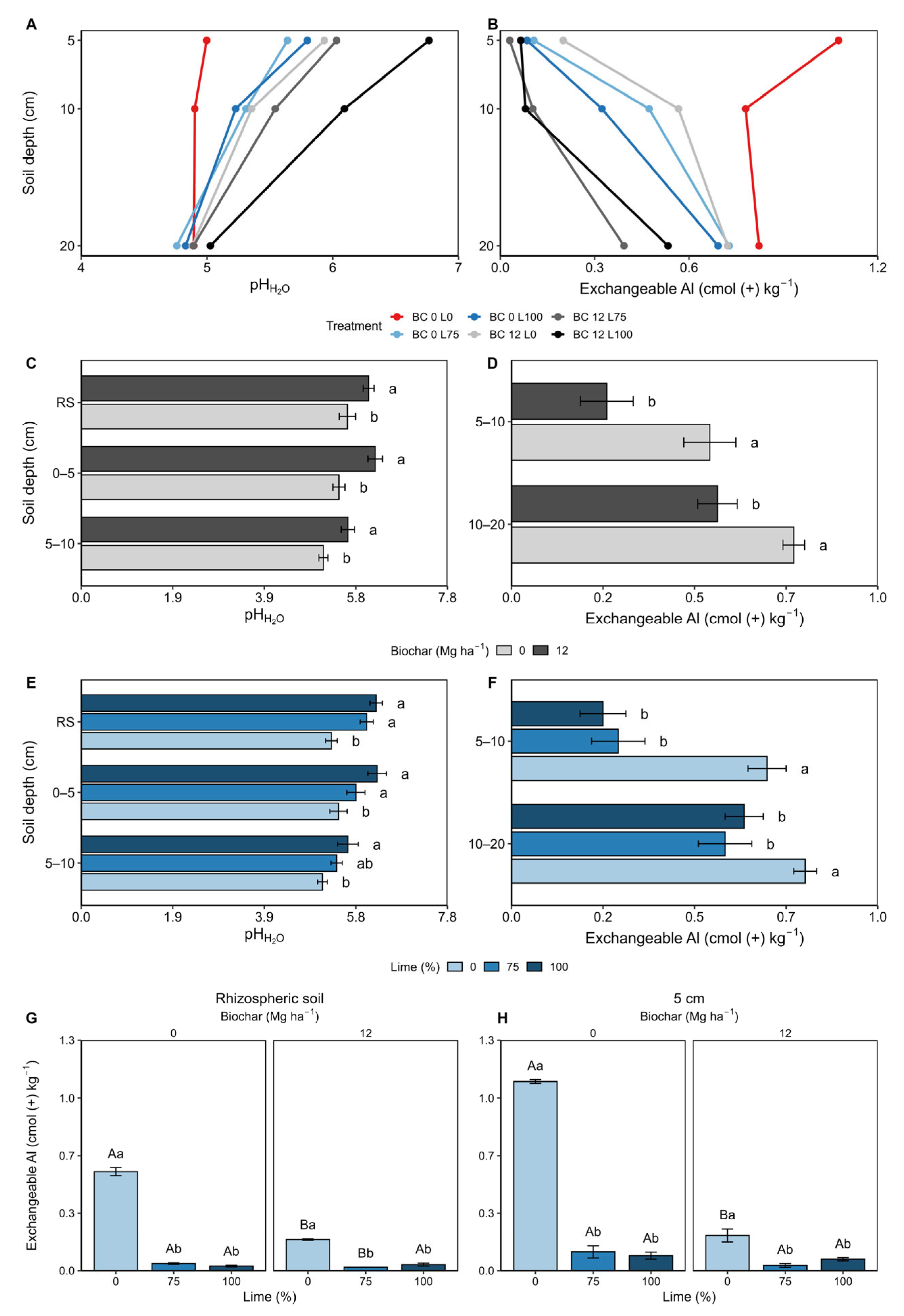
Biochar application increased soil pH and decreased exchangeable Al concentrations, with the strongest effects observed in the rhizosphere and surface soil layers (Figure 1A,B). In the absence of lime, biochar increased soil pH by 0.45, 0.77, and 0.52 units in the rhizosphere (RS), 0–5 and 5–10 cm, respectively, compared with BC0 (Figure 1C), whereas no significant pH effects were observed at 10–20 cm. No significant interaction between biochar and lime was detected for soil pH (p > 0.05); however, the highest pH was observed in BC12L100 at 0–5 cm (6.76). Biochar also reduced exchangeable Al as a main effect, particularly at depth, reaching 0.54 cmol(+) kg−1 at 10–20 cm under BC12 (Figure 1D).
Lime application increased soil pH in the rhizosphere and surface layers (Figure 1E), and reduced exchangeable Al as a main effect, with values of 0.20 cmol(+) kg−1 at 5–10 cm under the highest lime rate, and 0.61 cmol(+) kg−1 at 10–20 cm under full lime rate (L100) (Figure 1F). A significant interaction between biochar and lime was observed for exchangeable Al in the rhizosphere and 0–5 cm layer (Figure 1G,H), where BC12L75 resulted in the lowest Al concentrations (0.02 and 0.03 cmol(+) kg−1, respectively) (Figure 1G,H).
Figure 1. Depth distribution of soil pH (A) and exchangeable Al concentrations (B); the isolated effects of biochar (C,D) and lime (E,F) on soil pH and exchangeable Al. The interaction effects of biochar and lime on exchangeable Al at rhizosphere soil (RS) (G) and soil layer 0–5 cm (H) for each treatment 51 days after sowing. Biochar rates (Mg ha−1): BC0 = 0, BC12 = 12. Lime rates (% of the recommended rate to raise base saturation to 60%): L0 = 0, L75 = 75, and L100 = 100. Means followed by different lowercase letters indicate significant differences among treatments according to the Tukey test (p < 0.05). For interaction effects (G,H), lowercase letters compare lime doses within each biochar level, while uppercase letters compare biochar levels within each lime dose. Bars represent mean values ± standard error.
Agronomy 16 01246 g001
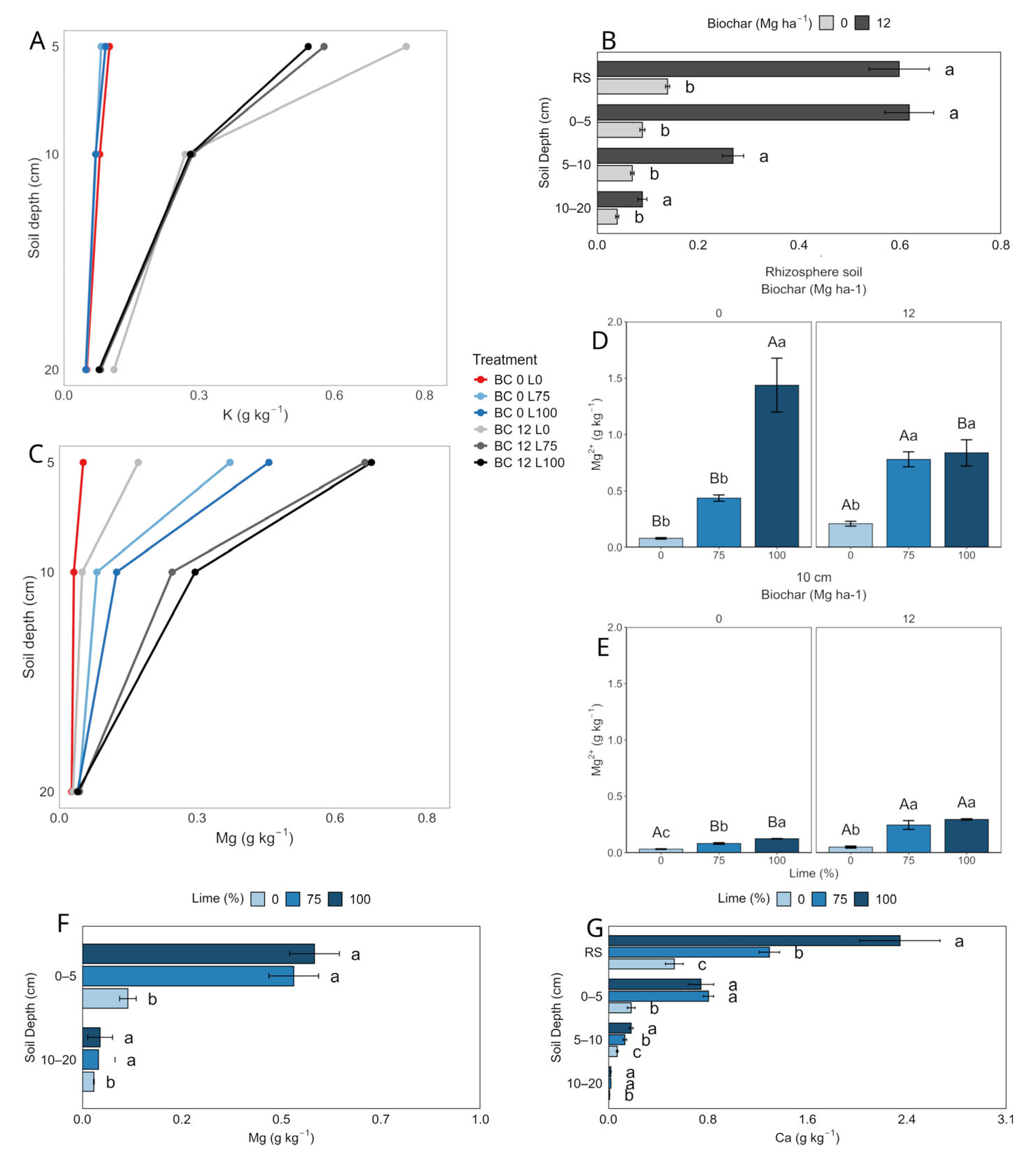
Biochar application increased K concentrations at all depths (Figure 2A), with the strongest effects in the RS and the 0–5 cm layer, reaching values up to 0.6 g kg−1, irrespective of lime rate (Figure 2B). Magnesium showed depth-dependent responses to biochar and lime application (Figure 2C). In the rhizosphere, the highest Mg was observed under BC0L100 (1.44 g kg−1), whereas biochar application reduced Mg to 0.83 g kg−1 under the same lime rate (BC12L100) (Figure 2D). At 5–10 cm, BC12L75 and BC12L100 resulted in higher Mg concentrations than BC0L100 (Figure 2E). At 0–5 cm, Mg increased in response to lime and biochar applied individually, while at 10–20 cm, Mg increased only in response to lime, with no detectable effect of biochar (Figure 2F). In contrast, Ca concentrations were affected only by liming, reaching 2.3 g kg−1 in the RS under the full lime rate (L100) (Figure 2G).
Figure 2. Depth profile of soil K concentrations as affected by biochar (BC) and lime (L) (A). Main effect of biochar on pseudo-total K concentrations in rhizospheric soil (RS) and in the 0–5, 5–10, and 10–20 cm layers (B). Depth profile of soil Mg concentrations as affected by biochar (BC) and lime (L) (C). Interaction effects of biochar and lime on pseudo-total Mg concentrations in rhizospheric soil (RS) (D) and in the 5–10 cm layer (E). Main effect of lime on pseudo-total Mg concentrations (F) and Ca concentrations (G). Biochar rates (Mg ha−1): BC0 = 0, BC12 = 12. Lime rates (Mg ha−1) (% of the recommended rate to raise base saturation to 60%): L0 = 0, L75 = 75, and L100 = 100. Means followed by different lowercase letters indicate significant differences among treatments according to the Tukey test (p < 0.05). For interaction effects (D,E), lowercase letters compare lime doses within each biochar level, while uppercase letters compare biochar levels within each lime dose. Bars represent mean values ± standard error.
Agronomy 16 01246 g002

3.2. Soil Microbiological Indicators

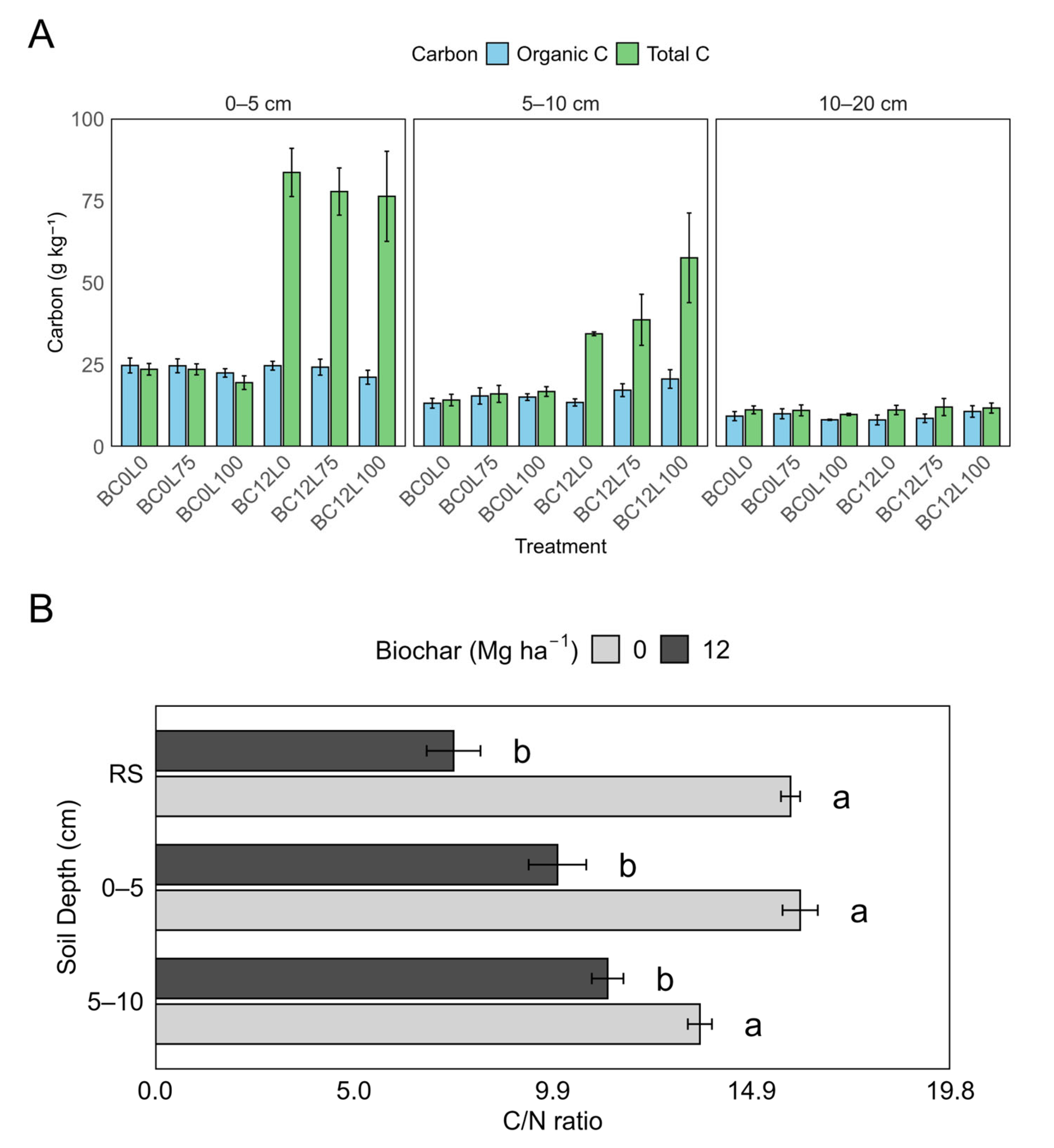
Biochar altered carbon pools and microbiological properties in a depth-dependent manner. Biochar increased total carbon (TC) in the 0–5 and 5–10 cm, whereas organic carbon (OC), determined by the Walkley–Black method, showed no significant treatment effects at any depth (Figure 3A). No changes in TC or OC were detected in the 10–20 cm layer and liming alone did not affect carbon pools across the soil profile. Biochar also increased total nitrogen (TN) in the RS, 0–5 cm and 5–10 cm, and C/N ratios decreased in the same layers (17% to 53%) (Figure 3B).
Figure 3. Effect of biochar on total and organic carbon contents at different soil depths (0–5, 5–10, and 10–20 cm) (A). Total carbon (TC) was determined via dry combustion, while organic carbon (OC) was measured using the Walkley–Black method. Effect of biochar on the C/N ratio in rhizospheric soil and in the 0–5 and 5–10 cm layers (B). Biochar rates (Mg ha−1): BC0 = 0, BC12 = 12. Lime rates (Mg ha−1) (% of the recommended rate to raise base saturation to 60%): L0 = 0, L75 = 75, and L100 = 100. Different letters indicate statistically significant differences between treatments within each depth according to Tukey’s test (p < 0.05). Bars represent mean values ± standard error.
Agronomy 16 01246 g003
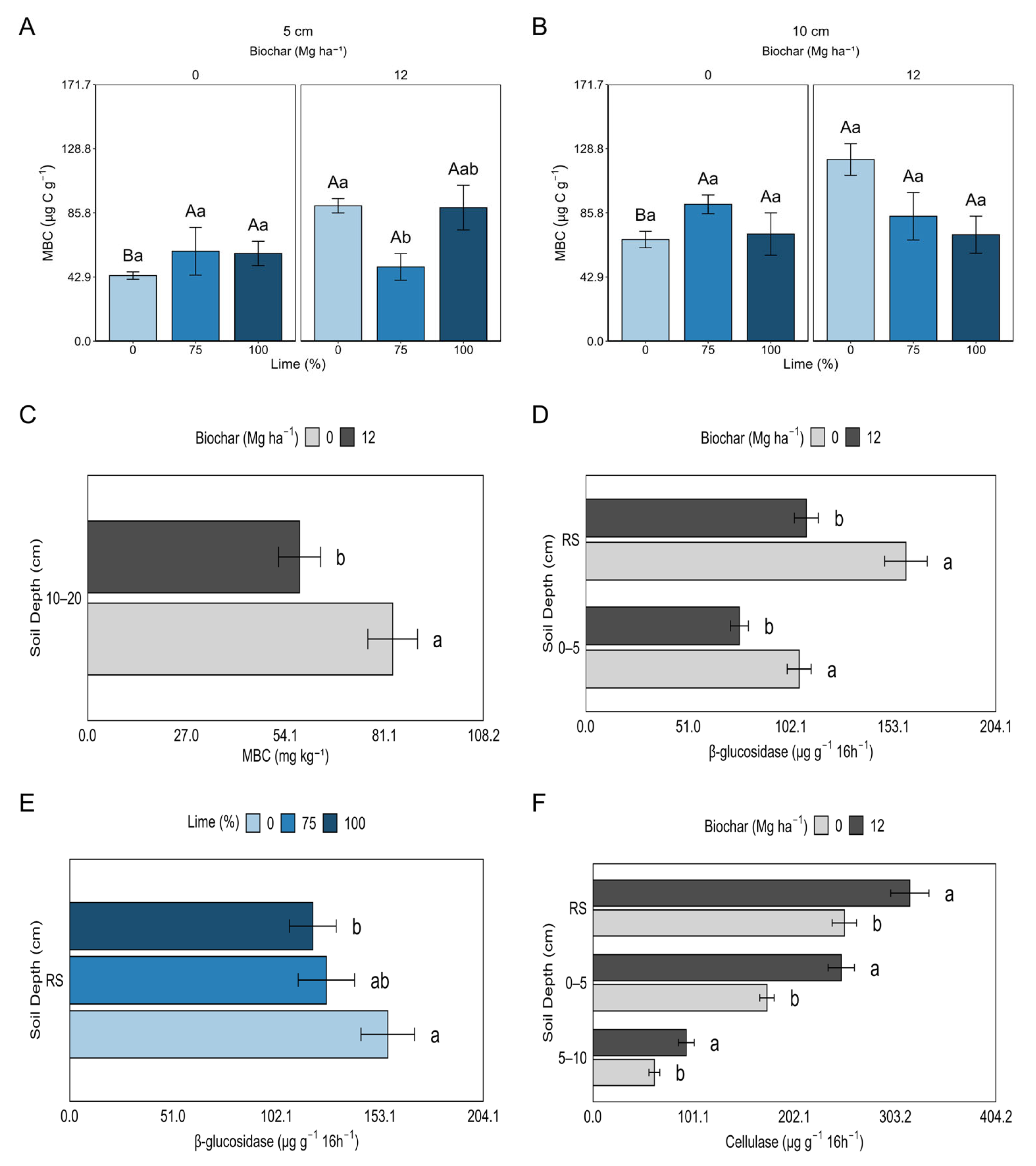
Microbial biomass carbon (MBC) responded to biochar addition in a depth-dependent manner. The highest values occurred in RS, where no treatment effects were detected (≈163 µg C g−1). At 0–5 and 5–10 cm, BC12L0 showed higher MBC than BC0L0, and exceeded the lime treatments (Figure 4A,B). In contrast, at 10–20 cm, biochar reduced MBC relative to the control (BC0) as a main effect (Figure 4C), while lime had no detectable effect. Enzyme activity exhibited contrasting responses. β-glucosidase activity decreased in RS and 0–5 cm under biochar, and a similar reduction was observed with liming, as a main effect, with a reduction of 23–31% (Figure 4D,E). In contrast, biochar stimulated cellulase activity, with increases in RS and in the 0–5 and 5–10 cm layers (20 to 34%) (Figure 4F). No significant effect was detected for both enzymes in the 10–20 cm layer.
Figure 4. Interaction effects of biochar and lime on MBC soil layer 0–5 cm (A) and 5–10 (B). Main effect of biochar on MBC (C) and on β-glucosidase (D). Main effect of lime in RS for β-glucosidase (E). Main effect of biochar on cellulase activity at different soil depths (F). Biochar rates (Mg ha−1): BC0 = 0, BC12 = 12. Lime rates (Mg ha−1) (% of the recommended rate to raise base saturation to 60%): L0 = 0, L75 = 75, and L100 = 100. Means followed by different lowercase letters indicate significant differences among treatments according to the Tukey test (p < 0.05). For interaction effects (A,B), lowercase letters compare lime doses within each biochar level, while uppercase letters compare biochar levels within each lime dose. Bars represent mean values ± standard error.
Agronomy 16 01246 g004

3.3. Plant Nutrient Accumulation and Productivity

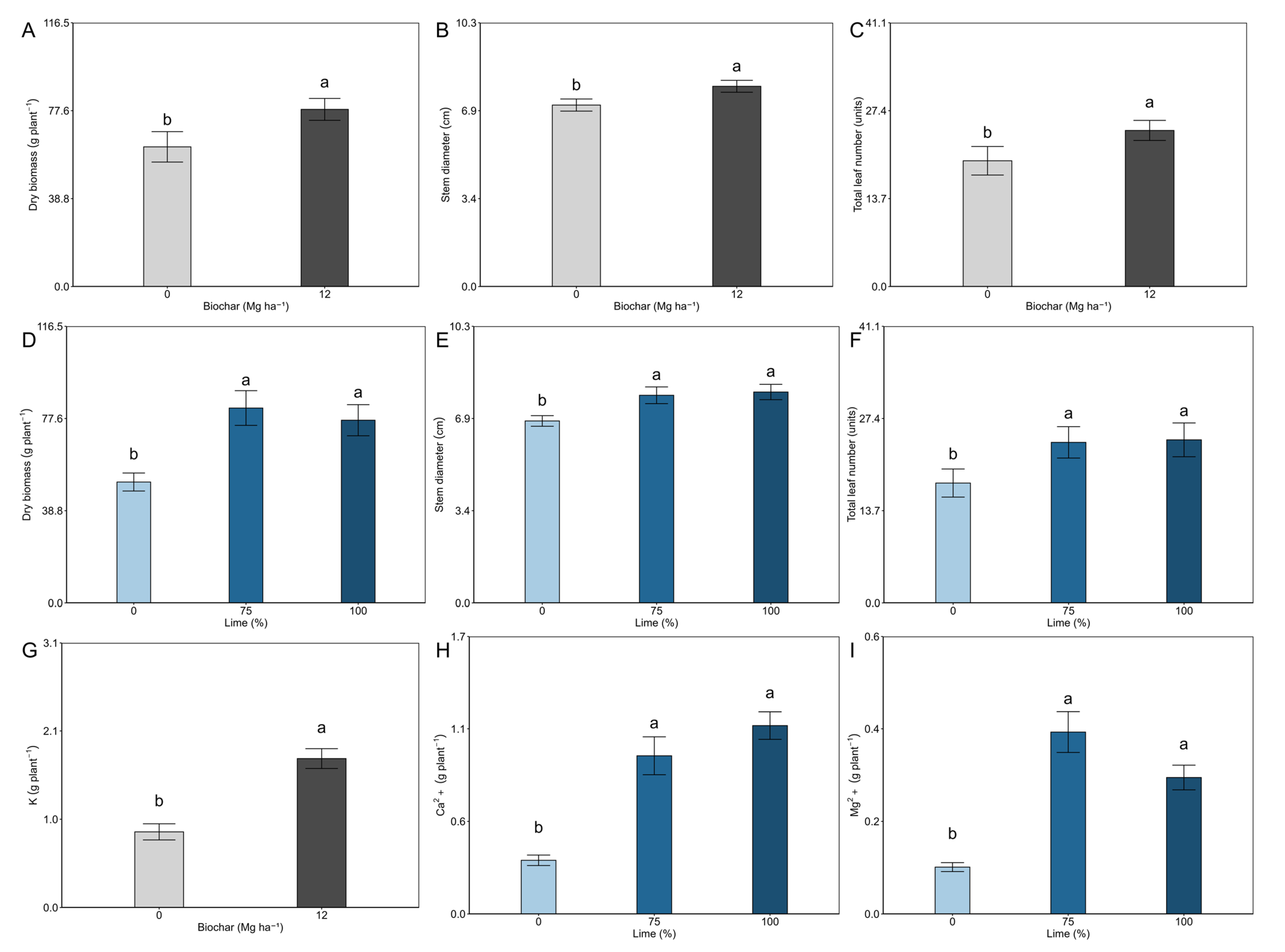
Biochar application increased cowpea aboveground biomass, stem diameter, and the number of trifoliate leaves (Figure 5A–C). Plants under BC12 reached 78.2 g plant−1 of aboveground biomass, exceeding BC0, with similar responses observed for stem diameter and leaf number. Liming also enhanced vegetative growth, with aboveground biomass reaching 77 g plant−1 and up to 24 trifoliate leaves plant−1 under the highest lime rate (L100) (Figure 5D–F). Biochar application significantly increased potassium uptake in the aboveground plant parts, nearly doubling K accumulation relative to BC0 (0.88 to 1.74 g plant−1), with no significant effect of lime (Figure 5G). In contrast, the highest accumulations of Ca and Mg occurred at the maximum lime rate (L100), without a significant effect of biochar (Figure 5H,I). No treatment altered plant N accumulation (p > 0.05).
Figure 5. Isolated effect of biochar on dry biomass (A), stem diameter (B), total leaf number (C), and K+ (g plant −1) accumulation (G), 51 days after sowing. Isolated effect of lime on dry biomass (D), stem diameter (E), total leaf number (F), Ca2+ (g plant −1) (H), and Mg2+ (g plant −1) accumulation (I). Biochar rates (Mg ha−1): BC0 = 0, BC12 = 12. Lime rates (Mg ha−1) (% of the recommended rate to raise base saturation to 60%): L0 = 0, L75 = 75, and L100 = 100. Different letters indicate statistically significant differences between treatments within each depth according to Tukey’s test (p < 0.05). Bars represent mean values ± standard error.
Agronomy 16 01246 g005
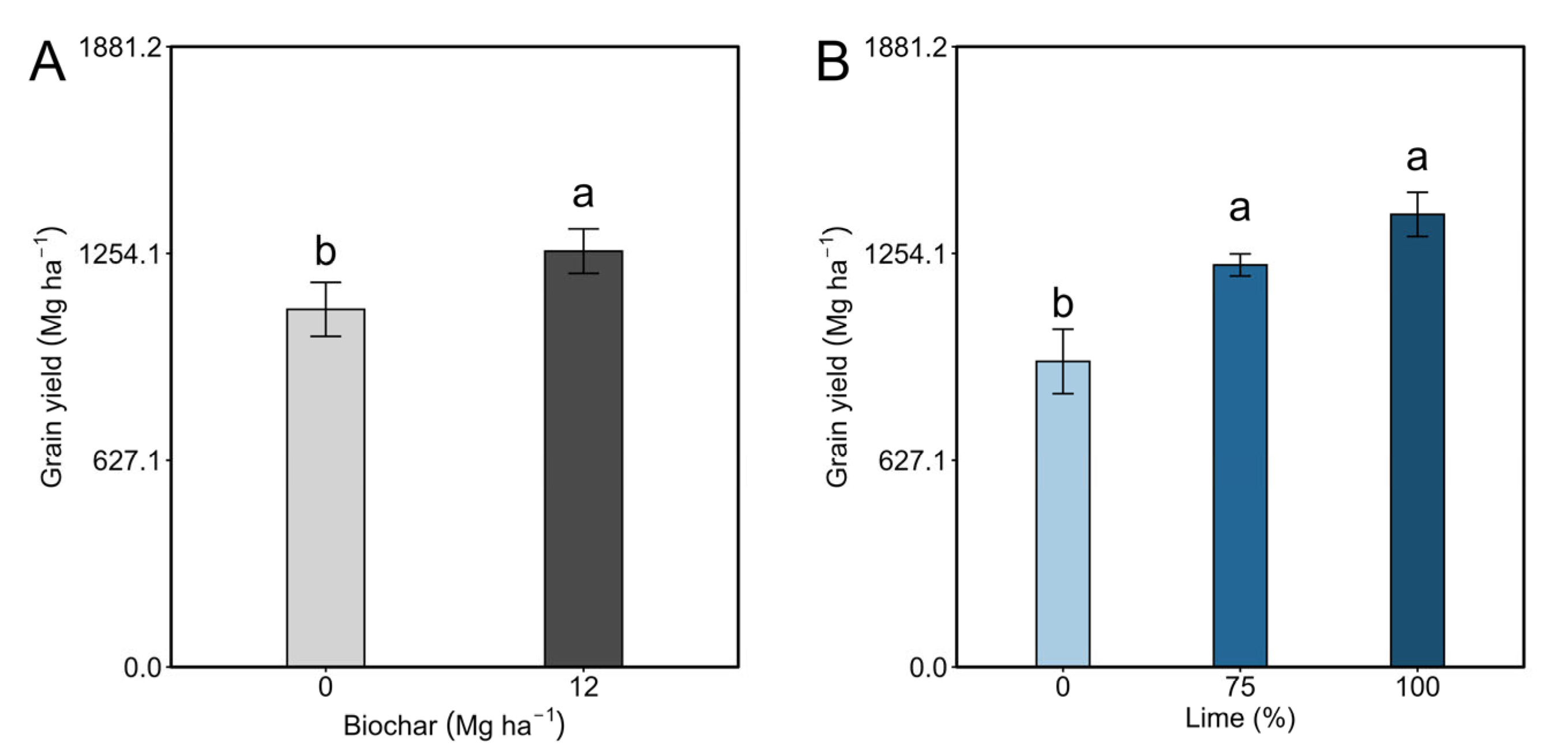
Grain yield increased in response to both amendments (Figure 6A,B). Biochar application increased yield by 16.3% (1261.08 kg ha−1), while lime increased yield by 48% (1372.53 kg ha−1). Although no biochar × lime interaction was detected (p > 0.05), the highest grain yield was observed under the combined treatment BC12L100 (1459.8 kg ha−1), approximately 13.6% higher than that obtained with the full lime rate without biochar (BC0L100). In addition, grain yield under BC12L75 did not differ from that obtained with the full lime rate without biochar (Table S2).
Figure 6. Main effect of biochar (A) and lime (B) on grain yield (kg ha−1). Different letters indicate statistically significant differences between treatments according to Tukey’s test (p < 0.05). Biochar rates (Mg ha−1): BC0 = 0, BC12 = 12. Lime rates (%) (% of the recommended rate to raise base saturation to 60%): L0 = 0, L75 = 75, and L100 = 100. Bars represent mean values ± standard error.
Agronomy 16 01246 g006

3.4. Multivariate Analysis and Correlation

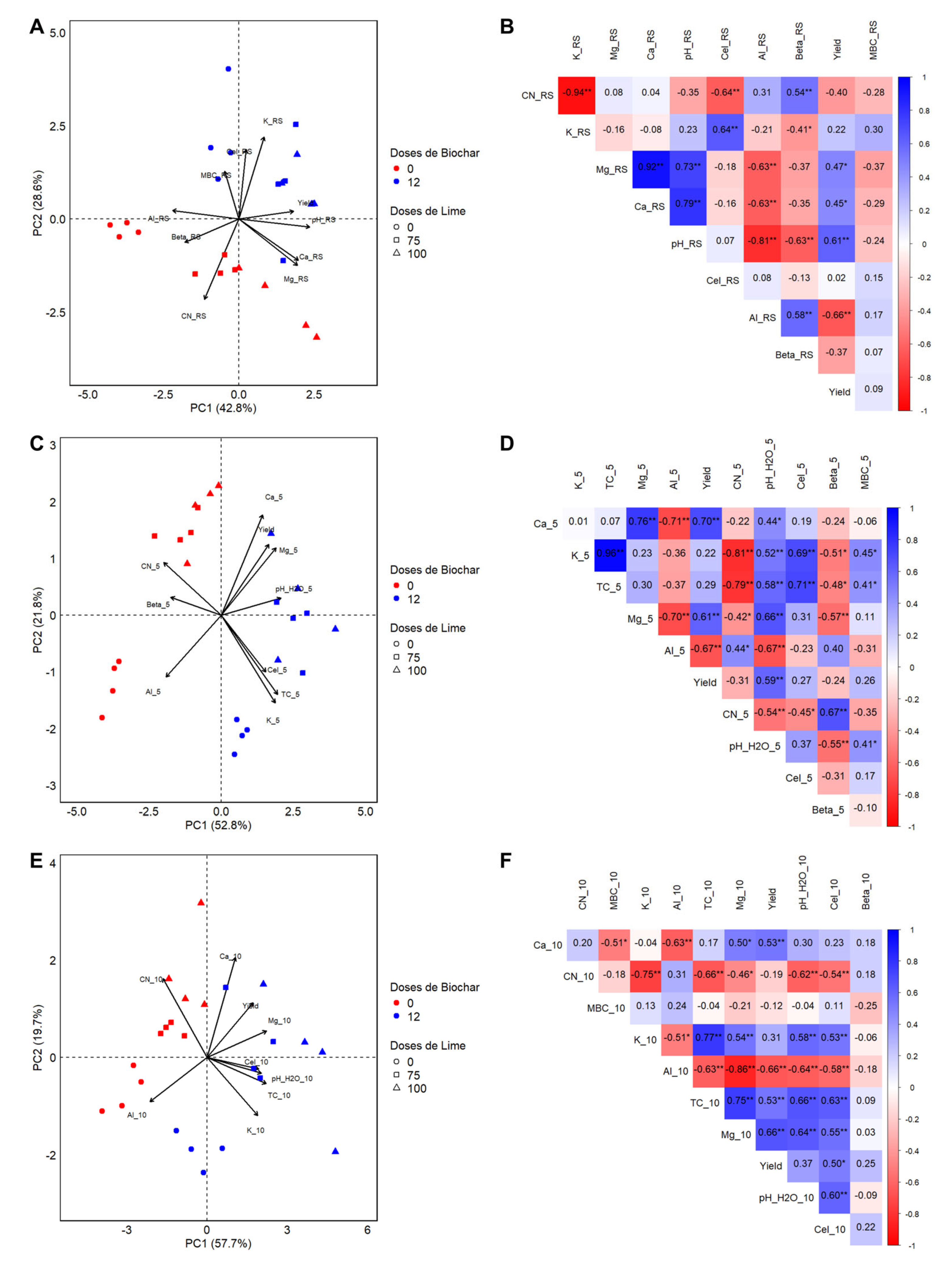
Principal component analysis (PCA) explained 71.4%, 74.6%, and 77.4% of the total variance in the rhizosphere (RS), 0–5 cm and 5–10 cm layers, respectively (Figure 7). In the rhizosphere (RS), unamended soils (BC0L0) clustered with higher levels of exchangeable Al, while biochar treatments were associated with higher levels of K, MBC, and cellulase activity. The Pearson correlation matrix supported this pattern (Figure 7).
In the 0–5 cm layer, combined biochar and lime treatments were associated with higher levels of K, cellulase activity, TC, pH, and grain yield, while unamended soils clustered with higher Al. The correlation map confirmed this pattern, highlighting a positive correlation between K and TC (r = 0.96), pH (r = 0.52), and cellulase activity (r = 0.69).
In the 5–10 cm layer, PCA differentiated the biochar treatments, which were associated with higher levels of K, TC, Mg, and pH, while the unamended soils remained related to higher Al. The correlation matrix showed a strong negative association between Al and K (r = –0.51) and between Al and Mg (r = –0.86), as well as positive correlation of total carbon with pH (r = 0.66) and Mg (r = 0.75).
These results indicate that biochar, particularly when combined with lime, promoted chemical improvements up to 10 cm, reducing the toxic effect of aluminum and increasing soil K concentration. Variables with low sampling adequacy, including MBC in the 10–20 cm layer and β-glucosidase activity in the 5–10 cm layer, were excluded from the PCA due to insufficient Kaiser–Meyer–Olkin (KMO) values (< 0.5), according to Kaiser’s criterion.
Figure 7. Principal component analysis (PCA) and Pearson correlation matrices of soil chemical and biological attributes and yield under biochar and lime application at different soil depths. (A,C,E) PCA biplots for rhizospheric soil (RS), 0–5 cm and 5–10 cm depths. PC1 and PC2 indicate the percentage of explained variance. Arrows represent variable loadings. (B,D,F) Pearson correlation heatmaps for each soil depth. Asterisks denote significant correlations (* p < 0.05; ** p < 0.01). Colors indicate biochar doses (0 and 12 t ha−1), and symbols represent lime doses (0, 75, and 100% of the recommended rate).
Agronomy 16 01246 g007

4. Discussion

4.1. Effects of Açaí Biochar on Soil Acidity and Cation Dynamics

The application of açaí biochar increased pH and reduced exchangeable Al throughout the soil profile. In surface layers (0–10 cm), the biochar increased pH to values comparable to those observed with 100% of the lime rate, reaching the ideal range for nutrient availability (5.5–7.0) [41]. In the 10–20 cm layer, the reduction in exchangeable Al exceeded that achieved with 100% of the lime rate, suggesting the possible operation of distinct amelioration mechanisms independent of classical carbonate neutralization and not reliant on the downward mobility of lime in subsoil horizons [42,43]. Given the low calcium carbonate equivalent value (CCE = 4.2%) and low ash content (3.8%) of the açaí biochar, these effects are unlikely to be fully explained by conventional liming reactions and instead appear to be consistent with processes described in the literature, such as Al3+ complexation by oxygenated groups on the biochar surface (–COOH, –OH), whose protonation and deprotonation may increase soil buffering capacity (Acid-BC), as well as the adsorption and coprecipitation of Al with amorphous silicates released by the biochar [44,45]. Previous characterization of the same açaí-derived biochar (Sample S1), as reported in [24], indicated the presence of oxygen-containing functional groups based on FTIR analysis, including bands assigned to alcohol and ether functionalities (e.g., 1030 and 1005 cm−1), which may act as reactive sites for sorption processes [24]. Complementary SEM and EDS analyses further revealed a highly porous and heterogeneous surface morphology dominated by carbon, with low contents of inorganic elements such as Ca. Although these features were not directly assessed in the present study, they are consistent with low intrinsic liming capacity and suggest a potential for surface-mediated interactions [24]. The dissociation between pH and Al at further depth may indicate the migration of soluble organic compounds from the biochar capable of complexing Al3+, or the leaching of exchangeable bases from the surface layers to the subsoil [9,46]. Such non-carbonate mechanisms may contribute to greater functional resilience of highly weathered soils, where subsoil acidity often constrains root development and nutrient uptake.
Biochar increased pseudo-total K concentrations by 3 to 5 fold, reaching up to 20 cm in depth, a result consistent with its high intrinsic K content and the formation of soluble and exchangeable K fractions at moderate pyrolysis temperatures [47]. The porous structure, surface area, and high cation exchange capacity of biochar likely enhanced nutrient retention and moderated leaching, while potential stimulation of K-solubilizing microorganisms may have further contributed to this enrichment [48]. In K-deficient acidic soils, biochar can increase K-solubilizing bacteria and allow reductions of up to 40% in K fertilizer inputs, with long-term impacts on microbial community structure persisting for at least four years after application [49,50].
In contrast, biochar did not alter pseudo-total Ca concentrations and their dynamics were dominated by liming. The Mg content in the soil decreased in the combination of biochar with the maximum lime rate, an effect explained by the antagonism and ionic competition between K, Ca, and Mg [51,52]. Some studies report an increase in magnesium and calcium in the soil after biochar incorporation [14,53], while reductions in the release of these ions have also been described [53], as well as the absence of significant changes [54]. The discrepancies in the results are due to the properties of the raw materials used, in addition to the type and temperature of pyrolysis, application strategies, soil type, and time spent evaluating the application of biochar to the soil [55,56]. Overall, biochar primarily affected soil pH, exchangeable Al, and K, whereas Ca and Mg were mainly controlled by liming, with Mg showing variable responses under combined application. Thus, the initial hypothesis was only partially supported, as the expected increases in Ca2+ and Mg2+ did not occur. Collectively, these findings indicate that açaí biochar mitigates Al toxicity and enhances K supply, offering important implications for improving fertility management in highly weathered tropical soils under conditions of nutrient imbalance. It is important to note that, despite the agronomic benefits of açaí-waste biochar, its practical application may depend on production systems and application strategies, as suggested by previous economic assessments [57].

4.2. Açaí Biochar Enhances Microbial Biomass and Selectively Regulates Carbon Dynamics and Cycling Enzymes in Tropical Ferralsols

Açaí biochar induced shifts in microbial activity and carbon dynamics in the upper soil profile. Increases in total carbon (TC), without an effect on organic carbon (OC) estimated by the Walkley–Black method, may indicate the predominance of recalcitrant carbon fractions, consistent with the low H/C and O/C ratios of the biochar material [34,58,59]. This apparent discrepancy likely reflects methodological limitations, as the Walkley–Black method is based on dichromate oxidation and incompletely recovers recalcitrant carbon fractions such as pyrogenic carbon [60]. Moreover, this method primarily quantifies easily oxidizable carbon and may not adequately represent total soil organic carbon in systems enriched with stable carbon inputs, whereas dry combustion provides a more comprehensive estimate of total carbon [61]. Therefore, the absence of detectable changes in OC should not be interpreted as a lack of carbon accumulation, but rather as a limitation in detecting biochar-derived carbon. In this context, total carbon (TC) likely provides a more reliable indicator of carbon accumulation in biochar-amended soils. Estimates suggest that up to 97% of the added TC corresponds to recalcitrant C, reinforcing the long-term persistence and stability of biochar in the soil [24,62]. No effects were detected at 10–20 cm, suggesting the limited vertical mobility of biochar in the soil profile [13].
Despite its chemical stability, biochar application was associated with increased microbial biomass carbon (MBC) in the 0–10 cm layers, a response commonly reported in acidic soils with nutritional limitations [63,64]. Microbial responses may be associated with physicochemical attributes of biochar, including its carbon content, mineral composition, and porosity and with soil conditions such as pH and organic C [65]. The positive correlations between MBC, soil pH, pseudo-total of K, and TC are consistent with this interpretation and may reflect improved nutrient status and the creation of favorable microbial colonization niches [66]. In contrast, no significant MBC response was detected in the rhizosphere, which already exhibited the highest MBC values, likely reflecting the strong influence of root-driven microbial activity [67].
Biochar also induced a functional divergence in soil enzymatic profiles, with increased cellulase activity and decreased β-glucosidase activity. Cellulase activity increased and may be associated with greater carbon substrate availability and the potential co-localization of enzymes and substrates on biochar surfaces [68], reinforced by strong correlations with soil TC. The positive correlation with pseudo-total of K may indicate enhanced microbial activity in response to nutrient retention and availability associated with the biochar application [69]. In contrast, the decrease in β-glucosidase activity may be related to increased soil pH, improved microbial carbon-use efficiency in the microenvironment formed at the biochar–soil interface (“biochar-sphere”), or to the potential sorption of enzymes, substrates, or reaction products on biochar surfaces [63]. This response is also consistent with the predominance of recalcitrant carbon forms, which may limit the availability of easily degradable substrates required for β-glucosidase activity. The strong negative correlation between β-glucosidase activity and soil pH further suggests a possible pH-driven suppression, a mechanism widely documented for this enzyme mainly under less acidic conditions [68,70]. The opposite behavior of cellulase and β-glucosidase may indicate that biochar selectively modulated enzymatic activities involved in carbon degradation. However, given that microbial community composition and substrate availability were not directly assessed, further studies incorporating temporal dynamics and microbial interactions are required to better elucidate these processes [71].
The reduction in the C/N ratio in the same layers where MBC and cellulase increased may indicate changes in microbial carbon and nitrogen dynamics, potentially associated with shifts in substrate utilization and microbial activity. These patterns may also be influenced by the limited recovery of biochar-derived carbon by the Walkley–Black method. In this legume-based system, additional nitrogen inputs from biological fixation likely contributed to this N enrichment, alleviating microbial N limitation and allowing more efficient use of carbon substrates [72,73]. Overall, these results suggest that biochar application may promote a partial dissociation between carbon accumulation and short-term microbial responses, possibly associated with shifts in carbon quality, nutrient availability, and microhabitat conditions in highly weathered tropical Ferralsols. Taken together, biochar effects were depth-dependent, characterized by increases in TC and MBC in surface layers, no detectable changes in OC as determined by the Walkley–Black method, and a selective divergence in enzymatic activities, indicating shifts in carbon quality and microbial functioning. These findings support hypothesis (ii), as açaí biochar increased microbial biomass and selectively modulated enzymatic activities involved in carbon cycling.

4.3. Potential of Açaí Biochar to Improve Cowpea Performance and Reduce Lime Dependency

The application of açaí biochar substantially improved cowpea growth and nutritional status, even in the absence of lime. Increases in aboveground biomass, stem diameter, and number of trifoliate leaves under biochar were comparable to those observed under the full lime rate. Similar increases in legume biomass following biochar application have been documented previously [74] and are commonly attributed to improvements in soil chemical conditions, stimulation of microbial processes, and increases in K retention and uptake [47,48].
Potassium was the nutrient most responsive to biochar application. Plant K uptake nearly doubled in BC12 relative to BC0, with no effect from lime, reflecting the high soil K concentrations promoted by açaí biochar. In contrast, Ca and Mg accumulation in cowpea was primarily driven by liming, consistent with dolomitic lime as the dominant source of these cations in highly weathered Ferralsols [6,75]. Although açaí biochar increased soil Mg concentrations, this effect was not translated into greater plant uptake, likely due to antagonistic interactions among K, Ca, and Mg at root absorption sites [76]. Such competitive relations are well documented in tropical crops, where high K availability enhances tissue K but reduces Mg translocation to shoots [76,77]. Magnesium levels remained within adequate ranges and no deficiency symptoms were observed [78]. Plant N accumulation was not affected by any treatment, consistent with evidence that biochar does not necessarily enhance N assimilation in legume crops [74].
Although biochar and lime acted additively rather than interactively, their combined application resulted in the highest cowpea grain yield. The BC12L100 treatment produced grain yield approximately 13.6% higher than that obtained with the full lime rate without biochar (BC0L100). Importantly, grain yield under BC12L75 did not differ from that obtained under BC0L100, indicating that biochar application allowed a 25% reduction in lime rate without yield penalties under the conditions of this study. Nevertheless, achieving maximum yield still required the full lime rate in combination with biochar, reinforcing a complementary, but not fully substitutive, role of biochar relative to liming. Taken together, biochar primarily enhanced plant growth and K nutrition, whereas liming controlled Ca and Mg accumulation, and their combined application maximized grain yield, indicating complementary but not fully substitutive effects. These results partially support hypothesis (iii), demonstrating that açaí biochar improved plant growth and grain yield and allowed a partial reduction in lime input, although maximum productivity was achieved only when biochar was combined with the full lime rate. Similar additive responses to combined soil amendments have been reported in tropical agroecosystems, where different inputs act through partially distinct mechanisms affecting soil fertility and crop performance [45,79].
The potential of açaí biochar to reduce mineral fertilizer inputs was not directly evaluated, as all treatments received the same rates of mineral N, P, and K fertilization. Therefore, while biochar substantially increased soil and plant K, the present results do not allow conclusions regarding the substitution of mineral fertilizers. Future studies should explicitly evaluate reduced K fertilization rates and combined reductions in lime inputs to quantify nutrient-use efficiency and the potential for input substitution under field conditions in acidic tropical soils. Furthermore, the selected rate (12 Mg ha−1) was based on agronomic relevance and field applicability; however, a broader range of biochar application rates should be explored to better characterize response curves and refine recommendations for tropical Ferralsols under different management conditions.

5. Conclusions

The application of açaí biochar reduced soil acidity and exchangeable Al, significantly improving soil fertility and cowpea performance in highly weathered tropical soils. When combined with liming, biochar promoted additive effects on acidity correction, resulting in the highest grain yields under the full lime rate. Biochar application also increased pseudo-total K concentrations, enhanced total soil carbon, and modulated microbial functioning by increasing microbial biomass carbon and cellulase activity.
Overall, the initial hypotheses were partially supported. Biochar increased soil pH, reduced exchangeable Al and enhanced K availability, but did not significantly affect Ca and Mg, which were primarily influenced by liming. In addition, biochar enhanced microbial biomass and selectively modulated enzymatic activities involved in carbon cycling. Improvements in plant growth and grain yield, together with the possibility of reducing lime input without yield penalties, highlight the agronomic potential of açaí biochar, although it did not fully replace liming.
Collectively, these findings demonstrate that açaí biochar acts as a complementary soil amendment, contributing to nutrient supply, particularly K, chemical amelioration of soil acidity and the regulation of soil microbial process. Overall, the results demonstrated that açaí biochar, applied alone or in combination with lime, represents a sustainable management strategy to improve soil fertility, nutrient status, and crop productivity in acidic tropical systems. By valorizing regional agro-industrial residues, this approach supports the Amazonian bioeconomy, improving soil functional resilience, and contributes to soil conservation and potential climate-mitigation pathways. Future research should focus on evaluating a wider range of biochar application rates, long-term field performance, and the potential for reducing mineral fertilizer inputs under tropical conditions to better define sustainable management strategies.

Supplementary Materials

The following supporting information can be downloaded at: https://www.mdpi.com/article/10.3390/agronomy16131246/s1, Figure S1: The annual radiation at the study area in 2022; Figure S2: Representation of the experimental area used in the study. (A) Randomized block design with six treatments (T1–T6) and four replicates. (B) Plant arrangement scheme with indication of the effective plot (orange rectangle). (C) Furrow preparation for soil amendment application. (D) General view of the experimental field during cowpea (Vigna unguiculata L. Walp) development; Table S1: The p-values and coefficients of variation (CV) for variables evaluated in a field experiment with cowpea (Vigna unguiculata) grown on a Ferralsol, soil and plant variables (51 days after sowing) and yield (72 days after sowing), under biochar and lime application; Table S2: Grain yield of cowpea (Vigna unguiculata (L.) Walp.) grown in a Ferralsol under biochar and lime application, 72 days after sowing. Different uppercase letters indicate no significant differences between biochar rates within each lime level, whereas different lowercase letters indicate significant differences among lime rates within each biochar level (Tukey’s test, p < 0.05); Table S3: Soil chemical attributes under biochar and lime application at different soil depths. Values represent mean ± standard deviation. RS = rhizosphere. Biochar rates (Mg ha−1): BC0 = 0, BC12 = 12. Lime rates (Mg ha−1) (% of the recommended rate to raise base saturation to 60%): L0 = 0, L75 = 75, and L100 = 100; Table S4: Soil carbon fractions and microbial activity under biochar and lime application at different soil depths. Values represent mean ± standard deviation. RS = rhizospheric soil. Biochar rates (Mg ha−1): BC0 = 0, BC12 = 12. Lime rates (Mg ha−1) (% of the recommended rate to raise base saturation to 60%): L0 = 0, L75 = 75, and L100 = 100; Table S5: Growth, nutrient accumulation, biomass, and grain yield of cowpea under biochar and lime application. Values represent mean ± standard deviation. TLN = total leaf number; SD = stem diameter. Biochar rates (Mg ha−1): BC0 = 0, BC12 = 12. Lime rates (Mg ha−1) (% of the recommended rate to raise base saturation to 60%): L0 = 0, L75 = 75, and L100 = 100.

Author Contributions

C.K.A.d.O.D.: Conceptualization, Methodology, Investigation, Data curation, Formal analysis, Validation, Visualization, Writing—Original Draft, Writing—Review and Editing, funding acquisition. A.L.F.: Methodology, Investigation, Data curation, Validation, Visualization, Writing—Original Draft, Writing—Review and Editing. F.E.D.: Investigation, Writing—Review and Editing. H.M.S.: Conceptualization, Methodology, Investigation, Writing—Review and Editing. A.R.d.O.B.: project administration. V.J.: project administration. N.P.d.S.F.: Supervision. C.S.d.C.M.-d.-S.: Supervision, Writing—Review and Editing. All authors have read and agreed to the published version of the manuscript.

Funding

This research and the open access publication were funded by national funds through FCT—Fundação para a Ciência e a Tecnologia, I.P., under project UID/00239/2025 (DOI: 10.54499/UID/00239/2025) of the Forest Research Centre. This work was also supported by FCT through LA/P/0092/2020 of Associate Laboratory TERRA (DOI: 10.54499/LA/P/0092/2020), and by Amazonas State Research Foundation (Fundação de Amparo à Pesquisa do Estado do Amazonas—FAPEAM) through Notice Number 001/2021—Women in Science, Process Number 01.02.016301.01742/2021. The Fundação de Amparo à Pesquisa do Estado de São Paulo (FAPESP) also provided a Postdoctoral fellowship to A.L. Florentino (grant numbers 2022/01698-0 and 2023/12181-1).

Data Availability Statement

The original contributions presented in this study are included in the article/Supplementary Materials. Further inquiries can be directed to the corresponding author.

Acknowledgments

This work was funded by national funds through FCT—Fundação para a Ciência e a Tecnologia, I.P., under project UID/00239/2025 (DOI: 10.54499/UID/00239/2025), and by the European Union—NextGenerationEU under projects UID/PRR/00239/2025 (DOI: 10.54499/UID/PRR/00239/2025) and UID/PRR2/00239/2025 (DOI: 10.54499/UID/PRR2/00239/2025). The authors gratefully acknowledge the support received throughout all stages of this research from the Federal Institute of Education of Amazonas (IFAM, Brazil) and the National Institute of Amazonian Research (INPA, Brazil). Additional support was provided by the Doctoral Program in Climate Change and Sustainable Development Policies, the Institute of Social Sciences of the University of Lisbon (ICS-UL), the School of Agriculture of the University of Lisbon (ISA-UL), and the financial support of the Amazonas State Research Foundation (FAPEAM).

Conflicts of Interest

The authors declare no conflicts of interest.

References

  1. Kong, F.; Lu, S. Inorganic Amendments Improve Acidic Paddy Soils: Effects on Soil Properties, Al Fractions, and Microbial Communities. Chemosphere 2023, 331, 138758. [Google Scholar] [CrossRef] [PubMed]
  2. Paul, K.I.; Scott Black, A.; Conyers, M.K. Development of Acidic Subsurface Layers of Soil under Various Management Systems. In Advances in Agronomy; Academic Press: Cambridge, MA, USA, 2003; Volume 78, pp. 187–214. [Google Scholar]
  3. Bolan, N.S.; Adriano, D.C.; Curtin, D. Soil Acidification and Liming Interactions with Nutrientand Heavy Metal Transformationand Bioavailability. In Advances in Agronomy; Academic Press: Cambridge, MA, USA, 2003; Volume 78, pp. 215–272. [Google Scholar]
  4. Dai, Z.; Zhang, X.; Tang, C.; Muhammad, N.; Wu, J.; Brookes, P.C.; Xu, J. Potential Role of Biochars in Decreasing Soil Acidification—A Critical Review. Sci. Total Environ. 2017, 581–582, 601–611. [Google Scholar] [CrossRef] [PubMed]
  5. Sparks, D.L.; Singh, B.; Siebecker, M.G. (Eds.) Chapter 9—The Chemistry of Soil Acidity. In Environmental Soil Chemistry, 3rd ed.; Academic Press: Boston, MA, USA, 2024; pp. 381–410. [Google Scholar]
  6. Moreira, S.G.; de Moraes, F.A.; Peixoto, D.S.; Silva, J.C.R.; Gaudencio, J.R.F.; Silva, B.M.; Silva, M.M.; Macedo, J.R. Deep Incorporation of High Limestones Rates Affects the Macro and Micronutrients Availability and the Accumulated Grain Yield in Three Acidic Sites in Brazil. Eur. J. Agron. 2024, 154, 127074. [Google Scholar] [CrossRef]
  7. HOME—Abracal. Available online: https://abracal.com.br/site/ (accessed on 5 August 2025).
  8. Xu, P.; Gao, Y.; Cui, Z.; Wu, B.; Yan, B.; Wang, Y.; Zaitongguli, K.; Wen, M.; Wang, H.; Jing, N.; et al. Research Progress on Effects of Biochar on Soil Environment and Crop Nutrient Absorption and Utilization. Sustainability 2023, 15, 4861. [Google Scholar] [CrossRef]
  9. Zhang, X.; Yuan, X.; Yang, X.; Zhang, H.; Han, L. Environmental Leaching of Biochar: A Full Factorial Analysis of Composition and Redundancy. Biomass Conv. Bioref. 2025, 15, 19993–20007. [Google Scholar] [CrossRef]
  10. Lehmann, J.; Joseph, S. Biochar for Environmental Management: Science, Technology and Implementation; Routledge: London, UK, 2015. [Google Scholar]
  11. IPCC. Climate Change and Land: An IPCC Special Report on Climate Change, Desertification, Land Degradation, Sustainable Land Management, Food Security, and Greenhouse Gas Fluxes in Terrestrial Ecosystems; Shukla, P.R., Skea, J., Buendia, E.C., Masson-Delmotte, V., Pörtner, H.-O., Roberts, D.C., Zhai, P., Slade, R., Connors, S., van Diemen, R., et al., Eds.; Intergovernmental Panel on Climate Change (IPCC): Geneva, Switzerland, 2019. [Google Scholar]
  12. Kaschuk, G.; Alberton, O.; Hungria, M. Three Decades of Soil Microbial Biomass Studies in Brazilian Ecosystems: Lessons Learned about Soil Quality and Indications for Improving Sustainability. Soil Biol. Biochem. 2010, 42, 1–13. [Google Scholar] [CrossRef]
  13. Gross, A.; Bromm, T.; Glaser, B. Soil Organic Carbon Sequestration after Biochar Application: A Global Meta-Analysis. Agronomy 2021, 11, 2474. [Google Scholar] [CrossRef]
  14. Sohi, S.P.; Krull, E.; Lopez-Capel, E.; Bol, R. Chapter 2—A Review of Biochar and Its Use and Function in Soil. In Advances in Agronomy; Academic Press: Cambridge, MA, USA, 2010; Volume 105, pp. 47–82. [Google Scholar]
  15. Xu, R.; Qafoku, N.P.; Van Ranst, E.; Li, J.; Jiang, J. Chapter One—Adsorption Properties of Subtropical and Tropical Variable Charge Soils: Implications from Climate Change and Biochar Amendment. In Advances in Agronomy; Sparks, D.L., Ed.; Academic Press: Cambridge, MA, USA, 2016; Volume 135, pp. 1–58. [Google Scholar]
  16. Palansooriya, K.N.; Wong, J.T.F.; Hashimoto, Y.; Huang, L.; Rinklebe, J.; Chang, S.X.; Bolan, N.; Wang, H.; Ok, Y.S. Response of Microbial Communities to Biochar-Amended Soils: A Critical Review. Biochar 2019, 1, 3–22. [Google Scholar] [CrossRef]
  17. He, L.; Lu, S.; Wang, C.; Mu, J.; Zhang, Y.; Wang, X. Changes in Soil Organic Carbon Fractions and Enzyme Activities in Response to Tillage Practices in the Loess Plateau of China. Soil Tillage Res. 2021, 209, 104940. [Google Scholar] [CrossRef]
  18. Wang, J.; Xiong, Z.; Kuzyakov, Y. Biochar Stability in Soil: Meta-Analysis of Decomposition and Priming Effects. GCB Bioenergy 2016, 8, 512–523. [Google Scholar] [CrossRef]
  19. Peterson, M.E.; Curtin, D.; Thomas, S.; Clough, T.J.; Meenken, E.D. Denitrification in Vadose Zone Material Amended with Dissolved Organic Matter from Topsoil and Subsoil. Soil Biol. Biochem. 2013, 61, 96–104. [Google Scholar] [CrossRef]
  20. Xu, N.; Tan, G.; Wang, H.; Gai, X. Effect of Biochar Additions to Soil on Nitrogen Leaching, Microbial Biomass and Bacterial Community Structure. Eur. J. Soil Biol. 2016, 74, 1–8. [Google Scholar] [CrossRef]
  21. IBGE Sistema IBGE de Recuperação Automática—SIDRA. Produção Agrícola Municipal. Available online: https://sidra.ibge.gov.br/tabela/1613#resultado (accessed on 12 August 2021).
  22. dos Santos, É.M.; Toti, T.R.B.; dos Santos, C.A.; Coco, J.C.; Silvério, L.A.L.; Santinon, C.; Ataide, J.A.; Ramos, Y.J.; Giacon, V.M.; Paiva-Santos, A.C.; et al. What We Know about Açaí By-Products and Topical Formulations: A Review. Int. J. Pharm. 2025, 680, 125732. [Google Scholar] [CrossRef] [PubMed]
  23. Sato, M.K.; de Lima, H.V.; Noronha Costa, A.; Rodrigues, S.; Mooney, S.J.; Clarke, M.; Silva Pedroso, A.J.; de Freitas Maia, C.M.B. Biochar as a Sustainable Alternative to Açaí Waste Disposal in Amazon, Brazil. Process Saf. Environ. Prot. 2020, 139, 36–46. [Google Scholar] [CrossRef]
  24. John, V.; Braga, A.R.d.O.; Danielli, C.K.A.d.O.; Sousa, H.M.; Danielli, F.E.; de Araujo, R.O.; Marques-dos-Santos, C.S.d.C.; Falcão, N.P.d.S.; Guerra, J.F.C. Characterization of Biochar Produced in a Mobile Handmade Kiln from Small-Sized Waste Biomass for Agronomic and Climate Change Benefits. Agronomy 2024, 14, 1861. [Google Scholar] [CrossRef]
  25. IUSS Working Group. WRB World Reference Base for Soil Resources 2014, Update 2015: International Soil Classification System for Naming Soils and Creating Legends for Soil Maps; FAO: Rome, Italy, 2015. [Google Scholar]
  26. Alvares, C.A.; Stape, J.L.; Sentelhas, P.C.; de Moraes Gonçalves, J.L.; Sparovek, G. Köppen’s Climate Classification Map for Brazil. Meteorol. Z. 2013, 22, 711–728. [Google Scholar] [CrossRef]
  27. dos Santos, H.G.; Jacomine, P.K.T.; dos Anjos, L.H.C.; de Oliveira, V.A.; Lumbreras, J.F.; Coelho, M.R.; de Almeida, J.A.; de Araujo Filho, J.C.; de Oliveira, J.B.; Cunha, T.J.F. Sistema Brasileiro de Classificação de Solos; Embrapa: Brasília, Brazil, 2018. [Google Scholar]
  28. Teixeira, P.C.; Donagemma, G.K.; Fontana, A.; Teixeira, W.G. Manual de Métodos de Análise de Solo; Embrapa: Rio de Janeiro, Brazil, 2017; 573p. [Google Scholar]
  29. Camargo, O.A.; Moniz, A.C.; Jorge, J.A.; Valadares, J.M.A.S. Métodos de Análises Química, Mineralógica e Física de Solos Do Instituto Agronômico de Campinas. Governo Do Estado de São Paulo, Boletim No. 106, 77. 2009. Available online: https://www.scirp.org/reference/referencespapers?referenceid=1252161 (accessed on 18 August 2025).
  30. ASTM D1762-84; Standard Test Method for Chemical Analysis of Wood Charcoal. ASTM International: West Conshohocken, PA, USA, 2021.
  31. IBI-STD-2.1; IBI Standardized Product Definition and Product Testing Guidelines for Biochar That Is Used in Soil (Aka IBI Biochar Standards), Version 2.1. International Biochar Initiative: Bowdoinham, ME, USA, 2015.
  32. Lima, J.R.d.S.; Goes, M.d.C.C.d.; Antonino, A.C.D.; Medeiros, É.V.d.; Duda, G.P.; Leite, M.C.d.B.S.; Silva, V.P.d.; Souza, B.L.L.d.; Hammecker, C. Biochar Enhances Acrisol Attributes and Yield of Bean in Brazilian Tropical Dry Region. Acta Agric. Scand. Sect. B—Soil Plant Sci. 2021, 71, 674–682. [Google Scholar] [CrossRef]
  33. De Oliveira, I.J.; Fontes, J.R.A.; Dias, M.C.; Barreto, J.F. Recomendações Técnicas Para o Cultivo de Feijão-Caupi no Estado do Amazonas; Circular Técnica 71; Embrapa Amazônia Ocidental: Manaus, Brazil, 2019; p. 30. [Google Scholar]
  34. Song, Y.N.; Marschner, P.; Li, L.; Bao, X.G.; Sun, J.H.; Zhang, F.S. Community Composition of Ammonia-Oxidizing Bacteria in the Rhizosphere of Intercropped Wheat (Triticum aestivum L.), Maize (Zea mays L.), and Faba Bean (Vicia faba L.). Biol. Fertil. Soils 2007, 44, 307–314. [Google Scholar] [CrossRef]
  35. Walkley, A.; Black, I.A. An Examination of the Degtjareff Method for Determining Soil Organic Matter, and a Proposed Modification of the Chromic Acid Titration Method. Soil Sci. 1934, 37, 29–38. [Google Scholar] [CrossRef]
  36. Kjeldahl, C. A New Method for the Determination of Nitrogen in Organic Matter. Z. Anal. Chem. 1883, 22, 366. [Google Scholar] [CrossRef]
  37. Eivazi, F.; Tabatabai, M.A. Glucosidases and Galactosidases in Soils. Soil Biol. Biochem. 1988, 20, 601–606. [Google Scholar] [CrossRef]
  38. Hope, C.F.A.; Burns, R.G. Activity, Origins and Location of Cellulases in a Silt Loam Soil. Biol. Fertil. Soils 1987, 5, 164–170. [Google Scholar] [CrossRef]
  39. Anderson, J.P.E.; Domsch, K.H. A Physiological Method for the Quantitative Measurement of Microbial Biomass in Soils. Soil Biol. Biochem. 1978, 10, 215–221. [Google Scholar] [CrossRef]
  40. Malavolta, E. Nutrição Mineral e Adubação da Laranjeira; Ultrafertil: Belo Horizonte, Brazil, 1979. [Google Scholar]
  41. Bo, X.; Zhang, Z.; Wang, J.; Guo, S.; Li, Z.; Lin, H.; Huang, Y.; Han, Z.; Kuzyakov, Y.; Zou, J. Benefits and Limitations of Biochar for Climate-Smart Agriculture: A Review and Case Study from China. Biochar 2023, 5, 77. [Google Scholar] [CrossRef]
  42. Butterly, C.R.; Amado, T.J.C.; Tang, C. Soil Acidity and Acidification. In Subsoil Constraints for Crop Production; de Oliveira, T.S., Bell, R.W., Eds.; Springer International Publishing: Cham, Switzerland, 2022; pp. 53–81. [Google Scholar]
  43. Eduah, J.O.; Nartey, E.K.; Abekoe, M.K.; Asomaning, S.K.; Essibu, J.K.; Henriksen, S.W. Acidity and Aluminum Speciation in Biochar Amended Tropical Soils. Commun. Soil Sci. Plant Anal. 2022, 53, 913–927. [Google Scholar] [CrossRef]
  44. Paz-Ferreiro, J.; Álvarez-Calvo, M.L.; Figueiredo, C.C.d.; Mendez, A.-M.; Gascó, G. Effect of Biochar and Hydrochar on Forms of Aluminium in an Acidic Soil. Appl. Sci. 2020, 10, 7843. [Google Scholar] [CrossRef]
  45. Liu, S.; Cen, B.; Yu, Z.; Qiu, R.; Gao, T.; Long, X. The Key Role of Biochar in Amending Acidic Soil: Reducing Soil Acidity and Improving Soil Acid Buffering Capacity. Biochar 2025, 7, 52. [Google Scholar] [CrossRef]
  46. Jiang, S.; Dai, G.; Liu, Z.; He, T.; Zhong, J.; Ma, Y.; Shu, Y. Field-Scale Fluorescence Fingerprints of Biochar-Derived Dissolved Organic Matter (DOM) Provide an Effective Way to Trace Biochar Migration and the Downward Co-Migration of Pb, Cu and As in Soil. Chemosphere 2022, 301, 134738. [Google Scholar] [CrossRef]
  47. Xiu, L.; Sun, Y.; Han, X. Effects of Biochar Amendment on Potassium Supply Capacity and Potassium Accumulation in Soybean Across Diverse Soils. Plants 2025, 14, 1959. [Google Scholar] [CrossRef]
  48. Bilias, F.; Kalderis, D.; Richardson, C.; Barbayiannis, N.; Gasparatos, D. Biochar Application as a Soil Potassium Management Strategy: A Review. Sci. Total Environ. 2023, 858, 159782. [Google Scholar] [CrossRef]
  49. Xia, H.; Riaz, M.; Liu, B.; Li, Y.; El-Desouki, Z.; Jiang, C. Over Two Years Study: Peanut Biochar Promoted Potassium Availability by Mediating the Relationship between Bacterial Community and Soil Properties. Appl. Soil Ecol. 2022, 176, 104485. [Google Scholar] [CrossRef]
  50. Zhang, M.; Riaz, M.; Xia, H.; Li, Y.; Wang, X.; Jiang, C. Four-Year Biochar Study: Positive Response of Acidic Soil Microenvironment and Citrus Growth to Biochar under Potassium Deficiency Conditions. Sci. Total Environ. 2022, 813, 152515. [Google Scholar] [CrossRef] [PubMed]
  51. Ohno, T.; Grunes, D.L. Potassium-Magnesium Interactions Affecting Nutrient Uptake by Wheat Forage. Soil Sci. Soc. Am. J. 1985, 49, 685–690. [Google Scholar] [CrossRef]
  52. Viadé, A.; Fernández-Marcos, M.L.; Hernández-Nistal, J.; Alvarez, E. Effect of Particle Size of Limestone on Ca, Mg and K Contents in Soil and in Sward Plants. Sci. Agric. 2011, 68, 200–208. [Google Scholar] [CrossRef]
  53. Silber, A.; Levkovitch, I.; Graber, E.R. pH-Dependent Mineral Release and Surface Properties of Cornstraw Biochar: Agronomic Implications. Environ. Sci. Technol. 2010, 44, 9318–9323. [Google Scholar] [CrossRef]
  54. Tammeorg, P.; Simojoki, A.; Mäkelä, P.; Stoddard, F.L.; Alakukku, L.; Helenius, J. Short-Term Effects of Biochar on Soil Properties and Wheat Yield Formation with Meat Bone Meal and Inorganic Fertiliser on a Boreal Loamy Sand. Agric. Ecosyst. Environ. 2014, 191, 108–116. [Google Scholar] [CrossRef]
  55. Tomczyk, A.; Sokołowska, Z.; Boguta, P. Biochar Physicochemical Properties: Pyrolysis Temperature and Feedstock Kind Effects. Rev. Environ. Sci. Biotechnol. 2020, 19, 191–215. [Google Scholar] [CrossRef]
  56. Weber, K.; Quicker, P. Properties of Biochar. Fuel 2018, 217, 240–261. [Google Scholar] [CrossRef]
  57. John, V.; Braga, A.R.d.O.; Danielli, C.K.A.d.O.; Sousa, H.M.; Danielli, F.E.; Falcão, N.P.d.S.; Guerra, J.; Lasmar, D.J.; Marques-dos-Santos, C.S.C. Investigation, Prospects, and Economic Scenarios for the Use of Biochar in Small-Scale Agriculture in Tropical. Agriculture 2025, 15, 1700. [Google Scholar] [CrossRef]
  58. Ippolito, J.A.; Laird, D.A.; Busscher, W.J. Environmental Benefits of Biochar. J. Environ. Qual. 2012, 41, 967–972. [Google Scholar] [CrossRef]
  59. Wei, S.; Zhu, M.; Fan, X.; Song, J.; Peng, P.; Li, K.; Jia, W.; Song, H. Influence of Pyrolysis Temperature and Feedstock on Carbon Fractions of Biochar Produced from Pyrolysis of Rice Straw, Pine Wood, Pig Manure and Sewage Sludge. Chemosphere 2019, 218, 624–631. [Google Scholar] [CrossRef] [PubMed]
  60. Hardy, B.; Dufey, J.E. The Resistance of Centennial Soil Charcoal to the “Walkley-Black” Oxidation. Geoderma 2017, 303, 37–43. [Google Scholar] [CrossRef]
  61. Blair, G.; Lefroy, R.; Lisle, L. Soil Carbon Fractions Based on Their Degree of Oxidation, and the Development of a Carbon Management Index for Agricultural Systems. Aust. J. Agric. Res. 1995, 46, 1459–1466. [Google Scholar] [CrossRef]
  62. Wang, J.; Sun, L.; Sun, Y.; Yang, S.; Qin, Q.; Xue, Y. Long-Term Biochar-Based Fertilizer Substitution Promotes Carbon, Nitrogen, and Phosphorus Acquisition Enzymes in Dryland Soils by Affecting Soil Properties and Regulating Bacterial Community. Appl. Soil Ecol. 2025, 206, 105801. [Google Scholar] [CrossRef]
  63. Lehmann, J.; Rillig, M.C.; Thies, J.; Masiello, C.A.; Hockaday, W.C.; Crowley, D. Biochar Effects on Soil Biota—A Review. Soil Biol. Biochem. 2011, 43, 1812–1836. [Google Scholar] [CrossRef]
  64. Chagas, J.K.M.; de Figueiredo, C.C.; Ramos, M.L.G. Biochar Increases Soil Carbon Pools: Evidence from a Global Meta-Analysis. J. Environ. Manag. 2022, 305, 114403. [Google Scholar] [CrossRef]
  65. Deshoux, M.; Sadet-Bourgeteau, S.; Gentil, S.; Prévost-Bouré, N.C. Effects of Biochar on Soil Microbial Communities: A Meta-Analysis. Sci. Total Environ. 2023, 902, 166079. [Google Scholar] [CrossRef]
  66. Tomar, U.; Baishya, R. Seasonality and Moisture Regime Control Soil Respiration, Enzyme Activities, and Soil Microbial Biomass Carbon in a Semi-Arid Forest of Delhi, India. Ecol. Process. 2020, 9, 50. [Google Scholar] [CrossRef]
  67. Zhang, C.; Liu, G.; Xue, S.; Song, Z. Rhizosphere Soil Microbial Activity under Different Vegetation Types on the Loess Plateau, China. Geoderma 2011, 161, 115–125. [Google Scholar] [CrossRef]
  68. Foster, E.J.; Hansen, N.; Wallenstein, M.; Cotrufo, M.F. Biochar and Manure Amendments Impact Soil Nutrients and Microbial Enzymatic Activities in a Semi-Arid Irrigated Maize Cropping System. Agric. Ecosyst. Environ. 2016, 233, 404–414. [Google Scholar] [CrossRef]
  69. Dai, Z.; Xiong, X.; Zhu, H.; Xu, H.; Leng, P.; Li, J.; Tang, C.; Xu, J. Association of Biochar Properties with Changes in Soil Bacterial, Fungal and Fauna Communities and Nutrient Cycling Processes. Biochar 2021, 3, 239–254. [Google Scholar] [CrossRef]
  70. Bailey, V.L.; Fansler, S.J.; Smith, J.L.; Bolton, H. Reconciling Apparent Variability in Effects of Biochar Amendment on Soil Enzyme Activities by Assay Optimization. Soil Biol. Biochem. 2011, 43, 296–301. [Google Scholar] [CrossRef]
  71. Kolb, S.E.; Fermanich, K.J.; Dornbush, M.E. Effect of Charcoal Quantity on Microbial Biomass and Activity in Temperate Soils. Soil Sci. Soc. Am. J. 2009, 73, 1173–1181. [Google Scholar] [CrossRef]
  72. Zhang, M.; Liu, Y.; Wei, Q.; Gou, J. Biochar Enhances the Retention Capacity of Nitrogen Fertilizer and Affects the Diversity of Nitrifying Functional Microbial Communities in Karst Soil of Southwest China. Ecotoxicol. Environ. Saf. 2021, 226, 112819. [Google Scholar] [CrossRef]
  73. Huang, K.; Li, M.; Li, R.; Rasul, F.; Shahzad, S.; Wu, C.; Shao, J.; Huang, G.; Li, R.; Almari, S.; et al. Soil Acidification and Salinity: The Importance of Biochar Application to Agricultural Soils. Front. Plant Sci. 2023, 14, 1206820. [Google Scholar] [CrossRef]
  74. Rondon, M.A.; Lehmann, J.; Ramírez, J.; Hurtado, M. Biological Nitrogen Fixation by Common Beans (Phaseolus vulgaris L.) Increases with Bio-Char Additions. Biol. Fertil. Soils 2007, 43, 699–708. [Google Scholar] [CrossRef]
  75. Bolan, N.; Sarmah, A.K.; Bordoloi, S.; Bolan, S.; Padhye, L.P.; Van Zwieten, L.; Sooriyakumar, P.; Khan, B.A.; Ahmad, M.; Solaiman, Z.M.; et al. Soil Acidification and the Liming Potential of Biochar. Environ. Pollut. 2023, 317, 120632. [Google Scholar] [CrossRef]
  76. Xie, K.; Cakmak, I.; Wang, S.; Zhang, F.; Guo, S. Synergistic and Antagonistic Interactions between Potassium and Magnesium in Higher Plants. Crop J. 2021, 9, 249–256. [Google Scholar] [CrossRef]
  77. Hannaway, D.B.; Bush, L.P.; Leggett, J.E. Mineral Composition of Kenhy Tall Fescue as Affected by Nutrient Solution Concentrations of Mg and K. J. Plant Nutr. 1982, 5, 137–151. [Google Scholar] [CrossRef]
  78. Fageria, V.D. Nutrient Interactions in Crop Plants. J. Plant Nutr. 2001, 24, 1269–1290. [Google Scholar] [CrossRef]
  79. Jeffery, S.; Abalos, D.; Prodana, M.; Bastos, A.C.; van Groenigen, J.W.; Hungate, B.A.; Verheijen, F. Biochar Boosts Tropical but Not Temperate Crop Yields. Environ. Res. Lett. 2017, 12, 053001. [Google Scholar] [CrossRef]

Table 1. Physical and chemical attributes of a Ferralsol soil utilized in the experiment.
ParameterUnitLowMediumHigh
Clay%-53.0-
Silt%-17.7-
Sand%-29.3-
pH (1:2.5 H2O)-3.994.104.43
Soil Organic Carbon (SOC)g kg−115.1616.016.17
Kcmol(+) kg−10.030.050.07
Cacmol(+) kg−10.100.150.16
Mgcmol(+) kg−10.030.040.05
Alcmol(+) kg−10.911.102.45
H + Alcmol(+) kg−14.474.695.81
CECcmol(+) kg−11.081.352.72
Basis Saturation%-5.9-
Aluminum Saturation%-80.9-
Physical analysis (clay, silt, and sand) was performed using the method of [29] and chemical analysis followed [28]. H + Al = total acidity and CEC = cation exchange capacity. Note: Low, Medium, and High correspond to the minimum, mean, and maximum values, respectively, obtained from sampling points. Exchangeable cations (K, Ca, Mg, and Na) are expressed as cmol(+) kg−1.
Table 2. Physical and chemical attributes of biochar obtained from açaí waste.
ParameterUnitValue
Pyrolysis temperature°C430
Electrical conductivityμS183
Moisture%5.30
Ash%3.80
pH (1:20 H2O)-9.10
Kg kg−15.80
Cag kg−11.30
Mgg kg−10.90
H/C-0.19
O/C-0.14
Disclaimer/Publisher’s Note: The statements, opinions and data contained in all publications are solely those of the individual author(s) and contributor(s) and not of MDPI and/or the editor(s). MDPI and/or the editor(s) disclaim responsibility for any injury to people or property resulting from any ideas, methods, instructions or products referred to in the content.