


Abstract
Seed pelleting improves seed handling and precision sowing, but its performance depends strongly on the physicochemical properties of filler materials. This study evaluated the effects of talc-based mineral filler combinations on pellet characteristics, germination, greenhouse emergence, seed vigor, and seedling growth of Chinese cabbage (Brassica rapa L. var. pekinensis). Talc (TC) was used alone or combined with bentonite (BE), calcium carbonate (CC), and diatomaceous earth (DE). Pellet physical properties, morphology, and surface elemental composition were analyzed using hardness measurements, porosity analysis, scanning electron microscopy, and energy-dispersive X-ray spectroscopy. TC + BE exhibited excessive swelling-driven water retention, prolonged disintegration time, and severe surface cracking, which were associated with reduced germination, delayed emergence, and poor seed vigor. In contrast, TC + CC + DE showed balanced physicochemical properties, including adequate hardness, moderate porosity, acceptable disintegration time, and improved water-holding capacity, producing superior greenhouse emergence while maintaining seedling growth comparable to the unpelleted control. Overall, successful seed pelleting depended on balancing structural integrity, water retention, and mass transfer properties within the pellet matrix. TC + CC + DE appears to be a promising formulation for Chinese cabbage seed pelleting.
1. Introduction
Seed pelleting is a seed enhancement technique that modifies seed size, shape, and weight through the application of layered coatings using biodegradable materials, enabling precision sowing while providing protective and nutritional support [1,2,3,4]. By forming a uniform and compact unit around the seed, pelleting improves handling and facilitates mechanical sowing, which is particularly advantageous for small-seeded vegetable crops [4,5]. In addition, pelleting enhances stand establishment by promoting uniform seed distribution and spacing, while the coating layer can act as a carrier for nutrients, germination-promoting substances, and crop protection agents that support early seedling growth [6,7,8].
The effectiveness of seed pelleting largely depends on the selection of appropriate filler materials and binders that are compatible with seed viability and germination [9,10]. Ideal pelleting materials should be economical, readily available, compatible with adhesives, and capable of absorbing water while dissolving or disintegrating easily after sowing to avoid restricting radicle and shoot emergence [11,12]. Various mineral-based fillers, including calcium carbonate, bentonite, zeolite, pumice, gypsum, talc, vermiculite, and diatomaceous earth, have been widely used in seed pelleting [9]. Previous studies have demonstrated that well-designed pellet matrices can maintain or enhance germination and seedling performance. For instance, tobacco seeds pelleted with bentonite, talc, or pumice showed acceptable germination [13,14], while lettuce and tomato seeds exhibited favorable emergence when pelleted with selected mineral materials [13,14]. In some cases, materials such as zeolite, gypsum, and calcium carbonate have improved seedling growth by enhancing water retention, oxygen diffusion, and physical protection [14,15]. However, inappropriate pellet composition, excessive size, or poor dissolution characteristics can delay germination and hinder seedling emergence, highlighting the need for careful optimization for each crop species [16,17,18].
Chinese cabbage (Brassica rapa L. var. pekinensis), commonly known as napa cabbage, is one of the most important vegetable crops in South Korea and a key ingredient in Korean cuisine [19]. According to FAO [20], South Korea is the world’s fourth-largest producer of Brassica cabbage, with a total production of 2,555,876 tons. However, the small size (1–2 mm) and round shape of Chinese cabbage seeds make precise sowing difficult, often leading to uneven plant distribution. Seed pelleting offers a practical solution by increasing seed size and improving uniformity in weight, shape, and handling, thereby enhancing sowing precision and crop establishment [10,20,21].
Despite its advantages, seed pelleting does not always guarantee improved seed performance. Previous studies have reported that pelleting can alter germination timing and reduce emergence under certain conditions, particularly when pellet structure restricts water and oxygen movement around the seed [17]. For example, tobacco seeds enclosed in larger pellets (2 mm) exhibited reduced emergence and poorer seedling development compared with smaller pellet treatments [18]. Although mineral-based fillers are widely used in commercial pelleting systems, the effects of specific filler combinations on pellet physicochemical properties and subsequent seedling establishment remain insufficiently understood, especially for Chinese cabbage. Furthermore, many previous studies have primarily focused on laboratory germination tests, which may not adequately reflect pellet behavior under variable moisture and soil conditions encountered during seedling establishment. Therefore, this study aimed to systematically evaluate talc-based mineral filler combinations for Chinese cabbage seed pelleting and determine how their physicochemical and elemental characteristics, including hardness, density, porosity, water-holding capacity, disintegration behavior, and SEM–EDS composition, influence germination, greenhouse emergence, seed vigor, and early seedling growth. The ultimate objective was to identify an optimal pelleting formulation capable of maintaining or improving seedling establishment relative to unpelleted seeds while achieving balanced structural stability and mass transfer properties within the pellet matrix.
2. Materials and Methods
2.1. Plant Material and Pelleting Filler Materials
The experiments were conducted from July 2025 to September 2025 at the Department of Horticultural Bioscience, Pusan National University, Miryang, Republic of Korea. The pelleting experiment was conducted using Chinese cabbage seeds (Brassica rapa L. var. pekinensis ‘Shinseidae’) obtained from Green Heart Bio, Korea. Polyvinyl alcohol (PVA; DC Chemical Co., Ltd., Seoul, Republic of Korea) was used as the binding agent. To evaluate domestically available mineral resources as alternatives to imported pellet fillers, talc (TC), bentonite (BE), calcium carbonate (CC), and diatomaceous earth (DE) were obtained from REX Materials Co., Ltd. (REXM, Pohang, Republic of Korea). Talc was used as a single-component filler material, while three binary mixtures consisting of talc + bentonite (TC + BE), talc + calcium carbonate (TC + CC), and talc + diatomaceous earth (TC + DE) were prepared at a 1:1 ratio (v/v). In addition, one ternary mixture consisting of talc, calcium carbonate, and diatomaceous earth (TC + CC + DE) was prepared at a 1:1:1 ratio (v/v/v). These filler materials were selected to compare their suitability for seed pelleting in terms of pellet physicochemical properties, germination, emergence, and seedling growth.
2.2. Pellet Preparation
Chinese cabbage seeds were pelleted using talc (TC) alone, TC + BE, TC + CC, TC + DE (1:1, v/v), and TC + CC + DE (1:1:1, v/v/v) as filler materials. The pelleting procedure was adapted from the rotary seed coating method described by Amirkhani et al. [22], in which powder filler and liquid binder are applied incrementally to rotating seeds to obtain a uniform coating layer. In the present study, this method was modified for Chinese cabbage seeds and mineral filler-based pellet formulations. Pelleting was carried out using a rotary pan-type seed pelleting machine (PPM-4100 Seed Pelleting Pan, Seed Processing Holland B.V., Enkhuizen, The Netherlands). For each batch, 1 kg of seeds was placed in the machine, and filler materials were gradually added in small portions while the adhesive solution was sprayed onto the seed surface. Polyvinyl alcohol (PVA) was used as the binder, with 0.5%, 1.0%, and 3.0% (w/v) aqueous solutions applied at the initial, intermediate, and final stages of pellet formation, respectively. The rotating pan speed was maintained at 60–70 rpm, 100–150 rpm, and 400–500 rpm during the initial, intermediate, and final stages, respectively. After pellet formation, the completed pellets were dried for 2 min using a hot-air blower to improve pellet hardness and handling stability.
2.3. Physical Characterization for Pelleted Seeds
The physical properties of the selected filler materials, including hardness, bulk density, true density, porosity, disintegration time, and water-holding capacity, were evaluated to determine their suitability for seed pelleting. Bulk density and true density of the pelleting materials were determined following the methods described by Li et al. [23] and Sandhan et al. [24], with minor modifications. Bulk density was determined by gently filling a 100 mL graduated cylinder with each dry pelleting material and weighing the material occupying the fixed volume. True density was determined using the water displacement method with distilled water as the displacement medium. For each pelleting material, 250 mL of distilled water was placed in a 500 mL graduated cylinder, and 50 g of dry material was slowly added. The suspension was gently stirred to fully submerge the particles and minimize trapped air bubbles. After stabilization of the water level, the final volume was recorded. The displaced volume was calculated by subtracting the initial water volume from the final volume, and true density was calculated as the dry weight of the material divided by the displaced volume. Porosity was then calculated using the equation below:
Water-holding capacity was determined by saturating the filler material with water, removing excess surface moisture using filter paper, and measuring the weight increase to estimate the maximum water retention capacity. For volume measurement, 100 g of filler material was placed in a 500 mL graduated cylinder, and the increased volume was recorded. To determine water-holding capacity, water was gradually added to 100 g of filler material until the maximum water-holding weight was reached. Water-holding capacity was then calculated on a dry weight basis using the following equation:
For each treatment, 20 pelleted seeds were randomly selected for hardness and disintegration time measurements [25]. Hardness was measured using a seed hardness meter (KHT series, Fujiwara Scientific Co., Ltd., Tokyo, Japan), and the breaking load of each pellet was recorded in grams. Disintegration time was determined by placing individual pelleted seeds in distilled water and recording the time from the onset of visible swelling or cracking to complete pellet breakdown. The values were expressed in seconds.
In addition to digital imaging with a Canon EOS 550D DSLR camera (Canon Inc., Tokyo, Japan), pelleted seeds were observed using scanning electron microscopy (SEM; TM4000 Plus II, Hitachi High-Tech Corporation, Tokyo, Japan) to evaluate pellet morphology and filler particle distribution. Three representative pelleted seeds were selected from each treatment for SEM-EDS observation. Pelleted seeds were fixed onto black conductive carbon tape without additional metal coating. SEM images were obtained at ×20 magnification to examine the overall pellet morphology. To ensure uniformity, medium-sized pelleted seeds were selected from each treatment, and the pellet surfaces were scanned under the same observation conditions. SEM observation was performed at an accelerating voltage of 20 kV under conductor high-vacuum mode using a backscattered electron detector, SEM-EDS (JSM-IT200, JEOL Ltd., Akishima, Tokyo, Japan). Energy-dispersive X-ray spectroscopy (EDS) analysis was also conducted to determine the elemental composition of the outer pellet surface using a JSM-IT200 SEM equipped with EDS (JEOL, Tokyo, Japan) at an accelerating voltage of 10.0 kV.
2.4. Seed Germination Test
The seed germination test was conducted using a completely randomized design with three biological replicates per treatment. Each biological replicate consisted of one 10 cm-diameter Petri dish containing 50 seeds; therefore, a total of 150 seeds were evaluated per treatment. Seeds were placed on two layers of Whatman No. 1 filter paper and wetted with 5 mL distilled water. The dishes were incubated in a controlled growth chamber at a constant temperature of 25 °C under a 16 h light/8 h dark photoperiod. Filter paper was replaced every three days, and an additional 5 mL of distilled water was added as needed [26]. The experiment followed ISTA [25] protocols and continued until no further germination occurred for three consecutive days.
Germinated seeds were counted daily for each Petri dish to calculate the germination index (GI) [27]. Germination percentage was calculated based on the number of normally germinated seeds in each Petri dish. At the end of the germination test, shoot length, root length, seedling dry weight, and seed vigor index (SVI) were measured [28,29]. For seedling growth measurements, seedlings measured within each Petri dish were treated as subsamples, and the mean value of each Petri dish was used as one biological replicate for statistical analysis.
where the Gt is the number of germinated seeds on day (T) and Dt is the time corresponding to Gt in days.
where RL is the root length (cm), SL is shoot length (cm) of germinated seedlings under laboratory condition and GI is germination index.
2.5. Seedling Emergence Test
Seedling emergence tests were conducted under greenhouse conditions to validate the performance of the same treatments used in the laboratory germination experiment under more realistic growing conditions. The emergence test was conducted in a 40 m2 advanced greenhouse at Pusan National University, Miryang, Republic of Korea. The experiment was arranged in a completely randomized design with three biological replicates per treatment. Each replicate consisted of one plastic pot (12 cm × 12 cm) containing 50 seeds; therefore, a total of 150 seeds were evaluated per treatment. Plastic pots were filled with a vermiculite-soil mixture (1:1, w/w), and seeds were sown at a depth of 10 mm according to Muhammad et al. [21]. The pots were watered to maintain 80% field capacity [30] and placed in a greenhouse maintained at 20–25 °C day/night. To minimize positional effects in the greenhouse, pots were randomly arranged and periodically repositioned during the experimental period. Seedling emergence was recorded daily for each replicate until no new seedlings emerged for three consecutive days. Emerged seedlings were counted daily to calculate the emergence index (EI) [27]. Emergence percentage was calculated based on the number of emerged seedlings in each pot. At the end of the emergence test, shoot length, root length, seedling growth traits, and seedling dry weight were evaluated following the same procedures used in the laboratory germination experiment [28,29]. For seedling growth measurements, seedlings within each pot were treated as subsamples, and the mean value of each pot was used as one biological replicate for statistical analysis.
where the Et is the number of emerge seeds on day t, and Dt is the time corresponding to Et in days.
2.6. Statistical Analysis
All experiments were conducted with three biological replicates per treatment. In the laboratory germination test, each Petri dish containing 50 seeds was considered one experimental unit. In the greenhouse emergence test, each plastic pot containing 50 seeds was considered one experimental unit. Therefore, a total of 150 seeds per treatment were evaluated in both the germination and emergence tests. For seedling growth traits, individual seedlings measured within each Petri dish or pot were treated as subsamples, and the mean value of each experimental unit was used for statistical analysis. Results are presented as means, and different lowercase letters indicate significant differences among treatments. Statistical analyses were performed using SAS software version 9.4 (SAS Institute Inc., Cary, NC, USA). Data were subjected to one-way analysis of variance (ANOVA), and when treatment effects were significant at p < 0.05, means were separated using Tukey’s honestly significant difference (HSD) test.
3. Results
3.1. Physical Appearance of Pelleted Seeds
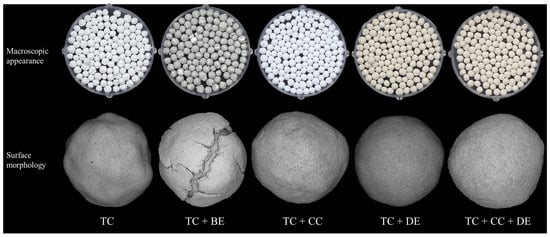
Pelleting Chinese cabbage seeds with talc-based filler combinations produced visually distinct pellet structures depending on the incorporated material. As shown in Figure 1, TC, TC + CC, TC + DE, and TC + CC + DE produced relatively uniform, round, and compact pellets, whereas TC + BE resulted in a rough and irregular surface with visible cracking. These visual differences were consistent with the measured physical properties of the pellets (Table 1). TC + BE showed the lowest hardness value among the pelleted treatments, with 696.8 g, and also had the lowest true density, at 1.19 g·cm−3. In addition, this treatment exhibited the longest disintegration time, 28.0 s, and the highest water-holding capacity, 500.0%. These results indicate that the incorporation of bentonite increased water retention but reduced structural stability. Although TC + BE had the lowest calculated porosity, it showed the highest water-holding capacity. This apparent discrepancy suggests that water retention in TC + BE was not mainly controlled by open interparticle pore volume, but rather by the swelling capacity of bentonite particles. Therefore, TC + BE likely formed a compact dry pellet matrix with limited pore space, while still absorbing a large amount of water during hydration through clay swelling.
Figure 1.
Physical appearance and SEM surface morphology of Chinese cabbage seeds pelleted with different filler matrices; Talc (TC) alone; Talc + Bentonite (TC + BE); Talc + Calcium carbonate (TC + CC); Talc + Diatomaceous earth (TC + DE); Talc + Calcium carbonate + Diatomaceous earth (TC + CC + DE).
Table 1.
Physical property of Chinese cabbage seed pelleted with different matrices.
In contrast, TC + CC produced the strongest and most compact pellet structure. This treatment had the highest hardness, 883.7 g, and the highest true density, 2.08 g·cm−3, which corresponded well with its smooth and dense surface morphology. However, its relatively low water-holding capacity, 123.1%, and moderate disintegration time, 7.1 s, suggest that the compact pellet layer could provide good mechanical resistance while still allowing the pellet to break down within a relatively short period after hydration. TC alone and TC + CC + DE showed similar hardness values, 815.8 g, but differed in their water-holding capacity and porosity. TC + CC + DE had higher porosity, 60.6%, and greater water-holding capacity, 147.8%, than TC alone, indicating that the addition of calcium carbonate and diatomaceous earth improved the internal pore structure and water-retention characteristics of the pellet matrix.
Among the treatments, TC + DE showed the highest porosity, 65.3%, and the lowest bulk density, 0.58 g·cm−3. This reflects the highly porous nature of diatomaceous earth and suggests that TC + DE may facilitate water penetration and gas exchange during germination. However, its hardness, 764.8 g, was lower than that of TC, TC + CC, and TC + CC + DE, indicating that excessive porosity may reduce mechanical strength. Therefore, while TC + DE may be advantageous for rapid hydration, it may be less suitable where high pellet durability is required for mechanical handling or precision sowing.
The EDS analysis further confirmed that the surface elemental composition of the pellets reflected the mineral characteristics of each filler combination (Table 2). Oxygen was the dominant element in all treatments, ranging from 53.61 to 65.95 at%, indicating that the pellet surfaces were primarily composed of oxide- and silicate-based mineral materials. TC contained relatively high Mg, 11.01 at%, and Si, 10.54 at%, which is consistent with the chemical characteristics of talc. The addition of bentonite in TC + BE increased Al and Si contents to 6.70 and 19.18 at%, respectively, compared with TC alone, reflecting the aluminosilicate nature of bentonite. This higher aluminosilicate content may have contributed to the strong swelling behavior and surface cracking observed in the TC + BE pellets.
Table 2.
Atomic composition (at.%) in pelleting particulate materials determined by energy-dispersive X-ray spectroscopy (EDS).
The TC + CC treatment showed a markedly higher Ca content, 26.54 at%, than the other treatments, confirming the successful incorporation of calcium carbonate into the pellet matrix. This high Ca content was associated with the highest hardness and true density, suggesting that calcium carbonate contributed to pellet compaction and mechanical strength. In TC + DE, Si content increased sharply to 28.24 at%, which corresponded with the porous surface structure and high porosity observed in Table 1. This indicates that diatomaceous earth contributed a silica-rich and porous structure to the pellet matrix. In the ternary mixture TC + CC + DE, both Ca and Si were detected at substantial levels, 11.30 and 12.32 at%, respectively, suggesting that this formulation combined the structural strengthening effect of calcium carbonate with the porosity-enhancing effect of diatomaceous earth.
Overall, the physical, morphological, and elemental analyses indicated that each pelleting material contributed differently to pellet quality. TC + BE had the highest water-holding capacity but showed poor surface integrity and delayed disintegration due to swelling-related cracking. TC + CC produced the hardest and most compact pellets, making it suitable for improving mechanical resistance. TC + DE enhanced porosity and water-retention characteristics but had relatively lower hardness. Among the tested formulations, TC + CC + DE showed the most balanced characteristics, with good hardness, moderate porosity, acceptable disintegration time, and improved water-holding capacity. Collectively these results highlight the wide diversity of filler properties and their influence on pellet characteristics, providing a basis for subsequent evaluation of their effects on pelleted seed germination and seedling growth.
3.2. Effect of Chinese Cabbage Seed Pelleting on Seed Quality
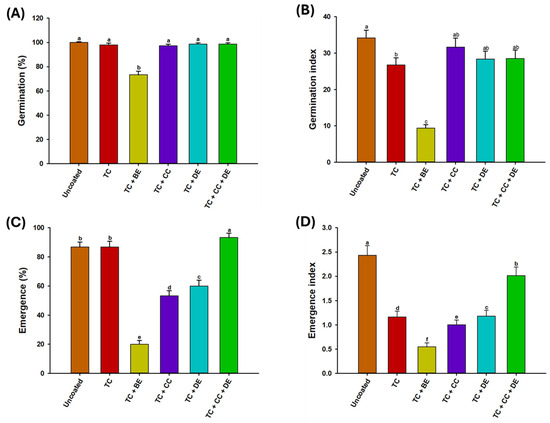
Germination percentage was not significantly affected by most pelleting treatments, as unpelleted, TC, TC + CC, TC + DE, and TC + CC + DE maintained high germination rates, whereas TC + BE showed a significantly lower germination percentage, indicating a negative effect of bentonite on seed germination (Figure 2). A similar pattern was observed for the germination index, with unpelleted seeds showing the highest value and TC + BE the lowest, suggesting that bentonite-based pelleting markedly delayed germination. Under greenhouse conditions, however, a different trend emerged. TC + CC + DE achieved the highest emergence percentage, significantly exceeding even the unpelleted control, whereas TC + BE again performed the poorest, with the lowest emergence among all treatments. This discrepancy between laboratory germination and greenhouse emergence indicates that pelleting formulation plays a greater role in seedling establishment than under controlled conditions. For the emergence index, unpelleted seeds showed the highest value, followed by TC + CC + DE, which was the only pelleted treatment to achieve a rate comparable to that of the unpelleted control. In contrast, TC + BE showed the lowest value, indicating the slowest and least uniform seedling establishment.
Figure 2.
Effects of different seed pelleting materials on germination and emergence performance of Chinese cabbage seeds. (A) Germination percentage and (B) germination index measured under laboratory conditions. (C) Emergence percentage and (D) emergence index evaluated under greenhouse conditions. Treatments included unpelleted seeds as the control, talc monolayer pelleting (TC), talc + bentonite (TC + BE), talc + calcium carbonate (TC + CC), talc + diatomaceous earth (TC + DE), and talc + calcium carbonate + diatomaceous earth (TC + CC + DE). Vertical bars indicate SE. Different lowercase letters above bars indicate significant differences among treatments according to Tukey’s HSD test at p < 0.05.
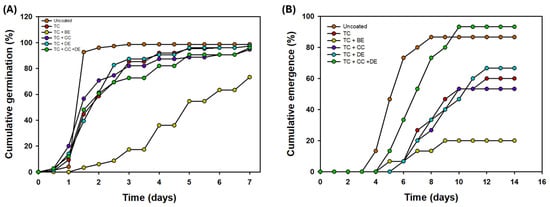
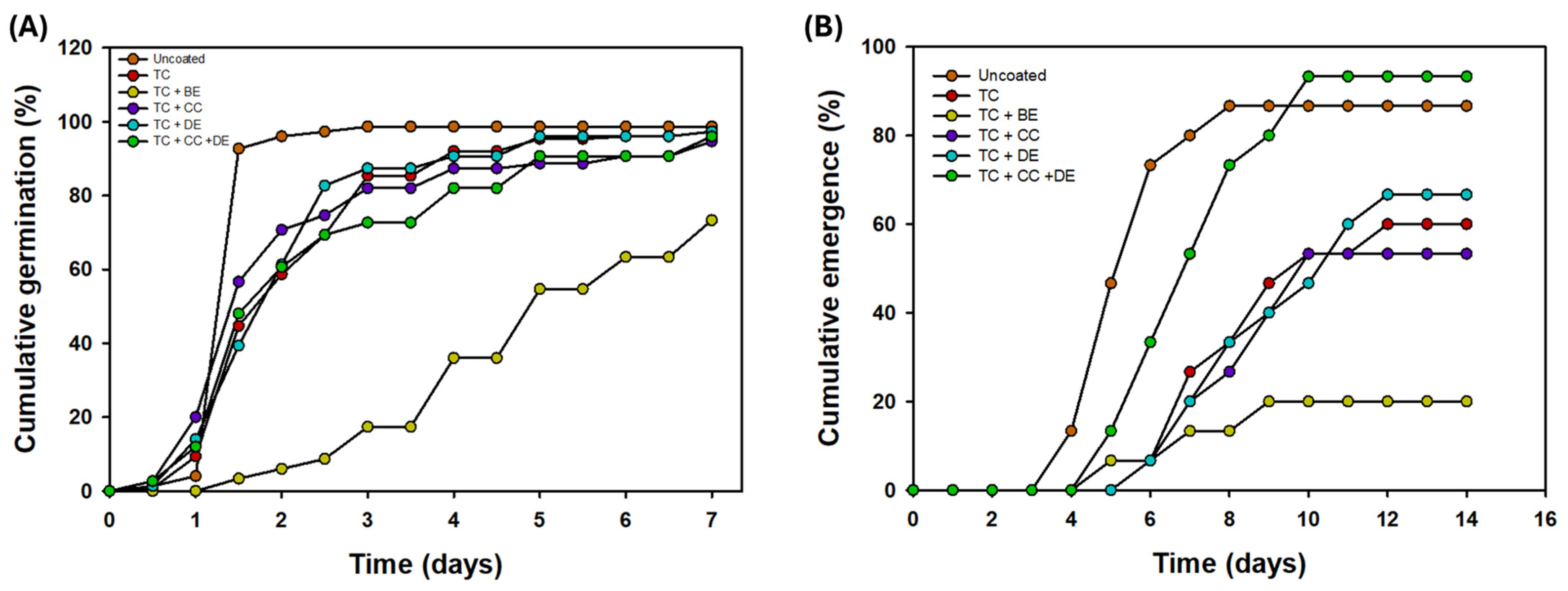
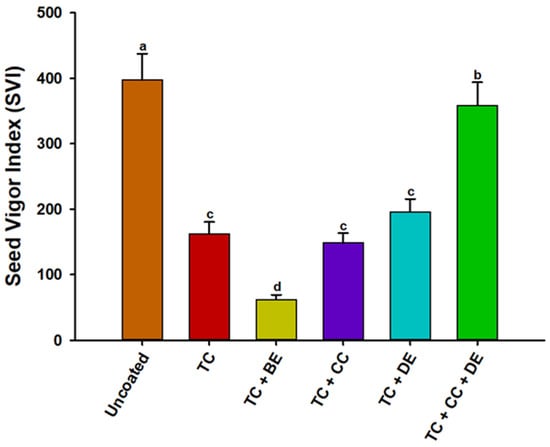
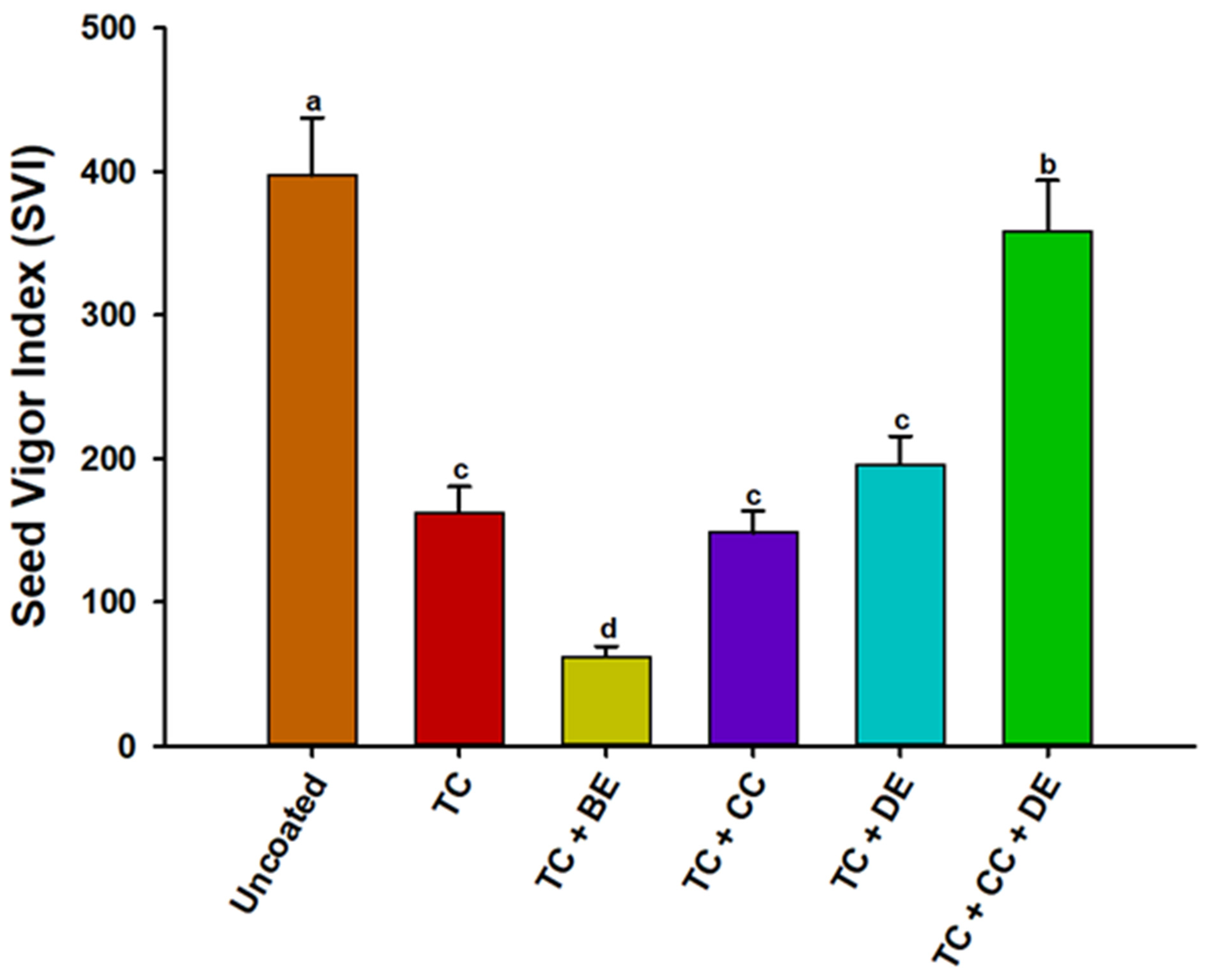
The cumulative germination curves supported these findings (Figure 3), with most treatments reaching near-maximum germination within the first few days, whereas TC + BE showed a delayed pattern and remained below all other treatments throughout the observation period. Likewise, TC + CC + DE exhibited a steep cumulative emergence curve from the early observation period onward and ultimately surpassed the unpelleted control, while TC + BE plateaued early with little further improvement. The remaining treatments showed intermediate emergence responses. Seed vigor index (SVI) followed a similar trend (Figure 4). Unpelleted seeds showed the highest SVI, while TC + CC + DE had the second-highest value, retaining approximately 90% of the vigor of the unpelleted seeds. In contrast, TC + BE showed the lowest SVI, significantly lower than all other treatments. Overall, these results indicate that TC + CC + DE was the most effective pelleting formulation for preserving seed quality and seedling establishment potential, whereas the inclusion of bentonite consistently impaired seed performance across all measured parameters.
Figure 3.
Cumulative germination and emergence patterns of Chinese cabbage seeds subjected to different pelleting materials over time. (A) Cumulative germination (%) under laboratory condition. (B) Cumulative emergence (%) under greenhouse conditions. Treatments included unpelleted seeds (control), talc monolayer pelleting (TC), talc + bentonite (TC + BE), talc + calcium carbonate (TC + CC), talc + diatomaceous earth (TC + DE), and talc + calcium carbonate + diatomaceous earth (TC + CC + DE).
Figure 4.
Effect of seed pelleting materials on the seed vigor index (SVI) of Chinese cabbage under laboratory conditions. Treatments included unpelleted seeds as the control, talc monolayer pelleting (TC), talc + bentonite (TC + BE), talc + calcium carbonate (TC + CC), talc + diatomaceous earth (TC + DE), and talc + calcium carbonate + diatomaceous earth (TC + CC + DE). Vertical bars indicate SE. Different lowercase letters above bars indicate significant differences among treatments according to Tukey’s HSD test at p < 0.05.
3.3. Effect of Chinese Cabbage Seed Pelleting on Seedling Growth
Seedling growth responses under laboratory and greenhouse conditions generally supported the seed quality patterns described in Section 3.2. Under laboratory conditions, seedling length was significantly affected by pelleting treatment (Table 3). Unpelleted seeds showed the greatest seedling length, while TC + CC + DE produced a statistically comparable value. In contrast, TC, TC + BE, TC + CC, and TC + DE showed significantly lower seedling length than the unpelleted control. Shoot length was not significantly affected by pelleting treatment, indicating that shoot elongation was relatively stable among treatments. Root length showed significant treatment differences, with unpelleted seeds showing the highest value, whereas TC + BE, TC + CC, and TC + CC + DE showed lower values. Hypocotyl diameter was also significantly affected by pelleting treatment, with TC + DE showing the highest value and TC + BE and TC + CC showing relatively lower values.
Table 3.
Effects of seed pelleting materials on seedling growth traits of Chinese cabbage under laboratory conditions.
Fresh and dry weight under laboratory conditions showed significant differences among treatments (Table 3). Interestingly, TC + BE showed the highest fresh and dry weight per surviving seedling, despite its reduced germination percentage, low germination index, and low seed vigor index. This result should not be interpreted as improved seed performance because biomass was measured only from surviving normal seedlings. The higher individual biomass in TC + BE may reflect a survivor effect, in which fewer established seedlings experienced reduced competition within the Petri dish. Therefore, germination percentage, germination index, and SVI provide a more reliable assessment of overall seed performance than individual biomass alone.
Under greenhouse conditions, seedling length, shoot length, and root length were not significantly affected by pelleting treatment (Table 4). However, hypocotyl diameter showed significant treatment differences, with TC + DE showing the highest value and TC + CC + DE showing the lowest value. Fresh weight was significantly affected by pelleting treatment, with unpelleted seedlings showing the highest value, followed by TC and TC + CC + DE. TC + BE showed the lowest fresh weight among treatments, confirming its poor establishment performance under greenhouse conditions. Dry weight was also significantly affected by treatment; unpelleted seedlings had the highest dry weight, whereas all pelleted treatments showed lower and statistically similar values.
Table 4.
Effects of seed pelleting materials on seedling growth traits of Chinese cabbage under greenhouse conditions.
Overall, TC + CC + DE maintained relatively good seedling growth under both laboratory and greenhouse conditions, while TC + BE consistently showed poor germination, emergence, and establishment performance. These results indicate that pelleting materials influenced seedling establishment more strongly than shoot elongation, and that balanced pellet physical properties are important for maintaining early seedling growth.
4. Discussion
4.1. Influence of Pelleting Materials on Physical Properties and Composition
The results demonstrated that the physicochemical characteristics of pelleting materials were strongly influenced by their mineral composition, which in turn governed pellet structure and functionality. EDS analysis confirmed that each formulation reflected its dominant mineral components, with TC + BE enriched in Al and Si, TC + CC in Ca, and TC + DE in Si. These compositional differences are consistent with the known properties of aluminosilicates, calcium-based minerals, and siliceous materials, respectively [12,16].
The high Al and Si content in TC + BE indicates the presence of bentonite, a swelling aluminosilicate clay mineral with strong water absorption capacity. The apparent discrepancy between the low calculated porosity and the extremely high water-holding capacity of TC + BE can be explained by the difference between dry interparticle pore space and swelling-driven water retention. The porosity value calculated from bulk and true density mainly reflects the pore volume of the dry pellet matrix, whereas the water-holding capacity of bentonite is largely governed by hydration and swelling of clay particles. Therefore, TC + BE may have formed a compact dry structure with limited open pore space, while still absorbing a large amount of water after hydration. During imbibition, swelling of bentonite particles may further reduce pore connectivity, increase diffusion resistance, and restrict oxygen movement within the pellet matrix, leading to reduced aeration around the seed [16]. Blunk et al. [31] reported that bentonite-based pellets can expand significantly during hydration, which may compromise structural stability and result in cracking, as observed in this study. These findings suggest that the poor performance of TC + BE was associated with swelling-driven water retention, impaired pore connectivity, and structural instability rather than low porosity alone.
In contrast, the high Ca content in TC + CC contributed to increased hardness and true density, indicating improved mechanical strength. Calcium carbonate is widely recognized for enhancing pellet durability and resistance to mechanical stress [9]. Meanwhile, the high Si content and porosity observed in TC + DE reflect the structure of diatomaceous earth, which promotes water infiltration and gas exchange [14,15]. However, the relatively lower hardness of TC + DE indicates that excessive porosity may reduce pellet integrity. Therefore, these results highlight that individual materials provide distinct functional advantages, but none alone fulfills all requirements of an ideal pelleting matrix.
From a critical perspective, the present study suggests that optimal pelleting performance is achieved through compositional synergy rather than single-material dominance. However, the current work is limited to a fixed ratio of materials, and does not fully explore the design space of filler combinations. Future research should therefore focus on systematic optimization of material ratios, particularly the balance between Ca-rich and Si-rich components, to fine-tune mechanical strength and pore structure. In addition, advanced structural characterization techniques such as micro-CT imaging could provide deeper insights into pore connectivity and internal architecture of pellets, which are not captured by bulk measurements alone.
4.2. Effects of Pelleting Formulation on Germination and Emergence
Although most pelleting treatments maintained high germination percentages under laboratory conditions, clear differences were observed in germination rate and greenhouse emergence, indicating that pelleting formulation primarily influences seed performance under non-optimal conditions. The TC + BE treatment showed significantly reduced germination index, emergence percentage, and seed vigor index, suggesting that the swelling behavior of bentonite negatively affected early germination processes. In TC + BE, the negative effect on germination and emergence was likely related to swelling-induced reduction in pore connectivity rather than water retention alone. Although bentonite retained a large amount of water, hydration-driven swelling may have reduced the continuity of air-filled pores around the seed, thereby restricting oxygen diffusion and delaying metabolic activation and radicle protrusion [12,16]. This interpretation is supported by Blunk et al. [31], who demonstrated that excessive swelling in bentonite-based pellets can impair seed performance.
In contrast, TC + CC + DE exhibited superior emergence performance, even exceeding the unpelleted control under greenhouse conditions. This result suggests that an appropriately designed pelleting formulation can support seedling establishment under greenhouse conditions rather than merely preserving seed viability. The improved emergence of TC + CC + DE was likely associated with its balanced physical properties, including adequate hardness, moderate porosity, and acceptable disintegration time. These characteristics could have supported water uptake while avoiding excessive restriction of gas exchange. Under greenhouse conditions, where soil resistance and moisture fluctuation influence emergence, the uniform spherical shape and stable pellet structure of TC + CC + DE could also have contributed to more consistent seed–soil contact and water availability around the seed. In addition, the presence of Ca- and Si-rich mineral components may have contributed to early seedling performance. However, because soil moisture dynamics, mineral dissolution, and nutrient uptake were not directly measured, the proposed roles of Ca and Si remain speculative. Future studies should include pellet dissolution assays, soil moisture monitoring, oxygen diffusion measurements, and seedling nutrient analysis to confirm the mechanisms responsible for improved emergence. Previous studies have similarly reported that mineral-based fillers can improve emergence by optimizing the seed microenvironment [15,16].
The discrepancy between laboratory germination and greenhouse emergence highlights an important limitation in conventional seed testing approaches. Under controlled laboratory conditions, where moisture supply was more uniform and physical resistance was minimal, most treatments performed similarly. However, under greenhouse conditions, pellet disintegration, soil resistance, and fluctuating moisture availability become critical determinants of seedling establishment. Williams et al. [17] reported that seed coatings can significantly alter emergence timing and soil penetration without affecting final germination percentage, supporting the findings of this study.
From a critical standpoint, these results suggest that laboratory germination tests alone are insufficient to evaluate pelleting performance, and greater emphasis should be placed on greenhouse and field-based assessments. Future studies should therefore incorporate multi-environment trials, including varying soil textures, moisture regimes, and temperature conditions, to better evaluate the robustness of pelleting formulations. Additionally, measurements of pellet disintegration kinetics, water uptake in soil, oxygen diffusion, mineral dissolution, and seedling nutrient uptake would provide stronger evidence for the mechanisms underlying greenhouse emergence differences.
4.3. Effect of Pelleting Materials on Seedling Growth and Vigor
The seedling growth responses observed in this study were generally consistent with the trends in germination and emergence, indicating that early pellet–seed interactions can influence subsequent seedling establishment. The TC + BE treatment showed reduced germination, delayed emergence, and low seed vigor, suggesting that bentonite-containing pellets negatively affected early establishment. As discussed above, this response was likely associated with swelling-induced restriction of pore connectivity and gas exchange during imbibition, rather than water retention alone. Such early limitations in oxygen diffusion and water balance may have negatively affected subsequent root development and seedling establishment [16].
In contrast, TC + CC + DE produced seedling growth comparable to that of the unpelleted control under both laboratory and greenhouse conditions, indicating that this formulation did not impose strong physical constraints on early seedling development. The absence of significant differences in shoot length among treatments suggests that pelleting materials had a greater influence on establishment-related traits, particularly root growth and emergence, than on shoot elongation. This is important because early root development is directly linked to water uptake efficiency, anchorage, and successful seedling establishment.
The relatively high fresh and dry weight observed in TC + BE under laboratory conditions should be interpreted with caution. These values represented biomass of surviving normal seedlings only and did not reflect total biomass production per Petri dish or overall treatment performance. Because TC + BE had markedly lower germination percentage, germination index, emergence percentage, and SVI, the higher individual biomass of surviving seedlings may reflect a survivor effect rather than enhanced seed vigor. In this case, fewer established seedlings may have experienced reduced competition within the Petri dish, resulting in greater biomass per surviving seedling. Therefore, individual seedling biomass alone is not a reliable indicator of seed quality and should be interpreted together with germination, emergence, and vigor parameters.
In contrast, the relatively high seed vigor index of TC + CC + DE, which retained approximately 90% of the unpelleted control, indicates that an appropriately designed pelleting formulation can maintain physiological performance while providing the practical benefits of pelleting [4,5]. This is consistent with Pedrini et al. [16], who emphasized that effective pelleting systems must optimize both physical and biological performance. The balanced combination of talc, calcium carbonate, and diatomaceous earth may have provided sufficient structural stability while maintaining favorable water and gas movement within the pellet matrix.
Furthermore, the improved performance of TC + CC + DE may be partially associated with the presence of Si-rich diatomaceous earth and Ca-rich calcium carbonate, which have been reported to support seedling growth and stress resilience [15]. However, the present study did not directly quantify mineral dissolution, Si or Ca uptake, or physiological responses related to these elements. Therefore, the role of Ca and Si should be regarded as a possible explanation rather than a confirmed mechanism.
Future research should investigate the physiological and biochemical responses of seedlings, including nutrient uptake, enzyme activity, stress-related indicators, and mineral dissolution from the pellet matrix, to better understand the mechanisms underlying improved vigor. In addition, long-term studies evaluating yield performance and crop quality are needed to determine whether early advantages observed at the seedling stage translate into agronomic benefits. Such approaches would provide a more comprehensive assessment of pelleting effectiveness beyond early growth stages.
5. Conclusions
This study demonstrated that the performance of pelleted Chinese cabbage seeds is strongly governed by the physicochemical properties and mineral composition of the pelleting materials. Among the tested formulations, the combination of talc, calcium carbonate, and diatomaceous earth (TC + CC + DE) provided the most balanced pellet characteristics, integrating adequate structural stability with favorable porosity, water-holding capacity, and disintegration time. This optimized matrix maintained high germination, produced superior greenhouse emergence, and supported seedling growth comparable to, and in some cases exceeding, that of unpelleted seeds. In contrast, the talc + bentonite formulation (TC + BE) exhibited excessive swelling, very high-water retention, and poor aeration, which collectively reduced germination index, emergence percentage and uniformity, and seed vigor. Integration of EDS data with physical and biological measurements suggested that Ca-rich components were associated with improved mechanical strength, whereas Si-rich porous components were associated with improved pellet porosity and potential water–gas movement; however, neither property alone was sufficient to ensure optimal performance. These findings highlight that successful seed pelleting requires a careful balance between structural integrity and mass transfer within the pellet matrix, rather than maximization of any single property. Overall, TC + CC + DE is identified as a promising talc-based formulation for Chinese cabbage seed pelleting, while bentonite-based systems appear unsuitable unless their swelling behavior and associated mass transfer limitations can be mitigated. The results provide practical guidance for designing efficient, locally adaptable pelleting materials for small-seeded vegetable crops.
Author Contributions
Conceptualization, J.-S.K., M.C.S.C.E., S.-R.K. and F.A.M.; methodology, J.-S.K., M.C.S.C.E., S.-R.K. and J.-G.L.; software, M.C.S.C.E.; validation, J.-S.K., S.-R.K., F.A.M. and J.-G.L.; formal analysis, M.C.S.C.E.; investigation, M.C.S.C.E., S.-R.K., F.A.M., J.-G.L., M.-G.C., D.-G.J., M.-J.K. and K.-M.P.; resources, J.-S.K.; data curation, M.C.S.C.E., J.-G.L., M.-G.C., D.-G.J. and M.-J.K.; writing—original draft preparation, M.C.S.C.E.; writing—review and editing, M.C.S.C.E., F.A.M. and J.-S.K.; visualization, M.C.S.C.E.; supervision, J.-S.K.; project administration, J.-S.K.; funding acquisition, J.-S.K. All authors have read and agreed to the published version of the manuscript.
Funding
This work was funded by Ministry of Agriculture, Food and Rural Affairs (MAFRA) (RS-2025-02220080).
Data Availability Statement
The original contributions presented in this study are included in the article. Further inquiries can be directed to the corresponding author.
Acknowledgments
This work was supported by Korea Institute of Planning and Evaluation for Technology in Food, Agriculture and Forestry (IPET) through Cutting-edge Precision Breeding Development Program. During the preparation of this manuscript, the authors used AI tools (Perplexity AI, Pro Search mode, Perplexity AI, Inc., San Francisco, CA, USA) for writing assistance purposes, including grammar and language refinement. All outputs were subsequently reviewed, edited, and finalized by the authors. The authors take full responsibility for the content of the manuscript.
Conflicts of Interest
The authors declare no conflicts of interest.
Abbreviations
The following abbreviations are used in this manuscript:
| ANOVA | Analysis of variance |
| ISTA | ISTA International Seed Testing Association |
| SEM | Scanning electron microscopy |
| SVI | Seed vigor index |
| HSD | Honestly significant difference |
| EDS | Energy-dispersive X-ray spectroscopy |
| PVA | Polyvinyl alcohol |
| BE | Bentonite |
| CC | Calcium carbonate |
| DE | Diatomaceous earth |
| EI | Emergence index |
| GI | Germination index |
| TC | Talc |
References
- Afzal, I.; Javed, T.; Amirkhani, M.; Taylor, A.G. Modern seed technology: Seed coating delivery systems for enhancing seed and crop performance. Agriculture 2020, 10, 526. [Google Scholar] [CrossRef] [Scilit]
- Mei, J.; Wang, W.; Peng, S.; Nie, L. Seed pelleting with calcium peroxide improves crop establishment of direct-seeded rice under waterlogging conditions. Sci. Rep. 2017, 7, 4878. [Google Scholar] [CrossRef] [Scilit] [PubMed]
- Rocha, I.; Ma, Y.; Carvalho, M.F.; Magalhães, C.; Janoušková, M.; Vosátka, M.; Freitas, H.; Oliveira, R.S. Seed coating with inocula of arbuscular mycorrhizal fungi and plant growth-promoting rhizobacteria for nutritional enhancement of maize under different fertilisation regimes. Arch. Agron. Soil Sci. 2019, 65, 31–43. [Google Scholar] [CrossRef] [Scilit]
- Xue, J.; Ma, X.; Hou, Z.; Guo, M.; Zhang, X. Experimental Study on the Pelleting and Coating Performance of Red Clover Seeds. Coatings 2024, 14, 1443. [Google Scholar] [CrossRef] [Scilit]
- Wasanthika, H.M.N.; Edirimanna, I.C.S.; Nashath, M.N.F.; Mubarak, A.N.M.; Kumara, A.D.N.T. Effect of seed pelleting on the growth and yield performance of sesame (Sesamum indicum L.) cultivation. Sri Lankan J. Technol. 2022, 3, 24–29. [Google Scholar]
- Ilyas, N.; Mumtaz, K.; Akhtar, N.; Yasmin, H.; Sayyed, R.Z.; Khan, W.; Enshasy, H.A.E.; Dailin, D.J.; Elsayed, E.A.; Ali, Z. Exopolysaccharides Producing Bacteria for the Amelioration of Drought Stress in Wheat. Sustainability 2020, 12, 8876. [Google Scholar] [CrossRef] [Scilit]
- Javed, T.; Afzal, I.; Shabbir, R.; Ikram, K.; Zaheer, M.S.; Faheem, M.; Ali, H.H.; Iqbal, J. Seed coating technology: An innovative and sustainable approach for improving seed quality and crop performance. J. Saudi Soc. Agric. Sci. 2022, 21, 536–545. [Google Scholar] [CrossRef] [Scilit]
- Rocha, I.; Ma, Y.; Souza-Alonso, P.; Vosátka, M.; Freitas, H.; Oliveira, R.S. Seed coating: A tool for delivering beneficial microbes to agricultural crops. Front. Plant Sci. 2019, 10, 1357. [Google Scholar] [CrossRef] [Scilit]
- Bozdar, B.; Ahmed, N.; Meghwar, M.R.; Zhu, Z.; Talpur, A.; Li, Z.H. Seed pelleting technologies: Paving the way for resilient and sustainable future farming. Food Energy Secur. 2025, 15, e70193. [Google Scholar] [CrossRef] [Scilit]
- Kangsopa, J.; Hynes, R.K.; Siri, B. Lettuce seeds pelleting: A new bilayer matrix for lettuce (Lactuca sativa) seeds. Seed Sci. Technol. 2018, 46, 521–531. [Google Scholar] [CrossRef] [Scilit]
- Jarrar, H.; El-Keblawy, A.; Ghenai, C.; Abhilash, P.; Bundela, A.K.; Abideen, Z.; Sheteiwy, M.S. Seed enhancement technologies for sustainable dryland restoration: Coating and scarification. Sci. Total Environ. 2023, 904, 166150. [Google Scholar] [CrossRef] [Scilit] [PubMed]
- Taylor, A.G. Seed treatments. In Encyclopedia of Applied Plant Sciences; Thomas, B.D.J., Murphy, B.G., Eds.; Elsevier Academic Press: Cambridge, UK, 2003; pp. 1291–1298. [Google Scholar]
- Guan, Y.; Wang, J.; Tian, Y.; Hu, W.; Zhu, L.; Zhu, S.; Hu, J. The novel approach to enhance seed security: Dual anti-counterfeiting methods applied on tobacco pelleted seeds. PLoS ONE 2013, 8, e57274. [Google Scholar] [CrossRef] [Scilit]
- Kangsopa, J.; Siri, B. Using potential carboxymethyl cellulose and hydroxypropyl methylcellulose as binder for seed pelleting of lettuce (Lactuca sativa) seeds. Khon Kaen Agric. J. 2015, 43, 268–273. [Google Scholar]
- Jeephet, P.; Atnaseo, C.; Hermhuk, S.; Kangsopa, J. Effect of seed pelleting with different matrices on physical characteristics and seed quality of lettuce (Lactuca sativa). Int. J. Agric. Technol. 2022, 18, 2009–2020. [Google Scholar]
- Pedrini, S.; Webber, Z.; D’Agui, H.; Dixon, K.; Just, M.; Arya, T.; Turner, S. Customise the seeds, not the seeder: Pelleting of small-seeded species for ecological restoration. Ecol. Eng. 2023, 196, 107105. [Google Scholar] [CrossRef] [Scilit]
- Williams, M.I.; Dumroese, R.K.; Page-Dumroese, D.S.; Hardegree, S.P. Can biochar be used as a seed coating to improve native plant germination and growth in arid conditions? J. Arid. Environ. 2016, 125, 8–15. [Google Scholar] [CrossRef] [Scilit]
- Zamani, H.; Mobasser, H.; Hamidi, A.; Daneshmand, A. Study on effect of tobacco seed pelleting on germination and seedling emergence. Iran. J. Seed Sci. Technol. 2017, 6, 133–140. [Google Scholar] [CrossRef] [Scilit]
- KREI (Korea Rural Economic Institute). Agricultural Demand 2017, I—Supply and Demand of the Leafy and Root Vegetables; Kim, S.W., Rho, H.Y., Lim, H.B., Choi, S.W., Han, E.S., Lee, D.K., Chae, J.H., Kim, S.Y., Eds.; Korea Rural Economic Institute Research Report; Korea Rural Economic Institute: Naju-si, Republic of Korea, 2017; pp. 557–629. [Google Scholar]
- FAO (Food and Agriculture Organization of the United Nations). Crops and Livestock Products: Production Quantities of Cabbage and Other Brassicas by Country. 2022. Available online: https://www.fao.org/faostat/en/#data/QCL/visualize (accessed on 26 March 2026).
- Muhammad, A.; Shi, X.; Mi, S.; Jin, H.; Wang, X.; Han, Y. The effect of pelleting filler composition on the physical properties, germination and seedling growth of red clover. Seed Sci. Technol. 2025, 53, 171–184. [Google Scholar] [CrossRef] [Scilit]
- Amirkhani, M.; Mayton, H.; Loos, M.; Taylor, A.G. Development of Superabsorbent Polymer (SAP) Seed Coating Technology to Enhance Germination and Stand Establishment in Red Clover Cover Crop. Agronomy 2023, 13, 438. [Google Scholar] [CrossRef] [Scilit]
- Li, Q.; Qin, J.; Liang, H.; Li, J.; Ye, S.; Youssef, M.; Chen, Y.; Li, B. A Novel Konjac Powder with High Compressibility, High Water-Holding Capacity, and High Expansion Force. Foods 2025, 14, 211. [Google Scholar] [CrossRef] [Scilit] [PubMed]
- Sandhan, S.; Derle, D. Functionality assessment of multifunctional excipients: A review. Int. J. Pharm. Sci. Res. 2019, 10, 4078–4089. [Google Scholar] [CrossRef] [Scilit]
- ISTA. International Rules for Seed Testing; International Seed Testing Association: Bassersdorf, Switzerland, 2021. [Google Scholar]
- Sparg, S.; Kulkarni, M.G.; Light, M.E.; Van Staden, J. Improving seedling vigour of indigenous medicinal plants with smoke. Bioresour. Technol. 2005, 96, 1323–1330. [Google Scholar] [CrossRef] [Scilit]
- Rastegar, Z.; Sedghi, M.; Khomari, S. Effects of accelerated aging on soybean seed germination indexes at laboratory conditions. Not. Sci. Biol. 2011, 3, 126–129. [Google Scholar] [CrossRef] [Scilit]
- Barik, S.R.; Pandit, E.; Sanghamitra, P.; Mohanty, S.P.; Behera, A.; Mishra, J.; Nayak, D.K.; Bastia, R.; Moharana, A.; Sahoo, A. Unraveling the genomic regions controlling the seed vigour index, root growth parameters and germination per cent in rice. PLoS ONE 2022, 17, e0267303. [Google Scholar] [CrossRef] [Scilit] [PubMed]
- Shah, S.M.M.; Asif, F.; Fatima, H. Pinching effect on plant growth, yield, and quality of different varieties of okra. EPH-Int. J. Agric. Environ. Res. 2023, 9, 28–33. [Google Scholar] [CrossRef] [Scilit]
- Rehman, M.M.U.; Zhu, Y.; Abrar, M.; Khan, W.; Wang, W.; Iqbal, A.; Khan, A.; Chen, Y.; Rafiq, M.; Tufail, M.A.; et al. Moisture- and period-dependent interactive effects of plant growth-promoting rhizobacteria and AM fungus on water use and yield formation in dryland wheat. Plant Soil 2024, 502, 149–165. [Google Scholar] [CrossRef] [Scilit]
- Blunk, S.; Hoffer, J.; Brosda, S.; de Heer, M.I.; Sturrock, C.J.; Mooney, S.J. Impact of fruit orientation and pelleting material on water uptake and germination performance in artificial substrate for sugar beet. PLoS ONE 2020, 15, e0232875. [Google Scholar] [CrossRef] [Scilit]

Disclaimer/Publisher’s Note: The statements, opinions and data contained in all publications are solely those of the individual author(s) and contributor(s) and not of MDPI and/or the editor(s). MDPI and/or the editor(s) disclaim responsibility for any injury to people or property resulting from any ideas, methods, instructions or products referred to in the content. |
© 2026 by the authors. Licensee MDPI, Basel, Switzerland. This article is an open access article distributed under the terms and conditions of the Creative Commons Attribution (CC BY) license.