


Abstract
Salt stress is a major constraint on cowpea cultivation in semi-arid regions, primarily due to excess salts in irrigation water and soils. We aimed to investigate the effects of foliar magnesium (Mg) application on the production, phenology, and seed vigor of the cowpea landraces “Pingo de Ouro” and “Costela de Vaca” under salt stress conditions. Two experiments were conducted. The first was carried out in a greenhouse using a randomized block design with five replicates, in a 2 × 3 × 4 factorial scheme: two cowpea landraces (“Pingo de Ouro” and “Costela de Vaca”), three irrigation water salinity levels (0.54, 3.50, and 5.00 dS m−1), and four foliar doses of a product (0.0, 1.0, 2.0 and 3.0 mL L−1) containing 8% magnesium. Morphological traits and seed production were evaluated. The second experiment was conducted in a laboratory using a completely randomized design, also in a 2 × 3 × 4 factorial, with four replicates of 25 seeds each. In the first experiment, the 1 mL L−1 dose provided the best results for pod length in the variety “Pingo de Ouro” under an electrical conductivity salinity of 5.00 dS m−1. In the variety “Costela de Vaca”, this same dose increased the number of seeds per pod and the 100-seed weight under the same salinity level. In the second experiment, seedlings of “Pingo de Ouro” grown from seeds produced by plants treated with 2 and 3 mL L−1 doses showed greater shoot length, root length, stem diameter, and shoot fresh mass, particularly under 0.54 dS m−1 salinity. Therefore, “Pingo de Ouro” exhibited superior seedling growth at doses of 2 and 3 mL L−1, particularly under conditions of low salinity. These findings support the use of foliar magnesium fertilization as an effective agronomic strategy to enhance seed production and quality in cowpea landraces under salt stress conditions.
1. Introduction
The Cowpea (Vigna unguiculata (L.) Walp) plays a critical role in global agriculture, particularly in semi-arid and tropical regions, due to its adaptability to adverse environments and its socio-economic importance as a staple food for millions of people [1]. In Brazil, this legume is essential for food security, especially in water-scarce areas where few crops can thrive as efficiently [2]. The cultivation of landrace seeds, adapted to local conditions, also contributes to agricultural sustainability and ensures the conservation of genotypes with resistance to environmental stressors [3]. Landrace seeds hold strategic importance in agricultural systems, particularly in smallholder farming. They are the result of continuous natural selection and farmer management, making them well-adapted to local environmental conditions and more resilient to abiotic stresses such as salinity and drought. Their use supports food security, agricultural biodiversity, and the autonomy of farmers, who are able to preserve varieties with specific traits related to stress tolerance and productivity—essential qualities in semi-arid regions.
One of the main challenges in cowpea cultivation in semi-arid regions is salt stress. Soil salinization, common in areas with poor irrigation practices and inadequate water management, drastically reduces agricultural productivity. Salinity impairs water and nutrient uptake and causes ion toxicity—particularly from Na+ and Cl−—which compromises plant development [4]. These negative effects include ion-specific toxicity, reduced photosynthetic activity, and pigment degradation [5,6]. Under salt stress, cowpea phenology may be severely affected, with disruptions in growth from germination through the reproductive phase. This stress triggers several physiological disturbances, including impaired gas exchange [7]. As a result, plants become less vigorous and less capable of surviving and reproducing under adverse conditions [6,8].
Magnesium (Mg) plays a vital role in plant physiology, serving as the central atom in the chlorophyll molecule and being essential for enzymatic activation and ion regulation. Its application can help mitigate the harmful effects of salt stress by maintaining cellular homeostasis and membrane integrity—both crucial for proper plant functioning. Mg also supports ionic balance and can enhance plant resistance to toxic ion buildup. Adequate Mg application helps alleviate salinity-induced damage, leading to better plant development and higher seed quality [9,10]. The role of magnesium in photosynthesis is another key factor, as it is essential for ATP formation and CO2 fixation—central processes in plant energy metabolism. Additionally, Mg stabilizes ribosomes, supports protein synthesis, and promotes cell growth. Studies have shown [11,12,13,14] that under salt stress, Mg supplementation can reduce oxidative stress by enhancing antioxidant enzyme activity and decreasing lipid peroxidation in cell membranes. Consequently, magnesium not only improves stress tolerance but also enhances water and nutrient use efficiency—critical factors for agricultural productivity in semi-arid regions.
We hypothesized that foliar magnesium application can reduce the adverse effects of salt stress, improving production, phenology, and seed vigor in cowpea landraces. The varieties “Pingo de Ouro” and “Costela de Vaca” are anticipated to respond differently to Mg doses under saline conditions. The interaction between Mg doses and salinity levels is also expected to positively influence productive and phenological traits, as well as seed vigor, highlighting magnesium’s role as a mitigating agent against salt stress. In this context, we aimed to assess the effects of foliar magnesium application on two developmental phases of cowpea landraces—"Pingo de Ouro” and “Costela de Vaca”—under saline stress. During the first phase, we focused on phenological development and seed production; in the second phase, we investigated seed viability and vigor.
2. Materials and Methods
This study was conducted in two phases during the years 2023 and 2024. The first phase assessed phenological and yield-related traits of cowpea landraces, while the second phase evaluated seed viability and vigor based on the material harvested in the initial phase.
2.1. First Phase: Phenology and Seed Production Traits
The experiment was conducted in a greenhouse at the Department of Agronomic and Forestry Sciences (DCAF) of the Federal Rural University of the Semi-Arid Region (UFERSA) in Mossoró, Rio Grande do Norte, Brazil, from June to August 2023. Mossoró is located in Brazil’s semi-arid northeast (5°11′31″ S, 37°20′40″ W, 18 m altitude), where the climate is classified as semi-arid (BSh) according to Köppen, with irregular rainfall [15].
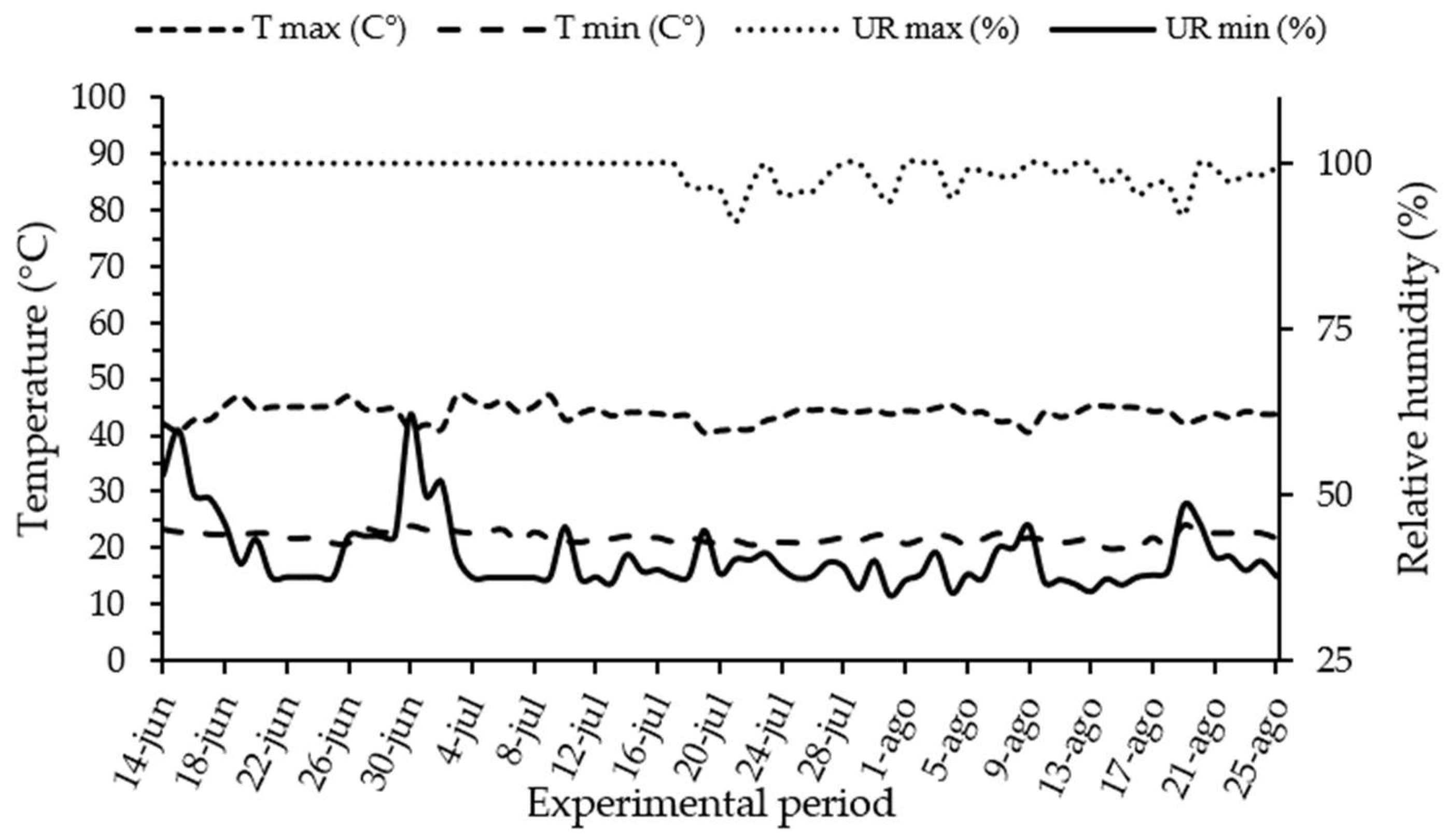
Inside the greenhouse, temperature and relative humidity were monitored daily using a Digital Thermo-Hygrometer Minipa, MTH1300®, São Paulo, Brazil, from 14 June to 25 August 2023. Maximum temperatures ranged from 40.3 to 47.0 °C, and minimum temperatures from 19.9 to 24.0 °C (Figure 1).
Figure 1.
Temperature and relative humidity data from June to August 2023. Source: Data provided by the authors, 2024.
The greenhouse was constructed with galvanized steel arches, measuring 3.5 m in height, 7 m in width, and 18 m in length. The roof was covered with low-density polyethylene film (150 microns thick) and shaded by a screen providing 50% light reduction.
2.1.1. Experimental Design
A randomized complete block design was used in a 2 × 3 × 4 factorial scheme, with five replications totaling 120 experimental units. The factors included two cowpea landraces: V1—“Pingo de Ouro” and V2—“Costela de Vaca”, three irrigation water salinity levels (0.54 [S1], 3.50 [S2], and 5.00 dS m−1 [S3]), and four foliar doses of a product (0.0, 1.0, 2.0 and 3.0 mL L−1) containing 8% magnesium.
Each experimental unit consisted of a 12 dm3 polyethylene pot with a drainage channel located just above the bottom. Pots were initially brought to field capacity with water corresponding to each salinity treatment. Foliar Mg applications were performed on the 15th, 32nd, and 38th days after sowing (DAS), corresponding to cowpea phenological stages V3, V5, and V9, respectively [16]. The foliar fertilizer used was the commercial product Forplant®, with a density of 1.30 g mL−1 at 20 °C and 8% Mg content. The applied doses were 0.0, 1.0, 2.0, and 3.0 mL L−1. Each plant received 50 mL of the Mg solution sprayed onto the leaves, distributed over three applications of 10, 20, and 20 mL, respectively, following the methodology of Sá et al. [17].
2.1.2. Plant Material and Irrigation Water Sources
The seeds of the cowpea landraces were obtained directly from local farmers due to their widespread use in the region. These seeds were harvested during the 2023 growing season and acquired from traditional seed keepers in rural communities of Western Rio Grande do Norte, Brazil.
Variety V1—“Pingo de Ouro” is characterized by a semi-prostrate growth habit, with flowering beginning approximately 41 DAS, physiological maturity reached between 71 and 80 DAS, an average 100-seed weight of 19 g, beige seed coat color, and yield potential of 1118 kg ha−1 [18]. According to Araújo [19], plants of variety V2—“Costela de Vaca” are classified as non-vigorous, with average height below 37 cm and canopy width under 75 cm. They exhibit an erect, semi-prostrate, indeterminate growth habit without twining tendencies. The apical leaflet is subglobose, with an average length of 98 mm and width of 69 mm. The stems are covered with short appressed hairs, light green in color, and have a membranous texture with distinctive V-shaped markings on the leaflets. Flowering occurs approximately 54 to 59 days after emergence, and flowers—white in color—remain open for 3 to 4 days. The mature pods are straw-colored and form angles of 30° to 90° with the peduncle, which bears one or two pods with an average length of 180 mm.
Irrigation water salinity levels were prepared using reject brine from a reverse osmosis desalination system (JBC Dessalinizadores®, 500L, São Paulo, Brazil), supplying the Jurema settlement, located along highway RN-013 between the cities of Mossoró and Tibau, Brazil. This brine was diluted with potable water to achieve the desired electrical conductivity levels for each treatment (Table 1).
Table 1.
Chemical characterization of the irrigation water sources.
S1 consisted of local tap water. For S2, a mixture of 55% tap water and 45% saline reject was used, while for S3, the mixture comprised 33% S1 and 67% saline reject. These conductivities resemble those of water sources available for irrigation in the Brazilian northeast [20] and follow the relationship between electrical conductivity (EC) and total salt concentration (mmolc L−1 = EC × 10), as described by [21].
S2 approximates the salinity threshold tolerated by cowpea (3.3 dS m−1) [22]. In contrast, S3 was specifically selected to induce stress in the plants, as its salt concentration exceeds the crop’s tolerance limit.
2.1.3. Soil Characterization
The soil used was a dystrophic Yellow-Red Latosol with argic horizon [23], equivalent to an Oxisol [24], collected at a depth of 0–30 cm from the Rafael Fernandes Experimental Farm, affiliated with UFERSA and located in the Lagoinha district, rural area of Mossoró-RN, at coordinates 5°03′37″ S and 37°23′50″ W. The soil was collected, air-dried, crushed, sieved through a 2.0 mm mesh, and sampled for physical and chemical analyses.
The water source (Table 1), soil, and soil saturation extract (SE) analyses were performed at the Soil, Water and Plant Laboratory (LASAP) and the Semi-arid Soil, Water and Plant Analysis Laboratory (LASAPSA), following the methodology described by Richards [25] for water analysis and by Teixeira et al. [26] for soil and saturation extract analyses. The soil analysis revealed the following chemical properties: total nitrogen (N) was 0.47 g kg−1 and organic matter (O.M.) content was 14.00 g kg−1. Soil pH was 7.40, and electrical conductivity (EC) measured 0.10 dS m−1. The available phosphorus (P) concentration was 90.80 mg dm−3, potassium (K+) was 61.80 mg dm−3, sodium (Na+) was 48.60 mg dm−3, calcium (Ca2+) was 2.44 cmolc dm−3, magnesium (Mg2+) was 0.68 cmolc dm−3, and aluminum (Al3+) was 0 cmolc dm−3. Potential acidity (H+Al) was also 0 cmolc dm−3. The sum of bases (SB), total exchangeable cations (T), and cation exchange capacity (CEC) were all 3.50 cmolc dm−3. Base saturation (V) was 100.00%, aluminum saturation (m) was 0%, and the percentage of exchangeable sodium (PES) was 6.00%. Physically, the soil had a bulk density (Ds) of 1.6 kg dm−3 and a particle size distribution of 820 g kg−1 sand, 30 g kg−1 silt, and 150 g kg−1 clay, classifying it as a sandy loam.
The chemical characterization of the soil saturation extract (SE) prior to the experiment showed a pH of 7.30 and electrical conductivity (EC) of 0.83 dS m−1. The concentrations of cations were as follows: potassium (K+) at 0.57 mmolc L−1, sodium (Na+) at 4.05 mmolc L−1, calcium (Ca2+) at 2.95 mmolc L−1, and magnesium (Mg2+) at 4.55 mmolc L−1. Among the anions, chloride (Cl−) was present at 5.0 mmolc L−1 and bicarbonate (HCO3−) at 9.1 mmolc L−1, while carbonate (CO32−) was not detected.
2.1.4. Fertilization Management and Cultural Practices
Macronutrient fertilization followed the recommendations of [27], adapted to 50% of the recommended dose, corresponding to 50 mg of N, 150 mg of P2O5, 75 mg of K2O, 29 mg of CaO, 18 mg of MgO, and 30 mg of SO42− per dm3 of soil. The nutrient sources used were monoammonium phosphate (61% P2O5; 12% N), calcium nitrate (18% CaO; 15% N), magnesium sulfate (9% MgO, 11% SO42−; 1% K2O), potassium sulfate (17.5% SO42−; 51.5% K2O), and potassium chloride (60% K2O). Fertilization was split into nine fertigation applications. The first was applied before planting, with 20% of the total dose; the remaining applications were made weekly, each corresponding to 10% of the total dose.
Micronutrient fertilization consisted of four applications throughout the experiment, with 18-day intervals between applications. The commercial product used was Liqui-Plex Fruit®, with a density of 1.47 g cm−3, applied at a concentration of 3 mL L−1, following the manufacturer’s recommendations. The foliar fertilizer Liqui-Plex Fruit® contains the following nutrients in its composition: nitrogen (N) at 73.50 g L−1, calcium (Ca) at 14.70 g L−1, sulfur (S) at 77.91 g L−1, boron (B) at 14.70 g L−1, copper (Cu) at 0.74 g L−1, manganese (Mn) at 73.50 g L−1, molybdenum (Mo) at 1.47 g L−1, and zinc (Zn) at 73.50 g L−1. In addition, it contains 2.35% organic carbon (O.C.).
Throughout the experiment, weeds present in the pots were manually removed. To control whitefly (Bemisia tabaci), leaf miner (Liriomyza sativae), and other pests, specific commercial products were applied through spraying as needed.
During sowing, nine seeds were placed in each pot. The first thinning was performed 6 days after sowing (DAS), leaving three plants per pot; the second at 15 DAS, reducing to two plants per pot; and the final thinning at 34 DAS, leaving only one plant per pot.
2.1.5. Irrigation Management
The irrigation system consisted of BAV1118-02UC electric pumps (Invensys®, 220 V, 60 Hz, 34 W, London, UK), installed in a 100 L reservoir and connected to 16 mm hoses equipped with self-compensating drippers with a flow rate of 1.3 L h−1.
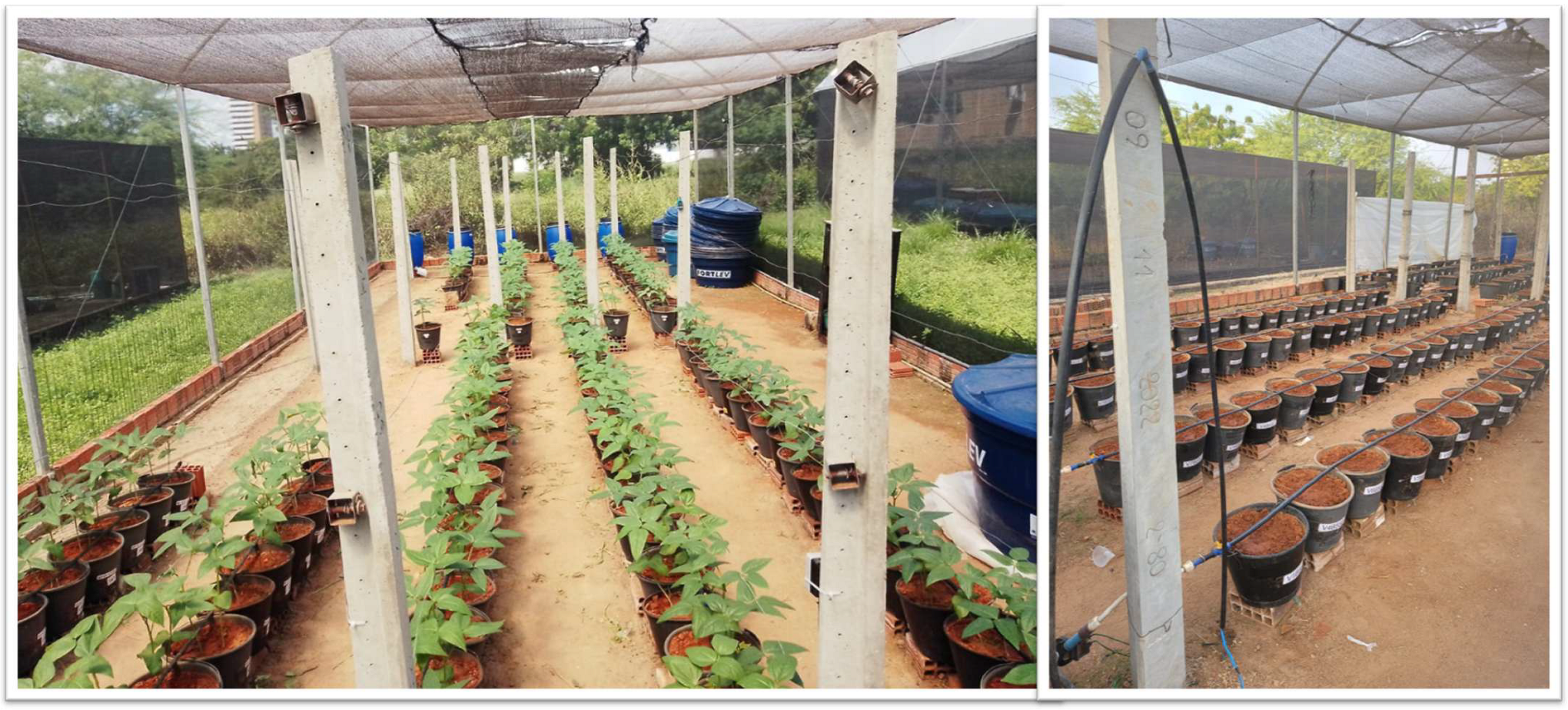
To estimate the evapotranspiration of cowpea and determine irrigation requirements under different water salinity levels, the drainage lysimetry method was used [28]. Six lysimeters were installed, distributed across the three salinity levels: S1, S2, and S3. For each level, two lysimeters were used—one for variety V1 and one for variety V2. Separate irrigation lines were set up in the greenhouse for each salinity level (Figure 2).
Figure 2.
Distribution of the pots and the irrigation system in the greenhouse to grow the cowpea varieties.
Irrigation was conducted by gradually applying water to each lysimeter until field capacity (FC) was reached to determine the water requirement of each variety under a given salinity. The moisture content of the soil’s field capacity was taken into account when the water began to drain after irrigation. The total volume of water held by the pot was 3.0 L. When the volume of water added exceeded the soil’s field capacity, the water was drained through the drain at the bottom of the pot. The drained volume was collected and subtracted from the total applied, thus estimating the amount of water from crop evapotranspiration. The time and volume to irrigate were determined using the lysimeters before irrigating the other pots. The volume to be irrigated should not exceed 50% of the volume of the soil’s field capacity (1.5 L per pot).
For each salinity level, FC was estimated for each variety, and irrigation was based on the average values, with irrigation time calculated using Equation (1). Where, T—Irrigation time (min); Va—Water volume added to the lysimeters (L); Vd—Water volume drained from the lysimeters (L); and Q—Drip rate (L h−1).
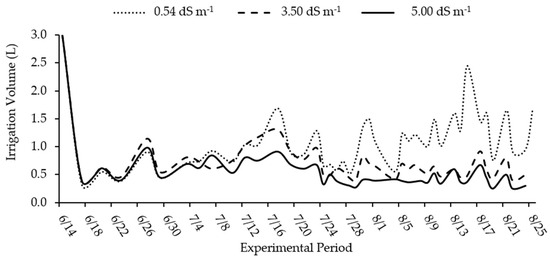
The volume of irrigation water applied throughout the experiment was quantified (Figure 3). The variation in applied water reflects the differing water requirements of the crop in response to soil salinity.
Figure 3.
Irrigation volume for each salinity throughout the experiment. Source: Data provided by the authors, 2024.
Based on the chemical analysis of each irrigation water source and the total volume applied, the amount of salt added under each salinity level was estimated (Table 2) using Equation (2) [21], where, SDT—Salts dissolved in water (mg L−1); ECa—Electrical conductivity of the irrigation water (dS m−1); and V—Total irrigation volume (L).
Table 2.
Salt volume added to the soil through irrigation water at each salinity level.
This calculation enabled the estimation of total salt added to the soil by the end of the experiment, allowing for a more accurate assessment of the effects of salinity on cowpea.
At the end of the experiment, the electrical conductivity of the soil saturation extract was analyzed for each pot, and the average was calculated for each salinity level (Table 3). To determine the electrical conductivity of the saturation extract (ECse), the method of [22] for medium-textured soils was followed. A leaching fraction of 10% of the total irrigation volume was applied to each pot. The drained volume was collected, and the electrical conductivity of the drainage water (ECd) was measured using a benchtop conductivity meter. The data were expressed in dS m−1 and adjusted to a temperature of 25 °C before being applied in Equation (3).
Table 3.
Electrical conductivity of the saturation extract (ECse) was standardized at the beginning of the experiment, and the ECse reached 71 DAS, resulting from irrigation water salinity.
2.1.6. Variable Analyzed
When each variety reached phenological stage R9 (maturation phase), with pods showing characteristic color and gloss, the dry pods were harvested. In the laboratory, the following variables were determined by counting: number of pods per plant (NPP), number of locules per pod (NLP), number of empty locules (EL), and number of seeds per pod (NSP). Measurements included pod length (PL, cm), assessed with a millimeter ruler; seed length (SL, mm), width (SW, mm), and thickness (ST, mm), determined using a high-precision digital caliper; and both the weight of 100 seeds (W100, g) and the average seed weight (ASW, g), obtained using a precision analytical scale to ensure accuracy.
2.1.7. Statistical Analysis
Data were subjected to analysis of variance (ANOVA), considering both individual effects and the interaction among factors. The means for the cowpea varieties were compared using Student’s t-test (p ≤ 0.05), while Tukey’s test (p ≤ 0.05) was used for comparing means related to irrigation water salinity levels and foliar Mg doses. Statistical analyses were performed using the SISVAR® 5.6 software [29].
2.2. Second Phase: Seed Viability and Vigor
The experiment was carried out at the Seed Analysis Laboratory of the Federal Rural University of the Semi-Arid Region. Seeds used in this phase were produced during the first phase of the study, in which the cowpea landraces Pingo-de-Ouro and “Costela de Vaca” were subjected to three salinity levels [0.54 (S1), 3.50 (S2), and 5.00 dS m−1 (S3)] and four foliar Mg doses (0, 1, 2, and 3 mL L−1). The experiment followed a completely randomized design in a 2 × 3 × 4 factorial scheme (2 varieties, 3 salinity levels, and 4 Mg doses), with four replicates of 25 seeds each.
The seeds were sown on paper roll-type substrate, pre-moistened with distilled water. The rolls were incubated in a Solid Steel® germinator (model SSBOD 343 L, São Paulo, Brazil) at 25 °C under a photo period of 8 h of light and 16 h of darkness. The first germination count and the final germination assessment were conducted at 5 and 8 days after sowing, respectively [30]. Seeds were considered germinated when the radicle had reached a length of at least 2 mm, indicating the onset of seedling development. This criterion ensured consistency in the evaluation of the germination process.
2.2.1. Variables Analyzed
Eight days after sowing, the germination percentage (GER, %) was determined by counting the number of normal seedlings in relation to the total number of seeds sown, and results were expressed as percentages. Shoot length (SL, cm) was measured using a millimeter ruler, considering the distance from the collar to the highest point of the shoot. Root length (RL, cm) was measured from the collar to the tip of the primary root. Stem diameter was measured at the collar using a high-precision digital caliper. For fresh shoot mass (FSM, g) and fresh root mass (FRM, g), seedlings were carefully separated into their respective parts and weighed immediately after collection using an analytical balance to ensure measurement accuracy. Following these measurements, seedlings were placed in kraft paper bags and dried in a forced-air oven at 65 °C until reaching constant weight. They were then weighed using a precision balance to obtain dry shoot mass (SDM, g) and dry root mass (RDM, g).
2.2.2. Statistical Analysis
Data were subjected to analysis of variance (ANOVA) for a significance of 1 (p ≤ 0.01), 5 (p ≤ 0.5), and 10% (p ≤ 0.1), considering both the main effects and their interactions. Means for cowpea varieties, salinity levels, and Mg doses were compared using Tukey’s test (p ≤ 0.05). Statistical analyses were performed using the SISVAR® 5.6 software [29].
3. Results
3.1. First Phase: Phenology and Seed Production Traits
According to the F-test, a significant interaction was observed between salinity levels and cowpea varieties for the number of empty locules (EL) (p ≤ 0.10) (Table 4). A significant interaction was also found between salinity and magnesium dose for 100-seed weight (SW100) (p ≤ 0.10) and the number of locules per pod (NLP) (p ≤ 0.05). A three-way interaction (salinity × variety × dose) significantly affected pod length (PL) (p ≤ 0.10), average seed weight (ASW) (p ≤ 0.10), number of seeds per pod (NSP) (p ≤ 0.10), seed length (SL) (p ≤ 0.01), seed width (SW) (p ≤ 0.05), and seed thickness (ST) (p ≤ 0.01). An isolated effect of salinity was observed for the number of pods per plant (NPP) (p ≤ 0.001) (Table 4).
Table 4.
Summary of the analysis of variance for number of pods per plant (NPP), pod length (PL, cm), average seed weight (ASW, g), number of locules per pod (NLP), empty locules (EL), number of seeds per pod (NSP), seed length (SL, mm), seed width (SW, mm), seed thickness (ST, mm), and 100-seed weight (SW100, g).
For variety V1, PL did not vary among Mg doses across all salinity levels (Table 5). For variety V2, no differences were observed among salinities at doses of 0 and 1 mL L−1. However, at 2 mL L−1 under salinity S1, PL was greater than under S3. At 3 mL L−1, salinities S1 and S2 yielded higher PL than S3. For V2 at salinity S3, the dose of 1 mL L−1 resulted in a mean PL of 22.38 cm, similar to the 0 mL L−1 dose but higher than the remaining doses (Table 5).
Table 5.
Pod length (PL, cm) of cowpea varieties as affected by the interaction between variety (V1—“Pingo de Ouro”, V2—“Costela de Vaca”), irrigation water salinity (S1—0.54 dS m−1, S2—3.50 dS m−1, S3—5.00 dS m−1), and foliar Mg doses (0, 1, 2, 3 mL L−1).
Within each salinity level, PL did not vary among Mg doses for V1. Comparing varieties, at 0 mL L−1, V2 showed higher PL than V1 at S1; at 1 mL L−1, V2 outperformed V1 at S3; at 2 mL L−1, V2 exceeded V1 at S1. No differences were found between varieties at 3 mL L−1 (Table 5).
No differences in ASW were observed between Mg doses within each variety and salinity level, except for V2 at 3 mL L−1 under S3, which showed a lower value (0.240 g) (Table 6). For V1, no differences were found among salinity levels at 0 and 1 mL L−1. At 2 and 3 mL L−1, S1 and S3 yielded higher ASW than S2.
Table 6.
Average seed weight (ASW, g) of cowpea varieties as affected by the interaction between variety (V1—“Pingo de Ouro”, V2—“Costela de Vaca”), irrigation water salinity (S1—0.54 dS m−1, S2—3.50 dS m−1, S3—5.00 dS m−1), and foliar Mg doses (0, 1, 2, 3 mL L−1).
For V2, ASW did not differ among salinity levels. Comparing varieties, at 0 mL L−1, V1 and V2 did not differ under S1 and S2, but under S3, V2 showed a 33.3% higher ASW (0.320 g vs. 0.240 g). At 2 mL L−1, V2 outperformed V1 under S2. At 3 mL L−1, V2 again surpassed V1 under S2. Overall, V2 outperformed V1 under S3 without Mg application. Similarly, at S2, V2 showed better performance at 2 and 3 mL L−1 (Table 6).
NPP decreased as salinity increased (Table 7). The highest NPP was recorded under S1 (8.30 pods per plant). Reductions of 34.58% and 61.69% were observed under S2 and S3, respectively, compared to the control.
Table 7.
Number of pods per plant (NPP) of cowpea under different salinity levels of irrigation water (S1—0.54 dS m−1, S2—3.50 dS m−1, S3—5.00 dS m−1).
At salinity level S1, the application of 0 mL L−1 of Mg resulted in the highest NLP (19.54), outperforming the other doses. In other words, the absence of foliar Mg application led to a greater NLP under S1 conditions (Table 8). For the higher salinity levels (S2—3.50 dS m−1 and S3—5.00 dS m−1), the values showed little variation among Mg doses. However, under S3, the dose of 1 mL L−1 yielded the highest NLP (17.41).
Table 8.
Number of locules per pod (NLP) of cowpea as affected by the interaction between irrigation water salinity (S1, S2, S3) and foliar Mg doses (0, 1, 2, 3 mL L−1).
At salinity level S1, EL was relatively low for both varieties, with values of 2.97 for V1 and 3.91 for V2, with no significant difference between them. However, V2 exhibited an EL 36.7% higher than that of V1 (Table 9). As salinity increased, the difference between varieties became more pronounced. At S2, EL in V1 remained practically stable (2.90), whereas V2 showed a marked increase, reaching a mean of 5.90, surpassing V1. Under S3, both varieties showed higher EL compared to S1. For V1, EL reached 4.19 under S3, representing a 44.5% increase relative to S2. V2 reached 5.33 under the same condition, remaining slightly higher than V1 despite the close values (Table 9).
Table 9.
Number of empty locules (EL) in cowpea pods as a function of the interaction between varieties (V1—“Pingo de Ouro”, V2—“Costela de Vaca”) and salinity levels of irrigation water (S1—0.54 dS m−1, S2—3.50 dS m−1, S3—5.00 dS m−1).
For variety V1, under salinity S1, NSP ranged from 13.28 to 13.76, with no significant differences between Mg doses (Table 10). Under S2, no differences were observed among Mg doses, with NSP values ranging from 11.94 to 14.58.
Table 10.
Number of seeds per pod (NSP) in cowpea as a function of the interaction between varieties (V1—“Pingo de Ouro”, V2—“Costela de Vaca”), salinity levels of irrigation water (S1—0.54 dS m−1, S2—3.50 dS m−1, S3—5.00 dS m−1), and foliar Mg doses (0, 1, 2, 3 mL L−1).
For variety V2 at salinity level S1, the highest number of seeds per pod (NSP) was observed at the 0 mL L−1 Mg dose (18.72). Increasing Mg doses led to a decrease in NSP, with values ranging from 13.10 to 14.20 (Table 10). At S2, the lowest NSP was recorded at 0 mL L−1, while the other doses showed no significant differences, varying from 10.92 to 12.96. Under the highest salinity level (S3), NSP ranged from 9.68 to 14.10, with the 1 mL L−1 dose yielding the highest value (14.10), significantly outperforming the other doses despite high salinity stress. When comparing varieties, under S1 and without Mg application, V2 showed a 36% higher NSP than V1. In contrast, under S3 and with 2 mL L−1 of Mg, V1 outperformed V2, with an NSP 35% greater (Table 10).
For variety V1, seed length (SL) did not vary with increasing Mg doses across all salinity levels, with average values of 9.35 and 9.11 mm (Table 11). However, at the highest salinity level (S3), SL at the 3 mL L−1 dose was comparable to that observed at the lowest salinity level (S1). For variety V2, Mg doses had no effect on SL under S1 and S2, but under S3, increasing Mg levels led to a reduction in SL. V2 generally exhibited longer seeds than V1, except under S3, where the two varieties showed similar SL values (Table 11).
Table 11.
Seed length (SL, mm) of cowpea as a function of the interaction between varieties (V1—“Pingo de Ouro”, V2—“Costela de Vaca”), irrigation water salinity levels (S1—0.54 dS m−1, S2—3.50 dS m−1, S3—5.00 dS m−1), and foliar Mg doses (0, 1, 2, 3 mL L−1).
In variety V1, seed width (SW) was not influenced by increasing Mg doses at any salinity level. However, salinity increase reduced SW in the absence of Mg. At 3 mL L−1, SW at S3 was similar to that under S1 (Table 12). In variety V2 under S1, SW was generally greater than in V1, except at the 0 mL L−1 dose. Values ranged from 7.86 to 8.14 mm, with no significant differences among Mg doses. Under S2, values ranged from 7.24 to 8.00 mm, with the 2 mL L−1 dose producing the highest SW (8.00 mm), significantly higher than the other doses and the control. Under S3, the highest SW was observed at 0 mL L−1 (8.16 mm), while higher Mg doses slightly reduced SW, with the lowest value (7.40 mm) at 3 mL L−1.
Table 12.
Seed width (SW, mm) of cowpea as a function of the interaction between varieties (V1—“Pingo de Ouro”, V2—“Costela de Vaca”), irrigation water salinity levels (S1—0.54 dS m−1, S2—3.50 dS m−1, S3—5.00 dS m−1), and foliar Mg doses (0, 1, 2, 3 mL L−1).
For variety V1 at S1, seed thickness (ST) ranged from 6.04 to 6.18 mm, with no significant differences among Mg doses. Under S2, ST was slightly lower, from 5.50 to 5.90 mm, again without significant differences. At S3, ST increased with Mg application, particularly at 3 mL L−1, which yielded the highest value (6.32 mm), significantly surpassing the other Mg doses (Table 13).
Table 13.
Seed thickness (ST, mm) of cowpea as a function of the interaction between varieties (V1—“Pingo de Ouro”, V2—“Costela de Vaca”), irrigation water salinity levels (S1—0.54 dS m−1, S2—3.50 dS m−1, S3—5.00 dS m−1), and foliar Mg doses (0, 1, 2, 3 mL L−1).
For variety V2 under S1, ST ranged from 5.80 to 5.96 mm, with no significant differences among Mg doses. At S2, ST values were lower, ranging from 5.42 to 5.86 mm, with the lowest ST recorded at 0 mL L−1. Under S3, the highest ST (6.06 mm) was observed at 0 mL L−1, while higher Mg doses led to a decline, particularly at 3 mL L−1 (5.54 mm) (Table 13).
At salinity level S1, the highest 100-seed weight (SW100) was recorded with the 1 mL L−1 Mg dose (30.337 g), significantly greater than the other doses. The 0 and 2 mL L−1 doses produced lower weights (23.006 g and 24.134 g, respectively), while 3 mL L−1 showed an intermediate value (26.406 g) (Table 14).
Table 14.
Hundred-seed weight (SW100, g) of cowpea as a function of the interaction between irrigation water salinity levels (S1—0.54 dS m−1, S2—3.50 dS m−1, S3—5.00 dS m−1) and foliar Mg doses (0, 1, 2, 3 mL L−1).
At S2, the highest SW100 was again observed at 1 mL L−1 (27.979 g), followed by 3 mL L−1 (29.021 g). The control (0 mL L−1) showed the lowest value (22.503 g). Under S3, the 1 mL L−1 dose led to the highest SW100 (29.784 g), significantly higher than the control (23.971 g). The 2 mL L−1 dose yielded an intermediate value (28.129 g), while 3 mL L−1 resulted in a lower weight (25.399 g) (Table 14).
3.2. Second Phase: Seed Viability and Vigor
According to the ANOVA results, significant interactions were observed between salinity and variety (p ≤ 0.001), salinity and Mg dose (p ≤ 0.001), and variety and Mg dose (p ≤ 0.001) for root fresh mass (RFM) (Table 15). Three-way interactions (salinity × variety × dose) were also significant for shoot length (SL; p ≤ 0.001), root length (RL; p ≤ 0.001), stem diameter (SD; p ≤ 0.05), shoot fresh mass (SFM; p ≤ 0.001), shoot dry mass (SDM; p ≤ 0.001), root dry mass (RDM; p ≤ 0.001), and germination percentage (GER; p ≤ 0.05).
Table 15.
Summary of the analysis of variance for shoot length (SL, cm), root length (RL, cm), stem diameter (SD, mm), shoot fresh mass (SFM, g), shoot dry mass (SDM, g), root fresh mass (RFM, g), root dry mass (RDM, g), and germination percentage (GER, %).
For variety V1, no significant differences were observed in SL under S1, with values ranging from 7.78 to 8.43 cm. Under S2, the 2 mL L−1 dose resulted in the highest SL (8.80 cm), significantly exceeding the 1 mL L−1 dose (7.48 cm). Under S3, SL values ranged from 6.35 to 7.10 cm with no significant differences among Mg doses (Table 16).
Table 16.
Shoot length (SL, cm) of cowpea seedlings as affected by the interaction between varieties (V1—“Pingo de Ouro”, V2—“Costela de Vaca”), irrigation water salinity levels (S1—0.54 dS m−1, S2—3.50 dS m−1, S3—5.00 dS m−1), and foliar Mg doses (0, 1, 2, 3 mL L−1).
For variety V2 under S1, SL was significantly reduced with the 1 mL L−1 dose (3.45 cm), while the 3 mL L−1 dose yielded the highest SL (7.40 cm), differing from all other treatments. Under S2, no significant differences were found among doses, with SL values ranging from 3.53 to 4.48 cm. At S3, the 3 mL L−1 dose resulted in the highest SL (6.00 cm), significantly greater than the control (3.93 cm). In general, V1 exhibited higher SL than V2, except at S3 under the highest Mg dose, where the varieties showed similar performance (Table 16).
In V1 under S1, the control treatment (0 mL L−1) resulted in the highest RL (17.52 cm). RL decreased slightly with increasing Mg doses, with the lowest value observed at 3 mL L−1 (14.27 cm). Under S2, RL values decreased compared to S1, with no significant differences among Mg doses (13.65–14.69 cm). Under S3, RL was the lowest among salinity levels, with the control yielding the shortest roots (9.35 cm), while the 1 and 3 mL L−1 doses produced the longest roots (12.12 and 13.52 cm, respectively), significantly exceeding the other treatments (Table 17).
Table 17.
Root length (RL, cm) of cowpea seedlings as affected by the interaction between varieties (V1—“Pingo de Ouro”, V2—“Costela de Vaca”), salinity levels (S1—0.54 dS m−1, S2—3.50 dS m−1, S3—5.00 dS m−1), and foliar Mg doses (0, 1, 2, 3 mL L−1).
In V2 under S1, the control yielded an RL of 15.85 cm, with no significant differences compared to the 2 and 3 mL L−1 doses; however, RL was significantly higher than at 1 mL L−1. Under S2, RL was lower, with the control showing the shortest value (8.12 cm), while the 2 and 3 mL L−1 doses were superior (11.42 and 11.57 cm, respectively). Under S3, RL ranged from 9.47 to 11.04 cm without significant differences. Within S1, V2 showed significantly higher RL at 0, 2, and 3 mL L−1 doses compared to the other salinity levels (Table 17).
In V1 under S1, SD increased progressively with Mg application, peaking at 3 mL L−1, which was 15.42% higher than the control. Under S2, the 2 mL L−1 dose resulted in the highest SD (3.73 mm), outperforming all other treatments, including 3 mL L−1, which caused a reduction. Under S3, the intermediate dose (2 mL L−1) again produced the highest SD (3.91 mm), while 3 mL L−1 resulted in the lowest (3.02 mm) (Table 18).
Table 18.
Stem diameter (SD, mm) of cowpea seedlings as affected by the interaction between varieties (V1—“Pingo de Ouro”, V2—“Costela de Vaca”), salinity levels (S1—0.54 dS m−1, S2—3.50 dS m−1, S3—5.00 dS m−1), and foliar Mg doses (0, 1, 2, 3 mL L−1).
V2 displayed a different pattern. Under S1, the 3 mL L−1 dose yielded the largest diameter (4.84 mm), although not significantly different from 0 and 2 mL L−1. Under S2, SD increased with rising Mg doses, reaching 3.95 mm at 3 mL L−1, which did not differ from 2 mL L−1. Under S3, differences were minor, but the highest SD was again observed at 3 mL L−1, though increments were smaller than under S1 (Table 18).
Among varieties, V2 outperformed V1 at S1 and S3 in the absence of Mg, while V1 performed better under S2. At 1 mL L−1, V1 was superior at S1 and S2, with no differences at S3. At 2 mL L−1, V1 excelled at S2, while V2 had the highest SD at S1. At 3 mL L−1, V2 was superior at S1 and S3, with no differences under S2 (Table 18).
In V1 under S1, the highest SFM values were obtained with 1 and 2 mL L−1 (0.992 and 0.997 g, respectively), significantly higher than the control (0.673 g). Under S2, SFM ranged from 0.774 to 0.954 g with no significant differences. Under S3, the control and 1 mL L−1 doses had the lowest values (0.626 and 0.607 g), while 3 mL L−1 improved SFM to 0.857 g (Table 19).
Table 19.
Shoot fresh mass (SFM, g) of cowpea seedlings as affected by the interaction between varieties (V1—“Pingo de Ouro”, V2—“Costela de Vaca”), salinity levels (S1—0.54 dS m−1, S2—3.50 dS m−1, S3—5.00 dS m−1), and foliar Mg doses (0, 1, 2, 3 mL L−1).
In V2 under S1, the 3 mL L−1 dose produced the highest SFM (1.165 g), significantly surpassing the other treatments. In contrast, the 1 mL L−1 dose resulted in a notably low value (0.341 g). Under S2, V2 was more sensitive, with low SFM values across all doses (0.266–0.478 g), though 2 and 3 mL L−1 were superior to the others. At S3, SFM remained low across all doses (0.480–0.615 g), with no significant differences (Table 19).
In V1 under S1, the highest SDM values were observed at 1 and 2 mL L−1 (0.098 and 0.095 g), surpassing the control (0.060 g) and the 3 mL L−1 dose (0.066 g). Under S2, SDM values ranged from 0.058 to 0.079 g without significant differences. Under S3, the 3 mL L−1 dose improved SDM to 0.090 g, while 0 and 1 mL L−1 showed significantly lower values, 0.048 and 0.049 g, respectively (Table 20).
Table 20.
Shoot dry mass (SDM, g) of cowpea seedlings as affected by the interaction between varieties (V1—“Pingo de Ouro”, V2—“Costela de Vaca”), salinity levels of irrigation water (S1—0.54 dS m−1, S2—3.50 dS m−1, S3—5.00 dS m−1), and foliar Mg doses (0, 1, 2, 3 mL L−1).
In V2 under S1, the highest SDM was observed at 0 mL L−1 (0.164 g), contrasting with V1, which benefited from Mg application. The 3 mL L−1 dose also yielded a relatively high SDM (0.116 g), while the 1 mL L−1 dose had one of the lowest values (0.032 g). Under S2, SDM was low across all doses (0.027–0.041 g), with no significant differences. Under S3, SDM ranged from 0.035 to 0.050 g without statistical differences (Table 20).
Comparing varieties, under S1 and without Mg, V2 outperformed V1. Under S2, V1 had higher SDM. At 1 and 2 mL L−1, V1 outperformed V2 under S1 and S2, with no differences under S3. At 3 mL L−1, V1 had higher SDM under S3, while V2 was superior under S1 (Table 20).
Under salinity level S1, no significant differences were observed between the varieties. Under S2, V1 stood out, exhibiting the highest root fresh mass (RFM) (0.298 g), while V2 showed a significant reduction (0.128 g), indicating greater sensitivity to increased salinity (Table 21). In S3, both varieties exhibited lower RFM values than in S2, but V1 maintained a higher RFM (0.244 g) than V2 (0.189 g).
Table 21.
Root fresh mass (RFM, g) of cowpea seedlings as affected by the interaction between salinity (S1—0.54 dS m−1, S2—3.50 dS m−1, S3—5.00 dS m−1) and varieties (V1—“Pingo de Ouro”, V2—“Costela de Vaca”).
Under S1, the highest RFM values were observed at 0, 2, and 3 mL L−1 of Mg, with values of 0.244 g, 0.259 g, and 0.286 g, respectively, and no significant differences among them (Table 22). The 1 mL L−1 dose resulted in the lowest RFM (0.125 g). Under S2, RFM ranged from 0.160 g (0 mL L−1) to 0.257 g (3 mL L−1).
Table 22.
Root fresh mass (RFM, g) of cowpea seedlings as affected by the interaction between salinity levels (S1—0.54 dS m−1, S2—3.50 dS m−1, S3—5.00 dS m−1) and foliar Mg doses (0, 1, 2, 3 mL L−1).
The lowest value was recorded in the absence of Mg, while the 2 and 3 mL L−1 doses led to higher values (0.226 g and 0.257 g, respectively). Under S3, RFM was lower compared to S1 and S2. The 0 mL L−1 dose yielded the lowest value (0.159 g), whereas the 3 mL L−1 dose resulted in the highest RFM (0.270 g). The 1 and 2 mL L−1 doses also had positive effects (0.220 g and 0.216 g, respectively), although they were less effective than the 3 mL L−1 dose (Table 23).
Table 23.
Root fresh mass (RFM, g) of cowpea seedlings as affected by the interaction between varieties (V1—“Pingo de Ouro”, V2—“Costela de Vaca”) and foliar Mg doses (0, 1, 2, 3 mL L−1).
For variety V1, RFM increased with increasing Mg doses. The 0 mL L−1 dose resulted in an RFM of 0.226 g, not differing from the 1 and 2 mL L−1 doses (0.242 g and 0.246 g, respectively). The highest RFM was recorded at 3 mL L−1, which was significantly higher than the other doses (Table 23). For V2, RFM was lower at all Mg doses compared to V1. Nevertheless, the 2 and 3 mL L−1 doses led to an increase in RFM, reaching 0.221 g and 0.216 g, respectively.
For V1 under S1, the highest RDM was observed at 2 mL L−1 of Mg (0.030 g), while the 0 and 3 mL L−1 doses yielded similar values (0.027 g). The 1 mL L−1 dose produced the lowest RDM (0.025 g), though not significantly different from the 0 and 3 mL L−1 doses. Under S2, all Mg doses produced similar RDM values without significant differences. Under S3, the 3 mL L−1 dose was the most effective, yielding an RDM of 0.028 g, while the 0, 1, and 2 mL L−1 doses resulted in significantly lower values: 0.011 g, 0.018 g, and 0.014 g, respectively (Table 24).
Table 24.
Root dry mass (RDM, g) of cowpea seedlings as affected by the interaction among varieties (V1—“Pingo de Ouro”, V2—“Costela de Vaca”), salinity levels of irrigation water (S1—0.54 dS m−1, S2—3.50 dS m−1, S3—5.00 dS m−1), and foliar Mg doses (0, 1, 2, 3 mL L−1).
For V2 under S1, the highest RDM was observed with 3 mL L−1 of Mg (0.025 g), while the lowest was with 1 mL L−1 (0.006 g). Under S2, RDM remained low across all doses, ranging from 0.005 g to 0.013 g, with 3 mL L−1 being superior to the other doses. In S3, the most effective dose was 1 mL L−1 (0.015 g), with the 2 and 3 mL L−1 doses showing no differences and higher values than the absence of foliar Mg (Table 24).
When comparing varieties in the absence of foliar Mg, V1 showed superior RDM to V2 under S1 and S2, with no significant difference under S3. At 1 mL L−1, V1 was superior across all salinity levels. At 2 and 3 mL L−1, V1 was superior under S2 and S3, with no differences under S1 (Table 24).
For V1 under S1, GER was high, with the 0 and 3 mL L−1 doses yielding the highest values (97.5% and 98.75%, respectively). However, the 1 mL L−1 dose resulted in a significantly lower percentage (86.25%). Under S2, GER was high for all Mg doses, reaching 100% in three out of four tested doses (1, 2, and 3 mL L−1). Under S3, GER remained high, ranging from 94.31% to 100%, with no significant differences among Mg doses (Table 25).
Table 25.
Germination percentage (GER, %) of cowpea seeds as affected by the interaction among varieties (V1—“Pingo de Ouro”, V2—“Costela de Vaca”), salinity levels of irrigation water (S1—0.54 dS m−1, S2—3.50 dS m−1, S3—5.00 dS m−1), and foliar Mg doses (0, 1, 2, 3 mL L−1).
For V2 under S1, GER reached 100% at all Mg doses except for 2 mL L−1, which yielded 97.5%. In S2, there was a slight variation, with the 1 mL L−1 dose being slightly lower (92.5%), while the other doses ranged from 93.8% to 100%. In S3, GER was again high, ranging from 95.0% to 100%, with no differences among the doses. When comparing varieties, V2 outperformed V1 at the 1 mL L−1 dose under S1 and S2. At 2 mL L−1, V2 was again superior to V1 (Table 25).
4. Discussion
Discovering innovative methods to irrigate crops with saline water is of paramount importance in combating food insecurity, especially in semi-arid landscapes where freshwater resources are dwindling. Research focused on boosting crop tolerance and productivity in the face of salt stress—particularly through the utilization of beneficial substances—plays a crucial role in fostering sustainable agricultural practices. These approaches optimize yields under challenging environmental conditions and also enhance food security in the most vulnerable regions. This is especially notable in the cultivation of cowpea, a resilient crop that can thrive in less-than-ideal circumstances while supporting local communities. This research enabled us to evaluate the potential of foliar magnesium (Mg) fertilization to mitigate the effects of salt stress on cowpea landraces. The study was conducted in two phases: the first phase to assess phenological and yield-related traits of two traditional cowpea varieties, V1—"Pingo de Ouro” and V2—"Costela de Vaca”. In the second phase, we evaluated the viability and vigor of seeds from the two cowpea varieties harvested in the initial phase.
4.1. First Phase: Phenology and Seed Production Traits
In the first experiment, the application of 1 mL L−1 of magnesium under high salinity (S3) led to a 10.05% increase in pod length (PL) in variety V2 compared to the control treatment. This result indicates that V2 has a notable capacity to utilize magnesium in alleviating the negative impact of salinity stress. Additionally, V2 consistently produced longer pods than V1 under most conditions, reinforcing its potential advantage in pod development under saline environments.
The increase in PL with foliar Mg application highlights the importance of Mg supplementation for maintaining or enhancing pod growth under salt stress. The dose of 1 mL L−1 appears to be the most suitable for V2 under S3, likely providing sufficient Mg to support the physiological and metabolic processes involved in pod development without inducing nutritional imbalances. The absence of foliar Mg resulted in shorter pods, probably due to the plant’s inability to offset the negative effects of salt stress without this essential nutrient. The addition of Mg likely enhanced photosynthetic efficiency, leading to greater photoassimilate production and allocation to the pods, thereby promoting their growth [14]. Moreover, Mg facilitates the transport of other essential nutrients for pod development through the vascular system [16].
Unlike PL, the different Mg doses did not significantly affect average seed weight (ASW). A broader analysis suggests that increased salinity, particularly under S2 for the variety “Costela de Vaca”, led to a higher number of empty locules. This behavior may be associated with a reduction in the number of seeds per pod, indicating that more severe salinity conditions impaired reproductive development, possibly due to reduced availability of metabolic resources for complete pod formation.
The adequate presence of other nutrients may have compensated for Mg function, resulting in the lack of significant response in ASW across Mg doses and salinity levels. Other nutrients essential for growth may have played a more dominant role in influencing this variable [31]. Furthermore, Mg may be more directly involved in physiological processes rather than having a direct effect on ASW.
Thus, the absence of a significant effect on ASW does not negate the importance of Mg but suggests that its role is more critical in physiological aspects of plant growth. From an economic standpoint, foliar Mg application may not be necessary to maximize ASW. Lower doses or soil-based supplementation may be sufficient to meet crop requirements. Improving ASW may instead depend more on optimizing other nutrients, irrigation management, or abiotic stress control, in addition to foliar supplementation.
The sharp reduction in the number of pods under salinity levels S2 and S3, with significant decreases compared to the control, indicates that high salinity imposes considerable stress on cowpea, negatively affecting pod formation. This trend aligns with [32], who reported similar reductions in NPP. Such a decrease may be attributed to various physiological and biochemical factors, including sodium toxicity and plant dehydration, which interfere with the proper development of reproductive structures [33].
The application of 1 mL L−1 of Mg to variety V2 under salinity S3 proved beneficial for the number of seeds per pod (NSP), with an average of 14.10 seeds per pod. This result is consistent with the observed 10.05% increase in pod length (PL) under the same conditions, suggesting that V2 is more efficient in utilizing Mg to counteract the adverse effects of salinity.
This efficiency supports the importance of Mg supplementation in maintaining or even improving pod development under salt stress. The positive relationship between Mg application and cowpea yield variables may be attributed to enhanced photosynthetic efficiency, leading to greater photoassimilate production, which is directed towards pod development [16].
Although foliar Mg application did not directly influence average seed weight (ASW), it had positive effects on seed structure and morphology. Seed width (SW) increased significantly, indicating that under salt stress, Mg may contribute to improved seed formation. Moreover, Mg positively affected seed thickness (ST), suggesting that this nutrient enhances seed structure and density—key factors for seed quality.
The 100-seed weight (SW100) was influenced by the 1 mL L−1 Mg dose under all salinity conditions, highlighting this dose as effective in maintaining seed weight and density even under stress. These findings reinforce the role of Mg not only as a structural component but also as a metabolic regulator, promoting resource allocation toward seed development [11,13,14].
4.2. Second Phase: Seed Viability and Vigor
In the second experiment, the seeds produced by plants subjected to different salinity and Mg treatments showed that seedling shoot length (SL) was influenced by the treatments applied to the mother plants. In variety V1, seeds from plants treated with 2 mL L−1 of Mg under salinity S2 produced seedlings with longer shoots. This indicates that Mg helped sustain vegetative growth under adverse conditions, likely due to its role in enhancing photosynthesis and plant metabolism [34].
Variety V2 responded best to the 3 mL L−1 Mg dose under salinity level S3, suggesting that Mg contributed positively to alleviating salt stress in the seeds, thereby promoting seedling development. Magnesium plays a role in carbohydrate transport and the regulation of cellular processes [35,36,37], which may have enhanced seed vigor and seedling growth. These findings indicate that the treatments applied to the mother plants had a positive impact on seed traits and the vigor of the resulting seedlings.
Root development in seedlings, measured by root length (RL), was influenced by the salinity levels and Mg doses applied to the mother plants. This effect likely resulted from physiological conditioning of the seeds during their formation under salt stress. Magnesium plays a crucial role in photosynthesis, directly affecting seedling vigor [34,35,36], and also contributes to the absorption of essential nutrients such as phosphorus and potassium, which are vital for initial root development [37,38,39,40]. Salt stress in the mother plants likely induced physiological changes that influenced early seedling growth.
In variety V1, under high salinity conditions, seeds from plants treated with Mg—particularly at higher doses—produced seedlings with longer roots. This suggests that Mg helped mitigate the impact of salinity on the mother plant’s metabolism, resulting in more vigorous seeds [36]. Magnesium may have stabilized physiological processes such as photosynthesis and nutrient transport in the mother plants [14,37,40], ensuring adequate nutrient reserves in the seeds and consequently more vigorous seedlings.
Conversely, the variety “Costela de Vaca” appeared more sensitive. Root growth in seedlings was better under salinity S2 with the application of 2 mL L−1 Mg, compared to the treatment without Mg. This highlights the role of magnesium in alleviating salinity effects in this variety. Additionally, in “Pingo de Ouro” under salinity S3, the 3 mL L−1 Mg dose stood out compared to the control (no Mg), showing promising results for this variable. These data reinforce the potential of Mg to improve the physiological efficiency of seedlings even under salt stress, promoting better ionic and nutritional balance [36,41]. These results support the idea that physiological conditioning of seeds by the mother plants is crucial for seedling performance. Magnesium appears to play an important role in maintaining metabolic homeostasis—particularly of the photosynthetic apparatus—under salt stress [34,36], allowing seeds from Mg-treated plants to better overcome stress during germination.
The gradual increase in shoot diameter (SD) with higher Mg doses under salinity S1 suggests that Mg contributed to the development of thicker stems. The 3 mL L−1 dose was the most effective, indicating that under more favorable conditions, Mg optimizes cell division and tissue thickening, stabilizes cell membranes, and enhances enzymatic activity [36,42], all of which are reflected in more robust stems. Moreover, Mg plays a central role in photosynthesis and carbohydrate transport, which may have favored vegetative growth [37]. However, in plants subjected to salinity, the seeds produced showed more variable responses to foliar Mg doses. The 2 mL L−1 dose was more effective for this variable, while the 3 mL L−1 dose led to a slight reduction. This may be associated with the accumulation of toxic ions in salt-stressed plants, which can overload metabolism and generate oxidative stress even in the presence of Mg [41]. Excess Mg, combined with salt stress, may have caused ionic imbalance in the mother plants, disrupting cellular homeostasis and resulting in seeds with reduced growth potential under severe salinity conditions [36].
Variety V2 exhibited a distinct response to the interaction between salinity and Mg. The plants that produced the analyzed seeds were treated with foliar Mg doses, and under salinity level S1, the highest dose resulted in the greatest shoot diameter (SD) in seedlings. This reinforces the positive role of Mg in promoting vegetative growth, especially under less adverse conditions [34]. Under S2, the 2 and 3 mL L−1 doses also showed beneficial effects, helping to mitigate salt stress and promoting more stable seedling growth. This suggests that Mg contributed to maintaining the balance of key ions, such as K+ and Ca2+, under stress conditions [43].
Under S3, although Mg maintained a positive effect on SD, the gains were less pronounced, indicating that under more severe stress, the benefits of Mg are more limited. High salinity likely impairs the plant’s ability to maintain ionic homeostasis and membrane integrity, even with Mg supplementation [36,43]. However, mother plants treated with appropriate Mg doses appeared to produce seeds with greater vegetative growth potential, particularly under moderate salinity, highlighting the role of Mg in maintaining physiological efficiency under stress [34].
In variety V1, the 1 and 2 mL L−1 Mg doses positively affected shoot fresh mass (SFM) and shoot dry mass (SDM) under S1. This suggests that Mg improved water retention and seedling biomass, likely by enhancing photosynthesis and carbohydrate accumulation, which are essential for early plant development [34,37]. The absence of Mg (0 mL L−1) limited growth, emphasizing the nutrient’s importance for biomass accumulation under favorable conditions [36].
As salinity increased, responses for SFM became more variable. Under S2, there were no significant differences between doses, indicating that moderate stress may have impaired water and nutrient uptake in mother plants, leading to less vigorous seeds [41]. Under S3, the 3 mL L−1 dose was most effective, suggesting that higher Mg levels can help mitigate salt stress by improving ionic homeostasis and stomatal function [34].
For variety V2, the 3 mL L−1 dose was most effective at increasing SFM under S1; however, the highest SDM was recorded in the absence of Mg (0 mL L−1). This suggests that high Mg doses may have promoted water retention without a proportional increase in dry biomass [44]. Under S2, V2 seedlings were more sensitive, showing low SFM and SDM across all doses, indicating that stress on the mother plants resulted in less vigorous seeds. At S3, both SFM and SDM remained low, suggesting a limited effect of Mg in mitigating high salinity stress in this variety.
In variety V1, the 2 and 3 mL L−1 Mg doses under S1 had a positive effect on root fresh mass (RFM) and root dry mass (RDM), indicating that Mg favored water uptake and root biomass accumulation. This effect may be attributed to improved ion transport and cell stability promoted by Mg, leading to better root development [41,44]. The 1 mL L−1 dose resulted in the lowest RFM and RDM, indicating it was not effective under these conditions.
Under S2, RFM remained stable at 2 and 3 mL L−1, while RDM remained relatively low. Although Mg contributed to water retention, dry mass accumulation was likely constrained by the higher energetic cost of maintaining ionic homeostasis under salt stress, reducing biomass production [34].
Under severe salinity (S3), the 3 mL L−1 dose was most effective for both RFM and RDM, suggesting that Mg helped alleviate the adverse effects of salt stress, possibly by preserving cellular integrity and enhancing enzymatic activity [45].
In variety V2, a similar pattern was observed, with the 3 mL L−1 dose producing the highest RFM and RDM under S1, while the 1 mL L−1 dose was the least effective. This reinforces that higher Mg doses are needed to maximize root development. Under S2, RFM was highest with 2 and 3 mL L−1, while RDM remained low, suggesting that dry matter production was limited under moderate salinity. Under S3, the 1 mL L−1 dose was the most effective for RDM, possibly reflecting a compensatory response by the plants to maintain ionic balance without promoting excessive fresh biomass accumulation.
The analysis of seed germination rate (GER) revealed high germinative capacity in both varieties. In variety V1, under salinity level S1, GER was high overall, but the 1 mL L−1 dose resulted in significantly lower germination compared to the 0 and 3 mL L−1 doses, suggesting that this intermediate dose may have been insufficient to optimize seed physiological processes. Under S2, GER remained high across all doses, indicating that Mg maintained seed viability even under moderate salt stress. At S3, GER also remained elevated, highlighting the resilience of variety V1 under severe stress conditions.
Variety V2 also exhibited high germination across all salinity levels. Under S1, most Mg doses, particularly 2 mL L−1, resulted in 100% germination. At S2, a slight reduction in GER was observed with the 1 mL L−1 dose, suggesting reduced effectiveness under moderate stress; however, the other doses maintained high GER. Under high salinity (S3), GER ranged from 95% to 100%, indicating that, similar to V1, variety V2 maintained strong germinative capacity under severe stress.
These results indicate that Mg exerted a slightly positive effect on germination, regardless of salinity conditions. Variety V1 was more sensitive to the 1 mL L−1 dose, while V2 showed a slight reduction under S2 at the same dose. This suggests that higher Mg doses (2 and 3 mL L−1) are more effective in ensuring maximum seed viability under saline conditions, enhancing resilience in both mother plants and their seeds.
5. Conclusions
The results of this study highlight the positive impact of foliar magnesium fertilization on seed production and seedling vigor under saline stress conditions, particularly in cowpea varieties “Costela de Vaca” and “Pingo de Ouro”. The application of a 1 mL L−1 Mg dose significantly enhanced pod length and seed yield parameters in “Costela de Vaca”, while doses of 2 and 3 mL L−1 promoted more vigorous seedling development in “Pingo de Ouro” at lower salinity levels. Notably, all treatments supported full germination, indicating a strong resilience to salinity when supported by Mg supplementation.
These findings suggest that the beneficial effects of foliar Mg application are variety-specific and dose-dependent, rather than universally applicable to all plant species or genotypes. Therefore, while foliar magnesium fertilization presents a promising strategy for managing salt stress in leguminous crops, further research is necessary to validate its efficacy across broader genetic backgrounds and environmental conditions. In practice, this knowledge can guide targeted fertilization protocols for cowpea cultivation in saline-prone areas, contributing to more sustainable agricultural practices and improved crop performance.
Author Contributions
Conceptualization, methodology, investigation, data curation, writing—original draft preparation, A.S.d.S., M.F.N., T.D.C.P., K.T.O.P., F.V.d.S.S.; writing—review and editing, formal analysis, A.S.d.S., T.D.C.P., F.V.d.S.S., K.T.O.P., H.Y.d.A.M., R.A.R.F.; C.A.d.S., B.C.d.S.; visualization, methodology, investigation, A.S.d.S., K.F.d.P.A., H.Y.d.A.M., C.A.d.S., B.C.d.S.; R.A.d.A., R.A.d.A.; supervision, project administration, funding acquisition, M.F.N., S.B.T., N.d.S.D., F.V.d.S.S. All authors have read and agreed to the published version of the manuscript.
Funding
This study was financed in part by the Coordenação de Aperfeiçoamento de Pessoal de Nível Superior—Brasil (CAPES), Finance Code 001. National Council of Scientific and Technological Development Council—CNPq, Finance Code 303233/2022-2. Fundação de Amparo e Pro-moção da Ciência Tecnologia e Inovação do Rio Grande do Norte (FAPERN)—001. Conselho Nacional de Desenvolvimento Científico e Tecnológico-Brasil (CNPQ)—Finance Code 001.
Data Availability Statement
All data are presented in the paper.
Conflicts of Interest
The authors declare no conflicts of interest.
References
- Carvalho, B.M.; Viana, A.P.; Santos, P.H.D.; Generoso, A.L.; Corrêa, C.C.G.; Silveira, V.; Eiras, M.; Santos, E.A. Proteome of resistant and susceptible Passiflora species in the interaction with cowpea aphid-borne mosaic virus reveals distinct responses to pathogenesis. Euphytica 2019, 215, 167. [Google Scholar] [CrossRef] [Scilit]
- Freire Filho, F.R. Cowpea in Brazil: Production, Genetic Improvement, Advances and Challenges; Embrapa Meio-Norte: Teresina, Brazil, 2011; 84p, Available online: https://www.embrapa.br/en/busca-de-publicacoes/-/publicacao/916831/feijao-caupi-no-brasil-producao-melhoramento-genetico-avancos-e-desafios (accessed on 15 October 2024).
- Rolim, R.R.; Nascimento, N.F.F.; Nascimento, M.F.; Araujo, H.F.P. Genotype x environment interaction and stability in landraces of cowpea under dryland conditions. Rev. Caatinga 2023, 36, 339–348. [Google Scholar] [CrossRef] [Scilit]
- Khare, S.; Singh, N.B.; Singh, A.; Hussain, I.; Niharika, K.; Yadav, V.; Bano, C.; Yadav, R.K.; Amist, N. Plant secondary metabolites synthesis and their regulations under biotic and abiotic constraints. J. Plant Biol. 2020, 63, 203–216. [Google Scholar] [CrossRef] [Scilit]
- Wang, H.; Feng, D.; Zhang, A.; Zheng, C.; Li, K.; Ning, S.; Zhang, J.; Sun, C. Effects of saline water mulched drip irrigation on cotton yield and soil quality in the North China Plain. Agric. Water Manag. 2022, 262, e107405. [Google Scholar] [CrossRef] [Scilit]
- Oliveira, L.K.B.; Costa, R.S.; Silva, J.S.; Silva, B.A.; Lima, K.V.G.; Pinto, M.B.S.; Batista, A.B.P.; Silva, F.J.L.; Silva, T.I.; Mesquita, R.O. Morphophysiology of cowpea under salt stress and application of carbon-based nanobiostimulant in the vegetative stage. Rev. Bras. Eng. Agríc. Ambient. 2024, 28, e279070. [Google Scholar] [CrossRef] [Scilit]
- Costa, R.S.; de Oliveira, L.K.B.; Amorim, A.V.; Silva, F.D.B.; Marinho, A.B.; Filho, S.M.; Mesquita, R.O. Ecophysiology of cowpea (Vigna unguiculata L.) cultivated under different saline and biofertilizer levels. Aust. J. Crop Sci. 2020, 14, 923–931. [Google Scholar] [CrossRef] [Scilit]
- Arif, Y.; Singh, P.; Siddiqui, H.; Bajgus, A.; Hayat, S. Salinity induced physiological and biochemical changes in plants: An omic approach towards salt stress tolerance. Plant Physiol. Biochem. 2020, 156, 64–77. [Google Scholar] [CrossRef] [Scilit]
- Marschner, P. Marschner’s Mineral Nutrition of Higher Plants, 3rd ed.; Elsevier: London, UK, 2012; 651p. [Google Scholar]
- Taiz, L.; Zeiger, E. Fisiologia E Desenvolvimento Vegetal, 6th ed.; Artmed: Porto Alegre, Brazil, 2017; 857p. [Google Scholar]
- Cakmak, I.; Hengeler, C.; Marschner, H. Partitioning of shoot and root dry matter and carbohydrates in bean plants suffering from phosphorus, potassium and magnesium 76 deficiency. J. Exp. Bot. 1994, 45, 1245–1250. [Google Scholar] [CrossRef] [Scilit]
- Hermans, C.; Johnson, G.N.; Strasser, R.J.; Verbruggen, N. Physiological characterization of magnesium deficiency in sugar beet: Acclimation to low magnesium differentially affects photosystems I and II. Planta 2004, 220, 344–355. [Google Scholar] [CrossRef] [Scilit]
- Geiger, D. Plant sucrose transporters from a biophysical point of view. Mol. Plant 2011, 4, 395–406. [Google Scholar] [CrossRef] [Scilit]
- Trankner, M.; Tavakolb, E.; Jákli, B. Functioning of potassium and magnesium in photosynthesis, photosynthate translocation and photoprotection. Physiol. Plant 2018, 163, 414–431. [Google Scholar] [CrossRef] [Scilit]
- Alvares, C.A.; Stape, J.L.; Sentelhas, P.C.; Moraes Gonçalves, J.L.; Sparovek, G. Koppen’s climate classification map for Brasil. Meterol. Z. 2014, 22, 711–728. [Google Scholar] [CrossRef] [Scilit] [PubMed]
- Santos, A.R.; Melo, Y.L.; Oliveira, L.F.; Cavalcante, I.E.; Ferraz, R.L.S.; Sá, F.V.S.; Lacerda, C.F.F.; Melo, A.S. Silício exógeno e prolina modulam osmoproteção e atividade antioxidante em feijão-caupi sob estresse hídrico. J. Soil Sci. Plant Nutr. 2022, 22, 1692–1699. [Google Scholar] [CrossRef] [Scilit]
- Sá, F.V.S.; Araujo, J.L.; Oliveira, F.S.; Silva, L.A.A.; Moreira, R.C.L.; Silva Neto, A.N. Influence of silicon in papaya plant growth. Científica 2015, 43, 77–83. [Google Scholar] [CrossRef] [Scilit]
- Almeida, I.C.F. Phosphorus Use Efficiency in Cowpea Genotypes. Master’s Thesis, (Postgraduate Program in Soil and Water Management), Universidade Federal Rural do Semi-Árido, Mossoró, Brazil, 2016. Available online: https://repositorio.ufersa.edu.br/handle/tede/606 (accessed on 15 October 2024).
- Araújo, M.L. Descrição de cultivares crioulos cultivados no Vale do Juruá. In Feijões do Vale do Juruá, 1st ed.; Mattar, E.P.L., Oliveira, E., Santos, R.C., Siviero, A., Eds.; IFAC: Rio Branco, Brazil, 2016; Chapter 6; pp. 167–190. Available online: https://www.alice.cnptia.embrapa.br/alice/bitstream/doc/1057620/1/26215.pdf (accessed on 15 October 2024).
- Medeiros, J.F. Qualidade da Água de Irrigação Utilizada Nas Propriedades Assistidas Pelo “GAT” Nos Estados do RN, PB, CE E Avaliação da Salinidade dos Solos. Master’s Thesis, Federal University of Campina Grande, Campina Grande, Brazil, 1992. [Google Scholar]
- Rhoades, J.D.; Kandiah, A.; Mashali, Q.M. The Use of Saline Waters for Crop Production; FAO: Rome, Italy, 1992; 133p. Available online: https://www.ars.usda.gov/arsuserfiles/20361500/pdf_pubs/P1313.pdf (accessed on 15 October 2024).
- Ayers, R.S.; Westcot, D.W. Water Quality in Agriculture, 2nd ed.; UFPB: Campina Grande, Brazil, 1999; 153p. [Google Scholar]
- Empresa de Pesquisa Agropecuária Brasileira (EMBRAPA). Sistema Brasileiro de Classificação de Solos, 5th ed.; Embrapa: Brasília, DF, Brazil, 2018. [Google Scholar]
- United States Department of Agriculture (USDA). Keys to Soil Taxonomy, 12th ed.; NRCS: Lincoln, NE, USA, 2014. Available online: https://www.nrcs.usda.gov/resources/data-and-reports/web-soil-survey (accessed on 15 October 2024).
- Richards, L.A. Diagnosis and Improvement of Saline and Alkaline Soils. In Agricultural Handbook 60; Department of Agriculture: Washington, DC, USA, 1954; 160p. [Google Scholar]
- Teixeira, P.C.; Donagemma, G.K.; Fontana, A.; Teixeira, W.G. Soil Analysis Methods Manual, 3rd ed.; Embrapa Solos: Brasília, Brazil, 2017; 573p. [Google Scholar]
- Novais, R.F.; Neves, J.C.L.; Barros, N.F. Controlled environment test. In Soil Fertility Research Methods; Oliveira, A.J., Ed.; Embrapa-SEA: Brasília, Brazil, 1991; pp. 189–253. [Google Scholar]
- Bernardo, S.; Soares, A.A.; Mantovani, E.C. Irrigation Manual, 8th.ed.; UFV: Viçosa, Brazil, 2006; 625p. [Google Scholar]
- Ferreira, D.F. SISVAR: A computer analysis system to fixed effects split plot type designs. Braz. J. Biom. 2019, 37, 529–535. [Google Scholar] [CrossRef] [Scilit]
- Brazil Ministry of Agriculture, Livestock and Food Supply (MAPA). Rules for Seed Analysis; SDA/ACS: Brasília, Brazil, 2025. Available online: https://wikisda.agricultura.gov.br/pt-br/Laborat%C3%B3rios/Metodologia/Sementes/RAS_2025/RAS_2024 (accessed on 25 June 2025).
- Sá, F.V.S.; Silva, I.E.; Ferreira-Neto, M.; Lima, Y.B.; Paiva, E.P.; Gheyi, H.R. Phosphorus doses alter the ionic homeostasis of cowpea irrigated with saline water. Rev. Bras. Eng. Agríc. Ambient. 2021, 25, 372–379. [Google Scholar] [CrossRef] [Scilit]
- Dsouza, M.K.; Chethan, M.; Siddaraju, M.N. Effect of Salt Stress on Germination, Growth and Yield of Cowpea. Int. J. Sci. Res. 2024, 13, 461–463. [Google Scholar] [CrossRef] [Scilit]
- Munns, R.; Tester, M. Mechanism of salinity tolerance. Annu. Rev. Plant Biol. 2008, 59, 651–681. [Google Scholar] [CrossRef] [Scilit]
- Tang, L.; Xiao, L.; Chen, E.; Lei, X.; Ren, J.; Yang, Y.; Xiao, B.; Gong, C. Magnesium transporter CsMGT10 of tea plants plays a key role in chlorosis leaf vein greening. Plant Physiol. Biochem. 2023, 201, 107842. [Google Scholar] [CrossRef] [Scilit]
- Cakmak, I.; Kirkby, E.A. Role of magnesium in carbon partitioning and alleviating photooxidative damage. Physiol. Plant 2008, 133, 692–704. [Google Scholar] [CrossRef] [Scilit]
- Cakmak, I.; Yazici, A.M. Magnesium: A forgotten element in crop production. Better Crops Plant Food 2010, 94, 23–25. [Google Scholar]
- Jiao, J.; Li, J.; Li, J.; Chang, J.; Li, J.; Chen, X.; Li, Z.; Song, Z.; Xie, D.; Zhang, B. Magnesium effects on carbohydrate characters in leaves, phloem sap and mesocarp in wax gourd (Benincasa hispida (Thunb.) cogn.). Agronomy 2023, 13, 455. [Google Scholar] [CrossRef] [Scilit]
- Geng, G.; Cakmak, I.; Ren, T.; Lu, Z.; Lu, J. Effect of magnesium fertilization on seed yield, seed quality, carbon assimilation and nutrient uptake of rapeseed plants. Field Crops Res. 2021, 264, 108082. [Google Scholar] [CrossRef] [Scilit]
- Lu, Z.; Wang, Y.; Degryse, F.; Huang, C.; Hou, C.; Wu, L.; Jiang, R.; Mclaughlin, M.J.; Zhang, F. Magnesium-fortified phosphate fertilizers improve nutrient uptake and plant growth without reducing phosphorus availability. Pedosphere 2022, 32, 744–754. [Google Scholar] [CrossRef] [Scilit]
- Zhou, H.; Peng, J.; Zhao, W.; Zeng, Y.; Xie, K.; Huang, G. Leaf diffusional capacity largely contributes to the reduced photosynthesis in rice plants under magnesium deficiency. Plant Physiol. Biochem. 2024, 209, 108565. [Google Scholar] [CrossRef] [Scilit]
- Verbruggen, N.; Hermans, C. Physiological and molecular responses to magnesium nutritional imbalance in plants. Plant Soil. 2013, 368, 87–99. [Google Scholar] [CrossRef] [Scilit]
- Ahmed, N.; Zhang, B.; Bozdar, B.; Chachar, S.; Rai, M.; Li, J.; Li, Y.; Hayat, F.; Chachar, Z.; Tu, P. The power of magnesium: Unlocking the potential for increased yield, quality, and stress tolerance of horticultural crops. Front. Plant Sci. 2023, 14, 1285512. [Google Scholar] [CrossRef] [Scilit]
- Tang, R.-J.; Luan, S. Regulation of calcium and magnesium homeostasis in plants: From transporters to signaling network. Curr. Opin. Plant Biol. 2017, 39, 97–105. [Google Scholar] [CrossRef] [Scilit]
- Morozova, L. The role of magnesium ions for the growth and development of tomatoes when growing in protected soil conditions. Balanc. Nat. Using 2022, 10, 112–118. [Google Scholar] [CrossRef] [Scilit]
- RengeL, Z.; Bose, J.; Chen, Q.; Tripathi, B.N. Magnesium alleviates plant toxicity of aluminium and heavy metals. Crop Pasture Sci. 2015, 66, 1298–1307. [Google Scholar] [CrossRef] [Scilit]

Disclaimer/Publisher’s Note: The statements, opinions and data contained in all publications are solely those of the individual author(s) and contributor(s) and not of MDPI and/or the editor(s). MDPI and/or the editor(s) disclaim responsibility for any injury to people or property resulting from any ideas, methods, instructions or products referred to in the content. |
© 2025 by the authors. Licensee MDPI, Basel, Switzerland. This article is an open access article distributed under the terms and conditions of the Creative Commons Attribution (CC BY) license (https://creativecommons.org/licenses/by/4.0/).