


Abstract
Coffee beverage quality is determined by a complex interaction of genetic and environmental factors, including specific biochemical characteristics. In this context, the present study aimed to estimate the genetic parameters of elite irrigated Conilon coffee genotypes in the Cerrado over two consecutive years based on the biochemical characteristics of the beans, assessed by near-infrared spectroscopy (NIRS). The research was conducted at the Embrapa Cerrados experimental field, using the unit’s elite collection. Levels of chlorogenic acid (5-ACQ), caffeine, sucrose, citric acid and trigonelline were analyzed in the raw beans of 18 genotypes harvested in two consecutive years. Data were subjected to analysis of variance in a time-subdivided plot design, considering genotypes as plots and years as subplots, with means grouped by the Scott-Knott test at 5% significance. Results showed significant genetic variability for caffeine, sucrose and trigonelline, while chlorogenic and citric acid levels did not differ significantly among genotypes. A significant genotype × year interaction was observed for caffeine, sucrose, and 5-ACQ. Estimated heritabilities were high for caffeine (85.5%), trigonelline (80.1%), sucrose (62%) and citric acid (60%). Selection gains were positive for sucrose (5.58%), citric acid (10.01%) and trigonelline (8.27%), and negative for caffeine (−6.87%) and 5-ACQ (−0.47%). It is concluded that among the compounds evaluated, caffeine shows the greatest potential for selection, enabling effective gains in raw bean composition, while sucrose and trigonelline present moderate potential for genetic improvement.
1. Introduction
Plant breeding improvement of canefora coffee (Coffea canephora Pierre ex Froehner) has led to the launch of productive varieties and clones adapted to different environments and production systems, along with a notable increase in the final quality of the beverage, with varieties including the Robustas from the Amazon and the Conilons from the state of Espírito Santo. However, coffee beverage quality is influenced by a complex combination of genetic and environmental factors, including specific biochemical characteristics [1].
Among the biochemical components present in coffee, sucrose, caffeine, trigonelline, lipids and chlorogenic acids play important roles in shaping the flavor, aroma and sensory profile of the beverage after roasting the beans [2,3]. While sucrose and trigonelline have a positive correlation with the quality of the coffee cup, caffeine and some subclasses of chlorogenic acids, present in higher proportions in canefora coffees, have a negative correlation with the quality of the drink [4,5,6].
There is a significant gap in the literature on the genetic parameters related to specific biochemical characteristics for irrigated Conilon coffee in the Cerrado, since only Embrapa Cerrados is developing varieties for this environment [7,8]. In a breeding program, the estimation of the genetic parameters is of paramount importance in assessing the variability and proportion in which desirable characters are inherited, which makes the selection and evaluation process more efficient [9].
According to [10], obtaining a superior cultivar requires at least 12 years of field research to evaluate the various characteristics associated with production and the final quality of the product. In this sense, tools that make data collection faster are important allies in breeding programs, as is the case with near-infrared spectroscopy (NIRS).
NIRS is an extremely simple and fast method, which is non-destructive and does not require reagents or dilutions. It is used in the analysis of organic food components, based on the principle of emission of electromagnetic radiation, where the spectral reading of various samples of the product is first carried out in a given wavelength range and then traditional analyses are carried out to determine the compound studied in the respective samples. Through mathematical combinations, correlations are established between the spectra and the results of the analyses, making it possible to predict the content of the compound in question in any sample of the same product [11].
In this context, the aim of this study was to estimate the genetic parameters of elite Conilon coffee genotypes grown under irrigation in the Brazilian Cerrado over two consecutive years. The evaluation was based on the biochemical characteristics of the beans, analyzed by near-infrared spectroscopy.
2. Materials and Methods
This research was carried out in Embrapa Cerrados’ experimental field using the unit’s elite collection. Eighteen Conilon coffee genotypes were evaluated, from selections previously made from natural crosses of the Robusta Tropical cultivar (EMCAPA 8151) [12] in Embrapa’s experimental field.
The elite collection was planted in November 2017 in the Embrapa Cerrados experimental field in Planaltina, Federal District, located at a latitude of 15°35′57″ south, a longitude of 47°42′38″ west and an altitude of 1007 m, in clayey, dystrophic Latossolo ermelho soil, irrigated by central pivot. The region’s climate is classified as Aw according to the Köppen–Geiger climate classification [13].
Irrigation management was based on the Cerrado Irrigation Monitoring Program proposed by [14], and for uniform flowering, water stress management was used as suggested [15].
The soil was prepared by liming with two tons of dolomitic limestone per hectare, divided into equal doses, one before plowing and the other before harrowing, in order to increase the base saturation to 60%, along with the application of two tons of agricultural gypsum. At planting, 120 g of triple super phosphate, 50 g of magnesium thermophosphate (Yoorin®—Yoorin Fertilizantes—Poço de Caldas/MG, Brazil) and 24.5 g of micronutrients (FTE BR 12) were added per cradle. Maintenance fertilization was performed with 450 kg ha−1 of N with urea and 450 kg ha−1 of K2O with potassium chloride, applied in four equal plots in September, December, February and March; and with 300 kg ha−1 of P2O5 with simple superphosphate as a source, with two thirds applied in September and one third in December.
The spacing used was 3.5 m between rows and 1.0 m between plants, with the clones grouped by genotype, containing up to 10 plants, without an experimental design, and three plants per genotype were used for data collection.
The fruit was hand-harvested in June and July of 2020 and 2021, with only the cherry-stage fruit collected for chemical component analysis. To ensure the quality of these analyses, mature (cherry) beans were separated, excluding green or overripe beans, so that 800 g of fruit exclusively at the cherry stage were selected for evaluation. Once harvested, the fruit was immediately processed by drying in a conventional terrarium and was turned daily for uniform drying. Fruit moisture was monitored weekly with a DICKEY-john Multi-Grain™ grain moisture meter. When the fruits reached 11% moisture, they were collected from the yard in paper bags. This calibration is essential to validate the measurements and ensure the accuracy of the results, especially regarding moisture content determination and subsequent spectroscopic analyses.
The samples were taken individually for processing using a Palini & Alves PA-AMO/300 (Alfenas/MG, Brazil) sample peeler, where the husk and parchment were separated from the kernels. Defects were removed and the processed coffee samples were then packed in paper bags and stored in a cold room at 5 °C until analysis. Moisture was determined using a GEHAKA G610i (São Paulo, Brazil) apparatus.
The chemical components were analyzed using near infra-red spectroscopy (NIRS) (USA) with the prepared samples.
Before collecting the spectra, the beans were ground in a hammer mill, sieved through a 20-mesh sieve and dried in a forced-air oven (Tecnal TE-394/3—Piracicaba/SP, Brazil) at 40 °C until their weight remained constant.
The spectra of the coffee samples were then collected using an FOSS spectrophotometer (Hillerod, Denmark). The samples were analyzed by reflectance in the spectral range between 1108 nm and 2492.8 nm and the spectra were obtained from the averages of three scans using the ISIscan spectroscopy program version 2.85 (Infra-soft International LLC, State College, PA, USA). By capturing the spectra, the contents of chlorogenic acid (caffeoylquinic acid—5-ACQ), caffeine, sucrose, citric acid and trigonelline were predicted.
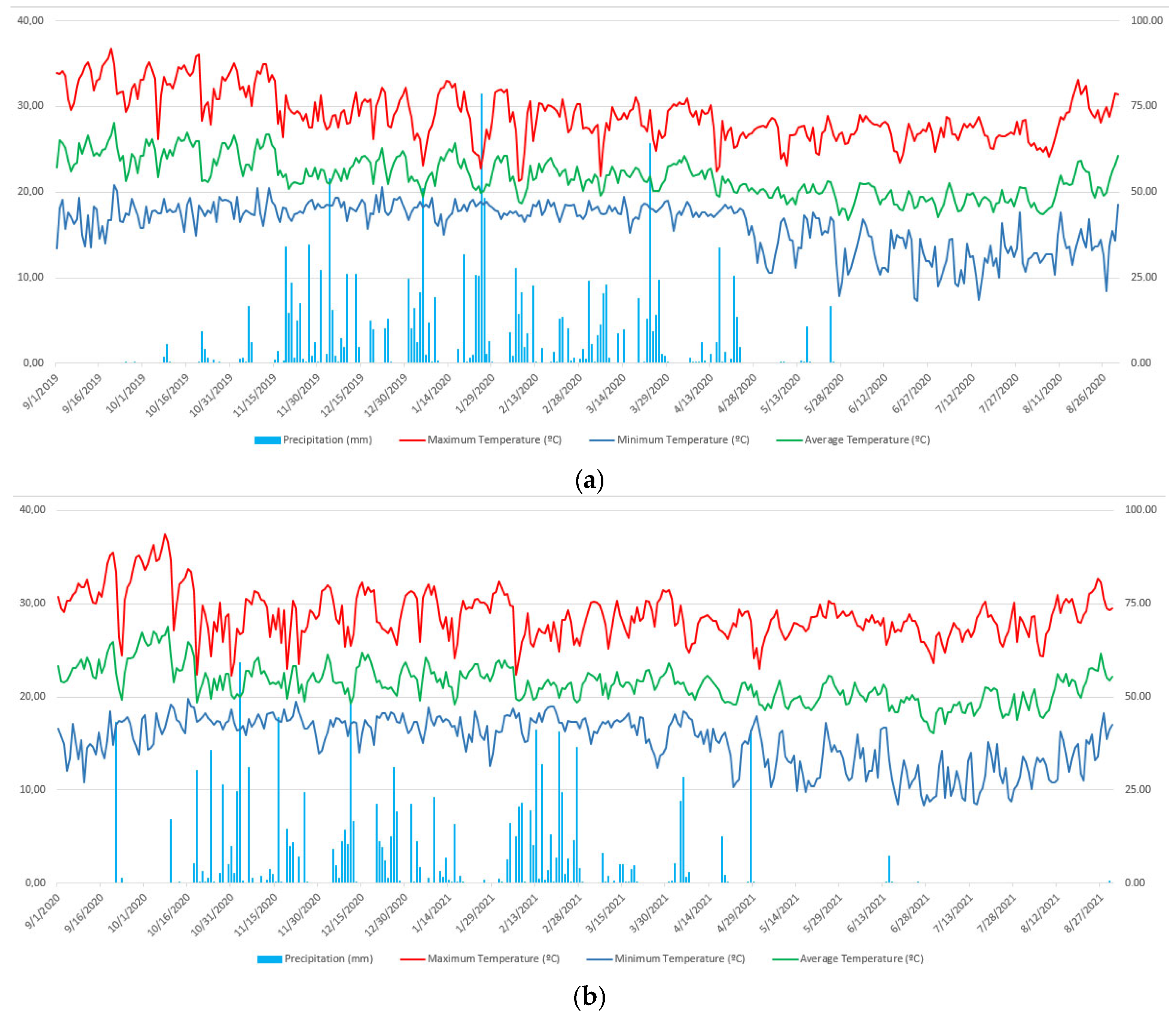
Data on climatological elements, including maximum, average and minimum temperatures (°C) and total precipitation (mm), were collected for the evaluated crop years (Figure 1).
Figure 1.
Climatological data from the main automatic weather station at Embrapa Cerrados: (a) from 09/01/2019 to 08/31/2020; (b) from 09/01/2020 to 08/31/2021. Planaltina, Federal District, 2023. A joint analysis of variance was carried out in a time-subdivided plot design, considering genotypes, years and interactions (Table 1). The genotypes were considered as plots and the years as subplots. In the nature of the model, the genotypes were considered fixed and the years were considered random. The source of variation plot was considered fixed and the subplot was considered random, and the following statistical model was used:
Yijk = µ + Gi + εij + Ak + GAik + δijk
- Yijk = the relative observed value of the trait of the i-th genotype in the j-th repetition in the k-th year;
- µ = general average;
- Gi = effect of the i-th genotype (i = 1, 2, …, g);
- εij = random error a;
- Ak = effect of the k-th year (k = 1, 2, …, a);
- GAik = effect of the interaction between the i-th genotype and the k-th year;
- δijk = random error b.
Table 1.
Diagram of the joint analysis of variance of a completely randomized design model with first-order interaction, with the expected mean squares and F tests for the sources of variation, considering the fixed effects of the genotypes, random effects of the years and genotype × year interaction.
The variance components of genotype, year and interaction, as well as the heritability and genetic (CVg) and environmental (CVe) coefficients of variation at the genotype and year level, were calculated using the following expressions:
Genetic variance component—genotype effect:
Genetic variance component—year effect:
Variance component of the genotype × year interaction:
Heritability, considering the genetic effect in the plot:
Heritability, considering the genetic effect in the subplot:
Coefficient of environmental variation:
Genetic coefficient of variation:
where m = character average.
Relative coefficient of variation:
Selective accuracy:
The means were grouped using the Scott-Knott test at a 5% probability level.
All the genetic statistical analyses were carried out using the GENES program [16].
3. Results
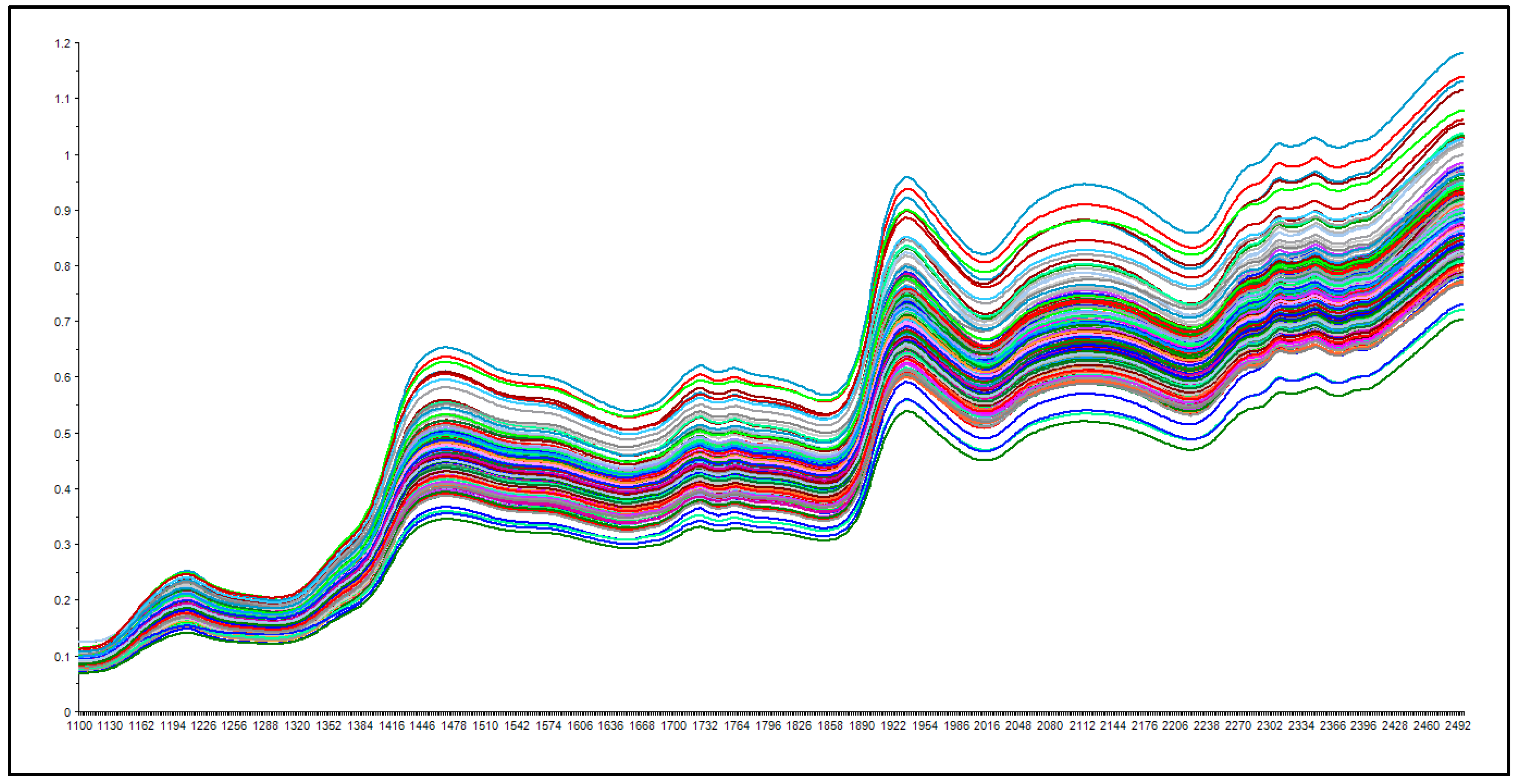
Figure 2 shows the reflectance spectra of various ground green coffee samples, collected over the spectral range from approximately 1100 nm to 2500 nm. Each colored line represents the spectrum of a different sample, illustrating variations in light absorption/reflection in the near-infrared region. The peaks and valleys observed in the spectra indicate the presence of different chemical compounds, as each substance has a characteristic absorption pattern at specific wavelengths. The more pronounced peaks are generally related to functional groups present in the biochemical compounds of coffee, such as chlorogenic acid, caffeine, sucrose, citric acid and trigonelline.
Figure 2.
Spectra of raw ground coffee samples collected by near-infrared spectroscopy—NIRS, using reflectance in the spectral range between 1108 nm and 2492.8 nm. ISIscan spectroscopy program version 2.85.
The analysis of variance (Table 2) showed that there was no difference between the genotypes for chlorogenic acid (5-ACQ) and citric acid content, but there was a difference for sucrose, caffeine and trigonelline content, indicating genetic diversity for these characteristics between the genotypes evaluated. In the evaluations carried out in both years, there were differences for all the characteristics evaluated, suggesting that the environmental factor was a determining factor in the chemical composition of the coffee.
Table 2.
Mean squares of the joint analysis in subdivided plots, F values and estimations of genetic parameters for the content of chlorogenic acid (5-ACQ), caffeine, sucrose, citric acid and trigonelline, all shown in percentages, in the raw beans of 18 Conilon coffee genotypes in an irrigated cultivation system in the Cerrado. Planaltina, Federal District, 2023.
There was a significant interaction between genotypes and years for the contents of chlorogenic acid (5-ACQ), caffeine and sucrose (p < 0.05), indicating the performance of the genotypes for these traits, while there was no interaction for citric acid and trigonelline content. To assess the experimental quality, the F value and selective accuracy were used as indicators of experimental precision. F values above 2.0 and selective accuracies above 0.7 were observed for sucrose, caffeine and trigonelline, attesting to the high experimental precision.
Among the genotypes evaluated, the lowest caffeine levels in 2020 were observed in L1L4P139 (1), L2L28P100 (11), L2L21P20 (12), L2L2P24 (16) and L4L21P20 (34). For 2021, the genotypes with the lowest caffeine levels were L1L4P139 (1), L2L28P100 (11), L2L21P20 (12), L3L13P39 (19) and L4L21P20 (34) (Table 3).
Table 3.
Average levels of chlorogenic acid (5-ACQ), caffeine, sucrose, citric acid and trigonelline evaluated in the raw beans of 18 Conilon coffee genotypes grown in an irrigated system in the Cerrado in two consecutive years. Planaltina, Federal District, 2023.
The selection gains for the biochemical compound contents evaluated were −0.466% for chlorogenic acid, −6.879% for caffeine, 5.582% for sucrose, 10.014% for citric acid and 8.275% for trigonelline (Table 4).
Table 4.
Estimates of heritability (H2), specific selection gain (SG), average of the original population (Xo) and average of the improved population (Xs) for the chlorogenic acid (5-ACQ), caffeine, sucrose, citric acid and trigonelline contents evaluated in the raw beans of 18 Conilon coffee genotypes in an irrigated system in the Cerrado in 2020 and 2021. Embrapa Cerrados, Planaltina, DF, 2023.
4. Discussion
The analysis of these spectra (Figure 2) enables the prediction, through calibrated models, of the concentration of key biochemical compounds in the samples, circumventing the need for conventional chemical methods that are more time-consuming and costly [17]. The spectral variation observed among the lines reflects the chemical diversity present across different coffee genotypes or batches, underscoring the value of near-infrared spectroscopy (NIRS) as a rapid and efficient tool for product quality assessment [18].
The joint analysis of variance data (Table 2) provides robust evidence of the significant genetic variability among the evaluated genotypes for the sucrose, caffeine and trigonelline contents—compounds closely linked to sensory quality and commercial value. This genetic diversity is critical for the success of breeding programs, as it permits the identification and selection of superior genotypes exhibiting desirable chemical profiles [4,6]. Notably, high heritability estimates for these compounds (all above 60%, with caffeine reaching 85.5%) confirm that a substantial fraction of phenotypic variation is genetically determined, facilitating meaningful selection gains (Table 4) [7,19]. For instance, the genetic coefficient of variation for caffeine (6.72%) surpasses the environmental coefficient (4.74%), indicating a favorable scenario for genetic improvement targeted at modifying bitterness or enhancing flavor intensity [20,21].
Conversely, chlorogenic acid (5-ACQ) and citric acid did not exhibit statistically significant differences among genotypes, suggesting lower genetic influence and higher biochemical stability within the population. This aligns with prior findings that chlorogenic acid levels tend to be more affected by environmental and physiological factors—such as solar radiation, temperature and maturation stage—than by genetic factors alone [22]. Such stability may derive from the conserved metabolic pathways and tight regulatory mechanisms characteristic of compounds with antioxidant roles in plant defense.
The mean biochemical compound levels per genotype and year (Table 3) reveal considerable phenotypic variability, particularly for caffeine, trigonelline and sucrose, highlighting the strong impact of environmental factors on trait expression. This interannual fluctuation emphasizes the necessity to select genotypes demonstrating consistent performance across diverse growing conditions, ensuring the stability of key quality attributes [23,24]. In this context, breeding strategies must prioritize not only high average performance but also environmental resilience and adaptability to safeguard quality amid climatic variability.
From a practical breeding standpoint, this variability constitutes an advantage by enabling the identification of promising genotypes that combine superior chemical profiles with adaptability to varying environments [25,26]. The integration of molecular tools such as marker-assisted selection or genomic selection could further accelerate the development of cultivars with the stable expression of desirable biochemical traits throughout production cycles. Given the challenges imposed by climate change, deploying genetically superior and environmentally robust genotypes is imperative for sustaining coffee quality and competitiveness in global markets [27,28].
The significant genetic potential evidenced, especially for caffeine content, highlights its strategic importance in coffee breeding programs. The observed heritability and genetic variability parameters underscore the feasibility of achieving targeted improvements, whether aimed at reducing bitterness for milder coffee variants or intensifying flavor for specialty markets [28,29]. Harnessing this potential will facilitate the alignment of sensory excellence with agronomic performance, ultimately driving sustainable advancements in coffee production.
5. Conclusions
The evaluated genotypes showed medium to high genetic variability for caffeine, with a heritability of 85.5% and a genetic coefficient of variation higher than the environmental coefficient (CVr > 1). For sucrose and trigonelline, the genetic variability was medium, with heritabilities and variation coefficients lower than those of caffeine.
The significant genotype × year interaction for chlorogenic acid, caffeine and sucrose indicates the environmental influence on the expression of these traits.
Among the compounds evaluated, caffeine demonstrated the greatest potential for selection, enabling real gains in raw grain, while the potential for sucrose and trigonelline is moderate.
Author Contributions
Conceptualization, F.A.A.B., R.F.A., A.D.V. and M.F.; methodology, R.F.A., A.D.V. and M.F.; software, J.V.M.; validation, R.F.A., A.D.V. and M.F.; formal analysis, F.A.A.B., R.F.A., J.V.M., A.D.V. and M.F.; investigation, F.A.A.B., R.F.A., J.V.M., A.D.V., G.B.C.S., A.R.F. and M.F.; resources, R.F.A. and M.F.; data curation, F.A.A.B., R.F.A., J.V.M., A.D.V., G.B.C.S., A.R.F. and M.F.; writing—original draft preparation, F.A.A.B.; writing—review and editing, G.B.C.S. and A.R.F.; visualization, F.A.A.B., R.F.A., J.V.M., A.D.V., G.B.C.S., A.R.F. and M.F.; supervision, R.F.A. and M.F.; project administration, R.F.A. and M.F.; funding acquisition, R.F.A. and M.F. All authors have read and agreed to the published version of the manuscript.
Funding
This research was funded by Fundação de Apoio à Pesquisa do Distrito Federal (FAP-DF), grant number 02/2024.
Data Availability Statement
The original contributions presented in this study are included in the article; further inquiries can be directed to the corresponding author.
Acknowledgments
The authors would like to acknowledge the technical support provided by Embrapa Cerrados, which was essential to the success of this research. We would also like to thank FAPDF for the financial support for the publication of this article in the journal. We are grateful to the entire Embrapa Cerrados team for their valuable contributions, expertise and collaboration throughout the study.
Conflicts of Interest
The remaining authors declare that the research was conducted in the absence of any commercial or financial relationships that could be construed as a potential conflict of interest.
References
- Pimenta, C.J.; Angélico, C.L.; Chalfoun, S.M. Challengs in coffee quality: Cultural, chemical and microbiological aspects. Ciência Agrotecnol. 2018, 42, 337–349. [Google Scholar] [CrossRef] [Scilit]
- Cheng, B.; Furtado, A.; Smyth, H.E.; Henry, R.J. Influence of genotype and environment on coffee quality. Trends Food Sci. Technol. 2016, 57, 20–30. [Google Scholar] [CrossRef] [Scilit]
- Farah, A. Coffee as a speciality and functional beverage. In Functional and Speciality Beverage Technology; Woodhead Publishing: Cambridge, UK, 2009; pp. 370–395. [Google Scholar]
- Cheserek, J.J.; Ngugi, K.; Muthomi, J.W.; Omondi, C.O.; Kathurima, C.W. Genetic Variability and Correlation of Biochemical and Sensory Characteristics of Coffee. J. Agric. Sci. 2022, 14, 95. [Google Scholar] [CrossRef] [Scilit]
- Tran, H.T.; Lee, L.S.; Furtado, A.; Smyth, H.; Henry, R.J. Advances in genomics for the improvement of quality in coffee. J. Sci. Food Agric. 2016, 96, 3300–3312. [Google Scholar] [CrossRef] [Scilit] [PubMed]
- Gichimu, B.M.; Gichuru, E.K.; Mamati, G.E.; Nyende, A.B. Biochemical Composition within Coffea arabica cv. Ruiru 11 and its Relationship with Cup Quality. J. Food Res. 2014, 3, 31–44. [Google Scholar] [CrossRef] [Scilit]
- Sala, P.I.A.L. Biometria e Composição Química de Genótipos do café Conilon Irrigado no Cerrado do Planalto Central do Distrito Federal. Master’s Thesis, Faculdade de Agronomia e Medicina Veterinária, Universidade de Brasília, Brasília, Brazil, 2018. [Google Scholar]
- Brige, F.A.A. Variabilidade Genética e Caracterização Química de Acessos de Café Conilon em Sistema de Cultivo Irrigado no Cerrado. Master’s Thesis, Faculdade de Agronomia e Medicina Veterinária, Universidade de Brasília, Brasília, Brazil, 2016. [Google Scholar]
- Vencovsky, R.; Barriga, P. Genética Biométrica no Fitomelhoramento; Sociedade Brasileira de Genética: Ribeirão Preto, Brazil, 1992; 496p. [Google Scholar]
- Ferrão, R.G.; Volpi, P.; Senra, J.D.B.; Comério, M.; Ferrão, M.; Verdin Filho, A.C.; Da Fonseca, A.F.A. Comportamento e a variabilidade genética entre clones de café conilon em ambientes representativos e não irrigados do Espírito Santo. Multi-Sci. Res. 2023, 5, 6–21. [Google Scholar] [CrossRef] [Scilit]
- Siesler, H.W.; Ozaki, Y.; Kawata, S.; Heise, H.M. Near-Infrared Spectroscopy: Principles, Instruments, Applications; John Wiley & Sons: Weinheim, Germany, 2008; 361p. [Google Scholar]
- Ferrão, R.G.; Fonseca, A.F.A.d.; Ferrão, M.A.G.; Bragança, S.M. ‘Emcaper 8151’—Robusta Tropical: Primeira variedade melhorada de café conilon propagada por sementes para o Estado do Espírito Santo. In Resumos Expandidos; Simpósio de Pesquisa dos Cafés do Brasil; Embrapa Café/Minasplan: Brasília, Brazil, 2000; pp. 413–416. [Google Scholar]
- Köppen, W.; Geiger, R. Klimate der Erde; Verlag Justus Perthes: Gotha, Germany, 1928. [Google Scholar]
- Rocha, O.C.; Guerra, A.F.; Silva, F.A.M.; Machado Júnior, J.R.R.; Araújo, M.C.; Silva, H.C. Programa para monitoramento de irrigação do cafeeiro no Cerrado. In Proceedings of the VIII Simpósio Brasileiro de Pesquisa em Cafeicultura Irrigada, Araguari, Brazil, 23–26 October 2006; UFV: Viçosa, Brazil, 2006; pp. 61–64. [Google Scholar]
- Guerra, A.F.; Rocha, O.C.; Rodrigues, G.C.; Sanzonowicz, C.; Sampaio, J.B.R.; Silva, H.C.; Araújo, M.C. Irrigação do Cafeeiro no Cerrado: Estratégia de Manejo de água para Uniformização de Florada; Embrapa Cerrados. Comunicado técnico, 122; Embrapa Cerrados: Planaltina, Brazil, 2005; 4p. [Google Scholar]
- Cruz, C.D. GENES—A software package for analysis in experimental statistics and quantitative genetics. Acta Sci. 2013, 35, 271–276. [Google Scholar]
- Rodrigues, M.; Machado, M.A.; Ferreira, L.F.; Silva, R.M. Use of NIR spectroscopy to discriminate coffee genotypes based on chemical composition. J. Food Sci. Technol. 2019, 56, 4204–4211. [Google Scholar]
- Mishra, S.; Bal, L.M.; Mohapatra, D. Advances in coffee breeding and quality assessment using omics and phenotyping tools. Plant Physiol. Biochem. 2022, 173, 12–25. [Google Scholar] [CrossRef] [Scilit]
- Farah, A.; de Paula Lima, J.; Trugo, L.C. Effect of roasting on chlorogenic acids, caffeine, and other bioactive compounds in coffee. Food Chem. 2019, 302, 125281. [Google Scholar] [CrossRef] [Scilit]
- Ávila, F.A.; Santos, J.B.; Mendes, T.R. Influence of climatic factors on biochemical compounds of Coffea arabica L. during the development stages. Plant Physiol. Biochem. 2021, 158, 120–128. [Google Scholar] [CrossRef] [Scilit]
- Oliveira, M.C.; Silva, J.A.G.; Ferreira, C.D. Genetic variability and stability of coffee genotypes for biochemical traits under varying environments. Crop Breed. Appl. Biotechnol. 2020, 20, e282120. [Google Scholar]
- Campa, C.R.; Machado, R.P.; Lima, L.S. Integrating environmental data and genotypic performance for improved coffee breeding strategies. Theor. Appl. Genet. 2022, 135, 2831–2845. [Google Scholar]
- Silva, R.S.; Barbosa, T.A.; Souza, L.A. Adaptability and resilience of coffee genotypes under climate change scenarios: Challenges and prospects. Front. Plant Sci. 2023, 14, 1156723. [Google Scholar]
- Cheserek, M.J.; Mwangi, M.; Kibet, L. Heritability and genetic variability of caffeine, sucrose and trigonelline contents in Coffea arabica and Coffea canephora hybrids. Plant Breed. 2022, 141, 453–463. [Google Scholar] [CrossRef] [Scilit]
- Mishra, S.; Sharma, R.; Singh, K. Genetic improvement of coffee quality traits: Recent advances and future prospects. Breed. Sci. 2022, 72, 1–15. [Google Scholar]
- Gichimu, B.M.; Wanyoko, J.K.; Kinyua, M.G. Influence of genetic and environmental factors on caffeine content in Arabica coffee grown in Kenya. Food Chem. 2021, 340, 127933. [Google Scholar] [CrossRef] [Scilit]
- Rodrigues, R.M.; Silva, J.A.; Santos, F.C. Environmental modulation of caffeine biosynthesis and accumulation in Coffea arabica L. beans. Front Plant Sci. 2020, 11, 578682. [Google Scholar]
- Alves, R.M.; Pereira, G.E.; Oliveira, L.R. Variability in caffeine content among coffee genotypes and implications for breeding programs. Crop Sci. 2019, 59, 1551–1560. [Google Scholar]
- Oliveira, M.C.; Silva, J.A.G.; Ferreira, C.D. Genetic variability and selection potential for biochemical compounds in coffee under different environmental conditions. Euphytica 2021, 217, 125. [Google Scholar]

Disclaimer/Publisher’s Note: The statements, opinions and data contained in all publications are solely those of the individual author(s) and contributor(s) and not of MDPI and/or the editor(s). MDPI and/or the editor(s) disclaim responsibility for any injury to people or property resulting from any ideas, methods, instructions or products referred to in the content. |
© 2025 by the authors. Licensee MDPI, Basel, Switzerland. This article is an open access article distributed under the terms and conditions of the Creative Commons Attribution (CC BY) license (https://creativecommons.org/licenses/by/4.0/).