


Abstract
Poly(propylene carbonate) diol (PPCDL) can incorporate CO2 directly into the soft segment of a thermoplastic polyurethane (TPU); however, its rigid and strongly polar carbonate backbone suppresses microphase separation, so lower hardness is usually achieved only at the expense of tensile strength. Herein, this trade-off was addressed by molecular design rather than formulation adjustment within this fixed formulation window. By utilizing a rigid–flexible synergetic strategy, six heterocyclic siloxane modifiers bearing triazole, thiadiazole, or aniline pendants, along with three amino-terminated poly(dimethylsiloxane) (PDMS) controls, were incorporated into PPCDL-based TPUs as chain-extending segments via a torque-rheometer-assisted bulk process at a fixed hard-segment content of 17 wt% and a [NCO]/[OH] ratio of 1.02. Each modifier couples a flexible siloxane spacer with heterocyclic hydrogen-bonding moieties, and the N–H donor and sp2-hybridized nitrogen acceptor counts were explicitly enumerated. The long-chain triazole modifier L2 afforded the most balanced elastomer, with a Shore A hardness of 76, a tensile strength of 5.71 ± 0.44 MPa, and an elongation at break of 892 ± 54%; these values exceeded those of the best PDMS control (4.36 ± 0.33 MPa, 621 ± 0.97%, 80 Shore A) in all evaluated metrics, without any petroleum-based polyol. Gaussian deconvolution of the N–H stretching band showed that the ordered hydrogen-bonded fraction, rather than the total N–H content, correlated with tensile strength (r = 0.723) and hardness (r = 0.732). Because all formulations share a 17 wt% hard segment, R = 1.02, a single PPCDL molar mass, and a single heterocyclic modifier loading, the proposed design rules should be regarded as qualitative guidelines whose transferability remains to be validated.
1. Introduction
Thermoplastic polyurethanes (TPUs) are segmented elastomers whose hard and soft blocks can be tuned almost independently, which makes them indispensable in footwear, textile fibers, protective films, and biomedical devices and increasingly attractive as active layers for wearable strain sensors [1,2] and skin-like ionic conductors [3]. The same tunability has also been exploited in light-triggered and humidity-responsive polyurethane actuators [4,5,6]. These applications require low stiffness, high stretchability, and adequate load-bearing capacity simultaneously. Meanwhile, the pressure to decarbonize polymer manufacturing has renewed interest in non-petroleum feedstocks. CO2-based poly(propylene carbonate) diol (PPCDL) is a prominent candidate: it incorporates CO2 as a C1 building block into the polyol chain [7], yields polyurethanes with improved hydrolysis and oxidation resistance [8], and lowers the greenhouse-gas footprint of polyurethane production, as confirmed by a life-cycle assessment of an industrial process [9]. Oligocarbonate diols prepared directly from CO2 are already manufactured on an industrial scale [10,11]. Efforts to improve the sustainability of TPUs have progressed from conventional petroleum-based formulations, through partially CO2-based systems that blend PPCDL with petroleum-based polyether glycols, to fully CO2-based PPCDL TPUs. Although the fully CO2-based system eliminates petroleum-based polyols and offers complete degradability, it still suffers from a low-hardness/low-strength dilemma, as illustrated in Chart 1.

Chart 1.
Schematic comparison of traditional TPU, partially CO2-based TPU, and fully CO2-based PPCDL TPU with respect to synthesis composition, degradability, and the remaining challenge of low hardness with sufficient strength.
The mechanical behavior of a segmented TPU is governed mainly by the chemistry of its soft segment [12]; PPCDL, however, presents a particular challenge. Semicrystalline polyester soft segments tend to crystallize near room temperature, which degrades elasticity [13,14,15]; shortening the polyol or increasing the hard-segment content only partially alleviates this issue, while compromising toughness or processability [16,17]. Replacing part of the polyester with a second, non-crystallizable glycol [18,19] adds synthetic complexity without altering the underlying balance. PPCDL is non-crystallizable, but its alternating carbonate linkages are strongly polar and interact with the urethane and urea hard segments. Consequently, the hard domains serve as inefficient physical crosslinks, and microphase separation remains limited. When the hard-segment content is reduced to achieve low hardness, the tensile strength falls well below that of polyether or polyester analogues [20,21]. Blending with petroleum-based polyether glycols can restore toughness but removes the CO2-based character of the material. A modifier that softens the PPCDL phase while introducing reinforcing interactions is therefore needed.
Two strategies have been pursued synergetically for this purpose. The first is silicone modification. Chemically incorporating poly(dimethylsiloxane) (PDMS) as a soft-segment component or chain extender exploits the low glass-transition temperature, high backbone flexibility, and low surface energy of siloxanes [22,23,24,25]. Its limitation is equally well documented: non-polar PDMS is thermodynamically incompatible with the polar urethane matrix, forms no specific interactions with the hard domains, and undergoes macrophase separation beyond a modest loading, so reinforcement saturates rapidly. The second strategy is hydrogen-bonding engineering [26], in which multidentate motifs are incorporated into the chain to densify and order the physical crosslinks. Quadruple hydrogen-bonding ureidopyrimidinone units [27,28,29], biomimetic hierarchical hydrogen-bonding arrays [30,31], and tris-urea motifs [32] all raise strength and toughness substantially; dihydrazide-derived hard segments have pushed tensile strength and fracture energy towards record values [33,34], and dense packing of hydrogen-bonding arrays in poly(urethane urea) elastomers achieves a comparable combination of toughness, resilience, and healability [35]. Related work on dynamic main-chain and dangling hydrogen bonds [36,37,38], multiple-hydrogen-bond crosslinks [39] and rigid–flexible supramolecular segment interplay [40] has established the general design principle that a stiff, strongly associating moiety must be paired with a compliant spacer. Combining the rigid–flexible strategy in a single molecule, in which a flexible siloxane spine carries heterocyclic hydrogen-bond moieties, has not been tested in a fully CO2-based TPU.
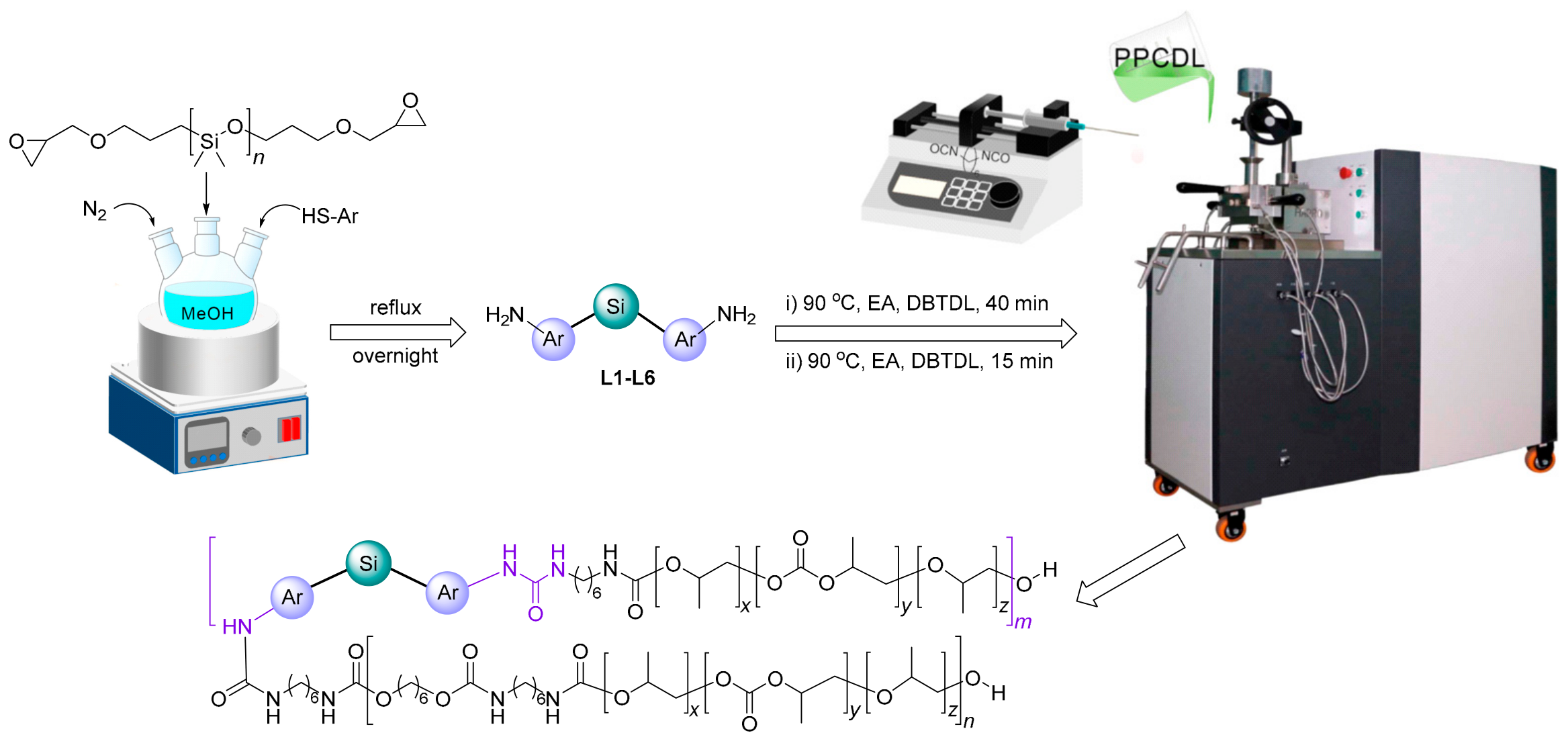
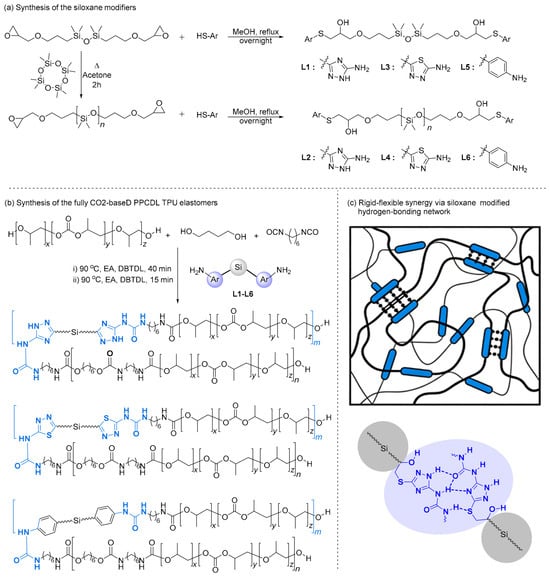
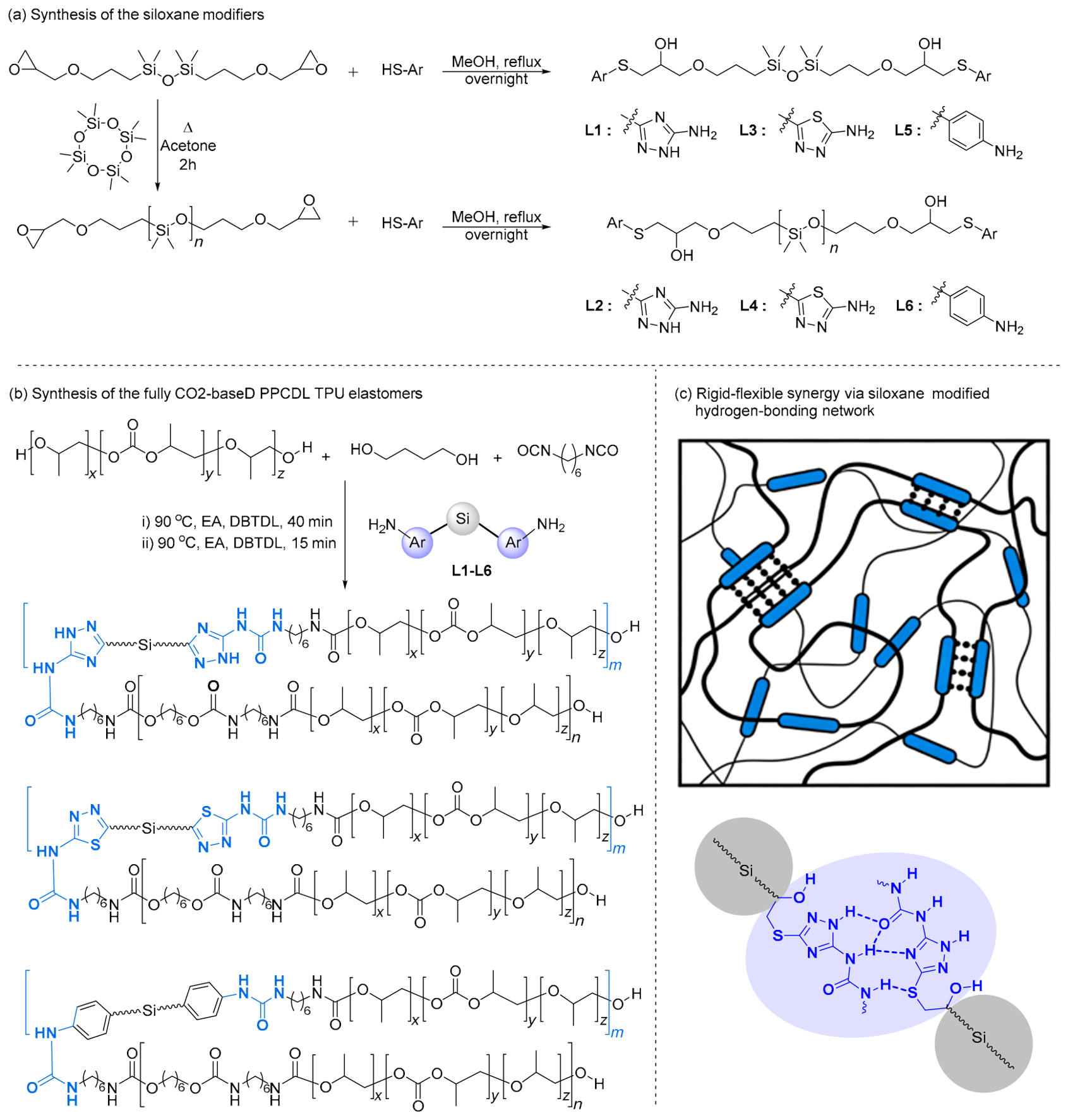
At fixed 17 wt% hard-segment content, R = 1.02, a single PPCDL molar mass, and a fixed modifier loading, the two modifier-structural variables were decoupled. Other formulation variables were not explored. Six heterocyclic siloxanes (L1–L6) were prepared by thiol–epoxy ring-opening addition between diglycidyl-terminated siloxanes and three amino-heteroaryl thiols, which provided two siloxane chain lengths for each of three pendants: 3-amino-1,2,4-triazole (L1, L2), 2-amino-1,3,4-thiadiazole (L3, L4), and para-aminophenyl (L5, L6), as depicted in Scheme 1a. Three amino-terminated PDMS homologs served as controls. All nine modifiers were incorporated into the PPCDL backbone through urea linkages under identical conditions, so that the only variables were the siloxane chain length and the heterocyclic pendant for the synthesis of TPU elastomers (Scheme 1b). The rigid–flexible synergy, in which the siloxane spacer softens the carbonate soft phase while the heterocyclic pendants organize ordered hydrogen-bond arrays between chains (Scheme 1c), enabled a significant reduction in the hardness of the fully PPCDL-based TPU while improving its strength. The CO2-derived polyol accounted for 78–82 wt% of every elastomer formulated in this study, and no petroleum-based co-soft segment was used.
Scheme 1.
Molecular design and synthesis of the rigid–flexible siloxane modifiers. (a) Preparation of the amino-terminated siloxanes (NH2-PDMS-500, NH2-PDMS-2000), the diglycidyl-terminated PO-PDMS and the six heterocyclic siloxanes L1–L6 by thiol–epoxy ring-opening addition, together with the N–H donor/sp2-nitrogen acceptor inventory of the three heterocyclic pendants. (b) A torque-rheometer-assisted bulk polymerization of the PPCDL-based TPUs in a torque rheometer: the isocyanate-terminated prepolymer is chain-extended by the modifier through urea linkages. (c) Schematic of the rigid–flexible synergy: the siloxane spacer softens the carbonate soft phase, while the heterocyclic pendants organize ordered hydrogen-bond arrays between the chains.
2. Experiment
2.1. Materials
1,1,3,3,5,5,7,7-Hexamethylcyclotetrasiloxane (D4), 1,1,3,3,5,5-hexamethylcyclotrisiloxane (D3), 1,3-bis(3-aminopropyl)-1,1,3,3-tetramethyldisiloxane, 1,3-bis(3-glycidyloxypropyl)-1,1,3,3-tetramethyldisiloxane, 3-amino-5-mercapto-1,2,4-triazole, 2-amino-5-mercapto-1,3,4-thiadiazole, 4-aminothiophenol, 1,4-butanediol (BDO), and dibutyltin dilaurate (DBTDL) were obtained from Aladdin or Macklin. Hexamethylene diisocyanate (HMDI) was purchased from J&K. Hydroxyl-terminated PPCDL (Mn = 2116 g mol−1, Đ = 1.057, a hydroxyl value of 56.1 mmol g−1, functionality f = 2.116) was supplied by our laboratory. Solvents and other reagents were used as received.
2.2. Synthesis of the Siloxane Modifiers
Amino-terminated siloxanes were prepared by KOH-catalyzed ring-opening polymerization of D4 or D3 with the aminopropyl end-blocker at 46–70 °C under argon, followed by neutralization with phosphoric acid and vacuum stripping at 85 °C; amine-value titration with 0.1 mol L−1 perchloric acid gave Mn = 508 g mol−1 (NH2-PDMS-500) and 1912 g mol−1 (NH2-PDMS-2000), while the unmodified end-blocker (M = 249.6 g mol−1) served as the shortest homolog. The diglycidyl-terminated PO-PDMS (designed Mn ≈ 600 g mol−1) was prepared analogously with the glycidyloxypropyl end-blocker. The heterocyclic siloxanes L1–L6 were obtained by adding two equivalents of an amino-heteroaryl thiol to the epoxy groups of PO-PDMS or of the short-chain bis-epoxy disiloxane (M = 362.6 g mol−1) in dry methanol at 70 °C under argon overnight. Full procedures, quantities, and 1H NMR spectra are given in the Supporting Information.
2.3. Synthesis of the TPU Elastomers
TPU-5-1 to TPU-5-9 were prepared by a torque-rheometer-assisted bulk polymerization in a torque rheometer at 60 rpm (Scheme 2). PPCDL (25.0 g, preheated to 110 °C) was dissolved in ethyl acetate, charged into the preheated rheometer, and freed from solvent; DBTDL (30 mg) and BDO (0.9742 g, 10.8 mmol) were mixed in for 5 min, and HMDI (4.1109 g, 24.5 mmol) was added dropwise over at least 40 min. After a further 15 min, the heterocyclic siloxane (0.5 mmol) or the amino-terminated PDMS (1.0 mmol) was introduced, and mixing continued for 15 min. Because [NCO]/[OH] = 1.02, the chains are isocyanate-terminated at this stage and are extended by rapid addition of the modifier amino groups to form urea linkages. The product was vacuum-dried at 90 °C overnight, and specimens were prepared by compression molding, which demonstrates melt-processability under the adopted conditions; it does not by itself establish retention of properties after repeated reprocessing. Reprocessing-cycle tests were not performed. All formulations were held at 17 wt% hard-segment content and R = [NCO]/[OH] = 1.02 (Table 1).
Table 1.
Composition of the TPU elastomers and the hydrogen-bonding inventory of the siloxane modifiers, expressed per modifier molecule and per batch. All formulations use the PPCDL soft segment (Mn ≈ 2000 g mol−1), HMDI, and BDO, with a hard-segment content of 17 wt% and R = [NCO]/[OH] = 1.02.
Scheme 2.
Synthesis of the siloxane-modified PPDCL-based TPUs via the torque-rheometer-assisted bulk polymerization.
2.4. Characterization
1H NMR spectra were recorded on a Bruker Avance 400 MHz spectrometer (CDCl3 or DMSO-d6). ATR-FTIR spectra were collected on a Nicolet iS10 spectrometer (4000–500 cm−1, 32 scans, 5 cm−1 resolution). TGA was performed on a PerkinElmer Pyris Diamond under nitrogen; DSC was carried out on a NETZSCH DSC 200PC, with the soft-segment glass-transition temperature (Tg) taken from the second heating scan. Tensile tests were performed on a QJ-211 universal testing machine at 25 °C, and Shore A hardness was measured with an LXD-A durometer. Gel permeation chromatography (GPC) measurements were performed using a Shimadzu GPC system (Shimadzu Corporation, Kyoto, Japan), an RID-20A refractive index (RI) detector, an LC-20AD liquid chromatograph pump, and a CTO-20AC column oven. The mobile phase was THF at a flow rate of 1.0 mL min−1; column pressure was maintained at 670–760 psi; column temperature was set at 40 °C; the total elution time was 33 min. The system was calibrated with narrow-dispersity polystyrene (PS) standard samples with Mn ranging from 580 to 1,670,000 g mol−1. Molar-mass parameters (Mn, Mw, Đ = Mw/Mn) were calculated from the RI detector response using a third-order polynomial PS calibration curve.
2.5. Deconvolution of the N–H Stretching Band
The N–H stretching region (3500–3100 cm−1) is a broad envelope produced by N–H groups in different hydrogen-bonding environments, so individual contributions cannot be read from the peak position alone. After baseline correction each spectrum was smoothed with a Savitzky–Golay filter, its second derivative was calculated to locate the sub-band centers, and a sum of Gaussian functions was fitted by bounded least squares (non-negative amplitudes; centers within ±40 cm−1 of the derivative estimates; half-widths 5–60 cm−1); if the fit did not converge, the number of sub-bands was reduced to three and the fit repeated. The area of a Gaussian component is proportional to the concentration of N–H groups in the corresponding state. Components above 3450 cm−1 were assigned to free N–H and those below to hydrogen-bonded N–H; the hydrogen-bonding degree is HBD = 1 – A_free/A_total, and the area fraction of each component was used as a finer descriptor of the hydrogen-bond population [41,42].
2.6. Hydrogen-Bond Site Inventory
For each modifier the number of N–H donors and sp2-hybridized ring-nitrogen acceptors were counted per molecule on the assumption that the exocyclic amino group is consumed by the isocyanate to give a urea linkage, which itself contributes two N–H donors. All six heterocyclic modifiers additionally carry two secondary hydroxyl groups generated by the thiol–epoxy ring opening; this contribution is identical across L1–L6 and is therefore not a discriminating variable, whereas the amino-terminated PDMS controls carry no such hydroxyl.
2.7. Statistical Analysis
Pearson coefficients and two-sided p-values for n = 9 samples were calculated from the tabulated data with numpy and scipy; correlations are reported as associations between measured quantities and are not treated as evidence of causation.
3. Results and Discussion
3.1. Molecular Design and Hydrogen-Bonding Inventory of the Modifiers
The synthesis followed the two-step route of Scheme 1. Amino-terminated siloxanes of three lengths were obtained by equilibrium ring-opening polymerization of D4 with the same aminopropyl end-blocker, and the diglycidyl-terminated PO-PDMS was prepared with a glycidyloxypropyl end-blocker; its designed Mn of 600 g mol−1 was consistent with the constant 237.4 g mol−1 increment within each short-chain/long-chain pair (L2 − L1 = L4 − L3 = L6 − L5 = 237.4 g mol−1), which corresponded to 3.2 dimethylsiloxane repeat units. The heterocyclic siloxanes L1–L6 were then obtained by thiol–epoxy ring-opening addition, and their 1H NMR spectra confirmed quantitative consumption of the epoxy groups. The modifiers spanned a molar-mass ladder of 594.9–866.4 g mol−1 (Table 1), short enough to remain compatible with the TPU melt yet long enough to act as a flexible spacer.
Within the studied series, the more discriminating structural variable was the hydrogen-bonding functionality of the pendant rather than the siloxane length, and here the three heterocycles differ in a way that can be counted exactly (Table 1). Each modifier molecule carries two heterocyclic units. In L1 and L2, the 3-amino-1,2,4-triazole unit contributes one ring N–H and one exocyclic amino group; if, as expected, the exocyclic amino group reacts with the isocyanate, each unit retains one ring N–H donor and generates two urea N–H donors, i.e., three N–H donors and two pyridine-type sp2 nitrogen acceptors per unit, or six donors and four acceptors per molecule. In L3 and L4, the 2-amino-1,3,4-thiadiazole ring carries no N–H, so each unit contributes two urea N–H donors and two sp2 nitrogen acceptors, giving four donors and four acceptors per molecule. In L5 and L6, the p-aminophenyl unit provides neither a ring N–H nor an acceptor nitrogen, so each molecule contributes four urea N–H donors and no heteroaromatic acceptor.
This inventory corrects an intuition that is simple to state but easy to misinterpret. The two amino-heteroaryl pendant series, L1/L2 and L3/L4, differ by a factor of 1.5 in N–H donor count (six versus four per molecule), rather than by a factor of two. The aniline series L5/L6 is not donor-deficient: it matches the thiadiazole series in donor count and differs only by lacking sp2 nitrogen acceptors (Table 1). More importantly, the three amino-PDMS controls were dosed at twice the molar amount of the heterocyclic modifiers, so they supplied 4.0 mmol of urea N–H per batch—more than any heterocyclic modifier (3.0 mmol for L1/L2 and 2.0 mmol for L3–L6). Any reinforcing effect of the heterocyclic modifiers therefore cannot be attributed to the number of N–H donors alone; it must involve the additional sp2-nitrogen acceptors and the rigid aromatic moieties on which ordered N–H···N and N–H···O=C arrays can be built. The same reasoning implies that the total site count (donors plus acceptors) rather than the donor count is the quantity worth correlating with the mechanical response, and this expectation is tested below.
3.2. Mechanical Properties
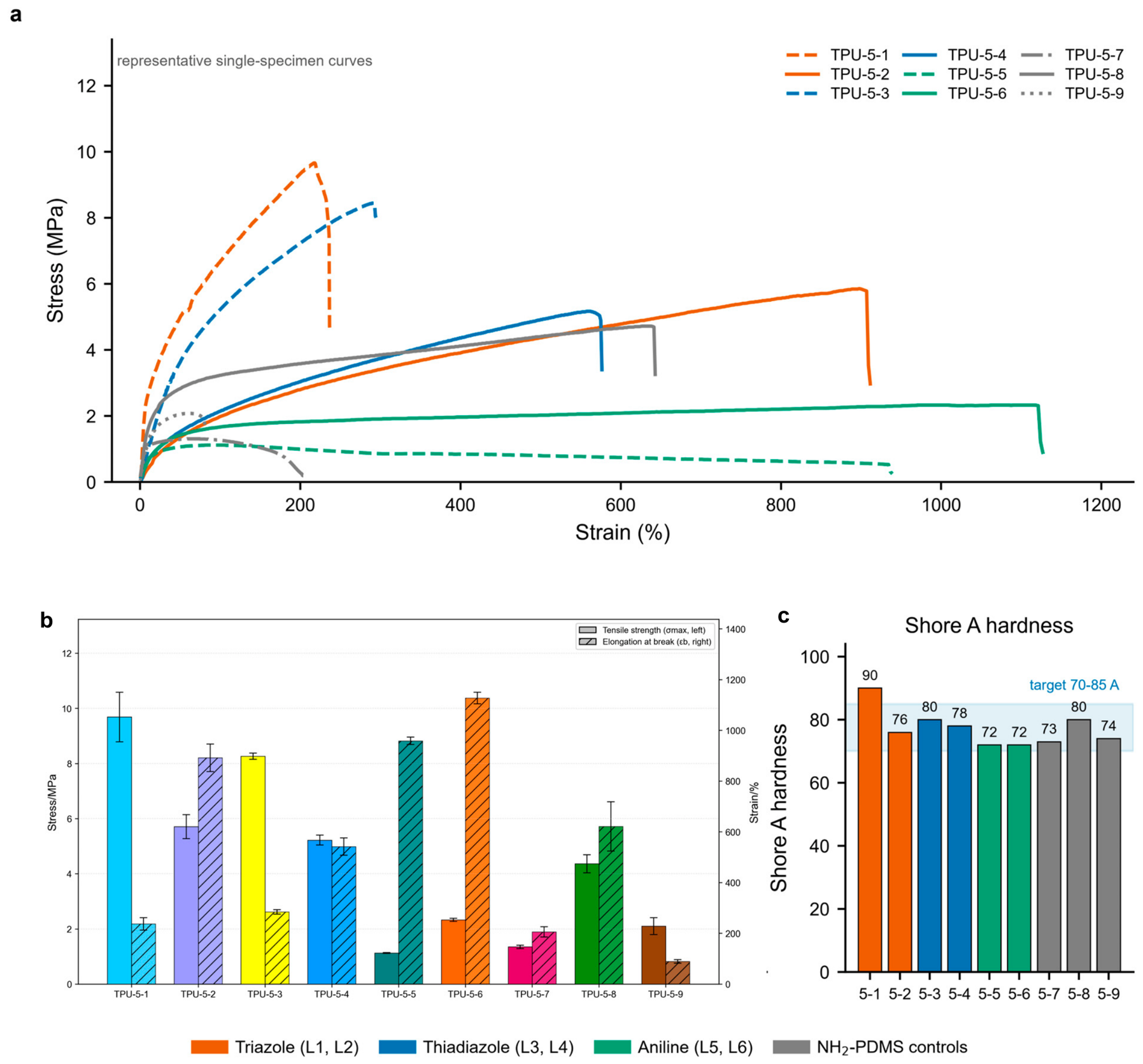
Table 2 and Figure 1 summarize the mechanical response of the nine elastomers. Figure 1a shows representative stress–strain curves for individual specimens, while Figure 1b,c display the series-average values for each formulation. Three comparisons isolate the two design variables.
Table 2.
Mechanical and thermal properties of TPU-5-1 to TPU-5-9.
Figure 1.
Mechanical properties of TPU-5-1 to TPU-5-9. (a) Stress–strain curves of individual specimens (dashed, short siloxane; solid, long siloxane; the controls are drawn in gray). (b) Ultimate tensile strength and elongation at break. Error bars in (b) represent the standard deviation of n = 4 independent specimens. Hardness in (c) is the mean of five indentation measurements per specimen; individual readings are not shown. (c) Mean value of Shore A hardness; the shaded band is the medium-hardness target of 70–85 A. The color code shared by (c) is given below . The values in (b,c) are those reported for the series and need not coincide with the single-specimen curves in (a).
Effect of the heterocycle. At a fixed spacer length, the tensile strength followed the order triazole > thiadiazole > aniline (9.69 ± 0.90 > 8.26 ± 0.11 > 1.13 ± 0.02 MPa for the short series and 5.71 ± 0.44 > 5.22 ± 0.18 > 2.33 ± 0.06 MPa for the long series). This trend agrees with the total hydrogen-bond site count listed in Table 1 Because the carbonate carbonyls of the PPCDL soft segment are present in large excess, the N–H donors are not the limiting species; the decisive factor is whether a donor can engage an ordered, spatially matched acceptor. The aniline series is particularly informative: its strength (1.13 ± 0.02 and 2.33 ± 0.06 MPa) is close to that of the amino-PDMS controls TPU-5-7 and TPU-5-9 (1.35 ± 0.06 and 2.10 ± 0.31 MPa). Once the heteroaromatic acceptors are removed, a heterocyclic siloxane behaves like a conventional amino-terminated PDMS modifier, even though it delivers the same number of N–H donors as the thiadiazole series.
Comparison with conventional amino-PDMS modification. Among the controls, NH2-PDMS-500 (TPU-5-8) was the most effective, giving 4.36 ± 0.33 MPa, 621 ± 97%, and 80 Shore A; the lowest- and highest-molar-mass controls were markedly worse, with TPU-5-7 reaching only 1.35 ± 0.06 MPa at 206 ± 20% and TPU-5-9 failing at 88 ± 7% elongation. TPU-5-2, the long-chain triazole elastomer, surpassed TPU-5-8 in every metric simultaneously: 5.71 ± 0.44 MPa (+30%), 892 ± 54% (+44%), and a hardness 4 Shore A lower. Notably, a fixed hard-segment content of 17 wt% of the heterocyclic siloxane delivered medium hardness and high strength together within the present formulation window, whereas the conventional amino-PDMS route delivered hardness or strength but not both.
The limitation should be stated as clearly as the achievement. The absolute strength of the present elastomers (≤9.69 ± 0.90 MPa) remained below that of the best dihydrazide- or ureidopyrimidinone-reinforced polyether TPUs [33,34,35], an inevitable consequence of confining the formulation to a pure, non-crystallizing CO2-based soft segment at only 17 wt% hard segments. The contribution of this work lies not in a record strength but in the demonstration that, within that constraint, the hardness–strength trade-off can be moved by molecular design. The fixed 17 wt% hard-segment content, R = 1.02, single PPCDL molar mass (Mn ≈ 2116 g mol−1), and single heterocyclic modifier loading define a narrow formulation window. The proposed rigid–flexible synergy is therefore a mechanistically motivated qualitative guideline established within this window, not a generally validated design rule. Transferability to different hard-segment contents, PPCDL molar masses, and modifier concentrations remains to be tested.
3.3. Thermal Behavior and Soft-Segment Mobility
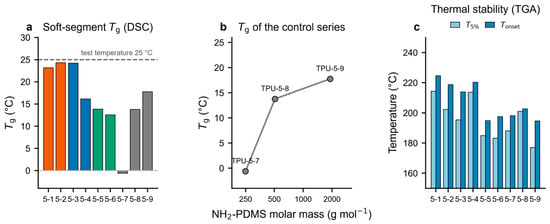
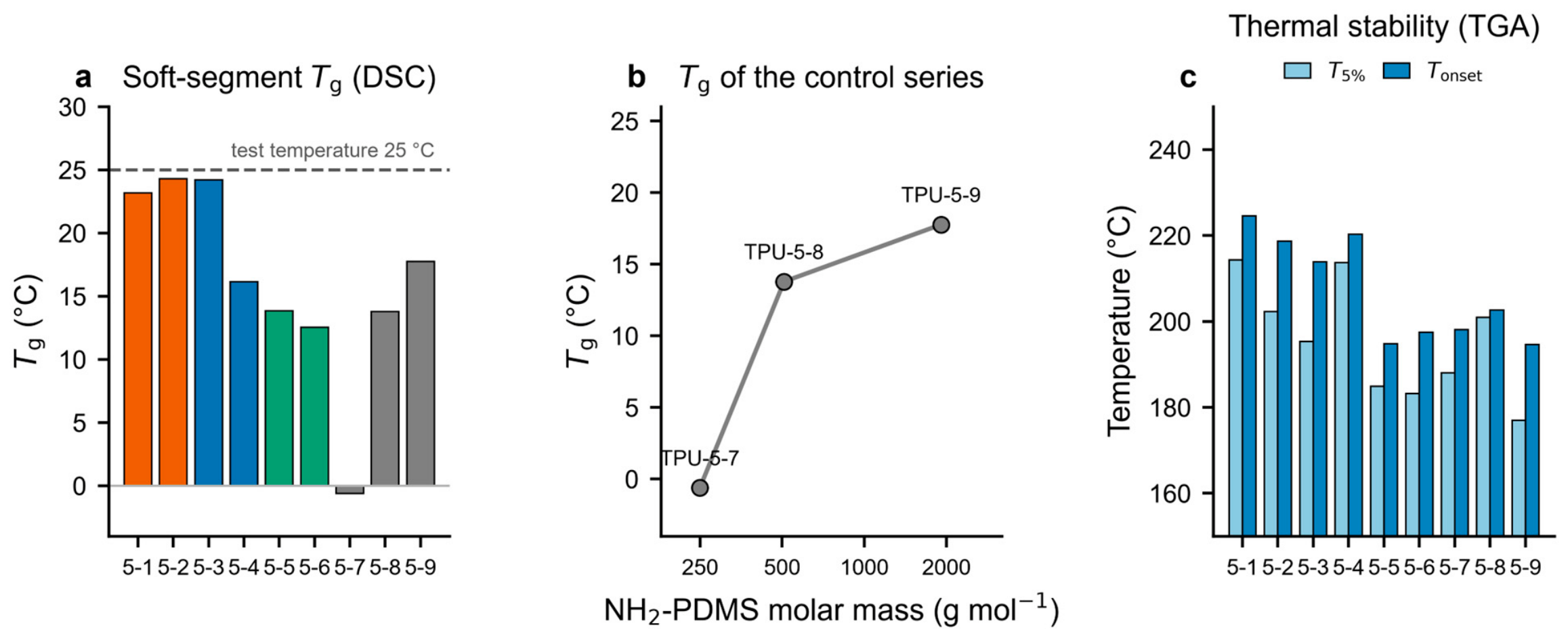
The two-stage degradation profile is consistent with the well-established behavior of segmented polyurethanes (Table 2 and Figure 2c): the first stage (~215–235 °C) corresponds to the thermolysis of urethane/urea linkages in the hard segments, and the second stage (~350–470 °C) corresponds to the decomposition of the PPCDL soft segment and the siloxane moiety. This assignment is supported by the higher thermal stability of the Si–O–Si moiety and by the lower decomposition temperature of aliphatic HMDI-based urethane linkages relative to aromatic analogues [43,44]. The highest Tonset among the series (TPU-5-1, 224.6 °C) is consistent with, though not exclusively attributable to, its higher ordered hydrogen-bond fraction; other structural factors such as hard-domain packing and phase-separation extent may also contribute.
Figure 2.
Thermal properties. (a) Soft-segment glass-transition temperature of TPU-5-1 to TPU-5-9; the dashed line marks the tensile test temperature of 25 °C. (b) Tg of the control series against the molar mass of the amino-PDMS modifier. (c) Temperature of 5% mass loss (T5%) and onset decomposition temperature (Tonset) from TGA.
The soft segment spanned −0.62 to 24.30 °C (Figure 2a) and correlated with the mechanical response. Across all nine samples, Tg correlated positively with tensile strength (r = 0.757, p = 0.018) and showed no significant correlation with elongation at break (r = 0.022, p = 0.95). This global correlation mainly reflects the fact that formulations with very low Tg, such as the aniline-modified and high-molar-mass PDMS controls, are soft and weak, whereas formulations whose Tg approaches the testing temperature are stronger. The Tg values of TPU-5-1, TPU-5-2, and TPU-5-3 (23.18–24.30) are close to the 25 °C testing temperature, placing these specimens within the glass-to-rubber transition zone. This proximity directly explains the strength–elongation trade-off: TPU-5-2 has the highest Tg (24.30 °C), TPU-5-3 is 24.20 °C, and TPU-5-1 is 23.18 °C; all three are close to 25 °C. Although TPU-5-1 has a slightly lower Tg, it exhibits the highest strength and lowest elongation because its short triazole modifier forms a more ordered hydrogen-bond network. Rather than a confounding factor,, Tg proximity amplifies viscoelastic sensitivity, though it does not alone determine the stress–strain balance. No melting endotherm was observed in any sample, confirming that the siloxane modification suppressed the packing of the carbonate sequences and kept the soft phase amorphous, an advantage that PPCDL shares with polyether rather than with semicrystalline polyester soft segments [14,15].
The control series displayed an instructive anomaly: Tg rose with the molar mass of the amino-PDMS (−0.62, 13.78, and 17.76 °C for Mn ≈ 250, 508, and 1912 g mol−1; Figure 2b), contradicting the intuition that a longer siloxane spacer should soften the material. The lowest-molar-mass homolog was short enough to be dispersed molecularly in the polar matrix, where it acted as an internal plasticizer and depressed Tg; the highest-molar-mass homolog was too incompatible and underwent macrophase separation, concentrating the hard segments in the urethane-rich phase and raising the Tg of that phase. The intermediate NH2-PDMS-500 balanced the two effects and, consistently, gave the best mechanical performance among the controls. This interpretation may explain the brittleness of TPU-5-9, which failed at only 82% elongation.
3.4. Hydrogen-Bonding Microstructure from the N–H Stretching Band
The full ATR-FTIR spectra of the nine elastomers were nearly superimposable: each showed the N–H stretching band near 3300 cm−1, the urethane carbonyl band at 1739 cm−1, the amide II band at 1529 cm−1, and the C–O–C stretching bands at 1224 and 1064 cm−1; Si–O–Si stretching also contributed in the 1000–1100 cm−1 region, where it overlapped the carbonate C–O–C modes. Neither the isocyanate band at 2275 cm−1 nor a urea carbonyl band near 1648 cm−1 was detected, so the isocyanate had been consumed, and urethane linkages dominated the spectrum. Incorporation of the modifiers into the urethane/urea backbone was thus confirmed spectroscopically.
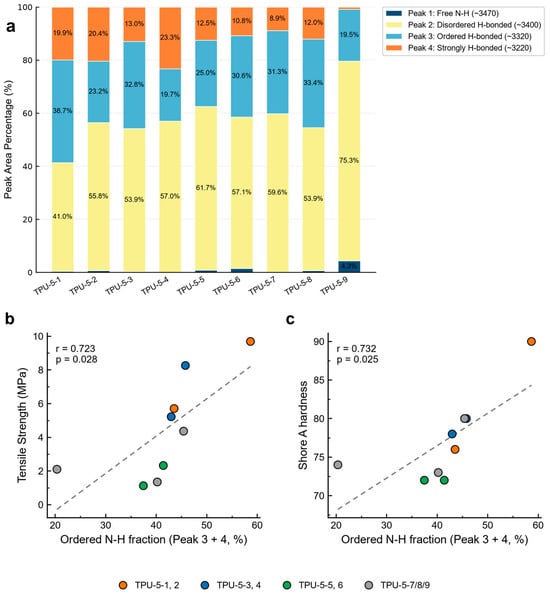
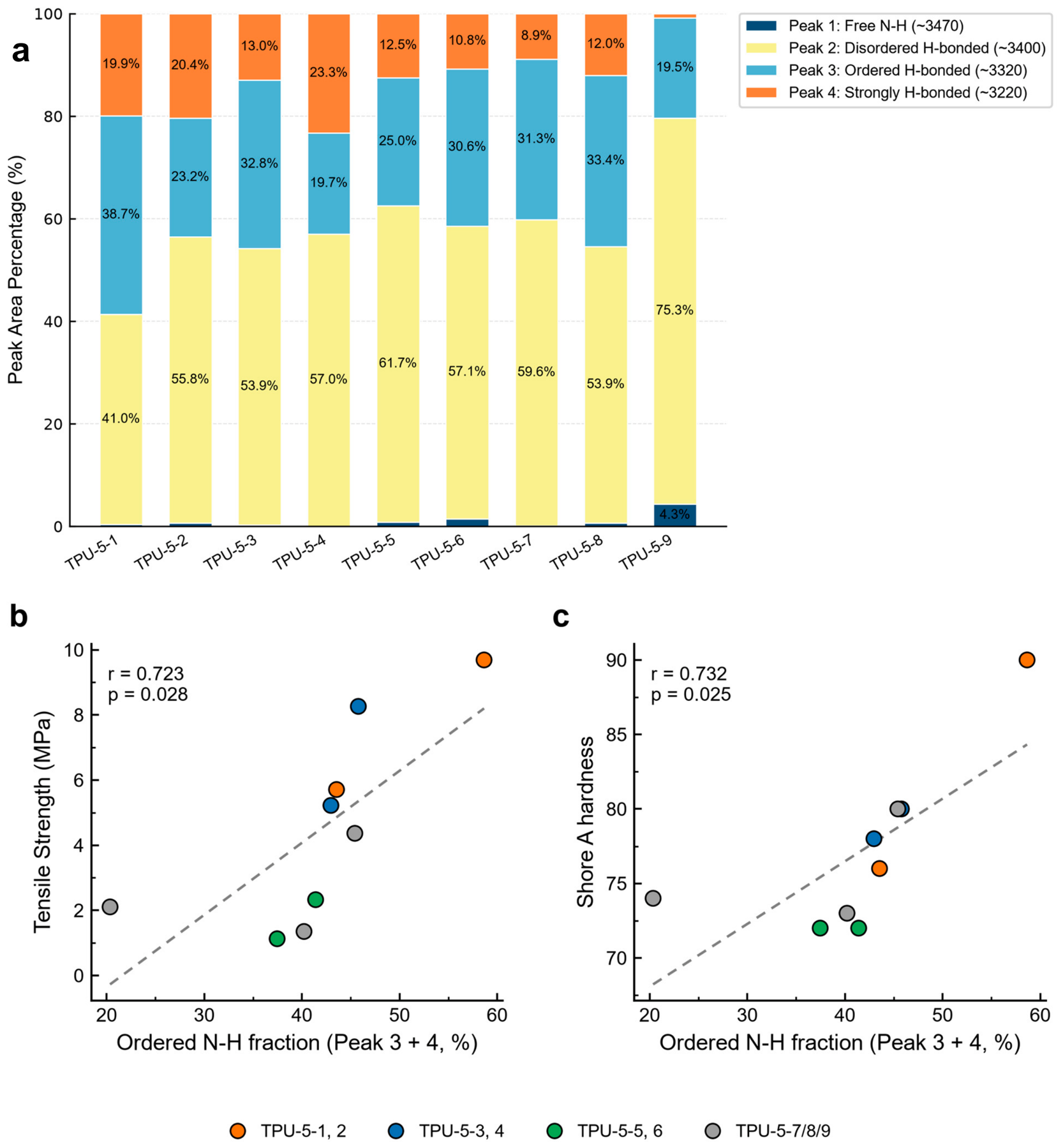
Because the carbonyl region was heavily overlapped, the hydrogen bonds were quantified through the N–H stretching band instead, following the protocol described in the Experimental Section [41,42]. Four sub-bands were resolved for every sample (all bands were fitted with Gaussian profiles; initial positions were 3470, 3400, 3320, and 3220 cm−1, positions were allowed to vary within ±50 cm−1, widths were constrained to 5–80 cm−1, and the baseline was linear between the two extremes of the 3500–3100 cm−1 window; Gaussian profiles were retained because Lorentzian profiles were rejected decisively (ΔAIC = +343 to +1580 for all nine samples), whereas Gaussian and pseudo-Voigt were statistically indistinguishable (ΔBIC = −268 to +285); four bands were preferred over three by BIC (ΔBIC = +14 to +1523 for all nine samples)), and their area fractions, normalized to 100%, are listed in Table 3 and plotted in Figure 3a. Fifty independent fits per sample, with initial positions perturbed by ±10 cm−1, converged to the same minimum for five of nine samples (98–100% of runs); the remaining four converged for 2–38% of runs. The two dominant bands were reproducible (SD ≤ 0.5 cm−1 at ~3319 cm−1 and ≤3.1 cm−1 at ~3394 cm−1 in seven of nine samples), whereas the free and strongly ordered components were not (position SD up to 37 cm−1; the strongly ordered component reached the +50 cm−1 bound in eight of nine samples). Area fractions are therefore reported as mean ± SD over these fits.
Table 3.
Area fractions (%) of the N–H sub-bands and hydrogen-bonding degree from the Gaussian deconvolution of the 3500–3100 cm−1 region. The four components are normalized to sum to 100%; HBD = 1 − A_free/A_total.
Figure 3.
Hydrogen-bonding microstructure from the deconvolution of the N–H stretching band (3500–3100 cm−1). (a) Area fractions of the free, disordered, ordered, and strongly ordered N–H sub-bands, normalized to 100%. (b) Ordered N–H fraction against tensile strength; (c) against Shore A hardness. Dashed lines are least-squares fits, and the inset gives the Pearson coefficient and the two-sided p-value for n = 9.
Two observations followed. First, the free fraction remained below 5% in every sample (0.0–4.3%, and below 1.5% in seven of nine), so the hydrogen-bonding degree lay between 0.964 and 1.000 under the ±50 cm−1 protocol and between 0.982 and 1.000 across all five protocols (SD ≤ 0.016) for all nine elastomers: essentially every N–H group was engaged in a hydrogen bond, and the large differences in mechanical performance (1.13 ± 0.02–9.69 ± 0.90 MPa, 88 ± 7–1127 ± 23%) could not originate from the presence or absence of hydrogen bonds. Second, the discriminating information was carried by the ordered/disordered partition: the ordered fraction, defined as the sum of the ordered (~3320 cm−1) and strongly ordered (~3220 cm−1) components, ranged from 20.4% (TPU-5-9) to 58.7% (TPU-5-1).
The ordered fraction correlated with the macroscopic response (Figure 3b,c): Pearson coefficients of r = 0.723 (p = 0.028) against tensile strength and r = 0.732 (p = 0.025) against hardness, both significant at the 5% level for n = 9. The association persisted across all five fitting protocols (hardness r = 0.60–0.93, p = 0.086 to <0.001; tensile strength r = 0.46–0.83, p = 0.210 to 0.005). TPU-5-1, with the highest ordered fraction (58.7%), was indeed the strongest and hardest sample, while the four elastomers with ordered fractions below 42% (TPU-5-9, 5-5, 5-7, and 5-6) were also the four weakest (1.13 ± 0.02–2.33 ± 0.06 MPa). The association between the disordered fraction and the elongation at break was weaker: no consistent association was observed: Pearson r ranged from −0.73 to +0.11 depending on the fitting protocol and changed sign, so we do not claim even a trend for this relationship. TPU-5-7 failed brittly at 206 ± 20% despite an ordered fraction (40.2%) essentially identical to that of the highly ductile TPU-5-6 (41.4%, 1127 ± 23% elongation); removing ordered crosslinks was not equivalent to adding ductility. Following standard infrared assignments for polyurethane hydrogen bonding [41,42], these correlations are associations rather than direct structural proof after accounting for the fitting uncertainty quantified above, and within this scope they support the design hypothesis that the ordered fraction, not the total N–H content, scales with stiffness and strength.
3.5. Structure–Property Relationships and Design Rules
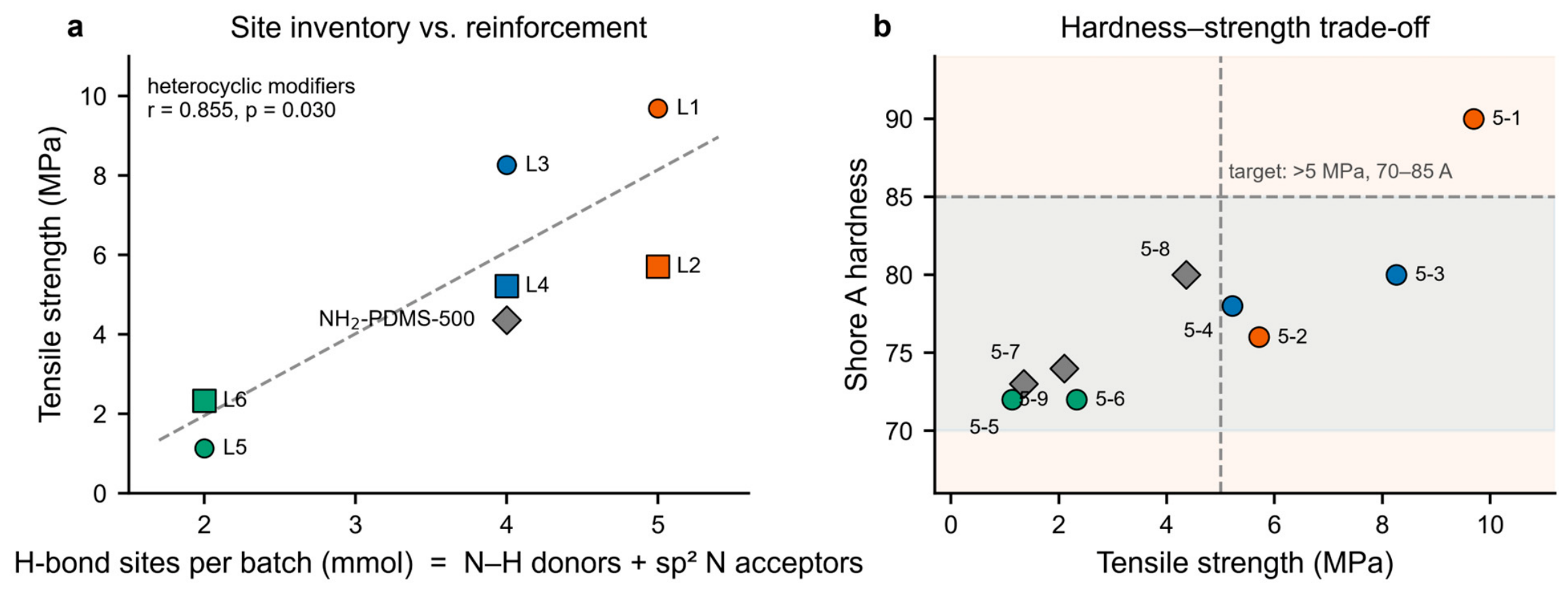
Combining the mechanical, thermal, and spectroscopic results yields a coherent picture of how the rigid–flexible modifiers operate (Scheme 1c). The siloxane spacer is the flexible element: lengthening it lowers Tg and hardness and raises the elongation at break because the non-polar Si–O–Si chain accommodates strain and dilutes the polar carbonate soft phase. The heterocyclic pendant is the rigid element: its sp2 nitrogen acceptors and aromatic frame organize the urea N–H donors into ordered arrays that act as physical crosslinks, and it is the ordered fraction of these arrays that correlates with strength and hardness. The tensile strengthes and the corresponding total number of hydrogen-bond sites were correlated across the six heterocyclic modifiers (r = 0.855, p = 0.030; Figure 4a) The two elements are complementary, and neither is sufficient alone. A rigid moiety without a flexible spacer (L1, L3) gives high strength at high hardness; a flexible spacer without an ordered node (L5, L6, and the amino-PDMS controls) gives softness but little strength. Only the combination of a long siloxane spacer carrying triazole moieties delivers medium hardness and high strength simultaneously (Figure 4b).
Figure 4.
Structure–property relations. (a) Tensile strength of the six heterocyclic modifiers as a function of the total number of hydrogen-bond sites supplied per batch (N–H donors plus sp2 nitrogen acceptors); the diamond is the best amino-terminated PDMS control. (b) Hardness–strength map of all nine elastomers; the shaded region is the target window (>5 MPa, 70–85 Shore A).
Three design rules follow for CO2-based TPUs. (i) At fixed hard-segment content, the siloxane length sets the hardness–elongation balance and should be chosen for the target hardness window; here the ≈600 g mol−1 spacer was optimal. (ii) The heterocycle should maximize the number of sp2 nitrogen acceptors, not the number of N–H donors; triazole > thiadiazole > aniline is both the observed and the predicted order. (iii) Conventional amino-terminated PDMS, which offers neither acceptors nor an ordered moiety, is an inferior modifier even when dosed at twice the molar amount. These rules were established on a single formulation platform (PPCDL/HMDI/BDO, 17 wt% hard segment, R = 1.02) and on nine samples, so their generality across hard-segment contents, diisocyanates, and CO2-polyol molar masses remains to be tested.
The formulation reported here also maps onto several principles of green chemistry. The soft segment is derived from CO2, and the CO2-based polyol constitutes 78–82 wt% of every elastomer formulated in this study; no petroleum-based polyether or polyester glycol is used as a co-soft segment, which distinguishes this work from most low-hardness TPU formulations reported to date. The modifier synthesis relies on a thiol–epoxy addition that is atom-economical and proceeds at 70 °C under atmospheric pressure in methanol, and the TPU itself is prepared by solvent-free bulk polymerization in a torque rheometer. The material is thermoplastically processable by compression molding and can therefore be reprocessed rather than discarded. Two caveats bound these claims. First, methanol and the siloxane monomers are still petrochemicals, and the siloxane modifier is used at only 0.5–1.0 mmol per batch, so the renewable carbon content of the elastomer is set by the polyol and not by the modifier. Second, we have not performed a full life-cycle assessment; the comparison with the petroleum-based benchmark therefore rests on the published assessment of CO2-derived polyols [9] rather than on measurements made here.
The mechanical, thermal, and spectroscopic results together show that the siloxane spacer controls the hardness–elongation balance while the heterocyclic pendant controls the ordered hydrogen-bond fraction that scales with strength and hardness (Scheme 1c). Three design rules follow for CO2-based TPUs. (i) At a fixed hard-segment content, the siloxane length should be selected for the target hardness window; here the ≈600 g mol−1 spacer was optimal. (ii) The heterocycle should maximize the number of sp2 nitrogen acceptors rather than the number of N–H donors, consistent with the observed and predicted order triazole > thiadiazole > aniline. (iii) Conventional amino-terminated PDMS is an inferior modifier even when dosed at twice the molar amount. These rules were established on a single formulation platform (PPCDL/HMDI/BDO, 17 wt% hard segment, R = 1.02), so their generality across hard-segment contents, diisocyanates, and CO2-polyol molar masses remains to be tested.
The formulation also aligns with several principles of green chemistry. The CO2-based polyol constitutes 78–82 wt% of every elastomer, and no petroleum-based polyether or polyester glycol is used as a co-soft segment. The TPU is prepared by bulk polymerization in a torque rheometer, making it thermoplastically reprocessable. Two caveats remain: methanol and the siloxane monomers are still petrochemicals, and the modifier is used at only 0.5–1.0 mmol per batch, so the renewable carbon content is set by the polyol; and no full life-cycle assessment was performed, so the comparison with the petroleum-based benchmark rests on the published assessment of CO2-derived polyols [9].
4. Conclusions
We have shown that the low-hardness/low-strength trade-off of pure PPCDL-based TPU elastomers can be alleviated by pairing a flexible siloxane spacer with a rigid heterocyclic hydrogen-bond moiety in a single modifier molecule. Nine elastomers were prepared at a fixed hard-segment content of 17 wt% and R = 1.02, without any petroleum-based co-soft segment, and the two design variables were decoupled by design. The decisive finding is that reinforcement tracks the number of sp2-nitrogen acceptors rather than the number of N–H donors: the amino-terminated PDMS controls supply more N–H per batch than any heterocyclic modifier yet provide less reinforcement, and across the six heterocyclic modifiers tensile strength correlates with the total hydrogen-bond site count (r = 0.855, p = 0.030). The long-chain triazole modifier L2 affords the best balance, 76 Shore A, 5.71 ± 0.44 MPa, and 892 ± 54% elongation, exceeding the best PDMS control in every metric. Spectroscopically, the ordered fraction of the N–H stretching band, not the total hydrogen-bonded fraction, tracks strength (r = 0.723) and hardness (r = 0.732), which places the reinforcement in the ordering of the hydrogen-bond network. These rules are presently qualitative design guidelines valid within the studied formulation window; systematic mapping across hard-segment content, PPCDL molar mass, and modifier concentration is required to establish quantitative transferability.
Supplementary Materials
The following supporting information can be downloaded at https://www.mdpi.com/article/10.3390/polym18232944/s1, The experimental procedures and characterization methods, 1H NMR spectra of the modifiers and monomers, GPC curves, and supplementary TGA/DSC/FT-IR data and the supplementary tables and figures cited in the text are collected in the Supplementary Materials.
Author Contributions
B.L.: Methodology, Investigation, Formal analysis, Writing—original draft. S.Z.: Investigation, Formal analysis. S.W.: Formal analysis. M.X.: Formal analysis. Z.K.: Conceptualization, Supervision, Funding acquisition, Writing—review and editing. Y.M.: Conceptualization, Supervision, Funding acquisition, Review and editing. All authors have read and agreed to the published version of the manuscript.
Funding
This work was supported by the National Natural Science Foundation of China (22373118), the Guangdong Basic and Applied Basic Research Foundation (2024B1515040025), and the Fundamental Research Funds for the Central Universities.
Institutional Review Board Statement
Not applicable.
Data Availability Statement
The data that support the findings of this study are available from the corresponding author upon reasonable request.
Acknowledgments
During the preparation of Chart 1, the author(s) used Seedream 5.0 to assist in generating the initial layout and basic icons. After using this tool, the author(s) reviewed and edited the content extensively, manually drawing all chemical structures and text to ensure scientific accuracy, and take full responsibility for the final content of the publication.
Conflicts of Interest
The authors declare that they have no known competing financial interests or personal relationships that could have appeared to influence the work reported in this paper.
References
- Tan, C.; Dong, Z.; Li, Y.; Zhao, H.; Huang, X.; Zhou, Z.; Jiang, J.-W.; Long, Y.-Z.; Jiang, P.; Zhang, T.-Y.; et al. A high performance wearable strain sensor with advanced thermal management for motion monitoring. Nat. Commun. 2020, 11, 3530. [Google Scholar] [CrossRef] [Scilit] [PubMed]
- Sun, H.; Fang, X.; Fang, Z.; Zhao, L.; Tian, B.; Verma, P.; Maeda, R.; Jiang, Z. An ultrasensitive and stretchable strain sensor based on a microcrack structure for motion monitoring. Microsyst. Nanoeng. 2022, 8, 111. [Google Scholar] [CrossRef] [Scilit] [PubMed]
- Chen, S.; Sun, L.; Zhou, X.; Guo, Y.; Song, J.; Qian, S.; Liu, Z.; Guan, Q.; Meade Jeffries, E.; Liu, W.; et al. Mechanically and biologically skin-like elastomers for bio-integrated electronics. Nat. Commun. 2020, 11, 1107. [Google Scholar] [CrossRef] [Scilit] [PubMed]
- Yue, X.; Dong, C.; Wang, Y.; Cui, Z.; Ren, Z.; Guan, Z.-H. Three birds with one stone: Design and synthesis of polyurethane actuator for executing heat, light and humidity triggered deformation. Chem. Eng. J. 2023, 457, 141290. [Google Scholar] [CrossRef] [Scilit]
- Cui, Z.; Yue, X.; Wang, Y.; Zhang, Y.; Ren, Z.-H.; Guan, Z.-H. A light-responsive poly(urethane-urea) actuator with room temperature self-healing performance. Chem. Eng. J. 2024, 479, 147538. [Google Scholar] [CrossRef] [Scilit]
- Lu, X.; Lu, D.; Xu, L.; Wang, D.; Shao, S.; Zhang, A.; Zhang, J. Ionic conductive elastomer with enhanced tensile strength and Skin-Like modulus for artificial skin based on dynamic Polyurethane-urea. Chem. Eng. J. 2025, 505, 159292. [Google Scholar] [CrossRef] [Scilit]
- Grignard, B.; Gennen, S.; Jérôme, C.; Kleij, A.W.; Detrembleur, C. Advances in the use of CO2 as a renewable feedstock for the synthesis of polymers. Chem. Soc. Rev. 2019, 48, 4466–4514. [Google Scholar] [CrossRef] [Scilit] [PubMed]
- Wang, J.; Zhang, H.; Miao, Y.; Qiao, L.; Wang, X.; Wang, F. Waterborne polyurethanes from CO2 based polyols with comprehensive hydrolysis/oxidation resistance. Green Chem. 2016, 18, 524–530. [Google Scholar] [CrossRef] [Scilit]
- von der Assen, N.; Bardow, A. Life cycle assessment of polyols for polyurethane production using CO2 as feedstock: Insights from an industrial case study. Green Chem. 2014, 16, 3272–3280. [Google Scholar] [CrossRef] [Scilit]
- Huang, X.; Alferov, K.; Zhao, T.; Yin, J.; Wang, S.; Han, D.; Huang, S.; Huang, Z.; Xiao, M.; Meng, Y. Facile and direct synthesis of oligocarbonate diols from carbon dioxide and their application as sustainable feedstock for polyurethane. J. CO2 Util. 2023, 75, 102571. [Google Scholar] [CrossRef] [Scilit]
- Cui, S.; Borgemenke, J.; Liu, Z.; Li, Y. Recent advances of “soft” bio-polycarbonate plastics from carbon dioxide and renewable bio-feedstocks via straightforward and innovative routes. J. CO2 Util. 2019, 34, 40–52. [Google Scholar] [CrossRef] [Scilit]
- Yilgör, I.; Yilgör, E.; Wilkes, G.L. Critical parameters in designing segmented polyurethanes and their effect on morphology and properties: A comprehensive review. Polymer 2015, 58, A1–A36. [Google Scholar] [CrossRef] [Scilit]
- Sonnenschein, M.F.; Lysenko, Z.; Brune, D.A.; Wendt, B.L.; Schrock, A.K. Enhancing polyurethane properties via soft segment crystallization. Polymer 2005, 46, 10158–10166. [Google Scholar] [CrossRef] [Scilit]
- Ma, Z.; Hong, Y.; Nelson, D.M.; Pichamuthu, J.E.; Leeson, C.E.; Wagner, W.R. Biodegradable Polyurethane Ureas with Variable Polyester or Polycarbonate Soft Segments: Effects of Crystallinity, Molecular Weight, and Composition on Mechanical Properties. Biomacromolecules 2011, 12, 3265–3274. [Google Scholar] [CrossRef] [Scilit] [PubMed]
- Van Bogart, J.; Bluemke, D.; Cooper, S. Annealing-induced morphological changes in segmented elastomers. Polymer 1981, 22, 1428–1438. [Google Scholar] [CrossRef] [Scilit]
- Velankar, S.; Cooper, S.L. Microphase Separation and Rheological Properties of Polyurethane Melts. 1. Effect of Block Length. Macromolecules 1998, 31, 9181–9192. [Google Scholar] [CrossRef] [Scilit]
- Kloss, J.; Munaro, M.; De Souza, G.P.; Gulmine, J.V.; Wang, S.H.; Zawadzki, S.; Akcelrud, L. Poly(ester urethane)s with polycaprolactone soft segments: A morphological study. J. Polym. Sci. Part A Polym. Chem. 2002, 40, 4117–4130. [Google Scholar] [CrossRef] [Scilit]
- Alteheld, A.; Feng, Y.; Kelch, S.; Lendlein, A. Biodegradable, Amorphous Copolyester-Urethane Networks Having Shape-Memory Properties. Angew. Chem. Int. Ed. 2005, 44, 1188–1192. [Google Scholar] [CrossRef] [Scilit] [PubMed]
- Batiste, D.C.; Pfau-Cloud, M.R.; Kim, H.J.; Ellison, C.J.; Hillmyer, M.A. Alkyl-Substituted Polycaprolactone Poly(urethane-urea)s as Mechanically Competitive and Chemically Recyclable Materials. ACS Macro Lett. 2024, 13, 1449–1455. [Google Scholar] [CrossRef] [Scilit] [PubMed]
- Xu, S.; Zhang, M. Synthesis and characterization of a novel polyurethane elastomer based on CO2 copolymer. J. Appl. Polym. Sci. 2007, 104, 3818–3826. [Google Scholar] [CrossRef] [Scilit]
- Wu, P.; Cheng, H.; Wang, Y.; Shi, R.; Wu, Z.; Arai, M.; Zhao, F. New Kind of Thermoplastic Polyurea Elastomers Synthesized from CO2 and with Self-Healing Properties. ACS Sustain. Chem. Eng. 2020, 8, 12677–12685. [Google Scholar] [CrossRef] [Scilit]
- Bai, C.; Zhang, X.; Dai, J. Synthesis and characterization of PDMS modified UV-curable waterborne polyurethane dispersions for soft tact layers. Prog. Org. Coat. 2007, 60, 63–68. [Google Scholar] [CrossRef] [Scilit]
- Zhang, C.; Zhang, X.; Dai, J.; Bai, C. Synthesis and properties of PDMS modified waterborne polyurethane–acrylic hybrid emulsion by solvent-free method. Prog. Org. Coat. 2008, 63, 238–244. [Google Scholar] [CrossRef] [Scilit]
- Zhang, Z.-P.; Song, X.-F.; Cui, L.-Y.; Qi, Y.-H. Synthesis of Polydimethylsiloxane-Modified Polyurethane and the Structure and Properties of Its Antifouling Coatings. Coatings 2018, 8, 157. [Google Scholar] [CrossRef] [Scilit]
- Dou, Q.; Wang, C.; Cheng, C.; Han, W.; Thüne, P.C.; Ming, W. PDMS-Modified Polyurethane Films with Low Water Contact Angle Hysteresis. Macromol. Chem. Phys. 2006, 207, 2170–2179. [Google Scholar] [CrossRef] [Scilit]
- Meng, Y.; Wu, X.; Zhang, A.; Lin, Y. Multiscale Simulation of Multicomponent Polyurethane Elastomers: Unraveling Composition-Dependent Microphase Separation Dynamics and Mechanical Properties. Macromolecules 2026, 59, 5057–5070. [Google Scholar] [CrossRef] [Scilit]
- Verjans, J.; Hoogenboom, R. Supramolecular polymer materials based on ureidopyrimidinone quadruple hydrogen bonding units. Prog. Polym. Sci. 2023, 142, 101689. [Google Scholar] [CrossRef] [Scilit]
- Dankers, P.Y.; van Leeuwen, E.N.; van Gemert, G.M.; Spiering, A.; Harmsen, M.C.; Brouwer, L.A.; Janssen, H.M.; Bosman, A.W.; van Luyn, M.J.; Meijer, E. Chemical and biological properties of supramolecular polymer systems based on oligocaprolactones. Biomaterials 2006, 27, 5490–5501. [Google Scholar] [CrossRef] [Scilit] [PubMed]
- Söntjens, S.H.M.; Renken, R.A.E.; van Gemert, G.M.L.; Engels, T.A.P.; Bosman, A.W.; Janssen, H.M.; Govaert, L.E.; Baaijens, F.P.T. Thermoplastic Elastomers Based on Strong and Well-Defined Hydrogen-Bonding Interactions. Macromolecules 2008, 41, 5703–5708. [Google Scholar] [CrossRef] [Scilit]
- Song, Y.; Liu, Y.; Qi, T.; Li, G.L. Towards Dynamic but Supertough Healable Polymers through Biomimetic Hierarchical Hydrogen-Bonding Interactions. Angew. Chem. Int. Ed. 2018, 57, 13838–13842. [Google Scholar] [CrossRef] [Scilit] [PubMed]
- Yan, X.; Liu, Z.; Zhang, Q.; Lopez, J.; Wang, H.; Wu, H.-C.; Niu, S.; Yan, H.; Wang, S.; Lei, T.; et al. Quadruple H-Bonding Cross-Linked Supramolecular Polymeric Materials as Substrates for Stretchable, Antitearing, and Self-Healable Thin Film Electrodes. J. Am. Chem. Soc. 2018, 140, 5280–5289. [Google Scholar] [CrossRef] [Scilit] [PubMed]
- Ballard, N. Supramolecularly Reinforced Films from Polyurethane–Urea Dispersions Containing the Tris-Urea Motif. ACS Appl. Polym. Mater. 2020, 2, 4045–4053. [Google Scholar] [CrossRef] [Scilit]
- Li, Z.; Zhu, Y.-L.; Niu, W.; Yang, X.; Jiang, Z.; Lu, Z.-Y.; Liu, X.; Sun, J. Healable and Recyclable Elastomers with Record-High Mechanical Robustness, Unprecedented Crack Tolerance, and Superhigh Elastic Restorability. Adv. Mater. 2021, 33, 2101498. [Google Scholar] [CrossRef] [Scilit] [PubMed]
- Guan, T.; Wang, X.; Zhu, Y.-L.; Qian, L.; Lu, Z.; Men, Y.; Li, J.; Wang, Y.; Sun, J. Mechanically Robust Skin-like Poly(urethane-urea) Elastomers Cross-Linked with Hydrogen-Bond Arrays and Their Application as High-Performance Ultrastretchable Conductors. Macromolecules 2022, 55, 5816–5825. [Google Scholar] [CrossRef] [Scilit]
- Tian, J.; Zhou, Z.; Miao, X.; Wang, S.; Ming, Y.; Nie, Y.; Ma, Y.; Li, Z. Supertough, Resilient, and Healable Thermoplastic Poly(Urethane Urea) Elastomers by Dense Packing of Hydrogen-Bonding Arrays. Adv. Funct. Mater. 2025, 36, e04882. [Google Scholar] [CrossRef] [Scilit]
- Hu, J.; Mo, R.; Jiang, X.; Sheng, X.; Zhang, X. Towards mechanical robust yet self-healing polyurethane elastomers via combination of dynamic main chain and dangling quadruple hydrogen bonds. Polymer 2019, 183, 121912. [Google Scholar] [CrossRef] [Scilit]
- Wang, F.; Yang, Z.; Li, J.; Zhang, C.; Sun, P. Bioinspired Polyurethane Using Multifunctional Block Modules with Synergistic Dynamic Bonds. ACS Macro Lett. 2021, 10, 510–517. [Google Scholar] [CrossRef] [Scilit] [PubMed]
- Zhu, X.; Zheng, W.; Zhao, H.; Wang, L. Non-covalent assembly of a super-tough, highly stretchable and environmentally adaptable self-healing material inspired by nacre. J. Mater. Chem. A 2021, 9, 20737–20747. [Google Scholar] [CrossRef] [Scilit]
- Yang, T.; Lu, X.; Wang, X.; Li, Y.; Wei, X.; Wang, W.; Sun, J. Healable, Recyclable, and Scratch-Resistant Polyurethane Elastomers Cross-Linked with Multiple Hydrogen Bonds. ACS Appl. Polym. Mater. 2023, 5, 2830–2839. [Google Scholar] [CrossRef] [Scilit]
- Wang, L.; Guo, L.; Zhang, K.; Xia, Y.; Hao, J.; Wang, X. Development of Tough Thermoplastic Elastomers by Leveraging Rigid–Flexible Supramolecular Segment Interplays. Angew. Chem. Int. Ed. 2023, 62, e202301762. [Google Scholar] [CrossRef] [Scilit] [PubMed]
- Coleman, M.M.; Lee, K.H.; Skrovanek, D.J.; Painter, P.C. Hydrogen bonding in polymers. 4. Infrared temperature studies of a simple polyurethane. Macromolecules 1986, 19, 2149–2157. [Google Scholar] [CrossRef] [Scilit]
- Lee, H.S.; Wang, Y.K.; Hsu, S.L. Spectroscopic analysis of phase separation behavior of model polyurethanes. Macromolecules 1987, 20, 2089–2095. [Google Scholar] [CrossRef] [Scilit]
- Shaker, A.; Khedewy, A.T.; Hassan, M.A.; El-Baky, M.A.A. Thermo-mechanical characterization of electrospun polyurethane/carbon-nanotubes nanofibers: A comparative study. Sci. Rep. 2023, 13, 17368. [Google Scholar] [CrossRef] [Scilit] [PubMed]
- Mi, H.-Y.; Jing, X.; Napiwocki, B.N.; Hagerty, B.S.; Chen, G.; Turng, L.-S. Biocompatible, degradable thermoplastic polyurethane based on polycaprolactone-block-polytetrahydrofuran-block-polycaprolactone copolymers for soft tissue engineering. J. Mater. Chem. B. 2017, 5, 4137–4151. [Google Scholar] [CrossRef] [Scilit] [PubMed]


Disclaimer/Publisher’s Note: The statements, opinions and data contained in all publications are solely those of the individual author(s) and contributor(s) and not of MDPI and/or the editor(s). MDPI and/or the editor(s) disclaim responsibility for any injury to people or property resulting from any ideas, methods, instructions or products referred to in the content. |
© 2026 by the authors. Licensee MDPI, Basel, Switzerland. This article is an open access article distributed under the terms and conditions of the Creative Commons Attribution (CC BY) license.