


Abstract
A self-standing Ni–B@PVDF-HFP nanofibrous membrane was fabricated via electrospinning followed by NaBH4 reduction and evaluated for hydrogen generation from ammonia borane (AB) methanolysis. The membrane retained its interconnected fibrous structure, with an average fiber diameter of approximately 330 nm and a porosity of 82.6%. XRD and FTIR analyses confirmed the preservation of the β-rich PVDF-HFP structure, with an electroactive β-phase fraction of 95.84%. KMnO4 reduction experiments revealed enhanced reduction under mechanical stimulation in the presence of PVDF-HFP, while comparative AB methanolysis experiments demonstrated substantially higher H2 generation under stirring than under non-stirring conditions. The apparent reaction orders with respect to membrane dosage and AB concentration were 0.79 and 0.80, respectively. Increasing the membrane dosage reduced the time required to reach the final H2 yield from 26 to 6 min, while increasing the AB amount from 1 to 4 mmol increased the final H2 production in accordance with the expected reaction stoichiometry. Increasing the reaction temperature from 30 to 45 °C shortened the reaction time from 26 to 12 min. The apparent activation energy was 26.93 kJ mol−1, with activation enthalpy (ΔH‡) and entropy (ΔS‡) values of 24.35 kJ mol−1 and −213 J mol−1 K−1, respectively. The membrane retained 86.3% of its initial H2 yield after five consecutive catalytic cycles, while post-reaction SEM revealed substantial preservation of the interconnected nanofibrous structure. These findings demonstrate the potential of electrospun Ni–B@PVDF-HFP membranes as recoverable catalytic materials for hydrogen generation from AB methanolysis.
1. Introduction
H2 is considered an important energy carrier in the transition to low-carbon energy systems because of its carbon-neutral use and its high gravimetric energy density. However, the obstacles to safe storage, transportation, and controlled distribution impede its effective implementation [1,2,3]. An alternative strategy is to use chemical H2 carriers, which store H2 in a chemically bound form and release it on demand. Ammonia borane (NH3BH3, AB) has been widely investigated as a chemical hydrogen carrier owing to its high H2 concentration (19.6 wt%), low molecular weight (30.7 g mol−1), and stability under ambient conditions [4,5,6].
H2 can be generated from AB by thermolysis or catalytic solvolysis, such as hydrolysis or alcoholysis. Methanolysis provides AB with solubility in methanol, and its methanolic solutions are stable in the absence of a catalyst. It can suppress ammonia release associated with hydrolysis at higher AB concentrations and operate below 0 °C [5]. In addition, the major boron-derived product, ammonium tetramethoxyborate, presents a potential route for AB regeneration [5]. The process produces three moles of H2 gas for every mole of AB, as shown in Equation (1):
NH3BH3 + 4CH3OH → NH4B(OCH3)4 + 3H2
The AB methanolysis process is sluggish in the absence of an adequate catalyst, despite these advantages. Furthermore, the high cost and limited availability of precious metals such as Rh, Ru, and Pd have spurred the development of catalysts that employ abundant transition metals.
In this context, Ni has been investigated because of its catalytic activity toward B-H compounds and its relatively low cost. Özhava et al. [7] provided a detailed description of the methanolysis of AB by the use of PVP-stabilized Ni(0) nanoparticles (NPs) with an average size of 3.0 ± 0.7 nm. The initial turnover frequency (TOF) of the catalyst was measured to be 12.1 min−1. Regarding the catalyst concentration, the kinetic analysis showed a first-order relationship, whereas the correlation with AB concentration was nearly zero-order. Tunç and Rakap [8] demonstrated that the nanoclusters composed of Ni–Ru, Ni–Rh, and Ni–Pd, which were anchored on hydroxyapatite, exhibited TOF values of 58.9, 120.3, and 25.2 min−1, respectively, for AB methanolysis at a temperature of 25 °C. These results show that catalytic activity depends on catalyst composition and interfacial structure. The use of B-modified Ni compounds offers an alternative approach to modifying nickel’s structure and catalytic characteristics. The reduction of Ni2+ precursors could result in Ni–B centers that are dispersed and physically disordered. In contrast to crystalline metals, amorphous or weakly crystalline metal-boron complexes exhibit heterogeneous local coordination environments. These environments could provide accessible sites for the adsorption and activation of reactants. Kalidindi et al. [9] conducted a study on nanocomposites consisting of Co–Co2B, Ni–Ni3B, and Co–Ni–B for the purpose of producing H2 by AB methanolysis. Although the Ni-Ni3B system produced three equivalents of H2 in about 4.2 min, the bimetallic Co-Ni-B catalyst achieved the same amount of H2 in around 1.5 min under the provided parameters. The effectiveness of a nanocatalyst is influenced by the distribution and stability of the active component. The presence of unsupported nanoparticles increases their surface energy, making them more prone to aggregation. This, in turn, reduces the number of available active sites and makes catalyst recovery more difficult after the reaction [10,11]. Immobilization to an appropriate substrate can reduce the mobility of the NPs and their tendency to cluster. This may make it easier to recover and reuse the catalyst. Electrospun polymer nanofibers are a suitable choice for this application because their interconnected porosity provides a high surface-to-volume ratio and minimizes diffusion distances [12]. Additionally, their self-supporting membrane structure facilitates catalyst retrieval, making them a suitable candidate for this application [13,14,15].
Poly(vinylidene fluoride-co-hexafluoropropylene) (PVDF-HFP) has been investigated as a nanofibrous catalyst substrate owing to its chemical stability, mechanical flexibility, and electroactive characteristics [16,17,18]. Electrospinning can enhance the formation and orientation of the polar β-phase, in which the all-trans configuration of the polymer chains results in a net molecular dipole, thereby inducing a piezoelectric response in the material [16,17,19]. PVDF-HFP need not serve solely as a passive support. The mechanical deformation of the fibers may induce transient surface polarization and a localized electric field that can modify the charge distribution at the polymer–catalyst interface. This attribute is relevant when the catalytic reaction is carried out under mechanical stirring. PVDF-HFP films have sensitivity to small mechanical stimuli, as demonstrated by Chai et al. [20]; under mechanical pressure, the pristine PVDF-HFP film exhibited a piezoelectric coefficient (d33) of around 12 pC N−1, an open-circuit voltage nearing 0.4 V, and a short-circuit current of 20 nA. The incorporation of α-Fe2O3 elevated these metrics to roughly 29 pC N−1, 1.6 V, and 60 nA, respectively. The deformation of the PVDF-HFP-based film in the presence of stirring or flowing water has been shown to generate an interfacial piezoelectric field that participates in charge transfer and redox reactions [20]. In a mechanically agitated catalytic system, the stirring could contribute beyond conventional mass transfer: the deformation of an electroactive PVDF-HFP membrane could induce local polarization, thereby modifying the catalyst-polymer interfacial conditions. Despite the extensive research on Ni-based catalysts for AB methanolysis and the growing interest in PVDF-HFP-supported catalysts for H2 production, the application of borohydride-derived Ni-B domains in conjunction with an electroactive electrospun PVDF-HFP membrane for AB methanolysis has received limited attention. This configuration is of interest because the polymer membrane can simultaneously provide nanoscale confinement, enable straightforward catalyst retrieval, and offer a mechanically responsive interface. At the same time, Ni-B serves as a non-noble-metal catalytic phase.
The present study involved the fabrication of Ni–B@PVDF-HFP nanofibrous membranes via electrospinning of a nickel acetate/PVDF-HFP precursor, which was subsequently reduced with NaBH4, and their evaluation for H2 production from AB methanolysis. The incorporation of the Ni2+ precursor prior to electrospinning aimed to enhance the dispersion of metal species throughout the fibrous matrix, whereas subsequent borohydride reduction resulted in the formation of dispersed Ni–B domains within the membrane. The resulting materials were characterized for their morphology, composition, structure, and chemical state, and their catalytic performance was examined as a function of catalyst loading, AB concentration, and reaction temperature. The kinetic and activation properties, along with the catalyst’s reusability, were further examined. Beyond the conventional supporting role of PVDF-HFP, the potential impact of piezoelectric polarization induced by stirring on the Ni–B/PVDF-HFP interfacial environment was in relation to the catalytic activity.
2. Experimental
2.1. Materials
Nickel(II) acetate tetrahydrate (Ni(CH3COO)2·4H2O, NiAc), poly(vinylidene fluoride-co-hexafluoropropylene) (PVDF-HFP), sodium borohydride (NaBH4), ammonia borane (NH3BH3, AB), N, N-Dimethylformamide (DMF), acetone, methanol (MeOH), and ethanol (EtOH) were obtained from Sigma Aldrich (St. Louis, MO, USA).
2.2. Preparation of NiAc/PVDF-HFP Precursor Solution
A 15% PVDF-HFP solution was prepared by combining DMF and acetone in a 4:1 mass ratio. The solution was mixed homogeneously and kept clear by magnetic stirring until all the polymer powder had dissolved. 1.5 g of NiAc was added to 15 g of the PVDF-HFP solution prepared for the Ni-containing formulation. Continuous stirring overnight achieved a homogeneous precursor solution and uniform distribution of Ni2+ ions throughout the polymer matrix.
2.3. Electrospinning of NiAc/PVDF-HFP Nanofibrous Membrane
Electrospinning was performed on the homogeneous NiAc/PVDF-HFP precursor sol–gel in a laboratory-scale apparatus after it was placed into a plastic syringe. A grounded metal drum wrapped with aluminum foil served as the fiber collector, and the syringe was linked to the positive end of a high-voltage power source. During the electrospinning process, a voltage of 20 kV was applied between the collector and the syringe. The precursor solution was loaded into a conventional plastic syringe mounted on an inclined holder at an appropriate angle to direct the solution toward the needle without a syringe pump. The distance between the tip and the collector was kept at 15 cm. Electrospinning was carried out in a laboratory fume hood at about 24 °C in an air-conditioned room. A steady jet was generated by the precursor solution in response to the applied electric field, and the aluminum-foil-covered collector was coated with continuous NiAc/PVDF-HFP nanofibers. The electrospun nanofibrous mat was carefully removed from the collector and dried under vacuum at 30 °C overnight to remove residual acetone and DMF.
2.4. Chemical Reduction of NiAc/PVDF-HFP Membrane
In situ chemical reduction of the NiAc/PVDF-HFP membrane was accomplished using methanol and NaBH4. To ensure an adequate supply of reducing agent for the integrated Ni2+ species, the molar ratio of NiAc to NaBH4 was kept at 1:5. The precursor solution contained 1 g of nickel acetate, or about 4.02 mmol of Ni precursor. This amounts to a fivefold molar excess of around 20.1 mmol (0.76 g) of NaBH4. Subsequently, a NaBH4 solution in methanol was prepared and added to the electrospun membrane. The membrane gradually darkened as gas developed throughout the reduction process. When detectable H2 gas production ceased, the membrane remained in the reducing solution. To remove any remaining reducing agent, soluble salts, or reaction by-products, the product was extracted and extensively rinsed with deionized water and ethanol. We finally dried the reduced membrane overnight at 40 °C. Hereafter, the Ni-B@PVDF-HFP membrane will be referred to as the borohydride-reduced membrane.
2.5. Characterization
The morphology of the electrospun Ni-B@PVDF-HFP membrane was investigated using scanning electron microscopy (SEM). To confirm the presence of Ni within the nanofibrous matrix and analyze the membrane’s elemental composition, energy-dispersive X-ray spectroscopy (EDX) was used in conjunction with scanning electron microscopy (SEM). Using Cu Kα radiation, X-ray diffraction (XRD) was employed to examine the membrane’s structural properties. To determine the polymer’s structural status after Ni precursor insertion and reduction. Fourier transform infrared (FTIR) spectra were produced using a Nicolet iS10 FTIR Spectrometer (Thermo Fisher Scientific, Waltham, MA, USA). The spectra were collected over the wavenumber range 1000–4000 cm−1, with a resolution of 4 cm−1. A total of 32 cumulative scans were completed. The gravimetric method was used in order to determine the Ni loading of the Ni@PVDF-HFP NFs. A 100 mg sample of catalyst was placed in a ceramic crucible and calcined at 900 °C in a muffle furnace (Carbolite, GHF 3/8, Hope Valley, UK). The polymer matrix had been completely decomposed, and Ni had been converted into NiO. The residual solid was allowed to cool and then weighed to determine the amount of Ni present. X-ray photoelectron spectroscopy (XPS) was employed to investigate the surface elemental composition of the Ni–B@PVDF-HFP nanofibrous membrane. A wide-survey spectrum was acquired using an X-ray source operated at a nominal spot size of 400 µm (X-Ray003, FG ON, Thermo Fisher Scientific, Waltham, MA, USA). UV–visible absorption measurements were performed using a Jenway 6850 UV/Vis Spectrophotometer (Jenway, London, UK). For the purpose of determining the porosity (P) of the NF membranes that were synthesized, the dried samples were immersed in n-butanol (BuOH) solution for a duration of 1 h. The equation that is shown below was used in order to ascertain the value of P [21]:
where Mm represents the mass of the dry membrane, MBuOH represents the mass of n-butanol that has been absorbed, ρBuOH represents the density of n-butanol, and ρp represents the density of the PVDF-HFP.
2.6. H2 Generation from AB Methanolysis
The Ni–B@PVDF-HFP membrane’s catalytic effectiveness for H2 production via methanolysis of AB was assessed in a batch reactor coupled to an inverted burette to measure the volume of released H2. The reactor was placed in a thermostat-controlled water bath to maintain the reaction at the specified temperature. In the following method, a typical experiment was conducted: 1 mmol of AB was solubilized in 25 mL of methanol using magnetic stirring. Once the reaction medium reached the required temperature, a specific mass of Ni–B@PVDF-HFP membrane was introduced into the reactor to commence the reaction. Using the water displacement technique, the evolved H2 was collected volumetrically after being transferred via a gas plastic tube. When no further quantifiable gas generation was observed, the H2 volume was evaluated as a function of reaction time.
2.7. Effect of Catalyst Loading and AB Concentration
The impact of catalyst loading was investigated by altering the mass of the Ni–B@PVDF-HFP membrane while keeping the other reaction parameters constant. The linear section of the related evolution curve was used to compute the initial rate of H2 production, and the volume of H2 was plotted against time for each catalyst loading. The impact of AB concentration was further investigated at a fixed membrane loading by varying the initial AB concentration while keeping the methanol volume and other reaction parameters constant.
2.8. Effect of Reaction Temperature and Activation Parameters
To investigate the temperature dependence of AB methanolysis, H2 evolution experiments were conducted under similar conditions across a range of temperatures. Before introducing the catalyst, the thermostatically regulated water bath was brought to thermal equilibrium. According to the Arrhenius equation, the apparent activation energy (Ea) was determined. The Eyring equation was used to ascertain the activation enthalpy (ΔH‡) and activation entropy (ΔS‡).
3. Results and Discussions
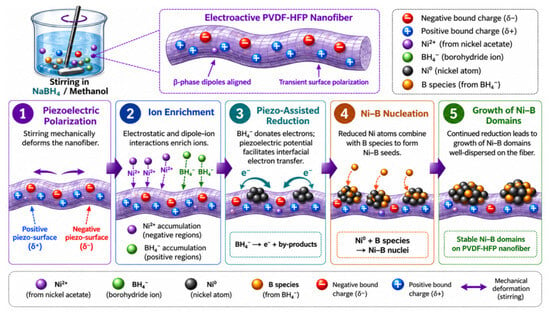
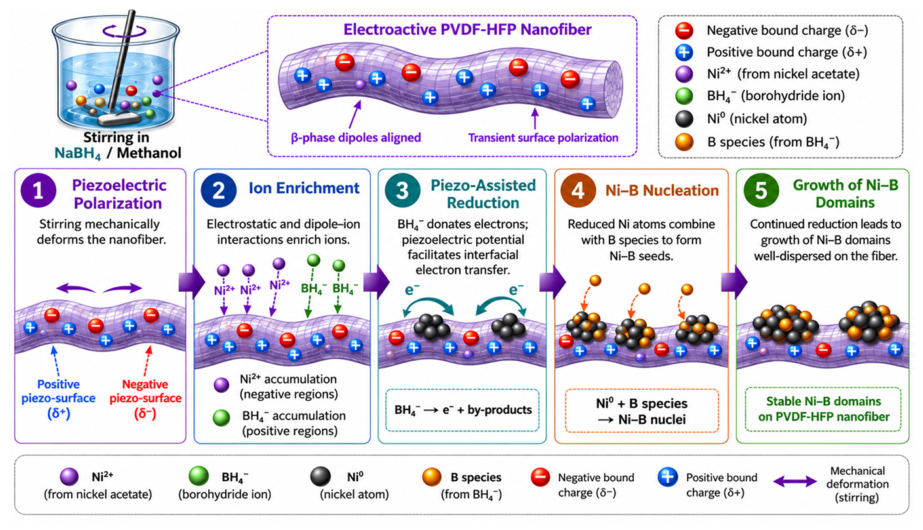
Electrospun PVDF-HFP is a porous, flexible nanofibrous matrix capable of producing transient piezoelectric polarization when subjected to mechanical strain. NiAc was added to the PVDF-HFP solution prior to electrospinning, which facilitated the distribution of Ni2+ species throughout the fibrous network. Continued stirring may distort the PVDF-HFP NFs and create localized positive and negative surface charges during subsequent reduction with NaBH4 in methanol (Figure 1). While NaBH4 remains the reducing agent, these transient polarization domains could affect the local distribution of Ni2+ species and enable interfacial charge redistribution. The development of structurally disordered Ni–B domains restricted to the PVDF-HFP fibers is favored by the introduction of B-containing species and the production of dispersed Ni-containing nuclei by borohydride reduction. By restricting particle movement and providing spatially separated nucleation sites, the nanofibrous matrix facilitates dispersion and inhibits aggregation. Thus, the suggested process integrates limited Ni–B nucleation and development on the PVDF-HFP NFs, borohydride-driven reduction, and stirring-induced piezoelectric polarization.
Figure 1.
Proposed mechanism for the formation of Ni–B@PVDF-HFP nanofibrous membranes through stirring-induced piezoelectric polarization.
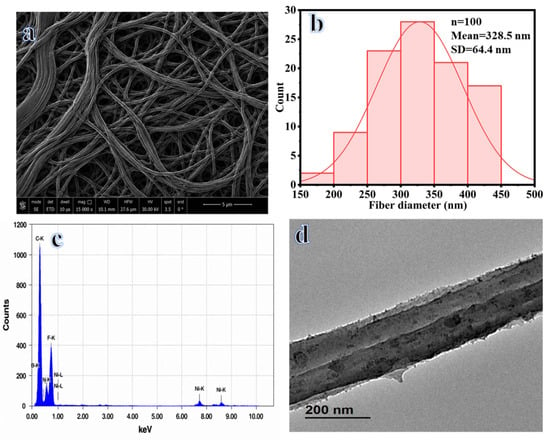
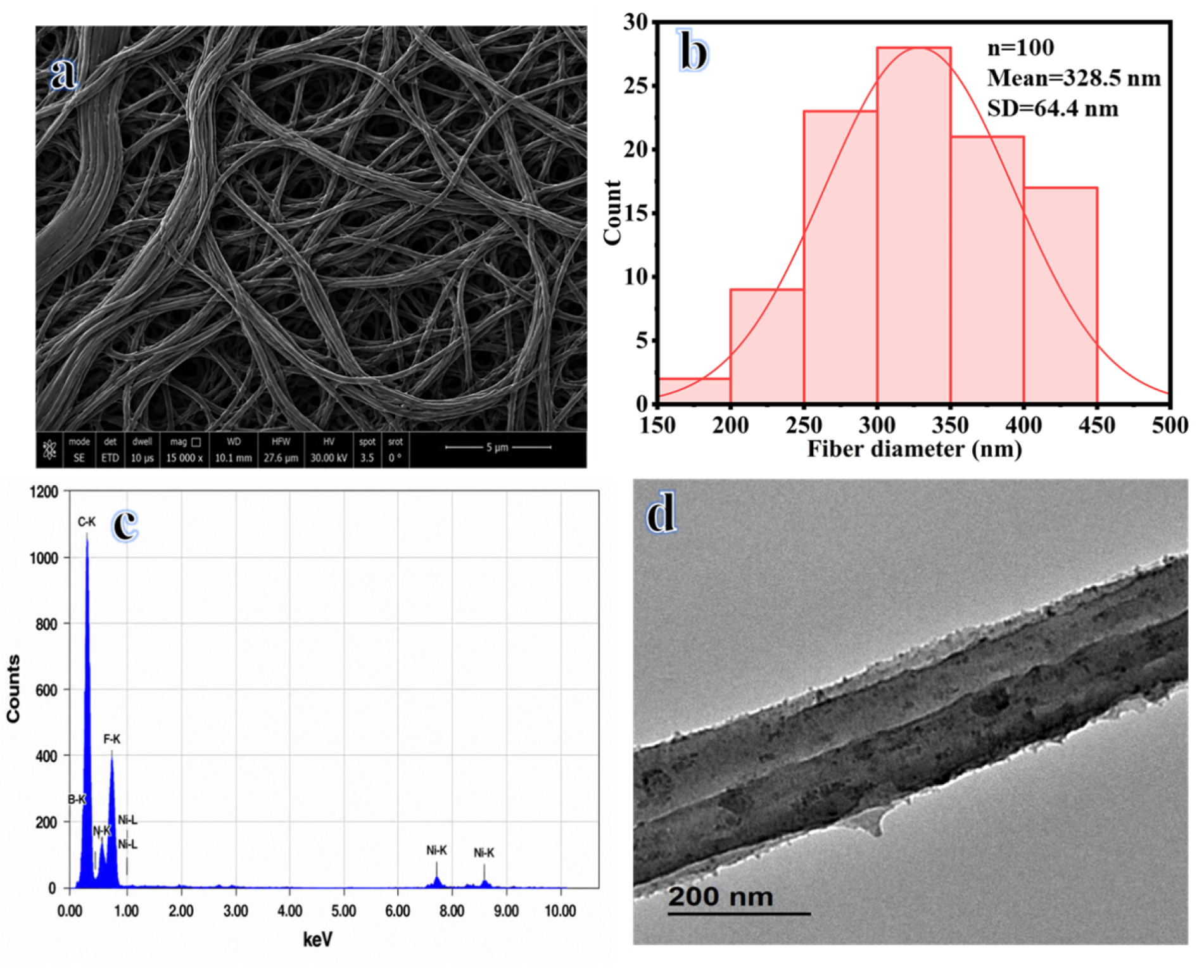
The SEM image (Figure 2a) shows a network of continuous, randomly oriented nanofibers that are linked. After reducing NaBH4 and integrating the Ni precursor, the fibrous structure is still preserved. Figure 2b shows the fiber-diameter distribution with an average diameter of 328.36 ± 64.37 nm. As expected for the PVDF-HFP matrix, the EDX spectrum (Figure 2c) is dominated by C and F, with discernible Ni signals. The retention of the Ni species inside the nanofibrous membrane is shown by the presence of Ni upon reduction and repeated washing. The faint B signal detected is consistent with the inclusion of boron-containing species during NaBH4 reduction. The TEM image (Figure 2d) also shows that the individual fiber retains its continuous shape upon reduction. Because they have higher electron density than PVDF-HFP, the darker areas scattered throughout the fiber may be Ni-containing domains. Their dispersion throughout the fiber implies that the polymer matrix confines the decreased Ni species. TEM data show that the electrospinning–reduction process incorporates borohydride-derived Ni species throughout the membrane while maintaining the nanofibrous PVDF-HFP architecture. The porosity of the pristine PVDF-HFP membrane decreased from 84.5% to 82.6% upon Ni–B inclusion. This decrease indicates that the open nanofibrous structure was largely retained by the Ni–B domains. As a result, during AB methanolysis, the membrane maintained enough porosity to allow reactant diffusion and access to catalytic sites. The 100 mg Ni@PVDF-HFP catalyst sample had a solid residue of 12.9 mg after calcination at 900 °C. Based on calculations, the equivalent metallic Ni content is 10.14 mg.
Figure 2.
Morphological and elemental characterization of the Ni–B@PVDF-HFP nanofibrous membrane: (a) SEM image, (b) fiber-diameter distribution, (c) EDX spectrum, and (d) TEM image.
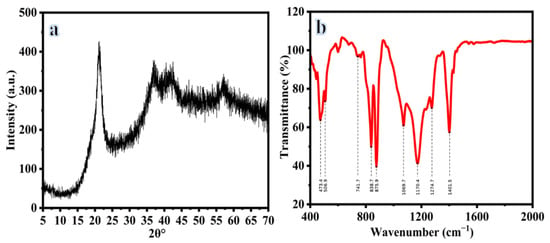
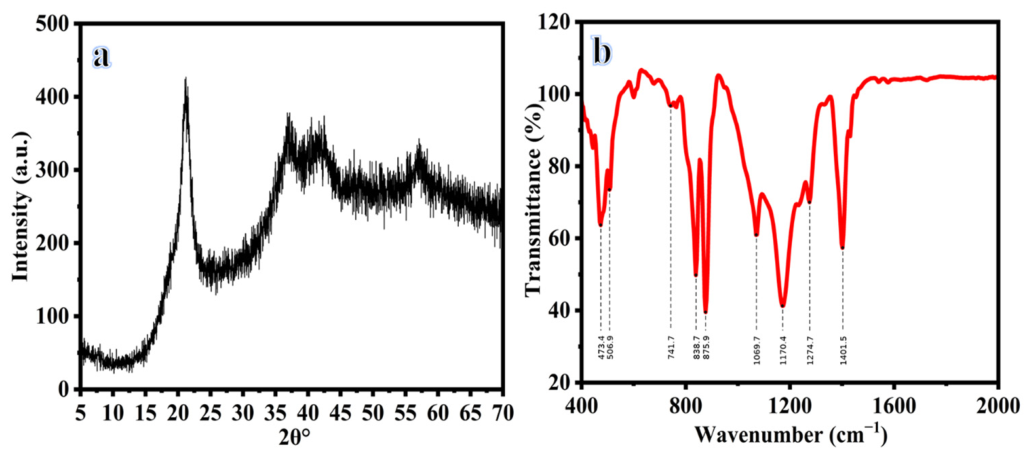
Figure 3a depicts the XRD pattern of the Ni–B@PVDF-HFP nanofibrous catalyst. This pattern reveals that the PVDF-HFP matrix is of a semicrystalline structure. Three diffraction peaks were detected at 2θ = 21.22°, 37.07°, and 41.59°. The prominent diffraction peak at 21.22° is associated with the overlapping (110)/(200) reflections pertaining to the electroactive β-phase of PVDF-HFP. A comparable diffraction characteristic within the range of 20.5–21.3° has been documented for electrospun PVDF fibers [22]. The diffraction peak seen at 37.07° corresponds with the β-phase reflections noted around 36.7° for the electrospun PVDF-HFP NFs [23]. The peak at 41.59° may correspond to a crystalline contribution from the polymer matrix, given the noted α-phase reflection at around 41.1° for PVDF [24]. The detected alterations in diffraction locations relative to published data may be associated with changes in crystalline packing and the local arrangement of polymer chains following the incorporation of Ni-containing species. No identifiable diffraction peaks of crystalline metallic nickel are seen at its typical FCC reflections at about 44.5° and 51.8° (PDF No. 04-0850). No clearly defined diffraction pattern characteristic of crystalline NiO is seen.
Figure 3.
(a) XRD pattern and (b) FTIR spectrum of the Ni–B@PVDF-HFP nanofibrous membrane.
The Ni@PVDF-HFP nanofibrous catalyst’s FTIR spectra are shown in Figure 3b. In the range 473–1401 cm−1, distinctive absorption bands are observed. There is substantial evidence for the electroactive β-phase in the band at about 1275 cm−1, and the coupled CH2 rocking and CF2 stretching vibrations are attributed to the strong absorption band at 839 cm−1. The absorption bands at around 1070 cm−1 and 1170 cm−1 arise from the stretching vibrations of C-C skeletal and CF2, respectively. The polymer-chain vibrational modes are attributed to the band at around 1401 cm−1. Based on the distinctive β-phase absorption bands, the electrospun Ni@PVDF-HFP nanofibrous catalyst primarily consists of polar crystalline conformations. Using the FTIR absorbance readings at about 764 and 840 cm−1 in accordance with the Beer-Lambert law, the relative electroactive β-phase fraction, F(β),as calculated as follows [23]:
where A764 represents the α-phase absorption band, and A840 represents the β-phase absorption band. The determined F(β) value was 95.84%, which demonstrates a high relative proportion of the electroactive β-phase in the synthesized NFs catalyst. This result agrees with the XRD reflection at 21.22°, which further supports the formation of β-rich crystalline phase. The predominance of the polar β-phase provides a structural basis for the potential piezoelectric response of the nanofibrous catalyst.
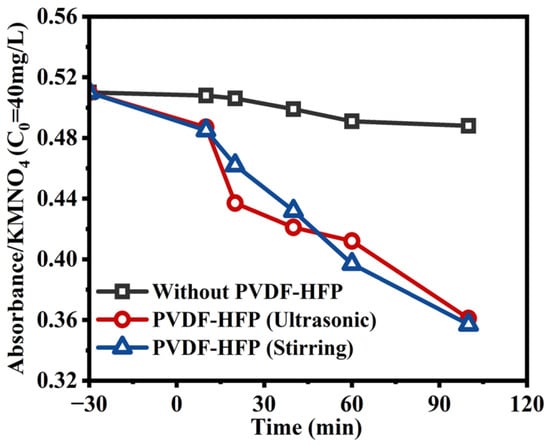
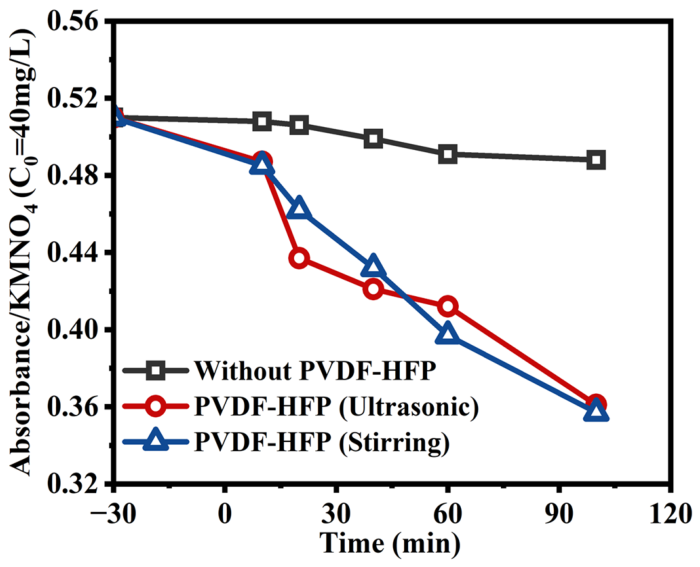
The reduction of potassium permanganate (KMnO4) was used as a probe to evaluate PVDF-HFP’s capacity to generate electrons under mechanical stimulation [25]. In addition to having a distinctive absorption band at 525 nm, KMnO4 is a powerful oxidizing agent that accepts electrons. This results in a gradual drop in absorbance as Mn(VII) is reduced to lower oxidation states (Figure 4) [26]. At a wavelength of 525 nm, the initial absorbance of the KMnO4solution (defined as C0 = 40 mg L−1) was roughly 0.51 after the process of dark equilibration. In the absence of PVDF-HFP, the absorbance remained practically constant, reducing only from 0.510 to 0.488 after 100 min. This suggests that neither ultrasonic irradiation nor stirring had a major impact on KMnO4 (Figure 4). However, a marked reduction in absorbance was observed in the presence of PVDF-HFP. When subjected to ultrasonic treatment, the absorbance reduced from 0.510 to 0.360, and when subjected to magnetic stirring, it decreased from 0.510 to 0.358 after 100 min. These reductions amount to 29.4% and 29.8%, respectively. These findings provide evidence that PVDF-HFP, when subjected to mechanical deformation, produces electrons. These electrons are then transferred to KMnO4, which in turn promotes the material’s reduction. The observed electron-generation capacity may be attributed to the high β-phase content in PVDF-HFP. This high β-phase content allows polarization and charge separation, hence indicating its piezoelectric response and potential for piezocatalytic applications.
Figure 4.
UV–Vis absorbance changes at 525 nm of KMnO4 were used to evaluate the electron-generation capability of PVDF-HFP under mechanical stimulation.
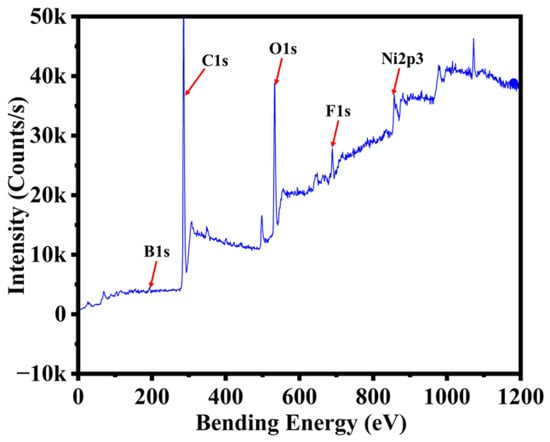
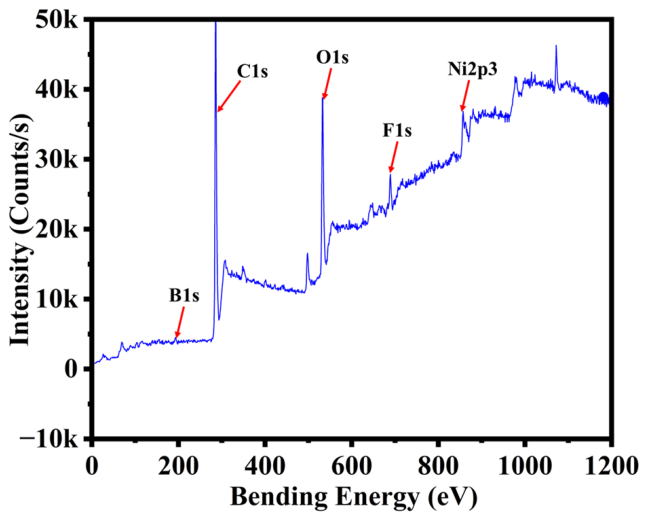
XPS was used to study the surface composition of the Ni–B@PVDF-HFP membrane. The survey spectrum shows C 1s and F 1s signals primarily from the PVDF-HFP matrix, along with O 1s, Ni 2p, and B 1s signals, indicating Ni- and B-containing species on the membrane surface (Figure 5). The B 1s contribution at about 192.88 eV is assigned to oxidized boron species (B–O). This assignment agrees well with previous XPS studies of nickel borides. Mohammad Aminzadeh and Zeynizadeh [27] observed B 1s components at 187.82 and 192.88 eV for a Ni2B-containing composite. Yang et al. [28] also reported B 1s components at 187.6 and 192.88 eV for a Ni3B/Ni heterostructure and assigned them to boride and oxidized boron species, respectively. The presence of oxidized boron at ~192 eV is not sufficient to rule out a nickel-boride phase. Previous studies have found oxidized B and nickel boride in the same material. Bai et al. [18] reported a B1S contribution at ~188 eV and an oxidized B contribution at ~192 eV for Ni2B and Ni3B nanocrystals. Their characterization also revealed an amorphous B2O3-containing surface layer on the nickel-boride nanocrystals. The authors reported an XPS information depth of about 6 nm. Thus, the XPS spectrum primarily reflects the near-surface region of these particles. Thus, the B1s signal at 192.24 eV in the present Ni–B@PVDF-HFP membrane is attributed to the oxidized boron species on the surface. This component detection should not be interpreted as a signature of the whole B-containing phase as boron oxide, because oxidized B close to 192–193 eV has been previously reported together with nickel-boride phases [27,28,29].
Figure 5.
XPS survey spectrum of the Ni–B@PVDF-HFP membrane.
3.1. Effect of the Polymeric Support on Catalytic H2 Generation
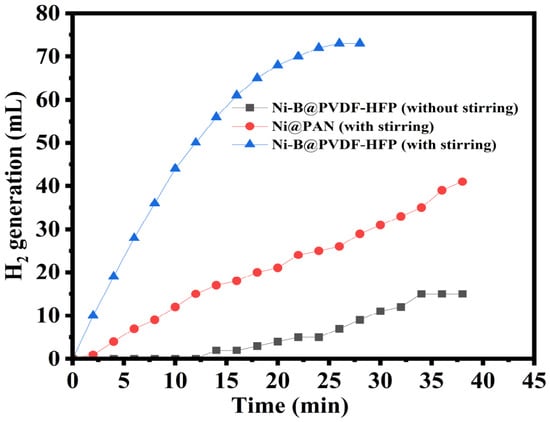
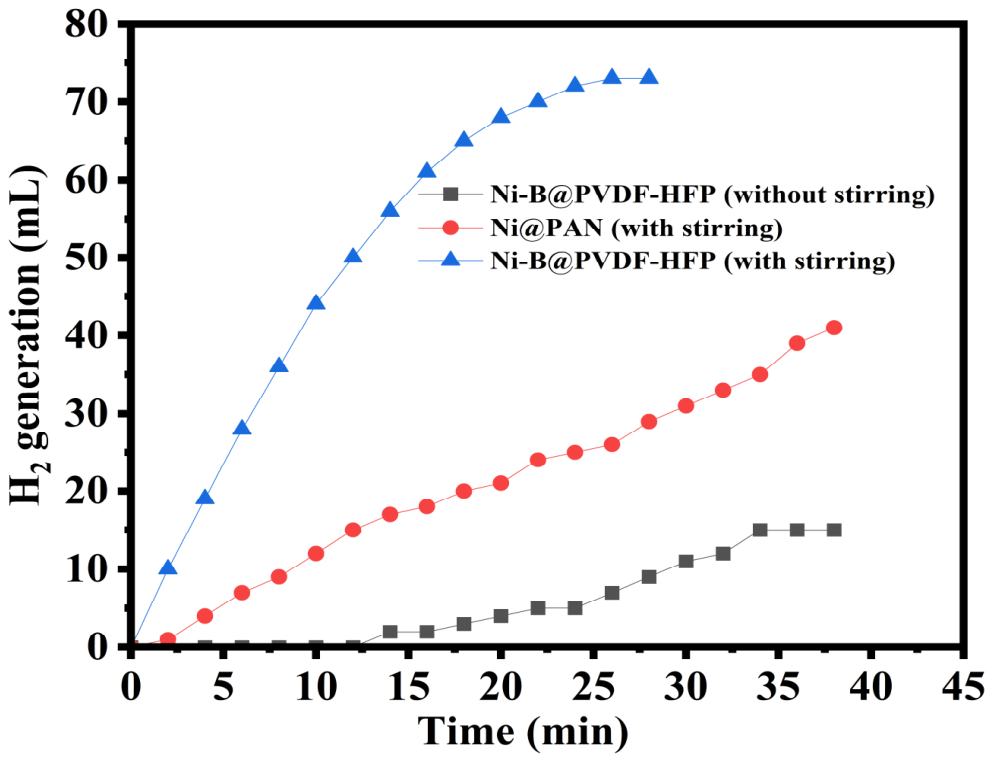
To investigate the potential contribution of PVDF-HFP support and mechanical stirring to H2 generation, control experiments were carried out with Ni@PAN under stirring conditions and Ni-B@PVDF-HFP without stirring. All the experiments were carried out using 100 mg of catalyst at 30 ± 3 °C. Figure 6 demonstrates that stirring Ni–B@PVDF-HFP produced the highest H2 evolution with a yield of 73 mL in 26 min, while stirring Ni@PAN resulted in 26 mL. Ni–B@PVDF-HFP, without stirring, generated only 7 mL over the same reaction time. These values correspond to a 2.81- and 10.43-fold increase in cumulative H2 production, respectively. The good enhancement under stirring confirms the importance of mechanical agitation in facilitating H2 generation over Ni–B@PVDF-HFP. The enhancement could be attributed to improved mass transfer and hydrogen bubble removal and possibly to polarization of the electrospun PVDF-HFP fibers by mechanical action.
Figure 6.
Comparison of hydrogen generation during ammonia borane methanolysis using Ni–B@PVDF-HFP under stirring and non-stirring conditions and Ni@PAN under stirring conditions (catalyst loading: 100 mg; reaction temperature: 30 ± 3 °C).
3.2. Effect of Membrane Dosage on H2 Generation
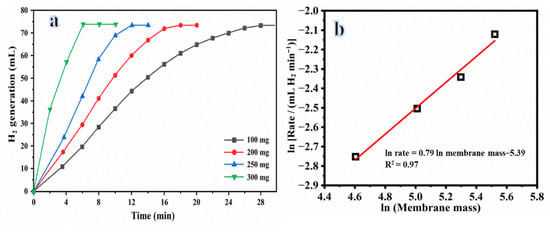
The influence of Ni-B@PVDF-HFP mass on H2 generation from AB methanolysis was studied under identical reaction conditions (Figure 7a). Increasing the Ni-B@PVDF-HFP mass increased the H2 generation rate. At the lowest membrane NFs dosage, about 73 mL of H2 was obtained after 26 min, while the same volume was obtained after about 16, 10, and 6 min as the dosage increased. This led to a 77% reduction in the time to reach the final H2 volume across the range from the lowest to the highest membrane dosage. In all experiments, the stoichiometric volume of H2 was produced. This indicated that changing the membrane dosage affected the reaction rate without appreciably changing the final H2 production volume. The effect of Ni-B@PVDF-HFP membrane dosage on the rate of reaction was determined from the log-log plot of the rate of generation of H2 versus mass of Ni-B@PVDF-HFP membrane (Figure 7b). This plot shows a straight line, suggesting that the catalytic AB methanolysis activated by the Ni-B@PVDF-HFP membrane depends on the mass of the Ni-B@PVDF-HFP catalyst used, consistent with expectations for a heterogeneous reaction. The slope of 0.79 from the linear fit (R2 = 0.97) corresponds to an apparent reaction order of 0.79 with respect to the mass of the Ni-B@PVDF-HFP membrane; this value is consistent with the literature [30]. This indicates that the reaction rate increases with the amount of Ni-B@PVDF-HFP membrane used.
Figure 7.
(a) Effect of Ni–B@PVDF-HFP membrane dosage on H2 generation from AB methanolysis and (b) log–log plot of the H2 generation rate as a function of membrane mass.
3.3. Effect of AB Concentration on H2 Generation
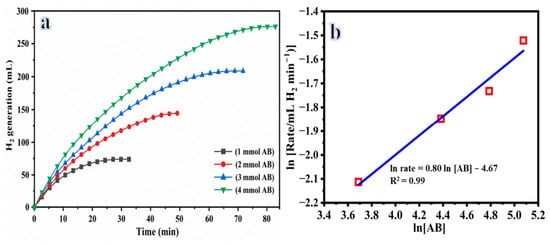
The influence of AB concentration on H2 generation was studied by keeping the Ni-B@PVDF-HFP membrane dosage and other reaction conditions constant (Figure 8a). The H2 generation rate and the final H2 volume increased as AB concentration increased from 1 to 4 mmol. The H2 volume was approximately 73 mL for 1 mmol AB, and the final H2 volumes increased to approximately 142, 208, and 274 mL as AB increased to 2, 3, and 4 mmol, respectively. Thus, the final increase in the H2 volume is roughly proportional to the amount of AB introduced in the reaction medium. This behavior is consistent with the reported stoichiometry of AB methanolysis, in which complete conversion of AB can yield up to three equivalents of H2 [5,7,8]. The kinetic dependence on the concentration of AB was determined from the log–log plot of the rate of reaction versus the concentration of AB (Figure 8b). Linear fitting resulted in a slope of 0.80, which corresponded to a reaction order of 0.80 in relation to the AB concentration. The order indicates a positive, fractional-order dependence on AB concentration under the experimental conditions. It has been reported that the dependence of AB methanolysis kinetics on substrate concentration is different in the catalytic system. Özhava et al. [7] reported zero-order dependence on AB concentration and first-order dependence on Ni concentration for AB methanolysis over PVP-stabilized Ni(0) NPs. CoPd nanoparticles showed zero-order dependence on AB and first-order dependence on catalyst concentration with an activation energy of 25.5 kJ mol−1 [10]. Conversely, it has also been reported that homogeneous Ir-catalyzed AB methanolysis is first order with respect to the AB concentration [31]. This demonstrates that the kinetic dependence on AB concentration depends on the catalyst.
Figure 8.
(a) Effect of AB concentration on H2 generation from AB methanolysis and (b) log–log plot of the H2 generation rate versus AB concentration over the Ni–B@PVDF-HFP membrane.
3.4. Effect of Reaction Temperature and Kinetic Parameters
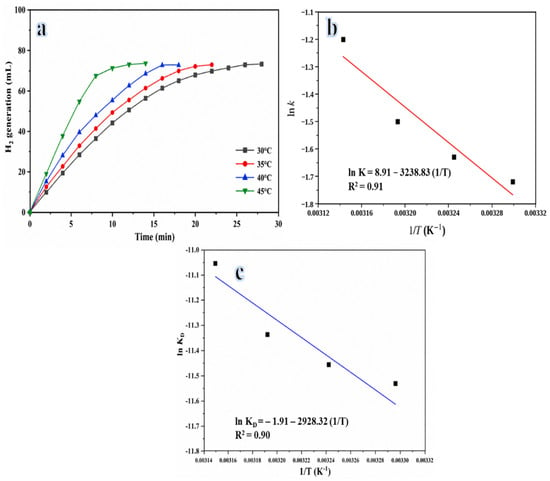
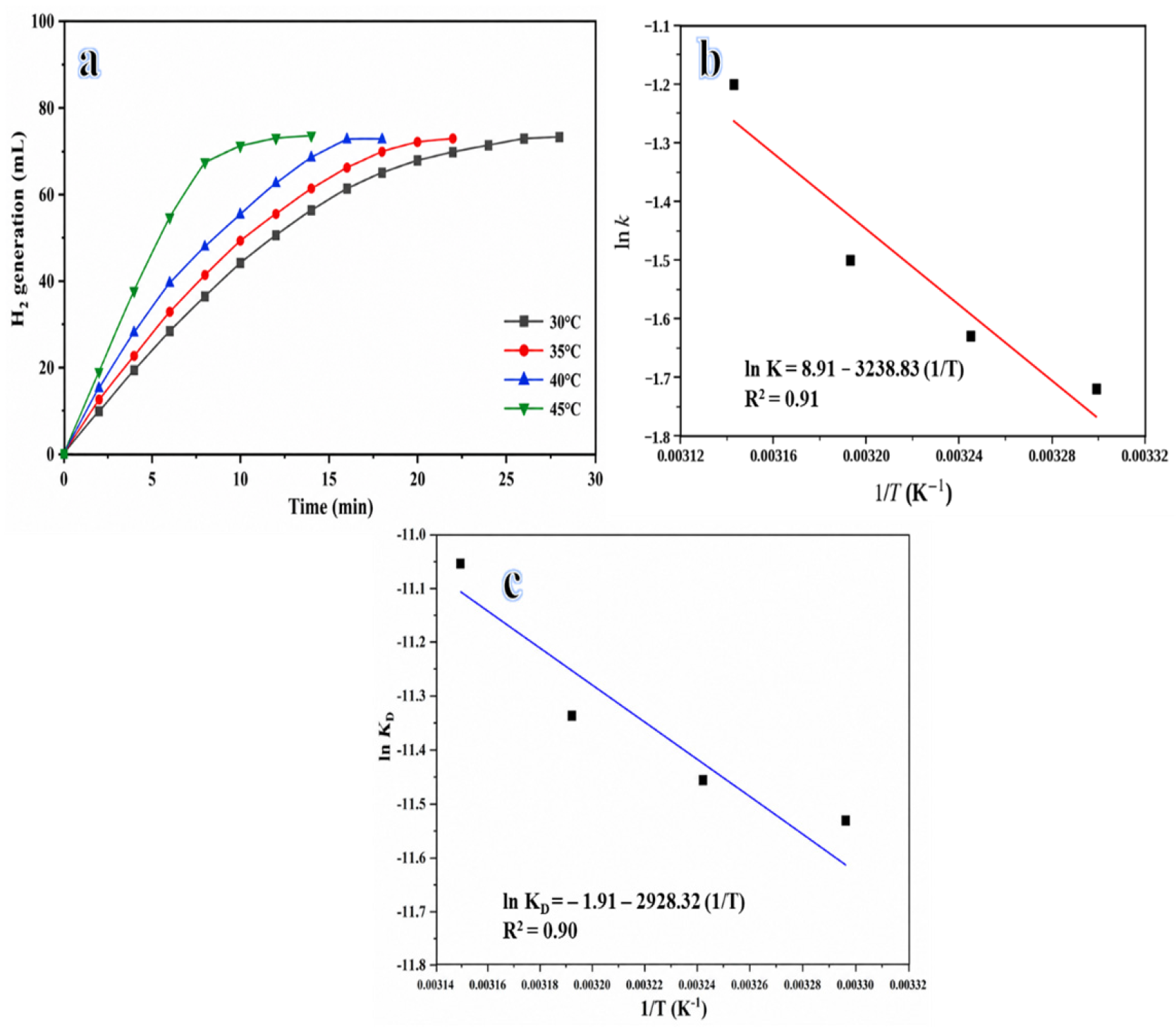
The effect of reaction temperature on H2 generation was investigated over the range of 30–45 °C, with other reaction conditions held constant (Figure 9a). The H2 generation rate increased, and the time to reach the final H2 volume decreased as the temperature increased. The volume of H2 obtained at 30 °C was about 73 mL after about 26 min. At 35, 40, and 45 °C, the same volume was obtained after about 20, 16, and 12 min, respectively. The final H2 volume was approximately 73 mL at all temperatures. Therefore, the rate of AB methanolysis increased with temperature, but the final amount of H2 generated remained unchanged. This temperature dependence is consistent with previous studies of catalytic AB methanolysis, in which higher reaction temperatures increased the H2 evolution rate [7,8,10,30]. The rate constant was examined as a function of temperature by means of an Arrhenius plot (Figure 9b). The slope of the linear fit was found to be −3238.83 K, which corresponds to an apparent activation energy of 26.93 kJ mol− 1. This value is within the range reported for AB methanolysis over transition-metal catalysts. For comparison, apparent activation energies of 25.5 kJ mol−1, 37.5 kJ mol−1, and 39.72 kJ mol−1 have been reported for Co48Pd52 nanoparticles [8], Ag30Pd70/C [5], and Co@Ni-MOF/NF [22], respectively. Higher values have been obtained for some Ni-containing systems. For Ni@PVP, an activation energy of ca. 62–63 kJ mol−1 was reported, whereas Ni–Ru, Ni–Rh, and Ni–Pd nanoclusters supported on hydroxyapatite exhibited values of 65.9, 66.8, and 58.1 kJ mol−1, respectively [7,8,10,30]. The activation parameters were also analyzed using Eyring analysis (Figure 9c). The slope of −2928.32 K corresponds to an activation enthalpy (ΔH) of 24.35 kJ mol−1. The intercept of −1.91 corresponds to an activation entropy, ΔS, of −213 J mol−1 K−1. The positive ΔH‡ is consistent with the observed increase in rate with temperature, while the negative ΔS‡ indicates a loss of configurational freedom when going to the activated state. Negative activation entropy has also been reported for AB methanolysis; for example, Ru/HTaL gave ΔH = 23.95 kJ mol−1 and ΔS = −134.5 J mol−1 K−1 [32].
Figure 9.
(a) Effect of reaction temperatures on H2 generation from AB methanolysis over the Ni–B@PVDF-HFP membrane, (b) Arrhenius plot of ln k versus 1/T, and (c) Eyring plot of ln(k/T) versus 1/T.
3.5. Catalyst Reusability of Ni–B@PVDF-HFP
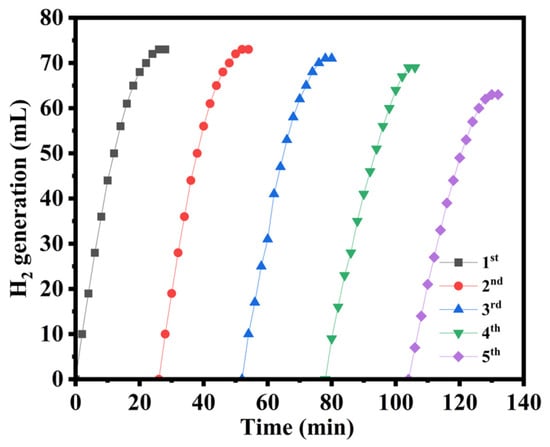
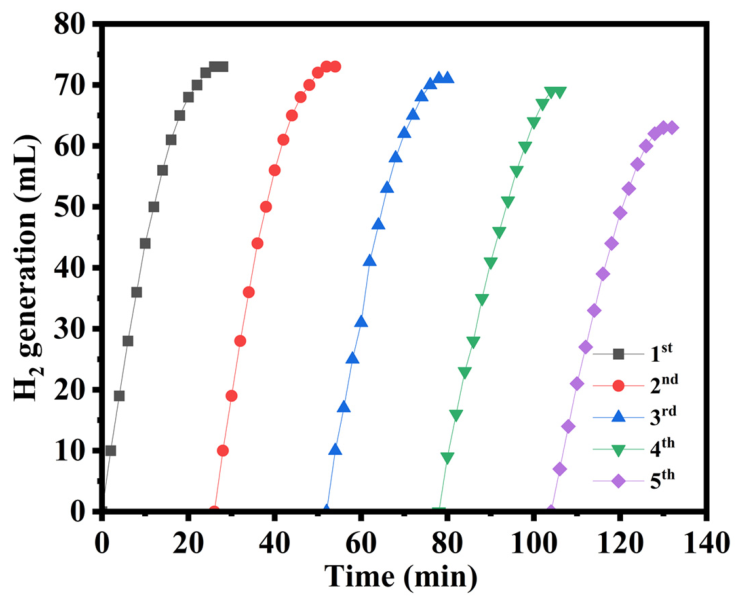
Figure 10 shows the reusability study of the Ni-B@PVDF-HFP nanofibrous membrane with five consecutive cycles of H2 production from AB methanolysis. After the 1st and 2nd cycles, the catalyst generated 73 mL of H2, corresponding to 100% of the initial yield. The amount of H2 was gradually reduced to 71, 69, and 63 mL in the 3rd, 4th, and 5th cycles, respectively. This corresponds to yields of 97.3%, 94.5%, and 86.3% of the initially generated yield, respectively. The rate at which H2 was generated showed a gradual reduction as the number of cycles of the process increased. This drop could be related to the formation and accumulation of chemical by-products, particularly ammonium tetramethoxyborate. It has been demonstrated in previously published studies that the accumulation of methoxyborate species and the increase in solution viscosity both hinder mass transfer and restrict access to catalytic sites in AB methanolysis [33,34]. In addition, the adsorption of these byproducts on the catalyst surface can partially obstruct active sites [8,33].
Figure 10.
Reusability of the Ni–B@PVDF-HFP nanofibrous membrane.
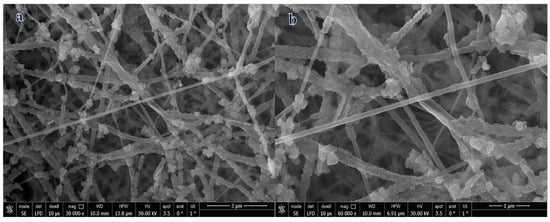
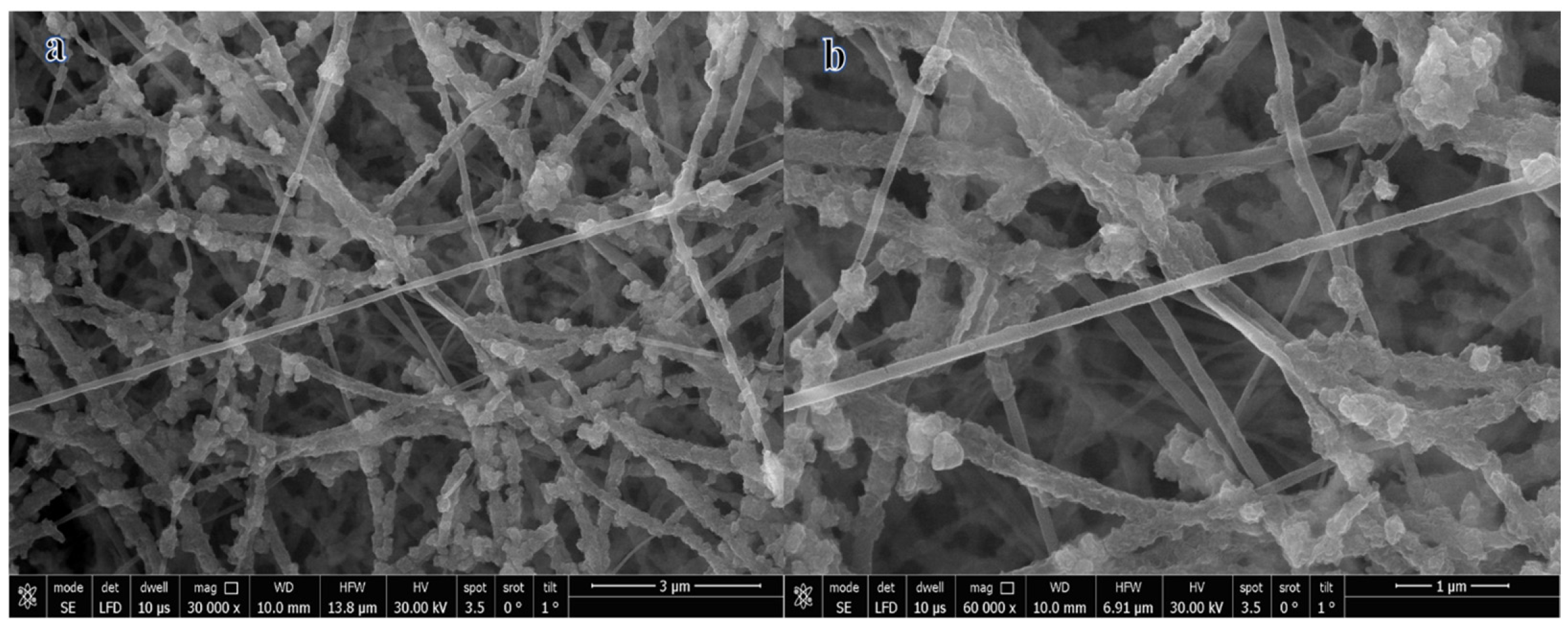
The SEM images of the Ni–B@PVDF-HFP membrane after the 5th cycle (Figure 11a,b) demonstrate that the interconnected NFs structure was mostly preserved; nevertheless, some uneven surface deposits and dispersed agglomerates formed along the NFs. It was observed that the surface of the restored membrane was less uniform than the original morphology (Figure 2a). It is possible that these deposits are attached to reaction-derived species that partially cover the Ni–B active sites and restrict reactant accessibility. Despite these surface alterations, the membrane remained catalytically active after five cycles, as evidenced by its maintaining 86.3% of the initially generated H2.
Figure 11.
Low- (a) and high-magnification (b) SEM images of the Ni–B@PVDF-HFP nanofibrous membrane after five consecutive catalytic cycles.
4. Conclusions
A self-standing Ni–B@PVDF-HFP nanofibrous membrane for H2 generation from AB methanolysis was developed through electrospinning followed by borohydride reduction. This approach incorporated Ni- and B-containing species into the PVDF-HFP nanofibrous network while largely preserving its porous morphology and β-rich structure. FTIR analysis revealed a high electroactive β-phase fraction of 95.84%. The KMnO4 reduction and comparative H2-generation experiments indicated that mechanical agitation influenced the observed reaction performance, highlighting the potential of electroactive PVDF-HFP as a functional catalyst support. The catalytic study demonstrated that membrane dosage, AB concentration, and reaction temperature influenced H2 generation. Kinetic and thermodynamic analyses provided further insight into the reaction behavior. The membrane retained 86.3% of its initial H2 yield after five consecutive cycles, while post-reaction SEM revealed substantial preservation of the nanofibrous architecture despite some surface deposits and agglomeration. Immobilizing the catalytic material within a self-standing membrane offers an alternative to freely dispersed catalysts, facilitating catalyst recovery and handling. These findings support further development of membrane-immobilized catalytic systems for H2 release from chemical hydrogen carriers.
Funding
This research received no external funding.
Institutional Review Board Statement
Not applicable.
Data Availability Statement
The original contributions presented in this study are included in the article. Further inquiries can be directed to the corresponding author.
Acknowledgments
This research was funded by Jazan University through project number JU-RSP2026. During the preparation of this manuscript/study, the author(s) used ChatGPT GPT-6 (OpenAI) and QuillBot Premium: QuillBot (2026) to assist with English language editing, grammatical corrections, and improvements in readability. In addition, ChatGPT was used to assist in preparing Figure 1 and the graphical abstract. All AI-assisted content was carefully reviewed and verified by the author, who takes full responsibility for the accuracy, originality, and integrity of the manuscript.
Conflicts of Interest
The author declares no conflict of interest.
References
- Staffell, I.; Scamman, D.; Velazquez Abad, A.; Balcombe, P.; Dodds, P.E.; Ekins, P.; Shah, N.; Ward, K.R. The role of hydrogen and fuel cells in the global energy system. Energy Environ. Sci. 2019, 12, 463–491. [Google Scholar] [CrossRef] [Scilit]
- Ball, M.; Weeda, M. The hydrogen economy—Vision or reality? In Compendium of Hydrogen Energy; Elsevier: Amsterdam, The Netherlands, 2016; pp. 237–266. [Google Scholar]
- Arishi, M.; Kuku, M.; Abutaleb, A.; Yousef, A.; El-Halwany, M.M. Amorphous Co–Cu catalysts confined in PVHF nanofibers for sustainable hydrogen generation from ammonia borane methanolysis. Rev. Adv. Mater. Sci. 2026, 65, 20250199. [Google Scholar] [CrossRef] [Scilit]
- Staubitz, A.; Robertson, A.P.M.; Manners, I. Ammonia-borane and related compounds as dihydrogen sources. Chem. Rev. 2010, 110, 4079–4124. [Google Scholar] [CrossRef] [Scilit]
- Özkar, S. Transition metal nanoparticle catalysts in releasing hydrogen from the methanolysis of ammonia borane. Int. J. Hydrogen Energy 2020, 45, 7881–7891. [Google Scholar] [CrossRef] [Scilit]
- Abutaleb, A. Catalytic and photocatalytic electrospun nanofibers for hydrogen generation from ammonia borane complex: A review. Polymers 2021, 13, 2290. [Google Scholar] [CrossRef] [Scilit]
- Özhava, D.; Kılıçaslan, N.Z.; Özkar, S. PVP-stabilized nickel (0) nanoparticles as catalyst in hydrogen generation from the methanolysis of hydrazine borane or ammonia borane. Appl. Catal. B Environ. 2015, 162, 573–582. [Google Scholar] [CrossRef] [Scilit]
- Tunç, N.; Rakap, M. Preparation and characterization of Ni-M (M: Ru, Rh, Pd) nanoclusters as efficient catalysts for hydrogen evolution from ammonia borane methanolysis. Renew. Energy 2020, 155, 1222–1230. [Google Scholar] [CrossRef] [Scilit]
- Kalidindi, S.B.; Vernekar, A.A.; Jagirdar, B.R. Co–Co2B, Ni–Ni3B and Co–Ni–B nanocomposites catalyzed ammonia–borane methanolysis for hydrogen generation. Phys. Chem. Chem. Phys. 2009, 11, 770–775. [Google Scholar] [CrossRef] [Scilit]
- Sun, D.; Mazumder, V.; Metin, O.; Sun, S. Methanolysis of ammonia borane by CoPd nanoparticles. ACS Catal. 2012, 2, 1290–1295, Erratum in ACS Catal. 2013, 3, 138. [Google Scholar] [CrossRef] [Scilit]
- Yurderi, M.; Bulut, A.; Ertas, İ.E.; Zahmakiran, M.; Kaya, M. Supported copper–copper oxide nanoparticles as active, stable and low-cost catalyst in the methanolysis of ammonia–borane for chemical hydrogen storage. Appl. Catal. B Environ. 2015, 165, 169–175, Erratum in Appl. Catal. B Environ. 2016, 186, 212. [Google Scholar] [CrossRef] [Scilit]
- Abutaleb, A.; Maafa, I.M.; Zouli, N.; Yousef, A.; El-Halwany, M.M. Electrospun Co nanoparticles@ PVDF-HFP nanofibers as efficient catalyst for dehydrogenation of sodium borohydride. Polymers 2023, 15, 597. [Google Scholar] [CrossRef] [Scilit]
- Greiner, A.; Wendorff, J.H. Electrospinning: A fascinating method for the preparation of ultrathin fibers. Angew. Chem. Int. Ed. 2007, 46, 5670–5703. [Google Scholar] [CrossRef] [Scilit]
- Teo, W.E.; Ramakrishna, S. A review on electrospinning design and nanofibre assemblies. Nanotechnology 2006, 17, R89–R106. [Google Scholar] [CrossRef] [Scilit]
- Abutaleb, A. CuNi alloy NPs anchored on electrospun PVDF-HFP NFs catalyst for H2 production from sodium borohydride. Polymers 2023, 15, 474. [Google Scholar] [CrossRef] [Scilit]
- Martins, P.; Lopes, A.C.; Lanceros-Mendez, S. Electroactive phases of poly (vinylidene fluoride): Determination, processing and applications. Prog. Polym. Sci. 2014, 39, 683–706. [Google Scholar] [CrossRef] [Scilit]
- Garain, S.; Jana, S.; Sinha, T.K.; Mandal, D. Design of in situ poled Ce3+-doped electrospun PVDF/graphene composite nanofibers for fabrication of nanopressure sensor and ultrasensitive acoustic nanogenerator. ACS Appl. Mater. Interfaces 2016, 8, 4532–4540. [Google Scholar] [CrossRef] [Scilit]
- Bai, Y.; Liu, Y.; Lv, H.; Shi, H.; Zhou, W.; Liu, Y.; Yu, D.G. Processes of Electrospun Polyvinylidene Fluoride-Based Nanofibers, Their Piezoelectric Properties, and Several Fantastic Applications. Polymers 2022, 14, 4311. [Google Scholar] [CrossRef] [Scilit]
- Tariq, A.; Behravesh, A.H.; Utkarsh; Rizvi, G. Statistical modeling and optimization of electrospinning for improved morphology and enhanced β-phase in polyvinylidene fluoride nanofibers. Polymers 2023, 15, 4344. [Google Scholar] [CrossRef] [Scilit]
- Chai, M.; Tong, W.; Wang, Z.; Chen, Z.; An, Y.; Zhang, Y. Piezoelectric-Fenton degradation and mechanism study of Fe2O3/PVDF-HFP porous film drove by flowing water. J. Hazard. Mater. 2022, 430, 128446. [Google Scholar] [CrossRef] [Scilit]
- Raghavan, P.; Zhao, X.; Kim, J.-K.; Manuel, J.; Chauhan, G.S.; Ahn, J.-H.; Nah, C. Ionic conductivity and electrochemical properties of nanocomposite polymer electrolytes based on electrospun poly (vinylidene fluoride-co-hexafluoropropylene) with nano-sized ceramic fillers. Electrochim. Acta 2008, 54, 228–234. [Google Scholar] [CrossRef] [Scilit]
- Prasad, G.; Lin, X.; Liang, J.; Yao, Y.; Tao, T.; Liang, B.; Lu, S.-G. Fabrication of intra porous PVDF fibers and their applications for heavy metal removal, oil absorption and piezoelectric sensors. J. Mater. 2023, 9, 174–182. [Google Scholar] [CrossRef] [Scilit]
- Tohluebaji, N.; Putson, C.; Muensit, N. High electromechanical deformation based on structural beta-phase content and electrostrictive properties of electrospun poly (vinylidene fluoride-hexafluoropropylene) nanofibers. Polymers 2019, 11, 1817. [Google Scholar] [CrossRef] [Scilit]
- Castkova, K.; Kastyl, J.; Sobola, D.; Petrus, J.; Stastna, E.; Riha, D.; Tofel, P. Structure–properties relationship of electrospun pvdf fibers. Nanomaterials 2020, 10, 1221. [Google Scholar] [CrossRef] [Scilit]
- Song, L.; Sun, S.; Zhang, S.; Wei, J. Hydrogen production and mechanism from water splitting by metal-free organic polymers PVDF/PVDF-HFP under drive by vibrational energy. Fuel 2022, 324, 124572. [Google Scholar] [CrossRef] [Scilit]
- Kuku, M.; Arishi, M.; Abutaleb, A.; Yousef, A.; El-Halwany, M.J.C.L. Piezoelectric-Assisted Co–Mo Bimetallic Nanocatalysts Confined in PVDF-HFP Nanofibers for Efficient H2 Generation from Ammonia Borane Methanolysis. Catal. Lett. 2026, 156, 273. [Google Scholar] [CrossRef] [Scilit]
- Mohammad Aminzadeh, F.; Zeynizadeh, B. Immobilized nickel boride nanoparticles on magnetic functionalized multi-walled carbon nanotubes: A new nanocomposite for the efficient one-pot synthesis of 1, 4-benzodiazepines. Nanoscale Adv. 2023, 5, 4499–4520. [Google Scholar] [CrossRef] [Scilit]
- Yang, F.; Han, P.; Yao, N.; Cheng, G.; Chen, S.; Luo, W. Inter-regulated d-band centers of the Ni3B/Ni heterostructure for boosting hydrogen electrooxidation in alkaline media. Chem. Sci. 2020, 11, 12118–12123. [Google Scholar] [CrossRef] [Scilit]
- Hong, J.; Mutalik, S.; Miola, M.; Gerlach, D.; Mehrabi, K.R.; Ahmadi, M.; Kooi, B.J.; Portale, G.; Rudolf, P.; Pescarmona, P.P. Nickel boride (NixB) nanocrystals: From solid-state synthesis to highly colloidally stable inks. Chem. Mater. 2023, 35, 1710–1722. [Google Scholar] [CrossRef] [Scilit]
- Amoo, K.O.; Onyeozili, E.N.; Kalu, E.E.; Omoleye, J.A.; Efeovbokhan, V.E. Activity of varying compositions of Co–Ni–P catalysts for the methanolysis of ammonia borane. Int. J. Hydrogen Energy 2016, 41, 21221–21235. [Google Scholar] [CrossRef] [Scilit]
- Bustos, I.; Freixa, Z.; Pazos, A.; Mendicute-Fierro, C.; Garralda, M.A. Efficient Homogeneous Hydridoirida-β-Diketone-Catalyzed Methanolysis of Ammonia-Borane for Hydrogen Release in Air. Mechanistic Insights. Eur. J. Inorg. Chem. 2021, 2021, 3131–3138. [Google Scholar] [CrossRef] [Scilit]
- BaĞuÇ, İ.B.; Yurderi, M.; KanberoĞlu, G.S.; Bulut, A. Hydrotalcite framework stabilized ruthenium nanoparticles (Ru/HTaL): Efficient heterogeneous catalyst for the methanolysis of ammonia-borane. Turk. J. Chem. 2020, 44, 364–377. [Google Scholar] [CrossRef] [Scilit]
- Luo, W.; Cheng, W.; Hu, M.; Wang, Q.; Cheng, X.; Zhang, Y.; Wang, Y.; Gao, D.; Bi, J.; Fan, G. Ultrahigh catalytic activity of l-proline-functionalized Rh nanoparticles for methanolysis of ammonia borane. ChemSusChem 2019, 12, 535–541. [Google Scholar] [CrossRef] [Scilit]
- Liao, J.; Feng, Y.; Wu, S.; Ye, H.; Zhang, J.; Zhang, X.; Xie, F.; Li, H. Hexagonal CuCo2O4 nanoplatelets, a highly active catalyst for the hydrolysis of ammonia borane for hydrogen production. Nanomaterials 2019, 9, 360. [Google Scholar] [CrossRef] [Scilit]
Disclaimer/Publisher’s Note: The statements, opinions and data contained in all publications are solely those of the individual author(s) and contributor(s) and not of MDPI and/or the editor(s). MDPI and/or the editor(s) disclaim responsibility for any injury to people or property resulting from any ideas, methods, instructions or products referred to in the content. |
© 2026 by the author. Licensee MDPI, Basel, Switzerland. This article is an open access article distributed under the terms and conditions of the Creative Commons Attribution (CC BY) license.