


Abstract
This study evaluates the performance of major types of conventional and bio-based plastic items commonly used in agriculture to provide comprehensive insights into their key structural and functional properties, including the chemical composition of the polymer matrix and additives, mechanical behavior, and thermal and radiometric properties. Twelve agricultural plastic (AP) items were analyzed: covering mulch films, geotextile ground cover, protection fleece and low tunnel fleece cover, fertilizer sack, fly trap, irrigation pipe, tree binding net, guide for tree, silage film and hay bales protection fabric. This selection of APs also encompasses a broad range of basic polymers, including conventional materials (mainly polyethylene and polypropylene) and bio-based formulations (primarily starch- or lignocellulose-containing blends). Mass spectrometry and infrared spectroscopy analyses were performed to assess polymer composition and additives. Mechanical properties were assessed through tensile and puncture tests; in addition, radiometric, thermogravimetric, surface wettability, water absorption and permeability tests were also performed to assess other relevant physical characteristics. The study identified significant differences among bio-based biodegradable APs and compared them with their conventional polyolefin-based counterparts. Material composition and structure were found to critically influence water interactions, shaping the balance between durability, degradation, and crop protection performance. Notably, bio-based mulch films exhibited higher water vapor permeability (0.6–1.1 × 10⁻¹³ g/m Pa s), reduced penetration resistance (12.1 N) and lowered impact and tensile strengths (21.8 MPa). Water interaction tests showed that the starch-based mulch film displayed very high swelling (above 100%), favoring biodegradation, whereas a biodegradable blend based on polyhydroxybutyrate and polybutylene succinate exhibited minimal swelling (<3%). Material composition and morphology were also key determinants of water vapor transport: dense polymer films provided superior moisture barriers (permeability range 0.013–0.04 × 10⁻¹³ g/m Pa s), while fibrous or biodegradable materials allowed enhanced vapor permeability. The results of this study, highlighting functionality, advantages and limitations of biodegradable APs versus conventional APs, are intended to guide future innovation in AP design, ensuring alignment with both the operational demands of modern agriculture and environmental sustainability goals. The data obtained from this study can support scientific advancements and policy recommendations on the use and management of plastics in agriculture.
1. Introduction
In recent decades, the widespread use of plastics in agriculture has significantly improved this sector, streamlining agricultural activities and providing increased quantity and quality of food production. However, it is imperative to confirm that the considerable short-term benefits provided by plastics do not imply major long-term sustainability problems [1]. To do this, a thorough knowledge of these plastics is a crucial first step.
As is known, conventional plastic is an umbrella term covering countless oil-based materials consisting of polymers and additional compounds, such as stabilizers, antioxidants, ultraviolet (UV) absorbers, pigments, and fillers, that can facilitate the manufacturing process and/or provide the final plastic product with the targeted properties. This applies to all plastic products, and agricultural plastics (APs) are no exception. Among the most widely used APs, mulch films are extensively applied, alongside greenhouse covering films, nets and irrigation pipes, with usage patterns varying according to climatic context and agricultural practices. Inevitably, this results in the generation of a huge amount of agricultural plastic waste (APW) at the end of the useful life of APs [2].
APs based on polyolefins, such as polyethylene (PE) and polypropylene (PP), are considered persistent due to their chemical structure, which makes them non-biodegradable in natural environments. They can fragment into micro- and nano-plastics (MNPs), accumulating in soil and being easily taken up by biota or transported through ecosystems [3]. Therefore, these APs should be recovered after use to limit the accumulation of persistent MNPs in soil and the leaching of the contained chemical additives, which negatively affect soil biota and productivity. Conversely, biodegradable APs are designed and manufactured considering the microbial metabolic process leading to their conversion under aerobic conditions into CO2, water and small amounts of microbial mass at end of life.
Biodegradable polymers are generally classified considering origin, chemical composition, synthesis and processing method and application. According to their origin, biodegradable polymers can be natural or synthetic. The former, including polysaccharides (starch, chitin/chitosan, alginate, lignin, etc.) and protein-based polymers (collagen, albumin, gelatin, etc.), are derived from natural sources and have generally high biodegradability [4]. The synthetic polymers, which encompass aliphatic polyesters (e.g., poly(glycolic acid), poly(lactic acid)), polyhydroxyalkanoates, and poly(anhydrides), are more customizable in terms of mechanical performance, heat resistance, and processability, but sometimes at the expense of slower degradability [5]. Concerning production, biodegradable polymers can be obtained by direct processing of natural polymers (chemically and microbiologically synthesized), as well as by enzymatic and chemo-enzymatic synthesis [4].
These materials must pass several tests on chemical composition, complete degradation in laboratory and real-world conditions and ecotoxicity to be qualified as biodegradable [6], as biodegradation depends both on the physico-chemical properties of the product and the environmental conditions of the exposure context [7]. As an example, the biodegradability of products certified as biodegradable in soil, which are intended to be plowed after use [8], is assessed according to recognized international standards. ISO 17556:2019 [9] specifies methods for determining aerobic biodegradation in soil, while UNI EN 13432 [10] defines requirements for biodegradable and compostable materials. UNI EN 17033 [11] establishes specific requirements for mulch biodegradation in soil under field conditions.
The use of APs and the potential release of MNPs into terrestrial ecosystems alter physical, chemical, and biological soil properties. This is attributed to the intrinsic properties of plastic products, their photodegradation process in the field, mainly driven by solar UV radiation, and to their end-of-Life (EoL) management. The chemical composition of the material, morphology, size, and surface characteristics are very relevant factors [3,12], as they influence AP behavior during use and at EoL, as well as the resulting environmental impacts. In this regard, the negative effects associated with the release of plastic particles and related additives into the environment, and subsequently in the food chain, are a critical issue requiring further investigation [13]. The release of MNPs has detrimental consequences for soil properties and microbial communities [14,15], induces physiological and biochemical impacts on flora and fauna [16,17] and contributes to microbiome disruption [18]. Additive leakage represents another major concern. The release timeframe can vary widely, from days (as in the case of more polar phthalates) to centuries (for more hydrophobic additives), and long-term release dynamics in particular require deeper study [19,20]. Moreover, some additives, such as phthalates and bisphenols, are known for their toxic effects [21].
Therefore, the chemical composition of each AP category strongly influences APW management. Reuse and recycling, after proper collection, are preferred [22], but they are only feasible when APs possess suitable physical and chemical characteristics and are free from residues and problematic additives [23]. When APs become too degraded or soiled to be recovered, materials certified as biodegradable in soil should be employed, ensuring complete biodegradability [1,24]. These materials must contain only eco-friendly additives [25] and allow for biodegradation in situ under real environmental conditions, which differ substantially from the controlled laboratory settings defined by standard test methods [26]. To promote a more sustainable approach to APs, more information on AP characteristics and specific chemical composition is needed [27]. Additionally, greater sustainability can be achieved through innovation in material design aimed at producing more environmentally benign products. From this perspective, an inventory and thorough characterization of the most widely used APs can serve as a valuable tool. The overall goal of this paper is therefore to provide in-depth knowledge of representative examples from the main AP categories used in Europe to support informed choices, appropriate use and effective management at their EoL. The APs selected for testing were identified through consultation with multi-stakeholder industry working groups across the agri-plastics value chain and informed by the authors’ pilot surveys. The materials examined include mulch and covering films, as well as other AP types that may contribute to MNP contamination of soils, encompassing both petroleum-based and bio-based plastics in both non-biodegradable and biodegradable forms. To pursue the general objective, the research set specific goals related to the assessment of the chemical, physical, and mechanical properties of selected APs, with the aim of understanding their composition, functionality, and potential environmental impacts. These specific aims were fully achieved through in-depth, targeted analyses. Detailed chemical characterization was performed to assess the polymer matrix composition and to identify possible chemical additives present in the formulations, as AP composition, including both base polymer and additives, is often proprietary information not disclosed by manufacturers. Morphological and functional properties were also investigated, including tensile and puncture behavior, radiometric properties, water absorption, and water vapor permeability. All laboratory analyses were performed on pristine APs; no field trials were conducted, as the overarching goal of the study was the characterization of unused materials.
The output of this work provides comprehensive data on the composition and characteristics of APs. The results are intended to guide future innovation in AP design, ensuring that new materials meet the operational requirements of modern agriculture while aligning with environmental sustainability goals. The data generated in this study can support not only scientific progress but also the development of policy recommendations concerning the use and management of plastics in agriculture.
2. Materials and Methods
2.1. Collected Samples of Major AP Categories
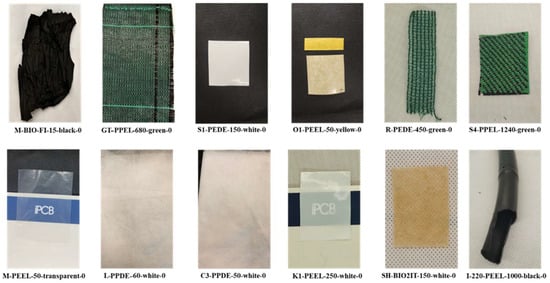
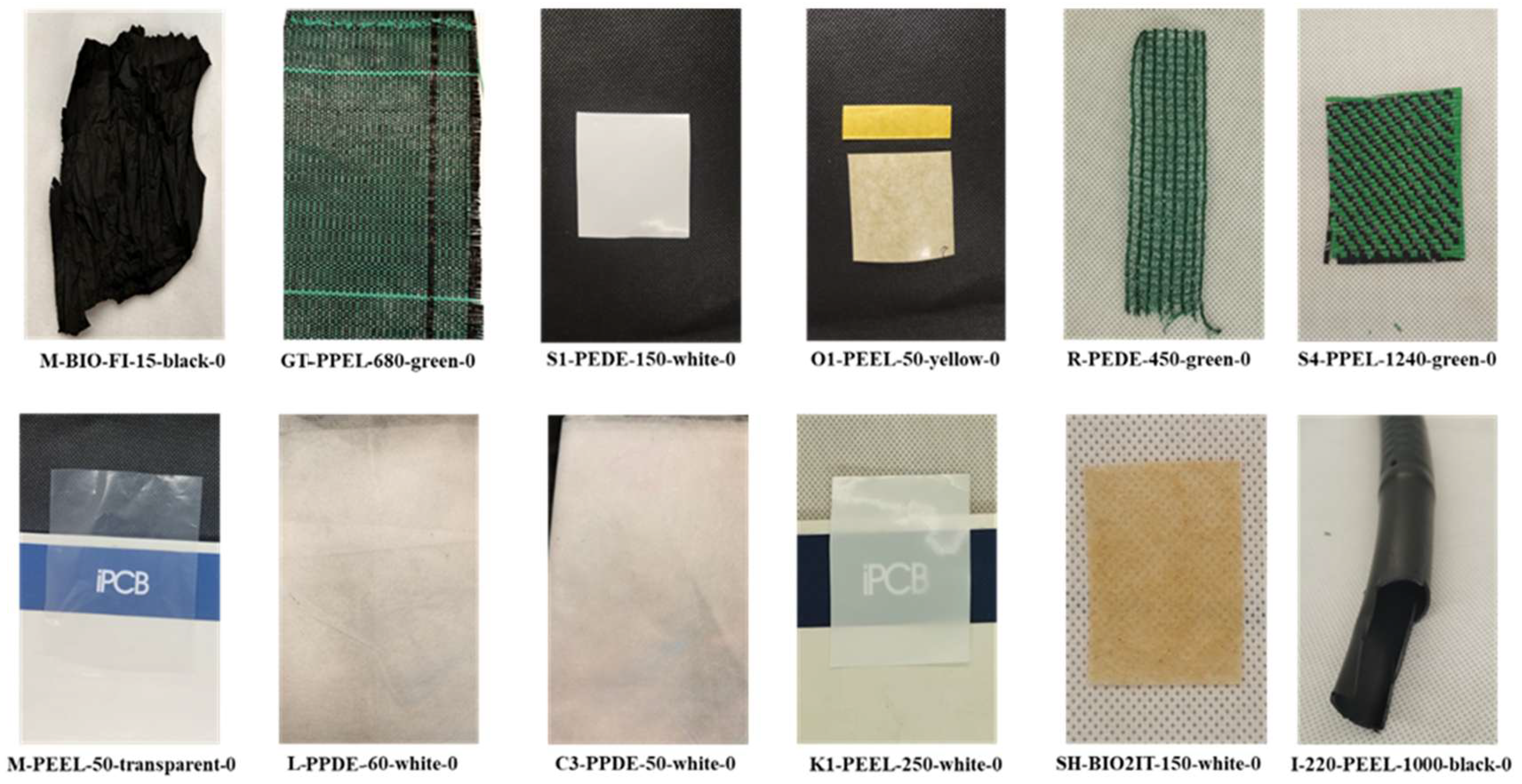
Pristine commercial samples were collected among 12 of the major AP categories for analysis (Figure 1). These samples of major AP categories were chosen based on their material properties (composition, functional characteristics), market size, and EoL. The 12 AP samples were a heterogeneous group in terms of products, composition and characteristics, but included the most used APs, according to relevant stakeholders. The variety of APs should not be considered a limitation of the research, but rather a strength of this inventory, providing details on all of these products. More detailed information on the samples collected is presented in Table 1. These AP products include 2 mulch films consisting of a conventional linear low-density polyethylene (LLDPE) film and a biodegradable starch/polybutylene adipate terephthalate (PBAT) blend film, 1 low-density polyethylene (LDPE)-based low tunnel fleece, 1 PP-based fleece cover, 1 PP geotextile ground cover, 2 LDPE and PP-based silage/hay bale protection films, 1 LDPE fertilizer sack, 1 LDPE fly trap, 1 LDPE drip pipe, 1 high-density polyethylene (HDPE) tree binding net, and 1 biodegradable polyester-based shelter/guide for vine trees. A taxonomical study of APs was carried out by Briassoulis [28] and Tartiu et al. [29].
Figure 1.
Images of the selected AP samples, representative of the major categories of plastic items used in agriculture.
Table 1.
Main properties of the selected APs.
2.2. Analysis of Polymer Composition and Chemical Additives
2.2.1. Pyrolysis/Thermal Desorption Gas Chromatography–Mass Spectrometry (Py/TD-GC-MS)
To characterize the polymer matrices, Pyrolysis/Thermal Desorption Gas Chromatography–Mass Spectrometry (Py/TD-GC-MS) analyses were performed. A Multi-Shot Pyrolyzer (EGA/PY-3030D, Frontier Labs, Liverpool, UK) was used, coupled to a GC-2020 system (Shimadzu Corporation, Kyoto, Japan) and a triple quadrupole mass spectrometer (TQ8040, Shimadzu Corporation) operating with electron ionization (70 eV). Chromatographic separation was achieved using an Ultra Alloy® metal capillary column (Frontier Labs) with a 5% diphenyl-methylpolysiloxane stationary phase (250 μm inner diameter, 0.25 μm film thickness, 30 m length).
Approximately 0.1 mg of each sample was analyzed. The interface temperatures of the Py-GC and GC-MS systems were set at 300 °C and 250 °C, respectively. To improve spectral interpretation and facilitate the identification of pyrolysis products, a stepwise thermal desorption approach was applied. This method enables the sequential release of volatile and semi-volatile compounds at progressively higher temperatures, enhancing their separation and reducing the resulting chromatogram’s complexity. Specifically, biodegradable materials were analyzed at 300 °C, 400 °C, and 500 °C, whereas non-biodegradable materials were analyzed at 400 °C and 500 °C. This multistep thermal desorption strategy improves peak resolution and helps distinguish the degradation pathways of different polymer fractions.
The GC oven temperature was initially held at 50 °C for 1 min, then increased to 100 °C at a rate of 30 °C/min and maintained for 5 min. It was subsequently ramped to 300 °C at 10 °C/min and held for 10 min. Helium was used as the carrier gas at a constant flow rate of 1.78 mL/min, with a split ratio of 1:50. Blank measurements were performed before each analysis by heating an empty crucible under identical pyrolysis conditions to ensure baseline accuracy. The chemical structures of the pyrolysis products were identified by comparing the obtained mass spectra with reference databases (NIST11.Lib.; NIST11s.Lib.; WILEY8.LIB).
2.2.2. MALDI-TOF Mass Spectrometry
Matrix-Assisted Laser Desorption/Ionization Time-of-Flight Mass Spectrometry (MALDI-TOF MS) was employed to characterize the polymeric matrices present in the selected biodegradable APs, specifically M-BIOFI-15-black-0 and SH-BIO2IT-150-white-0. Spectral acquisition was carried out using an UltrafleXtreme instrument (Bruker Daltonics GmbH & Co, Bremen, Germany) with an accelerating voltage of 20 kV and a delay time of 250 ns. The laser (SmartBeam 2, Bruker Daltonics GmbH & Co, Bremen, Germany) power was set at the minimum threshold required to obtain detectable sample signals, and each spectrum was obtained by collecting 1000 laser shots. Measurements were performed in reflectron mode with positive ion detection. For sample preparation, DHB (0.1 M tetrahydrofuran, THF) was used as the matrix. M-BIOFI-15-black-0 (5 mg/mL in THF) and SH-BIO2IT-150-white-0 (5 mg/mL in hexafluoroisopropanol, HFIP) were prepared, filtered, and concentrated to isolate the soluble fraction. Appropriate volumes of polymer solution and matrix solution were mixed in 2:1, 1:1, and 1:2 ratios (sample/matrix, v/v). A 1 µL aliquot of each mixture was deposited onto the MALDI-TOF sample plate and air-dried to promote matrix crystallization. To ensure reproducibility, three independent regions of APs were analyzed. Data processing was performed using FlexAnalysis software (Version 3.4). The MALDI-TOF spectra acquired for M-BIOFI-15-black-0 exhibited a resolution (full width at half maximum, FWHM) ranging from 21,000 to 26,000, with mass accuracy between 100 and 150 ppm within the m/z range of 800–2000 Da. For SH-BIO2IT-150-white-0, the FWHM ranged from 13,000 to 24,000, and mass accuracy varied between 160 and 200 ppm within the same m/z range (800–2000 Da).
2.2.3. Inductively Coupled Plasma Mass Spectrometry (ICP-MS)
To determine the total concentrations of metals in the polymer samples, an acid digestion procedure was employed, followed by analysis using inductively coupled plasma mass spectrometry (ICP-MS). Approximately 200 ± 1 mg of each sample was subjected to microwave-assisted digestion using an Anton-Paar Multiwave 3000 system (Anton-Paar, Graz, Austria), with digestion conducted in PTFE vessels according to EPA Method 3052 [31]. Each digestion involved the addition of 3.5 mL of concentrated HNO3 and 1.5 mL of H2O2 to facilitate breakdown of the sample matrix. After digestion, the solutions were diluted with 5 mL of deionized water and filtered through Whatman 40 filters to remove particulates. A 1000 µL aliquot of the resulting filtrate was then diluted to 50 mL to prepare the samples for metal quantification using a PerkinElmer Nexion 300X ICP-MS instrument (PerkinElmer, Bridgeport Ave Shelton, CT, USA), following EPA Method 6020 [32]. Results were normalized with mineralization and measurement blanks and are reported in mg/kg. Each determination was performed in triplicate, with a relative standard deviation (RSD) below 10%.
2.2.4. Attenuated Total Reflection Fourier Transform Infrared Spectroscopy (ATR-FTIR)
FTIR analysis was acquired in Attenuated Total Reflection mode (ATR-FTIR) on the AP samples using a PerkinElmer Spectrum 100 (Waltham, MA, USA) equipped with a diamond/ZnSe crystal (1 Reflection) UATR accessory. Transmittance spectra were recorded as the average of 16 scans (range: 4000–650 cm−1, resolution: 4 cm−1). The ATR crystal was fully covered by the sample, and the pressure device available on the instrument was used to ensure contact between the sample and the ATR crystal.
2.3. Mechanical Characterization
2.3.1. Tensile Tests
The tensile properties of the AP materials studied were evaluated using an Instron 5900 Series dynamometer (Instron, Norwood, MA, USA) under controlled conditions of 23 ± 1 °C and 50% relative humidity (RH). The procedures followed were in strict accordance with the ISO 527-1:2018 [33] standard for determining the tensile properties of thin plastic films properly adapted to nets. This standardized approach ensured the accuracy and comparability of the tensile strength, elongation, and modulus data obtained for each AP type.
2.3.2. Puncture Tests
Puncture testing primarily involves the evaluation of tear and stiffness behavior and measures the resistance of a test specimen to puncture. Puncture resistance is a key property of flexible films and membranes; for example, in agricultural applications, mulching films are often exposed to damage caused by the penetration of weeds.
To assess the resistance of APs to the localized pressure exerted by the hard tips of spontaneous weeds, puncture tests were performed on film- and membrane-shaped samples, such as M-PEEL-50-transparent-0, M-BIOFI-15-black-0, SH-BIO2IT-150-white-0, S4-PPEL-1240-green-0, K1-PEEL-250-white-0, and O1-PEEL-50-yellow-0. Circular samples with a 40 mm diameter were clamped using a metal ring on top of an aluminum cup, which was gripped to the lower specimen holder of an INSTRON 4023 dynamometer (Instron, Norwood, MA, USA). The material was then compressed by a spherical steel probe mounted on the moving crosshead, which was then driven downward at a constant rate of 2 mm/min until material rupture occurred. The applied load as a function of displacement was recorded. All mechanical tests were performed on at least three specimens, previously conditioned at room temperature and 50% air RH.
2.4. Radiometric Test
Laboratory tests to evaluate the radiometric properties of the materials were carried out using spectrophotometers. A double-beam ultraviolet–visible–near-infrared (UV-VIS-NIR) spectrophotometer (Lambda 950, PerkinElmer Instruments, Norwalk, CT, USA) was used to measure the spectral direct transmissivity of the materials across the solar wavelength range (200–2500 nm). Measurements were performed in 10 nm steps using radiation with a direct perpendicular incidence. Spectral total transmissivity and reflectivity were measured using an integrating sphere (diameter 100 mm) that served as the receiver of the Lambda 950 spectrophotometer, using a double-beam comparative method.
A Fourier Transform Infrared (FT-IR) spectrophotometer (1760 X, PerkinElmer Instruments, Norwalk, CT, USA) was used to measure spectral transmissivity and reflectivity in the long-wave infrared radiation (LWIR) range (2500–25,000 nm) in steps of 4 cm−1. Spectral transmissivity was measured using radiation with direct perpendicular incidence, while reflectivity was measured at near-normal incidence (10°). Spectral emissivity was calculated from the spectral transmissivity and reflectivity by means of Kirchhoff’s law.
Transmissivity and reflectivity tests in both the solar and LWIR ranges were performed on five samples (40 mm × 40 mm) for each material.
The radiometric coefficients of the materials were calculated for different wavelength bands: the solar wavelength range (200–2500 nm), the photosynthetic active radiation range (PAR, 400–700 nm), and the LWIR range (7500–12,500 nm). The radiometric coefficients in the solar wavelength band were calculated as the weighted average value of the spectral transmissivity using the spectral distribution of the solar radiation at ground level as the weighting function. The transmissivity and emissivity coefficients in the LWIR range were calculated as average values of the spectral transmissivity and emissivity in the wavelength range 7500–12,500 nm.
2.5. Thermogravimetric Analysis
Thermogravimetry (TG) measurements were performed using a PerkinElmer Pyris 1 thermo-balance (Perkin Elmer, Milan, Italy) to analyze the weight loss of samples. Approximately 4.5 ± 0.5 mg of each sample was placed in open ceramic crucibles and heated from 25 to 650 °C at a 10 °C/min rate. The tests were performed under an inert atmosphere, with a nitrogen flow rate of 30 mL/min.
2.6. Surface Wettability: Water Contact Angle Measurements
Water Contact Angle (WCA) measurements were performed at room temperature using the sessile drop technique and a contact angle system. The First Ten Angstroms FTA1000 Instrument (Portsmouth, VA, USA) was equipped with a high-resolution video camera (752 × 582 pixels and image acquisition speed of 25 frames per second); the data were analyzed by RTA32 software (v2.0, provided by FTA). Measurements followed the static method at room temperature (θ, deg). Briefly, three drops of distilled water (2 μL each) were deposited onto the surface specimens using a micropipette. Afterward, the contact angle was immediately calculated by measuring the angle between the base line of the drop and the tangent.
2.7. Water Absorption and Swelling Ratio
Before testing, the samples were subjected to different washing cycles to remove soil residues firmly attached to their surfaces. To calculate swelling, square strips of AP samples (1 cm × 1 cm) were weighed at time zero (m1) and immersed in 20 mL of deionized water for different durations (0, 1, 2, 3, and 5 h). The residual water on the sample surface was carefully wiped off, and the sample was then weighed (m2). The swelling ratio was calculated using the following equation:
2.8. Permeability Tests
Water vapor transmission rate (WVTR) was measured according to the ASTM E96 (1993) [34] wet method, using CEAST (Norwood, MA, USA) aluminum diffusion cell cups with a 6.154 cm2 exposed area. The cups were filled with distilled water (RH = 100%) and placed in an environmental chamber set at 25 °C and 50% RH. WVTR values, expressed in g h−1·m−2, were determined from a linear plot of weight change vs. time, following the equation:
where ∆G (g) is the weight change, t (h) is the time during which ∆G occurs, A (m2) is the test area of the cell cup, and ∆G/t is the slope of the linear plot.
Water vapor permeability (WVP, in g m−2 Pa−1 s−1) was calculated according to the following equation:
where Th (m) is the thickness of the films and ∆P (Pa) is the water pressure difference between both sides of the film. Data were the mean of three measurements for each sample.
2.9. Statistical Analysis
Experimental data were expressed as mean ± standard deviation (SD). One-way analysis of variance (ANOVA) was used to evaluate differences among the studied parameters. Significant differences between means were identified using Tukey’s post hoc multiple comparison test at a significance level of p < 0.05. All statistical analyses were performed using OriginPro 8.5 (OriginLab Corporation, Northampton, MA, USA).
3. Results and Discussion
3.1. Composition of the Tested APs
3.1.1. Pyrolysis/Thermal Desorption Gas Chromatography–Mass Spectrometry (Py/TD-GC-MS) and MALDI-TOF
The chemical composition of the 12 selected AP materials was first analyzed using a combination of advanced analytical techniques, including chromatographic, spectrometric and spectroscopic techniques. Pyrolysis/Thermal Desorption Gas Chromatography–Mass Spectrometry (Py/TD-GC-MS) was employed to determine the thermal degradation products characteristic of each AP, reflecting both the macromolecular nature and the volatile additives. Table 2 summarizes the key findings from the Py/TD-GC-MS analyses conducted at 300 °C, 400 °C, and 500 °C. The decomposition products identified at 400 °C and 500 °C provided insight into the composition of the polymer matrix, whereas additive identification was primarily achieved at 300 °C. Compound assignment was performed by comparing the experimental mass spectra with those in the NIST11s and Wiley8 libraries, considering only plausible degradation products with a match score above 85%.
Table 2.
Main results of Pyrolysis/Thermal Desorption Gas Chromatography–Mass Spectrometry (Py/TD-GC-MS).
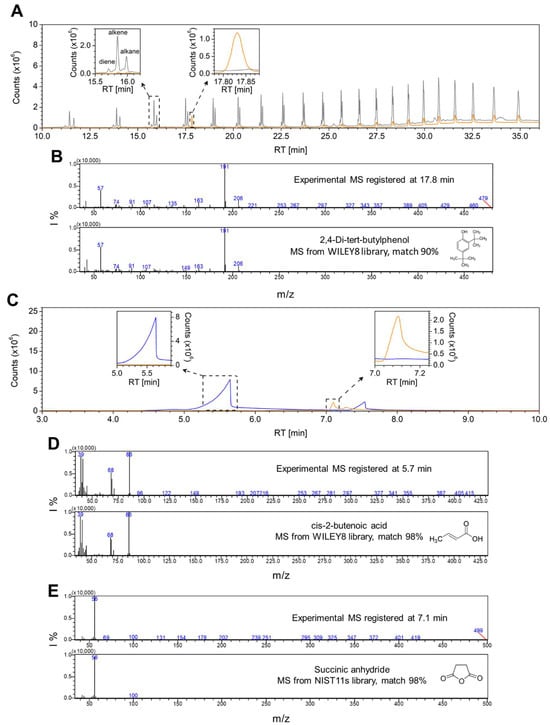
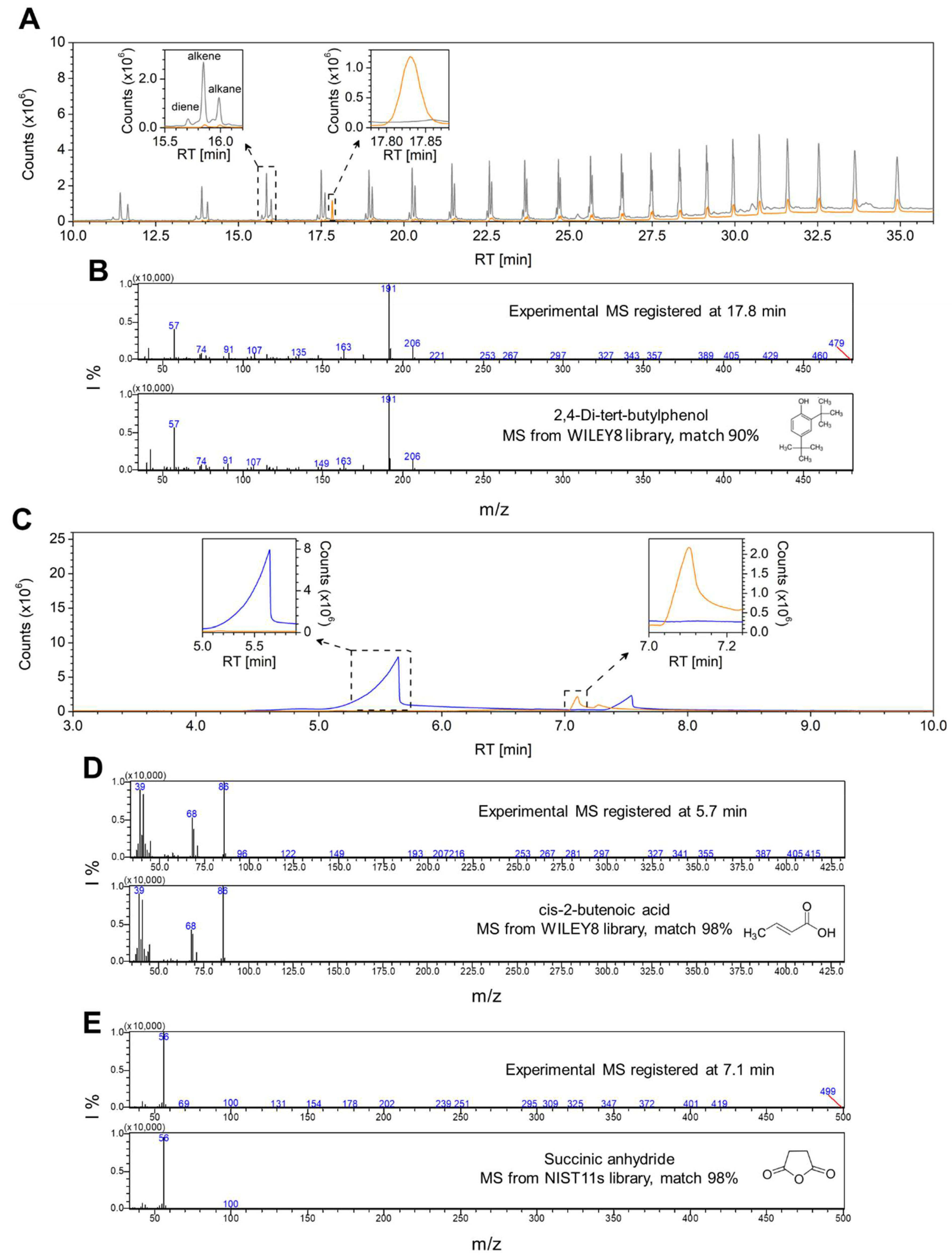
Significant differences were observed between conventional polymers, such as R-PEDE-450-green-0, and biodegradable polymers, such as SH-BIO2IT-150-white-0 (Figure 2). The chromatographic profiles of R-PEDE-450-green-0 (Figure 2A) at 400 °C (orange line) and 500 °C (gray line) show distinct degradation patterns characteristic of PE. Notably, the pyrolysis profile features the well-known repeating sequence of paraffin triplets (diene–alkene–alkane) per carbon number, as reported in the inset between RT 15.5 min and 16.5 min. Additionally, at RT 17.7 min, a peak corresponding to 2,4-di-tert-butylphenol, a commonly used antioxidant and UV absorber, is detected. The presence of this additive was confirmed through mass spectral comparison with the Wiley8 MS library, yielding a 90% match (Figure 2B). The chromatograms of SH-BIO2IT-150-white-0 (Figure 2C) reveal the presence of cis-2-butenoic acid (RT 5.5 min) and succinic anhydride (RT 7.1 min), both identified with 98% spectral matching to libraries (Figure 2D,E). This suggests that this AP is composed of biodegradable polyesters. Cis-2-butenoic acid is a well-documented pyrolysis product of polyhydroxyalkanoates (PHAs), while succinic anhydride is a characteristic degradation product of polybutylene succinate (PBS). The simultaneous detection of these compounds suggests that SH-BIO2IT-150-white-0 contains a blend of PHAs and PBS, consistent with formulations designed to balance mechanical performance with environmental degradability.
Figure 2.
Py/TD-GC-MS results obtained for R-PEDE-450-green-0 and SH-BIO2IT-150-white-0. (A) Chromatogram of R-PEDE-450-green-0 at 400 °C (orange line) and 500 °C (gray line). (B) Experimental mass spectrum of 2,4-Dimethyl-1-heptene compared with the WILEY8 MS library. (C) Chromatogram of SH-BIO2IT-150-white-0 at 300 °C (blue line) and 400 °C (orange line). (D) Experimental mass spectrum of cis-2-butenoic acid compared with the WILEY8 MS library. (E) Experimental mass spectrum of succinic anhydride compared with the WILEY8 MS library.
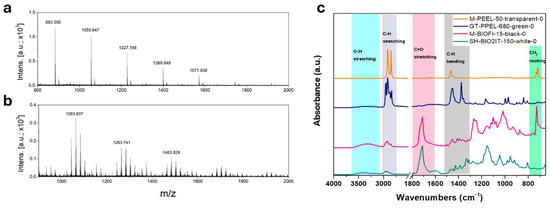
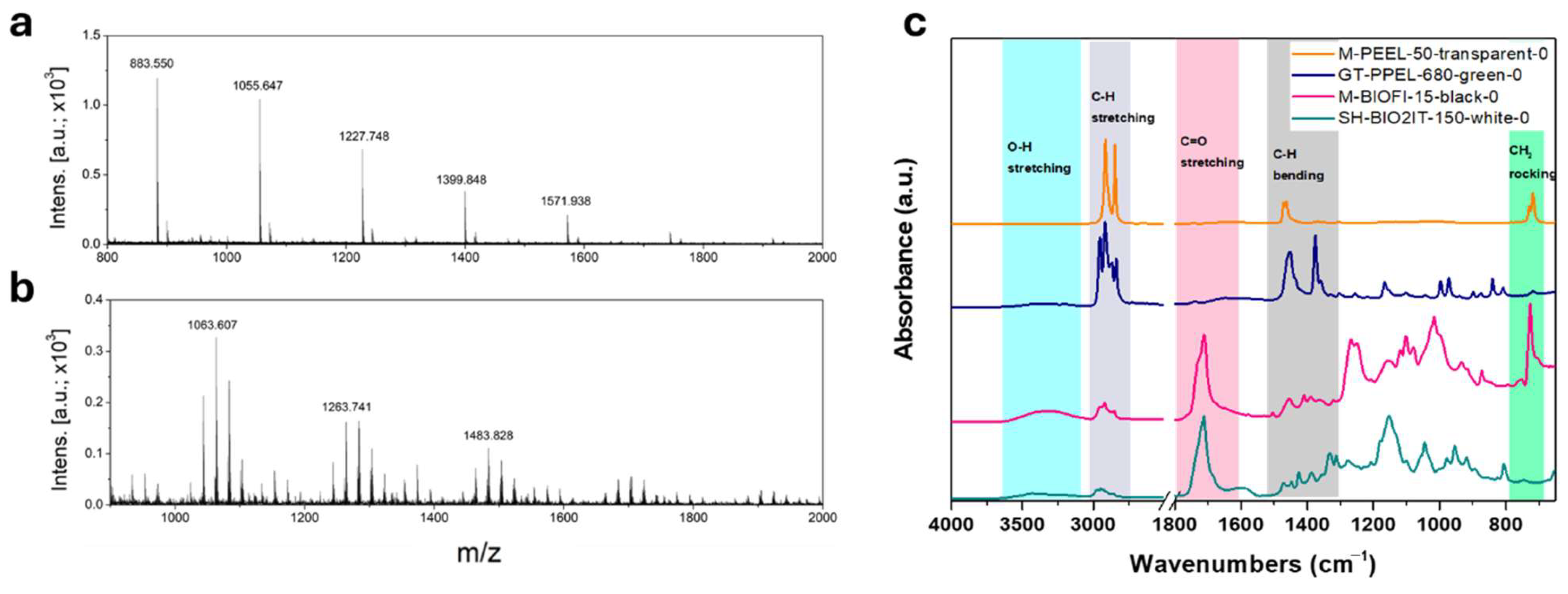
MALDI-TOF analysis provides additional confirmation of the material’s composition, complementing the findings obtained through PY/TD-GC-MS regarding the polymeric nature of the biodegradable plastics. It is important to note that MALDI-TOF preferentially ionizes and desorbs low masses in polydisperse polymeric systems [35]. For the M-BIOFI-15-black-0 material, the resulting spectrum (Figure 3a) confirmed the presence of poly(butylene adipate-co-terephthalate) (PBAT) as the main polymeric constituent.
Figure 3.
MALDI-TOF spectrum of (a) M-BIOFI-15-black-0, and (b) SH-BIO2IT-150-white-0 polymer fractions, recorded in positive reflectron mode. (c) FTIR-ATR spectra of: M-PEEL-50-transparent-0, GT-PPEL-680-green-0, M-BIOFI-15-black-0, and SH-BIO2IT-150-white-0.
In particular, the detected mass peaks correspond to sodium adducts of cyclic copolymeric species, whose co-monomer ratio (A/T) and mass-to-charge (m/z) values are detailed in Table S1. In contrast, the analysis conducted on SH-BIO2IT-150-white-0 (Figure 3b) revealed the presence of poly(butylene succinate) (PBS) as a polymeric constituent, as shown in Table S2. The polyalkenoates identified through Py-GC-MS analysis were not observed in the MALDI-TOF spectrum. This lack of information in MALDI-TOF data is a common occurrence, as the MALDI-TOF process often suffers from polymer preferential desorption depending on the blend formulation.
3.1.2. Inductively Coupled Plasma Mass Spectrometry (ICP-MS)
Inductively Coupled Plasma Mass Spectrometry (ICP-MS) was employed to complement the compositional characterization by quantifying metal ion concentrations in the samples, providing additional insights into their composition and potential environmental impact (Table 3). Each sample was analyzed for the total content of 15 metals: antimony (Sb), mercury (Hg), lead (Pb), aluminum (Al), chromium (Cr), cobalt (Co), copper (Cu), zinc (Zn), arsenic (As), tin (Sn), vanadium (V), cadmium (Cd), iron (Fe), manganese (Mn), and nickel (Ni). These elements were selected based on their possible occurrence in plastics, either as intentionally incorporated (as additives or catalysts during polymer synthesis) or as unintentional contaminants introduced during manufacturing, processing, use, and management [36]. Several of these metals—such as As, Cd, Co, Cr, Hg, and Pb—are of particular toxicological concern due to their classification as carcinogenic, mutagenic, reproductive toxicants, or environmentally hazardous substances [36]. The results listed in Table 3 indicate that metal concentrations in the analyzed samples were generally low, with all values either below detection limits for hazardous elements or within permissible regulatory thresholds. However, a higher concentration of Al was consistently detected in colored samples compared with colorless ones, likely due to the presence of carbon black or pigments, which contribute to the material’s colorimetric properties. A similar trend was observed for Fe. Zn was also detected, potentially originating from phenyl-phosphonic acid zinc salt, a commonly used additive in plastic manufacturing that enhances crystallization and mechanical properties in various polymers [26].
Table 3.
Metal concentrations of the APs determined using ICP-MS analysis.
3.1.3. Fourier Infrared (FTIR) Spectroscopy
FTIR spectroscopy enabled the identification of the main functional groups present in the polymers constituting the APs and provided information on some of the additives used (Figure S1). The main absorption peaks observed in the analyzed APs are reported in Table 4, while Figure 3c shows the FTIR-ATR spectra of four representative samples, which are discussed in further detail. In the two polyolefin-based materials (the mulching film M-PEEL-50-transparent-0 and the ground cover GT-PPEL-680-green-0), strong absorption peaks at 2915 and 2848 cm−1 are noticed, due to asymmetric and symmetric C–H stretching vibrations, respectively. Additional peaks at 1466 and 1365 cm−1 are associated with the combined bands of CH2 and CH3 scissoring vibration. The spectra of the PE-based APs also show the absorption peak at 725 cm−1, due to C–H rocking vibrations in repeating –CH2– units [37]. Both materials exhibit a weak and broad absorption band between 1700 and 1550 cm−1, attributed to C=C stretching vibrations, likely arising from phenol-based stabilizing additives; this interpretation is supported by the absorption band around 3350 cm−1, typical of hydroxyl group stretching [38].
Table 4.
Main absorption peaks found in FTIR-ATR spectra of the analyzed APs.
For the biodegradable AP samples, the mulching film M-BIOFI-15-black-0 shows the presence of bands attributable to PBAT and starch. The peak around 1020 cm−1 is due to the C–O stretching vibrations associated with the glycosidic part of the starch, more specifically, the glycosidic bonds between glucose units. Further, the characteristic PBAT functional groups are visible at 3350 cm−1 (OH stretching), 3000 cm−1 (C–H stretching of aliphatic and aromatic fractions), 1715 cm−1 (C=O carbonyl groups) and 1270 cm−1 (C–O in ester linkages). Additional bands at 1578, 1456, 1409 and 1017 cm−1 are assigned to the stretching of phenylene groups, whereas the sharp band located at 726 cm−1 is characteristic of four or more adjacent methylene groups. Furthermore, bending modes of substituted benzene are recognized in the 700–900 cm−1 spectral range [39]. The FTIR-ATR spectrum of the tree shelter SH-BIO2IT-150-white-0 also displays absorption peaks characteristic of a polyester matrix, including OH stretching around 3350 cm−1, carbonyl stretching at 1715 cm−1, and the stretching vibration of C–O at 1045 cm−1 [40]. However, the lack of features in the region around 730 cm−1 suggests the absence of adjacent –CH2– groups in the main chain, corroborating the presence of a polyhydroxyalkanoate (PHA) or a polysuccinate (PES, PBS) as a polymer matrix, as suggested by Py-GC-MS analysis. A prominent peak occurring in the 1120–1160 cm−1 wavenumber region, typical of polysaccharide C–O–C stretching, indicates the introduction of lignocellulosic biomass as a filler in the polymer formulation [41].
3.2. Functionalities of the Tested APs
3.2.1. Mechanical Properties
Tensile Properties
The tensile test results for the selected APs (Table 5) reveal clear differences in mechanical performance across product categories. Conventional PE-based films, such as M-PEEL-50-transparent-0, exhibit the highest tensile strength and elongation values among the mulching films, reflecting their high ductility and ability to undergo substantial plastic deformation before rupture. In contrast, the biodegradable film M-BIOFI-15-black-0 shows lower tensile strength and reduced elongation, indicative of a more brittle behavior typical of biodegradable mulching films of comparable thickness. The tube I-220-PEEL-1000-black-0 displays both high tensile strength and considerable elongation at break, confirming robustness and ductility required for irrigation applications. Other conventional films, such as those used for fertilizer sacks and silage wrapping (K1-PEEL-250-white-0 and S1-PEDE-150-white-0), also exhibit relatively high tensile strength and elongation, supporting their suitability for mechanical handling and load-carrying capacity. In contrast, the fly trap film (O1-PEEL-50-yellow-0) presents lower elongation and moderate strength, consistent with its intended function. Nonwoven and geotextile-type products, such as GT-PPEL-680-green-0 and C3-PPDE-50-white-0, show significantly lower elongation but comparatively higher tensile strength per unit width. This behavior reflects their design priorities, i.e., dimensional stability and tear resistance rather than ductility. Similarly, bale nets and protective fabrics (e.g., S4-PPEL-1240-green-0) combine high tensile strength with moderate elongation, providing a balance between mechanical integrity and controlled elasticity. Finally, biodegradable materials intended for temporary applications, such as SH-BIO2IT-150-white-0, display much lower tensile strength and minimal elongation, confirming their brittleness compared to their conventional counterparts. Overall, the results demonstrated that PE- and PP-based materials maintain superior mechanical strength and ductility, whereas biodegradable alternatives are more suitable for short-term applications where the EoL biodegradability is the primary requirement.
Table 5.
Tensile properties of the analyzed AP samples.
Puncture Resistance
The puncture behavior of the selected mulching films, ground cover films, and young tree shelter was evaluated by recording the maximum load (N) as a function of displacement (mm) (Table 6). In general, puncture properties of materials are proportional to the thickness of the specimens and depend on their polymeric composition. For a given material, thicker samples exhibit higher elongation at puncture, as observed for K1-PEEL-250-white-0 (Table 6) [42]. This behavior is particularly relevant for fertilizer sacks, which must withstand handling and transportation stresses; high puncture resistance combined with high displacement capacity helps prevent sudden tearing under load. Similar trends are observed for PE films such as O1-PEEL-50-yellow-0 and M-PEEL-50-transparent-0 (made of LLDPE), which show comparatively higher load values. This enhanced resistance contributes to durability in applications where these products must tolerate environmental exposure without easily tearing. Conversely, the PP-based hay bale protection film S4-PPEL-1240-green-0 exhibits good ductility but lower puncture strength, indicating a highly flexible material with limited resistance to sharp objects. M-BIOFI-15-black-0 has significantly lower puncture resistance (12.1 N) and shorter displacement (14.7 mm). The lower thickness (15 µm) and biodegradable nature likely contribute to its reduced mechanical performance compared to PE-based mulch films. This behavior reflects the intrinsic brittleness or the different cohesive forces of the biodegradable blend, made up of PBAT and thermoplastic starch (TPS), compared to the more homogeneous PE matrix.
Table 6.
Puncture properties of the analyzed AP samples.
Finally, SH-BIO2IT-150-white-0 exhibits very low puncture resistance (2.4 N) and short displacement (12.9 mm). Despite its thicker structure (150 µm), this biodegradable blend of polymers has very limited elongation at break and pronounced brittleness, making it more prone to puncture damage. Its minimal displacement at failure further reflects its low capacity for plastic deformation. However, such behavior may be acceptable if the material is designed to provide temporary protection to young trees before gradually degrading in the environment.
3.2.2. Radiometric Properties
The radiometric coefficients of the materials in the solar, PAR, and LWIR ranges are shown in Table 7. The main radiometric requirement of a black mulching film is to be opaque to PAR radiation; a very low PAR transmissivity prevents the passage of solar radiation in wavelengths essential for photosynthesis, thereby reducing weed development [43]. The tested black mulching film (M-BIOFI-15-black-0) showed a PAR transmissivity coefficient of 1.7%.
Table 7.
Radiometric properties of conventional and biodegradable AP samples. PAR: photosynthetic active radiation; LWIR: long-wave infrared.
Transparent mulch films are designed to increase soil temperature by allowing solar radiation to pass through the material. The higher the solar transmissivity coefficient, the greater the soil warming effect under the mulch. The transparent mulching film (M-PEEL-50-transparent-0) showed a high solar total transmissivity coefficient, equal to 89.6%. The LWIR transmissivity coefficient also plays a crucial role in soil temperature regulation. The lower the LWIR transmissivity coefficient of the mulching film, the higher the soil temperature under the mulching film. Among the tested mulching films, M-BIOFI-15-black-0 was the most effective in limiting radiative heat loss, with the lowest LWIR transmissivity coefficient (equal to 16.2%). The other materials displayed more variable radiometric behavior, reflecting differences in polymer composition, thickness, pigmentation, and intended application.
One of the primary functions of a geotextile used as ground cover is to prevent the growth of spontaneous plants; thus, a very low PAR total transmissivity coefficient is desirable. The ground cover film (GT-PPEL-680-green-0) meets this requirement, exhibiting a very low PAR total transmissivity coefficient, equal to 0.2%, indicating minimal penetration of PAR.
The fertilizer sack K1-PEEL-250-white-0 showed a PAR total transmissivity coefficient equal to 45.3%, whereas the silage sack S1-PEDE-150-white-0 showed a lower value, equal to 27.6%. Silage bags provide a cost-effective and secure method for the temporary storage of maize, grass, grain, and other crops. They create airtight conditions that promote optimal fermentation and preserve nutrients, even when the stored material has a moderate moisture content. Their opaque barrier helps limit solar radiation exposure, thereby reducing photodegradation and inhibiting unwanted biological activity. This explains the lower PAR transmissivity of silage sacks, which contributes to maintaining feed quality and preventing spoilage.
The protection fleece (C3-PPDE-50-white-0), which is not a black material, is characterized by high solar and PAR total transmissivity coefficients, equal to 87.1% and 86.8%, respectively. Such values are consistent with its intended function.
3.2.3. Morphological Characterization
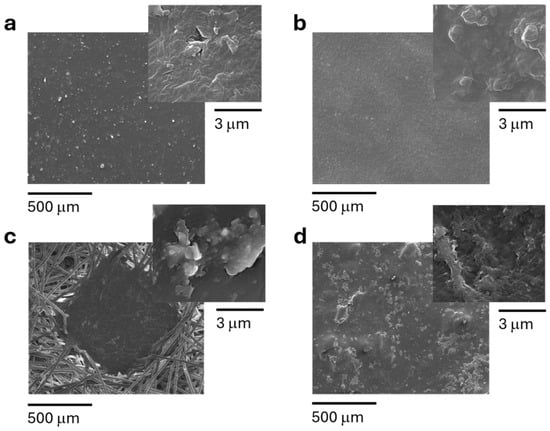
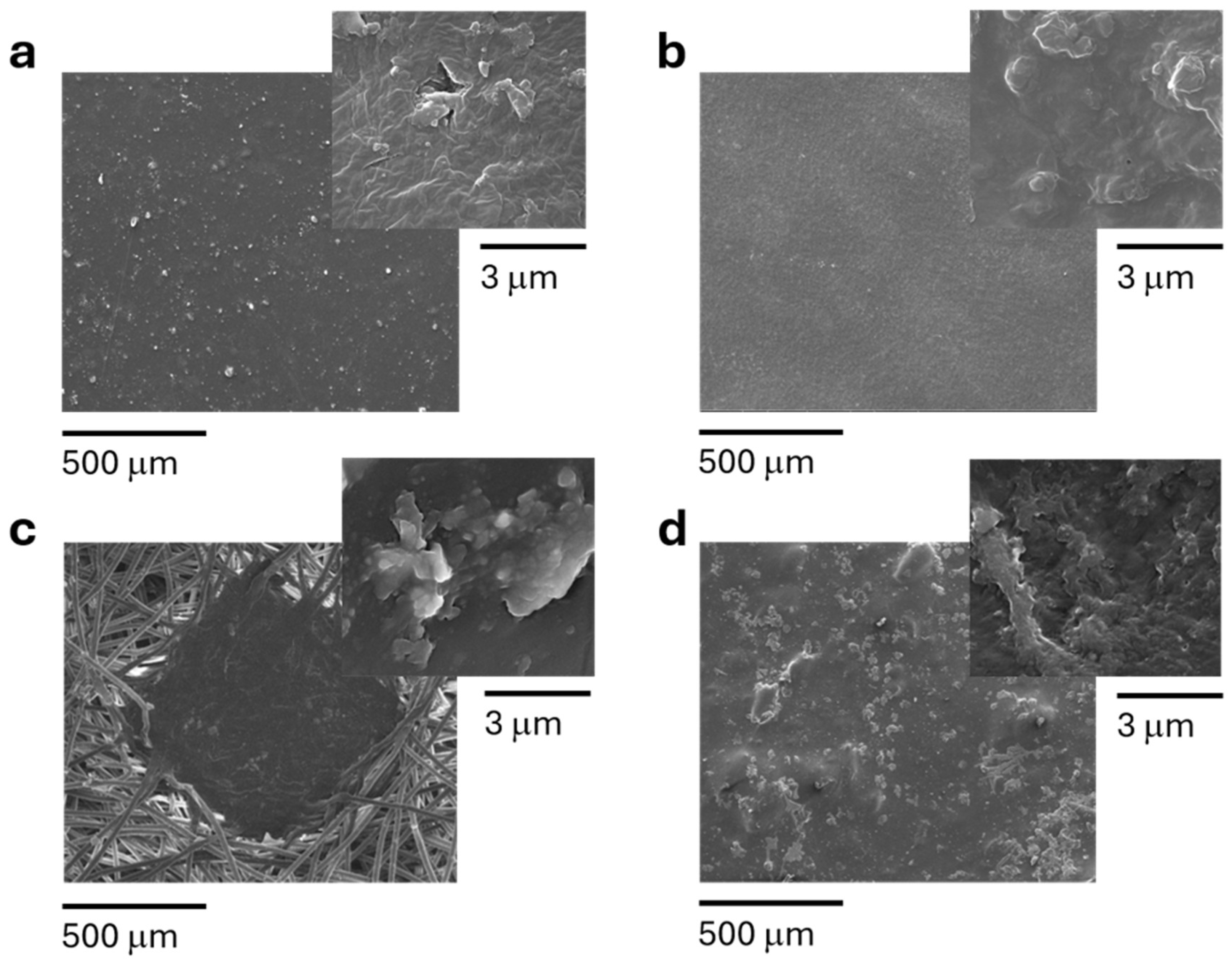
The morphological characterization of the two mulch films (M-PEEL-50-transparent-0 and M-BIOFI-15-black-0), the protection fleece (C3-PPDE-50-white-0), and the shelter (SH-BIO2IT-150-white-0) was carried out by SEM microscopy, and the corresponding surface micrographs are shown in Figure 4. At low magnification (200×), M-PEEL-50-transparent-0 shows a smooth texture, indicative of quite homogeneous materials. However, small particles are visible on the film surface, attributable to the presence of fillers (Figure 4a). Higher magnification images (Figure 4a, inset) also highlight the presence of surface defects, including wrinkles, grooves, and even voids, from which stretched portions of the films protrude. These defects locally reduce film thickness and may increase the probability of crack initiation and fragment formation during field use.
Figure 4.
SEM images of the surface of: (a) M-PEEL-50-black-0, (b) M-BIOFI-15-black-0, (c) C3-PPDE-50-tranparent-0, and (d) SH-BIO2IT-150-white-0 at 200× and 40,000× (inset) magnification.
Compared to the SEM micrographs of the PE-based mulch film, the biodegradable mulch images (Figure 4b) show a rougher surface, featuring numerous particles in the μm range, which are evenly distributed across the film surface. This dispersed phase corresponds to the semi-crystalline phase of non-plasticized thermoplastic starch granules. Higher-magnification images reveal very fine particles, smaller than 1 μm (Figure 4b, inset). These particles likely correspond to additives included in the mulch film formulations, such as carbon black, inorganic fillers and other additives introduced to improve the compatibility between PBAT and thermoplastic starch. In this respect, the particles are well embedded in the matrix, with no visible signs of delamination or interfacial separation.
The SEM images of C3-PPDE-50-tranparent-0 reveal the characteristic fibrous microstructure of a PP-based nonwoven fleece used for soil protection (Figure 4c). The 200× magnification image shows an interconnected network of PP fibers with diameters of approximately 10–30 μm, forming a porous matrix typical of melt-blown or spunbond nonwoven materials. The inset provides a closer view of fiber junction points, where thermal bonding occurred during manufacturing. These joint regions likely consist of a lower-melting-point polymer, such as PP/PE copolymers with lower crystallinity and melting points, used as a thermal bonding agent. The nonwoven fleece presents significant potential for microfiber release into soil systems, due to fiber diameters falling within the microplastic size range, its high surface area increasing susceptibility to weathering and fragmentation, and the presence of junction points, which may represent weak points where differential thermal expansion and weathering and/or mechanical stress could cause fiber release.
Finally, Figure 4d displays the SEM surface images of SH-BIO2IT-150-white-0, a biodegradable protective sheet for young trees composed of biopolymers and wood scrap fillers. At 200× magnification, the surface appears heterogeneous, with an irregular distribution of both smooth and rough regions. Numerous small, angular particles are embedded within the polymer matrix, consistent with the presence of lignocellulosic biomass or other natural fillers. The visible particulates are likely wood particles, which are well-dispersed but not fully encapsulated by the polymer matrix. This is typical for biocomposite films, where the interface between filler and matrix is often less uniform than in conventional plastics. The underlying matrix shows a relatively continuous phase, suggesting good film formation; however, microvoids and surface roughness are evident. These can be attributed to the inclusion of hydrophilic wood particles and the biodegradable nature of the polymer. The rough, particulate-rich surface and the presence of wood scrap indicate points of weakness, where microbial or enzymatic attack can initiate, thereby enhancing the film’s biodegradability. Compared to fossil-based synthetic shelters, the risk of persistent microplastic release is significantly reduced because both the matrix and the wood filler are biodegradable. Nonetheless, during the early stages of degradation, small fragments or microfibers may still be released, especially from poorly encapsulated wood particles or from brittle regions of the matrix. These fragments are expected to undergo further degradation over time, minimizing long-term accumulation in the soil and supporting the suitability of this material for sustainable agriculture and forestry applications.
3.2.4. Thermogravimetric Analysis
Thermogravimetric analysis (TGA) was used to assess the thermal stability of the selected APs. A summary of the main results is provided here, while a more detailed discussion is available in the Supplementary Material. Table 8 lists the relevant thermal decomposition parameters, including the temperature at which 5% of the initial weight is lost (Tonset), the peak temperatures (Tpeak) calculated from the derived TG (DTG) curves, the temperature of charring (Tchar), and the weight of the residue at 650 °C (Wt650). For all the APs, degradation occurs well above typical processing temperatures, meaning it does not interfere with material use. PE-based APs degraded in a single step between 350 and 480 °C, with I-220-PEEL-1000-black-0 displaying the highest degradation temperature (483.3 °C), likely due to carbon black and other stabilizing additives. PP-based APs showed similar behavior but with slightly lower Tpeak (425–450 °C), reflecting the PP’s greater susceptibility to thermal degradation (Figure S2). Biodegradable samples exhibited multistep degradation, consistent with the presence of multiple components like starch and polyesters. For instance, the first weight loss of M-BIOFI-15-black-0 at 300 °C (20%) corresponds to starch decomposition, followed by PBAT degradation.
Table 8.
Main thermal parameters of the analyzed AP samples as measured by thermogravimetry.
3.2.5. Water Contact Angle (WCA), Swelling Ratio and Water Vapor Permeability of the AP Samples
The characterization of the interaction between APs and both liquid and gaseous water is crucial for ensuring their efficacy, particularly concerning their water swelling, contact angle, and WVP. Water swelling reflects a material’s hydrophilicity, which significantly influences its interaction with moisture and, consequently, its performance in agricultural settings [44]. The contact angle, which quantifies surface wettability, is essential for understanding how water interacts with plastic materials; a lower contact angle typically indicates higher hydrophilicity, which can enhance the material’s moisture uptake and potentially affect its mechanical properties. Furthermore, WVP is a critical parameter, as it determines the ability of agricultural films and covers to regulate water vapor transfer. The interplay among these properties is largely dictated by material formulation. For instance, the addition of plasticizers can modify the hydrophilic characteristics of bioplastics, thereby impacting both contact angle and WVP [45]. These aspects are examined in the following sections, as a comprehensive understanding of these parameters is essential for developing effective APs that meet both functional and sustainability criteria.
Water Contact Angle Measurements
A contact angle tester was used to measure the static contact angles of the APs to assess their hydrophobic properties. Wettability is considered high when the contact angle is below 90°, and low when it exceeds 90°. For the examined APs, the contact angle of the M-PEEL-50-transparent-0 film was 79.7°, indicating moderate wetting resistance compared to PE-based mulch films, which exhibit values around 90° [46]. This result can be due to a different polymer matrix formulation, as M-PEEL-50-transparent-0 was likely made up of a polyolefin blend. Furthermore, the presence of additives and fillers also affected WCA. As indicated by TG, the residual char of M-PEEL-50-transparent-0 was 16%. Since fillers are generally more hydrophilic in nature than the PE matrix, higher filler content tends to increase the film’s wettability. M-BIOFI-15-black-0 exhibited a more hydrophobic character, with a WCA of 103.1°. Its residual char was only 5%, which suggests that the hydrophobicity of the PBAT-based blend is higher than that of the PE. Furthermore, the lower wettability also implies that hydrolysis processes could be slowed down, potentially delaying the film’s degradation in soil. Among the other APs, the PP-based samples exhibited a distinctly hydrophobic character, with WCA values of 107.1° and 104.8° for S4-PPEL-1240-green-0 and C3-PPDE-50-white-0, respectively. Interestingly, the biodegradable SH-BIO2IT-150-white-0 shelter displayed the lowest WCA (56.0°), a characteristic that favors faster biodegradation in soil.
Swelling Tests
Swelling tests were performed to assess the extent of water absorption in both biodegradable and conventional polyolefin-based samples. The tests were carried out in duplicate. Based on the results (Figure S3), the samples can be grouped into low, medium, and high absorption categories. High absorption was observed for M-BIOFI-15-black-0, which reached values above 100%. Such high water uptake reflects the material’s chemical composition and morphology, clearly distinguishing it from all polyolefin-based plastics. This behavior is typical of biodegradable starch-based blends, which are characterized by a hydrophilic polymer matrix and the presence of hydrophilic fillers or plasticizers [47].
Medium swelling (10–40%) was observed for most products, including O1-PEEL-50-yellow-0 (fly trap), L-PPDE-60-white-0 (low tunnel fleece), C3-PPDE-50-white-0 (protection fleece), R-PEDE-450-green-0 (binding net), S4-PPEL-1240-green-0 (hay bales protection fabric), GT-PPEL-680-green-0 (ground cover fabric), and M-PEEL-50-transparent-0 (mulch film). Although these products are made of hydrophobic polymers (PE and PP), they showed moderate hydrophilicity due to their structure (e.g., O1-PEEL-50-yellow-0, laminated with cellulose) or woven/nonwoven assembly that caused water uptake to increase compared to dense, thin films.
The low swelling group included products that absorbed very little water (<10%), consistent with their hydrophobic nature. As expected, thick and dense PE items like drip tubes and silage or packaging films showed the lowest swelling. Remarkably, the biodegradable shelter SH-BIO2IT-150-white-0 also showed very low absorption (<3%), despite containing hydrophilic lignocellulose filler and having a low WCA. However, SH-BIO2IT-150-white-0 contained a blend of PHAs and PBS polyesters, which are rather hydrophobic and provided the product with remarkable water resistance.
In summary, M-BIOFI-15-black-0 exhibited dramatically higher swelling than polyolefin plastics, making it suitable for applications requiring high water sensitivity and rapid degradation. PE and PP films remain hydrophobic and stable, with minimal swelling, supporting their continued use where resistance to water ingress is needed. However, this also implies the long-term persistence of plastic residues in soil, contributing to microplastic pollution. Woven and nonwoven structures (ground cover, protection fleece) exhibited higher apparent swelling than extruded films. Material thickness also correlates with total swelling (e.g., thicker ground covers swell more than thin films of similar polymer) but remains secondary to the impact of polymer chemistry and structure.
Water Vapor Permeability (WVP)
WVP is an important indicator for evaluating the ability of APs to reduce water evaporation [48]. For mulch or tunnel films, high water vapor barrier performance promotes water condensation and improves soil moisture retention, supporting crop growth [49]. Likewise, for container-type products, such as boxes or fertilizer sacks, protecting the contents from external humidity is essential. In this respect, several biodegradable polyesters, such as PBAT, especially when blended with TPS, can be moisture-sensitive, leading to higher WVP. Thus, the water vapor barrier property must be carefully considered when selecting these materials for agricultural applications [50].
The WVP values obtained for the APs (Table 9) reveal clear trends when grouping the samples by polymer type and structural form, reflecting both functional requirements and inherent material properties. PE-based films and fabrics consistently exhibit the lowest WVP values, typically between 0.013 and 0.04 × 10⁻¹³ g/m·Pa·s for thin films such as mulch films, silage films, and fruit fly traps. This low permeability is characteristic of PE’s dense and semi-crystalline structure, which provides an effective moisture barrier, essential for applications requiring soil moisture retention or protection from ambient humidity (e.g., mulch films and fertilizer sacks) [51]. Woven and nonwoven fabrics used for tree binders, bale protection, and protection fleeces show much higher permeability (from 3.6 to ~26.5 × 10⁻¹³ g/m·Pa·s) due to their textile-like and porous structure that facilitates vapor transmission. These materials are designed to provide physical protection while allowing vapor exchange, promoting ventilation and reducing condensation risks under covers, to prevent moisture accumulation and related phytopathologies. They also allow moisture to reach the cultivation or soil, reducing irrigation needs. This highlights how plastic permeability can be tailored by modifying thickness and fabric structure to balance moisture retention and breathability.
Table 9.
Water Contact Angle, swelling ratio after 24 h, and water vapor permeability of the AP samples.
Biodegradable films and fabrics exhibit intermediate WVP values (approximately 0.6–1.1 × 10⁻¹³ g/m·Pa·s), which are higher than those of conventional PE films but lower than those of textile-based PP materials. This moderate permeability is typical of biodegradable polyesters, possibly blended with starch or lignocellulosic biomass, which generally have more amorphous and hydrophilic structures that facilitate water vapor diffusion [52,53]. Such permeability supports controlled moisture exchange, potentially improving soil microclimate while also promoting biodegradation. Overall, dense polymer films offer superior moisture–barrier performance, whereas fibrous or biodegradable materials provide enhanced vapor permeability. Material choice therefore reflects a functional compromise between moisture retention and vapor exchange, tailored to specific agricultural functions such as mulching, crop protection, or packaging.
4. Conclusions
The findings of this research underline the significant differences between conventional and biodegradable APs in terms of chemical composition, mechanical and physical properties, and overall performance. Conventional plastics, predominantly PE and PP, exhibited high tensile strength, elongation, and favorable radiometric properties, which explain their widespread use in mulching, covering, and geotextile applications. However, these materials also showed no biodegradability, raising concerns about their long-term accumulation in soils and their potential contribution to MNP pollution.
The results demonstrate a clear relationship between the chemical composition, material structure, and functional performance of APs. Conventional polyolefin-based materials (PE and PP), characterized by non-polar hydrocarbon backbones and compact structures, exhibited low water uptake, high mechanical strength, and superior barrier properties. In contrast, biodegradable formulations containing aliphatic polyesters blended with starch and/or lignocellulosic components showed increased polarity and heterogeneous morphologies, resulting in higher water absorption and vapor permeability, lower puncture resistance, and enhanced susceptibility to biodegradation. These findings highlight that the functional behavior of agricultural plastics is governed not only by polymer type but also by the interplay between chemical formulation, additives, and structural organization, providing useful guidelines for the design of materials that balance agronomic performance and environmental sustainability.
The comprehensive characterization carried out in this research highlights that, due to their intrinsic characteristics, oil-based APs leave a long environmental trace. These materials fragment into MNPs that accumulate in soil, alter its properties, and act as carriers for chemicals. Although the biodegradable materials are designed as a more sustainable alternative, their environmental impact remains to be fully assessed. The biodegradable materials are expected to reduce long-term persistence, yet they can still generate fragments during degradation and release chemicals, producing effects that are not yet fully understood. Consequently, we should responsibly try to minimize overall plastic use, prioritize materials with verified field-biodegradation and minimal additive content, and pair their deployment with monitoring programs capable of tracking MNP formation, soil health and interactions with chemicals.
Further research is necessary to ensure that biodegradable plastics meet the functional demands of agriculture while minimizing environmental impacts. The findings of this research contribute to shaping future policies on agricultural plastic use and support the development of more sustainable materials.
Supplementary Materials
The following supporting information can be downloaded at: https://www.mdpi.com/article/10.3390/polym18131656/s1, Figure S1: FTIR spectra of the 12 selected AP materials (AP samples name are given within each spectrum); Figure S2: TG curves and DTG of M-PEEL-50-transparent-0, M-BIOFI-15-black-0, SH-BIO2IT-150-white-0, and GT-PPEL-680-green-0; Figure S3: Swelling in water of the tested AP samples; Table S1: Structural assignment of the macromolecular adducts in the mass spectra reported in Figure 3; Table S2: Structural assignment of the macromolecular adducts in the mass spectra of SH-BIO2IT-150-white-0, reported in Figure 2B; Table S3: Main thermal parameters of the analyzed AP samples as measured by thermogravimetry; Refs. [54,55] are cited in Supplementary Materials File.
Author Contributions
Conceptualization, S.C.C., A.M., E.S., G.V. and P.C.; Methodology, S.A.S., P.M.R., S.C.C., F.C., A.M., G.V. and P.C.; Validation, S.A.S., P.M.R., F.C., A.M., C.P., E.S. and P.C.; Formal Analysis, S.A.S., P.M.R., F.C., C.P. and A.A.S.; Investigation, C.P. and A.A.S.; Data Curation, S.A.S., P.M.R., F.C. and A.A.S.; Writing—Original Draft Preparation, S.A.S., P.M.R., S.C.C., F.C., A.M., A.A.S., E.S., G.V. and P.C.; Writing—Review and Editing, S.A.S., P.M.R., S.C.C., F.C., A.M., C.P., E.S., G.V. and P.C.; Supervision, S.C.C., E.S., G.V. and P.C.; Funding Acquisition, S.C.C., E.S. and P.C. All authors have read and agreed to the published version of the manuscript.
Funding
This study has received funding from the project PAPILLONS funded under the European Union’s Horizon 2020 research and innovation program (grant agreement No 101000210).
Institutional Review Board Statement
Not applicable.
Data Availability Statement
The original contributions presented in this study are included in the article. Further inquiries can be directed to the corresponding authors.
Acknowledgments
The authors would like to thank Davide Sfregola (University of Bari) for his assistance with radiometric measurements.
Conflicts of Interest
The authors declare no conflicts of interest.
References
- von Vacano, B.; Mangold, H.; Vandermeulen, G.W.M.; Battagliarin, G.; Hofmann, M.; Bean, J.; Künkel, A. Sustainable Design of Structural and Functional Polymers for a Circular Economy. Angew. Chem.-Int. Ed. 2023, 62, e202210823. [Google Scholar] [CrossRef] [PubMed]
- Hachem, A.; Convertino, F.; Batista, T.; Baptista, F.; Briassoulis, D.; Valera Martínez, D.L.; Moreno Teruel, M.A.; Nizzetto, L.; Papardaki, N.G.; Ruggiero, G.; et al. GIS mapping of agricultural plastic waste in southern Europe. Sci. Total Environ. 2024, 946, 174491. [Google Scholar] [CrossRef] [PubMed]
- Lwanga, E.H.; Beriot, N.; Corradini, F.; Silva, V.; Yang, X.; Baartman, J.; Rezaei, M.; van Schaik, L.; Riksen, M.; Geissen, V. Review of microplastic sources, transport pathways and correlations with other soil stressors: A journey from agricultural sites into the environment. Chem. Biol. Technol. Agric. 2022, 9, 20. [Google Scholar] [CrossRef]
- Mukherjee, C.; Varghese, D.; Krishna, J.S.; Boominathan, T.; Rakeshkumar, R.; Dineshkumar, S.; Brahmananda Rao, C.V.S.; Sivaramakrishna, A. Recent advances in biodegradable polymers—Properties, applications and future prospects. Eur. Polym. J. 2023, 192, 112068. [Google Scholar] [CrossRef]
- Amoke, A.; Kalu, I.E. Advances in biodegradable polymeric materials: Focus on controlling factors and sustainable applications. Next Res. 2026, 7, 101501. [Google Scholar] [CrossRef]
- Dallaev, R.; Papež, N.; Allaham, M.M.; Holcman, V. Biodegradable Polymers: Properties, Applications, and Environmental Impact. Polymers 2025, 17, 1981. [Google Scholar] [CrossRef] [PubMed]
- Kyrikou, I.; Briassoulis, D. Biodegradation of agricultural plastic films: A critical review. J. Polym. Environ. 2007, 15, 125–150. [Google Scholar] [CrossRef]
- Giglio, V.; Dvorakova, D.; Convertino, F.; Tsagkaris, A.S.; Messina, A.; Salanitri, G.P.; Dell’Acqua, A.C.; Schettini, E.; Carroccio, S.C. Tracking additives fate from a biodegradable mulch film to soil: A comprehensive LC-MS investigation. J. Hazard. Mater. 2025, 499, 140039. [Google Scholar] [CrossRef] [PubMed]
- ISO 17556:2019; Plastics—Determination of the Ultimate Aerobic Biodegradability of Plastic Materials in Soil by Measuring the Oxygen Demand in a Respirometer or the Amount of Carbon Dioxide Evolved. International Organization for Standardization: Geneva, Switzerland, 2019.
- UNI EN 13432:2002; Imballaggi—Requisiti per Imballaggi Recuperabili Mediante Compostaggio e Biodegradazione—Schema di Prova e Criteri di Valutazione per L’accettazione Finale degli Imballaggi. UNI Ente Italiano di Normazione: Milano, Italy, 2002.
- UNI EN 17033:2018; Materie Plastiche—Film Biodegradabili per Pacciamatura per Uso in Agricoltura e Orticoltura—Requisiti e Metodi di Prova. UNI Ente Italiano di Normazione: Milano, Italy, 2018.
- Rillig, M.C.; Lehmann, A. Microplastic in terrestrial ecosystems. Research shifts from ecotoxicology to ecosystem effects and Earth system feedbacks. Science 2020, 368, 1430–1431. [Google Scholar] [CrossRef] [PubMed]
- DeLoid, G.M.; Cao, X.; Bitounis, D.; Singh, D.; Llopis, P.M.; Buckley, B.; Demokritou, P. Toxicity, uptake, and nuclear translocation of ingested micro-nanoplastics in an in vitro model of the small intestinal epithelium. Food Chem. Toxicol. 2021, 158, 112609. [Google Scholar] [CrossRef] [PubMed]
- Qi, Y.; Beriot, N.; Gort, G.; Huerta Lwanga, E.; Gooren, H.; Yang, X.; Geissen, V. Impact of plastic mulch film debris on soil physicochemical and hydrological properties. Environ. Pollut. 2020, 266, 115097. [Google Scholar] [CrossRef] [PubMed]
- Qian, H.; Zhang, M.; Liu, G.; Lu, T.; Qu, Q.; Du, B.; Pan, X. Effects of Soil Residual Plastic Film on Soil Microbial Community Structure and Fertility. Water Air Soil Pollut. 2018, 229, 261. [Google Scholar] [CrossRef]
- Li, Z.; Li, Q.; Li, R.; Zhou, J.; Wang, G. The distribution and impact of polystyrene nanoplastics on cucumber plants. Environ. Sci. Pollut. Res. 2021, 28, 16042–16053. [Google Scholar]
- Xu, B.; Liu, F.; Cryder, Z.; Huang, D.; Lu, Z.; He, Y.; Wang, H.; Lu, Z.; Brookes, P.C.; Tang, C.; et al. Microplastics in the soil environment: Occurrence, risks, interactions and fate—A review. Crit. Rev. Environ. Sci. Technol. 2020, 50, 2175–2222. [Google Scholar] [CrossRef]
- Santos, A.L.; Rodrigues, C.C.; Oliveira, M.; Rocha, T.L. Microbiome: A forgotten target of environmental micro(nano)plastics? Sci. Total Environ. 2022, 822, 153628. [Google Scholar] [CrossRef] [PubMed]
- Henkel, C.; Hüffer, T.; Hofmann, T. Polyvinyl Chloride Microplastics Leach Phthalates into the Aquatic Environment over Decades. Environ. Sci. Technol. 2022, 56, 14507–14516. [Google Scholar] [CrossRef] [PubMed]
- Wang, Y.; Wang, F.; Xiang, L.; Gu, C.; Redmile-Gordon, M.; Sheng, H.; Wang, Z.; Fu, Y.; Bian, Y.; Jiang, X. Risk Assessment of Agricultural Plastic Films Based on Release Kinetics of Phthalate Acid Esters. Environ. Sci. Technol. 2021, 55, 3676–3685. [Google Scholar] [CrossRef] [PubMed]
- Hahladakis, J.N.; Velis, C.A.; Weber, R.; Iacovidou, E.; Purnell, P. An overview of chemical additives present in plastics: Migration, release, fate and environmental impact during their use, disposal and recycling. J. Hazard. Mater. 2018, 344, 179–199. [Google Scholar] [CrossRef] [PubMed]
- Convertino, F.; Vox, G.; Blanco, I.; Hachem, A.; Schettini, E. Plastic waste management in agriculture through a GIS-based territory design approach. Resour. Conserv. Recycl. 2025, 217, 108210. [Google Scholar] [CrossRef]
- Law, K.L.; Narayan, R. Reducing environmental plastic pollution by designing polymer materials for managed end-of-life. Nat. Rev. Mater. 2021, 7, 104–116. [Google Scholar] [CrossRef]
- European Commission: Directorate-General for Environment. The Impact of the Use of “Oxo-Degradable” Plastic on the Environment—Final Report; European Commission: Brussels, Belgium, 2016. [Google Scholar] [CrossRef]
- Wiesinger, H.; Wang, Z.; Hellweg, S. Deep Dive into Plastic Monomers, Additives, and Processing Aids. Environ. Sci. Technol. 2021, 55, 9339–9351. [Google Scholar] [CrossRef] [PubMed]
- Convertino, F.; Carroccio, S.C.; Cocca, M.C.; Dattilo, S.; Dell’Acqua, A.C.; Gargiulo, L.; Nizzetto, L.; Riccobene, P.M.; Schettini, E.; Vox, G.; et al. The fate of post-use biodegradable PBAT-based mulch films buried in agricultural soil. Sci. Total Environ. 2024, 948, 174697. [Google Scholar] [CrossRef] [PubMed]
- FAO (Food and Agriculture Organization of the United Nations). Assessment of Agricultural Plastics and Their Sustainability. A Call for Action; FAO: Rome, Italy, 2021. [Google Scholar] [CrossRef]
- Briassoulis, D. Agricultural plastics as a potential threat to food security, health, and environment through soil pollution by microplastics: Problem definition. Sci. Total Environ. 2023, 892, 164533. [Google Scholar] [CrossRef] [PubMed]
- Tartiu, V.E.; Hurley, R.; Baann, C.; Briassoulis, D.; Schettini, E.; Convertino, F.; Le Moine, B.; Martinelli, A.; Vernet, L.; Ranneklev, S.B.; et al. Addressing the environmental sustainability of plastics used in agriculture: A multi-actor perspective. Camb. Prism. Plast. 2025, 3, e5. [Google Scholar] [CrossRef]
- ASTM D6400-2; Standard Specification for Labeling of Plastics Designed to be Aerobically Composted in Municipal or Industrial Facilities. ASTM International: West Conshohocken, PA, USA, 2023.
- Method 3052; Microwave Assisted Acid Digestion of Siliceous and Organically Based Matrices. U.S. Environmental Protection Agency (U.S. EPA): Washington, DC, USA, 1996.
- Method 6020; Inductively Coupled Plasma-Mass Spectrometry. U.S. Environmental Protection Agency (U.S. EPA): Washington, DC, USA, 2014.
- ISO 527-1:2018; Plastics—Determination of Tensile Properties—Part 1: General Principles. International Organization for Standardization: Geneva, Switzerland, 2018.
- ASTM E96; Standard Test Methods for Water-Vapor Transmission of Materials. ASTM International: West Conshohocken, PA, USA, 1993.
- Sun, A.B.; Li, S.; Kou, X. Applications of MALDI-TOF-MS in structural characterization of synthetic polymers. Anal. Methods 2023, 15, 868–883. [Google Scholar] [CrossRef] [PubMed]
- Eriksen, M.K.; Pivnenko, K.; Olsson, M.E.; Astrup, T.F. Contamination in plastic recycling: Influence of metals on the quality of reprocessed plastic. Waste Manag. 2018, 79, 595–606. [Google Scholar] [CrossRef] [PubMed]
- De Geyter, N.; Morent, R.; Leys, C. Surface characterization of plasma-modified polyethylene by contact angle experiments and ATR-FTIR spectroscopy. Surf. Interface Anal. Int. J. Devoted Dev. Appl. Tech. Anal. Surf. Interfaces Thin Films 2008, 40, 608–611. [Google Scholar] [CrossRef]
- Marturano, V.; Marotta, A.; Salazar, S.A.; Ambrogi, V.; Cerruti, P. Recent advances in bio-based functional additives for polymers. Prog. Mater. Sci. 2023, 139, 101186. [Google Scholar] [CrossRef]
- Scaffaro, R.; Maio, A.; Lopresti, F. Physical properties of green composites based on poly-lactic acid or Mater-Bi® filled with Posidonia Oceanica leaves. Compos. Part A Appl. Sci. Manuf. 2018, 112, 315–327. [Google Scholar] [CrossRef]
- Jena, K.K.; Raju, K.V.S.N.; Prathab, B.; Aminabhavi, T.M. Hyperbranched polyesters: Synthesis, characterization, and molecular simulations. J. Phys. Chem. B 2007, 111, 8801–8811. [Google Scholar] [CrossRef] [PubMed]
- Aniza, R.; Chen, W.H.; Herrera, C.J.; Quirino, R.; Petrissans, M.; Petrissans, A. Bioenergy and bioexergy analyses with artificial intelligence application on combustion of recycled hardwood and softwood wastes. Renew. Energy 2024, 237, 121885. [Google Scholar] [CrossRef]
- Guo, K.; Cao, M.; Gu, F.; Wu, F.; Yang, H.; Xu, H.; Hu, Z. Mechanical Properties of Metallocene Linear Low-Density Polyethylene Mulch Films Correlate with Ultraviolet Irradiation and Film Thickness. Sustainability 2023, 15, 6713. [Google Scholar] [CrossRef]
- Schettini, E.; Vox, G. Effects of agrochemicals on the radiometric properties of different anti-UV stabilized EVA plastic films. Acta Hortic. 2012, 956, 515–522. [Google Scholar] [CrossRef]
- Kamthai, S.; Wiriyacharee, P.; Naruenartwongsakul, S.; Khaw-on, P.; Deenu, A.; Chaipoot, S.; Phongphisutthinant, R.; Tachai, K.; Orpool, S. Influence of Honey Bee Brood Protein on the Hydrophilic, Mechanical, and Thermal Properties of Polysaccharide Gel Films. Gels 2025, 11, 236. [Google Scholar] [CrossRef] [PubMed]
- Vieira, E.F.; Amaral, T.; Domingues, V.F.; Delerue-Matos, C. Hydrophobicity Strategies of Starch-Based Films: Recent Advances and Perspectives. Polymers 2026, 18, 490. [Google Scholar] [CrossRef] [PubMed]
- Zhang, C.; Liu, X.; Zhang, L.; Chen, Q.; Xu, Q. Assessing the aging and environmental implications of polyethylene mulch films in agricultural land. Environ. Sci. Process. Impacts 2024, 26, 1310–1321. [Google Scholar] [CrossRef] [PubMed]
- Pittarello, M.; Rodinò, M.T.; Sidari, R.; Panuccio, M.R.; Cozzi, F.; Branca, V.; Petrovičová, B.; Gelsomino, A. Employment of Biodegradable, Short-Life Mulching Film on High-Density Cropping Lettuce in a Mediterranean Environment: Potentials and Prospects. Agriculture 2025, 15, 1219. [Google Scholar] [CrossRef]
- Ma, Z.; Ma, Y.; Qin, L.; Liu, J.; Su, H. Preparation and characteristics of biodegradable mulching films based on fermentation industry wastes. Int. Biodeterior. Biodegrad. 2016, 111, 54–61. [Google Scholar] [CrossRef]
- Yang, N.; Ying, L.; Li, K.; Chen, F.; Zhao, F.; Sun, Z.; Feng, L.; Liu, J. Biodegradable Mulching Films Based on Polycaprolactone and Its Porous Structure Construction. Polymers 2022, 14, 5340. [Google Scholar] [CrossRef] [PubMed]
- Ning, R.; Liang, J.; Sun, Z.; Liu, X.; Sun, W. Preparation and characterization of black biodegradable mulch films from multiple biomass materials. Polym. Degrad. Stab. 2021, 183, 109411. [Google Scholar] [CrossRef]
- Demo, A.H.; Asefa Bogale, G. Enhancing crop yield and conserving soil moisture through mulching practices in dryland agriculture. Front. Agron. 2024, 6, 1361697. [Google Scholar] [CrossRef]
- Briassoulis, D.; Giannoulis, A. Evaluation of the functionality of bio-based plastic mulching films. Polym. Test. 2018, 67, 99–109. [Google Scholar] [CrossRef]
- Touchaleaume, F.; Martin-Closas, L.; Angellier-Coussy, H.; Chevillard, A.; Cesar, G.; Gontard, N.; Gastaldi, E. Performance and environmental impact of biodegradable polymers as agricultural mulching films. Chemosphere 2016, 144, 433–439. [Google Scholar] [CrossRef] [PubMed]
- Esmizadeh, E.; Tzoganakis, C.; Mekonnen, T.H. Degradation behavior of polypropylene during reprocessing and its biocomposites: Thermal and oxidative degradation kinetics. Polymers 2020, 12, 1627. [Google Scholar] [CrossRef] [PubMed]
- Pešenjanski, I.; Miljković, B.; Vićević, M. Pyrolysis kinetic modelling of wheat straw from the pannonian region. J. Combust. 2016, 2016, 9534063. [Google Scholar] [CrossRef]

Disclaimer/Publisher’s Note: The statements, opinions and data contained in all publications are solely those of the individual author(s) and contributor(s) and not of MDPI and/or the editor(s). MDPI and/or the editor(s) disclaim responsibility for any injury to people or property resulting from any ideas, methods, instructions or products referred to in the content. |
© 2026 by the authors. Licensee MDPI, Basel, Switzerland. This article is an open access article distributed under the terms and conditions of the Creative Commons Attribution (CC BY) license.