Enhancement of Ultraviolet Light Resistance of Colorless and Transparent Semi-Alicyclic Polyimide Nanocomposite Films via the Incorporation of Hindered Amine Light Stabilizers for Potential Applications in Flexible Optoelectronics
 and
and 
Abstract
1. Introduction
2. Materials and Methods
2.1. Materials
2.2. Measurements
2.3. Preparation of the CPI-0 (HPMDA-DMBZ) Film
2.4. Preparation of CPI/HALS Nanocomposite Films
3. Results and Discussion
3.1. HALS Evaluation
3.2. CPI-0 and CPI/HALS Nanocomposite Film Preparation
3.3. Optical Properties
3.4. Photo-Degradation Behaviors of the CPI-D Nanocomposite Films
3.5. Thermal Properties of the CPI-D Nanocomposite Films
4. Conclusions
Author Contributions
Funding
Institutional Review Board Statement
Informed Consent Statement
Data Availability Statement
Conflicts of Interest
References
- Liang, N.; Fujiwara, E.; Nara, M.; Ishige, R.; Ando, S. Colorless copolyimide films ehibbiting large stokes-shifted photoliminescence applicable for spectral conversion. ACS Appl. Polym. Mater. 2021, 3, 3911–3921. [Google Scholar] [CrossRef] [Scilit]
- Miyane, S.; Chen, C.K.; Lin, Y.C.; Ueda, M.; Chen, W.C. Thermally stable colorless copolyimides with a low dielectric constant and dissipation factor and their organic field-effect transistor applications. ACS Appl. Polym. Mater. 2021, 3, 3153–3163. [Google Scholar] [CrossRef] [Scilit]
- Kim, H.; Hwang, S.; Hwang, T.; In, J.B.; Yeo, J. Digitally patterned mesoporous carbon nanostructures of colorless polyimide for transparent and flexible micro-supercapacitor. Energies 2021, 14, 2547. [Google Scholar] [CrossRef] [Scilit]
- Wright, J.S.; Jones, A.; Farmer, B.; Rodman, D.L.; Minton, T.K. POSS-enhanced cololess organic/inorganic nanocomposite (CORIN®) for atomic oxygen resistance in low earth orbit. CEAS Space J. 2021, 13, 399–413. [Google Scholar] [CrossRef] [Scilit]
- Gao, H.; Lan, X.; Liu, L.; Xiao, X.; Liu, Y.; Leng, J. Study on performances of colorless and transparent shape memory polyimide film in space thermal cycling, atomic oxygen and ultraviolet irradiation environments. Smart Mater. Struct. 2017, 26, 095001. [Google Scholar] [CrossRef] [Scilit]
- Huang, J.; Zhang, G.; Dong, B.; Liu, J. Synthesis and properties of polyimide silica nanocomposite film with high transparent and radiation resistance. Nanomaterials 2021, 11, 562. [Google Scholar] [CrossRef] [Scilit]
- Pei, X.; Wang, Q. Different responses of several kinds of copolymerized polyimide films to ultraviolet irradiation. Appl. Surf. Sci. 2007, 253, 5494–5500. [Google Scholar] [CrossRef] [Scilit]
- Plis, E.A.; Engelhart, D.P.; Cooper, R.; Johnston, W.R.; Ferguson, D.; Hoffmann, R. Review of radiation-induced effects in polyimide. Appl. Sci. 2019, 9, 1999. [Google Scholar] [CrossRef] [Scilit]
- Rabek, J.F. Photodegradation and photo-oxidative degradation of heterochain polymers. In Polymer Photodegradation; Springer: Dordrecht, The Netherlands, 1995; pp. 255–352. [Google Scholar]
- Hoyle, C.E.; Anzures, E.T. Photodegradation of polyimides. I. A spectral, viscometric, chromatographic, and weight loss investigation of polyimides based on a hexafluorinated dianhydride. J. Appl. Polym. Sci. 1991, 43, 1–10. [Google Scholar] [CrossRef] [Scilit]
- Hoyle, C.E.; Anzures, E.T. Photodegradation of polyimides. II. Thermal property changes of polyimides based on a hexafluorinated dianhydride. J. Appl. Polym. Sci. 1991, 43, 11–18. [Google Scholar] [CrossRef] [Scilit]
- Hoyle, C.E.; Anzures, E.T. Photodegradation of polyimides. III. The effect of chemical composition, radiation source, atmosphere, and processing. J. Polym. Sci. Part A Polym. Chem. 1992, 30, 1233–1245. [Google Scholar] [CrossRef] [Scilit]
- Hoyle, C.E.; Creed, D.; Nagarajan, R.; Subramanian, P.; Anzures, E.T. Photodegradation of polyimides. 4. Mechanism for the photo-oxidation process based on a model compound. Polymer 1992, 33, 3162–3168. [Google Scholar] [CrossRef] [Scilit]
- Hoyle, C.E.; Anzures, E.T.; Subramanian, P.; Nagarajan, R.; Creed, D. Photodegradation of polyimides. 5. An explanation of the rapid photolytic decomposition of a selected polyimide via anhydride formation. Macromolecules 1992, 25, 6651–6657. [Google Scholar] [CrossRef] [Scilit]
- Creed, D.; Hoyle, C.E.; Subramanian, P.; Nagarajan, R.; Pandey, C.; Anzures, E.T.; Cane, K.M.; Cassidy, P.E. Photodegradation of polyimides. 6. Effect of donor-acceptor groups on the photooxidative stability of polyimides and model compounds. Macromolecules 1994, 27, 832–837. [Google Scholar] [CrossRef] [Scilit]
- Creed, D.; Hoyle, C.E.; Jordan, J.W.; Pandey, C.A.; Nagarajan, R.; Pankasem, S.; Peeler, A.M.; Subramanian, P. Charge transfer states in the photophysics and photochemistry of polyimides and related phthalimides. Macromol. Symp. 1997, 116, 1–13. [Google Scholar] [CrossRef] [Scilit]
- Hasegawa, M.; Horie, K. Photophysics, photochemistry, and optical properties of polyimides. Prog. Polym. Sci. 2001, 26, 259–335. [Google Scholar] [CrossRef] [Scilit]
- Chung, C.M.; Cho, S.Y.; Lee, J.Y.; Oh, S.Y. Photodegradation behavior of a polyimide containing imidosulfonate groups and cyclobutane rings. Mol. Cryst. Liq. Cryst. 2000, 349, 59–62. [Google Scholar] [CrossRef] [Scilit]
- Mai, A.T.M.; Thakur, A.; Ton, N.N.T.; Nguyen, T.N.; Kaneko, T.; Taniike, T. Photodgradation of a semi-aromatic bio-derived polyimide. Polym. Degrad. Stab. 2021, 184, 109472. [Google Scholar] [CrossRef] [Scilit]
- Yousif, E.; Haddad, R. Photodegradation and photostabilization of polymers, especially polystyrene: A review. SpringerPlus 2013, 2, 398. [Google Scholar] [CrossRef] [Scilit]
- Harito, C.; Bavykin, D.V.; Yuliarto, B.; Dipojono, H.K.; Walsh, F.C. Inhibition of polyimide photodegradation by incorporation of titanate nanotubes into a composite. J. Polym. Environ. 2019, 27, 1505–1515. [Google Scholar] [CrossRef] [Scilit]
- Kim, S.; Hwang, T.G.; Namgoong, J.W.; Kim, H.M.; Kim, J.P. Effect of linker moiety on linear dimeric benzotrizaole derivatives as highly stable UV absorber for transparent polyimide film. Dyes Pigment. 2020, 18, 108469. [Google Scholar] [CrossRef] [Scilit]
- Gijsman, P. A review on the mechanism of action and applicability of hindered amine stabilizers. Polym. Degrad. Stab. 2017, 145, 2–10. [Google Scholar] [CrossRef] [Scilit]
- Gijsman, P.; Hennekens, J.; Tummers, D. The mechanism of action of hindered amine light stabilizers. Polym. Degrad. Stab. 1993, 39, 225–233. [Google Scholar] [CrossRef] [Scilit]
- Gijsman, P. New synergists for hindered amine light stabilizers. Polymer 2002, 43, 1573–1579. [Google Scholar] [CrossRef] [Scilit]
- Hodgson, J.L.; Coote, M.L. Clarifying the mechanism of the Denisov cycle: How do hindered amine light stabilizers protect polymer coatings from photo-oxidative degradation? Macromolecules 2010, 43, 4573–4583. [Google Scholar] [CrossRef] [Scilit]
- Schaller, C.; Rogez, D.; Braig, A. Hindered amine light stabilizers in pigmented coatings. J. Coat. Technol. Res. 2009, 6, 81–88. [Google Scholar] [CrossRef] [Scilit]
- Klampfl, C.W.; Himmelsbach, M. Advances in the determination of hindered amine light stabilizers—A review. Anal. Chem. Acta 2016, 933, 10–22. [Google Scholar] [CrossRef] [Scilit]
- Kreisberger, G.; Buchberger, W.W. Rapid determination of oligomeric hindered amine light stabilizers in polymeric materials. J. Sep. Sci. 2017, 40, 2366–2373. [Google Scholar] [CrossRef] [Scilit]
- Balabanovich, A.I.; Klimovtsova, I.A.; Prokopovich, V.P.; Prokopchuk, N.R. Thermal stability and thermal decomposition study of hindered amine light stabilizers. Thermochim. Acta 2007, 459, 1–8. [Google Scholar] [CrossRef] [Scilit]
- Pryde, C.A. IR studies of polyimides. I. Effects of chemical and physical changes during cure. J. Polym. Sci. Part A Polym. Chem. 1989, 27, 711–724. [Google Scholar] [CrossRef] [Scilit]





| CPI | CPI-0, DMAc (g, g) | HALS, DMAc (mg, g) | MHALS/MCPI |
|---|---|---|---|
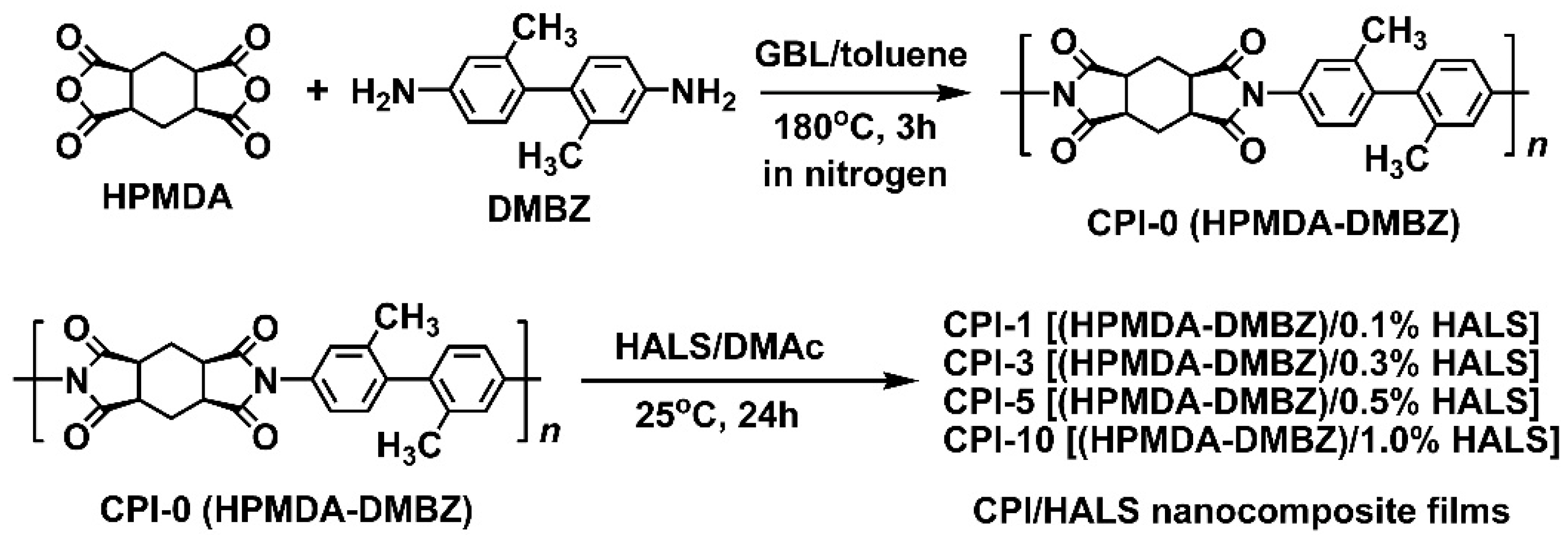
| CPI-1 | 3.9475, 21.0525 | 3.9475, 1.3390 | 0.1% |
| CPI-3 | 3.9475, 21.0525 | 11.8425, 1.3840 | 0.3% |
| CPI-5 | 3.9475, 21.0525 | 19.7375, 1.4285 | 0.5% |
| CPI-10 | 3.9475, 21.0525 | 39.4750, 1.5405 | 1.0% |
| Samples | Description |
|---|---|
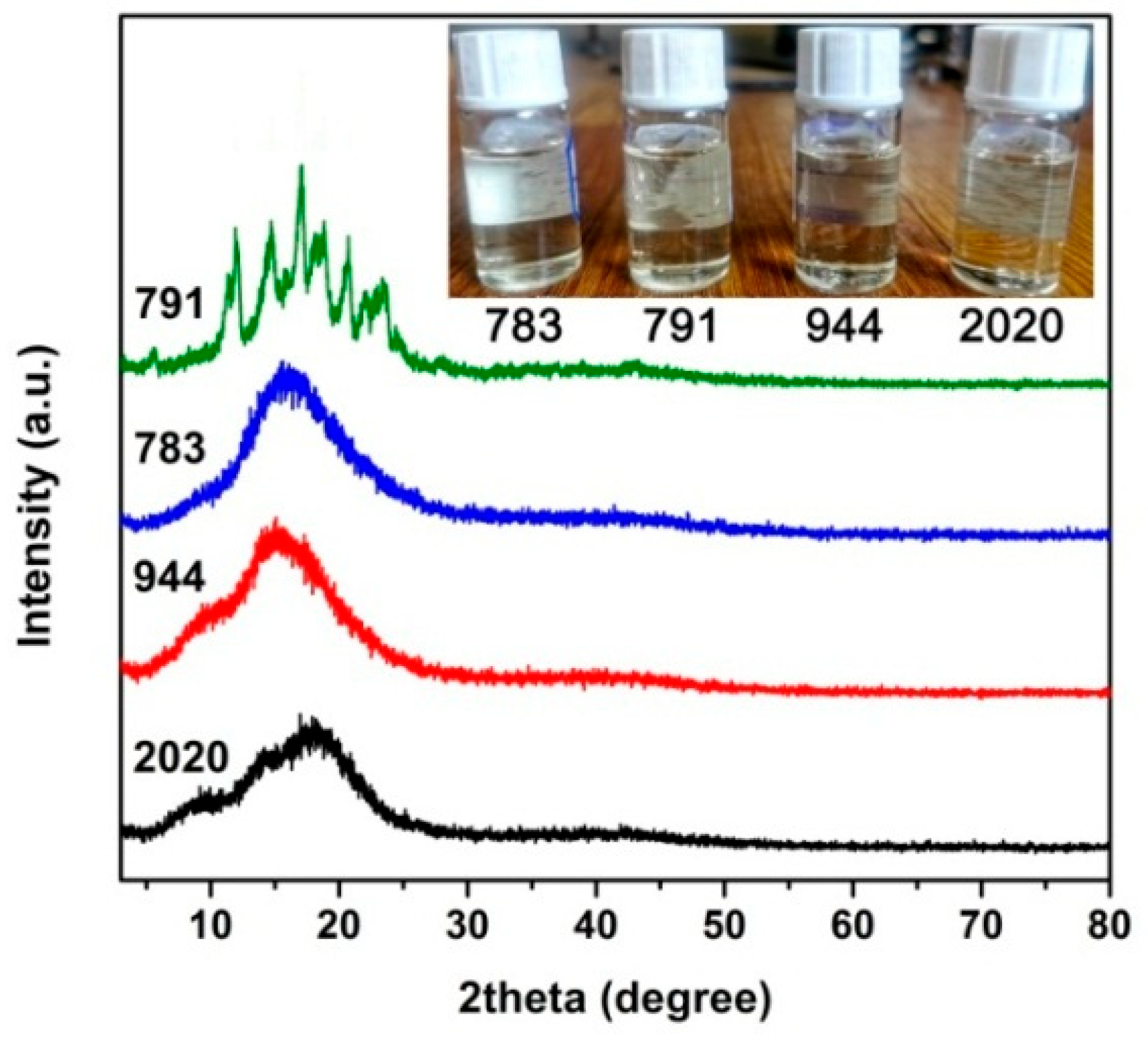
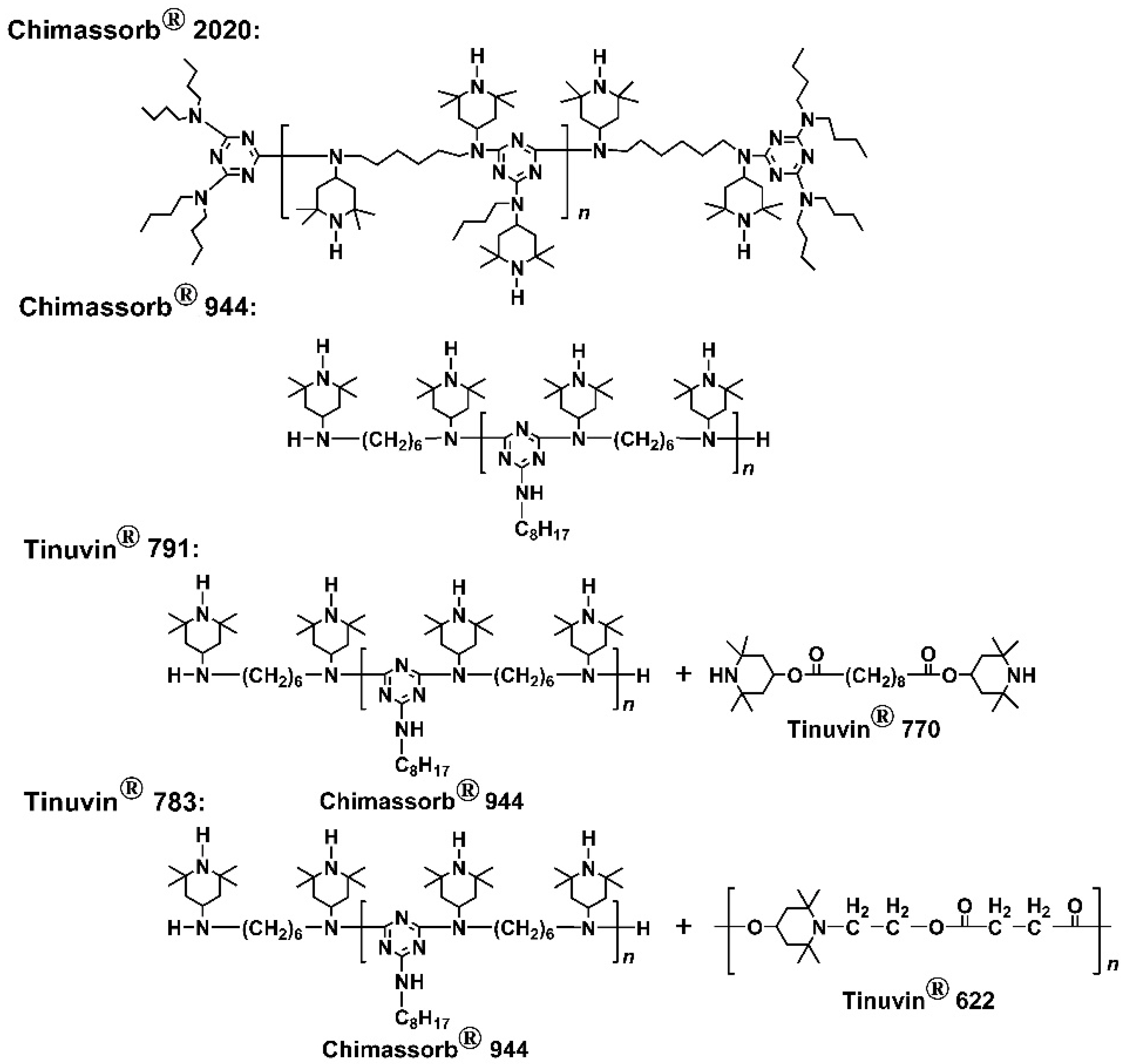
| 2020 | Chimassorb® 2020 (BASF, Ludwigshafen, Germany) |
| 944 | Chimassorb® 944 (BASF, Ludwigshafen, Germany) |
| 783 | Tinuvin® 783 (BASF, Ludwigshafen, Germany) |
| 791 | Tinuvin® 791 (BASF, Ludwigshafen, Germany) |
| CPI-0 | CPI (HPMDA-DMBZ) matrix |
| CPI-1 | CPI/HALS nanocomposite film with the MHALS/MCPI = 0.1% |
| CPI-3 | CPI/HALS nanocomposite film with the MHALS/MCPI = 0.3% |
| CPI-5 | CPI/HALS nanocomposite film with the MHALS/MCPI = 0.5% |
| CPI-10 | CPI/HALS nanocomposite film with the MHALS/MCPI = 1.0% |
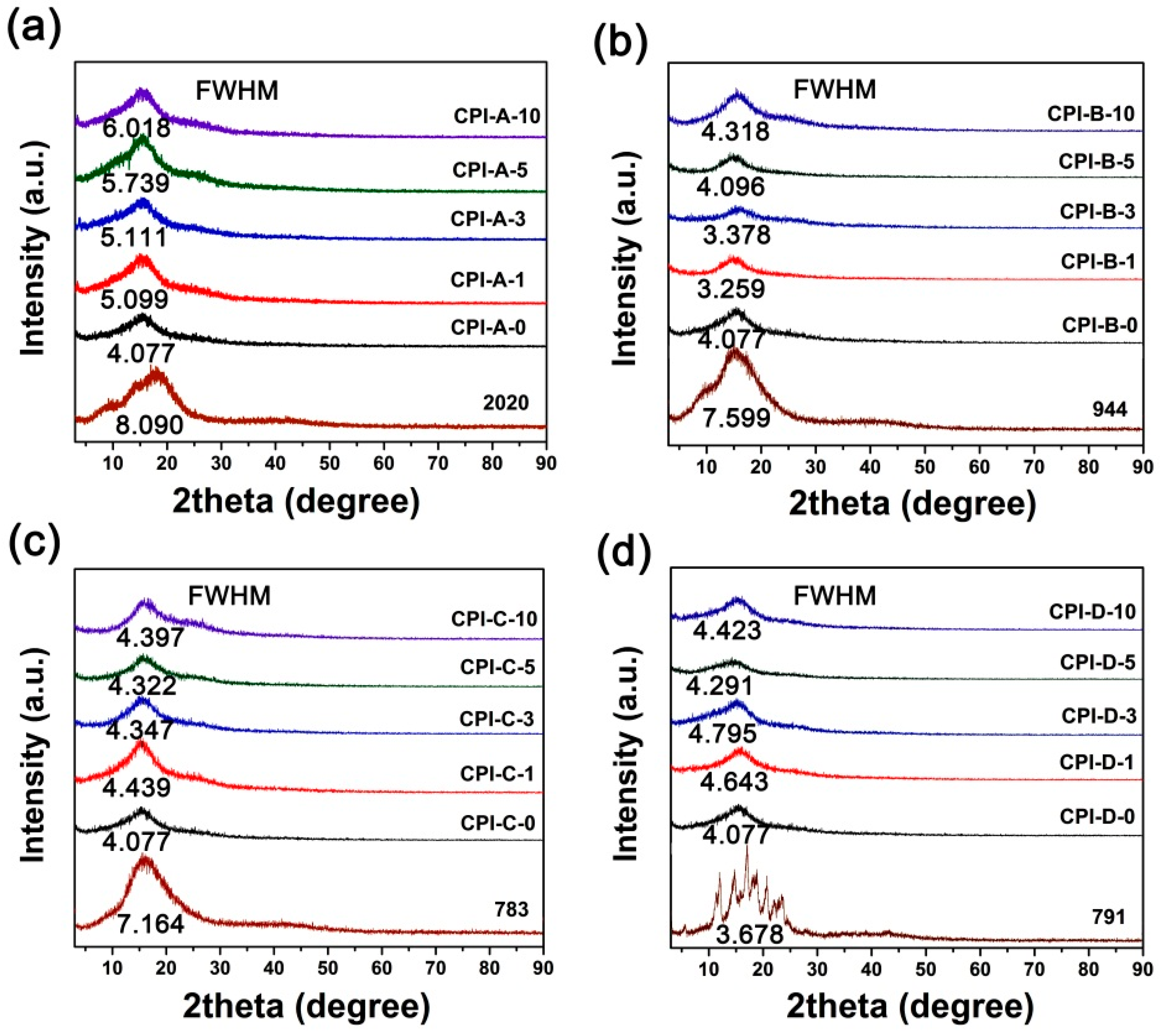
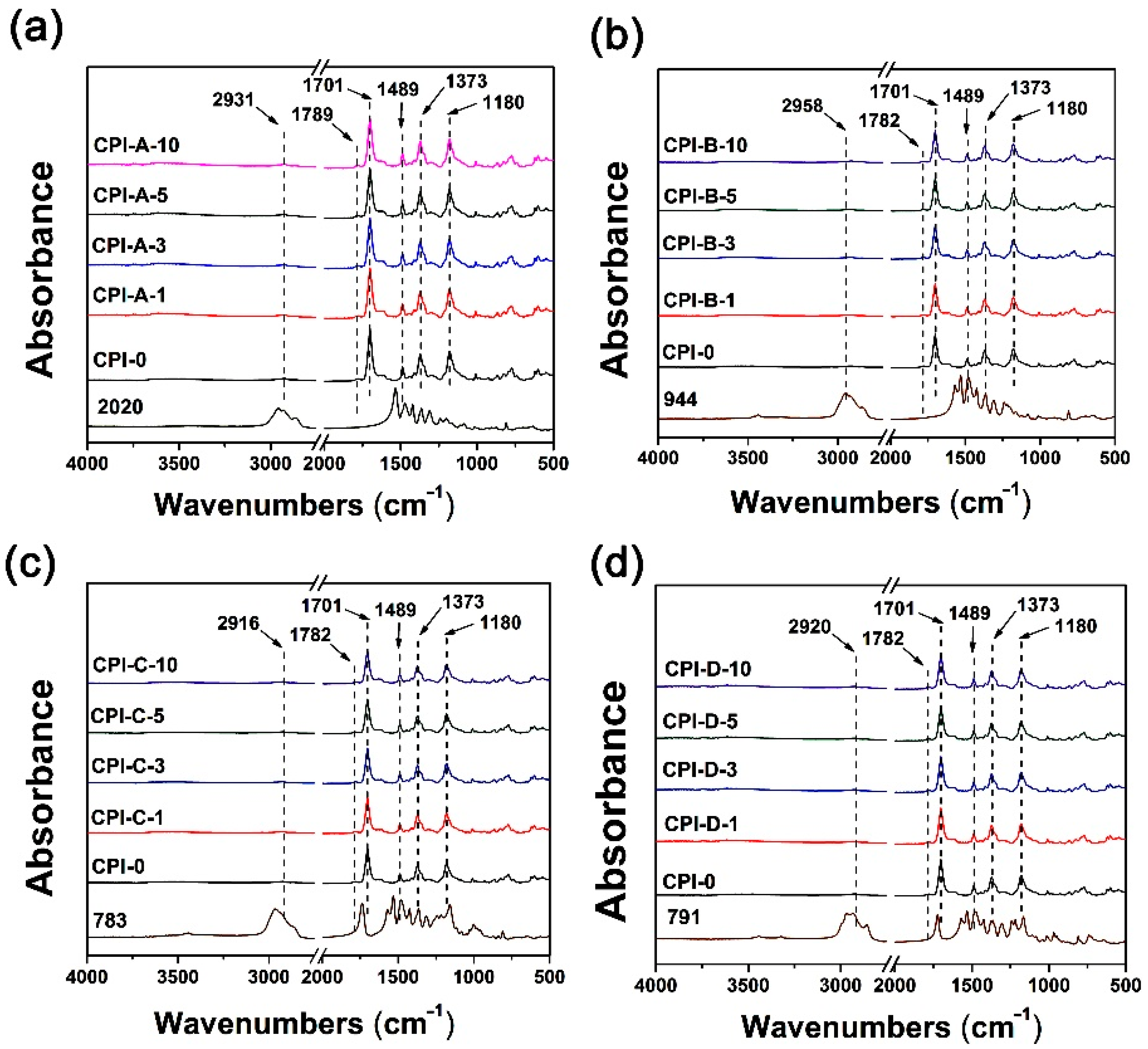
| CPI-A-X | Series A, CPI-0/2020 composite films; X: contents of 2020 (X = 1, 0.1%; X = 3, 0.3%; X = 5, 0.5%; X = 10, 1.0%) |
| CPI-B-X | Series B, CPI-0/944 composite films; X: contents of 944 (X = 1, 0.1%; X = 3, 0.3%; X = 5, 0.5%; X = 10, 1.0%) |
| CPI-C-X | Series C, CPI-0/783 composite films; X: contents of 783 (X = 1, 0.1%; X = 3, 0.3%; X = 5, 0.5%; X = 10, 1.0%) |
| CPI-D-X | Series D, CPI-0/791 composite films; X: contents of 791 (X = 1, 0.1%; X = 3, 0.3%; X = 5, 0.5%; X = 10, 1.0%) |
| CPI-D-X-Y | CPI-0/791 composite film with different UV exposure time; X: contents of 791 (X = 1, 0.1%; X = 10, 1.0%); Y: Xenon lamp exposure time (Y = 1, 1 h; Y = 1.5, 1.5 h; Y = 2, 2 h; Y = 3, 3 h; Y = 4, 4 h; Y = 5, 5 h; Y = 6, 6 h) |
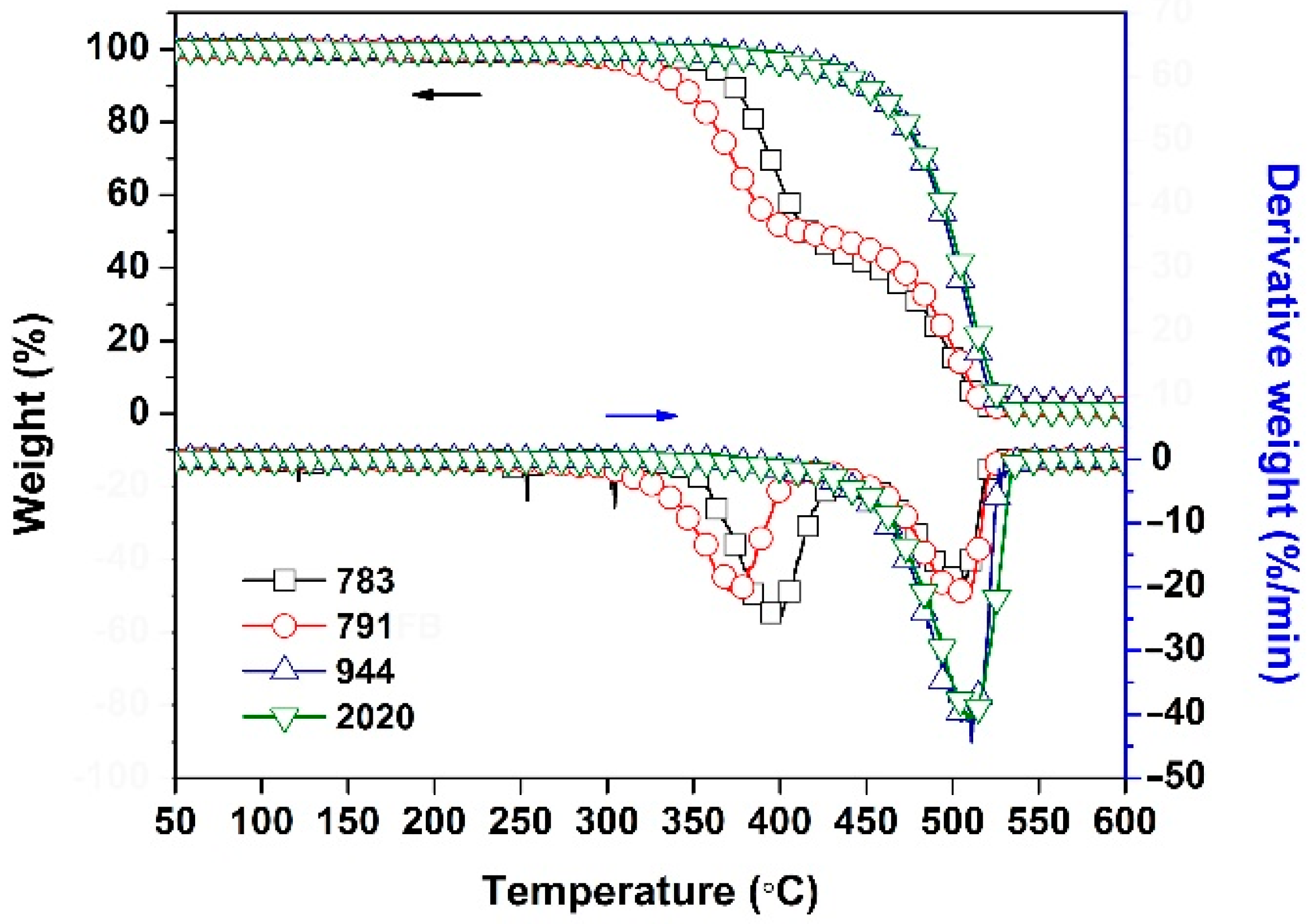
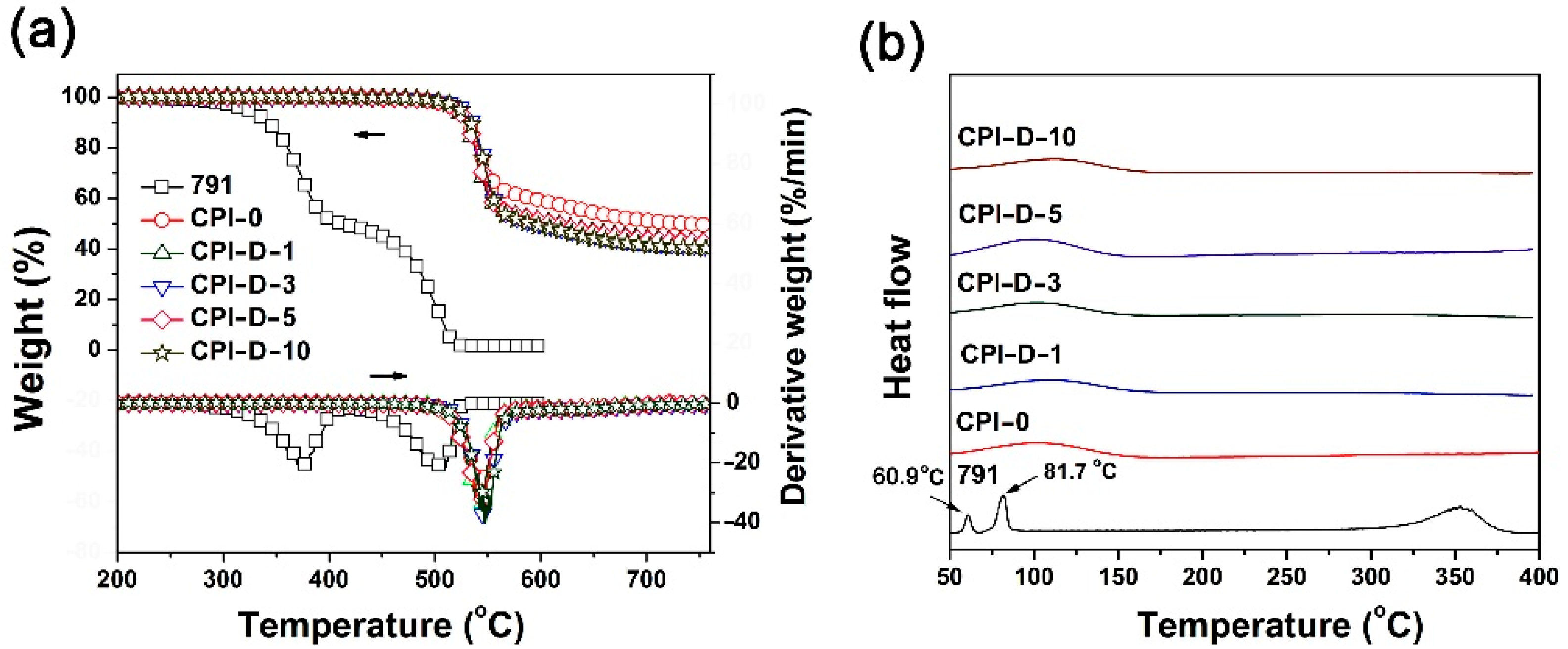
| HALS | FWHM 1 (°) | T5% 2 (°C) | T10% 2 (°C) | Tmax1 2 (°C) | Tmax2 2 (°C) | Rw500 2 (%) |
|---|---|---|---|---|---|---|
| 783 | 7.164 | 361.9 | 372.8 | 399.7 | 502.3 | 15.3 |
| 791 | 3.678 | 322.4 | 342.3 | 376.3 | 503.7 | 18.2 |
| 944 | 7.599 | 425.5 | 450.3 | NA 3 | 510.8 | 45.2 |
| 2020 | 8.090 | 420.5 | 448.8 | NA | 509.0 | 48.7 |
| Property | CPI-0 | Series A (2020) | Series B (944) | Series C (783) | Series D (791) | ||||||||||||
|---|---|---|---|---|---|---|---|---|---|---|---|---|---|---|---|---|---|
| A-1 | A-3 | A-5 | A-10 | B-1 | B-3 | B-5 | B-10 | C-1 | C-3 | C-5 | C-10 | D-1 | D-3 | D-5 | D-10 | ||
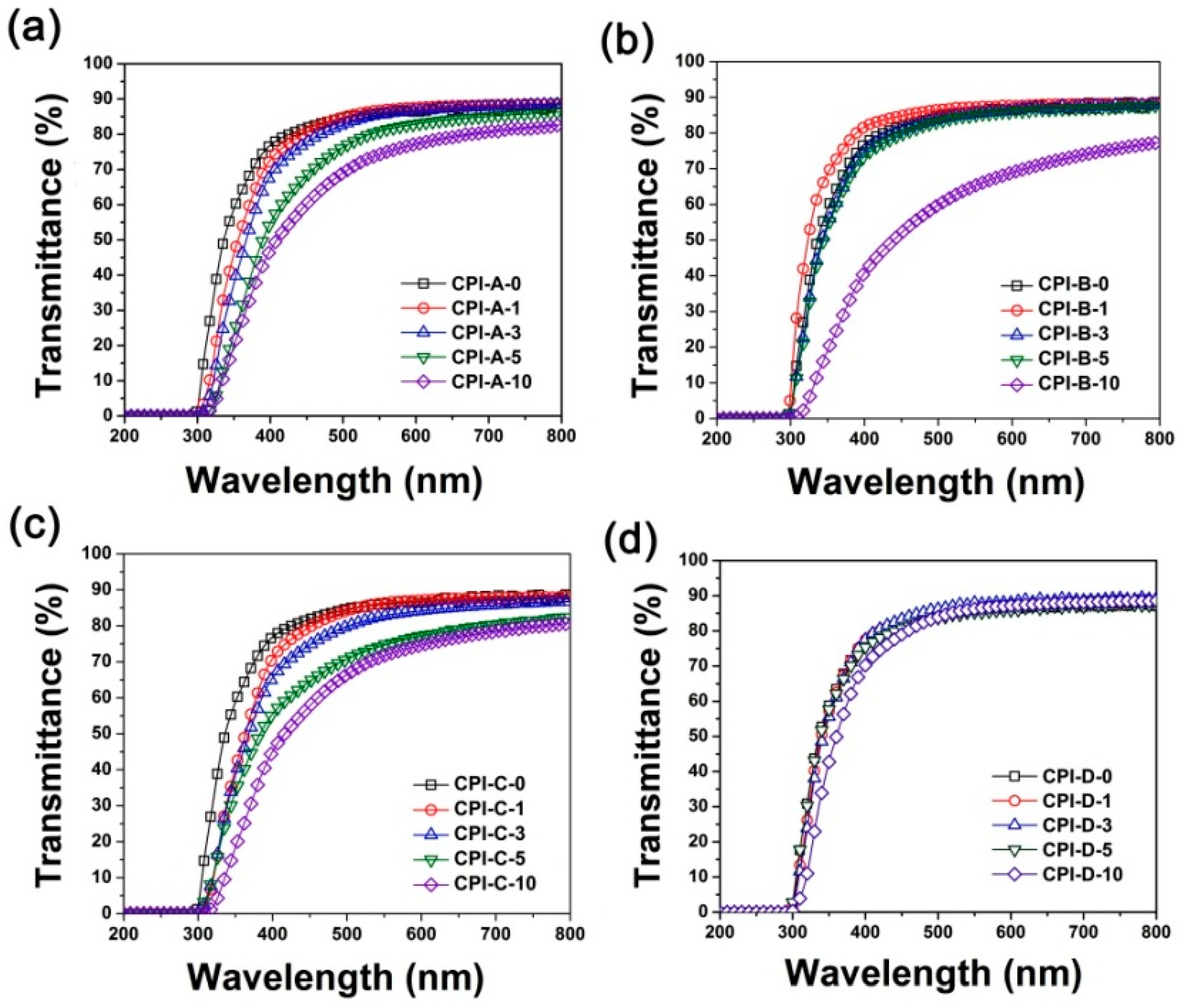
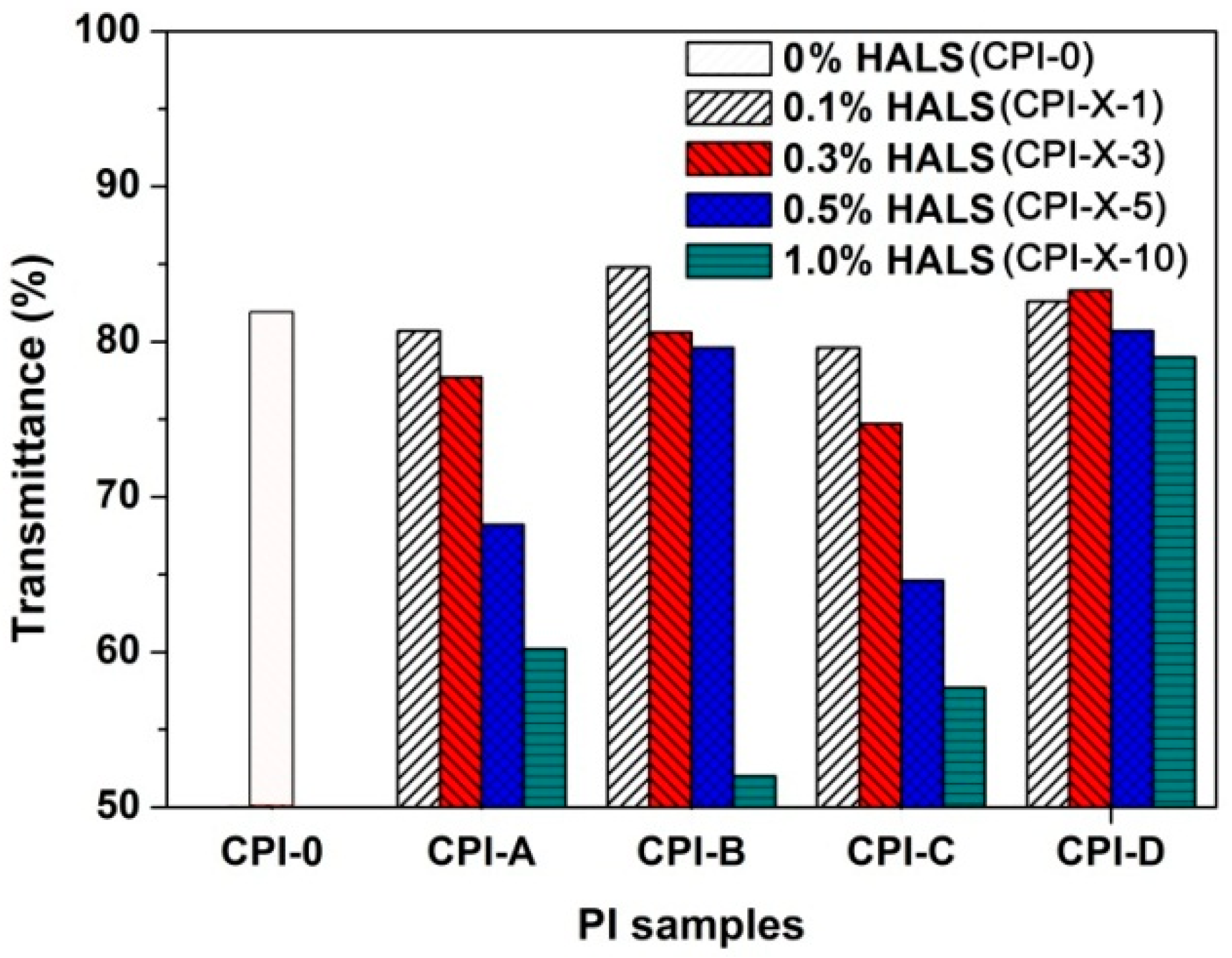
| λcut 1 (nm) | 292 | 290 | 293 | 298 | 293 | 289 | 293 | 290 | 294 | 297 | 292 | 294 | 300 | 293 | 294 | 292 | 294 |
| T400 2 (%) | 76.9 | 72.7 | 68.1 | 54.8 | 47.0 | 81.7 | 74.8 | 73.5 | 40.9 | 70.9 | 65.6 | 55.5 | 45.1 | 77.5 | 77.5 | 75.3 | 70.2 |
| T450 2 (%) | 81.9 | 80.7 | 77.7 | 68.2 | 60.2 | 84.8 | 80.6 | 79.6 | 52.0 | 79.6 | 74.7 | 64.6 | 57.7 | 82.6 | 83.3 | 80.7 | 79.0 |
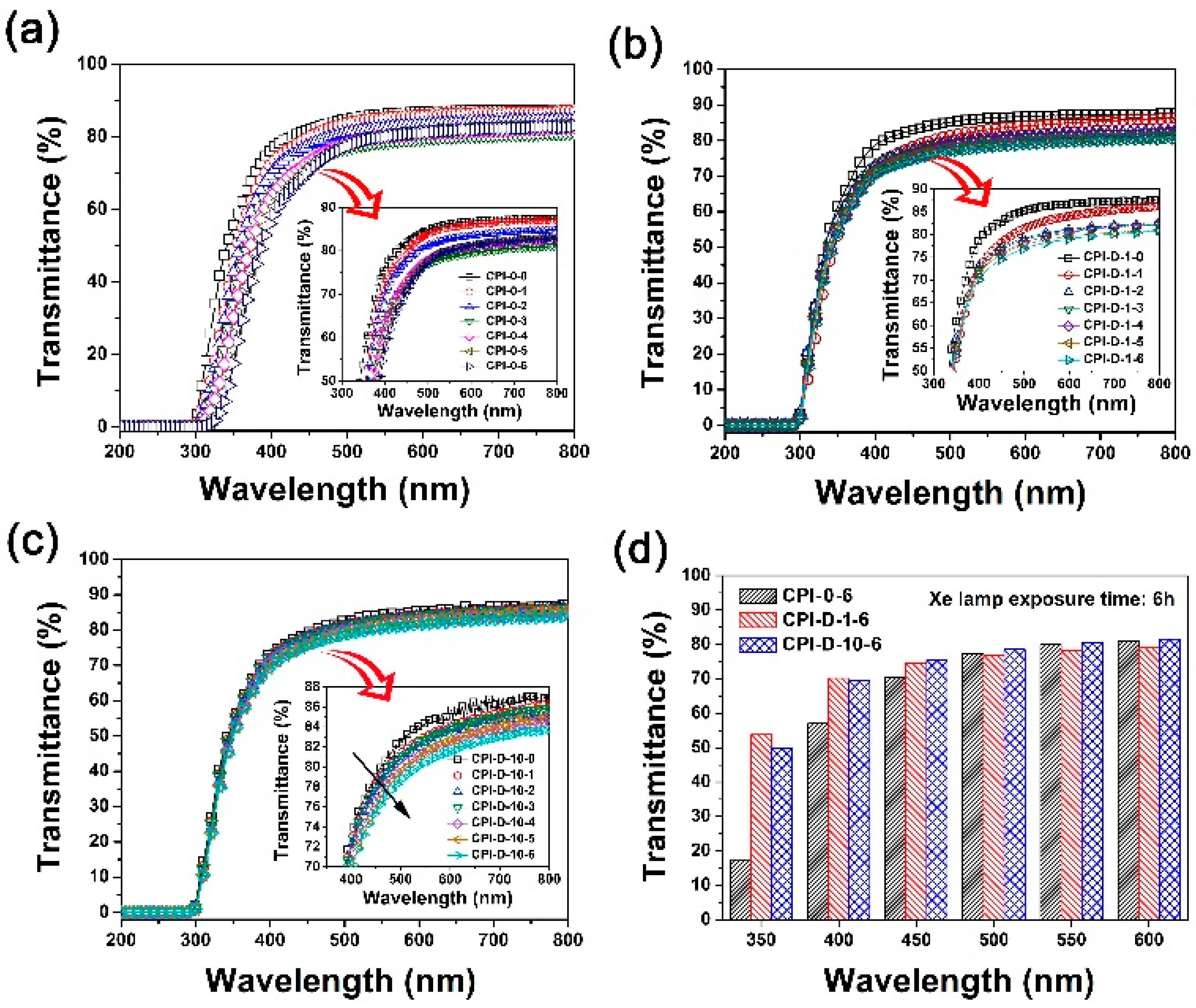
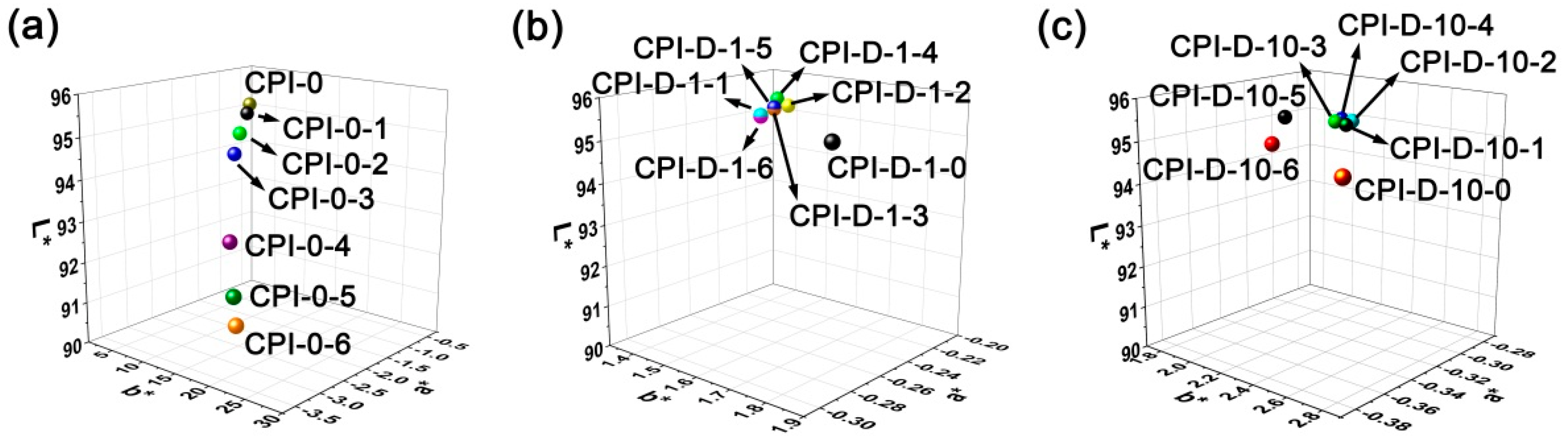
| CPI Samples | T350, Xe 1 (%) | L*Xe 2 | b*Xe 2 | hazeXe 2 (%) |
|---|---|---|---|---|
| CPI-0-0 | 55.7 | 95.12 | 3.38 | 1.46 |
| CPI-0-1 | 45.4 | 94.92 | 3.82 | 3.12 |
| CPI-0-2 | 42.7 | 94.55 | 5.65 | 4.97 |
| CPI-0-3 | 33.7 | 94.23 | 8.22 | 7.03 |
| CPI-0-4 | 30.2 | 92.71 | 15.59 | 7.12 |
| CPI-0-5 | 21.2 | 91.91 | 20.60 | 8.81 |
| CPI-0-6 | 17.5 | 91.38 | 21.95 | 9.33 |
| CPI-D-1-0 | 61.4 | 95.46 | 1.84 | 0.69 |
| CPI-D-1-1 | 53.8 | 95.38 | 1.51 | 3.46 |
| CPI-D-1-2 | 55.0 | 95.34 | 1.46 | 3.19 |
| CPI-D-1-3 | 53.4 | 95.33 | 1.46 | 3.87 |
| CPI-D-1-4 | 55.6 | 95.36 | 1.38 | 4.20 |
| CPI-D-1-5 | 55.9 | 95.37 | 1.46 | 3.10 |
| CPI-D-1-6 | 53.8 | 95.36 | 1.51 | 3.34 |
| CPI-D-10-0 | 54.3 | 94.96 | 2.82 | 3.38 |
| CPI-D-10-1 | 53.4 | 94.93 | 2.11 | 5.33 |
| CPI-D-10-2 | 50.2 | 94.93 | 2.07 | 5.95 |
| CPI-D-10-3 | 53.1 | 94.97 | 2.04 | 5.57 |
| CPI-D-10-4 | 50.8 | 94.95 | 2.00 | 5.53 |
| CPI-D-10-5 | 51.8 | 95.25 | 1.97 | 5.61 |
| CPI-D-10-6 | 49.9 | 94.95 | 2.16 | 7.63 |
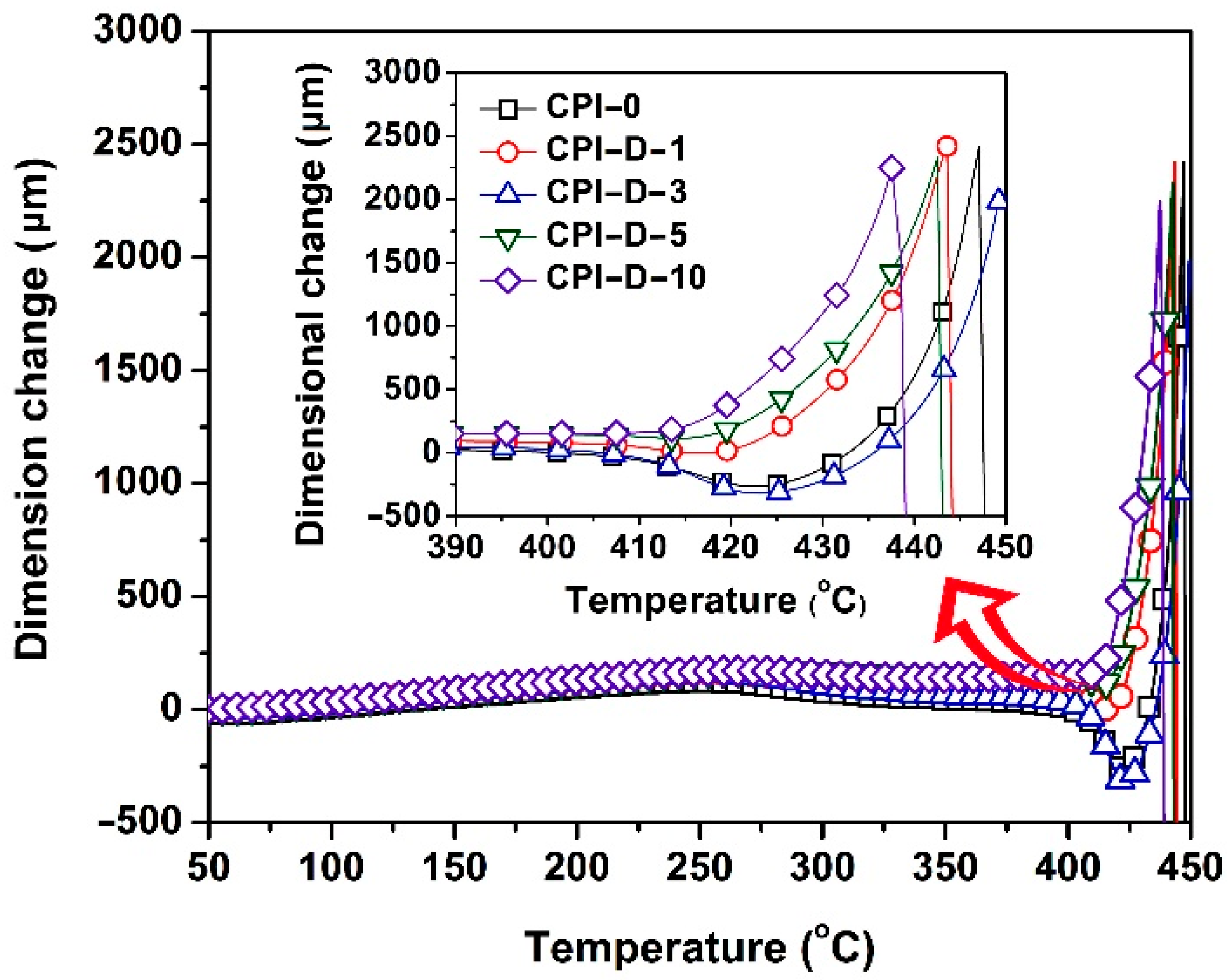
| PI Samples | T5% 1 (°C) | T10% 1 (°C) | Tmax 1 (°C) | Rw750 1 (%) | CTE 1 (10−6/K) |
|---|---|---|---|---|---|
| CPI-0 | 521.5 | 531.2 | 541.9 | 51.2 | 46.9 |
| CPI-D-1 | 521.6 | 528.8 | 542.7 | 42.9 | 53.8 |
| CPI-D-3 | 526.3 | 535.0 | 550.1 | 41.1 | 53.1 |
| CPI-D-5 | 520.4 | 529.4 | 544.0 | 42.7 | 55.6 |
| CPI-D-10 | 524.1 | 533.6 | 548.1 | 40.3 | 55.9 |
Publisher’s Note: MDPI stays neutral with regard to jurisdictional claims in published maps and institutional affiliations. |
© 2022 by the authors. Licensee MDPI, Basel, Switzerland. This article is an open access article distributed under the terms and conditions of the Creative Commons Attribution (CC BY) license (https://creativecommons.org/licenses/by/4.0/).
Share and Cite
Wei, X.-Y.; He, Z.-B.; Yuan, S.-Q.; Wu, H.; Zhi, X.-X.; Zhang, Y.; Chen, S.-J.; Liu, J.-G. Enhancement of Ultraviolet Light Resistance of Colorless and Transparent Semi-Alicyclic Polyimide Nanocomposite Films via the Incorporation of Hindered Amine Light Stabilizers for Potential Applications in Flexible Optoelectronics. Polymers 2022, 14, 1091. https://doi.org/10.3390/polym14061091
Wei X-Y, He Z-B, Yuan S-Q, Wu H, Zhi X-X, Zhang Y, Chen S-J, Liu J-G. Enhancement of Ultraviolet Light Resistance of Colorless and Transparent Semi-Alicyclic Polyimide Nanocomposite Films via the Incorporation of Hindered Amine Light Stabilizers for Potential Applications in Flexible Optoelectronics. Polymers. 2022; 14(6):1091. https://doi.org/10.3390/polym14061091
Chicago/Turabian StyleWei, Xin-Ying, Zhi-Bin He, Shun-Qi Yuan, Hao Wu, Xin-Xin Zhi, Yan Zhang, Shu-Jing Chen, and Jin-Gang Liu. 2022. "Enhancement of Ultraviolet Light Resistance of Colorless and Transparent Semi-Alicyclic Polyimide Nanocomposite Films via the Incorporation of Hindered Amine Light Stabilizers for Potential Applications in Flexible Optoelectronics" Polymers 14, no. 6: 1091. https://doi.org/10.3390/polym14061091
APA StyleWei, X.-Y., He, Z.-B., Yuan, S.-Q., Wu, H., Zhi, X.-X., Zhang, Y., Chen, S.-J., & Liu, J.-G. (2022). Enhancement of Ultraviolet Light Resistance of Colorless and Transparent Semi-Alicyclic Polyimide Nanocomposite Films via the Incorporation of Hindered Amine Light Stabilizers for Potential Applications in Flexible Optoelectronics. Polymers, 14(6), 1091. https://doi.org/10.3390/polym14061091