Facile Electrodeposition of NiCo2O4 Nanosheets on Porous Carbonized Wood for Wood-Derived Asymmetric Supercapacitors

 ,
,  and
and 
Abstract
1. Introduction
2. Materials and Methods
2.1. Preparation of NCW
2.2. Preparation of NCNS–NCW
2.3. Physicochemical Characterization
2.4. Supercapacitor Measurements
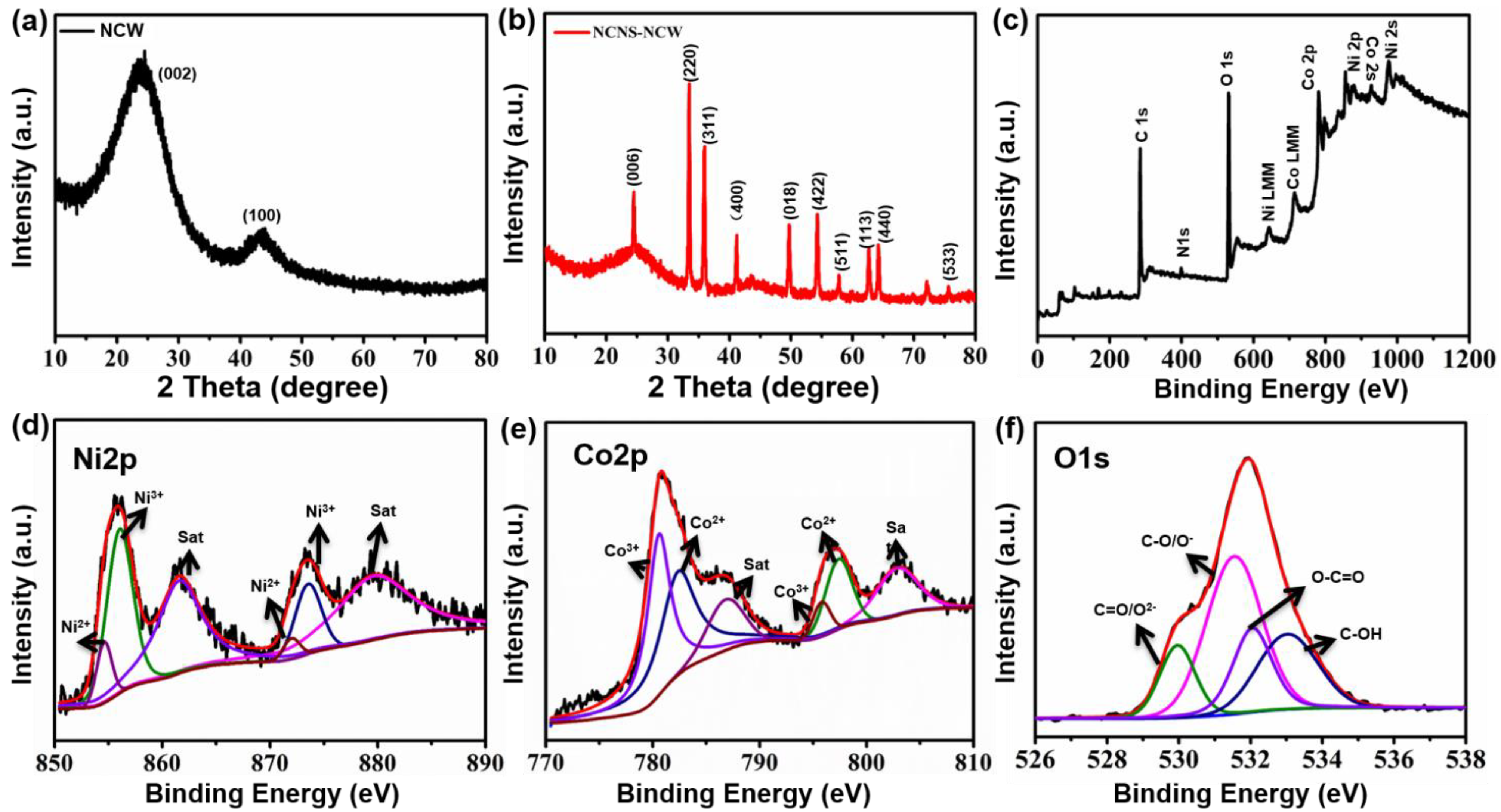
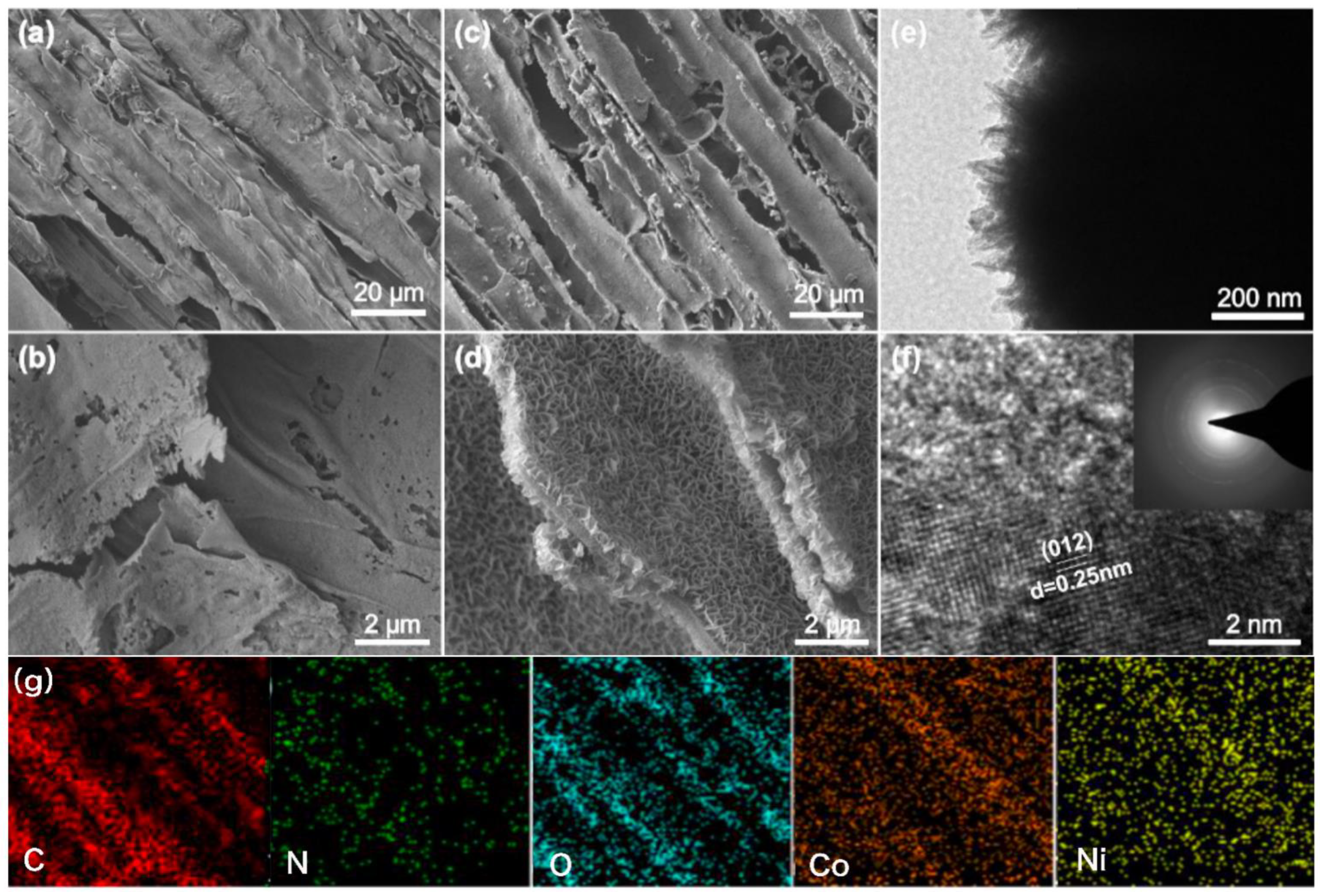
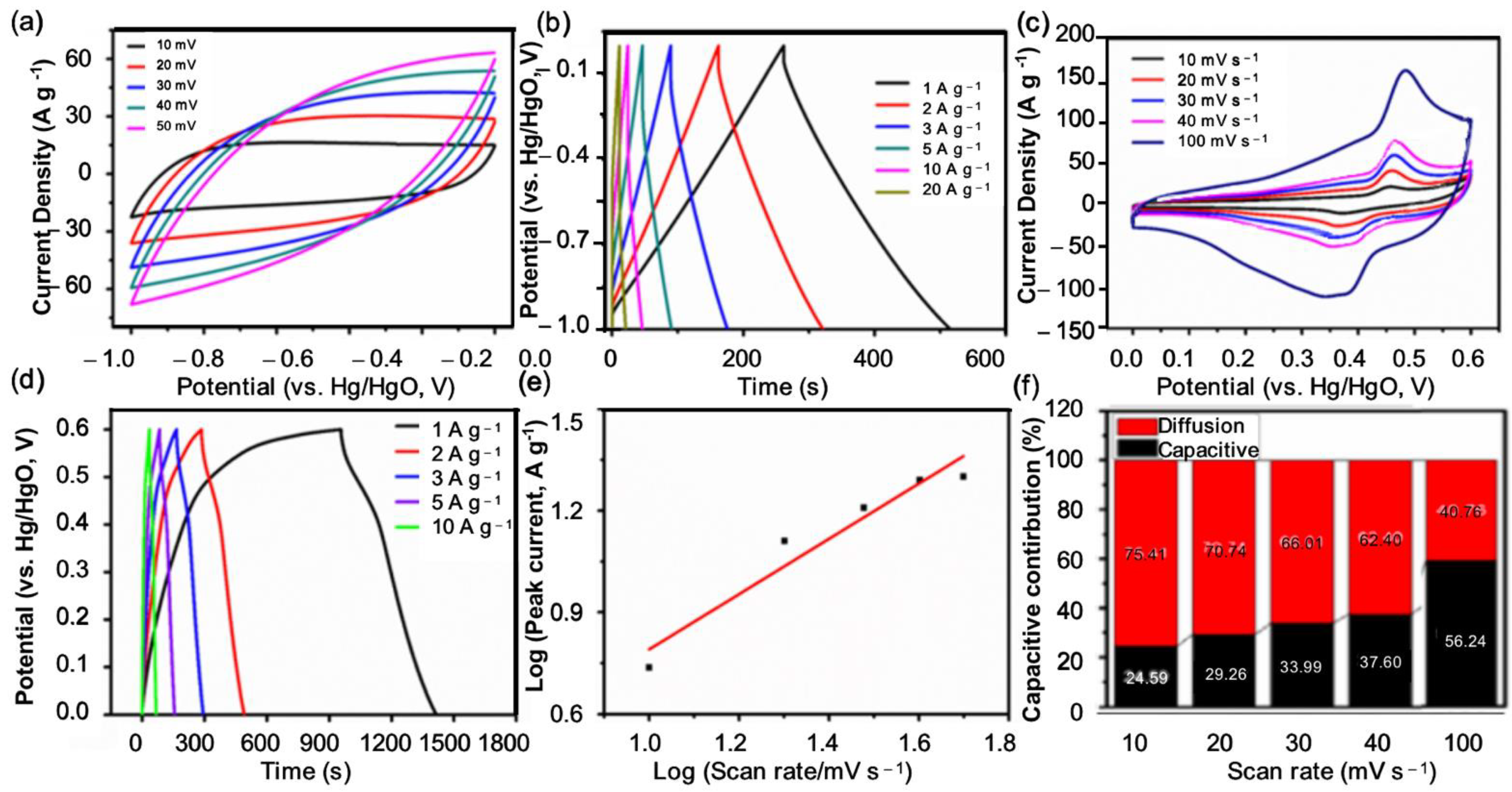
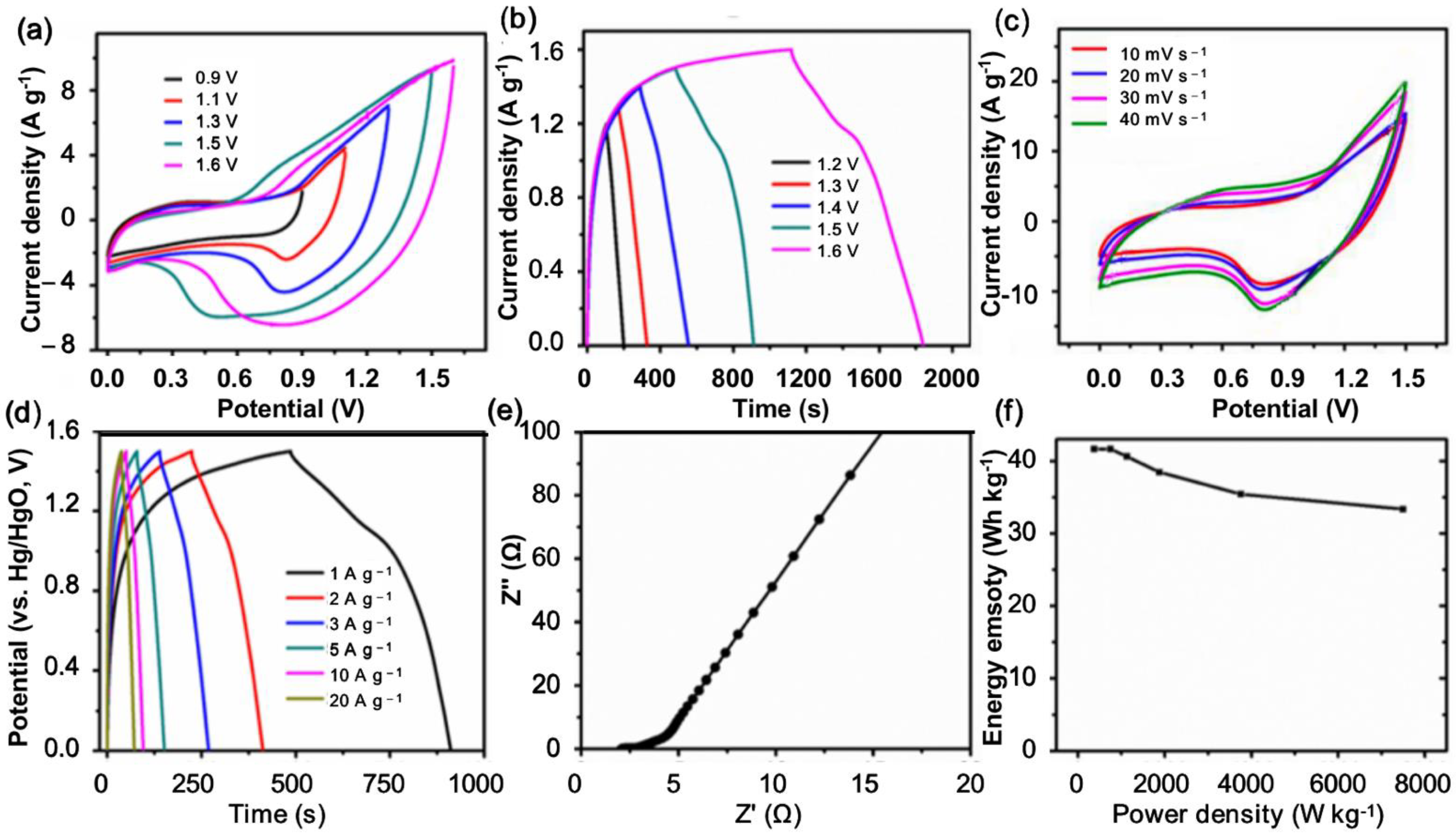
3. Results
4. Conclusions
Supplementary Materials
Author Contributions
Funding
Conflicts of Interest
References
- Yan, J.; Wang, Q.; Wei, T.; Fan, Z. Recent advances in design and fabrication of electrochemical supercapacitors with high energy densities. Adv. Energy Mater. 2014, 4, 1300816. [Google Scholar] [CrossRef] [Scilit]
- Liu, C.; Li, F.; Ma, L.P.; Cheng, H.M. Advanced materials for energy storage. Adv. Mater. 2010, 22, E28–E62. [Google Scholar] [CrossRef] [Scilit]
- Han, X.; Xiao, G.; Wang, Y.; Chen, X.; Duan, G.; Wu, Y.; Gong, X.; Wang, H. Design and fabrication of conductive polymer hydrogels and their applications in flexible supercapacitors. J. Mater. Chem. A 2020, 8, 23059–23095. [Google Scholar] [CrossRef] [Scilit]
- Yang, L.; Guo, X.; Jin, Z.; Guo, W.; Duan, G.; Liu, X.; Li, Y. Emergence of melanin-inspired supercapacitors. Nano Today 2021, 37, 101075. [Google Scholar] [CrossRef] [Scilit]
- Zheng, S.; Zhang, J.; Deng, H.; Du, Y.; Shi, X. Chitin derived nitrogen-doped porous carbons with ultrahigh specific surface area and tailored hierarchical porosity for high performance supercapacitors. J. Bioresour. Bioprod. 2021, 6, 142–151. [Google Scholar] [CrossRef] [Scilit]
- Guo, W.; Guo, X.; Yang, L.; Wang, T.; Zhang, M.; Duan, G.; Liu, X.; Li, Y. Synthetic melanin facilitates mno supercapacitors with high specific capacitance and wide operation potential window. Polymer 2021, 235, 124276. [Google Scholar] [CrossRef] [Scilit]
- Yu, Z.N.; Tetard, L.; Zhai, L.; Thomas, J. Supercapacitor electrode materials: Nanostructures from 0 to 3 dimensions. Energy Environ. Sci. 2015, 8, 702–730. [Google Scholar] [CrossRef] [Scilit]
- Han, Z.; Zhong, W.; Wang, K. Preparation and examination of nitrogen-doped bamboo porous carbon for supercapacitor materials. J. For. Eng. 2020, 5, 76–83. [Google Scholar]
- Saeb, M.R.; Rabiee, N.; Seidi, F.; Far, B.F.; Bagherzadeh, M.; Lima, E.C.; Rabiee, M. Green coni2s4/porphyrin decorated carbon-based nanocomposites for genetic materials detection. J. Bioresour. Bioprod. 2021, 6, 215–222. [Google Scholar] [CrossRef] [Scilit]
- Jjagwe, J.; Olupot, P.W.; Menya, E.; Kalibbala, H.M. Synthesis and application of granular activated carbon from biomass waste materials for water treatment: A review. J. Bioresour. Bioprod. 2021, 6, 292–322. [Google Scholar] [CrossRef] [Scilit]
- Wang, Z.; Hu, C.; Tu, D.; Zhang, W.; Guan, L. Preparation and adsorption property of activated carbon made from camellia olerea shells. J. For. Eng. 2020, 5, 96–102. [Google Scholar]
- Chen, J.; Xiao, G.; Duan, G.; Wu, Y.; Zhao, X.; Gong, X. Structural design of carbon dots/porous materials composites and their applications. Chem. Eng. J. 2021, 421, 127743. [Google Scholar] [CrossRef] [Scilit]
- Zhang, Y.; Zhou, W.; Chen, H.; Duan, G.; Luo, H.; Li, Y. Facile preparation of cnts microspheres as improved carbon absorbers for high-efficiency electromagnetic wave absorption. Ceram. Int. 2021, 47 Pt A, 10013–10018. [Google Scholar] [CrossRef] [Scilit]
- Zhang, W.; Cheng, R.-R.; Bi, H.-H.; Lu, Y.-H.; Ma, L.-B.; He, X.-J. A review of porous carbons produced by template methods for supercapacitor applications. New Carbon Mater. 2021, 36, 69–81. [Google Scholar] [CrossRef] [Scilit]
- Chen, C.; Zhao, M.; Cai, Y.; Zhao, G.; Xie, Y.; Zhang, L.; Zhu, G.; Pan, L. Scalable synthesis of strutted nitrogen doped hierarchical porous carbon nanosheets for supercapacitors with both high gravimetric and volumetric performances. Carbon 2021, 179, 458–468. [Google Scholar] [CrossRef] [Scilit]
- Augustyn, V.; Simon, P.; Dunn, B. Pseudocapacitive oxide materials for high-rate electrochemical energy storage. Energy Environ. Sci. 2014, 7, 1597–1614. [Google Scholar] [CrossRef] [Scilit]
- Fleischmann, S.; Mitchell, J.B.; Wang, R.C.; Zhan, C.; Jiang, D.E.; Presser, V.; Augustyn, V. Pseudocapacitance: From fundamental understanding to high power energy storage materials. Chem. Rev. 2020, 120, 6738–6782. [Google Scholar] [CrossRef] [Scilit] [PubMed]
- Wang, Q.; Wang, X.; Xu, J.; Ouyang, X.; Hou, X.; Chen, D.; Wang, R.; Shen, G. Flexible coaxial-type fiber supercapacitor based on nico2o4 nanosheets electrodes. Nano Energy 2014, 8, 44–51. [Google Scholar] [CrossRef] [Scilit]
- Liu, X.Y.; Zhang, Y.Q.; Xia, X.H.; Shi, S.J.; Lu, Y.; Wang, X.L.; Gu, C.D.; Tu, J.P. Self-assembled porous nico2o4 hetero-structure array for electrochemical capacitor. J. Power Sources 2013, 239, 157–163. [Google Scholar] [CrossRef] [Scilit]
- Li, Y.; Han, X.; Yi, T.; He, Y.; Li, X. Review and prospect of NiCo2O4-based composite materials for supercapacitor electrodes. J. Energy Chem. 2019, 31, 54–78. [Google Scholar] [CrossRef] [Scilit]
- An, C.; Wang, Y.; Huang, Y.; Xu, Y.; Jiao, L.; Yuan, H. Porous NiCo2O4 nanostructures for high performance supercapacitors via a microemulsion technique. Nano Energy 2014, 10, 125–134. [Google Scholar] [CrossRef] [Scilit]
- Wang, K.; Zhang, X.; Zhang, X.; Chen, D.; Lin, Q. A novel ni(oh)2/graphene nanosheets electrode with high capacitance and excellent cycling stability for pseudocapacitors. J. Power Sources 2016, 333, 156–163. [Google Scholar] [CrossRef] [Scilit]
- Ma, W.; Chen, S.; Yang, S.; Chen, W.; Weng, W.; Cheng, Y.; Zhu, M. Flexible all-solid-state asymmetric supercapacitor based on transition metal oxide nanorods/reduced graphene oxide hybrid fibers with high energy density. Carbon 2017, 113, 151–158. [Google Scholar] [CrossRef] [Scilit]
- BoopathiRaja, R.; Parthibavarman, M. Desert rose like heterostructure of NiCo2O4/NF@PPy composite has high stability and excellent electrochemical performance for asymmetric super capacitor application. Electrochim. Acta 2020, 346, 136270. [Google Scholar] [CrossRef] [Scilit]
- Peng, M.; Tian, X.; Li, D.; Wang, Q.; Zhang, D. Flexible high-energy asymmetric supercapacitors based on pani@cnt-graphene and NiCo2O4@n-c electrode. Mater. Lett. 2020, 272, 127859. [Google Scholar] [CrossRef] [Scilit]
- Liu, Y.; Xu, X.; Shao, Z.; Jiang, S.P. Metal-organic frameworks derived porous carbon, metal oxides and metal sulfides-based compounds for supercapacitors application. Energy Storage Mater. 2020, 26, 1–22. [Google Scholar] [CrossRef] [Scilit]
- Abbas, Q.; Olabi, A.G.; Raza, R.; Gibson, D. Carbon/metal oxide composites as electrode materials for supercapacitors applications. In Reference Module in Materials Science and Materials Engineering; Elsevier: Amsterdam, The Netherlands, 2018. [Google Scholar]
- Mastouri, A.; Efhamisisi, D.; Shirmohammadli, Y.; Oladi, R. Physicochemical properties of thermally treated poplar wood in silicone and rapeseed oils: A comparative study. J. Build. Eng. 2021, 43, 102511. [Google Scholar] [CrossRef] [Scilit]
- Zhang, C.; Mo, J.; Fu, Q.; Liu, Y.; Wang, S.; Nie, S. Wood-cellulose-fiber-based functional materials for triboelectric nanogenerators. Nano Energy 2021, 81, 105637. [Google Scholar] [CrossRef] [Scilit]
- Zou, Y.; Yang, P.; Yang, L.; Li, N.; Duan, G.; Liu, X.; Li, Y. Boosting solar steam generation by photothermal enhanced polydopamine/wood composites. Polymer 2021, 217, 123464. [Google Scholar] [CrossRef] [Scilit]
- Chen, L.; Sun, Y.; Wang, J.; Ma, C.; Peng, S.; Cao, X.; Yang, L.; Ma, C.; Duan, G.; Liu, Z.; et al. A wood-mimetic porous mxene/gelatin hydrogel for electric field/sunlight bi-enhanced uranium adsorption. e-Polymers 2022, 22, 468–477. [Google Scholar] [CrossRef] [Scilit]
- Cai, S.; Li, Y.; Huang, Y.; Guo, Y. Study on correlation between mechanical measurement of wood cell wall and added load by nano-indentation. J. For. Eng. 2021, 6, 64–71. [Google Scholar]
- Wu, J.; Xia, M.; Zhang, X.; Chen, Y.; Sun, F.; Wang, X.; Yang, H.; Chen, H. Hierarchical porous carbon derived from wood tar using crab as the template: Performance on supercapacitor. J. Power Sources 2020, 455, 227982. [Google Scholar] [CrossRef] [Scilit]
- Volperts, A.; Dobele, G.; Zhurinsh, A.; Vervikishko, D.; Shkolnikov, E.; Ozolinsh, J. Wood-based activated carbons for supercapacitor electrodes with a sulfuric acid electrolyte. Carbon 2017, 124, 729. [Google Scholar] [CrossRef] [Scilit]
- Wu, C.; Zhang, S.; Wu, W.; Xi, Z.; Zhou, C.; Wang, X.; Deng, Y.; Bai, Y.; Liu, G.; Zhang, X.; et al. Carbon nanotubes grown on the inner wall of carbonized wood tracheids for high-performance supercapacitors. Carbon 2019, 150, 311–318. [Google Scholar] [CrossRef] [Scilit]
- Tang, Z.; Pei, Z.; Wang, Z.; Li, H.; Zeng, J.; Ruan, Z.; Huang, Y.; Zhu, M.; Xue, Q.; Yu, J.; et al. Highly anisotropic, multichannel wood carbon with optimized heteroatom doping for supercapacitor and oxygen reduction reaction. Carbon 2018, 130, 532–543. [Google Scholar] [CrossRef] [Scilit]
- Zhang, W.; Yang, Y.; Xia, R.; Li, Y.; Zhao, J.; Lin, L.; Cao, J.; Wang, Q.; Liu, Y.; Guo, H. Graphene-quantum-dots-induced MnO2 with needle-like nanostructure grown on carbonized wood as advanced electrode for supercapacitors. Carbon 2020, 162, 114–123. [Google Scholar] [CrossRef] [Scilit]
- Chen, L.; Wang, F.; Tian, Z.; Guo, H.; Cai, C.; Wu, Q.; Du, H.; Liu, K.; Hao, Z.; He, S.; et al. Wood-derived high-mass-loading mno2 composite carbon electrode enabling high energy density and high-rate supercapacitor. Small 2022, 2201307. [Google Scholar] [CrossRef] [Scilit]
- Lei, D.; Li, X.-D.; Seo, M.-K.; Khil, M.-S.; Kim, H.-Y.; Kim, B.-S. NiCo2O4 nanostructure-decorated pan/lignin based carbon nanofiber electrodes with excellent cyclability for flexible hybrid supercapacitors. Polymer 2017, 132, 31–40. [Google Scholar] [CrossRef] [Scilit]
- Zhang, X.; Zhang, X.; Qu, G.; Wang, Z.; Wei, Y.; Yin, J.; Xiang, G.; Xu, X. Nickel-cobalt double oxides with rich oxygen vacancies by b-doping for asymmetric supercapacitors with high energy densities. Appl. Surf. Sci. 2020, 512, 145621. [Google Scholar] [CrossRef] [Scilit]
- Tian, D.; Lu, X.; Nie, G.; Gao, M.; Song, N.; Wang, C. Growth of polyaniline thorns on hybrid electrospun cnfs with nickel nanoparticles and graphene nanosheets as binder-free electrodes for high-performance supercapacitors. Appl. Surf. Sci. 2018, 458, 389–396. [Google Scholar] [CrossRef] [Scilit]
- Zhang, L.; Zheng, W.; Jiu, H.; Ni, C.; Chang, J.; Qi, G. The synthesis of nio and NiCo2O4 nanosheets by a new method and their excellent capacitive performance for asymmetric supercapacitor. Electrochim. Acta 2016, 215, 212–222. [Google Scholar] [CrossRef] [Scilit]
- Zhu, Y.G.; Wang, Y.; Shi, Y.; Wong, J.I.; Yang, H.Y. Coo nanoflowers woven by cnt network for high energy density flexible micro-supercapacitor. Nano Energy 2014, 3, 46–54. [Google Scholar] [CrossRef] [Scilit]
- Lin, J.H.; Chen, H.; Shuai, M.M.; Wu, W.Z.; Wang, Y.; Zhang, W.G.; Ling, Q.D. Facile synthesis of the 3d interconnecting petal-like NiCoO2/C composite as high-performance supercapacitor electrode materials. Mater. Today Nano 2019, 7, 100046. [Google Scholar] [CrossRef] [Scilit]
- Liu, F.; Wang, Z.; Zhang, H.; Jin, L.; Chu, X.; Gu, B.; Huang, H.; Yang, W. Nitrogen, oxygen and sulfur co-doped hierarchical porous carbons toward high-performance supercapacitors by direct pyrolysis of kraft lignin. Carbon 2019, 149, 105–116. [Google Scholar] [CrossRef] [Scilit]
- Zhao, G.; Chen, C.; Yu, D.; Sun, L.; Yang, C.; Zhang, H.; Sun, Y.; Besenbacher, F.; Yu, M. One-step production of o-n-s co-doped three-dimensional hierarchical porous carbons for high-performance supercapacitors. Nano Energy 2018, 47, 547–555. [Google Scholar] [CrossRef] [Scilit]
- Chen, J.; Ma, T.; Chen, M.; Peng, Z.; Feng, Z.; Pan, C.; Zou, H.; Yang, W.; Chen, S. Porous NiCo2O4@ppy core-shell nanowire arrays covered on carbon cloth for flexible all-solid-state hybrid supercapacitors. J. Energy Storage 2020, 32, 101895. [Google Scholar] [CrossRef] [Scilit]
- Abouali, S.; Garakani, M.A.; Xu, Z.-L.; Kim, J.-K. NiCo2O4/cnt nanocomposites as bi-functional electrodes for li ion batteries and supercapacitors. Carbon 2016, 102, 262–272. [Google Scholar] [CrossRef] [Scilit]
- Arnold, E.M.; Kumar, P.N.; Robinson, J.A.; Emmanuel, B.P.; Agnes, J.K.; Padmaja, S.; Shyla, J.M. Role of molar concentration in NiCo2O4 nanoparticles synthesis for supercapacitor applications. Mater. Today Proc. 2021, 50, 53–56. [Google Scholar] [CrossRef] [Scilit]
- Mo, Y.; Ru, Q.; Song, X.; Guo, L.; Chen, J.; Hou, X.; Hu, S. The sucrose-assisted NiCo2O4@c composites with enhanced lithium-storage properties. Carbon 2016, 109, 616–623. [Google Scholar] [CrossRef] [Scilit]
- Hu, C.; Miao, L.; Yang, Q.; Yu, X.; Song, L.; Zheng, Y.; Wang, C.; Li, L.; Zhu, L.; Cao, X.; et al. Self-assembly of cnts on ni foam for enhanced performance of NiCoO2@cnt@nf supercapacitor electrode. Chem. Eng. J. 2021, 410, 128317. [Google Scholar] [CrossRef] [Scilit]
- Wang, J.; Polleux, J.; Lim, J.; Dunn, B. Pseudocapacitive contributions to electrochemical energy storage in TiO2 (anatase) nanoparticles. J. Phys. Chem. C 2007, 111, 14925–14931. [Google Scholar] [CrossRef] [Scilit]
- Xia, X.; Chao, D.; Zhang, Y.; Zhan, J.; Zhong, Y.; Wang, X.; Wang, Y.; Shen, Z.X.; Tu, J.; Fan, H.J. Generic synthesis of carbon nanotube branches on metal oxide arrays exhibiting stable high-rate and long-cycle sodium-ion storage. Small 2016, 12, 3048–3058. [Google Scholar] [CrossRef] [Scilit] [PubMed]
- Yang, G.; Park, S.-J. Nanoflower-like NiCo2O4 grown on biomass carbon coated nickel foam for asymmetric supercapacitor. J. Alloys Compd. 2020, 835, 155270. [Google Scholar] [CrossRef] [Scilit]
- Wan, C.; Tian, W.; Zhou, J.; Qing, Y.; Huang, Q.; Li, X.; Wei, S.; Zhang, L.; Liu, X.; Wu, Y. Green anisotropic carbon-stabilized polylaminate copper oxide as a novel cathode for high-performance hybrid supercapacitors. Mater. Des. 2021, 198, 109309. [Google Scholar] [CrossRef] [Scilit]
- Chu, W.; Shi, Z.; Hou, Y.; Ma, D.; Bai, X.; Gao, Y.; Yang, N. Trifunctional of phosphorus-doped NiCo2O4 nanowire materials for asymmetric supercapacitor, oxygen evolution reaction, and hydrogen evolution reaction. ACS Appl. Mater. Interfaces 2020, 12, 2763–2772. [Google Scholar] [CrossRef] [Scilit]

Publisher’s Note: MDPI stays neutral with regard to jurisdictional claims in published maps and institutional affiliations. |
© 2022 by the authors. Licensee MDPI, Basel, Switzerland. This article is an open access article distributed under the terms and conditions of the Creative Commons Attribution (CC BY) license (https://creativecommons.org/licenses/by/4.0/).
Share and Cite
Yang, J.; Li, H.; He, S.; Du, H.; Liu, K.; Zhang, C.; Jiang, S. Facile Electrodeposition of NiCo2O4 Nanosheets on Porous Carbonized Wood for Wood-Derived Asymmetric Supercapacitors. Polymers 2022, 14, 2521. https://doi.org/10.3390/polym14132521
Yang J, Li H, He S, Du H, Liu K, Zhang C, Jiang S. Facile Electrodeposition of NiCo2O4 Nanosheets on Porous Carbonized Wood for Wood-Derived Asymmetric Supercapacitors. Polymers. 2022; 14(13):2521. https://doi.org/10.3390/polym14132521
Chicago/Turabian StyleYang, Jingjiang, Huiling Li, Shuijian He, Haijuan Du, Kunming Liu, Chunmei Zhang, and Shaohua Jiang. 2022. "Facile Electrodeposition of NiCo2O4 Nanosheets on Porous Carbonized Wood for Wood-Derived Asymmetric Supercapacitors" Polymers 14, no. 13: 2521. https://doi.org/10.3390/polym14132521
APA StyleYang, J., Li, H., He, S., Du, H., Liu, K., Zhang, C., & Jiang, S. (2022). Facile Electrodeposition of NiCo2O4 Nanosheets on Porous Carbonized Wood for Wood-Derived Asymmetric Supercapacitors. Polymers, 14(13), 2521. https://doi.org/10.3390/polym14132521