Review

Additive Manufacturing of Sensors for Military Monitoring Applications
by
David T. Bird
1,2 and
Nuggehalli M. Ravindra
2,3,*
1
Picatinny Arsenal, NJ U.S. Army Combat Capabilities Development Command Armaments Center (CCDC AC), Wharton, NJ 07885, USA
2
Interdisciplinary Program in Materials Science and Engineering, New Jersey Institute of Technology, Newark, NJ 07102, USA
3
Department of Physics, New Jersey Institute of Technology, Newark, NJ 07102, USA
*
Author to whom correspondence should be addressed.
Polymers 2021, 13(9), 1455; https://doi.org/10.3390/polym13091455
Submission received: 11 March 2021 / Revised: 21 April 2021 / Accepted: 22 April 2021 / Published: 30 April 2021
(This article belongs to the Special Issue Polymer-Based Sensor)

Abstract

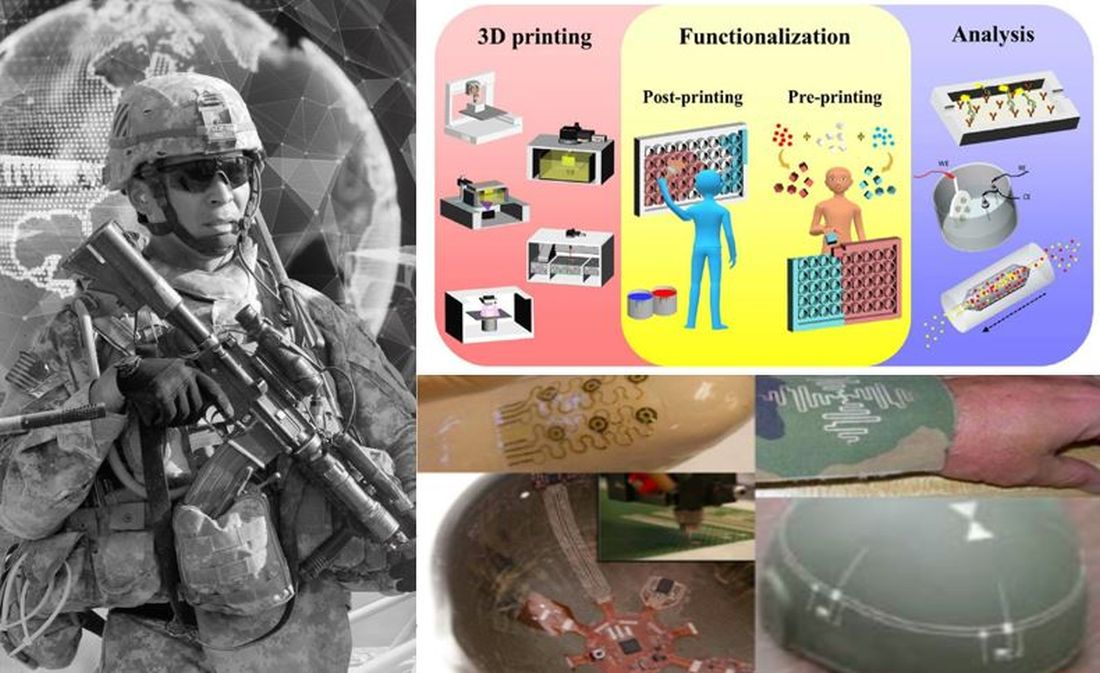
The US Department of Defense (DoD) realizes the many uses of additive manufacturing (AM) as it has become a common fabrication technique for an extensive range of engineering components in several industrial sectors. 3D Printed (3DP) sensor technology offers high-performance features as a way to track individual warfighters on the battlefield, offering protection from threats such as weaponized toxins, bacteria or virus, with real-time monitoring of physiological events, advanced diagnostics, and connected feedback. Maximum protection of the warfighter gives a distinct advantage over adversaries by providing an enhanced awareness of situational threats on the battle field. There is a need to further explore aspects of AM such as higher printing resolution and efficiency, with faster print times and higher performance, sensitivity and optimized fabrication to ensure that soldiers are more safe and lethal to win our nation’s wars and come home safely. A review and comparison of various 3DP techniques for sensor fabrication is presented.
Keywords: additive manufacturing; 3D printing; sensor technology; fabrication; diagnostics additive manufacturing; 3D printing; sensor technology; fabrication; diagnostics
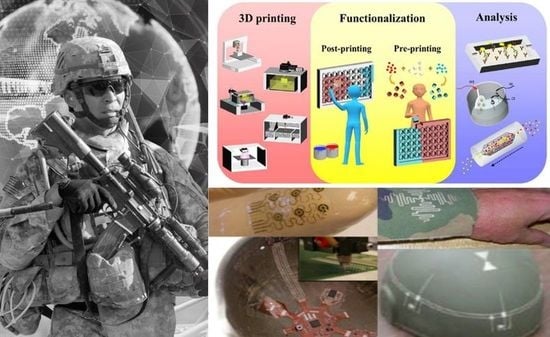
Graphical Abstract