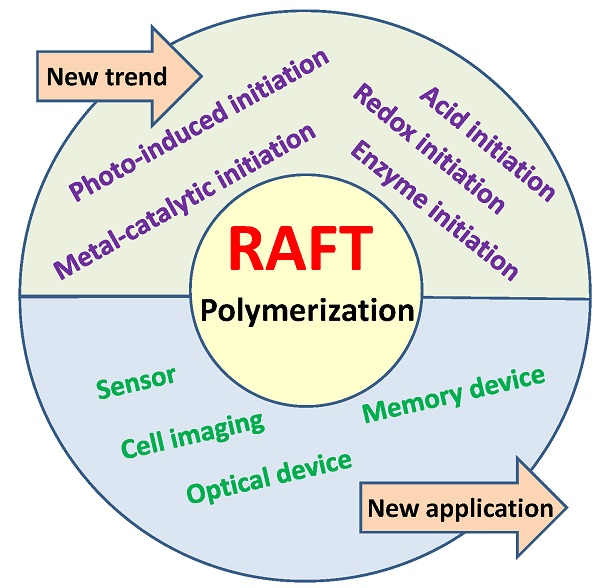
Recent Advances in RAFT Polymerization: Novel Initiation Mechanisms and Optoelectronic Applications



Abstract
Share and Cite
Tian, X.; Ding, J.; Zhang, B.; Qiu, F.; Zhuang, X.; Chen, Y. Recent Advances in RAFT Polymerization: Novel Initiation Mechanisms and Optoelectronic Applications. Polymers 2018, 10, 318. https://doi.org/10.3390/polym10030318
Tian X, Ding J, Zhang B, Qiu F, Zhuang X, Chen Y. Recent Advances in RAFT Polymerization: Novel Initiation Mechanisms and Optoelectronic Applications. Polymers. 2018; 10(3):318. https://doi.org/10.3390/polym10030318
Chicago/Turabian StyleTian, Xiangyu, Junjie Ding, Bin Zhang, Feng Qiu, Xiaodong Zhuang, and Yu Chen. 2018. "Recent Advances in RAFT Polymerization: Novel Initiation Mechanisms and Optoelectronic Applications" Polymers 10, no. 3: 318. https://doi.org/10.3390/polym10030318
APA StyleTian, X., Ding, J., Zhang, B., Qiu, F., Zhuang, X., & Chen, Y. (2018). Recent Advances in RAFT Polymerization: Novel Initiation Mechanisms and Optoelectronic Applications. Polymers, 10(3), 318. https://doi.org/10.3390/polym10030318