


Abstract
This study used red mud (RM), steel slag (SS), and desulfurization slag (DS) as raw materials to construct three catalytic oxidation systems, namely RM-DCDA/H2O2, SS-DS/H2O2, and SS-DS/peroxymonosulfate (PMS), to promote the utilization of industrial solid waste and enhance the treatment of recalcitrant antibiotic wastewater. The ciprofloxacin (CIP) degradation performances, influencing factors, and preliminary reaction mechanisms of these systems were investigated. RM formed an Fe3N/C composite structure after acidification and dicyandiamide-assisted calcination. The Fe3N active phase, coexistence of Fe2+/Fe3+, and N-doped C structure facilitated H2O2 activation and electron transfer. The SS-DS catalyst exhibited a rough and porous structure and contained Fe, Ca, and S species, which could provide reactive sites for H2O2 and PMS activation, following acid modification and urea-assisted calcination. Under the necessary reaction conditions, the CIP degradation efficiencies of the RM-DCDA/H2O2, SS-DS/H2O2, and SS-DS/PMS systems reached 94.60%, 92.58%, and 95.17%, respectively. These results indicate that RM- and SS-derived materials can be used for CIP oxidative degradation; however, the values should not be interpreted as a strict comparison of the intrinsic catalytic activity because the operating conditions differed among the systems. Parametric experiments showed that the catalyst dosage, oxidant concentration, and initial pH influenced the degradation efficiency. The H2O2-based systems were more suitable under acidic conditions, whereas the SS-DS/PMS system showed wider pH adaptability. Coexisting anion and humic acid experiments indicated that the systems were tolerant to natural organic matter, whereas HCO3− and HPO42− inhibited degradation. CIP was further oxidized in total organic C and recycling experiments; however, it was difficult to completely mineralize it within a short reaction time, and the catalyst retained relatively high activity after repeated use. Radical quenching experiments suggested that ·OH and ·O2− participated in the degradation reactions in the RM-DCDA/H2O2 and SS-DS/H2O2 systems. In the SS-DS/PMS system, comparative quenching experiments revealed that non-radical singlet oxygen (1O2) was the dominant reactive species, while SO4−· and ·OH contributed only marginally. In conclusion, RM and SS-DS can be used as low-cost raw materials to prepare industrial solid-waste-derived catalysts for the oxidative degradation of CIP, thereby providing a reference for industrial solid waste valorization and antibiotic wastewater treatment.
1. Introduction
With continuous industrialization and urbanization, residual antibiotics and other emerging organic pollutants are increasingly threatening aquatic environments [1,2,3]. Ciprofloxacin (CIP), a typical fluoroquinolone antibiotic, is widely applied in clinical treatment and livestock breeding because of its broad applications and antibacterial spectrum [4,5,6]. Owing to the quinolone skeleton and carboxyl, carbonyl, and piperazine groups in its molecular structure, CIP exhibits strong chemical stability and environmental persistence, making it difficult to remove completely using conventional biological treatments [4,5,6,7]. Fluoroquinolone antibiotics, including CIP, are frequently detected in aquatic environments [1,6,8]. Long-term persistence of CIP may affect the structure of microbial communities in aquatic environments and promote the spread of antibiotic-resistant bacteria and antibiotic resistance genes [2,8,9]. Therefore, the development of efficient, economical, and stable technologies for the removal of CIP is of considerable environmental and practical value.
Advanced oxidation processes (AOPs) are widely used to treat refractory antibiotics in water because of their strong oxidation capacity and high degradation efficiency [10,11,12]. Among them, Fenton and Fenton-like oxidation processes can activate hydrogen peroxide (H2O2) to generate hydroxyl radicals (·OH), which attack aromatic rings, unsaturated bonds, and N-containing functional groups in organic pollutants, leading to bond cleavage, ring opening, and oxidative decomposition [13,14,15]. However, conventional homogeneous Fenton systems are limited by a narrow applicable pH range, large amounts of Fe sludge, and difficulties in catalyst recovery [13,14]. Recently, persulfate-based oxidation systems have been extensively investigated. These systems can generate reactive species such as sulfate radicals (SO4−) and hydroxyl radicals (·OH), which can destroy the stable structures of antibiotic molecules and gradually convert them into small-molecule intermediates or mineralize them into CO2 and H2O [16,17,18,19]. Therefore, the construction of efficient Fenton-like and persulfate activation systems is important for improving the treatment performance of antibiotic wastewater.
Specifically, various Fenton- and persulfate-based processes have been explored for CIP degradation. For example, iron-mediated H2O2 systems have been applied to degrade CIP and assess the toxicity of its degradation products [20], and persulfate combined with H2O2 activated by ultrasound and ferrous ions has also been reported for CIP removal [21]. More recently, heterogeneous iron minerals such as pyrite have been used to activate H2O2 for efficient CIP degradation over a wide pH range [22]. However, most of these systems rely on homogeneous reagents or a single oxidant, and systematic comparisons of solid-waste-derived catalysts in both H2O2 and persulfate-based systems remain insufficient.
The selection of catalytic materials critically affects the performance of AOP systems [14,23]. Red mud (RM) and steel slag (SS) are representative bulk industrial solid wastes characterized by large production volumes, high environmental risks during stockpiling, and relatively low resource utilization rates [24,25,26]. Long-term stockpiling of RM may cause land occupation, alkaline pollution, and heavy metal leaching, whereas free calcium oxide and metal components in SS may cause volume instability and environmental release [24,25,26]. Therefore, using RM and SS to prepare environmentally functional materials can alleviate the pressure associated with the disposal of industrial solid waste and promote its utilization.
Meanwhile, RM, SS, and desulfurization slag (DS) contain abundant metal oxide components that serve as active components or supports in Fenton-like reactions for activating oxidants such as H2O2 and persulfate to generate reactive oxidizing species [27,28,29,30]. In addition, RM, SS, and their modified derivatives possess certain surface adsorption capacities. During the catalytic degradation of antibiotics, these materials can adsorb antibiotic molecules from water onto the catalyst surface, increase the local pollutant concentration near the reactive sites, and enhance catalytic degradation [31,32]. This process may have contributed to the synergistic effect of adsorption and catalytic oxidation.
Although industrial solid-waste-derived catalytic materials have been applied in AOPs, several limitations remain. First, systematic comparisons of different solid-waste-derived materials in H2O2- and persulfate-based systems remain insufficient [22,23,26]. Second, the effects of environmental factors, including initial pH, catalyst dosage, oxidant concentration, coexisting ions, and natural organic matter, on the stability and degradation performance of these systems require clarification [11,12,19]. Third, certain studies did not adequately identify the main reactive species and attributed pollutant removal to a single radical pathway, resulting in insufficient mechanistic interpretations [33,34,35]. Therefore, different industrial solid-waste-derived catalytic oxidation systems must be systematically evaluated in terms of their degradation performance, influencing factors, and reaction mechanisms.
Therefore, this study used RM and SS-DS as raw materials to construct three catalytic oxidation systems, namely RM-DCDA/H2O2, SS-DS/H2O2, and SS-DS/peroxymonosulfate (PMS). The physicochemical properties of the catalysts were characterized using X-ray diffraction (XRD), scanning electron microscopy (SEM), X-ray photoelectron spectroscopy (XPS), energy-dispersive X-ray spectroscopy (EDS), and BET analyses, and the degradation performance of the systems toward CIP was systematically investigated. The effects of key operational parameters, including the initial pH, catalyst dosage, and oxidant concentration, were examined, and the roles of coexisting substances were evaluated. Radical quenching experiments were conducted to identify the reactive species involved in the CIP degradation. This study provides a comparative evaluation of RM- and SS-based catalytic materials for antibiotic oxidation and offers a reference for the utilization of bulk industrial solid wastes and treatment of refractory antibiotic wastewater.
2. Materials and Methods
2.1. Experimental Materials and Instruments
2.1.1. Chemical Reagents
All chemical reagents were of analytical grade unless otherwise specified and were used without further purification. RM and SS-DS (Guilin Xiangsheng Environmental Protection Co., Ltd., Guilin, China) were used as raw industrial solid wastes for the catalyst preparation. Sulfuric acid (H2SO4) and hydrochloric acid (HCl) were used for acid modification of the solid waste materials, whereas sodium hydroxide (NaOH) and HCl were used to adjust the initial pH of the reaction solution.
Melamine (C3H6N6), dicyandiamide (DCDA; C2H4N4), and urea (CH4N2O) were used as N-containing precursors for catalyst modification (Shanghai Aladdin Biochemical Technology Co., Ltd., Shanghai, China). CIP (purity 98%, Shanghai Aladdin Biochemical Technology Co., Ltd., Shanghai, China) was selected as the target antibiotic. H2O2 (Guangxi Jiuzhoutong Pharmaceutical Co., Ltd., Nanning, China) and PMS (Zhejiang Jinke Daily Chemical New Materials Co., Ltd., Shaoxing, China) were used as oxidants in catalytic degradation experiments. Tert-Butanol (C4H10O) and p-benzoquinone (C6H4O2, Shanghai Aladdin Biochemical Technology Co., Ltd., Shanghai, China) were used as radical scavengers for hydroxyl and superoxide radicals, respectively. Humic acid (HA, purity ≥ 90%, Shanghai Aladdin Biochemical Technology Co., Ltd., Shanghai, China) was used as a representative natural organic matter to evaluate the influence of dissolved organic substances on CIP degradation. Deionized water was used in all experiments.
2.1.2. Experimental Instruments
The main instruments used in this study included a 85-1 Laboratory Magnetic Stirrer (Jiangsu Jinyi Instrument Technology Company Limited, Changzhou, China), an EX125DZH analytical balance (Ohaus, NJ, USA), a DZF-6050 vacuum drying oven (Shanghai Jiecheng Expermental Instrument Company Limited, Shanghai, China), a OTF-1200X tube furnace (MTI Corporation, Richmond, CA, USA), a TGL-10B centrifuge (Shanghai Anting Scientific Instrument Factory, Shanghai, China), a high-performance liquid chromatography system (LC-20A, Shimadzu Corporation, Kyoto, Japan), and a TOC-L CPH total organic carbon analyzer (Shimadzu, Kyoto, Japan). A magnetic stirrer was used for solution mixing and acid modification processes, and an analytical balance was used to weigh the catalysts and chemical reagents. A vacuum oven was used to dry the pretreated and modified solid samples. A tube furnace was used for calcination under an N2 atmosphere during catalyst preparation. The centrifuge was used for solid–liquid separation after washing and modification. The residual CIP concentration in the reaction solution was determined using HPLC.
2.2. Catalyst Preparation
2.2.1. Preparation of RM-DCDA Catalyst
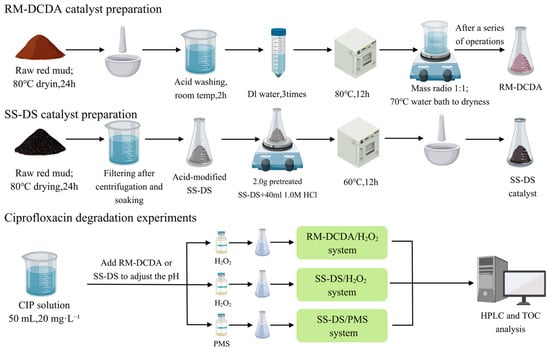
Raw RM was oven-dried at 80 °C for 24 h and then ground into a powder. Subsequently, 1.0 g of dried RM was acid-washed with 0.5 M H2SO4 under magnetic stirring at room temperature for 2 h. The obtained solid was separated using centrifugation and washed three times with deionized water to remove residual acids and soluble impurities. After drying in a vacuum oven at 80 °C for 12 h, the solid was ground to obtain acidified RM [27,29,36].
The acidified RM was then uniformly mixed with DCDA in a mass ratio of 1:1. An appropriate amount of deionized water was added to promote homogeneous mixing, and the mixture was stirred and heated in a water bath at 70 °C until dry. The dried mixture was ground into a powder and transferred to a porcelain boat. The sample was then calcined in a tube furnace under an N2 atmosphere at 550 °C for 2 h, with a heating rate of 5 °C·min−1. After naturally cooling to room temperature, the obtained RM-DCDA-derived catalyst was used in the RM-DCDA/H2O2 catalytic oxidation system [36,37,38,39,40].
2.2.2. Preparation of SS-DS Catalysts
The SS-DS was first washed with deionized water under ultrasonication for 30 min, followed by centrifugation. This washing process was repeated three times. The cleaned solid was then soaked in deionized water for 12 h to remove soluble alkaline substances, centrifuged, and dried at 100 °C to constant weight to obtain the pretreated SS-DS [23,26,28].
For acid modification, 2.0 g of the pretreated SS-DS was treated with 40 mL of 1.0 mol·L−1 HCl under magnetic stirring at room temperature for 2 h. The solid product was then washed with deionized water until nearly neutral and vacuum-dried at 60 °C to constant weight to obtain acid-modified SS-DS [23,31].
The acid-modified SS-DS was mixed with urea in a mass ratio of 1:1 and calcined at 550 °C for 2 h under an N2 atmosphere, with a heating rate of 5 °C·min−1. The modified catalyst was denoted as SS-DS [26,28,31]. Experimental flowchart is shown in Figure 1.
Figure 1.
Experimental flowchart.
2.3. Catalyst Characterization
The phase composition and crystal structure of the catalysts were analyzed using RINT 2100 XRD (Rigaku, Takatsuki, Japan) over a 2θ range of 10–80°. The morphology and elemental distribution were characterized using JSM-7600F field-emission SEM (JEOL, Tokyo, Japan) and EDS. The surface elemental composition and chemical valence states were determined using Theta Probe XPS (Thermo Scientific, Waltham, MA, USA), and the binding energies were calibrated using the C 1s peak at 284.8 eV as the reference [28,41].
2.4. Experimental Methods
2.4.1. CIP Degradation in the RM-DCDA/H2O2 System
Degradation experiments of CIP in the RM-DCDA/H2O2 system were conducted in batch mode. Unless otherwise stated, 10 mg of RM-DCDA catalyst was added to 50 mL of CIP solution with an initial concentration of 20 mg·L−1. The suspension was magnetically stirred at 400 rpm and 25 ± 1 °C, and the initial pH was adjusted to 3.0 with HCl or NaOH. The reaction was initiated by adding H2O2 to a final concentration of 10 mmol·L−1 [11,38].
At 0, 5, 10, 20, 30, 45, and 60 min, 2.0 mL of the reaction suspension was withdrawn, immediately quenched with excess methanol, and filtered through a 0.22 μm hydrophilic membrane filter before HPLC analysis. The CIP degradation efficiency was calculated using Equation (1) [37,38].
where C0 is the initial CIP concentration, mg·L−1, and Ct is the CIP concentration at reaction time t, mg·L−1.
The effects of catalyst dosage, H2O2 concentration, initial pH, coexisting anions, and HA on CIP removal were investigated by varying one parameter at a time. The catalyst dosages were 2, 4, 6, 8, and 10 mg; the H2O2 concentrations were 3, 5, 7, 10, and 20 mmol·L−1; and the initial pH values were 3, 5, 7, and 9. For the coexisting ion experiments, NaCl, NaHCO3, Na2SO4, and Na2HPO4 were each added separately at 10 mmol·L−1 before the addition of catalyst and oxidant. For the HA experiments, HA was added at 5, 10, 15, and 20 mg·L−1 before the reaction [11,13,14].
2.4.2. CIP Degradation in the SS-DS/H2O2 System
CIP degradation in the SS-DS/H2O2 system was performed in batch mode. In a typical experiment, 8 mg of SS-DS catalyst was added to 50 mL of 20 mg·L−1 CIP solution. The suspension was magnetically stirred at 400 rpm and 25 ± 1 °C, and the initial pH was adjusted to 4.0 with HCl or NaOH. The reaction was initiated by adding H2O2 to a final concentration of 10 mmol·L−1 [14,23,41].
For the catalyst dosage experiments, the SS-DS dosages were set to 2, 4, 6, 8, and 10 mg, whereas all other conditions were kept constant. For the pH experiments, the initial pH was adjusted to 3.0, 4.0, 5.0, 7.0, and 9.0. For the H2O2-concentration experiments, H2O2 was added at final concentrations of 3, 5, 7, 10, and 20 mmol·L−1. For the coexisting ion experiments, NaCl, NaHCO3, Na2SO4, and Na2HPO4 were each added separately at 10 mmol·L−1 before the addition of catalyst and oxidant. For the HA experiments, HA was added at 5, 10, 15, and 20 mg·L−1 before the reaction [16,17,18,19,42,43].
Sampling and quenching followed the procedure outlined in Section 2.4.1: at 0, 5, 10, 20, 30, 45, and 60 min, 2.0 mL of suspension was withdrawn, immediately quenched with excess methanol, filtered through a 0.22 μm hydrophilic membrane filter, and analyzed using HPLC [28,41].
2.4.3. CIP Degradation in the SS-DS/PMS System
For the SS-DS/PMS system, potassium peroxymonosulfate (KHSO5) was used as the PMS source. In a typical experiment, 5 mg of SS-DS catalyst was added to 50 mL of 20 mg·L−1 CIP solution. The suspension was magnetically stirred at 400 rpm and 25 ± 1 °C. Unless otherwise stated, the initial pH was adjusted to the target value using HCl or NaOH. The reaction was initiated by adding PMS to a final concentration of 0.4 mmol·L−1 [10,11,12].
The effect of catalyst dosage was examined using SS-DS dosages of 1, 3, 5, 7, and 9 mg; the effect of PMS concentration was examined at final concentrations of 0.2, 0.3, 0.4, 0.5, and 0.6 mmol·L−1; and the effect of initial pH was examined at pH 3.0, 4.0, 5.0, 7.0, and 9.0. The coexisting ion and HA experiments followed the same procedure as described for the SS-DS/H2O2 system. At 0, 5, 10, 20, 30, 45, and 60 min, 2.0 mL of suspension was withdrawn, immediately quenched with excess methanol, filtered through a 0.22 μm hydrophilic membrane filter, and analyzed using HPLC [10,11,12,15].
2.4.4. HPLC Analysis of CIP
The residual CIP concentration was determined by high-performance liquid chromatography (HPLC) equipped with a UV detector. Separation was performed on an Agilent ZORBAX Eclipse Plus C18 column (150 mm × 4.6 mm, 5 μm). The mobile phase consisted of 0.1% formic acid aqueous solution (A) and acetonitrile (B) at a volume ratio of 30:70 (v/v). The flow rate was 0.2 mL·min−1, the column temperature was maintained at 35 °C, the detection wavelength was 277 nm, and the injection volume was 20 μL.
CIP was quantified using an external standard calibration curve. The calibration equation was y = 2726.7x − 127.4, with a linear range of 2–400 μg·L−1 and a coefficient of determination (R2) of 0.999. The limit of detection and the limit of quantification were 0.11 and 0.36 μg·L−1, respectively.
2.4.5. Determination of Total Organic C (TOC)
TOC was measured using a Shimadzu TOC-L CPH total organic carbon analyzer based on high-temperature catalytic combustion to evaluate the mineralization of CIP during catalytic oxidation. The samples were collected at 0, 10, 20, 30, 45, and 60 min. Before TOC analysis, the samples were required to be clear and transparent, filtered through a 0.45 μm membrane filter, and transferred into 50 mL centrifuge tubes for analysis. The calibration range of the TOC analyzer was 1–10 ppm. If the TOC concentration of the sample exceeded this range, it was diluted with ultrapure water before analysis. The TOC removal efficiency was calculated from the change in TOC concentration during the reaction.
2.4.6. Catalyst Reusability Experiments
The reusability of the catalysts was evaluated under optimal degradation conditions for each system. After each run, the catalyst was separated from the reaction solution using vacuum filtration, washed three times with deionized water and anhydrous ethanol to remove residual pollutants and adsorbed intermediates, and dried in a vacuum oven at 60 °C for 12 h. The dried catalyst was reused in subsequent cycles. Eight consecutive cycles were performed and the CIP degradation efficiencies were compared after each cycle.
2.4.7. Radical Quenching Experiments
Radical quenching experiments were conducted to probe the contribution of reactive species. Tert-Butanol (TBA, 30 mmol·L−1) was used to scavenge hydroxyl radicals (·OH), methanol (MeOH) to scavenge both ·OH and sulfate radicals (SO4−·), p-benzoquinone (p-BQ, 1 mmol·L−1) to scavenge superoxide radicals (·O2−), and furfuryl alcohol (FFA) to scavenge singlet oxygen (1O2). For the SS-DS/PMS system, TBA, MeOH, and FFA were each added at a quencher/PMS molar ratio of 100. Each scavenger was added to the CIP solution before the addition of catalyst and oxidant, and a control experiment without scavenger was run in parallel. To exclude the direct reaction between FFA and PMS, a catalyst-free control (PMS + CIP + FFA, without SS-DS) was also conducted. After the reaction was initiated, samples were collected at 0, 5, 10, 20, 30, 45, and 60 min, immediately quenched, filtered through a 0.22 μm membrane filter, and analyzed by HPLC. All experiments were performed in triplicate.
3. Results
3.1. Catalyst Structure and Composition Analysis
To clarify the structural differences between the RM-based catalyst and the SS-DS, RM-DCDA was characterized using SEM-EDS, XRD, and XPS, whereas the surface morphology of SS-DS was examined using SEM. The results are shown in Figure 2, Figure 3 and Figure 4.
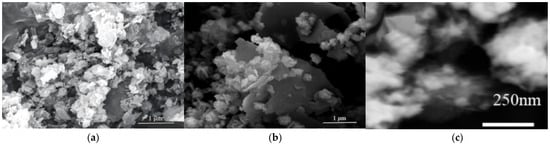
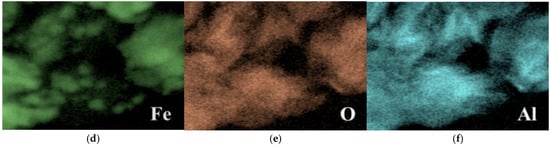
Figure 2.
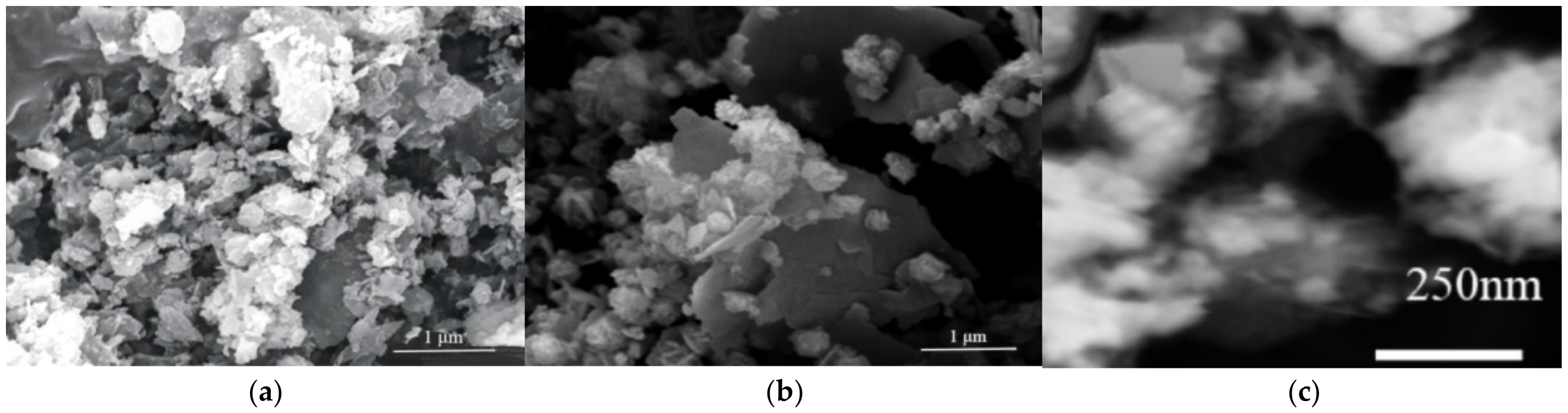
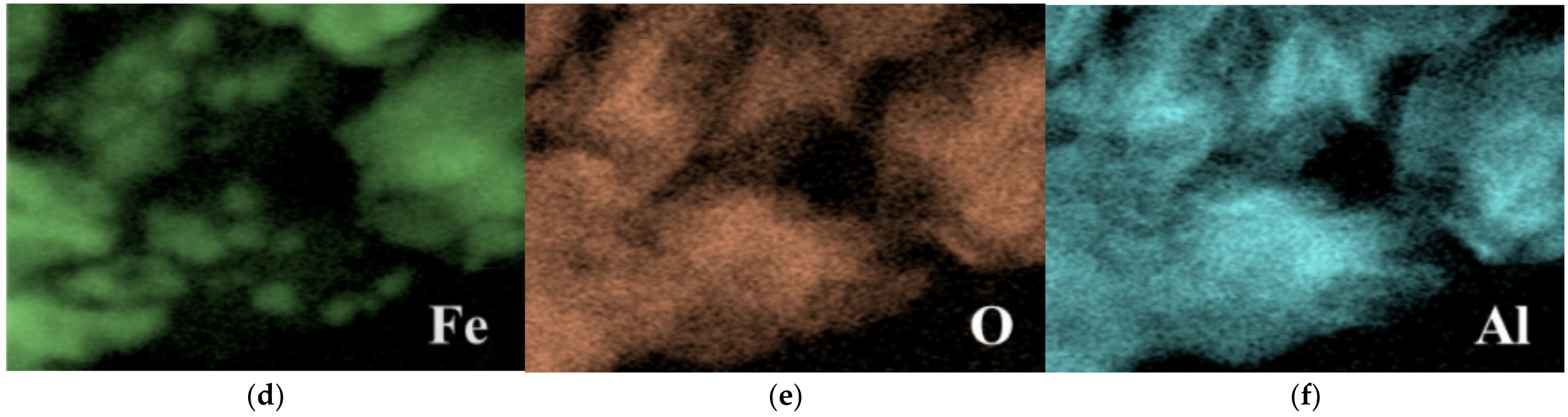
Morphology and elemental distribution of the red mud-based catalysts. (a) SEM image of raw red mud; (b) SEM image of RM-DCDA; (c) electron image of the region selected for EDS mapping; (d–f) EDS elemental mapping of Fe, O, and Al in RM-DCDA, respectively. SEM images of (a) raw RM and (b) RM-DCDA; (c) corresponding electron image of the selected region for EDS mapping; (d–f) EDS elemental mapping images of Fe, O, and Al in RM-DCDA.
Figure 3.
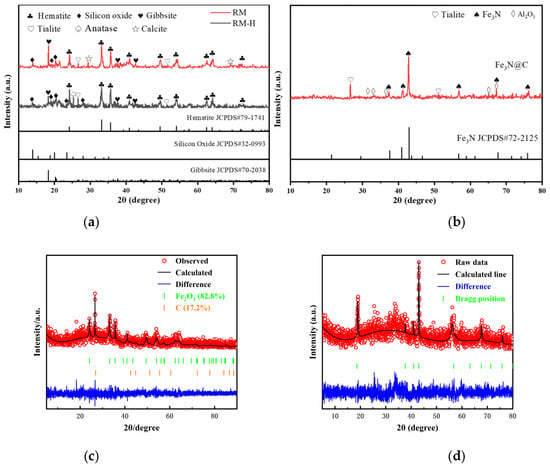
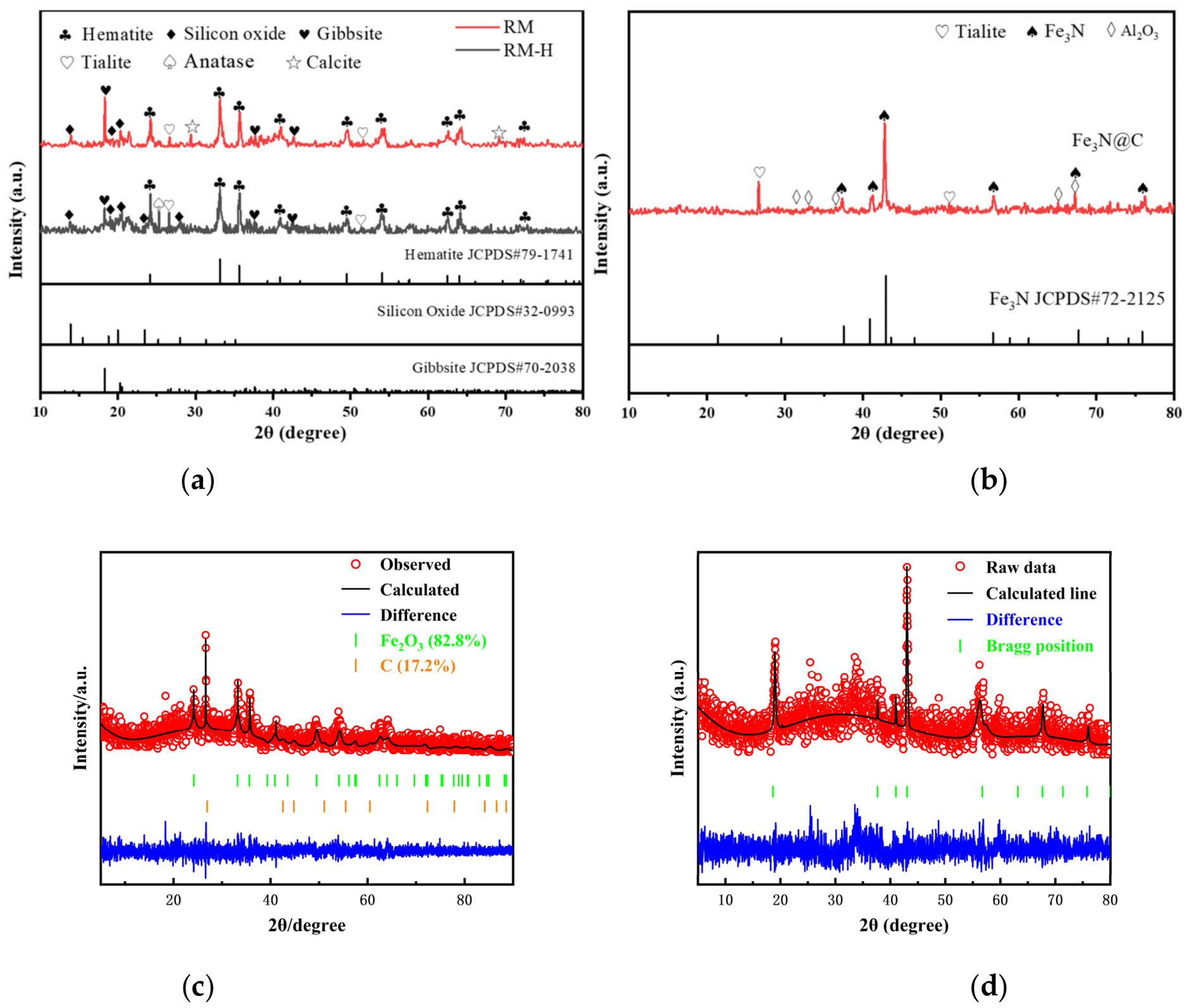
XRD patterns and Rietveld refinement results of the red mud-based materials. (a) XRD patterns of raw red mud (RM) and acidified red mud (RM-H); (b) XRD pattern of RM-DCDA after dicyandiamide-assisted calcination; (c) Rietveld refinement result of RM; (d) Rietveld refinement result of RM-DCDA.
Figure 4.
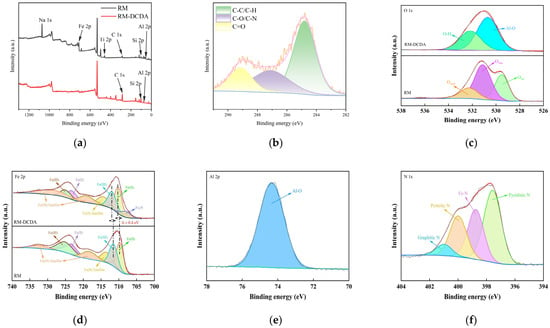
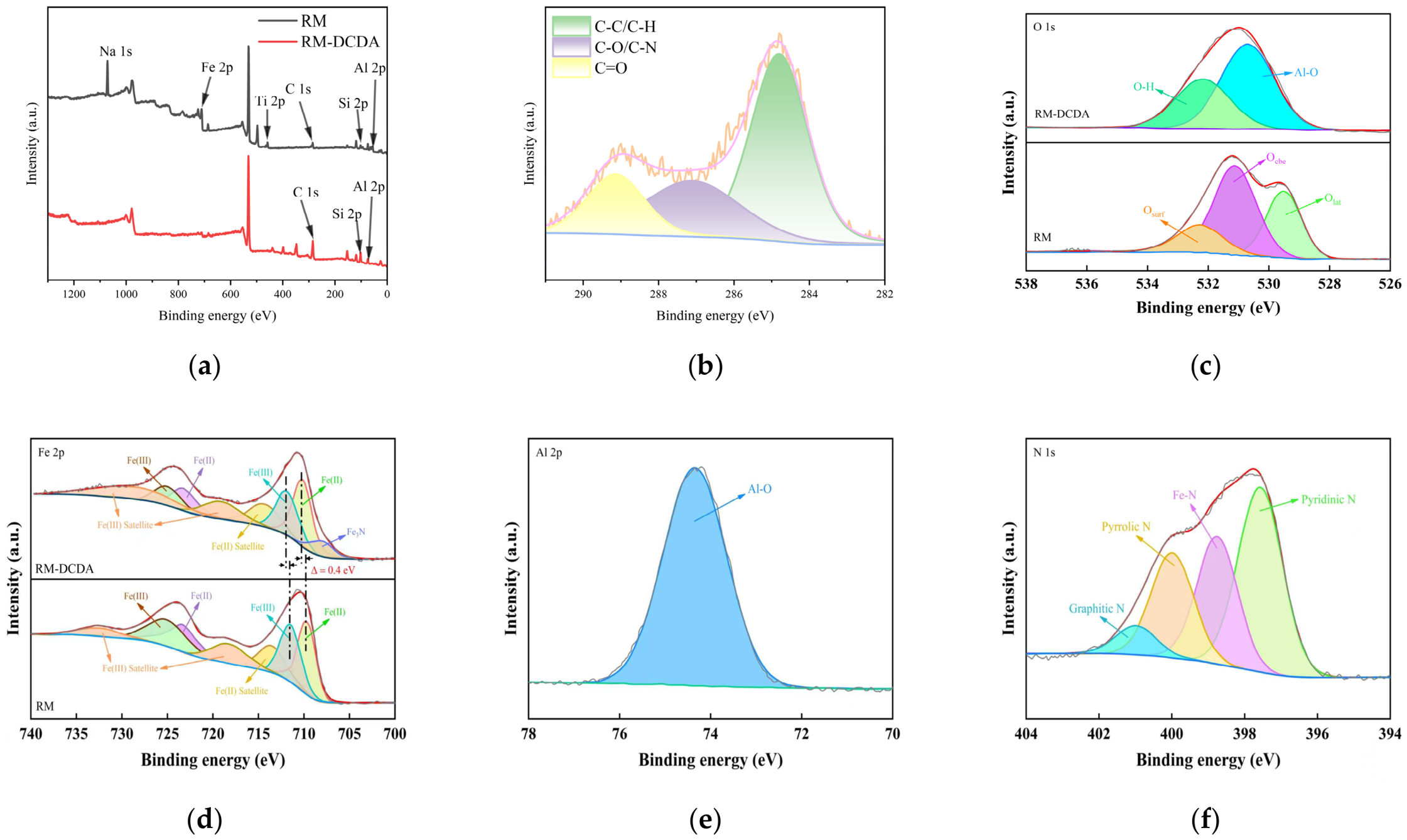
XPS characterization of raw red mud and RM-DCDA. (a) survey spectrum of raw red mud; (b) C 1s of raw red mud; (c) O 1s of RM-DCDA; (d) Fe 2p of RM-DCDA; (e) Al 2p of RM-DCDA; (f) N 1s of RM-DCDA. In (b–f), colored peaks represent deconvoluted components as labeled in the spectra, and the red lines represent the overall envelope fits.
As shown in Figure 2a, the raw RM exhibits irregular particles with rough surfaces, accompanied by the partial aggregation of metal-containing particles and visible lamellar structures. These morphological features are related to mineral components such as Al2O3 in RM [25,27,44]. However, Fe-based active components in raw RM are poorly dispersed, which may limit the effective interfacial sites available for oxidant activation [29,36]. The morphology of the RM-DCDA changed noticeably after acidification and DCDA-assisted calcination. The modified particles became more dispersed and some of the aggregated particles transformed into relatively uniform quasi-spherical particles attached to the lamellar substrate (Figure 2b). This indicates that acidification and thermal treatment altered the surface structure of the RM and promoted the exposure of Fe-containing species at the reaction interface [45].
The EDS elemental mapping results supported this structural change. As shown in Figure 2c–f, Fe is uniformly distributed on the RM-DCDA surface without severe local aggregation. The distributions of Al and O largely overlapped, indicating that stable oxide phases such as Al2O3 were retained in the catalyst and could act as supporting structures for the Fe-based active components [27,29]. These results suggest that RM-DCDA is a composite catalyst comprising Fe-based active species and stable mineral components derived from RM.
Figure 3 presents the XRD patterns and Rietveld refinement results. Several characteristic peaks corresponding to hematite, quartz, gibbsite, aluminum titanate, anatase, and calcite were observed in the raw RM, indicating a complex mineral composition [25]. After acidification, hematite remained the dominant Fe-containing crystalline phase, suggesting that the main crystalline structure of the Fe species was not significantly destroyed by the acid treatment. Meanwhile, the characteristic peaks of calcite weakened or disappeared, indicating that some of the carbonate and alkaline components were removed during the acid washing [29]. Compared with raw and acidified RM, RM-DCDA showed new diffraction peaks at 2θ = 37.5°, 40.9°, 42.9°, 56.7°, and 67.7°, corresponding to the (110), (002), (−1–11), (−1–12), and (300) planes of Fe3N, respectively (Figure 3b). This indicates that DCDA participated in the transformation of Fe species during calcination and promoted the formation of the Fe3N active phase [46]. The refinement results supported the phase evolution from RM to the N-modified catalyst (Figure 3c,d). For RM, the fitted pattern was mainly associated with Fe oxide-related crystalline phases, whereas RM-DCDA showed diffraction features consistent with the formation of Fe3N and the retention of mineral-derived inorganic components. In addition, stable mineral phases such as Al2O3 and aluminum titanate were observed in RM-DCDA, suggesting that part of the inorganic framework of RM was retained after modification [27,44].
XPS was performed to determine the surface elemental composition and chemical states of the raw RM and RM-DCDA. As shown in Figure 4a, the survey spectrum of raw RM shows the presence of Na, Fe, O, Ti, C, Si, and Al, indicating that the surface of raw RM mainly comprises metal oxides, aluminosilicate components, Na-containing species, and surface C species [25,27,36]. No obvious N signal was observed in the raw RM, suggesting that N-containing species were absent before the DCDA-assisted calcination. These results provide a useful reference for evaluating N incorporation and surface chemical changes after modification.
Figure 4b presents the C 1s spectrum of the raw RM. It could be deconvoluted into three components at 284.80, 286.73, and 288.53 eV. The dominant peak (284.80 eV) was assigned to C-C/C-H, accounting for 72.62%, and was mainly associated with surface-adsorbed or adventitious C. The peak at 286.73 eV accounted for 14.06% and was mainly attributed to O-containing C species such as C-O. Because no obvious N signal was observed in raw RM, this peak should not be directly assigned to C-N bonds. The peak at 288.53 eV accounted for 13.32% and could be attributed to C=O, O-C=O, or carbonate-related C species, indicating the presence of O-containing functional groups and carbonate residues on the surface of raw RM [27,29]. These results indicate that the C species in the raw RM were mainly derived from surface-adsorbed and O-containing C species, rather than N-doped C structures.
After acidification and DCDA-assisted calcination, the surface chemical environment of the RM-DCDA changed markedly. In the high-resolution C 1s spectrum of RM-DCDA, the peaks at 284.8, 286.4, and 288.7 eV could be assigned to C-C/C=C, C-N, and C=O species, respectively [39,40]. Compared to that in raw RM, the appearance of C-N species in RM-DCDA indicates that N was successfully incorporated into the carbonaceous structure during DCDA pyrolysis. The introduction of N-containing C structures may improve interfacial electron transfer and provide additional reactive sites for H2O2 activation [39,40,46].
Figure 4c presents the high-resolution O 1s spectrum of the RM-DCDA. The O 1s spectrum was mainly fitted to Al-O- and H-O-related components. The Al-O component indicates that Al oxide species such as Al2O3 were retained in the catalyst, whereas the H-O component suggests the presence of surface hydroxyl-related groups. These hydroxyl groups may facilitate the adsorption of CIP and provide interfacial sites for H2O2 activation. The Al 2p spectrum (Figure 4e) confirmed that Al mainly existed in the form of Al-O, supporting the retention of stable Al oxide components as structural supports for the Fe-based active species [25,27,36].
The Fe 2p spectrum provided information on the surface Fe species in RM-DCDA. As shown in Figure 4d, the peaks at 710.25 and 723.5 eV correspond to Fe2+, whereas those at 712.05 and 725.4 eV correspond to Fe3+ [29,37]. The coexistence of Fe2+ and Fe3+ suggests that RM-DCDA contains multiple surface Fe species. The Fe2+/Fe3+ redox pair may promote Fe cycling during the Fenton-like reaction, which is important for continuous H2O2 decomposition and reactive O species generation [14,37]. The XRD results support the formation of Fe3N, whereas the XPS results provide evidence for changes in the surface chemical environment of Fe after N-assisted calcination.
Figure 4f presents the high-resolution N 1s spectrum of RM-DCDA. The N 1s spectrum can be deconvoluted into four components at 397.6, 398.8, 400.0, and 401.0 eV, which are assigned to pyridinic, Fe, pyrrolic, and graphitic N, respectively [39,40,46]. Pyridinic and pyrrolic N can introduce defect sites into the C matrix, which may improve pollutant adsorption and interfacial electron transfer. The Fe-N component indicates coordination between the N species and Fe centers, which may help stabilize Fe-based active sites. Graphitic N can regulate the electronic structure of the C matrix and enhance electron transport during H2O2 activation. Therefore, the catalytic activity of RM-DCDA can be attributed to the combined contribution of the Fe3N phase identified using XRD, Fe2+/Fe3+ redox cycling, and the N-doped C structure [37,39,40]. However, because no quantitative peak area ratios were provided, the relative contributions of these species were interpreted qualitatively rather than quantitatively.
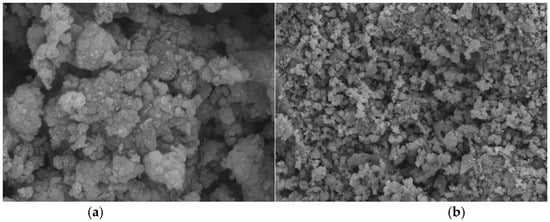
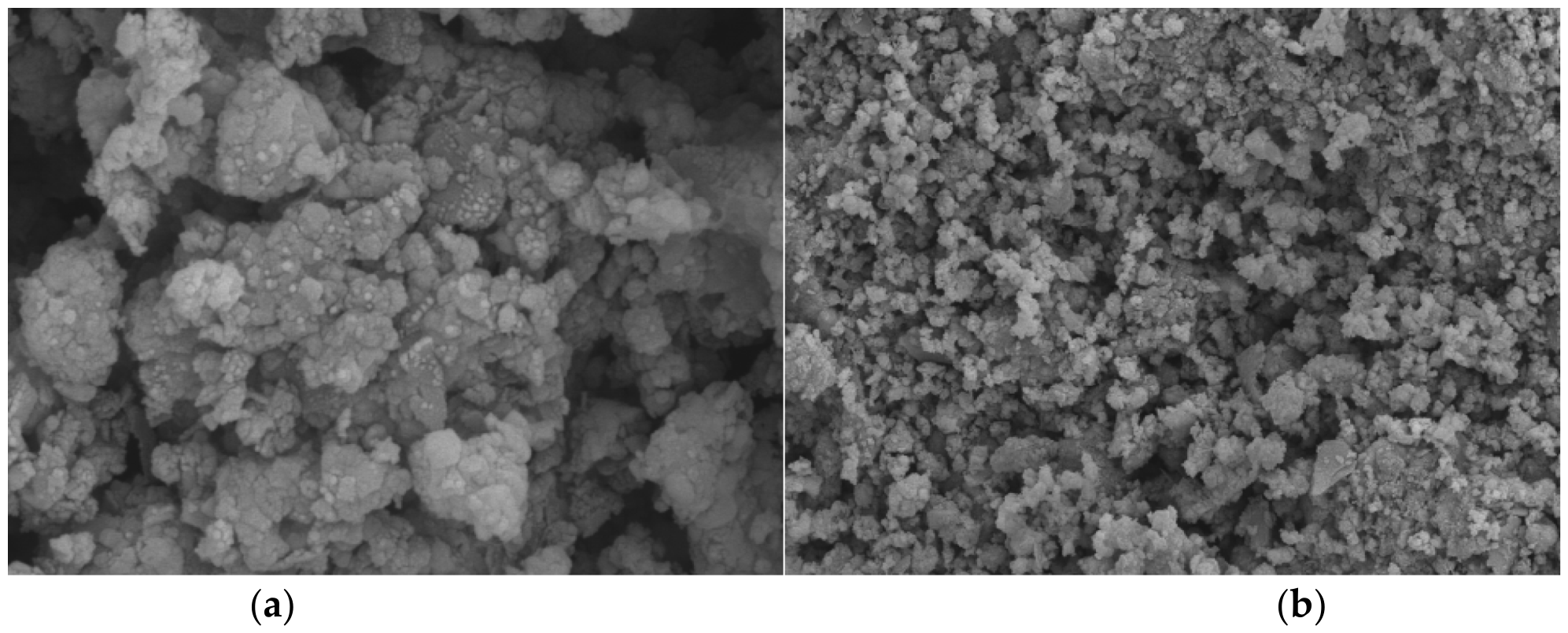
Figure 5 presents the SEM images of SS-DS. The SS-DS particles mainly exhibited irregular block-like morphology, with particle sizes of approximately 10–100 μm [26,28]. The surface was rough and contained abundant micron-scale pores [41,47]. After the acid treatment, more etched pores appeared on the particle surface, and local corrosion marks were observed on some metal-containing particles. This suggests that acidification removed some surface impurities and exposed more potential reaction sites [41].
Figure 5.
SEM images of SS-DS before and after acid treatment: (a) before acid treatment; (b) after acid treatment.
Unlike RM-DCDA, the advantage of SS-DS is that it has a rough porous structure and the coexistence of Fe-, Ca-, and S-containing components [23,26]. Fe species may participate in H2O2 or PMS activation. The Ca-containing alkaline components may affect the local pH environment near the catalyst surface. S-containing species, particularly reduced S species such as CaS if present, may facilitate the conversion of Fe3+ to Fe2+, thereby helping maintain Fe cycling during oxidant activation [41,48]. These features make SS-DS a potential activation material for H2O2 and PMS systems.
Overall, RM-DCDA and SS-DS exhibited distinct structural characteristics. RM-DCDA formed an Fe3N/C composite structure after acidification and DCDA-assisted calcination. Its Fe3N active phase, Fe2+/Fe3+ coexistence, Fe-N coordination, and N-doped C structure provide a structural basis for H2O2 activation and electron transfer [37,39,40]. In contrast, SS-DS mainly relies on its rough porous morphology and the coexistence of Fe, Ca, and S-containing components to provide reactive sites for H2O2 and PMS activation [23]. These structural differences may explain the different catalytic behaviors of the three systems in terms of CIP degradation efficiency, pH adaptability, and contribution of reactive species.
3.2. Degradation Performance of Different Catalytic Systems Toward CIP
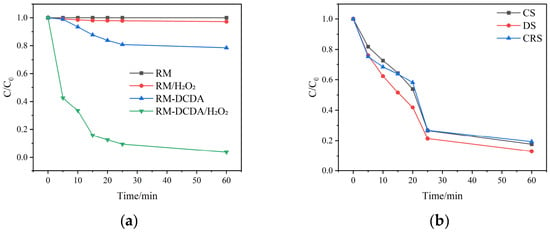
Based on the structural characterization results, the CIP degradation performance of different industrial solid-waste-derived catalytic systems was evaluated (Figure 6a,b). Considering that the experimental conditions used for RM-based system screening, SS source screening, and comparison among the three catalytic systems were not identical, this section mainly focuses on system effectiveness and material applicability rather than making an overextended comparison of reaction rates.
Figure 6.
Screening of the red mud- and steel slag-derived catalytic systems for ciprofloxacin degradation. (a) Effect of different red mud-based reaction systems on the degradation of ciprofloxacin (raw red mud is plotted with a distinct symbol for clarity); (b) effect of different steel slag sources on the degradation of ciprofloxacin. CS, converter slag; DS, desulfurization slag; CRS, casting residue slag. Reaction conditions: CIP 20 mg·L−1, 50 mL, catalyst 10 mg, H2O2 10 mmol·L−1, initial pH 3, 25 ± 1 °C, 400 rpm, 60 min.
In the RM-based system, the CIP removal efficiency varied markedly under different reaction conditions. The removal efficiency of CIP was <5% when only raw RM was added (Figure 6a), indicating that the raw RM had a limited direct removal capacity for CIP. When acidified RM and DCDA were added without further catalytic activation, the removal efficiency increased to 21.18%, which was more likely associated with pollutant adsorption on the material surface [49]. In contrast, the CIP degradation efficiency reached 94.60% in the RM-DCDA/H2O2 system, indicating that acidification and DCDA-assisted calcination markedly enhanced the catalytic activity of the RM-based material. Combined with the characterization results in Section 3.1, the Fe3N active phase, the coexistence of Fe2+/Fe3+, and the N-doped C structure formed in RM-DCDA may jointly promote H2O2 activation, thereby improving the oxidative degradation efficiency of CIP [37,38].
To screen a more suitable SS material for Fenton-like reactions, the CIP removal performances of converter SS, desulfurization SS, and casting residue SS were compared. The desulfurized SS system exhibited better degradation performance than the other two SS systems (Figure 6b). The differences among different SS materials may be related to their Fe content, S-containing reductive components, surface pore structures, and alkaline components [23,26]. Desulfurized SS has a rough surface and contains Fe, Ca, and S species, which are favorable for oxidant activation and contact between the reactants and active sites [41]. Therefore, SS-DS was selected as the main catalytic material for the subsequent SS-based systems.
The final degradation efficiencies of the RM-DCDA/H2O2, SS-DS/H2O2, and SS-DS/PMS systems were 94.60%, 92.58%, and 95.17%, respectively. The final degradation efficiencies of all three systems exceeded 90%, indicating that RM and SS-DS could serve as feedstocks for preparing industrial solid-waste-derived catalysts for CIP degradation [50].
Considering material function, the high degradation efficiency of the RM-DCDA/H2O2 system was mainly associated with the Fe-based active phase and N-doped C structure. Fe3N and the Fe2+/Fe3+ redox pair could facilitate H2O2 activation, whereas the N-doped C structure may improve interfacial electron transfer [37,39,40]. In contrast, the catalytic activity of the SS-DS/H2O2 and SS-DS/PMS systems depended more on the multicomponent nature of SS-DS. Fe species may serve as activation sites for oxidants, S-containing components may promote the conversion of Fe3+ to Fe2+, and alkaline components such as CaO may regulate the local reaction environment [23,41]. These results suggest that the catalytic function of SS-DS is not determined by a single Fe component but is closely related to its complex composition and rough porous structure [48].
Overall, the three industrial solid-waste-derived catalytic systems were effective for CIP degradation. The SS-DS/PMS system exhibited a slightly higher final degradation efficiency; however, the differences among the systems were small. Because the initial pollutant concentration, oxidant type, and reaction conditions were inconsistent among the different experimental groups, a more appropriate conclusion is that RM-DCDA and SS-DS can be used as industrial solid-waste-derived catalytic materials for CIP oxidative degradation [51]. Specifically, RM-DCDA is more suitable for constructing an H2O2-based Fenton-like system, whereas SS-DS can be applied in H2O2 and PMS activation systems [52,53]. Further evaluation of the pH, catalyst dosage, oxidant concentration, and coexisting substances is required to clarify the applicable range and stability of each catalytic system [54].
3.3. Effects of Reaction Conditions on CIP Degradation
3.3.1. Effect of Initial pH
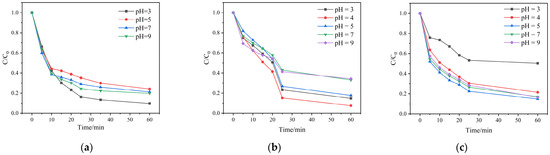
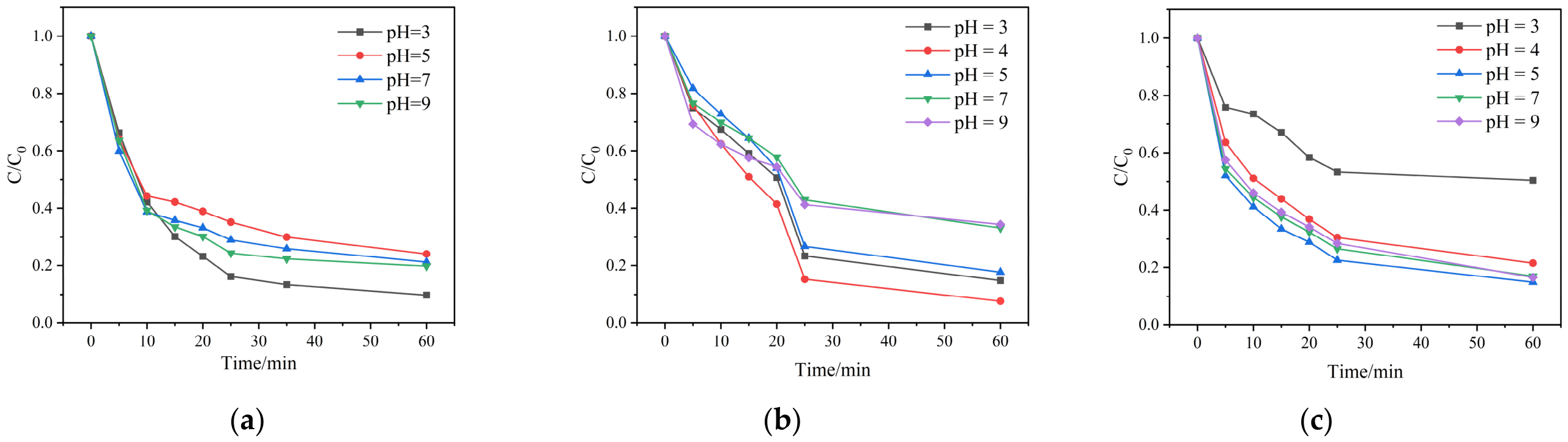
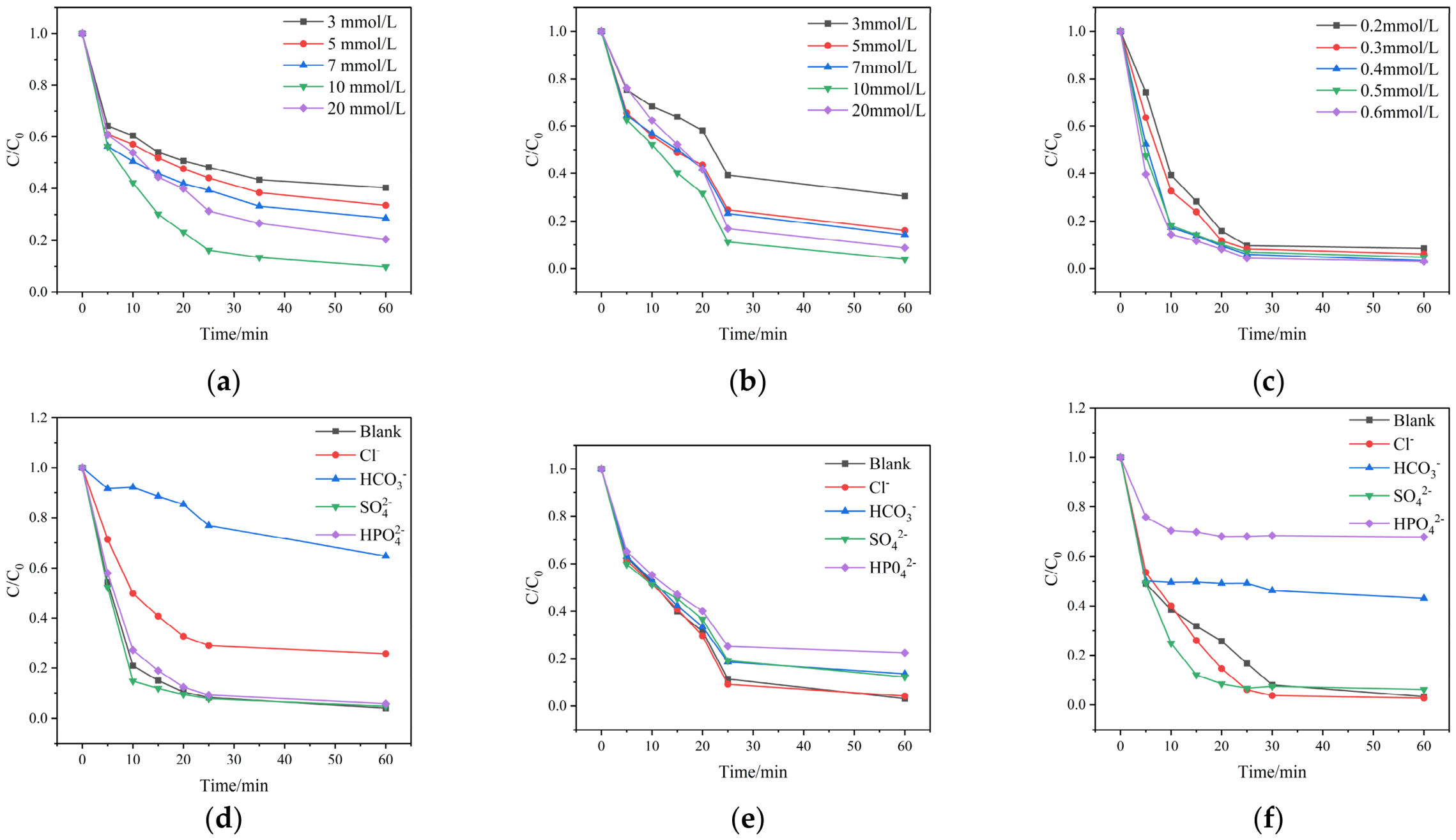
The initial pH can affect the speciation of CIP, surface charge of the catalyst, and oxidant activation process, making it important for evaluating the applicable range of Fenton-like and persulfate-based systems [54]. Figure 7a–c present the degradation results under different initial pH conditions.
Figure 7.
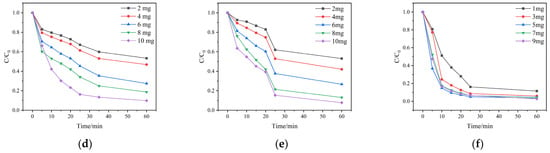
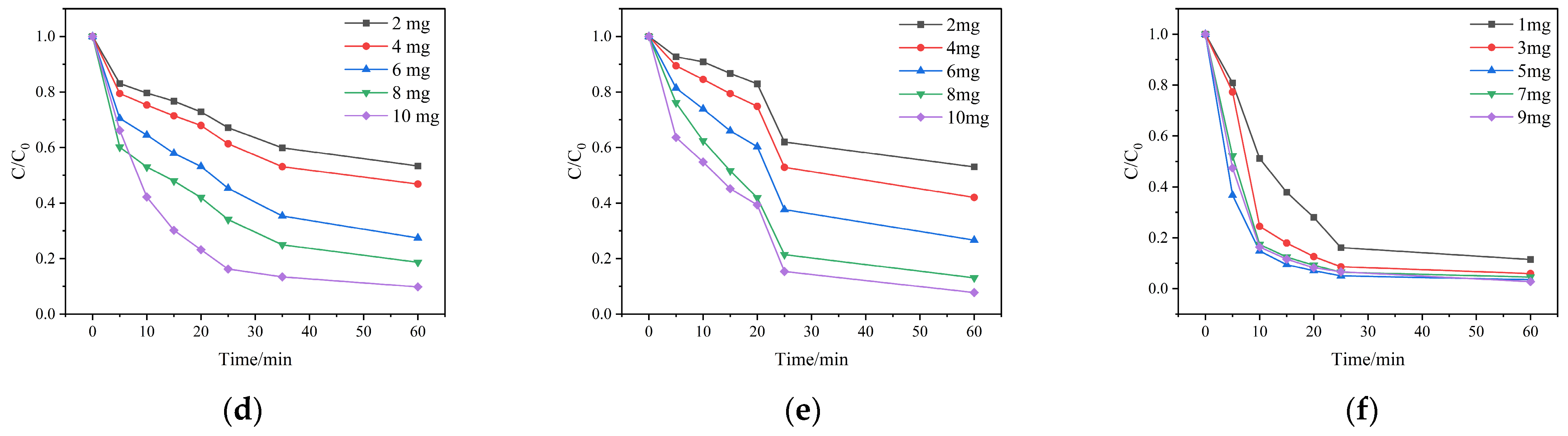
Effects of initial pH and catalyst dosage on ciprofloxacin degradation in different catalytic systems. (a–c) Effect of initial pH (3, 4, 5, 7, and 9) on CIP degradation in the RM-DCDA/H2O2, SS-DS/H2O2, and SS-DS/PMS systems, respectively, with catalyst dosage and oxidant concentration fixed; (d–f) effect of catalyst dosage on CIP degradation in the same three systems, with initial pH and oxidant concentration fixed. Fixed conditions—RM-DCDA/H2O2: catalyst 10 mg, H2O2 10 mmol·L−1, initial pH 3 (d); SS-DS/H2O2: catalyst 8 mg, H2O2 10 mmol·L−1, initial pH 4 (e); SS-DS/PMS: catalyst 5 mg, PMS 0.4 mmol·L−1, initial pH 4 (f). Common conditions: CIP 20 mg·L−1, 50 mL, 25 ± 1 °C, 400 rpm, 60 min.
In the RM-DCDA/H2O2 system, the change in pH clearly affected CIP degradation. When the initial pH values were 3, 5, 7, and 9, the degradation efficiencies after 60 min were 92.55%, 71.96%, 80.34%, and 81.93%, respectively (Figure 7a). The best degradation performance was obtained at pH 3, indicating that an acidic environment was more favorable for H2O2 activation by RM-DCDA. This result is generally consistent with the typical Fenton-like reaction behavior [13,14]. Under acidic conditions, Fe-based sites are more likely to participate in H2O2 activation, leading to stronger ·OH generation. As pH increases, Fe species may undergo hydrolysis or form hydroxide precipitates, thereby reducing the number of available active sites and decreasing H2O2 utilization efficiency [13,55].
The SS-DS/H2O2 system showed strong pH dependence. When the initial pH values were 3.0, 4.0, 5.0, 7.0, and 9.0, the CIP removal efficiencies were 85.1%, 92.3%, 82.3%, 66.9%, and 65.8%, respectively (Figure 7b). The highest degradation efficiency was achieved at pH 4.0, suggesting that weakly acidic conditions were more suitable for H2O2 activation by SS-DS. Compared to RM-DCDA, SS-DS contains alkaline components such as CaO, which may alter the local pH environment during the reaction. This may explain the slight difference in the optimal pH between the two H2O2-based systems [23,26]. Under neutral and alkaline conditions, the activation efficiency of H2O2 decreased, and the catalyst surface could be covered by OH− or precipitated species, resulting in lower degradation efficiency [13,14].
The pH response differed between the SS-DS/PMS and H2O2-based systems. The system maintained a high degradation performance at pH 5–9 and under unadjusted pH conditions, whereas the removal efficiency decreased at pH 3 (Figure 7c). This indicates that strongly acidic conditions are not necessarily favorable for PMS activation by SS-DS. Excessive H+ could have potentially altered the PMS activation pathway or inhibited the participation of effective surface components in the reaction [16,17,18]. Overall, RM-DCDA/H2O2 and SS-DS/H2O2 were more dependent on acidic conditions, whereas SS-DS/PMS showed a wider pH adaptability [17,18].
3.3.2. Effect of Catalyst Dosage
Catalyst dosage determines the number of available active sites in the reaction system and affects the contact probability between the pollutants, oxidants, and catalyst surfaces [11,14]. Figure 7d–f present the degradation results for different catalyst dosages.
In the RM-DCDA/H2O2 system, the CIP degradation efficiency increased from 42.72% to 80.42% with increasing catalyst dosage (2 mg to 10 mg, Figure 7d). This indicates that catalyst dosage is an important limiting factor within the tested range. With increasing catalyst dosage, more Fe-based active sites became available for H2O2 activation, and CIP molecules were more likely to be adsorbed and oxidized on the catalyst surface [31,37].
A similar trend was observed in the SS-DS/H2O2 system. When the SS-DS dosages were 2, 4, 6, 8, and 10 mg, the CIP degradation efficiencies after 60 min were 42.72%, 49.61%, 69.27%, 88.05%, and 90.34%, respectively (Figure 7e). Increasing the catalyst dosage increased the total active surface area of the system and improved the contact between CIP and the reactive sites, thereby enhancing the degradation efficiency [41]. However, the degradation efficiency at 10 mg was only slightly higher than that at 8 mg, suggesting that a further increase in the catalyst dosage had limited additional benefits. Considering degradation efficiency and material consumption, 8–10 mg was considered a suitable dosage range for this system.
In the SS-DS/PMS system, a high degradation efficiency was achieved at relatively low catalyst dosages When the SS-DS dosages were 1, 3, 5, 7, and 9 mg, the CIP degradation efficiencies were 86.4%, 92.5%, 96.6%, 95.5%, and 95.7%, respectively (Figure 7f). The degradation efficiency increased markedly with increasing catalyst dosage (1 mg to 5 mg); however, no further improvement was observed when the dosage was increased to 7 or 9 mg. This suggests that 5 mg of SS-DS is sufficient to provide adequate PMS activation sites under the tested conditions [17,18]. Excessive catalyst dosage did not enhance degradation, which may be related to particle aggregation, radical self-quenching, or saturation of the reaction interface [18,35].
3.3.3. Effect of Oxidant Concentration
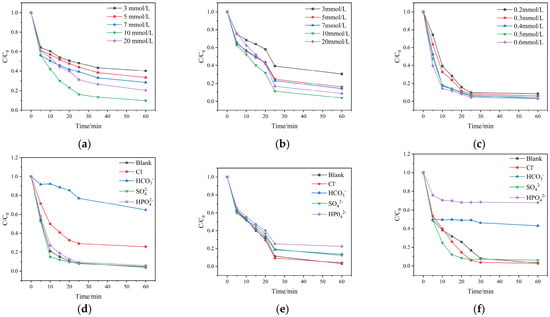
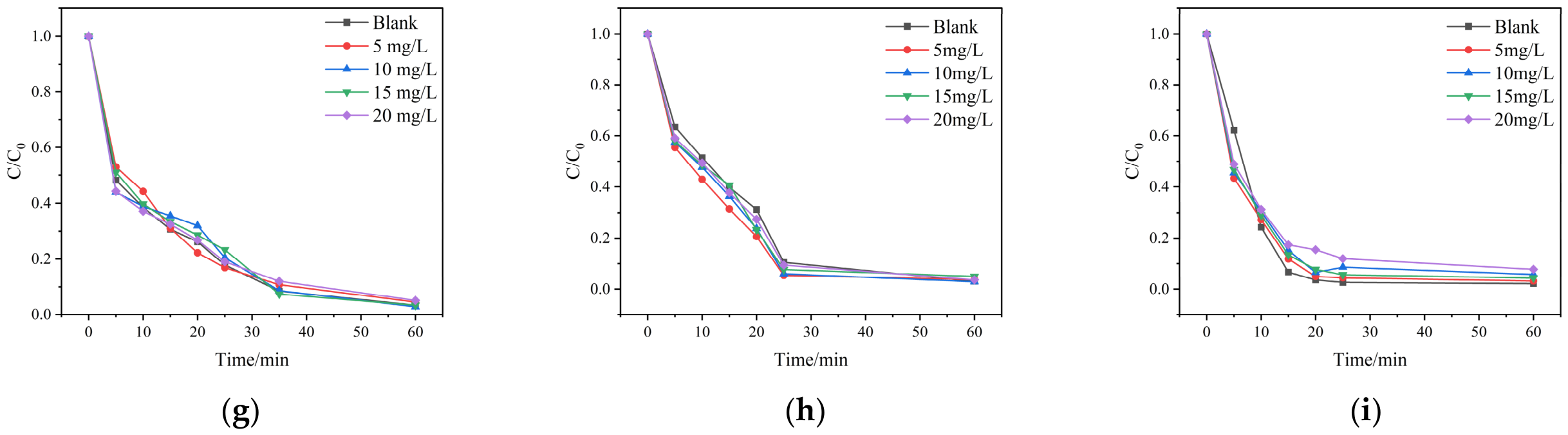
Oxidant concentration directly affects the generation of reactive species. However, excess oxidants may induce side reactions and reduce the effective utilization of radicals [15,18,35]. Figure 8a–c present the degradation results under different oxidant concentrations.
Figure 8.
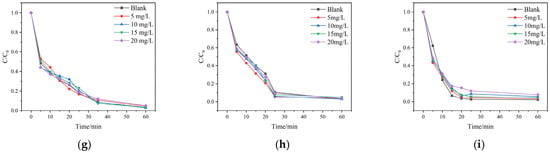
Effects of oxidant concentration and water matrix components on ciprofloxacin degradation. (a–c) Effect of oxidant concentration in the RM-DCDA/H2O2 (H2O2 3, 5, 7, 10, 20 mmol·L−1), SS-DS/H2O2 (H2O2 3, 5, 7, 10, 20 mmol·L−1), and SS-DS/PMS (PMS 0.2, 0.3, 0.4, 0.5, 0.6 mmol·L−1) systems, with catalyst dosage and initial pH fixed; (d–f) effect of coexisting anions (NaCl, NaHCO3, Na2SO4, and Na2HPO4, each at 10 mmol·L−1), with catalyst dosage, initial pH, and oxidant concentration fixed; (g–i) effect of humic acid (5, 10, 15, and 20 mg·L−1), with catalyst dosage, initial pH, and oxidant concentration fixed, in the three systems, respectively. Fixed conditions—RM-DCDA/H2O2: catalyst 10 mg, initial pH 3, H2O2 10 mmol·L−1; SS-DS/H2O2: catalyst 8 mg, initial pH 4, H2O2 10 mmol·L−1; SS-DS/PMS: catalyst 5 mg, initial pH 4, PMS 0.4 mmol·L−1. Common conditions: CIP 20 mg·L−1, 50 mL, 25 ± 1 °C, 400 rpm.
In the RM-DCDA/H2O2 system, increasing the H2O2 concentration significantly promoted CIP degradation. When the H2O2 concentrations were 3, 5, 7, 10, and 20 mmol·L−1, the degradation efficiencies after 60 min were 55.01%, 62.00%, 67.33%, 73.84%, and 95.40%, respectively (Figure 8a). This indicates that insufficient H2O2 supply limited ·OH generation in the system. With increasing H2O2 concentration, more H2O2 could be activated by Fe3N and Fe2+/Fe3+ sites, leading to improved degradation efficiency [13,15]. When the H2O2 concentration increased to 10 mmol·L−1, C/C0 decreased markedly. However, increasing H2O2 to 20 mmol·L−1 did not necessarily indicate a continuously proportional improvement, because excessive H2O2 may consume ·OH and lower radical utilization efficiency.
In the SS-DS/H2O2 system, H2O2 concentration affected the degradation performance. An appropriate increase in H2O2 concentration favored pollutant removal, whereas an excessively high concentration did not necessarily lead to proportional enhancement (Figure 8b). This can be explained by the following two factors: Fe species in SS-DS require sufficient H2O2 for oxidant activation. However, excessive H2O2 may scavenge ·OH or be consumed by reductive components in SS through ineffective reactions, thereby reducing oxidant utilization efficiency [15,38,41]. Therefore, the H2O2 concentration in this system should be controlled within an appropriate range rather than simply increased.
In the SS-DS/PMS system, the PMS concentration more directly affected degradation efficiency. When the PMS concentration increased from 0.2 to 0.4 mmol·L−1, the CIP degradation efficiency increased from 65.8% to 96.7% (Figure 8c). When the PMS concentration was increased further to 0.6 mmol·L−1, only a slight additional increase was observed. Therefore, 0.4 mmol·L−1 PMS was sufficient for reactive species generation in this system. Further PMS addition may be limited by the number of available catalytic sites, and excess PMS may react with SO4−· or ·OH, thereby reducing the effective radical utilization efficiency [16,18].
3.3.4. Effect of Coexisting Anions
Actual water matrices generally contain inorganic anions such as Cl−, HCO3−, SO42−, and HPO42−, which may affect pollutant degradation by competing for active sites, scavenging reactive species, or altering the reaction environment [16,18,19]. Figure 8d–f show the effects of different coexisting anions on the CIP degradation.
In the RM-DCDA/H2O2 system, Cl− had a limited effect on the final CIP degradation efficiency but increased the initial degradation rate, with the degradation efficiency reaching 92.24% after 30 min (Figure 8d). SO42− exerted a slight inhibitory effect; however, the degradation efficiency reached 89.50% after 30 min. In contrast, HCO3− and HPO42− markedly inhibited CIP degradation. HCO3− can react with ·OH to generate HCO3· with lower oxidation capacity and may consume H2O2, reducing the effective oxidant concentration [15,16]. HPO42− may compete with CIP for reactive radicals and generate HPO4·− with weaker oxidation capacity, resulting in more pronounced inhibition [15,18].
The SS-DS/H2O2 system was relatively more tolerant to coexisting anions and maintained high degradation efficiency in the presence of different anions (Figure 8e). This phenomenon may be related to the rough porous structure and multicomponent composition of the SS-DS. The abundant surface sites may buffer part of the competitive effect of anions, whereas S-containing components may help maintain the Fe3+/Fe2+ cycle [41].
Cl−, HCO3−, SO42−, and HPO42− affected PMS activation in the SS-DS/PMS system. Carbonate- and phosphate-containing systems were more likely to show inhibition, which is associated with the consumption of SO4−· and ·OH (Figure 8f). Overall, SS-DS systems showed a certain tolerance to common inorganic anions; however, their degradation efficiency may decrease in waters with high carbonate or phosphate concentrations [16,18].
A similar anion dependence has been reported for the FeS2/H2O2 system, in which Cl−, SO42−, and NO3− had little effect on CIP degradation, whereas HCO3−, CO32−, and H2PO4− markedly inhibited it [22].
HA is a common dissolved organic matter found in natural waters. It contains functional groups such as carboxyl and phenolic hydroxyl groups, which may compete with pollutants for reactive species or adsorb on the catalyst surface and affect the reaction [56]. Figure 8g–i exhibit the effects of different HA concentrations on CIP degradation.
In the RM-DCDA/H2O2 system, when the HA concentrations were 5, 10, 15, and 20 mg·L−1, the CIP degradation efficiencies showed minor differences compared with the control group (Figure 8g). This indicates that HA did not significantly inhibit the RM-DCDA/H2O2 system within the tested concentration range. One explanation is that RM-DCDA still provided sufficient Fe-based active sites, and the generated ·OH could oxidize part of the HA functional groups during the reaction, thereby reducing its long-term surface-covering effect [56].
A similar result was observed in the SS-DS/H2O2 system. The addition of HA did not clearly decrease CIP degradation efficiency (Figure 8h). The Ca-containing components of the SS-DS may promote the adsorption or precipitation of HA, and the rough porous structure may provide abundant reaction sites. These factors may have contributed to the tolerance of this system to HA. However, HA has a complex composition, and its aromaticity, molecular weight, and functional group content may vary considerably between sources [56].
In the SS-DS/PMS system, the CIP degradation performance changed only slightly at a HA concentration of 5–20 mg·L−1 (Figure 8i). This suggests that the SS-DS/PMS system is resistant to natural organic matter interference. The SO4−· and ·OH generated from PMS activation possess strong oxidation capacity and may reduce the persistent occupation of active sites by HA [16,17]. However, in real water matrices, HA typically coexists with inorganic ions, suspended particles, and other organic matter. The combined effect may be stronger than that observed in single HA experiments [10,57].
Overall, the catalyst dosage, oxidant concentration, and initial pH markedly affected CIP degradation. The RM-DCDA/H2O2 and SS-DS/H2O2 systems were more suitable under acidic conditions, indicating that H2O2-based Fenton-like systems were still restricted by pH. In contrast, the SS-DS/PMS system maintained high activity over a wider pH range and showed relatively better environmental adaptability [17,18]. Among the coexisting anions, HCO3− and HPO42− were more likely to inhibit degradation, whereas HA had a limited effect within the tested concentration range [56]. These results indicate that the three industrial solid-waste-derived catalytic systems exhibited certain stability; however, they should be applied according to the water pH, inorganic ion composition, and natural organic matter content [58,59].
3.4. Mineralization, Stability, and Reactive Species Analysis
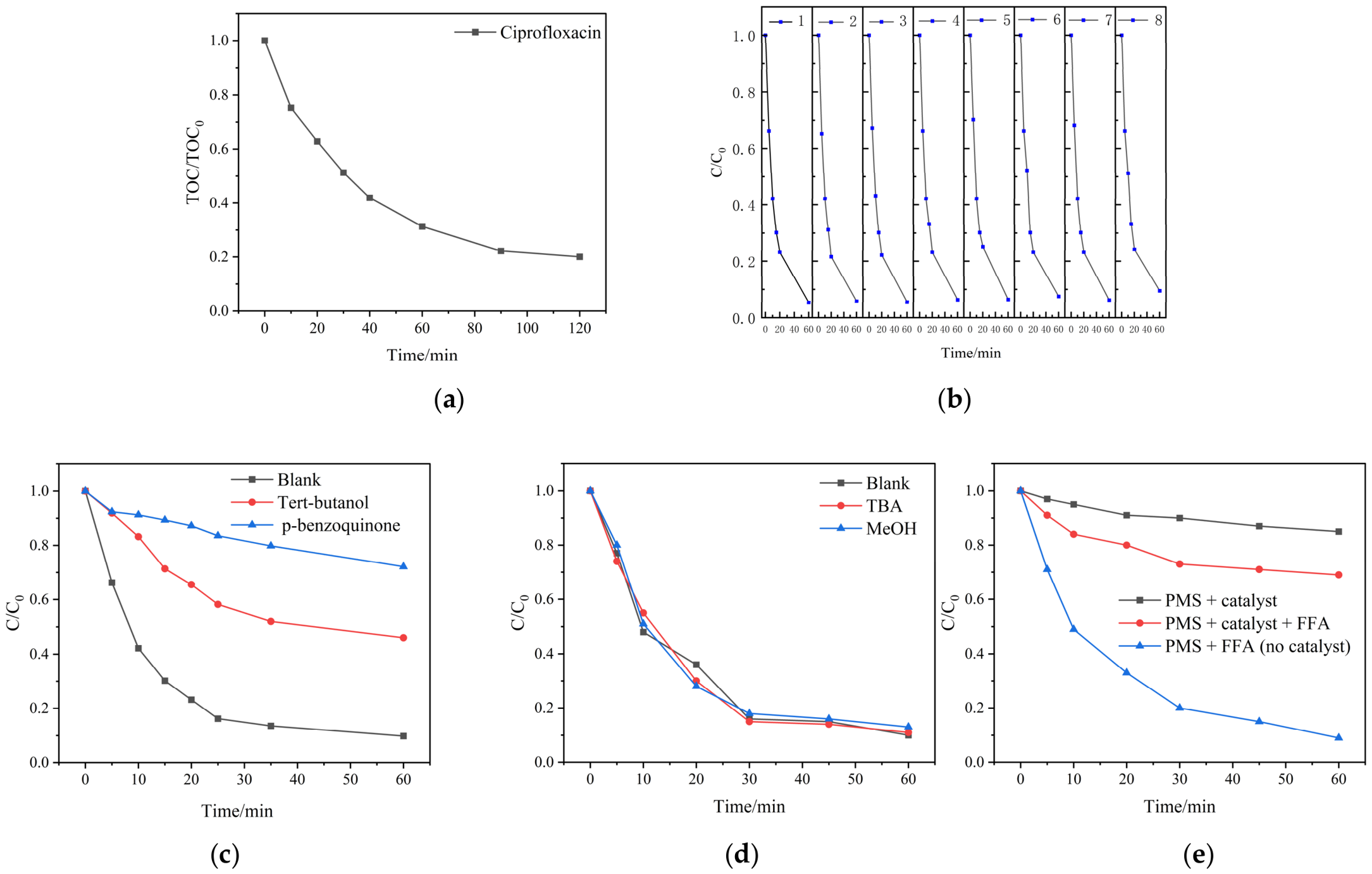
The variation in the TOC during the reaction was investigated to evaluate whether CIP underwent deep oxidation in the catalytic systems (Figure 9a). Unlike the rapid decrease in CIP concentration, the overall TOC removal efficiency was relatively low. In the single Fenton-like system, the TOC removal efficiency was 19.33%, indicating that this system could destroy the molecular structure of CIP but had limited mineralization capacity within a short reaction time [10,11]. Under enhanced oxidation, the TOC removal efficiency increased to 52.56%, suggesting that some intermediates could be further oxidized. These results indicate that CIP degradation mainly reflects the decrease in the parent pollutant concentration, whereas mineralization represents the conversion of organic C into inorganic products such as CO2 [55].
Figure 9.
Mineralization, reusability, and radical quenching analysis of ciprofloxacin degradation. (a) TOC removal during CIP degradation; (b) reusability of the catalyst over eight consecutive cycles; (c) radical quenching experiments in the RM-DCDA/H2O2 system; (d) radical quenching experiments in the SS-DS/H2O2 system; (e) radical quenching experiments in the SS-DS/PMS system (Blank, +TBA, +MeOH, +FFA, and the catalyst-free control). Quenching conditions: scavengers added before the catalyst and oxidant; for SS-DS/PMS, quencher/PMS molar ratio = 100.
Figure 9b presents the catalyst reusability. The CIP degradation efficiencies after eight consecutive cycles were 95.94%, 94.61%, 92.10%, 93.07%, 92.54%, 91.71%, 91.79%, and 90.07%. Overall, the degradation efficiency remained >90% throughout the tests, indicating the good reusability of the catalyst [14,37,41]. The slight decrease in degradation efficiency during cycling may be attributed to catalyst loss during recovery, coverage of surface-active sites by reaction intermediates, and partial leaching of Fe species [14,37]. However, the decrease was limited, suggesting that the main structure of the catalyst maintained relatively stable catalytic activity during short-term repeated use.
Radical quenching experiments were conducted using tert-butanol and p-benzoquinone to identify the main reactive species involved in the reaction. Tert-Butanol was mainly used as a scavenger for hydroxyl radicals (·OH), whereas p-benzoquinone was used to quench superoxide radicals (·O2−) [15,33]. Figure 9c–d show the results.
For the RM-DCDA/H2O2 system, CIP degradation was inhibited after the addition of scavengers, indicating that ·OH and ·O2− participated in degradation. The inhibitory effect of tert-butanol suggests the importance of ·OH in this system [55]. This result is generally consistent with the characterization results in Section 3.1, where Fe3N, the Fe2+/Fe3+ redox pair, and the N-doped C structure were identified as possible contributors to H2O2 activation [37,39].
In the SS-DS/H2O2 system, the effect of scavengers was more pronounced. In the control system, CIP degradation efficiency reached 94.60% after 60 min. The addition of tert-butanol decreased the degradation efficiency to 70.13%, and that of p-benzoquinone further decreased it to 29.65%. These results suggest that ·OH and ·O2− participated in CIP degradation in the SS-DS/H2O2 system, and the contribution of ·O2− should be noted [15,33]. Combined with the compositional features of SS-DS, Fe species may participate in H2O2 activation, whereas S-containing components may promote the conversion of Fe3+ to Fe2+, thereby maintaining the generation of reactive species [41].
For the SS-DS/PMS system, comparative quenching experiments were performed to identify the dominant reactive species. The addition of TBA (·OH scavenger) and MeOH (·OH/SO4−· scavenger) did not markedly inhibit CIP degradation, with the 60-min removal efficiency decreasing only slightly from 91.0% to 89.0% and 87.0%, respectively. This indicates that radical species (SO4−· and ·OH) were not the dominant contributors in this system. In contrast, the addition of FFA strongly suppressed CIP degradation, reducing the removal efficiency from 91.0% to 31.0%. In the catalyst-free control (PMS + CIP + FFA), only 15.0% of CIP was removed, confirming that this inhibition did not originate from a direct FFA-PMS reaction but from the scavenging of singlet oxygen generated by the catalytic system. These results demonstrate that singlet oxygen (1O2), a non-radical reactive species, played the dominant role in CIP degradation in the SS-DS/PMS system, whereas SO4−· and ·OH contributed only marginally. This non-radical-dominated pathway is consistent with the wider pH adaptability of the SS-DS/PMS system (efficient at pH 5–9 but lowest at pH 3), since 1O2-mediated oxidation is generally less sensitive to solution pH than radical pathways. It should be noted that the quenching method has recognized limitations in persulfate-based systems [36]; therefore, the present assignment is interpreted conservatively, and further confirmation by electron paramagnetic resonance (EPR) is recommended as future work. Similar non-radical, singlet-oxygen-dominated pathways have been reported for red-mud-derived catalysts activating persulfate, in which 1O2 rather than SO4−/OH governed pollutant degradation [60]. In addition, PMS activation has been widely employed for CIP degradation over various catalysts, including magnetic graphene oxide [42], further supporting the feasibility of PMS-based CIP removal.
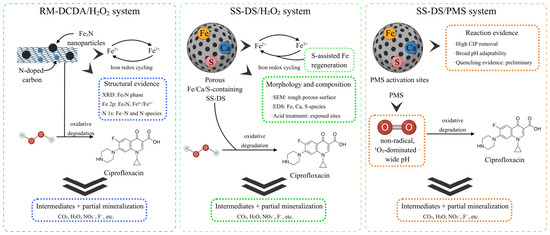
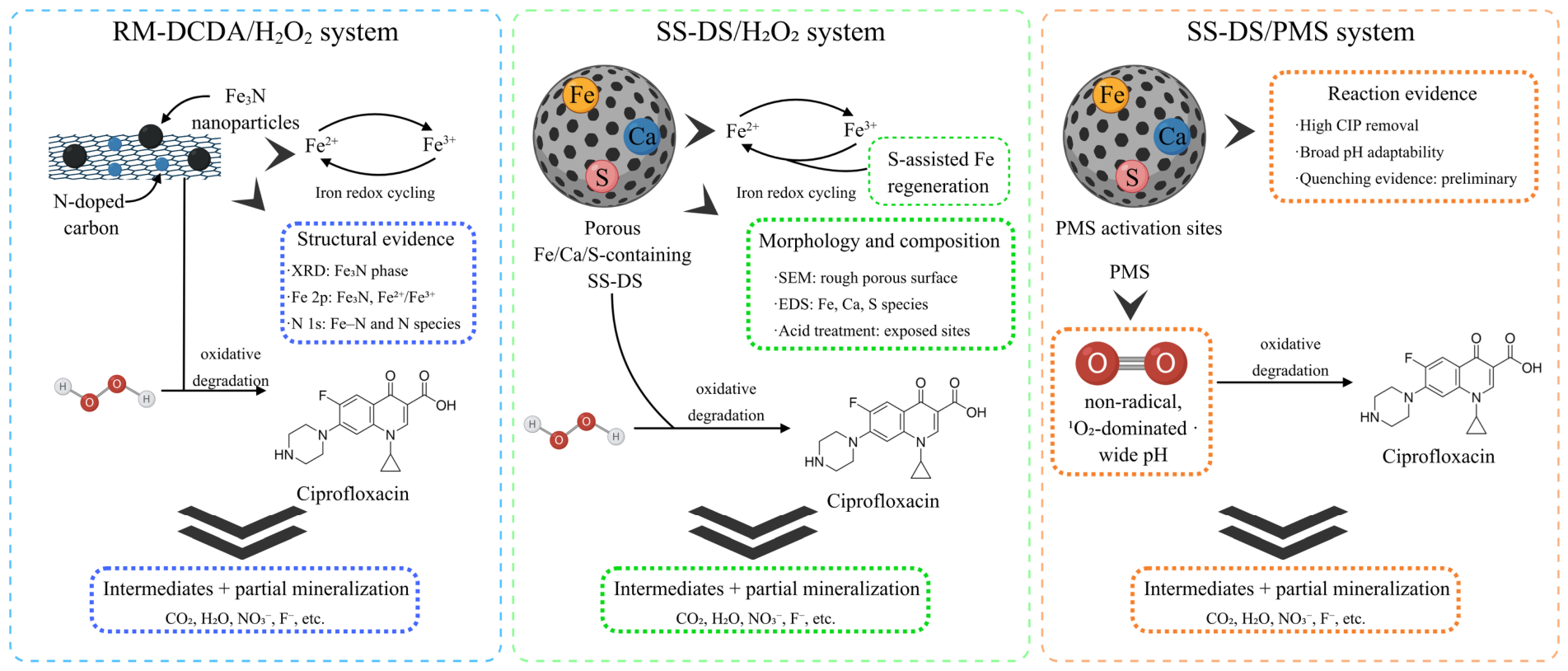
Overall, the TOC, recycling, and radical quenching results indicated that CIP removal in the three industrial solid-waste-derived catalytic systems was mainly attributed to oxidative degradation rather than simple adsorption. In the RM-DCDA/H2O2 system, the Fe3N active phase, Fe2+/Fe3+ cycling, and N-doped C structure jointly promoted H2O2 activation, generating reactive species dominated by ·OH and ·O2− [37,39]. In the SS-DS/H2O2 system, the coexistence of Fe, Ca, and S-containing components may have facilitated H2O2 activation and Fe cycling [41]. In general, in the SS-DS/PMS system, comparative quenching experiments indicated that a non-radical pathway dominated by singlet oxygen (1O2) was mainly responsible for CIP degradation, with SO4−· and ·OH playing only minor roles [18,33]. The proposed catalytic mechanisms for CIP degradation in the three systems are summarized in Figure 10.
Figure 10.
Proposed catalytic mechanisms for CIP degradation in the RM-DCDA/H2O2, SS-DS/H2O2, and SS-DS/PMS systems.
4. Conclusions
In this study, RM and SS-DS were used as raw materials to construct three industrial solid-waste-derived catalytic oxidation systems. Their CIP degradation performance, influencing factors, and preliminary reaction mechanisms were systematically investigated. RM formed an Fe3N/C composite structure after acidification and DCDA-assisted calcination. The Fe3N active phase, coexistence of Fe2+/Fe3+, and N-doped C structure enabled H2O2 activation and electron transfer. After acid modification and urea-assisted calcination, the resulting SS-DS catalyst exhibited a rough porous structure and contained Fe, Ca, and S-containing components, which could provide potential reactive sites for H2O2 and PMS activation.
The degradation experiments showed that all three systems effectively removed CIP. Under the required reaction conditions, the final degradation efficiencies of the RM-DCDA/H2O2, SS-DS/H2O2, and SS-DS/PMS systems reached 94.60%, 92.58%, and 95.17%, respectively. These results indicate that RM and SS-DS can be used as low-cost raw materials to prepare catalysts for AOPs. The raw waste exhibited negligible activity (<5% removal), and catalytic performance emerged only after modification. Although the SS-DS/PMS system showed slightly higher final degradation efficiency, the reaction conditions of the different systems were not identical. This difference should be interpreted as evidence of system applicability rather than as a strict ranking of intrinsic catalytic activity.
Parametric experiments indicated that the catalyst dosage, oxidant concentration, and initial pH affected the CIP degradation efficiency. The RM-DCDA/H2O2 and SS-DS/H2O2 systems operated better under acidic conditions, suggesting that pH limited H2O2-based Fenton-like systems. In contrast, the SS-DS/PMS system maintained high degradation performance over a wider pH range, showing relatively better environmental adaptability. In the coexisting anion experiments, HCO3− and HPO42− were more likely to inhibit the degradation process, whereas HA had a limited effect on the systems within the tested concentration range.
The TOC results showed that CIP could be further oxidized during the reaction; however, complete mineralization was not achieved within a short reaction time, indicating that intermediate products were still present. Recycling experiments showed that the catalyst retained a relatively high activity after repeated use, suggesting operational stability. Radical quenching experiments indicated that ·OH and ·O2− participated in CIP degradation in the RM-DCDA/H2O2 and SS-DS/H2O2 systems. For the SS-DS/PMS system, comparative quenching experiments indicated that singlet oxygen (1O2)-mediated non-radical oxidation was dominant, whereas SO4−· and ·OH played only minor roles; this finding is consistent with its wider pH adaptability.
It should be noted that this study is a preliminary performance evaluation. The long-term stability of the catalysts and the potential risk of metal leaching (e.g., Fe, Al, Ti, Ca, and possible trace impurities such as Cr, Ni, V, and As) were not systematically assessed and should be evaluated before practical application; a systematic investigation of metal leaching and catalyst stability is therefore designated as a direction for future work. Overall, RM and SS-DS can serve as low-cost raw materials for preparing industrial solid-waste-derived catalysts for the oxidative degradation of CIP, providing a reference for industrial solid waste valorization and antibiotic wastewater treatment.
Author Contributions
Conceptualization, D.W. and M.W.; methodology, Y.L. and J.L.; validation, J.Y., R.X. and R.S.; formal analysis, Y.L. and J.L.; investigation, Y.L., J.L. and J.Y.; resources, D.W. and Y.L.; data curation, Y.L. and M.W.; writing—original draft preparation, Y.L. and M.W.; writing—review and editing, M.W. and Y.L.; visualization, J.Y. and R.X.; supervision, M.W. and M.W.; project administration, D.W.; funding acquisition, K.D. All authors have read and agreed to the published version of the manuscript.
Funding
This research was funded by the Guangxi Key Research and Development Program (grant number GuikeAB24010118), Guangxi Science and Technology Program (Guike LT2600640045), the Natural Science Foundation of China (grant number 52260023), the Research funds of the Guangxi Key Laboratory of Theory and Technology for Environmental Pollution Control (grant number 2301Z003) and the Guangxi Talent Hub for New Materials and Equipment in Aquatic Ecosystem Restoration and the Innovation Project of Guangxi Graduate Education (YCBA2025169).
Informed Consent Statement
Not applicable.
Data Availability Statement
The original contributions presented in the study are included in the article, and further inquiries can be directed to the corresponding author.
Conflicts of Interest
The authors declare no conflicts of interest.
References
- Wilkinson, J.L.; Boxall, A.B.A.; Kolpin, D.W.; Leung, K.M.Y.; Lai, R.W.S.; Galbán-Malagón, C.; Adell, A.D.; Mondon, J.; Metian, M.; Marchant, R.A.; et al. Pharmaceutical pollution of the world’s rivers. Proc. Natl. Acad. Sci. USA 2022, 119, e2113947119. [Google Scholar] [CrossRef] [Scilit] [PubMed]
- Maghsodian, Z.; Sanati, A.M.; Mashifana, T.; Sillanpää, M.; Feng, S.; Nhat, T.; Ramavandi, B. Occurrence and distribution of antibiotics in the water, sediment, and biota of freshwater and marine environments: A review. Antibiotics 2022, 11, 1461. [Google Scholar] [CrossRef] [Scilit] [PubMed]
- Grenni, P.; Ancona, V.; Caracciolo, A.B. Ecological effects of antibiotics on natural ecosystems: A review. Microchem. J. 2018, 136, 25–39. [Google Scholar] [CrossRef] [Scilit]
- Janecko, N.; Pokludova, L.; Blahova, J.; Svobodova, Z.; Literak, I. Implications of fluoroquinolone contamination for the aquatic environment: A review. Environ. Toxicol. Chem. 2016, 35, 2647–2656. [Google Scholar] [CrossRef] [Scilit] [PubMed]
- Riaz, L.; Mahmood, T.; Khalid, A.; Rashid, A.; Siddique, M.B.A.; Kamal, A.; Coyne, M.S. Fluoroquinolones (FQs) in the environment: A review on their abundance, sorption and toxicity in soil. Chemosphere 2018, 191, 704–720. [Google Scholar] [CrossRef] [Scilit] [PubMed]
- da Silva Bruckmann, F.; Vieira, Y.; Bender, C.R.; dos Reis, G.S.; Silva, L.F.O.; Crissien, T.; Sellaoui, L.; Dotto, G.L. Occurrence, toxicity, ecological aspects, and environmental removal of ciprofloxacin, levofloxacin, and other fluoroquinolones excreted in urine. J. Water Process Eng. 2025, 77, 108593. [Google Scholar] [CrossRef] [Scilit]
- Du, J.; Liu, Q.; Pan, Y.; Xu, S.; Li, H.; Tang, J. The research status, potential hazards and toxicological mechanisms of fluoroquinolone antibiotics in the environment. Antibiotics 2023, 12, 1058. [Google Scholar] [CrossRef] [Scilit] [PubMed]
- Hanna, N.; Tamhankar, A.J.; Lundborg, C.S. Antibiotic concentrations and antibiotic resistance in aquatic environments of the WHO Western Pacific and South-East Asia regions: A systematic review and probabilistic environmental hazard assessment. Lancet Planet. Health 2023, 7, e45–e54. [Google Scholar] [CrossRef] [Scilit]
- Liang, H.; Zhang, J.; Hu, J.; Li, X.; Li, B. Fluoroquinolone residues in the environment rapidly induce heritable fluoroquinolone resistance in Escherichia coli. Environ. Sci. Technol. 2023, 57, 4784–4795. [Google Scholar] [CrossRef] [Scilit] [PubMed]
- Phoon, B.L.; Ong, C.C.; Saheed, M.S.M.; Show, P.L.; Chang, J.S.; Ling, T.C.; Lam, S.S.; Juan, J.C. Conventional and emerging technologies for removal of antibiotics from wastewater. J. Hazard. Mater. 2020, 400, 122961. [Google Scholar] [CrossRef] [Scilit] [PubMed]
- Ahmed, Y.; Maya, A.A.S.; Akhtar, P.; AlMohamadi, H.; Mohammad, A.W.; Ashekuzzaman, S.M.; Olbert, A.I.; Uddin, M.G. Advancements and challenges in Fenton-based advanced oxidation processes for antibiotic removal in wastewater: From the laboratory to practical applications. J. Environ. Chem. Eng. 2025, 13, 115068. [Google Scholar] [CrossRef] [Scilit]
- Jiang, Y.; Ran, J.; Mao, K.; Yang, X.; Zhong, L.; Yang, C.; Feng, X.; Zhang, H. Recent progress in Fenton/Fenton-like reactions for the removal of antibiotics in aqueous environments. Ecotoxicol. Environ. Saf. 2022, 236, 113464. [Google Scholar] [CrossRef] [Scilit] [PubMed]
- Neyens, E.; Baeyens, J. A review of classic Fenton’s peroxidation as an advanced oxidation technique. J. Hazard. Mater. 2003, 98, 33–50. [Google Scholar] [CrossRef] [Scilit] [PubMed]
- Thomas, N.; Dionysiou, D.D.; Pillai, S.C. Heterogeneous Fenton catalysts: A review of recent advances. J. Hazard. Mater. 2021, 404, 124082. [Google Scholar] [CrossRef] [Scilit] [PubMed]
- Wang, J.; Wang, S. Reactive species in advanced oxidation processes: Formation, identification and reaction mechanism. Chem. Eng. J. 2020, 401, 126158. [Google Scholar] [CrossRef] [Scilit]
- Wacławek, S.; Lutze, H.V.; Grübel, K.; Padil, V.V.T.; Černík, M.; Dionysiou, D.D. Chemistry of persulfates in water and wastewater treatment: A review. Chem. Eng. J. 2017, 330, 44–62. [Google Scholar] [CrossRef] [Scilit]
- Ghanbari, F.; Moradi, M. Application of peroxymonosulfate and its activation methods for degradation of environmental organic pollutants. Chem. Eng. J. 2017, 310, 41–62. [Google Scholar] [CrossRef] [Scilit]
- Lee, J.; von Gunten, U.; Kim, J.H. Persulfate-based advanced oxidation: Critical assessment of opportunities and roadblocks. Environ. Sci. Technol. 2020, 54, 3064–3081. [Google Scholar] [CrossRef] [Scilit] [PubMed]
- Oh, W.D.; Dong, Z.; Lim, T.T. Generation of sulfate radical through heterogeneous catalysis for organic contaminants removal: Current development, challenges and prospects. Appl. Catal. B Environ. 2016, 194, 169–201. [Google Scholar] [CrossRef] [Scilit]
- Shah, N.S.; Rizwan, A.D.; Khan, J.A.; Sayed, M.; Khan, Z.U.H.; Murtaza, B.; Iqbal, J.; Din, S.U.; Imran, M.; Nadeem, M.; et al. Toxicities, kinetics and degradation pathways investigation of ciprofloxacin degradation using iron-mediated H2O2 based advanced oxidation processes. Process Saf. Environ. Prot. 2018, 117, 473–482. [Google Scholar] [CrossRef] [Scilit]
- Kyzas, G.Z.; Mengelizadeh, N.; Khodadadi Saloot, M.; Mohebi, S.; Balarak, D. Sonochemical degradation of ciprofloxacin by hydrogen peroxide and persulfate activated by ultrasound and ferrous ions. Colloids Surf. A Physicochem. Eng. Asp. 2022, 642, 128627. [Google Scholar] [CrossRef] [Scilit]
- Li, Z.; Zhang, Y.; Bi, W.; Liu, F. Degradation of ciprofloxacin by hydrogen peroxide activated with pyrite under simulated sunlight. J. Water Process Eng. 2024, 68, 106389. [Google Scholar] [CrossRef] [Scilit]
- Li, T.; Liang, Z.; Zhao, Y.; Yang, T.; Ji, H.; Li, Z. Revisiting steel slag as a modified catalyst in advanced oxidation processes for the degradation of emerging pollutants in water: A review. Environ. Res. 2026, 298, 124199. [Google Scholar] [CrossRef] [Scilit] [PubMed]
- Wang, S.; Jin, H.; Deng, Y.; Xiao, Y. Comprehensive utilization status of red mud in China: A critical review. J. Clean. Prod. 2021, 289, 125136. [Google Scholar] [CrossRef] [Scilit]
- Agrawal, S.; Dhawan, N. Evaluation of red mud as a polymetallic source: A review. Miner. Eng. 2021, 171, 107084. [Google Scholar] [CrossRef] [Scilit]
- Gao, W.; Zhou, W.; Lyu, X.; Liu, X.; Su, H.; Li, C.; Wang, H. Comprehensive utilization of steel slag: A review. Powder Technol. 2023, 422, 118449. [Google Scholar] [CrossRef] [Scilit]
- Liu, Y.; Lin, C.; Wu, Y. Characterization of red mud derived from a combined Bayer Process and bauxite calcination method. J. Hazard. Mater. 2007, 146, 255–261. [Google Scholar] [CrossRef] [Scilit] [PubMed]
- Moreira, D.T.; Menezes, M.A.B.C.; Batista, A.S.M. Characterization of steel slag by SEM-EDS, XRD, and INAA. Braz. J. Radiat. Sci. 2021, 9. [Google Scholar] [CrossRef] [Scilit]
- Chen, H.; Long, Q.; Zhang, Y.; Yang, H.; Shu, J. Using red mud to prepare the iron-bearing catalyst for the efficient degradation of phenol in the Fenton-like process. Arab. J. Chem. 2024, 17, 105797. [Google Scholar] [CrossRef] [Scilit]
- Shao, L.; Wei, G.; Wang, Y.; Li, Z.; Zhang, L.; Zhao, S.; Zhou, M. Preparation and application of acidified/calcined red mud catalyst for catalytic degradation of butyl xanthate in Fenton-like process. Environ. Sci. Pollut. Res. 2016, 23, 15202–15207. [Google Scholar] [CrossRef] [Scilit]
- Xu, K.; Lin, Q.; Fan, X.; Zheng, J.; Liu, Y.; Ma, Y.; He, J. Enhanced degradation of sulfamethoxazole by activation of peroxodisulfate with red mud modified biochar: Synergistic effect between adsorption and nonradical activation. Chem. Eng. J. 2023, 460, 141578. [Google Scholar] [CrossRef] [Scilit]
- Shi, T.; Guo, M.; Gao, H.; Wang, Y.; Li, H.; Wu, M.; Cheng, D.; Han, Y.; Wang, D. Removal of tetracycline by steel slag-red mud composite pellets: Adsorption performance and mechanism. Appl. Surf. Sci. 2025, 688, 162363. [Google Scholar] [CrossRef] [Scilit]
- Liu, W.; Lu, Y.; Dong, Y.; Jin, Q.; Lin, H. A critical review on reliability of quenching experiment in advanced oxidation processes. Chem. Eng. J. 2023, 466, 143161. [Google Scholar] [CrossRef] [Scilit]
- Urán-Duque, L.; Saldarriaga-Molina, J.C.; Rubio-Clemente, A. Advanced oxidation processes based on sulfate radicals for wastewater treatment: Research trends. Water 2021, 13, 2445. [Google Scholar] [CrossRef] [Scilit]
- Matzek, L.W.; Carter, K.E. Activated persulfate for organic chemical degradation: A review. Chemosphere 2016, 151, 178–188. [Google Scholar] [CrossRef] [Scilit] [PubMed]
- Zhuang, Y.; Wang, X.; Shah, K.J.; Sun, Y. A review on the preparation of catalysts using red mud resources. Catalysts 2025, 15, 809. [Google Scholar] [CrossRef] [Scilit]
- Liu, S.; Liu, J.; Wang, J.; Liu, Y.; Yang, B.; Hong, M.; Yu, S.; Qiu, G.; Fang, Y. Heterogeneous Fenton degradation of ciprofloxacin by RM-Co PBA prepared with red mud as iron source and carrier. J. Environ. Manag. 2025, 375, 124356. [Google Scholar] [CrossRef] [Scilit]
- Lu, C.; Wei, G.; Ba, J.; Li, Q.; Zhang, L.; Li, Z.; Cen, L.; Ma, J.; Song, Y. Three-dimensional electro-Fenton degradation of ciprofloxacin catalyzed by CuO doped red mud particle electrodes: Electrodes preparation, kinetics and mechanism. J. Environ. Chem. Eng. 2022, 10, 107151. [Google Scholar] [CrossRef] [Scilit]
- Li, X.; Jia, Y.; Zhou, M.; Su, X.; Sun, J. High-efficiency degradation of organic pollutants with Fe, N co-doped biochar catalysts via persulfate activation. J. Hazard. Mater. 2020, 397, 122764. [Google Scholar] [CrossRef] [Scilit] [PubMed]
- Long, Y.; Huang, Y.; Wu, H.; Shi, X.; Xiao, L. Peroxymonosulfate activation for pollutants degradation by Fe-N-codoped carbonaceous catalyst: Structure-dependent performance and mechanism insight. Chem. Eng. J. 2019, 369, 542–552. [Google Scholar] [CrossRef] [Scilit]
- Nasuha, N.; Ismail, S.; Hameed, B.H. Activated electric arc furnace slag as an efficient and reusable heterogeneous Fenton-like catalyst for the degradation of Reactive Black 5. J. Taiwan Inst. Chem. Eng. 2016, 67, 235–243. [Google Scholar] [CrossRef] [Scilit]
- Wang, X.; Li, Y.; Qin, J.; Pan, P.; Shao, T.; Long, X.; Jiang, D. Degradation of ciprofloxacin in water by magnetic-graphene-oxide-activated peroxymonosulfate. Toxics 2023, 11, 1016. [Google Scholar] [CrossRef] [Scilit] [PubMed]
- Wang, X.; Li, Y.; Chen, H.; Zhang, L.; Zhou, C.; Cong, J.; Geng, C.; Hui, B. Enhanced peroxymonosulfate activation for ciprofloxacin degradation enabled by a delignified wood-derived carbon. Environ. Res. 2025, 286, 123019. [Google Scholar] [CrossRef] [Scilit] [PubMed]
- Bai, B.; Bai, F.; Li, X.; Nie, Q.; Jia, X.; Wu, H. The remediation efficiency of heavy metal pollutants in water by industrial red mud particle waste. Environ. Technol. Innov. 2022, 28, 102944. [Google Scholar] [CrossRef] [Scilit]
- Yang, R.; Wang, Z.; Guo, J.; Qi, J.; Liu, S.; Zhu, H.; Li, B.; Liu, Z. Catalytic degradation of antibiotic sludge to produce formic acid by acidified red mud. Environ. Res. 2024, 245, 117970. [Google Scholar] [CrossRef] [Scilit] [PubMed]
- Shen, C.; Dong, X.; Yang, J.; Li, Y.; Cui, S.; Zhang, D.; Lin, X. Red mud-based magnetic biochar composite as a peroxydisulfate activator for tetracycline degradation. Environ. Res. 2025, 279, 121793. [Google Scholar] [CrossRef] [Scilit] [PubMed]
- Hou, J.; Lin, J.; Fang, L.; Zhang, X.; Ma, R.; Luo, J. Microwave-catalyzed pyrolysis of waste engine oil using steel slag catalyst: Structure design and insights into the intrinsic mechanism of active catalytic sites and microwave absorption functions. Chem. Eng. J. 2023, 471, 144171. [Google Scholar] [CrossRef] [Scilit]
- Zhou, X.; Chen, X.; Han, W.; Han, Y.; Guo, M.; Peng, Z.; Fan, Z.; Shi, Y.; Wan, S. Tetracycline removal by hercynite-biochar from the co-pyrolysis of red mud-steel slag-sludge. Nanomaterials 2022, 12, 2595. [Google Scholar] [CrossRef] [Scilit] [PubMed]
- Shi, J.; Wang, W.; Li, Z.; Shi, Y. Ciprofloxacin removal via acid-modified red mud: Optimizing the process, analyzing the adsorption features, and exploring the underlying mechanism. Molecules 2024, 29, 2928. [Google Scholar] [CrossRef] [Scilit] [PubMed]
- Huang, F.; Ma, H.; Li, Z.; Zhang, L.; Li, J.; Chen, S.; Zhou, P.; Chen, G. Heterogeneous catalytic ozonation of ciprofloxacin in wastewater with red mud: Characterization and performance. J. Water Process Eng. 2024, 64, 105667. [Google Scholar] [CrossRef] [Scilit]
- Yang, J.; Wang, S.; Luo, X.; Yu, Z.; Zhou, Y. Fenton-like process in antibiotic-containing wastewater treatment: Applications and toxicity evaluation. Chin. Chem. Lett. 2025, 36, 110996. [Google Scholar] [CrossRef] [Scilit]
- Wang, L.; Jiang, J.; Ma, J.; Pang, S.; Zhang, T. A review on advanced oxidation processes homogeneously initiated by copper(II). Chem. Eng. J. 2022, 427, 131721. [Google Scholar] [CrossRef] [Scilit]
- Rayaroth, M.P.; Aravind, U.K.; Aravindakumar, C.T. Degradation of pharmaceuticals by ultrasound-based advanced oxidation process. Environ. Chem. Lett. 2016, 14, 259–290. [Google Scholar] [CrossRef] [Scilit]
- Pimentel Prates, M.; de Oliveira Loures Marcionílio, S.M.; Borges Machado, K.; Medeiros de Araújo, D.; Martínez-Huitle, C.A.; Leão Arantes, A.L.; Ferreira da Silva Gadêlha, J.E. Fenton: A systematic review of its application in wastewater treatment. Processes 2023, 11, 2466. [Google Scholar] [CrossRef] [Scilit]
- Liu, Y.; He, X.; Fu, Y.; Dionysiou, D.D. Degradation kinetics and mechanism of oxytetracycline by hydroxyl radical-based advanced oxidation processes. Chem. Eng. J. 2016, 284, 1317–1327. [Google Scholar] [CrossRef] [Scilit]
- Matilainen, A.; Sillanpää, M. Removal of natural organic matter from drinking water by advanced oxidation processes. Chemosphere 2010, 80, 351–365. [Google Scholar] [CrossRef] [Scilit] [PubMed]
- Sillanpää, M.; Ncibi, M.C.; Matilainen, A. Advanced oxidation processes for the removal of natural organic matter from drinking water sources: A comprehensive review. J. Environ. Manag. 2018, 208, 56–76. [Google Scholar] [CrossRef] [Scilit]
- Qu, J.; Peng, J. Significance and enlightenment of implementing water ecological assessment. Water Ecol. 2025, 1, 100002. [Google Scholar] [CrossRef] [Scilit]
- Qu, J.; Rose, J.B. Why WE? A scientific odyssey for planetary sustainability via Water & Ecology. Water Ecol. 2025, 1, 100005. [Google Scholar] [CrossRef] [Scilit]
- Xu, B.; An, Q.; Deng, S.; Li, Z.; Yang, Z.; Wu, H.; Ye, Z. Acid-modified red mud biochar for the degradation of tetracycline: Synergistic effect of adsorption and nonradical activation. J. Environ. Manag. 2023, 347, 119077. [Google Scholar] [CrossRef] [Scilit]
Disclaimer/Publisher’s Note: The statements, opinions and data contained in all publications are solely those of the individual author(s) and contributor(s) and not of MDPI and/or the editor(s). MDPI and/or the editor(s) disclaim responsibility for any injury to people or property resulting from any ideas, methods, instructions or products referred to in the content. |
© 2026 by the authors. Licensee MDPI, Basel, Switzerland. This article is an open access article distributed under the terms and conditions of the Creative Commons Attribution (CC BY) license.