


Abstract
This study investigates the effect of dilute organic acid treatment on the structural, textural, electronic, and catalytic properties of layered La–Sr–Fe–O Ruddlesden–Popper (R–P) oxides using XRD, TEM, BET, Mössbauer spectroscopy, XPS, H2-TPR, C2H6-TPR and catalytic testing. XRD and TEM confirm that the overall layered Ruddlesden–Popper structure is preserved after acid treatment and during catalysis, with minor changes in phase composition, including a decrease in the n = 1 phase and a relative increase in the n = 2 phase. BET analysis shows increased specific surface area and pore volume, forming a more accessible mesoporous structure that is retained under reaction conditions. Mössbauer spectroscopy and XPS reveal an increased Fe4+ fraction and formation of hydroxylated and carbonated surface species stabilizing active Fe sites. During catalysis, a dynamic Fe3+/Fe4+ redox cycle occurs, along with surface restructuring and involvement of non-lattice oxygen, while the bulk electronic structure remains largely unchanged. Catalytic tests show improved activity, with a 40–60 °C reduction in operating temperature for all acid-treated samples, independent of acid type. This enhancement is mainly attributed to surface-related modifications, including removal of surface Sr-containing species, improved surface accessibility, and enhanced mass transport, while the overall R–P structural remains preserved.
1. Introduction
Air pollution caused by volatile organic compounds (VOCs) is a serious environmental issue of global importance. These compounds are major atmospheric pollutants with significant effects on air quality and climate change. The main anthropogenic sources of VOCs include the chemical industry, fossil fuel combustion, transport, pharmaceutical production, and other industrial activities [1,2]. Increasing VOC emissions from industrial and domestic sources pose risks to both the environment and human health. They participate in photochemical reactions that lead to the formation of ground-level ozone and secondary organic aerosols, key components of photochemical smog [3,4]. Therefore, developing effective VOC removal technologies is essential for reducing atmospheric pollution.
One of the most efficient methods for VOC removal is catalytic oxidation, where organic compounds are converted into CO2 and H2O at relatively low temperatures [5,6]. The effectiveness of this process depends strongly on catalyst properties such as electronic structure, surface characteristics, and oxygen activation ability [7].
Perovskite oxides with the ABO3-type structure have attracted considerable attention in recent years due to their high thermal stability, flexible crystal structure, and the possibility of partial cation substitution within the lattice. These materials are capable of forming oxygen vacancies that facilitate redox processes and significantly enhance catalytic activity [8,9,10]. The crystal structure of perovskites allows substitution at both the A-site and the B-site of the lattice, resulting in tunable changes in the electronic structure, oxygen mobility, and catalytic performance. In general, A-site cations, typically rare-earth or alkaline-earth metals, stabilize the crystal structure and influence the thermal and chemical stability of the material, whereas B-site cations, most commonly transition metals, act as the primary active centers for oxidation–reduction reactions [11,12,13].
Layered perovskite structures, including the Ruddlesden–Popper (R–P) phases, demonstrate significant potential for catalytic applications due to their enhanced oxygen transport properties and adaptable structural organization [14]. These materials consist of alternating layers, which facilitates the formation of oxygen vacancies and the stabilization of variable oxidation states of transition metals. These two factors are critically important for redox catalytic processes [15]. Perovskites based on LaFeO3 have been extensively studied as catalysts for various oxidation reactions, including the catalytic oxidation of hydrocarbons and volatile organic compounds. Their physicochemical properties and catalytic activity strongly depend on the synthesis method employed and the presence of defects in the crystal structure, such as oxygen vacancies and changes in the valence state of iron [16]. Perovskite oxides such as LaFeO3 and partially Sr-substituted La1−xSrxFeO3−δ exhibit high thermal stability and good resistance to deactivation in the presence of H2O and CO2, making them promising catalysts for high-temperature oxidation processes [17].
An effective approach to improving the catalytic properties of perovskites is the partial substitution of La3+ with divalent cations such as Sr2+. In the La1−x SrxFeO3 system, such substitution leads to an electronic imbalance that is compensated by the oxidation of Fe3+ to Fe4+ and the formation of oxygen vacancies. These structural modifications enhance lattice oxygen mobility and improve the reducibility of the material, which is crucial for catalytic oxidation processes [18,19,20]. It has been reported that La0.8Sr0.2FeO3 exhibits significantly higher catalytic activity in reactions such as CO and methane oxidation. This enhancement is attributed to the presence of oxygen vacancies, which facilitate the adsorption and dissociation of oxygen on the catalyst surface as well as the diffusion of lattice oxygen toward the active sites [21].
Oxygen vacancies play a crucial role in the catalytic oxidation of VOCs by facilitating oxygen activation and enabling the participation of lattice oxygen in the reaction mechanism. The oxidation process over perovskite oxide catalysts is commonly described by the Mars–van Krevelen mechanism, in which lattice oxygen reacts with the organic molecule, while the resulting oxygen vacancy is replenished by oxygen from the gas phase [22,23]. The presence of surface defects and cation vacancies can significantly increase the concentration of reactive oxygen species and thereby enhance the catalytic activity in the oxidation of aromatic VOCs such as toluene [18].
Surface modification is another effective strategy to tailor the catalytic properties of perovskite oxides [24,25]. Acid treatment has been demonstrated as a powerful approach for generating oxygen vacancies and structural defects, leading to the formation of new active sites and an increase in specific surface area. Selective leaching of A-site cations and surface reconstruction can significantly enhance catalytic performance. For example, treatment of LaFeO3 with nitric acid leads to selective extraction of La from the surface layer and exposure of Fe–O active sites, improving methane oxidation activity [26]. Acid etching of Mn-containing perovskites results in dissolution of A-site cations and the formation of oxygen vacancies, enhancing CO oxidation performance [7]. Similar effects have been reported for La0.8Sr0.2CoO3 treated with oxalic acid, where oxygen vacancies and Lewis acidic Con+ centers promote methane oxidation [27]. In three-dimensionally ordered macroporous (3DOM) LaFe0.6Mg0.4O3, acid treatment induces B-site defects and increases oxygen vacancy concentration, enhancing the Fe3+/Fe4+ redox cycle and catalytic activity [28].
Despite significant progress in perovskite-based catalysts, the relationship between structural modification and catalytic activity is still not fully understood. In particular, the influence of acid treatment on the surface structure, defect chemistry, and catalytic behavior of La–Sr–Fe–O perovskites remains insufficiently explored. Although numerous studies have demonstrated the beneficial effect of acid treatment on conventional ABO3-type perovskites such as LaFeO3 and Co-based systems, considerably less attention has been paid to layered Ruddlesden–Popper ferrites with high Sr content. These materials possess distinctive structural features, enhanced oxygen mobility, and mixed-valence iron states, which make them promising candidates for oxidation reactions but also render their response to acid treatment more complex and less understood. To the best of our knowledge, a systematic correlation between acid-induced structural modifications and catalytic performance in layered La–Sr–Fe–O Ruddlesden–Popper systems has not been sufficiently established.
In our previous study, catalysts with nominal composition La2−x SrxFeO4, where x = 0.5, 1, and 1.5, were successfully synthesized and investigated for the complete oxidation of C1–C4 hydrocarbons (methane, ethane, propane, and n-butane) as representative compounds of volatile organic compounds (VOCs) [29]. The La0.5Sr1.5FeO4 catalyst exhibited the highest activity in the VOC oxidation processes. This finding motivated the selection of this composition for further investigation of the effect of surface modification on its structural and catalytic properties.
In this context, the present study is focused on the synthesis of perovskite oxides from the La0.5Sr1.5FeO4 system via the sol–gel method, followed by acid treatment aimed at modifying the surface structure and improving the catalytic activity in the oxidation of volatile organic compounds.
2. Materials and Methods
2.1. Synthesis
La2O3 (99.9%, Alfa Aesar, Karlsruhe, Germany), Sr(NO3)2 (98%, Alfa Aesar, Karlsruhe, Germany), and Fe(NO3)3·9H2O (98.0–101.0%, Alfa Aesar, Karlsruhe, Germany) were used as metal precursors without further purification. Other reagents used during the synthesis, including HNO3, C6H8O7·H2O, and CH3COOH, were of analytical grade and purchased from Chem-spectr Ltd., Sofia, Bulgaria.
The material with nominal composition La0.5Sr1.5FeO4 was synthesized via a citrate sol–gel auto-combustion method, using the corresponding metal nitrates and citric acid as a complexing/fuel agent. The molar ratio of citric acid to the total metal ions was 3.3:1. The experimental procedure was as follows: La2O3, Sr(NO3)2, and Fe(NO3)3·9H2O in a molar ratio of 1:3:2 were dissolved in an aqueous nitric acid solution at room temperature under continuous stirring. Citric acid was then added, and stirring continued at 100 °C. The auto-combustion process was carried out by heating the mixture in a furnace at 200 °C for 2 h. The resulting material was further thermally treated at 1100 °C for an additional 2 h to ensure complete phase formation [29,30]. The initial sample was denoted as IS.
For acid treatment, 0.02 M citric acid and 0.02 M acetic acid solutions were prepared. Then, 2.3 g of the synthesized IS sample was added in 50 mL acid solution and stirred continuously for 1 h at room temperature without additional heating. The samples were then centrifuged for 10 min at 4200 rpm, washed with deionized water, centrifuged again for an additional 10 min, and dried under vacuum at 60 °C. The resulting materials were designated as CA and AA, corresponding to samples treated with citric and acetic acids, respectively.
In order to assess the suitability of the synthesized material for potential practical applications, the AA sample was subjected to prolonged thermal treatment in an air atmosphere at 550 °C for a period of 200 h. This procedure was carried out to simulate long-term operating conditions, and the sample obtained after this treatment is referred to as thermally aged (AA, thermally aged).
2.2. Characterization Techniques
Powder X-ray diffraction analysis (XRD) was used for characterization of the samples. X-ray patterns were collected on a Bruker D8 Advance diffractometer (Karlsruhe, Germany) with CuKα radiation (λ = 1.5418Å) and a LynxEye detector in the range 5–80° 2θ with a constant step of 0.02° 2θ. Identification of crystalline phases was performed with EVA (v4) software using the ICDD-PDF2 (2024) database. Unit cell parameters, crystallite sizes, and phase mass content were calculated using the Topas 4 program.
The textural characteristics of the catalyst samples were examined by low-temperature nitrogen adsorption in a Quantachrome NOVA 1200e Surface&Pore Analyzer (AntonPaar Quanta Tech Inc., Boynton Beach, FL, USA). The specific surface area was calculated by using the Brunauer Emmett Teller (BET) equation, the total pore volume and average pore diameter being determined at a relative pressure of 0.99.
The Mössbauer spectra were obtained with a WissEl (Wissenschaftliche Elektronik GmbH, Starnberg, Germany) electromechanical spectrometer working in a constant acceleration mode. A 57Co/Rh (activity ≅ 50 mCi) source and α-Fe standard were used. The experimentally obtained spectra were fitted using WinNormos-for-Igor v.6.0 software. The parameters of hyperfine interaction, including isomer shift (δ), quadrupole splitting (Δ), quadrupole shift (2ε), effective internal magnetic field (Bhf), line widths (Γexp), and relative weight (G) of the partial components in the spectra, were determined.
X-ray photoelectron spectroscopy (XPS) was carried out using an ESCALAB Mk II spectrometer (VG Scientific, now Thermo Fisher Scientific, Waltham, MA, USA) at a base pressure of 5 × 10⁻¹⁰ mbar in the analysis chamber (2 × 10⁻⁹ mbar during measurement), using a non-monochromatic Al Kα source (hν = 1486.6 eV). The pass energy was set to 20 eV for O 1s and C 1s spectra and 50 eV for Fe 2p, Sr 3d, and La 3d in order to balance signal intensity and resolution. The instrumental resolution, determined from the Ag 3d5/2 line, was approximately 1 eV. Data were processed using SpecsLab2 and CasaXPS software (version 2.3.26PR1). A Shirley-type background [31] was subtracted, and the spectra were fitted with mixed Gaussian–Lorentzian functions. Relative atomic concentrations were determined from the peak areas normalized to Scofield photoionization cross-sections [32].
The morphology, microstructure and phase composition of the ferrites were studied with a JEOL JEM 2100 transmission electron microscope (JEOL Ltd., Tokyo, Japan) at 200 kV accelerating voltage. The following modes of the microscope were used for this purpose: bright-field transmission electron microscopy (BF TEM), selected area electron diffraction (SAED) and high-resolution TEM (HR TEM). The images were recorded with a CCD camera ORIUS SC1000 (Gatan, Inc., Pleasanton, CA 94588, USA) equipped with Digital Micrograph software, version 2.31.734.0, through which some of the calculations were made. The phase analysis was performed using the Crystallography Open Database (COD) and Match software, version 3.13 (Crystal Impact GbR, Bonn, Germany).
Temperature-programmed reduction by ethane (C2H6/TPR) tests were performed by using a gas flow of nitrogen (500 mL/min), plus the adding of 500 ppm of ethane. The gas analysis for TPR experiments was carried out by on-line gas analyzers for CO/CO2/O2 (NDIR, Mod. 710S, Maihak-Sick, Reute, Germany) and for total organic content (TOC) (ThermoFID, equipped with flame ionization detector), a multi-channel mass flow controller system (Bronkhorst) was used to set up the compositions of the different reaction gas mixtures.
Temperature-programmed reduction by hydrogen (H2/TPR) tests were performed by using a system of two consequent reactors. The first reactor is loaded with the catalyst under TPR investigation and a gas flow of nitrogen (500 mL/min), plus the adding of 1000 ppm of hydrogen is applied. Then, 1000 ppm oxygen are supplied to the exit gas from the first reactor and the gas mixture is directed to the second reactor, loaded with 2 cm3 commercial Pt/alumina catalyst operating at 450 °C, where the residual from the first reactor hydrogen is oxidized. The amount of the consumed hydrogen is obtained on the basis of the residual oxygen concentration, measured at the exit of the second reactor. The increase in the oxygen concentration (above the nominal 500 ppm in absence of catalyst in the first reactor) is directly proportional to the oxygen from the catalytic sample, reacting with the hydrogen supplied to the first reactor during the increase in the temperature with 7.5 K/min. The oxygen concentration was measured by utilizing a highly precise SGM4 ZIROX (ZIROX—Sensoren und Elektronik GmbH, Greifswald, Germany) oxygen gas analyzer equipped with zirconia sensor with a resolution of 0.1 ppm gas phase oxygen.
2.3. Catalytic Activity Measurement
Catalytic activity was investigated in a laboratory-scale continuous flow glass reactor operated under fixed-bed conditions. The total bed volume was 0.7 cm3, consisting of 0.5 cm3 of catalyst mixed with 0.2 cm3 of quartz glass. The catalyst particles were irregularly shaped, with an average diameter of 0.45 ± 0.15 mm. The reactor had an internal diameter of 6 mm, yielding a reactor-to-particle diameter ratio (Dreactor/Dparticle) of at least 10, thereby reducing axial and radial heat and mass transfer limitations. The gaseous hourly space velocity (GHSV) was kept constant at 60,000 h−1 for all experiments. The inlet concentration of VOCs was set at 0.10 vol.% for each component, with oxygen fixed at 10.0 vol.%. The reaction temperature was maintained below 550 °C, which was considered the practical upper limit for VOC abatement processes. Gas flow rates were accurately regulated using mass flow controllers supplied by Bronkhorst (Bronkhorst High Tech B.V., Ruurlo, The Netherlands). Reaction products were continuously analyzed online using a MultiGas FTIR gas analyzer (Model 2030G) manufactured by MKS Instruments Inc. (Andover, MA, USA), allowing quantitative determination of VOCs, CO, CO2, and H2O.
3. Results and Discussion
3.1. X-Ray Diffraction
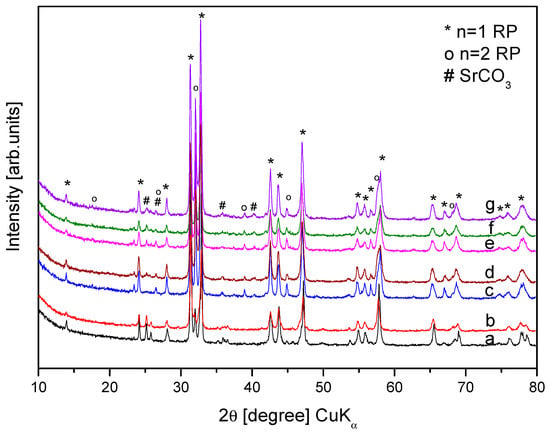
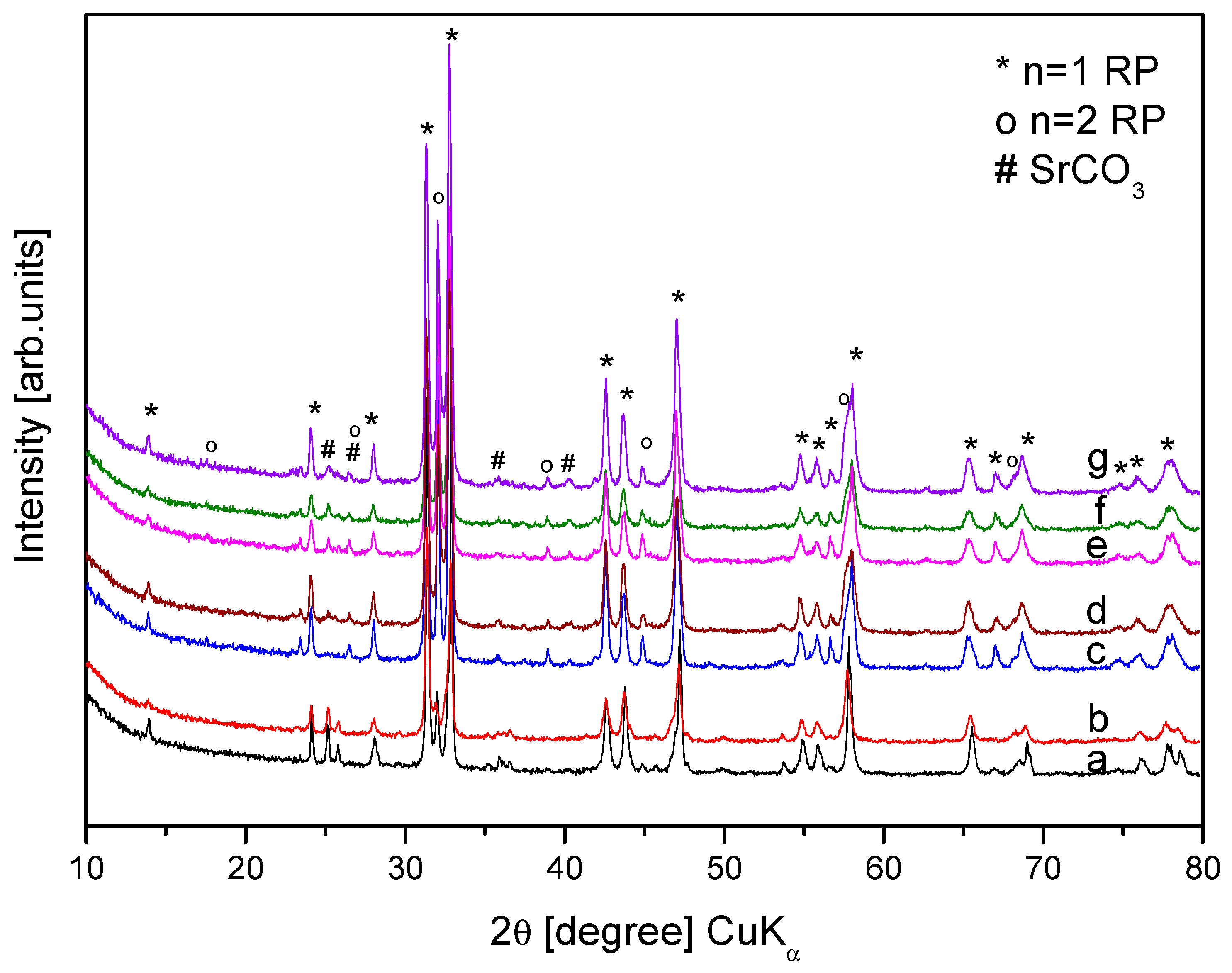
Powder diffraction patterns of the samples before and after catalysis and after thermal ageing are presented in Figure 1. Phase composition, crystallographic, and morphological characteristics are presented in Table 1.
Figure 1.
XRD patterns of a-IS, b-IS after catalytic test, c-AA, d-AA after catalytic test, e-CA, f-CA after catalytic test, g-AA after thermally aged.
Table 1.
Phase composition, unit cell parameters, and mean crystallite size of the investigated samples before and after the catalytic test.
The IS sample represents a mixture of n = 1 ((La,Sr)2FeO4+δ) and n = 2 (Sr3Fe2O7−δ) members of the Ruddlesden–Popper structure family [9,15]. An additional quantity of SrCO3 is also observed. The determined c-parameter of the predominant n = 1 phase is close to that of the stoichiometric LaSrFeO4.The increased Sr content led to the formation of a second (n = 2) phase of the Ruddlesden–Popper family with an increased amount of Fe4+ ions. For the n = 2 phase, the c-parameter corresponds to a negligible δ value. The mean crystallite size obtained for both phases shows good crystallinity with a slightly larger size for the n = 1 phase.
The CA- and AA-treated samples show a decrease in the content of n = 1 phase, (La,Sr)2FeO4+δ, and a corresponding increase in the content of n = 2 phase, Sr3Fe2O7−δ, indicating that acid treatment alters the phase equilibrium. This behavior is likely due to increased selective dissolution of the lanthanum-containing n = 1 phase and SrCO3, while for the Sr-rich n = 2 phase, dissolution is not as pronounced as in the case of the n = 1 phase.
This process is accompanied by the change of the mean crystallite size, which, for the n = 1 phase, decreases and, for the n = 2 phase, increases. The observation indicates that the responses of the two Ruddlesden–Popper phases to acid treatment differ substantially. For the n = 2 phase, the increase in the average crystallite size suggests preferential dissolution of smaller crystallites, leaving a sample enriched in larger and more stable crystallites. In contrast, the apparent reduction in the crystallite size of the n = 1 phase is likely associated with the generation of structural defects, microstrains, and partial degradation of the crystal structure induced by acid treatment. A possible explanation for these results is based on the difference in the structure of the two RP phases. The n = 1 ferrite contains isolated perovskite layers separated by rock-salt blocks, making lattice oxygen and A-site cations more accessible to proton attack and leaching, which promotes structural degradation and dissolution under acidic conditions. In contrast, the n = 2 R–P phase contains thicker double-perovskite slabs with stronger Fe–O–Fe bonding, resulting in a more rigid framework that limits proton accessibility, slows cation extraction, and enhances acid stability.
Compared with IS, both CA- and AA-treated samples exhibit a decrease in the in-plane lattice parameter a and an increase in the out-of-plane lattice parameter c, corresponding to an anisotropic lattice distortion characterized by in-plane contraction and expansion along the stacking direction. Because of the anisotropic structure, changes in chemistry or bonding may affect a and c parameters differently, and sometimes in opposite ways, depending on the slab thickness (n). Since the a-parameter is mainly related to Fe–O–Fe distances within the perovskite layers, its decrease suggests shortening of Fe–O bonds, likely associated with partial oxidation of Fe3+ to the smaller Fe4+ ion and/or increased oxygen incorporation. In contrast, the increase in c-parameter reflects expansion of the interlayer spacing, which may result from the oxygen incorporation and interlayer oxygen rearrangement that push adjacent layers apart. The nearly identical lattice parameters obtained after CA and AA treatments indicate that the resulting n = 1 and n = 2 phases reach a similar oxygen stoichiometry, Fe oxidation state, and defect chemistry regardless of the acid type.
After the catalytic reaction, the IS sample shows a decrease in the mean crystallite size and a slight increase in the unit cell parameters of both n = 1 and n = 2 R–P phases. The carbonate component also increases slightly. On the other hand, for the acid-treated samples, the catalytic tests do not lead to a significant change in content, unit cell parameters, or crystallite size of the R–P phases. The only difference is a slight increase in the carbonate component, with a relatively small crystallite size, indicating that it is a secondary product of the reaction.
The thermal ageing after the catalytic test of the AA-treated sample shows no substantial changes in the phase composition and structural parameters. The only difference is morphological, as the mean crystallite size of the SrCO3 phase increases.
3.2. Nitrogen Physisorption
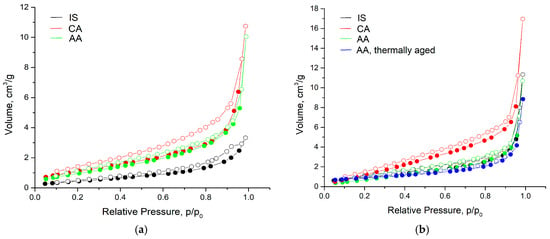
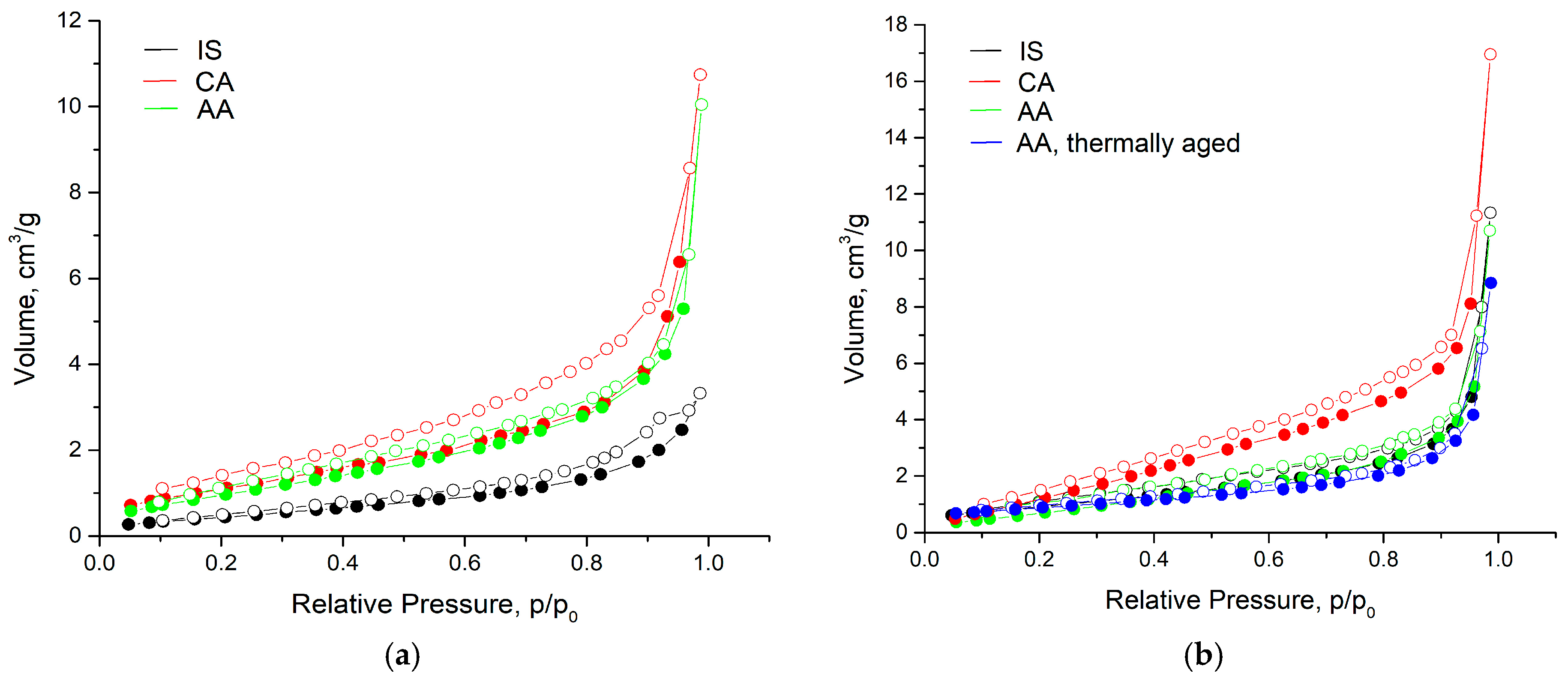
Table 2 presents the textural characteristics for the tested samples corresponding to the nitrogen adsorption/desorption isotherms in Figure 2.
Table 2.
Nitrogen physisorption data for the investigated samples: specific surface area (SBET), total pore volume (Vt), average pore diameter (Dav).
Figure 2.
Nitrogen adsorption–desorption isotherms of (a) samples before catalytic test; (b) samples after catalytic test.
The nitrogen adsorption–desorption isotherms for all analyzed samples, according to the UPAC classification, correspond to type II and are characterized by the presence of an H3 hysteresis loop [33]. This type of isotherm is typically observed in macroporous or practically non-porous materials, where the interaction between the adsorbate and the surface of the adsorbent is relatively weak, and the surface itself is heterogeneous. The inflection point indicates the formation of a monolayer adsorption and at higher relative pressures, the increase in the amount of adsorbed gas indicates the subsequent formation of multilayer adsorption. This behavior is characteristic of open and easily accessible surfaces.
The presence of H3 hysteresis is associated with the presence of slit-shaped pores resulting from the aggregation of plate-like particles. This type of curve is typical for adsorption in poorly defined, unstable, or interparticle cavities. Such adsorption behavior is commonly observed in layered materials, including metal oxides, hydroxides, and other structures with plate-like morphology. In these systems, the specific surface area is mainly determined by the external surfaces and interparticle porosity rather than by the micropores. Therefore, this type of structure is particularly important for applications where surface accessibility, diffusion processes, and kinetic factors play a key role, such as in catalytic reactions, adsorption processes, and others.
Based on the results presented in Table 2, it is evident that acid treatment increases the specific surface area (SBET), from 2 m2/g for the IS sample to 4 m2/g after treatment with citric acid (CA) or acetic acid (AA). The total pore volume (Vt) also shows an increase from 0.01 to 0.02 cm3/g, likely due to partial collapse of macropores and the formation of additional mesopores. After catalytic testing, further changes are observed; for example, the SBET of the CA sample increases to 4 m2/g before the catalytic test to 7 m2/g after the catalytic test, while the average pore diameter (Dav) shows variations reflecting structural changes. The increase in the specific surface area after VOC oxidation can be attributed to surface rearrangement and the formation of additional defect sites and porosity during the redox catalytic process. Furthermore, the removal of surface-bound species and partial de-agglomeration of catalyst particles under reaction conditions may further enhance the accessible surface area. Thus, the development of a mesoporous structure, along with an enlarged external surface, facilitates improved contact between the catalyst and gaseous reactants, which is crucial for the catalytic and adsorption properties. After the thermal ageing, the mesoporous structure is preserved as no substantial changes are detected.
3.3. Mössbauer Spectroscopy
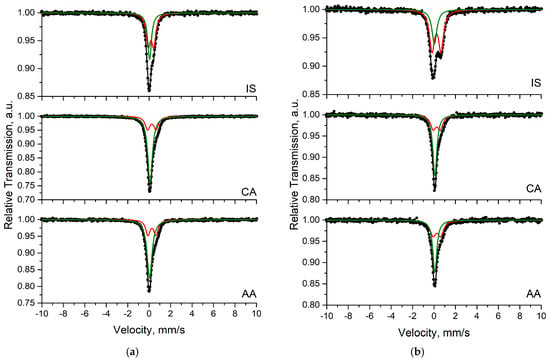
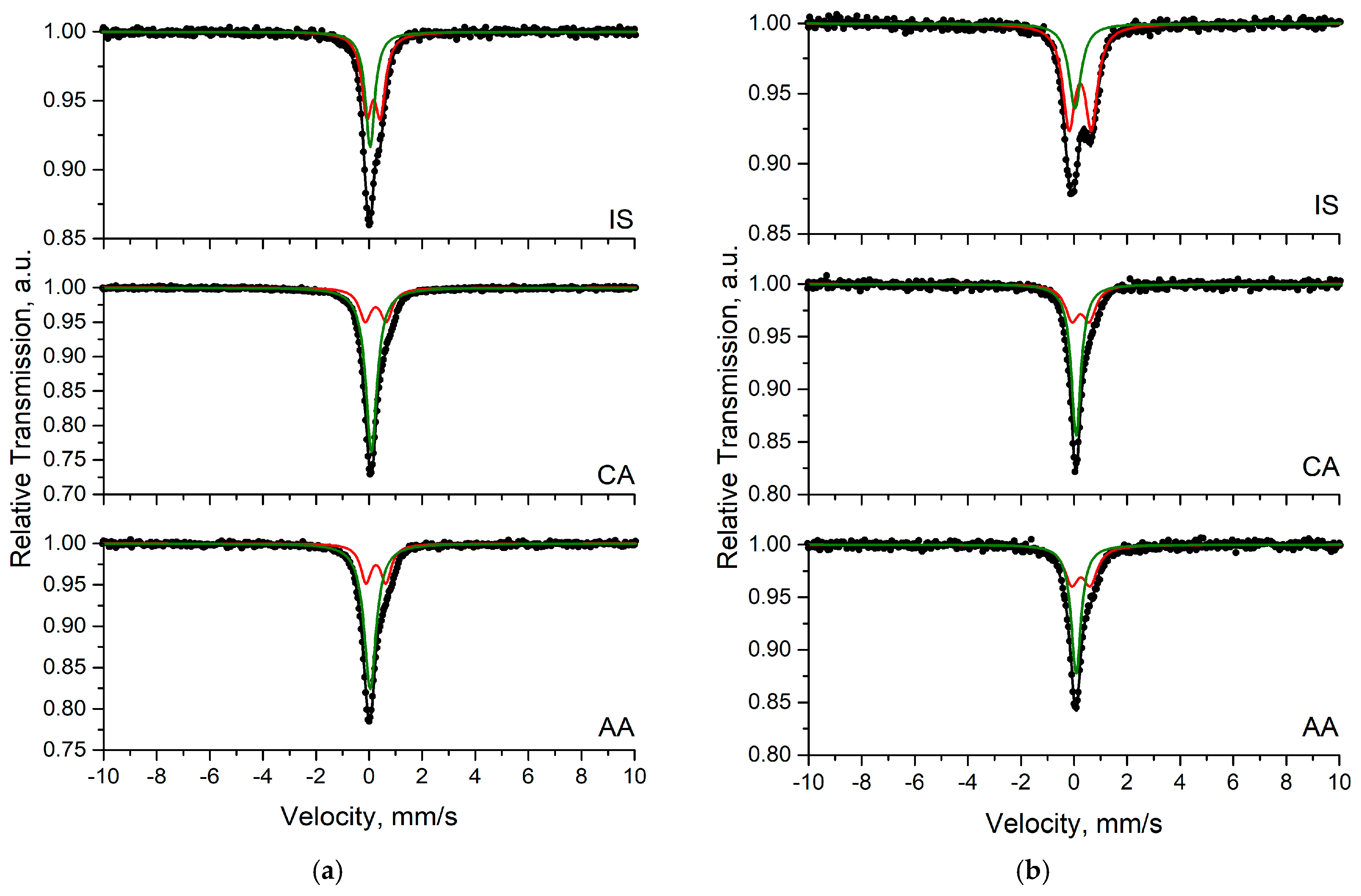
The Mössbauer spectrum of the IS sample is presented in Figure 3a. The spectrum is a superposition of one singlet and one doublet. The fitting results are shown in Table 3. The singlet has an isomer shift of δ = 0.04 mm/s, which is typical for Fe4+ in perovskite and perovskite-related structures [34]. The isomer shift of the doublet (δ = 0.17 mm/s) lies between the values typical for Fe4+ and Fe3+ (Table 3) and can be assigned to an average oxidation state of iron of 3.5+, as reported in previous studies [34,35].
Figure 3.
Mössbauer spectra of (a) samples before catalytic test; (b) samples after catalytic test.
Table 3.
Mössbauer parameters of investigated samples.
The spectra of CA and AA samples (Figure 3a) consist of the same components, but a significant increase in the relative weight of the singlet is observed (Table 3). The Sn/Db ratio of the untreated sample is about 0.7, whereas the Sn/Db ratios for the CA and AA samples are 2.6 and 2.2, respectively. This indicates a significant oxidation of iron during acid treatment and an increase in Fe4+ content in the samples.
The spectra of the samples after the catalytic reaction do not show any significant change in the iron oxidation state or coordination, as seen in Figure 3b and in Table 3. Only a slight decrease in the Sn/Db ratio is observed, which results from the partial oxidation of iron during the catalytic test.
3.4. X-Ray Photoelectron Spectroscopy
X-ray photoelectron spectroscopy (XPS) was applied to quantify the surface atomic concentrations and to evaluate the oxidation states of the elements present on the surface of the investigated samples. The survey spectra confirm that the surface composition consists exclusively of C, O, Fe, Sr, and La, as expected, without detectable impurities from the synthesis procedure.
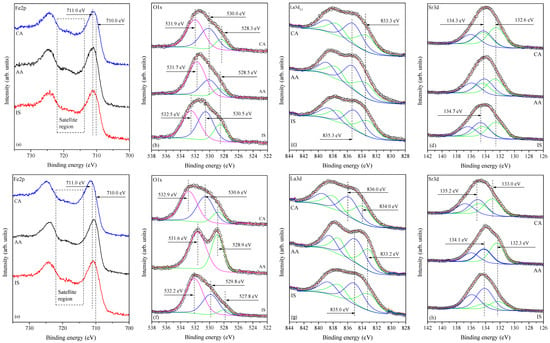
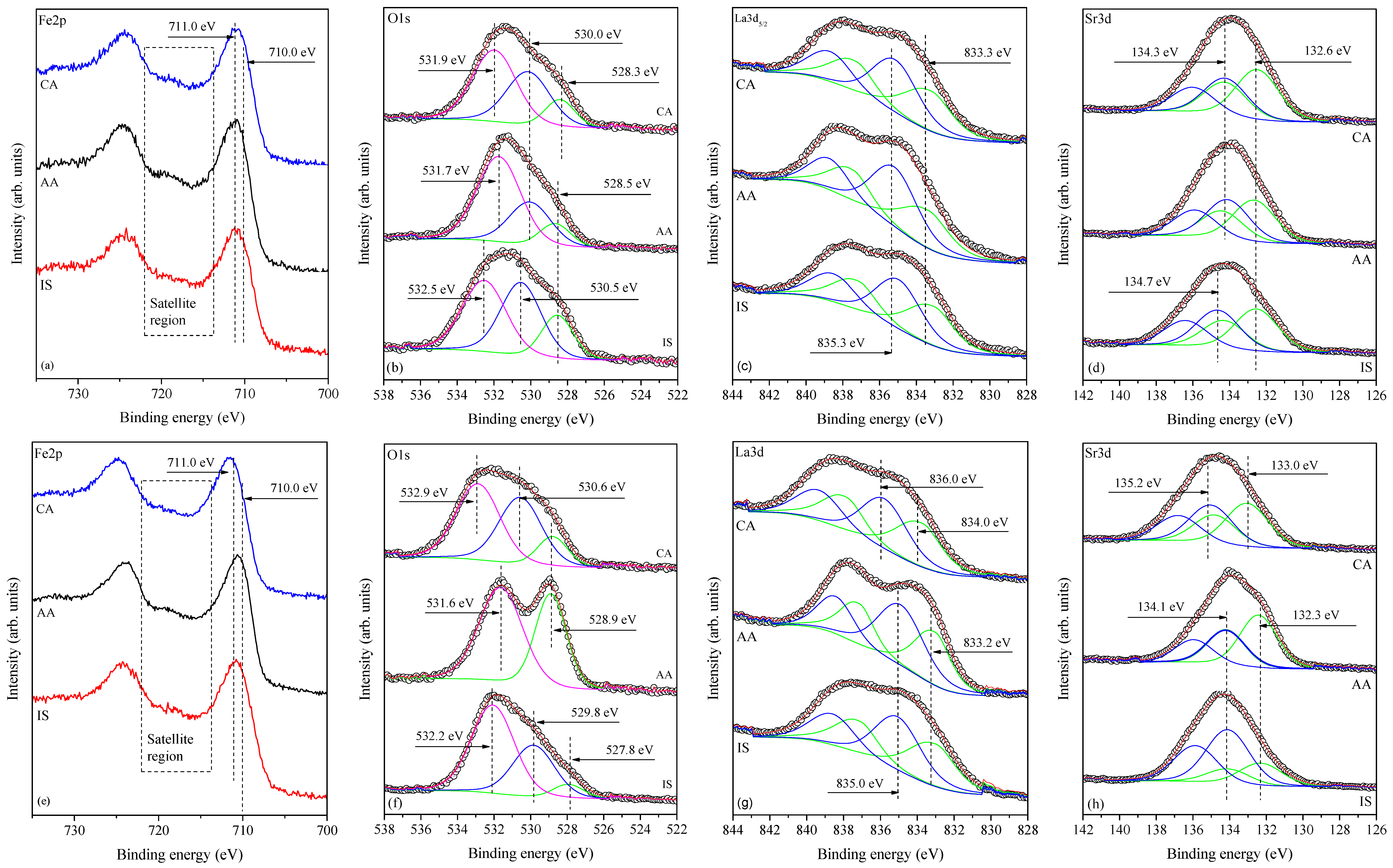
Figure 4 presents the high-resolution Fe 2p, O 1s, La 3d5/2, and Sr 3d spectra of IS, CA and AA samples before and after catalytic testing. The interpretation of the Fe oxidation state is based on established approaches reported in the literature [29,36], considering both the binding energy (BE) position of the Fe 2p3/2 core level and the characteristic satellite structure.
Figure 4.
High-resolution XP spectra of (a) Fe2p, (b) O1s, (c) La 3d5/2 and (d) Sr3d core levels for IS, CA and AA samples before the catalytic test and (e) Fe2p, (f) O1s, (g) La 3d5/2 and (h) Sr3d core levels for IS, CA and AA samples after the catalytic test.
The Fe 2p spectra (Figure 4a,e) exhibit broad and asymmetric Fe 2p3/2 peaks in the range of 710.0–711.0 eV, accompanied by satellite features in the region of 714–722 eV. These spectral characteristics indicate the coexistence of Fe3+ and Fe4+ species at the surface of all investigated samples.
Prior to catalysis, the CA- and AA-modified samples show a more pronounced satellite structure characteristic of Fe3+ species compared to the IS sample. This behavior is consistent with the presence of surface-bound organic species and associated hydroxyl and carbonate groups, which modify the local electronic environment and favor stabilization of Fe3+ at the surface.
After catalytic testing, all samples exhibit a systematic shift of the Fe 2p peaks toward higher binding energies, indicating a shift toward higher binding energies and a tendency toward higher oxidation state contribution of surface iron species [37]. At the same time, variations in the relative intensity of the Fe3+ satellite are observed. These changes do not indicate a simple reduction process, but rather, reflect a redistribution of Fe3+/Fe4+ species and increased surface heterogeneity induced by catalytic operation.
This behavior is consistent with a Mars–van Krevelen-type mechanism, in which lattice oxygen participates in the oxidation of VOC molecules, leading to the formation of oxygen vacancies and subsequent reoxidation of the catalyst surface. The dynamic Fe3+/Fe4+ redox cycling is therefore directly linked to the catalytic function of the material.
The O 1s spectra (Figure 4b,f) were deconvoluted into three main components: (i) a low-binding-energy peak at 527.8–528.5 eV, attributed to oxygen bonded to Sr (Sr–O) [29,36]; (ii) a lattice oxygen component at 529.8–530.5 eV, corresponding to La–O and Fe–O bonds; (iii) a high-binding-energy component at 531.6–532.9 eV, assigned to non-lattice oxygen species, including hydroxyl and carbonate groups [29].
Before catalysis, all samples exhibit a significant contribution from the non-lattice oxygen component, which is the dominant contribution in the O 1s envelope. This indicates a high concentration of surface hydroxyl and carbonate species, originating from both synthesis and surface modification treatments (CA and AA), and reflects the highly reactive and adsorptive nature of the surface.
After catalytic testing, substantial changes in the relative intensities of the O 1s components are observed. In particular, the AA sample shows a pronounced increase in the lattice oxygen contribution, while the non-lattice oxygen fraction remains nearly unchanged, indicating surface oxidation and restructuring rather than simple removal of surface adsorbates. In the CA sample, the lattice oxygen contribution also increases, but in this case, it is accompanied by a moderate decrease in the non-lattice component, suggesting partial removal or transformation of surface hydroxyl/carbonate species. The persistence of non-lattice oxygen even after catalysis indicates that these species are intrinsic to the surface chemistry under reaction conditions rather than being solely due to adventitious contamination.
The Sr–O component shows a decreasing trend after catalysis for some samples, which can be associated with surface Sr segregation, migration into the subsurface region, or coverage by carbonate layers. Simultaneously, slight changes in the La–O/Fe–O contribution suggest surface restructuring and possible La enrichment.
It should be noted that due to the overlap of oxygen environments in complex oxides, the assignment of O 1s components should be regarded as indicative of different chemical environments rather than as a strict atom-specific separation.
The La 3d5/2 spectra (Figure 4c,g) exhibit the characteristic multiplet-split structure of La3+ species. Two main components are identified: a lower binding energy contribution at 833.2–834.0 eV, attributed to La–O bonds [29,38], and a higher binding energy component at 835.0–836.0 eV, associated with La(OH)3 and/or La2(CO3)3 species [39].
The relative ratio between these components remains approximately constant for all samples, indicating that lanthanum predominantly preserves its oxidation state while undergoing surface hydroxylation and carbonation processes. The presence of these species is consistent with the observations from the O 1s analysis.
The Sr 3d spectra (Figure 4d,h) can be resolved into two components corresponding to Sr–O bonds (132.3–133.0 eV) and surface carbonate/hydroxide species (134.1–135.2 eV) [40]. The relative contribution of these components varies depending on the surface treatment and catalytic exposure.
After catalysis, changes in the Sr-related components indicate surface redistribution phenomena, including Sr segregation and carbonate formation. These effects are consistent with the literature reporting on Sr-containing perovskite materials, where surface segregation and cation redistribution are known to alter surface composition, stability, and oxygen exchange properties [41].
The surface atomic concentrations summarized in Table 4 show that the Fe content remains within a relatively narrow concentration range before and after catalysis, indicating structural stability of the iron sublattice. Slight variations in Fe concentration for modified samples can be attributed to changes in surface coverage by carbon-containing species.
Table 4.
Surface atomic concentrations (at.%) for IS, CA and AA samples before and after catalytic test.
As expected, the Sr concentration is significantly higher than that of La, consistent with the nominal composition. However, deviations in Sr/La ratios after catalysis suggest surface restructuring, including possible Sr depletion or redistribution.
A key observation is that the highest oxygen contribution corresponds to the non-lattice oxygen component for all samples. This confirms that the surface is largely covered by hydroxyl and carbonate species, which play an important role in adsorption and surface reactivity.
3.5. Transmission Electron Microscopy
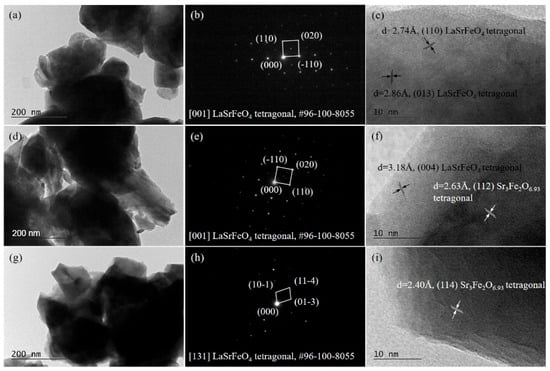
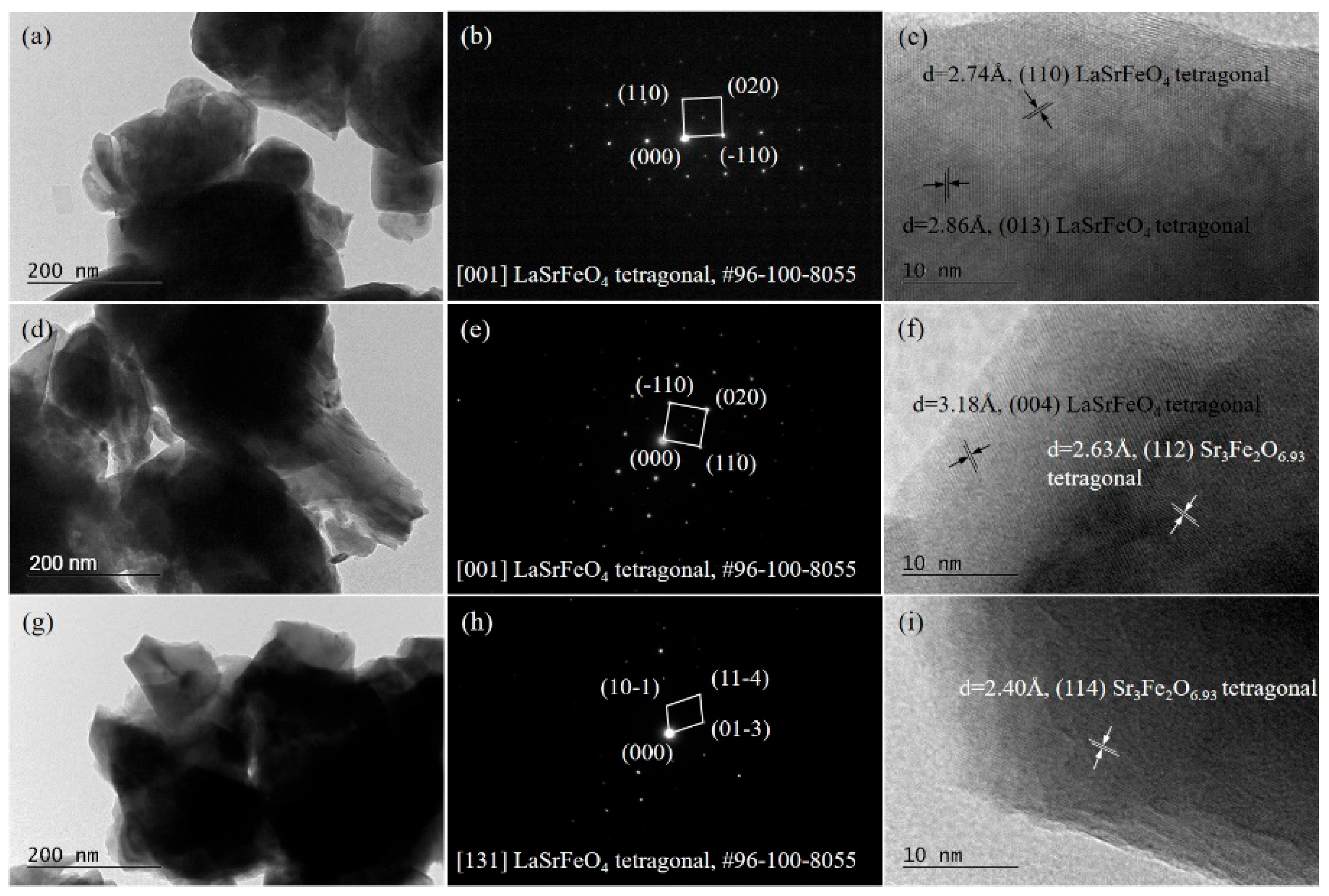
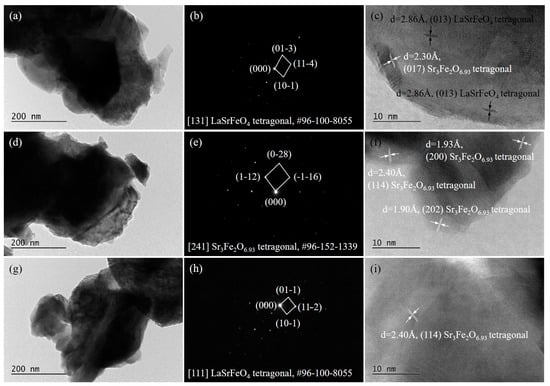
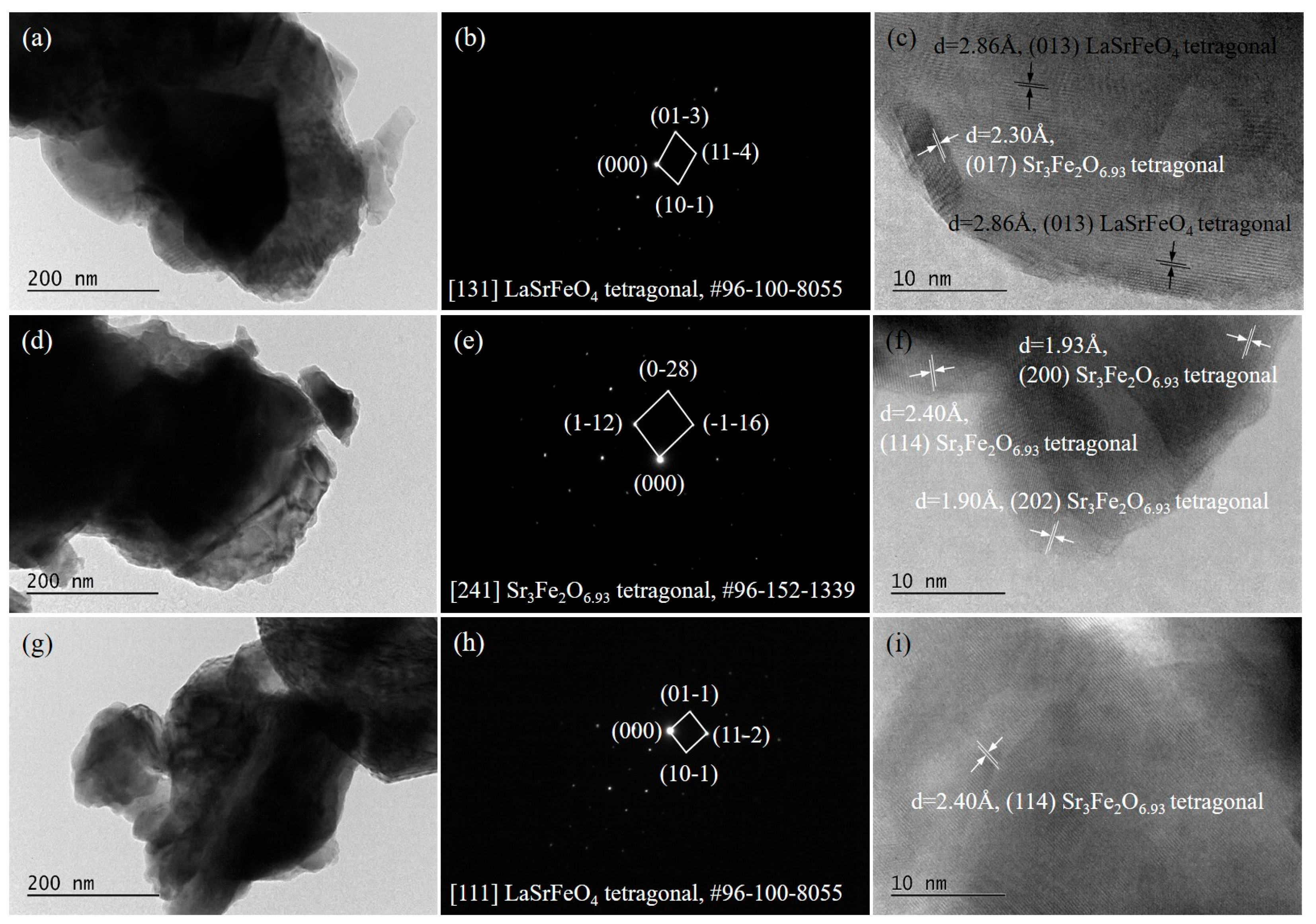
Analysis of the morphology and phase composition of IS, CA and AA samples before and after catalysis are presented in Figure 5 and Figure 6, respectively.
Figure 5.
BF TEM micrographs, corresponding SAED patterns, and HR TEM images of IS (a,b,c), CA (d,e,f), and AA (g,h,i) before the catalytic test.
Figure 6.
BF TEM micrographs, corresponding SAED patterns, and HR TEM images of IS (a,b,c), CA (d,e,f), and AA (g,h,i) after the catalytic test.
It is clearly seen that the particles are crystalline, often well faceted, with sizes over 100 nm. The registered diffraction patterns are single-crystalline, and their indexing reveals the presence of a mixed ferrite phase (COD Entry #96-100-8055) in most cases and Sr3Fe2O6.93 (COD Entry #96-152-6451) for one of the samples of the working catalysts. In the high-resolution images, both phases are detected in most cases, which is consistent with the XRD results.
3.6. Catalytic Test
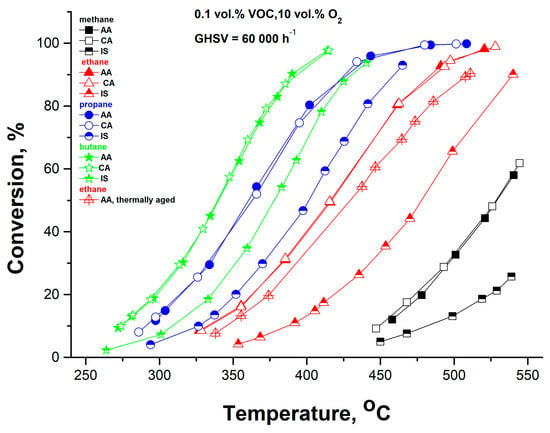
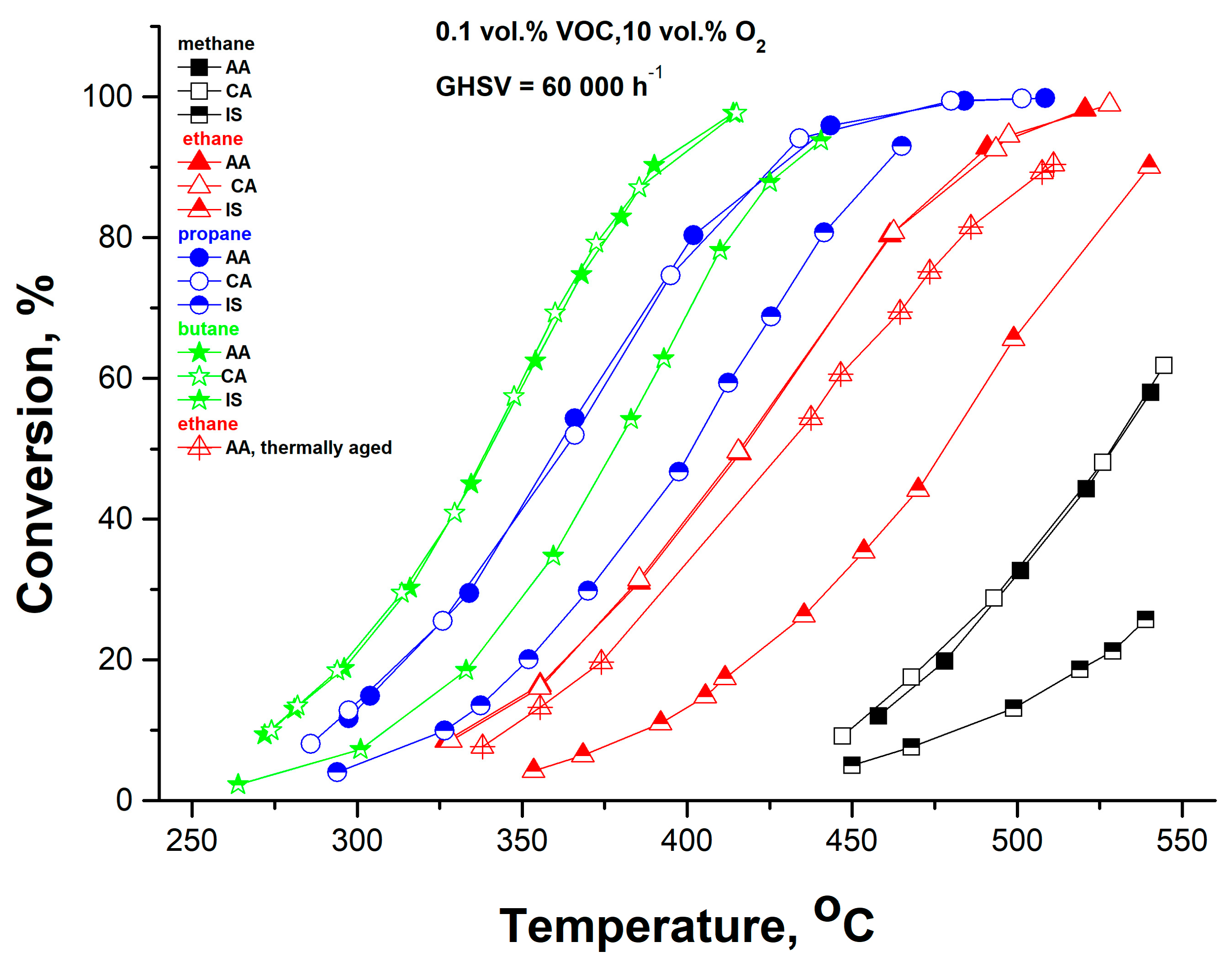
The steady-state conversion of C1–C4 alkanes (methane, ethane, propane and butane) as a function of temperature was investigated over the prepared catalysts. The catalytic tests were carried out under identical reaction conditions in order to isolate the effect of the acid treatment on the catalytic performance. The obtained results are presented in Figure 7. For comparison, the catalytic performance of the IS catalyst is also included, allowing a direct assessment of the influence of the acid modification on the conversion efficiency.
Figure 7.
Temperature dependence of VOC oxidation over the investigating samples.
The results from the VOC tests indicate that complete oxidation takes place at relatively high temperatures (above 220 °C), with n-butane exhibiting the lowest T50 values.
For all investigated VOCs, full conversion to CO2 and H2O was observed. The complete oxidation of the tested n-alkanes occurs at slightly higher temperatures, which can be attributed to the specific physicochemical properties of the VOC molecules, such as molecular structure, adsorption strength, ionization potential, and related factors [42,43].
A noticeable enhancement in catalytic activity was observed for the acid-treated samples. In particular, the temperatures required to achieve 50% conversion (T50) were significantly reduced, by approximately 40–60 °C, in comparison with the as-prepared catalyst (Table 5). This shift toward lower conversion temperatures clearly indicates that the acid treatment has a beneficial effect on the catalytic performance, facilitating more efficient reactant activation and oxidation at reduced operating temperatures. It has been established that treatment with the two acids exerts the same effect on the catalytic activity, indicating that the nature of the acid used does not lead to any significant difference in the catalytic activity.
Table 5.
“Light-off” T50 and T90 temperatures for the synthesized catalysts.
The activities reported in the present study are close to the data obtained for methane combustion [26]. The comparison is based on gas—an hourly space velocity of 60,000 h−1 (assuming 200 mg catalyst and 200 mL/min gas flow) and temperatures of 475–550 °C. Further, another study [44] reports novel insights into the rational design of efficient ferroelectric photocatalysts.
A reactor model accounting for both internal and external mass transfer effects was applied for comparative analysis of the reaction rates before and after acid treatment. The calculated values for the pre-exponential factors at fixed activation energies (methane: 154.4 kJ/mol; ethane: 137.2 kJ/mol; propane: 134.4 kJ/mol; butane: 132.1 kJ/mol) show an average increase of 4.5 times for the acid-treated samples (methane: 3.7; ethane: 6.3; propane: 3.8; butane: 4.3). The higher values of the pre-exponent factor (or the frequency of effective collisions between the reagents and the catalytic surface) indirectly indicate a higher number of active sites for acid-treated samples when compared to the IS.
It should be pointed out that the calculated values for the activation energies after acid treatment are lower, within the range of 5–10%, when compared to the IS sample (more specifically as follows: methane: 7.2%; ethane: 3.6%; propane: 9.2%; butane: 8.9%).
The results for the catalytic oxidation of ethane show that the sample possesses good thermal stability. The ethane test after aging was chosen for quantitative evaluation of the stability of the catalyst. The increase in T50 is 13 °C, which in terms of a decrease in the calculated reaction rate constant, shows a lower value with 24%.
3.7. Temperature-Programmed Reduction by Hydrogen and Temperature-Programmed Reduction by Ethane
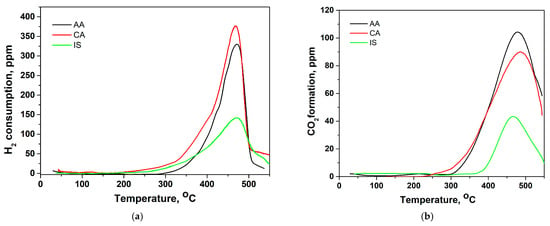
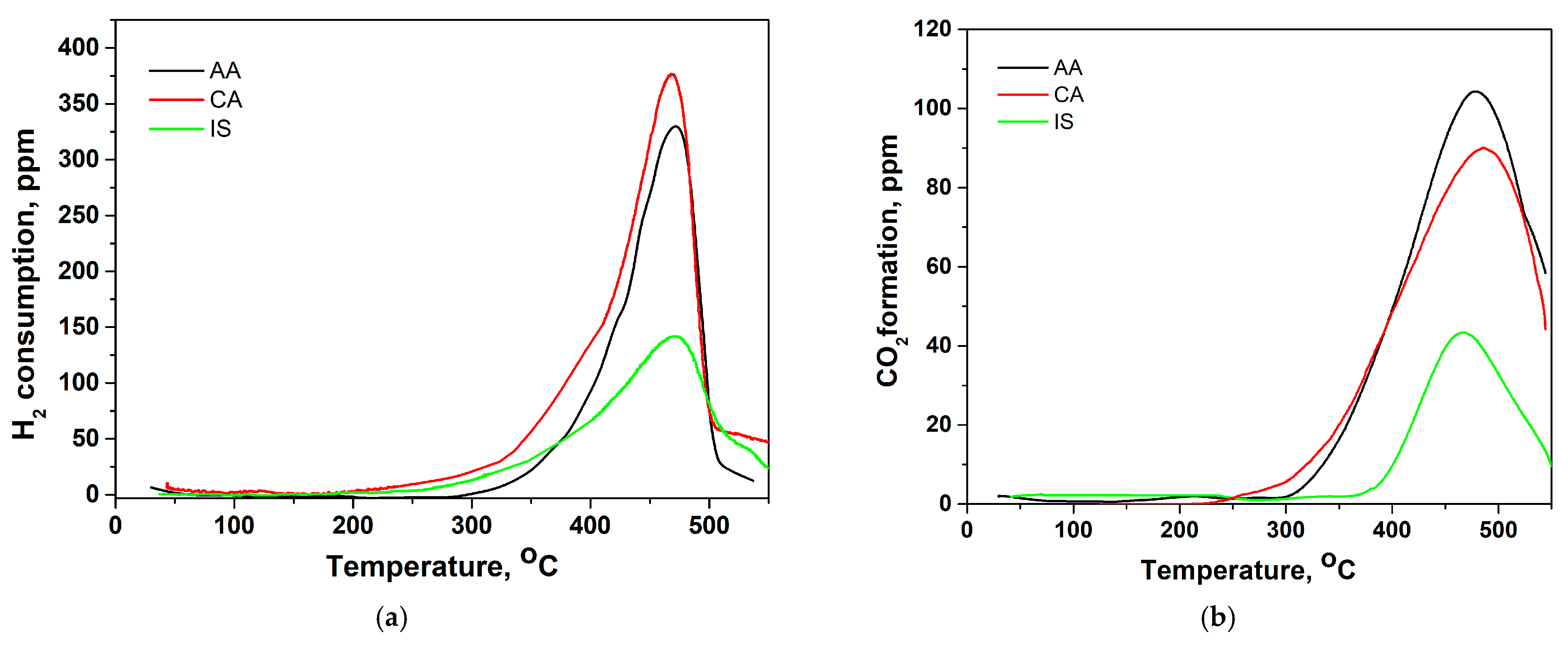
The H2-TPR (Figure 8a) shows that the oxygen consumption begins at 250 °C (AA) and 200 °C (CA) with maxima at 470–480 °C (471 °C for IS; 477 °C for AA; 467 °C for CA). The C2H6-TPR (Figure 8b) shows similar behavior—a broad peak of CO2 formation is observed at temperatures around 485 °C. The main difference comes from the amounts of reactive oxygen. While the AA and CA samples pose similar amounts of oxygen able to oxidize the hydrogen or ethane, the IS sample shows significant 1.5–3-times-lower amounts of reactive oxygen (H2: AA: 134.2 μmol/g-cat; CA: 185.7 μmol/g-cat; IS: 91.6 μmol/g-cat), (ethane: AA: 137.2 μmol/g-cat; CA: 150.5 μmol/g-cat; IS: 54.7 μmol/g-cat).
Figure 8.
Temperature-programmed reduction: (a) H2-TPR of the IS, AA and CA catalysts; (b) C2H6/TPR of the IS, CA and AA catalysts.
Similar H2-TPR profiles have been reported for LaFeO3, Cu2+-, and Ni2+-substituted LaFeO3 samples and for Ni-perovskite-based catalysts for the temperature region 400–550 °C. This behavior is explained by a high oxygen vacancy concentration and the low temperature of reduction peaks, which suggest that the materials demonstrate high reducibility and oxygen mobility, directly connected with the increased catalytic activity [45,46].
Furthermore, the XRD results indicate that the acid treatment does not lead to significant changes in the initial crystalline phases. This observation suggests that the improved catalytic activity is not associated with bulk structural changes but rather with surface-related modifications. After acid treatment, the amount of SrCO3 present in the sample decreased. Additionally, an increase in Sr3Fe2O7−δ was detected, indicating a possible transformation or redistribution of the strontium-containing phases during the treatment.
As reported in the literature, acid treatment has been widely proposed as an effective strategy to modify the surface structure of perovskite-type oxides without significantly altering their bulk crystal lattice [47].
According to results from XPS studies, a decrease in Sr content was observed after acid treatment. In particular, such treatment can induce selective leaching of A-site cations, such as Sr, which are typically more weakly bound compared to B-site species. This selective removal leads to an increased exposure of catalytically active B-site metal centers at the surface, altering surface properties and significantly influencing catalytic performance [7].
In addition, the redistribution of surface species and partial removal of A-site cations can contribute to subtle modifications in the electronic structure, as well as to the formation of surface oxygen vacancies [48].
According to results, the CA and AA samples showed a marked increase in catalytic oxidation activity, which was accompanied by a 40–60 °C drop in the operating temperature. This increase can be mainly ascribed to surface modification effects rather than substantial alterations in the bulk chemical composition or crystal structure. In addition, the nearly identical catalytic performance obtained after treatment with both citric and acetic acids indicates that acid-specific effects, such as selective A-site cation extraction or defect formation within the Fe–O sublattice, are unlikely to be the dominant factor governing the observed activity enhancement. Instead, the results point toward a common mechanism associated with mild surface cleaning, namely the removal of surface-blocking species that hinder access to active sites. This observation is consistent with the data obtained from Mössbauer spectroscopy and XPS analysis, both of which demonstrate that acid treatment induces changes in the iron oxidation state, leading to an increased fraction of Fe4+ ions in the material.
This interpretation is in line with earlier wet-etching research, which showed that weak acid solutions can efficiently change the surface of perovskite oxides by eliminating A-site species and enhancing catalytic performance without causing significant bulk structural modifications [26].
4. Conclusions
The comprehensive study of La–Sr–Fe–O layered perovskites and their acid-modified analogues demonstrates that dilute organic acid treatment is an effective approach for enhancing the catalytic properties of layered oxide materials. The results from XRD and TEM analyses confirm that the main Ruddlesden–Popper crystalline structure remains stable during both modification and catalytic operation, with no significant degradation of the morphology observed. However, acid treatment leads to changes in phase composition, including a decrease in the content of n = 1 phase and a relative increase in the content of n = 2 phase. Textural analysis shows the development of a more accessible mesoporous structure, accompanied by an increase in specific surface area and pore volume, which improves mass transport and reactant accessibility to the active sites. These textural features are largely maintained under reaction conditions, indicating good structural stability. Mössbauer spectroscopy and XPS analysis reveal that acid treatment results in an increased fraction of Fe4+ ions and the formation of a hydroxylated and carbonated surface, which stabilizes the active Fe centers. During catalytic operation, a dynamic Fe3+/Fe4+ redox process occurs, together with surface restructuring, Sr redistribution, and the participation of non-lattice oxygen, highlighting the importance of surface chemistry in the catalytic process. Catalytic tests demonstrate a significant enhancement in activity, expressed by a 40–60 °C decrease in operating temperature for all acid-treated samples, independent of the acid used. These results indicate that the improved catalytic performance is mainly associated with surface-related modifications, including partial removal and redistribution of Sr-containing surface species and increased accessibility of Fe sites, together with improved textural properties, while the overall layered Ruddlesden–Popper framework is preserved. The synthesized thermally stable phase is prospective for use in catalytic converters for waste gases treatment, and tests on active phase support on ceramic monolithic elements are planned.
Author Contributions
Conceptualization, N.V., T.P., R.V., and A.N.; methodology, N.V., T.P., R.V., and A.N.; formal analysis, T.P., D.K. (Daniela Kovacheva), I.S., H.K., D.K. (Daniela Karashanova), K.T., G.I., and N.V.; investigation, T.P., N.V., D.K. (Daniela Kovacheva), H.K., D.K. (Daniela Karashanova), K.T., and G.I.; data curation, T.P., N.V., S.D., H.K., D.K. (Daniela Kovacheva), D.K. (Daniela Karashanova), K.T., and R.V.; writing—original draft preparation, T.P., N.V., D.K. (Daniela Kovacheva), R.V., and A.N.; writing—review and editing, N.V., A.N., D.K. (Daniela Kovacheva), I.S., H.K., and R.V.; visualization, T.P., N.V., and R.V.; project administration, N.V. All authors have read and agreed to the published version of the manuscript.
Funding
The authors express their gratitude to the National Science Fund of Bulgaria for financial support under the Contract No. KП-06-H89/5/2024.
Data Availability Statement
The data presented in this study are available upon request from the corresponding authors.
Acknowledgments
The MultiGas FTIR Gas Analyzer 2030G, under the project no. BG16RFPR002-1.014-0006, “National Center of Excellence Mechatronics and Clean Technologies”, supported by the European Regional Development Fund under the “Research Innovation and Digitization for Smart Transformation” program 2021–2027, was used for the experimental work. Research equipment from the distributed research infrastructure INFRAMAT, part of the Bulgarian National Roadmap for Research Infrastructures, supported by the Bulgarian Ministry of Education and Science, was also used in the investigation.
Conflicts of Interest
The authors declare no conflicts of interest.
References
- Drobek, M.; Figoli, A.; Santoro, S.; Navascués, N.; Motuzas, J.; Simone, S.; Algieri, C.; Gaeta, N.; Querze, L.; Trotta, A. PVDF-MFI mixed matrix membranes as VOCs adsorbers. Microporous Mesoporous Mater. 2015, 207, 126–133. [Google Scholar] [CrossRef] [Scilit]
- Liotta, L.F. Catalytic oxidation of volatile organic compounds on supported noble metals. Appl. Catal. B Environ. 2010, 100, 403–412. [Google Scholar] [CrossRef] [Scilit]
- Atkinson, R. Atmospheric chemistry of VOCs and NOx. Atmos. Environ. 2000, 34, 2063–2101. [Google Scholar] [CrossRef] [Scilit]
- Seinfeld, J.H.; Pandis, S.N. Atmospheric Chemistry and Physics: From Air Pollution to Climate Change, 3rd ed.; Wiley-Interscience: Hoboken, NJ, USA, 2016. [Google Scholar]
- Kamal, M.S.; Razzak, S.A.; Hossain, M.M. Catalytic oxidation of volatile organic compounds (VOCs)—A review. Atmos. Environ. 2016, 140, 117–134. [Google Scholar] [CrossRef] [Scilit]
- Yi, J.; Liu, B.; Gao, L.; Cao, B.; Sillanpää, M. The comprehensive review of catalysts for catalytic oxidation of volatile organic compounds. J. Environ. Chem. Eng. 2025, 13, 115691. [Google Scholar] [CrossRef] [Scilit]
- Cho, J.H.; Yun, J.; Kim, M.; Jung, J.C. Surface Engineering of Perovskite Catalysts: Using Acid Treatment to Enhance CO and CH4 Oxidation Activity. Appl. Catal. A 2025, 701, 120312. [Google Scholar] [CrossRef] [Scilit]
- Royer, S.; Duprez, D. Catalytic oxidation of carbon monoxide over transition metal oxides. ChemCatChem 2011, 3, 24–65. [Google Scholar] [CrossRef] [Scilit]
- Peña, M.A.; Fierro, J.L.G. Chemical structures and performance of perovskite oxides. Chem. Rev. 2001, 101, 1981–2017. [Google Scholar] [CrossRef] [Scilit] [PubMed]
- Yadav, P.; Yadav, S.; Atri, S.; Tomar, R. A brief review on key role of perovskite oxides as catalyst. ChemistrySelect 2021, 6, 12947–12959. [Google Scholar] [CrossRef] [Scilit]
- Teraoka, Y.; Zhang, H.M.; Furukawa, S.; Yamazoe, N. Oxygen permeation through perovskite-type oxides. Chem. Lett. 1985, 14, 1743–1746. [Google Scholar] [CrossRef] [Scilit]
- Tang, W.; Liu, T.; Zhang, M.; Yuan, F.; Zhou, K.; Lai, R.; Lian, Y.; Xing, S.; Xiong, W.; Zhang, M.; et al. The Roles of Metal Oxidation States in Perovskite Semiconductors. Matter 2023, 6, 3782–3802. [Google Scholar] [CrossRef] [Scilit]
- Zang, M.; Zhao, C.; Wang, Y.; Chen, S. A Review of Recent Advances in Catalytic Combustion of VOCs on Perovskite-Type Catalysts. J. Saudi Chem. Soc. 2019, 23, 645–654. [Google Scholar] [CrossRef] [Scilit]
- Li, S.-F.; Zhang, B.-Q.; Wang, Y.-Q.; Yan, D. Enhancing Oxygen Evolution Reaction Performance of Ruddlesden–Popper Perovskite Oxide through Heteroatom Incorporation. Chem. Eng. J. 2024, 491, 151912. [Google Scholar] [CrossRef] [Scilit]
- Shen, Y.; de Martín Vidales, M.J.; Gorni, G.; Sampaio, M.J.; Silva, A.M.T.; Ribeiro, A.R.L.; Dos Santos-García, A.J. Composition-Dependent PMS Activation in SrxLa2−xCoO4±δ Perovskite-Derivatives: From Radical to Strengthened Electron-Transfer Pathway. Appl. Catal. B Environ. Energy 2024, 357, 124291. [Google Scholar] [CrossRef] [Scilit]
- Kucharczyk, B.; Winiarski, J.; Szczygieł, I.; Adamska, K. Physicochemical Properties of LaFeO3 Perovskite Prepared by Various Methods and Its Activity in the Oxidation of Hydrocarbons. Ind. Eng. Chem. Res. 2020, 59, 16603–16613. [Google Scholar] [CrossRef] [Scilit]
- Roy, S.; Hegde, M.S.; Madras, G. Catalysis for NOx Abatement. Appl. Energy 2009, 86, 2283–2297. [Google Scholar] [CrossRef] [Scilit]
- Wu, M.; Chen, S.; Xiang, W. Oxygen Vacancy Induced Performance Enhancement of Toluene Catalytic Oxidation Using LaFeO3 Perovskite Oxides. Chem. Eng. J. 2020, 387, 124101. [Google Scholar] [CrossRef] [Scilit]
- Spinicci, R.; Tofanari, A.; Delmastro, A.; Mazza, D.; Ronchetti, S. Catalytic Properties of Stoichiometric and Non-Stoichiometric LaFeO3 Perovskite for Total Oxidation of Methane. Mater. Chem. Phys. 2002, 76, 20–25. [Google Scholar] [CrossRef] [Scilit]
- Doroftei, C.; Murariu, G.; Dobromir, M. Porous La-Fe-O Perovskite as Catalyst for Combustion of Volatile Organic Compounds. Materials 2025, 18, 2008. [Google Scholar] [CrossRef] [Scilit] [PubMed]
- Zhang, X.; Li, H.; Li, Y.; Shen, W. Structural Properties and Catalytic Activity of Sr-Substituted LaFeO3 Perovskite. Chin. J. Catal. 2012, 33, 1109–1114. [Google Scholar] [CrossRef] [Scilit]
- Xu, T.; Wang, C.; Lv, Y.; Zhu, B.; Zhang, X. Catalytic Oxidative Removal of Volatile Organic Compounds (VOCs) by Perovskite Catalysts: A Review. Nanomaterials 2025, 15, 685. [Google Scholar] [CrossRef] [Scilit] [PubMed]
- Gao, C.; Ding, W.; Tu, W.; Wang, P.; Wang, L.; Zhan, S. Advances in Perovskite-Based Catalysts for VOCs Oxidation: Catalyst Design and Mechanistic Insights. Chem. Res. Chin. Univ. 2025, 41, 1405–1420. [Google Scholar] [CrossRef] [Scilit]
- Dai, L.; Lu, X.-B.; Chu, G.-H.; He, C.-H.; Zhan, W.-C.; Zhou, G.-J. Surface tuning of LaCoO3 perovskite by acid etching to enhance its catalytic performance. Rare Met. 2021, 40, 555–562. [Google Scholar] [CrossRef] [Scilit]
- Wang, K.; Zhou, J.; Deng, X.; Wu, S.; Wu, J.; Gao, Y.; Deng, K.; Niu, J.; Fu, L.; Wu, K. Acid etching engineering enhances the activity of oxygen evolution reaction in high entropy perovskite oxide. J. Power Sources 2025, 644, 237084. [Google Scholar] [CrossRef] [Scilit]
- Wu, X.; Li, M.; Abouserie, A.; Frommelius, A.; Dalfollo, G.; Ohlerth, T.; Simon, U. Acid Treatment Enhances the Methane Combustion Activity of LaFeO3 Perovskite Catalyst. Catal. Today 2024, 432, 114620. [Google Scholar] [CrossRef] [Scilit]
- Yang, J.; Hu, S.; Shi, L.; Hoang, S.; Yang, W.; Fang, Y.; Liang, Z.; Pan, C.; Zhu, Y.; Li, L.; et al. Oxygen Vacancies and Lewis Acid Sites Synergistically Promoted Catalytic Methane Combustion over Perovskite Oxides. Environ. Sci. Technol. 2021, 55, 9243–9254. [Google Scholar] [CrossRef] [Scilit] [PubMed]
- Ren, L.; Huo, Z.; Song, S.; Yu, H.; Tan, B.; Wang, Y.; Feng, N.; Wan, H.; Guan, G. Surface Tuning of 3DOM LaFe0.6Mg0.4O3 Perovskite by Acid Etching to Enhance Catalytic Performance for Soot Combustion. Appl. Surf. Sci. 2023, 629, 157435. [Google Scholar] [CrossRef] [Scilit]
- Velinova, R.; Petrova, T.; Velinov, N.; Kovacheva, D.; Spassova, I.; Ivanov, G.; Tumbalova, K.; Kolev, H.; Karashanova, D.; Naydenov, A. Complete Oxidation of C1–C4 Hydrocarbons on La2−xSrxFeO4 (x = 0.5, 1.0, and 1.5) Catalysts. Catalysts 2026, 16, 43. [Google Scholar] [CrossRef] [Scilit]
- Velinov, N.; Petrova, T.; Tumbalova, K.; Velinova, R.; Ivanov, G.; Kolev, H.; Kovacheva, D.; Naydenov, A. Mössbauer Study and Catalytic Activity of La-Sr-Fe Perovskite-Related Materials. Hyperfine Interact. 2026, 247, 10. [Google Scholar] [CrossRef] [Scilit]
- Shirley, D.A. High-Resolution X-Ray Photoemission Spectrum of the Valence Bands of Gold. Phys. Rev. B 1972, 5, 4709–4714. [Google Scholar] [CrossRef] [Scilit]
- Scofield, J.H. Hartree-Slater Subshell Photoionization Cross-Sections at 1254 and 1487 eV. J. Electron Spectrosc. Relat. Phenom. 1976, 8, 129–137. [Google Scholar] [CrossRef] [Scilit]
- Thommes, M.; Kaneko, K.; Neimark, A.V.; Olivier, J.P.; Rodriguez-Reinoso, F.; Rouquerol, J.; Sing, K.S.W. Physisorption of Gases, with Special Reference to the Evaluation of Surface Area and Pore Size Distribution (IUPAC Technical Report). Pure Appl. Chem. 2015, 87, 1051–1069. [Google Scholar] [CrossRef] [Scilit]
- Adler, P.; Lebon, A.; Damljanović, V.; Ulrich, C.; Bernhard, C.; Boris, A.V.; Maljuk, A.; Lin, C.T.; Keimer, B. Magnetoresistance Effects in SrFeO3−δ: Dependence on Phase Composition and Relation to Magnetic and Charge Order. Phys. Rev. B 2006, 73, 094451. [Google Scholar] [CrossRef] [Scilit]
- Lu, Z.; Shen, J.; Zou, J.; Zhang, Q.; Mo, J.; Wu, Z.; Xia, Y.; Liu, M. Mössbauer Spectroscopic Analysis of La1−xSrxFeO3−δ Perovskites. Phys. Status Solidi B 2023, 260, 2200511. [Google Scholar] [CrossRef] [Scilit]
- Wang, L.; Du, Y.; Sushko, P.V.; Bowden, M.E.; Stoerzinger, K.A.; Heald, S.M.; Scafetta, M.D.; Kaspar, T.C.; Chambers, S.A. Hole-Induced Electronic and Optical Transitions in La1−xSrxFeO3 Epitaxial Thin Films. Phys. Rev. Mater. 2019, 3, 025401. [Google Scholar] [CrossRef] [Scilit]
- Cornell, R.M.; Schwertmann, U. The Iron Oxides: Structure, Properties, Reactions, Occurrences and Uses; Wiley-VCH: Weinheim, Germany, 2003. [Google Scholar]
- Jiang, J.; Li, Y. Novel LaAOx/g-C3N4 (A = V, Fe, Co) Heterojunctions with Enhanced Photocatalytic Degradation of Norfloxacin under Visible Light. Crystals 2021, 11, 1173. [Google Scholar] [CrossRef] [Scilit]
- Naurzkulova, S.; Arapova, M.; Ishchenko, A.; Krieger, T.; Saraev, A.; Kaichev, V.; Rogov, V.; Krasnov, A.; Massalimova, B.; Sadykov, V. Ni–Ru-Containing Mixed Oxide-Based Composites as Precursors for Ethanol Steam Reforming Catalysts: Effect of the Synthesis Methods on the Structural and Catalytic Properties. Open Chem. 2021, 19, 696–708. [Google Scholar] [CrossRef] [Scilit]
- Li, H.; Kang, H.S.; Liu, Z.; Barkhordarian, O.; Lee, S.; Yoon, Y.; Lee, M.H. Effect of Angstrom-Level Oxide Overcoat on Sr Segregation Behavior of LSM Electrodes. Int. J. Hydrogen Energy 2022, 47, 33058–33066. [Google Scholar] [CrossRef] [Scilit]
- Koo, B.; Kim, K.; Kim, J.K.; Kwon, H.; Han, J.W.; Jung, W. Sr Segregation in Perovskite Oxides: Why It Happens and How It Exists. Joule 2018, 2, 1476–1499. [Google Scholar] [CrossRef] [Scilit]
- Kim, S.C. The Catalytic Oxidation of Aromatic Hydrocarbons over Supported Metal Oxide. J. Hazard. Mater. 2002, 91, 285–299. [Google Scholar] [CrossRef] [Scilit] [PubMed]
- Bedia, J.; Rosas, J.M.; Rodríguez-Mirasol, J.; Cordero, T. Pd Supported on Mesoporous Activated Carbons with High Oxidation Resistance as Catalysts for Toluene Oxidation. Appl. Catal. B Environ. 2010, 94, 8–18. [Google Scholar] [CrossRef] [Scilit]
- Yao, Q.; Liu, P.; Yang, F.; Zhu, Y.; Pan, Y.; Xue, H.; Mao, W.; Chu, L. Ferroelectric polarization in Bi0.9Dy0.1FeO3/g-C3N4 Z-scheme heterojunction boosts photocatalytic hydrogen evolution. Sci. China Mater. 2024, 67, 3160–3167. [Google Scholar] [CrossRef] [Scilit]
- Medkhali, A.H.A.; Narasimharao, K.; Basahel, S.N.; Mokhtar, M. Divalent Transition Metals Substituted LaFeO3 Perovskite Catalyst for Nitrous Oxide Decomposition. J. Membr. Sep. Technol. 2014, 3, 206–212. [Google Scholar] [CrossRef] [Scilit]
- Muñoz, H.J.; Korili, S.A.; Gil, A. Recent advances in the application of Ni-perovskite-based catalysts for the dry reforming of methane. Catal. Rev. 2026, 68, 91–143. [Google Scholar] [CrossRef] [Scilit]
- Luo, M.; Hao, R.; Xu, Z.; Qin, Z.; Qian, Z.; Yuan, B. Advances in Perovskite Oxide Catalysts for Gaseous Pollutant Abatement: Design Strategies, Practical Applications, and Reaction Mechanisms. J. Environ. Chem. Eng. 2025, 13, 119599. [Google Scholar] [CrossRef] [Scilit]
- Liang, P.; Ren, C.; Zhu, Y.; Wang, J.; Zhang, X.; Zhang, C. Improved Catalytic Activity in Peroxymonosulfate Activation over Manganese-Based Perovskite Oxides with Acid Treatment. Chem. Eng. Sci. 2024, 293, 120058. [Google Scholar] [CrossRef] [Scilit]

Disclaimer/Publisher’s Note: The statements, opinions and data contained in all publications are solely those of the individual author(s) and contributor(s) and not of MDPI and/or the editor(s). MDPI and/or the editor(s) disclaim responsibility for any injury to people or property resulting from any ideas, methods, instructions or products referred to in the content. |
© 2026 by the authors. Licensee MDPI, Basel, Switzerland. This article is an open access article distributed under the terms and conditions of the Creative Commons Attribution (CC BY) license.