Article

Synthesis and Application of Liquid Crystalline Racemates as Dopants in Antiferroelectric Mixtures


by
Magdalena Urbańska
*,
Monika Zając
and
Olimpia Kaczorowska
Institute of Chemistry, Military University of Technology, ul. Sylwestra Kaliskiego 2, 00-908 Warsaw, Poland
*
Author to whom correspondence should be addressed.
Crystals 2026, 16(7), 415; https://doi.org/10.3390/cryst16070415 (registering DOI)
Submission received: 26 May 2026 / Revised: 22 June 2026 / Accepted: 24 June 2026 / Published: 26 June 2026
(This article belongs to the Collection Liquid Crystals and Their Applications)

Abstract

Four liquid crystalline racemates, with oligomethylene spacer lengths of three and five and terminal alkyl chain carbon numbers of six and seven (acronyms 3PhPhC6, 5PhPhC6, 3PhPhC7, and 5PhPhC7), were synthesized. Racemates were characterized by their mesomorphic and thermodynamic properties. Identification of the liquid crystalline phases was performed using polarizing optical microscopy (POM), and the temperatures and enthalpies of phase transitions were determined by differential scanning calorimetry (DSC). Two selected racemates were used as dopants in antiferroelectric mixtures with investigated properties, and the effects of their addition on the mesomorphic properties of these mixtures were examined. The helical pitch of the doped mixtures was also measured using UV-Vis spectrophotometry. Racemates containing six carbon atoms in the alkyl chain (C6) exhibit the following phase sequence of Cr-SmCA-SmC-SmA-Iso, while racemates with seven carbon atoms (C7) exhibit the following phase sequence of Cr-SmC-SmA-Iso. Racemate-doped mixtures exhibit a very wide range of the antiferroelectric phase and slightly higher clearing points than the base mixtures. The helical pitch of the racemate-doped mixtures is longer than that of the base mixtures. Racemates containing seven carbon atoms in the alkyl chain have the potential to be used in the ferroelectric mixtures due to the absence of an anticlinic phase.

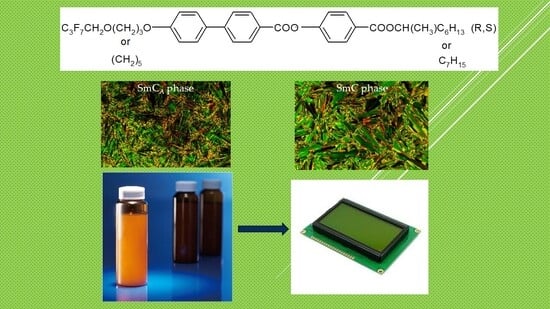
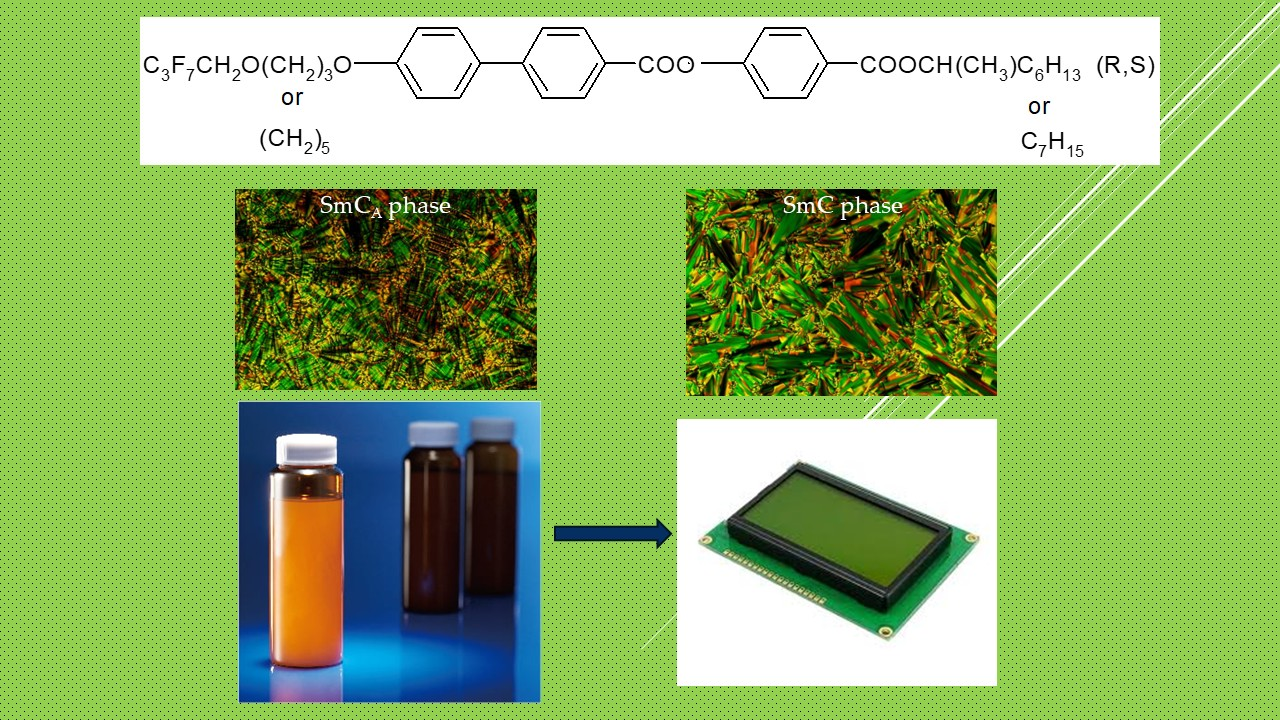
Graphical Abstract

1. Introduction

Liquid crystals (LCs) are a group of compounds that exhibit properties of both solids and liquids [1]. Due to their partial molecular ordering, they exhibit anisotropy in physical properties, enabling their use in modern technologies, including liquid crystal displays, photonics, and sensors [2]. Chiral liquid crystal systems are of particular importance. They are mesophases formed by molecules lacking mirror symmetry, inducing a unique helical, self-assembled superstructure. Characterized by a twisted molecular arrangement, they exhibit high sensitivity to external stimuli, acting as photonic materials that selectively reflect circularly polarized light and exhibit strong thermochromic effects [3,4]. Chirality is most often introduced by synthesizing molecules containing an asymmetric carbon atom, but chiral dopants can also be added to achiral liquid crystals, thereby creating a chiral system [5]. In the world of chiral liquid crystals, ferroelectrics (FLCs) and antiferroelectrics (AFLCs) occupy a prominent place [6,7,8]. In the synclinic phase (SmC), molecules in consecutive layers tilt in the same direction. In the anticlinic phase (SmCA), molecules in consecutive layers tilt in opposite directions. These phases in chiral molecules determine the material’s ferroelectric and antiferroelectric properties. The chiral analog of the smectic C and smectic CA phases is denoted by an asterisk (*). Smectic ferroelectrics comprise molecules arranged in distinct layers that can slide over each other. They maintain both orientational and positional order, unlike ferroelectric nematics (NFs), discovered in 2017 [9,10], whose molecules are oriented in a common direction (as in ordinary nematics) but do not form any layers or additional spatial structures. The molecules are arranged randomly, which makes this material more fluid. Furthermore, the ferroelectric nematic phase occurs in achiral (symmetric) molecules. The dipoles of all molecules spontaneously and coherently align in the same direction, creating a polarized liquid. In ferroelectric nematics, polarization switching is very fast (thresholdless) and almost hysteresis free. Thanks to their unique switching dynamics, ferroelectric nematics are the basis for creating next-generation technologies, such as smart windows, new types of motors, or energy-saving screens [11,12,13,14].
Smectic ferroelectric and antiferroelectric liquid crystal arrangements offer low response times, thereby improving the properties and quality of electro–optical devices [15,16,17,18,19,20,21,22,23,24,25,26,27]. FLCs/AFLCs, which have long helical pitch, enable the use of thicker cells with high-quality alignment of liquid crystalline materials in display technology [28]. Therefore, materials with a very wide temperature range for the antiferroelectric phase and a long helical pitch are sought, and efforts are underway to lengthen the pitch by mixing chiral and achiral components or by mixing the (R) and (S) enantiomers [29,30].
The properties of chiral liquid crystalline systems can be modified by adding dopants, chiral [31,32,33] or achiral, in the form of racemates, i.e., mixtures of compounds containing equal proportions of left-handed (R) and right-handed (S) enantiomers. For this purpose, four racemates differing in alkyl chain length were synthesized (as shown in Figure 1) and then doped into chiral antiferroelectric mixtures of known compositions and properties. In practice, only liquid crystalline mixtures are used, which is why mixtures were doped rather than pure compounds.
Adding a racemate to a base mixture allows for modification of its properties, as demonstrated in previous publications [34,35,36,37]. First and foremost, the use of racemates in mixtures reduces the cost of their preparation, as chiral compounds are expensive. Furthermore, it improves their mesomorphic and electro–optical properties and, above all, causes helical unwinding in mixtures. This time, racemates with alkyl chains containing six and seven carbon atoms were synthesized, resulting in significant differences in the mesomorphic properties of these analogs. The racemates exhibit synclinic or anticlinic properties, depending on the length of the alkyl chain, which determines whether they are used in ferroelectric or antiferroelectric mixtures. At the same time, it was demonstrated that a small difference in molecular structure has a significant impact on mesomorphic properties. When we decided to obtain racemates with the C7H15 chain, we did not expect such differences in mesomorphic properties. The main focus so far has been on the C6H13 chain, but racemates with shorter chains, C5H11 and C4H9, have also been obtained.

2. Materials and Methods

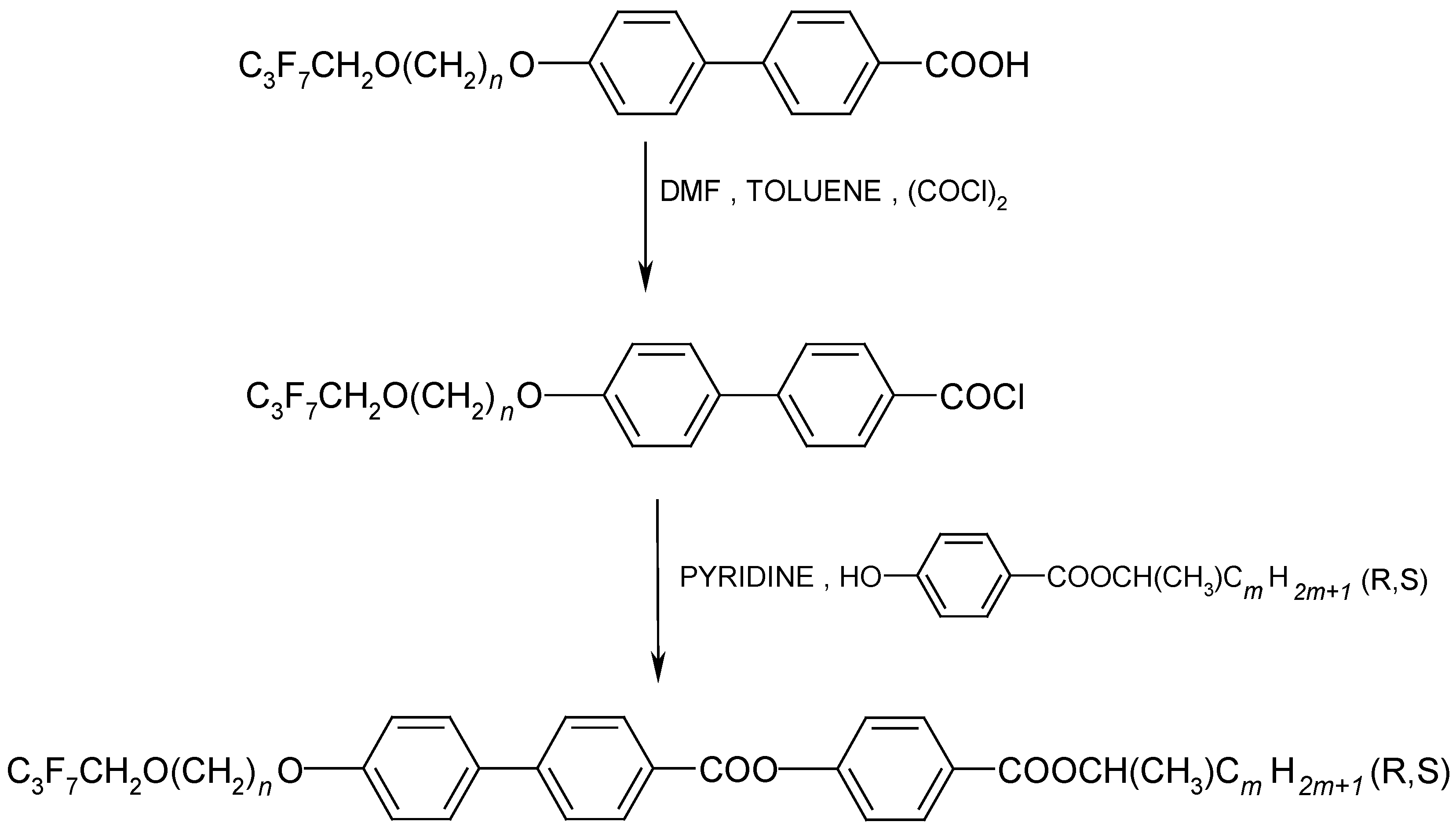
The racemates were obtained as follows (see Figure 2). All reagents were used for the reactions as purchased; only toluene was dried by distillation over diphosphorus pentaoxide. The purity of the liquid crystalline racemates was determined using a Shimadzu Prominence chromatograph (Shimadzu Co., Kyoto, Japan) equipped with an SPD-M20A diode array detector. The racemates have chemical purities of about 99% as shown in Table 1. The esterification yield was about 50% in all cases.
Mass spectra were recorded on a Shimadzu GC-MS-QP2010S instrument (Shimadzu Co., Kyoto, Japan) equipped with a quadrupole mass analyzer, operating in direct insertion (DI) mode. This technique allows the sample to be introduced directly into the ion source without prior chromatographic separation, making it particularly suitable for the analysis of pure compounds. Electron ionization (EI) at 70 eV was employed, and spectra were recorded over an appropriate mass range to confirm the molecular ion and the characteristic fragmentation pattern of each compound (see Table 1). Mass spectra for the obtained racemates are included in the Supplementary Materials in Figures S1–S4.
1H NMR confirmed the structures of the racemic mixtures. The NMR spectra were acquired on a Bruker Avance III 500 MHz spectrometer (Bruker, Karlsruhe, Germany). This device has a superconducting magnet that generates a magnetic field of 11.75 T at induction, and for the sample, radiation effects at 500 MHz for proton nuclei. Deuterated chloroform was used as the solvent. The spectra of all of the samples were measured at room temperature. A comparison of NMR spectra confirmed that the real structures matched the planned structures, as shown in the Supplementary Materials in Figures S5–S8.
Infrared spectra were measured using the ATR (Attenuated Total Reflectance) technique with a Nicolet iS10 spectrometer (Thermo Fisher Scientific, Waltham, MA, USA). The spectra were measured over 4000–600 cm−1 with 32 scans and a resolution of 4 cm−1. Before each sample measurement, the background measurement was performed. All spectra were recorded at room temperature for racemates in the crystalline phase and are shown in Figures S9–S12 in the Supplementary Materials.
The synthesis is presented in detail for the racemate with the acronym 5PhPhC7. The remaining racemates were obtained in the same manner.
4-[5-(2,2,3,3,4,4,4-heptafluorobutoxy)pentyl-1-oxy]biphenylcarboxylic acid (1.5 g; 3 mmol) and 50 mL of anhydrous toluene were placed in a flask. Oxalyl chloride (0.3 mL; 3.5 mmol) and a catalytic amount (2 drops) of DMF were added to the prepared suspension. The reaction mixture was stirred for 6 h after heating to 50 °C. During the reaction, gas evolution (CO, CO2) was observed. Initially, the solution was turbid, but after warming, it became clear and straw-colored. The product of the first stage of the reaction is the chloride acid. After completion of the first stage, the excess unreacted oxalyl chloride was distilled from the reaction mixture along with a small amount of solvent. To the cooled reaction mixture were added 4-(1-methyloctyloxycarbonyl)phenol (0.792 g; 3 mmol) and a two-fold excess of pyridine (0.5 mL; 6 mmol). The reaction mixture was stirred for 16 h at approximately 60 °C. During the reaction, a brown precipitate was observed. After the reaction was complete, the cooled mixture was poured into a beaker with water and hydrochloric acid and stirred for 1.5 h. The resulting mixture was filtered through activated carbon. The filtrate was washed twice with distilled water and separated. The organic phase was dried over anhydrous magnesium sulfate. After filtering off the drying agent, the toluene was evaporated in a vacuum evaporator. The product was crystallized from 20 mL of absolute ethanol, passed through a chromatographic column for purification and then recrystallized. In each synthesis, the yield allowed the production of approximately 1.0 g of product:
-
Racemate 3PhPhC6, 1.1 g, yield 53.5%;
-
Racemate 3PhPhC7, 1.05 g, yield 49.0%;
-
Racemate 5PhPhC6, 1.0 g, yield 52.3%;
-
Racemate 5PhPhC7, 1.15 g, yield 52.6%.
Phase transition observations and determination of phase transition temperature ranges were performed using an Olympus BX51 polarizing microscope (Shinjuku, Tokyo, Japan) equipped with a heating stage and a Linkam THMS 600 temperature controller (Linkam Scientific Instruments Ltd., Tadworth, UK). Phase transition temperatures were determined from observed changes in sample texture. A small amount of the racemate under study was applied to a glass slide, then a second identical glass slide was placed on top. The sample was then placed on the microscope’s heating stage. The samples were heated to isotropic liquid and then cooled at 2 °C/min. Texture changes were analyzed both during heating and cooling.
A Netzsch DSC 204 F1 Phoenix differential calorimeter (NETZSCH-Gerätebau GmbH, Selb, Germany) was used to determine the temperatures and enthalpies of phase transitions. The instrument operates by recording the heat flux difference between a reference vessel and a sample vessel. Measurements were conducted in two cycles (heating and cooling), within a temperature range of −20 °C to 150 °C. Temperature changes were 2 °C/min during both heating and cooling of the samples.
The helical pitch of the studied liquid crystalline mixtures was determined from transmittance spectra. A Shimadzu UV-3600 UV-Vis-NIR spectrophotometer (Shimadzu Co., Kyoto, Japan) was used. This method allows for the determination of the helical pitch of chiral systems by analyzing characteristic changes in transmittance as a function of wavelength. Samples were deposited on glass plates coated with an orienting compound, which forced the helix to align perpendicularly. Transmittance spectra were recorded over 3000–360 nm at controlled temperatures of 107–2 °C.

3. Results

3.1. Mesomorphic and Thermodynamic Properties of the Obtained Racemates

Table 2 presents the phase transition temperatures [°C] and their corresponding enthalpies [kJ/mol]. The first row shows the phase transition temperatures determined by DSC during heating, and the second row shows the values recorded during cooling. The third row, marked in italics, shows the phase transition enthalpies. POM temperature measurements are included in Table S1 of the Supplementary Materials. DSC thermograms are also provided in the Supplementary Materials (Figures S13–S16).
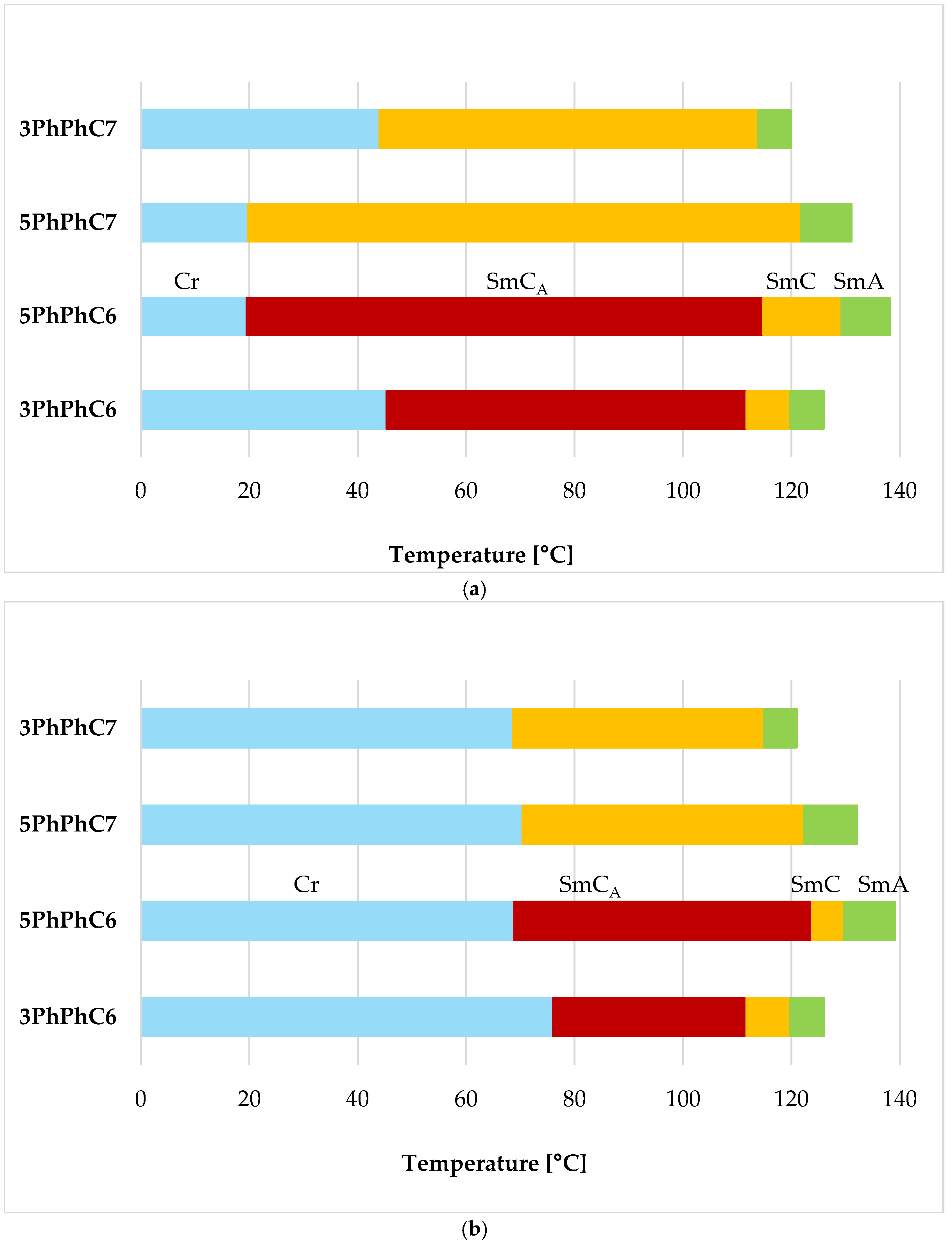
Figure 3a,b shows the ranges of phase transition temperatures for the obtained racemates, determined by DSC measurements during cooling and heating cycles (blue is the crystal phase—Cr; red is the anticlinic phase—SmCA; orange is the synclinic phase—SmC; and green is the smectic A phase—SmA).
All obtained racemic mixtures have an SmA phase in a medium or narrow temperature range. Mixtures with a C6 chain have the following phase sequence of Cr-SmCA-SmC-SmA-Iso, whereas those with a C7 chain have the following phase sequence of Cr-SmC-SmA-Iso. Mixtures with a C6 chain possess the anticlinic, SmCA, phase over a very wide temperature range, while mixtures with a C7 chain possess the synclinic, SmC, phase over a very wide range. During the cooling cycle, a broadening of the phase transition temperature range is observed, due to supercooling (see Figure 3a). The clearing points of the racemates do not exceed 150 °C, with the highest value observed for the racemate 5PhPhC6. The highest melting point is that of the racemate 3PhPhC6 (76 °C), while the remaining racemates have lower melting points.
The enthalpies of the SmCA-SmC, SmC-SmA, and SmA-Iso phase transitions are similar. Still, significant differences exist in the melting enthalpies; they are more than twice as high for racemates with the oligomethylene spacer five (about 30 kJ/mol) and for racemates with spacer three, below 18 kJ/mol. The SmCA-SmC phase transition has the lowest enthalpy of transition, below 0.08 kJ/mol.
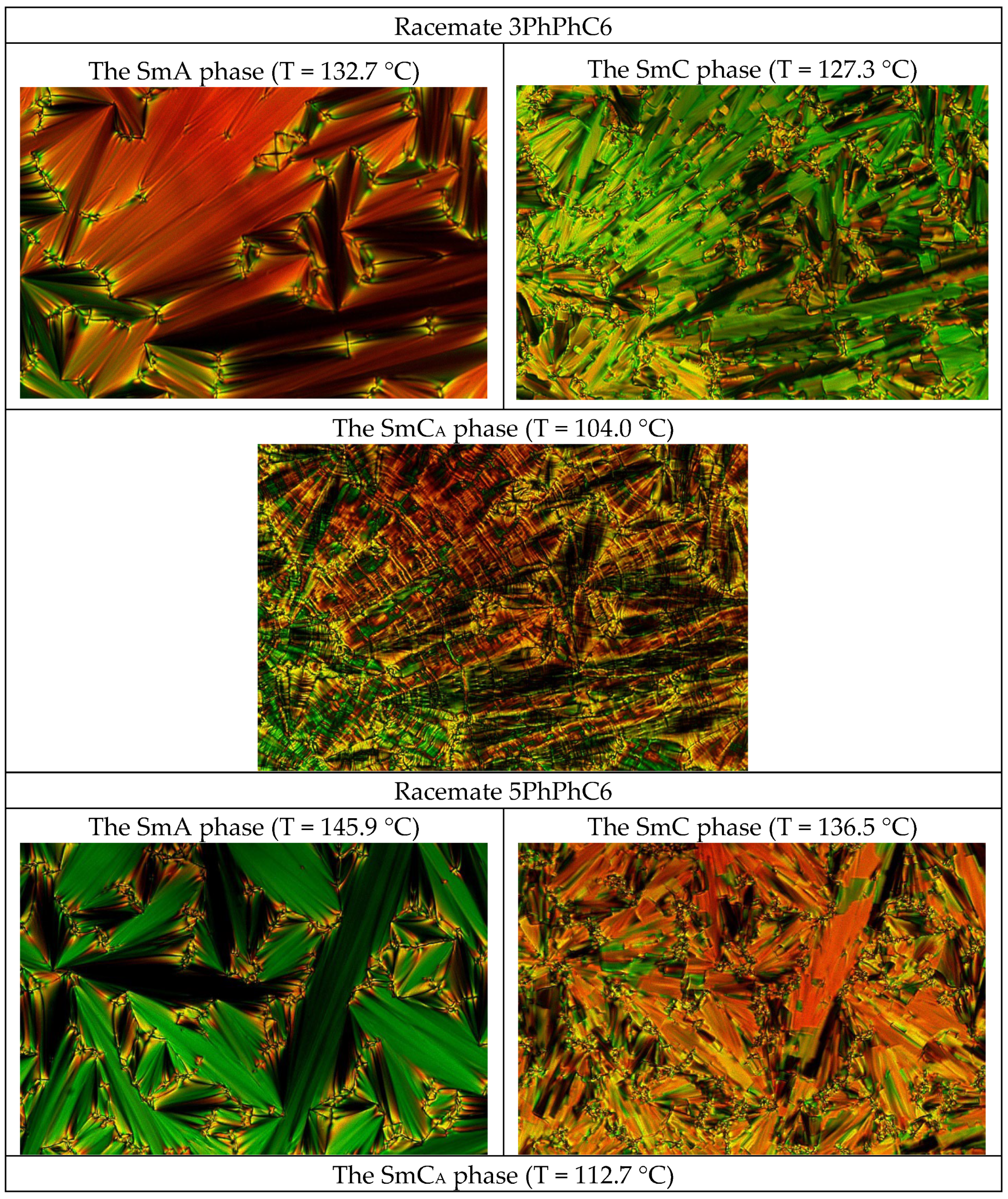
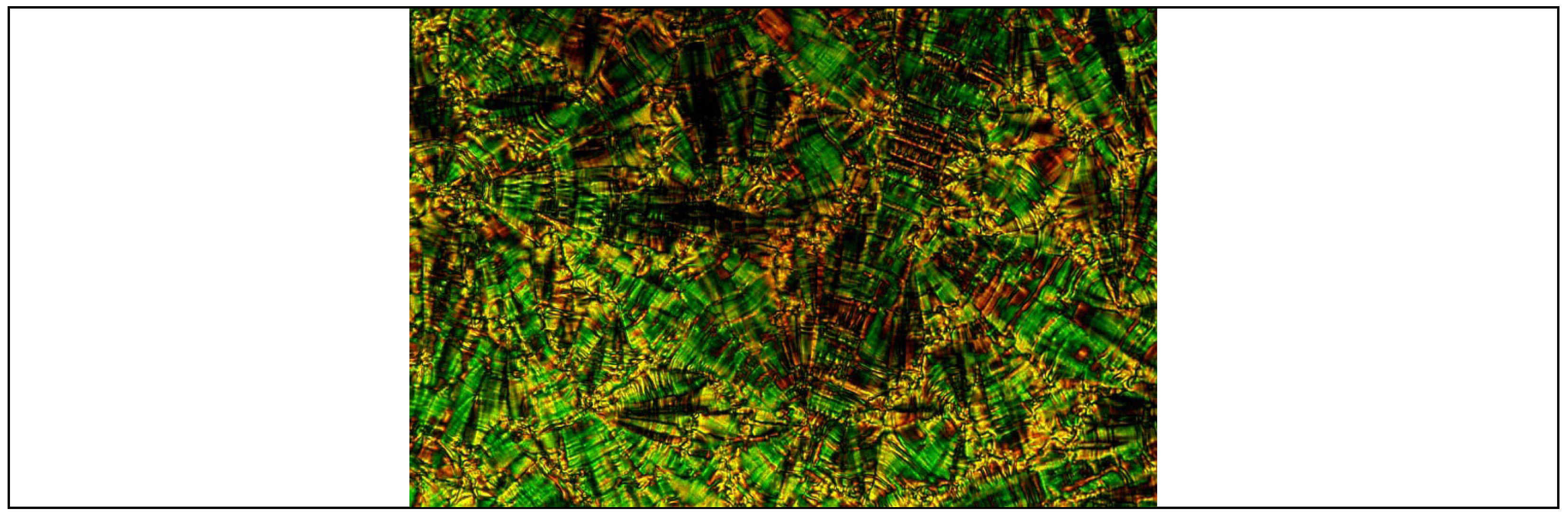
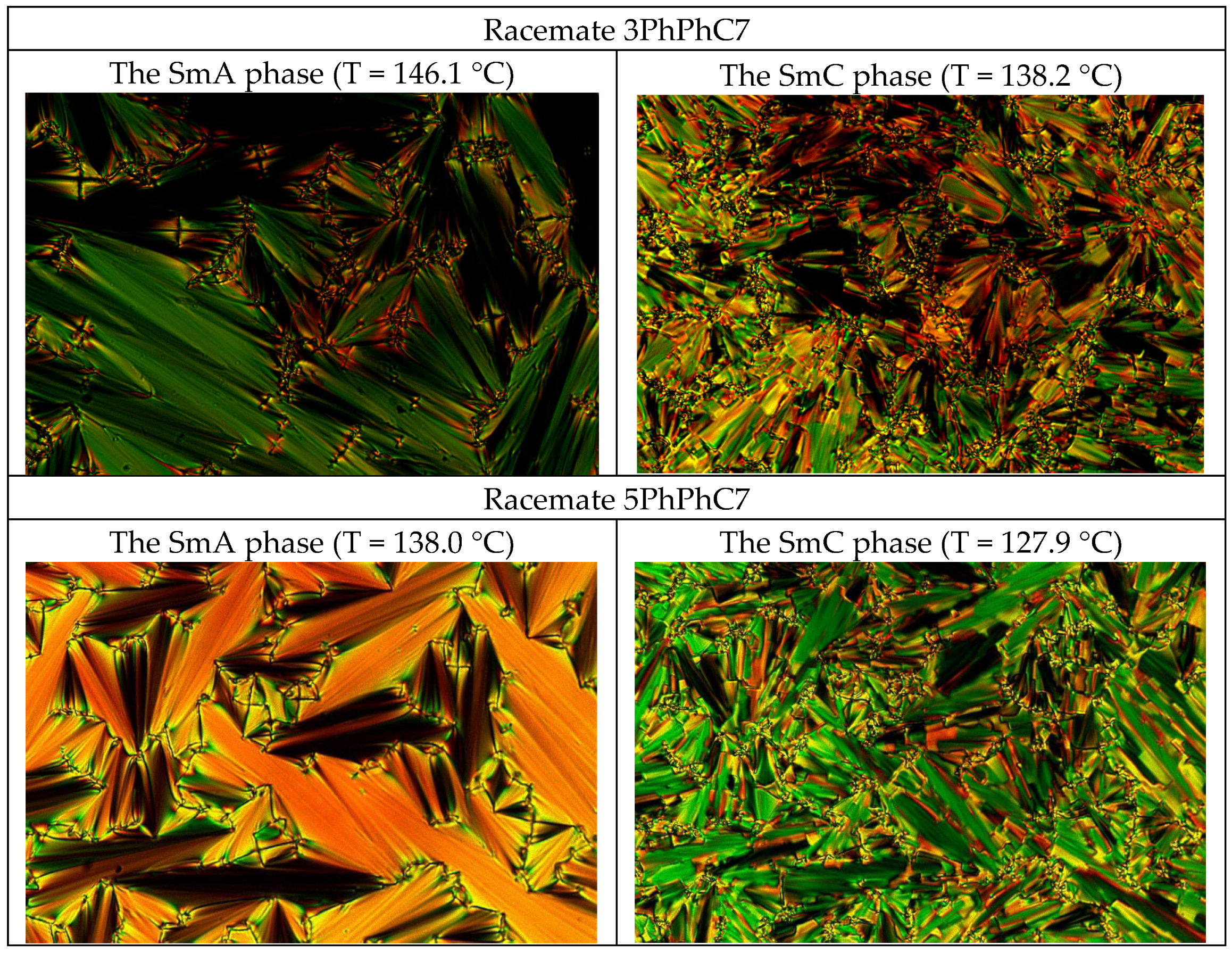
The textures from the cooling cycle for the observed phases are shown in Figure 4 and Figure 5. The smectic A phase has a fan-like texture, and the anticlinic (SmCA) phase has a peacock-tail texture, which is not observed in mixtures with a C7 chain; hence, this phase is interpreted as a synclinic phase, SmC.
To compare the mesomorphic properties of the obtained racemates with structurally similar racemates, it is best to do so for racemates with the formulas and phase transition temperatures given below [35,36,38]:
Crystals 16 00415 i001
Crystals 16 00415 i002
The structures presented for comparison differ from the racemates analyzed in this paper in both benzene ring arrangement (-PhCOOPhPh-) and alkyl chain length (C4, C5, and C6). All these racemates have the anticlinic phase, while shorter alkyl chains (C4 and C5) have the SmA phase longer alkyl chains (C6) have the synclinic phase. It is evident here that increasing the alkyl chain length promotes the occurrence of the synclinic phase (SmC), as observed in the racemates with the C7 chain described in this paper.

3.2. Preparation of Mixtures

Base liquid crystalline mixtures designated W-274 and W-275 were prepared for further studies. The mixture W-274 consisted of four enantiomers, which have a similar structure to the obtained racemates but with an inverted aromatic ring system. Two components contained a difluorinated benzene ring. The mixture W-275 is also a four-component mixture; one component had the same ring system, while the others had an inverted ring system. The length of the oligomethylene spacer was always odd, as in the obtained racemates. This length was three, five, or seven. All enantiomers contained the same chiral fragment obtained from (S)-(+)-2-octanol, a chiral eight-carbon secondary alcohol. This is one of the frequently used chiral alcohols for the preparation of compounds with antiferroelectric properties [39,40,41,42,43,44]. Two of the obtained racemates were selected for doping, allowing for a comparison of the effect of the dopant structure on the mesomorphic properties and helical pitch of the antiferroelectric mixtures. The mixtures W-274 and W-275 were prepared according to the weight fractions of the individual components presented in Table 3 and Table 4. The properties of the components are described in Ref. [39].
The compositions of eutectic mixtures were calculated using the equations given by Le Chatelier, Schröder, and van Laar. These equations relate the concentrations of components in individual phases to the temperature and parameters of the pure compounds (phase transition temperature and enthalpy), assuming that the system is in isobaric conditions, as well as with constant heat capacities of the components in the phases at phase equilibrium and no chemical reactions of the components in the system [45,46,47].
A 20% of selected racemates was added by weight to the base liquid crystalline mixtures of W-274 and W-275 (Table 5). The amount of added racemate was determined from previous studies and was found to be optimal [36].

3.3. Results Obtained for Doped Chiral Mixtures

Table 6 presents the phase transition temperatures [°C] and the corresponding enthalpies [J/g] for racemate-doped mixtures. The rows contain temperatures and enthalpies, which are described identically for the pure racemates. SmCA* means the antiferroelectric phase, colored green; SmC* means the ferroelectric phase, colored orange; and SmA* means the smectic A* phase, colored blue. POM temperatures are in the Supplementary Materials in Table S2.
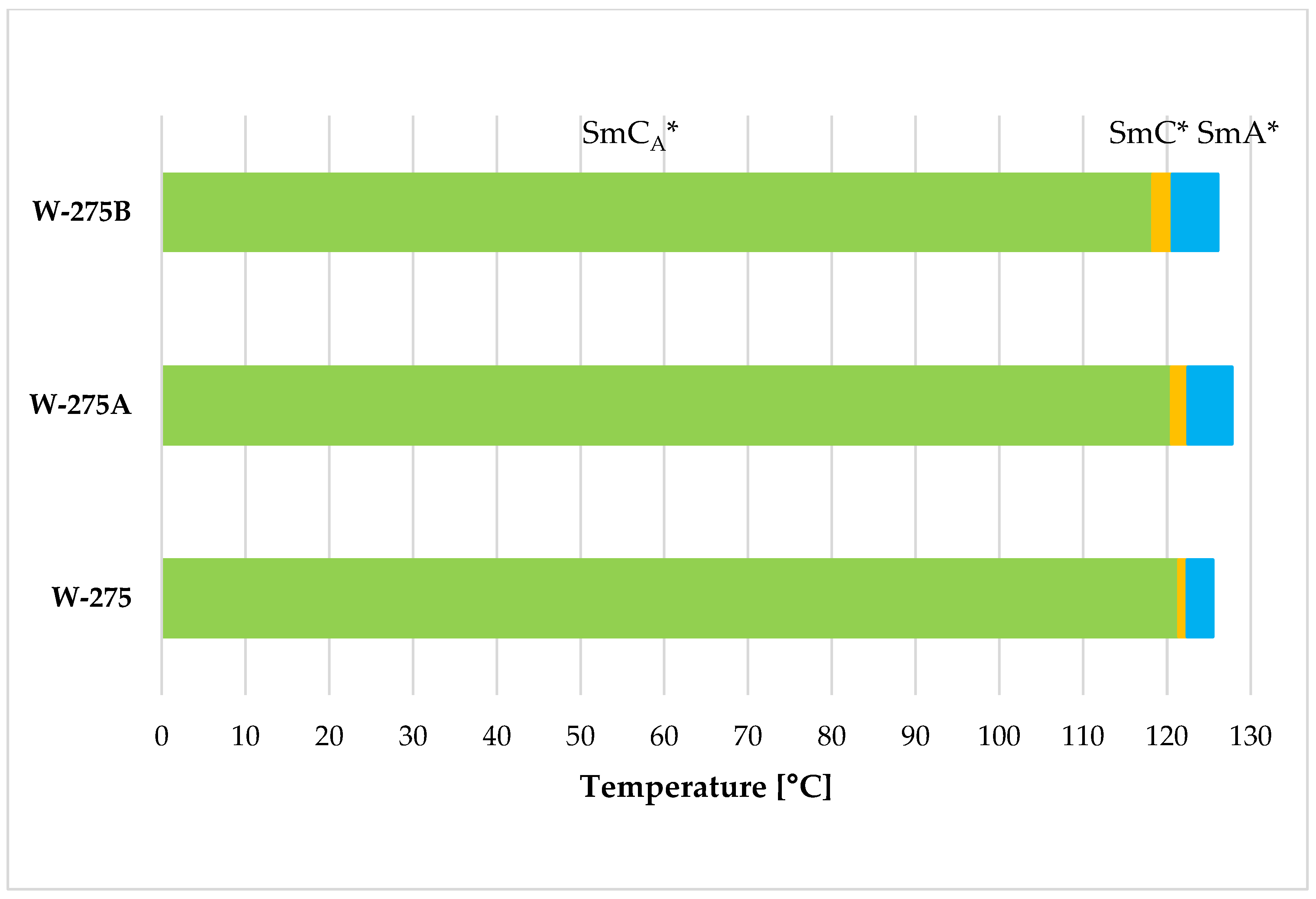
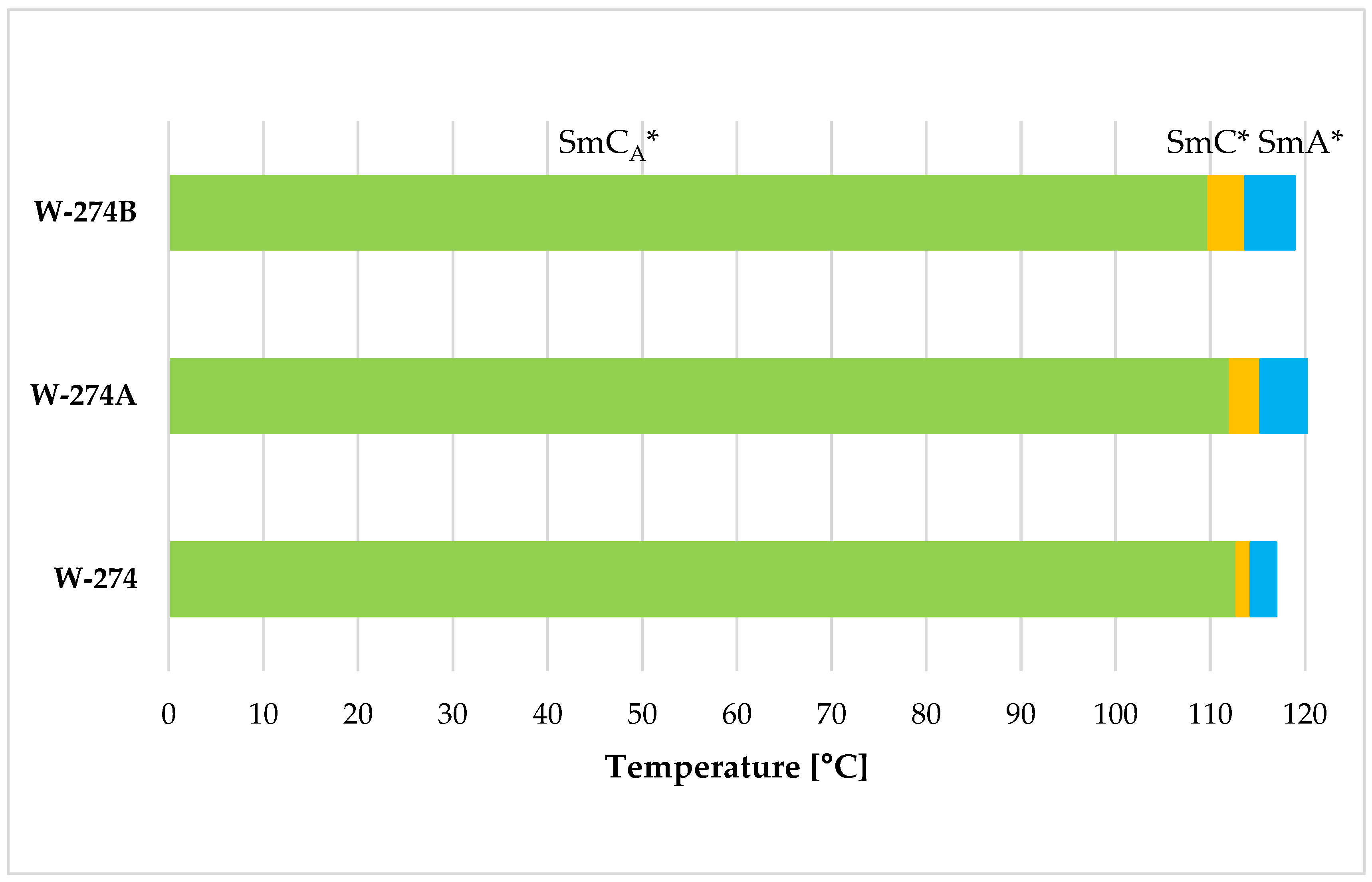
For each mixture, a very wide range of the SmCA* (antiferroelectric) phase can be observed exceeding 100 °C. The doped mixtures exhibit a wider range of SmC* and SmA* phase occurrence than the base mixtures. In the case of the mixtures W-274B and W-275B, the range for the SmC* phase is doubled, which results from doping with the racemate with the synclinic phase. The clearing points differ by several degrees; in the doped mixtures, they are slightly higher, as shown in Figure 6 and Figure 7. The crystallization temperatures of the mixtures were not determined due to supercooling. DSC thermograms are provided in the Supplementary Materials (Figures S17–S20).
The lowest enthalpy was observed for the SmCA*-SmC* transition in the mixture W-275B. The remaining enthalpies are comparable across transitions and mixtures.
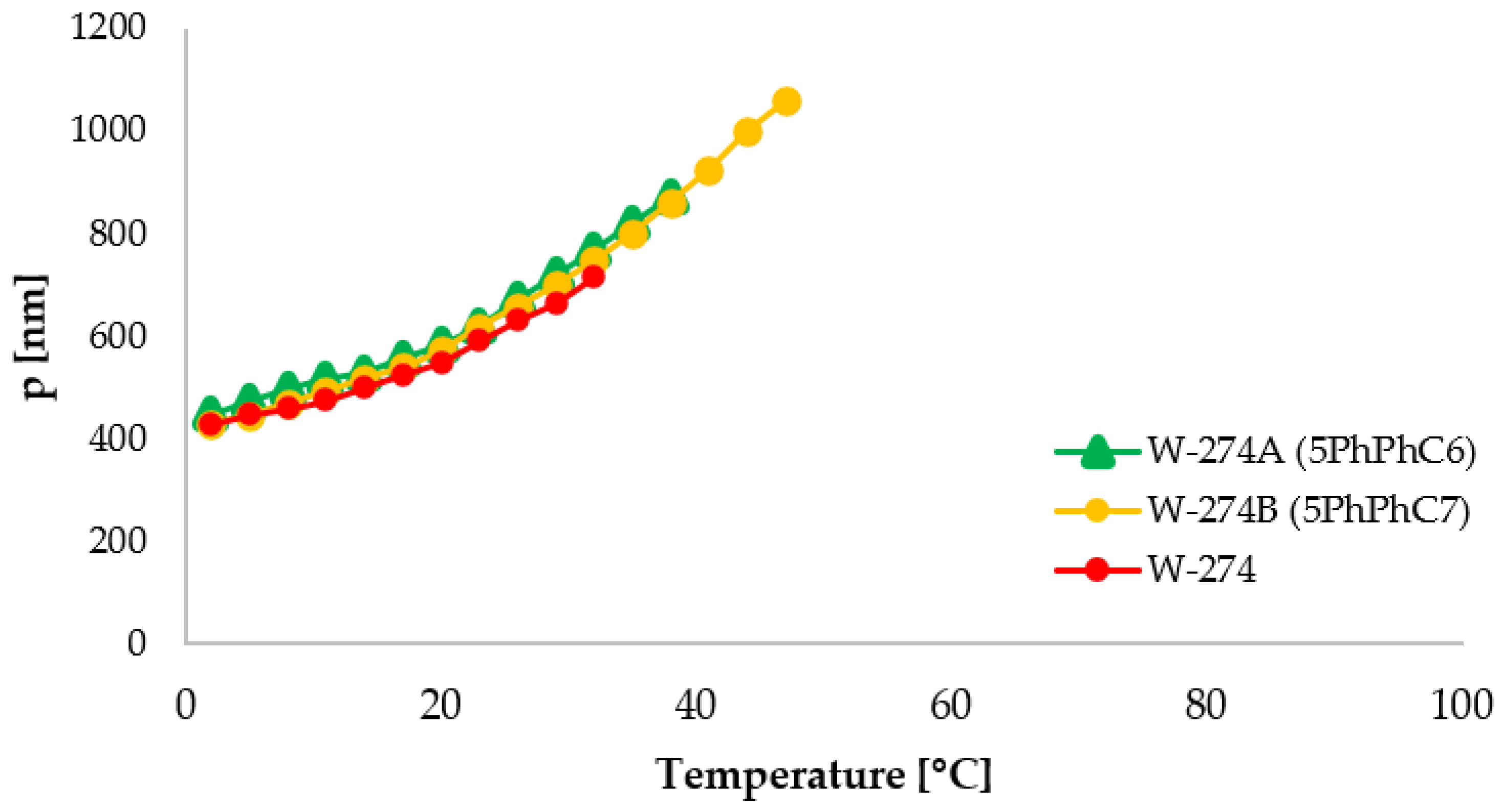
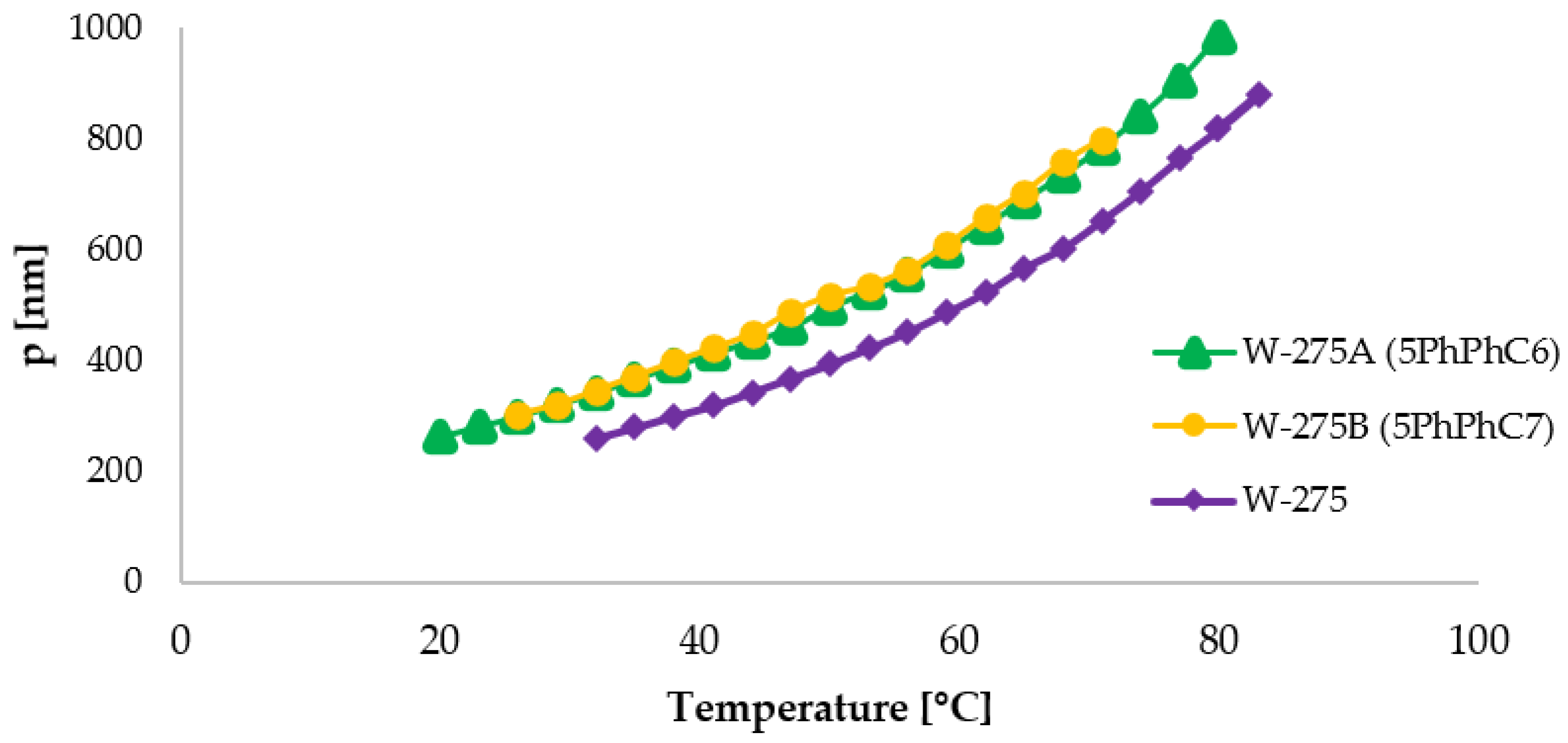
Figure 8 and Figure 9 present the helical pitch versus temperature for all mixtures. The pitch p was calculated for the antiferroelectric phase from the dependence:
λmax = n · p,
where n is the average refractive index. The value n = 1.5 was taken from the calculation [48].
In each case, the helical pitch increases with increasing temperature. The base mixtures exhibit lower helical pitch values than the doped mixtures. The highest helical pitch values were obtained for the mixtures W-275A (ca. 1000 nm at 80 °C) and W-274B (ca. 1050 nm at 47 °C). The helical pitch could not be measured in the ferroelectric phase (due to the narrow range of this phase).
Figure 8 and Figure 9 show that a greater effect on the helical pitch was observed for the mixture W-275 after doping with racemates. This mixture contained an enantiomer with the same aromatic ring system as the racemates (-PhPhCOOPh-). Therefore, it is worth checking the influence of the obtained racemates on the properties of other antiferroelectric mixtures comprising enantiomers structurally similar to the racemates described in the paper.

4. Conclusions

Four liquid crystalline racemates were obtained, with oligomethylene spacer lengths of three and five and with carbon atoms in the terminal alkyl chain of six and seven. Racemates containing six carbon atoms in the alkyl chain (C6) exhibit the following phase sequence of Cr-SmCA-SmC-SmA-Iso, while racemates with seven carbon atoms (C7) exhibit the following phase sequence of Cr-SmC-SmA-Iso. A wide range of SmC phase occurrences were in racemates containing alkyl chains with seven carbon atoms. In contrast, in the case of C6, the SmCA phase occurs over a wide temperature range, while the remaining SmC and SmA phases occur over a medium or narrow temperature range.
Racemate-doped mixtures exhibit a very wide range of antiferroelectric phase and slightly higher clearing points than the base mixtures. Doping the base mixtures with racemates containing seven carbon atoms leads to a two-fold expansion of the SmC* (ferroelectric) phase.
The helical pitch of the racemate-doped mixtures is longer than that of the base mixtures; the highest pitch value was obtained for the mixture W-274B (above 1000 nm), which indicates the unwinding of the helix.
Racemates containing seven carbon atoms in the alkyl chain have the potential to be used in ferroelectric mixtures due to the absence of the anticlinic phase in the pure racemates. Analysis of the results indicates that the terminal alkyl chain plays a significant role in mesomorphic properties. For shorter chains (C4, C5), the anticlinic phase is observed, while increasing the length causes the appearance of the synclinic phase for C6 chains; in the case of C7, the anticlinic phase disappears in favor of the synclinic phase, as demonstrated in previous studies [35,36,38]. We also plan to synthesize racemates with shorter and longer terminal alkyl chains (C3 and C8).
Further work will be carried out on the use of the obtained racemates as dopants in other chiral mixtures, as well as an attempt to separate these mixtures using high-performance liquid chromatography [49,50] to obtain pure enantiomers [51,52] without the need for their synthesis.

Supplementary Materials

The following supporting information can be downloaded at: https://www.mdpi.com/article/10.3390/cryst16070415/s1. Figure S1: Mass spectrum of the racemate denoted as 3PhPhC6; Figure S2: Mass spectrum of the racemate denoted as 3PhPhC7; Figure S3: Mass spectrum of the racemate denoted as 5PhPhC6; Figure S4: Mass spectrum of the racemate denoted as 5PhPhC7; Figure S5: 1H NMR spectrum of the racemate 3PhPhC6 in CDCl3; Figure S6: 1H NMR spectrum of the racemate 3PhPhC7 in CDCl3; Figure S7: 1H NMR spectrum of the racemate 5PhPhC6 in CDCl3; Figure S8: 1H NMR spectrum of the racemate 5PhPhC7 in CDCl3; Figure S9: IR spectrum for the racemate 3PhPhC6; Figure S10: IR spectrum for the racemate 3PhPhC7; Figure S11: IR spectrum for the racemate 5PhPhC6; Figure S12: IR spectrum for the racemate 5PhPhC7; Figure S13: DSC thermogram for the racemate 3PhPhC6; Figure S14: DSC thermogram for the racemate 3PhPhC7; Figure S15: DSC thermogram for the racemate 5PhPhC6; Figure S16: DSC thermogram for the racemate 5PhPhC7; Figure S17: DSC thermogram for mixture W-274A; Figure S18: DSC thermogram for mixture W-274B; Figure S19: DSC thermogram for mixture W-275A; Figure S20: DSC thermogram for mixture W-275B; Table S1: Phase transition temperatures [°C] from the microscope for the obtained racemates; Table S2: Phase transition temperatures [°C] from the microscope for mixtures doped with racemates.

Author Contributions

Conceptualization, M.U.; methodology, M.U.; software, M.U. and M.Z.; validation, M.U.; formal analysis, M.U.; investigation, M.U., M.Z., and O.K.; resources, M.U.; data curation, M.U. and O.K.; writing—original draft preparation, M.U. and M.Z.; writing—review and editing, M.U.; visualization, M.U. and O.K.; supervision, M.U. All authors have read and agreed to the published version of the manuscript.

Funding

This research was funded by a University Research Grant (UGB 22-094) and by the Polish Ministry of Science and Higher Education under the “Regional Initiative of Excellence” program, project title: Increasing competencies in identifying threats related to hazardous materials (2024-27)—project No. RID/SP/0042/2024/01.

Institutional Review Board Statement

Not applicable.

Informed Consent Statement

Not applicable.

Data Availability Statement

The original contributions presented in this study are included in the article. Further inquiries can be directed to the corresponding author.

Acknowledgments

We would like to thank Olga Strzeżysz for her help in measuring the mesomorphic properties of mixtures; Michał Czerwiński for his help in measuring the helical pitch of mixtures and the IR spectra of racemates; and Mateusz Szala for the NMR spectra of racemates.

Conflicts of Interest

The authors declare no conflicts of interest.

References

  1. Kelker, H. History of liquid crystals. Mol. Cryst. Liq. Cryst. 1973, 21, 1–48. [Google Scholar] [CrossRef]
  2. Lagerwall, J.P.F.; Scalia, G. A new era for liquid crystal research: Applications of liquid crystals in soft matter nano-, bio- and microtechnology. Curr. Appl. Phys. 2012, 12, 1387–1412. [Google Scholar] [CrossRef]
  3. Kitzerow, H.-S.; Bahr, C. Chirality in Liquid Crystals; Springer: New York, NY, USA, 2001. [Google Scholar]
  4. Dierking, I. Chiral liquid crystals: Structures, phases, effects. Symmetry 2014, 6, 444–472. [Google Scholar] [CrossRef]
  5. Goodby, J.W. Chirality in Liquid Crystals. J. Mater. Chem. 1991, 1, 307–318. [Google Scholar] [CrossRef]
  6. Lagerwall, S.T. Ferroelectric and Antiferroelectric Liquid Crystals; Wiley-VCH: Weinheim, Germany, 1999. [Google Scholar]
  7. Meyer, R.B. Ferroelectric liquid crystals; a review. Mol. Cryst. Liq. Cryst. 1977, 40, 33–48. [Google Scholar] [CrossRef]
  8. Chandani, A.D.L.; Górecka, E.; Ouchi, Y.; Takezoe, H.; Fukuda, A. Antiferroelectric chiral smectic phases responsible for the tristable switching in MHPOBC. Jap. J. Appl. Phys. 1989, 28, L1265–L1268. [Google Scholar]
  9. Mandle, R.J.; Cowling, S.J.; Goodby, J.W. Rational Design of Rod-Like Liquid Crystals Exhibiting Two Nematic Phases. Chem. Eur. J. 2017, 23, 14554–14562. [Google Scholar] [PubMed]
  10. Nishikawa, H.; Shiroshita, K.; Higuchi, H.; Okumura, Y.; Haseba, Y.; Yamamoto, S.; Sago, K.; Kikuchi, H. A Fluid Liquid-Crystal Material with Highly Polar Order. Adv. Mater. 2017, 29, 1702354. [Google Scholar]
  11. Cruickshank, E. The Emergence of a Polar Nematic Phase: A Chemist’s Insight into the Ferroelectric Nematic Phase. Chempluschem 2024, 89, e202300726. [Google Scholar] [PubMed]
  12. Pociecha, D.; Thornborrow, Z.; Karcz, J.; Bakiera, M.; Herman, J.; Makal, A.; Szydłowska, J.; Górecka, E. Helical vs. non-helical nematic and lamellar proper ferroelectric liquid crystal phases. Soft Matter 2026, 22, 1973–1978. [Google Scholar] [CrossRef] [PubMed]
  13. Czerwiński, M.; Mrukiewicz, M.; Filipow, M.; Pociecha, D.; Podoliak, N.; Repček, D.; Zając, M.; Węgłowska, D. The Role of Terminal Groups in Nonchiral Rod-Like Compounds on the Formation of Polar Fluids. Chem. Mat. 2025, 37, 8077–8087. [Google Scholar]
  14. Karcz, J.; Herman, J.; Rychłowicz, N.; Kula, P.; Górecka, E.; Szydłowska, J.; Majewski, P.W.; Pociecha, D. Spontaneous Chiral Symmetry Breaking in Polar Fluid-Heliconical Ferroelectric Nematic Phase. Science 2024, 384, 1096–1099. [Google Scholar] [PubMed]
  15. Fukuda, A.; Takanishi, Y.; Isozaki, T.; Ishikawa, K.; Takezoe, H. Antiferroelectric chiral smectic liquid crystals. J. Mat. Chem. 1994, 4, 997–1016. [Google Scholar] [CrossRef]
  16. Link, D.R.; Natale, G.; Shao, R.; Maclennan, J.E.; Clark, N.A.; Korblova, E.; Walba, D.M. Spontaneous formation of macroscopic chiral domains in a fluid smectic phase of achiral molecules. Science 1997, 278, 1924–1927. [Google Scholar] [CrossRef] [PubMed]
  17. Dłubacz, A.; Marzec, M.; Dardas, D.; Żurowska, M. New antiferroelectric liquid crystal for use in LCD. Phase Transit. 2016, 89, 349–358. [Google Scholar]
  18. Yoshizawa, A. Ferroelectric Smectic Liquid Crystals. Crystals 2024, 14, 350. [Google Scholar] [CrossRef]
  19. Lagerwall, J.P.F.; Giesselmann, F. Current topics in smectic liquid crystal research. ChemPhysChem 2006, 7, 20–45. [Google Scholar] [CrossRef] [PubMed]
  20. Pandey, M.B.; Dąbrowski, R.; Dhar, R. Antiferroelectric liquid crystals: Smart materials for future displays. Adv. Energy Mater. 2014, 10, 389–432. [Google Scholar] [CrossRef]
  21. Yamamoto, N.; Koshoubu, N.; Mori, K.; Nakamura, K.; Yamada, Y. Full-color antiferroelectric liquid crystal display. Ferroelectrics 1993, 149, 295–304. [Google Scholar] [CrossRef]
  22. Yurtseven, H.; Kavruk, D. Analysis of the Spontaneous Polarization and the Dielectric Constant Near the Ferroelectric Phase Transition in TSCC. Ferroelectrics 2008, 367, 190–200. [Google Scholar] [CrossRef]
  23. Uchida, J.; Soberats, B.; Gupta, M.; Kato, T. Advanced Functional Liquid Crystals. Adv. Mater. 2022, 34, 2109063. [Google Scholar] [CrossRef]
  24. Nys, I.; Stebryte, M.; Ussembayev, Y.Y.; Beeckman, J.; Neyts, K. Tilted Chiral Liquid Crystal Gratings for Efficient Large-Angle Diffraction. Adv. Opt. Mater. 2019, 7, 1901364. [Google Scholar]
  25. Czerwiński, M.; Filipow, M.; Łuczak, K.; Węgłowska, D. Ferroelectric Smectic Liquid Crystalline Materials with Different Degree of Chirality. Materials 2025, 18, 2343. [Google Scholar] [CrossRef] [PubMed]
  26. Kotova, S.P.; Pozhidaev, E.P.; Samagin, S.A.; Kesaev, V.V.; Barbashov, V.A.; Torgova, S.I. Ferroelectric Liquid Crystal with Sub-Wavelength Helix Pitch as an Electro-Optical Medium for High-Speed Phase Spatial Light Modulators. Opt. Laser Technol. 2021, 135, 106711. [Google Scholar]
  27. Akaogi, J.; Koizumi, Y.; Ono, M.; Furue, H. Application of Ferroelectric Liquid Crystals to Optical Devices. Mol. Cryst. Liq. Cryst. 2014, 596, 106–112. [Google Scholar] [CrossRef]
  28. Chełstowska, A.; Czerwiński, M.; Tykarska, M.; Bennis, N. The influence of antiferroelectric compounds on helical pitch of orthoconic W-1000 mixture. Liq. Cryst. 2014, 41, 812–820. [Google Scholar] [CrossRef]
  29. Urbańska, M.; Strzeżysz, O.; Szala, M. Highly tilted antiferroelectric (R) enantiomers useful for the formulation of eutectic mixtures. Liq. Cryst. 2020, 47, 179–190. [Google Scholar]
  30. Debnath, A.; Mandal, P.K.; Węgłowska, D.; Dąbrowski, R. Induction of a room temperature ferroelectric SmC* phase in binary mixtures with moderate spontaneous polarization and sub-millisecond switching time. RSC Adv. 2016, 6, 84369–84378. [Google Scholar]
  31. Urbańska, M.; Gratzke, M.; Czerwiński, M. Synthesis and Characterization of New Chiral Smectic Four-Ring Esters. Molecules 2024, 29, 3134. [Google Scholar] [CrossRef] [PubMed]
  32. Debnath, A.; Mandal, P.K. Effect of fluorination on the phase sequence, dielectric and electro-optical properties of ferroelectric and antiferroelectric mixtures. Liq. Cryst. 2017, 44, 2192–2202. [Google Scholar] [CrossRef]
  33. Urbańska, M.; Strzeżysz, O.; Perkowski, P. Fluorinated esters with a very broad temperature range of the antiferroelectric phase. Liq. Cryst. 2023, 50, 2332–2344. [Google Scholar] [CrossRef]
  34. Urbańska, M.; Dardas, D. Properties of Antiferroelectric Mixtures Differing in the Amount of Added Racemate. Crystals 2024, 14, 147. [Google Scholar] [CrossRef]
  35. Morawiak, P.; Żurowska, M.; Piecek, W. A Long Pitch Orthoconic Antiferroelectric Mixture Modified by Isomeric and Racemic Homostructural Dopants. Liq. Cryst. 2018, 45, 1451–1459. [Google Scholar] [CrossRef]
  36. Urbańska, M.; Szala, M. Synthesis, Mesomorphic Properties and Application of (R,S)-1-Methylpentyl 4′-Hydroxybiphenyl-4-carboxylate Derivatives. Crystals 2022, 12, 1710. [Google Scholar]
  37. Urbańska, M.; Dziaduszek, J.; Strzeżysz, O.; Szala, M. Synclinic and anticlinic properties of (R,S) 4′-(1-methylheptyloxycarbonyl)biphenyl-4-yl 4-[7-(2,2,3,3,4,4,4-heptafluorobutoxy)heptyl-1-oxy]benzoates. Phase Trans. 2019, 92, 657–666. [Google Scholar]
  38. Urbańska, M.; Vaňkátová, P.; Kubíčková, A.; Kalíková, K. Synthesis, characterisation and supercritical fluid chromatographyenantioseparation of new liquid crystalline materials. Liq. Cryst. 2020, 47, 1832–1843. [Google Scholar]
  39. Żurowska, M.; Dąbrowski, R.; Dziaduszek, J.; Garbat, K.; Filipowicz, M.; Tykarska, M.; Rejmer, W.; Czupryński, K.; Spadło, A.; Bennis, N.; et al. Influence of alkoxy spacer length and fluorosubstitution of benzene ring on mesogenic and spectral properties of high tilted antiferroelectric 4′-(S)-1-(methylheptyloxycarbonyl)biphenyl-4-yl-4-(2,2,3,3,4,4,4-heptafluorobutoxy)alkoxybenzoates. J. Mater. Chem. 2010, 21, 2144–2153. [Google Scholar]
  40. Milewska, K.; Drzewiński, W.; Czerwiński, M.; Dąbrowski, R. Design, synthesis and mesomorphic properties of chiral benzoates and fluorobenzoates with direct SmCA*-Iso phase transition. Liq. Cryst. 2015, 42, 1601–1611. [Google Scholar]
  41. Dąbrowski, R. Liquid crystals with fluorinated terminal chains and antiferroelectric properties. Ferroelectrics 2000, 243, 1–18. [Google Scholar] [CrossRef]
  42. Sokół, E.; Drzewiński, W.; Dziaduszek, J.; Dąbrowski, R.; Bennis, N.; Otón, J.M. The synthesis and properties of novel partially fluorinated ethers with high tilted anticlinic phase. Ferroelectrics 2006, 343, 41–48. [Google Scholar] [CrossRef]
  43. Żurowska, M.; Morawiak, P.; Piecek, W.; Czerwiński, M.; Spadło, A.; Bennis, N. A new mesogenic mixture with antiferroelectric phase only at a broad temperature range. Liq. Cryst. 2016, 43, 1365–1374. [Google Scholar] [CrossRef]
  44. Dąbrowski, R.; Gąsowska, J.; Otón, J.M.; Piecek, W.; Przedmojski, J.; Tykarska, M. High tilted antiferroelectric liquid crystalline materials. Displays 2004, 25, 9–19. [Google Scholar] [CrossRef]
  45. Schröder, I.Z. Über die Abhängigkeit der Löslichkeit eines festen Körpers von seiner Schmelztemperatur. Z. Phys. Chem. 1893, 11, 449–465. [Google Scholar] [CrossRef]
  46. van Laar, J.J. Die Schmelz- oder Erstarrungskurven bei binären Systemen, wenn die feste Phase ein Gemisch (amorphe feste Lösung oder Mischkristalle) der beiden Komponenten ist. Z. Phys. Chem. 1908, 63, 257–297. [Google Scholar] [CrossRef]
  47. Le Chatelier, H. Sur un énoncé général des lois des équilibres chimiques. C. R. Acad. Sci. 1884, 99, 786–789. [Google Scholar]
  48. Raszewski, Z.; Kędzierski, J.; Perkowski, P.; Piecek, W.; Rutkowska, J.; Kłosowicz, S.; Zieliński, J. Refractive Indices of the MHPB(H)PBC and MHPB(F)PBC Antiferroelectric Liquid Crystals. Ferroelectrics 2002, 276, 289–300. [Google Scholar]
  49. Snyder, L.R.; Kirkland, J.J.; Glajch, J.L. Practical HPLC Method Development; John Wiley & Sons, Inc.: Hoboken, NJ, USA, 1997. [Google Scholar]
  50. Swadesh, J.K. HPLC Practical and Industrial Applications, 2nd ed.; CRC Press: Boca Raton, FL, USA, 2000. [Google Scholar]
  51. Clark, A.; Kitson, R.R.A.; Mistry, N.; Taylor, P.; Taylor, M.; Lloyd, M.; Akamune, C. Introduction to Stereochemistry; Royal Society of Chemistry: Cambridge, UK, 2021. [Google Scholar]
  52. Vaňkátová, P.; Kubíčková, A. Towards greener enantioselective liquid chromatography: An exploratory study on chiral liquid crystals. Anal. Chim. Acta 2025, 1342, 343664. [Google Scholar] [CrossRef] [PubMed]
Figure 1. The formula of the obtained racemates.
Crystals 16 00415 g001
Figure 2. Scheme for the synthesis of racemates (n = 3 or 5, m = 6 or 7).
Crystals 16 00415 g002
Figure 3. (a) Ranges of occurrence of individual phases for the obtained racemates in the cooling cycle (DSC measurements, first cycle). (b) Ranges of occurrence of individual phases for the obtained racemates in the heating cycle (DSC measurements, first cycle).
Crystals 16 00415 g003
Figure 4. Microphotographs of the characteristic textures obtained during the cooling cycles for the racemates 3PhPhC6 and 5PhPhC6.
Crystals 16 00415 g004aCrystals 16 00415 g004b
Figure 5. Microphotographs of the characteristic textures obtained during the cooling cycles for the racemates 3PhPhC7 and 5PhPhC7.
Crystals 16 00415 g005
Figure 6. Ranges of occurrence of individual phases in mixtures W-274, W-274A, and W-274B in the heating cycle from DSC measurements of the first cycle.
Crystals 16 00415 g006
Figure 7. Ranges of occurrence of individual phases in mixtures W-275, W-275A, and W-275B in the heating cycle from DSC measurements of the first cycle.
Crystals 16 00415 g007
Figure 8. Helical pitch versus temperature for the mixtures W-274, W-274A, and W-274B.
Crystals 16 00415 g008
Figure 9. Helical pitch versus temperature for the mixtures W-275, W-275A, and W-275B.
Crystals 16 00415 g009
Table 1. Chromatographic purity and mass peak of the obtained racemates.
Name and Acronym of the RacematePurity [%]m/z
4′-(1-methylheptyloxycarbonyl)phenyl-4-yl (R,S)-4-[3-(2,2,3,3,4,4,4-heptafluorobutoxy)prop-1-oxy]biphenylcarboxylate
3PhPhC6
99.0685
4′-(1-methyloctyloxycarbonyl)phenyl-4-yl (R,S)-4-[3-(2,2,3,3,4,4,4-heptafluorobutoxy)prop-1-oxy]biphenylcarboxylate
3PhPhC7
98.4714
4′-(1-methylheptyloxycarbonyl)phenyl-4-yl (R,S)-4-[5-(2,2,3,3,4,4,4-heptafluorobutoxy)pentyl-1-oxy]biphenylcarboxylate
5PhPhC6
98.6700
4′-(1-methyloctyloxycarbonyl)phenyl-4-yl (R,S)-4-[5-(2,2,3,3,4,4,4-heptafluorobutoxy)pentyl-1-oxy]biphenylcarboxylate
5PhPhC7
98.5728
Table 2. Phase transition temperatures and enthalpies from the calorimeter for the obtained racemates (* means phase present; - means phase absent).
AcronymCr SmCA SmC SmA Iso
3PhPhC6*76.0 °C
45.3 °C
17.5 kJ/mol
*118.4 °C
111.7 °C
0.04 kJ/mol
*121.4 °C
119.8 °C
0.8 kJ/mol
*127.0 °C
126.0 °C
3.4 kJ/mol
*
3PhPhC7*68.6 °C
44.0 °C
16.0 kJ/mol
- *114.9 °C
113.9 °C
0.7 kJ/mol
*121.0 °C
119.9 °C
3.3 kJ/mol
*
5PhPhC6*68.9 °C
19.5 °C
29.4 kJ/mol
*123.8 °C
114.8 °C
0.07 kJ/mol
*129.7 °C
129.2 °C
0.8 kJ/mol
*139.1 °C
138.2 °C
4.2 kJ/mol
*
5PhPhC7*70.4 °C
19.8 °C
29.0 kJ/mol
- *122.4 °C
121.7 °C
0.6 kJ/mol
*132.1 °C
131.1 °C
3.8 kJ/mol
*
Table 3. Composition and phase transition temperatures of the mixture W-274.
Chemical Formula of EnantiomersPercentage Content [wt.%]
Crystals 16 00415 i00326.06
Crystals 16 00415 i00428.82
Crystals 16 00415 i00513.41
Crystals 16 00415 i00631.71
SmCA* 112.8 SmC* 114.3 SmA* 116.4 Iso
Table 4. Composition and phase transition temperatures of the mixture W-275.
Chemical Formula of EnantiomersPercentage Content [wt.%]
Crystals 16 00415 i00714.32
Crystals 16 00415 i00831.91
Crystals 16 00415 i00918.36
Crystals 16 00415 i01035.41
SmCA* 119.0 SmC* 119.6 SmA* 122.8 Iso
Table 5. Liquid crystalline mixtures doped with racemates.
MixturesBase MixturesAcronym of the RacematePercentage
Content [wt.%]
W-274AW-2745PhPhC620
W-274B5PhPhC7
W-275AW-2755PhPhC6
W-275B5PhPhC7
Table 6. Temperatures and enthalpies of phase transitions from the calorimeter for mixtures doped with racemates (* means phase present).
MixturesSmCA* SmC* SmA* Iso
W-274A*112.1 °C
109.5 °C
0.1 J/g
*115.3 °C
114.6 °C
1.1 J/g
*120.5 °C
119.5 °C
5.1 J/g
*
W-274B*109.8 °C
106.6 °C
0.1 J/g
*113.7 °C
113.0 °C
1.0 J/g
*118.9 °C
117.9 °C
4.8 J/g
*
W-275A*120.5 °C
118.5 °C
0.1 J/g
*122.4 °C
121.8 °C
1.4 J/g
*127.7 °C
126.9 °C
5.2 J/g
*
W-275B*118.3 °C
116.0 °C
0.03 J/g
*120.6 °C
120.0 °C
1.2 J/g
*126.1 °C
125.2 °C
5.1 J/g
*
Disclaimer/Publisher’s Note: The statements, opinions and data contained in all publications are solely those of the individual author(s) and contributor(s) and not of MDPI and/or the editor(s). MDPI and/or the editor(s) disclaim responsibility for any injury to people or property resulting from any ideas, methods, instructions or products referred to in the content.