


Abstract
The dominance of inexpensive ferrites and high-performance rare-earth-based magnets on the global market causes a significant performance gap between these materials. Fe2P-based materials are promising rare-earth-free candidates to bridge this gap, offering high magnetization and uniaxial anisotropy. In this study, density functional theory was employed to systematically analyze the influence of Si and Co substitution on the phase stabilities of such Fe2−yCoyP1−xSix compounds. At 0 K, Si substitution destabilizes the compounds; however, this trend is reversed at elevated temperatures, where Si significantly enhances phase stability. In contrast, Co substitution reduces competition energies at 0 K but promotes instability with increasing temperature. For quaternary Fe2−yCoyP1−xSix compounds, the combined presence of Si and Co leads to a pronounced expansion of the stability range of the hexagonal crystal structure, in reasonable agreement with available experimental observations. Starting from temperatures above 1000 K, several quaternary compounds exhibit negative competition energies, indicating thermodynamic stability. Among all investigated compositions, Fe1.84Co0.16P0.84Si0.16 stands out, combining particularly low competition energies with a previously reported mean-field Curie temperature of 557 K and a high magnetic hardness factor. These results identify Fe1.84Co0.16P0.84Si0.16 as a highly promising rare-earth-lean hard magnetic material for future applications.
1. Introduction
Magnetic materials have attracted growing scientific and technological interest because of their central importance in applications such as electric mobility, energy conversion, and renewable power generation [1,2,3,4,5,6,7]. In particular, the growing demand for sustainable technologies has intensified the search for resource-efficient and inexpensive hard magnetic materials that combine strong magnetic properties with low material costs and reduced dependence on critical raw elements.
Despite these ambitions the global market is dominated by two material classes: high-performance Nd–Fe–B magnets and inexpensive but lower-performing hard ferrite magnets [8,9]. While ferrites are attractive due to their low manufacturing costs, their range of usage is limited because of their comparatively weak magnetic properties. On the other hand, rare-earth magnets, such as Nd2Fe14B, exhibit outstanding magnetic properties originating from the combination of a high magnetic anisotropy from the incorporated rare-earths (RE) and their f-electrons and a high magnetization delivered by the transition-metal (TM) element. However, their widespread application is limited by high production costs, supply-chain risks and the criticality of elements such as Dy, Sm or Tb to raise the Curie temperature to operational levels [10,11,12].
As a consequence, a substantial gap remains between ferrites and high-performance rare-earth magnets [13], which has stimulated considerable research into identifying RE-lean or RE-free alternatives to fill this intermediate performance range between ferrites and RE-magnets. One noteworthy candidate that could potentially bridge the gap is the hexagonally structured Fe2P compound [6,14,15]. It is composed primarily of inexpensive iron, exhibits a high magnetization of approximately 1.03 T and shows a pronounced uniaxial magnetocrystalline anisotropy in the range of 2.3 to 2.6 MJ/m3 [13,16,17,18,19,20]. The major limitation of the Fe2P compound is a relatively low Curie temperature of 214 K [17,19,21,22], which restricts its practical range of usage.
Previous investigations have demonstrated that the substitution of Fe and P atoms with elements such as Co and Si can substantially modify the magnetic properties and the Curie temperature of Fe2P-based compounds [6,7,10,23,24]. The substitution of both elements was shown to increase the Curie temperature and alter the magnetocrystalline anisotropy of the materials, while simultaneously influencing the structural stability of the hexagonal phase and promoting the formation of competing crystal structures such as a body-centered orthorhombic phase. However, the general effect of these substitutions on the phase stability of the compounds in the hexagonal structure has not yet been systematically investigated.
In the present study, the Fe2−yCoyP1−xSix system is examined with emphasis on the role of Si and Co substitution on the phase stabilities of these compounds. By combining finite-temperature phase-stability calculations with earlier results on magnetic properties, a comprehensive assessment of the suitability of these materials as rare-earth-free hard magnets is provided.
To establish a systematic understanding, we briefly summarize our perviously reported magnetic properties, including the saturation magnetization , anisotropy constant and the Curie temperature of Fe2−yCoyP1−xSix compounds with and 1 from our previous work. Additionally, the hardness factor , derived from the magnetization and anisotropy constant , is given for all compounds.
This manuscript is organized as follows: Section 2 outlines the computational methods employed in this work. In Section 3 a brief overview of the previously investigated magnetic properties of Fe2−yCoyP1−xSix materials is given. The following Section 3.2 describes the calculated heat capacity for validation of the results. Section 3.3 then examines first the sole influence of Si and Co, followed by the combined effects of both on the phase stabilities. Finally, the paper concludes in Section 4 with remarks and discussions.
2. Computational Details
First principles calculations were performed within the framework of spin-polarized density functional theory using the Vienna ab initio Simulation Package (VASP) [25,26]. The projector-augmented wave method (PAW) was employed as implemented in VASP, while exchange-correlation effects were described using the generalized gradient approximation (GGA) of Perdew–Burke–Ernzerhof (PBE) [27]. Brillouin zone integrations were carried out using a -centered k-point mesh of 10 × 10 × 10 meshes for supercells containing 36 atoms. A plane-wave cutoff energy of 500 eV was applied, together with a smearing width of 0.01 eV. The convergence criterion for the self-consistent field (SCF) calculations was set to eV. These computational parameters ensured total energy convergence within 1 meV/atom.
The calculation of phase stabilities requires the thermodynamic contributions of the electronic , magnetic and vibrational free energies . These contributions have been calculated as a function of crystal volume V and temperature T within the adiabatic approximation [28]:
with as the total energy at zero K. The electronic contribution was calculated via the finite temperature DFT scheme as proposed by Mermin et al. [29].
with as the total electronic free energy at 0 K. For these calculations it is important to use Fermi-Dirac broadening to have the SIGMA value correspond to the electronic temperature of the system. This is important as the underlying physics of the electronic free energy are the thermodynamic excitations of electrons near the Fermi energy. The electronic entropy is derived from Fermi occupation numbers with the following relation:
with as the Boltzmann constant.
The vibrational energy contribution describes the phonons and was calculated by considering the direct force constant method [30,31]. This method employs small displacements (0.02 Å) to calculate the Hellmann–Feynman forces. The number of displacements is connected to the symmetry of the crystal structure and number of different atom types. The displaced input geometries were generated using the phonopy package [32,33] and the forces were calculated using VASP. The eigenvalues of the Fourier transformed dynamical matrix enter the free energy expression in an harmonic approximation [28]
with ℏ as the reduced Planck constant. This relation sums all 3N phonon states, with N as the number of atoms in the unit cell. In this work the quasi-harmonic approximation was used, including the volume dependence of the phonon frequencies . Anharmonic contributions are not included in the considerations of this work, even though the phonon frequencies are often dependent on the actual magnetic state of a material [34,35]. This was done due to the complexity of the investigated materials and the computational cost connected to these considerations.
The magnetic free energy was computed using a model proposed by Inden et al. [36,37]. The magnetic heat capacity is treated in this model by different formulations, one above one below the Curie temperature. As an input, the Curie temperature, the mean magnetic moment and the magnetic enthalpy ratio of short to long-range order are needed. This model was modified by Chen and Sundman [38] to include the phase transformation from body-centered cubic to face-centered cubic for Fe. Another improvement was proposed by Xiong et al. [39] to replace the mean magnetic moment with an effective magnetic moment. This had the advantage of that antiferromagnetic interactions could be taken into account. In this work, the magnetic free energy of an ordered state as a function of the relative temperature is given as follows:
with p as a structural parameter, that accounts to 0.37 for bcc and 0.25 for non-bcc crystal symmetries. The magnetic entropy in the high-temperature limit, , can be expressed with the relation:
with x as the composition and as the local magnetic moment. Calculated DFT magnetic moments have been used as an input for these computations.
Since the total magnetic free energy is given by the sum of the ordered and disordered state contributions, the paramagnetic ordering has to be additionally taken into account. The free energy contribution from this disordering at infinitely high temperatures is given by
More details for this model can be found in Ref. [39]. Previous investigations have shown that the impact of the Inden model on the calculation of competition energies is negligibly small [40].
The needed input Curie temperatures were taken from theoretical AkaiKKR calculations as published in previous investigation [6,7]. The AkaiKKR code, also known as MACHIKANEYAMA, is a program package employing the Korringa–Kohn–Rostoker (KKR), Greens function method to perform first-principles calculations [41]. To account for the known overestimation of up to ∼40%, the theoretical s were corrected by a factor of 0.75.
3. Results
3.1. Magnetic Properties
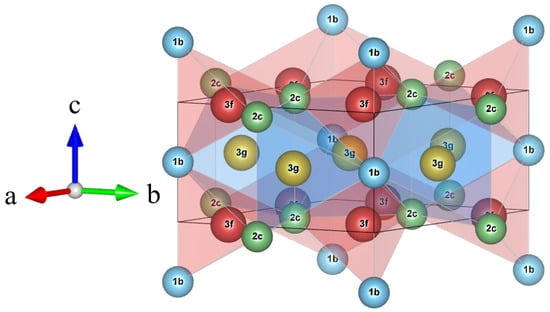
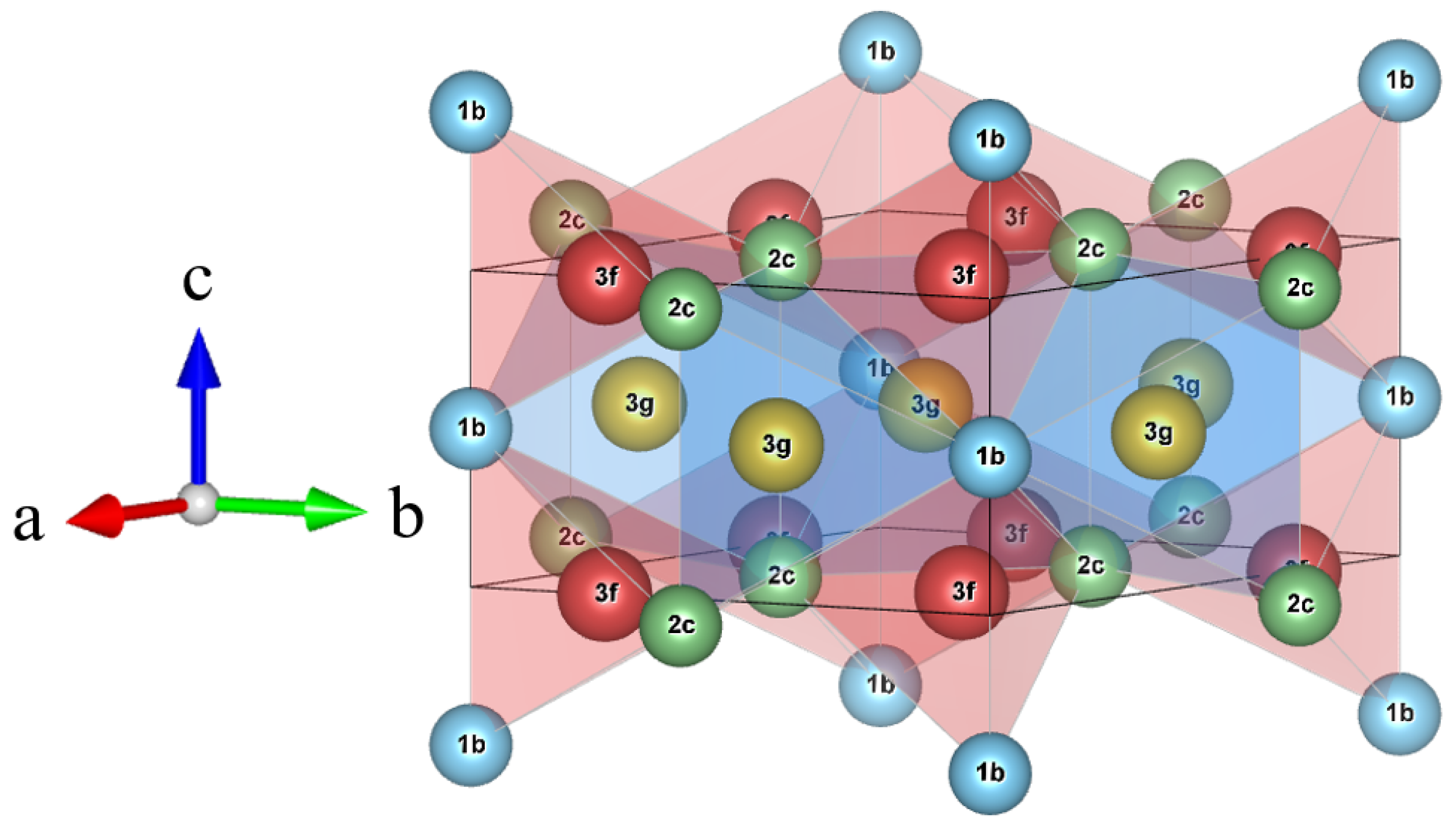
The hexagonally structured Fe2P material is known as a potential magnet material due to its high anisotropy and high magnetization. However, the Curie temperature of this compound is comparably low, at 214 K (Nd2Fe14B: 588 K [42]). The hexagonal unit cell, consisting of Fe atoms in the 3f and 3g Wykoff positions and P in the 2c and 1b of the Fe2P is shown in Figure 1.
Figure 1.
Schematic representation of the hexagonally structured Fe2P material with Fe in the 3f (red) and 3g (yellow) positions and P in the 2c (green) and 1b (blue) sites.
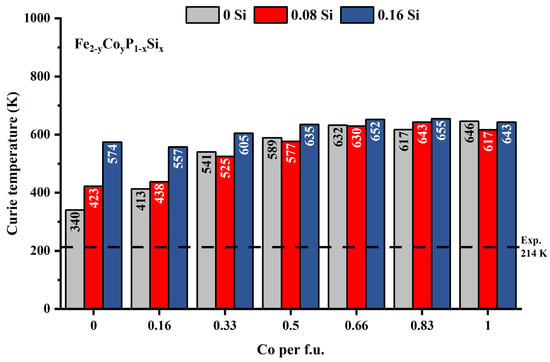
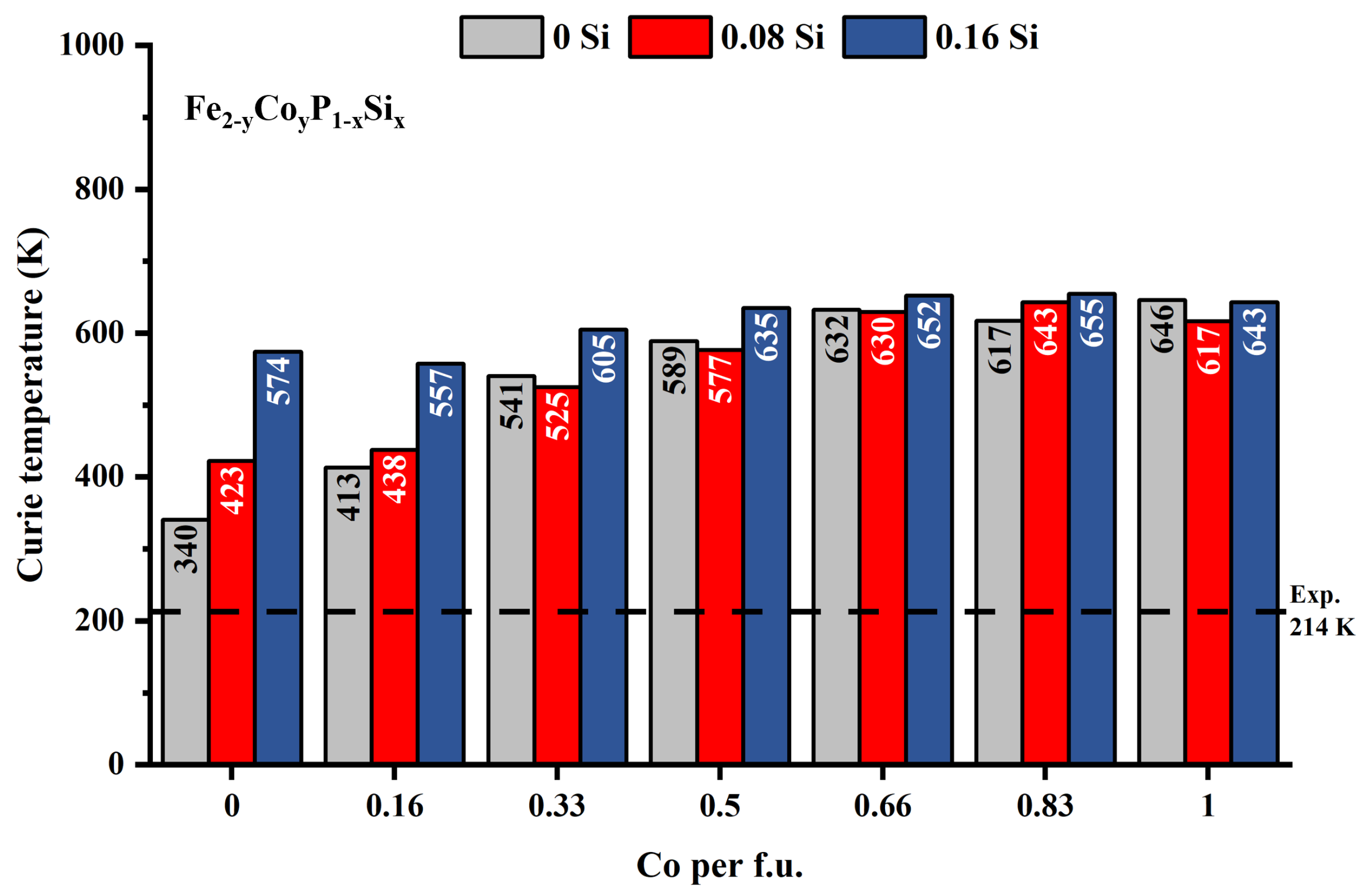
To provide a systematic overview, the calculated saturation magnetization , anisotropy constants and resulting magnetic hardness factors from previous works for ternary and quaternary (Fe2−yCoyP1−xSix) compounds are given in Table 1. The previously mean-field approximation calculated Curie temperatures of these compounds are shown in Figure 2. Note that these calculated s are expected to overestimate the experimental results by up to 40%. Nevertheless, the important trend of the development with Si and Co is in reasonable agreement with experimental findings by Bao et al. [15] For more details on these properties (, and ), see Refs. [6,7]. To quickly summarize the previous findings, Si showed an improvement in the magnetic moments and derived properties like magnetization and . Co on the other hand reduced the magnetic moments due to its inherently lower magnetic moment. Both elements influence the magnetocrystalline anisotropy by decreasing the MAE and even resulting in a loss of the uniaxial anisotropy at high Co concentrations. The magnetic hardness factor for these compounds can then be calculated based on the magnetization and anisotropy constant values by the following relation:
with as the first order anisotropy constant and as the magnetization polarization. Based on their magnetic hardness factor, magnetic materials can be categorized into hard (1 ), semi-hard () and soft ( 0.1) magnetic materials. The calculated hardness factors for the investigated compounds are visible in Table 1. It can be observed, that both Si and Co substitution reduce the magnetic hardness of the compounds, primarily as a consequence of decreasing anisotropy constants. The initially high hardness factors of 1.92 (1.22), 1.58 (1.65) and 1.35 (1.53) obtained within the GGA (LSDA) framework decline markedly with increasing Co content. To maintain a hardness factor above 1, the Co concentration should therefore be limited to a maximum of y = 0.33 Co per f.u. At this substitution level, hardness factors of 1.04 (0.95), 1.19 (1.12) and 1.19 (1.17) are obtained within GGA (LSDA) for Si contents of 0.0, 0.08 and 0.16 per f.u., respectively. With these results a complete analysis of the materials can be provided in combination with the calculated phase stabilities.
Table 1.
Calculated 0 K hardness factors, magnetization and anisotropy constants for hexagonal ternary and quaternary Fe2−y CoyP1−xSix materials with x = 0.0, 0.08 and 0.16 Si per f.u. and y in the range 0 1 Co per f.u. The values calculated using the LSDA functional are given in parenthesis, while the GGA value is given without brackets.
Figure 2.
In mean-field approximation calculated Curie temperatures for hexagonal ternary and quaternary Fe2−yCoyP1−xSix compounds with x = 0.0 (grey), 0.08 (red) and 0.16 (blue) Si per f.u. The calculated s are from previous investigations and shown in more detail in [6,7]. Note that the calculated s are prone to overestimation of up to 40% compared to experimental values. The experimental of Fe2P was taken from Caron et al. [19].
3.2. Heat Capacity—Fe2P
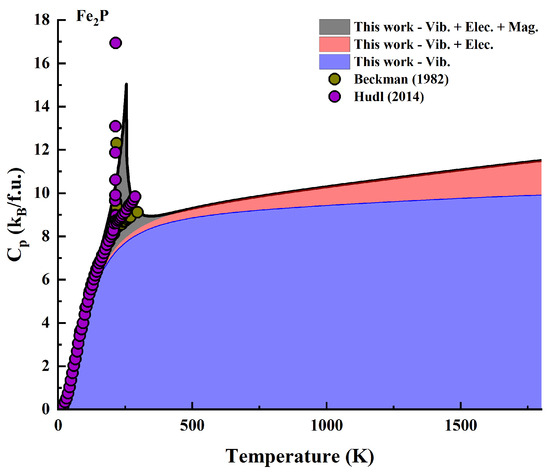
As a straightforward approach to validate the calculated results, the derived heat capacities of the compounds can be compared with available experimental data. For this purpose, the heat capacity at constant pressure can be obtained from the Gibbs energy using the following relation:
where T denotes the temperature and G the Gibbs free energy. The resulting temperature-dependent heat capacities for the substitution-free Fe2P compound are shown in Figure 3.
Figure 3.
Calculated heat capacity at constant pressure for the Fe2P compound. The contributions from lattice vibrations (blue area), electronic excitations (red area) and the magnetic contribution are shown. Experimental data for comparison by Beckman et al. [43] and Hudl et al. [44] are included as circles.
The theoretical data are compared to values from the literature reported by Beckman et al. [43] and Hudl et al. [44], both of whom observed the first-order transition at 216 K with a peak heat capacity of ∼17 and 12.5 kB/f.u., respectively. The noticeable shift of the theoretical maximum— ∼15 kB/f.u.—to a slightly higher temperature (∼250 K) can be attributed to the Curie temperatures being calculated in the mean-field approximation (MFA). Since MFA is well known to overestimate , a correction factor of 0.75 is applied to account for this deviation. With this correction, the magnetic contribution is more accurately represented, leading to a more reliable description of the phase stabilities.
3.3. Phase Stabilities
The influence of Si substitution on the Gibbs energies and consequently the stability of the compounds is investigated. The formation and competition energies are calculated using Equations (12)–(14) based on the corresponding calculated Gibbs energy values. The first equation uses the unary elements Fe, Co, P and Si as reference states to calculate the formation energy, which can be seen as a first assessment of the stability of a compound. With negative formation energies, the compound is more likely to form than the pure elements. Similarly, the second and third equations are used to calculate the competition energy. Different from the formation energy, the competition energy is calculated using the energy values of competing binary and ternary compounds. By using these binaries and ternaries as reference states, a negative competition energy indicates a higher possibility of forming the compound compared to the used competing materials. However, in this case the usage of the ternary FeCoP material makes the use of two equations necessary at Co concentrations lower and higher than the P content in the compound. Above the included P content Equation (14) excludes the energy of FeP, as all included P is covered by the FeCoP material. However, the energy of pure fcc Co is additionally needed as a reference phase to completely describe the competition energy.
with E(alloy) as the respective Gibbs free energies of the materials, x as the amount of Si per f.u., y as the amount of Co per f.u. and N as the number of functional units in the unit cell.
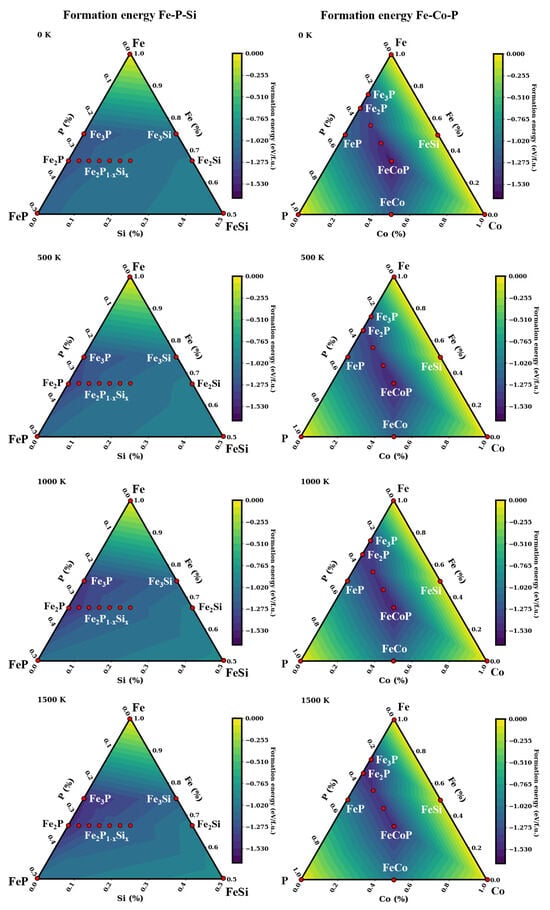
Using the calculated formation and competition energies, isothermic ternary phase diagrams can be constructed. In these diagrams, the defined reference phases are placed at the corners of the triangle. Since only stoichiometric compounds are considered, the isothermal ternary phase diagram contain only the actual composition of the investigated compounds. The formation and competition energies are visualized through color coding, while all non-highlighted points within the diagram are obtained by linear interpolation.
3.3.1. Formation Energy
The formation energy provides a first basic assessment of the phase stability of a compound. In the ternary phase diagram of the formation energy for Si substitution, using ferromagnetic bcc Fe, non-magnetic black P and non-magnetic fcc Si as reference states, the investigated region is restricted to the high Fe-content area (≥0.5%) to improve the clarity of the results. Isothermal ternary phase diagrams have been constructed for 0, 500, 1000 and 1500 K and are shown for Si (left) and Co (right) substitution in Figure 4.
Figure 4.
Calculated isothermic ternary phase diagrams for the substitution of Si (left) and Co (right) in Fe2P1−xSix and Fe2−yCoyP compounds. For Si substitution the elements Fe, P and Si were taken as reference states, while for Co substitution Fe, Co and P were used. The shown FeCoP compound is calculated in the hexagonal crystal structure.
The theoretical results clearly show for both considered elements negative values for all compounds, indicating their potential thermodynamic stability. For Si substitution, a noticeable increase in the formation energy at higher Si concentrations is observed, which reflects a destabilization of the compounds with increasing Si content. Conversely, with rising temperature, an opposite trend emerges: the formation energies decrease systematically. This temperature-induced stabilization affects all Si-containing compounds and significantly decreases the formation energy, reaching values of ∼−1.53 eV/f.u. for both the substitution-free Fe2P compound and the alloy containing 0.08 Si.
In case of Co substitution, the incorporation of Co into Fe2P leads to a decrease in the formation energy towards the center of the diagram. However, with increasing temperature, the trend differs from that observed for Si: the stabilizing effect of Co is progressively reduced. This results in lower formation energies for the low-Co compounds at elevated temperatures, with Fe2P and Fe1.67Co0.33P exhibiting values ∼−1.53 eV/f.u. Compounds with higher Co concentrations, on the other hand, show comparatively higher formation energies of about −1.4 eV/f.u.
3.3.2. Competition Energy
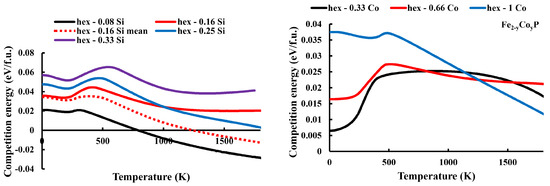
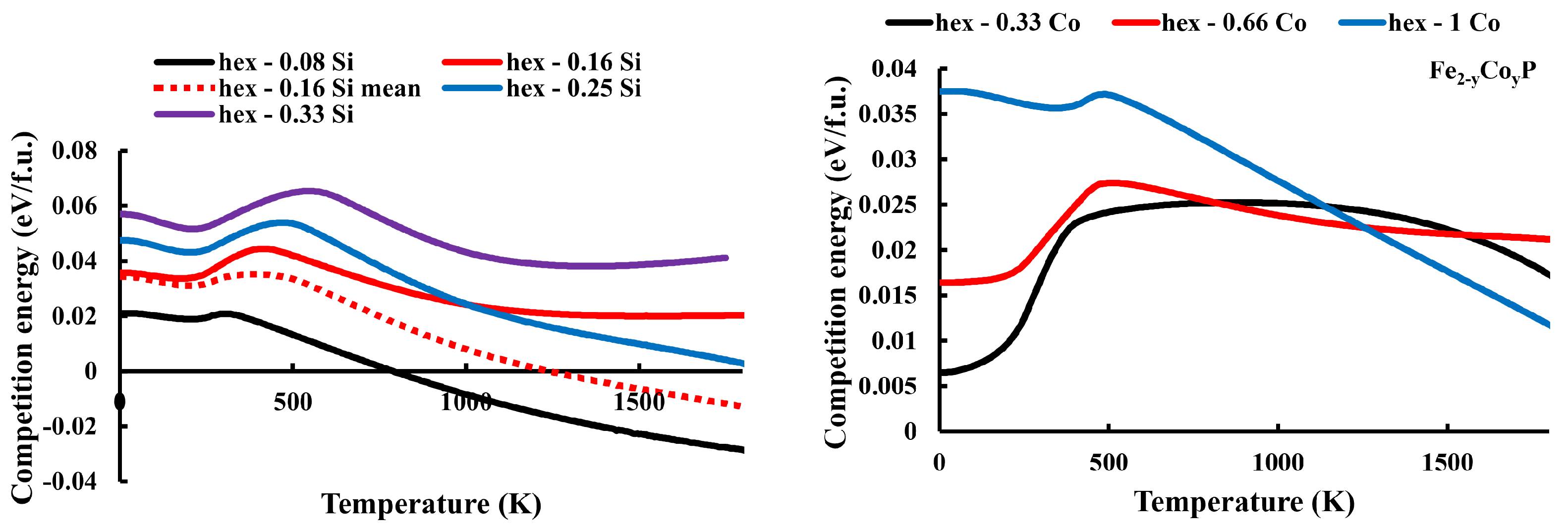
Using the binary and ternary compounds Fe2P, FeSi, FeCo and FeCoP together with the elements bcc Fe and fcc Co as reference phases, a more accurate description of the compound stabilities can be obtained. These reference phases were selected because they represent the most likely decomposition products of the ternary and quaternary systems. The resulting temperature-dependent competition energies are shown in Figure 5 for Si and Co concentrations up to x = 0.33 (left) and y = 1 Co per f.u. (right), respectively.
Figure 5.
(Left): Calculated competition energies for ternary Fe2P1−x Six with x = 0.08 (black), 0.16 (red), 0.25 (blue) and 0.33 (purple) Si per f.u. depending on the temperature. The dashed red line shows the mean values between 0.08 and 0.25 Si per f.u. The competition energies are calculated using Fe2P, FeSi and Fe as reference states. (Right): Calculated competition energies for ternary Fe2−yCoyP compounds with y = 0.33 (black), 0.66 (red) and 1.0 (blue) Co per f.u. depending on the temperature. The competition energies are calculated using Fe2P, FeCoP and Fe as reference states.
In comparison with the formation energies, the competition energies reveal markedly different trends. With increasing Si concentration, the competition energies rise at 0 K, yielding values of ∼0.02, 0.035, 0.05 and 0.059 eV/f.u. for 0.08, 0.16, 0.25 and 0.33 Si per f.u., respectively. This increase in the competition energy can be attributed to an increase in the calculated static energy of the compounds at 0 K. As temperature increases, all four compounds first show a slight decrease before exhibiting a rise in competition energy to a maximum that shifts to higher temperatures with increasing Si concentrations. The small decrease indicates a higher relative decrease in the Fe2P1−xSix compounds compared to the reference materials, which could be due to a higher magnetic entropy at low temperatures. The following increase can be attributed to the rising importance of the vibrational entropy, which causes a higher relative free energy change in the reference phases, leading to an increase in the competition energy. Beyond this observed maximum, the competition energies steadily decrease for compositions up to x = 0.25. The compound with x = 0.33 decreases only up to 1200 K, then levels off before showing a slight increase again at ∼1750 K.
This steady decrease at high temperatures can be seen as a result of the Fe2P1−xSix compounds profiting from a higher vibrational entropy change. This results in a stabilization of the investigated compounds at high temperatures compared to the reference phases. This high importance of the vibrational energy at high temperatures can be assumed based on the high contribution of the vibrations in the heat capacity calculations, where it provides a substantial amount. While a detailed decomposition of electronic, vibrational, and magnetic contributions for each composition is beyond the scope of this work, the observed trends clearly indicate that entropy-driven effects govern the high-temperature stabilization.
It is noteworthy that the Fe2P0.84Si0.16 compound exhibits a temperature dependence comparable to Fe2P0.67Si0.33. However, this behavior deviates from the experimentally observed trend reported by Severin et al. [45] or Jernberg et al. [46], both of whom found increasing stability for hexagonal Fe2P1−xSix compounds with rising temperatures. To provide a qualitative guide for comparison with experimental expectations for x = 0.16 Si, the mean values (dashed red line) between 0.08 and 0.25 Si compositions are indicated. These averaged values result in a trend that aligns well with the available experimental data, showing a stability of the hexagonal phase up to 0.25 Si per f.u. [15,45,46]. Note, that these average values are not used in further calculations and are just shown as a simple way to indicate the expected trend. As the underlying reason for the deviation cannot be clearly identified, the data for concentrations ≥0.16 Si has to be treated carefully and can be prone to uncertainties as the trends for the competition energies differ. At Si concentrations of 0.08 Si a better agreement of the data can be expected due to its similarity with the experimental findings.
The deviation in the data for concentrations higher than 0.16 Si is most likely caused by the substitution of Si into a finite cell size under periodic conditions. In particular, for the calculation of the phonon energies, these periodic boundary conditions can cause self-interaction errors of the small displacements from the employed finite difference method [33,47]. This makes a considerably enlarged unit cell necessary to minimize these effects. In this work, only an increase in the supercells by 2 × 2 × 2 was considered. For Si concentrations of 0.16 and higher, the supercell might have been too small to negate these self-interaction problems and should be addressed in future works by further enlargement of the unit cell. Nevertheless, the overall trends are still viable to provide a general assessment of the trend of stability with increasing temperatures.
Due to the effect of temperature, the Si-containing compounds reach negative competition energies at elevated temperatures of 800, 1250 and ∼1800 K for x = 0.08, 0.16 and 0.25 Si per f.u. This stabilization of the low-Si compositions is consistent with experimental observations, which report Si solubility limits in the range of 0.2–0.25 Si per f.u. at higher temperatures [15,45,46,48].
For Co substitution in Fe2P, all three compositions exhibit positive competition energies, ranging from ∼0.006 to 0.0375 eV/f.u. at 0.33 and 1 Co per f.u. This trend of destabilization runs opposite to the stabilizing effect of Co observed in the formation energies. The change in the trend results from the effect of the ternary FeCoP compound, which possesses an exceptionally high stability and therefore a strong likelihood of forming relative to other competing phases. The temperature evolution of the competition energies also differs from the evolution of the formation energies. After reaching a maximum between 400 and 500 K, the competition energies steadily decrease, except for the 0.33 Co composition. Despite this decline, none of the investigated compositions reach negative competition energies at any temperature. This result is in agreement with experimental data, which report that ternary Fe2−yCoyP compounds are only stable in the hexagonal crystal symmetry up to y = 0.3 Co per f.u., before a phase transition to a primitive orthorhombic phase takes place [15,23].
3.3.3. Quaternary Si and Co Substitution
With the ternary phase stabilities established, the quaternary Fe2−yCoyP1−x Six compounds with x = 0.08 and 0.16 Si per f.u. and Co concentrations in the range of 0 1 Co per f.u. were investigated. For these materials, the competition energies were calculated considering Fe, Co, Fe2P, FeSi, FeCo and FeCoP as reference phases. Because these compounds contain more than three elements, constructing ternary diagrams is no longer feasible, and quaternary (pyramid-type) phase diagrams become too complex to visualize clearly. To address this issue, two-dimensional isothermal heatmaps were generated for the considered range of Si and Co concentrations.
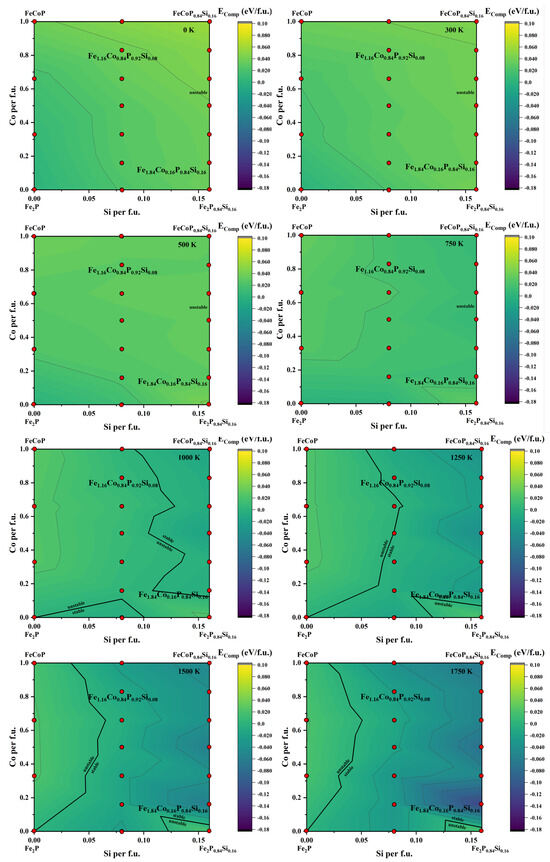
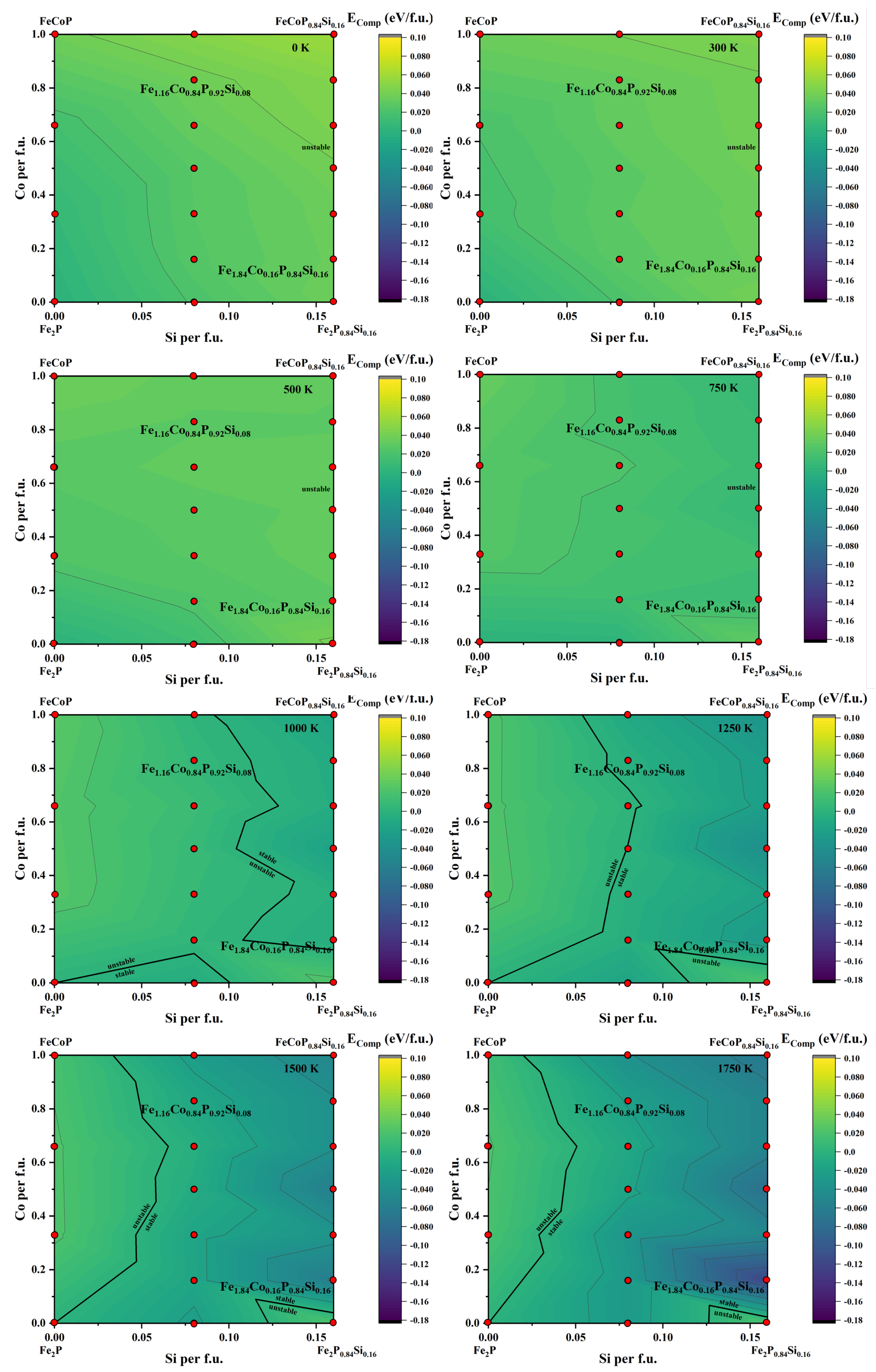
The resulting isothermal diagrams are presented in Figure 6 for temperatures 0, 300, 500, 750, 1000, 1250, 1500 and 1750 K. As these quaternary compounds form the central focus of this work, particular attention was given to them, with additional temperature-resolved diagrams provided. To further clarify the stability of each composition, the critical threshold of 0 eV/f.u. is marked in the heatmaps by a black line, along with indicators denoting the stable and unstable regions.
Figure 6.
Heatmap for the competition energy using Fe2P, FeSi, FeCoP, Fe and Co of the quaternary Fe2−yCoyP1−x Six materials (red dots) in the range of 0 0.16 Si and 0 1 Co per f.u. The competition energy is color-coded (yellow to dark blue) and the 0 eV/f.u. threshold is marked by a black line.
The heatmaps show that all quaternary compounds remain unstable—with positive competition energies—up to intermediate temperatures of around 750 K. Beginning at 1000 K, all compositions with x = 0.16 Si become stabilized, exhibiting 0 eV/f.u. This indicates that, at this temperature, these compounds are thermodynamically favored over the chosen reference phases. Another composition that stabilizes near 1000 K is the ternary Fe2P0.92Si0.08 compound, consistent with the earlier findings for Si substitution in the ternary system.
Upon increasing the temperature to 1250 K, the = 0 boundary shifts further toward lower Si concentrations and first quaternary compounds containing 0.08 Si per f.u. achieve negative competition energies. The initial stabilizing alloys at this Si concentration incorporate low Co concentrations, up to a maximum of 0.5 Co per f.u., with the 0.5 Co composition being only marginally stable.
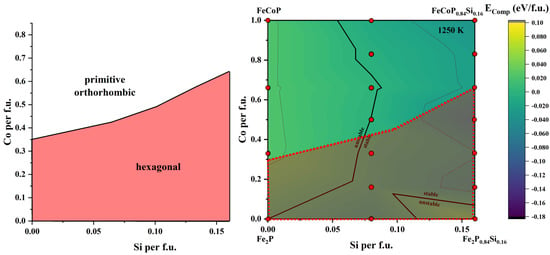
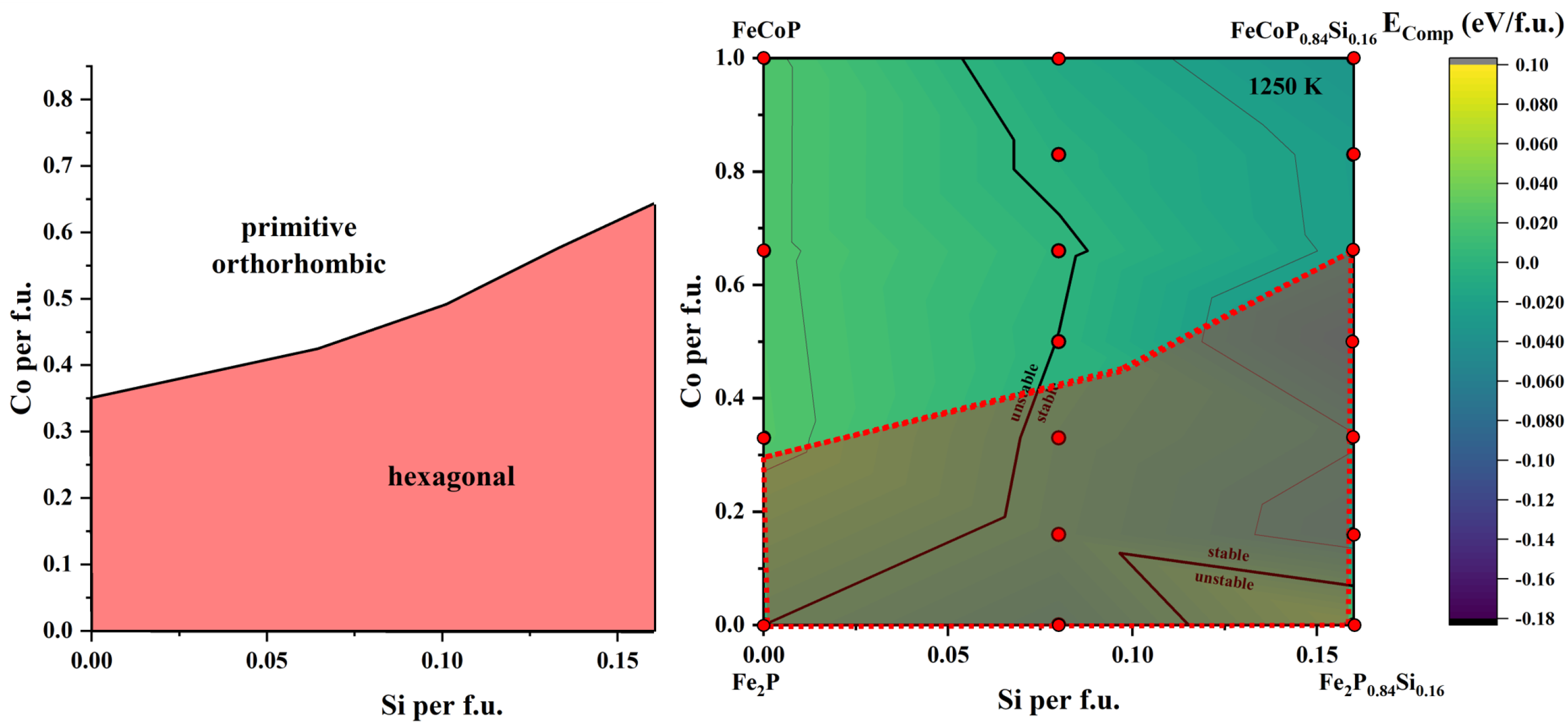
At temperatures above 1500 K, all investigated quaternary compositions exhibit negative competition energies, indicating thermodynamic stability with respect to the selected reference phases. Among these, the Fe1.84Co0.16P0.84Si0.16 compound is particularly noteworthy, as it shows pronounced stabilization at elevated temperatures, with competition energies reaching values as low as −0.12 eV/f.u. The proposed compound can be expected to crystallize in the hexagonal crystal structure as similar compounds with slightly higher concentrations of x = 0.2 Si and y = 0.2 Co per f.u. are seen to synthesize in the hexagonal crystal symmetry as well [6,15]. This pronounced stabilization contrasts with the behavior of the Co-free Fe2P0.84Si0.16 compound, which retains positive competition energies at the same temperature and is therefore predicted to remain unstable.The enhanced stability observed upon simultaneous Co and Si substitution indicates that the combined alloying effect fundamentally alters the thermodynamic trends compared to the corresponding ternary systems. In particular, whereas increasing Si content alone leads to destabilization in the ternary Fe2P1−x Six system, higher Si concentrations become stabilizing when accompanied by Co substitution. From these results it can be concluded that, in contrast to the ternary trends, higher Si concentrations lead to enhanced stability when combined with Co substitution. This finding is consistent with X-ray diffraction results reported by Bao et al. [15] who observed an increase in the stability region of the hexagonal crystal structure under simultaneous Si and Co substitution. For a better comparison, the data obtained in this work are presented alongside the experimental observations in Figure 7. Since the experimental samples were synthesized via solid-state reactions and following heat treatment at 1100 °C, the comparison is carried out using the 1250 K dataset. The stability at elevated temperatures is particularly relevant for synthesis, as these materials are typically formed at high temperatures and can remain metastable at room temperature after quenching.
Figure 7.
Comparison of the experimentally found room temperature phase stabilities (left) for quaternary Fe2−yCoyP1−xSix compounds by Bao et al. [15] with the calculated phase stabilities at 1250 K of this work (right). The experimentally found stability range of the hexagonal crystal structure is additionally depicted in the heatmap to emphasize the agreement.
The comparison shows that in the limitations of DFT a reasonable agreement with the experimental data was achieved. However, it should be emphasized that due to the exclusion of the anharmonicity contribution to the Gibbs free energy, deviations to experimental findings can be expected. The anharmonicity can provide a significant contribution at elevated temperatures and needs to be considered in future works for a higher precision of results. It also needs to be emphasized that the comparison with the room temperature data by Bao et al. [15] is used to underline the theoretical manufacturability of the experimentally found compounds and to indicate the most likely crystal structure of the investigated compounds. In this work, the BCO structure of the compounds was not examined. Therefore, it is possible that BCO structured compounds are more stable than the proposed hexagonal compounds.
4. Conclusions
Phase stability investigations for ternary and quaternary Fe2−yCoyP1−xSix magnetic materials reveal distinct and composition-dependent effects of Si and Co substitution at finite temperatures. An initial assessment based on formation energies indicates a destabilizing effect of increasing Si content at 0 K, which is progressively compensated by temperature-induced stabilization. For Co substitution, the formation energies decrease at 0 K with rising Co concentration, while this trend is reversed at elevated temperatures, favoring compositions with lower Co content.
A more realistic stability picture emerges when competition energies are considered, accounting for relevant binary and ternary reference phases. Under these conditions, ternary Si substitution leads to a increasing competition energies, limiting the stability of the hexagonal phase to compositions below approximately 0.25 Si per formula unit, in agreement with experimental observations. In contrast, ternary Co substitution remains thermodynamically unfavorable over the entire investigated temperature range, consistent with the experimentally observed stability limit of y = 0.3 Co per f.u.
Most notably, the combined substitution of Si and Co fundamentally alters the trends. At temperatures above 1000 K, quaternary compositions containing x = 0.16 Si become thermodynamically stable independently of Co concentration, while at T ≥ 1250 K, alloys with x = 0.08 Si achieve negative competition energies up to y = 0.5 Co. This behavior represents a clear deviation from the instability trends observed in the ternary systems and demonstrates that simultaneous Si and Co substitution stabilizes the hexagonal phase more effectively than either element alone.
By combining the present phase-stability analysis with previously reported magnetic property calculations, Fe1.84Co0.16P0.84Si0.16 is identified as one of the most promising composition among the investigated materials. It unites high thermodynamic stability with a magnetic hardness factor of 1.44 (1.48) and a mean-field Curie temperature of 557 K, fulfilling key requirements for rare-earth-lean hard magnetic applications. Other compounds offering promising combinations of hardness, phase stability and Curie temperature are Fe1.84Co0.16P0.92Si0.08 and Fe1.67Co0.33P0.84Si0.16. They yield hardness values of 1.41 (1.48) and 1.19 (1.17) next to theoretical Curie temperatures of 438 and 605 K, respectively. They also show reasonable phase stabilities, achieving stabilization around 1000 to 1250 K. When higher magnetocrystalline anisotropy is required, compositions with x = 0.08 Si and y = 0.16–0.33 Co additionally represent viable alternatives, offering a favorable balance between magnetic performance and phase stability.
Overall, this work demonstrates that finite-temperature effects are essential for accurately assessing the stability of Fe2P-based magnets and establishes combined Si and Co substitution as an effective strategy to expand the stability range of the hexagonal phase. These insights provide a robust theoretical foundation for the targeted design of rare-earth-lean hard magnetic materials and motivate further investigations into higher substitution levels and alternative alloying strategies.
Nevertheless, the usage of only the PBE functional limits the results of this work to the relative trends in phase stability as a function of composition and temperature. For further improvements, additional functionals, such as PBEsol or SCAN, and advanced approaches for disorder treatment (SQS) need to be considered in future works to provide a more quantitative assessment of the absolute phase stability boundaries.
Author Contributions
Conceptualization, S.E. and H.İ.S.; methodology, S.E. and H.İ.S.; software, T.K.; validation, S.E. and H.İ.S.; formal analysis, S.E.; investigation, S.E.; resources, T.K.; data curation, S.E.; writing—original draft preparation, S.E.; writing—review and editing, H.İ.S. and T.K.; visualization, S.E.; supervision, H.İ.S. and T.K.; project administration, H.İ.S. and T.K.; funding acquisition, T.K. All authors have read and agreed to the published version of the manuscript.
Funding
This research received no external funding.
Data Availability Statement
The original contributions presented in this study are included in the article. Further inquiries can be directed to the corresponding author.
Acknowledgments
The simulations were performed at the HPC Cluster ROSA, located at the University of Oldenburg (Germany) and funded by the DFG through its Major Research Instrumentation Programme (INST 184/225-1 FUGG) and the Ministry of Science and Culture (MWK) of the Lower Saxony State.
Conflicts of Interest
Author Halil İbrahim Sözen was employed by the company Mercedes-Benz Turk A.S. The remaining authors declare that the research was conducted in the absence of any commercial or financial relationship that could be construed as a potential conflict of interest.
Abbreviations
The following abbreviations are used in this manuscript:
| Curie temperature | |
| RE | Rare-earth |
| TM | Transition metal |
| VASP | Vienna ab initio Simulation Package |
| PAW | Projector-augmented wave |
| GGA | Generalized gradient approximation |
| PBE | Perdew–Burke–Ernzerhof |
| SCF | Self-consistent-field |
| LSDA | Local spin density approximation |
| Exchange interaction energies | |
| KKR | Korringa–Kohn–Rostoker |
| FM | Ferromagnetic |
| CPA | Coherent potential approximation |
| BCO | Body-centered-orthorhombic |
| Total magnetic moment | |
| Polarization saturation | |
| Maximum energy product | |
| Anisotropy constant | |
| HPC | High performance computing |
| DFG | Deutsche Forschungsgemeinschaft |
| MWK | Ministry of Science and Culture |
| SQS | Special quasirandom structures |
References
- Erdmann, S.; Klüner, T.; İbrahim Sözen, H. Magnetic properties of rare-earth-lean ThMn12-type (Nd,X)Fe11Ti (X: Y and Ce) compounds: A DFT study. J. Magn. Magn. Mat. 2023, 572, 170645. [Google Scholar] [CrossRef] [Scilit]
- İbrahim Sözen, H.; Klüner, T. Ab initio phase stabilities of rare-earth lean Nd-based hard magnets. J. Magn. Magn. Mat. 2022, 559, 169529. [Google Scholar] [CrossRef] [Scilit]
- İbrahim Sözen, H. Ab Initio Phase Stabilities of Ce-Based Hard Magnetic Materials. Ph.D. Thesis, Ruhr-Universität Bochum, Bochum, Germany, 2019. [Google Scholar]
- İbrahim Sözen, H.; Ener, S.; Maccari, F.; Fayyazi, B.; Gutfleisch, O.; Neugebauer, J.; Hickel, T. Combined ab initio and experimental screening of phase stabilities in the Ce-Fe-Ti-X system (X = 3d and 4d metals). Phys. Rev. Mater. 2023, 7, 014410. [Google Scholar] [CrossRef] [Scilit]
- Wittemann, T.; Sözen, H.I.; Oezaslan, M.; Klüner, T. Ab initio calculations of the chemisorption of atomic H and O on Pt and Ir metal and on bimetallic PtxIry surfaces. Z. Naturforsch. B 2024, 79, 177–190. [Google Scholar] [CrossRef] [Scilit]
- Erdmann, S.; Sozen, H.I.; Guillou, F.; Yibole, H.; Kluner, T. Theoretical and experimental investigations on Fe2P-type magnets: Effects of Si and Co substitution on physical and magnetic properties. Phys. Rev. Mater. 2024, 8, 094401. [Google Scholar] [CrossRef] [Scilit]
- Erdmann, S.; İbrahim Sözen, H.; Klüner, T. Ab Initio Investigation on the Magnetic Moments, Magnetocrystalline Anisotropy and Curie Temperature of Fe2P-Based Magnets. Magnetism 2025, 5, 14. [Google Scholar] [CrossRef] [Scilit]
- Coey, J.M.D. Perspective and Prospects for Rare Earth Permanent Magnets. Engineering 2020, 6, 119–131. [Google Scholar] [CrossRef] [Scilit]
- Gutfleisch, O.; Willard, M.A.; Brück, E.; Chen, C.H.; Sankar, S.G.; Liu, J.P. Magnetic materials and devices for the 21st century: Stronger, lighter, and more energy efficient. Adv. Mater. 2011, 23, 821–842. [Google Scholar] [CrossRef] [Scilit]
- Woodcock, T.G.; Zhang, Y.; Hrkac, G.; Ciuta, G.; Dempsey, N.M.; Schrefl, T.; Gutfleisch, O.; Givord, D. Understanding the microstructure and coercivity of high performance NdFeB-based magnets. Scr. Mater. 2012, 67, 536–541. [Google Scholar] [CrossRef] [Scilit]
- Bauer, D.; Diamond, D.; Li, J.; McKittrick, M.; Sandalow, D.; Telleen, P. Critical Materials Strategy for Clean Energy Technologies; US Department of Energy Office of Policy and International Affairs (PI): Washington, DC, USA, 2011; pp. 1–170.
- Directorate-General for Internal Market, Industry, Entrepreneurship and SMEs; Commission, S.E.; Grohol, M.; Veeh, C. Study on the Critical Raw Materials for the EU 2023—Final Report; Technical Report; Publications Office of the European Union: Luxembourg, 2023. [Google Scholar] [CrossRef]
- He, Y.; Adler, P.; Schneider, S.; Soldatov, I.; Mu, Q.; Borrmann, H.; Schnelle, W.; Schaefer, R.; Rellinghaus, B.; Fecher, G.H.; et al. Intrinsic Magnetic Properties of a Highly Anisotropic Rare-Earth-Free Fe2P-Based Magnet. Adv. Funct. Mater. 2022, 32, 2107513. [Google Scholar] [CrossRef] [Scilit]
- Surilemu, Z.; Bao, L.L.; Yibole, H.; Erdmann, S.; Sözen, H.; Klüner, T.; Guillou, F. Structure, phase transitions and hard magnetic properties of ternary Fe1.93(P1−xSix) compounds with x ≤ 0.5. Acta Mater. 2025, 291, 120991. [Google Scholar] [CrossRef] [Scilit]
- Bao, L.L.; Yibole, H.; Xu, J.Y.; Ou, Z.Q.; Haschuluu, O.; Tegus, O.; van Dijk, N.H.; Brück, E.; Guillou, F. Crystal structures and magnetic properties of Fe1.93−xCoxP1−ySiy compounds. J. Alloys Compd. 2022, 903, 163770. [Google Scholar] [CrossRef] [Scilit]
- Tobola, J.; Bacmann, M.; Fruchart, D.; Kaprzyk, S.; Koumina, A.; Niziol, S.; Soubeyroux, J.L.; Wolfers, P.; Zach, R. Magnetism of Fe2P investigated by neutron experiments and band structure calculations. J. Magn. Magn. Mat. 1996, 157, 708–710. [Google Scholar] [CrossRef] [Scilit]
- Fujii, H.; Hokabe, T.; Kamigaichi, T.; Okamoto, T. Magnetic Properties of Fe2P Single Crystal. J. Phys. Soc. Jpn. 1977, 43, 41–46. [Google Scholar] [CrossRef] [Scilit]
- Häggström, L.; Severin, L.; Andersson, Y. Experimental and theoretical studies of Si/P substituted orthorhombic Fe2P. Hyperfine Interact. 1994, 94, 2075–2079. [Google Scholar] [CrossRef] [Scilit]
- Caron, L.; Hudl, M.; Höglin, V.; Dung, N.H.; Gomez, C.P.; Sahlberg, M.; Brück, E.; Andersson, Y.; Nordblad, P. Magnetocrystalline anisotropy and the magnetocaloric effect in Fe2P. Phys. Rev. B 2013, 88, 094440. [Google Scholar] [CrossRef] [Scilit]
- de Vos, K.J.; Velge, W.A.; Steeg, M.G.V.D.; Zijlstra, H. Permanent magnetic properties of iron-cobalt-phosphides. J. Appl. Phys. 1962, 33, 1320–1322. [Google Scholar] [CrossRef] [Scilit]
- Wäppling, R.; Häggström, L.; Ericsson, T.; Devanarayanan, S.; Karlsson, E.; Carlsson, B.; Rundqvist, S. First Order Magnetic Transition, Magnetic Structure, and Vacancy Distribution in Fe2P. J. Solid. State. Chem. 1975, 13, 258–271. [Google Scholar] [CrossRef] [Scilit]
- Lundgren, L.; Tarmohamed, G.; Beckman, O.; Carlsson’, B.; Rundqvist’, S. First Order Magnetic Phase Transition in Fe2P. Phys. Scr. 1978, 17, 39–48. [Google Scholar] [CrossRef] [Scilit]
- Fruchart, R.; Roger, A.; Senateur, J.P. Crystallographic and magnetic properties of solid solutions of the phosphides M2P, M = Cr, Mn, Fe, Co, and Ni. J. Appl. Phys. 1969, 40, 1250–1257. [Google Scholar] [CrossRef] [Scilit]
- Xu, J.Y.; Bao, L.; Yibole, H.; Guillou, F. Structure and magnetic properties of Fe1.95−xNixP1−ySiy alloys. Solid State Commun. 2020, 319, 113996. [Google Scholar] [CrossRef] [Scilit]
- Kresse, G.; Furthmüller, J. Efficiency of ab-initio total energy calculations for metals and semiconductors using a plane-wave basis set. Comput. Mater. Sci. 1996, 6, 15–50. [Google Scholar] [CrossRef] [Scilit]
- Kresse, G.; Furthmüller, J. Efficient iterative schemes for ab initio total-energy calculations using a plane-wave basis set. Phys. Rev. B 1996, 54, 11169–11186. [Google Scholar] [CrossRef] [Scilit] [PubMed]
- Perdew, J.P.; Burke, K.; Ernzerhof, M. Generalized gradient approximation made simple. Phys. Rev. Lett. 1996, 77, 3865–3868. [Google Scholar] [CrossRef] [Scilit]
- Wallace, D.C. Thermodynamics of Crystals; Dover Publications: Garden City, NY, USA, 1998. [Google Scholar]
- Mermin, N.D. Thermal Properties of the Inhomogeneous Electron Gas. Phys. Rev. 1965, 137, A1441–A1443. [Google Scholar] [CrossRef] [Scilit]
- Parlinski, K.; Li, Z.Q.; Kawazoe, Y. First-Principles Determination of the Soft Mode in Cubic ZrO2. Phys. Rev. Lett. 1997, 78, 4063–4066. [Google Scholar] [CrossRef] [Scilit]
- Grabowski, B.; Hickel, T.; Neugebauer, J. Ab initio study of the thermodynamic properties of nonmagnetic elementary fcc metals: Exchange-correlation-related error bars and chemical trends. Phys. Rev. B 2007, 76, 024309. [Google Scholar] [CrossRef] [Scilit]
- Togo, A.; Chaput, L.; Tadano, T.; Tanaka, I. Implementation strategies in phonopy and phono3py. J. Phys. Condens. Matter 2023, 35, 353001. [Google Scholar] [CrossRef] [Scilit]
- Togo, A. First-principles Phonon Calculations with Phonopy and Phono3py. J. Phys. Soc. Jpn. 2023, 92, 012001. [Google Scholar] [CrossRef] [Scilit]
- Zhou, L.; Körmann, F.; Holec, D.; Bartosik, M.; Grabowski, B.; Neugebauer, J.; Mayrhofer, P.H. Structural stability and thermodynamics of CrN magnetic phases from ab initio calculations and experiment. Phys. Rev. B 2014, 90, 184102. [Google Scholar] [CrossRef] [Scilit]
- Körmann, F.; Breidi, A.A.H.; Dudarev, S.L.; Dupin, N.; Ghosh, G.; Hickel, T.; Korzhavyi, P.; Muñoz, J.A.; Ohnuma, I. Lambda transitions in materials science: Recent advances in CALPHAD and first-principles modelling. Phys. Status Solidi 2014, 251, 53–80. [Google Scholar] [CrossRef] [Scilit]
- Inden, G. Proceeding Report. Proceedings of CALPHAD V; Technical Report; Max-Planck Inst. Eisenforschung: Düsseldorf, Germany, 1976. [Google Scholar]
- Hillert, M.; Jarl, M. A model for alloying in ferromagnetic metals. Calphad 1978, 2, 227–238. [Google Scholar] [CrossRef] [Scilit]
- Chen, Q.; Sundman, B. Modeling of Thermodynamic Properties for Bcc, Fcc, Liquid, and Amorphous Iron. J. Ph. Equilib. Diffus. 2001, 22, 631–644. [Google Scholar] [CrossRef]
- Xiong, W.; Chen, Q.; Korzhavyi, P.A.; Selleby, M. An improved magnetic model for thermodynamic modeling. Calphad 2012, 39, 11–20. [Google Scholar] [CrossRef] [Scilit]
- İbrahim Sözen, H.; Hickel, T.; Neugebauer, J. Impact of magnetism on the phase stability of rare-earth based hard magnetic materials. Calphad Comput. Coupling Ph. Diagr. Thermochem. 2020, 68, 101731. [Google Scholar] [CrossRef] [Scilit]
- Akai, H. Available online: http://kkr.issp.u-tokyo.ac.jp (accessed on 16 April 2026).
- Skomski, R.; Coey, J.M. Magnetic anisotropy—How much is enough for a permanent magnet? Scr. Mater. 2016, 112, 3–8. [Google Scholar] [CrossRef] [Scilit]
- Beckman, O.; Lundgren, L.; Nordblad, P.; Svedlindh, P.; Törne, A.; Andersson, Y.; Rundqvist, S. Specific Heat of the Ferromagnet Fe2P. Phys. Scr. 1982, 25, 679–681. [Google Scholar] [CrossRef] [Scilit]
- Hudl, M.; Campanini, D.; Caron, L.; Höglin, V.; Sahlberg, M.; Nordblad, P.; Rydh, A. Thermodynamics around the First-Order Ferromagnetic Phase Transition of Fe2P Single Crystals. Phys. Rev. B 2014, 90, 144432. [Google Scholar] [CrossRef] [Scilit]
- Severin, L.; Häggström, L.; Nordström, L.; Andersson, Y.; Johansson, B. Magnetism and crystal structure in orthorhombic Fe2P: A theoretical and experimental study. J. Phys. Condens. Matter 1995, 7, 185–198. [Google Scholar] [CrossRef] [Scilit]
- Jernberg, P.; Yousif, A.A.; Häggström, L.; Andersson, Y. A Mössbauer Study of Fe2P1−xSix, (x ≤ 0.35). J. Solid State Chem. 1984, 53, 313–322. [Google Scholar] [CrossRef] [Scilit]
- Makov, G.; Payne, M.C. Periodic boundary conditions in ab initio calculations. Phys. Rev. B 1995, 51, 4014–4022. [Google Scholar] [CrossRef] [Scilit] [PubMed]
- Guillou, F.; Sun-Liting; Haschuluu, O.; Ou, Z.Q.; Brück, E.; Tegus, O.; Yibole, H. Room temperature magnetic anisotropy in Fe2P-type transition metal based alloys. J. Alloys Compd. 2019, 800, 403–411. [Google Scholar] [CrossRef] [Scilit]

Disclaimer/Publisher’s Note: The statements, opinions and data contained in all publications are solely those of the individual author(s) and contributor(s) and not of MDPI and/or the editor(s). MDPI and/or the editor(s) disclaim responsibility for any injury to people or property resulting from any ideas, methods, instructions or products referred to in the content. |
© 2026 by the authors. Licensee MDPI, Basel, Switzerland. This article is an open access article distributed under the terms and conditions of the Creative Commons Attribution (CC BY) license.