


Abstract
Spectroscopic ellipsometry (SE) is a non-destructive optical technique widely used to extract film thickness, optical constants, surface roughness, and compositional information. Despite its versatility and high sensitivity, conventional SE analysis typically relies on iterative nonlinear regression of parameterized optical models, which is computationally demanding, strongly dependent on expert intervention, and often affected by convergence and non-uniqueness issues. In recent years, artificial intelligence (AI) has emerged as a promising route to overcome these limitations. This review summarizes recent advances in AI-driven ellipsometry, spanning traditional machine learning (ML) methods, such as artificial neural networks (ANNs), support vector regression (SVR), and support vector machines (SVMs), as well as deep learning (DL) architectures, including convolutional neural networks (CNNs). Representative applications in semiconductors, perovskites, and biosensing are also discussed. Overall, this review highlights the opportunities and current limitations of AI for next-generation ellipsometric characterization.
1. Introduction
Spectroscopic ellipsometry (SE) [1] is a non-destructive optical technique [2] that measures changes in the polarization state of light upon reflection or transmission from a sample, providing information about optical constants (refractive index n and extinction coefficient k), film thickness, surface roughness, and compositional properties [3]. SE has become indispensable in materials science [4], semiconductor manufacturing [5], thin films [6], thick films [7], polymer films [8] and biomedical diagnostics [9] due to its high sensitivity, sub-nanometer precision, and compatibility with in situ monitoring [10]. However, traditional SE data analysis [11] relies on iterative nonlinear regression methods that fit experimental spectra to parameterized optical models, a process that is computationally intensive, requires expert knowledge to define appropriate models and initial parameters [12], and often suffers from solution non-uniqueness and convergence issues [13]. Moreover, conventional approaches, such as the Levenberg–Marquardt (LM) algorithm [14], are often computationally demanding and become impractical when dealing with large datasets or high-resolution maps.
The classical method for solving the above inverse ellipsometric problem is nonlinear regression analysis (NRA), as described in Ref. [15]. AI-driven approaches offer several compelling advantages, including (1) automation of parameter extraction without the need for manual model construction, (2) significant speed improvements compared to traditional iterative fitting procedures, (3) enhanced generalization across diverse measurement conditions, and (4) the ability to address non-ideal or complex structures that are challenging for conventional analysis methods [15]. Early efforts to integrate artificial neural networks (ANNs) into ellipsometric data analysis date back to the 1990s, when they were proposed as a strategy to accelerate the solution of inverse problems. In particular, during the 1990s, Fried et al. [16] and Rédei et al. [17] used ANN to evaluate full spectroscopic ellipsometry (broadband Ψ, Δ spectra) of complex layer structures, including Separation by IMplanted OXygen (SIMOX) structures—silicon-on-insulator materials fabricated via oxygen ion implantation. Backpropagation neural networks (BPNs), a class of feedforward ANNs, correspond directly to physical parameters (n, κ, d). In the same period, Urban and co-workers [18,19,20] used an ANN to speed up the evaluation of single-wavelength or multi-wavelength ellipsometry for in-situ monitoring of single-layer growth.
This comprehensive literature review synthesizes recent advances in AI for ellipsometry. It further examines a broad range of application domains, including semiconductors, two-dimensional materials, perovskites, and biosensing platforms, highlighting the versatility of AI-driven ellipsometric analysis.
This review is intended to provide a broad and critical overview of the potential of AI in ellipsometry, with emphasis on its opportunities, application areas, and current challenges, rather than a fully technical description of every computational framework. For in-depth methodological and implementation details, the reader is referred to the original research articles.
2. Theory of Ellipsometry
Ellipsometric measurements provide two fundamental parameters, Ψ and Δ, which depend on both the wavelength and the angle of incidence. These quantities are defined as
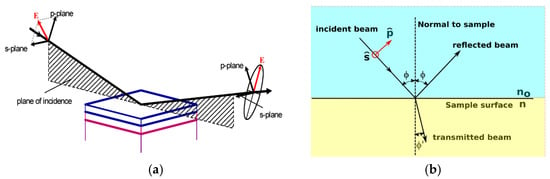
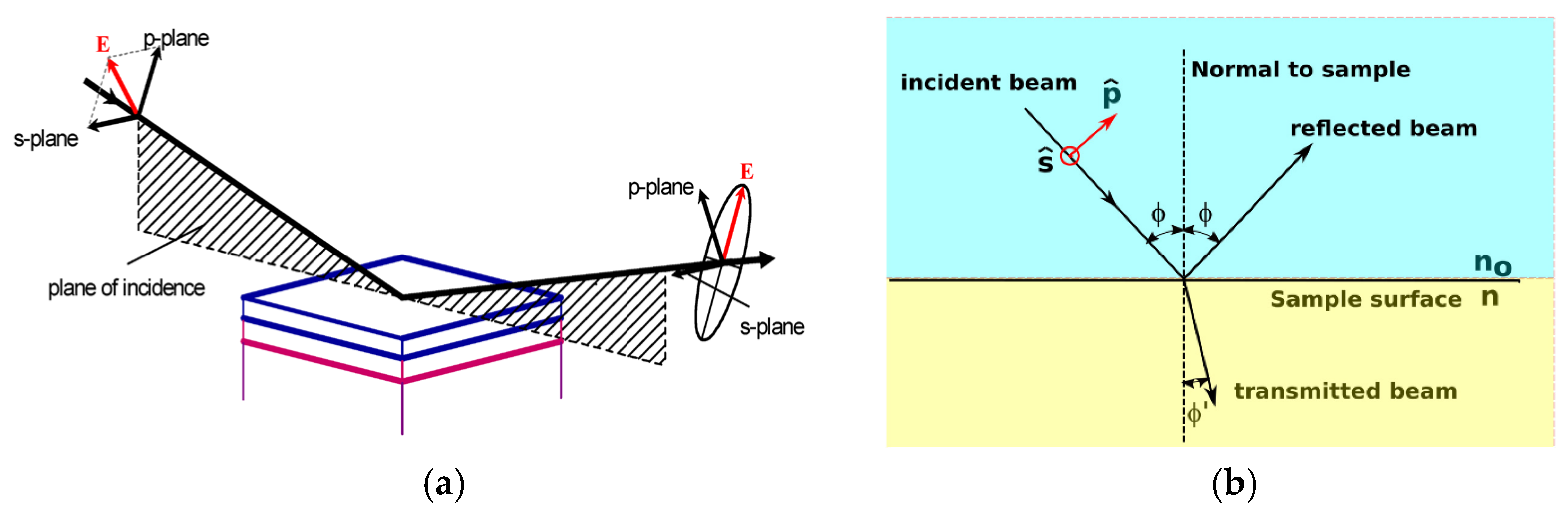
The parameter Ψ is related to the amplitude ratio between the reflected p- and s-polarized light components and ranges between 0° and 90°. In contrast, Δ represents the phase difference between these two components upon reflection, with values spanning from 0° to 360°. Here, the p-polarization lies in the plane of incidence, while the s-polarization is perpendicular to it.
A central quantity in ellipsometric analysis is the complex reflectance ratio, , defined as
The use of capital R indicates that the reflection coefficients account for the full optical response of the sample, which may consist of multiple layers and/or heterogeneous compositions. This feature enables ellipsometry to effectively probe rough surfaces and composite materials.
Basic configurations of ellipsometry are schematically illustrated in Figure 1.
Figure 1.
(a) Ellipsometry system. Reproduced from [12]. (b) Illustration showing a monochromatic polarized light beam approaching and interacting with a material medium at an incidence angle ~ϕ in air. Reproduced from [21].
The analysis starts with experimental measurements, followed by the application of an optical model based on Fresnel equations to simulate the expected response using estimated or known parameters. The generated data are then compared with the experimental results, typically using the mean square error (MSE) to evaluate the quality of the fit. Through an iterative fitting process, key optical parameters such as the refractive index (n) and extinction coefficient (k) are obtained. In addition, other properties, including surface roughness, can also be extracted from the analysis.
Further details on the theoretical principles of SE, together with modeling strategies and data analysis procedures, are provided in a review [21] by the author intended for beginner readers. Moreover, readers are encouraged to consult advanced articles written by experts in SE [22,23].
3. Machine Learning Approaches
Machine learning (ML) methods, including artificial neural networks (ANNs), support vector regression (SVR), and support vector machines (SVMs), have formed the foundation of AI-driven ellipsometry over the past few years.
The need to reduce expert intervention in conventional ellipsometric analysis has motivated the adoption of ML approaches. ML, a branch of AI, enables data-driven modeling of complex systems by learning directly from available datasets, without requiring explicit modeling of the underlying physical relationships.
3.1. Artificial Neural Networks
Artificial neural networks (ANNs) [24] are computational models composed of interconnected processing units, or neurons, arranged in layered architectures inspired by biological neural systems. They typically consist of an input layer, one or more hidden layers, and an output layer. Information propagates through the network via weighted connections and nonlinear activation functions, enabling the approximation of complex nonlinear relationships between input data and target variables. The output layer provides the final prediction of the desired quantities [25].
ANNs have been extensively applied to ellipsometric inverse problems due to their ability to approximate complex nonlinear mappings between spectral data and material parameters [20]. In early work by Urban et al. [18], ANNs are trained on simulated datasets to rapidly estimate thin-film parameters, providing outputs within the millisecond time regime. These initial predictions are subsequently refined using a variably damped least-squares algorithm, combining the speed of data-driven methods with the accuracy of conventional fitting procedures. This hybrid approach enables highly efficient and precise data reduction, achieving analysis times on the order of tens of milliseconds per data point. Such performance is suitable for real-time monitoring and control of thin-film growth processes, as demonstrated for Ni and Au grown on BK7 substrates under in situ conditions.
Other early studies also included the use of backpropagation neural networks (BPNs) [16,17]. A BPN, as discussed in the work of Fried et al. [16], is a multilayer structure composed of artificial neurons, also referred to as processing elements. It includes an input layer, one or more hidden layers, and an output layer. Each processing element receives multiple input signals and produces a single output, which can be transmitted to neurons in the subsequent layer. The connections between neurons are characterized by weights that define the strength of the signal transfer. For each neuron, the incoming signals are combined into a net input through a weighted sum, and the resulting value is then transformed into an output via an activation function, such as a sigmoid or linear function, depending on the specific application. Rédei et al. [17] demonstrated that, while conventional backpropagation aims at minimizing the overall root mean squared error (RMSE), it does not guarantee control over the maximum deviation between predicted and actual parameters. This limitation is especially relevant in SE, where the inversion procedure is highly sensitive to initial conditions due to the use of nonlinear gradient-based optimization algorithms, often leading to convergence toward local minima. Within this early framework, BPNs were primarily employed to provide improved initial guesses for subsequent fitting procedures with a significantly reduction in the maximum prediction error (e.g., from ~37% to below 10% in SIMOX-based models), albeit with a slight increase in RMSE.
More recently, Bordovalos et al. [26] proposed an ANN-assisted framework to complement conventional regression analysis for hydrogenated amorphous silicon (a-Si:H) thin films. In their approach, one set of neural networks identified the appropriate structural model, while another predicted the corresponding optical and structural parameters. Validation on a-Si:H films deposited on different substrates demonstrated that the ANN-assisted analysis reproduced structural models obtained with traditional least-squares regression while providing comparable fitting quality with reduced computational time and without requiring manually defined initial parameters. This two-stage strategy effectively automated the model-selection step, a task that typically demands significant expert judgment.
ANN-based methods have also been proposed for the analysis of imaging ellipsometry data. In the study by Kfoury et al. [27], this approach was applied to characterize silver nanoparticles embedded in a poly(vinyl alcohol) matrix. The results obtained using ANN were found to be in good agreement with those derived from traditional fitting and a consistent reduction in computation time was achieved.
Urban et al. [28] studied ANN-based ellipsometric analysis for real-time, in situ process control during the growth of absorbing thin films. Their numerical framework was based on a multilayer perceptron (MLP) architecture consisting of four input neurons, four output neurons, and two hidden layers with 40 neurons each. The model was designed to predict film thickness and optical constants independently at each wavelength, thus avoiding the use of wavelength-dependent fitting functions. This fully non-iterative, wavelength-resolved approach enabled solutions to be obtained on a millisecond timescale, making it suitable for real-time monitoring of thin films with thicknesses up to 30 nm during deposition. Compared to conventional LM regression methods, which rely on iterative refinement and may suffer from convergence issues, the proposed approach offers improved computational stability and speed.
Building on these approaches, Urban et al. in their research work [29] further extended the use of ANNs to predict film thickness and optical properties under both single-angle (55°) and multi-angle (55°, 65°, and 75°) measurement configurations. Thin films with thicknesses up to approximately 40 nm were investigated using networks with either 4 or 12 input neurons, 4 output neurons, and two hidden layers of 80 neurons each. A distinctive feature of this ANN-based method is the use of independently trained networks at each wavelength, enabling direct prediction of optical parameters without relying on predefined dispersion models. The approach consists of two main stages: a training phase, in which large datasets are used to optimize the network weights via backpropagation, and a prediction phase, where experimental ellipsometric data are rapidly processed. Although the training step is computationally demanding, it is performed only once, allowing fast, non-iterative data analysis during application.
Jung et al. [30] developed into a multi-step neural-network-based algorithm for the rapid and accurate extraction of structural parameters from spectroscopic ellipsometry data on complex nanostructures. In that case, three ANNs trained on simulated datasets were employed in sequence: one stage was devoted to the estimation of the optical constants, while the following stages progressively refined the prediction of the structural parameters. This hierarchical approach is particularly relevant because it explicitly recognizes the strong interdependence between optical constants and structural reconstruction in ellipsometric analysis. Applied to a one-dimensional SiO2 nanograting, the method achieved sub-nanometer average error together with analysis times on the order of a few hundred milliseconds, highlighting its potential for real-time and in situ monitoring. An additional advantage of this framework is its flexibility, since changes in the optical constants can be more readily incorporated than in conventional fitting-based schemes.
3.2. Support Vector Regression and Support Vector Machines
Support vector regression (SVR) and support vector machines (SVMs) have been applied to ellipsometric data analysis, offering advantages in terms of training efficiency, robustness to overfitting, and interpretability for classification tasks.
SVMs [31] are supervised learning algorithms used primarily for classification tasks, which aim to identify the optimal decision boundary that maximizes the margin between different classes in a high-dimensional feature space. By employing kernel functions, SVMs can efficiently handle nonlinear relationships by mapping input data into higher-dimensional spaces where linear separation becomes possible. SVR [32] is the regression counterpart of SVM, designed to predict continuous output variables. SVR constructs a function that approximates the relationship between input data and target values while minimizing the prediction error within a predefined tolerance margin. Similar to SVM, kernel functions enable SVR to model complex nonlinear relationships in high-dimensional spaces. A representative example of the application of SVR in ellipsometric analysis has been reported for polymer–nanocomposite systems, such as PVP:ZnTiO3 films by Barkhordari et al. [25]. In this study, ellipsometric parameters (Ψ and Δ) were analyzed using both conventional nonlinear regression (NLR) and ML approaches, including ANNs and SVR. The comparison demonstrated that ML-based methods provide accuracy comparable to traditional fitting procedures, while significantly reducing computational time. In particular, SVR showed superior performance, yielding lower prediction errors and improved generalization capability compared to ANNs.
Herawati et al. [33] reported a spectroscopic-ellipsometry/machine-learning (SE–ML) workflow for rapid and label-free microalgae detection based on Cr thin films used as thickness-optimized optical transducers. Because the Ψ–Δ response of the multilayer stacks was high-dimensional, nonlinear, and strongly correlated, the authors employed a multitask deep neural network for rapid prediction and an SVM for film-stack discrimination. The SVM classifier achieved excellent discrimination performance, demonstrating the utility of combining SE with ML to convert complex spectral urban signatures into decision-oriented outputs for intelligent, non-destructive biosensing and environmental diagnostics. ML-assisted ellipsometry was also applied in reproductive biology, where broadband variable-angle spectroscopic ellipsometry was combined with optimized learning models for the analysis of highly sensitive spectroscopic data [9]. In the study by Amaral et al. [9], the method was applied to classify biological samples collected from male offspring of ZIKV-infected and uninfected murine models, providing a label-free, simple, and cost-effective diagnostic approach. The combination of spectroscopic depolarization data with a well-trained SVM model achieved excellent classification performance, while optical modeling based on Kramers–Kronig-consistent B-splines enabled the extraction of the average refractive index for each class. The observed optical differences were associated with structural abnormalities and biomolecular damage, further highlighting the potential of SE–ML strategies for advanced biosensing and biomedical diagnostics.
ML approaches have also been applied to in situ SE during thin-film deposition processes such as atomic layer deposition, as studied by Arunachalam et al. [34]. In this context, predictive models can be trained directly on ellipsometric parameters (Ψ, Δ) to estimate film thickness in real time, without relying on iterative fitting procedures. Different algorithms, including SVM, decision trees, ensemble methods, and instance-based approaches, have been investigated, with k-nearest neighbors showing particularly competitive performance in terms of simplicity and prediction accuracy. Notably, these models demonstrate robustness even when spectral information is partially reduced or limited to a narrower wavelength range. Although prediction accuracy may decrease for thicker films, these results highlight the potential of ML-assisted ellipsometry for real-time process monitoring and control in thin-film fabrication.
4. Deep Learning Approaches in Ellipsometry
Deep learning (DL) [35] is a subfield of ML based on artificial neural networks with multiple hidden layers, designed to learn complex and hierarchical representations directly from data. Unlike traditional ML approaches, which often rely on predefined features, deep learning models can automatically extract relevant features from raw input data, making them particularly suitable for high-dimensional and nonlinear problems.
Deep neural networks (DNNs) [36] are a class of DL models composed of fully connected layers, where each neuron is connected to all neurons in the subsequent layer. By stacking multiple hidden layers and applying nonlinear activation functions, DNNs are able to approximate complex mappings between input data, such as ellipsometric spectra, and target variables, including optical constants and film thickness.
Convolutional neural networks (CNNs) [37] represent a specialized class of DL architectures designed to process structured data, such as images or spectral datasets. CNNs employ convolutional filters to capture local patterns and correlations, while reducing the number of trainable parameters through weight sharing. This makes them particularly effective for analyzing high-dimensional ellipsometric data, where correlations exist.
Deep Neural Networks and Convolutional Neural Networks
Liu et al. [38] employed a DNN-driven iterative learning (denominated as “SUNDIAL”) to study the relationship between optical parameters and experimental measurements, enabling fully automated and reliable retrieval of film properties without extensive expert-driven fitting procedures. By simultaneously incorporating reflectance (R) and transmittance (T) data together with conventional ellipsometric parameters (Ψ, Δ), the method reduced ambiguity in determining refractive index, extinction coefficient, and film thickness, a persistent challenge in traditional analysis. This multi-observable approach proved compatible with standard ellipsometric instrumentation and opened possibilities for rapid, high-throughput optical characterization and real-time in situ monitoring during thin-film fabrication.
The application of DNN-assisted methods has also been proposed for the characterization of nanostructured gratings, where the inverse problem becomes particularly challenging because both geometrical features and optical constants must be determined simultaneously [39]. In these systems, studied by Jiang et al. [39], conventional scatterometry-based approaches may suffer from limited stability and high instrumental complexity. To address these issues, the authors have shown that ellipsometric angles acquired with standard ellipsometers can be treated as functional inputs for neural-network-based reconstruction. By combining physically enriched structural models with data-driven inference, such approaches enable the rapid and accurate characterization of nano-gratings, including non-ideal features such as rounded corners and residual layers. Additional strategies, such as the use of multiple initial conditions, azimuth-resolved measurements, and compensation procedures, further improve robustness and prediction accuracy.
A study by Oka et al. [40] introduced deep learning ellipsometry (DLE), a comprehensive framework combining ultra-large training datasets, a hybrid strategy for modeling extinction and absorption behavior, noise-robust learning, and an optimized CNN architecture to improve the extraction of optical and structural parameters from ellipsometric spectra. Validation on experimental thin films deposited on Si substrates showed that DLE accurately retrieved optical constants, film thickness, and bandgap-related information without prior knowledge of the sample, while reducing total analysis time to only a few seconds. The hybrid modeling strategy addressed the challenge of representing both transparent and absorbing regions of the spectrum within a unified framework, a common source of fitting difficulties in traditional methods.
DL approaches, including CNNs, have also been proposed to overcome the limitations of conventional nonlinear regression [41], which is often too slow for autonomous or closed-loop ellipsometric analysis. In particular, different data-driven strategies, such as spectral, piecewise, and pointwise methods, have been developed to adapt the analysis to the specific material system and experimental objectives.
To provide a clearer comparison of the different AI approaches applied to spectroscopic ellipsometry, Table 1 summarizes their typical application domains, associated inverse problems, and main advantages and limitations. This comparison highlights that the suitability of each method strongly depends on the specific ellipsometric task and data characteristics.
Table 1.
Comparison of AI approaches in ellipsometry.
5. Advanced Measurement Techniques
Mueller matrix spectroscopic ellipsometry (MMSE), imaging ellipsometry, and real-time in situ monitoring have been significantly enhanced by AI-driven analysis. These techniques generate high-dimensional, spatially resolved, or time-resolved datasets that are ideally suited for ML-based processing, enabling new capabilities that would be impractical with traditional analysis methods.
Mueller Matrix Spectroscopic Ellipsometry
MMSE measures the complete 4×4 Mueller matrix that describes the polarization transformation properties of a sample, providing richer information than standard ellipsometry (which measures only two parameters, Ψ and Δ) [42]. However, the increased information content comes at the cost of significantly higher data dimensionality and complexity, making traditional analysis methods even more challenging. AI-driven approaches have proven particularly effective for MMSE data analysis, enabling the extraction of structural parameters, temperature mapping, and high-throughput wafer-scale metrology. Mudide et al. [43] combine MMSE with ML to enable fast parameter extraction. In this framework, neural networks trained on simulation data are used to model the forward optical response, which is then inverted to retrieve key structural parameters from experimental measurements. This strategy significantly reduces computational time while maintaining high accuracy, showing strong agreement with established techniques.
Oh et al. [44] introduced an ultra-wide-field imaging Mueller matrix spectroscopic ellipsometry (IMMSE) system capable of acquiring more than 10 million Mueller matrix spectra over a 20 × 20 mm field of view with micrometric spatial resolution. By combining this massive spectral dataset with ML analysis, the approach enables spatially dense characterization across the wafer for dynamic random access memory structures and wafer-level yield analysis. The ML-based analysis pipeline processes the entire dataset rapidly, extracting spatially resolved structural parameters and identifying process variations that would be invisible to point-measurement approaches. This work demonstrates that AI enables a qualitative leap in MMSE capability: the sheer volume of data makes traditional analysis infeasible, whereas ML-based approaches can process millions of spectra in a reasonable time.
Sun et al. [45] demonstrated a novel approach for non-invasive temperature monitoring in microelectronic devices by combining MMSE with thermo-optical analysis and DL. In their work, the temperature dependence of the optical response of SiO2 thin films in the UV–visible range was exploited to indirectly retrieve local temperature variations. By employing multi-channel DL models to analyze ellipsometric data, the method enabled accurate temperature mapping in regions where conventional infrared techniques are ineffective, particularly due to the transparency of silicon at low temperatures. This study highlights the potential of integrating ellipsometry with data-driven approaches for advanced thermal diagnostics, offering a promising strategy for improving process control and reliability in next-generation electronic devices.
In the work by Jung et al. [46], the authors introduced a methodology based on MMSE for the characterization of nanograting structures. The proposed framework is structured in two main stages. First, the experimentally measured Mueller matrix is compared with a precomputed database in order to identify the closest matching configuration. In the second stage, an ANN is employed to estimate the structural parameters by exploiting the local information associated with the selected configuration. In that implementation, the search for the optimal match within the database was refined through an iterative procedure based on the LM algorithm. While this strategy improves the accuracy of the matching process, it also significantly increases the computational cost, particularly when dealing with large datasets or a high number of structural parameters. Additionally, the approach requires careful treatment of the optical constants, which may vary depending on fabrication conditions and temperature.
Sun et al. [47] have demonstrated the capability of combining MMSE data with deep learning employing CNN to identify and quantify defects in through-silicon via TSV-Cu systems, which are critical for three-dimensional integration technologies. In these approaches, different defect types induced by fabrication processes, such as chemical–mechanical planarization and annealing, can be accurately distinguished by analyzing selected Mueller matrix elements.
6. AI Applications in Ellipsometry for Materials Characterization
Recent developments in AI have considerably enhanced the role of ellipsometry in material characterization. ML and DL provide flexible tools for analyzing diverse classes of materials. For instance, CNN-based models have been applied to the classification of thin-film materials. In particular, in the study by Hayashi et al. [48], DL approaches trained on ellipsometric heatmaps acquired over a wide range of incidence angles have been shown to distinguish between different material categories, such as amorphous, crystalline, organic, metallic, transparent conductive oxides, and transparent films. These models typically rely on large synthetic datasets, generated from parameterized dielectric function models, for pre-training, followed by fine-tuning using experimental data to improve robustness. Experimental validation has demonstrated high classification performance, with strong accuracy metrics across multiple classes, while maintaining very short analysis times on the order of a few seconds. This capability highlights the potential of CNN-based methods not only for parameter estimation but also for rapid material identification, enabling more flexible and data-driven ellipsometric analysis workflows.
Xu et al. [49] present a review on the integration of AI with optical metrology in semiconductor manufacturing, with particular focus on spectroscopy-based techniques and ellipsometry. The authors classify different AI strategies, including forward modeling, inverse prediction, and physics-informed approaches, and evaluate their effectiveness in addressing key industrial challenges such as tool-to-tool matching and the characterization of complex nanostructures. Their analysis highlights the potential of AI to enhance accuracy and efficiency in semiconductor metrology, while also identifying critical limitations related to data quality, model generalization, and scalability.
ANN-based approaches have also been applied to complex material systems such as multicomponent perovskites [50], where conventional analysis methods struggle to capture the relationship between composition and optical response. In these systems, variations in stoichiometric ratios lead to highly nonlinear changes in optical properties, making traditional regression approaches inadequate. To address this challenge, ANNs have been employed to perform high-dimensional regression, enabling the prediction of optical constants directly from compositional parameters and wavelength. The results demonstrate strong agreement with experimental ellipsometric measurements, accurately reproducing trends in refractive index and extinction coefficient across different compositions.
A further important application domain concerns two-dimensional (2D) materials, where the number of layers plays a crucial role in determining electronic and optoelectronic properties [51]. Accurate thickness identification is therefore essential prior to device fabrication and physical characterization. In this context, ML has emerged as a powerful tool to complement optical characterization techniques of 2D materials [52]. While optical methods enable efficient acquisition of spectral information, ML algorithms provide fast, high-throughput, and automated data processing. The integration of optical techniques with ML therefore enables more efficient extraction of thickness and optical properties, facilitating large-scale analysis and accelerating both fundamental studies and industrial applications of 2D materials.
Alloys play a central role in materials science due to their highly tunable physical and chemical properties, which can be tailored through precise control of composition. In this context, accurate determination of stoichiometry is essential for both fundamental studies and technological applications. Conventional characterization techniques, such as energy-dispersive X-ray spectroscopy (EDX), are widely used for compositional analysis; however, they are often time-consuming and typically require vacuum conditions, limiting their applicability for rapid or in situ measurements. To address these limitations, recent studies have proposed alternative strategies based on SE combined with AI [53]. In particular, ANNs have been employed to extract compositional information directly from ellipsometric spectra [53]. This data-driven approach enables the estimation of alloy stoichiometry without the need for EDX.
He et al. [54] have demonstrated that neural network models can be trained on ellipsometric data to accurately predict refractive index (n) and extinction coefficient (k) over a broad range of alloy compositions and processing conditions. Different architectures, including convolutional and sequence-based models, have been explored, with CNNs typically providing the best compromise between accuracy and robustness. Importantly, these models can also be used to infer optical trends at unmeasured compositions within the combinatorial libraries, enabling the identification of transition concentrations associated with changes in optical properties. This capability reduces the need for extensive experimental measurements and provides an efficient strategy for analyzing composition–property relationships in complex alloy systems.
In the work by Li et al. [41], DL-based methodologies have been developed for the analysis of ellipsometric data, enabling a significant acceleration of the characterization process. Once properly trained, these models allow the extraction of optical constants and structural parameters with inference times orders of magnitude shorter than traditional fitting procedures. These approaches have been successfully applied to a variety of material systems relevant for high-throughput studies. For instance, they enable efficient analysis of multilayer thin films composed of optically isotropic materials, such as phase-change Ge–Sb–Te alloys, as well as more complex systems exhibiting strong optical anisotropy, including transition metal dichalcogenides like MoS2. Importantly, the choice of the most suitable analysis strategy depends on both the material properties and the specific characterization objectives. The effectiveness of DL-assisted ellipsometry has been demonstrated in combinatorial studies, where large compositional libraries can be rapidly screened. In such cases, hundreds of distinct material compositions can be analyzed within seconds, allowing the identification of optimal properties within extremely short analysis times. This capability highlights the strong potential of AI-driven ellipsometric methods for high-throughput material characterization and accelerated materials discovery.
7. Critical Analysis: Limitations and Challenges
Despite the impressive advances in AI-driven ellipsometry over the past years, several important limitations and challenges remain.
7.1. Kramers–Kronig (KK) Consistency
A critical limitation of purely data-driven DL models is their potential to produce physically implausible predictions. Liu et al. [15] introduced the Smart Ellipsometry Network (SENet), which integrates physics-enhanced learning to enforce physically plausible optical constants, including Kramers–Kronig (KK) consistency [55], during inference rather than relying solely on black-box CNNs. SENet combines a data-driven neural network with explicit physics constraints that ensure the predicted refractive index and extinction coefficient satisfy fundamental causality relations. This hybrid approach improves generalization to unseen materials and measurement conditions while maintaining the speed advantages of neural network inference. Validation on diverse thin-film systems demonstrated that SENet produced more physically consistent optical constants than unconstrained models, particularly in spectral regions with limited training data coverage.
7.2. Data Availability and Quality
The performance of ML models strongly depends on the availability of sufficiently large, representative, and accurately labeled datasets. This fundamental requirement poses significant challenges for ellipsometry applications, where experimental data collection is time-consuming, expensive, and often proprietary.
De Vecchy et al. [56] provided a clear example of the limitations imposed by experimental data in their study of Ge-rich GeSbTe crystallization. Models trained only on experimental data showed poor predictive performance, especially in the 390–410 °C crystallization range, where limited data reduced prediction reliability [56]. Although synthetic data significantly improved model accuracy, this also indicates that the robustness of ML approaches may rely heavily on the assumptions adopted for data generation. If the synthetic data generation process does not accurately capture the physics of the real system (e.g., due to simplified models, neglected effects, or inaccurate material parameters), the trained model may fail to generalize to experimental data. Data quality issues extend beyond quantity to include measurement noise, systematic errors and sample-to-sample variability. Most ML studies report performance on carefully controlled laboratory samples, but real-world applications (e.g., semiconductor manufacturing, biosensing) involve samples with greater variability, contamination, roughness, and other non-idealities. The robustness of ML models to these real-world conditions remains an open question that requires systematic investigation. A further critical issue concerns the variability between different measurement instruments. In large-scale semiconductor manufacturing, ellipsometric data are often acquired using multiple systems, leading to systematic discrepancies caused by factors such as detector misalignment and instrumental noise. These variations can significantly affect the reproducibility and reliability of machine learning models. To address this challenge, recent approaches by Kim et al. [57] have introduced data augmentation strategies that incorporate domain-specific knowledge of the measurement process. By modeling realistic instrumental variations, such as wavelength calibration errors and stochastic noise, these methods improve repeatability and reproducibility while preserving predictive accuracy. This enables ML to maintain consistent performance across different measurement conditions, which is essential for deployment in industrial environments.
These challenges are further exacerbated when the measured optical response deviates from ideal model assumptions, a situation frequently encountered in real ellipsometric measurements. AI-driven approaches help address some intrinsic limitations of conventional ellipsometry when the measured response deviates from ideal optical models. This is particularly relevant for absorbing materials and porous systems [50], where conventional regression analysis may become unstable or require oversimplified assumptions. In such cases, ML and DL models can be trained to recognize complex spectral patterns, instrumental artifacts, noise contributions, or non-ideal optical responses [58,59].
7.3. Computational Resources and Deployment
The integration of AI into ellipsometric analysis has demonstrated the potential to dramatically accelerate data processing, by a factor of nearly 1000, while simplifying the workflow by removing the need for initial parameter estimates and convergence criteria [60]. Nevertheless, these approaches remain fundamentally constrained by the underlying physics of light–matter interaction and the mathematical conditions required for parameter identifiability [60].
Another critical issue is the computational cost. While ML-based inference is typically fast (milliseconds to seconds per spectrum), the training phase can be computationally demanding, requiring large datasets, powerful GPUs, and extended training times (hours to days). This computational burden may limit the accessibility of ML-driven ellipsometry to research groups and companies with sufficient computational resources. Zhu et al. [61] addressed this challenge by developing a lightweight neural network for SE analysis that balances accuracy and computational efficiency through careful architectural design and 8-bit quantization. The lightweight model is designed for rapid, potentially on-instrument ellipsometry analysis suitable for real-time factory deployment, demonstrating that sophisticated deep learning capabilities can be deployed in practical metrology environments without requiring high-end GPU infrastructure.
A framework based on physics-informed tandem untrained neural networks (PITUNN) [62] has been proposed for channeled spectroscopic ellipsometry, enabling parameter extraction without requiring a dedicated training phase. This approach improves computational efficiency and relaxes some of the strict requirements on hardware and calibration, while maintaining robustness against system errors and measurement noise. However, the trade-offs between model size, computational requirements, and accuracy require further systematic investigation.
8. Conclusions and Outlook
AI is rapidly reshaping the landscape of ellipsometry, offering powerful solutions to long-standing limitations associated with conventional nonlinear regression approaches. As discussed throughout this review, ML and DL techniques enable fast, automated, and highly flexible analysis of ellipsometric data, significantly reducing the need for expert-driven model construction and iterative fitting procedures.
Despite these advances, AI-driven ellipsometry remains an emerging field, still characterized by a relatively limited number of studies but undergoing rapid expansion. Key challenges persist, including the availability and quality of training datasets, model generalization across different material systems and experimental conditions, and the need to ensure physical consistency of the predicted optical properties.
A major opportunity lies in the transition from purely data-driven approaches toward more integrated and intelligent analysis frameworks. In particular, the development of multi-modal AI models combining ellipsometric data with complementary techniques, such as XRD, Raman spectroscopy, and electron microscopy, has the potential to provide a more comprehensive and robust characterization of materials.
Furthermore, improving the interpretability of AI-based models remains a key challenge. In particular, the explicit quantification of correlation matrices is not yet established within AI-driven ellipsometry and represents a promising direction for future research.
The integration of real-time AI-assisted ellipsometry with autonomous experimentation platforms represents another promising step in process optimization. In this framework, AI would guide experimental decisions, reducing human intervention to the minimum required. However, several challenges remain in the analysis of complex optical systems. Transparent substrates affected by backside reflections represent a well-known challenge in ellipsometric analysis, particularly for bulk transparent substrates such as polyethylene terephthalate (PET), where multiple reflections and interference effects complicate the interpretation of Ψ and Δ. The application of AI to disentangle these contributions has not yet been systematically explored and represents a promising research direction.
Ellipsometry analysis requires strong expertise in optical modeling, including the selection of appropriate dispersion laws, layer structures, and fitting strategies. This often represents a major barrier to entry. In contrast, generative AI models could be embedded directly into commercial software environments to automatically propose physically plausible models, suggest initial parameter sets, and guide users through the fitting process in an intuitive way. From an industrial perspective, the integration of generative AI into ellipsometry software developed by instrument manufacturers could facilitate wider adoption of the technique, reduce analysis time, and improve reproducibility across different laboratories. This evolution toward more user-friendly, AI-assisted platforms is likely to play a crucial role in bridging the gap between advanced optical modeling and practical applications.
Crucially, the continued growth of this field will strongly depend on investment in education and training. Despite its rapid expansion, AI-driven ellipsometry remains an area that requires expertise at the intersection of optical modeling, materials science, and data-driven methods. Without adequate training, the adoption of these advanced approaches risks remaining limited. Therefore, the development of user-friendly software environments, together with training initiatives, such as workshops, tutorials, webinars, and open educational resources, will be fundamental. These efforts are particularly important to bridge the gap for researchers who are already familiar with traditional optical modeling but may lack experience in ML.
Funding
This research received no external funding.
Data Availability Statement
No new data were generated or analyzed in this study.
Acknowledgments
During the preparation of this manuscript, the author used ChatGPT (OpenAI, GPT-5.3) for improvement of readability. The author has carefully reviewed and edited the output and takes full responsibility for the content of this publication.
Conflicts of Interest
The author declares no conflicts of interest.
Abbreviations
The following abbreviations are used in this manuscript:
| SE | Spectroscopic Ellipsometry |
| AI | Artificial Intelligence |
| ML | Machine Learning |
| DL | Deep Learning |
| ANN | Artificial Neural Network |
| BPNs | Backpropagation Neural Networks |
| DNN | Deep Neural Network |
| CNN | Convolutional Neural Network |
| SVM | Support Vector Machine |
| SVR | Support Vector Regression |
| MLP | Multilayer Perceptron |
| LM | Levenberg–Marquardt |
| MSE | Mean Squared Error |
| MMSE | Mueller Matrix Spectroscopic Ellipsometry |
| KK | Kramers–Kronig |
| Ψ | Ellipsometric Amplitude Ratio |
| Δ | Ellipsometric Phase Difference |
| n | Refractive Index |
| k | Extinction Coefficient |
References
- Aspnes, D.E. Spectroscopic ellipsometry—A perspective. J. Vac. Sci. Technol. A 2013, 31, 58502. [Google Scholar] [CrossRef] [Scilit]
- Politano, G.G.; Versace, C. Variable-Angle Spectroscopic Ellipsometry of Graphene-Based Films. Coatings 2021, 11, 462. [Google Scholar] [CrossRef] [Scilit]
- Fujiwara, H. Spectroscopic Ellipsometry; John Wiley & Sons: Hoboken, NJ, USA, 2007; pp. i–xviii. [Google Scholar]
- Ermolaev, G.A.; El-Sayed, M.A.; Yakubovsky, D.I.; Voronin, K.V.; Romanov, R.I.; Tatmyshevskiy, M.K.; Doroshina, N.V.; Nemtsov, A.B.; Voronov, A.A.; Novikov, S.M.; et al. Optical Constants and Structural Properties of Epitaxial MoS2 Monolayers. Nanomaterials 2021, 11, 1411. [Google Scholar] [CrossRef] [Scilit]
- Ermolaev, G.A.; Voronin, K.V.; Tatmyshevskiy, M.K.; Mazitov, A.B.; Slavich, A.S.; Yakubovsky, D.I.; Tselin, A.P.; Mironov, M.S.; Romanov, R.I.; Markeev, A.M.; et al. Broadband Optical Properties of Atomically Thin PtS2 and PtSe2. Nanomaterials 2021, 11, 3269. [Google Scholar] [CrossRef] [Scilit] [PubMed]
- Politano, G.G. Optical Properties of Graphene Nanoplatelets on Amorphous Germanium Substrates. Molecules 2024, 29, 4089. [Google Scholar] [CrossRef] [Scilit] [PubMed]
- Politano, G.G. Optical Properties of Thick TiO2-P25 Films. Nanomaterials 2025, 15, 99. [Google Scholar] [CrossRef] [Scilit]
- Lameri, I.; Riccardi, D.; Syed, S.; Viscusi, G.; Sassella, A.; Rizzo, P. Porous polymer films with tunable refractive index. Polymer 2025, 335, 128820. [Google Scholar] [CrossRef] [Scilit]
- Amaral, P.H.R.; Wnuk, N.T.; Camargos, V.N.; Andrade, L.M.; da Silva, M.I.N.; Teixeira, M.M.; Souza, D.d.G.; Costa, V.V.; Lacerda, S.M.d.S.N.; Costa, G.M.J.; et al. Machine learning ellipsometry as a sensitive diagnostic tool to study reproductive biology in Zika virus infected murine models. Microchem. J. 2024, 207, 111973. [Google Scholar] [CrossRef] [Scilit]
- Magnozzi, M.; Colace, S.; Samandari, S.; Caminale, M.; Venturino, V.; Galafassi, R.; Michel, C.; Teillon, J.; Martinez, V.; Bazzan, M.; et al. Exploring in situ the thermal annealing of amorphous TiO2-GeO2 coatings. J. Non-Cryst. Solids 2026, 673, 123866. [Google Scholar] [CrossRef] [Scilit]
- Aspnes, D.E. Spectroscopic ellipsometry—Past, present, and future. Thin Solid Films 2014, 571, 334–344. [Google Scholar] [CrossRef] [Scilit]
- J. A. Woollam Co. WVASE Manual “Guide to Using WVASE32”; J. A. Woollam Co.: Lincoln, NE, USA, 2010. [Google Scholar]
- Tompkins, H.; Irene, E.A. Handbook of Ellipsometry; William Andrew: New York, NY, USA, 2005. [Google Scholar]
- Moré, J.J. The Levenberg-Marquardt algorithm: Implementation and theory. In Numerical Analysis: Proceedings of the Biennial Conference Held at Dundee, June 28–July 1, 1977; Watson, G.A., Ed.; Springer: Berlin/Heidelberg, Germany, 1978; pp. 105–116. [Google Scholar]
- Liu, S.; Chen, X.; Liu, S. Physics-Enhanced Learning for Automated Determination of Material Optical Constants. Laser Photonics Rev. 2025, 19, e00809. [Google Scholar] [CrossRef] [Scilit]
- Fried, M.; Masa, P. Backpropagation (neural) networks for fast pre-evaluation of spectroscopic ellipsometric measurements. J. Appl. Phys. 1994, 75, 2194–2201. [Google Scholar] [CrossRef] [Scilit]
- Rédei, L.; Fried, M.; Bársony, I.; Wallinga, H. A modified learning strategy for neural networks to support spectroscopic ellipsometric data evaluation. Thin Solid Films 1998, 313–314, 149–155. [Google Scholar] [CrossRef] [Scilit]
- Urban, F.K.; Park, D.C.; Tabet, M.F. Development of artificial neural networks for real time, in situ ellipsometry data reduction. Thin Solid Films 1992, 220, 247–253. [Google Scholar] [CrossRef] [Scilit]
- Urban, F.K., III; Barton, D.; Boudani, N.I. Extremely fast ellipsometry solutions using cascaded neural networks alone. Thin Solid Films 1998, 332, 50–55. [Google Scholar] [CrossRef] [Scilit]
- Urban, F.K.; Tabet, M.F. Real time, in-situ ellipsometry solutions using artificial neural network pre-processing. Thin Solid Films 1994, 245, 167–173. [Google Scholar] [CrossRef] [Scilit]
- Politano, G.G.; Versace, C. Spectroscopic Ellipsometry: Advancements, Applications and Future Prospects in Optical Characterization. Spectrosc. J. 2023, 1, 163–181. [Google Scholar] [CrossRef] [Scilit]
- Theeten, J.B.; Aspnes, D.E. Ellipsometry in Thin Film Analysis. Annu. Rev. Mater. Sci. 1981, 11, 97–122. [Google Scholar] [CrossRef] [Scilit]
- Aspnes, D.E.; Theeten, J.B.; Hottier, F. Investigation of effective-medium models of microscopic surface roughness by spectroscopic ellipsometry. Phys. Rev. B 1979, 20, 3292–3302. [Google Scholar] [CrossRef] [Scilit]
- Dey, P. (Ed.) Artificial Neural Network: An Overview. In Computational Cytology: Advancements and Applications with Artificial Intelligence; Springer Nature: Singapore, 2025; pp. 67–91. [Google Scholar]
- Barkhordari, A.; Mashayekhi, H.R.; Amiri, P.; Özçelik, S.; Hanife, F.; Azizian-Kalandaragh, Y. Performance of machine learning algorithms in spectroscopic ellipsometry data analysis of ZnTiO3 nanocomposite. Sci. Rep. 2024, 14, 1617. [Google Scholar] [CrossRef] [Scilit]
- Bordovalos, A.; Kanneboina, V.; Dulal, P.; Ramanujam, B.; Shan, A.; Podraza, N.J. Artificial neural network assisted spectroscopic ellipsometry data analysis of hydrogenated amorphous silicon thin films. J. Appl. Phys. 2025, 138, 94902. [Google Scholar] [CrossRef] [Scilit]
- Kfoury, P.; Battie, Y.; Naciri, A.E.; Voue, M.; Chaoui, N. Rapid ellipsometric imaging characterization of nanocomposite films with an artificial neural network. Opt. Lett. 2024, 49, 574–577. [Google Scholar] [CrossRef] [Scilit]
- Urban, F.K., III; Barton, D. Numerical ellipsometry: Artificial intelligence for real-time, in situ absorbing film process control. J. Vac. Sci. Technol. A 2024, 42, 23404. [Google Scholar] [CrossRef] [Scilit]
- Urban, F.K., III; Barton, D. Numerical ellipsometry: Advanced methods for design, testing, and use of artificial intelligence for absorbing films using Jones and/or Mueller measurements. J. Vac. Sci. Technol. A 2025, 43, 63409. [Google Scholar] [CrossRef] [Scilit]
- Jung, J.; Kim, N.; Kim, K.; Park, J.; Cho, Y.J.; Chegal, W.; Kim, Y.-J. Neural network-based analysis algorithm on Mueller matrix data of spectroscopic ellipsometry for the structure evaluation of nanogratings with various optical constants. Nanophotonics 2025, 14, 471–484. [Google Scholar] [CrossRef] [Scilit] [PubMed]
- Cervantes, J.; Garcia-Lamont, F.; Rodríguez-Mazahua, L.; Lopez, A. A comprehensive survey on support vector machine classification: Applications, challenges and trends. Neurocomputing 2020, 408, 189–215. [Google Scholar] [CrossRef] [Scilit]
- Comito, C.; Pizzuti, C. Artificial intelligence for forecasting and diagnosing COVID-19 pandemic: A focused review. Artif. Intell. Med. 2022, 128, 102286. [Google Scholar] [CrossRef] [Scilit] [PubMed]
- Herawati, A.; Suhendra; Khasanah, R.A.N.; Widianto, E.; Santoso, I.; Suharyadi, E.; Kato, T.; Iwata, S.; Lin, H.-T. Machine learning-assisted spectroscopic ellipsometry of chromium thin films for microalgae biosensing. Biosens. Bioelectron. 2026, 302, 118543. [Google Scholar] [CrossRef] [Scilit]
- Arunachalam, A.; Berriel, S.N.; Feit, C.; Kumar, U.; Seal, S.; Basu, K.; Banerjee, P. Machine learning approach to thickness prediction from in situ spectroscopic ellipsometry data for atomic layer deposition processes. J. Vac. Sci. Technol. A 2021, 40, 12405. [Google Scholar] [CrossRef] [Scilit]
- LeCun, Y.; Bengio, Y.; Hinton, G. Deep learning. Nature 2015, 521, 436–444. [Google Scholar] [CrossRef] [Scilit]
- Antamis, T.; Drosou, A.; Vafeiadis, T.; Nizamis, A.; Ioannidis, D.; Tzovaras, D. Interpretability of deep neural networks: A review of methods, classification and hardware. Neurocomputing 2024, 601, 128204. [Google Scholar] [CrossRef] [Scilit]
- Zhao, X.; Wang, L.; Zhang, Y.; Han, X.; Deveci, M.; Parmar, M. A review of convolutional neural networks in computer vision. Artif. Intell. Rev. 2024, 57, 99. [Google Scholar] [CrossRef] [Scilit]
- Liu, J.; Zhang, D.; Yu, D.; Ren, M.; Xu, J. Machine learning powered ellipsometry. Light Sci. Appl. 2021, 10, 55. [Google Scholar] [CrossRef] [Scilit]
- Jiang, Z.; Gan, Z.; Liang, C.; Li, W.-D. Generic characterization method for nano-gratings using deep-neural-network-assisted ellipsometry. Nanophotonics 2024, 13, 1181–1189. [Google Scholar] [CrossRef] [Scilit] [PubMed]
- Oka, R.; Yamamoto, Y.; Hilfiker, J.N.; Maekawa, T.; Tampo, H.; Nagai, T.; Fujiwara, H. Deep learning ellipsometry: Ultrafast and high-accuracy determination of optical constants, film structures, and bandgaps. Mater. Today Commun. 2025, 48, 113448. [Google Scholar] [CrossRef] [Scilit]
- Li, Y.; Wu, Y.; Yu, H.; Takeuchi, I.; Jaramillo, R. Deep Learning for Rapid Analysis of Spectroscopic Ellipsometry Data. Adv. Photonics Res. 2021, 2, 2100147. [Google Scholar] [CrossRef] [Scilit]
- Hilfiker, J.N.; Hong, N.; Schoeche, S. Mueller matrix spectroscopic ellipsometry. Adv. Opt. Technol. 2022, 11, 59–91. [Google Scholar] [CrossRef] [Scilit]
- Mudide, S.; Keller, N.; Andrew Antonelli, G.; Cruz, G.; Hart, J.; Bruccoleri, A.R.; Heilmann, R.K.; Schattenburg, M.L. Machine learning driven measurement of high-aspect-ratio nanostructures using Mueller matrix spectroscopic ellipsometry. J. Vac. Sci. Technol. B 2025, 43, 12801. [Google Scholar] [CrossRef] [Scilit]
- Oh, J.; Son, J.; Yoon, C.; Hwang, E.; Ahn, J.; Lee, J.; Lee, J.; Shin, J.; Lee, D.; Lim, S.; et al. Ultra-wide-field imaging Mueller matrix spectroscopic ellipsometry for semiconductor metrology. Nat. Commun. 2025, 16, 8512. [Google Scholar] [CrossRef] [Scilit]
- Sun, Q.; Jin, X.; Ma, B.; Lei, Z.; Liu, X.; Peng, J.; Yang, L. Non-destructive measurement of temperature in the micro-area wafer using Mueller matrix spectroscopic ellipsometry. In Eighth International Workshop on Advanced Patterning Solutions; SPIE: Bellingham, WA, USA, 2024; Volume 13423, p. 1342310. [Google Scholar]
- Jung, J.; Kim, K.; Choi, J.; Kim, N.; Chegal, W.; Cho, Y.J.; Kim, Y.-J. Geometric analysis algorithm based on a neural network with localized simulation data for nano-grating structure using Mueller matrix spectroscopic ellipsometry. Opt. Express 2023, 31, 44364–44374. [Google Scholar] [CrossRef] [Scilit]
- Sun, Q.; Yang, D.; Liu, T.; Liu, J.; Wang, S.; Hu, S.; Liu, S.; Song, Y. Nondestructive monitoring of annealing and chemical–mechanical planarization behavior using ellipsometry and deep learning. Microsyst. Nanoeng. 2023, 9, 50. [Google Scholar] [CrossRef] [Scilit]
- Hayashi, M.; Hilfiker, J.N.; Maekawa, T.; Tampo, H.; Koida, T.; Fujiwara, H. Highly accurate classification of material types from spectroscopic ellipsometry heatmap measurements using deep learning. Appl. Phys. Lett. 2025, 127, 183303. [Google Scholar] [CrossRef] [Scilit]
- Xu, W.; Zhang, H.; Ji, L.; Li, Z. AI-Powered Next-Generation Technology for Semiconductor Optical Metrology: A Review. Micromachines 2025, 16, 838. [Google Scholar] [CrossRef] [Scilit] [PubMed]
- Kim, S.M.; Naqvi, S.D.; Kang, M.G.; Song, H.; Ahn, S. Optical Characterization and Prediction with Neural Network Modeling of Various Stoichiometries of Perovskite Materials Using a Hyperregression Method. Nanomaterials 2022, 12, 932. [Google Scholar] [CrossRef] [Scilit] [PubMed]
- Politano, G.G.; Versace, C. Recent Advances in the Raman Investigation of Structural and Optical Properties of Graphene and Other Two-Dimensional Materials. Crystals 2023, 13, 1357. [Google Scholar] [CrossRef] [Scilit]
- Mao, Y.; Wang, L.; Chen, C.; Yang, Z.; Wang, J. Thickness Determination of Ultrathin 2D Materials Empowered by Machine Learning Algorithms. Laser Photonics Rev. 2023, 17, 2200357. [Google Scholar] [CrossRef] [Scilit]
- Yann Battie, A.; Valero, A.C.; Horwat, D.; Naciri, A.E. Rapid ellipsometric determination and mapping of alloy stoichiometry with a neural network. Opt. Lett. 2022, 47, 2117–2120. [Google Scholar] [CrossRef] [Scilit]
- He, X.; Zuo, J.; Zhang, W.; Mardare, A.I.; Guan, C.; Han, T.; Zhao, D. Utilizing deep learning for swift analysis of high-throughput spectroscopic ellipsometry data on anodized oxides of valve metals. Comput. Mater. Sci. 2025, 247, 113549. [Google Scholar] [CrossRef] [Scilit]
- Lucarini, V.; Saarinen, J.J.; Peiponen, K.-E.; Vartiainen, E.M. Kramers-Kronig Relations in Optical Materials Research; Springer Science & Business Media: Berlin/Heidelberg, Germany, 2005; Volume 110. [Google Scholar]
- de Vecchy, J.; Tortai, J.-H.; Besacier, M.; Le Cunff, D.; Pelissier, B. Hybrid metrology investigation combining Raman and ellipsometry spectroscopy applied to in line GeSbTe crystallization measurements and deep learning approaches for accurate prediction. Microelectron. Eng. 2025, 300, 112345. [Google Scholar] [CrossRef] [Scilit]
- Kim, I.; Gwak, S.; Bae, Y.; Jo, T. Optical spectrum augmentation for machine learning powered spectroscopic ellipsometry. Opt. Express 2022, 30, 16909–16920. [Google Scholar] [CrossRef] [Scilit]
- Weng, J.; Gao, C.; Lei, B. Deep Learning Enabled Spatially Polarization Modulated Mueller Matrix Ellipsometer. IEEE Trans. Instrum. Meas. 2023, 72, 2527113. [Google Scholar] [CrossRef] [Scilit]
- Liu, S.; Chen, X. Smart ellipsometry: Artificial intelligence for thin film characterization. In Modeling Aspects in Optical Metrology X; SPIE: Bellingham, WA, USA, 2025; Volume 13568, p. 1356809. [Google Scholar]
- Urban, F.K., III; Barreto, A. Numerical ellipsometry: Advancements in artificial intelligence methods to obtain accuracy, speed, and ease of use for a wider range of thin film optical properties. J. Appl. Phys. 2026, 139, 95304. [Google Scholar] [CrossRef] [Scilit]
- Zhu, P.; Zhang, D.; Niu, X.; Liu, J.; Ren, M.; Xu, J. A Lightweight Neural Network for Spectroscopic Ellipsometry Analysis. Adv. Opt. Mater. 2024, 12, 2301381. [Google Scholar] [CrossRef] [Scilit]
- Yang, S.; Chen, X.; Chen, W.; Hu, J.; Wang, Y.; Liu, S.; Liu, S. Channeled spectroscopic ellipsometry enabled by physics-informed tandem untrained neural networks. Measurement 2024, 235, 114940. [Google Scholar] [CrossRef] [Scilit]

Disclaimer/Publisher’s Note: The statements, opinions and data contained in all publications are solely those of the individual author(s) and contributor(s) and not of MDPI and/or the editor(s). MDPI and/or the editor(s) disclaim responsibility for any injury to people or property resulting from any ideas, methods, instructions or products referred to in the content. |
© 2026 by the author. Licensee MDPI, Basel, Switzerland. This article is an open access article distributed under the terms and conditions of the Creative Commons Attribution (CC BY) license.