


Abstract
Gypsum (CaSO4·2H2O) crystallization is highly sensitive to the supersaturation pathway, which governs the balance between nucleation and crystal growth and ultimately controls growth morphology. In this study, gypsum was synthesized via two contrasting routes—diffusion-controlled crystallization and rapid precipitation—using identical reactant systems to enable a direct comparison of distinct kinetic regimes. A polycarboxylate-based superplasticizer was incorporated to investigate pathway-dependent additive effects. Time-resolved observations reveal that rapid precipitation is characterized by high nucleation density under steep supersaturation, whereas diffusion-controlled crystallization proceeds under gradually increasing supersaturation with restricted nucleation and sustained anisotropic growth. Powder X-ray diffraction confirms the formation of phase-pure gypsum under all conditions. Scanning electron microscopy shows that the presence of the superplasticizer reduces crystal number density and modifies crystal habit in both pathways, although the extent and manifestation of these effects depend strongly on the governing kinetic regime. Under diffusion-controlled conditions, the increasing superplasticizer dosage promotes the transition from elongated to more tabular morphologies, while rapid precipitation results in dense, intergrown aggregates under high supersaturation. Overall, the results demonstrate that the effectiveness of the superplasticizer is not intrinsic but depends on the crystallization pathway. These findings provide new insight into how supersaturation profiles mediate the interplay between additive interactions and growth processes, enabling improved control over gypsum crystal morphology.
1. Introduction
Gypsum (CaSO4·2H2O) crystallization from aqueous solutions provides a representative model system for studying the interrelation between supersaturation dynamics, nucleation behaviour, crystal growth, and morphology development [1,2,3,4,5]. While the thermodynamic stability and phase transformations of calcium phatesulphate hydrates have been extensively investigated, the kinetic pathways that govern how supersaturation evolves and translates into specific crystal morphologies remain less systematically explored [2,6,7,8,9]. In crystallization science, not only the magnitude of supersaturation but also its temporal development determines whether a system operates in a nucleation-dominated or growth-dominated regime, thereby directly influencing crystal habit and aggregate architecture [10]. Crystal growth morphology is not merely a descriptive characteristic but a structural manifestation of the governing kinetic regime, whereas equilibrium morphology is primarily governed by thermodynamic considerations. Under conditions of restricted nucleation and sustained anisotropic growth, gypsum commonly develops elongated, needle-like or prismatic crystals reflecting preferential growth along specific crystallographic directions [11,12,13]. In contrast, when supersaturation rises rapidly and nucleation occurs within a narrow time window, high nuclei densities intensify competition for growth species. Such nucleation-dominated conditions frequently generate plate-like habits, rosette assemblies, or densely intergrown aggregates. Therefore, variations in supersaturation pathway are expected to produce distinct morphological signatures that encode the balance between nucleation frequency, growth competition, and surface-controlled processes [14,15,16]. In many experimental studies, gypsum is synthesized by direct mixing of calcium and sulphate salt solutions, which rapidly establishes steep supersaturation profiles [17,18,19,20,21,22]. This procedure typically leads to a short induction period followed by burst-like nucleation and the formation of numerous crystallites growing simultaneously. Although such rapid precipitation routes are widely applied, they inherently favour nucleation-dominated regimes and may obscure the independent contribution of supersaturation dynamics to morphology evolution [19,23,24,25,26,27]. In contrast, diffusion-controlled crystallization restricts ion transport and enables gradual supersaturation build-up, although similar supersaturation profiles can also be achieved by alternative methods such as co-titration. Under these conditions, nucleation events remain limited, and a smaller number of crystals can grow over extended periods, often producing well-defined anisotropic morphologies characteristic of growth-dominated regimes [7,12,15,17,28]. Despite the fundamental implications of these kinetic distinctions, direct experimental comparisons between diffusion-controlled crystallization and rapid precipitation under identical chemical conditions remain scarce [29,30]. In many cases, morphological variations are attributed to changes in composition or additive type without explicitly isolating the supersaturation pathway as the primary variable [31,32]. Consequently, the extent to which gypsum morphology is governed by kinetic regime rather than solely by chemical composition remains insufficiently clarified. The presence of polymeric additives introduces additional complexity to this kinetic–morphological relationship. Polycarboxylate-based superplasticizers, characterized by an anionic backbone and sterically active side chains, can adsorb onto Ca2+-rich crystal surfaces and modify interfacial processes. Such adsorption primarily influences crystal growth by altering step propagation and modifying directional growth rates [33,34,35]. In addition, additives may affect nucleation through more complex interactions in the prenucleation stage, which cannot be solely attributed to surface adsorption [36]. However, the manifestation of these effects is expected to depend strongly on the supersaturation pathway. In a growth-dominated regime with restricted nucleation, polymer adsorption may primarily regulate anisotropic growth and induce habit transformation without fundamentally increasing nuclei density [33,34,35,36,37]. Conversely, under rapid supersaturation conditions, additives may significantly influence induction time, nuclei density, and the spatial organization of early-stage aggregates. These effects are likely associated with complex interactions occurring during the prenucleation stage, whereas adsorption primarily affects subsequent growth and aggregation processes. Thus, the effectiveness of polycarboxylate superplasticizers may be intrinsically pathway-dependent. Accordingly, it remains unresolved whether the influence of polycarboxylate additives on gypsum crystallization can be interpreted independently of the supersaturation pathway or whether it is fundamentally governed by the kinetic regime established during phase formation. A controlled comparison in which chemical composition is held constant while only the supersaturation pathway is varied is necessary to disentangle these effects [36,38,39,40,41,42,43,44]. Despite extensive studies on gypsum crystallization, a clear separation of the effects of supersaturation pathway from variations in chemical composition or additive type remains insufficiently resolved. In particular, direct experimental comparisons between growth-dominated and nucleation-dominated regimes under strictly identical chemical conditions are scarce, limiting a fundamental understanding of how kinetic pathways govern morphology evolution. Moreover, the pathway-dependent effectiveness of polycarboxylate superplasticizers and their role in coupling nucleation behaviour with crystal growth processes have not been systematically established. Addressing this gap is essential for developing a mechanistic framework that links supersaturation dynamics, additive interactions, and crystal growth morphology. To address this issue, the present study systematically investigates gypsum crystallization via two contrasting supersaturation pathways using an identical reactant system (CaCl2/Na2SO4). Diffusion-controlled crystallization was employed to generate gradual supersaturation development and a growth-dominated regime with limited nucleation, whereas rapid precipitation induced by direct mixing produced steep supersaturation profiles and a nucleation-dominated regime following a short induction period. A commercially available polycarboxylate-based superplasticizer (Sika® ViscoCrete® 120P) was incorporated at concentrations of 0.5%, 1%, and 2% (relative to the theoretical gypsum yield) to evaluate concentration-dependent effects under both kinetic conditions [12,45,46,47]. Through time-resolved macroscopic observation, phase verification by powder X-ray diffraction, and detailed morphological characterization using scanning electron microscopy, this study correlates supersaturation pathway, kinetic regime, and morphology evolution. By explicitly isolating the mode of supersaturation development as the governing variable, the work demonstrates that gypsum crystal growth morphology—ranging from elongated anisotropic crystals to plate-dominated and intergrown aggregates—emerges as a direct consequence of pathway-controlled nucleation and growth dynamics. The findings establish that superplasticizer effectiveness is not an intrinsic constant but is strongly modulated by the supersaturation pathway, thereby providing a pathway-oriented framework for understanding morphology control in gypsum crystallization.
2. Experimental Details
2.1. Materials
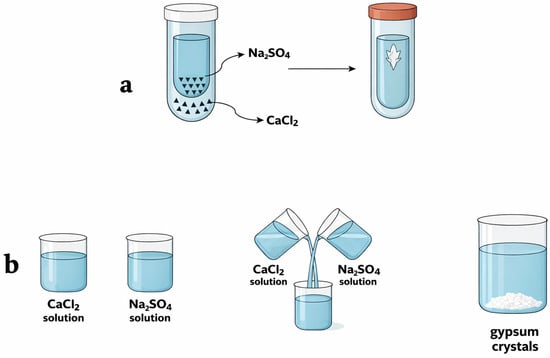
In this study, calcium chloride (CaCl2, 2.2 g, corresponding to 0.40 mol·L−1 in 50 mL) and sodium sulphate (Na2SO4, 2.8 g, corresponding to 0.40 mol·L−1 in 50 mL) were used as starting materials for the synthesis of gypsum (CaSO4·2H2O). The two solutions were prepared separately and subsequently combined to yield a total reaction volume of 100 mL. The type and quantity of raw materials were kept identical for both the diffusion-controlled and rapid precipitation synthesis routes to allow for direct comparison between two contrasting crystallization regimes representing growth-dominated and nucleation-dominated conditions. To evaluate the influence of organic additives on gypsum crystallization, a polycarboxylate-based superplasticizer (Sika® ViscoCrete® 120P (Sika AG, Baar, Switzerland)) was incorporated at dosages of 0.5%, 1%, and 2%, calculated relative to the theoretically predicted amount of gypsum formed according to reaction stoichiometry. Prior to crystallization, the superplasticizer was completely dissolved in deionized water to ensure homogeneous distribution within the reaction medium. The diffusion-controlled experiments were performed using coaxial test tubes consisting of an inner tube (diameter ≈ 1.6 cm, solution height ≈ 15.9 cm) placed inside a larger outer tube (diameter ≈ 3 cm, height ≈ 20 cm), allowing ion transport exclusively via diffusion under static conditions. No dialysis membrane was used, and ion transport occurred solely through direct diffusion between the solutions. In the rapid precipitation experiments, crystallization was carried out in a cylindrical glass beaker (diameter ≈ 8 cm, height ≈ 4.4 cm), where rapid supersaturation was established under static conditions without mechanical stirring, resulting in nucleation-dominated crystallization. All experiments were conducted under controlled ambient laboratory conditions (23 ± 1 °C, relative humidity ≈ 50%) and under standard indoor lighting without exposure to direct sunlight. A schematic representation of the experimental setup and synthesis procedures for the diffusion-controlled and rapid precipitation methods is shown in Figure 1a,b, respectively [12].
Figure 1.
Schematic illustration of gypsum (CaSO4·2H2O) synthesis: (a) diffusion-controlled crystallization and (b) rapid precipitation.
2.2. Instrumental Characterization
The phase composition of the synthesized gypsum samples were characterized using powder X-ray diffraction (XRD) performed on a Panalytical X’Pert Pro PW 3040/60 diffractometer (Malvern Panalytical Ltd., Malvern, UK) operating in powder mode. The XRD patterns were used to confirm the formation of gypsum (CaSO4·2H2O) and to evaluate the crystallinity of samples synthesized via diffusion-controlled and rapid precipitation routes under different superplasticizer dosages. The morphology and surface characteristics of the gypsum crystals were examined using an environmental scanning electron microscope (FEI Company, Hillsboro, OR, USA). Dried samples were mounted on aluminium stubs using conductive carbon tape to ensure sufficient mechanical stability during imaging. SEM observations were carried out in low-vacuum mode (≈100 Pa) at accelerating voltages of 10 and 20 kV with a working distance of approximately 10 mm. A backscattered electron detector (BSED) attached to the ESEM (FEI Company, Hillsboro, OR, USA) was employed to enhance topographical contrast, enabling direct imaging of the non-conductive gypsum crystals without the need for conductive coatings. SEM micrographs were acquired at various magnifications to assess overall crystal morphology and surface features.
3. Results and Discussion
3.1. Macroscopic Comparison of Gypsum Crystallization via Diffusion-Controlled and Rapid Synthesis Method
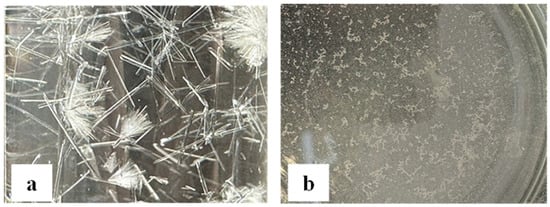
Figure 2a,b compare the macroscopic appearance of gypsum crystals synthesized via the diffusion-controlled and rapid method in the absence of superplasticizer, serving as reference samples. In the diffusion-controlled system, well-defined needle-like gypsum crystals with elongated morphologies are clearly visible at the macroscopic scale. These crystals frequently assemble into radial, star-like aggregates and preferentially attach to the inner walls of the glass container. Such characteristics indicate slow crystal growth under low and gradually increasing supersaturation conditions, where crystal growth dominates over nucleation. The observed anisotropic morphology is consistent with preferential growth along the crystallographic c-axis of gypsum. In contrast, the rapid precipitation method exhibits a markedly different crystallization behaviour. Upon mixing the aqueous solutions of calcium chloride and sodium sulphate in a beaker, no immediate bulk crystallization was observed. However, careful time-resolved observations revealed the onset of crystallization, with the first optically detectable crystalline features appearing after 7 ± 1 min following mixing (mean ± standard deviation, n = 5), forming as a very thin, quasi-continuous layer at the air–solution interface. At this stage, the crystallites were submicrometric in size and exhibited low optical contrast, rendering them not capturable by photographic techniques; nevertheless, subtle changes in the appearance of the solution surface could be discerned by naked-eye observation. After 13 ± 2 min (mean ± standard deviation, n = 5), these initial crystallites underwent further growth, giving rise to crystals of sufficient size to become optically distinguishable and capturable at the macroscopic scale, progressively covering the upper surface of the solution. As crystal growth continued and the accumulated crystal mass increased, the crystals detached from the interface and settled toward the bottom of the container, forming a sediment layer. This behaviour indicates preferential heterogeneous nucleation at the air–liquid interface, where local supersaturation and interfacial energy conditions promote nucleation. The delayed emergence of optically detectable crystals reflects the presence of a short induction period preceding effective nucleation, followed by crystal growth and gravitational settling.
Figure 2.
Macroscopic comparison of gypsum crystallization pathways: (a) diffusion-controlled growth producing elongated, needle-like crystals, and (b) rapid precipitation characterized by fast nucleation at the air–solution interface and subsequent crystal settling.
3.2. Influence of Superplasticizer Concentration on Gypsum Crystallization Under Diffusion-Controlled and Rapid Precipitation Conditions
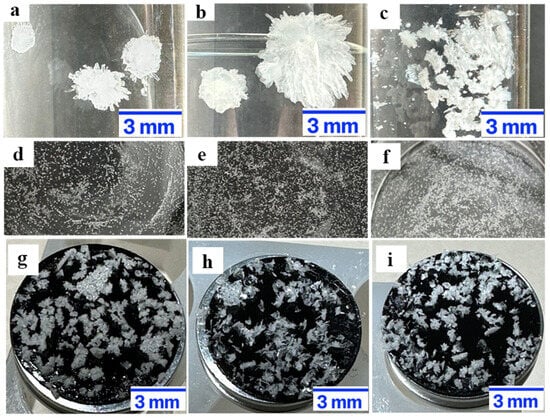
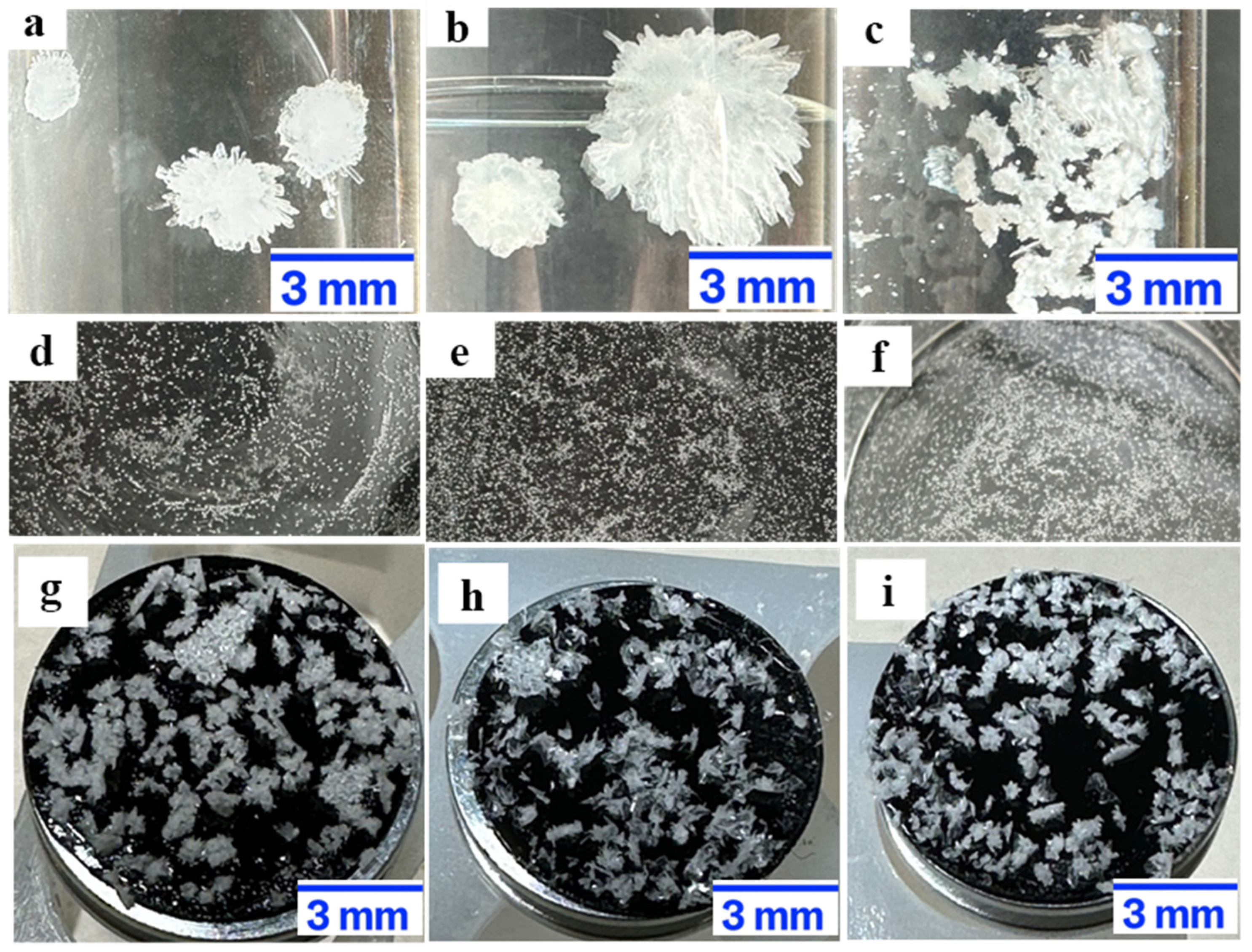
The influence of superplasticizer concentration on the nucleation and growth behaviour of gypsum crystals was investigated under diffusion-controlled and rapid precipitation conditions at concentrations of 0.5%, 1%, and 2% (see Figure 3). Under diffusion-controlled conditions, gypsum crystallization produced only a limited number of nuclei that subsequently grew to relatively large crystals, reflecting a growth-dominated regime associated with the low and gradually increasing supersaturation characteristic of diffusion-based systems. Because only a small number of nuclei form under these conditions, the total crystal surface area remains relatively limited, allowing the available superplasticizer molecules to interact more effectively with existing crystal surfaces. At a superplasticizer concentration of 0.5%, large radially arranged aggregates composed of elongated needle-like crystals were observed, indicating pronounced anisotropic growth under restricted nucleation conditions. These aggregates were frequently observed attached to the container walls, suggesting that crystal growth often occurred preferentially near the solid–solution interface or at defects in the glass surface that may act as nucleation centres under diffusion-limited conditions. Increasing the superplasticizer concentration to 1% reduced aggregate size and packing density while largely preserving the elongated crystal morphology, which is consistent with partial adsorption of superplasticizer molecules on specific crystal faces that moderately slows growth without fundamentally altering the anisotropic growth mechanism of gypsum. At a concentration of 2%, the influence of the superplasticizer became more pronounced, resulting in increased aggregate fragmentation, lower crystal density, and greater morphological irregularity, although crystal growth remained observable even at the highest additive concentration. In contrast, gypsum crystallization under rapid precipitation conditions exhibited a markedly stronger dependence on superplasticizer concentration. Rapid precipitation produces a steep increase in supersaturation, leading to the formation of a large number of nuclei and therefore a substantially larger total crystal surface area than in diffusion-controlled systems. Under these conditions, the available superplasticizer molecules may not be able to cover all newly formed crystal surfaces uniformly, resulting in a kinetically complex interaction between polymer adsorption, nucleation, and crystal growth. All reported crystallization times are presented as mean values ± standard deviation based on five independent synthesis repetitions (n = 5). At a superplasticizer concentration of 2%, optically detectable gypsum crystals appeared after 64 ± 2 min (mean ± standard deviation, n = 5), initially at the air–solution interface and subsequently within the bulk solution, whereas at 1% the first detectable crystals appeared after 23 ± 1 min at both the solution surface and the bottom of the container. At the lowest concentration of 0.5%, crystallization occurred more rapidly, with observable crystals forming after 17 ± 1 min throughout both surface and bulk regions. Observations of the dried products further revealed a clear concentration-dependent decrease in crystal size under rapid precipitation conditions, with higher superplasticizer concentrations producing progressively finer gypsum crystals. In addition to adsorption on crystal surfaces, polycarboxylate chains may also interact with Ca2+ ions in solution [46], temporarily binding and subsequently releasing them during the crystallization process. Such interactions can influence the local availability of calcium ions and may contribute to variations in nucleation behaviour and crystal development; further studies involving direct measurements of Ca2+ concentration and solution chemistry could provide deeper insight into these effects. Overall, these observations indicate that the influence of superplasticizers on gypsum crystallization strongly depends on the supersaturation pathway: diffusion-controlled systems generate relatively small crystal surface areas and therefore allow more effective interaction between polymer molecules and crystal surfaces, whereas rapid precipitation produces a large number of nuclei and extensive crystal surface formation, creating a kinetically dominated environment in which polymer adsorption, ion complexation, and nucleation processes interact dynamically to control crystal growth and morphology, as illustrated in Figure 3.
Figure 3.
Optical images showing the effect of superplasticizer concentration (0.5%, 1%, and 2%) on gypsum crystallization under (a–c) diffusion-controlled and (d–f) rapid precipitation conditions. Images (g–i) show the corresponding dried samples.
3.3. Xrd Analysis of Gypsum Crystals Synthesized via Diffusion-Controlled and Rapid Precipitation Routes
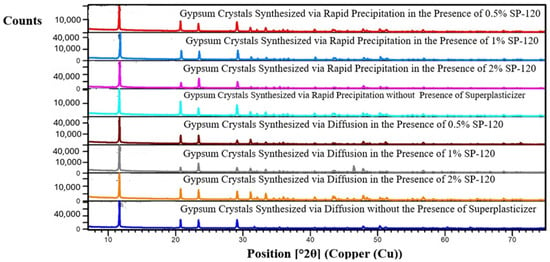
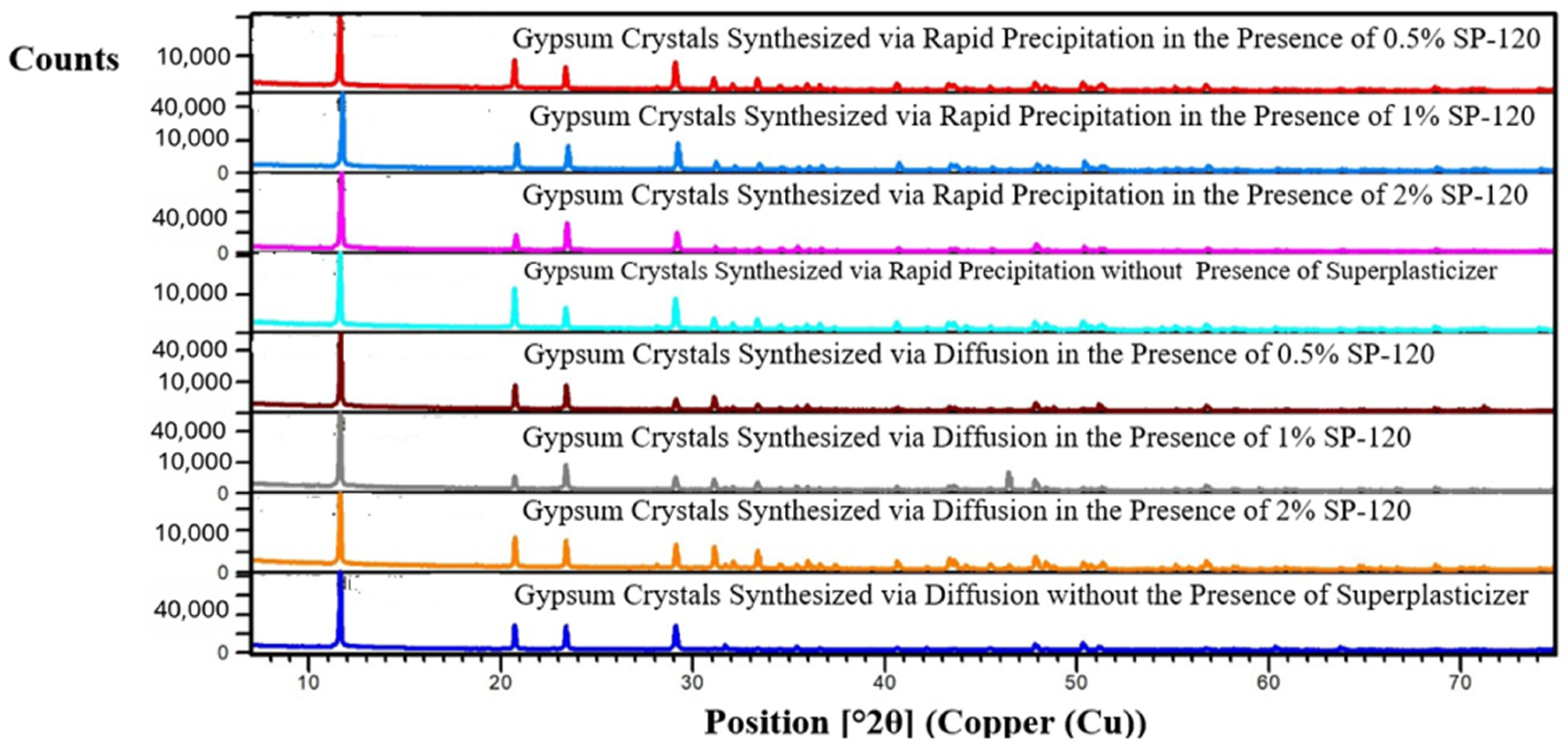
Powder X-ray diffraction (XRD) was employed to verify the crystalline phase of the synthesized gypsum samples obtained via rapid precipitation and diffusion-controlled crystallization at different superplasticizer concentrations. Prior to the XRD measurements, all samples were carefully ground into fine powders to minimize preferred orientation effects arising from the pronounced anisotropic and needle-like morphology of the crystals and to ensure that the recorded diffraction patterns represent the bulk crystalline phase. Figure 4 shows the stacked XRD patterns of all synthesized samples, including those prepared in the presence of 0.5%, 1%, and 2% SP-120 as well as samples synthesized in the absence of superplasticizer for both rapid precipitation and diffusion-controlled crystallization routes. All diffraction patterns exhibit the characteristic reflections of gypsum (CaSO4·2H2O), indicating that the crystalline phase remains unchanged regardless of the synthesis pathway or the superplasticizer concentration. The most intense diffraction peak at approximately 11.6° (2θ) is clearly observed in all samples together with the remaining diagnostic reflections at higher diffraction angles. Importantly, no additional diffraction peaks corresponding to other calcium sulphate phases such as bassanite (CaSO4·0.5H2O) or anhydrite (CaSO4) were detected. Furthermore, no diffraction peaks corresponding to crystalline sodium chloride (NaCl) were observed. Since NaCl is highly soluble in water, it is expected to remain predominantly in the solution phase during crystallization and to be largely removed during sample separation and drying. Any residual NaCl present in the solid products would therefore likely remain below the detection limit of XRD or occur as highly dispersed or amorphous material. A detailed comparison between the experimental diffraction patterns and the ICDD reference peaks of gypsum is provided in the Supplementary Materials (Figures S1–S8), where the experimentally observed reflections coincide with the reference peak positions of gypsum, confirming the formation of phase-pure calcium sulphate dihydrate under all investigated synthesis conditions.
Figure 4.
Stacked XRD patterns of gypsum crystals synthesized via rapid precipitation and diffusion-controlled crystallization at different SP-120 concentrations (0.5%, 1%, and 2%) and in the absence of superplasticizer. Each colored pattern represents a distinct experimental condition corresponding to the synthesis method and SP-120 concentration.
3.4. Influence of Crystallization Pathway and Superplasticizer on Gypsum Crystal Morphology: Sem Observations
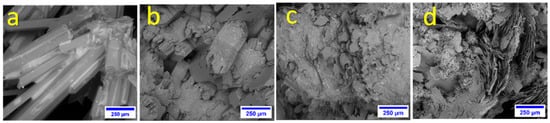
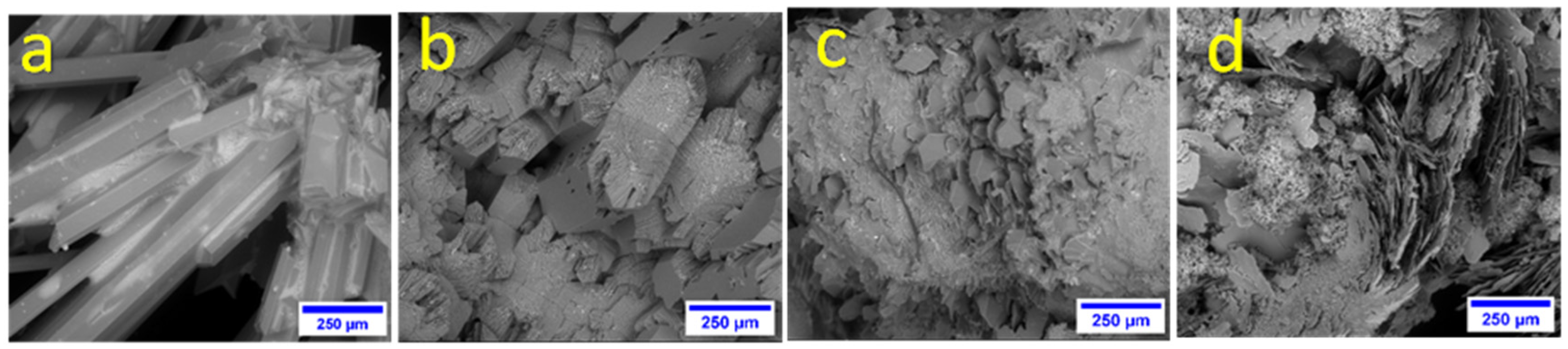
SEM observations demonstrate a concentration-dependent evolution of gypsum crystal morphology under both diffusion-controlled and rapid precipitation crystallization conditions in the presence of a polycarboxylate-based superplasticizer, as illustrated in Figure 5 and Figure 6. Under diffusion-controlled conditions Figure 5, gypsum crystallization proceeds through the formation of a limited number of nuclei, followed by sustained crystal growth, reflecting a growth-dominated regime governed by gradual supersaturation development and diffusion-limited ion transport. In the absence of superplasticizer, the low nucleation density enables uninterrupted anisotropic growth along fast-growing crystallographic directions, resulting in highly elongated, needle-like crystals arranged in open radial aggregates. This morphology is consistent with a system in which crystal growth rates are primarily dictated by mass transport rather than surface processes. At a superplasticizer concentration of 0.5%, the crystallization pathway remains largely unchanged, indicating that growth is still controlled by diffusion. However, the slight shortening of crystals and the preservation of smooth, well-faceted surfaces suggest moderate adsorption of polymer chains at active growth sites, leading to a partial reduction in step propagation rates without altering the dominant growth directions. Upon increasing the superplasticizer concentration to 1%, a pronounced modification of crystal habit is observed. The transition toward plate-like and tabular morphologies, accompanied by granular surface textures, suggests that selective adsorption of polycarboxylate chains on specific crystal faces inhibits lateral growth and promotes step pinning, thereby altering the relative growth rates of different crystallographic directions. As a result, crystal growth becomes increasingly controlled by surface kinetics rather than purely by diffusion. At a superplasticizer concentration of 2%, extensive surface coverage further amplifies these effects. The formation of lamellar, stacked plate-like structures with step-like edges and layered fracture features is consistent with strong inhibition of step advancement and constrained two-dimensional growth, leading to enhanced intergrowth and agglomeration. The presence of a fine-grained surface layer suggests localized growth under kinetically constrained conditions, while overall nucleation remains limited due to the diffusion-controlled supersaturation pathway. Overall, these SEM results indicate that under diffusion-controlled conditions, increasing superplasticizer concentration induces a progressive shift from purely diffusion-limited growth toward a mixed regime in which surface-controlled growth processes become increasingly important, while the crystallization process remains characterized by restricted nucleation and the formation of a limited number of crystals.
Figure 5.
SEM micrographs of gypsum crystals synthesized under diffusion-controlled crystallization conditions in the presence of increasing concentrations of a polycarboxylate-based superplasticizer: (a) 0% (no superplasticizer), (b) 0.5%, (c) 1%, and (d) 2%. The images illustrate the progressive evolution of crystal morphology from elongated, needle-like crystals with open aggregates toward plate-like, lamellar, and increasingly intergrown and agglomerated structures as the superplasticizer concentration increases. All images were acquired at comparable magnification (scale bar: 250 µm).
Figure 6.
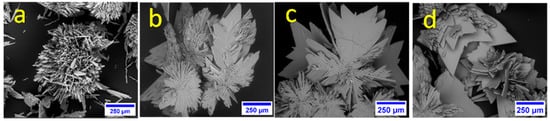
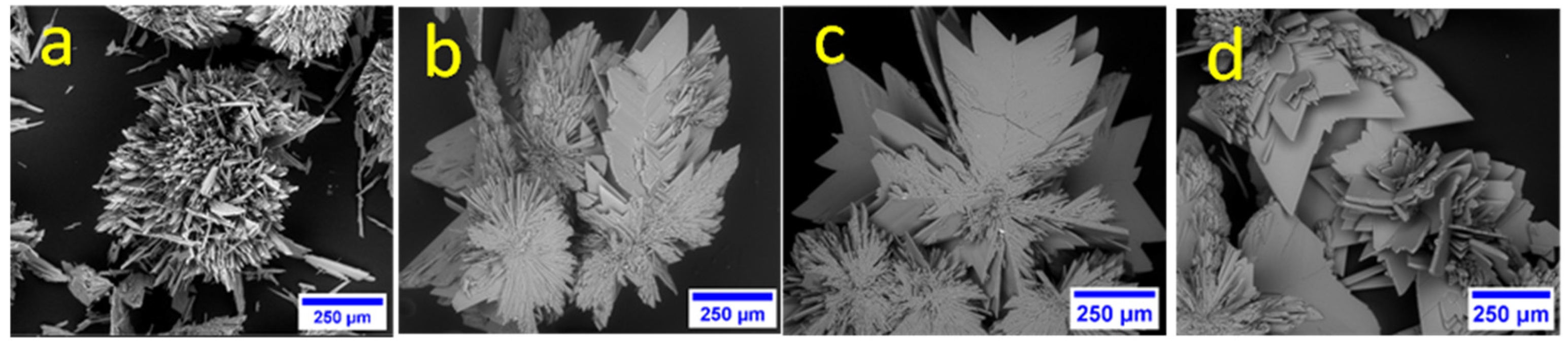
SEM micrographs of gypsum crystals synthesized under rapid precipitation conditions at increasing superplasticizer concentrations: (a) 0%, (b) 0.5%, (c) 1%, and (d) 2%, showing concentration-dependent morphological variations (scale bar: 250 µm).
In contrast to diffusion-controlled crystallization, SEM observations under rapid precipitation conditions (Figure 6) reveal a pronounced concentration-dependent evolution of gypsum crystal morphology in the presence of a polycarboxylate-based superplasticizer. The rapid increase in supersaturation promotes the formation of a large number of nuclei within a short time window following a brief induction period, placing the system in a nucleation-dominated regime during the early stages of crystallization. In the absence of superplasticizer (Figure 6a), the high nucleation density results in the nearly simultaneous growth of numerous crystals, leading to intense competition for growth species and the formation of fine, poorly developed crystallites with rough surfaces, weakly defined crystal facets, and extensive agglomeration. The addition of 0.5% superplasticizer (Figure 6b) slightly delays the onset of crystallization, while partial interaction of polymer chains with growing crystal surfaces reduces crystal–crystal interactions and produces a more uniform spatial distribution of crystals without fundamentally altering the nucleation-dominated character of the system. At a superplasticizer concentration of 1% (Figure 6c), rosette-like aggregates composed of radially arranged tabular plates together with short prismatic to needle-like crystallites become more clearly developed, resulting in a multimodal morphology with coexisting plate-like and elongated features. Increasing the concentration to 2% (Figure 6d) leads to further morphological modification characterized by intensified lamellar stacking and more compact rosette aggregates, while the relative contribution of elongated needle-like crystallites becomes less pronounced. The contrasting morphological responses observed under diffusion-controlled and rapid precipitation conditions can be rationalized by considering the relationship between crystallization rate, nucleation density, and additive adsorption behaviour. Under diffusion-controlled conditions, nucleation proceeds slowly and only a limited number of crystals form, resulting in a relatively small total crystal surface area, allowing additive molecules to interact more selectively with energetically favourable crystal faces. Under such conditions, a sequential adsorption behaviour may occur, in which the additive progressively saturates preferred growth surfaces before interacting with additional crystallographic planes. In contrast, rapid precipitation generates a very large number of nuclei within a short time interval, dramatically increasing the total crystal surface area. Consequently, the available additive becomes effectively distributed over a much larger surface (“additive dilution”), and adsorption may occur in a more statistical manner across different crystallographic planes rather than sequentially saturating specific faces. As a result, preferred growth directions may remain only partially inhibited unless higher additive concentrations are present. This difference in the surface-to-additive ratio provides a plausible explanation for the stronger dosage dependence observed under rapid precipitation conditions, where significantly larger additive amounts may be required to achieve morphological effects comparable to those observed during slow crystallization. Overall, the SEM observations indicate that gypsum crystallization under rapid precipitation remains governed by high supersaturation and dense nucleation, while increasing superplasticizer concentration progressively modifies surface growth behaviour and aggregate compactness. While the present SEM observations mainly reflect changes in crystal growth morphology, the influence of the superplasticizer on nucleation dynamics discussed in Section 3.2 may also contribute indirectly through interactions with Ca2+ ions and the resulting modification of early-stage crystallization conditions.
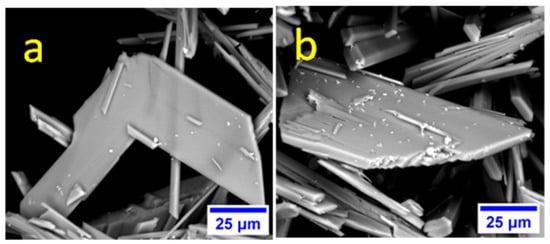
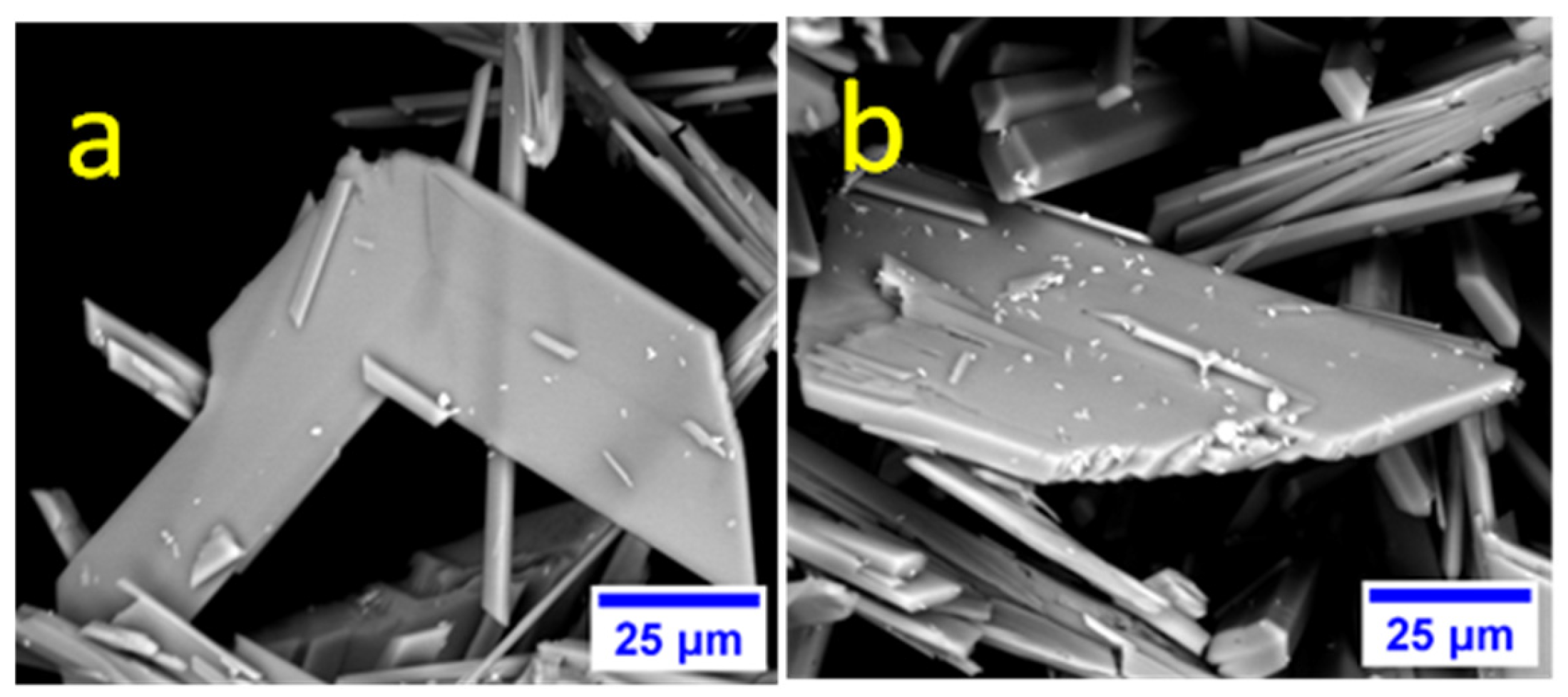
Detailed SEM examination with enhanced resolution reveals that, in the absence of superplasticizer, gypsum crystals can form as large, well-faceted plate-like crystals with very smooth surfaces, coexisting with elongated needle-like or prismatic crystals (Figure 7). In the present images, a dominant plate-like crystal shape with sharp boundaries and a uniform surface is observed, while several small crystallites appear as surface decorations or localized features on its crystal faces. The presence of slender elongated crystals surrounding the plate-like crystal, together with intersecting contacts among them, indicates localized intergrowth and interlocking. The small crystallites observed on the surface may represent localized secondary crystallization features; however, their origin cannot be unambiguously determined from the SEM images alone and could also be related to sample drying artifacts or minor fragmentation of larger crystals during sample preparation. Overall, the microstructure reflects well-developed faceted growth accompanied by the coexistence of different crystal habits in the absence of additives.
Figure 7.
SEM images of gypsum crystals synthesized via rapid precipitation in the absence of superplasticizer (a,b), showing well-faceted plate-like crystals with smooth surfaces coexisting with elongated needle-like or prismatic crystals. (Scale bar: 25 µm).
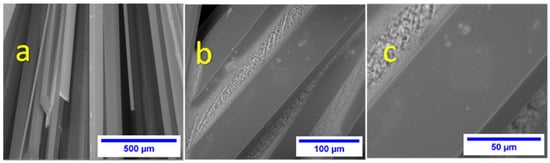
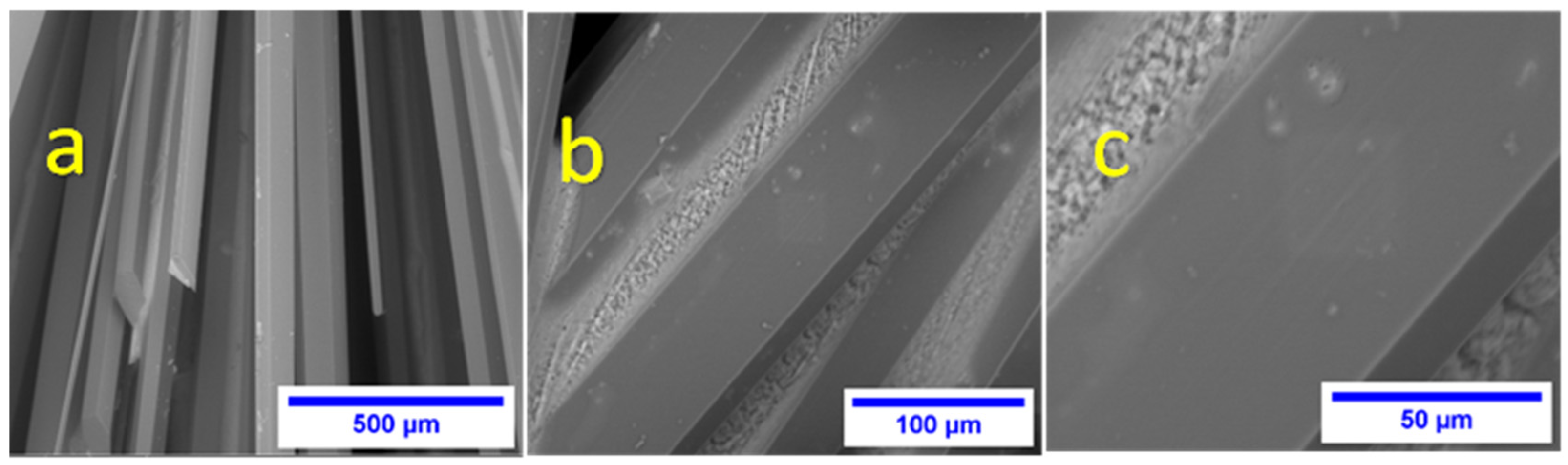
In contrast to the fast crystallization pathway, SEM observations of gypsum crystals synthesized under diffusion-controlled conditions in the absence of superplasticizer reveal a markedly different microstructural evolution across multiple length scales (Figure 8). At lower magnification, the microstructure is dominated by a limited number of well-separated crystals, indicating a low nucleation density and sustained crystal growth. The crystals predominantly exhibit elongated prismatic to needle-like morphologies with high aspect ratios, forming relatively open aggregates with minimal crowding. Higher-magnification SEM images further show that individual crystals possess. well-developed, smooth, and faceted surfaces with sharp and clearly defined edges. Unlike the fast-precipitated samples, no evidence of extensive surface roughening, fine-grained background matrices, or widespread secondary nucleation is observed. Interparticle contacts are generally restricted to point or line contacts, and extensive interlocking or surface–surface agglomeration is absent, reflecting sufficient spatial separation and growth time for individual crystallites. When compared to the additive-free fast crystallization samples, which exhibit localized intergrowth, increased crystal–crystal interactions, and the coexistence of multiple crystal habits within confined regions, the diffusion-controlled samples demonstrate more uniform anisotropic growth and a higher degree of morphological development. These observations indicate that, in the absence of superplasticizer, diffusion-controlled crystallization promotes sustained faceted growth and morphological stability, whereas rapid precipitation favours increased interaction between growing crystals and limits the extent of individual crystal development.
Figure 8.
SEM micrographs of gypsum crystals synthesized under diffusion-controlled conditions in the absence of superplasticizer at increasing magnifications (a–c) (scale bars: 500 µm, 100 µm, and 50 µm).
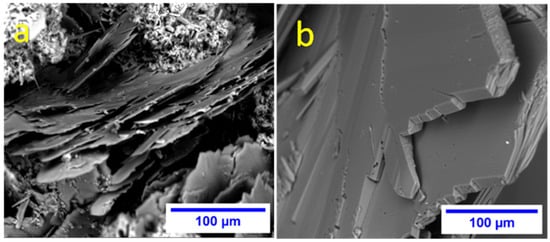
As shown in Figure 9a at a superplasticizer concentration of 0.5%, the crystallization pathway exerts a pronounced influence on gypsum crystal morphology. Under diffusion-controlled conditions, the microstructure is predominantly composed of coarse, well-developed tabular crystals exhibiting broad faces and sharply defined geometric boundaries. These crystals appear relatively organized, with moderate intergrowth and a layered surface topography characterized by directional striations and lamellar features, consistent with crystal growth under gradually developing supersaturation where a limited number of nuclei can grow over extended periods and develop well-defined crystal faces. In contrast, as shown in Figure 9b, the rapid precipitation pathway produces a distinctly heterogeneous microstructure at the same additive concentration. In addition to large tabular crystals, numerous elongated needle-like to prismatic crystallites are observed, frequently forming bundled clusters and accumulating along the edges and interfacial regions of the larger plates, resulting in increased crystal–crystal interactions and more extensive intergrowth. Surface examination further reveals greater local heterogeneity, with fine adhered crystallites and irregular surface textures more prominently developed than in the diffusion-controlled counterpart. Collectively, these observations demonstrate that, at identical superplasticizer concentration, diffusion-controlled crystallization favours the development of predominantly tabular, geometrically defined crystals with comparatively ordered spatial organization, whereas rapid precipitation promotes multimodal crystal habits, higher spatial density, and enhanced interparticle interaction. These differences may also reflect variations in the effective availability of additive relative to the number of nuclei or total crystal surface area: rapid precipitation produces a large number of nuclei and therefore a substantially larger total crystal surface area, which can effectively dilute the additive across numerous growth sites, whereas diffusion-controlled crystallization may provide a higher effective additive concentration per crystal surface, thereby allowing more selective modification of crystal growth.
Figure 9.
SEM micrographs of gypsum crystals synthesized at 0.5% superplasticizer concentration under (a) diffusion-controlled and (b) rapid precipitation conditions (scale bar: 100 µm).
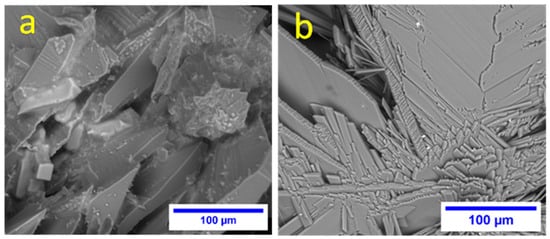
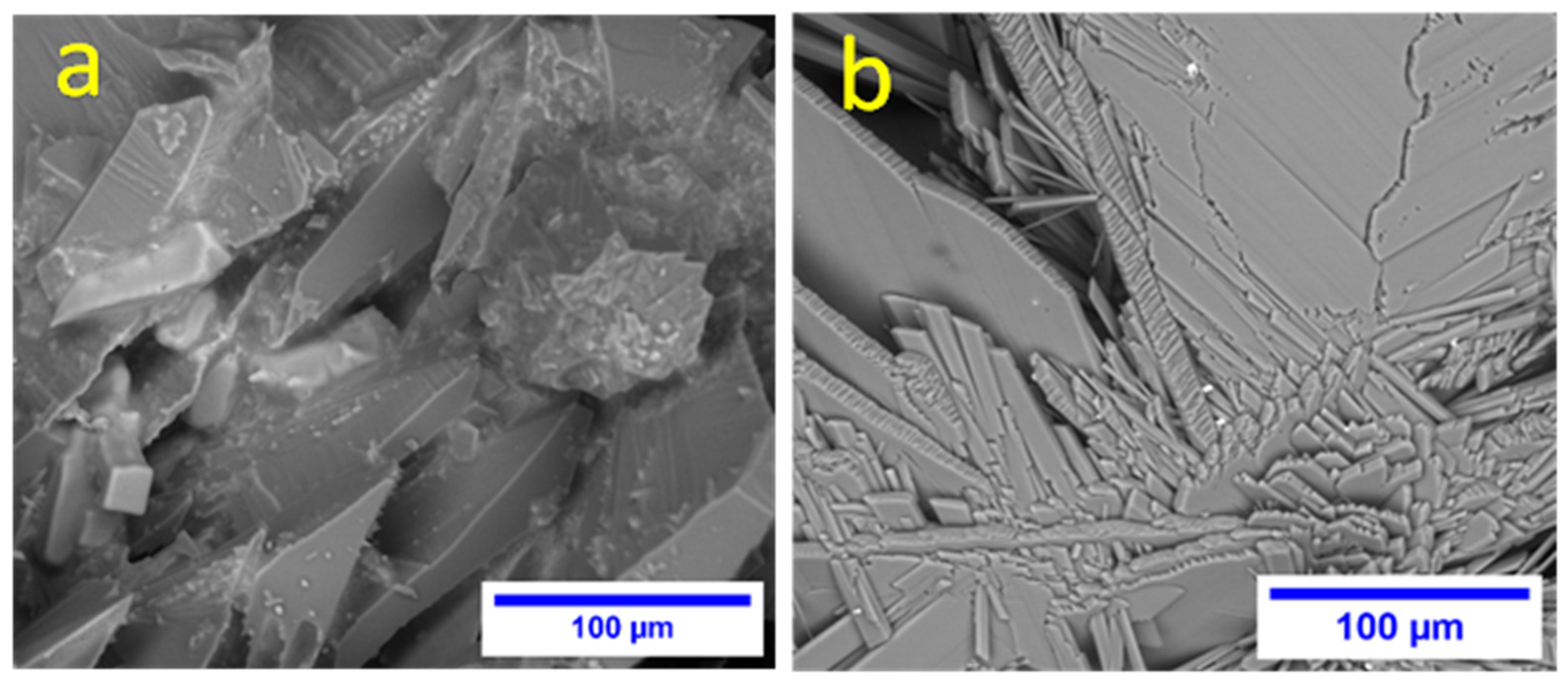
Building upon the morphological differences observed at 0.5% superplasticizer concentration, a further increase to 1% amplifies the pathway-dependent distinctions as illustrated in Figure 10a. Under diffusion-controlled crystallization, the microstructure remains predominantly composed of well-developed tabular crystals with defined geometric boundaries and moderate spatial separation, although subtle variations in crystal thickness and surface topography become more apparent. In contrast, under rapid precipitation conditions Figure 10b, the crystal assemblage becomes more densely arranged and morphologically compact. A reduction in aspect ratio is observed in certain regions and more frequent interparticle contacts, accompanied by increased surface irregularities and localized heterogeneity. These observations suggest that increasing superplasticizer concentration enhances the divergence between the two crystallization pathways, with diffusion-controlled growth maintaining comparatively ordered tabular development, while rapid precipitation promotes progressively denser packing and morphological complexity.
Figure 10.
SEM micrographs of gypsum crystals formed at 1% superplasticizer concentration under (a) diffusion-controlled crystallization and (b) rapid precipitation conditions (scale bar: 100 µm).
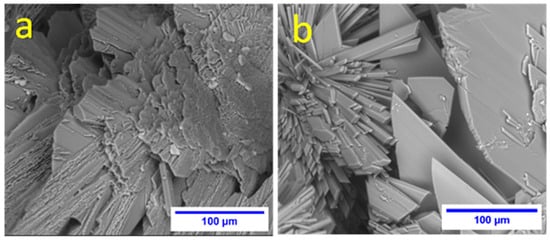
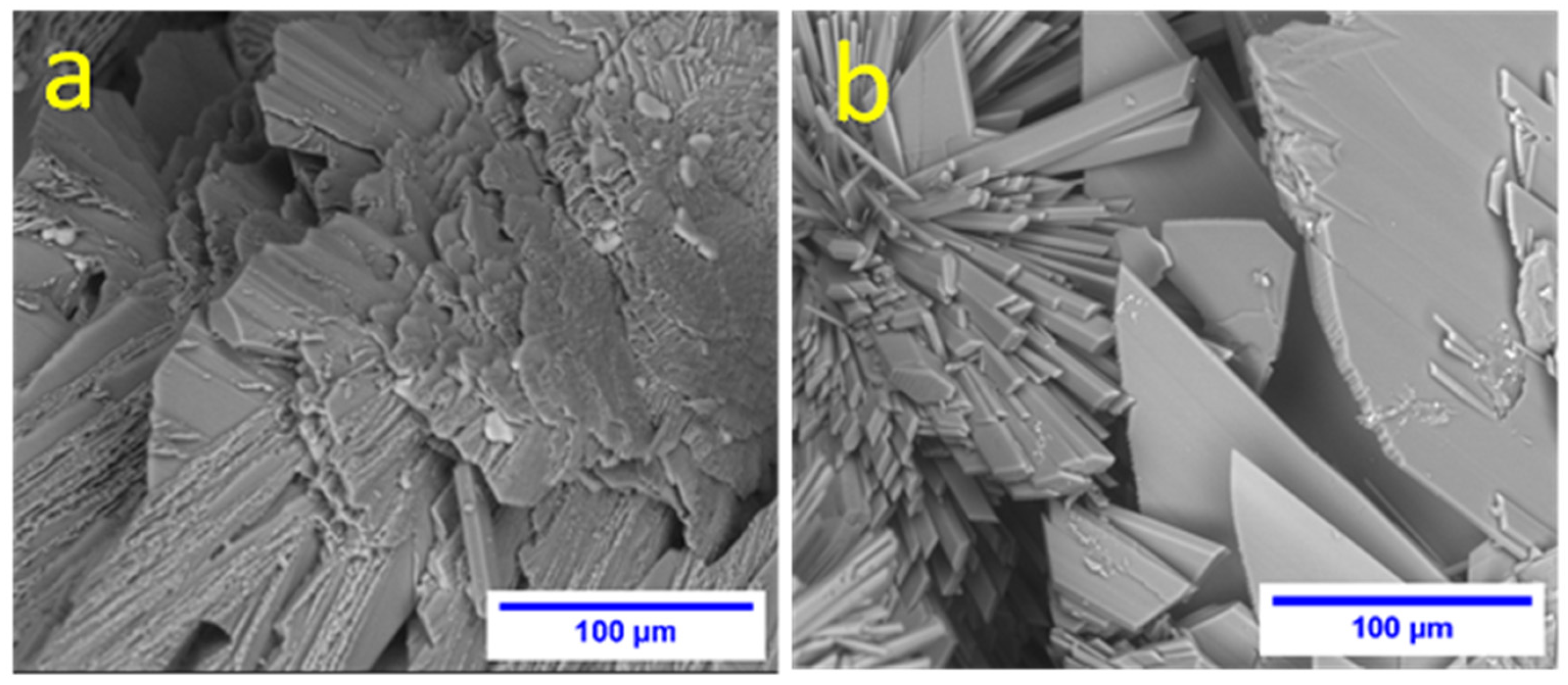
At a superplasticizer concentration of 2%, pathway-dependent morphological characteristics remain clearly discernible, although adsorption-mediated growth regulation becomes a dominant kinetic factor in both systems as illustrated in Figure 11. This behaviour can be further interpreted in terms of facet-dependent growth regulation, in which the adsorption of polycarboxylate molecules selectively retards the growth of specific crystallographic planes. Such selective adsorption modifies the relative growth rates of different crystal faces, leading to the observed transition toward plate-like and lamellar morphologies. Under diffusion-controlled crystallization (Figure 11a), the microstructure is primarily composed of relatively large, well-developed tabular plates arranged in partially stacked lamellar aggregates with moderate spatial separation. Individual crystals remain morphologically distinguishable, preserving coherent faces and an overall open structural organization. The persistence of inter-plate spacing suggests that the gradual evolution of supersaturation inherent to diffusion-limited conditions continues to restrain excessive nucleation and mitigate crowding-induced interlocking. However, the more pronounced step-like edges and localized surface roughening observed at this concentration indicate intensified interaction between advancing growth steps and adsorbed polycarboxylate molecules. Such adsorption can promote step pinning and non-uniform lateral advancement, thereby modulating the edge morphology while still permitting sustained plate development under diffusion-governed ion supply. In contrast, under rapid precipitation conditions, the microstructure transitions into a densely packed and strongly intergrown lamellar framework characterized by intensified stacking, reduced inter-plate spacing, and extensive crystal–crystal contacts. The compact aggregate architecture (Figure 11b) reflects the combined effect of burst-like nucleation induced by rapid supersaturation increase and subsequent adsorption-mediated inhibition of surface growth sites. Under these conditions, high particle density enhances spatial confinement, while strong polymer adsorption intermittently restricts step propagation and crystal thickening. As a result, growth proceeds under a predominantly surface-controlled regime in which discontinuous growth fronts and structural interlocking become more pronounced. Collectively, these findings demonstrate that although both pathways yield plate-dominated morphologies at 2% superplasticizer concentration, diffusion-controlled crystallization sustains comparatively organized lamellar assemblies through moderated nucleation and sustained growth, whereas rapid precipitation amplifies aggregate densification and intergrowth due to the synergistic influence of high supersaturation and adsorption-driven kinetic constraints which may also be associated with a higher density of crystallographic defects formed under these highly nonequilibrium growth conditions.
Figure 11.
SEM micrographs of gypsum crystals formed at 2% superplasticizer concentration under (a) diffusion-controlled and (b) rapid precipitation conditions (scale bar: 100 µm).
A comprehensive qualitative comparison of the crystallization behaviour, including induction time, crystal number, size, morphology, and aggregate structure under different experimental conditions, is summarized in Table S1 (Supplementary Materials).
4. Conclusions
The present findings establish that gypsum crystallization is fundamentally governed by the supersaturation pathway, which defines whether the system operates in a growth-dominated or nucleation-dominated kinetic regime and, consequently, how a polycarboxylate superplasticizer modulates crystal development. Phase analysis confirmed the exclusive formation of CaSO4·2H2O for all synthesis conditions, demonstrating that the observed morphological variations originate from kinetic pathway effects rather than phase transitions. Under diffusion-controlled crystallization, gradual supersaturation build-up restricted nucleation and promoted sustained anisotropic growth, producing well-separated elongated crystals. Increasing polymer concentration progressively altered crystal habit toward tabular and lamellar morphologies, indicating a transition from predominantly diffusion-limited growth toward a mixed regime in which adsorption-mediated surface control becomes increasingly significant. Conversely, rapid precipitation generated steep supersaturation profiles and burst-like nucleation following a short induction period. In this kinetically sensitive regime, superplasticizer addition markedly delayed nucleation and modified aggregate architecture, leading to compact, plate-dominated rosette assemblies with enhanced intergrowth at higher dosages. These findings demonstrate that the effectiveness of polycarboxylate superplasticizers is not intrinsic but pathway-dependent. The supersaturation profile dictates the balance between transport-limited and surface-controlled growth, thereby controlling induction time, nucleation density, and aggregate compactness. From a broader perspective, deliberate control of crystallization pathway provides an effective tool for tailoring gypsum morphology and optimizing additive performance in sulphate-based and cementitious systems. In addition, interaction between polycarboxylate molecules and Ca2+ ions in solution may locally influence the effective Ca/SO4 ratio during the early stages of crystallization, particularly under rapid precipitation conditions where nucleation occurs within a narrow time window, whereas such effects may be less pronounced under diffusion-controlled conditions due to continuous ion supply.
Supplementary Materials
The following supporting information can be downloaded at: https://www.mdpi.com/article/10.3390/cryst16040241/s1.
Author Contributions
Conceptualization, F.M.K. and C.P.; data curation, F.M.K., C.P. and T.K.; formal analysis, F.M.K. and C.P.; investigation, F.M.K., C.P. and P.P.; writing—original draft preparation, F.M.K.; writing—review and editing, F.M.K., C.P. and M.S.K.; supervision, C.P. and M.S.K.; project administration, M.S.K.; funding acquisition, M.S.K. All authors have read and agreed to the published version of the manuscript.
Funding
This research received no external funding.
Data Availability Statement
The data presented in this study are available on request from the corresponding author.
Conflicts of Interest
The authors declare no conflict of interest.
References
- Levickaya, K.; Alfimova, N.; Nikulin, I.; Kozhukhova, N.; Buryanov, A. The Use of Phosphogypsum as a Source of Raw Materials for Gypsum-Based Materials. Materials 2020, 13, 69. [Google Scholar] [CrossRef] [Scilit]
- Aquilano, D.; Bruno, M.; Ghignone, S. Gypsum: From the Equilibrium to the Growth Shapes—Theory and Experiments. Minerals 2024, 14, 1175. [Google Scholar] [CrossRef] [Scilit]
- Van Driessche, A.E.S.; Stawski, T.M.; Kellermeier, M. Calcium sulfate precipitation pathways in natural and engineering environments. Chem. Geol. 2019, 530, 119274. [Google Scholar] [CrossRef] [Scilit]
- Pritzel, C.; Kowald, T.; Sakalli, Y.; Trettin, R. Binding Materials Based on Calcium Sulphates: Composition, Properties, Application; De Gruyter: Siegen, Germany, 2017. [Google Scholar]
- Esan, M.T. Review of gypsum reinforced composites as building materials. Discov. Civ. Eng. 2024, 3, 5. [Google Scholar] [CrossRef] [Scilit]
- Stawski, T.M.; van Driessche, A.E.S.; Ossorio, M.; Rodriguez-Blanco, J.D.; Besselink, R.; Benning, L.G. Formation of Calcium Sulfate through the Aggregation of Sub-3 Nanometre Primary Species. Nat. Commun. 2016, 7, 11177. [Google Scholar] [CrossRef] [Scilit]
- Reiss, A.G.; Gavrieli, I.; Rosenberg, Y.O.; Reznik, I.J.; Luttge, A.; Emmanuel, S.; Ganor, J. Gypsum Precipitation under Saline Conditions: Thermodynamics, Kinetics, Morphology, and Size Distribution. Minerals 2021, 11, 141. [Google Scholar] [CrossRef] [Scilit]
- Małysiak, A.; Orda, S.; Drzazga, M. Influence of Supersaturation, Temperature and Rotational Speed on Induction Time of Calcium Sulfate Crystallization. Crystals 2021, 11, 1236. [Google Scholar] [CrossRef] [Scilit]
- La Bella, M.; Besselink, R.; Wright, J.P.; Van Driessche, A.E.S.; Fernandez-Martinez, A.; Giacobbe, C. Hierarchical Synchrotron Diffraction and Imaging Study of the Calcium Sulfate Hemihydrate–Gypsum Transformation. Appl. Crystallogr. 2023, 10, 391–402. [Google Scholar] [CrossRef] [Scilit]
- Nývlt, J. The Kinetics of Industrial Crystallization; Elsevier: Amsterdam, The Netherlands, 1985; Volume 19. [Google Scholar]
- Ziegenheim, S.; Szabados, M.; Kónya, Z.; Kukovecz, Á.; Pálinkó, I.; Sipos, P. Manipulating the Crystallization Kinetics and Morphology of Gypsum, CaSO4·2H2O via Addition of Citrate at High Levels of Supersaturation and the Effect of High Salinity. Polyhedron 2021, 204, 115253. [Google Scholar] [CrossRef] [Scilit]
- Kakar, F.; Pritzel, C.; Kowald, T.; Killian, M.S. Influence of Superplasticizers on the Diffusion-Controlled Synthesis of Gypsum Crystals. Crystals 2025, 15, 709. [Google Scholar] [CrossRef] [Scilit]
- Cotellucci, A.; Garcia-Ruiz, J.-M.; Otálora, F.; Canals, À.; Bruno, M.; Wehrung, Q.; Pellegrino, L.; Aquilano, D.; Pastero, L. Gypsum Crystals Formed by the Anhydrite–Gypsum Transformation at Low Temperatures: Implications for the Formation of the Geode of Pulpí. Minerals 2024, 14, 1074. [Google Scholar] [CrossRef] [Scilit]
- Putnis, C.V.; Wang, L.; Ruiz-Agudo, E.; Ruiz-Agudo, C.; Renard, F. Crystallization via Nonclassical Pathways: Nanoscale Imaging of Mineral Surfaces. In Crystallization via Nonclassical Pathways Volume 2: Aggregation, Biomineralization, Imaging & Application; ACS Symposium Series 1383; American Chemical Society: Washington, DC, USA, 2021; pp. 1–35. [Google Scholar]
- Kellermeier, M.; Scheck, J.; Drechsler, M.; Rosenberg, R.; Stawski, T.M.; Fernandez-Martinez, A.; Gebauer, D.; Van Driessche, A.E.S. From Ions to Crystals: A Comprehensive View of the Non-Classical Nucleation of Calcium Sulfate. Angew. Chem. Int. Ed. 2024, 63, e202408429. [Google Scholar] [CrossRef] [Scilit] [PubMed]
- Chen, Y.; Cohen, Y. Calcium Sulfate and Calcium Carbonate Scaling of Thin-Film Composite Polyamide Reverse Osmosis Membranes with Surface-Tethered Polyacrylic Acid Chains. Membranes 2021, 11, 1287. [Google Scholar] [CrossRef] [Scilit] [PubMed]
- Ossorio, M.; Stawski, T.M.; Rodríguez-Blanco, J.D.; Sleutel, M.; García-Ruiz, J.M.; Benning, L.G.; Van Driessche, A.E.S. Physicochemical and Additive Controls on the Multistep Precipitation Pathway of Gypsum. Minerals 2017, 7, 140. [Google Scholar] [CrossRef] [Scilit]
- Trukhina, M.; Tkachenko, S.; Ryabova, A.; Oshchepkov, M.; Redchuk, A.; Popov, K. Calcium Sulfate Crystallization in Presence of Fluorescent-Tagged Polyacrylate and Some Refinement of Scale Inhibition Mechanism. Minerals 2023, 13, 559. [Google Scholar] [CrossRef] [Scilit]
- Singh, N.B.; Middendorf, B. Calcium sulphate hemihydrate hydration leading to gypsum crystallization. Prog. Cryst. Growth Charact. Mater. 2007, 53, 57–77. [Google Scholar] [CrossRef] [Scilit]
- Wang, Y.W.; Kim, Y.Y.; Christenson, H.K.; Meldrum, F.C. A new precipitation pathway for calcium sulfate dihydrate (gypsum) via amorphous and hemihydrate intermediates. Chem. Commun. 2012, 48, 504–506. [Google Scholar] [CrossRef] [Scilit]
- Van Driessche, A.E.S.; Stawski, T.M.; Benning, L.G.; Kellermeier, M. Calcium Sulfate Precipitation Throughout Its Phase Diagram. In New Perspectives on Mineral Nucleation and Growth; Van Driessche, A.E.S., Kellermeier, M., Benning, L.G., Gebauer, D., Eds.; Springer: Berlin/Heidelberg, Germany, 2017; pp. 227–256. [Google Scholar]
- Saha, A.; Lee, J.; Pancera, S.M.; Bräeu, M.F.; Kempter, A.; Tripathi, A.; Bose, A. New Insights into the transformation of calcium sulfate hemihydrate to gypsum using time-resolved cryogenic transmission electron microscopy. Langmuir 2012, 28, 11182–11187. [Google Scholar] [CrossRef] [Scilit]
- De Yoreo, J.J.; Vekilov, P.G. Principles of crystal nucleation and growth. Rev. Mineral. Geochem. 2003, 54, 57–93. [Google Scholar] [CrossRef] [Scilit]
- Popov, K.; Oshchepkov, M.; Kovalenko, A.; Redchuk, A.; Dikareva, J.; Pochitalkina, I. Scale nucleation natural precursors: A case study of “micro/nanodust” impurities nature in laboratory aqueous samples obtained from Moscow tap water. Int. J. Corros. Scale Inhib. 2020, 9, 1097–1112. [Google Scholar] [CrossRef] [Scilit]
- Oshchepkov, M.; Popov, K.; Kovalenko, A.; Redchuk, A.; Dikareva, J.; Pochitalkina, I. Initial Stages of Gypsum Nucleation: The role of “Nano/microdust”. Minerals 2020, 10, 1083. [Google Scholar] [CrossRef] [Scilit]
- Anduix-Canto, C.; Levenstein, M.A.; Kim, Y.-Y.; Godinho, J.R.A.; Kulak, A.N.; Niño, C.G.; Withers, P.J.; Wright, J.P.; Kapur, N.; Christenson, H.K.; et al. Exploiting Confinement to Study the Crystallization Pathway of Calcium Sulfate. Adv. Funct. Mater. 2021, 31, 2107312. [Google Scholar] [CrossRef] [Scilit]
- Abdel-Aal, E.A.; Rashad, M.M.; El-Shall, H. Crystallization of Calcium Sulfate Dihydrate at Different Supersaturation Ratios and Different Free Sulfate Concentrations. Cryst. Res. Technol. 2004, 39, 313–321. [Google Scholar] [CrossRef] [Scilit]
- Cotellucci, A.; Pellegrino, L.; Costa, E.; Bruno, M.; Dela Pierre, F.; Aquilano, D.; Destefanis, E.; Pastero, L. Effect of Different Evaporation Rates on Gypsum Habit: Mineralogical Implications for Natural Gypsum Deposits. Cryst. Growth Des. 2023, 23, 8892–8904. [Google Scholar] [CrossRef] [Scilit]
- Gebauer, D.; Kellermeier, M.; Gale, J.D.; Bergström, L.; Cölfen, H. Pre-Nucleation Clusters as Solute Precursors in Crystallisation. Chem. Soc. Rev. 2014, 43, 2348–2371. [Google Scholar] [CrossRef] [Scilit]
- Abu Zeitoun, E.; Pritzel, C.; Sakalli, Y.; Trettin, R. The mechanism of the first hydration–dehydration cycle of pure α- and β-CaSO4·0.5H2O. Adv. Mater. Sci. Eng. 2020, 2020, 1732621. [Google Scholar] [CrossRef] [Scilit]
- Gao, Y.; Song, W.; Yang, J.; Ji, X.; Wang, N.; Huang, X.; Wang, T.; Hao, H. Crystal Morphology Prediction Models and Regulating Methods. Crystals 2022, 12, 484. [Google Scholar] [CrossRef] [Scilit]
- Kim, Y.-Y.; Freeman, C.L.; Gong, X.; Levenstein, M.A.; Wang, Y.; Kulak, A.; Anduix-Canto, C.; Lee, P.A.; Li, S.; Chen, L.; et al. The Effect of Additives on the Early Stages of Growth of Calcite Single Crystals. Angew. Chem. 2017, 129, 12047–12052. [Google Scholar] [CrossRef] [Scilit]
- Madeja, B.; Avaro, J.; Van Driessche, A.E.S.; Rückel, M.; Wagner, E.; Cölfen, H.; Kellermeier, M. Tuning the Growth Morphology of Gypsum Crystals by Polymers. Cryst. Growth Des. 2021, 21, 1517–1528. [Google Scholar]
- Kim, K.Y.; An, S.H.; Lee, J.U. Study on the effect of residual polymer superplasticizer on the properties of graphene–cement composites. Polymers 2024, 16, 956. [Google Scholar] [CrossRef] [Scilit]
- Hirata, T.; Ye, J.; Branicio, P.; Zheng, J.; Lange, A.; Plank, J.; Sullivan, M. Adsorbed conformations of PCE superplasticizers in cement pore solution unraveled by molecular dynamics simulations. Sci. Rep. 2017, 7, 16048. [Google Scholar] [CrossRef] [Scilit]
- Baken, A.; Fernandez-Martinez, A.; Lanson, M.; Aretxabaleta, X.M.; Manzano, H.; Kellermeier, M.; Di Michiel, M.; Van Driessche, A.E.S. Additive effects on nucleation mechanisms beyond surface adsorption. Nat. Commun. 2026, 17, 1925. [Google Scholar] [CrossRef] [Scilit] [PubMed]
- Huang, R.; Shi, C.; Ma, K.; Xiao, Y.; Wu, Z.; Zheng, J.; Ye, G. A review on concrete superplasticizers and their applications. Polymers 2024, 16, 1949. [Google Scholar]
- Salami, B.A.; Kazeem, A.A.; Yusuf, M.O.; Garde, A.M.; Oladimeji, A.A. Polymer-enhanced concrete: A comprehensive review of innovations and pathways for resilient and sustainable materials. Case Stud. Constr. Mater. 2024, 21, e03062. [Google Scholar] [CrossRef] [Scilit]
- Guan, Y.F.; Wang, Y.; Sun, J.; Li, C. Gypsum heterogeneous nucleation pathways regulated by surface properties. Sci. Rep. 2024, 14, 11739488. [Google Scholar]
- Jun, Y.S.; Kim, H.; Waychunas, G.A. Adsorption-induced local amorphization drives structural transformation on gypsum surfaces. Cryst. Growth Des. 2015, 15, 1722–1732. [Google Scholar]
- Lei, L.; Palacios, M.; Plank, J.; Jeknavorian, A. Interaction between polycarboxylate superplasticizers and non-calcined clays and calcined clays: A review. Cem. Concr. Res. 2022, 154, 106717. [Google Scholar] [CrossRef] [Scilit]
- Lei, L.; Zhang, Y.; Li, R. Specific molecular design of polycarboxylate polymers for enhanced adsorption and dispersing performance. Cem. Concr. Res. 2021, 145, 106450. [Google Scholar]
- Walkley, B.; Geddes, D.A.; Matsuda, T.; Provis, J.L. Reversible adsorption of polycarboxylates on silica fume in high pH, high ionic strength environments for control of concrete fluidity. Langmuir 2022, 38, 1662–1671. [Google Scholar] [CrossRef] [Scilit]
- Bessaies-Bey, H.; Leonelli, C.; Khelidj, M. Polycarboxylate ester adsorption on cement grains: Influence of polydispersity and architecture. Cem. Concr. Res. 2021, 144, 106442. [Google Scholar] [CrossRef] [Scilit]
- Pritzel, C.; Emami, M.; Afflerbach, S.; Killian, M.; Trettin, R. Formation of α-hemihydrate inside of a gypsum crystal during the dehydration process. Crystals 2022, 12, 1780. [Google Scholar] [CrossRef] [Scilit]
- Chabowska, M.A.; Załuska-Kotur, M. Diffusion-dependent pattern formation on crystal surfaces. ACS Omega 2023, 8, 43775–43784. [Google Scholar] [CrossRef] [Scilit]
- Pritzel, C.; Sakalli, Y.; Trettin, R. How do additives influence the morphology of the hydration product of calcium sulfate hemihydrate. In Proceedings of the Thirty-eighth International Conference on Cement Microscopy, Lyon, France, 17–21 April 2016; International Cement Microscopy Association: San Diego, CA, USA, 2016. [Google Scholar]
Disclaimer/Publisher’s Note: The statements, opinions and data contained in all publications are solely those of the individual author(s) and contributor(s) and not of MDPI and/or the editor(s). MDPI and/or the editor(s) disclaim responsibility for any injury to people or property resulting from any ideas, methods, instructions or products referred to in the content. |
© 2026 by the authors. Licensee MDPI, Basel, Switzerland. This article is an open access article distributed under the terms and conditions of the Creative Commons Attribution (CC BY) license.