


Abstract
This study aims to systematically investigate the influence of substituent effects on the strength of Lewis acid–base interactions in frustrated Lewis pairs (FLPs). Specifically, -C6F5 groups of the classical Lewis acid B(C6F5)3 are sequentially replaced with -C6Cl5, -C6Br5, and -C6I5 groups, and the Lewis acids are paired with the Lewis base 1,3-disubstituted imidazol-2-ylidene (ItBu) to form FLPs. Further energy decomposition analysis (sobEDA), orbital analysis, and molecular fragment density difference (MFDD) analysis reveal the nature of the substituent effect on the interaction energy (∆Eint) of the FLPs. The research findings indicate that the ∆Eint of B(C6F5)3-ItBu, B(C6F5)x(C6Y5)3−x-ItBu (x = 0, 1, 2; Y = Cl, Br, I) originates mainly from the interaction between the outermost halogen atom of the Lewis acid and the central carbon (C) atom of the Lewis base, rather than from the interaction between the central atoms boron (B) and carbon (C). This mechanism ultimately leads to a ∆Eint for B(C6F5)2(C6Y5)-ItBu (Y = Cl, Br, I) that is comparable to that of B(C6F5)3-ItBu. This indicates that modified B(C6F5)2(C6Y5) (Y = Cl, Br, I) exhibits greater potential for the construction of novel FLPs.
1. Introduction
Since the Stephan group discovered and defined the concept of frustrated Lewis pairs (FLPs) in 2006, FLPs have attracted widespread interest for their metal-free catalytic potential [1]. After more than a decade of development, FLPs have evolved into a highly versatile tool for the activation of small molecules [2,3,4,5]. The “push–pull” hypothesis posits that FLPs activate small molecules through a cooperative electron transfer process: the Lewis acid accepts electron density from the reactant bonding orbital, while the Lewis base donates electron density into its antibonding orbital, thereby achieving activation [6]. Steric hindrance prevents the formation of a stable adduct between the Lewis acid and base, thereby preserving their independent “push–pull” action. Hence, the design of FLPs requires the delicate balancing of both steric and electronic factors in component selection. Notably, Tris(pentafluorophenyl)borane-B(C6F5)3 and its derivatives exhibit high acidity and significant steric bulk. The presence of an empty orbital on the boron (B) atom facilitates the acceptance of electron pairs from small molecules, while the steric hindrance of substituents can effectively impede interaction with Lewis bases, thus ensuring the sterically frustrated state of the FLPs. Numerous experimental achievements have been made in the activation of small molecules by FLPs, which are derived from the rational substitution of substituents on the B atom of the B(C6F5)3 [7,8,9,10,11,12]. Ashley et al. reported the activation of hydrogen (H2) by B(C6F5)3 and B(C6F5)x(C6Cl5)3−x (x = 0, 1, 2). Experimentally, B(C6F5)2(C6Cl5) exhibits enhanced air stability and H2 activation activity comparable to B(C6F5)3, marking it as a promising alternative [13]. Nevertheless, B(C6F5)x(C6Cl5)3−x (x = 0, 1) show lower H2 activation rates. The result challenges the prevailing understanding derived from the work of Ashley et al. Theoretically, the larger atomic radius of the Cl atom compared with the F atom should lead to more pronounced steric effects within the FLP framework. This is favorable for H2 activation. When F atoms are replaced by Cl atoms, the electrophilicity weakens, leading to a decrease in Lewis acidity. This results in a lower bond energy of the formed FLPs, thereby making them more favorable for H2 activation. Therefore, B(C6F5)x(C6Cl5)3−x (x = 0, 1), with a higher Cl content, should be more active towards H2 activation than B(C6F5)2(C6Cl5). But this is inconsistent with the experimental results reported by Ashley et al.
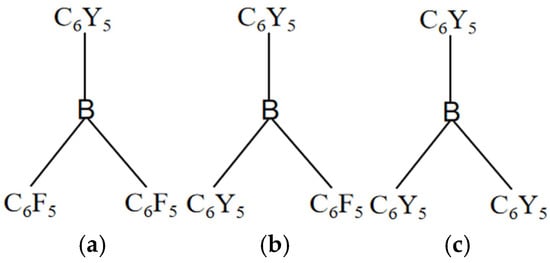
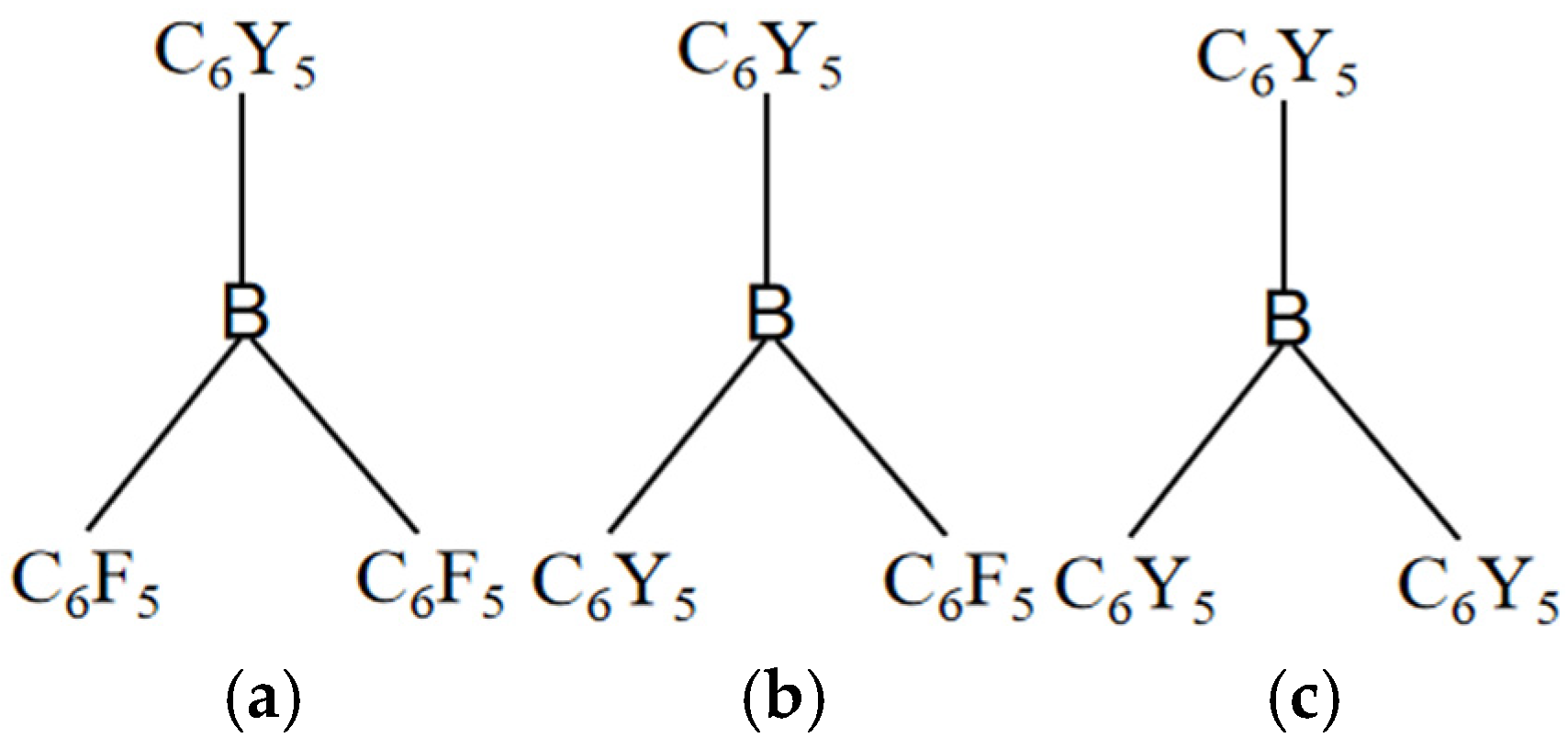
To explain the above issues, we employ halogenated aryl substituents (-C6Cl5, -C6Br5, -C6I5) to systematically replace the -C6F5 group in B(C6F5)3, as shown in Figure 1 [14,15]. Thus, the FLPs are designed by combining Lewis acids B(C6F5)3 and B(C6F5)x(C6Y5)3−x (x = 0, 1, 2; Y = Cl, Br, I) with the Lewis base 1,3-disubstituted imidazol-2-ylidene (ItBu) [16]. To elucidate the substituent effects, we systematically investigate the formation of the FLPs based on the modified Lewis acids in comparison with the classical B(C6F5)3. This investigation is conducted through a combination of structural, energy, orbital and electron density analyses. This study has two main objectives: (i) to examine the chemical properties of the B(C6F5)x(C6Y5)3−x (x = 0, 1, 2; Y = Br, I) in comparison with B(C6F5)x(C6Cl5)3−x (x = 0, 1, 2) and (ii) to elucidate the mechanism underlying the enhanced interaction in FLPs with halogen atom substitution. On this basis, the fundamental factors governing the interactions of FLPs are identified, thereby enabling the construction of novel FLPs through systematic modification of the classical B(C6F5)3.
Figure 1.
Schematic diagrams of the modified structures of the Lewis acid B(C6F5)3. (a) (-C6Y5), (b) (-C6Y5)2 and (c) (-C6Y5)3 groups (Y = Cl, Br, I).
2. Methods
All geometry optimizations and vibrational frequency calculations in this work are performed at the B3LYP-D3(BJ)/def2-TZVP level of theory with the Gaussian 09 software package [17,18]. The investigated systems include both the monomers and the corresponding FLPs. To decompose the interaction energy of the FLPs into physically meaningful components, we employ the energy decomposition analysis method (sobEDA) [19,20,21]. It is a powerful DFT-based approach that incorporates dispersion correction, enabling the quantification of multiple interaction components. This method facilitates the rapid and accurate partitioning of interaction energy into seven terms (∆Eint, ∆Eels, ∆Ex, ∆Erep, ∆Eorb, ∆EDFTc, ∆Edc), thereby elucidating the dominant and secondary factors governing the interactions. The individual energy terms are related as follows:
Here, ∆Eels, ∆Ex, ∆Erep and ∆Eorb represent the classical electrostatic interaction, the exchange interaction, the Pauli repulsion and the orbital interaction energies, respectively. ∆EDFTc and ∆Edc correspond to the DFT and the dispersion correction terms, respectively. Essentially, ∆Ex arises from the quantum interference effect induced by the antisymmetrization of the wavefunction due to electrons being identical particles with no corresponding classical effect. In practice, ΔEx is commonly grouped with ΔErep to define the exchange–repulsion energy ΔEXrep = ΔEx + ΔErep. ∆EDFTc, which is contributed by the DFT correlation functional, accounts for the Coulombic contribution to the intermolecular interaction. However, it performs poorly in describing long-range Coulomb effects, necessitating the inclusion of ΔEdc for correction.
The Multiwfn program is a powerful and practical wavefunction analysis tool, which is widely used in quantum chemical calculations [22,23,24,25]. Among these, molecular electrostatic potential (ESP) analysis, orbital analysis, and molecular fragment density difference (MFDD) analysis can all be realized through its powerful functionality. The ESP extreme points near the central atom of the optimized monomer serve as a direct criterion for the construction of FLP structures and the prediction of interaction strength. The orbital analysis module is used to quantify the overlap between the highest occupied molecular orbital (HOMO) and lowest unoccupied molecular orbital (LUMO), as well as the electron population on the center atoms (B and C) of the FLPs. This constitutes a critical basis for assessing the magnitude of the interaction between the B and C of the FLPs. The MFDD analysis is employed to map electron migration between the fragments. The variation in the FLP interaction energy directly correlates with the redistribution of electron density in the interfacial region between the acid and base. The key factors governing the binding energy of FLPs are determined through a comparative analysis of electron density migration between various atoms within the FLPs [26,27,28,29,30,31,32,33,34,35].
3. Results and Discussion
3.1. Comparison of Bond Energy of the FLPs on Modified Lewis Acid B(C6F5)3
This study investigates a series of FLPs derived from ItBu and various borane Lewis acids. These acids include B(C6F5)3 and a systematic set of B(C6F5)x(C6Y5)3−x (x = 0, 1, 2; Y = Cl, Br, I) [34]. Under normal conditions, the B atom of B(C6F5)3 and B(C6F5)x(C6Y5)3−x (x = 0, 1, 2; Y = Cl, Br, I) typically possesses an empty orbital, while the C atom of ItBu has a lone pair of electrons. A molecular ESP analysis of Lewis acids and Lewis base is performed, and the results are presented in S1. For Lewis acids, a positive region of ESP exists outside the B atom. For ItBu, the negative region of ESP exists outside the C atom of the imidazole ring. For the classical B(C6F5)3, the positive ESP value outside the B atom is 33.87 kcal/mol. For the modified B(C6F5)x(C6Y5)3−x (x = 0, 1, 2; Y = Cl, Br, I), the positive ESP values are 17.70 kcal/mol, 17.07 kcal/mol, and 14.98 kcal/mol at x = 2; 17.36 kcal/mol, 11.66 kcal/mol, and 6.84 kcal/mol at x = 1; and 15.35 kcal/mol, 9.85 kcal/mol, and 4.88 kcal/mol at x = 0; Therefore, the positive ESP values outside the B atom of B(C6F5)x(C6Y5)3−x decrease gradually in the order of x = 2, x = 1, x = 0 and Y = Cl, Br, I, but all values are lower than that of the classical B(C6F5)3.
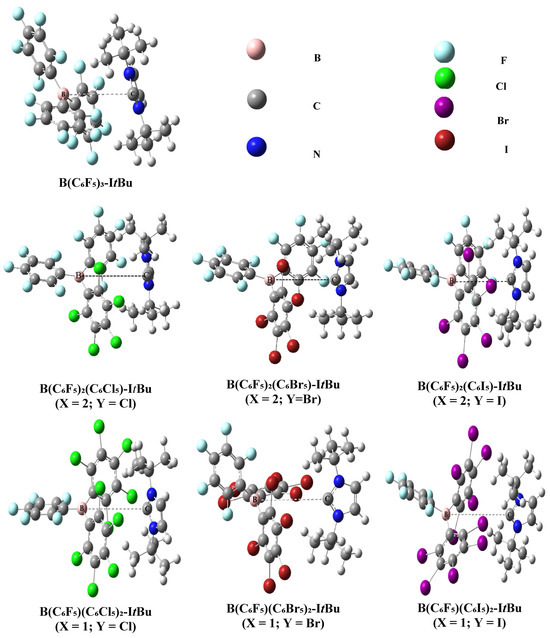
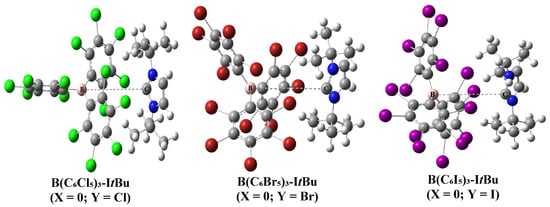
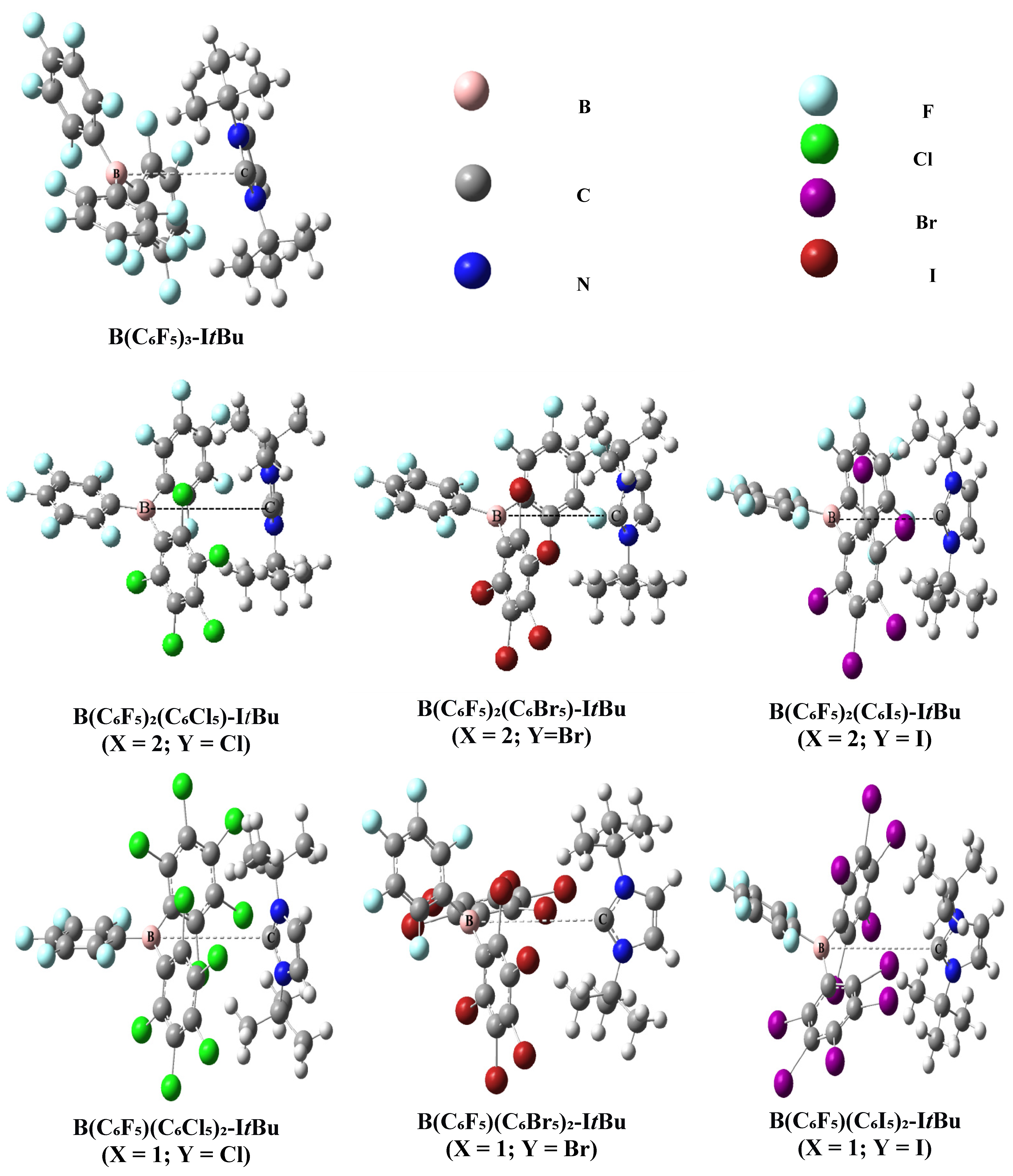
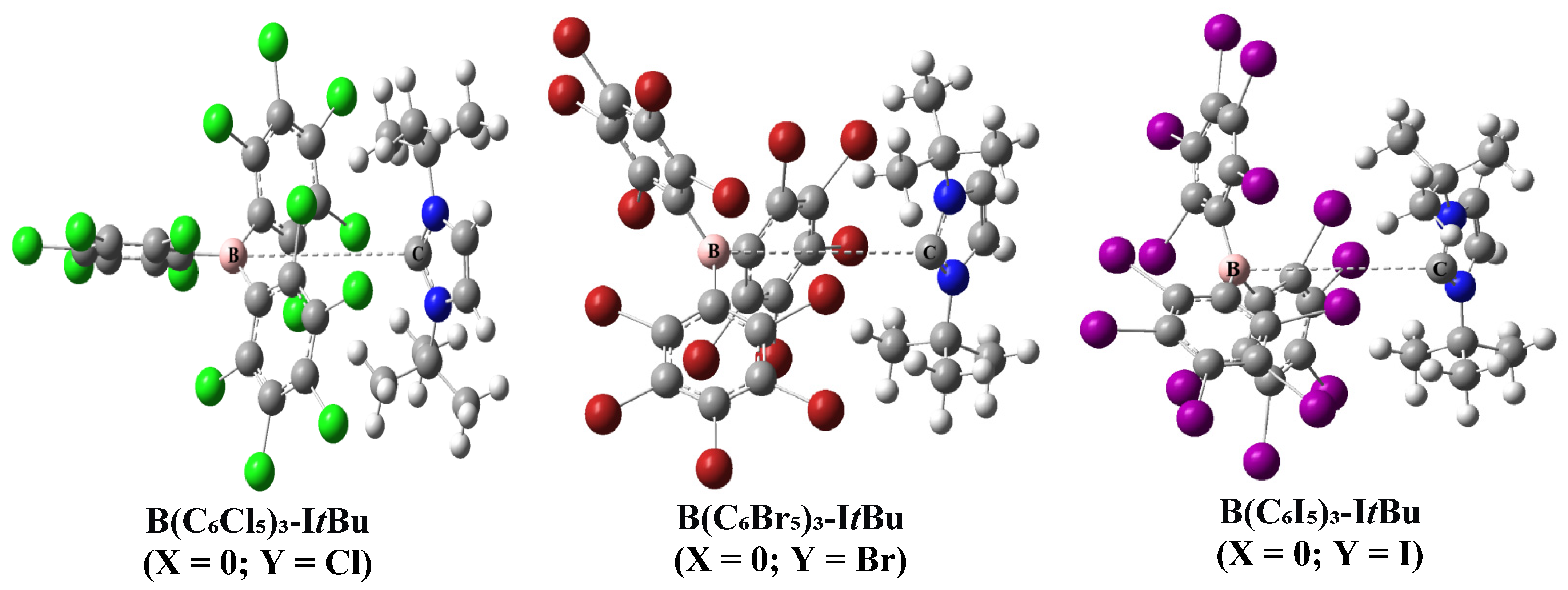
Based on the analysis of the molecular ESP of S1, the FLPs are constructed and optimized. The optimized structures of the most stable FLPs are shown in Figure 2, and the distance between B and C (RB…C) and the corresponding bond energies (ΔE) are listed in Table 1. The other isomers of FLPs and relative zero-point energy are shown in S2. For FLPs, significant steric hindrance forces the Lewis acid and base to adopt a perpendicular orientation, thereby enabling their interaction.
Figure 2.
Optimized structural of the FLPs B(C6F5)3-ItBu and B(C6F5)x(C6Y5)3−x-ItBu (x = 0, 1, 2; Y = Cl, Br, I).
Table 1.
The distance RB…C between the B and C and the bond energy ∆E of the FLPs.
As shown in Figure 2, compared with B(C6F5)3-ItBu, B(C6F5)2(C6Y5)-ItBu (Y = Cl, Br, I) exhibits larger intermolecular separations RB…C from 4.908 Å to 5.490 Å, 5.284 Å, and 5.297 Å, with the corresponding ΔE enhanced from −10.15 kcal/mol to −11.68 kcal/mol, −12.37 kcal/mol and −12.36 kcal/mol. For B(C6F5)3-ItBu and B(C6F5)ₓ(C6Y5)3−x-ItBu (x = 0, 1; Y = Cl, Br, I), the Lewis acid and Lewis base fragments are found to remain separated by relatively large distances RB…C, increasing from 4.908 Å to 5.364 Å, 5.655 Å and 5.967 Å for x = 1, as well as from 4.908 Å to 5.485 Å, 5.571 Å and 5.458 Å for x = 0. Nevertheless, the corresponding ∆E are enhanced, changing from −10.15 kcal/mol to −13.24 kcal/mol, −13.43 kcal/mol and −20.00 kcal/mol for x = 1 and from −10.15 kcal/mol to −12.88 kcal/mol, −15.49 kcal/mol and −20.08 kcal/mol for x = 0.
Therefore, the ∆E between the modified Lewis acid B(C6F5)x(C6Y5)3−x (x = 0, 1, 2) and the ItBu enhances gradually in the order of Y = Cl, Br, I. For the same halogen substitution, when x = 1 or 0, the atom types and distances in the interaction region are highly similar, so their ∆E are also very comparable and larger than that at x = 2. Moreover, all these ∆E are larger than that of the classical B(C6F5)3.
Normally, for B(C6F5)3 and B(C6F5)x(C6Y5)3−x (x = 0, 1, 2; Y = Cl, Br, I), a larger ESP value outside the B atom is expected to lead to a stronger bond energy with the ItBu. However, an opposite trend is observed in FLPs. Therefore, besides steric hindrance and electronegativity, other additional effects must be taken into account.
3.2. Energy Decomposition Analysis of the FLPs Based on Modified Lewis Acid B(c6f5)3
Only by considering ΔE and the various physical components that influence ΔE can we gain a deeper understanding of the nature of the interaction between Lewis acids and Lewis bases. In general, the ΔE of FLPs comprises two components: the deformation energy (ΔEs) and the interaction energy (ΔEint). The former is associated with the structural distortion of the Lewis acid and base upon association, while the latter represents the actual energy of interaction between the distorted monomers. The relationship can be expressed as follows:
Table S1 summarizes the zero-point energy changes in the Lewis acid and Lewis base in FLPs before and after association, which originate from structural deformation. Its formula is expressed as follows:
where, whether B(C6F5)3, B(C6F5)x(C6Y5)3−x (x = 0, 1, 2; Y = Cl, Br, I) or ItBu, ΔEbefore represents the zero-point energy before association and ΔEafter represents the zero-point energy after association. For the FLPs formed between B(C6F5)3, B(C6F5)x(C6Y5)3−x (x = 0, 1, 2; Y = Cl, Br, I) and ItBu, the energy changes associated with structural deformation are very small. Consequently, the ΔE of these FLPs are approximately equal to their corresponding ΔEint.
In this section, the ΔEint of the FLPs arising from variations in the substituents on the B atom is discussed and the main origins of these differences are analyzed using the sobEDA method [36]. The results of the sobEDA are compiled in Table 2. Comparative analysis reveals that for B(C6F5)3-ItBu, B(C6F5)x(C6Y5)3−x-ItBu(x = 0, 1, 2; Y = Cl, Br, I), ΔE and ΔEint are not only close in value but also follow identical trends. For B(C6F5)2(C6Y5)-ItBu (Y = Cl, Br, I), the ΔEint is slightly larger than that of B(C6F5)3-ItBu, from −11.09 kcal/mol to −12.04 kcal/mol, −12.58 kcal/mol and −12.57 kcal/mol. The enhancement of ΔEint arises from the concerted variation in its components: ΔEels, ΔEXrep and ΔEdc. ΔEels becomes slightly larger, changing from −6.11 kcal/mol to −7.67 kcal/mol, −8.49 kcal/mol and −7.61 kcal/mol. ΔEXrep becomes larger, changing from 22.31 kcal/mol to 26.37 kcal/mol, 27.31 kcal/mol and 27.14 kcal/mol. ΔEdc becomes significantly larger, changing from −14.28 kcal/mol to −17.64 kcal/mol, −18.91 kcal/mol and −18.45 kcal/mol. Interestingly, ΔEorb is weakened from −3.87 kcal/mol to −2.77 kcal/mol, −2.55 kcal/mol and −2.62 kcal/mol.
Table 2.
Energy decomposition analysis (sobEDA) of the FLPs based on modified Lewis acid B(C6F5)3.
For B(C6F5)(C6Y5)2-ItBu (Y = Cl, Br, I), ∆Eint (−13.04 kcal/mol, −14.05 kcal/mol and −22.18 kcal/mol) is much larger than that of B(C6F5)3-ItBu (∆Eint = −11.09 kcal/mol). This behavior is primarily attributed to the pronounced enhancement of ΔEels, from −6.11 kcal/mol to −7.69 kcal/mol, −17.97 kcal/mol and −39.10 kcal/mol. This is accompanied by an enhancement of ΔEdc, which is augmented from −14.28 kcal/mol to −19.17 kcal/mol, −16.38 kcal/mol, and −19.97 kcal/mol. ΔEint becomes much larger, accompanied by a substantial enhancement in ΔEXrep that rises from 22.31 kcal/mol to 27.41 kcal/mol, 40.25 kcal/mol and 78.51 kcal/mol. In addition, relative to B(C6F5)3-ItBu, the ΔEorb in B(C6F5)(C6Y5)2-ItBu (Y = Br, I) is significantly enhanced, from −3.87 kcal/mol to −9.66 kcal/mol and −27.30 kcal/mol. By contrast, for B(C6F5)(C6Cl5)2-ItBu and B(C6F5)3-ItBu, ΔEorb slightly weakens from −3.87 kcal/mol to −3.07 kcal/mol. For B(C6Y5)3-ItBu (Y = Cl, Br, I), the variation trend of ΔEint is consistent with that observed for B(C6F5)(C6Y5)2-ItBu (Y = Cl, Br, I). Specifically, the ΔEint of this series is much larger than that of B(C6F5)3-ItBu (−11.09 kcal/mol), reaching −12.65 kcal/mol, −16.63 kcal/mol and −22.62 kcal/mol, respectively. The ΔEorb of B(C6Cl5)3-ItBu is still slightly weaker compared with that of B(C6F5)3-ItBu, from −3.87 kcal/mol to −3.07 kcal/mol.
The sobEDA analysis reveals that, relative to B(C6F5)3-ItBu, B(C6F5)x(C6Y5)3−x-ItBu (x = 0, 1, 2; Y = Cl, Br, I) exhibits larger energy components ΔEels, ΔEXrep and ΔEdc. However, compared with B(C6F5)3-ItBu, ΔEorb is weakened in both B(C6F5)2(C6Y5)-ItBu (Y = Cl, Br, I) and B(C6F5)x(C6Cl5)3−x-ItBu (x = 0, 1). This results in ΔEint being weaker for B(C6F5)2(C6Y5)-ItBu (Y = Cl, Br, I) and B(C6F5)x(C6Cl5)3−x-ItBu (x = 0, 1) than for B(C6F5)x(C6Y5)3−x-ItBu (x = 0, 1; Y = Br, I). The results ultimately show that ΔEint is more comparable between B(C6F5)3-ItBu and B(C6F5)2(C6Y5)-ItBu (Y = Cl, Br, I). This is consistent with the experimental results reported by Ashley et al. When using B(C6F5)3 and B(C6F5)x(C6Cl5)3−x (x = 0, 1, 2) to activate H2, B(C6F5)3 and B(C6F5)2(C6Cl5) display comparable activation efficiencies, whereas B(C6F5)x(C6Cl5)3−x (x = 0, 1) exhibits a relatively lower efficiency. Therefore, B(C6F5)2(C6Y5) (Y = Cl, Br, I) is more favorable for the construction of novel FLPs. However, for B(C6F5)2(C6Y5)-ItBu (Y = Cl, Br, I) and B(C6F5)x(C6Cl5)3−x-ItBu (x = 0, 1), their ΔEorb are weakened compared with that of B(C6F5)3-ItBu. This phenomenon warrants further investigation.
3.3. Homo and Lumo Analysis of the FLPs Based on Modified B(C6F5)3
In the analysis of the previous section, the anomalous weaker ΔEorb between B(C6F5)2(C6Y5)-ItBu (Y = Cl, Br, I) and B(C6F5)x(C6Cl5)3−x-ItBu (x = 0, 1), compared with B(C6F5)3-ItBu, requires further confirmation. The interaction strength of the FLPs is governed by the interaction between the vacant lowest unoccupied molecular orbital (LUMO) located on the B atom of B(C6F5)3 and B(C6F5)x(C6Y5)3−x (x = 0, 1, 2; Y = Cl, Br, I) and the highest occupied molecular orbital (HOMO) associated with the lone pair on the C atom of ItBu. In general, bulky substituendum hinder the Lewis acid and Lewis base from adopting an optimal spatial arrangement, thereby significantly reducing the effective overlap between the LUMO and HOMO. As a result, charge transfer is restricted and orbital interaction cannot be fully developed. Consequently, a larger electron population associated with the B-centered LUMO and the C-centered HOMO corresponds to a smaller degree of charge transfer during the interaction process of the FLPs [37,38,39,40,41].
From a more intuitive perspective, S3 depicts the LUMO of B(C6F5)3 and B(C6F5)x(C6Y5)3−x (x = 0, 1, 2; Y = Cl, Br, I), together with the HOMO corresponding to the ItBu. Such orbital mixing is absent in most halogen substituted FLPs, including B(C6F5)3-ItBu, B(C6F5)2(C6Y5)-ItBu (Y = Cl, Br, I) and B(C6F5)x(C6Cl5)3−x-ItBu (x = 0, 1), where these orbitals remain relatively independent. It is worth noting that, for B(C6F5)x(C6Y5)3−x-ItBu (x = 0, 1; Y = Br, I), a portion of the electrons in the HOMO is transferred onto the substituents of the corresponding Lewis acid. This indicates that the orbital interaction between the fragments of the B(C6F5)x(C6Y5)3−x-ItBu (x = 0, 1; Y = Br, I) is enhanced. This phenomenon is highly similar to the trend in the value of ΔEorb.
To further investigate the relationship between electron transfer and orbital interaction in these FLPs, we employ the Multiwfn program to calculate the electron population of the LUMO localized on the B atom and the HOMO localized on the C atom, as well as the overlap integral of norm between the LUMO and HOMO. These results are summarized in Table 3. In a comparison of B(C6F5)3-ItBu and B(C6F5)2(C6Y5)-ItBu (Y = Cl, Br, I), the electron population associated with the B atom in the LUMO changes from 41.16% to 42.94, 41.68% and 38.11%, respectively. The electron population localized on the C atom in the HOMO changes from 86.53% to 87.88%, 87.12% and 87.56%. Concurrently, the overlap integral of norm varies from 0.042 to 0.023, 0.084 and 0.050. It is evident that all these values are distributed within a narrow range around those of the B(C6F5)3-ItBu. This suggests that comparable orbital interaction strengths are present between B(C6F5)3-ItBu and B(C6F5)2(C6Y5)-ItBu (Y = Cl, Br, I).
Table 3.
Analysis of the LUMO and HOMO of central atoms in the FLPs based on modified B(C6F5)3.
When comparing B(C6F5)3-ItBu with B(C6F5)(C6Y5)2-ItBu (Y = Cl, Br, I), the electron population associated with the B atom in the LUMO changes from 44.16% to 44.61%, 42.78% and 27.05%. The electron population associated with the C atom in the HOMO varies from 86.53% to 86.60%, 81.58% and 46.40%, and the overlap integral of norm changes from 0.042 to 0.042, 0.111 and 0.415. The orbital analysis reveals very similar values for B(C6F5)(C6Cl5)2-ItBu and B(C6F5)3-ItBu, consistent with comparable orbital interactions in the two systems. In contrast, for B(C6F5)(C6Y5)2-ItBu (Y = Br, I), pronounced decreases are observed in the electron populations on both the HOMO and the LUMO, accompanied by a marked increase in the overlap integral of norm. These features indicate the presence of larger orbital interactions in these systems. When comparing B(C6F5)3-ItBu with B(C6Y5)3-ItBu (Y = Cl, Br, I), for the B atom in the LUMO, the electron population changes from 44.16% to 44.61%, 41.37%, 30.26%, and for the C atom in the HOMO, it changes from 86.53% to 86.74%, 80.37%, 40.45%. The overlap integral of norm changes from 0.042 to 0.041, 0.112 and 0.403. These results show that, relative to B(C6F5)3-ItBu, B(C6Cl5)3-ItBu exhibits a comparable orbital interaction strength, whereas B(C6Y5)3-ItBu (Y = Br, I) displays the larger orbital interaction.
Subsequently, the FLPs with comparable performance based on the orbital analysis are further investigated. Compared with B(C6F5)x(C6Y5)3−x-ItBu (x = 0, 1; Y = Br, I), the electron density on the B atom in the LUMO, the electron density on the C atom in the HOMO, and the orbital overlap integral of norm between LUMO and HOMO for B(C6F5)2(C6Y5)-ItBu (Y = Cl, Br, I) and B(C6F5)x(C6Cl5)3−x-ItBu (x = 0, 1) are all weaker. These factors collectively lead to a weaker ΔEorb. Moreover, these values are very comparable to the ΔEorb of B(C6F5)3-ItBu. However, the other influencing factors ΔEels, ΔEXrep and ∆Edc of B(C6F5)x(C6Cl5)3−x-ItBu (x = 0, 1) are larger than that of B(C6F5)2(C6Y5)-ItBu (Y = Cl, Br, I). This ultimately leads to the ∆Eint of B(C6F5)2(C6Y5)-ItBu (Y = Cl, Br, I) being comparable to that of B(C6F5)3-ItBu. As a result, modified B(C6F5)2(C6Y5) (Y = Cl, Br, I) is more conducive to the development of the novel FLPs.
3.4. The MFDD Analysis of the FLPs Based on Modified B(C6F5)3
Theoretical calculations reveal that the trend in the strength of ∆Eint is contrary to the predictions based on ESP analysis. Moreover, comparative studies on the H2 activation performance of B(C6F5)2(C6Cl5) and B(C6F5)x(C6Cl5)3−x (x = 0, 1) reveal that, beyond steric hindrance effects, other types of interactions also exert a significant influence on the ∆Eint between FLPs. To delineate the influence of non-steric contributions, MFDD analysis is employed across the series of the FLPs. The concept of MFDD analysis has been introduced by Daudel and Roux in the 1950s [42,43]. The corresponding expression is defined as follows:
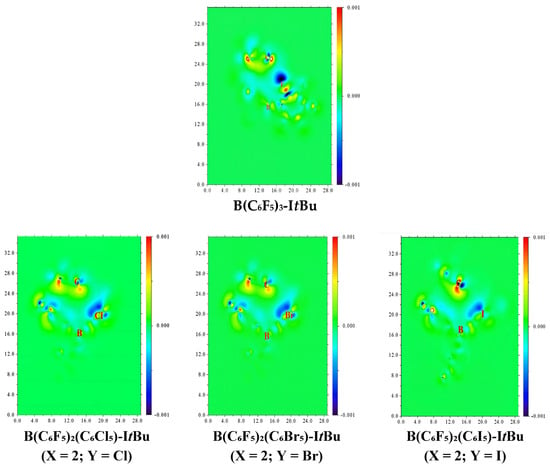
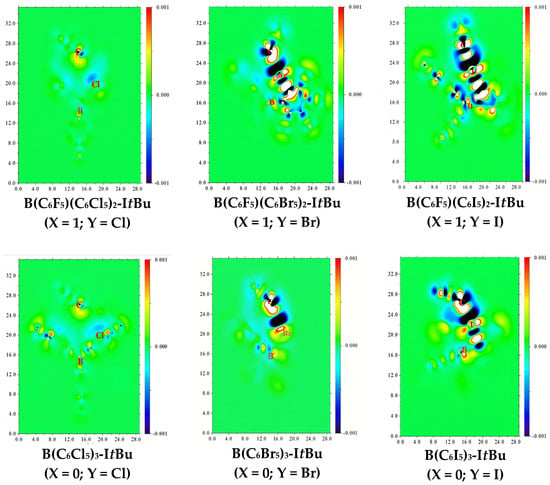
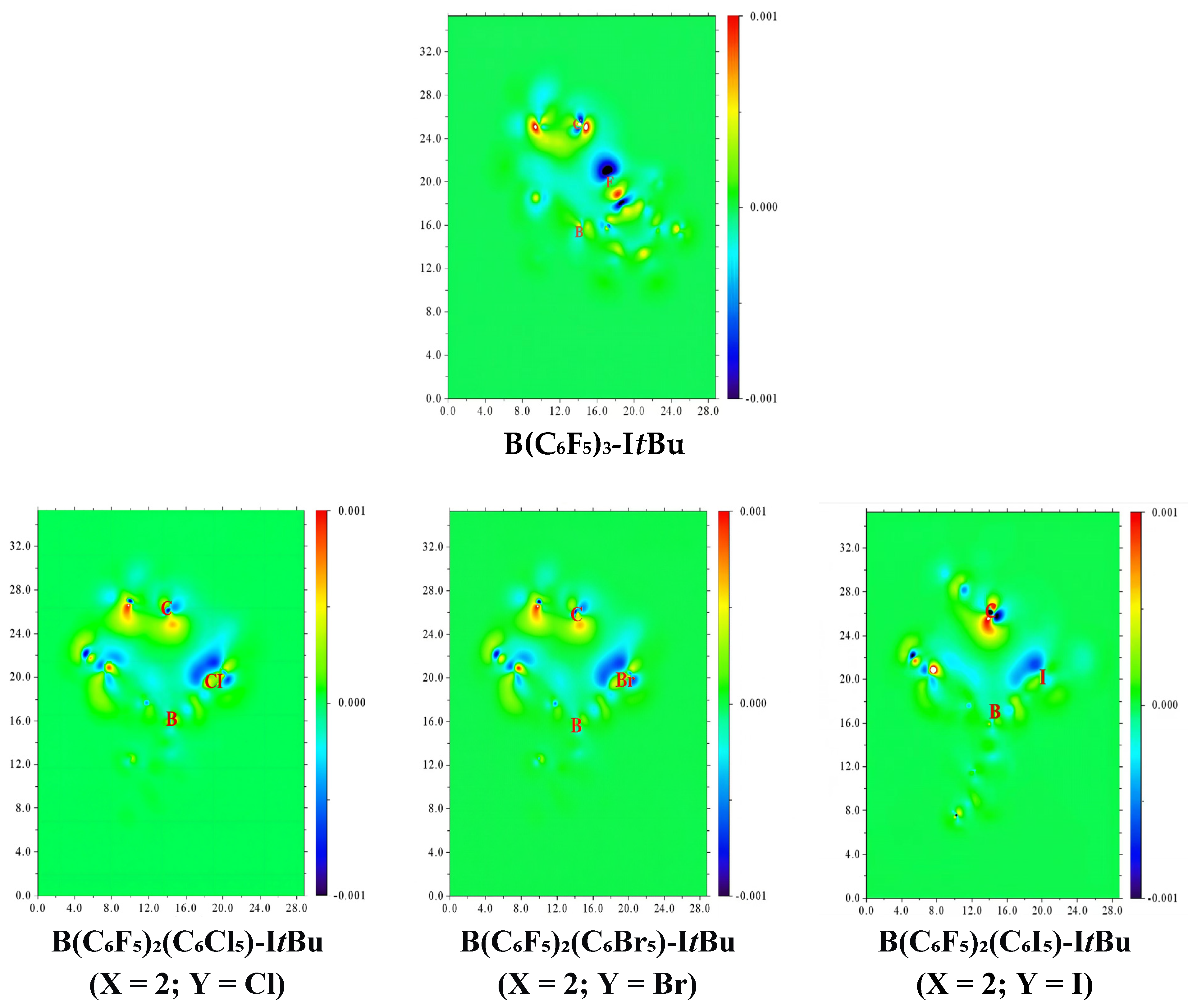
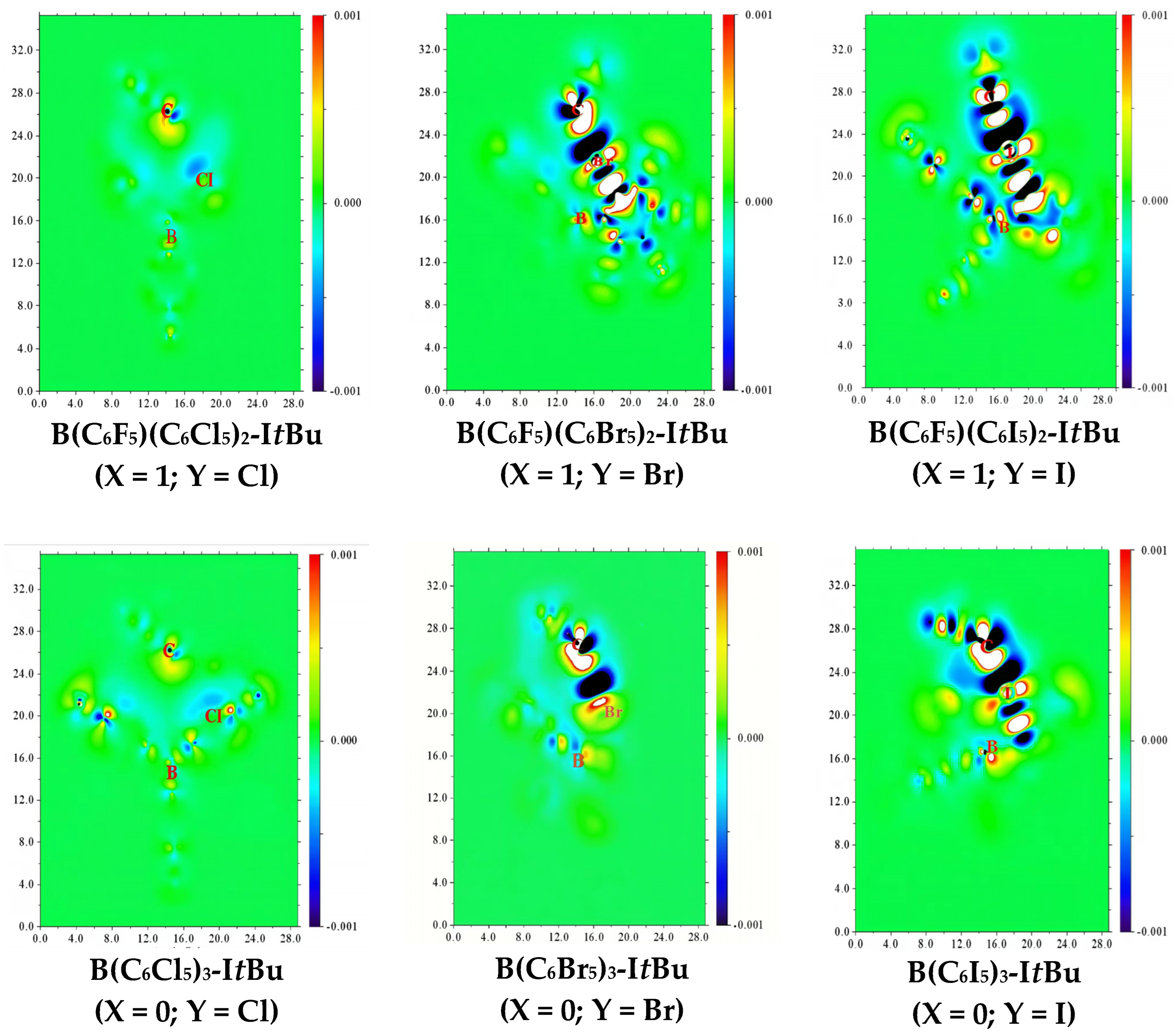
Here, represents the electron density of the FLPs, denotes the electron density of the Lewis acid and corresponds to the electron density of the Lewis base. Accordingly, is defined as the electron density difference between the frustrated Lewis pair complex and the isolated monomeric species. In this work, to observe the maps of electron density difference clearly, we place the central atoms B and C of the FLPs and the outermost halogen ligand atom of the Lewis acid in the same position. Consequently, the MFDD map on the plane defined by these three atoms is generated as shown in Figure 3. The electron density accumulation and depletion are indicated by distinct color variations. As indicated by the color scale, the electron density is continuously redistributed from depletion regions (blue) to accumulation regions (red), thus providing a direct visualization of both the direction and magnitude of electron migration between the FLPs.
Figure 3.
The MFDD analysis of the FLPs B(C6F5)3-ItBu and B(C6F5)x(C6Y5)3−x-ItBu (x = 0, 1, 2; Y = Cl, Br, I).
To our surprise, significant electron density changes exist between the outermost halogen ligand atoms of the Lewis acid and the C atom of the Lewis base, as shown in Figure 3. For B(C6F5)3-ItBu and B(C6F5)2(C6Y5)-ItBu (Y = Cl, Br, I), the decreases in electron density are observed around the outermost halogen atom F, Cl, Br, I accompanied by a corresponding increase in electron density on the C atom. There is almost no change in the electron density on the B atom of the Lewis acid. Based on the intensity of electron transfer, the ligand effect of B(C6F5)3-ItBu and B(C6F5)2(C6Cl5)-ItBu is more significant than that of B(C6F5)2(C6Y5)-ItBu (Y = Br, I), but the difference is not substantial. This phenomenon indicates that the interaction between the B atom and the C atom is weak, while the ligand effect between the outermost halogen atom of the Lewis acid and the C atom is significant and cannot be ignored.
For B(C6F5)3-ItBu and B(C6F5)x(C6Y5)3−x-ItBu (x = 0, 1; Y = Cl, Br, I), when Y = Br, I, the pronounced electron density depletion is observed on the outermost halogens atoms Br and I, accompanied by a significant electron density accumulation around the corresponding C atom. This implies that, compared with B(C6F5)3-ItBu, the ligand effect between the Lewis acid and base fragments becomes significantly enhanced. However, when Y = Cl, the relatively weak electron transfer is observed between the outermost halogen atom Cl and the corresponding C atom. Nevertheless, it remains larger than the electron migration between B and C.
Specifically, the ligand effect between the outermost halogen atom of B(C6F5)3, B(C6F5)x(C6Y5)3−x (x = 0, 1, 2; Y = Cl, Br, I) and the C atom of ItBu is considerably larger than the interaction between the central B atom and C atom. As shown in Figure 3, the ligand effects of B(C6F5)3-ItBu, B(C6F5)2(C6Y5)-ItBu (Y = Cl, Br, I) and B(C6F5)x(C6Cl5)3-x-ItBu (x = 0, 1) are weaker than that of B(C6F5)x(C6Y5)3−x-ItBu (x = 0, 1; Y = Br, I). According to the sobEDA results, which better reflect the nature of the interaction, the various physical quantities ΔEels, ΔEXrep, ΔEorb and ∆Edc influencing B(C6F5)x(C6Cl5)3−x-ItBu (x = 0, 1) are all larger compared with those of B(C6F5)2(C6Y5)-ItBu (Y = Cl, Br, I). Ultimately, the ∆Eint of B(C6F5)2(C6Y5)-ItBu (Y = Cl, Br, I) is comparable to that of B(C6F5)3-ItBu. Therefore, modified B(C6F5)2(C6Y5) (Y = Cl, Br, I) is the most favorable for the construction of novel FLPs.
4. Conclusions
In this study, a theoretical computational approach is employed to systematically examine substituent effects in the prototypical B(C6F5)3, achieved through stepwise replacement of the aryl groups with -C6Cl5, -C6Br5 and -C6I5. After association with the ItBu, the resulting FLPs are systematically analyzed to evaluate changes in their ∆Eint. Further sobEDA analysis, orbital analysis, and MFDD analysis reveal the nature of the substituent effect on the ∆Eint of the FLPs. The results indicate that, for B(C6F5)3-ItBu, B(C6F5)x(C6Y5)3−x-ItBu (x = 0, 1, 2; Y = Cl, Br, I), the key role is played not by the direct interaction between the central atoms B and C but by the ligand effect between the outmost halogen atom of B(C6F5)3 and B(C6F5)x(C6Y5)3−x (x = 0, 1, 2; Y = Cl, Br, I) and the C atom of ItBu. This leads to a gradual enhancement in the ∆Eint between the modified B(C6F5)x(C6Y5)3−x (x = 0, 1, 2) and ItBu in the order Y = Cl, Br, I. For the same halogen substitution, FLPs with x = 1 or 0 exhibit highly similar atomic types and distances in the interaction region, resulting in comparable ∆Eint that are both larger than that of the FLPs with x = 2. Consequently, B(C6F5)2(C6Y5)-ItBu (Y = Cl, Br, I) exhibits a ∆Eint comparable to that of B(C6F5)3-ItBu, rendering modified B(C6F5)2(C6Y5) (Y = Cl, Br, I) more suitable for the development of novel FLPs.
Supplementary Materials
The following supporting information can be downloaded at: https://www.mdpi.com/article/10.3390/cryst16040236/s1, Figure S1: The positive region of ESP (Kcal/mol) outside the B atom of the optimized Lewis acid monomer and the negative region (kcal/mol) of ESP outside the C atom of the optimized Lewis base monomer; Figure S2: The optimized geometries of the FLPs, the relative energies relative to the global minimum structure (kcal/mol) are shown; Figure S3: Schematic representations of the LUMO and HOMO localized on the B and C in the FLPs. Table S1: The absolute change in the zero-point energies of the FLPs monomers before and after association(kcal/mol); Table S2: Structural coordinates of the FLPs.
Author Contributions
Conceptualization, Q.W. and W.L.; Methodology, Q.W. and W.L.; Software, Q.W. and W.L.; Validation, Q.W., Z.L., Y.C., J.Z., H.L. and W.L.; Formal analysis, Q.W., Z.L., Y.C., J.Z., H.L. and W.L.; Investigation, Q.W. and W.L.; Resources, Q.W. and W.L.; Data curation, W.L.; Writing—original draft, Q.W., Z.L., Y.C., J.Z., H.L. and W.L.; Writing—review & editing, Q.W., Z.L., Y.C., J.Z., H.L. and W.L.; Visualization, Q.W. and W.L. All authors have read and agreed to the published version of the manuscript.
Funding
The work was supported by the Beijing Natural Science Foundation (No. 2214064), the Research Project of the National Institute of Metrology (AKYZZ2325), the SAMR Scientific and Technological Programs (S2024MK0553), the National Natural Science Foundation of China (Nos. 92161l15), and the Fundamental Research Funds for the Central Universities (No. 2024MS072) supported by the fund of North China Electric Power University.
Data Availability Statement
The original contributions presented in this study are included in the article/Supplementary Material. Further inquiries can be directed to the corresponding author.
Conflicts of Interest
The authors declare no conflicts of interest.
References
- Welch, G.C.; Juan, R.R.S.; Masuda, J.D.; Stephan, D.W. Reversible, metal-free hydrogen activation. Science 2006, 314, 1124. [Google Scholar] [CrossRef] [Scilit]
- Stephan, D.W.; Erker, G. Frustrated Lewis pair chemistry: Development and perspectives. Angew. Chem. Int. Ed. 2015, 54, 6400–6441. [Google Scholar] [CrossRef] [Scilit]
- Ju, M.; Lu, Z.; Novaes, L.F.T.; Martinez Alvarado, J.I.; Lin, S. Frustrated radical pairs in organic synthesis. J. Am. Chem. Soc. 2023, 145, 19478–19489. [Google Scholar] [CrossRef] [Scilit] [PubMed]
- Lin, W.; Chen, H.; Lin, G.; Yao, S.; Zhang, Z.; Qi, J.; Jing, M.; Song, W.; Li, J.; Liu, X.; et al. Creating frustrated Lewis pairs in defective boron carbon nitride for electrocatalytic nitrogen reduction to ammonia. Angew. Chem. 2022, 134, e202207807. [Google Scholar] [CrossRef] [Scilit]
- Khan, M.N.; van Ingen, Y.; Boruah, T.; McLauchlan, A.; Wirth, T.; Melen, R.L. Advances in CO2 activation by frustrated Lewis pairs: From stoichiometric to catalytic reactions. Chem. Sci. 2023, 14, 13661–13695. [Google Scholar] [CrossRef] [Scilit] [PubMed]
- Gastearena, X.; Matxain, J.M.; Ruipérez, F. Exploring N2 activation using novel Lewis acid/base pairs: Computational insight into frustrated Lewis pair reactivity. Dalton Trans. 2025, 54, 4338–4352. [Google Scholar] [CrossRef] [Scilit]
- Scott, D.J.; Fuchter, M.J.; Ashley, A.E. Designing effective ‘frustrated Lewis pair’ hydrogenation catalysts. Chem. Soc. Rev. 2017, 46, 5689–5700. [Google Scholar] [CrossRef] [Scilit]
- Lam, J.; Szkop, K.M.; Mosaferi, E.; Stephan, D.W. FLP catalysis: Main group hydrogenations of organic unsaturated substrates. Chem. Soc. Rev. 2019, 48, 3592–3612. [Google Scholar] [CrossRef] [Scilit]
- Jupp, A.R.; Stephan, D.W. New directions for frustrated Lewis pair chemistry. Trends Chem. 2019, 1, 35–48. [Google Scholar] [CrossRef] [Scilit]
- Harhausen, M.; Fröhlich, R.; Kehr, G.; Erker, G. Reactions of modified intermolecular frustrated P/B Lewis pairs with dihydrogen, ethene, and carbon dioxide. Organometallics 2012, 31, 2801–2809. [Google Scholar] [CrossRef] [Scilit]
- Liu, H.J.; Ziegler, M.S.; Tilley, T.D. Synthesis, structures, and reactivity studies of cyclometalated N-heterocyclic carbene complexes of ruthenium. Dalton Trans. 2018, 47, 12138–12146. [Google Scholar] [CrossRef] [Scilit]
- Cui, P.; Comanescu, C.C.; Iluc, V.M. Frustrated Lewis pair-like reactions of nucleophilic palladium carbenes with B (C6F5)3. Chem. Commun. 2015, 51, 6206–6209. [Google Scholar]
- Scott, D.J.; Fuchter, M.J.; Ashley, A.E. Metal-Free Hydrogenation Catalyzed by an Air-Stable Borane: Use of Solvent as a Frustrated Lewis Base. Angew. Chem. Int. Ed. 2014, 53, 10218–10222. [Google Scholar] [CrossRef] [Scilit]
- Hu, J. Chiral generation in achiral lower diamondoid triamantane through prochiral halogen substitution. J. Mol. Model. 2025, 31, 1–8. [Google Scholar] [CrossRef] [Scilit]
- Wang, C.; Wang, Z.; Yang, K.; Zhang, G.; Li, N. From nonpolar to polar: The reconstruction mechanism of electronic structure in alkane C-C bonds induced by fluorine substitution. J. Mol. Model. 2025, 31, 304. [Google Scholar] [CrossRef] [Scilit]
- Chase, P.A.; Stephan, D.W. Hydrogen and Amine Activation by a Frustrated Lewis Pair of a Bulky N-Heterocyclic Carbene and B(C6F5)3. Angew. Chem. 2008, 120, 7543–7547. [Google Scholar] [CrossRef] [Scilit]
- Frisch, M.J.; Trucks, G.W.; Schlegel, H.B.; Scuseria, G.E.; Robb, M.A.; Cheeseman, J.R.; Scalmani, G.; Barone, V.; Mennucci, B.; Petersson, G.A.; et al. Gaussian 09, Revision E.01; Gaussian Inc.: Wallingford, CT, USA, 2009. [Google Scholar]
- Walker, M.; Harvey, A.J.A.; Sen, A.; Dessent, C.E. Performance of M06, M06-2X, and M06-HF density functionals for conformationally flexible anionic clusters: M06 functionals perform better than B3LYP for a model system with dispersion and ionic hydrogen-bonding interactions. J. Phys. Chem. A 2013, 117, 12590–12600. [Google Scholar] [CrossRef] [Scilit] [PubMed]
- Lu, T.; Chen, Q. Simple, efficient, and universal energy decomposition analysis method based on dispersion-corrected density functional theory. J. Phys. Chem. A 2023, 127, 7023–7035. [Google Scholar] [CrossRef] [Scilit] [PubMed]
- Gao, W.; Feng, H.; Xuan, X.; Chen, L. The assessment and application of an approach to noncovalent interactions: The energy decomposition analysis (EDA) in combination with DFT of revised dispersion correction (DFT-D3) with Slater-type orbital (STO) basis set. J. Mol. Model. 2012, 18, 4577–4589. [Google Scholar] [CrossRef] [Scilit]
- Zhao, L.; von Hopffgarten, M.; Andrada, D.M.; Frenking, G. Energy decomposition analysis. Wiley Interdiscip. Rev. Comput. Mol. Sci. 2018, 8, e1345. [Google Scholar] [CrossRef] [Scilit]
- Lu, T.; Chen, F. Multiwfn: A multifunctional wavefunction analyzer. J. Comput. Chem. 2012, 33, 580–592. [Google Scholar] [CrossRef] [Scilit]
- Lu, T. A comprehensive electron wavefunction analysis toolbox for chemists. Multiwfn. J. Chem. Phys. 2024, 161, 082503. [Google Scholar] [CrossRef] [Scilit]
- Zhang, J.; Lu, T. Efficient evaluation of electrostatic potential with computerized optimized code. Phys. Chem. Chem. Phys. 2021, 23, 20323–20328. [Google Scholar] [CrossRef] [Scilit]
- Lu, T.; Chen, F. Quantitative analysis of molecular surface based on improved Marching Tetrahedra algorithm. J. Mol. Graph. Model. 2012, 38, 314–323. [Google Scholar] [CrossRef] [Scilit]
- Lu, T.; Chen, F. Calculation of molecular orbital composition. Acta Chim. Sin. 2011, 69, 2393–2406. [Google Scholar]
- Lu, T.; Chen, Q. Visualization analysis of weak interactions in chemical systems. Compr. Comput. Chem. 2024, 2, 240–264. [Google Scholar]
- Lu, T.; Chen, Q. Interaction region indicator: A simple real space function clearly revealing both chemical bonds and weak interactions. Chem.-Methods 2021, 1, 231–239. [Google Scholar] [CrossRef] [Scilit]
- Jiang, J.H.; Zhao, S.; Sun, Y.; Wang, X.D. From Binary to Higher-Order Organic Cocrystals: Design Principles and Performance Optimization. Angew. Chem. 2025, 137, e202507102. [Google Scholar] [CrossRef] [Scilit]
- Glendening, E.D. Natural energy decomposition analysis: Explicit evaluation of electrostatic and polarization effects with application to aqueous clusters of alkali metal cations and neutrals. J. Am. Chem. Soc. 1996, 118, 2473–2482. [Google Scholar] [CrossRef] [Scilit]
- Mayer, I. Improved chemical energy component analysis. Phys. Chem. Chem. Phys. 2012, 14, 337–344. [Google Scholar] [CrossRef] [Scilit]
- Lu, T. Visualization analysis of covalent and noncovalent interactions in real space. Angew. Chem. Int. Ed. 2025, 64, e202504895. [Google Scholar] [CrossRef] [Scilit]
- Chari, V.R.; Behera, R.N. Reduction of hydrogen peroxide by amine-based diselenides: Understanding the effect of substitutions on reactivity. J. Mol. Model. 2025, 31, 87. [Google Scholar] [CrossRef] [Scilit]
- Ma, F.; Miao, T.; Zhou, Z.; Sun, D. Design of Lewis acid-base complex: Enhancing the stability and first hyperpolarizability of large excess electron compound. J. Mol. Model. 2013, 19, 4805–4813. [Google Scholar] [CrossRef] [Scilit]
- Silva, D.R.; de Azevedo Santos, L.; Koning, M.A.J.G.; Guerra, C.F.; Hamlin, T.A. The spectrum from van der Waals to donor–acceptor bonding. Phys. Chem. Chem. Phys. 2025, 27, 12569–12576. [Google Scholar] [CrossRef] [Scilit] [PubMed]
- Zhao, L.; Hermann, M.; Schwarz, W.H.E.; Frenking, G. The Lewis electron-pair bonding model: Modern energy decomposition analysis. Nat. Rev. Chem. 2019, 3, 48–63. [Google Scholar] [CrossRef] [Scilit]
- Das, R.; Vigneresse, J.L.; Chattaraj, P.K. Redox and Lewis acid-base activities through an electronegativity-hardness landscape diagram. J. Mol. Model. 2013, 19, 4857–4864. [Google Scholar] [CrossRef] [Scilit]
- Maqbool, M.; Ayub, K. Controlled tuning of HOMO and LUMO levels in supramolecular nano-Saturn complexes. RSC Adv. 2024, 14, 39395–39407. [Google Scholar] [CrossRef] [Scilit]
- Miar, M.; Shiroudi, A.; Pourshamsian, K.; Oliaey, A.R.; Hatamjafari, F. Theoretical investigations on the HOMO-LUMO gap and global reactivity descriptor studies, natural bond orbital, and nucleus-independent chemical shifts analyses of 3-phenylbenzo [d] thiazole-2(3 H)-imine and its para-substituted derivatives: Solvent and substituent effects. J. Chem. Res. 2021, 45, 147–158. [Google Scholar]
- Mitoraj, M.; Michalak, A. Natural orbitals for chemical valence as descriptors of chemical bonding in transition metal complexes. J. Mol. Model. 2007, 13, 347–355. [Google Scholar] [CrossRef] [Scilit] [PubMed]
- Kukułka, M.; Żurowska, O.; Mitoraj, M.; Michalak, A. ETS-NOCV description of chemical bonding: From covalent bonds to non-covalent interactions. J. Mol. Model. 2025, 31, 6. [Google Scholar] [CrossRef] [Scilit] [PubMed]
- Li, W.; Zeng, Y.; Li, X.; Sun, Z.; Meng, L. The competition of Y…O and X…N halogen bonds to enhance the group V σ-hole interaction in the NCY…O=PH3…NCX and O=PH3…NCX…NCY (X, Y, F, Cl, and Br) complexes. J. Comput. Chem. 2015, 36, 1349–1358. [Google Scholar] [CrossRef] [Scilit] [PubMed]
- Li, W.; Zeng, Y.; Li, X.; Sun, Z.; Meng, L. Insight into the pseudo π-hole interactions in the M3 H6…(NCF)n (M=C, Si, Ge, Sn, Pb; n = 1, 2, 3) complexes. Phys. Chem. Chem. Phys. 2016, 18, 24672–24680. [Google Scholar] [CrossRef] [Scilit]

Disclaimer/Publisher’s Note: The statements, opinions and data contained in all publications are solely those of the individual author(s) and contributor(s) and not of MDPI and/or the editor(s). MDPI and/or the editor(s) disclaim responsibility for any injury to people or property resulting from any ideas, methods, instructions or products referred to in the content. |
© 2026 by the authors. Licensee MDPI, Basel, Switzerland. This article is an open access article distributed under the terms and conditions of the Creative Commons Attribution (CC BY) license.