


Abstract
This study employs effective field theory to investigate the magnetic properties of the Carbon-60 fullerene cage (C60). The analysis shows that the magnetic behavior of the C60 molecule mirrors that of its sixty constituent carbon atoms, a phenomenon attributed to the molecule’s unique cage geometry and defined herein as the “identic magnetic effect” (IME). Furthermore, thermodynamic quantities, including magnetic susceptibility, specific heat, and internal energy, exhibit dual peaks at the coercive field points when the temperature is below the critical threshold (T < Tc). As the temperature exceeds this threshold (T > Tc), these peaks coalesce into a single maximum. These findings show good quantitative agreement with experimental phase transition characteristics, reflecting the magnetic behavior induced by the C60 cage geometry. IME behavior can open the door to modeling and produce a new class of IME sensors (IMESs).
1. Introduction
The C60 fullerene cage is a spherical carbon nanomaterial first identified by Kroto et al. [1], a discovery that catalyzed extensive experimental and theoretical research into carbon-based nanomaterials [2]. Following its identification, the unique molecular structure of C60 prompted numerous investigations of fullerenes and their derivatives. Extensive research has focused on the magnetic properties of various C60 configurations and composites, including rhombohedral C60 polymers [3,4], nickel-coated C60 nanorods [5], and polymer-inorganic intercalation nanocomposites such as C60-PEO within layered MnPS3 [6]. Further investigations have explored intercalated systems such as KxC60 and RbxC60 [7], single-bonded fullerene dimers [8], and nanomagnetic thin films incorporating Fe, Co, and CoFe [9]. Additionally, studies have examined ferrite formation in C60 and C35 steels [10], as well as various doped composites including C60:Er [11], alkali-doped OO-PPV/C60 [12], FeC14 ions in C60/C70 [13], Na-doped C60 derived from (NaN3) [14], and the fullerene C60 [15,16]. Despite the breadth of this empirical research, existing theoretical analyses of C60 magnetic properties have predominantly relied on Density Functional Theory (DFT). Examples include studies of the magnetic properties of spherical 2(N + 1)2 aromatic fullerenes [17,18,19], co-crystallized fullerenes and mixed dysprosium double-decker single-molecule magnets [20], stacked bilayers of Pd/C60, and compressed crystals of polymeric C60 [21,22,23].
Alternatively, the effective field theory (EFT) developed by Kaneyoshi [24,25,26,27] provides a powerful framework for investigating magnetic materials and nanosystems. For instance, EFT has been used to examine the magnetic properties of cubic nanowires [28,29], core/shell nanoparticles [30,31], nanographene layers [32,33,34], carbon nanodiamonds [35], and copper-oxide superconductors [36]. Despite its widespread application in magnetic and nanoscale research, few studies have used EFT to model and investigate fullerene systems, with existing research limited to two-dimensional islands of C60 molecules [37] and endohedral fullerene (EF) systems [38,39,40].
The present study aimed to examine the magnetic properties of the C60 fullerene cage, comprising spin-1/2 Ising nanoparticles, within the EFT framework. Specifically, the study examines magnetization, magnetic susceptibility, specific heat, internal energy, and hysteresis loop behavior. The present paper is organized as follows: Section 2 details the model and the theoretical methodology employed. Section 3 presents and discusses the theoretical results, and Section 4 provides concluding remarks.
2. Materials and Methods
Model and Theoretical Method
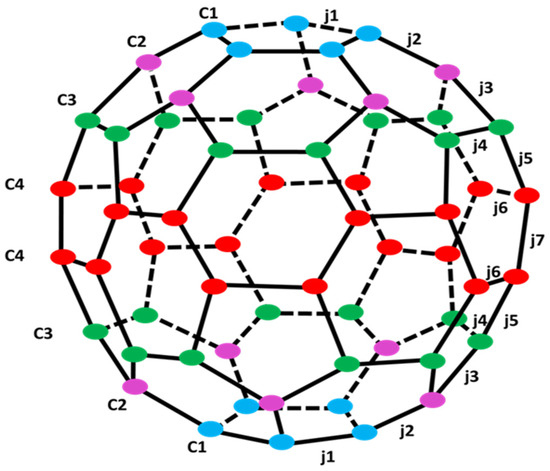
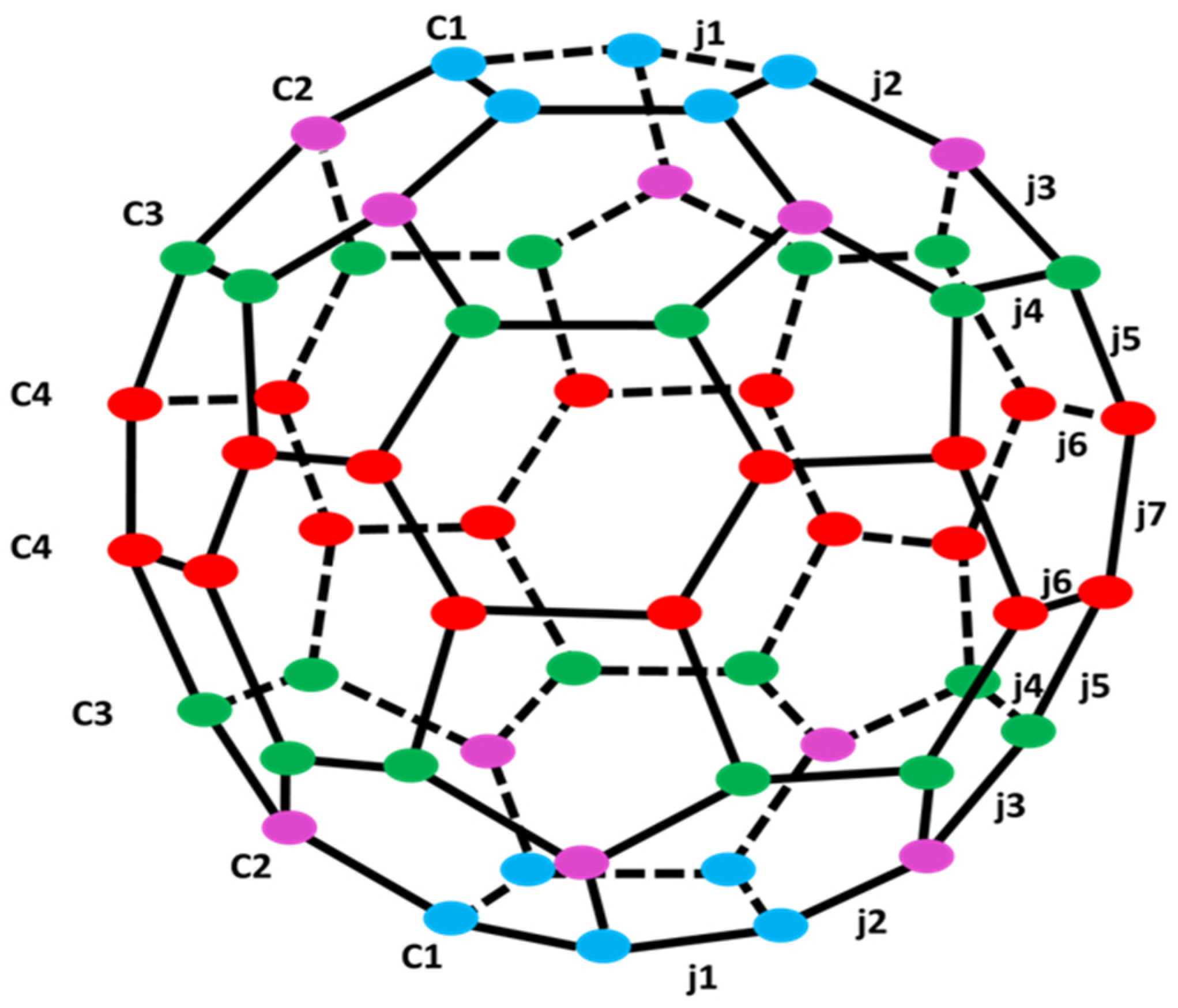
The C60 fullerene cage and its constituent components (C1, C2, C3, and C4) are illustrated in Figure 1. The selection of these four constituent components is intended to facilitate the systematic investigation of various modifications to the C60 system in future work, including the effects of ferromagnetic and antiferromagnetic interactions, doping, and the removal of specific atoms. In the present study, we have focused exclusively on the ferromagnetic properties to obtain the Identical Magnetic Effect (IME) for this specific case. This multi-component framework provides a robust basis for future studies aiming to understand how external structural and chemical influences alter the magnetic and thermodynamic landscape of fullerene-like structures.
Figure 1.
Schematic representation of the C60 fullerene cage and its components.
In this model, a pseudospin value of S = 1/2 is assigned to each carbon atom within the C60 cage lattice. While Abou Ghantous et al. [37] utilized a pseudospin value of S = 5/2, the present study adopts S = 1/2 to facilitate numerical computation. The Hamiltonian of the C60 cage is given by
where the C60 cage has seven exchange interactions between two nearest-neighbor (NN) carbon atoms, namely J1 for C1–C1, J2 for C1–C2, J3 for C2–C3, J4 for C3–C3, J5 for C3–C4, J6, and J7 for C4–C4. J6 belongs to the d1 lattice constant, and J7 to the d2 lattice constant, magnetic carbon atom groups. In this model, Sz = ±1 is the Pauli spin operator, and h is the external magnetic field. J is defined as J = k/d [34,35,41,42,43,44,45]. k is a constant that defines the type of magnetism (if k = 1 > 0, the C60 is ferromagnetic, and if k = −1 < 0, the C60 is antiferromagnetic). d is the distance between two nearest-neighbor atoms, d1(6/5) is the distance between hexagons and pentagons lattice and d2(6/6) is the distance between two hexagons lattice of the C60 (d1(6/5) = 1.455 Å, and d2(6/6) = 1.391 Å) [46,47]. By using k (1 eV.Å), d1(6/6) and d2(6/5), we obtained the values of the exchange interactions as J1 = J3 = J5 = J6 = k/d1 = 0.6872 eV, J2 = J4 = J7 = k/d2 = 0.7189 eV. (Reduced exchange interactions J1 = J3 = J5 = J6 = k/d1 = 0.6872, J2 = J4 = J7 = k/d2 = 0.7189).
By applying the EFT [24,25,26,27], the magnetizations of the C1, C2, C3, C4, and C60 are given by as follows,
where is the differential operator and the function of FS−1/2(x) is defined by as follows for the spin-1/2 Ising particles.
where β = 1/kBTA, kB is the Boltzmann constant, and TA is the absolute temperature. For all numerical calculations, dimensionless variables were employed to represent thermal and magnetic energy. Specifically, the reduced temperature is defined as T = kBTA/J, and the reduced magnetic field is expressed as H = h/J. Susceptibilities, specific heats, and internal energies of C1, C2, C3, C4 and C60 are given as follows [48],
The total magnetization of the C60 is given by
Similarly, using Equations (4)–(6), we can write the total susceptibilities, specific heats, and internal energies of C60 and its components as in Equation (2).
3. Theoretical Results and Discussion
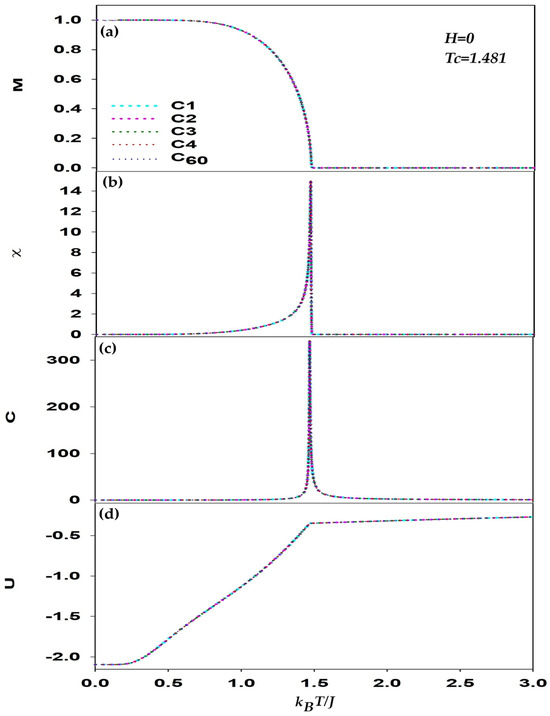
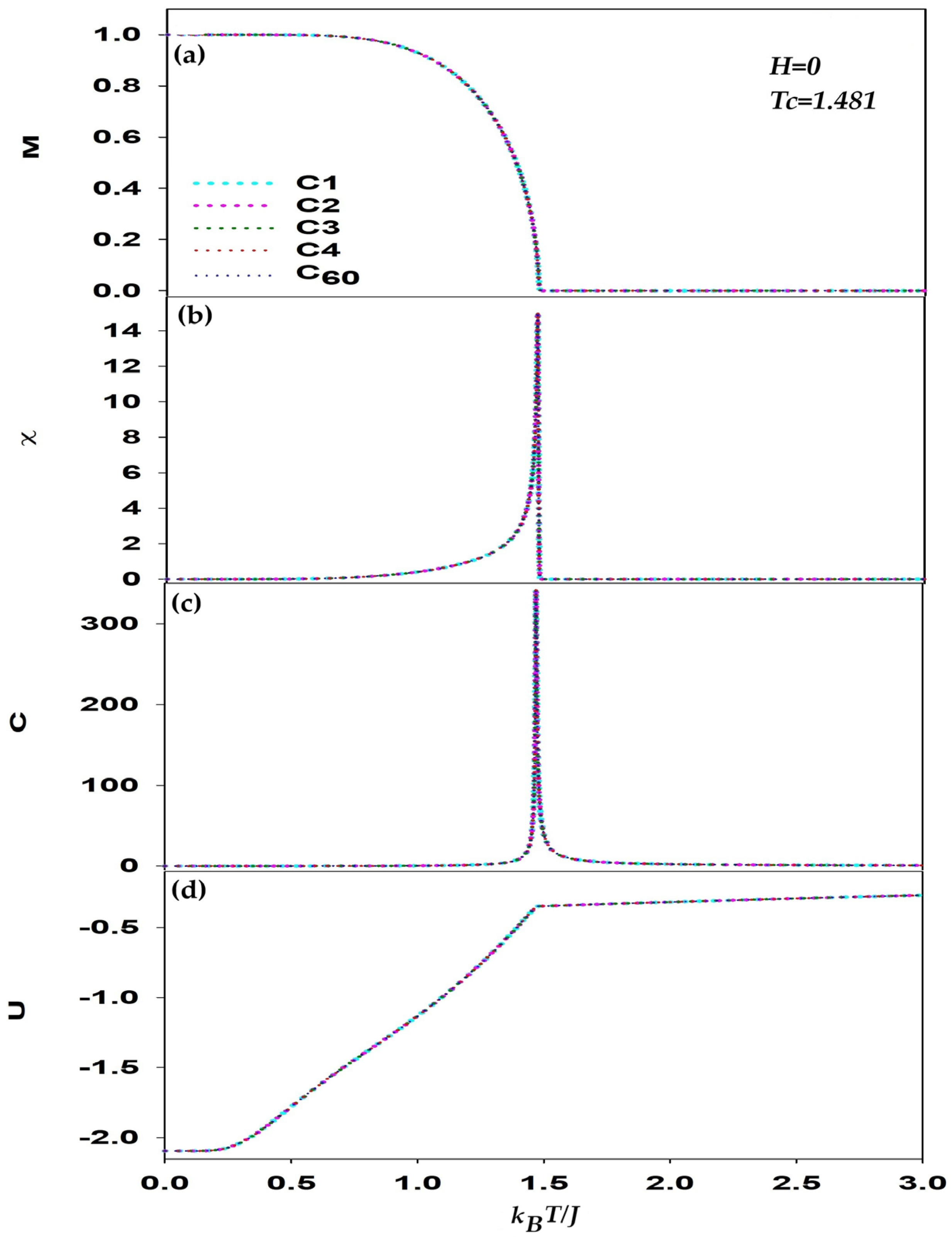
Figure 2 illustrates the temperature dependence of magnetization, susceptibility, specific heat, and internal energy for the total C60 (MT, χT, CT, and UT) and its components (C1, C2, C3, and C4) at H = 0 as the temperature function. Figure 2a illustrates the temperature dependence of the magnetizations of MT, mC1, mC2, mC3, and mC4. Notably, the magnetization of the C60 molecule is identical to that of its components, such that MT = mC1 = mC2 = mC3 = mC4. We define this behavior as the “identic magnetic effect” (IME). The cage geometry of C60 induces the IME, causing all carbon atoms within the lattice to exhibit uniform magnetic behavior. The C60 system and its components undergo a second-order phase transition from the ferromagnetic to the paramagnetic phase at Tc = 1.481. This second-order transition is in quantitative and structural agreement with the experimental results for rhombohedral C60 reported by Makarova [49].
Figure 2.
(a) The magnetizations, (b) magnetic susceptibilities, (c) specific heats, and (d) internal energies of the C60 fullerene cage and its components versus temperature.
Figure 2b displays the susceptibility of C60 and its components. Due to the cage lattice structure, the susceptibilities also exhibit the IME and overlap perfectly, reaching a maximum at Tc. The specific heats of C60 are presented in Figure 2c. Similar to the susceptibilities, the specific heats peak at Tc; however, while the specific heat values are greater than those of the susceptibilities for T < Tc, their peak magnitudes are comparatively lower. The specific heat values approach zero for T > Tc, yet they maintain the IME observed in the magnetization and susceptibility data. Finally, Figure 2d presents the internal energies of C60. The internal energy starts at U = −2.093 at T = 0 and increases to U = −0.345 at Tc. For T > Tc, the internal energy exhibits minimal variation, nearly forming a straight line with temperature. Similar thermal magnetization behavior has been reported for two-dimensional islands of C60 molecules on a hexagonal lattice using spin-5/2 Ising particles [37].
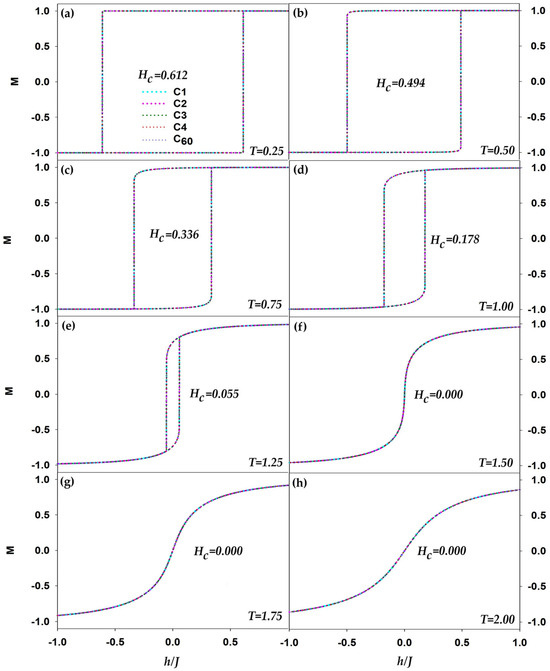
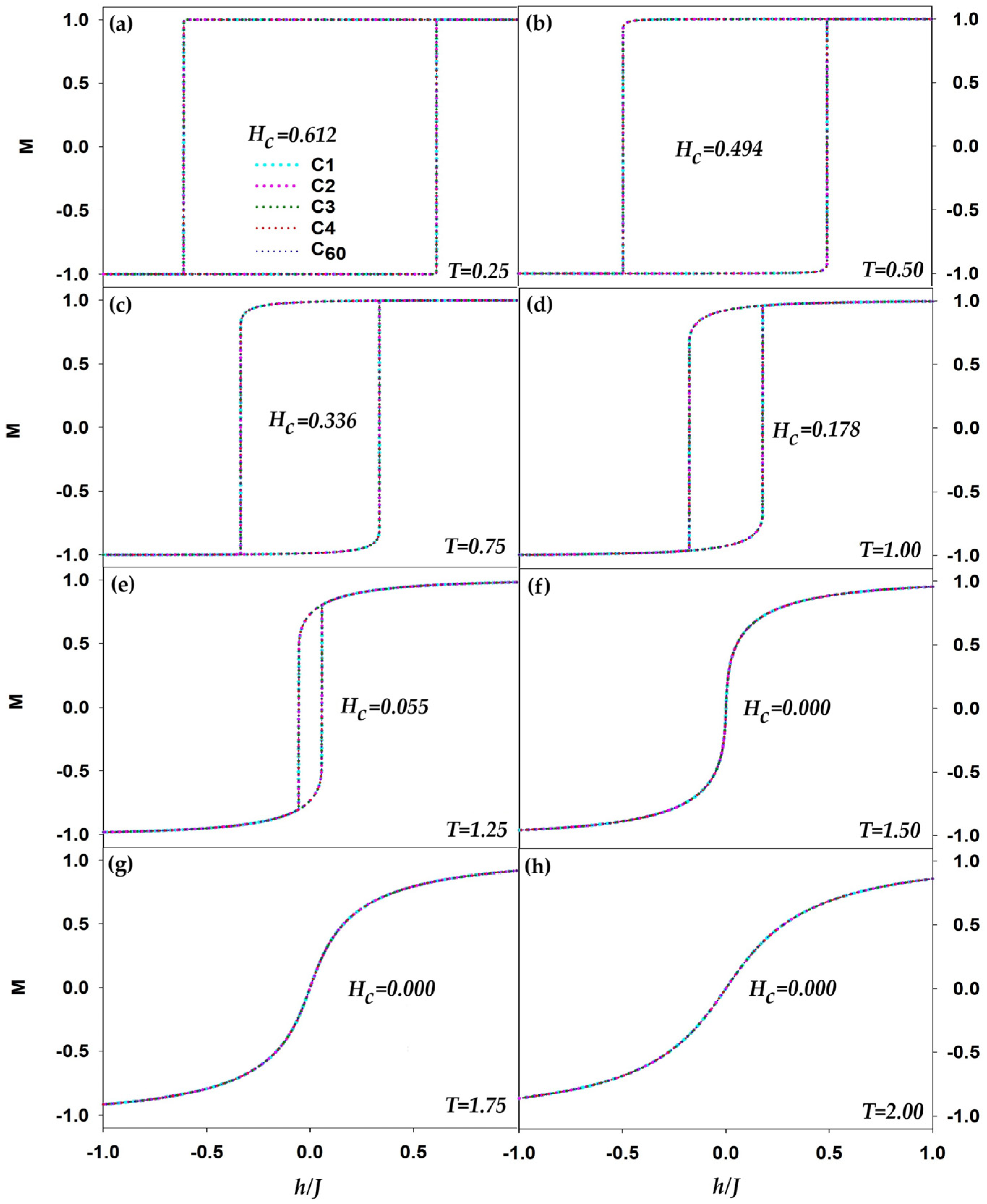
Figure 3 illustrates the magnetic hysteresis loop properties of the C60 molecule and its components (C1, C2, C3, and C4) at temperatures from T = 0.25 to 2.0 in increments of 0.25.
Figure 3.
The magnetizations of the C60 fullerene cage and its components versus the applied field, for the temperature: (a) T = 0.25, (b) T = 0.50, (c) T = 0.75, (d) T = 1.00, (e) T = 1.25, (f) T = 1.50, (g) T = 1.75, and (h) T = 2.00.
As shown in Figure 3a–h, the coercive field strengths for the C60 cage and its constituent atoms are identical, with values of Hc = 0.612, 0.494, 0.336, 0.178, and 0.055 at T = 0.25, 0.50, 0.75, 1.00, and 1.25, respectively. As the temperature approaches the critical threshold (Tc = 1.481), the hysteresis loops narrow and eventually vanish. Consequently, the coercive field strengths are Hc = 0.000 for T = 1.50, 1.75, and 2.00 (T > Tc). These results indicate that all carbon atoms within the C60 fullerene cage exhibit ferromagnetic behavior for T < Tc and transition to a paramagnetic state for T > Tc. These theoretical hysteresis results demonstrate robust quantitative agreement with experimental data for nickel-coated C60 nanorods [5], stacked Pd/C60 bilayers [21], rhombohedral C60 [49,50], TDAE-C60 samples [51], C60 polymer samples [52,53], and photolyzed C60 [54]. Notably, the hysteresis curves of the C60 molecule and its components overlap perfectly, mirroring the temperature-dependent magnetization behavior. This confirms that the identical magnetic effect (IME) extends to the hysteresis characteristics of all carbon atoms due to the uniform influence of the C60 cage lattice.
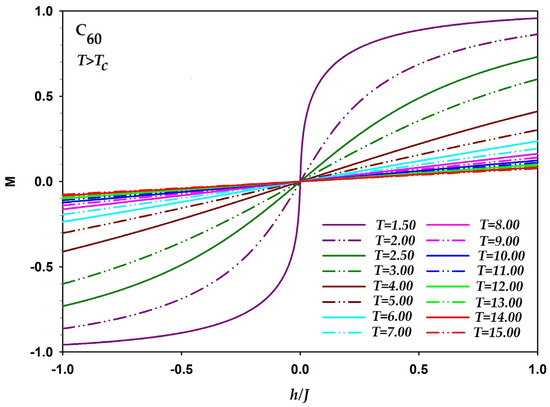
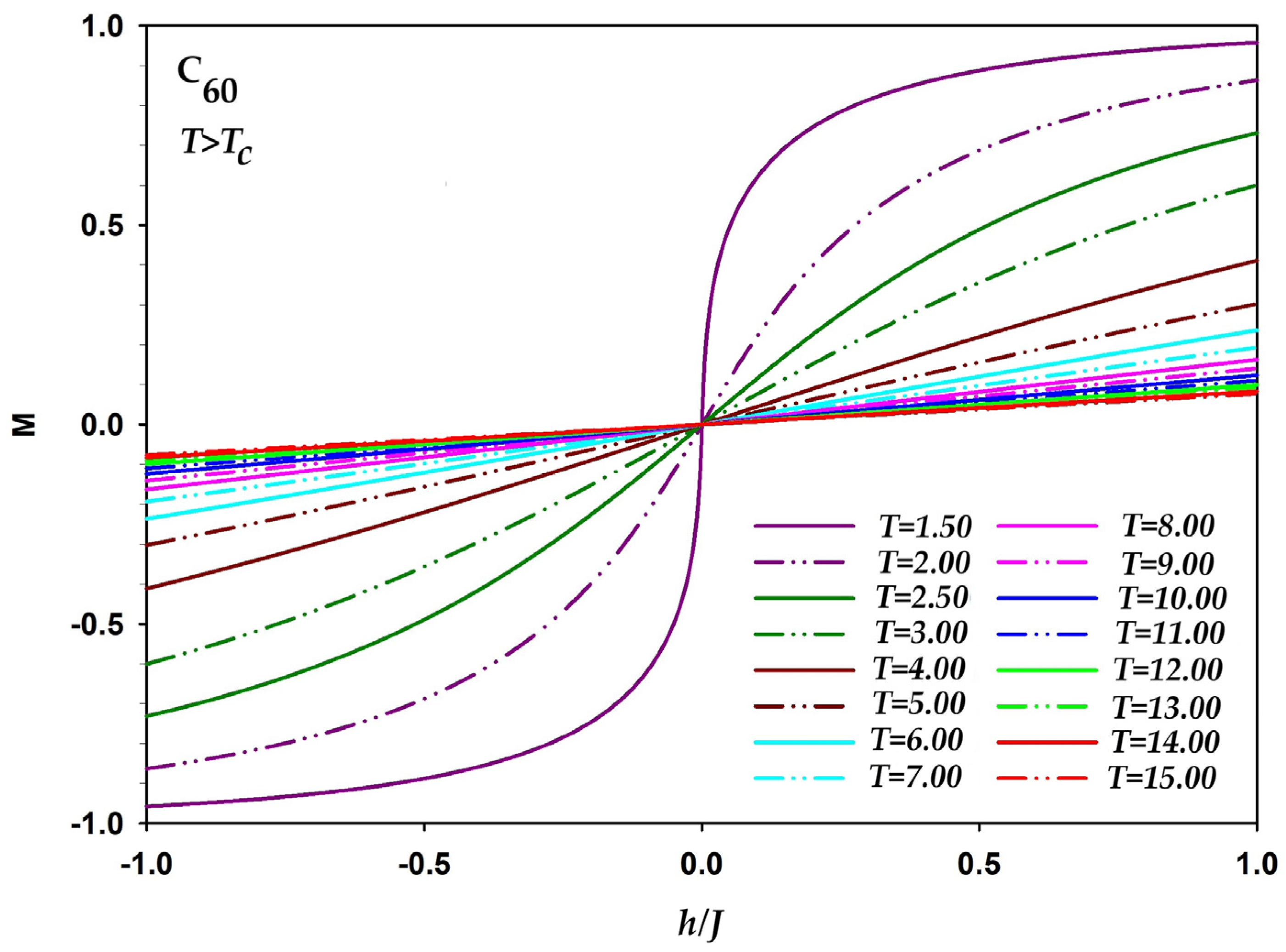
Figure 4 shows the hysteresis curves for the total C60 molecule at temperatures above the critical threshold (T > Tc). Consistent with the observed IME, only the total magnetization (MT) is plotted as a function of the applied field. As the temperature increases, the hysteresis curves approach a linear profile, with magnetization values tending toward zero for T ≫ Tc. The divergence between successive paramagnetic curves is significantly reduced at elevated temperatures compared with the variations observed near Tc.
Figure 4.
The total magnetization of the C60 fullerene cage at T > Tc.
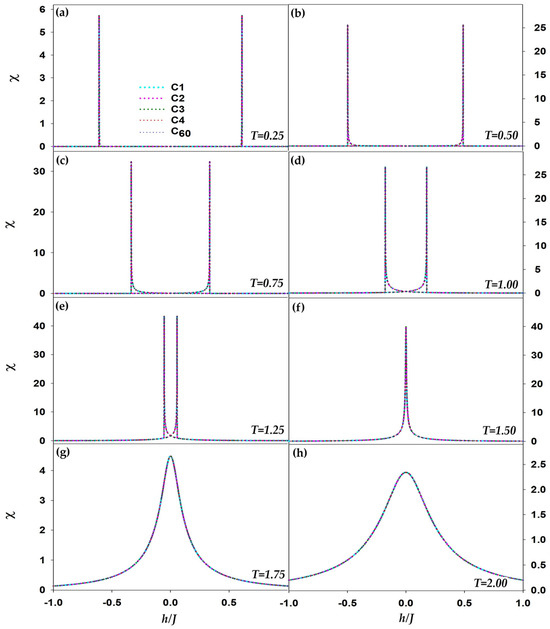
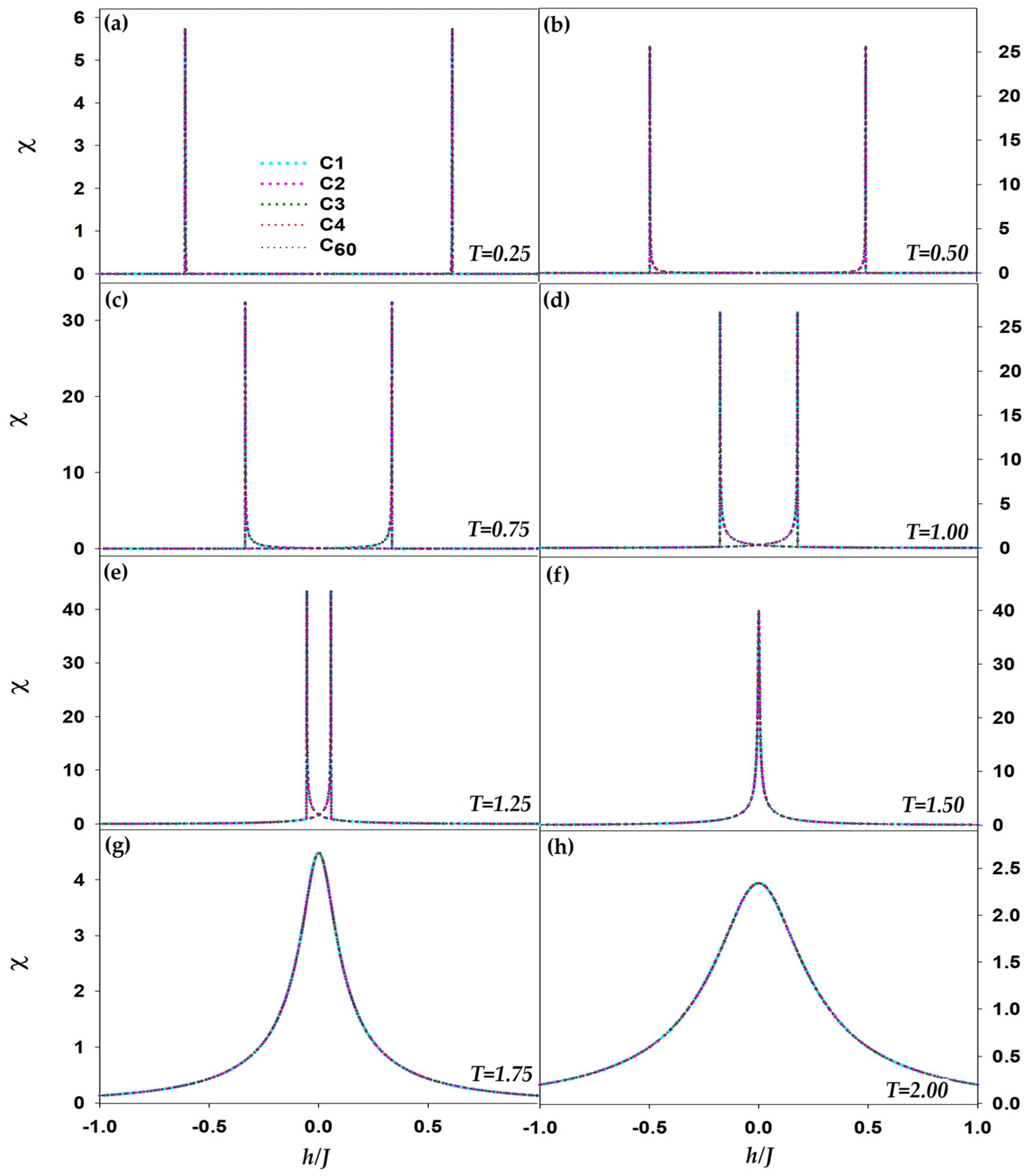
Figure 5 shows the external-field dependence of the susceptibilities for the total C60 molecule and its constituent components across eight temperatures. The susceptibility profiles consistently exhibit the identical magnetic effect (IME). In Figure 5a–e, where T < Tc, the susceptibility curves display two distinct peaks corresponding to the positive and negative coercive field points. At T = Tc, these features converge into a single peak at H = 0.0. Conversely, for T > Tc, as shown in Figure 5f–h, the curves exhibit a single maximum at H = 0.0 rather than a sharp peak. Similar behavior has been reported theoretically for various systems, including the body-centered orthorhombic nanolattice structure (BCOLS) [41], Ising simple cubic (sc), body-centered cubic (bcc), and face-centered cubic (fcc) nanolattices [43], Ising core/shell nanowires [55], and Ising nanotubes [56]. Experimental observations of these phenomena have also been documented in multilayered core/shell nanowires [57]. These susceptibility peaks serve as diagnostic tools for characterizing the magnetic state and determining the coercive field points of a system: the presence of dual peaks indicates a ferromagnetic state with associated coercive points, whereas a single maximum at H = 0.0 signifies a paramagnetic state with no coercive field (Hc = 0.0).
Figure 5.
The magnetic susceptibilities of the C60 fullerene cage and its components versus the applied field, for the temperature: (a) T = 0.25, (b) T = 0.50, (c) T = 0.75, (d) T = 1.00, (e) T = 1.25, (f) T = 1.50, (g) T = 1.75, and (h) T = 2.00.
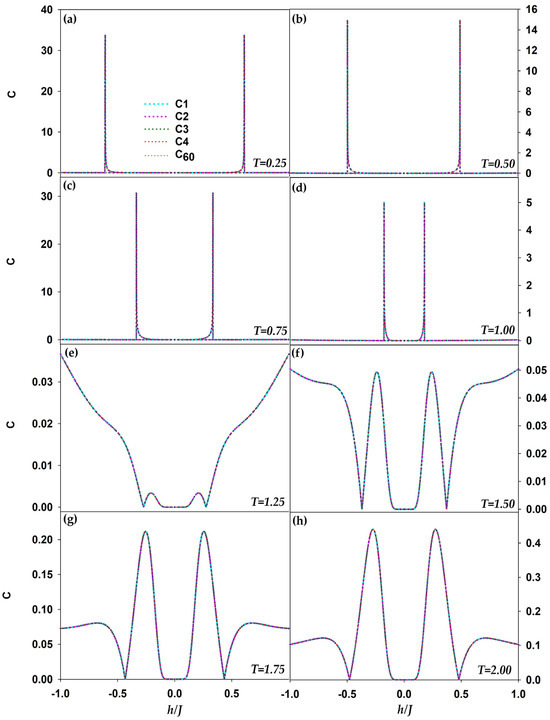
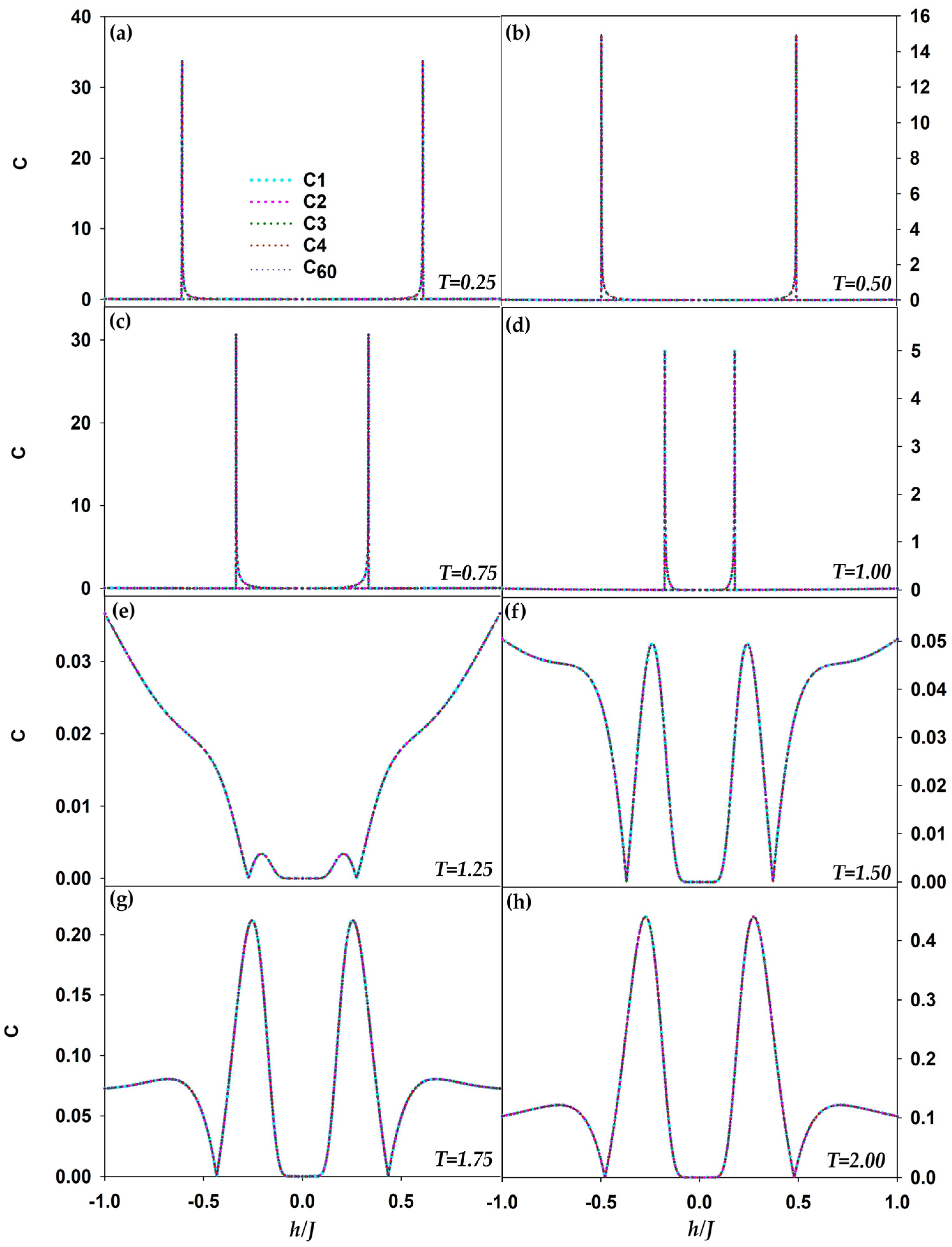
Figure 6 shows the external-field dependence of the specific heat for the C60 molecule and its components from T = 0.25 to 2.00 in increments of 0.25. In Figure 6a–d, the specific heat curves exhibit dual peaks at the coercive field points, mirroring the behavior observed in the susceptibility profiles. However, in Figure 6e–h, the curves exhibit broad maxima near H = 0.0 and reach zero at exactly H = 0.0. This contrasts with the susceptibility curves, which maintain dual maxima in Figure 5e and a single maximum at H = 0.0 in Figure 5f–h. Furthermore, the specific heat results consistently demonstrate IME behavior.
Figure 6.
The specific heats of the C60 fullerene cage and its components versus the applied field, for the temperature: (a) T = 0.25, (b) T = 0.50, (c) T = 0.75, (d) T = 1.00, (e) T = 1.25, (f) T = 1.50, (g) T = 1.75, and (h) T = 2.00.
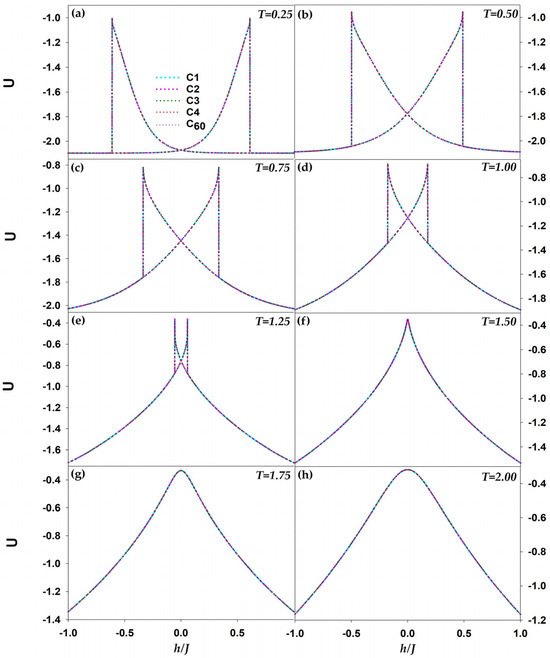
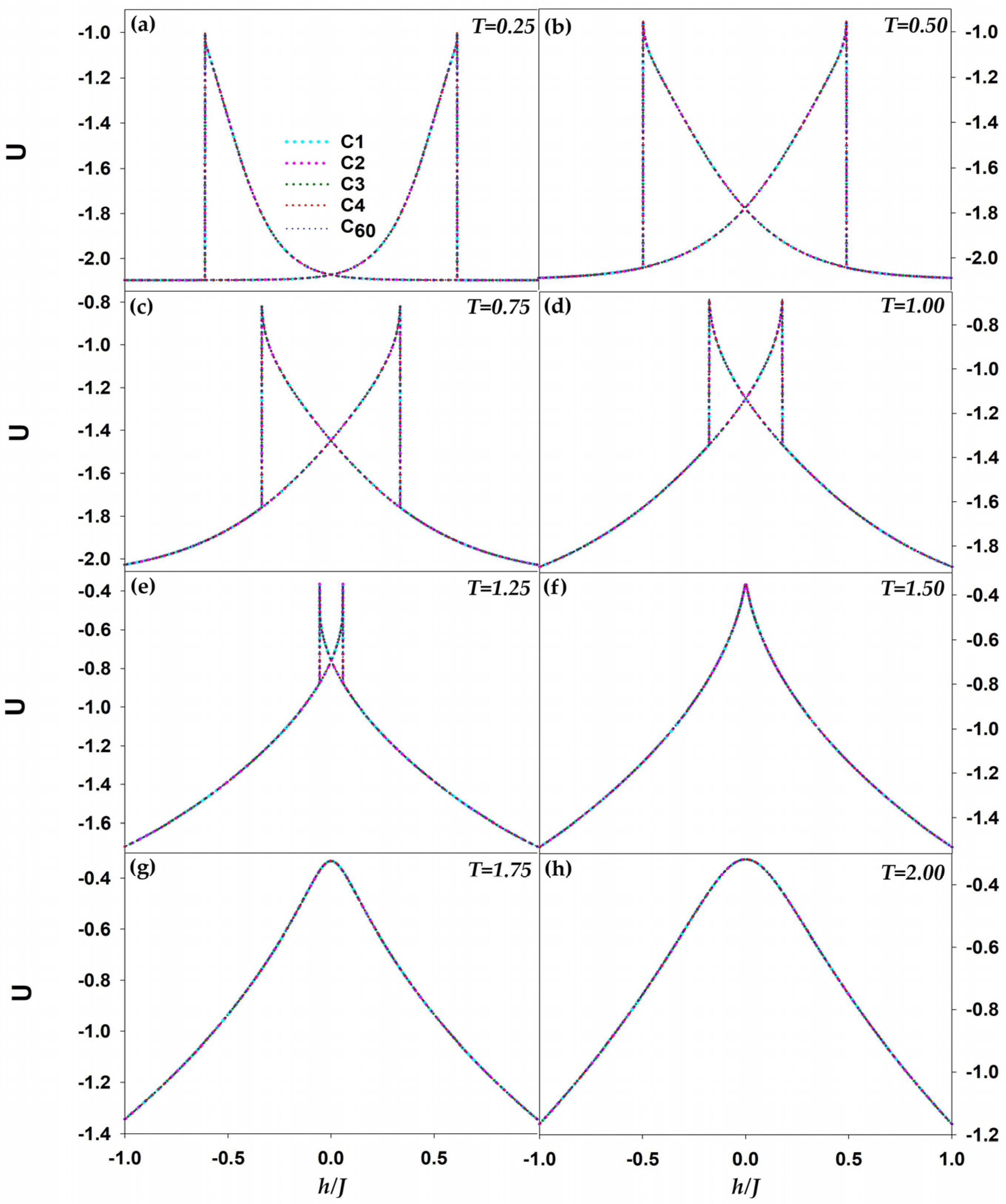
Figure 7 shows the external-field dependence of the internal energy for the C60 molecule and its components across eight temperatures. The internal energy profiles exhibit dual peaks at the coercive field (Hc), characteristic of ferromagnetic behavior. As shown in Figure 7a–e, the peak regions partially overlap, forming two distinct loops that intersect at H = 0.0. These internal energy loops vanish for T > Tc, as depicted in Figure 7f–h. Consistent with the other magnetic properties of the C60 system, the internal energy data further corroborates the existence of the IME.
Figure 7.
The internal energies of the C60 fullerene cage and its components versus the applied field, for the temperature: (a) T = 0.25, (b) T = 0.50, (c) T = 0.75, (d) T = 1.00, (e) T = 1.25, (f) T = 1.50, (g) T = 1.75, and (h) T = 2.00.
As a result, it is important to emphasize that the temperature dependence of the magnetic properties—specifically magnetization, magnetic susceptibility, specific heat, and internal energy—of the C60 molecule and its constituent components is identical and perfectly overlapping. These results indicate that all carbon atoms within the C60 fullerene cage exhibit uniform magnetic responses to both temperature and external field variations. This identical behavior is inherent to the cage lattice structure of C60, as the IME has not been observed in non-cage lattice configurations [24,25,26,27,28,29,30,31,32,33,34,35,36,37,38,39,40,41,42,43,44,45,55,56,58]. Consequently, while non-cage lattice structures do not exhibit IME, the unique geometric symmetry of cage-like lattices facilitates this phenomenon.
Based on the results obtained via effective field theory (EFT), the following conditions are necessary for the manifestation of the identical magnetic effect (IME):
- ➢
- The distances between nearest-neighbor atoms on the lattice must be identical or exhibit only negligible differences (e.g., in the present study, d1(6/6) = 1.391 Å and d2(6/5) = 1.445 Å) [46,47].
- ➢
- All atoms within the lattice must possess an equal number of nearest neighbors (uniform coordination).
- ➢
- The spin orientations of all atoms on the lattice must be aligned parallel (i.e., the exchange interactions J1 through J7 must be positive).
The cage lattice geometry is critical because it inherently satisfies these three conditions, thereby facilitating IME in C60 fullerene. Conversely, non-cage lattice structures typically fail to satisfy at least one of these criteria and, consequently, do not exhibit IME behavior. The cage lattice geometry is critical because it inherently satisfies these three conditions, thereby facilitating IME in C60 fullerene. Conversely, non-cage lattice structures typically fail to satisfy at least one of these criteria and, consequently, do not exhibit IME behavior.
On the other hand, the identical magnetic effect (IME) of the C60 fullerene and its components (C1, C2, C3, and C4) decays immediately and distinctively under external influences, such as the addition or removal of atoms/molecules or variations in temperature and magnetic fields. By leveraging these differences in the IME response to external effects, a new class of IME sensors (IMESs) could be modeled and developed. These would be analogous to thermo-hardness sensors (THSs) and actuators (THAs) that utilize the critical hardness temperature (Tch) of the Zr2RhTl Heusler alloy [59], as well as magnetoresistance sensors (MRSs) [60,61,62,63,64], NMR [65], and superconductivity-based applications [66]. Additionally, we anticipate that this EFT method will be highly effective for modeling and investigating the magnetic and thermodynamic properties of various fullerene and fullerene-like structures, serving as a robust numerical technique comparable to Density Functional Theory (DFT) [67,68,69,70]. Furthermore, recent investigations into the magnetic properties and hysteresis loops of low-dimensional materials [71,72,73,74,75,76,77,78,79] have highlighted the sensitivity of these effects to physical parameters. By comparing our EFT results with recent Monte Carlo (MC) findings, we observe consistent trends in magnetic phase transition characteristics, further validating the effectiveness of our modeling approach for C60 cage systems. Moreover, magnetic moments of the C60 can be induced through physical mechanisms that do not require chemical doping or metallic additives. A prominent example is Photo-assisted Magnetization (PAM), where magnetic properties are imparted to pure C60 via magnetic-field-trapped Raman scattering [80]. This process enables the study of magnetic phase transitions while preserving the intrinsic lattice symmetry of the fullerene cage. In this work, we specifically investigate how such symmetry-driven interactions dictate the thermodynamic and magnetic characteristics of C60-like structures using the effective field theory (EFT) approach.
4. Conclusions
The present study modeled the C60 fullerene cage using four distinct magnetic atom groups (C1, C2, C3, and C4), with seven interaction parameters defined between nearest neighbors to account for the unique cage geometry. The magnetization, hysteresis, susceptibility, specific heat, and internal energy of the C60 cage and its components were investigated within the EFT framework. The study revealed several significant physical phenomena:
- (1)
- The C60 molecule and its constituent atoms undergo a second-order phase transition from a ferromagnetic to a paramagnetic state at a critical temperature of Tc = 1.481.
- (2)
- For T < Tc, the magnetic susceptibility, specific heat, and internal energy of both the C60 cage and its components exhibit dual peaks, characteristic of the ferromagnetic phase. In the paramagnetic regime (T > Tc), susceptibility and internal energy reach a maximum, whereas the specific heat vanishes at H = 0.0.
- (3)
- Due to the geometric constraints of the cage lattice, the temperature and applied field dependencies of the C60 fullerene cage perfectly mirror those of its individual components. This exact overlap in magnetic behavior is termed the “identic magnetic effect” (IME).
- (4)
- Within the internal energy peaks, specific regions superimpose to form two distinct loops at T ≤ 1.25. These loops are characterized by a common intersection point at the zero-field position (H = 0.0).
- (5)
- IME behavior can open the door to modeling and produce a new class of IME sensors (IMESs) like the thermo-hardness sensors (THSs) and actuators (THAs) by using the critical hardness temperature (Tch) of the Zr2RhTl Heusler alloy [59], magnetoresistance sensors (MRSs) [60,61,62,63,64], NMR [65] and SC applications [66].
Author Contributions
Conceptualization, N.Ş. and Y.G.Y.; methodology, N.Ş. and G.D.Y.; software, N.Ş.; validation, N.Ş., Y.G.Y., and G.D.Y.; formal analysis, Y.G.Y.; investigation, Y.G.Y. and G.D.Y.; resources, N.Ş.; data curation, N.Ş. and Y.G.Y.; writing—original draft preparation, N.Ş., Y.G.Y. and G.D.Y.; writing—review and editing, N.Ş., Y.G.Y. and G.D.Y.; visualization, G.D.Y.; supervision, N.Ş. All authors have read and agreed to the published version of the manuscript.
Funding
This research received no external funding.
Data Availability Statement
The data presented in this study are available from the corresponding author upon reasonable request.
Conflicts of Interest
The authors declare no conflicts of interest.
References
- Kroto, H.W.; Heath, J.R.; O’Brien, S.C.; Curl, R.F.; Smalley, R.E. C60: Buckminsterfullerene. Nature 1985, 318, 162–163. [Google Scholar] [CrossRef] [Scilit]
- Krätschmer, W.; Lamb, L.D.; Fostiropoulos, K.H.D.R.; Huffman, D.R. Solid C60: A new form of carbon. Nature 1990, 347, 354–358. [Google Scholar] [CrossRef] [Scilit]
- Makarova, T.L.; Sundqvist, B.; Höhne, R.; Esquinazi, P.; Kopelevich, Y.; Scharff, P.; Davydov, V.A.; Kashevarova, L.S.; Rakhmanina, A.V. Magnetic carbon. Nature 2001, 413, 716–718. [Google Scholar] [CrossRef] [Scilit] [PubMed]
- Yu, Y.; Wu, J.; Gu, M.; Zhang, W.; Cui, G.; Xu, X.; Feng, D.; Tang, T.B. An NMR investigation on the adducted hydrogen in weak ferromagnetic rhombohedral C60 polymers. Chem. Phys. Lett. 2009, 482, 66–71. [Google Scholar] [CrossRef] [Scilit]
- Chen, A.; Liu, B.; Hou, Y.; Wen, G.; Liu, D.; Lu, S.; Li, Z.; Li, X.; Zou, Y.; Zou, B.; et al. Decoration of C60 nanorods with nickel and their magnetic properties. Chin. Sci. Bull. 2009, 54, 2539–2542. [Google Scholar] [CrossRef] [Scilit]
- Chen, X.; Li, Z.; Zhou, H.; Wang, T.; Qin, J.; Inokuchi, M. The intercalation of C60-containing PEO into layered MnPS3. Polymer 2007, 48, 3256–3261. [Google Scholar] [CrossRef] [Scilit]
- Kempiński, W. Superconductivity of carbon materials-unstable phases. Acta Phys. Pol. A 2004, 106, 627–636. [Google Scholar] [CrossRef] [Scilit]
- Konarev, D.V.; Khasanov, S.S.; Saito, G.; Otsuka, A.; Yoshida, Y.; Lyubovskaya, R.N. Formation of single-bonded (C60-)2 and (C70-)2 dimers in crystalline ionic complexes of fullerenes. J. Am. Chem. Soc. 2003, 125, 10074–10083. [Google Scholar] [CrossRef] [Scilit]
- Zheng, L.A.; Lairson, B.M.; Barrera, E.V.; Shull, R.D. Formation of nanomagnetic thin films by dispersed fullerenes. Appl. Phys. Lett. 2000, 77, 3242–3244. [Google Scholar] [CrossRef] [Scilit]
- Te Velthuis, S.G.E.; Van Dijk, N.H.; Rekveldt, M.T.; Sietsma, J.; Van der Zwaag, S. Field-dependent neutron depolarization study of the ferrite formation in medium-carbon steels. Acta Mater. 2000, 48, 1105–1114. [Google Scholar] [CrossRef] [Scilit]
- Shanina, B.D.; Konchits, A.A.; Kolesnik, S.P.; Katsaj, M.Y. Electron paramagnetic resonance and magnetic properties of composite C60: Er. J. Magn. Magn. Mater. 2000, 210, 215–224. [Google Scholar] [CrossRef] [Scilit]
- Yoshino, K.; Zakhidov, A.A.; Kajii, H.; Araki, H.; Tada, K.; Noguchi, T.; Ohnishi, T.; Yakushi, K. Multiphase superconductivity in OO-PPV/C60 composite doped by alkali metals low-field microwave absorption and SQUID study. Phys. C Supercond. 1996, 264, 161–171. [Google Scholar] [CrossRef] [Scilit]
- Ksari, Y.; Chouteau, G.; Yazami, R.; Cherigui, A. Intercalation of the FeCl4 ion in C60/C70: Magnetic properties of the resulting compound. J. Magn. Magn. Mater. 1995, 140, 2061–2062. [Google Scholar] [CrossRef] [Scilit]
- Khairullin, I.I.; Imaeda, K.; Yakushi, K.; Inokuchi, H. Superconducting properties of Na-doped C60 prepared from sodium azide. Phys. C Supercond. 1994, 231, 26–36. [Google Scholar] [CrossRef] [Scilit]
- Grivei, E.; Cassart, M.; Issi, J.P.; Langer, L.; Nysten, B.; Michenaud, J.P.; Fabre, C.; Rassat, A. Anomalous specific heat of C60. Phys. Rev. B 1993, 48, 8514. [Google Scholar] [CrossRef] [Scilit]
- Allemand, P.M.; Khemani, K.C.; Koch, A.; Wudl, F.; Holczer, K.; Donovan, S.; Grüner, G.; Thompson, J.D. Organic molecular soft ferromagnetism in a fullerene C60. Science 1991, 253, 301–302. [Google Scholar] [CrossRef] [Scilit] [PubMed]
- Muñoz-Castro, A. The shielding cone in spherical aromatic structures: Insights from models for spherical 2(N + 1)2 aromatic fullerenes. Phys. Chem. Chem. Phys. 2017, 19, 12633–12636. [Google Scholar] [CrossRef] [Scilit] [PubMed]
- Rauhalahti, M.; Muñoz-Castro, A.; Sundholm, D. Magnetic response properties of gaudiene—A cavernous and aromatic carbocage. Phys. Chem. Chem. Phys. 2016, 18, 18880–18886. [Google Scholar] [CrossRef] [Scilit]
- Muñoz-Castro, A. Axis-dependent magnetic behavior of C60 and C60 10+. consequences of spherical aromatic character. Chem. Commun. 2015, 51, 10287–10290. [Google Scholar] [CrossRef] [Scilit] [PubMed]
- Wang, H.; Qian, K.; Qi, D.; Cao, W.; Wang, K.; Gao, S.; Jiang, J. Co-crystallized fullerene and a mixed (phthalocyaninato) (porphyrinato) dysprosium double-decker SMM. Chem. Sci. 2014, 5, 3214–3220. [Google Scholar] [CrossRef] [Scilit]
- Ghosh, S.; Tongay, S.; Hebard, A.F.; Sahin, H.; Peeters, F.M. Ferromagnetism in stacked bilayers of Pd/C60. J. Magn. Magn. Mater. 2014, 349, 128–134. [Google Scholar] [CrossRef] [Scilit]
- Ribas-Arino, J.; Novoa, J.J. The origin of the magnetic moments in compressed crystals of polymeric C60. Angew. Chem. 2004, 116, 587–590. [Google Scholar] [CrossRef] [Scilit]
- Chan, J.A.; Montanari, B.; Gale, J.D.; Bennington, S.M.; Taylor, J.W.; Harrison, N.M. Magnetic properties of polymerized C60: The influence of defects and hydrogen. Phys. Rev. B—Condens. Matter Mater. Phys. 2004, 70, 041403. [Google Scholar] [CrossRef] [Scilit]
- Kaneyoshi, T. Magnetizations of a transverse Ising nanowire. J. Magn. Magn. Mater. 2010, 322, 3410–3415. [Google Scholar] [CrossRef] [Scilit]
- Kaneyoshi, T. Reduced magnetization curves of Ising nanoparticles with high critical temperature. Phase Transit. 2020, 93, 376–387. [Google Scholar] [CrossRef] [Scilit]
- Kaneyoshi, T. Clear distinctions between ferromagnetic and ferrimagnetic behaviors in a cylindrical Ising nanowire (or nanotube). J. Magn. Magn. Mater. 2011, 323, 2483–2486. [Google Scholar] [CrossRef] [Scilit]
- Kaneyoshi, T. Magnetic properties of a cylindrical Ising nanowire (or nanotube). Phys. Status Solidi B 2011, 248, 250–258. [Google Scholar] [CrossRef] [Scilit]
- Jiang, W.; Li, X.X.; Liu, L.M.; Chen, J.N.; Zhang, F. Hysteresis loop of a cubic nanowire in the presence of the crystal field and the transverse field. J. Magn. Magn. Mater. 2014, 353, 90–98. [Google Scholar] [CrossRef] [Scilit]
- Ertaş, M.; Kocakaplan, Y. Dynamic behaviors of the hexagonal Ising nanowire. Phys. Lett. A 2014, 378, 845–850. [Google Scholar] [CrossRef] [Scilit]
- Kantar, E.; Keskin, M. Thermal and magnetic properties of ternary mixed Ising nanoparticles with core–shell structure: Effective-field theory approach. J. Magn. Magn. Mater. 2014, 349, 165–172. [Google Scholar] [CrossRef] [Scilit]
- Magoussi, H.; Zaim, A.; Kerouad, M. Effects of the trimodal random field on the magnetic properties of a spin-1 Ising nanotube. Chin. Phys. B 2013, 22, 116401. [Google Scholar] [CrossRef] [Scilit]
- Şarlı, N. Generation of an external magnetic field with the spin orientation effect in a single-layer Ising nanographene. Phys. E Low-Dimens. Syst. Nanostructures 2016, 83, 22–29. [Google Scholar] [CrossRef] [Scilit]
- Şarlı, N.; Akbudak, S.; Ellialtioğlu, M.R. The peak effect (PE) region of the antiferromagnetic two-layer Ising nanographene. Phys. B Condens. Matter 2014, 452, 18–22. [Google Scholar] [CrossRef] [Scilit]
- Şarlı, N.; Akbudak, S.; Polat, Y.; Ellialtıoğlu, M.R. Effective distance of a ferromagnetic trilayer Ising nanostructure with an ABA stacking sequence. Phys. A Stat. Mech. Its Appl. 2015, 434, 194–200. [Google Scholar] [CrossRef] [Scilit]
- Şarlı, N. Artificial magnetism in a carbon diamond nanolattice with the spin orientation effect. Diam. Relat. Mater. 2016, 64, 103–109. [Google Scholar] [CrossRef] [Scilit]
- Padilha, I.T.; de Sousa, J.R.; Neto, M.A.; Salmon, O.R.; Viana, J.R. Thermodynamics properties of copper-oxide superconductors described by an Ising frustrated model. Phys. A Stat. Mech. Its Appl. 2013, 392, 4897–4904. [Google Scholar] [CrossRef] [Scilit]
- Abou Ghantous, M.; Moujaes, E.A.; Dunn, J.L.; Khater, A. Cooperative Jahn-Teller effect in a 2D mesoscopic C60n− system with D5d symmetry adsorbed on buffer layers using Ising EFT model. Eur. Phys. J. B 2012, 85, 178. [Google Scholar] [CrossRef] [Scilit]
- Kantar, E. Superconductivity-like phenomena in an ferrimagnetic endohedral fullerene with diluted magnetic surface. Solid State Commun. 2017, 263, 31–37. [Google Scholar] [CrossRef] [Scilit]
- Kantar, E. Dynamic calculations of the core/shell structured Ising-type endohedral fullerenes: The effect of core and core/shell interaction. Mod. Phys. Lett. B 2017, 31, 1750307. [Google Scholar]
- Kantar, E. The thermal behaviors and phase diagrams of the Ising-type endohedral fullerene with magnetic core and diluted magnetic shell (Core@ Shell20). Eur. Phys. J. B 2017, 90, 152. [Google Scholar] [CrossRef] [Scilit]
- Şarlı, N. Superconductor core effect of the body centered orthorhombic nanolattice structure. J. Supercond. Nov. Magn. 2015, 28, 2355–2363. [Google Scholar] [CrossRef] [Scilit]
- Kittel, C. Introduction to Solid State Physics, 7th ed.; John Wiley & Sons, Inc.: New York, NY, USA, 1996; pp. 333–378. [Google Scholar]
- Şarlı, N. Paramagnetic atom number and paramagnetic critical pressure of the sc, bcc, and fcc Ising nanolattices. J. Magn. Magn. Mater. 2015, 374, 238–244. [Google Scholar] [CrossRef] [Scilit]
- Keskin, M.; Şarlı, N. Magnetic properties of the binary Nickel/Bismuth alloy. J. Magn. Magn. Mater. 2017, 437, 1–6. [Google Scholar] [CrossRef] [Scilit]
- Duran, A. Lattice location effect of Ni50Mn36Sn14 Heusler alloy. J. Supercond. Nov. Magn. 2018, 31, 1101–1109. [Google Scholar] [CrossRef] [Scilit]
- Álvarez-Murga, M.; Hodeau, J.L. Structural phase transitions of C60 under high-pressure and high-temperature. Carbon 2015, 82, 381–407. [Google Scholar] [CrossRef] [Scilit]
- David, W.I.; Ibberson, R.M.; Matthewman, J.C.; Prassides, K.; Dennis, T.J.S.; Hare, J.P.; Kroto, H.W.; Walton, D.R.M. Crystal structure and bonding of ordered C60. Nature 1991, 353, 147–149. [Google Scholar] [CrossRef] [Scilit]
- Kaneyoshi, T. Differential operator technique in the Ising spin systems. Acta Phys. Pol. A 1993, 83, 703–738. [Google Scholar] [CrossRef] [Scilit]
- Makarova, T. Magnetism of carbon-based materials. arXiv 2002, arXiv:cond-mat/0207368. [Google Scholar] [CrossRef] [Scilit]
- Wood, R.A.; Lewis, M.H.; Lees, M.R.; Bennington, S.M.; Cain, M.G.; Kitamura, N. Ferromagnetic fullerene. J. Phys. Condens. Matter 2002, 14, L385. [Google Scholar] [CrossRef] [Scilit]
- Jagličić, Z.; Trontelj, Z.; Lužnik, J.; Pirnat, J.; Blinc, R. Magnetic properties of TDAE-C60 single crystal and powder samples: The influence of thermal annealing. Solid State Commun. 1997, 101, 591–595. [Google Scholar] [CrossRef] [Scilit]
- Makarova, T.L.; Han, K.H.; Esquinazi, P.; Da Silva, R.R.; Kopelevich, Y.; Zakharova, I.B.; Sundqvist, B. Magnetism in photopolymerized fullerenes. Carbon 2003, 41, 1575–1584. [Google Scholar] [CrossRef] [Scilit]
- Han, K.H.; Spemann, D.; Höhne, R.; Setzer, A.; Makarova, T.; Esquinazi, P.; Butz, T. Observation of intrinsic magnetic domains in C60 polymer. Carbon 2003, 41, 785–795. [Google Scholar] [CrossRef] [Scilit]
- Owens, F.J.; Iqbal, Z.; Belova, L.; Rao, K.V. Evidence for high-temperature ferromagnetism in photolyzed C60. Phys. Rev. B 2004, 69, 033403. [Google Scholar] [CrossRef] [Scilit]
- Şarlı, N.; Keskin, M. Two distinct magnetic susceptibility peaks and magnetic reversal events in a cylindrical core/shell spin-1 Ising nanowire. Solid State Commun. 2012, 152, 354–359. [Google Scholar] [CrossRef] [Scilit]
- Şarlı, N. Band structure of the susceptibility, internal energy and specific heat in a mixed core/shell Ising nanotube. Phys. B Condens. Matter 2013, 411, 12–25. [Google Scholar] [CrossRef] [Scilit]
- Chong, Y.T.; Görlitz, D.; Martens, S.; Yau, M.Y.E.; Allende, S.; Bachmann, J.; Nielsch, K. Multilayered core/shell nanowires displaying two distinct magnetic switching events. Adv. Mater 2010, 22, 2435. [Google Scholar] [CrossRef] [Scilit]
- Saatçi, B.; Şarlı, N.; Özdemir, E.G.; Merdan, Z. Bridge constant and atom between theoretical and experimental magnetism in Ni2MnSb Heusler alloy: DFT and EFT studies. Philos. Mag. 2021, 101, 501–516. [Google Scholar] [CrossRef] [Scilit]
- Doğruer, S.; Merdan, Z.; Yıldız, Y.G. Softening of Hard Magnetic Behavior and the Maximum Coercive Field in Zr2RhTl as Revealed by Effective Field Theory. Crystals 2026, 16, 144. [Google Scholar] [CrossRef] [Scilit]
- Şarlı, N.; Yıldız, Y.G.; Yıldız, G.D. Kondo effect revealed by anisotropic exchange interaction in 2D-CeSb2. Mol. Cryst. Liq. Cryst. 2026, 1–8. [Google Scholar] [CrossRef] [Scilit]
- Şarlı, N. Spin dependence of the Magnetoresistance in the simple cubic lattice. In SPIN; World Scientific Publishing Company: Singapore, 2026; p. 2650002. [Google Scholar] [CrossRef] [Scilit]
- Baibich, M.N.; Broto, J.M.; Fert, A.; Van Dau, F.N.; Petroff, F.; Etienne, P.; Creuzet, G.; Friederich, A.; Chazelas, J. Giant magnetoresistance of (001) Fe/(001) Cr magnetic superlattices. Phys. Rev. Lett. 1988, 61, 2472. [Google Scholar] [CrossRef] [Scilit]
- Binasch, G.; Grünberg, P.; Saurenbach, F.; Zinn, W. Enhanced magnetoresistance in layered magnetic structures with antiferromagnetic interlayer exchange. Phys. Rev. B 1989, 39, 4828. [Google Scholar] [CrossRef] [Scilit]
- Hankard, F.; Gattacceca, J.; Fermon, C.; Pannetier-Lecoeur, M.; Langlais, B.; Quesnel, Y.; Rochette, P.; McEnroe, S.A. Magnetic field microscopy of rock samples using a giant magnetoresistance–based scanning magnetometer. Geochem. Geophys. Geosyst. 2009, 10, 10. [Google Scholar] [CrossRef] [Scilit]
- Gilski, M.; Bernatowicz, P.; Sakowicz, A.; Szymański, M.P.; Zalewska, A.; Szumna, A.; Jaskólski, M. C60 in a peptidic cage: A case of symmetry mismatch studied by crystallography and solid-state NMR. Acta Cryst. B 2020, 76, 815–824. [Google Scholar] [CrossRef] [Scilit]
- Pęczkowski, P.; Zachariasz, P.; Zalecki, R.; Piętosa, J.; Michalik, J.M.; Jastrzębski, C.; Ziętala, M.; Zając, M.; Gondek, Ł. Influence of polyurethane skeleton on structural and superconducting properties of Y-123 foams. J. Eur. Ceram. Soc. 2024, 44, 5722–5730. [Google Scholar] [CrossRef] [Scilit]
- Wang, Y.; Huang, Y.; Liu, R. Squeezing carbon dimers into the smallest fullerenes: DFT prediction of new carbon clusters containing double hypercoordinate carbons. J. Mol. Struct. THEOCHEM 2006, 775, 61–65. [Google Scholar] [CrossRef] [Scilit]
- Poklonski, N.A.; Vyrko, S.A.; Kislyakov, E.F.; Hieu, N.N.; Bubel, O.N.; Popov, A.M.; Lozovik, Y.E.; Knizhnik, A.A.; Lebedeva, I.V.; Viet, N.A. Effect of Peierls transition in armchair carbon nanotube on dynamical behaviour of encapsulated fullerene. Nanoscale Res. Lett. 2011, 6, 216. [Google Scholar] [CrossRef] [Scilit]
- Chegeni, M.H.; Boostani-Poor, R.; Jalilian, J. Spin and orbital magnetism of exohedral fullerene doped with single transition metal atom (Sc-Ni): A relativistic density functional theory study. Comput. Theor. Chem. 2022, 1215, 113842. [Google Scholar] [CrossRef] [Scilit]
- Estrada-Salas, R.E.; Valladares, A.A. DFT calculations of the structure and electronic properties of late 3d transition metal atoms endohedrally doping C60. J. Mol. Struct. THEOCHEM 2008, 869, 1–5. [Google Scholar] [CrossRef] [Scilit]
- Abounachit, O.; Jabar, A.; Idrissi, S.; Bahmad, L. Investigation of the magnetic properties of the fullerene C30 with mixed spins: A Monte Carlo study. J. Magn. Magn. Mater. 2024, 589, 171604. [Google Scholar] [CrossRef] [Scilit]
- Fadil, Z.; Sana, S.S.; El Fdil, R.; Rosaiah, P.; Mahmoud, M.H.; Fouad, H.; Kim, S.C. Emergence of multiple hysteresis cycles and polarization plateaus: A Monte Carlo investigation of fullerene-like system. ECS J. Solid State Sci. Technol. 2023, 12, 113014. [Google Scholar] [CrossRef] [Scilit]
- Eraki, H.; Maaouni, N.; Fadil, Z.; Mhirech, A.; Kabouchi, B.; Bahmad, L.; Benomar, W.O. Magnetization plateaus of a double fullerene core/shell-like nanostructure in an external magnetic field: Monte Carlo study. Jordan J. Phys. 2023, 16, 435–445. [Google Scholar]
- Aouini, S.; Mhirech, A.; Alaoui-Ismaili, A.; Bahmad, L. Phase diagrams and magnetic properties of a double fullerene structure with core/shell. Chin. J. Phys. 2019, 59, 346–356. [Google Scholar] [CrossRef] [Scilit]
- Wang, W.; Wang, X.G.; Liu, Z.Y.; Bao, G.C.; Xu, Z.Y. Exploration of dynamic thermodynamic properties and hysteresis loops of a bilayer fullerene-like structure. Phys. A Stat. Mech. Its Appl. 2025, 675, 130864. [Google Scholar]
- Zhang, X.H.; Liang, J.; Wang, W.; Li, B.C. Compensation temperatures and hysteresis loops in a kekulene with alternate multilayer. Appl. Phys. A 2025, 131, 277. [Google Scholar] [CrossRef] [Scilit]
- Wang, W.; Xing, L.; Xia, Y.; Xu, Z.Y. Insight into dynamic magnetic hysteresis behaviors of the nanotube encapsulated with X 36. Mod. Phys. Lett. B 2026, 40, 2550257. [Google Scholar] [CrossRef] [Scilit]
- Wang, W.; Liu, Z.Y.; Wang, X.G.; Xia, Y.; Xu, Z.Y. Exploration of dynamic magnetic properties and magnetocaloric effect of a bilayer fullerene X540-Y540. J. Mater. Sci. 2025, 60, 21338–21356. [Google Scholar] [CrossRef] [Scilit]
- Sui, M.X.; Wang, W.; Xu, Z.Y. Compensation temperatures and hysteresis behaviors of a ternary cylindrical ferrimagnetic Ising nanowire: A Monte Carlo study. Mod. Phys. Lett. B 2026, 40, 2650050. [Google Scholar] [CrossRef] [Scilit]
- Luo, Z.; Xiao, C.; Yi, L.; Hian, L.B.; Peng, A.; Yao, J. Photoassisted Magnetization of Fullerene C60 with Magnetic-Field Trapped Raman Scattering. J. Am. Chem.Soc. 2012, 134, 1130−1135. [Google Scholar]
Disclaimer/Publisher’s Note: The statements, opinions and data contained in all publications are solely those of the individual author(s) and contributor(s) and not of MDPI and/or the editor(s). MDPI and/or the editor(s) disclaim responsibility for any injury to people or property resulting from any ideas, methods, instructions or products referred to in the content. |
© 2026 by the authors. Licensee MDPI, Basel, Switzerland. This article is an open access article distributed under the terms and conditions of the Creative Commons Attribution (CC BY) license.