


Abstract
Elastocaloric cooling, which leverages stress-induced phase transformation in shape memory materials, represents a sustainable and energy-efficient alternative to conventional vapor-compression cooling systems. Central to optimizing these materials is understanding how thermal processing history dictates phase formation, microstructure, and thermal properties. In this study, we investigated the (Ni50Mn31.5Ti18)99.8B0.2 compound synthesized via vacuum induction melting and arc melting, followed by water quenching. Induction melting results in needle-like, boron-rich precipitates within the martensite lattice. In contrast, vacuum arc melting promoted precipitate growth at the grain boundaries. The vacuum arc melting sample exhibits ~82% martensite phase fraction, a near-ambient transformation temperature of ~277 K, a large transition entropy change of ~75 J·kg−1·K−1, and moderate thermal hysteresis of ~24 K. These results underscore the pivotal role of thermal history in tailoring phase stability and transformation thermodynamics, providing essential design guidelines for subsequent mechanical performance optimization in elastocaloric shape memory alloys for energy-efficient and sustainable thermal management applications.
1. Introduction
The rising global demand for cooling, driven by climate change and urbanization, underscores the urgent need for sustainable, energy-efficient refrigeration technologies. Conventional vapor-compression cooling systems contribute significantly to greenhouse gas emissions due to their reliance on hydrofluorocarbon (HFC) refrigerants and inherently high energy consumption. Consequently, solid-state cooling technologies have garnered increasing attention as environmentally friendly alternatives. Among these, caloric effects activated by external stimuli, such as magnetocaloric (magnetic field) [1], electrocaloric (electric field) [2], barocaloric (hydrostatic pressure) [3], and elastocaloric effects (uniaxial stress) [4,5,6], represent promising candidates for next-generation refrigeration. The elastocaloric effect is particularly compelling due to its mechanical simplicity and high potential for cost-effective scaling in compact systems [4,7,8].
Elastocaloric cooling leverages stress-induced reversible martensite phase transformations in shape memory materials. This technology has demonstrated exceptional potential for high energy efficiency and energy saving, as recognized by the U.S. Department of Energy [9]. When a mechanical stress is applied to an elastocaloric material, it induces a first-order martensite phase transition accompanied by a significant entropic change, releasing latent heat and increasing the material temperature. Conversely, the removal of stress triggers a reverse transformation into the austenitic phase, absorbing heat from the surroundings and producing a cooling effect [10]. For practical viability in sustainable thermal management, it is critical that these materials operate near or below room temperature, ensuring seamless integration into residential and commercial cooling systems while maximizing thermodynamic performance [11,12].
The development of high-performance elastocaloric materials is fundamental in advancing solid-state refrigeration. While extensive research has focused on NiTi-based [13,14,15], Cu-based [16,17,18], Fe-based [19,20], and NiMn-based [6,21] shape memory alloys (SMAs), recent attention has shifted toward microalloying with nonmetallic dopants to refine functional properties. Silicon (Si) has been shown to enhance transformation entropy [22], while nitrogen (N) promotes microstructural uniformity and cyclic stability [23]. Among these, boron (B) has emerged as one of the most effective dopants for enhancing grain boundary cohesion and refinement, thereby improving both mechanical strength and caloric cyclability [24,25,26]. Cong et al. reported a colossal elastocaloric effect in ferroelastic Ni-Mn-Ti SMAs [6], achieving a high reversible adiabatic temperature change of 31.5 K and an isothermal entropy change of 45 J·kg−1·K−1. By adjusting the Mn/Ti/B ratios in (Ni50Mn31.5Ti18.5)100−xBx alloys, the working temperature can be finely tuned between ~250 K and ~500 K. However, the complex relationship between thermal processing history, microstructure, and the resulting caloric properties in these B-doped systems remains insufficiently explored.
Modern materials design increasingly view heat treatment not merely as a stress-relief step but as a precise tool for microstructural programming. Recent studies on all-d-metal Ni-Mn-Ti systems have demonstrated that solution treatment and subsequent aging can be used to control the coherency and distribution of secondary phases, which directly modulates the transformation hysteresis and latent heat [27]. Furthermore, quenching kinetics play a vital role in solute trapping, where rapid cooling prevents Boron segregation to grain boundaries, inducing significant lattice strain that shifts the transformation temperature [24]. It has also been highlighted that optimizing the annealing temperature is essential in achieving high structural integrity and cyclic stability, as it governs the trade-off between grain refinement and the dissolution of brittle intermetallic precipitates [28]. Consequently, understanding the synergy between melting techniques and subsequent thermal history is vital for the development of high-performance elastocaloric cooling materials.
While the elastocaloric effect ultimately depends on stress-induced transformations, previous research has already established the mechanical behavior of Ni-Mn-Ti-B alloys [6]. In this study, we isolate the impact of distinct thermal processing routes, comparing induction melting and arc melting followed by water quenching, specifically on a (Ni50Mn31.5Ti18)99.8B0.2 compound. The results demonstrate that thermal processing history significantly influences the martensite-to-austenite ratio and precipitate morphology. During rapid water quenching, boron is trapped in a non-equilibrium state, interstitially positioned within the martensite lattice, where it forms boron-rich precipitates and stabilizes the austenite phase. Specifically, the water-quenched sample prepared via vacuum arc melting achieved a martensite phase fraction of ~82% and a near-ambient phase transformation temperature of ~277 K. This leads to a substantial transition entropy change of ~75 J·kg−1·K−1 with a moderate thermal hysteresis of ~24 K. These findings highlight the pivot role of thermal processing in tailoring phase stability and transformation thermodynamics, providing valuable insights for the optimization of sustainable cooling applications.
2. Materials and Methods
2.1. Alloy Synthesis
The designed (Ni50Mn31.5Ti18)99.8B0.2 samples were fabricated using vacuum arc melting (VAM) (MAM-1, Edmund Buehler, GmbH, Bodelshausen, Germany) and vacuum induction melting (VIM) (MTI Corporation, Richmond, CA, USA) under an Ar atmosphere. Raw materials of Ni (foil, 99.98%, Sigma Aldrich, Darmstadt, Germany), Mn (foil, 99.95%, Sigma Aldrich, Darmstadt, Germany), Ti (wire, 99.7%, Sigma Aldrich, Darmstadt, Germany), and B (granule, 99%, Sigma Aldrich, Darmstadt, Germany) were weighed stoichiometrically with a total mass of 10 g. To ensure complete mixing and homogeneity, the ingots were re-melted 10 times for VAM with a 1 min holding time per melting cycle, and 3 times for VIM with a 3 min holding time per melting cycle. The as-cast ingots prepared by VIM were naturally cooled down inside the crucible by turning off the furnace (~10−2–10−1 K/s cooling rate). The as-cast ingots prepared by VAM were cooled down by the circulating water under the copper hearth, with a high cooling rate (~10–100 K/s). The pictures of the as-cast ingots are shown in Figure 1. The as-cast ingots were sealed in a quartz tube under vacuum (~10−5 mbar), annealed at 900 °C for 36 h in a muffle furnace (Lindberg Blue M, Riverside, MI, USA), followed by water quenching.
Figure 1.
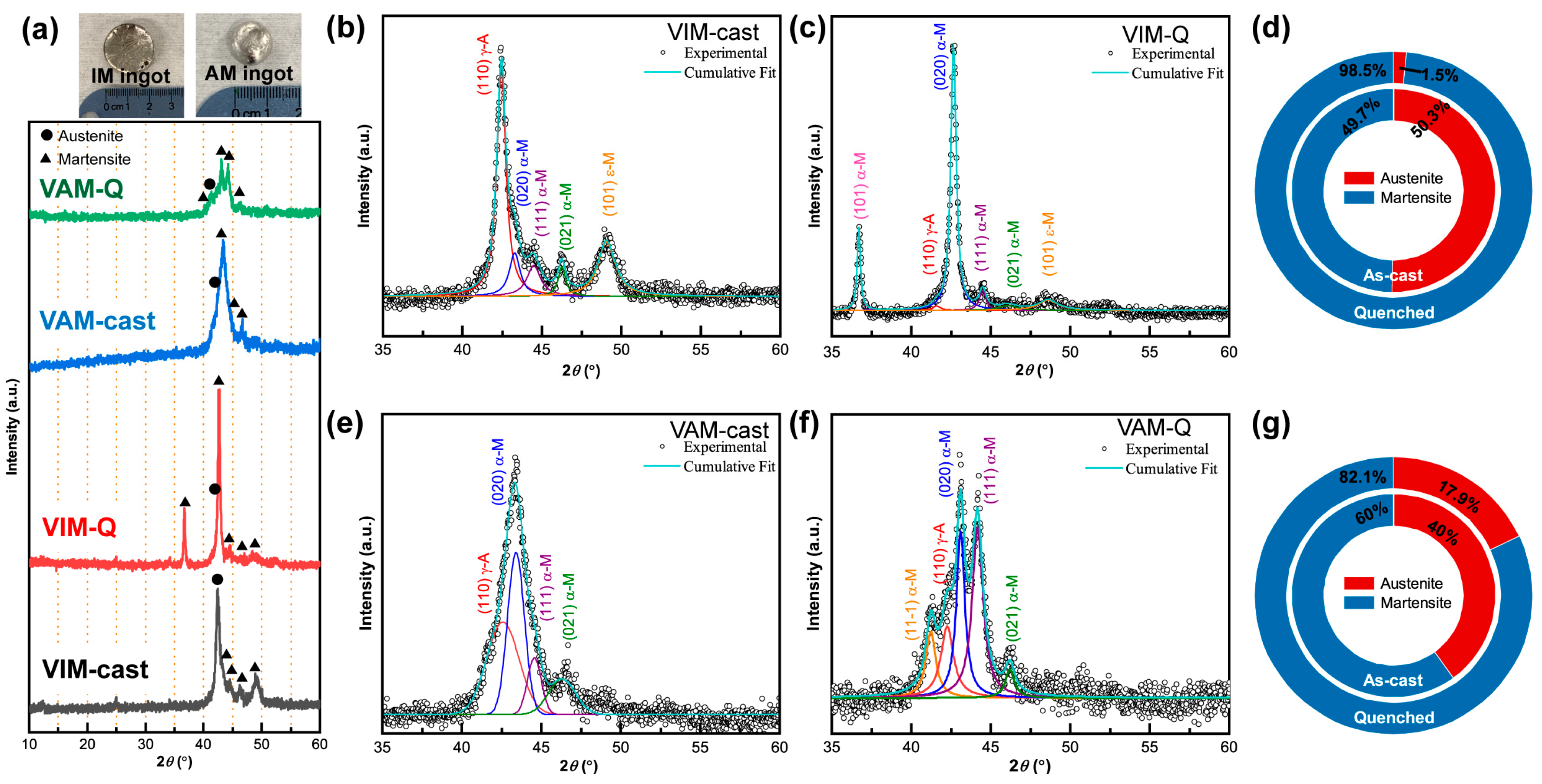
Phase formation and evolution in all the (Ni50Mn31.5Ti18)99.8B0.2 samples. (a) Sample appearance and XRD patterns illustrating phase changes for as-casted VIM (VIM-cast), as-casted VAM (VAM-cast), water-quenched VIM (VIM-Q), and water-quenched (VAM-Q) samples. (b–d) VIM samples and (e–g) VAM samples: XRD peak fitting in VIM-cast and VAM-cast (b,e) VIM-Q and VAM-Q (c,f). (d,g) Conditions and martensite and austenite phase fractions extracted from the fittings. γ and α denote FCC austenite and orthorhombic martensite phases, respectively.
2.2. Structural and Thermal Characterizations
The crystal structure of all the samples was confirmed using X-ray diffraction (XRD, PANalytical X-ray Diffractometer, Malvern Panalytical Ltd, Westborough, MA, USA) with Cu Kα radiation and a Bragg–Brentano configuration over a 2θ range from 10° to 60°. Instrumental broadening was corrected using a silicon standard reference material. The microstructures of the alloys were characterized by field emission scanning electron microscopy (FESEM) (FEI Verios G4, Thermo Fisher Scientific, Waltham, WA, USA) and energy-dispersive spectroscopy (EDS) (Oxford Aztec, Oxford, UK). Thermal analysis was performed using a differential scanning calorimeter (DSC 214) (NETZSCH Group, Selb, Germany) with the heating and cooling rate of 10 K/min. The phase fraction analysis was performed using ilastik software (version 1.4.0) developed by the ilastik team [29] and Fiji [30].
3. Results and Discussion
3.1. Subsection Austenite and Martensite Phase
The development of novel materials increasingly relies on the synergy between high-throughput computational exploration and rigorous experimental validation [31,32,33]. While simulation studies on binary or ternary systems have elucidated how composition-dependent bond energies dictate phase stability and transition temperatures [27,34], the present work extends these fundamental insights to complex quaternary Ni-Mn-Ti-B alloys. X-ray diffraction (XRD) was employed to characterize the phase evolution of (Ni50Mn31.5Ti18)99.8B0.2 samples synthesized via vacuum induction melting (VIM) and vacuum arc melting (VAM), both in the as-cast state and after water quenching (denoted as VIM-cast, VIM-Q, VAM-cast, and VAM-Q, Figure 1a). In the as-cast state, XRD patterns reveal a dual-phase contribution of austenite and martensite across all the samples. The VAM-cast sample exhibited a slightly higher martensite fraction (~60%) compared to the VIM-cast counterpart (~49.7%). This divergence is attributed to the distinct solidification kinetics of each process, where VIM involves more uniform heating but slower cooling, leading to the formation of larger precipitates that stabilize the austenite phase. Conversely, the high localized heating and rapid cooling inherent to VAM promote a more uniform phase distribution and result in a higher initial martensite content.
Upon thermal annealing and subsequent water quenching (denoted as VIM-Q and VAM-Q), a substantial increase in martensite fraction was observed. This shift stems from the transition from the face-centered cubic austenite (γ-FCC, space group ) to the orthorhombic martensite (α, space group Pmma). Thermal annealing above the transformation temperature facilitates a more uniform phase distribution while water quenching with rapid cooling rate locks this state, preventing a reversion to the austenite phase. Notably, the VIM-Q sample showed a dramatic increase in martensite content from ~50% to ~98.5% (Figure 1b–d), whereas the VAM-Q sample increased from ~60% to ~82.1% (Figure 1e–g). The pronounced responsiveness in the induction-melted sample is likely due to the dissolution or reorganization of the larger precipitates formed during the initial VIM process, which clears the path for a nearly complete martensite transformation. In contrast, the transformation in the VAM-Q sample is slightly constrained by the significant elemental segregation, dendritic structure, and finer grains resulting from the intense localized temperature gradients of the VAM process. These XRD findings dictate the critical role of thermal processing history in governing phase constitution, highlighting the VIM processed alloy’s superior sensitivity to microstructural tuning via water quenching.
3.2. Microstructure
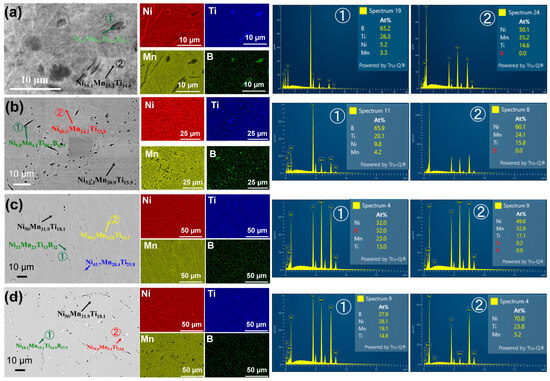
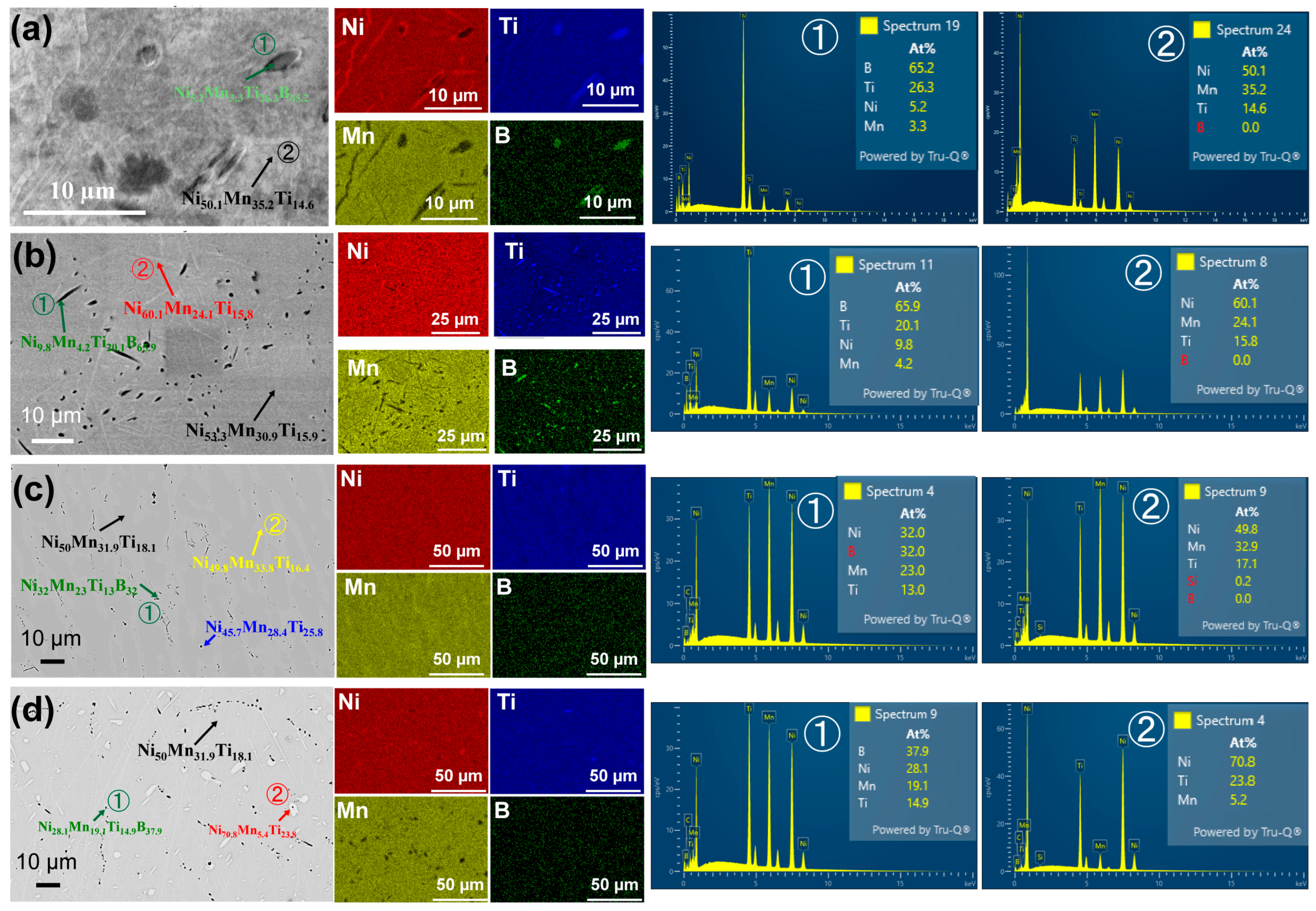
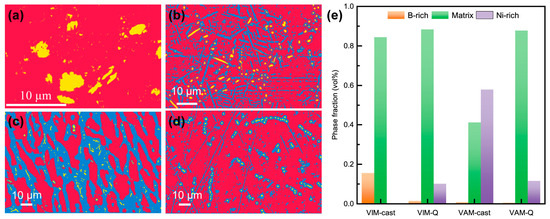
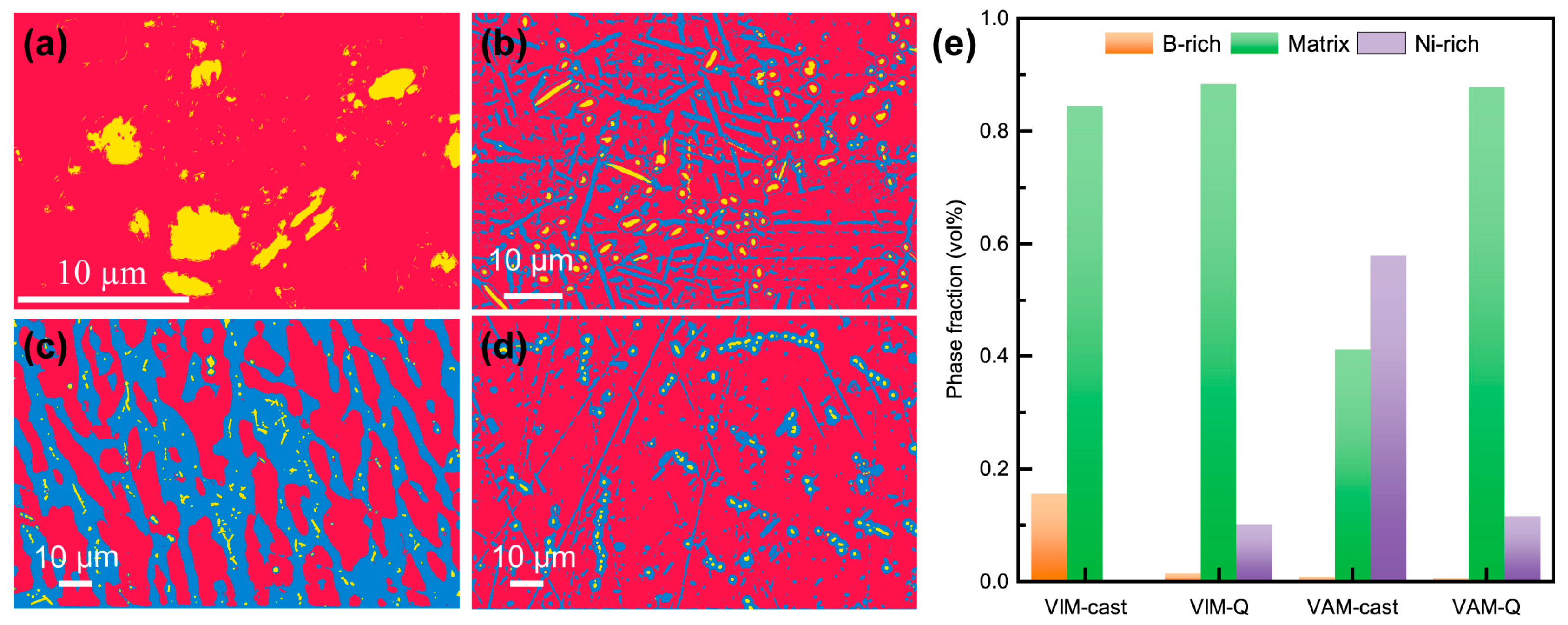
The microstructural evolution of the (Ni50Mn31.5Ti18)99.8B0.2 alloys was investigated, revealing notable differences between the VIM and VAM processing routes (Figure 2 and Figure 3). The VIM-cast sample exhibits relatively coarse precipitates (~2–10 μm). Energy-dispersive X-ray spectroscopy (EDS) mapping identifies these as B-rich (yellow regions in Figure 3a) and NiTi-rich phases (Figure 2a). These large precipitates act as nucleation sites for the austenite phase, effectively stabilizing it and hindering a complete transformation to martensite. In contrast, the VAM-cast sample displays a more refined, homogeneous microstructure with smaller dendritic features and a uniform distribution of precipitates (~1–2 μm with ~0.89 vol%, Figure 2c and Figure 3c). This finer distribution offers less resistance to martensitic transformation, resulting in a higher initial martensite fraction. However, localized elemental segregation within these dendritic regions may still stabilize the austenite phase internally, influencing the material response to subsequent thermal treatment.
Figure 2.
SEM images and EDS mapping of all (Ni50Mn31.5Ti18)99.8B0.2 samples. (a) VIM-cast sample. (b) VIM-Q sample. (c) VAM-cast sample. (d) VAM-Q sample.
Figure 3.
Phase fraction analysis. (a) VIM-cast sample. (b) VIM-Q sample. (c) VAM-cast sample. (d) VAM-Q sample. (e) Phase fraction of B-rich (needle-shape yellow regions), matrix (red regions), and Ni-rich (blue regions) phases in vol%. These data are calculated as the mean value based on three FESEM images captured from different regions of each sample with standard deviation < 10%.
Following thermal annealing and water quenching, both samples underwent significant precipitate refinement. For the VIM-Q sample, rapid cooling broke down the coarse as-cast precipitates into finer, evenly distributed precipitates (~1.47 vol%, Figure 2b and Figure 3b). B-rich zones primarily formed at grain boundaries, while Ni-rich zones appeared as light-gray acicular structures (Figure 2b). These finer precipitates provide significantly less mechanical hindrance to martensitic transformation, explaining the dramatic increase in martensite content observed in XRD analysis. While the VAM-Q sample also showed refinement, the transition was less pronounced because the microstructure of the VAM-cast sample was already conducive to martensitic transformation.
A defining feature of the water-quenched samples, particularly the VIM-Q variant (~1.47 vol% vs. ~0.66 vol%, Figure 3), is the presence of pronounced needle-like regions (Figure 3b,d). This acicular morphology is a hallmark of the martensitic phase, which forms through a rapid, diffusionless transformation involving the coordinated shear motion of atoms [35]. The growth of these elongated structures is governed by specific habit planes, such as the transition from (110) γ to (020) α, for nucleation and growth (Figure 1b–f) [36,37].
It is well established that carbon diffusion plays a crucial role in stabilizing the austenite phase and influencing martensite formation in steel and other alloys [38]. The role of boron in this system appears analogous to that of carbon in steel. During water quenching, the high cooling rate creates a diffusion-limited non-equilibrium state where boron atoms are trapped within the lattice. Given that the atomic size of boron (~0.85 Å) is substantially smaller than those of the matrix elements (Ni ~1.25 Å, Mn ~1.27 Å, Ti ~1.45 Å), boron preferentially occupies larger octahedral interstitial sites rather than substituting for larger metal atoms [39]. Additionally, boron exhibits higher solubility in the austenite matrix. The rapid quenching kinetics of the VAM-Q sample suppresses the long-range diffusion required for boron to segregate into TiB2 precipitates. Consequently, these interstitial boron atoms induce local lattice strains that stabilize the dendritic regions and modulate the austenite-to-martensite transformation.
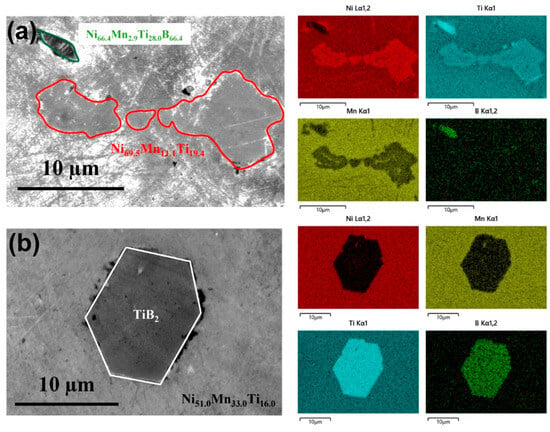
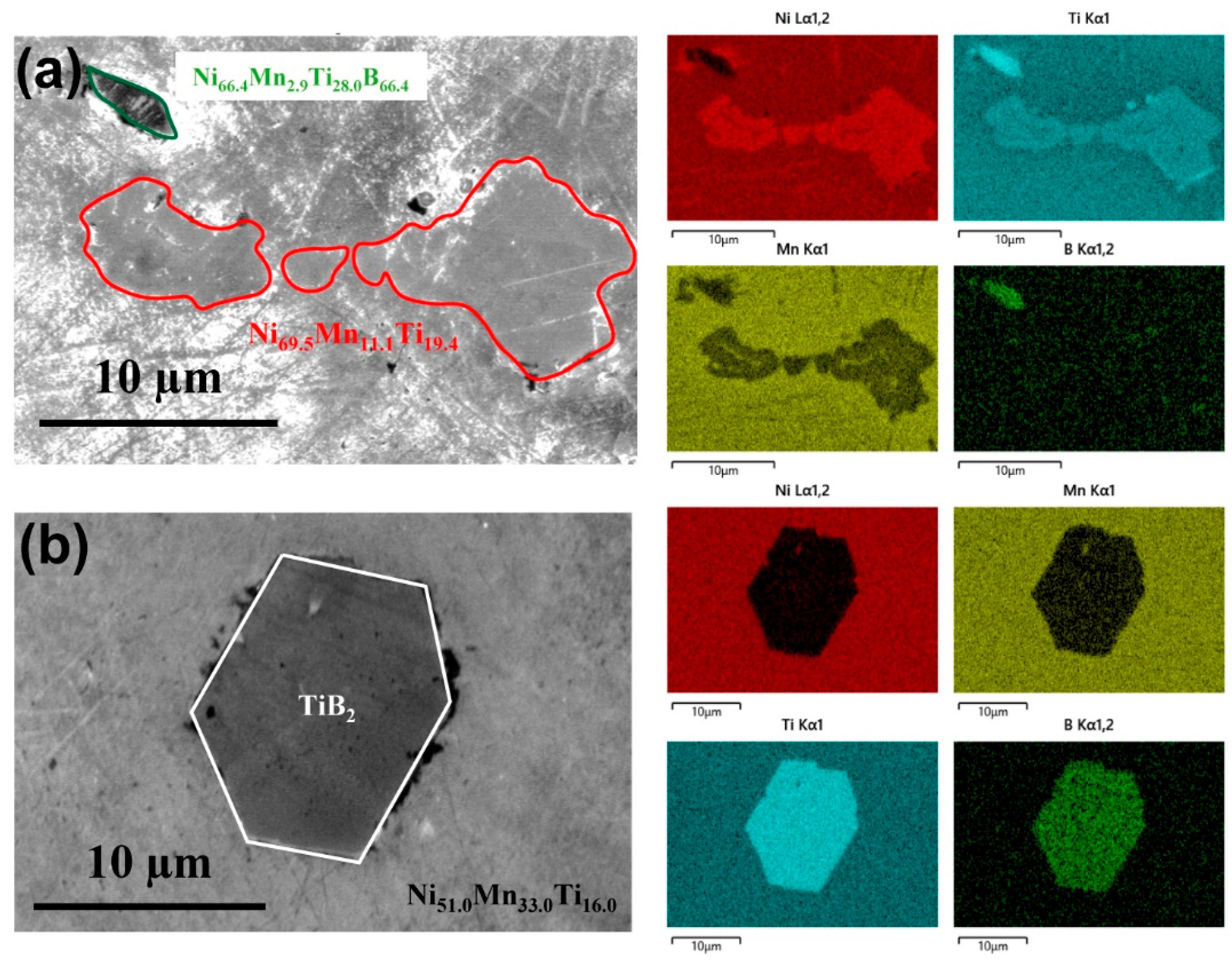
Notably, the VIM-cast sample exhibits significantly lower homogeneity compared to its VAM-cast counterpart. EDS analysis reveals the presence of cubit Ni2(Ti, Mn) (space group Fd3m) and hexagonal TiB2 (space group P6/mmm) flakes, with dimensions of ~10 μm (Figure 4). Thermodynamically, the formation of TiB2 is highly favored due to its exceptionally low negative enthalpy of formation (ΔHf ~ −324 kJ/mol) [40], rendering it substantially more stable than potential Ni-B (ΔHf ~ −35 kJ/mol) or Mn-B (ΔHf ~ −63 kJ/mol) alternatives [40,41]. Following the quenching process, these precipitates evolve into acicular (needle-like) morphologies (Figure 2b). In both VIM and VAM samples, boron resides primarily along grain boundaries as precipitates rather than being fully assimilated into the NiTi matrix. Previous studies indicate that Ni-Ti and TiB2 precipitates can enhance the mechanical strength of SMAs by improving grain boundary cohesion while preserving superelasticity [42,43]. These B-rich precipitates and needle-like structures likely serve as additional nucleation sites for stress-induced martensite. By reducing the energy dissipation associated with nucleation and promoting a more reversible phase transition, these features contribute to the reduction in stress hysteresis.
Figure 4.
SEM images and EDS mapping of (Ni50Mn31.5Ti18)99.8B0.2 VIM-cast sample, revealing chemical inhomogeneity. (a) Ni2(Ti,Mn)-rich phase. (b) TiB2-rich phase.
The TiB2 and Ni2(Ti,Mn) precipitates show a dual role in modulating martensitic strain propagation. Kinetically, large and coarse precipitates (Figure 4) act as thermal and mechanical obstacles. Thermodynamically, however, they alter the local matrix composition, thereby shifting phase stability. To quantify this thermodynamic driving force, the valence electron concentration (e/a ratio) [44] was determined based on the matrix composition of the quenched samples (Figure 2b,d), representing the chemical state of the austenite/martensite phases during the DSC measurements (Figure 5a,b). The e/a ratio is defined as
where ci is the atomic fraction of each element in the matrix and Vi is the number of valence electrons. A shift in e/a from 7.957 (VAM-Q sample) to 8.129 (VIM-Q sample) was observed. This increase in Δ(e/a) of ~1.7 corresponds to an increase in phase transformation temperature of ~100 K (Table 1), as revealed in our DSC data (Figure 5a,b). This confirms that the precipitates exert a primary thermodynamic influence by modulating matrix chemistry, rather than acting solely as passive mechanical barriers.
Table 1.
Austenite and martensite start, peak and finish temperatures (As, Ap, Af, Ms, Mp, Mf), and thermal hysteresis ΔThys of VIM-Q and VAM-Q (Ni50Mn31.5Ti18)99.8B0.2 samples.
3.3. Thermal Analysis
The DSC profiles characterize the phase transitions of the alloys; endothermic peaks during heating and exothermic peaks during cooling correspond to the austenitic and martensitic transformations, respectively. The critical transition temperatures, including As (austenite start), Ap (austenite peak), Af (austenite finish), Ms (martensite start), Mp (martensite peak), and Mf (martensite finish), along with the thermal hysteresis (ΔThys) and transformation entropy changes (ΔStr), are summarized in Table 1. The ΔThys is defined as
For a reversible first-order transformation at equilibrium, the Gibbs free energy change ΔG = 0. Consequently, ΔStr can be derived as
where is the transformation enthalpy obtained by integrating the heat flow peaks, and T0 represents the thermodynamic equilibrium temperature at which martensite and austenite phase coexist, often approximated as [45]. Both ΔThys and ΔStr are crucial parameters in evaluating and optimizing elastocaloric SMA materials. A larger ΔStr leads to improved cooling power, while lower thermal hysteresis allows for enhanced cycling stability and mechanical durability, improved system efficiency, and reduced energy loss [21,46]. As shown in Figure 5a,b, the VIM-cast and VAM-cast samples exhibit relative flat and broad DSC curves. This is attributed to the incomplete phase transition and microstructural inhomogeneities, such as segregation of elements, dendritic structures, and unevenly distributed precipitates, which suppress distinct transformation peaks. In contrast, the quenched samples (VIM-Q and VAM-Q) display sharp, well-defined peaks, indicating a more complete and homogeneous transformation facilitated by the redistribution of precipitates during thermal treatment.
Figure 5.
DSC analysis. (a) VIM-Q sample. (b) VAM-Q sample. (c) Comparison of thermal hysteresis (ΔThys) between VIM-Q and VAM-Q samples and the literature [6,21,47,48,49].
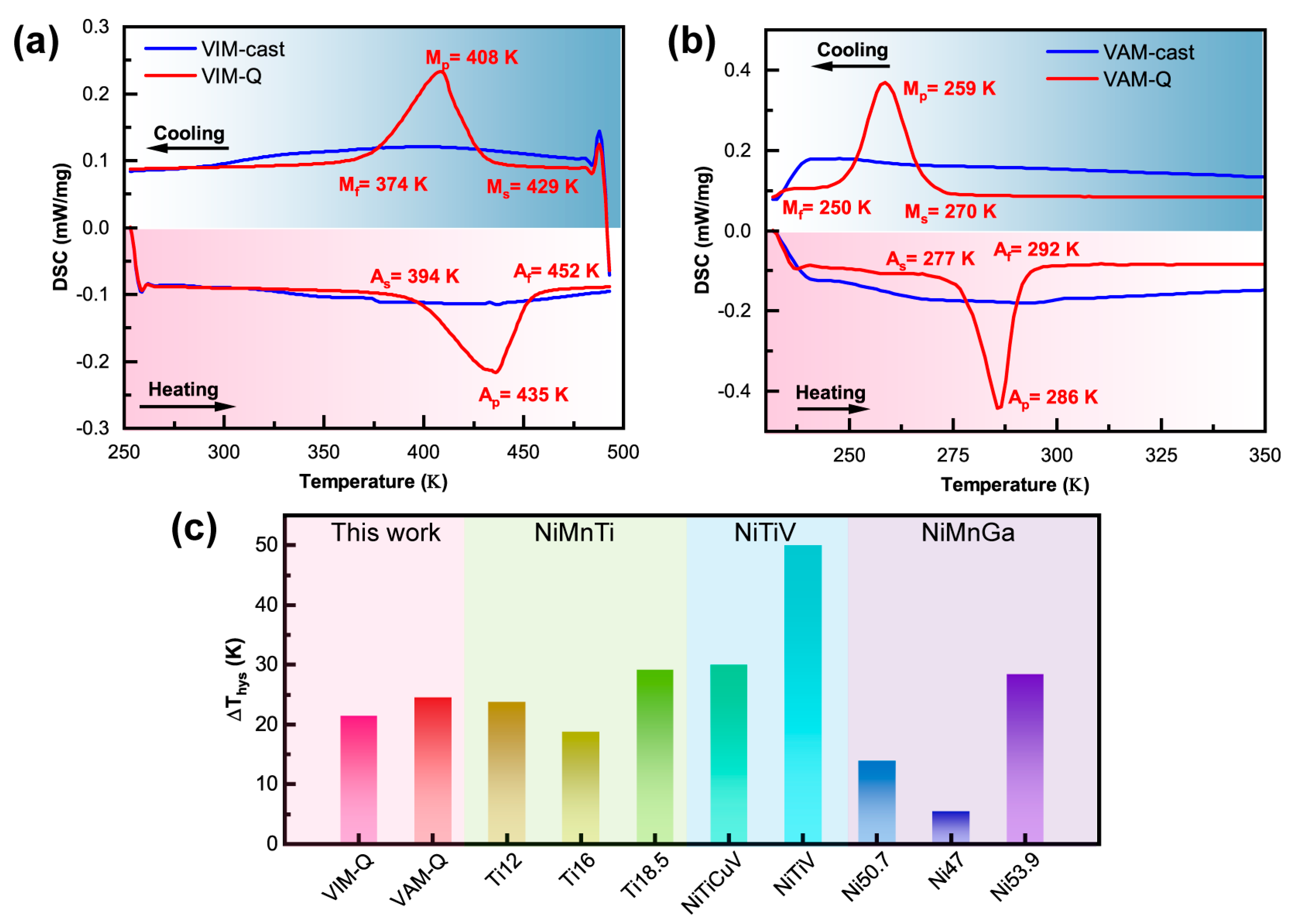
The VAM-Q sample illustrates a significantly lower transformation temperature compared to the VIM-Q sample, characterized by a sharp transition near ambient temperature (Ap = 286 K and Mp = 259 K). Conversely, the VIM-Q sample shows broader transformation peaks at much higher temperatures, with As being ~120 K higher than that of the VAM-Q sample (Figure 5a,b and Table 1). This shift is driven by the higher martensite fraction (~98.5% in Figure 1d) in the VIM-Q sample, which generates significant internal stresses and a highly strained needle-like microstructure (Figure 2b). The high transformation temperature in the VIM-Q sample is supported by a thermodynamic balance where internal quenching stresses and precipitate-induced strain fields act as a mechanical driving force, shifting the equilibrium temperature upward as per the Clausius–Clapeyron relationship [50]. The total Gibbs free energy change for the austenite-to-martensite transformation (ΔGA→M) is expressed as
where is the chemical free energy difference (ΔH-TΔS), is the elastic strain energy from lattice mismatch, and is the energy dissipated by internal friction of hysteresis [51]. In the VIM-Q sample, the higher fraction of needle-like precipitates (~1.47%) contributes to a substantial internal stress (σint) that acts as a mechanical driving force. According to the Clausius–Clapeyron relation, this internal stress lifts the transformation temperature (ΔTtr) as follows [50]:
where is the transformation strain. The local stress fields around these precipitates favor the nucleation of martensite at significantly higher temperatures (As ~394 K), while their relatively high fraction (~98.5%) provides a lower barrier to global phase propagation.
Boron, as a p-block element, has a very low e/a ratio contribution compared to transition metals. It does not significantly change the global e/a value but alters the γ (Fmm)–α (Pmma) phase equilibrium (Figure 1). By occupying interstitial sites within the lattice, boron alters the elastic strain energy () and the chemical potential of the phases. The quenching process is kinetically essential to trap boron in this interstitial state, preventing the formation of TiB2 precipitates (Figure 2, Figure 3 and Figure 4). This solute effect fundamentally redefines the energy landscape, as evidenced by the substantial increase in the equilibrium temperature of T0 ~100 K (Figure 5a,b) and the substantial changes in transformation enthalpy (ΔH).
From an application standpoint, the near-ambient transformation temperature of the VAM-Q sample (~273 K) is ideal for space cooling and refrigeration. Operating within this range allows for efficient heat extraction from building environments without excessive energy input. Furthermore, this proximity to room temperature minimizes mechanical stress accumulation during cycling, enhancing the coefficient of performance (COP) and ensuring the long-term durability of elastocaloric materials [4,11,12,52,53].
Figure 5c summarizes the thermal hysteresis (ΔThys) of the represented elastocaloric SMAs. The ΔThys of the VAM-Q sample is slightly higher than that of the VIM-Q sample. The difference is primarily governed by three factors: chemical compositions, microstructure homogeneity, and transition entropy change (ΔStr). ΔThys varies significantly with stoichiometry. For example, variations in Ti content (Ti16 and Ti18.5) in NiMnTi-based SMAs [6], in Ni concentration (Ni47 to Ni53.9) in NiMnGa-based SMAs [47], and in V concentration in TiNiCuV-based SMAs [21] can shift ΔThys by 10.4 K to 23 K, respectively. The observed ΔThys of ~23 K is considered moderate compared to the 30–40 K typical of binary NiTi and many all-d-metal Heusler alloys [54,55]. Microstructurally, the VAM-Q sample’s dendritic architecture and boron-rich precipitates introduce spatial variations in transformation temperatures, contributing to its slightly higher thermal hysteresis relative to the VIM-Q sample.
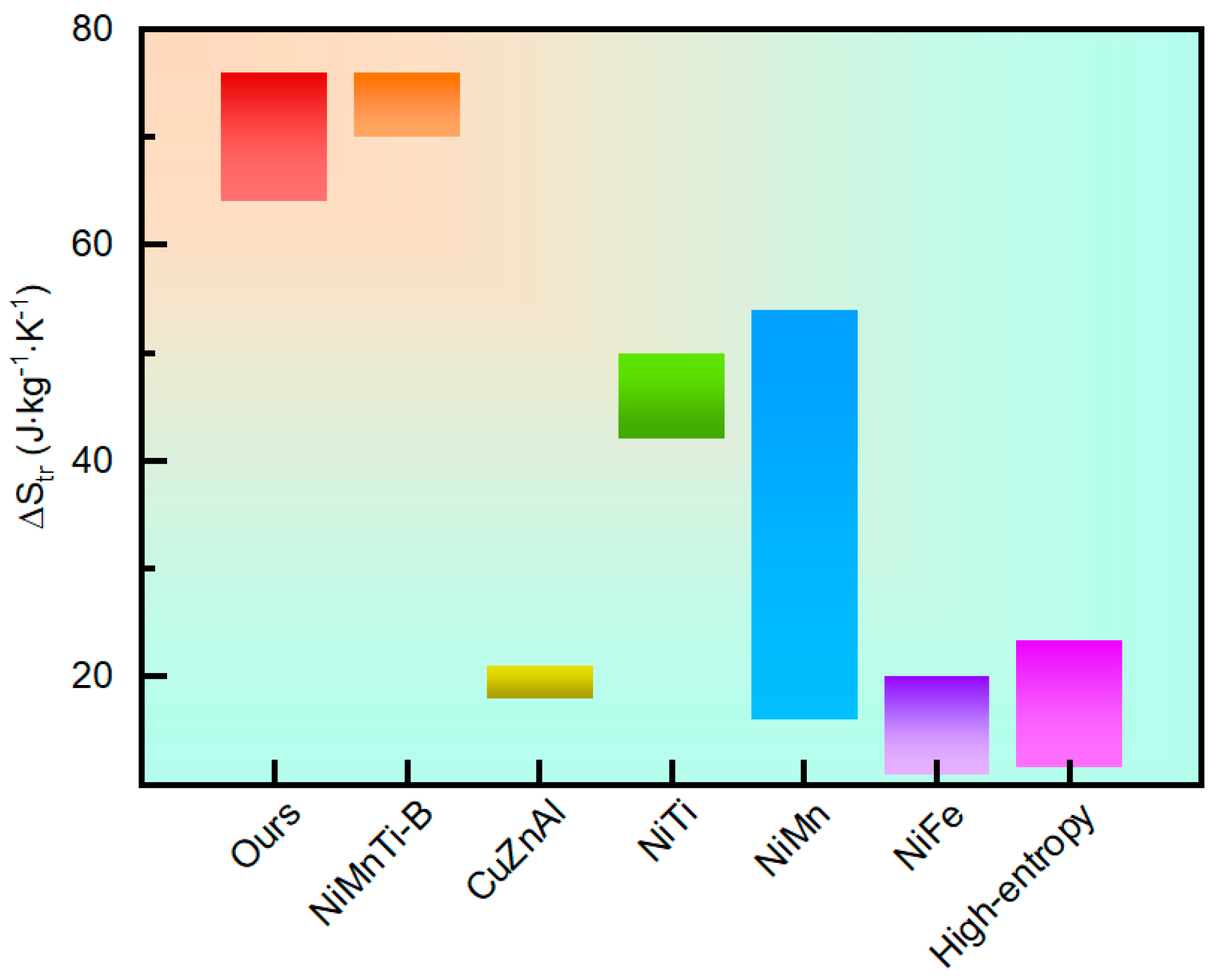
Furthermore, SMAs exhibiting larger ΔStr during phase transitions typically demonstrate wider thermal hysteresis [56]. As illustrated in Figure 6, both VIM-Q and VAM-Q samples process high ΔStr values (>60 J·kg−1·K−1), with the VAM-Q sample reaching ~75 J·kg−1·K−1. These results are significant when compared with other state-of-the-art SMAs (Figure 6) [14,15,57,58,59,60,61,62,63]. While moderate hysteresis can lead to cumulative heating and a potential reduction in the COP, this is offset by the advantages of a colossal ΔStr.
A high ΔStr enhances elastocaloric cooling performance in several critical ways. Firstly, it increases latent heat (), according to the relation , leading to higher cooling power per cycle. Secondly, it drives a larger adiabatic temperature change (ΔTad), defined as [5], where Cp is the specific heat capacity. This facilitates a broader operating temperature span. Thirdly, a high ΔStr enhances recoverable work output (W), given by , and promotes more rapid thermal cycling. In this study, we deliberately focus on the synthesis and thermal treatment history, to isolate the impact of them on phase fraction, precipitate morphology, and transformation entropy changes. Our results show similar ΔStr to other high-transition-entropy changes in the literature in Mn-Ti-B systems [6,54,64,65]. A colossal adiabatic temperature change for Mn-Ti-B alloys of up to −31.5 K has been reported, which surpasses the state-of-the-art NiTi (~25 K) [6,54]. Furthermore, the advantage of boron microalloying provides high compressive strength (>1500 MPa) and significant ductility (>17%) by strengthening grain boundaries [65].
Figure 6.
Transformation entropy changes ΔStr in VIM-Q and VAM-Q samples and comparison with other SMAs [6,66,67,68,69,70,71,72,73,74,75]. The A-M and M-A indicate the austenite-to-martensite and martensite-to-austenite phase transformation. The highest values of ΔStr are collected under the various conditions such as stress mode and cycle numbers. The range of ΔStr for each system corresponds to the different elemental ratio reported from either the same or different literature.
4. Conclusions
This study demonstrates that thermal processing history is a decisive factor in governing the martensite–austenite phase ratio, microstructure evolution, and phase transformation kinetics in (Ni50Mn31.5Ti18)99.8B0.2 alloys. In the induction-melted sample, water quenching (VIM-Q) induces the formation of needle-like, boron-rich precipitates within the martensite lattice. Conversely, the water-quenched vacuum arc-melted (VAM-Q) sample exhibits boron-rich precipitates localized along grain boundaries within a characteristic dendritic architecture. These precipitates facilitate austenite phase retention, effectively shifting the transformation temperature toward the ambient regime. Consequently, the VAM-Q sample achieved a significant martensite phase fraction of ~82% and a near-ambient phase transformation temperature of ~277 K. This microstructural tuning yielded a colossal transformation entropy change of ~ 75 J·kg−1·K−1 and a moderate thermal hysteresis of ~23 K. These findings highlight the fundamental role of thermal processing history in tailoring phase stability and transition thermodynamics, offering a robust framework for the design and fabrication of high-performance elastocaloric materials for sustainable thermal management.
Author Contributions
Conceptualization, N.L. and W.L.; methodology, N.L. and W.L.; validation, N.L., M.A. and W.L.; formal analysis, N.L. and W.L.; investigation, N.L., M.A., D.M., S.G. and W.L.; resources, W.L. and B.P.; data curation, N.L. and W.L.; writing—original draft preparation, N.L.; writing—review and editing, N.L., M.A., D.M., S.G., B.P. and W.L.; visualization, N.L. and W.L.; supervision, W.L.; project administration, W.L.; funding acquisition, W.L. All authors have read and agreed to the published version of the manuscript.
Funding
This project was supported, in part, by funding from the Seed Grant of Penn State’s Materials Research Institute (MRI) and Penn State’s Institute for Energy and the Environment (IEE). Content is the responsibility of the authors and does not represent the view of the MRI or IEE. The project was partially supported by the Start-up package at Georgia Southern University.
Data Availability Statement
All data is available in the main text and is available upon request.
Conflicts of Interest
The authors declare no conflicts of interest.
References
- Zhang, F.Q.; Miao, X.F.; van Dijk, N.; Brück, E.; Ren, Y. Advanced Magnetocaloric Materials for Energy Conversion: Recent Progress, Opportunities, and Perspective. Adv. Energy Mater. 2024, 14, 2400369. [Google Scholar] [CrossRef] [Scilit]
- Cheng, L.Q.; Yan, Y.K.; Li, X.T.; Xiong, X.M.; Chen, X.; Zhu, L.F.; Li, W.J.; Chen, K.; Sanghadasa, M.; Priya, S. Electrocaloric Performance of Multilayer Ceramic Chips: Effect of Geometric Structure Induced Internal Stress. ACS Appl. Mater. Inter. 2021, 13, 38508–38516. [Google Scholar] [CrossRef] [Scilit]
- Sun, Y.; An, S.H.; Gao, Y.H.; Yu, Z.B.; Yuan, X.L.; Ma, Z.J.; Shi, K.W.; Hu, F.X.; Wang, C. Materials with the barocaloric effect for solid-state refrigeration. J. Mater. Chem. A 2025, 13, 6152–6175. [Google Scholar] [CrossRef] [Scilit]
- Ahcin, Z.; Dall’Olio, S.; Zerovnik, A.; Baskovic, U.Z.; Porenta, L.; Kabirifar, P.; Cerar, J.; Zupan, S.; Brojan, M.; Klemenc, J.; et al. High-performance cooling and heat pumping based on fatigue-resistant elastocaloric effect in compression. Joule 2022, 6, 2338–2357. [Google Scholar] [CrossRef] [Scilit] [PubMed]
- Chen, J.Y.; Lei, L.P.; Fang, G. Elastocaloric cooling of shape memory alloys: A review. Mater. Today Commun. 2021, 28, 102706. [Google Scholar] [CrossRef] [Scilit]
- Cong, D.Y.; Xiong, W.X.; Planes, A.; Ren, Y.; Manosa, L.; Cao, P.Y.; Nie, Z.H.; Sun, X.M.; Yang, Z.; Hong, X.F.; et al. Colossal Elastocaloric Effect in Ferroelastic Ni-Mn-Ti Alloys. Phys. Rev. Lett. 2019, 122, 255703. [Google Scholar]
- Bruederlin, F.; Bumke, L.; Chluba, C.; Ossmer, H.; Quandt, E.; Kohl, M. Elastocaloric Cooling on the Miniature Scale: A Review on Materials and Device Engineering. Energy Technol. 2018, 6, 1588–1604. [Google Scholar] [CrossRef] [Scilit]
- Tusek, J.; Engelbrecht, K.; Eriksen, D.; Dall’Olio, S.; Tusek, J.; Pryds, N. A regenerative elastocaloric heat pump. Nat. Energy 2016, 1, 16134. [Google Scholar] [CrossRef] [Scilit]
- Energy Savings Potential and RD&D Opportunities for Nonvapor-Compression HVAC Technologies; U.S. Department of Energy: Washington, DC, USA, 2014.
- Manosa, L.; Planes, A. Elastocaloric Effect in Shape-Memory Alloys. Shape Mem. Superelast. 2024, 10, 89–98. [Google Scholar] [CrossRef] [Scilit]
- Qian, S.X.; Catalini, D.; Muehlbauer, J.; Liu, B.Y.; Mevada, H.; Hou, H.L.; Hwang, Y.H.; Radermacher, R.; Takeuchi, I. High-performance multimode elastocaloric cooling system. Science 2023, 380, 722–727. [Google Scholar] [CrossRef] [Scilit]
- Wang, Y.; Liu, Y.; Xu, S.; Zhou, G.; Yu, J.; Qian, S. Towards practical elastocaloric cooling. Comms. Eng. 2023, 2, 79. [Google Scholar] [CrossRef] [Scilit]
- Tusek, J.; Engelbrecht, K.; Millán-Solsona, R.; Mañosa, L.; Vives, E.; Mikkelsen, L.P.; Pryds, N. The Elastocaloric Effect: A Way to Cool Efficiently. Adv. Energy Mater. 2015, 5, 1500361. [Google Scholar] [CrossRef] [Scilit]
- Cui, J.; Wu, Y.M.; Muehlbauer, J.; Hwang, Y.H.; Radermacher, R.; Fackler, S.; Wuttig, M.; Takeuchi, I. Demonstration of high efficiency elastocaloric cooling with large ΔT using NiTi wires. Appl. Phys. Lett. 2012, 101, 073904. [Google Scholar] [CrossRef] [Scilit]
- Ossmer, H.; Lambrecht, F.; Gültig, M.; Chluba, C.; Quandt, E.; Kohl, M. Evolution of temperature profiles in TiNi films for elastocaloric cooling. Acta Mater. 2014, 81, 9–20. [Google Scholar] [CrossRef] [Scilit]
- López-Ferreño, I.; Gómez-Cortés, J.F.; Breczewski, T.; Ruiz-Larrea, I.; Nó, M.L.; San Juan, J.M. High-temperature shape memory alloys based on the Cu-Al-Ni system: Design and thermomechanical characterization. J. Mater. Res. Technol. 2020, 9, 9972–9984. [Google Scholar]
- Dasgupta, R. A look into Cu-based shape memory alloys: Present scenario and future prospects. J. Mater. Res. 2014, 29, 1681–1698. [Google Scholar] [CrossRef] [Scilit]
- Tang, R.Z.; Liu, G.T.; Sun, B.; Dong, Z.Z.; Zhang, X.; Cui, B. New insights on improving the strain recovery characteristics of the Cu-Al-Ni high-temperature shape memory alloy. J. Alloys Compd. 2025, 1010, 177476. [Google Scholar] [CrossRef] [Scilit]
- Vollmer, M.; Arold, T.; Kriegel, M.J.; Klemm, V.; Degener, S.; Freudenberger, J.; Niendorf, T. Promoting abnormal grain growth in Fe-based shape memory alloys through compositional adjustments. Nat. Commun. 2019, 10, 2337. [Google Scholar] [CrossRef] [Scilit]
- Algamal, A.; Abedi, H.; Gandhi, U.; Benafan, O.; Elahinia, M.; Qattawi, A. Manufacturing, processing, applications, and advancements of Fe-based shape memory alloys. J. Alloys Compd. 2025, 1010, 177068. [Google Scholar]
- Pfeuffer, L.; Lemke, J.; Shayanfar, N.; Riegg, S.; Koch, D.; Taubel, A.; Scheibel, F.; Kani, N.A.; Adabifiroozjaei, E.; Molina-Luna, L.; et al. Microstructure engineering of metamagnetic Ni-Mn-based Heusler compounds by Fe-doping: A roadmap towards excellent cyclic stability combined with large elastocaloric and magnetocaloric effects. Acta Mater. 2021, 221, 117390. [Google Scholar] [CrossRef] [Scilit]
- Li, Z.Z.; Li, Z.B.; Lu, Y.Z.; Lu, X.; Zuo, L. Enhanced elastocaloric effect and refrigeration properties in a Si-doped Ni-Mn-In shape memory alloy. J. Mater. Sci. Technol. 2022, 117, 167–173. [Google Scholar] [CrossRef] [Scilit]
- Zhu, X.; Zhang, X.; Qian, M.; Geng, L. Microstructure evolution during superelastic cycles and related elastocaloric effect in N-doped Ti-based shape memory alloys. J. Mater. Sci. Technol. 2025, 234, 1–14. [Google Scholar] [CrossRef] [Scilit]
- Yang, Z.; Cong, D.Y.; Sun, X.M.; Nie, Z.H.; Wang, Y.D. Enhanced cyclability of elastocaloric effect in boron-microalloyed Ni-Mn-In magnetic shape memory alloys. Acta Mater. 2017, 127, 33–42. [Google Scholar] [CrossRef] [Scilit]
- Tang, X.H.; Feng, Y.; Wang, H.B.; Wang, P. Enhanced elastocaloric effect and cycle stability in B and Cu co-doping Ni-Mn-In polycrystals. Appl. Phys. Lett. 2019, 114, 033901. [Google Scholar] [CrossRef] [Scilit]
- Zhang, X.Y.; Chen, H.Y.; Li, S.W.; Niu, Y.R.; Yin, T.; Song, C.; Lang, R.Q.; Cong, D.Y.; Li, S.L.; Wang, Y.D. Enhanced cyclability of superelasticity and elastocaloric effect in Cu and B co-doped Co-Ni-Ga shape memory alloys. J. Alloys Compd. 2022, 918, 165633. [Google Scholar] [CrossRef] [Scilit]
- Trong, D.N.; Quoc, T.T.; Ţălu, Ş. Simulation study of structural, phase transition, and glass transition behavior in Ga1-xInx alloys (x = 0.2–0.8). Phys. B Condens. Matter 2026, 727, 418271. [Google Scholar] [CrossRef] [Scilit]
- Tehranchi, A.; Zhang, S.; Zendegani, A.; Scheu, C.; Hickel, T.; Neugebauer, J. Metastable defect phase diagrams as roadmap to tailor chemically driven defect formation. Acta Mater. 2024, 277, 120145. [Google Scholar] [CrossRef] [Scilit]
- Berg, S.; Kutra, D.; Kroeger, T.; Straehle, C.N.; Kausler, B.X.; Haubold, C.; Schiegg, M.; Ales, J.; Beier, T.; Rudy, M.; et al. ilastik: Interactive machine learning for (bio) image analysis. Nat. Methods 2019, 16, 1226–1232. [Google Scholar] [CrossRef] [Scilit]
- Schindelin, J.; Arganda-Carreras, I.; Frise, E.; Kaynig, V.; Longair, M.; Pietzsch, T.; Preibisch, S.; Rueden, C.; Saalfeld, S.; Schmid, B.; et al. Fiji: An open-source platform for biological-image analysis. Nat. Methods 2012, 9, 676–682. [Google Scholar]
- Raman, L.; Debnath, A.; Furton, E.; Lin, S.; Krajewski, A.; Ahn, M.; Shang, S.; Priya, S.; Liu, Z.-K.; Beese, A.M.; et al. Data-driven inverse design of MoNbTiVWZr refractory multicomponent alloys: Microstructure and mechanical properties. J. Mater. Sci. Eng. A 2024, 918, 147475. [Google Scholar] [CrossRef] [Scilit]
- Li, W.; Raman, L.; Debnath, A.; Ahn, M.; Lin, S.; Krajewski, A.M.; Shang, S.; Priya, S.; Reinhart, W.F.; Liu, Z.-K.; et al. Design and validation of refractory alloys using machine learning, CALPHAD, and experiments. Int. J. Refract. Met. Hard Mater. 2024, 121, 106673. [Google Scholar] [CrossRef] [Scilit]
- Ghosh, S.; Nozariasbmarz, A.; Lee, H.; Raman, L.; Sharma, S.; Smriti, R.B.; Mandal, D.; Zhang, Y.; Karan, S.K.; Liu, N.; et al. High-entropy-driven half-Heusler alloys boost thermoelectric performance. Joule 2024, 8, 3303–3312. [Google Scholar] [CrossRef] [Scilit]
- Talu, S.; Trong, D.N.; Truong, L.V. Review, The power of simulation: Exploring binary alloys for next-generation applications. J. Nanomater. Appl. 2025, 1, 1–16. [Google Scholar]
- Delaey, L. Diffusionless Transformations. In Phase Transformations in Materials; Wiley: Hoboken, NJ, USA, 2001; pp. 583–654. [Google Scholar]
- Machlin, E.S.; Cohen, M. Habit Phenomenon in the Martensitic Transformation. JOM 1951, 3, 1019–1029. [Google Scholar] [CrossRef] [Scilit]
- Heller, L.; Šittner, P. On the habit planes between elastically distorted austenite and martensite in NiTi. Acta Mater. 2024, 269, 119828. [Google Scholar] [CrossRef] [Scilit]
- Speer, J.; Matlock, D.K.; De Cooman, B.C.; Schroth, J.G. Carbon partitioning into austenite after martensite transformation. Acta Mater. 2003, 51, 2611–2622. [Google Scholar] [CrossRef] [Scilit]
- Gong, X.; Wu, Y.; Gao, Z.; Sun, Y.; Guan, Y.; Guan, X.; Qin, X.; Hou, J.; Zhou, L. Microstructural Evolution and Mechanical Properties of a Ni-Based Alloy with High Boron Content for the Pre-Sintered Preform (PSP) Application. Materials 2023, 16, 7483. [Google Scholar] [CrossRef] [Scilit]
- Colinet, C.; Tedenac, J.-C. Enthalpies of Formation of Transition Metal Diborides: A First Principles Study. Crystals 2015, 5, 562–582. [Google Scholar] [CrossRef] [Scilit]
- Wang, K.; Du, D.; Chang, B.; Hong, Y.; Ju, J.; Sun, S.; Fu, H. Mechanical Properties, Electronic Structures, and Debye Temperature of NixBy Compounds Obtained by the First Principles Calculations. Crystals 2018, 8, 451. [Google Scholar] [CrossRef] [Scilit]
- Zhao, Y.; Ming, F.; Jia, N.; Chen, J.; Ren, S.; Xu, W.; Qu, X. High-strength superelastic as-cast Ni50.9Ti49.1-TiB2 in-situ composites. Mater. Sci. Eng. A 2021, 818, 141451. [Google Scholar] [CrossRef] [Scilit]
- Li, Z.; Cai, J.; Zhao, Z.; Yang, Y.; Ren, Y.; Sha, G.; Cui, L.; Yu, K.; Jiang, D.; Xiao, Y.; et al. Local chemical inhomogeneity enables superior strength-ductility-superelasticity synergy in additively manufactured NiTi shape memory alloys. Nat. Commun. 2025, 16, 1941. [Google Scholar] [CrossRef] [Scilit]
- Zarinejad, M.; Wada, K.; Pahlevani, F.; Katal, R.; Rimaz, S. Valence Electron Ratio for Design of Shape Memory Alloys with Desired Phase Transformation Temperatures. Shape Mem. Superelast. 2021, 7, 179–189. [Google Scholar] [CrossRef] [Scilit]
- Kohl, M. Shape Memory Microactuators, 1st ed.; Springer: Berlin/Heidelberg, Germany, 2004; p. 247. [Google Scholar]
- Zhang, G.Y.; Wang, H.L.; Li, Z.B.; Yang, B.; Yan, H.L.; Zuo, L. Quasi-linear superelasticity and associated elastocaloric effect in boron-doped polycrystalline Ni-Mn-Ti alloys. Acta Mater. 2024, 281, 120411. [Google Scholar] [CrossRef] [Scilit]
- Zhang, C.G.; Chen, X.; Hubert, O.; He, Y.J. Characterization on thermal hysteresis of shape memory alloys via macroscopic interface propagation. Materialia 2024, 33, 102038. [Google Scholar] [CrossRef] [Scilit]
- Schmidt, M.; Ullrich, J.; Wieczorek, A.P.; Frenzel, J.; Schütze, A.; Eggeler, G.; Seelecke, S. Thermal Stabilization of NiTiCuV Shape Memory Alloys: Observations During Elastocaloric Training. Shape Mem. Superelast. 2015, 1, 132–141. [Google Scholar] [CrossRef] [Scilit]
- Frenzel, J.; Wieczorek, A.; Opahle, I.; Maass, B.; Drautz, R.; Eggeler, G. On the effect of alloy composition on martensite start temperatures and latent heats in Ni-Ti-based shape memory alloys. Acta Mater. 2015, 90, 213–231. [Google Scholar] [CrossRef] [Scilit]
- Wollants, P.; Roos, J.R.; Delaey, L. Thermally- and stress-induced thermoelastic martensitic transformations in the reference frame of equilibrium thermodynamics. Prog. Mater. Sci. 1993, 37, 227–288. [Google Scholar] [CrossRef] [Scilit]
- Ortín, J.; Planes, A. Thermodynamic analysis of thermal measurements in thermoelastic martensitic transformations. Acta Metall. 1988, 36, 1873–1889. [Google Scholar] [CrossRef] [Scilit]
- Greibich, F.; Schwödiauer, R.; Mao, G.; Wirthl, D.; Drack, M.; Baumgartner, R.; Kogler, A.; Stadlbauer, J.; Bauer, S.; Arnold, N.; et al. Elastocaloric heat pump with specific cooling power of 20.9 Wg−1 exploiting snap-through instability and strain-induced crystallization. Nat. Energy 2021, 6, 260–267. [Google Scholar] [CrossRef] [Scilit]
- Hou, H.L.; Simsek, E.; Ma, T.; Johnson, N.S.; Qian, S.X.; Cissé, C.; Stasak, D.; Al Hasan, N.; Zhou, L.; Hwang, Y.H.; et al. Fatigue-resistant high-performance elastocaloric materials made by additive manufacturing. Science 2019, 366, 1116–1121. [Google Scholar] [CrossRef] [Scilit]
- Yan, H.-L.; Wang, L.-D.; Liu, H.-X.; Huang, X.-M.; Jia, N.; Li, Z.-B.; Yang, B.; Zhang, Y.-D.; Esling, C.; Zhao, X.; et al. Giant elastocaloric effect and exceptional mechanical properties in an all-d-metal Ni–Mn–Ti alloy: Experimental and ab-initio studies. Mater. Des. 2019, 184, 108180. [Google Scholar] [CrossRef] [Scilit]
- Suzuki, Y.; Horikawa, H. Thermal Hysteresis in Ni-Ti and Ni-Ti-X Alloys and Their Applications. MRS Online Proc. Libr. 1991, 246, 389–398. [Google Scholar] [CrossRef] [Scilit]
- Hess, T.; Maier, L.M.; Bachmann, N.; Corhan, P.; Schäfer-Welsen, O.; Wöllenstein, J.; Bartholomé, K. Thermal hysteresis and its impact on the efficiency of first-order caloric materials. J. Appl. Phys. 2020, 127, 075103. [Google Scholar] [CrossRef] [Scilit]
- Qian, S.X.; Geng, Y.L.; Wang, Y.; Ling, J.Z.; Hwang, Y.H.; Radermacher, R.; Takeuchi, I.; Cui, J. A review of elastocaloric cooling: Materials, cycles and, system integrations. Int. J. Refrig. 2016, 64, 1–19. [Google Scholar] [CrossRef] [Scilit]
- Liang, X.; Xiao, F.; Jin, M.J.; Jin, X.J.; Fukuda, T.; Kakeshita, T. Elastocaloric effect induced by the rubber-like behavior of nanocrystalline wires of a Ti-50.8Ni (at.%) alloy. Scripta Mater. 2017, 134, 42–46. [Google Scholar] [CrossRef] [Scilit]
- Romero, R.; Pelegrina, J.L. Change of entropy in the martensitic transformation and its dependence in Cu-based shape memory alloys. Mater. Sci. Eng. A—Struct. 2003, 354, 243–250. [Google Scholar] [CrossRef] [Scilit]
- Manosa, L.; Planes, A.; Ortin, J.; Martinez, B. Entropy Change of Martensitic Transformations in Cu-Based Shape-Memory Alloys. Phys. Rev. B 1993, 48, 3611–3619. [Google Scholar] [CrossRef] [Scilit] [PubMed]
- Omori, T.; Kainuma, R. Martensitic Transformation and Superelasticity in Fe-Mn-Al-Based Shape Memory Alloys. Shape Mem. Superelast. 2017, 3, 322–334. [Google Scholar] [CrossRef] [Scilit]
- Fu, G.Q.; Liu, X.N.; Yi, X.Y.; Zhang, S.Z.; Cao, X.J.; Meng, X.L.; Gao, Z.Y.; Wang, H.Z. Development of High-Entropy Shape-Memory Alloys: A Review. Metals 2023, 13, 1279. [Google Scholar] [CrossRef] [Scilit]
- L’vov, V.A.; Cesari, E.; Kosogor, A.; Torrens-Serra, J.; Recarte, V.; Pérez-Landazábal, J.I. Entropy Change Caused by Martensitic Transformations of Ferromagnetic Shape Memory Alloys. Metals 2017, 7, 509. [Google Scholar] [CrossRef] [Scilit]
- Wang, H.; Wang, Y.; Zhang, G.; Li, Z.; Yang, J.; Li, J.; Yang, B.; Yan, H.; Zuo, L. Giant Elastocaloric Effect and Improved Cyclic Stability in a Directionally Solidified (Ni50Mn31Ti19)99B1 Alloy. Materials 2024, 17, 4756. [Google Scholar] [CrossRef] [Scilit]
- Guan, Z.; Bai, J.; Zhang, Y.; Gu, J.; Morley, N.; Zhang, Y.; Esling, C.; Zhao, X.; Zuo, L. Ni-Co-Mn-Ti-B high performance multiferroic phase transformation material: Simultaneous modulation of mechanical properties and successive caloric effects by B doping. Mater. Today Phys. 2023, 36, 101183. [Google Scholar] [CrossRef] [Scilit]
- Mañosa, L.; Planes, A. Materials with Giant Mechanocaloric Effects: Cooling by Strength. Adv. Mater. 2017, 29, 1603607. [Google Scholar] [CrossRef] [Scilit] [PubMed]
- Bonnot, E.; Romero, R.; Manosa, L.; Vives, E.; Planes, A. Elastocaloric effect associated with the martensitic transition in shape-memory alloys. Phys. Rev. Lett. 2008, 100, 125901. [Google Scholar] [CrossRef] [Scilit]
- Vives, E.; Burrows, S.; Edwards, R.S.; Dixon, S.; Mañosa, L.; Planes, A.; Romero, R. Temperature contour maps at the strain-induced martensitic transition of a Cu-Zn-Al shape-memory single crystal. Appl. Phys. Lett. 2011, 98, 011902. [Google Scholar] [CrossRef] [Scilit]
- Pataky, G.J.; Ertekin, E.; Sehitoglu, H. Elastocaloric cooling potential of NiTi, NiFeGa, and CoNiAl. Acta Mater. 2015, 96, 420–427. [Google Scholar] [CrossRef] [Scilit]
- Castillo-Villa, P.O.; Soto-Parra, D.E.; Matutes-Aquino, J.A.; Ochoa-Gamboa, R.A.; Planes, A.; Mañosa, L.; González-Alonso, D.; Stipcich, M.; Romero, R.; Ríos-Jara, D.; et al. Caloric effects induced by magnetic and mechanical fields in a Ni50Mn25-xGa25Cox magnetic shape memory alloy. Phys. Rev. B 2011, 83, 174109. [Google Scholar] [CrossRef] [Scilit]
- Castillo-Villa, P.O.; Mañosa, L.; Planes, A.; Soto-Parra, D.E.; Sánchez-Llamazares, J.L.; Flores-Zúñiga, H.; Frontera, C. Elastocaloric and magnetocaloric effects in Ni-Mn-Sn(Cu) shape-memory alloy. J. Appl. Phys. 2013, 113, 053506. [Google Scholar] [CrossRef] [Scilit]
- Li, Y.; Zhao, D.W.; Liu, J. Giant and reversible room-temperature elastocaloric effect in a single-crystalline Ni-Fe-Ga magnetic shape memory alloy. Sci. Rep. 2016, 6, 25500. [Google Scholar] [CrossRef] [Scilit]
- Xiao, F.; Jin, M.J.; Liu, J.; Jin, X.J. Elastocaloric effect in Ni50Fe19Ga27Co4 single crystals. Acta Mater. 2015, 96, 292–300. [Google Scholar] [CrossRef] [Scilit]
- Guo, Y.; Wang, H.L.; Guo, X.M.; Cong, D.Y.; Yang, J.J.; Li, J.W.; Li, Z.B. Ultra-wide working temperature range of elastocaloric effect in a (Ti25Zr10Hf15Ni25Cu25)99.6B0.4 high entropy shape memory alloy. J. Alloys Compd. 2025, 1021, 179683. [Google Scholar] [CrossRef] [Scilit]
- Yaacoub, J.; Abuzaid, W.; Brenne, F.; Sehitoglu, H. Superelasticity of (TiZrHf)50Ni25Co10Cu15 high entropy shape memory alloy. Scripta Mater. 2020, 186, 43–47. [Google Scholar] [CrossRef] [Scilit]

Disclaimer/Publisher’s Note: The statements, opinions and data contained in all publications are solely those of the individual author(s) and contributor(s) and not of MDPI and/or the editor(s). MDPI and/or the editor(s) disclaim responsibility for any injury to people or property resulting from any ideas, methods, instructions or products referred to in the content. |
© 2026 by the authors. Licensee MDPI, Basel, Switzerland. This article is an open access article distributed under the terms and conditions of the Creative Commons Attribution (CC BY) license.