Review

Design- and Optimization-Oriented Composition and Morphology Engineering for MOF-Derived Microwave Absorbers

School of Materials Science and Engineering, Shenyang Aerospace University, Shenyang 110136, China
*
Author to whom correspondence should be addressed.
Crystals 2026, 16(3), 210; https://doi.org/10.3390/cryst16030210
Submission received: 3 February 2026 / Revised: 12 March 2026 / Accepted: 17 March 2026 / Published: 19 March 2026
(This article belongs to the Section Hybrid and Composite Crystalline Materials)

Abstract

In recent decades, the requirement for materials with excellent electromagnetic wave (EMW) absorption properties has been steadily expanding. Developing and designing multifunctional hybrid absorbers featuring diverse components and synergistic loss mechanisms have become a significant research field. MOF materials feature abundant heterogeneous interfaces and high porosity, and their derivatives exhibit superior magnetic effects. They can enhance EMW absorption through multiple scattering and reflection. These merits enable them to satisfy the demands of diverse EMW absorption applications. Therefore, this work summarizes the investigations and applications of MOF derivatives in EMW absorption. The EMW absorption mechanisms of MOF derivatives are thoroughly investigated from the aspects of precursor design, framework construction, and compounding with reinforcing phases. Meanwhile, the research progress of related materials is summarized, including multi-component MOF-derived EMW absorbers, MOF-derived biomass composite absorbing materials, and MOF-derived conductive polymer composite absorbers. In addition, the subsequent progress of EMW absorbers shows promising prospects. The various deficiencies of MOF-derived absorbers in current research are also analyzed. It is expected to provide more systematic and thorough guidance for the future investigations in related fields.

1. Introduction

As the 5G era arrives, the information industry and various electronic devices have developed rapidly. While greatly improving people’s daily lives, they have inevitably caused prominent electromagnetic pollution problems [1]. Such electromagnetic radiation not only interferes with some precision instruments, leading to equipment malfunction and signal interruption, thus incurring unpredictable losses [2]. Meanwhile, excessive leaked electromagnetic radiation also represents potential negative effects on human health, which may induce tumors, acute radiation damage, nervous system diseases, gene mutation and other hazards [3]. Previously, numerous researchers have prepared carbon-based microwave absorption materials [4,5], conductive polymer absorption materials (including polypyrrole-based composites [6] and polyaniline-based composites [7]), and magnetic absorption materials such as ferrites. However, these absorbents with only a single attenuation mechanism have long been unable to satisfy the practical demands of EMW absorption in current society. Therefore, the requirement for high-performance microwave absorbing materials (MAMs) has been continuously growing in recent decades. Developing and designing composite EMW absorbers with synergistic effects of multiple components and various absorption mechanisms has emerged as an urgent and crucial topic in related fields.
Metal–organic frameworks (MOFs) are a class of materials constructed from the self-assembly of organic ligands and metal ions. They exhibit remarkable characteristics such as excellent porosity, large specific surface area, and periodic network crystal structure [8]. Compared with other absorbers, MOF derivatives have the following significant superiorities: (1) The ordered framework structure of MOFs allows magnetic particles to be homogeneously dispersed in the carbon matrix, thereby forming more heterogeneous interfaces and achieving better magnetic effects [9]. (2) By controlling the carbonization temperature, the electrical conductivity of MOF derivatives can be effectively modulated [10]. (3) The high porosity retained by MOF derivatives contributes to the realization of impedance matching, while improving the electromagnetic shielding loss performance of materials via multiple scattering or reflection. In addition, it can provide abundant heterogeneous interfaces and structural defects to enhance polarization loss and simultaneously lower the material density to achieve lightweight design that meets practical application requirements. [11]. (4) The component of derivatives can be modulated by adjusting pyrolysis conditions to meet the application requirements in different scenarios. Based on the above advantages, numerous studies have pointed out that the development of MOF derivatives for electromagnetic shielding and absorption is one of the most promising directions in this research field.
On this basis, this work provides a systematic review of relevant studies on MOF derivatives in MAMs. From the perspectives of MOF precursor structure design, framework construction, composite modification with reinforcing phases, and other dimensions, the relevant properties and research progress of MOF derivatives are systematically discussed. Meanwhile, this review summarizes the development status of emerging research fields, including multi-component EMW absorbers, biomass-based MOF absorbers, and conductive polymer-based MAMs. In addition, our review elaborates on the progress trends of MOF-based EMW absorbers and identifies the main obstacles and difficulties encountered within contemporary investigations of MOF-derived absorbers. It aims to provide more complete, systematic and valuable theoretical and practical support for follow-up research in this field.

2. Electromagnetic Wave Absorption Mechanisms Based on MOF Derivatives

2.1. Core Electromagnetic Wave Absorption Mechanisms

2.1.1. Dielectric Loss Mechanisms

Dielectric loss comprises two categories: polarization relaxation loss and conductive loss. Generally, the dielectric loss capacity is characterized by the dielectric loss tangent ( t a n δ ε ). The higher the dielectric loss tangent value, the stronger the dielectric loss performance of the absorber.
(1) Polarization relaxation losses fall into three types: interfacial polarization relaxation, dipolar polarization relaxation, and ionic polarization relaxation [12].
As suggested by Debye’s theory, the polarization relaxation loss is given by [13,14,15]
ε = ε + ε s ε 1 + ( 2 π f ) 2 τ 2
ε = 2 π f ( ε s ε ) 1 + ( 2 π f ) 2 τ 2
ε refers to the relative dielectric permittivity at the high-frequency limit, ε s stands for the static permittivity, and τ corresponds to the relaxation time.
The correlation between the real and imaginary parts of the dielectric constant is presented in the following expression:
( ε ε s + ε 2 ) 2 + ( ε ) 2 = ( ε s ε 2 ) 2
As shown in Equation (3), a semicircle with the center at ( ε s + ε 2 , 0) and a radius of ε s ε 2 is referred to as the Cole–Cole semicircle and represents the polarization–relaxation behavior in EMW absorbers [16,17,18]. Within actual applications, better matching between the real and imaginary constituents of the dielectric constant can produce a Cole–Cole semicircle with a larger radius.
(2) Conductive loss:
Under the electric field, the microscopic currents are converted into heat, dissipating electrical energy and absorbing electromagnetic waves [19]. Based on the free electron theory, the conductive loss of highly conductive MAMs shows a direct correlation with ε , and can be represented by the electrical conductivity (σ) [20]:
ε = σ 2 π ε o f
ε o stands for the permittivity of free space, also known as vacuum permittivity.

2.1.2. Magnetic Loss Mechanisms

(1) Hysteresis loss:
Magnetic components (e.g., Fe, Co nanoparticles) undergo irreversible rotation of magnetic domains under a time-varying magnetic field. The area enclosed by the hysteresis loop corresponds to energy loss, which is associated with the saturation magnetization (Ms) and coercivity (Hc) of the material.
(2) Eddy current loss:
Under high-frequency magnetic fields, induced eddy currents are generated inside magnetic particles, and the resistance of eddy currents leads to energy loss. Its expression is as follows [21]:
C 0 = μ ( μ ) 2 f = 2 3 π μ 0 σ d 2
In practical analysis, when the value of C0 remains unchanged, the magnetic loss only originates from eddy current loss.
(3) Resonance Loss:
Resonance loss is mainly divided into natural resonance and exchange resonance.
From a mathematical perspective, natural resonance can be expressed as [22,23]
2 π f r = γ H α
H α = 4 | K | 3 μ 0 M s
Ms refers to the saturation magnetization, γ refers to the gyromagnetic ratio, fr stands for the natural resonance frequency, µ0 stands for the magnetic permeability of free space, K is the anisotropy coefficient, and Hα stands for the anisotropic energy.
At higher frequency ranges, the permeability drops sharply as a result of Snoek’s limit, and the relationship is shown as follows [24,25]:
( μ i 1 ) f r = 1 3 π γ M s
µi is the initial permeability.

2.1.3. Structure-Related Loss Mechanism

(1) Multiple scattering/reflections induced by porous and hierarchical structures:
The MOF-derived three-dimensional (3D) porous structures (e.g., aerogels, hollow microspheres) enable electromagnetic waves to undergo multiple reflection, refraction, and scattering inside the pores, prolonging the propagation path and increasing the interaction time with lossy media.
(2) Nanoscale size effect:
The surface effect and quantum size effect of nanoscale particles (e.g., 10–100 nm metal oxides) enhance interfacial polarization and surface defect loss. If the dimension is less than the skin depth, the eddy current loss is reduced, and resonance loss dominates.

2.1.4. Component Synergistic Effect

(1) Dielectric–magnetic loss complementarity:
The integration of carbon-based materials (dominated by dielectric loss) and magnetic metals/oxides (dominated by magnetic loss) balances the dielectric constant and magnetic permeability, optimizing impedance matching.
(2) Coupling of conductive networks and magnetic sites:
Conductive networks constructed by carbon nanotubes/graphene accelerate charge migration and enhance conductive loss. Magnetic particles uniformly dispersed in the carbon network reduce agglomeration and maximize magnetic loss sites.

2.2. Impedance Matching and Absorption Efficiency Optimization

2.2.1. Impedance Matching Theory

The impedance matching ratio is calculated by the following formula [26].
Z r = Z i Z 0 = μ r ε r t a n h [ j ( 2 π c ) f d μ r ε r ] = 1
A system achieves perfect impedance matching when the impedance matching value is 1 (i.e., Zr = 1). Alternatively, trigonometric functions are often used to characterize the impedance matching of absorbers, with the formula given below [27,28]:
| Δ | = | s i n h 2 ( K f d ) M |
K and M are governed by the relative complex permittivity:
K = 4 π μ ε s i n δ e + δ m 2 c c o s δ e c o s δ m
M = 4 μ c o s δ e ε c o s δ m ( μ c o s δ e ε c o s δ m ) 2 + [ t a n ( δ m 2 δ e 2 ) ] 2 ( μ c o s δ e + ε c o s δ m ) 2
Here, the electromagnetic parameters μr/ε and the matching thickness d/λ correspond to δe and δm in turn. Impedance matching becomes more effective as the value of Δ approaches zero [29].

2.2.2. Attenuation Constant

The attenuation constant (α) is used to assess the attenuation of EM energy [30,31]:
α = 2 c π f ( μ ε μ ε ) + ( μ ε μ ε ) 2 + ( μ ε + μ ε ) 2
Generally, a larger α leads to a stronger response of MAMs to the alternating electromagnetic field and greater energy attenuation.

2.2.3. Quarter-Wavelength Cancellation Law

Furthermore, impedance matching relies heavily on absorber thickness [32]. The theoretically optimal thickness at a specific frequency is described by Equation (14), known as the quarter-wavelength model [33].
t m = n c 4 f m μ r ε r ( n = 1,3 , 5 , . )
The quarter-wavelength model effectively tunes the matching thickness of absorbers at a fixed frequency, confirming agreement between experimental and theoretical values.

3. MOF Derivatives

In recent years, researchers have conducted extensive experiments and investigations. Their efforts aim to realize a dramatic enhancement in the EMW absorption performance of MOF derivatives. Through continuous exploration, three fundamental strategies for performance optimization have been gradually established and widely recognized.
First, the chemical composition and micromorphology of the precursor are regulated. Through the selection of different types of metal centers (e.g., transition metal ions such as Co, Ni, and Fe) and organic ligands (e.g., imidazole-based, carboxylic acid-based, and porphyrin-based ligands), the elemental composition, coordination environment, and pore structure of MOFs can be tailored at the molecular level. This lays a solid foundation for the construction of electromagnetic loss mechanisms in the subsequent pyrolysis products [34,35,36,37,38].
Second, the optimization of pyrolysis parameters serves as a key approach to control the structure and composition of MOF derivatives. By precisely controlling the pyrolysis temperature, heating rate, and atmosphere, the conductivity of the carbon skeleton, the dispersion state of metals/metal compounds, and the interfacial polarization effect in the derived materials can be directionally regulated [39,40].
Finally, composite modification with functional enhancement components is also a key approach to optimize the overall performance. By compounding with conductive phases (for example, carbon nanotubes, SiC, and MXene) or magnetic phases (e.g., Fe3O4), the dielectric loss and magnetic loss capabilities of the materials are synergistically optimized, and the impedance matching characteristics can be effectively improved. As a result, superior MAMs with wide effective absorption bandwidth and strong absorption intensity can be achieved [41,42].

3.1. Chemical Composition and Morphology of Precursors

Since the Furukawa group first reported the controllable preparation method of MOFs, this type of crystalline porous material has aroused extensive attention. Organic ligands self-assemble with metal ions or metal clusters via coordination bonds to construct MOFs. They have rapidly developed into a large material family with tens of thousands of members [43]. Following the basic rules of coordination chemistry, the framework structure of MOFs can be precisely regulated by controlling the specific types and proportions of organic ligands and metal centers. This characteristic offers a flexible and promising platform for the customized design of the composition and microstructure of MAMs. More importantly, after pyrolysis treatment in an inert atmosphere, MOF materials can be converted into composite EMW materials containing both metal/metal compound active components and carbon matrices (such as porous carbon, graphene, etc.). Their electromagnetic parameters, including the dielectric constant and magnetic permeability, are able to be tuned effectively by adjusting the chemical composition of the precursor and the pyrolysis process [44,45]. This predictable correlation between “precursor structure and pyrolysis product performance” provides a new solution to break through the bottleneck problems existing in traditional EMW absorbers, such as poor impedance matching, excessive material thickness, and narrow absorption bandwidth.

3.1.1. ZIF Series Materials

The preparation of zeolitic imidazolate framework (ZIF) series materials is achieved through coordination reactions between Co2+ or Zn2+ ions and imidazole ligands on the surface of aluminosilicate zeolite frameworks. Imidazole-based ligands give rise to the bridging Si (Al) units, and transitional Si (Al) units correspondingly produce the tetrahedral Si (Al) units. After the substitution of these units with metal ions, the framework structure contributes to the outstanding stability of the ZIF materials.
Magnetic ZIF materials utilize ferromagnetic metals such as Co2+ and Fe2+ as nodes, adopting a dominant magnetic loss and synergistic dielectric loss mechanism to deliver efficient MAMs performance. The core advantages of such materials mainly stem from the ferromagnetic resonance effect and eddy current effect generated by metal nanoparticles. In EMW absorption research, ZIF-67 and ZIF-68 are the most widely applied magnetic ZIF materials [46]. Lu et al. [47] synthesized ZIF-67 through the coordination reaction between Co2+ and 2-methylimidazole, using methanol as the reaction medium, and applied it to the EMW absorption research. They systematically investigated the thermal decomposition kinetics of ZIF-67 in air and inert gas (e.g., argon) environments by means of thermogravimetric (TG) curves. Meanwhile, the structure of its pyrolysis products was detected and analyzed under different heating conditions. The experimental data demonstrate that the effective absorption bandwidth (EAB) of the optimal absorbent can reach 5.80 GHz. This conclusion confirms that ZIF-67 is an ideal precursor for MAMs, which has subsequently attracted a large number of researchers to engage in the related research on ZIF-67-derived MAMs.
Non-magnetic ZIF materials employ diamagnetic or weakly magnetic metal ions (e.g., Zn2+, Cu2+) or high-valence ions with suppressed magnetic moments (e.g., Co3+) as structural nodes. Their microwave absorption properties mainly rely on the synergistic mechanism of dielectric loss and structural loss. Specifically, their derived materials can achieve the efficient dissipation of electromagnetic wave energy through defect polarization, conductive network construction, and hierarchical porous structure design.
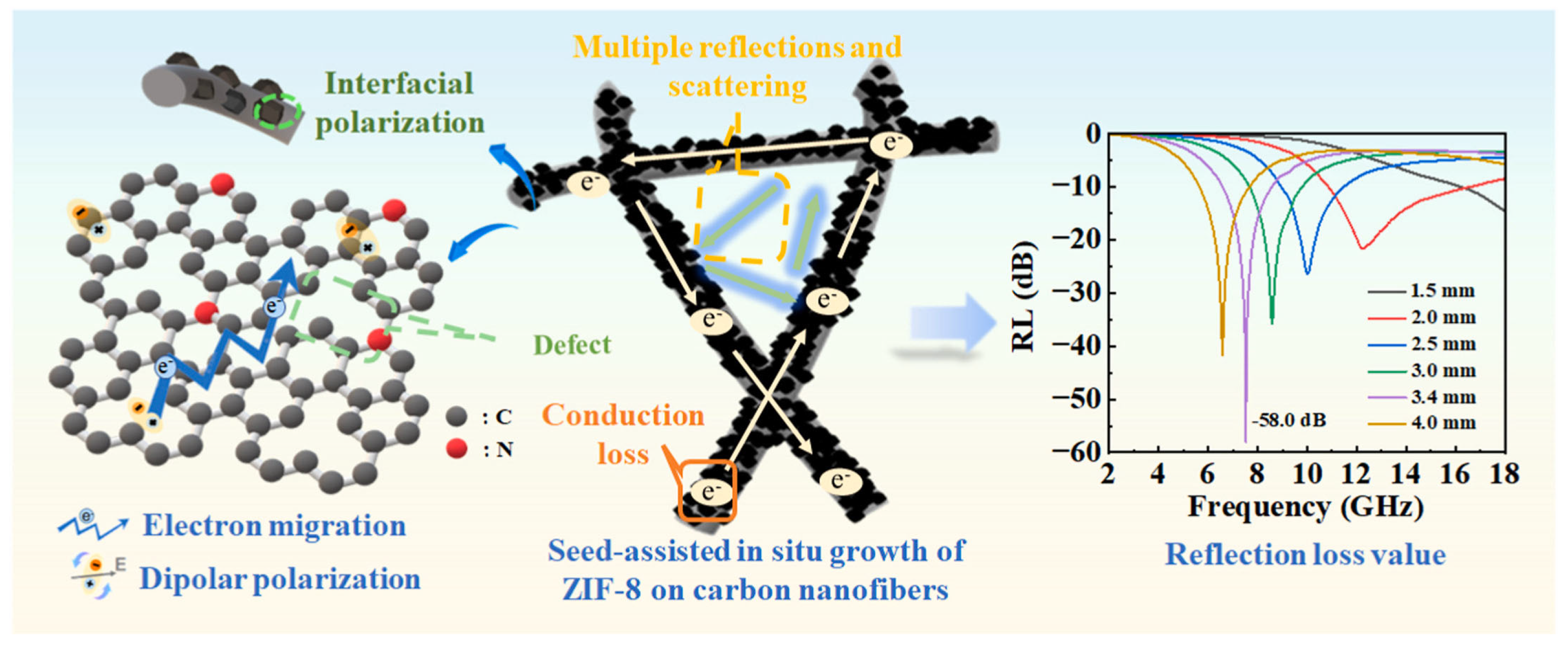
Among non-magnetic ZIF materials, ZIF-8 is the most widely used. Wang et al. [48] (as shown in the Figure 1) successfully synthesized C/ZnO nanofiber composites using ZIF-8 as a precursor via a seed-assisted in situ electrospinning technique. The composites possess a distinctive cavity-rich structure and heterogeneous interfaces formed between C and ZnO, which effectively promote the scattering and multiple reflections of microwaves. Benefiting from the synergistic effect of dipole polarization loss, interfacial polarization loss, and conduction loss, the C/ZnO nanofiber composites exhibit excellent electromagnetic wave absorption properties. At 7.5 GHz, the minimum reflection loss (RLmin) reaches −58 dB, and the EAB is up to 6.5 GHz.
In addition, magnetic–nonmagnetic synergistic structure design can also be performed on ZIF materials. With the complementary and combined action of magnetic loss and dielectric loss, combined with structural optimization methods, efficient dissipation of electromagnetic waves can be achieved. Magnetic metal nodes such as Co2+ and Fe2+ can provide magnetic loss pathways including ferromagnetic resonance and eddy current effect. Non-magnetic components such as Zn2+-derived porous carbon and MXene can further strengthen the dielectric loss capability of the absorbers through defect polarization, conductive network construction, and interfacial polarization. The two can realize precise regulation of impedance matching characteristics through design methods such as core–shell structures and heterojunction structure. At the same time, the hierarchical pore structure can induce multiple scattering effects of electromagnetic waves. Finally, a triple synergistic system of dielectric loss, magnetic loss and scattering loss is formed. This method can remarkably broaden the absorption bandwidth of the material and effectively improve its reflection loss performance. Lin et al. [49] successfully prepared a ZIF-8/ZIF-67-derived biomass composite (CoZnO@BPC) with a simple preparation process, based on multi-component micro- and nano-scale metal particles and biomass porous materials derived from Xanthoceras sorbifolia shell. At a loading content of 20 wt%, the composite material exhibits desirable EMW absorption properties. At the frequency of 15.84 GHz, its RLmin can reach −50.2 dB, with the matching thickness of only 1.7 mm.

3.1.2. MOF-74 Series

The MOF-74 series materials were first discovered by the Yaghi research group from Texas A&M University, USA. This series of materials takes divalent transition metal ions (e.g., Mg2+, Co2+, Ni2+, Zn2+) and 2,5-dihydroxyterephthalic acid (DOBDC) as core building units. They are interconnected through coordination bonds to form crystalline porous materials with one-dimensional (1D) channel structures. In EMW absorption applications, derivatives such as Co-MOF-74 and Ni-MOF-74 [50] can be converted into metal/carbon composite systems via pyrolysis treatment or composite modification strategies. By virtue of the magnetic loss effect of metal components and the dielectric loss characteristics of carbon matrices, efficient EMW absorption is achieved. Zhang et al. [51] prepared a range of MOF-74-derived nanocomposites by combining hydrothermal synthesis with subsequent carbonization processes. They systematically investigated the EMW absorption properties of the materials and the functional roles of each component and comprehensively clarified the intrinsic electromagnetic wave absorption mechanism of the materials. At a matching thickness of 2.64 mm, the MnO/Co/C nanocomposite derived from MnCo-MOF-74 exhibited an RLmin of −68.89 dB; its EAB could reach 5.3 GHz at a thickness of 2.3 mm. The exceptional EMW absorption performance of this material is primarily ascribed to the optimized impedance matching properties and the cooperative effect of multiple attenuation mechanisms.

3.1.3. RE-MOF Series (Rare Earth Metal–Organic Frameworks)

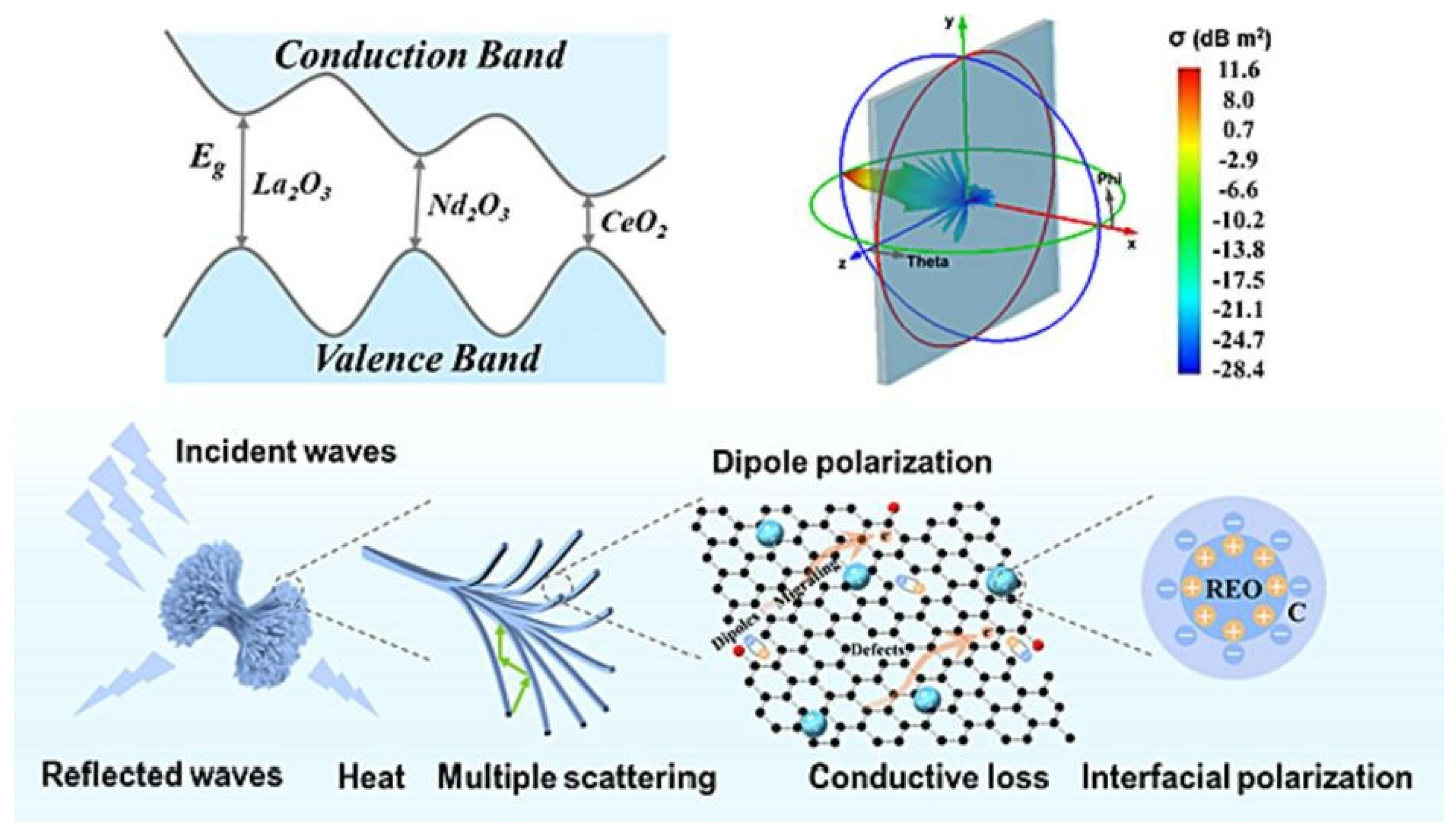
RE-MOF series materials are fabricated by the self-assembly reaction of rare earth metal ions (e.g., Y3+, La3+, Eu3+, Gd3+) with organic ligands (mostly carboxylic acid ligands or nitrogen-containing ligands) through coordination bonds. They possess diverse topological structures, including 0D, 1D, 2D, and 3D network structures. This series of materials also exhibits prominent characteristics such as adjustable pore size, ultra-large pore volume, and excellent thermal stability. In EMW absorption, RE-MOF materials are usually modified by compounding with magnetic nanoparticles or conductive materials. By virtue of the unique electronic structure and coordination environment of rare earth ions, combined with the polarization effect generated by heterogeneous interfaces, wide-band EMW absorption is ultimately achieved [52]. Li et al. (as shown in the Figure 2) [53] selected typical rare earth ions such as Ce3+, La3+, and Nd3+ as metal sources and trimesic acid (H3BTC) as the organic ligand. They successfully synthesized three kinds of rare earth metal–organic frameworks (RE-MOFs) with straw-bundle-like structures at room temperature via a simple and scalable coprecipitation process. Subsequently, these as-prepared RE-MOFs were subjected to carbonization treatment, thereby fabricating MOF-derived REO/C hybrid materials with similar crystal structures and morphologies (where REO corresponds to CeO2, La2O3, and Nd2O3, respectively). This study further clarified the core role played by the band gap width of rare earth oxides in regulating the microwave absorption properties of RE-MOF derivatives. In addition, the introduction of rare earth oxide nanoparticles further optimized the impedance matching characteristics of the materials and formed rich heterojunction interfaces, effectively boosting the interfacial polarization loss capacity of the materials. This research work by Li et al. fully confirms that RE-MOF derivatives hold enormous promise for EMW absorption.

3.1.4. UiO Series Materials

The UiO series materials are 3D porous structures formed by the coordination interaction between dicarboxylic acid organic ligands and Zr4+. They exhibit remarkable advantages such as high specific surface area, outstanding stability, regular size and high porosity. Regulating the type of organic ligands and reaction conditions enables the preparation of UiO materials with various sizes and morphologies. Therefore, this series of materials has been extensively studied and promoted by researchers. A research team from Shandong University successfully prepared cobalt-modified porous ZrO2/C hybrid octahedral materials by subjecting NH2-UiO-66 impregnated with Co(NO3)2 to a pyrolysis process. The obtained Co/ZrO2/C composite material exhibited excellent EMW absorption properties: at a matching thickness of 3.3 mm, its RLmin reached −57.2 dB at 15.8 GHz; the maximum EAB reached 11.9 GHz, covering a range of 6.1–18 GHz, which accounted for 74.4% of the entire measured bandwidth [37].

3.1.5. The PCN Series Materials

The PCN series porous materials take zirconium clusters (e.g., Zr6 clusters) as metal nodes and porphyrin-based (e.g., TCPP) or carboxylic acid compounds as ligands. The research team led by Professor Zeng Xiaojun [54] successfully prepared PCN-300/SiO2@MXene/Fe3C nanofiber membranes by combining electrospinning technology with high-temperature carbonization process. Using PCN-300 as the precursor, this composite material realized the in situ growth of carbon nanotubes (CNTs) relying on its own mesoporous structure, while loading Fe3C magnetic particles. In addition, the introduction of core–shell structured SiO2@MXene further enhanced the material’s ability to form a conductive network and dielectric regulation performance of the material. The prepared nanofiber membrane showed extremely remarkable EMW absorption properties: At a material thickness of only 2.03 mm, the RLmin reached −71.14 dB; the EAB reached 3.85 GHz; the ratio of reflection loss to thickness (RL/d) reached −35.04 dB·mm−1. This performance is in a leading position among the currently reported EMW absorbers.

3.1.6. MIL Series Materials

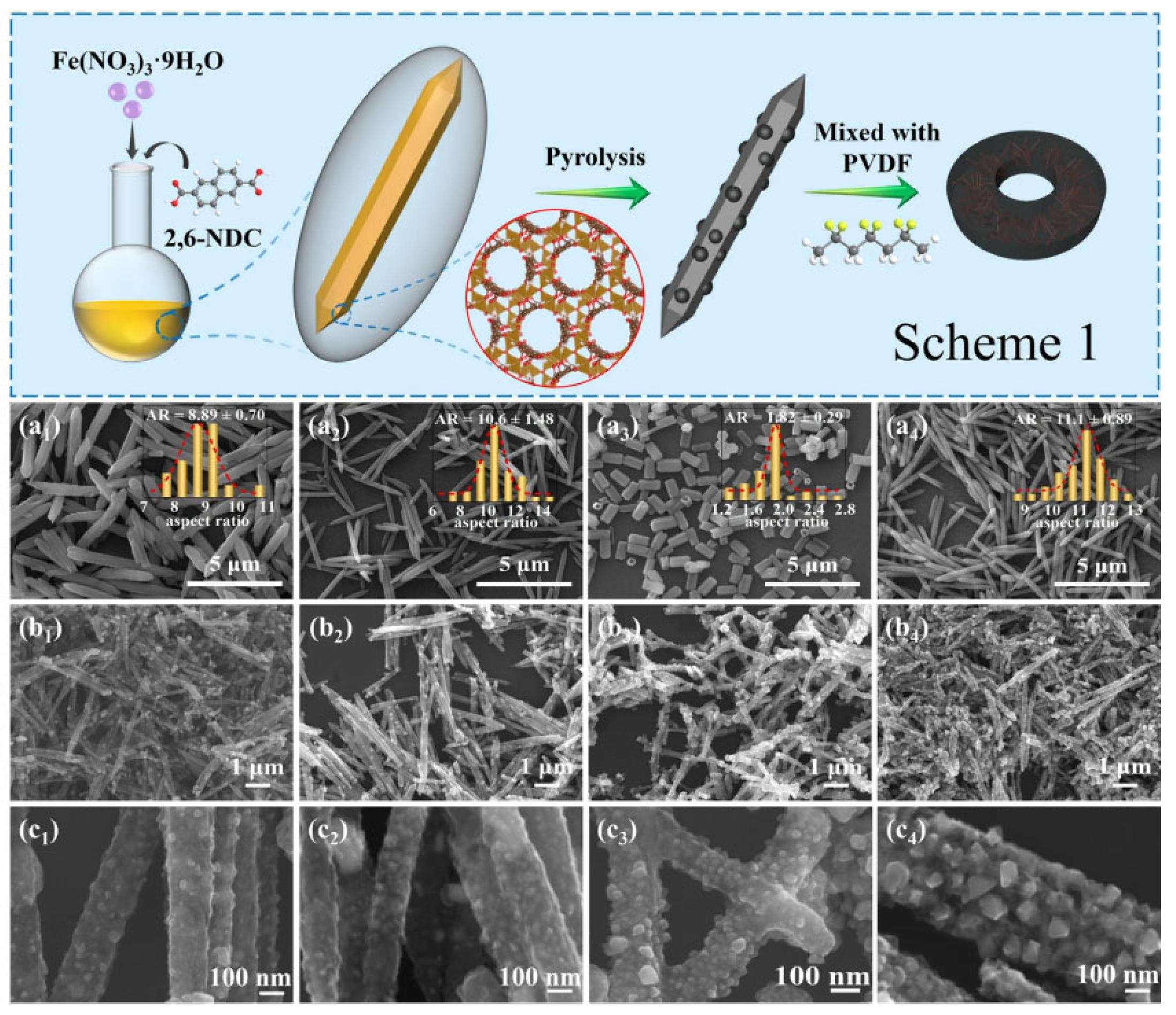
MIL series materials developed by Lavoisier Institute are composed of transition metal ions such as Cr, Fe, and Al, which self-assemble with organic carboxylic acid ligands via coordination bonds. Apart from the crystalline porous characteristics, they also exhibit outstanding stability, stable porosity, and extremely high specific surface area. MIL-53 and MIL-100 are the two most widely used types in this series of materials for microwave absorption. Zhang et al. (as shown in the Figure 3) [55] achieved the controllable synthesis of MIL-88C materials with different aspect ratios (AR) by adjusting the oil bath reaction conditions. They then employed these materials as precursors to prepare carbon-coated iron-based composite EMW absorption materials via a one-step pyrolysis process. The research found that adjusting the preparation parameters of the precursor MIL-88C(Fe) enables precise regulation of the phase composition, graphitization degree, and aspect ratio of its derived materials, thereby synergistically achieving low filler loading, ideal impedance matching, and superior EMW absorption performance. Among them, the wave-absorbing materials of MD2/PVDF, MD3/PVDF, and MD4/PVDF exhibit superior EMW absorption capability, with the optimal filler loading less than 20 wt% and the minimum value 5 wt%. To further broaden the EAB of the material, the researchers constructed a symmetric gradient honeycomb structure (SGHS) using a high-frequency structure simulator. Finally, they achieved an EAB of 14.6 GHz and an RLmin of −59.0 dB. This research provides a feasible approach and reference for designing novel structures and high-efficiency MAMs.

3.1.7. HKUST Series Materials

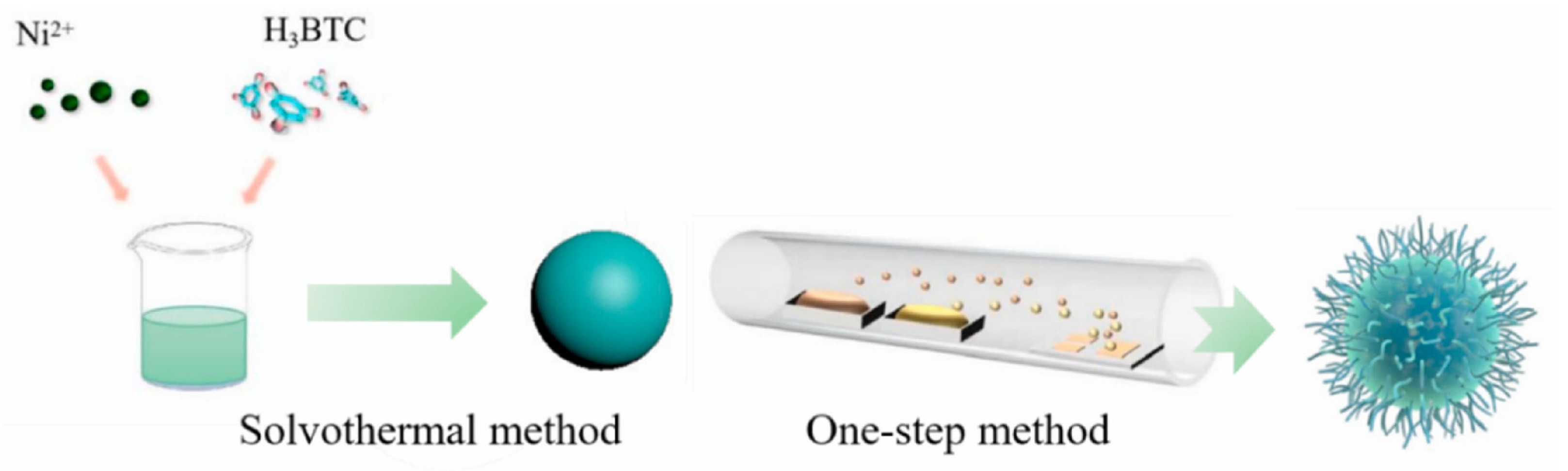
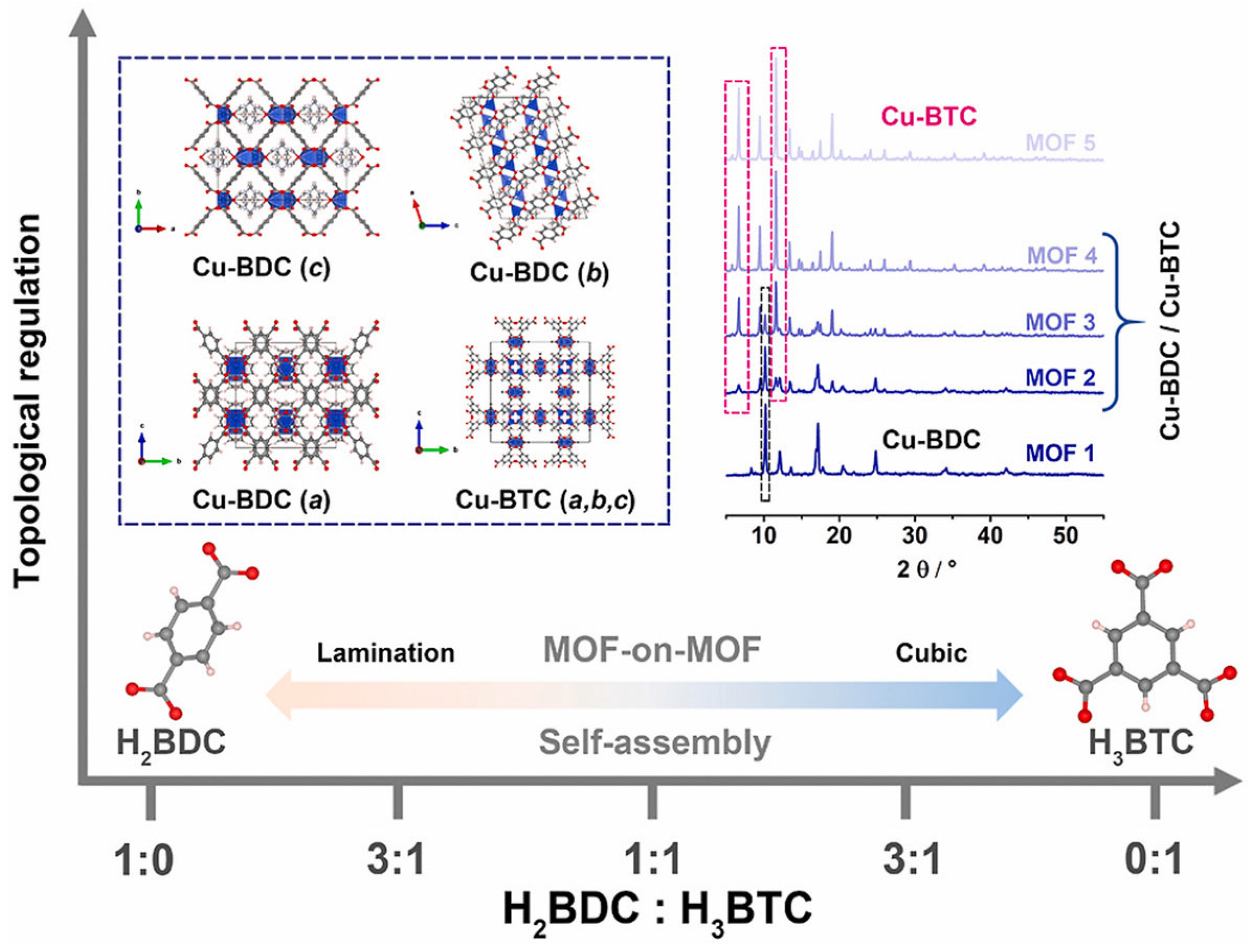
The HKUST series of materials were first discovered by the Hong Kong University of Science and Technology. They are crystalline porous materials with a three-dimensional cubic network structure. They are self-assembled via coordination bonds using copper ions (Cu2+) as the metal centers and organic carboxylic acid ligands such as benzene–1,3,5-tricarboxylic acid (BTC). These materials exhibit high chemical and thermal stability, with a specific surface area reaching 2000–2500 m2/g. Their regular octahedral pore structure endows them with excellent gas adsorption performance. In EMW absorption, HKUST-1 (Cu-BTC MOF) is the most representative material. After derivatization or composite modification, it can exhibit outstanding EMW absorption performance. Ren et al. (as shown in the Figure 4) [56] successfully prepared a series of novel copper nanocluster-decorated carbon-based composites (Cu@C) via a MOF self-assembly strategy, using terephthalic acid (H2BDC) and benzene-1,3,5-tricarboxylic acid (H3BTC) as ligands. These materials were obtained by pyrolysis of MOF-on-MOF hybrid materials (Cu-BDC/Cu-BTC), and their morphology could be controllably tuned. Due to the adjustable size and anisotropic structure, the Cu@C nanocomposites exhibited both conduction loss and polarization loss. Meanwhile, the matching thickness of the materials gradually reduced with rising H3BTC content. This study revealed the nanoscale effect of metal clusters during EMW absorption and provided rigorous guidance and inspiration for the design of novel MAMs originated from MOF-on-MOF hybrid structures.

3.2. Topological Structure of MOF Derivatives

The topological structure of MOF derivatives makes an indispensable and crucial contribution to improving their microwave absorption properties [57]. First, the topological structure is a core factor for optimizing impedance matching. Taking hollow structures as an example, the lightweight characteristic originating from internal cavities can adequately reduce the overall dielectric constant of the absorbers, narrow the impedance difference between the material and air, and improve the impedance matching effect. Second, the transmission path of electromagnetic waves can be significantly lengthened by unique spatial configurations. For instance, the “labyrinth-like” transmission channels formed by porous or multilevel hollow structures enable multiple reflections, refractions, and scattering of electromagnetic waves between pores and cavities, thereby prolonging the duration of interaction between electromagnetic waves and the active components of the material and enhancing the dissipation efficiency of electromagnetic wave energy. Meanwhile, topological structures can induce strong interfacial polarization by constructing abundant heterogeneous interfaces, such as metal–carbon interfaces in core–shell structures and inner/outer wall interfaces in hollow structures, thereby synergistically improving the dielectric loss capability of the material. Among these, interconnected porous topological structures can optimize the internal conductive network and enhance the conduction loss. In contrast, dispersed magnetic particles can strengthen the magnetic loss through hysteresis loss, ferromagnetic resonance, and other pathways, ultimately achieving a synergistic enhancement of dielectric loss and magnetic loss. In addition, the low-density advantage of hollow, porous, and other topological structures can decrease the overall thickness of the absorbers and match the penetration depth of electromagnetic waves at different frequencies through rational design of multilevel pores, realizing a balanced trade-off between lightweight design and broadband absorption performance.
In summary, the rational construction of topological structures has become a fundamental regulation method for promoting the breakthrough improvement of the wave absorption performance of MOF derivatives.

3.2.1. X@Shell

X@shell is defined as core–shell structured materials fabricated by integrating MOFs with other functional substances. The shell may be single-layered or multi-layered. The yolk@shell structure refers to a structure where a gap exists between the shell and the core. Conversely, the core@shell structure may lack void space. The rod-like FON/NC@PPy composite was fabricated via a dual-ligand synthesis method combined with a calcination process [58]. In the synthesis process, 2-methylimidazole was employed as both ligand and nitrogen source. This design is conducive to the creation of a rod-like microstructure that facilitates electron migration. Furthermore, the introduction of a polypyrrole (PPy) shell notably improved the electrical conductivity of the composite, thus enhancing its EMW absorption properties. Test data indicate that when the filler content is 30.0 wt%, the EAB of the composite reaches 5.06 GHz at a thickness of 1.64 mm. Meanwhile, the RLmin reaches −60.08 dB at a material thickness of 1.44 mm. In contrast to core@shell structures, yolk@shell nanostructures possess a larger specific surface area, and their internal cavities can effectively promote fluid transport, further optimizing the material properties. Chu et al. selected Fe-MIL-101 as a precursor and adopted an innovative one-step carbonization process. They treated it in a molten salt medium consisting of NaCl/KCl and successfully converted it into a tailored yolk–shell microstructure [59]. This structure successfully reduced the impedance mismatch between the nanocomposite and the ambient medium. It obviously enhanced the microwave absorption performance of the absorbers. At a thickness of 2.5 mm and a frequency of 9.85 GHz, an RLmin of −45.53 dB was achieved. In addition, Zhang et al. [60] performed oxidation heat treatment on flake-like FeSiCr obtained by ball milling. They then carried out an in situ composite reaction with MIL-88, and finally successfully prepared a dual core–shell structured MIL-88(Fe)@Fe2O3@FeSiCr composite. At 6.61 GHz, the dual core–shell composite reached an RLmin of −72.65 dB. The thickness of the microwave absorption coating was only 2.97 mm, and the EAB reached 2.38 GHz, covering the frequency range of 5.42–7.80 GHz.

3.2.2. Hollow Nanostructures

Compared with matrix materials, MOF-derived hollow nanostructures exhibit stronger interactions, better compatibility, more abundant exposed active sites, and lower density. In addition, such structures enable the convenient encapsulation of various components within their internal cavities or channels. According to structural differences, they can be mainly divided into two categories: single-shell hollow nanostructures and double-shell hollow nanostructures.
The preparation of hollow graphene nanospheres is achieved via a coordination reaction, which uses 2-methylimidazole as the organic linker and cobalt ions and zinc ions as the metal nodes. This method makes full use of the highly graphitized carbon derived from ZIF-67 and the large specific surface area carbon provided by ZIF-8 [61]. The prepared HGS@PAC MAMs exhibit remarkable electromagnetic wave absorption properties at a filler content of 10.0 wt%. In a unique study [62], ZIF-67 was initially etched to produce a hollow architecture, which was then combined with polyacrylonitrile (PAN) through electrospinning. Following an annealing process, the organic ligands and polyacrylonitrile fibers underwent thorough carbonization, finally generating defective, heteroatom-doped hollow macroporous magnetic carbon fibers. The findings demonstrate that the material achieves an RLmin of −49.4 dB at a thickness of 2.5 mm and a filling ratio of 5.0 wt%, while the EAB extends to 10.8 GHz at 2.8 mm thickness.

3.2.3. Porous Structure

Previous studies have confirmed that the multiple reflection effect arising from porous structures effectively strengthens the attenuation capability of materials, improves the impedance matching, and thus significantly boosts their microwave absorption properties. Liu et al. [63] synthesized multi-cavity carbon microspheres with abundant internal cavities through the targeted treatment of Ni-MOF. Compared with traditional hollow carbon microspheres, this unique multi-cavity structure endows the MAM with superior impedance matching characteristics and further optimizes the absorption performance. Li et al. constructed metal–organic frameworks on a reduced graphene oxide matrix. They composited hierarchically porous graphene with iron oxide and subsequently carried out an annealing process, successfully developing composite MAMs containing magnetic foam [64]. The distinctive anisotropic properties of this material significantly enhance its ability to break the Snoek limit, allowing more electromagnetic waves to enter the material interior and facilitating the effective energy dissipation of electromagnetic waves in the foam structure. This feature endows the composite with remarkable EMW absorption properties, achieving an RLmin of −60.13 dB and an EAB of 6.23 GHz.

3.2.4. Other Structures

In addition to the continuous exploration of porous, hollow, and core–shell structures, various special microstructures such as flower-like and waxberry-like morphologies have also emerged. The orderly arrangement and precise regulation of these different hierarchical structures can obviously enhance the microwave absorption performance of materials, providing more ideas for the design of microwave absorbers. Han et al. [65] synthesized flower-like CoFe@C composite MAMs by combining solvothermal synthesis and high-temperature carbonization. The material achieved optimal electromagnetic absorption performance, which is attributed to the synergistic effect of the composition and microstructure of CoFe@C. When the Co/Fe molar ratio was tuned to 0.5:0.5, the Co0.5Fe0.5@C composite exhibited an RLmin of −54.0 dB at a matching thickness of 1.8 mm; its EAB reached 5.8 GHz at a thickness of 2.1 mm. In an innovative study [66], researchers synthesized, for the first time, a waxberry-like CoNiMPC@CNTs/MXene (CNCM) hybrid microwave absorber originated from Co-Ni bimetallic MOFs via a simple solution precipitation, heat treatment, and electrostatic self-assembly strategy. By reasonably modulating the mass ratio of CoNiMPC@CNTs to MXene, the hybrid material achieved remarkable microwave absorption performance, further expanding the application potential of MOF-derived materials with special structures.

3.3. Composite Derivatives of MOFs

In recent decades, to overcome the performance limitations of single MOF-derived materials in EMW absorption, researchers have shifted their focus to the hybridization of MOFs with functional materials. Specifically, composite systems are constructed by introducing reinforcing phases with specific electromagnetic functions, which opens up a new avenue for optimizing the electromagnetic parameters and absorption properties of MOF-derived materials. Such a hybrid design, which uses MOFs as precursors combined with reinforcing phases, can not only retain the advantages of MOFs in component regulation and structural derivation but also exploit the unique characteristics of reinforcing phases to address the issues of insufficient dielectric loss, low magnetic permeability, or poor impedance matching in single derivatives. Ultimately, a synergistic effect of “1 + 1 > 2” is achieved.

3.3.1. MOF–Carbon Composite Derivative Wave-Absorbing Materials

Carbon-based materials exhibit excellent microwave absorption properties, good stability, and low density. The composite of carbon materials and MOFs can construct a conductive framework and optimize electron transport pathways. However, structural defects and heterogeneous interfaces between carbon materials and MOFs can lead to an excessive increase in dielectric loss, thereby weakening the radio-frequency wave absorption performance [67,68].
MOF-CNT Composite Derivative Wave-Absorbing Materials
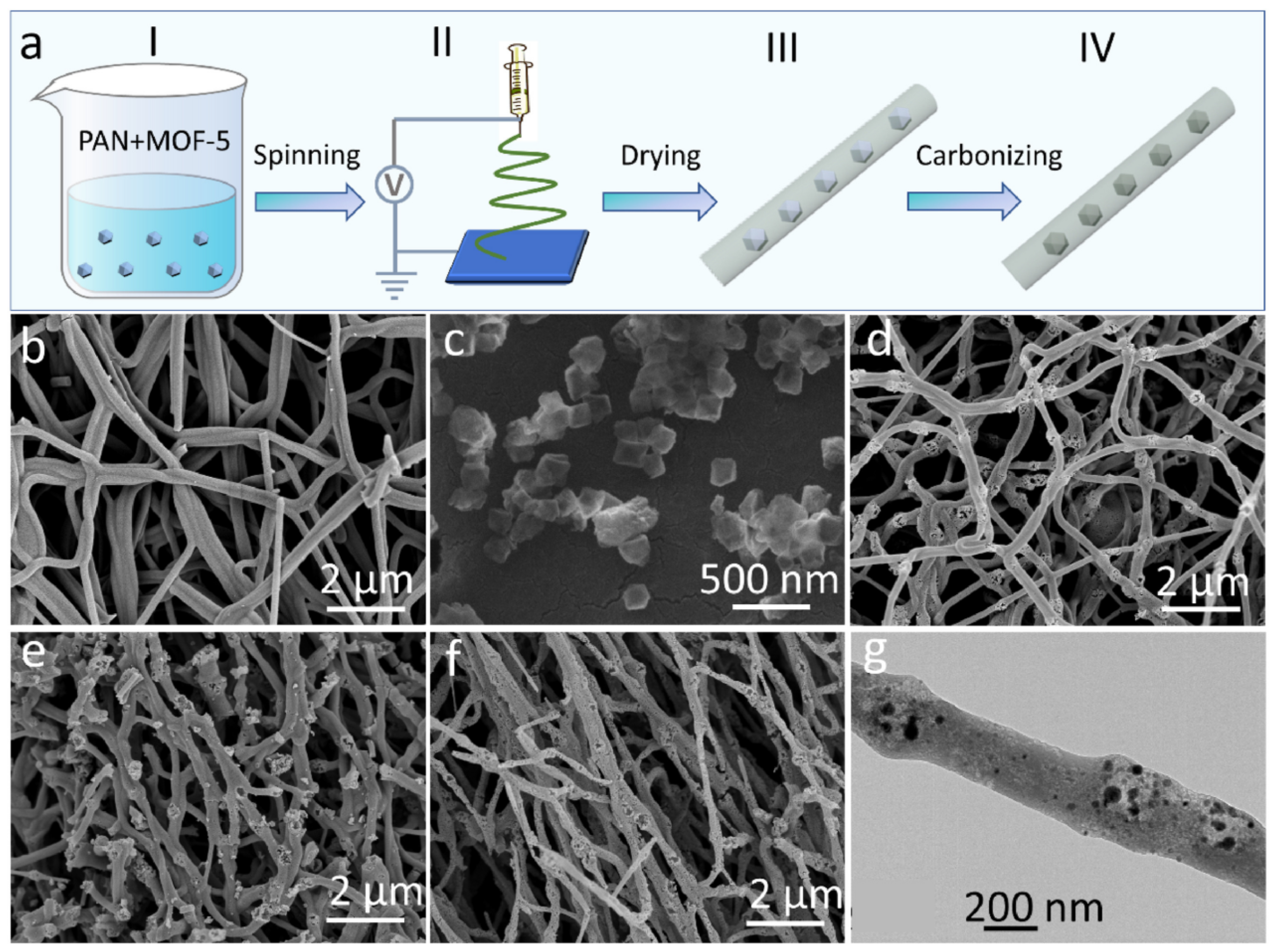
The hybridization of carbon nanotubes (CNTs) with MOFs offers multiple advantages. CNTs can construct a continuous conductive network. They significantly enhance the conduction loss efficiency of composite derivatives and accelerate the transformation of electromagnetic wave energy into thermal energy via electron transfer and conduction. The combination of the two produces abundant heterogeneous interfaces, which further generate significant interfacial polarization and boost dielectric loss. In addition, the incorporation of carbon nanotubes effectively optimizes the impedance matching capability of the absorbers. The tubular structure of CNTs cooperates synergistically with the porous structure derived from MOFs. The pores enable multiple reflections and scattering of electromagnetic waves, while the conductive nature of CNTs modulates the dielectric constant, effectively avoiding the impedance mismatch caused by overly high dielectric loss. Weng et al. (as shown in the Figure 5) [69] prepared MOF-derived Ni@CNT materials with controllable CNT length by a solvothermal route and a simple one-step pyrolysis process and elucidated the formation mechanism of carbon nanotubes. They subsequently explored the influence of in situ grown CNT morphology on the electromagnetic parameters and microwave absorption behavior of the materials. They found that uniformly sized carbon nanotubes grown in situ on the surfaces of MOF derivatives endowed the material with stable electromagnetic parameters. Shorter CNTs exhibited higher relaxation strength, thus providing excellent microwave absorption properties. Hu et al. [70] used terephthalic acid as the ligand and added multi-walled carbon nanotubes (MWCNTs) to prepare an MOF-5@MWCNTs precursor. Subsequently, the precursor was calcined at 500 °C for different times to acquire ZnO@MWCNTs composites. The absorption performance was tested by mixing 20 wt% ZnO@MWCNTs composite with paraffin. Research data indicated that the sample obtained after calcination at 500 °C for 4 h exhibited the optimal performance: at a thickness of 2.7 mm and 7.68 GHz, the RLmin reached −47.4 dB, and the EAB was 3.7 GHz at 1.5 mm thickness.
MOF/Carbon Fiber Composite Derivative Wave-Absorbing Materials
Carbon nanofibers (CNFs) possess a continuous one-dimensional fibrous structure, superior electrical conductivity, and a large specific surface area. After hybridization with MOFs, CNFs can not only build a continuous conductive network to accelerate electron transport and improve conduction loss but also enhance the mechanical characteristics and pore structure of the material, preventing structural collapse during pyrolysis. Meanwhile, the gaps between fibers cooperate with the micropores and mesopores derived from MOFs to form a hierarchical pore system, which further accommodates the penetration of electromagnetic waves at different frequencies. This material thus achieves better impedance matching. Chen et al. (as shown in the Figure 6) [71] employed terephthalic acid as the ligand for the preparation of FeIII-MOF-5. Then, they mixed FeIII-MOF-5 with PAN at different ratios to prepare a solution for electrospinning. After electrospinning, the products were annealed at 700 °C to acquire the target composite: FeIII-MOF-5-derived/carbon nanofiber composites (FMCFs). The absorption performance was evaluated by blending FMCFs with paraffin at a mass fraction of 40 wt%. Experimental data showed that the RLmin reached −39.2 dB at 1.4 mm thickness, and the EAB was 4.44 GHz (13.56–18 GHz). Jia et al. [72] innovatively utilized the distinctive dual-sided modification effect of polydopamine (PDA). They induced the ordered self-assembly of MOFs onto carbon fibers and other materials, preparing an FeCo-MOF-derived microsphere/nitrogen-doped carbon/short-cut carbon fiber (SCF) composite with a special microstructure. Importantly, the FeCo-MOF-derived microspheres were firmly encapsulated in the nitrogen-doped carbon coating, establishing a highly effective synergistic attenuation structure on the surfaces of carbon fibers. Test results demonstrated that this novel structure greatly improved the EMW absorption properties. A wide EAB of 4.25 GHz was achieved at a coating thickness of 2.3 mm, with a reflection loss of −57.7 dB.
MOF–Graphene Composite Derivative Wave-Absorbing Materials
As a result of its unique structural characteristics, graphene possesses numerous inherent excellent chemical and physical properties, such as ultra-thin thickness, outstanding electrical conductivity, low density and thermal conductivity, high specific surface area, and large aspect ratio [73,74,75,76]. The layered configuration of graphene can combine with the porous structure derived from MOFs to form a “layer–pore” synergistic system.
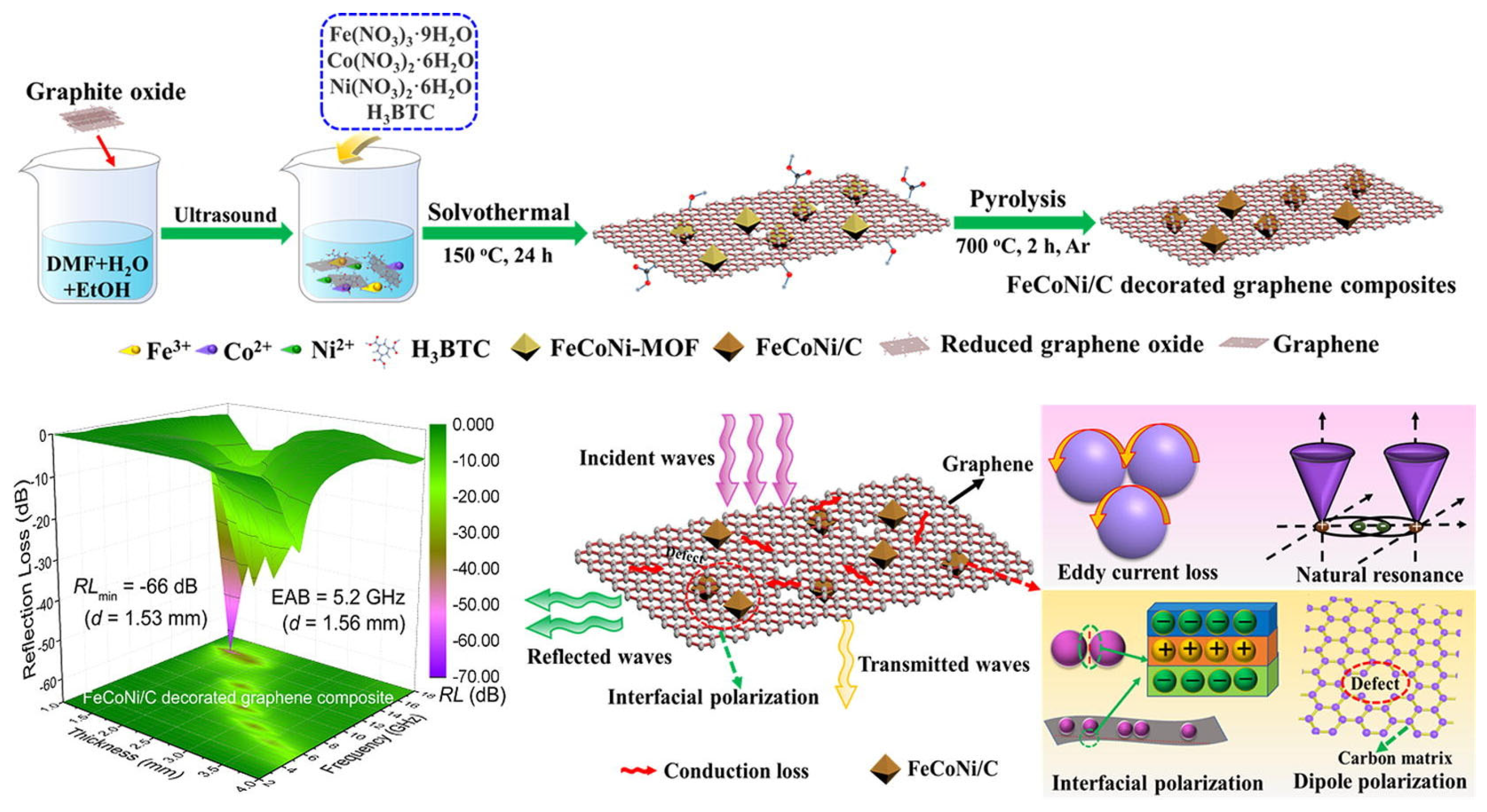
This system not only enables multiple reflections and scattering of electromagnetic waves through the interlayer gaps, prolonging their propagation path but also optimizes the impedance matching of the absorbers via the inherent flexibility of graphene, avoiding the enhanced electromagnetic wave reflection resulting from an overly high dielectric constant. Shu et al. (as shown in the Figure 7) [77] prepared FeCoNi/C-decorated graphene composites using a two-step strategy combining solvothermal reaction and pyrolysis treatment. Microstructural analysis revealed that a large number of octahedral FeCoNi/C carbon frameworks were homogeneously spread over the wrinkled surface of sheet-like graphene. By merely controlling the dosage of graphene oxide, the electromagnetic parameters and EMW absorption performance of the composites could be effectively optimized. When the dosage of graphene oxide was 67.2 mg, the as-prepared FeCoNi/C-decorated graphene composite exhibited the optimal microwave absorption properties: the RLmin reached up to −66 dB at 15.6 GHz; a broad EAB of 4.8 GHz was achieved at an ultra-thin thickness of 1.53 mm and a filler loading of 30 wt%. In addition, the maximum absorption bandwidth was further extended to 5.2 GHz when the matching thickness was slightly tuned to 1.56 mm.
MOF/SiC Composite Derivative Wave-Absorbing Materials
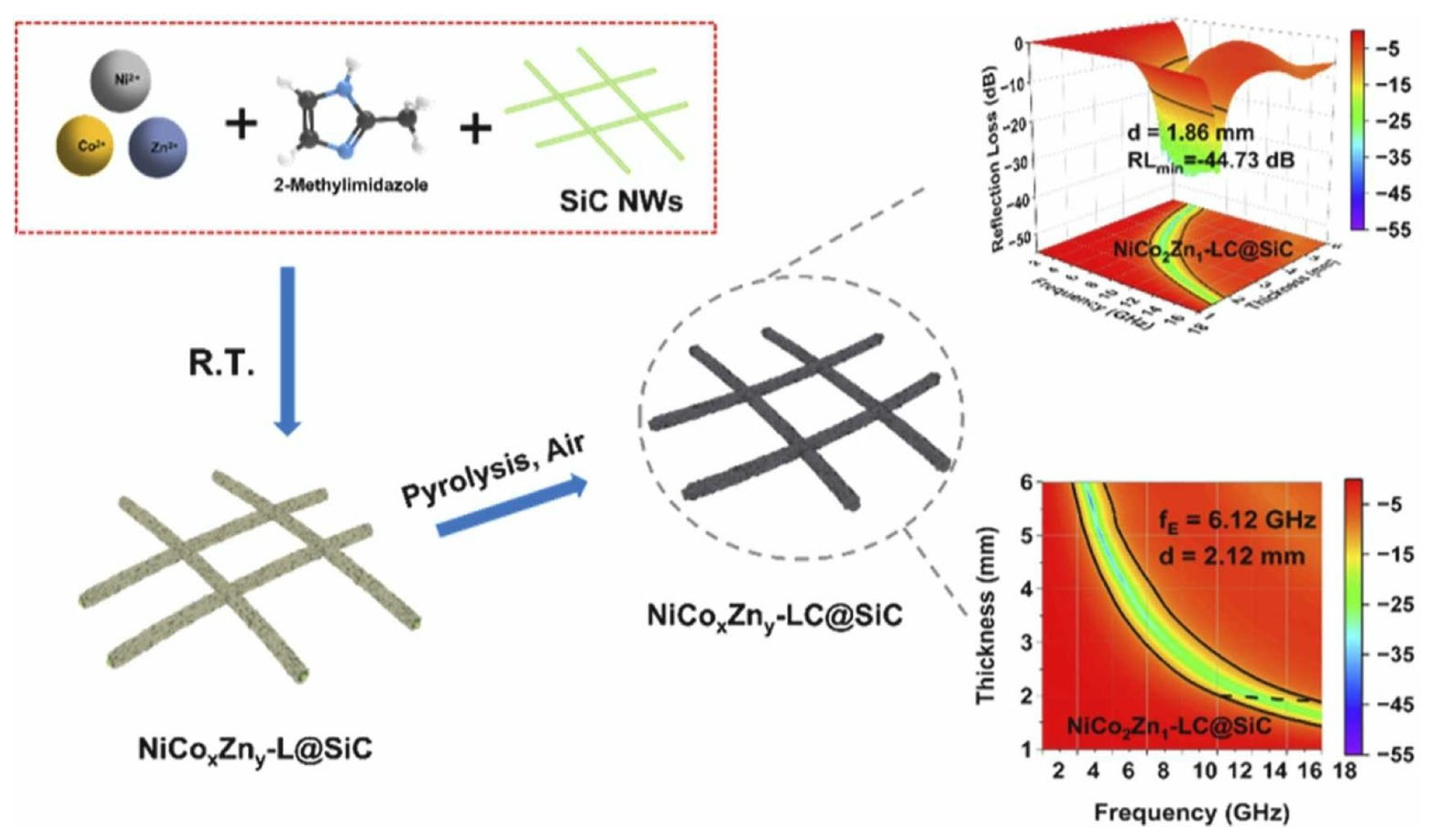
SiC is a multifunctional microwave absorption material with great development potential. It exhibits outstanding merits such as oxidation resistance, corrosion resistance, excellent high-temperature resistance, and high mechanical strength [78,79,80,81]. After hybridization with MOFs, the covalent bond-based crystal structure of SiC can not only introduce an appropriate dielectric constant and enhance dielectric loss, but also, owing to its special microstructures including nanowires and whiskers with large aspect ratios, it can induce multiple scattering and reflection of electromagnetic waves within the material, prolong the propagation path, and thus improve the energy dissipation efficiency. Meanwhile, the introduction of SiC can regulate the overall dielectric constant of the absorbers and synergize with the MOF-derived porous structure to improve the impedance matching performance, ensuring efficient incidence and absorption of electromagnetic waves. Xu et al. (as shown in the Figure 8) [82] prepared fungus-like two-dimensional trimetallic layered double hydroxide (LDH) nanosheets with tunable ions (Ni2+, Co2+, Zn2+) based on a component-inheritance approach from MOFs, as shown in the figure. Subsequently, these nanosheets were coated on one-dimensional SiC nanowires through self-assembly deposition under ambient temperature, and a variety of core–shell structured composites were successfully prepared. The rational combination of dielectric and magnetic constituents, together with the appropriate core–shell configuration, not only provides better impedance matching and realizes multiple reflections, scattering and polarization loss of electromagnetic waves but also enhances the conduction loss and magnetic loss of the material. The experimental findings demonstrate that the NiCo2Zn1-LC@SiC composite delivers excellent EMW absorption performance: at a thickness of 1.86 mm, the RLmin reaches −44.73 dB, and the maximum effective absorption bandwidth (EABmax) is up to 6.12 GHz at 2.12 mm.

3.3.2. MOF–Ceramic Composite Derivative Wave-Absorbing Materials

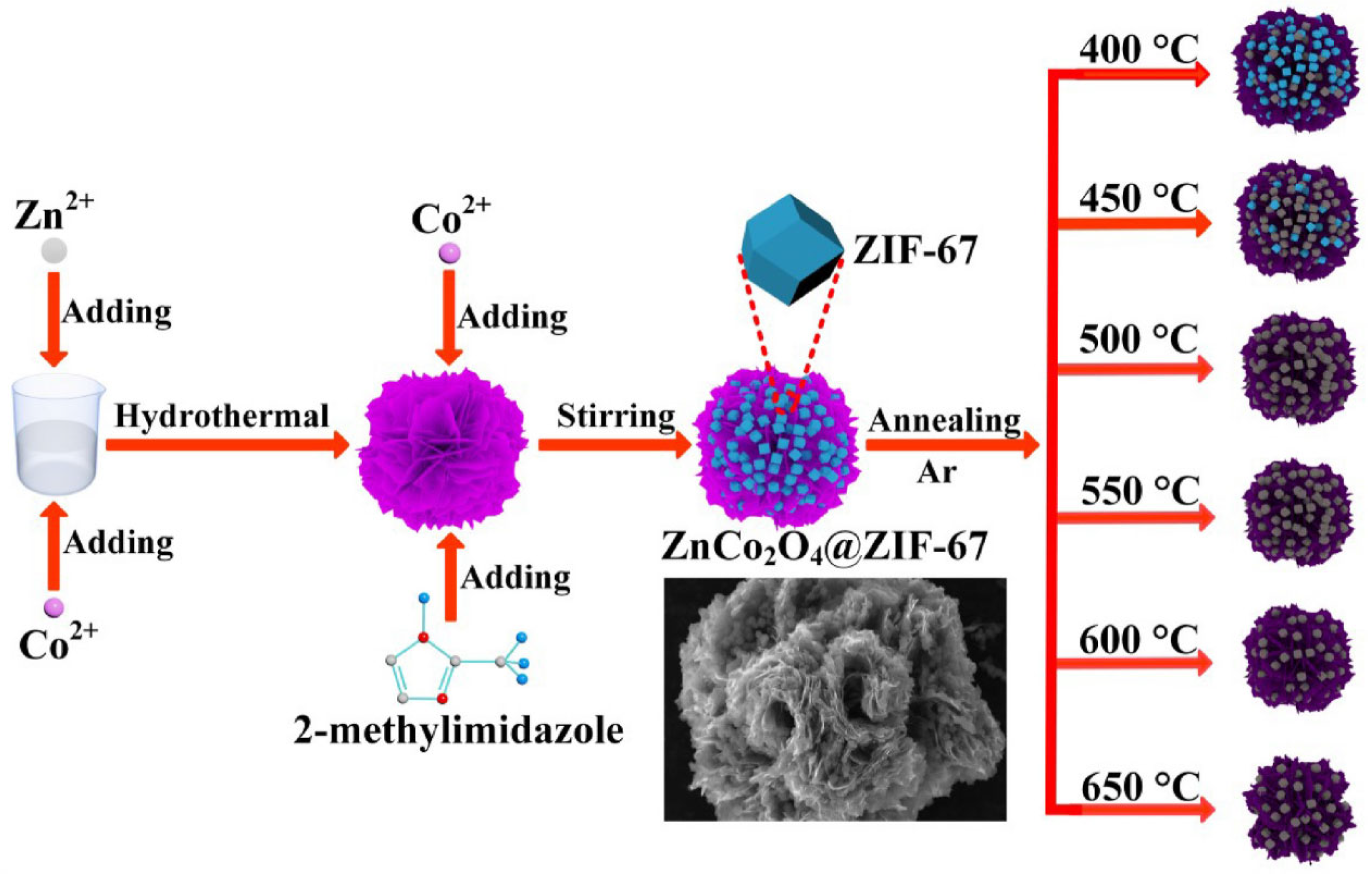
Ceramic materials including metal oxides, carbides, and sulfides (MgO, CoS2, TiO2, ZrO2, CuO, and ZnO) exhibit excellent chemical and thermal stability. However, their low electromagnetic wave loss efficiency limits their standalone application as MAMs [37,83]. Combining these ceramic materials with MOFs followed by carbonization can effectively alleviate the impedance mismatch of the materials, thereby endowing them with favorable electromagnetic wave absorption performance. Lu et al. [84] developed a TiO2/Co/C composite structure by calcining Ti3C2Tx/Co-MOF composites. In this composite, Co nanoparticles, carbon sheets, TiO2, and in situ grown CNTs constructed a multi-component synergistic system, which not only triggered interfacial polarization and dipole polarization but also optimized the impedance matching performance. At a thickness of 3.0 mm, the findings showed the RLmin reached −50.45 dB, and the EAB was 5.48 GHz at an ultra-thin thickness of only 1.7 mm. Zhao et al. (as shown in the Figure 9) [85] (as shown in the figure) first prepared a ZnCo2O4@ZIF-67 heterogeneous precursor composite, which was then annealed at various temperatures to fabricate a variety of heterogeneous interface-reconstructed products with excellent microwave absorption properties: ZnCo2O4-CoO@N/C, ZnO-Co@N/C, and Co3ZnC-Co@N/C, respectively. It was further verified by experiments that MAMs with multiple heterogeneous interfaces can reach superior impedance matching and reflection loss performance through multiple reflections and scattering of electromagnetic waves, combined with the joint contribution of conductive loss, dielectric loss, and magnetic loss.

3.3.3. MOF–MXene Composite Derivative Wave-Absorbing Materials

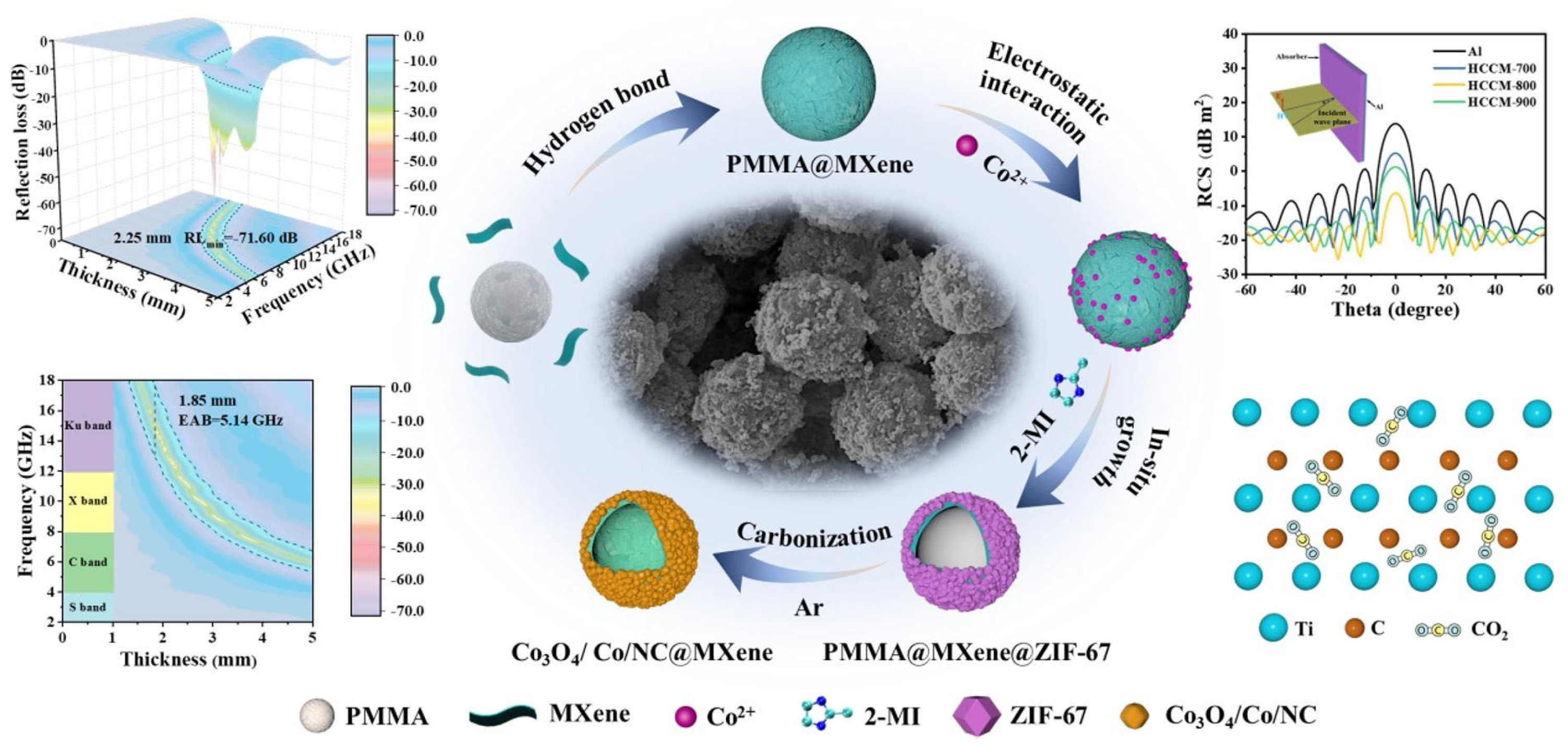
As emerging two-dimensional materials, MXenes consist of transition metal carbonitrides, carbides, and nitrides [86,87,88,89]. The integration of MOFs and MXene into composites induces interfacial polarization, endows the composites with superior impedance matching and attenuation properties, and effectively improves the microwave absorption capability [90]. Wu et al. [91] constructed an entangled one-dimensional (1D) heterogeneous structure through the assembly of MXene and MOFs without the aid of any templates or stiff supports. In this study, by regulating the formation of MOFs at the interface of 1D MXene fibers, the growth process of CNTs could be precisely regulated, thus achieving precise modulation of the material’s electromagnetic parameters. The 3D cross-linked network formed by the entangled 1D heterogeneous components (MXene fibers/CoNi/C and CNT/CoNi) possesses abundant heterogeneous interfaces, hierarchical pore structures, and excellent electrical conductivity, thus delivering outstanding microwave absorption performance. By integrating electrostatic self-assembly with a templating approach, Xing et al. [92] (as shown in the Figure 10) fabricated ZIF-67 nanoparticles on the surface of a 3D spherical scaffold. This scaffold was underpinned by Ti3C2Tx MXene nanosheets. A single-step pyrolysis procedure was subsequently employed to yield Co3O4/Co/NC@MXene microspheres, which featured distinct hollow architectures. This magnetic carbon heterogeneous structure improves the impedance matching state of the material and achieves excellent microwave absorption performance. Notably, the HCCM-800 sample performed particularly outstandingly: at 2.25 mm thickness, the RLmin reached −71.60 dB; the EABmax could reach 5.14 GHz at a thickness of 1.85 mm.

3.3.4. MOF–Magnetic Nanoparticle (NP) Composite Derivatives

The combination of magnetic nanoparticles with MOFs can introduce various magnetic loss mechanisms, including hysteresis loss, eddy current loss, and ferromagnetic resonance, forming a synergistic effect that effectively balances the dielectric constant and magnetic permeability of the absorbers. Meanwhile, the heterogeneous interfaces generated by the combination can further enhance interfacial polarization and enhance the overall electromagnetic loss performance. Additionally, by adjusting the dispersion, size, and content of the magnetic nanoparticles, the magnetic permeability of the composite derivatives can be precisely tuned, optimizing their impedance matching and ensuring that electromagnetic waves efficiently propagate into the inner part of the material instead of suffering from surface reflection. The addition of magnetic particles tends to shift the minimum reflection loss peak toward higher frequencies, enabling superior absorption at relatively thin thicknesses. However, the poor oxidation resistance of magnetic particles restricts their further practical application. Wang et al. [93] successfully developed nanoporous Co/C composites via thermal carbonization using ZIF-67 composites as precursors. It was found that the sample carbonized at 700 °C exhibited the optimal EMW absorption performance: the RLmin reached −30.31 dB at a thickness of 3.0 mm, and the EAB was 4.93 GHz at the same thickness. Cobalt nanoparticles dispersed within the porous ZIF-67 matrix remarkably decreased the complex dielectric constant of porous carbon and favored impedance matching, thus enhancing the electromagnetic wave absorption performance. Furthermore, the interfaces between porous cobalt nanoparticles and graphite induced additional interfacial polarization, which benefited the dielectric loss of electromagnetic waves. Liu et al. [94] first mechanically mixed an iron precursor (ferrous salt) with pre-synthesized ZIF-8. Subsequently, they converted the precursor into iron nanoparticles (Fe NPs) at high temperature, successfully synthesizing Fe/C-modified nanoporous carbon materials. After heat treatment at 1000 °C, zinc in the material volatilized, and the metallic species in the carbon matrix were substituted with iron. At a thickness of 2.5 mm, the modified material achieved an RLmin of −29.5 dB, accompanied by an EAB of 3.0 GHz.

3.3.5. MOF–Polymer Composite Derivatives

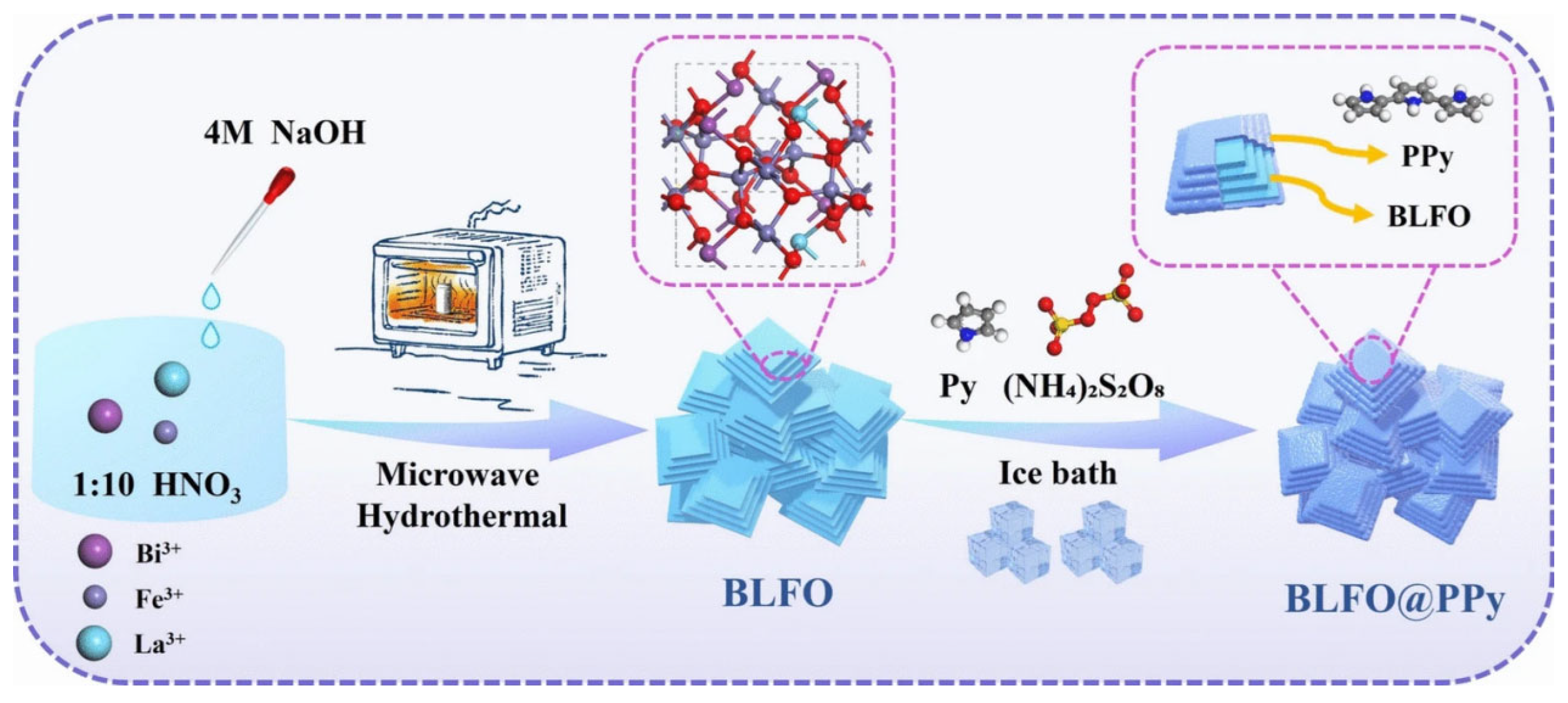
Conductive polymers (e.g., polyaniline, polypyrrole, polythiophene) [95] possess characteristics including low cost, strong corrosion resistance, good flexibility, low bulk density, high dielectric constant, and tunable absorption frequency width. They are often compounded with MOFs and used as high-performance MAMs. The excellent electrical conductivity endowed by their conjugated π-bond structure facilitates the construction of additional electron transport channels, improving the conduction loss efficiency of composite derivatives and promoting the conversion of electromagnetic wave energy through electron transition and conduction processes. More importantly, after introducing conductive polymers, the dielectric constant of the absorbers can be precisely regulated by adjusting their doping degree and polymerization degree. Furthermore, they can synergize with the MOF-derived porous structure to optimize impedance matching, effectively avoiding the enhanced electromagnetic wave reflection caused by an excessively high dielectric constant [96,97,98]. Xiong et al. (as shown in the Figure 11) [99] innovatively designed and prepared a heterogeneous structure composite with a truncated pyramidal nanosheet array architecture. This composite material is composed of lanthanum-doped Bi2Fe4O9 and polypyrrole. Experimental results show that the uniform coating of polypyrrole enhances the conduction loss and dielectric loss performance of the absorber, providing a new theoretical support for the development of the next-generation MAMs (as shown in the figure). Li et al. [100] used ZIF-67 as the precursor and fabricated polyaniline (PANI)/ZIF-67 derivative composites via a combined strategy of pyrolysis and in situ polymerization, successfully preparing Co/NC@PANI composite materials with hollow structures. The introduction of polyaniline and the uniform dispersion of cobalt magnetic particles significantly enhanced the dielectric loss capacity and microwave absorption properties of the composite. The Co/NC@PANI composite delivers an RLmin of −46.28 dB at 5.76 GHz and an EAB of 3.52 GHz at a thickness of 2.5 mm.

3.3.6. MOF Derivatives with Aerogel Structures

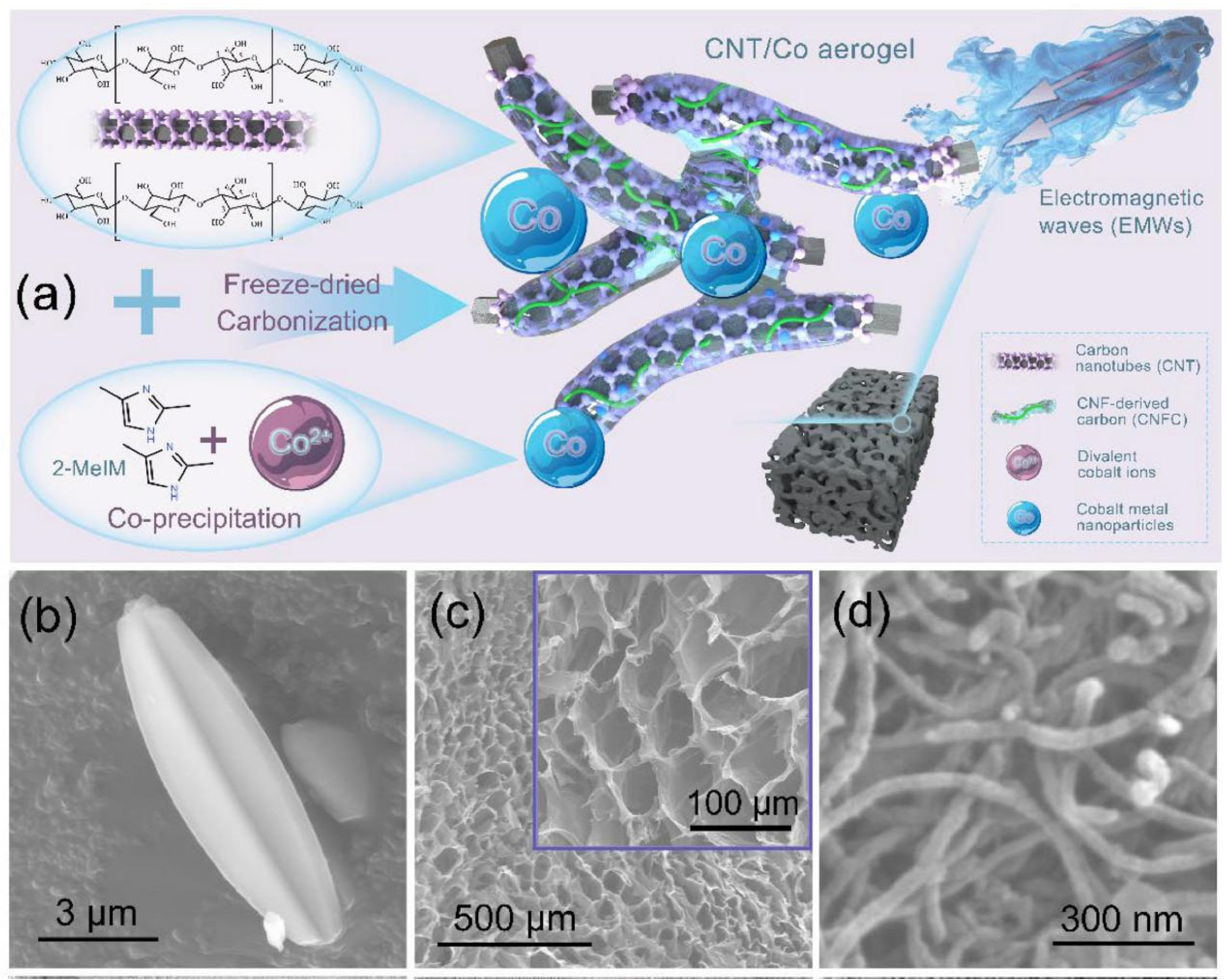
Ultra-high porosity materials, including aerogels and foams, after compositing with MOFs, possess a 3D interconnected porous network structure. This not only significantly decreases the total density of the material to achieve lightweight design but also lengthens the travel distance of electromagnetic waves via multiple reflections and scattering inside the pores, thus improving the energy dissipation efficiency. In addition, the pore size and distribution of such ultra-high porosity materials can be precisely tailored by tuning the preparation conditions. Cooperating with the pores of MOF-derived structures, they form a hierarchical pore system, which further adapts to the penetration depth of electromagnetic waves at various frequencies and enhances the impedance matching capability of the absorber. Therefore, they exhibit strong application prospects in electromagnetic wave absorbers. Liu et al. [101] (as shown in the Figure 12) successfully prepared hierarchical CNT/ZIF-67 derivative composite aerogels via a process involving ice-templating freeze-drying and carbonization. The freeze-casting method provides a distinctive strategy to fabricate porous bulk materials featuring large specific surface area and tailorable pore structure, which is crucial for boosting the reflection and scattering of EMW. At a filling ratio of only 10 wt%, the as-prepared CNT/ZIF-67 composite aerogel achieved an RLmin of −71.03 dB and an EAB of 4.64 GHz.

3.3.7. Bio-MOF Wave-Absorbing Materials

Biomass is a natural material with abundant reserves, low cost, and recyclability. Biomolecules extracted from biomass, such as polysaccharides, peptides, alkalis, and amino acids, may serve as bridging ligands to replace traditional organic ligands for constructing metal–biomolecule frameworks (bio-MOFs), thereby avoiding the potential toxic pollution caused by traditional organic ligands [102,103,104]. Integrating biomass with MOFs offers a cost-effective and sustainable approach for designing high-performance advanced functional materials [105,106,107]. Yang et al. [108] successfully fabricated a hierarchical carbon fiber (named HCF@CZ-CNTs) using cotton and ZIF-67 as raw materials, which is decorated with dodecahedral Co/C nanoparticles and villous CNTs. This material has an ultra-low apparent density (0.0198 g/cm3), and the minimum microwave reflection loss can reach −53.5 dB at 7.8 GHz, accompanied by an EAB of 8.02 GHz. Zhou et al. found that the Ni/NC/C composite obtained from Ni-MOF/luffa sponge presents superior microwave absorption properties [109]. The RLmin of the composite is −63.10 dB at a filling rate of 16 wt%, an annealing temperature of 650 °C, and material thickness of 2.0 mm; it exhibits an EAB of 35.44 GHz in the frequency range of 2–40 GHz when the material thickness is varied from 1 mm to 5.5 mm. For one thing, the three-dimensional hollow structure of luffa sponge itself provides channels for electrons and thermal conduction and enhances the conductive loss of the material. For another, the abundant interfaces and defects in the Ni/NC/C composite increase the possibility of polarization. Apart from luffa sponge, carbonized spinach stems [110], wood [111], walnut shells [106], sponge blocks [112], rice [107], eggshell membranes [113], and strawberries [114] have also been documented for preparing lightweight MAMs.

4. Conclusions and Outlook

MOFs-derived microwave absorbers have evolved into a research hotspot and core development orientation in EMW absorption, due to their versatile tunability in composition and structure, which endows them with outstanding electromagnetic response potential. This paper sorts out the research progress and design principles of MOF-derived MAMs from three core dimensions: precursor design, architecture innovation, and reinforcing phase recombination, summarizing their respective design principles, so as to establish a comprehensive research framework.
Firstly, the common principles of MOF precursor design are “matching coordination activity and tunable composition”. Specific strategies include selecting ligands containing conjugated aromatic rings, heteroatoms or unsaturated coordination sites, choosing transition/rare-earth metal ions and regulating coordination ratios, and designing MOF precursors with different dimensions and tuning pore structures. Based on this, relying on the chelation behavior of ligands and metal ions, a variety of MOF precursors such as ZIF, MOF-74, and RE-MOF have been effectively fabricated and widely applied in EMW absorption, and the research and development of novel precursors are still being continuously promoted. Secondly, in terms of architecture innovation, the common principles are “controllable morphology, optimized impedance matching, and enhanced electromagnetic loss”; specific strategies are precisely regulating synthesis conditions and preparation routes to develop diverse nanostructures including core@shell, yolk@shell, hollow and porous structures. These nanostructures realize the effective modulation of the materials’ micro-morphology and spatial configuration, providing structural support for optimizing the electromagnetic loss and impedance matching performance. Thirdly, with respect to composite modification, the common principles are “component complementarity, synergistic enhancement, and interfacial compatibility”; derivatization strategies combining MOFs with reinforcing phases (carbon materials such as carbon nanotubes and graphene, ceramics, MXene, magnetic nanoparticles, polymers, etc.) have been adopted. The cooperative effect of various constituents remarkably boosts the EMW absorption performance of the materials, offering abundant technical schemes for elevating the microwave absorption properties of high-performance absorbers. Although a relatively complete research system has been formed in material design and performance regulation, numerous critical challenges remain to be overcome urgently, among which the interpretation of absorption mechanisms, the breakthrough of large-scale preparation bottlenecks, and the enhancement of practical application effects are the most pressing.
In terms of mechanism, the absorption capacity of materials stems from the synergistic effect of multiple mechanisms, including impedance matching, magnetic loss, multiple reflections, and dielectric loss. However, there is insufficient theoretical support for the quantitative evaluation of the influence of each mechanism at present. Most studies only briefly mention the synergistic effect with almost no verification via theoretical calculations. In addition, simulation studies on absorbing materials targeting practical complex device models are extremely scarce, making it difficult to directly judge their application effects in devices. Therefore, the microwave absorption mechanisms of MOF-derived absorbing materials are in urgent need of further clarification. At the level of structural regulation, limited by the inherent characteristics of MOFs, their derived carbon materials are dominated by microporous structures, which are unfavorable for electron transfer. Moreover, the direct carbonization products of MOFs feature monotonous morphology and poor tunability, and the carbonization process imposes stringent requirements on temperature control, which strongly restricts the optimization space of the materials’ electromagnetic properties. For practical applications, on the one hand, MOF-based absorbing materials have to confront complex environments such as temperature fluctuations, humidity variations, and chemical corrosion during service. Maintaining the stability of absorption performance and structural integrity in long-term usage is the core bottleneck for their engineering application. On the other hand, despite the continuous emergence of new methods for the synthesis of MOF precursors, large-scale production processes are still immature, failing to fully exploit their performance advantages and hindering the implementation of practical applications.
In conclusion, as a core research direction in electromagnetic protection materials, MOF-derived MAMs are the critical carrier to satisfy the performance demands of “thin, light, wide, and strong” at present and in the future. They will surely achieve continuous development, resolve existing application dilemmas, consistently boost the scientific and technological progress and industrial upgrading in the microwave absorbing materials field, and inject new impetus into the development of key fields such as electromagnetic protection and aerospace.

Author Contributions

The individual contributions for this review paper are distributed as follows: Conceptualization, Q.X.; methodology, Q.X.; investigation, Y.Q. and X.Z.; data curation, Y.Q. and C.X.; formal analysis, M.H.; writing—original draft preparation, Q.X.; writing—review and editing, H.L.; supervision, L.N. and J.J. All authors have read and agreed to the published version of the manuscript.

Funding

Innovation and Entrepreneurship Training Program of Shenyang Aerospace University (Project No.: Z202510143069).

Data Availability Statement

The original contributions presented in this study are included in the article. Further inquiries can be directed to the corresponding author.

Conflicts of Interest

The authors declare that they have no known competing financial interests or personal relationships that could have appeared to influence the work reported in this paper.

References

  1. Cai, Z.; Su, L.; Wang, H.; Niu, M.; Tao, L.; Lu, D.; Xu, L.; Li, M.; Gao, H. Alternating multilayered Si3N4/SiC aerogels for broadband and high-temperature electromagnetic wave absorption up to 1000 degrees C. ACS Appl. Mater. Interfaces 2021, 13, 16704–16712. [Google Scholar] [CrossRef] [PubMed]
  2. Liu, Y.; Liu, X.; Wang, B.; Jia, Z.; Chi, Q.; Wu, G. Synthesis of MnxOy@ C hybrid composites for optimal electromagnetic wave absorption capacity and wideband absorption. J. Mater. Sci. Technol. 2022, 103, 157–164. [Google Scholar] [CrossRef]
  3. Liang, L.; Li, Q.; Yan, X.; Feng, Y.; Wang, Y.; Zhang, H.-B.; Zhou, X.; Liu, C.; Shen, C.; Xie, X. Multifunctional magnetic Ti3C2TxMXene/graphene aerogel with superior electromagnetic wave absorption performance. ACS Nano 2021, 15, 6622–6632. [Google Scholar] [CrossRef] [PubMed]
  4. Chen, X.; Liu, H.; Hu, D.; Liu, H.; Ma, W. Recent advances in carbon nanotubes-based microwave absorbing composites. Ceram. Int. 2021, 47, 23749–23761. [Google Scholar] [CrossRef]
  5. Yang, W.; Jiang, B.; Che, S.; Yan, L.; Li, Z.-X.; Li, Y.-F. Research progress on carbon-based materials for electromagnetic wave absorption and the related mechanisms. New Carbon Mater. 2021, 36, 1016–1033. [Google Scholar] [CrossRef]
  6. Yan, J.; Huang, Y.; Liu, X.; Zhao, X.; Li, T.; Zhao, Y.; Liu, P. Polypyrrole-based composite materials for electromagnetic wave absorption. Polym. Rev. 2021, 61, 646–687. [Google Scholar] [CrossRef]
  7. Su, X.; Liu, Y.; Liao, Z.; Bi, Y.; Ma, M.; Chen, Y.; Ma, Y.; Wan, F.; Chung, K.L. Recent progress of polyaniline-based composites in the field of microwave absorption. Synth. Met. 2022, 291, 117190. [Google Scholar] [CrossRef]
  8. Yang, Z.; Zhang, Y.; Li, M.; Yang, L.; Liu, J.; Hou, Y.; Yang, Y. Surface Architecture of Ni-Based Metal Organic Framework Hollow Spheres for Adjustable Microwave Absorption. ACS Appl. Nano Mater. 2019, 2, 7888–7897. [Google Scholar] [CrossRef]
  9. Gao, S.; Zhang, G.; Wang, Y.; Han, X.; Huang, Y.; Liu, P. MOFs derived magnetic porous carbon microspheres constructed by core-shell Ni@C with high-performance microwave absorption. J. Mater. Sci. Technol. 2021, 88, 56–65. [Google Scholar] [CrossRef]
  10. Liu, Y.; Yao, Z.; Zhou, J.; Jin, L.; Wei, B.; He, X. Facile synthesis of MOF-derived concave cube nanocomposite by self-templated toward lightweight and wideband microwave absorption. Carbon 2022, 186, 574–588. [Google Scholar] [CrossRef]
  11. Wu, Q.; Wang, B.; Fu, Y.; Zhang, Z.; Yan, P.; Liu, T. MOF-derived Co/CoO particles prepared by low temperature reduction for microwave absorption. Chem. Eng. J. 2021, 410, 128378. [Google Scholar] [CrossRef]
  12. Xu, Z.; Du, Y.; Liu, D.; Wang, Y.; Ma, W.; Wang, Y.; Xu, P.; Han, X. Pea-like Fe/Fe3C nanoparticles embedded in nitrogen-doped carbon nanotubes with tunable dielectric/magnetic loss and efficient electromagnetic absorption. ACS Appl. Mater. Interfaces 2019, 11, 4268–4277. [Google Scholar] [CrossRef]
  13. Singh, P.P.; De, A.; Khatua, B.B. Bio-inspired smart composite architecture for thermally tunable green EMI shielding. Appl. Surf. Sci. 2024, 643, 158643. [Google Scholar] [CrossRef]
  14. Gao, Z.; Zhang, J.; Lei, D.; Guo, Z.; Zhang, S.; Song, Y.; Wang, J.; Kou, K. Ferrocene decorative phenolic epoxy resin as lightweight thermal-stable dielectric relaxor for electromagnetic wave absorption. Compos. Commun. 2020, 22, 100472. [Google Scholar] [CrossRef]
  15. Qiao, J.; Zhang, X.; Liu, C.; Lyu, L.; Yang, Y.; Wang, Z.; Wu, L.; Liu, W.; Wang, F.; Liu, J. Non-magnetic bimetallic MOF-derived porous carbon-wrapped TiO2/ZrTiO4 composites for efficient electromagnetic wave absorption. Nano-Micro Lett. 2021, 13, 75. [Google Scholar] [CrossRef] [PubMed]
  16. Lv, H.; Guo, Y.; Wu, G.; Ji, G.; Zhao, Y.; Xu, Z.J. Interface polarization strategy to solve electromagnetic wave interference issue. ACS Appl. Mater. Interfaces 2017, 9, 5660–5668. [Google Scholar] [CrossRef] [PubMed]
  17. Liu, W.; Tan, S.; Yang, Z.; Ji, G. Hollow graphite spheres embedded in porous amorphous carbon matrices as lightweight and low-frequency microwave absorbing material through modulating dielectric loss. Carbon 2018, 138, 143–153. [Google Scholar] [CrossRef]
  18. Dong, S.; Song, J.; Zhang, X.; Hu, P.; Sun, B.; Zhou, S.; Luo, X. Strong contribution of in situ grown nanowires to enhance the thermostabilities and microwave absorption properties of porous graphene foams under different atmospheres. J. Mater. Chem. C 2017, 5, 11837–11846. [Google Scholar]
  19. Wang, J.; Li, Q.; Ren, J.; Zhang, A.; Zhang, Q.; Zhang, B. Synthesis of bowknot-like N-doped Co@ C magnetic nanoparticles constituted by acicular structural units for excellent microwave absorption. Carbon 2021, 181, 28–39. [Google Scholar]
  20. He, G.; Duan, Y.; Pang, H. Microwave absorption of crystalline Fe/MnO@C nanocapsules embedded in amorphous carbon. Nano-Micro Lett. 2020, 12, 57. [Google Scholar] [CrossRef]
  21. Liang, X.; Man, Z.; Quan, B.; Zheng, J.; Gu, W.; Zhang, Z.; Ji, G. Environment-stable CoxNiy encapsulation in stacked porous carbon nanosheets for enhanced microwave absorption. Nano-Micro Lett. 2020, 12, 102. [Google Scholar] [CrossRef]
  22. Guo, J.; Chen, Z.; Xu, X.; Li, X.; Liu, H.; Xi, S.; Abdul, W.; Wu, Q.; Zhang, P.; Xu, B.B.; et al. Enhanced electromagnetic wave absorption of engineered epoxy nanocomposites with the assistance of polyaniline fillers. Adv. Compos. Hybrid Mater. 2022, 5, 1769–1777. [Google Scholar] [CrossRef]
  23. Liu, Y.; Wu, H.; Li, R.; Wang, J.; Kong, Y.; Guo, Z.; Jiang, H.; Ren, Y.; Pu, Y.; Liang, X.; et al. MOF–COF “Alloy” Membranes for Efficient Propylene/Propane Separation. Adv. Mater. 2022, 34, 2201423. [Google Scholar] [CrossRef] [PubMed]
  24. Bush, G.G. Generalization of Snoek’s limit for modeling initial permeability of magnetic materials. J. Appl. Phys. 1988, 63, 3765–3767. [Google Scholar] [CrossRef]
  25. Zhao, Y.; Liu, L.; Han, J.; Wu, W.; Tong, G. Effective modulation of electromagnetic characteristics by composition and size in expanded graphite/Fe3O4 nanoring composites with high Snoek’s limit. J. Alloys Compd. 2017, 728, 100–111. [Google Scholar] [CrossRef]
  26. Lv, H.; Ji, G.; Zhang, H.; Du, Y. Facile synthesis of a CNT@ Fe@SiO2 ternary composite with enhanced microwave absorption performance. RSC Adv. 2015, 5, 76836–76843. [Google Scholar] [CrossRef]
  27. Liang, C.; Liu, C.; Wang, H.; Wu, L.; Jiang, Z.; Xu, Y.; Shen, B.; Wang, Z. SiC–Fe3O4 dielectric–magnetic hybrid nanowires: Controllable fabrication, characterization and electromagnetic wave absorption. J. Mater. Chem. A 2014, 2, 16397–16402. [Google Scholar] [CrossRef]
  28. Yao-Qing, H.; Jie, Y.; Wei-Li, S.; Bo, W.; Xiao-Yong, F.; Mao-Sheng, C. Microwave absorbing materials: Solutions for real functions under ideal conditions of microwave absorption. Chin. Phys. Lett. 2010, 27, 027702. [Google Scholar] [CrossRef]
  29. Ma, Z.; Cao, C.-T.; Liu, Q.-F.; Wang, J.-B. A new method to calculate the degree of electromagnetic impedance matching in one-layer microwave absorbers. Chin. Phys. Lett. 2012, 29, 038401. [Google Scholar] [CrossRef]
  30. Zhao, B.; Shao, G.; Fan, B.; Zhao, W.; Zhang, R. Investigation of the electromagnetic absorption properties of Ni@ TiO2 and Ni@ SiO2 composite microspheres with core–shell structure. Phys. Chem. Chem. Phys. 2015, 17, 2531–2539. [Google Scholar] [CrossRef]
  31. Thi, Q.V.; Park, S.; Jeong, J.; Lee, H.; Hong, J.; Koo, C.M.; Tung, N.T.; Sohn, D. A nanostructure of reduced graphene oxide and NiO/ZnO hollow spheres toward attenuation of electromagnetic waves. Mater. Chem. Phys. 2021, 266, 124530. [Google Scholar] [CrossRef]
  32. Jiang, K.; Liu, Y.; Pan, Y.; Wang, R.; Hu, P.; He, R.; Zhang, L.; Tong, G. Monodisperse NixFe3−xO4 nanospheres: Metal-ion-steered size/composition control mechanism, static magnetic and enhanced microwave absorbing properties. Appl. Surf. Sci. 2021, 404, 40–48. [Google Scholar] [CrossRef]
  33. Lv, H.; Ji, G.; Wang, M.; Shang, C.; Zhang, H.; Du, Y. FeCo/ZnO composites with enhancing microwave absorbing properties: Effect of hydrothermal temperature and time. RSC Adv. 2014, 4, 57529–57533. [Google Scholar] [CrossRef]
  34. Gao, Z.; Zhang, J.; Zhang, S.; Wang, J.; Song, Y. Cationic etching of ZIF-67 derived LaCoO3/Co3O4 as high-efficiency electromagnetic absorbents. Chem. Eng. J. 2021, 421, 127829. [Google Scholar] [CrossRef]
  35. Miao, P.; Zhou, R.; Chen, K.; Liang, J.; Ban, Q.; Kong, J. Tunable electromagnetic wave absorption of supramolecular isomer-derived nanocomposites with different morphology. Adv. Mater. Interfaces 2020, 7, 1901820. [Google Scholar] [CrossRef]
  36. Li, W.; Chen, J.; Gao, P. MOFs-derived hollow copper-based sulfides for optimized electromagnetic behaviors. J. Colloid Interface Sci. 2022, 606, 719. [Google Scholar] [CrossRef]
  37. Zhang, X.; Qiao, J.; Liu, C.; Wang, F.; Jiang, Y.; Cui, P.; Wang, Q.; Wang, Z.; Wu, L.; Liu, J. A MOF-derived ZrO2/C nanocomposite for efficient electromagnetic wave absorption. Inorg. Chem. Front. 2020, 7, 385. [Google Scholar] [CrossRef]
  38. Liu, X.; Liang, T.; Zhang, R.; Ding, Q.; Wu, S.; Li, C.; Lin, Y.; Ye, Y.; Zhong, Z.; Zhou, M. Iron-based metal–organic frameworks in drug delivery and biomedicine. ACS Appl. Mater. Interfaces 2021, 13, 9643. [Google Scholar] [CrossRef]
  39. Yang, H.; Shen, Z.; Peng, H.; Xiong, Z.; Liu, C.; Xie, Y. 1D–3D mixed-dimensional MnO2@nanoporous carbon composites derived from Mn-metal organic framework with full-band ultra-strong microwave absorption response. Chem. Eng. J. 2021, 417, 128087. [Google Scholar] [CrossRef]
  40. Wang, L.; Wen, X.; Li, J.; Zeng, P.; Song, Y.; Yu, H. Roles of defects and linker exchange in phosphate adsorption on UiO-66 type metal organic frameworks: Influence of phosphate concentration. Chem. Eng. J. 2021, 405, 126681. [Google Scholar] [CrossRef]
  41. Dong, M.; Peng, M.; Wei, W.; Xu, H.; Liu, C.; Shen, C. Improved microwave absorption performance of double helical C/Co@CNT nanocomposite with hierarchical structures. J. Mater. Chem. C 2021, 9, 2178. [Google Scholar] [CrossRef]
  42. Li, X.; Wang, Z.; Xiang, Z.; Zhu, X.; Dong, Y.; Huang, C.; Cai, L.; Lu, W. Biconical prisms Ni@C composites derived from metal-organic frameworks with an enhanced electromagnetic wave absorption. Carbon 2021, 184, 115. [Google Scholar] [CrossRef]
  43. Furukawa, H.; Müller, U.; Yaghi, O.M. “Heterogeneity within order” in metal–organic frameworks. Angew. Chem. Int. Ed. 2015, 54, 3417–3430. [Google Scholar] [CrossRef] [PubMed]
  44. Zhang, Z.; Cai, Z.; Wang, Z.; Peng, Y.; Xia, L.; Ma, S.; Yin, Z.; Huang, Y. A review on metal–organic framework-derived porous carbon-based novel microwave absorption materials. Nano-Micro Lett. 2021, 13, 56. [Google Scholar] [CrossRef] [PubMed]
  45. Hwang, J.; Ejsmont, A.; Freund, R.; Goscianska, J.; Schmidt, B.V.K.J.; Wuttke, S. Controlling the morphology of metal–organic frameworks and porous carbon materials: Metal oxides as primary architecture-directing agents. Chem. Soc. Rev. 2020, 11, 3348–3422. [Google Scholar] [CrossRef]
  46. Ma, C.; Wang, Y.; Zhang, C.; Huang, Y.; Zhang, X.; Peng, J.; Chai, C.; Yuan, M.; Ma, H.; Zhai, M. ZIF-67 derived porous core-shell nano composites for high-efficiency electromagnetic absorption. Appl. Surf. Sci. 2023, 637, 157913. [Google Scholar] [CrossRef]
  47. Lü, Y.; Wang, Y.; Li, H.; Lin, Y.; Jiang, Z.; Xie, Z.; Kuang, Q.; Zheng, L. MOF-derived porous Co/C nanocomposites with excellent electromagnetic wave absorption properties. ACS Appl. Mater. Interfaces 2015, 7, 13604. [Google Scholar] [CrossRef]
  48. Wang, X.; Zhang, L.; Ding, E.; Cao, X.; Luo, C.; Huang, L. Seed-assisted in situ ZIF-8 growth on carbon nanofibers for enhanced microwave absorption. Carbon 2023, 214, 118316. [Google Scholar] [CrossRef]
  49. Lin, X.; Zhou, Y.; Hong, J.; Wei, X.; Liu, B.; Wang, C.-C. Facile preparation of ZIF-8/ZIF-67-derived biomass carbon composites for highly efficient electromagnetic wave absorption. Chin. Chem. Lett. 2024, 35, 10983. [Google Scholar] [CrossRef]
  50. Qiu, Y.; Lin, Y.; Yang, H.; Wang, L.; Wang, M.; Wen, B. Hollow Ni/C microspheres derived from Ni-metal organic framework for electromagnetic wave absorption. Chem. Eng. J. 2020, 383, 123207. [Google Scholar] [CrossRef]
  51. Zhang, X.; Tian, X.; Liu, C.; Qiao, J.; Liu, W.; Liu, J.; Zeng, Z. MnCo-MOF-74 derived porous MnO/Co/C heterogeneous nanocomposites for high-efficiency electromagnetic wave absorption. Carbon 2022, 194, 257–266. [Google Scholar] [CrossRef]
  52. Miao, P.; Chen, W.; Zhao, W.; Kong, J. La2O3 nanorods anchoring metal-organic framework derivates for super broadband microwave absorption. Appl. Surf. Sci. 2023, 608, 155142. [Google Scholar] [CrossRef]
  53. Li, L.; Qiao, J.; Zhang, X.; Lin, J.; Liu, W.; Wu, Q.; Pan, F.; Liu, J.; Zeng, Z. Straw-bundle-like rare earth metal-organic frameworks derivatives for high-efficiency electromagnetic wave absorption. Chem. Eng. J. 2024, 479, 147446. [Google Scholar] [CrossRef]
  54. Zeng, X.; Liu, Y.; Wei, Z.; Zhong, Z. Synergistic polarization relaxation in heteroatom-optimized heterointerfaces for electromagnetic wave absorption. Chem. Eng. J. 2023, 452, 138422. [Google Scholar] [CrossRef]
  55. Zhang, Y.; Yang, S.-H.; Xin, Y.; Cai, B.; Hu, P.-F.; Dai, H.-Y.; Liang, C.-M.; Meng, Y.-T.; Su, J.-H.; Zhang, X.-J.; et al. Designing symmetric gradient honeycomb structures with carbon-coated iron-based composites for high-efficiency microwave absorption. Nano-Micro Lett. 2024, 16, 234. [Google Scholar] [CrossRef]
  56. Ren, X.; Gao, Z.; Wu, G. Tunable nano-effect of Cu clusters derived from MOF-on-MOF hybrids for electromagnetic wave absorption. Compos. Commun. 2022, 35, 101292. [Google Scholar] [CrossRef]
  57. Liu, W.; Liu, L.; Ji, G.; Li, D.; Zhang, Y.; Ma, J.; Du, Y. Composition design and structural characterization of MOF-derived composites with controllable electromagnetic properties. ACS Sustain. Chem. Eng. 2017, 5, 7961–7971. [Google Scholar] [CrossRef]
  58. Ma, M.; Bi, Y.; Jiao, Z.; Yue, J.; Liao, Z.; Wang, Y.; Ma, Y.; Huang, W. Facile fabrication of metal-organic framework derived Fe/Fe3O4/FeN/N-doped carbon composites coated with PPy for superior microwave absorption. J. Colloid Interface Sci. 2022, 608, 525–535. [Google Scholar] [CrossRef]
  59. Chu, W.; Wang, K.; Li, H.; Chen, Y.; Liu, H. Harvesting yolk-shell nanocomposites from Fe-mil-101 self-template in NaCl/KCl molten salt environment for high-performance microwave absorber. Chem. Eng. J. 2022, 430, 133112. [Google Scholar] [CrossRef]
  60. Zhang, W.; Du, H.; Wang, L.; Rehman, S.U.; Shen, S.; Dong, W.; Hu, Y.; Zou, H.; Liang, T. Preparation of MIL-88(Fe)@Fe2O3@FeSiCr double core-shell-structural composites and their wave-absorbing properties. Phys. Chem. Chem. Phys. 2024, 26, 1671–1683. [Google Scholar] [CrossRef]
  61. Tang, J.; Huang, C.; Liu, Y.; Wang, T.; Yu, M.; Hao, H.; Zeng, W.; Huang, W.; Wang, J.; Wu, M. Metal-organic framework nanoshell structures: Preparation and biomedical applications. Coord. Chem. Rev. 2023, 490, 215211. [Google Scholar] [CrossRef]
  62. Chen, J.; Wang, Y.; Liu, Y.; Tan, Y.; Zhang, J.; Liu, P.; Kong, J. Fabrication of macroporous magnetic carbon fibers via the cooperative etching-electrospinning technology toward ultra-light microwave absorption. Carbon 2023, 208, 82–91. [Google Scholar] [CrossRef]
  63. Liu, D.; Du, Y.; Wang, F.; Wang, Y.; Cui, L.; Zhao, H.; Han, X. MOFs-derived multi-chamber carbon microspheres with enhanced microwave absorption. Carbon 2020, 157, 478–485. [Google Scholar] [CrossRef]
  64. Li, S.; Ma, T.; Chai, Z.; Zhang, Z.; Zhu, M.; Tang, X.; Zhao, X.; Lu, Y.; Lan, Q.; Wang, Z.; et al. Graphene—Based magnetic composite foam with hierarchically porous structure for efficient microwave absorption. Carbon 2023, 207, 105–115. [Google Scholar] [CrossRef]
  65. Han, L.; Yang, H.; Lin, Y.; Zhou, H.; Cai, Z.; Qiu, Y. MOF-derived flower-like CoFe@C composites for enhanced electromagnetic wave absorption. Ceram. Int. 2024, 50, 1341–1350. [Google Scholar]
  66. Wu, T.; Ren, F.; Guo, Z.; Zhang, J.; Hou, X.; Chen, Z.; Jin, Y.; Ren, P. Bayberry-like bimetallic Co-Ni-MOF-74 derivatives/MXene hybrids with abundant heterointerfaces toward high-efficiency electromagnetic wave absorption. J. Alloys Compd. 2024, 976, 172984. [Google Scholar] [CrossRef]
  67. Gai, L.; Zhao, H.; Wang, F.; Wang, P.; Liu, Y.; Han, X.; Du, Y. Advances in core—Shell engineering of carbon-based composites for electromagnetic wave absorption. Nano Res. 2022, 15, 9410–9439. [Google Scholar]
  68. Zheng, Q.; Cao, W.-Q.; Zhai, H.; Cao, M.-S. Tailoring carbon-based nanofiber microstructures for electromagnetic absorption, shielding, and devices. Mater. Chem. Front. 2023, 7, 1737–1759. [Google Scholar] [CrossRef]
  69. Weng, J.; Liu, Y.; Huang, X. Synthesis of in situ grown CNTs on MOF-derived Ni@ CNT with tailorable microstructures toward regulation of electromagnetic wave absorption performance. Carbon 2025, 231, 119678. [Google Scholar]
  70. Hu, Q.; Yang, R.; Yang, S.; Huang, W.; Zeng, Z.; Gui, X. Metal-organic framework-derived core-shell nanospheres anchored on fe-filled carbon nanotube sponge for strong wideband microwave absorption. ACS Appl. Mater. Interfaces 2022, 14, 10577–10587. [Google Scholar]
  71. Chen, J.; Zheng, J.; Wang, F.; Huang, Q.; Ji, G. Carbon fibers embedded with FeIII-MOF-5-derived composites for enhanced microwave absorption. Carbon 2021, 174, 509–517. [Google Scholar] [CrossRef]
  72. Jia, H.; He, L.; Ye, W.; Long, X.; Sun, Q. High-performance absorbing material with FeCo-MOF pyrolysis-derived microspheres embedded on the surface of multilayer carbon magnetic heterostructure carbon fibers. Surf. Interfaces 2024, 52, 104930. [Google Scholar] [CrossRef]
  73. Fang, J.; Zha, W.; Kang, M.; Lu, S.; Cui, L.; Li, S. Microwave absorption response of nickel/graphene nanocomposites prepared by electrodeposition. J. Mater. Sci. 2013, 48, 8060. [Google Scholar] [CrossRef]
  74. Georgakilas, V.; Otyepka, M.; Bourlinos, A.B.; Chandra, V.; Kim, N.; Kemp, K.C.; Hobza, P.; Zboril, R.; Kim, K.S. Functionalization of graphene: Covalent and non-covalent approaches, derivatives and applications. Chem. Rev. 2012, 112, 6156. [Google Scholar] [CrossRef] [PubMed]
  75. Stankovich, S.; Dikin, D.A.; Piner, R.D.; Kohlhaas, K.A.; Kleinhammes, A.; Jia, Y.; Wu, Y.; Nguyen, S.T.; Ruoff, R.S. Synthesis of graphene-based nanosheets via chemical reduction of exfoliated graphite oxide. Carbon 2007, 45, 1558. [Google Scholar] [CrossRef]
  76. Wang, G.; Zhang, M.; Liu, S.; Xie, X.; Ding, G.; Wang, Y.; Chu, P.K.; Gao, H.; Ren, W.; Yuan, Q.; et al. Synthesis of layer-tunable graphene: A combined kinetic implantation and thermal ejection approach. Adv. Funct. Mater. 2015, 25, 3666–3675. [Google Scholar] [CrossRef]
  77. Shu, R.; Li, X.; Ge, C.; Wang, L. Synthesis of FeCoNi/C decorated graphene composites derived from trimetallic metal-organic framework as ultrathin and high-performance electromagnetic wave absorbers. J. Colloid Interface Sci. 2023, 630, 754–762. [Google Scholar] [CrossRef]
  78. Wu, Z.; Yao, C.; Meng, Z.; Zheng, H.; Zhou, H.; Yang, X.; Li, Y. Enhancement of the electromagnetic wave absorption via the bamboo-like SiC whiskers with high-density stacking faults. J. Mater. Sci.-Mater. Electron. 2022, 33, 21351–21362. [Google Scholar] [CrossRef]
  79. Xiao, T.; Kuang, J.; Pu, H.; Zheng, Q.; Lu, Y.; Liu, W.; Cao, W. Hollow SiC microtube with multiple attenuation mechanisms for broadband electromagnetic wave absorption. J. Alloys Compd. 2021, 862, 158032. [Google Scholar] [CrossRef]
  80. Wang, J.; Zhou, J.; Van Zalinge, H.; Yao, Z.; Yang, L. Hollow SiC@MnO2 nanospheres with tunable core size and shell thickness for excellent electromagnetic wave absorption. Chem. Eng. J. 2023, 471, 144769. [Google Scholar] [CrossRef]
  81. Wang, C.; You, T.; Zhang, Y.; Song, M.; Huang, Z.; Xia, W. Synthesis of N-doped SiC nano-powders with effective microwave absorption and enhanced photoluminescence. J. Alloys Compd. 2023, 932, 167699. [Google Scholar] [CrossRef]
  82. Xu, Z.; Zhang, K.; Li, Y.; Zhang, Y.; Zhao, X.; Wang, Y. Synthesis of SiC nanowires wrapped in trimetallic layered double hydroxide nanosheets with core-shell structure via self-assembly growth approach for effective electromagnetic wave absorption. J. Alloys Compd. 2024, 976, 173316. [Google Scholar] [CrossRef]
  83. Ma, J.; Zhang, X.; Liu, W.; Ji, G. Direct synthesis of MOF-derived nanoporous CuO/carbon composites for high impedance matching and advanced microwave absorption. J. Mater. Chem. C 2016, 4, 11419–11426. [Google Scholar] [CrossRef]
  84. Lv, Y.; Ye, X.; Chen, S.; Ma, L.; Zhang, L.; Liang, W.; Wu, Y.; Wang, Q. Ti3C2Tx/Co-MOF derived TiO2/Co/C composites for broadband and high absorption of electromagnetic wave. Appl. Surf. Sci. 2023, 622, 156935. [Google Scholar] [CrossRef]
  85. Zhao, Y.; Wang, W.; Wang, Q.; Zhao, H.; Li, P.; Yan, J.; Wang, G.; Zhao, W.; Yun, J.; Deng, Z.; et al. Construction of excellent electromagnetic wave absorber from multi-heterostructure materials derived from ZnCo2O4and ZiF-67 composite. Carbon 2021, 185, 514–525. [Google Scholar] [CrossRef]
  86. Liang, X.; Quan, B.; Ji, G.; Liu, W.; Zhao, H.; Dai, S.; Lv, J.; Du, Y. Tunable dielectric performance derived from the metal–organic framework/reduced graphene oxide hybrid with broadband absorption. ACS Sustain. Chem. Eng. 2017, 5, 10570–10579. [Google Scholar] [CrossRef]
  87. Zhang, Z.; Karimi-Maleh, H. Label-free electrochemical aptasensor based on gold nanoparticles/titanium carbide MXene for lead detection with its reduction peak as index signal. Adv. Compos. Hybrid Mater. 2023, 6, 68. [Google Scholar] [CrossRef]
  88. Bin Choi, S.; Meena, J.S.; Joo, J.; Kim, J.-W. Autonomous self-healing wearable flexible heaters enabled by innovative MXene/polycaprolactone composite fibrous networks and silver nanowires. Adv. Compos. Hybrid Mater. 2023, 6, 227. [Google Scholar] [CrossRef]
  89. Lin, Z.; Li, X.; Zhang, H.; Bin Xu, B.; Wasnik, P.; Li, H.; Singh, M.V.; Ma, Y.; Li, T.; Guo, Z. Research progress of MXenes and layered double hydroxides for supercapacitors. Inorg. Chem. Front. 2023, 10, 4358–4392. [Google Scholar] [CrossRef]
  90. Mathew, A.E.; Jose, S.; Babu, A.M.; Varghese, A. State of the art MOF-composites and MXene-composites: Synthesis, fabrication and diverse applications. Mater. Today Chem. 2024, 36, 101927. [Google Scholar] [CrossRef]
  91. Wu, F.; Liu, Z.; Wang, J.; Shah, T.; Liu, P.; Zhang, Q.; Zhang, B. Template-free self-assembly of MXene and CoNi-bimetal MOF into intertwined one-dimensional heterostructure and its microwave absorbing properties. Chem. Eng. J. 2021, 422, 130591. [Google Scholar] [CrossRef]
  92. Xing, L.; Cheng, H.; Li, Y.; Chen, Q.; Liu, X. Simultaneous manipulation of constituent and structure toward MOFs-derived hollow Co3O4/Co/NC@MXene microspheres via pyrolysis strategy for high-performance microwave absorption. Chem. Eng. J. 2024, 487, 150729. [Google Scholar] [CrossRef]
  93. Wang, H.; Xiang, L.; Wei, W.; An, J.; He, J.; Gong, C.; Hou, Y. Efficient and Lightweight Electromagnetic Wave Absorber Derived from Metal Organic Framework-Encapsulated Cobalt Nanoparticles. ACS Appl. Mater. Interfaces 2017, 9, 42102–42110. [Google Scholar] [CrossRef] [PubMed]
  94. Liu, Q.; Liu, X.; Feng, H.; Shui, H.; Yu, R. Metal organic framework-derived Fe/carbon porous composite with low Fe content for lightweight and highly efficient electromagnetic wave absorber. Chem. Eng. J. 2017, 314, 320–327. [Google Scholar] [CrossRef]
  95. Zheng, M.; Wei, Y.; Ren, J.; Dai, B.; Luo, W.; Ma, M.; Li, T.; Ma, Y. 2-aminopyridine functionalized magnetic core–shell Fe3O4@polypyrrole composite for removal of Mn (VII) from aqueous solution by double-layer adsorption. Sep. Purif. Technol. 2021, 277, 119455. [Google Scholar] [CrossRef]
  96. Guo, J.; Chen, Z.; El-Bahy, Z.M.; Liu, H.; Abo-Dief, H.M.; Abdul, W.; Abualnaja, K.M.; Alanazi, A.K.; Zhang, P.; Huang, M.; et al. Tunable negative dielectric properties of magnetic CoFe2O4/graphite-polypyrrole metacomposites. Adv. Compos. Hybrid Mater. 2022, 5, 899–906. [Google Scholar] [CrossRef]
  97. Liang, C.; Gu, Z.; Zhang, Y.; Ma, Z.; Qiu, H.; Gu, J. Structural design strategies of polymer matrix composites for electromagnetic interference shielding: A review. Nano-Micro Lett. 2021, 13, 181. [Google Scholar] [CrossRef]
  98. Zhang, Y.; Gu, J. A perspective for developing polymer-based electromagnetic interference shielding composites. Nano-Micro Lett. 2022, 14, 89. [Google Scholar] [CrossRef]
  99. Xiong, S.; Cai, L.; Chen, G.; Dong, C.; Guan, H. Hierarchical La-doped Bi2Fe4O9/polypyrrole heterostructures with truncated pyramid nanostructure: A novel design for enhanced electromagnetic wave absorption. Adv. Compos. Hybrid Mater. 2025, 8, 238. [Google Scholar] [CrossRef]
  100. Li, R.; Zhai, F.; Liu, Y.; Wang, Q.; Wei, H.; Wu, W.; Zhang, C.; Chen, W. MOFs self-templated hollow co/NC@PANI composites for high-efficiency electromagnetic absorption. Synth. Met. 2024, 301, 117514. [Google Scholar] [CrossRef]
  101. Liu, C.; Wu, N.; Li, B.; Wang, Z.; Wu, L.; Zeng, Z.; Liu, J. Facile manufacturing of carbon nanotube/ZIF-67-derived cobalt composite aerogel with high-efficiency electromagnetic wave absorption. J. Mater. Sci. Technol. 2025, 220, 129–139. [Google Scholar] [CrossRef]
  102. Imaz, I.; Rubio-Martinez, M.; An, J.; Sole-Font, I.; Rosi, N.L.; Maspoch, D. Metal–Biomolecule Frameworks (MBioFs). Chem. Commun. 2011, 47, 7287. [Google Scholar] [CrossRef] [PubMed]
  103. Zulys, A.; Yulia, F.; Muhadzib, N.; Nasruddin. Biological Metal–Organic Frameworks (Bio-MOFs) for CO2 Capture. Ind. Eng. Chem. Res. 2021, 60, 37–51. [Google Scholar] [CrossRef]
  104. Cai, H.; Huang, Y.-L.; Li, D. Biological Metal–Organic Frameworks: Structures, Host–Guest Chemistry and Bio-Applications. Coord. Chem. Rev. 2019, 378, 207–221. [Google Scholar] [CrossRef]
  105. Lai, F.; Miao, Y.-E.; Zuo, L.; Lu, H.; Huang, Y.; Liu, T. Biomass-derived nitrogen-doped carbon nanofiber network: A facile template for decoration of ultrathin nickel-cobalt layered double hydroxide nanosheets as high-performance asymmetric supercapacitor electrode. Small 2016, 12, 3235–3244. [Google Scholar] [CrossRef]
  106. Qiu, X.; Wang, L.; Zhu, H.; Guan, Y.; Zhang, Q. Lightweight and efficient microwave absorbing materials based on walnut shell-derived nano-porous carbon. Nanoscale 2017, 9, 7408–7418. [Google Scholar] [CrossRef]
  107. Zhao, H.; Cheng, Y.; Lv, H.; Ji, G.; Du, Y. A novel hierarchically porous magnetic carbon derived from biomass for strong lightweight microwave absorption. Carbon 2019, 142, 245–253. [Google Scholar] [CrossRef]
  108. Yang, M.; Yuan, Y.; Li, Y.; Sun, X.; Wang, S.; Liang, L.; Ning, Y.; Li, J.; Yin, W.; Che, R.; et al. Dramatically enhanced electromagnetic wave absorption of hierarchical CNT/Co/C fiber derived from cotton and metal-organic-framework. Carbon 2020, 161, 517–527. [Google Scholar] [CrossRef]
  109. Zhou, Y.; Zhou, W.; Ni, C.; Yan, S.; Yu, L.; Li, X. “Tree Blossom” Ni/NC/C Composites as High-Efficiency Microwave Absorbents. Chem. Eng. J. 2022, 430, 132621. [Google Scholar] [CrossRef]
  110. Wu, Z.; Tian, K.; Huang, T.; Hu, W.; Xie, F.; Wang, J.; Su, M.; Li, L. Hierarchically porous carbons derived from biomasses with excellent microwave absorption performance. ACS Appl. Mater. Interfaces 2018, 10, 11108–11115. [Google Scholar] [CrossRef]
  111. Xi, J.; Zhou, E.; Liu, Y.; Gao, W.; Ying, J.; Chen, Z.; Gao, C. Wood-based straightway channel structure for high performance microwave absorption. Carbon 2017, 124, 492–498. [Google Scholar] [CrossRef]
  112. Wang, H.; Meng, F.; Li, J.; Li, T.; Chen, Z.; Luo, H.; Zhou, Z. Carbonized design of hierarchical porous carbon/Fe3O4@Fe derived from Loofah Sponge to achieve tunable high-performance microwave absorption. ACS Sustain. Chem. Eng. 2018, 6, 11801–11810. [Google Scholar] [CrossRef]
  113. Huang, L.; Li, J.; Wang, Z.; Li, Y.; He, X.; Yuan, Y. Microwave absorption enhancement of porous C@CoFe2O4 nanocomposites derived from eggshell membrane. Carbon 2019, 143, 507–516. [Google Scholar] [CrossRef]
  114. Sun, X.; Yang, M.; Yang, S.; Wang, S.; Yin, W.; Che, R.; Li, Y. Ultrabroad band microwave absorption of carbonized waxberry with hierarchical structure. Small 2019, 15, 1902974. [Google Scholar] [CrossRef]
Figure 1. Schematic diagram of microwave attenuation mechanism of C/ZnO-2 nanofibers. Reproduced with permission from Ref. [48]. Copyright 2023. Elsevier Publication.
Crystals 16 00210 g001
Figure 2. Schematic diagram of the preparation process for RE-MOF-derived REO/C hybrid materials utilizing the band gap characteristics of different REOs. Reproduced with permission from Ref. [53]. Copyright 2024. Elsevier Publication.
Crystals 16 00210 g002
Figure 3. Preparation process of carbon-coated iron-based composites and absorbers; SEM images and AR normal distribution of precursors: (a1) 88C-1, (a2) 88C-2, (a3) 88C-3, (a4) 88C-4; corresponding derivatives and their partial magnified images: (b1,c1) MD1, (b2,c2) MD2, (b3,c3) MD3, (b4,c4) MD4. Reproduced with permission from Ref. [55]. Copyright 2024. Springer Nature Publication.
Crystals 16 00210 g003
Figure 4. Schematic diagram of self-assembled synthesis of MOF-on-MOF. Reproduced with permission from Ref. [56]. Copyright 2022. Elsevier Publication.
Crystals 16 00210 g004
Figure 5. Schematic diagram of the preparation process for Ni@CNT composites. Reproduced with permission from Ref. [69]. Copyright 2024. Elsevier Publication.
Crystals 16 00210 g005
Figure 6. (a) Schematic diagram of the synthesis strategy for FMCFs composites; (b) SEM image of pure carbon fibers; (c) FeIII-MOF-5 particles; (df) carbon fiber composites with different FeIII-MOF-5-derived concentrations ((d): S-40; (e): S-50; (f): S-60); (g) TEM image of the S-60 sample. Reproduced with permission from Ref. [71]. Copyright 2021. Elsevier Publication.
Crystals 16 00210 g006
Figure 7. Schematic diagram of the preparation process for FeCoNi/C-decorated graphene composites. Reproduced with permission from Ref. [77]. Copyright 2022. Elsevier Publication.
Crystals 16 00210 g007
Figure 8. Synthesis process of NiCoxZny-LC@SiC nanocomposites. Reproduced with permission from Ref. [82]. Copyright 2023. Elsevier Publication.
Crystals 16 00210 g008
Figure 9. Schematic diagram of the formation process and synthesis mechanism of ZnCo2O4@ZIF-67 materials. Reproduced with permission from Ref. [85]. Copyright 2021. Elsevier Publication.
Crystals 16 00210 g009
Figure 10. Schematic diagram of the preparation process for hollow Co3O4/Co/NC@MXene microspheres. Reproduced with permission from Ref. [92]. Copyright 2024. Elsevier Publication.
Crystals 16 00210 g010
Figure 11. Schematic diagram of BLFO@PPy preparation. Reproduced with permission from Ref. [99]. Copyright 2025. Springer Nature Publication.
Crystals 16 00210 g011
Figure 12. (a) Schematic diagram of CNFC-assisted preparation of CNT/Co aerogel; (b) SEM image of the as-prepared ZIF-67; (c) SEM image of the pore structure of the as-prepared aerogel; (d) SEM image of CNT/Co-3. Reproduced with permission from Ref. [101]. Copyright 2025. Elsevier Publication.
Crystals 16 00210 g012
Disclaimer/Publisher’s Note: The statements, opinions and data contained in all publications are solely those of the individual author(s) and contributor(s) and not of MDPI and/or the editor(s). MDPI and/or the editor(s) disclaim responsibility for any injury to people or property resulting from any ideas, methods, instructions or products referred to in the content.