


Abstract
The valorisation of significant quantities of wood biomass ash (WBA) in the production of building and construction materials is a sustainable approach to waste management. Due to their low chemical reactivity, the challenge for WBA-based alkali-activated materials (AAM) is improving their mechanical properties. To address this issue, WBA, containing wood biomass bottom ash and wood biomass fly ash, was used as the primary precursor. One aluminosilicate-rich material (coal fly ash (CFA), metakaolin (MK), or natural zeolite (NZ)) was added as a binary precursor at 10, 20, 30, and 40% of the total precursor mass (the mass of WBA plus the binary precursor) to compare its effectiveness. In the overall composition, the proportion of these aluminosilicate precursors was only 3.3–13.3%. Alkali activators consisted of 10% calcium hydroxide, 7 mol/L sodium hydroxide, and sodium silicate with the same solute mass as sodium hydroxide. Compressive strength and microstructural examinations (SEM-EDS, TG-DTA, XRD, XRF, and FTIR) were conducted on the produced AAM to analyse the mechanical performance and reaction mechanisms. A cradle-to-gate lifecycle assessment (LCA) was performed to evaluate the environmental impacts, including greenhouse gas emissions and energy consumption. The results show that NZ increased compressive strength by up to 57.62% when used at 6.6% in the composition. At the same time, MK and CFA increased strength by 33.05% and 47.15%, respectively. Binary precursors increased the greenhouse gas emissions and energy demands of AAM products, especially the MK, due to its energy-intensive calcination process. From a comprehensive view, NZ is the most efficient choice based on both mechanical and environmental insights.
1. Introduction
Wood biomass ash (WBA) is the byproduct of biofuel energy [1,2]. Usually, WBA contains both inorganic and organic matter and can be divided into wood biomass fly ash (WBFA) and wood biomass bottom ash (WBBA) based on the wood-burning procedures used to produce the ash [3,4]. Currently, the global annual generation of wood biomass is estimated at 4600 million tons and is projected to triple by the year 2035 [5,6]. This results in a problem with waste management of the large quantity of WBA, which is mostly disposed of in landfills, even though fertiliser production for agricultural and forestry purposes recycles a small portion of the ashes [7]. Despite the rising costs of landfills, more concerns are being raised about the environmental threats posed by the disposal of WBA. The leaching of hazardous contents in WBA contaminates soil and groundwater, and the fine particles can be dispersed by wind and become airborne [7,8].
Additionally, the heavy metals in the ash are hazardous to agricultural plants [9]. On the other hand, wood biomass is regarded as CO2-neutral, i.e., during growth, it absorbs approximately the same amount of CO2 as it emits during combustion [6,10]. As a byproduct of renewable clean energy, the valorisation of WBA is considered eco-friendly and sustainable, contributing to a very small carbon footprint and energy savings [11]. Therefore, from an environmental conservation perspective, the reuse of WBA is sustainable and eco-friendly.
One application of valorised WBA is the fabrication of building and construction materials. Some investigations have been conducted regarding the utilisation of WBA in Portland cement (PC)-based materials [12,13,14,15,16]. Nonetheless, it is pointed out that the use of WBA can deteriorate the strength development and rheology of the concrete, owing to its great content of unburnt organic matter [14,17]. Another possibility is to incorporate WBA into alkali-activated materials (AAMs) or geopolymers, which have become increasingly popular in recent years due to the focus on developing cementless eco-binders [4]. Du et al. [11] attempted to develop an alkali-activated mortar with WBA as the only precursor. They concluded that co-utilising ashes of different particle sizes could improve mechanical properties, but the highest compressive strength was only 6.3 MPa. Similar results were obtained by Zhu et al. [18], with the greatest 28-day compressive strength reaching 3.97 MPa. The limited strength development poses the challenge of WBA application.
To address this issue while maintaining the sustainability advantage of WBA-based AAMs, one consideration is incorporating a secondary precursor material in small quantities as a supplement. Ca-rich binder materials are first considered. Vaičiukyniene et al. [19] have confirmed the potential of phosphogypsum utilised together with WBBA in a NaOH or NaOH/Na2SiO3 activating system. The highest strength was twice that of the reference sample when 15% of WBBA was substituted. Similar results were obtained by Zhu et al. [20], indicating an optimal replacement ratio of 30%. The extra source of Ca is positive on the facilitation of the hydration process to produce calcium silicate hydrates (CSH) and calcium aluminate silicate hydrates (CASH), which is related to the improvement of the material structure. Another possibility is the introduction of aluminosilicate-rich materials that can be alkali-activated to generate polymeric gel product sodium aluminate silicate hydrates (NASH). A debate is noted in the current literature regarding the capacity of WBA for use with aluminosilicates. Most studies have ruled out the possibility of incorporating more than 50% WBA as precursor materials due to its limited chemical reactivity, which hinders activation [21,22,23,24]. However, in research conducted by Cheah et al. [25], the replacement ratio of high-calcium WBA by coal fly ash (CFA) increased from 30% to 50%. The difference could be due to variations in the physical and chemical properties of WBA, which greatly influence its reaction performance in an alkaline environment [4]. This is also one of the factors limiting the mass application of WBA. Given that WBA has a significantly lower carbon footprint [26], which is approximately 35% that of the traditional geopolymer precursor metakaolin (MK) [27], the task is to find a balance between sustainability and engineering properties. CFA and MK are the two most commonly used precursors for the production of geopolymers. Although some investigations examined their hybrid use with WBA [21,28,29,30,31], further studies are needed to specify and compare their effects and mechanisms in AAMs based on a large number of WBA valorisations. Natural zeolite (NZ) is another material that is attracting significant attention as an additive or precursor in geopolymer production. Its unique microstructure, based on crystalline-hydrate aluminosilicates and a three-dimensional open framework, importantly favours the densification of produced AAMs and modifies the pore structure. Some investigations have already been conducted on the use of NZ in AAMs [32,33,34], but its binary use with BWA remains unexplored.
Based on the above discussion, current research only includes WBA in a small amount of less than 50% of the precursor mass and is limited in terms of valorising WBA at a large ratio. Furthermore, these studies only focus on the effects of WBA utilisation with one specific aluminosilicate, and lack a systematic comparison of the effectiveness of WBA co-usage with different aluminosilicates. In terms of the research methodologies, most research only concentrates on the engineering and microstructural properties and neglects the analysis of environmental impacts. A comprehensive study is therefore needed covering the perspectives of mechanical properties, reaction mechanisms, and environmental impacts for a better understanding of the application of WBA with different aluminosilicates. Thus, in this study, two categories of WBA—WBBA and WBFA—were used together as the primary precursors to produce a sustainable WBA-based AMM mortar. Ternary activators consisting of calcium hydroxide (CH), sodium hydroxide (SH), and sodium silicate (SS) were used. Given that the WBA used in the study belonged to high-Ca materials, and CH was applied as an additional Ca source, one aluminosilicate-rich material (either CFA, MK, or NZ) was used to substitute for WBA at 10, 20, 30, and 40% as a binary precursor. Recycled sand (RS) was valorised from combustion sites as recycled fine aggregates to improve the material’s eco-efficiency further. Compressive strength and microstructural examinations (SEM-EDS, TG-DTA, XRD, XRF, and FTIR) were conducted to analyse mechanical performance and related mechanisms. A cradle-to-gate lifecycle assessment (LCA) was performed to evaluate the environmental impacts, including greenhouse gas emissions and energy demand. The novelty of the study lies in the transformation of polluting wastes into applicable material products, which reduces the environmental impacts linked to waste disposal and enhances the economic added value by utilising WBA and RS with zero price as the primary raw materials instead of commercial PC and natural river sand. This fits for the development of the circular economy, and favours decreasing the product price. In addition, this study systematically compares the effects of the co-usage of WBA with several aluminosilicates on the mechanical property and microstructural development, combined with LCA throughout the production procedure. This provides a comprehensive reference in the application of wood biomass wastes.
2. Materials and Methods
2.1. Raw Materials
In this study, two types of WBA, including WBFA and WBBA, were used together as the primary precursor to produce AAM. RS substituted natural river sand by 100% as fine aggregates. Both WBA and RS were valorised from biofuel plants and provided by Ekobaze Waste Management (Vilnius, Lithuania). CFA, MK, or NZ was added as a binary precursor. CFA was class F and came from a power plant based on coal burning in Krakow, Poland. MK and NZ were commercial products from Bauchemie GmbH (Bottrop, Germany). WBFA, WBBA, and CFA were subjected to ball milling equipment for 24 hrs to reduce the particle size. After grinding, WBBA was sieved through a 0.5 mm sieve to eliminate plastics, stones, and metals. RS was sieved using a 1.25 mm sieve before usage. Ternary alkali activators were used, including water glass (WG), sodium hydroxide, and calcium hydroxide. WG consists of 50% sodium silicate (SS) and 50% water by mass. Boric acid (BA) was used as a retarder to guarantee the initial setting. All the chemicals (SH, WG, CH, and BA) were supplied by Lerochem (Klaipeda, Lithuania).
The material properties are summarised in Table 1. WBBA had a bulk density over 1 g/cm3. In comparison, WBFA, NZ, MK, and CFA were lighter precursor materials. After pre-treatment, the main particle diameter of WBA was three to nine times higher than that of CFA, MK, and NZ. Based on the chemical composition, WBA was rich in SiO2 and CaO, while CFA, MK, and NZ were mainly composed of SiO2 and Al2O3. WBFA had a loss of ignition (LOI) of 26.93%, which is 4 to 25 times greater than that of other materials. Due to low-temperature combustion at 500–600 °C, the incomplete combustion of wood biomass in the boilers resulted in a large amount of carbon being retained in the ash [18,35], significantly reducing the ash’s chemical reactivity and increasing the challenges of its reuse.
Table 1.
Material properties of raw materials.
2.2. Mix Design and Sample Preparation
In Table 2, the mix ratios and the corresponding material consumption required to produce per cubic meter of AAM are specified in detail. In total, 13 mixes were cast and investigated. Primary precursors, WBBA and WBFA, were added at the same mass. Binary precursors (CFA, MK, or NZ) replaced WBFA and WBBA by 10, 20, 30, and 40% of the total precursor mass. The fine aggregate/total precursor ratio was 2. The concentration of the SH solution was 7 mol/L, and the mass of the WG solution was twice that of the SH dry powder. The water/total precursor (WBBA, WBFA, and one aluminosilicate) ratio was 0.55. CH and BA were used as dry powder at 10% and 1%, respectively, of the total precursor mass. In Table 2, REF indicates the reference sample. F, M, and Z refer to CFA, MK, and NZ, respectively. The numbers 10, 20, 30, and 40 demonstrate the mass ratio of added binary precursors. For instance, F10 refers to the sample with 10% CFA, and Z40 is the sample with 40% NZ.
Table 2.
Mix design and material demand per 1 m3 of mortar.
In advance, the alkali-activator solution (AAS) was prepared by dissolving SH into tap water to obtain a 7 mol/L SH solution. Then, WG was added to the AAS and stirred for 1 min. The dry mixture consisting of WBFA, WBBA, CH, and RS was prepared and evenly mixed for 2 min. Then, it was mixed with the AAS, and the wet mixture was homogeneously stirred for 3 min using an electronic mixer. Afterwards, the fresh mortar was poured into steel cubic moulds in several layers and vibrated on a vibration table for 2 min. The moulds were 50 mm × 50 mm × 50 mm. The moulds were covered with plastic film and treated at 60 °C for 24 hrs. After demoulding, the samples were labelled and placed in a laboratory setting at room temperature under plastic film for 28 days.
2.3. Testing Methods
For the raw material characterisation, the particle size distribution was tested on a “Cilas 1090 LD” (Orleans, France) particle size analyser within a diameter range of 0.01–500 μm. The mineralogical phases were detected using an X-ray diffractometer (SmartLab, Rigaku, Tokyo, Japan) to obtain X-ray diffraction (XRD) patterns. The 2θ range was 10° to 80°. The diffractometer was equipped with an X-ray tube with a 9 kW rotating Cu anode and a graphite monochromator on the beam. The Highscore 3.0 software conducted phase characterisation. The chemical composition was analysed using a high-performance, multichannel, sequential Wavelength-Dispersive X-ray fluorescence (XRF) spectrometer (AXIOS-MAX, Panalytical, Eindhoven, The Netherlands). The chamber was under vacuum conditions, and the detector gas was P10 (Ar/CH4 90/10). The quantitative analysis was completed using the Omnian 37 software. The chemical groups were characterised by Fourier transform infrared (FTIR) analysis on a Thermo Scientific Nicolet iS50 spectrometer (Waltham, MA, USA). The range of wave numbers varied from 4000 to 600 cm−1. The mode of operation was Attenuated Total Reflectance (ATR), and the data were processed using OMNIC 9.0 software. Thermogravimetry-differential thermal analysis (TG-DTA) was performed on a Linseis STA PT-1600 thermal analysis instrument. The temperature ranged from 10 °C to 1000 °C, and the rate of rise was 10 °C/min. The morphology and microstructure were observed via scanning electron microscopy with energy-dispersive X-ray spectroscopy (SEM-EDS) on a Thermalscientific Verios 5 UC with Silicon Drift Detector Oxford Instrument X- MaxN 150 equipment (Oxford, UK) under different magnifications.
After 28 days of curing, the compressive strength of WBA-based AMM composite was examined via a WDW-20 universal testing apparatus. Six samples per mix were tested. Afterwards, the fractured pieces of representative samples (REF, F30, M20, and Z20) were subjected to microstructural examinations. Before XRD, XRF, FTIR, and TG-DTA analysis, the samples were milled into a fine powder and sieved through a 0.063 mm sieve. For the SEM-EDS examination, a small piece of each sample was used, and the surface was polished to improve the conductivity.
2.4. Environmental Impact Analysis
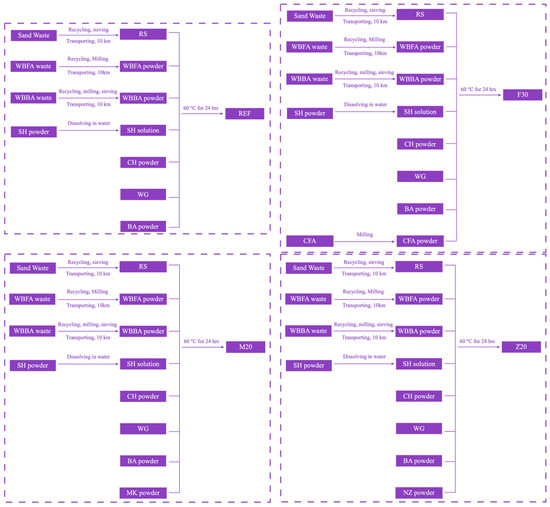
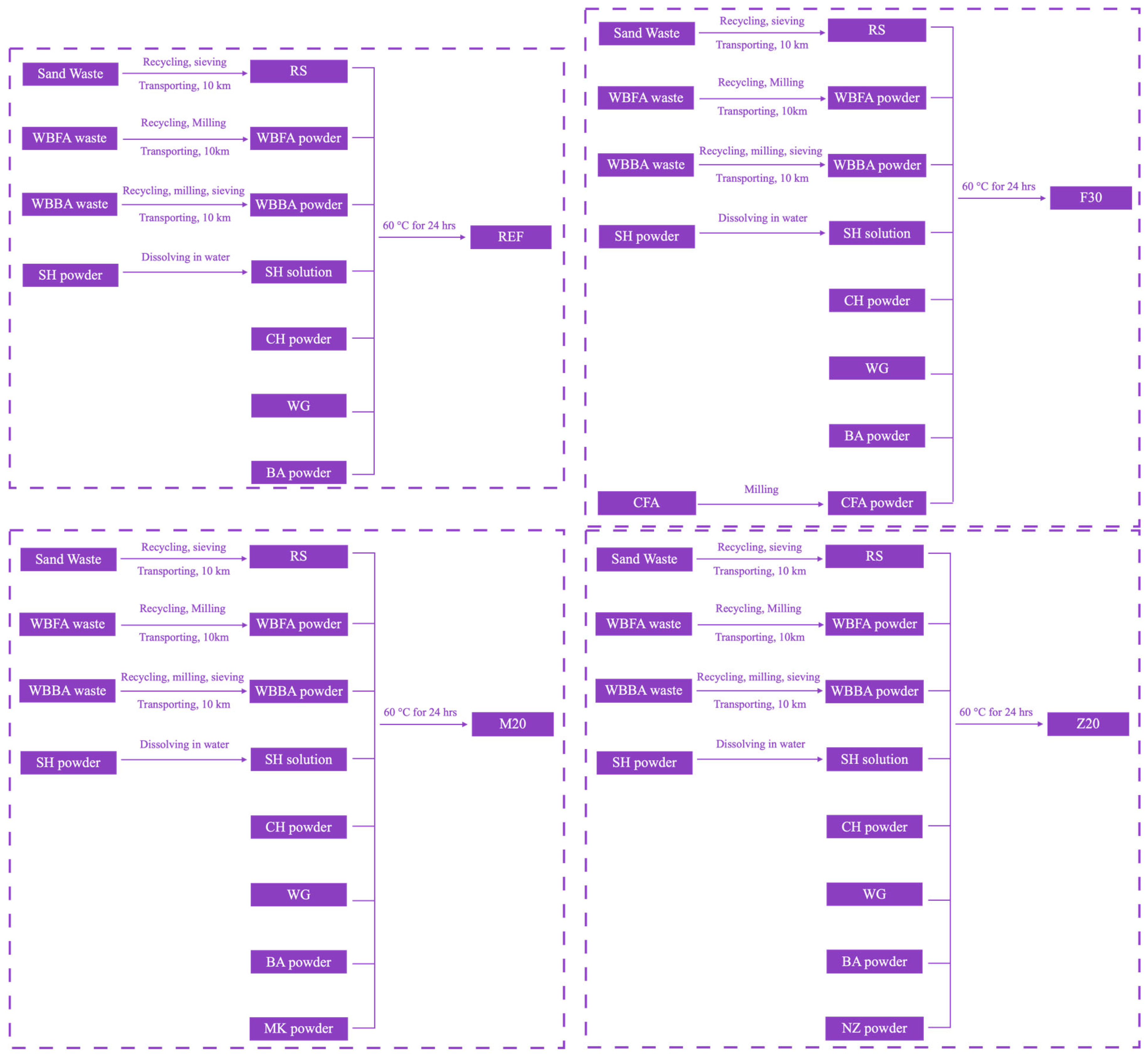
A cradle-to-gate LCA was performed on the reference sample (REF) and three other selected samples with the highest mechanical performance in their research groups (F30, M20, and Z20) to compare environmental impacts, particularly the greenhouse gas emissions resulting from the introduction of an additional precursor. The modelling was conducted in SimaPro 8.0, and the GWP 100a (global warming potential) and CED (cumulative energy demand) methods were used to calculate the carbon footprint and energy consumption. The functional unit (FU) was defined as the fabrication of 1 m3 of WBA-based AMM composite. The system boundary of the analysis is depicted in Figure 1, which covers the material and processing flows of inputs and outputs from the recycling sites to the industry gate: (1) recycling and transportation of raw wastes to the fabrication site; (2) pre-treatment of raw wastes, including milling, calcination, and sieving; (3) production of every FU of AAM composites.
Figure 1.
System boundary of LCA.
The lifecycle inventory (LCI) in the modelling was primarily sourced from the Ecoinvent 3.0 database, and unavailable data were retrieved from the relevant literature and production practices in the Lithuanian context, based on previous studies [11,26]. In addition, CFA is regarded as a co-product of energy production, and its inventory was adopted following the economic allocation method, as proposed in the literature [27,28,29]. In the analysis, 0.052 kg of CFA was considered per 1 kWh of electricity produced, and 1% of the economic values were allocated [30]. The MK used in this study was a commercial product obtained via the calcination of natural kaolin. This process usually consists of a heat treatment at 600–800 °C to evaporate water, accounting for approximately 14% of the kaolin’s mass, owing to hydroxylation [31]. The calcination inventory was converted to the energy input based on heat transfer [32,33]. An estimated 2.16 MJ/kg was required for the thermal treatment of kaolin [34,35]. There is no available inventory for NZ in the database. Therefore, data on limestone were selected to estimate the inputs, given the similar mining methods of the two minerals [36,37].
3. Results and Discussions
3.1. Characterisation of Raw Materials
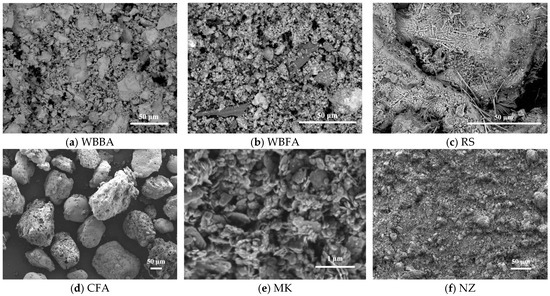
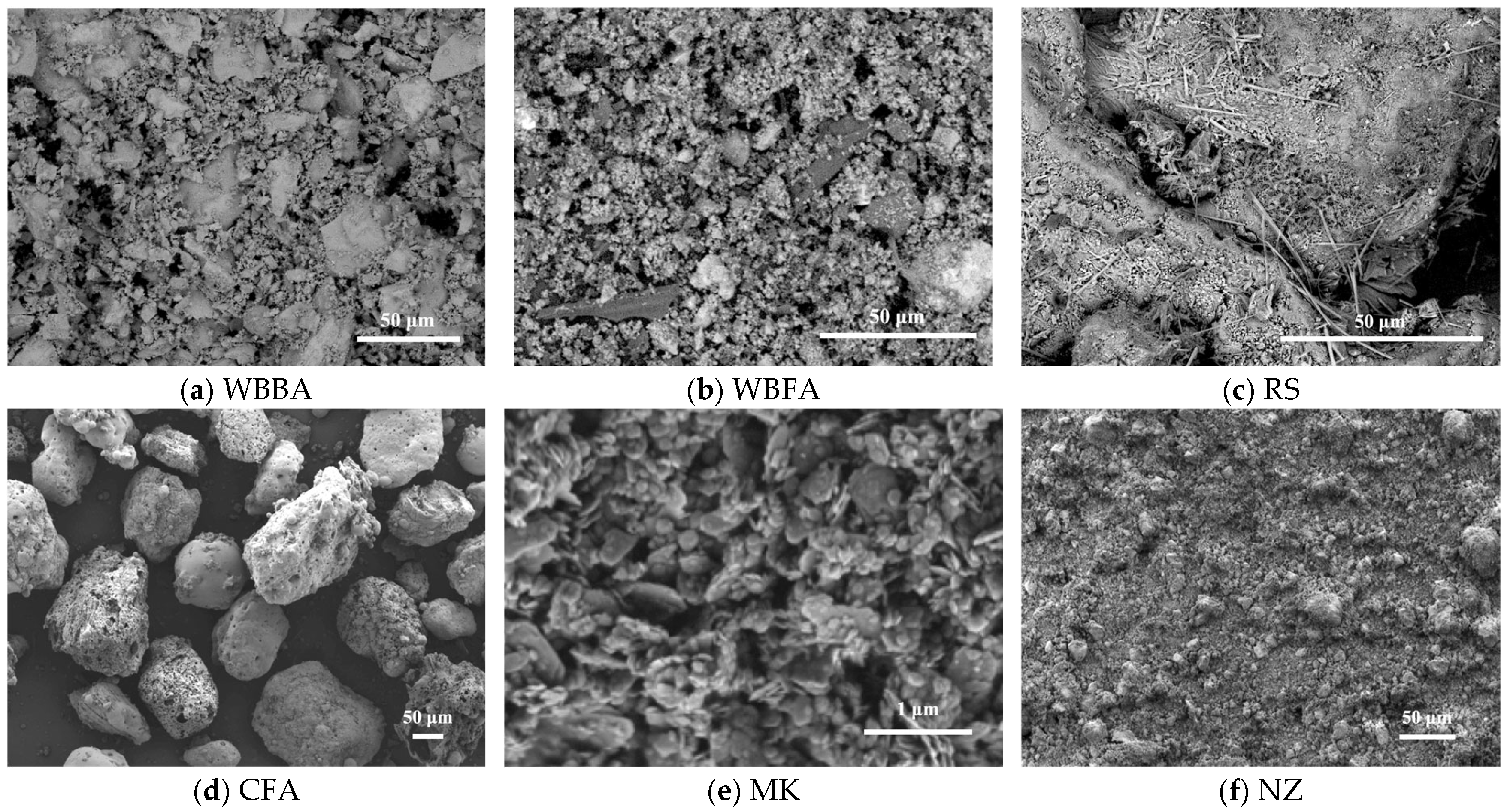
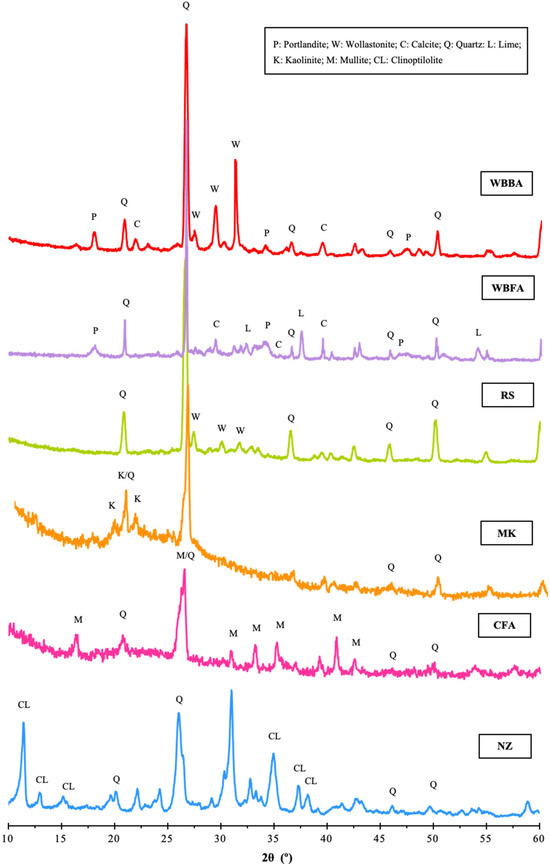
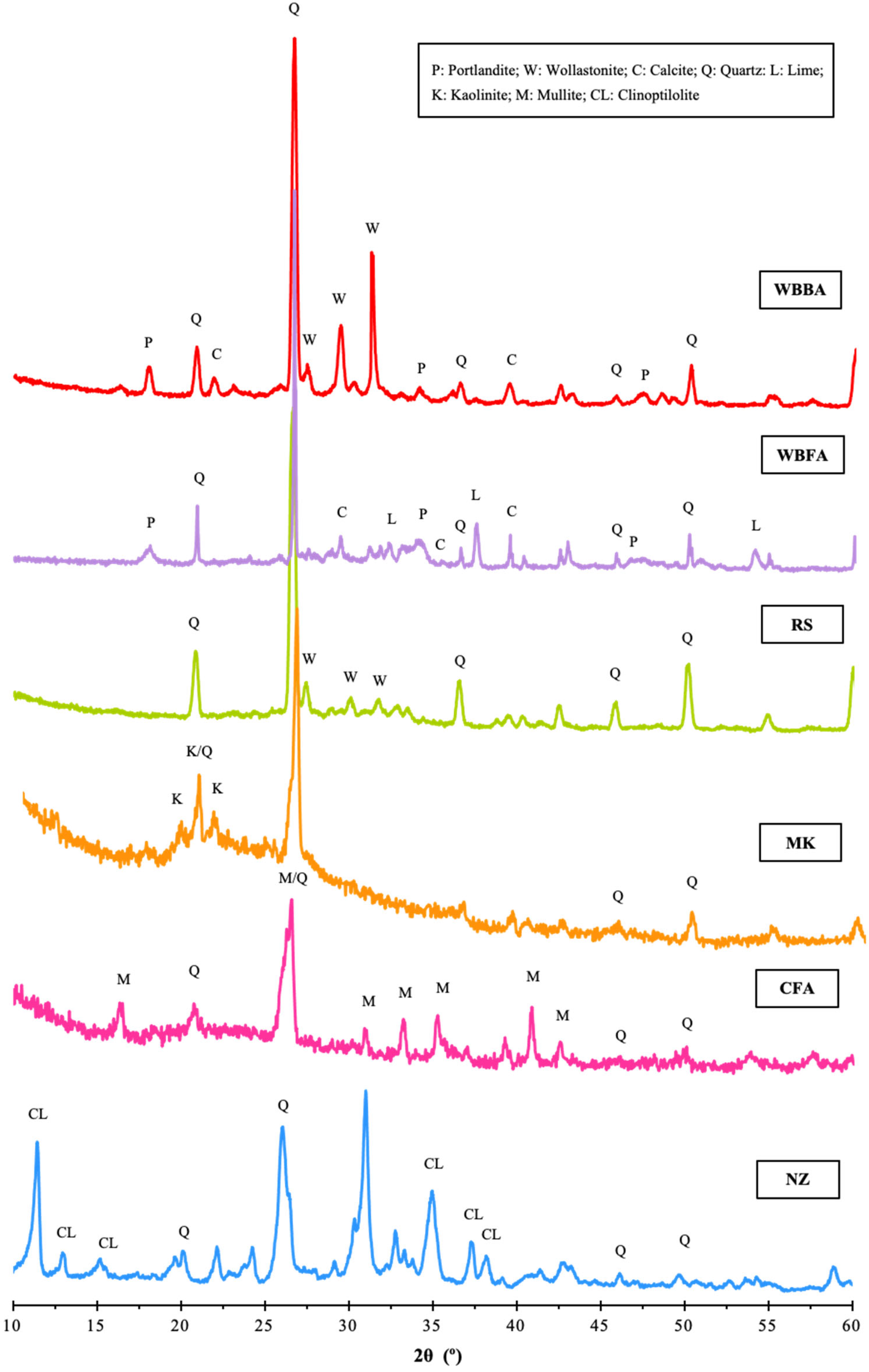
Figure 2 presents the SEM graphs of the raw materials. WBFA, WBBA and RS valorised from biofuel plants both exhibited irregularly shaped particles with rough surfaces, and there were unburnt wood residues on their surfaces, which mainly belonged to cellulose, lignin, and hemicelluloses [18]. In comparison, the particles of CFA showed sphere shapes at various diameters, and in the micrograph of MK, packed particles of plate shapes were identified, belonging to the typical morphology of kaolinite. In NZ, a compact microstructure with irregular flocculence-shaped particles was observed. The mineral composition of the raw materials is shown in Figure 3, which demonstrates the chemical composition of the materials. WBAs are calcium-silicate-based materials, consisting of quartz, calcite, portlandite, wollastonite, and lime, while CFA, MK, and NZ are aluminosilicate-based materials, consisting of quartz and, respectively, mullite, kaolinite, and clinoptilolite. It is worth noting that the silicate source in WBA is mainly crystalline quartz, which has strong internal bonds and becomes inactive when exposed to an alkaline environment.
Figure 2.
Morphology of raw materials.
Figure 3.
XRD patterns of raw materials.
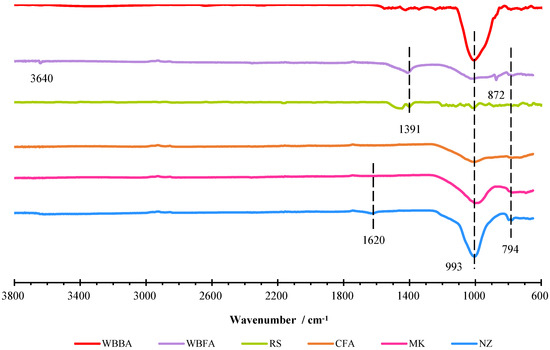
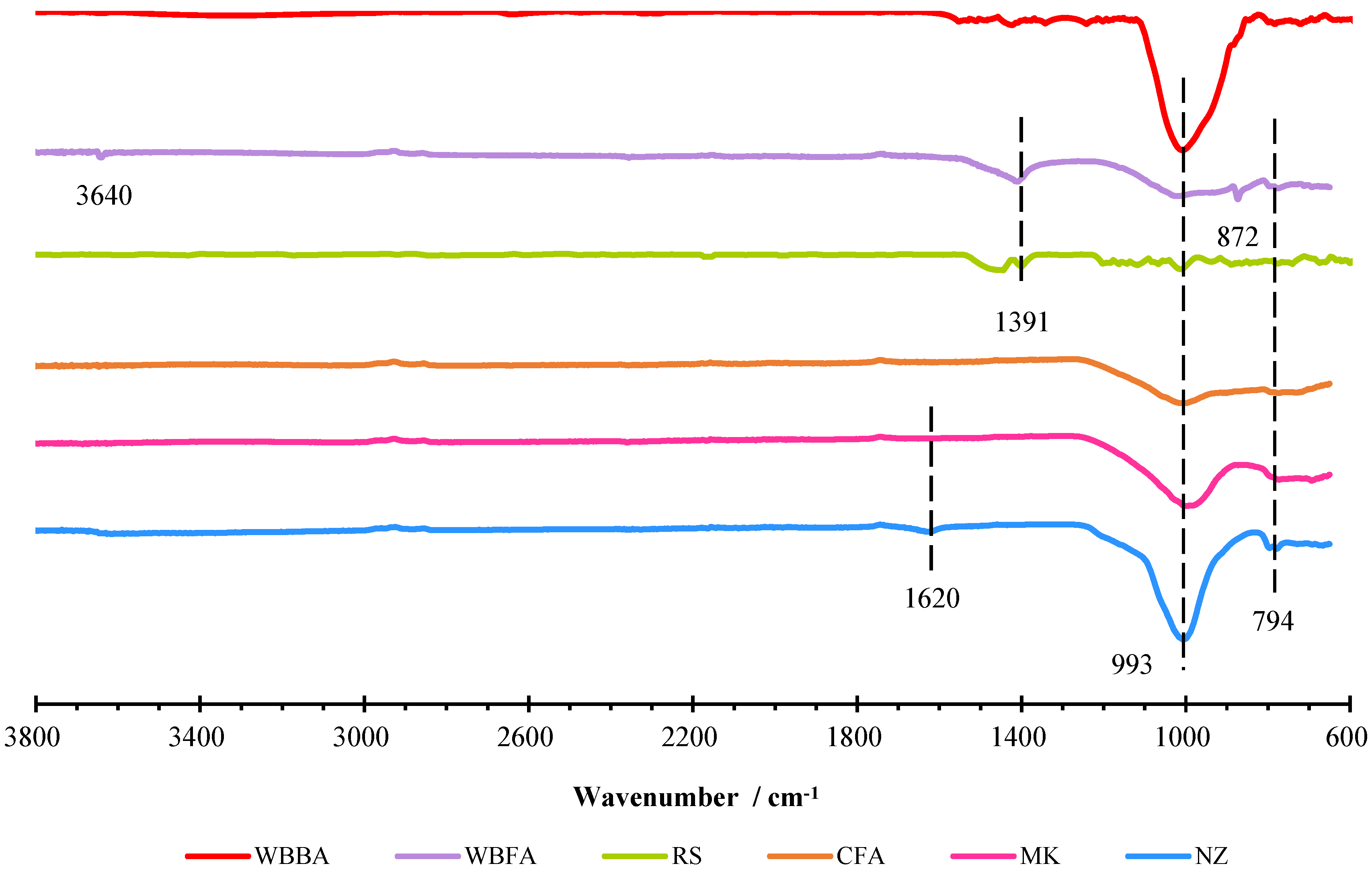
In comparison, the silicate content in CFA, MK, and NZ is derived from aluminosilicate minerals that are more chemically reactive. Figure 4 depicts the FTIR results of the raw materials in the wavelength range of 600 to 4000 cm−1. The band centred around 993 cm−1 occurred in all the materials, which is assigned to the vibration of Si-O-Si stretching, and the band belonging to Al-O-Si vibration was observed at approximately 794 cm−1 [38]. The weak bands at 1391 cm−1 in WBFA and RS, and at 872 cm−1 in WBFA, were assigned to different C-O vibration modes of the carbonate groups [39,40,41]. This indicates a high carbon content, particularly in WBFA, as evidenced by its impressive loss-on-ignition. At the wave number of 1620 cm−1, the absorption bands in NZ corresponded to the bending vibration of O-H in chemisorbed water, and the small bands at nearly 3600 cm−1 in WBFA were due to the stretching of O-H groups in the water molecules [40,41,42]. These results further confirm the chemical composition and structure of the raw materials used, as shown by XRF and XRD analyses.
Figure 4.
FTIR outcomes of raw materials.
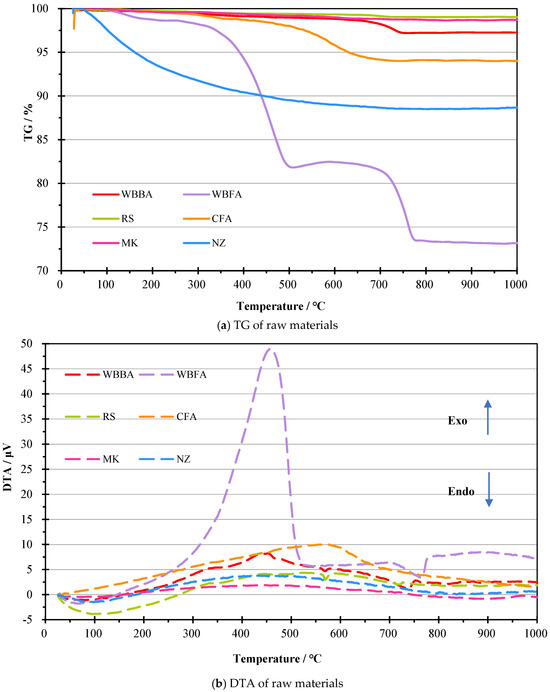
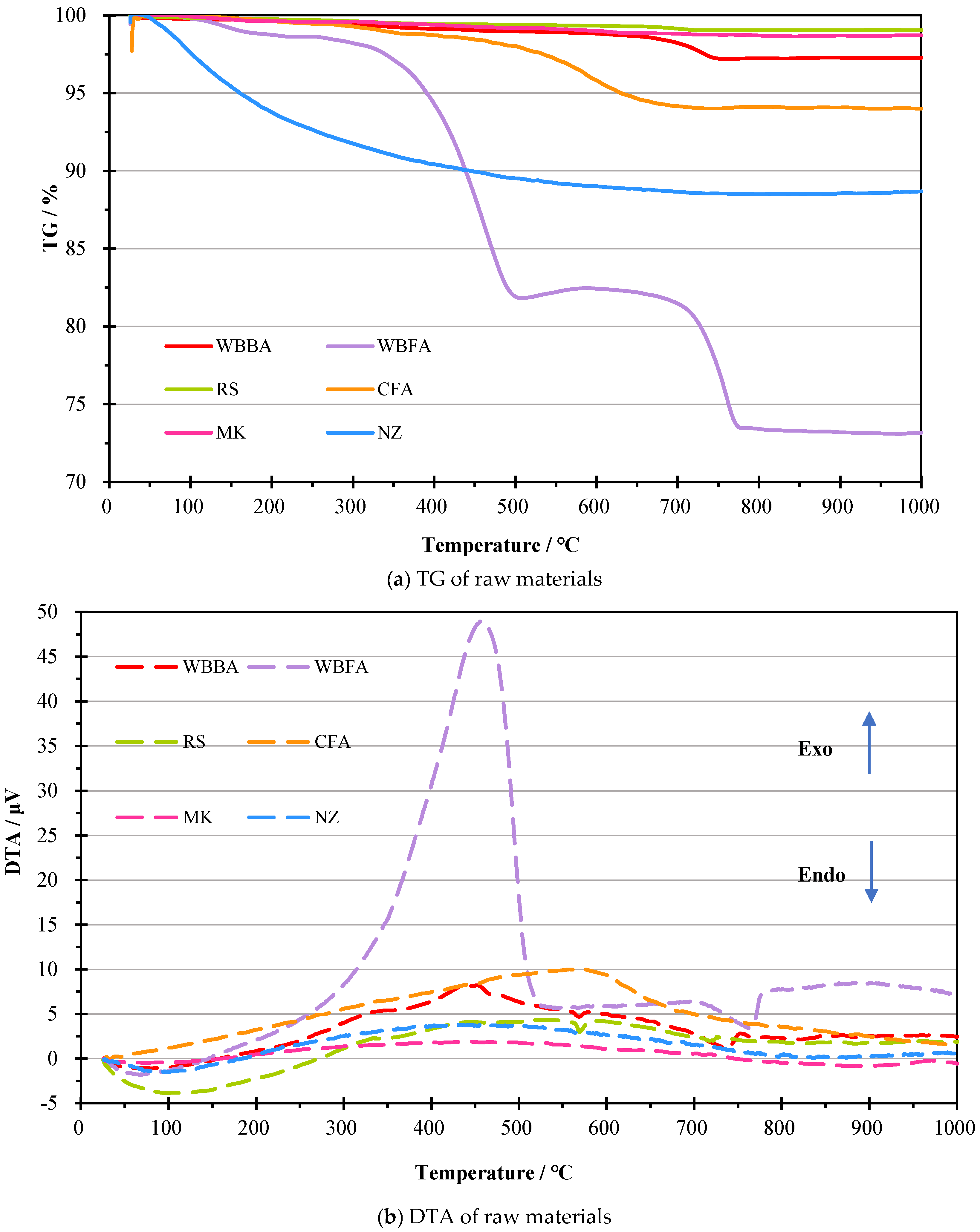
In the TG-DTA curves presented in Figure 5, the total weight loss of seven various raw materials is 2.73% (WBBA), 26.84% (WBFA), 0.96% (RS), 5.99% (CFA), 1.29% (MK), and 11.32% (NZ). The intensive exothermic peak within the range between 330 and 520° in two WBAs and RS belonged to the decomposition of organic matter due to the unburnt wood residues [11,18,43], and the endothermic peak at 50 to 200° corresponded to the evaporation of free and physically bound water [41,44,45]. The peaks of portlandite (CH) dehydration in WBFA and WBBA occurred within the range of 450 to 500° [24], overlapping with the temperature range of wood residue decomposition, and the endothermic peak from 680 to 770° was assigned to the decomposition of calcite [18,46]. WBFA exhibited the greatest mass loss during the thermal analysis, primarily due to its high content of organic wood matter and carbonate-containing phases. A similar evolution of DTA curves was observed for MK, NZ, and CFA, with only a single wide exothermic peak observed. This indicates that no structural changes occur during the thermal analysis, and the loss in sample weight is due to thermal dehydration, removing physically and chemically bound water in kaolinite, clinoptilolite, or mullite, respectively. Similar results were reported in other research [41,44,47]. No peaks of portlandite or carbonite were seen in MK, NZ, and CFA, which aligns well with the XRD results.
Figure 5.
TG and TA curves of raw materials.
3.2. Compressive Strength
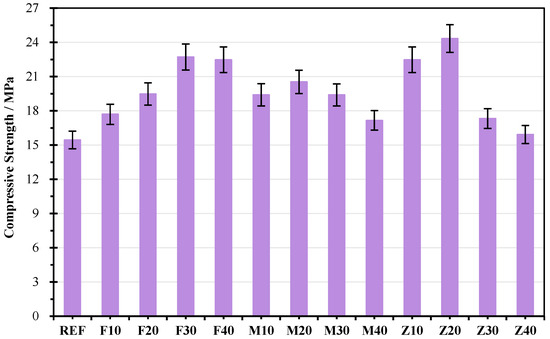
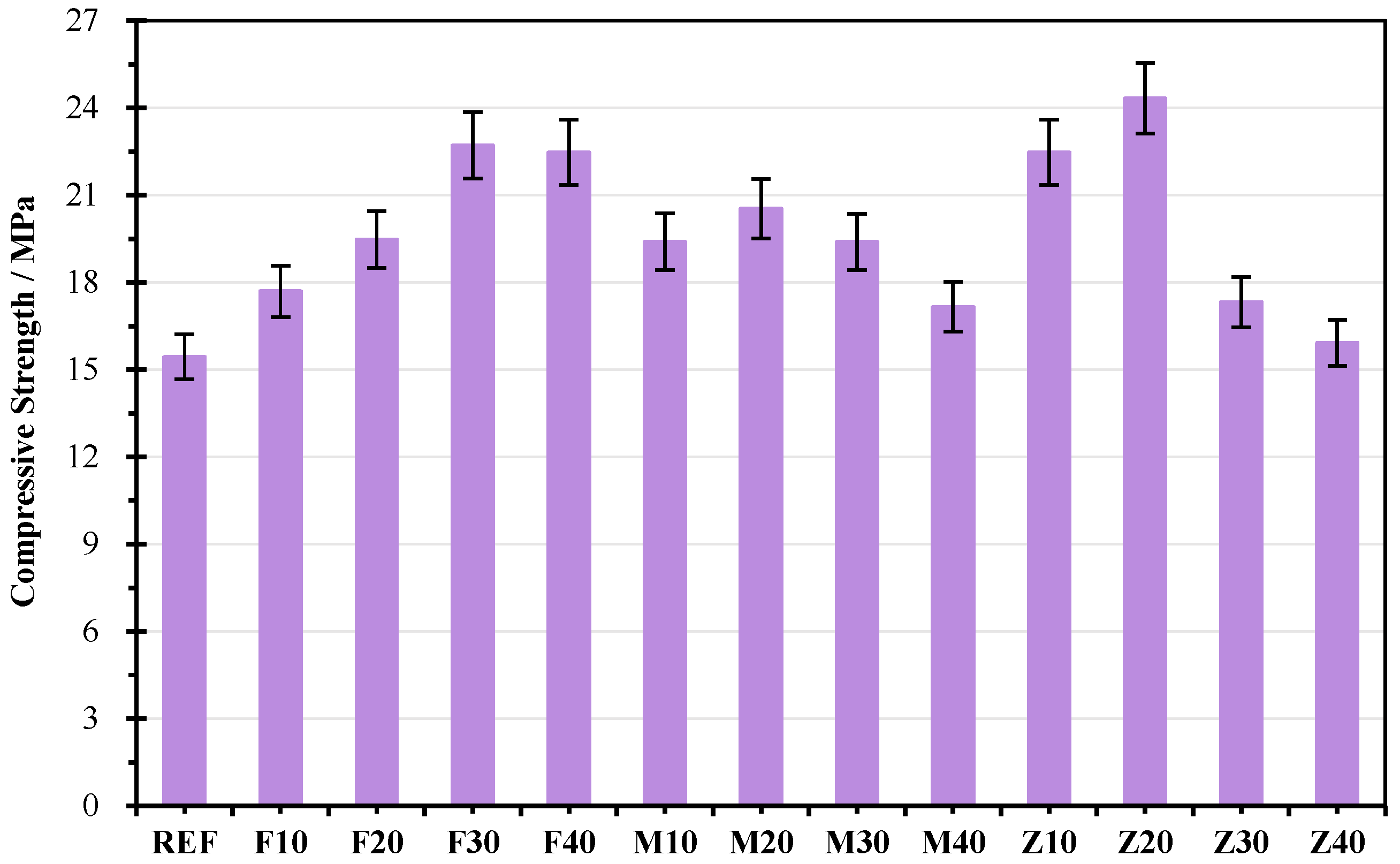
Figure 6 shows the compressive strength after 28 days of curing. The binary use of CFA, MK, and NZ contributed to varying degrees of strength development, ranging from 3.11% to 57.62%. Compared to the reference sample that reached a strength of 15.44 MPa, the greatest strengths of the samples with CFA, MK, and NZ were 22.71, 20.54, and 24.33 MPa, respectively, with growth of 47.09, 33.03, and 57.62%. One possible mechanism is that the additional source of amorphous silicate in the CFA, MK, and NZ of the raw materials, as analysed in the chemical–mineralogical compositions, facilitates higher hydration degrees. Meanwhile, the addition of aluminosilicates can trigger geopolymerisation, forming geopolymeric gels that coexist with Ca-based hydrates and a closely bonded microstructure, as shown in SEM images. This is also mentioned by other researchers [48,49,50,51]. An optimal ratio of binary precursor content was observed at 30, 20, and 20% for CFA, MK, and NZ, respectively. Exceeding this, the compressive strength started to decrease. In the previous research applying CFA, MK, and NZ together with WBA, the optimal contents were reported at 30–40%, 50%, and 1–5%, respectively [25,52,53]. This differs from the results in this study. The main factors are the adoption of different activators, curing conditions, and WBA characteristics.
Figure 6.
Compressive strength after 28 days.
It is worth noting that 20% NZ contributed to the greatest increase in compressive strength, and 30% CFA improved flexural strength to the greatest extent. The mechanisms of NZ in the geopolymer binder system can be concluded as modifying fillers or aluminosilicate-source precursors. In the alkaline environment, NZ phases dissolve and participate in geopolymerisation, contributing to the formation of NASH gels. Meanwhile, the unreacted NZ particles present in the newly formed geopolymer binder serve as additives, modifying the matrix microstructure. Geopolymeric gel provides a strong and durable support for NZ, and NZ improves the pore structure by introducing inner-connected and multiscale pores, leading to the combination of NZ micropores with the mesopores and macropores of the polymeric matrix [54,55,56]. These two effects favour the development of compressive strength when NZ is included, as observed in previous research [48,57,58]. In the context of this research, the first effect takes priority. As seen in SEM and XRD analyses, NZ dissolution to a great extent leads to an increase in the amount of geopolymeric gel and a dense morphology. Meanwhile, due to the second effect, the unreacted NZ particles and produced hydrates show a mutual support, which improves the pore structure and minimises the propagation of microcracks.
After partial substitution of WBA with CFA or MK, the active aluminosilicate phase reacts with activators to promote the formation of gel products. As a commonly used geopolymer precursor, MK is highly effective at promoting geopolymerisation. However, in this study, CFA outperforms MK in improving mechanical properties, even though the aluminosilicate content in the raw material MK is higher than that in CFA. Similar strength loss at high levels of MK use is also observed by other researchers [52,59]. One possible reason is the presence of unreacted MK particles, which deteriorate the microstructure of the produced mortar by introducing more cracks and gaps and cause structural defects, as observed in SEM images. Another can be the acceleration of the dissolution rate and condensation reactions of the aluminate contents at a lower MK amount [59].
3.3. Microstructure and Elemental Composition
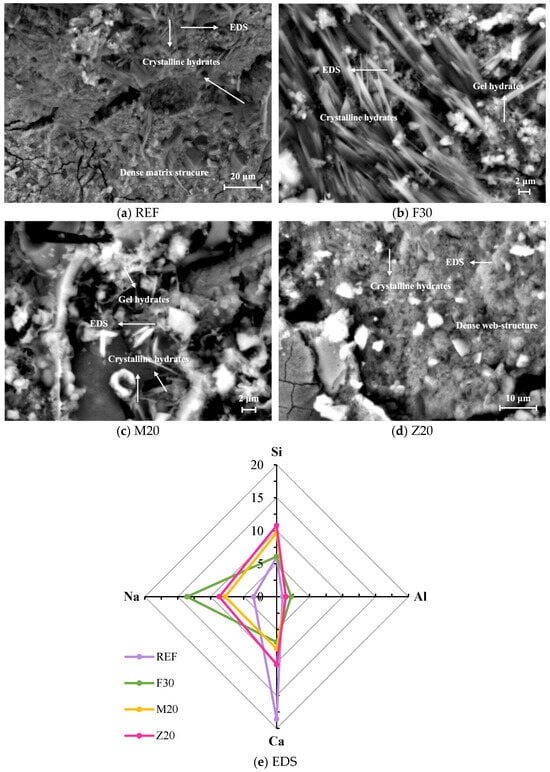
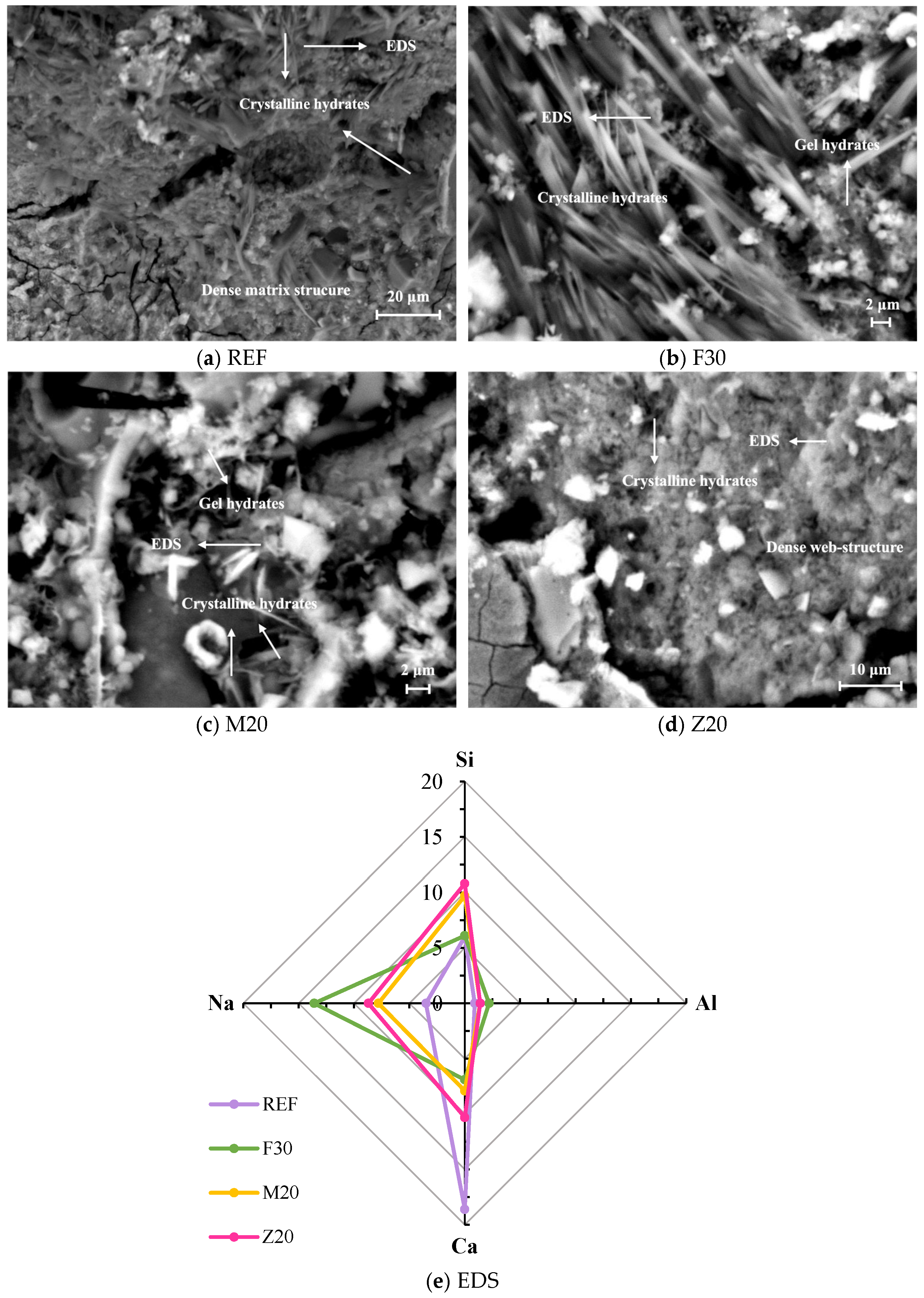
Figure 7 depicts the SEM images of the reference sample REF and the samples with 30% CFA (F30), 20% MK (M20), and 20% NZ (Z20), along with their corresponding EDS results. The hydrates can be clearly seen in the micrographs, which bind the aggregates in the mortar and bestow strength development [60]. In REF, a dense but nonhomogeneous matrix microstructure was observed, supporting the development of the mechanical properties. Phases of fibrillar and sheet-like structures were detected and assigned to crystalline hydration products. In the matrix, microcracks and large voids were observed, indicating that although the binder structure was well formed, the particle-to-particle connection remained loose. This restrains further improvement in its strength.
Figure 7.
Micrographs of AAM samples and the corresponding EDS results.
Under a larger magnification, the morphology of various hydrates was noted in sample F30. Needle-like crystalline hydrates existed in clusters, with spherical and flocculent gel hydrates covering the spaces among them. This contributes to a denser, more homogeneous microstructure with stronger particle-to-particle bonds. This kind of gel–crystal coexistence structure favours the development of the binder matrix and thus enhances mechanical strength. In M20, the same needle-shaped crystalline hydrates and gel hydrates were observed, but with a less compact microstructure when compared to F30. The hydrates were poorly crystallised, and their association with the gels was loose and weak, leading to the formation of microspaces and voids in the matrix. This explains the limitation in its mechanical strength evolution. It is worth noticing that different morphologies of the hydrates were observed, which has been a debate point heavily influenced by the activator category, curing conditions, and observing techniques [61].
Sample Z20 exhibited a slightly different morphology. A compact matrix was observed, with a dense, web-structured morphology composed of gel hydrates supported by the three-dimensional NZ structure. The uncreated NZ showed composite effects, with coexisting reaction products, significantly reducing pore size in the binder and transforming open pores into closed ones. The improvement in the pore structure led to superior compressive strength, surpassing that of all the other samples. This effect of NZ is also mentioned by previous researchers [45,48]. The crystalline phases of the hydrates were also identified, but in smaller sizes. They bridged gaps in the matrix and filled pores, further modifying the mortar’s microstructure.
In addition to the main elemental composition shown in the EDS results in Figure 7e, it is worth noting that the C proportion was observed in all samples, ranging from 15% to 17%. It partially stems from unburnt organic residues in WBFA, as also reported by other researchers [18]. In REF, Ca accounted for the highest amount at 18.6%, while Al and Na accounted for 3.5% and 0.9%, respectively, i.e., the hydrate composition in the observed spot in the reference sample is Ca-based and dominated by CSH. This can also be noted in XRD patterns. F30, in comparison, consisted of the greatest amount of Na at 13.6%, and the contents of Al and Ca were 2.2 and 6.9%, respectively, which confirms the production of Na-containing hydrates, i.e., NASH, after the introduction of CFA in the mortar. Sample M20 contained a similar content of Na and Ca, at around 7.85%, indicating the coexistence of Na- and Ca-based hydrates. In sample Z20, the chemical elements Ca, Al, Na, and Si were all abundant, indicating the probable existence of various hydrates CSH, CASH, and NASH. The wide variety of hydrates accounts for their remarkable mechanical properties.
3.4. Phase Identification
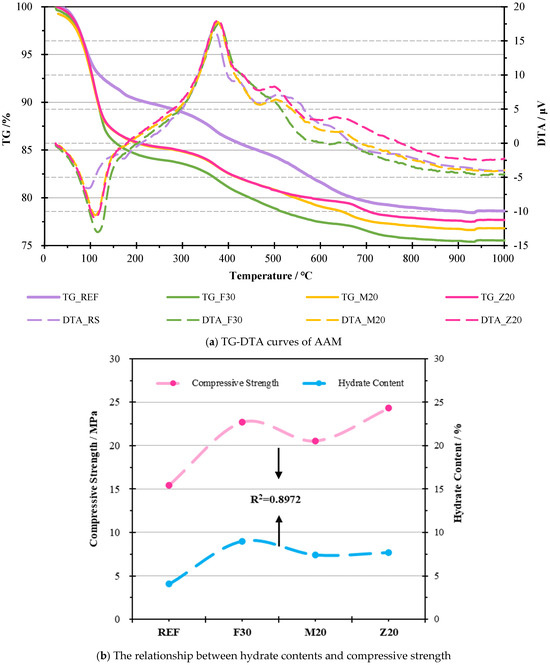
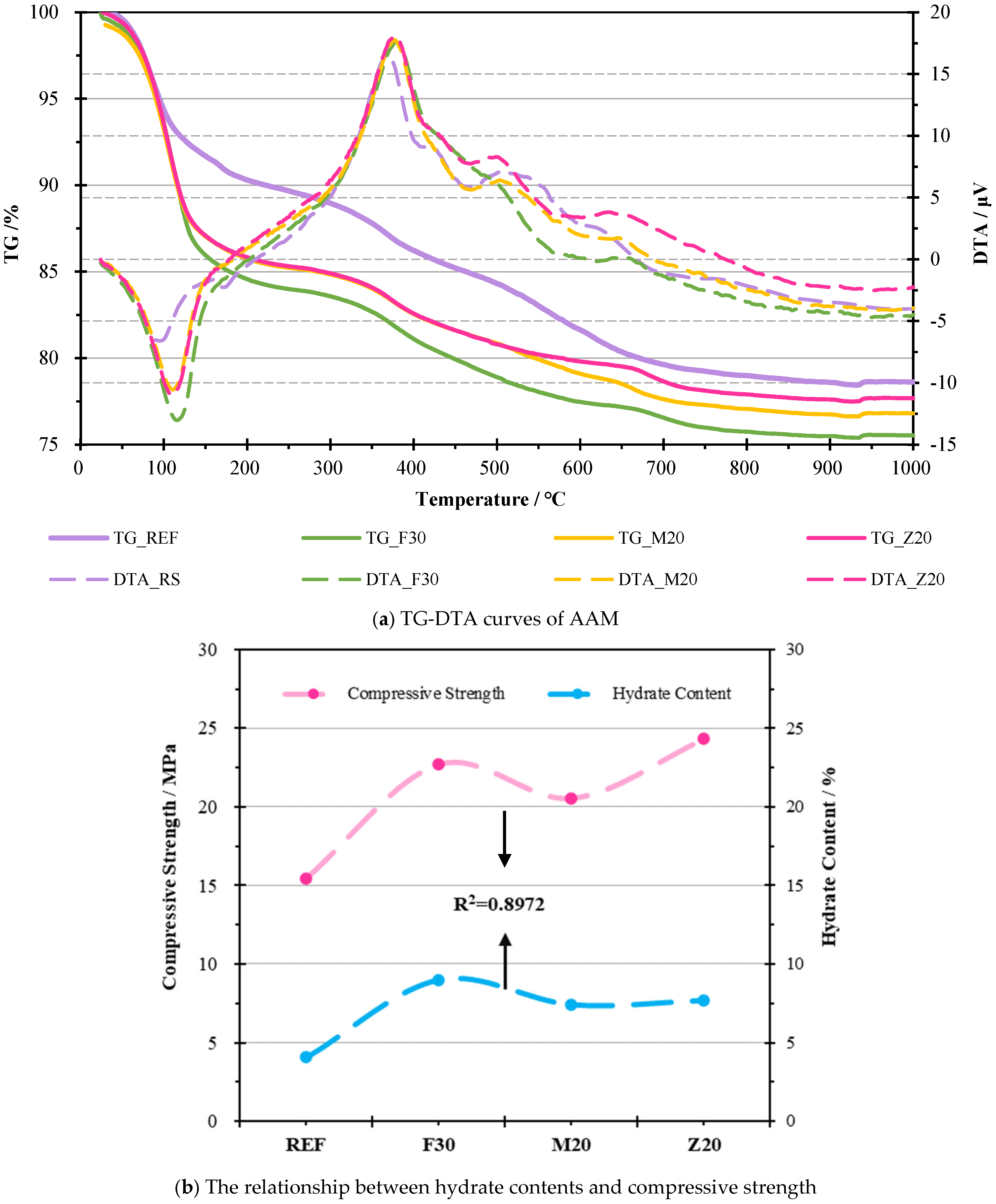
Figure 8a depicts the TG-DTA thermographs. Three primary peaks are observed in the DTA curves for all four samples, indicating similar thermal behaviour of the mortar mixes in terms of mass loss, though with different values. The first wide endothermic peak in the DTA curves between 50 and 200 °C is attributed to the evaporation of free and physically bound water, as well as the decomposition of hydrates CSH, CASH, and sodium aluminate silicate hydrate (NASH) [5,60,62,63]. The second intensive exothermic peak from 300 to 430 °C corresponds to the decomposition of organic matter in the wood biomass wastes [4,43]. The appearance of this peak highlights that the unburnt wood residues fail to dissolve or react during the activation process. In a way, their presence negatively affects the development of mechanical properties. At the temperature range of 430–520 °C, the endothermic peak is assigned to the dehydration of portlandite, and the endothermic peak in the extent between 520 and 650 °C belongs to the completion of dehydroxylation and decomposition of carbonate-containing phases [46,64,65,66,67]. Compared to the temperature range of carbonate decomposition in raw materials, the shift to the lower temperature is due to the poor crystallisation of the phases in the mortar, which is also mentioned in other research [26,65].
Figure 8.
TG-DTA analysis of AAM.
To quantitatively approximate the reaction process, the formation quantity of each reaction product is usually estimated from the mass loss in TG curves over different temperature ranges, with peak overlaps ignored [46,68]. As noted in the existing literature, the cumulative weight prior to 200 °C is indicative of the water content within hydrate components [60,69]. Considering the evaporation of free water usually occurs below 100 °C, the temperature range of 100–200 °C is used to estimate the proportion of hydrate products. Based on the results, in Figure 8b, the mass loss during the production of hydrates of REF, F30, M20, and Z20 is 4.06%, 9.01%, 7.43%, and 7.69%, respectively, with a correlation coefficient (R2) of 0.89072. This suggests a significant positive correlation between the development of compressive strength and the hydrate contents, i.e., a higher hydrate content is theoretically connected with a greater compressive strength. The replacement of WBA with an aluminosilicate binary precursor increases the alkaline activation degree, resulting in the formation of more hydrate products. This correlates with the enhancement of mechanical properties, as supported by the strength outcomes that the compressive strength of F30, M20, and Z20 surpasses that of REF. However, one point worth mentioning is that F30 has the highest hydrate content, but the greatest compressive strength is reached in Z20. The reason behind it can be that NZ is a natural mineral with a special cage-like microstructure, which also acts as an effective additive, modifying the microstructure of the mortar [48,57], as already discussed in compressive strength development and SEM-EDS analysis. Unlike the mineral structures of CFA and MK, NZ contains abundant lattice vacancies that can host large exchangeable cations (e.g., Na+ and Ca2+), which readily hydrate by coordinating with water molecules. These voids may interconnect to form channels of varying sizes, giving clinoptilolite-based NZ a high cation-exchange capacity. Consequently, Na+ and Ca2+ from the activating solution, and other constituents can be immobilised within the zeolite framework, promoting the formation of an NZ–AAM composite structure.
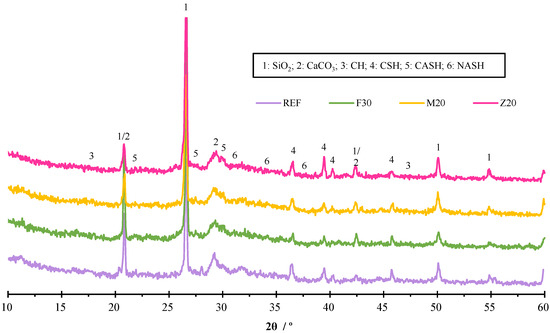
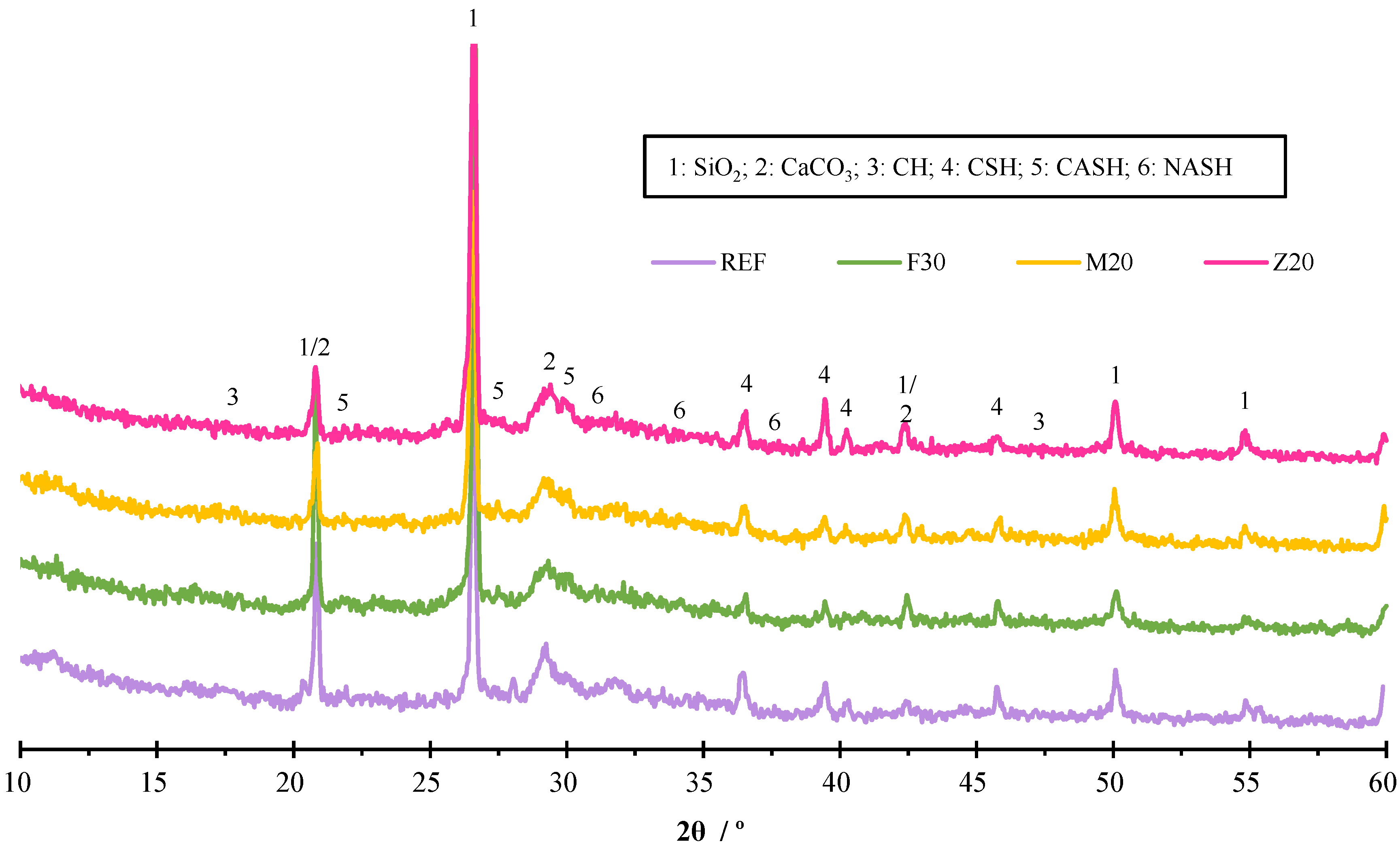
To further characterise the chemical composition, XRD patterns of representative AAM samples after 28 days were obtained, as shown in Figure 9. The crystalline phases were mainly quartz, calcite, portlandite, CSH, CASH, and NASH. CSH and CASH are Ca-based hydration products, while NASH belongs to a geopolymeric product. An amorphous region was noted between 25 and 35°, corresponding to the existence of gel hydrates CSH, CASH, and NASH [70]. This coexistence of crystalline and gel hydrates further supported the SEM-EDS analysis. Quartz remained highly intense in the AAMs, indicating that it barely dissolved during the reaction, as reported by other researchers [5,45,71]. The fact that quartz was the main silicate source in WBA significantly affected its chemical reactivity and increased the difficulty of its utilisation. The absence of peaks for primary minerals in the raw precursor materials assigned to lime, wollastonite, mullite, kaolinite, and clinoptilolite indicates their dissolution in the alkaline environment and their participation in the activation reaction when exposed to alkali activators, producing various categories of hydrates. Compared to the reference sample REF, the intensity of the Ca-containing hydrate peaks CSH and CASH increased in samples with additional CFA, MK, and NZ, indicating an increase in hydration products. This is in accordance with the TG-DTA results and is one of the reasons for the mechanical property development, as seen in the compressive strength. Small peaks of NASH were detected in F30, M20, and Z20, testifying to the production of polymeric products due to the geopolymerisation between aluminosilicates and alkali activators, as also mentioned in SEM-EDS analysis. Meanwhile, the portlandite peaks were weak and narrow in the XRD patterns, despite the addition of CH as a ternary activator. This indicates that it is consumed in the alkali-activation reaction.
Figure 9.
XRD patterns of AAM.
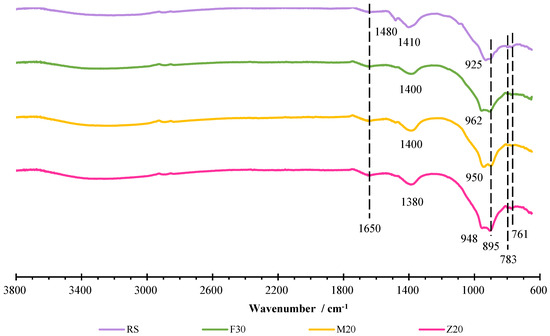
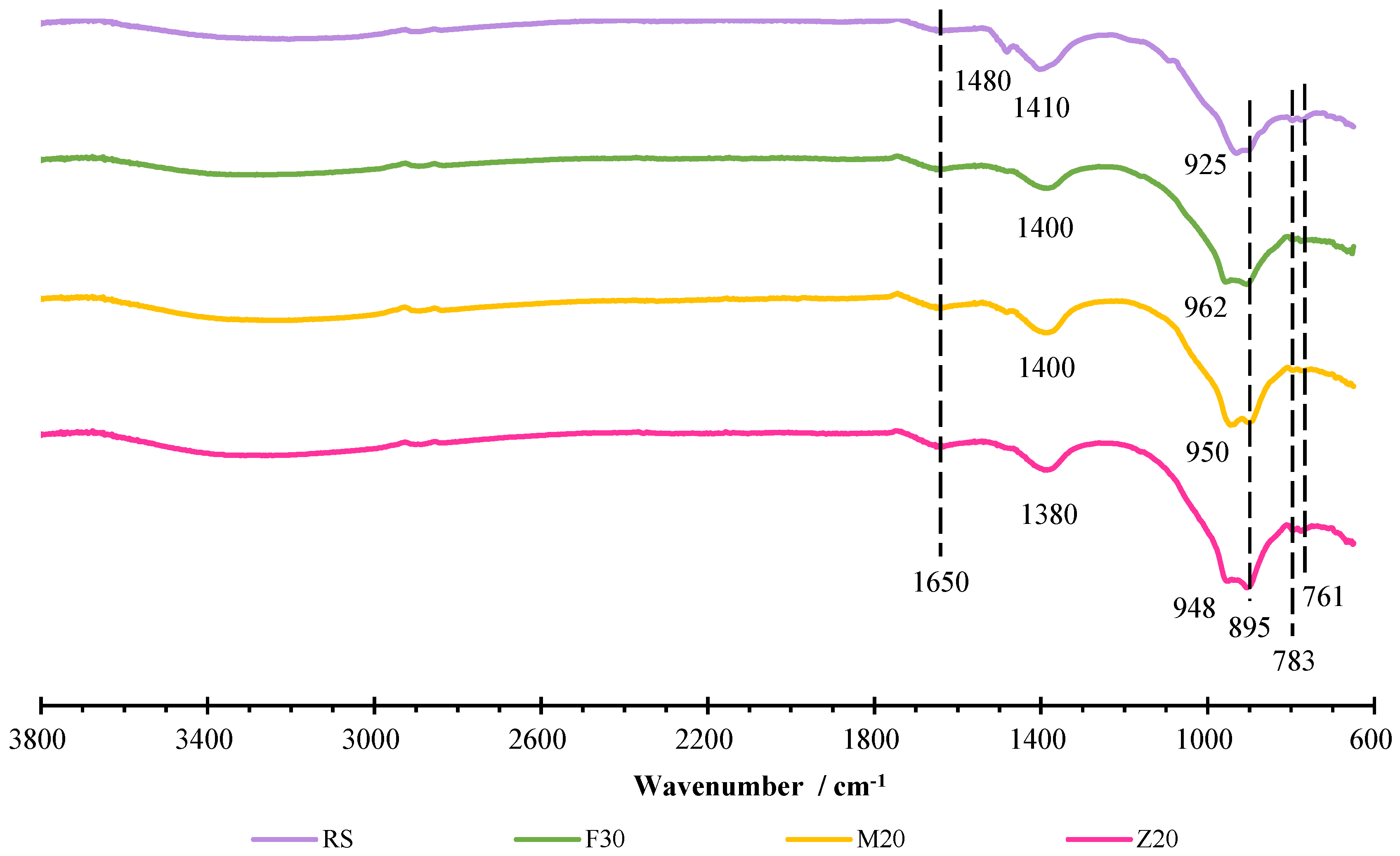
The vibration spectra of four representative AAM samples are depicted in Figure 10, with the wavenumber ranging from 600 to 4000 cm−1. Compared to the FTIR curves of the raw materials, the O-H stretching vibration centred around 3600 cm−1 [41] in WBFA disappeared in all the AAM samples, while a peak belonging to the O-H bending vibration attached to interlayer bound water in hydrate gels was recorded at 1650 cm−1 [42], which was only observed in NZ in Figure 4. This alternation in the O-H bands indicates the decomposition of raw material compounds and the transformation to new hydrate products during the activation process. A shift of bands from 1391 cm−1 in WBFA and RS to 1380–1420 cm−1 in mortar samples was observed, together with the generation of a small peak at 1480 cm−1 in REF. This is attributed to the formation of new C-O vibration bands due to the carbonation of hydration products, as evidenced by the XRD patterns. It also influenced the shift of C-O bending bands from 872 cm−1 in WBFA to 895 cm−1 in mortar samples REF, F30, M20, and Z20. The alternation of the stretching vibration from 993 cm−1 in the raw materials to 925–962 cm−1 in the produced mortar is associated with Si-O-Si bands in the SiO4 tetrahedra [72]. The shift of bands from 794 cm−1 in raw materials to 783 cm−1 in AAM samples, as well as the generation of new peaks centred around 761 cm−1, is attributed to the vibration of Al-O-Si bands [38]. The change in these two ranges is significant evidence of the ongoing activation to produce hydrates and geopolymeric products in the binder.
Figure 10.
FTIR spectra of AAM.
3.5. Environmental Impact Assessment
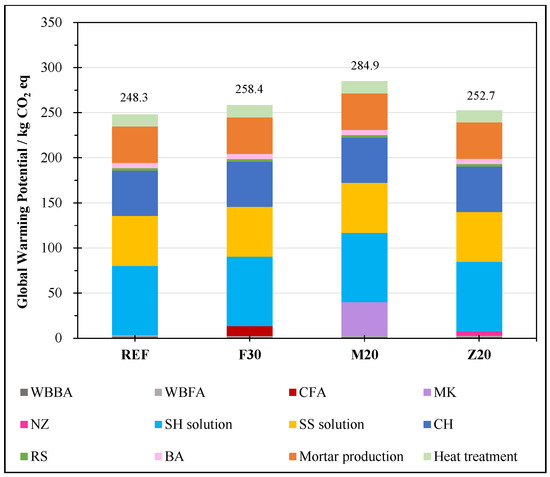
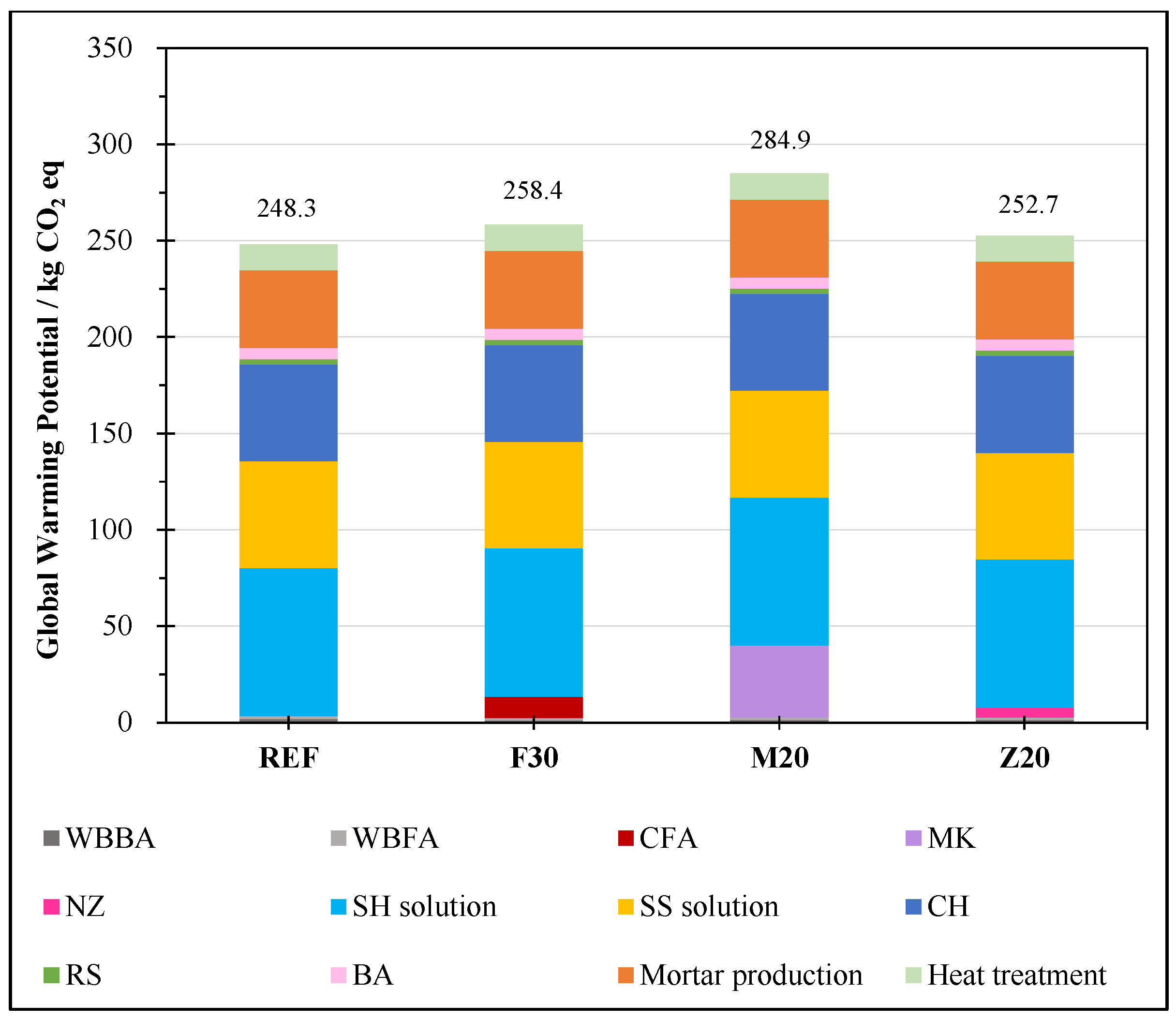
The greenhouse gas emissions for the production of one cubic meter of representative AAM mixes are depicted in Figure 11. The results showed that the GWP ranged from 240 to 300 kg CO2 eq, with the highest carbon footprint of 284.9 kg CO2 eq observed at M20 with 20% MK usage. This can be attributed to the calcination process used to produce MK from kaolin clay. These values are much lower than those of PC-based mortar materials at 700–1000 kg CO2 eq [73]. The reference sample showed the lowest GWP, with a value of 265.52 kg CO2 eq, and the replacement of WBA with 30% CFA, 20% MK, and 20% NZ resulted in increases in environmental burdens of 4.05%, 14.75%, and 1.79%, respectively. Even so, for F30, M20, and Z20, the total emissions from precursor materials still accounted for only 1.29–21.92% of those from alkaline activators, which totalled 182.45 kg CO2 eq across all samples. That indicates that CFA and MK are more eco-friendly as binary precursors. Another point worth noting is that the GWP of WBA did not exceed 2.36 kg CO2 eq, suggesting superior eco-efficiency.
Figure 11.
Greenhouse gas emissions of AAM production per cubic metre (WBBA: wood biomass bottom ash; WBFA: wood biomass fly ash; CFA: coal fly ash; MK: metakaolin; NZ: natural zeolite; SH: sodium hydroxide; SS: sodium silicate; CH: calcium hydroxide; RS: recycled sand; BA: boric acid).
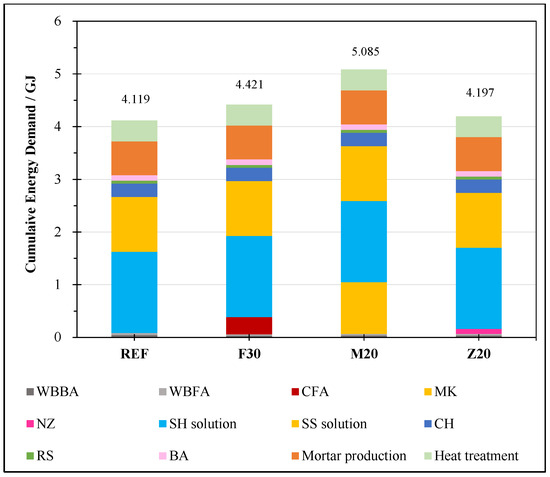
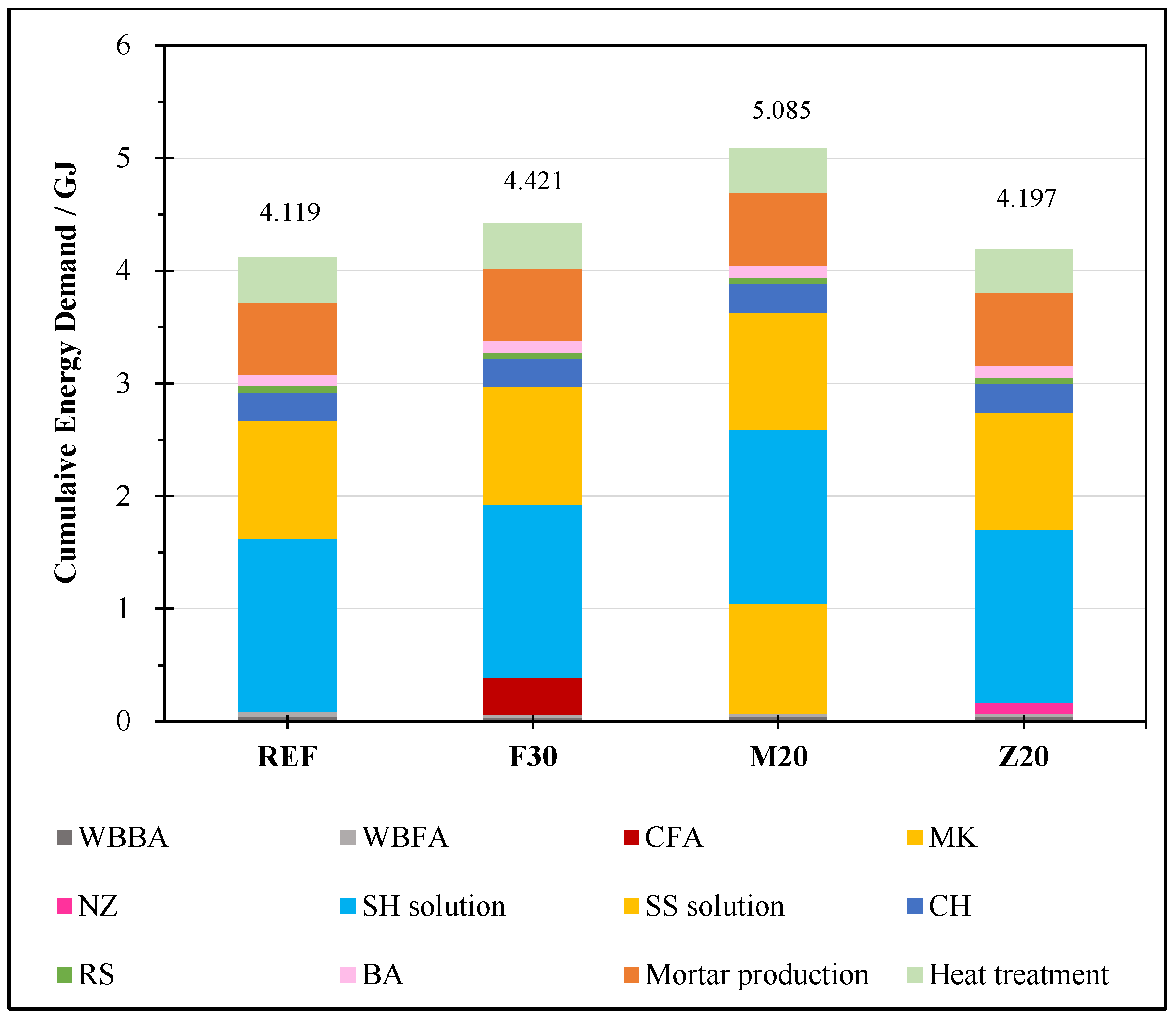
Figure 12 displays the cumulative energy demand of the corresponding samples, varying from 4 to 5 GJ, which is less than the energy demand of PC-based mortar at 5–7 GJ [73]. Similarly, as with GWP, the highest energy demand was observed at M20, and MK accounted for approximately 20% of total consumption. The reference sample with only WBA had the lowest CED of 4.12 GJ per cubic meter of production, and the use of a secondary precursor led to increases in energy of 7.31 (F30), 23.44 (M20), and 1.89 (Z20). In the precursor materials, WBA had the lowest energy consumption, at less than 0.07 GJ. Also, it is worth noting that the CED of 10% CH was 83.54% and 75.60% lower than those of SH and SS solutions, respectively. This indicates that introducing CH as an additional activator to reduce the use of SH and SS solutions is a sustainable approach.
Figure 12.
Energy demand of AAM production per cubic meter (WBBA: wood biomass bottom ash; WBFA: wood biomass fly ash; CFA: coal fly ash; MK: metakaolin; NZ: natural zeolite; SH: sodium hydroxide; SS: sodium silicate; CH: calcium hydroxide; RS: recycled sand; BA: boric acid).
The LCA results show that the use of MK greatly reduced greenhouse gas emissions and energy consumption, owing to its energy-intensive production process. In comparison, the utilisation of NZ resulted in the lowest increase in environmental burden, which aligns with previous studies indicating that NZ in PC-based materials can effectively reduce carbon footprints [74] and the introduction of binary precursors. From the perspective of multi-criteria decision-making, a sustainability index (SI) for the production of AAM per cubic meter was considered by relating environmental impacts to mechanical strength. It was defined according to the following equation, which was adjusted based on previous investigations to align with the current research, and the CED was converted to greenhouse gas emissions using an intensity of 0.05 kg CO2 eq/MJ [75,76].
where:
SI: sustainability index, kg CO2 eq/MPa;
GWP: global warming potential, kg CO2 eq;
CED: cumulative energy demand, MJ;
fc: compressive strength, MPa.
Based on the results, the SI values for REF, F30, M20, and Z20 are 29.43, 21.11, 26.25, and 23.33 kg CO2 eq/MPa, respectively, in the order REF > M20 > F30 > Z20. The higher the SI, the less sustainable the AAM mix. The indices of F30, M20, and Z20 are smaller than that of REF, suggesting that the addition of 30% CFA, 20% MK, and 20% NZ improved both the sustainability and mechanical performance. The use of 20% NZ is the optimal dosage in this study, as it outperforms MK and CFA.
4. Conclusions
In this study, a sustainable waste-based AAM mortar was created, which can be combined with recycled coarse aggregates to further produce cementless eco-concrete. Moreover, considering the mechanical properties, the mortar can be applied in low load-bearing elements, such as building enclosures, roofs, floors, and infrastructure-supporting elements. Based on the obtained results, the primary conclusions are as follows:
- The reference sample with only WBA as precursor material reached a compressive strength of 15.44 MPa. The problem with WBA is the lack of active amorphous minerals, especially when Si exists as stable quartz, making it a hard-to-utilise waste. Ternary activator CH added at 10% of the total precursor mass was a source of active Ca, which can positively facilitate the formation of CSH/CASH hydrates when used together with WBA. After adding aluminosilicate-rich (CFA, MK, NZ) binary precursors at 10–40%, the results show their effectiveness in improving mechanical properties in the sequence NZ > CFA > MK, reaching the highest compressive strength at 24.33, 22.71, and 20.54 MPa, respectively.
- The mechanical properties are affected by both the activation degree and microstructural development. In the XRD, crystalline quartz, calcite, portlandite, crystalline hydrates (CSH, CASH, and NASH), and amorphous gel hydrates were identified, accompanied by shifts in the vibration bands in the FTIR and the appearance of typical peaks in the DTA. The reference sample REF is Ca-dominated and, in an alkaline ambient, similar to PC, the hydration of active Ca and Si forms a dense matrix in SEM composed of gel and crystalline hydrates dominated by C(A)SH. However, the presence of large gaps and microcracks limited its strength development.
- The replacement of WBA by CFA, MK, and NZ contributed to an increase in hydrate content, as quantified by TG-DTA analysis, where the hydrate amounts are in the order of F30 (9.01%) > Z20 (7.69%) > M20 (7.43%) > REF (4.06%). Meanwhile, the introduction of CFA, MK, and NZ enriches the hydrate classification. The geopolymerisation of active aluminosilicates accounts for NASH formation. The growing generation of CSH, CASH, and NASH, resulting from the coexistence of hydration and geopolymerisation, significantly densifies the mortar structure and forms a more homogeneous matrix with fewer micropores and cracks, thereby favouring strength development. Another point worth noting is that a dense, web-structured morphology gel is observed in Z20, i.e., NZ not only participates in the geopolymerisation as a precursor, but unreacted NZ particles also act as additives, modifying the matrix’s pore structure. This explains the outstanding mechanical properties of Z20.
- When environmental impacts were taken into account, binary precursors contributed to increased GWP and CED. The sustainability of the precursor materials follows the sequence of WBA > NZ > CFA > MK, highlighting the low carbon footprint and energy consumption of valorised WBA. The energy-intensive calcination procedures used in MK production significantly increase its environmental impact. Regarding alkaline activators, CH exerted lower environmental burdens than SH and SS solutions, indicating that CH is an eco-friendly choice. From a comprehensive perspective via SI, Z20 showed higher sustainability than M20 and F30, with an SI of, accordingly, 23.33, 21.11 and 26.25 CO2 eq/MPa.
- The valorisation of wood biomass wastes adds economic value to industrial byproducts by transforming them into material products for building and construction. This favours a circular economy. In addition, as CFA’s value rises due to its widespread use as a supplementary material in PC products, its economic value may decrease its eco-efficiency. From this point of view, it is suggested that a lifecycle cost analysis be conducted in future research to assess eco-viability.
Author Contributions
Conceptualisation, I.P. and Y.D.; methodology, I.P. and Y.D.; software, J.P.; validation, I.P. and J.P.; formal analysis, I.P. and Y.D.; investigation, Y.D.; resources, I.P. and J.P.; data curation, J.P. and Y.D.; writing—original draft preparation, Y.D.; writing—review and editing, I.P. and J.P.; visualisation, Y.D. and J.P.; supervision, I.P. and J.P.; funding acquisition, I.P. and J.P. All authors have read and agreed to the published version of the manuscript.
Funding
The research was funded by the Research Council of Lithuania within the project “Development of water treatment systems that counteract the eutrophication process of lakes based on zeolites obtained from industrial byproducts” under the international programme M-ERA.NET 3 Cofund (Grant No. S-M-ERA.NET-24-2).
Data Availability Statement
The original contributions presented in this study are included in the article. Further inquiries can be directed to the corresponding author.
Conflicts of Interest
The authors declare no conflicts of interest.
Abbreviations
The following abbreviations are used in this manuscript:
| WBA | Wood biomass ash |
| WBFA | Wood biomass fly ash |
| WBBA | Wood biomass bottom ash |
| PC | Portland cement |
| AAM | Alkali-activated material |
| CSH | Calcium silicate hydrates |
| CASH | Calcium aluminate silicate hydrates |
| NASH | Sodium aluminate silicate hydrates |
| CFA | Coal fly ash |
| MK | Metakaolin |
| NZ | Natural zeolite |
| CH | Calcium hydroxide |
| SH | Sodium hydroxide |
| SS | Sodium silicate |
| RS | Recycled sand |
| SEM-EDS | Scanning electron microscopy with energy-dispersive X-ray spectroscopy |
| TG-DTA | Thermogravimetry-differential thermal analysis |
| XRD | X-ray diffraction |
| XRF | X-ray fluorescence |
| FTIR | Fourier transform infrared spectra |
| LCA | Lifecycle assessment |
| WG | Water glass |
| BA | Boric acid |
| LOI | Loss of ignition |
| AAS | Alkali-activator solution |
| GWP | Global warming potential |
| CED | Cumulative energy demand |
| FU | Functional unit |
| R2 | Correlation coefficient |
| LCI | Lifecycle inventory |
| SI | Sustainability index |
References
- Ramos, T.; Matos, A.M.; Sousa-Coutinho, J. Mortar with Wood Waste Ash: Mechanical Strength Carbonation Resistance and ASR Expansion. Constr. Build. Mater. 2013, 49, 343–351. [Google Scholar] [CrossRef] [Scilit]
- Zhu, C. Development of Alkali-Activated Materials Using Biomass Fly Ash, Phosphogypsum, and Recycled Concrete Aggregates. Doctoral Dissertation, Vilnius Gediminas Technical University, Vilnius, Lithuania, 2024. [Google Scholar]
- Gómez-Casero, M.A.; Pérez-Villarejo, L.; Castro, E.; Eliche-Quesada, D. Effect of Steel Slag and Curing Temperature on the Improvement in Technological Properties of Biomass Bottom Ash Based Alkali-Activated Materials. Constr. Build. Mater. 2021, 302, 124205. [Google Scholar] [CrossRef] [Scilit]
- Du, Y.; Pundienė, I.; Pranckevičienė, J.; Kligys, M.; Girskas, G.; Korjakins, A. A Review of Biomass Wood Ash in Alkali-Activated Materials: Treatment, Application, and Outlook. J. Compos. Sci. 2024, 8, 161. [Google Scholar] [CrossRef] [Scilit]
- Zhu, C.; Pranckevičienė, J.; Pundienė, I.; Kizinievič, O. Utilising Phosphogypsum and Biomass Fly Ash By-Products in Alkali-Activated Materials. Sustainability 2024, 16, 1084. [Google Scholar] [CrossRef] [Scilit]
- Teker Ercan, E.E.; Cwirzen, A.; Habermehl-Cwirzen, K. The Effects of Partial Replacement of Ground Granulated Blast Furnace Slag by Ground Wood Ash on Alkali-Activated Binder Systems. Materials 2023, 16, 5347. [Google Scholar] [CrossRef] [Scilit]
- Sigvardsen, N.M.; Kirkelund, G.M.; Jensen, P.E.; Geiker, M.R.; Ottosen, L.M. Impact of Production Parameters on Physiochemical Characteristics of Wood Ash for Possible Utilisation in Cement-Based Materials. Resour. Conserv. Recycl. 2019, 145, 230–240. [Google Scholar] [CrossRef] [Scilit]
- Udoeyo, F.F.; Inyang, H.; Young, D.T.; Oparadu, E.E. Potential of Wood Waste Ash as an Additive in Concrete. J. Mater. Civ. Eng. 2006, 18, 605–611. [Google Scholar] [CrossRef] [Scilit]
- Maresca, A.; Hansen, M.; Ingerslev, M.; Astrup, T.F. Column Leaching from a Danish Forest Soil Amended with Wood Ashes: Fate of Major and Trace Elements. Biomass Bioenergy 2018, 109, 91–99. [Google Scholar] [CrossRef] [Scilit]
- Amaral, R.C.; Rohden, A.B.; Garcez, M.R.; de Oliveira Andrade, J.J. Reuse of Wood Ash from Biomass Combustion in Non-Structural Concrete: Mechanical Properties, Durability, and Eco-Efficiency. J. Mater. Cycles Waste Manag. 2022, 24, 2439–2454. [Google Scholar] [CrossRef] [Scilit]
- Du, Y.; Pundiene, I.; Pranckeviciene, J.; Korjakins, A.; Kligys, M. Mechanical Properties and Lifecycle Assessment of a Green Alkali-Activated Mortar Based on Biomass Wood Ash. Environ. Clim. Technol. 2024, 28, 195–207. [Google Scholar] [CrossRef] [Scilit]
- Nascimento, L.C.; Junior, G.B.; de Castro Xavier, G.; Monteiro, S.N.; Vieira, C.M.F.; de Azevedo, A.R.G.; Alexandre, J. Use of Wood Bottom Ash in Cementitious Materials: A Review. J. Mater. Res. Technol. 2023, 23, 4226–4243. [Google Scholar] [CrossRef] [Scilit]
- Wang, S.; Miller, A.; Llamazos, E.; Fonseca, F.; Baxter, L. Biomass Fly Ash in Concrete: Mixture Proportioning and Mechanical Properties. Fuel 2008, 87, 365–371. [Google Scholar] [CrossRef] [Scilit]
- Siddique, R. Utilization of Wood Ash in Concrete Manufacturing. Resour. Conserv. Recycl. 2012, 67, 27–33. [Google Scholar] [CrossRef] [Scilit]
- Sigvardsen, N.M.; Geiker, M.R.; Ottosen, L.M. Reaction Mechanisms of Wood Ash for Use as a Partial Cement Replacement. Constr. Build. Mater. 2021, 286, 122889. [Google Scholar] [CrossRef] [Scilit]
- Rajamma, R.; Ball, R.J.; Tarelho, L.A.C.; Allen, G.C.; Labrincha, J.A.; Ferreira, V.M. Characterisation and Use of Biomass Fly Ash in Cement-Based Materials. J. Hazard. Mater. 2009, 172, 1049–1060. [Google Scholar] [CrossRef] [Scilit]
- Maschio, S.; Tonello, G.; Piani, L.; Furlani, E. Fly and Bottom Ashes from Biomass Combustion as Cement Replacing Components in Mortars Production: Rheological Behaviour of the Pastes and Materials Compression Strength. Chemosphere 2011, 85, 666–671. [Google Scholar] [CrossRef] [Scilit] [PubMed]
- Zhu, C.; Pundienė, I.; Pranckevičienė, J.; Kligys, M. Effects of Na2CO3/Na2SiO3 Ratio and Curing Temperature on the Structure Formation of Alkali-Activated High-Carbon Biomass Fly Ash Pastes. Materials 2022, 15, 8354. [Google Scholar] [CrossRef] [Scilit]
- Vaičiukyniene, D.; Nizevičiene, D.; Kantautas, A.; Bocullo, V.; Kiele, A. Alkali Activated Paste and Concrete Based on of Biomass Bottom Ash with Phosphogypsum. Appl. Sci. 2020, 10, 5190. [Google Scholar] [CrossRef] [Scilit]
- Zhu, C.; Pranckevičienė, J.; Pundienė, I.; Du, Y. Effect of Low-Alkalinity Activators on the Performance of Calcium-Rich Waste-Based Alkali-Activated Binders. Ceram. Int. 2025; in press. [CrossRef] [Scilit]
- Abdulkareem, O.A.; Ramli, M.; Matthews, J.C. Production of Geopolymer Mortar System Containing High Calcium Biomass Wood Ash as a Partial Substitution to Fly Ash: An Early Age Evaluation. Compos. B Eng. 2019, 174, 106941. [Google Scholar] [CrossRef] [Scilit]
- Hassan, H.S.; Abdel-Gawwad, H.A.; Vásquez-García, S.R.; Israde-Alcántara, I.; Flores-Ramirez, N.; Rico, J.L.; Mohammed, M.S. Cleaner Production of One-Part White Geopolymer Cement Using Pre-Treated Wood Biomass Ash and Diatomite. J. Clean. Prod. 2019, 209, 1420–1428. [Google Scholar] [CrossRef] [Scilit]
- Kim, K.W.; Park, K.T.; Ates, F.; Kim, H.G.; Woo, B.H. Effect of Pretreated Biomass Fly Ash on the Mechanical Properties and Durability of Cement Mortar. Case Stud. Constr. Mater. 2023, 18, e01754. [Google Scholar] [CrossRef] [Scilit]
- Silva, T.H.; Lara, L.F.S.; Silva, G.J.B.; Provis, J.L.; Bezerra, A.C.S. Alkali-Activated Materials Produced Using High-Calcium, High-Carbon Biomass Ash. Cem. Concr. Compos. 2022, 132, 104646. [Google Scholar] [CrossRef] [Scilit]
- Cheah, C.B.; Part, W.K.; Ramli, M. The Hybridizations of Coal Fly Ash and Wood Ash for the Fabrication of Low Alkalinity Geopolymer Load Bearing Block Cured at Ambient Temperature. Constr. Build. Mater. 2015, 88, 41–55. [Google Scholar] [CrossRef] [Scilit]
- Du, Y.; Pundienė, I.; Pranckevičienė, J. Valorisation of Wood Biomass Wastes in Alkali-Activated Mortar with Hybrid Activator. Ceram. Int. 2025; in press. [CrossRef] [Scilit]
- Kurda, R.; Silvestre, J.D.; de Brito, J. Life Cycle Assessment of Concrete Made with High Volume of Recycled Concrete Aggregates and Fly Ash. Resour. Conserv. Recycl. 2018, 139, 407–417. [Google Scholar] [CrossRef] [Scilit]
- Wang, J.J.; Wang, Y.F.; Sun, Y.W.; Tingley, D.D.; Zhang, Y.R. Life Cycle Sustainability Assessment of Fly Ash Concrete Structures. Renew. Sustain. Energy Rev. 2017, 80, 1162–1174. [Google Scholar] [CrossRef] [Scilit]
- Chen, C.; Habert, G.; Bouzidi, Y.; Jullien, A.; Ventura, A. LCA Allocation Procedure Used as an Incitative Method for Waste Recycling: An Application to Mineral Additions in Concrete. Resour. Conserv. Recycl. 2010, 54, 1231–1240. [Google Scholar] [CrossRef] [Scilit]
- Bumanis, G.; Korjakins, A.; Bajare, D. Environmental Benefit of Alternative Binders in Construction Industry: Life Cycle Assessment. Environments 2022, 9, 6. [Google Scholar] [CrossRef] [Scilit]
- Rashad, A.M. Metakaolin as Cementitious Material: History, Scours, Production and Composition—A Comprehensive Overview. Constr. Build. Mater. 2013, 41, 303–318. [Google Scholar] [CrossRef] [Scilit]
- Adelfio, L.; Giallanza, A.; La Scalia, G.; La Fata, C.M.; Micale, R. Life Cycle Assessment of a New Industrial Process for Sustainable Construction Materials. Ecol. Indic. 2023, 148, 110042. [Google Scholar] [CrossRef] [Scilit]
- Munir, Q.; Abdulkareem, M.; Horttanainen, M.; Kärki, T. A Comparative Cradle-to-Gate Life Cycle Assessment of Geopolymer Concrete Produced from Industrial Side Streams in Comparison with Traditional Concrete. Sci. Total Environ. 2023, 865, 161230. [Google Scholar] [CrossRef] [Scilit]
- Riofrio, A.; Cornejo, M.; Baykara, H. Environmental Performance of Bamboo Fibers and Sugarcane Bagasse Reinforced Metakaolin-Based Geopolymers. Case Stud. Constr. Mater. 2022, 17, e01150. [Google Scholar] [CrossRef] [Scilit]
- Heath, A.; Paine, K.; McManus, M. Minimising the Global Warming Potential of Clay Based Geopolymers. J. Clean. Prod. 2014, 78, 75–83. [Google Scholar] [CrossRef] [Scilit]
- Abu Yosef, S.; Balkaya, M.; Güven, H.; Fares, A. Life Cycle Assessment of Fly Ash, Olive Cake Ash, and Zeolite for Environmentally Sustainable Soil Stabilization. Int. J. Environ. Sci. Technol. 2026, 23, 100. [Google Scholar] [CrossRef] [Scilit]
- Salas, D.A.; Ramirez, A.D.; Ulloa, N.; Baykara, H.; Boero, A.J. Life Cycle Assessment of Geopolymer Concrete. Constr. Build. Mater. 2018, 190, 170–177. [Google Scholar] [CrossRef] [Scilit]
- Gao, L.; Zheng, Y.; Tang, Y.; Yu, J.; Yu, X.; Liu, B. Effect of Phosphoric Acid Content on the Microstructure and Compressive Strength of Phosphoric Acid-Based Metakaolin Geopolymers. Heliyon 2020, 6, e03853. [Google Scholar] [CrossRef] [Scilit]
- Tchadjié, L.N.; Djobo, J.N.Y.; Ranjbar, N.; Tchakouté, H.K.; Kenne, B.B.D.; Elimbi, A.; Njopwouo, D. Potential of Using Granite Waste as Raw Material for Geopolymer Synthesis. Ceram. Int. 2016, 42, 3046–3055. [Google Scholar] [CrossRef] [Scilit]
- Hammas, I.; Horchani-Naifer, K.; Férid, M. Solubility Study and Valorization of Phosphogypsum Salt Solution. Int. J. Miner. Process. 2013, 123, 87–93. [Google Scholar] [CrossRef] [Scilit]
- Aboulayt, A.; Riahi, M.; Ouazzani Touhami, M.; Hannache, H.; Gomina, M.; Moussa, R. Properties of Metakaolin Based Geopolymer Incorporating Calcium Carbonate. Adv. Powder Technol. 2017, 28, 2393–2401. [Google Scholar] [CrossRef] [Scilit]
- Lachehab, A.; Mertah, O.; Kherbeche, A.; Hassoune, H. Utilization of Phosphogypsum in CO2 Mineral Sequestration by Producing Potassium Sulphate and Calcium Carbonate. Mater. Sci. Energy Technol. 2020, 3, 611–625. [Google Scholar] [CrossRef] [Scilit]
- Straka, P.; Havelcová, M. Polycyclic Aromatic Hydrocarbons and Other Organic Compounds in Ashes from Biomass Combustion. Acta Geodyn. Geomater. 2012, 9, 481–490. [Google Scholar]
- Król, M.; Stoch, P.; Szymczak, P.; Mozgawa, W. Thermal Behavior of Coal Fly Ash Geopolymers: Structural Analysis Supported by Molecular Dynamics and Machine Learning Methods. J. Therm. Anal. Calorim. 2024, 149, 4397–4409. [Google Scholar] [CrossRef] [Scilit]
- Ibrahim, J.E.F.M.; Kotova, O.B.; Sun, S.; Kurovics, E.; Tihtih, M.; Gömze, L.A. Preparation of Innovative Eco-Efficient Composite Bricks Based on Zeolite-Poor Rock and Hen’s Eggshell. J. Build. Eng. 2022, 45, 103491. [Google Scholar] [CrossRef] [Scilit]
- Abdalqader, A.F.; Jin, F.; Al-Tabbaa, A. Characterisation of Reactive Magnesia and Sodium Carbonate-Activated Fly Ash/Slag Paste Blends. Constr. Build. Mater. 2015, 93, 506–513. [Google Scholar] [CrossRef] [Scilit]
- Zendelska, A.; Golomeova, M.; Lisichkov, K.; Kuvendziev, S.; Jakupi, Š.; Lisičkov, K.; Kuvendžiev, S.; Marinkovski, M. Characterization and Application of Clinoptilolite for Removal of Heavy Metal Ions from Water Resources. Geol. Maced. 2018, 32, 21–32. [Google Scholar]
- Rożek, P.; Król, M.; Mozgawa, W. Geopolymer-Zeolite Composites: A Review. J. Clean. Prod. 2019, 230, 557–579. [Google Scholar] [CrossRef] [Scilit]
- Jiang, T.; Liu, Z.; Tian, X.; Wu, J.; Wang, L. Review on the Impact of Metakaolin-Based Geopolymer’s Reaction Chemistry, Nanostructure and Factors on Its Properties. Constr. Build. Mater. 2024, 412, 134760. [Google Scholar] [CrossRef] [Scilit]
- Luhar, I.; Luhar, S. A Comprehensive Review on Fly Ash-Based Geopolymer. J. Compos. Sci. 2022, 6, 219. [Google Scholar] [CrossRef] [Scilit]
- Singh, B.; Ishwarya, G.; Gupta, M.; Bhattacharyya, S.K. Geopolymer Concrete: A Review of Some Recent Developments. Constr. Build. Mater. 2015, 85, 78–90. [Google Scholar] [CrossRef] [Scilit]
- Jurado-Contreras, S.; Bonet-Martínez, E.; Sánchez-Soto, P.J.; Gencel, O.; Eliche-Quesada, D. Synthesis and Characterization of Alkali-Activated Materials Containing Biomass Fly Ash and Metakaolin: Effect of the Soluble Salt Content of the Residue. Arch. Civ. Mech. Eng. 2022, 22, 121. [Google Scholar] [CrossRef] [Scilit]
- Vaiciukyniene, D.; Nizeviciene, D.; Mikelioniene, A.; Radzevicius, A. Utilization of Zeolitic Waste in Alkali-Activated Biomass Bottom Ash Blends. Molecules 2020, 25, 3053. [Google Scholar] [CrossRef] [Scilit] [PubMed]
- Provis, J.L.; van Deventer, J.S.J. Geopolymerisation Kinetics. 2. Reaction Kinetic Modelling. Chem. Eng. Sci. 2007, 62, 2318–2329. [Google Scholar] [CrossRef] [Scilit]
- Papa, E.; Medri, V.; Amari, S.; Manaud, J.; Benito, P.; Vaccari, A.; Landi, E. Zeolite-Geopolymer Composite Materials: Production and Characterization. J. Clean. Prod. 2018, 171, 76–84. [Google Scholar] [CrossRef] [Scilit]
- Takeda, H.; Hashimoto, S.; Yokoyama, H.; Honda, S.; Iwamoto, Y. Characterization of Zeolite in Zeolite-Geopolymer Hybrid Bulk Materials Derived from Kaolinitic Clays. Materials 2013, 6, 1767. [Google Scholar] [CrossRef] [Scilit]
- Andrejkovičová, S.; Sudagar, A.; Rocha, J.; Patinha, C.; Hajjaji, W.; Da Silva, E.F.; Velosa, A.; Rocha, F. The Effect of Natural Zeolite on Microstructure, Mechanical and Heavy Metals Adsorption Properties of Metakaolin Based Geopolymers. Appl. Clay Sci. 2016, 126, 141–152. [Google Scholar] [CrossRef] [Scilit]
- Villa, C.; Pecina, E.T.; Torres, R.; Gómez, L. Geopolymer Synthesis Using Alkaline Activation of Natural Zeolite. Constr. Build. Mater. 2010, 24, 2084–2090. [Google Scholar] [CrossRef] [Scilit]
- Candamano, S.; De Luca, P.; Frontera, P.; Crea, F. Production of Geopolymeric Mortars Containing Forest Biomass Ash as Partial Replacement of Metakaolin. Environments 2017, 4, 74. [Google Scholar] [CrossRef] [Scilit]
- Bahmani, H.; Mostafaei, H.; Ghiassi, B.; Mostofinejad, D.; Wu, C. A Comparative Study of Calcium Hydroxide, Calcium Oxide, Calcined Dolomite, and Metasilicate as Activators for Slag-Based HPC. Structures 2023, 58, 105653. [Google Scholar] [CrossRef] [Scilit]
- Bahmani, H.; Mostofinejad, D. High-Performance Concrete Based on Alkaline Earth Metal Ions-Activated Slag at Ambient Temperature: Mechanical and Microstructure Properties. J. Mater. Res. Technol. 2023, 24, 8703–8724. [Google Scholar] [CrossRef] [Scilit]
- Nikolov, A.; Rostovsky, I.; Nugteren, H. Geopolymer Materials Based on Natural Zeolite. Case Stud. Constr. Mater. 2017, 6, 198–205. [Google Scholar] [CrossRef] [Scilit]
- Chaipanich, A.; Wianglor, K.; Piyaworapaiboon, M.; Sinthupinyo, S. Thermogravimetric Analysis and Microstructure of Alkali-Activated Metakaolin Cement Pastes. J. Therm. Anal. Calorim. 2019, 138, 1965–1970. [Google Scholar] [CrossRef] [Scilit]
- Wang, P.; Chen, P.; Ming, Y.; Li, Q.; Dong, X. In-Depth Insight into the Effects of Steel Slag and Calcium Hydroxide on the Properties of a Fly Ash–Red Mud Geopolymer. Materials 2024, 17, 1249. [Google Scholar] [CrossRef] [Scilit]
- Wang, J.; Lyu, X.J.; Wang, L.; Cao, X.; Liu, Q.; Zang, H. Influence of the Combination of Calcium Oxide and Sodium Carbonate on the Hydration Reactivity of Alkali-Activated Slag Binders. J. Clean. Prod. 2018, 171, 622–629. [Google Scholar] [CrossRef] [Scilit]
- Tran Thi, K.D.; Liao, M.C.; Vo, D.H. The Characteristics of Alkali-Activated Slag-Fly Ash Incorporating the High Volume Wood Bottom Ash: Mechanical Properties and Microstructures. Constr. Build. Mater. 2023, 394, 132240. [Google Scholar] [CrossRef] [Scilit]
- Sitarz, M.; Figiela, B.; Łach, M.; Korniejenko, K.; Mróz, K.; Castro-Gomes, J.; Hager, I. Mechanical Response of Geopolymer Foams to Heating—Managing Coal Gangue in Fire-Resistant Materials Technology. Energies 2022, 15, 3363. [Google Scholar] [CrossRef] [Scilit]
- Gu, K.; Jin, F.; Al-Tabbaa, A.; Shi, B.; Liu, J. Mechanical and Hydration Properties of Ground Granulated Blastfurnace Slag Pastes Activated with MgO-CaO Mixtures. Constr. Build. Mater. 2014, 69, 101–108. [Google Scholar] [CrossRef] [Scilit]
- Bahmani, H.; Mostofinejad, D. Strength Development and Microstructure Properties of Slag Activated with Alkaline Earth Metal Ions: A Review Study. Eur. J. Environ. Civ. Eng. 2023, 27, 4497–4527. [Google Scholar] [CrossRef] [Scilit]
- Kim, B.; Lee, S.; Chon, C.M.; Cho, S. Setting Behavior and Phase Evolution on Heat Treatment of Metakaolin-Based Geopolymers Containing Calcium Hydroxide. Materials 2022, 15, 194. [Google Scholar] [CrossRef] [Scilit] [PubMed]
- Statkauskas, M.; Vaičiukynienė, D.; Grinys, A.; Paul Borg, R. Mechanical Properties and Microstructure of Ternary Alkali Activated System: Red Brick Waste, Metakaolin and Phosphogypsum. Constr. Build. Mater. 2023, 387, 131648. [Google Scholar] [CrossRef] [Scilit]
- Sun, G.; Zhang, J.; Yan, N. Microstructural Evolution and Characterization of Ground Granulated Blast Furnace Slag in Variant PH. Constr. Build. Mater. 2020, 251, 118978. [Google Scholar] [CrossRef] [Scilit]
- Hossain, M.U.; Poon, C.S.; Lo, I.M.C.; Cheng, J.C.P. Comparative LCA on Using Waste Materials in the Cement Industry: A Hong Kong Case Study. Resour. Conserv. Recycl. 2017, 120, 199–208. [Google Scholar] [CrossRef] [Scilit]
- Valipour, M.; Yekkalar, M.; Shekarchi, M.; Panahi, S. Environmental Assessment of Green Concrete Containing Natural Zeolite on the Global Warming Index in Marine Environments. J. Clean. Prod. 2014, 65, 418–423. [Google Scholar] [CrossRef] [Scilit]
- Damineli, B.L.; Kemeid, F.M.; Aguiar, P.S.; John, V.M. Measuring the Eco-Efficiency of Cement Use. Cem. Concr. Compos. 2010, 32, 555–562. [Google Scholar] [CrossRef] [Scilit]
- Du, Y.; Korjakins, A.; Sinka, M.; Pundienė, I. Lifecycle Assessment and Multi-Parameter Optimization of Lightweight Cement Mortar with Nano Additives. Materials 2024, 17, 4434. [Google Scholar] [CrossRef] [Scilit] [PubMed]

Disclaimer/Publisher’s Note: The statements, opinions and data contained in all publications are solely those of the individual author(s) and contributor(s) and not of MDPI and/or the editor(s). MDPI and/or the editor(s) disclaim responsibility for any injury to people or property resulting from any ideas, methods, instructions or products referred to in the content. |
© 2026 by the authors. Licensee MDPI, Basel, Switzerland. This article is an open access article distributed under the terms and conditions of the Creative Commons Attribution (CC BY) license.