


Abstract
Synergistically coupling amorphous electrocatalysts with crystalline phases endows heterostructure materials with multiple desirable merits for an efficient oxygen evolution reaction (OER), such as plentiful active sites and exceptional electron transfer kinetics. Herein, an amorphous/crystalline CoS/Ni3B heterostructure has been synthesized via a combination of solid-state reaction and electrochemical deposition methods. This unique crystalline–amorphous structure accelerates the surface reconstruction to enhance the OER activity, which exhibits a low overpotential of 259 mV at 10 mA·cm−2 in 1 mol·L−1 KOH media, outperforming the commercial RuO2 catalyst. The current work delivers a novel strategy for the design and synthesis of highly active, stable, and cost-effective OER electrocatalysts for the heterostructure transition-metal borides.
1. Introduction
The oxygen evolution reaction (OER) as the anodic half-reaction of electrocatalytic water-splitting is critical to determine the efficiency of hydrogen production, because it involves the slow four-electron transfer kinetics [1,2]. Although the noble metal of RuO2 has been viewed as the state-of-the-art electrocatalyst for the OER, its low poisoning tolerance, natural scarcity, and excessive cost restrict its use in large-scale commercial applications [3,4]. Therefore, it is urgent to develop low-cost, highly active, and stable non-noble OER electrocatalysts that can substitute for their noble metal counterparts.
Recently, multifunctional amorphous transition-metal borides (TMBs) [5] have been investigated as promising non-noble-metal electrocatalysts mainly benefitting from the following advantages: (1) their excellent chemical stability is rooted in the strong covalent bonds of boron atoms; and (2) the atomic disordering of the amorphous state contributes abundant accessible active sites [6,7,8,9]. Thanks to the above merits, the amorphous nickel borides exhibit many excellent electrocatalytic performances such as the hydrogen evolution reaction (HER) and nitrate reduction to ammonia (NRA) [10,11,12]. For example, it has been reported that the crystalline Ni3B/NP shows an excellent performance for the OER with a low overpotential of 346 mV at 10 mA·cm−2 in 1 mol·L−1 KOH media [13]. Zhang and co-workers reported that the particle size, morphology, and HER activity of amorphous Ni3B is sensitive to the atomic ratio of B and Ni. As a result, the optimal Ni−B0.54 exhibits low overpotentials of 45 and 135 mV in 0.5 mol·L−1 H2SO4 and 1 mol·L−1 KOH media, respectively, for efficient HER activity [14]. Cao et al. reported that amorphous Ni3B (a-Ni3B) exhibits tunable electrocatalytic behavior during the competition between the hydrogen evolution reaction (HER) and nitrate reduction to ammonia (NRA). As a result, the NH3 yield of a-Ni3B surpasses that if pure Ni and NiO. The main reason for that is the preferential adsorption of NO3− on the B and Ni sites of a-Ni3B for the NRA reaction, greatly inhibiting the HER [15]. The above investigations pose an important question on whether the rational construction of Ni3B with compatible material could effectively improve the OER activity and even surpass the commercial RuO2, which is the primary research purpose of the present study.
Guided by the above idea, self-supported monolithic Ni3B electrodes were fabricated on the surface of Ni mesh using a solid-state reaction. Subsequently, amorphous CoS nanosheets were fabricated on the surface of Ni3B by an electrodeposition method, to form the amorphous/crystalline CoS/Ni3B heterostructure. The OER measurement results show that the optimal heterostructure displays overpotentials as low as 259 mV at 10 mA cm−2 and small Tafel slopes of 39.32 mV·dec−1 in 1 mol·L−1 KOH, respectively. Moreover, the heterostructure exhibits excellent stability and durability, outperforming the commercial RuO2. Hence, the present novel methodology delivers a viable synthetic strategy to fabricate highly active and durable non-precious electrocatalysts for the OER.
2. Materials and Methods
2.1. Materials
All chemicals of sodium borohydride (NaBH4, 99.0%), ruthenium (IV) oxide (RuO2, 99.9%, mean size of 60 nm), thiourea (H2NCSNH2), cobalt nitrate hexahydrate (Co(NO3)2·6H2O, 99.0%), and potassium hydroxide (KOH) were bought from Aladdin Ltd. (Shanghai, China).
2.2. Fabrication of Self-Supported Monolithic Ni3B Electrode
A commercial nickel mesh with a size of 10 × 10 mm2 was buried into 0.03 g of NaBH4 powder and the mixture was compressed into a pellet at 10 MPa. Then, the tablet was heated at target temperatures of 750, 800, and 850 °C for 90 min in a vacuum condition, in which the heating rate was controlled to be 350 °C/h. After the reaction, the samples were naturally cooled down to room temperature. After the reaction, the resultant products were directly used for all characterization and measurement without any purification. For convenience, the samples synthesized at 750, 800, and 850 °C were labeled as Ni3B-750, Ni3B-800, and Ni3B-850.
2.3. Fabrication of Amorphous/Crystalline CoS/Ni3B
The electrodeposition method was used to fabricate the amorphous/crystalline CoS/Ni3B heterostructure, in which the Ni3B served as the working electrode, Pt foil as the counter electrode, and Ag/AgCl as the reference electrode. The electrodeposition electrolyte was prepared by dissolving Co(NO3)2·6H2O and thiourea (CH4N2S) in deionized water, with individual concentrations of 0.01 mol·L−1 for each component. The molar ratio of Co(NO3)2·6H2O to thiourea was 1:1, and the final volume of the electrolyte was adjusted to 0.1 L. To obtain highly efficient OER performance, the effects of electroplating conditions, including deposition scan rate, scan number, and potential, on the overpotential (Δη10 @10 mA·cm−2) of the Ni3B electrode were investigated. For comparison, a RuO2 reference electrode was prepared by dispersing 10 mg of commercial RuO2 powder in 200 µL of deionized water and 200 µL of absolute ethanol with 40 µL of Nafion solution, ultrasonication for 20 min, followed by drop-casting onto both sides of carbon cloth with a working area of 0.5 cm × 0.5 cm and drying for 24 h. The mass of the CoS/Ni3B heterostructure within the working area was approximately 8 mg, which is very close to the RuO2 loading of 10 mg.
2.4. Material Characterization
The crystalline phase, surface electronic valences, work function, morphology, and microstructure of the as-fabricated samples were measured by X-ray diffraction (XRD, Malvern Panalytical Empyrean) using Cu Kα radiation (λ = 1.5406 Å), X-ray photoelectron spectroscopy (XPS, VG Scientific ESCALAB Mark II) using an Al Kα X-ray source (hν = 1486.6 eV, λ = 0.834 nm), and ultraviolet photoelectron spectroscopy (UPS, Thermo Fisher Scientific Nexsa G2 system) with He I radiation (hν = 21.22 eV), field emission scanning electron microscopy (FESEM-HITACHI SU-8010), and a high-resolution transmission electron microscope (JEOL-2100F).
2.5. Electrochemical Measurements
The as-fabricated CoS/Ni3B heterostructure was cut into a rectangular size of 10 × 5 mm2 and then used as a working electrode for all the electrochemical measurements, including linear sweep voltammetry (LSV), cyclic voltammetry (CV), electrochemical impedance spectroscopy, etc. Meanwhile, an Hg/HgO electrode filled with 1 mol·L−1 KOH solution was used as the reference electrode, a graphite rod was used as counter electrode, and all the measurements were performed by a standard three-electrode setup (CHI 760E Chenhua, Shanghai, China). The apparent TOF was estimated using the following equation:
where ECSA = Cdl/Cs and Nsites = ECSA × σ. The specific capacitance (Cs) and surface active-site density (σ) were assumed to be 0.040 mF cm−2 and 1.6 × 10¹⁵ sites cm−2, respectively. Assuming 100% Faradaic efficiency, the apparent TOF of CoS/Ni3B was estimated to be 0.2255 s−1 at 10 mA·cm−2. A sensitivity analysis was also performed to evaluate the effect of the assumed surface active-site density (σ) on the calculated apparent TOF.
3. Results and Discussion
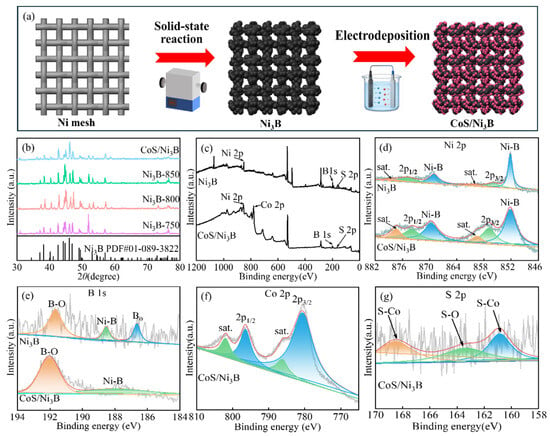
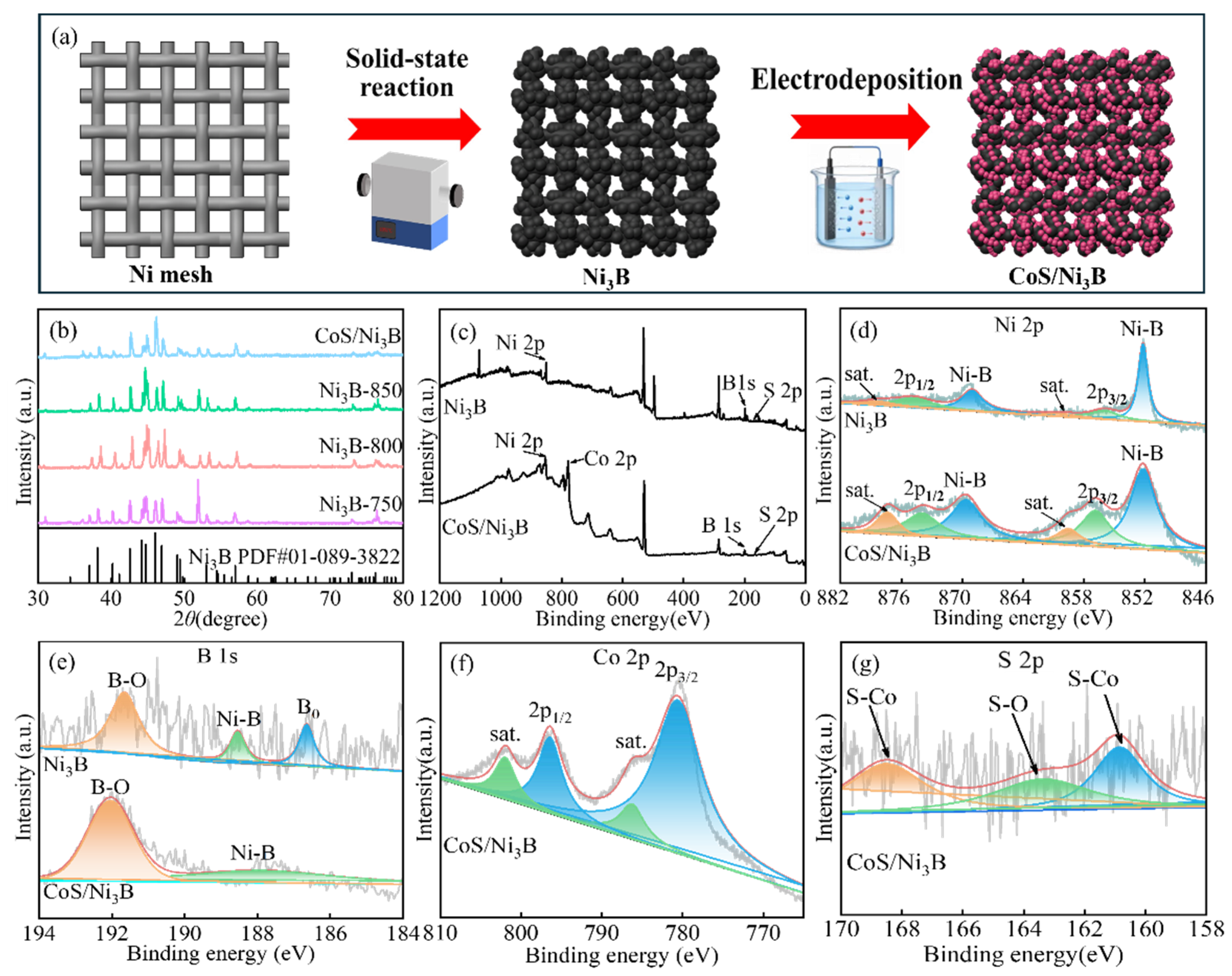
As shown in Figure 1a, the amorphous/crystalline CoS/Ni3B heterostructure has been synthesized via a combination of the following two procedures: (1) the self-supported Ni3B electrode was fabricated by the solid-state reaction of Ni mesh and NaBH4. (2) The amorphous CoS layer was fabricated by the electrodeposition method. Figure 1b shows the corresponding XRD patterns, which reveal that the Ni3B prepared at different temperatures and the CoS/Ni3B heterostructure have the same tetragonal Ni3B single phase (PDF#01-089-3822) without any crystalline CoS peaks observed, suggesting its amorphous phase.
Figure 1.
(a) Scheme of the synthetic route; (b) XRD; (c) survey XPS spectra; (d) Ni 2p; (e) B 1s; (f,g) Co 2p and S 2p for the CoS/Ni3B heterostructure.
To further study the chemical composition and valence state of the CoS/Ni3B heterostructure, XPS measurements were performed for characterization, in which self-supported Ni3B as a reference was also carried out. The survey spectrum of Figure 1c reveals that the surface of CoS/Ni3B heterostructure is composed of Co, S, Ni, and B elements, indicating the formation of a CoS layer on the Ni3B surface. In the Ni 2p spectrum for the CoS/Ni3B heterostructure (Figure 1d), the peaks at 852 and 869 eV result from Ni-B bonds and the peaks at 856 and 874 eV belong to the Ni 2p3/2 and Ni 2p1/2 species, while the peaks at 859 and 877.6 eV are attributed to satellite peaks. These results are very similar to the Ni 2p spectra of Ni3B. The B 1s spectrum of the CoS/Ni3B heterostructure is composed of B-Ni (188.1 eV) and B-O bonds (192.1 eV), while there are three bonds of B-Ni (188.1 eV), B-O (192.1 eV), and B0 (186.7 eV) in the B 1s spectrum of Ni3B. For the Co 2p spectrum in Figure 1f, the two peaks at 780.6 and 796.1 eV are assigned to the Co 2p3/2 and Co 2p1/2 species, while the two peaks at 786.4 and 802.1 eV are attributed to the satellite peak. The corresponding S 2p spectrum in Figure 1g can be indexed to the S-Co (160.9 and 168.5 eV) and S-O bonds (163.3 eV) [16,17].
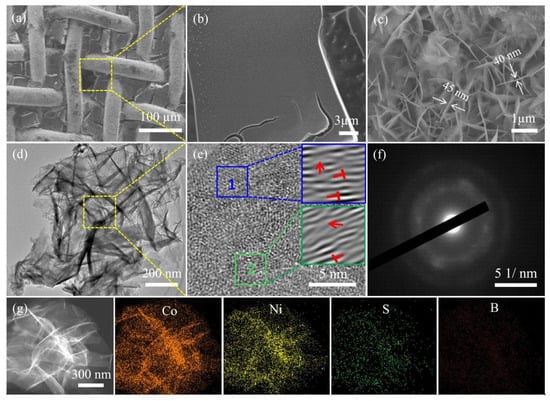
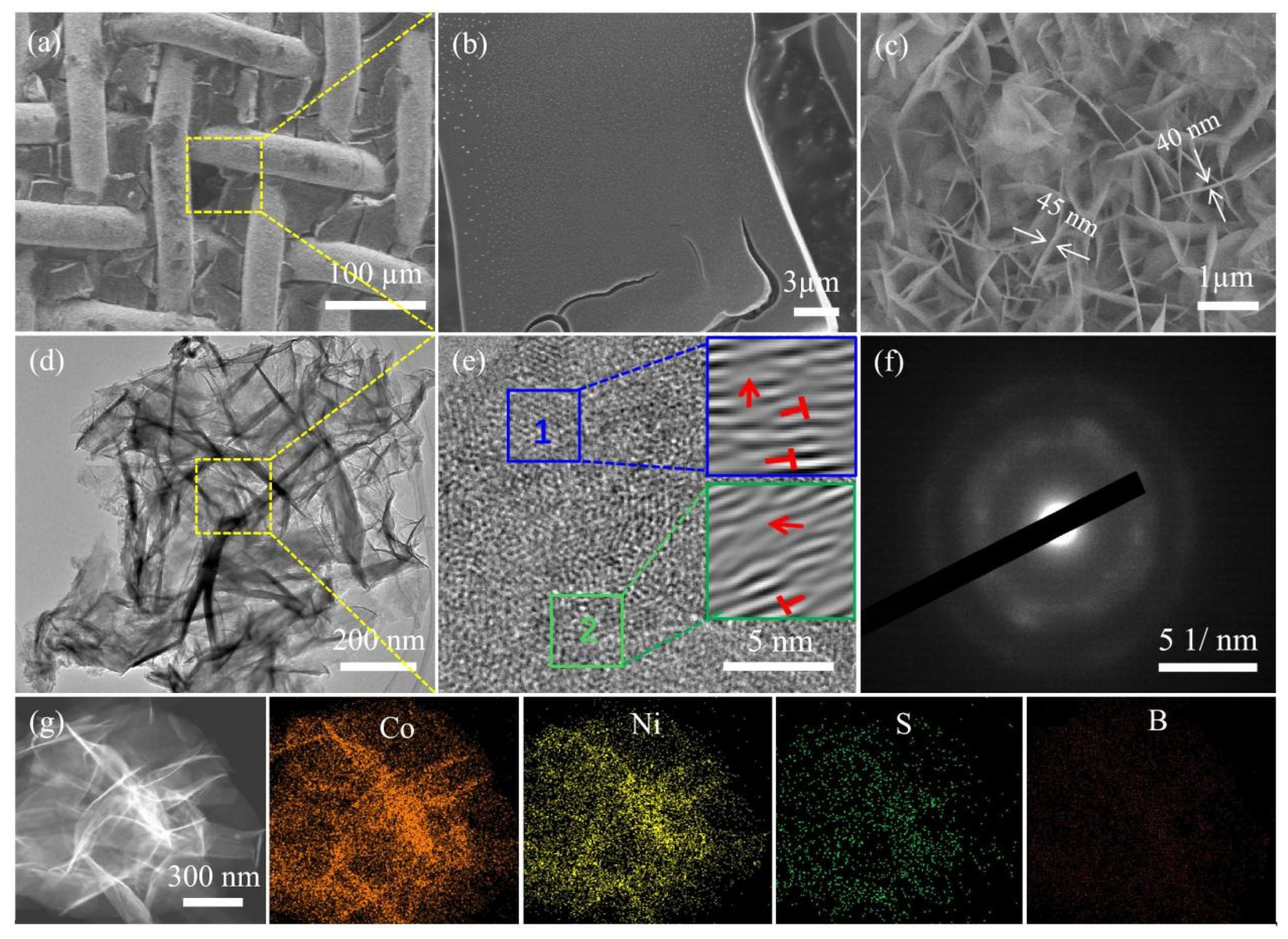
Figure 2a,b show low- and high-magnification FESEM images of the self-supported Ni3B electrode surface, revealing that micron-scale Ni3B grains were grown on the surface of the Ni mesh. In contrast, the electrodeposited CoS displays a homogeneous nanosheet nanostructure with an average thickness of 40–45 nm, which is in good agreement with the TEM observation results of Figure 2d. The HRTEM image of amorphous CoS (Figure 2e) shows that there is an absence of lattice fringes and clear halo rings in the selected area electron diffraction (SAED) pattern (Figure 2f), indicative of the amorphous nature. Moreover, the inverse FFT patterns corresponding to region 1 and 2 reveal that there are many lattice distortions and edge dislocations, which are denoted by the symbol “T” and arrows. It has been previously reported the atomic disordering of amorphous catalysts with abundant crystal defects, which possess many “dangling bonds”, could offer enriched active sites for the OER [18]. Thus, it can be inferred that amorphous CoS with abundant active sites supported on crystalline Ni3B could contribute to the effective enhancement of OER activity. The elemental mapping images (Figure 2g) reveal the homogeneous distribution of Co, S, Ni, and B elements over the CoS/Ni3B heterostructure, verifying the successful integration of CoS with Ni3B.
Figure 2.
(a,b) Low- and high-magnification SEM images of Ni3B; (c) SEM images of the CoS/Ni3B heterostructure; (d) TEM image; (e) HRTEM image; (f,g) SAED pattern and STEM–HAADF image and corresponding element-mapping images of the CoS/Ni3B heterostructure.
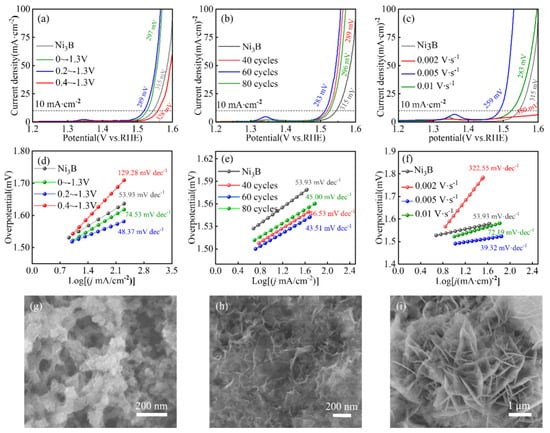
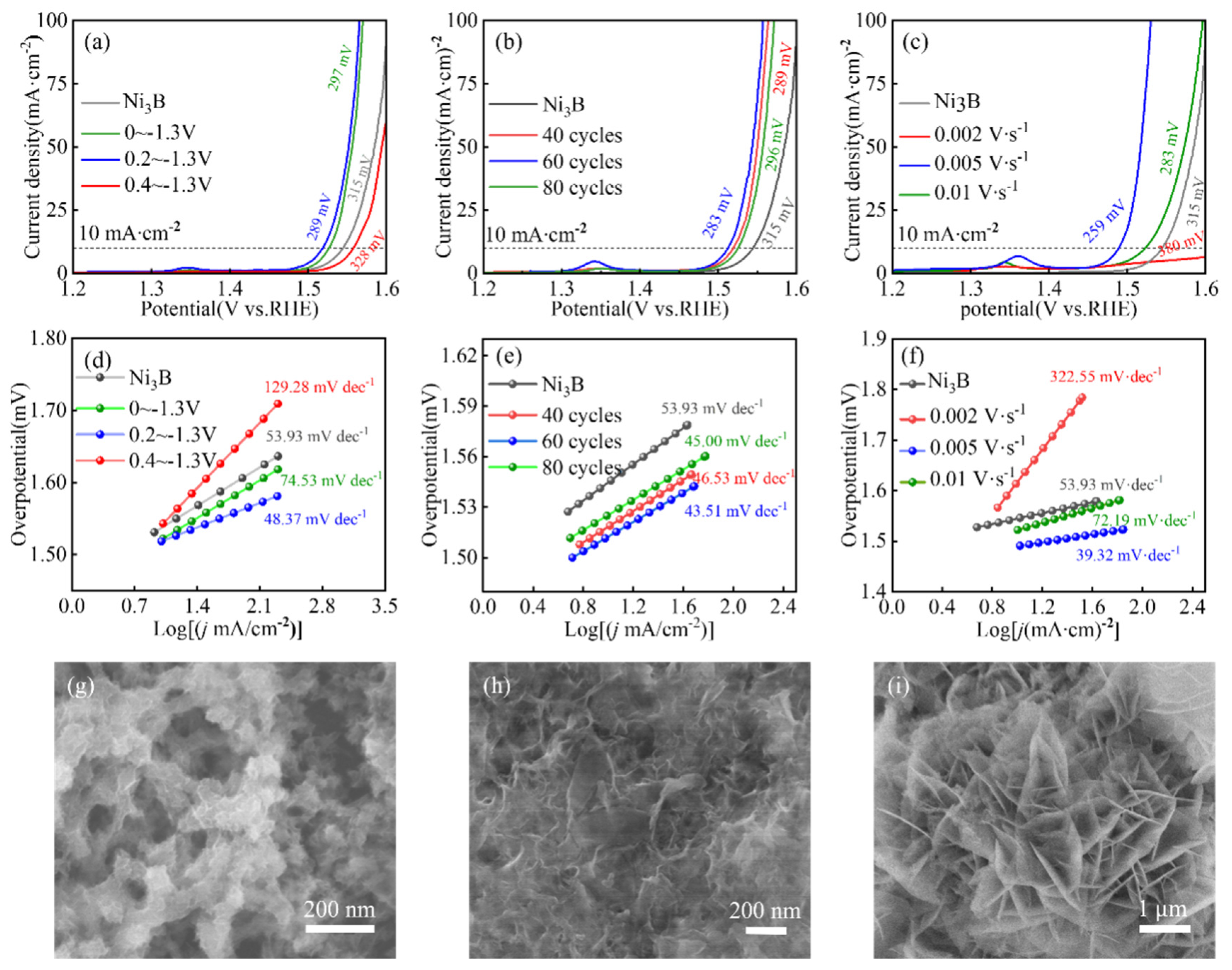
The OER performance of the CoS/Ni3B heterostructure was evaluated in a conventional three-electrode configuration using 1 mol·L−1 KOH as the electrolyte. To optimize the electrocatalytic performance, the effects of electrochemical deposition parameters, including scan rate, scan number, and anodic potential, on the overpotential (Δη10 @10 mA·cm−2) and Tafel plots [19,20] of the Ni3B electrode were investigated. It can be seen from Figure 3a,d that the CoS/Ni3B heterostructure shows an enhanced OER activity with a low overpotential of 289 mV and small Tafel plots of 74.53 mV·dec−1, while the anodic potential is optimized to be 0.2 V. As observed from the corresponding SEM image of Figure 3g, the CoS nanoparticles are formed at this stage with a mean size of 50 nm. Upon further optimizing the deposition cycles, the overpotential and Tafel slope are further reduced to 283 mV and 53.93 mV·dec−1 (Figure 3b,e). In this stage, a small quantity of CoS nanosheets is generated, which could effectively enrich the active sites. For further optimizing the scan rate, the Δη10 and Tafel slope have been further reduced to 259 mV and 39.32 mV·dec−1 (Figure 3c,f). Meanwhile, a large number of uniformly distributed CoS nanosheets have been formed, thereby increasing the number of accessible surface-active sites (Figure 3i).
Figure 3.
(a,d) OER activity of the CoS/Ni3B heterostructure fabricated under various electrodeposition conditions and anodic potential; (b,e) scan cycle; (c,f) scan rate; (g–i) corresponding SEM images for optimized parameters.
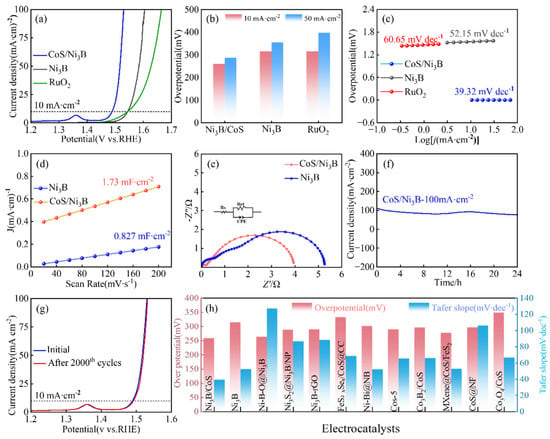
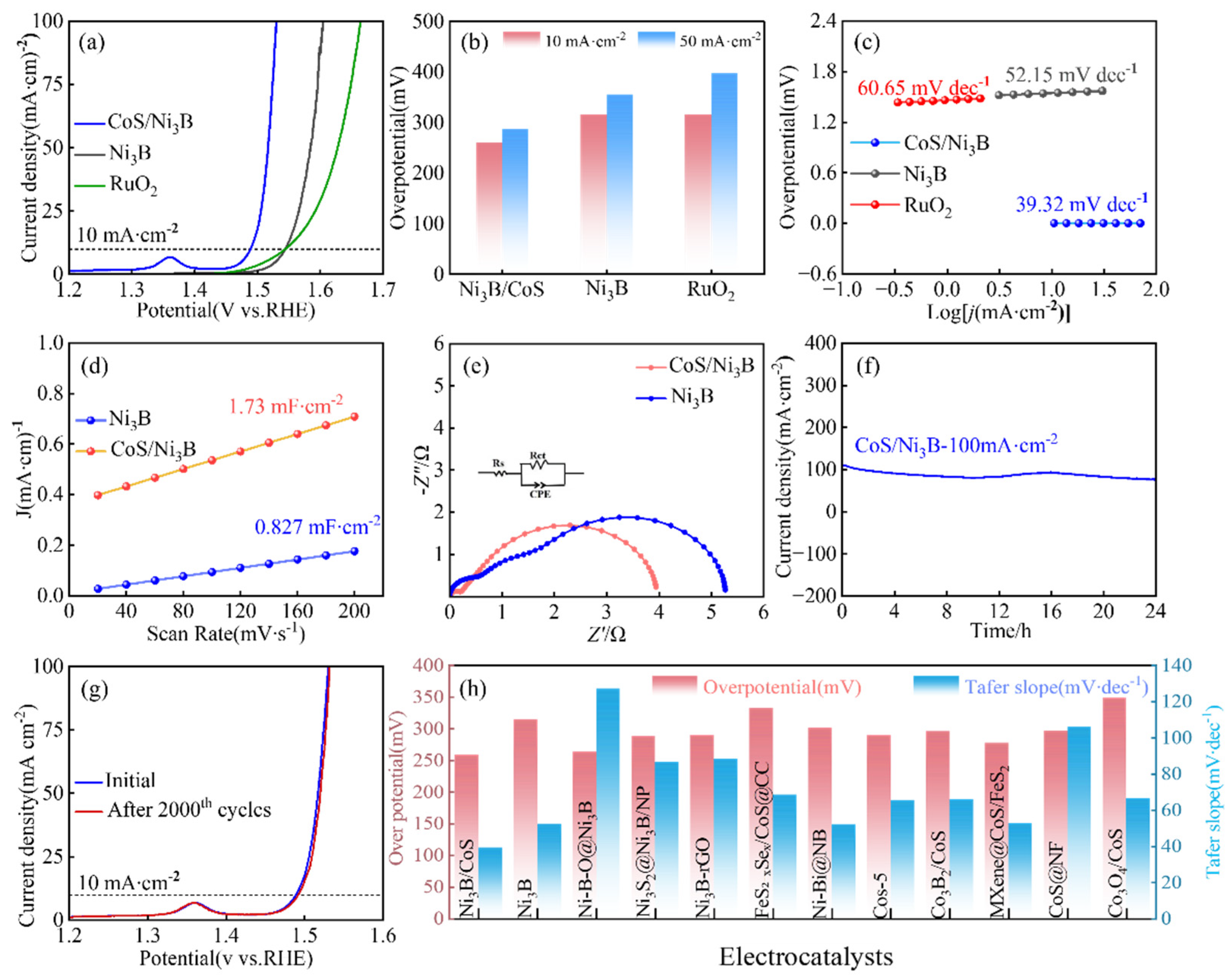
Figure 4a shows the LSV comparison results of the best-performing CoS/Ni3B heterostructure with commercial RuO2. It can be clearly seen from Figure 4b that the overpotentials of the CoS/Ni3B heterostructure at 10 and 50 mA·cm−2 were 259 and 300 mV, which are better than those of commercial RuO2 (315 mV and 434 mV, respectively). As shown in Figure 4c, the CoS/Ni3B heterostructure exhibits the lowest Tafel slope of 39.32 mV·dec−1, which is superior to that of RuO2 (60.65 mV·dec−1). Cyclic voltammetry (CV) measurements were employed (Figures S1 and S2) to determine the double-layer capacitance (Cdl) for estimating the electrochemically active surface area (ECSA) [21,22]. It can be seen from Figure 4d that the Cdl value of the CoS/Ni3B heterostructure is equal to 1.73 mF·cm−2, which is clearly higher than that of Ni3B (0.827 mF·cm–2), confirming that the crystal defects of CoS offer abundant active sites for increasing the ECSA. As shown in Figure 4e, the Rct value of the CoS/Ni3B heterostructure is estimated to be 4 Ω, which is smaller than that of Ni3B (ca. 5 Ω), suggesting faster electron transfer ability. At the same time, it can be observed from Figure 4f that the CoS/Ni3B heterostructure sustains a high current density of approximately 100 mA·cm−2 over the 24 h long-term OER durability test. Moreover, it exhibits a negligible overpotential decay after 2000 consecutive CV cycles (Figure 4g), suggesting an excellent durability. Figure 4h exhibits the OER activity comparison result of our sample and other electrocatalysts, revealing that the overpotential Δη10 = 259 mV of our sample is near to or surpasses those previously reported for some series of Ni-based and Fe-based catalysts (detailed comparisons are listed in Table 1). To further evaluate the OER catalytic activity, the apparent turnover frequency (TOF) of the activated CoS/Ni3B electrode was estimated. The calculated TOF reaches 0.2255 s−1 at 10 mA·cm−2, exceeding the reported values of several representative OER electrocatalysts, including NiFe LDH (0.0560 s−1), CoFeP/NF (0.1000 s−1), Ni–Co–Fe–P@CC (0.1900 s−1), and NiQ@FTO (0.1960 s−1), as summarized in Figure S3 and Table S1. Furthermore, sensitivity analysis was performed to evaluate the influence of the assumed surface active-site density on the calculated TOF (Figure S4). Although the estimated TOF depends on the active-site quantification method, these results provide additional support for the favorable OER catalytic performance of CoS/Ni3B.
Figure 4.
(a) LSV; (b) detailed value of Δη10 and Δη50; (c) Tafel plots; (d) Cdl; (e) Nyquist plots; (f) Chronoamperometric test at CoS/Ni3B heterostructure; (g) LSV before and after 2000 CV cycles of the as-fabricated catalyst; (h) OER activity comparison results.
Table 1.
OER comparison results of the CoS/Ni3B heterostructure with various electrocatalysts.
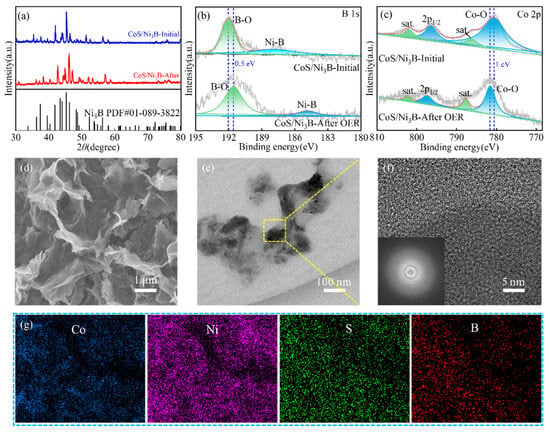
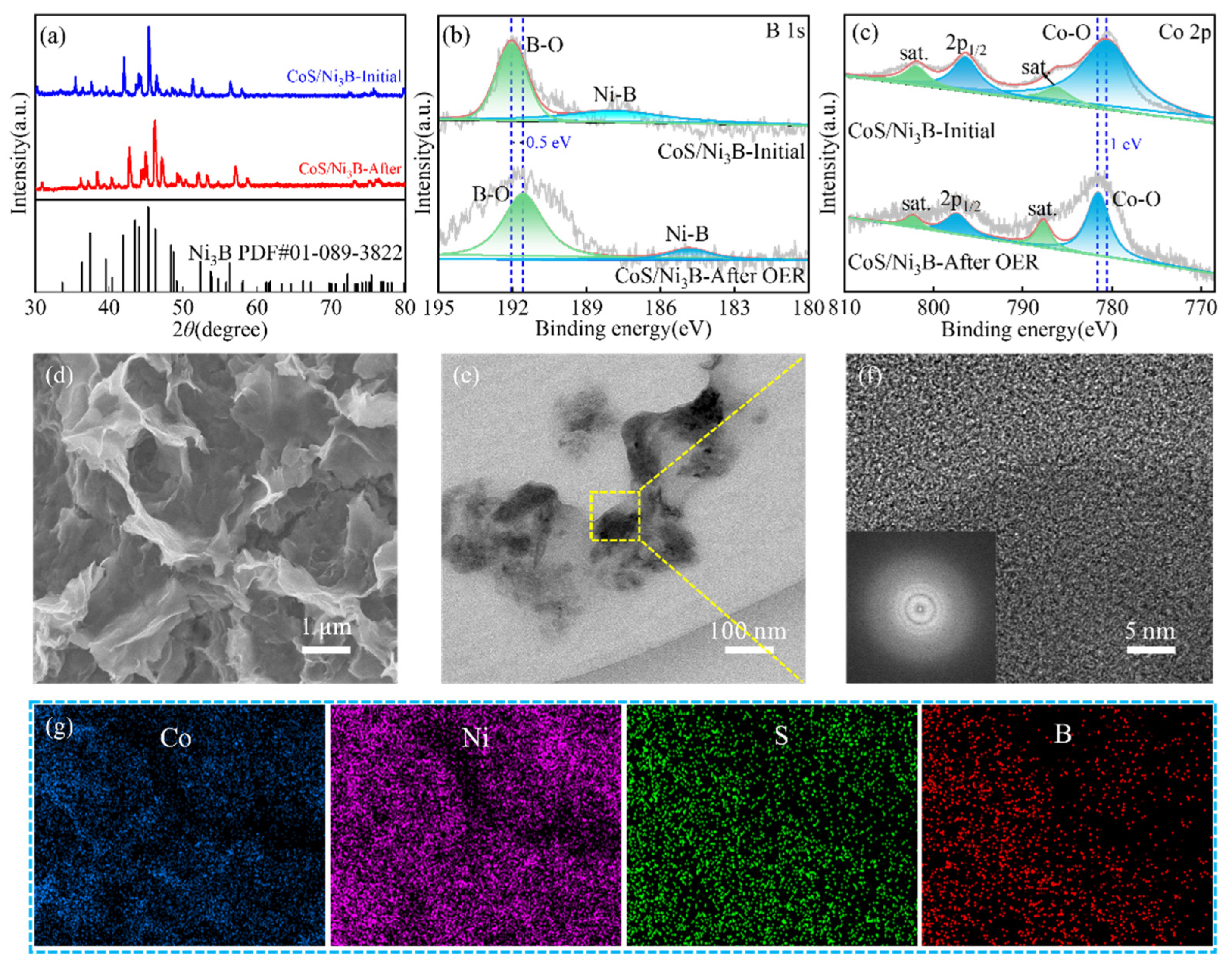
The crystal structure, surface valence state, morphology, and microstructure of the CoS/Ni3B heterostructure before and after the OER have been characterized. As shown in Figure 5a, the CoS/Ni3B heterostructure still preserves the original Ni3B single phase (PDF#01-089-3822) before and after the OER, with no new diffraction peaks detected. XPS measurements were carried out to uncover the surface structural evolution. In terms of the B 1s spectra (Figure 5b), there is a negative shift at about 0.5 eV for the B-O peaks after the OER. As shown in Figure 5c, the peak of Co-O (~2p3/2, 780.6 eV) shows a positive shift of 1 eV after the OER (to 781.6 eV). Combined with the negative shifts of B 1s and positive shifts of Co 2p spectra, it can be inferred that the strong coupling effects between the metallic Ni3B and amorphous CoS layer have been occurring during the OER, which facilitates the electron transport from B atoms (~Ni3B) to Co atoms (~ CoS layer). Additionally, the positive shifts observed in the Co 2p3/2 spectra after the OER reveal the valence state evolution from Co2+ to Co3+, verifying the generation of the Co3+ OOH active species that boost the OER performance. SEM was employed to characterize the surface morphology of the CoS/Ni3B heterostructure after the OER. The results reveal that (Figure 5d) the nanosheet architecture is well preserved, while the surface turns rough, demonstrating surface reconstruction of the material during the OER process. The TEM image (Figure 5e) shows that the heterostructure retains its nanosheet morphology. Meanwhile, no distinct lattice fringes can be identified in the corresponding HRTEM image (Figure 5f), and the diffuse halo suggests its amorphous structure. Elemental mapping (Figure 5g) demonstrates that Ni, Co, S, and B remain uniformly distributed across the electrode surface after the OER stability test. To investigate the compositional evolution of the CoS/Ni3B electrode during the OER, EDS analyses were performed before and after electrochemical testing. The corresponding EDS spectra and elemental mapping images are presented in Figure S5. After the OER, the relative atomic percentage of oxygen increases from 23.2% to 59.6%, accompanied by an increase in the relative Co content from 4.0% to 31.3%. Meanwhile, the relative atomic percentage of Ni decreases from 19.7% to 8.3% (Table S2). These changes indicate pronounced compositional evolution of the electrode and suggest the formation of an oxygen-rich Co/Ni oxyhydroxide surface through oxidative reconstruction under alkaline OER conditions [33,34].
Figure 5.
(a) XRD patterns; (b) B 1s; (c) Co 2p before and after OER; (d) SEM; (e) TEM image; (f) HRTEM and SAED pattern; (g) element-mapping images after OER of the CoS/Ni3B heterostructure.
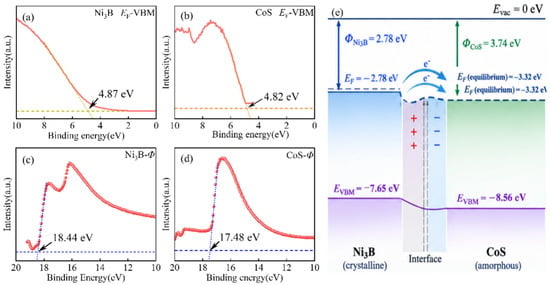
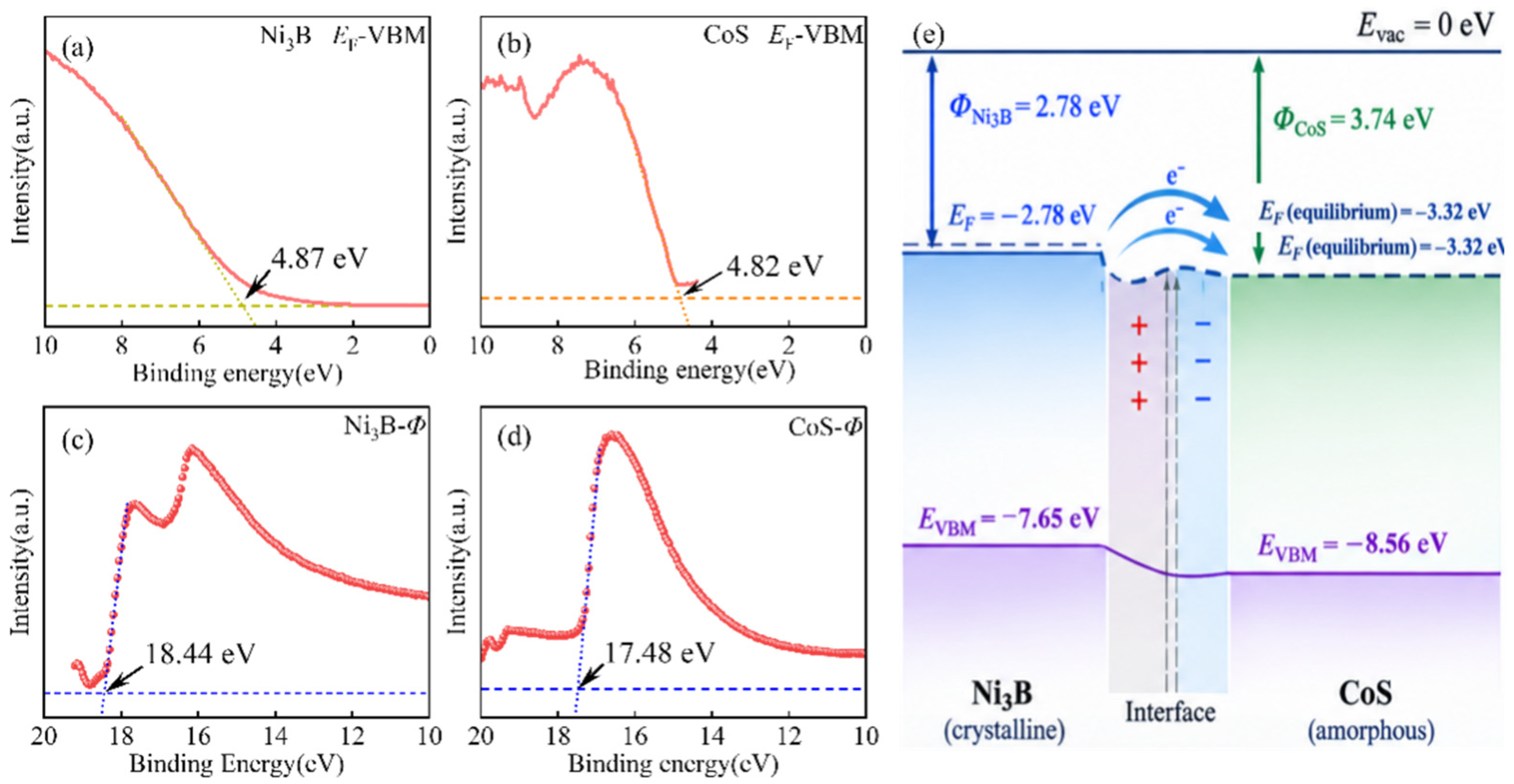
In general, the electronic structure matching at the amorphous/crystalline heterostructure interface is vital for boosting the OER performance [35]. Specifically, the electrons’ transfer direction was driven by the work function difference of the two side materials. Thus, ultraviolet photoelectron spectroscopy (UPS) is employed to perform the work function of crystalline Ni3B and amorphous CoS. The Fermi edge was employed to calibrate the binding energy scale by setting Evac = 0 eV, while the valence band maximum (VBM) was obtained via linear extrapolation of the valence band edge to the background baseline. As shown in Figure 6a,b, the extrapolated VBM of Ni3B and CoS are located at a binding energy of 4.87 and 4.82 eV, which yields EF − EVBM = 4.87 eV and 4.82 eV. On the basis of the above measurements, the experimentally derived work function values for Ni3B and amorphous CoS are equal to 2.78 eV and 3.74 eV, respectively (Figure 6c,d). Amorphous CoS possesses a greater work function relative to Ni3B, implying the Fermi level of CoS (−3.74 eV) sits below that of crystalline Ni3B (−2.78 eV). This peculiar electronic structural characteristic promotes efficient electron transfer from Ni3B to the surface of CoS (Figure 6e). Ultimately, this gives rise to the modulation of the interface electronic structure and then efficiently enhances the OER performance.
Figure 6.
(a,b) UPS spectra of the valence band spectrum for determining the energy difference between the Fermi level (EF) and valence band maximum (VBM) for Ni3B and CoS; (c,d) secondary electron cutoff spectrum used to calculate the work function for Ni3B and CoS; (e) illustration of the proposed mechanism for OER activity enhancement.
4. Conclusions
In summary, we constructed a novel amorphous/crystalline CoS/Ni3B heterostructure with a distinctive dual-phase architecture, which accelerates surface reconstruction toward a highly active OER electrocatalyst. The optimal heterostructure exhibits a low overpotential of 259 mV at 10 mA·cm−2 in 1 mol·L−1 KOH media, outperforming the commercial RuO2 catalyst. Additionally, the electronic structure matching at interface of CoS and Ni3B plays a vital role for boosting the OER activity. Hence, this study delivers an alternative route toward constructing non-precious OER electrocatalysts based on transition-metal borides.
Supplementary Materials
The following supporting information can be downloaded at: https://www.mdpi.com/article/10.3390/cryst16120751/s1, Figure S1: Cyclic voltammogram at the scan rate of 20, 40, 60, 80, 100, 120, 140, 160, 180 and 200 mV·s−1 for nanocrystalline Ni3B; Figure S2: Cyclic voltammogram at the scan rate of 20, 40, 60, 80, 100, 120, 140, 160, 180 and 200 mV s−1 for nanocrystalline CoS/Ni3B; Figure S3: Comparison of the reported turnover frequencies (TOFs) of CoS/Ni3B with those of representative OER electrocatalysts reported in the literature; Figure S4: Sensitivity analysis of the calculated apparent TOF with respect to surface active-site density (σ); Table S1: Comparison of active-site estimation parameters and reported TOF values for representative OER electrocatalysts; Figure S5: EDS characterization of the CoS/Ni3B electrode before and after OER testing. EDS spectrum and corresponding elemental mapping images of the electrode before OER. (a,b); Table S2: Relative atomic percentages of the elements before and after OER [36,37,38,39,40,41,42].
Author Contributions
Conceptualization, L.B.; methodology, L.B. and T.L.; investigation, T.L. and A.M.; data curation, T.L., A.M. and K.P.; writing—original draft preparation, L.B., T.L., A.M. and Y.C.; writing—review and editing, T.L., K.P., B.H., X.P. and Y.C.; project administration, L.B. and Y.C.; funding acquisition, L.B. and Y.C. All authors have read and agreed to the published version of the manuscript.
Funding
This work is financially supported by the Key Research and Development and Achievement Transformation Program of Inner Mongolia Autonomous Region (2025KJHZ0020); the Key Research Program of the State Key Laboratory of Cryogenic Science and Technology (E5ASR20201) and the Key Research Program of the State Key Laboratory of Cryogenic Science and Technology (Grant No. E5ASR20201).
Data Availability Statement
The raw data supporting the conclusions of this article will be made available by the authors on request.
Conflicts of Interest
The authors declare no conflicts of interest.
References
- Zhang, W.; Zhang, Y.; Wang, J.; Zhao, Q.; Liu, G.; Li, J. Research and Perspectives on Electrocatalytic Water Splitting and Large Current Density Oxygen Evolution Reaction. Chin. J. Eng. 2023, 45, 1057–1070. [Google Scholar]
- Chen, J.; Guo, Z.; Luo, Y.; Cai, M.; Gong, Y.; Sun, S.; Li, Z.; Mao, C. Engineering Amorphous Nickel Iron Oxyphosphide as a Highly Efficient Electrocatalyst toward Overall Water Splitting. ACS Sustain. Chem. Eng. 2021, 9, 9436–9443. [Google Scholar] [CrossRef] [Scilit]
- Xiao, J.; He, J.; Wang, H.; Wan, S.; Pan, X.; Bao, L. Rational Design of Amorphous CoS Coupling with Crystalline Ni3B toward Efficient Oxygen Evolution Reaction: Computation and Experiment. J. Chem. Phys. 2026, 164, 064704. [Google Scholar] [CrossRef] [Scilit] [PubMed]
- Gopalakrishnan, M.; Mohamad, A.A.; Nguyen, M.T.; Yonezawa, T.; Qin, J.; Thamyongkit, P.; Somwangthanaroj, A.; Kheawhom, S. Recent Advances in Oxygen Electrocatalysts Based on Tunable Structural Polymers. Mater. Today Chem. 2022, 23, 100632. [Google Scholar] [CrossRef] [Scilit]
- Li, M.; Zhou, Q.; Ren, C.; Shen, N.; Chen, Q.; Zhao, J.; Guo, C.; Zhang, L.; Li, J. Surfacing Amorphous Ni–B Nanoflakes on NiCo2O4 Nanospheres as Multifunctional Bridges for Promoting Lithium Storage Behaviors. Nanoscale 2019, 11, 22550–22558. [Google Scholar] [CrossRef] [Scilit] [PubMed]
- Min, X.; Xiao, R.; Wang, H.; Wang, W. Electronic Structure and Chemical Bond of Titanium Diboride. J. Wuhan Univ. Technol.-Mater. Sci. Ed. 2003, 18, 11–14. [Google Scholar] [CrossRef] [Scilit]
- Tao, Q.; Ma, S.; Cui, T.; Zhu, P. Structures and Properties of Functional Transition Metal Borides. Acta Phys. Sin. 2017, 66, 036103. [Google Scholar] [CrossRef] [Scilit]
- Hashim, D.P.; Narayanan, N.T.; Romo-Herrera, J.M.; Cullen, D.A.; Hahm, M.G.; Lezzi, P.; Suttle, J.R.; Kelkhoff, D.; Muñoz-Sandoval, E.; Ganguli, S.; et al. Covalently Bonded Three-Dimensional Carbon Nanotube Solids via Boron Induced Nanojunctions. Sci. Rep. 2012, 2, 363. [Google Scholar] [CrossRef] [Scilit] [PubMed]
- Yang, X.; Li, X.; Liu, M.; Yang, S.; Xu, Q.; Zeng, G. Quantitative Construction of Boronic-Ester Linkages in Covalent Organic Frameworks for the Carbon Dioxide Reduction. Angew. Chem. Int. Ed. 2024, 63, e202317785. [Google Scholar] [CrossRef] [Scilit] [PubMed]
- Zhu, Q.; Qiu, B.; Du, M.; Xing, M.; Zhang, J. Nickel Boride Cocatalyst Boosting Efficient Photocatalytic Hydrogen Evolution Reaction. Ind. Eng. Chem. Res. 2018, 57, 8125–8130. [Google Scholar] [CrossRef] [Scilit]
- Yao, Q.; Xiao, Y.; Wang, H.; Zhong, H.; Wang, T. Multi-Functional Amorphous Nickel Phosphide Electrocatalytic Reduction of Nitrate for Ammonia Production: Unraveling the Anode-Driven Enhancement Mechanism. Sustainability 2025, 17, 3835. [Google Scholar] [CrossRef] [Scilit]
- Li, Y.; Zhang, X.; Zheng, Z. A Review of Transition Metal Oxygen-Evolving Catalysts Decorated by Cerium-Based Materials: Current Status and Future Prospects. CCS Chem. 2022, 4, 31–53. [Google Scholar] [CrossRef] [Scilit]
- Xu, X.; Deng, Y.; Gu, M.; Sun, B.; Liang, Z.; Xue, Y.; Guo, Y.; Tian, J.; Cui, H. Large-scale synthesis of porous nickel boride for robust hydrogen evolution reaction electrocatalyst. Appl. Surf. Sci. 2019, 470, 591–595. [Google Scholar] [CrossRef] [Scilit]
- Zhang, P.; Wang, M.; Yang, Y.; Yao, T.; Han, H.; Sun, L. Electroless plated Ni–Bx films as highly active electrocatalysts for hydrogen production from water over a wide pH range. Nano Energy 2016, 19, 98–107. [Google Scholar] [CrossRef] [Scilit]
- Cao, Y.; Yuan, S.; Hai, Y.; Wang, X.; Li, X.; Luo, M. Amorphous Ni3B Promotes Electroreduction of Nitrate to Ammonia. ACS Appl. Mater. Interfaces 2024, 16, 64807–64815. [Google Scholar] [CrossRef] [Scilit] [PubMed]
- Waltrovitz, R.R.; Qian, G.; de Groot, F.M.F.; Quinton, J.S.; Harmer, S.L. Influence of Co:Fe:Ni Ratio on Cobalt Pentlandite’s Electronic Structure and Surface Speciation. Miner. Eng. 2022, 190, 107935. [Google Scholar] [CrossRef] [Scilit]
- Liu, X.; Wei, X.; Zhang, Z.; Wang, X.; Liu, G.; Luo, D.; Li, J. Design of Defect-Rich MgCo-Layered Double Hydroxide Microspheres as Highly Effective Sulfur Reduction Reaction Electrocatalyst for High-Performance Li-S Batteries. Renewables 2024, 2, 162–170. [Google Scholar] [CrossRef] [Scilit]
- Jin, Y.; Bai, Q.; Sun, Z.; Chen, W.; Zhai, H. Amorphous Substrate-Supported Single-Atom Catalysts: Design Strategies, Electronic Regulation, and Catalytic Applications. Small Struct. 2026, 7, e202500841. [Google Scholar] [CrossRef] [Scilit]
- Akshaya, K.B.; Varghese, A.; Sudhakar, Y.N.; George, L. Electrocatalytic Oxidation of Morin on Electrodeposited Ir-PEDOT Nanograins. Food Chem. 2019, 270, 78–85. [Google Scholar] [CrossRef] [Scilit] [PubMed]
- Loukil, N.; Feki, M. Effect of Sodium Diisopropylnaphthalene Sulfonate on Zn-Mn Alloys Electrodeposition. J. Solid State Electrochem. 2021, 25, 339–350. [Google Scholar] [CrossRef] [Scilit]
- Schalenbach, M.; Selmert, V.; Kretzschmar, A.; Raijmakers, L.; Durmus, Y.E.; Tempel, H.; Eichel, R.-A. How Microstructures, Oxide Layers, and Charge Transfer Reactions Influence Double Layer Capacitances. Part 1: Impedance Spectroscopy and Cyclic Voltammetry to Estimate Electrochemically Active Surface Areas (ECSAs). Phys. Chem. Chem. Phys. 2024, 26, 14288–14304. [Google Scholar] [CrossRef] [Scilit] [PubMed]
- Yamada, H.; Yoshii, K.; Asahi, M.; Chiku, M.; Kitazumi, Y. Cyclic Voltammetry Part 2: Surface Adsorption, Electric Double Layer, and Diffusion Layer. Electrochemistry 2022, 90, 102006. [Google Scholar] [CrossRef] [Scilit]
- Yuan, W.; Zhao, X.; Hao, W.; Li, J.; Wang, L.; Ma, X.; Guo, Y. Performance of Surface-Oxidized Ni3B, Ni2B, and NiB2 Electrocatalysts for Overall Water Splitting. ChemElectroChem 2019, 6, 764–770. [Google Scholar] [CrossRef] [Scilit]
- Wu, Y.; Yin, J.; Jiang, W.; Li, H.; Liu, C.; Che, G. Constructing Urchin-Like Ni3S2@Ni3B on Ni Plate as a Highly Efficient Bifunctional Electrocatalyst for Water Splitting Reaction. Nanoscale 2021, 13, 17953–17960. [Google Scholar] [CrossRef] [Scilit] [PubMed]
- Arivu, M.; Masud, J.; Umapathi, S.; Nath, M. Facile Synthesis of Ni3B/rGO Nanocomposite as an Efficient Electrocatalyst for the Oxygen Evolution Reaction in Alkaline Media. Electrochem. Commun. 2018, 86, 121–125. [Google Scholar] [CrossRef] [Scilit]
- Yin, X.; Mu, X.; Qi, S.; Li, H.; Qi, M.; Yusuf, A. Se-Doped FeS2/CoS Nanosphere Catalysts Bifunctional Electrocatalyst for Superior OER and HER Activity. Res. Chem. Intermed. 2025, 51, 3229–3242. [Google Scholar] [CrossRef] [Scilit]
- Jiang, W.; Niu, S.; Tang, T.; Zhang, Q.; Liu, X.; Zhang, Y.; Chen, Y.; Li, J.; Gu, L.; Wan, L.; et al. Crystallinity-Modulated Electrocatalytic Activity of a Nickel (II) Borate Thin Layer on Ni3B for Efficient Water Oxidation. Angew. Chem. Int. Ed. 2017, 56, 6572–6577. [Google Scholar] [CrossRef] [Scilit] [PubMed]
- Zhang, Y.; Zheng, G.; Li, A.; Zhu, X.; Jiang, J.; Zhang, Q.; Deng, L.; Gao, X.; Ouyang, F. Hexagonal Single-Crystal CoS Nanosheets: Controllable Synthesis and Tunable Oxygen Evolution Performance. Inorg. Chem. 2022, 61, 7568–7578. [Google Scholar] [CrossRef] [Scilit] [PubMed]
- Gao, Y.; Zhao, J.; Xiao, J.; Wan, S.; Wang, H.; Lv, X.; Bao, L. Integration of Amorphous/Crystalline CoS/Co3B2 Heterostructure with Coupled Electronic Engineering toward Efficient and Stable Oxygen Evolution Reaction. J. Alloys Compd. 2025, 1037, 182443. [Google Scholar] [CrossRef] [Scilit]
- Zhang, Z.; Liang, T.; Jin, C.; Zhang, S.; Cui, Y.; Chen, J.; Zeng, X. Synergistically Coupling CoS/FeS2 Heterojunction Nanosheets on a MXene via a Dual Molten Salt Etching Strategy for Efficient Oxygen Evolution Reaction. J. Mater. Chem. A 2024, 12, 14517–14530. [Google Scholar] [CrossRef] [Scilit]
- Guo, P.; Wu, Y.; Lau, W.; Liu, H.; Liu, L. CoS Nanosheet Arrays Grown on Nickel Foam as an Excellent OER Catalyst. J. Alloys Compd. 2017, 723, 772–778. [Google Scholar] [CrossRef] [Scilit]
- Min, K.; Kim, S.; Lee, E.; Yoo, G.; Ham, H.C.; Shim, S.E.; Lim, D.; Baeck, S. A Hierarchical Co3O4/CoS Microbox Heterostructure as a Highly Efficient Bifunctional Electrocatalyst for Rechargeable Zn-Air Batteries. J. Mater. Chem. A 2021, 9, 17344–17352. [Google Scholar] [CrossRef] [Scilit]
- Fan, K.; Zou, H.; Lu, Y.; Chen, H.; Li, F.; Liu, J.; Sun, L.; Tong, L.; Toney, M.F.; Sui, M.; et al. Direct Observation of Structural Evolution of Metal Chalcogenide in Electrocatalytic Water Oxidation. ACS Nano 2018, 12, 12369–12379. [Google Scholar] [CrossRef] [Scilit] [PubMed]
- Masa, J.; Sinev, I.; Mistry, H.; Ventosa, E.; de la Mata, M.; Arbiol, J.; Muhler, M.; Roldan Cuenya, B.; Schuhmann, W. Ultrathin High Surface Area Nickel Boride (NixB) Nanosheets as Highly Efficient Electrocatalyst for Oxygen Evolution. Adv. Energy Mater. 2017, 7, 1700381. [Google Scholar] [CrossRef] [Scilit]
- Yu, F.; Liu, G.; Zhan, J.; Jia, Y.; Feng, Z.; Shen, B.; Shiju, N.R.; Zhang, L.-H. Self-Driven Electron Enrichment of Ultrafine PdAu Nanoparticles for Electrochemical CO2 Reduction: High Applicability of Work Function as an Activity Descriptor. Appl. Catal. B Environ. 2023, 338, 122931. [Google Scholar] [CrossRef] [Scilit]
- Kamalakkannan, A.; Machiche, S.; Subramanian, B.; Sasirekha, N.R.; Essalhi, M.; Abida, O. Cobalt-Induced Electronic and Defect Structure Modulation in Nickel Iron Layered Double Hydroxides for Electrochemical, Photo-Electrochemical and Photocatalytic Water Splitting. RSC Adv. 2026, 16, 66724–66743. [Google Scholar] [CrossRef] [Scilit] [PubMed]
- Khan, A.; Alsalhi, S.A.; Al-Sehemi, A.G.; Kumar, A. Hydrothermally Synthesized a Pyrochlore-Type Composite (rGO@Sr3Mn2O7;): An Effective Electrocatalyst for Oxygen Evolution Reaction (OER). Diam. Relat. Mater. 2025, 154, 112143. [Google Scholar] [CrossRef] [Scilit]
- Nimal, R.; Clarke, S.M.; Warren, A.J.; Shah, A.; Siddiq, M.; Guan, S. Facile Synthesis of a Nickel–Quinizarin Metal Coordination Compound as a Binder-Free Electrode for Efficient Alkaline Oxygen Evolution Reaction. New J. Chem. 2026, 50, 14675–14687. [Google Scholar] [CrossRef] [Scilit] [PubMed]
- Zhang, X.; Zhang, L.; Zhu, Y.; Li, Z.; Wang, Y.; Wågberg, T.; Hu, G. Increasing Electrocatalytic Oxygen Evolution Efficiency through Cobalt-Induced Intrastructural Enhancement and Electronic Structure Modulation. ChemSusChem 2021, 14, 467–478. [Google Scholar] [CrossRef] [Scilit] [PubMed]
- Díez-García, M.I.; Montaña-Mora, G.; Botifoll, M.; Cabot, A.; Arbiol, J.; Qamar, M.; Morante, J.R. Cobalt–Iron Oxyhydroxide Obtained from the Metal Phosphide: A Highly Effective Electrocatalyst for the Oxygen Evolution Reaction at High Current Densities. ACS Appl. Energy Mater. 2023, 6, 5690–5699. [Google Scholar] [CrossRef] [Scilit] [PubMed]
- Dharmaraj, K.; Alencar Emerenciano, A.; Kaplan, C.; Schultz, T.; Handke, M.; Koch, N.; Schlatmann, R.; Lauermann, I.; Browne, M.P. Low Loading Thin Film vs. Industrially Relevant Powder Electrodes as Catalysts for Anion Exchange Membrane Water Electrolysis. J. Mater. Chem. A 2026, 14, 29881–29892. [Google Scholar] [CrossRef] [Scilit]
- Amin, H.M.A.; Placke-Yan, C.; Bendt, G.; Hagemann, U.; Schulz, S. Tuning the Oxygen Evolution Reaction Activity of Co3O4; Nanocubes via Controlled Metal Doping and Surface Faceting. Chem. Eng. J. 2026, 537, 176110. [Google Scholar] [CrossRef] [Scilit]

Disclaimer/Publisher’s Note: The statements, opinions and data contained in all publications are solely those of the individual author(s) and contributor(s) and not of MDPI and/or the editor(s). MDPI and/or the editor(s) disclaim responsibility for any injury to people or property resulting from any ideas, methods, instructions or products referred to in the content. |
© 2026 by the authors. Licensee MDPI, Basel, Switzerland. This article is an open access article distributed under the terms and conditions of the Creative Commons Attribution (CC BY) license.