


Abstract
The growing demand for energy and the need to reduce the environmental impacts associated with the use of fossil fuels are driving the development of more efficient and sustainable energy storage devices. In this context, supercapacitors stand out for their high-power density, long lifespan, and fast charging and discharging capabilities. This work aims to develop a composite made up of mordenite zeolite (MOR) coated with cobalt oxide (Co3O4) following a simple and template-free method, and to use it as an electrode for application as supercapacitors. Furthermore, chemical activation of the graphitic electrode substrate was performed to improve the capacitance of the MOR-70%Co3O4 composite. The substrate activated with a 0.1 mol/L sulfuric acid solution and with the addition of carbon black showed the best electrochemical performance, reaching a specific capacitance of approximately 160 F/g at 1.0 A/g and important cycling stability, retaining 100% of the capacitance after 2000 charge and discharge cycles. Overall, the results indicated that the combination of the porous structure of zeolite, the presence of cobalt redox species, and the use of a conductive additive/activated substrate constitutes a promising strategy for the development of electrodes for application in energy storage devices, providing new perspectives for zeolite-based materials.
1. Introduction
Global demand has driven excessive energy consumption, mainly due to the introduction of new electronic devices and electrical equipment to the market, whose performance is limited by the characteristics of current technologies. Consequently, it becomes necessary to explore new sustainable and clean sources, as well as more efficient energy storage and conversion technologies [1,2]. Among energy storage devices, supercapacitors stand out due to their high-power density, fast charge and discharge rates, and long lifespan, making them promising for applications in portable electronic devices, hybrid systems, and decentralized applications [3,4,5,6,7,8,9]. These devices offer advantages such as structural flexibility and lower manufacturing costs when compared to conventional batteries [1,10,11,12]. In addition, supercapacitors or electrochemical capacitors store energy by the formation of an electrical double layer and pseudocapacitive processes, resulting in capacitances significantly higher than those of conventional electrostatic capacitors. In this context, the search for electroactive materials capable of optimizing energy and power density has intensified [13,14].
Cobalt oxide (Co3O4) is a mixed oxide of cobalt (II, III) that crystallizes in a spinel-like structure, in which Co2+ ions occupy tetrahedral sites and Co3+ ions are in octahedral sites. This structural configuration gives the material high thermal and chemical stability, as well as p-type semiconductor behavior [15,16]. Due to the presence of multiple accessible oxidation states of cobalt, mainly Co2+ and Co3+ in the crystal structure, in addition to the possibility of transient formation of Co4+ species during electrochemical processes, Co3O4 exhibits high redox reversibility. This makes it highly attractive for electrochemical applications, especially in supercapacitor electrodes and lithium-ion batteries [17,18]. However, although Co3O4-based materials show promising performance, it is still necessary to develop structured composites that favor greater structural stability, higher electrical conductivity, and better utilization of the electrochemically active area.
Zeolites emerge as materials of interest due to their well-ordered microporous structure, high porosity, and with specific surface areas that can typically range between 100 and 800 m2.g−1, depending on the structural topology [19,20,21,22,23,24,25,26,27,28]. Few studies explore the use of zeolites/metal oxides in supercapacitor research due to the low electrical conductivity of zeolites. However, it is believed that zeolites can act as efficient matrices for the incorporation of oxides, potentially contributing to greater utilization of the electrochemically active area and improvement of the electrode/electrolyte interface when associated with pseudocapacitive materials [15,29].
The major challenge in this scenario is to produce zeolites using green methods, with minimal energy and environmental impact, minimizing the emission of xenobiotic substances [30,31,32,33]. One zeolite considered green is mordenite (MOR topology), since its synthesis does not require the addition of structural directing agents (SDA′s) in the synthesis gel, which are organic molecules harmful to humans and the environment. MOR presents an essentially one-dimensional pore system located along the crystallographic direction c-axis [001], consisting of 12 membered rings with dimensions of 6.7 Å × 7.0 Å accessible to various ions and larger molecules, besides two small pore systems with sizes of 2.6 Å × 5.7 Å and 3.4 Å × 4.8 Å, which have virtually no practical application, limiting the use of MOR in several processes [23]. As a result, mordenite zeolite does not attract high attention of researchers, since only one pore system is of interest in its structure.
To promote new applications for mordenite and zeolites in general, a simple synthesis strategy is proposed in this work, within the premises of green processes, to produce a new MOR/Co3O4 composite and to investigate its use as supercapacitors. By adjusting the experimental conditions, especially the accomplishment of chemical treatments of the graphitic substrate and the use of carbon black, a highly efficient and stable composite was obtained, demonstrating that zeolites modified with metal oxides can be used in energy storage systems, revealing new fields of applications for zeolites, and thus overcoming the electrical conductivity limitations generally found for these materials.
2. Materials and Methods
2.1. Synthesis of MOR-Co3O4 Composites
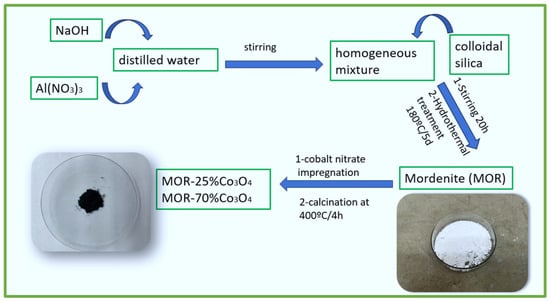
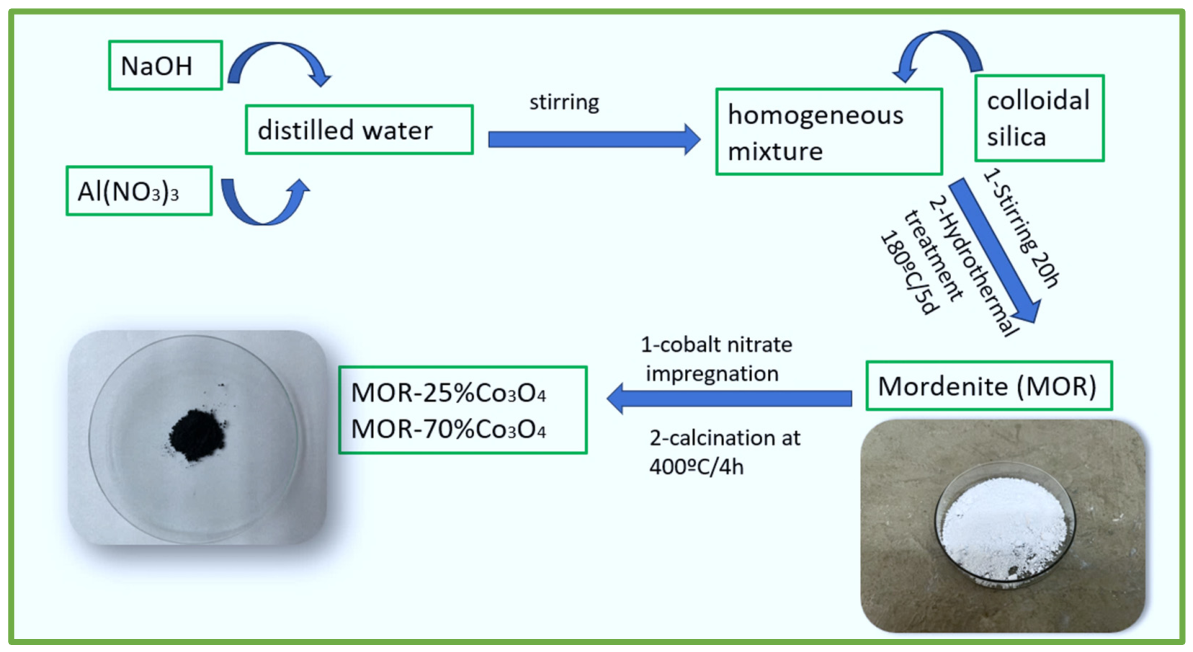
The synthesis of mordenite took place from the dissolution of sodium hydroxide (DINÂMICA) (8.00 g) and aluminum nitrate (Aldrich) (12.5 g) in 70 mL of distilled water. Then, 50.0 g of colloidal silica-LUDOX AS-30 (Aldrich)were added. The system remained under stirring for 20 h before subjected to hydrothermal treatment at 180 °C for 5 days in a stainless-steel autoclave. After hydrothermal treatment, the product was filtered and washed with approximately 1 L of distilled water. The solid was dried at 60 °C overnight.
Cobalt incorporation was performed physically mixing the Co(NO3)2.6H2O (DINÂMICA) and zeolite. The amount of cobalt nitrate was calculated based on the desired Co3O4 content, 25 and 70 wt.%, with respect to 1.0 g of zeolite. The material was then calcined at 400 °C during 4 h to obtain the solids MOR-25%Co3O4 and MOR-70%Co3O4, respectively. The steps involved in the production of the materials are shown in Scheme 1.
Scheme 1.
Representation of the procedures used to produce the composites MOR-25%Co3O4 and MOR-70%Co3O4.
2.2. Characterization
The samples synthesized in the present work were structurally characterized by X-ray diffraction (XRD) in a Rigaku Miniflex powder diffractometer with CuKα radiation, 40 kV voltage, 40 mA current and with the diffraction angle (2θ) scanned from 5 to 50° at a rate of 2° min−1. Semi-quantitative elemental analysis was performed X-ray fluorescence spectrometry (XRF) using a Bruker S8/Tiger instrument (Bruker, Karlsruhe, Germany). Scanning electron microscopy (SEM) images were recorded in a MEV-FEG Tescan Mira 2 microscope (Tescan, Brno, Czech Republic), with 20 kV voltage, equipped with energy-dispersive X-ray spectroscopy (EDS) accessory. N2 physisorption experiments were performed at 77 K on a Micromeritics ASAP 2020 instrument (Micromeritics Instrument Corporation, Norcross, GA, USA) to determine the specific surface area (SBET) of the samples, using the Brunauer, Emmett, and Teller (BET) method, with 5 points recorded in the relative pressure (P/P0) range between 0.01 and 0.05. The pore size distributions were calculated from the N2 adsorption isotherms using the non-local density functional theory (NLDFT) approach. Fourier-transform infrared (FTIR) spectroscopy analyses were conducted on an FT-IR Cary 630 instrument (Agilent Technologies, Inc., Santa Clara, CA, USA) (Agilent Technologies) using a spectral region of 650–4000 cm−1, 16 scans and a resolution of 4 cm−1.
2.3. Electrochemical Studies
An electrochemical system was prepared with a three-electrode setup on an electrochemical workstation, using a KOH solution (1.0 mol/L) as the electrolyte. KOH is a compound widely employed as an electrolyte in supercapacitors due to its higher ionic conductivity and the greater mobility of K+ ions in aqueous solution compared to, for instance, NaOH. Another relevant factor is that KOH exhibits greater electrochemical stability in aqueous solutions, allowing for a potential window better suited to the operation of the supercapacitor, which directly impacts the device’s energy density. Furthermore, the use of KOH reduces the internal resistance of the system, facilitating higher power output and improved cycle efficiency [34,35].
The electrochemical cell comprised an Ag|AgCl|KClsat. reference electrode, a platinum counter electrode, and a working electrode, which is a graphitic substrate coated with an electroactive paste containing the MOR/Co3O4 composite (MOR-25%Co3O4 or MOR-70%Co3O4), a carbon-based material (activated carbon or carbon black), and polyvinylidene fluoride (PVDF), in a mass ratio of 16:2:2. Dimethyl sulfoxide (DMSO) was used as a solvent/dispersant, added gradually until a semi-fluid paste was obtained.
The prepared electrodes were characterized by using cyclic voltammetry, charge and discharge testing, and cycling testing techniques. Cyclic voltammetry was performed on a PalmSens EmStat 3+ potentiostat/galvanostat workstation (Netherlands), monitored using PSTRACE 4.2 software.
The charge and discharge tests and the cycling experiments were performed on an Ametek brand potentiostat/galvanostat, model VersaStat 3A, monitored using VersaStudio 2.62.2 software.
The specific capacitance of the electrodes was also determined from the galvanostatic discharge curves, using Equation (1).
where Cs is the specific capacitance (F/g), I is the applied current density (0.5 to 5 A/g), Δt corresponds to the discharge time, and ΔV is the potential window (0 to 0.35 V).
The coulombic efficiency of the system can be evaluated by the ratio between the discharge and charging times, as expressed by Equation (2).
where η is the coulombic efficiency (%), ΔtD indicates the discharge time and ΔtC the charging time obtained from the galvanostatic charge and discharge curves.
3. Results and Discussion
3.1. Characterization of Materials
Structural, Chemical and Textural Properties
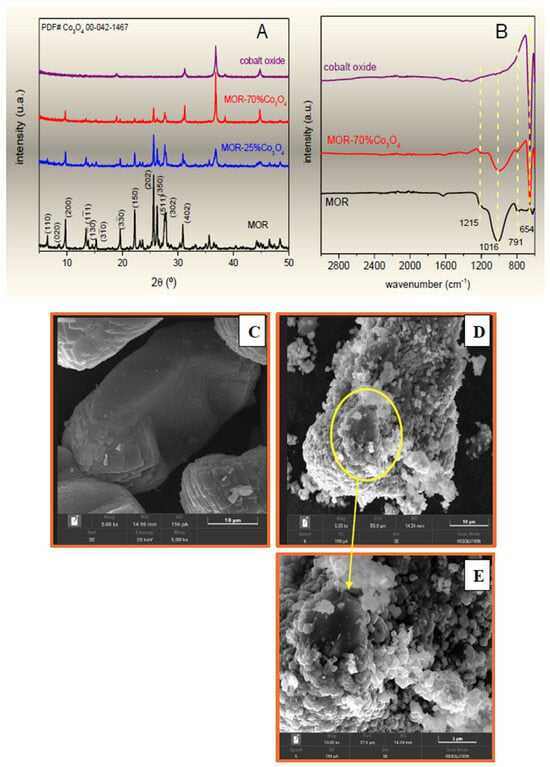
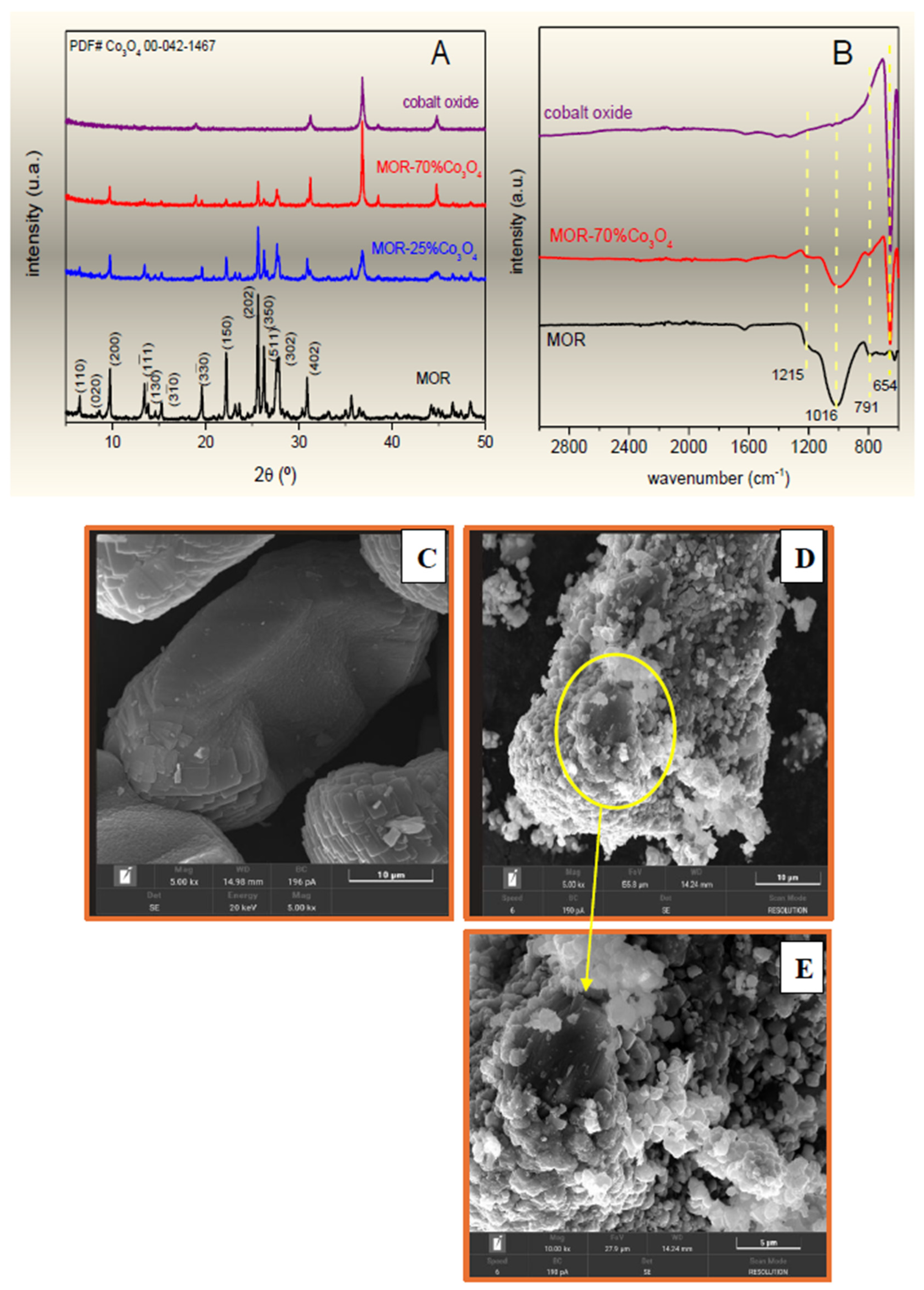
Figure 1A reveals that the green synthesis of mordenite gives a product with high crystallinity, with all the X-ray diffraction (XRD) peaks associated with the presence of the MOR-type structure, indicating a high degree of purity [36,37]. After impregnation with cobalt, a clear reduction in the intensity of the zeolite diffraction peaks and an increase in the relative intensity of the peaks associated with the Co3O4 phase (PDF# Co3O4 00-042-1467) are observed. It is worth noting that the Co3O4 contents obtained by X-ray fluorescence (XRF), given in Table 1, are very close to the nominal values, suggesting successful impregnation with minimal material loss.
Figure 1.
XRD patterns (A) and FTIR spectra (B) of MOR, Co3O4, and the produced composites. SEM images of the samples MOR (C) and MOR-70%Co3O4 in different magnifications (D,E).
Table 1.
Chemical composition (from XRF) and specific surface area of the produced samples.
For the sample with higher Co3O4 load (MOR-70%Co3O4), the attenuation of the XRD peaks attributed to the MOR phase may be associated with an extensive formation of a thicker layer of cobalt oxide deposited on the zeolite surface instead of crystalline phase destruction. This fact can be confirmed through the FTIR results (Figure 1B). The symmetrical/asymmetrical internal and external vibrational modes of mordenite are observed by the presence of bands at 791, 1016, and 1215 cm−1 [38], showing the structural integrity of the zeolite after impregnation. Furthermore, the positions of the bands at 1215 and 791 cm −1 remain unchanged, while the band at 1016 cm−1 exhibits a slight shift to lower frequencies. This suggests that Co3O4 is deposited on the surface of the zeolite rather than forming new chemical bonds. The new band observed for this sample at 654 cm−1 is due to the presence of the Co3O4 phase. It is worth remarking that the FTIR analysis and the other characterization experiments were not conducted for MOR-25%Co3O4 because this sample presented unsatisfactory performance on the electrochemical tests, as will be discussed further.
Scanning electron microscopy (SEM) images of MOR reveal small fragments of agglomerated plates, forming crystals with micrometric dimensions (Figure 1C). After cobalt insertion, small particles with nearly spherical shape are observed deposited on the MOR surface, which can be attributed to the presence of Co3O4 (Figure 1D,E). It can be observed that the original morphology of mordenite is preserved, suggesting the maintenance of the MOR phase, which is consistent with the XRD results. Energy-dispersive X-ray spectroscopy (EDS) analysis reveal that only the elements Si, Al, O, and Na are present in the MOR sample, and the same elements plus Co are detected in the MOR-70%Co3O4 composite, showing that the produced materials exhibit high chemical and phase purity.
The N2 adsorption/desorption isotherm recorded for the MOR sample exhibits a profile typical of a predominantly microporous material (type I isotherm) [39,40]. After the formation of Co3O4 particles, a huge decrease in the pore volume was observed (as shown in Figure S1a, in the Supplementary Material). Accordingly, the BET specific surface area was severely reduced, from 257 m2/g for the MOR sample to 6.3 and 4.0 m2/g for the MOR-25%Co3O4 and MOR-70%Co3O4 samples, respectively (Table 1). These results again suggest that Co3O4 is primarily coating the surface of mordenite. However, as will be seen in the discussion of electrochemical experiments, this decrease in specific surface area does not appear to be a drawback in the present study, where it is believed that the electrolyte ions can diffuse appropriately along the voids present in the material’s structure, as observed by the pore size distributions of the materials (Figure S1b). Studies of Co3O4 samples presenting relatively low specific surface area but excellent performance as supercapacitors have recently been reported [41].
3.2. Electrochemical Experiments
3.2.1. Parameters Optimization
The initial tests consisted of comparing electrodes prepared from pastes containing activated carbon and MOR-25%Co3O4 or MOR-70%Co3O4 on a non-activated graphitic substrate (Figure 2A,B). It is important to point out that electrochemical tests using electrodes containing only Co3O4 were carried out; however, the paste did not have sufficient adhesion and detached during the experiments (Figure S2a,b), making its use unfeasible without the presence of zeolite (Figure S2c,d).
Figure 2.
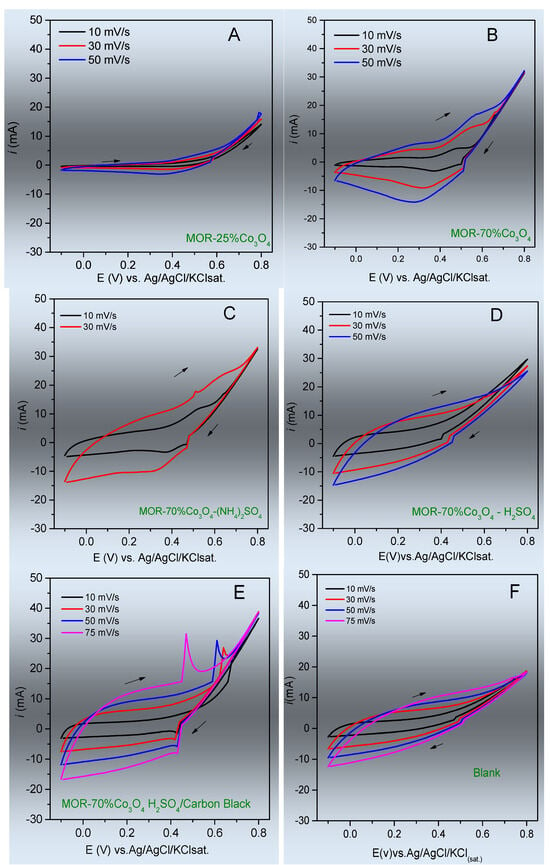
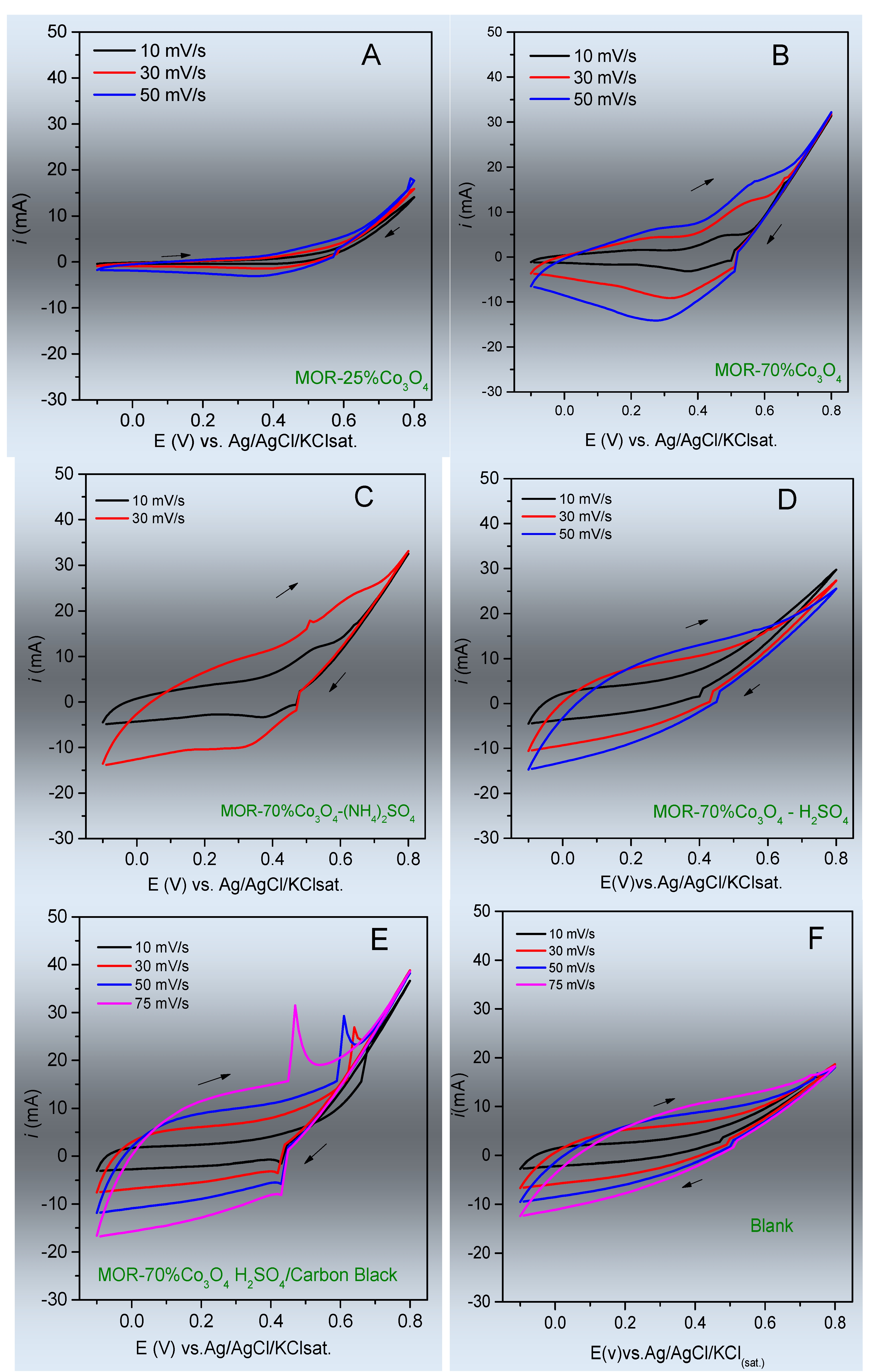
Cyclic voltammetry curves recorded at different scan rates using the indicated zeolite-based electrodes: MOR-25%Co3O4 (A) and MOR-70%Co3O4 (B), on a non-activated substrate. MOR-70%Co3O4-(NH4)2SO4 (C), on a substrate activated with (NH4)2SO4 (0.1 mol/L). MOR-70%Co3O4-H2SO4 (D), on a substrate activated with H2SO4 (0.1 mol/L). MOR-70%Co3O4-H2SO4/carbon black (E), on a substrate containing carbon black and (0.1 mol/L). (F) Blank = the same system in (E) without the presence of MOR-70%Co3O4.
For MOR-25%Co3O4 electrode, Figure 2A reveals nonsymmetric cyclic voltammogram (CV) profiles [15]. In this case, the capacitive characteristics of the electrode are less pronounced compared to faradaic processes. In addition, the voltammetric response was not very significant, indicating low electrochemical activity and, consequently, limiting the charge storage capacity of the zeolite-based electrode, since the typical characteristics of supercapacitors (rectangular voltammetric shape) were not observed in the CV profiles of MOR-25%Co3O4. This suggests that the low concentration of cobalt was not sufficient to promote the formation of active sites suitable for the surface redox reactions responsible for the increase in pseudo capacitance, requiring a minimum amount of active material to enable satisfactory performance [15,18]. For this reason, from now on only studies with the MOR70%-Co3O4 sample will be discussed.
As expected, the presence of a higher cobalt content promoted an increase in cathodic and anodic current (Figure 2B). This favored the availability of redox centers associated with cobalt species present on the electrode surface, particularly those related to Co2+/Co3+ redox transitions, enhancing the electrode/electrolyte interaction and increasing the contribution of faradaic processes. It is important to emphasize that, even with 70% cobalt oxide, without activation of the graphitic substrate, the electrode modified with the MOR-70%Co3O4 composite still presented low charge values (0.39–0.53 C—Table 2), not expected for materials intended for supercapacitors [42]. This shows that simple metal impregnation, while promising, is not sufficient to guarantee competitive performance. The low efficiency may be related to the high internal resistance of the system and the limited electrical conductivity of the non-activated modified graphitic electrode, restricting the access of electrolyte ions to the active sites [42].
Table 2.
Charge values determined by cyclic voltammetry for different electrodes in function of scan rate.
Substrate activation is a fundamental procedure for enhancing the electrochemical performance of materials used in supercapacitors. It is related to increasing the available active surface area, creating controlled porosity, and/or introducing functional groups that favor interaction with the electrolyte, improving the charge values [43]. The graphitic electrode was subjected to an electrochemical activation process in a 0.1 mol/L (NH4)2SO4 solution, and a current of 10 mA was applied for 10 min. After this period, the substrate was removed from the electrochemical cell, washed with distilled water, and dried in an oven at 100 °C for 1 h. Activating the graphitic substrate with 0.1 mol/L (NH4)2SO4 led to a small increase in the charge values (Figure 2C, MOR-70%Co3O4-(NH4)2SO4 system and Table 2) but this was still unsatisfactory for a supercapacitor. Activation with ammonium sulfate did not show a satisfactory effect, attributed to the weakly aggressive nature of this salt in aqueous solution, which does not promote significant changes on the substrate surface.
As next step, the substrate was activated using a 0.1 mol/L sulfuric acid (H2SO4) solution for 10 min, which is expected to be somewhat more aggressive in improving the electrochemical properties of the electrode. The choice of this method was based on several studies in the literature that demonstrate the effectiveness of the acid treatment in improving adhesion between the active material and the electrically conductive substrate, as well as promoting the removal of surface impurities and increasing roughness, which enhances the electrode/electrolyte contact area [43,44]. After activation, a significant increase in the electrode’s capacitive response was observed, with a greater widening of the CV profiles and intensification of the currents, as revealed in Figure 2D (MOR-70%Co3O4-H2SO4 system). This effect was particularly satisfactory at the 10 mV/s scan rate, where the material exhibited the best electrochemical performance among the evaluated scan rates, indicating a higher charge value (1.53 C, Table 2) associated with cobalt redox processes.
The improved electrochemical response obtained at 10 mV/s can be attributed to the longer time available for the electrolyte ions to diffuse and interact with the active sites on the electrode surface. At lower scan rates, the charging and discharging processes occur more slowly, allowing more efficient ionic diffusion along the composite pores and surface, providing greater access to the cobalt redox centers. As consequence, Figure 2D reveals wider CV profiles and significantly higher currents, with strong participation of pseudocapacitive processes. This effect contributes to the intensification of the observed currents and to the greater participation of pseudo capacitance in charge storage [16,45]. On the other hand, at higher scan rates, the interaction time between the electrolyte ions and the electroactive sites is reduced, hindering the complete ion diffusion towards the redox centers. The superior performance obtained at the lower scan rate is directly related to the ion diffusion kinetics and more efficient access to the electroactive sites of MOR-70%Co3O4 [16,45].
Although the MOR-70%Co3O4-H2SO4 system showed interesting charge values, the CV in Figure 2D revealed a slightly distorted rectangular shape typical of materials with considerable internal electrical resistance. The electroactive paste was reformulated, replacing the activated carbon with carbon black, while maintaining the same proportions between the materials. This replacement was motivated by the high electrical conductivity of carbon black, characteristics that favor the formation of a more efficient conductive network between the particles of the electroactive material, facilitating the transport of electrons in the electrode. As a result of these modifications, an improvement in the CV profiles was observed, with less electrical resistance contribution, as shown in Figure 2E (Mor-70%Co3O4-H2SO4/carbon black electrode). A quasi-rectangular (box-like) shape of the voltammetric profile typical of processes associated with the formation of an electrical double layer, was achieved. Therefore, even though it exhibited a lower charge value at a scan rate of 10 mV/s than in situation observed in Figure 2D, the carbon black displayed predominantly capacitive behavior for all scan rates. In addition, anodic and cathodic peaks were also observed in some regions of the voltammograms, indicating the occurrence of faradaic processes related to the cobalt species present in the material [16,45,46]. These peaks may be associated with transitions between different oxidation states of cobalt, such as Co2+/Co3+/Co4+, involving hydroxylated species formed in an alkaline electrolytic medium, such as Co(OH)2, CoOOH, and CoO2. Such transformations are frequently reported in the literature in potential ranges close to those observed in this study, typically between approximately 0.4 and 0.7 V, depending on the experimental conditions and the structure of the material, and are commonly attributed to the redox pairs Co2+/Co3+ (≈0.35–0.50 V) and Co3+/Co4+ (≈0.50–0.65 V) [16,45,46,47,48]. Additionally, small variations in the position and intensity of the peaks may be associated with charge transfer resistance and diffusional limitations, especially in materials supported on porous matrices [16,45].
It is also observed that, at higher scan rates, the redox peaks become more pronounced. This behavior is related to the increased electrode polarization and the predominance of surface electrochemical processes. At high scan rates, the time available for ion diffusion within the porous structure of the material is reduced, primarily favoring reactions that occur on the surface or in regions close to the electrode surface [47,48]. Additionally, a slight asymmetry can be observed between the anodic and cathodic regions of the voltammograms, particularly at higher scan rates, which is attributed to the kinetic limitations of the redox processes or to ionic diffusion effects at the electrode/electrolyte interface. Small distortions in the curve profiles may also be associated with the redistribution of electroactive species on the electrode surface during the scanning cycles [47,48].
Even with increased scan rate, the overall shape of the CV profiles is relatively preserved, indicating the electrochemical stability of the material and adequate reversibility of the involved processes. Overall, the results indicate that the modifications performed on the composition of the electroactive paste and the treatment of the graphitic substrate contributed to improving the voltammetric response of the electrode. Replacing activated carbon with carbon black promoted the formation of a more efficient electrically conductive system, reducing the previously observed internal electrical resistance. Furthermore, the presence of Co3O4 particles deposited on the surface of mordenite favors the occurrence of redox processes accessible to the electrolyte, contributing to the pseudocapacitive behavior of the material. Consequently, the electrode exhibited a combined charge storage mechanism (with charge values of 1.40C—Table 2), involving both electrical double-layer processes and faradaic reactions associated with cobalt species, highlighting the potential of zeolite/cobalt oxide-based materials for novel applications in energy storage devices.
The above discussed results show that the paste deposited on the substrate previously treated electrochemically with sulfuric acid solution, prepared using the MOR-70%Co3O4 composite, with the addition of PVDF and carbon black (MOR-70%Co3O4-H2SO4/carbon black system), showed the best electrochemical performance; thus, this modified electrode was selected for the subsequent stages of the study. It is important to emphasize that zeolite plays a fundamental role in improving the adhesion of the paste to the substrate, as well as helping to protect the graphitic substrate against degradation. To corroborate the results regarding the function of the zeolite/Co3O4 composite, a paste without zeolite containing only activated carbon, carbon black, and PVDF was also tested (Figure 2F-blank) and exhibited a significantly inferior electrochemical performance with charge values ranging from 0.94 C at 10 mV/s to 0.20 C at 75 mV/s.
3.2.2. Galvanostatic Charge and Discharge Assays
Based on the results obtained by cyclic voltammetry, which showed the superior electrochemical performance for the MOR-70%Co3O4-H2SO4/carbon black system, it was decided to further investigate this system through galvanostatic charge and discharge tests. Galvanostatic charge and discharge analyses were performed at different current densities (from 0.5 to 3.0 A/g) to investigate the electrode performance under different operating conditions and to evaluate its electrochemical response at both low and high current density regimes.
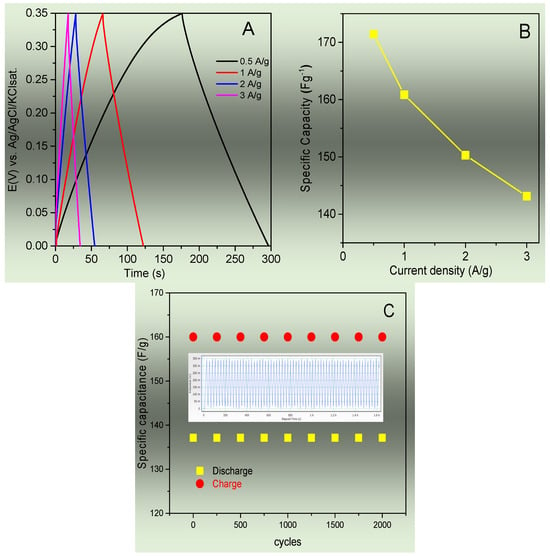
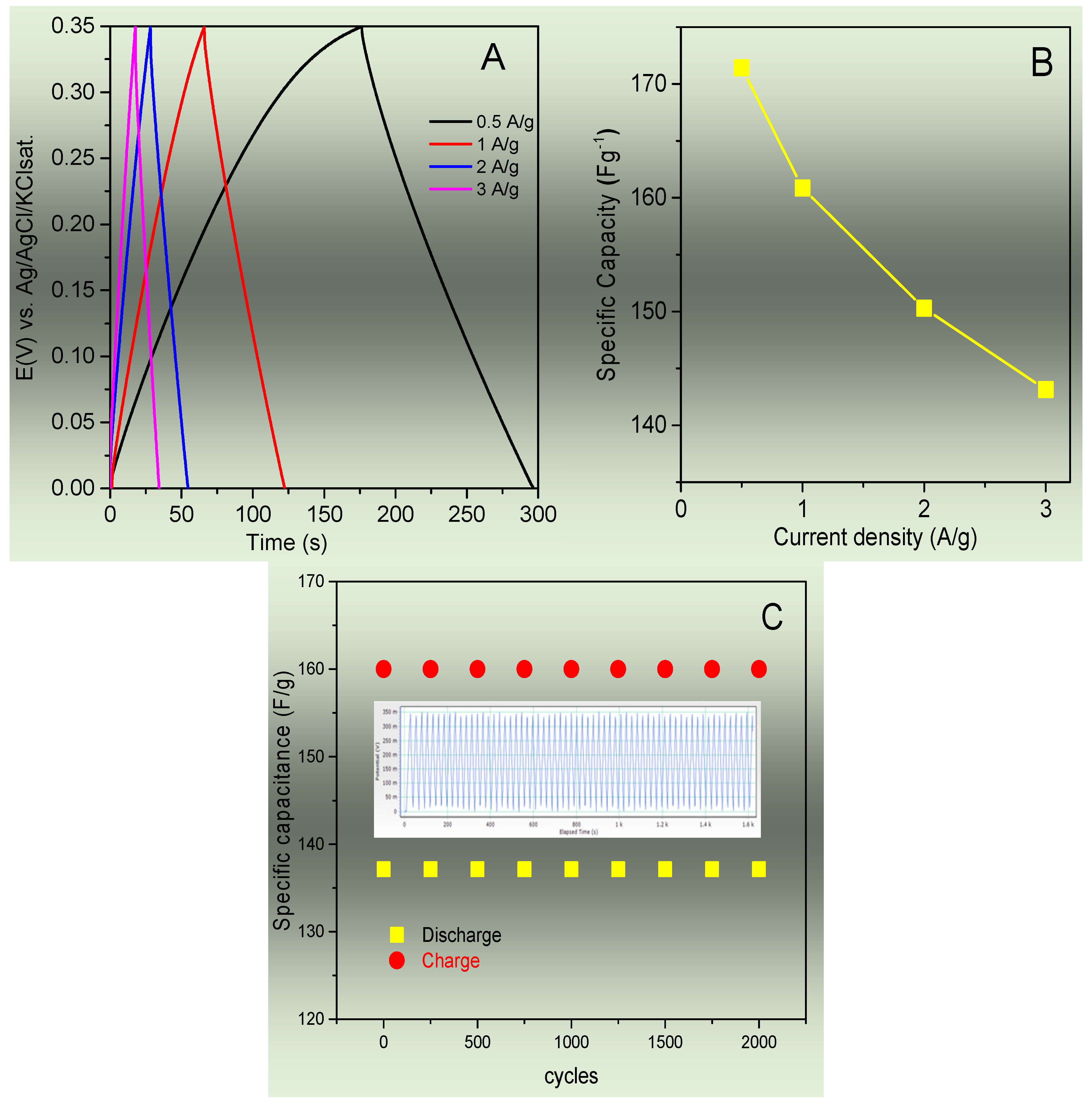
Figure 3A shows the galvanostatic charge and discharge profiles of the MOR-70%Co3O4-H2SO4/carbon black electrode at different current densities. The curves exhibit an approximately triangular and symmetrical profile, characteristic of materials with predominantly capacitive behavior [49]. This indicates the reversibility of the electrochemical processes and suggests that charge storage occurs mainly through mechanisms associated with the formation of the electrical double layer, with an additional contribution from pseudocapacitive processes, as previously observed in cyclic voltammetry results. It is also observed that the discharge sections exhibit approximately linear behavior as a function of time, which indicates near-ideal capacitive performance and interesting efficiency in charge storage and release [50]. With increasing the current density, there is a reduction in discharge time. This behavior is expected, since at higher currents the discharge process occurs more quickly [49,50]. In addition, at high current densities, limitations in ion diffusion within the porous structure of the material hinder complete access to the active sites, reducing the active surface area of the electrode and its specific capacitance. At low current densities, the electrolyte ions have more time to penetrate the pores of the material, promoting more efficient use of the active surface area and, consequently, longer discharge times and higher specific capacitances, as shown in Figure 3B.
Figure 3.
Electrostatic charge and discharge curves obtained at different current densities (from 0.5 to 3.0 A/g) for the MOR-70%Co3O4-H2SO4/carbon black system (A). Variation in electrode specific capacitance as a function of current density (B) and variation in electrode specific capacitance during 2000 successive charge/discharge cycles (C).
A coulombic efficiency of 85% was achieved, indicating that most of the charge stored during the loading process is recovered during discharge. This result demonstrates interesting electrochemical reversibility and low energy losses, with such losses possibly associated with irreversible processes, such as secondary faradaic reactions, internal electrode resistance, and limitations in ion transport [51]. Values of coulombic efficiency in this range are typical of cobalt-based pseudocapacitive materials, confirming the excellent performance of the developed electrode [51]. This result is consistent with the approximately symmetrical profile of the galvanostatic charge and discharge curves, reinforcing the reversible nature of the observed electrochemical processes.
The specific capacitance of the electrode as a function of current density, in the range of 0.5 to 3.0 A/g is presented in Figure 3B. Specific capacitance decreases with increasing current density, a behavior widely reported for materials used in supercapacitors [10,52,53,54,55]. This phenomenon is related to the limitation of ionic transport under fast charging conditions, in which the electrolyte ions cannot efficiently access all available active sites within the porous structure of the material, resulting in less utilization of the electroactive surface area and, consequently, lower specific capacitance values. It is observed that, despite the reduction in specific capacitance at higher currents densities, the electrode retains a significant fraction of its initial capacitance, indicating reasonable rate capability and adequate ion and electronic transport kinetics in the material.
Cycling stability is one of the most important indicators for evaluating the electrochemical properties of materials used in energy storage devices, as it is directly related to the durability, reversibility of electrochemical reactions, and structural stability of the material throughout successive charging and discharging processes. The electrochemical stability of the electrode was evaluated by means of galvanostatic charge and discharge tests over 2000 cycles at a current density of 1.0 A/g (Figure 3C). The results showed that the galvanostatic charge and discharge curves exhibited stable behavior throughout the cycles, without significant changes in discharge time or curve shape, indicating interesting electrochemical reversibility and material stability during repeated charge and discharge processes; the specific capacitance remained at 100% of the initial value after 2000 cycles, pointing to the capacitance retention and good cycling stability. This demonstrates that the MOR-70%Co3O4 composite exhibits important structural and electrochemical stability, with low degradation of the active sites throughout the charge and discharge cycles. Such a promising electrochemical performance can be attributed to the synergy between the porous structure of the zeolite, which favors ionic transport, the presence of redox species associated with cobalt, which contribute to charge storage through pseudo capacitance, and the use of an activated graphitic substrate and of carbon black, which improves the electrical conductivity of the electrode and reduces the internal electrochemical resistance of the system. The combination of these factors resulted in a material with important characteristics for application in energy storage devices.
Comparing the specific capacitance values obtained in this work with those reported in the literature for different materials used in supercapacitors (Table 3), it is verified that the MOR70%Co3O4 composite supported on a substrate activated with H2SO4 solution and with the addition of carbon black presented relevant electrochemical performance. The results demonstrate that the developed material exhibits competitive behavior when compared to other electrodes described in the literature. The electrode developed in this work exhibited a specific capacitance of approximately 160 F/g, a value comparable or higher than the ones obtained for several materials reported in the literature, in addition to showing high cycling stability after 2000 cycles, indicating that electrodes modified with zeolite-Co3O4 composites are promising for potential future applications in energy storage devices.
Table 3.
Comparison of specific capacitances of the MOR-70%Co3O4 system described in this work and of some materials from the literature.
4. Conclusions
This work developed and evaluated the green synthesis of cobalt-impregnated mordenite zeolite-based electrodes for application in supercapacitors, investigating the influence of cobalt concentration, substrate activation, and the addition of an electrically conductive component on the electrochemical performance of the obtained materials. The characterization results revealed the preservation of the zeolitic structure and that cobalt oxide particles are deposited on the external surface of the zeolite. The electrochemical results revealed predominantly pseudocapacitive behavior of the electrodes, characterized by the presence of anodic and cathodic peaks associated with the reversible faradaic reactions of the cobalt species. It was found that increasing the cobalt concentration significantly improved the electrochemical response of the materials, with the best results obtained for the samples containing 70% of Co3O4. The chemical activation of the graphitic substrate with a 0.1 mol/L H2SO4 solution promoted a significant increase in the electrochemical response compared to the non-activated substrate and the substrate activated with ammonium sulfate. The addition of carbon black to the electroactive paste significantly contributed to improving the electrode performance, promoting increased electrical conductivity, and improved electronic and ionic transport. This effect was evidenced by the increased area under the cyclic voltammetry curves and the improved galvanostatic profiles obtained. Cycling stability tests, performed over 2000 consecutive galvanostatic charge and discharge cycles, demonstrated good electrochemical stability of the material, with approximately 100% retention of specific capacitance at the end of the cycles. These findings evidence high structural stability, good adhesion of the electroactive paste to the substrate, and maintenance of the activity of cobalt redox species throughout the cycling process. This study revealed new perspectives for the application of zeolite-based materials as energy storage devices, highlighting that these materials are promising for future investigations in this field.
Supplementary Materials
The following supporting information can be downloaded at: https://www.mdpi.com/article/10.3390/cryst16110732/s1, Figure S1: N2 physisorption isotherms (a) and the corresponding pore size distributions (b) obtained for the MOR, MOR-25%Co3O4, and MOR-70%Co3O4 samples; Figure S2: (a,b) System without the presence of zeolite (extensive material detachment) and (c,d) System containing zeolite-cobalt oxide (strong adhesion and no material loss are observed).
Author Contributions
D.M.S.A.: Investigation; G.R.P.S.: Investigation; I.C.S.: Investigation; E.A.F.: Formal analysis, Review and Editing; D.F.C.: Investigation; D.N.F.: Investigation; Formal analysis; J.C.C.F.: Funding acquisition; Formal analysis; Writing—Review and Editing; M.K.P.: Conceptualization; Funding acquisition; Formal analysis; Writing—Original Draft; Writing—Review and Editing; Project administration. All authors have read and agreed to the published version of the manuscript.
Funding
This work was supported by FAPERJ (grant Nº E-26/210.138/2022 and No E-26/010.001842/2015).
Institutional Review Board Statement
Not applicable.
Informed Consent Statement
Not applicable.
Data Availability Statement
The original contributions presented in this study are included in the article. Any inquiries can be directed to the corresponding authors.
Acknowledgments
This work was supported by FAPERJ (grant Nº E-26/210.138/2022 and No E-26/010.001842/2015) and CNPq (grant 309873/2022-3). JCCF acknowledges the support from the Brazilian agencies FAPES (grant 892/2023) and CNPq (grant 310528/2022-4). E.A.F. acknowledges the support from CNPQ (grant 304539/2026-0).
Conflicts of Interest
The authors declare no conflicts of interest.
References
- Kumar, N.; Kim, S.-B.; Lee, S.-Y.; Park, S.-J. Recent Advanced Supercapacitor: A Review of Storage Mechanisms, Electrode Materials, Modification, and Perspectives. Nanomaterials 2022, 12, 3708. [Google Scholar] [CrossRef] [Scilit] [PubMed]
- Hao, L.; Li, X.; Zhi, L. Carbonaceous Electrode Materials for Supercapacitors. Adv. Mater. 2013, 25, 3899–3904. [Google Scholar] [CrossRef] [Scilit] [PubMed]
- Rajkumar, P.; Thirumal, V.; Yoo, K.; Kim, J. Synergistic Integration of Mesocarbon Microbeads, Graphitic Nanofibers, and Mesoporous Carbon for Advanced Supercapacitor Electrodes. Crystals 2025, 15, 64. [Google Scholar] [CrossRef] [Scilit]
- Rajesh, J.A.; Kwon, S.-J.; Manikandan, R.; Kang, S.-H.; Ahn, K.-S. Design of Co0.85Se Microsphere-like Architectures for High-Performance Hybrid Supercapacitors. Crystals 2025, 15, 217. [Google Scholar] [CrossRef] [Scilit]
- Vignesh, S.; Ramkumar, R.; Suganthi, S.; Kumar, P.; Ahmad, K.; Kim, W.K.; Oh, T.H. MoSe2 as Electrode Material for Super-Capacitor, Hydrogen Evolution, and Electrochemical Sensing Applications: A Review. Crystals 2025, 15, 238. [Google Scholar] [CrossRef] [Scilit]
- Aleksandrova, M.; Pandiev, I. Electrical Characterization of a Novel Piezoelectric-Enhanced Supercapacitor with a PET/ITO/PVDF-Tr-FE/PEDOT:PSS:Graphene/LiTaO3/Al Structure. Crystals 2025, 15, 660. [Google Scholar] [CrossRef] [Scilit]
- Omashova, G.; Tussupzhanov, A.; Ramankulov, S.; Katpayeva, K.; Baltabaeyeva, D.; Mussakhan, N.; Kaldar, B. Recent Advances in MoS2-Based Nanocomposites: Synthesis, Structural Features, and Electrochemical Applications. Crystals 2025, 15, 1037. [Google Scholar] [CrossRef] [Scilit]
- Jia, X.; Wang, J.; Dang, J. CVD-Grown Carbon Nanofibers on Knitted Carbon Fabric for Enhanced Supercapacitor Performance. Crystals 2025, 15, 1049. [Google Scholar] [CrossRef] [Scilit]
- Manavalan, V.; Coward, B.; Najdanovic-Visak, V.; Worrall, S.D. Electrosynthesis of Co-ZIF Using Bio-Derived Solvents: Electrochemical Evaluation of Synthesised MOFs as a Binder-Free Supercapacitor Electrode in Alkaline Electrolyte. Crystals 2024, 14, 700. [Google Scholar] [CrossRef] [Scilit]
- Shi, L.; Bai, W.; Sun, Q.; Wang, Y.; Liu, Z.; Sun, J.; Li, M.; Zhang, S. Structurally Tailored 3D Porous Co Current Collector with Surface Growth of CoOx Nanosheet Arrays for Supercapacitor and OER Application. Next Mater. 2025, 8, 100741. [Google Scholar] [CrossRef] [Scilit]
- Shetty, P.G.; Sudapalli, A.M. Investigating the Synergistic Effect of CuO and PANI-CuO Composite for High-Performance Supercapacitor Studies. Next Mater. 2025, 9, 101287. [Google Scholar] [CrossRef] [Scilit]
- Marimuthu, G.; Priyadharsini, C.I.; Prabhu, S.; Viji, A.; Vignesh, S.; AlSalhi, M.S.; Lee, J.; Palanisamy, G. Silver-Decorated SrTiO3 Nanoparticles for High-Performance Supercapacitors and Effective Remediation of Hazardous Pollutants. Environ. Geochem. Health 2024, 46, 96. [Google Scholar] [CrossRef] [Scilit] [PubMed]
- Prashanth, G.K.; Rao, S.; Lalithamba, H.S.; Bhagya, N.P.; Swamy, M.M.; Yashodha, S.R.; Yogananda, H.S. Smart Nanomaterials for Semiconductor Applications: Recent Advances in Energy Storage and Biosensing Technologies. Next Mater. 2025, 9, 100964. [Google Scholar] [CrossRef] [Scilit]
- Sonapatel; Udayabhanu; Nandeesh, K.N.; Prashantha, K. Recent Advances on Metal Sulfides as Next-Generation Electrodes for Supercapacitor Energy Storage: A Holistic Review. Next Mater. 2025, 9, 101103. [Google Scholar] [CrossRef] [Scilit]
- Moafor, S.N.; Tsobnang, P.K.; Oyedotun, K.O.; Lontio Fomekong, R.; Kabongo, G.L.; Lebohang, M.; Lambi, J.N.; Jewell, L.L. Effect of SiO2/Al2O3 Ratio on the Electrochemical Performance of Amorphous Zeolite Loaded with Cobalt Oxide Grown via Steam-Assisted Crystallization Method. RSC Adv. 2023, 13, 21393–21402. [Google Scholar] [CrossRef] [Scilit] [PubMed]
- Moafor, S.N.; Macheli, L.; Kabongo, G.L.; Nyongombe, G.; Tsobnang, P.K.; Lambi, J.N.; Jewell, L.L. Supercapacitive Performance of Cobalt-Loaded Amorphous Zeolite for Energy Storage Applications. Microporous Mesoporous Mater. 2024, 363, 112784. [Google Scholar] [CrossRef] [Scilit]
- Meher, S.K.; Rao, G.R. Ultralayered Co3O4 for High-Performance Supercapacitor Applications. J. Phys. Chem. C 2011, 115, 15646–15654. [Google Scholar] [CrossRef] [Scilit]
- Zallouz, S.; Aumond, T.; Moissette, A.; Sachse, A.; Matei Ghimbeu, C. Zeolite-Templated Carbons as Supercapacitors: The Fundamental Role of Structural and Textural Properties. ACS Appl. Energy Mater. 2024, 7, 9142–9155. [Google Scholar] [CrossRef] [Scilit]
- Profeta, D.O.; da Silva, M.A.; Faria, D.N.; Cipriano, D.F.; Freitas, J.C.C.; dos Santos, F.S.; Lima, T.M.; Vasconcelos, S.C.; Pietre, M.K. Zeolite/Calcium Carbonate Composite for a Synergistic Adsorption of Cadmium in Aqueous Solution. Next Mater. 2025, 6, 100493. [Google Scholar] [CrossRef] [Scilit]
- Moraes, C.S.; Carneiro, P.A.; Faria, D.N.; Cipriano, D.F.; Freitas, J.C.C.; Amorim, R.G.; da Silva, R.S.; Pietre, M.K. High Efficiency of Myclobutanil Adsorption by CTAB-Zeolite Structures: Experimental Evidence Meets Theoretical Investigation. Silicon 2024, 16, 3737–3753. [Google Scholar] [CrossRef] [Scilit]
- Amaral, M.S.C.; da Silva, M.A.; Cidade, G.d.S.; Faria, D.N.; Cipriano, D.F.; Freitas, J.C.C.; dos Santos, F.S.; Pietre, M.K.; dos Santos, A.M. Enhanced Ammonium Removal from Wastewater Using FAU-Type and BEA-Type Zeolites and Potential Application on Seedling Growth: Towards Closing the Waste-to-Resource Cycle. Processes 2025, 13, 2426. [Google Scholar] [CrossRef] [Scilit]
- Dai, X.; Cheng, Y.; Liu, T.; Mao, L. Catalyst for Moderate Hydrocracking of Polycyclic Aromatic Hydrocarbons in LCO to Produce Chemical Raw Materials: Ni in-Situ Modified Y Zeolite-Supported-NiWS. J. Ind. Eng. Chem. 2024, 140, 343–353. [Google Scholar] [CrossRef] [Scilit]
- Aly, H.M.; Moustafa, M.E.; Abdelrahman, E.A. Synthesis of Mordenite Zeolite in Absence of Organic Template. Adv. Powder Technol. 2012, 23, 757–760. [Google Scholar] [CrossRef] [Scilit]
- Zhang, Y.; Louis, B. Biochar-Mediated Synthesis of ZSM-5 Zeolite for the Methanol-to-Olefins Reaction. Next Mater. 2024, 5, 100259. [Google Scholar] [CrossRef] [Scilit]
- da Silva, R.S.; Pietre, M.K.; Amorim, R.G. A DFT Perspective on Cd2+ Removal by CaCO3/FAU Zeolite Frameworks: Bridging Theory and Experiment. J. Xenobiotics 2026, 16, 133. [Google Scholar] [CrossRef] [Scilit] [PubMed]
- Houghton, E.E.; Yapi, L.; Haneklaus, N.; Brink, H.G.; Tichapondwa, S.M. Coal Fly Ash-Based Adsorbents for Tetracycline Removal: Comparative Insights into Modification and Zeolite Conversion. J. Xenobiotics 2025, 15, 36. [Google Scholar] [CrossRef] [Scilit] [PubMed]
- Gupta, K.N.; Kumar, R.; Thakur, A.K. A Critical Review on Abatement of VOCs By Adsorption: Adsorbent Types and Their Characteristics. Water Air Soil Pollut. 2025, 236, 795. [Google Scholar] [CrossRef] [Scilit]
- Gong, H.; Ke, P.; Zhou, Y.; Xu, L.; He, G.; Jian, P. Adsorption of Fluorine from Lepidolite Hydrometallurgy Wastewater by Aluminum Modified Zeolite. Environ. Geochem. Health 2025, 47, 21. [Google Scholar] [CrossRef] [Scilit] [PubMed]
- Olegario, E.; Pelicano, C.M.; Felizco, J.C.; Mendoza, H. Thermal Stability and Heavy Metal (As5+, Cu2+, Ni2+, Pb2+ and Zn2+) Ions Uptake of the Natural Zeolites from the Philippines. Mater. Res. Express 2019, 6, 085204. [Google Scholar] [CrossRef] [Scilit]
- Céleri, E.P.; da Silva, C.C.M.; Lacerda, V., Jr.; Barañano, A.G. Synthesis of Sodalite Zeolite from Alkaline Fusion of Kaolin and Crystallization at Low Temperature and Ambient Pressure. Braz. J. Chem. Eng. 2024, 42, 637–645. [Google Scholar] [CrossRef] [Scilit]
- Teixeira, R.S.; Schmidt, D.V.C.; dos Santos, F.S.; Cipriano, D.F.; Faria, D.N.; Freitas, J.C.C.; Pietre, M.K. Nanostructured Faujasites with Different Structural and Textural Properties for Adsorption of Cobalt and Nickel. Braz. J. Chem. Eng. 2023, 41, 1271–1283. [Google Scholar] [CrossRef] [Scilit]
- Doan, T.H.Y.; Nguyen, T.T.T.; Kieu, T.T.; Hoang, D.T.; Vu, T.L.C.; Le, T.S.; Dang, V.L.; Nguyen, M.N.; Pham, T.D. Modification of Bio-Zeolite Greenly Synthesized from Rice Husk and Application in Adsorptive Removal of Herbicide Glyphosate. Mater. Chem. Phys. 2024, 316, 129108. [Google Scholar] [CrossRef] [Scilit]
- Hart, A.; Wood, J. Methodological Review of Zeolite Synthesis from Industrial Waste and Natural Clays and the Fabrication of Hierarchical Pore Structures. Next Mater. 2025, 9, 101113. [Google Scholar] [CrossRef] [Scilit]
- Manohar, A.; Suvarna, T.; Bandi, H.; Sangaraju, S.; Venkatesulu, A.; Sathish, M.; Murthy, V.N.N.; Kim, K.H. Mechanistic Insights into KOH-Driven Improvements in Supercapacitor Charge Storage and Stability. J. Ind. Eng. Chem. 2026, 155, 329–361. [Google Scholar] [CrossRef] [Scilit]
- Wang, G.; Dai, M.; Zeng, Z.; Guo, X. A Review of Alkaline Aqueous Electrolytes for Supercapacitors. Int. J. Electrochem. Sci. 2026, 21, 101441. [Google Scholar] [CrossRef] [Scilit]
- Sánchez-López, P.; Antúnez-García, J.; Fuentes-Moyado, S.; Galván, D.H.; Petranovskii, V.; Chávez-Rivas, F. Analysis of Theoretical and Experimental X-Ray Diffraction Patterns for Distinct Mordenite Frameworks. J. Mater. Sci. 2019, 54, 7745–7757. [Google Scholar] [CrossRef] [Scilit]
- Mirmohammadi, A.H.; Sohrabnezhad, S.; Foulady-Dehaghi, R. Mordenite-Supported CdS/C3N4 Nanocomposite for Photocatalytic Cr(VI) Reduction in Aqueous Solutions. Mater. Chem. Phys. 2026, 349, 131795. [Google Scholar] [CrossRef] [Scilit]
- Hincapie, B.O.; Garces, L.J.; Zhang, Q.; Sacco, A.; Sui, S.L. Synthesis of mordenite nanocrystals. Microporous Mesoporous Mater. 2004, 67, 19–26. [Google Scholar] [CrossRef] [Scilit]
- Landripet, I.; Puškarić, A.; Robić, M.; Bronić, J. Fine Tuning of Hierarchical Zeolite Beta Acid Sites Strength. Crystals 2023, 14, 53. [Google Scholar] [CrossRef] [Scilit]
- da Silva, J.R., Jr.; Ferreira, A.R.O. Conversion of Naphthenic Hydrocarbons over HZSM-12 Zeolites—Activity and Selectivity to Light Olefins Depending on Their Acid and Textural Properties and on the Size of the Processed Molecule. Braz. J. Chem. Eng. 2025, 43, 815–830. [Google Scholar] [CrossRef] [Scilit]
- Hu, Y.; Ren, X.; You, Y.; Tu, C.; Li, Z.; Tian, F.; Xu, C.; Chen, H. Urea-Modulated Hydrothermal Synthesis of Co3O4 Nanowires and Nanosheets for High-Performance Supercapacitors. Colloids Surf. A Physicochem. Eng. Asp. 2026, 742, 140450. [Google Scholar] [CrossRef] [Scilit]
- Chen, X.; Paul, R.; Dai, L. Carbon-Based Supercapacitors for Efficient Energy Storage. Natl. Sci. Rev. 2017, 4, 453–489. [Google Scholar] [CrossRef] [Scilit]
- Ahmed, B.; El-Ghazaly, A.; Halim, J.; Rosen, J. Electrochemical Activation of Commercial Graphite Sheets for Supercapacitive Applications. Electrochim. Acta 2022, 431, 140882. [Google Scholar] [CrossRef] [Scilit]
- Wang, L.; Chen, X. Three-Dimensional Activated Graphite Paper for High-Performance Supercapacitors. J. Energy Storage 2022, 52, 104939. [Google Scholar] [CrossRef] [Scilit]
- Fleischmann, S.; Mitchell, J.B.; Wang, R.; Zhan, C.; Jiang, D.; Presser, V.; Augustyn, V. Pseudocapacitance: From Fundamental Understanding to High Power Energy Storage Materials. Chem. Rev. 2020, 120, 6738–6782. [Google Scholar] [CrossRef] [Scilit] [PubMed]
- Ren, S.; Guo, Y.; Ju, L.; Xiao, H.; Hu, A.; Li, M. Facile Synthesis of Petal-like Nanocrystalline Co3O4 Film Using Direct High-Temperature Oxidation. J. Mater. Sci. 2019, 54, 7922–7930. [Google Scholar] [CrossRef] [Scilit]
- Xia, X.; Tu, J.; Zhang, Y.; Mai, Y.; Wang, X.; Gu, C.; Zhao, X. Freestanding Co3O4 Nanowire Array for High Performance Supercapacitors. RSC Adv. 2012, 2, 1835–1841. [Google Scholar] [CrossRef] [Scilit]
- Zhao, C.; Zheng, W.; Wang, X.; Zhang, H.; Cui, X.; Wang, H. Ultrahigh Capacitive Performance from Both Co(OH)2/Graphene Electrode and K3Fe(CN)6 Electrolyte. Sci. Rep. 2013, 3, 2986. [Google Scholar] [CrossRef] [Scilit] [PubMed]
- Kim, B.K.; Sy, S.; Yu, A.; Zhang, J. Electrochemical Supercapacitors for Energy Storage and Conversion. In Handbook of Clean Energy Systems; Wiley: Hoboken, NJ, USA, 2015; pp. 1–25. [Google Scholar]
- Yu, A.; Chabot, V.; Zhang, J. Electrochemical Supercapacitors for Energy Storage and Delivery: Fundamentals and Applications; CRC Press: Boca Raton, FL, USA, 2017. [Google Scholar]
- Simon, P.; Gogotsi, Y. Perspectives for Electrochemical Capacitors and Related Devices. Nat. Mater. 2020, 19, 1151–1163. [Google Scholar] [CrossRef] [Scilit] [PubMed]
- Chao, C.-Y.; Li, H.-F.; Li, P.-J.; Yang, J.-Y.; Wu, L.-J.; Yue, H.-W.; Li, H. Phytic Acid as an Eco-Friendly Phosphorus Source in the Synthesis of Phosphorus-Doped NiCo2O4 for Supercapacitor Electrodes. Next Mater. 2024, 5, 100247. [Google Scholar] [CrossRef] [Scilit]
- Jadhav, S.L.; Jadhav, A.L.; Kadam, A.V. Organic Solvent-Driven Synthesis of Mo-Doped Co3O4 Nanostructures: Elevating Supercapacitor Performance through Solvent Engineering. Next Mater. 2025, 8, 100850. [Google Scholar] [CrossRef] [Scilit]
- Zhang, M.; Fan, H.; Ren, X.; Zhao, N.; Peng, H.; Wang, C.; Wu, X.; Dong, G.; Long, C.; Wang, W.; et al. Study of Pseudocapacitive Contribution to Superior Energy Storage of 3D Heterostructure CoWO4/Co3O4 Nanocone Arrays. J. Power Sources 2019, 418, 202–210. [Google Scholar] [CrossRef] [Scilit]
- Xie, R.; Huang, H.; Qi, X.; Wei, G. Significant Enhancement of the Electrochemical Performance of Hierarchical Co3O4 Electrodes for Supercapacitors via Architecture Design and Training Activation. J. Energy Storage 2021, 35, 102258. [Google Scholar] [CrossRef] [Scilit]
- Tepeli Büyüksünetçi, Y. Enhanced Charge Storage and Capacitance of FeNiCo Trimetallic MOF/MWCNT-Modified Carbon Felt Electrodes. Processes 2026, 14, 1080. [Google Scholar] [CrossRef] [Scilit]
- Mukhiemer, S.; Daraghmah, A.; Nassar, H.; Hussain, S.; Lim, H.; Han, H.; Kim, T.W.; Amireh, A.N.; Hilal, H.S. Coffee-Waste-Based ZnCl2 Activated Carbon in High-Performance Supercapacitor Electrodes: Impact of Graphitization, Surface Morphology, Porosity and Conductivity. Processes 2024, 12, 2832. [Google Scholar] [CrossRef] [Scilit]
- Song, L.; Han, Y.; Guo, F.; Jiao, Y.; Li, Y.; Liu, Y.; Gao, F. Mesoporous Nickel-Based Zeolite Capsule Complex with Fe3O4 as Electrode for Advanced Supercapacitor. J. Nanomater. 2018, 2018, 9813203. [Google Scholar] [CrossRef] [Scilit]
- Saba, S.; Alsharari, A.M.; Aldaleeli, N.Y.; Aljohani, M.M.; Hamdalla, T.A. Structural, Electrochemical, and Supercapacitor Characterization of Double Metal Oxides Doped Within ZIF-8 Composites. Processes 2025, 13, 859. [Google Scholar] [CrossRef] [Scilit]
- Phong, M.T.; Tu, P.M.; Hai, N.D.; Nam, N.T.H.; Quan, V.M.; Son, T.N.; Lin, T.H.; Han, L.G.; Son, N.T.; Hieu, N.H.; et al. Green Synthesis of Carbon Aerogel Derived from Lotus Root for the Removal of Ciprofloxacin, Oil, Organic Solvents, and Supercapacitor Applications. Water Air Soil Pollut. 2024, 235, 135. [Google Scholar] [CrossRef] [Scilit]
- Ramkumar, R.; Koyyada, G.; Rabbi Abir, M.R.A.; Gurugubelli, T.R.; Kim, W.K.; Kim, J.H. Porous Zn Nano-Wafer Aerogels for Asymmetric Supercapacitors: Synthesis, Structural Engineering, and Performance. Processes 2025, 13, 1461. [Google Scholar] [CrossRef] [Scilit]
- Guragain, D.; Karna, S.; Choi, J.; Bhattarai, R.; Poudel, T.P.; Gupta, R.K.; Shen, X.; Mishra, S.R. Electrochemical Performance of Iron-Doped Cobalt Oxide Hierarchical Nanostructure. Processes 2021, 9, 2176. [Google Scholar] [CrossRef] [Scilit]
- Zou, H.; Li, Y.; Fan, J.; Zhao, Z.; Yang, W.; Chen, S. Preparation of Two-Dimensional Siloxene and the Application of Supercapacitor. Silicon 2025, 17, 3457–3467. [Google Scholar] [CrossRef] [Scilit]

Disclaimer/Publisher’s Note: The statements, opinions and data contained in all publications are solely those of the individual author(s) and contributor(s) and not of MDPI and/or the editor(s). MDPI and/or the editor(s) disclaim responsibility for any injury to people or property resulting from any ideas, methods, instructions or products referred to in the content. |
© 2026 by the authors. Licensee MDPI, Basel, Switzerland. This article is an open access article distributed under the terms and conditions of the Creative Commons Attribution (CC BY) license.