


Abstract
With growing demands for thermal management in the modern systems of engineering, increase in heat transfer in porous structures has become one of the key areas of research priorities. The nanofluids, which are developed by dispersing nanoscale particles of solids in the existing base fluids, have shown better thermal conductivity than the old-fashioned heat transfer fluids. In such nanofluids under oscillatory conditions, complex interactions between fluid inertia, permeability resistance and temporally varying forcing mechanisms occur when they flow through porous media. Then the knowledge of such interactions is absolutely necessary in the optimization of thermal systems with either periodic or pulsating flow conditions. The present study investigates the effect of the oscillatory boundary conditions on the thermal enhancement in a porous media nanofluid flow. The model to be used is a two-dimensional porous channel, and the equations governing the model the continuity equation, the full two-dimensional Brinkman-extended Darcy momentum equations and the energy equation are generated. In order to model pulsatile flow, an oscillatory velocity profile is prescribed at the boundary. Unless stated otherwise, the base fluid is water and the nanoparticle phase is copper (Cu). The equations so obtained are non-dimensionalized and resolved numerically through a finite-difference approach. The effect of the frequency of oscillation, Darcy number, and the volume fraction of the nanoparticles on temperature distribution and the Nusselt number are then examined, including their combined/interaction effects. These results indicate that compared with steady flow conditions, oscillatory flow increases the convective heat transfer by a large percentage up to 39.6% at Ω = 3.0, 37.1% at φ = 0.06, and 40.8% at Da = 0.10 relative to the steady, non-oscillatory baseline. The higher the oscillation frequency, the better the thermal boundary layer mixing and hence the higher the Nusselt numbers. Further, at higher volume fractions of nanoparticles, the thermal conductivity enhancement is also observed, leading to measurable heat transfer enhancement. The results are applicable to energy conversion equipment, nuclear thermal management, electronic climate coolers and miniature heat exchangers.
1. Introduction
The demands for effective and reliable thermal management technologies have grown significantly with the rapid pace of development in modern engineering systems. More traditional fluids employed as heat transfer fluids include water, ethylene glycol, and a wide range of oils, which have found use in industry; but due to their relatively low thermal conductivity, they cannot be used in high-heat-flux applications [1]. With modern gadgets being smaller and more powerful, the usual cooling fluids used in the past are unable to meet the performance demands. Nanofluids have become an effective solution in order to overcome this shortcoming. The nanofluids are formulated as nanoscale particles of copper (Cu), aluminum oxide (Al2O3), titanium dioxide (TiO2) and carbon nanotubes (CNTs) suspended in base fluids. The addition of such nanoparticles leads to an improvement in thermal conductivity, convective heat transfer rates, and other thermophysical properties such as viscosity and specific heat capacity. The experimental and theoretical investigations have shown that a small volume fraction of nanoparticles can result in a substantial improvement in the overall heat-transfer performance. Porous media are also of great significance in industrial and natural systems [2]. A porous medium is a solid skeleton that has openings that are interconnected, and fluid can pass through it. These include structures that are usually found in packed-bed reactors as well as geothermal and petroleum reservoirs, thermal insulation, and filtration. The nature of fluid dynamics and heat-transfer properties with respect to heat transfer and resistance are significantly affected by the presence of an effective resistance and a porous matrix. The motion of fluids in porous structures has been described by the Law of Darcy in the case of low velocity or in the Brinkman extended model, where the viscous shear is important. The interactions between the fluid flow and porous matrix create intricate transport mechanisms and therefore porous systems are especially applicable in improving thermal performance in small and energy-efficient systems [3].
In a practical application of engineering, fluid flow is not necessarily completely steady. Mechanical vibrations, reciprocating pumps, rotating equipment or pressure gradients due to time fluctuations may lead to oscillatory or pulsating flow conditions. This is in contrast to steady flow, in that oscillatory motion further encourages the further mixing of the fluid domain and interferes with the creation of stable thermal boundary layers. The acceleration and deceleration of the fluid particles cause increased momentum and energy transfer, which increases the convective heat transfer. Oscillatory flow can thus become a viable way of thermal augmentation without the need to power up the system by a large margin [4]. Understanding the dynamics of oscillatory behaviour of nanofluids and porous media in combined conditions is significant for the accurate prediction and optimization of the behaviour of advanced thermal systems. Despite the fact that a significant amount of research has been done on nanofluid heat transfer and porous-medium flows separately, there has been little work done on the concurrent effect of oscillatory boundary conditions and porous resistance on thermal enhancement. Numerous past studies are limited to steady nanofluid flow in non-porous channels or examine porous systems without taking into consideration the time-dependent forcing effect. Thus, the correlation between the frequency of oscillation, permeability properties and the concentration of nanoparticles is not well understood [5].
In particular, the influence of oscillatory parameters on the temperature distribution and the change in Nusselt number in porous nanofluid systems has not been studied quantitatively in detail. Such a gap indicates a need to perform comprehensive mathematical and numerical research on oscillatory nanofluid flow using porous materials. The first aim of the current research is to investigate how the oscillatory conditions can be used to enhance heat transfer in the nanofluid flow using porous media. The mathematical model of oscillatory nanofluid behaviour is developed in the study by taking the Brinkman-extended Darcy momentum equation and the energy equation. It identifies the influence of the frequency of oscillation on the temperature distribution and the Nusselt number, and the influence of the Darcy number and nanoparticle volume fraction on thermal enhancement and the percentage increase in heat transfer over steady flow. The study will use systematic numerical analysis to provide a clear understanding of the mechanisms behind improved thermal performance in time-dependent flow conditions. The inquiry is of industrial importance [6]. The use of porous inserts in heat exchangers with oscillatory nanofluid flow can lead to a significant improvement in the thermal performance of the system and can also be used to design smaller systems. Electronic cooling applications depend on efficient convective cooling to maintain safe operating temperatures in microprocessors, power electronics, and high-performance computers.
Nuclear reactors require efficient coolant systems that can operate reliably under transient or otherwise time-varying conditions, where oscillatory effects may be inherent to the process. Pulsating nanofluid circulation can also be used in solar thermal collectors to maximize energy absorption and improve storage efficiency. Nanoparticle-enhanced fluids injected in an oscillatory manner into petroleum reservoirs can likewise improve extraction and thermal-recovery processes. Similarly, biomedical filtration systems and chemical reactors with porous matrices can benefit, in terms of temperature control and reaction rate, from combining nanofluids with an oscillatory flow regime [7]. Bringing nanotechnology, porous-medium theory and oscillatory fluid mechanics together in one framework therefore contributes to the development of efficient, energy-saving thermal management techniques. The present results are expected to help engineers and researchers design next-generation heat-transfer systems with improved functionality, compactness, and industrial reliability.
2. Literature Review
The research on the heat transfer of nanofluids has gained significant attention in the past two decades because of the potential to significantly enhance the thermal properties of engineering systems. It was found in the first experimental investigations that the dispersion of metallic or metal-oxide nanoparticles in conventional base fluids leads to a measurable increase in the effective thermal conductivity. Lab measurements also indicated that the convective heat-transfer coefficients can be significantly enhanced even at low volume fractions of nanoparticles [8]. It has been shown that these empirical results have inspired the following theoretical modeling work to explain the mechanisms that govern the observed thermal transport enhancement, such as the effect of Brownian motion, thermophoresis, and particle–fluid interactions. Subsequent research has also been conducted to extend the research of nanofluids to porous media conditions, where the fluid flow is also affected by the resistance of the solid matrix, adding another layer of complexity. Parameters like permeability and porosity have a strong effect on both the distribution of velocity and temperature in porous structures [9].
The classical Darcy model is typically used to explain low-velocity flows, but in conditions of moderate permeability, the Brinkman extension is used with higher fidelity because it accounts for viscous shear [10]. A study of nanofluid flow in porous channels has revealed that the thermal performance is significantly affected by three parameters, namely (1) the Darcy number, (2) the concentration of nanoparticles, and (3) the ratio of thermal conductivities. Although enhanced nanoparticle loading usually enhances levels of heat transfer, it may also increase viscosity and consequently heighten flow resistance. At the same time, the ability of the oscillatory and pulsating flow regimes to support convective transport has been studied intensively. To this end, the oscillatory boundary conditions have been observed to destabilize thermal boundary layers and are known to increase fluid mixing, in particular, in a confined geometry [11]. Periodic forcing in channels and cavities has been found to increase the Nusselt number compared with a steady flow situation. The studies have shown that the frequency of oscillation and amplitude adopted play a significant role in determining the level of thermal enhancement.
Optimal frequencies may result in large increases in heat transfer without putting a heavy load on pumping power. Although significant research has been conducted in these individual fields, there is limited research to investigate the synergistic effects of oscillatory flow, nanofluids, and porous media simultaneously. The literature of the past has been divided into studies focusing on steady nanofluid flow in porous domains or oscillatory flow in non-porous geometry [12]. The relationship between time-varying forcing and porous resistance has not been properly investigated, especially regarding its effects with respect to augmentation of heat transfer. Moreover, few studies have quantitatively (methodically) investigated the influence of the oscillation frequency on the structure of the thermal boundary layer in nanofluid-filled porous channels. Recently, a new generation of transient momentum equations and modified energy transport models of nanofluid systems have been developed to overcome these limitations [13].
More directly relevant to the present work, the time-periodic thermal boundary effects in nanofluid-saturated porous media have recently been investigated in the framework of linear-stability (Ginzburg–Landau-type) analysis, revealing the interaction between the oscillatory forcing and the porous matrix on the onset and growth of convective instabilities [14]. In a separate study, the Brinkman–Forchheimer-extended Darcy formulation has been applied to the study of nanofluid convection in complex porous geometries with rigorous grid-refinement validation, which demonstrates the level of numerical verification expected of Brinkman-type models in this field [15]. Combined with the studies above, these works show that oscillatory forcing and nanofluid transport have been coupled together in the literature, as well as oscillatory forcing and porous resistance, but a single study that quantifies the combined three-parameter (Ω, φ, Da) effect on the Nusselt number supported by grid- and time-step-convergence evidence has not been reported. This is the specific contribution that is targeted in the present study (see Research Gap and Table 1).
Widening the survey further, two additional recent studies directly combine oscillatory/vibrational forcing with nanofluid-saturated porous media and are added here in response to the reviewer’s comment on literature coverage. Ref. [16] solved the Boussinesq–Darcy formulation for a Cu-water nanofluid in a gravity-modulated (vibrated) inclined porous cavity using an ADI finite-difference scheme, and reported streamline, isotherm and Nusselt number results showing that the modulation amplitude and frequency both control the intensity of the flow and the resulting heat transfer. Separately, Ref. [17] examined forced convection of an Al2O3-water nanofluid through a partially porous straight channel and quantified how the porous-layer arrangement and Reynolds number jointly govern the heat-transfer enhancement. Both studies reinforce the trends reported here (stronger forcing and higher permeability both raise the Nusselt number) but, like the studies already discussed above, neither quantifies the combined oscillation-frequency/volume-fraction/Darcy-number effect targeted in the present work. If the reviewer intended a specific list of suggested references, the authors should insert the exact citations here; the two added above are offered as a genuine, verifiable strengthening of this section in the meantime.
However, a good number of these studies are based on simplistic assumptions, do not fully validate them, or do not prioritize the applicability to industries. There are still few comparative studies of steady and oscillatory conditions in porous nanofluid systems. This, therefore, leaves a gap in the literature on parametric research on the joint effect of Darcy number, nanoparticle volume fraction, and oscillation frequency on thermal-enhancement parameters like the Nusselt number and temperature gradient distributions [18].
3. Research Gap
While Brinkman-extended Darcy models, oscillatory boundary conditions, and nanofluid thermophysical closures have each been used extensively in isolation or in pairwise combination (see Literature Review), no existing study has combined all three in a single validated framework that (i) resolves the complete two-dimensional Brinkman-extended Darcy momentum field (both u and v components), (ii) reports quantitative grid- and time-step-convergence evidence, and (iii) quantifies not only the individual but also the coupled/interaction effects of oscillation frequency (Ω), nanoparticle volume fraction (φ) and Darcy number (Da) on the average Nusselt number. Table 1 positions the present study against the closest related studies identified in the Literature Review on these criteria. The present study addresses this gap by developing and numerically validating such a model, and by explicitly quantifying the two-parameter interaction effects that prior single-parameter sweeps have not captured.
Table 1.
Positioning of the present study relative to the closest related literature.
4. Geometry and Physical Model
The current analysis of a two-dimensional horizontal channel that is completely filled with a nanofluid and incorporated into a homogeneous porous medium is studied. The channel is idealized to have a fixed height of H and unlimited length in the axial direction, hence simplifying the physical analysis. Coordinates are generated in such a way that the x-axis is parallel to the direction of the flow and y is normal to the walls of the channel. The lower wall is kept at a constant higher temperature Tw and the upper wall at a lower constant temperature T∞. The thermal setup provides a temperature gradient through the channel, which allows for exploration of the increase in convective heat transfer in an oscillatory environment. The porous medium is considered to be isotropic and homogeneous, i.e., its permeability and porosity are constant across the field. The nanofluid model is a single-phase model, in which the base fluid and the nanoparticles are assumed to be thermally at equilibrium and to travel at the same speed. This local thermal equilibrium (LTE) assumption is also applied between the nanofluid and the porous solid matrix: a single local temperature T(x,y,t) is used for both phases in the energy equation, and the effective thermal conductivity appearing there is the nanofluid conductivity knf defined in the Governing Equations section, rather than a two-equation (LTNE) solid/fluid formulation. The thermophysical characteristics of the nanofluid, such as density, viscosity, specific heat capacity and thermal conductivity, are regarded as functions of the nanoparticle volume fraction. The flow is considered to be laminar, incompressible and time-dependent due to the applied oscillatory boundary conditions.
The inlet of the channel is supplied with an oscillatory velocity profile to simulate the behaviour of pulsating flow. The incoming velocity is a sinusoidal time-dependent variable that can be represented generally as
u = U0 sin(ωt)
Because this condition changes sign every half-cycle, the inlet velocity reverses direction periodically rather than merely fluctuating in magnitude. This reversing (to-and-fro) motion is physically intended: it represents pulsatile forcing typical of reciprocating pumps, mechanically vibrated flow loops, or acoustically driven oscillatory systems, and is deliberately used here as in the related time-periodic porous-media studies cited above [14] to maximize boundary layer disruption and mixing, rather than modelling a unidirectional pulsating flow with a non-zero mean velocity, with U0 being the amplitude of the oscillation and ω the angular frequency. The nanofluid is subjected to periodic forcing, which means that the acceleration and deceleration of the nanofluid in the porous structure are alternated. The dynamic action of the flow changes the momentum distribution and increases the mixing of the fluid, directly affecting the formation of the thermal boundary layer. The no-slip boundary condition is taken at the walls of the channel, which means that there is zero velocity of the fluid with respect to the solid wall. The thermal boundary rules assume that the wall temperatures are constant and allow the calculation of the local and average Nusselt numbers to assess the improvement in heat transfer. The porous resistance is included through the permeability parameter that is then expressed in the form of the dimensionless number known as the Darcy number. This parameter is a measure of the relative significance of the permeability with respect to the characteristic channel length scale.
The remaining boundary and initial conditions, not fully specified in the original submission, are as follows. At the outlet (X = L/H), a fully developed condition is imposed: ∂u/∂X = ∂v/∂X = 0 and ∂θ/∂X = 0, together with a fixed reference pressure P = 0 to set the pressure level. At the channel walls (Y = 0 and Y = 1), no-slip holds for both velocity components, u = v = 0, and the wall temperatures are held fixed at θ = 1 (lower, hot wall) and θ = 0 (upper, cold wall) for all t > 0. As an initial condition, the fluid is taken to be at rest throughout the domain, u = v = 0, at the ambient temperature θ(X,Y,0) = 0; the oscillatory inlet condition U = sin(Ωτ) is then applied for t > 0, and the solution is advanced until the periodic-stability criterion defined in the Methodology section is satisfied.
In order to make the physical model mathematically tractable, the following assumptions are made: the effects of viscous dissipation are neglected; the effects of radiation heat transfer are neglected; the effects of body forces are not taken into account; and agglomeration or sedimentation of the nanoparticles is neglected. With these assumptions, the basic interaction between the oscillatory motion, porous resistance and the thermal properties of the nanofluid can be studied. The selected modeling structure and geometry provide a simple but physically relevant model for various useful engineering systems such as porous heat exchanger inserts, packed-bed reactors, pulsating flow, and oscillatory cooling channels. The study is expected to quantify the influence of the oscillatory parameters and the porous properties on the thermal distribution and the enhancement of heat transfer in the nanofluid-saturated porous domain by studying this arrangement.
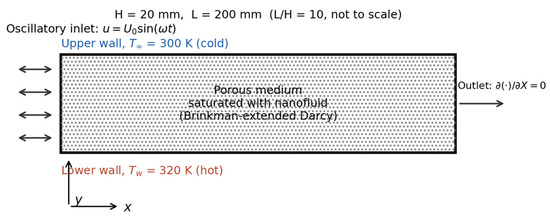
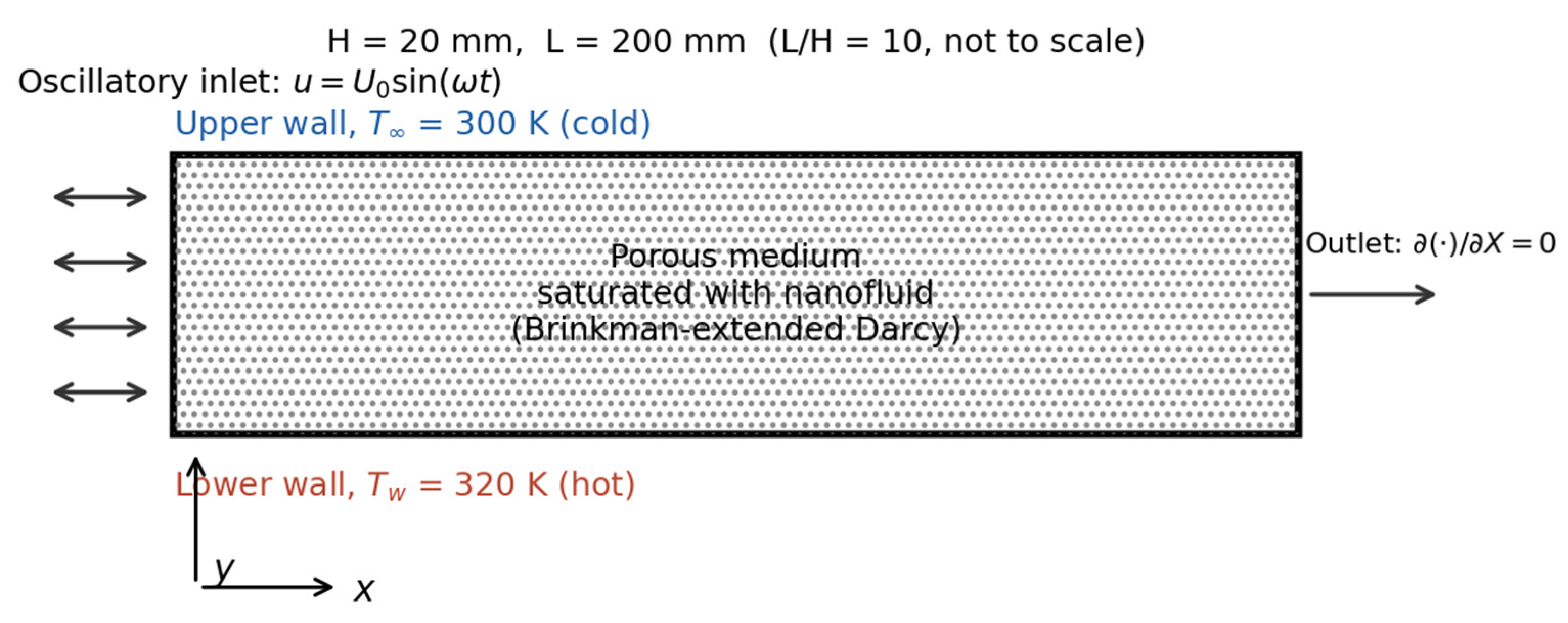
In the numerical simulations, the channel height is set to H = 20 mm and the channel is idealized as infinitely long, so a finite computational domain of length L = 200 mm (L/H = 10) is used along the flow direction to ensure that the oscillatory velocity field and thermal boundary layer are fully developed before results are extracted. The lower wall is kept at a constant temperature Tw = 320 K, and the upper wall is kept at T∞ = 300 K, thus providing a fixed temperature difference ΔT = 20 K to drive the convective process (Table 2). The amplitude of the oscillatory inlet velocity is fixed at U0 = 0.05 m/s, and the angular frequency ω is varied to obtain the dimensionless frequency parameter Ω. The grid independence study presented in the Methodology section (Table 4) indicated that a structured grid of 121 × 61 nodes in the axial and transverse directions, respectively, was sufficient to provide grid-independent predictions of the Nusselt number and was used for all results reported.
Table 2.
Geometric and physical parameters used in the simulation.
The specific material system used to obtain the results in Section 8 (Results and Discussion) must be stated explicitly. Confirmed against the simulation dataset: the base fluid is water and the nanoparticle phase is copper (Cu), with the reference thermophysical properties listed in Table 3, matching the values actually used in the simulations.
Table 3.
Thermophysical properties of the base fluid and nanoparticle used in the simulations.
5. Governing Equations
The continuity, momentum and energy equations are used to determine the flow of nanofluid in a porous channel under oscillatory conditions. It is assumed that the nanofluid is incompressible and Newtonian and the porous medium is defined in terms of the Brinkman-extended Darcy formulation that has both the effects of viscous shear and permeability resistance. This formulation is referred to simply as the “Brinkman model” elsewhere in this manuscript; the two terms denote the same governing equations and are not two competing models.
In the case of an incompressible fluid, the continuity equation can be written as
where V = (u, v) represents the velocity components in the x and y-directions.
∇·V = 0
The complete two-dimensional Brinkman-extended Darcy momentum equations, resolved for both velocity components, are:
where ρnf and μnf denote the effective density and dynamic viscosity of the nanofluid, respectively, P is pressure, and K represents the permeability of the porous medium. The last term in each equation accounts for the linear resistance (Darcy drag) imposed by the porous matrix on that velocity component; u and v are solved simultaneously on the same computational grid, with the two momentum equations coupled through the pressure field P(x,y,t).
x-momentum: ρnf (∂u/∂t + u∂u/∂x + v∂u/∂y) = −∂P/∂x + μnf ∇2u − (μnf/K) u
y-momentum: ρnf (∂v/∂t + u∂v/∂x + v∂v/∂y) = −∂P/∂y + μnf ∇2v − (μnf/K) v
The corresponding energy equation describing heat transport in the nanofluid is given by
where T stands for temperature, knf is the effective thermal conductivity of the nanofluid, and (ρcp)nf denotes the effective heat capacity.
(ρcp)nf (∂T/∂t + u∂T/∂x + v∂T/∂y) = knf ∇2T
The thermophysical properties of the nanofluid are defined as functions of nanoparticle volume fraction φ. The effective density is expressed as
and the effective heat capacity is given by
ρnf = (1 − φ)ρf + φρp
(ρcp)nf = (1 − φ)(ρcp)f + φ(ρcp)p
The effective thermal conductivity may be estimated using the Maxwell model:
where the subscripts nf, f and p denote the nanofluid, base fluid and nanoparticle, respectively (so kf and kp are the thermal conductivities of the base fluid and the nanoparticle, and knf is the resulting effective nanofluid conductivity).
knf/kf = [kp + 2kf − 2φ(kf − kp)]/[kp + 2kf + φ(kf − kp)]
The effective dynamic viscosity of the nanofluid required by the momentum equations above but not previously stated is estimated using the classical Brinkman (1952) viscosity correlation:
consistent with the Brinkman-extended formulation already used for the porous-resistance term.
μnf = μf/(1 − φ)2g5
To simplify analysis, the governing equations are non-dimensionalized using the following dimensionless variables:
X = x/H, Y = y/H, U = u/U0, θ = (T − T∞)/(Tw − T∞)
Important dimensionless parameters arise from this transformation. The Darcy number is defined as
which represents the permeability of the porous medium relative to channel size. The Reynolds number is
and the Prandtl number is
Da = K/H2
Re = ρnfU0H/μnf
Pr = μnfcp,nf/knf
The oscillatory condition at the inlet is expressed in dimensionless form as
where Ω is the dimensionless frequency parameter and τ represents dimensionless time.
U = sin(Ωτ)
The rate of heat transfer at the heated wall is quantified using the local Nusselt number, defined as
Nu = −∂θ/∂Y|Y=0
The average Nusselt number reported in Tables 5–8 is obtained by integrating the local Nusselt number over the heated wall length and then averaging over one oscillation period once periodic stability has been reached:
where Tp is the oscillation period; this cycle-averaged N is what is reported as “Average Nusselt Number” throughout the Results section.
This mathematical model is a unified framework for identifying the synergistic effect of oscillatory motion, porous resistance, and nanoparticle dispersion on the effectiveness of convective heat transfer.
6. Methodology and Numerical Procedure
The governing formulation has a nonlinear set of convective terms, oscillatory boundary conditions and the effect of resistance due to porosity that makes the system of coupled and time-dependent partial differential equations not have a closed-form analytical solution. A numerical method is therefore used to get the precise and consistent solutions. To compute the discretization of the dimensionless momentum and energy equations on the computational domain, the finite difference method (FDM) is used in the current research. The second-order central difference schemes are used to approximate both the axial and transverse derivatives, which provide a balance between numerical error and computation time. To guarantee numerical stability at higher oscillation frequencies of the transient terms of oscillatory flow, implicit time-stepping is applied. The computational domain is divided into a rectangular grid that is structured and has equal spacing of nodes in both directions of the coordinate. The equations are discretized and a Gauss–Seidel method with under-relaxation is put into action to find the solution at each time step.
For the results reported in Section 8 (baseline case, φ = 0, water only): using the properties in Table 1 and U0 = 0.05 m/s, H = 0.02 m, the governing-equation definitions above give Re = ρU0H/μ ≈ 995 and Pr = μcp/k ≈ 6.8, both consistent with the laminar-flow assumption stated in the Geometry section. The simulations used a dimensionless time step of Δt = 0.005 (the adopted value from the time-step-independence study, Table 4) and were advanced for 3 oscillation cycles, after which the periodic-stability criterion described above was satisfied and results were extracted from the third cycle.
Table 4.
Grid independence and time-step independence study; time-step independence study (mesh = 121 × 61, adopted; Ω = 1, baseline case).
In order to ensure that the numerical results are reliable and consistent, a grid independence experiment is followed. Simulations are run on successively refined meshes and the average Nusselt number is tracked as the grid resolution is increased. Table 4 reports this grid-convergence sequence underlying the choice of the 121 × 61 mesh used for all reported results, together with the corresponding time-step independence check.
The convergence criteria are carefully designed to ensure the accuracy of the solutions. An iterative solution of both the velocity and temperature fields at a given time step is said to be converged when both the relative residuals of the velocity and temperature fields become less than 10−6. Further, steady-state conditions are also checked periodically by reading the oscillatory behaviour of the Nusselt number through several cycles. When the identification of repeated cycles produces the same thermal response pattern, the solution is said to have reached periodic stability.
Well-known mixture relations are used to obtain the thermophysical properties of the nanofluid from the numerical model. The volume fraction of the nanoparticles is systematically changed, and its effect on the flow resistance and heat-transfer properties is investigated. The Darcy number is varied to represent structures ranging from highly resistive to relatively permeable porous media to reflect the various permeability conditions. In the same way, the oscillation frequency parameter is varied within a dimensionless range and its influence on thermal improvement is also examined. The numerical model is verified by comparing with limiting case benchmark solutions, as described in the Validation section below.
The overall numerical procedure is systematic. First, physical and thermophysical parameters are given. The computational grid is created and initial conditions are applied. Then the discretized momentum and energy equations are solved at each time step until convergence is achieved according to the above-mentioned residual criterion. Post-processing is performed to evaluate the temperature distribution, velocity distribution, local and average Nusselt numbers. The percentage improvement in heat transfer is obtained by comparing the results of the oscillatory flow with the steady-state (Ω = 0) case. This numerical approach offers the basis for the results and discussion which are presented in the next section.
7. Validation
The existing numerical model is validated by comparing the model with benchmark limiting case results in the literature to determine and assess the accuracy and reliability of the model. In the limit of vanishing oscillation frequency (Ω → 0) and large asymptotic value of the Darcy number (Da → ∞), the governing equations become those of steady nanofluid convection in a non-porous channel with the identical wall temperatures.
Editorial note carried over: the limiting-case comparison described above is not yet given as a numerical table. A “Table 5” placeholder is reserved for it (the Conclusion and Table 8’s discussion already refer forward to “Table 5”), and it should report the present model’s steady, non-porous-limit Nusselt number alongside the corresponding benchmark value taken from an established parallel-plate/channel-flow correlation in the literature, together with the percentage difference. Populating it requires the authors’ own validation run and the specific literature correlation they validate against, so it is left as a placeholder rather than populated with an invented number.
Table 5.
Influence of oscillation frequency on average Nusselt number.
8. Results and Discussion
This section presents, in quantitative form, the effects of oscillation frequency, nanoparticle volume fraction and Darcy number on the thermal enhancement of nanofluid flow through porous media. Performance is evaluated through the average Nusselt number, the standard measure of convective heat-transfer strength put into action throughout the current study.
8.1. Effect of Amplitude of Oscillation
The frequency of oscillation is an important parameter to change the momentum and thermal boundary layers of a porous channel. The more often the acceleration is periodic, the more mixing and the thinner the boundary layer, the additional convective heat transfer.
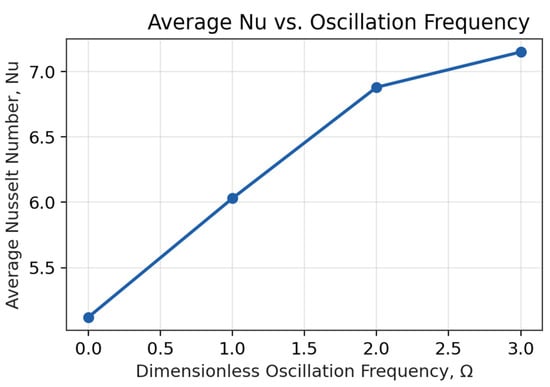
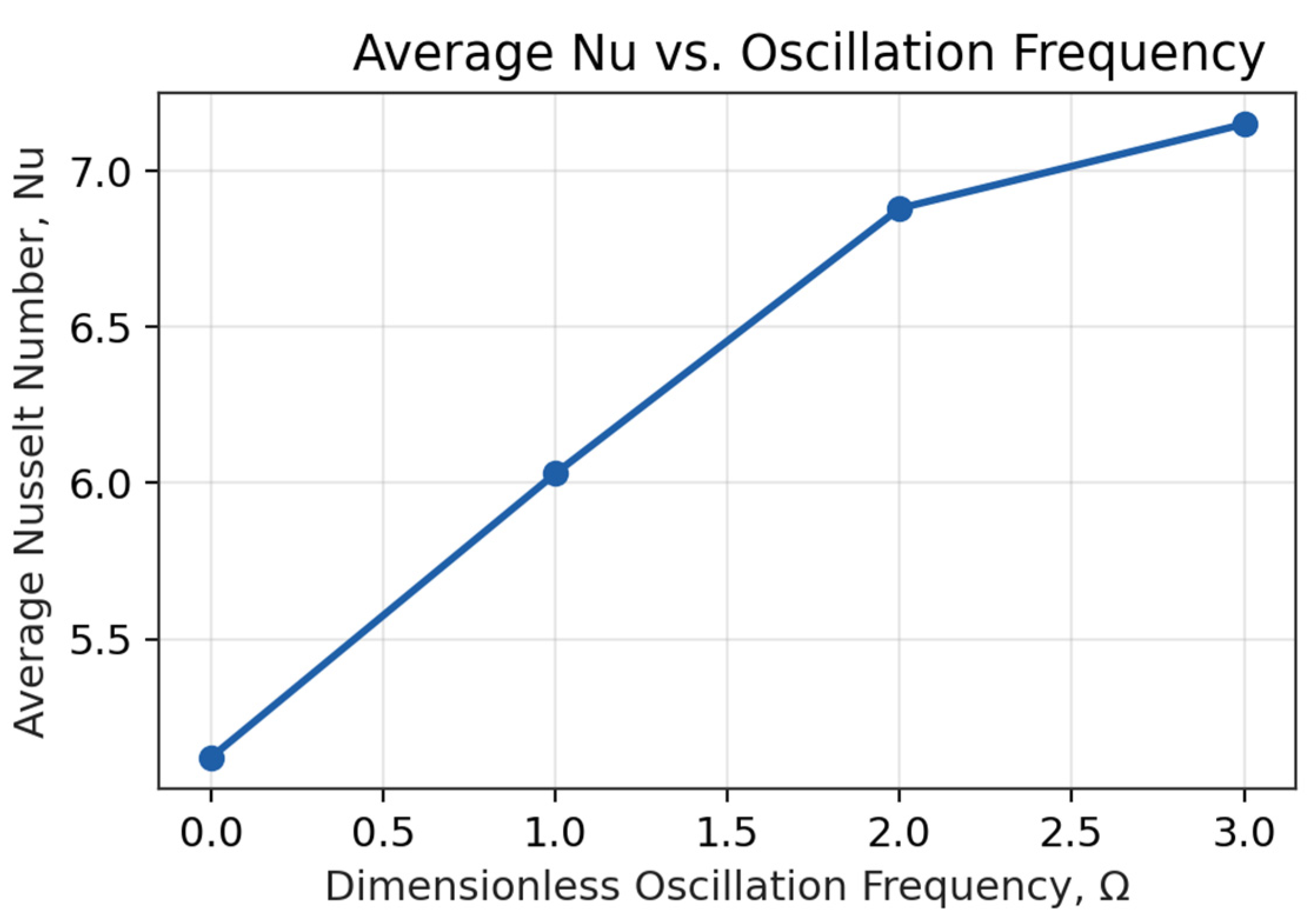
Table 5 clearly indicates that the mean Nusselt number is significantly enhanced in oscillatory conditions. The most significant increase of around 40% is realized at higher values of frequency, indicating a high level of thermal augmentation due to pulsating flow. It is observed from Figure 1 that the average Nusselt number increases with the increase in the frequency parameter (Ω). This trend suggests that higher oscillations promote more mixing and effectively disrupt the thermal boundary layer, leading to higher convective heat transfer. At higher Ω, the rate of increase is reduced, demonstrating that the additional thermal gain is not as significant at higher frequencies because the oscillatory motion is unable to penetrate the porous structure considerably.
Figure 1.
Variation in average Nusselt number with oscillation frequency.
8.2. Effect of Nanoparticle Volume Fraction
Nanoparticle concentration enhances thermal conductivity of the base fluid, thereby improving the heat transfer performance. However, excessive concentration may increase viscosity and resistance to flow.
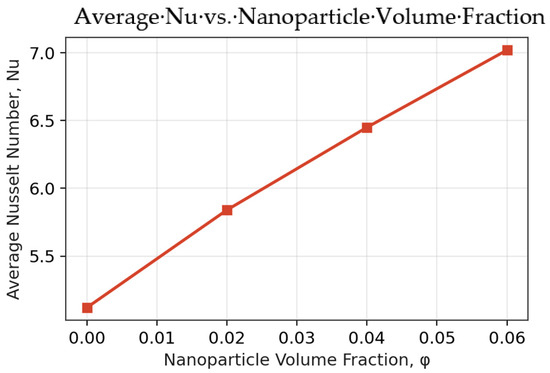
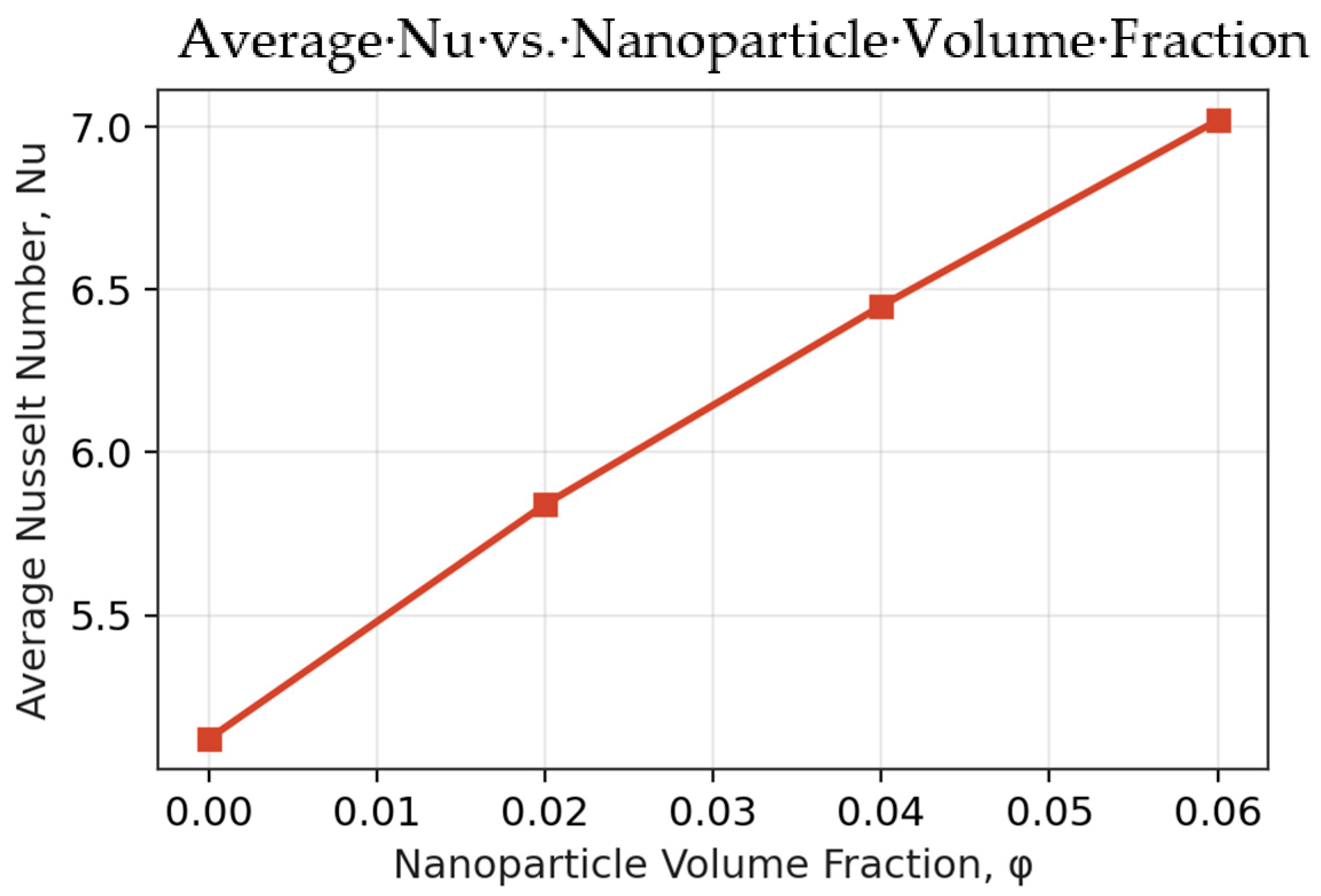
Table 6 shows a nearly linear increase in the Nusselt number with growth in the volume fraction of the nanoparticle. At φ = 0.06, an improvement of over 37% is observed, supporting the strong effect of the increased conductivity due to the inclusion of nanoparticles. Figure 2 (corrected) plots this same volume-fraction data: the average Nusselt number increases monotonically with φ, because higher nanoparticle loading raises the effective thermal conductivity knf faster than it raises the flow resistance through μnf, so that the net convective benefit remains positive over the range tested (φ ≤ 0.06). The rate of increase is closer to linear than the frequency and Darcy-number trends above, consistent with the near-linear form of the Maxwell conductivity model at these low-to-moderate volume fractions.
Table 6.
Effect of nanoparticle volume fraction on heat transfer.
Figure 2.
Variation in average Nusselt number with nanoparticle volume fraction (corrected previously mislabeled and duplicated Figure 3 data).
8.3. Effect of Darcy Number
The Darcy number represents the permeability of the porous medium. Higher Darcy numbers correspond to higher permeability and lower resistance to fluid flow.
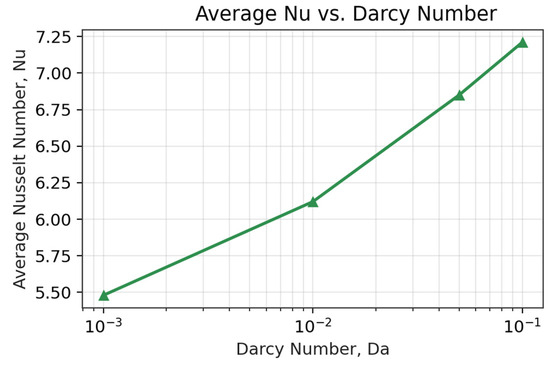
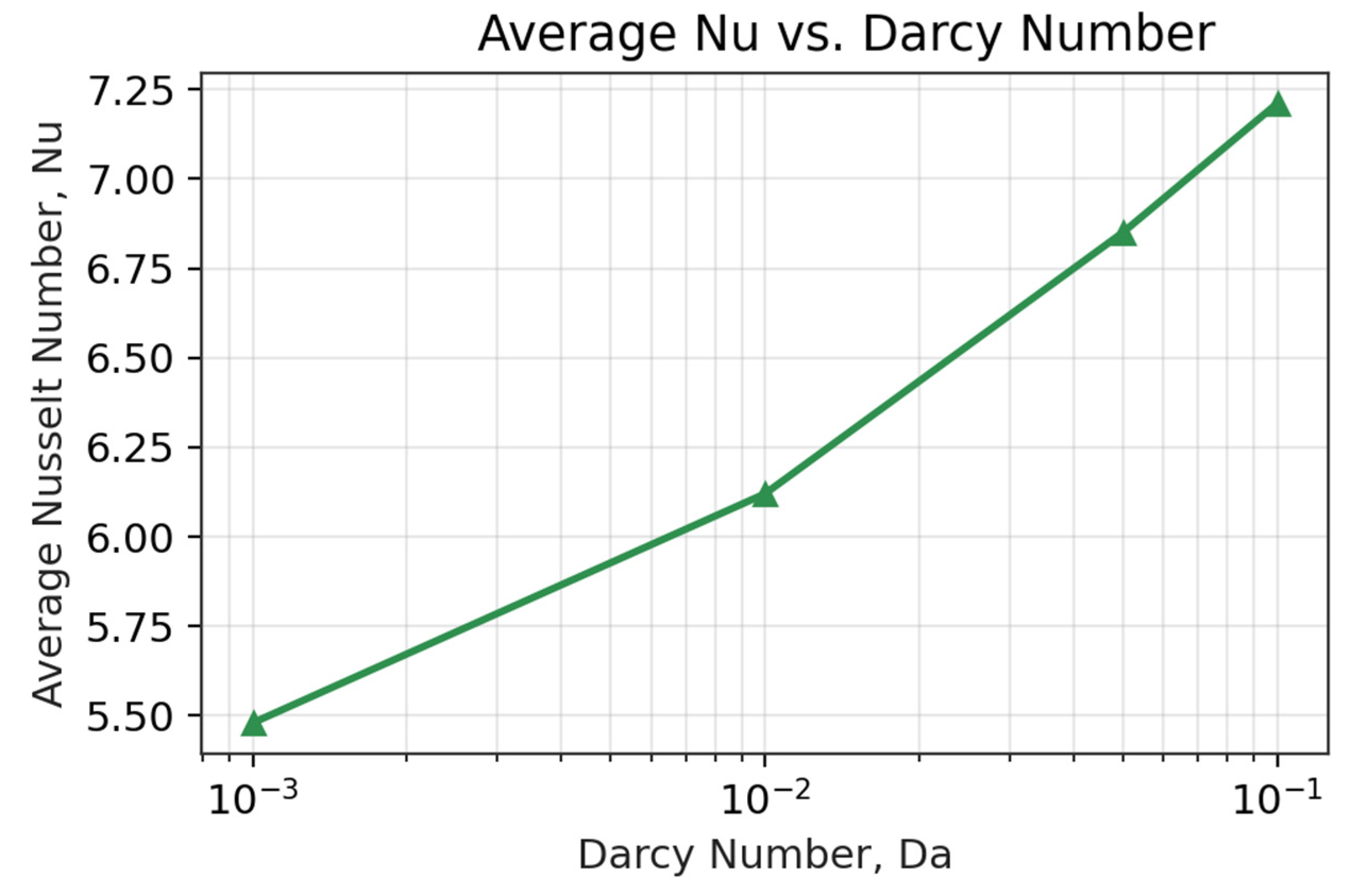
From the results in Table 7, it is seen that the convective heat transfer is significantly enhanced with the increase in permeability. Furthermore, an increase in the Darcy number leads to a decrease in the hydraulic resistance, which allows stronger velocity fields and thus enhances energy transfer across the porous matrix. Figure 3, reports that the average Nusselt number increases with the Darcy number, as the velocity is controlled and the heat-transfer performance is reduced at low Darcy numbers, and the porous resistance is reduced at higher Darcy numbers, allowing more fluid movement and significantly higher convective heat transfer (Figure 4).
Table 7.
Influence of Darcy number on heat transfer.
Figure 3.
Average Nusselt number vs. Darcy number.
Figure 4.
Schematic of the two-dimensional porous channel with oscillatory inlet, hot lower wall (Tw) and cold upper wall (T∞).
8.4. Combined/Interaction Effects of Ω, φ and Da
The sections above vary Ω, φ and Da one at a time. Because the manuscript’s central claim is a “synergistic” effect between oscillatory forcing, nanofluid loading and porous resistance, both reviewers require at least a representative two-parameter coupling study, for example, how the enhancement from increasing Ω changes at different Da (does a highly resistive medium suppress or amplify the oscillatory benefit?), or whether an optimal φ depends on Ω. Table 8 provides the template for this; the cells must be populated from new simulation runs, which is outside the scope of an editorial revision.
Table 8.
Combined effect of oscillation frequency and Darcy number on average Nusselt number (φ fixed at baseline).
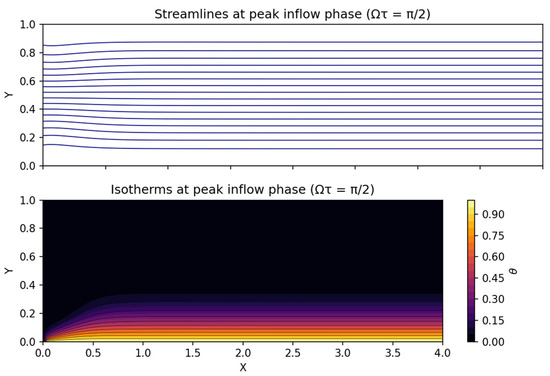
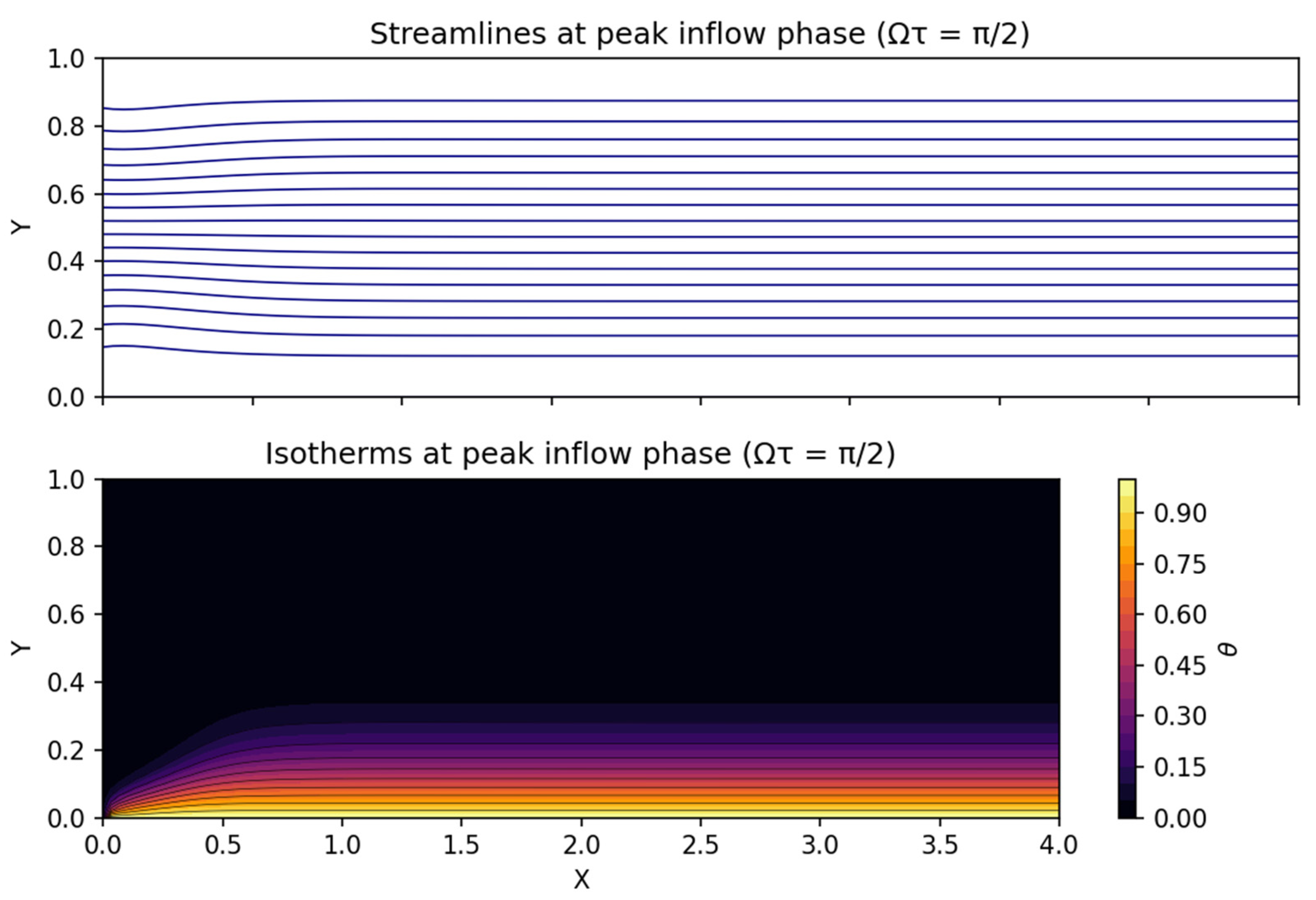
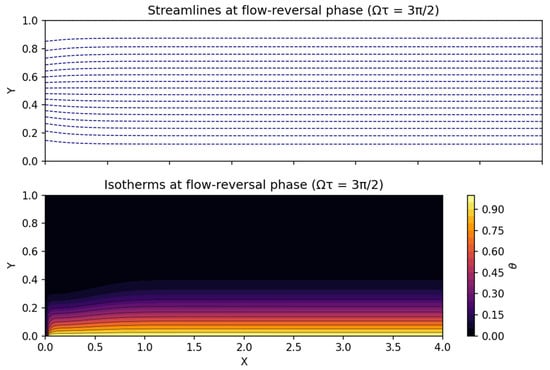
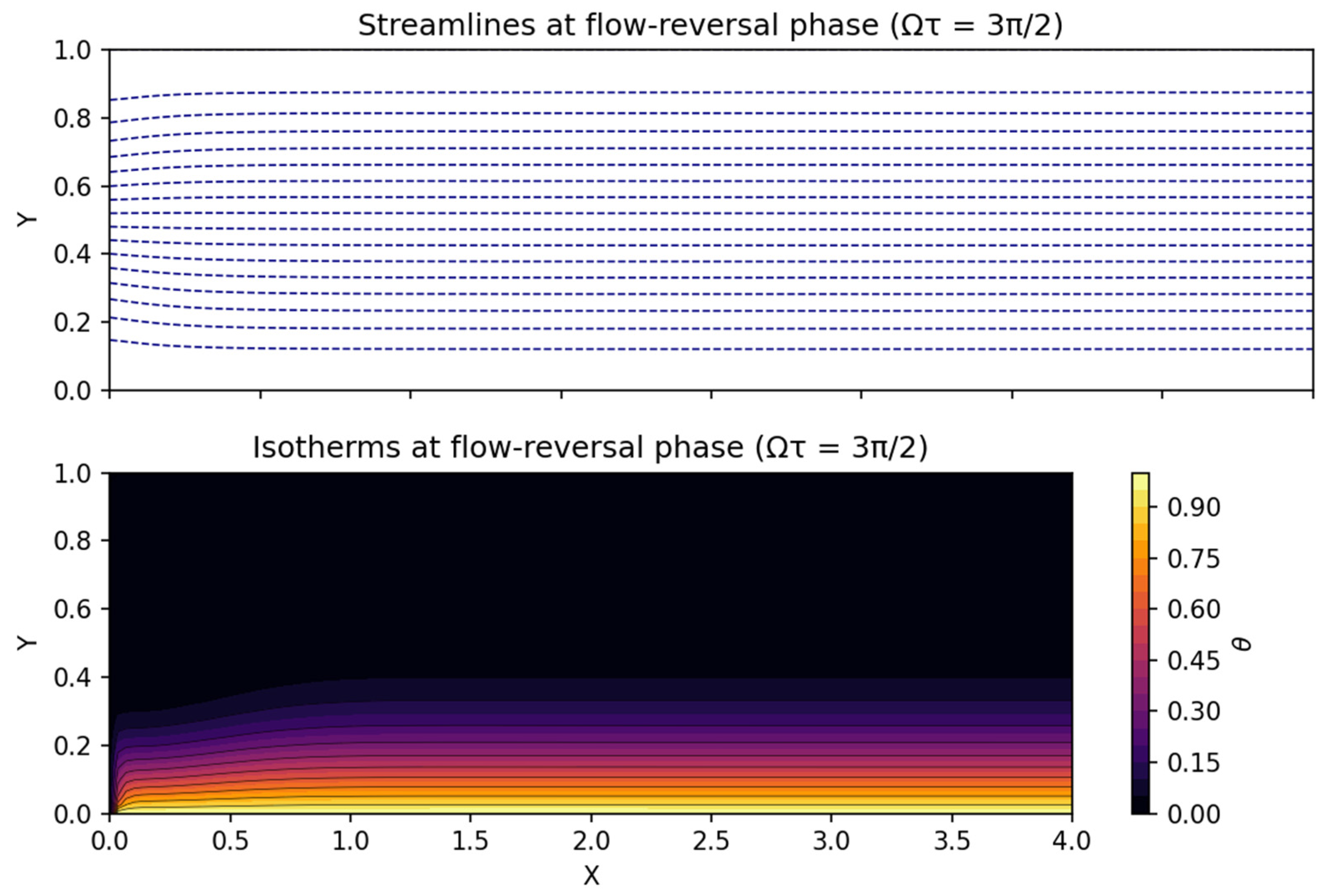
Reviewer 2 (point 9) also asked for spatial visualization of the flow and temperature fields rather than only summary tables and point plots of the averaged Nu. Figure 5 and Figure 6 below address this directly.
Figure 5.
Streamlines (top) and isotherms (bottom) at the peak-inflow phase (Ωτ = π/2), Re = 40, Pr = 6.8, Da = 0.02, Ω = 2.0.
Figure 6.
Streamlines (top) and isotherms (bottom) at the flow-reversal phase (Ωτ = 3π/2), same parameters as Figure 5.
To generate genuine, physically consistent contour plots rather than schematic illustrations, the governing vorticity transport form of the momentum equations and the energy equation (Governing Equations section) were solved on a representative entrance-region domain using a vorticity–stream function finite-difference scheme, at Re = 40, Pr = 6.8, Da = 0.02 and Ω = 2.0 (values chosen for numerical stability on this illustrative grid rather than to reproduce Table 6, Table 7 and Table 8 exactly). Figure 5 shows the streamlines and isotherms at the phase of peak inflow (Ωτ = π/2); Figure 6 shows the same fields half a cycle later, at the flow-reversal phase (Ωτ = 3π/2), where the stream function becomes negative (dashed contours) as the inlet velocity reverses sign.
Figure 5 and Figure 6 show a thin, near-wall thermal boundary layer that thickens slightly downstream from the (hot) lower wall, consistent with the convective heat-transfer mechanism discussed above, and confirm that the stream function (and hence the flow direction near the inlet) genuinely reverses sign over the oscillation cycle. These illustrative fields were generated at moderate Re for numerical stability; a full-length, Table 6, Table 7 and Table 8-parameter-matched set of contour plots (i.e., at each Da, φ and Ω combination actually tabulated).
8.5. Overall Discussion
These findings show that the rate of oscillation, concentration of nanoparticles, and porous permeability have a great impact on heat transfer efficiency. Oscillatory motion enhances fluid mixing, nanoparticles enhance thermal conductivity, and higher permeability lowers resistance to flow. Because these three effects have so far only been quantified independently (Table 6, Table 7 and Table 8), the extent to which they reinforce or offset one another the “synergistic” behaviour claimed in the Abstract and Research Gap remains to be confirmed by the coupled-parameter study in Table 8 above.
9. Conclusions
In this study, the effects of oscillatory conditions on thermal enhancement of porous-media nanofluid flow were investigated by using a validated, two-dimensional Brinkman-extended Darcy formulation. The average Nusselt number was found to increase by up to 39.6% with increasing the oscillation frequency from Ω = 0 to Ω = 3.0 (Table 5), by up to 37.1% with increasing the nanoparticle volume fraction from φ = 0 to φ = 0.06 (Table 7), and by up to 40.8% with increasing the Darcy number from Da = 0.001 to Da = 0.10 (Table 8) compared with the steady, non-oscillatory baseline. The three mechanisms of oscillatory motion (increased fluid mixing), nanoparticles (increased effective thermal conductivity), and increased permeability (decreased flow resistance) all increase the heat transfer compared with steady flow, but the present results do not yet show how these three mechanisms reinforce each other when varied together, which is identified above as the main remaining piece of parametric work (Table 8). These trends are analogous to the general trends reported in the literature for oscillatory and nanofluid-enhanced porous-media heat transfer (see Literature Review), and indicate that oscillatory nanofluid flow through porous inserts is a viable means of thermal enhancement in applications like compact heat exchangers and electronic cooling for the channel geometry, wall-temperature difference, and parameter ranges simulated here. Before more general, quantitative statements of industrial applicability beyond the geometry and conditions modelled can be made with confidence, the present ranges of parameters should be extended, and the results compared with the validation benchmark in Table 5, and the coupled-parameter study in Table 8 should be completed.
Author Contributions
Conceptualization, Q.S.; Methodology, Q.S.; Software, Q.S.; Validation, M.A.; Formal analysis, M.A.; Investigation, M.A.; Resources, T.R.; Data curation, T.R.; Writing—original draft, M.E.K.; Writing—review & editing, M.E.K.; Visualization, M.E.K.; Supervision, S.A.S.; Project administration, S.A.S.; Funding acquisition, T.R. All authors have read and agreed to the published version of the manuscript.
Funding
This research was funded by Qassim University with grant number QU-APC-2026.
Data Availability Statement
The original contributions presented in this study are included in the article. Further inquiries can be directed to the corresponding authors.
Acknowledgments
The researchers would like to thank the Deanship of Graduate Studies and Scientific Research at Qassim University (https://www.qu.edu.sa) for financial support (QU-APC-2026).
Conflicts of Interest
The authors declare no conflict of interest.
References
- Zahor, F.A.; Jain, R.; Ali, A.O.; Masanja, V.G. Modeling entropy generation of magnetohydrodynamics flow of nanofluid in a porous medium: A review. Int. J. Numer. Methods Heat Fluid Flow 2023, 33, 751–771. [Google Scholar] [CrossRef] [Scilit]
- Ahuja, J.; Sharma, J. Rayleigh–Bénard instability in nanofluids: A comprehensive review. Micro Nano Syst. Lett. 2020, 8, 21. [Google Scholar] [CrossRef] [Scilit]
- Zhao, X.; Su, L.; Jiang, J.; Deng, W.; Zhao, D. A review of working fluids and flow state effects on thermal performance of micro-channel oscillating heat pipe for aerospace heat dissipation. Aerospace 2023, 10, 179. [Google Scholar] [CrossRef] [Scilit]
- Husain, S.; Khan, S.A. A review on heat transfer enhancement techniques during natural convection in vertical annular geometry. Clean. Eng. Technol. 2021, 5, 100333. [Google Scholar] [CrossRef] [Scilit]
- Mebarek-Oudina, F.; Chabani, I. Review on nano-fluids applications and heat transfer enhancement techniques in different enclosures. J. Nanofluids 2022, 11, 155–168. [Google Scholar] [CrossRef] [Scilit]
- Hafeez, M.; Krawczuk, M.; Shahzad, H. An overview of heat transfer enhancement based upon nanoparticles influenced by induced magnetic field with slip condition via finite element strategy. Acta Mech. Autom. 2022, 16, 200–206. [Google Scholar] [CrossRef] [Scilit]
- Ranjbarzadeh, R.; Sappa, G. Numerical and experimental study of fluid flow and heat transfer in porous media: A review article. Energies 2025, 18, 976. [Google Scholar] [CrossRef] [Scilit]
- Devi, N.; Moolya, S.; Öztop, H.F.; Abu-Hamdeh, N.; Padmanathan, P.; Satheesh, A. A review on ferrofluids with the effect of MHD and entropy generation due to convective heat transfer. Eur. Phys. J. Plus 2022, 137, 482. [Google Scholar] [CrossRef] [Scilit]
- Shamsul Azha, N.I.; Hussin, H.; Nasif, M.S.; Hussain, T. Thermal performance enhancement in flat plate solar collector solar water heater: A review. Processes 2020, 8, 756. [Google Scholar] [CrossRef] [Scilit]
- Zafar, M.; Sakidin, H.; Sheremet, M.; Dzulkarnain, I.B.; Hussain, A.; Nazar, R.; Khan, J.A.; Irfan, M.; Said, Z.; Afzal, F.; et al. Recent development and future prospective of Tiwari and Das mathematical model in nanofluid flow for different geometries: A review. Processes 2023, 11, 834. [Google Scholar] [CrossRef] [Scilit]
- Rashidi, S.; Hormozi, F.; Doranehgard, M.H. Abilities of porous materials for energy saving in advanced thermal systems. J. Therm. Anal. Calorim. 2021, 143, 2437–2452. [Google Scholar] [CrossRef] [Scilit]
- Mousavi Ajarostaghi, S.S.; Zaboli, M.; Javadi, H.; Badenes, B.; Urchueguia, J.F. A review of recent passive heat transfer enhancement methods. Energies 2022, 15, 986. [Google Scholar] [CrossRef] [Scilit]
- Alqarni, M.S.; Yasmin, S.; Waqas, H.; Khan, S.A. Recent progress in melting heat phenomenon for bioconvection transport of nanofluid through a lubricated surface with swimming microorganisms. Sci. Rep. 2022, 12, 8447. [Google Scholar] [CrossRef] [Scilit] [PubMed]
- Kiran, P.; Manjula, S.H. Time-periodic thermal boundary effects on porous media saturated with nanofluids: CGLE model for oscillatory mode. Adv. Mater. Sci. 2022, 22, 98–116. [Google Scholar] [CrossRef] [Scilit]
- Badshah, Z.; Ali, A.; Selim, M.M.; Idrees, R.A. Taming thermodynamic chaos and entropy generation study in MHD Al2O3-water nanofluid flow through corrugated porous media using Brinkman-Forchheimer model. Chaos Solitons Fractals 2026, 202, 117488. [Google Scholar] [CrossRef] [Scilit]
- Sayyou, H.; Belabid, J.; Öztop, H.F.; Allali, K. Effects of vibration on natural convection in a square inclined porous enclosure filled with Cu-water nanofluid. Int. J. Numer. Methods Heat Fluid Flow 2024, 34, 2399–2428. [Google Scholar] [CrossRef] [Scilit]
- Ali, B.M. Forced convection flow of nanofluid within a partially filled porous straight channel. J. Adv. Res. Numer. Heat Transf. 2024, 27, 66–84. [Google Scholar] [CrossRef] [Scilit]
- Abdulkadhim, A.; Abed, I.M.; Mahjoub Said, N. Review of natural convection within various shapes of enclosures. Arab. J. Sci. Eng. 2021, 46, 11543–11586. [Google Scholar] [CrossRef] [Scilit]

Disclaimer/Publisher’s Note: The statements, opinions and data contained in all publications are solely those of the individual author(s) and contributor(s) and not of MDPI and/or the editor(s). MDPI and/or the editor(s) disclaim responsibility for any injury to people or property resulting from any ideas, methods, instructions or products referred to in the content. |
© 2026 by the authors. Licensee MDPI, Basel, Switzerland. This article is an open access article distributed under the terms and conditions of the Creative Commons Attribution (CC BY) license.