


Abstract
Carbon coated Fe-deficient LiFexPO4 (x = 0.95, 0.96, 0.97, 0.98, 0.99) cathodes were produced by a combined co-precipitation and carbothermal reduction routes. The effect of the Fe/P atomic ratio on the crystal structure Li/Fe antisite defect, and electrochemical performance of non-stoichiometric cathode materials was investigated. X-ray diffraction patterns and Rietveld refinements reveal that, even when the Fe/P ratio is less than 1.0, the cathode preferentially forms a LiFePO4 phase containing iron vacancies rather than a mixture of LiFePO4 and Li3PO4. Because Li-site vacancies and structural integrity induced by the Fe/P ratio exert opposite effects, the highest capacity is obtained at an Fe/P ratio of 0.97.
1. Introduction
Olivine-type lithium iron phosphate (LiFePO4, LFP) has become one of the most widely used cathode materials in lithium-ion batteries owing to its outstanding safety performance, exceptionally long cycle life, and low preparation cost [1]. However, LFP materials possess one-dimensional (1D) lithium-ion diffusion channels along the [010] direction, and the crystal structure is highly sensitive to internal defects. Among them, the formation of Li/Fe antisite defects is a key factor limiting electrochemical performance and degrading high-rate charge–discharge capability [2]. The occupancy of Li sites by Fe2+ ions imposes significant steric hindrance and strong electrostatic suppression on the 1D Li+ diffusion channels, substantially increasing the migration energy barrier of Li+ ions and reducing ionic conductivity [2]. Moreover, Fe2+ ions occupying Li sites cannot participate in redox reactions and impede Li extraction/insertion processes, resulting in loss of active sites, reduced reversible capacity, and ultimately severe degradation of the overall electrochemical performance of LFP batteries [3].
To suppress Li/Fe antisite defects and optimize the electrochemical performance of LFP, various efficient modification strategies have been developed, including bulk ion doping and surface modification. In bulk ion doping systems, metal ions with different valences can achieve differentiated modification effects through lattice regulation. Al3+ doping effectively suppresses antisite defect formation and enhances lattice stability, showing promising application prospects in the direct recycling and regeneration of spent LFP [4]. Mg2+ doping can regulate the defect chemistry, reduce Li+ migration resistance, and effectively promote Li+ diffusion within the lattice [5]. Ti4+ doping, which precisely substitutes for Fe sites in spent LFP, can lead to the repair of crystal defects by widening Li diffusion channels, significantly improving the lithium storage capacity and electrochemical performance of spent materials [6]. The in situ surface reconstruction technique for single-crystal LFP can effectively suppress the generation and accumulation of antisite defects under fast-charging conditions, mitigate fast-charging-induced performance degradation, and substantially extend battery cycle life under fast-charging cycling [7]. Through precise defect engineering, harmful Li/Fe antisite defects can be converted into beneficial structures, enabling resource utilization of defects and enhancing the overall electrochemical performance of LFP materials [8].
The Fe/P ratio, as a critical stoichiometric parameter of LFP materials, is expected to play a crucial role in regulating crystal defect states and electrochemical performance. Although the effects of bulk ion doping and surface modification on the formation of Li/Fe antisite defects and resulting electrochemical performance have been investigated, there are few studies on the role of the Fe/P ratio. In this work, Fe deficient LiFePO4/C cathodes were prepared by a combined co-precipitation and carbothermal reduction routes. The effect of the Fe/P atomic ratio on the crystal structure Li/Fe antisite defects was studied by X-ray diffraction (XRD) patterns and Rietveld refinements. The electrochemical performance of non-stoichiometric cathode materials was investigated as well. We found that by precisely regulating and optimizing the Fe/P ratio, the generation of Li/Fe antisite defects can be reduced, and thus high-rate electrochemical performance can be achieved.
2. Experimental
FeSO4·7H2O (Tianjin BASF Chemical Co., Ltd., Tianjin, China), H3PO4 (Chengdu Kelong Chemical Reagent Factory, Chengdu, China), H2O2 (Chengdu Kelong Chemical Reagent Factory, Chengdu, China), and NaOH (Tianjin Hengxing Chemical Reagent Co., Ltd., Tianjin, China) were employed to prepare an FePO4·2H2O precursor via oxidation-assisted co-precipitation. Briefly, 100 mL of a 1 M Fe-P aqueous solution (prepared from FeSO4·7H2O and H3PO4) was fed at a constant rate into a flask containing 50 mL of pre-heated deionized water (70–95 °C) using a peristaltic pump. Simultaneously, 10–30% H2O2 was introduced, maintaining an Fe2+:H2O2 molar ratio of 1:0.6. The pH value of the resultant solution was adjusted to 1 with 2 M NaOH under magnetic stirring for 0.1–1 h. The resulting white precipitate was filtered, repeatedly washed with deionized water, and dried at 80 °C for 12 h.
The dried FePO4·2H2O precursor was mixed with Li2CO3 and glucose (carbon source) in non-stoichiometric proportions (LiFexPO4, x = 0.95–0.99) using an agate mortar with ethanol as the grinding medium. The obtained mixture was first pre-heated to 350 °C at a heating rate of 5 °C min−1 and held for 5 h. Subsequently, the temperature was raised to 700 °C at 5 °C min−1 and maintained for 10 h under a flowing N2 atmosphere. After calcination, the sample was naturally cooled down to room temperature inside the furnace. The above heat treatment process realizes the carbothermal reduction reaction. Lithium content in all samples was quantified by inductively coupled plasma optical emission spectrometry (ICP-OES, Varian 720-ES, Agilent Technologies, Santa Clara, CA, USA). The amount of coated carbon on the surface of LiFexPO4/C (x = 0.95, 0.96, 0.97, 0.98, and 0.99) was determined using a high-frequency infrared carbon and sulfur analyzer (Corey-200, Deyang Kerui Instrument, Deyang, Sichuan, China). The carbon contents of the five samples were all around 2 wt%.
The crystal structure of LiFexPO4/C composite powders was characterized by XRD on a D/Max2500PC diffractometer, Rigaku Corporation, Akishima, Tokyo, Japan (Cu-Kα, 30 kV, 100 mA) from 10° to 120° 2θ with a step size of 0.02°. During Rietveld refinement, the Fe site occupancy was constrained according to the nominal Fe content derived from chemical analysis (0.95–0.99). Powder morphology was examined using scanning electron microscopy (SEM, NanoSEM450, FEI Company, Hillsboro, OR, USA). Fe and P concentrations in LiFexPO4/C composites were determined by potassium dichromate titration and gravimetric methods, respectively.
2032-type coin cells were assembled in an Ar-filled glove box. Cathodes were prepared by mixing LiFexPO4/C, acetylene black, and PVDF in an 85:9:6 mass ratio. The mixture was dispersed in N-methylpyrrolidone, cast onto Al foil, and dried at 80 °C for 12 h (active material loading ≈ 4.97 mg cm−2, corresponding to ca. 7.7 mg active material per ϕ14 mm cathode disk; all samples adopted identical electrode-preparation conditions). Lithium foil served as the counter/reference electrode. Cellgard 2400 was used as the separator. 1 M LiPF6 in EC/DMC (volume ratio of 1:1) was used as the electrolyte. Galvanostatic charge/discharge tests were carried out at 0.1 C, 0.5 C, 1 C, 2 C, and 5 C between 2.0 V and 4.0 V at room temperature, using a LAND-CT2001A battery testing system.
3. Results and Discussion
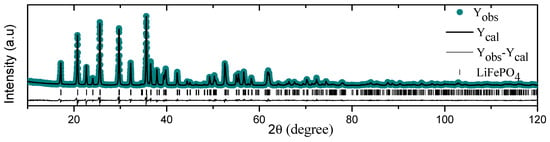
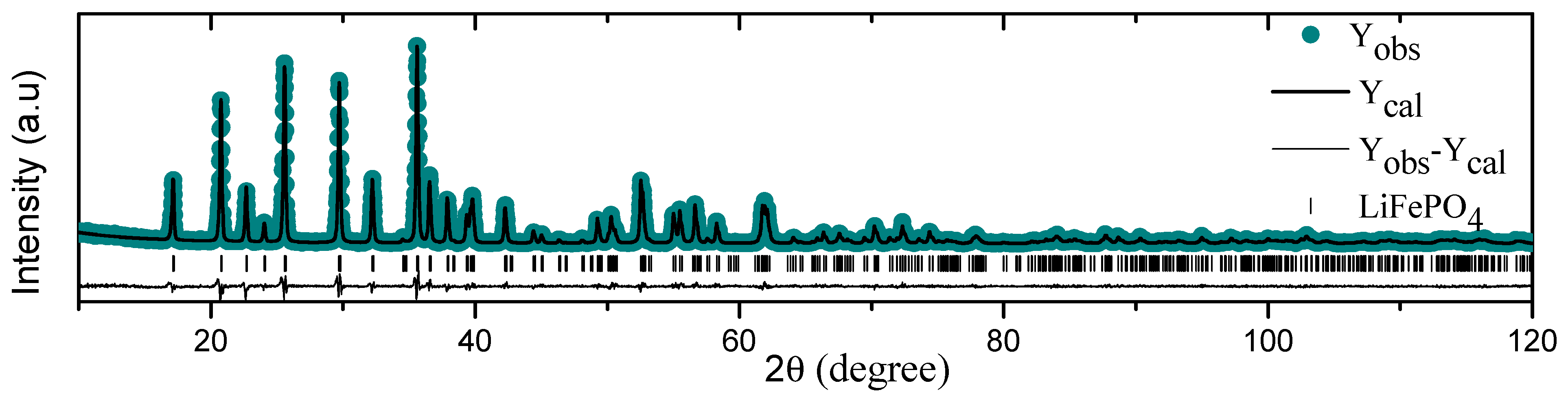
To characterize the crystal structures of LiFexPO4/C (x = 0.95–0.99) and identify impurity phases formed during high-temperature sintering, we performed Rietveld refinement on the XRD data. The full XRD patterns for all five compositions (x = 0.95–0.99) are provided in Figure S1 (Supplementary Information). The typical XRD pattern of LiFe0.97PO4/C is shown in Figure 1. The composite consists of the single olivine LiFePO4 phase (PDF #81-1173) with no detectable secondary phases (e.g., Li3PO4, Fe2O3) [9]. This indicates that Fe deficiency does not affect the crystal structure of the material. No characteristic carbon diffraction peak can be identified in the diffraction pattern, suggesting that the incorporated carbon is in an amorphous state. Thus, the introduction of carbon does not affect the crystal structure. The Rietveld refinement parameters, including Rwp, Rexp, and GOF, for all five compositions (x = 0.95–0.99) are summarized in Table S1 (Supplementary Information). The lattice parameters a, b, and c, as well as the unit cell volume (V) of the LiFePO4/C composite are summarized in Table 1. The table shows that the changes in a, b, c, and V with increasing Fe/P ratio are almost in the same way. These values decrease initially (except a value at x = 0.96), reach a minimum at x = 0.97, increase at x = 0.98 and then decrease at x = 0.99. Notably, the unit cell volume at x = 0.97 is 290.959 Å3, which is very close to 290.958 Å3 at x = 0.99. This suggests that moderate Fe deficiency enables fine-tuning of the crystal lattice, which may positively affect Li+ diffusion pathways and electrochemical performance.
Figure 1.
Rietveld refinement of the XRD patterns of LiFe0.97PO4/C composite cathode.
Table 1.
Structure parameters of the LiFexPO4/C composites.
Table 2 lists bond-length parameters obtained from the Rietveld refinements. For the Fe–O bond, at x ≤ 0.97, the average Fe–O distance increases from 2.1340 Å (x = 0.95) to 2.1424 Å (x = 0.97), indicating a modest expansion of the FeO6 octahedra as iron vacancies are filled by Li+ ions. At x ≥ 0.97, the change in average Fe–O distance has no clear trend (2.1414 Å at x = 0.98, 2.1450 Å at x = 0.99), indicating that local disorder dominates the Fe–O environment [10]. For the Li–O bond, the Li–O bond length slightly decreases with increasing x value from 0.95 to 0.97. It then gradually increases at x ≥ 0.97. This suggests that LiO6 polyhedra remain structurally robust, with only a marginal response to iron vacancy concentration. The most pronounced change occurs in the P–O bonds, which decrease steadily from 1.5858 Å (x = 0.95) to 1.5659 Å (x = 0.99) with increasing x value. The steepest contraction appears for x < 0.97, implying that iron vacancies reinforce the covalent character of the PO4 tetrahedron, thereby enhancing structural stability [11].
Table 2.
Refined bond length parameters of LiFexPO4/C.
Isotropic temperature factors (B factors) for Li sites are calculated to be 1.52, 1.07, 0.98, 1.36, 1.14 for LiFexPO4/C with x values of 0.95, 0.96, 0.97, 0.98, and 0.99, respectively. Rietveld refinement indicates that no iron ions occupy the lithium sites for all compositions. In other words, the generation of Fe vacancies due to Fe deficiency significantly reduces the formation of antisite defects associated with Fe occupancy at Li sites. On the other hand, Rietveld refinements show that the occupancy of Li at Fe sites is more detectable when x value is less than 0.97 due to the presence of abundant Fe vacancies. This implies that the concentration of Li vacancies along the 1D lithium diffusion channel starts to increase with the decreasing x value. It can be expected that the above structural evolution due to non-stoichiometry will impact the electrochemical performance of LiFexPO4/C cathodes, which will be demonstrated later.
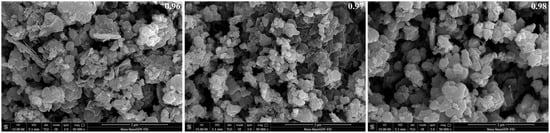
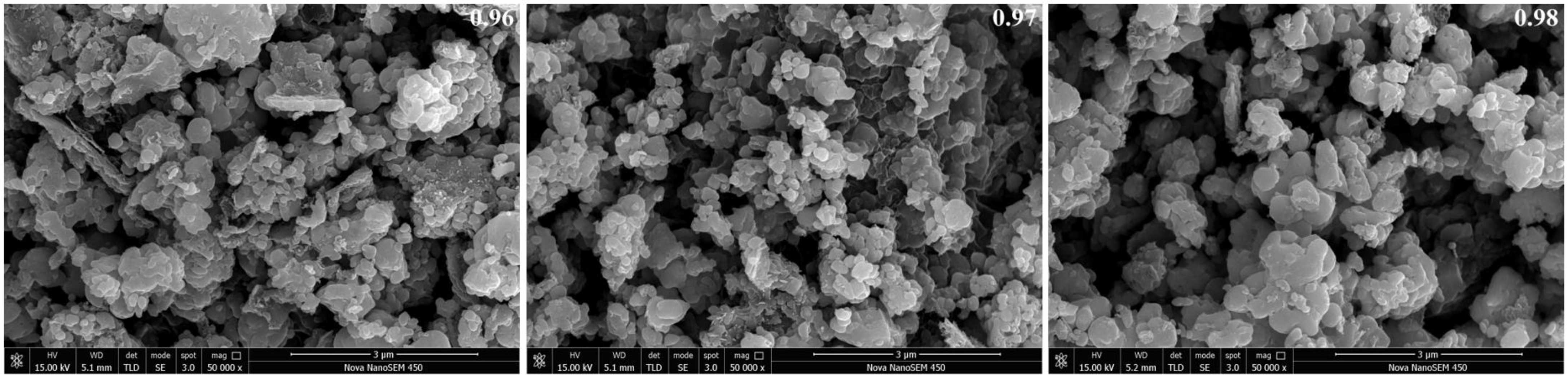
SEM images of LiFexPO4/C powders are shown in Figure 2. It reveals that densely packed nanocrystals with a primary particle size of 100–200 nm aggregate into micrometer-scale secondary particles. This nanostructure offers two key advantages: a shortened Li+ diffusion path, which accelerates ion transport; and intimate contact with the carbon matrix, establishing a continuous electronic network and mitigating stress during volume changes, thereby enhancing structural durability. The three samples with different Fe/P ratios exhibit no fundamental difference in particle morphology or size.
Figure 2.
SEM image s of LiFexPO4/C samples with different Fe/P ratios (x = 0.96, 0.97 and 0.98).
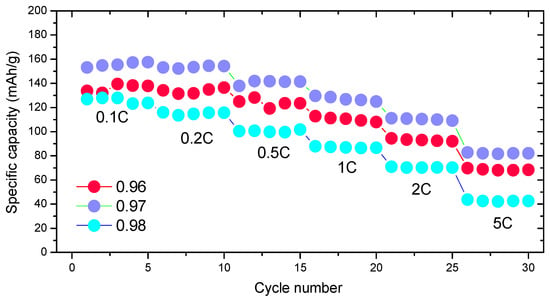
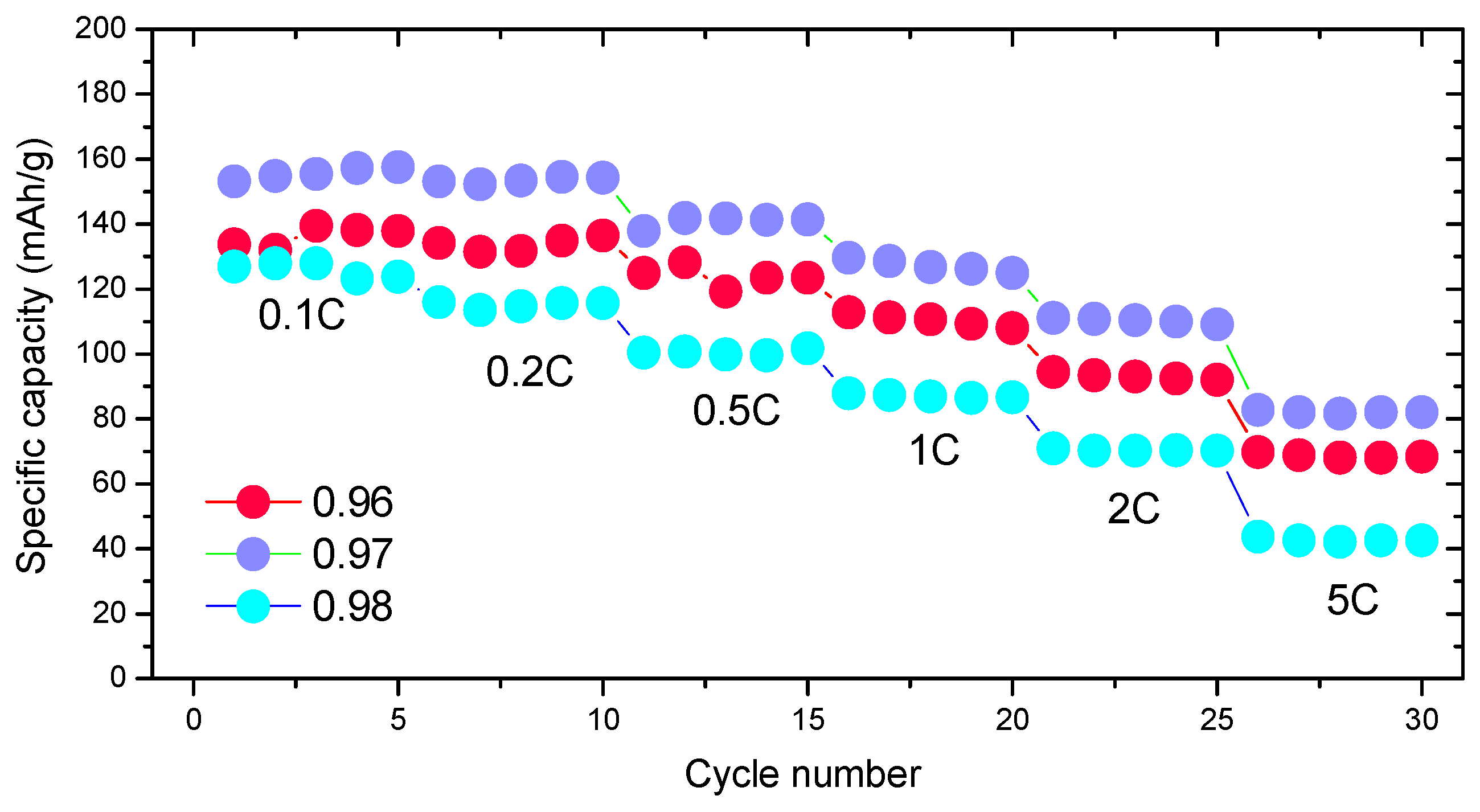
Table 3 summarizes the electrochemical properties from the first-cycle tests of LiFe0.97PO4/C cathodes with x = 0.96, 0.97, 0.98. The LiFe0.97PO4/C sample delivers the highest initial charge (162.69 mAh/g) and discharge capacities (153.10 mAh/g) with a Coulombic efficiency of 94%, which is higher than the efficiencies (85% and 88%) of counterparts with x = 0.96 and 0.98 [12,13]. The corresponding galvanostatic charge/discharge profiles are provided in Figure S2 (Supplementary Information). Figure 3 depicts discharge capacities of LiFexPO4/C composites from 0.1 C to 5 C. The electrode with x = 0.97 shows a capacity of 153 mAh/g at 0.1 C and retains a relatively high capacity of 109 mAh/g even at 5 C, outperforming LiFexPO4/C composites with both x = 0.96 and x = 0.98 across the whole rate spectrum. A systematic comparison of the present LiFe0.97PO4/C with recently reported LiFePO4 systems is provided in Table S2 (Supplementary Information). The synthesis routes, voltage windows, and current densities are clearly specified. According to previous Rietveld refinement, an appropriate increase in Fe deficiency (i.e., slightly decreasing x value) in LiFexPO4/C cathodes not only suppresses the occupancy of Fe at Li sites, but also induces the formation of Li vacancies along the 1D lithium diffusion channel due to the Li migration into Fe vacancies, which results in improved electrochemical properties. However, excessive Fe deficiency (i.e., excessively decreasing x value) leads to reduced Fe contents to participate in redox reactions during charge/discharge processes. Therefore, the electrochemical properties of LiFexPO4/C cathodes will be compromised. These two opposing effects mean that optimal electrochemical performance is achieved at a suitable Fe/P ratio, not at the stoichiometric Fe/P ratio of unity. Our results suggest that in addition to well-studied strategies, such as bulk ion doping and surface modification, the stoichiometric ratio can also be employed to enhance the electrochemical properties of LiFexPO4 cathodes.
Table 3.
The electrochemical performance from first cycle charge–discharge curves for LiFexPO4/C composites (x = 0.96, 0.97, 0.98) tested against a Li metal anode at a rate of 0.1 C between 2 V and 4 V.
Figure 3.
Rate performances of LiFexPO4/C cathode material (x = 0.96, 0.97, 0.98).
4. Conclusions
Carbon-coated Fe-deficient LiFexPO4 cathodes were successfully produced by combined co-precipitation and carbothermal reduction routes. XRD patterns show a single LiFePO4 phase containing iron vacancies for all cathodes with different x values. SEM observation shows aggregated powders with primary particle at the size of 100–200 nm. Rietveld refinement suggests that there are suppressed occupancy of Fe at Li sites and the formation of Li vacancies along the lithium diffusion channel with decreasing x value, which is favorable for improvement of electrochemical properties of LiFexPO4/C cathodes. However, excessive decrease in x value can deteriorate electrochemical properties since the Fe contents to participate redox reactions during charge/discharge processes are reduced significantly. Therefore, the optimal x value was found to be 0.97. Our results unambiguously suggest that the stoichiometric ratio can be employed to control the electrochemical properties of LiFexPO4 cathodes.
Supplementary Materials
The following supporting information can be downloaded at: https://www.mdpi.com/article/10.3390/cryst16100610/s1 [13,14,15,16,17].
Author Contributions
Conceptualization, Y.G.; Data curation, Y.G. and Y.W.; Formal analysis, Y.G. and Y.W.; Investigation, Y.G. and Y.W.; Methodology, Y.G.; Project administration, Y.G.; Resources, Y.G.; Supervision, Y.G.; Validation, Y.G.; Visualization, Y.G.; Writing—original draft preparation, Y.W.; Writing—review and editing, C.L., H.G., X.D., H.Z. and T.Z. All authors have read and agreed to the published version of the manuscript.
Funding
This work was financially supported by National Natural Science Foundation of China (No. 51641206), Take on challenges and assume leadership project from Shangrao City of Jiangxi Province (China) (Grant No. 2022A006), and Weifang Zhongkai New Energy Co., Ltd. (Grant No. KJ2026152).
Data Availability Statement
The raw data supporting the conclusions of this article will be made available by the authors on request.
Conflicts of Interest
The authors declare no conflict of interest.
References
- Fisher, C.A.J.; Prieto, V.M.H.; Islam, M.S. Lithium battery materials LiMPO4 (M = Mn, Fe, Co, and Ni): Insights into defect association, transport mechanisms, and doping behavior. Chem. Mater. 2008, 20, 5907–5915. [Google Scholar] [CrossRef] [Scilit]
- Liu, H.; Choe, M.-J.; Enrique, R.A.; Orvañanos, B.; Zhou, L.; Liu, T.; Thornton, K.; Grey, C.P. Effects of antisite defects on Li diffusion in LiFePO4 revealed by Li isotope exchange. J. Phys. Chem. C 2017, 121, 12025–12036. [Google Scholar] [CrossRef] [Scilit]
- Qin, X.; Wang, J.; Xie, J.; Li, F.; Wen, L.; Wang, X. hydrothermally synthesized LiFePO4 crystals with enhanced electrochemical properties: Simultaneous suppression of crystal growth along [010] and antisite defect formation. Phys. Chem. Chem. Phys. 2012, 14, 2669. [Google Scholar] [CrossRef] [Scilit]
- Xiao, Y.; Zhao, Z.; Zhang, Q.; Qiao, R. LiFePO4 with Al3+: Suppression of anti-site defects and implications for battery recycling. ACS Omega 2025, 10, 1293–1302. [Google Scholar] [CrossRef] [Scilit]
- Zhang, H.; Tang, Y.; Shen, J.; Xin, X.; Cui, L.; Chen, L.; Ouyang, C.; Shi, S.; Chen, L. Antisite defects and Mg doping in LiFePO4: A first-principles investigation. Appl. Phys. A 2011, 104, 529–537. [Google Scholar] [CrossRef] [Scilit]
- Zhang, J.; Dong, Z.; Zeng, Z.; Zhao, Y.; Sun, W.; Ge, P.; Yang, Y. Upcycling spent LiFePO4: Precisely Fe-sites doped by Ti-atoms with expanded Li-diffusion channels toward high capacity. Adv. Funct. Mater. 2026, 36, e22632. [Google Scholar] [CrossRef] [Scilit]
- X Pan, X.; Zhuang, S.; Sun, Y.; Sun, G.; Ren, Y.; Jiang, S.; Zhu, B.; Li, X.; Wen, Y. Restraining formation of Fe-Li anti-site defects via in-situ surface construction on single-crystal LiFePO4 cathode for extending fast charging lifespan. J. Alloys Compd. 2023, 960, 172257. [Google Scholar] [CrossRef] [Scilit]
- Xiao, H.; Fang, H. A compensation strategy to make unfavorable antisite defects in LiFePO4 favorable. Ceram. Int. 2025, 51, 16370–16375. [Google Scholar] [CrossRef] [Scilit]
- Wu, Y.J.; Gu, Y.J.; Chen, Y.B.; Liu, H.Q.; Liu, C.Q. Effect of lithium phosphate on the structural and electrochemical performance of nanocrystalline LiFePO4 cathode material with iron defects. Int. J. Hydrogen Energy 2018, 43, 2050–2056. [Google Scholar] [CrossRef] [Scilit]
- Zhang, H.; Zou, Z.; Zhang, S.; Liu, J.; Zhong, S. A review of the doping modification of LiFePO4 as a cathode material for lithium ion batteries. Int. J. Electrochem. Sci. 2020, 15, 12041–12067. [Google Scholar] [CrossRef] [Scilit]
- Yang, C.-C.; Hsu, Y.-H.; Shih, J.-Y.; Wu, Y.-S.; Karuppiah, C.; Liou, T.-H.; Lue, S.J. Preparation of 3D micro/mesoporous LiFePO4 composite wrapping with porous graphene oxide for high-power lithium ion battery. Electrochim. Acta 2017, 258, 773–785. [Google Scholar] [CrossRef] [Scilit]
- Wu, Y.J. Preparation and Performance Study of LiFePO4 Cathode Materials for Lithium-Ion Batteries by Coprecipitation Method. Master’s Thesis, Shandong University of Science and Technology, Shandong, China, 2018. [Google Scholar]
- Fang, Z.; Hu, G.; Du, K.; Peng, Z.; Fu, Q.; Wang, H.; Jiang, X.; Cao, Y. Effect of iron phosphorus ratio on the structure and electrochemical performance of non-stoichiometric carbon-coated LiFePO4 cathode materials. Solid State Ion. 2025, 430, 117009. [Google Scholar] [CrossRef] [Scilit]
- Song, Y.; Chen, Q.; Zhang, H.; Zhang, S.; Zhang, K.; Hu, J.; Li, Y.; Yao, Y. Adenosine triphosphate in solvothermal method for preparing high-rate LiFePO4 cathode material. Mater. Today Chem. 2025, 45, 102659. [Google Scholar] [CrossRef] [Scilit]
- Li, Y.; Hui, C.; Hu, J.; Wang, L.; Yao, Y. Preparation of FePO4 from leaching liquor of Fe-P waste slag and its application in lithium ions batteries. Solid State Ion. 2024, 412, 116588. [Google Scholar] [CrossRef] [Scilit]
- Xu, W.; Li, Y.; Yao, J.; Xiao, S.; Liu, B. LiFePO4/rGO composite prepared from the leaching liquor of jarosite residue as a cathode material for lithium-ion batteries. J. Alloys Compd. 2023, 952, 170105. [Google Scholar] [CrossRef] [Scilit]
- Xie, X.; Zhang, B.; Hu, G.; Du, K.; Wu, J.; Wang, Y.; Gan, Z.; Fan, J.; Su, H.; Cao, Y.; et al. A new route for green synthesis of LiFe0.25Mn0.75PO4/C@rGO material for lithium ion batteries. J. Alloys Compd. 2021, 853, 157106. [Google Scholar] [CrossRef] [Scilit]

Disclaimer/Publisher’s Note: The statements, opinions and data contained in all publications are solely those of the individual author(s) and contributor(s) and not of MDPI and/or the editor(s). MDPI and/or the editor(s) disclaim responsibility for any injury to people or property resulting from any ideas, methods, instructions or products referred to in the content. |
© 2026 by the authors. Licensee MDPI, Basel, Switzerland. This article is an open access article distributed under the terms and conditions of the Creative Commons Attribution (CC BY) license.