


Abstract
This study presents the synthesis, crystal structure determination and luminescence properties of three novel mononuclear europium (III) complexes constructed from sodium benzoate and the three different isomers of biphenylcarboxylic acid (2-, 3-, and 4-). All complexes share a common structural core; consisting of a single europium (III) ion coordinated by three bidentate benzoate ligands and two monodentate biphenylcarboxylate ligands. The synthesis followed a two-step strategy: first, a benzoate-based precursor complex was prepared by displacing the chloride and water molecules from europium (III) chloride hexahydrate with sodium benzoate by chelating process. The remaining water ligands were substituted with each biphenylcarboxylic acid isomer yielding solvent-free luminescent complexes. The structural characterization involved thermogravimetric analysis (TGA) to confirm the complete elimination of water molecules. The crystal structures of the europium (III) complexes were solved from X-ray powder diffraction data using the EXPO2014 software; and were deposited in the Cambridge Crystallographic Data Centre (CCDC) under deposition numbers 2477668, 2477667 and 2476992. The photoluminescence properties, including excitation, emission, decay time, and color purity, were studied. The influence of each biphenylcarboxylate isomer on the symmetry of the europium coordination sphere was assessed by calculating the asymmetry ratio, R = (I5D0 → 7F2/I5D0 → 7F1), revealing clear differences in emission intensity and symmetry distortion, directly correlated to the ligand isomer used. These findings demonstrate the antenna effect and tunable luminescence enabled by ligand design, offering potential applications in optoelectronics, bio-imaging and others.
1. Introduction
In recent decades, lanthanide ions, particularly europium (III), have attracted considerable attention due to their exceptional luminescent properties and their potential use in a wide variety of applications, including fluorescent sensors, nonlinear optics, photocatalysis, OLED displays, electroluminescent devices, bioimaging, and optical fiber dopants [1,2,3,4,5,6]. However, the direct excitation of 4f–4f transitions in lanthanide ions is inefficient due to their forbidden character [7,8]. To overcome this limitation, one of the most promising routes is through the assistance of organic ligands that act as sensitizers to absorb and transfer excitation energy efficiently to the metal center, a phenomenon known as the “antenna effect” [9]. Among various ligand classes, aromatic carboxylates, such as benzoate, are particularly effective sensitizers for europium (III) luminescence due to their efficient energy transfer and ability to form stable complexes [10,11,12]. While the use of simple benzoate ligands has been extensively studied, the modification of the ligand structure by means of the study of how positional isomerism in larger, rigid ligand systems influences the coordination geometry and ultimately the luminescent output of europium (III) complexes is underexplored [13,14].
This work focuses on the design and synthesis of three novel mononuclear europium(III) complexes coordinated by aromatic carboxylic ligands. The study examines the structural and optical effects of introducing different positional isomers of biphenylcarboxylic acid (2-, 3-, and 4-) as monodentate ligands in a common europium-benzoate structure. The aim of the work is to demonstrate that different dipole moments of each isomer would induce varying degrees of distortion in the first coordination sphere of the europium (III) ion, providing different pathways for the energy transfer, and therefore, different luminescent properties, particularly the intensity ratio of the hypersensitivity-driven 5D0 → 7F2 transition. Furthermore, key photo-physical parameters such as excitation/emission spectra, radiative lifetimes, and symmetry-sensitive transitions were analyzed to assess the role of ligand geometry and substitution in modulating luminescence behavior. The resulting complexes are solvent-free, mononuclear, and capable of red emission via the 5D0 → 7F2 transition introduction.
2. Materials and Methods
The design of luminescent lanthanide complexes typically involves careful selection of organic ligands capable of effectively sensitizing the central metal ion via the “antenna effect” [15]. This is often achieved by coordinating the lanthanide ion with a combination of bidentate and monodentate ligands, which modulate both the geometry and the photophysical properties of the complex [16,17,18]. Then, this study focused on the role of monodentate coordination of positional isomers of biphenylcarboxylic acid and their influence on the luminescent behavior of europium (III) complexes.
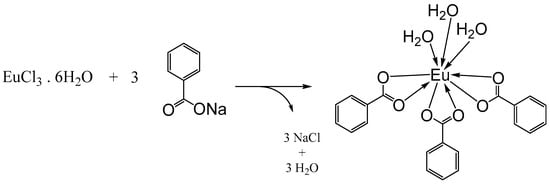
A two-step synthesis strategy was employed to construct the target complexes: EuAB2C (2-biphenylcarboxylic acid), EuAB3C (3-biphenylcarboxylic acid), and EuAB4C (4-biphenylcarboxylic acid). First, the europium precursor EuCl3·6H2O reacted with three equivalents of sodium benzoate, leading to the displacement of three chloride anions and three coordinated water molecules. The resulting intermediate complex contained three bidentate benzoate ligands, yielding a neutral, partially hydrated structure represented as: [Eu(C6H5COO)3·3(H2O)].
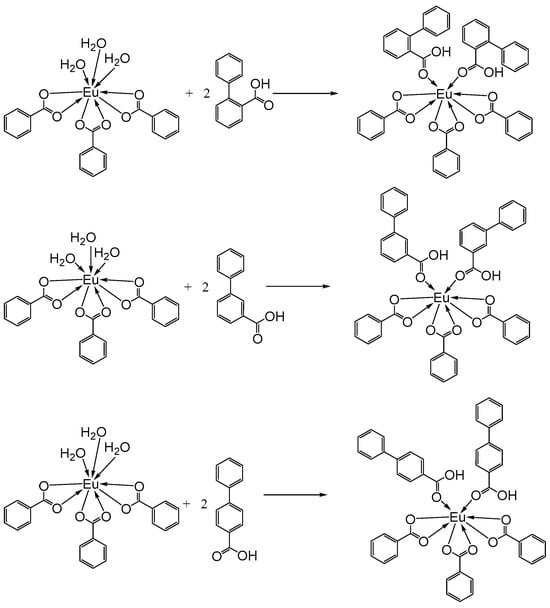
In the second step, two equivalents of the desired biphenylcarboxylic acid isomer (2-, 3-, or 4-biphenylcarboxylic acid) were added. These ligands selectively replaced the remaining three coordinated water molecules, binding to the europium center via monodentate coordination through the carboxylic oxygen atoms.
Despite the availability of three coordination sites, only two biphenyl ligands were incorporated per complex. This stoichiometry is attributed to steric hindrance between the bulky aromatic ligands, which prevents full occupation of the coordination sphere by three biphenyl groups. This observation is consistent with previous crystallographic analyses of similar complexes, where spatial constraints favour partial ligand substitution [19,20]. Thus, the final complexes follow the general formula: [Eu(C6H5COO)3(L)2], where L = 2-, 3-, or 4-biphenylcarboxylic acid.
The following reagents were supplied by Sigma-Aldrich: europium (III) chloride hexahydrate (99%), sodium benzoate (99%), Biphenyl-2-carboxylic acid (98%), Biphenyl-3-carboxylic acid (97%), Biphenyl-4-carboxylic acid (95%) and deionized water. The synthesis of the europium complexes was performed in two steps.
Step 1–Synthesis of the europium–benzoate precursor: A solution of 6 mmol sodium benzoate (864.66 mg) was prepared in 50 mL of deionized water. This was added dropwise to a solution of 2 mmol EuCl3·6H2O (732.82 mg) in 10 mL of deionized water, maintaining a 3:1 molar ratio of ligand to metal. The mixture was stirred for 1 h at room temperature under vigorous stirring, leading to the formation of a white precipitate. The product was filtered, washed with deionized water, and dried at ambient temperature. Figure 1 shows the resulting precursor complex consisted of one europium (III) ion coordinated to three bidentate benzoate ligands and three coordinated water molecules with formula [Eu(C6H5COO)3(H2O)3].
Figure 1.
Synthesis of [Eu(C6H5COO)3(H2O)3].
Step 2–Incorporation of biphenylcarboxylic acid isomers: To eliminate the coordinated water and introduce additional sensitizing ligands, three separate reactions were performed using each isomer of biphenylcarboxylic acid. In each case, 0.5 mmol of the europium–benzoate precursor (285.18 mg) was dissolved in 10 mL deionized water. Separately, 1 mmol of the selected biphenylcarboxylic acid isomer (198.22 mg) was dispersed in 10 mL of deionized water. The mixtures were stirred for 6 h, resulting in the formation of a precipitated compound in each reaction. The solids were filtered, washed with water, and dried at 80 °C for 1 h. The final yields, based on the expected molecular mass, were 89% (EuAB2C), 91% (EuAB3C), and 92% (EuAB4C), demonstrating the high efficiency of the precipitation-based synthesis (Figure 2). These final products are mononuclear and solvent-free complexes in which the biphenylcarboxylic acid ligands contribute to both structural asymmetry and enhanced luminescence via energy transfer.
Figure 2.
Synthesis of the complexes: EuAB2C, EuAB3C and EuAB4C.
3. Results and Discussion
3.1. Thermogravimetric Analysis (TGA)
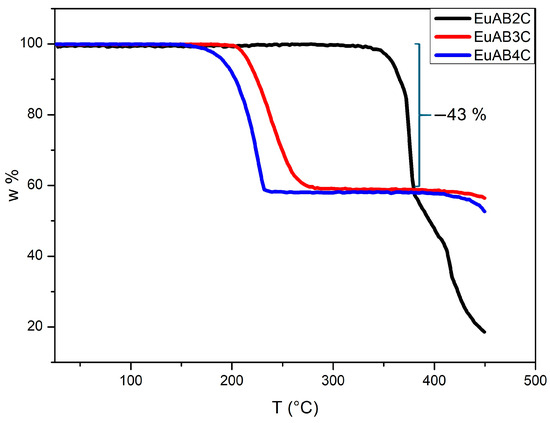
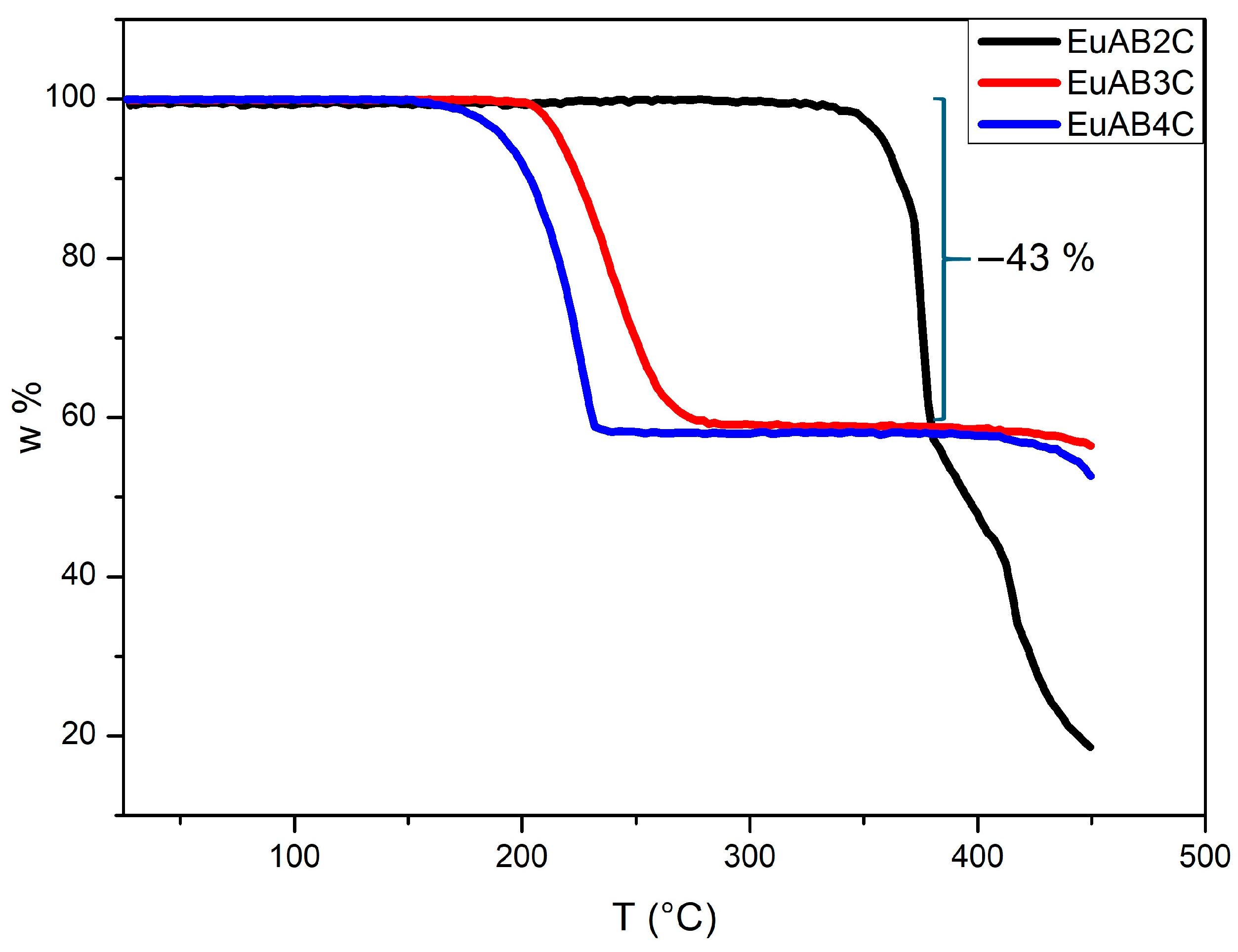
Thermogravimetric measurements were carried out in flowing air on all three europium (III) complexes (EuAB2C, EuAB3C, and EuAB4C) from room temperature (27 °C) up to 450 °C (Figure 3). Each complex begins with a mass of 911.75 units (Eu + 3 bidentate benzoates + 2 monodentate biphenylcarboxylates).
Figure 3.
Thermogravimetric analysis of EuAB2C, EuAB3C and EuAB4C.
All samples suffer a single-step mass loss of approximately 43% (396 units), consistent with the detachment of the two biphenylcarboxylate ligands. EuAB2C exhibits the highest thermal stability, with decomposition starting at 325 °C and completing around 390 °C. EuAB3C begins losing mass at 200 °C, with the process ending at 285 °C. EuAB4C shows the earliest onset of degradation, from 160 °C to completion at 230 °C.
The order of thermal stability (EuAB2C > EuAB3C > EuAB4C) reflects ligand-dependent effects on coordination robustness and ligand–metal interaction strength. The thermal stability observed in the analyzed complexes is comparable to previously reported europium-based organic/inorganic materials [21,22].
EuAB2C, stable up to 325 °C, is suitable for applications requiring moderately high thermal resistance, such as optoelectronic devices operating under elevated temperatures. EuAB3C, with stability until 200 °C, may serve in mild thermal environments but with limited applicability where higher heat exposure occurs. EuAB4C, though less thermally stable, demonstrates the strongest luminescence and may be better suited to ambient-temperature applications like bioimaging, sensors, or light-emitting diodes where high thermal strength is not critical.
To provide a complementary metric for thermal stability, the temperature corresponding to a 5% mass loss (T95%) was determined for each complex. The obtained T95% values further support the stability trend observed from the onset temperatures, with EuAB2C (358 °C) exhibiting the highest resistance to initial decomposition, followed by EuAB3C (224 °C) and EuAB4C (198 °C). These results confirm the ligand-dependent thermal robustness of the complexes.
3.2. Crystal Structure Solution
X-ray powder diffraction was performed to evaluate the structural organization of the synthesized complexes derived from biphenylcarboxylic acid isomers. Each sample exhibited distinct diffraction patterns, confirming the formation of crystalline phases unique to each ligand system.
Powder X-ray diffraction (PXRD) data were analyzed using the EXPO2014 software package, which enables full structure solution and refinement from powder data. This integrated suite allows indexing of diffraction patterns, extraction of integrated intensities, space group determination, structure solution using direct methods or direct space approaches, and final refinement using the Rietveld method [23].
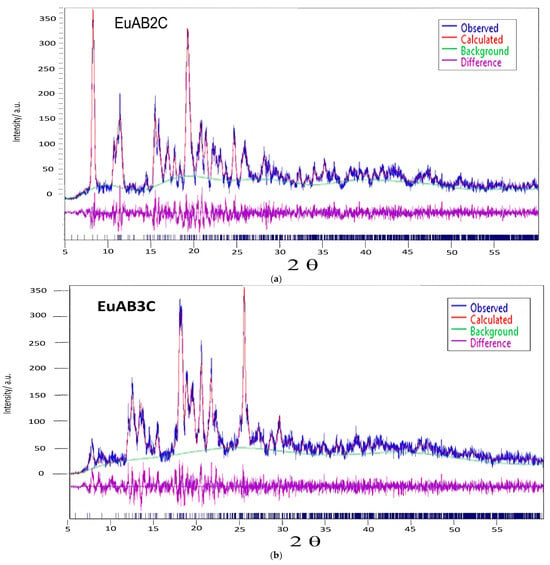
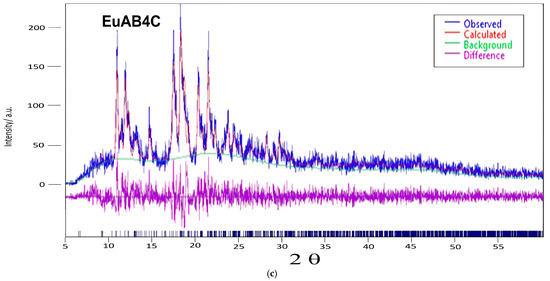
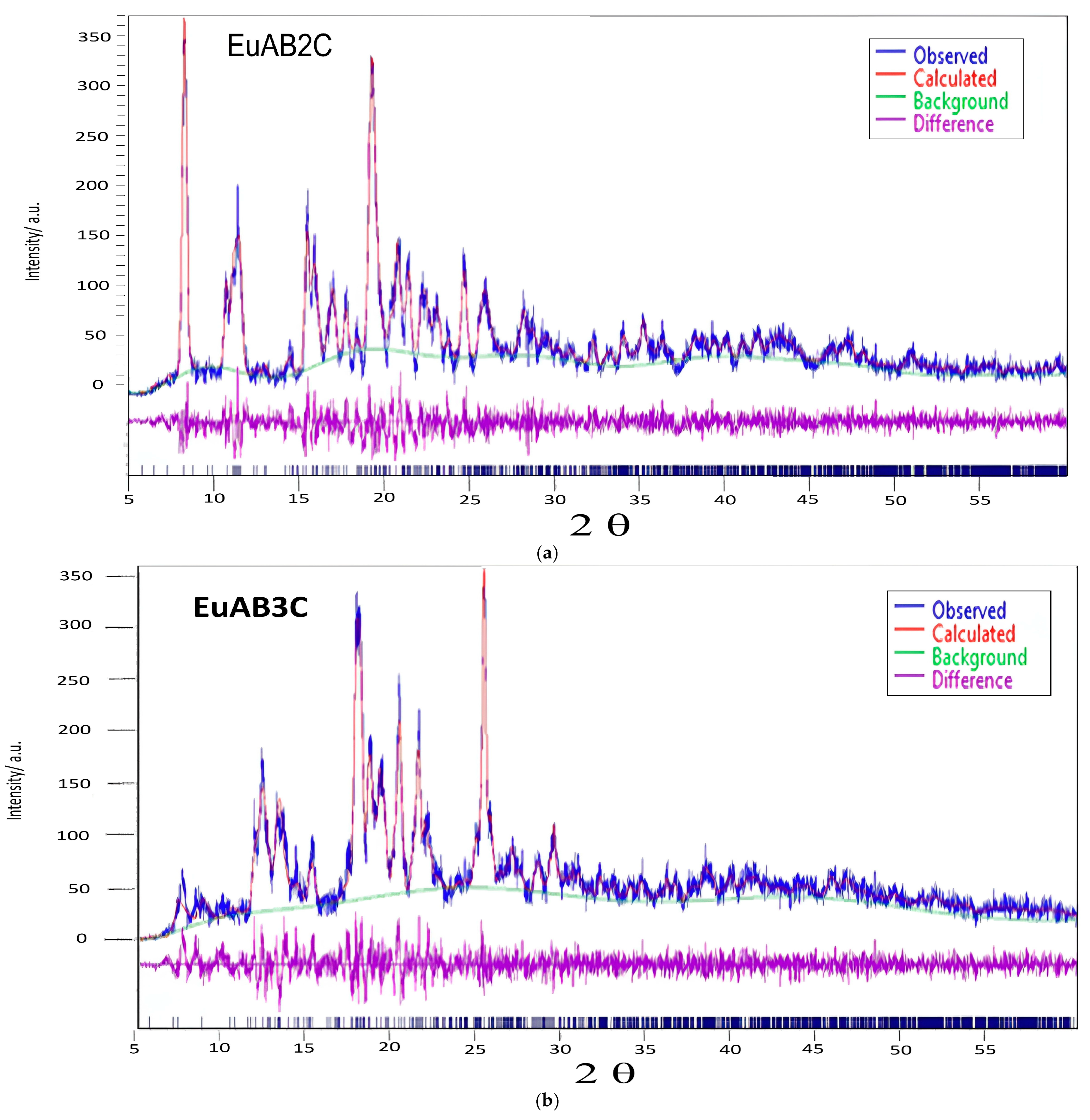
For all three synthesized complexes (EuAB2C, EuAB3C, EuAB4C), the diffraction patterns were indexed using the N-TREOR09 algorithm, as implemented within EXPO2014. The initial unit cell parameters were estimated from the 25 most intense peaks of each pattern. Subsequent analysis led to the identification of the triclinic P-1 space group for all three complexes, with two molecules per unit cell. The structure solution was performed via the direct space method, involving the generation of random configurations based on an initial 3D molecular model. These models were built using ChemBioDraw® Ultra and geometrically optimized using MOPAC with the RM1 semi-empirical model. The candidate structures were iteratively modified until a satisfactory match was obtained between the experimental and simulated PXRD patterns (Figure 4).
Figure 4.
Rietveld plot of (a) EuAB2C, (b) EuAB3C and (c) EuAB4C. Blue line-observed diffraction profile; Red line-calculated profile; Green line-background and Violet line-difference profile.
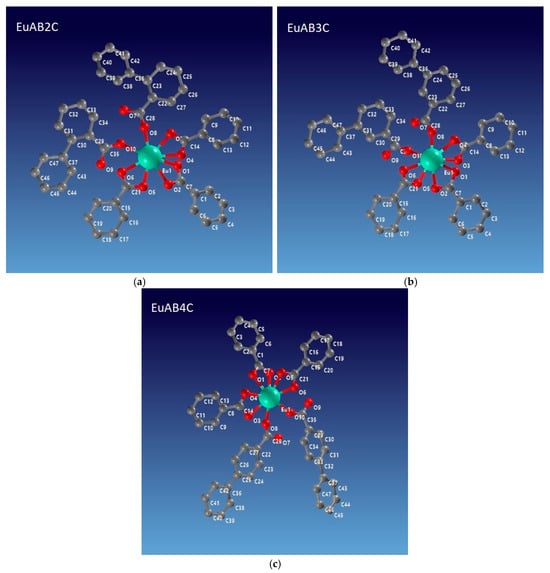
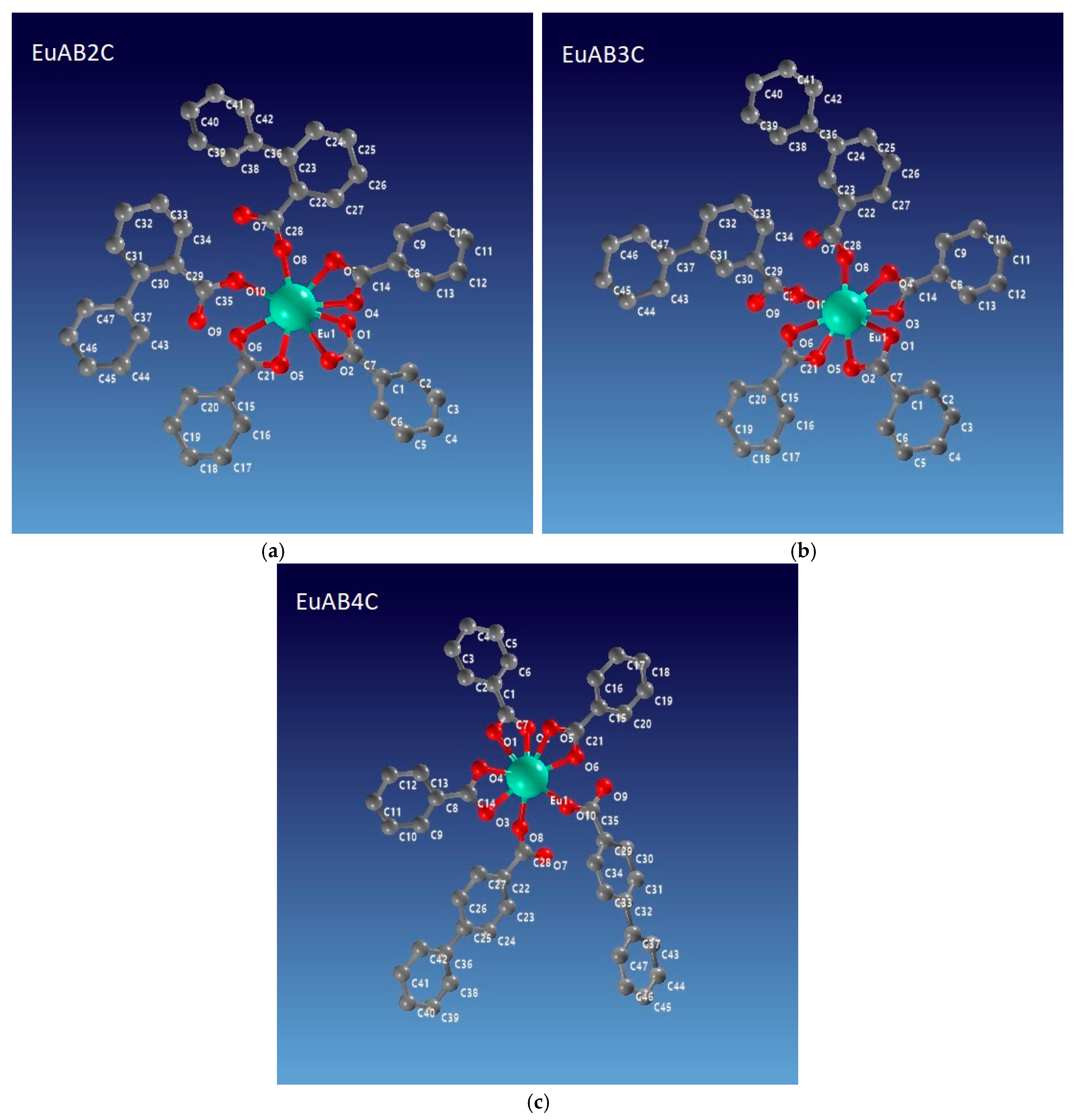
The final agreement factors R obtained for the three complexes were as follows: EuAB2C = 1.573, EuAB3C = 1.507 and EuAB4C = 1.322. These values indicate a good agreement between the calculated and experimental data, supporting the successful solution and refinement of the crystal structures for the three complexes. The models were refined by the Rietveld method and the optimized crystal structures are shown in Figure 5.
Figure 5.
Crystal structure of complexes (a) EuAB2C, (b)EuAB3C and (c) EuAB4C. Europium atom in green, oxygen atoms in red and carbon atoms in gray. Hydrogen atoms are omitted for clarity.
All the resolution parameters for complexes EuAB2C, EuAB3C and EuAb4C are shown in Table 1 and the CCDC numbers 2477667, 2477668 and 2476992 contains the supplementary crystallographic data for this study (Supplementary Materials). These data can be obtained free of charge from the Cambridge Crystallographic Data Center (CCDC) via. www.ccdc.cam.ac.uk/structures (accessed on 13 November 2025).
Table 1.
Parameters for complexes EuAB2C, EuAB3C and EuAb4C.
3.3. Photoluminescence Results
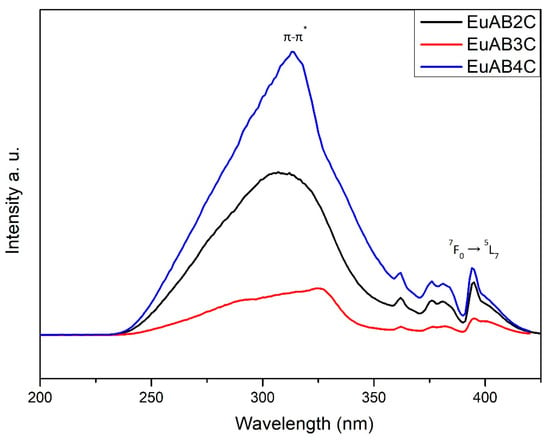
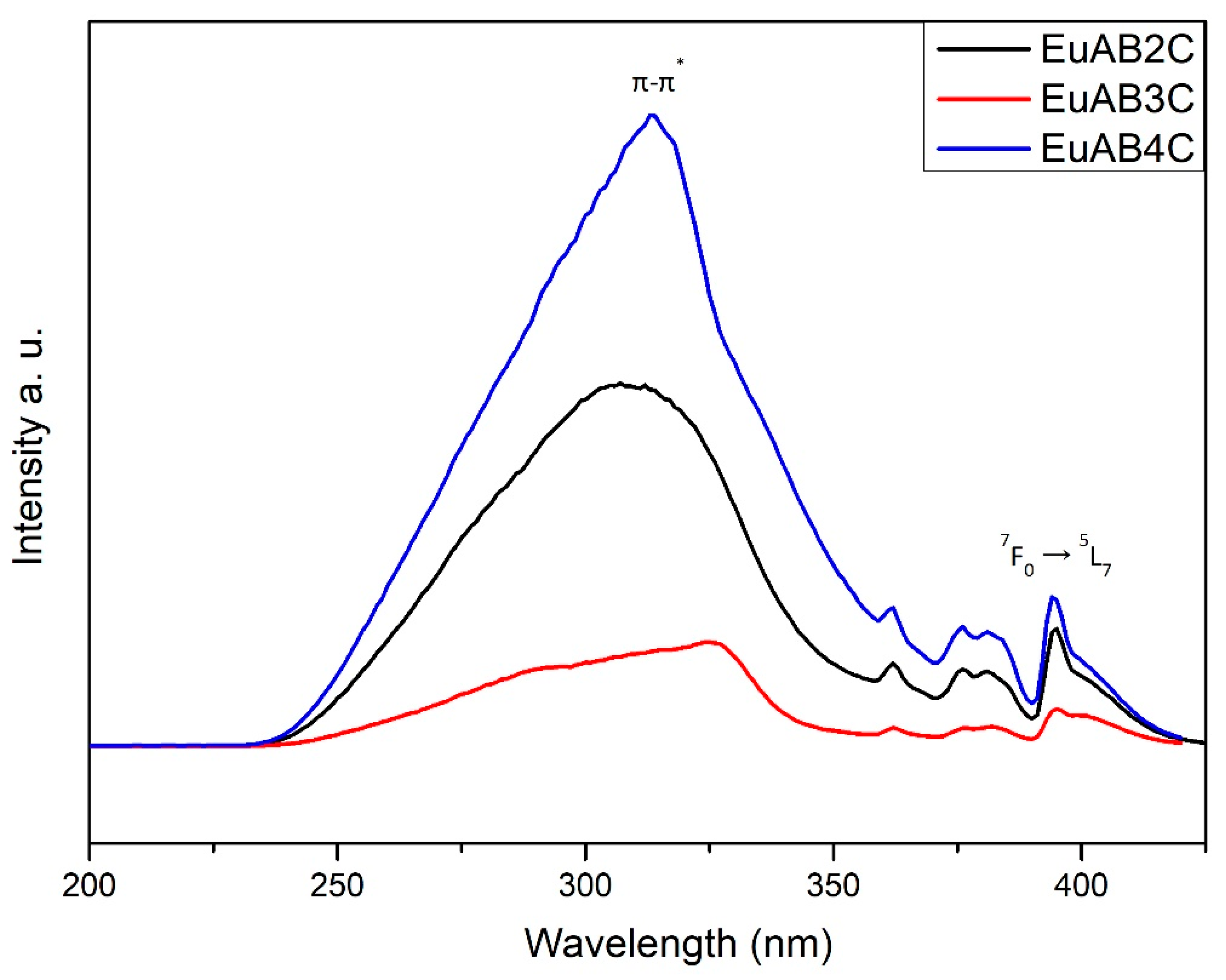
Excitation spectra were recorded by monitoring the characteristic europium (III) red emission at 616 nm (5D0 → 7F2 transition) to evaluate the efficiency of ligand-to-metal energy transfer in each complex (Figure 6). The spectra reveal strong absorption bands between 280–330 nm (Figure 6), which are attributed to π–π* transitions within the aromatic ligands [24], corresponding to excitation from the ground singlet state (S0) to the first excited singlet state (S1). These transitions serve as the primary pathway for sensitization of the europium ion via the antenna effect. On the other hand, the bands at 397 nm are attributed to the f-f transitions of Europium. The fact that the absorption band across the ligands is several orders of magnitude higher than the intra-configurational ones of Europium demonstrates that the main pathway of absorption is through the ligands. The maximum excitation intensities are reported on Table 2.
Figure 6.
Excitation of EuAB2C, EuAB3C and EuAB4C.
Table 2.
PL Excitation result for complexes EuAB2C, EuAB3C and EuAb4C.
The excitation intensity reflects the absorption efficiency of the ligand and the effectiveness of energy transfer to the Eu3+ ion. Among the three complexes, EuAB4C exhibited the strongest excitation response, indicating the most efficient antenna sensitization. EuAB2C showed moderate sensitization, while EuAB3C displayed the weakest, consistent with its overall lower emission intensity.
These results reinforce the conclusion that the position of the carboxylic acid group on the biphenyl moiety significantly affects conjugation and electronic resonance, influencing the efficiency of ligand absorption and energy transfer. The stronger π-conjugation in EuAB4C, due to its para-substituted geometry, likely enhances delocalization and facilitates more effective coupling to the Eu3+ excited state.
This ligand-dependent behavior confirms that the antenna effect is maximized when the ligand absorbs efficiently and its excited singlet state lies at an appropriate energy level to allow intersystem crossing to the triplet state, from which energy is transferred to the Eu3+ ion.
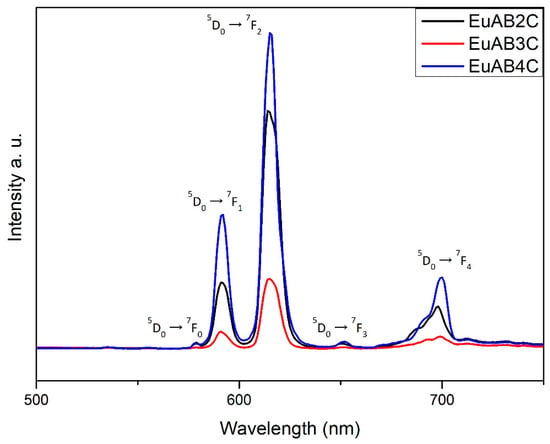
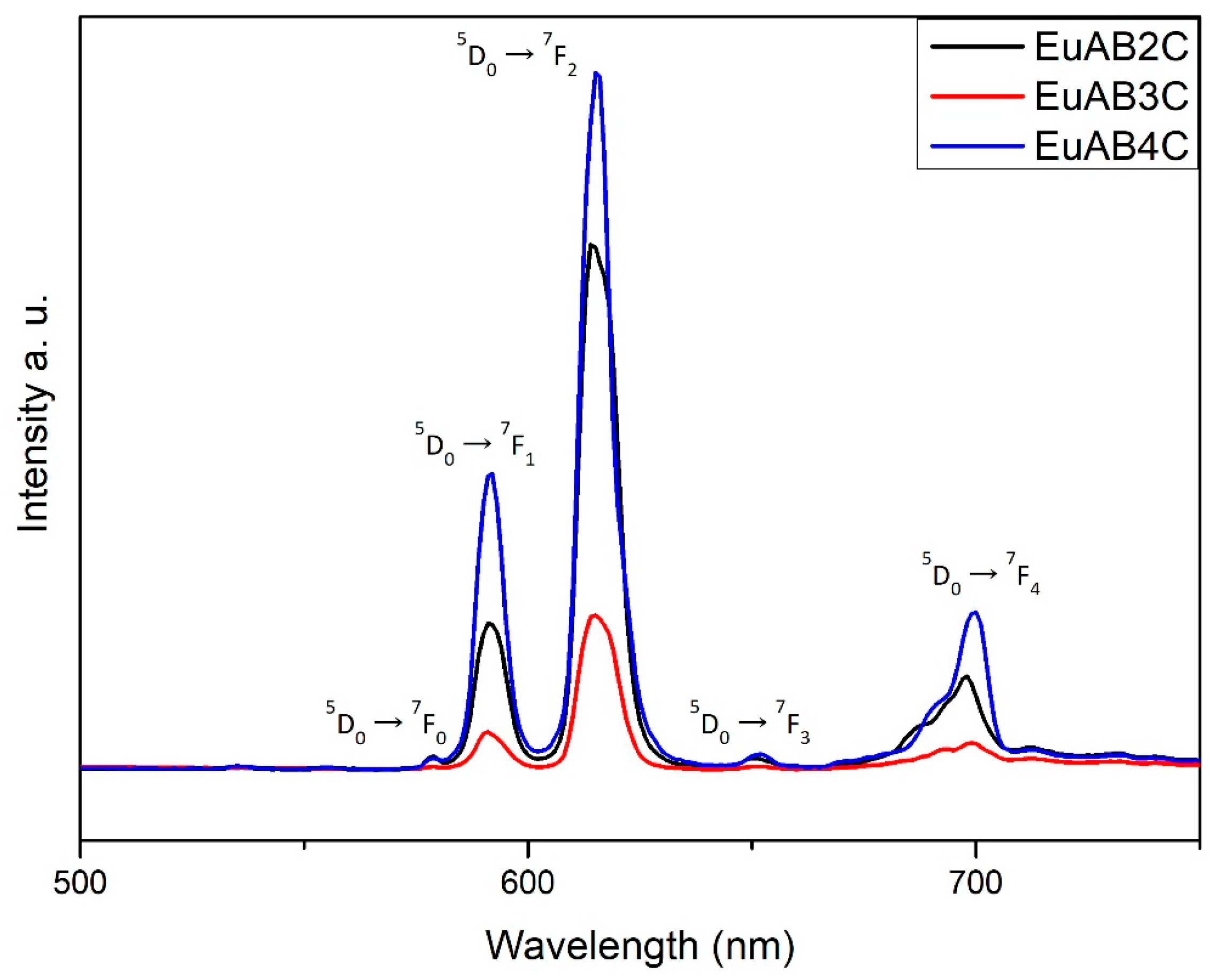
These variations highlight the antenna effect provided by the organic ligands, enabling efficient energy transfer to the europium ion. The emission spectra of all three compounds (Figure 7) display the characteristic europium (III) transitions at 590 nm (5D0 → 7F1), 616 nm (5D0 → 7F2), and 700 nm (5D0 → 7F4) from the excited state 5D0 to the 7FJ ground multiplet, with dominant peaks at 590 nm (5D0 → 7F1, magnetic dipole transition) and 616 nm (5D0 → 7F2, electric dipole transition). The emission intensities and relative peak ratios varied with each complex, reflecting different local symmetries around the europium (III) ion.
Figure 7.
Emission spectra of EuAB2C, EuAB3C and EuAB4C.
It is possible to determine if different biphenylcarboxylate isomers in the system modifies the local crystal field environment around the Eu3+ ion located in the host, by R-factor of the 5D0 → 7F2 to 5D0 → 7F1 transitions, since it is known that the 5D0 → 7F2 emissions are electric dipole transitions, whereas the 5D0 → 7F1 emissions are electric magnetic dipole transitions. Also, the first is a hypersensitive transition and, therefore, very sensitive to the site symmetry, and the second is insensitive to the symmetry of the crystal environment [25]. Therefore, allows assessment of the coordination symmetry around the Eu3+ centre. However, the overall luminescence efficiency also heavily depends on the ligand’s electronic properties specifically its ability to transfer energy (antenna effect), which correlates with electron-donating or electron-withdrawing character. The result for the complexes is shown in Table 3.
Table 3.
R-factor of mononuclear europium (III) complexes.
The calculated R-factors highlight the impact of the biphenylcarboxylic acid isomers on the coordination symmetry around europium (III). The highest asymmetry is observed in EuAB3C (R = 3.88), indicating stronger electric dipole transitions and thus a more distorted local environment. EuAB2C also shows significant asymmetry (R = 3.57), whereas EuAB4C exhibits the lowest R-factor (2.35), consistent with a more symmetric ligand field. These differences reinforce the sensitivity of europium (III) luminescence to subtle variations in ligand topology [26]. Electron-donating ligands, or those with favourable conjugation and triplet-state energetics, tend to function as superior light-harvesting antennas, resulting in higher luminescence quantum efficiency [27,28]. In our system, the position of the carboxyl group on the biphenyl ring influences both electronic donation and triplet-state alignment, impacting the antenna effect.
The electronic influence of the biphenylcarboxylate isomers can be rationalized using Hammett substituent constants, which quantify how a functional group modulates electron density in an aromatic system. The carboxylic acid group has a Hammett constant for the para position (σp) of approximately −0.01, indicating a negligible net inductive effect and a significant capacity for resonance electron donation. This efficient π-delocalization across the para-substituted biphenyl system in EuAB4C enhances the ligand’s charge-transfer character, facilitating optimal energy transfer to the Eu3+ center (the antenna effect). In contrast, the meta-substituted isomer (EuAB3C) has a constant of σm = +0.37, reflecting a purely electron-withdrawing inductive effect that disrupts continuous π-conjugation. This hinders efficient electron density migration, explaining its poorer performance as a sensitizer. For the ortho isomer (EuAB2C), classical Hammett parameters are less reliable due to dominant steric effects that constrain the carboxylate group and perturb both resonance and inductive interactions. This analysis confirms that the para substitution provides the most favorable electronic structure for sensitization, while the meta isomer disrupts π-delocalization, and the ortho isomer is governed by steric constraints [29].
Quantum yield (QY) measurements were performed to quantify the overall efficiency of the luminescent response in each complex under optimized excitation and emission conditions. Quantum yield (QY) measurements were performed using an integrating sphere, the measurements considered the primary emission bands of Eu3+ (5D0 → 7FJ where J = 1, 2, 4), covering a spectral range of 565 to 725 nm in all cases. For EuAB2C, the excitation was set to 305 nm, resulting in a quantum yield of 4.44%. The EuAB3C complex, excited in 356 nm, showed a significantly lower QY of 1.96%, consistent with its relatively poor excitation and emission intensities. In contrast, EuAB4C exhibited the highest QY of 5.70%, with an excitation of 310 nm and emission between 565 and 725 nm.
The absolute QY was calculated according to:
where ε and α are number of photons emitted and absorbed by the sample, respectively. Lemission is the luminescence emission spectrum within the emission spectral range, Esample is the excitation spectrum for the sample and Eblanc is the excitation spectrum of the sample. The luminescent properties of the present complexes are consistent with previously reported europium (III) complexes containing aromatic carboxylate ligands. Chen Q. et al. [5] reported Eu–benzoate derivatives with moderate emission intensities and quantum yields in the range, which is comparable to our EuAB2C (4.44%) and EuAB4C (5.70%) values.
The QY values obtained are modest (Table 4), which is expected because the objective of this work was not to maximize luminescence efficiency, but to isolate the influence of monodentate ligand position on europium (III) sensitization. It is well established that europium (III) quantum yield can be enhanced through ligand systems containing phosphines or strongly delocalized π-acceptors, which reduce non-radiative decay pathways, or by embedding lanthanum (III) complexes in polymeric or inorganic matrices. In contrast, the present complexes were intentionally prepared as solvent-free mononuclear systems to investigate the fundamental role of monodentate biphenylcarboxylate coordination. These results therefore represent an essential structural-photophysical baseline for future materials development, where tuning strategies will be applied.
Table 4.
Quantum yield of mononuclear europium (III) complexes.
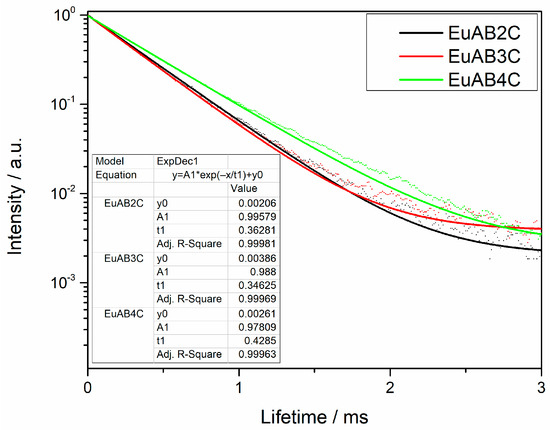
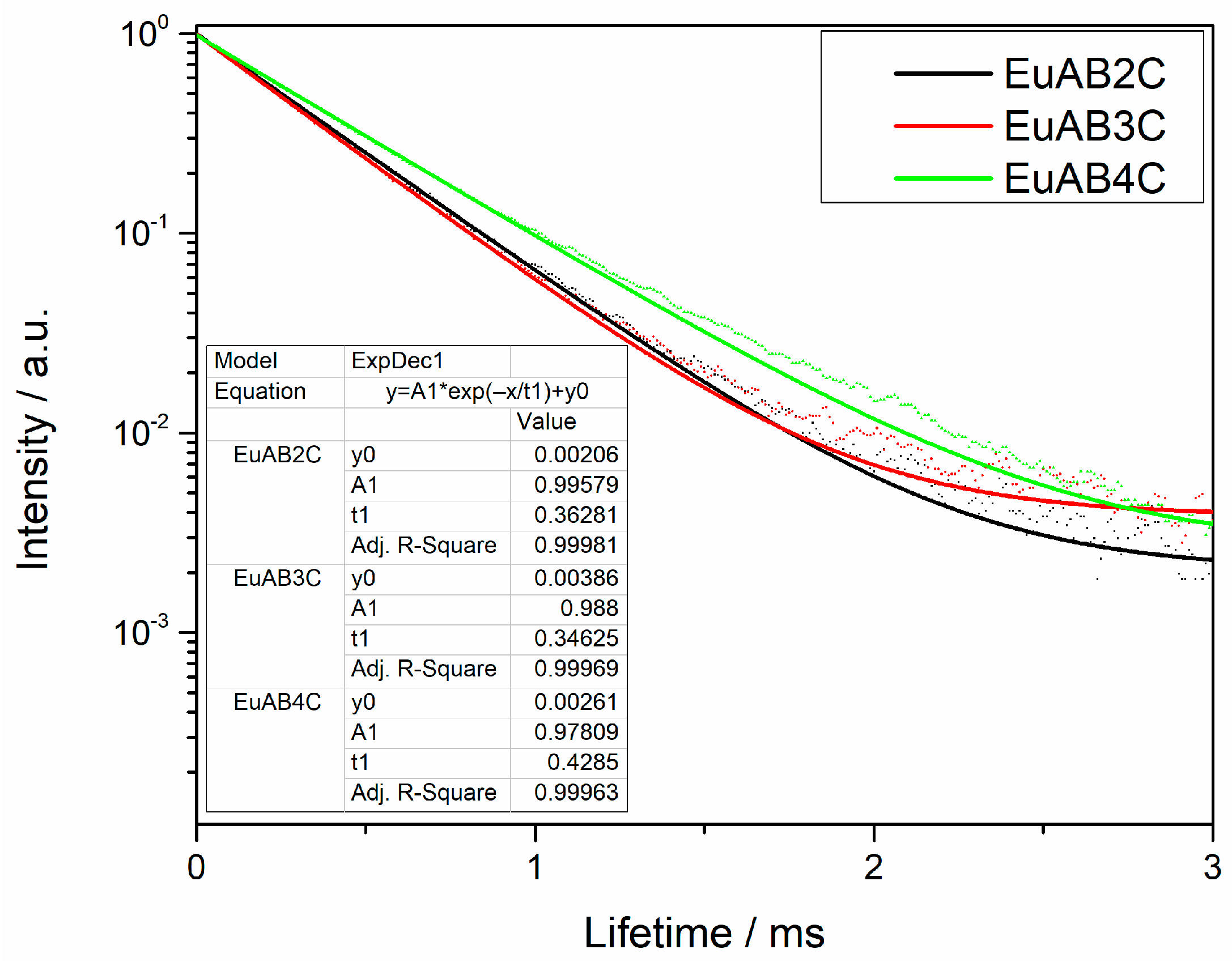
The fluorescence decay profiles (Figure 8) were recorded for each complex at its respective excitation wavelength. All decay curves were well-fitted using a single-exponential model:
where I(t) is the luminescence intensity at time t, I0 is the initial intensity, τ is the lifetime, and y0 is a constant offset accounting for the background. The high quality of the single-exponential fits (adjusted R2 ≥ 0.999) confirms the presence of a single, well-defined luminescent species in each complex, without significant emission heterogeneity or energy transfer between different Eu3+ sites indicating a homogeneous chemical environment around the Eu3+, as expected for mononuclear compounds. The measured lifetimes are summarized in Table 5. The order of lifetimes follows EuAB4C > EuAB2C > EuAB3C, which correlates directly with the observed quantum yield trends. The longer lifetime for EuAB4C suggests a more effective shielding of the europium (III) ion from non-radiative deactivation pathways, likely due to a more efficient shielding of the europium (III) ion by the para-substituted ligand.
Figure 8.
Lifetime measurements of EuAB2C, EuAB3C and EuAB4C.
Table 5.
Lifetime of mononuclear europium (III) complexes.
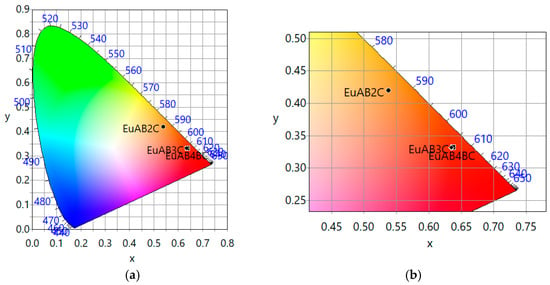
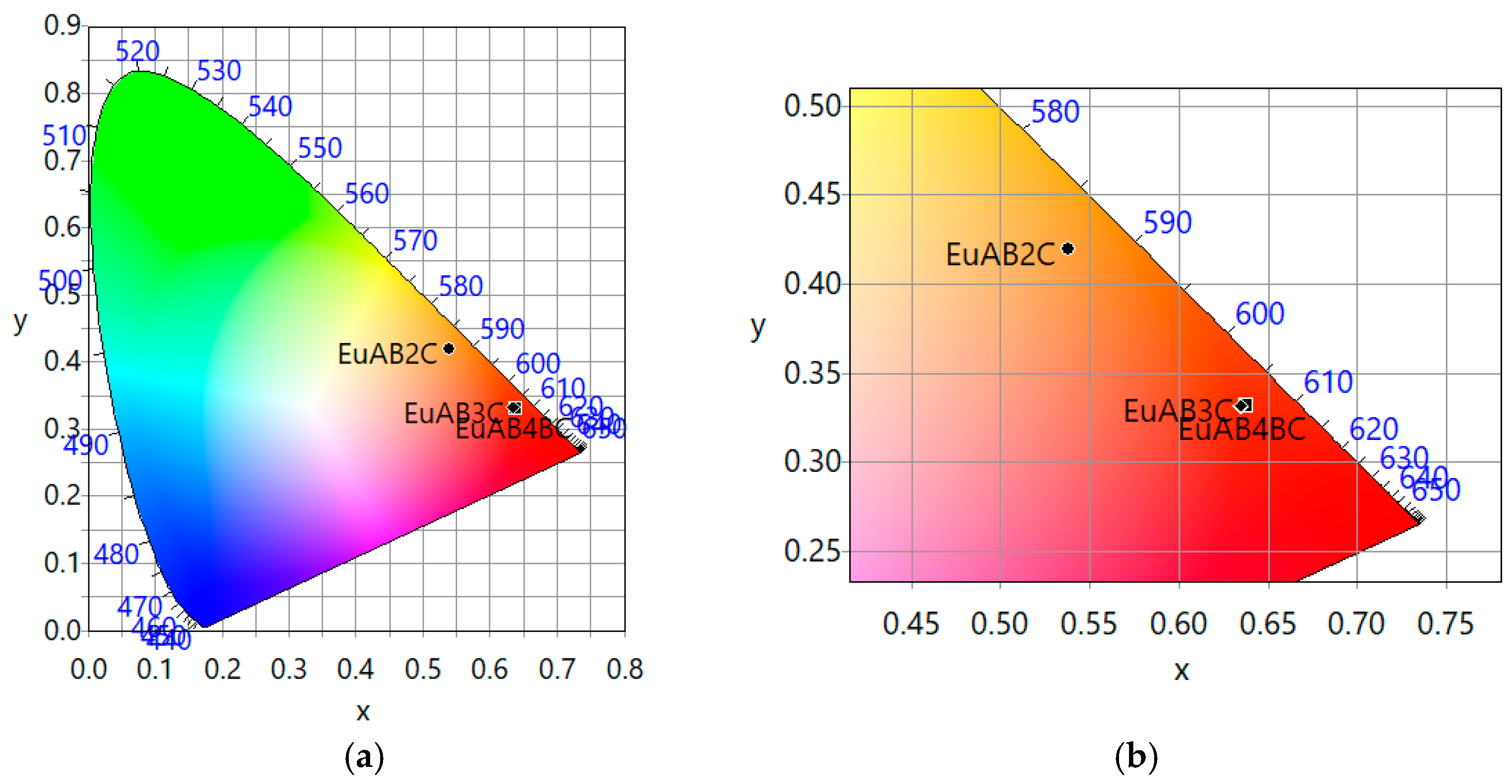
Finally, chromaticity coordinates were obtained from the emission spectra using the CIE 1931 system full emission spectra and plotted on the CIE 1931 diagram (Figure 9a,b). The obtained coordinates, summarized in Table 6, confirm that all three complexes emit in the red region. The coordinates for EuAB3C and EuAB4C are nearly identical and lie closer to the spectral locus in the deep red region compared to EuAB2C. This is quantitatively confirmed by the color purity values, where EuAB3C (90.8%) and EuAB4C (90.0%) show superior purity over EuAB2C (87.6%), The results suggests that the meta- and para-substituted isomers produce a more purer red emission, whereas the distinct coordinate for EuAB2C, which is shifted towards the orange-yellow region, is consistent with its different relative intensity ratio between the 5D0 → 7F2 (electric dipole) and 5D0 → 7F1 (magnetic dipole) transitions, as reflected in its lower R-factor.
Figure 9.
(a) CIE coordinates of EuAB2C, EuAB3C and EuAB4C. (b) Zoom of reddish zone.
Table 6.
CIE coordinates and color purity (CP) of mononuclear europium (III) complexes.
4. Conclusions
Three novel mononuclear europium (III) complexes were synthesized by combining Eu3+ with three bidentate benzoate ligands and two monodentate isomers of biphenylcarboxylic acid (2-, 3-, and 4-substituted). The resulting complexes EuAB2C, EuAB3C, and EuAB4C were evaluated in terms of photophysical and thermal properties.
Thermal analysis revealed that EuAB2C is the most thermally stable, decomposing above 325 °C, while EuAB4C, though highly emissive, is the least stable thermally. The comprehensive thermal characterization, including both onset decomposition temperatures and T95% values, consistently confirmed the stability trend EuAB2C > EuAB3C > EuAB4C. This agreement between different thermal metrics reinforces the ligand-dependent robustness of the coordination sphere and provides reliable parameters for selecting complexes based on specific application temperature requirements.
Photoluminescence studies demonstrated that EuAB4C is the highest excited and with the highest emission intensity, along with the longest lifetime, attributed to better electronic conjugation and more efficient antenna behavior. The systematic analysis using Hammett substituent constants provided fundamental insight into the electronic effects governing the luminescence efficiency. The superior performance of the para-substituted isomer (EuAB4C) is attributed to its optimal resonance-assisted π-delocalization, which facilitates efficient energy transfer to the Eu3+ center. In contrast, the meta-substituted isomer’s electron-withdrawing character disrupts conjugation, while steric constraints dominate in the ortho-substituted analogue.
Despite having the highest R-factor, EuAB3C displayed the weakest emission, proving that symmetry distortion alone does not ensure effective energy transfer. Furthermore, the quantum yield (QY) measurements provided additional insight into the overall photophysical efficiency of the synthesized complexes. Among the three, EuAB4C exhibited the highest QY (5.70%), confirming its superior antenna behavior and energy transfer efficiency, which aligns with its intense excitation and emission bands and prolonged excited-state lifetime. The EuAB2C complex displayed an intermediate QY (4.44%), consistent with its moderate luminescent performance and notable thermal stability. In contrast, EuAB3C presented the lowest QY (1.96%), further supporting its poor excitation and emission intensity and highlighting the limited suitability of the meta-substituted biphenylcarboxylic acid for sensitization of Eu3+ emission.
These quantum yield trends underscore the critical role of ligand electronic structure and substitution pattern in optimizing luminescent efficiency. The correlation between QY, excitation intensity, and lifetime reaffirms that ligand design directly influences both the radiative and non-radiative pathways, and therefore the functional performance of lanthanide-based luminescent materials.
This work demonstrates that ligand design significantly affects the energy transfer efficiency and stability of europium (III) complexes. The correct choice of ligands (considering conjugation, coordination geometry, and ligand of substitution) can optimize optical performance and thermal durability, depending on the application.
Supplementary Materials
The following supporting information can be downloaded at: https://www.mdpi.com/article/10.3390/cryst15121028/s1.
Author Contributions
Conceptualization, Á.d.J.M.-R. and C.F.-G.; methodology, C.F.H.-F. and M.L.C.-J.; investigation, C.F.H.-F., L.S.C.-C. and J.O.-L.; writing—original draft preparation, C.F.H.-F. and Á.d.J.M.-R.; writing—review and editing, A.R.-L. and J.A.A.C.; visualisation, A.R.-L. and J.O.-L. All authors have read and agreed to the published version of the manuscript.
Funding
This research received no external funding.
Institutional Review Board Statement
Not applicable.
Informed Consent Statement
Not applicable.
Data Availability Statement
The original contributions presented in this study are included in the article. Further inquiries can be directed to the corresponding authors.
Acknowledgments
The authors acknowledge to: Comisión de Fomento a las Actividades Académicas, Estimulo al desempeño de los Investigadores; Sistema Nacional de Investigadores, Secretaria de Ciencia, Humanidades, Tecnología e Innovación (SECIHTI) México; and the Instituto Politécnico Nacional—SIP for 2389 multidisciplinary project (20251162 and 20253565). Also to the Technological and Autonomous Institute of México (ITAM), Mexican Association of Culture.
Conflicts of Interest
The authors declare no conflicts of interest.
Abbreviations
The following abbreviations are used in this manuscript:
| EuAB2C | Biphenyl 2-carboxylic acid. |
| EuAB3C | Biphenyl 3-carboxylic acid. |
| EuAB4C | Biphenyl 4-carboxylic acid. |
References
- Hasegawa, M.; Ohmagari, H.; Tanaka, H.; Machida, K. Luminescence of Lanthanide Complexes: From Fundamental to Prospective Approaches Related to Water- and Molecular-Stimuli. J. Photochem. Photobiol. C Photochem. Rev. 2022, 50, 100484. [Google Scholar] [CrossRef] [Scilit]
- Xue, H.; He, Z.; Shen, X.; Zhu, Y.; Ge, M. Luminous Properties of Skin–Core Structure New Luminous Fiber: SrAl2O4:Eu2+,Dy3+-PET/Light Conversion Agent-PET. J. Mater. Sci. Mater. Electron. 2018, 29, 18045–18050. [Google Scholar] [CrossRef] [Scilit]
- Cho, U.; Chen, J.K. Lanthanide-Based Optical Probes of Biological Systems. Cell Chem. Biol. 2020, 27, 921–936. [Google Scholar] [CrossRef] [Scilit]
- Butorlin, O.S.; Petrova, A.S.; Toikka, Y.N.; Kolesnikov, I.E.; Orlov, S.N.; Ryazantsev, M.N.; Bogachev, N.A.; Skripkin, M.Y.; Mereshchenko, A.S. The Structure and Optical Properties of Luminescent Europium Terephthalate Antenna Metal–Organic Frameworks Doped by Yttrium, Gadolinium, and Lanthanum Ions. Molecules 2024, 29, 3558. [Google Scholar] [CrossRef] [Scilit]
- Chen, Q.; Zhang, J.; Ye, Q.; Qin, S.; Li, L.; Teng, M.; Wong, W.-Y. Progress in Luminescent Materials Based on Europium (III) Complexes of β-Diketones and Organic Carboxylic Acids. Molecules 2025, 30, 1342. [Google Scholar] [CrossRef] [Scilit] [PubMed]
- Ahmed, Z.; Carvalho, R.D.S.; Dos Santos, A.M.; Gambassi, F.; Bandini, E.; Marvelli, L.; Maini, L.; Barbieri, A.; Cremona, M. Highly Luminescent Europium(III) Complexes in Solution and PMMA-Doped Films for Bright Red Electroluminescent Devices. Molecules 2023, 28, 4371. [Google Scholar] [CrossRef] [Scilit]
- Zhang, Q.; Yang, X.; Deng, R.; Zhou, L.; Yu, Y.; Li, Y. Synthesis and Near Infrared Luminescence Properties of a Series of Lanthanide Complexes with POSS Modified Ligands. Molecules 2019, 24, 1253. [Google Scholar] [CrossRef] [Scilit]
- Serra, A.R.B.; Casagrande, T.R.; De Lima, J.F.; De Oliveira, M.F.; Júnior, S.A.; De Oliveira Junior, M.; Serra, O.A. Synthesis and Structural Characterization of an Amorphous and Photoluminescent Mixed Eu/Zr Coordination Compound, a Potential Marker for Gunshot Residues. Sci 2022, 4, 43. [Google Scholar] [CrossRef] [Scilit]
- Zhao, S.-N.; Wang, G.; Poelman, D.; Voort, P. Luminescent Lanthanide MOFs: A Unique Platform for Chemical Sensing. Materials 2018, 11, 572. [Google Scholar] [CrossRef] [Scilit]
- Zhuravlev, K.P.; Tsaryuk, V.I.; Kudryashova, V.A.; Gawryszewska, P. Regulation of the Luminescence Efficiency of Europium Benzoates by −OH and −NO2 Substituents and Alkali Metal Counterions. J. Photochem. Photobiol. Chem. 2018, 353, 255–262. [Google Scholar] [CrossRef] [Scilit]
- Wang, C.; Xi, P.; Yan, J.; Cheng, B. Luminescence and Anti-Counterfeiting Functions of the Novel Benzoate Eu(III) Complexes with Multiple Excitation Properties. Dyes Pigments 2025, 241, 112859. [Google Scholar] [CrossRef] [Scilit]
- Lima, N.B.D.; Silva, A.I.S.; Gonçalves, S.M.C.; Simas, A.M. Synthesis of Mixed Ligand Europium Complexes: Verification of Predicted Luminescence Intensification. J. Lumin. 2016, 170, 505–512. [Google Scholar] [CrossRef] [Scilit]
- Dong, C.; Wang, X.; Gong, W.; Ma, W.; Zhang, M.; Li, J.; Zhang, Y.; Zhou, Z.; Yang, Z.; Qu, S.; et al. Influence of Isomerism on Radioluminescence of Purely Organic Phosphorescence Scintillators. Angew. Chem. Int. Ed. 2021, 60, 27195–27200. [Google Scholar] [CrossRef] [Scilit]
- Mu, B.; Zhang, Z.; Hao, X.; Ma, T.; Tian, W. Positional Isomerism-Mediated Copolymerization Realizing the Continuous Luminescence Color-Tuning of Liquid-Crystalline Polymers. Macromolecules 2022, 55, 5332–5341. [Google Scholar] [CrossRef] [Scilit]
- Song, Z.; Hao, Y.; Long, Y.; Zhang, P.; Zeng, R.; Chen, S.; Chen, W. Luminescent Lanthanide Infinite Coordination Polymers for Ratiometric Sensing Applications. Molecules 2025, 30, 396. [Google Scholar] [CrossRef] [Scilit]
- Romanova, J.; Lyapchev, R.; Kolarski, M.; Tsvetkov, M.; Elenkova, D.; Morgenstern, B.; Zaharieva, J. Molecular Design of Luminescent Complexes of Eu(III): What Can We Learn from the Ligands. Molecules 2023, 28, 4113. [Google Scholar] [CrossRef] [Scilit]
- Ivanova, E.A.; Smirnova, K.S.; Pozdnyakov, I.P.; Potapov, A.S.; Lider, E.V. Synthesis, Crystal Structures, and Luminescence Properties of Lanthanide(III) Complexes with 1-(1H-Benzimidazol-1yl-Methyl)-1H-Benzotriazole. Inorganica Chim. Acta 2023, 557, 121697. [Google Scholar] [CrossRef] [Scilit]
- Zhang, X. Spectroscopic studies on the luminescence properties of ternary europium complexes with different ligands. J. Lumin. 2010, 130, 1060–1066. [Google Scholar] [CrossRef] [Scilit]
- Syakaev, V.V.; Masliy, A.N.; Podyachev, S.N.; Sudakova, S.N.; Shvedova, A.E.; Lentin, I.I.; Gorbunov, A.N.; Vatsouro, I.M.; Lapaev, D.V.; Mambetova, G.S.; et al. NMR and DFT-Study of New Luminescent Eu3+ Complexes Based on Calixarenes with 1,2,3-Triazole and 1,3-Diketone Groups. Inorganica Chim. Acta 2024, 561, 121848. [Google Scholar] [CrossRef] [Scilit]
- Stener, M.; Decleva, P.; Holland, D.M.P.; Shaw, D.A. A Study of the Valence Shell Electronic States of Pyrimidine and Pyrazine by Photoabsorption Spectroscopy and Time-Dependent Density Functional Theory Calculations. J. Phys. B At. Mol. Opt. Phys. 2011, 44, 075203. [Google Scholar] [CrossRef] [Scilit]
- Lozovan, V.; Borodi, G.; Perhaţia, I.; Turza, A.; Brânzanic, A.M.V.; Pîrnău, A.; Mureşan, L.E. Eu(III) Complexes Derived from 2-Quinolinecarbohydrazide Schiff Base Ligand, Relations between Structure and Luminescence Properties. J. Mol. Struct. 2025, 1322, 140397. [Google Scholar] [CrossRef] [Scilit]
- Wani, R.J.; Hussain, A.; Sheikh, M.U.D.; Bukhari, M.N.; Fatima, M.; Ali, G. Synthesis of Mono and Hetero-Bi Nuclear Lanthanum (III) and Europium (III) Complexes of 2-Hydroxy-5-Sulfobenzoic Acid and 1,10-Phenanthroline: Luminescence and Magnetic Studies. J. Mater. Sci. Mater. Eng. 2025, 20, 64. [Google Scholar] [CrossRef] [Scilit]
- Altomare, A.; Capitelli, F.; Corriero, N.; Cuocci, C.; Falcicchio, A.; Moliterni, A.; Rizzi, R. The Rietveld Refinement in the EXPO Software: A Powerful Tool at the End of the Elaborate Crystal Structure Solution Pathway. Crystals 2018, 8, 203. [Google Scholar] [CrossRef] [Scilit]
- Sakthivel, T.; Sun, L.; Devakumar, B.; Li, B.; Huang, X. Novel High-Efficiency Eu3+ -Activated Na2Gd2B2O7 Red-Emitting Phosphors with High Color Purity. RSC Adv. 2018, 8, 32948–32955. [Google Scholar] [CrossRef] [Scilit]
- Binnemans, K. Interpretation of Europium(III) Spectra. Coord. Chem. Rev. 2015, 295, 1–45. [Google Scholar] [CrossRef] [Scilit]
- Eliseeva, S.V.; Bünzli, J.-C.G. Lanthanide Luminescence for Functional Materials and Bio-Sciences. Chem. Soc. Rev. 2010, 39, 189–227. [Google Scholar] [CrossRef] [Scilit] [PubMed]
- Kramar, B.V.; Flanders, N.C.; Helweh, W.; Dichtel, W.R.; Hupp, J.T.; Chen, L.X. Light Harvesting Antenna Properties of Framework Solids. Acc. Mater. Res. 2022, 3, 1149–1159. [Google Scholar] [CrossRef] [Scilit]
- Zhang, J.; Zhang, L.; Chen, Y.; Huang, X.; Wang, L.; Zhang, Q. Influence of Different Carboxylic Acid Ligands on Luminescent Properties of Eu(Lc)3 Phen (Lc = MAA, AA, BA, SA) Complexes. J. Nanomater. 2013, 2013, 768535. [Google Scholar] [CrossRef] [Scilit]
- Haansch, C.; Leo, A.; Taft, R.W. A survey of Hammett substituent constants and resonance and field parameters. Chem. Rev. 1991, 91, 165. [Google Scholar] [CrossRef] [Scilit]

Disclaimer/Publisher’s Note: The statements, opinions and data contained in all publications are solely those of the individual author(s) and contributor(s) and not of MDPI and/or the editor(s). MDPI and/or the editor(s) disclaim responsibility for any injury to people or property resulting from any ideas, methods, instructions or products referred to in the content. |
© 2025 by the authors. Licensee MDPI, Basel, Switzerland. This article is an open access article distributed under the terms and conditions of the Creative Commons Attribution (CC BY) license (https://creativecommons.org/licenses/by/4.0/).