Article

Luminescence of BaFBr and BaF2 Crystals Irradiated by Swift Krypton Ions

by
Daurzhan Kenbayev
1,*,
Abdirash Akilbekov
2,*,
Alma Dauletbekova
2,
Gulnara Aralbayeva
2,
Balzhan Saduova
2 and
Madiyar Knyazev
1
1
Department of Physics and Informatics, Graduate School of STEM Education, Shakarim University, Glinka St. 20A, Semey 071412, Kazakhstan
2
Institute of Physical and Technical Sciences, L.N. Gumilyov Eurasian National University, Astana 010008, Kazakhstan
*
Authors to whom correspondence should be addressed.
Crystals 2025, 15(12), 1027; https://doi.org/10.3390/cryst15121027
Submission received: 31 October 2025 / Revised: 24 November 2025 / Accepted: 27 November 2025 / Published: 29 November 2025
(This article belongs to the Section Crystal Engineering)

Abstract

In this study, radiation damage in BaFBr and BaF2 crystals irradiated with 147 MeV 84Kr ions up to fluences of (1010–1014) ions/cm2 was investigated using X-ray excited optical luminescence (XEOL) and pulsed cathodoluminescence (PCL). The effect of oxygen impurities present in the studied crystals was also considered. XEOL spectra revealed bands associated with oxygen impurities occupying halide sites, as well as luminescence bands with maxima at approximately 2.81 eV, 3.7–4 eV, and 2.3 eV. The luminescence at 2.81 eV can be attributed to the recombination of electrons released during X-ray irradiation with holes trapped at specific sites (Type I, PL). The observed highly energetic luminescence is most likely due to perturbed exciton. Such a perturbed exciton can be formed in the configuration F + Vk ( Br 2 ) in the presence of the neighboring impurity ion O 2 . Oxygen impurities play an important role in the formation mechanisms of these centers. High radiation doses lead to crystal degradation. Excitation by a high-power electron pulse induces excitonic luminescence near the oxygen impurity at 4.2 eV. A distinctive feature of the 4.2 eV emission band is its strong intensity at high temperatures. In the decay kinetics of the PCL spectra, a fast component in the nanosecond range dominates, which remains independent of fluence in BaFBr and BaF2 crystals irradiated with krypton ions.

1. Introduction

The BaFBr crystal is a mixed monocrystal of layered-type alkaline earth halides. The BaFBr crystal has a tetragonal PbFCl-type structure with a space group symmetry of P4/nmm and a density of 4.9 g/cm3 [1]. Activated by Eu2+ ions of BaFBr crystals, which are used today in the world as detectors, they store some of the absorbed energy in the form of as metastable centers. In these materials, the image created by X-ray radiation remains stable in the dark for a long time at room temperature, which has been successfully used to create X-ray imaging plate (imaging plate). Together, pulse cathodoluminescence and X-ray luminescence studies in BaFBr crystals reveal intricate interactions of electronic excitations, defects, and dopant ions that govern their optical emission properties. Recent research and applications of BaFBr:Eu include its widespread use in medical imaging and radiation detection, advances in safety and nuclear security, and the challenges and future prospects of using it in scintillation materials, see attached [2,3,4,5,6,7,8,9,10,11,12,13,14]. Barium fluoride is an ionic material with a wide band gap that is widely used for radiation detection and in optical applications. A distinctive feature of BaF2 is the presence of two main radiation wavelengths in the ultraviolet spectrum, approximately 310 nm (slow component) and 220 nm (fast component), which is due to the peculiarities of its electronic structure and luminescence excitation mechanisms [15,16]. These properties make it a promising material for scintillators [17,18].
Initially developed for X-rays, imaging plates are now used for other types of ionizing radiation such as neutrons, gamma rays, electron beams, protons, and ions. These materials have many important applications in various areas of radiation imaging. By including certain components (Gd2O3 or 6LiF) in BaFBr:Eu2+, thermal neutron detectors (NIP) and neutron image plate have been developed [19,20,21,22]. The possibility of registering microbeams of heavy ions using BaFBr:Eu2+ was considered [23], and the behavior of the imaging plate under heavy-ion irradiation was examined in a study [24].
However, despite significant advances, the mechanisms of these processes have not yet been fully identified, limiting further improvements in the efficiency of this class of phosphors. The solution to this problem requires in-depth studies of radiation-stimulated processes in these materials, especially matrices, which is one of the urgent tasks of modern condensed state physics.
The purpose of this work is to investigate radiation-induced effects in BaFBr and BaF2 crystals irradiated with swift 84Kr ions using X-ray excited optical luminescence (XEOL) and pulsed cathodoluminescence (PCL), focusing on oxygen-related impurity centers and changes in excitonic emission under irradiation.

2. Materials and Methods

BaFBr crystals were grown by the Shteber method on a special device (Vinogradov Institute of Geochemistry SB RAS, Irkutsk, Russia) in a graphite crucible in a helium-fluoride atmosphere using stoichiometric mixtures of BaBr2 and BaF2 [25]. The powders contained oxygen impurity. X-ray diffraction analysis and crystallographic parameters are presented in [26], confirming the formation of BaFBr crystals.
BaFBr and BaF2 crystals samples were irradiated with 147 MeV 84Kr ions at room temperature (RT) to fluences (1010–1014) ion/cm2 at accelerator DC-60 (Astana, Kazakhstan). Monocrystals of BaF2 were produced by Epic Crystal (Kunshan, China). BaFBr samples prepared for irradiation were 10–12 mm long, 9–10 mm wide, and about 1 mm thick. Monocrystals of BaF2 were produced by Epic Crystal (Kunshan, China). Table 1 presents the data on their dimensions and thickness after irradiation with krypton ions.
After irradiation with Kr ions at an energy of 147 MeV and a fluence of 1 × 10¹⁰ ions/cm2, the sample dimensions increased to 12 mm × 10 mm with a thickness of 1 mm, while at 1 × 10¹¹ ions/cm2, the dimensions were 11 mm × 10 mm with a thickness of 0.9 mm. At higher fluences, progressive size reduction was observed: at 1 × 10¹² ions/cm2, the dimensions were 9 mm × 6 mm with a thickness of 1 mm; at 1 × 10¹³ ions/cm2, they were 10 mm × 5 mm with a thickness of 0.5 mm; and at 1 × 10¹⁴ ions/cm2, they were 7 mm × 4 mm with a thickness of 0.3 mm.
An analysis of electronic and nuclear energy losses for 147 MeV 84Kr ions in BaFBr crystal was conducted using the Stopping and Range of Ions in Matter (SRIM) program [27]. The ionization-specific energy losses Se (electronic losses) was 12.04 keV/nm. The energy loss due to elastic collisions Sn (nuclear losses) was 1.36 keV/nm and the range R = 17.87 μm. The ratio Se/Sn is 10:1, indicating that the mechanism of electronic excitations is predominant. However, the contribution of nuclear energy losses must also be considered.
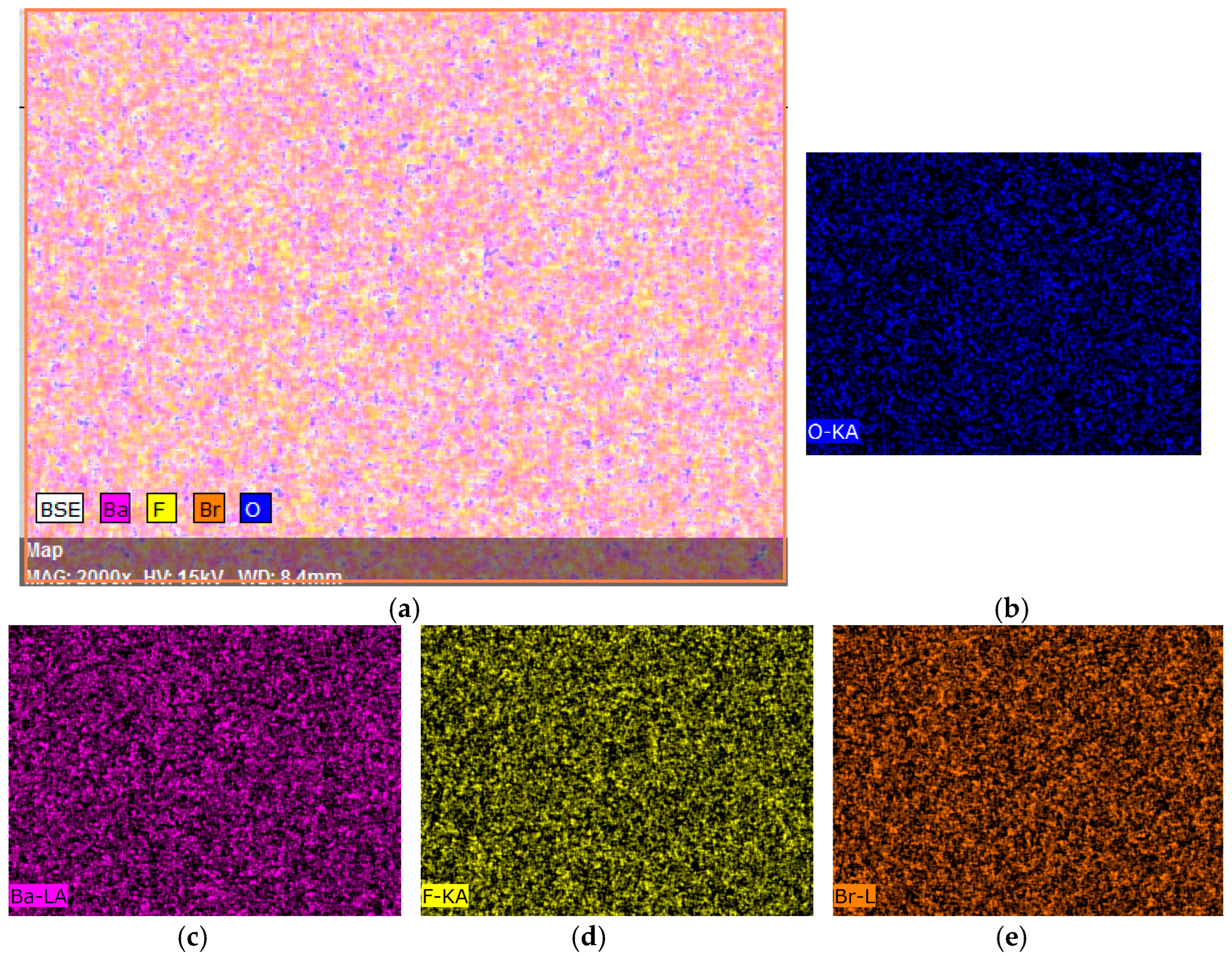
Elemental analysis was performed using energy-dispersive X-ray spectroscopy (EDX) with a Hitachi SEM TM3030 (Hitachi High-Technologies Corporation, Tokyo, Japan) equipped with a Bruker attachment and quantax 70 software (Bruker Nano GmbH, Berlin, Germany). EDX, or Energy Dispersive X-ray Spectroscopy, is a technique used to determine the composition of solid materials. The elemental distribution maps of the initial BaFBr crystal, obtained by EDX are presented in Figure 1.
Figure 1 (a) shows a summary map of the distribution of elements, where each element is represented by its own color: (b) oxygen (O); (c) barium (Ba); (d) fluorine (F); (e) bromine (Br). The map shows a uniform distribution of the main elements across the entire area of the crystal under study. The structure is homogeneous, with no noticeable clusters or local concentrations of any element. The EDX data demonstrates that BaFBr crystals are stoichiometric (F—38.3 at.%, Br—32.0 at.%, Ba—25.2 at.%, and O—3.6 at.%), but they also contain some oxygen impurities [28].
The X-ray exited optical luminescence (XEOL) spectra of crystals were measured in the range of (2–5) eV at X-ray irradiation parameters of 25 mA and 30 kV at RT.
Pulsed cathodoluminescence (PCL) was excited by a pulsed electron beam by the accelerator GIN-600 (Tomsk Polytechnic University, Tomsk, Russia) with the following parameters: the average energy of accelerated electrons E = 0.25 MeV, the electron pulse duration at half-width t1/2 was 15 ns, and the electron beam power density Pp = 40 mJ/cm2. The spectra were measured on an optical spectrometer consisting of MDR-3 monochromator, PEM-97 photomultiplier tube, and a four-channel 350 MHz oscilloscope LeCroy WR 6030A (Test Equipment Center, Gainesville, FL, USA). Luminescence oscillograms were obtained for photons with energy ranging from 1.0 to 5.0 eV at room temperature. These oscillograms were subsequently transformed into luminescence kinetic curves to evaluate the luminescence decay parameters and to record the luminescence spectrum at specific time delays with a temporal resolution of 7 ns.

3. Results and Discussion

3.1. X-Ray Excited Optical Luminescence (XEOL)

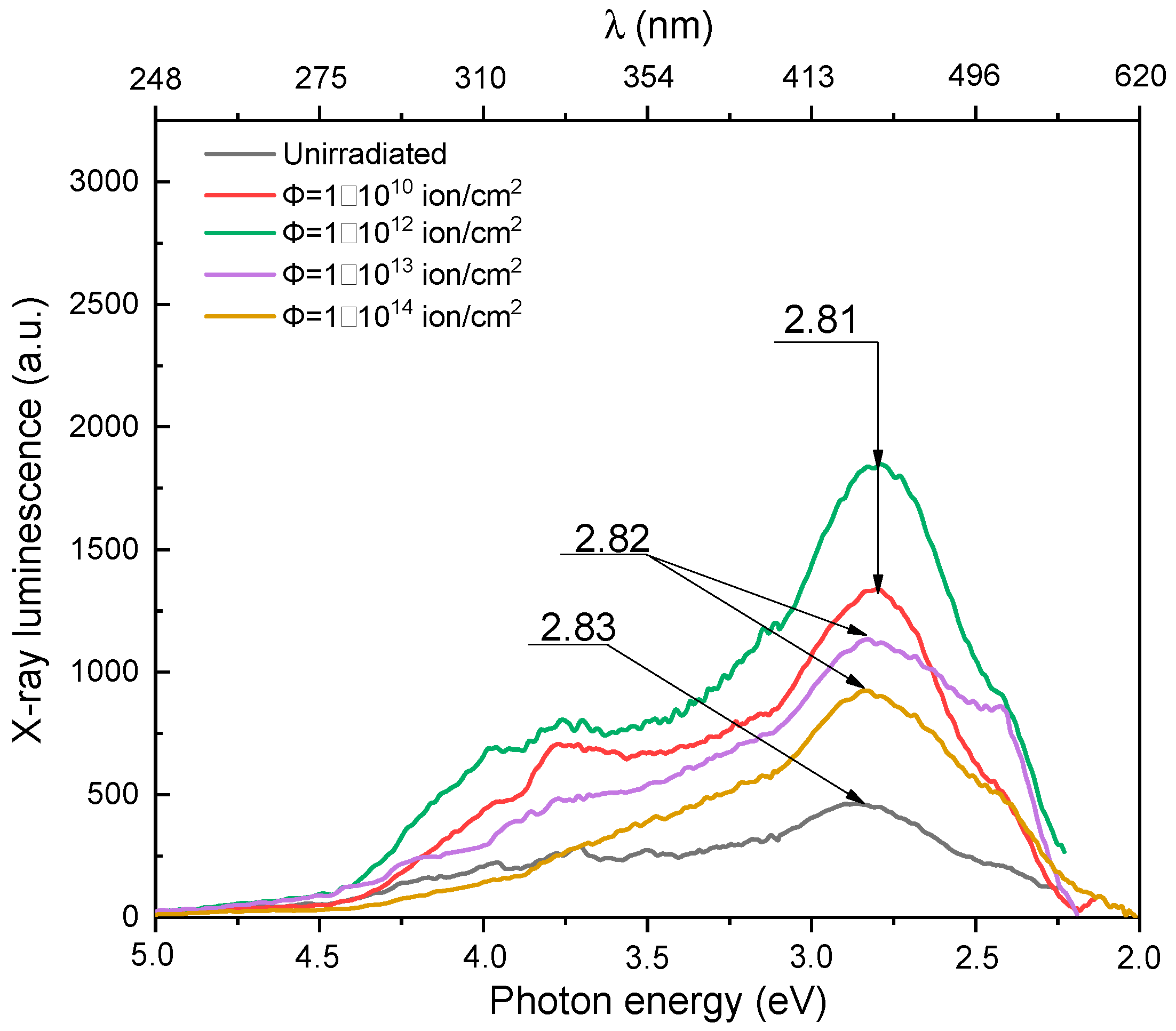
In the X-ray excited optical luminescence (XEOL) spectra measured at RT (Figure 2), peaks with maximum at 2.81 eV, a broad band with a maximum around 3.7 eV, and emission at 2.3 eV were observed (Figure 1). In contrast, the study by [29] reported only a broad band with a maximum at 440 nm (2.81 eV). This discrepancy is most likely due to differences in sample preparation methods. The BaFBr samples in this study were obtained by solid-state reaction.
According to [29], the XEOL peak at 2.81 eV can be attributed to an O2−—substituting halide center. It is known that the PL of 2.5 eV corresponds to the oxygen-vacancy defect (Type I) O F v B r + centers (where an oxygen ion takes the place of fluorine ion, and vacancy compensates the charge). In the second type center, the oxygen ion replaces the bromine ion and is located next to the bromine vacancy. The design of this center resembles the following: O B r v B r + with PL 2.05 eV. Both types of centers were present in the unirradiated crystal, as shown in Figure 1. Also, the O F v F + center (Type III) corresponds to luminescence with a maximum of 2.31–2.29 eV [30]. Figure 1 shows that there is a significant presence of these centers, which leads to a shift in the maximum of the luminescence bands of these centers [28]. Thus, the PL maximum of 2.5 eV can be shifted to 2.75 eV. Therefore, the 2.81 eV band can be attributed to a defect of Type I.
The emissions 3.7–4 eV are observed under X-ray excitation at photon energies exceeding the bandgap of BaFBr, Eg = 8.2 eV [29]. According to work [30], the 4.2 eV PL corresponds to the emission of a self-trapped bromine exciton. Therefore, the observed highly energetic luminescence is most likely due to perturbed exciton. Here, we rely on the work of [31], where the PL band at 4.2 eV may arise from a perturbed exciton trapped near point defects or impurity ions. Such a perturbed exciton can be formed in the configuration F + Vk ( Br 2 ) in the presence of the neighboring impurity ion O 2 .
It should be noted that the increase in XEOL intensity up to a fluence of 1012 ions/cm2, followed by a subsequent decrease, may be reasonably interpreted in terms of reabsorption within the irradiated layer and scattering on irradiation-induced macrodefects (hillocks and latent tracks). The formation of latent tracks in BaFBr crystals under irradiation with 147 MeV 84Kr ions has been reported in Refs. [28,32].

3.2. The Pulsed Cathodoluminescence (PCL)

The pulsed cathodoluminescence (PCL) spectrum of unirradiated crystals, measured at the initial moment after the excitation pulse (I0), consists of a band with a maximum around 4.2 eV. According to [33], this corresponds to the emission of a self-trapped bromine exciton. In [31], the authors proposed that self-trapped excitons (STEs) in BaFBr crystals have a two-center structure consisting of an electron and a self-trapped hole—Vk center.
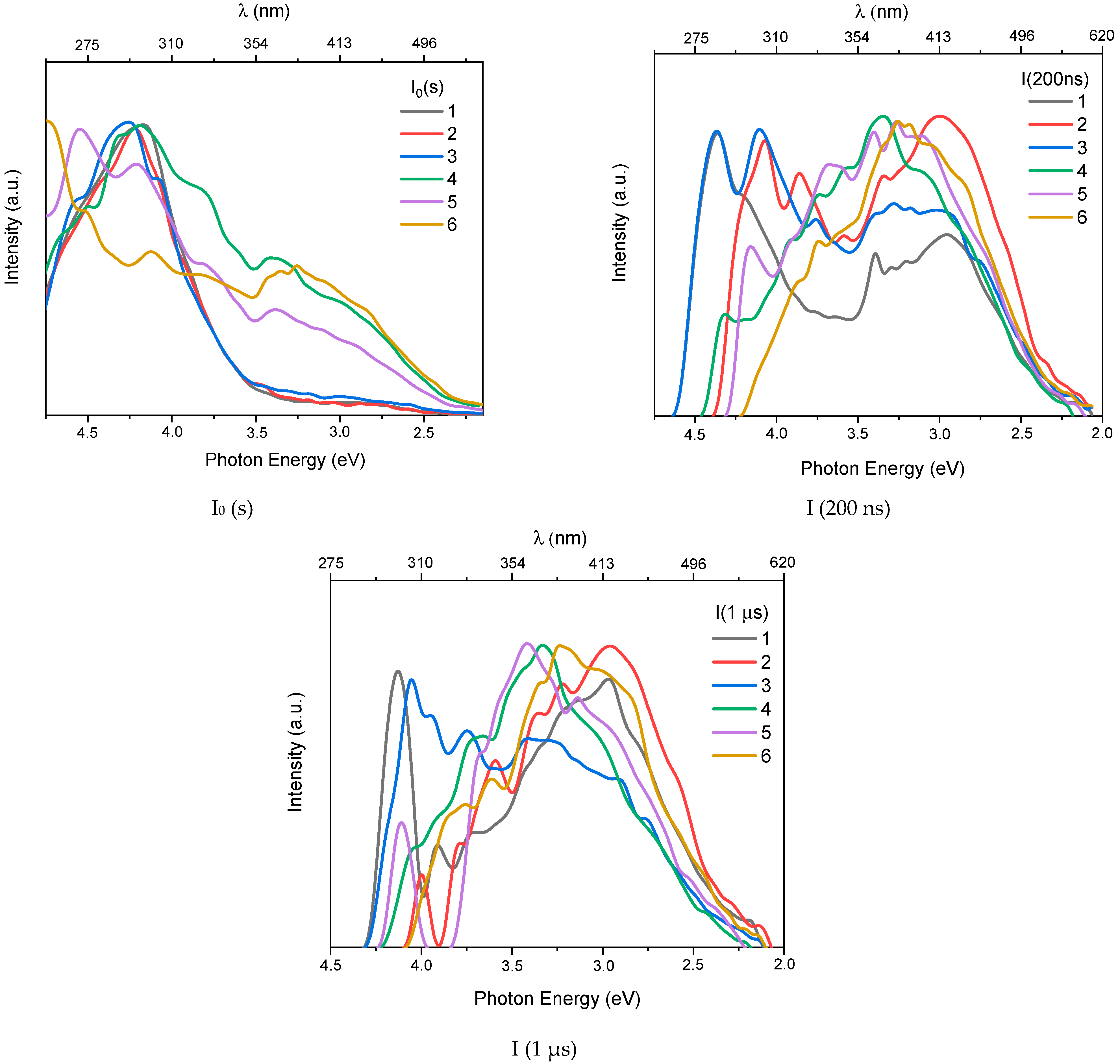
A gradual decrease in intensity and noticeable modifications in the shape of the luminescence curve in the ultraviolet spectral region were observed in all samples irradiated with krypton ions. Figure 3 illustrates the dependence of the 4.2 eV band intensity in the PCL spectrum on Kr ion beam fluence.
The nanosecond component of the PCL spectra exhibits an initial increase up to a fluence of 1 × 10¹² ions/cm2, followed by a gradual decay up to 1 × 10¹⁴ ions/cm2. No noticeable changes in the intensity of the microsecond component were detected as a function of fluence.
A distinctive feature of the 4.2 eV luminescence band is its unusually strong intensity even at room temperature. This behavior is confirmed by pulsed cathodoluminescence measurements presented in Figure 3.
The kinetics of luminescence decay are described by an exponential time dependence of a general form.
I t = I 0 exp t τ
where I0—the amplitude value of the luminescence intensity after the excitation pulse ends, and τ—is the characteristic decay time.
The authors of [31] do not attribute the 4.2 eV band to the intrinsic luminescence of the BaFBr crystal, unlike the other exciton band at 5.15 eV. According to [31], the 4.2 eV band may originate from a perturbed exciton trapped near point defects or impurity ions. Such a perturbed exciton may form in the F + Vk ( Br 2 ) configuration in the presence of a neighboring O2− impurity ion.
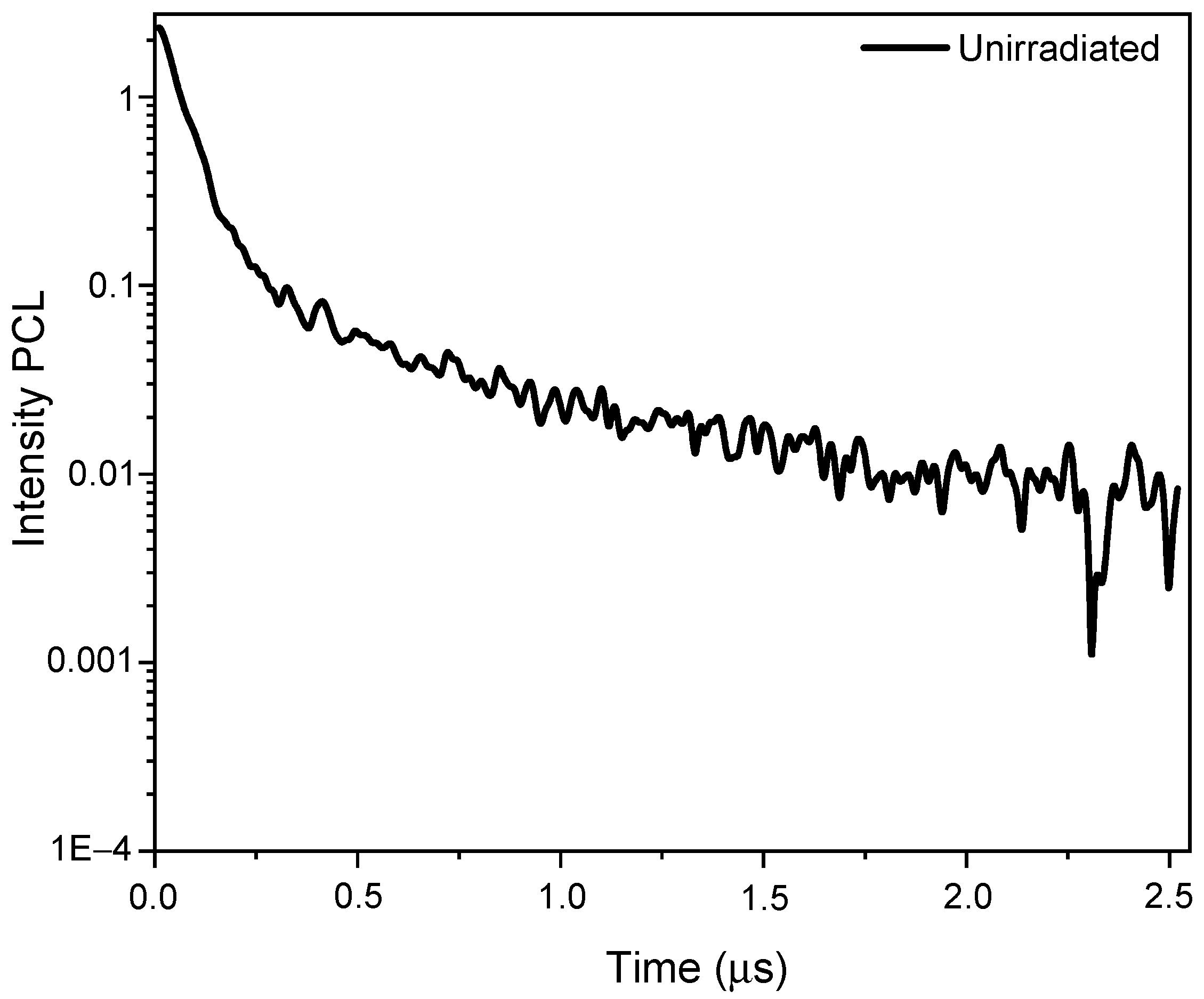
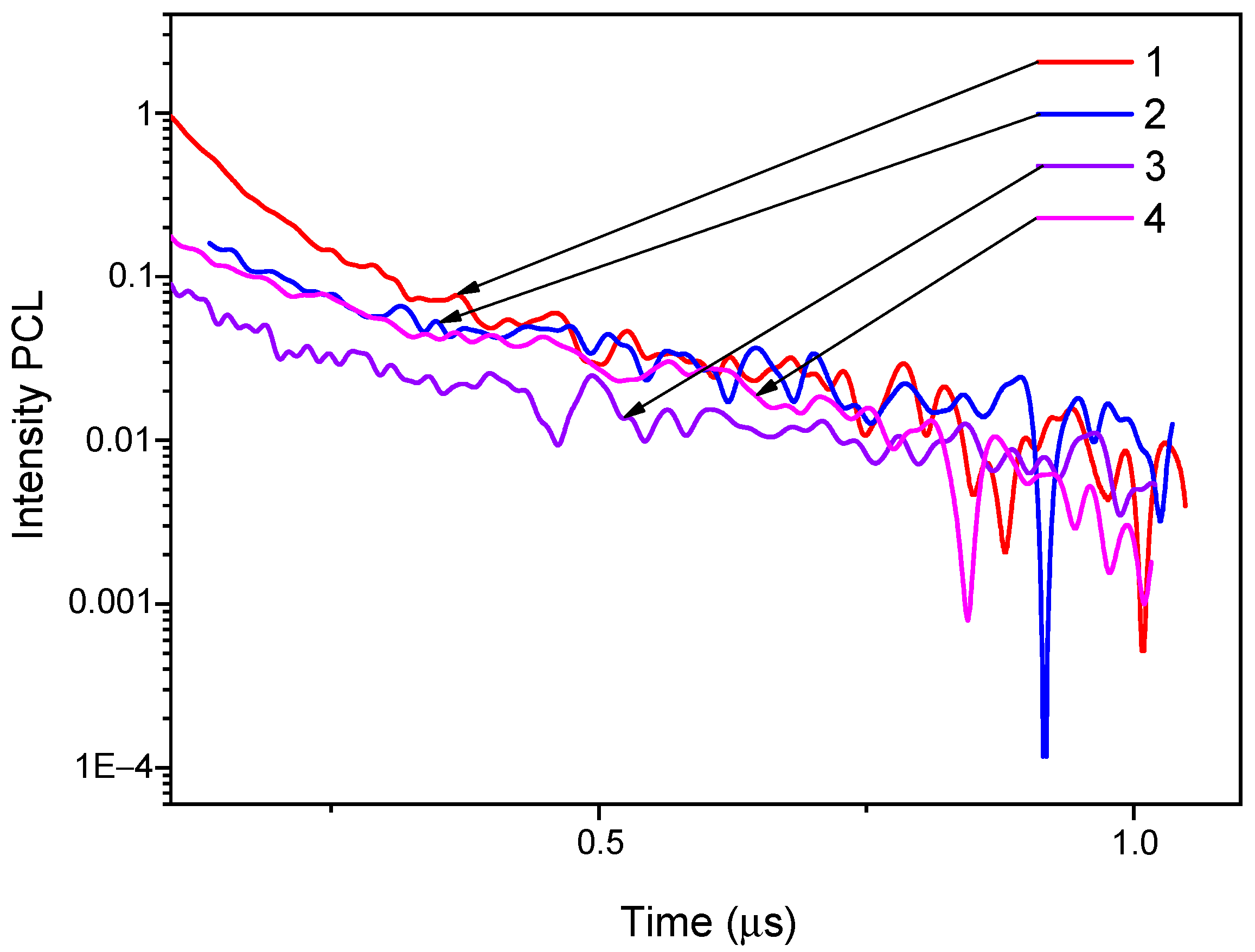
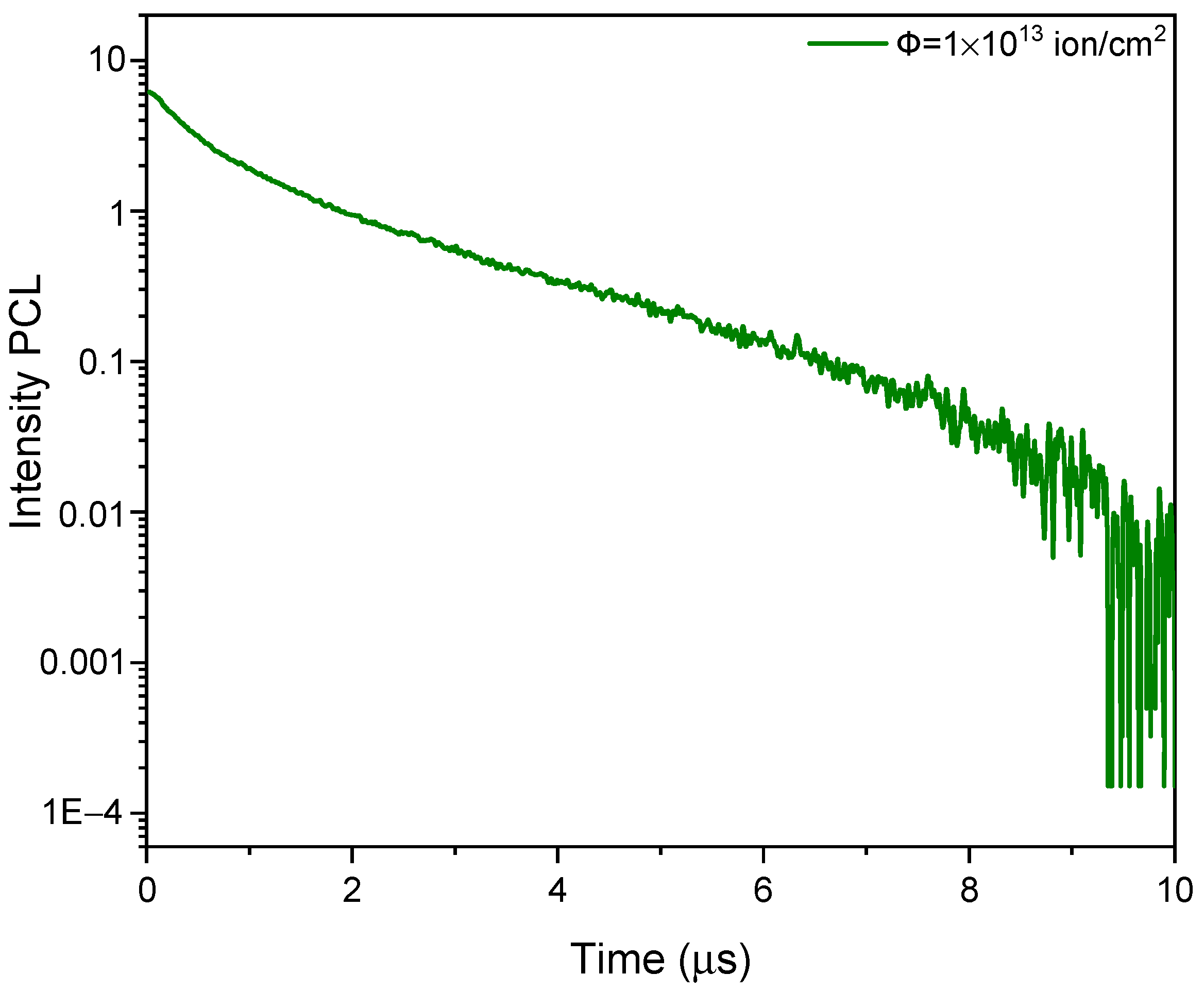
The luminescence decay kinetics of the samples studied are presented in Figure 4, Figure 5 and Figure 6. The decay kinetics of the 4.2 eV band in unirradiated and irradiated BaFBr crystals exposed to heavy ions at different fluences are described by a set of two exponential functions at T = 296 K, each with different characteristic decay times (see Table 2).
According to the data presented in Table 2, the amplitude decay kinetics of the pulsed cathodoluminescence spectra in BaFBr crystals irradiated with krypton ions are dominated by a fast component in the nanosecond range. The analysis (Table 2) shows that the amplitudes of this nanosecond PCL component do not exhibit a systematic dependence on ion fluence: although an increase is observed at Φ = 1 × 10¹³ ions/cm2, the values at Φ = 1 × 10¹⁴ ions/cm2 return to the level characteristic of lower fluences.
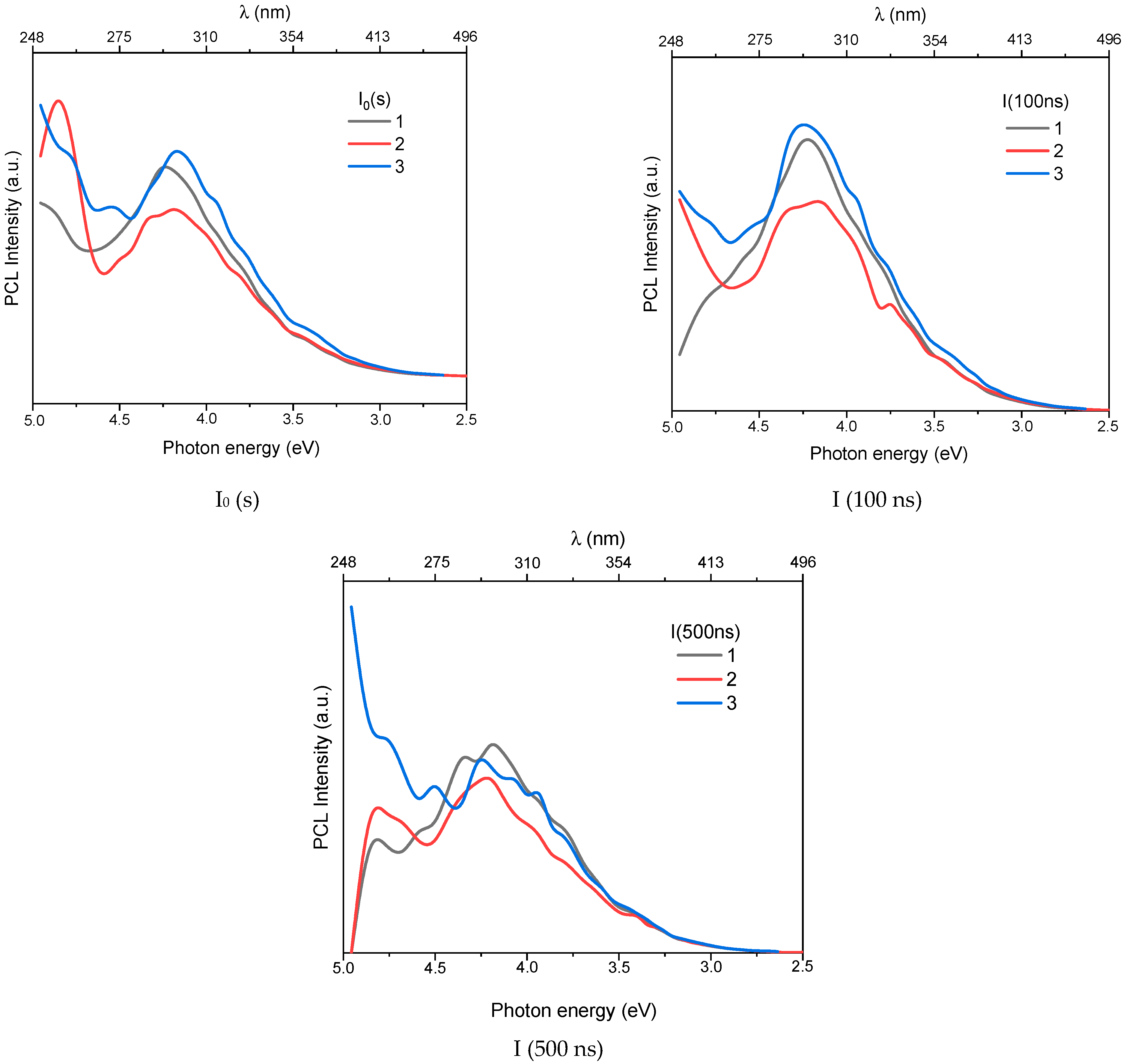
As in the case of BaFBr, a maximum intensity of approximately 4.13 eV (λ = 300 nm) was detected in the BaF2 samples studied, regardless of fluence (Figure 7). This luminescence corresponds to electron–hole and exciton recombination processes in the crystal. During irradiation with krypton ions, radiation defects are formed in the visible region of the studied crystals. This effect is associated with electron–hole and exciton processes in the crystal.
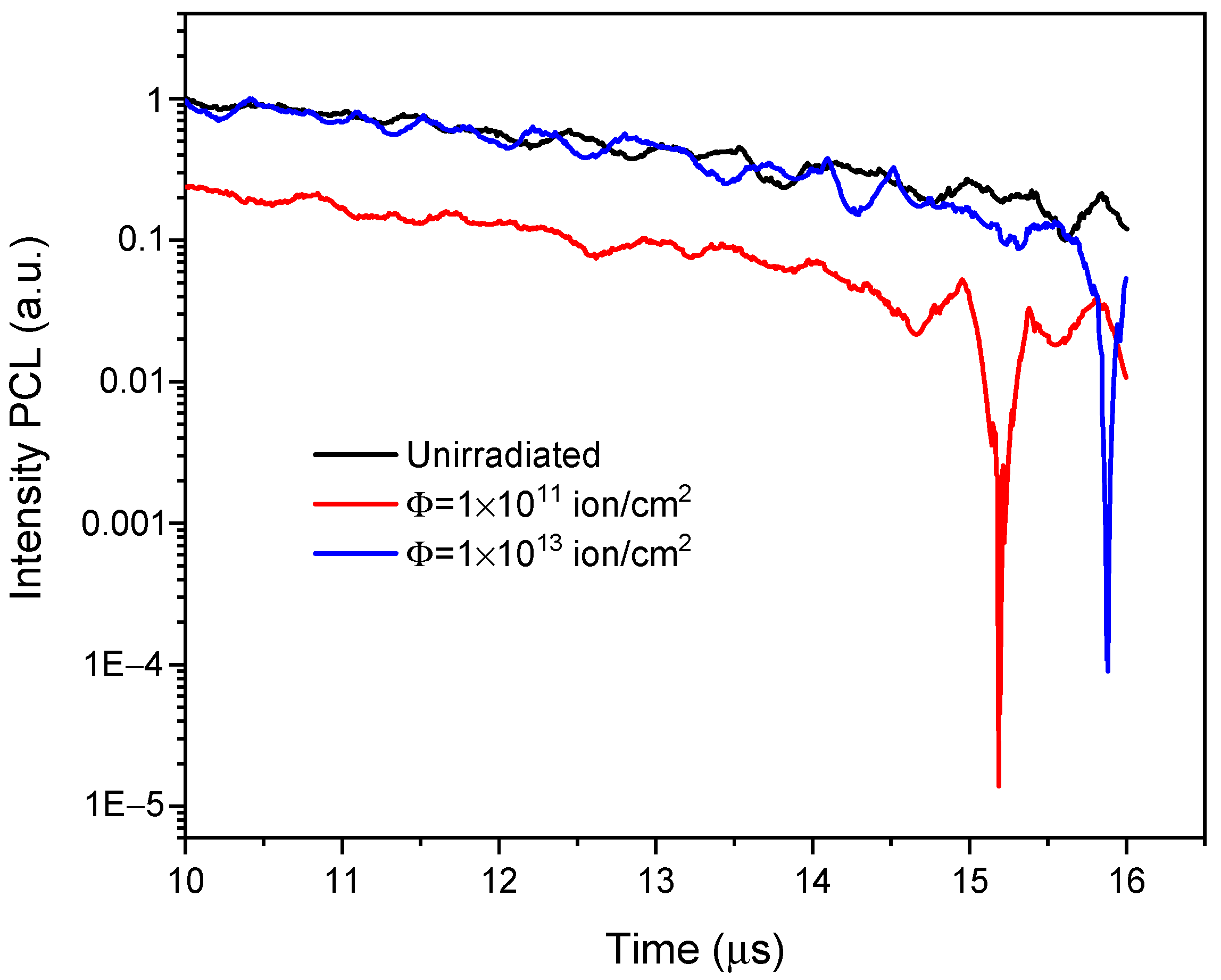
STE in BaF2 crystals (Figure 8) is characterized by a slow component and has a lifetime of several hundred nanoseconds [34,35]. As mentioned earlier, defect formation phenomena directly affect the delay and intensity of STE luminescence. In particular, a decrease in intensity and a change in the peak decay time are possible (Table 3).
Table 3 shows that the fast component τ1 prevails in the unirradiated BaF2 crystal sample. Depending on the krypton ion fluence, a noticeable change in lifetime and amplitude can be observed, which is possible due to the formation of radiation defects. The effect of irradiation with fast heavy ions on the luminescence kinetics in BaF2 crystals most likely indicates the formation of radiation traps that affect the recombination dynamics.

4. Conclusions

In the XEOL spectra of BaFBr measured at RT, peaks at 2.81 eV and 3.7–4 eV and emissions at 2.3 eV were observed. The luminescence at 2.81 eV can be attributed to the recombination of electrons released during X-ray irradiation with holes trapped at specific sites (Type I, PL). The observed highly energetic luminescence is most likely due to perturbed exciton. Here, we rely on the work of [31], where the PCL band at 4.2 eV may arise from a perturbed exciton trapped near point defects or impurity ions. Such a perturbed exciton can be formed in the configuration F + Vk ( Br 2 ) in the presence of the neighboring impurity ion O 2 . Oxygen impurities play an important role in the formation mechanisms of these centers. A distinctive feature of the 4.2 eV luminescence band is its strong intensity at significantly high temperatures (RTs). In the decay kinetics of the PCL spectra, a fast component in the nanosecond range dominates, which remains independent of fluence in BaFBr crystals irradiated with krypton ions. Irradiation of BaF2 crystals with krypton ions significantly affects the decay kinetics, changing both the lifetimes and amplitudes of the components, which reflects the process of defect formation in crystal structures.

Author Contributions

Conceptualization, A.D. and D.K.; methodology, A.D. and D.K.; validation, A.D., D.K., and A.A.; formal analysis, A.D. and A.A.; investigation, D.K., B.S., G.A., and M.K.; data curation, D.K.; writing—original draft preparation, A.D., D.K., and A.A.; writing—review and editing, A.D. and A.A.; visualization, G.A. and B.S.; supervision, D.K.; project administration, A.A.; funding acquisition, D.K. All authors have read and agreed to the published version of the manuscript.

Funding

This research was funded by the Committee of Science of the Ministry of Science and Higher Education of the Republic of Kazakhstan (Grant No. AP19178510).

Data Availability Statement

The raw data supporting the conclusions of this article will be made available by the authors on request.

Acknowledgments

We are grateful for the financial support provided by the Science Committee of the Ministry of Science and Higher Education of the Republic of Kazakhstan, grant No. AP19178510.

Conflicts of Interest

The authors declare no conflicts of interest.

References

  1. Horst, A.; Joachim, D.; Sigrid, J.-B.; Manfred, S. Radiation Exposure and Image Quality in X-Ray Diagnostic Radiology. In Physical Principles and Clinical Applications; Springer: Berlin/Heidelberg, Germany, 2012; Volume 2, p. 30. [Google Scholar] [CrossRef]
  2. Mbagwu, J. Theoretical investigation of dosimeter accuracy for linear energy transfer measurements in proton therapy: A comparative study of stopping power ratios. Radiat. Phys. Chem. 2025, 227, 112354. [Google Scholar] [CrossRef]
  3. Hirata, Y.; Kai, T.; Ogawa, T.; Matsuya, Y.; Sato, T. Development of a model for evaluating the luminescence intensity of phosphors based on the PHITS track-structure simulation. Nucl. Instrum. Methods Phys. Res. Sect. B Beam Interact. Mater. At. 2024, 547, 165183. [Google Scholar] [CrossRef]
  4. Vanderloo, N.; Cufari, M.; Russell, L.; Johnson, T.M.; Vargas, J.; Foo, B.C.; Buschmann, B.I.; Dannhoff, S.G.; DeVault, A.; Evans, T.E.; et al. Image plate multi-scan response to fusion protons in the range of 1–14 MeV. Rev. Sci. Instrum. 2024, 95, 093536. [Google Scholar] [CrossRef]
  5. Hayashi, Y.; Mori, M.; Kotaki, H.; Onoda, S.; Yamada, K.; Kando, M. Measuring the sensitivity of imaging plates to keV carbon ions. Rev. Sci. Instrum. 2024, 95, 123309. [Google Scholar] [CrossRef]
  6. Kimura, H.; Kato, T.; Fujiwara, T.; Tanaka, M.; Okada, G.; Nakauchi, D.; Kawaguchi, N.; Yanagida, T. Optical and photostimulated luminescence properties of Eu:BaFBr translucent ceramics synthesized by SPS. Ceram. Int. 2023, 49, 15315–15319. [Google Scholar] [CrossRef]
  7. Bezrukovs, V.; Konuhova, M.; Bezrukovs, D.; Berzins, A. Hydrogen Hydraulic Compression System for Refuelling Stations. Latv. J. Phys. Tech. Sci. 2022, 59 (Suppl. S3), 96–105. [Google Scholar] [CrossRef]
  8. Hirata, Y.; Sato, T.; Watanabe, K.; Ogawa, T.; Parisi, A.; Uritani, A. Theoretical and experimental estimation of the relative optically stimulated luminescence efficiency of an optical-fiber-based BaFBr:Eu detector for swift ions. J. Nucl. Sci. Technol. 2022, 59, 915–924. [Google Scholar] [CrossRef]
  9. Rajakrishna, K.; Dhanasekaran, A.; Yuvaraj, N.; Ajoy, K.C.; Venkatraman, B.; Jose, M.T. Improvement in Plastic Scintillator with Loading of BaFBr:Eu2;⁺ Radioluminescence Phosphor. IEEE Trans. Nucl. Sci. 2021, 68, 1286–1295. [Google Scholar] [CrossRef]
  10. Popov, A.; Zimmermann, J.; McIntyre, G.; Wilkinson, C. Photostimulated luminescence properties of neutron image plates. Opt. Mater. 2016, 59, 83–86. [Google Scholar] [CrossRef]
  11. Blakeley, M. Neutron macromolecular crystallography. Crystallogr. Rev. 2009, 15, 157–218. [Google Scholar] [CrossRef]
  12. Rajan, K.G.; Yousuf, M.; Subramanian, N.; Pumiah, B.; Kasiviswanathan, K.V. Photostimulable luminescence: Physics and applications. Indian J. Pure Appl. Phys. 1997, 35, 699–708. [Google Scholar]
  13. Kobayashi, H.; Satoh, M.; Matsubayashi, M. Study for a novel tomography technique using an imaging plate. Nucl. Instrum. Methods Phys. Res. Sect. A 1999, 424, 221–228. [Google Scholar] [CrossRef]
  14. Ohnishi, A.; Kan’No, K.; Iwabuchi, Y.; Mori, N. Luminescence from self-trapped excitons in BaFCl/BaFBr solid solutions. J. Electron Spectrosc. Relat. Phenom. 1996, 79, 159–162. [Google Scholar] [CrossRef]
  15. Kubota, S.; Ruan, J.; Itoh, M.; Hashimoto, S.; Sakuragi, S. A new type of luminescence mechanism in large band-gap insulators: Proposal for fast scintillation materials. Nucl. Instrum. Methods Phys. Res. Sect. A 1990, 289, 253–260. [Google Scholar] [CrossRef]
  16. Cadatal-Raduban, M.; Mui, L.V.; Yamashita, M.; Shibazaki, Y.; Shimizu, T.; Sarukura, N.; Yamanoi, K. Pressure-controlled luminescence in fast-response barium fluoride crystals. NPG Asia Mater. 2024, 16, 50. [Google Scholar] [CrossRef]
  17. van Eijk, C. Cross-luminescence. J. Lumin. 1994, 60–61, 936–941. [Google Scholar] [CrossRef]
  18. Kirm, M.; Nagirnyi, V.; Vielhauer, S.; Feldbach, E. Relaxation and interaction of electronic excitations induced by intense ultra short light pulses in BaF2 scintillator. In Damage to VUV, EUV, and X-Ray Optics III, Proceedings of the 2011 SPIE Optics + Optoelectronics, Prague, Czech Republic, 18–21 April 2011; SPIE: Bellingham, WA, USA, 2011. [Google Scholar] [CrossRef]
  19. Wilkinson, C.; Gabriel, A.; Lehmann, M.; Zemb, T.; Ne, F. Image plate neutron detector. In SPIE 1737, Neutrons, X Rays, and Gamma Rays: Imaging Detectors, Material Characterization Techniques, and Applications, Proceedings of the San Diego ‘92, San Diego, CA, USA, 2 February 1993; SPIE: Bellingham, WA, USA, 1993. [Google Scholar] [CrossRef]
  20. Niimura, N.; Karasawa, Y.; Tanaka, I.; Miyahara, J.; Takahashi, K.; Saito, H.; Koizumi, S.; Hidaka, M. An imaging plate neutron detector. Nucl. Instrum. Methods Phys. Res. Sect. A 1994, 349, 521–525. [Google Scholar] [CrossRef]
  21. Cipriani, F.; Castagna, J.-C.; Claustre, L.; Wilkinson, C.; Lehmann, M.S. Large area neutron and X-ray image-plate detectors for macromolecular biology. Nucl. Instrum. Methods Phys. Res. Sect. A 1997, 392, 471–474. [Google Scholar] [CrossRef]
  22. Wilkinson, C.; Cowan, J.A.; Myles, D.A.A.; Cipriani, F.; McIntyre, G.J. VIVALDI—A thermal-neutron laue diffractometer for physics, chemistry and materials science. Neutron News 2002, 13, 37–41. [Google Scholar] [CrossRef]
  23. Tosaki, M.; Nakamura, M.; Hirose, M.; Matsumoto, H. Application of heavy-ion microbeam system at Kyoto University: Energy response for imaging plate by single ion irradiation. Nucl. Instrum. Methods Phys. Res. Sect. B Beam Interact. Mater. At. 2011, 269, 3145–3148. [Google Scholar] [CrossRef]
  24. Batentschuk, M.; Winnacker, A.; Schwartz, K.; Trautmann, C. Storage efficiency of BaFBr:Eu2+ image plates irradiated by swift heavy ions. J. Lumin. 2007, 125, 40–44. [Google Scholar] [CrossRef]
  25. Shalaev, A.A.; Radzhabov, E.A. Single crystal growth of BaFBr:Eu storage phosphor with alkali impurities. J. Cryst. Growth 2005, 275, e775–e777. [Google Scholar] [CrossRef]
  26. Akilbekov, A.; Kenbayev, D.; Dauletbekova, A.; Polisadova, E.; Yakovlev, V.; Karipbayev, Z.; Shalaev, A.; Elsts, E.; Popov, A.I. The Effect of Fast Kr Ion Irradiation on the Optical Absorption, Luminescence, and Raman Spectra of BaFBr Crystals. Crystals 2023, 13, 1260. [Google Scholar] [CrossRef]
  27. Ziegler, J.F.; Ziegler, M.D.; Biersack, J.P. SRIM—The stopping and range of ions in matter. Nucl. Instrum. Methods Phys. Res. Sect. B Beam Interact. Mater. At. 2010, 268, 1818–1823. [Google Scholar] [CrossRef]
  28. Akilbekov, A.; Kenbayev, D.; Dauletbekova, A.; Shalaev, A.; Akylbekova, A.; Aralbayeva, G.; Baimukhanov, Z.; Baizhumanov, M.; Elsts, E.; Popov, A.I. The Effect of 147 MeV 84Kr and 24.5 MeV 14N Ions Irradiation on the Optical Absorption, Luminescence, Raman Spectra and Surface of BaFBr Crystals. Crystals 2024, 14, 480. [Google Scholar] [CrossRef]
  29. Rajan, K.G.; Lenus, A.J. X-ray excited optical luminescence studies on the system BaXY (X,Y = F, Cl, Br, I). Pramana—J. Phys. 2005, 65, 323–338. [Google Scholar] [CrossRef]
  30. Radzhabov, E.A.; Egranov, A.V. Exciton emission in BaFBr and BaFCl crystals. J. Phys. Condens. Matter 1994, 6, 5639–5645. [Google Scholar] [CrossRef]
  31. Ohnishi, A.; Kan’NO, K.; Iwabuchi, Y.; Mori, N. Recombination luminescence from self-trapped excitons in BaFBr. Nucl. Instrum. Methods Phys. Res. Sect. B Beam Interact. Mater. At. 1994, 91, 210–214. [Google Scholar] [CrossRef]
  32. Inerbaev, T.; Akilbekov, A.; Kenbayev, D.; Dauletbekova, A.; Shalaev, A.; Polisadova, E.; Konuhova, M.; Piskunov, S.; Popov, A.I. Color Centers in BaFBr Crystals: Experimental Study and Theoretical Modeling. Materials 2024, 17, 3340. [Google Scholar] [CrossRef] [PubMed]
  33. Baetzold, R.C. Possibility of off-center-exciton formation in BaFBr. Phys. Rev. B 1989, 40, 3246–3248. [Google Scholar] [CrossRef]
  34. Gundacker, S.; Pots, R.H.; Nepomnyashchikh, A.; Radzhabov, E.; Shendrik, R.; Omelkov, S.; Kirm, M.; Acerbi, F.; Capasso, M.; Paternoster, G.; et al. Vacuum ultraviolet silicon photomultipliers applied to BaF2 cross-luminescence detection for high-rate ultrafast timing applications. Phys. Med. Biol. 2021, 66, 114002. [Google Scholar] [CrossRef] [PubMed]
  35. Kenbayev, D.; Sorokin, M.V.; El-Said, A.S.; Dauletbekova, A.; Saduova, B.; Aralbayeva, G.; Akilbekov, A.; Shablonin, E.; Bazarbek, A.-D. Creation and Stability of Color Centers in BaF2 Single Crystals Irradiated with Swift 132Xe Ions. Crystals 2025, 15, 785. [Google Scholar] [CrossRef]
Figure 1. Maps of element distribution in the initial BaFBr crystal obtained using EDX. Image size: 480 × 360. Magnification: 2000×. Voltage: 15.0 kV.
Crystals 15 01027 g001
Figure 2. XEOL spectra of virgin BaFBr crystals and irradiated with 147 MeV 84Kr ions to fluences 1 × 10¹⁰–1 × 10¹⁴ ion/cm2 at RT.
Crystals 15 01027 g002
Figure 3. Dependence of spectra I0 (s), nanosecond I (200 ns), and microsecond I (1 μs) components of pulsed cathodoluminescence decay of BaFBr crystals irradiated by 147 MeV Kr ions at RT on fluence: (1) Unirradiated sample, (2) 1 × 10¹⁰ ion/cm2; (3) 1 × 10¹¹ ion/cm2; (4) 1 × 10¹² ion/cm2; (5) 1 × 10¹³ ion/cm2; (6) 1 × 10¹⁴ ion/cm2.
Crystals 15 01027 g003
Figure 4. Decay kinetics of the 4.2 eV luminescence band in BaFBr crystals at room temperature.
Crystals 15 01027 g004
Figure 5. Decay kinetics of the 4.2 eV luminescence band in BaFBr crystals irradiated with 147 MeV Kr ions at room temperature as a function of fluence: (1) 1 × 10¹⁰ ions/cm2; (2) 1 × 10¹¹ ions/cm2; (3) 1 × 10¹² ions/cm2; (4) 1 × 10¹⁴ ions/cm2.
Crystals 15 01027 g005
Figure 6. Decay kinetics of the 4.2 eV luminescence band in BaFBr crystals irradiated with 147 MeV Kr ions at room temperature, Φ = 1 × 10¹³ ions/cm2.
Crystals 15 01027 g006
Figure 7. Dependence of spectra I0 (s), nanosecond I (100 ns), and microsecond I (500 ns) components of pulsed cathodoluminescence decay of BaF2 crystals irradiated by 147 MeV Kr ions at RT on fluence: (1) Unirradiated sample; (2) 1 × 10¹¹ ion/cm2; (3) 1 × 10¹³ ion/cm2.
Crystals 15 01027 g007
Figure 8. Decay kinetics of the 4.2 eV luminescence band in BaF2 crystals irradiated with 147 MeV Kr ions at room temperature as a function of fluence: Unirradiated; Φ = 1 × 10¹¹ ions/cm2; Φ = 1 × 10¹³ ions/cm2.
Crystals 15 01027 g008
Table 1. Dimensions of BaFBr Samples Before and After Kr Ion Irradiation.
ObjectIonEnergy, MeVFluence, Ions/cm2R, µmLength, mmWidth, mmThickness, mm
BaFBrUnirr.1091
Kr147101017.8712101
101111100.9
1012961
10131050.5
1014740.3
Table 2. Characteristic decay time values.
Ion(Φ),
Ion/cm2
(λ),
nm
(τ), mks(A)
τ1τ2A1A2
84Krvirgin2950.0570.5412.8410.116
1 × 10102950.0570.5714.8530.146
1 × 10112950.0620.7210.8170.108
1 × 10122950.04780.2660.2740.065
1 × 10132900.3921.9854.0932.551
1 × 10143100.0590.4670.4540.125
Table 3. Characteristic decay time values for BaF2.
Ion(Φ),
Ion/cm2
(λ),
nm
(τ), mks(A)
τ1τ2A1A2
84Krvirgin3000.3973.9086.17214.659
1 × 10113000.0846.7936.9650.333
1 × 10133000.0961.7110.0550.518
Disclaimer/Publisher’s Note: The statements, opinions and data contained in all publications are solely those of the individual author(s) and contributor(s) and not of MDPI and/or the editor(s). MDPI and/or the editor(s) disclaim responsibility for any injury to people or property resulting from any ideas, methods, instructions or products referred to in the content.