


Abstract
Developing cost-effective photocatalysts with high activity remains a key challenge in photocatalysis. In this study, a low-cost nickel phosphide (Ni2P) cocatalyst was combined with MIL-53(Fe) to fabricate Ni2P/MIL-53(Fe) nanocomposites via a simple hydrothermal method. The as-prepared composites were systematically characterized by XRD, FT-IR, SEM, UV-vis DRS, PL, and EIS to evaluate their structural, morphological, optical, and electrochemical properties. The introduction of Ni2P significantly promoted the separation of photogenerated electron–hole pairs on the MIL-53(Fe) surface, thereby enabling valence band holes (h+) to participate in alcohol oxidation, as confirmed by photoelectrochemical analysis. Under optimized conditions, the Ni2P/MIL-53(Fe) nanocomposite achieved a significant photocatalytic alcohol conversion rate of 74%, which is 7.4-fold and 2.5-fold higher than those of pristine Ni2P and MIL-53(Fe), respectively. Furthermore, mechanistic studies revealed that valence band holes are primarily responsible for the selective oxidation of aromatic alcohols.
1. Introduction
Our growing dependence on fossil fuels has caused serious environmental challenges, creating an urgent need for sustainable, eco-friendly, and clean energy alternatives [1]. Among renewable energy sources, solar energy is the most abundant and promising, as it can be harnessed for electrical, chemical, or thermal energy [2]. Photocatalytic technology, which mimics natural photosynthesis, has emerged as an important approach for utilizing solar energy [3,4]. However, current photocatalytic systems suffer from inefficient solar energy conversion, making the optimization of solar-harvesting efficiency a critical research focus. In parallel, photocatalysis has also found increasing application in selective organic transformations, such as the synthesis of five-membered nitrogen heterocycles, demonstrating its potential beyond environmental remediation [5].
Loading cocatalysts is an effective strategy to enhance the photocatalytic activity of semiconductors [6]. Cocatalysts can efficiently capture photogenerated electrons (e) and promote the separation of electron–hole pairs, thereby facilitating the participation of holes (h+) in oxidation reactions [7,8]. Recently, iron-doped titania coupled with licorice-derived biochar has been shown to significantly enhance the visible light photocatalytic degradation of cationic contaminants. Such biochar-based cocatalysts exemplify how carbonaceous materials can improve photocatalytic activity through enhanced substrate adsorption and facilitated charge separation [9]. Noble metals (e.g., Au [10], Ag [11], Pt [12], and Pd [13]) are widely used as cocatalysts; however, their high cost limits large-scale application, driving the search for low-cost and abundant alternatives. Among the promising alternatives, metal phosphides (e.g., CoP2 [14], FeP [15], MoP [16], Cu3P [17], Ni2P quantum dots [18], and Ni2P [19]) have attracted considerable attention due to their earth abundance, metallic conductivity, and robust stability [13]. Among them, Ni2P is particularly attractive because of low cost, metallic conductivity, and excellent stability over a wide pH range [20,21,22], combined with its hexagonal crystal structure and significant catalytic activity under acidic, alkaline, and neutral conditions. However, most of the reported Ni2P-semiconductor systems are applied to pollutant degradation, rather than selective organic transformations, and the combination of Ni2P with Fe-based MOFs for photocatalytic oxidation of aromatic alcohols has not been systematically investigated. In particular, the influence of Ni2P loading on interfacial charge transfer and the resulting selectivity remains poorly understood. MIL-53(Fe) was selected as the host matrix for its visible light response, high surface area, and structural flexibility [23].
In this work, we demonstrate a low-cost Ni2P/MIL-53(Fe) composite prepared by a simple hydrothermal route, driven by the need to replace noble metals with an earth-abundant cocatalyst for selective oxidation. Characterization results revealed that, although the catalytic activity varied with different Ni2P loadings, the original shuttle-like morphology of MIL-53(Fe) was preserved in all nanocomposites. Compared with pristine MIL-53(Fe), the Ni2P/MIL-53(Fe) nanocomposites exhibited a 2.5-fold increase in conversion efficiency for aromatic alcohol oxidation. The systematic variation of Ni2P content allowed us to correlate the loading with the degree of charge separation and catalytic performance, thereby providing a structure–activity relationship that was previously unavailable. Mechanistic studies based on reactive species trapping confirmed that the oxidation process was primarily governed by hole-mediated reactions. Furthermore, recycling experiments demonstrated excellent photostability, as the aromatic alcohol conversion rate showed no significant decrease after three consecutive catalytic cycles. This work not only expands the application of Ni2P/MOF composites to value-added chemical synthesis, but also clarifies the critical role of cocatalyst loading in balancing activity and selectivity.
2. Results
2.1. Structural Characterization of XNi2P/MIL-53(Fe) Composite Photocatalysts
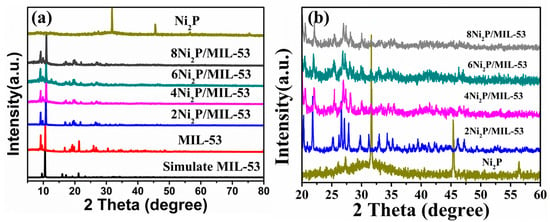
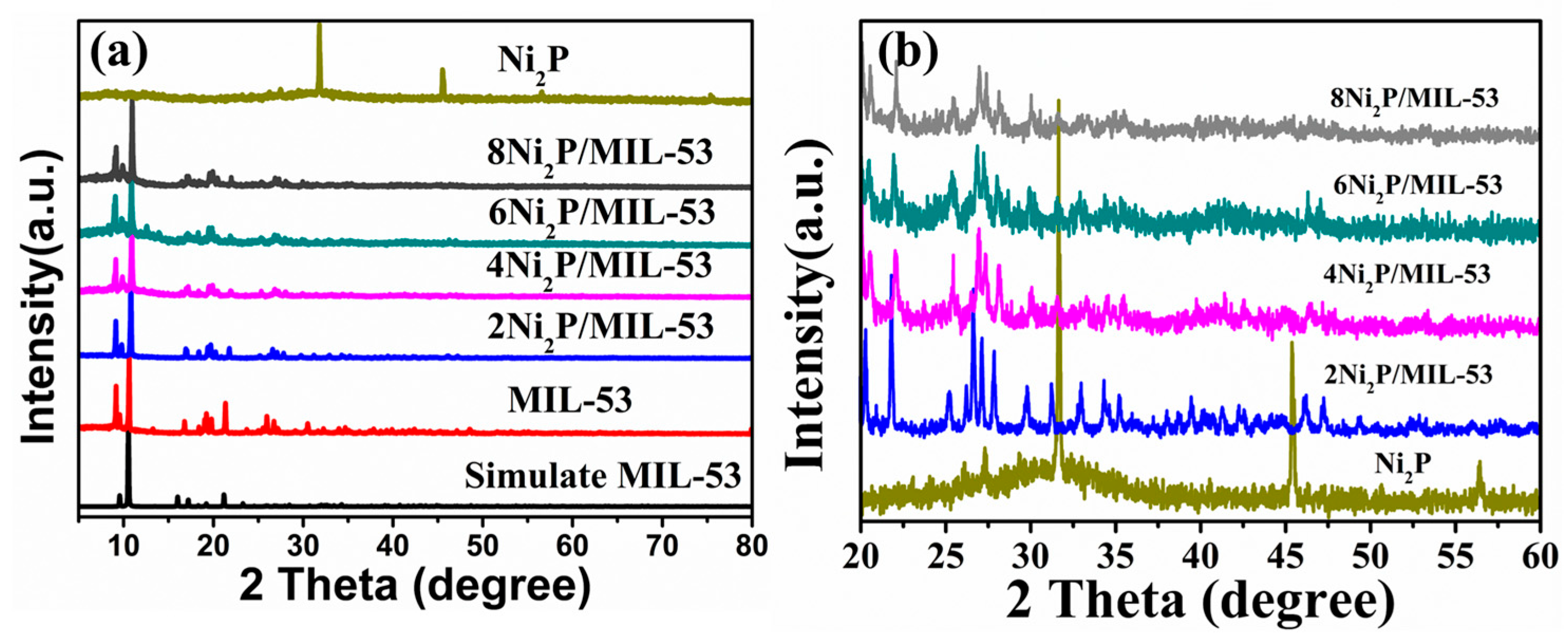
Figure 1 presents the XRD patterns of the as-prepared samples, including MIL-53(Fe), Ni2P, and their corresponding nanocomposites. The diffraction pattern of the synthesized MIL-53(Fe) was in excellent agreement with the simulated crystal structure, confirming the successful formation of the desired framework. For pure Ni2P, characteristic diffraction peaks were observed at 27.3°, 31.6°, 45.6°, 56.6°, and 75.7°, corresponding to the (010), (011), (110), (112), and (300) crystal planes, respectively (JCPDS No. 65-3544). An additional weak peak at 12.1° was also detected, which was attributed to instrumental artifacts rather than to any crystalline phase. Notably, although the diffraction features of MIL-53(Fe) remained prominent in the nanocomposite samples, the characteristic peaks of Ni2P were significantly attenuated. This observation suggests that (1) the crystalline structure of Ni2P remains intact during composite formation, and (2) the reduced peak intensity likely results either from the high dispersion of Ni2P within the MIL-53(Fe) matrix or from the relatively low loading content of Ni2P. The absence of any additional diffraction peaks confirmed that no chemical reaction occurred between Ni2P and MIL-53(Fe) during nanocomposite synthesis.
Figure 1.
(a,b) XRD patterns of the XNi2P/MIL-53(Fe) nanocomposites.
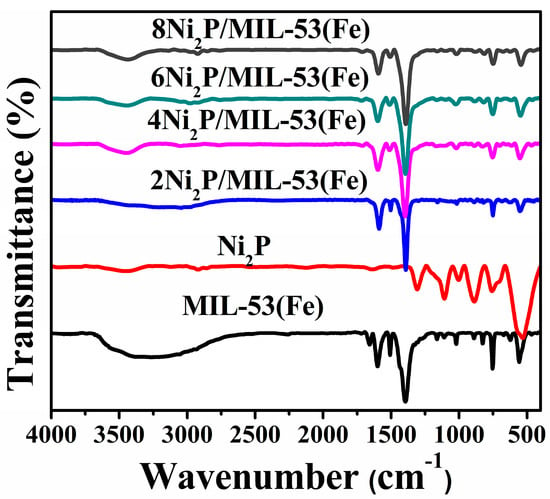
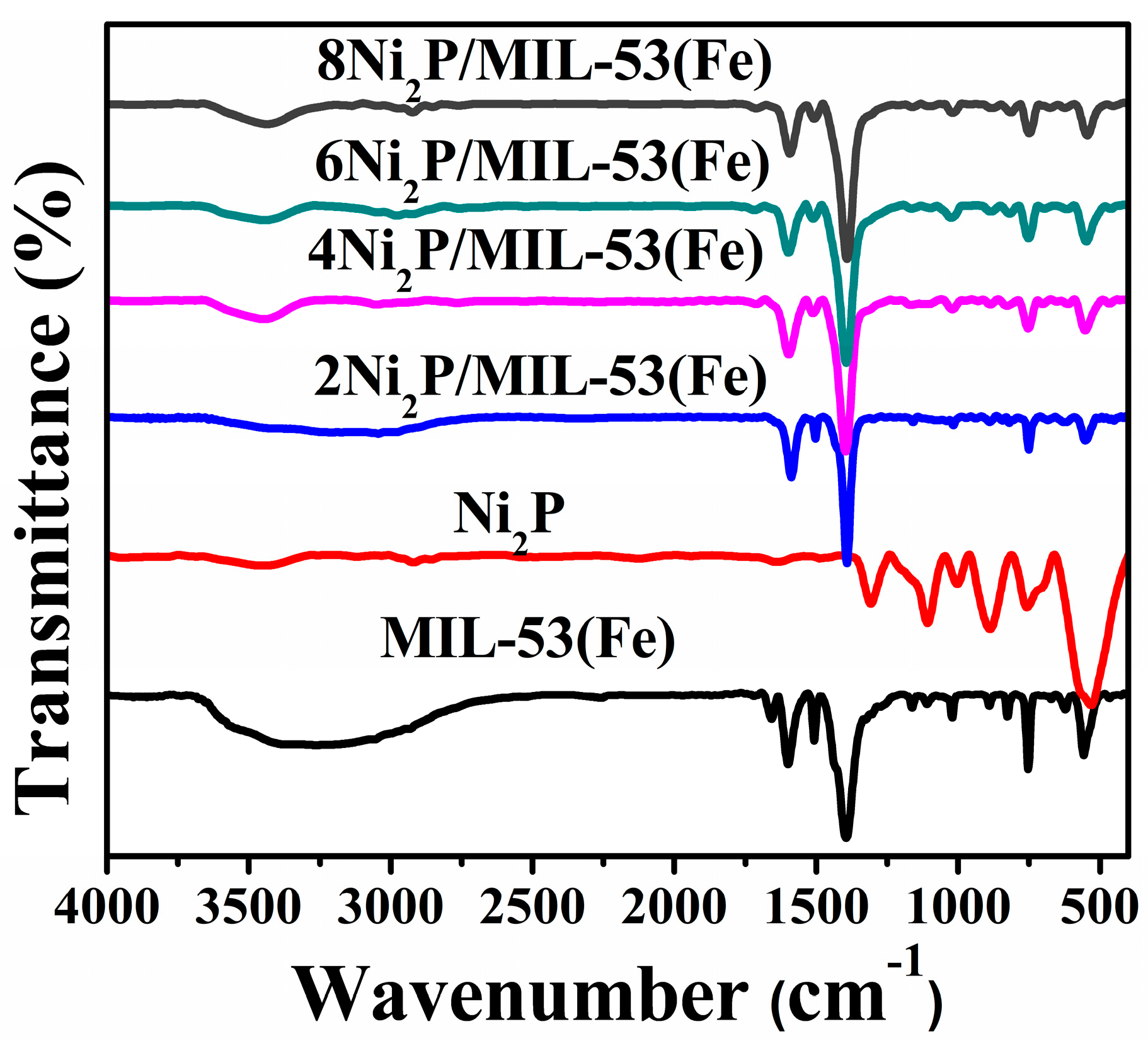
Figure 2 shows the FT-IR spectra of the as-prepared samples. In the spectrum of MIL-53(Fe), the stretching vibration of the benzene ring skeleton appears at 1597 cm−1, while the asymmetric and symmetric vibrations of the carboxyl group are observed at 1504 cm−1 and 1392 cm−1, respectively. The absorption peak at 1018 cm−1 corresponds to the in-plane bending vibrations of C-H in the benzene ring, and the C-H stretching mode of the benzene ring in the organic linkers gives a characteristic peak at 749 cm−1. In contrast to previous reports [24], the characteristic absorption bands of Ni2P are more complex. The P=O stretching vibration appears at 1000 cm−1. Although pure Ni2P should not exhibit this vibration, it can arise from residual phosphate species derived from the NaH2PO4·H2O precursor that were not fully converted during N2-protected calcination, as well as from slight surface oxidation upon air exposure. Additional minor peaks likely originate from impurities introduced during calcination. The FT-IR spectra of the nanocomposites are largely consistent with those of pure MIL-53(Fe). However, the characteristic absorption bands of Ni2P are attenuated. This attenuation is not solely due to the low Ni2P content, but likely also reflects the screening effect of the surface phosphate/oxide layer and the electronic interaction with the MIL-53(Fe) framework.
Figure 2.
FT-IR spectra of the XNi2P/MIL-53(Fe) nanocomposites.
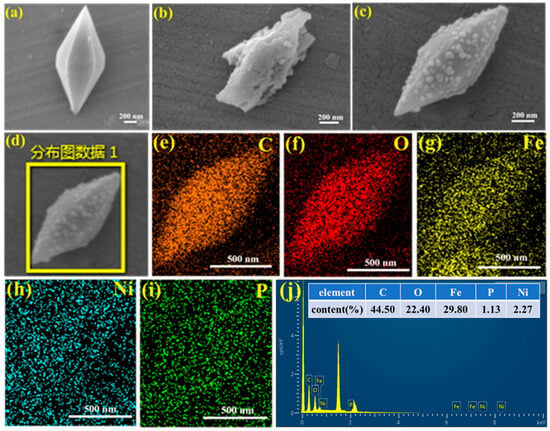
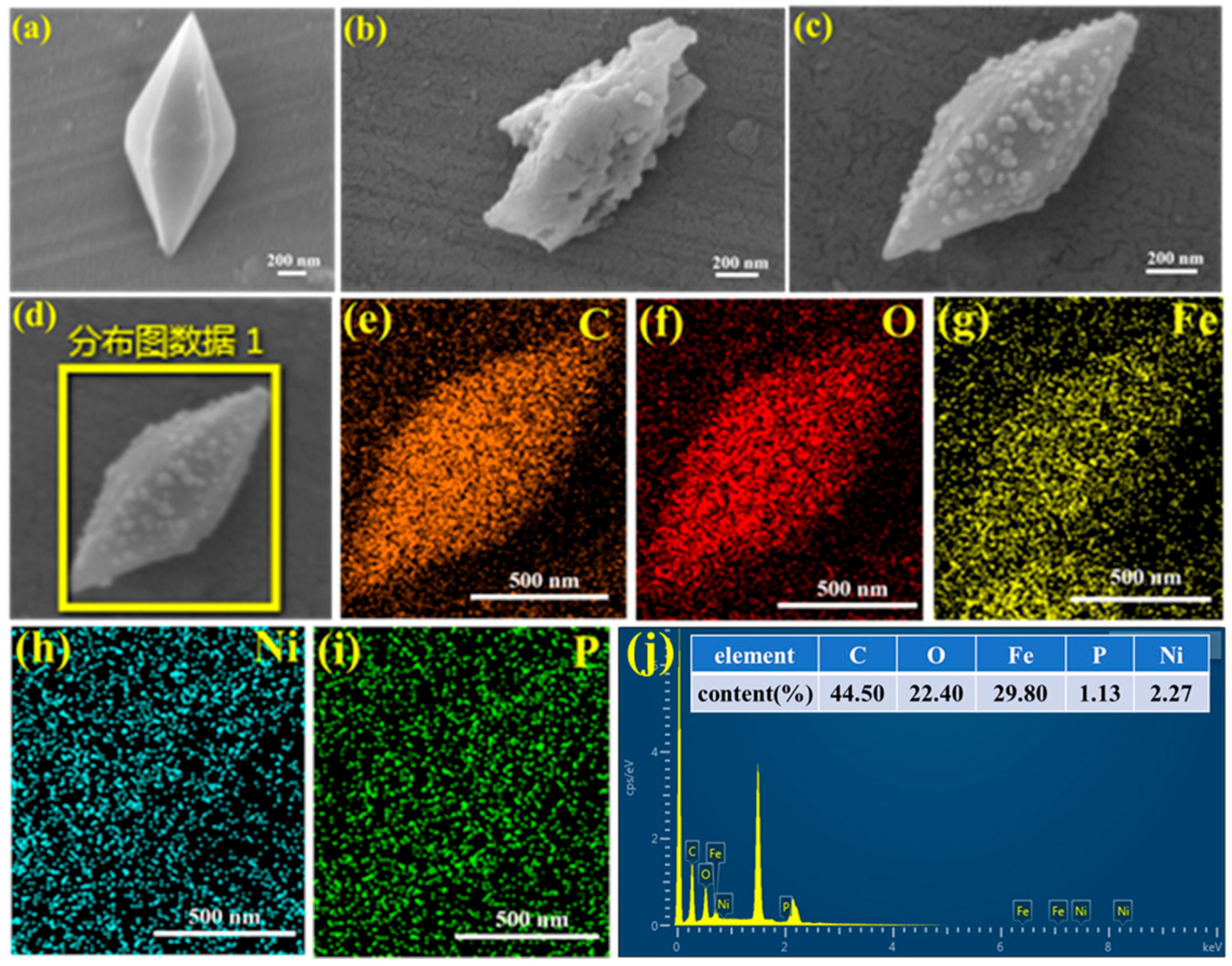
To investigate the morphology, elemental composition, and content of the Ni2P/MIL-53(Fe) nanocomposite (Figure 3), scanning electron microscopy (SEM) analysis was conducted. MIL-53(Fe) (Figure 3a) exhibited a shuttle-shaped structure with a smooth surface. Figure 3b shows the SEM image of Ni2P, which displays a block-like morphology with a smooth surface and noticeable agglomeration. The SEM image of the Ni2P/MIL-53(Fe) nanocomposite revealed that the Ni2P nanoparticles were uniformly and tightly anchored on the surface of MIL-53(Fe). Furthermore, elemental mapping analysis (Figure 3e–i) confirmed the coexistence of C, O, Fe, Ni and Pin the synthesized Ni2P/MIL-53(Fe) nanocomposite, with elemental proportions of 29.8%, 44.5%, 1.13%, 2.27%, and 22.4%, respectively.
Figure 3.
SEM images of (a) MIL-53(Fe), (b) Ni2P, and (c) Ni2P/MIL-53(Fe); (d–i) elemental mapping images of Ni2P/MIL-53(Fe); and (j) compositional analysis of Ni2P/MIL-53(Fe). 分布图数据 refer to the distribution of Ni2P/MIL-53.
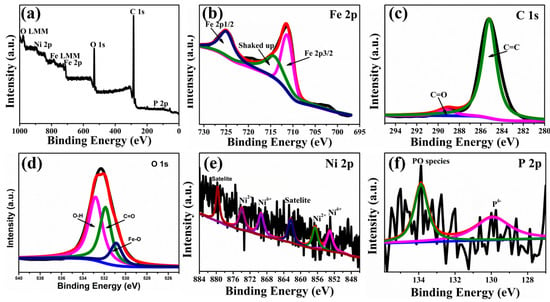
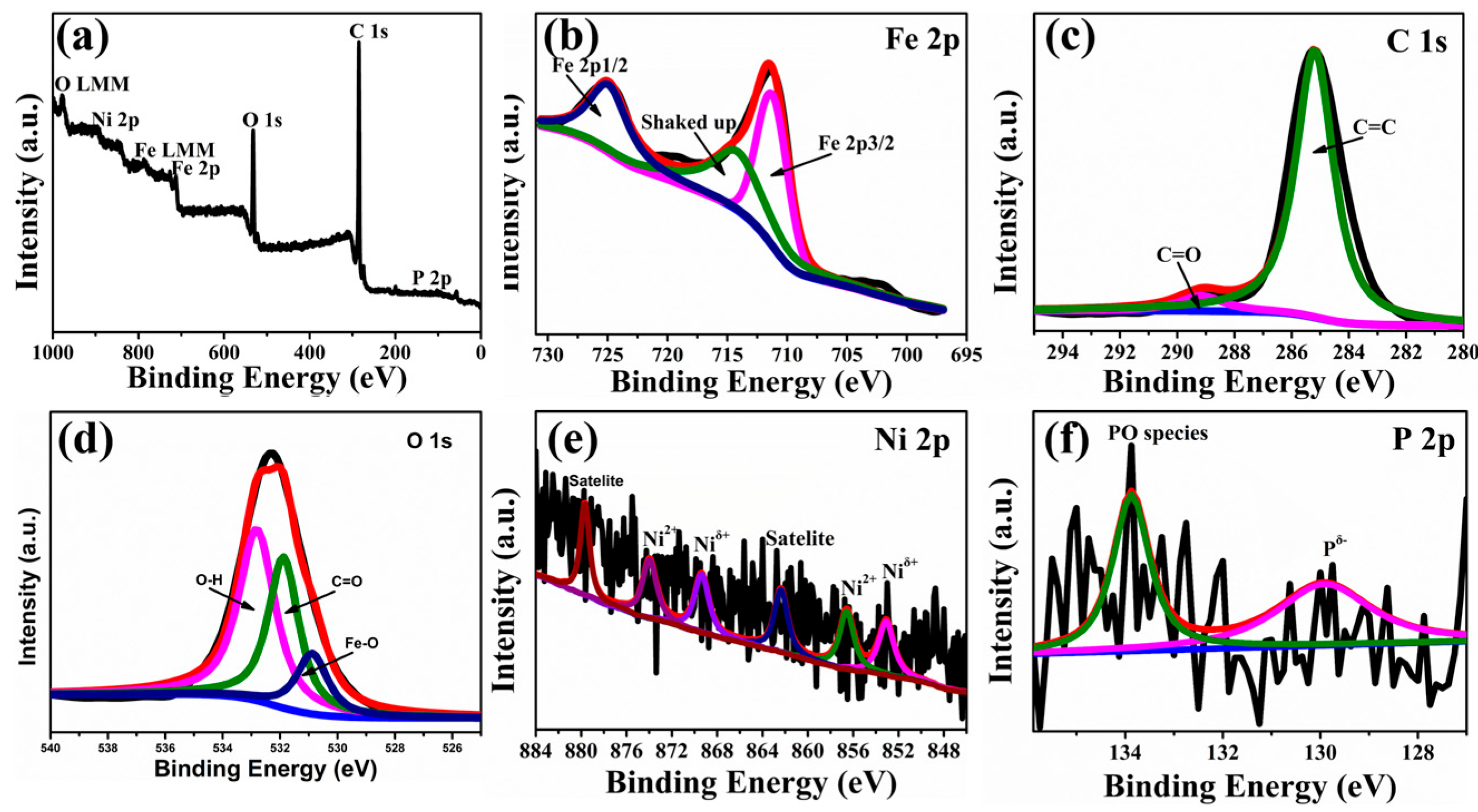
To further investigate the surface composition and chemical states of the Ni2P/MIL-53(Fe) nanocomposite, X-ray photoelectron spectroscopy (XPS) was performed. The survey spectrum (Figure 4a) confirmed the presence of Fe, C, O, Ni, and P in the composite. In the high-resolution Fe 2p spectrum (Figure 4b), the peaks at 711.88 eV and 725.88 eV correspond to Fe 2p3/2 and Fe 2p1/2, respectively, with a spin–orbit splitting of 14 eV, which is consistent with α-Fe2O3 [25]. A satellite peak corresponding to the Fe 2p3/2 → Fe 2p1/2 shake-up transition was observed at 713.38 eV. The C 1s spectrum (Figure 4c) exhibited two distinct peaks at 285.13 eV (C=C, aromatic carbon) and 289.00 eV (C=O, carboxyl groups). Deconvolution of the O 1s spectrum (Figure 4d) revealed two components at 532.00 eV (carboxylate oxygen in H2BDC linkers) and 532.63 eV (Fe-O bonds in MIL-53(Fe)). The Ni 2p spectrum (Figure 4e) displayed six fitted peaks at 853.00, 856.50, 862.38, 869.30, 874.00, and 879.63 eV, which are assigned to Ni 2p3/2 [26], oxidized Niδ+, Ni 2p1/2 [27], oxidized Ni2+, and Niδ+ (0 < δ < 2), respectively. Finally, the P 2p spectrum (Figure 4f) showed doublets at 129.88 eV (Pδ− in Ni2P) and 133.88 eV (P=O from surface oxidation) [28].
Figure 4.
XPS analysis of the 6Ni2P/MIL-53(Fe) composite: (a) survey spectrum, (b) Fe 2p, (c) C 1s, (d) O 1s, (e) Ni 2p, and (f) P 2p.
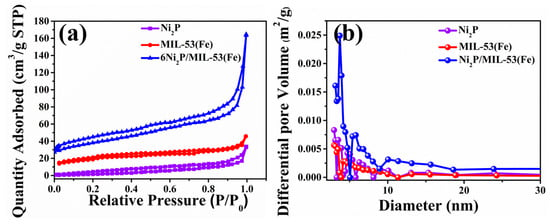
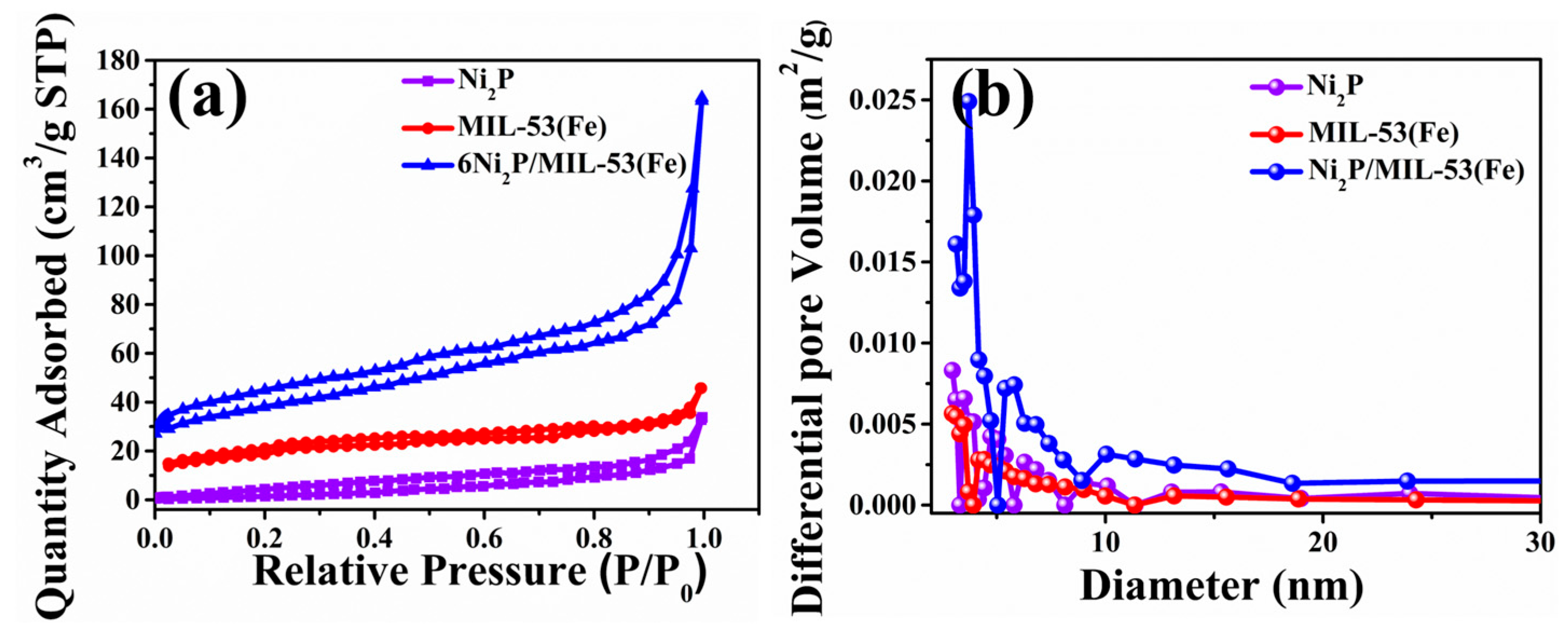
Figure 5 presents the N2 adsorption–desorption isotherms of the synthesized samples, revealing significant differences in their textural properties. Notably, the 6Ni2P/MIL-53(Fe) nanocomposite exhibited a substantially larger specific surface area (128.75 m2/g) than both pristine Ni2P (11.42 m2/g) and MIL-53(Fe) (67.54 m2/g). Structural characterization further revealed that Ni2P possesses an average pore size of 1.83 nm and a total pore volume of 5.221 × 10⁻² cm3/g, while MIL-53(Fe) shows values of 4.20 nm and 7.073 × 10⁻² cm3/g. In comparison, the 6Ni2P/MIL-53(Fe) nanocomposite achieved superior porosity parameters, with an average pore size of 7.91 nm and a total pore volume of 2.547 × 10⁻¹ cm3/g. These results are consistent with the established literature, which indicates that materials with larger surface areas typically exhibit enhanced adsorption capacities for substrate molecules. This suggests that the structural advantages of the 6Ni2P/MIL-53(Fe) nanocomposite may contribute to its improved photocatalytic performance.
Figure 5.
N2 adsorption–desorption isotherms (a) and corresponding pore size distribution curves (b) of the XNi2P/MIL-53(Fe) nanocomposites.
2.2. Photoelectric Properties of XNi2P/MIL-53(Fe) Photocatalysts
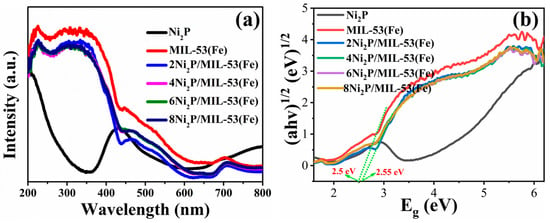
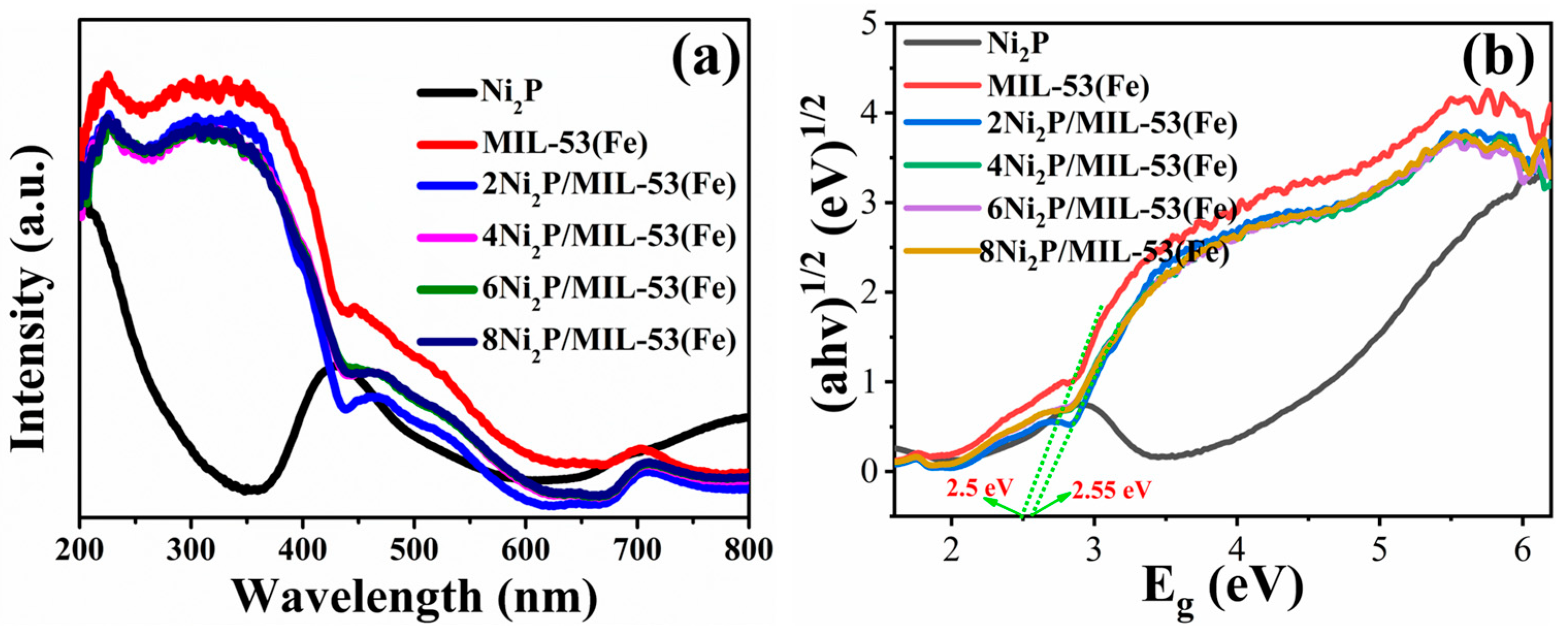
To investigate the optical properties of the synthesized materials, UV-vis diffuse reflectance spectroscopy (UV-vis DRS) was employed. As shown in Figure 6, Ni2P exhibits strong light absorption at 200 and 420 nm, demonstrating its excellent light-harvesting capability. The nanocomposite samples showed absorption characteristics similar to those of MIL-53(Fe). Notably, compared with pure Ni2P, the Ni2P/MIL-53(Fe) composite exhibited a red-shifted absorption edge at approximately 486 nm. The optical bandgap was calculated to be 2.55 eV using the equation Eg = 1240/λ [29]. These results clearly indicate that the introduction of Ni2P as a cocatalyst effectively enhances the photoresponse of MIL-53(Fe) in the visible light region.
Figure 6.
UV-vis DRS (a) and Tauc plots (b) for band gap estimation of the XNi2P/MIL-53(Fe) nanocomposites.
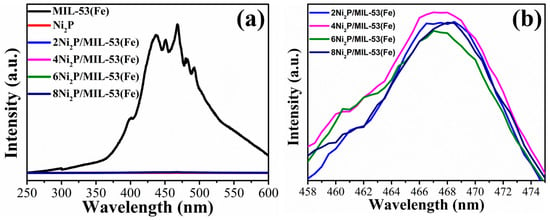
The optical properties of the synthesized materials were investigated using photoluminescence (PL) spectroscopy. As shown in Figure 7a, pure Ni2P exhibits a negligible PL signal due to its metallic-like nature, which allows ultrafast non-radiative relaxation of photoexcited carriers. In contrast, pure MIL-53(Fe) shows a strong emission peak centered at approximately 468 nm, indicating pronounced radiative recombination. Notably, the PL intensity of the Ni2P/MIL-53(Fe) composite is markedly lower than that of pure MIL-53(Fe) and lies between those of the two individual components. Rather than being contradictory, this intermediate intensity directly reflects efficient interfacial charge separation: photogenerated electrons in MIL-53(Fe) are effectively transferred to Ni2P, suppressing radiative electron–hole recombination in the MOF. Because Ni2P itself is nearly non-emissive, the residual PL of the composite originates from the unrecombined excitons remaining in the MIL-53(Fe) phase, which naturally falls between the signals of the two pristine materials.
Figure 7.
PL spectra of the XNi2P/MIL-53(Fe) nanocomposites.
To further assess the influence of Ni2P loading on charge separation, the PL spectra of the XNi2P/MIL-53(Fe) nanocomposites with varying Ni2P contents were compared. As illustrated in Figure 7b, all composites display emission peaks centered at approximately 468 nm, indicative of the radiative recombination of photoexcited charge carriers. The fluorescence intensity followed the order: 4Ni2P/MIL-53(Fe) > 2Ni2P/MIL-53(Fe) > 8Ni2P/MIL-53(Fe) > 6Ni2P/MIL-53(Fe). In general, a higher PL emission intensity correlates with enhanced charge recombination, which typically reduces photocatalytic efficiency. Conversely, materials with lower PL intensity exhibit suppressed electron–hole recombination, thereby promoting greater availability of charge carriers for photocatalytic reactions. Based on these findings, 6Ni2P/MIL-53(Fe) exhibited the weakest fluorescence signal, suggesting the most effective charge separation among the tested samples. Consequently, this nanocomposite is expected to demonstrate superior photocatalytic performance compared with its counterparts. These PL results are fully consistent with the enhanced interfacial charge separation in the heterostructure and are corroborated by the photoelectrochemical measurements discussed below.
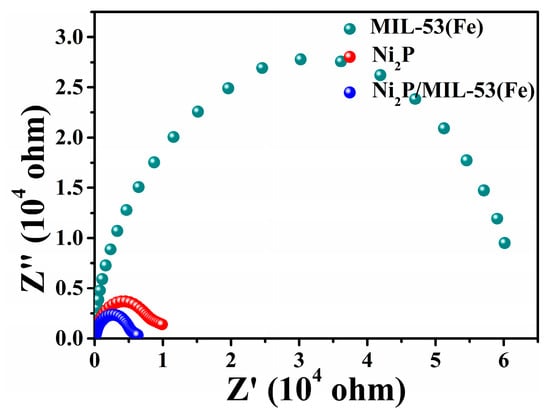
The separation efficiency of photogenerated charge carriers was further investigated using electrochemical impedance spectroscopy (EIS). Figure 8 shows the Nyquist plots of MIL-53(Fe), Ni2P, and the 6Ni2P/MIL-53(Fe) nanocomposite. Notably, the 6Ni2P/MIL-53(Fe) composite exhibited a significantly smaller arc radius than both pristine MIL-53(Fe) and Ni2P, indicating enhanced charge transfer efficiency. These results clearly demonstrate that the 6Ni2P/MIL-53(Fe) nanocomposite achieved the highest photogenerated charge carrier separation efficiency among all tested samples. The improved performance can be attributed to the intimate interfacial contact between Ni2P and MIL-53(Fe), which facilitates effective charge separation and consequently enhances photocatalytic activity. This conclusion is well supported by the PL spectral analysis, providing consistent evidence for the superior charge separation capability of the 6Ni2P/MIL-53(Fe) nanocomposite.
Figure 8.
EIS Nyquist plots of the XNi2P/MIL-53(Fe) nanocomposites.
2.3. Investigation of the Photocatalytic Oxidation Activity of Alcohols
To evaluate the photocatalytic performance of the synthesized materials, the selective oxidation of benzyl alcohol was investigated as a model reaction. As summarized in Table 1, control experiments showed that pristine MIL-53(Fe) and Ni2P alone exhibited modest conversion rates of 30% and 10%, respectively. Notably, the composite photocatalysts displayed significantly enhanced activity, with the 6Ni2P/MIL-53(Fe) sample achieving the highest performance of 74% conversion. This corresponds to a 2.5-fold improvement over pristine MIL-53(Fe), despite Ni2P constituting only 6 wt% of the composite. Additional control experiments confirmed the photocatalytic nature of the reaction: under dark conditions, 6Ni2P/MIL-53(Fe) exhibited only 15% conversion, indicating that both the catalyst and light irradiation are essential for efficient reaction progression. These results highlight that the synergistic interaction between Ni2P and MIL-53(Fe) facilitates an efficient photocatalytic system for the selective oxidation of aromatic alcohols.
Table 1.
Control experiments of the photocatalytic oxidation of benzyl alcohol.
To precisely determine the optimal solvent conditions for the reaction system, seven common solvents were systematically screened (Table 2). Among the tested solvents, carbon tetrachloride afforded the highest benzyl alcohol conversion (77%) with excellent selectivity (>95%). 1,2-Dichloroethane, ethyl acetate, and acetonitrile also gave moderate conversions of 64%, 56%, and 35%, respectively, while maintaining >95% selectivity. In contrast, toluene and absolute ethanol yielded very low conversions (5% and 2%, respectively), and N,N-dimethylformamide (DMF) resulted in no detectable conversion, indicating an unsuitable medium for this photocatalytic reaction.
Table 2.
Photocatalytic oxidation performance for benzyl alcohol in different solvents.
The observed solvent-dependent activity can be rationalized by considering both the polarity and the electron-accepting ability of each solvent. Non-polar or low-polarity solvents such as toluene and carbon tetrachloride generally favor the solubility of benzyl alcohol and the aromatic products, but the striking difference between toluene (5%) and carbon tetrachloride (77%) suggests that polarity alone is not the determining factor. Instead, the unique performance of carbon tetrachloride arises from its well-known property as an efficient electron scavenger. Under light irradiation, photogenerated electrons from the MIL-53(Fe) framework can be rapidly captured by carbon tetrachloride, which undergoes reductive dechlorination to form trichloromethyl radicals and chloride ions. This process effectively suppresses the recombination of electron–hole pairs, leaving more holes available for the oxidation of benzyl alcohol. In contrast, solvents such as ethyl acetate and acetonitrile lack such strong electron-accepting capability, leading to moderate conversions. 1,2-Dichloroethane, although chlorinated, is a weaker electron scavenger compared to carbon tetrachloride, which explains its lower conversion (64%). The very low conversions in absolute ethanol and toluene are likely due to their poor electron affinity and possible competitive adsorption on the catalyst surface. DMF, a polar aprotic solvent, may coordinate strongly with the Fe centers of MIL-53(Fe), blocking active sites and inhibiting the photocatalytic process. Thus, the superior performance of carbon tetrachloride can be attributed to its dual role: it not only serves as an effective reaction medium, but also acts as a powerful electron scavenger, thereby markedly promoting the separation of photogenerated electron–hole pairs and substantially enhancing the photocatalytic efficiency. These characteristics make carbon tetrachloride an ideal choice for the reaction system, fulfilling a dual role as both a solvent and a catalytic assistant.
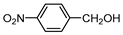
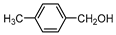
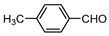
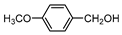
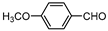
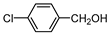
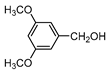
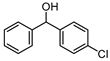
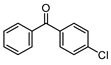
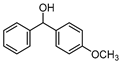
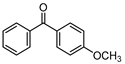
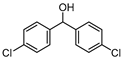
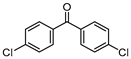
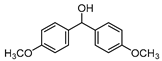
Finally, we evaluated the applicability of the photocatalyst for the oxidation of various benzyl alcohol derivatives, and the corresponding results are summarized in Table 3. The consistently low conversion of unsubstituted benzyl alcohol indicates the poor photocatalytic performance of the system. For the substituted derivatives, the conversion was significantly influenced by the nature and position of the substituents on the aromatic ring, while excellent selectivities (>90% in most cases) were observed across all substrates. Among the simple benzyl alcohol derivatives, substrates bearing electron-donating groups (e.g., –CH3, –OCH3) gave relatively higher conversions: 36% for p-tolylmethanol, 42% for (4-methoxyphenyl) methanol, 43% for m-tolylmethanol, and 54% for (3,5-dimethoxyphenyl) methanol. In contrast, the electron-withdrawing nitro group afforded a moderate conversion of 33% for (4-nitrophenyl) methanol, whereas the strong electron-withdrawing chloro substituent at the para position led to a very low conversion of only 5% for (4-chlorophenyl) methanol. Notably, the diphenylmethanol derivatives exhibited distinct reactivity patterns. (4-chlorophenyl)(phenyl)methanol and bis(4-chlorophenyl)methanol gave considerably higher conversions of 61% and 57%, respectively, whereas (4-methoxyphenyl) (phenyl)methanol and bis(4-methoxyphenyl) afforded lower conversions of 33% and 27%, respectively. In addition, 2-phenylethan-1-ol, a primary alcohol without a benzylic hydroxy group, was also tested and gave a conversion of 64% with 96% selectivity. Based on these observations, we conclude that the current photocatalytic system is unsuitable for the efficient oxidation of benzyl alcohol derivatives, although marginally improved reactivity was observed for substrates with electron-donating groups in the simple benzyl alcohol series.
Table 3.
Photocatalytic oxidation of benzyl alcohol derivatives catalyzed by 6Ni2P/MIL-53(Fe).
2.4. Recyclability and Stability of the Photocatalyst
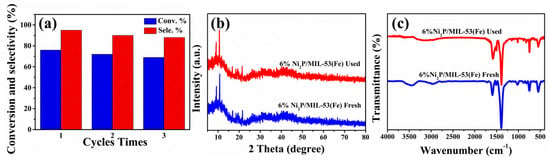
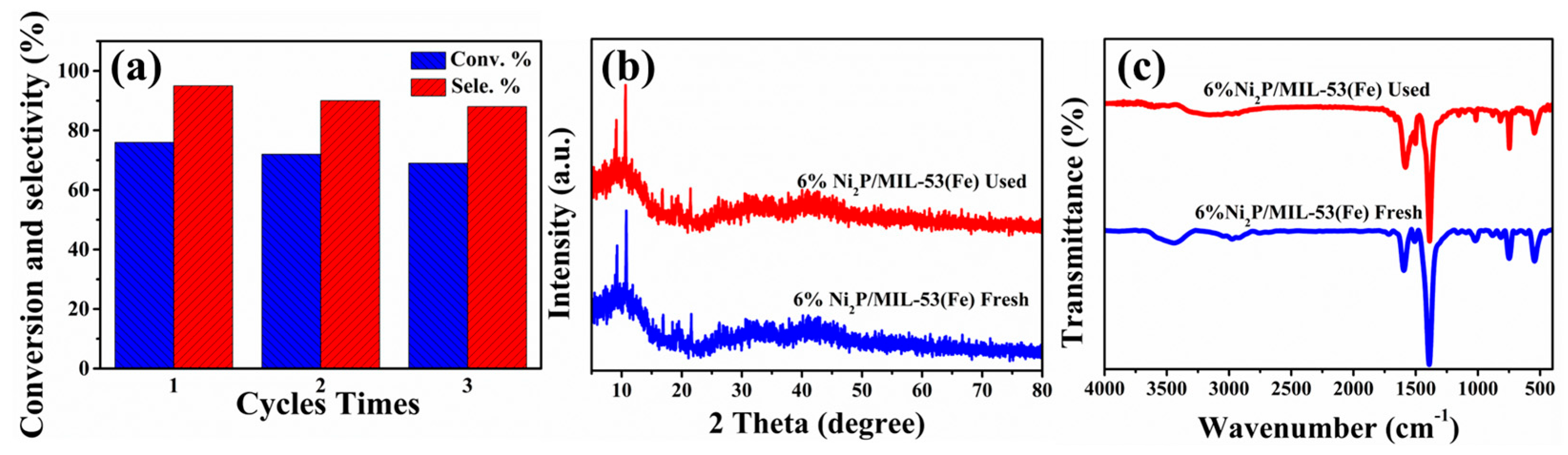
The photocatalytic stability was systematically evaluated by monitoring the reaction efficiency over multiple cycles and by characterizing the crystalline structure and surface functional groups via XRD and FT-IR spectroscopy before and after the reaction, respectively (Figure 9). Cycling tests demonstrated excellent stability, with a decline of less than 5% in benzyl alcohol conversion and consistently high selectivity (>98%) over three consecutive cycles. Structural characterization further confirmed the robustness of the catalyst: XRD patterns revealed no detectable phase changes after the reaction, and FT-IR spectra exhibited identical vibrational features with no observable additional peaks. These comprehensive results affirm the outstanding photostability of the developed photocatalytic system.
Figure 9.
Cyclic performance of the Ni2P/MIL-53(Fe) composite in the photocatalytic oxidation of benzyl alcohol: (a) conversion and product selectivity over multiple reaction cycles; (b) XRD patterns of the fresh and spent catalysts; (c) FT-IR spectra before and after the reaction.
2.5. Reaction Mechanism of the Photocatalytic Selective Oxidation of Benzyl Alcohol
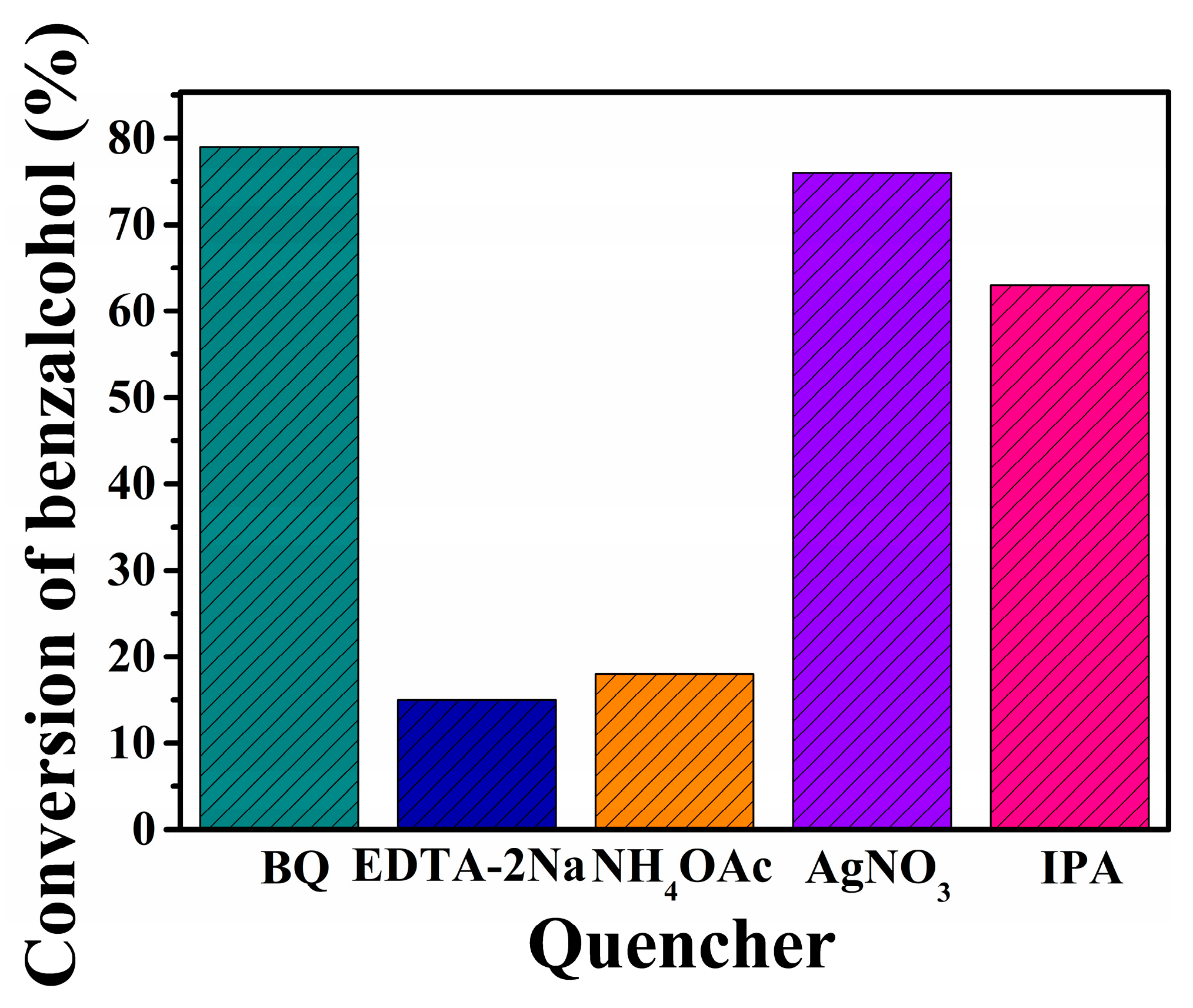
The reaction mechanism was investigated by radical trapping experiments using various scavengers, as shown in Figure 10. The addition of EDTA-2Na and ammonium oxalate (both hole scavengers) significantly suppressed the conversion of benzyl alcohol, whereas other scavengers exhibited negligible effects. These results clearly indicate that photogenerated holes (h+) are the predominant active species in the photocatalytic oxidation process.
Figure 10.
Effects of radical scavengers on the photocatalytic oxidation of benzyl alcohol over Ni2P/MIL-53(Fe) composites.
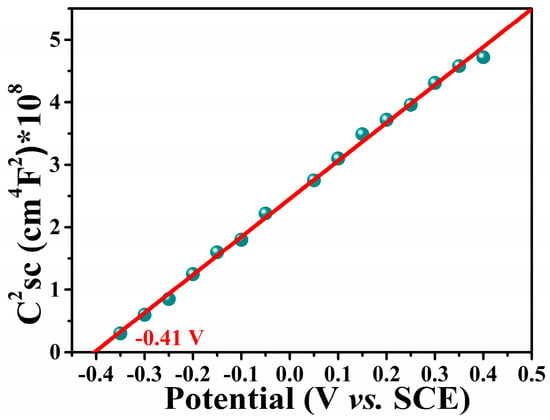
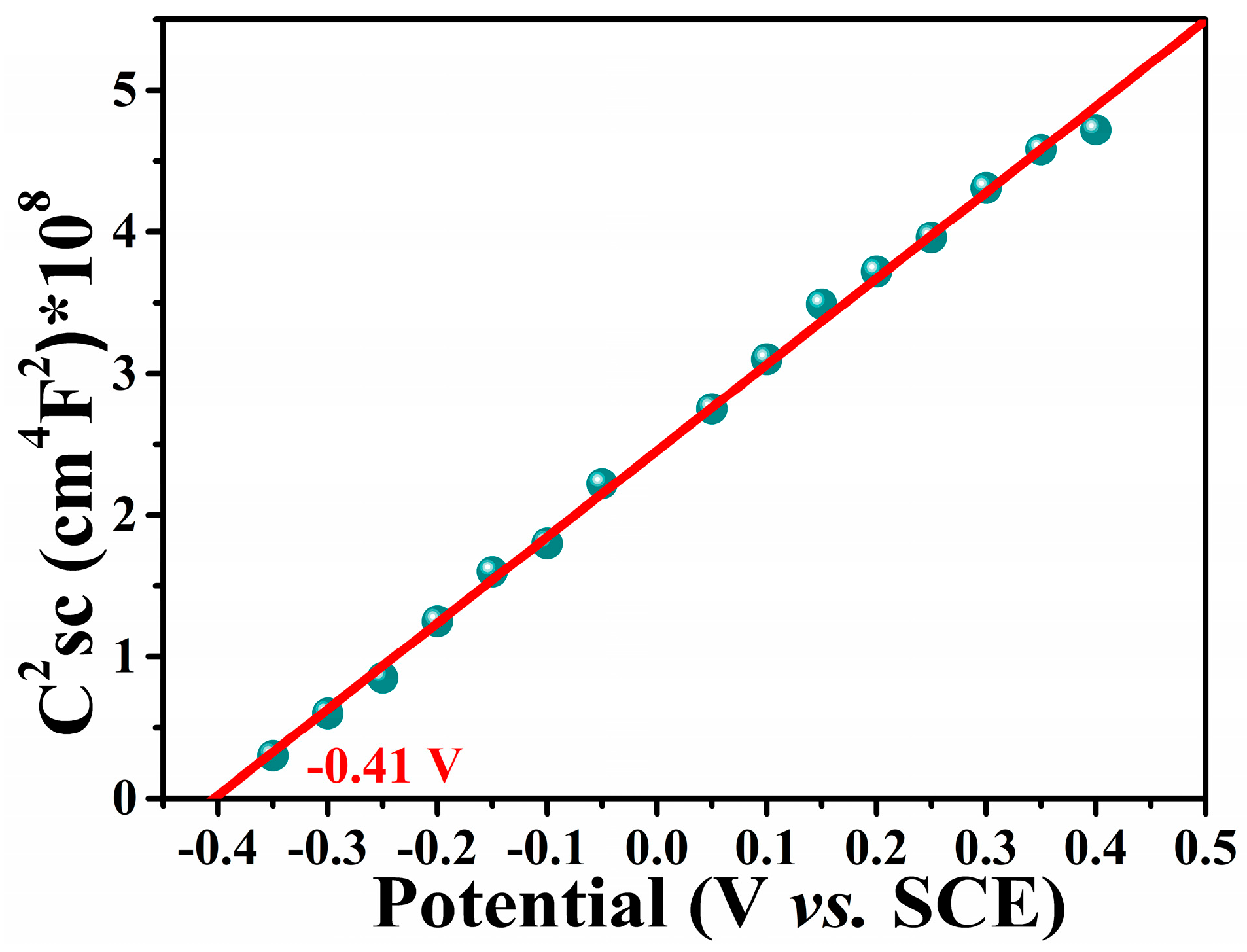
To further elucidate the reaction mechanism, Mott–Schottky (M-S) analysis was performed. As shown in Figure 11, the positive slope of the M-S plot confirms the n-type semiconductor characteristic of the composite [30]. The flat band potential of Ni2P/MIL-53(Fe) was determined to be −0.41 V vs. Ag/AgCl (−0.17 V vs. NHE). Based on the typical correlation for n-type semiconductors, the conduction band (CB) potential was estimated to be −0.27 V vs. NHE [31]. UV-vis DRS results showed an absorption edge at 450 nm, corresponding to a band gap of 2.55 eV. Using the equation EVB = ECB + Eg, the valence band (VB) potential was calculated to be 2.28 V vs. NHE. This VB potential is more positive than the oxidation potential of benzyl alcohol (1.88–2.27 V vs. NHE), confirming that the photogenerated holes are thermodynamically capable of driving the oxidation. Ni2P acts as an effective cocatalyst that facilitates electron extraction from MIL-53(Fe), thereby promoting efficient separation of photogenerated charge carriers. This mechanism was further corroborated by the use of CCl4 as an electron scavenger, which significantly enhanced charge separation. Consequently, holes accumulated in the VB of MIL-53(Fe) effectively drive the selective oxidation of benzyl alcohol. These findings are fully consistent with the radical trapping experiments, and a proposed reaction mechanism is depicted in Figure 12. Although the present study focuses on the qualitative identification of reactive species and band alignment, a more comprehensive thermodynamic and kinetic analysis would be valuable for fully resolving the charge transfer dynamics and will be pursued in future work [32].
Figure 11.
Mott-Schottky plot of 6Ni2P/MIL-53(Fe).
Figure 12.
Mechanism of photocatalytic oxidation of benzyl alcohol over Ni2P/MIL-53(Fe).
3. Materials and Methods
3.1. Materials and Reagents
Analytical-grade reagents were used in this work, including sodium dihydrogen phosphate hydrate (NaH2PO4), iron(III) chloride hexahydrate (FeCl3·6H2O), disodium ethylenediaminetetraacetate (EDTA-2Na) (99.7%, Yantai Shuangshuang Chemical Co., Ltd., Yantai, China.) terephthalic acid (C8H6O2, 99.5%, Tianjin Guangfu Fine Chemical Research Institute, Tianjin, China), ammonium acetate (CH3COONH4), nickel(II) chloride hexahydrate (NiCl2·6H2O, 99.5%, Shanghai Zhongqin Chemical Reagent Co., Ltd., Shanghai, China), benzyl alcohol and its derivatives (99.9%, Aladdin, Shanghai, China and J&K Scientific, Beijing, China), ethyl acetate (C4H8O2), absolute ethanol (C2H6O), N,N-dimethylformamide (C3H7NO/HCON(CH3)2, 98%, Tianjin Chemical Reagent Factory, Tianjin, China), Anhydrous sodium sulfate (Na2SO4, ≥99.0%, Sinopharm Chemical Reagent Co., Ltd., Shanghai, China) toluene (C7H8), 1,2-dichloroethane (C2H4Cl2), carbon tetrachloride (CCl4, 99.5%, Beijing Chemical Works, Beijing, China), acetonitrile (C2H3N, 99.5%, Sinopharm Chemical Reagent Co., Ltd., Shanghai, China), p-benzoquinone (C6H4O2, 99.5%, Tianjin Kaixin Chemical Industry Co., Ltd., Tianjin, China), silver nitrate (AgNO3) (99.5%, Shanghai Fine Chemical Materials Research Institute, Shanghai, China), and potassium chloride (KCl, 99%, Xi’an Reagent Factory, Xi’an, China).
3.2. Synthesis of the XNi2P/MIL-53(Fe) Composite
3.2.1. Synthesis of MIL-53(Fe)
MIL-53(Fe) was synthesized according to a modified literature procedure [33]. In a typical synthesis, 1 mmol of FeCl3·6H2O (0.5406 g) and 1 mmol of H2BDC (0.3323 g) were dissolved in 43.14 mL of DMF under continuous stirring at room temperature for 60 min. The homogeneous mixture was then transferred to a 100 mL Teflon-lined autoclave and heated at 170 °C for 24 h. After natural cooling to room temperature, the resulting yellow suspension was centrifuged and washed alternately with DMF and ethanol (three cycles each). To ensure the complete removal of residual guest molecules, the product was soaked in methanol for 72 h with daily solvent replacement. Finally, the purified MIL-53(Fe) powder was obtained by centrifugation and vacuum-dried at 100 °C overnight.
3.2.2. Synthesis of Ni2P
The 20% Ni2P catalyst was synthesized according to a modified solid-state reaction method [24]. Briefly, stoichiometric amounts of NiCl2·6H2O (62.4 mg) and NaH2PO4·H2O (105.4 mg) were thoroughly ground together in an agate mortar until complete homogenization. The resulting mixture was then subjected to thermal treatment in a tubular furnace under continuous N2 flow, with a controlled heating rate of 2 °C·min−1 to the target temperature of 400 °C, where it was maintained for 2 h. After natural cooling to room temperature, the obtained faint yellow powder was collected and stored under inert conditions for subsequent characterization and catalytic evaluation.
3.2.3. Synthesis of Ni2P/MIL-53(Fe) Composite
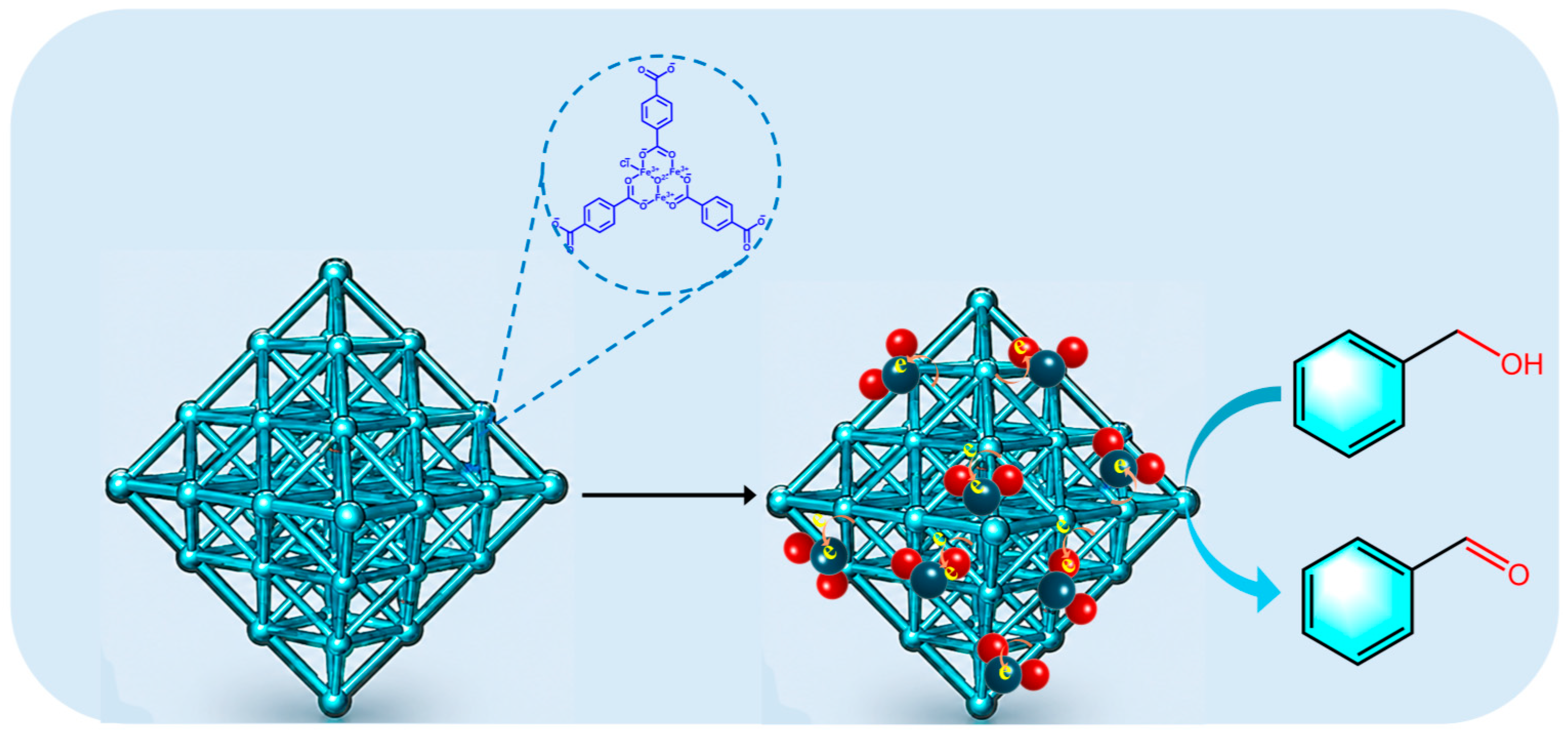
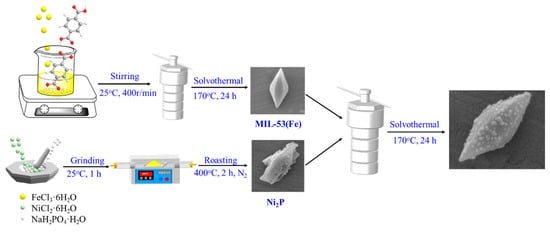
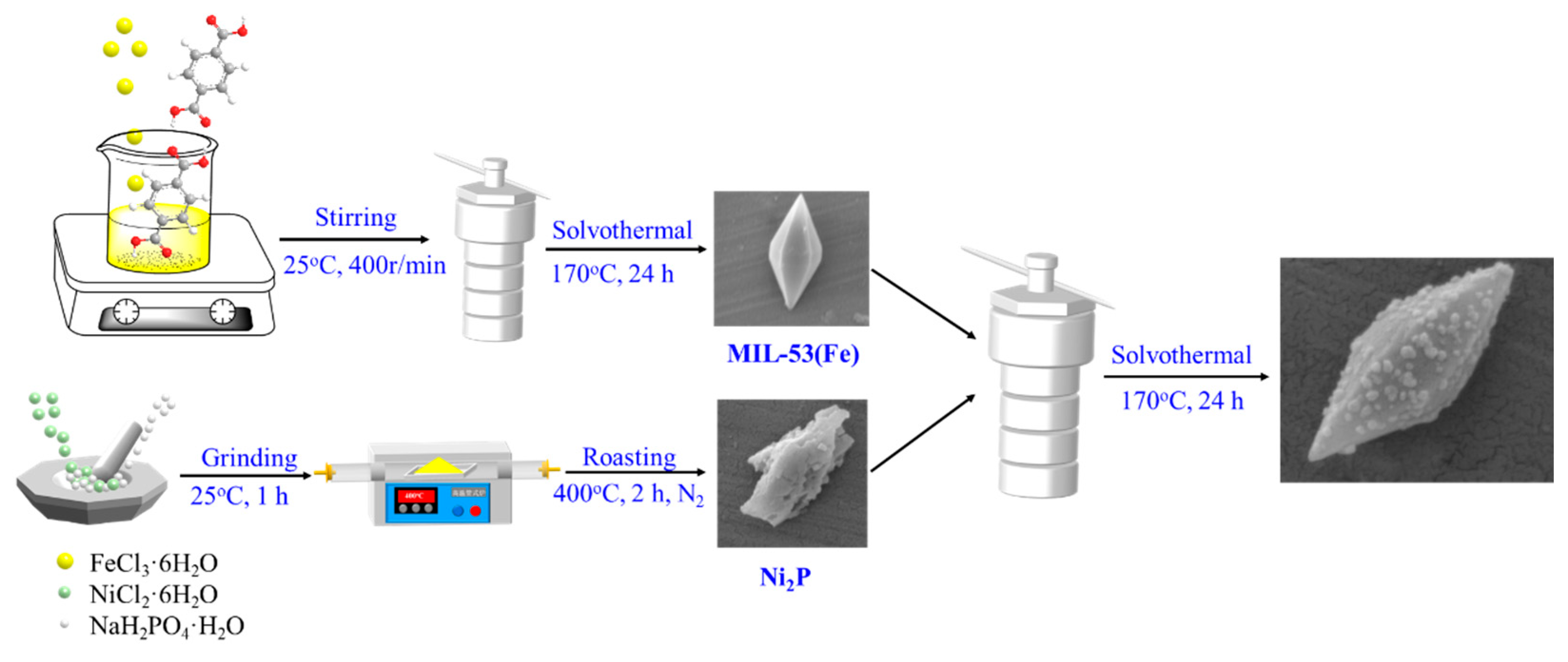
The Ni2P/MIL-53(Fe) composite was prepared using a solvothermal method. Initially, a predetermined quantity of as-synthesized Ni2P was dispersed in 10 mL of DMF via ultrasonication for 30 min. Simultaneously, 2 mmol (0.5405 g) of FeCl3·6H2O and 2 mmol (0.3323 g) of H2BDC were dissolved in 43.14 mL of DMF in a 100 mL beaker under continuous stirring at room temperature for 40 min. The ultrasonically treated Ni2P suspension was then introduced into the precursor solution, followed by an additional 30 min ultrasonic treatment to ensure homogeneous dispersion. The resulting mixture was transferred to a 100 mL Teflon-lined autoclave and subjected to solvothermal treatment at 170 °C for 24 h. After cooling to room temperature, the product was collected and washed alternately three times each with DMF and ethanol. To remove residual guest molecules and activate the porous structure, the material was soaked in methanol for 72 h with daily solvent replacement. Finally, the purified product was obtained by centrifugation and vacuum-dried at 100 °C overnight, and denoted as X% Ni2P/MIL-53(Fe), where X represents the mass percentage of Ni2P in the composite (Figure 13).
Figure 13.
Preparation process of the XNi2P/MIL-53(Fe) composite photocatalyst.
3.3. Characterization
The structural features of the samples were examined by Fourier transform infrared spectroscopy (FT-IR) on a Nicolet NEXUS 670 spectrometer, Thermo Fisher Scientific, Waltham, MA, USA. Chemical states of the catalysts were investigated using X-ray photoelectron spectroscopy (XPS, Thermo VG Scientific Sigma Probe, Thermo Fisher Scientific, East Grinstead, UK) with Al Kα radiation. Crystal phases were identified by powder X-ray diffraction (XRD) on a Rigaku D/max-2400 diffractometer (Rigaku Corporation, Tokyo, Japan) employing Cu Kα radiation (λ = 1.5418 Å). Optical properties were probed by UV-vis diffuse reflectance spectroscopy (UV-vis DRS) with a Cary 500 UV-vis-NIR spectrophotometer (Varian Inc., Palo Alto, CA, USA) and by photoluminescence (PL) spectroscopy using a FluoroSENS Luminescence Fluorescence spectrophotometer (Gilden Photonics Ltd., Glasgow, UK). Morphological and structural observations were carried out with a scanning electron microscope (SEM, Ultra Plus, Carl Zeiss AG, Oberkochen, Germany) operated at 6.0 kV and a transmission electron microscope (TEM, JEOL JEM 2010 EX, JEOL Ltd., Tokyo, Japan). Electrochemical measurements, including Mott–Schottky (M-S) and electrochemical impedance spectroscopy (EIS), were performed on a CHI660E electrochemical workstation (Shanghai Chenhua Instrument Co., Ltd., Shanghai, China). Thermogravimetric analysis (TGA) was conducted on a TA Instruments Discovery thermogravimetric analyzer (TA Instruments, New Castle, DE, USA) from ambient temperature to 800 °C at a heating rate of 10 °C min−1 under a nitrogen atmosphere. The products from selective alcohol oxidation were quantified using a gas chromatograph (GC, Shimadzu GC-2010, Shimadzu Corporation, Kyoto, Japan). Brunauer–Emmett–Teller (BET) specific surface areas were measured on an Autosorb iQ2 MP instrument (Quantachrome Instruments, Boynton Beach, FL, USA); prior to the measurements, the samples were degassed at 250 °C to remove moisture and adsorbed impurities, followed by analysis at liquid-nitrogen temperature (−195 °C).
3.4. Photocatalytic Experimental Detail
The photocatalytic performances of the XNi2P/MIL-53(Fe) nanocomposites were evaluated via the oxidation of aromatic alcohols under visible light. In a typical test, 0.2 mmol of aryl alcohol and 5 mg of photocatalyst were suspended in 6 mL of CCl4 inside an open quartz tube. To establish adsorption–desorption equilibrium, the suspension was magnetically stirred in the dark for 1 h before irradiation. The mixture was then exposed to visible light for 9 h using a 500 W metal halide lamp (PLS-SXE 300, BiLon Co., Ltd., Shanghai, China) as the light source. After the reaction, the liquid phase was analyzed by gas chromatography. Alcohol conversion and aldehyde/ketone selectivity were calculated according to Equations (1) and (2):
where Co denotes the initial alcohol concentration, Cn the residual alcohol concentration at time t, and Ca the concentration of the generated aldehyde or ketone.
Conversion (%) = [(Co − Cn)/Co] × 100%
Selectivity (%) = [Ca/(Co − Cn)] × 100%
3.5. Electrochemical Measurement
Mott–Schottky and electrochemical impedance spectroscopy measurements were carried out in a standard three-electrode configuration using a 0.2 M Na2SO4 electrolyte. A saturated calomel electrode served as the reference, a platinum foil as the counter electrode, and a fluorine-doped tin oxide (FTO) glass slide as the working electrode. Prior to use, the FTO substrates were cleaned sequentially with isopropanol, acetone, and water (volume ratio 1:1:1). The spectra were recorded at open-circuit potential over a frequency range of 105 to 10−2 Hz with an AC perturbation amplitude of 5 mV. To prepare the working electrodes, the as-synthesized XNi2P/MIL-53(Fe) photocatalysts were dispersed in a chitosan solution to obtain a concentration of 3 mg mL−1, followed by ultrasonication for 30 min to form a homogeneous colloidal suspension. An aliquot of 60 μL of this suspension was drop-cast onto the conductive face of the FTO glass and dried overnight at 100 °C.
4. Conclusions
In summary, a series of Ni2P/MIL-53(Fe) nanocomposites with markedly enhanced photocatalytic activity were successfully fabricated via a facile one-step hydrothermal method. Comprehensive characterizations (XRD, SEM, UV-vis DRS, etc.) confirmed that the nanocomposites possess well-defined crystalline structures, favorable morphologies, and extended light absorption ranges. Photoelectrochemical measurements demonstrated that the introduction of Ni2P substantially improves charge separation efficiency. Mechanistic investigations, including radical trapping experiments and Mott–Schottky analysis, revealed two key findings: (i) photogenerated holes (h+) serve as the dominant active species in the photocatalytic reaction, and (ii) Ni2P functions as an efficient electron mediator. More importantly, the synergistic effect between the Ni2P cocatalyst and the solvent CCl4 effectively promotes the separation of photogenerated electron–hole pairs, thereby providing robust theoretical support for the proposed mechanism underlying the photocatalytic selective oxidation of benzyl alcohol. Overall, this work not only demonstrates a feasible strategy for constructing transition metal phosphide/MOF heterostructures, but also underscores the critical role of Ni2P as a non-noble metal cocatalyst in enhancing charge carrier dynamics. The findings open new avenues for designing high-performance MOF-based photocatalytic systems, and future efforts may focus on extending this strategy to other transition metal phosphides and exploring their potential in diverse organic transformation reactions under mild conditions.
Author Contributions
S.M. was responsible for Methodology, Investigation, Data curation, Validation, Funding acquisition, Writing—Original draft, and Writing—Review & editing; B.L. for Writing—Review & editing (formal review of the manuscript); J.Z. for Investigation; K.H. for Investigation; M.X. for Formal analysis (optical analysis); X.W. for Project administration; Z.Y. for Conceptualization, Funding acquisition, and Writing—Review & editing; X.G. for Conceptualization, Funding acquisition, and Supervision. All authors have read and agreed to the published version of the manuscript.
Funding
This work was financially supported by the Youth Fund (Grant No. 2024QN-15) and the Key Research and Development Program (Grant No. 2025ZDYF-03) of the Gansu Academy of Sciences, the Matching Project of the Gansu Academy of Sciences (Grant No. 2025PTXM-10), the Science and Technology Program of Gansu Province (Grant No. 25RCKA028), the Science and Technology Program of Lanzhou Municipality (Grant No. 2025-2-37), and the Science and Technology Program of Chengguan District, Lanzhou City (Grant No. 2024JSCX0013).
Data Availability Statement
The original contributions presented in this study are included in the article. Further inquiries can be directed to the corresponding authors.
Conflicts of Interest
The authors declare no conflicts of interest.
References
- Li, X.; Wang, X.; Zhu, J.; Li, Y.; Zhao, J.; Li, F. Fabrication of two-dimensional Ni2P/ZnIn2S4 heterostructures for enhanced photocatalytic hydrogen evolution. Chem. Eng. J. 2018, 353, 15–24. [Google Scholar] [CrossRef] [Scilit]
- Liu, G.; Zhen, C.; Kang, Y.; Wang, L.; Cheng, H. Unique physicochemical properties of two-dimensional light absorbers facilitating photocatalysis. Chem. Soc. Rev. 2018, 47, 6410–6444. [Google Scholar] [CrossRef] [Scilit] [PubMed]
- Zhu, S.; Wang, D. Photocatalysis: Basic principles, diverse forms of implementations and emerging scientific opportunities. Adv. Energy Mater. 2017, 7, 1700841. [Google Scholar] [CrossRef] [Scilit]
- Barber, J. Photosynthetic energy conversion: Natural and artificial. Chem. Soc. Rev. 2009, 38, 185–196. [Google Scholar] [CrossRef] [Scilit] [PubMed]
- Haider, Z.; Archana, R.; Ju, H. Recent advances in photocatalytic synthesis of five-membered nitrogen heterocycles and their derivatives. Molecules 2025, 30, 3490. [Google Scholar] [CrossRef] [Scilit] [PubMed]
- Christoforidis, K.; Fornasiero, P. Photocatalytic hydrogen production: A rift into the future energy supply. ChemCatChem 2017, 9, 1523–1544. [Google Scholar] [CrossRef] [Scilit]
- Ran, J.; Zhang, J.; Yu, J.; Jaroniec, M.; Qiao, S. Earth-abundant cocatalysts for semiconductor-based photocatalytic water splitting. Chem. Soc. Rev. 2014, 43, 7787–7812. [Google Scholar] [CrossRef] [Scilit] [PubMed]
- Li, Y.; Li, H.; Li, Y.; Peng, S.; Hu, Y. Fe-B alloy coupled with Fe clusters as an efficient cocatalyst for photocatalytic hydrogen evolution. Chem. Eng. J. 2018, 344, 506–513. [Google Scholar] [CrossRef] [Scilit]
- Rosaa, D.; Abbasovab, N.; Fazi, M. Photocatalytic activity of iron-doped titania coupled with biochar for wastewater treatment. Chem. Eng. Trans. 2025, 118, 235–240. [Google Scholar] [CrossRef]
- Jin, W.; Wang, A.; Li, X.; Wang, Y.; Liu, Y.; Xie, R.; Luo, R.; Li, Y. Multivalent Au nanoparticles accelerated ZnIn2S4 electron transfer kinetics for sacrificial-agent-free of H2O2 photosynthesis. ChemSusChem 2026, 19, e202502442. [Google Scholar] [CrossRef] [Scilit] [PubMed]
- Zhang, S.; Bai, B.; Liu, J.; Li, Y.; Zhang, X.; Zhang, J. Sub-nanometer-precision construction of Ag cocatalysts via in situ lattice atom abstraction kinetics over chalcogenide nanorods. Nano Res. 2026, 19, 94908485. [Google Scholar] [CrossRef] [Scilit]
- Han, X.; Jiang, M.; Li, H.; Li, R.; Sulaiman, N.; Zhang, T.; Li, H.; Zheng, L.; Wei, J.; He, L.; et al. Upcycle polyethylene terephthalate waste by photoreforming: Bifunction of Pt cocatalyst. J. Colloid Interf. Sci. 2024, 665, 204–218. [Google Scholar] [CrossRef] [Scilit] [PubMed]
- Chen, F.; Wang, J.; He, Y.; Liu, D.; Hu, L.; Shi, R.; Liu, Y.; Zhang, J.; Zhu, Y.; Wang, J. Regulating reactive oxygen species with H2 over PdCu/ZnO for selective photocatalytic aerobic oxidation of methane to methanol. ACS Catal. 2026, 16, 6699–6707. [Google Scholar] [CrossRef] [Scilit]
- Sikandaier, A.; Zhu, Y.; Yang, D. In-situ decorated cobalt phosphide cocatalyst on Hittorf’s phosphorus triggering efficient photocatalytic hydrogen production. Chin. J. Struct. Chem. 2024, 43, 100242. [Google Scholar] [CrossRef] [Scilit]
- Wang, Q.; Fei, Z.; Shen, D.; Cheng, C.; Dyson, P. Ginkgo leaf-derived carbon supports for the immobilization of iron/iron phosphide nanospheres for electrocatalytic hydrogen evolution. Small 2024, 20, 2309830. [Google Scholar] [CrossRef] [Scilit] [PubMed]
- Podrojková, N.; Gubóová, A.; Streckova, M.; Oriňaková, R. A study of the mechanism of the hydrogen evolution reaction catalysed by molybdenum phosphide in different media. Mater. Today Sustain. 2025, 31, 101141. [Google Scholar] [CrossRef] [Scilit]
- Zhou, H.; Chen, R.; Han, C.; Wang, P.; Tong, Z.; Tan, B.; Huang, Y.; Liu, Z. Copper phosphide decorated g-C3N4 catalysts for highly efficient photocatalytic H2 evolution. J. Colloid Interf. Sci. 2022, 610, 126–135. [Google Scholar] [CrossRef] [Scilit] [PubMed]
- Lian, C.; Yu, Z.; Sun, L.; Jiang, R.; Hou, Y.; Huang, J.; Chen, J.; Zhong, T.; Chen, H.; Fan, B. Improving the performance of photocatalytic hydrogen production through adjusting the size of defective quantum dots Co-catalyst affected by intramolecular steric hindrance on thermal stability of functional groups. Sol. RRL 2022, 6, 2200687. [Google Scholar] [CrossRef] [Scilit]
- Mao, C.; Qu, Q.; Li, F.; Fang, C.; Li, H.; Ding, J.; Wan, H.; Zhang, P.; Guan, G. Nickel phosphide cocatalyst and carbon defects simultaneously boosting the photocatalytic hydrogen production over carbon nitride. J. Environ. Chem. Eng. 2024, 12, 112271. [Google Scholar] [CrossRef] [Scilit]
- Shahid, M.; Najam, T.; Helal, M.; Hossain, I.; El-Bahy, S.; El-Bahy, Z.; Rehman, A.; Shah, S.; Nazir, M. Transition metal chalcogenides and phosphides for photocatalytic H2 generation via water splitting: A critical review. Int. J. Hydrogen Energy 2024, 62, 1113–1138. [Google Scholar] [CrossRef] [Scilit]
- Liu, S.; Ma, L.; Zhang, H.; Ma, C. ZnS/Ni2P core/shell composites: Simple hydrothermal synthesis, characterization and its photocatalytic degradation of pyronine B. Mater. Res. Bull. 2016, 77, 271–278. [Google Scholar] [CrossRef] [Scilit]
- Gao, W.; Xu, Y.; Chen, Y.; Fu, W. Highly efficient and selective photocatalytic reduction of nitroarenes using the Ni2P/CdS catalyst under visible-light irradiation. Chem. Commun. 2015, 51, 13217–13220. [Google Scholar] [CrossRef] [Scilit] [PubMed]
- Chai, Y.; Tang, S.; Wang, Q.; Wu, Q.; Li, L.; Liang, J. Nickel phosphide nanoparticles as a noble-metal-free co-catalyst for the selective photocatalytic aerobic oxidation of CH4 into CO and H2. J. Catal. 2023, 425, 306–313. [Google Scholar] [CrossRef] [Scilit]
- Wang, Z.; Jin, Z.; Yuan, H.; Wang, G.; Ma, B. Orderly-designed Ni2P nanoparticles on g-C3N4 and UiO-66 for efficient solar water splitting. J. Colloid Interf. Sci. 2018, 532, 287–299. [Google Scholar] [CrossRef] [Scilit] [PubMed]
- Xu, J.; Gao, J.; Qi, Y.; Wang, C.; Wang, L. Anchoring Ni2P on the UiO-66-NH2/g-C3N4-derived C-doped ZrO2/g-C3N4 heterostructure: Highly efficient photocatalysts for H2 production from water splitting. ChemCatChem 2018, 10, 3327–3335. [Google Scholar] [CrossRef] [Scilit]
- Huang, Z.; Chen, Z.; Chen, Z.; Lv, C.; Meng, H.; Zhang, C. Ni12P5 nanoparticles as an efficient catalyst for hydrogen generation via electrolysis and photoelectrolysis. ACS Nano 2014, 8, 8121–8129. [Google Scholar] [CrossRef] [Scilit] [PubMed]
- Liu, Y.; Hu, W.; Li, X.; Dong, B.; Shang, X.; Han, G.; Chai, Y.; Liu, Y.; Liu, C. One-pot synthesis of hierarchical Ni2P/MoS2 hybrid electrocatalysts with enhanced activity for hydrogen evolution reaction. Appl. Surf. Sci. 2016, 383, 276–282. [Google Scholar] [CrossRef] [Scilit]
- Pu, Z.; Liu, Q.; Tang, C.; Asiri, A.; Sun, X. Ni2P nanoparticle films supported on a Ti plate as an efficient hydrogen evolution cathode. Nanoscale 2014, 6, 11031–11034. [Google Scholar] [CrossRef] [Scilit] [PubMed]
- Yue, W.; Suraru, S.; Bialas, D.; Muller, M.; Wurthner, F. Synthesis and properties of a new class of fully conjugated azahexacene analogues. Angew. Chem. Int. Ed. 2014, 53, 6159–6162. [Google Scholar] [CrossRef] [Scilit] [PubMed]
- Sun, L.; Niu, S.; Jin, J.; Yang, G.; Ye, L. Crystal structure and surface photovoltage of a series of Ni(II) coordination supramolecular polymer. Inorg. Chem. Commun. 2006, 9, 679–682. [Google Scholar] [CrossRef] [Scilit]
- Jin, X.; Ye, L.; Wang, H.; Su, Y.; Xie, H.; Zhong, Z.; Zhang, H. Bismuth-rich strategy induced photocatalytic molecular oxygen activation properties of bismuth oxyhalogen: The case of Bi24O31C10. Appl. Catal. B Environ. 2015, 165, 668–675. [Google Scholar] [CrossRef] [Scilit]
- Rosa, D.; Remmani, R.; Bavasso, I.; Bracciale, M.; Palma, L. Biochar supported Fe-TiO2 composite for wastewater treatment: Solid-state synthesis and mechanistic insights. Chem. Eng. Sci. 2025, 317, 122076. [Google Scholar] [CrossRef] [Scilit]
- Wang, D.; Huang, R.; Liu, W.; Sun, D.; Li, Z. Fe-Based MOFs for photocatalytic CO2 reduction: Role of coordination unsaturated sites and dual excitation pathways. ACS Catal. 2014, 4, 4254–4260. [Google Scholar] [CrossRef] [Scilit]






Disclaimer/Publisher’s Note: The statements, opinions and data contained in all publications are solely those of the individual author(s) and contributor(s) and not of MDPI and/or the editor(s). MDPI and/or the editor(s) disclaim responsibility for any injury to people or property resulting from any ideas, methods, instructions or products referred to in the content. |
© 2026 by the authors. Licensee MDPI, Basel, Switzerland. This article is an open access article distributed under the terms and conditions of the Creative Commons Attribution (CC BY) license.