
Review

Catalytic Oxidation Routes for Benzaldehyde Production: Synthesis Methodologies and Sustainability Challenges


by
Santiago A. Bedoya Betancur
1,2,
Alba N. Ardila Arias
1,*,
Erasmo Arriola-Villaseñor
1,2 and
Luz M. Ocampo-Carmona
2
1
Research Group on Environmental Catalysis and Renewable Energies-CAMER, Politécnico Colombiano Jaime Isaza Cadavid, Medellín 050010, Colombia
2
Facultad de Minas, Universidad Nacional de Colombia, Medellín 050034, Colombia
*
Author to whom correspondence should be addressed.
Catalysts 2026, 16(9), 758; https://doi.org/10.3390/catal16090758
Submission received: 24 June 2026 / Revised: 14 August 2026 / Accepted: 17 August 2026 / Published: 24 August 2026

Abstract

Benzaldehyde is a key intermediate in the fine chemical, pharmaceutical, fragrance, and agrochemical industries, and the development of efficient and sustainable synthetic routes remains a major research priority. This review critically examines the principal catalytic pathways reported for benzaldehyde production, with particular emphasis on the oxidation of benzyl alcohol and the partial oxidation of toluene. Reaction conditions, catalytic systems, and performance descriptors such as conversion and selectivity are systematically analyzed, highlighting the strengths and limitations of each approach. Special attention is given to the choice of oxidants, reaction phase, and operating temperature, as these factors strongly influence process efficiency and product distribution. From a sustainability perspective, conventional routes are compared with greener alternatives based on molecular oxygen or air, aiming to reduce energy consumption and the generation of hazardous by-products. The review further discusses current challenges associated with catalyst stability, overoxidation, and process scalability. It identifies the principal scientific gaps limiting the industrial implementation of heterogeneous catalytic systems and critically examines how catalyst design, synthesis methodologies, sustainable feedstocks, waste-derived materials, and techno-economic considerations can collectively contribute to scalable and environmentally responsible benzaldehyde production. Finally, future research directions are proposed to guide the development of highly selective, economically viable, and sustainable catalytic processes.

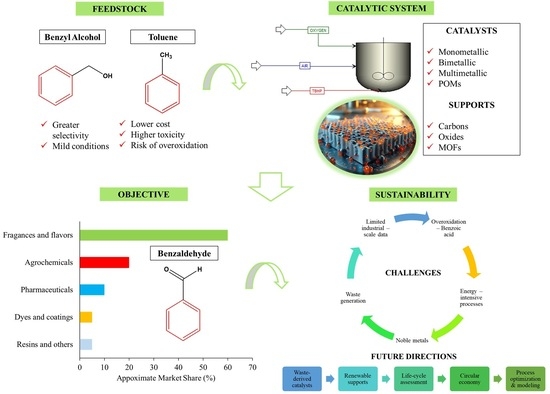
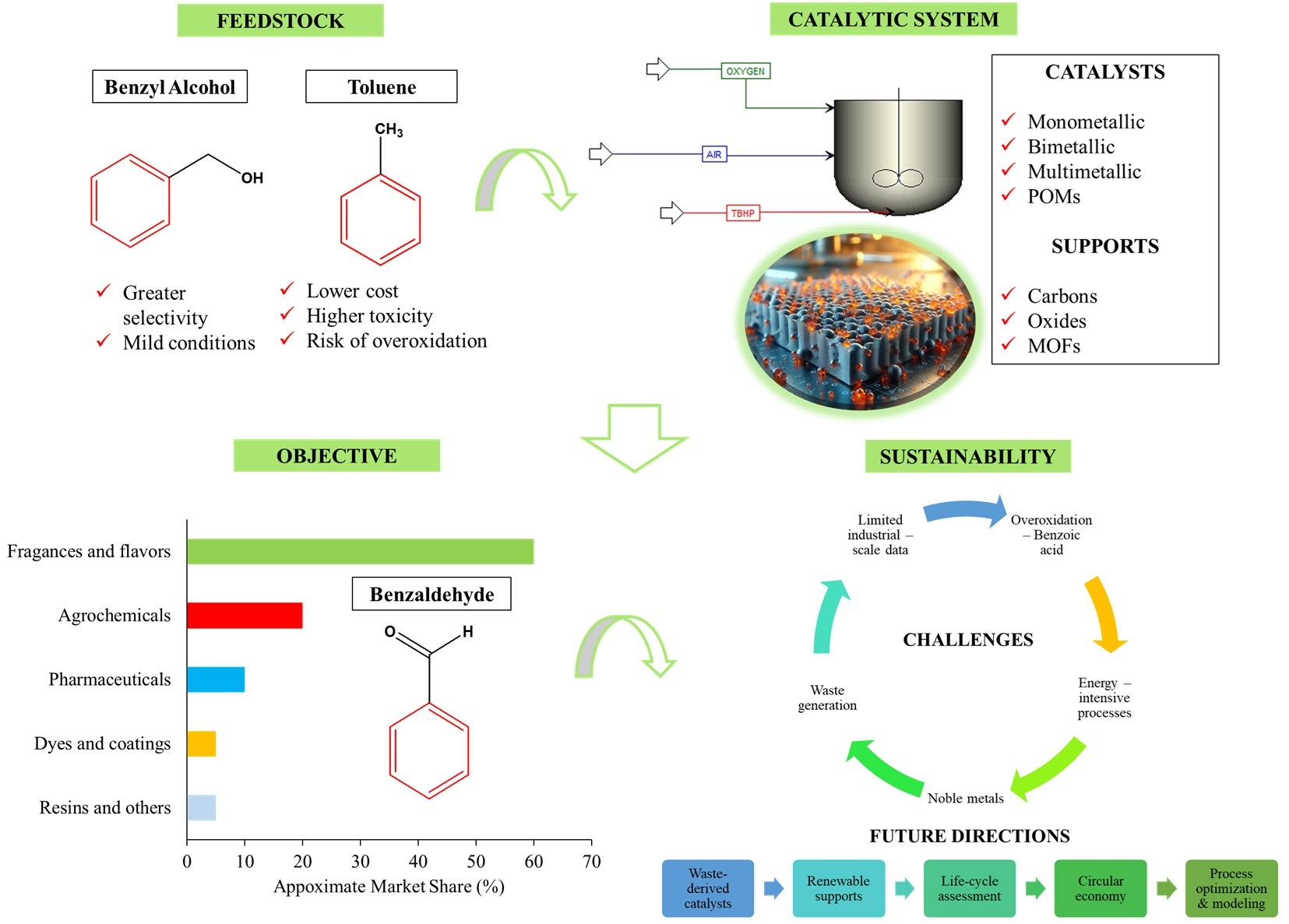
Graphical Abstract

1. Introduction

The oxidation of alcohols to aldehydes is an important class of industrial organic transformations, with broad applications in the production of fine chemicals and pharmaceutical intermediates [1]. These reactions produce benzaldehyde, a high-value chemical intermediate, which is a key raw material in various industries. It is considered a high-value-added chemical due to its wide applications in pharmaceuticals, fragrances, agrochemicals, and fine chemicals [2].
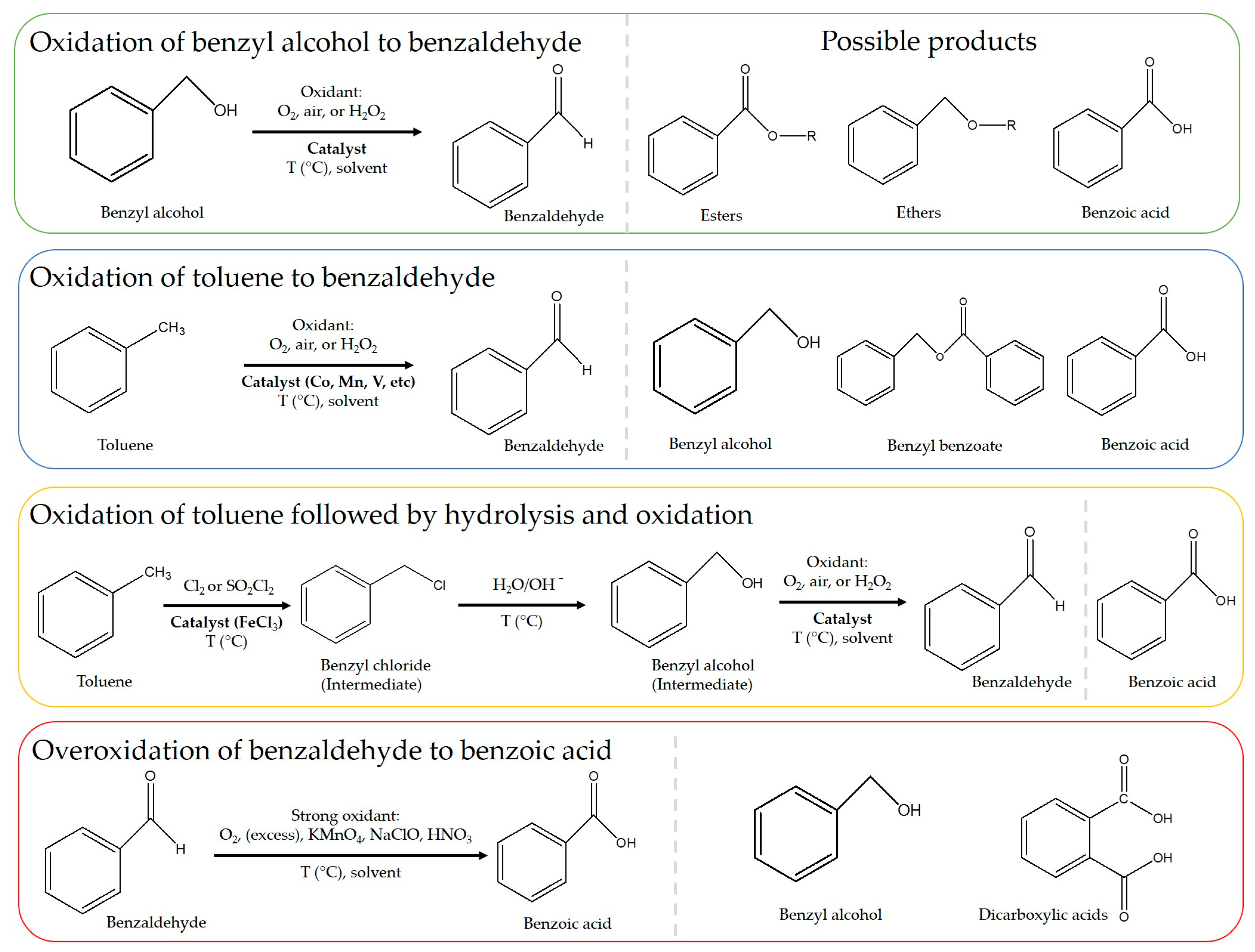
This compound plays an essential role in various industrial applications, including flavoring agents, pharmaceuticals, fragrances, agricultural chemicals, coatings, dyes, resin additives and as a pharmaceutical precursors [3,4]. Within the various synthetic routes reported for this compound, the oxidation of benzyl alcohol and the partial oxidation of toluene stand out (Figure 1).
Reported laboratory-scale liquid-phase reactions for benzaldehyde production typically operate at 25–150 °C, whereas gas-phase processes generally operate at substantially higher temperatures. Common oxidants include oxygen, air, and tert-butyl hydroperoxide (TBHP), with solvents such as N,N-dimethylformamide (DMF), water, hexane, and methanol used in some liquid-phase systems [4,5,6,7].
Detailed industrial-scale operating conditions for benzaldehyde production are generally proprietary and are not disclosed in the open literature. At the laboratory scale, benzaldehyde synthesis has been extensively investigated using feedstocks such as toluene and benzyl alcohol [8,9]. Toluene oxidation can be limited by low conversion, competing oxidation pathways, and the formation of overoxidation products, depending on the catalyst and reaction conditions [10,11].
Both catalyst synthesis and conventional oxidation methods for converting benzyl alcohol to benzaldehyde may involve expensive metal precursors and energy-intensive processing [12]. In addition, some heterogeneous catalytic systems use corrosive or hazardous precursor chemicals, which can increase waste generation and treatment requirements [13].
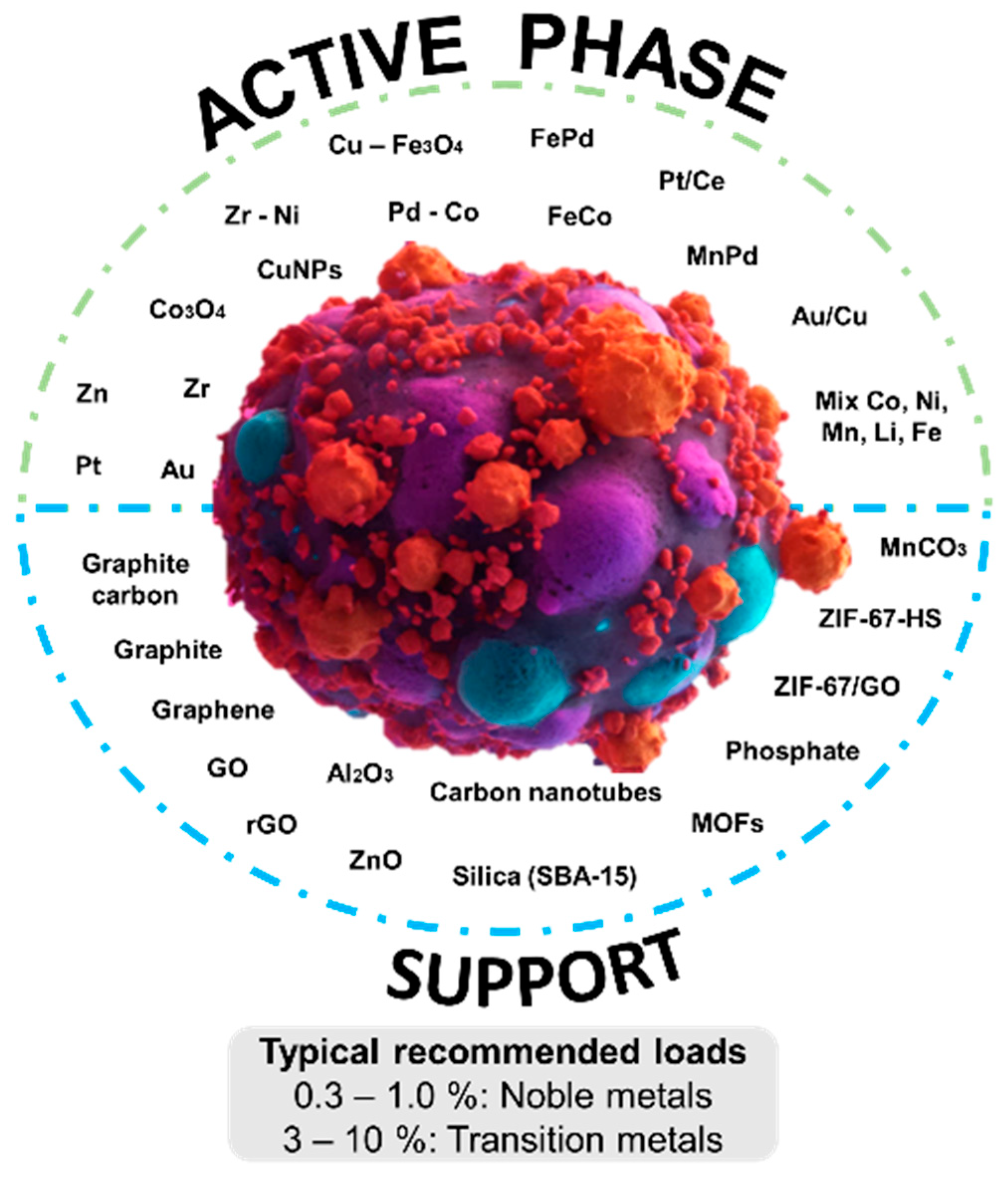
Heterogeneous catalysts reported for benzaldehyde synthesis include monometallic systems (Pd, Zr, Mn, Fe, Ni, Co, Cu) [14,15,16,17] bimetallic catalysts (Fe:Pd, Au-Sn, Ni:Fe, Au-Pd, La-Co) [18,19,20,21,22] multiphase systems (Au-Pt-Cu, Au-Pt-Cu-Ni, CoCu-Ce) [23,24] and polyoxometalates (POMs) [25,26,27]. These catalytic phases are typically supported on a wide range of materials, including activated carbon, graphene, graphene oxide, reduced graphene oxide, chitosan, organometallic compounds, and silica-based supports, among others [28,29,30,31] (Figure 2).
Figure 2 schematically summarizes the typical loading ranges of active phases supported by different materials for the selective oxidation of toluene and benzyl alcohol to benzaldehyde. Noble metals (Pd, Pt, Au), acting mainly as promoters for oxygen activation, are incorporated at low loadings (0.3–1.0 wt %) to preserve high dispersion and avoid overoxidation. In contrast, transition metal oxides and mixed metal systems (e.g., Co3O4, MnOx, Fe-based and bimetallic catalysts) are used at moderate loadings (3–10 wt %) to provide redox-active sites required for selective oxidation. The lower part of the diagram highlights the role of the support, including carbon-based materials, metal oxides, and porous frameworks, which mainly influence metal dispersion, stability, and metal–support interactions rather than contributing directly to catalytic activity. Overall, the figure illustrates how controlled active-phase loading is essential to balance conversion and selectivity toward benzaldehyde.
The composition of heterogeneous catalysts reported for benzaldehyde production is highly variable because research efforts focus on different aspects of the synthesis process, ranging from fundamental studies such as reaction kinetics and mechanistic investigations to applied approaches aimed at maximizing catalytic performance in terms of yield, selectivity, and conversion, which are strongly dependent on the physicochemical properties of the catalyst and the operating reaction conditions [32,33,34,35].
Several previous reviews have addressed closely related aspects of benzaldehyde production and catalytic oxidation. For example, Chan-Thaw et al. [36] provided a detailed discussion of heterogeneous Pd-based catalysts for the liquid-phase oxidation of benzyl alcohol, with particular emphasis on nanoparticle morphology and support effects. Najafishirtari et al. [37] reviewed alcohol oxidation across thermocatalytic, electrocatalytic, and photocatalytic systems, focusing on structure-performance relationships. More recently, Su et al. [38] reviewed heterogeneous catalytic systems for the oxidation of toluene, with emphasis on reaction mechanisms and catalyst modification strategies. These studies provide valuable contributions to the understanding of specific catalytic systems and reaction pathways. However, their scopes are primarily focused on substrates, catalyst families, or catalytic approaches.
In contrast, the present review adopts a broader and integrated perspective by considering both benzyl alcohol and toluene as relevant feedstocks for benzaldehyde production and by covering a wide range of heterogeneous catalytic systems, including mono-, bi-, and multimetallic catalysts, supported materials, and polyoxometalate-based systems. In addition to catalytic performance and synthesis methodologies, the review considers sustainability, laboratory-scale cost estimation, bibliometric trends, and the potential use of waste-derived materials as alternative sources of catalytic components and supports. This integrated approach connects catalyst design and reaction performance with economic, environmental, and industrial considerations. The catalytic performance of various systems is systematically compared in Table 1.
Regarding the costs associated with catalysts, equipment, and reagents used in benzaldehyde production, scientific literature lacks comprehensive techno-economic assessments published in indexed journals. Although several studies suggest that replacing noble metals with transition metals in the active phases may reduce overall costs, there is currently limited quantitative information or comparative analysis available to substantiate this claim. This highlights knowledge gap that limits a holistic understanding of the economic implications associated with the use of different heterogeneous catalytic systems in this context.
Similarly, and in response to the challenges posed by the United Nations Sustainable Development Goals (SDGs), increasing attention has been devoted over the past five years to the valorization of post-consumer waste in diverse applications. Such waste streams are being explored as sustainable feedstocks for the synthesis of catalytic materials, including both active phases and supports, due to their abundance and potential for recovery. In this regard, lithium-ion batteries constitute an increasingly abundant secondary resource; despite this, at the end of their service life, a significant fraction remains inadequately managed. Despite the existence of recycling routes, limited collection efficiency, economic constraints, and insufficient recycling infrastructure result in a substantial proportion of spent batteries being disposed of in landfills, safety cells, or temporary storage facilities, particularly in regions lacking consolidated waste management systems [39].
Finally, emerging strategies based on the valorization of urban and industrial waste, particularly spent lithium-ion batteries, are discussed as alternative sources of catalytic materials, addressing their potential contribution to sustainable catalyst design and the remaining scientific and technological challenges. Beyond summarizing the existing literature, this review critically evaluates how catalyst composition, synthesis methodology, support selection, reaction conditions, and sustainability criteria collectively determine the feasibility of future industrial benzaldehyde production.
First, current market trends and conventional routes for benzaldehyde synthesis are discussed, highlighting their operational conditions, oxidants, and inherent limitations. Subsequently, the main laboratory-scale reaction pathways are reviewed, with emphasis on the use of benzyl alcohol and toluene as feedstocks and their associated catalytic challenges. The review then systematically examines heterogeneous catalytic systems, including mono-, bi-, and multimetallic catalysts as well as polyoxometalate-based materials, focusing on the role of active phases, metal synergy, and support selection. In addition, the most widely reported catalyst synthesis methodologies such as impregnation, co-precipitation, sol–gel, hydrothermal, and deposition–precipitation routes are critically compared in terms of performance, scalability, and environmental impact. The review further incorporates an item-by-item estimation of the costs associated with reagents and materials used in defined laboratory-scale catalyst batches, together with a bibliometric analysis of research trends and an assessment of emerging strategies based on waste-derived materials. Finally, emerging strategies based on the valorization of urban and industrial waste, particularly spent lithium-ion batteries, are discussed as alternative sources of catalytic materials, addressing their potential contribution to sustainable catalyst design and the remaining scientific and technological challenges.

2. Benzaldehyde Market Trends

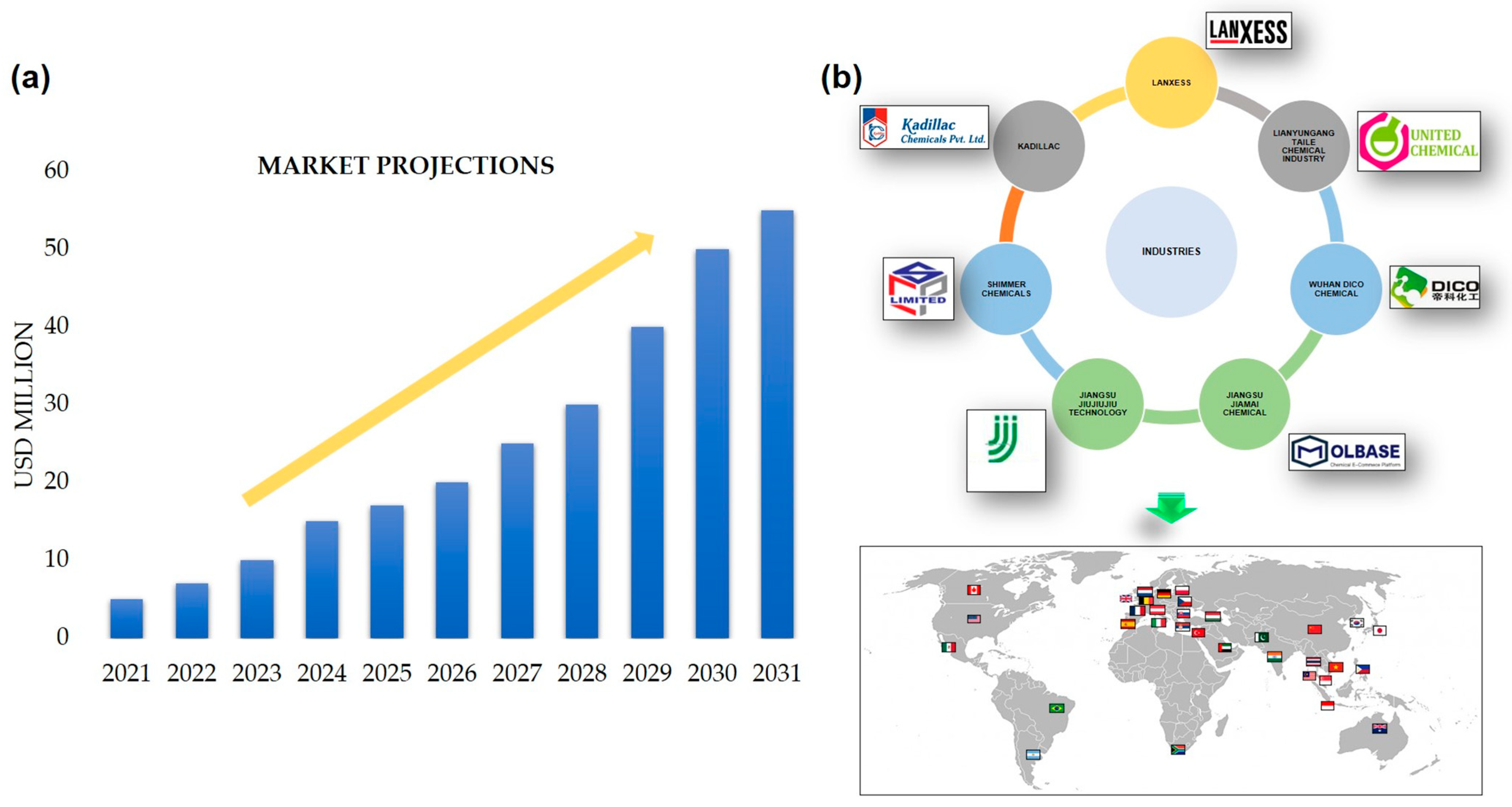
The industrial benzaldehyde market is experiencing significant transformation, driven by increasing demand in key sectors such as the pharmaceutical and fragrance industries [11]. In 2024, the United States benzaldehyde market is projected to account for 10.8% of the global share, with an estimated value of USD 100.1 million, mainly due to its use in food additives, cosmetics, and perfumes [40]. Additionally, market projections indicate a value exceeding USD 50 million by 2031 (Figure 3a). According to reports published by ReportLinker, China accounted for 35.1% of the global benzaldehyde market in 2023, with projections reaching USD 325.8 million by 2034. The country’s advanced manufacturing infrastructure and the availability of raw materials have enabled low-cost supply, thereby driving demand in the pharmaceutical sector. India has also emerged as a relevant market player, with an estimated share of approximately 6.6% in 2023 and a projected market value of USD 152.6 million by 2034 [41].
Despite the positive market outlook and the strong growth projected in regions such as China and India, the benzaldehyde market faces several limiting factors. The availability and cost of key raw materials, such as toluene and benzyl alcohol, remain critical concerns that can affect production stability and pricing. In addition, increasingly strict environmental and safety regulations may lead to higher production costs, particularly for conventional synthesis routes. Furthermore, concerns regarding the potential adverse health effects of benzaldehyde could negatively influence its demand, highlighting the need for safer production methods and more sustainable alternatives.
In Japan, the growth of the agrochemical and fragrance sectors, together with stringent regulations on chemical substances, significantly influences both the production and use of benzaldehyde. Meanwhile, in Australia, the strong focus on sustainability and chemical research is fostering the development of new applications and improvements in benzaldehyde production, which is expected to contribute to market growth toward 2034 [43]. In addition, the Food Chemicals Codex (FCC) grade is expected to dominate the market by 2026, ensuring high purity and compliance with safety standards required for flavor and fragrance formulations. This trend is driven by the increasing demand for natural products, in which benzaldehyde is anticipated to play a key role [43].
In addition to market growth, sustainability has become a key aspect in benzaldehyde production processes. Conventional synthesis routes, such as the oxidation of toluene or benzyl alcohol, are commonly associated with the generation of by-products, including benzoic acid, overoxidation products, acidic effluents, and metal-containing waste streams when homogeneous catalysts are employed [40]. To address these issues, recent industrial and academic efforts have focused on minimizing waste generation using heterogeneous catalysts, milder oxidants, solvent-free systems, and improved process control aimed at enhancing selectivity toward benzaldehyde. These strategies contribute to waste reduction, improved atom efficiency, and compliance with increasingly strict environmental regulations.
The industrial relevance of benzaldehyde is also reflected in the presence of several major companies operating globally. Figure 3b summarizes some of the leading players in the benzaldehyde market, highlighting their production facilities and corporate offices worldwide, which underscores the strategic importance of this compound in the chemical and pharmaceutical industries [44].
Additionally, the geographical distribution of these industries is predominantly concentrated in developed countries, where per capita income levels and production and distribution systems operate under advanced technological, scientific, and innovation standards. Consequently, it can be inferred that this compound has been extensively studied in these countries, including its industrial-scale implementation, which suggests the availability of techno-economic assessment perspectives. Nevertheless, due to proprietary know-how and confidentiality constraints, detailed production volumes are rarely disclosed, and the available information is therefore largely limited to import and export data.
Regarding export and import dynamics, in 2022, benzaldehyde was one of the most traded fine chemicals globally, being traded for a total of $105 million. Between 2020 and 2022, Benzaldehyde exports grew by 32.8%, from USD 79.3 million to USD 105 million. Benzaldehyde trade represents 0.00050% of total world trade. In 2022, the top exporters of Benzaldehyde were China ($41.5 million), the Netherlands ($19.7 million), India ($8.19 million), Belgium ($7.28 million) and Malaysia ($5.45 million). In addition, for the same year, the main importers of Benzaldehyde “benzoic aldehyde“ were the United States ($30.6 M), the United Kingdom ($11.2 million), India ($5.74 million), South Korea ($5.09 million) and Germany ($5.07 million) [45].
The following are the main exporting continents and countries:
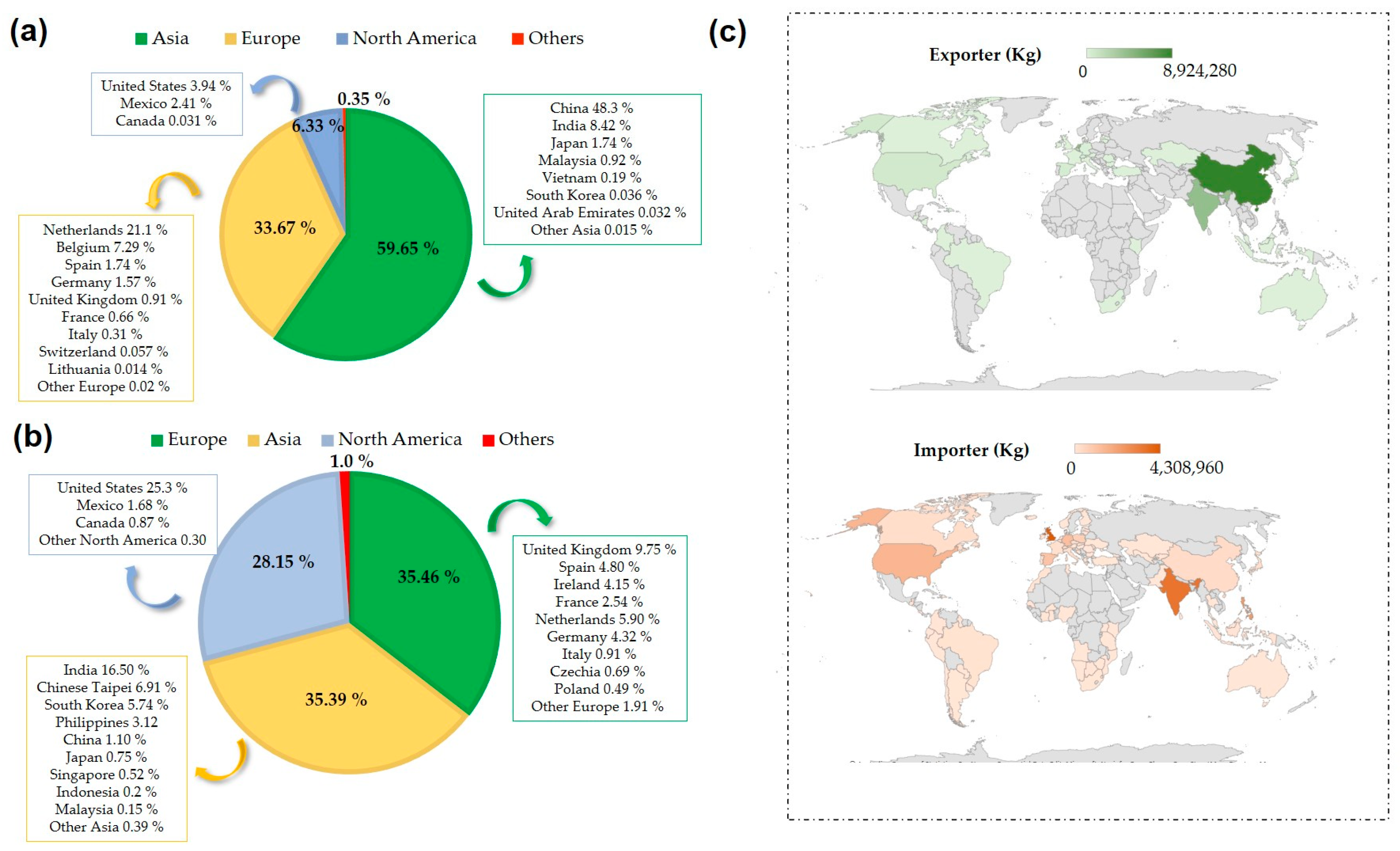
The trade data (Figure 4) reveal a clear concentration of benzaldehyde production in Asia and Europe, with China (41.5 million USD) and the Netherlands (19.7 million USD) as the leading exporters. This geographical distribution correlates with the availability of low-cost raw materials such as toluene and well-established chemical manufacturing infrastructures. In contrast, import patterns-dominated by the United States (30.6 million USD), the United Kingdom (11.2 million USD), and India (5.74 million USD)-are largely driven by demand from downstream industries, including pharmaceuticals, flavorings, and fragrances. This global imbalance between production and consumption centers underscores the strategic importance of benzaldehyde as a value-added chemical intermediate. Notably, Latin America and Africa play a comparatively minor role in both exports and imports, reflecting lower industrialization levels or limited downstream demand in these regions. These trade dynamics are not merely commercial indicators; they indirectly highlight where the compound is produced and used, which is relevant for understanding regional research priorities, regulatory frameworks, and the potential for adopting more sustainable production technologies.
Regional export distribution: The trade data (Figure 4) reveal a clear concentration of benzaldehyde production in Asia and Europe, with China and the Netherlands as leading exporters, while import patterns are largely driven by the demand from downstream industries in North America and Europe, highlighting a global imbalance between production and consumption centers.
Country-specific exports: The figure lists the leading countries in terms of benzaldehyde exports for each continent. China takes the lead in Asia, and the Netherlands leads in Europe. Notably, the United States is the leading exporter in North America. These figures align with the notion that larger, more developed economies tend to have a stronger presence in global chemical exports.
Latin America and Africa: The data show relatively lower benzaldehyde export percentages in other countries compared to other regions. Notably, Colombia and Morocco are the primary exporters in their respective regions, but their export percentages are notably lower than the leaders in Asia and Europe.
Other countries by export share: Figure 4a includes categories for “Other Asia” and “Other Europe,” representing a smaller portion of benzaldehyde exports. This suggests that Benzaldehyde exports are also distributed across other countries in these regions.
At the same time, the import of benzaldehyde to different continents is shown (Figure 4b). The presented Figure 4b provides a comprehensive view of the percentage distribution of benzaldehyde importation across continents and their respective countries. Notably, the data reveals that North America, Asia, and Europe are the primary contributors to benzaldehyde importation, with the United States, India, and the United Kingdom leading their respective continents in import percentages. These findings suggest the presence of robust chemical industries in these regions, with the United States indicating a substantial demand for benzaldehyde.
Australia, which is described under “other” plays a comparatively minor role in the import of benzaldehyde, accounting for only a small percentage. Beyond these major players, it is crucial for the article to delve into the specific reasons behind these import patterns. These import patterns can be mainly associated with differences in domestic production capacity, the presence of downstream industries such as pharmaceuticals, fragrances, and agrochemicals, as well as regional regulatory frameworks and access to raw materials [46,47].
Following the same line, Figure 4c presents the countries with the highest benzaldehyde export and import values, expressed in kilograms, for the year 2023. Export and import data are represented using green and brown color gradients, respectively. Darker shades indicate higher export or import volumes, whereas lighter shades correspond to lower values.
Although international trade data provide useful insights into the global distribution of benzaldehyde, the relevance of these figures lies primarily in understanding where the compound is produced and used, rather than in identifying commercial trends per se. High import volumes observed in countries such as the United Kingdom, India, and South Korea are closely linked to strong domestic demand driven by downstream industries, including pharmaceuticals, flavorings, fragrances, and fine chemicals. In contrast, major exporting countries such as China and India reflect their large-scale production capacity, access to raw materials, and established chemical manufacturing infrastructure [38,45,46].
These observations suggest that benzaldehyde production is geographically concentrated in regions with robust chemical industries, while consumption is more globally distributed according to application-specific demand. Therefore, differences between import and export volumes do not represent market trends in isolation, but rather the balance between domestic production, internal consumption, and industrial specialization. In this context, international trade data serve as an indirect indicator of industrial usage patterns rather than as a primary focus of this review [48,49,50].
Based on this perspective, the following sections focus on the synthesis routes of benzaldehyde, recent advances in catalytic systems, and the technological challenges associated with improving selectivity, sustainability, and environmental performance.

3. Benzaldehyde Production

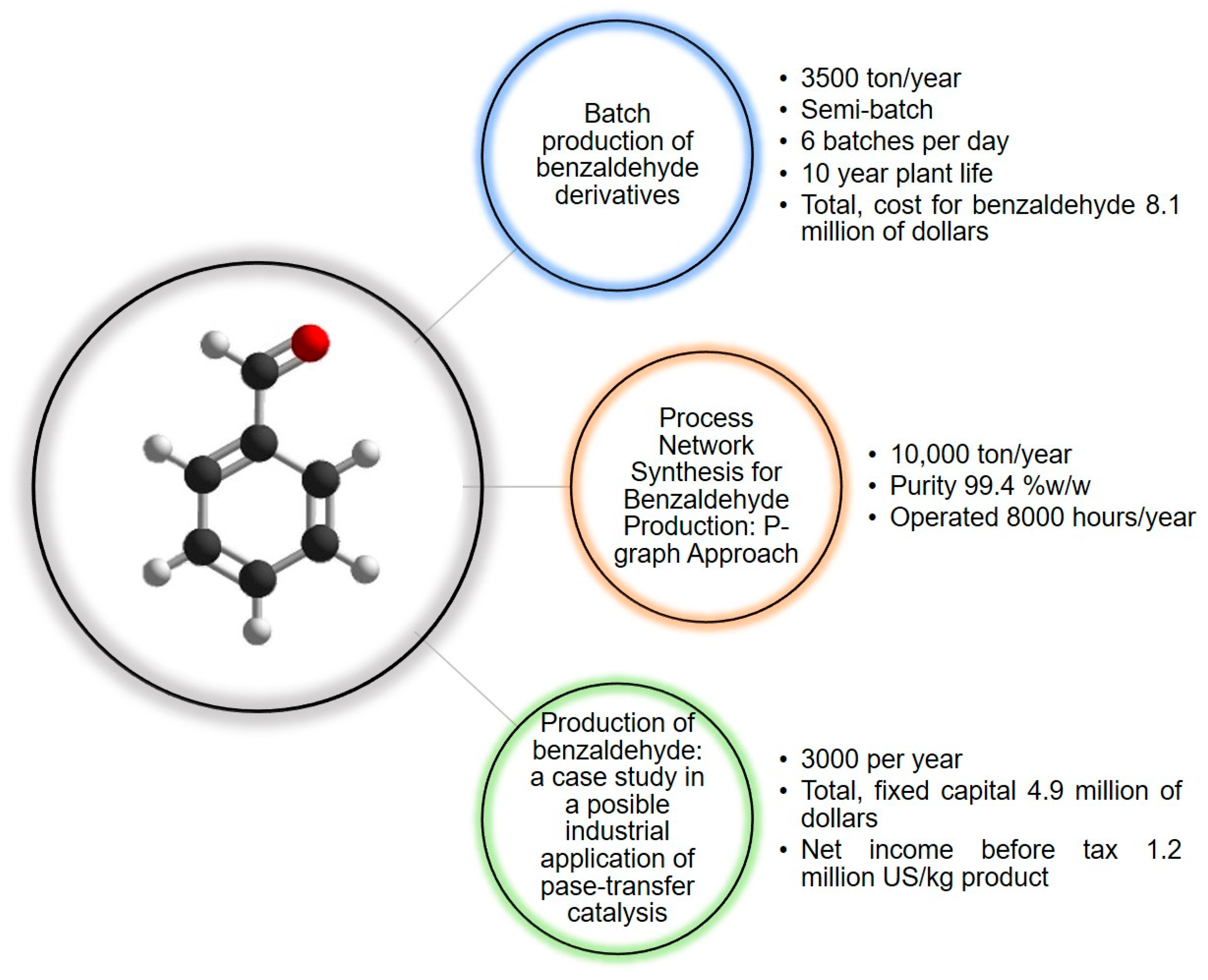
Industrial-scale studies on benzaldehyde production remain limited in the open literature, as most available information is derived from laboratory-scale academic research [48,51]. Only a small number of studies have addressed process-oriented approaches, including pilot-scale evaluations and techno-economic assessments of benzaldehyde production routes, as schematically summarized in Figure 5. These studies primarily focus on the feasibility of specific oxidation pathways rather than on the detailed design of industrial reactors or large-scale catalyst synthesis [52].
At the industrial scale, benzaldehyde is predominantly produced through the catalytic oxidation of toluene, mainly due to its lower cost and wide availability compared to benzyl alcohol. This process is typically carried out using heterogeneous catalytic systems under gas-phase or liquid-phase conditions, where selectivity control is critical to avoid overoxidation to benzoic acid. Although toluene-based routes are economically attractive, their higher toxicity compared to benzyl alcohol represents a relevant safety and environmental concern.
Alternative feedstocks such as benzyl alcohol, benzene, 1-phenylethanol, and styrene have also been investigated. Benzyl alcohol oxidation offers higher selectivity under milder conditions but is limited by higher raw material costs. In contrast, routes involving benzene or 1-phenylethanol require additional reaction steps, increasing process complexity and operational costs, while styrene-based pathways generally exhibit low performance and remain poorly explored [56].
Notably, there is a lack of publicly available industrial-scale studies addressing catalyst synthesis, physicochemical characterization, reactor configuration, and process variables for benzaldehyde production. This gap is largely attributed to the proprietary know-how retained by multinational companies. Consequently, current research efforts are mainly driven by academic studies aimed at understanding reaction mechanisms, optimizing catalytic performance, and exploring new sustainable feedstocks and synthesis routes aligned with the Sustainable Development Goals. In this context, the following sections review recent investigations employing different raw materials and catalytic systems.
The catalytic performance of various systems is systematically compared in Table 2. From Table 2, it is observed that approximately 72% of the reported studies employ benzyl alcohol as the feedstock, which is noteworthy given that, at the industrial scale, toluene is the primary raw material for benzaldehyde production. A comparative analysis of the literature reveals a clear divergence between laboratory-scale systems and those potentially viable at the industrial scale, particularly with respect to the selected feedstock, oxidizing agent, catalyst type, and operating conditions.
Table 2. Conversion and selectivity of benzaldehyde in batch reactors under different reaction conditions.
SubstrateReaction Temperature (°C)OxidantReaction Time (h)Conversion (%)Selectivity (%)Reference
Benzyl alcohol26Air1094.1100[57]
Benzyl alcohol25Oxygen209996[58]
Benzyl alcohol120Air886.797.4[59]
Benzyl alcohol120Air893.698.2[60]
Benzyl alcohol25H2O23070-[61]
Benzyl alcohol90Air57894[62]
Benzyl alcohol120Air210096[63]
Benzyl alcohol80–100Air49060[30]
Benzyl alcohol120Oxygen484.790.3[64]
Benzyl alcohol100Oxygen889.597.3[65]
Benzyl alcohol90Tert-Butyl hydroperoxide (TBHP)496100[66]
Benzyl alcohol80Oxygen650.089.0[57]
Benzyl alcohol150Oxygen2495.396.7[13]
Benzyl alcohol80H2O28-98.1[67]
Benzyl alcohol140Oxygen599100[68]
Benzyl alcohol120Oxygen38096.6[18]
Benzyl alcohol90Oxygen595.742.7[19]
Benzyl alcohol25H2O20.13--[28]
Benzyl alcohol100TBHP79899[1]
Toluene120H2O21111.566.5[15]
Toluene120TBHP686.788.1[35]
Toluene80H2O2 and TBHP12-71[69]
Toluene340Air-90-[70]
Toluene260-10090-[71]
Toluene180Oxygen2.56.570.3[72]
Toluene300Oxygen-50-[73]
- No data available.
Most academic studies employ benzyl alcohol as a model substrate because its selective oxidation to benzaldehyde can proceed under relatively mild conditions (≤120 °C), facilitating evaluation of catalyst activity and selectivity. The studies summarized in Table 2 also illustrate the requirements of industrially relevant feedstocks and process conditions [13,25]. Within this framework, two main feedstocks have been explored: toluene and benzyl alcohol. The use of toluene is advocated by authors such as Deng et al. and Kalita and Talukdar, who emphasize its low industrial cost [35,72]. Nevertheless, selective toluene oxidation is mechanistically more complex, as it typically follows a Mars–van Krevelen mechanism, requiring interaction between the substrate and lattice oxygen from the catalyst [70,71,72]. Deng et al. reported a 70.3% selectivity toward benzaldehyde and benzyl alcohol using a Mn@ZIF-8-derived catalyst under solvent-free conditions at 180 °C [72]. In contrast, Song et al. employed Cu nanoparticles supported on graphene, achieving a 66.5% selectivity at 65 °C, although high O2 pressures (2.0 MPa) were required to compensate for the lower thermal energy input [61].
Conversely, benzyl alcohol oxidation is consistently reported as a more controlled and efficient route for selectivity studies. Tamizhdurai et al. extensively investigated mesoporous silica supports such as SBA-15, incorporating zirconia and Pt/Ce active phases [64,66]. Their results indicate that the ordered hexagonal structure of SBA-15 effectively confines metal species, preventing agglomeration and enabling conversions exceeding 98% at 90 °C [64,66]. A relevant comparison is provided by Kalita and Talukdar, who proposed MCM-48 as an alternative support, arguing that its three-dimensional cubic pore network minimizes pore blockage and enhances mass transport during toluene oxidation with TBHP at 80 °C [35]. Similarly, Mangesh et al. favored SBA-15 for supporting Ni–Fe bimetallic catalysts, achieving 99% selectivity at 90 °C, attributed to high metal dispersion promoted by oleic acid as a protective agent [1].
Reaction temperature remains a critical parameter. While Tamizhdurai and Mangesh identified 90 °C as optimal for silica-based systems using TBHP [64,66], Gao et al. required 150 °C for CoFe2O4 nanocatalysts when employing gaseous O2 [13]. This difference is associated with the higher activation energy required for O2 activation, whereas TBHP undergoes thermal decomposition above 90–100 °C, reducing oxidizing efficiency and increasing safety concerns [35]. Liu et al. demonstrated that increasing temperature from 80 to 100 °C in Au–Sn/GO systems enhances conversion but reduces selectivity due to overoxidation to benzoic acid [19]. This behavior is kinetically supported by the work of Namyśl et al., who identified the phenoxy radical as a key intermediate governing benzaldehyde degradation under gas-phase conditions [73].
The choice of oxidant affects both catalytic activity and sustainability process. Aldosari and Yang et al. proposed graphene-supported bimetallic systems such as Fe-Pd and Co-based catalysts, capable of activating molecular O2 at 100–120 °C while remaining magnetically recoverable [18,30]. Aldosari attributed the enhanced yield to a synergistic effect, where Pd modulates the electronic density of Fe, facilitating alcohol adsorption while suppressing deep oxidation. Similarly, Yang et al. employed atomic layer deposition (ALD) to decorate Pd nanoparticles with MnOx, selectively passivating Pd facets and completely suppressing toluene formation; a level of control not achievable via conventional impregnation methods [63].
Reactor configuration also plays a decisive role. Pohar et al. demonstrated that reactor design is as critical as catalyst formulation, employing 3D printing to fabricate FePd monoliths supported on Al2O3 and GO [62]. Continuous-flow monolith reactors outperformed packed-bed and batch reactors, increasing the turnover frequency (TOF) by up to 90% due to improved axial dispersion and phase contact [62]. Overall, the literature suggests that while benzyl alcohol enables higher yields under mild conditions (80–120 °C), industrial implementation will likely rely on optimized toluene oxidation, achieved through precise nano-architectural control and continuous-flow technologies to enhance atom economy and operational safety [15].

4. Trends in Catalyst Synthesis for Benzaldehyde Production

Traditional benzaldehyde synthesis routes have historically relied on highly reactive inorganic oxidants, including sulfur-, iodine-, and manganese-containing species, often operating under non-strictly catalytic regimes [74]. These systems typically require near-stoichiometric reagent quantities, resulting in poor atom economy and substantial inorganic waste generation. Moreover, the corrosive and toxic nature of metal halides and manganese salts poses significant challenges in terms of safety, effluent treatment, and regulatory compliance, limiting their industrial sustainability [15].
To address these limitations, noble-metal-based catalysts (Au, Pt, Pd) have been widely investigated due to their high activity and selectivity, albeit at elevated costs [10,57,63,75]. Transition metals such as Cu, Co, Ni, and Fe have emerged as cost-effective alternatives [30,52,60,76]. Cobalt-based catalysts, in particular, have demonstrated conversions of 40–100% and selectivities of 72–99% [58,59,60,77]. Despite this, a frequently overlooked limitation lies in the origin of metal precursors, which are commonly derived from energy-intensive mining and refining processes, potentially conflicting with Green Chemistry principles [78,79].
Bimetallic and multifunctional catalysts have been extensively investigated to address the limitations of monometallic systems. Aldosari [18], evaluated the performance of graphene-supported Fe, Pd, and Fe-Pd catalysts, reporting selectivity and conversion ranges of 99.9–1.0% (selectivity) and 98.3–78.1% and 80.0–96.6% (conversion), respectively. The superior performance of the bimetallic Fe-Pd catalyst was attributed to the synergistic interaction between Fe and Pd, which enhances catalyst stability, as well as to the stronger substrate adsorption capacity of Fe compared to the corresponding monometallic catalysts. Comparable results were reported by Mohapatra and Yoo [20], who achieved a selectivity of 98% and a conversion of 85% under photocatalytic conditions. Their findings highlighted the critical role of the structure-activity relationship, surface properties, and defect density of the catalyst, identifying these materials as highly promising systems. Similarly, Wang et al. [22] investigated La-Co bimetallic catalysts, obtaining a benzaldehyde selectivity of 99.6% and a conversion of 73.4%. The incorporation of La into the cobalt spinel structure modified the electronic properties of Co, increasing the surface concentration of Co3+; species and thereby enhancing catalytic activity. Overall, these studies reveal common features governing catalytic performance, namely synergistic interactions between active metal species and structural stabilization effects induced by dopants or supports. Such factors consistently promote higher reaction yields and selectivity, supporting the potential applicability of bimetallic catalysts not only at the laboratory scale but also in industrial benzaldehyde production.
Multiphase and polyoxometalate-based catalysts have also been investigated for this organic oxidation reaction. For example, Liu et al. [23] studied supported Au-Pt-Cu and Au-Pt-Cu-Ni nanoparticles, reporting enhanced thermal stability due to chemical interactions between transition metals (Cu or Ni) and the Au-Pt framework. These interactions promoted homogeneous metal distribution and high dispersion, resulting in reaction yields of up to 96%. Similarly, Xu et al. [24] developed a trimetallic CoCu–CeO2 oxide catalyst, demonstrating that the introduction of Co and Cu species positively modifies the structure and morphology of CeO2 compared to its monometallic counterpart. This improvement was attributed to the generation of crystal defects, which favor oxygen activation and synergistic effects arising from Co–Cu codoping. Overall, these studies indicate that catalysts containing multiple active phases, including transition metals, enhance both catalyst stability and electron transfer between active sites, leading to improved performance in redox reactions.
In parallel, alternative approaches based on POMs have been explored for benzaldehyde production. Zhu et al. [25] reported the use of the Na5.1La0.7CoMn0.3Mo11.7O40⋅22.05H2O@AC, achieving 13.18% conversion and 40.43% selectivity toward benzaldehyde. In this system, Co acted as the central atom, while Mn and Mo served as additional metal ions. The authors demonstrated that the stoichiometric ratio of metal atoms significantly influences catalytic activity, and that sodium and lanthanum species promote conversion, suggesting favorable synergistic interactions that also enhance thermal stability. Likewise, Yu-Fei Song et al. [26] investigated interfacial electronic interactions in Au0Pd^δ+ oxides co-modified with Na12[α-P2W15O56] nanoclusters, achieving 92% conversion and 96% selectivity toward benzaldehyde. In another study, Mahmood and Amani [27] synthesized a Keggin-type POM (H5PMo10V2O40) immobilized on UiO-66-NH2, reporting a benzaldehyde yield of 95%, attributed to the high surface area, uniform POM dispersion, and strong electronic interactions that facilitate redox processes.
In general, laboratory-scale studies on the oxidation of benzyl alcohol and toluene using POM-based catalysts consistently report improved catalytic performance, mainly due to enhanced metal–support electronic interactions, increased thermal stability, larger specific surface areas, and more homogeneous dispersion of active phases. These features promote oxidant activation and stabilization of reactive intermediates, which are essential for selective oxidation reactions. However, despite their catalytic advantages, most POMs and their support are synthesized from commercial reagents or via multi-step, energy-intensive routes involving high-purity metal salts, generating significant environmental impacts. This approach conflicts with the principles of green chemistry and the Sustainable Development Goals (SDGs), particularly those related to responsible production and waste minimization [80].
In the selective oxidation of benzyl alcohol and toluene to benzaldehyde, the choice of catalytic support plays a critical role in determining system performance, as it directly affects active phase dispersion, accessibility of catalytic sites, thermal stability, and reaction selectivity. Carbon-based supports have been widely employed due to their high surface area, tunable porosity, good electronic conductivity, and ability to establish strong metal–support interactions, which favor oxidant activation and intermediate stabilization while minimizing overoxidation. In parallel, inorganic oxides and other porous materials allow modulation of acid–base and redox properties, contributing to reaction pathway control and improved benzaldehyde performance.
It should be noted that most conventional catalytic supports originate from petrochemical routes, refining processes, and intensive purification steps, including graphite and its derivatives (reduced graphene oxide, rGO; graphene oxide, GO), alumina, zinc oxides, silicates, carbonates, zeolites, and metal–organic frameworks (MOFs). Although these materials enhance catalytic activity due to their physicochemical properties, they present sustainability limitations, reinforcing the need to explore alternative supports derived from renewable resources or waste materials [10,58,59,62,81,82].
Moreover, the production of these supports poses additional environmental challenges, as a significant fraction originates from mining and primary processing of inorganic raw materials, which involve high water and energy consumption, greenhouse gas emissions, and contaminated effluents. Consequently, despite their competitive catalytic performance, the cumulative environmental impact of conventional supports limits their alignment with green chemistry principles and the SDGs, highlighting the need for alternative strategies based on the valorization of urban or industrial waste as functional catalytic support precursors [80].

4.1. Catalyst Synthesis Methodologies

The selection of synthesis methodologies for mono-, bi-, and multimetallic catalysts, as well as POMs, depends on multiple factors widely discussed in the literature, including the nature of the active phase, support type, required metal dispersion, thermal and chemical stability, and operating conditions of benzaldehyde oxidation processes [83]. Wet impregnation and co-precipitation are commonly preferred due to their operational simplicity and scalability, whereas more advanced strategies-such as deposition-precipitation, hydrothermal synthesis, template-assisted self-assembly, and organometallic precursor pyrolysis are employed to finely control particle size distribution, metal–support interactions, and active oxidation states [84]. For bimetallic catalysts and materials derived from MOFs and POMs, synthesis methodology is particularly critical, as it determines metal proximity, electronic interactions, and the formation of synergistic active sites, directly impacting conversion, selectivity, and catalyst stability. Table 3 summarizes the main synthesis methods reported in the literature, along with their key characteristics and applications in benzaldehyde production from different feedstocks.
According to Table 3, the literature reports a wide diversity of methodologies for the synthesis of catalysts applied to the oxidation of benzyl alcohol and toluene to benzaldehyde. The selection of a given method is closely associated with the required level of control over metal dispersion, material morphology, active phase–support interaction, thermal stability, and scalability. Consequently, these methods differ not only in operational complexity but also in the balance between catalytic performance, cost, and sustainability, which ultimately determines their suitability for specific applications.
Impregnation and its variants emerge as the most widely employed methodologies, mainly due to their simplicity, reproducibility, and ease of tuning metal loading on a broad range of supports [17,20]. Systems such as SiMo12/Al2O3 and Pt/C demonstrate that this approach enables adequate dispersion of the active phase, leading to satisfactory conversion and selectivity toward benzaldehyde [85]. Despite these advances, studies report limitations related to metal particle sintering and coke formation under prolonged or severe reaction conditions, which negatively affect catalyst stability and long-term reusability [24].
In contrast, sol–gel methodologies are typically selected when finer control over morphology, particle size, and metal–support interactions is required. Catalysts such as Fe:Pd/G synthesized via sol–gel routes exhibit high selectivity and thermal stability, attributed to the formation of homogeneous and well-integrated nanostructures [86]. Nevertheless, the increased process complexity, higher reagent consumption, and additional synthesis steps restrict their economic and industrial feasibility, confining their application mainly to laboratory-scale studies.
Hydrothermal and solvothermal methods stand out for their ability to control crystallinity and morphology, as observed in catalysts such as CoFe2O4 and ZnS@ZnIn2S4. The hydrothermal method, typically operating at 100–250 °C and using water as the solvent, is considered a relatively economical and less toxic alternative, although it requires long reaction times and significant energy input [87]. By contrast, the solvothermal method provides greater structural versatility but involves higher temperatures (often above 300 °C), the use of specific organic solvents, and specialized equipment, substantially increasing costs and potential environmental impacts.
Co-precipitation and simple precipitation represent attractive approaches from both economic and environmental perspectives, as they allow relatively homogeneous metal distribution, as reported for systems such as La-Co1Ox and Mn-Cu [85,88]. Nevertheless, these methods are highly sensitive to subsequent thermal treatments, where sintering and particle growth can adversely affect metal dispersion. Comparatively, co-precipitation generally offers improved selectivity and compositional control relative to simple precipitation, although at the expense of longer synthesis times and stricter operational control [89].
Deposition-precipitation is positioned as an intermediate strategy, combining high metal dispersion with precise control of active phase loading, as demonstrated for Au/Al2O3 catalysts [26,90]. Nevertheless, its strong sensitivity to parameters such as pH, temperature, and precursor concentration, together with the need for additional washing and purification steps, increases costs and limits large-scale implementation.
A particularly relevant aspect highlighted in Table 3 is the use of POMs as active phases, which are predominantly synthesized via impregnation, in some cases combined with immobilization strategies. The main advantage of POMs lies in their multimetallic nature, enabling the integration of multiple redox centers within a single structure and enhancing catalytic activity without the need for high noble metal loadings [26,91]. From both economic and environmental perspectives, this feature is especially attractive, as these metals could potentially be sourced from urban or industrial wastes, reducing reliance on energy-intensive separation and purification processes [92].
Table 3. Synthesis methods of catalysts employed for benzaldehyde production.
CatalystSynthesis MethodAdvantagesDisadvantagesReference
SiMo12/Al2O3Wet impregnationPrecise control of metal loading; tunable particle sizeLimited kinetic stability; catalyst deactivation by coke formation[93]
MMn2O4 (M=Co, Ni, Cu)Sol–gelHigh recyclability; high selectivitySlow activation; complex handling[77]
Fe:Pd/GSol–gelHigh metal dispersion; formation of nanostructures; enhanced thermal stabilityProcess complexity; fragility of graphene matrix; metal loss during synthesis; slow and costly process[18]
Si/M (M=Co, Fe)HydrothermalLower cost compared to solvothermal methods; low synthesis temperaturesLong reaction times; impurity formation; poor catalyst recoverability[33]
Ru-Ce/C170-600HydrothermalWell-defined and stable active phases; high dispersion; strong metal–support interaction; low synthesis temperature High cost of precursors; risk of contamination; difficult morphology control[94]
CoFe2O4HydrothermalControl of particle size and morphology; stable phases; scalable Risk of undesired phase formation; high energy consumption[13]
ZnS@ZnIn2S4SolvothermalFormation of stable metallic phases Use of organic solvents; high equipment cost[25,82,95]
LayCo1OxCo-precipitationLow cost; environmentally friendly; effective at moderate temperaturesLower selectivity and stability; sintering-induced deactivation[20]
Ce/(FeCoNiCrMn)3O4Co-precipitationHomogeneous metal distributionSinterization during thermal treatment[96]
Mn-CuPrecipitationGood activity at low temperatures; improved selectivity; enhanced efficiencyLow metal dispersion; formation of by-products; purification required[88]
Au-Ni/MIL-101-1Impregnation and H2 reductionHigh dispersion of active metals; scalableMetal agglomeration: thermal treatment required; active phase loss; long-term deactivation; hydrogen handling cost[97]
Na5.1La0.7CoMn0.3Mo11.7O40⋅22.05H2O@ACImpregnationHigh surface area; simple and economicalPoor metal distribution; sintering-induced deactivation[23]
ZnO/MnCO3ImpregnationSupport compatibility; scalable; high dispersionLimited support stability; additional processing steps required[82]
NiCo@SBA-15Co-impregnationHigh surface area; thermal stability; formation of bimetallic catalystsInhomogeneous metal distribution; agglomeration; process complexity[98]
Au-Pd/Ceria-zirconiaDeposition precipitationHigh noble metal dispersion; controlled metal loading; Au–Pd synergistic effectsSensitive to precipitation conditions; additional purification steps; high reagent cost[99]
Au/Al2O3Deposition precipitationHigh dispersion; controlled metal loading; homogeneous structures; scalable and relatively low costpH sensitivity; impurity risks[90]
Pt/CImpregnationSimple and low-cost method; high Pt dispersion; controlled metal loadingHigh cost of active phase[100]
M-La/CoOx (M=La addition)ImpregnationImproved redox properties and stability; compatibility with various supportsSinterization; post-treatments required; possible impurity contamination[101]
Ag-Cu/POMDepositionHigh dispersion of active metals; Ag–Cu synergistic effects; improved thermal and redox stabilityCatalyst poisoning; formation of inactive phases; high precursor cost[102,103]
AuPd/P2W15-Al2O3Deposition, precipitation and immobilizationAu–Pd synergy; improved thermal and redox stability; enhanced catalytic selectivityRisk of sintering; additional treatment steps required[26]
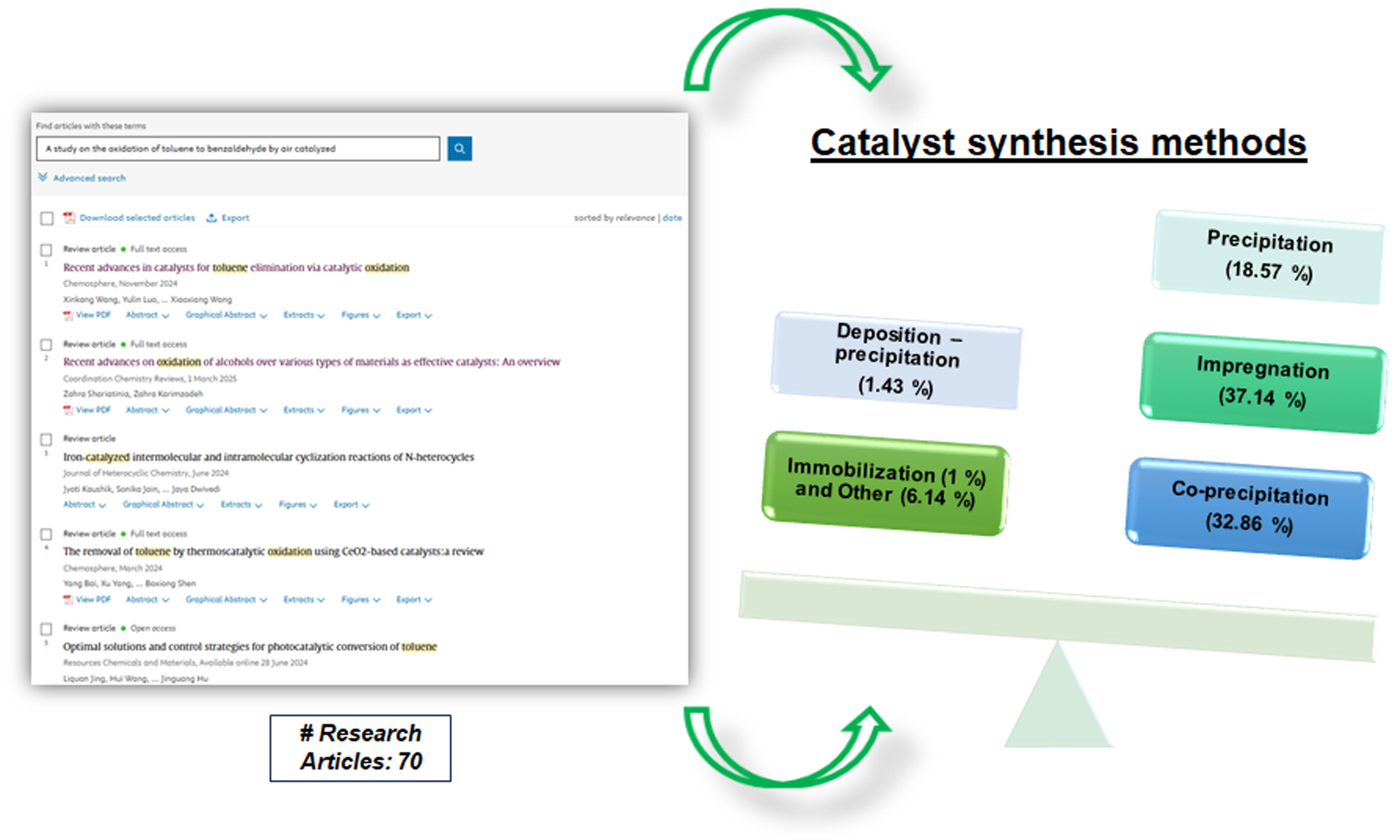
A quantitative analysis of the literature indicates that, out of 70 analyzed articles, 37.14% employ impregnation-based methods, followed by co-precipitation (32.86%) and precipitation (18.57%), while the remaining fraction corresponds to more specific or hybrid methodologies (Figure 6). This distribution suggests that, although more sophisticated methods allow optimization of structural and catalytic properties, simple and scalable approaches continue to dominate due to their practical feasibility.
Overall, the literature reveals a recurrent trade-off between synthetic complexity and catalytic performance. Methods offering enhanced control over morphology and metal dispersion are generally more costly and difficult to scale, whereas simpler approaches often suffer from limitations in stability and homogeneity. This duality underscores the need to develop synthesis strategies that combine operational simplicity, catalytic stability, and sustainability, particularly using alternative materials and waste-derived precursors.
In general, synthesis methods that provide enhanced control over morphology, metal dispersion, and metal–support interactions are associated with higher experimental complexity and increased costs. In contrast, simpler and readily scalable methodologies, such as impregnation and co-precipitation, often exhibit limitations in structural homogeneity and thermal stability, frequently requiring post-synthesis treatments to improve catalytic performance. These methodological considerations are particularly relevant in heterogeneous catalysis for the selective oxidation of benzyl alcohol and its derivatives to benzaldehyde. Recent studies emphasize the need to adopt approaches aligned with Green Chemistry principles, including the replacement of toxic oxidants with more sustainable alternatives such as molecular oxygen or hydrogen peroxide. In this context, Albadran et al. [100,102] investigated noble metal catalysts such as platinum supported on carbon (Pt/C), highlighting that, despite their high cost, their superior efficiency in oxygen activation arises from the high density of active sites achieved through atomic-scale dispersion. In comparison, Bian et al. y Duarte et al. [82,98] focused on transition metal oxides such as Ni-Co and Zn-Mn systems, respectively, arguing that these catalysts are economically viable and benefit from synergistic effects between multivalent metal ions and the generation of oxygen vacancies, which enhance reactive species mobility. Similarly Xu et al. [24] demonstrated that in trimetallic CoCu-CeO2 catalysts, Cu incorporation promotes electron transfer from Co3+ to Co2+, a key factor governing the redox performance of complex catalytic systems.
The synthesis method emerges as a determining factor for controlling particle size and active site homogeneity. Although wet or incipient impregnation remains the most widely used technique due to its technical simplicity and ease of industrial scale-up [18], authors such as Tareq et al. and Aldosari report that sol immobilization is superior for producing highly dispersed and uniform nanoparticles. Specifically, Tareq et al. [21] showed that this method reduced Au–Pd particle size to 2.39 nm, compared to 4.72 nm obtained via impregnation, resulting in significantly enhanced catalytic activity. Along similar lines, Olmos et al. and Zelin et al. [90,99] employed deposition–precipitation (DP), achieving particle sizes in the range of 1.9–5.0 nm, and concluded that strict pH control during synthesis is critical to maximizing exposed noble metal surface area and optimizing interactions with supports such as alumina or ceria–zirconia. Conversely, hydrothermal synthesis has been adopted by Gao et al. to fabricate spinel-type CoFe2O4 structures with particle sizes of approximately 16 nm, characterized by high phase purity and thermal stability [13].
The nature of the support also plays a critical role beyond simple metal dispersion. Lukato et al. and Li et al. [26,103] emphasized that polyoxometalates (POMs) act as exceptional supports by stabilizing Ag-Cu or Au-Pd nanoparticles, preventing metal leaching, and facilitating electron transfer without undergoing permanent structural changes. Zelin et al. [90] conducted a comparative analysis of different supports and found that γ-Al2O3 outperformed ZnO in benzaldehyde synthesis, attributing this behavior to a higher density of weak and moderate acid sites that favor benzyl alcohol chemisorption. In addition, Liu et al. employed metal–organic frameworks (MIL-101) to encapsulate Au–Ni alloys, arguing that pore confinement suppresses excessive particle growth and enhances surface charge heterogeneity within the alloy [97].
From a catalytic performance perspective, marked differences are observed depending on whether the reaction is conducted in the presence or absence of solvent. The highest reported performances correspond to Lukato et al., who achieved nearly complete conversion with selectivities exceeding 99% using Ag-Cu/POM in toluene under mild conditions [98,103]. Similarly, Bian et al. reported a conversion of 98% at 120 °C using NiCo@SBA-15, highlighting bimetallic synergy as the key factor underlying such high efficiency [98]. Under solvent-free conditions, Aldosari achieved an efficiency of 87% using Fe-Pd supported on graphene, whereas Xu et al., working with Ce-doped high-entropy oxides, reported a lower conversion of 37.7% but emphasized the exceptional catalyst stability over seven reaction cycles due to entropy-stabilized structures [18,96].
From a selectivity and conversion standpoint, the recurring challenge lies in suppressing overoxidation to benzoic acid. Aldosari demonstrated that in bimetallic systems, iron promotes oxidation while palladium suppresses further oxidation, thereby inhibiting acid formation [18]. Duarte et al. provided a fundamental analysis of solvent effects, concluding that nonpolar solvents such as toluene or ethylbenzene are preferable because they enhance oxygen solubility and do not compete with the substrate for active sites, unlike polar solvents such as DMF or DMSO [82]. Nevertheless, Rezaei et al. identified acetonitrile as the optimal solvent for their vanadium-based system (VPO/KIT-6), as it activates molecular oxygen through the formation of an effective oxygen-transfer intermediate [34]. Finally, Zhu et al. demonstrated the feasibility of using atmospheric air and activated carbon as a support for POM-based catalysts, achieving selectivities of 40.4% and highlighting that uniform catalyst dispersion on porous supports is a key determinant for industrial applicability [25].
Bimetallic synergy plays a decisive role in determining final selectivity toward benzaldehyde by modifying the intrinsic electronic properties of surface active sites [97]. Lili Liu et al., [97] reported that alloy formation, such as Au–Ni, induces surface charge heterogeneity that enhances activity and selectivity beyond that of individual monometallic components. This electronic redistribution is critical, as demonstrated by Hongqiang Li et al. [26] through density functional theory (DFT) calculations, showing that electron transfer within Au-Pd alloys generates electron-rich metal species that optimize the metal d-band center. Such electronic modulation facilitates molecular oxygen activation to form superoxide radicals (•O2−), which are key reactive species enabling selective alcohol oxidation while suppressing deep oxidation pathways [104].
The ability of these systems to suppress overoxidation to benzoic acid represents one of the most significant benefits of bimetallic synergy. In Fe–Pd systems, Aldosari reported that iron sites are primarily responsible for substrate adsorption and metal–alkoxide formation, whereas palladium inhibits subsequent oxidation steps, preventing benzaldehyde conversion to benzoic acid [18]. This functional cooperation is consistent with observations by Lukato et al., who found that while monometallic Ag catalysts exhibit reasonable conversion, their selectivity toward aldehydes is often limited; Nevertheless, Cu incorporation increased selectivity to values exceeding 99% through cooperative effects that stabilize desired transition states and mitigate metal leaching [103].
Finally, structural architecture and surface defect engineering constitute an additional pillar in controlling bimetallic selectivity. Olmos et al. demonstrated that core–shell structures (Au-core@Pd-shell) are significantly more active and selective than fully homogeneous alloys, as Pd surface migration creates interfacial regions that promote rapid benzaldehyde formation and desorption [99]. Complementarily, in transition metal systems such as Ni–Co or Co–Cu, Bian et al. and Xu et al. [85] highlighted that atomic-level bimetallic interactions facilitate the generation of multiple oxidation states and abundant oxygen vacancies [100]. These defects not only enhance molecular oxygen activation but also suppress byproduct formation by modulating the redox potential of the system, ensuring selective termination at benzaldehyde even under high humidity or pressure conditions [24].

4.2. Benzaldehyde Synthesis Methods and Associated Costs at Laboratory Scale

To establish the costs associated with benzaldehyde production, several studies were considered, extracting from each of them the most representative substances used in each process, which were used as the basis for cost estimation. Prices varied considerably depending on the supplier (commercial companies such as Sigma-Aldrich, Merck, Anedra, Ineos, Laring, various websites, minority distributors and producers of benzaldehyde) and their technical specifications. With the aim of maintaining consistency in the estimation of prices related to the reagents used in the synthesis of catalysts and their application in the organic synthesis reaction for obtaining benzaldehyde, we reference commercial containers or presentations with capacities reported by various commercial suppliers. This ensures that these containers contain the experimental volumes used in the studies. This approach was adopted because there are studies that do not provide quantities at the experimental level, complicating the cost calculation process.
Additionally, certain substances such as deionized water are quantified through the purchase of a deionizer, as the cost per cubic meter varies by country. Gases like Ar, H2, N2, Air, He, and O2 are also considered through the purchase of cylinders.
According to the data in Table 4, the estimated reagent costs range from approximately USD 1100 to 4100 USD for reagents observed. Despite the focus of the research on obtaining benzaldehyde, the wide range of reagent costs is primarily attributed to the field of study. Various themes are identified, such as the type of catalyst and its modifications (homogeneous or heterogeneous), catalytic properties, and kinetic analysis (catalyst activity, selectivity, and yield).
Other factors contributing to cost variations include the availability of materials and reagents (associated costs, precursors), reaction conditions (temperature, pressure, agitation, reagent concentration, oxidant, etc.), process requirements, and specific catalyst characteristics (particle size, pore distribution, crystallinity, functional groups, etc.). These characteristics are determined based on instrumental techniques summarized in Figure 7. Additionally, it is noted that there is variability in the route or methods of catalyst synthesis, as expected, since the chosen route is linked to the application and the goal of the research. Nevertheless, it is not possible to deduce the best synthesis route for benzaldehyde at this point. Commonly used methods include impregnation and its variants, as well as the deposition process.
Furthermore, it is not possible to establish a directly proportional relationship between the costs of the catalyst synthesis method and the chemicals used. As mentioned earlier, depending on the research objective or scope, costs can be variable and depend not only on the number and quantity of reagents used but also on their nature, concentration, brand, and impurities. For example, S. Qiu et al., [65] present a study using the highest number of chemicals compared to other research, with an estimated cost of $3456 USD. In contrast, C. Jacquot et al. [62], report similar costs ($3259 USD) with a lower number of chemical reagents than those presented by S. Qiu et al.
Furthermore, Table 4 also indicates that, to meet the cost reduction goal in the process, specifically in the catalytic material, active phases derived from transition metals such as Co and Cu have been used. In a certain way, they contribute to the reduction in production costs, but they are still obtained from precursor salts such as nitrates and oxalates, resulting in an increase in carbon footprint, water usage, and environmentally unfriendly processes [29,105]. It can also be observed that research with yields exceeding 90% not only employs noble metals but also transition metals, distributed evenly. This suggests that transition-metal active phases may provide a lower-cost alternative to noble-metal-based catalysts for benzaldehyde production. Similarly, in terms of costs, the use of different oxidizing agents such as TBHP, H2O2, oxygen, and air is noted. TBHP and hydrogen peroxide are excellent oxidizing agents; however, they tend to be pollutants. On the other hand, oxygen is the optimal oxidizing agent detailed for these types of reactions, but its acquisition cost necessitates replacement, making air one of the most economical, environmentally friendly, and widely used alternatives in research [29,106,107].
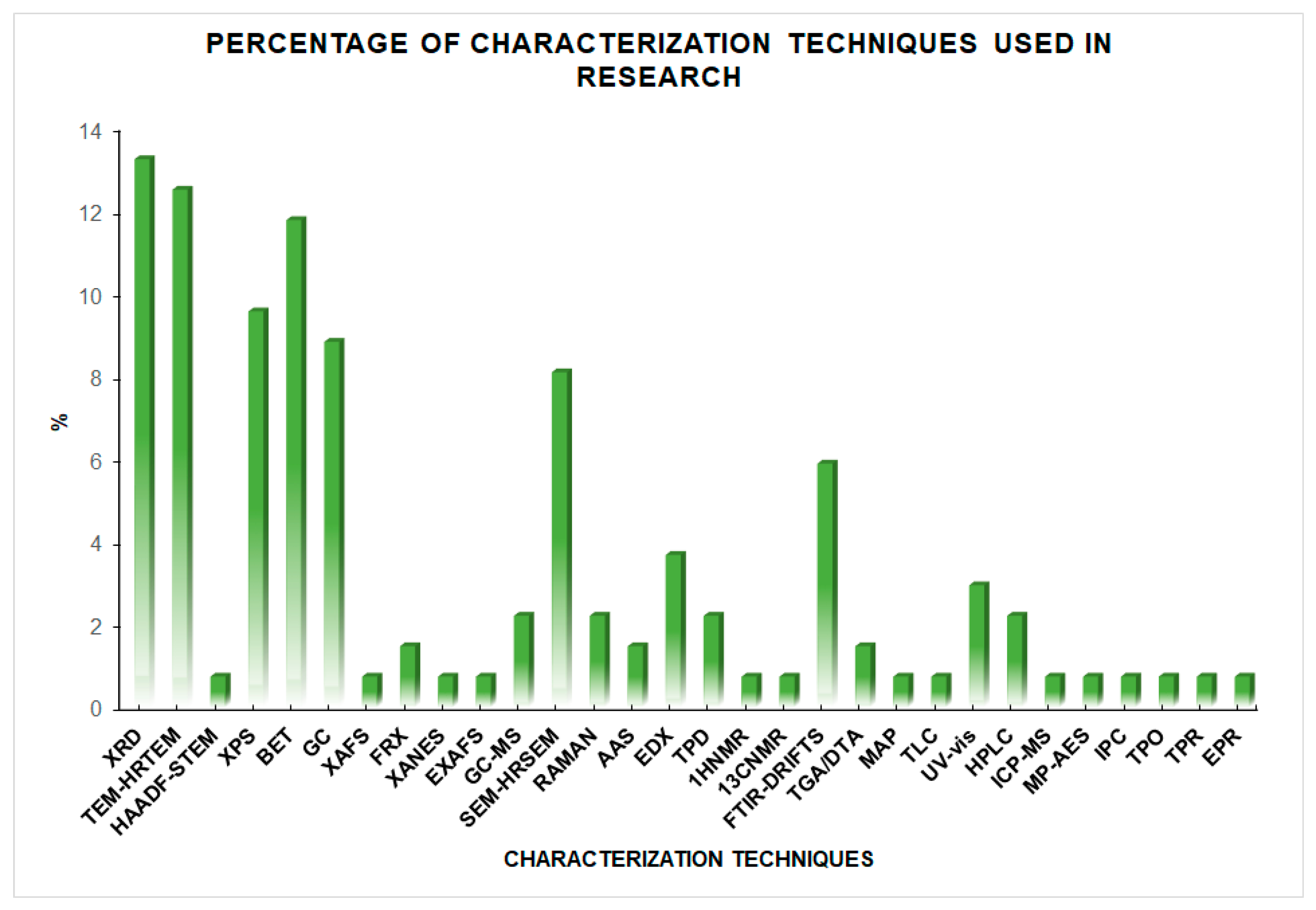
Figure 7 shows that the most commonly used techniques are X-ray Diffraction (XRD) (13.2%), Transmission Electron Microscopy–High-Resolution Transmission Electron Microscopy (TEM-HRTEM) (12.5%), BET area-Adsorption desorption (11.8%), X-ray Photoelectron Spectroscopy (XPS) (9.6%), Gas Chromatography (GC) (8.8%), Scanning Electron Microscopy–High Resolution Scanning Electron Microscopy (SEM-HRSEM) (8.1%), and Fourier Transform Infrared Spectroscopy-Diffuse Reflectance Infrared Fourier Transform Spectroscopy (FTIR-DRIFTS) (5.9%). Following these are techniques such as Energy Dispersive X-ray (EDX) (3.7%), Ultraviolet-Visible Spectroscopy (UV-vis) (2.9%), Gas Chromatography–Mass Spectrometry (GC-MS) (2.2%), Raman (2.2%), Temperature-Programmed Desorption (TPD) (2.2%), High-Performance Liquid Chromatography (HPLC) (2.2%), Atomic Absorption Spectrometry (AAS) (1.5%), and Thermogravimetric Analysis/Differential Thermal Analysis (TGA/DTA) (1.5%). Lastly, the least common characterization techniques include High-Angle Annular Dark-Field Scanning Transmission Electron Microscopy (HAADF-STEM), X-ray Absorption Fine Structure (XAFS), Proton Nuclear Magnetic Resonance (1HNMR), Carbon-13 Nuclear Magnetic Resonance (13CNMR), Element Mapping (MAP), Thin Layer Chromatography (TLC), Inductively Coupled Plasma-Mass Spectrometry (ICP-MS), Microwave Plasma Atomic Emission Spectroscopy (MP-AES), Inductively Coupled Plasma (ICP), Temperature Programmed Oxidation (TPO), Temperature Programmed Reduction (H2-TPR), and Electron Paramagnetic Resonance Spectroscopy (EPR), all with a percentage of 0.7%.
The prevalent use of XRD, TEM, and BET adsorption–desorption techniques suggests a focus on the crystalline structure, morphology, specific surface area, surface composition, and interaction with molecules relevant to the benzyl alcohol-to-benzaldehyde reaction. The predominance of these techniques may stem from their capability to provide structural and surface information. The limited utilization of other techniques could be attributed to their constraints in applicability to these specific catalyst characteristics or restrictions in accessibility and cost. This analysis underscores the importance of selecting techniques aligned with the specific characterization objectives and critical properties of the catalyst under study. In addition to the characterization analysis, the costs presented in Table 4 were estimated on an item-by-item basis, considering the detailed contribution of each experimental component. The cost of each reagent and material was calculated according to the current quantity employed for a defined laboratory-scale batch of catalysts. Consequently, the total estimated cost was determined by summing the individual costs of all experimental components required for each catalyst synthesis procedure, with the reagent costs normalized according to the quantity used per catalyst gram.
Table 4. Catalyst synthesis method, oxidation reaction and associated process costs.
Catalyst
Synthesis Method
Precursors
(Catalyst)
Reagents
(Reaction)
Cost
(USD)
References
DispersionZnO, DI water, H2PtCl6.H2O, NaBH4
Bi(NO3)3.5H2O
Benzyl alcohol, air1468[10]
Dispersion–depositionAu and Cu (oxides), Acetone, Carbon Black Vulca XC-72,
n-pentane
Oxygen, cyclohexane
Benzyl alcohol, octanol
1356[57]
DepositionMesoporous silica (KIT-6), Co(NO3)2.6H2O, NaOHBenzyl alcohol, DMF, air, toluene
CH3CN
1727[58]
ImpregnationCo(NO3)2.6H2O, DMF, ethanol, DI water, TPT, H3btc 1,3,5 benzene tricarboxylic acid,
cobalt chloride, NaOH, N2 (gas), H2
Benzyl alcohol, n-hexane-ethyl acetate2625[59]
CopyingSBA-15, toluene
Co(NO3)2.6H2O, 2M NaOH, Benzoquinone, Benzyl benzoate
Benzyl alcohol, air, DMF, toluene, CH3CN2054[52]
Co-precipitation-Immobilized
hydrothermal
Dopamine, hydrochloride
Copper (II), acetate hexahydrate, ethanol
salicylaldehyde, NEt3, n-hexane, Diethyl ether, Dichloromethane/acetone, ferrous chloride, ferric chloride, DI water,
ammonium hydroxide, NaOH
Benzyl alcohol, H2O2 30%, n-hexane/ethyl acetate (4:1), diethyl ether3106[60]
ComplexationH2SO4 98%, KMnO4
DI water, H2O2 30%, ethanol, CuSO4, GO, KOH (1M), hydrazine hydrate 90%, acetyl trimetyl ammonium bromide (CTAB)
Toluene 30% H2O2, methanol, oxygen, nitrobenzene2121[61]
PyrolysisCo(NO3)2.6H2O, methanol, 2-methylimidazole
ZIF-67, Argo flow
HF, DI water, ethanol,
DMF, benzyl alcohol, air, amyl alcohol1592[15]
Hydrothermaldodecylamine 98%, tetraethyl orthosilicate 98% (TEOS), AgNO3 99% SCRC, etanol
DI water, Co(NO3)2
Ce(NO3)3, La(NO3)3, Cu(NO3)2, Sr(NO3)2, Cd(NO3)2, Ni(NO3)2, Fe(NO3)3, MnSO4.H2O
N2, air, oxygen, benzyl alcohol1884[17]
Deposition-
Continuous Hydrothermal
Flow Synthesis
Fe(NO3)3.9H2O, Co(NO3)2.6H2O, Pd(NO3)2.4NH3, Puralox TH 100/150 (Alumina powder), He, oxygen 20%Benzyl alcohol, DMF, air, K2CO3, potassium carbonate anhydrous 99.5%3259[62]
Wet impregnationAl2O3 99%, Palladium nitrate dihydrate 18.09%, air, MnOx
N2, Tris (2,2,6,6-tetramethyl-3,5-heptanedionato), manganese (II)),
ozone 99.999%
Benzyl alcohol, oxygen2428[63]
DopingGO, N2, Co(NO3)2.4H2O, DI water, 2-methylimidazoleBenzyl alcohol, DMF, O21585[30]
DepositionMesoporous SBA-15, acid (2M HCl), pluronic tri-block copolymer (silica), ZrO2 (10–40%), DI water, urea, N2Benzyl alcohol, TBHP (oxidant), ethyl acetate, DMF2372[64]
DispersionP-hidroxy benzaldehyde, 3-nitrophtalonitrile
DMF, N2, potassium carbonate, NaOH, NaCl aqueous
3-(4-formyl) phenoxy phthalonitrile, NaBH4
Anhydrous methanol, HCl, ether/ethyl acetate
3-(4-hydroximethyl) phenoxy, phthalonitrile, CoCl2.6H2O, n-pentanol, Ar, 1,8-diazabicyclo undec-7-ene (DBU), petroleum ether, DI water, concentrated nitric acid
Benzyl alcohol, O2, acetone3456[65]
Impregnated by incipient wetnessP123 (triblock co-polymer), DI water
HCl, TEOS, chloroplatinic acid
CeO2 5–20%, urea, cerium nitrate, air, ammonium hydroxide
Benzyl alcohol, TBHP (Tert-butyl hydroperoxide) (oxidant), acetonitrile3284[66]
DepositionCTAB (Hexadecyltrimethylammonium bromide), DI water, Co(NO3)2.6H2O, 0.5 M
HMIM (2-methylmidazole 1.096 M, DMF
APTES (3-aminopropyl) triethoxysilane, isopropyl alcohol
HauCl4, sodium citrate, NaBH4 0.1 M,
ammonia, ethanol,
TEOS, air
Benzyl alcohol, O2, K2CO34196[81]
ImpregnationZr-Ni 15% nickel, natural phosphate, DI waterBenzyl alcohol, H2O2
oil, silica gel, hexane, EtOAC, ethyl acetate
2280[108]
Incipient wetness impregnationMnCO3 93%, Zn(NO3)2.6H2O 99.5%, N2, ZnO 99%O2, benzyl alcohol, toluene, N2
benzoic acid, n-dodecane
1113[82]
CoprecipitationSpongy citrus grandis peel, HNO3 1M, DI water, Cu(NO3)2, Mn(NO3)2, airBenzyl alcohol, H2O2, n-decane, toluene1346[109]
DopingSBA-15, Co(NO3)2.6H2O, air, Mn(NO3)2·4H2O, Cu(NO3)2·2.5H2O, Zn(NO3)2·6H2O, Palladium (II) chlorideBenzyl alcohol 99.99%,
O2
1951[110]

5. Alternative Raw Materials for Catalyst Synthesis

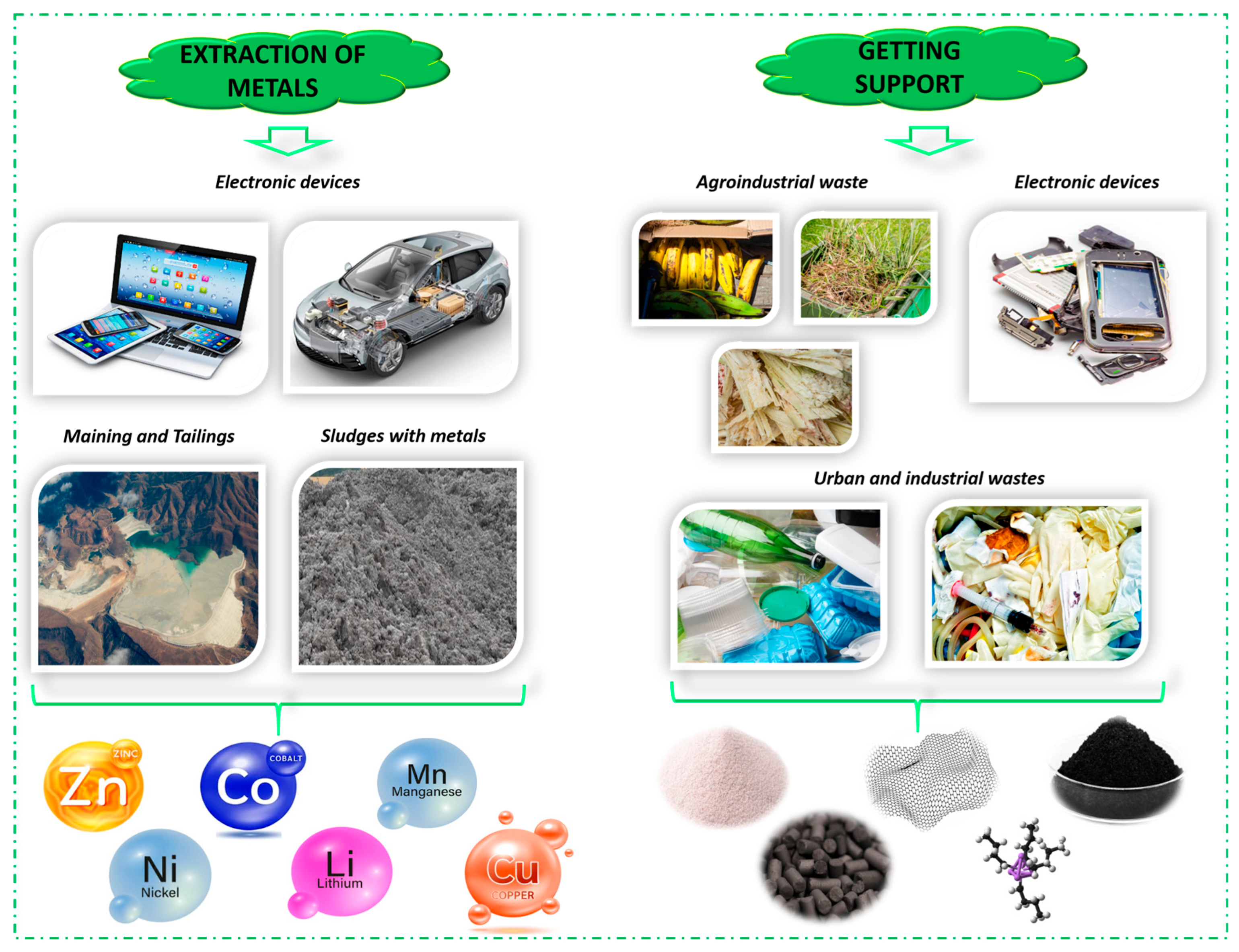
The development of routes for obtaining active phases and catalytic supports has traditionally relied on complex and costly processes involving commercially available chemicals. In response, alternative raw materials and more environmentally benign processes have been proposed, in alignment with the United Nations Sustainable Development Goals (SDGs) [111]. Figure 8 illustrates several urban and industrial wastes from which metals such as Ni, Li, Co, Cu, Zn, and Mn, as well as carbonaceous materials, have been recovered and used as precursors for catalyst synthesis applicable to organic reactions. The valorization of these residues contributes to pollutant reduction and to the recovery of materials that would otherwise remain unused, generating added value and a positive impact on both aquatic and terrestrial ecosystems. The relevance of waste valorization lies in mitigating adverse effects on living organisms and reducing contamination hotspots associated with improper waste management and disposal, which are often linked to mosquito proliferation and the spread of human diseases. In the specific case of heavy metals, inadequate handling may result in mutagenic, carcinogenic, and teratogenic effects [112].
Relatively few studies have reported the use of waste-derived materials for catalyst preparation and their subsequent application in benzaldehyde synthesis. These studies generally focus on recovering either the active phase from waste materials while using commercial supports, or conversely, employing waste-derived supports combined with commercially sourced active phases (Table 5).
From these reports, it is evident that the selected raw materials are primarily used either for the preparation of active phases or for catalyst supports, but rarely for both simultaneously. Nevertheless, the waste streams depicted in Figure 8 appear particularly promising, as they enable the recovery of catalytically active species suitable for benzaldehyde synthesis. For example, Qian-Cheng et al. [113] investigated Co–Mo2C-decorated nanoparticles doped into graphene-based composites derived from the efficient recycling of Li–CO2 batteries. Yuwei Xiang et al. [114] utilized nickel–cobalt tailings to produce catalytic materials for advanced oxidation systems aimed at the degradation of organic pollutants. Similarly, Rende Chang et al. [115] reported the synthesis of nickel ferrite catalysts from electroplating sludge and demonstrated their application in CO2 conversion to CO, followed by energy generation.
Regarding catalytic supports, several authors have proposed agro-industrial waste as viable alternatives. Haftom Weldekidan et al. [116] synthesized a porous catalyst from lemon peel waste for CO2 adsorption. Likewise, Nygil Thomas et al. [117] developed a Ni–Co3O4 electrocatalyst supported on activated carbon derived from orange peel for oxygen reduction reactions. Additional examples include the production of graphene nanosheets from spent lithium-ion battery anodes for pollutant removal applications [118], and the synthesis of sulfonated catalysts from biomass and plastic waste for aviation biofuel production [119]. Although most of these studies target applications other than benzaldehyde synthesis, the reported methodologies and waste-derived materials exhibit significant potential as alternative resources for catalyst development in selective oxidation reactions. The collected evidence demonstrates that commercial catalysts can be effectively replaced by waste-derived catalysts, supporting the feasibility of more sustainable and circular approaches for benzaldehyde production.
Table 5. Main alternative raw materials for catalyst synthesis and their application in benzaldehyde production.
Renewable Raw MaterialCatalystSynthesis MethodApplicationReferences
Spent lithium–ion batteriesLiNixMnxCoxO2CalcinationOxidation of benzyl alcohol to benzaldehyde[120]
Spent lithium–ion batteriesMnO2-HM-140Hydrothermal
Impregnation
Co-precipitation
Toluene oxidation to benzaldehyde[121]
Rice huskCo-MCM-41
Ni-MCM-41
Sol–gelOxidation of styrene into benzaldehyde[122]
Rice huskCoOx/SiO2Wet impregnationOxidation of styrene[123]
Rice huskMCMSalenNiHydrothermal/sol–gelOxidation of benzyl alcohol[124]
Camellia sinensis var. Assamica (tea) leaves.NiFe2O4BiosynthesisOxidation of benzyl alcohol[76]

Bibliometric Study of Benzaldehyde Production

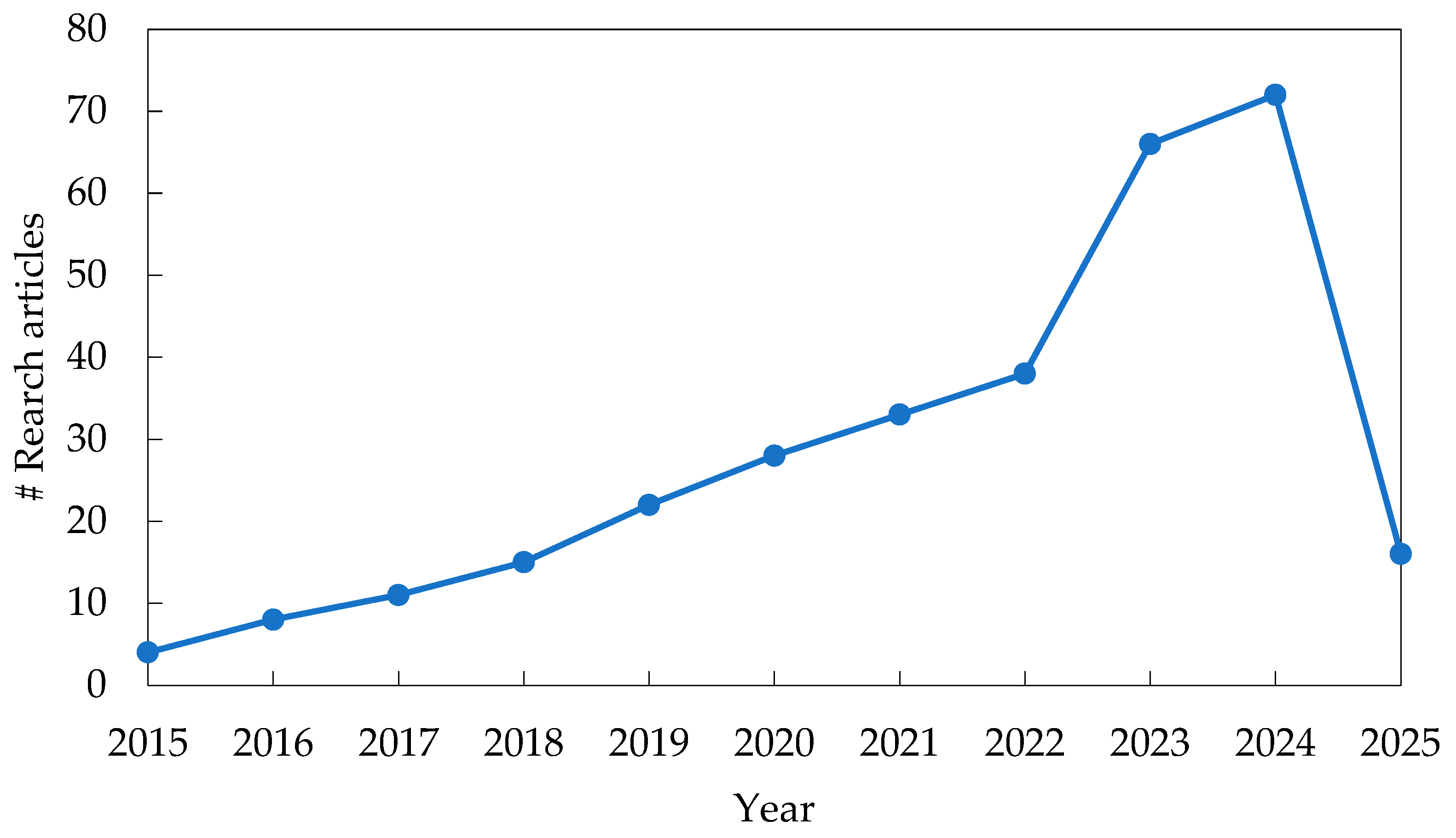
The number of studies addressing the production of benzaldehyde from renewable sources rather than from commercially available chemicals can be confirmed through a bibliometric analysis performed using the SCOPUS database and predefined search string. The search strategy was defined using a combination of keywords related to benzaldehyde synthesis, oxidation, toluene, benzyl alcohol, catalysts, and catalysis. The search was performed within the title, abstract, and author keywords fields (TITLE-ABS-KEY), while the publication period was restricted to 2015–2025. No restrictions were applied regarding the application field, catalyst composition, or transition-metal species to obtain a broad representation of the scientific literature. The complete search string was as follows:
“(TITLE-ABS-KEY (synthesis) AND KEY (benzaldehyde) AND TITLE-ABS-KEY (oxidation) AND TITLE-ABS-KEY (toluene) OR TITLE-ABS-KEY (benzyl AND alcohol) AND TITLE-ABS-KEY (catalyst) OR TITLE-ABS-KEY (catalysis)) AND PUBYEAR > 2014 AND PUBYEAR < 2026”
The analysis identified up to 313 publications between 2015 and 2025; the number of publications does not exceed 313 when using a general search syntax in which keywords related to transition metals are not included and application fields are not excluded (Figure 9). However, when transition metals are incorporated into the advanced search syntax and the results are restricted to the areas of chemistry, chemical engineering, materials science, engineering, and environmental sciences, the number of publications is reduced to only 46 for the same period.
According to Figure 9, the highest number of publications was recorded in 2024, with a total of 72 studies, whereas only 16 publications were identified for 2025. This marked reduction is mainly due to the exclusion of research areas and the restriction to catalysts containing transition-metal active phases. Notably, the inclusion of the thesaurus term “waste” in the search syntax used for Figure 9 yielded no results. This finding clearly indicates a significant knowledge gap related to the synthesis of catalysts from renewable or waste-derived sources and their valorization for catalytic applications in benzaldehyde production.

6. Perspectives, Challenges and Future Research

The production of benzaldehyde faces major challenges related to the efficient use of renewable resources and environmental sustainability, particularly from the perspectives of circular economy and life-cycle assessment. Most reported studies still rely on catalysts prepared from commercially available raw materials. This trend persists despite the fact that more than 1.4 billion tons of urban waste are generated worldwide annually, with a substantial content of heavy metals, not including industrial waste streams, whose valorization remains limited [125]. The underutilization of these waste streams represents a missed opportunity to close material life cycles, reduce dependence on non-renewable natural resources, and decrease the environmental footprint by minimizing waste generation and the consumption of virgin raw materials. Moreover, the valorization of waste-derived catalysts could potentially reduce production costs in benzaldehyde synthesis, strengthening both economic and environmental sustainability.

6.1. Technical Challenges in Catalyst Synthesis

As promising materials, polyoxometalates (POMs) stand out due to their structural stability and their relative insensitivity to pH variations, making them suitable candidates for precipitation, chelation, and co-precipitation processes. However, the handling of complex species such as oxalates or citrates remains challenging due to separation difficulties. Their implementation could be optimized by designing synthesis routes that avoid additional purification steps.
Regarding active phase-support interaction, the studies emphasize the need for a deeper understanding of the interaction between active species (transition metals) and catalyst supports, as the influence of this interaction on the performance of toluene or benzyl alcohol oxidation reactions is not yet clearly established. Parameters such as the generation of acidic or basic sites, surface area, dispersion of active components, and synthesis methodology directly affect catalytic activity and selectivity.
Concerning the use of renewable sources, although renewable sources are increasingly proposed as alternative raw materials, only a limited number of studies investigate the effect of impurities such as Li, Ni, Mn, and Cu on catalyst activity, selectivity, and stability. This aspect represents a significant opportunity for the development of more robust and sustainable catalytic materials.

6.2. Benzaldehyde Production and Industrial Scale-Up

At the industrial scale, benzaldehyde has historically been produced through routes involving side-chain chlorination of toluene followed by hydrolysis, although the relative importance of specific industrial routes and operating conditions depends on the producer and product grade. This route benefits from the low cost and wide availability of toluene but generates chlorinated intermediates and aqueous waste streams. In contrast, benzyl alcohol oxidation is frequently investigated at the laboratory scale because it can provide high benzaldehyde selectivity under relatively mild conditions. However, the higher cost of benzyl alcohol relative to toluene can limit its economic attractiveness for large-scale production.
An alternative approach involves the oxidation of toluene in air using acetic acid as a solvent and POMs supported on activated carbon as catalysts. Such catalytic approaches have been proposed as potentially more environmentally favorable alternatives to conventional chlorination–hydrolysis processes and may improve process viability. However, further research is required to assess their performance, scalability, and environmental benefits under industrially relevant conditions.
From a green chemistry perspective, several studies on catalytic benzaldehyde production have already incorporated individual sustainability indicators, including atom economy, E-factor, process mass intensity, solvent selection, catalyst recyclability, and, in some cases, metal leaching. For example, recent studies on the oxidation of benzyl alcohol to benzaldehyde have reported E-factor and mass-intensity values, while other catalytic systems have evaluated atom economy, reaction mass efficiency, solvent selection, catalyst recovery, and reuse [126,127,128,129,130,131]. These approaches demonstrate the growing application of green chemistry metrics in benzaldehyde synthesis; however, their use remains fragmented, with individual studies generally focusing on selected indicators rather than providing an integrated assessment of the overall environmental performance of the production route.
Environmental assessment and circular economy are therefore important considerations for the future development of sustainable benzaldehyde production. Evaluating environmental feasibility through indicators such as atom economy, carbon and water footprints, E-factor, solvent toxicity, energy demand, catalyst recyclability, metal leaching, and life-cycle considerations would enable a more comprehensive comparison of conventional and emerging catalytic routes. Such analyses could also provide a basis for comparing catalysts synthesized from commercial raw materials with those derived from renewable or waste-derived sources. Furthermore, identifying synthesis methodologies that minimize stoichiometric reagent consumption, replace highly ecotoxic chemicals, reduce the number of processing steps, improve catalyst lifetime, minimize metal losses, or lower energy demands is critical for reducing both environmental impacts and process costs.
Importantly, most of these green chemistry indicators are currently applied at the laboratory or reaction scale and do not necessarily capture the environmental burdens associated with catalyst preparation, raw-material production, solvent and oxidant manufacture, energy consumption, product separation, catalyst regeneration, or end-of-life management. Consequently, a favorable E-factor, high atom economy, solvent-free operation, or good catalyst recyclability at the laboratory scale does not necessarily imply a lower environmental impact at industrial scale. Future studies should therefore integrate green chemistry metrics with life-cycle assessment (LCA), process simulation, and techno-economic analysis to evaluate benzaldehyde production routes under industrially relevant conditions. Such an integrated approach would allow a more rigorous comparison of environmental, technical, and economic performance and help determine whether emerging catalytic routes can maintain their sustainability advantages during scale-up.
Regarding industrial challenges, the growing demand for benzaldehyde as an intermediate in paints, dyes, and coatings, its increasing use as a food preservative and in personal care products due to its antimicrobial properties, and the need to develop more sustainable and efficient technologies to meet consumer preferences for natural and organic ingredients represent key drivers for future industrial innovation [42].

7. Conclusions

The selective oxidation routes to benzaldehyde continue to be constrained by technological and environmental limitations, largely stemming from reliance on petrochemical feedstocks, energy-intensive operating conditions, and the use of noble metals or chemically aggressive precursors. These factors collectively undermine the overall sustainability of current catalytic systems.
This review demonstrates that catalytic performance is strongly dictated by the nature of the active phase and metal–support interactions. Bimetallic, multimetallic, and polyoxometalate-based systems consistently exhibit enhanced activity and selectivity due to synergistic electronic and redox effects. However, the fundamental understanding of these synergistic mechanisms remains incomplete, particularly regarding the specific role of each metal component in the reaction pathway and the nature of the active sites under reaction conditions.
Catalyst support plays a decisive role in controlling metal dispersion, stability, and accessibility of active sites, particularly in carbon-based materials and inorganic oxides. However, the conventional production routes for these supports remain heavily dependent on mining or petrochemical processes, introducing environmental burdens that are seldom addressed in the literature. This represents a significant gap that requires attention in future research.
The choice of catalyst synthesis methodology involves an intrinsic trade-off between structural control, scalability, and economic feasibility. Scalable approaches often suffer from limited homogeneity and durability, whereas advanced techniques increase costs, solvent consumption, and energy demand. The development of synthesis strategies that combine operational simplicity, catalytic stability, and sustainability, particularly using alternative materials and waste-derived precursors, is a critical research direction.
Despite extensive development of alternative catalytic formulations, comprehensive techno-economic and environmental assessments are still scarce, limiting meaningful comparisons between noble-metal-based systems and transition-metal-derived or waste-based catalysts. Future studies should incorporate systematic life-cycle assessment (LCA) and techno-economic analysis (TEA) to enable quantitative comparison of different catalytic approaches.
The valorization of urban and industrial residues emerges as a promising strategy for the development of sustainable catalytic materials, enabling the recovery of active phases and supports from secondary resources and fostering the integration of circular economy principles into future benzaldehyde production processes. However, significant challenges remain regarding the control of impurities, the scalability of waste-derived catalyst synthesis, and the demonstration of comparable or superior performance to conventional catalysts under industrially relevant conditions.

Author Contributions

S.A.B.B.: conceptualization, recent progress analysis, writing and reviewing draft; A.N.A.A.: conceptualization, recent progress analysis, writing and reviewing draft; L.M.O.-C.: writing text; E.A.-V.: writing text. All authors have read and agreed to the published version of the manuscript.

Funding

This research received no external funding.

Data Availability Statement

The original contributions presented in this study are included in the article. Further inquiries can be directed to the corresponding author.

Acknowledgments

This research was made possible through funding from Minciencias-Colombia, Politecnico Colombiano Jaime Isaza Cadavid, and Universidad Nacional de Colombia. We acknowledge Minciencias for supporting the research project “Comprehensive valorization of post-consumer and industrial waste for the development of materials with catalytic potential under a circular economy approach” (code 82312).

Conflicts of Interest

The authors declare no conflicts of interest.

References

  1. Mangesh, V.L.; Govindarajan, M.; Chekuri, R.B.R.; Perumal, T.; Rajendran, K.; Chandrasekaran, K.; Kumar, N.S.; Basivi, P.K.; Alreshaidan, S.B.; Al-Fatesh, A.S. Ni–Fe bimetallic catalysts with high dispersion supported by SBA-15 evaluated for the selective oxidation of benzyl alcohol to benzaldehyde. RSC Adv. 2024, 14, 2300–2310. [Google Scholar] [CrossRef] [Scilit]
  2. Market Research Report. Benzaldehyde Market Size, Share, Growth, and Industry Analysis by Type (FCC Grade and Technical Grade) by Application (Spices, Pharmaceuticals, Agricultural, and Dye), Regional Insights and Forecast from 2025 to 2035. Available online: https://www.businessresearchinsights.com/market-reports/benzaldehyde-market-101517? (accessed on 16 September 2025).
  3. Qiu, J.; Forbes, T.; Lin, T. Tailoring the oxidation of benzyl alcohol and its derivatives with (photo)electrocatalysis. Chem. Commun. 2025, 61, 3421–3435. [Google Scholar] [CrossRef] [Scilit] [PubMed]
  4. Leitão, M.M.; Vieira, T.F.; Sousa, S.F.; Borges, F.; Simões, M.; Borges, A. Microbial Pathogenesis Dual action of benzaldehydes: Inhibiting quorum sensing and enhancing antibiotic efficacy for controlling Pseudomonas aeruginosa biofilms. Microb. Pathog. 2024, 191, 22. [Google Scholar] [CrossRef] [Scilit] [PubMed]
  5. Lapa, H.M.; Martins, L.M.D.R.S. Toluene Oxidation: CO2 vs. Benzaldehyde: Current Status and Future Perspectives. ACS Omega 2024, 9, 26780–26804. [Google Scholar] [CrossRef] [Scilit] [PubMed]
  6. Oberhauser, W.; Manca, G. Aerobic benzyl alcohol oxidation by copper(I)(2,2′-bipyridine)-based catalysts. Inorganica Chim. Acta 2024, 565, 121977. [Google Scholar] [CrossRef] [Scilit]
  7. Zhu, Y.; Li, X.; Zhang, C.; Fang, H.; Bin, F.; Liang, W. Mechanism of the generation of benzaldehyde and benzoic acid on Pd (1 1 1) surface during the destruction of toluene: Verification of experiments and models. Appl. Surf. Sci. 2024, 657, 159774. [Google Scholar] [CrossRef] [Scilit]
  8. Koel, M. Developments in analytical chemistry initiated from green chemistry. Sustain. Chem. Environ. 2024, 5, 100078. [Google Scholar] [CrossRef] [Scilit]
  9. Aprahamian, N.S.; Nyack, W. Process for the Production of Benzaldehyde. 1976. Available online: https://patentimages.storage.googleapis.com/99/e8/1d/7baae6686aecd1/US3931330.pdf (accessed on 16 December 2025).
  10. Liu, J.; Zou, S.; Wu, J.; Kobayashi, H.; Zhao, H.; Fan, J. Green catalytic oxidation of benzyl alcohol over Pt/ZnO in base-free aqueous medium at room temperature. Chin. J. Catal. 2018, 39, 1081–1089. [Google Scholar] [CrossRef] [Scilit]
  11. Xue, F.; Li, Y.; Bi, J.; Zhuang, S.; Cui, M.; Fei, Z.; Tian, Z.; Qiao, X. Highly-selective oxidation of benzyl alcohol to benzaldehyde over Co1/NC catalysts. Catal. Sci. Technol. 2024, 14, 3012–3020. [Google Scholar] [CrossRef] [Scilit]
  12. Wang, L.; Zhang, J.; Zhang, H.; Xu, J.; Zhou, C.; Qu, G.; Yang, S. Significant augmentation of hydrogen and benzaldehyde production through mediator-free in-situ synthesis of CuNi/CN photocatalysts for benzyl alcohol splitting. Fuel 2024, 370, 131827. [Google Scholar] [CrossRef] [Scilit]
  13. Gao, G.; Rong, R.; Zhang, Z.; Pan, B.; Sun, X.; Zhang, Q.; Zheng, G.; Xu, K.; Gao, L. Selective oxidation of benzyl alcohol to benzaldehyde over CoFe2O4 nanocatalyst. Catal. Commun. 2023, 183, 106757. [Google Scholar] [CrossRef] [Scilit]
  14. An, G.; Zhang, X.; Zhang, C.; Gao, H.; Liu, S.; Qin, G.; Qi, H.; Kasemchainan, J.; Zhang, J.; Wang, G. Metal-organic-framework-based materials as green catalysts for alcohol oxidation. Chin. J. Catal. 2023, 50, 126–174. [Google Scholar] [CrossRef] [Scilit]
  15. Lu, M.; Hu, X.; Hu, Q.; Yang, H.; Lai, D.; Yan, X.; Feng, R.; Zhao, G. Selective oxidation of benzyl alcohol to benzaldehyde with air using ZIF-67 derived catalysts. Colloids Surf. A Physicochem. Eng. Asp. 2021, 629, 127520. [Google Scholar] [CrossRef] [Scilit]
  16. Gueci, L.; Ferrante, F.; Prestianni, A.; Arena, F.; Duca, D. Benzyl alcohol to benzaldehyde oxidation on MnOx clusters: Unraveling atomistic features. Mol. Catal. 2021, 513, 111735. [Google Scholar] [CrossRef] [Scilit]
  17. Jia, L.; Zhang, S.; Gu, F.; Ping, Y.; Guo, X.; Zhong, Z.; Su, F. Highly selective gas-phase oxidation of benzyl alcohol to benzaldehyde over silver-containing hexagonal mesoporous silica. Microporous Mesoporous Mater. 2012, 149, 158–165. [Google Scholar] [CrossRef] [Scilit]
  18. Aldosari, O.F. Iron-palladium supported graphene as an efficient bimetallic catalyst for the selective oxidation of benzyl alcohol to benzaldehyde. J. Saudi Chem. Soc. 2023, 27, 101671. [Google Scholar] [CrossRef] [Scilit]
  19. Liu, L.; Zhou, X.; Xin, C.; Zhang, B.; Zhang, G.; Li, S.; Liu, L.; Tai, X. Efficient oxidation of benzyl alcohol into benzaldehyde catalyzed by graphene oxide and reduced graphene oxide supported bimetallic Au–Sn catalysts. RSC Adv. 2023, 13, 23648–23658. [Google Scholar] [CrossRef] [Scilit] [PubMed]
  20. Mohapatra, L.; Yoo, S.H. New reaction pathway induced by N-deficient conjugated polymer-supported bimetallic oxide quantum dot S-scheme heterojunction for benzyl alcohol oxidation in water. Mater. Today Energy 2023, 35, 101331. [Google Scholar] [CrossRef] [Scilit]
  21. Tareq, S.; Hin, Y.; Saleh, A.; Halim, A.; Rashid, U.; Izham, M. Synthesis of bimetallic gold-pallidum loaded on carbon as ef fi cient catalysts for the oxidation of benzyl alcohol into benzaldehyde. J. Mol. Liq. 2018, 271, 885–891. [Google Scholar] [CrossRef] [Scilit]
  22. Wang, W.; Wang, R.; Jiang, X.; He, Z.; Wang, K.; Yang, Y.; Liu, Z. Solvent-free aerobic selective oxidation of benzyl alcohol over La-Co bimetallic catalyst: A kinetic study. Appl. Catal. A Gen. 2022, 634, 118537. [Google Scholar] [CrossRef] [Scilit]
  23. Liu, N.; Chen, G.; Dong, W.; Liu, C.; Xu, C. Preparation of Au nanoparticles with high dispersion and thermal stability by a controlled impregnation method for alcohol oxidation. Gold Bull. 2017, 50, 163–175. [Google Scholar] [CrossRef] [Scilit]
  24. Xu, M.; Wang, L.; Sun, Y.; Ma, Y.; Zhu, L.; Zhu, Y.; Zhang, J.; Qiao, S.; Gao, J.; Ji, W.; et al. Synergistic double doping of Co and Cu constructs multiple active sites to achieve catalyzed degradation of toluene at high humidity. Fuel 2023, 342, 127875. [Google Scholar] [CrossRef] [Scilit]
  25. Zhu, D.; Hai, J.; Wang, L.; Long, X. A study on the oxidation of toluene to benzaldehyde by air catalyzed by polyoxometalate loaded on activated carbon. Mol. Catal. 2023, 551, 113626. [Google Scholar] [CrossRef] [Scilit]
  26. Li, Y.H.; Zhao, W.-L.; Chen, W.; Zheng, R.; An, S.; Song, Y.-F. Interfacial interactions of polyoxometalate and Au0Pdδ+ alloy boosting aerobic oxidation of alcohols. Chem. Eng. Sci. 2024, 298, 120407. [Google Scholar] [CrossRef] [Scilit]
  27. Mahmood, K.; Amani, K. A novel amine-functionalized polyoxometalate-based metal-organic framework: A reusable heterogeneous nanocomposite for selective oxidation of alcohols. J. Mol. Struct. 2024, 1303, 137503. [Google Scholar] [CrossRef] [Scilit]
  28. Javidfar, F.; Fadaeian, M.; Ghomi, J.S. Co3O4@chitosan/La2O3 nanocomposites as innovative, powerful, and recyclable nanocatalysts for sonochemical treatment of benzyl alcohols to obtain the corresponding benzaldehyde derivatives. RSC Adv. 2022, 12, 35959–35965. [Google Scholar] [CrossRef] [Scilit] [PubMed]
  29. Zhu, J.; Kailasam, K.; Fischer, A.; Thomas, A. Supported Cobalt Oxide Nanoparticles As Catalyst for Aerobic Oxidation of Alcohols in Liquid Phase. ACS Catal. 2011, 1, 342–347. [Google Scholar] [CrossRef] [Scilit]
  30. Yang, X.; Wu, S.; Hu, J.; Fu, X.; Peng, L.; Kan, Q.; Huo, Q.; Guan, J. Highly efficient N-doped magnetic cobalt-graphene composite for selective oxidation of benzyl alcohol. Catal. Commun. 2016, 87, 90–93. [Google Scholar] [CrossRef] [Scilit]
  31. Feng, X.; Lv, P.; Sun, W.; Han, X.; Gao, L.; Zheng, G. Reduced graphene oxide-supported Cu nanoparticles for the selective oxidation of benzyl alcohol to aldehyde with molecular oxygen. Catal. Commun. 2017, 99, 105–109. [Google Scholar] [CrossRef] [Scilit]
  32. Wang, J.; Shi, X.; Hou, X.; Chen, X.; Wang, Q.; Zhen, H.; Wang, Y.; Li, X.; Li, Y.; Shi, L. Simultaneously catalytic oxidation of benzyl alcohol to benzaldehyde and selectively phase separation via a sandwich-like polymeric PVDF membrane. Mol. Catal. 2024, 564, 114303. [Google Scholar] [CrossRef] [Scilit]
  33. Ruan, C.; Wang, C.; Chen, Y.; Wang, Z.; Wang, K.; Zhou, Y.; Zhang, S.; Chen, G.; Zheng, X.; Meng, S.; et al. Hollow heterojunction with dual-vacancy engineering to boost photocatalytic performance for photoreduction of CO2 coupled with selective oxidation of benzyl alcohol to benzaldehyde. Sep. Purif. Technol. 2024, 351, 127929. [Google Scholar] [CrossRef] [Scilit]
  34. Rezaei, M.; Chermahini, A.N.; Dabbagh, H.A. Selective oxidation of toluene to benzaldehyde by H2O2 with mesoporous silica KIT-6 supported VOHPO4 0.5H2O catalyst. J. Environ. Chem. Eng. 2017, 5, 3529–3539. [Google Scholar] [CrossRef] [Scilit]
  35. Kalita, A.; Talukdar, A.K. Streamlined synthesis of iron and cobalt loaded MCM-48: High-performance heterogeneous catalysts for selective liquid-phase oxidation of toluene to benzaldehyde. Heliyon 2024, 10, e27296. [Google Scholar] [CrossRef] [Scilit] [PubMed]
  36. Chan-thaw, C.E.; Savara, A.; Villa, A. Selective Benzyl Alcohol Oxidation over Pd Catalysts. Catalyst 2018, 8, 431. [Google Scholar] [CrossRef] [Scilit]
  37. Najafishirtari, S.; Ortega, K.F.; Douthwaite, M.; Pattisson, S.; Hutchings, G.J.; Bondue, C.J.; Tschulik, K.; Waffel, D.; Peng, B.; Deitermann, M.; et al. A Perspective on Heterogeneous Catalysts for the Selective Oxidation of Alcohols. Chem. Eur. J. 2021, 27, 16809–16833. [Google Scholar] [CrossRef] [Scilit] [PubMed]
  38. Su, Z.; Long, H.; Zhao, R.-R.; Gao, K.; Xiao, W.-J. Heterogeneous Catalysts for Toluene Oxidation. Chem.-Asian J. 2025, 20, e00530. [Google Scholar] [CrossRef] [Scilit] [PubMed]
  39. Lv, L.; Zhou, S.; Liu, C.; Sun, Y.; Zhang, J.; Bu, C.; Meng, J.; Huang, Y. Recycling and Reuse of Spent LIBs: Technological Advances and Future Directions. Molecules 2024, 29, 3161. [Google Scholar] [CrossRef] [Scilit] [PubMed]
  40. Verificada Mercado Informes. Mercado Global de Benzaldehído Industrial por Tipo (Grado Farmacéutico, Grado Alimenticio), por Aplicación (Especias, Productos Farmacéuticos), por Alcance Geográfico y Pronóstico. Available online: https://www.verifiedmarketreports.com/es/product/industrial-benzaldehyde-market/ (accessed on 16 December 2025).
  41. ReportLinker. Global Solvent Market Overview 2024–2028. Available online: https://www.reportlinker.com/market-report/Specialty-Chemical/714253/Solvent?term=solvent (accessed on 16 December 2025).
  42. FMI. Benzaldehyde Market. Available online: https://www.futuremarketinsights.com/reports/benzaldehyde-market#:~:text=The (accessed on 16 December 2025).
  43. Chemanalyst. Food Chemicals Codex, Houston, Texas, 2023. Available online: https://www.chemanalyst.com/industry-report/benzaldehyde-market-817 (accessed on 16 December 2025).
  44. Vilochani, S.; Borgianni, Y.; McAloone, T.C.; Pigosso, D.C.A. An investigation into the extent to which sustainable product development practices are implemented in manufacturing companies. Sustain. Prod. Consum. 2024, 50, 155–167. [Google Scholar] [CrossRef] [Scilit]
  45. Datawheel. Center for Collective Learning OEC. Available online: https://oec.world/es/profile/hs/benzaldehyde (accessed on 10 July 2025).
  46. Volza Grow Global. Dimethyl Benzaldehyde Imports in World-Market Size & Demand Based on Import Trade Data. Available online: https://www.volza.com/p/dimethyl-benzaldehyde/import/ (accessed on 12 November 2025).
  47. Libraries. Principles of Economics. Available online: https://saylordotorg.github.io/text_principles-of-economics-v2.0/?spm=5176.28103460.0.0.11192988d32IZz (accessed on 12 November 2025).
  48. Chemanalyst. Decode the Future of Benzaldehyde. Available online: https://www.chemanalyst.com/industry-report/benzaldehyde-market-817 (accessed on 12 November 2025).
  49. European Drug Report 2023: Trends and Devolpments. Available online: https://member.reportlinker.com/next/search?query=benzaldehyde&viewedItem=document::c23e5f63ab4401cab7644d019d94ccbb5cb95d720a3aa9e7e1a79c30dedc4003 (accessed on 12 November 2025).
  50. World Integrated Trade Solution. Benzaldehyde Exports and Imports by Country in 2023. Available online: https://wits.worldbank.org/trade/comtrade/en/country/ALL/year/2023/tradeflow/Exports/partner/WLD/product/291221 (accessed on 24 November 2025).
  51. Inada, M.; Kato, H.; Maruyama, H.; Okada, E.; Imai, F.; Inada, S. Toxic benzyl alcohol inhalation: Altered mental status with metabolic acidosis and hyperammonemia. Am. J. Emerg. Med. 2022, 57, 234.e3–234.e5. [Google Scholar] [CrossRef] [Scilit] [PubMed]
  52. Zhang, Q.; Fu, X.; Kan, Q.; Guan, J. Efficient Conversion of Benzyl Alcohol on a Mesoporous Co3O4. Ind. Eng. Chem. Res. 2019, 58, 4774–4779. [Google Scholar] [CrossRef] [Scilit]
  53. Pimentel Losada, J.; Heckl, I.; Bertok, B.; Friedler, F.; Garcia-Ojeda, J.C.; Argoti, A. Process Network Synthesis for Belzaldehyde Production: P-graph Approach. Chem. Eng. Trans. 2015, 45, 37–52. [Google Scholar] [CrossRef] [Scilit]
  54. Satrio, J.; Doraiswamy, L.K. Production of benzaldehyde a case study in a possible industrial application of phase-transfer catalysis. Chem. Eng. J. 2001, 82, 46–56. [Google Scholar] [CrossRef] [Scilit]
  55. West Virginia University. Batch Production of Benzaldehyde Derivatives, Virginia. Available online: https://cbe.statler.wvu.edu/files/d/99068733-4038-4bc5-8d1f-5f3102af1e5c/batch-benzaldehyde-derivatives.pdf (accessed on 10 February 2026).
  56. Flores, J.G.; Díaz-García, M.; Ibarra, I.A.; Aguilar-Pliego, J.; Sánchez-Sánchez, M. Sustainable M-MOF-74 (M = Cu, Co, Zn) prepared in methanol as heterogeneous catalysts in the synthesis of benzaldehyde from styrene oxidation. J. Solid State Chem. 2021, 298, 122151. [Google Scholar] [CrossRef] [Scilit]
  57. Marelli, M.; Jouve, A.; Villa, A.; Psaro, R.; Balerna, A.; Prati, L.; Evangelisti, C. Hybrid Au/CuO Nanoparticles: Effect of Structural Features for Selective Benzyl Alcohol Oxidation. J. Phys. Chem. C 2019, 123, 2864–2871. [Google Scholar] [CrossRef] [Scilit]
  58. Li, M.; Fu, X.; Peng, L.; Bai, L.; Wu, S.; Kan, Q.; Guan, J. Synthesis of Three-Dimensional-Ordered Mesoporous Cobalt Oxides for Selective Oxidation of Benzyl Alcohol. ChemistrySelect 2017, 2, 9486–9489. [Google Scholar] [CrossRef] [Scilit]
  59. Bai, C.; Li, A.; Yao, X.; Liu, H.; Li, Y. Efficient and selective aerobic oxidation of alcohols catalysed by MOF-derived Co catalysts. Green Chem. 2016, 18, 1061–1069. [Google Scholar] [CrossRef] [Scilit]
  60. Mardani, H.R.; Ziari, M. Synthesis and characterization of a new nanomagnetic coordination composite from Fe3O4 and Cu(II) complex: As an efficient catalyst in oxidation of benzyl alcohol. Res. Chem. Intermed. 2018, 44, 6605–6619. [Google Scholar] [CrossRef] [Scilit]
  61. Song, G.; Feng, L.; Xu, J.; Zhu, H. Liquid-phase Oxidation of Toluene to Benzaldehyde with Molecular Oxygen Catalyzed by Copper Nanoparticles Supported on Graphene. Res. Chem. Intermed. 2018, 44, 4989–4998. [Google Scholar] [CrossRef] [Scilit]
  62. Jacquot, C.; Middelkoop, V.; Köckritz, A.; Pohar, A.; Bienert, R.; Kellici, S.; Bărăgău, I.-A.; Venezia, B.; Gavriilidis, A.; Likozar, B.; et al. 3D printed catalytic reactors for aerobic selective oxidation of benzyl alcohol into benzaldehyde in continuous multiphase flow. Sustain. Mater. Technol. 2021, 30, e00329. [Google Scholar] [CrossRef] [Scilit]
  63. Yang, J.; Cao, K.; Gong, M.; Shan, B.; Chen, R. Atomically decorating of MnOx on palladium nanoparticles towards selective oxidation of benzyl alcohol with high yield. J. Catal. 2020, 386, 60–69. [Google Scholar] [CrossRef] [Scilit]
  64. Tamizhdurai, P.; Sakthinathan, S.; Krishnan, P.S.; Ramesh, A.; Mangesh, V.; Abilarasu, A.; Narayanan, S.; Shanthi, K.; Chiu, T.-W. Catalytic activity of ratio-dependent SBA-15 supported zirconia catalysts for highly selective oxidation of benzyl alcohol to benzaldehyde and environmental pollutant heavy metal ions detection. J. Mol. Struct. 2019, 1176, 650–661. [Google Scholar] [CrossRef] [Scilit]
  65. Qiu, S.; Li, Y.; Xu, H.; Liang, Q.; Zhou, M.; Rong, J.; Li, Z.; Xu, S. Efficient catalytic oxidation of benzyl alcohol by tetrasubstituted cobalt phthalocyanine-MWCNTs composites. Solid State Sci. 2022, 129, 106905. [Google Scholar] [CrossRef] [Scilit]
  66. Tamizhdurai, P.; Narayanan, S.; Kumaran, R.; Mangesh, V.; Kavitha, C.; Lakshmi, N.V.; Ragupathi, C.; Alothman, Z.A.; Ouladsmane, M.; Mani, G. Catalytic activity of ratio-dependent SBA-15 supported cerium/Pt catalysts for highly selective oxidation reaction of benzyl alcohol to benzaldehyde. Adv. Powder Technol. 2021, 32, 4286–4294. [Google Scholar] [CrossRef] [Scilit]
  67. Hacıefendioğlu, D.; Tuncel, A. Switching of selectivity from benzaldehyde to benzoic acid using MIL-100(V) as a heterogeneous catalyst in aerobic oxidation of benzyl alcohol. Catal. Sci. Technol. 2024, 14, 6524–6536. [Google Scholar] [CrossRef] [Scilit]
  68. Bathula, G.; Rana, S.; Bandalla, S.; Dosarapu, V.; Mavurapu, S.; Rajeevan V. V., A.; Sharma, B.; Jonnalagadda, S.B.; Baithy, M.; Vasam, C.S. The role of WOx and dopants (ZrO2 and SiO2) on CeO2-based nanostructure catalysts in the selective oxidation of benzyl alcohol to benzaldehyde under ambient conditions. RSC Adv. 2023, 13, 36242–36253. [Google Scholar] [CrossRef] [Scilit] [PubMed]
  69. Mahmoud, A.G.; Gurbanov, A.V.; Guedes da Silva, M.F.C.; Pombeiro, A.J.L. Water-soluble arylhydrazone complexes based on Mn(II) and Cu(II) as catalysts for liquid-phase toluene oxidation. J. Organomet. Chem. 2024, 1015, 7. [Google Scholar] [CrossRef] [Scilit]
  70. Li, J.; Zhang, R.; Liu, Y.; Sun, T.; Jia, J.; Guo, M. Enhanced catalytic activity of toluene oxidation over in-situ prepared Mn3O4-Fe2O3 with acid-etching treatment. Catal. Commun. 2022, 174, 106581. [Google Scholar] [CrossRef] [Scilit]
  71. Song, Z.; Li, H.; Zhang, X.; Zhang, Z.; Mao, Y.; Liu, W.; Liu, Z.; Mo, D.; Zhu, X.; Huang, Z. The catalytic oxidation performance of toluene over the MnOx catalysts: Effect of MnSO4 content. Chem. Phys. Impact 2022, 5, 100124. [Google Scholar] [CrossRef] [Scilit]
  72. Deng, S.; Chen, G.; Liang, C.; Wang, L.; Xiang, B. Selective liquid-phase oxidation of toluene over heterogeneous Mn@ZIF-8 derived catalyst with molecular oxygen in the solvent-free conditions. Arab. J. Chem. 2023, 16, 104666. [Google Scholar] [CrossRef] [Scilit]
  73. Namysl, S.; Pelucchi, M.; Maffei, L.P.; Herbinet, O.; Stagni, A.; Faravelli, T.; Battin-Leclerc, F. Experimental and modeling study of benzaldehyde oxidation. Combust. Flame 2020, 211, 124–132. [Google Scholar] [CrossRef] [Scilit]
  74. Shetgaonkar, S.E.; Jothish, S.; Dohi, T.; Singh, F.V. Iodine (V)-Based Oxidants in Oxidation Reactions. Molecules 2023, 28, 5250. [Google Scholar] [CrossRef] [Scilit] [PubMed]
  75. Cui, J.; Cui, Y.; Tan, J.; Zhang, H.; Gu, M.; Huang, L. Efficient catalytic oxidation of VOCs by a Pd-Pt/SiO2 catalyst: The cooperative catalysis of dual metal sites. J. Environ. Chem. Eng. 2024, 12, 111930. [Google Scholar] [CrossRef] [Scilit]
  76. Chetia, T.; Bora, J.; Dutta, M.; Chetia, B. Green synthesis of template-free NiFe2O4 nanoparticles: A promising sustainable catalyst for efficient benzaldehyde and phenolic motifs development. J. Mol. Struct. 2025, 1324, 140766. [Google Scholar] [CrossRef] [Scilit]
  77. Abednatanzi, S.; Abbasi, A.; Masteri-farahani, M. Immobilization of catalytically active polyoxotungstate into ionic liquid-modi fi ed MIL-100 (Fe): A recyclable catalyst for selective oxidation of benzyl alcohol. Catal. Commun. 2017, 96, 6–10. [Google Scholar] [CrossRef] [Scilit]
  78. Costa, R.C.C.; Lelis, M.; Oliveira, L.; Fabris, J.; Ardisson, J.; Rios, R.; Silva, C.; Lago, R. Novel active heterogeneous Fenton system based on Fe3−xMxO4 (Fe, Co, Mn, Ni): The role of M2+ species on the reactivity towards H2O2 reactions. J. Hazard. Mater. 2006, 129, 171–178. [Google Scholar] [CrossRef] [Scilit] [PubMed]
  79. Weng, X.; Guo, M.; Luo, F.; Chen, Z. One-step green synthesis of bimetallic Fe/Ni nanoparticles by eucalyptus leaf extract: Biomolecules identification, characterization and catalytic activity. Chem. Eng. J. 2017, 308, 904–911. [Google Scholar] [CrossRef] [Scilit]
  80. Sathya, R.R.V.; Jagatheesan, R.; Jeevanantham, V.; Gopi, D.; Muralidharan, V.P. Selective oxidation of benzyl alcohol to benzaldehyde using sustainable catalysts: An overview. J. Indian Chem. Soc. 2024, 101, 101456. [Google Scholar] [CrossRef] [Scilit]
  81. Yuan, S.; Lv, X.; Zhang, Y.; Wu, Y.; Mao, C.; Zhou, Y.; Chen, W.; Wang, Y. Fabrication of mesoporous SiO2/Au/Co3O4 hollow spheres catalysts with core-shell structure for liquid phase oxidation of benzyl alcohol to benzaldehyde. J. Taiwan Inst. Chem. Eng. 2019, 103, 138–148. [Google Scholar] [CrossRef] [Scilit]
  82. Duarte, H.A.; Luggren, P.J.; Zelin, J.; Sad, M.E.; Díez, V.K.; Di Cosimo, J.I. Selective aerobic oxidation of benzyl alcohol on inexpensive and reusable ZnO/MnCO3 catalyst. Catal. Today 2021, 394–396, 178–189. [Google Scholar] [CrossRef] [Scilit]
  83. Dashtian, K.; Shahsavarifar, S.; Usman, M.; Joseph, Y.; Ganjali, M.R.; Yin, Z.; Rahimi-Nasrabadi, M. A comprehensive review on advances in polyoxometalate based materials for electrochemical water splitting. Coord. Chem. Rev. 2024, 504, 215644. [Google Scholar] [CrossRef] [Scilit]
  84. Gao, J.; Chen, S.; Gao, Y.; Sun, W.; Zhou, J.; Shah, K.J.; Sun, Y. Current Developments in Ozone Catalyst Preparation Techniques and Their Catalytic Oxidation Performance. Catalysts 2025, 15, 671. [Google Scholar] [CrossRef] [Scilit]
  85. Zou, D.; Li, H.; Deng, Y.; Chen, J.; Bai, Y. Recovery of lanthanum and cerium from rare earth polishing powder wastes utilizing acid baking-water leaching-precipitation process. Sep. Purif. Technol. 2020, 261, 118244. [Google Scholar] [CrossRef] [Scilit]
  86. Esposito, S. “Traditional” Sol-Gel Chemistry as a Powerful Tool for the Preparation of Supported Metal and Metal Oxide Catalysts. Materials 2019, 12, 668. [Google Scholar] [CrossRef] [Scilit] [PubMed]
  87. De Conti, M.C.M.D.; Dey, S.; Pottker, W.E.; La Porta, F.A. An overview into advantages and applications of conventional and unconventional hydro (solvo) thermal approaches for novel advanced materials design. Mater. Today Sustain. 2023, 23, 100458. [Google Scholar] [CrossRef] [Scilit]
  88. Jiang, Y.; Cheng, S.; Su, C.; Jiang, Y.; Sun, X.; Zhang, G.; Liu, Y.; Dou, X.; Yang, Z. Bimetallic Mn-Cu oxide catalysts for toluene oxidation: Synergistic effect and catalytic mechanism. Appl. Surf. Sci. 2024, 670, 160629. [Google Scholar] [CrossRef] [Scilit]
  89. Borovinskaya, E.S.; Trebbin, S.; Alscher, F.; Breitkopf, C. Synthesis, Modification, and Characterization of CuO/ZnO/ZrO2 Mixed Metal Oxide Catalysts for CO2/H2 Conversion. Catalysts 2019, 9, 1037. [Google Scholar] [CrossRef] [Scilit]
  90. Zelin, J.; Luggren, P.J.; Duarte, H.A.; Sad, M.E.; Díez, V.K. Liquid-phase benzyl alcohol oxidation on gold-based catalysts: Effect of catalyst support and gold loading. Mater. Sci. Eng. B 2024, 313, 117887. [Google Scholar] [CrossRef] [Scilit]
  91. Nejati, F.M.; Shahhosseini, S.; Rezaee, M. Cobalt-based sandwich-type polyoxometalate supported on amino-silane decorated magnetic graphene oxide: A recoverable catalyst for extractive-catalytic oxidative desulfurization of model oil. J. Environ. Chem. Eng. 2022, 10, 107949. [Google Scholar] [CrossRef] [Scilit]
  92. Ammar, S.H.; Abdulnabi, W.A.; Abdul, H.D. Synthesis, characterization and environmental remediation applications of polyoxometalates-based magnetic zinc oxide nanocomposites (Fe3O4@ZnO/PMOs). Environ. Nanotechnol. Monit. Manag. 2020, 13, 100289. [Google Scholar] [CrossRef] [Scilit]
  93. Sukale, S.B.; Aher, D.S.; Chavan, L.D.; Khillare, K.R.; Shankarwar, S.G. Synthesis and characterization of alumina supported molybdosilicic acid (SiMo12/Al2O3): Efficient solid acid catalyst for the synthesis of pyranopyrazole derivatives. Synth. Commun. 2024, 54, 826–842. [Google Scholar] [CrossRef] [Scilit]
  94. Xing, X.; Li, Z.; Wang, Y.; Tian, Z.; Liu, D.; Cheng, J.; Hao, Z. Synergistic catalytic degradation of benzene and toluene on spinel MMn2O4 (M Co, Ni, Cu) catalysts. J. Environ. Sci. 2024, 154, 238–251. [Google Scholar] [CrossRef] [Scilit] [PubMed]
  95. Shi, M.; Li, M.; Wang, Y.; Yao, M.; Zhang, Z.; Wang, J.; Guo, C. Surfactants govern the fabrication of sulfur-enriched heterojunction catalysts for highly selective photocatalytic conversion of toluene. J. Alloys Compd. 2024, 1010, 177219. [Google Scholar] [CrossRef] [Scilit]
  96. Xu, C.; Zhong, S.; Yuan, L.; Yu, M.; Chen, Y.; Dai, L.; Wang, X. Insight into the promotional effect of Ce doped in (FeCoNiCrMn)3O4 high entropy oxides for solvent-free aerobic oxidation of benzyl alcohol. Chem. Eng. J. 2023, 481, 148767. [Google Scholar] [CrossRef] [Scilit]
  97. Liu, L.; Tai, X.; Zhou, X.; Hou, J.; Zhang, Z. Bimetallic Au–Ni alloy nanoparticles in a metal–organic framework (MIL-101) as efficient heterogeneous catalysts for selective oxidation of benzyl alcohol into benzaldehyde. J. Alloys Compd. 2019, 790, 326–336. [Google Scholar] [CrossRef] [Scilit]
  98. Bian, Q.; Li, S.; Shen, R.; Shen, S.; Wen, Z.; Jiang, X.; Gou, F. Mesoporous silica-supported Ni–Co composite metal oxide as a heterogeneous catalyst for air oxidation of benzyl alcohols. J. Solid State Chem. 2023, 332, 124560. [Google Scholar] [CrossRef] [Scilit]
  99. Olmos, C.M.; Chinchilla, L.E.; Villa, A.; Delgado, J.J.; Hungría, A.B.; Blanco, G.; Prati, L.; Calvino, J.J.; Chen, X. Size, nanostructure, and composition dependence of bimetallic Au–Pd supported on ceria–zirconia mixed oxide catalysts for selective oxidation of benzyl alcohol. J. Catal. 2019, 375, 44–55. [Google Scholar] [CrossRef] [Scilit]
  100. Albadran, F.H.; Saeed, M.; Kamal, I. A kinetic study of benzyl alcohol oxidation over Pt/C catalyst. Kuwait J. Sci. 2025, 52, 100373. [Google Scholar] [CrossRef] [Scilit]
  101. Tang, N.; You, Z.; Li, M.; Jiang, S.; He, Y. Promotion of toluene catalytic oxidation by M−LaCoOx catalysts directly prepared from Co-MOFs precursors. Sep. Purif. Technol. 2024, 349, 127754. [Google Scholar] [CrossRef] [Scilit]
  102. Yang, D.; Feng, B.; Wang, H.; Xie, Q.; Liu, Y.; Gai, H.; Song, H. A broad-spectrum oxidation capability Ru-CeO2 catalyst for efficient synergistic selective oxidation of benzyl alcohol. Mol. Catal. 2024, 565, 114383. [Google Scholar] [CrossRef] [Scilit]
  103. Lukato, S.; Wendt, O.F.; Wallenberg, R.; Kasozi, G.N.; Naziriwo, B.; Persson, A.; Folkers, L.C.; Tebandeke, E. Selective oxidation of benzyl alcohols with molecular oxygen as the oxidant using Ag-Cu catalysts supported on polyoxometalates. Results Chem. 2021, 3, 100150. [Google Scholar] [CrossRef] [Scilit]
  104. Mao, Y.; Wang, P.; Li, L.; Chen, Z.; Wang, H.; Li, Y. Unravelling the Synergy between Oxygen Vacancy and Oxygen Substitution in BiO2-x for Efficient Molecular Oxygen Activation. Angew. Chem. Int. Ed. Engl. 2019, 59, 3685–3690. [Google Scholar] [CrossRef] [Scilit] [PubMed]
  105. Jiang, Y.; Chai, K.; Wang, Y.-Q.; Zhang, H.-D.; Xu, W.-M.; Li, W.; Shi, Y. Mesoporous Silica-Supported CuCoO Mixed-Metal Oxides for the Aerobic Oxidation of Alcohols. ACS Appl. Nano Mater. 2019, 2, 4435–4442. [Google Scholar] [CrossRef] [Scilit]
  106. Madaka, H.; Babbitt, C.W.; Ryen, E.G. Resources, Conservation & Recycling Opportunities for reducing the supply chain water footprint of metals used in consumer electronics. Resour. Conserv. Recycl. 2021, 176, 105926. [Google Scholar] [CrossRef] [Scilit]
  107. Liu, T.; Cai, S.; Zhao, G.; Gao, Z.; Liu, S.; Li, H.; Chen, L.; Li, M.; Yang, X.; Guo, H. Recycling valuable cobalt from spent lithium ion batteries for controllably designing a novel sea-urchin-like cobalt nitride-graphene hybrid catalyst: Towards efficient overall water splitting. J. Energy Chem. 2021, 62, 440–450. [Google Scholar] [CrossRef] [Scilit]
  108. Laasri, L.; El Makhfi, M. Materials Today: Proceedings Ecofriendly oxidation of benzyl alcohol to benzaldehyde using Zr-Ni/Natural phosphate as an efficient and recyclable heterogeneous catalyst. Mater. Today Proc. 2020, 31, S156–S161. [Google Scholar] [CrossRef] [Scilit]
  109. Yang, Q.; Tang, Y.; Zhang, H.; Chen, J.; Jiang, Z.; Xiong, K.; Wang, J.; Liu, X.; Yang, N.; Du, Q.; et al. Classic Deep Oxidation CuMnOx Catalysts Catalyzed Selective Oxidation of Benzyl Alcohol. Appl. Surf. Sci. 2022, 610, 155364. [Google Scholar] [CrossRef] [Scilit]
  110. Li, Y.; Chatterjee, A.; Bernadetta, L.; Lam, F.L.; Hu, X. Pd doped Co functionalized SBA-15 as an active magnetic catalyst for low temperature solventless additive-base-free selective oxidation of benzyl alcohol. Mol. Catal. 2020, 488, 110869. [Google Scholar] [CrossRef] [Scilit]
  111. Wang, Y.; Liu, S. Glass-ceramics from a zinc-electroplating solid waste: Devitrification promoted further crystallization of parent glass upon heat treatment. Ceram. Int. 2018, 44, 10663–10668. [Google Scholar] [CrossRef] [Scilit]
  112. Bao, J.; He, J.; Hu, N.; Xiong, H.; Chen, Y.; Huang, L. Removal characteristics of heavy metals from polluted river water purified by hybrid constructed wetlands. Sci. Total Environ. 2024, 959, 178162. [Google Scholar] [CrossRef] [Scilit] [PubMed]
  113. Zhu, Q.-C.; Xin, X.-B.; Zhou, S.-H.; Wang, Z.-Y.; Mao, D.-Y.; Fu, A.-J. Synthesis of Co-Mo2C nanoparticles decorated three-dimensional N-doped graphene composite as an efficient cathode catalyst for Li–CO2 batteries. Electrochim. Acta 2025, 514, 145683. [Google Scholar] [CrossRef] [Scilit]
  114. Xiang, Y.; Lan, J.; Cai, Y.; Dong, Y.; Hou, H. Modified nickel–cobalt tailing activated PMS for highly efficient degradation of organic pollutants: Multiple-scale effect and active sites. Chem. Eng. J. 2024, 482, 149196. [Google Scholar] [CrossRef] [Scilit]
  115. Chang, R.; Ding, C.; Long, H.; Lv, X.; Chun, T.; Peng, C.; Wei, R.; Xu, X.; Yan, Z.; Sun, Y.; et al. Efficient carbon dioxide conversion by nickel ferrite-based catalysts derived from metallurgical electroplating sludge collaborating with low-temperature plasma. J. Colloid Interface Sci. 2024, 682, 353–368. [Google Scholar] [CrossRef] [Scilit] [PubMed]
  116. Weldekidan, H.; Patel, H.; Mohanty, A.; Misra, M. Synthesis of porous and activated carbon from lemon peel waste for CO2 adsorption. Carbon Capture Sci. Technol. 2023, 10, 100149. [Google Scholar] [CrossRef] [Scilit]
  117. Vazhayil, A.; Majumder, S.; Jeffery, A.A.; Altaf, M.; Ahn, Y.-H.; Thomas, N. Orange peel derived activated carbon supported Ni-Co3O4 as an efficient bifunctional electrocatalyst for oxygen evolution and reduction reaction in alkaline media. Mater. Chem. Phys. 2024, 328, 129983. [Google Scholar] [CrossRef] [Scilit]
  118. Mai, N.T.; Van Thanh, D.; Hien, T.N.; Hanh, H.T.H.; Hoa, L.T.T.; Khai, N.M.; Bich, D.D.; Nguyen, D.D.; Tan, C.M.; Van Hao, P. Highly adsorptive removal of heavy metal, dye, and antibiotic pollutants using functionalized graphene nanosheets sono-electrochemically derived from graphitic waste. J. Environ. Chem. Eng. 2024, 12, 113020. [Google Scholar] [CrossRef] [Scilit]
  119. Mateo, W.; Lei, H.; Villota, E.; Qian, M.; Zhao, Y.; Huo, E.; Zhang, Q.; Lin, X.; Wang, C.; Huang, Z. Synthesis and characterization of sulfonated activated carbon as a catalyst for bio-jet fuel production from biomass and waste plastics. Bioresour. Technol. 2019, 297, 122411. [Google Scholar] [CrossRef] [Scilit] [PubMed]
  120. Shivamurthy, B.P.; Kirdant, S.P.; Katakam, S.; Rawat, P.; Jadhav, V.H.; Nayaka, G.P. Performance scrutiny of spent lithium-ion batteries cathode material as a catalyst for oxidation of benzyl alcohol. Next Sustain. 2023, 3, 100017. [Google Scholar] [CrossRef] [Scilit]
  121. Min, X.; Guo, M.; Li, K.; Gu, J.-N.; Hu, X.; Jia, J.; Sun, T. Performance of toluene oxidation on different morphologies of α-MnO2 prepared using manganese-based compound high-selectively recovered from spent lithium-ion batteries. Environ. Res. 2022, 215, 114299. [Google Scholar] [CrossRef] [Scilit] [PubMed]
  122. Andas, J.; Ekhbal, S.H.; Ali, T.H. MCM-41 modified heterogeneous catalysts from rice husk for selective oxidation of styrene into benzaldehyde. Environ. Technol. Innov. 2021, 21, 101308. [Google Scholar] [CrossRef] [Scilit]
  123. Chen, Y.; Cao, C.; Huang, C.; Gong, W.; Niu, K.; Luo, Y.; Wu, E.; Zeng, L.; Qian, Q.; Chen, Q. CoOx supported on rice-husk derived SiO2 for styrene combustion: The balance of low temperature activity and thermal stability. Appl. Surf. Sci. 2022, 606, 154851. [Google Scholar] [CrossRef] [Scilit]
  124. Abbas, S.H.; Adam, F.; Muniandy, L. Green synthesis of MCM-41 from rice husk and its functionalization with nickel(II) salen complex for the rapid catalytic oxidation of benzyl alcohol. Microporous Mesoporous Mater. 2020, 305, 110192. [Google Scholar] [CrossRef] [Scilit]
  125. Wang, Y.; Li, J.; Zhang, J.; Zhang, J.; Zhai, D.; Qian, G.; Liu, Y.; Zuo, C. Advantages of bimetallic nitric oxide reduction catalysts consisting of heavy metals rich in hazardous wastes. J. Clean. Prod. 2019, 237, 117834. [Google Scholar] [CrossRef] [Scilit]
  126. Emeji, I.C.; Kumi, M.; Meijboom, R. Performance Evaluation of Benzyl Alcohol Oxidation with tert-Butyl Hydroperoxide to Benzaldehyde Using the Response Surface Methodology, Artificial Neural Network, and Adaptive Neuro-Fuzzy Inference System Model. ACS Omega 2024, 9, 34464–34481. [Google Scholar] [CrossRef] [Scilit] [PubMed]
  127. Arumugam, D.B.; Santhakumar, K. Efficient aerobic oxidation of benzyl alcohols using a magnetically recoverable Ni/nitrogen-containing carbon nanocomposite. RSC Adv. 2026, 16, 25806–25818. [Google Scholar] [CrossRef] [Scilit] [PubMed]
  128. Li, Z.; Zhang, J.; Li, C.; Cao, J.; Tao, S. The AIE-active flavonoids in orange peel for photocatalytic oxidation reactions. Green Chem. 2026, 28, 2602–2611. [Google Scholar] [CrossRef] [Scilit]
  129. Dutta, M.; Bora, J.; Jyoti Kalita, A.; Suleman, A.; Chutia, U.; Chetia, B. Ag-Decorated NiFe2O4 Magnetic Nanocomposites as Catalysts for the Synthesis of 5-Substituted 1H-Tetrazoles and for the Selective Oxidation of Benzyl Alcohol to Benzaldehyde. ACS Appl. Nano Mater. 2025, 8, 22670–22682. [Google Scholar] [CrossRef] [Scilit]
  130. Feng, M.; Wang, M.-Y.; Wang, F.; Xue, B.; Xu, J. Solvent-free and efficiently selective oxidation of benzyl alcohol catalyzed by Pd/CeO2 materials under atmospheric oxygen. Appl. Catal. A Gen. 2023, 665, 119384. [Google Scholar] [CrossRef] [Scilit]
  131. Alshammari, H.M. Synthesis of Palladium and Copper Nanoparticles Supported on TiO2 for Oxidation Solvent-Free Aerobic Oxidation of Benzyl Alcohol. Processes 2021, 9, 1590. [Google Scholar] [CrossRef] [Scilit]
Figure 1. Main routes for benzaldehyde production. Adapted from [2].
Catalysts 16 00758 g001
Figure 2. Typical metal loadings used in supported catalysts, showing the recommended ranges for noble metals and transition metals. Authors’ own elaboration.
Catalysts 16 00758 g002
Figure 3. Global benzaldehyde market and industry distribution: (a) projected global market growth from 2021 to 2031; and (b) geographical distribution of major benzaldehyde-producing companies and industries [42].
Catalysts 16 00758 g003
Figure 4. Global benzaldehyde trade distribution: (a) main exporting continents and countries, (b) main importing continents and countries, and (c) global distribution of benzaldehyde exports and imports [45]. Authors’ own elaboration.
Catalysts 16 00758 g004
Figure 5. Studies on benzaldehyde production at different scales, including batch production, process network synthesis, and potential industrial-scale production [53,54,55]. Authors’ own elaboration.
Catalysts 16 00758 g005
Figure 6. Distribution of catalyst synthesis methodologies reported for benzaldehyde production (N = 70 articles from SCOPUS).
Catalysts 16 00758 g006
Figure 7. Characterization techniques for catalysts in the synthesis of benzaldehyde. Authors’ own elaboration.
Catalysts 16 00758 g007
Figure 8. Industrial and urban wastes used for the recovery of active phases and catalytic supports. Authors’ own elaboration.
Catalysts 16 00758 g008
Figure 9. Bibliometric analysis for catalyst synthesis based on advanced SCOPUS searches, including all research areas.
Catalysts 16 00758 g009
Table 1. Comparison of previous reviews on benzaldehyde-related catalytic oxidation and the scope of the present review.
ReviewBenzyl Alcohol OxidationToluene OxidationHeterogeneous CatalystsCatalyst DiversitySustainabilityCost AnalysisBibliometric AnalysisWaste-Derived Catalysts
[36]✓-✓Pd-based systemsLimited---
[37]✓-✓Thermo, electro, and photocatalysis✓---
[38]-✓✓Heterogeneous catalystsLimited---
Present review✓✓✓Mono-, bi-, multi
supported, POM-based
Limited✓✓✓
✓ Reported; - No data available.
Disclaimer/Publisher’s Note: The statements, opinions and data contained in all publications are solely those of the individual author(s) and contributor(s) and not of MDPI and/or the editor(s). MDPI and/or the editor(s) disclaim responsibility for any injury to people or property resulting from any ideas, methods, instructions or products referred to in the content.