


Abstract
Low-cost, efficient, and durable electrocatalysts for two-electron oxygen reduction (2e− ORR) to synthesize hydrogen peroxide (H2O2) are essential for sustainable chemical manufacturing. Herein, we report a sustainable route to prepare activated carbon electrodes (ASC) from municipal sludge via chemical activation and pyrolysis. The electrode activated with 30 wt.% H3PO4 and calcined at 600 °C for 2 h exhibited high catalytic activity. This electrode featured a hierarchical micro-/meso-/macroporous structure with a high BET surface area of 806.20 m2·g−1, abundant carboxyl groups (surface O content of 4.0 at.%), and high hydrophobicity (contact angle of 121.6°). The unique hierarchical porosity, high surface area, hydrophobic surface, and carboxyl functionalities synergistically enhanced O2 mass transfer, exposed abundant accessible active sites, and stabilized the triple-phase interface. Electrochemical evaluation revealed that 30 wt.% H3PO4-ASC achieved a high H2O2 selectivity of 86–92% with an electron transfer number of 2.2, approaching the ideal 2e− ORR pathway. Under optimized conditions (pH = 3, j = 5.0 mA·cm−2), it produced 997.3 mg·L−1 of H2O2 in 90 min, with a current efficiency of 68.8% and an energy consumption of 27.6 kWh·kg−1 H2O2. Moreover, the electrode retained 81.1% of its initial H2O2 production after 15 cycles, demonstrating good reusability and long-term stability. This work offers a sustainable strategy for high-value utilization of municipal sludge and advances the development of efficient electrocatalysts for green H2O2 production.
1. Introduction
Hydrogen peroxide (H2O2) is recognized as one of the 100 most important basic chemicals [1]. Its decomposition products are only O2 and H2O, making it a typical green chemical. With a redox potential of approximately 1.8 V, H2O2 exhibits strong oxidizing properties and is therefore widely used in wastewater treatment, chemical synthesis, fabric and pulp bleaching, among other applications. In particular, H2O2 can achieve sterilization and disinfection by releasing reactive oxygen species that penetrate cell membranes and disrupt enzyme and protein activities, thus playing a crucial role in the prevention and control of infectious diseases such as COVID-19 [2,3].
The industrial anthraquinone process dominates large-scale H2O2 production, but it suffers from complex processes, high safety risks, and the generation of waste streams [4,5]. In contrast, the electrochemical oxygen reduction reaction (ORR) for H2O2 production uses only water, air, or oxygen as raw materials, generating no additional pollutants. This method is simple, environmentally benign, and represents a promising decentralized process [6]. The electrode material is a key influencing factor. Currently, the main electrocatalytic materials include noble metal catalysts (e.g., Au, Pt-Hg alloys) [7], transition metal-nitrogen-carbon (M-N-C) catalysts (e.g., Fe-N-C, Co-N-C) [8], carbon nanotubes [9], graphene-based catalysts [10], and carbon black [11].
Although noble metal catalysts exhibit high selectivity for H2O2 production, they suffer from drawbacks such as scarcity of raw materials and high costs [12]. While M-N-C catalysts possess excellent catalytic activity, the metal active sites tend to catalyze the decomposition of H2O2, and the leaching of metal ions may cause secondary pollution [13]. Carbon nanotube and graphene-based catalysts offer large specific surface areas and superior electrical conductivity, but their preparation is costly, and they show low selectivity for H2O2 production [14]. In contrast, commercial carbon black catalysts have relatively low costs; however, they are limited by small specific surface areas, insufficient active sites, and rapid degradation of reusability performance [15]. Therefore, the development of low-cost, non-metallic electrocatalytic materials with high selectivity for H2O2 production and strong reusability and stability has become a current research hotspot.
In China, the annual production of municipal sludge reaches 90 million tons. The primary disposal methods are sanitary landfilling and incineration, with a resource utilization rate of less than 25% [16]. These practices not only occupy vast land resources but also increase carbon emissions and cause secondary pollution [17]. The carbon content (on a dry basis) of municipal sludge ranges from 30% to 40%. Through pyrolysis and activation, biomass-derived carbon electrode materials with different catalytic performances can be prepared [18]. For example, Deng et al. [19] used municipal sludge as a raw material to prepare an N, P, S, O co-doped porous carbon catalyst (MSB-P), achieving a specific surface area of 98.96 m2·g−1 and an NH4+ yield of 35.76 μg·h−1·mg−1 for electrocatalytic N2 reduction. Guo et al. [20] prepared an iron- and manganese-containing sludge-derived carbon catalyst from dewatered sludge, which exhibited a rich porous structure, a high specific surface area, and good electrical conductivity, with an electrochemically active surface area (ECSA) of 86.44 mF·cm−2. Li et al. [21] prepared sludge biochar (SBC) containing graphitic nitrogen from municipal sludge and loaded it onto nickel foam to construct an SBC@Ni electro-Fenton electrode, achieving a H2O2 concentration of 80.3 mg·L−1 from O2 reduction.
Inspired by these works, we adopt municipal sludge as the precursor and utilize different activators (H3PO4, ZnCl2, KOH, and KHCO3) to fabricate sludge-derived activated carbon through a facile calcination procedure. The resulting carbon materials are then fabricated into composite electrodes using graphite felt as the substrate and polytetrafluoroethylene (PTFE) as the binder. The surface morphology, pore structure, elemental composition, and surface chemical functionalities of the sludge carbon and its composite electrodes are characterized by scanning electron microscopy (SEM), Brunauer–Emmett–Teller (BET) surface area analysis, X-ray photoelectron spectroscopy (XPS), Raman spectroscopy, Fourier transform infrared spectroscopy (FTIR), and contact angle measurements. The electrochemical performance of the municipal sludge-derived activated carbon composite electrodes is evaluated using cyclic voltammetry (CV), linear sweep voltammetry (LSV), ECSA, electrochemical impedance spectroscopy (EIS), and rotating ring-disk electrode (RRDE) techniques. The effects of the type of inorganic activator, activator concentration, and current density on the H2O2 production of the electrodes are systematically investigated, and the reusability and stability of the as-prepared electrodes are examined.
2. Results and Discussion
In this study, a series of municipal sludge-derived carbon composite electrodes were prepared using different activators (H3PO4, ZnCl2, KOH, KHCO3) followed by calcination and loading onto graphite felt. The obtained electrodes were designated as Blank-ASC (no activator), x wt.% H3PO4-ASC (where x represents the mass percentage concentration of the activator H3PO4, x = 10,20,30,40,50), ZnCl2-ASC (40 wt.% ZnCl2), KOH-ASC (20 wt.% KOH), and KHCO3-ASC (20 wt.% KHCO3). An electrode without sludge carbon (only PTFE) was named PTFE.
2.1. Morphological and Surface Chemical Characterization
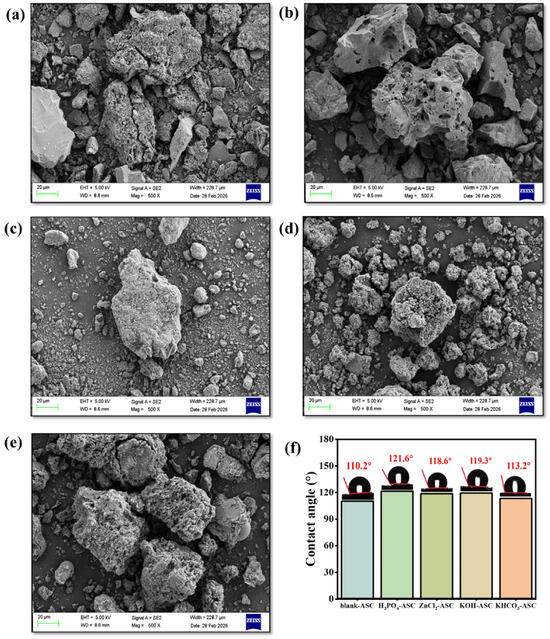
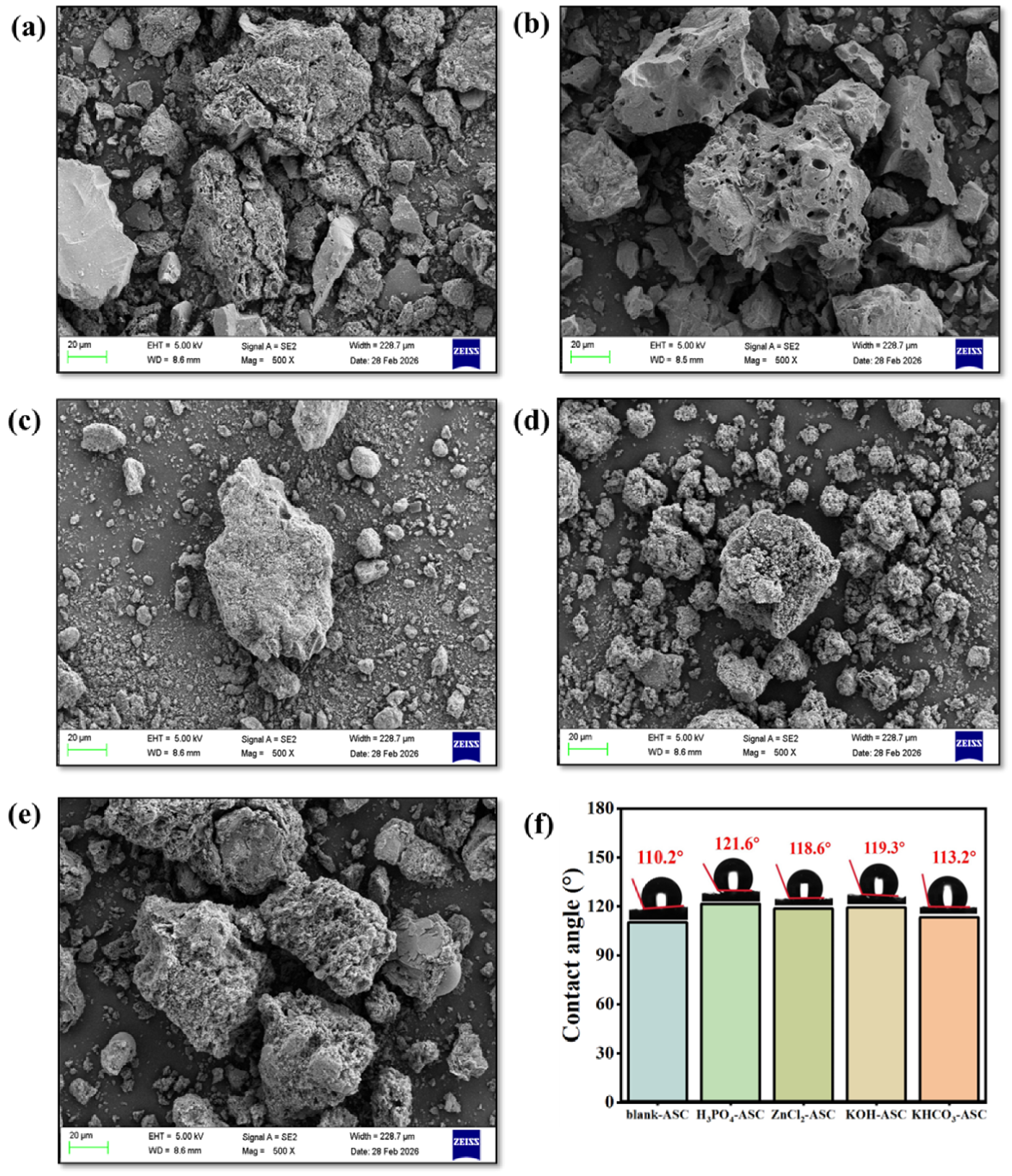
Figure 1 shows the SEM morphologies and water contact angles of the different sludge carbons. Blank-ASC presented a rough surface with indistinct pores and a low specific surface area, reflecting a basic carbon skeleton with limited porosity. Its contact angle was 110.2°, indicating moderate hydrophobicity. ZnCl2-ASC featured a denser surface with a contact angle of 118.6°, while KOH-ASC consisted of aggregated particles and delivered a contact angle of 119.3°; KHCO3-ASC exhibited a loose flake-like structure and a lower contact angle of 113.2°. In contrast, H3PO4-ASC displayed a dense yet highly porous architecture with well-developed hierarchical pores in the range of 2.5–12 µm. This unique structure is expected to significantly reduce mass transfer resistance and prevent the encapsulation of active sites [22]. Moreover, H3PO4-ASC exhibited the highest contact angle of 121.6°, indicating the strongest surface hydrophobicity. The good hydrophobic interface is beneficial for enriching dissolved oxygen from the electrolyte and stabilizing the gas–liquid-solid triple-phase catalytic boundary, thereby enhancing O2 interfacial mass transfer and the kinetics of the selective reduction reaction [23].
Figure 1.
SEM image of (a) Blank-ASC, (b) H3PO4-ASC, (c) ZnCl2-ASC, (d) KOH-ASC, (e) KHCO3-ASC; (f) Contact angles of municipal sludge-derived activated carbons with different activators.
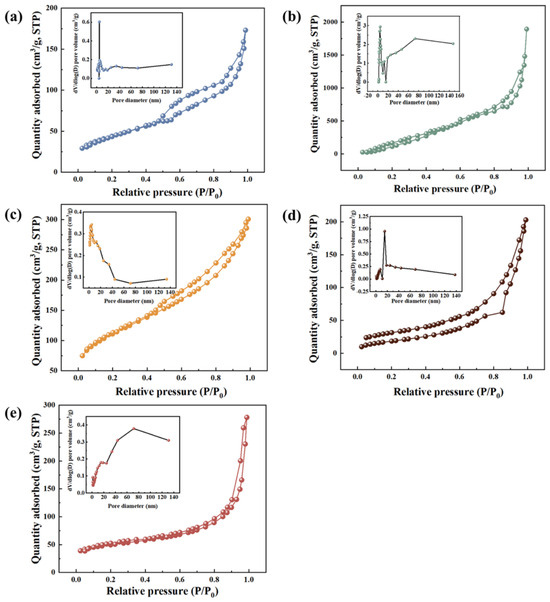
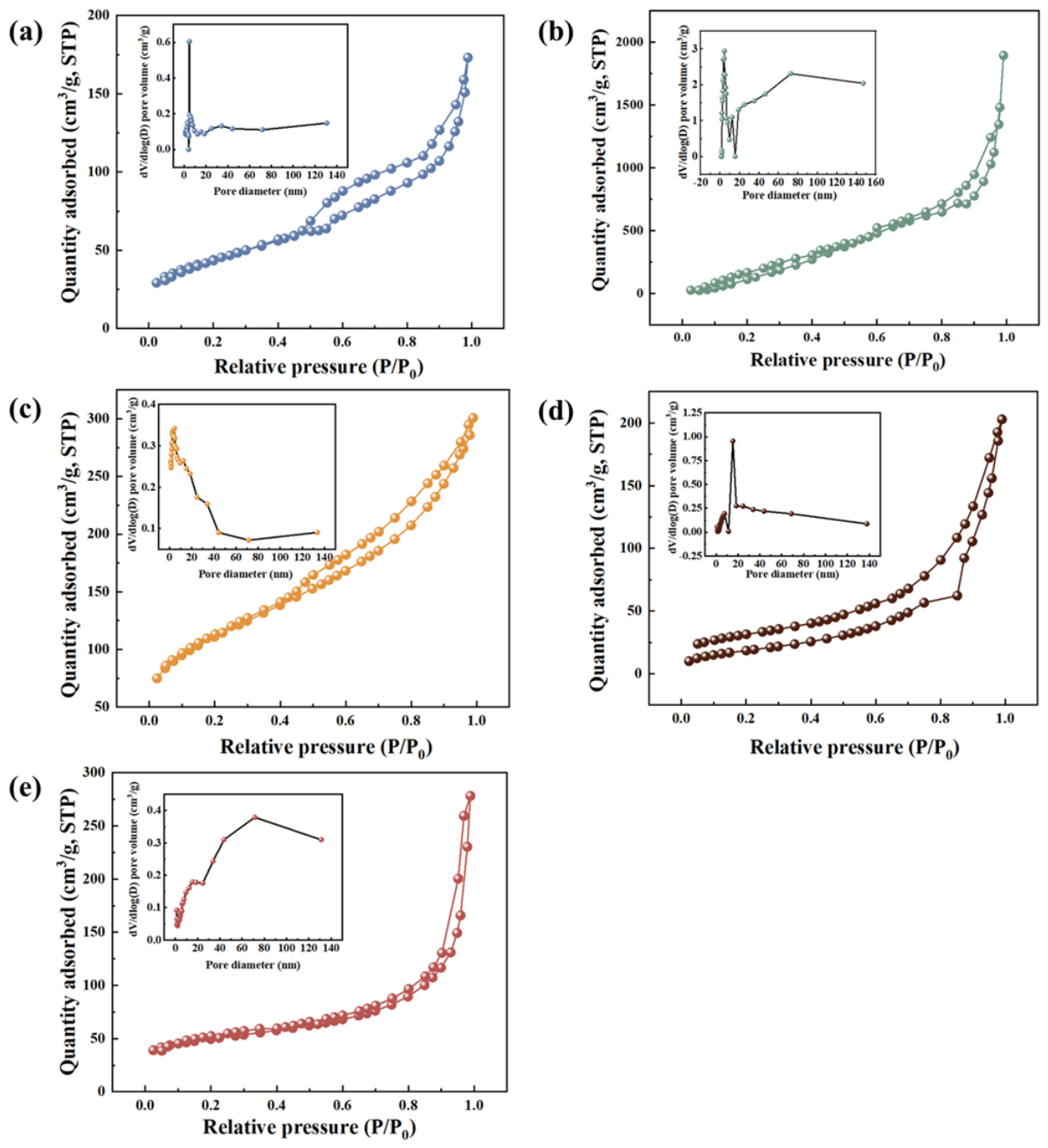
To quantitatively corroborate the SEM observations, N2 adsorption–desorption measurements were performed, and the BET surface area, pore volume, and average pore size of all samples are summarized in Table 1. Blank-ASC exhibited a moderate BET surface area of 155.84 m2·g−1. H3PO4-ASC showed a high specific surface area of 806.20 m2·g−1, substantially larger than that of ZnCl2-ASC (388.70 m2·g−1), KOH-ASC (69.33 m2·g−1), and KHCO3-ASC (163.26 m2·g−1). The N2 adsorption–desorption isotherms (Figure 2) of H3PO4-ASC exhibited a typical Type III behavior: a steep uptake at low relative pressure (P/P0 < 0.1) indicated the presence of abundant micropores, while a sharp rise at high relative pressure (P/P0 close to 1.0) confirmed the existence of macropores, consistent with the SEM observations (Figure 1). Pore-size distribution analysis further confirmed that H3PO4-ASC possessed a hierarchical micro-meso-macroporous structure, with a notable contribution from mesopores alongside micropores and macropores. This unique hierarchical scaffold, combined with its high surface area and superior surface hydrophobicity (contact angle of 121.6°), synergistically minimizes O2 mass-transfer resistance, prevents electrolyte flooding of active sites, and stabilizes the triple-phase reaction interface. As a result, H3PO4-ASC provides abundant accessible active sites for the dissolved O2 and facilitates the rapid diffusion of the produced H2O2 away from the electrode surface, which are critical factors for achieving high selectivity and activity in the 2e− ORR [23].
Table 1.
BET surface area, pore volume, and average pore size of municipal sludge-derived activated carbons prepared with different activators.
Figure 2.
Nitrogen adsorption-desorption isotherms and pore-size distribution curves of (a) Blank-ASC, (b) H3PO4-ASC, (c) ZnCl2-ASC, (d) KOH-ASC, (e) KHCO3-ASC.
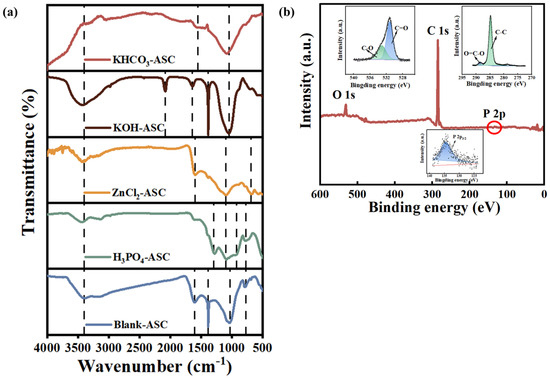
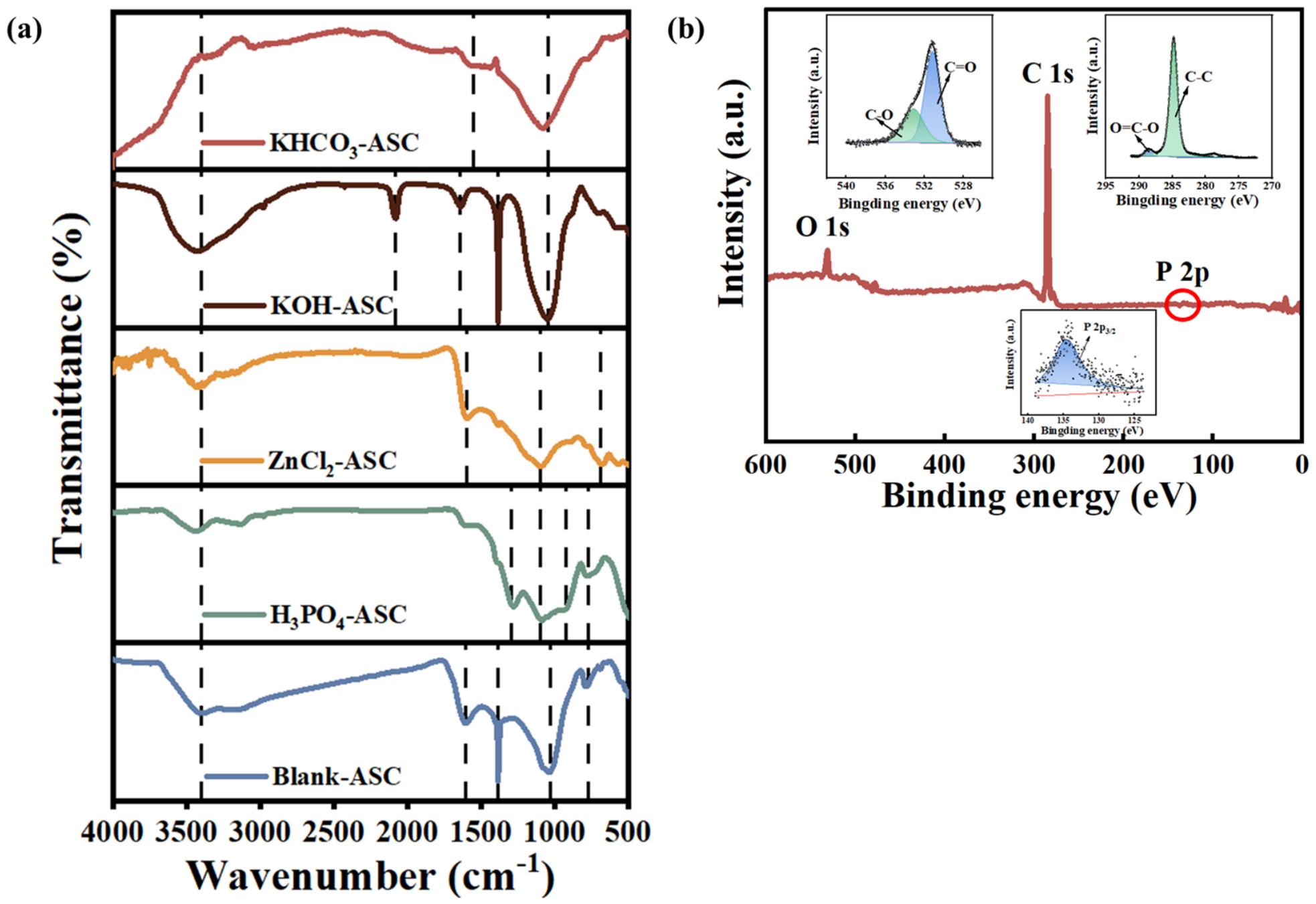
The FTIR spectra (Figure 3) provide insight into the surface chemical functionalities. All sludge carbons showed characteristic FTIR absorption bands at approximately 3400 cm−1 and in the 1000–1100 cm−1 region, assigned to the O-H stretching of hydroxyl/carboxyl groups [24], and the C-O stretching vibration of aliphatic C-OH and C-O-C ether linkages [25], respectively. Blank-ASC showed peaks at 1610 cm−1 (aromatic C=C), 1385 cm−1 and 780 cm−1 (C-H bending) [26,27,28], confirming a basic aromatic carbon framework but with limited functional diversity. ZnCl2-ASC exhibited a similar pattern with a slight improvement in carbon skeleton integrity (1590 cm−1, 680 cm−1) but no new oxygen groups. KOH-ASC displayed peaks at 1640 cm−1 and 1385 cm−1, suggesting that alkali etching mainly optimizes the local carbon structure without enriching active oxygen functionalities [29]. KHCO3-ASC showed a C=C peak at 1560 cm−1 but no significant oxygenated features. In contrast, H3PO4-ASC exhibited several distinct peaks: a broad band at 3130 cm−1 (carboxylic acid dimer O-H) [30], a strong absorption at 1280 cm−1 which can be attributed to the overlapping contributions of C-O stretching in carboxyl groups [31] and P=O/P-O-C stretching vibrations introduced by H3PO4 activation [32]. In addition, the band in the 980–920 cm−1 region is assigned to the asymmetric stretching of P-O-P or P-O-C linkages, as well as C-O-P bending modes [32], indicating the presence of phosphate species grafted onto the carbon framework. The O-H out-of-plane bending at 785 cm−1 [28] is also observed. These phosphorus-containing functionalities, along with carboxyl groups, collectively modulate the surface polarity and may contribute to the enhanced 2e− ORR activity, although the carboxyl groups are considered the primary active sites.
Figure 3.
(a) FTIR spectra of municipal sludge-derived activated carbons, and (b) XPS of H3PO4-ASC.
The XPS survey spectra (Figure 3b) further corroborated these findings. The H3PO4-ASC sample displayed clear P 2p, O 1s and C 1s signals, with a surface oxygen content of 4.71 at.% and a phosphorus content of 0.4 at.%, confirming the successful grafting of both oxygen-containing and phosphorus functionalities onto the carbon framework during H3PO4 activation. The C 1s high-resolution spectrum revealed peaks corresponding to C-C (284.6 eV) and O-C=O (288.8 eV), confirming the presence of carboxyl and hydroxyl groups. The O 1s spectrum further showed contributions from C=O (531.5 eV) and C-O (532.8 eV) species [33]. While the high-resolution P 2p spectrum exhibited a characteristic peak at ~134.6 eV, which is typically assigned to P-O-C and phosphate (PO43−) species [32]. This result is fully consistent with the FTIR assignments. Collectively, these features unequivocally demonstrate that H3PO4 activation introduces abundant carboxyl and other oxygen-containing groups onto the carbon surface. Such oxygen functionalities not only serve as highly active sites for the 2e− ORR by effectively modulating the electron distribution at the electrode interface, optimizing the interfacial charge transfer environment, and precisely steering the reduction of O2 to H2O2, but also endow the electrode with excellent catalytic activity at the molecular structural level [34]. Although the phosphorus content is relatively low, its presence may synergistically modulate the surface charge environment in conjunction with the dominant carboxyl active sites.
2.2. Effect of Activator Type on H2O2 Electrosynthesis
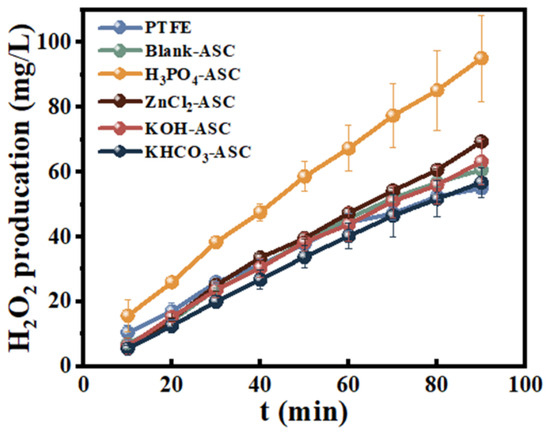
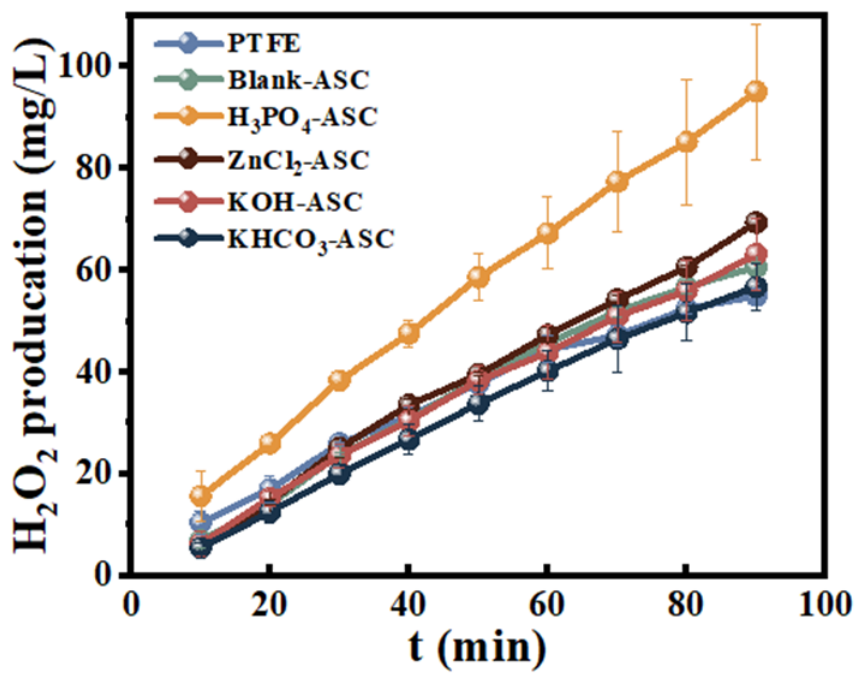
Figure 4 compares the cumulative H2O2 concentration over 90 min for electrodes prepared with different activators. Within 90 min of reaction, Blank-ASC increased from 6.9 to 60.7 mg·L−1, ZnCl2-ASC from 5.8 to 69.4 mg·L−1, KOH-ASC from 6.2 to 63.2 mg·L−1, and KHCO3-ASC from 5.5 to 56.8 mg·L−1. In sharp contrast, H3PO4-ASC started at a much higher initial concentration (15.6 mg·L−1) and reached 95.1 mg·L−1 after 90 min, maintaining the highest production rate throughout. The superior performance of H3PO4-ASC arose from its most abundant pore channels, the strongest hydrophobicity, and the highest content of oxygen-containing functional groups, which were more favorable for O2 mass transfer and the 2e− ORR, thus resulting in the highest H2O2 yield [35].
Figure 4.
Effect of activator types on the accumulated concentration of H2O2, experimental conditions: Na2SO4 solution concentration is 0.05 M, current density is 0.5 mA·cm−2, pH = 3, O2 aeration rate is 500 mL·min−1.
2.3. Electrochemical Mechanism
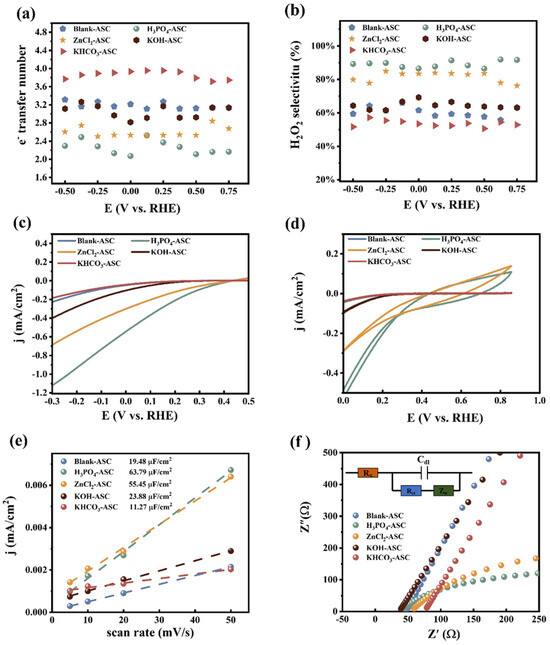
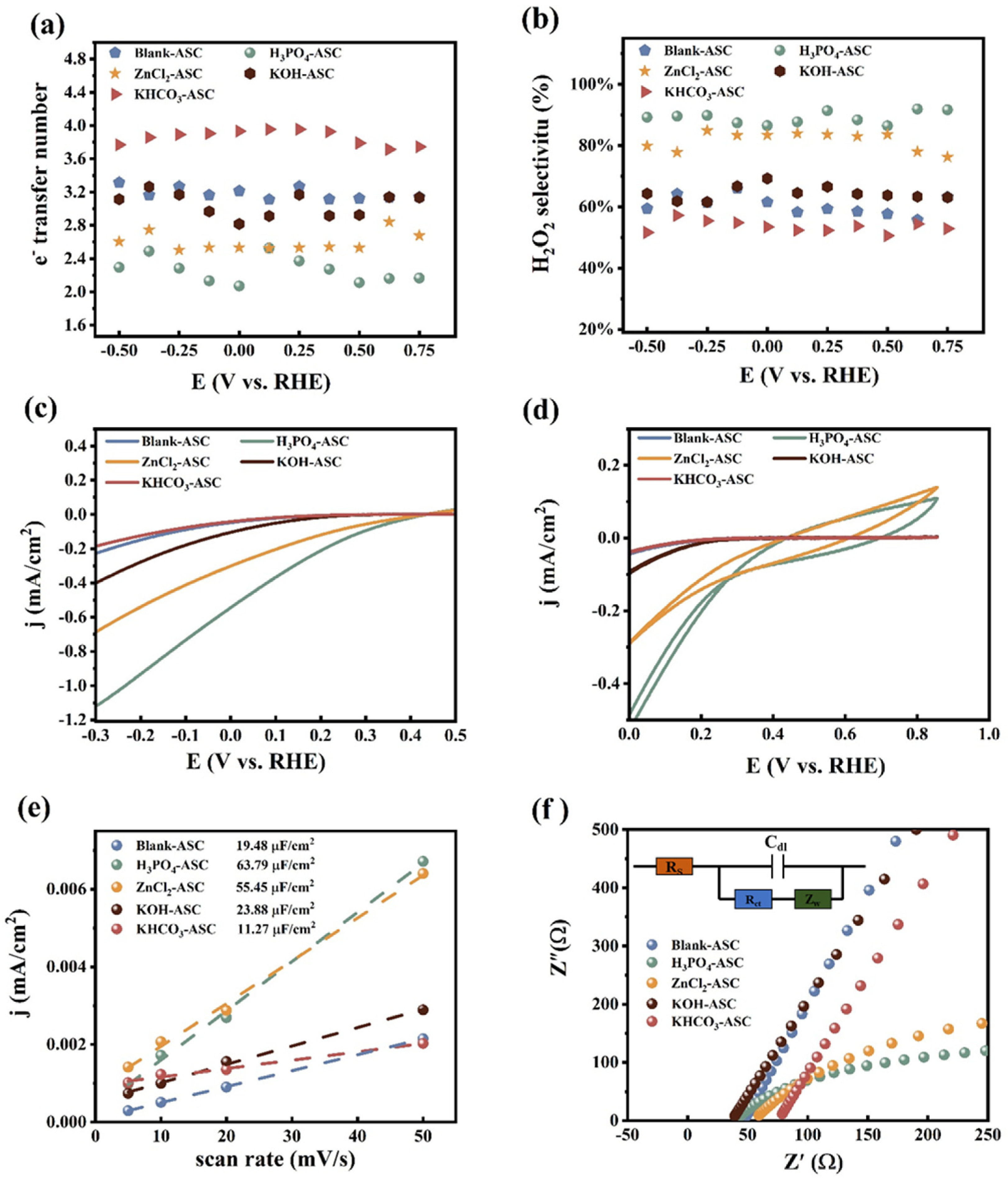
The ORR pathways were further elucidated by rotating ring-disk electrode measurements. As shown in Figure 5a,b, Blank-ASC showed an electron transfer number of approximately 3.2 and an H2O2 selectivity of 55–65%, indicating a mixed 2e−/4e− pathway. ZnCl2-ASC showed an electron transfer number of about 2.6 and a H2O2 selectivity of 75–80%; KOH-ASC had an electron transfer number of about 3.0 and a H2O2 selectivity of 61–64%; KHCO3-ASC presented an electron transfer number of about 3.8 and a H2O2 selectivity of 50–55%. Notably, H3PO4-ASC achieved the highest H2O2 selectivity of 86–92% and an electron transfer number of about 2.2, which was close to the ideal 2e− pathway for H2O2 production. This near-ideal selectivity underscored that the carboxyl-rich surface effectively suppressed the 4e− pathway, likely by destabilizing the O-O bond scission intermediates that led to H2O formation [34].
Figure 5.
Electrochemical characterization of municipal sludge-derived activated carbons activated by different agents: (a) electron transfer number, (b) H2O2 selectivity, (c) LSV, (d) CV, (e) ECSA, (f) EIS.
The LSV curves in Figure 5c indicated that H3PO4-ASC demonstrated the best ORR catalytic activity among the tested samples, with a more positive onset potential and a larger limiting current density, while the electrocatalytic reduction activities of ZnCl2-ASC, KOH-ASC, and KHCO3-ASC decreased successively.
The CV curves and ECSA results shown in Figure 5d,e indicated that H3PO4-ASC possessed the largest ECSA of 63.79 µF·cm−2, followed by ZnCl2-ASC (55.45 µF·cm−2), while KOH-ASC and KHCO3-ASC showed much smaller values of 23.88 µF·cm−2 and 11.27 µF·cm−2, respectively. The high ECSA of H3PO4-ASC was a direct consequence of its high specific surface area and hierarchical porous structure, which exposed a greater number of active sites. Furthermore, the rich oxygen functional groups not only contributed to ECSA but also enhanced the catalytic activity, as evidenced by the high selectivity even at the relatively low ECSA compared to some metal-based catalysts [36].
The EIS in Figure 5f shows that H3PO4-ASC had the smallest charge transfer resistance (Rct). indicating the most facile electron transfer across the electrode/electrolyte interface. The carboxyl groups likely lower the interfacial barrier by moderately enhancing the local hydrophilicity of the active sites without flooding the hydrophobic pore channels, a delicate balance uniquely achieved by H3PO4 activation [37]. In contrast, ZnCl2-ASC, KOH-ASC, and KHCO3-ASC exhibited progressively larger Rct values, which correlated with their inferior catalytic kinetics.
Taken together, H3PO4-ASC simultaneously achieved the highest H2O2 selectivity, the lowest electron transfer number, the largest ECSA, and the smallest Rct, unequivocally establishing it as the optimal catalyst among the studied systems.
2.4. Effect of H3PO4 Concentration on Electrosynthesis
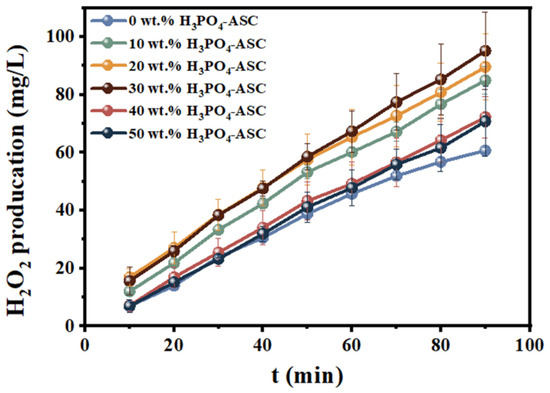
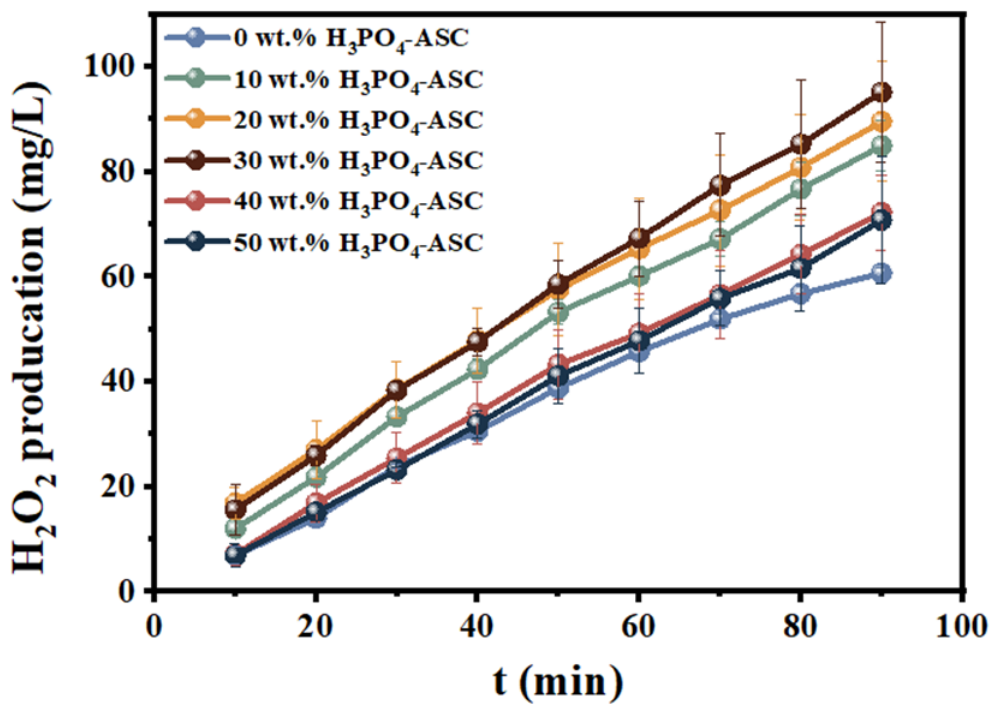
The effect of H3PO4 concentration (10–50 wt.%) on H2O2 accumulation is shown in Figure 6. The cumulative H2O2 concentration of all electrodes increased linearly with time. After 90 min, 30 wt.% H3PO4-ASC exhibited the highest cumulative H2O2 concentration of 95.1 mg·L−1, followed by 20 wt.% H3PO4-ASC with 89.6 mg·L−1, 40 wt.% H3PO4-ASC with 85.7 mg·L−1, and 10 wt.% H3PO4-ASC with 84.8 mg·L−1; the lowest cumulative concentration of 70.8 mg·L−1 was obtained with 50 wt.% H3PO4. This volcano-shaped trend indicates that an optimal activator concentration is required: at low concentrations of H3PO4, insufficient activation leads to limited porosity and fewer carboxyl groups; at excessively high concentrations, over-etching may collapse the porous structure or introduce excessive phosphorus residues that block active sites [38]. Therefore, 30 wt.% was identified as the optimal concentration.
Figure 6.
Effect of activator concentration on the accumulated concentration of H2O2, experimental conditions: Na2SO4 solution concentration is 0.05 M, current density is 0.5 mA·cm−2, pH = 3, O2 aeration rate is 500 mL·min−1.
2.5. Effects of Current Density on H2O2 Yield and Current Efficiency
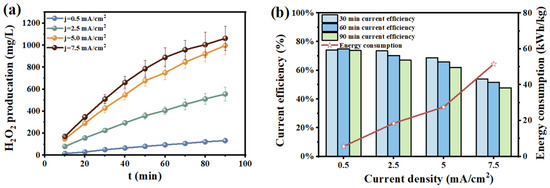
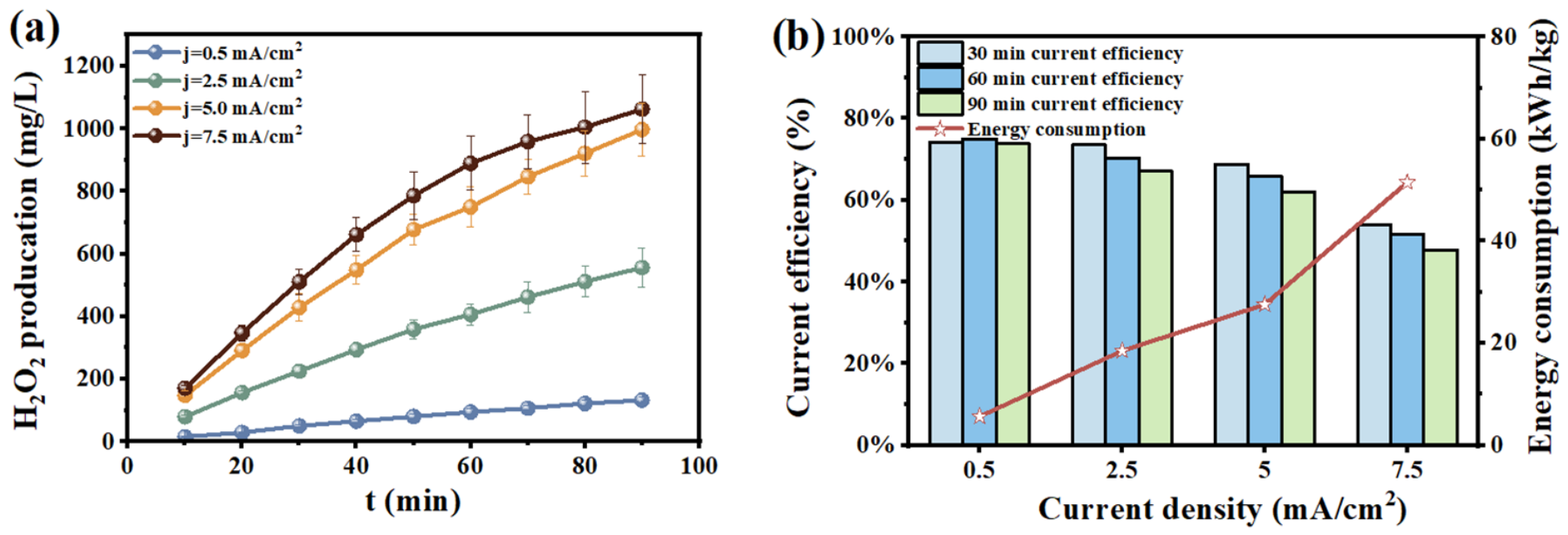
Figure 7 illustrates the impact of current density (0.5–7.5 mA·cm−2) on H2O2 yield and current efficiency. The cumulative concentration increased with current density, reaching 1062.8 mg·L−1 at 7.5 mA·cm−2 and 997.3 mg·L−1 at 5.0 mA·cm−2 after 90 min. However, the current efficiency (CE) decreased from ~75.0% at 0.5 mA·cm−2 to ~50.0% at 7.5 mA·cm−2, while energy consumption (EC) increased sharply from 27.6 kWh·kg−1 H2O2 (at 5.0 mA·cm−2) to 51.5 kWh·kg−1 H2O2 (at 7.5 mA·cm−2). Moreover, at j = 7.5 mA·cm−2, the electrolyte became noticeably hot, indicating that excessively high current density induced severe side reactions and Joule heating, which is detrimental to the stable operation of the system [39]. Although a higher current density yields more H2O2 in absolute terms, the trade-off in CE and EC, along with thermal instability, makes 5.0 mA·cm−2 the optimal condition for balancing productivity, energy efficiency, and long-term stability.
Figure 7.
(a) Effect of current density on H2O2 accumulation, and (b) corresponding current efficiency and energy consumption, experimental conditions: Na2SO4 solution concentration is 0.05 M, pH = 3, O2 aeration rate is 500 mL·min−1.
2.6. Reusability and Stability
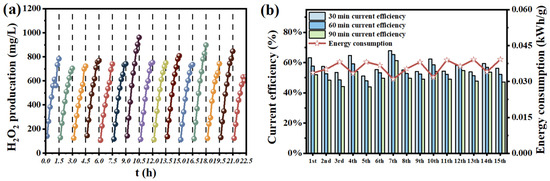
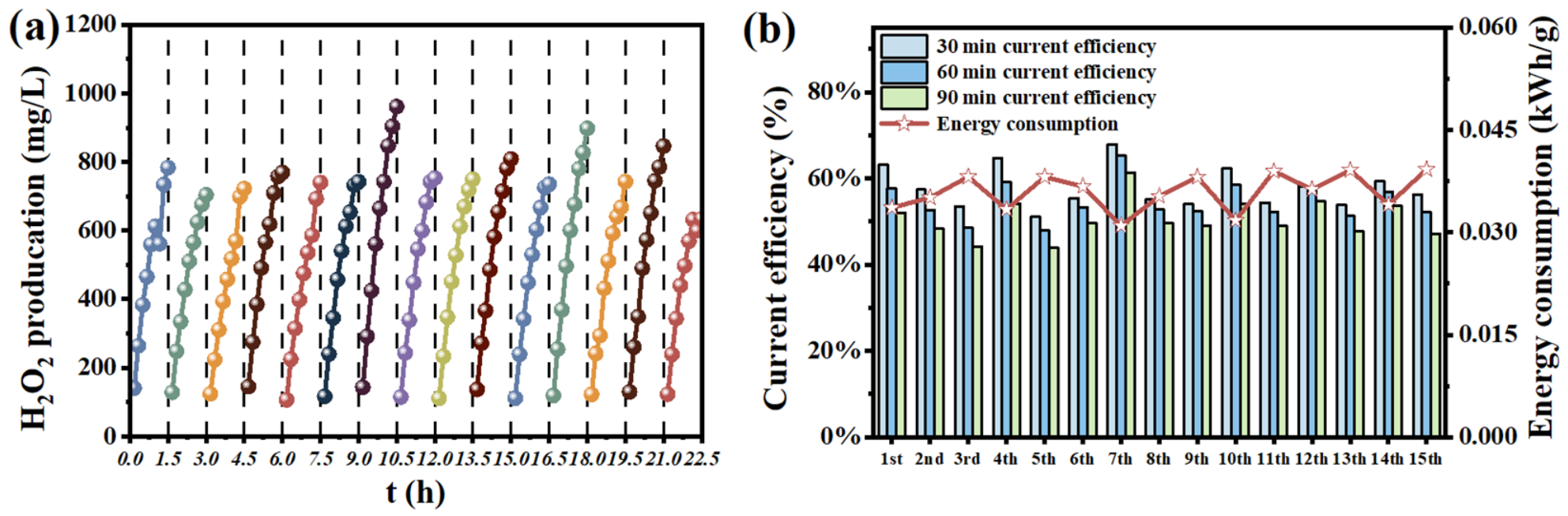
The reusability and stability of the 30 wt.% H3PO4-ASC electrodes were assessed over 15 consecutive cycles (Figure 8). The cumulative H2O2 concentration gradually declined from 783.3 mg·L−1 (1st cycle) to 634.4 mg·L−1 (15th cycle), retaining 81.1% of the initial H2O2 yield. The current efficiency remained above 47.0% even after 15 cycles, and energy consumption fluctuated modestly between 33.6 and 39.0 kWh·kg−1 H2O2.
Figure 8.
(a) Accumulated H2O2 concentration from 15 repeated electrocatalytic reactions using 30 wt.% H3PO4-ASC composite electrodes, (b) corresponding current efficiency and energy consumption, experimental conditions: Na2SO4 solution concentration is 0.05 M, current density is 5.0 mA·cm−2, pH = 3, O2 aeration rate is 500 mL·min−1.
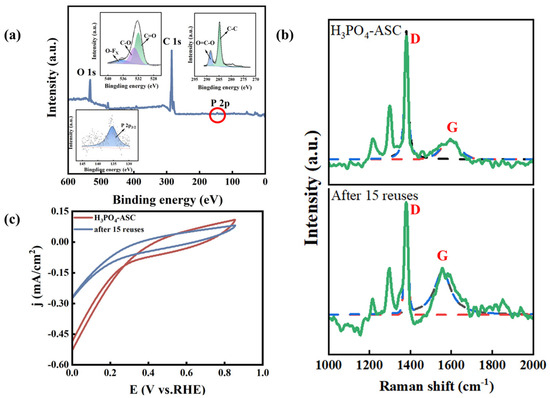
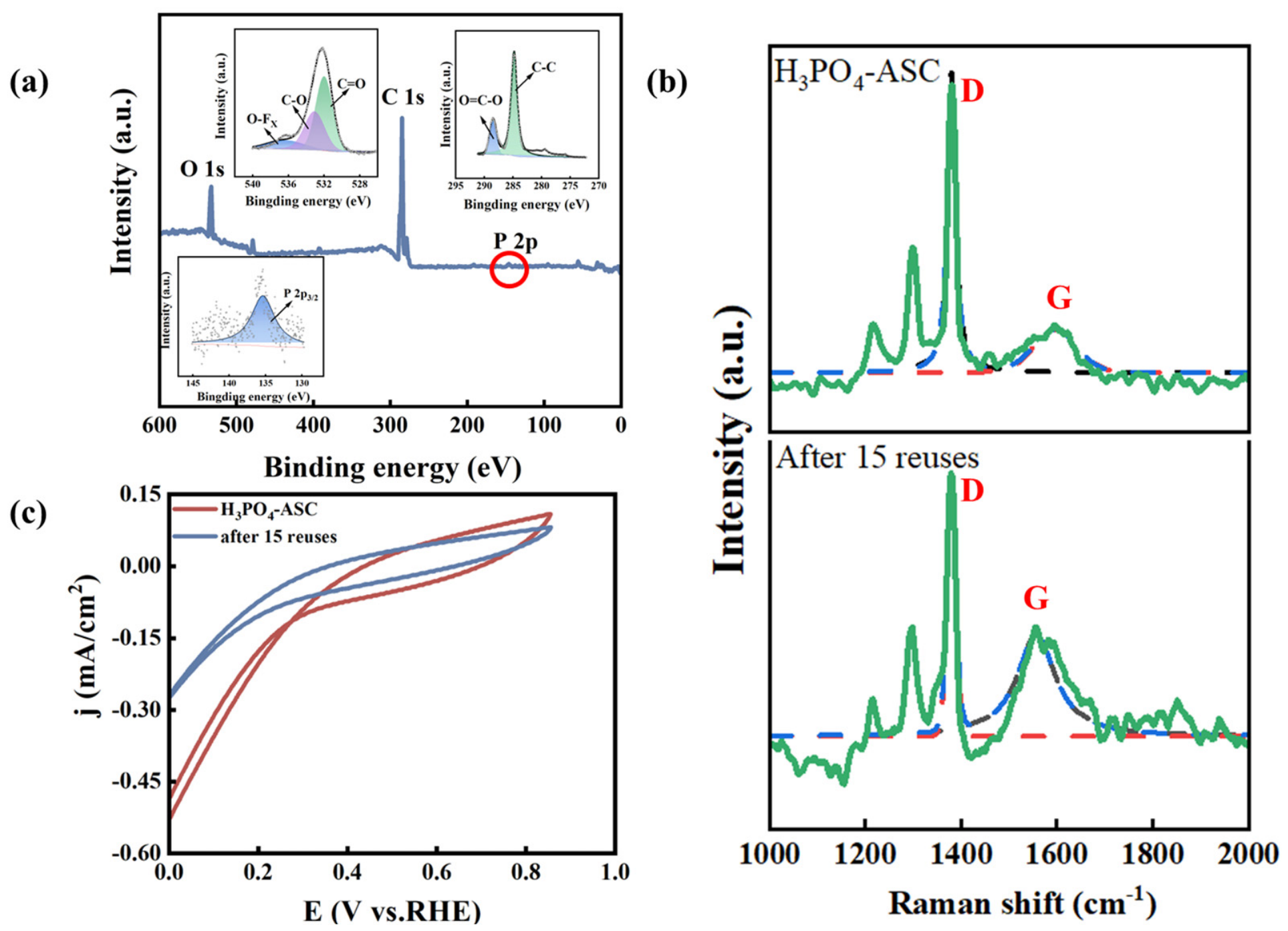
To elucidate the chemical origin of this moderate deactivation, XPS and Raman analyses were performed on the electrode before and after 15 cycles. Surprisingly, the high-resolution O 1s spectra (Figure 3b and Figure 9a) revealed that the surface oxygen content increased markedly from 4.71 at.% to 11.90 at.% after cycling, rather than decreasing. In the C 1s spectra, the C-C component slightly increased from 97.14% to 97.95%, while the carboxyl carbon (O=C-O) fraction decreased only marginally from 2.86% to 2.05% (Table 2), indicating that the intrinsic carbon skeleton and the key carboxylic acid groups were largely retained. In the O 1s spectra, however, the proportions of C=O and C-O declined from 65.18% to 52.86% and from 34.82% to 34.37% (Table 2), respectively, while a new O-Fx species (chemisorbed oxygen) emerged after cycling at 12.77% (absent in the fresh electrode). This distinct redistribution of oxygen species—coupled with the increase in total oxygen content—suggests that the prolonged electrolysis induced partial surface oxidation, generating new oxygen-containing functional groups (e.g., carbonyl, hydroxyl, and ether groups) [40], but also converting part of the original C=O/C-O moieties into more strongly chemisorbed oxygen species (O-Fx). Importantly, the carboxyl groups remained essentially intact (only a slight decrease from 2.86% to 2.05%), confirming that these crucial active functionalities were not chemically destroyed [33]. Meanwhile, the phosphorus content remained at a low level (from 0.40 at.% to 0.53 at.%) after cycling.
Figure 9.
(a) XPS of 30 wt.% H3PO4-ASC composite electrode after 15 reuses, (b) Raman peaks and (c) CV of 30 wt.% H3PO4-ASC composite electrode before and after 15 reuses.
Table 2.
The proportions of carbon and oxygen with different chemical states in 30 wt.% H3PO4-ASC composite electrode before and after 15 recycling cycles.
Concurrently, Raman spectroscopy (Figure 9b) showed only a modest increase in the ID/IG ratio from 1.85 to 2.18. The pristine electrode exhibited a relatively high ID/IG ratio of 1.85, indicating a disordered carbon structure with abundant defects and limited graphitization. After 15 cycles, this ratio increased modestly to 2.18, suggesting further disruption of the crystalline structure, increased defect density, and even less pronounced graphitization, which would inevitably compromise the ORR catalytic performance of the electrode [41]. Note that the Raman measurements were performed on carbon/PTFE mixtures coated on graphite felt, not on pristine powder; thus, weak PTFE fluorescence, C-F bands, and felt carbon signals may appear as minor extra peaks alongside the main D/G bands, but they do not compromise the assessment of carbon structural changes [42,43]. These spectroscopic findings are further corroborated by the CV curves before and after cycling (Figure 9c), which exhibited a slight decrease in peak current but no appreciable reduction in the enclosed area. The enclosed CV area, which is proportional to the number of electrochemically accessible active sites, showed no significant reduction, indicating that the active site density remained largely unchanged despite the surface oxygen enrichment.
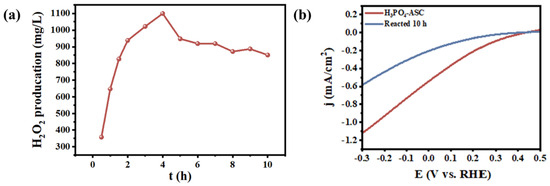
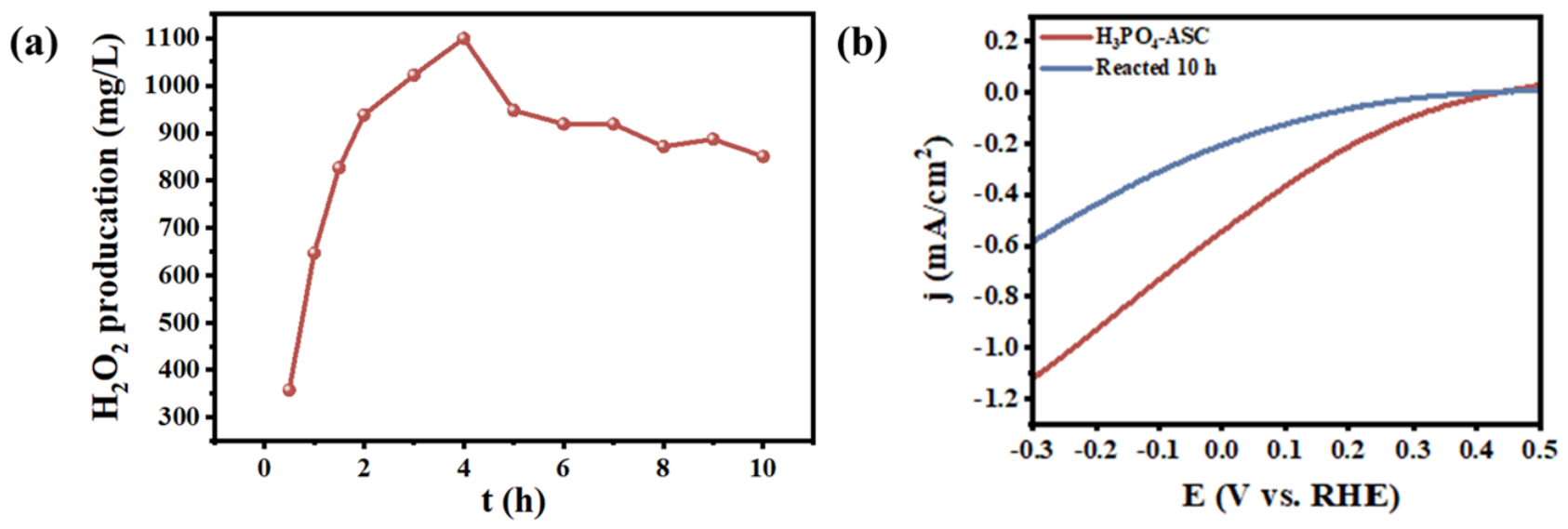
To complement the intermittent cycling results, a prolonged continuous electrolysis test lasting 10 h was conducted to assess the operational stability under sustained polarization (Figure 10a). The H2O2 concentration increased steadily within the initial 4 h and peaked at 1099.0 mg·L−1. Beyond 4 h, the H2O2 accumulation rate decreased progressively, which was mainly attributed to Joule heating-induced H2O2 decomposition at the relatively high current density (5.0 mA·cm−2) and further reduction-decomposition of H2O2 at the cathode. Notably, post-test LSV characterization revealed that the used electrode exhibited a certain decrease in the reduction onset potential and limiting current density (Figure 10b), confirming that the decline in H2O2 accumulation after 4 h was attributable to a combination of the electrode activity decay and H2O2 decomposition.
Figure 10.
(a) H2O2 accumulation during the electrocatalytic reaction of the 30 wt.% H3PO4-ASC electrode for 10 h; (b) LSV of the 30 wt.% H3PO4-ASC electrode before and after 10 h of use.
Taken together, the moderate activity decline is associated with surface chemical evolution and thermal effects. The 30 wt.% H3PO4-ASC electrode thus exhibits good reusability and structural robustness, positioning it as a durable and sustainable electrocatalyst for practical H2O2 electrosynthesis.
In addition, Table 3 compares the performance of 30 wt.% H3PO4-ASC with reported sludge-derived catalysts. Our electrode achieves significantly higher H2O2 selectivity (90%, n = 2.20) and yield (997.3 mg·L−1 in 90 min) than literature values. The outstanding performance is attributed to the hierarchical micro-/meso-/macroporosity, high surface area, abundant carboxyl groups, and strong hydrophobicity, while the higher EC results from the applied current density and structural resistance. Overall, this sludge-derived carbon is a promising low-cost electrocatalyst for H2O2 production.
Table 3.
Comprehensive comparison of 30 wt.% H3PO4-ASC with representative sludge-derived activated carbon catalysts reported in the literature.
3. Materials and Methods
3.1. Raw Materials and Reagents
Municipal sludge (obtained from Everbright Water (Nanjing) Co., Ltd., Nanjing, China); potassium hydroxide, potassium bicarbonate, phosphoric acid, sulfuric acid, sodium hydroxide (AR, Shanghai Lingfeng Chemical Reagent Co., Ltd., Shanghai, China); zinc chloride (AR, Xilong Scientific Co., Ltd., Shantou, China); nitric acid (65–68%), hydrogen peroxide (30%), graphite felt (100 mm × 50 mm × 2 mm) (Sinopharm Chemical Reagent Co., Ltd., Shanghai, China); anhydrous sodium sulfate (AR, Shanghai Aladdin Biochemical Technology Co., Ltd., Shanghai, China); potassium titanium oxalate (AR), polytetrafluoroethylene (PTFE, 60 wt.%) (Shanghai Macklin Biochemical Technology Co., Ltd., Shanghai, China); anhydrous ethanol (AR, Wuxi Yasheng Chemical Co., Ltd., Wuxi, China); potassium bromide (GR, Shandong Xiya Chemical Co., Ltd., Linyi, China); Nafion solution (5%, Shanghai Aladdin Biochemical Technology Co., Ltd., Shanghai, China); ruthenium-iridium titanium mesh electrode (100 mm × 50 mm × 2 mm, Shaanxi Baoji Titanium Xin Machinery Processing Factory, Baoji, China); high-purity O2, high-purity N2 (99.999% by volume, Nanjing Special Gas Factory Co., Ltd., Nanjing, China). Ultrapure water was used throughout the experiments.
3.2. Material Characterization
Electric blast drying oven (DHG-9030A, Shanghai Jinghong Experimental Equipment Co., Ltd., Shanghai, China); tube furnace (TL1200, Nanjing Boyuntong Instrument Technology Co., Ltd., Nanjing, China); muffle furnace (KSL-1100X, Hefei Kejing Materials Technology Co., Ltd., Hefei, China); UV-Vis spectrophotometer (UV-3300, Shanghai Mapada Instruments Co., Ltd., Shanghai, China); electronic balance (SQP, Sartorius Scientific Instruments (Beijing) Co., Ltd., Beijing, China); digital ultrasonic cleaner (KQ3200V, Kunshan Ultrasonic Instruments Co., Ltd., Kunshan, China); circulating water multipurpose vacuum pump (SHZ-D(III), Henan Yuhua Instruments Co., Ltd., Gongyi, China); magnetic stirrer (FJS-4, Jincheng Fuwei Experimental Instrument Factory, Jintan District, Changzhou, China); DC power supply (KXN-3040D, Shenzhen Zhaoxin Electronic Instrument Equipment Co., Ltd., Shenzhen, China).
3.3. Catalyst Synthesis
(1) Pretreatment of municipal sludge: The municipal sludge collected from the secondary sedimentation tank of the wastewater treatment plant was first filtered through a 40-mesh sieve to remove mixed kitchen waste debris. It was then filtered through a 100-mesh filter cloth, washed with ultrapure water under ultrasonication for 1 h, and dried in an oven at 105 °C to constant weight. Finally, the dried sludge was ground into powder particles smaller than 40 mesh.
(2) Pretreatment of graphite felt: The graphite felt was cut into small pieces of 5 × 10 cm, immersed in anhydrous ethanol under ultrasonication for 30 min, then washed with ultrapure water and ultrasonicated for another 30 min, followed by drying in an oven at 105 °C.
(3) Preparation of municipal sludge-derived activated carbon: 15 g of the pretreated sludge was mixed with different activators (10–50 wt.% H3PO4, 40 wt.% ZnCl2, 20 wt.% KOH, and 20 wt.% KHCO3) and impregnated for 2 h. The mixture was first dried in an oven at 105 °C to constant weight and then placed in a tube furnace under a N2 atmosphere with a flow rate of 500 mL·min−1. The temperature was ramped to the calcination temperature at a heating rate of 5 °C·min−1. and maintained for the corresponding calcination time. The calcined product was ground into powder in an agate mortar, then mixed with 80 mL of 1 mol·L−1 HNO3 solution and stirred for 4 h. The suspension was filtered under suction and washed with ultrapure water until the filtrate became neutral. Finally, the product was dried in an oven at 105 °C to constant weight to obtain the municipal sludge-derived activated carbon.
(4) Preparation of composite electrodes: 0.200 g of the above-prepared municipal sludge-derived activated carbon was mixed with 20 mL of 40 wt.% PTFE solution and stirred for 20 min to ensure thorough mixing. The mixture was then uniformly coated onto a 100 mm × 50 mm piece of graphite felt. The coated felt was dried in an oven first at 80 °C for 2 h, then at 100 °C for 1.5 h. After drying, it was placed in a muffle furnace, heated to 300 °C at a rate of 10 °C·min−1, and calcined at 300 °C for 1 h to obtain the sludge carbon composite electrodes.
The as-prepared electrodes were designated as Blank-ASC (sludge carbonized directly without any activator), x wt.% H3PO4-ASC (where x represents the mass percentage concentration of the activator H3PO4, x = 10,20,30,40,50), ZnCl2-ASC (activated with 40 wt.% ZnCl2), KOH-ASC (activated with 20 wt.% KOH), and KHCO3-ASC (activated with 20 wt.% KHCO3). An electrode without sludge carbon, coated only with 40 wt.% PTFE solution was named PTFE.
3.4. Material Characterization
The surface morphology and pore structure of the electrodes were observed using a Zeiss Gemini 300 scanning electron microscope (Carl Zeiss AG, Oberkochen, Germany). The contact angle on the electrode surface was measured with a JC2000X contact angle goniometer (Shanghai Zhongchen Digital Technology Apparatus Co., Ltd., Shanghai, China) to determine the hydrophilicity/hydrophobicity of the electrode material. The types of oxygen-containing functional groups on the surface of the biochar treated with different activators were analyzed using a Thermo Fisher Scientific Nicolet iS20 Fourier transform infrared spectrometer (Thermo Fisher Scientific, Waltham, MA, USA), with the wavenumber range of 400–4000 cm−1, a resolution of 4 cm−1, and 32 scans. The nitrogen adsorption/desorption isotherms at 77 K were obtained using an Autosorb-iQ-MP high-vacuum gas sorption analyzer (Quantachrome Instruments, a brand of Anton Paar, Boynton Beach, FL, USA). The samples were degassed at 120 °C for 6 h prior to measurement. The specific surface area (SSA) was calculated according to the BET method with five relative pressure points in the interval of 0.05–0.30. X-ray photoelectron spectroscopy (XPS, Thermo Fisher Scientific K-alpha, Waltham, MA, USA) was carried out to analyze the surface elemental states and their distribution ratios on the biomass-derived carbon material. The degree of graphitization was characterized using a Raman spectrometer (DXR2xi Dispersive Microscopic Confocal Laser Raman Spectrometer, Thermo Scientific, Waltham, MA, USA).
3.5. H2O2 Electrosynthesis Experiments
The electrochemical reaction system consisted of an electrochemical reaction cell (500 mL volume), a DC regulated power supply, and an oxygen cylinder. The cathode was a 100 mm × 50 mm composite electrode, and the anode was a 100 mm × 50 mm stainless steel plate, with a distance of 25 mm between them. A 250 mL of 0.05 mol·L−1 Na2SO4 solution was used as the electrolyte, and the initial pH was adjusted to 3. The system was first purged with O2 to saturate the dissolved oxygen, and then the electrolysis for H2O2 production was carried out. Samples were taken at regular intervals, and the H2O2 concentration in the solution was determined by the potassium titanium oxalate method.
The current efficiency (CE) of H2O2 electrosynthesis was calculated according to Equation (1):
where CE is the current efficiency (%), n is the number of electrons transferred in the ORR (n = 2), F is the Faraday constant (96,485 C·mol−1), C is the concentration of H2O2 produced (mol·L−1), V is the volume of the electrolyte (0.250 L), I is the current intensity (A), and t is the electrolysis time (s).
CE = [(n × F × C × V)/(I × t)] × 100%,
The energy consumption (EC) of H2O2 electrosynthesis was calculated according to Equation (2):
where EC is the energy consumption (kWh·kg−1 H2O2), U is the applied voltage (V), I is the current intensity (A), t is the electrolysis time (s), C is the concentration of H2O2 produced (mol·L−1), M is the molar mass of H2O2 (34.01 g·mol−1), and V is the volume of the electrolyte (0.250 L).
EC = (U × I × t)/(3600 × C × M × V),
3.6. Electrochemical Measurements
All electrochemical tests were performed in a three-electrode system using a DH7003 electrochemical workstation (Donghua Analytical Instruments Co., Ltd., Taizhou, China). The electrochemical cell contained 250 mL of 0.05 mol·L−1 Na2SO4 solution. A saturated calomel electrode (SCE) was used as the reference electrode, a platinum plate as the counter electrode, and the sludge carbon composite electrode (10 mm × 20 mm) as the working electrode.
For CV and LSV, the electrolyte was first purged with O2 at 500 mL·min−1 for 15 min to achieve dissolved oxygen saturation. CV scans were recorded in the potential range of −1.0 to 0.2 V vs. SCE at a scan rate of 50 mV·s−1. LSV measurements were performed in the same potential range at a scan rate of 50 mV·s−1.
For ECSA and EIS measurements, the electrolyte was purged with N2 at 500 mL·min−1 for 15 min to remove dissolved oxygen. ECSA was determined by measuring the double-layer capacitance in the potential range of −0.2 to 0.2 V vs. SCE at scan rates of 5–50 mV·s−1. The current density difference (Δj) at 0 V vs. SCE was plotted against the scan rate, and the slope of the linear fit gave the double-layer capacitance (Cdl). EIS measurements were performed at the open-circuit potential over a frequency range of 0.01–10,000 Hz with an amplitude of 5 mV and a static time of 2 s. The impedance spectra were analyzed using Zview software (Version 2).
RRDE tests were conducted to calculate the H2O2 selectivity and electron transfer number. A catalyst ink was prepared by ultrasonically dispersing 0.1 mg of sludge carbon, 0.25 mL of anhydrous ethanol, and 0.125 mL of Nafion solution for 10 min. Then, 3.0 µL of the suspension was pipetted onto the disk electrode and dried; this procedure was repeated twice. LSV was performed at a rotation speed of 1200 rpm in the potential range of 0.5 to −1.5 V vs. SCE at a scan rate of 10 mV·s−1, with the ring electrode potential set at 1.0 V vs. SCE.
All potentials measured vs. SCE were converted to the reversible hydrogen electrode (RHE) scale using Equation (3):
E (vs. RHE) = E (vs. SCE) + 0.244 + 0.059 × pH,
The ECSA was calculated according to Equation (4):
where ECSA is the electrochemical active surface area (μF·cm−2), Cdl is the measured double-layer capacitance (μF·cm−2), and Cs is the specific capacitance (40 μF·cm−2).
ECSA = Cdl/Cs,
The H2O2 selectivity and electron transfer number were calculated using Equations (5) and (6):
where H2O2 stands for H2O2 selectivity (%), IR is the ring current (mA), ID is the disk current (mA), N is the collection coefficient (N = 0.4077 in this work), n is the number of transferred electrons.
H2O2 = [(IR/N)/(ID + IR/N)] × 200%,
n = (4 × ID)/(ID + IR/N),
4. Conclusions
In this study, a series of municipal sludge-derived activated carbon electrodes (ASC) were successfully synthesized via a simple calcination process using different activators (H3PO4, ZnCl2, KOH, and KHCO3), and their catalytic performance for the 2e− ORR toward H2O2 electrosynthesis was systematically investigated. The key findings are summarized as follows:
(1) The optimal conditions for preparing municipal sludge-derived activated carbon were activation with 30 wt.% H3PO4 and calcination at 600 °C for 2 h. Under the conditions of an initial electrolyte pH of 3 and a current density of 5.0 mA·cm−2, the 30 wt.% H3PO4-ASC electrodes achieved an H2O2 yield of 997.3 mg·L−1 after 90 min of reaction, with a current efficiency of 68.8% and an energy consumption of 27.6 kWh·kg−1 H2O2.
(2) The good performance of 30 wt.% H3PO4-ASC was attributed to three synergistic factors: (i) a high specific surface area (806.20 m2·g−1) with a hierarchical micro-meso-macroporous structure—micropores provided abundant active sites, while mesopores and macropores (2.5–12 µm) effectively facilitated O2 diffusion and H2O2 detachment; (ii) abundant carboxyl and other oxygen-containing groups that serve as highly active and selective sites for the 2e− ORR, with additional phosphorus functionalities (P-O-C/phosphate species) synergistically modulating the surface charge environment; and (iii) suitable surface hydrophobicity that enriches dissolved O2 at the catalyst interface. These features together gave an ECSA of 63.79 µF·cm−2, a near-ideal electron transfer number of 2.2, and a H2O2 selectivity of 86–92%.
(3) The electrode exhibited good reusability, retaining 81.1% of its initial H2O2 production after 15 cycles. XPS analysis revealed that surface oxygen content increased from 4.71 at.% to 11.90 at.% after cycling, while the phosphorus content changed slightly from 0.40 to 0.53 at.%. Raman spectroscopy confirmed that the disorder and defects of electrode materials increase (ID/IG increased slightly from 1.85 to 2.18). All of these may be related to the decrease in electrode catalytic activity.
In summary, this work demonstrates that municipal sludge can be transformed into a high-performance and cost-effective electrocatalyst for green H2O2 production, delivering yield and selectivity substantially superior to those of previously reported sludge-derived carbon catalysts. Moreover, the reasons for the excellent H2O2 electrosynthesis have been preliminarily explained. Further investigations are still required to optimize large-scale preparation, elucidate the detailed reaction mechanism (e.g., via DFT calculations or in situ spectroscopy), and explore its applications in pollutant degradation and other oxidative processes.
Author Contributions
Conceptualization, Y.D. and Z.Z.; methodology, Y.D. and D.J.; validation, Y.D., W.F. and M.L.; investigation, X.G. and D.J.; resources, Z.Z.; data curation, Y.D.; writing—original draft preparation, Y.D.; writing—review and editing, Z.Z. and H.W.; supervision, Z.Z.; project administration, Z.Z.; funding acquisition, Z.Z. All authors have read and agreed to the published version of the manuscript.
Funding
This research was funded by the National Natural Science Foundation of China 51308284.
Data Availability Statement
The data that support the findings of this study are available from the corresponding author upon reasonable request.
Conflicts of Interest
The authors declare that they have no known competing financial interests or personal relationships that could have appeared to influence the work reported in this paper.
References
- Xu, H.; Zhang, S.; Zhang, X.; Xu, M.; Han, M.; Zheng, L.R.; Zhang, Y.; Wang, G.; Zhang, H.; Zhao, H. Atomically dispersed iron regulating electronic structure of iron atom clusters for electrocatalytic H2O2 production and biomass upgrading. Angew. Chem. Int. Ed. 2023, 62, e202314414. [Google Scholar] [CrossRef] [Scilit]
- Siahrostami, S.; Villegas, S.J.; Mostaghimi, A.H.B.; Back, S.; Farimani, A.B.; Wang, H.; Persson, K.A.; Montoya, J. A review on challenges and successes in atomic-scale design of catalysts for electrochemical synthesis of hydrogen peroxide. ACS Catal. 2020, 10, 7495–7511. [Google Scholar] [CrossRef] [Scilit]
- Li, S.; Ma, J.; Xu, F.; Wei, L.; He, D. Fundamental principles and environmental applications of electrochemical hydrogen peroxide production: A review. Chem. Eng. J. 2023, 452, 139371. [Google Scholar] [CrossRef] [Scilit]
- Wen, L.; An, Y.; Lei, Y. Performance study of biomass carbon-based materials in electrocatalytic Fenton degradation of printing and dyeing wastewater. Catalysts 2025, 15, 818. [Google Scholar] [CrossRef] [Scilit]
- Ranganathan, S.; Sieber, V. Recent advances in the direct synthesis of hydrogen peroxide using chemical catalysis—A review. Catalysts 2018, 8, 379. [Google Scholar] [CrossRef] [Scilit]
- Jin, M.; Liu, S.; Meng, G.; Zhang, S.; Liu, Q.; Luo, J.; Liu, X. Low-coordinated Mo clusters for high-efficiency electrocatalytic hydrogen peroxide production. Adv. Mater. Interfaces 2023, 10, 2201144. [Google Scholar] [CrossRef] [Scilit]
- Jian, Z.; Zhao, H.; Qu, Z.; Zhang, J.; Tang, Z.; Jiang, H.; Chen, R. Synergistic effects of carbon supports and noble metal catalysts on the electrocatalytic hydrogenation of phenol to KA Oil. Ind. Eng. Chem. Res. 2025, 64, 20611–20624. [Google Scholar] [CrossRef] [Scilit]
- Han, J.; Xu, Q.; Rong, J.; Zhao, X.; She, P.; Qin, J.; Rao, H. Molecular engineering of porous Fe-N-C catalyst with sulfur incorporation for boosting CO2 reduction and Zn-CO2 battery. Adv. Sci. 2024, 11, 2407063. [Google Scholar] [CrossRef] [Scilit]
- Wu, Z.; Feng, L.; Lu, Z.; Yu, X.; Zhao, Y.; Luo, J.; Wang, S.; Tian, X.; Chen, Q. Covalent organic frameworks/carbon nanotubes composite with cobalt(II) pyrimidine sites for bifunctional oxygen electrocatalysis. Nano Mater. Sci. 2024, 6, 419–427. [Google Scholar] [CrossRef] [Scilit]
- Ramli, Z.A.C.; Pasupuleti, J.; Samidin, S.; Saharuddin, T.S.T.; Isahak, W.N.R.W.; Sofiah, A.; Koh, S.; Kiong, S.T. Recent advances of two-dimensional-based (2D) materials as electrocatalysts in DLFC: An overview. Fuel 2025, 387, 134386. [Google Scholar] [CrossRef] [Scilit]
- Sun, J.; Zhou, H.; Xu, J.; Wang, M.; Liu, X.; Huang, X.; Wang, Y.; Bai; S. Huang, Z. Simple preparation of nickel single atoms for efficient CO2 electroreduction and techno-economic analysis. Appl. Catal. B Environ. 2024, 358, 124396. [Google Scholar] [CrossRef] [Scilit]
- Li, Y.; Li, Z.; Wang, Z. Platinum single-atom catalysts confined in NH2-UIO-66 for highly selective oxygen reduction reaction. Mater. Lett. 2023, 352, 135179. [Google Scholar] [CrossRef] [Scilit]
- Sun, Y.; Silvioli, L.; Sahraie, N.R.; Ju, W.; Li, J.; Zitolo, A.; Li, S.; Bagger, A.; Arnarson, L.; Wang, X.; et al. Activity-selectivity trends in the electrochemical production of hydrogen peroxide over single-site metal-nitrogen-carbon catalysts. J. Am. Chem. Soc. 2019, 141, 12372–12381. [Google Scholar] [CrossRef] [Scilit] [PubMed]
- Singh, H.; Marley-Hines, M.; Chakravarty, S.; Nath, M. Multi-walled carbon nanotube supported manganese selenide as a highly active bifunctional OER and ORR electrocatalyst. J. Mater. Chem. A 2022, 10, 6772–6784. [Google Scholar] [CrossRef] [Scilit]
- Perez-Rodrı’guez, S.; Pastor, E.; Lazaro, M.J. Electrochemical behavior of the carbon black vulcan XC-72R: Influence of the surface chemistry. Int. J. Hydrogen Energy 2018, 43, 7911–7922. [Google Scholar] [CrossRef] [Scilit]
- Zhu, Y.; Wen, X.; Guo, Z. Research progress on high-value utilization technology of sludge solid waste in China. J. Mater. Cycles Waste Manag. 2025, 27, 654–665. [Google Scholar] [CrossRef] [Scilit]
- Moustakas, K.; Loizidou, M.; Klemes, J.; Hao, J.; Varbanov, P. New developments in sustainable waste-to-energy systems. Energy 2023, 284, 129270. [Google Scholar] [CrossRef] [Scilit]
- Mechnou, I.; Meskini, S.; Elqars, E.; Chham, A.-I.; Hlaibi, M. Classical and advanced isotherms to model the adsorption of drugs, dyes and metals on activated carbonaceous materials: A review. Environ. Chem. Lett. 2024, 22, 2375–2404. [Google Scholar] [CrossRef] [Scilit]
- Deng, L.; Wang, L.; Wei, G.; Yuan, H.; Xie, J.; Chen, Y. Efficient electrocatalytic reduction of N2 to ammonia at ambient conditions with municipal sludge-derived porous carbon codoped with multiple heteroatoms. Electrochim. Acta 2022, 408, 139934. [Google Scholar] [CrossRef] [Scilit]
- Guo, Y.; Zhang, X.; Zhang, D.; Li, S.; Wang, H.; Peng, Y.; Bian, Z. Catalysts containing Fe and Mn from dewatered sludge showing enhanced electrocatalytic degradation of triclosan. Environ. Res. 2022, 214, 114065. [Google Scholar] [CrossRef] [Scilit] [PubMed]
- Li, C.; Qiu, X.; Wan, H.; Ma, Z.; Jin, R.; Zhao, Y. Graphite-N reinforced sludge biochar electrode: A experimental and DFT theoretical analysis of efficient evolution and in-situ utilization of H2O2. Environ. Pollut. 2024, 355, 124107. [Google Scholar] [CrossRef] [Scilit] [PubMed]
- Mian, M.M.; Ao, W.; Deng, S. Sludge-based biochar adsorbent: Pore tuning mechanisms, challenges, and role in carbon sequestration. Biochar 2023, 5, 83. [Google Scholar] [CrossRef] [Scilit]
- Tian, Q.; Jing, L.; Wang, W.; Ye, X.; Chai, X.; Zhang, X.; Hu, Q.; Yang, H.; He, C. Hydrogen peroxide electrosynthesis via selective oxygen reduction reactions through interfacial reaction microenvironment engineering. Adv. Mater. 2025, 37, 2414490. [Google Scholar]
- Nolasco, A.; Squilante, J.; Velotto, S.; D’AUria, G.; Ferranti, P.; Mamone, G.; Errico, M.E.; Avolio, R.; Castaldo, R.; Cirillo, T.; et al. Valorization of coffee industry wastes: Comprehensive physicochemical characterization of coffee silverskin and multipurpose recycling applications. J. Clean. Prod. 2022, 370, 133520. [Google Scholar] [CrossRef] [Scilit]
- Jiang, L.; Luo, M. Pinpointing carbonyl on pentagon defect for H2O2 electrosynthesis. Mater. Today 2024, 78, 297–300. [Google Scholar] [CrossRef] [Scilit]
- Shi, Y.; Zhu, Y.; Chen, S.; Wang, Y.; Song, Y. Structural characterization and molecular model construction of lignite: A case of Xianfeng coal. Energies 2024, 17, 1049. [Google Scholar] [CrossRef] [Scilit]
- Rahman, A.S.A.; Fizal, A.N.S.; Khalil, N.A.; Yahaya, A.N.A.; Hossain, S.; Zulkifli, M. Fabrication and characterization of magnetic cellulose-chitosan-alginate composite hydrogel bead bio-sorbent. Polymers 2023, 15, 2494. [Google Scholar] [CrossRef] [Scilit] [PubMed]
- Li, J.; Chen, M.; Jiang, J.; Huang, J.; Chen, H.; Pan, L.; Nesterov, D.S.; Ma, Z.; Pombeiro, A.J.L. A new concept of enhancing the anticancer activity of manganese terpyridine complex by oxygen-containing substituent modification. Int. J. Mol. Sci. 2023, 24, 3903. [Google Scholar] [CrossRef] [Scilit] [PubMed]
- Zhang, S.; Li, X.; Zhou, J.; Li, L.; Bao, L.; Li, X. The critical role of oxygen-containing functional groups in the etching behavior of activators to carbon materials. ACS Sustain. Chem. Eng. 2021, 9, 1646–1655. [Google Scholar] [CrossRef] [Scilit]
- Yu, J.; Chen, Z.; Zhong, L.; Yang, W.; Li, T.; Huang, Y.; Peng, X. Bamboo fiber-derived bifunctional electrocatalyst for rechargeable Zn-air batteries. Ionics 2023, 29, 3193–3202. [Google Scholar] [CrossRef] [Scilit]
- Liu, X.; Xu, Y.; Zhan, X.; Xie, W.; Yang, X.; Cui, S.W.; Xia, W. Development and properties of new kojic acid and chitosan composite biodegradable films for active packaging materials. Int. J. Biol. Macromol. 2020, 144, 483–490. [Google Scholar] [CrossRef] [Scilit] [PubMed]
- Pamula, K.K.; Yogita; Srinivasa, R.B.; Nakka, L. Selective transformation of carbohydrates to 5-ethoxymethylfurfural over tungstophosphoric acid supported on activated carbon derived from orange peel. J. Indian Chem. Soc. 2023, 100, 101007. [Google Scholar] [CrossRef] [Scilit]
- Li, H.; Wei, Z. Impacts of modified graphite oxide on crystallization, thermal and mechanical properties of polybutylene terephthalate. Polymers 2021, 13, 2431. [Google Scholar] [CrossRef] [Scilit] [PubMed]
- Fang, W.; Wang, L.; Shen, D.; Shen, D.; Meng, X.; Bai, H.; Li, C. The oxygen-containing functional groups cooperate to boost electrochemical ORR selectivity to H2O2. Inorg. Chem. Front. 2025, 12, 7695–7705. [Google Scholar]
- Li, N.; Huang, C.; Wang, X.; Feng, Y.; An, J. Electrosynthesis of hydrogen peroxide via two-electron oxygen reduction reaction: A critical review focus on hydrophilicity/hydrophobicity of carbonaceous electrode. Chem. Eng. J. 2022, 450, 138246. [Google Scholar] [CrossRef] [Scilit]
- Gautam, M.; Patodia, T.; Kushwaha, P.; Agrawal, M.; Sachdev, K.; Kushwaha, H.S. Evaluation of zinc-ion hybrid super-capacitor based on chemically activated (KOH/H3PO4) ground nutshell biochar. Carbon Trends 2024, 15, 100341. [Google Scholar] [CrossRef] [Scilit]
- Li, Y.; Fan, X.; Zhang, M.; Cui, L.; Jiao, T. Enhanced electrochemical performance of the activated carbon electrodes with a facile and in-situ phosphoric acid modification. J. Energy Storage 2019, 24, 100744. [Google Scholar] [CrossRef] [Scilit]
- Heidarinejad, Z.; Dehghani, M.H.; Heidari, M.; Javedan, G.; Ali, I.; Sillanpää, M. Methods for preparation and activation of activated carbon: A review. Environ. Chem. Lett. 2020, 18, 393–415. [Google Scholar] [CrossRef] [Scilit]
- Ren, J.; Li, Y.; Wang, Z.; Sun, J.; Yue, Q.; Fan, X.; Zhao, T. Thermal issues of vanadium redox flow batteries. Int. J. Heat Mass Transf. 2023, 203, 123818. [Google Scholar] [CrossRef] [Scilit]
- Sun, J.; Dang, Y.; Sun, X.; Heumann, S.; Ding, Y. Can carbon be used as an anode for water splitting? ChemSusChem 2025, 18, e202401340. [Google Scholar] [PubMed]
- Cançado, L.G.; Takai, K.; Enoki, T.; Endo, M.; Kim, Y.A.; Mizusaki, H.; Jorio, A.; Coelho, L.N.; Magalhães-Paniago, R.; Pimenta, M.A. General equation for the determination of the crystallite size La of nanographite by Raman spectroscopy. Appl. Phys. Lett. 2006, 88, 163106. [Google Scholar] [CrossRef] [Scilit]
- Ryzhkova, G.G.; Volkov, V.T.; Korepanov, V.I. Detection and visualization of minor irradiation-induced changes in polytetrafluoroethylene (PTFE) by Raman spectroscopy. Appl. Spectrosc. 2024, 78, 1203–1207. [Google Scholar] [CrossRef] [Scilit] [PubMed]
- El-Hage, R.; Feynerol, V.; Helú, M.B.; Canevesi, R.L.S.; Celzard, A.; Fierro, V.; Liu, L.; Etienne, M. Evaluation of graphite felt activation and aging by electroanalysis at microfiber electrodes. Electrochim. Acta 2024, 485, 144033. [Google Scholar] [CrossRef] [Scilit]
- Ramírez, A.; Ramírez, A.; Martín, F.; Muñoz-Morales, M.; Llanos, J. Electrochemical hydrogen peroxide generation through circular valorization of waste biomass: Co-processing sludge digestate and phytomass residues. Electrochim. Acta 2025, 526, 146194. [Google Scholar] [CrossRef] [Scilit]
- Xing, L.; Wei, J.; Liu, X.; Zhang, Y.; Xu, M.; Li, J.; Pan, G.; Li, J. Application of energy sustainable utilization strategy for highly efficient electro-Fenton treatment of antibiotics. J. Environ. Chem. Eng. 2022, 10, 107059. [Google Scholar] [CrossRef] [Scilit]

Disclaimer/Publisher’s Note: The statements, opinions and data contained in all publications are solely those of the individual author(s) and contributor(s) and not of MDPI and/or the editor(s). MDPI and/or the editor(s) disclaim responsibility for any injury to people or property resulting from any ideas, methods, instructions or products referred to in the content. |
© 2026 by the authors. Licensee MDPI, Basel, Switzerland. This article is an open access article distributed under the terms and conditions of the Creative Commons Attribution (CC BY) license.