


Abstract
Ni-doped amorphous Al2O3 catalysts were successfully prepared for the one-step reduction of nitrobenzene to azoxybenzene using NaBH4 as hydrogen donors under mild conditions. The amorphous Ni1Al87Ox catalyst achieved a highly efficient azoxybenzene production rate of 1.89 mol·g-Ni−1·h−1, significantly outperforming its Ni/γ-Al2O3 counterpart. On the basis of the MAS NMR and XPS characterization results, the enhanced catalytic performance is associated with Ni incorporation during the preparation of amorphous Ni1Al87Ox, which introduces abundant unsaturated pentacoordinate Al species with oxygen vacancies and stabilizes Niδ+ sites against over-reduction. Notably, Ni1Al87Ox loaded on commercial ZSM-5 supports maintained an azoxybenzene yield of 9.02 mol·g-Ni−1·h−1, highlighting the strong potential for further scalable applications.
1. Introduction
Azoxybenzene serves as an important building block in the fields of dyestuffs, pharmaceutical agents, and materials science [1,2]. Conventional synthetic routes generally follow a two-step protocol: complete hydrogenation of nitrobenzene to aniline, followed by partial oxidation of aniline to azoxybenzene. In contrast, one-pot strategies enabling the direct transformation of nitrobenzene into azoxybenzene via selective partial reduction have garnered considerable attention owing to their higher efficiency and operational simplicity [3,4,5]. A critical bottleneck remains in the design of catalysts capable of selectively reducing nitrobenzene to the requisite intermediates, while exhibiting cost-effectiveness and retaining catalytic activity over multiple reaction cycles [6,7].
Noble-metal catalysts such as Au, Pt, and Pd exhibit strong activity for nitrobenzene hydrogenation but frequently over-reduce to aniline, bypassing the azo intermediate [8,9,10,11,12]. To address this, strategies such as single-atom catalyst design, dual active-site synergistic catalysis, and efficient hydrogen transfer have been developed to achieve one-step nitrobenzene reduction for azobenzene synthesis [13,14,15]. Despite these advances, noble-metal catalysts still encounter significant barriers for scale-up, including high costs and poor stability.
Ni-based catalysts demonstrate mild and efficient hydrogenation with high selectivity for azoxybenzene under specific conditions [6,7,16]. For instance, Corma et al. [6] used Ni@C/CeO2 nanocomposites in nitrobenzene catalytic reduction reactions, achieving ~100% nitrobenzene conversion and 94% azoxybenzene selectivity at 120 °C and 1.0 MPa H2. Hou et al. [17] found that highly dispersed Ni-Niδ+ clusters formed on CeO2 by controlling the reduction degree of NiO/CeO2 in H2, with strong metal–support interaction between Ni and CeO2 inhibiting azoxybenzene hydrogenation to aniline. Shen et al. [18] prepared Ni@SiOx catalysts to tune selectivity for azoxybenzene by adjusting the Ni0/Ni2+ ratio through variations in the reduction temperature. Ni0 species act as H2 adsorption/activation sites, while Ni2+ species interact with the polar functional groups of the reactants. The low oxophilicity of Ni allows for horizontal adsorption on the Ni surface, which is crucial for high selectivity to fully hydrogenated products [19]. Electron-deficient metallic Ni species, especially Ni2+, are essential for nitrobenzene coupling reactions. And the Ni2+ ratio correlates positively with nitrobenzene adsorption amounts [20]. Nonetheless, maintaining Niδ+ stability under reduction conditions remains a big challenge.
Among various hydrogen donors evaluated for nitrobenzene hydrogenation, sodium borohydride (NaBH4) demonstrates superior reaction mildness and enhanced hydrogen release efficiency compared to molecular hydrogen [21,22], hydrazine hydrate [23], isopropyl alcohol [20], and ammonia borane [24]. Despite these advantages, the application of Ni-based catalysts with NaBH4 for the targeted synthesis of azo compounds remains scarcely documented. Teixeira et al. [7] developed Ni-PHI catalysts for nitrobenzene coupling reactions, achieving 92.0% nitrobenzene conversion and 87.0% azoxybenzene selectivity, with NaBH4 as the hydrogen donor. Nevertheless, the intricate synthetic procedures required for these catalysts present substantial obstacles to their large-scale production. Consequently, the development of cost-effective and structurally simple nickel-based catalysts capable of retaining high catalytic activity under ambient reaction conditions has become a central research priority.
For conventional Ni/γ-Al2O3-supported catalysts, the stabilization of nickel species in Niδ+ remains challenging. Recent studies show that constructing the amorphous phase effectively enhances heterogeneous catalyst activity for hydrogenation reactions. Specially, Huo et al. [25] revealed that the uniform dispersion of amorphous AlOx promotes electron transfer from metallic nickel, thereby stabilizing Niδ+ species. The introduction of heteroatoms can further suppress the crystalline phase transition, stabilizing the amorphous structure [26,27]. These disordered architectures may promote (i) superior dispersion of active components, (ii) strengthened metal–support interactions, and (iii) increased exposure of vacancy defects and unsaturated coordination sites—identified as catalytic active sites [28,29,30,31]. Owing to these synergistic effects, amorphous nanomaterials exhibit a superior catalytic performance relative to their crystalline counterparts [32,33].
This study aims to create the rational design of cost-effective, stable catalysts for the one-step reduction of nitrobenzene to azoxybenzene using NaBH4 as the hydrogen donor. Low Ni-doped amorphous AlOx catalysts were successfully constructed, wherein enhanced Ni-Al interactions, highly defective Ni-AlOx interfaces, and direct electron transfers from Ni to AlOx synergistically provide abundant active sites. Upon support loading, strengthened metal–support interactions further promote active Ni dispersion and catalytic efficacy. Catalytic performance in nitrobenzene hydrogenation and associated reaction kinetics was systematically investigated. Complementary characterization techniques, including XRD, SEM, H2-TPR, XPS, and MAS NMR, were employed to elucidate structure–property relationships and identify critical structural features governing catalytic behavior.
2. Results
2.1. Characterization of Ni-Based Catalysts
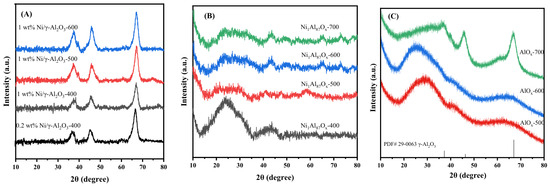
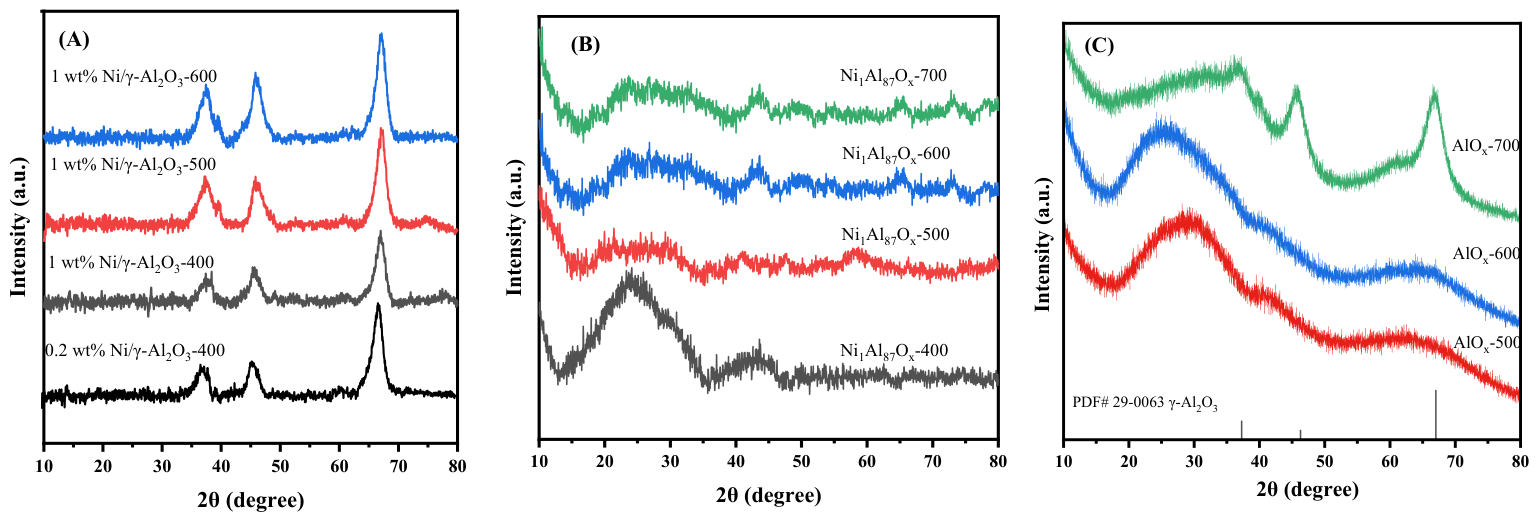
The general physicochemical properties of the nickel-based catalysts were characterized. X-ray diffraction (XRD) patterns of Ni/γ-Al2O3, Ni1Al87Ox, and AlOx catalysts are presented in Figure 1. As shown in Figure 1A, the Ni/γ-Al2O3 series samples exhibited diffraction peaks at 2θ of 37.6°, 45.8°, and 66.8°, assignable to the (311), (400), and (440) planes of γ-Al2O3 (PDF 29-0063). No diffraction peaks associated with Ni species were observed, even at calcination temperatures up to 600 °C. This is attributed to the low Ni loading and its high dispersion on the γ-Al2O3 surface [34]. Figure 1B displays the XRD patterns of Ni1Al87Ox catalysts calcined at different temperatures. The sample calcined at 400 °C shows a broad diffraction peak in the 2θ range of 15.0–35.0°, which may arise from residual carbonaceous species produced by the incomplete decomposition of citrate precursors. This peak gradually diminished and eventually disappeared at elevated calcination temperatures. No characteristic diffraction peaks corresponding to crystalline Al2O3 or NiO were detected for Ni1Al87Ox samples in the temperature range of 500–700 °C. In contrast, Al2O3 prepared via the same synthetic route exhibited distinct diffraction peaks of crystalline Al2O3 at 700 °C (Figure 1C). The absence of sharp diffraction peaks in the Ni1Al87Ox series confirms the preservation of an amorphous structure, implying that the incorporation of Ni modifies the alumina framework and inhibits the formation of crystalline phases [27,35].
Figure 1.
XRD patterns of (A) n wt% Ni/γ-Al2O3-T, (B) Ni1Al87Ox-T, and (C) AlOx-T catalysts.
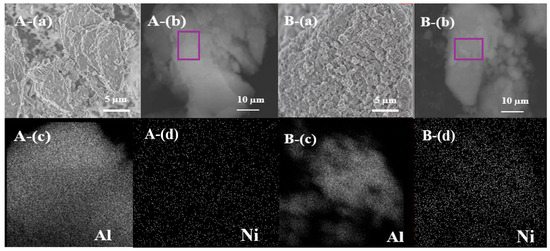
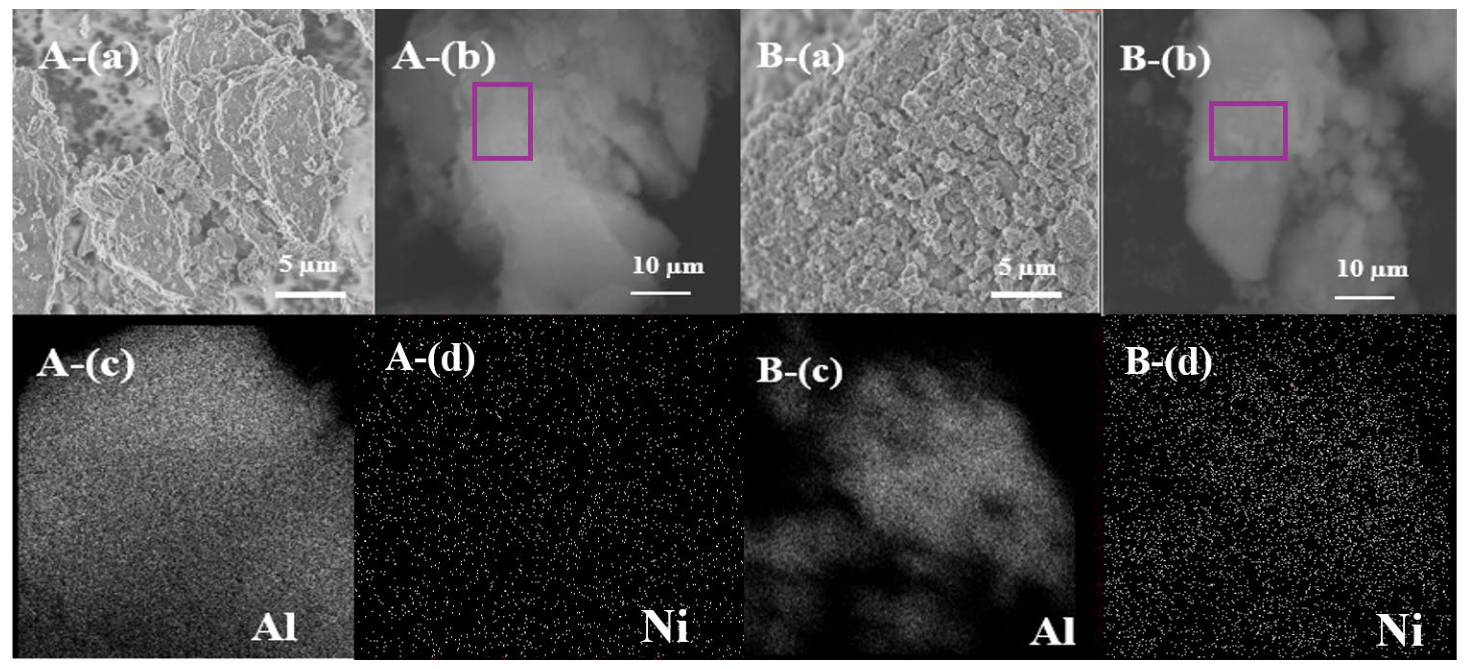
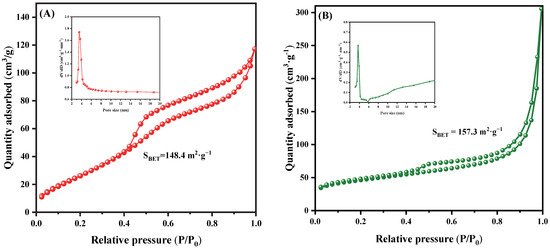
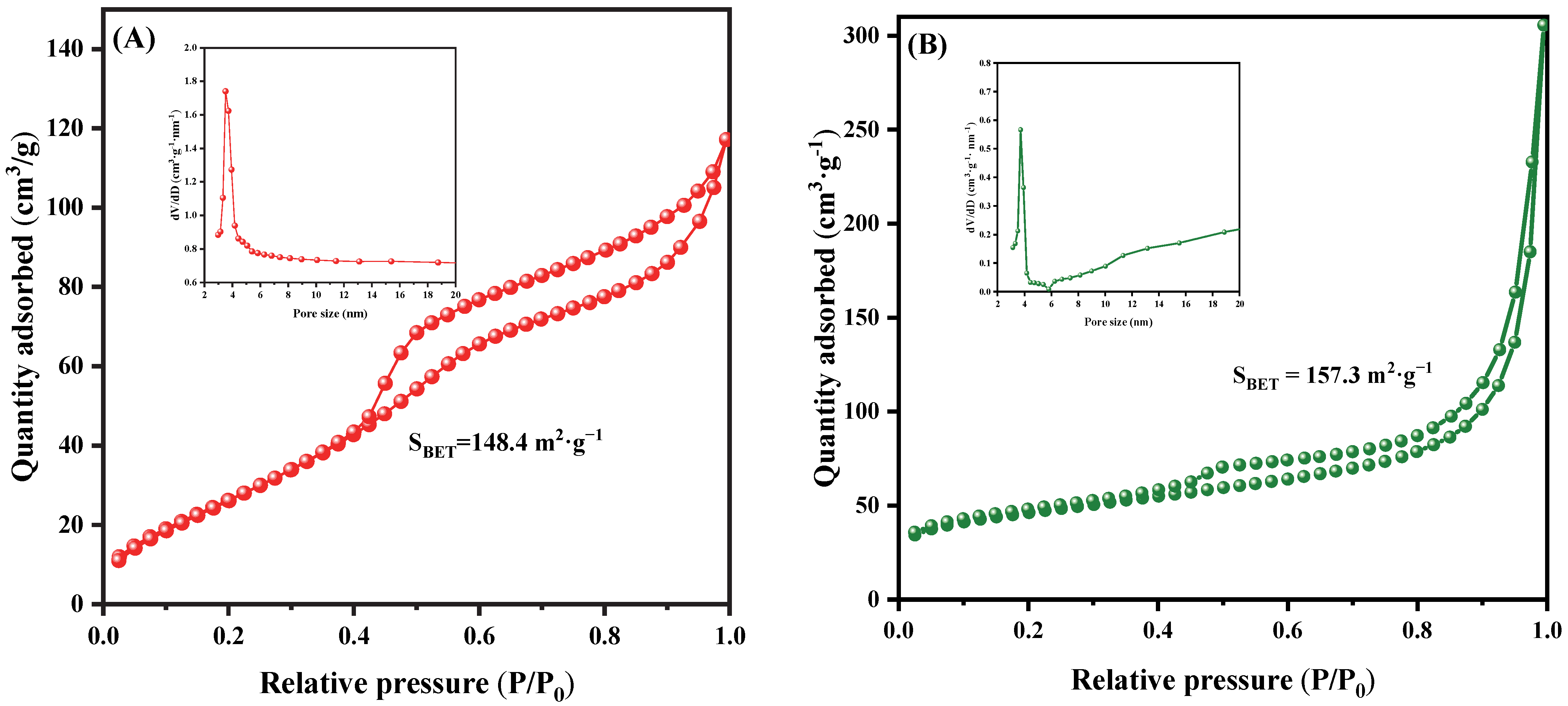
SEM images and EDS mappings of the catalysts are presented in Figure 2. All samples possessed blocky structures with diverse particle sizes. Notably, Ni1Al87Ox displayed a more uniform morphology owing to the introduction of citric acid during gel formation, which may suppress the aggregation of large particles [36,37]. Meanwhile, the decomposition of citric acid during calcination also promoted the generation of an abundant porous structure [38]. EDS mappings verified the homogeneous distribution of Al (Figure 2A(c,d)) and Ni (Figure 2B(c,d)) species in both samples. N2 adsorption–desorption analysis (Figure 3) showed that the specific surface areas of all samples ranged from 150 to 200 m2·g−1. The 0.2 wt% Ni/γ-Al2O3 exhibits a typical-type IV N2 adsorption isotherm with a total pore volume of 0.210 cm3/g, whereas the Ni1Al87Ox sample features a distinctive H3-type hysteresis loop, accompanied by an increase in pore volume to 0.431 cm3/g. Such differences in the hysteresis loop reflects divergent hysteresis behaviors in the mesoporous pores of the two catalysts [36,39]. The higher pore volume of Ni1Al87Ox may facilitate the intraparticle diffusion of reactant molecules. Pore size distribution analysis demonstrates that the pore diameters of both catalysts are centered at 2–4 nm, falling within the typical mesoporous range.
Figure 2.
SEM and EDS mapping image of (A)-(a–d) 0.2 wt% Ni/γ-Al2O3-400 and (B)-(a–d) Ni1Al87Ox-500.
Figure 3.
N2 adsorption–desorption isotherms and pore size distributions of (A) 0.2 wt% Ni/γ-Al2O3-400 and (B) Ni1Al87Ox-500.
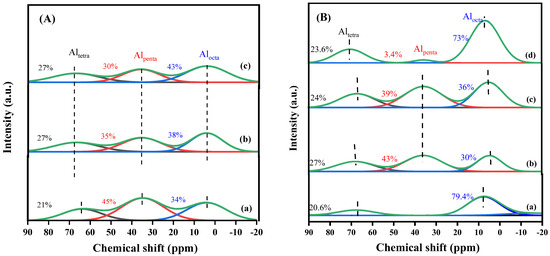
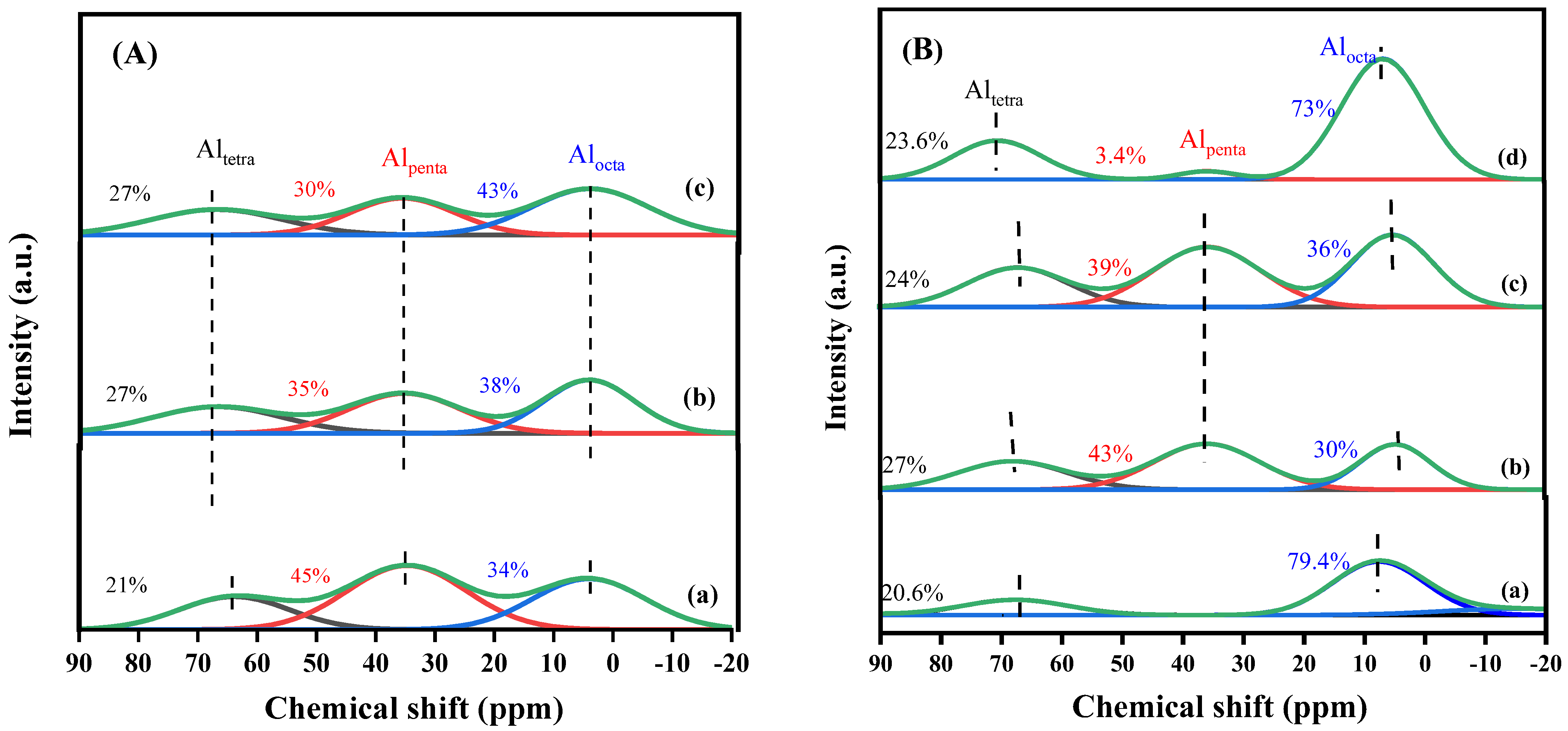
To elucidate the structural characteristics of the samples, 27Al MAS NMR spectra were recorded. As shown in Figure 4, three peaks centered at around 7, 38, and 70 ppm are observed for both Ni1Al87Ox and Al2O3 samples synthesized via a citric acid-assisted sol–gel method. The two characteristic resonances at 7 and 70 ppm correspond to octahedrally coordinated Alocta and tetrahedrally coordinated Altetra, respectively, while the peak at 38 ppm is assigned to coordinatively unsaturated Alpenta in pentahedral coordination [40]. In contrast, 0.2 wt% Ni/γ-Al2O3-400 exhibited only two distinct signals at 10 and 70 ppm. Alpenta represents the dominant species (43%) in the as-prepared Al2O3. However, its relative content decreases drastically from 43% to 3.4% as the calcination temperature is elevated from 500 to 700 °C. This observation confirms that Alpenta species gradually diminish during the phase transformation of alumina from an amorphous state to a crystalline phase upon calcination temperature. Conversely, for the amorphous Ni1Al87Ox catalyst, the effect of calcination temperature on the Alpenta content is far less pronounced, with its proportion declining only from 45% to 30%. Thermal stability analysis demonstrates that amorphous Al2O3 converts to γ-Al2O3 accompanied by the loss of Alpenta species upon heating to 700 °C, which is consistent with the aforementioned XRD results, whereas amorphous Ni1Al87Ox preserves its amorphous structure at both 600 and 700 °C, underscoring the role of Ni in suppressing the crystalline phase transformation.
Figure 4.
27Al MAS NMR spectra of (A) Ni1Al87Ox-T, T = (a) 500, (b) 600, and (c) 700; (B) 0.2 wt% Ni/γ-Al2O3-400 (a) and AlOx-T, T = (b) 500, (c) 600, and (d) 700.
It is well established that Alpenta sites possess a coordinatively unsaturated nature and can form strong chemical interactions with metal species through oxygen bridges [41,42,43]. The high abundance of pentahedrally coordinated Al species in amorphous Ni1Al87Ox originates from the defect-rich character of its amorphous phase. Furthermore, Ni species are more likely to anchor at these coordinatively unsaturated pentacoordinate Al centers via oxygen bridges rather than merely being dispersed on the Al2O3 surface.
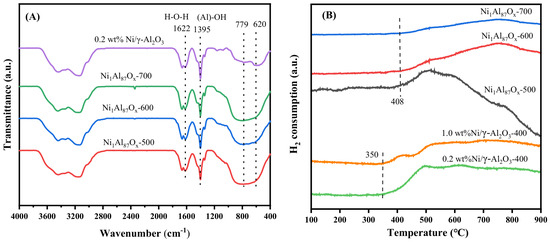
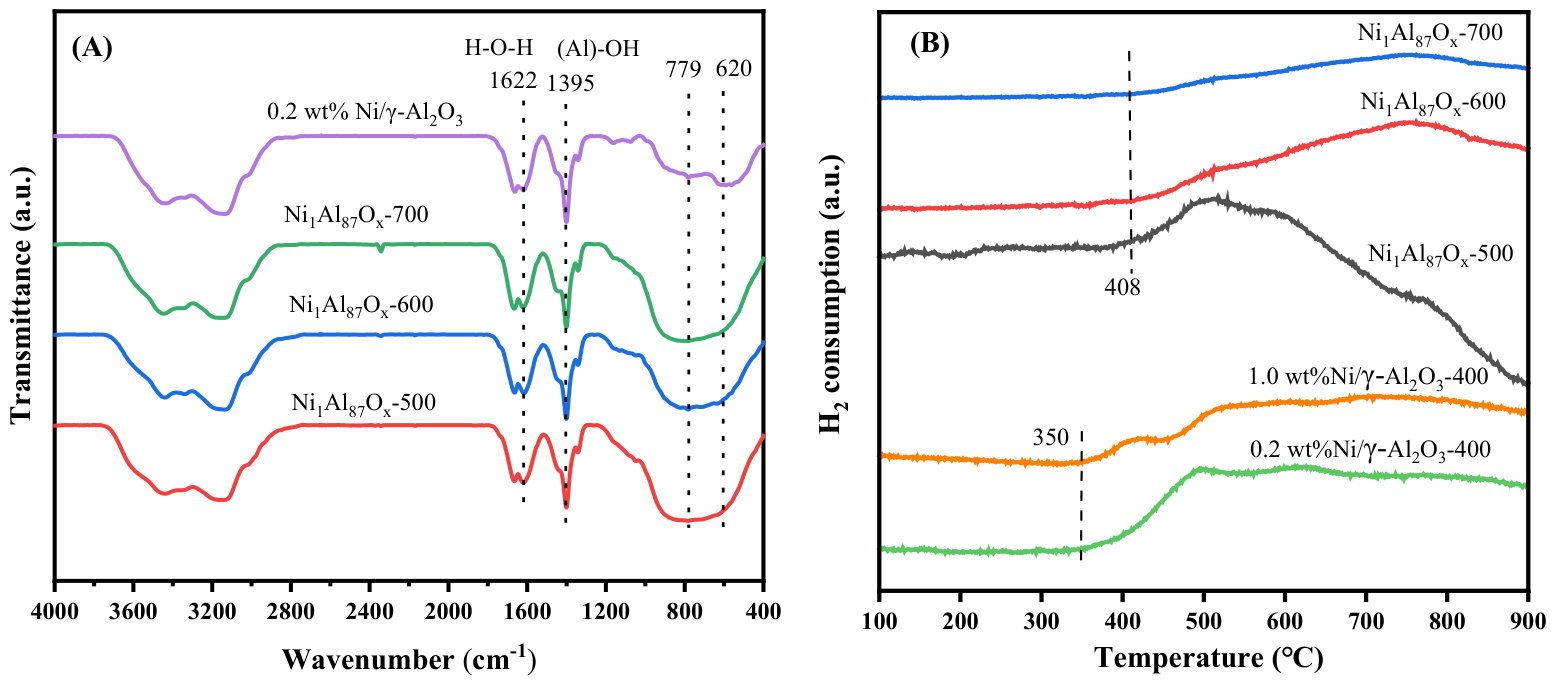
FT-IR spectroscopy was employed to characterize the surface functional groups of Ni/γ-Al2O3 and Ni1Al87Ox catalysts calcined at different temperatures. As shown in Figure 5A, the broad band observed in the 3000–3600 cm−1 region may come from the contribution of adsorbed water, while the peaks at 1395 cm−1 and 1622 cm−1 are assigned to the stretching vibrations of (Al)-OH and the bending vibrations of H-O-H in adsorbed water, respectively [44,45]. Peaks corresponding to metal–oxygen (M–O) bonds appear below 1000 cm−1, with Ni-O and Al-O vibrations observed at 620 cm−1 and 779 cm−1, respectively [46]. For the amorphous Ni1Al87Ox catalysts, these M-O peaks shifted slightly to higher wavenumbers and merged into a broad overlapping peak below 1000 cm−1, with a significantly different M-O/(Al)-OH intensity ratio compared to crystalline Al2O3. These observations indicate the substantial differences in M-O coordination environments, which may be induced by the strong interactions between Ni species and coordinatively unsaturated Alpenta sites on the Ni1Al87Ox surface.
Figure 5.
(A) Infrared spectra. (B) The H2-TPR profiles of Ni1Al87Ox-T catalysts and Ni/γ-Al2O3 catalysts.
H2-TPR experiments investigated the reducibility of Ni species and the nature of metal–support interactions. As shown in Figure 5B, broad reduction peaks in the range of 300~800 °C were observed for all catalysts. The 1.0 wt% Ni/γ-Al2O3 catalyst exhibited a reduction peak at 420 °C, which is likely associated with surface-dispersed NiO particles with weak metal–support interactions. In contrast, 0.2 wt% Ni/γ-Al2O3 showed a higher reduction temperature, attributed to strongly interacting NiO nanoparticles that arise from low Ni loading and high dispersion on the γ-Al2O3 surface. The Ni1Al87Ox catalyst displayed reduction peaks ranging from 400 °C to 800 °C, with a slight shift toward higher temperatures after calcination. This shift indicates modifications in the coordination environment of Ni and an increase in the strength of M-O bonds [38,47,48,49,50,51]. These findings further confirm the presence of strong interactions between Ni species and coordinatively unsaturated Alpenta sites in the Ni1Al87Ox catalyst, which impede the reduction of nickel species and enhance the thermal stability of the amorphous Ni1Al87Ox phase [52,53].
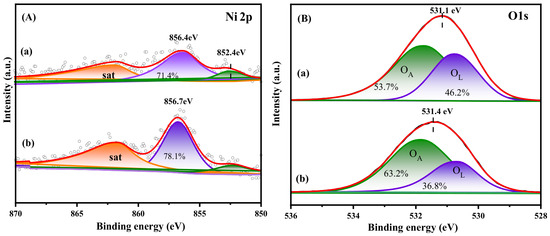
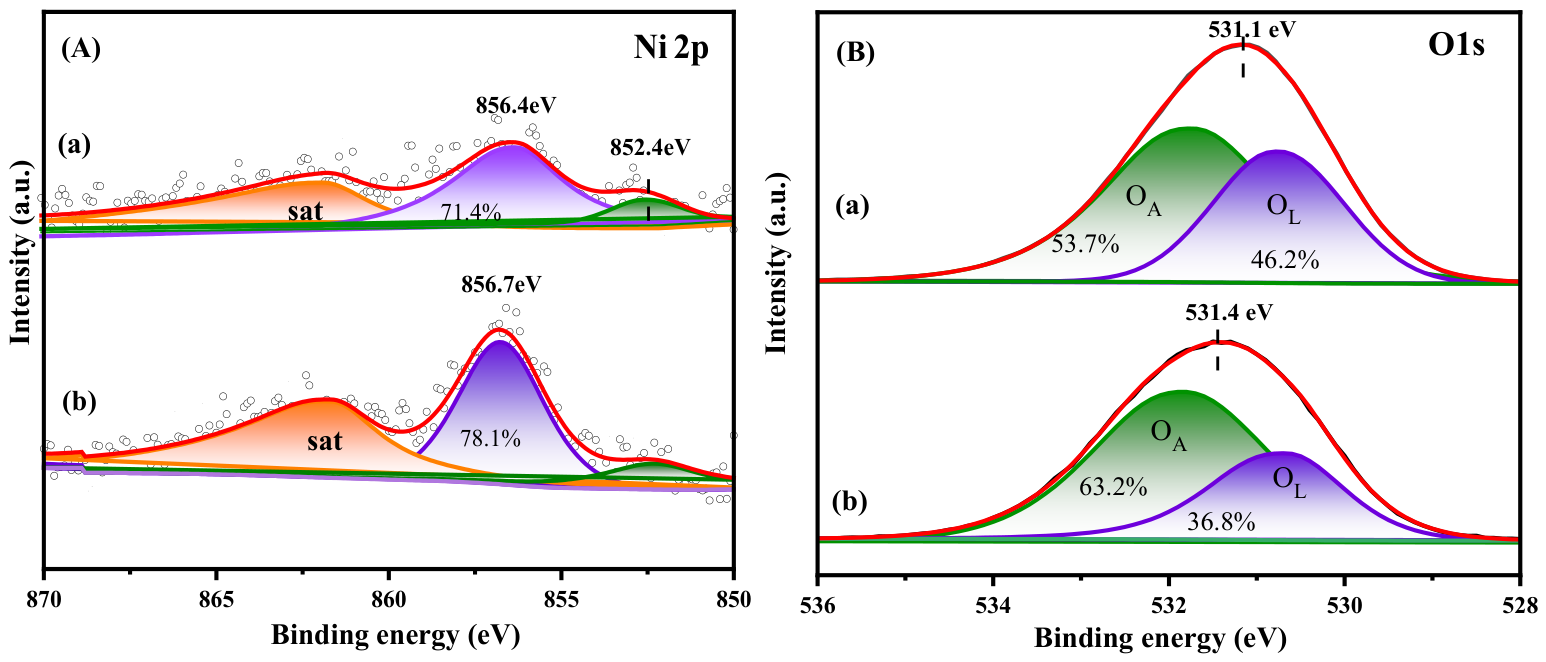
It is well established that the electronic structures of active phases are closely correlated with their coordination environments, which in turn govern catalytic behavior. To explore the electronic states of Ni species in the amorphous Ni1Al87Ox phase, XPS measurements were performed. As shown in Figure 6, the Ni 2p3/2 peaks at approximately 852.4 eV and 856.4 eV are assigned to Ni0 and Ni2+ species, respectively [25,39]. Notably, the majority of surface Ni species existed in oxidized states. For Ni1Al87Ox-500, the Ni 2p3/2 peak shifted to a higher binding energy (856.7 eV vs. 856.4 eV) compared to 0.2 wt% Ni/γ-Al2O3-400. This is primarily attributed to the electron-donating nature of Ni species. Such electron transfer from Ni to Al further enhances the stabilization of Ni2+ species in the catalyst [54].
Figure 6.
The XPS spectra of (A) Ni 2p and (B) O 1s, (a) 0.2 wt% Ni/γ-Al2O3-400 and (b) Ni1Al87Ox-500 catalysts.
The O 1s binding energy of Ni1Al87Ox-500 was a little higher than that of 0.2 wt% Ni/γ-Al2O3-400, accompanied by an increased surface oxygen content (63.2% vs. 53.7%). This enhancement is ascribed to the stronger Ni-O-Al electron transfer capability in the presence of coordinatively unsaturated Al sites. The elevated reactivity of surface oxygen atoms facilitated their departure from the lattice upon electron loss, thereby leading to the formation of oxygen vacancies [55].
2.2. Catalytic Performance of Ni-Doped Amorphous Al2O3 Catalysts
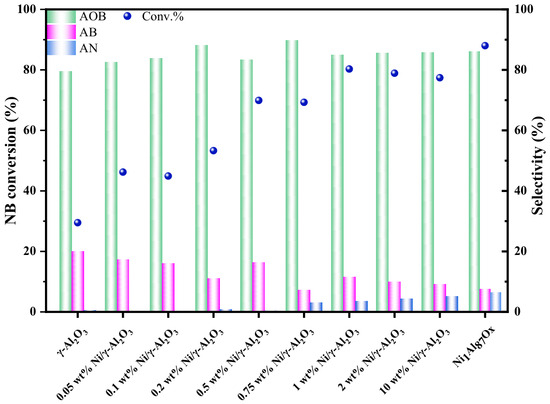
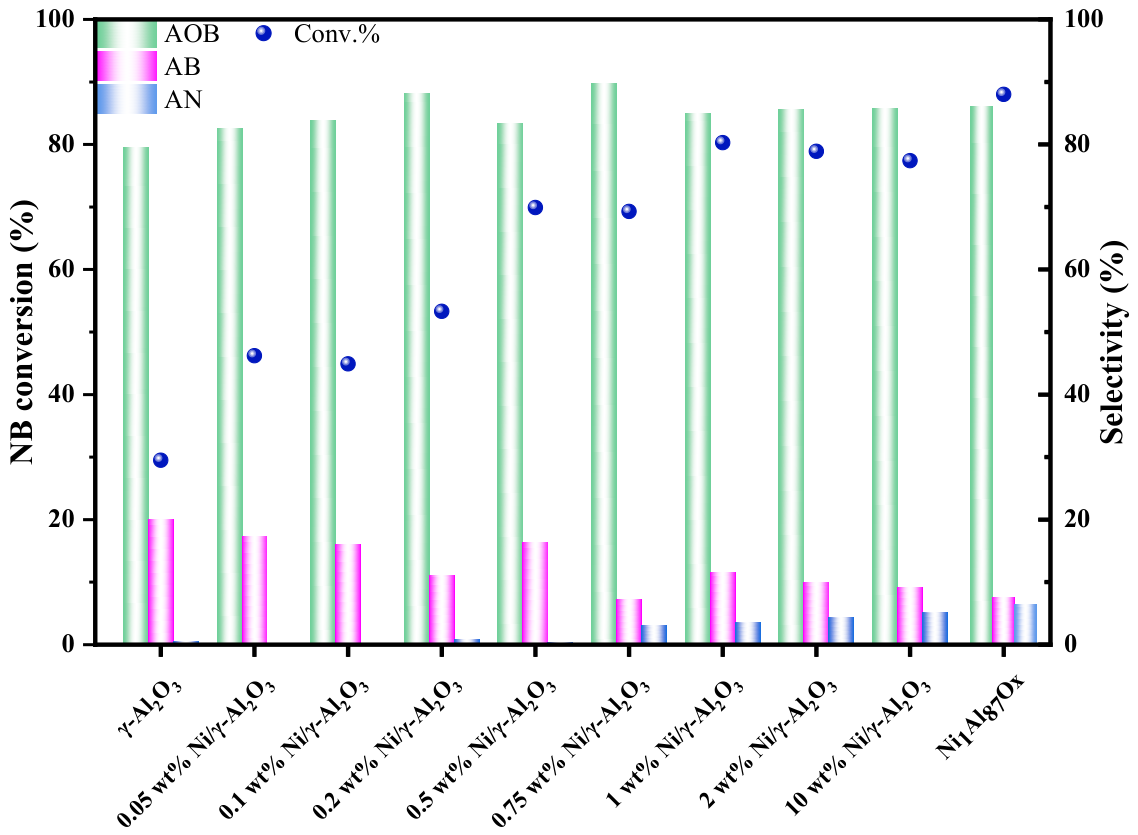
The catalytic performance of the Ni/γ-Al2O3-400 series catalysts and the Ni1Al87Ox-500 catalyst was evaluated for the catalytic reduction in nitrobenzene (NB) by NaBH4 under identical reaction conditions. As shown in Figure 7, γ-Al2O3 alone exhibited negligible catalytic activity, achieving only 29.5% nitrobenzene conversion with azoxybenzene (AOB) as the dominant product. The introduction of Ni significantly enhanced the catalytic activity while maintaining azoxybenzene selectivity above 80% across the tested Ni content range (0.05–10 wt%). The Ni content directly influenced the catalyst performance. For 0.05 wt% Ni/γ-Al2O3-400, it achieved 42.6% nitrobenzene conversion, with 82.3% azoxybenzene selectivity and 17.7% azobenzene (AB) selectivity. When the Ni content increased to 0.5 wt%, aniline (AN), selectivity remained below 1.0%, suggesting that moderate Ni loading favors azoxybenzene formation while suppressing aniline production. The 1 wt% Ni/γ-Al2O3-400 catalyst achieved the highest nitrobenzene conversion (80.3%), with 3.5% aniline selectivity. However, further increasing the Ni content to 10 wt% resulted in a slight decrease in conversion, accompanied by a gradual decline in azoxybenzene selectivity and an increase in aniline selectivity to 5.1%, indicating that high Ni content promotes aniline formation. Nitrobenzene conversion increases gradually as Ni loading increases from 0.05 to 1.0 wt%, with optimal activity obtained at 1.0–2.0 wt% Ni. A plausible explanation is that 1.0 wt% Ni supplies adequate active sites and achieves proper metal–support interactions, whereas excessive Ni loading may cover and block accessible active sites, thereby lowering catalytic performance.
Figure 7.
Catalytic performance of n wt% Ni/γ-Al2O3-400 and Ni1Al87OX catalysts for the reduction in nitrobenzene (reaction condition: 0.1 g catalyst, 4 mL ethanol, 1 mmol nitrobenzene, 2 mmol NaBH4, 60 °C, and 60 min).
Ni1Al87Ox-400 exhibited a superior catalytic performance compared to 0.2 wt% Ni/γ-Al2O3-400 in the nitrobenzene reduction reaction. The 0.2 wt% Ni/γ-Al2O3-400 catalyst achieved a nitrobenzene conversion of 53.3% with 88.1% azoxybenzene selectivity, whereas the Ni1Al87Ox-400 catalyst exhibited a much higher conversion of 82.9%, along with an improved azoxybenzene selectivity of 90.2%. Notably, even when compared to the 1 wt% Ni/γ-Al2O3-400, whose Ni content is five times higher, Ni1Al87Ox-400 still outperformed it. These pronounced differences highlight the critical role of robust Ni–Al interactions in enhancing the catalytic performance of Ni1Al87Ox, wherein Ni species are effectively stabilized by coordinatively unsaturated Al sites.
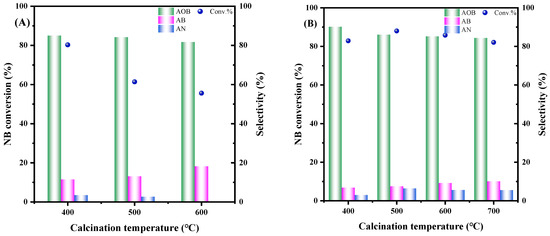
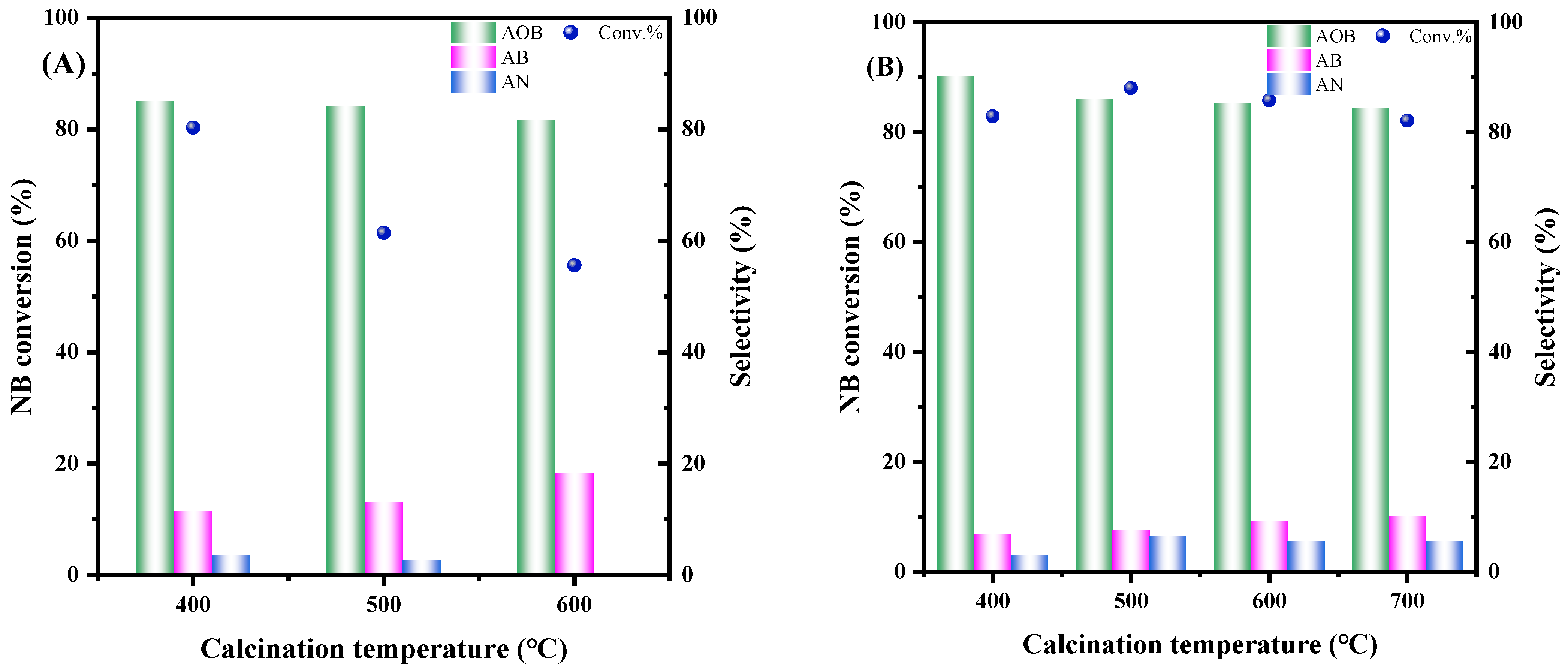
Figure 8 further investigates the influence of catalyst calcination temperature on the reaction performance. It was found that Ni1Al87Ox catalysts maintained a consistent catalytic performance across different calcination temperatures, whereas the activity of 1 wt% Ni/γ-Al2O3 catalysts decreased significantly after high-temperature treatment. This discrepancy in catalytic behavior is consistent with the structural characteristics of the catalysts. The density of coordinatively unsaturated Alpenta sites in γ-Al2O3 decreases progressively upon calcination temperature. And a similar reduction is observed in the 0.2 wt% Ni/γ-Al2O3-400 catalyst. Ni1Al87Ox catalyst features strengthened the interaction between electron-deficient Ni species and Alpenta sites, thereby promoting both the polarization of the N=O bond and the reductive activation of NaBH4. Consequently, Ni1Al87Ox demonstrates superior catalytic activity for the selective hydrogenation of nitrobenzene to azoxybenzene relative to the Ni/γ-Al2O3 catalyst series.
Figure 8.
Effect of calcination temperature on catalytic reduction performance of nitrobenzene over (A) 1 wt% Ni/γ-Al2O3-T and (B) Ni1Al87Ox-T catalysts (reaction condition: 0.1 g catalyst, 4 mL ethanol, 1 mmol nitrobenzene, 2 mmol NaBH4, 60 °C, and 60 min).
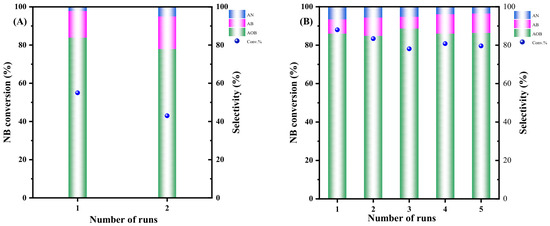
The stability of Ni-based catalysts is critical to their practical application. The 0.2 wt% Ni/γ-Al2O3-400 underwent rapid deactivation, with nitrobenzene conversion declining from 53% to 40% within only two reaction cycles. In contrast, reusability evaluations revealed that nitrobenzene conversion over Ni1Al87Ox-500 remained above 80% even after five consecutive cycles (Figure 9). Notably, azoxybenzene selectivity remained nearly constant across all recycling tests. These results collectively demonstrate that the Ni1Al87Ox-500 catalyst exhibits excellent reusability.
Figure 9.
Reusability tests for the reduction in nitrobenzene over (A) 0.2 wt% Ni/γ-Al2O3-400 and (B) Ni1Al87Ox-500 catalysts (reaction condition: 0.1 g catalysts, 4 mL ethanol, 1 mmol nitrobenzene, 2 mmol NaBH4, 60 °C, and 60 min).
Table 1 summarizes the catalytic performance of Ni-based catalysts for the reduction of nitrobenzene to azoxybenzene. For amorphous Ni1Al87Ox and Ni1Al87Ox/support catalysts, azoxybenzene selectivity was maintained above 80.0%. The 20 wt% (Ni1Al87Ox)/ZSM-5 catalyst achieved the highest nitrobenzene conversion of 85.2%, followed by 75.2% for MCM-41-supported, and even the molar ratio of nickel to substrate was up to a ratio of 1:1867. This performance is also comparable to other Ni-based catalysts reported in the literature. As shown in Table 1, Ni1Al87Ox-500 exhibited a comparable performance to 1 wt% Ni-PHI but consumed only half the NaBH4 [7]. It also outperformed Ni-CeO2-based catalysts using hydrogen as the reducing agent [17]. Notably, supported Ni1Al87Ox catalysts achieved exceptional azoxybenzene formation rates, with 20 wt% (Ni1Al87Ox)/ZSM-5 reaching 9.02 mol·g-Ni−1·h−1. The high specific surface area of the support facilitates the dispersion of Ni1Al87Ox species. These results suggest that the synergistic interaction between Ni species and unsaturated coordinated Al in Ni1Al87Ox contributes to its activity in nitrobenzene conversion.
Table 1.
Catalytic performance of Ni-based catalysts for the reduction of nitrobenzene to azoxybenzene.
Based on the characterization results, the exceptionally high activities and sintering resistances of the amorphous Ni1Al87Ox catalysts are attributed to the Ni-doped AlOx, which hosts more vacancy defects, and unsaturated Alpenta sites anchored the electron-deficient Ni species through their strong interactions. These defects promote the activation of the hydrodeoxygenation reaction, thereby contributing to enhanced nitrobenzene hydrogenation activity [56,57]. Meanwhile, the robust Ni-doped AlOx inhibited the ordered growth of γ-Al2O3 crystallites and hindered the reduction in Niδ+ species, which play an important role in the dehydrogenation of NaBH4. The existence of Niδ+ species may allow for a non-horizontal adsorption of NB on the Ni surface, which contributes to the high selectivity to partial hydrogenated products.
3. Materials and Methods
3.1. Catalyst Preparation
3.1.1. Preparation of Ni/γ-Al2O3-T Catalysts
Ni/γ-Al2O3 catalysts were synthesized via an impregnation method. An aqueous solution of Ni(NO3)2·6H2O (Kemiou Chemical Reagent Co., Ltd., Tianjin, China) was first prepared by dissolving the precursor in 100 mL of distilled water. Al2O3 (Shanghai Macklin Biochemical Co., Ltd., Shanghai, China) was then added to the resulting solution, followed by stirring at room temperature for 4 h. The resulting mixture was concentrated using a rotary evaporator to remove excess water. The obtained solid residue was dried at 100 °C for 2 h and subsequently calcined in a muffle furnace at predetermined temperatures (400 °C, 500 °C, or 600 °C) for 3 h in static air. A series of catalysts with varying nickel loadings (0.05, 0.1, 0.2, 0.5, 0.75, 1.0, 2.0, and 10.0 wt%) were thus prepared. The final materials were labeled as n wt% Ni/γ-Al2O3-T, where n denotes the nominal nickel loading (in wt%), and T represents the calcination temperature (in °C).
3.1.2. Preparation of Ni1Al87Ox-T Catalysts
The Ni1Al87Ox-T catalysts, with 0.2 wt% Ni loading (equivalent to that in 0.2 wt% Ni/Al2O3.), were prepared using a citric acid-assisted sol–gel method. Precursor solutions were prepared by co-dissolution of Ni(NO3)2·6H2O and Al(NO3)3·9H2O (Guanghua Sci-Tech Co., Ltd., Shantou, China) in 50 mL of distilled water to achieve a Ni:Al atomic ratio of 1:87. Citric acid (Sinopharm Chemical Reagent Co., Ltd., Shanghai, China) was subsequently introduced at a metal-to-ligand molar ratio of 2:3. The mixture was held at 70 °C under constant stirring for 5 h to promote gelation, followed by aging at 110 °C for 12 h. The dried gel was calcined in a furnace at specific temperatures (400 °C, 500 °C, 600 °C, or 700 °C) for 3 h. The final catalysts were denoted as Ni1Al87Ox-T, with T indicating the calcination temperature.
3.1.3. Preparation of 20 wt% (Ni1Al87Ox)/Support Catalysts
A series of 20 wt% (Ni1Al87Ox)/support catalysts were synthesized following a procedure similar to that used for Ni1Al87Ox-T catalysts. Specifically, 0.5 g of various commercial catalyst supports was added to the precursor mixture containing nickel nitrate, aluminum nitrate, and citric acid. The loading of Ni1Al87Ox was maintained at 20 wt% relative to the support mass, yielding a nickel content of 0.04 wt% in the final catalyst. The resulting samples were labeled as 20 wt% (Ni1Al87Ox)/ZSM-5, 20 wt% (Ni1Al87Ox)/C, and 20 wt% (Ni1Al87Ox)/MCM-41 catalysts (ZSM-5 is from Nankai University Catalyst Co., Ltd., Tianjin, China, MCM-41 is from Zhuoran Environmental Technology Co., Ltd., Quzhou, China, and carbon is from Huzhou Jia Tan Company, Huzhou, China).
3.2. Characterization
The crystalline phases of the synthesized catalysts were characterized using a D8 Advance X-ray diffractometer (Bruker Corporation, Billerica, MA, USA) equipped with Cu Kα radiation (40 kV, 40 mA). Powder XRD patterns were collected over a 2θ range from 10° to 80° with a scanning rate of 10°/min.
Nitrogen adsorption–desorption isotherms were measured at −196 °C using an Autosorb-6B volumetric system (Quantachrome, Boynton Beach, FL, USA). The specific surface area and pore structure characteristics of the catalysts were determined using the BET method. Prior to analysis, samples were degassed under vacuum at 300 °C for 1 h. Cumulative pore volume was determined from the amount adsorbed at a relative pressure of 0.99, and pore size distributions were derived from the desorption branch of the isotherms using the Barrett–Joyner–Halenda (BJH) model.
The morphological and microstructural features of the catalysts were examined using a field-emission scanning electron microscope (FE-SEM, JEOL JSM-7500F, JEOL Ltd., Tokyo, Japan) operating at an accelerating voltage of 5–15 kV. Elemental composition and distribution were analyzed using energy-dispersive X-ray spectroscopy (EDX) integrated with the SEM system.
Surface functional groups of the synthesized materials were identified using Fourier-transform infrared (FTIR) spectroscopy. Spectra were recorded in the range of 4000–400 cm−1 using a Bruker Tensor 27 spectrometer (Bruker Tensor, Billerica, MA, USA) with a spectral resolution of 4 cm−1. Prior to measurement, samples were ground, mixed with spectroscopic-grade potassium bromide (KBr), and pressed into pellets under vacuum to ensure optimal transmittance.
The 27Al MAS NMR spectra were obtained on the Bruker 600 MHz AVANCE III spectrometer (Bruker Tensor, Billerica, MA, USA) with a magnetic field strength of 14.09 T. The spin rate of the samples was 20 kHz, the π/12 pulse was 0.2 us, with a recycle delay of 0.5 s, and a total of 256 scans were performed to each sample.
The reduction behavior of the catalysts was evaluated using H2-TPR experiments conducted on a GC-2060 instrument (Shimadzu Corporation, Yantai, China). Typically, 25 mg of catalyst was loaded into a quartz tube and heated from 50 °C to 900 °C at a rate of 10 °C/min in 5 vol% H2/N2 gas mixture.
The surface chemical composition and electronic states of the catalysts were analyzed using X-Ray Photoelectron Spectroscopy (Thermo Fisher ESCALAB 250xi, Thermo Fisher Scientific, USA) with monochromatized Al Kα X-rays (1486.6 eV). Binding energies were calibrated using the C 1s adventitious carbon signal at 284.8 eV.
3.3. Catalyst Performance Evaluation
Catalytic performance evaluations were carried out in a 100 mL three-neck flask equipped with a magnetic stirrer operating at 200 rpm and 60 °C. Reaction mixtures typically contained 40 mL of anhydrous ethanol, 1 mL of nitrobenzene, 1 mL of n-decane (internal standard), NaBH4, and a predetermined amount of catalyst. After the reaction, the catalyst was separated via centrifugation, washed with anhydrous ethanol, and directly reused for subsequent reaction cycles. The liquid product composition, including nitrobenzene (NB), azoxybenzene (AOB), azobenzene (AB), and aniline (AN), as outlined in reaction scheme (Scheme 1), was analyzed using Agilent 6890 GC (Agilent Technologies, Santa Clara, CA, USA) equipped with a flame ionization detector (FID) and an HP-5 capillary column. Reaction conversion and product selectivity were calculated using the following formulas:
Scheme 1.
Reaction scheme of nitrobenzene reduction.
The AOB formation rate was calculated using the following formula:
where n0 denotes the reactant’s initial moles, conversion denotes the reactant’s conversion, mNi denotes the catalyst’s actual input in the process, and t indicates the actual reaction time.
4. Conclusions
Low Ni-doped amorphous Al2O3 catalysts were successfully prepared for one-step nitrobenzene reduction to azoxybenzene using NaBH4 as a hydrogen donor under mild conditions. The Ni1Al87Ox catalyst achieved a highly efficient azoxybenzene production rate of 1.89 mol·g-Ni−1·h−1, significantly outperforming Ni/γ-Al2O3 counterparts. The enhanced catalytic performance is attributed to Ni incorporation, which stabilizes Niδ+ against reduction and introduces rich unsaturated pentacoordinate Al species with oxygen vacancies.
Notably, Ni1Al87Ox loaded on commercial supports (ZSM-5, MCM-41, and activated carbon) maintained excellent catalytic activity for nitrobenzene hydrogenation even at extremely low nickel-to-substrate molar ratios (up to 1:1867). Among these, the 20 wt% (Ni1Al87Ox)/ZSM-5 catalyst achieved an exceptional azoxybenzene yield of 9.02 mol·g-Ni−1·h−1, demonstrating potential for further industrial applications. This work provides valuable insights into designing efficient and durable non-noble-metal catalysts for catalytic hydrogenation reactions.
Author Contributions
S.W. and W.Y. fabricated the samples and performed the measurements. M.Z. and R.Z. performed XRD, H2-TPR, and FTIR measurements. F.L. and Y.Z. performed the SEM results. W.S. and X.L. designed the project. All authors discussed the results. All authors have read and agreed to the published version of the manuscript.
Funding
This work is financially supported by Doctoral Start-up Foundation of Liaoning Province (2024-BSBA-37) and Scientific Research Fund of Liaoning Provincial Education Department (no. LJ2020009).
Data Availability Statement
No datasets were generated or analyzed during the current study.
Conflicts of Interest
The authors declare no conflicts of interest.
References
- Zhang, L.; Shao, Z.-J.; Cao, X.-M.; Hu, P. Insights into different products of nitrosobenzene and nitrobenzene hydrogenation on Pd(111) under realistic reaction conditions. J. Phys. Chem. C 2018, 122, 20337–20350. [Google Scholar] [CrossRef] [Scilit]
- Acharyya, S.S.; Ghosh, S.; Bal, R. Catalytic oxidation of aniline to azoxybenzene over CuCr2O4 spinel nanoparticle catalyst. ACS Sustain. Chem. Eng. 2014, 2, 584–589. [Google Scholar] [CrossRef] [Scilit]
- Liu, X.; Ye, S.; Li, H.-Q.; Liu, Y.-M.; Cao, Y.; Fan, K.-N. Mild, selective and switchable transfer reduction of nitroarenes catalyzed by supported gold nanoparticles. Catal. Sci. Technol. 2013, 3, 3200–3206. [Google Scholar] [CrossRef] [Scilit]
- Liu, Q.; Zhang, J.; Xing, F.; Cheng, C.; Wu, Y.; Huang, C. Plasmon-enhanced and controllable synthesis of azobenzene and hydrazobenzene using Au/TiO2 composite. Appl. Surf. Sci. 2020, 500, 144214. [Google Scholar] [CrossRef] [Scilit]
- Zhang, Z.-P.; Wang, X.-Y.; Yuan, K.; Zhu, W.; Zhang, T.; Wang, Y.-H.; Ke, J.; Zheng, X.-Y.; Yan, C.-H.; Zhang, Y.-W. Free-standing iridium and rhodium-based hierarchically-coiled ultrathin nanosheets for highly selective reduction of nitrobenzene to azoxybenzene under ambient conditions. Nanoscale 2016, 8, 15744–15752. [Google Scholar] [CrossRef] [Scilit] [PubMed]
- Liu, L.; Concepción, P.; Corma, A. Modulating the catalytic behavior of non-noble metal nanoparticles by inter-particle interaction for chemoselective hydrogenation of nitroarenes into corresponding azoxy or azo compounds. J. Catal. 2019, 369, 312–323. [Google Scholar] [CrossRef] [Scilit]
- da Silva, M.A.; Rocha, G.F.S.R.; Diab, G.A.A.; Cunha, C.S.; Pastana, V.G.S.; Teixeira, I.F. Simple and straightforward method to prepare highly dispersed Ni sites for selective nitrobenzene coupling to Azo/Azoxy compounds. Chem. Eng. J. 2023, 460, 141068. [Google Scholar] [CrossRef] [Scilit]
- Zhang, Q.; Bu, J.; Wang, J.; Sun, C.; Zhao, D.; Sheng, G.; Xie, X.; Sun, M.; Yu, L. Highly efficient hydrogenation of nitrobenzene to aniline over Pt/CeO2 catalysts: The shape effect of the support and key role of additional Ce3+ sites. ACS Catal. 2020, 10, 10350–10363. [Google Scholar] [CrossRef] [Scilit]
- Song, W.; Yi, X.; Jiang, X.; Lai, W. Mo2C promoted Pd nanoparticles on hierarchical porous carbon for enhanced selective hydrogenation of nitroarenes. Ind. Eng. Chem. Res. 2020, 59, 20298–20306. [Google Scholar] [CrossRef] [Scilit]
- Liu, Q.; Xu, Y.; Qiu, X.; Huang, C.; Liu, M. Chemoselective hydrogenation of nitrobenzenes activated with tuned Au/h-BN. J. Catal. 2019, 370, 55–60. [Google Scholar] [CrossRef] [Scilit]
- Li, Z.; Zhang, M.; Dong, X.; Ji, S.; Zhang, L.; Leng, L.; Li, H.; Horton, J.H.; Xu, Q.; Zhu, J. Strong electronic interaction of indium oxide with palladium single atoms induced by quenching toward enhanced hydrogenation of nitrobenzene. App. Catal. B Environ. 2022, 313, 121462. [Google Scholar] [CrossRef] [Scilit]
- Jiang, Y.; Li, Q.; Li, X.; Wang, X.; Dong, S.; Li, J.; Hou, L.; Jiao, T.; Wang, Y.; Gao, F. Three-dimensional network Pd-Ni/γ-Al2O3 catalysts for highly active catalytic hydrogenation of nitrobenzene to aniline under mild conditions. ACS Omega 2021, 6, 9780–9790. [Google Scholar] [CrossRef] [Scilit] [PubMed]
- Combita, D.; Concepción, P.; Corma, A. Gold catalysts for the synthesis of aromatic azocompounds from nitroaromatics in one step. J. Catal. 2014, 311, 339–349. [Google Scholar] [CrossRef] [Scilit]
- Liu, X.; Li, H.Q.; Ye, S.; Liu, Y.M.; He, H.Y.; Cao, Y. Gold-catalyzed direct hydrogenative coupling of nitroarenes to synthesize aromatic azo compounds. Angew. Chem. Int. Ed. 2014, 53, 7624–7628. [Google Scholar] [CrossRef] [Scilit] [PubMed]
- Chong, H.; Li, P.; Xiang, J.; Fu, F.; Zhang, D.; Ran, X.; Zhu, M. Design of an ultrasmall Au nanocluster-CeO2 mesoporous nanocomposite catalyst for nitrobenzene reduction. Nanoscale 2013, 5, 7622–7628. [Google Scholar] [CrossRef] [Scilit] [PubMed]
- Pahalagedara, M.N.; Pahalagedara, L.R.; He, J.; Miao, R.; Gottlieb, B.; Rathnayake, D.; Suib, S.L. Room temperature selective reduction of nitrobenzene to azoxybenzene over magnetically separable urchin-like Ni/Graphene nanocomposites. J. Catal. 2016, 336, 41–48. [Google Scholar] [CrossRef] [Scilit]
- Hou, T.; Wang, Y.; Zhang, J.; Li, M.; Lu, J.; Heggen, M.; Sievers, C.; Wang, F. Peculiar hydrogenation reactivity of Ni-Niδ+ clusters stabilized by ceria in reducing nitrobenzene to azoxybenzene. J. Catal. 2017, 353, 107–115. [Google Scholar] [CrossRef] [Scilit]
- Wang, X.; Yang, C.; Wang, P.; Shen, C. Small interface with ample impact: Synergistic catalysis between Ni0 and Ni2+ during nitrobenzene hydrogenation. Chem. Eng. J. 2023, 470, 144195. [Google Scholar] [CrossRef] [Scilit]
- Zhong, W.; Wang, J.; Li, X.; Wang, S.; Tan, H.; Ouyang, X. Boosting the hydrodeoxygenation of PET waste to cycloalkanes by electron transfer and hydrogen spillover in HxWO3-y incorporated dendritic fibrous nanosilica supported Ni catalysts. Green Chem. 2025, 27, 4621–4631. [Google Scholar] [CrossRef] [Scilit]
- Zhao, J.X.; Chen, C.Q.; Xing, C.H.; Jiao, Z.-F.; Yu, M.-T.; Mei, B.-B.; Yang, J.; Zhang, B.-Y.; Jiang, Z.; Qin, Y. Selectivity regulation in Au-catalyzed nitroaromatic hydrogenation by anchoring single-site metal oxide promoters. ACS Catal. 2020, 10, 2837–2844. [Google Scholar] [CrossRef] [Scilit]
- Cai, K.Y.; Zhou, Y.M. Reduction of aromatic nitro compounds to azoxy compounds with sodium borohydride. Adv. Mater. 2014, 1033–1034, 18–21. [Google Scholar] [CrossRef] [Scilit]
- Qin, Y.; Jiang, Y.; Wei, X.; Ma, Y.; Liao, H.; Peng, Q.; Dai, S.; Wang, Z.; Zhao, X.; Hou, Z. Zirconium phosphate supported-silver nanoparticles for selective hydrogenation of nitrobenzene into azoxybenzene compounds. New J. Chem. 2023, 47, 14380–14394. [Google Scholar] [CrossRef] [Scilit]
- Zhang, Z.; Liu, Y.; Du, J.; Jiang, Y.; Wang, Z.; Yun, R.; Zheng, B. Highly efficient hydrogenation of nitroarenes by Co nanoparticles encapsulated in N-doped carbon nanotubes under mild conditions. Inorg. Chem. Front. 2023, 10, 7028–7037. [Google Scholar] [CrossRef] [Scilit]
- Shen, J.; Tang, M.; Shi, Z.; Guan, S.; Shi, Y.; Zhuang, Z.; Li, R.; Yang, J.; He, D.; Liu, B.; et al. Efficient generation of negative hydrogen with bimetallic-ternary-structured catalysts for nitrobenzene hydrogenation. Angew. Chem. Int. Ed. 2025, 64, e202423626. [Google Scholar] [CrossRef] [Scilit] [PubMed]
- Wang, J.; Ren, D.; Zhang, N.; Lang, J.; Du, Y.; He, W.; Norinaga, K.; Huo, Z. Boosting in-situ hydrodeoxygenation of fatty acids over a fine and oxygen-vacancy-rich NiAl catalyst. Renew. Energy 2023, 202, 952–960. [Google Scholar] [CrossRef] [Scilit]
- Tewari, A.; Aschauer, U.; Bowen, P.; Sinnott, S. Atomistic modeling of effect of Mg on oxygen vacancy diffusion in α-Alumina. J. Am. Ceram. Soc. 2014, 97, 2596–2601. [Google Scholar] [CrossRef] [Scilit]
- Suhasinee Behera, P.; Bhattacharyya, S.; Sarkar, R. Effect of citrate to nitrate ratio on the sol-gel synthesis of nanosized α-Al2O3 powder. Ceram. Int. 2017, 43, 15221–15226. [Google Scholar] [CrossRef] [Scilit]
- Seo, J.; Jeon, S.; Lee, S.; Lim, D.-K.; Kim, J.H.; Kim, J.H.; Ahn, S.; Jung, W. Oxidative strong metal-support interaction induced by an amorphous TiOx seed layer boosts the electrochemical performance and high-temperature durability of Pt nanocatalysts. ACS Catal. 2022, 12, 8593–8600. [Google Scholar] [CrossRef] [Scilit]
- Li, Z.; Li, B.; Yu, M.; Yu, C.; Shen, P. Amorphous metallic ultrathin nanostructures: A latent ultra-high-density atomic-level catalyst for electrochemical energy conversion. Int. J. Hydrogen Energy 2022, 47, 26956–26977. [Google Scholar] [CrossRef] [Scilit]
- Chen, Q.; Cai, C.; Zhang, X.; Zhang, Q.; Chen, L.; Li, Y.; Wang, C.; Ma, L. Amorphous FeNi-ZrO2-catalyzed hydrodeoxygenation of lignin-derived phenolic compounds to naphthenic fuel. ACS Sustain. Chem. Eng. 2020, 8, 9335–9345. [Google Scholar] [CrossRef] [Scilit]
- Kurniawan, R.G.; Karanwal, N.; Park, J.; Verma, D.; Kwak, S.K.; Kim, S.K.; Kim, J. Direct conversion of furfural to 1,5-pentanediol over a nickel-cobalt oxide-alumina trimetallic catalyst. Appl. Catal. B Environ. 2023, 320, 121971. [Google Scholar] [CrossRef] [Scilit]
- Wang, B.; Biesold, G.M.; Zhang, M.; Lin, Z. Amorphous inorganic semiconductors for the development of solar cell, photoelectrocatalytic and photocatalytic applications. Chem. Soc. Rev. 2021, 50, 6914–6949. [Google Scholar] [CrossRef] [Scilit] [PubMed]
- Guo, T.; Hu, P.; Li, L.; Wang, Z.; Guo, L. Amorphous materials emerging as prospective electrodes for electrochemical energy storage and conversion. Chem 2023, 9, 1080–1093. [Google Scholar] [CrossRef] [Scilit]
- Li, X.; Xie, H.; Gao, X.; Wu, Y.; Wang, P.; Tian, S.; Zhang, T.; Tan, Y. Effects of calcination temperature on structure-activity of K-ZrO2/Cu/Al2O3 catalysts for ethanol and isobutanol synthesis from CO hydrogenation. Fuel 2018, 227, 199–207. [Google Scholar] [CrossRef] [Scilit]
- Dong, X.; An, Q.; Zhang, S.; Yu, H.; Wang, M. Porous ceramics based on high-thermal-stability Al2O3-ZrO2 nanofibers for thermal insulation and sound absorption applications. Ceram. Int. 2023, 49, 31035–31045. [Google Scholar] [CrossRef] [Scilit]
- Li, H.; Li, Z.; Ji, D.; Li, G. Hydrogenation of paranitrotoluene to p-methyl-cyclohexylamine catalyzed by PEG modified Ru/NaY catalysts. Catal. Commun. 2018, 104, 91–95. [Google Scholar] [CrossRef] [Scilit]
- Gao, Y.; Meng, F.; Cheng, Y.; Li, Z. Influence of fuel additives in the urea-nitrates solution combustion synthesis of Ni-Al2O3 catalyst for slurry phase CO methanation. Appl. Catal. A 2017, 534, 12–21. [Google Scholar] [CrossRef] [Scilit]
- Wang, J.; Sun, Y.; Wu, Y.; Shen, X.; Tu, R.; Jiang, E.; Xu, X. The steam reforming of guaiacol for hydrogen via Ni/Al2O3: The influence of dispersion. Int. J. Energy Res. 2020, 44, 2754–2767. [Google Scholar] [CrossRef] [Scilit]
- Gao, H.B.; Qiu, L.L.; Wu, F.P.; Xiao, J.; Zhao, Y.-P.; Liang, J.; Bai, Y.-H.; Liu, F.-J.; Cao, J.-P. Highly efficient catalytic hydrogenolysis of lignin model compounds over hydrotalcite-derived Ni/Al2O3 catalysts. Fuel 2023, 337, 127196. [Google Scholar] [CrossRef] [Scilit]
- Kwak, J.H.; Hu, J.; Lukaski, A.; Kim, D.H.; Szanyi, J.; Peden, C.H.F. Role of pentacoordinated Al3+ Ions in the high temperature phase transformation of γ-Al2O3. J. Phys. Chem. C 2008, 112, 9486–9492. [Google Scholar] [CrossRef] [Scilit]
- Kwak, J.H.; Hu, J.; Mei, D.; Yi, C.-W.; Kim, D.H.; Peden, C.H.F.; Allard, L.F.; Szanyi, J. Coordinatively unsaturated Al3+ centers as binding sites for active catalyst phases of platinum on γ-Al2O3. Science 2009, 325, 1670–1673. [Google Scholar] [CrossRef] [Scilit] [PubMed]
- Mei, D.; Kwak, J.H.; Hu, J.; Cho, S.J.; Szanyi, J.; Allard, L.F.; Peden, C.H.F. Unique role of anchoring penta-coordinated Al3+ sites in the sintering of γ-Al2O3-supported Pt catalysts. J. Phys. Chem. Lett. 2010, 1, 2688–2691. [Google Scholar] [CrossRef] [Scilit]
- Shi, L.; Deng, G.M.; Li, W.C.; Miao, S.; Wang, Q.N.; Zhang, W.P.; Lu, A.H. Al2O3 nanosheets rich in pentacoordinate Al3+ Ions stabilize Pt-Sn clusters for propane dehydrogenation. Angew. Chem. Int. Ed. 2015, 127, 14200–14204. [Google Scholar] [CrossRef] [Scilit]
- Zheng, L.; Li, Z.; Fu, P.; Sun, F.; Liu, M.; Guo, T.; Fan, Q. Development of Mo-Modified pseudoboehmite supported Ni catalysts for efficient hydrogen production from formic acid. ACS Omega 2022, 7, 27172–27184. [Google Scholar] [CrossRef] [Scilit] [PubMed]
- Abdelbaki, Y.; de Arriba, A.; Solsona, B.; Delgado, D.; García-González, E.; Issaadi, R.; López Nieto, J.M. The nickel-support interaction as determining factor of the selectivity to ethylene in the oxidative dehydrogenation of ethane over nickel oxide/alumina catalysts. Appl. Catal. A 2021, 623, 118242. [Google Scholar] [CrossRef] [Scilit]
- Calleja, G.; Aguado, J.; Carrero, A.; Moreno, J. Preparation, characterization and testing of Cr/AlSBA-15 ethylene polymerization catalysts. Appl. Catal. A 2007, 316, 22–31. [Google Scholar] [CrossRef] [Scilit]
- Tada, S.; Otsuka, F.; Fujiwara, K.; Moularas, C.; Deligiannakis, Y.; Kinoshita, Y.; Uchida, S.; Honma, T.; Nishijima, M.; Kikuchi, R. Development of CO2-to-Methanol hydrogenation catalyst by focusing on the coordination structure of the Cu species in spinel-type oxide Mg1–xCuxAl2O4. ACS Catal. 2020, 10, 15186–15194. [Google Scholar] [CrossRef] [Scilit]
- Liu, C.y.; Bard, A.J. Pressure-induced insulator-conductor transition in a photoconducting organic liquid-crystal film. Nature 2002, 418, 162–164. [Google Scholar] [CrossRef] [Scilit] [PubMed]
- Li, Z.; Xiao, M.; Liu, X.; Zhang, J.; Shen, J.; An, X.; Li, C.; Li, Z.; Chen, Y.; Zhang, J.; et al. Supra-Strong metal-support interaction in oxide-solid-solution-derived transition metal catalysts. Small 2025, 21, e2411636. [Google Scholar] [CrossRef] [Scilit] [PubMed]
- Millet, M.-M.; Algara-Siller, G.; Wrabetz, S.; Mazheika, A.; Girgsdies, F.; Teschner, D.; Seitz, F.; Tarasov, A.; Levchenko, S.V.; Schlögl, R.; et al. Ni single atom catalysts for CO2 activation. J. Am. Chem. Soc. 2019, 141, 2451–2461. [Google Scholar] [CrossRef] [Scilit] [PubMed]
- Liu, S.; Li, J.; Xiong, H. Thermally-stable single-atom catalysts and beyond: A perspective. Front. Chem. 2022, 10, 959525. [Google Scholar] [CrossRef] [Scilit] [PubMed]
- Park, H.R.; Kim, B.J.; Lee, Y.L.; Ahn, S.-Y.; Kim, K.-J.; Hong, G.-R.; Yun, S.-J.; Jeon, B.-H.; Bae, J.W.; Roh, H.-S. CO2 reforming of CH4 using coke oven gas over Ni/MgO-Al2O3 catalysts: Effect of the MgO:Al2O3 ratio. Catalysts 2021, 11, 1468. [Google Scholar] [CrossRef] [Scilit]
- Joutsuka, T.; Hamamura, R.; Fujiwara, K.; Honma, T.; Nishijima, M.; Tada, S. Understanding the structure of Cu-doped MgAl2O4 for CO2 hydrogenation catalyst precursor using experimental and computational approaches. Int. J. Hydrogen Energy 2022, 47, 21369–21374. [Google Scholar] [CrossRef] [Scilit]
- Lou, Y.; Ma, J.; Hu, W.; Dai, Q.; Wang, L.; Zhan, W.; Guo, Y.; Cao, X.-M.; Guo, Y.; Hu, P.; et al. Low-Temperature methane combustion over Pd/H-ZSM-5: Active Pd sites with specific electronic properties modulated by acidic sites of H-ZSM-5. ACS Catal. 2016, 6, 8127–8139. [Google Scholar] [CrossRef] [Scilit]
- Wu, P.; Chen, J.; Zhang, Y.; Wang, C.; Mi, J.; Chen, X.; Huang, F.; Xing, J.; Mo, S.; Li, J. Coordination-Modulated Al2O3 nanowire catalysts for COS hydrolysis: Promoting mechanism of Al electron localization. ACS Catal. 2025, 15, 20024–20035. [Google Scholar] [CrossRef] [Scilit]
- Cai, Z.; Yu, X.; Wang, P.; Wu, H.; Chong, R.; Ren, L.; Hu, T.; Wang, X. Role of Y2O3 in Cu/ZnO/Y2O3 catalysts for CO2 hydrogenation to methanol. Chin. J. Catal. 2025, 70, 410–419. [Google Scholar] [CrossRef] [Scilit]
- Weng, X.; Yang, S.; Ding, D.; Chen, M.; Wan, H. Applications of in-situ wide spectral range infrared absorption spectroscopy for CO oxidation over Pd/SiO2 and Cu/SiO2 catalysts. Chin. J. Catal. 2022, 43, 2001–2009. [Google Scholar] [CrossRef] [Scilit]



Disclaimer/Publisher’s Note: The statements, opinions and data contained in all publications are solely those of the individual author(s) and contributor(s) and not of MDPI and/or the editor(s). MDPI and/or the editor(s) disclaim responsibility for any injury to people or property resulting from any ideas, methods, instructions or products referred to in the content. |
© 2026 by the authors. Licensee MDPI, Basel, Switzerland. This article is an open access article distributed under the terms and conditions of the Creative Commons Attribution (CC BY) license.