


Abstract
Dry reforming of methane (DRM) enables the simultaneous conversion of CH4 and CO2, yet rapid coking severely restricts the stability of Ni-based catalysts. In this study, Co was incorporated into Ce-, La-, and Zr-promoted Ni catalysts to construct Ni-Co alloy active sites, and their catalytic behavior was systematically evaluated. While single-promoter modification partially suppressed coke deposition at the expense of activity, Ni-Co alloy formation maintained high reforming performance and significantly enhanced stable catalytic performance within the 20 h evaluation period, with the Ce-promoted Ni-Co catalyst exhibiting the most durable anti-coking performance. CO2-TPD and coke characterization results indicate that promoter species enhance medium-strength basicity and oxygen mobility, thereby facilitating CO2 adsorption and accelerating the oxidation of surface coke intermediates; in particular, Ce supplies mobile active oxygen species through its oxygen storage-release capacity. DFT calculations further reveal that Co incorporation modulates the electronic structure of Ni sites, optimizing the balance between CH4 dissociation and CO2 activation and thus suppressing excessive methane cracking. These findings elucidate the synergistic effect of Ni-Co alloying and promoter modification in DRM and provide mechanistic insight for the rational design of coke-resistant Ni-based catalysts.
1. Introduction
In high-temperature reforming systems, the intrinsic trade-off between catalytic activity and structural stability remains a central scientific challenge in catalyst design. For the dry reforming of methane (DRM), active metal sites must possess sufficient capability for C–H bond activation to ensure high reaction rates; however, excessive cracking ability inevitably exacerbates the formation and accumulation of surface carbon species, leading to catalyst deactivation [1,2,3]. This inherent contradiction of “high activity versus high coke deposition” is particularly pronounced in Ni-based catalyst systems [4,5,6]. Consequently, achieving a balance between maintaining reaction activity and inhibiting coke formation has become a longstanding and critical issue in DRM catalyst research.
To address this challenge, extensive studies have demonstrated that modifying the support or introducing structural promoters can improve the coking resistance of Ni-based catalysts. Among these, promoters such as Ce, La, and Zr have garnered significant attention due to their unique structural and chemical properties [7,8,9,10,11,12]. Specifically, Ce possesses reversible Ce3+/Ce4+ redox characteristics, enabling the supply of highly mobile active oxygen species during the reaction to facilitate the oxidative removal of surface coke intermediates [13,14,15]. The introduction of La contributes to enhanced surface basicity, thereby strengthening CO2 adsorption and activation [16,17]. Meanwhile, Zr is known to improve the thermal stability of the support and metal dispersion, mitigating sintering behaviors under high-temperature conditions [18,19,20]. Although these promoters exhibit positive effects in inhibiting coke deposition, related studies frequently observe that reliance solely on promoter modification often comes at the expense of DRM reaction activity [21,22,23,24]. This suggests that structural optimization at the support or promoter level is insufficient to fundamentally resolve the contradictions stemming from the intrinsic reaction behavior of Ni active sites.
In contrast, intrinsic modulation of Ni active sites via alloying is considered a more promising strategy. Ni-Co alloys, characterized by excellent solid solubility and tunable electronic structures, offer the potential to balance activity and stability in DRM reactions [25,26,27]. Existing research indicates that the introduction of Co modulates the electronic structure of the Ni surface and weakens Ni–C interactions, thereby suppressing excessive CH4 cracking and mitigating coke deposition to a certain extent [28,29,30]. For instance, Wang et al. [31] demonstrated that by precisely tuning the Ni/Co ratio, NiCo alloy nanocatalysts can induce a synergistic effect that optimizes the kinetic balance of CH4 and CO2 activation and promotes the coupling of key CH* intermediates with active oxygen species, thus significantly inhibiting coking while maintaining superior stability. Zou et al. [32] showed that Ni-Co alloys effectively balance CH4 cracking and CO2 activation through electronic transfer and strong metal–metal interactions, synergistically enhancing resistance to coking and oxidative deactivation. Furthermore, Russel et al. [33] utilized density functional theory (DFT) to reveal the surface segregation behavior of nickel and the optimized electronic structure in Ni3Co alloys, which significantly lowered the energy barriers for methane activation and coke oxidation. Combined with experimental validation, their work confirmed that moderate Co introduction not only optimizes geometric configuration by improving metal dispersion but also kinetically inhibits coke formation. Despite these advances, most existing work focuses on empirical improvements in macroscopic reaction performance. A systematic and in-depth understanding of how Ni-Co alloy active sites simultaneously regulate CH4 cracking and CO2 activation at the atomic scale and whether specific functional divisions or synergistic mechanisms exist between the alloy and promoters (Ce, La, Zr) remains lacking. This lack of mechanistic clarity limits the further development of synergistic design strategies involving Ni-Co alloys and promoters.
Motivated by these considerations, this study introduces Co to construct Ni-Co alloy active sites within Ni-based catalyst systems modified by promoters (Ce, La, Zr). By combining experimental characterization with DFT calculations, we systematically investigate the impact of Ni-Co alloys on DRM activity, stability, and coking resistance and reveal the intrinsic modulation of CH4 cracking and CO2 activation behaviors from the perspectives of electronic structure and reaction energy barriers. Furthermore, combining CO2-TPD and coke deposition analysis, we elucidate the synergistic mechanisms formed between Ni-Co alloys and promoter elements during the reaction, providing new mechanistic insights for the rational design of Ni-based DRM catalysts.
2. Results and Discussion
2.1. Catalytic Activity of Co-Modified Catalysts
Previous studies [32,34] have demonstrated that modifying Ni-based catalysts with Ce, La, and Zr enhances surface oxygen mobility and coking resistance, albeit at the expense of DRM reaction activity. To compensate for this loss, Co was introduced to construct Ni-Co alloy active sites. These bimetallic sites leverage a “dual-protection” mechanism, balancing the high activity of Ni with the superior stability and resistance to oxidation/coking provided by Co. Accordingly, based on the optimal doping mass fraction determined in our previous work [21], 3.0 wt% Co was modified into the Ce-, La-, and Zr-modified Ni catalysts to synthesize 12.5%Ni7%Ce3%Co, 12.5%Ni7%La3%Co, and 12.5%Ni7%Zr3%Co samples.
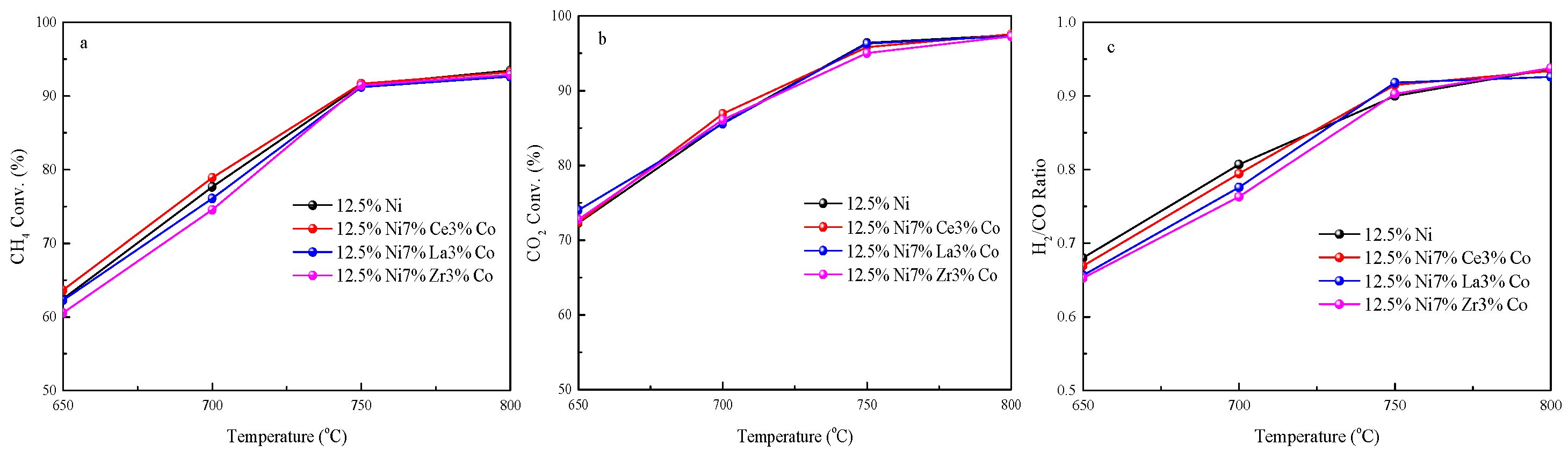
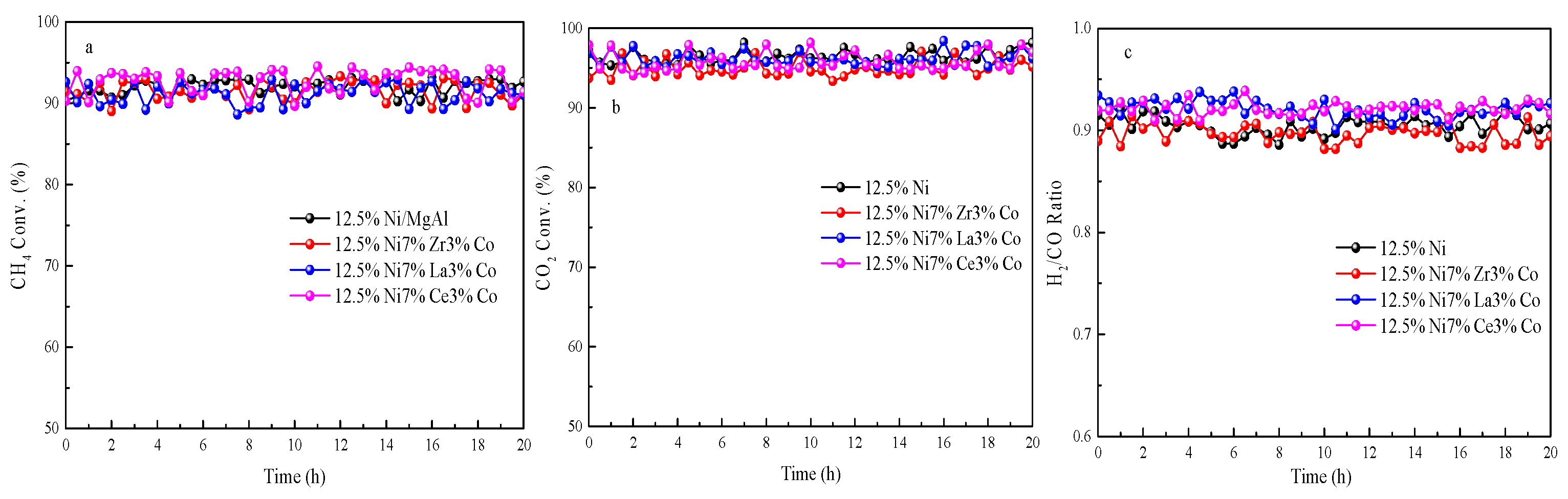
Figure 1 and Figure 2 illustrate the temperature-dependent DRM activity and the results of stability tests conducted at 750 °C, respectively. As shown in Figure 1, the catalytic activity of all samples increased monotonically with temperature, reflecting the strongly endothermic nature of the DRM reaction. For all catalysts, the CO2 conversion was slightly higher than the CH4 conversion. This discrepancy is primarily attributed to the occurrence of side reactions, such as the reverse water–gas shift (RWGS) reaction, which consumes additional CO2. The influence of the RWGS reaction is further evidenced by the H2/CO molar ratios, which remained consistently below the stoichiometric value of 1.0 (Figure 1c).
Figure 1.
Catalytic performance of Co-modified Ni-based catalysts in CH4-CO2 dry reforming at different temperatures: (a) CH4 conversion; (b) CO2 conversion; (c) H2/CO ratio. Reaction conditions: CH4/CO2 = 1:1, pressure 0.1 MPa, total flow rate 120 mL min−1, catalyst weight 0.3 g. All catalysts were pre-reduced in situ under H2 at 650 °C for 120 min.
Figure 2.
Stability tests of Co-modified Ni-based catalysts in CH4-CO2 dry reforming: (a) CH4 conversion; (b) CO2 conversion; (c) H2/CO ratio. Reaction conditions: 750 °C, CH4/CO2 = 1:1, pressure 0.1 MPa, total flow rate 120 mL min−1, catalyst weight 0.3 g. All catalysts were pre-reduced in situ under H2 at 650 °C for 120 min.
In the temperature range of 650–750 °C, the reaction activity exhibited a sharp increase as the temperature increased. However, this trend decelerated as the temperature approached 800 °C. At this temperature, the performance of all catalysts converged, indicating that the catalyst composition plays a less critical role in enhancing DRM at high temperatures. Notably, while the introduction of Ce, La, or Zr initially led to a decrease in the DRM activity of the Ni-based catalysts, subsequent doping with Co significantly improved the performance. It is worth noting that while metallic Co itself typically exhibits lower intrinsic DRM activity and is more susceptible to oxidation deactivation compared to Ni, its incorporation here facilitates the formation of Ni-Co alloys [35,36]. The significant activity enhancement following Co addition suggests that the improved performance is not a mere additive effect of two metals but rather a consequence of the synergistic electronic modulation within the Ni-Co alloy sites, which optimizes the reaction kinetics for CH4/CO2 activation. This enhancement effectively compensates for the negative impact on activity caused by the promoters. During the 20 h stability test at 750 °C (Figure 2), all catalysts maintained stable performance without significant degradation over time, demonstrating excellent catalytic stability across the series.
2.2. Characterization of Fresh and Spent Catalysts
2.2.1. Crystalline Structure and Surface Morphology
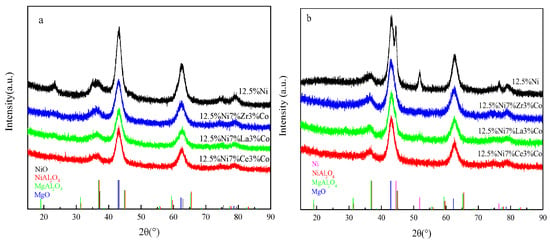
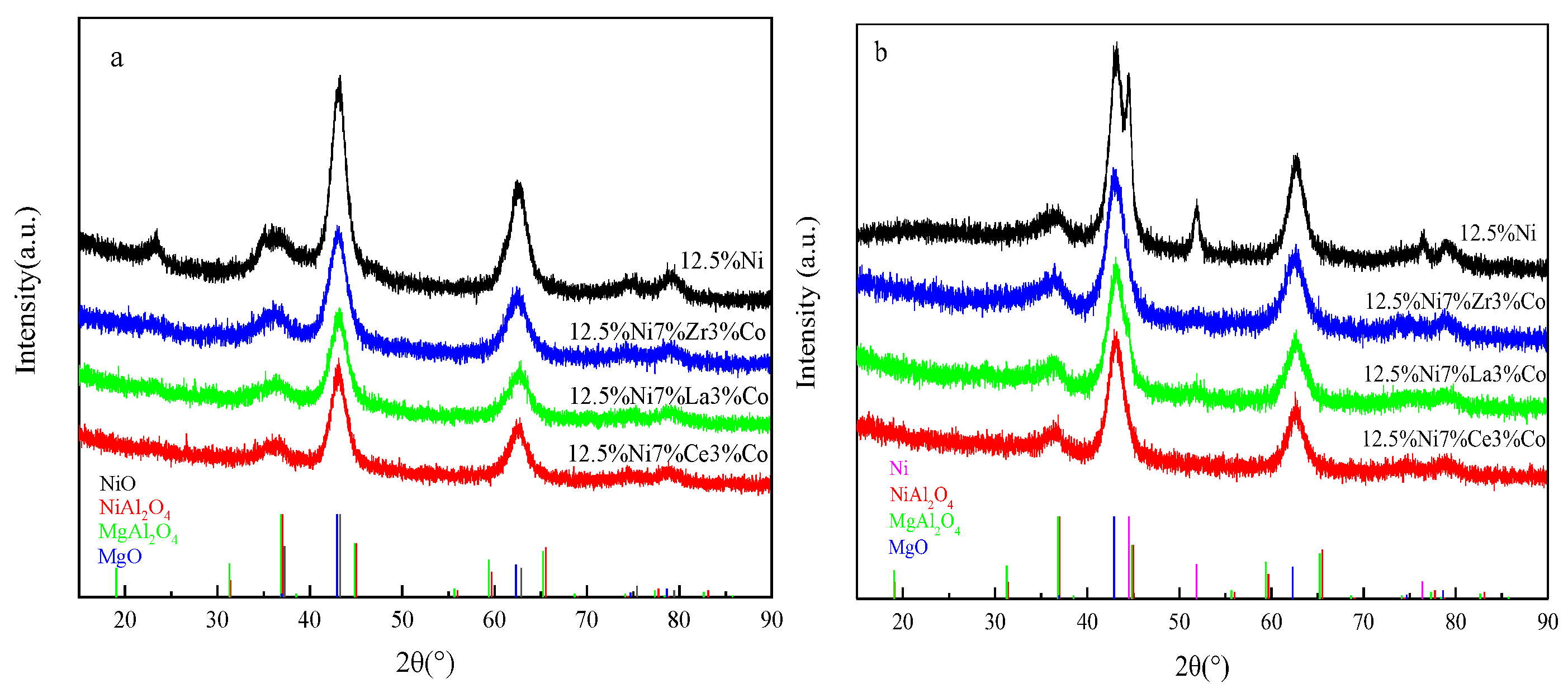
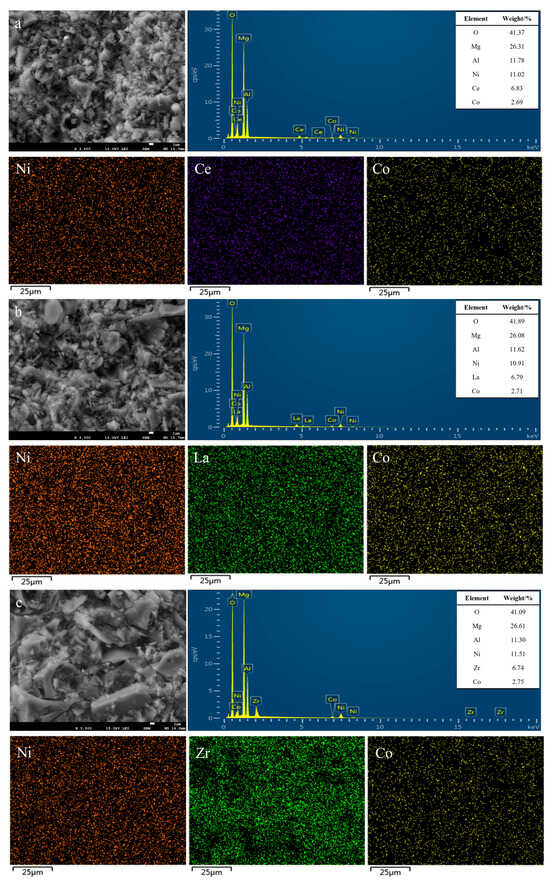
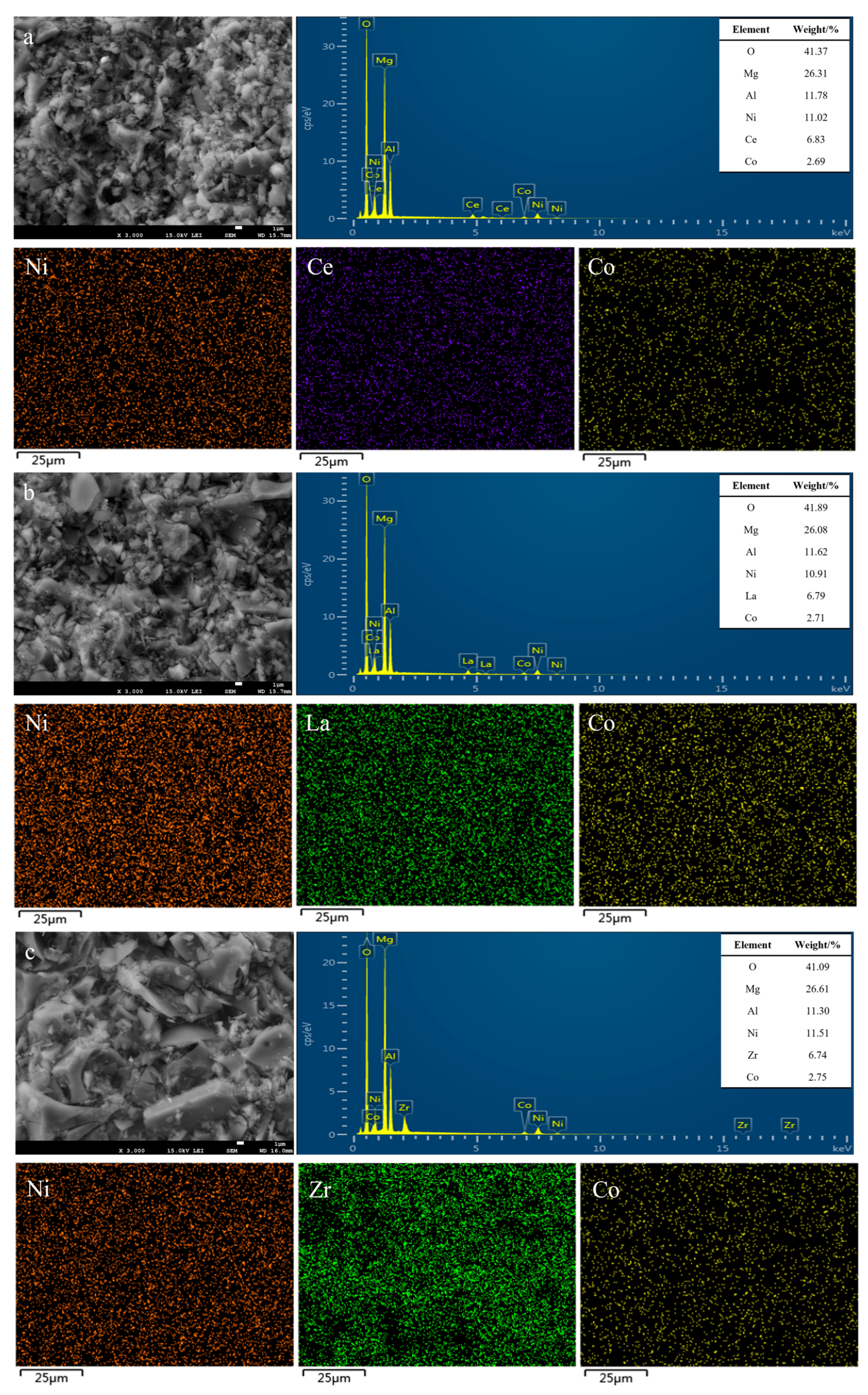
The textural properties of the three Co-modified catalysts were evaluated using N2 physisorption. The specific surface areas of 12.5%Ni7%Ce3%Co, 12.5%Ni7%La3%Co, and 12.5%Ni7%Zr3%Co were 58.61, 60.49, and 59.53 m2/g, respectively, with corresponding pore volumes of 0.06, 0.06, and 0.07 cm3/g. These parameters are closely aligned with those of the catalysts prior to Co doping, suggesting that the introduction of 3 wt% Co has a negligible impact on the pore structure of the samples. Figure 3 presents the XRD patterns of the Co-modified catalysts in both calcined and reduced states. The crystalline structure remained largely unaffected by Co modification. Due to the low loading of Co, no diffraction peaks corresponding to cobalt oxides or metallic Co were detected. The absence of independent cobalt oxide or metallic cobalt diffraction lines is attributed to both the low loading and the high thermodynamic solubility between Ni and Co. Under the pretreatment conditions, the reduced metallic Co atoms readily dissolve into the Ni lattice to form a continuous solid solution phase. SEM-EDS analysis of the calcined catalysts (Figure 4) revealed a granular morphology characteristic of the MgO-MgAl2O4 support. The primary metallic elements were uniformly distributed, with Co exhibiting particularly high dispersion due to its low concentration.
Figure 3.
XRD patterns of the Co-modified Ni-based catalysts: (a) after calcination and (b) after reduction.
Figure 4.
SEM-EDS images of the calcined catalysts: (a) 12.5%Ni7%Ce3%Co; (b) 12.5%Ni7%La3%Co; (c) 12.5%Ni7%Zr3%Co.
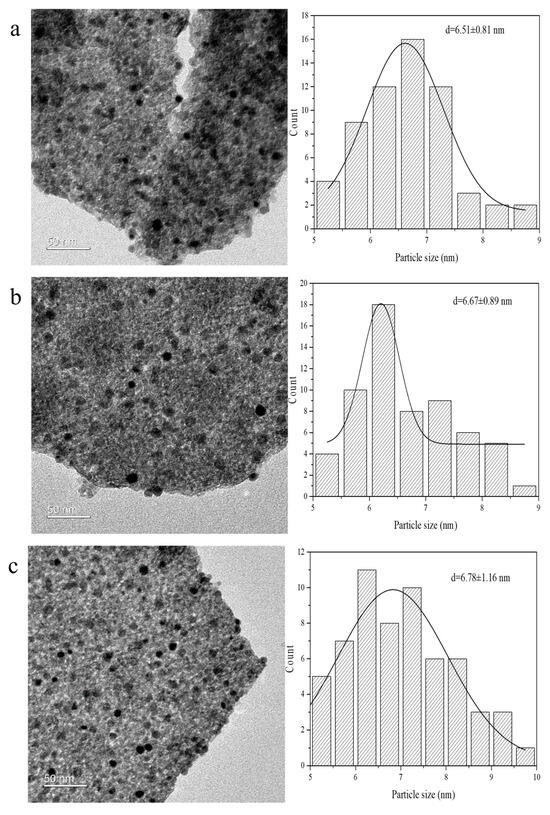
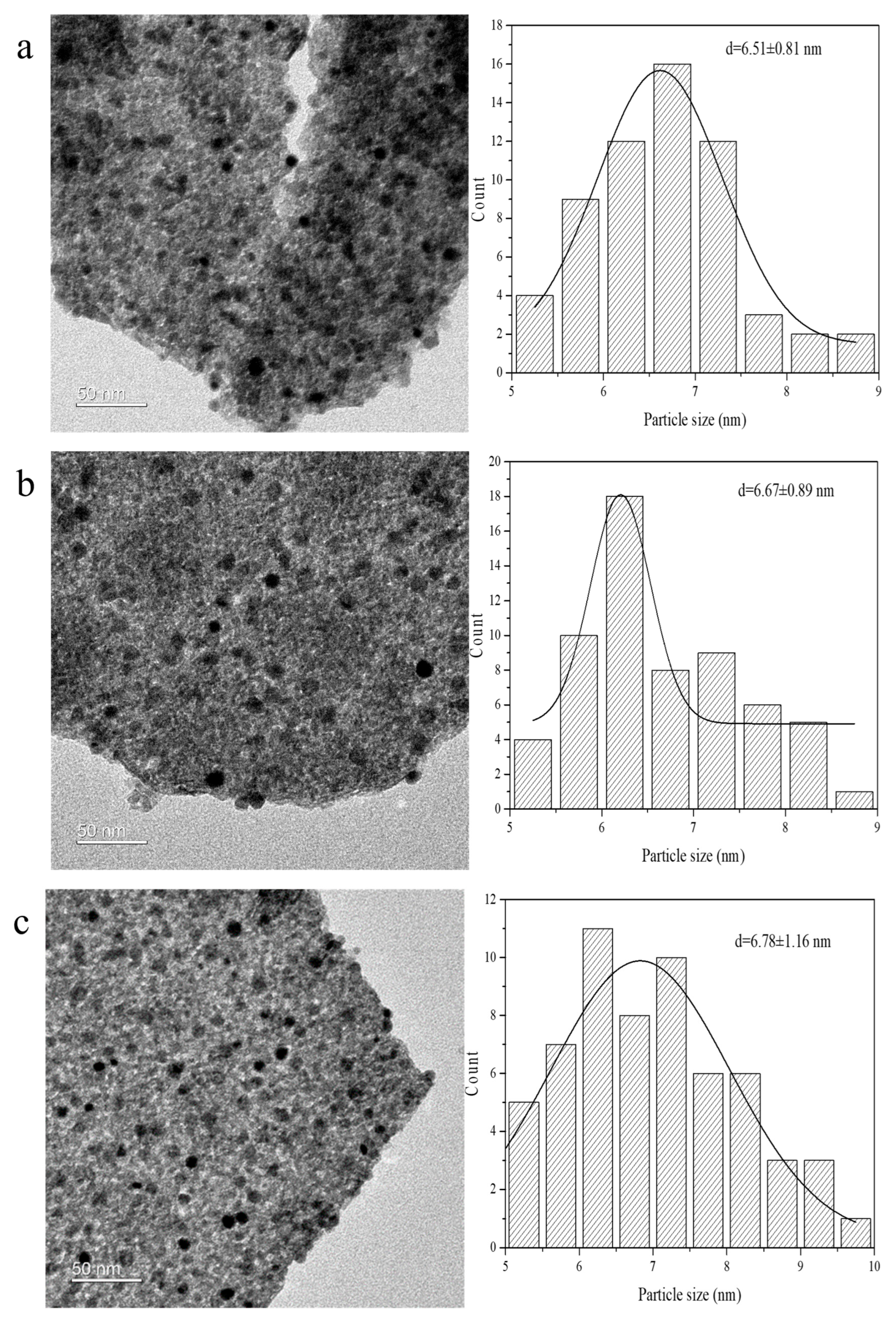
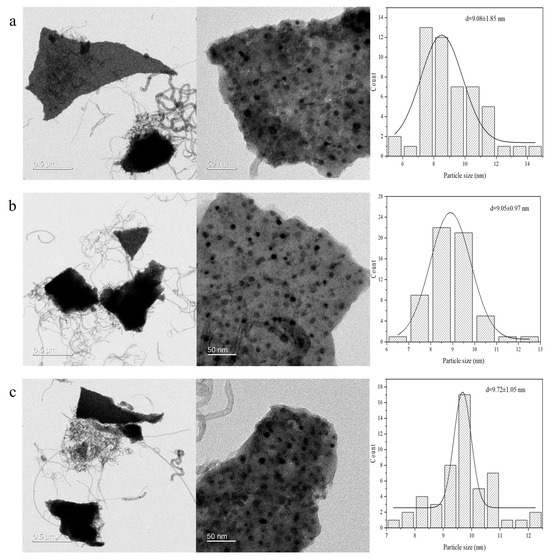
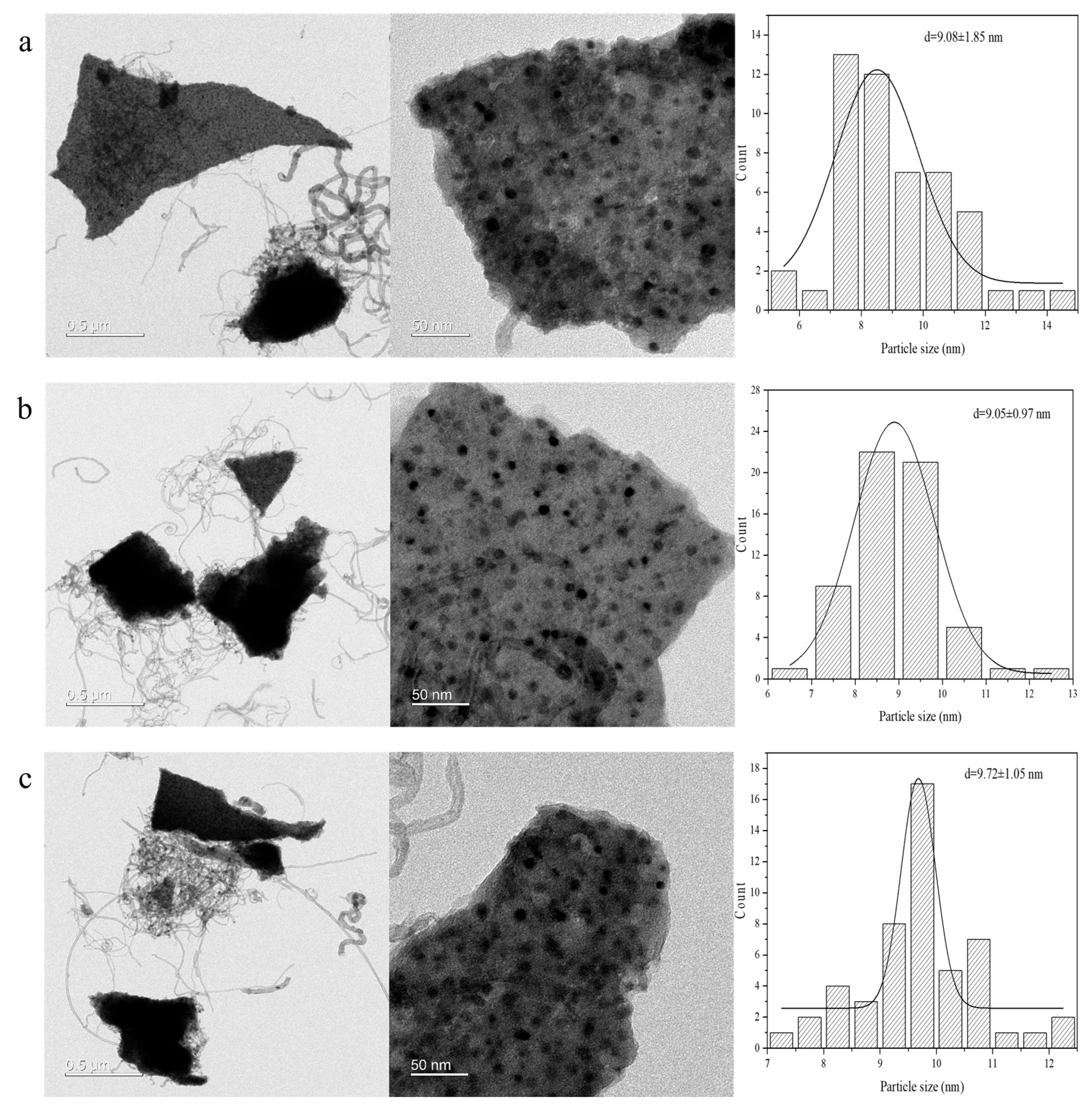
The morphologies of the reduced and spent catalysts were further examined via TEM, with particle size distributions summarized in Figure 5 and Figure 6. In the reduced samples, numerous black nanoparticles consisting of metallic Ni0 were observed on the support surface. In contrast, the TEM images of the spent catalysts revealed the formation of fibrous structures, identified as filamentous carbon. These structures primarily originate from the cracking of CH4 at elevated temperatures. Specifically, CH4 dissociates on the active Ni sites to form carbon atoms and hydrogen; these carbon atoms then diffuse through the Ni nanoparticles and precipitate as graphite on the opposite side, gradually developing into oriented filamentous carbon structures. The particle size distributions for both the reduced and spent catalysts followed a normal distribution. For the reduced catalysts, the particle sizes were primarily concentrated in the 6–7 nm and 8–9 nm ranges, which is consistent with the distribution intervals of the catalysts without Co modification. That is to say, the modification with 3 wt% Co has no significant influence on the textural characteristics, crystalline phase, or surface morphology of the Ni-based catalyst system.
Figure 5.
TEM images of the reduced catalysts: (a) 12.5%Ni7%Ce3%Co; (b) 12.5%Ni7%La3%Co; (c) 12.5%Ni7%Zr3%Co.
Figure 6.
TEM images of the spent catalysts after reaction: (a) 12.5%Ni7%Ce3%Co; (b) 12.5%Ni7%La3%Co; (c) 12.5%Ni7%Zr3%Co.
2.2.2. Surface Electronic States
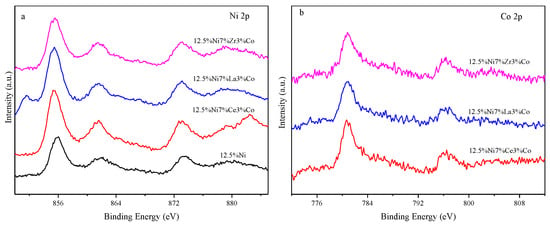
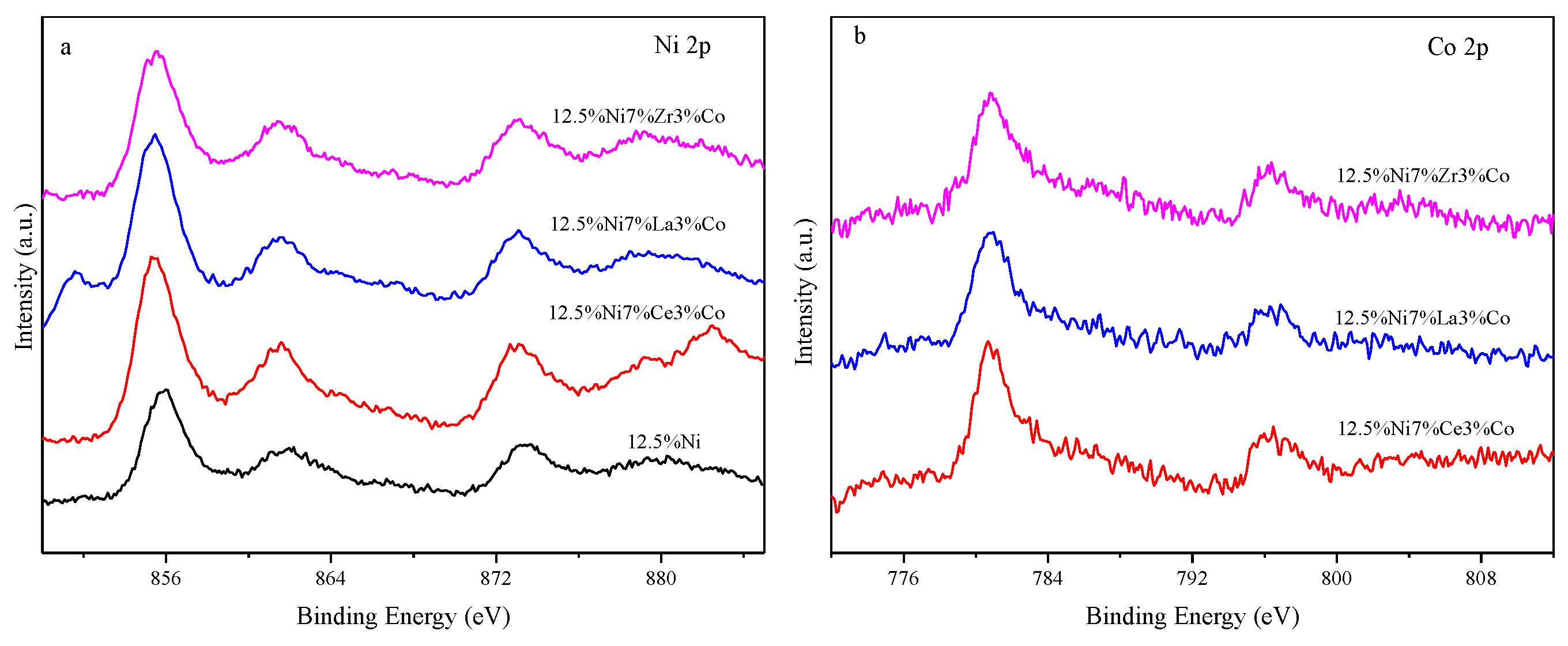
To explore the initial chemical environments and electronic interactions of the active metal components, high-resolution XPS spectra of the calcined precursors were obtained. As shown in Figure 7a, the Ni 2p3/2 main peak centers at approximately 856.0 eV accompanied by a well-defined satellite peak at ~861.5 eV, which indicates that nickel exists predominantly as Ni2+ species interacting with the support matrix [22,36]. In Figure 7b, the Co 2p3/2 core-level spectra exhibit main peaks around 780.8 eV along with their respective satellite features, demonstrating the presence of oxidic cobalt species [27,36]. Although the catalysts are in an unreduced state, the introduction of different promoters (Ce, La, Zr) alters the baseline envelopes and causes subtle shifts in the peak positions compared to the promoter-free 12.5%Ni reference. These variations reflect localized electronic perturbations and chemical state adjustments within the precursor frameworks. Such initial metal–promoter and metal–metal interactions during the calcination stage serve as a prerequisite that facilitates the uniform atomic infusion and co-reduction of Ni and Co species to form stable homogeneous alloy sites under subsequent thermal activation. While the physical characterizations (TEM and XRD) demonstrate highly dispersed metallic sites, and the precursor XPS spectra suggest distinct localized electronic perturbations, these features collectively indicate a high probability of synchronous reduction and uniform atomic infusion to form a metallic Ni-Co solid solution or alloyed phase. Nevertheless, considering the inherent complexity of multicomponent catalytic systems, the close interaction and coexistence of individual single-metal domains alongside the alloyed phase at the atomic scale should also be taken into consideration under the present reaction conditions.
Figure 7.
XPS profiles of the calcined catalysts: (a) N 2p and (b) Co 2p.
2.2.3. Surface Basicity Analysis
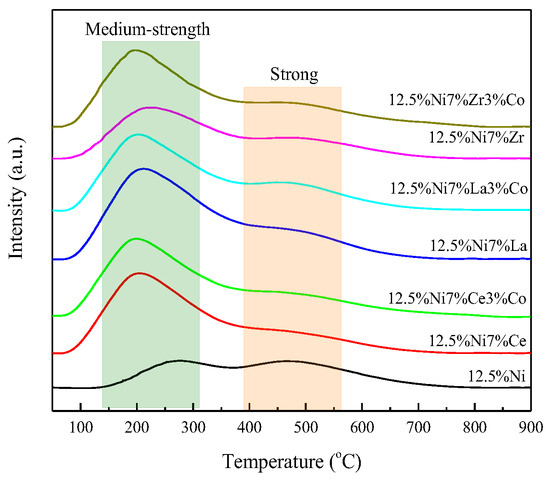
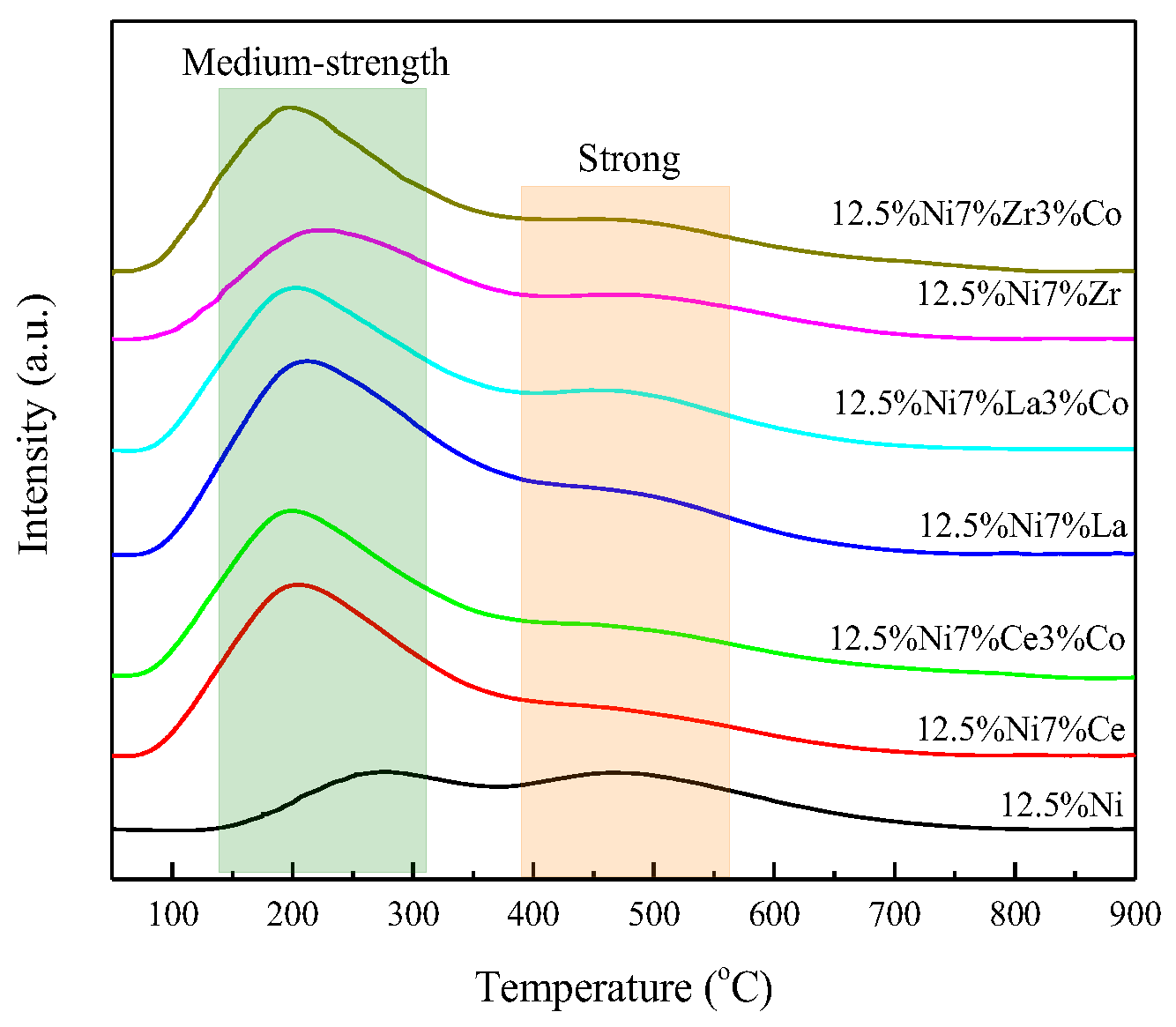
The surface basicity of the reduced catalysts was characterized using CO2-TPD, with the results presented in Figure 8 and Table 1. The results indicate that Co modification significantly optimizes the basicity of the catalysts. Specifically, the characteristic desorption peaks corresponding to medium-strength basic sites shifted toward lower temperatures, accompanied by a marked increase in their relative proportion. This shift suggests that the introduction of Co facilitates the formation of a greater number of medium-strength basic sites, which are widely considered the primary centers for effective CO2 activation.
Figure 8.
CO2-TPD profiles of the reduced catalysts.
Table 1.
CO2-TPD parameters derived from the reduced catalysts.
Further quantitative analysis of CO2 adsorption capacity revealed that the impact of Co modification varies depending on the specific promoter used. For the 12.5%Ni7%Ce catalyst, the introduction of Co had a negligible effect on the total CO2 adsorption capacity. This is primarily because Ce itself possesses inherent oxygen storage/release capacity as well as a strong CO2 affinity. Therefore, the role of Co is manifested more in enhancing surface activity and oxygen mobility rather than in increasing the total number of adsorption sites. In contrast, the 12.5%Ni7%La catalyst exhibited a slight decrease in CO2 adsorption capacity upon Co modification. This may be attributed to Co incorporation disrupting the distribution of weak basic sites initially induced by La or to a site-competition effect between Co and La. Nevertheless, the increased proportion of medium-strength basic sites suggests that the catalyst’s efficiency in CO2 activation may still be maintained or even enhanced. Conversely, for the 12.5%Ni7%Zr catalyst, Co modification significantly promoted CO2 adsorption, indicating a distinct synergistic enhancement between Zr and Co. This improvement likely stems from the induction of additional oxygen vacancies or the optimization of the surface electronic structure, which increases both the density of medium-strength basic sites and their affinity for CO2. Compared to pure Co catalysts, which often show limited CO2 adsorption capacity or different binding strengths, the Ni–Co–promoter ternary system in this study exhibits a more optimized distribution of medium-strength basic sites.
2.2.4. Coking Resistance Achieved by Co-Modified Catalysts
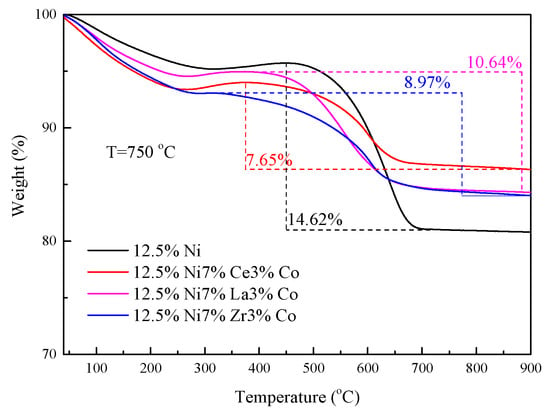
TG was performed to quantify the coke deposition on the catalysts that worked for 20 h during the DRM reaction at 750 °C. As illustrated in Figure 9, the weight evolution profiles of all spent catalysts exhibit three distinct stages: a minor weight loss below 250 °C due to moisture evaporation and gas desorption; a slight weight gain between 300 °C and 450 °C corresponding to the oxidation of metallic Ni0 to NiO; and a significant weight loss in the 450–750 °C range. This high-temperature weight loss is primarily attributed to the oxidation of amorphous carbon (450–500 °C) and more stable graphitic or filamentous carbon (600–750 °C) [37,38].
Figure 9.
TG curves of the catalysts after 20 h of reaction at 750 °C.
The coke content was calculated based on the weight loss within the 450–750 °C range. The unmodified 12.5%Ni catalyst exhibited the highest coke accumulation, reaching 14.62%. In contrast, catalysts modified with Ce, La, or Zr and further modified with Co showed varying degrees of reduction in coke deposition. Notably, the Co-modified samples achieved lower coke levels than their counterparts modified only by promoters, with further reductions of 2.84%, 4.81%, and 1.99% for the Ce, La, and Zr systems, respectively. These results demonstrate that Co modification effectively inhibits coke formation and enhances the overall coking resistance of the catalysts. This enhanced coking resistance is primarily derived from the formation of a Ni-Co alloy phase. The alloy structure not only stabilizes the metal nanoparticles against sintering but also modulates the electronic properties of the active site, which is further proved via DFT simulation in the next section. These effects collectively optimize the kinetic balance between CH4 cracking and the oxidative removal of carbon intermediates, thereby significantly mitigating coke accumulation on the catalyst surface. Combined with the TEM observations in Figure 6, filamentous carbon is identified as the dominant coke species on the spent catalysts. The modification with Co primarily suppressed the accumulation rate of this filamentous carbon phase rather than changing the fundamental type of the deposited carbon.
Compared with other DRM catalysts reported in recent studies, the coking resistance of the 12.5%Ni7%Ce3%Co catalyst is comparable or favorable. For instance, conventional Ni-Co/Al2O3 or Ni-based catalysts modified with similar promoters often exhibit carbon deposition exceeding 14 wt% under similar reaction conditions at 750 °C [39,40]. The carbon content of 7.65 wt% observed for our sample after a 20 h reaction reflects the effect of the Ni-Co alloying combined with the Ce promoter, similar to conclusions from other reports [41,42].
2.3. DFT Simulation of Ni-Co Synergistic Mechanism
2.3.1. Electronic Structure Modulation
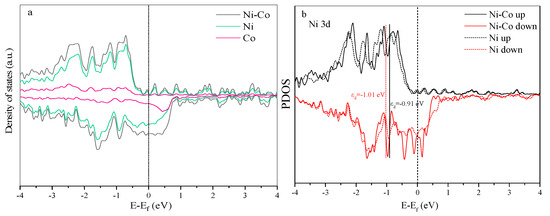
The density of states (DOS) and Ni 3d partial density of states (PDOS) were analyzed to evaluate the electronic impact of alloying (Figure 10). For the pristine Ni surface, a high density of states is observed near the Fermi level (Ef), with the d-band center (εd) located at −1.01 eV. This high electron-donating capacity facilitates CH4 activation but simultaneously leads to excessively strong adsorption of carbon intermediates. Upon the formation of the Ni-Co alloy, the Ef distribution is restructured, and the Ni 3d-band center shifts upward to −0.91 eV. This electronic redistribution weakens the Ni-C interaction, resulting in a more moderate adsorption strength for carbon species. By preventing the over-binding of carbon while maintaining CH4 activation capability, the Ni-Co alloy establishes an electronic foundation for the kinetic balance between coke formation and elimination.
Figure 10.
Calculated (a) total density of states (DOS) and (b) Ni 3d partial density of states (PDOS) for the pristine Ni and Ni-Co alloy surfaces.
2.3.2. Synergistic Activation of CH4 and CO2
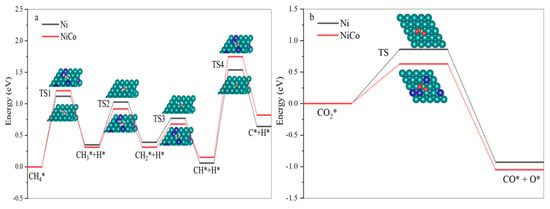
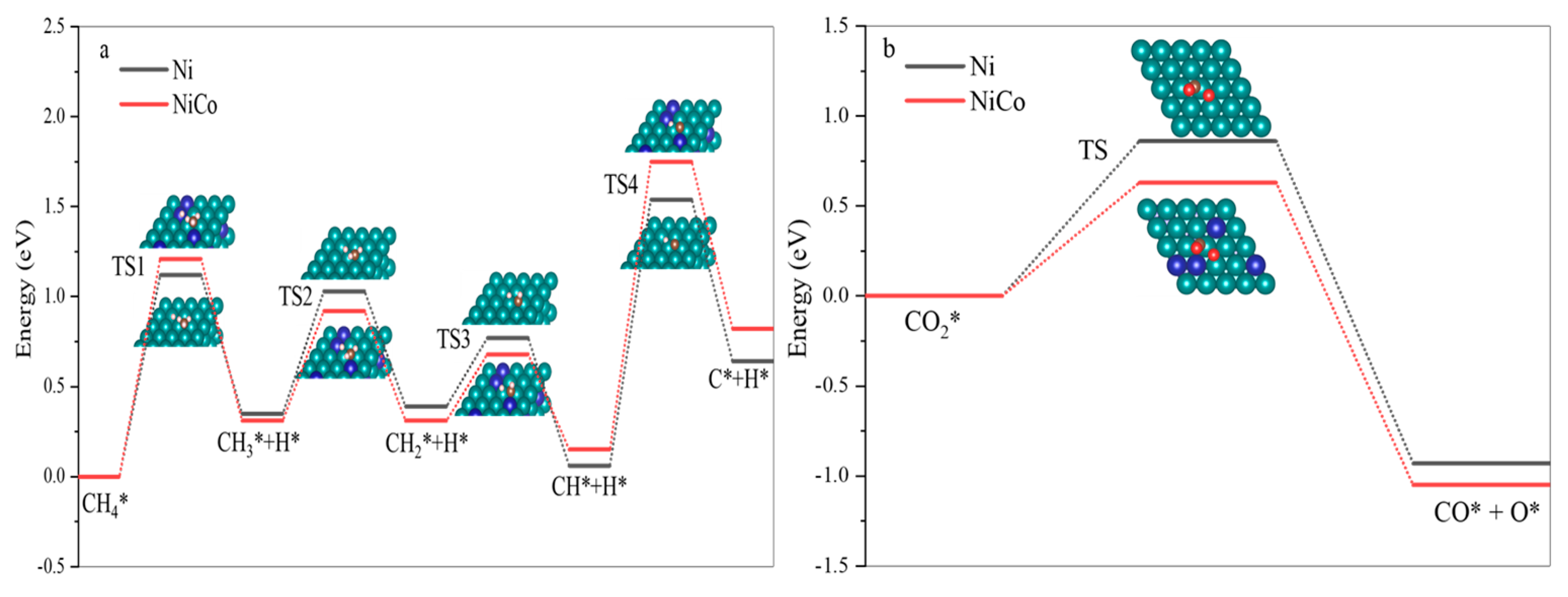
The reaction coordinates for CH4 and CO2 dissociation reveal that the Ni-Co alloy significantly modulates the dehydrogenation kinetics of methane (Figure 11a). On the pure Ni surface, CH4 undergoes sequential dehydrogenation (CH4 → CH3* → CH2* → CH* → C*) with a critical deep-cracking barrier (TS4) of ~2.0 eV, which promotes the accumulation of stable surface carbon. In contrast, the Ni-Co surface shows a redistribution of energy barriers. Although the initial C-H bond cleavage remains accessible, the barrier for complete dehydrogenation decreases to approximately 1.8 eV. This shift, from relatively hindered initial activation to constrained deep dehydrogenation, reduces the kinetic driving force for carbon precursor formation and thus provides an intrinsic mechanism for suppressing coke deposition.
Figure 11.
Reaction energy profiles of (a) CH4 and (b) CO2 decomposition on Ni and Ni-Co catalysts.
Simultaneously, the Ni-Co alloy facilitates superior CO2 activation and surface cleaning (Figure 11b). The dissociation barrier for CO2* → CO* + O* is reduced from ~0.8 eV on pure Ni to ~0.6 eV on the Ni-Co alloy, accompanied by a lower relative energy for the dissociated product state. This indicates that the alloy not only accelerates CO2 cleavage but also stabilizes the resulting active oxygen species. By concurrently elevating the barriers for early precursors of excessive CH4 cracking and lowering the threshold for CO2 activation from ~0.8 eV to ~0.6 eV, the Ni-Co alloy achieves a kinetic balancing effect. The reduction in the CO2 activation barrier accelerates the generation of active surface oxygen species (O*), ensuring that the rate of surface carbon elimination via the oxidation pathway (C* + O* ⟶ CO) is dynamically faster than the rate of carbon accumulation, which suppresses the net formation of surface coke as observed in experimental tests.
2.3.3. Synergistic Mechanism Between Ni-Co Alloy and Promoters
The catalytic performance of the modified catalysts stems from a multi-level synergy between the Ni-Co alloy active sites and the structural promoters (Ce, La, and Zr). As evidenced by the CO2-TPD and TG results, the introduction of promoters optimizes the distribution of medium-strength basic sites and the surface oxygen supply, which govern CO2 adsorption and activation behaviors. The Ni-Co alloy phase complements these promoter effects by lowering the intrinsic reaction barriers for CO2 dissociation and methane deep cracking at the atomic scale.
Among the studied systems, the Ce-modified Ni-Co catalyst exhibits the most stable catalytic performance over the 20 h reaction period. This is attributed to the oxygen storage/release capacity and distinct oxygen mobility of the CeO2-based species, which work in tandem with the optimized electronic structure of the neighboring Ni-Co sites [43,44]. Based on the well-established oxygen storage and transport mechanisms verified in our previous analog catalyst series [21,34], the enhanced oxygen mobility driven by the Ce, La, and Zr promoters provides a rational theoretical framework for understanding the catalytic behavior of the present system. Therefore, when correlating the macroscopic catalytic activity with the anti-coking trends, this enhanced oxygen mobility is elucidated as a key synergistic factor responsible for suppressing carbon deposition. This cooperative mechanism ensures that surface carbon intermediates are continuously converted to CO, effectively suppressing the accumulation of graphitic and filamentous carbon phases [45,46,47]. Due to the high structural complexity and multi-phase boundaries of the multi-component catalyst interface, the structural effects of the promoters and the intrinsic energy barriers of the metal active sites were evaluated via a decoupled approach. The computational study focused specifically on the intrinsic reaction pathways and electronic state perturbations on the metal slabs, while the promoter-induced surface characteristics were validated through experimental characterization.
3. Materials and Methods
3.1. Catalyst Preparation
The Ce-, La-, Zr-, and Co-modified Ni/MgO-MgAl2O4 catalysts were synthesized via a sol–gel method. Nickel nitrate (Ni(NO3)2·6H2O), aluminum nitrate (Al(NO3)3·9H2O), and magnesium nitrate (Mg(NO3)2·6H2O) were used as precursors for the active Ni phase and the MgO-MgAl2O4 support, respectively. Cerium nitrate (Ce(NO3)3·6H2O), lanthanum nitrate (La(NO3)3·6H2O), zirconium nitrate (Zr(NO3)4·5H2O), and cobalt nitrate (Co(NO3)2·6H2O) served as precursors for the corresponding promoter elements, and citric acid (C6H10O8) was employed as the chelating agent.
The molar ratio of (Ni+Mg) to Al was fixed at 3:1. The theoretical Ni loading was maintained at 12.5 wt%, the promoter loading (Ce/La/Zr) was 7 wt%, and the Co loading was 3 wt%. In a typical synthesis, the required nitrates were sequentially dissolved in 20 mL of deionized water under continuous stirring at room temperature, followed by the addition of 5 drops of 6 mol·L−1 nitric acid. Citric acid was then introduced at a molar ratio of 1.5 relative to the total metal cations. The solution was ultrasonically treated (50 W) for 30 min and subsequently stirred at 60 °C until a homogeneous sol was formed. The obtained gel was sealed and aged at room temperature for 72 h, followed by calcination in air at 750 °C for 4 h with a heating rate of 2 °C·min−1.
The catalysts were denoted according to their nominal compositions; for example, 12.5%Ni7%(Ce/La/Zr)3%Co represents a catalyst containing 12.5 wt% Ni, 7 wt% Ce (or La or Zr), and 3 wt% Co.
3.2. Catalyst Reaction Evaluation
The CH4-CO2 dry reforming reaction was carried out in a fixed-bed quartz reactor (internal diameter: 8 mm, length: 500 mm) operated at atmospheric pressure. The reactor was vertically positioned, and the catalyst (40–60 mesh, 0.25–0.42 mm) was loaded into the constant-temperature zone of the reactor. Typically, 300 mg of catalyst was placed between two quartz wool plugs to ensure stable packing. A thermocouple was positioned in close proximity to the catalyst bed to monitor the reaction temperature.
Prior to the DRM reaction, the catalyst was reduced in situ at 650 °C under high-purity H2 for 120 min. After reduction, the system was purged with pure Ar for 10 min. The reaction was then initiated at the desired temperature by introducing a gas mixture of CH4, CO2, and Ar with a molar ratio of 1:1:2. The total gas flow rate was maintained at 120 mL·min−1 using mass flow controllers.
The outlet gases were analyzed online using a gas chromatograph (GC9790 II, Zhejiang Fuli Analytical Instrument Co., Ltd., Wenling, China) equipped with a thermal conductivity detector (TCD). A silica gel drying tube was installed between the reactor outlet and the GC sampling valve to remove water vapor generated during the reaction. The conversions of CH4 and CO2 (CH4 conversion and CO2 conversion) and the H2/CO molar ratio were calculated according to the following equations:
Here, and represent the inlet flow rates of CH4 and CO2 in the feed gas (mL/min); and denote the outlet flow rates of CH4 and CO2 in the product stream (mL/min); and correspond to the outlet flow rates of H2 and CO in the product stream (mL/min), respectively.
3.3. Catalyst Characterization
X-ray diffraction (XRD, Rigaku Ultima IV, Rigaku Corporation, Akishima, Tokyo, Japan) was employed to determine the crystalline phases and structural evolution of the catalysts after calcination, reduction, and reaction. N2 adsorption–desorption measurements were carried out on an automated surface area and porosity analyzer (ASAP 2020, Micromeritics Instrument Corp., Norcross, GA, USA) to obtain the textural properties of the calcined samples using the BET method. Field-emission scanning electron microscopy (FESEM, Hitachi S-4800, Hitachi Ltd., Tokyo, Japan) was used to examine surface morphology and metal dispersion, coupled with energy-dispersive X-ray spectroscopy (EDS) for elemental mapping and surface composition analysis. Field-emission transmission electron microscopy (TEM, FEI Tecnai G2 F20, FEI Co., Hillsboro, OR, USA) was further applied to characterize the microstructure, particle size, and lattice features of the catalysts.
X-ray photoelectron spectroscopy (XPS, Thermo Fisher Scientific ESCALAB 250Xi, Thermo Fisher Scientific, Waltham, MA, USA) was conducted to analyze the surface elemental valence states and electronic structure. Both survey and high-resolution spectra were recorded, and binding energies were calibrated using the adventitious coke C 1s peak at 284.8 eV. Thermogravimetric analysis (TG, Hitachi STA200, Hitachi High-Tech Corporation, Tokyo, Japan) was performed to quantify coke deposition on the spent catalysts.
The surface basicity and basic strength distribution of the reduced catalysts were investigated by CO2 temperature-programmed desorption (CO2-TPD) using a Micromeritics AutoChem II 2920 system. Typically, 50 mg of catalyst was loaded into a U-shaped quartz reactor and reduced at 650 °C for 120 min in 10% H2/Ar (30 mL·min−1), followed by purging in Ar for 30 min. After cooling to 50 °C, high-purity CO2 was introduced for 1 h to ensure saturation adsorption. Subsequently, the sample was purged in He for 120 min to remove physically adsorbed CO2. The desorption profile was recorded under a He flow with a heating rate of 5 °C·min−1 up to 800 °C.
3.4. DFT Calculation Method and Modeling Description
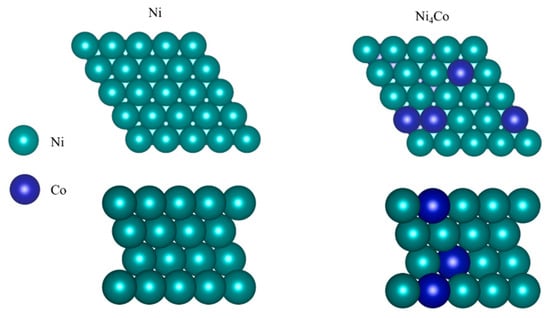
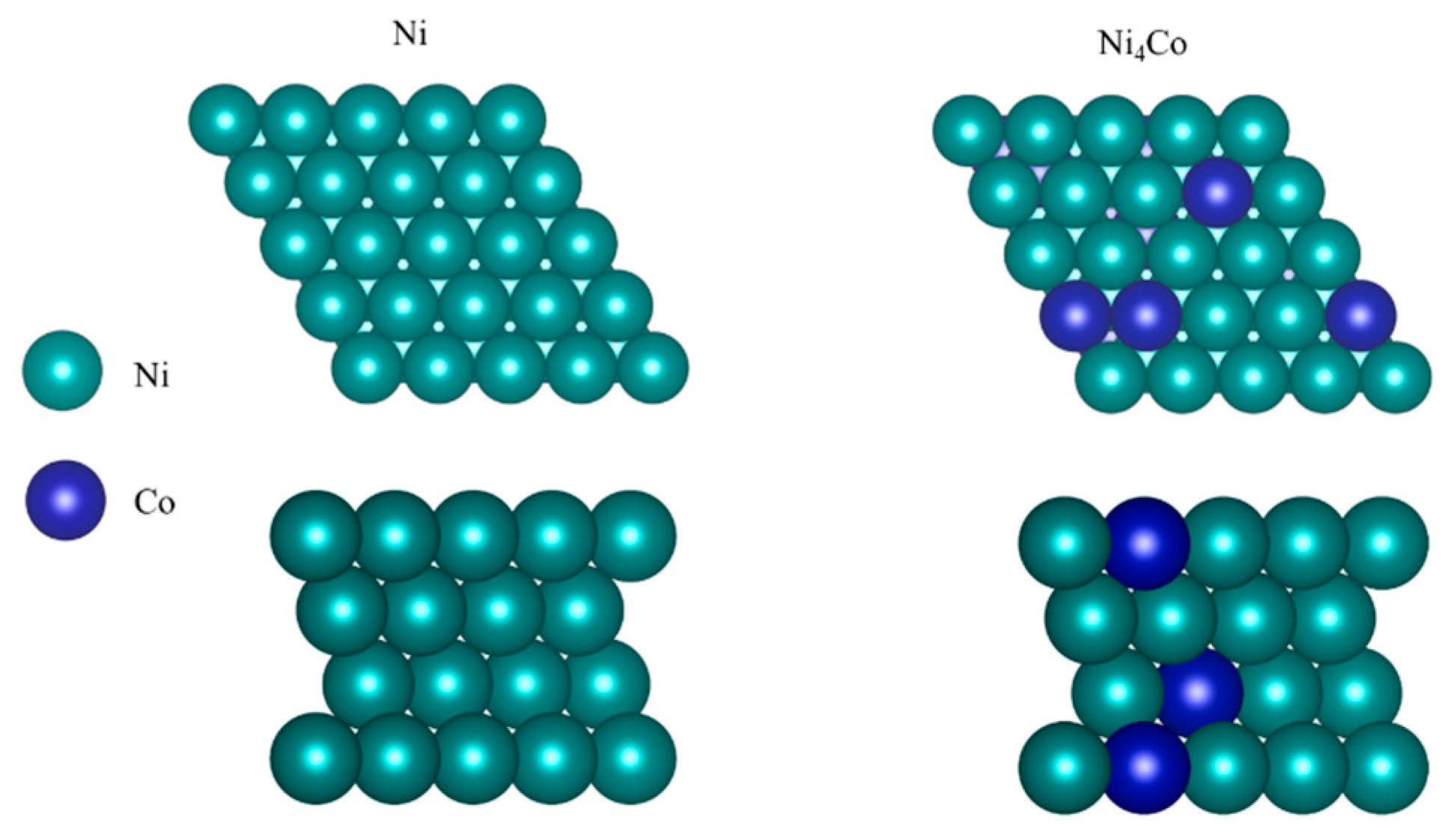
Density functional theory (DFT) calculations were carried out using the Vienna Ab initio Simulation Package (VASP) [48,49]. The generalized gradient approximation (GGA) with the Perdew–Burke–Ernzerhof (PBE) functional [50] was employed to describe exchange-correlation interactions, and the projector-augmented wave (PAW) method [51,52] was used to treat core–valence electron interactions. A plane-wave cutoff energy of 500 eV was applied. The electronic and ionic convergence criteria were set to 1 × 10⁻⁵ eV and 0.02 eV·Å−1, respectively. Brillouin zone integrations were performed using a 4 × 4 × 1 Monkhorst–Pack k-point mesh [53], and spin polarization was included in all calculations. The energy barriers of the key elementary steps involved in CH4 dissociation and CO2 activation were calculated using the climbing image nudged elastic band (CI-NEB) method. The atomic structure of Ni (111) and Ni4Co (111) used in this work is presented in Figure 12.
Figure 12.
Top and side views of Ni (111) and Ni4Co (111).
4. Conclusions
This study combines experimental characterization and density functional theory (DFT) calculations to elucidate the synergistic roles of Ni-Co alloy active sites and promoter elements in DRM. The introduction of Co to form Ni-Co alloys significantly enhances catalyst stability and coke resistance while preserving high catalytic activity, among which the Ce-promoted Ni-Co catalyst exhibits the most stable and sustained anti-coking performance. DFT calculations indicate that Co incorporation regulates the electronic structure of Ni sites, optimizing the energy barriers for CH4 dissociation and CO2 activation and thereby suppressing excessive methane cracking while promoting carbon removal. CO2-TPD and coke analyses further suggest that promoter elements enhance CO2 adsorption and activation by tuning medium-strength basic sites and oxygen mobility; notably, Ce continuously supplies mobile active oxygen species through its oxygen storage-release capability, accelerating the oxidation of surface carbon intermediates. The complementary synergy between electronic modulation by Ni-Co alloying and oxygen-mediated carbon removal induced by Ce provides a clear mechanistic basis for the rational design of highly active and coke-resistant Ni-based DRM catalysts.
Author Contributions
Conceptualization, G.Z. and C.W.; methodology, G.Z. and Z.L.; formal analysis, G.Z. and X.Z.; investigation, G.Z. and C.W.; data curation, G.Z. and X.Z.; writing—original draft preparation, G.Z.; writing—review and editing, X.Z., Z.L. and L.L.; supervision, C.W., Z.L. and L.L.; project administration, G.Z. and X.Z.; funding acquisition, X.Z. and C.W. All authors have read and agreed to the published version of the manuscript.
Funding
This research was funded by the Youth Fund Project of Shandong Province (Grant No. ZR2022QE111) and the Tianshan Talent Support Program (Grant Nos. CZ000401 and CZ000206).
Data Availability Statement
The original contributions presented in this study are included in the article. Further inquiries can be directed to the corresponding authors.
Acknowledgments
Leteng Lin would like to acknowledge the support of faculty funding for research work at Linnaeus University, Sweden. We thank Shihezi University for providing the instruments and equipment sharing platform. The authors also thank all colleagues who provided technical assistance during the project.
Conflicts of Interest
The authors declare no conflicts of interest.
References
- Min, H.; Ju, Y.; Ji, Y.J.; Kim, D.Y.; Kim, Y.J.; Kang, S.B. Long-term stable catalyst for dry reforming of Methane: Ni-Nanocluster embedded in silica. Chem. Eng. J. 2024, 489, 151520. [Google Scholar] [CrossRef] [Scilit]
- Niu, J.; Wang, Y.; Liland, S.E.; Regli, S.K.; Yang, J.; Rout, K.R.; Luo, J.; Rønning, M.; Ran, J.; Chen, D. Unraveling enhanced activity, selectivity, and coke resistance of Pt-Ni bimetallic clusters in dry reforming. ACS Catal. 2021, 11, 2398–2411. [Google Scholar] [CrossRef] [Scilit]
- Wang, H.; Cui, G.; Lu, H.; Li, Z.; Wang, L.; Meng, H.; Li, J.; Yan, H.; Yang, Y.; Wei, M. Facilitating the dry reforming of methane with interfacial synergistic catalysis in an Ir@CeO2-x catalyst. Nat. Commun. 2024, 15, 3765. [Google Scholar] [CrossRef] [Scilit] [PubMed]
- Wang, P.; Wei, S.; Wang, S.; Lin, R.; Mou, X.; Ding, Y. Interface-directed epitaxially growing nickle ensembles as efficient catalysts in dry reforming of methane. J. Energy Chem. 2022, 66, 502–513. [Google Scholar] [CrossRef] [Scilit]
- Das, S.; Lim, K.H.; Gani, T.Z.H.; Aksari, S.; Kawi, S. Bi-functional CeO2 coated NiCo-MgAl core-shell catalyst with high activity and resistance to coke and H2S poisoning in methane dry reforming. Appl. Catal. B Environ. 2023, 323, 122141. [Google Scholar] [CrossRef] [Scilit]
- Xue, Q.; Lim, K.H.; Sun, Z.; Yan, B.; Yin, Z.; Nzihou, A.; Wang, Y.; Luo, G.; Xiao, F.-S.; Kawi, S. Engineering core-shell-structured BaAl2O4 overlaid Ni catalyst with strong metal-support interaction for durable and efficient CH4 dry reforming. J. Energy Chem. 2025, 109, 807–819. [Google Scholar] [CrossRef] [Scilit]
- Naveen, N.S.P.; Dooley, K.M.; Janik, M.J.; Noh, G.; Alexopoulos, K. A multisite microkinetic framework for describing interfacial kinetics in dry methane reforming (DRM) over Ni-CeO2 Catalysts. ACS Catal. 2026, 16, 2535–2549. [Google Scholar] [CrossRef] [Scilit] [PubMed]
- Lucas, J.; Naveen, N.S.P.; Janik, M.J.; Alexopoulos, K.; Noh, G.; Aireddy, D.; Ding, K.; Dorman, J.A.; Dooley, K.M. Improved selectivity and stability in methane dry reforming by atomic layer deposition on Ni-CeO2-ZrO2/Al2O3 catalysts. ACS Catal. 2024, 14, 9115–9133. [Google Scholar] [CrossRef] [Scilit] [PubMed]
- Ahn, S.; Littlewood, P.; Liu, Y.; Marks, T.J.; Stair, P.C. Stabilizing supported Ni catalysts for dry reforming of methane by combined La modifing and Al overcoating using atomic layer deposition. ACS Catal. 2022, 12, 10522–10530. [Google Scholar] [CrossRef] [Scilit]
- Niu, Z.; Han, P.; Du, Y.; Han, Z.; Lang, L.; Li, X.; Yin, X. Ni-La confined in TiO2 nanotubes with efficient activity and stability for dry methane reforming. Renew. Energy 2025, 248, 123150. [Google Scholar] [CrossRef] [Scilit]
- Jamsaz, A.; Pham-Ngoc, N.; Wang, M.; Jeong, D.H.; Shin, E.W. Favorable formation of needle-shaped NiAl2O4 phase over macroporous Ni/CexZr1-xO2-Al2O3 catalysts in one-pot preparation and coke-resistant catalytic performance in dry reforming of methane. Chem. Eng. J. 2024, 500, 156932. [Google Scholar] [CrossRef] [Scilit]
- Jin, H.; Liu, Y.; Huang, L.; Liu, Y.; Cui, S.; Liu, H.; Xu, J.; Wang, L. Three-dimensional mesoporous Ni-CeO2 catalyst for dry reforming of methane. Catalysts 2024, 14, 291. [Google Scholar] [CrossRef] [Scilit]
- Huang, Z.; Liu, J.; He, Y.; Hu, W.; Wu, J.; Zairov, R.; Sinyashin, O.G.; Hu, W.; Zhou, Y. Role of the Pr/Ni loading sequence in boosting the photothermal catalytic activity of CeO2 for methane dry reforming. Nanoscale 2025, 17, 26354–26366. [Google Scholar] [CrossRef] [Scilit] [PubMed]
- Zhu, B.; Li, Y.; Wu, J.; Wang, X.; Wang, J.; Gao, S.; Li, F.; Zheng, L.; Wu, L.; Ding, X.; et al. Influence of Ce0.8Zr0.2O2 solid solutions with hierarchical morphologies on the catalytic performance in dry reforming of methane. Int. J. Hydrogen Energy 2025, 111, 304–318. [Google Scholar] [CrossRef] [Scilit]
- Pu, Z.; Liu, Q.; Chen, C.; Wang, F. Promoting surface lattice oxygen and oxygen vacancy of CeO2 for photothermal methane dry reforming over Ni/CeO2 catalysts. Chem. Eng. J. 2024, 497, 154861. [Google Scholar] [CrossRef] [Scilit]
- Qiu, H.; Ou, Z.; Lim, K.H.; Song, G.; Li, C.; Wang, Y.; Zhang, H.; Huang, X.; Ran, J.; Kawi, S. Unveiling the enhanced role of Ni-La2O2CO3 for low-temperature dry reforming of methane. J. Energy Inst. 2025, 7, 102110. [Google Scholar] [CrossRef] [Scilit]
- Safi, N.A.; Ullah, H.; Liu, G.; Xin, F. Tuning oxygen vacancy defects in VOx/Ce1-xLaxO2-δ nanorod catalysts through La doping for selective methanol oxydehydrogenation to dimethoxymethane. J. Catal. 2025, 450, 116264. [Google Scholar] [CrossRef] [Scilit]
- Zou, Z.; Zhang, T.; Lv, L.; Tang, W.; Zhang, G.; Gupta, R.K.; Wang, Y.; Tang, S. Preparing a Zr-modified CeO2 nanorod to improve the catalytic performance of the Ni-based catalyst for dry reforming of methane by enhancing oxygen supply. ACS Sustain. Chem. Eng. 2023, 11, 7443–7453. [Google Scholar] [CrossRef] [Scilit]
- Yu, Q.; Cheng, Y.; Qu, Q.; Ji, X.; Yang, Y.; Su, Y.; Yu, X.; Yang, L.; Chen, L.; Zhou, X. Coupling Ni exposure with interfacial oxygen on Zr-modified CeO2 for stable dry reforming of methane. Sep. Purif. Technol. 2026, 392, 137164. [Google Scholar]
- Marinho, A.L.A.; Rabelo-Neto, R.C.; Bion, N.; Toniolo, F.S.; Noronha, F.B. Dry reforming of methane over embedded Ni nanoparticles in CeZrO2: Effect of Ce/Zr ratio and H2O addition. Int. J. Hydrogen Energy 2024, 71, 1151–1163. [Google Scholar] [CrossRef] [Scilit]
- Zhang, G.; Zhang, X.; Wang, C.; Li, Z.; Lin, L. Optimizing Ce-La-Co synergy in Ni/MgO-MgAl2O4 catalysts for efficient CH4-CO2 dry reforming with improved stability and coke resistance. Catal. Lett. 2026, 165, 51. [Google Scholar]
- Tsoukalou, A.; Imtiaz, Q.; Kim, S.M.; Abdala, P.M.; Yoon, S.; Müller, C.R. Dry-reforming of methane over bimetallic Ni-M/La2O3 (M = Co, Fe): The effect of the rate of La2O2CO3 formation and phase stability on the catalytic activity and stability. J. Catal. 2016, 343, 208–214. [Google Scholar] [CrossRef] [Scilit]
- Ay, H.; Üner, D. Dry reforming of methane over CeO2 supported Ni, Co and Ni-Co catalysts. Appl. Catal. B Environ. 2015, 179, 128–138. [Google Scholar] [CrossRef] [Scilit]
- Wang, S.; Lu, G.Q. Role of CeO2 in Ni/CeO2-Al2O3 catalysts for carbon dioxide reforming of methane. Appl. Catal. B Environ. 1998, 19, 267–277. [Google Scholar] [CrossRef] [Scilit]
- Phan, T.S.; Sane, A.R.; de Vasconcelos, B.R.; Nzihou, A.; Sharrock, P.; Grouset, D.; Doan, P.M. Hydroxyapatite supported bimetallic cobalt and nickel catalysts for syngas production from dry reforming of methane. Appl. Catal. B Environ. 2018, 224, 310–321. [Google Scholar] [CrossRef] [Scilit]
- Tan, J.S.; Singh, S.; Omoregbe, O.; Bach, L.G.; Nguyen, H.H.P.; Vo, D.-V.N. Hydrogen production from CH4 dry reforming over bimetallic Ni-Co/Al2O3 catalyst. J. Energy Inst. 2018, 91, 683–694. [Google Scholar] [CrossRef] [Scilit]
- Erdogan, B.; Arbag, H.; Yasyerli, N. SBA-15 supported mesoporous Ni and Co catalysts with high coke resistance for dry reforming of methane. Int. J. Hydrog. Energ. 2018, 43, 1396–1405. [Google Scholar] [CrossRef] [Scilit]
- Xin, J.; Cui, H.; Cheng, Z.; Zhou, Z. Bimetallic Ni-Co/SBA-15 catalysts prepared by urea co-precipitation for dry reforming of methane. Appl. Catal. A Gen. 2018, 554, 95–104. [Google Scholar] [CrossRef] [Scilit]
- Sharifianjazi, F.; Esmaeilkhanian, A.; Bazli, L.; Eskandarinezhad, S.; Khaksar, S.; Shafiee, P.; Yusuf, M.; Abdullah, B.; Salahshour, P.; Sadeghi, F. A review on recent advances in dry reforming of methane over Ni- and Co-based nanocatalysts. Int. J. Hydrogen Energy 2022, 47, 42213–42233. [Google Scholar] [CrossRef] [Scilit]
- Horlyck, J.; Lawrey, C.; Lovell, E.C.; Amal, R.; Scott, J. Elucidating the impact of Ni and Co loading on the selectivity of bimetallic NiCo catalysts for dry reforming of methane. Chem. Eng. J. 2018, 352, 572–580. [Google Scholar] [CrossRef] [Scilit]
- Wang, J.; Fu, Y.; Kong, W.; Li, S.; Yuan, C.; Bai, J.; Chen, X.; Zhang, J.; Sun, Y. Investigation of atom-level reaction kinetics of carbon-resistant bimetallic NiCo-reforming catalysts: Combining microkinetic modeling and density functional theory. ACS Catal. 2022, 12, 4382–4393. [Google Scholar] [CrossRef] [Scilit]
- Zou, Z.; Zhang, T.; Lv, L.; Tang, W.; Zhang, G.; Gupta, R.K.; Wang, Y.; Tang, S. Preparation adjacent Ni-Co bimetallic nano catalyst for dry reforming of methane. Fuel 2023, 343, 128013. [Google Scholar] [CrossRef] [Scilit]
- Russel, A.S.; Yadav, P.K.; Deo, G. Density functional theory-driven microkinetic modeling and experimental validation reveal the promotional effect of cobalt in Ni catalysts during oxidative dry reforming of methane. J. Phys. Chem. C 2024, 128, 14259–14272. [Google Scholar] [CrossRef] [Scilit]
- Zhang, G.; Wang, C.; Zhang, X.; Li, Z. Mechanism of Ce/La/Zr doping on the structure and anti-coking performance of Ni/MgO-MgAl2O4 catalyst. J. Fuel Chem. Technol. 2026, 54, 20250383. [Google Scholar] [CrossRef] [Scilit]
- Hu, W.; Wu, J.; Huang, Z.; Tan, H.; Tang, Y.; Feng, Z.; Deng, R.; Zhang, H.; Rustem, Z.; Pan, Z. Catalyst development for biogas dry reforming: A review of recent progress. Catalysts 2024, 14, 494. [Google Scholar] [CrossRef] [Scilit]
- Gao, J.; Zhang, H.; Ran, J.; Ma, C.; Huang, X.; Shao, Y.; Qiu, H.; Ou, Z.; Tang, L. Role of Ni-Co bimetals in CaCr2O4 catalysts for dry reforming of methane: Promotion in coke resistance. Fuel 2026, 404, 136375. [Google Scholar] [CrossRef] [Scilit]
- Yuan, X.; Li, B.; Li, B.; Wang, X. Performance and stability in CO2 reforming of methane over neodymium nickel oxide composite catalysts. Fuel Process. Technol. 2021, 211, 106581. [Google Scholar] [CrossRef] [Scilit]
- Li, B.; Yuan, X.; Li, L.; Li, B.; Wang, X. Stabilizing Ni-Co alloy on bimodal mesoporous alumina to enhance carbon resistance for dry reforming of methane. Ind. Eng. Chem. Res. 2021, 60, 16874–16886. [Google Scholar] [CrossRef] [Scilit]
- Gwon, Y.; Kim, D.; Jun, U.; Ku, B.; Badalyan, S.; Kim, M.; Casale, S.; Reboul, J.; Lee, K. Effect of catalyst synthesis strategy on the structure and performance of Ni-Co bimetallic catalysts for dry reforming of methane. Catal. Today 2026, 461, 115502. [Google Scholar] [CrossRef] [Scilit]
- Kim, M.; Kim, J.; Kim, Y.; Youn, J.; Kim, D.; Shapiro, D.; Guo, J.; Lee, K. Surface control of Ni-Al2O3 dry reforming of methane catalyst by composition segregation. J. CO2 Util. 2024, 84, 102721. [Google Scholar]
- Kumari, R.; Sengupta, S. Catalytic CO2 reforming of CH4 over MgAl2O4 supported Ni-Co catalysts for the syngas production. Int. J. Hydrogen Energy 2020, 45, 22775–22787. [Google Scholar] [CrossRef] [Scilit]
- Wang, J.; Lucas, J.; Nakashima, H.; Ogino, I.; Dooley, K.; Gazit, O. Strong electrostatic adsorption sequence of Ni and Co affects low temperature dry reforming performance over NiCo/MgAlOx/ZrO2. Appl. Catal. B Environ. 2025, 366, 125004. [Google Scholar] [CrossRef] [Scilit]
- Yadav, P.K.; Sharma, S. Ni, Co & Cu substituted CeO2: A catalyst that improves H2/CO ratio in the dry reforming of methane. Fuel 2024, 358, 130163. [Google Scholar] [CrossRef] [Scilit]
- Yadav, P.K.; Verma, P.; Sharma, S. Bimetal (CuNi and CuCo) substituted CeO2: An approach for low temperature dry reforming of methane. Mol. Catal. 2024, 565, 114398. [Google Scholar] [CrossRef] [Scilit]
- Yi, Q.; Zheng, M.; Tian, L.; Wang, H.; Chen, M.; Tang, S.; Tang, W. Antisolvent extraction strategy for fabricating ceria-modified Ni/MgAl2O4 catalysts with enhanced sintering and coking resistance for dry reforming of methane. Ind. Eng. Chem. Res. 2025, 64, 8676–8688. [Google Scholar]
- Wang, Y.; He, L.; Zhou, B.; Sheng, J.; Fan, J.; Li, W. Anti-coking NiCe/HAP catalyst with well-balanced carbon formation and gasification in methane dry reforming. Fuel 2022, 329, 125477. [Google Scholar] [CrossRef] [Scilit]
- Sun, Y.; Zhang, Y.; Yin, X.; Zhang, C.; Li, Y.; Bai, J. Recent advances in the design of high-performance cobalt-based catalysts for dry reforming of methane. Green Chem. 2024, 26, 5103–5126. [Google Scholar] [CrossRef] [Scilit]
- Kresse, G.; Furthmuller, J. Efficiency of ab-initio total energy calculations for metals and semiconductors using a plane-wave basis set. Comp. Mater. Sci. 1996, 6, 15–50. [Google Scholar] [CrossRef] [Scilit]
- Kresse, G.; Furthmueller, J. Efficient iterative schemes for ab initio total-energy calculations using a plane-wave basis set. Phys. Rev. B 1996, 54, 11169–11186. [Google Scholar] [CrossRef] [Scilit] [PubMed]
- Perdew, J.P.; Burke, K.; Ernzerhof, M. Generalized gradient approximation made simple. Phys. Rev. Lett. 1996, 77, 3865–3868. [Google Scholar] [CrossRef] [Scilit] [PubMed]
- Kresse, G.; Joubert, D. From ultrasoft pseudopotentials to the projector augmented-wave method. Phys. Rev. B 1999, 59, 1758. [Google Scholar] [CrossRef] [Scilit]
- Blöchl, P.E. Projector Augmented-Wave Method. Phys. Rev. B 1994, 50, 17953–17979. [Google Scholar] [CrossRef] [Scilit] [PubMed]
- Monkhorst, H.J.; Pack, J.D. Special Points for Brillouin-Zone Integrations. Phys. Rev. B 1976, 13, 5188–5192. [Google Scholar] [CrossRef] [Scilit]

Disclaimer/Publisher’s Note: The statements, opinions and data contained in all publications are solely those of the individual author(s) and contributor(s) and not of MDPI and/or the editor(s). MDPI and/or the editor(s) disclaim responsibility for any injury to people or property resulting from any ideas, methods, instructions or products referred to in the content. |
© 2026 by the authors. Licensee MDPI, Basel, Switzerland. This article is an open access article distributed under the terms and conditions of the Creative Commons Attribution (CC BY) license.