


Abstract
Carbamazepine (CBZ), a poorly biodegradable antibiotic, is widely detected in aquatic environments, posing potential threats to ecosystems and human health. There is an urgent need to develop efficient water treatment technologies. This study successfully prepared nitrogen-doped biochar composite materials loaded with zero-valent iron (Fe0@CN) via a one-pot calcination method for activating peroxymonosulfate (PMS) to degrade CBZ. The material was systematically characterized using multiple analytical techniques. Results indicate that Fe0@CN-1.5 exhibits a high specific surface area (482.65 m2/g) and an abundant mesoporous structure, with nitrogen doping promoting graphitic structure formation and the uniform dispersion of zero-valent iron. Under conditions of a 0.3 g/L catalyst loading, a 15 mM PMS concentration, and an initial pH of 5.5, 30 mg/L of CBZ achieved 97% degradation within 30 min. Radical quenching experiments and electrochemical analysis indicate that ·SO4− and ·OH are the primary active species in this system, alongside non-radical electron transfer processes. The material demonstrates excellent degradation performance and cycling stability across various real-world water bodies and pollutant systems. This study provides a carbon-based catalytic material with application potential and a theoretical basis for the efficient treatment of antibiotic wastewater.
1. Introduction
The widespread detection and persistent accumulation of antibiotic pollutants in aquatic environments pose severe challenges to ecosystem balance and human health, making the development of efficient, green advanced treatment technologies particularly urgent [1]. Carbamazepine (CBZ), a typical recalcitrant pharmaceutical pollutant, exhibits low removal efficiency in conventional water treatment processes, tends to persist long-term in aquatic environments, and may transform into more toxic intermediate products, making it one of the challenges in water environmental management [2,3]. The peroxymonosulfate (PMS)-based advanced oxidation process is recognized as an effective degradation technology due to the high oxidation potential and relatively long half-life of the sulfate radical (·SO4−) it generates [4,5]. However, radical-dominated systems face inherent limitations in practical applications: the short lifetime of reactive species restricts their diffusion and contact with pollutants; their non-selective nature leads to inefficient consumption by background matrix components (e.g., natural organic matter, inorganic ions); and their performance is often pH-dependent. Moreover, they may generate toxic halogenated byproducts in the presence of halides, further constraining their environmental applicability [6,7,8].
To overcome these limitations, non-radical degradation pathways have garnered significant attention in recent years due to their high selectivity, strong resistance to interference, and a broader pH adaptability [9,10]. Particularly, the electron transfer pathway (ETP) involves the formation of a surface-activated PMS complex (catalyst-PMS), which directly oxidizes pollutants via electron abstraction, thereby minimizing undesirable side reactions [11,12]. Nonetheless, non-radical systems also have drawbacks, such as potentially slower reaction kinetics for certain pollutants and a dependence on the catalyst’s ability to facilitate interfacial electron transport. Most current catalysts, whether carbon- or metal-based, tend to cleave the O–O bond in PMS, favoring radical generation over the formation of stable surface complexes for the ETP [13,14]. Therefore, designing catalytic systems that can harness the complementary strengths of both radical and non-radical pathways—leveraging the high activity of radicals and the selectivity/stability of non-radical processes—represents a strategic approach. The synergistic cooperation between these pathways is key to developing robust, efficient, and practical oxidation systems for complex water treatment [15,16].
Carbon materials, owing to their large specific surface area, tunable surface chemistry, and excellent conductivity, are frequently employed as carriers for PMS activation. Among these, nitrogen doping effectively modulates the electronic distribution of the carbon framework, introducing basic sites that enhance PMS adsorption and activation [17,18]. However, carbon materials relying solely on nitrogen doping still face limitations such as a limited active site density, insufficient electron conductivity, and significant performance degradation in complex water conditions [19,20,21]. Introducing transition metals (e.g., Fe, Co) to construct composite catalytic systems can significantly enhance PMS activation efficiency. Iron-based materials have gained research prominence due to their environmental friendliness, low cost, and ease of magnetic recovery [22,23,24]. In particular, zero-valent iron (Fe0) can directly activate PMS via electron donation, generating reactive radicals (e.g., ·SO4−, ·OH) [24].However, iron species in traditional iron/carbon composites tend to agglomerate and leach during preparation and operation, exhibiting poor cycling stability. Additionally, the low Fe2+/Fe3+ cycling efficiency limits their long-term performance [25,26,27]. Recent studies indicate that nitrogen doping to construct Fe-Nx coordination structures not only enhances metal-support interactions and improves iron species dispersion and stability but also modulates reaction pathways, promoting non-radical mechanisms [28,29,30]. Nevertheless, existing studies predominantly focus on simulated aqueous systems, with insufficient evaluation of their adaptability to complex real-world water qualities. Furthermore, the synergistic effects and quantitative contributions of radical and non-radical pathways remain poorly understood [31,32,33].
To address these limitations, this study employed waste biomass rapeseed straw as the carbon source, urea as the nitrogen source, and hexahydrate iron chloride as the iron source. A one-step pyrolysis method was used to synthesize zero-valent iron-loaded nitrogen-doped biochar composites (Fe0@CN). This material design incorporates the following innovations: nitrogen doping promotes graphitization of the carbon skeleton, forming a highly conductive network that accelerates electron transfer; in situ thermal reduction achieves highly dispersed and stably anchored zero-valent iron nanoparticles within the nitrogen-doped carbon skeleton, suppressing active component leaching; systematic evaluation of degradation performance and cycling stability in diverse real-world water sources (tap water, lake water, and seawater) and complex ionic backgrounds; employing a comprehensive approach of radical quenching experiments, electrochemical analysis, and in situ spectroscopy is employed to reveal the synergistic mechanisms and quantitative contributions of radical (·SO4−, ·OH) and non-radical (electron transfer) pathways within the system, thereby providing theoretical foundations and technical references for developing highly efficient, stable, and practical carbon-based persulfate-activated materials.
2. Results and Discussion
2.1. Characterizations of the Catalysts
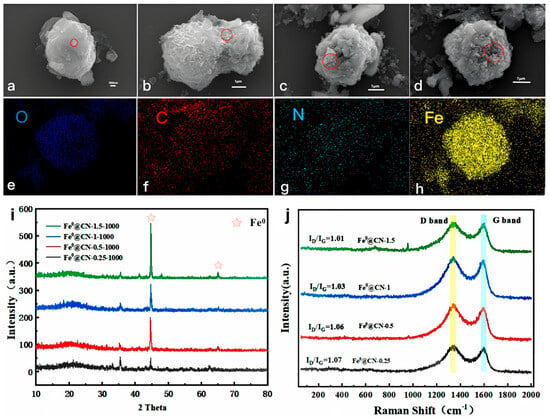
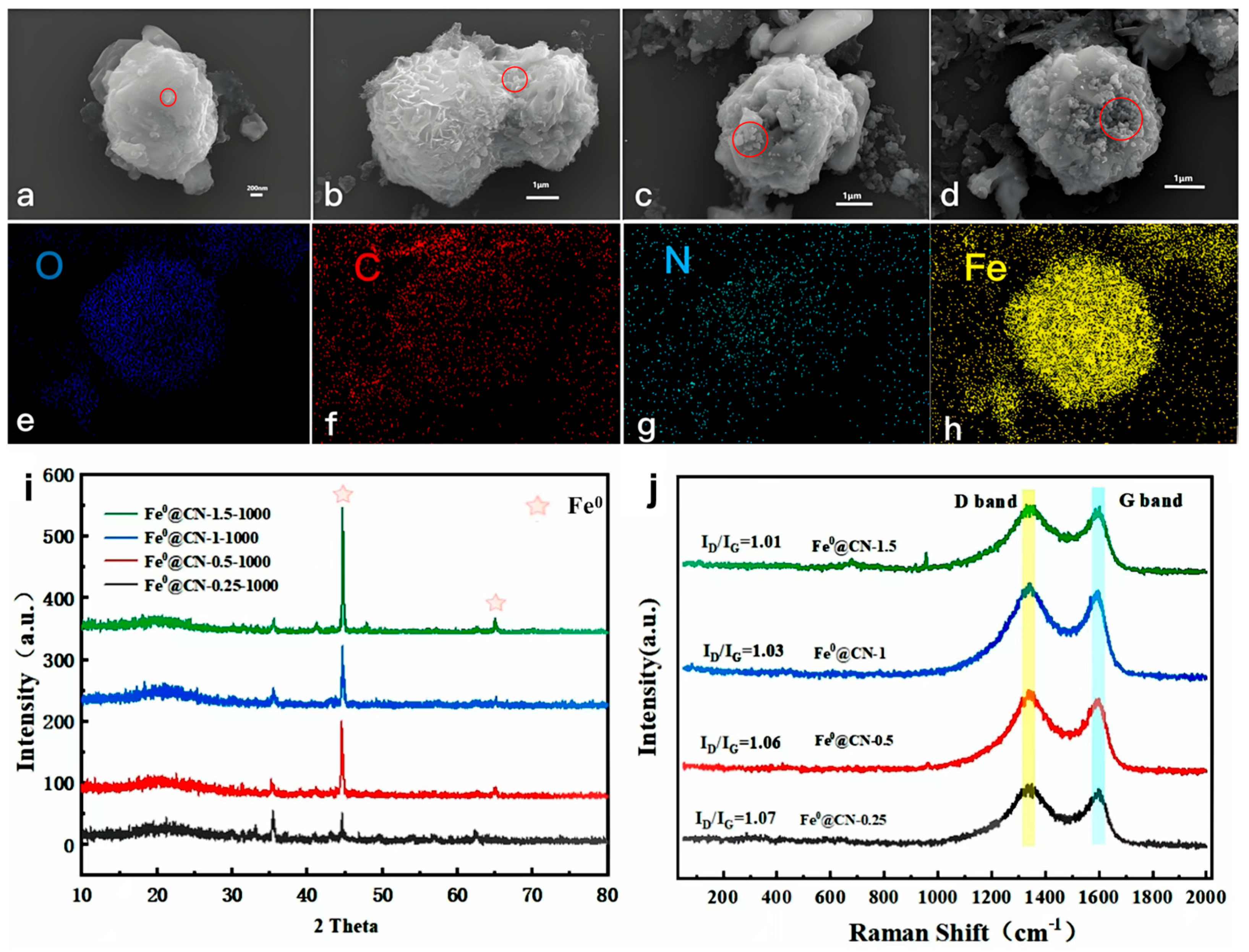
In this study, scanning electron microscopy (SEM) coupled with energy dispersive spectroscopy (EDS) was employed to characterize the morphology and elemental distribution of a series of catalyst powders. As shown in Figure 1a–d, Fe0@CN-y (y = 0.25, 0.5, 1, 1.5) samples with varying iron contents all exhibited micron-sized particles after calcination at 1000 °C with nanoscale particles attached to their surfaces. The overall morphology predominantly featured spherical or flower-like structures. EDS surface scanning analysis of the optimal Fe0@CN-1.5 sample (Figure 1e–h) revealed widespread distribution of oxygen, carbon, and nitrogen throughout the material (Figure 1e–g), while iron (Figure 1h) exhibited relatively uniform enrichment on the micron-sized particle surfaces. This confirms the effective composite formation among the three precursors and the successful loading of zero-valent iron (Fe0) with high dispersion.
Figure 1.
(a–d) SEM images of Fe0@CN-y-derived composite materials (micron-sized particles with numerous nano-sized particles (red circles) attached on their surfaces) (e–h) EDS images of Fe0@CN-1.5 (i) XRD image of Fe0@CN-y-derived composite material (The star symbols (☆) represent the diffraction peaks of metallic Fe⁰) (j) Raman image of Fe0@CN-y-derived composite material.
The elemental compositions of the Fe0@CN-y catalysts were further quantified by EDX point-scan analysis, and the results are summarized in Table S2. As the amount of the iron precursor increased from 0.25 g to 1.5 g, the surface iron atomic percentage progressively rose from 3.4 at% to 9.1 at%, confirming the successful and tunable loading of iron species onto the nitrogen-doped carbon matrix. Notably, the nitrogen content remained relatively stable (3.8–4.5 at%) across all samples, indicating that the nitrogen doping level was not significantly affected by the iron loading.
Regarding the iron distribution, the SEM images (Figure 1a–d) reveal that at lower iron loadings (Fe0@CN-0.25 and Fe0@CN-0.5), the surface-attached nanoparticles are sparse and relatively small in size. With increasing iron content, the density of these nanoparticles on the carbon surface increases, and for Fe0@CN-1.5, a uniform distribution of nanoparticles with slight aggregation is observed, but no severe agglomeration into large clusters occurs. This good dispersion can be attributed to the in situ thermal reduction process and the anchoring effect of the nitrogen-doped carbon framework, where Fe-Nx coordination sites effectively stabilize the Fe0 nanoparticles and prevent their migration and agglomeration during high-temperature pyrolysis. This uniform dispersion of iron active sites is crucial for achieving high catalytic performance in PMS activation, as it maximizes the accessibility of the active sites and minimizes mass transfer limitations.
The crystal structure of the material was analyzed via X-ray diffraction (XRD). The XRD patterns (Figure 1i) reveal distinct diffraction peaks at 44.7° and 65.0° for all Fe0@CN-y samples, corresponding to the (110) and (200) crystal planes of zero-valent iron (Fe0) (JCPDS No. 87-0721), confirming the successful loading of Fe0. As the amount of the iron precursor increases, the intensity of the Fe0 characteristic peaks gradually increases, indicating improved crystallinity. Notably, no distinct diffraction peaks characteristic of iron oxide phases such as Fe3O4 or Fe2O3 were observed within the 30–40° range. Only an extremely faint hump near 35.5° was detected, potentially originating from a weak signal generated by an ultrathin oxide layer on the surface of the Fe0 nanoparticles or representing amorphous species below the XRD detection limit. Additionally, a diffraction peak attributable to the graphitic carbon (002) plane is observed at 26.5°, indicating a certain degree of graphitization in the carbon framework. This finding is consistent with the Raman spectroscopy analysis results (where the ID/IG ratio decreases with increasing iron content). These results indicate that the prepared composite primarily consists of highly crystalline Fe0 nanoparticles uniformly loaded onto a nitrogen-doped graphitized carbon framework.
Raman spectroscopy was further employed to evaluate the structural characteristics of the carbon framework. As shown in Figure 1j, the intensity ratio of the D peak (~1350 cm−1) to the G peak (~1580 cm−1) (ID/IG) is commonly used to characterize the graphitization degree or structural defect density of carbon materials. A lower ratio typically indicates higher graphitization and a more ordered structure. In this work, the ID/IG value for Fe0@CN-0.25 was approximately 1.07, gradually decreasing with increasing iron content to 1.01 at Fe0@CN-1.5. This trend indicates that elevated iron content promotes the graphitization of the carbon material during high-temperature calcination, leading to a more developed sp2-hybridized carbon structure and reduced defects. This highly graphitized structure enhances the material’s electronic conductivity and promotes π-π interactions with organic pollutants, potentially improving its catalytic adsorption and degradation performance.
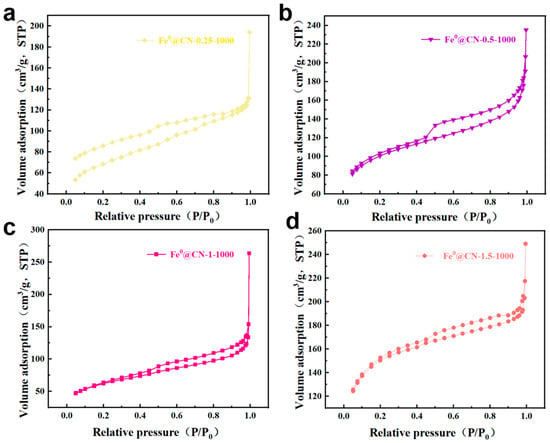
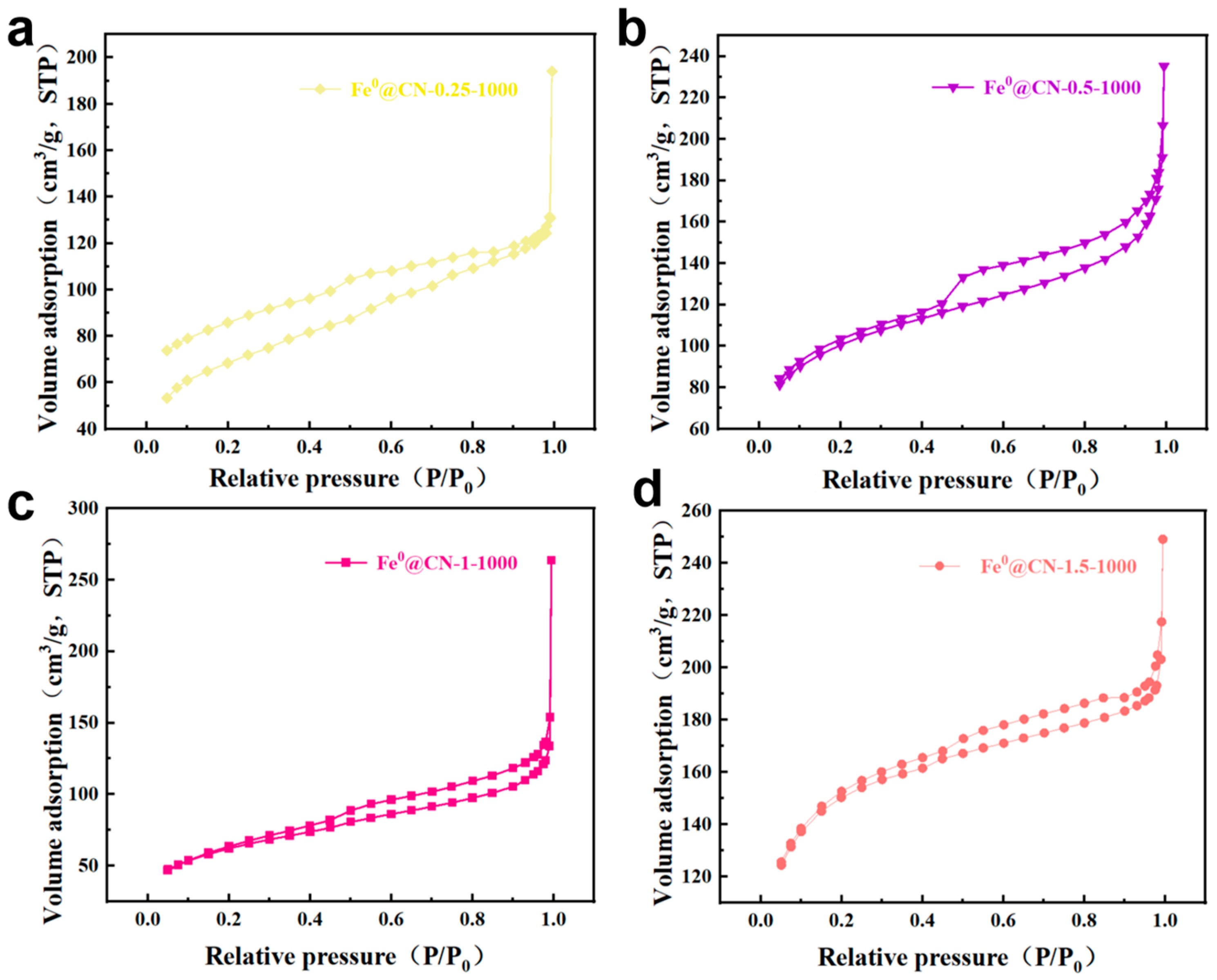
To thoroughly analyze the textural properties and surface chemistry of the materials, we further conducted N2 adsorption–desorption testing and Fourier transform infrared spectroscopy analysis. The N2 adsorption–desorption isotherms are shown in Figure 2a–d. All Fe0@CN-y samples exhibit typical Type IV isotherms accompanied by H3-type hysteresis loops, clearly confirming the presence of abundant mesoporous structures within the materials. The steps and data for calculating the specific surface area using the BET model are summarized in Text S3 and Figure S2. The results indicate a significant increase in the specific surface area with increasing iron content: Fe0@CN-0.25 (231.9 m2/g), Fe0@CN-0.5 (312.8 m2/g), Fe0@CN-1 (332.0 m2/g), reaching a maximum of 482.6 m2/g for Fe0@CN-1.5. This marked increase can be attributed to the dual role of iron species during high-temperature pyrolysis. On the one hand, iron acts as a graphitization catalyst, promoting the transformation of amorphous carbon into an ordered graphitic framework, as evidenced by the decreasing ID/IG ratio in Raman spectra with increasing iron loading. On the other hand, the iron precursor (FeCl3·6H2O) decomposes at elevated temperatures to generate gases such as HCl and H2O, which in situ etch the carbon matrix, while CO/CO2 released during the carbothermal reduction of iron oxides further contributes to pore development, effectively serving as a porogen. This synergistic effect of catalytic graphitization and chemical activation not only endows Fe0@CN-1.5 with the highest specific surface area but also generates a well-developed mesoporous structure. The corresponding pore size distribution curves (Figure S3a–d) indicate that the material’s pores are predominantly concentrated in the mesoporous range of 2–10 nm. The combination of a high specific surface area and a well-developed mesoporous structure facilitates the exposure of more active sites and promotes the mass transfer of reactant molecules, thereby creating favorable conditions for catalytic reactions.
Figure 2.
(a–d) N2 adsorption–desorption isotherms of Fe0@CN-y-derived composite materials.
To determine the actual iron loadings in the Fe0@CN-y catalysts, inductively coupled plasma optical emission spectrometry (ICP-OES) was performed after complete acid digestion. The results show that the iron content progressively increases with the precursor amount, from 3.2 wt% for Fe0@CN-0.25 to 6.5 wt%, 9.8 wt%, and 11.8 wt% for Fe0@CN-0.5, Fe0@CN-1, and Fe0@CN-1.5, respectively. This upward trend is consistent with the enhanced intensity of the Fe0 diffraction peaks in the XRD patterns (Figure 1i) and the increasing density of iron-containing nanoparticles observed by SEM (Figure 1a–d). Furthermore, the uniform distribution of iron on the carbon surface, as visualized by EDS mapping (Figure 1e–h), together with the coexistence of Fe0, Fe2+, and Fe3+ species revealed by high-resolution XPS (Figure 3c), confirms the successful incorporation of iron into the nitrogen-doped carbon matrix.
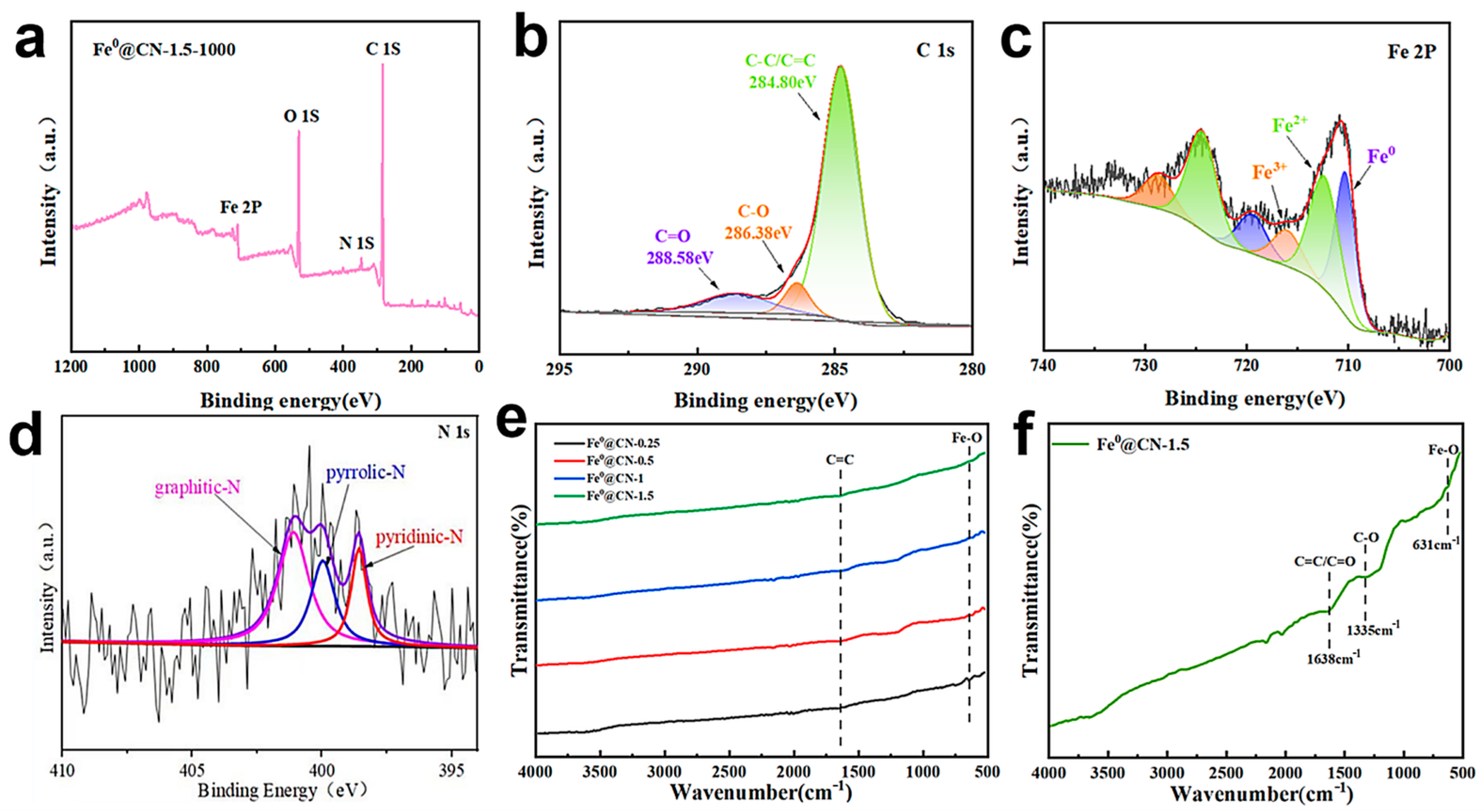
Figure 3.
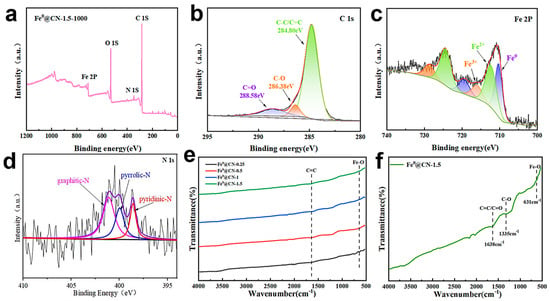
(a) XPS full spectrum of Fe0@CN-1.5 (b) C 1s orbital spectrum (c) Fe 2p orbital spectrum (d) N 1s orbital spectrum (e) Infrared spectrum comparison of Fe0@CN-y (f) Magnified infrared spectrum of Fe0@CN-1.5.
To thoroughly analyze the surface chemical composition and elemental chemical states of the Fe0@CN-1.5 sample, we further employed X-ray photoelectron spectroscopy (XPS) and Fourier transform infrared spectroscopy (FT-IR) for characterization. The full XPS spectrum (Figure 3a) clearly reveals the presence of C, O, Fe, and N elements in the sample, confirming the successful preparation of the nitrogen-doped carbon framework loaded with iron species composite material. Fitting analysis of the high-resolution spectra further elucidates the chemical environments of each element. The C 1s spectrum (Figure 3b) decomposes into three characteristic peaks: the peak at 284.8 eV corresponds to C-C/C=C bonds, the peak at 286.4 eV corresponds to C-O bonds, and the peak at 288.6 eV is attributed to C=O bonds. Fitting results of the Fe 2p spectrum (Figure 3c) indicate that iron exists in three valence states: binding energies at 710.3 eV and 719.5 eV correspond to Fe0, peaks at 712.4 eV and 724.4 eV are attributed to Fe2+, while peaks at 716.0 eV and 728.7 eV originate from Fe3+. Fitting of the N 1s spectrum (Figure 3d) indicates that nitrogen species primarily exist in three forms: pyridine nitrogen (397.5 eV), pyrrole nitrogen (401.0 eV), and graphitic nitrogen (402.2 eV). The relative abundance distribution of each chemical species is shown in Figures S4–S6: Fe2+ (50.6%) and Fe0 (32.6%) are the predominant iron species; the higher proportion of Fe2+ compared to Fe0 observed by XPS, despite synthesis under a N2 atmosphere at 1000 °C, can be explained by the surface-sensitive nature of XPS (sampling depth of 2–10 nm) and the inevitable oxidation of nanoscale zero-valent iron (nZVI) upon exposure to air during sample handling and storage. This results in a thin surface oxide layer (FeOx) where iron exists as Fe2+/Fe3+, while the bulk metallic Fe0 core remains intact and is detected by XRD. Furthermore, some Fe2+ may originate from stable Fe-Nx coordination sites formed within the nitrogen-doped carbon matrix. Thus, the XPS and XRD results are complementary rather than contradictory, and the surface Fe2+ species can still participate effectively in PMS activation. The carbon framework is dominated by sp2-hybridized C–C/C=C bonds (81.7%); while nitrogen doping types are dominated by graphitic nitrogen (46.8%) and pyrrole nitrogen (27.5%). This composition holds significant implications: graphitic nitrogen regulates charge distribution on adjacent carbon atoms, readily bonding with negatively charged oxygen atoms in persulfates to promote O-O bond cleavage; pyrrole nitrogen coordinates with iron species to form Fe-Nx active sites, thereby enhancing catalytic activity.
Furthermore, FT-IR spectra (Figure 3e,f) corroborate the surface functional group information of the material. The absorption peak at 1638 cm−1 is attributed to C=C/C=O stretching vibrations, the peak at 1335 cm−1 corresponds to C-O stretching vibrations, and the characteristic peak at 631 cm−1 originates from Fe-O bond vibrations. These results are consistent with XPS analysis, collectively confirming the coexistence of carbon framework structures, oxygen-containing functional groups, and iron–oxygen bonds within the catalyst. It is noteworthy that while XPS analysis confirms the presence of nitrogen in the form of pyridinic N, pyrrolic N, and graphitic N (Figure 3d), the FT-IR spectra (Figure 3e,f) do not exhibit the characteristic N–H stretching vibrations typically observed in the 3200–3500 cm−1 region. This absence indicates that nitrogen atoms are predominantly incorporated into the carbon lattice as doping species rather than as pendant amine groups, which is consistent with the formation of nitrogen-doped carbon frameworks. Such incorporation is essential for modulating the electronic properties of the carbon matrix and enhancing PMS activation.
2.2. Degradation Performance Evaluation
The primary organic pollutant degraded in this study was carbamazepine, with a concentration of 30 ppm. By fixing the raw material ratio of Iron (III) chloride hexahydrate: urea: rapeseed straw = 1:1:1, the optimal calcination temperature was determined by investigating the degradation performance of the synthesized composite samples activated with PMS at different temperatures.
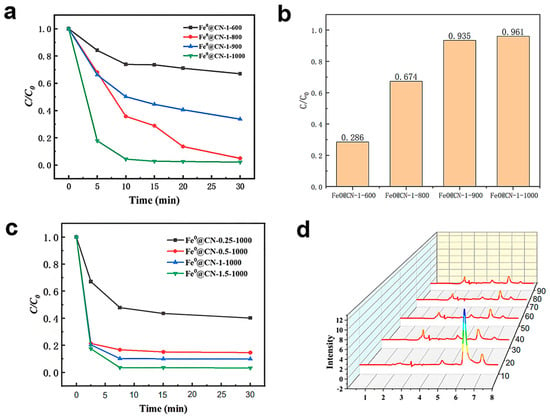
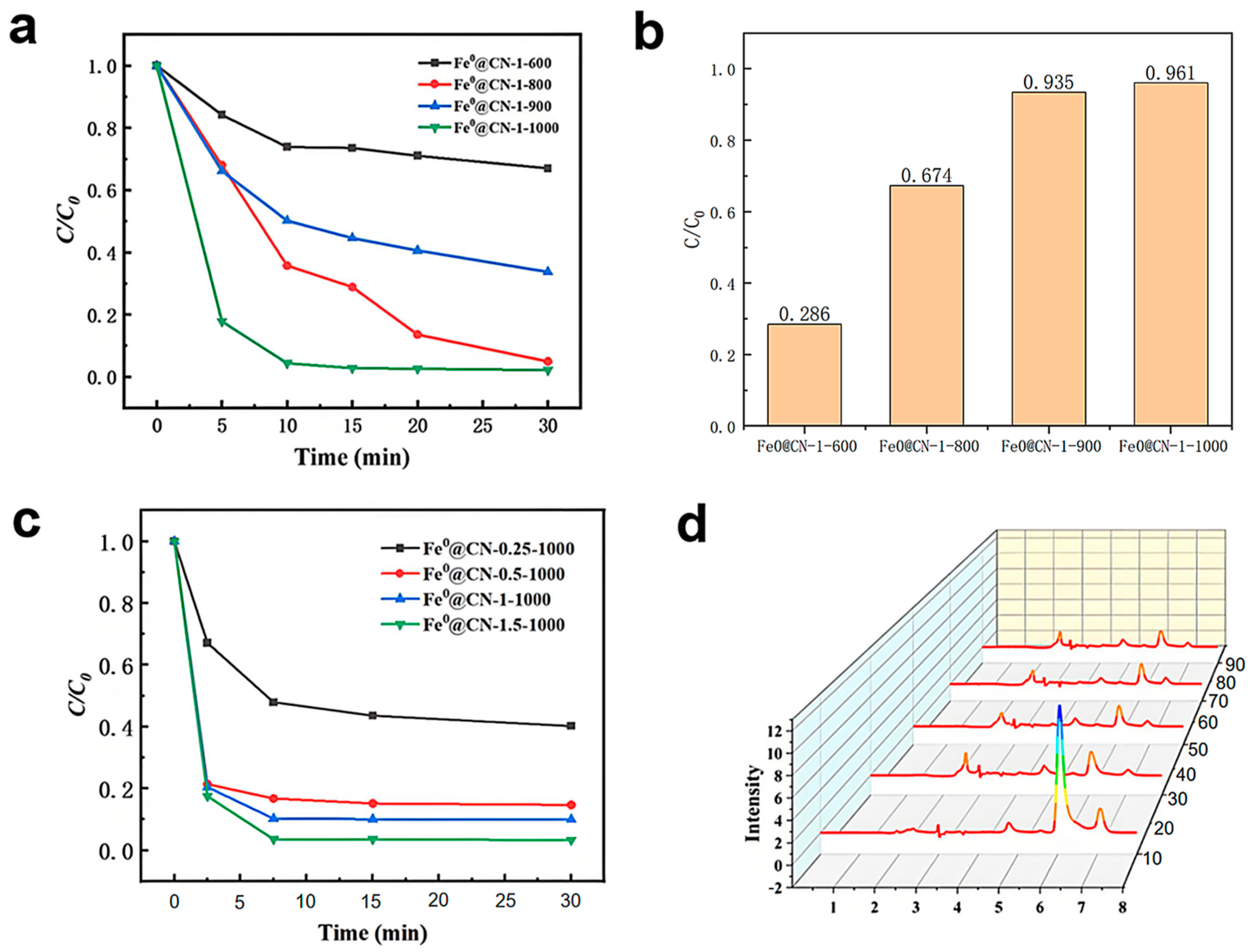
With a fixed precursor mass ratio (FeCl3·6H2O: urea: rapeseed straw = 1:1:1), the catalytic activity of the resulting materials (Fe0@CN-x) was investigated at different calcination temperatures (600, 800, 900, 1000 °C). As shown in Figure 4a,b, material performance significantly improved with increasing calcination temperature. The degradation rates of CBZ at 30 min for Fe0@CN-600, Fe0@CN-800, Fe0@CN-900, and Fe0@CN-1000 were 28.6%, 67.4%, 93.5%, and 96.1%, respectively. Fe0@CN-1000 exhibited the best performance, and thus 1000 °C was selected as the optimal calcination temperature for subsequent experiments. At a 1000 °C calcination temperature, samples with varying iron contents (y = 0.25, 0.5, 1, 1.5) were prepared (Fe0@CN-y) and their catalytic performance was evaluated. As shown in Figure 4c, the catalytic activity increased with rising iron content. Fe0@CN-1.5 exhibited the highest performance, achieving a degradation rate of 97.1% within 30 min. This sample approached complete degradation (97.1%) within 30 min, with its highly efficient degradation process visually demonstrated by significant changes in the liquid chromatography profile (Figure 4d). Consequently, Fe0@CN-1.5 was selected as the catalyst for subsequent studies. Prior to the degradation experiments, the adsorption capacity of Fe0@CN-1.5 toward CBZ was evaluated under dark conditions for 30 min. As shown in Figure S7, the catalyst reached adsorption equilibrium within 30 min, with an adsorption efficiency of 14.5% for CBZ. The concentration after adsorption equilibrium was used as the initial concentration (C0) for all subsequent kinetic analyses.
Figure 4.
(a) Degradation performance diagram of Fe0@CN-x derivative composite materials; (b) Bar chart of degradation rates; (c) Degradation performance diagram of Fe0@CN-y-derived composite materials; (d) Visual representation of CBZ degradation by Fe0@CN-1.5 in solution at different time points.
Based on the optimal catalyst Fe0@CN-1.5, the effects of the reaction conditions on its performance in activating PMS for CBZ degradation were systematically investigated.
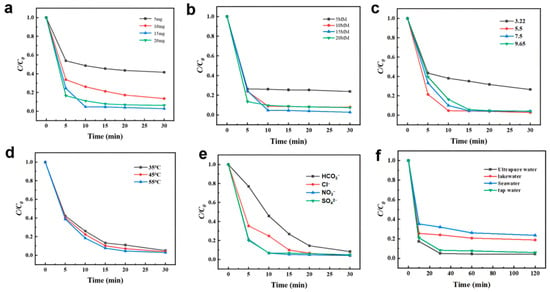
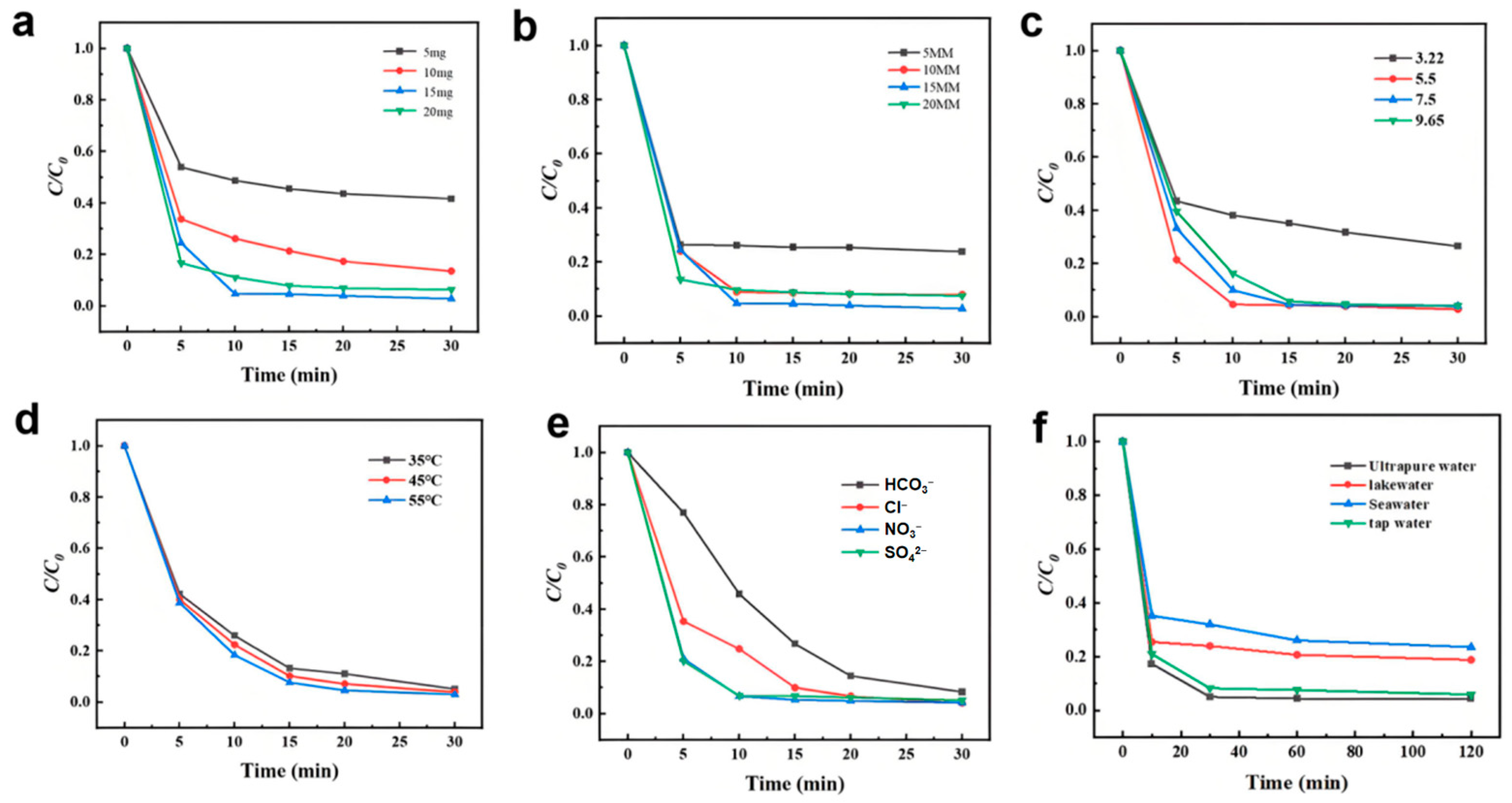
As shown in Figure 5a, the CBZ degradation rate increased with increasing catalyst loading within the range of 5 to 15 mg; however, the degradation efficiency decreased when the loading reached 20 mg. This decline may be attributed to the agglomeration of excess catalyst particles, which reduced the accessibility of the active sites. As shown in Figure 5b, the degradation rate increased with PMS concentration within the range of 5–15 mM. Efficiency decreased when the concentration reached 20 mM, likely due to the self-quenching effects of excess PMS or side reactions with active radicals, thereby reducing its effective utilization. Based on the above results, the optimal reaction conditions were determined as follows: a catalyst dosage of 15 mg (corresponding to 0.3 g/L) and a PMS concentration of 15 mM. Degradation experiments were conducted under initial pH conditions of 3.22, 5.5 (original pH of the CBZ solution), 7.5, and 9.65 (Figure 5c). Results indicate excellent degradation performance under both weakly acidic (pH 5.5) and neutral (pH 7.5) conditions, demonstrating the system’s broad pH applicability and potential for pH-free operation in practical applications. At the optimized dosage and pH, the effect of reaction temperature (25, 35, 45, 55 °C) was investigated (Figure 5d). Degradation efficiency showed only marginal improvement with increasing temperature, indicating efficient operation at ambient conditions. To assess environmental background interference, the effects of common anions were evaluated (Figure 5e). Cl−, NO3−, and SO42− exhibited negligible impact on the degradation process, while HCO3− demonstrated slight inhibitory effects, potentially attributed to its alkaline buffering contribution. Further experiments replaced the reaction medium with tap water, lake water, and seawater (Figure 5f). Compared to the high degradation efficiency (~97%) in deionized water, performance remained largely unchanged in tap water. However, the degradation rates decreased to approximately 80% and 76% in lake water and seawater, respectively. This decline is primarily attributed to competitive and quenching effects from the complex dissolved organic matter and inorganic ions present in natural water bodies.
Figure 5.
Fe0@CN-y-1.5 Process parameters for composite materials: (a) Effect of different catalyst dosages; (b) Effect of different PMS concentrations; (c) Effect of different pH values (d) Effect of different temperatures; (e) Effect of different anions; (f) Effect of pure water, lake water, seawater, and tap water.
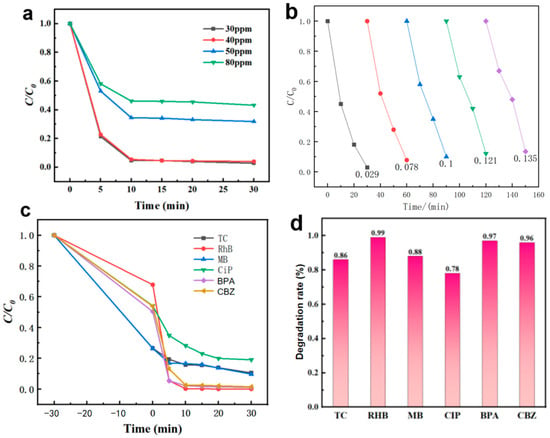
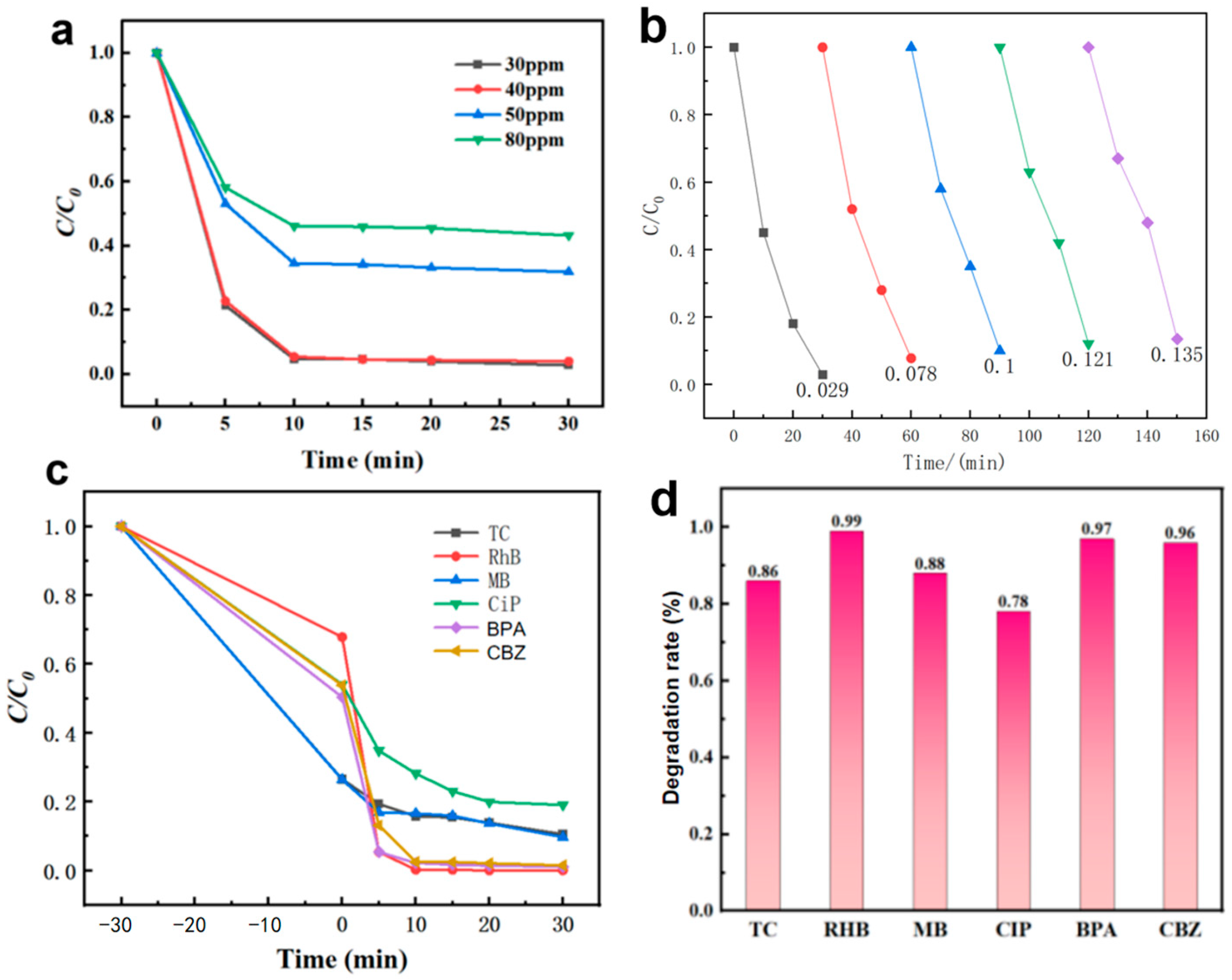
Under the determined optimal reaction conditions, the degradation performance of Fe0@CN-1.5 toward carbamazepine (CBZ) at different initial concentrations was evaluated (Figure 6a). The results indicate that for CBZ concentrations of 30 mg/L and 40 mg/L, the catalyst achieves near-complete degradation within 30 min, with degradation rates exceeding 97% in both cases. However, when the pollutant concentrations were further increased to 50 mg/L and 80 mg/L, degradation efficiencies decreased to approximately 70% and 58%, respectively, within the same reaction time. This phenomenon indicates that the degradation capacity of this system has an upper limit under fixed catalyst and oxidant dosages. The decrease in degradation efficiency may be attributed to the limited generation rate of active species (such as radicals), which cannot match the oxidant demand required for high-concentration pollutants. To achieve effective removal of higher-concentration pollutants, it may be necessary to correspondingly increase the catalyst dosage or PMS concentration to provide sufficient active oxidizing species. Catalyst stability is a critical consideration for practical applications. Using CBZ as the target pollutant, Fe0@CN-1.5 underwent five consecutive cycles of reuse (Figure 6b). After each cycle, the catalyst is recovered via centrifugation or filtration, washed repeatedly with deionized water and ethanol to remove surface-adsorbed intermediates, and then dried at 60 °C for reuse in subsequent cycles. The results indicate that after five reuse cycles, the catalyst exhibits only a slight decrease in activity while maintaining high catalytic performance, with no significant reduction in the degradation rate of CBZ. This demonstrates the excellent structural stability and reusability of Fe0@CN-1.5, indicating minimal loss of active components and structural integrity during the reaction process, thereby showcasing its potential for continuous application.
Figure 6.
(a) Degradation performance of Fe0@CN-1.5 composite materials under varying concentrations of CBZ (b) Cycling experiment (c) Degradation performance diagram of composite material Fe0@CN-1.5 against various antibiotics and dyes (d) Bar chart of degradation rates.
To evaluate the universality of the Fe0@CN-1.5/PMS system, it was applied to the degradation of various types of antibiotic and dye pollutants (Figure 6c). Under identical reaction conditions (30 min), the system demonstrated excellent degradation efficiency for tetracycline hydrochloride (TC), ciprofloxacin (CIP), Rhodamine B (RhB), methylene blue (MB), and bisphenol A (BPA), achieving degradation rates of 86%, 78%, 99%, 88%, and 97%, respectively (Figure 6d). Thus, this catalyst achieves degradation rates exceeding 80% for most of the tested pollutants. Notably, RhB, BPA, and CBZ were degraded most thoroughly, while CIP showed relatively lower efficiency, likely attributed to differences in molecular structure, reactivity, and interactions with the catalyst surface among these pollutants. Overall, Fe0@CN-1.5 demonstrates broad-spectrum degradation capabilities for multiple typical organic pollutants.
To further evaluate the structural stability and potential environmental risk of the Fe0@CN-1.5 catalyst, the concentration of leached iron ions in the reaction solution was measured by inductively coupled plasma optical emission spectrometry (ICP-OES) after 30 min of reaction under optimized conditions. The results show that the total iron leaching concentration was 0.0977 mg/L, which is significantly lower than the discharge limit for total iron in wastewater (typically 2.0–5.0 mg/L). This low iron leaching can be attributed to the robust anchoring effect of the nitrogen-doped carbon matrix, where Fe-Nx coordination sites (confirmed by XPS analysis, Figure 3d) effectively stabilize the iron species, preventing their dissolution into the aqueous phase. Furthermore, the uniform dispersion of Fe0 nanoparticles within the carbon framework (evidenced by SEM and EDS mapping, Figure 1e–h) minimizes direct exposure of iron to the reaction medium, further suppressing leaching. The low iron release observed is consistent with the excellent reusability of the catalyst (Figure 6b), which retained high catalytic activity after three cycles, indicating that the active iron species remain largely immobilized on the support. These results demonstrate that the Fe0@CN-1.5 catalyst possesses good structural stability and environmental compatibility, making it a promising candidate for practical wastewater treatment applications.
2.3. Catalytic Mechanism
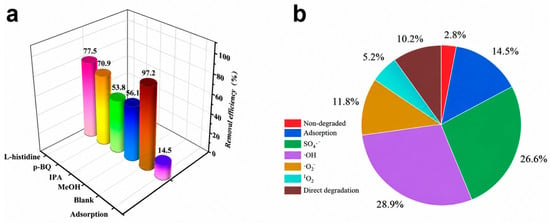
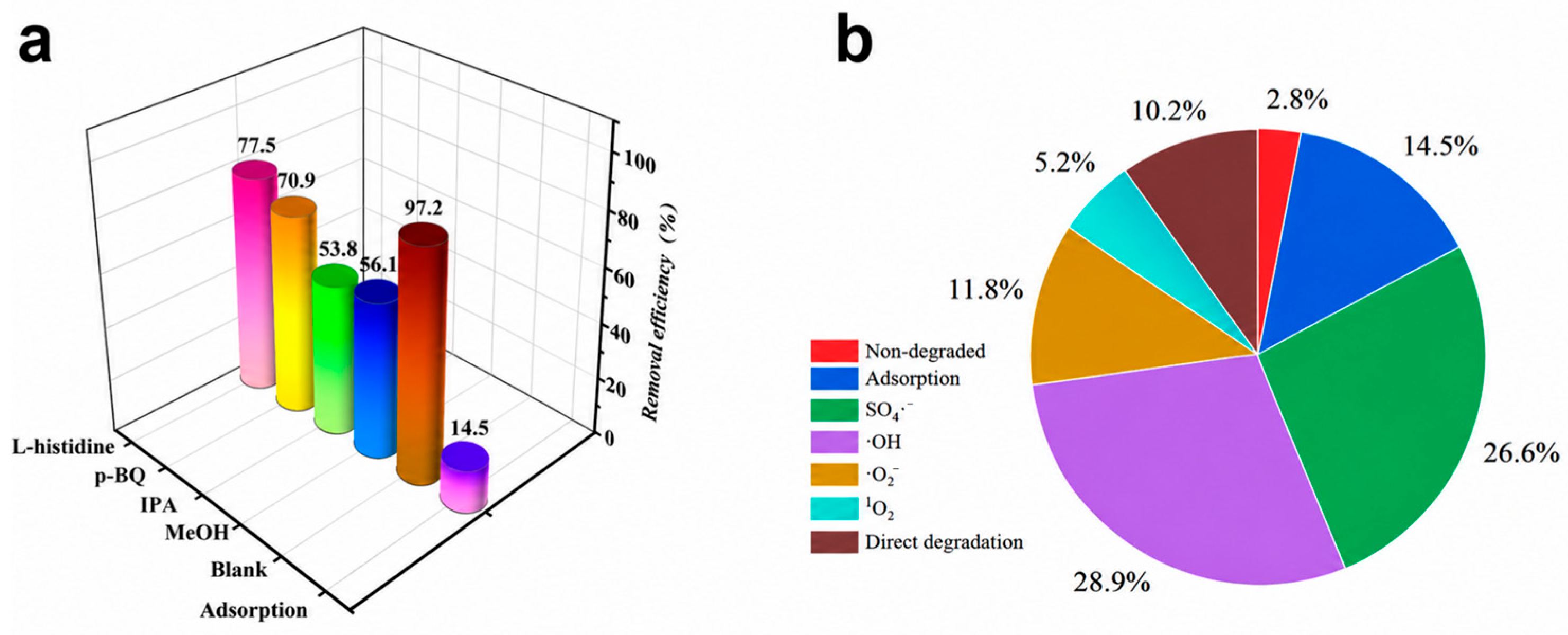
In the Fe0@CN-1.5/PMS catalytic system, pollutant degradation typically results from the synergistic action of multiple active species. To identify the key active species involved, radical quenching experiments were conducted using 30 mg/L CBZ as the target pollutant. Methanol (MeOH) and isopropanol (IPA) were selected as specific quenchers for sulfate radicals (·SO4−) and hydroxyl radicals (·OH), respectively. P-benzoquinone (p-BQ) and L-histidine were used to quench superoxide radicals (·O2−) and singlet oxygen (1O2), respectively. (1O2). A control group without any quenchers was also included.
The experimental results are shown in Figure 7a. Compared to the control group’s high degradation rate of 97.2%, the addition of MeOH and IPA significantly inhibited the degradation efficiency of CBZ to 56.1% and 53.8%, respectively, with similar degrees of inhibition. This indicates that both ·SO4− and ·OH play crucial roles in the degradation process. When p-BQ was added, the degradation rate decreased to 70.9%, demonstrating that ·O2− also participates in the reaction, though its contribution is secondary to the former two species. Upon the addition of L-histidine, the degradation rate dropped to 77.5%, suggesting that 1O2 contributes to degradation via non-radical pathways but is not the dominant factor. To quantitatively evaluate the contribution of each reactive species, radical quenching experiments were conducted and the degradation kinetic data were fitted using a pseudo-first-order model (detailed in Text S4). Based on the calculated rate constants (), the contributions of ·SO4−, ·OH, ·O2−, and 1O2 to CBZ degradation were determined to be 26.6%, 28.9%, 11.8%, and 5.2%, respectively (Figure 7b). The order of contribution was ·OH > ·SO4− > ·O2− > 1O2, indicating that radical pathways dominate the degradation process, while non-radical pathways (1O2 and electron transfer) also contribute.
Figure 7.
Fe0@CN-y-1.5 composite material: (a) 3D columnar degradation rate diagram; (b) Radical contribution rate statistical diagram.
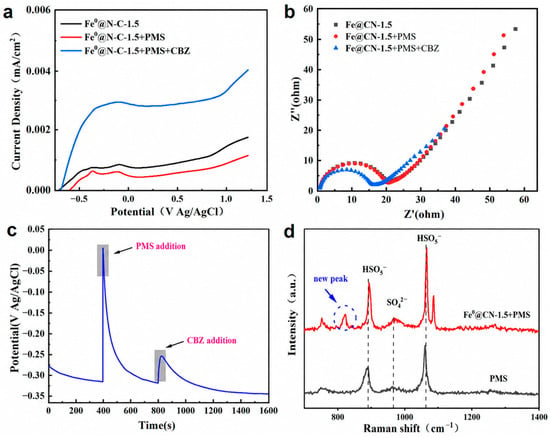
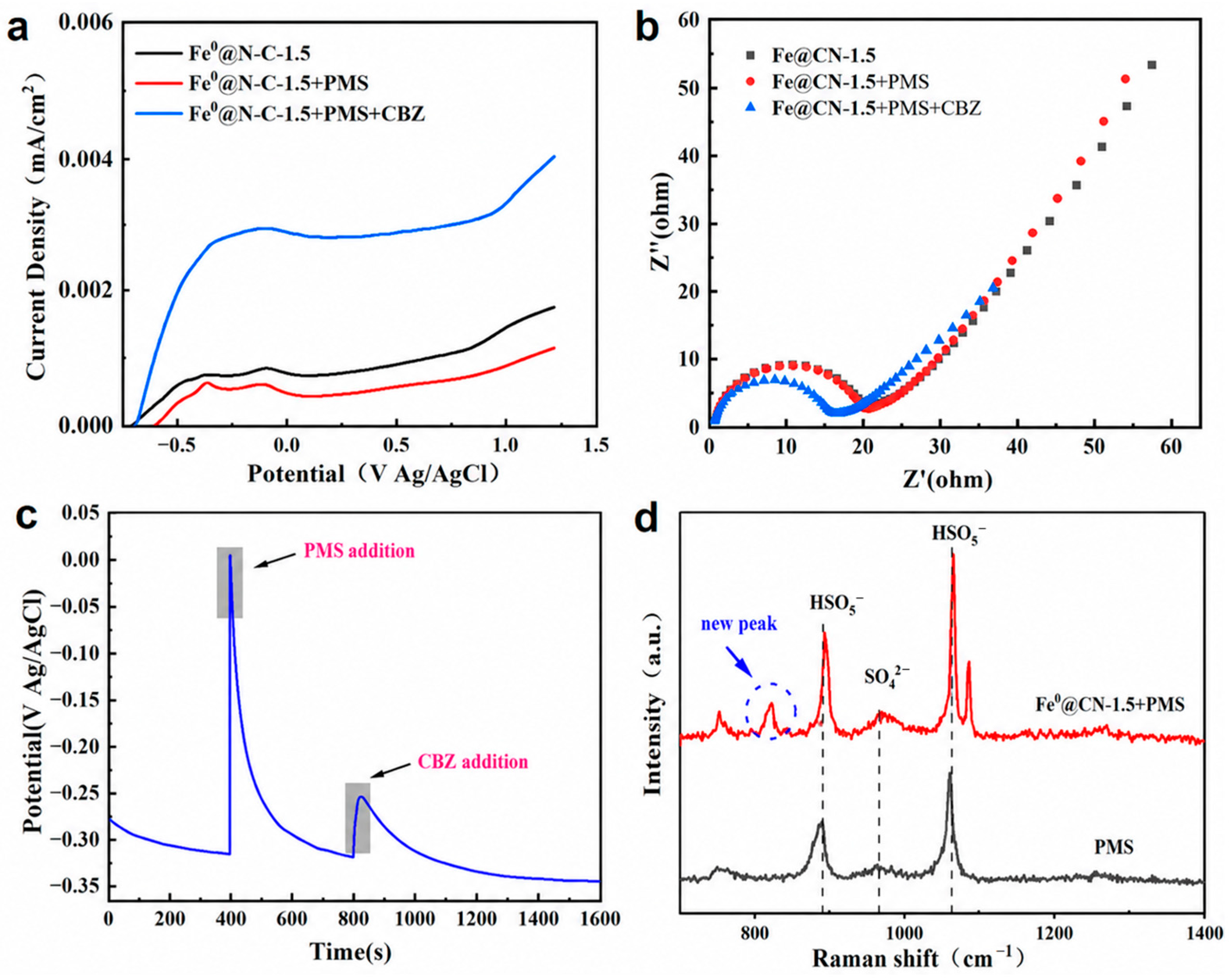
In the Fe0@CN-1.5/PMS system, radical and non-radical pathways operate simultaneously rather than competitively. The radical pathway is dominated by ·SO4−and ·OH, which originate from the activation of PMS by Fe0/Fe2+ species and the graphitic carbon framework. The non-radical pathway involves both singlet oxygen (1O2) and an electron transfer process, as evidenced by the quenching experiments (Figure 7a) and the direct observation of a metastable Fe0@CN-1.5-PMS* complex via in situ Raman spectroscopy (Figure 8d). These two pathways are not mutually exclusive; instead, they are mediated by different active sites within the same catalyst and collectively contribute to the rapid degradation of CBZ. Based on the radical quenching experiments, the contributions of ·SO4−, ·OH, and 1O2 were quantitatively determined to be 26.6%, 28.9%, and 5.2%, respectively, using the inhibition of the pseudo-first-order rate constants (Table S1). Therefore, the total contribution of the identified radical and 1O2 pathways accounts for approximately 60.7% of the degradation. The remaining 39.3% can be reasonably attributed to the electron transfer pathway, which is supported by the electrochemical analyses: (i) the higher onset potential and strongest current response in the Fe0@CN-1.5/PMS/CBZ system compared to the control systems (Figure 8a); (ii) the lowest charge transfer resistance in the complete system (Figure 8b); and (iii) the direct current response upon PMS and CBZ addition (Figure 8c), indicating that Fe0@CN-1.5 acts as an electron transfer mediator. While a complete separation of the electron transfer contribution from the electrochemical data alone is not feasible, the combination of quenching experiments and electrochemical evidence allows for a semi-quantitative estimation that places the electron transfer pathway as a major non-radical contributor (~39%). This dual-pathway mechanism, combining the high oxidation power of radicals with the selectivity and stability of the electron transfer process, accounts for the excellent catalytic performance of Fe0@CN-1.5 (Text S5).
Figure 8.
Fe0@CN-y-1.5 composite material: (a) LSV; (b) EIS impedance test diagram; (c) i-t curve; (d) In situ Raman test diagram.
To further elucidate the electron transfer behavior of the catalyst during the reaction, a series of electrochemical tests were conducted using a three-electrode system. As shown in Figure 8a, compared to the pure Fe0@CN-1.5 and Fe0@CN-1.5/PMS systems, the Fe0@CN-1.5/PMS/CBZ system exhibited a higher onset potential and the strongest current response. This result clearly indicates that in the presence of CBZ, the Fe0@CN-1.5 catalyst significantly accelerates the electron transfer process between PMS activation and pollutant oxidation, thereby efficiently driving the catalytic degradation of CBZ. Charge transfer resistance was evaluated via EIS testing. As shown in Figure 8b, Fe0@CN-1.5 alone exhibits a large impedance arc radius, indicating significant charge transfer resistance. Upon the addition of PMS addition, the impedance slightly decreased. In the complete Fe0@CN-1.5/PMS/CBZ system, the impedance arc radius became minimal, indicating the lowest charge transfer resistance and the highest conductivity, which facilitates rapid electron transfer across the reaction interface. The current changes during the reaction were monitored in real-time via i-t curves (Figure 8c). Upon adding PMS to the Fe0@CN-1.5 suspension, the current value immediately increased significantly, indicating rapid electron transfer between the catalyst and PMS, where PMS was activated by acquiring electrons from the electron-rich region of the catalyst. Subsequently, upon adding CBZ, the current curve exhibited pronounced fluctuations, providing direct evidence that Fe0@CN-1.5 acts as an electron transfer mediator between PMS and CBZ molecules, directly catalyzing the oxidative degradation of pollutants. To obtain direct evidence for the non-radical electron transfer pathways, in situ Raman spectroscopy was performed. As shown in Figure 8d, the PMS solution alone exhibits characteristic peaks at 1082 cm−1 and 986 cm−1 corresponding to HSO5− and SO42−, respectively. Upon adding the Fe0@CN-1.5 catalyst to the PMS solution, a new characteristic peak appears at 825 cm−1, attributed to the bending vibration of the metal–peroxy bond (M-O-O). This result directly confirms the formation of a metastable Fe0@CN-1.5-PMS reaction intermediate complex on the catalyst surface, providing crucial spectroscopic evidence for the existence of a non-radical electronic transfer pathway in this system.
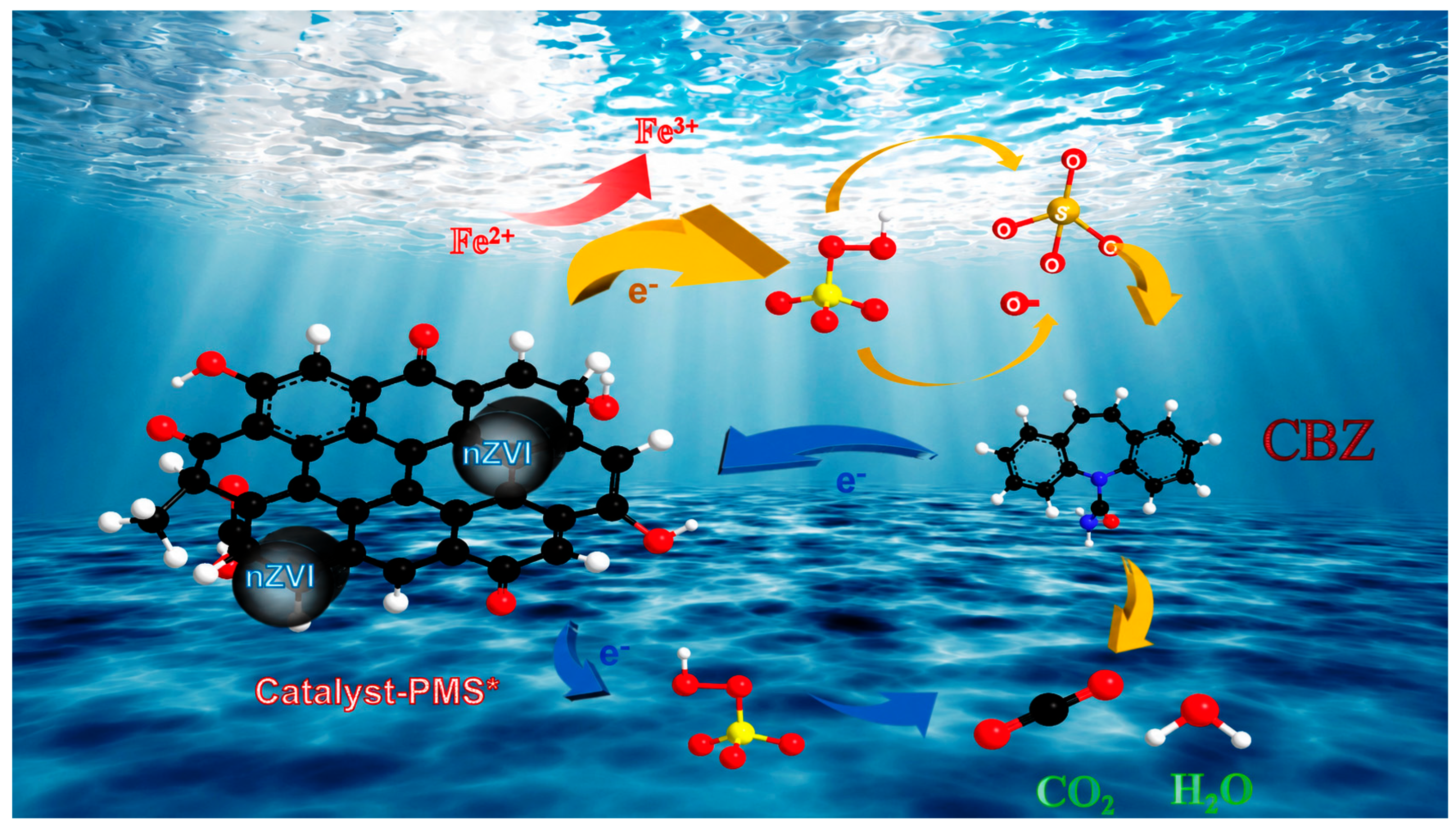
The degradation mechanism is illustrated in Figure 9. The reactions that may occur during degradation are summarized in Equations (1)–(10):
C-π + HSO5− → C = π+ + OH− + ·SO4−
Fe0 + HSO5− + H+ → Fe2+ + ·SO4− + H2O
Fe2+ + HSO5− → Fe3+ + ·SO4− + ·OH
HSO5− + H2O → H2O2 + HSO4−
·SO4− + H2O2 → SO42− + ·O2− + 2H+
·OH + H2O2 → ·HO2 + H2O
·HO2 → ·O2− + H+
·O2- + ·HO2 → 1O2 + HO2−
HSO5− + SO52− → HSO4− + SO42− + 1O2
·SO4−/·OH/·O2−/1O2 + CBZ → Multiple Steps → CO2 + H2O
Figure 9.
Reaction mechanism analysis diagram for the system: Fe0@CN-1.5/PMS/CBZ. (Catalyst-PMS* denotes the metastable Fe0@CN-1.5–PMS intermediate complex formed during PMS activation, while the arrows indicate the proposed electron-transfer and reaction pathways involved in CBZ degradation.).
Based on the aforementioned test analysis, the mechanism of action for the Fe0@CN-1.5/PMS/CBZ system involves both radical and non-radical pathways. ·SO4−, ·OH, ·O2−, and 1O2 all participate in the degradation reaction, with ·SO4− and ·OH being the primary reactive oxygen species. Combined with the appearance of abundant zero-valent iron particles and the formation of graphitic structures in the calcined Fe0@CN-1.5, it is speculated that both the abundant C-π active sites and Fe0 sites in the sample structure can activate PMS to form ·OH and SO42−. During this process, iron undergoes a transformation from Fe0 → Fe2+ → Fe3+, leading to the consumption of some Fe0, while a continuous conversion also occurs between the reactive oxygen species. On the other hand, the electron transfer pathway involves PMS adsorption on the Fe0@CN-1.5 catalyst, forming a metastable Fe0@CN-1.5-PMS complex. The resulting Fe0@CN-1.5-PMS can elevate the redox potential of Fe0@CN-1.5. When Fe0@CN-1.5 exceeds the oxidation potential of CBZ, Fe0@CN-1.5-PMS extracts electrons from CBZ, facilitating its rapid decomposition via electron transfer.
To evaluate the mineralization efficiency of CBZ in the Fe0@CN-1.5/PMS system, total organic carbon (TOC) analysis was conducted after 30 min of reaction under optimized conditions (catalyst 0.3 g/L, PMS 15 mM, and initial pH 5.5). The results show that the TOC removal efficiency reached 56.7%, while the CBZ degradation efficiency was 97% under identical conditions. This discrepancy between degradation and mineralization is commonly observed in persulfate-based advanced oxidation processes, as the rapid cleavage of the parent CBZ molecule initially generates a variety of organic intermediates (e.g., hydroxylated and ring-opening products) that are not immediately mineralized to CO2 and H2O. The partial mineralization observed (56.7%) confirms that the Fe0@CN-1.5/PMS system not only efficiently degrades CBZ but also achieves substantial conversion of organic carbon into inorganic forms. The relatively high mineralization efficiency can be attributed to the synergistic effect of radical (·SO4−, ·OH) and non-radical (1O2, electron transfer) pathways, which collectively promote the deep oxidation of the pollutant.
2.4. Practical Application
The organic pollutants and dyes subjected to degradation in the aforementioned experiments were prepared using laboratory-grade analytical reagents and distilled water. Given the complex composition of wastewater in real-world environments, to better evaluate the degradation performance of the prepared composite catalyst Fe0@CN-1.5 activated with PMS, this experiment utilized effluent from the secondary sedimentation tank of a coking plant in Guangxi (COD = 150–180 mg/L, pH = 7.2–8.1) as the study subject. Its COD value was determined according to the “Determination of Chemical Oxygen Demand in Water by Potassium Dichromate Method”, characterizing the total amount of reducible substances in the water sample that can be oxidized by strong oxidizing agents (K2Cr2O7) under acidic conditions. These include thiosulfate (S2O32−), ferrous ions (Fe2+), and volatile fatty acids (VFAs), which are primarily organic compounds. Thus, it also serves as an indicator for the organic matter content in the water samples. Since the simulated experimental environment featured low concentrations and simple compositions of degradable substances, the actual wastewater conditions were approximated by increasing the catalyst dosage and the PMS concentration. To achieve measurable degradation, the catalyst dosage and the PMS concentration were increased tenfold to 3 g/L and 150 mM, respectively, compared to the optimal lab-scale conditions. The reaction time was extended to 120 min. The pre-degradation sample was designated as raw water, and the post-degradation sample as degraded water. After calculating the COD value for each group, the average of three groups was taken. The final measured COD value of the raw water before degradation was 694.35 mg/L, while the COD value of the degraded water after degradation was 318 mg/L, yielding a degradation rate of 45.8%. This indicates that the composite sample catalyst prepared in this study holds certain application value in practical wastewater treatment.
3. Materials and Methods
3.1. Chemicals
Ferric chloride hexahydrate (FeCl3·6H2O), urea (CO(NH2)2), rapeseed straw ((C6H10O5)n), potassium persulfate ((NH2CH2)2), carbamazepine (CBZ), anhydrous ethanol (C2H5OH), isopropanol (C3H8O), methanol (CH4O), L-histidine (C8H18), p-benzoquinone (C6H4O2), sodium hydroxide (NaOH), hydrochloric acid (HCl), sodium chloride (NaCl), sodium sulfate (Na2SO4), distilled water (H2O), sodium nitrate (NaNO3). All chemicals were of analytical grade and purchased from Aladdin Reagent Co., Ltd. (Shanghai, China) unless otherwise specified.
3.2. Synthesis of Catalysts
Fe0@CN composites were prepared via a one-pot calcination process. Using rapeseed straw, urea, and iron(III) chloride hexahydrate as precursors, the samples were calcined at different temperatures (600–1000 °C) under a nitrogen atmosphere with a flow rate of 100 mL/min and a heating rate of 5 °C/min. The samples were then held at the final temperature before being allowed to cool naturally to room temperature, yielding Fe0@CN-y (y = 0.25, 0.5, 1, and 1.5 g of FeCl3·6H2O). Determinations indicated that the optimal calcination temperature was 1000 °C, and the resulting sample was designated Fe0@CN-1.5. Detailed preparation procedures for all catalysts are provided in the Supplementary Materials (Text S1 and Figure S1).
3.3. Characterization and Analytical Methods
This study systematically characterized the morphology and structure of the catalyst. The microstructure was observed using scanning electron microscopy (SEM). The crystal structure, surface functional groups, and elemental chemical states were determined by X-ray diffraction (XRD), Fourier transform infrared spectroscopy (FT-IR), and X-ray photoelectron spectroscopy (XPS), respectively. The actual iron contents of the Fe0@CN-y catalysts were determined by inductively coupled plasma optical emission spectrometry (ICP-OES). The mineralization efficiency of CBZ was evaluated by measuring total organic carbon (TOC) using a TOC analyzer. The concentration of leached iron ions in the reaction solution was determined by ICP-OES after filtration. The reusability of the catalyst was evaluated by consecutive degradation cycles, with the catalyst recovered by centrifugation, washed, and dried before reuse. The elemental composition and distribution of the catalysts were analyzed by energy-dispersive X-ray spectroscopy (EDS) coupled with SEM. The microstructure and morphology were further examined by transmission electron microscopy (TEM). The degree of graphitization and the defect structure of the material were evaluated using Raman spectroscopy. The specific surface area and pore structure were analyzed via nitrogen adsorption–desorption testing. The degradation performance of the catalyst was assessed through liquid chromatography and chemical oxygen demand (COD) analysis. The reaction mechanism was investigated using radical quenching experiments, electrochemical testing, and in situ Raman spectroscopy. Detailed characterization methods and analytical conditions are provided in the Supplementary Materials (Text S2) Data processing and plotting were performed using OriginPro 2021 (OriginLab Corporation, Northampton, MA, USA).
3.4. Experimental Procedures
The primary organic pollutant used in these experiments was 30 ppm carbamazepine, used to evaluate the degradation performance of the prepared catalyst. All degradation experiments were repeated three times, and the results are expressed as the mean ± standard deviation. Specifically, 15 mg of Fe0@CN-x was weighed into a 70 mL quartz test tube. A total of 50 mL of the pre-prepared 30 mg/L carbamazepine solution was added using a graduated cylinder. An equivalent magnetic stir bar was placed into the photoreactor. First, the stirring function was activated for 30 min to achieve adsorption equilibrium. Using a pipette, 4 mL of the solution was transferred into a small centrifuge tube pre-filled with 100 μL of methanol as an equilibrium reference point. After adding 1 mL of the persulfate, 4 mL was periodically pipetted from the quartz test tube into the centrifuge tube at regular intervals. The sample was then transferred to a liquid chromatography vial using a disposable syringe and a 0.2 μm pore size filter for liquid chromatography analysis.
The Fe0@CN-y samples were weighed separately, and degradation of 30 ppm carbamazepine was performed following the same procedure as described above. Finally, the degradation of other antibiotics and dyes was evaluated to further assess the applicability and versatility of the catalyst.
4. Conclusions
In summary, this work successfully fabricated a nitrogen-doped biochar composite loaded with zero-valent iron nanoparticles (Fe0@CN-1.5) via a one-pot calcination method using rapeseed straw, urea, and iron (III) chloride as precursors. The optimal material (Fe0@CN-1.5) exhibited a high specific surface area (482.6 m2/g), a well-developed graphitic structure, and uniformly dispersed Fe0 nanoparticles stabilized by Fe-Nx coordination sites. Under optimized conditions (0.3 g/L catalyst, 15 mM PMS, initial pH 5.5), the Fe0@CN-1.5/PMS system achieved 97.1% degradation of carbamazepine (30 mg/L) within 30 min, demonstrating excellent performance across a wide pH range, in various real water matrices (tap water, lake water, and seawater), and against multiple organic pollutants (TC, CIP, RhB, MB, and BPA), with good reusability over five cycles. Mechanistic investigations revealed that the outstanding catalytic activity originates from the simultaneous contribution of both radical and non-radical pathways: radical pathways dominated by ·SO4− and ·OH, and non-radical pathways involving singlet oxygen (1O2) as well as a direct electron transfer process mediated by the catalyst–PMS* complex, as evidenced by quenching experiments, electrochemical analysis, and in situ Raman spectroscopy. This work provides an efficient and stable carbon-based catalyst for persulfate activation and offers a fundamental understanding of the coexistence of radical and non-radical mechanisms, presenting a promising strategy for the treatment of antibiotic-contaminated wastewater.
Supplementary Materials
The following supporting information can be downloaded at: https://www.mdpi.com/article/10.3390/catal16060520/s1, Figure S1. Flowchart for the Preparation of Fe0@CN Composite Materials; Figure S2. Statistical plot of specific surface area for Fe0@CN-y-derived composites; Figure S3. (a–d) Pore size distribution diagrams of Fe0@CN-y-derived composite materials; Figure S4. Distribution map of Fe elements in different forms in Fe0@CN-1.5; Figure S5. Distribution map of C elements in different forms; Figure S6. Distribution map of N elements in different forms; Figure S7. Adsorption kinetics of CBZ on Fe0@CN-1.5 under dark conditions; Table S1. Pseudo-first-order rate constants and contributions of reactive species in the Fe0@CN-1.5/PMS/CBZ system; Table S2. Elemental compositions of Fe0@CN-y catalysts determined by EDX analysis (at.%). Text S1. Detailed catalyst preparation procedures. Text S2. Detailed characterization methods and analytical conditions. Text S3. Determination of specific surface area and pore structure. Text S4. Quantitative assessment of reactive species contributions. Text S5. Semi-quantitative estimation of electron transfer contribution.
Author Contributions
Z.C.: Writing—review and editing, Writing—original draft, Visualization, Software, Methodology, Investigation, Data curation, Conceptualization. J.Z.: Writing—original draft, Visualization, Methodology, Investigation, Conceptualization. D.C.: Writing—review and editing, Resources, Methodology, Funding acquisition, Conceptualization. Y.L.: Writing—review and editing, Visualization, Methodology, Data curation, Funding acquisition. G.D.: Writing—review and editing, Visualization, Software. All authors have read and agreed to the published version of the manuscript.
Funding
This work was partly supported by the National Natural Science Foundation of China (No. 21978276), the Open Project of Hebei Key Laboratory of Photoelectric Control on Surface and Interface (No. ZD2023001), the National Natural Science Foundation of China (No. 52262042), and the Yunnan Fundamental Research Projects (No. 202301AT070060).
Data Availability Statement
The datasets generated and analyzed during the current study are available from the corresponding author upon reasonable request.
Acknowledgments
This work was partly supported by the National Natural Science Foundation of China (No. 21978276), the Open Project of Hebei Key Laboratory of Photoelectric Control on Surface and Interface (No. ZD2023001), the National Natural Science Foundation of China (No. 52262042), and the Yunnan Fundamental Research Projects (No. 202301AT070060). Acknowledgment to China University of Geosciences (Beijing) for the high-performance computing platform.
Conflicts of Interest
The authors declare no conflicts of interest.
Abbreviations
The following abbreviations are used in this manuscript:
| PMS | Peroxymonosulfate |
| CBZ | Carbamazepine |
| SEM | Scanning Electron Microscopy |
| EDS | Energy-Dispersive X-ray Spectroscopy |
| XRD | X-ray Diffraction |
| ICP-OES | inductively coupled plasma optical emission spectrometry |
| FT-IR | Fourier Transform Infrared Spectroscopy |
| XPS | X-ray Photoelectron Spectroscopy |
| BET | Brunauer–Emmett–Teller |
| COD | Chemical Oxygen Demand |
| BPA | Bisphenol A |
| ETP | Electron Transfer Pathway |
| MeOH | Methanol |
| IPA | Isopropanol |
| p-BQ | p-Benzoquinone |
| EIS | Electrochemical Impedance Spectroscopy |
| LSV | Linear Sweep Voltammetry |
References
- Wang, J.; Wang, S. Activation of Persulfate (PS) and Peroxymonosulfate (PMS) and Application for the Degradation of Emerging Contaminants. Chem. Eng. J. 2018, 334, 1502–1517. [Google Scholar] [CrossRef] [Scilit]
- Anipsitakis, G.P.; Dionysiou, D.D. Radical Generation by the Interaction of Transition Metals with Common Oxidants. Environ. Sci. Technol. 2004, 38, 3705–3712. [Google Scholar] [CrossRef] [Scilit]
- Martínez-Huitle, C.A.; Rodrigo, M.A.; Sirés, I.; Scialdone, O. Single and Coupled Electrochemical Processes and Reactors for the Abatement of Organic Water Pollutants: A Critical Review. Chem. Rev. 2015, 115, 13362–13407. [Google Scholar] [CrossRef] [Scilit]
- Wang, Y.; Zhao, H.; Zhao, G. Iron-Copper Bimetallic Nanoparticles Embedded within Ordered Mesoporous Carbon as Effective and Stable Heterogeneous Fenton Catalyst for the Degradation of Organic Contaminants. Appl. Catal. B Environ. 2015, 164, 396–406. [Google Scholar] [CrossRef] [Scilit]
- Duan, X.; Sun, H.; Wang, S. Metal-Free Carbocatalysis in Advanced Oxidation Reactions. Acc. Chem. Res. 2018, 51, 678–687. [Google Scholar] [CrossRef] [Scilit]
- Wacławek, S.; Lutze, H.V.; Grübel, K.; Padil, V.V.T.; Černík, M.; Dionysiou, D.D. Chemistry of Persulfates in Water and Wastewater Treatment: A Review. Chem. Eng. J. 2017, 330, 44–62. [Google Scholar] [CrossRef] [Scilit]
- Yang, Y.; Jiang, J.; Lu, X.; Ma, J.; Liu, Y. Production of Sulfate Radical and Hydroxyl Radical by Reaction of Ozone with Peroxymonosulfate: A Novel Advanced Oxidation Process. Environ. Sci. Technol. 2015, 49, 7330–7339. [Google Scholar] [CrossRef] [Scilit] [PubMed]
- He, X.; De La Cruz, A.A.; Dionysiou, D.D. Destruction of Cyanobacterial Toxin Cylindrospermopsin by Hydroxyl Radicals and Sulfate Radicals Using UV-254 Nm Activation of Hydrogen Peroxide, Persulfate and Peroxymonosulfate. J. Photochem. Photobiol. Chem. 2013, 251, 160–166. [Google Scholar] [CrossRef] [Scilit]
- Ma, D.; Huo, X.; Lai, C.; Yi, H.; Zeng, L.; Xu, F.; Yan, H.; Zhou, X.; Fan, X.; Tang, L.; et al. Hollow Carbon Nanocage-Loaded Fe Single-Atom Mediated Electron Transfer Process for Antibiotics Removal: Coordination Environment and Mechanism Investigation. Appl. Catal. B Environ. Energy 2026, 381, 125894. [Google Scholar] [CrossRef] [Scilit]
- Huo, X. Reactive Complexes Mediated Singlet Oxygen Production by MnO2 Catalyzed Peracetic Acid: Characterization and DFT Study. Chem. Eng. J. 2024, 497, 154571. [Google Scholar] [CrossRef] [Scilit]
- Zhang, S.; Lu, Z.; Hu, C.; Li, F. Understanding the Distance Effect of the Single-Atom Active Sites in Fenton-Like Reactions for Efficient Water Remediation. Adv. Sci. 2024, 11, 2307151. [Google Scholar] [CrossRef] [Scilit] [PubMed]
- Gu, D. Cobalt-Doped Iron-Based Metal–Organic Gels as Efficient Visible-Light-Driven Peroxymonosulfate Activators for the Efficient Degradation of Norfloxacin with Simultaneous Antibacterial Activity. Chem. Eng. J. 2024, 486, 149892. [Google Scholar] [CrossRef] [Scilit]
- Zhang, P.; Yang, Y.; Duan, X.; Liu, Y.; Wang, S. Density Functional Theory Calculations for Insight into the Heterocatalyst Reactivity and Mechanism in Persulfate-Based Advanced Oxidation Reactions. ACS Catal. 2021, 11, 11129–11159. [Google Scholar] [CrossRef] [Scilit]
- Wang, L. Synergy between MgFe2O4 and Biochar Derived from Banana Pseudo-Stem Promotes Persulfate Activation for Efficient Tetracycline Degradation. Chem. Eng. J. 2023, 468, 143773. [Google Scholar] [CrossRef] [Scilit]
- Yang, Z.; Wang, H.; Hao, X.; Zhang, L.; Li, Y.; Zhang, G. Regulating Facet Exposure and Sulfur Vacancy in Magnetic Greigite Nanosheet for Boosting Heterogeneous Fenton-like Reaction towards Efficient Degradation of Metronidazole under Visible Light Irradiation: Synergistic Enhancement Effect, DFT Calculations and Mechanism Insight. J. Mater. Sci. Technol. 2025, 216, 27–37. [Google Scholar] [CrossRef] [Scilit]
- Li, B.; Liu, Y.; Hu, K.; Dai, Q.; Chen, C.; Duan, X.; Wang, S.; Wang, Y. Spin-Regulated Fenton-Like Catalysis for Nonradical Oxidation over Metal Oxide@Carbon Composites. Adv. Funct. Mater. 2024, 34, 2401397. [Google Scholar] [CrossRef] [Scilit]
- Collados, J.F.; Solà, R.; Harutyunyan, S.R.; Maciá, B. Catalytic Synthesis of Enantiopure Chiral Alcohols via Addition of Grignard Reagents to Carbonyl Compounds. ACS Catal. 2016, 6, 1952–1970. [Google Scholar] [CrossRef] [Scilit]
- Wang, Z.; Jiang, Y.; Wu, J.; Jiang, Y.; Huang, S.; Zhao, B.; Chen, Z.; Zhang, J. Reaction Mechanism of Li2S-P2S5 System in Acetonitrile Based on Wet Chemical Synthesis of Li7P3S11 Solid Electrolyte. Chem. Eng. J. 2020, 393, 124706. [Google Scholar] [CrossRef] [Scilit]
- Kim, S.H.; Jeong, S.; Chung, H.; Nam, K. Contribution of Precipitation and Adsorption on Stabilization of Pb in Mine Waste by Basic Oxygen Furnace Slag and the Stability of Pb under Reductive Condition. Chemosphere 2021, 263, 128337. [Google Scholar] [CrossRef] [Scilit]
- Sun, C.; Chen, T.; Huang, Q.; Zhan, M.; Li, X.; Yan, J. Activation of Persulfate by CO2-Activated Biochar for Improved Phenolic Pollutant Degradation: Performance and Mechanism. Chem. Eng. J. 2020, 380, 122519. [Google Scholar] [CrossRef] [Scilit]
- Deng, J.; Feng, S.; Zhang, K.; Li, J.; Wang, H.; Zhang, T.; Ma, X. Heterogeneous Activation of Peroxymonosulfate Using Ordered Mesoporous Co3O4 for the Degradation of Chloramphenicol at Neutral pH. Chem. Eng. J. 2017, 308, 505–515. [Google Scholar] [CrossRef] [Scilit]
- Oh, W.-D.; Dong, Z.; Lim, T.-T. Generation of Sulfate Radical through Heterogeneous Catalysis for Organic Contaminants Removal: Current Development, Challenges and Prospects. Appl. Catal. B Environ. 2016, 194, 169–201. [Google Scholar] [CrossRef] [Scilit]
- Wang, Y.; Indrawirawan, S.; Duan, X.; Sun, H.; Ang, H.M.; Tadé, M.O.; Wang, S. New Insights into Heterogeneous Generation and Evolution Processes of Sulfate Radicals for Phenol Degradation over One-Dimensional α-MnO2 Nanostructures. Chem. Eng. J. 2015, 266, 12–20. [Google Scholar] [CrossRef] [Scilit]
- Wang, J.; Liao, Z.; Ifthikar, J.; Shi, L.; Du, Y.; Zhu, J.; Xi, S.; Chen, Z.; Chen, Z. Treatment of Refractory Contaminants by Sludge-Derived Biochar/Persulfate System via Both Adsorption and Advanced Oxidation Process. Chemosphere 2017, 185, 754–763. [Google Scholar] [CrossRef] [Scilit]
- Chen, X.; Oh, W.-D.; Lim, T.-T. Graphene- and CNTs-Based Carbocatalysts in Persulfates Activation: Material Design and Catalytic Mechanisms. Chem. Eng. J. 2018, 354, 941–976. [Google Scholar] [CrossRef] [Scilit]
- Huo, J.; Xue, Y.; Zhang, X.; Guo, S. Hierarchical Porous Reduced Graphene Oxide Decorated with Molybdenum Disulfide for High-Performance Supercapacitors. Electrochim. Acta 2018, 292, 639–645. [Google Scholar] [CrossRef] [Scilit]
- Duan, X. Surface Controlled Generation of Reactive Radicals from Persulfate by Carbocatalysis on Nanodiamonds. Appl. Catal. B Environ. 2016, 194, 7–15. [Google Scholar] [CrossRef] [Scilit]
- Zhang, W. Modulating the Coordination Environment of Co Single-Atom Catalysts through Sulphur Doping to Efficiently Enhance Peroxymonosulfate Activation for Degradation of Carbamazepine. Chem. Eng. J. 2023, 474, 145377. [Google Scholar] [CrossRef] [Scilit]
- Liu, Y.; Chen, X.; Yang, Y.; Feng, Y.; Wu, D.; Mao, S. Activation of Persulfate with Metal–Organic Framework-Derived Nitrogen-Doped Porous Co@C Nanoboxes for Highly Efficient p-Chloroaniline Removal. Chem. Eng. J. 2019, 358, 408–418. [Google Scholar] [CrossRef] [Scilit]
- Wang, A.; Wang, H.; Deng, H.; Wang, S.; Shi, W.; Yi, Z.; Qiu, R.; Yan, K. Controllable Synthesis of Mesoporous Manganese Oxide Microsphere Efficient for Photo-Fenton-like Removal of Fluoroquinolone Antibiotics. Appl. Catal. B Environ. 2019, 248, 298–308. [Google Scholar] [CrossRef] [Scilit]
- Xu, R.; Jian, M.; Ji, Q.; Hu, C.; Tang, C.; Liu, R.; Zhang, X.; Qu, J. 2D Water-Stable Zinc-Benzimidazole Framework Nanosheets for Ultrafast and Selective Removal of Heavy Metals. Chem. Eng. J. 2020, 382, 122658. [Google Scholar] [CrossRef] [Scilit]
- Wang, J. Roles of Structure Defect, Oxygen Groups and Heteroatom Doping on Carbon in Nonradical Oxidation of Water Contaminants. Water Res. 2020, 185, 116244. [Google Scholar] [CrossRef] [Scilit]
- Chen, X.; Oh, W.-D.; Hu, Z.-T.; Sun, Y.-M.; Webster, R.D.; Li, S.-Z.; Lim, T.-T. Enhancing Sulfacetamide Degradation by Peroxymonosulfate Activation with N-Doped Graphene Produced through Delicately-Controlled Nitrogen Functionalization via Tweaking Thermal Annealing Processes. Appl. Catal. B Environ. 2018, 225, 243–257. [Google Scholar] [CrossRef] [Scilit]
Disclaimer/Publisher’s Note: The statements, opinions and data contained in all publications are solely those of the individual author(s) and contributor(s) and not of MDPI and/or the editor(s). MDPI and/or the editor(s) disclaim responsibility for any injury to people or property resulting from any ideas, methods, instructions or products referred to in the content. |
© 2026 by the authors. Licensee MDPI, Basel, Switzerland. This article is an open access article distributed under the terms and conditions of the Creative Commons Attribution (CC BY) license.