Article

Kinetic, Computational and Mechanistic Investigation of [Rh(κ2-dppe)2]-Catalyzed Transfer Hydroformylation of Alkenes with Formaldehyde Assisted by Bayesian Parameter Estimation


by
Merlín Rosales
1,*,
Federico Arrieta
2 and
Juan Carlos Drosos-Ramirez
1
1
Grupo de Química Bioorgánica, Facultad de Ciencias Exactas y Naturales, Universidad de Cartagena, Cartagena de Indias 13014, Colombia
2
Laboratorio de Química Inorgánica Teórica, Departamento de Química, Facultad Experimental de Ciencias, Universidad del Zulia, Maracaibo 4011, Venezuela
*
Author to whom correspondence should be addressed.
Catalysts 2026, 16(6), 521; https://doi.org/10.3390/catal16060521 (registering DOI)
Submission received: 4 May 2026 / Revised: 23 May 2026 / Accepted: 26 May 2026 / Published: 5 June 2026

Abstract

Transfer hydroformylation of alkenes with formaldehyde constitutes a green and sustainable route to aldehydes. In this work, the transfer hydroformylation of styrene with formaldehyde was efficiently catalyzed by [Rh(κ2-dppe)2]+ (A), where dppe stands for 1,2-bis(diphenylphosphino)ethane. The reaction was found to be first order with respect to both Rh and substrate concentrations and fractional order with respect to formaldehyde concentration, in line with the behavior previously reported for 1-hexene. DFT was used to investigate the reaction mechanism by using ethene and [Rh(κ2-dpe)2]+ (A), where dpe stands for 1,2-bis(phosphine)ethane, as simplified models of the substrate and catalyst, respectively, and by considering several functionals. The DFT calculations indicate that M06-L provides the most suitable description of the thermodynamic and activation parameters associated with the elementary steps. The combined analysis of kinetic results and the DFT calculations allowed us to propose a detailed catalytic cycle for this reaction, initiated by the reversible oxidative addition of formaldehyde to complex A to afford [Rh(H)(CHO)(κ2-dppe)2]+ (B, K 1 ). Coordination of ethene occurs through partial dissociation of one phosphorus atom of the diphosphine ligand, generating [Rh(H)(alkene)(CHO)(κ2-dppe)(κ1-dppe)]+ (IB, K 2 ), followed by the transfer of the hydride to the alkene to give [Rh(alkyl)(CHO)(κ2-dppe)2]+ (C, k 3 ), which is considered the rate-determining step of the process. The cycle is completed by reductive elimination of propanal, thereby regenerating A. The overall activation energy calculated by DFT (Ea = 20.0 kcal mol−1) is in good agreement with the experimental values determined for 1-hexene and styrene (20.1 and 22.9 kcal mol−1, respectively). On the basis of these experimental and DFT results, a mathematical kinetic model with the canonical form r 0 = K 1 K 2 k 3 R h o a l k e n e C H 2 O / ( 1 + K 1 C H 2 O ) was developed and fitted using a tandem LMFit/Bayesian approach, allowing the values of K1 and K2k3 to be estimated, with comparatively low uncertainty. Overall, this integrated kinetic, computational, and statistical study provides a consistent mechanistic and quantitative framework for understanding the transfer hydroformylation of alkenes with formaldehyde.

1. Introduction

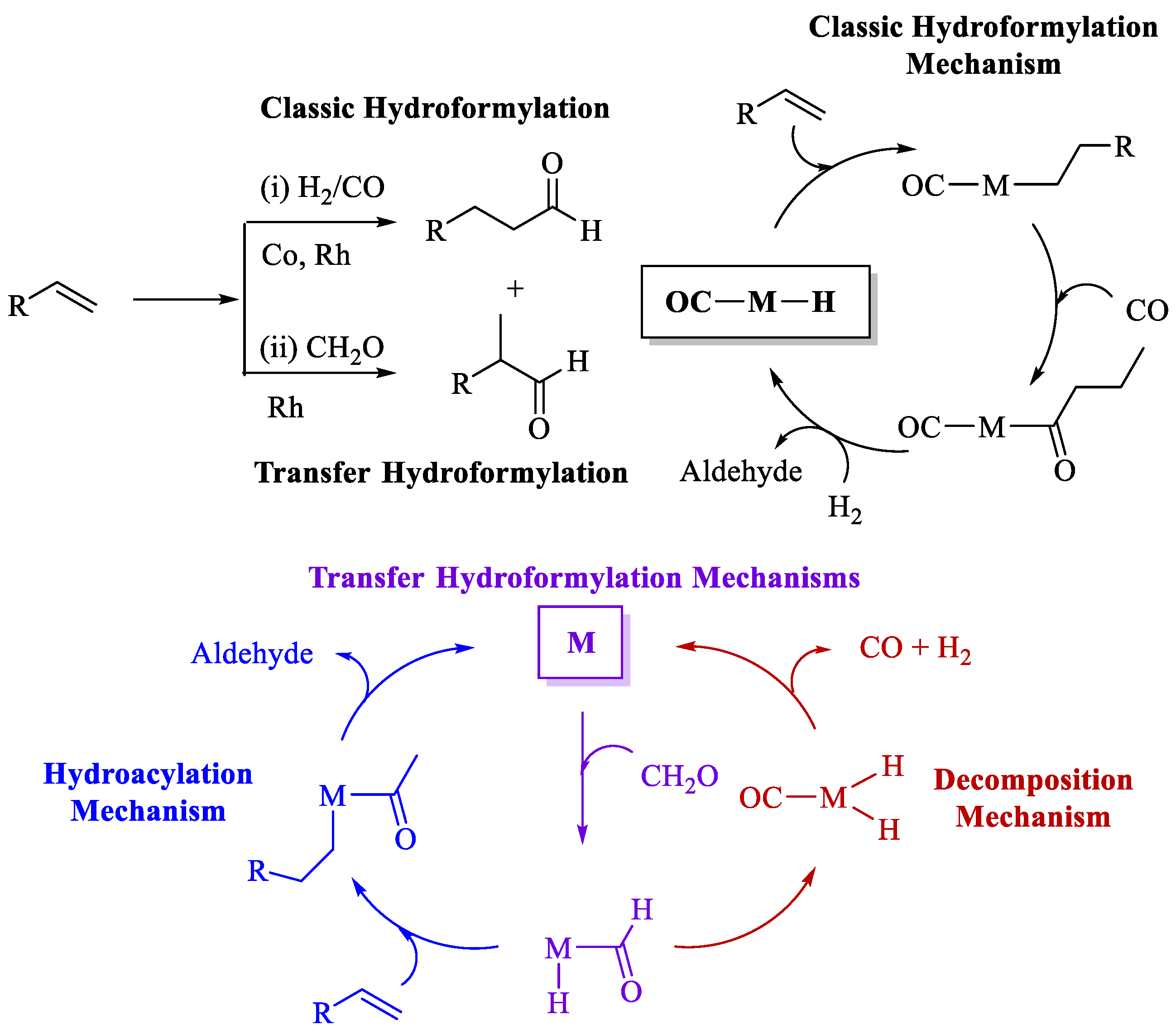
Catalytic hydroformylation is the transition metal-catalyzed addition of a CO/H2 mixture (syngas) to the carbon–carbon double bond of an alkene to generate aldehydes [1,2], typically using Co [3] or Rh [4] complexes (Scheme 1, reaction i). This reaction has been applied to the production of butanal and other commodities [1,2,3,4], green fuels [5,6,7,8] and high added-value products for fine chemicals and pharmaceuticals [4,7,9,10]. An alternative way to carry out this transformation is through the use of a syngas surrogate, such as formaldehyde. Hydroformylation of alkenes with formaldehyde, either in solution (formalin) or as a solid (paraformaldehyde), is an environmentally friendly and sustainable catalytic reaction for the synthesis of high value-added aldehydes with high atom economy (Scheme 1, reaction ii); this reaction is commonly referred to as transfer hydroformylation [11,12,13] and may also be regarded as a particular case of the hydroacylation reaction [14,15], thereby offering a synthetically attractive alternative to conventional hydroformylation protocols based on syngas. In terminal unsymmetrical alkenes, both conventional and transfer hydroformylation may lead to linear or branched aldehydes, depending on the alkene coordination and migratory insertion pathway. Therefore, the regioselective outcome is a relevant mechanistic aspect of the reaction and is discussed below. In addition to formaldehyde, other CO-surrogates have also been used, such as formic acid, alkyl- and arylformates, methanol and other alcohols and carbon dioxide [11,13,16].
The hydroformylation of alkenes with formaldehyde, discovered by Okano et al. [17], is performed under atmospheric pressure of an inert gas, avoids the use of lethal carbon monoxide and does not require high-pressure equipment, all of which contribute to the further advancement of sustainable chemistry. In spite of these advantages, this kind of reaction had been only sparsely investigated until the early 2000s [18,19,20,21,22], probably because of the possibility of aldehyde decarbonylation as a side reaction.
Between 2005 and 2017, Rosales et al. [23,24,25,26] reported the potential of rhodium catalysts containing mono-, bi- and tridentate phosphines in the hydroformylation of 1-hexene and other C6 alkenes, styrene and allyl alcohol with formaldehyde. Among these systems, the Rh catalysts containing two equivalents of dppe [1,2-bis(diphenylphosphino)ethane], which generated [Rh(κ2-dppe)2]+, were the most active precatalysts, thus identifying this cationic bis(diphosphine)rhodium system as a particularly relevant platform for mechanistic investigation.
On the other hand, in 2010, Morimoto et al. [27] reported the highly linear regioselective hydroformylation of α-alkenes using formaldehyde by employing [Rh2Cl2(BINAP)2] [binap: 2,2′-bis(diphenylphosphino)-1,1′-binaphthyl] and [RhH(CO)2(xantphos)] [xantphos: 4,5-bis(diphenylphosphino)-9,9-dimethylxanthene]. In that system, the binap complex catalyzed the decomposition of formaldehyde into H2 and CO (Scheme 1, reaction ii, decomposition mechanism), which were subsequently used by the xantphos complex to hydroformylate the alkenes through a conventional pathway (reaction i, classical mechanism). Two rhodium complexes that proved to be even more active in this process were those based on the ligands 2,2′-bis(diphenylphosphino)-1,1′-biphenyl (biphep) for the formaldehyde decarbonylation and 4,6-bis(diphenylphosphino)-10H-phenoxazine (nixantphos) for the classic hydroformylation of alkenes. Taddei et al. [28] described an improved version of this catalytic process using microwave dielectric heating, under which the reaction rate increased significantly. Subsequently, Morimoto et al. [29] established an accessible protocol for the asymmetric hydroformylation of vinylarenes using formaldehyde as a substitute for syngas, obtaining high regioselectivity (branched/linear ratio up to 96/4) and enantioselectivity (up to 95% ee), which can be attributed to the use of chiral Ph-bpe [(R,R)-1,2-bis(2,5-diphenylphospholano)ethane] as a ligand; this catalytic system was found to be sufficiently effective for both of the decarbonylation and stereoselective hydroformylation processes. Currently, this methodology of using formaldehyde as a substitute for syngas has been applied by the groups of Lühr [30] and Gusevskaya and dos Santos [31,32] to obtain high value-added products.
Although the mechanism of Rh-catalyzed hydroformylation of alkenes with syngas have been extensively studied from the theoretical point of view, as summarized in the reviews of Kegl [33,34], the theoretical data available for the mechanism of Rh(I)-catalyzed hydroacylation of alkenes remains rather limited [35,36,37], particularly for transfer hydroformylation processes employing formaldehyde as a syngas surrogate. With regard to the Rh-catalyzed hydroformylation of alkenes with formaldehyde, Meng et al. [36] studied the mechanism of the Rh(I)-catalyzed hydroformylation of propylene with formaldehyde by means of Density Functional Theory (DFT) at the B3LYP level in order to evaluate the regioselectivity of the reaction. In that study, oxidative addition of formaldehyde was proposed as the rate-determining step (rds) for formation of the linear product, whereas C–C bond formation was identified as the rds for formation of the branched product.
In 2016, some of us reported the hydroformylation of 1-hexene with formaldehyde catalyzed by [Rh(κ2-dppe)2]+, including kinetic measurements, coordination chemistry experiments and a preliminary theoretical DFT study using the M06-L functional and simplified models in which the phenyl groups of dppe were replaced by hydrogen atoms and ethene was used as substrate [25]. The experimental and computational results indicated that the catalytic cycle involved oxidative addition of formaldehyde, insertion of ethene into the Rh–H bond, and reductive elimination of propanal as the key elementary steps (Scheme 1, reaction ii, hydroacylation mechanism). The rds of the reaction was found to be insertion of ethene into the Rh–H bond; however, the activation energies obtained for both the overall reaction and for the rds (31.5 and 40.0 kcal/mol, respectively) were higher than the corresponding experimental values (20.1 and 23.9 kcal/mol, respectively), thus indicating that a more robust mechanistic and quantitative description of this catalytic system is still needed. This research represents the only kinetic and mechanistic study to date on the transfer-mediated hydroformylation of alkenes using a substitute for synthesis gas.
Now, in this article, we report a kinetic investigation of the transfer hydroformylation of styrene with formaldehyde catalyzed by the cationic bis(diphosphine)rhodium complex [Rh(κ2-dppe)2]+ by combining experimental kinetics, DFT calculations, and Bayesian statistical analysis. This study seeks to provide a more robust mechanistic and quantitative description of the elementary steps governing this catalytic transformation.

2. Results and Discussion

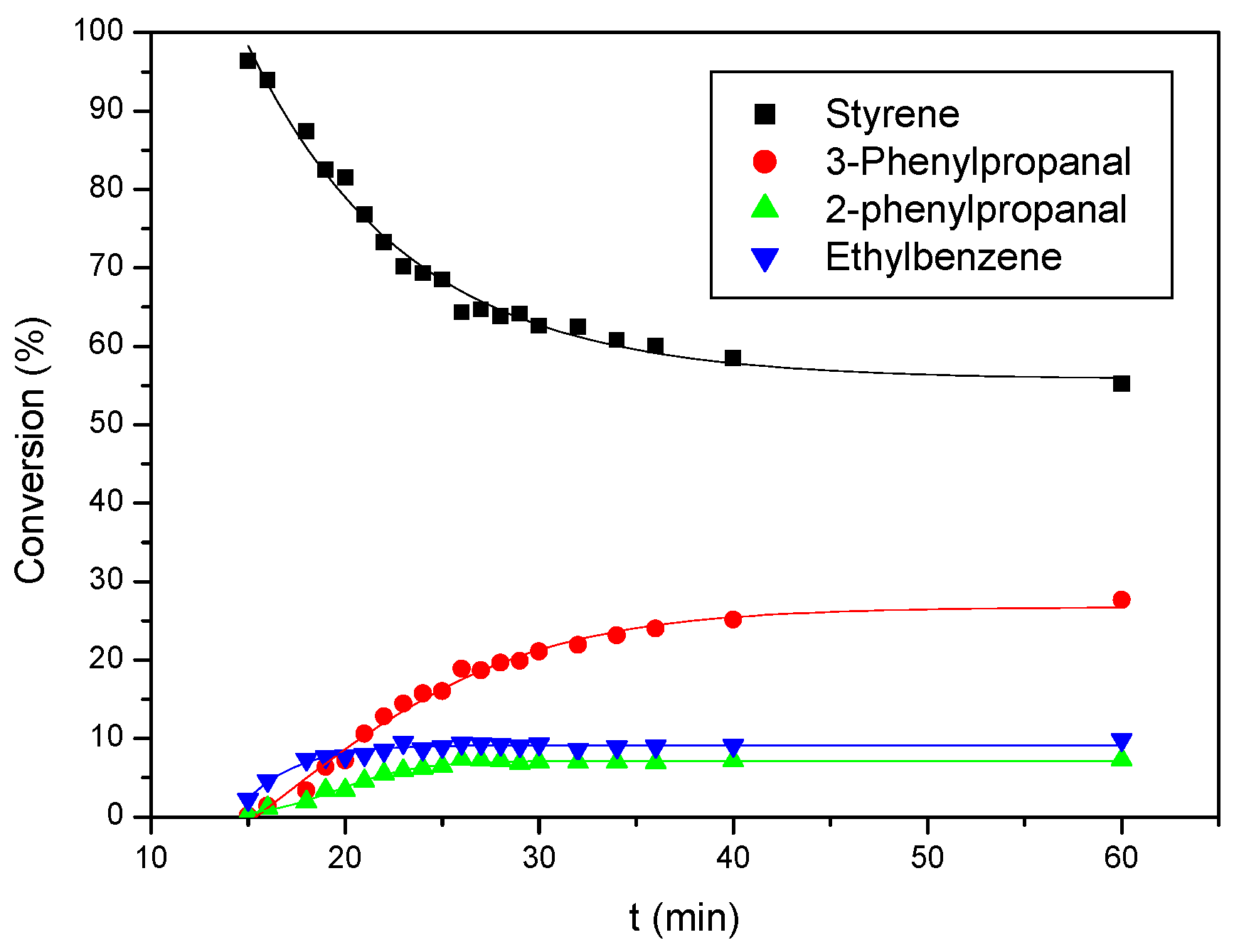
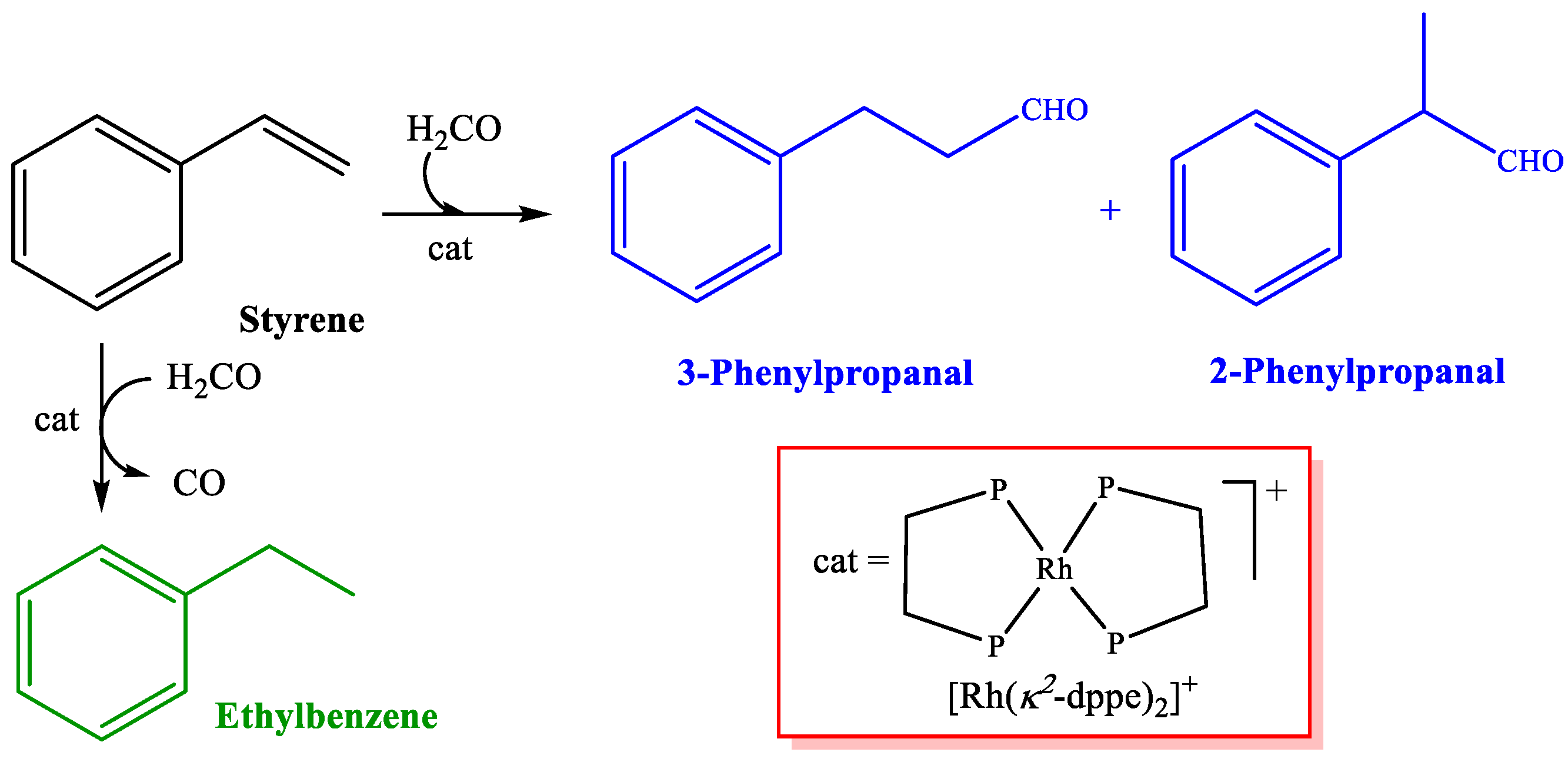
The complex [Rh(κ2-dppe)2]+ (A) was found to be an active precatalyst for the hydroformylation of styrene with formaldehyde, under mild reaction conditions (130 °C, 1 bar Ar), yielding the corresponding linear and branched aldehydes (3-phenyl- and 2-phenyl-propanal, respectively), which were identified by mass spectra (molecular ion peak M+ at m/z 134), as well as small amounts of ethylbenzene (close to 10% in 1 h) as a product of the substrate hydrogenation. Scheme 2 shows the products obtained in this reaction, while Figure 1 shows a typical reaction profile of the reaction, showing the decrease in styrene concentration and the increase in the corresponding hydrogenation and hydroformylation products over time. In this reaction, an induction period of approximately 15 min was observed, which was likely necessary for the in situ generation of formaldehyde and/or the formation of the active species in the reaction medium. The ratio of linear to branched products was approximately 3–4:1.
In previous works, we found that the [Rh(κ2-dppe)2]+ complex was a highly active precatalyst for the hydroformylation of 1-hexene with formaldehyde [23,24]; the kinetics of this reaction, together with some coordination chemistry and preliminary DFT studies, allowed us to propose a hydroacylation-type mechanism, as depicted in Scheme 1 (reaction ii) [25]. Some experimental evidence pointing to this type of mechanism is summarized in the Supplementary Material S1. However, some aspects of the mechanism remain unclear, for example, whether it involves the direct insertion of the alkene into the Rh–H bond or whether it occurs through the partial dissociation of one of the dppe ligands and the coordination of the alkene, followed by the migration of the hydride to the C–C double bond of the substrate.
In order to gain a deeper understanding of the mechanism of the transfer hydroformylation of alkenes with formaldehyde, we have conducted a comprehensive and detailed study combining three types of approaches, including: (i) a detailed kinetic study of the hydroformylation of styrene with formaldehyde catalyzed by [Rh(κ2-dppe)2]+ (A) and its comparison with the kinetics of the hydroformylation of 1-hexene, (ii) a DFT computational study in which various functionals were used, as well as the MP2 method—considered the most reliable—using the simplified analogue [Rh(κ2-dpe)2]+ (A′) as the precatalyst (dpe: 1,2-bis(phosphino)ethane, and (iii) the development of a mathematical kinetic model, which was fitted using the Levenberg–Marquardt [38] and a Bayesian statistical approach employing the Markov Chain Monte-Carlo (MCMC) method [39,40,41], which was implemented using the emcee algorithm [42,43].

2.1. Kinetics of the Hydroformylation of Styrene with Formaldehyde

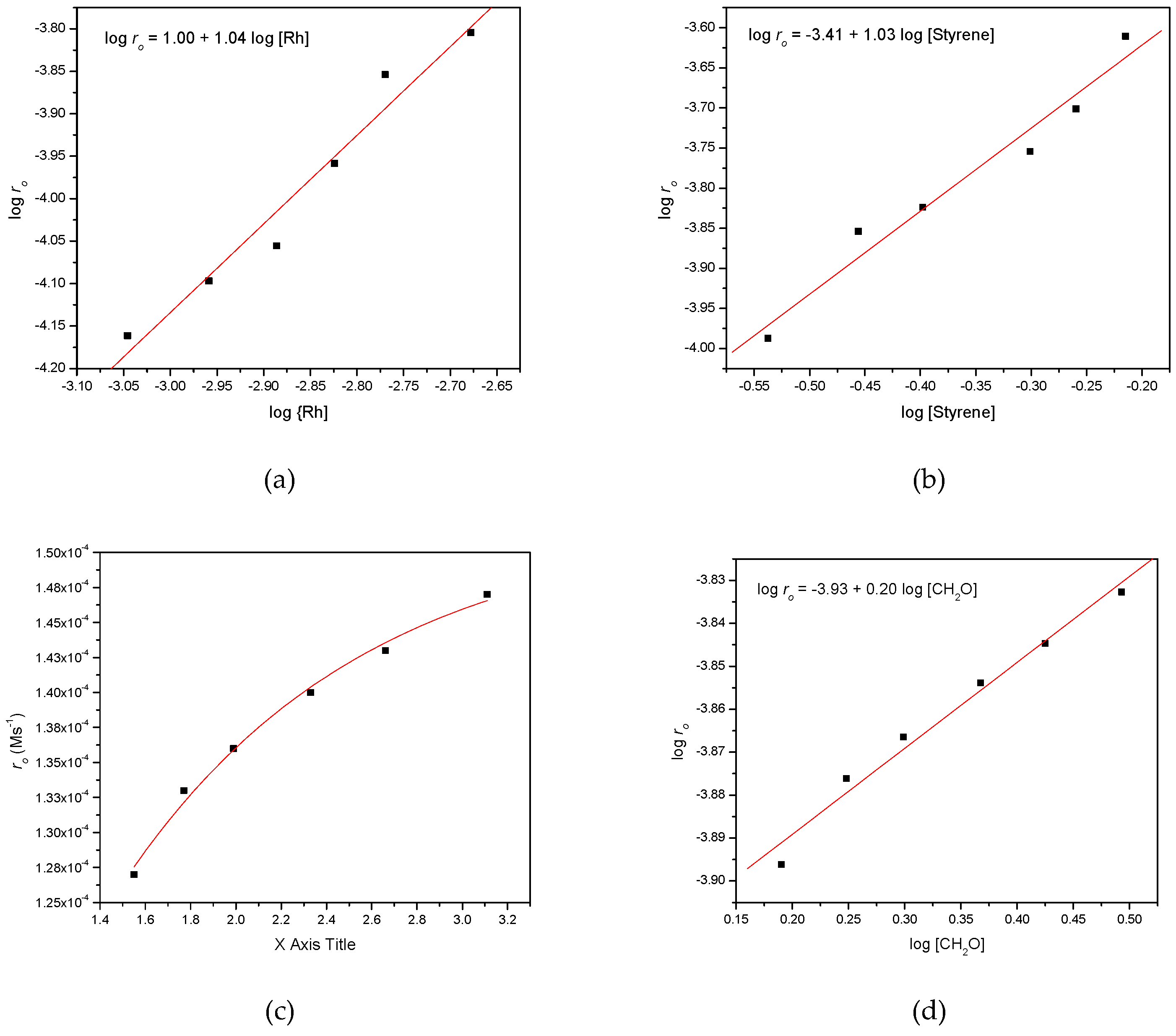
A kinetic study of the hydroformylation of styrene with formaldehyde catalyzed by [Rh(κ2-dppe)2]+ (A) at 373 K was performed and the data are shown in Table 1 and Figure 2. We conducted three sets of experiments with different concentrations of catalyst (entries 1–8, Table 1), substrate (entries 5 and 9–13, Table 1) and formaldehyde (entries 5 and 14–18, Table 1). The results obtained in the kinetic study of the transfer hydroformylation of styrene with formaldehyde showed that:
  • There is a direct (first order) dependence of the hydroformylation rate with respect to the Rh concentration up to a certain concentration (2.1 × 10⁻³ M); the plot of log ro versus log [Rh] at low catalyst concentrations gives a straight line (Figure 2a) with a slope of 1.04 (entries 1–6, Table 1). However, unlike 1-hexene transfer hydroformylation, an inhibition of the reaction was observed at higher Rh concentrations (entries 7 and 8, Table 1), which can be attributed to the formation of a less active or inactive species. Therefore, the order with respect to the concentrations of the other components was determined within the range of first-order kinetics with respect to the catalyst.
  • It was observed that the reaction was also first-order with respect to substrate concentration (Figure 2b). The plot of log ro versus log [styrene] yielded a straight line with slope 1.03. The fact that first-order behavior was observed with respect to the concentration of styrene indicates that the substrate likely participates in the rate-determining step (rds) of the reaction.
  • The reaction rate varied according to a saturation curve as a function of formaldehyde concentration (Figure 2c), and exhibited a fractional order dependence of 0.20 (Figure 2d). This fractional-order dependence indicates that formaldehyde is involved in an equilibrium prior to the rds of the reaction.
In view of the above kinetic observations, the Rh-catalyzed hydroformylation of styrene with formaldehyde proceeds according to the rate law shown in Equation (1), which may also be written as Equation (2).
r o = k c a t R h S t y r e n e C H 2 O 0.20
r o = a b + c C H 2 O R h S t y r e n e C H 2 O
As it may be seen, the results obtained in the transfer hydroformylation of styrene with formaldehyde catalyzed by [Rh(κ2-dppe)2]+ are rather similar to those obtained in the reaction with 1-hexene using the same catalytic precursor. For 1-hexene, a fractional order of 0.63 was obtained with respect to formaldehyde concentration; therefore, this substrate exhibits a rate expression similar to that of styrene (Equation (1)), with an exponent of 0.63 for [CH2O] [25].
A fourth set of experiments was conducted by varying the temperature while keeping the concentrations of the reactants and the catalyst constant (entries 5 and 19–21, Table 1). The Arrhenius plot allowed us to calculate the electronic activation energy (Ea) of the process as 22.9 kcal mol−1, which is slightly higher than that obtained for the hydroformylation of 1-hexene with formaldehyde (20.1 kcal mol−1); the frequency factor (A) value found was 5.75 × 10¹² M−1 s−1 and kcat (295.15 K) was 8.96 × 10⁻⁵ M−1 s−1 (see Supplementary Material S2).

2.2. DFT Study of the Hydroformylation of Styrene with Formaldehyde

The DFT study was conducted with two key considerations in mind; the first was to select the most appropriate density functional from a variety of options. The second aspect was to determine whether the reaction mechanism involves the direct insertion of the alkene into the Rh–H bond or whether it occurs through the dissociation of the phosphorus atom from a diphosphine ligand, accompanied by the coordination of the substrate, followed by the migration of the hydride to one of the carbon atoms of the alkene’s double bond.
The first aspect of this in silico study was addressed in two parts. Initially, calculations were performed to determine the thermodynamic parameters of the possible elementary steps using various functionals and to compare them with those obtained at the MP2 level. We found that the B3LYP-3D, M06-L and M11-L functionals yielded values closest to those found with the MP2 method (see Supplementary Material S3). On the other hand, calculations of potential energy surface were performed using the most widely used hybrid functional in quantum chemistry (B3LYP) and the three best-performing functionals (B3LYP-3D, M06-L and M11-L) obtained in this study in order to compare the calculated activation energies (Ea) with the experimental activation energy data. Supplementary Material S4 provides the activation energies value corresponding to each elementary step of the mechanism, and included energy diagrams of the hydroformylation process with formaldehyde catalyzed by A′. The B3LYP and B3LYP-D3 functionals yielded the highest activation energy values for both the overall reaction (Eacat) as for the rds (Ea2), while the M06-L functional provided the lowest values, which were closest to the experimentally determined values. These results indicate that M06-L is the best functional found for calculation of thermodynamic parameters and activation energies of the elementary steps in the catalytic cycle of the ethene hydroformylation with formaldehyde catalyzed by complex A′. These results are consistent with other studies, which indicate that DFT methods using the M06-L functional have been applied with great success in organometallic chemistry and catalysis due to their efficiency and accuracy [44,45,46,47,48].
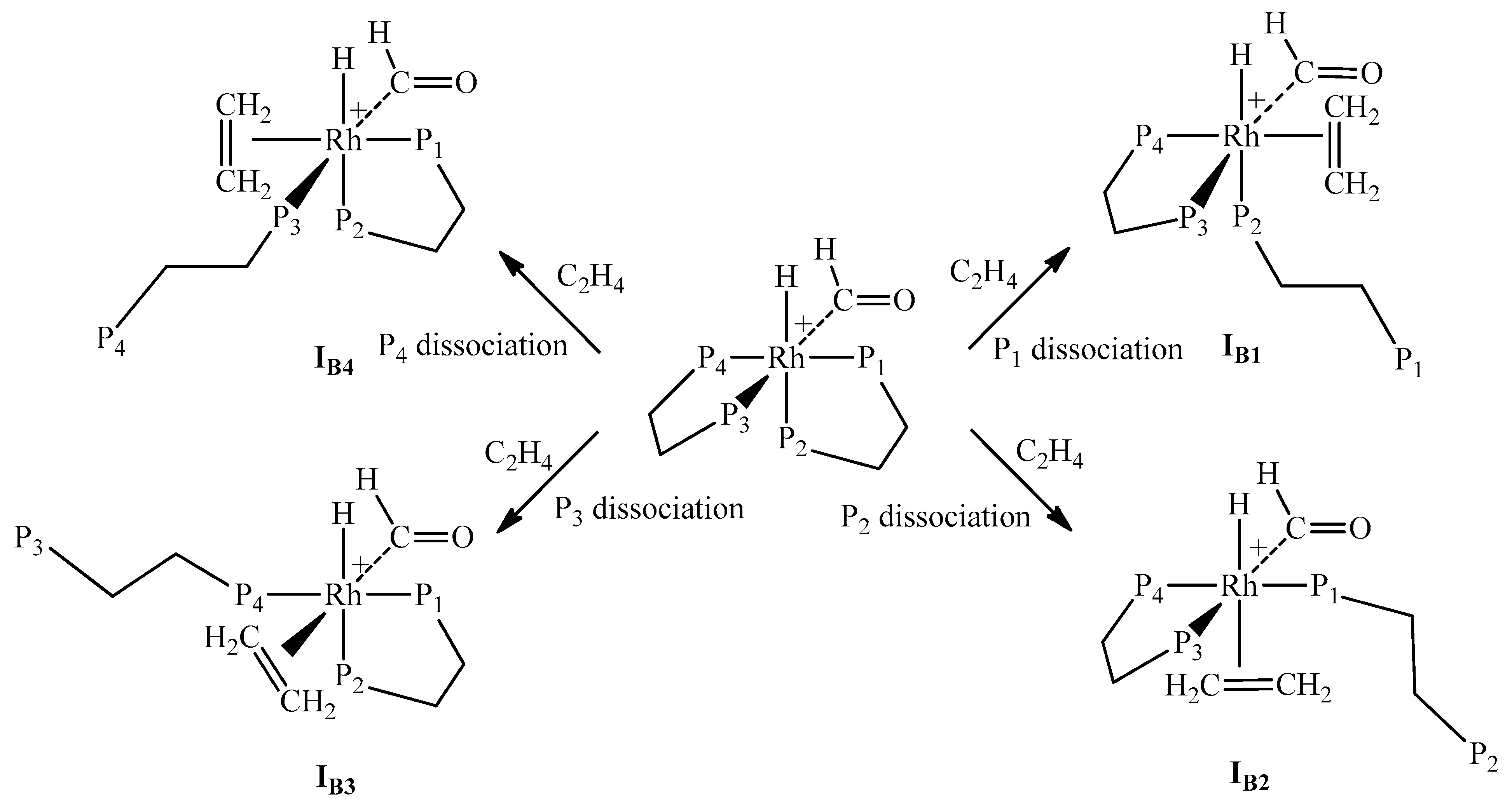
The second aspect focused on determining whether the mechanism of this reaction could occur through the partial dissociation of one of the diphosphine ligand following the oxidative addition of formaldehyde. The insertion of ethene into the Rh–H bond of cis-B′ can occur through the dissociation of a phosphorus atom from one of the diphosphine ligands, accompanied by the coordination of ethene (cis-B′ + C2H4IB′) and the subsequent transfer of the hydride ligand to the alkene (IB′cis-C′). The cis-B′ complex has four possible ways to dissociate a phosphorous atom from the diphosphine and coordinate the ethene molecule, as shown in Scheme 3. However, dissociation of the P2 atom was ruled out, since the coordination of the substrate at this position would result in the alkene being in the trans configuration relative to the hydride ligand, which precludes the migratory insertion of the ethene and the hydride ligands.
The results of these theoretical DFT calculations are shown in Table 2. As may be seen in this table, the dissociation of any phosphorus atom is endothermic and endergonic. The coordination of ethene via the dissociation of the P1 atom requires the highest enthalpy and Gibbs free energy, whereas the process via the dissociation of the P3 and P4 atoms yields values for these two thermodynamic parameters that are quite similar. Although the coordination of ethene via the dissociation of the P1 atom exhibits the highest thermodynamic values, the insertion of ethylene into the Rh–H bond of this structure (IB1) has the lowest activation energy (Ea = 20.5 kcal/mol) compared to those involving the dissociation of the P3 and P4 atoms, corresponding to the IB3 and IB4 (Ea = 38.6 and 37.2 kcal/mol, respectively). These results are displayed in Supplementary Material S5 for a more detailed analysis of the DFT computational calculations.
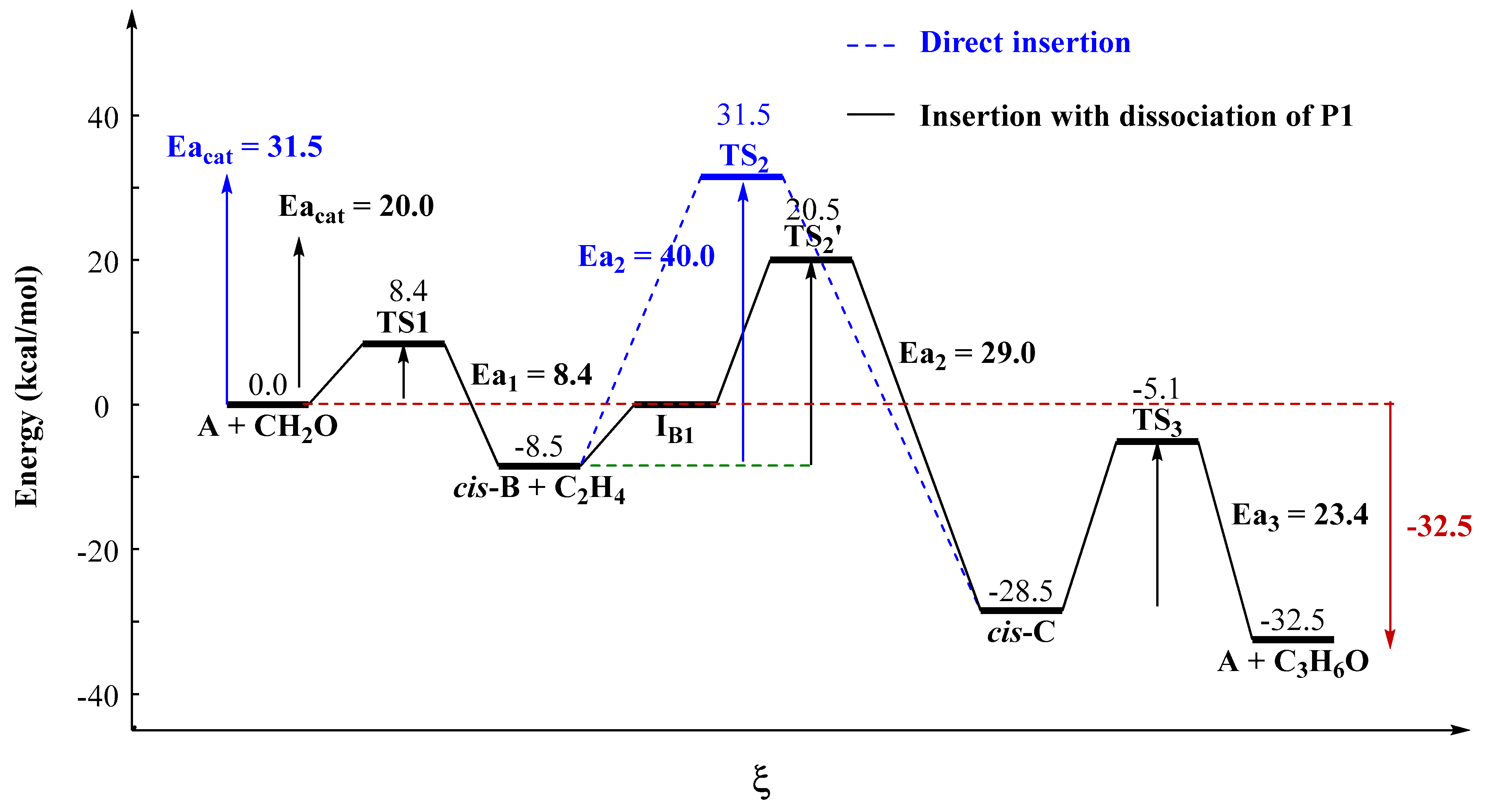
The activation energies of the overall reaction and of the rds (Ea = 20.0 and Ea2 = 29.0 kcal mol−1) for the mechanism involving the dissociation of P1 are lower than those of the direct ethylene insertion mechanism (Ea = 31.5 and Ea2 = 40.0 kcal mol−1, respectively), as may be seen in the profile shown in Figure 3. Furthermore, these values are quite similar to those determined experimentally for the hydroformylation of 1-hexene and styrene via transfer with formaldehyde (20.1 and 23.9 kcal/mol, respectively).

2.3. Overview of the Mechanism of the Alkene Hydroformylation with Formaldehyde

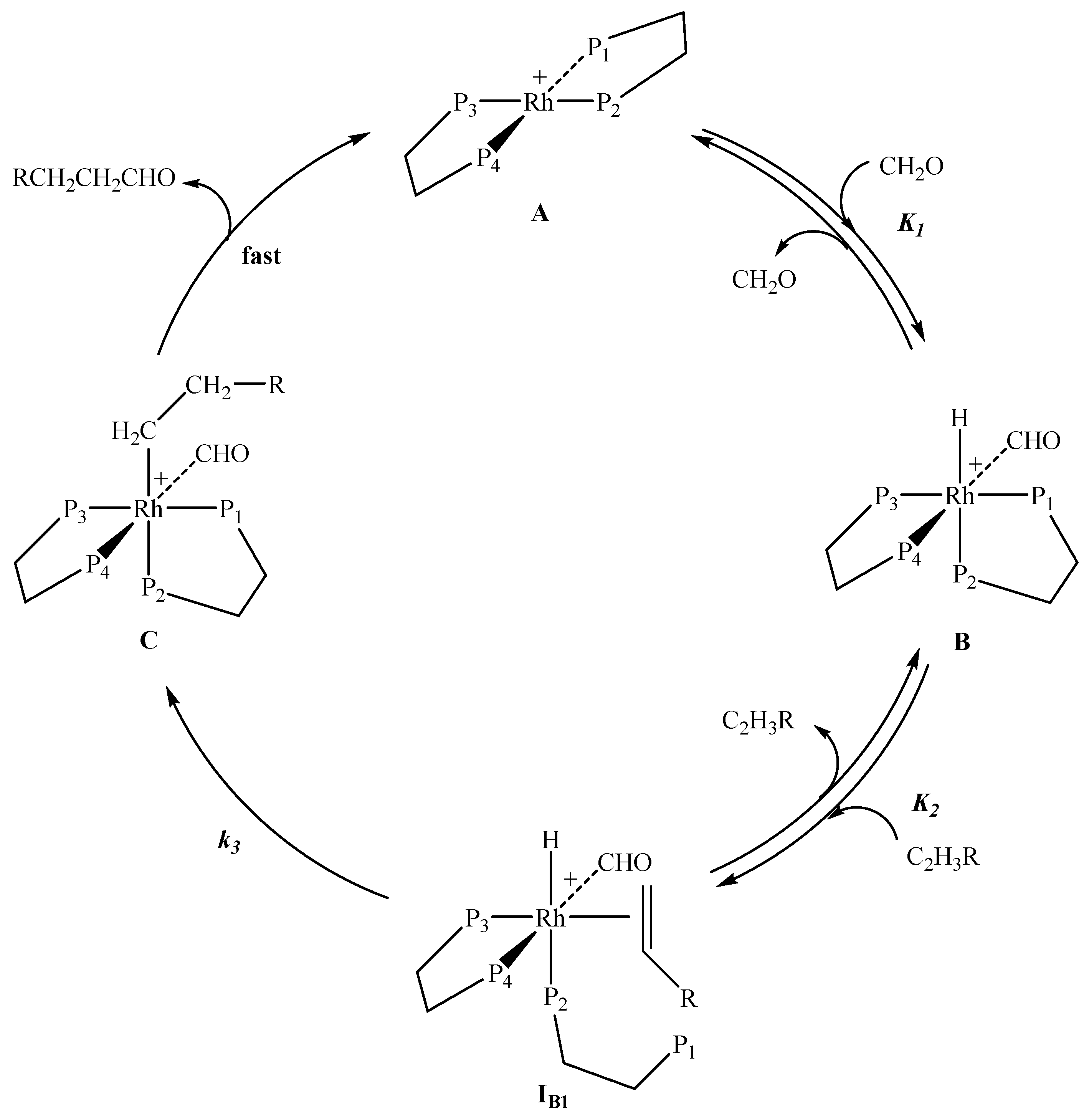
Based on the experimental and computational DFT calculations obtained for the hydroformylation of styrene with formaldehyde catalyzed by [Rh(κ2-dppe)2]+ (A) in this study and in those previously published for the reaction with 1-hexene [28], we conclude that the most likely acylation-type mechanism underlying the [Rh(κ2-dppe)2]+-catalyzed hydroformylation of alkenes with formaldehyde is the one involving the partial dissociation of the P1 atom of the diphosphine following the oxidative addition of formaldehyde, as shown in Scheme 4.
The catalytic cycle is initiated with the reversible oxidative addition of formaldehyde to complex A (K1) to generate [Rh(H)(CHO)(κ2-dppe)2]+ (B); a hydride(formyl)iridium complex, namely [Ir(H)(formyl)(PMe3)4]+, was synthesized and characterized by Thorn [49]. The process is followed by the dissociation of the phosphorous atom P1 with the concomitant coordination of alkene to yield [Rh(H)(CHO)(alkene)(κ1-dppe)(κ2-dpe)]+ (IB1), keeping coordinated the phosphorous atom of the diphosphine trans to the hydride ligand (K2). The migratory insertion of the alkene and hydride ligands generates the corresponding Rh-alkyl species, [Rh(alkyl)(CHO)(κ2-dpe)2]+ (C), which is considered as the rds of the process (k3). Finally, the fast reductive elimination of the aldehyde regenerates the catalyst A and restarts the transfer hydroformylation cycle.
Our experimental findings and DFT calculations differ from those obtained by Meng et al. [37] for the hydroformylation of propylene with formaldehyde catalyzed by a Rh(PH3)2 complex, in which the oxidative addition of formaldehyde was the rds of the mechanism for the formation of linear aldehyde and the reductive elimination was the rds for the formation of isoaldehyde. In our case, for the reaction of alkenes with formaldehyde catalyzed by [Rh(dppe)2]+, the insertion of the substrate into the Rh–H bond is the rds of the mechanism, which occurs through the dissociation of the P1 atom of the diphosphine and the subsequent coordination of the corresponding alkene. Another notable difference is that Meng et al. used only the B3LYP functional, whereas in the present work several functionals were evaluated, with M06-L providing the best agreement with the experimental activation parameters.

2.4. Mathematical Kinetic Model for the Alkene Hydroformylation with Formaldehyde

Based on the mechanism (catalytic cycle) described in Scheme 4, the rate equation for the transfer hydroformylation of alkenes with formaldehyde and the bis(dppe) rhodium complex as the catalyst can be derived by applying the rate-determining step approximation. Since the overall hydroformylation rate is determined by the rate of the rate-limiting step, the rate equation can be expressed as Equation (3).
r o = k 4 I B 1
Considering the equilibria involved prior to the rate-determining step (pre-equilibria K1 and K2) and the mass balance for rhodium ([Rh]o = [A] + [B] + [IB1]), the rate law can be expressed as Equation (4):
r 0 = K 1 K 2 k 3 R h o a l k e n e C H 2 O 1 + K 1 C H 2 O + K 1 K 2 a l k e n e C H 2 O
If K2 has a small value—which is highly likely given the high stability of the species with two dppe ligands coordinated in a bidentate mode—the third term in the denominator of Equation (4) can be neglected, so the rate law can be rewritten as:
r 0 = K 1 K 2 k 3 1 + K 1 C H 2 O R h o a l k e n e C H 2 O
This rate law is consistent with the experimental results of Rh-catalyzed hydroformylation of styrene ( a = K 1 K 2 k 3 ,   b = 1   a n d   c = K 1 ), in the sense that it is first-order with respect to the catalyst and substrate concentrations and fractional-order with respect to the concentration of formaldehyde. Furthermore, this rate law is similar to that observed in the transfer hydroformylation of 1-hexene with formaldehyde catalyzed by the same precatalyst [25].
If the catalyst and alkene concentrations are kept constant and the formaldehyde concentration is varied (entries 5, 9–13 of Table 1), the rate expression (Equation (5)) may be rewritten as Equation (6) ( m = K 1 K 2 k 3 R h o a l k e n e   a n d   n = K 1 ).
r 0 = m C H 2 O 1 + n C H 2 O
As it can be seen, the rate law is a rational function, to which a robust approach based on the Levenberg–Marquardt method (LMFit) [38] and Bayesian statistics can be applied. To fit this rational function, the Markov Chain Monte Carlo (MCMC) method was applied [39,40,41], implemented using emcee [42,43], which allowed us to identify the most likely values for these parameters. Recently, our research group successfully applied this type of strategy to the hydroformylation of eugenol with syngas [50].
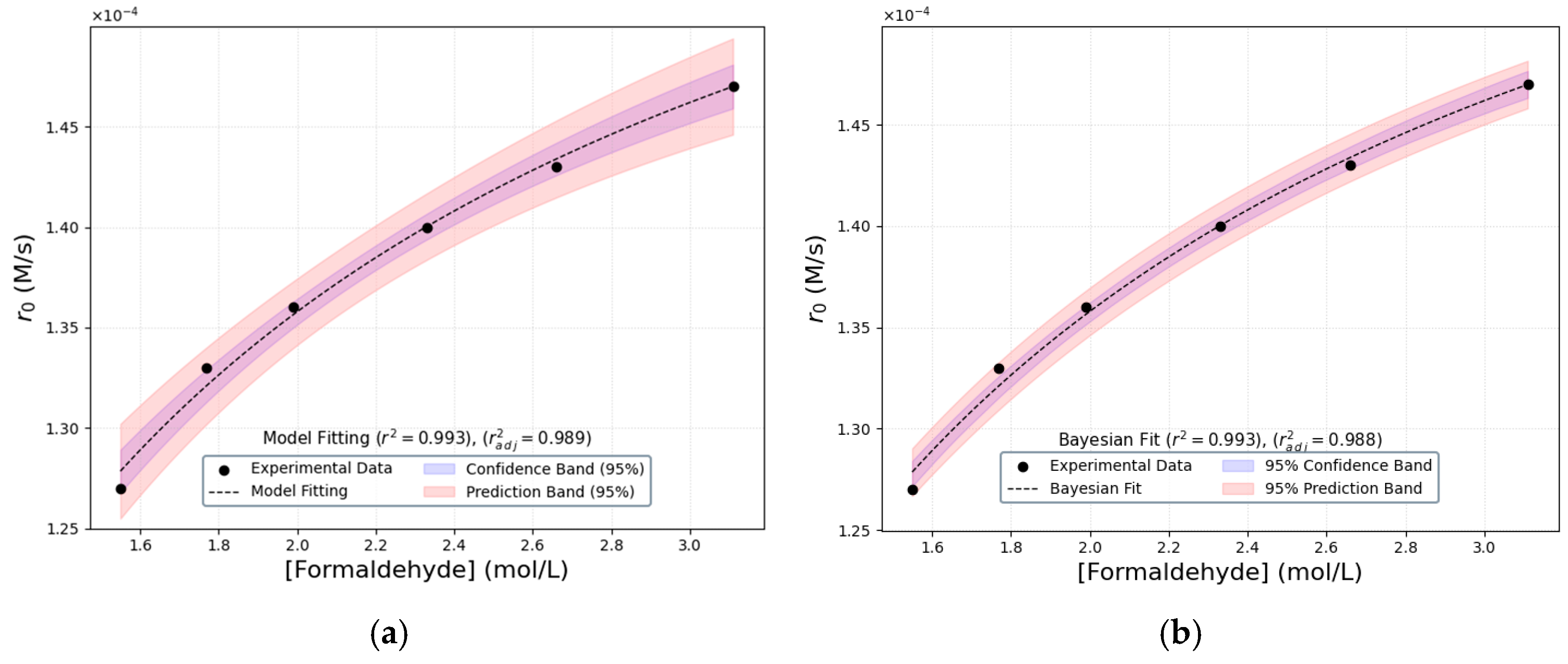
Initial estimates for the nonlinear least-squares fit were obtained from a linearized form of the kinetic model rather than from arbitrary starting values. For the model given by Equation (6), rearrangement gives [CH2O]/ro = (1/m) + (n/m)[CH2O]. Thus, a preliminary linear regression of [CH2O]/ro versus [CH2O] provides physically traceable estimates for the initial parameters, with minit = 1/intercept and ninit = slope/intercept. These values were used only as starting points for the LMFit nonlinear optimization and were not imposed as constraints or fixed parameters. The plot of ro versus formaldehyde concentration fits quite well to the rational function given by Equation (6) using LMFit (Figure 4a), which allowed us to obtain the coefficients with m = K 1 K 2 k 3 [Rh][alkene] = 3.18 × 10⁻⁴ Ms−1 and n = K 1 = 1.84 M−1. To evaluate the uncertainty and robustness of the fitted kinetic parameters, we applied a Bayesian approach using emcee and varying the value of m between 2.54 × 10⁻⁴ and 3.82 × 10⁻⁴, which corresponds to a range of 20% below to 20% above the calculated value of m per LMFit; the MCMC-fitted plot confirmed the values of m and n obtained by LMFit, as shown in Figure 4b.
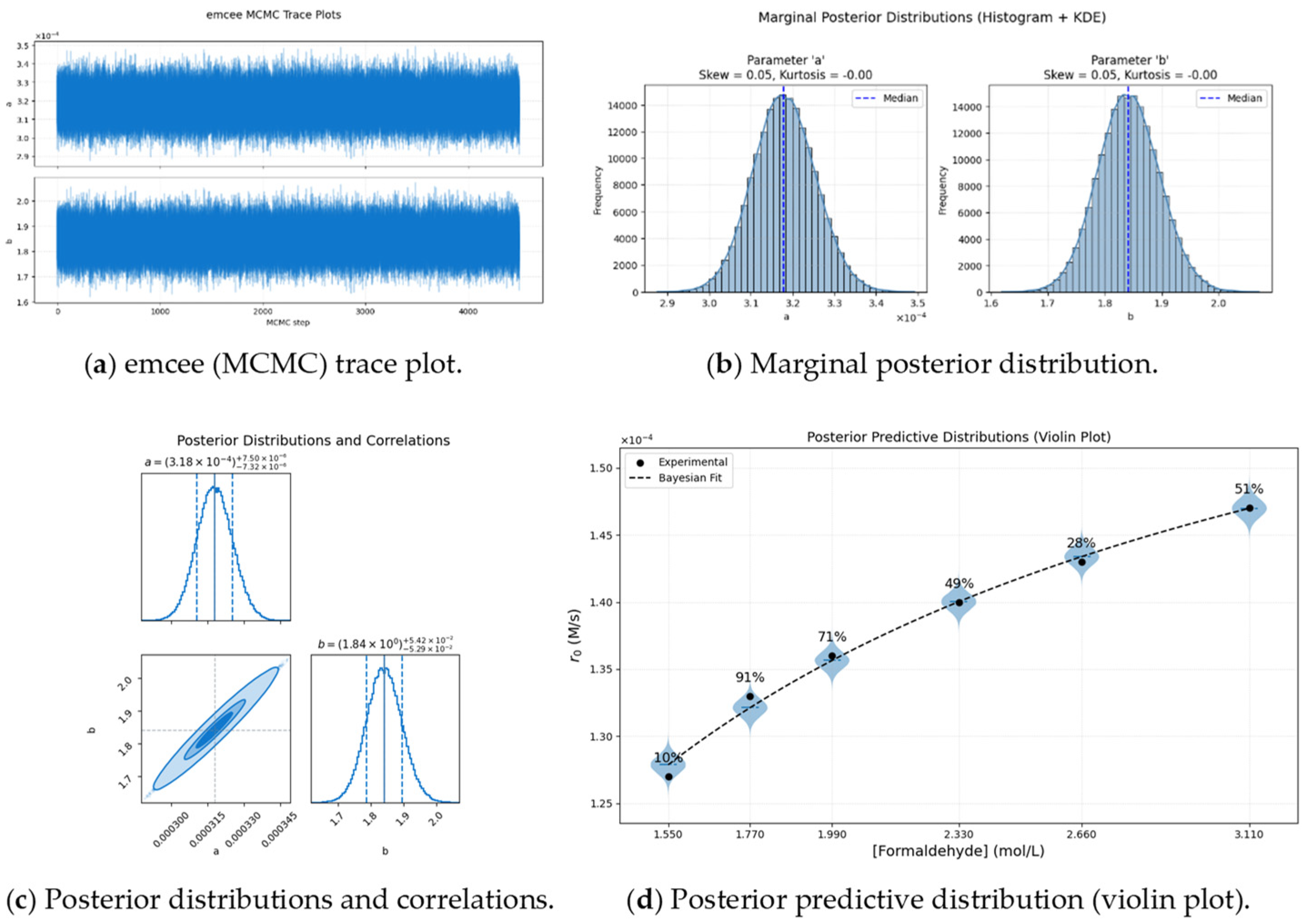
The Bayesian statistics approach based on the MCMC allowed the determination of the most probable statistical values of parameters m and n, which was corroborated by the plots of marginal posterior distribution, the trace plots, posterior distribution and correlations and posterior predictive distributions (Figure 5). In particular, the trace plots (Figure 5a) show the stability of the parameter search, in which it is observed that from the first iterations there was stability in the estimated values of the parameters. Moreover, MCMC analysis of the correlation between the parameters, which is represented through the marginal (Figure 5b) and posterior distribution (Figure 5c), illustrates that the parameters exhibit a strong mutual correlation, as can be visualized through the elongation of the corresponding ovals. Finally, the violin plot indicates that all of the experimental data are in the zone of maximum probability (68–32%) and below the standard threshold for rejection (95–5%), which means that the predictive level for this model is strong. Unlike the results obtained in the hydroformylation of eugenol with syngas [50], in this study no points were observed between the rejection threshold and the strong rejection region.
A strong posterior correlation between m and n was observed, which is expected for the rational model of Equation (6), since both parameters jointly determine the curvature and limiting response of the fitted function. However, this correlation does not indicate poor model performance: the marginal posterior distributions were unimodal and nearly symmetric, the trace plots showed stable sampling without evident drift, and the posterior predictive violin plot showed that the experimental observations were compatible with the predictive distributions. Moreover, the derived parameter m/n, which represents the apparent limiting response, was tightly constrained by the posterior distribution, supporting the robustness of the fitted model despite parameter covariance.
These results indicate that the experimentally measured reaction rate data obtained for the hydroformylation of styrene with formaldehyde catalyzed by [Rh(κ2-dppe)2]+ have high reliability and accuracy. With the values of the parameters m and n, we can calculate K1 (1.84) and the products K2k3 (0.29) and K1K2k3 (0.54). All these values are listed in Table 3.
In summary, for hydroformylation of styrene with formaldehyde, Bayesian analysis allowed the associated uncertainties to be explicitly quantified, with errors significantly lower than those reported in previous studies on heterogeneous [41] and homogeneous [50] catalytic reactions, using similar methods. Well-centered parameter distributions with realistic variance were obtained, thereby improving the robustness, interpretability, and reproducibility of the kinetic description.

3. Materials and Methods

All manipulations and reactions were carried out under strictly air-free conditions, using a vacuum, an argon-filled Schlenk line or an argon-filled glovebox. All compounds and solvents were acquired from Sigma Aldrich (St. Louis, MO, USA), Merck (Darmstadt, Germany) and Fluka (Buchs, Switzerland). Styrene was purified by distillation at reduced pressure and the solvents were distilled from suitable drying agents immediately prior to use. Formaldehyde was generated in situ in the reaction medium from dissolving paraformaldehyde in 1,4-dioxane. The [Rh(κ2-dppe)2]+ complex was prepared according to published procedure [23,25] from Rh(acac)(CO)2 [51].

3.1. Kinetic Measurements and Calculations

The kinetic reactions were carried out as described in a previous paper [25] using a Parr Instrument high-pressure reactor (model 4561, Moline, IL, USA), which was provided with an arrangement for sampling of liquid contents, in addition to automatic temperature, pressure and variable stirrer speed controls. The reaction was monitored by using GC (3300 Series VARIAN (Varian, Santa Clara, CA, USA) with a flame ionization detector fitted to a 2 m 20% SP-2100 on a 0.1% carbowax 100/120 Supelcoport column, using N2 as carrier gas) and GC-MS HP 5890/5971 (Hewlett-Packard, Palo Alto, CA, USA) coupled system using a Quadrex PONA 5% phenyl methyl silicone, 25 m, 320 μm column. Toluene was used as the internal standard for the reaction.
Each reaction was repeated at least twice in order to ensure reproducibility of the results. All the kinetic runs were performed at low conversions in order to apply the initial rate method [52]. The data of the catalytic reactions were plotted as total molar concentration of the corresponding products (aldehydes) versus time yielding straight lines, which were fitted by conventional linear regression programs (r2 > 0.95); initial rates of the reaction (ro) were calculated from the corresponding slopes. The reaction order of each component of the reaction (catalyst, styrene and formaldehyde) was determined from the slope of the plot log ro versus logarithm of the corresponding reagent concentration.

3.2. Computational Strategy

All the calculations were carried out with the Gaussian-09 (G09) [53] computational package. DFT [54,55] methods were used, which have been widely applied to various molecular systems with great success because of their efficiency and accuracy [45,56]. The thermodynamic parameters of the elementary steps were calculated using various functionals: B3LYP [57,58], the local GGA B97D [59], range-separated hybrids (ωB97, ωB97x and ωB97X-D) [60,61] and Minnesota M06, M062X, M06-HF, M06-L and M11-L [62,63,64,65,66]. These functionals were subjected to benchmarking and validation tests using the second-order Møller–Plesset method (MP2) [67] to select the top three functionals. Potential energy surface calculations were performed using the three best functionals and B3LYP to determine the theoretical apparent activation energy and compare them with the experimental activation energy in order to select the best functional (M06-L), which was used to perform all the remaining calculations. The basis set 6-31+G(d,p) was used for H, C, O, and P, and LANL2DZ for Rh.
Minimum energy structures (MES) and transition states’ (TS) calculations for all rhodium species involved in the catalytic cycles were performed using simplified dpe diphosphine analogue (dpe: 1,2-bis(diphosphino)ethane, H2P(CH2)2PH2) and ethene as alkene model to reduce the computational cost. Furthermore, the effect of solvent is included by the continuum self-consistent reaction field solvation models (SCRF), the most widely used class of implicit solvent model, by means of the subroutine SCRF = (Solvent = 1,4-dioxane). All the optimized structures were classified in accordance with frequency calculations. These frequencies permit us to distinguish between the MES (with all the vibrational frequencies positives) associated with the intermediate of reaction and the first order saddle points (with only one imaginary frequency) associated with the TS. All of the TS were obtained with the synchronous transit-guide quasi-Newton (STQN) methods, using the keyword QST3 implemented in G09. Moreover, the intrinsic reaction coordinates (IRC) method [68], which examines the reaction paths going down from the TS on the potential energy surface (PES), was carefully analyzed to confirm the right connectivity between all TS and their associated reaction immediate (MES).

3.3. Statistical Bayesian Analysis

To establish a mathematical kinetic model for the Rh-catalyzed transfer hydroformylation of alkenes with formaldehyde, both the Levenberg–Marquardt method [38] and the Bayesian approach were applied. The Bayesian analysis was performed by using Markov Chain Monte-Carlo (MCMC) [39,40,41], one of the most widely used Bayesian methods for nonlinear regressions, implemented through emcee [42,43] algorithm.

4. Conclusions

The results show that [Rh(κ2-dppe)2]+ (A) is an efficient catalyst for the hydroformylation of styrene with formaldehyde, affording the linear aldehyde in a regioselective manner (>75%) under mild reaction conditions. The experimental results, together with DFT calculations performed with the M06-L functional, which provided the most suitable description of the thermodynamic parameters and activation energies of the elementary steps, allowed us to propose a hydroacylation-type catalytic cycle for the hydroformylation of alkenes, such as 1-hexene and styrene. In this cycle, after the oxidative addition of formaldehyde to A, alkene insertion into the Rh–H bond takes place through partial dissociation of one phosphorus atom of the diphosphine ligand, followed by alkene coordination; the catalytic cycle is completed with the reductive elimination of aldehydes. The overall activation energy calculated by DFT (Ea = 20.0 kcal/mol) is in reasonably good agreement with the experimental values determined for 1-hexene and styrene (20.1 and 22.9 kcal/mol, respectively), thus supporting the consistency of the proposed mechanistic picture.
In addition, a mathematical kinetic model with the canonical form r0 = (K1K2k3[Rh]0[alkene][CH2O])/(1 + K1[CH2O]) was developed and fitted using a tandem LMFit/Bayesian approach, allowing the values of K1 and K2k3 to be estimated with comparatively low uncertainty. In this way, the kinetic treatment not only reproduced the experimental rate data satisfactorily, but also provided a quantitative basis for interpreting the behavior of this catalytic system.
Beyond the advantages commonly associated with hydroformylation with formaldehyde, namely operation under atmospheric pressure of an inert gas and the absence of high-pressure equipment, the present system also exhibits a comparatively simple kinetic and mechanistic profile relative to classical hydroformylation under syngas conditions. Taken together, these features make transfer hydroformylation of alkenes with formaldehyde a synthetically attractive alternative for small-scale applications of potential interest to the fine chemicals industry and, more broadly, support its value as a sustainable catalytic strategy.
To the best of our knowledge, [Rh(κ2-dppe)2]+ remains the only catalyst reported to date for the transfer hydroformylation of alkenes using formaldehyde as a substitute for syngas that proceeds through a hydroacylation-type mechanism, i.e., without prior formaldehyde decomposition.

Supplementary Materials

The following supporting information can be downloaded at: https://www.mdpi.com/article/10.3390/catal16060521/s1, S1: Experimental evidence pointing to a hydroacylation-type mechanism for the hydroformylation of alkenes with formaldehyde catalyzed by Rh(κ2-dppe)2]+ complex; S2: Experimental determination of the activation parameters for the hydroformylation of styrene with formaldehyde catalyzed by Rh(κ2-dppe)2]+ complex; S3: DFT calculations of the thermodynamic parameters for [Rh(κ2-dpe)2]+-catalyzed hydroformylation of ethene by direct insertion of olefin into the Rh–H bond; S4: DFT calculation of the activation energy for [Rh(κ2-dpe)2]+-catalyzed hydroformylation of ethene by direct insertion of olefin into the Rh–H bond; S5: DFT calculations of the Ea for hydroformylation of ethene with formaldehyde catalyzed by [Rh(κ2-dpe)2]+ through the partial dissociation of one of the diphosphine ligands. Table S1: Effect of the temperature on the rate constant for the hydroformylation of styrene with formaldehyde catalyzed by [Rh(κ2-dppe)2]+ complex; Figure S1: Arrhenius plot for the hydroformylation of styrene with formaldehyde catalyzed by [Rh(κ2-dppe)2]+ complex; Table S2: Activation parameters for the for the hydroformylation of styrene with formaldehyde catalyzed by Rh(κ2-dppe)2]+; Scheme S1: Initial proposal for the catalytic cycle for the hydroformylation of ethene with formaldehyde catalyzed by [Rh(κ2-dpe)2]+; Table S3: Thermodynamic parameters of the oxidative addition of formaldehyde to the complex [Rh(κ2-P,P-dpe)2]+ calculated by DFT; Table S4: Thermodynamic parameters of the ethylene insertion into the complex [RhH(CHO)(κ2-dpe)2]+; Table S5: Thermodynamic parameters of reductive elimination of propanal from the complex [Rh(C2H5)(CHO)(κ2-dpe)2]+ calculated by DFT; Table S6: Comparison of the thermodynamic and kinetic parameters of the elementary steps for [Rh(κ2-dpe)2]+-catalyzed hydroformylation of ethene by direct insertion of olefin into the Rh–H bond; Figure S2: Comparison of the energy profile for [Rh(κ2-dpe)2]+-catalyzed hydroformylation of ethene by direct insertion of olefin into the Rh–H bond; Scheme S2: Possible pathways for the dissociation of a phosphorus atom from a diphosphine in the [Rh(H)(CHO)(κ2-dpe)2]+ intermediate (Scheme 3 in manuscript); Table S7: Thermodynamic and kinetic parameters for the hydroformylation of ethylene with formaldehyde catalyzed by [Rh(κ2-dpe)2 via partial dissociation of one of the dpe ligand (Table 2 in manuscript); Figure S3: Comparison of the energy profile for [Rh(κ2-dpe)2]+-catalyzed hydroformylation of ethene through partial dissociation of a diphosphine. Ref. [69] is cited in the Supplementary Materials.

Author Contributions

Conceptualization, M.R. and J.C.D.-R.; methodology, M.R., F.A. and J.C.D.-R.; validation, M.R., F.A. and J.C.D.-R.; formal analysis, M.R., F.A. and J.C.D.-R.; investigation, M.R., F.A. and J.C.D.-R.; writing—original draft preparation, M.R.; writing—review and editing, M.R. and J.C.D.-R.; supervision, M.R.; project administration, J.C.D.-R.; funding acquisition, J.C.D.-R. All authors have read and agreed to the published version of the manuscript.

Funding

This research was funded by the University of Cartagena as financial support for the Institute of Applied Mathematics, in accordance with Administrative Resolution Acta 014-2022, as part of the Plans to Strengthen the Research Institutes of the University of Cartagena (Resolution 00476 of 8 March 2022).

Data Availability Statement

The original contributions presented in this study are included in the Article/Supplementary Material. Further inquiries can be directed to the corresponding author.

Acknowledgments

M.R. and J.C.D.-R. are deeply grateful to Rafael Galeano-Andrades, for the support he has consistently provided to the Bioorganic Chemistry research group. The authors would also like to express their gratitude to Evelyn Yamal and Pablo J. Baricelli for their valuable contributions and careful review of this manuscript.

Conflicts of Interest

The authors declare no conflicts of interest.

Abbreviations

The following abbreviations are used in this manuscript:
dppe1,2-bis(diphenylphosphino)ethane
dpe1,2-bis(phosphino)ethane
DFTDensity functional theory
GGAGeneralized Gradient Approximation
rdsrate-determining step
binap2,2′-bis(diphenylphosphino)-1,1′-binaphthyl
xantphos4,5-bis(diphenylphosphino)-9,9-dimethylxanthene
biphep2,2′-bis(diphenylphosphino)-1,1′-biphenyl
nixantphos4,6-bis(diphenylphosphino)-10H-phenoxazine
Ph-bpe(R,R)-1,2-bis(2,5-diphenylphospholano)ethane
LMFitLevenberg-Marquardt fit
MCMCMarkov Chain Monte Carlo
emceeIt is an MIT licensed pure-Python implementation of Goodman & Weare’s Affine Invariant MCMC Ensemble sampler

References

  1. Bhaduri, S.; Mukesh, D. Homogeneous Catalysis: Mechanisms and Industrial Applications, 2nd ed.; Wiley-Interscience: New York, NY, USA, 2014; pp. 141–152. [Google Scholar]
  2. Zhang, B.; Peña Fuentes, D.; Börner, A. Hydroformylation. ChemTexts 2022, 8, 2. [Google Scholar] [CrossRef]
  3. Hebrard, F.; Kalck, P. Cobalt-catalyzed hydroformylation of alkenes: Generation and recycling of the carbonyl species, and catalytic cycle. Chem. Rev. 2009, 109, 4272–4282. [Google Scholar] [CrossRef]
  4. Franke, R.; Selent, D.; Börner, A. Applied hydroformylation. Chem. Rev. 2012, 112, 5675–5732. [Google Scholar] [CrossRef] [PubMed]
  5. Modroño-Alonso, M.; Guanipa, V.; Melean, L.G.; Rosales, M.; González, A.; Baricelli, P.J. Catalytic activity of the RhH(CO)(TPPTS)3 precursor in the biphasic hydroformylation reaction of C5–C7 alkenes from a real naphtha cut. Appl. Catal. A Gen. 2009, 358, 211–214. [Google Scholar] [CrossRef]
  6. Baricelli, P.J.; Melean, L.G.; Modroño-Alonso, M.; Rodríguez, A.; Rosales, M.; González, A. Advances in the aqueous-phase hydroformylation of olefins from a refinery naphtha cut: The effect of monoethanolamine in the catalytic activity of the Rh/TPPTS system. Catal. Today 2015, 247, 124–131. [Google Scholar] [CrossRef]
  7. Baricelli, P.J.; Pereira, J.C.; Rosales, M. Aqueous-biphasic catalysis: A technological alternative for the use of organometallic complexes in hydrogenation and hydroformylation reactions with possible industrial application. Catal. Today 2025, 443, 114969. [Google Scholar] [CrossRef]
  8. Kokkinos, N.C. Alternative refinery process of fuel catalytic upgrade in aqueous media. In Clean Fuel for Mobility; Di Blasio, G., Agarwal, A.K., Belgiorno, G., Shukla, P.C., Eds.; Springer: Singapore, 2022. [Google Scholar]
  9. Behr, A.; Westfechtel, A.; Pérez Gomes, J. Catalytic processes for the technical use of natural fats and oils. Chem. Eng. Technol. 2008, 31, 700–714. [Google Scholar] [CrossRef]
  10. Whiteker, G.T.; Cobley, C.J. Applications of rhodium-catalyzed hydroformylation in the pharmaceutical, agrochemical, and fragrance industries. In Topics in Organometallic Chemistry; Beller, M., Blaser, H.-U., Eds.; Springer: Berlin/Heidelberg, Germany, 2012; Volume 42, pp. 35–46. [Google Scholar] [CrossRef]
  11. Wu, L.; Liu, Q.; Jackstell, R.; Beller, M. Carbonylations of Alkenes with CO Surrogates. Angew. Chem. Int. Ed. 2014, 53, 6310–6320. [Google Scholar] [CrossRef] [PubMed]
  12. Gorbunov, D.N.; Nenasheva, M.V.; Kardasheva, Y.S.; Karakhanov, E.A. Alternative sources of syngas for hydroformylation of unsaturated compounds. Russ. Chem. Bull. 2020, 69, 625–634. [Google Scholar] [CrossRef]
  13. Zhao, Z.; Lei, S.; Feng, W.; Wang, X.; Li, H.; Chen, H.; Wang, L.; Zhao, F.; Fu, S. Advances in hydroformylation with formaldehyde, formic acid and carbon dioxide as syngas surrogates. RSC Adv. 2025, 15, 43564–43575. [Google Scholar] [CrossRef]
  14. Ritleng, V.; Sirlin, C.; Pfeffer, M. Ru-, Rh-, and Pd-catalyzed C−C bond formation involving C−H activation and addition on unsaturated substrates:  Reactions and mechanistic aspects. Chem. Rev. 2002, 102, 1731–1770. [Google Scholar] [CrossRef]
  15. Willis, M.C. Transition metal catalyzed alkene and alkyne hydroacylation. Chem. Rev. 2010, 110, 725–748. [Google Scholar] [CrossRef] [PubMed]
  16. Chen, H.; Kang, X.; Zhang, Z.; He, L. Recent advances in using carbon dioxide as a carbonyl source for carbonylation reactions. Sustain. Chem. Energy Mater. 2026, 3, 100038. [Google Scholar] [CrossRef]
  17. Okano, T.; Kobayashi, T.; Konishi, H.; Kiji, J. Hydroformylation of olefins with paraformaldehyde catalyzed by rhodium complexes. Tetrahedron Lett. 1982, 23, 4967–4968. [Google Scholar] [CrossRef]
  18. Blackborow, J.R.; Daroda, R.J.; Wilkinson, G. Homogeneous hydrogenation of carbon monoxide. Coord. Chem. Rev. 1982, 43, 17–38. [Google Scholar] [CrossRef]
  19. Jemier, G.; Nahmed, E.; Libs-Konrath, S. Formaldehyde and formates as sources of synthesis gas via ruthenium-catalyzed decomposition reactions. J. Mol. Catal. 1991, 64, 337–347. [Google Scholar] [CrossRef]
  20. Lassaletta, J.-M.; Fernández, R.; Gasch, C.; Vázquez, J. Formaldehyde dimethylhydrazone: A new neutral reagent for nucleophilic hydroformylation and hydrocyanation. Tetrahedron 1996, 52, 9143–9160. [Google Scholar] [CrossRef]
  21. Ahn, H.S.; Han, S.H.; Uhm, S.J.; Seok, W.K.; Lee, H.N.; Korneeva, G.A. Hydroformylation of olefins with formaldehyde in the presence of RhHCO(PPh3)3. J. Mol. Catal. A Chem. 1999, 144, 295–306. [Google Scholar] [CrossRef]
  22. Morimoto, T.; Kakiuchi, K. Evolution of carbonylation catalysis: No need for carbon monoxide. Angew. Chem. Int. Ed. 2004, 43, 5580–5588. [Google Scholar] [CrossRef] [PubMed]
  23. Rosales, M.; González, A.; González, B.; Moratinos, C.; Pérez, H.; Urdaneta, J.; Sánchez-Delgado, R.A. Hydroformylation of alkenes with paraformaldehyde catalyzed by rhodium–phosphine complexes. J. Organomet. Chem. 2005, 690, 3095–3098. [Google Scholar] [CrossRef]
  24. Rosales, M.; Arrieta, F.; Baricelli, P.; González, A.; González, B.; Guerrero, Y.; Moratinos, C.; Pacheco, I.; Pérez, H.; Urdaneta, J. A comparative study of the 1-hexene hydroformylation either under syngas conditions or with paraformaldehyde catalyzed by rhodium/diphosphine systems. Catal. Lett. 2008, 126, 367–370. [Google Scholar] [CrossRef]
  25. Rosales, M.; Pérez, H.; Arrieta, F.; Izquierdo, R.; Moratinos, C.; Baricelli, P.J. Kinetics and mechanisms of homogeneous catalytic reactions. Part 14. Hydroformylation of 1-hexene with formaldehyde catalyzed by a cationic bis(diphosphine)rhodium complex. J. Mol. Catal. A Chem. 2016, 421, 122–130. [Google Scholar] [CrossRef]
  26. Rosales, M.; González, B.; Molina, J.; Pérez, H.; Modroño-Alonso, M.; Baricelli, P.J. Reactions of alkenes and alkynes with formaldehyde catalyzed by rhodium systems containing phosphine ligands. J. Mex. Chem. Soc. 2017, 61, 120–127. [Google Scholar] [CrossRef]
  27. Makado, G.; Morimoto, T.; Sugimoto, Y.; Tsutsumi, K.; Kagawa, N.; Kakiuchi, K. Highly linear-selective hydroformylation of 1-alkenes using formaldehyde as a syngas substitute. Adv. Synth. Catal. 2010, 352, 299–304. [Google Scholar] [CrossRef]
  28. Cini, E.; Airiau, E.; Girard, N.; Mann, A.; Salvadori, J.; Taddei, M. Microwave-assisted domino hydroformylation without syngas. Synlett 2011, 2, 199–202. [Google Scholar] [CrossRef]
  29. Morimoto, T.; Fujii, T.; Miyoshi, K.; Makado, G.; Tanimoto, H.; Nishiyama, Y.; Kakiuchi, K. Accessible protocol for asymmetric hydroformylation of vinylarenes using formaldehyde. Org. Biomol. Chem. 2015, 13, 4632–4636. [Google Scholar] [CrossRef]
  30. Concha-Puelles, M.; Cortínez, A.; Lezana, N.; Vilches-Herrera, M.; Lühr, S. Valorisation of biobased olefins via Rh-catalyzed transfer hydroformylation and isomerization using formaldehyde as CO/H2 surrogate. Catal. Sci. Technol. 2022, 12, 6883–6890. [Google Scholar] [CrossRef]
  31. Delolo, F.G.; Vieira, G.M.; Villarreal, J.A.A.; dos Santos, E.N.; Gusevskaya, E.V. One-pot hydroformylation/O-acylation of propenylbenzenes for the synthesis of polyfunctionalized fragrances. Catal. Today 2021, 381, 272–279. [Google Scholar] [CrossRef]
  32. Delolo, F.G.; dos Santos, E.N.; Gusevskaya, E.V. One-pot reactions in different sites: A new approach in hydroformylation-based processes. ChemCatChem 2024, 26, e202400273. [Google Scholar] [CrossRef]
  33. Kégl, T. Computational aspects of hydroformylation. RSC Adv. 2015, 5, 4304–4327. [Google Scholar] [CrossRef]
  34. Papp, T.; Nagy, P.R.; Kégl, T. Advanced computation of enthalpies for a range of hydroformylation reactions with a predictive power to match experiments. Chem. Phys. Lett. 2025, 861, 141833. [Google Scholar] [CrossRef]
  35. Hyatt, I.F.D.; Andrew, H.K.; Morehead, T., Jr.; Sargent, A.L. Mechanism of rhodium-catalyzed intramolecular hydroacylation: A computational study. Organometallics 2008, 27, 135–147. [Google Scholar] [CrossRef]
  36. Wang, F.; Meng, Q.; Li, M. Density functional computations of Rh(I)-catalysed hydroacylation of acetic aldehyde and ethene. Mol. Simul. 2008, 34, 515–523. [Google Scholar] [CrossRef]
  37. Wang, F.; Meng, Q.; Li, M. Mechanism of rhodium-catalyzed hydroacylation of propylene using formaldehyde: A computational study. Int. J. Quantum Chem. 2009, 110, 850–859. [Google Scholar] [CrossRef]
  38. Froment, G.F. Model discrimination and parameter estimation in heterogeneous catalysis. AlChE J. 1975, 21, 1041–1057. [Google Scholar] [CrossRef]
  39. Matera, S.; Schneider, W.F.; Heyden, A.; Savara, A. Progress in accurate chemical kinetic modelling, simulations and parameter estimation for heterogeneous catalysis. ACS Catal. 2019, 9, 6624–6647. [Google Scholar] [CrossRef]
  40. Walker, E.A.; Ravisankar, K.; Savara, A. CheKiPEUQ Intro 2: Harnessing uncertainties from data sets, Bayesian design of experiments in chemical kinetics. ChemCatChem 2020, 12, 5401–5410. [Google Scholar] [CrossRef]
  41. Murzin, D.Y.; Wärnå, J.; Haario, H.; Salmi, T. Parameter estimation in kinetic models of complex heterogeneous catalytic reactions using Bayesian statistics. React. Kinet. Mech. Catal. 2021, 133, 1–15. [Google Scholar] [CrossRef]
  42. Foreman-Mackey, D.; Hogg, D.W.; Lang, D.; Goodman, J. emcee: The MCMC hammer. Publ. Astron. Soc. Pac. 2013, 125, 306–312. [Google Scholar] [CrossRef]
  43. Bernardi, A.; Gomoescu, L.; Wang, J.; Pantelides, C.C.; Chadwick, D.; Chachuat, B. Kinetic model discrimination for methanol and DME synthesis using Bayesian estimation. IFAC Pap. 2019, 52, 335–340. [Google Scholar] [CrossRef]
  44. Sameera, W.M.C.; Maseras, F. Transition metal catalysis by density functional theory and density functional theory/molecular mechanics. WIREs Comput. Mol. Sci. 2012, 2, 375–385. [Google Scholar] [CrossRef]
  45. Mardirossian, N.; Head-Gordon, M. Thirty years of density functional theory in computational chemistry: An overview and extensive assessment of 200 density functionals. Mol. Phys. 2017, 115, 2315–2372. [Google Scholar] [CrossRef]
  46. Quesne, M.G.; Silveri, F.; de Leeuw, N.H.; Catlow, C.R.A. Advances in sustainable catalysis: A computational perspective. Front. Chem. 2019, 7, 182. [Google Scholar] [CrossRef]
  47. Cui, C.-X.; Chen, H.; Li, S.-J.; Zhang, T.; Qu, L.-B.; Lan, Y. Mechanism of Ir-catalyzed hydrogenation: A theoretical view. Coord. Chem. Rev. 2020, 412, 213251. [Google Scholar] [CrossRef]
  48. Rosales, M.; Arrieta, F.; Baricelli, P.; Colina, A.; Izquierdo, R. A detailed DFT theoretical investigation of the mechanism of quinoline hydrogenation catalyzed by a (1,5-cyclooctadiene)rhodium(I) complex. Catal. Today 2025, 447, 115160. [Google Scholar] [CrossRef]
  49. Thorn, D.L. Hydrido formyl, methoxycarbonyl, hydroxymethyl, and methyl complexes of iridium: Syntheses and reactivities. Organometallics 1982, 1, 197–204. [Google Scholar] [CrossRef]
  50. Rosales, M.; Almanza-Caro, M.; Galeano-Andrades, R.; Drosos-Ramírez, J.C.; Soto, O. Hydroformylation of alkenylbenzenes catalyzed by rhodium-phosphine complexes: Mechanistic features and kinetic behavior resolved through bayesian analysis. Catalysts 2026, 16, 274. [Google Scholar] [CrossRef]
  51. Varshavskii, Y.S.; Cherkasova, T.G. A simple method for preparing acetylacetonatodicarbonylrhodium(I). Russ. J. Inorg. Chem. 1967, 12, 899. [Google Scholar]
  52. Casado, J.; López-Quintela, M.A.; Lorenzo-Barral, F.M. The initial rate method in chemical kinetics: Evaluation and experimental illustration. J. Chem. Educ. 1983, 63, 450. [Google Scholar] [CrossRef]
  53. Frisch, M.J.; Trucks, G.W.; Schlegel, H.B.; Scuseria, G.E.; Robb, M.A.; Cheeseman, J.R.; Scalmani, G.; Barone, V.; Mennucci, B.; Petersson, G.A.; et al. Gaussian 09, Revision E.01; Gaussian Inc.: Pittsburgh, PA, USA, 2009.
  54. Parr, R.G.; Yang, W. Density-Functional Theory of Atoms and Molecules; Oxford University Press: New York, NY, USA, 1989. [Google Scholar]
  55. Sholl, D.S.; Steckel, J.A. Density Functional Theory: A Practical Introduction; John Wiley & Sons, Inc.: Hoboken, NJ, USA, 2009; p. 238. [Google Scholar]
  56. Verma, P.; Truhlar, D.G. Status and challenges of density functional theory. Trends Chem. 2020, 2, 302–318. [Google Scholar] [CrossRef]
  57. Becke, A.D. Density-functional thermochemistry. III. The role of exact exchange. J. Chem. Phys. 1993, 98, 5648–5652. [Google Scholar] [CrossRef]
  58. Lee, C.; Yang, W.; Parr, R.G. Development of the Colle-Salvetti correlation-energy formula into a functional of the electron density. Phys. Rev. B 1988, 37, 785–789. [Google Scholar] [CrossRef]
  59. Grimme, S. Semiempirical GGA-type density functional constructed with a long-range dispersion correction. J. Comput. Chem. 2006, 27, 1787–1799. [Google Scholar] [CrossRef]
  60. Chaia, J.-D.; Head-Gordon, M. Systematic optimization of long-range corrected hybrid density functionals. J. Chem. Phys. 2008, 128, 084106. [Google Scholar] [CrossRef]
  61. Chaia, J.-D.; Head-Gordon, M. Long-range corrected hybrid density functionals with damped atom–atom dispersion corrections. Phys. Chem. Chem. Phys. 2008, 10, 6615–6620. [Google Scholar] [CrossRef]
  62. Zhao, Y.; Truhlar, D.G. A new local density functional for main-group thermochemistry, transition metal bonding, thermochemical kinetics, and noncovalent interactions. J. Chem. Phys. 2006, 125, 194101. [Google Scholar] [CrossRef]
  63. Zhao, Y.; Truhlar, D.G. The M06 suite of density functionals for main group thermochemistry, thermochemical kinetics, noncovalent interactions, excited states, and transition elements: Two new functionals and systematic testing of four M06-class functionals and 12 other functionals. Theor. Chem. Acc. 2008, 120, 215–241. [Google Scholar] [CrossRef]
  64. Zhao, Y.; Truhlar, D.G. Density Functionals with Broad Applicability in Chemistry. Acc. Chem. Res. 2008, 41, 157–167. [Google Scholar] [CrossRef]
  65. Zhao, Y.; Truhlar, D.G. Applications and validations of the Minnesota density functionals. Chem. Phys. Lett. 2011, 502, 1–13. [Google Scholar] [CrossRef]
  66. Peverati, R.; Truhlar, D.G. M11-L: A Local Density Functional That Provides Improved Accuracy for Electronic Structure Calculations in Chemistry and Physics. J. Phys. Chem. Lett. 2012, 3, 117–124. [Google Scholar] [CrossRef]
  67. Cremer, D. Møller–Plesset perturbation theory: From small molecule methods to methods for thousands of atoms. WIREs Comp. Mol. Sci. 2011, 1, 509–530. [Google Scholar] [CrossRef]
  68. Gonzalez, C.; Schlegel, H.B. Reaction path following in mass-weighted internal coordinates. J. Phys. Chem. 1990, 94, 5523–5527. [Google Scholar] [CrossRef]
  69. Rosales, M.; Gonzalez, A.; Guerrero, Y.; Pacheco, I.; Sánchez-Delgado, R.A. Kinetics and mechanisms of homogeneous catalytic reactions: Part 6. Hydroformylation of 1-hexene by use of Rh(acac)(CO)2/dppe [dppe = 1,2-bis(diphenylphosphino)ethane] as the precatalyst. J. Mol. Catal. A Gen. 2007, 270, 241–249. [Google Scholar] [CrossRef]
Scheme 1. Types of hydroformylation reactions and their corresponding mechanisms.
Catalysts 16 00521 sch001
Scheme 2. Products obtained from the hydroformylation of styrene with formaldehyde.
Catalysts 16 00521 sch002
Figure 1. Reaction profile of the hydroformylation of styrene with formaldehyde catalyzed by [Rh(κ2-dppe)2]+ (conditions as entry 5, Table 1).
Catalysts 16 00521 g001
Figure 2. Effect of [Rh] (a), [styrene] (b) and formaldehyde [plots of ro versus [CH2O] (c) and log ro versus log [CH2O] (d)] on the reaction rate.
Catalysts 16 00521 g002
Scheme 3. Possible pathways for the dissociation of a phosphorus atom from a diphosphine in the [Rh(H)(CHO)(κ2-dpe)2]+ intermediate.
Catalysts 16 00521 sch003
Figure 3. Reaction profile for hydroformylation of styrene with formaldehyde catalyzed by [Rh(κ2-dppe)2]+ by direct insertion or through partial dissociation of a diphosphine (calculations performed at the M06-L level).
Catalysts 16 00521 g003
Scheme 4. Detailed catalytic mechanism for the [Rh(κ2-dppe)2]+-catalyzed hydroformylation of alkenes.
Catalysts 16 00521 sch004
Figure 4. Nonlinear curve fitting for analyzing the effect of [CH2O] on the rate of hydroformylation of styrene with formaldehyde catalyzed by [Rh(κ2-dppe)2]+ using MLFit (a) and Bayesian approach (b).
Catalysts 16 00521 g004
Figure 5. Bayesian analysis by MCMC algorithm of the effect of [CH2O] on the hydroformylation rate based on trace plots (a), marginal posterior distribution (b), posterior distributions and correlations (c) and posterior predictive distribution (d).
Catalysts 16 00521 g005
Table 1. Kinetic data for the transfer hydroformylation of styrene with formaldehyde catalyzed by [Rh(κ2-dppe)2]+.
EntryT (K)[Rh] (mM)[S] a (M)[CH2O] (M)104 ro (Ms−1)
13730.90.352.330.69
23731.10.352.330.80
33731.30.352.330.88
43731.50.352.331.10
53731.70.352.331.40
63732.10.352.331.57
73732.50.352.331.43
83732.80.352.331.13
93731.70.292.331.03
103731.70.402.331.50
113731.70.502.331.76
123731.70.552.331.99
133731.70.612.332.45
143731.70.351.551.27
153731.70.351.771.33
163731.70.351.991.36
173731.70.352.661.43
183731.70.353.111.47
193531.70.352.330.24
203631.70.352.330.73
213831.70.352.333.31
a [S]: styrene concentration.
Table 2. Thermodynamic and kinetic parameters for the hydroformylation of ethylene with formaldehyde catalyzed by [Rh(κ2-dpe)2 via partial dissociation of one of the dpe ligand calculated at the M06-L level.
Elementary StepΔE bΔH bΔG bEa b
Oxidative addition of formaldehyde a−8.5−9.34.2Ea1 = 8.4
Dissociation of P1 and ethylene coordination8.98.120.5
Migration of hydride to ethylene (dissociated P1)−28.9−28.9−26.5Ea2 = 29.0
Dissociation of P3 and ethylene coordination3.02.314.0
Migration of hydride to ethylene (dissociated P3)−23.0−23.0−20.0Ea2 = 38.6
Dissociation of P4 and ethylene coordination3.93.215.4
Migration of hydride to ethylene (dissociated P4)−23.9−23.9−21.4Ea2 = 37.2
Reductive elimination of propanal a−4.0−3.2−17.9Ea3 = 23.4
a These thermodynamic and kinetic parameters were reported in a previous study [25]; b kcal mol−1.
Table 3. Estimated values for the parameters of the mathematical kinetic model for the hydroformylation of styrene with formaldehyde, catalyzed by [Rh(κ2-dppe)2]+ using MLFit/Bayesian approach a.
ParameterEquilibrium Constants or Products of Rate and/or Equilibrium ConstantsValueError% Error
m K 1 K 2 k 3 R h o S 3.18 × 10−47.41 × 10−62.3
n K 1 1.840.052.7
m/ R h o S K 1 K 2 k 3 0.540.011.9
m/n R h o S K 2 k 3 0.290.013.6
a [Rh] = 1.7 mM; [Styrene] = 0.35 M.
Disclaimer/Publisher’s Note: The statements, opinions and data contained in all publications are solely those of the individual author(s) and contributor(s) and not of MDPI and/or the editor(s). MDPI and/or the editor(s) disclaim responsibility for any injury to people or property resulting from any ideas, methods, instructions or products referred to in the content.