Article

Highly Active and Stable TiO2{001}-Supported Palladium Catalyst for CO Oxidation in Complex Atmospheres


1
School of Chemistry and Chemical Engineering, Nanjing University, Nanjing 210093, China
2
School of Material and Chemical Engineering, Tongren University, Tongren 554300, China
3
Nanjing Institute of Microinterface Technology, Nanjing 210047, China
*
Authors to whom correspondence should be addressed.
These authors contributed equally to this work.
Catalysts 2026, 16(6), 519; https://doi.org/10.3390/catal16060519
Submission received: 30 April 2026 / Revised: 27 May 2026 / Accepted: 28 May 2026 / Published: 4 June 2026

Abstract

Catalytic oxidation has become a crucial technology for removing CO from industrial flue gas. However, the complex composition of flue gas (including NH3, NO, SO2, H2O, etc.) poses significant challenges to the catalytic activity and stability of catalysts. In this work, we propose a new strategy for constructing highly efficient catalysts by loading a Pd component onto TiO2 nanosheets (NSs) with predominantly exposed {001} facets. It has been revealed that the well-connected channels, abundant oxygen vacancies and Ti3+ species on the TiO2(NS) support facilitate the formation of highly dispersed and electron-rich Pd nanoparticles. The weak adsorption of impurities such as NH3, SO2, NO and H2O on these active sites promotes the adsorption and activation of the target reactants (CO and O2), thereby enhancing catalytic activity. Furthermore, such reduced adsorption inhibits the aggregation of Pd nanoparticles and synergizes with the intrinsically weak NH3 adsorption of TiO2(NS) to suppress ammonium sulfate species deposition, thereby enhancing long-term catalytic stability. This work advances TiO2 facet engineering in catalysis and offers new design concepts for efficient CO oxidation catalysts in complex atmospheres.

Graphical Abstract

1. Introduction

Over the past few decades, fossil fuels have been extensively utilized in industrial production. However, these fuels frequently undergo incomplete combustion, leading to the emission of large quantities of toxic carbon monoxide (CO) gas [1,2,3,4]. Among the various exhaust gas treatment technologies, catalytic oxidation has garnered significant interest due to its ability to efficiently remove CO from exhaust gases and release substantial heat during the reaction. This heat can be harnessed by a heat exchanger to preheat the incoming flue gas, thereby reducing the need for electricity or blast furnace gas and yielding economic benefits [5,6,7]. Nonetheless, industrial exhaust gases have a complex composition, containing not only CO and O2 but also impurities such as NH3, NO, SO2 and H2O, which can impair the performance and long-term stability of Mn-, Cu-, and Co-based catalysts [8,9,10,11,12]. Consequently, the development of a highly active and stable catalyst for CO oxidation in a complex atmosphere is of significant theoretical and practical importance.
Palladium (Pd) metal has garnered considerable attention due to its exceptional low-temperature CO oxidation performance [13,14,15,16,17]. For such catalysts, the structure of the support material is crucial to their catalytic activity and stability [18,19]. In the presence of SO2 and H2O, the CO conversion rate and long-term catalytic stability of Pd/TiO2 catalysts are significantly higher than those of Pd/Al2O3 and Pd/CeO2 catalysts [20]. Furthermore, TiO2 material demonstrates good stability in flue gas containing NH3, NO, SO2 and H2O [21,22,23]. Clearly, Pd/TiO2 catalysts show great potential for application in the CO oxidation reaction under complex atmospheres. Recent advances in the precision synthesis of nanomaterials have enabled the controllable fabrication of TiO2 nanocrystals with well-defined crystal facets. Numerous studies have confirmed that the crystal facets of TiO2 significantly influence the catalytic performance of supported Pd catalysts. Specifically, TiO2{001} material exhibits a higher density of oxygen vacancies and Ti3+ species than TiO2{101} material [24,25,26,27]. These structural features promote the generation of electron-rich Pd species through metal–support interaction, which can optimize the adsorption–desorption properties of reactants and potential poisons. Indeed, such electron-rich Pd sites have demonstrated excellent performance in reactions including formaldehyde oxidation [28], electrocatalytic hydrogen evolution reaction [29], photocatalytic phenol degradation [30] and cyclohexene oxidation [31]. To date, no study has examined whether the electron-rich Pd generated on TiO2{001} material can simultaneously resist NH3/NO/SO2/H2O poisoning. Bridging this knowledge gap will not only expand the application scope of facet-engineered Pd/TiO2 catalysts but also establish a new paradigm for designing CO oxidation catalysts capable of stable operation in the presence of multiple inhibitory species.
This work reports a strategy to synthesize a Pd/TiO2 catalyst for CO oxidation in the presence of NH3, NO, SO2 and H2O. The catalyst is prepared by first creating TiO2 nanosheets (NSs) that preferentially expose the {001} crystal plane, followed by loading Pd onto this plane. The synthesized Pd/TiO2(NS) catalyst exhibits excellent CO conversion and catalytic stability under complex atmosphere conditions. This result demonstrates that constructing electron-rich Pd sites through facet engineering is an effective route to mitigating multi-component poisoning, offering a rational design principle for advanced environmental catalysts.

2. Results and Discussion

2.1. Supports Structure

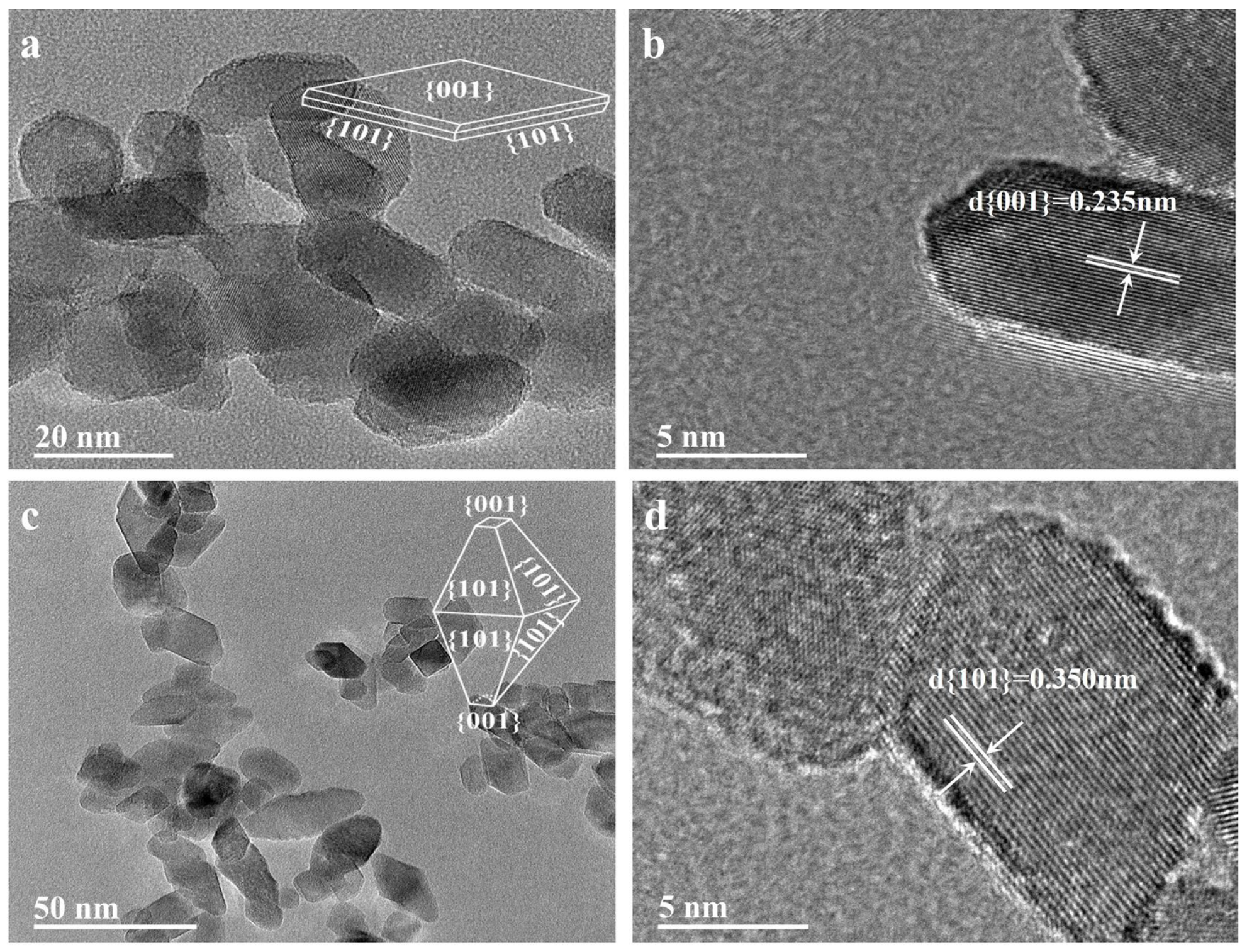
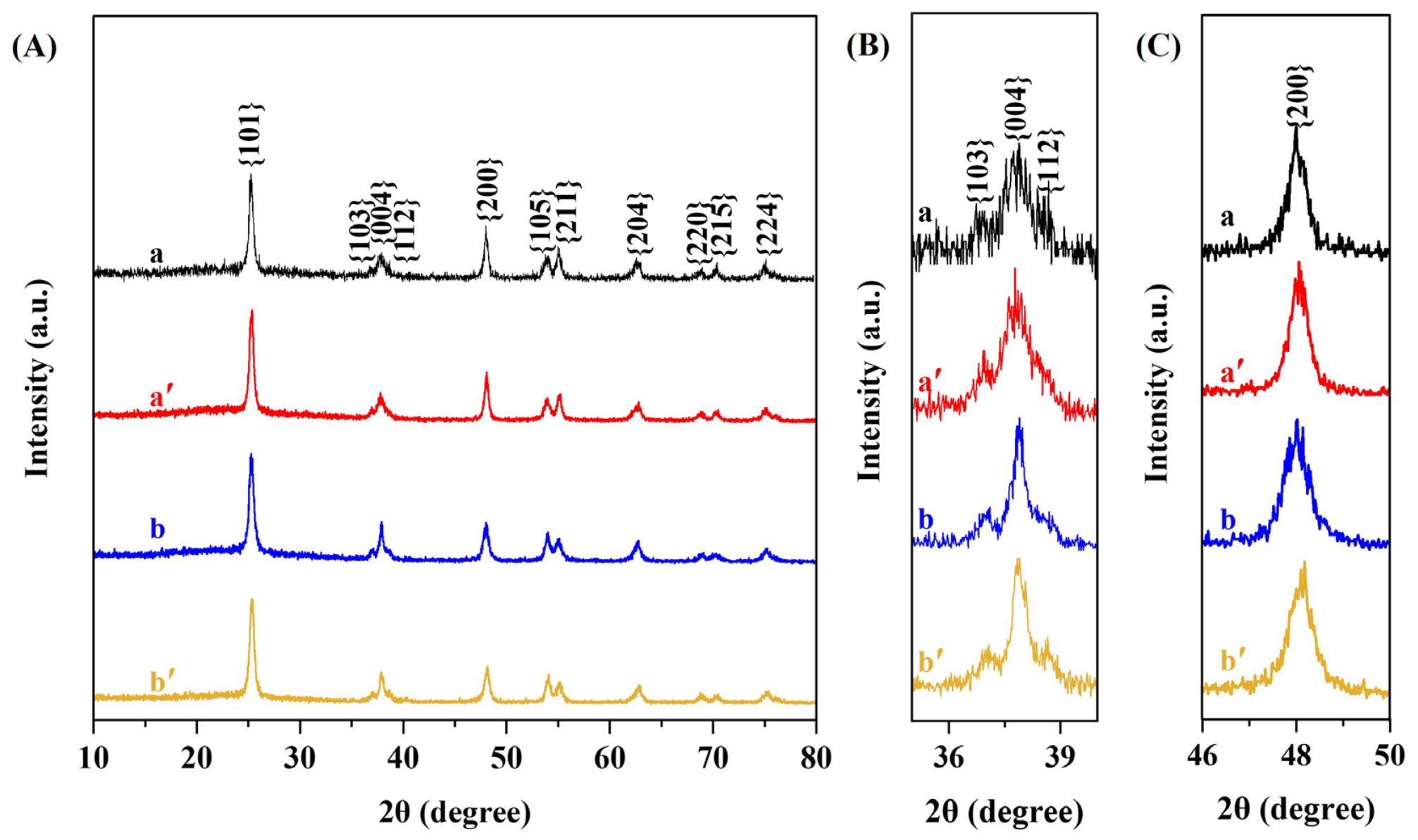
In this study, TiO2 materials with morphologies of nanosheets (NSs) and nanopolyhedra (NPs) were synthesized by a hydrothermal method. The structures of TiO2(NS) and TiO2(NP) materials were characterized using TEM and PXRD. As can be seen from TEM images (Figure 1), TiO2(NS) material mainly exhibits a rectangular nanosheet morphology, with lengths of 10–30 nm and thicknesses of 6–15 nm. The observed lattice fringe spacing is 0.235 nm, which matches the theoretical interplanar spacing of the {001} crystal plane of anatase TiO2 [29]. This result indicates that the TiO2(NS) material predominantly exposes the {001} facet. In contrast, TiO2(NP) material mainly presents a spindle-like morphology with particle sizes of 15–50 nm. The experimentally measured lattice stripe spacing is 0.350 nm, which is highly consistent with the theoretical interplanar spacing corresponding to the {101} crystal plane of anatase TiO2 [29,32], suggesting that TiO2(NP) material preferentially exposes the {101} facet. The PXRD pattern presented in Figure 2A reveals that both TiO2(NS) and TiO2(NP) materials exhibit eleven distinct PXRD peaks at 25.3°, 37.1°, 37.8°, 38.7°, 48.2°, 54.1°, 55.1°, 62.7°, 68.9°, 70.3°, and 75.1°, corresponding to the {101}, {103}, {004}, {112}, {200}, {105}, {211}, {204}, {220}, {215}, and {224} planes of anatase TiO2, respectively [31,33]. Compared with TiO2(NP) material, TiO2(NS) material exhibits a broader {004} diffraction peak and a sharper {200} diffraction peak, as shown in Figure 2B,C. This observation further supports the predominant exposure of {001} facets on TiO2(NS) material, as revealed by [34].

2.2. Catalyst Structure

The supported Pd catalysts were prepared by impregnating the aforementioned TiO2 materials into a Pd(NO3)2/H2O solution and subsequently reducing them with H2 at 400 °C. The Pd loading of the two catalysts was determined to be approximately 1 wt%, as shown in Table 1. N2 adsorption analyses revealed the pore structure of the supports and supported Pd catalysts, and the results are shown in Table 1. Although the specific surface area of TiO2(NS) is similar to that of TiO2(NP), TiO2(NS) exhibits larger pore size and pore volume, indicating that TiO2(NS) forms well-connected large mesoporous channels through nanosheet stacking. Upon Pd loading, the pore size of both materials remains virtually unchanged, while both the specific surface area and pore volume decrease. Such concurrent decline suggests that Pd species have been successfully incorporated into the internal pore channels. Compared with TiO2(NP) material, the decrease in specific surface area and pore volume is more pronounced for TiO2(NS) material, confirming that well-connected channels of TiO2(NS) facilitate the diffusion of Pd components deep into the pores.
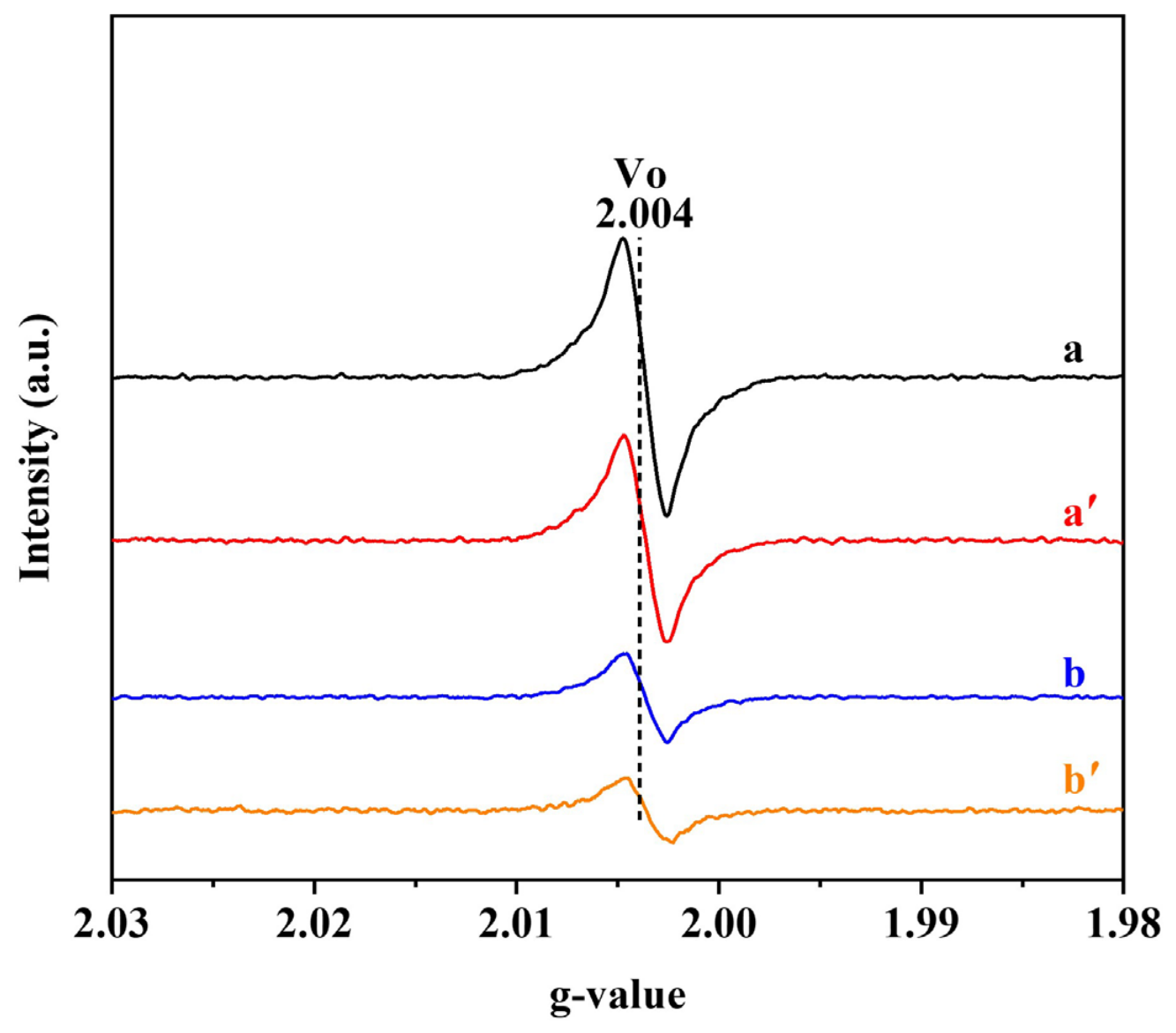
The EPR and XPS analyses elucidated the interaction mechanism between Pd and TiO2 with different exposed crystal planes. As shown in the EPR pattern (Figure 3), the TiO2(NP) material exhibits a single EPR signal at g = 2.004, which can be attributed to oxygen vacancies (Vo) [35,36]. In contrast, the TiO2(NS) material displays a more intense EPR signal, indicating that the TiO2(NS) material possesses a greater number of oxygen vacancies. After loading the Pd component, the EPR signal assigned to oxygen vacancies in the TiO2(NS) material diminishes significantly, whereas that in the TiO2(NP) material weakens only slightly. This result indicates that the oxygen vacancies in TiO2(NP) and TiO2(NS) are occupied by Pd components.
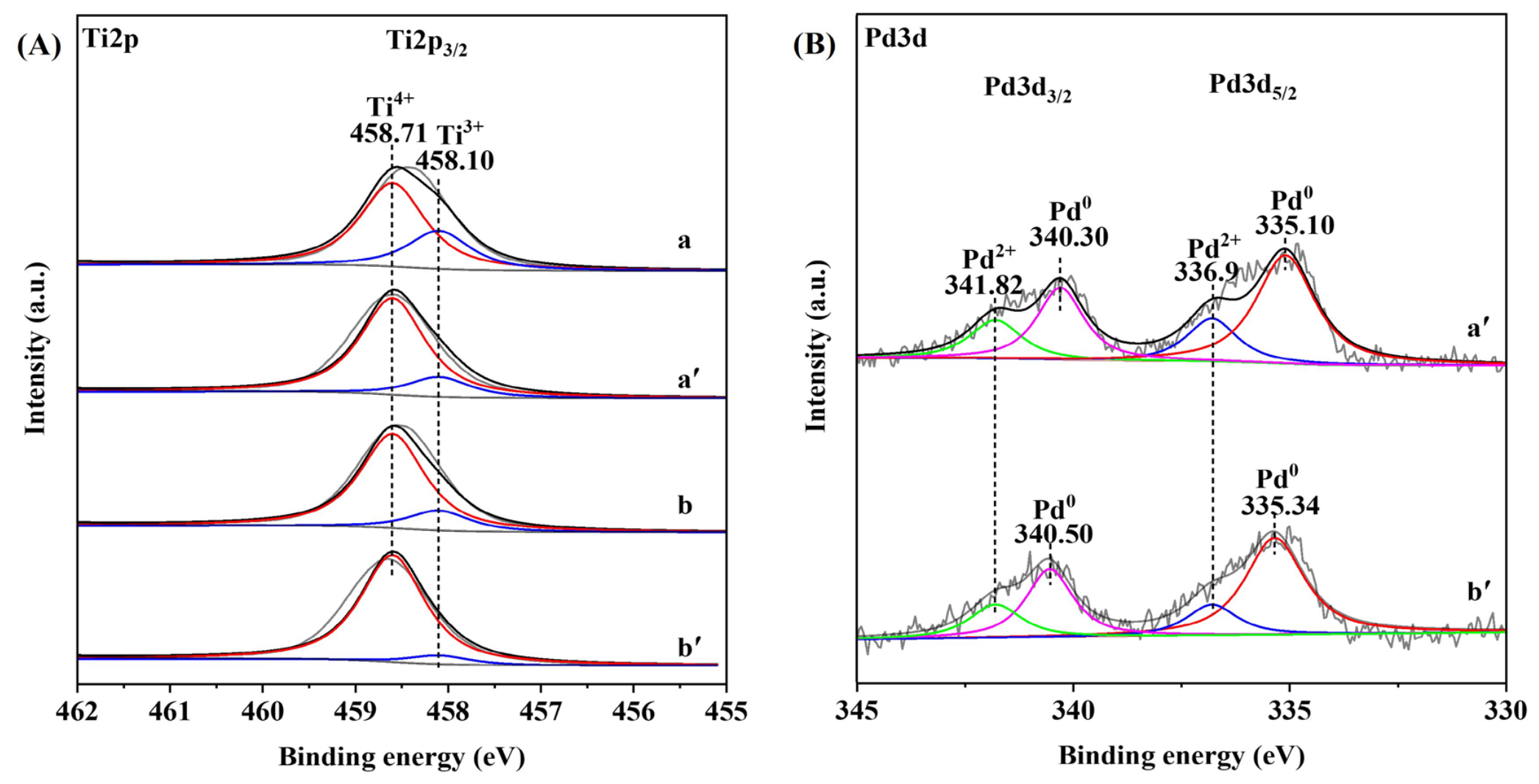
As depicted in the Ti2p XPS pattern (Figure 4A), all samples exhibit two Ti2p3/2 XPS peaks at 458.10 and 458.71 eV, corresponding to Ti3+ and Ti4+, respectively [37,38,39]. The relative proportions of Ti3+ and Ti4+ ions in the supports and supported Pd catalysts are detailed in Table 2. The TiO2(NS) material contains more Ti3+ ions than the TiO2(NP) material. After loading the Pd component, the Ti3+ content decreases appreciably on the TiO2(NS) material, while it shows only a minor decrease on the TiO2(NP) material. This suggests that Ti3+ ions also engage in interactions with the Pd component. Figure 4B illustrates the Pd3d XPS pattern of the supported Pd catalysts. The Pd/TiO2(NP) catalyst has one Pd3d5/2 XPS peak at 335.3 eV, which can be assigned to Pd0 in Pd nanoparticles [36,40]. In contrast, the Pd3d5/2 XPS peak assigned to Pd nanoparticles on the Pd/TiO2(NS) catalyst shifts to 335.1 eV. This result indicates that the well-connected channels, abundant oxygen vacancies and Ti3+ species of the TiO2(NS) material facilitate the formation of electron-rich Pd nanoparticles. Additionally, another Pd3d5/2 XPS peak is observed at 336.9 eV for both the Pd/TiO2(NP) and Pd/TiO2(NS) catalysts, which is assigned to Pd2+ ions generated by the oxidation of Pd nanoparticles upon exposure to air [40].
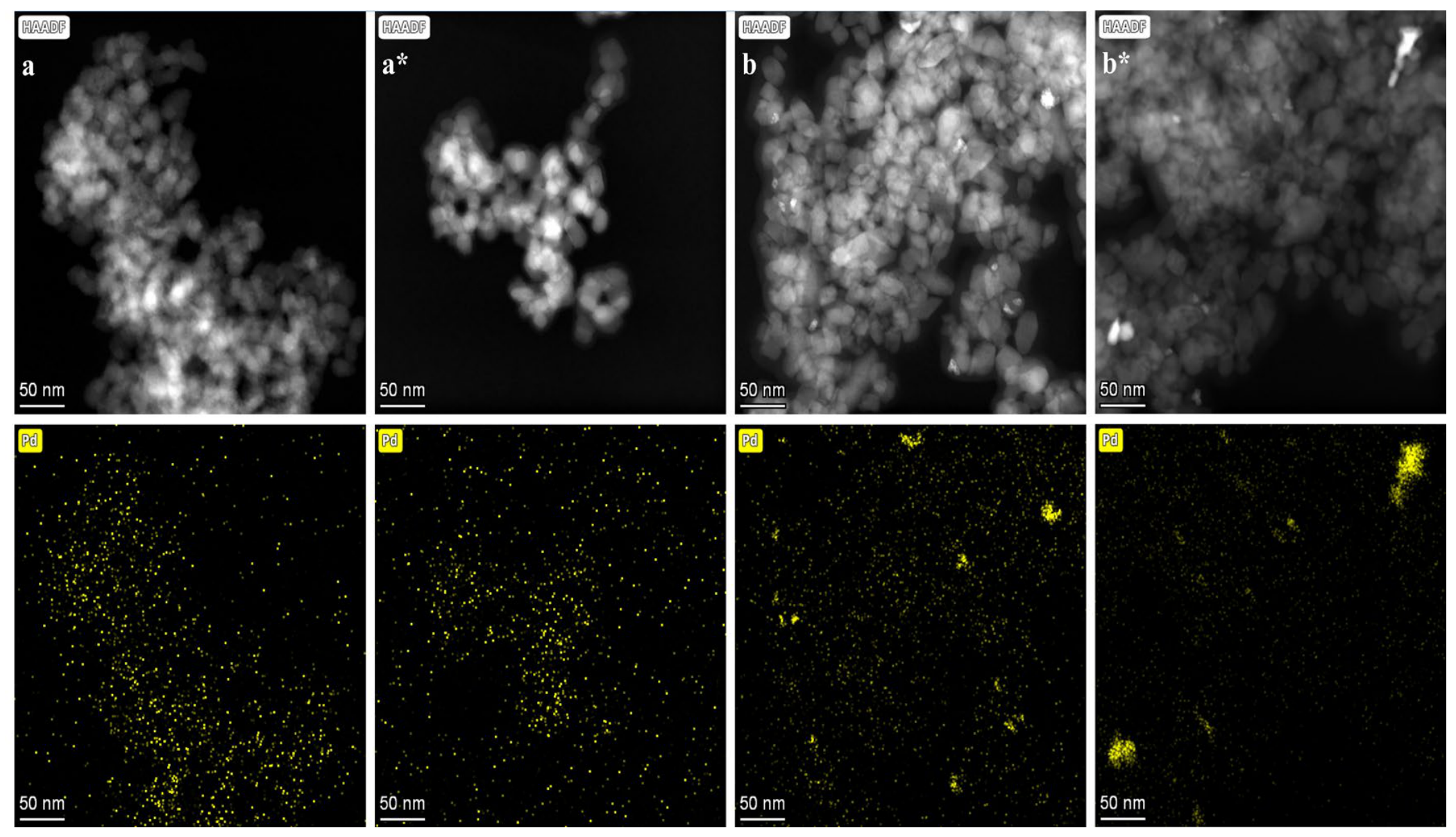
The PXRD, TEM and CO chemisorption analyses revealed the Pd dispersion on the supported Pd catalyst. As depicted in the PXRD pattern (Figure 2), no peaks corresponding to Pd crystallites are observed on the supported Pd catalyst, owing to the low Pd loading. As can be seen from TEM images (Figures S1 and S2), the Pd species exist as nanoparticles on both TiO2(NS) and TiO2(NP) materials. The measured lattice fringe spacing is 0.224 nm, which closely matches the characteristic {111} interplanar spacing of face-centered cubic (fcc) metallic palladium. Notably, the particle size of Pd nanoparticles on the Pd/TiO2(NS) catalyst is smaller than that of those on the Pd/TiO2(NP) catalyst. Furthermore, TEM–elemental mapping shown in Figure 5 indicates that the palladium nanoparticles are uniformly distributed on the TiO2(NS) material, while they are significantly aggregated on the TiO2(NP) material. In line with these observations, the Pd dispersion (DPd%) determined by CO chemisorption is higher for Pd/TiO2(NS) than for Pd/TiO2(NP), as shown in Table 2. The highly dispersed small-sized Pd nanoparticles on the TiO2(NS) material can be attributed to the stronger interaction between palladium and TiO2(NS), which effectively stabilizes the nanoparticles against aggregation.

2.3. CO Oxidation Reaction

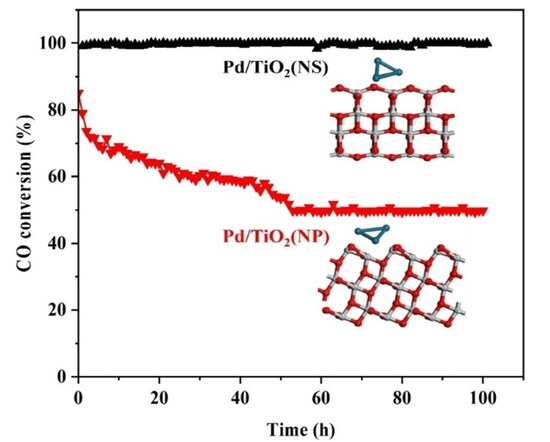
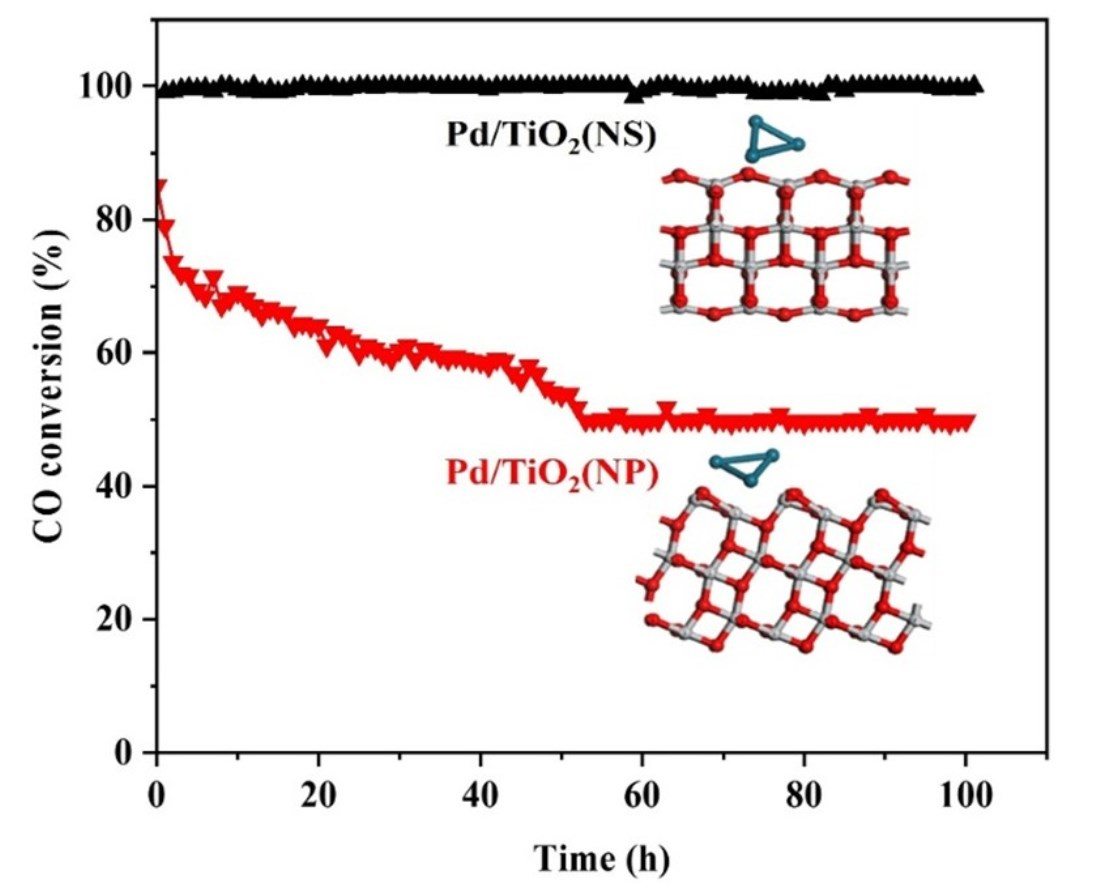
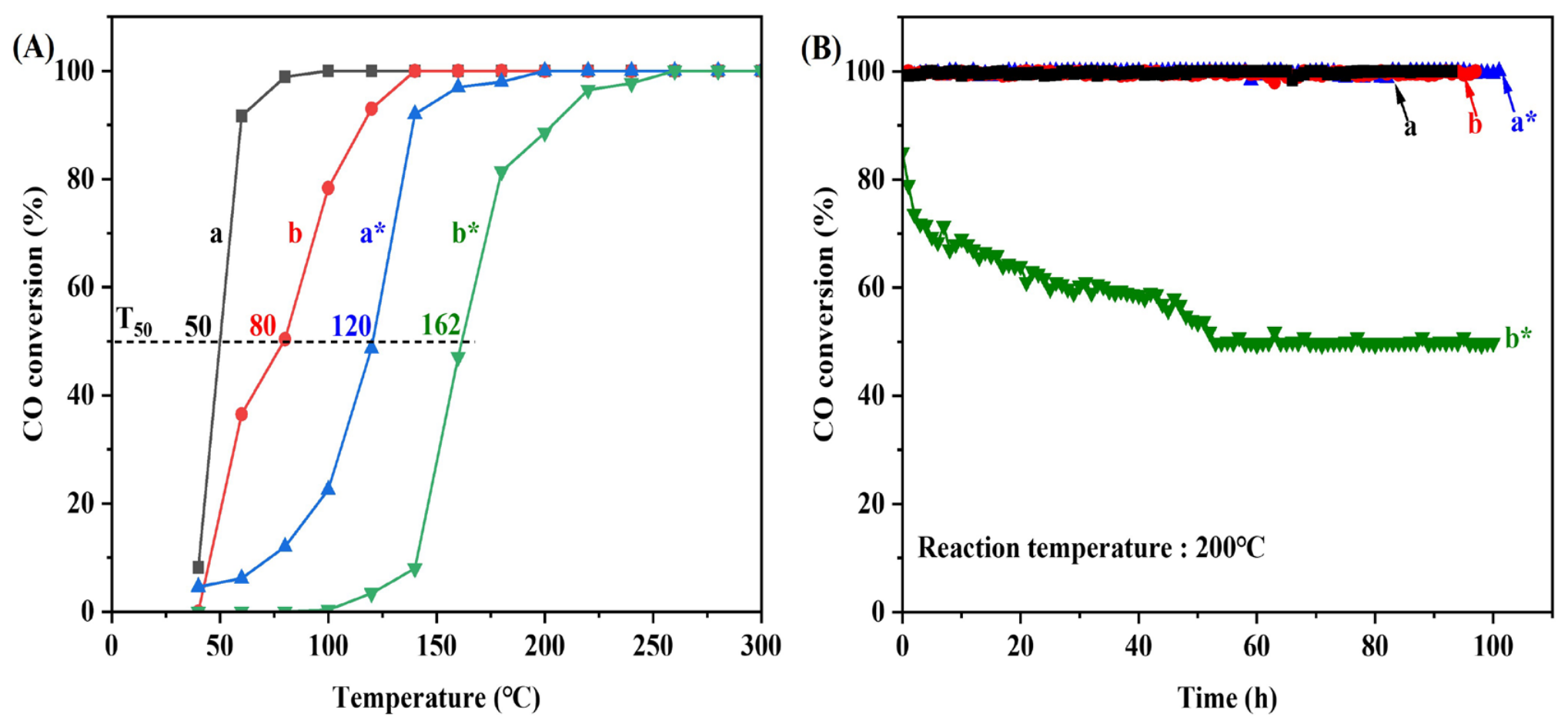
The CO oxidation reaction over the supported Pd catalysts was carried out in a fixed-bed microreactor under different conditions, and the results are shown in Figure 6A. In the clean atmosphere, the T50 and T90 values of the Pd/TiO2(NS) catalyst are significantly lower than those of the Pd/TiO2(NP) catalyst. Upon the introduction of NH3, NO, H2O and SO2 into the feed, the T50 and T90 of both catalysts shift to higher temperatures. Notably, the Pd/TiO2(NS) catalyst shows much smaller increases in T50 and T90, and its light-off temperatures remain consistently lower than those of the Pd/TiO2(NP) catalyst. The long-term catalytic stability of the catalysts for CO oxidation was examined at 200 °C under different atmospheres. As shown in Figure 6B, both Pd/TiO2(NS) and Pd/TiO2(NP) catalysts exhibit stable CO conversion over 100 h under clean conditions. After introducing impurities such as NH3, NO, SO2 and H2O, CO conversion of the Pd/TiO2(NS) catalyst consistently remains above 99%. In contrast, CO conversion of the Pd/TiO2(NP) catalyst gradually decreases from 85% to 50% within 53 h. When the reaction time is further extended to 100 h, CO conversion remains at around 50%. These results suggest that exposing the {001} crystal plane of the TiO2(NS) material is more beneficial for creating efficient and highly stable supported Pd catalysts for CO oxidation under complex atmospheres.
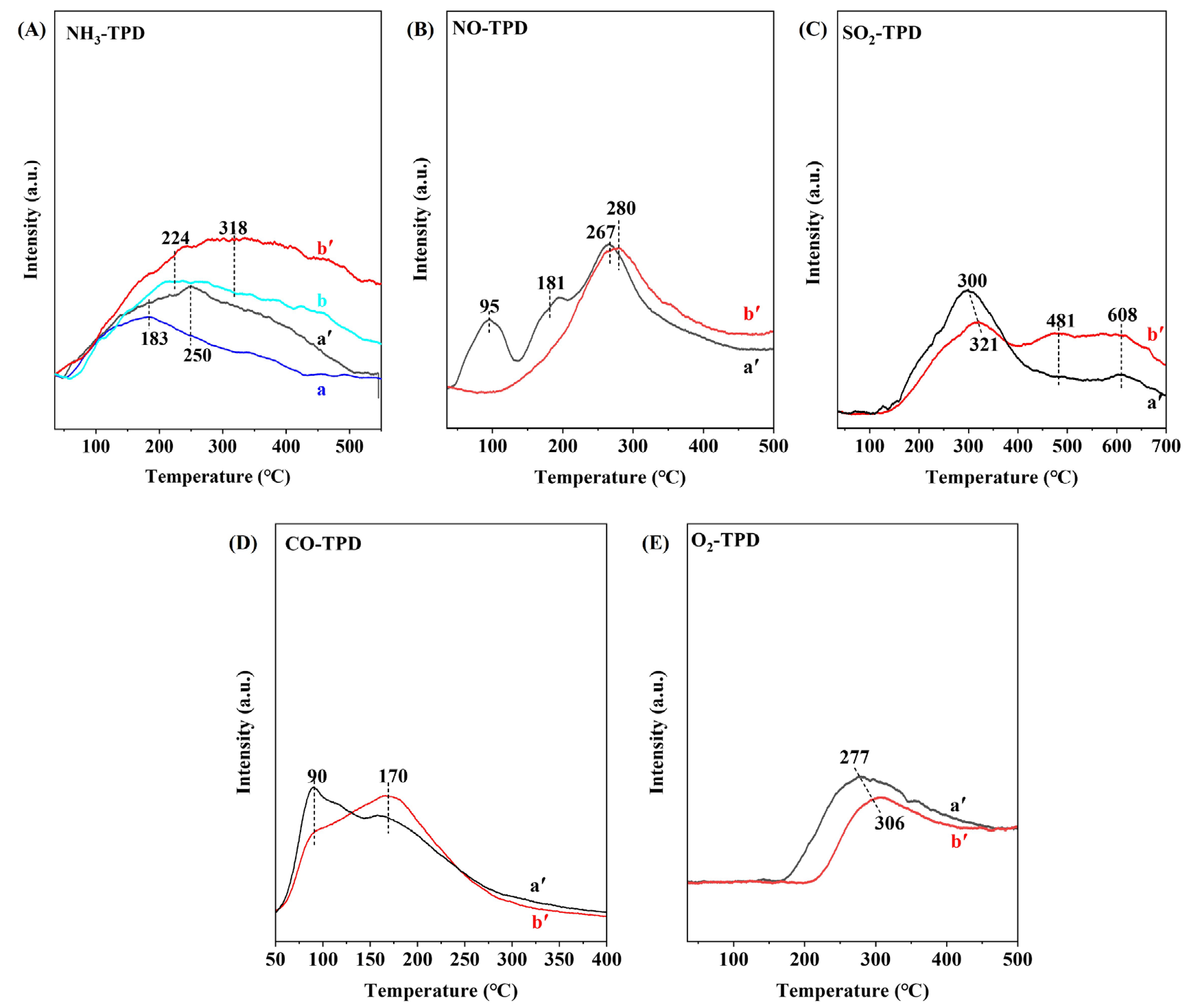
The higher Pd dispersion (Table 2) explains the superior CO oxidation activity of Pd/TiO2(NS) catalysts in the clean feed, but it alone cannot account for the markedly better performance in the complex atmosphere. To elucidate the underlying mechanism, the adsorption states of NH3, NO, SO2, CO and O2 were investigated by TPD characterization, and all TPD test results showed good reproducibility. The NH3-TPD pattern is shown in Figure 7A, and the peak area is given in Table S1. The TiO2(NP) material exhibits two NH3-TPD peaks. The peak at 224 °C corresponds to weakly adsorbed NH3 species, while the peak at 318 °C corresponds to moderately adsorbed NH3 species [41]. Compared with the TiO2(NP) material, the NH3-TPD peaks assigned to weakly and moderately adsorbed NH3 species on the TiO2(NS) material shift to 183 °C and 250 °C, respectively. In addition, the corresponding peak areas decrease. These results indicate that the TiO2(NS) material is not conducive to the adsorption of NH3, which is consistent with the findings in the literature [31,42]. After Pd loading, the NH3-TPD peak areas of weakly adsorbed NH3 species on the TiO2(NS) and TiO2(NP) materials increase slightly, while those of strongly adsorbed NH3 species increase markedly. The significant increase in the NH3-TPD peak area for the medium-absorbing NH3 species can be attributed to the Pd component. Notably, the Pd-associated peak area on the Pd/TiO2(NS) catalyst is significantly lower than that on the Pd/TiO2(NP) catalyst, suggesting that electron-rich Pd nanoparticles exhibit weaker NH3 adsorption ability.
According to previous literature reports, the bare TiO2 support exhibits negligible adsorption toward NO [43], SO2 [44], CO [45] and O2 [46]. Hence, the corresponding TPD signals originate predominantly from the Pd nanoparticles. As can be seen from NO-TPD (Figure 7B) pattern and corresponding peak area (Table S2), the Pd/TiO2(NP) catalyst exhibits one NO-TPD peak at 280 °C, which can be assigned to bridged nitrate species [47]. Interestingly, the NO-TPD peak assigned to bridged nitrate species on the Pd/TiO2(NS) catalyst shifts to 267 °C and becomes smaller. Furthermore, two new NO-TPD peaks appear at 95 and 181 °C, corresponding to weakly adsorbed NO species and monodentate nitrate species [47], respectively. These observations confirm that electron-rich Pd nanoparticles on the TiO2(NS) material contribute to the formation of weakly adsorbed NOx species. Figure 7C presents the SO2-TPD profile of the as-prepared supported Pd catalysts, and Table S3 shows the corresponding peak area. For the Pd/TiO2(NP) catalyst, three SO2-TPD peaks can be observed at 321, 481 and 608 °C, which can be assigned to weakly chemisorbed SO2 species, sulfite species and sulfate species, respectively [44,48]. In comparison, the SO2-TPD peak assigned to sulfite and sulfate species on the Pd/TiO2(NS) catalyst becomes weak. In addition, the SO2-TPD peak assigned to weakly chemisorbed SO2 species on the Pd/TiO2(NS) catalyst shifts to a lower temperature and become bigger. These results indicate that the electron-rich Pd nanoparticles on the TiO2(NS) material promote the population of weakly bound SOₓ species.
As shown in the CO-TPD pattern (Figure 7D) and corresponding peak area (Table S4), both Pd/TiO2(NS) and Pd/TiO2(NP) catalysts have two CO-TPD peaks at 89 and 170 °C, which can be assigned to weakly adsorbed CO species and strongly adsorbed CO species, respectively [45]. Compared to the Pd/TiO2(NP) catalyst, the CO-TPD peak assigned to strongly adsorbed CO on the Pd/TiO2(NS) catalyst is attenuated, whereas the peak corresponding to weakly adsorbed CO species is enhanced. This observation indicates that electron-rich Pd nanoparticles on the TiO2(NS) material are not conducive to strong adsorption of CO. The O2-TPD pattern shown in Figure 7E and the relevant peak area shown in Table S4 indicate that the Pd/TiO2(NP) catalyst has one O2-TPD peak at 306 °C, which can be assigned to surface-adsorbed oxygen species [46]. In contrast, the O2-TPD peak of surface-adsorbed oxygen species on Pd/TiO2(NS) shifts to 277 °C and becomes bigger, indicating that electron-rich Pd nanoparticles on TiO2(NS) promote the formation of more labile, weakly bound oxygen species.
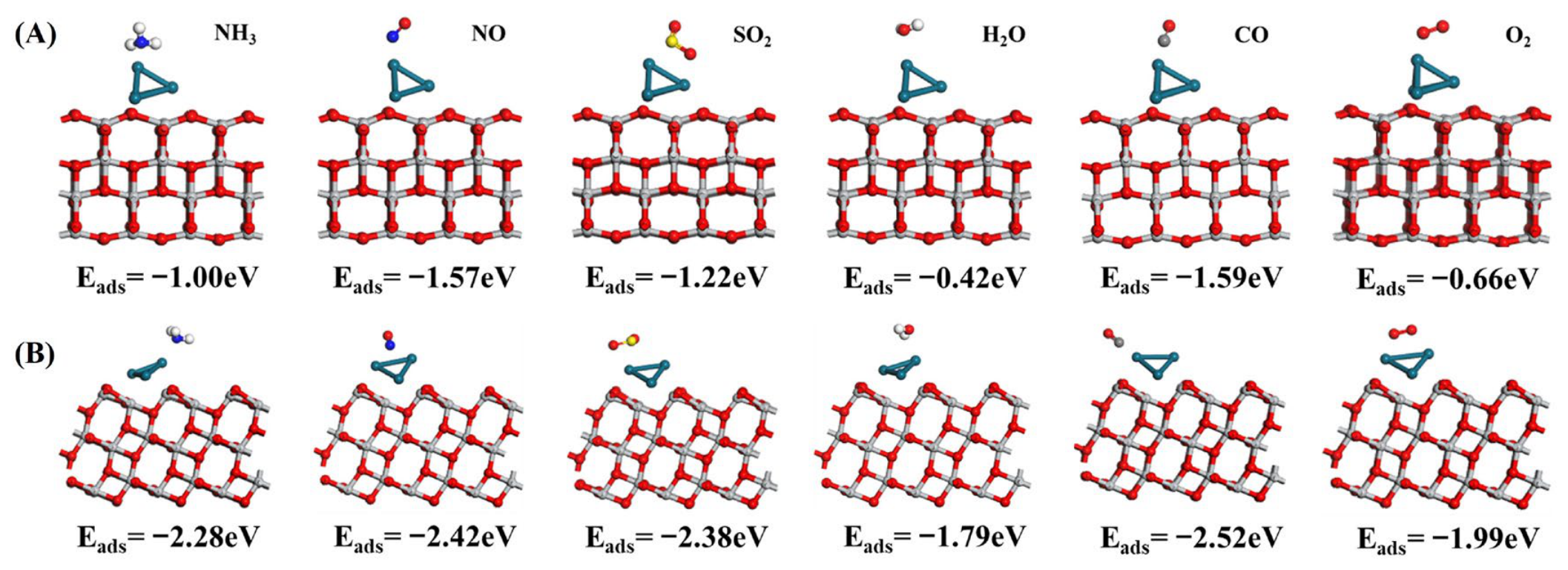
To further elucidate the adsorption behavior of NH3, NO, SO2, H2O, CO and O2 on the Pd nanoparticles, DFT calculations were performed to quantify the adsorption energies of these gas molecules on the Pd nanoparticles, and the results are shown in Figure 8. The Pd nanoparticles on the Pd/TiO2(NS) catalyst exhibit significantly weaker adsorption toward all the aforementioned gas molecules compared with those on the Pd/TiO2(NP) catalyst, which further confirms that electron-rich Pd nanoparticles effectively weaken the adsorption of these gas molecules. Previous studies have noted that weak CO adsorption on electron-rich Pd suppresses CO conversion [49]. However, this minor adverse effect is more than compensated by other promotional mechanisms that arise from the same electron-rich state. First, the weakened adsorption of competing impurity species (NH3, NO, H2O and SO2) on the electron-rich Pd nanoparticles minimizes active site blocking by these non-target adsorbates, preserving more available active sites for the adsorption and activation of the target reactants (CO and O2) and thereby improving the catalytic activity of the catalyst in complex atmospheres. Second, the weaker binding of surface oxygen species on electron-rich Pd nanoparticles facilitates their transformation into highly reactive oxygen species, which can also enhance catalytic activity under both clean and complex feed atmospheres [28,50].
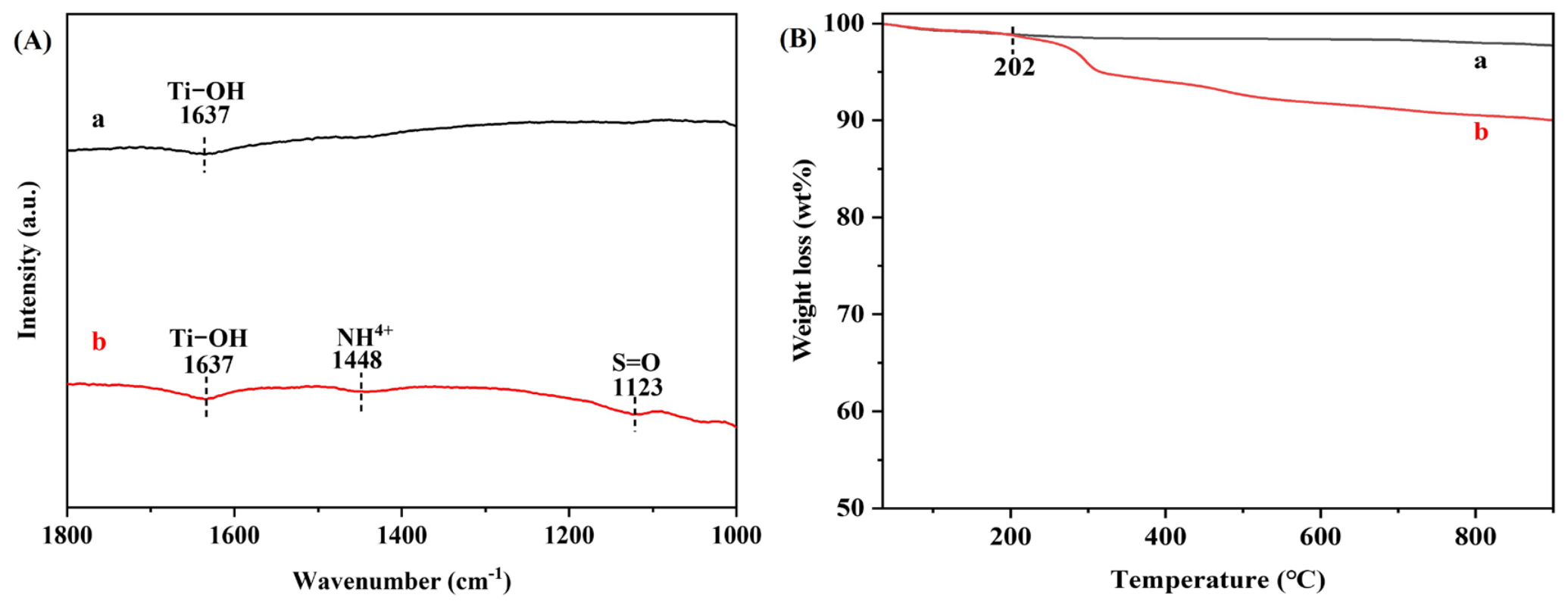
The TEM combined with elemental mapping revealed the dispersed state of the Pd component on supported Pd catalysts after 100 h CO oxidation reaction under 200 °C and complex atmosphere. As shown in the TEM image (Figure S1), the particle size of Pd nanoparticles on the Pd/TiO2(NS) catalyst remains unchanged after the reaction, while those on the Pd/TiO2(NP) catalyst grow larger in size. Furthermore, the TEM–elemental mapping shown in Figure 5 reveals that Pd nanoparticles on the Pd/TiO2(NS) catalyst still maintain a highly dispersed state after the reaction. In contrast, Pd nanoparticles on the Pd/TiO2(NP) catalyst exhibit obvious aggregation. These observations indicate that Pd nanoparticles on the TiO2(NS) material possess remarkably high stability under the tested reaction conditions. The FTIR and TG were used to detect the (NH4)2SO4 or NH4HSO4 on the surface of the Pd/TiO2 catalyst after long-term catalytic stability tests at 200 °C in the complex atmosphere. The FTIR pattern (Figure 9A) indicates that three distinct FTIR peaks are observed on the Pd/TiO2(NP) catalyst. Specifically, the peak at 1637 cm−1 is attributed to the Ti-OH groups on TiO2 material [51], while the peaks at 1448 cm−1 and 1123 cm−1 are assigned to NH4+ and S=O groups of (NH4)2SO4 or NH4HSO4, respectively [52]. In contrast, no obvious FTIR peaks assigned to (NH4)2SO4 or NH4HSO4 are detected on the Pd/TiO2(NS) catalyst. Furthermore, the TG curve shown in Figure 9B indicates that the Pd/TiO2(NP) catalyst undergoes significant weight loss at 202 °C, whereas the Pd/TiO2(NS) catalyst exhibits no weight loss at the corresponding temperature. These results confirm that a large amount of (NH4)2SO4 or NH4HSO4 forms on the Pd/TiO2(NP) catalyst, whereas no such production occurs on the Pd/TiO2(NS) catalyst. Obviously, the weak adsorption of NH3, NO, SO2 and H2O on the electron-rich Pd nanoparticles of the Pd/TiO2(NS) catalyst enhances the stability of the active species. Furthermore, this weak adsorption property, combined with the intrinsically low NH3 adsorption capacity of TiO2(NS) material, effectively suppresses the formation of (NH4)2SO4 or NH4HSO4. Consequently, the Pd/TiO2(NS) catalyst delivers exceptional catalytic stability for CO oxidation under complex flue gas atmospheres.

3. Experimental Section

3.1. Support Preparation

In this study, TiO2 materials with morphologies of nanosheets (NSs) and nanopolyhedra (NPs) were synthesized using a hydrothermal method. For TiO2(NS), the precursor solution was prepared by mixing 10.0 mL of titanium(IV) butoxide (Ti(OBu)4), 1.5 mL of a 40% hydrofluoric acid (HF) solution, and 3.0 mL of a 2 mol·L−1 hydrochloric acid (HCl) solution with continuous stirring for 30 min. The precursor solution was then transferred into a 50.0 mL hydrothermal reactor and maintained at 180 °C for 24 h. After cooling to room temperature, the white precipitate was collected by filtration, washed repeatedly with deionized water and ethanol, and dried at 100 °C for 12 h. For TiO2(NP), the precursor solution was prepared by mixing 25.0 mL of titanium(IV) butoxide (Ti(OBu)4), 2.7 mL of a 28% NH4OH solution, and 2.4 mL of water with continuous stirring for 30 min. The subsequent steps for synthesizing TiO2(NP) are identical to those described above for TiO2(NS).

3.2. Catalyst Preparation

First, 5.0 g of TiO2 material was added into 25.0 mL of Pd(NO3)2 aqueous solution (Pd concentration: 2.0 mg·mL−1) and heated to 80 °C to mostly remove water, followed by drying at 100 °C for 12 h and calcination at 500 °C in air for 4 h. Finally, the samples were reduced under 5%H2/Ar at 400 °C for 2 h to obtain the supported Pd catalyst.

3.3. Characterization

Transmission electron microscopy (TEM) images of the samples were obtained using a JEM-2100F microscope (JEOL Ltd., Tokyo, Japan) operated at an electron beam voltage of 200 kV. X-ray diffraction (XRD) measurements were performed at 40 kV and 30 mA using a Cu Kα radiation source, with a scanning range of 10° to 80° and a scan rate of 5°·min−1. Electron paramagnetic resonance (EPR) measurements were conducted using a Bruker EMXplus instrument (Bruker, Billerica, MA, USA), with operating parameters set to 140 K, 9064 MHz, and 0.998 mW, in the X-band. X-ray photoelectron spectroscopy (XPS) was carried out on a PHI 5000 VersaProbe spectrometer (Physical Electronics, Chanhassen, MN, USA) utilizing monochromatic Al Kα radiation (hν = 1486.8 eV) at an applied power of 150 W. The binding energy of the sample was calibrated using adventitious carbon (C1s = 284.6 eV) as a reference. Regarding the XPS fitting details: the background was the Shirley type, and the full width at half maximum of the peaks corresponding to each substance was fixed during the fitting process. The infrared (FTIR) spectrum of the sample was collected using a Nicolet IS10 infrared spectrometer (Thermo Fisher Scientific, Waltham, MA, USA). The scanning frequency was 64 times, the scanning range was from 400 to 4000 cm−1, and the resolution was ±8 cm−1. Thermogravimetric analysis (TG) was performed on a Netzsch STA 449C instrument (Selb, Germany) under a nitrogen atmosphere, heating from 30 to 900 °C at a rate of 10 °C·min−1. Temperature-programmed desorption (TPD) experiments were conducted using a custom-built experimental system. The 500 mg sample (40~60 mesh) was pretreated at 300 °C under a helium atmosphere for 30 min. Subsequently, the sample temperature was reduced to 35 °C, followed by adsorption of CO, O2, NH3, NO, O2, and SO2 until saturation and then purging with helium. Under the same helium atmosphere, the sample was heated at a rate of 5 °C·min−1, and the desorbed gas signals were detected by a TCD detector. The TPD experiments were performed using a custom-fabricated high-purity fused silica U-shaped reaction tube (inner diameter: 4.0 mm; total height: 217.0 mm), which features an enlarged reaction chamber with an inner diameter of 15.0 mm and a height of 30.0 mm near the bottom. CO chemisorption was performed on a Micromeritics ASAP 2020M system (Norcross, GA, USA). A 100 mg sample was treated at 200 °C under vacuum for 2 h. After cooling to 35 °C, the sample was exposed to CO, and then the adsorption isotherm was collected. To measure the amount of chemisorbed CO, physically adsorbed CO was removed by evacuating the system at 35 °C for 1 h during the test. The Pd dispersion (DPd%) was calculated using the formula DPd% = (nCO × 1.5)/nPd × 100%, where nCO is the total molar amount of CO chemically adsorbed on Pd, nPd is the total molar amount of Pd loading in the catalysts, and the PdS/COa = 1.5 stoichiometry was used as a reasonable estimate in determining DPd% [17].

3.4. CO Oxidation Reaction

The CO oxidation performance of the sample was tested in a microreactor. The U-shaped reaction tube used in the microreactor was the same as that in the above-mentioned TPD experiment. The simulated flue gas flow rate was 100 mL‧min−1, the sample dosage was 100 mg (40–60 mesh), and the reaction temperature ranged from 35 to 300 °C. The gas hourly space velocity (GHSV) was 60,000 mL·g−1·h−1. The reactant gas stream consisted of 10,000 ppm CO, 750 ppm NH3, 750 ppm NO, 50 ppm SO2, 5%H2O, 15% O2 and balance Ar. The CO concentration was measured by a flue gas analyzer. The CO conversion is calculated using the following formula:
X CO ( % ) = n CO ( inlet ) n CO ( outlet ) n CO ( inlet )   ×   100 %
where nco(Inlet) is the concentration of CO in the inlet flue gas and nco(outlet) is the concentration of CO in the outlet flue gas.

3.5. Computational Method and Details

To further investigate the adsorption behavior of Pd/TiO2, density functional theory (DFT) calculations were performed to evaluate the adsorption energies of O2, SO2, CO, H2O, NO, and NH3 on the surfaces. Grimme’s DFT-D method was employed to account for the van der Waals interactions between the gaseous molecules and the Pd/TiO2 surfaces. The optimized lattice parameters of anatase TiO2 were determined to be a = b = 3.78 Å and c = 9.49 Å. Two supercells of the anatase {001} and {101} surfaces were constructed, with dimensions of 11.33 × 11.33 × 23.91 Å and 16.33 × 15.10 × 24.62 Å, respectively. To minimize interactions between neighboring clusters, a p(3 × 3) slab was used for the {001} surface and a p(3 × 4) slab for the {101} facet after depositing Pd3 clusters. It should be noted that the Pd3 cluster model employed in this study is a significant simplification of realistic 2–5 nm Pd nanoparticles. This model cannot capture the bulk-like properties, complex size effects, or specific facet exposures of larger particles. However, with all its atoms in highly under-coordinated environments, Pd3 serves as a computationally feasible and effective conceptual model for studying trends in local adsorption behavior on low-coordination active sites of either very small Pd clusters or larger nanoparticles. The primary aim of this work is to use this simplified model to qualitatively explore and compare the adsorption preferences and preliminary rules of electronic interaction for key molecules at different sites of the Pd/TiO2 interface. During geometry optimization, the topmost layer of Ti atoms and the adsorbates were fully relaxed, while the bottom three Ti layers remained fixed. The exchange–correlation energy was treated using the Perdew–Burke–Ernzerhof (PBE) generalized gradient approximation (GGA). Convergence criteria included forces below 0.002 Ha/Å, an SCF energy tolerance of 10−5 Ha, and a maximum displacement threshold of 0.005 Å. The Brillouin zone was sampled using a 5 × 5 × 1 Monkhorst–Pack k-point grid. Core and valence electrons were described using DFT semi-core pseudopotentials (DSPPs) with a double-numerical plus polarization (DNP 4.4) basis set.
The adsorption energy (Eads) for different adsorption species was calculated using the following equation:
Eads = Ecom − (Esub + Ei)
where Ecom, Esub, and Ei represent the total energies of the adsorption complex, the substrate, and the isolated adsorbate molecule in their optimized geometries, respectively.

4. Conclusions

In summary, highly activity and durable catalysts for CO oxidation under complex conditions containing NH3, NO, SO2 and H2O were successfully constructed by anchoring Pd nanoparticles on TiO2(NS) with predominantly exposed {001} facets. The well-connected channel, abundant oxygen vacancies and Ti3+ species on the TiO2(NS) material facilitate the formation of highly dispersed, electron-rich Pd nanoparticles. The superior catalytic activity and stability of the Pd/TiO2(NS) catalyst stem from the weakened adsorption of NH3, NO, SO2 and H2O on these active sites. Such weakened adsorption mitigates the competitive adsorption of impurity molecules, ensuring enough active sites remain available for the target reactants (CO and O2) and consequently improving CO conversion. In addition, this weak adsorption mechanism not only inhibits the agglomeration of Pd nanoparticles but also exerts a synergistic effect with the weak adsorption property of TiO2(NS) for NH3, which suppresses the deposition of ammonium sulfate species and consequently enhances the long-term catalytic stability of the catalyst. This work advances the application of TiO2 facet engineering in catalytic reactions and provides new design ideas for the development of efficient catalysts for CO oxidation in complex atmospheres.

Supplementary Materials

The following supporting information can be downloaded at: https://www.mdpi.com/article/10.3390/catal16060519/s1, Figure S1: The TEM image and Pd particle size distribution plots of supported Pd catalysts; Figure S2: The TEM image of Pd/TiO2(NP) catalyst; Table S1: The peak area of NH3-TPD pattern for supported and supported Pd catalysts; Table S2: The peak area of NO-TPD pattern for supported Pd catalysts; Table S3: The peak area of SO2-TPD pattern for supported Pd catalyst; Table S4: The peak area of CO-TPD and O2-TPD pattern for supported Pd catalysts.

Author Contributions

M.C. and R.S. contributed equally to this work. M.C.: Conceptualization, data curation, formal analysis, investigation, methodology, software, validation, writing—original draft, and writing—review and editing. R.S.: Conceptualization, data curation, formal analysis, investigation, methodology, software, validation, DFT calculation, writing—original draft, and writing—review and editing. Z.C.: Data curation and investigation. R.C. and Y.L.: Data curation and investigation. Y.F.: Funding acquisition, project administration, supervision, and writing—review and editing. B.X.: Funding acquisition, project administration, supervision, and writing—review and editing. All authors have read and agreed to the published version of the manuscript.

Funding

This work was financially supported by the National Natural Science Foundation of China (22002058) and the Guizhou Provincial Basic Research Program (No. ZK[2021]059, ZK[2023]460).

Data Availability Statement

The data that support the findings of this study are available from the corresponding author upon reasonable request.

Conflicts of Interest

The authors declare that they have no known competing financial interests or personal relationships that could have appeared to influence the work reported in this paper.

References

  1. Gao, S.; Tang, M.; Zhao, X.; Zhou, L.; Zhang, R.; Qiu, J.; Luo, X.; Wang, J.; Wen, S. Study on multi-source analysis and prevention of CO in return corner of composite goaf. Case Stud. Therm. Eng. 2025, 76, 107362. [Google Scholar] [CrossRef]
  2. Wang, K.; Tian, H.; Hua, S.; Zhu, C.; Gao, J.; Xue, Y.; Hao, J.; Wang, Y.; Zhou, J. A comprehensive emission inventory of multiple air pollutants from iron and steel industry in China: Temporal trends and spatial variation characteristics. Sci. Total Environ. 2016, 559, 7–14. [Google Scholar] [CrossRef]
  3. Zhang, H.; Ma, C.; Zhang, M.; Yu, Y.; Wei, S.; Wang, Y.; Liu, Z.; Li, H.; Meng, T.; Chen, Y. Copper ion-modified δ-MnO2 as an efficient catalyst for CO oxidation. Catalysts 2026, 16, 380. [Google Scholar] [CrossRef]
  4. Paris, C.; Dib, H.; Bounoukta, C.; Genty, E.; Poupin, C.; Siffert, S.; Cousin, R. Benefit of LDH-derived mixed oxides for the Co-oxidation of toluene and CO exhausted from biomass combustion. Catalysts 2024, 14, 455. [Google Scholar] [CrossRef]
  5. Feng, C.; Liu, X.; Zhu, T.; Tian, M. Catalytic oxidation of CO on noble metal-based catalysts. Environ. Sci. Pollut. Res. 2021, 28, 24847–24871. [Google Scholar] [CrossRef]
  6. Shan, C.; Jia, Q.; Zhang, Y.; Liu, G.; Hou, X.; Wang, Y.; Han, R.; Liu, C.; Wang, W.; Liu, Q. Construction of functionalized Pt-O-S bridge on Pt/TiO2 simultaneously enhancing the catalytic activity and sulfur resistance for CO oxidation. Appl. Catal. B Environ. Energy 2025, 385, 126277. [Google Scholar] [CrossRef]
  7. Zhang, J.; Chen, J.; Li, Z.; Weng, H.; Xie, Y.; Wen, J.; Duan, W.; Zhang, Q.; Chen, J.; Ning, P. CO oxidation over PdOσ/Fe1−xWxOy catalysts and their SO2 resistance at relatively low temperature. Fuel 2023, 350, 128802. [Google Scholar] [CrossRef]
  8. Li, Y.; Li, G.; Lu, Y.; Hao, W.; Wei, Z.; Liu, J.; Zhang, Y. Denitrification performance of non-pitch coal-based activated coke by the introduction of MnOx–CeOx–M (FeOx, CoOx) at low temperature. Mol. Catal. 2018, 445, 21–28. [Google Scholar] [CrossRef]
  9. Liu, S.; Xue, W.; Ji, Y.; Xu, W.; Chen, W.; Jia, L.; Zhu, T.; Zhong, Z.; Xu, G.; Mei, D.; et al. Interfacial oxygen vacancies at Co3O4-CeO2 heterointerfaces boost the catalytic reduction of NO by CO in the presence of O2. Appl. Catal. B Environ. Energy 2023, 323, 122151. [Google Scholar] [CrossRef]
  10. Guo, J.; Xiao, J.; Gui, R.; Wang, Q. Efficient simultaneous removal of NOx and CO at low temperatures over integrated Mn2Co1Ox/iron mesh monolithic catalyst via NH3-SCR coupling with CO oxidation reactions. Chem. Eng. J. 2023, 465, 142611. [Google Scholar] [CrossRef]
  11. Tang, T.; Xue, J.; Su, X.; Chen, J.; Qiao, W.; Zhang, H.; Li, S.; Li, X.; Du, X. Selective NH3 trapping as the enabler for efficient bifunctional catalysis of NH3-SCR and CO oxidation reactions. Appl. Catal. B Environ. Energy 2025, 375, 125430. [Google Scholar] [CrossRef]
  12. Zeng, Y.; Rong, W.; Zhang, S.; Wang, Y.; Zhong, Q. Promoting NH3-SCR denitration via CO oxidation over CuO promoted V2O5-WO3/TiO2 catalysts under oxygen-rich conditions. Fuel 2022, 323, 124357. [Google Scholar] [CrossRef]
  13. Deng, Y.; Fu, L.; Song, W.; Yuan, S. Transition metal and Pr co-doping induced oxygen vacancy in Pd/CeO2 catalyst boosts low-temperature CO oxidation. Sep. Purif. Technol. 2023, 311, 123247. [Google Scholar] [CrossRef]
  14. Lu, Y.; Lin, F.; Wu, Y.; Gao, F.; Dohnalek, Z.; Karim, A.; Wang, H.; Wang, Y. Enhancing activity and stability of Pd-on-TiO2 single-atom catalyst for low-temperature CO oxidation through in situ local environment tailoring. J. Am. Chem. Soc. 2024, 146, 28141–28152. [Google Scholar] [CrossRef]
  15. Xie, S.; Tan, W.; Xu, Y.; Wang, C.; Feng, Y.; Ye, K.; Ma, L.; Ehrlich, S.; Li, Y.; Zhang, Y.; et al. Pd-CeO2 catalyst facilely derived from one-pot generated Pd@Ce-BTC for low temperature CO oxidation. J. Hazard. Mater. 2024, 466, 133632. [Google Scholar] [CrossRef]
  16. Kristy, S.; Svadlenak, S.; Hoffman, A.; Bare, S.; Goulas, K. Spectroscopic determination of metal redox and segregation effects during CO and CO/NO oxidation over silica-supported Pd and PdCu catalysts. Appl. Catal. B Environ. Energy 2024, 342, 123329. [Google Scholar] [CrossRef]
  17. Beck, A.; Horvath, A.; Schay, Z.; Stefler, G.; Koppany, Z.; Sajo, I.; Geszai, O.; Guczi, L. Sol derived gold-palladium bimetallic nanoparticles on TiO2: Structure and catalytic activity in CO oxidation. Top. Catal. 2007, 44, 115–121. [Google Scholar] [CrossRef]
  18. Sebastian, J.; Mebrahtu, C.; Zeng, F.; Palkovits, R. Strong metal-support interactions on TiO2-supported metal catalysts for fine-tuning catalysis. Angew. Chem. Int. Ed. 2026, 65, e02611. [Google Scholar] [CrossRef] [PubMed]
  19. Wang, S.; Li, X.; Lai, C.; Zhang, Y.; Lin, X.; Ding, S. Recent advances in noble metal-based catalysts for CO oxidation. RSC Adv. 2024, 14, 30566–30581. [Google Scholar] [CrossRef]
  20. Xiang, L.; Wang, C.; Nie, G.; Lou, M.; Ding, J.; Li, R.; Wu, Z.; Weng, X. In situ-formed tridentate Pd-SOx coordination for sulfur-tolerant CO oxidation catalysis. Environ. Sci. Technol. 2025, 59, 13073–13084. [Google Scholar] [CrossRef] [PubMed]
  21. Di Carli, G.; Melaet, G.; Kruse, N.; Liotta, L.; Pantaleo, G.; Venezia, A. Combined sulfating and non-sulfating support to prevent water and sulfur poisoning of Pd catalysts for methane combustion. Chem. Commun. 2010, 46, 6317–6319. [Google Scholar] [CrossRef]
  22. Chenakin, S.; Melaet, G.; Szukiewicz, R.; Kruse, N. XPS study of the surface chemical state of a Pd/(SiO2+TiO2) catalyst after methane oxidation and SO2 treatment. J. Catal. 2014, 312, 1–11. [Google Scholar] [CrossRef]
  23. Chen, M.; Wei, X.; Liang, J.; Li, S.; Zhang, Z.; Tang, F. Effects of CrOx species doping on V2O5-WO3/TiO2 catalysts on selective catalytic reduction of NOx by NH3 at low temperature. React. Kinet. Mech. Catal. 2022, 135, 1767–1783. [Google Scholar] [CrossRef]
  24. Zhao, C.; Ren, L.; Shi, Y.; Wang, X.; Huang, W.; Xie, H. Advances and recent applications in high-energy {001} facets of anatase TiO2: A review. J. Environ. Chem. Eng. 2025, 13, 115764. [Google Scholar] [CrossRef]
  25. Pei, D.; Gong, L.; Zhang, A.; Zhang, X.; Chen, J.; Mu, Y.; Yu, H. Defective titanium dioxide single crystals exposed by high-energy 001 facets for efficient oxygen reduction. Nature 2015, 6, 8696. [Google Scholar] [CrossRef] [PubMed]
  26. Han, X.; Kuang, Q.; Jin, M.; Xie, Z.; Zheng, L. Synthesis of titania nanosheets with a high percentage of exposed (001) facets and related photocatalytic properties. J. Am. Chem. Soc. 2009, 131, 3152–3153. [Google Scholar] [CrossRef]
  27. Wang, Y.; Wei, Z.; Wu, Y.; Zhang, L.; Liu, S.; Xu, K.; Liu, H.; Du, G.; Chai, X. Enhanced photocatalytic H2 evolution from glucose reforming on CuNi-decorated oxygen-vacancy-rich black TiO2 nanosheets. Fuel 2026, 408, 137665. [Google Scholar] [CrossRef]
  28. Chen, X.; Zhou, L.; Wang, J.; Wang, C.; Li, Y.; Shan, W. Effect of TiO2 crystal facet on Pd/anatase catalysts for formaldehyde oxidation. Top. Catal. 2026, 69, 1686–1698. [Google Scholar] [CrossRef]
  29. Chalgin, A.; Chen, W.; Xiang, Q.; Wu, Y.; Li, F.; Shi, F.; Song, C.; Tao, P.; Shang, W.; Wu, J. Manipulation of electron transfer between Pd and TiO2 for improved electrocatalytic hydrogen evolution reaction performance. ACS Appl. Mater. Interfaces 2020, 12, 27037–27044. [Google Scholar] [CrossRef]
  30. Ye, F.; Su, Y.; Quan, X.; Chen, S.; Yu, H.; Li, H. Constructing desired interfacial energy band alignment of Z-scheme TiO2-Pd-Cu2O hybrid by controlling the contact facet for improved photocatalytic performance. Appl. Catal. B Environ. 2019, 244, 347–355. [Google Scholar] [CrossRef]
  31. Sun, G.; Wang, Q.; Liao, Y.; Cui, Y.; Tian, L.; Chou, J.; Zhao, Y.; Peng, Y. Manipulating the H2O2 reactivity on pristine anatase TiO2 with various surface features and implications in oxidation reactions. J. Phys. Chem. Lett. 2024, 15, 11620–11628. [Google Scholar] [CrossRef]
  32. Wu, X.; Liu, C.; Wang, H.; Ge, Q.; Zhu, X. Origin of strong metal-support interactions between Pt and anatase TiO2 facets for hydrodeoxygenation of m-cresol on Pt/TiO2 catalysts. J. Catal. 2023, 418, 203–215. [Google Scholar] [CrossRef]
  33. Chen, M.; Zhao, M.; Tang, F.; Ruan, L.; Yang, H.; Li, N. Effect of Ce doping into V2O5-WO3/TiO2 catalysts on the selective catalytic reduction of NOx by NH3. J. Rare Earths 2017, 35, 1206–1215. [Google Scholar] [CrossRef]
  34. Wang, K.; Cai, R.; Zhang, D.; Yu, Z.; Liang, Z.; Wang, Y.; Zhao, L.; Liu, Y.; Fan, Y. The dispersion state and NOx-SCR properties of VOx species on V2O5 catalysts with different preferentially exposed facets of TiO2 supports. Catal. Sci. Technol. 2025, 15, 6222–6230. [Google Scholar] [CrossRef]
  35. Shi, H.; Wang, Q.; Fang, S.; Wang, C.; Yang, G.; Zeng, J.; Li, J.; Mele, G.; Wang, C. Loading Pt-Ru dual atoms on oxygen-vacancy-rich TiO2 for efficient photocatalytic H2 production. Langmuir 2025, 41, 15630–15640. [Google Scholar] [CrossRef] [PubMed]
  36. Wang, S.; Yang, Z.; Li, R.; Zhang, K.; Zhao, Z.; Zhang, H.; Hu, C.; Bao, X.; Yuan, P. Engineering aerobic-stable oxygen vacancies-Ti3+ defects of Pd/Mn-TiO2 for boosting nitrile butadiene rubber hydrogenation. Chem. Eng. J. 2025, 522, 167591. [Google Scholar] [CrossRef]
  37. Guo, J.; Yin, J.; Zheng, P. Carbon-coated NaTi2(PO4)3/TiO2 with rich Ti3+ for sodium energy storage with high performance. Electrochim. Acta 2025, 543, 147544. [Google Scholar] [CrossRef]
  38. Guillemot, F.; Porte, M.; Labrugere, C.; Baquey, C. Ti4+ to Ti3+ conversion of TiO2 uppermost layer by low-temperature vacuum annealing: Interest for titanium biomedical applications. J. Colloid Interface Sci. 2002, 255, 75–78. [Google Scholar] [CrossRef]
  39. Pylnev, M.; Rezende Santos, F.; Zhang, D.; Alawadhi, H.; Tabet, N. Compact TiO2 layer by UV-assisted TiBr4 chemical bath deposition for perovskite solar cells. Mater. Sci. Semicond. Process. 2023, 161, 107467. [Google Scholar] [CrossRef]
  40. Jiang, G.; Li, X.; Shen, Y.; Shi, X.; Lv, X.; Zhang, X.; Dong, F.; Qi, G.; Liu, R. Mechanistic insight into the electrocatalytic hydrodechlorination reaction on palladium by a facet effect study. J. Catal. 2020, 391, 414–423. [Google Scholar] [CrossRef]
  41. Qiu, W.; Ren, C.; Gong, M.; Hou, Y.; Chen, Y. Structure, surface properties and photocatalytic activity of TiO2 and TiO2/SiO2 catalysts prepared at different pH values. Acta Phys.-Chim. Sin. 2011, 27, 1487–1492. [Google Scholar] [CrossRef]
  42. Lin, F.; Chen, Y.; Zhang, L.; Mei, D.; Kovarik, L.; Sudduth, B.; Wang, H.; Gao, F.; Wang, Y. Single-facet dominant anatase TiO2(101) and (001) model catalysts to elucidate the active sites for alkanol dehydration. ACS Catal. 2020, 10, 4268–4279. [Google Scholar] [CrossRef]
  43. Watson, J.; Ozkan, U. Adsorption characteristics of sol-gel Gd–Pd/TiO2 catalysts in reduction of nitric oxide with CH4: DRIFTS and TPD. J. Catal. 2002, 210, 295–312. [Google Scholar] [CrossRef]
  44. Sun, J.; Liu, Y.; Deng, J.; Jing, L.; Bao, M.; Sun, Q.; Li, L.; Wu, L.; Hao, X.; Dai, H. PdPty/V2O5-TiO2: Highly active catalysts with good moisture- and sulfur dioxide-resistant performance in toluene oxidation. Catalysts 2022, 12, 1302. [Google Scholar] [CrossRef]
  45. Kaden, W.; Kunkel, W.; Sloan Roberts, F.; Kane, M.; Anderson, S. CO adsorption and desorption on size-selected Pdn/TiO2(110) model catalysts: Size dependence of binding sites and energies, and support-mediated adsorption. J. Chem. Phys. 2012, 136, 204705. [Google Scholar] [CrossRef]
  46. Fang, Y.; Yu, L.; Ye, F.; Sun, M. Synthesis, Characterization and Photocatalytic Performance of Ag-modified TiO2 Catalysts for the Degradation of Gas-phase Toluene. J. Mol. Catal. 2011, 25, 569–573. [Google Scholar] [CrossRef]
  47. Meng, D.; Zhan, W.; Guo, Y.; Wang, L.; Lu, G. A highly effective catalyst of Sm-MnOx for the NH3-SCR of NOx at low temperature: Promotional role of Sm and its catalytic performance. ACS Catal. 2015, 5, 5973–5983. [Google Scholar] [CrossRef]
  48. Wilburn, M.; Epling, W. Formation and decomposition of sulfite and sulfate species on Pt/Pd catalysts: An SO2 oxidation and sulfur exposure study. ACS Catal. 2019, 9, 640–648. [Google Scholar] [CrossRef]
  49. Abbasi, F.; Ghotbi, C. Enhanced CO oxidation over Pd/MIL catalysts promoted by co-impregnated alkali and alkaline earth metals. Inorg. Chem. Commun. 2025, 181, 115338. [Google Scholar] [CrossRef]
  50. Hou, N.; Shan, C.; Zhu, X.; Wang, H.; Zhang, W.; Jia, Q.; Jiang, Y.; Han, R.; Liu, Q. Revealing the key role of Pt and Pd sites in the promotion or inhibition of H2O on CO catalytic oxidation. Fuel 2026, 407, 137240. [Google Scholar] [CrossRef]
  51. Mostafa, M.; Bassioni, G.; El-Faramawy, N.; El-Kinawy, M. Physicochemical and thermoluminescence characterizations of TiO2 nanoparticles. J. Lumin. 2025, 284, 121280. [Google Scholar] [CrossRef]
  52. Zheng, Z.; Du, X.; Wang, X.; Liu, Y.; Chen, K.; Lu, P.; Rac, V.; Rakic, V. Experimental investigation on the decomposition of NH4HSO4 over V2O5-WO3/TiO2 catalyst by NH4NO3 at low temperature. Fuel 2023, 333, 126433. [Google Scholar] [CrossRef]
Figure 1. The TEM image of support materials. (a,b) TiO2(NS); (c,d) TiO2(NP).
Catalysts 16 00519 g001
Figure 2. Full-range pattern (A) and normalized enlarged pattern (B,C) of PXRD for supports and supported Pd catalysts. (a) TiO2(NS); (a′) Pd/TiO2(NS); (b) TiO2(NP); (b′) Pd/TiO2(NP).
Catalysts 16 00519 g002
Figure 3. The EPR pattern of supports and supported Pd catalysts. (a) TiO2(NS); (a′) Pd/TiO2(NS); (b) TiO2(NP); (b′) Pd/TiO2(NP).
Catalysts 16 00519 g003
Figure 4. XPS patterns of Ti2p (A) and Pd3d (B) for supports and supported Pd catalysts. (a) TiO2(NS); (a′) Pd/TiO2(NS); (b) TiO2(NP); (b′) Pd/TiO2(NP).
Catalysts 16 00519 g004
Figure 5. The TEM-EDS elemental mapping of Pd in supported Pd catalysts. (a) Pd/TiO2(NS); (a*) Pd/TiO2(NS) after 100 h of CO oxidation reaction under 200 °C and complex atmosphere; (b) Pd/TiO2(NP); (b*) Pd/TiO2(NP) after 100 h of CO oxidation reaction under 200 °C and complex atmosphere. The complex atmosphere is composed of 10,000 ppm CO, 750 ppm NH3, 750 ppm NO, 50 ppm SO2, 5% H2O, 15% O2 and Ar balance.
Catalysts 16 00519 g005
Figure 6. The CO oxidation activity (A) and stability (B) for supported Pd catalyst under different conditions. (a) Pd/TiO2(NS) in the clean atmosphere; (a*) Pd/TiO2(NS) in the complex atmosphere; (b) Pd/TiO2(NP) in the clean atmosphere; (b*) Pd/TiO2(NP) in the complex atmosphere. The GHSV for all reactions is 60,000 mL·g−1·h−1. The clean atmosphere only consists of 1000 ppm CO, 5% O2 and Ar balance. The complex atmosphere is composed of 10,000 ppm CO, 750 ppm NH3, 750 ppm NO, 50 ppm SO2, 5% H2O, 15% O2 and Ar balance.
Catalysts 16 00519 g006
Figure 7. The NH3-TPD (A), NO-TPD (B), SO2-TPD (C), CO-TPD (D) and O2-TPD (E) pattern of supported Pd catalysts. (a) TiO2(NS); (a′) Pd/TiO2(NS); (b) TiO2(NP); (b′) Pd/TiO2(NP).
Catalysts 16 00519 g007
Figure 8. The adsorption energies of NH3, NO, SO2, H2O, CO and O2 on supported Pd catalysts. Color code: Pd (dark green), O (red), N (blue), C (dark gray), S (yellow), Ti (silver) and H (white). (A) Pd/TiO2(NS); (B) Pd/TiO2(NP).
Catalysts 16 00519 g008
Figure 9. The FTIR pattern (A) and TG curve (B) of supported Pd catalysts after 100 h CO oxidation reaction under 200 °C and complex atmosphere. (a) Pd/TiO2(NS); (b) Pd/TiO2(NP). The complex atmosphere is composed of 10,000 ppm CO, 750 ppm NH3, 750 ppm NO, 50 ppm SO2, 5% H2O, 5% O2 and Ar balance.
Catalysts 16 00519 g009
Table 1. The pore structure and Pd loading of supports and supported Pd catalysts.
SampleSBET (m2‧g−1)DP (nm) *VP (cm3‧g−1)Pd Loading (wt%) **
TiO2(NS)80.311.80.37/
TiO2(NP)89.88.80.30/
Pd/TiO2(NS)69.711.60.320.98
Pd/TiO2(NP)85.19.00.281.01
* Most probable pore diameter. ** Measured by ICP.
Table 2. The structure of supports and supported Pd catalysts.
SampleTi2p3/2 XPSCO Chemisorption
Ti4+%Ti3+%nco (mmol‧g−1‧Pd)DPd%
TiO2(NS)71.328.7//
TiO2(NP)85.414.6//
Pd/TiO2(NS)83.216.83.5156.1
Pd/TiO2(NP)92.17.92.3938.3
Disclaimer/Publisher’s Note: The statements, opinions and data contained in all publications are solely those of the individual author(s) and contributor(s) and not of MDPI and/or the editor(s). MDPI and/or the editor(s) disclaim responsibility for any injury to people or property resulting from any ideas, methods, instructions or products referred to in the content.