


Abstract
Achieving efficient overall water splitting with non-precious metal catalysts remains a significant challenge due to the sluggish kinetics of both the hydrogen evolution reaction (HER) and the oxygen evolution reaction (OER). Herein, we report a nickel–iron bimetallic doped geopolymer electrocatalyst (Ni0.9Fe0.1-GP) fabricated via a one-step alkali activation method on 316L stainless steel. Structural characterizations reveal that Fe3+ incorporation alters the distribution of Na+ and Ni2+ within the geopolymer network and modulates the Ni electronic structure. Electrochemical measurements show that Ni0.9Fe0.1-GP delivers an HER overpotential of 332.42 mV and an OER overpotential of 227.31 mV at 10 mA cm−2, outperforming Ni-GP and bare 316L SS. The practical operating voltage of Ni0.9Fe0.1-GP is 1.81 V, while the two-electrode electrolyzer delivers a comparable current density at 1.90 V (after accounting for uncompensated system resistances). Long-term stability tests demonstrate the superior durability of Ni0.9Fe0.1-GP during HER, OER, and overall water splitting. Mechanistic studies reveal the dual role of Fe3+: substantially increasing the electrochemical active surface area (ECSA) while modulating the Ni electronic structure, and improving structural stability through strong chemical anchoring within the geopolymer network. This work provides new insights into cost-effective bifunctional electrocatalysts and expands the application of geopolymers as functional catalytic supports for water splitting.
1. Introduction
The global energy situation is dire, and conventional non-renewable coal, petroleum, and natural gas supplies are being rapidly depleted, highlighting the need to use renewable energy sources [1,2]. Hydrogen energy is green, clean, and renewable, holding great potential to alleviate the global energy crisis [3,4]. Compared with hydrocarbon cracking [5], hydrocarbon steam conversion [6], and refinery gas methods [7], the electrolysis of water can yield pure hydrogen [8]. Hydrogen production from water electrolysis offers a promising route to convert intermittent renewable energy sources (e.g., solar and wind) into stable chemical energy, wherein overall water splitting consists of two half-reactions: the anodic oxygen evolution reaction (OER) and the cathodic hydrogen evolution reaction (HER) [9]. However, the OER involves a four-electron transfer process with sluggish kinetics, while the HER, despite being a two-electron transfer reaction, also requires a high overpotential in alkaline media. Therefore, the development of efficient and stable electrocatalysts to lower the overpotential and enhance energy conversion efficiency represents a core challenge for the large-scale implementation of water electrolysis for hydrogen production [10,11].
Currently, the most efficient OER catalysts still rely on precious metal oxides such as iridium (Ir) and ruthenium (Ru), while the benchmark catalysts for HER are platinum (Pt)-based materials. The high cost and scarce terrestrial reserves of these noble metals severely hinder the commercial deployment of water electrolysis technology [12,13]. Consequently, research efforts have shifted toward earth-abundant and cost-effective non-precious metal-based catalysts. Among these, nickel (Ni)-based materials have been extensively studied due to their favorable intrinsic activity and stability in alkaline media [14,15].
However, while pure Ni-based catalysts exhibit acceptable OER activity, their HER activity is generally poor. For instance, the HER overpotential of pure Ni at a current density of 10 mA cm−2 often exceeds 300 mV, considerably higher than that of Pt (approximately 30–50 mV) [16]. To enhance the HER performance of Ni-based catalysts, various strategies have been explored, including nanostructure engineering, heteroatom doping, and the introduction of a second metal to form alloys or composites. Among these, the incorporation of iron (Fe) has been demonstrated as an effective approach to modulate the electronic structure of Ni. The introduction of Fe can alter the d-band center of Ni, optimizing the adsorption energy of the hydrogen intermediate (H*), thereby significantly reducing the HER overpotential [15,16]. Furthermore, Fe promotes the formation of active phases such as NiFe2O4 spinel, enhancing the corrosion resistance of the catalyst [17,18,19].
Although Fe doping can enhance the HER activity of Ni-based catalysts, the leaching, agglomeration, and detachment of active species (especially Ni and Fe) during long-term operation remain common issues, leading to performance degradation [20,21,22]. To address this stability bottleneck, anchoring active centers onto a stable support has been recognized as an effective strategy. An ideal support should possess the following characteristics: (1) strong chemical anchoring ability to suppress metal leaching; (2) porous structure providing nanoconfinement effects to prevent particle agglomeration; (3) good electrical conductivity and chemical inertness; and (4) low-cost raw materials and simple preparation process.
In recent years, geopolymers have emerged as a novel functional material in the field of catalytic supports. Geopolymers are three-dimensional amorphous network gel materials formed by the alkali activation of aluminosilicate precursors (e.g., industrial solid wastes such as slag and fly ash) [23,24]. Their unique structural and chemical characteristics offer multiple mechanisms to address the aforementioned challenges: (1) non-bridging oxygen sites and aluminate tetrahedra within the network can stably anchor metal ions via ionic or covalent bonds, forming M–O–Si (M = Ni, Fe) linkages; (2) nanoscale pores (ranging from a few to several tens of nanometers) exert a spatial confinement effect on active nanoparticles, inhibiting their migration and agglomeration; (3) mobile alkali metal ions (e.g., Na+) within the framework can dynamically migrate during electrochemical processes, buffering charge variations and maintaining structural stability [25,26]. Unlike conventional carbon or oxide supports, geopolymers provide strong covalent anchoring (M–O–Si), mobile charge-balancing cations, and intrinsic nanoconfinement, which collectively enhance both activity retention and structural durability. Although geopolymers have been explored in fields such as adsorption, construction materials, and photocatalysis, their application as electrocatalyst supports—particularly in HER and overall water splitting—remains in its nascent stage, with the underlying mechanisms requiring further in-depth investigation.
Based on the above background, in this study, a nickel–iron bimetallic doped geopolymer catalyst (Ni0.9Fe0.1-GP) was successfully fabricated via a one-step alkali activation and mixing method, and its HER, OER, and overall water splitting performances were systematically investigated under alkaline conditions. The structure, morphology, and chemical states of the catalyst were characterized by scanning electron microscopy (SEM), transmission electron microscopy (TEM), energy-dispersive spectroscopy (EDS), and X-ray photoelectron spectroscopy (XPS). Electrochemical evaluations included linear sweep voltammetry (LSV), Tafel slope analysis, and chronopotentiometry stability tests. This work not only confirms the significant promoting effect of Fe3+ doping on the HER activity of Ni-based catalysts but also demonstrates the broad application prospects of geopolymers as low-cost, multifunctional supports in bifunctional electrocatalysis.
2. Results and Discussion
2.1. Structural and Surface Chemical Characterization
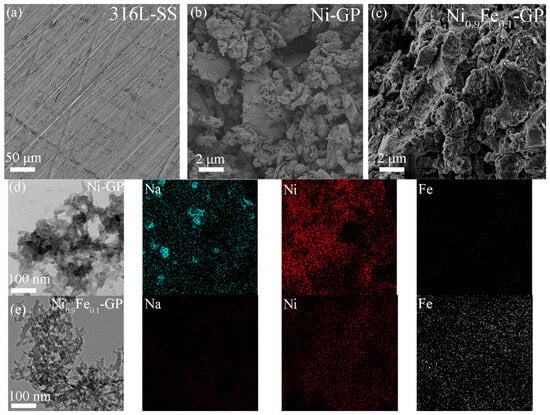
To investigate the influence of different metal components on the microstructure and elemental distribution of the geopolymer catalysts, the surface morphologies of the 316L stainless steel substrate, Ni-GP, and Ni0.9Fe0.1-GP electrodes were observed using scanning electron microscopy (SEM), and elemental distribution was characterized by energy-dispersive X-ray spectroscopy (EDS).
SEM images (Figure 1a–c) show that the surface of the 316L stainless steel substrate is relatively flat with no obvious coating features. Both Ni-GP and Ni0.9Fe0.1-GP samples exhibit the typical amorphous block-like structure of geopolymers, with no significant nanostructures or ordered morphologies observed on the surface, indicating that the catalytic performance primarily originates from the intrinsic chemical composition and electronic structure rather than specific geometric morphology.
Figure 1.
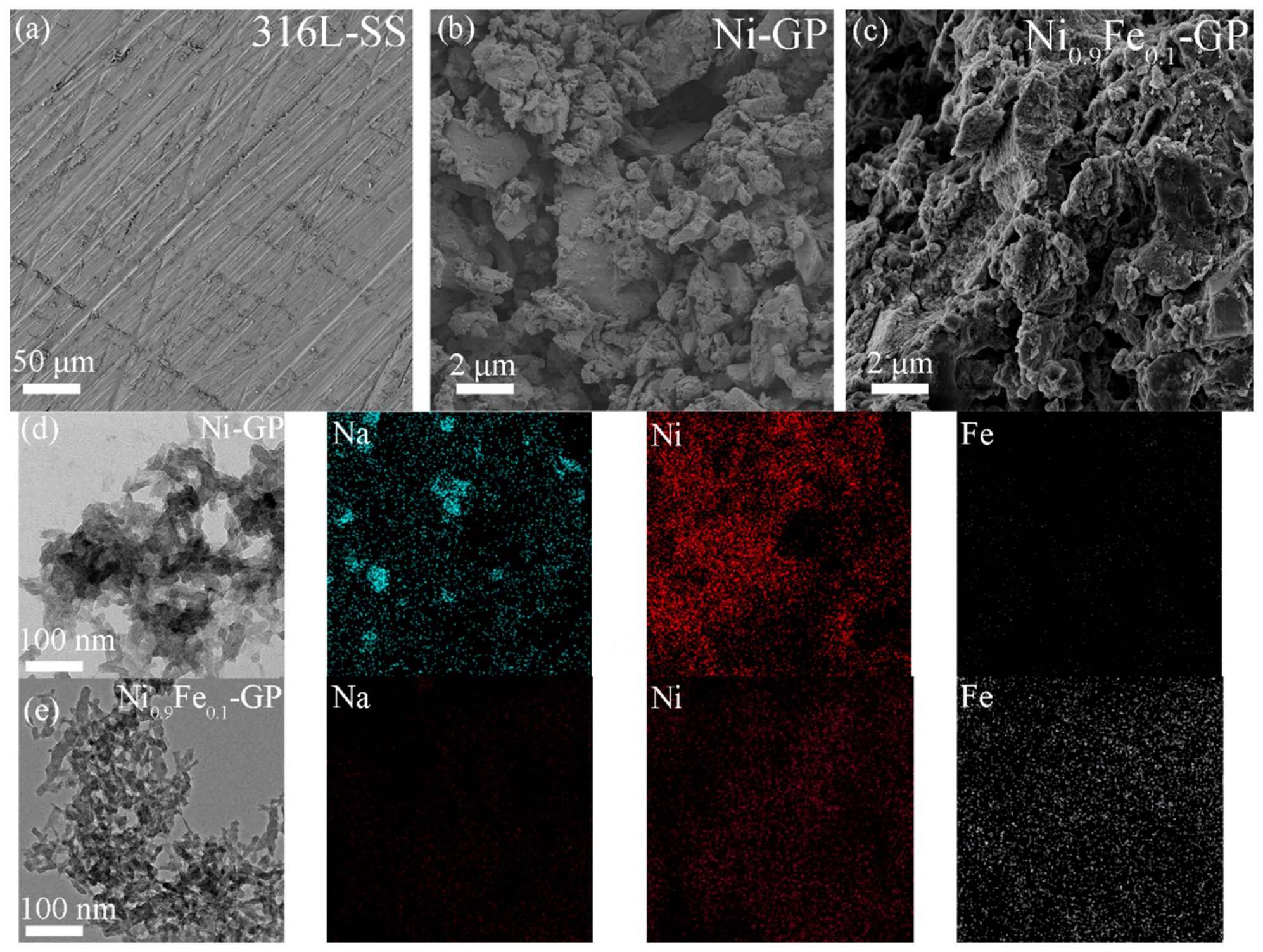
(a) SEM image of 316L SS, (b) SEM image of Ni-GP, (c) SEM image of Ni0.9Fe0.1-GP, (d) TEM image and EDS mapping of Ni-GP, and (e) TEM image and EDS mapping of Ni0.9Fe0.1-GP.
Further comparative analysis of the distribution of Na, Ni, and Fe in Ni-GP and Ni0.9Fe0.1-GP was conducted using EDS elemental mapping (Figure 1d,e). In the Ni-GP sample, Na shows pronounced local agglomeration and an exceptionally high signal intensity; Ni also exhibits very bright signals with relatively uniform distribution, while Fe is almost undetectable, consistent with its undoped composition.
In contrast, in the Ni0.9Fe0.1-GP sample, the Na signal is significantly weakened with almost no bright spots; Ni still shows signal but with notably lower intensity compared to Ni-GP; notably, Fe exhibits a very bright, uniformly distributed signal with prominent intensity, indicating that Fe3+ was successfully doped and uniformly anchored within the geopolymer matrix.
These SEM and EDS results demonstrate that the introduction of Fe significantly alters the distribution of Na+ and Ni2+ within the system and achieves uniform anchoring of Fe3+, providing a structural foundation for the optimization of subsequent electrocatalytic performance.
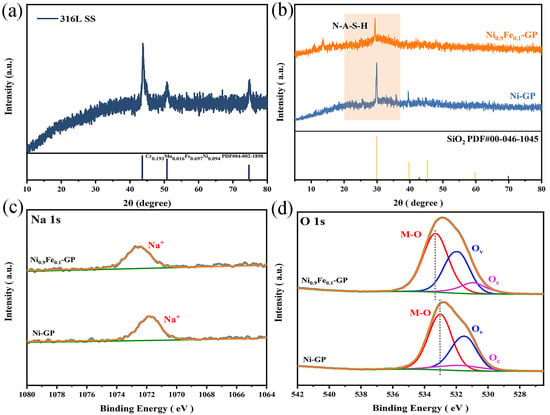
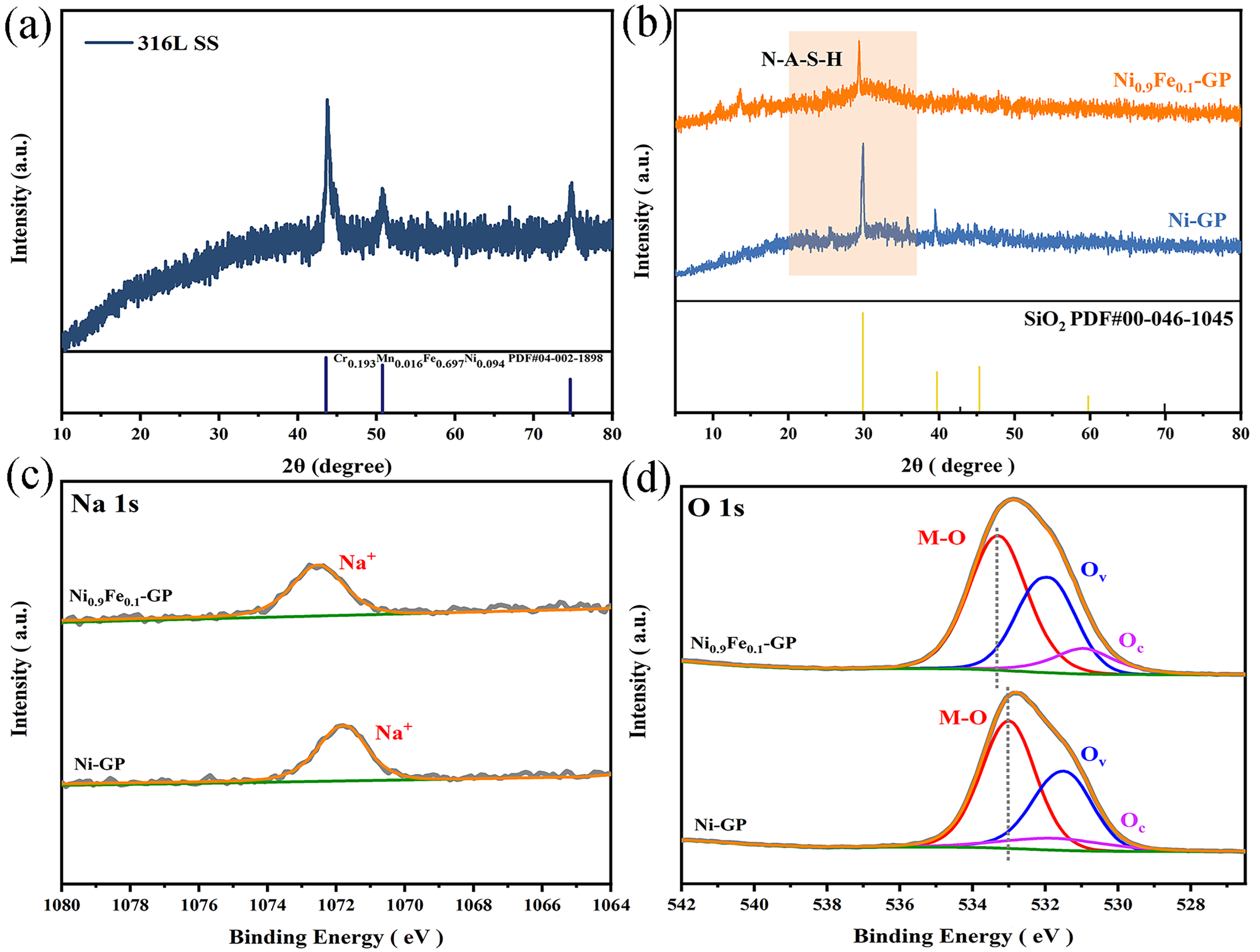
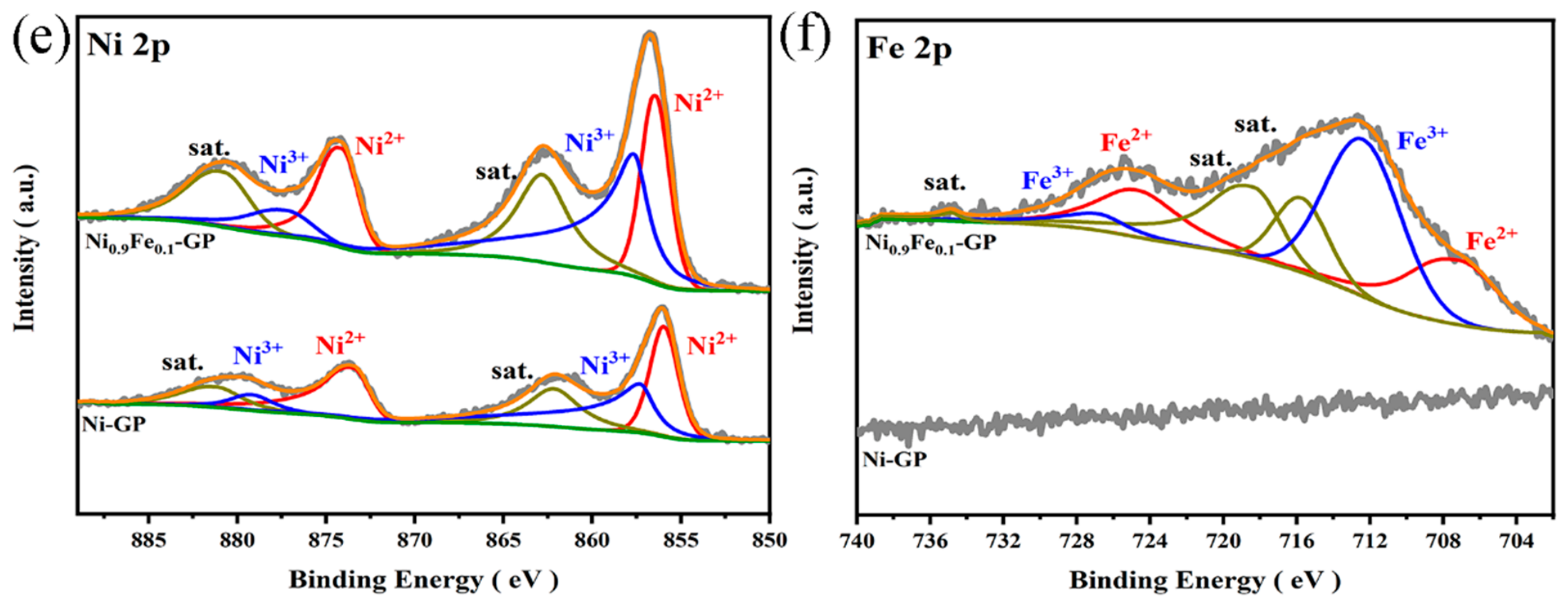
To further elucidate the surface chemical states and elemental interactions of the Ni-GP and Ni0.9Fe0.1-GP catalysts, X-ray photoelectron spectroscopy (XPS) analysis was performed on both samples (Figure 2).
Figure 2.
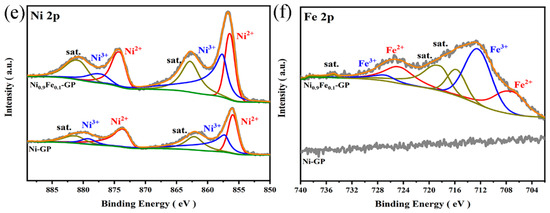
(a) XRD pattern of 316L SS, (b) XRD patterns of Ni-GP and Ni0.9Fe0.1-GP, (c) Na 1s XPS spectra of Ni-GP and Ni0.9Fe0.1-GP, (d) O 1s XPS spectra, (e) Ni 2p XPS spectra, and (f) Fe 2p XPS spectra.
The Na 1s spectra (Figure 2c) show that the binding energy of Na 1s is 1071.8 eV for the Ni-GP sample, while it shifts positively to 1072.48 eV for the Ni0.9Fe0.1-GP sample. This positive shift indicates that the incorporation of Fe enhances the interaction between Na+ and the geopolymer framework, likely due to the introduction of additional negative charge centers by Fe3+, which exert stronger electrostatic binding on Na+ [27,28].
The O 1s spectra (Figure 2d) can be deconvoluted into three components, corresponding to metal–oxygen bonds (M–O), oxygen vacancies (Ov), and surface-adsorbed oxygen/carbonate/hydroxyl species (Oc). For the Ni-GP sample, the peak positions for M–O, Ov, and Oc are 532.98 eV, 531.48 eV, and 531.98 eV, respectively. For the Ni0.9Fe0.1-GP sample, the M–O peak shifts positively to 533.28 eV, the Ov peak shifts positively to 531.98 eV, while the Oc peak shifts negatively to 530.98 eV. The positive shifts in the M–O and Ov peaks further corroborate that Fe3+ doping modulates the electronic environment of the metal–oxygen bonds and defect structures [29].
Figure 2 presents the high-resolution XPS spectra of Ni 2p, Fe 2p, Na 1s, and O 1s. From the Ni 2p spectra (Figure 2e), both samples exhibit typical mixed-valence features of Ni2+ and Ni3+. For the Ni-GP sample, the Ni2+ 2p3/2 and 2p1/2 peaks are located at 855.98 eV and 873.98 eV, respectively, while the Ni3+ peaks appear at 857.38 eV and 879.38 eV, accompanied by satellite peaks (Sat.) at 862.18 eV and 881.68 eV. In contrast, for the Ni0.9Fe0.1-GP sample, the Ni2+ peaks shift positively to 856.48 eV and 874.38 eV, and the Ni3+ peaks shift positively to 857.78 eV and 877.78 eV, with corresponding satellite peaks at 862.88 eV and 881.18 eV. The positive shift in Ni 2p binding energy (0.5 eV) is indicative of changes in the local electronic environment, which correlate with an altered d-band center of Ni and optimize the adsorption energy of hydrogen intermediates [30]. The overall positive shift in the Ni-related peaks indicates that the introduction of Fe3+ alters the local electronic environment of Ni, leading to a slightly higher oxidation state or changes in the coordination field.
The Fe 2p spectra are only detected in the Ni0.9Fe0.1-GP sample (Figure 2f), confirming the successful doping of Fe. The spectra reveal two doublets corresponding to Fe2+ (707.4 eV, 721.0 eV) and Fe3+ (712.3 eV, 725.6 eV), along with three satellite peaks at 714.9 eV, 717.2 eV, and 729.7 eV. The Fe3+ signal dominates, indicating that Fe predominantly exists in the +3 oxidation state during alkali activation and subsequent processing, which is consistent with its preferential occupancy in spinel structures [31,32]. The uniform Fe3+ anchoring and suppressed Na+ migration observed by EDS and XPS suggest that Fe3+ acts as a structural stabilizer, reducing metal leaching during long-term operation.
In summary, the XPS analysis demonstrates that the successful incorporation of Fe3+ significantly alters the chemical states of Ni, Na, and oxygen species, inducing an increase in the Ni oxidation state, enhanced binding of Na+, variations in metal–oxygen bond strength, and the potential modulation of the local electronic structure of oxygen vacancies. These electronic-level modifications provide a favorable chemical environment for the enhancement of subsequent electrocatalytic performance.
2.2. Hydrogen Evolution Reaction Study
The HER proceeds via a three-step mechanism on the electrode surface: initial hydrogen atom adsorption (1), the electrochemical desorption of hydrogen (2), and the chemical desorption of hydrogen from the cathode (3):
where M represents the electrocatalyst and MH* represents hydrogen adsorbed on the electrocatalyst surface [33].
This study systematically investigated the catalytic activity of three samples—316L SS, Ni-GP, and Ni0.9Fe0.1-GP—toward the hydrogen evolution reaction (HER). HER measurements were performed using a three-electrode system with a Pt sheet as the counter electrode and a Hg/HgO reference electrode in 1 M KOH.
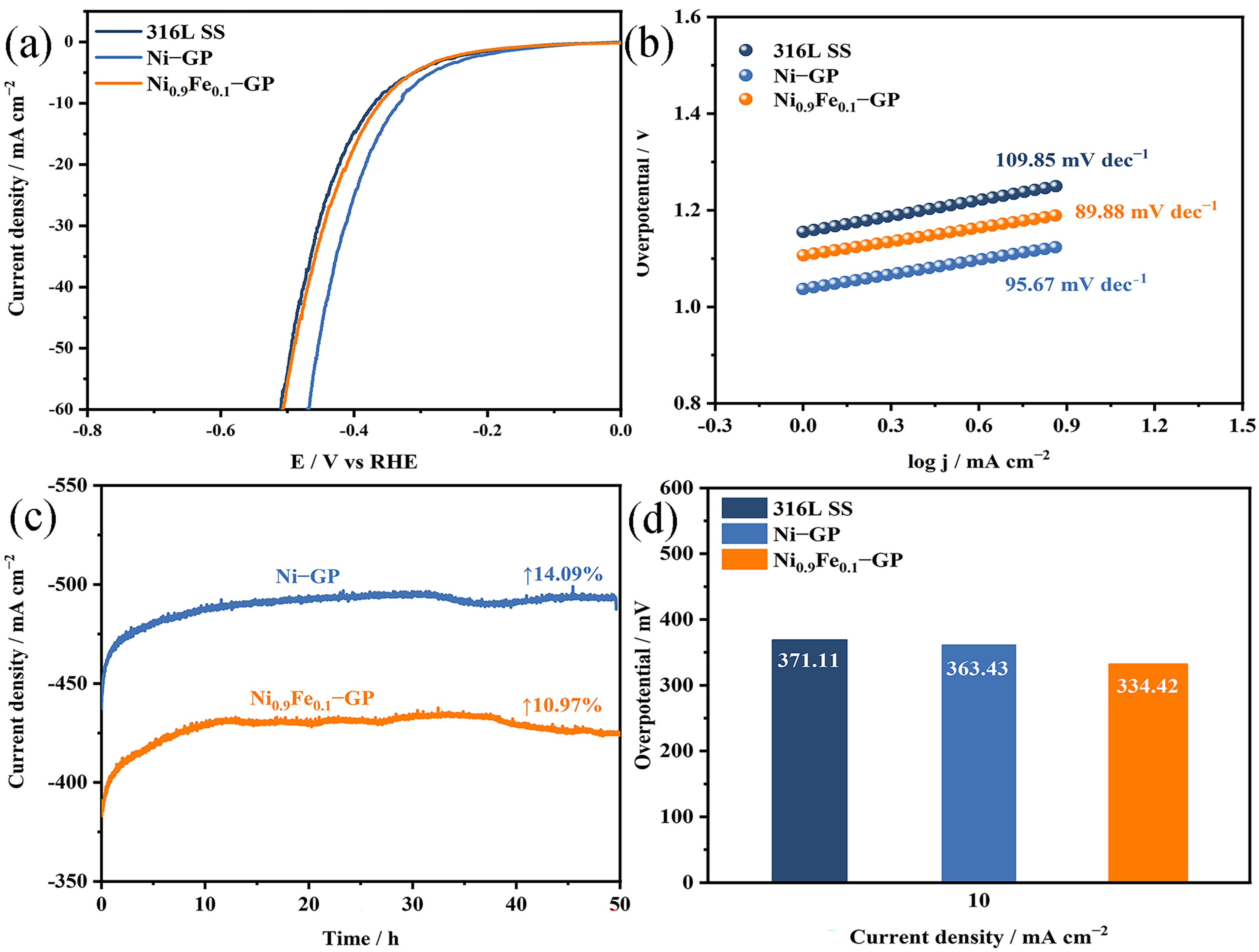
Figure 3a shows the linear sweep voltammetry (LSV) curves of the three electrodes in 1 M KOH at a scan rate of 5 mV s−1. The bare 316L stainless steel substrate exhibited limited HER activity, with an overpotential (η10) of 371.11 mV at a current density of 10 mA cm−2. After coating with Ni-GP, the η10 decreased to 363.43 mV, indicating that the introduction of Ni species modestly improved HER activity. Upon further incorporation of Fe3+, Ni0.9Fe0.1-GP displayed a significantly reduced η10 of 332.42 mV, representing a decrease of approximately 29 mV compared to Ni-GP and 37 mV compared to the bare substrate. This result clearly demonstrates that Fe3+ doping plays a crucial role in enhancing HER activity, which is closely correlated with the positive shift in Ni binding energy and the stable presence of Fe3+ observed by XPS, suggesting that Fe3+ optimizes the adsorption energy of hydrogen intermediates by modulating the electronic structure of Ni.
Figure 3.
HER polarization curves of 316L SS, Ni-GP, and Ni0.9Fe0.1-GP: (a) LSV curves, (b) Tafel slopes, (c) chronopotentiometry stability curves of Ni-GP and Ni0.9Fe0.1-GP, and (d) overpotentials required to achieve a current density of 10 mA cm−2.
The corresponding Tafel plots are presented in Figure 3b. The Tafel slopes for 316L SS, Ni-GP, and Ni0.9Fe0.1-GP were determined to be 109.85, 95.67, and 89.88 mV dec−1, respectively. The decreasing Tafel slope with Ni and Fe incorporation indicates that Ni0.9Fe0.1-GP exhibits superior reaction kinetics for the HER. Based on the range of Tafel slopes (typically 40–120 mV dec−1), it can be inferred that the HER follows the Volmer–Heyrovsky mechanism on all three electrodes, with electrochemical desorption as the rate-determining step [34,35,36,37].
Stability is a critical parameter for evaluating the practical application potential of catalysts. Chronopotentiometry measurements were conducted at a constant current density of 10 mA cm−2 for 20 h to assess the stability of Ni-GP and Ni0.9Fe0.1-GP (Figure 3c). The overpotential of Ni-GP increased from an initial value of 437.43 mV to approximately 499.08 mV, corresponding to an overpotential increase rate of 14.09%. In contrast, Ni0.9Fe0.1-GP exhibited an overpotential increase from 383.11 mV to about 437.74 mV, with a degradation rate of 10.97%. Both catalysts demonstrated good cathodic stability, with Ni0.9Fe0.1-GP showing a lower initial overpotential and superior performance throughout the entire test. The observed stability can be attributed to the strong anchoring effect of the geopolymer support, where Ni and Fe species are firmly immobilized within the three-dimensional network through chemical bonds, effectively suppressing metal leaching and agglomeration during long-term operation.
To evaluate the intrinsic catalytic activity, the HER current densities were normalized by the electrochemical surface area (ECSA). The ECSA values are 267.5 cm2 for Ni-GP and 409.75 cm2 for Ni0.9Fe0.1-GP, derived from double-layer capacitance measurements (Cdl = 10.7 and 16.39 mF, respectively). The ECSA-normalized HER polarization curves (Figure S1, Supplementary Information) show that, after normalization, Ni0.9Fe0.1-GP exhibits a lower current density than Ni-GP, indicating reduced per-site activity after Fe doping. This reduction is compensated by the substantially larger ECSA and superior long-term stability of the Fe-doped sample.
Collectively, the HER results demonstrate that the Ni0.9Fe0.1-GP catalyst exhibits significantly enhanced hydrogen evolution activity and favorable stability under alkaline conditions compared to Ni-GP and the bare substrate. The introduction of Fe3+ synergistically improves HER performance through multiple mechanisms, including the modulation of the Ni electronic structure, the reduction in charge transfer resistance, and increased exposure of active sites. Although there remains a performance gap relative to commercial Pt-based catalysts, the non-precious metal catalyst developed in this work offers distinct advantages in terms of cost and stability, providing a new materials design strategy for the development of efficient and durable HER catalysts.
2.3. Oxygen Evolution Reaction Study
The oxygen evolution reaction (OER) is a key reaction occurring at the anode during water splitting, significantly increasing the complexity of the overall process. This reaction involves a four-electron transfer, including O–H bond breaking and O–O bond formation, and requires a high applied potential to overcome its kinetic energy barrier.
During the OER, oxygen (O2) generation can proceed via two distinct mechanisms: (i) the direct coupling of adsorbed oxygen intermediates (O) to form O2 while releasing vacant active sites (Equation (6)), and (ii) the nucleophilic attack of hydroxide ions (OH-) on the adsorbed oxygen intermediate (O) to form a hydroperoxy intermediate (OOH) (Equation (7)).
Subsequently, the OOH* intermediate undergoes proton-coupled electron transfer, ultimately generating O2 and regenerating the active site (*), as shown in Equation (8). Prior to these steps, reactions depicted in Equations (4) and (5) must occur on the electrode surface to generate the adsorbed oxygen intermediate (O) [38]:
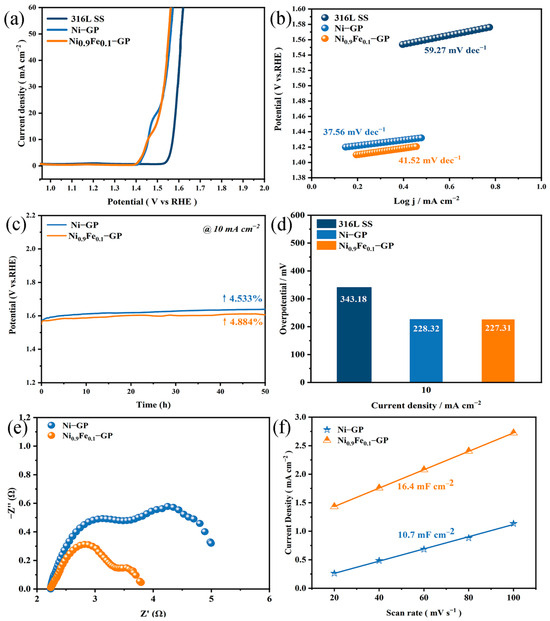
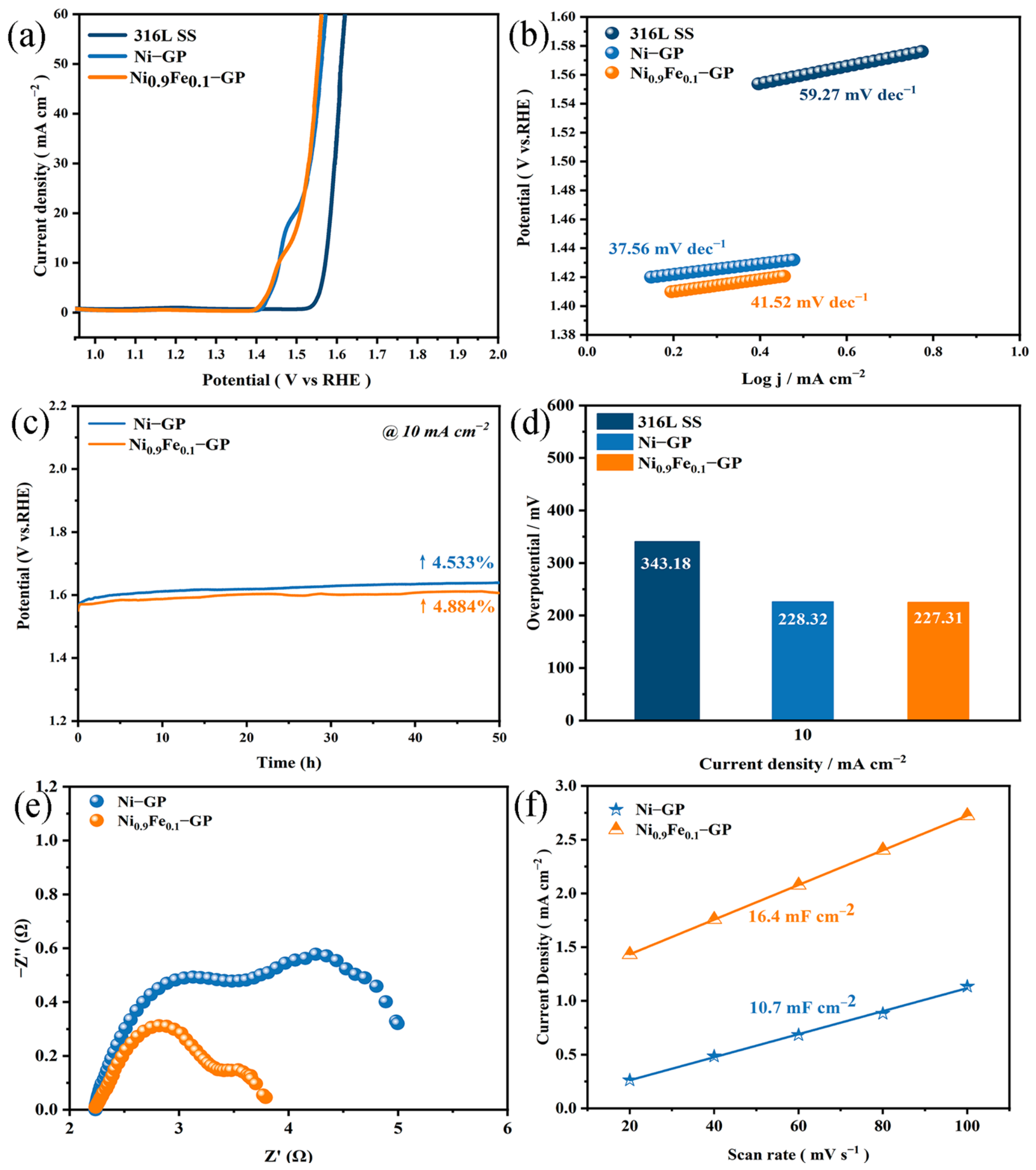
This study further investigated the oxygen evolution reaction (OER) performance of the as-prepared catalysts. Figure 4a shows the linear sweep voltammetry (LSV) curves of 316L stainless steel substrate, Ni-GP, and Ni0.9Fe0.1-GP in 1 M KOH at a scan rate of 5 mV s−1. The bare 316L stainless steel substrate exhibited limited OER activity, with an overpotential (η10) of 343.18 mV at a current density of 10 mA cm−2 and a high Tafel slope of 59.27 mV dec−1 (Figure 4b), indicating sluggish reaction kinetics. After coating with Ni-GP, η10 significantly decreased to 228.32 mV, representing a reduction of 114.65 mV, accompanied by a decrease in Tafel slope to 37.56 mV dec−1. These results demonstrate that the Ni species supported on the geopolymer serve as the primary active centers for OER and substantially enhance the reaction kinetics.
Figure 4.
OER polarization curves of 316L SS, Ni-GP, and Ni0.9Fe0.1-GP: (a) LSV curves, (b) Tafel slopes, (c) chronopotentiometry stability curves of Ni-GP and Ni0.9Fe0.1-GP, (d) overpotentials required to achieve a current density of 10 mA cm−2, and (e) Nyquist plots of Ni-GP and Ni0.9Fe0.1-GP. (f) Linear fitting of current density difference versus scan rate for double-layer capacitance (Cdl) determination.
It has been established that the introduction of iron (Fe) can significantly modulate the electronic structure of Ni-based catalysts. Such doping promotes the formation of high-valence active species, thereby enhancing both the electrical conductivity and oxygen adsorption capability of the material. The Fe content directly influences catalytic activity and improves the OER electrocatalytic performance by enhancing the synergistic effects among active sites and electron transfer efficiency [39,40,41]. This indicates that Fe doping is an effective strategy to enhance the OER performance of Ni-based catalysts.
The OER current densities were normalized by the ECSA (Figure S2). Consistent with the HER results, the ECSA-normalized OER current density of Ni0.9Fe0.1-GP is lower than that of Ni-GP. The turnover frequency (TOF) was calculated from the integrated Ni2+/Ni3+ redox peak in the cyclic voltammogram (see Section 3). At a geometric current density of 10 mA cm−2 (the same condition used for the OER overpotential comparison), the TOF values are 0.0058 s−1 for Ni-GP and 0.0038 s−1 for Ni0.9Fe0.1-GP. The lower TOF of the Fe-doped sample suggests that Fe3+ doping reduces the per-site intrinsic activity, but this drawback is offset by a higher density of active sites (larger ECSA) and significantly enhanced structural stability, as demonstrated in Figure 4c.
Electrochemical impedance spectroscopy (EIS) was conducted to probe the electrode kinetics (Figure 4e). The Nyquist plots reveal that Ni0.9Fe0.1-GP exhibits a smaller charge-transfer resistance than Ni-GP, indicating faster electron transfer after Fe3+ doping. The double-layer capacitance (Cdl) derived from cyclic voltammetry (Figure 4f) is 10.7 mF for Ni-GP and 16.39 mF for Ni0.9Fe0.1-GP, corresponding to ECSA values of 267.5 and 409.75 cm2, respectively.
Upon further incorporation of Fe3+, the Ni0.9Fe0.1-GP catalyst exhibited an η10 of 227.31 mV, which is nearly identical to that of Ni-GP (a difference of only 1.0 mV), with a Tafel slope of 41.52 mV dec−1, slightly higher than that of Ni-GP. This result indicates that Fe3+ doping does not significantly enhance the intrinsic OER activity, likely because Ni already possesses high intrinsic OER activity under alkaline conditions, while the primary role of Fe3+ lies in improving structural stability rather than intrinsic activity.
The long-term stability of the catalysts for OER was also evaluated by chronopotentiometry at 10 mA cm−2 for 50 h (Figure 4c). The overpotential increase rates for Ni-GP and Ni0.9Fe0.1-GP were 4.533% and 4.884%, respectively, demonstrating excellent anodic stability for both catalysts with very similar degradation rates. This stability can be attributed to the strong anchoring effect of the geopolymer support, where Ni and Fe species are firmly immobilized within the three-dimensional network through chemical bonds, effectively suppressing metal leaching and structural degradation under prolonged anodic potentials.
2.4. Comparison with Reported NiFe-Based Electrocatalysts
To benchmark the catalytic performance of our Ni0.9Fe0.1-GP catalyst, Table 1 compares its HER and OER activities with recently reported non-geopolymeric NiFe-based electrocatalysts in alkaline media. The selected references include representative examples of NiFe layered double hydroxides (LDHs), NiFe oxides, NiFe phosphides, and NiFe metal–organic frameworks (MOFs).
Table 1.
Comparison of HER and OER performance of recently reported NiFe-based electrocatalysts in alkaline media.
As shown in Table 1, the HER overpotential of Ni0.9Fe0.1-GP (332 mV) is higher than those of state-of-the-art NiFeP and NiFe-MOF catalysts, indicating room for improvement in hydrogen evolution kinetics. However, its OER overpotential (227 mV) and Tafel slope (42 mV dec−1) are competitive, and the overall water splitting voltage (1.90 V) is promising given the simplicity of the geopolymer support.
Despite the clear advantages of the geopolymer support in terms of stability and cost, the HER and OER activities of Ni0.9Fe0.1-GP remain moderate compared to the best NiFe-based electrocatalysts. Several factors account for this performance gap, which we discuss below to provide a balanced understanding and to guide future optimization.
First, the intrinsic conductivity of the amorphous aluminosilicate geopolymer matrix is inherently low, as it behaves as an electronic insulator. This poor conductivity increases the charge-transfer resistance at the electrode–electrolyte interface, as evidenced by our electrochemical impedance spectroscopy (EIS) results (Figure 4e). The higher uncompensated resistance partially limits the catalytic current, especially at high overpotentials. Second, the geopolymer binder may partially encapsulate NiFe nanoparticles, blocking a fraction of active sites from contacting the electrolyte. This “site-blocking” effect reduces the accessible active site density compared to a neat NiFe film or a highly porous support. Third, the total metal loading is intrinsically constrained by the geopolymer synthesis: we used 10 wt% Ni and 1 wt% Fe, which is near the upper limit before phase separation occurs (e.g., formation of isolated Ni/Fe hydroxides or agglomeration). Higher loadings compromise the mechanical integrity of the geopolymer coating, so current performance reflects a trade-off between metal content and structural stability. Fourth, the catalyst lacks deliberate nanostructuring (e.g., ordered mesopores, nanosheet arrays, or hierarchical porosity). Its activity relies primarily on the intrinsic electronic effects of Fe3+ doping and the chemical composition of the geopolymer, rather than on geometric or morphological enhancements.
These limitations, however, point to clear strategies for future improvement: increasing the electronic conductivity of the geopolymer matrix (e.g., by incorporating conductive carbon additives or conductive polymers), optimizing metal loading and dispersion, and introducing nanostructuring approaches such as template-assisted synthesis or exfoliation. Nevertheless, the present work successfully demonstrates the feasibility of using geopolymers as low-cost, stable, and bifunctional supports for water splitting electrocatalysis, with competitive OER performance and excellent long-term durability. In this context, hydrothermal treatment of lignocellulosic biomass has recently emerged as a low-carbon route to produce high-value carbonaceous electrode materials with tunable porosity and surface functionality [46]. For comparison, carbon-supported cobalt-based catalysts, such as CoS/P nanoparticles embedded in reduced graphene oxide aerogel, have also been reported with HER overpotentials around 169 mV at 10 mA cm−2 [47].
2.5. Overall Water Splitting
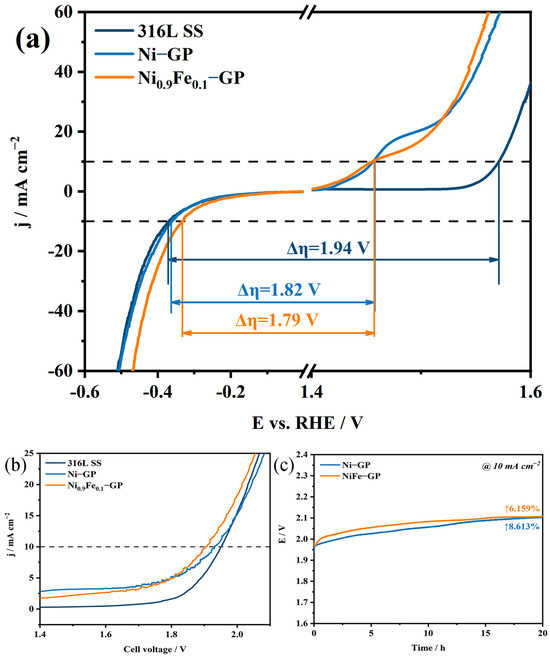
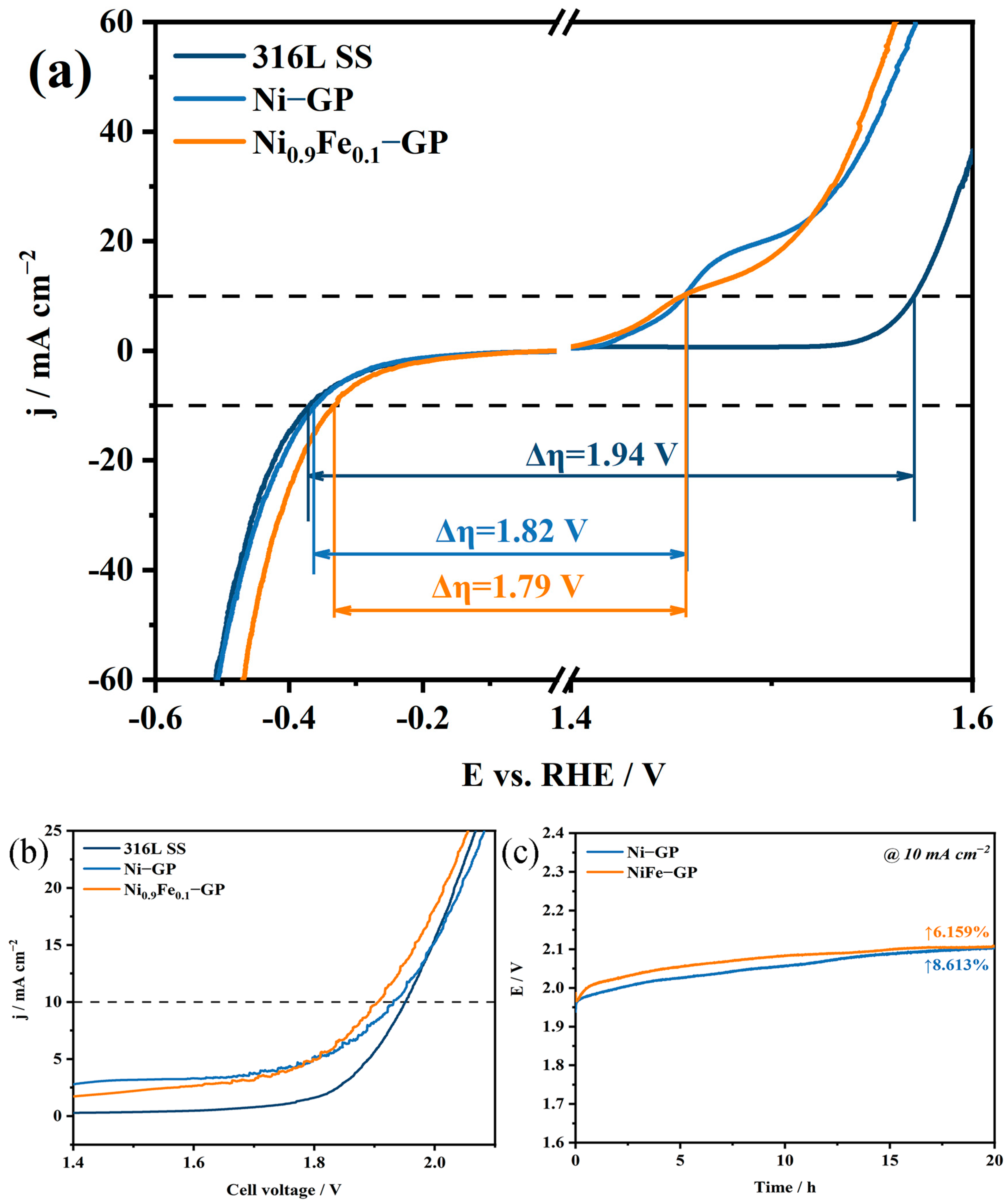
Based on the potential difference (Δη = η10,OER − η10, HER) derived from the HER and OER polarization curves at a current density of ±10 mA cm−2, the estimated cell voltage for overall water splitting was evaluated for each electrode material. As shown in Figure 5a, the Δη values for 316L SS, Ni-GP, and Ni0.9Fe0.1-GP were 1.96 V, 1.84 V, and 1.81 V, respectively. Among them, Ni0.9Fe0.1-GP exhibited the lowest estimated cell voltage, indicating its superior bifunctional activity for both OER and HER, which is favorable for constructing symmetric two-electrode electrolyzers in alkaline media.
Figure 5.
(a) Assessment of the bifunctional activity of the 316L SS, Ni-GP, and Ni0.9Fe0.1-GP catalysts by calculating the full-cell potential (∆η10), derived from the difference in overpotentials (η10) at ±10 mA cm−2, as obtained from the HER and OER linear sweep voltammograms (LSVs) shown in Figure 3a and Figure 4a. (b) Overall water splitting polarization curves of 316L SS, Ni-GP, and Ni0.9Fe0.1-GP, and (c) chronopotentiometry curves for overall water splitting stability of Ni-GP and Ni0.9Fe0.1-GP.
These results suggest that such catalysts hold promise for application in practical overall water splitting (OWS) systems operating in alkaline environments, with the same electrode material used for both the anode and cathode. The catalytic performance was further evaluated in a two-electrode alkaline electrolyzer configuration using 316L SS, Ni-GP, and NiFe-GP as both the anode and cathode (Figure 5b). The measured cell voltages at a current density of 10 mA cm−2 were 1.95 V for 316L SS, 1.93 V for Ni-GP, and 1.90 V for Ni0.9Fe0.1-GP, consistent with the trend observed in the estimated potential differences (Δη10), further confirming that Ni0.9Fe0.1-GP exhibits lower energy consumption and superior catalytic performance in overall water splitting.
The stability test results (Figure 5c) show that after prolonged constant-current electrolysis, the current density retention of Ni-GP was 8.613%, while that of Ni0.9Fe0.1-GP was 6.159%, indicating that the introduction of Fe significantly enhances the structural stability and catalytic durability of the electrode. In summary, the as-prepared Ni0.9Fe0.1-GP catalyst combines a low cell voltage, high activity, and excellent stability, making it a highly promising bifunctional non-precious metal electrocatalyst for alkaline overall water splitting.
3. Materials and Methods
3.1. Chemicals
Unless otherwise stated, all chemical reagents used in this experiment were of analytical grade. The slag used in this study (detailed chemical composition and content are provided in Table 2) was purchased from Beihai Chengde Nickel Industry Co., Ltd. (Beihai, China). Potassium hydroxide, nickel(II) nitrate hexahydrate, iron(III) nitrate nonahydrate, and hydrochloric acid were obtained from Guangdong Guanghua Chemical Co., Ltd. (Guangzhou, China), and anhydrous ethanol was purchased from Nanning Blue Sky Experimental Equipment Co., Ltd. (Nanning, China). All chemicals were of analytical grade and used as received without further purification. The 316L stainless steel substrates were purchased from Foshan Guangmei Stainless Steel Co., Ltd. (Foshan, China).
Table 2.
Major oxide composition of the slag used in this study.
3.2. Electrode Preparation
3.2.1. Pretreatment of Stainless Steel Substrate
The 316L stainless steel sheets (316L SS, 10 mm × 10 mm × 1 mm) used in the experiment were first polished with 400-grit sandpaper. Subsequently, they were ultrasonically cleaned sequentially in 3 M dilute hydrochloric acid, acetone, and anhydrous ethanol for 15 min each. After each cleaning step with a different solvent, the sheets were rinsed with deionized water via ultrasonication for another 15 min to remove any residual solvent. The pretreated stainless steel sheets were sealed and stored for later use. This combined process of polishing, chemical cleaning, and ultrasonication effectively removes the oxide layer, grease, and impurities from the stainless steel surface.
3.2.2. Preparation of Working Electrodes
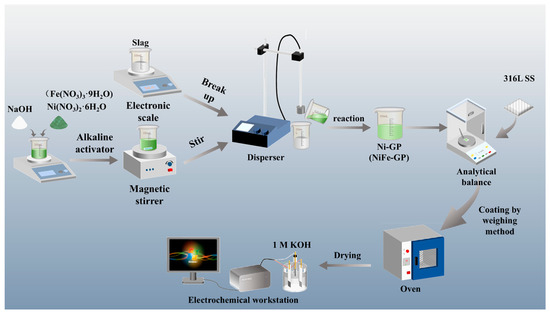
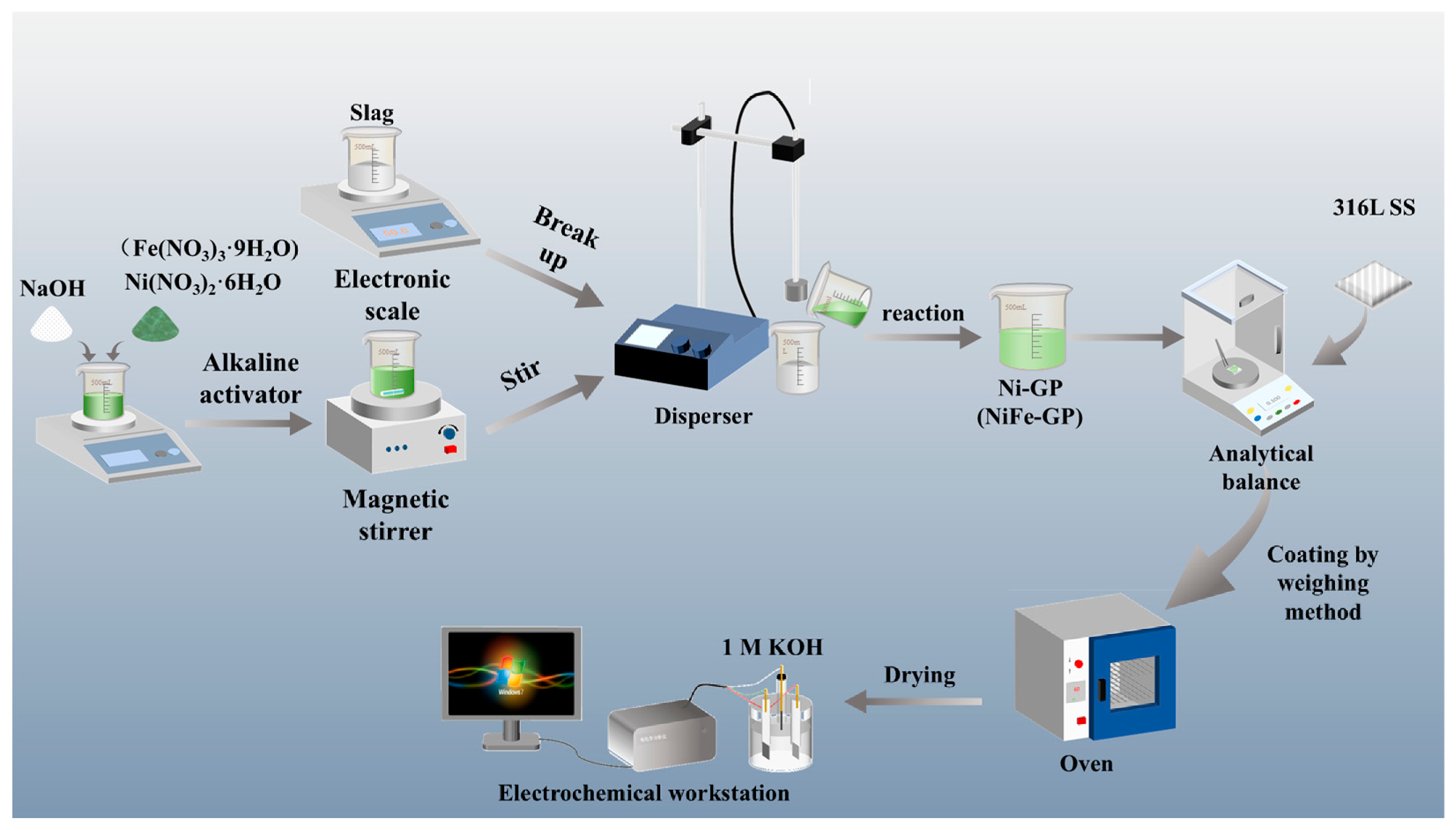
The preparation process for the working electrodes is illustrated in Figure 6. Based on preliminary optimization (Tables S1 and S2), the parameters for the Ni-GP sample were set as follows: water-to-solid ratio of 1.0, alkalinity of 4%, and Ni content of 10%. For the Ni0.9Fe0.1-GP sample, the parameters were water-to-solid ratio of 1.0, alkalinity of 4%, Ni content of 9%, and Fe content of 1%. Taking the preparation of the Ni-GP sample as an example, 50 g of slag was placed in a plastic beaker. In separate portions, 2.59 g of granular NaOH was dissolved in 20.6 mL of deionized water, and 24.85 g of Ni(NO3)2·6H2O was dissolved in 20 mL of deionized water, both under magnetic stirring until fully dissolved. The slag was then dispersed using a mixer for 30 s, followed by the addition of the alkali activator (NaOH solution) with continuous stirring until a gel-like paste formed. Finally, the nickel nitrate solution was slowly added to the paste, and stirring was continued until a homogeneous mixture free of flocculent aggregates was obtained.
Figure 6.
Preparation process of the working electrode.
The pretreated 316L stainless steel sheet was placed on a precision electronic balance. The geopolymer slurry was uniformly coated onto the stainless steel surface using a brush, and the coating mass was controlled in real time by monitoring the balance reading. Based on preliminary optimization, a coating thickness of 325 μm was identified as optimal for achieving the best catalytic performance. The coated samples were then cured in an oven at 60 °C for 3 h to obtain the final working electrodes.
3.3. Characterization of Coatings
The morphology and microstructure of the composite catalysts were characterized using scanning electron microscopy (SEM, ZEISS Sigma 300, Carl Zeiss AG, Oberkochen, Germany) and transmission electron microscopy (TEM, JEOL JEM 2100 F, Tokyo, Japan). The crystal structure of the catalysts was analyzed by X-ray diffraction (XRD, Rigaku Mini Flex 600, Akishima-shi, Japan) over a 2θ range of 10° to 80°. Fourier-transform infrared (FTIR) spectra were recorded using a Nicolet iS50 spectrometer (Thermo Fisher Scientific, Waltham, MA, USA). Raman spectroscopy was performed on a WITec alpha 300 R system (WITec GmbH, Ulm, Germany). The elemental composition of the materials was determined by inductively coupled plasma mass spectrometry (ICP-MS, PerkinElmer NexION 300 X, Waltham, MA, USA). The chemical states on the catalyst surface were analyzed by X-ray photoelectron spectroscopy (XPS).
3.4. Methods
All electrochemical measurements were performed at room temperature in a 1 M KOH electrolyte using a standard three-electrode system. The working electrode was the as-prepared NiFe-GP catalyst, the counter electrode was a Pt sheet, and the reference electrode was a Hg/HgO electrode. The measurements were carried out using an electrochemical workstation (PGSTAT 302 N, Metrohm Autolab, Utrecht, The Netherlands). All measured potentials were converted to the reversible hydrogen electrode (RHE) scale using the following equation:
where the pH of the 1 M KOH solution is 13.8.
Prior to testing, the catalyst was activated by cyclic voltammetry (CV) in the potential range of –1.3 V to –1.6 V (vs. RHE). The OER activity was evaluated by linear sweep voltammetry (LSV) at a scan rate of 5 mV s−1 with 80% iR compensation. The Tafel slope was obtained by fitting the LSV data according to the following equation:
where b is the Tafel slope, a is the Tafel intercept, and j is the current density [48].
Electrochemical impedance spectroscopy (EIS) was conducted in a frequency range from 105 to 10−2 Hz. Durability tests were performed using chronopotentiometry. The double-layer capacitance (Cdl) of the catalyst was determined from cyclic voltammetry (CV) measurements at various scan rates in the non-Faradaic region, and the electrochemical active surface area (ECSA) was subsequently calculated using the following equation:
where Cs = 0.04 mF cm−2 [49,50].
4. Conclusions
In summary, a nickel–iron bimetallic doped geopolymer catalyst (Ni0.9Fe0.1-GP) was successfully fabricated via a one-step alkali activation and mixing method. Structural characterization revealed that the incorporation of Fe3+ significantly altered the distribution of Na+ and Ni2+ within the geopolymer network, achieving uniform anchoring of Fe3+, while XPS analysis confirmed that Fe3+ doping induced the modulation of the Ni electronic structure, as evidenced by the positive shift in Ni binding energy. Electrochemical measurements demonstrated that Ni0.9Fe0.1-GP exhibited an HER overpotential of 332.42 mV at 10 mA cm−2 with a Tafel slope of 89.88 mV dec−1, outperforming Ni-GP (363.43 mV) and bare 316L SS (371.11 mV). For the OER, Ni0.9Fe0.1-GP achieved an overpotential of 227.31 mV at 10 mA cm−2, comparable to that of Ni-GP (228.32 mV). Based on the Δη10 derived from HER and OER, the practical operating voltage (including kinetic overpotentials) of Ni0.9Fe0.1-GP was estimated to be 1.81 V, which is consistent with the two-electrode measurement result of 1.90 V. The thermodynamic minimum voltage for water splitting is 1.23 V. Long-term stability tests showed that Ni0.9Fe0.1-GP exhibited superior durability in HER (20 h), OER (50 h), and overall water splitting compared to Ni-GP. This study reveals the dual role of Fe3+ in enhancing HER activity by modulating the Ni electronic structure and improving structural stability through strong chemical anchoring within the geopolymer network, providing new insights into the design of cost-effective bifunctional electrocatalysts for water splitting. Future DFT calculations will be performed to quantitatively correlate the XPS shift with the d band center position. Furthermore, exploring the recovery of electrocatalytic activity via electrochemical conditioning (e.g., cyclic voltammetry activation or pulsed potential methods) represents a promising direction to further enhance the long-term performance of geopolymer-based catalysts, which will be systematically investigated in our future work.
Supplementary Materials
The following supporting information can be downloaded at https://www.mdpi.com/article/10.3390/catal16060508/s1. Figure S1: ECSA-normalized HER polarization curves of Ni-GP and Ni0.9Fe0.1-GP in 1 M KOH at 5 mV s−1; Figure S2: ECSA-normalized OER polarization curves of Ni-GP and Ni0.9Fe0.1-GP under the same conditions. Table S1: Systematic Optimization of Synthesis Parameters and Corresponding OER Performance for the Ni-GP electrocatalysts; Table S2: Systematic Optimization of Synthesis Parameters and Corresponding OER Performance for the NiFe-Doped Geopolymer (NiFe-GP) Electrocatalyst.
Author Contributions
J.G.: Conceptualization, Investigation, Experiment, Writing—original draft, Validation, Methodology. Q.D.: Formal analysis, Software. X.P.: Methodology. Y.H.: Writing—review & editing, Supervision, Conceptualization. X.C.: Writing—review & editing, Supervision. L.L.: Supervision, Investigation, Funding acquisition. All authors have read and agreed to the published version of the manuscript.
Funding
This work was supported by the Natural Science Foundation of Guangxi Provincial (no. 2025JJA160199), the Innovation Project of Guangxi Graduate Education (no. YCSW2025053) and the Project of Guangxi Colleges and Universities Key Laboratory of New Technology and Application in Resource Chemical Engineering (no. 2025Koo1).
Data Availability Statement
The authors can confirm that all relevant data are included in the article. Further inquiries can be directed to the corresponding authors.
Conflicts of Interest
The authors do not have any financial or non-financial interests that are directly or indirectly related to the work submitted for publication.
References
- Lei, L.; Huang, D.; Zhou, C.; Chen, S.; Yan, X.; Li, Z.; Wang, W. Demystifying the Active Roles of Nife-Based Oxides/(Oxy)Hydroxides for Electrochemical Water Splitting under Alkaline Conditions. Coord. Chem. Rev. 2020, 408, 213177. [Google Scholar] [CrossRef] [Scilit]
- Gao, R.; Yan, D. Recent Development of Ni/Fe-Based Micro/Nanostructures toward Photo/Electrochemical Water Oxidation. Adv. Energy Mater. 2020, 10, 1900954. [Google Scholar] [CrossRef] [Scilit]
- Huang, Z.; Song, J.; Du, Y.; Xi, S.; Dou, S.; Nsanzimana, J.; Wang, C.; Xu, Z.; Wang, X. Chemical and Structural Origin of Lattice Oxygen Oxidation in Co–Zn Oxyhydroxide Oxygen Evolution Electrocatalysts. Nat. Energy 2019, 4, 329–338. [Google Scholar] [CrossRef] [Scilit]
- Yu, M.; Budiyanto, E.; Tüysüz, H. Principles of Water Electrolysis and Recent Progress in Cobalt-, Nickel-, and Iron-Based Oxides for the Oxygen Evolution Reaction. Angew. Chem. Int. Ed. 2022, 61, e202103824. [Google Scholar] [CrossRef] [Scilit]
- Potapenko, O.; Doronin, V.; Sorokina, T.; Likholobov, V. Intermolecular Hydrogen Transfer Reactions as Key Stages in the Catalytic Cracking: Achievements and Outlook. Russ. Chem. Rev. 2023, 92, RCR5065. [Google Scholar] [CrossRef] [Scilit]
- Yan, K.; Jie, X.; Li, X.; Horita, J.; Stephens, J.; Hu, J.; Yuan, Q. Microwave-Enhanced Methane Cracking for Clean Hydrogen Production in Shale Rocks. Int. J. Hydrogen Energy 2023, 48, 15421–15432. [Google Scholar] [CrossRef] [Scilit]
- Yang, S.; Zhang, Q.; Feng, X. Integrated Optimization for the Coupling Network of Refinery and Synthetic Plant of Chemicals. Processes 2023, 11, 789. [Google Scholar] [CrossRef] [Scilit]
- Yu, Z.; Duan, Y.; Feng, X.; Yu, X.; Gao, M.; Yu, S. Clean and Affordable Hydrogen Fuel from Alkaline Water Splitting: Past, Recent Progress, and Future Prospects. Adv. Mater. 2021, 33, 2007100. [Google Scholar] [CrossRef] [Scilit]
- Zhang, L.; Cai, W.; Bao, N. Top-Level Design Strategy to Construct an Advanced High-Entropy Co–Cu–Fe–Mo (Oxy)Hydroxide Electrocatalyst for the Oxygen Evolution Reaction. Adv. Mater. 2021, 33, 2100745. [Google Scholar] [CrossRef] [Scilit] [PubMed]
- Zhu, J.; Qian, J.; Peng, X.; Xia, B.; Gao, D. Etching-Induced Surface Reconstruction of Nimoo4 for Oxygen Evolution Reaction. Nano-Micro Lett. 2023, 15, 30. [Google Scholar] [CrossRef] [Scilit] [PubMed]
- Ran, N.; Song, E.; Wang, Y.; Zhou, Y.; Liu, J. Dynamic Coordination Transformation of Active Sites in Single-Atom MoS2 Catalysts for Boosted Oxygen Evolution Catalysis. Energy Environ. Sci. 2022, 15, 2071–2083. [Google Scholar] [CrossRef] [Scilit]
- Yan, D.; Xia, C.; Zhang, W.; Hu, Q.; He, C.; Xia, B.Y.; Wang, S. Cation Defect Engineering of Transition Metal Electrocatalysts for Oxygen Evolution Reaction. Adv. Energy Mater. 2022, 12, 2202317. [Google Scholar] [CrossRef] [Scilit]
- Huang, C.; Xu, H.; Shuai, T.; Zhan, Q.; Zhang, Z.; Li, G. A Review of Modulation Strategies for Improving Catalytic Performance of Transition Metal Phosphides for Oxygen Evolution Reaction. Appl. Catal. B Environ. 2023, 325, 122313. [Google Scholar] [CrossRef] [Scilit]
- Roy Chowdhury, P.; Medhi, H.; Bhattacharyya, K.G.; Hussain, C.M. Recent Progress in the Design and Functionalization Strategies of Transition Metal-Based Layered Double Hydroxides for Enhanced Oxygen Evolution Reaction: A Critical Review. Coord. Chem. Rev. 2023, 483, 215083. [Google Scholar] [CrossRef] [Scilit]
- Xie, X.; Du, L.; Yan, L.; Park, S.; Qiu, Y.; Sokolowski, J.; Wang, W.; Shao, Y. Oxygen Evolution Reaction in Alkaline Environment: Material Challenges and Solutions. Adv. Funct. Mater. 2022, 32, 2110036. [Google Scholar] [CrossRef] [Scilit]
- Šakickaitė, R.; Sukackienė, Z.; Kepenienė, V.; Balčiūnaitė, A.; Stagniūnaitė, R.; Valeckytė, G.; Tamašauskaitė-Tamašiūnaitė, L. Ternary Nickel-Iron-Phosphorus (Nifep) Electrocatalysts for Alkaline Water Splitting. Electrochem 2025, 6, 30. [Google Scholar] [CrossRef] [Scilit]
- Wu, L.; Feng, J.; Zou, Z.; Song, K.; Zeng, C. Formation of Feathery-Shaped Dual-Function S-Doped Feni-Mofs to Achieve Advanced Electrocatalytic Activity for Oer and Her. J. Electroanal. Chem. 2023, 935, 117365. [Google Scholar] [CrossRef] [Scilit]
- Jafari, F.; Najafpour, M. Iron–Nickel Based Catalysts for Oxygen-Evolution Reaction: Mechanism, Stability, and Potential-Dependent Role of Iron. Inorg. Chem. 2025, 64, 22742–22757. [Google Scholar] [CrossRef] [Scilit]
- Bodhankar, P.; Sarawade, P.; Singh, G.; Vinu, A.; Dhawale, D. Recent Advances in Highly Active Nanostructured Nife Ldh Catalyst for Electrochemical Water Splitting. J. Mater. Chem. A 2021, 9, 3180–3208. [Google Scholar] [CrossRef] [Scilit]
- Zhao, X.; Wang, S.; Cao, Y.; Li, Y.; Portniagin, A.S.; Tang, B.; Liu, Q.; Kasák, P.; Zhao, T.; Zheng, X.; et al. High-Density Atomic Level Defect Engineering of 2d Fe-Based Metal-Organic Frameworks Boosts Oxygen and Hydrogen Evolution Reactions. Adv. Sci. 2024, 11, 2405936. [Google Scholar] [CrossRef] [Scilit]
- Wang, Y.; Bai, X.; Huang, J.; Li, W.; Zhang, J.; Li, H.; Long, Y.; Peng, Y.; Xu, C. Tetrahydroxybenzoquinone-Based Two-Dimensional Conductive Metal–Organic Framework Via Π-D Conjugation Modulation for Enhanced Oxygen Evolution Reaction. ACS Catal. 2024, 14, 16532–16542. [Google Scholar] [CrossRef] [Scilit]
- Adegoke, K.; Ogunjinmi, O.; Adegoke, O.; Bello, O. Bi-functional Two-Dimensional Metal Organic Frameworks for Oxygen Reaction and Water Splitting. Nano Energy 2024, 128, 109897. [Google Scholar] [CrossRef] [Scilit]
- Banik, S.; Roy, S.; Ahmaruzzaman, M. Geopolymer-Based Catalyst for Sustainable Biodiesel Production: A Review. Inorg. Chem. Commun. 2026, 186, 116218. [Google Scholar] [CrossRef] [Scilit]
- Zhang, Z. Preparation of Copper-Loaded Geopolymer Microspheres and Their Application in Removing Bisphenol S from Water. Master’s Thesis, Guangxi University, Nanning, China, 2024. [Google Scholar] [CrossRef]
- Sun, C.; Zhao, L.; Hu, Y.; Wang, D.; Ye, F.; Long, Y.; Mao, B.; Hu, C. Architecting Dynamic Oxygen Migration Pathways for Stabilizing Ru–O Sites During Acidic Electrochemical Oxidation. Adv. Funct. Mater. 2026, 36, e18462. [Google Scholar] [CrossRef] [Scilit]
- Zhang, X.; Jiang, K.; Guo, S.; Mu, X.; Zhang, X.; He, P.; Han, M.; Zhou, H. Exploring a High Capacity O3-Type Cathode for Sodium-Ion Batteries and Its Structural Evolution During an Electrochemical Process. Chem. Commun. 2018, 54, 12167–12170. [Google Scholar] [CrossRef] [Scilit] [PubMed]
- Xing, J.; Xu, Z.; Liu, D.; Xue, B.; Li, F. NiFe2O4 Spinel Supported Cocr-Ldh Nanosheets for Efficient Oxygen Evolution Catalysis. J. Alloys Compd. 2025, 1022, 179924. [Google Scholar] [CrossRef] [Scilit]
- Yan, Y.; Lin, J.; Huang, K.; Zheng, X.; Qiao, L.; Liu, S.; Cao, J.; Jun, S.C.; Yamauchi, Y.; Qi, J. Tensile Strain-Mediated Spinel Ferrites Enable Superior Oxygen Evolution Activity. J. Am. Chem. Soc. 2023, 145, 24218–24229. [Google Scholar] [CrossRef] [Scilit]
- Cook, T.; Dogutan, D.; Reece, S.; Surendranath, Y.; Teets, T.; Nocera, D. Solar Energy Supply and Storage for the Legacy and Nonlegacy Worlds. Chem. Rev. 2010, 110, 6474–6502. [Google Scholar] [CrossRef] [Scilit] [PubMed]
- Mehta, P.; Greeley, J.; Delgass, W.N.; Schneider, W.F. Adsorption Energy Correlations at the Metal–Support Boundary. ACS Catal. 2017, 7, 4707–4715. [Google Scholar] [CrossRef] [Scilit]
- Jain, S.; Shah, J.; Negi, N.; Sharma, C.; Kotnala, R. Significance of Interface Barrier at Electrode of Hematite Hydroelectric Cell for Generating Ecopower by Water Splitting. Int. J. Energy Res. 2019, 43, 4743–4755. [Google Scholar] [CrossRef] [Scilit]
- Wu, Y.; Wang, X.; She, T.; Li, T.; Wang, Y.; Xu, Z.; Jin, X.; Song, H.; Yang, S.; Li, S.; et al. Iron 3d-Orbital Configuration Dependent Electron Transfer for Efficient Fenton-Like Catalysis. Small 2024, 20, 2306464. [Google Scholar] [CrossRef] [Scilit] [PubMed]
- Zhang, T.; Zhu, H.; Guo, C.; Cao, S.; Wu, C.M.L.; Wang, Z.; Lu, X. Theoretical Investigation on the Hydrogen Evolution Reaction Mechanism at MoS2 Heterostructures: The Essential Role of the 1t/2h Phase Interface. Catal. Sci. Technol. 2020, 10, 458–465. [Google Scholar] [CrossRef] [Scilit]
- Corva, M.; Blanc, N.; Bondue, C.J.; Tschulik, K. Differential Tafel Analysis: A Quick and Robust Tool to Inspect and Benchmark Charge Transfer in Electrocatalysis. ACS Catal. 2022, 12, 13805–13812. [Google Scholar] [CrossRef] [Scilit]
- Xia, H.; Pang, R.; Dong, X.; Liu, Q.; Chen, J.; Wang, E.; Li, J. Boosting Oxygen Reduction Reaction Kinetics by Designing Rich Vacancy Coupling Pentagons in the Defective Carbon. J. Am. Chem. Soc. 2023, 145, 25695–25704. [Google Scholar] [CrossRef] [Scilit]
- Wu, Y.; Muthukrishnan, A.; Nagata, S.; Nabae, Y. Tafel Slope Analysis from Inherent Rate Constants for Oxygen Reduction Reaction over N-Doped Carbon and Fe–N-Doped Carbon Electrocatalysts. Catal. Surv. Asia 2023, 27, 84–94. [Google Scholar] [CrossRef] [Scilit]
- Shinagawa, T.; Garcia-Esparza, A.T.; Takanabe, K. Insight on Tafel Slopes from a Microkinetic Analysis of Aqueous Electrocatalysis for Energy Conversion. Sci. Rep. 2015, 5, 13801. [Google Scholar] [CrossRef] [Scilit]
- Gong, Y.; Yao, J.; Wang, P.; Li, Z.; Zhou, H.; Xu, C. Perspective of Hydrogen Energy and Recent Progress in Electrocatalytic Water Splitting. Chin. J. Chem. Eng. 2022, 43, 282–296. [Google Scholar] [CrossRef] [Scilit]
- Nozari-Asbemarz, M.; Imanzadeh, H.; Hazraty, L.; Babaei, B.; Abbasi, A.; Mehrabi-Kalajahi, S.S.; Vafolomeev, M.A.; Leahy, J.J.; Amiri, M. Construction of Iron-Nickel Metal-Organic Framework Anchored on Reduced Graphene Oxide for Enhanced Oxygen Evolution Reaction Electrocatalysis. J. Power Sources 2025, 652, 237555. [Google Scholar] [CrossRef] [Scilit]
- Chen, H.; Hui, B. Flexible Nifep@Filter Paper Electrode for Alkaline Overall Water Electrosplitting. Int. J. Hydrogen Energy 2024, 51, 615–623. [Google Scholar] [CrossRef] [Scilit]
- Dong, G.; Chen, T.; Xie, F.; Xue, D.; Liu, T.; Chen, L.; Xia, J.; Du, S.; Wang, F.; Xie, F.; et al. Nifep Composites Supported on Ni Foam as an Efficient and Robust Bifunctional Electrocatalyst for Overall Water Splitting in Alkaline Solution. J. Alloys Compd. 2023, 968, 171746. [Google Scholar] [CrossRef] [Scilit]
- Gong, M.; Li, Y.; Wang, H.; Liang, Y.; Wu, J.Z.; Zhou, J.; Wang, J.; Regier, T.; Wei, F.; Dai, H. An Advanced Ni–Fe Layered Double Hydroxide Electrocatalyst for Water Oxidation. J. Am. Chem. Soc. 2013, 135, 8452–8455. [Google Scholar] [CrossRef] [Scilit]
- Wang, Y.; Zhang, Y.; Liu, Z.; Xie, C.; Feng, S.; Liu, D.; Shao, M.; Wang, S. Layered Double Hydroxide Nanosheets with Multiple Vacancies Obtained by Dry Exfoliation as Highly Efficient Oxygen Evolution Electrocatalysts. Angew. Chem. Int. Ed. 2017, 56, 5867–5871. [Google Scholar] [CrossRef] [Scilit] [PubMed]
- Bian, J.; Song, Z.; Li, X.; Zhang, Y.; Cheng, C. Nickel Iron Phosphide Ultrathin Nanosheets Anchored on Nitrogen-Doped Carbon Nanoflake Arrays as a Bifunctional Catalyst for Efficient Overall Water Splitting. Nanoscale 2020, 12, 8443–8452. [Google Scholar] [CrossRef] [Scilit]
- Lu, X.; Zhao, C. Electrodeposition of Hierarchically Structured Three-Dimensional Nickel–Iron Electrodes for Efficient Oxygen Evolution at High Current Densities. Nat. Commun. 2015, 6, 6616. [Google Scholar] [CrossRef] [Scilit] [PubMed]
- Wang, C.; Zhang, W.; Qiu, X.; Xu, C. Hydrothermal Treatment of Lignocellulosic Biomass Towards Low-Carbon Development: Production of High-Value-Added Bioproducts. EnergyChem 2024, 6, 100133. [Google Scholar] [CrossRef] [Scilit]
- Koo, S.H.; Li, D.J.; Yun, T.; Choi, D.S.; Lee, K.E.; Lee, G.Y.; Oh, Y.; Lim, J.; Sasikala, S.P.; Lee, H.J.; et al. Cobalt Based Nanoparticles Embedded Reduced Graphene Oxide Aerogel for Hydrogen Evolution Electrocatalyst. Part. Part. Syst. Charact. 2019, 36, 1900090. [Google Scholar] [CrossRef] [Scilit]
- Vasant Kumar, R.; Sarakonsri, T. Introduction to Electrochemical Cells. In Rechargeable Ion Batteries; Wiley-VCH: Weinheim, Germany, 2023; pp. 1–20. [Google Scholar] [CrossRef] [Scilit]
- Lu, Y.; Li, B.; Xu, N.; Zhou, Z.; Xiao, Y.; Jiang, Y.; Li, T.; Hu, S.; Gong, Y.; Cao, Y. One-Atom-Thick Hexagonal Boron Nitride Co-Catalyst for Enhanced Oxygen Evolution Reactions. Nat. Commun. 2023, 14, 6965. [Google Scholar] [CrossRef] [Scilit]
- Zhang, Z.; Zhao, H.; Xi, S.; Zhao, X.; Chi, X.; Yang, H.B.; Chen, Z.; Yu, X.; Wang, Y.G.; Liu, B.; et al. Breaking Linear Scaling Relationships in Oxygen Evolution Via Dynamic Structural Regulation of Active Sites. Nat. Commun. 2025, 16, 1301. [Google Scholar] [CrossRef] [Scilit]

Disclaimer/Publisher’s Note: The statements, opinions and data contained in all publications are solely those of the individual author(s) and contributor(s) and not of MDPI and/or the editor(s). MDPI and/or the editor(s) disclaim responsibility for any injury to people or property resulting from any ideas, methods, instructions or products referred to in the content. |
© 2026 by the authors. Licensee MDPI, Basel, Switzerland. This article is an open access article distributed under the terms and conditions of the Creative Commons Attribution (CC BY) license.