


Abstract
A layered bimetallic CoMo-LDH precursor was prepared on nickel foam via a hydrothermal method, and a 3D hierarchical flower-like nanosheet CoMoP/NF electrocatalyst with a crystalline–amorphous heterostructure was constructed in situ through low-temperature phosphidation. The water electrolysis performance was optimized by adjusting the Co/Mo molar ratio. The 3D hierarchical porous structure provides a large specific surface area and abundant active sites, and Mo doping effectively modulates the electronic structure. The catalyst exhibits superior HER performance with overpotentials of only 37 mV and 65 mV at 10 mA·cm−2 in acidic and alkaline media and shows a lower HER overpotential than commercial Pt/C at current densities above 426 mA·cm−2 in acidic conditions. Meanwhile, this catalyst delivers an OER overpotential of 729 mV at 500 mA·cm−2 in alkaline media and can operate stably for 50 h. The assembled two-electrode overall water splitting cell only requires 1.42 V at 10 mA·cm−2, outperforming Pt/CǁRuO2 (1.52 V). This work offers a promising strategy for designing low-cost and high-efficiency overall water splitting electrocatalysts for high-current-density applications.
1. Introduction
To alleviate the increasingly prominent energy crisis and environmental pollution, it is imperative to vigorously develop clean and renewable energy sources, including wind energy, solar energy, and hydrogen energy [1,2,3,4,5]. Hydrogen, with its high energy density and zero pollution, is expected to replace traditional fossil fuels [6,7,8,9,10]. Electrocatalytic water splitting is considered a highly promising method for renewable hydrogen production. However, the hydrogen evolution reaction (HER) and oxygen evolution reaction (OER) hinder water splitting efficiency due to sluggish reaction kinetics and high overpotentials [11,12,13]. Noble-metal-based materials such as IrO2, RuO2, and Pt have long been used as benchmark electrocatalysts for water splitting, but their scarcity and high cost limit large-scale applications [14,15]. Therefore, rationally designing and preparing high-activity non-noble-metal bifunctional electrocatalysts for both OER and HER has become a challenging research topic.
Recent studies on transition metals have revealed that introducing two transition metals into bimetallic layered double hydroxides (LDHs) generates strong synergistic effects, resulting in higher catalytic activity than single-metal hydroxides [16,17,18,19]. Among the various bimetallic LDHs, molybdenum (Mo) and cobalt (Co) are considered promising and efficient HER catalyst components due to their hydrogen adsorption energy, which is similar to that of platinum (Pt). Compared with single-metal hydroxides, CoMo-based LDHs possess a unique layered structure, favorable electrical properties, and open frameworks that facilitate rapid ion diffusion, making them promising electrode materials for water electrolysis [20,21]. Zhang et al. [22] synthesized flower-clustered Mo-doped Ni–Fe LDH (Mo–NiFe LDH/NF-0.2) via a one-step hydrothermal method. At a current density of 10 mA·cm−2, the Mo–NiFe LDH/NF-0.2 delivered HER and OER overpotentials of 167 mV and 220 mV, respectively, with outstanding durability up to 24 h. When employed as both a cathode and an anode in an electrolyzer, the catalyst achieved 10 mA·cm−2 at a cell voltage of 1.643 V.
Although LDHs are top-tier OER catalysts due to their abundant hydroxyl groups and open layered structures, which strongly adsorb OH−, they usually suffer from unfavorable hydrogen intermediate (H*) adsorption energy in HER, which restricts catalytic efficiency. Introducing phosphorus (P) to regulate the electronic structure can effectively improve electrical conductivity, accelerate the proton-coupled electron transfer (PCET) process, and significantly lower the kinetic barrier of HER [23]. Song et al. [24] synthesized Zn–Co–P micro-flower-like nanosheets on nickel foam (Zn-Co-P/NF), whose unique flower-like morphology provided abundant active sites and endowed the catalyst with excellent HER and OER performance. It achieved 10 mA·cm−2 at an HER overpotential of 110 mV and an OER overpotential of 279 mV. Despite these advances, pristine CoMoP materials still face critical bottlenecks such as slow electron transfer and insufficient long-term stability, which urgently demand further optimization.
In recent years, amorphous materials have attracted intensive attention due to their unique structural disorder, which exposes numerous unsaturated coordination sites and substantially increases the number and intrinsic activity of catalytic sites [25,26,27,28]. Combining the advantages of amorphous materials with the high conductivity and structural stability of crystalline materials to construct crystalline/amorphous heterointerfaces has emerged as a cutting-edge material design strategy. Pang et al. [29] reported a self-supported amorphous NiFeCoP catalyst with nanoporous structures. Benefiting from the nanoporous architecture, abundant active sites, and synergistic effects of various transition metals, the nanoporous NiFeCoP (np-NiFeCoP) catalyst exhibited favorable electrocatalytic activity. In 1.0 M KOH electrolyte, it achieved 10 mA·cm−2 with OER and HER overpotentials as low as 244 mV and 105 mV, respectively. Feng et al. [30] reported that their CoMoP-FexP/NF catalyst required overpotentials of only 85.6 mV (HER at 10 mA·cm−2) and 249.6 mV (OER at 20 mA·cm−2) and delivered a cell voltage of just 1.56 V for overall water splitting at 10 mA·cm−2.
In this work, a bifunctional self-supported CoMoP nanosheet electrode was designed for overall water splitting. Firstly, a 3D hierarchical flower-like CoMo-LDH/NF with nanosheet structures was prepared on nickel foam (NF) via a facile hydrothermal method, and a crystalline–amorphous CoMoP/NF electrocatalyst was further synthesized through a one-step low-temperature phosphidation strategy. The results show that the unique 3D hierarchical microstructure endows CoMoP/NF (Co:Mo = 1:1) with a large specific surface area and abundant exposed active sites. Benefiting from the hierarchical array structure, rapid bubble release and fast reaction kinetics can be realized. The catalyst exhibits outstanding OER and HER electrocatalytic performance in both acidic and alkaline media. Furthermore, the amorphous component delivers structural relaxation and self-reconstruction during electrocatalysis, maintaining the integrity of active structures and alleviating performance decay, thus achieving excellent long-term stability. This work provides a feasible strategy for developing low-cost, high-efficiency electrocatalysts suitable for high-current-density conditions.
2. Results and Discussion
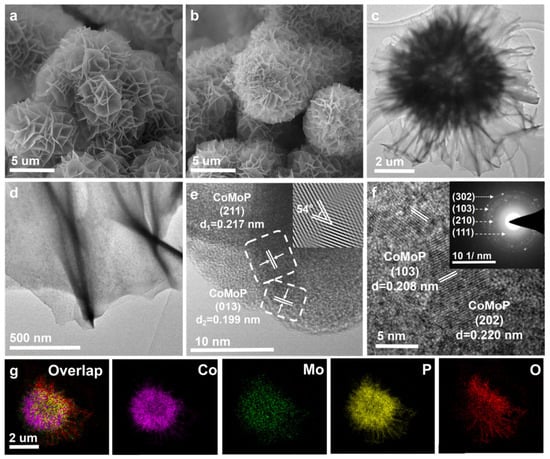
Figure 1a shows the CoMo-LDH/NF precursor with nanoflower aggregates of interlaced nanosheets forming a 3D porous network, providing a large specific surface area and space channels for rapid ion transport and gas release—a typical LDH morphology. After phosphidation (Figure 1b), CoMoP/NF still retains the original nanoflower structure, with intact nanosheet layers and no obvious collapse or fractures. TEM images (Figure 1c,d) further reveal ultrathin nanosheets with sharp edges and distinct boundaries. The nanosheets exhibit an extremely small thickness of only a few nanometers. More importantly, abundant regularly arranged mesopores and micropores between the nanosheets form an efficient mass-transfer network, facilitating rapid ion migration and bubble desorption, thus alleviating the “bubble blocking” issue and optimizing electrocatalytic efficiency.
Figure 1.
(a) SEM image of CoMo-LDH/NF. (b) SEM images of CoMoP/NF. (c,d) TEM image of CoMoP/NF. (e,f) HRTEM image of CoMoP/NF, (f) inset figure shows the SAED image of the nano-flower. (g) Element mapping image of CoMoP/NF.
HRTEM was used to analyze the crystal structure of the material. In Figure 1e, distinct lattice fringes are observed: the lattice spacing of 0.217 nm corresponds to the (211) crystal plane of CoMoP, and 0.199 nm matches the (013) plane of CoMoP, with an included angle of 54°, which is consistent with the CoMoP phase (PDF#97-000-2421). Since crystalline CoMoP is transformed from the amorphous phase, the amorphous region can be reasonably assigned to CoMoP as well. In Figure 1f, the measured lattice spacings of 0.208 nm and 0.220 nm correspond to the (103) and (202) planes of CoMoP, respectively. The selected-area electron diffraction (SAED) pattern in the inset shows clear polycrystalline diffraction rings with diffuse halos around the spots, attributed to the amorphous regions in the sample. The diffraction rings correspond to the (302), (103), (210), and (111) planes, respectively. Figure 1g shows the elemental distribution of CoMoP/NF. Elemental mapping reveals that Co, Mo, P, and O are uniformly distributed throughout the nanoflower structure without obvious segregation or aggregation, indicating that phosphidation achieves highly homogeneous doping of each component. This helps ensure a uniform distribution of active sites and further improves the stability of electrocatalytic performance. In addition, quantitative analysis verified the elemental composition of the CoMoP/NF sample (Figure S1). The atomic ratio of Co to Mo is approximately 11.8:9.8 ≈ 1.2:1, close to the designed 1:1 ratio, confirming the successful synthesis of the bimetallic phosphide. The atomic percentage of P (23.5%) is much higher than the total percentage of Co + Mo (21.6%), consistent with the elemental characteristics of phosphides. Meanwhile, part of P may exist in phosphate/oxidized states (corresponding to the high O content).
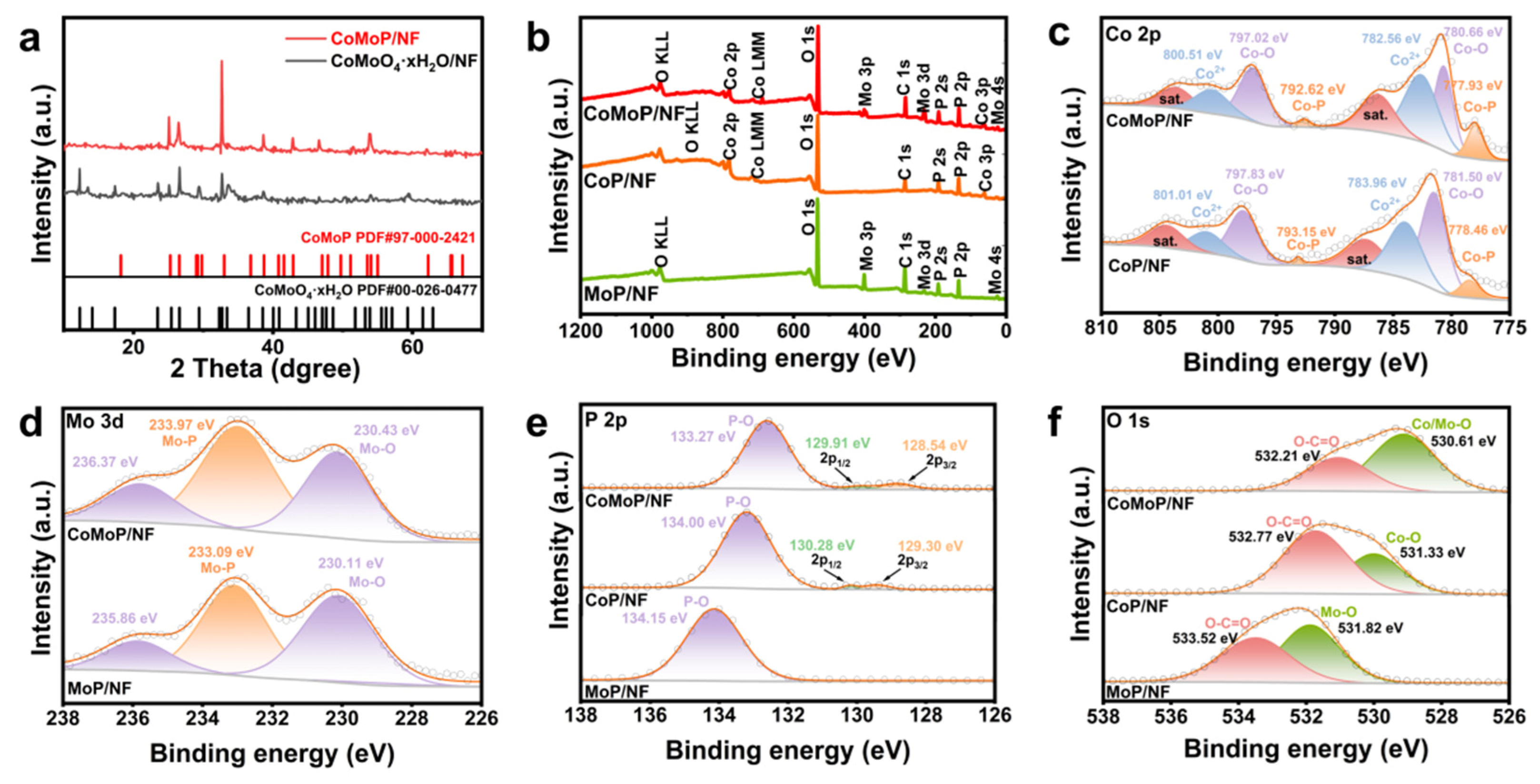
To clarify the crystal structure and surface elemental chemical states of CoMoP/NF, X-ray diffraction (XRD) and X-ray photoelectron spectroscopy (XPS) were systematically performed, with results shown in Figure 2. First, XRD was used to analyze the phase composition. As shown in Figure 2a, the diffraction peaks of the CoMoO4/NF precursor match well with the standard data of CoMoO4·xH2O (PDF#00-026-0477), confirming the successful preparation of CoMoO4/NF. After low-temperature phosphidation, the diffraction peaks of the product are highly consistent with CoMoP (PDF#97-000-2421), and no characteristic peaks of the precursor or impurity phases are detected. This proves that the precursor was completely converted into a pure-phase CoMoP with good crystallinity.
Figure 2.
(a) XRD patterns of CoMoO4/NF and CoMoP/NF. (b–f) XPS spectra of CoMoP/NF, CoP/NF and MoP/NF. (b) Full spectrum. (c) Co 2p spectrum. (d) Mo 3d spectrum. (e) P 2p spectrum. (f) O 1s spectrum.
XPS was further employed to explore the surface elemental chemical states and electronic structure. Figure 2b shows the XPS full spectra of CoMoP/NF, CoP/NF, and MoP/NF. Characteristic peaks of Co, Mo, P, and O are clearly detected in CoMoP/NF, consistent with the expected elemental composition. CoP/NF and MoP/NF show their respective characteristic element peaks, providing references for subsequent high-resolution spectrum fitting. Figure 2c displays the high-resolution Co 2p spectrum. The Co 2p3/2 and Co 2p1/2 peaks of CoMoP can be fitted into two pairs of peaks: peaks at 782.56 eV/800.51 eV are assigned to Co2+, and peaks at 780.66 eV/797.02 eV are assigned to Co-O, accompanied by satellite peaks [31]. Compared to CoP, the binding energy of Co in CoMoP shifts negatively, indicating that Mo incorporation modifies the chemical environment of Co, and causes Co to gain electrons during heterojunction formation. Moreover, CoMoP shows a higher peak intensity of the Co-P bond at 777.93 eV/792.62 eV than CoP, which may result from the synergistic interaction between Co and Mo increasing the electron density of Co, favoring the optimization of hydrogen adsorption/desorption behavior. Figure 2d presents the high-resolution Mo 3d spectrum. The Mo 3d spectrum of CoMoP can be fitted into two valence states. The peak at 231.97 eV is assigned to Mo4+ derived from Mo-P bonds (the dominant component of the phosphidation product), while the peaks at 229.13 eV and 234.77 eV correspond to Mo6+ originating from Mo-O bonds, which stem from the inevitable surface oxidation layer formed upon air exposure. Compared to MoP, the binding energy of Mo in CoMoP shifts positively, further confirming electron transfer between Co and Mo, with Mo losing electron density. The coexistence of Co and Mo generates an electronic structure distinct from that of single-metal phosphides. This is the main reason for the excellent water splitting performance of CoMoP, mainly attributed to the unique synergistic effect in bimetallic phosphides [32]. Figure 2e shows the P 2p spectrum. The P 2p spectrum of CoMoP can be fitted into two peaks: metal-phosphide bonds (P-M, 128.54 eV, 129.91 eV) and surface-oxidized phosphorus species (P-O, 133.27 eV). Based on the XPS P 2p spectrum fitting results, we calculated the peak area ratio of P-M species (P 2p1/2 + P 2p3/2) to the oxidized P-O species. As shown in Table S1, the ratio of P-M to P-O is approximately 9%, indicating that most of the surface phosphorus exists in the oxidized P-O form, while only a small fraction is in the metal phosphide state. Compared with single-metal phosphides, the binding energy of P shifts negatively, indicating that the electron environment of P atoms is co-regulated by Co and Mo, and P tends to accept electrons from metals. Such electron redistribution is conducive to optimizing the adsorption free energy of reaction intermediates (e.g., H*, OH*), which is key to enhancing the performance of bifunctional (HER/OER) electrocatalysts. Figure 2f displays the O 1s spectrum. The O 1s spectrum of CoMoP can be fitted into metal–oxygen bonds (Co/Mo-O, 530.61 eV) and surface-adsorbed oxygen-containing species (e.g., O-C=O, hydroxyl groups, 532.21 eV). Notably, CoMoP shows a lower M-O peak intensity than single-metal phosphides, indicating mild surface oxidation. This may be due to the stable ternary phase structure suppressing surface oxidation and benefiting catalytic stability.
Comprehensive XPS analysis confirms that the binding energies of Co, Mo, and P in CoMoP/NF shift significantly compared with single-metal phosphides, verifying the electronic synergistic effect between the two metals. This modulation of the electronic structure optimizes the adsorption free energy of hydrogen/oxygen-containing intermediates, thereby boosting the HER/OER performance of the catalyst. The good surface hydrophilicity of the catalyst improves the electrolyte permeability on the catalyst surface and promotes ion transport, thus enhancing HER performance. The hydrophilicity of the samples was investigated by contact angle measurements (Figure S2a–d). The contact angles of water droplets on bare nickel foam are both larger than 112°, indicating hydrophobicity. In contrast, water droplets spread rapidly on the surfaces of CoMoP/NF (Co:Mo = 1:1), CoP/NF, and MoP/NF, demonstrating superhydrophilicity. Water droplets are completely absorbed on the CoMoP/NF surface within only 60 ms, compared with 66 ms for CoP/NF and 80 ms for MoP/NF. This difference stems from distinct morphologies: as shown in Figure S2f, MoP/NF has small nanosheet structures, while CoMoP/NF and CoP/NF possess 3D hierarchical flower-like nanosheets and spherical nanowire structures, respectively, leading to better wettability.
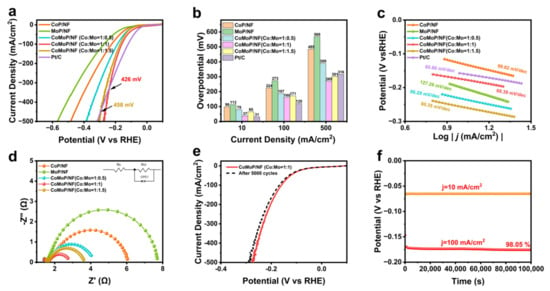
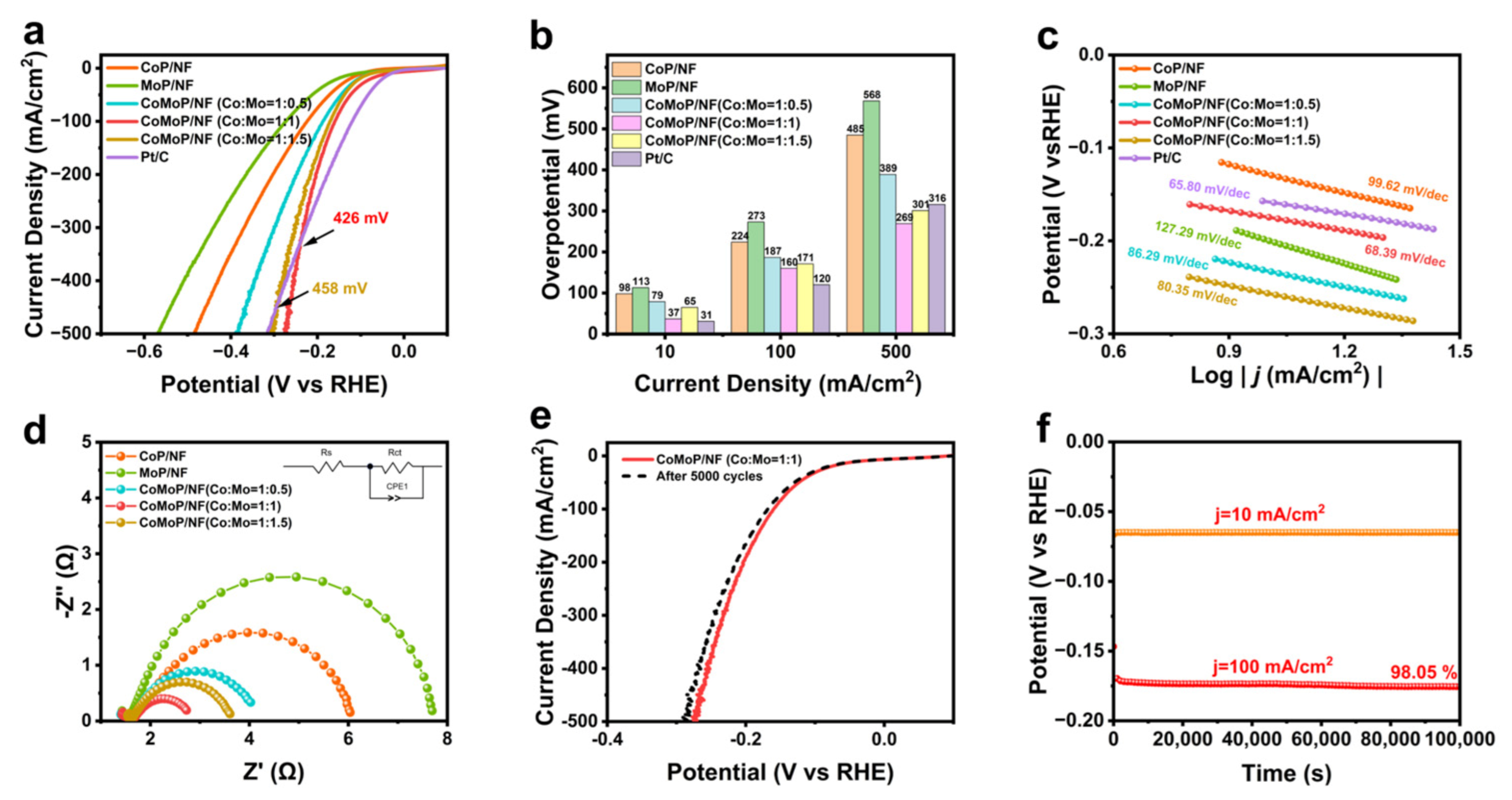
The electrocatalytic performance of different catalysts was tested in 0.5 M H2SO4 electrolyte using a three-electrode system. As shown in Figure 3a, linear sweep voltammetry (LSV) was used to evaluate the HER performance of CoMoP/NF with different molar ratios and reference samples. CoMoP/NF (Co:Mo = 1:1) exhibits outstanding HER performance, with an overpotential of 37 mV at 10 mA·cm−2, lower than that of CoMoP/NF (Co:Mo = 1:0.5, 79 mV), CoMoP/NF (Co:Mo = 1:1.5, 65 mV), CoP/NF (98 mV), and MoP/NF (113 mV) and comparable to that of commercial Pt/C/NF (31 mV). These control experiments reveal that the overpotential decreases with increasing Mo content at Co:Mo = 1:0.5, and the optimal HER overpotential of 37 mV is achieved at Co:Mo = 1:1. Further increasing the Mo content leads to a gradual rise in HER overpotential and degraded catalytic performance. In addition, the HER overpotentials of CoMoP/NF (Co:Mo = 1:1.5) and CoP/NF are lower than those of Pt/C at current densities exceeding 426 and 458 mA·cm−2, respectively, indicating excellent performance of the as-prepared catalysts at high current densities. As shown in Figure 3c, CoMoP/NF (Co:Mo = 1:1) delivers the lowest Tafel slope of 68.39 mV·dec−1 among all ratios, lower than those of CoMoP/NF (Co:Mo = 1:0.5, 86.29 mV·dec−1), CoMoP/NF (Co:Mo = 1:1.5, 80.35 mV·dec−1), CoP/NF (99.62 mV·dec−1), and MoP/NF (127.29 mV·dec−1), demonstrating the fastest HER kinetics. The HER kinetics follow the Volmer–Heyrovsky mechanism, and these observations point to a mixed kinetic regime where both proton adsorption (Volmer step) and electrochemical desorption (Heyrovsky step) contribute significantly to the overall reaction rate [33]. Compared with other reported electrocatalysts (Table S2), CoMoP/NF (Co:Mo = 1:1) also shows favorable catalytic performance. This result strongly proves that constructing bimetallic phosphides and regulating their micromorphology is an effective strategy for designing high-efficiency HER catalysts. Co and Mo atoms are bridged by P, leading to modulated electronic structures; d-electrons of Co transfer to Mo, optimizing the adsorption strength of metal sites toward the reaction intermediate (H*) to approach the vertex of the volcano plot [34]. Meanwhile, the 3D hierarchical “nanosheet flower” structure maximally exposes active sites, enables fast bubble desorption, promotes electrolyte diffusion and charge transfer, and further improves HER catalytic performance.
Figure 3.
Hydrogen evolution performance of different catalysts in 0.5 M H2SO4 electrolyte. (a) LSV curve. (b) Overpotential at current densities of 10, 100, and 500 mA·cm−2. (c) Tafel plot. (d) Impedance plot. (e) LSV of CoMoP/NF before and after 5000 CV cycles. (f) Stability test of CoMoP/NF at current densities of 10 and 100 mA·cm−2.
To gain a deeper insight into the reaction kinetics of the as-prepared electrodes, electrochemical impedance spectroscopy (EIS) was conducted on different catalysts. As shown in Figure 3d, the charge-transfer resistance (Rct) of the CoMoP/NF (Co:Mo = 1:1) electrode in acidic media is only 1.29 Ω, much lower than those of CoMoP/NF (Co:Mo = 1:0.5, 2.60 Ω), CoMoP/NF (Co:Mo = 1:1.5, 2.05 Ω), CoP/NF (4.35 Ω), and MoP/NF (6.27 Ω), indicating faster charge transfer for the CoMoP/NF (Co:Mo = 1:1) electrocatalyst. This may be attributed to the crystalline–amorphous heterointerfaces in CoMoP/NF (Co:Mo = 1:1) accelerating the electron transfer process and the 3D hierarchical flower-like structure facilitating electrolyte penetration and ion transport (supplying sufficient H3O+), as well as rapid desorption of generated H2 bubbles to avoid active-site coverage and increased resistance. Furthermore, CoMoP/NF (Co:Mo = 1:1) exhibits better hydrophilicity (Figure S1b), making it easier for the electrolyte to penetrate the surface of the heterostructured catalyst and favoring charge transfer and transport of the reaction medium.
Long-term stability is a critical parameter for large-scale industrial application. As shown in Figure 3e, after 5000 CV cycles, the overpotential of CoMoP/NF (Co:Mo = 1:1) at 10 mA·cm−2 increases by only 3 mV. Especially at current densities above 100 mA·cm−2, the increase in HER overpotential is almost negligible, demonstrating good electrochemical stability. The stability curve in Figure 3f shows that CoMoP/NF (Co:Mo = 1:1) can operate continuously at 10 mA·cm−2 for more than 27 h without any obvious attenuation, further verifying its excellent electrochemical stability. In addition, the attenuation rate of the CoMoP/NF (Co:Mo = 1:1) curve is only 3.8% in the stability test at 100 mA·cm−2, confirming its outstanding stability. The intrinsic electrocatalytic activity of the sample was measured by the double-layer capacitance method in the 0.5 M H2SO4 electrolyte. The double-layer capacitance (Cdl) was calculated by fitting CV curves to evaluate the electrochemical active surface area (ECSA) of different samples. Figure S3a–e shows the current densities of different catalysts measured at scan rates ranging from 20 to 120 mV·s−1. Figure S3f shows that the Cdl values of CoP/NF, MoP/NF, CoMoP/NF (Co:Mo = 1:0.5), CoMoP/NF (Co:Mo = 1:1), and CoMoP/NF (Co:Mo = 1:1.5) are 47.44 mF·cm−2, 39.42 mF·cm−2, 61.69 mF·cm−2, 79.10 mF·cm−2, and 72.67 mF·cm−2, respectively. The corresponding electrochemical active surface areas (ECSA) were calculated using Equation (1) as follows:
Among them, Cs is the specific capacitance per unit area of the sample, or the capacitance of a smooth plane of material atoms under the same electrolyte conditions. In the comparison of ESCA in this article, Cs is taken as a constant value of 0.04 mF cm−2 [35].
The corresponding ECSA values calculated by Equation (1) are 1186 cm2 (CoP/NF), 985.5 cm2 (MoP/NF), 1542.25 cm2 (CoMoP/NF, Co:Mo = 1:0.5), 1977.5 cm2 (CoMoP/NF, Co:Mo = 1:1), and 1816.75 cm2 (CoMoP/NF, Co:Mo = 1:1.5). It can be seen that the CoMoP/NF catalyst has the highest ECSA, which may be attributed to the abundant crystalline–amorphous heterointerfaces in the 3D hierarchical “nanosheet flower” structure, leading to superior HER performance.
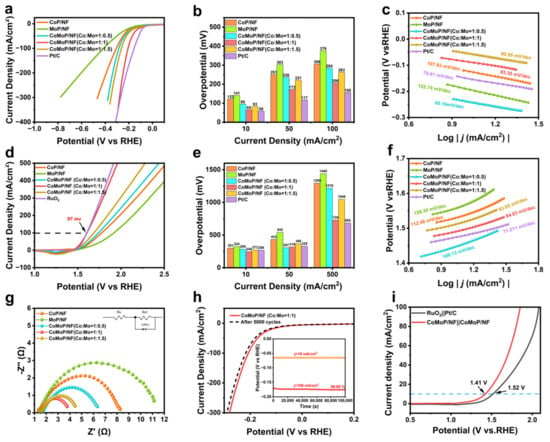
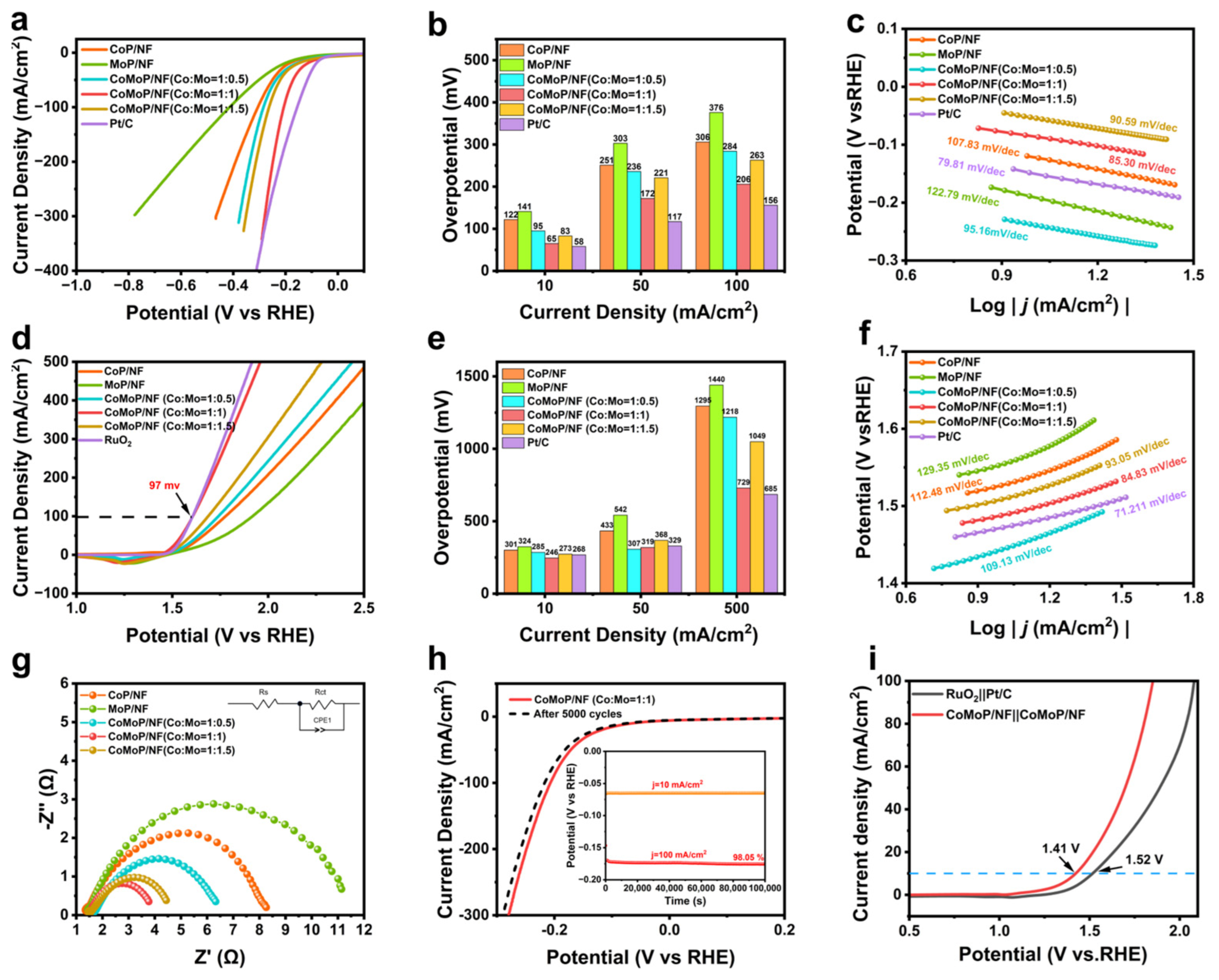
The electrocatalytic performance of various catalysts was evaluated in 1 M KOH electrolyte using a three-electrode system. As depicted in Figure 4a, linear sweep voltammetry (LSV) was employed to investigate the hydrogen evolution reaction (HER) performance of CoMoP/NF with different Co/Mo molar ratios and reference samples. CoMoP/NF (Co:Mo = 1:1) exhibited superior HER activity, delivering an overpotential of 65 mV at 10 mA·cm−2, which was lower than those of CoMoP/NF (Co:Mo = 1:0.5, 95 mV), CoMoP/NF (Co:Mo = 1:1.5, 83 mV), CoP/NF (122 mV), and MoP/NF (141 mV), although slightly inferior to the noble-metal Pt/C catalyst (58 mV). As shown in Figure 4c, CoMoP/NF (Co:Mo = 1:1) possessed the lowest Tafel slope of 85.30 mV·dec−1 among all Co/Mo ratios, lower than those of CoMoP/NF (Co:Mo = 1:0.5, 95.16 mV·dec−1), CoMoP/NF (Co:Mo = 1:1.5, 90.59 mV·dec−1), CoP/NF (107.83 mV·dec−1), and MoP/NF (122.79 mV·dec−1), indicating the fastest HER kinetics for CoMoP/NF (Co:Mo = 1:1). Moreover, CoMoP/NF (Co:Mo = 1:1) displayed favorable catalytic performance for both HER and oxygen evolution reaction (OER) compared to other previously reported electrocatalysts, as summarized in Table S3.
Figure 4.
Electrochemical performance of different catalysts in 1 M KOH solution. (a) Hydrogen evolution LSV. (b) Overpotential for hydrogen evolution at current densities of 10, 50, and 100 mA·cm−2. (c) Tafel plot. (d) Oxygen evolution LSV. (e) Overpotential for oxygen evolution at current densities of 10, 50, and 100 mA·cm−2. (f) Corresponding Tafel plot. (g) Impedance plot. (h) Stability tests of CoMoP/NF before and after 5000 CV cycles, as well as at different current densities. (i) Full water splitting LSV curves of CoMoP/NF (Co:Mo = 1:1) and RuO2ǁPt/C batteries.
Accordingly, the ECSA values of different samples were determined to be 738.25 cm2 for CoP/NF, 590.25 cm2 for MoP/NF, 859.5 cm2 for CoMoP/NF (Co:Mo = 1:0.5), 1230 cm2 for CoMoP/NF (Co:Mo = 1:1), and 948.5 cm2 for CoMoP/NF (Co:Mo = 1:1.5), respectively. Furthermore, it was observed that the ECSA values measured in alkaline media were generally smaller than those obtained in acidic media, which can be mainly attributed to the differences in reaction mechanisms and surface states. In acidic media, the high concentration of H+ enables direct proton participation in hydrogen adsorption/desorption, leading to fast reaction kinetics and a large measured active surface area. In alkaline media, however, the extremely low proton concentration requires hydrogen adsorption to proceed via the Volmer step [32], in which the H–O bond in water molecules is first broken: H2O + e− + ∗→H* + OH−. This process demands extra energy and results in slow reaction kinetics. Furthermore, the abundance of OH− in alkaline solution tends to adsorb onto the catalyst surface and occupy active sites, further suppressing the hydrogen adsorption process. Consequently, the ECSA values measured under alkaline conditions are usually relatively low.
The OER performance of different samples was investigated in the 1 M KOH electrolyte. As shown in Figure 4d, CoMoP/NF (Co:Mo = 1:1) delivers an OER overpotential of 246 mV at 10 mA·cm−2, significantly lower than those of CoP/NF (301 mV), MoP/NF (324 mV), CoMoP/NF (Co:Mo = 1:0.5, 285 mV), and RuO2/NF (273 mV). Compared to CoP/NF and MoP/NF, CoMoP/NF (Co:Mo = 1:1) exhibits a higher catalytic performance and current density, indicating that the Co-Mo synergy plays a key role in enhancing OER performance. However, the OER performance of CoMoP/NF (Co:Mo = 1:1) is inferior to that of RuO2/NF at current densities above 97 mA·cm−2, suggesting relatively poor OER performance at high current densities. The Tafel slopes of the as-prepared electrocatalysts are shown in Figure 4f. CoMoP/NF (Co:Mo = 1:1) shows a Tafel slope of only 84.83 mV·dec−1, significantly lower than those of CoP/NF (112.48 mV·dec−1), MoP/NF (129.35 mV·dec−1), CoMoP/NF (Co:Mo = 1:0.5, 109.13 mV·dec−1), and CoMoP/NF (Co:Mo = 1:1.5, 93.05 mV·dec−1) but slightly higher than that of RuO2/NF (71.21 mV·dec−1). EIS was used to reveal the electron transfer ability at the electrode–electrolyte interface for different electrodes. As shown in Figure 4g, the resistance of CoMoP/NF (Co:Mo = 1:1) is 2.3 Ω, much lower than those of CoP/NF (6.83 Ω), MoP/NF (9.61 Ω), CoMoP/NF (Co:Mo = 1:0.5, 4.64 Ω), and CoMoP/NF (Co:Mo = 1:1.5, 2.95 Ω), indicating the highest charge-transfer efficiency for CoMoP/NF (Co:Mo = 1:1). To better investigate the intrinsic active area of the materials, we performed ECSA normalization (specific activity) of the catalysts and obtained the ECSA-normalized current density plots, as shown in Figure S5. The comparison reveals that the intrinsic active area of the CoMoP/NF catalyst is higher than those of CoP/NF and MoP/NF, demonstrating that the construction of the heterojunction enhances the intrinsic activity of the catalyst. Furthermore, we calculated the TOF values of the catalysts at 0.2 V (vs. RHE), as presented in Figure S6. The results show that the hydrogen turnover frequency of CoMoP/NF is 0.15922 s−1, which is 2.57 times that of CoP/NF (0.06207 s−1) and 3.07 times that of MoP/NF (0.05173 s−1). These findings collectively demonstrate that the construction of the heterojunction not only increases the active surface area and intrinsic activity of the catalyst, but also enhances its turnover frequency.
To evaluate the stability of CoMoP/NF (Co:Mo = 1:1) in alkaline media, chronopotentiometry was performed, and LSV curves before and after 5000 CV cycles were compared (Figure 4h). No obvious change is observed in the LSV curves after 5000 CV cycles. The time–current density curve shows that CoMoP/NF (Co:Mo = 1:1) can operate continuously at 10 mA·cm−2 for more than 27 h without any obvious attenuation, further verifying its excellent electrochemical stability. In addition, the attenuation rate is only 1.95% in the stability test at 100 mA·cm−2, and the overpotential only increases by 7.17% after 50 h of electrolysis at 500 mA·cm−2 (Figure S7), further confirming its outstanding stability. Meanwhile, the post-stability SEM images (Figure S8) reveal that the catalyst still retains its original morphology and structure after long-term electrolysis. This confirms its excellent structural integrity and corrosion resistance under harsh high-current operating conditions. Given the excellent performance of the CoMoP/NF (Co:Mo = 1:1) electrocatalyst, it was assembled into a CoMoP/NFǁCoMoP/NF cell for overall water splitting performance testing. The LSV curve in Figure 4i shows that the CoMoP/NFǁCoMoP/NF cell requires only 1.42 V to reach 10 mA·cm−2, outperforming Pt/CǁRuO2 (1.52 V) and most recently reported bifunctional electrocatalysts, demonstrating superior HER and OER performance.
3. Experimental Section
3.1. Preparation of CoMo-LDH/NF
First, the 3 cm × 2 cm nickel foam (NF, 99.9%, Suzhou Keshenghe Metal Materials Co., Ltd., Suzhou, China) was ultrasonically cleaned in 1.0 M nitric acid nitric acid (HNO3, AR, Macklin, Shanghai, China), deionized water, and anhydrous ethanol (C2H5OH, AR) for 30 min sequentially to remove surface oxides. Meanwhile, 1 mmol of Co(NO3)2·6H2O, x mmol of (NH4)6Mo7O24·4H2O (AR, Aladdin, Shanghai, China), and 10 mmol of urea (CH4N2O, AR, Xilong, Guangzhou, China) were dissolved in 30 mL of deionized water and stirred magnetically for 30 min to obtain a purple solution. The resulting solution was transferred into a 100 mL Teflon-lined autoclave, into which the pre-treated nickel foam was immersed. The autoclave was sealed and heated in a hydrothermal reactor at 150 °C for 6 h. After naturally cooling to room temperature, the nickel foam fully covered with the precursor was taken out, rinsed with anhydrous ethanol and deionized water three times alternately to remove residual impurity ions, and then dried in an oven at 80 °C for 8 h to obtain the CoMo-LDH/NF precursor.
Preparation of CoMoP/NF
The obtained precursor sample was placed in a ceramic boat located at the downstream zone of a tube furnace, while 1 g of NaH2PO2 (AR, Aladdin) was placed at the upstream zone as the phosphorus source. The furnace was heated to 350 °C at a ramping rate of 3 °C/min and held for 2 h. After cooling to room temperature, the sample was collected to obtain the final CoMoP/NF.
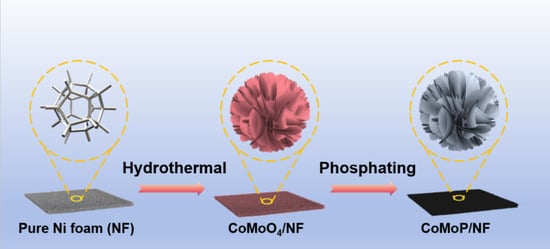
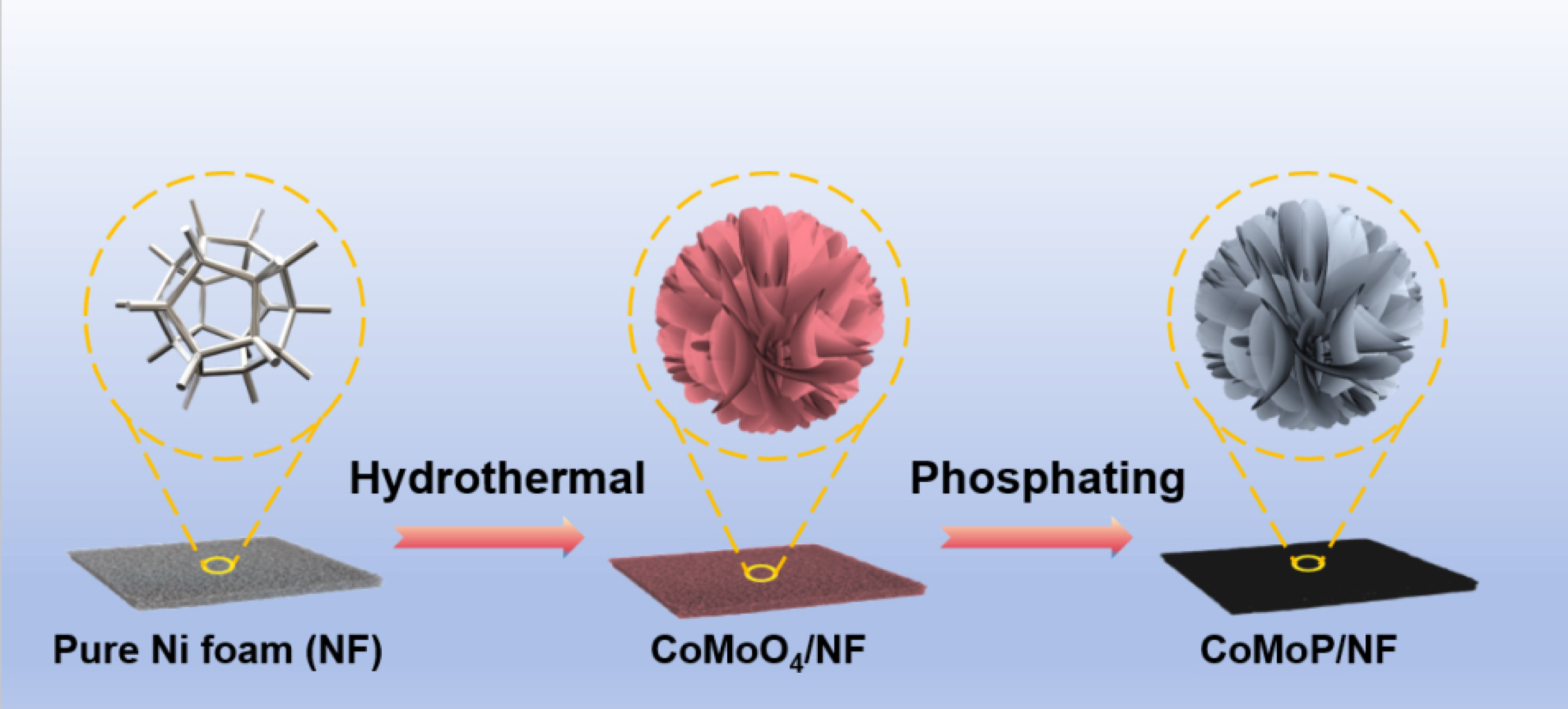
Control experiments were performed by varying the molar amount of Mo while keeping the Co molar amount at 1 mmol, yielding samples with Co:Mo molar ratios of 1:0.5 (Mo: 0.5 mmol), 1:1 (Mo: 1 mmol), and 1:1.5 (Mo: 1.5 mmol). Reference samples MoP/NF and CoP/NF were prepared without adding Co and Mo, respectively. The preparation process of the CoMoP/NF electrocatalyst is illustrated in Figure 5.
Figure 5.
The preparation process of CoMoP/NF electrocatalyst.
4. Conclusions
In summary, a 3D hierarchical flower-like CoMo-LDH/NF with nanosheet structures was prepared on nickel foam via a facile hydrothermal method, and an in situ crystalline–amorphous CoMoP/NF electrocatalyst was successfully constructed through a low-temperature phosphidation strategy. The amorphous phase introduces abundant unsaturated active sites through its disordered structure, while the 3D hierarchical nanoflower-like morphology ensures efficient electron and mass transport even under vigorous gas evolution. Moreover, the amorphous phase enables structural relaxation and self-reconstruction during electrolysis, effectively preventing grain boundary corrosion and phase transformation, thereby guaranteeing outstanding long-term stability. The catalyst displays outstanding HER activity in 1.0 M KOH and 0.5 M H2SO4 electrolytes, requiring overpotentials of 65 mV and 37 mV to achieve 10 mA·cm−2. It shows a lower HER overpotential than commercial Pt/C at current densities above 426 mA·cm−2 in acidic conditions. Meanwhile, this catalyst delivers an OER overpotential of 729 mV at 500 mA·cm−2 in alkaline media and can operate stably for 50 h, during which the overpotential increases by only 7.17%. When assembled into a CoMoP/NFǁCoMoP/NF cell for overall water splitting, it delivers a cell voltage of only 1.42 V at 10 mA·cm−2, surpassing Pt/CǁRuO2 (1.52 V) and most recently reported bifunctional electrocatalysts. This work provides a valuable strategy for designing and synthesizing low-cost, high-efficiency electrocatalysts for high-current-density overall water splitting.
Supplementary Materials
The following supporting information can be downloaded at: https://www.mdpi.com/article/10.3390/catal16050428/s1, Figure S1: EDS; Figure S2: Contact angle and SEM of CoP/NF, MoP/NF; Figures S3 and S4: Acidic and alkaline CV curves; Figure S5: ECSA-normalized HER/OER activity; Figure S6: TOF at 0.2 V (vs. RHE) [36]; Figure S7: CoMoP/NF stability in 1 M KOH; Figure S8: SEM after stability test; Table S1: P 2p peak area comparison; Table S2: HER performance in 0.5 M H2SO4 [37,38,39,40,41,42]; Table S3: Electrocatalytic performance comparison in 1 M KOH [24,43,44,45,46,47,48,49,50].
Author Contributions
J.W.: Methodology, Investigation, Experiment, Writing—Original Draft, Formal Analysis, Resources. Y.Y. (Yuan Yu) Writing—Review and Editing, Funding Acquisition, Methodology, Investigation, Resources, Conceptualization. D.S., Y.Q., X.Y., C.L., J.L., Y.J., Y.Y. (Yunkun Yang) and B.X.: Formal Analysis, Visualization. All authors have read and agreed to the published version of the manuscript.
Funding
The authors are grateful for the support of the National Natural Science Foundation of China (Grant No. 22308205), Shaanxi Province key research and development plan (Program No. 2023GXLH-081), and Xi’an key industrial chain technology research project (No. 24ZDCYJSGG0052).
Data Availability Statement
The data presented in this study are available on request from the corresponding author due to (specify the reason for the restriction).
Acknowledgments
We sincerely thank Shaanxi University of Science & Technology for providing the research platform and technical conditions for this study. We also express our gratitude to the Instrument Testing Platform of Compass Institution for its professional support and assistance in experimental testing and data analysis.
Conflicts of Interest
The authors declare no conflicts of interest.
References
- Chien, F.; Kamran, H.W.; Albashar, G.; Iqbal, W. Dynamic planning, conversion, and management strategy of different renewable energy sources: A sustainable solution for severe energy crises in emerging economies. Int. J. Hydrogen Energy 2021, 46, 7745–7758. [Google Scholar] [CrossRef] [Scilit]
- Worku, A.K.; Ayele, D.W.; Deepak, D.B.; Gebreyohannes, A.Y.; Agegnehu, S.D.; Kolhe, M.L. Recent advances and challenges of hydrogen production technologies via renewable energy sources. Adv. Energy Sustain. Res. 2024, 5, 2300273. [Google Scholar] [CrossRef] [Scilit]
- Farias, C.B.B.; Barreiros, R.C.S.; da Silva, M.F.; Casazza, A.A.; Converti, A.; Sarubbo, L.A. Use of hydrogen as fuel: A trend of the 21st century. Energies 2022, 15, 311. [Google Scholar] [CrossRef] [Scilit]
- Zh, Y. Analysis of China and the world’s energy security issues. Energy Syst. Res. 2022, 5, 24–29. [Google Scholar] [CrossRef] [Scilit]
- Liu, L.; Wang, X.; Wang, Z. Recent progress and emerging strategies for carbon peak and carbon neutrality in China. Greenh. Gases Sci. Technol. 2023, 13, 732–759. [Google Scholar] [CrossRef] [Scilit]
- Nicoletti, G.; Arcuri, N.; Nicoletti, G.; Bruno, R. A technical and environmental comparison between hydrogen and some fossil fuels. Energy Convers. Manag. 2015, 89, 205–213. [Google Scholar] [CrossRef] [Scilit]
- Qazi, U.Y. Future of hydrogen as an alternative fuel for next-generation industrial applications; challenges and expected opportunities. Energies 2022, 15, 4741. [Google Scholar] [CrossRef] [Scilit]
- Filippov, S.P.; Yaroslavtsev, A.B. Hydrogen energy: Development prospects and materials. Russ. Chem. Rev. 2021, 90, 627–643. [Google Scholar] [CrossRef] [Scilit]
- Chakraborty, S.; Dash, S.K.; Elavarasan, R.M.; Kaur, A.; Elangovan, D.; Meraj, S.T.; Kasinathan, P.; Said, Z. Hydrogen energy as future of sustainable mobility. Front. Energy Res. 2022, 10, 893475. [Google Scholar] [CrossRef] [Scilit]
- Saha, P.; Akash, F.A.; Shovon, S.M.; Monir, M.U.; Ahmed, M.T.; Khan, M.F.H.; Sarkar, S.M.; Islam, M.K.; Hasan, M.M.; Vo, D.-V.N. Grey, blue, and green hydrogen: A comprehensive review of production methods and prospects for zero-emission energy. Int. J. Green Energy 2024, 21, 1383–1397. [Google Scholar] [CrossRef] [Scilit]
- Lv, X.-W.; Tian, W.-W.; Yuan, Z.-Y. Recent advances in high-efficiency electrocatalytic water splitting systems. Electrochem. Energy Rev. 2023, 6, 23. [Google Scholar] [CrossRef] [Scilit]
- Zheng, Y.; Ma, M.; Shao, H. Recent advances in efficient and scalable solar hydrogen production through water splitting. Carbon Neutrality 2023, 2, 23. [Google Scholar] [CrossRef] [Scilit]
- Lee, J.E.; Jeon, K.-J.; Show, P.L.; Lee, I.H.; Jung, S.-C.; Choi, Y.J.; Rhee, G.H.; Lin, K.-Y.A.; Park, Y.-K. Mini review on H2 production from electrochemical water splitting according to special nanostructured morphology of electrocatalysts. Fuel 2022, 308, 122048. [Google Scholar] [CrossRef] [Scilit]
- Li, Y. Controllable Preparation of Noble Metal-Based Nanomaterials for Electrocatalytic Hydrogen Evolution Reaction. Ph.D. Thesis, Nanyang Technological University, Singapore, 2024. [Google Scholar]
- Shi, C.; Zhang, J.; Bao, W.; Wei, H.; Zhang, P.; Luo, Z.-H. Research advances and mechanisms of rare earth-based electrocat-alysts for water electrolysis. Chem. Commun. 2025, 62, 2110–2132. [Google Scholar] [CrossRef] [Scilit] [PubMed]
- Jeghan, S.M.N.; Kim, N.; Lee, G. Mo-incorporated three-dimensional hierarchical ternary nickel-cobalt-molybdenum layer double hydroxide for high-efficiency water splitting. Int. J. Hydrogen Energy 2021, 46, 22463–22477. [Google Scholar] [CrossRef] [Scilit]
- Chen, K.; Uthirakumar, P.; Dao, V.; Cao, Y.-H.; Yadav, S.; Lee, I.-H. Unlocking surface and interface engineering of layered double hydroxide (LDH)-based catalysts for efficient catalytic water-splitting: A comprehensive review. Adv. Compos. Hybrid Mater. 2025, 8, 391. [Google Scholar] [CrossRef] [Scilit]
- Mohanty, U.A.; Sahoo, D.P.; Paramanik, L.; Parida, K. A critical review on layered double hydroxide (LDH)-derived functional nanomaterials as potential and sustainable photocatalysts. Sustain. Energy Fuels 2023, 7, 1145–1186. [Google Scholar] [CrossRef] [Scilit]
- Al Shahrani, M.; Amer, M.S.; Alsaleh, A.A.; Arunachalam, P.; Al-Mayouf, A.M. Al, P-co-doping and interface engineering synergistically boost the electrocatalytic performance of WS2/Ni3S2/NiS nanosheet heterostructure for efficient hydrogen evolution reaction. RSC Adv. 2024, 14, 32251–32261. [Google Scholar] [CrossRef] [Scilit]
- Qi, R.; Bu, H.; Yang, X.; Song, M.; Ma, J.; Gao, H. Multifunctional molybdenum-tuning porous nickel-cobalt bimetallic phosphide nanoarrays for efficient water splitting and energy-saving hydrogen production. J. Colloid Interface Sci. 2024, 653, 1246–1255. [Google Scholar] [CrossRef] [Scilit]
- Lee, Y.J.; Park, S.-K. Synergistically coupling of Ni–Fe LDH arrays with hollow Co–Mo sulfide nanotriangles for highly efficient overall water splitting: YJ Lee, S.-K. Park. Rare Met. 2024, 43, 522–532. [Google Scholar] [CrossRef] [Scilit]
- Zhang, B.-J.; Chang, B.; Qiu, S.-P.; Zhao, G.; Wang, X.; Xu, X.-J.; Mu, L.; Liao, W.-B.; Dong, X.-J. Two-dimensional bifunctional electrocatalyst (Mo–NiFe-LDH) with multilevel structure for highly efficient overall water splitting. Rare Met. 2024, 43, 2613–2622. [Google Scholar] [CrossRef] [Scilit]
- Hoa, V.H.; Tran, D.T.; Nguyen, D.C.; Kim, D.H.; Kim, N.H.; Lee, J.H. Molybdenum and phosphorous dual doping in cobalt monolayer interfacial assembled cobalt nanowires for efficient overall water splitting. Adv. Funct. Mater. 2020, 30, 2002533. [Google Scholar] [CrossRef] [Scilit]
- Song, Y.; Wang, Q.; Liu, X.; Zhou, C.; Li, S.; Wang, S.; Sun, Y.; Zhang, P. Nickel foam-loaded Zn/Co bimetallic phosphide as an efficient bifunctional electrolytic water catalyst. Catal. Lett. 2024, 154, 5101–5109. [Google Scholar] [CrossRef] [Scilit]
- Kang, J.; Yang, X.; Hu, Q.; Cai, Z.; Liu, L.-M.; Guo, L. Recent progress of amorphous nanomaterials. Chem. Rev. 2023, 123, 8859–8941. [Google Scholar] [CrossRef] [Scilit] [PubMed]
- Zhai, W.; Sakthivel, T.; Chen, F.; Du, C.; Yu, H.; Dai, Z. Amorphous materials for elementary-gas-involved electrocatalysis: An overview. Nanoscale 2021, 13, 19783–19811. [Google Scholar] [CrossRef] [Scilit]
- Zhai, Y.; Ren, X.; Yan, J.; Liu, S. High density and unit activity integrated in amorphous catalysts for electrochemical water splitting. Small Struct. 2021, 2, 2000096. [Google Scholar] [CrossRef] [Scilit]
- Lan, H.; Wang, J.; Cheng, L.; Yu, D.; Wang, H.; Guo, L. The synthesis and application of crystalline–amorphous hybrid materials. Chem. Soc. Rev. 2024, 53, 684–713. [Google Scholar] [CrossRef] [Scilit]
- Pang, Y.; Xu, W.; Zhu, S.; Cui, Z.; Liang, Y.; Li, Z.; Wu, S.; Chang, C.; Luo, S. Self-supporting amorphous nanoporous NiFeCoP electrocatalyst for efficient overall water splitting. J. Mater. Sci. Technol. 2021, 82, 96–104. [Google Scholar] [CrossRef] [Scilit]
- Feng, J.; Chu, C.; Liu, J.; Wei, L.; Li, H.; Shen, J. Superhydrophilic 3D amorphous/crystalline heterostructure: Nanosheets-assembled CoMoP-FexP/NF as efficient bifunctional electrodes for alkaline water splitting. Int. J. Hydrogen Energy 2024, 63, 231–240. [Google Scholar] [CrossRef] [Scilit]
- Ma, D.; He, Z.; Wei, T.; Wang, L.; Li, Y.; Yurievich, K.V.; Anton, R.; Bian, T.; Yan, S. Constructing of crystalline CoP/amorphous CoMoP coupling composites for efficient water splitting. Int. J. Hydrogen Energy 2024, 51, 479–489. [Google Scholar] [CrossRef] [Scilit]
- Chen, Y.; Sui, T.; Lyu, C.; Wu, K.; Wu, J.; Huang, M.; Hao, J.; Lau, W.-M.; Wan, C.; Pang, D. Constructing abundant interfaces by decorating MoP quantum dots on CoP nanowires to induce electronic structure modulation for enhanced hydrogen evolution reaction. Mater. Horiz. 2023, 10, 3761–3772. [Google Scholar] [CrossRef] [Scilit]
- Wang, J.; Zang, W.; Liu, X.; Sun, J.; Xi, S.; Liu, W.; Kou, Z.; Shen, L.; Wang, J. Switch volmer-heyrovsky to volmer-tafel pathway for efficient acidic electrocatalytic hydrogen evolution by correlating Pt single atoms with clusters. Small 2024, 20, 2309427. [Google Scholar] [CrossRef] [Scilit] [PubMed]
- Gyanprakash, M. Investigation of the Shift in Volcano Peak for the Oxygen Evolution Reaction at a High Reaction Rate. J. Phys. Chem. C 2023, 127, 21526–21533. [Google Scholar] [CrossRef] [Scilit]
- Lv, J.; Liu, P.; Li, R.; Wang, L.; Wang, G. Constructing accelerated charge transfer channels along V-Co-Fe via introduction of V into CoFe-layered double hydroxides for overall water splitting. Appl. Catal. B Environ. 2021, 298, 120587. [Google Scholar] [CrossRef] [Scilit]
- Brunca da Silva, A.; Arizono dos Reis, E.; Ribeiro, C.; Helena Mascaro, L. Overcoming stability hurdles of transition metal phosphides for H2 evolution: A review. ChemSusChem 2025, 18, e202501388. [Google Scholar] [CrossRef] [Scilit]
- Zhou, J.; Duan, R.; Xiao, J.; Zhang, S.; Huang, C.; Xie, Y.; Yang, L.; Liu, Y.; Du, Y.; Yu, L. Cooperative d-electron density regulation on layered double hydroxides for boosting overall water/seawater splitting. J. Energy Chem. 2025, 114, 808–817. [Google Scholar] [CrossRef] [Scilit]
- Pi, Y.; Song, H.; Zhang, X.; Pi, C.; Qiang, M.; Wang, X.; Wang, H.; Gao, B.; Huo, K. Facile construction of porous and heterostructured molybdenum nitride/carbide nanobelt arrays for large current hydrogen evolution reaction. Int. J. Hydrogen Energy 2022, 47, 27887–27895. [Google Scholar] [CrossRef] [Scilit]
- Guboova, A.; Orinakova, R.; Streckova, M.; Podrojkova, N.; Parackova, M.; Milkovic, O.; Medvecky, L.; Girman, V.; Bystron, T. Bimetallic MoFe phosphide catalysts for the hydrogen evolution reaction. Electrochim. Acta 2024, 506, 145008. [Google Scholar] [CrossRef] [Scilit]
- Fan, S.; Fu, J.; Chen, H.; Liu, M.; Zhang, X.; Luo, L.; Chen, Y. Bifunctional and durable MoSe2-RuSe2 heterojunction catalyst for alkaline seawater splitting. J. Mater. Chem. A 2026, 14, 8989–8998. [Google Scholar] [CrossRef] [Scilit]
- Liu, C.; Pi, Y.; Yan, Q.; Li, X.; Yao, W.; Li, Z.; Wang, X.; Cheng, P. Synergistic enhancement of hydrogen evolution reaction catalysts via Ni/Co/Fe-doped Mo2C composites: Morphological, structural, and electrochemical insights. Int. J. Hydrogen Energy 2026, 223, 154362. [Google Scholar] [CrossRef] [Scilit]
- Maleki, M.; Sabour Rouhaghdam, A.; Barati Darband, G.; Han, D.; Shanmugam, S. Highly active and durable NiCoSeP nanostructured electrocatalyst for large-current-density hydrogen production. ACS Appl. Energy Mater. 2022, 5, 2937–2948. [Google Scholar] [CrossRef] [Scilit]
- Chang, X.W.; Li, S.; Wang, L.; Dai, L.; Wu, Y.P.; Wu, X.Q.; Tian, Y.; Zhang, S.; Li, D.S. Tuning morphology and electronic structure of cobalt metaphosphate via vanadium-doping for efficient water and urea splitting. Adv. Funct. Mater. 2024, 34, 2313974. [Google Scholar] [CrossRef] [Scilit]
- Zhang, S.; Zhu, L.; Ai, Z.; Wang, B.; Mansoor, A.; Zhang, Y.; Sun, W. Application of ZrO2 and Ni modified carbon nanotube composites as bifunctional water electrolysis catalysts. Diam. Relat. Mater. 2024, 150, 111731. [Google Scholar] [CrossRef] [Scilit]
- Qin, J.-F.; Lin, J.-H.; Chen, T.-S.; Liu, D.-P.; Xie, J.-Y.; Guo, B.-Y.; Wang, L.; Chai, Y.-M.; Dong, B. Facile synthesis of V-doped CoP nanoparticles as bifunctional electrocatalyst for efficient water splitting. J. Energy Chem. 2019, 39, 182–187. [Google Scholar] [CrossRef] [Scilit]
- Xu, S.; Sun, X.; Cui, W.; Bai, J.; Li, C. Embedding Co6Mo6C2-Mo2C heterostructure nanoparticles in carbon nanofibers as highly efficient electrocatalysts for overall water splitting. Int. J. Hydrogen Energy 2024, 49, 309–321. [Google Scholar] [CrossRef] [Scilit]
- Amer, M.S.; Arunachalam, P.; Alsaleh, A.A.; Almutairi, Z.A.; Al-Mayouf, A.M. Evaporation-induced co-assembly of Al and P co-doped mesoporous Co3O4 for highly efficient electrochemical water splitting. Electrochim. Acta 2026, 559, 148574. [Google Scholar] [CrossRef] [Scilit]
- Falake, M.B.; Bhabal, R.; Chunduri, A.; Dhulia, V.; Patel, R.; Patel, N. Bimetallic Cobalt-Vanadium Boride as a Bifunctional Electrocatalyst for Overall Water Splitting. Electrocatalysis 2025, 16, 645–654. [Google Scholar] [CrossRef] [Scilit]
- Ye, C.; Zheng, X.; Fang, L.; Fu, Z.; Li, D.; Zhu, J.; Jiang, D. Synergistically Coupled CoMoP/Cr(OH)3 for Electrocatalytic Water Splitting. Inorg. Chem. 2025, 64, 21683–21693. [Google Scholar] [CrossRef] [Scilit]
- Thiyagarajan, D.; Thirumurugan, A.; Lee, B.-K. Construction of NiS@CoFeMoO4/NF nanosheet heterostructures for efficient overall water splitting. J. Alloys Compd. 2023, 936, 168340. [Google Scholar] [CrossRef] [Scilit]
Disclaimer/Publisher’s Note: The statements, opinions and data contained in all publications are solely those of the individual author(s) and contributor(s) and not of MDPI and/or the editor(s). MDPI and/or the editor(s) disclaim responsibility for any injury to people or property resulting from any ideas, methods, instructions or products referred to in the content. |
© 2026 by the authors. Licensee MDPI, Basel, Switzerland. This article is an open access article distributed under the terms and conditions of the Creative Commons Attribution (CC BY) license.