Article

Enhanced Antibacterial and Photocatalytic Performance of Synergistic Graphene/Cellulose/Chitosan–Ag Nanocomposites


by
Mohammad Saood Manzar
1,
Sally Mostafa Khadrawy
2,
Mohd Imran
3,4,*,
Karim Tanji
5,
Mukarram Zubair
1,
Hissah A. Alqahtani
6,
Bhagyashree R. Patil
7,
Essam Kotb
8,9,
Mohammed Abdul Aleem Qureshi
1,
Hassan A. Rudayni
2 and
Ahmed A. Allam
2
1
Department of Environmental Engineering, College of Engineering, Imam Abdulrahman Bin Faisal University, Dammam 31451, Saudi Arabia
2
Department of Biology, College of Science, Imam Mohammad Ibn Saud Islamic University (IMSIU), Riyadh 11623, Saudi Arabia
3
Department of Chemical Engineering, College of Engineering and Computer Sciences, Jazan University, Jazan 82817, Saudi Arabia
4
Engineering and Technology Research Center, Jazan University, P.O. Box 114, Jazan 82817, Saudi Arabia
5
Laboratory of Advanced Materials and Process Engineering, Department of Chemistry, Faculty of Sciences, Ibn Tofaïl University, P.O. Box 133, Kenitra 14000, Morocco
6
Department of Chemistry, College of Science, Imam Abdulrahman Bin Faisal University, Dammam 31451, Saudi Arabia
7
Department of Biology, College of Science, Jazan University, Jazan 82817, Saudi Arabia
8
Department of Biology, College of Science, Imam Abdulrahman Bin Faisal University (IAU), P.O. Box 1982, Dammam 31441, Saudi Arabia
9
Basic and Applied Scientific Research Center (BASRC), Imam Abdulrahman Bin Faisal University (IAU), P.O. Box 1982, Dammam 31441, Saudi Arabia
*
Author to whom correspondence should be addressed.
Catalysts 2026, 16(5), 427; https://doi.org/10.3390/catal16050427 (registering DOI)
Submission received: 8 March 2026 / Revised: 15 April 2026 / Accepted: 23 April 2026 / Published: 5 May 2026

Abstract

In the current research, graphene and cellulose nanocrystals (CNCs) loaded with silver nanoparticles were synthesized using the hydrothermal method with different mass ratios (G:CNC:CS). The composite GC2 (1:0.2:0.2) (MIC = 6.1 µg·mL−1) and GC3 (1:0.3:0.3) (MIC = 1.8 µg·mL−1) exhibited the maximum antibacterial activity against Staphylococcus aureus subsp. aureus ATCC BAA-977 and Pseudomonas aeruginosa, respectively. The antibacterial performance underscores the complex interplay between the compositional attributes of GC2 and GC3, and the unique susceptibility profiles of different bacterial strains. The antibacterial mechanism was proposed to understand the antibacterial activity process. Ag+ cations and reactive oxygen species (ROS) formed with the composite materials are responsible for disrupting interactions with the bacterial cell wall via transmembrane proteins. Eriochrome Black T exhibited the highest photocatalytic degradation efficiency (~90% under UV), followed by Congo Red, which also showed substantial removal across all irradiation conditions. In contrast, Bisphenol A and tetracycline displayed comparatively lower degradation efficiencies, particularly under UV light. Overall, the degradation trend for all pollutants followed the order: UV > solar > visible irradiation.

1. Introduction

One of the most enduring global health issues is bacterial infections, especially in light of the rise in antibiotic-resistant strains that have reduced the effectiveness of traditional treatments [1,2]. Despite the fact that antibiotics have proven effective, their widespread and sometimes unchecked usage has increased bacterial resistance, creating a pressing need for alternative antimicrobial treatments [3]. Numerous scientific studies have reported the antibacterial activity of various metals such as gold, copper, platinum, and silver. Some metals, including gold and silver, have been recognized for their antimicrobial properties since ancient times [4]. Silver nanoparticles (AgNPs) are among the most popular and well-researched of these for use in surface disinfection, biomedical, and textile applications [5]. In addition, it has been reported that most silver nanocomposites exhibit antibacterial and antifungal efficacy against approximately 150 different bacteria [6].
The antibacterial properties of zinc oxide, iron oxide, titanium dioxide, silver oxide, copper oxide, and other nanoparticles have been the subject of several studies in current years [7]. Silver nanoparticles (AgNPs) have been commonly used in the plastics, health, textile, and paint industries [8]. Zhang et al. have previously tested the production of Ag nanoparticles through a one-step technique using AgNO3 and a multi-amino compound (RSD-NH2) to enhance the antimicrobial properties of silk fabrics. The results indicated that the silk fabrics treated with nano-silver exhibited remarkable antibacterial activity [7]. More recently, a research team at the Huazhong University of Science and Technology utilized the electron beam evaporation (EBE) technique to modify the surface of titanium dental implants with a silver nanoparticle coating to improve their antibacterial properties [7]. The surfaces modified with silver nanoparticles effectively subdued the expansion of Escherichia coli (E. coli) and Staphylococcus aureus (S. aureus). Moreover, various metal oxide-based nanocomposites have been used in the photodegradation of dyes, antibiotics and photogenerated hydrogen evolution in recent studies. Higher performance is the result of synergy between the nanocomposite counterparts which together show greater charge separation, higher charge mobility, and photogenerated radicals which take part in the degradation of pollutants [9,10].
Simultaneously, graphene and its derivatives, including graphene nanoplatelets, graphene oxides (GOs), and reduced graphene oxides (rGOs), have received a lot of research focus owing to their mechanical permanency, higher surface area, and antibacterial features [11,12,13,14]. Large quantities of phospholipids can be extracted from the cell membrane of E. coli by inserting or cutting through the sharp ends of graphene nanosheets, triggering physical impairment and the death of microorganisms. The degradation of the E. coli membrane that results from this procedure reduces the bacteria’s viability [15]. Panda et al. have shown superior antibacterial activities of natural shellac-based GO coatings on different metallic films [16]. Vanithakumari et al. successfully fabricated superhydrophobic titanium surfaces with higher antibacterial properties by electrodepositing GOs on annealed and anodized titanium and covering it with a salinized silica nanoparticle [17]. When equated to the control titanium tasters, the bacterial adhesion of the silane-GO coated samples was three to five orders lower. Hatami et al. synthesized GO/Co-MOF (metal–organic framework) and utilized it for biocidal activity against the development of the Gram-positive bacteria S. aureus and the Gram-negative E. coli [18]. The results show high antibacterial activities of GO/Co-MOF against E. coli and S. aureus, with an intensification in the GO concentration. Moreover, silver nanoparticles have recently been incorporated into GO composite materials to demonstrate significant antibacterial activity [19]. Poly(vinyl alcohol)/GO–AgNPs were prepared by incorporating reduced GO coated with silver nanoparticles (GO–AgNPs) [20]. The PVA/GO–AgNP nanocomposites revealed effective antibacterial activity against E. coli and S. aureus. Moreover, Zhu et al. [21] reported the synthesis of a BiOI/ZnO/rGO composite via a one-step hydrothermal method for the efficient degradation of chloramphenicol. The composite exhibited significantly enhanced photocatalytic activity, achieving degradation rates 8.1 and 1.8 times higher than BiOI and ZnO, respectively. This improvement was attributed to effective charge separation and enhanced conductivity due to the synergistic interaction between rGO and the BiOI/ZnO heterostructure [21]. Oluwole and Olatunji [22] reported the synthesis of rGO/BSO/g-C3N4 heterostructured nanocomposites via a wet impregnation method with high crystallinity and enhanced optical properties. The incorporation of rGO reduced electron–hole recombination and improved charge transfer, resulting in a narrowed band gap of 2.34 eV [22]. The optimized composite achieved up to a 97.70% degradation of naproxen under visible light, attributed to efficient charge separation and the dominant role of h+ and •O2 reactive species. Shenoy et al. [23] reported the fabrication of Cu2O/TiO2 nanofibers coated with rGO (CTNF@rGO) via a solution-based method, where the catalyst was also used as an efficient photocatalyst for H2 evolution under visible light. The composite exhibited a significantly enhanced H2 production rate, attributed to improved charge separation and reduced electron–hole recombination. This enhancement was driven by the formation of a p–n heterojunction and an interfacial electric field that facilitated efficient electron transfer [23].
Cellulose nanocrystals (CNCs) and chitosan (CS) are promising biomaterials and are increasingly used for various applications [24,25]. These biomaterials have shown excellent removal performance of various organic and inorganic contaminants in water purification technologies [26,27]. The abundant hydroxyl groups in CNCs and nitro groups in CS provide dominant active sites for effective water remediation. On the one hand, CNCs exhibit high mechanical and chemical stability, making them suitable for use as a sustainable nanofiller in various applications. Similarly, CS has broad antimicrobial activity against fungi and bacteria. However, CNCs have limited antibacterial ability, whereas CS has low mechanical properties. Therefore, the limitations of CNCs and CS can be enhanced by merging them with metal oxide [28,29]. Deng et al. (2022) fabricated starch film coated with CNCs and CS for enhanced mechanical and antimicrobial properties [29].
Although graphene–Ag or CNC/chitosan composites have been studied separately in the past, there has been no systematic optimization of CNC/CS loading for synergistic antibacterial action against Gram +ve and Gram −ve microorganisms. This work establishes a structure–function association by evaluating three ratios (GC1–GC3) in a novel way and demonstrating strain-dependent MIC performance. Thus, in the present research, a facile approach was adopted to synthesize new composites based on Ag, CNC, chitosan, and graphene nanosheets in various weight ratios using the hydrothermal method. This choice was motivated by its controlled synthesis, enhanced properties, eco-friendliness, and compatibility with biopolymers to develop potent antimicrobial agents and photodegradation of dyes and antibiotics. The CNC and CS components were added to the composite material of graphene and silver nanoparticles to enhance their dispersion and overall antibacterial and photodegradation efficacy. It is expected that the presence of CNC and CS will improve the stability and efficiency of Ag nanoparticles in the graphene matrix, resulting in excellent antibacterial activity against microorganisms. Additionally, CNCs act synergistically with the other components to further disrupt bacterial cell membranes, which may explain their role in observed antibacterial activity [30]. The prepared composites were fully characterized to evaluate the functional groups, crystalline structure, and surface morphology. The effectiveness of the composites in inhibiting bacterial growth was tested on two strains of bacteria, S. aureus and P. aeruginosa. Moreover, photodegradation studies were performed for Eriochrome Black T (EBT), Congo Red (CR), Bisphenol A (BSPA) and tetracycline (TC) under UV, visible, and natural light. The antibacterial mechanism of Ag+ ions and reactive oxygen species (ROS) generation was proposed to demonstrate the importance of the prepared composite in antibacterial activity.

2. Resources and Procedures

2.1. Resources

Silver nitrate (AgNO3) (>99.9%), high-purity acetone (>99.5%), and medium-molecular-weight chitosan (∼400,000) were procured from Sigma-Aldrich, Schnelldorf, Germany and graphene nanoplatelet powder (G) (surface area 800 m2/g, dia 1.5 µm and size 3 nm) was obtained from Nanografi, Ankara, Turkey. Luria–Bertani (LB) broth powder and agar powder for the creation of bacterial culture media were purchased from Becton, Dickinson and Co., Le Pont De Claix, France. The bacterial strains S. aureus subsp. aureus ATCCBAA-977 and P. aeruginosa ATCC27853 were procured via the American Type Culture Collection (ATCC), Manassas, VA, USA. The water of 18.2 MΩ·cm was utilized to make the solutions obtained from laboratory-grade water filter, High Wycombe, UK.

2.2. Synthesis Procedure of Graphene-Loaded Cellulose Nanocrystals, Chitosan, and Silver Nanoparticles

Cellulose nanocrystals (CNCs) used in this study were prepared from crushed office paper waste by acid hydrolysis [31]. Subsequently, hydrothermal synthesis was used to formulate graphene-based composites. For this experiment, 1 g of G, 100 mg of CNC, and 100 mg of chitosan were added in 50 mL of 0.05 molar AgNO3 solution and ultrasonicated for 30 min using an ultrasonicator, Qsonica Q500-110 Newtown, CT, USA. After that, the whole suspension was shifted to a 100 mL Teflon-lined autoclave reactor for hydrothermal reaction at 120 °C for 4 h, and permitted to cool. The resulting precipitates of graphene/CNC/chitosan/Ag composite were centrifuged, washed 4–5 times with deionized water and high-purity acetone, and dehydrated at 40 °C for 6 h in the oven. Similarly, the other ratios of the composite were prepared in the same manner as indicated in Table 1 below.

2.3. In Vitro Antibacterial Activity of the Prepared Samples

Preliminary stock suspensions of fabricated nanoparticles were made at a concentration of 25 mg/mL of deionized water. By quantifying the subsequent inhibition regions (mm) on seeded Müller–Hinton agar using a previously modified Beecher and Wong technique, the antibacterial activity of the synthetic tasters was assessed [32] and matched to nominated medical bacterial strains (S. aureus subsp. ATCCBAA-977 and P. aeruginosa ATCC27853). The Müller–Hinton agar comprised Beef excerpt (30%), Casein hydrolysate (1.75%), Starch (0.15%), and Agar (1.7%), and was autoclaved for 15 min (121 °C), brought down to 47 °C, and sowed with the inspected bacteria (1.0 × 10⁸ CFU/mL) under aseptic conditions. After solidifying, 5 mm diameter disks were placed onto the surface of the agar layer. The tested NPs were laden at 3 µL volume per disk (disk load = 75 µg). After that, plates were incubated at 37 °C for 18 h. The antibacterial activity was determined by gaging the inhibitory zones’ diameter in millimeters [33,34].
The agar dilution process was utilized to determine the MIC. Two-fold dilution series were used to create dilutions of 1000.00 µg/mL, 500.00 µg/mL, 250.00 µg/mL, 125.00 µg/mL, 62.50 µg/mL, 31.25 µg/mL, 15.62 µg/mL, 7.81 µg/mL, 3.91 µg/mL, and 1.95 µg/mL in deionized water. On the surface of the Müller–Hinton agar that had been seeded, disks of cellulose filter paper with a diameter of five millimeters were loaded with three microliters of the tested NPs. After 18 h of incubation, the inhibition zones that resulted were identified. The entire culture media were fortified following the manufacturer’s instructions. Microbial cultures were preserved at 4 °C in Heart Infusion Agar (HIA). The strains were subcultured beforehand via the media above and incubated for 24 h at 37 °C [35].

2.4. Characterization

Various techniques were employed to characterize the composite materials used in this study. The thermal stability and decomposition behavior were analyzed using thermogravimetric analysis (TGA), SDT-600 instrument (TA Instruments, New Castle, DE, USA) with a heating rate of 5 °C/min from 25 °C to 600 °C, under Ar. The crystal structure of the materials was determined using XRD in the 2θ range from 10° to 70°, with a step size of 0.02°, by employing Philips X-pert Cu-Kα radiation. FTIR was exploited to recognize functional clusters in the composites, using Thermo Fisher iS5, USA, and KBr pellets. Additionally, the shape, dimensions, and dispersal of the NPs in the composites were examined using SEM/EDX (VEGA 3 TESCAN, Brno, Czech Republic) and TEM techniques, (FEI Morgagni, Czech Republic) techniques.

2.5. Irradiation Trials for Dye and Antibiotic Degradation

To 100 mL of dye-antibiotic elucidation, a graphene-based catalyst was loaded, and the assortment was exposed to irradiation trials for 180 min. The photocatalytic presentation of graphene-based nanocomposites for two anionic dyes and two antibiotics was measured at pH 6 (dosage = 10 mg) to assess its potential for usage in actual wastewater schemes. The prepared nanocomposite was used to decompose two dyes EBT and CR as well as two antibiotics, TC and BSPA. The reaction blend was constantly agitated and exposed to irradiation under three dissimilar light sources: UV light, visible light, and natural solar irradiation, to equate the photocatalytic degradation efficiency under diverse spectral states. Solar radiation data was performed at Dammam, Saudi Arabia (26.24° N, 49.91° E), on 11 March 2026 at 11:00 A.M. For the individual trial, the preliminary dye-antibiotic concentration of 20 mg/L was placed in a reaction flask containing 0.1 g/L of nanocomposite and 0.1 g/L of H2O2 as an oxidizing agent to enhance photocatalytic activity by generating additional hydroxyl radicals (•OH) and by acting as an electron scavenger, thereby suppressing electron–hole recombination and improving degradation efficiency. Then, the flask was shaken vigorously for 3 h at a fixed pH of 6 under different light sources. The aliquot was taken out with the help of a syringe and then filtered through a Millipore syringe filter of 0.45 μm. The concentration of dyes and antibiotics was determined via a spectrophotometer. The degradation efficacy (%) was premeditated as:
Degradation   ( % )   =   C o C t C o × 100 ,
where C0 represents the dye-antibiotic concentration at the start of the irradiation trial and Ct represents the dye-antibiotic concentration at the end of the experiment.

2.6. Kinetic Analysis of Photocatalytic Degradation

The degradation kinetics of the designated contaminants were gaged under UV irradiation via time-dependent concentration measurements. The UV state was designated for kinetic assessment as it offers the steadiest analogous degradation trend among the verified systems. The degradation kinetics of the selected pollutants were evaluated under UV irradiation using time-dependent concentration data. In order to understand the degradation mechanism, the trial data were investigated using regularly stated kinetic models for diverse photocatalytic systems. Both pseudo-first-order and pseudo-second-order kinetic models were applied, and their appropriateness was measured built on the correlation coefficients (R2) and consistency of the fit outcomes.
First-Order Model
The pseudo-first-order kinetic model, usually linked with the Langmuir–Hinshelwood mechanism for photocatalytic degradation, is articulated as:
ln ( C o C t ) = kt ,
where C0 is the initial concentration, Ct is the concentration at time t, and k is the apparent rate constant (min−1). Linear plots of ln ( C o C t ) vs. irradiation time were fashioned, and the rate constants were obtained from the slopes of the tailored lines.
Second-Order Model
For evaluation, the degradation data were likewise evaluated via a pseudo-second-order kinetic model, articulated as:
1 C t 1 C o = kt .
Here, the symbol k is the apparent second-order rate constant. The linear association between ( 1 C t 1 C o ) and time was used to gauge the applicability of the model. The fitting of these kinetic models to the trial data and the investigation of the fit outcomes are explored in Section 3.8.

3. Results

3.1. Thermogravimetric Analysis

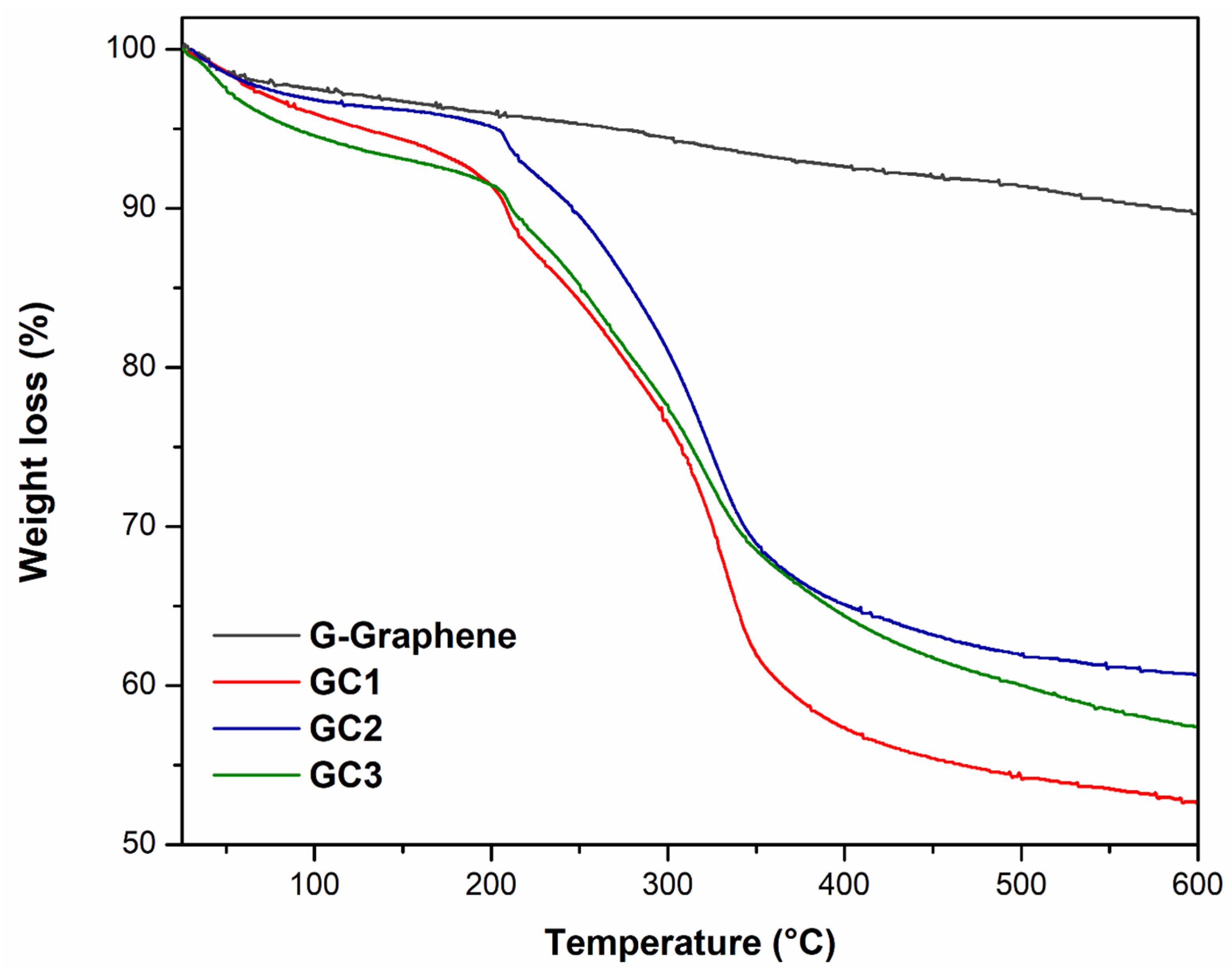
Thermogravimetric analysis (TGA) was carried out to evaluate the thermal stability and composition of the synthesized materials over the temperature range of 25–600 °C (Figure 1). The graphene sample exhibited a minor weight loss of approximately 3% below 100 °C, which is attributed to the removal of physically adsorbed moisture, confirming its high thermal stability. A further gradual weight loss of about 7% between 100 and 600 °C is associated with the decomposition of oxygen-containing functional groups, such as carboxyl moieties, accompanied by CO2 release [36]. In contrast, the composite samples (GC1, GC2, and GC3) showed significantly higher total weight losses of 49.38%, 39.65%, and 42.45%, respectively. The initial weight loss below 100 °C is related to the evaporation of physically adsorbed water. The major weight loss observed in the intermediate temperature range (200–400 °C) is mainly attributed to the thermal degradation of cellulose nanocrystals (CNCs) and chitosan (CS). At higher temperatures, additional mass loss is associated with the decomposition of residual functional groups and structural rearrangements within the graphene-based matrix.
The variation in weight loss among GC1, GC2, and GC3 reflects differences in composition, particularly the relative content of biopolymeric components, as well as the degree of interfacial interaction between graphene, CNC, CS, and Ag nanoparticles. Notably, the relatively lower weight loss observed for GC2 suggests improved thermal stability, which may be attributed to stronger interfacial interactions and better dispersion of the components within the hybrid structure. The higher weight loss of GC1, in spite of its lower Ag and CNC content, suggests that thermal stability is conferred by the complete complex structure, interfacial contacts, and residual inorganic content rather than filler concentration alone. Similar thermal degradation behavior has been reported for graphene-based biopolymer composites [37,38].

3.2. XRD Analysis

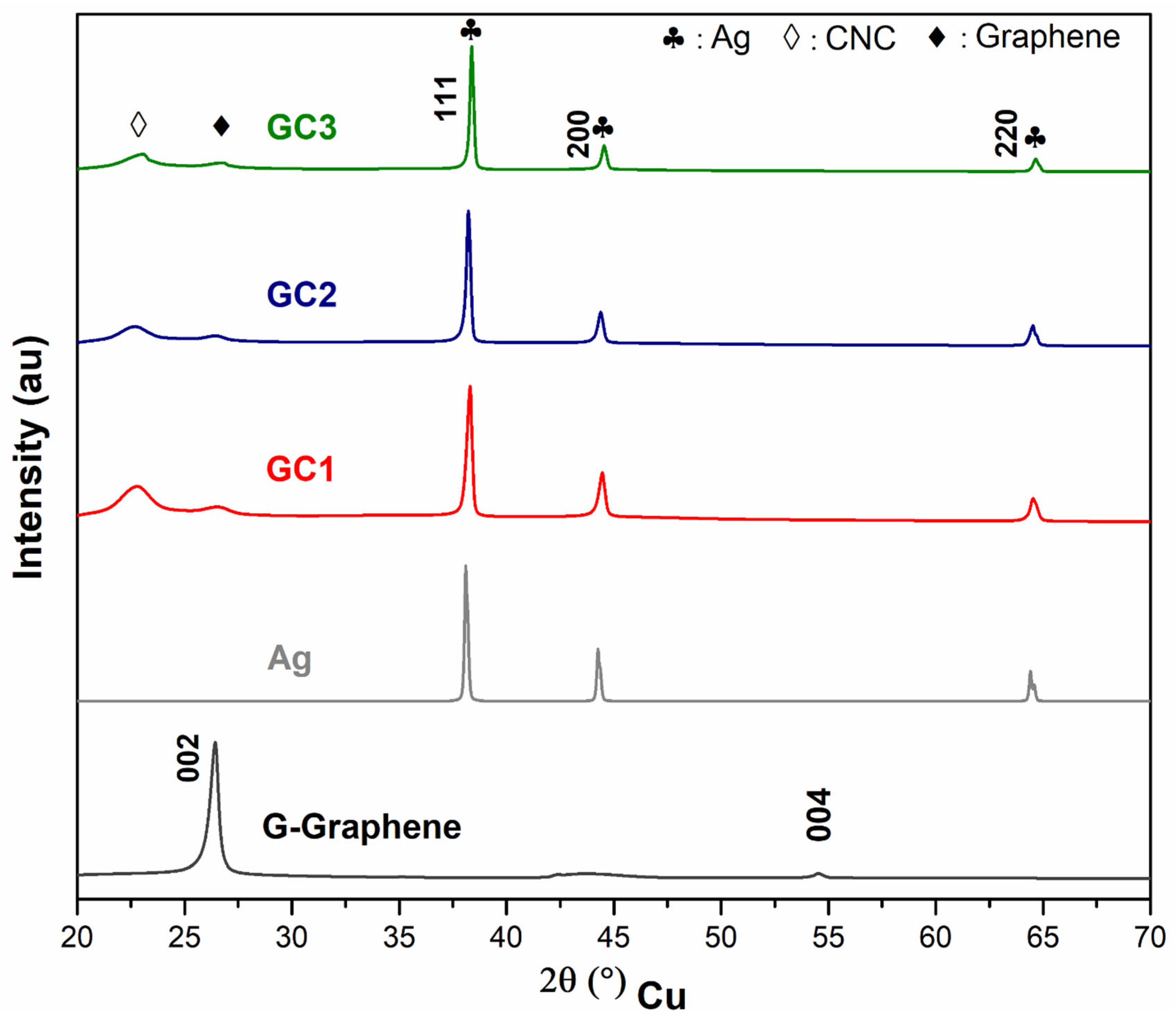
The created composites were characterized via XRD analysis, as exemplified in Figure 2. The XRD arrangement of the graphene exhibited a diffraction peak at 2θ = 26.62°, which is a characteristic peak of graphene corresponding to the (002) plane [39]. Furthermore, the (002) plane of cellulose nanocrystal (CNC) in the GC1, GC2, and GC3 spectra was identified through the diffraction peak observed at 22.80° [40]. This observation aligns with previous studies that validate the incorporation of CNC within graphene composites [41]. Moreover, the diffraction peaks corresponding to (111), (200), and (220) exhibited a good match with the cubic phase structure, with peak patterns at 2θ = 38.32°, 44.54°, and 64.83°, respectively, which are consistent with the JCPDS card number 76-1393. This finding is consistent with prior literature on similar crystalline structures [42,43].
In addition to phase identification, the apparent crystallite size of Ag in the composites was estimated using the Scherrer equation D = Kλ/(β cos θ) from the Ag (111) reflection near 2θ ≈ 38°, using K = 0.9 and Cu Kα radiation (λ = 0.15406 nm). The calculated apparent Ag crystallite sizes were approximately 32 nm for GC1, 46 nm for GC2, and 54 nm for GC3. These results indicate an increase in apparent Ag crystallite size from GC1 to GC3. The calculated values represent apparent crystallite sizes obtained from the Ag (111) peak without instrumental broadening correction, and are therefore considered approximate. These results suggest that Ag crystallite size may partly contribute to the observed antibacterial behavior.

3.3. FTIR Analysis

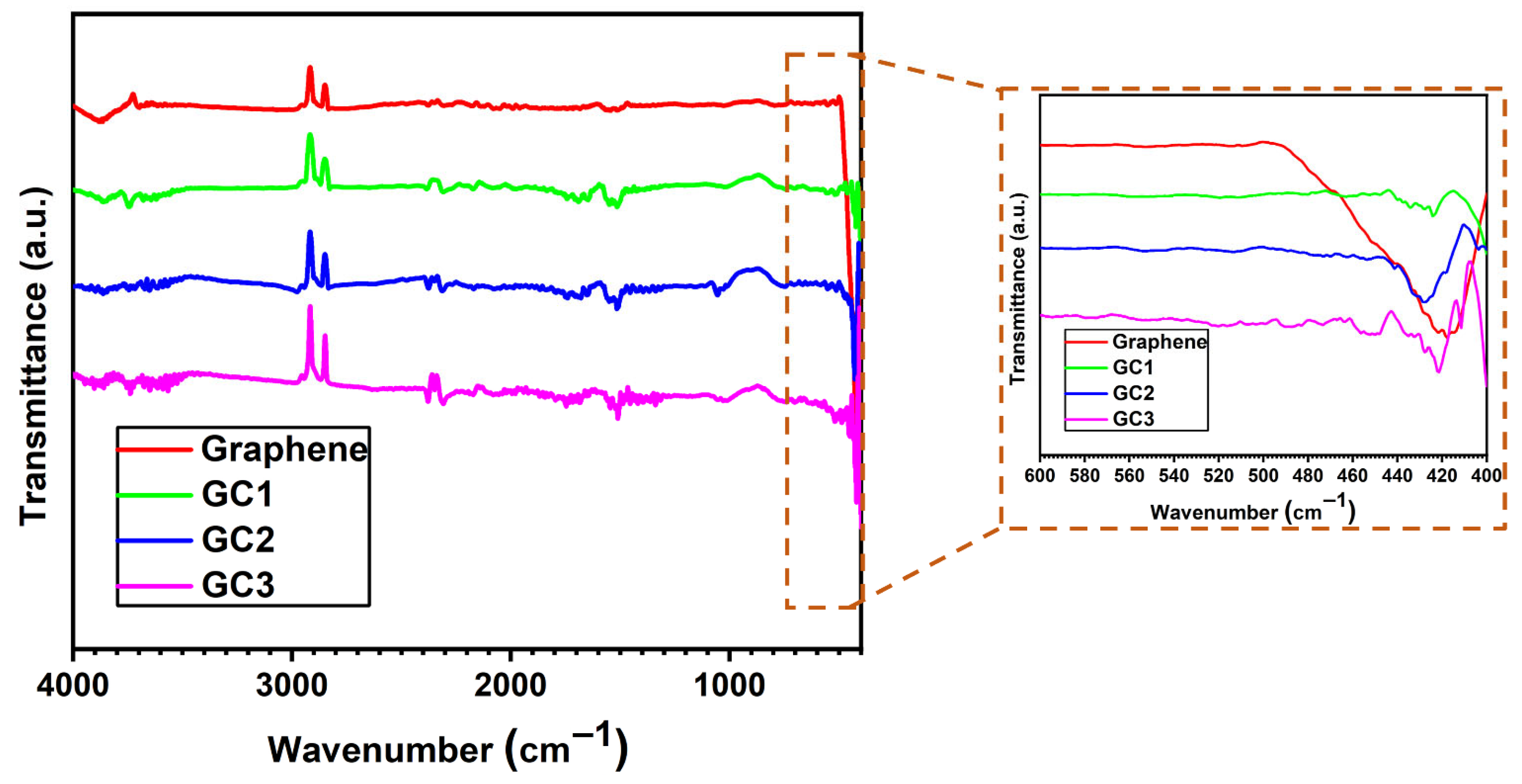
The prepared materials were exposed to FTIR study in the array of 500 to 4000 cm−1, as shown in Figure 3. The graphene spectrum exhibited a broad band at 3780.16 cm−1, which indicates the O-H stretching vibration [44]. Additionally, the C=O stretching vibrations were represented by a band at 1528 cm−1. The C-O-C bond was also evident, as indicated by the bond at 1018 cm−1 [45]. Furthermore, the infrared spectrum analysis of GC1, GC2, and GC3 samples revealed the incidence of a bond at 3741 cm−1, which was identified as the stretching vibration of –OH [46]. The robust absorption band observed at 2915 cm−1 was attributed to the –CH stretching vibrations of –CH3 and –CH2 functional groups, correspondingly, owing to the influence of atmospheric hydration. In addition, there was a peak shift observed in the GC nanohybrids at 1583 cm−1 which improved the formation of hydrogen bonds amid the graphene and cellulose nanocrystals; this matched to the C=O bonds in the COOH unit of graphene oxide [47]. The peak at ~436 cm−1 may be associated with metal–oxygen vibrations; however, FTIR alone is insufficient to confirm the chemical state of Ag [48]. The FTIR analysis confirms the presence of key functional groups which play a crucial role in the antibacterial and photocatalytic mechanisms. The –OH groups enhance hydrophilicity and facilitate strong interactions with bacterial cell walls and organic pollutants through hydrogen bonding. Meanwhile, C=O and C–O–C functionalities improve interfacial compatibility between graphene and cellulose nanocrystals, promoting efficient electron transport across the composite. The incorporation of graphene enhances electrical conductivity, enabling rapid charge transfer, while Ag nanoparticles act as electron sinks and release Ag+ ions, which interact with bacterial membranes and disrupt cellular functions. Additionally, under irradiation, the composite generates reactive oxygen species (ROS) such as •OH and •O2, which contribute to oxidative stress, leading to bacterial cell damage and degradation of organic pollutants. The synergistic interaction between graphene, CNC, and Ag nanoparticles results in enhanced charge separation, reduced recombination, and improved generation of ROS, which collectively explains the superior antibacterial activity (low MIC values) and high photocatalytic degradation efficiency, particularly under UV irradiation.

3.4. TEM Analysis

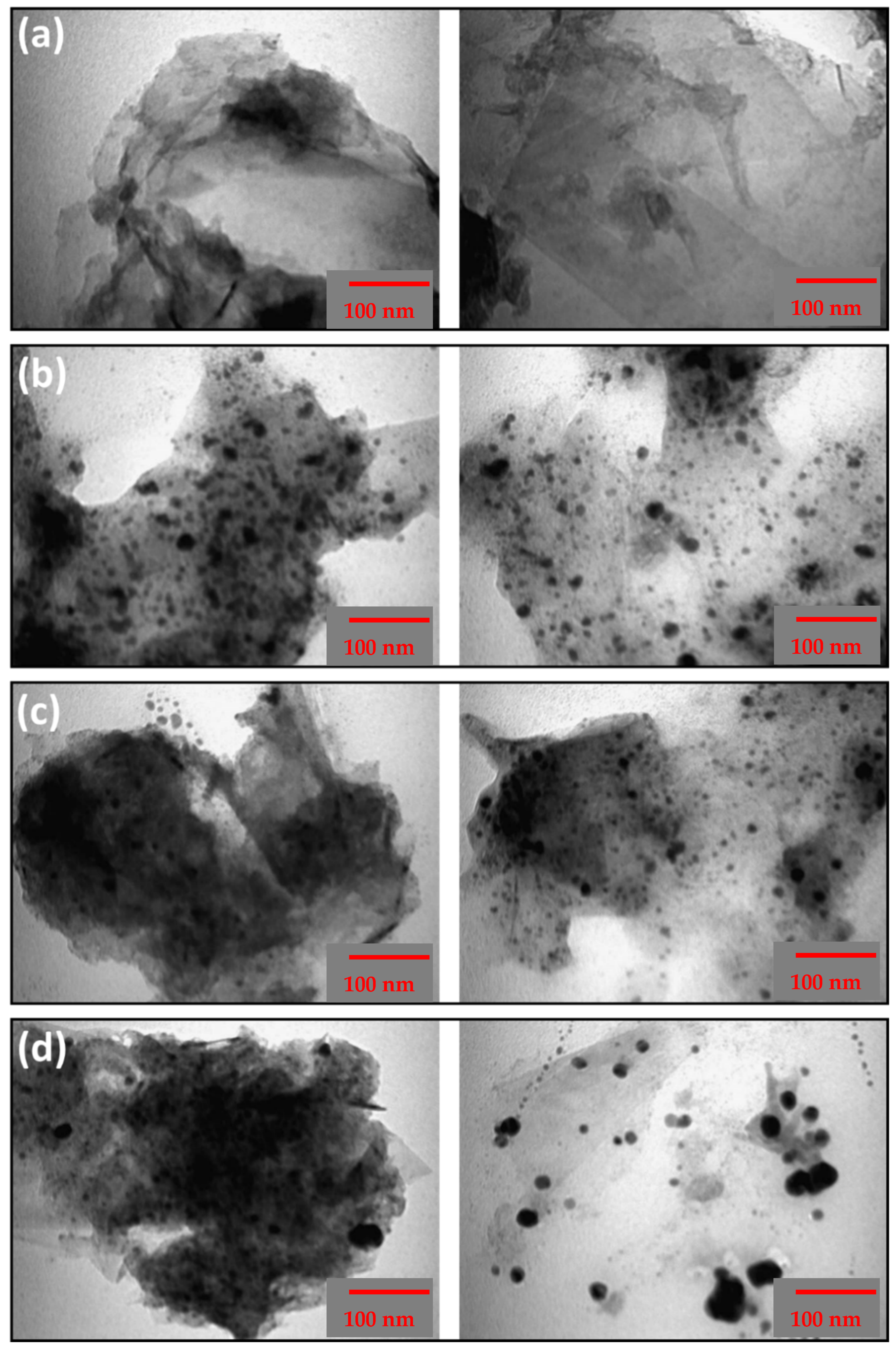
Transmission electron microscopy was utilized to characterize the morphologies of graphene, CNC and G/CNC/CS/Ag composite. As shown in Figure 4a, the graphene surface morphology exhibited a wrinkled and folded characteristic reported in previous studies in the literature [49]. In the case of the GC1, GC2, and GC3 composites (Figure 4b–d), it was observed that CNCs were distributed over the surface of graphene, which is ascribed to the resilient interaction between graphene and CNC particles which results in the random coverage of CNCs on its surface. In addition, the metallic silver nanoparticles are partly bonded over the entire surface of the flakes, but some are embedded between separate layers of G/CNC at the edges. In comparison to GC1 and GC2, the GC3 morphology indicated the aggregation of silver nanoparticles and CNCs over the surface of graphene, which is mainly accredited to the increased concentration of CNC. Similar outcomes were discovered by Khoshkava et al. when studying the agglomeration of CNCs on polymer nanocomposites [50]. The results indicated that GC1 and GC2 exhibited better surface morphology with uniform distribution of Ag and CNC nanoparticles, which may be assumed to provide better antibacterial performance. The average particle size was estimated to be ~15 nm, 25 nm and 35 nm for GC1, GC2 and GC3 respectively, measured by ImageJ software (version 1.53). The small particle size ~5 nm with narrow distribution enhances the surface-to-volume ratio, promoting efficient interaction with reactants and resulting in superior performance.

3.5. SEM/EDX Analysis

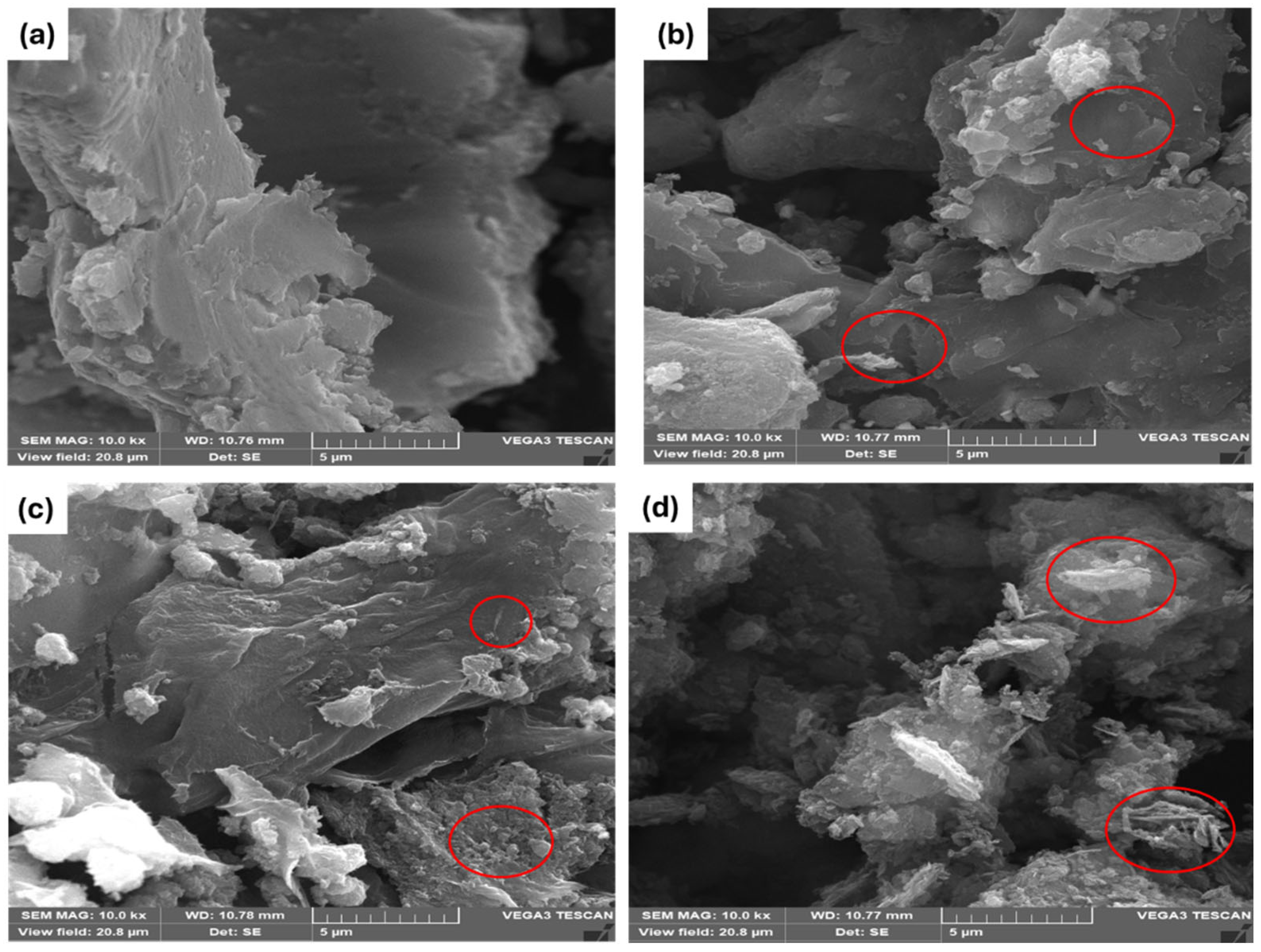
SEM exploration was conducted to examine the shape of the synthesized materials, as presented in Figure 5a–d. Figure 5a displays the initial state of the graphene nanoplatelet material used in the study. This material serves as the precursor for the synthesis of composite materials and exhibited a flat sheet surface, which aligns with previously reported studies [51,52]. As displayed in Figure 5b–d, the surface morphology of G/CNC/CS/Ag composites indicated the presence of cellulose nanocrystals, chitosan, and silver nanoparticles which are haphazardly dispersed on the flat surface of graphene. In addition, the increased concentration of CNCs and Ag in GC2 and GC3 facilitated the complete coverage of the graphene surface, with some agglomerate formation. The results are consistent with TEM analysis, confirming that GC2 showed homogeneous distribution of CNC and Ag nanoparticles over graphene whereas GC3, due to high CNC concentration, resulted in the formation of more aggregates of CNC/Ag, as indicated by the red circles (Figure 5d), which may be expected to reduce antibacterial performance. The smaller and well-dispersed nanoparticles provide a larger surface area and more active sites, facilitating enhanced charge transfer (or adsorption), which directly contributes to the improved performance of the material.
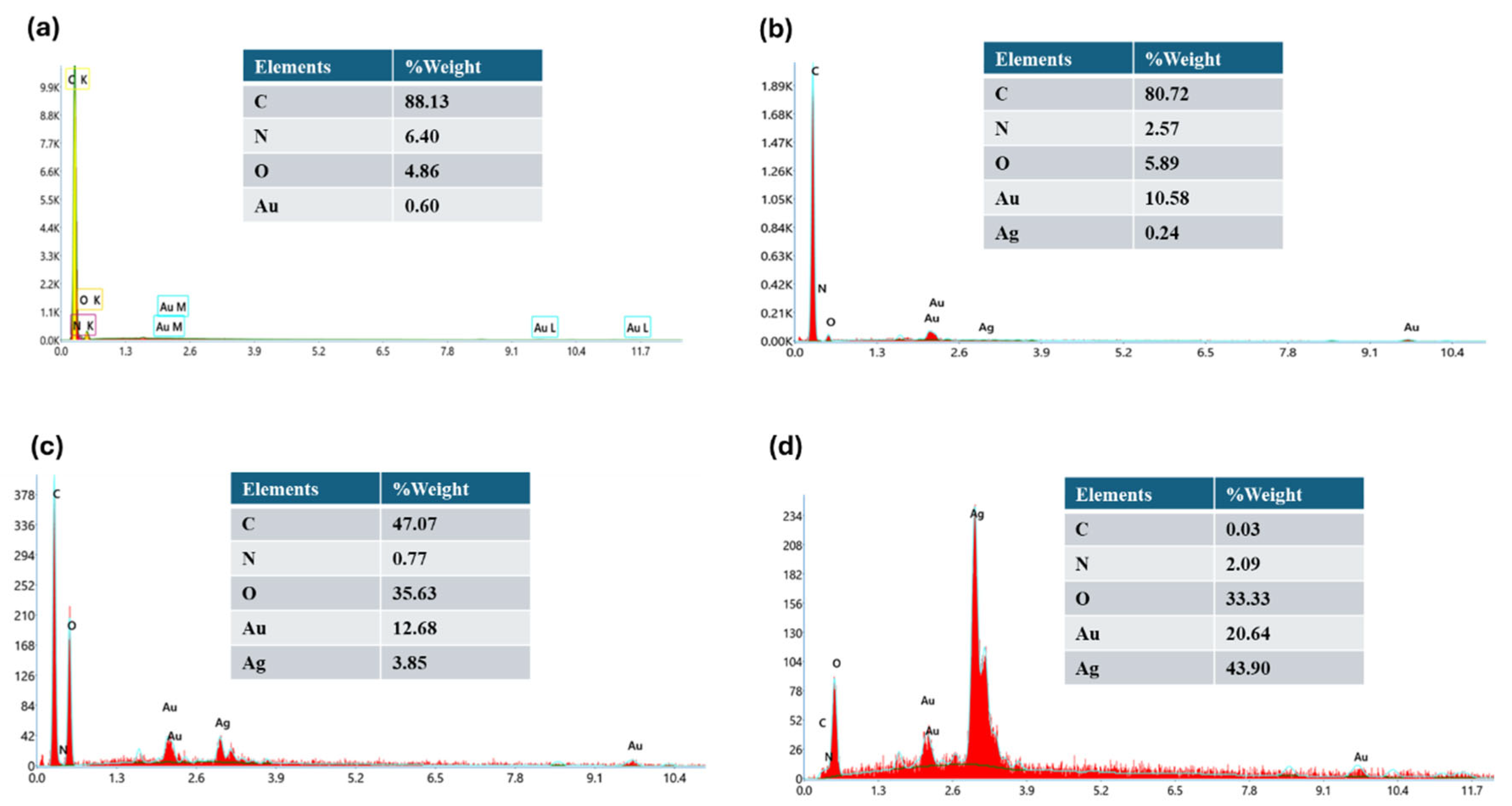
The EDX inquiry was accomplished to weigh the elemental mapping of graphene and graphene-based composites, with results depicted in Figure 6. As can be perceived in Figure 6a, the graphene nanoplatelet is of high purity, consisting of 88.13% C, 6.40% N, and 4.86% O. The EDX results of G/CNC/CS/Ag composites confirmed the presence of Ag nanoparticles and showed an increasing trend from GC1 to GC3 ranging from 0.24% in GC1, 3.85% in GC2, and 43.90% in GC3. The increased % weight of Ag is mostly accredited to the increased concentration of CNC and CS particles in the composites, which facilitated the strong adsorption of Ag ions during synthesis. This results in the creation of silver/CNC nanoparticle agglomerates on the composite surface as confirmed by SEM and TEM analysis. Similar behavior was reported by Shin et al. when silver-doped nanocellulose fibers were used for antibacterial applications [53].

3.6. Antibacterial Study

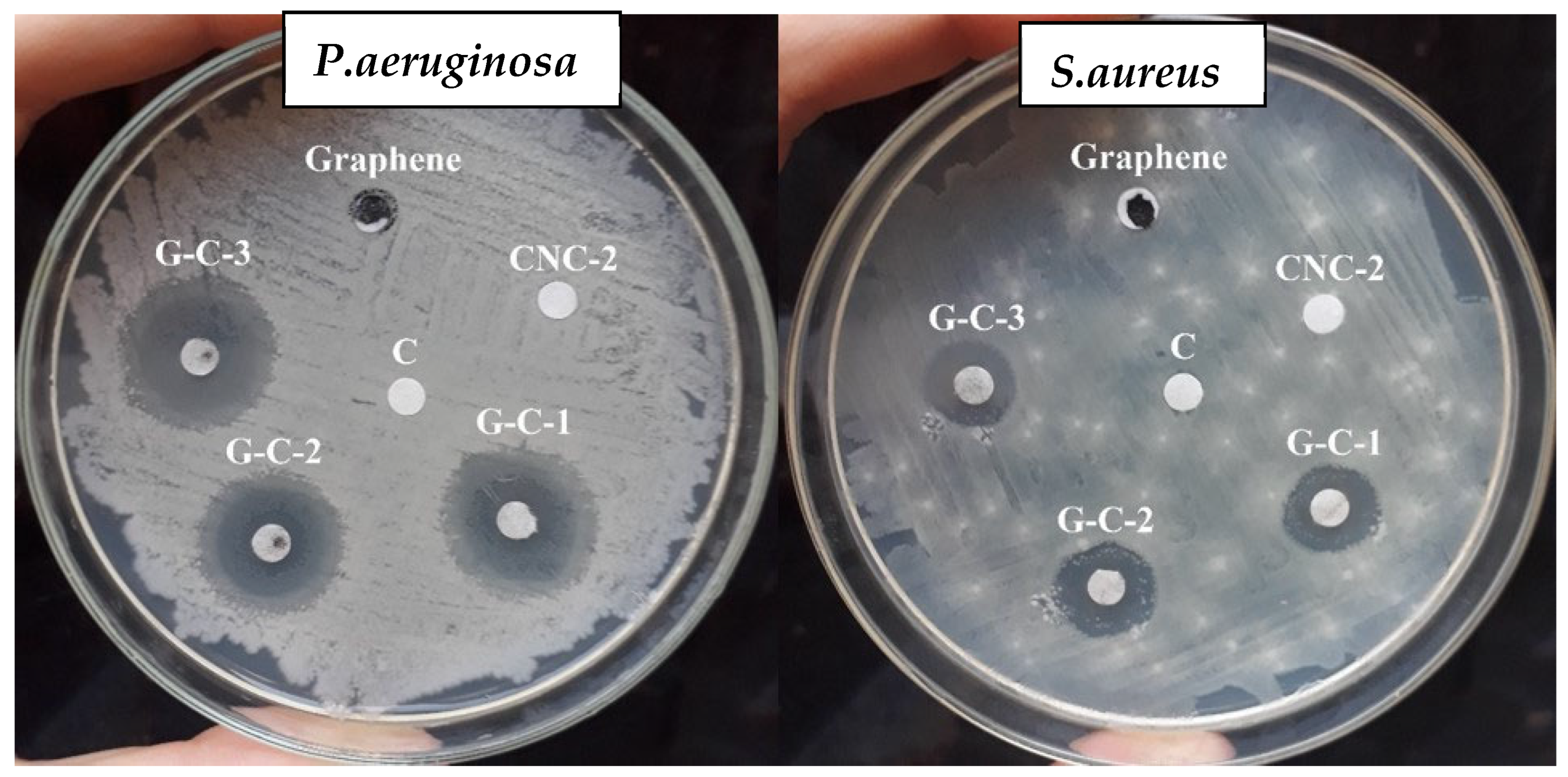
Table 2 and Figure 7 show that graphene and CNCs do not affect the tested bacteria. Regarding the Gram-positive bacterium S. aureus subsp. aureus ATCC BAA-977, among the tested compounds, GC2 exerted the maximum antibacterial activity with a zone of inhibition measuring 1.5 cm (MIC = 6.1 µg·mL−1). This observed variation in activity highlights the nuanced interactions between these compounds and specific structures in the building of bacterial strains, where Gram-positive bacteria are rich in peptidoglycan while Gram-negative bacteria are rich in lipids [54]. At the same time, GC3 exerted the lowest activity with a zone of inhibition measuring 1 cm (MIC = 21.5 µg·mL−1). Regarding the Gram-negative bacterium P. aeruginosa ATCC27853, GC3 exerted the maximum activity with a zone of inhibition measuring 3 cm (MIC = 1.8 µg·mL−1), while GC2 exerted the least antibacterial activity with a zone of inhibition measuring 2 cm (MIC = 6.9 µg·mL−1). This disparity in antibacterial performance is mainly associated with the alteration in the structures between Gram-positive and Gram-negative bacteria reacting in diverse manners with GC2 and GC3, where Gram-positive bacteria are rich in peptidoglycan while Gram-negative bacteria are rich in lipids [55]. Moreover, the increase in antibacterial activity from GC2 to GC3 is not proportional to the increase in Ag content, indicating that the activity is governed by the availability, dispersion, and bioavailability of Ag species rather than total Ag loading alone. Though the apparent Ag crystallite size augmented from 29.22 nm (GC1) to 36.85 nm (GC2) and 41.09 nm (GC3), the antibacterial trend did not associate directly with crystallite size alone. This proposes that Ag distribution, availability of active Ag species, and contact with the graphene/CNC/CS matrix also contributed to the observed variances.
Investigation was accomplished via the use of the statistical package SPSS 29.0. One-way ANOVA and Tukey’s test were used to compare differences among groups. The entire facts were inspected for normality and uniformity of variance using Levene’s and Shapiro–Wilk tests. A p-value < 0.05 was taken to be noteworthy. For P. aeruginosa ATCC 27853, the ANOVA confirmed that there was a major variance amid GC-1, GC-2, and GC-3 (p-value < 0.001, F = 43.75). However, Tukey’s test indicated that GC-1 and GC-3 had approximately the same activity. For S. aureus, the ANOVA established that there was a substantial variance amid GC-1, GC-2, and GC-3 (p-value < 0.001, F = 118.75). In addition, Tukey’s test indicated that GC-1, GC-2, and GC-3 had different activities.

3.7. Performance of Graphene-Based Catalyst

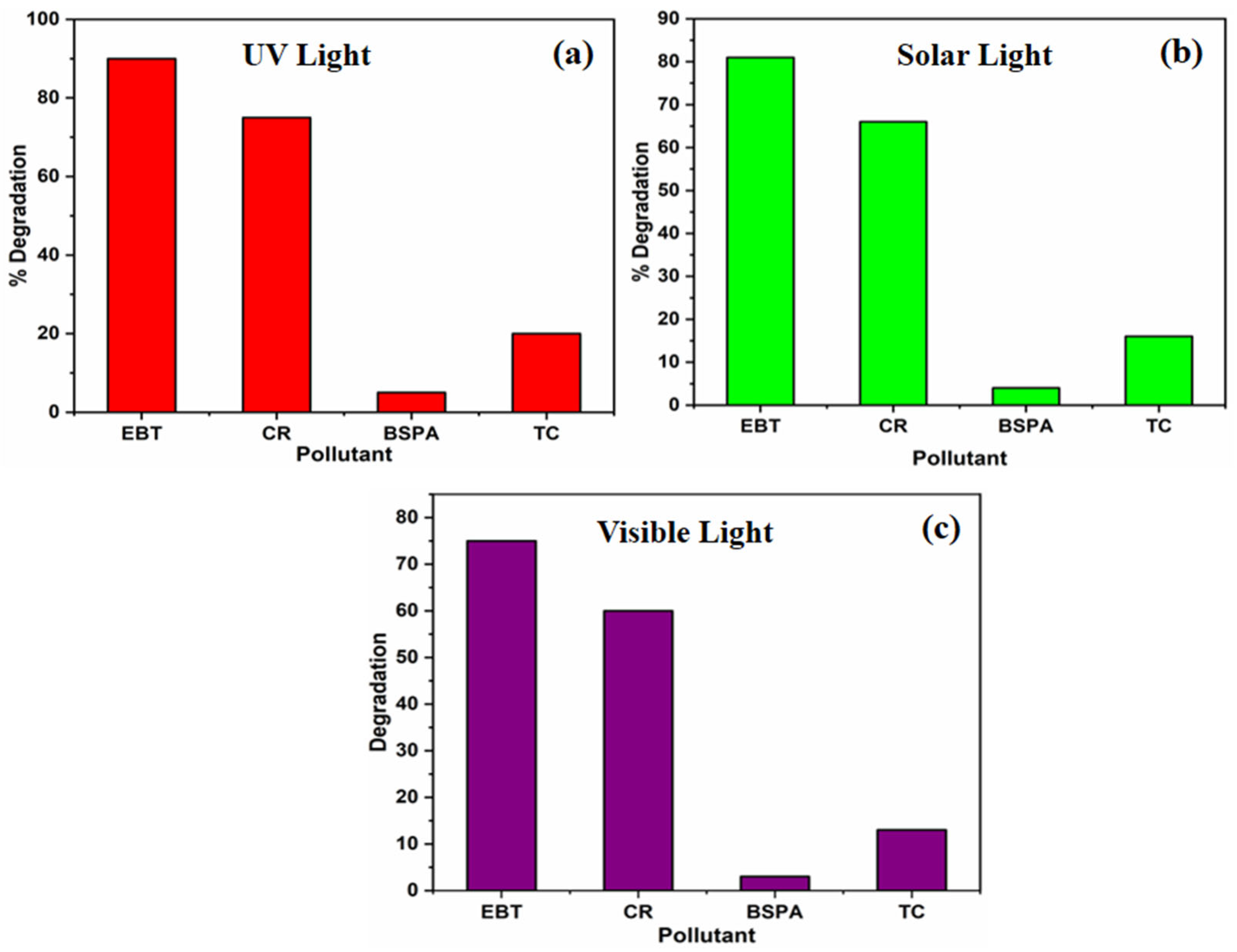
In order to examine the impact of various light sources on pollutant removal efficiency, the photocatalytic degradation performance of the graphene-based nanocomposite was assessed under ultraviolet (UV), visible, and solar irradiation (Figure 8a–c). EBT had the highest breakdown efficiency among the pollutants under investigation, reaching almost 90% under UV irradiation (Figure 8a), followed by 81% under solar light (Figure 8b) and 75% under visible light (Figure 8c). In a similar trend CR demonstrated significant degradation in UV, solar, and visible light, with removal efficiencies of 75%, 66%, and 60%, respectively. On the other hand, under UV irradiation, BSPA and TC showed relatively lower degradation efficiency, with maximum removals of 5% and 20%, respectively. The findings showed that for every pollutant examined, the degradation efficiency followed the order UV > solar > visible light. The higher degradation seen under UV irradiation can be credited to the greater photon energy, which efficiently stimulates the photocatalyst and produces a greater amount of electron–hole pairs, leading to the improved creation of reactive oxygen species such as hydroxyl radicals (•OH) and superoxide radicals (•O2). These radicals play a crucial role in the oxidative degradation of organic pollutants [56]. In contrast, visible light has lower photon energy, resulting in moderately condensed photocatalytic activity [57]. Remarkably, solar irradiation showed transitional degradation recital, which can be elucidated by the existence of both UV and visible components in the solar spectrum. The collective irradiation improves charge carrier excitation while upholding practical applicability for environmentally viable photocatalytic treatment. Moreover, the higher degradation efficacies detected for dye pollutants (EBT and CR) equated to BSPA and TC can be accredited to their photoactive functional groups, which allow stronger light absorption and assist oxidative bond breakage under photocatalytic conditions [58]. Conversely, BSPA and TC possess more stable cyclic structures that require higher oxidative energy or extended irradiation to attain higher degradation [59,60]. Furthermore, their comparatively poor adsorption affinity toward the composite surface further restricts their ability to interact effectively with reactive oxygen species produced by light. Because of this, these chemicals need more oxidative energy or lengthier irradiation times to degrade significantly, which results in relatively lower degradation efficiencies. Similar trends have been reported for graphene-based photocatalysts, where enhanced electron transport, increased surface adsorption, and improved charge separation significantly promote photocatalytic degradation under different irradiation conditions [61,62].

3.8. Kinetic Results

The kinetic analysis of the degradation experiments was performed using the models described in Section 2.6. The fit results and kinetic parameters are discussed below. The degradation kinetics of EBT, CR, BSPA, and TC under UV irradiation were investigated via both pseudo-first-order and second-order kinetic models. The premeditated rate constants and regression coefficients are shown in Table 3. Among the contaminants studied, EBT and TC displayed excellent agreement with the pseudo-first-order model, with high correlation coefficients (R2 = 0.993 and 0.984, respectively). BSPA showed very low degradation and poor linearity in both models, representative of partial photocatalytic activity. In contrast, CR displayed a somewhat better fit with the second-order model (R2 = 0.994) in comparison to the pseudo-first-order model (R2 = 0.983). Largely, the pseudo-first-order model was thought to be the most suitable general kinetic description for the current photocatalytic system since it offered the best or comparable match for the majority of pollutants. Based on the Langmuir–Hinshelwood mechanism, this behavior is in line with the frequently observed pseudo-first-order kinetics for heterogeneous photocatalytic degradation [63,64]. Variations in chemical structure, adsorption affinity on the catalyst surface, and interaction with reactive oxygen species produced during photocatalysis can all be responsible for the disparities in degradation kinetics among the pollutants [65,66].

4. Antibacterial Mechanism

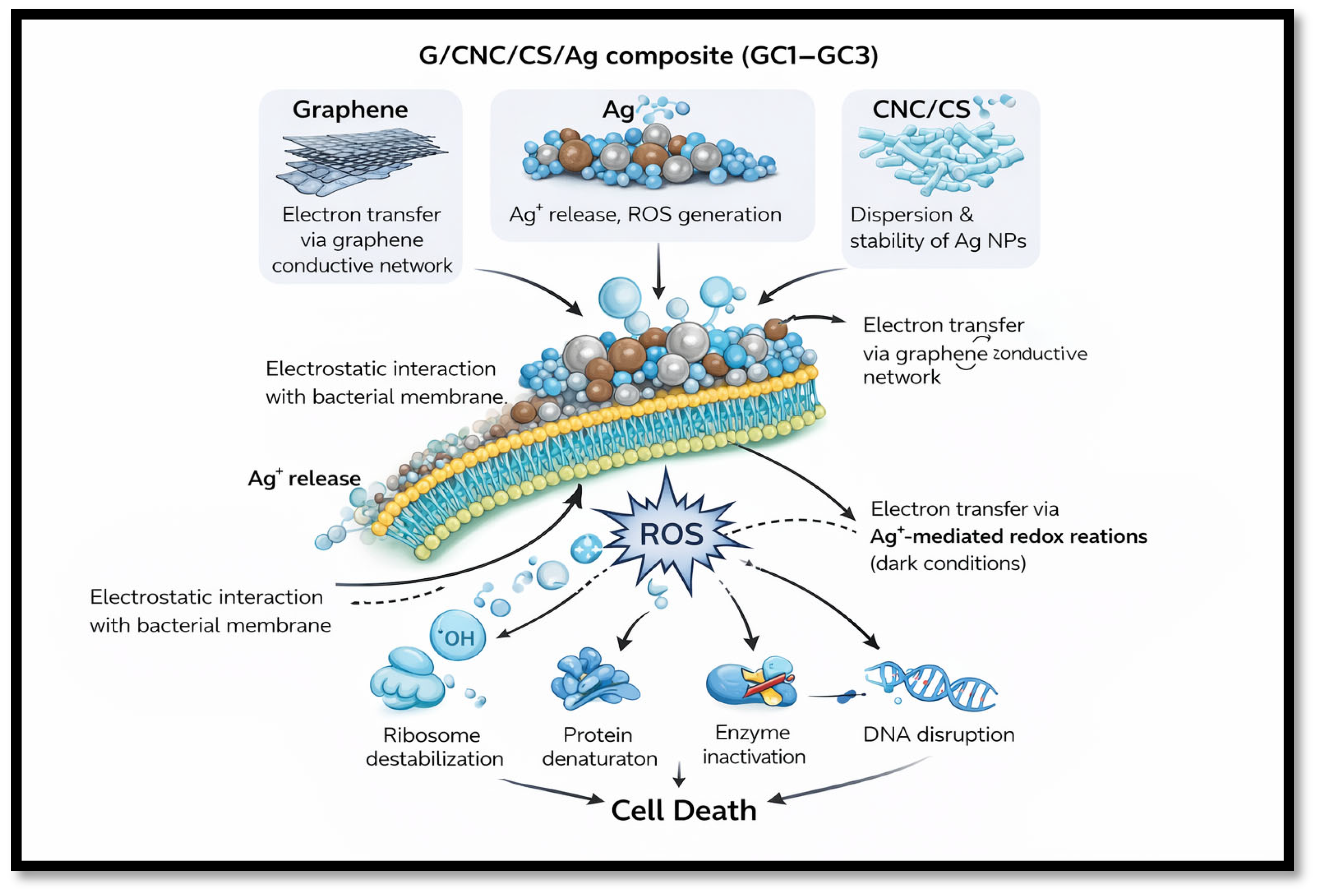
The antibacterial activity of the synthesized G/CNC/CS/Ag nanomaterials was assessed under dark conditions. Consequently, the activity is not linked to light and is mostly due to physical and chemical connections between the nanomaterial and the bacteria. When the nanomaterials interact with bacterial cells, they attach to the cell surface due to the difference in charge. This interaction disrupts the bacterial membrane, making it breakable and more pervious. Accordingly, the bacterial cells become weakened as crucial components such as proteins and ions start to trickle out of the cell [67,68].
Silver nanoparticles present in the nanomaterial discharge of Ag+ ions. These ions enter the bacterial cell and intermingle with proteins and enzymes, reducing their action. They can also affect bacterial genetic material, further stopping cell growth [69,70]. The high conductivity of graphene in the composite facilitates the flow of electrons. This enhances the material’s antibacterial activity and promotes surface reactions [71,72]. Furthermore, even in the absence of light, reactions at the material’s surface and the interaction of Ag+ with oxygen result in the formation of reactive oxygen species (ROS), such as superoxide (•O2) and hydroxyl radicals (•OH). These ROSs can impair the bacterial cell from inside [73,74]. As a whole, these effects harm the bacterial cell and eventually lead to its death. The improved recital of the nanomaterial in comparison to different materials is owed to the mutual influence of graphene, CNCs/CS, and silver nanoparticles, which increase the dissemination and activity of Ag species in the structure (Figure 9).
The prepared materials were thoroughly evaluated by comparing their antibacterial activity with that of composite materials studied in current research and relevant findings from previous works against a range of different bacteria (Table 4). While it is challenging to provide a direct comparison due to variations in operating parameters across different studies, this research still yields promising results, demonstrates competitive antibacterial activity, and the synthesized compounds hold the potential for further evaluation against additional bacterial strains.

5. Conclusions

In the current study, graphene-based nanocomposites were synthesized via a hydrothermal technique to enhance their antimicrobial action. The antimicrobial action of the G/Ag/CNC/CS nanomaterials was assessed against S. aureus subsp. and P. aeruginosa bacteria. The characterization outcomes indicate that the materials exhibited a crystal structure of Ag with characteristic peaks of graphene and CNC. The pure graphene nanosheets displayed a thin and flexible layered morphology, whereas, in the hybrid composite, Ag nanoparticles were erratically attached to the surfaces of the graphene nanosheets. Among the tested compounds, the antibacterial activity of GC2 was the highest against the Gram-positive bacterium S. aureus subsp. ATCC BAA-977, with a MIC of 6.1 µg/mL, while GC3 showed the lowest activity with a MIC of 21.5 µg/mL. For the Gram-negative bacterium P. aeruginosa ATCC 27853, GC3 exhibited the maximum activity with a MIC of 1.8 µg/mL, while GC2 exhibited the least antimicrobial action with a MIC of 6.9 µg/mL. The rapid and potent antibacterial activity of the G/Ag/CNC nanocomposite is ascribed to the combined influence of Ag NPs dispersed on the graphene nanosheets. This promotes the release of Ag+ ions and ROSs into the intracellular configuration of the bacteriological cell, which bind to DNA, proteins, and lipids. Subsequent enzyme oxidation generates additional oxidative stress that can lead to irreversible damage and cell death. In conclusion, our research on graphene/Ag/CNC/CS nanocomposites has provided valuable insights into nanomaterial-based antibacterial agents. However, notable research gaps and avenues for future exploration require further attention. Moreover, EBT demonstrated the highest photocatalytic degradation efficiency among the studied pollutants, followed by CR, while BSPA and TC exhibited comparatively lower removal performance. The results clearly indicate that UV irradiation is the most effective light source, with overall degradation efficiency following the order: UV > solar > visible light.

Author Contributions

Conceptualization, M.S.M., M.I., S.M.K. and M.Z.; Methodology, M.S.M. and K.T.; Validation, H.A.A., M.A.A.Q. and M.I.; Formal Analysis, E.K., H.A.R., A.A.A. and B.R.P.; Investigation, M.S.M. and M.I; Resources, H.A.A., M.Z. and B.R.P.; Data Curation, B.R.P., H.A.R., A.A.A. and K.T.; Writing—Original Draft Preparation, M.S.M., S.M.K. and K.T.; Writing—Review and Editing, M.S.M., S.M.K. and M.I.; Visualization, M.A.A.Q., H.A.A., M.Z. and M.I.; Supervision, M.S.M.; Project Administration, M.S.M.; Funding Acquisition S.M.K. and M.I. All authors have read and agreed to the published version of the manuscript.

Funding

The authors gratefully acknowledge the funding of the Deanship of Graduate Studies and Scientific Research, Jazan University, Saudi Arabia, through project number JU-202505353-DGSSR-ORA-2025.

Institutional Review Board Statement

This study did not include human or animal subjects, and all antibacterial tests were steered on standard laboratory strains; therefore, no ethical approval was required.

Data Availability Statement

Data will be made available from the authors upon reasonable request.

Conflicts of Interest

The authors declare that they have no known competing financial interests or personal relationships that could have appeared to influence the work reported in this paper.

References

  1. Chinemerem Nwobodo, D.; Ugwu, M.C.; Oliseloke Anie, C.; Al-Ouqaili, M.T.S.; Chinedu Ikem, J.; Victor Chigozie, U.; Saki, M. Antibiotic Resistance: The Challenges and Some Emerging Strategies for Tackling a Global Menace. J. Clin. Lab. Anal. 2022, 36, e24655. [Google Scholar] [CrossRef]
  2. Tarín-Pelló, A.; Suay-García, B.; Pérez-Gracia, M.-T. Antibiotic Resistant Bacteria: Current Situation and Treatment Options to Accelerate the Development of a New Antimicrobial Arsenal. Expert Rev. Anti-Infect. Ther. 2022, 20, 1095–1108. [Google Scholar] [CrossRef]
  3. Davies, J. Microbes Have the Last Word. EMBO Rep. 2007, 8, 616–621. [Google Scholar] [CrossRef]
  4. Duval, R.E.; Gouyau, J.; Lamouroux, E. Limitations of Recent Studies Dealing with the Antibacterial Properties of Silver Nanoparticles: Fact and Opinion. Nanomaterials 2019, 9, 1775. [Google Scholar] [CrossRef]
  5. Kong, H.; Jang, J. Antibacterial Properties of Novel Poly(Methyl Methacrylate) Nanofiber Containing Silver Nanoparticles. Langmuir 2008, 24, 2051–2056. [Google Scholar] [CrossRef] [PubMed]
  6. Fahmy, H.M.; Salah Eldin, R.E.; Abu Serea, E.S.; Gomaa, N.M.; AboElmagd, G.M.; Salem, S.A.; Elsayed, Z.A.; Edrees, A.; Shams-Eldin, E.; Shalan, A.E. Advances in Nanotechnology and Antibacterial Properties of Biodegradable Food Packaging Materials. RSC Adv. 2020, 10, 20467–20484. [Google Scholar] [CrossRef]
  7. Gudkov, S.V.; Burmistrov, D.E.; Smirnova, V.V.; Semenova, A.A.; Lisitsyn, A.B. A Mini Review of Antibacterial Properties of Al2O3 Nanoparticles. Nanomaterials 2022, 12, 2635. [Google Scholar] [CrossRef]
  8. Liu, H.L.; Dai, S.A.; Fu, K.Y.; Hsu, S. hui Antibacterial Properties of Silver Nanoparticles in Three Different Sizes and Their Nanocomposites with a New Waterborne Polyurethane. Int. J. Nanomed. 2010, 5, 1017–1028. [Google Scholar] [CrossRef]
  9. Imran, M.; Abdullah, A.Z.; Arishi, M.; Ali, S.K.; Khan, M.E.; Fellah, M.; Chaudhary, A.A. Enhanced Photo-Fenton Degradation of Ciprofloxacin Using Novel CuO/g-C3N4/MXene Ternary Nanocomposite: Synthesis, Characterization and Mechanistic Insights. Ceram. Int. 2025, 51, 44598–44611. [Google Scholar] [CrossRef]
  10. Imran, M.; Abdullah, A.Z.; Khan, M.E.; Khan, F.; Anjum, K.; Ali, S.K.; Alamri, A.A.; Khadrawy, S.M. Photo-Activated Fenton-like Degradation of Malachite Green Using Fe3O4/g-C3N4 Ceramics Nanocomposites: Kinetics, Stability, and Mechanistic Insights. J. Aust. Ceram. Soc. 2026. [Google Scholar] [CrossRef]
  11. Majdoub, A.; El Mrabet, I.; Majdoub, M.; Valdés, H.; Zaitan, H. In Situ Deposition of Ag Nanoparticles onto PE/RGO Hybrids for the Dip-Catalytic Hydrogenation of 4-Nitrophenol into 4-Aminophenol. Int. J. Environ. Anal. Chem. 2022, 104, 3656–3674. [Google Scholar] [CrossRef]
  12. Hou, W.C.; Lee, P.L.; Chou, Y.C.; Wang, Y.S. Antibacterial Property of Graphene Oxide: The Role of Phototransformation. Environ. Sci. Nano 2017, 4, 647–657. [Google Scholar] [CrossRef]
  13. Zhong, L.; Liu, H.; Samal, M.; Yun, K. Synthesis of ZnO Nanoparticles-Decorated Spindle-Shaped Graphene Oxide for Application in Synergistic Antibacterial Activity. J. Photochem. Photobiol. B Biol. 2018, 183, 293–301. [Google Scholar] [CrossRef]
  14. Fakhri, A.; Kahi, D.S. Synthesis and Characterization of MnS2/Reduced Graphene Oxide Nanohybrids for with Photocatalytic and Antibacterial Activity. J. Photochem. Photobiol. B Biol. 2017, 166, 259–263. [Google Scholar] [CrossRef]
  15. Cao, G.; Yan, J.; Ning, X.; Zhang, Q.; Wu, Q.; Bi, L.; Zhang, Y.; Han, Y.; Guo, J. Antibacterial and Antibiofilm Properties of Graphene and Its Derivatives. Colloids Surf. B Biointerfaces 2021, 200, 111588. [Google Scholar] [CrossRef]
  16. Panda, S.; Rout, T.K.; Prusty, A.D.; Ajayan, P.M.; Nayak, S. Electron Transfer Directed Antibacterial Properties of Graphene Oxide on Metals. Adv. Mater. 2018, 30, 1702149. [Google Scholar] [CrossRef]
  17. Vanithakumari, S.C.; Jena, G.; Sofia, S.; Thinaharan, C.; George, R.P.; Philip, J. Fabrication of Superhydrophobic Titanium Surfaces with Superior Antibacterial Properties Using Graphene Oxide and Silanized Silica Nanoparticles. Surf. Coat. Technol. 2020, 400, 126074. [Google Scholar] [CrossRef]
  18. Hatamie, S.; Ahadian, M.M.; Soufi Zomorod, M.; Torabi, S.; Babaie, A.; Hosseinzadeh, S.; Soleimani, M.; Hatami, N.; Wei, Z.H. Antibacterial Properties of Nanoporous Graphene Oxide/Cobalt Metal Organic Framework. Mater. Sci. Eng. C 2019, 104, 109862. [Google Scholar] [CrossRef]
  19. Rajapaksha, P.; Cheeseman, S.; Hombsch, S.; Murdoch, B.J.; Gangadoo, S.; Blanch, E.W.; Truong, Y.; Cozzolino, D.; McConville, C.F.; Crawford, R.J.; et al. Antibacterial Properties of Graphene Oxide-Copper Oxide Nanoparticle Nanocomposites. ACS Appl. Bio Mater. 2019, 2, 5687–5696. [Google Scholar] [CrossRef] [PubMed]
  20. Cobos, M.; De-La-Pinta, I.; Quindós, G.; Fernández, M.J.; Fernández, M.D. Synthesis, Physical, Mechanical and Antibacterial Properties of Nanocomposites Based on Poly(Vinyl Alcohol)/Graphene Oxide-Silver Nanoparticles. Polymers 2020, 12, 723. [Google Scholar] [CrossRef] [PubMed]
  21. Zhu, Z.; Guo, F.; Li, A.; Xu, W.; Zhang, X. Simple Synthesis of BiOI/ZnO/RGO for Efficient Photocatalytic Degradation of Antibiotic Chloramphenicol under Visible Light. J. Environ. Sci. 2023, 134, 65–76. [Google Scholar] [CrossRef]
  22. Oluwole, A.O.; Olatunji, O.S. Enhanced Photocatalytic Degradation of Naproxen in Aqueous Matrices Using Reduced Graphene Oxide (RGO) Decorated Binary BSO/g-C3N4 Heterojunction Nanocomposites. Chem. Eng. J. Adv. 2022, 12, 100417. [Google Scholar] [CrossRef]
  23. Shenoy, S.; Chuaicham, C.; Shanmugam, M.; Okumura, T.; Balijapalli, U.; Li, W.; Balakumar, V.; Sasaki, K.; Sekar, K. Tailoring Interfacial Physicochemical Properties in Cu2O-TiO2@rGO Heterojunction: Insights from EXAFS and Electron Trap Distribution Analysis. ACS Appl. Mater. Interfaces 2023, 15, 54105–54118. [Google Scholar] [CrossRef]
  24. Nasir, M.; Aziz, M.A.; Zubair, M.; Manzar, M.S.; Ashraf, N.; Mu’azu, N.D.; Al-Harthi, M.A. Recent Review on Synthesis, Evaluation, and SWOT Analysis of Nanostructured Cellulose in Construction Applications. J. Build. Eng. 2022, 46, 103747. [Google Scholar] [CrossRef]
  25. Zubair, M.; Aziz, H.A.; Ihsanullah, I.; Ahmad, M.A.; Al-Harthi, M.A. Engineered Biochar Supported Layered Double Hydroxide-Cellulose Nanocrystals Composite-: Synthesis, Characterization and Azo Dye Removal Performance. Chemosphere 2022, 307, 136054. [Google Scholar] [CrossRef]
  26. Zubair, M.; Aziz, H.A.; Ihsanullah, I.; Ahmad, M.A.; Al-Harthi, M.A. Enhanced Removal of Eriochrome Black T from Water Using Biochar/Layered Double Hydroxide/Chitosan Hybrid Composite: Performance Evaluation and Optimization Using BBD-RSM Approach. Environ. Res. 2022, 209, 112861. [Google Scholar] [CrossRef] [PubMed]
  27. R, R.; Thomas, D.; Philip, E.; Paul, S.A.; Madhavan, A.; Sindhu, R.; Binod, P.; Pugazhendhi, A.; Sirohi, R.; Tarafdar, A.; et al. Potential of Nanocellulose for Wastewater Treatment. Chemosphere 2021, 281, 130738. [Google Scholar] [CrossRef]
  28. Baldelli, A.; Etayash, H.; Oguzlu, H.; Mandal, R.; Jiang, F.; Hancock, R.E.W.; Pratap-Singh, A. Antimicrobial Properties of Spray-Dried Cellulose Nanocrystals and Metal Oxide-Based Nanoparticles-in-Microspheres. Chem. Eng. J. Adv. 2022, 10, 100273. [Google Scholar] [CrossRef]
  29. Deng, Z.; Wu, Z.; Tan, X.; Deng, F.; Chen, Y.; Chen, Y.; Zhang, H. Preparation, Characterization and Antibacterial Property Analysis of Cellulose Nanocrystals (CNC) and Chitosan Nanoparticles Fine-Tuned Starch Film. Molecules 2022, 27, 8542. [Google Scholar] [CrossRef] [PubMed]
  30. Noronha, V.T.; Camargos, C.H.M.; Jackson, J.C.; Souza Filho, A.G.; Paula, A.J.; Rezende, C.A.; Faria, A.F. Physical Membrane-Stress-Mediated Antimicrobial Properties of Cellulose Nanocrystals. ACS Sustain. Chem. Eng. 2021, 9, 3203–3212. [Google Scholar] [CrossRef]
  31. Zubair, M.; Mu’azu, N.D.; Nasir, M.; Manzar, M.S.; Aziz, M.A.; Saleem, M.; Al-Harthi, M.A. Cellulose Nanocrystals from Office Paper Waste for Green Mortar: Process Optimization Modeling, Characterization, and Mechanical Properties. Arab. J. Sci. Eng. 2022, 47, 5377–5393. [Google Scholar] [CrossRef]
  32. Beecher, D.J.; Wong, A.C.L. Identification of Hemolysin BL-Producing Bacillus Cereus Isolates by a Discontinuous Hemolytic Pattern in Blood Agar. Appl. Environ. Microbiol. 1994, 60, 1646–1651. [Google Scholar] [CrossRef]
  33. Jorgensen, J.H. Methods for Dilution Antimicrobial Susceptibility Tests for Bacteria That Grow Aerobically: Approved Standard, 9th ed.; National Committee for Clinical Laboratory Standards: Villanova, PA, USA, 2018. [Google Scholar]
  34. Palomino, J.C.; Martin, A.; Camacho, M.; Guerra, H.; Swings, J.; Portaels, F. Resazurin Microtiter Assay Plate: Simple and Inexpensive Method for Detection of Drug Resistance in Mycobacterium Tuberculosis. Antimicrob. Agents Chemother. 2002, 46, 2720. [Google Scholar] [CrossRef] [PubMed]
  35. Wiegand, I.; Hilpert, K.; Hancock, R.E.W. Agar and Broth Dilution Methods to Determine the Minimal Inhibitory Concentration (MIC) of Antimicrobial Substances. Nat. Protoc. 2008, 3, 163–175. [Google Scholar] [CrossRef] [PubMed]
  36. Paydayesh, A.; Mousavi, S.R.; Estaji, S.; Khonakdar, H.A.; Nozarinya, M.A. Functionalized Graphene Nanoplatelets/Poly (Lactic Acid)/Chitosan Nanocomposites: Mechanical, Biodegradability, and Electrical Conductivity Properties. Polym. Compos. 2022, 43, 411–421. [Google Scholar] [CrossRef]
  37. Yu, S.; Liu, J.; Zhu, W.; Hu, Z.T.; Lim, T.T.; Yan, X. Facile Room-Temperature Synthesis of Carboxylated Graphene Oxide-Copper Sulfide Nanocomposite with High Photodegradation and Disinfection Activities under Solar Light Irradiation. Sci. Rep. 2015, 5, 16369. [Google Scholar] [CrossRef] [PubMed]
  38. Quadrado, R.F.N.; Fajardo, A.R. Hydrogen Generation and Hydrogenation Reactions Efficiently Mediated by a Thin Film of Reduced Graphene Oxide-Grafted with Carboxymethyl Chitosan and Ag Nanoparticles. J. Colloid Interface Sci. 2021, 583, 626–641. [Google Scholar] [CrossRef]
  39. Thiyagu, C.; Manjubala, I.; Narendrakumar, U. Thermal and Morphological Study of Graphene Based Polyurethane Composites. Mater. Today Proc. 2021, 45, 3982–3985. [Google Scholar] [CrossRef]
  40. Chen, G.; Chen, T.; Hou, K.; Ma, W.; Tebyetekerwa, M.; Cheng, Y.; Weng, W.; Zhu, M. Robust, Hydrophilic Graphene/Cellulose Nanocrystal Fiber-Based Electrode with High Capacitive Performance and Conductivity. Carbon 2018, 127, 218–227. [Google Scholar] [CrossRef]
  41. Chen, Z.; Ren, W.; Gao, L.; Liu, B.; Pei, S.; Cheng, H.M. Three-Dimensional Flexible and Conductive Interconnected Graphene Networks Grown by Chemical Vapour Deposition. Nat. Mater. 2011, 10, 424–428. [Google Scholar] [CrossRef]
  42. Zhang, Y.; Tan, Y.W.; Stormer, H.L.; Kim, P. Experimental Observation of the Quantum Hall Effect and Berry’s Phase in Graphene. Nature 2005, 438, 201–204. [Google Scholar] [CrossRef]
  43. Li, D.; Kaner, R.B. Graphene-Based Materials. Science 2008, 320, 1170–1171. [Google Scholar] [CrossRef]
  44. Orasugh, J.T.; Saasa, V.; Ray, S.S.; Mwakikunga, B. Supersensitive Metal Free In-Situ Synthesized Graphene Oxide@cellulose Nanocrystals Acetone Sensitive Bioderived Sensors. Int. J. Biol. Macromol. 2023, 241, 124514. [Google Scholar] [CrossRef] [PubMed]
  45. Dacrory, S.; D’Amora, U.; Longo, A.; Hasanin, M.S.; Soriente, A.; Fasolino, I.; Kamel, S.; Al-Shemy, M.T.; Ambrosio, L.; Scialla, S. Chitosan/Cellulose Nanocrystals/Graphene Oxide Scaffolds as a Potential PH-Responsive Wound Dressing: Tuning Physico-Chemical, pro-Regenerative and Antimicrobial Properties. Int. J. Biol. Macromol. 2024, 278, 134643. [Google Scholar] [CrossRef]
  46. Gan, I.; Chow, W.S. Tailoring Chemical, Physical, and Morphological Properties of Sugarcane Bagasse Cellulose Nanocrystals via Phosphorylation Method. J. Nat. Fibers 2021, 18, 1448–1459. [Google Scholar] [CrossRef]
  47. Mohamed, E.N.; Abd-Elhamid, A.I.; El-Bardan, A.A.; Soliman, H.M.A.; Mohy-Eldin, M.S. Development of Carboxymethyl Cellulose-Graphene Oxide Biobased Composite for the Removal of Methylene Blue Cationic Dye Model Contaminate from Wastewater. Sci. Rep. 2023, 13, 14265. [Google Scholar] [CrossRef]
  48. Vinay, S.P.; Udayabhanu; Sumedha, H.N.; Nagaraju, G.; Harishkumar, S.; Chandrasekhar, N. Facile Combustion Synthesis of Ag2O Nanoparticles Using Cantaloupe Seeds and Their Multidisciplinary Applications. Appl. Organomet. Chem. 2020, 34, e5830. [Google Scholar] [CrossRef]
  49. Li, X.; Zhao, H.; Shi, L.; Zhu, X.; Lan, M.; Zhang, Q.; Hugh Fan, Z. Electrochemical Sensing of Nicotine Using Screen-Printed Carbon Electrodes Modified with Nitrogen-Doped Graphene Sheets. J. Electroanal. Chem. 2017, 784, 77–84. [Google Scholar] [CrossRef]
  50. Khoshkava, V.; Kamal, M.R. Effect of Drying Conditions on Cellulose Nanocrystal (CNC) Agglomerate Porosity and Dispersibility in Polymer Nanocomposites. Powder Technol. 2014, 261, 288–298. [Google Scholar] [CrossRef]
  51. Lovén, K.; Franzén, S.M.; Isaxon, C.; Messing, M.E.; Martinsson, J.; Gudmundsson, A.; Pagels, J.; Hedmer, M.; Lovén, K.; Franzén, S.M.; et al. Emissions and Exposures of Graphene Nanomaterials, Titanium Dioxide Nanofibers, and Nanoparticles during down-Stream Industrial Handling. J. Expo. Sci. Environ. Epidemiol. 2021, 31, 736–752. [Google Scholar] [CrossRef] [PubMed]
  52. Valizadeh, M.; Janalizadeh Choobbasti, A. Evaluation of Nano-Graphene Effect on Mechanical Behavior of Clayey Sand with Microstructural and Self-Healing Approach. J. Adhes. Sci. Technol. 2020, 34, 299–318. [Google Scholar] [CrossRef]
  53. Shin, J.U.; Gwon, J.; Lee, S.-Y.; Yoo, H.S. Silver-Incorporated Nanocellulose Fibers for Antibacterial Hydrogels. ACS Omega 2018, 3, 16150–16157. [Google Scholar] [CrossRef]
  54. EUCAST. Breakpoint Tables for Interpretation of MICs and Zone Diameters. Version 12.0; European Committee for Antimicrobial Susceptibility Testing: Basel, Switzerland, 2022. [Google Scholar]
  55. Seil, J.T.; Webster, T.J. Antibacterial Effect of Zinc Oxide Nanoparticles Combined with Ultrasound. Nanotechnology 2012, 23, 495101. [Google Scholar] [CrossRef]
  56. Manzoor, I.; R., V. ZnO2–SnO2: A New, Efficient Heterojunction Composite for the Rapid and Enhanced Photocatalytic Degradation of Rhodamine B Dye and Moxifloxacin under UV Irradiation and Sunlight. New J. Chem. 2024, 48, 20126–20139. [Google Scholar] [CrossRef]
  57. Neppolian, B.; Choi, H.C.; Sakthivel, S.; Arabindoo, B.; Murugesan, V. Solar/UV-Induced Photocatalytic Degradation of Three Commercial Textile Dyes. J. Hazard. Mater. 2002, 89, 303–317. [Google Scholar] [CrossRef]
  58. Daneshvar, N.; Salari, D.; Khataee, A.R. Photocatalytic Degradation of Azo Dye Acid Red 14 in Water on ZnO as an Alternative Catalyst to TiO2. J. Photochem. Photobiol. A Chem. 2004, 162, 317–322. [Google Scholar] [CrossRef]
  59. Jun, B.-M.; Nam, S.-N.; Jung, B.; Choi, J.S.; Park, C.M.; Choong, C.E.; Jang, M.; Jho, E.H.; Son, A.; Yoon, Y. Photocatalytic and Electrocatalytic Degradation of Bisphenol A in the Presence of Graphene/Graphene Oxide-Based Nanocatalysts: A Review. Chemosphere 2024, 356, 141941. [Google Scholar] [CrossRef]
  60. Subasi, B.S.; Hayri-Senel, T.; Kahraman, E.; Sezer, S.; Nasun-Saygili, G.; Erdol-Aydin, N. Photocatalytic Degradation of Tetracycline from Aqueous Solution with Graphene Oxide and Hydroxyapatite Composites. Sci. Rep. 2025, 15, 25894. [Google Scholar] [CrossRef]
  61. Tang, B.; Chen, H.; Peng, H.; Wang, Z.; Huang, W. Graphene Modified TiO2 Composite Photocatalysts: Mechanism, Progress and Perspective. Nanomaterials 2018, 8, 105. [Google Scholar] [CrossRef]
  62. Yeh, T.-F.; Cihlář, J.; Chang, C.-Y.; Cheng, C.; Teng, H. Roles of Graphene Oxide in Photocatalytic Water Splitting. Mater. Today 2013, 16, 78–84. [Google Scholar] [CrossRef]
  63. Chong, M.N.; Jin, B.; Chow, C.W.K.; Saint, C. Recent Developments in Photocatalytic Water Treatment Technology: A Review. Water Res. 2010, 44, 2997–3027. [Google Scholar] [CrossRef]
  64. Herrmann, J.-M. Heterogeneous Photocatalysis: Fundamentals and Applications to the Removal of Various Types of Aqueous Pollutants. Catal. Today 1999, 53, 115–129. [Google Scholar] [CrossRef]
  65. Karimi, L.; Zohoori, S.; Yazdanshenas, M.E. Photocatalytic Degradation of Azo Dyes in Aqueous Solutions under UV Irradiation Using Nano-Strontium Titanate as the Nanophotocatalyst. J. Saudi Chem. Soc. 2014, 18, 581–588. [Google Scholar] [CrossRef]
  66. Ollis, D.F.; Pelizzetti, E.; Serpone, N. Photocatalyzed Destruction of Water Contaminants. Environ. Sci. Technol. 1991, 25, 1522–1529. [Google Scholar] [CrossRef]
  67. Rai, M.; Yadav, A.; Gade, A. Silver Nanoparticles as a New Generation of Antimicrobials. Biotechnol. Adv. 2009, 27, 76–83. [Google Scholar] [CrossRef]
  68. Li, W.-R.; Xie, X.-B.; Shi, Q.-S.; Zeng, H.-Y.; Ou-Yang, Y.-S.; Chen, Y.-B. Antibacterial Activity and Mechanism of Silver Nanoparticles on Escherichia coli. Appl. Microbiol. Biotechnol. 2010, 85, 1115–1122. [Google Scholar] [CrossRef]
  69. Morones, J.R.; Elechiguerra, J.L.; Camacho, A.; Holt, K.; Kouri, J.B.; Ramírez, J.T.; Yacaman, M.J. The Bactericidal Effect of Silver Nanoparticles. Nanotechnology 2005, 16, 2346. [Google Scholar] [CrossRef] [PubMed]
  70. Son, W.K.; Youk, J.H.; Park, W.H. Antimicrobial Cellulose Acetate Nanofibers Containing Silver Nanoparticles. Carbohydr. Polym. 2006, 65, 430–434. [Google Scholar] [CrossRef]
  71. Hu, W.; Peng, C.; Lv, M.; Li, X.; Zhang, Y.; Chen, N.; Fan, C.; Huang, Q. Protein Corona-Mediated Mitigation of Cytotoxicity of Graphene Oxide. ACS Nano 2011, 5, 3693–3700. [Google Scholar] [CrossRef] [PubMed]
  72. Akhavan, O.; Ghaderi, E. Toxicity of Graphene and Graphene Oxide Nanowalls against Bacteria. ACS Nano 2010, 4, 5731. [Google Scholar] [CrossRef]
  73. Kim, J.S.; Kuk, E.; Yu, K.N.; Kim, J.-H.; Park, S.J.; Lee, H.J.; Kim, S.H.; Park, Y.K.; Park, Y.H.; Hwang, C.-Y.; et al. Antimicrobial Effects of Silver Nanoparticles. Nanomed. Nanotechnol. Biol. Med. 2007, 3, 95–101. [Google Scholar] [CrossRef] [PubMed]
  74. Patra, P.; Roy, S.; Sarkar, S.; Mitra, S.; Pradhan, S.; Debnath, N.; Goswami, A. Damage of Lipopolysaccharides in Outer Cell Membrane and Production of ROS-Mediated Stress within Bacteria Makes Nano Zinc Oxide a Bactericidal Agent. Appl. Nanosci. 2015, 5, 857–866. [Google Scholar] [CrossRef]
  75. Marrez, D.A.; Abdelhamid, A.E.; Darwesh, O.M. Eco-Friendly Cellulose Acetate Green Synthesized Silver Nano-Composite as Antibacterial Packaging System for Food Safety. Food Packag. Shelf Life 2019, 20, 100302. [Google Scholar] [CrossRef]
  76. Tafroji, W.; Margyaningsih, N.I.; Khoeri, M.M.; Paramaiswari, W.T.; Winarti, Y.; Salsabila, K.; Putri, H.F.M.; Siregar, N.C.; Soebandrio, A.; Safari, D. Antibacterial Activity of Medicinal Plants in Indonesia on Streptococcus pneumoniae. PLoS ONE 2022, 17, e0274174. [Google Scholar] [CrossRef]
  77. Cao, P.; Bai, X.; He, Y.; Song, P.; Wang, R.; Huang, J. Nano-Assemblies of Phosphonium-Functionalized Diblock Copolymers with Fabulous Antibacterial Properties and Relationships of Structure-Activity. J. Mater. Chem. B 2022, 10, 9202–9215. [Google Scholar] [CrossRef] [PubMed]
  78. Mao, F.; Su, Y.; Sun, X.; Li, B.; Liu, P.F. Cu(I) Metal-Organic Framework Composites with AgCl/Ag Nanoparticles for Irradiation-Enhanced Antibacterial Activity against E. coli. ACS Omega 2022, 24, 32. [Google Scholar] [CrossRef] [PubMed]
  79. Tao, R.; Lu, Y.; Xia, W.; Zhang, C.; Wang, C. Characterization and Antibacterial Activity of Ruthenium-Based Shikimate Cross-Linked Chitosan Composites. Int. J. Biol. Macromol. 2022, 217, 890–901. [Google Scholar] [CrossRef]
  80. Kubasheva, Z.; Sprynskyy, M.; Railean-Plugaru, V.; Pomastowski, P.; Ospanova, A.; Buszewski, B. Synthesis and Antibacterial Activity of (AgCl, Ag)NPs/Diatomite Hybrid Composite. Materials 2020, 13, 3409. [Google Scholar] [CrossRef]
Figure 1. TGA curves of G-Graphene, GC1, GC2, and GC3.
Catalysts 16 00427 g001
Figure 2. XRD patterns of G-Graphene, GC1, GC2, and GC3.
Catalysts 16 00427 g002
Figure 3. FTIR analysis of G-Graphene, GC1, GC2 and GC3.
Catalysts 16 00427 g003
Figure 4. TEM results of (a) G-Graphene, (b) GC1, (c) GC2, and (d) GC3.
Catalysts 16 00427 g004
Figure 5. SEM results of (a) G-Graphene, (b) GC1, (c) GC2, and (d) GC3.
Catalysts 16 00427 g005
Figure 6. EDX analysis of (a) G-Graphene, (b) GC1, (c) GC2, and (d) GC3.
Catalysts 16 00427 g006
Figure 7. The antibacterial activity of the freshly created NPs against a Gram-positive bacterium and a Gram-negative bacterium is shown in the figure. The left plate displays the culture of the bacterium P. aeruginosa ATCC27853, while the right panel shows the culture of the bacterium S. aureus subsp. aureus ATCCBAA-977. The disk labeled “C” represents the control treatment with solvent alone.
Catalysts 16 00427 g007
Figure 8. Comparative photodegradation performance of composites under (a) UV light, (b) solar light and (c) visible light irradiation for the pollutants.
Catalysts 16 00427 g008
Figure 9. Antibacterial mechanism of G/CNC/CS/Ag composites (GC1–GC3) under dark conditions.
Catalysts 16 00427 g009
Table 1. Composition of G/CNC/CS/Ag composites.
SampleGraphene (g)CNC (g)CS (g)AgNO3 (M)
GC110.10.10.05
GC210.20.20.05
GC310.30.30.05
Table 2. The antimicrobial activity of the shaped NPs.
Tested NPAntimicrobial Activity
P. aeruginosa ATCC 27853S. aureus subsp. aureus ATCC BAA-977
Inhibition Zone (mm)MIC (µg·mL−1)Inhibition Zone (mm)MIC (µg·mL−1)
Blank *ND ± 0.0NDND ± 0.0ND
GrapheneND ± 0.0NDND ± 0.0ND
CNC-2ND ± 0.0NDND ± 0.0ND
G-C-120.0 ± 0.25.612.5 ± 0.210.7
G-C-219.0 ± 0.26.913.5 ± 0.26.1
G-C-320.5 ± 0.21.811.0 ± 0.221.5
* Disks were laden using an equal bulk of disinfected deionized water. Tests were completed in triplicate, and the concluding interpretations are recorded as mean ± standard mean error. ND denotes ‘Not Detected’, indicating that no measurable inhibition zone was observed and the MIC could not be determined under the tested conditions.
Table 3. Kinetic parameters and model fitting for pollutant degradation using pseudo-first-order and second-order models.
Pollutantk1 (min−1) (Pseudo-First-Order)R2 (First-Order)k2 (Second-Order)R2 (Second-Order)Best Fit Model
EBT0.004660.9930.0003530.979First-order
CR0.006880.9830.0006610.994Second-order
BSPA0.0002590.8410.0000130.838Weak/First
TC0.001200.9840.0000670.981First-order
Table 4. Comparison of antibacterial activity between the present work with other publications.
CompositeSynthesis MethodTreated BacteriaMICReference
Graphene-loaded cellulose nanocrystals, chitosan, and silver nanoparticlesHydrothermalPseudomonas aeruginosa1.8 µg/mLThis work
Cellulose acetate (CA)-based films with nanosilverSolution castingEscherichia coli46.7 μg/mL[75]
Medicinal plants in IndonesiaSequential macerationStreptococcus pneumoniae0.16 mg/mL[76]
Phosphonium-functionalized diblock copolymersHigh-conversion RAFT polymerizationStaphylococcus aureus60 μg/mL[77]
Metal–organic framework composite with AgCl/AgSolution diffusion methodEscherichia coli7.8 μg/mL[78]
Ruthenium-based shikimate cross-linked chitosanMicrowave-assisted high-pressure homogenizationStaphylococcus aureus8 μg/mL[79]
AgNPs/graphene oxide/diatomite compositeWet impregnationEscherichia coli5 mg/mL[80]
Disclaimer/Publisher’s Note: The statements, opinions and data contained in all publications are solely those of the individual author(s) and contributor(s) and not of MDPI and/or the editor(s). MDPI and/or the editor(s) disclaim responsibility for any injury to people or property resulting from any ideas, methods, instructions or products referred to in the content.