


Abstract
Carbon-based bifunctional oxygen electrocatalysts with rationally designed architectures are essential for high-performance rechargeable zinc–air batteries (ZABs), yet the concurrent optimization of catalytic activity, durability, and mass transport remains challenging. Herein, hierarchical ZnCo carbon nanofibers/carbon nanotubes (CNFs@CNTs) are fabricated via single-nozzle electrospinning followed by melamine-assisted pyrolysis under a ZnCl2-regulated atmosphere. During thermal treatment, Co species embedded within carbon nanofibers catalyze in situ carbon nanotube growth, while ZnCl2 vapor modulates the carbonization process and surface chemistry, collectively generating a hierarchical CNFs@CNTs architecture with high surface area and abundant exposed active sites. As a result, ZnCo CNFs@CNTs exhibit outstanding bifunctional ORR/OER activity, surpassing Zn-free and Co-free counterparts. Combined structural and electrochemical analyses reveal that the synergistic interaction between Co active centers and Zn-assisted carbon structural regulation enhances reaction kinetics and long-term stability. When implemented as air electrodes in rechargeable ZABs, ZnCo CNFs@CNTs deliver high power density, reduced charge–discharge polarization, and excellent cycling durability, demonstrating strong practical applicability. This work presents an effective strategy for constructing hierarchical CNFs@CNTs composites via electrospinning and dual-component thermal regulation, offering new insights into the design of high-efficiency bifunctional air electrodes for advanced ZABs.
1. Introduction
In rechargeable zinc–air batteries, air electrodes must simultaneously drive the oxygen reduction reaction (ORR) during discharge and the oxygen evolution reaction (OER) during charge [1,2,3]. The sluggish kinetics and distinct reaction pathways impose stringent and synergistic requirements on the configuration of catalytic active sites, interfacial stability, and mass transport properties. Although noble-metal-based catalysts exhibit high activity for individual reactions, their high cost and limited durability in alkaline media hinder practical applications [4,5,6,7]. Therefore, developing efficient, stable, and scalable non-precious bifunctional oxygen electrocatalysts remains a critical challenge [8,9,10,11,12].
Carbon-based composite materials have attracted considerable attention as oxygen electrocatalysts due to their excellent electrical conductivity and tunable structures [13,14]. Modulating the local chemical environment of carbon supports can significantly influence the distribution of metal active sites and reaction pathways. For instance, controlling surface features in bamboo-like carbon nanotubes enables uniform noble-metal deposition, thereby improving catalytic utilization efficiency [15]. Similarly, integrating transition-metal species with carbon matrices can enhance the adsorption and conversion of oxygen intermediates at the reaction interface [16]. These studies highlight that carbon supports not only provide structural scaffolds but also actively regulate electrocatalytic performance through their microchemical environment.
Among carbon-based architectures, carbon nanofibers (CNFs) are attractive scaffolds for self-supporting air electrodes owing to their continuous one-dimensional structure and mechanical robustness. Incorporating carbon nanotubes (CNTs) onto CNF backbones further establishes hierarchical conductive networks, shortening electron and reactant transport pathways. Biomimetic designs that enrich N-doped CNTs within CNFs have been shown to simultaneously enhance ORR and OER activity [17,18,19,20], while synergistic interactions among multiple active components in CNF/CNT composites improve both power density and cycling stability in ZABs [21].
From the perspective of active species, cobalt exhibits high OER activity in alkaline media and can catalyze carbon structural reconstruction at elevated temperatures. Encapsulating cobalt nanoparticles within N-doped CNFs or CNTs suppresses metal aggregation and enhances reaction stability [8]. Further interface engineering or coordination modulation strategies can introduce diverse active sites, such as Co-N-C motifs, metal–carbon heterojunctions, or alloy structures, thereby strengthening bifunctional catalytic performance [22,23]. However, single-metal systems often exhibit unbalanced ORR and OER activity, limiting their overall performance in rechargeable systems.
Multimetallic strategies have therefore attracted increasing interest. Introducing a secondary metal or constructing bimetallic heterostructures can tune electronic structures and optimize the adsorption energies of oxygen intermediates [24,25]. In zinc–air battery systems, Zn incorporation not only modulates electronic properties but can also induce porosity evolution or form unique coordination environments during thermal treatment, thereby enhancing overall electrochemical performance [26]. Moreover, gas-phase or in situ reconstruction strategies have proven effective in stabilizing bimetallic interfaces and carbon-encapsulated structures, preserving active site integrity during extended cycling [27,28].
Electrospinning provides a versatile route for integrating multiple components and building hierarchical architectures. By tailoring precursor composition and post-treatment conditions, controlled metal dispersion, heteroatom doping, and porous structures can be achieved within individual fibers [17]. Coupling high-temperature gas-phase modulation or impregnation strategies enables simultaneous carbonization, N-doping, and metal structural reconstruction, yielding well-defined CNF/CNT hybrid structures. Despite advances in interface engineering and heterostructure design [29,30], a systematic understanding of in situ CNT growth, bimetallic synergy, and their influence on ORR/OER active site evolution remains limited.
Motivated by these considerations, this work employs single-nozzle electrospinning to fabricate cobalt-containing polymer nanofiber precursors, achieving uniform Co dispersion within PAN-derived carbon fibers. Subsequent melamine-assisted pyrolysis under a ZnCl2-regulated atmosphere induces carbonization, N-doping, and in situ CNT growth on the CNF surface, constructing hierarchical CNFs@CNTs composites. By comparing samples prepared with and without ZnCl2 and varying metal compositions, we systematically investigate their effects on microstructural evolution and bifunctional oxygen electrocatalytic performance. Finally, the optimized materials are assembled into ZABs to evaluate their practical performance in energy conversion devices.
2. Results and Discussion
2.1. Structural Characterizations and Composition Analysis
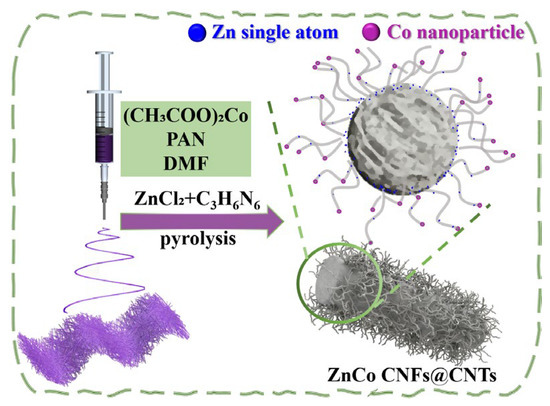
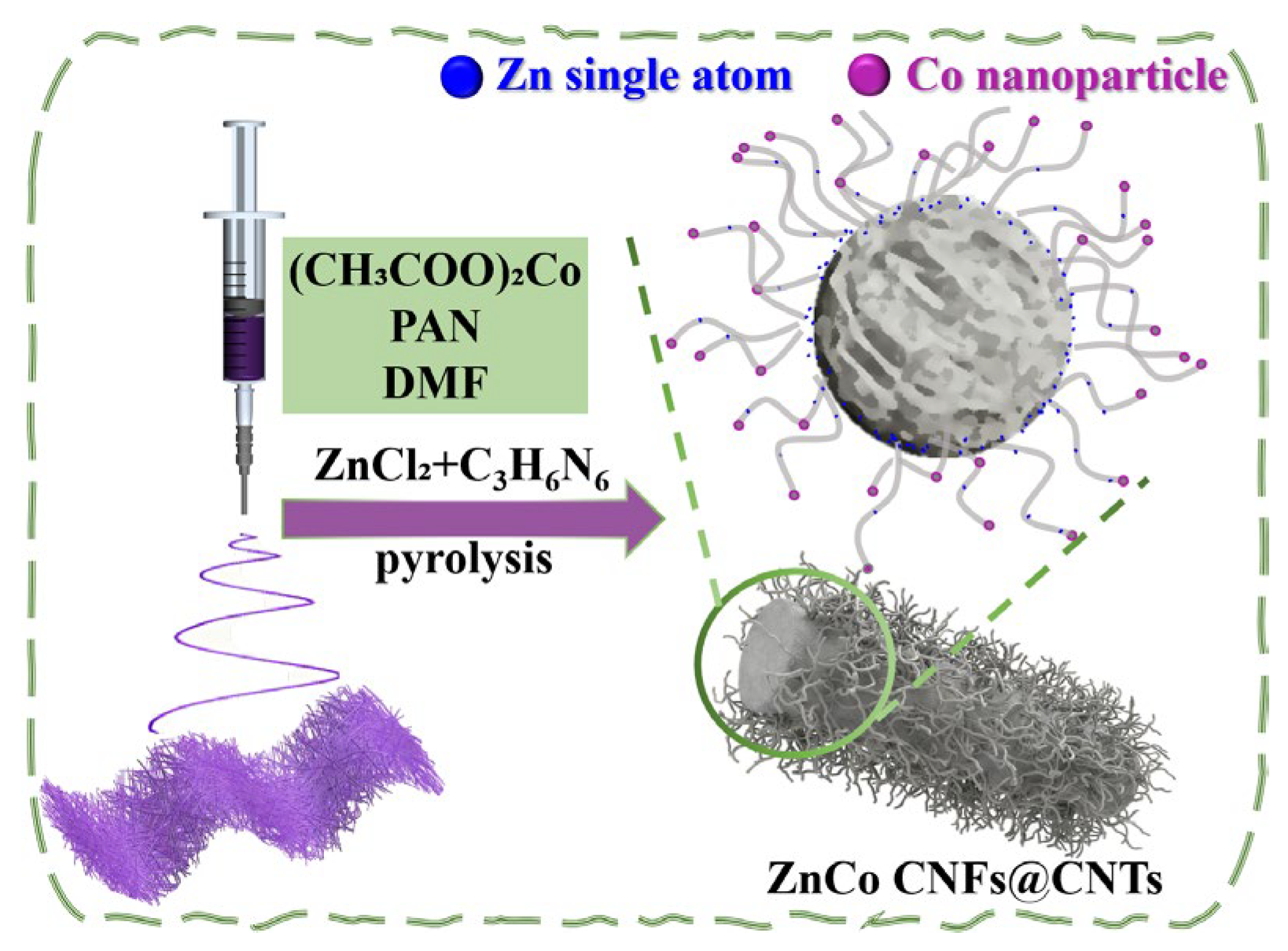
The synthesis process of ZnCo CNFs@CNTs is illustrated in Scheme 1. Co(CH3COO)2·4H2O was first uniformly incorporated into a PAN solution, and one-dimensional Co NFs precursor nanofibers were prepared via uniaxial electrospinning, ensuring homogeneous dispersion of Co species within the fiber skeleton. The Co NFs precursor was then subjected to heat treatment in a double-boat tube furnace, where melamine (C3H6N6) was placed downstream of the Co NFs as a carbon/nitrogen source, while ZnCl2 in the upstream boat created a regulated gas-phase environment. During pyrolysis, melamine decomposed to release active C and N species, inducing in situ CNT growth on the fiber surface under Co catalysis. Meanwhile, ZnCl2 sublimation enabled Zn species to migrate downstream, participating in structural evolution and modulating the carbon surface chemistry. As a result, a hierarchical CNFs@CNTs composite consisting of continuous and flexible carbon nanofibers decorated with CNTs was obtained, providing enhanced specific surface area and active site exposure. The final product was denoted as ZnCo CNFs@CNTs.
Scheme 1.
Schematic illustration depicting the synthesis process of ZnCo CNFs@CNTs.
The morphological structure and elemental distribution of Zn CNFs were systematically characterized (Figure S1). SEM images (Figure S1a) reveal that Zn CNFs retain a continuous one-dimensional nanofiber network with smooth surfaces, indicating that the fiber morphology is well maintained after ZnCl2 introduction and high-temperature carbonization. High-angle annular dark-field scanning transmission electron microscopy (HAADF-STEM) and corresponding elemental mapping analyses (Figure S1b,c) demonstrate that Zn species are uniformly distributed within the N-doped carbon framework without observable nanoparticle aggregation, while C, N, and Cl are homogeneously dispersed throughout the matrix. These results verify effective nitrogen doping and a highly dispersed distribution of Zn species.
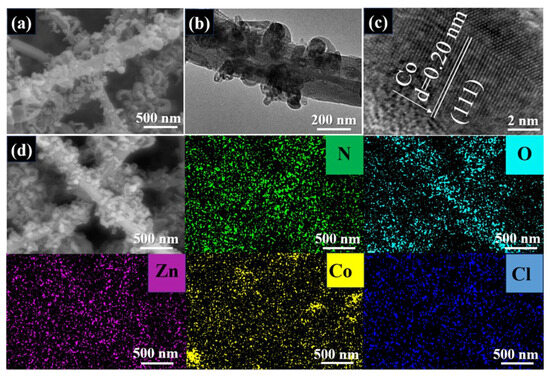
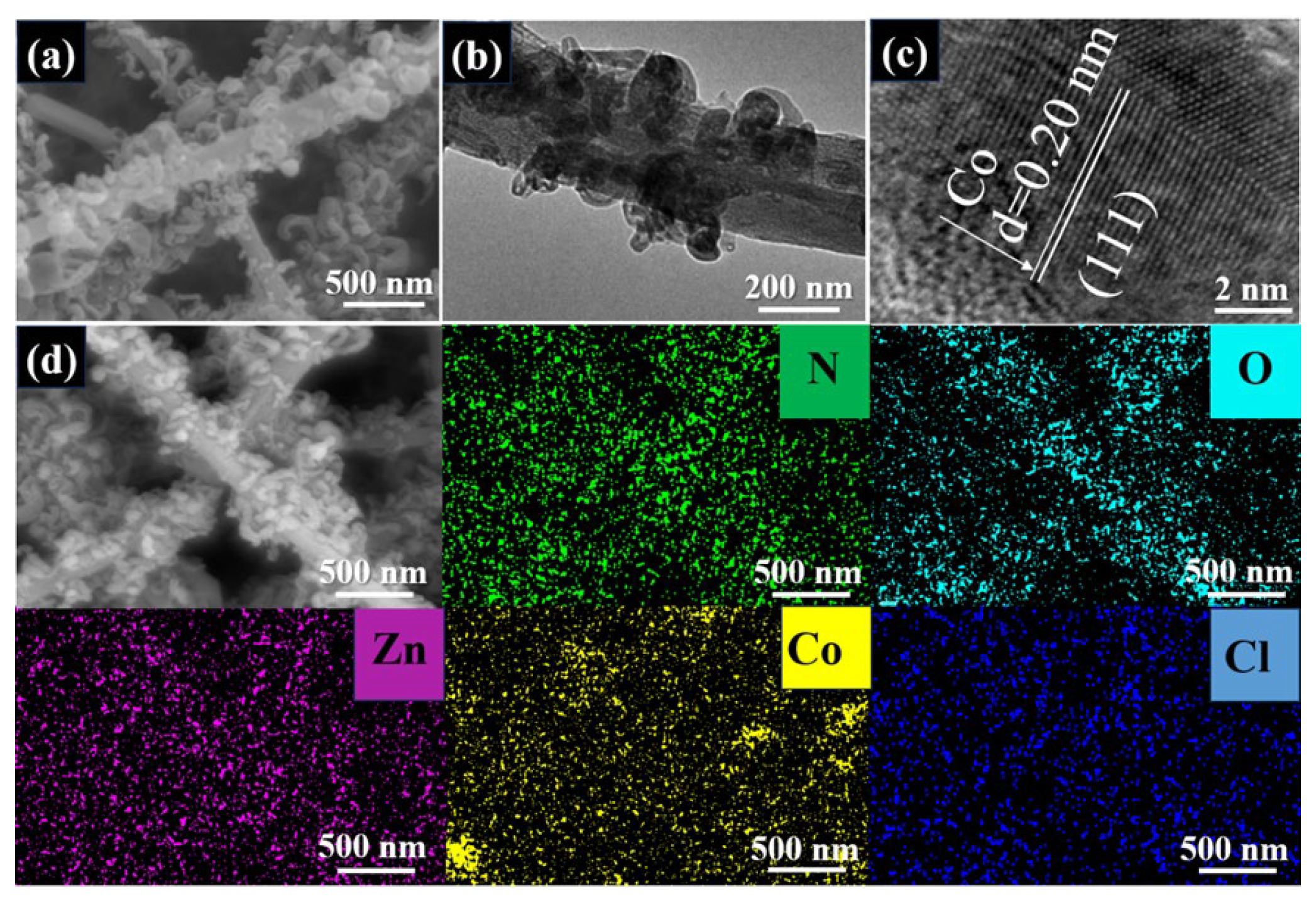
ZnCo CNFs@CNTs display a hierarchical structure, in which CNTs grow in situ on carbon nanofibers to form a three-dimensional conductive network, as confirmed by SEM and TEM images (Figure 1a,b). A tightly bonded interface between CNTs and CNFs is observed, and Co nanocrystals with a lattice spacing of ~0.20 nm, corresponding to the Co (111) plane, act as catalytic centers for CNT growth (Figure 1c). EDS elemental mapping (Figure 1d) confirms the uniform distribution of Zn, Co, N, O, and Cl. These structural characteristics provide abundant active sites, high surface area, and efficient electron and mass transport pathways, establishing a robust framework for bifunctional oxygen electrocatalysis.
Figure 1.
Morphology and elemental distribution characterization of ZnCo CNFs@CNTs. (a) SEM image; (b) TEM image; (c) HRTEM image; (d) SEM image with corresponding EDS elemental mapping (Zn, Co, N, O, and Cl).
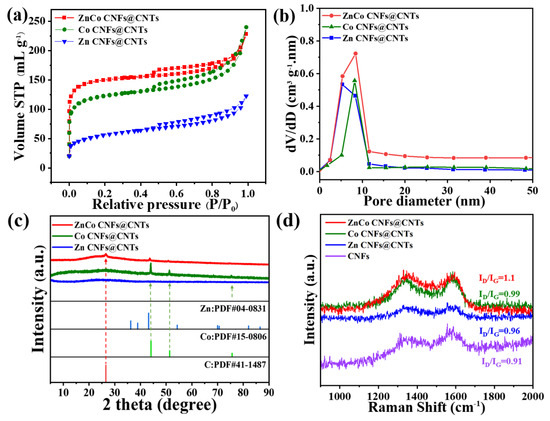
Figure 2 compares the structural characteristics of different samples. N2 adsorption–desorption isotherms (Figure 2a) indicate that ZnCo CNFs@CNTs, Co CNFs@CNTs, and Zn CNFs exhibit typical type IV behavior with hysteresis loops, indicating dominant mesoporous structures. Notably, ZnCo CNFs@CNTs display higher adsorption at low relative pressure (P/P0 < 0.1), suggesting additional microporosity and a higher specific surface area of 569.83 m2 g−1, which is higher than that of Co CNFs@CNTs (380.16 m2 g−1) and Zn CNFs (210.51 m2 g−1). This increased surface area favors active site exposure and is attributed to ZnCl2 vapor acting as a porogen to in situ etch the carbon framework during pyrolysis. Pore size distribution curves (Figure 2b) reveal that ZnCo CNFs@CNTs possess a concentrated mesoporous range of 5–15 nm while retaining larger pores, forming a hierarchical micro-mesoporous structure that facilitates mass transport and gas diffusion, consistent with the pore-engineering effect of ZnCl2 vapor.
Figure 2.
(a) N2 adsorption–desorption isotherms; (b) pore size distribution curves; and (c) XRD patterns of ZnCo CNFs@CNTs, Co CNFs@CNTs, and Zn CNFs; (d) Raman spectra of ZnCo CNFs@CNTs, Co CNFs@CNTs, Zn CNFs, and CNFs.
XRD patterns (Figure 2c) show a broad diffraction peak at ~26°, corresponding to the (002) plane of graphitic carbon, which is clearly observed in ZnCo CNFs@CNTs but is very weak or absent in Co CNFs@CNTs and Zn CNFs. The stronger peak in ZnCo CNFs@CNTs is attributed to more effective catalytic graphitization induced by Zn-Co bimetals, where Zn species are uniformly incorporated into the N-doped carbon skeleton, with ZnCl2 vapor serving as a volatile Zn source for in situ introduction and dispersion during pyrolysis. Weak metallic Co peaks are observed for Co CNFs@CNTs and ZnCo CNFs@CNTs, confirming partial reduction to small Co nanocrystals. In contrast, Zn CNFs show no discernible Zn or ZnO diffraction peaks, indicating the absence of large crystalline Zn/ZnO domains and suggesting the presence of highly dispersed or amorphous Zn species derived from the volatile ZnCl2 precursor. Raman spectra (Figure 2d) display characteristic D and G bands at ~1350 and 1580 cm−1, respectively. The highest ID/IG ratio is observed for ZnCo CNFs@CNTs, reflecting an increased defect density arising from Zn/Co synergistic effects, in situ CNT growth, and the incorporation of Cl species derived from ZnCl2. The enriched carbon defects not only enhance active site anchoring and electronic structure modulation but also represent an important structural contribution of Cl species to catalytic performance optimization.
Overall, ZnCo CNFs@CNTs integrate hierarchical porosity (engineered by ZnCl2 vapor), high surface area, Co nanocrystals, and enriched carbon defects (promoted by Cl species). In this system, ZnCl2 vapor functions as both a porogen and a volatile Zn source for structural regulation and Zn species incorporation, while Cl species modulate the defect density and electronic structure of the carbon matrix—these synergistic features together provide a favorable structural foundation for superior electrocatalytic performance [31].
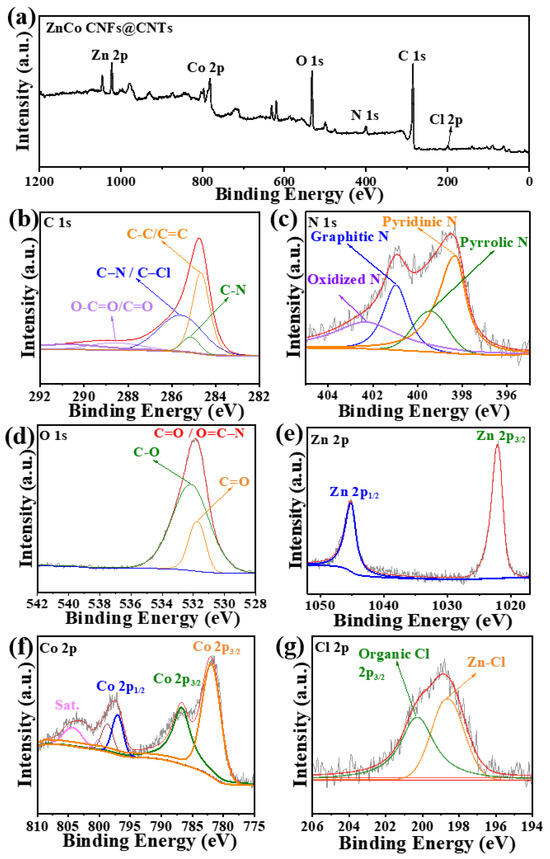
Figure 3 presents the surface elemental composition and chemical states of ZnCo CNFs@CNTs. The survey XPS spectrum (Figure 3a) shows the presence of C, N, O, Zn, Co, and Cl, confirming successful multiple element incorporation into the N-doped carbon framework. High-resolution C 1s spectra (Figure 3b) reveal C-C/C=C, C-N/C-Cl, and O-C=O/C=O bonds, reflecting a rich heteroatom environment capable of modulating the local electronic structure. The N 1s spectrum (Figure 3c) can be deconvoluted into pyridinic, pyrrolic, graphitic, and oxidized nitrogen species. Pyridinic and graphitic nitrogen act as active sites for ORR and OER, while pyrrolic nitrogen increases defect density and stabilizes metal species. The O 1s spectra (Figure 3d) show C-O, C=O, and O-C=O/C=O-C-N groups, which can enhance metal–support interactions and structural stability. Zn 2p spectra (Figure 3e) indicate that Zn exists predominantly in ionic or coordinated states rather than metallic Zn, promoting dispersion and electronic regulation. Co 2p spectra (Figure 3f) show oxidized Co species forming Co-Nx/Co-Ox structures, which serve as key active centers for bifunctional oxygen catalysis. Cl 2p spectra (Figure 3g) reveal the presence of organic Cl and Zn-Cl species. It is speculated that bonded Cl species may synergistically enhance alkaline stability by modulating the electronic structure of Zn/Co sites and strengthening metal–support interactions, thereby suppressing the leaching and agglomeration of active sites [31].
Figure 3.
XPS spectra of ZnCo CNFs@CNTs: (a) survey spectrum, (b) C 1s, (c) N 1s, (d) O 1s, (e) Zn 2p, (f) Co 2p, and (g) Cl 2p.
Collectively, XPS results confirm the synergistic incorporation of Zn, Co, N, and Cl into the carbon framework, generating a complex chemical environment that underpins the excellent ORR/OER performance of ZnCo CNFs@CNTs.
2.2. Electrocatalytic Properties
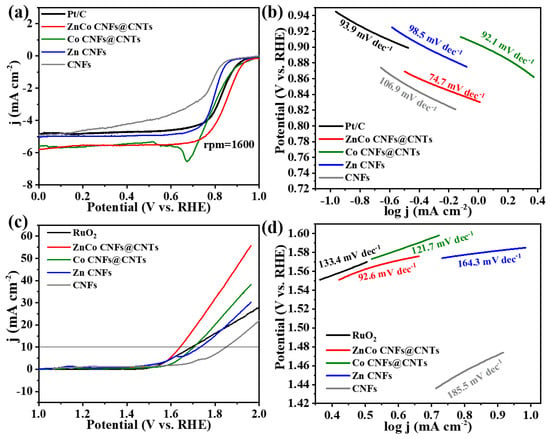
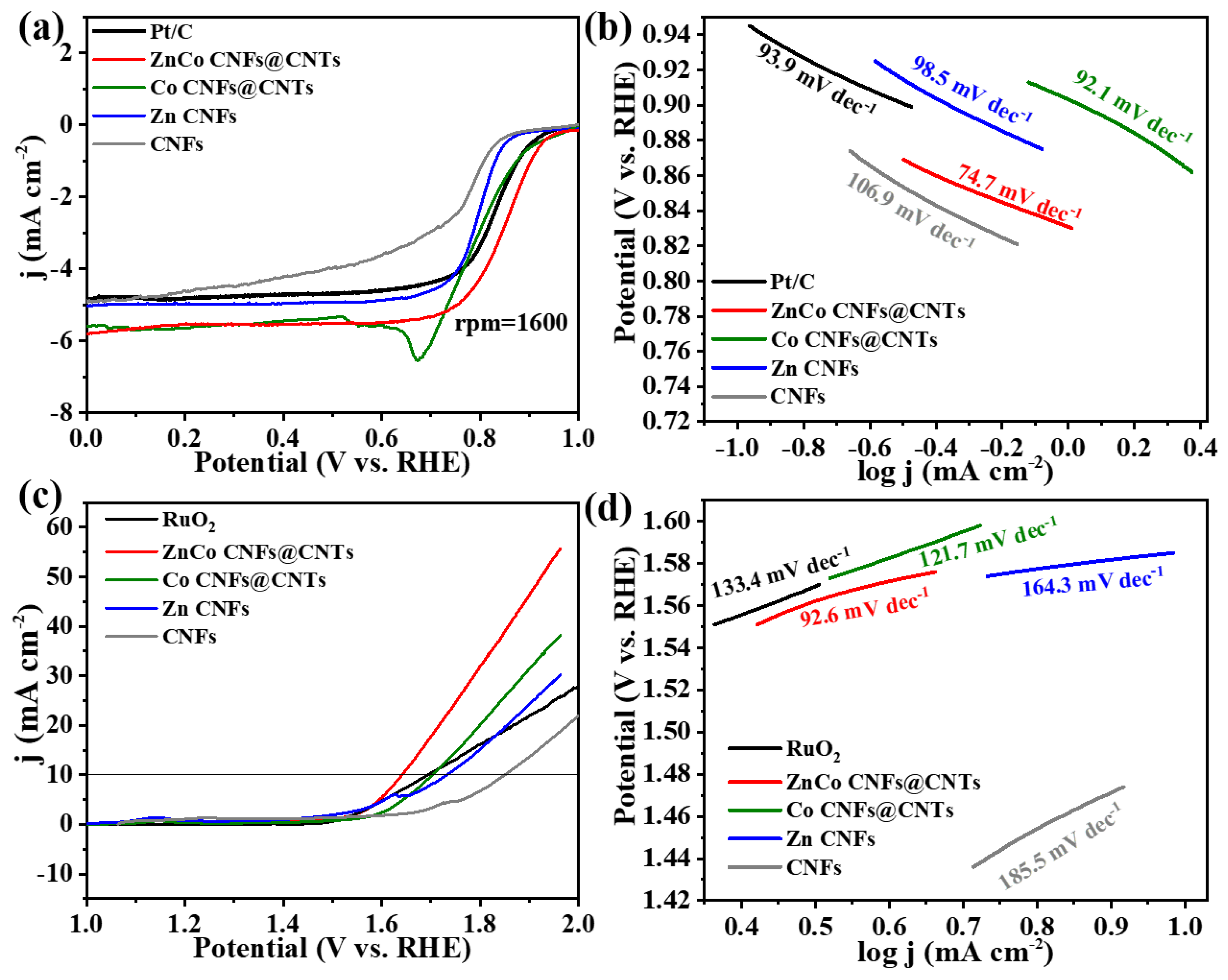
Figure 4 compares the electrocatalytic performance of five different catalysts toward the oxygen reduction reaction (ORR) and oxygen evolution reaction (OER). At a scanning rate of 10 mV·s−1, the ORR polarization curves (Figure 4a) show that ZnCo CNFs@CNTs exhibit the highest catalytic activity, delivering a half-wave potential of 0.86 V. This value is significantly higher than that of the commercial Pt/C catalyst (0.83 V) and other comparative samples (Co CNFs@CNTs: 0.81 V; Zn CNFs: 0.80 V; CNFs: 0.76 V), and surpasses many previously reported ORR catalysts (Table S1) [32,33,34,35,36]. The corresponding Tafel plot (Figure 4b) indicates that ZnCo CNFs@CNTs possess the lowest Tafel slope (74.7 mV·dec−1), reflecting more favorable ORR kinetics. For the OER, ZnCo CNFs@CNTs require a potential of 1.64 V vs. RHE to achieve a current density of 10 mA cm−2, corresponding to an overpotential of 410 mV. This value is lower than that of commercial RuO2 and the other comparative catalysts (Figure 4c).
Figure 4.
(a) ORR performance curves of five catalysts at 10 mV s−1 at 1600 rpm and (b) corresponding Tafel plots; (c) OER performance curves of five catalysts at 10 mV s−1 at 1600 rpm and (d) corresponding Tafel plots.
The OER Tafel slope (Figure 4d) of 92.6 mV·dec−1 further confirms faster charge-transfer kinetics and a reduced reaction energy barrier. Overall, ZnCo CNFs@CNTs demonstrate excellent bifunctional catalytic activity for both ORR and OER, which can be attributed to the synergistic interaction between Zn and Co species and the highly conductive CNT network. These features promote efficient electron transfer and optimized adsorption/desorption of reaction intermediates, thereby markedly enhancing catalytic efficiency and highlighting the potential of ZnCo CNFs@CNTs for ZAB applications.
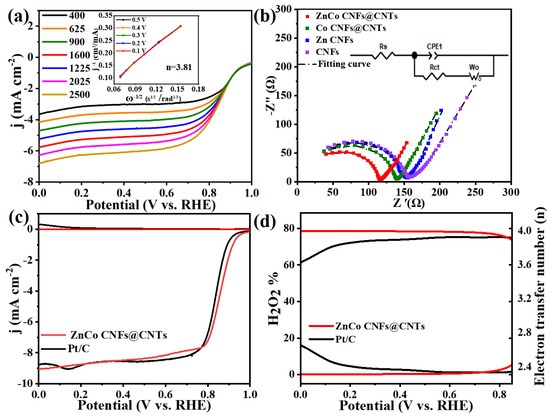
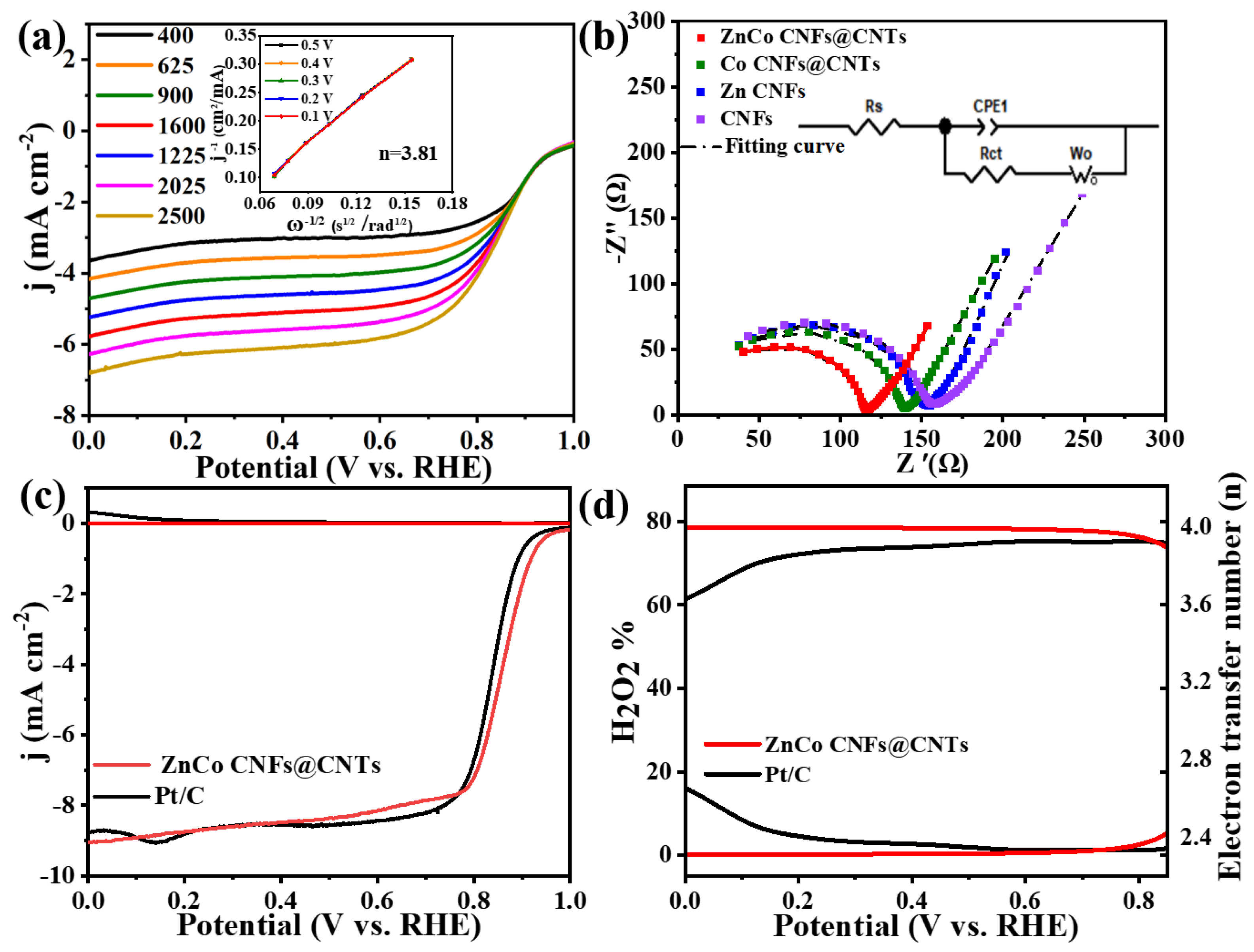
A comprehensive analysis of Figure 5 further demonstrates that ZnCo CNFs@CNTs exhibit excellent ORR activity with a well-defined four-electron reaction pathway. The linear sweep voltammograms recorded at different rotation speeds (400–2500 rpm, Figure 5a) show a pronounced increase in limiting diffusion current density with increasing rotation speed, while the half-wave potential remains nearly unchanged, indicating favorable mass transfer behavior and kinetic stability. The corresponding Koutecky-Levich (K-L) plots derived from the LSV curves (inset of Figure 5a) yield an electron transfer number of 3.81, suggesting a dominant four-electron pathway [37]. The Nyquist plots shown in Figure 5b are fitted using an equivalent circuit model (Rs-CPE-Rct-Wo), and the extracted parameters are summarized in Table S2. Among all samples, ZnCo CNFs@CNTs exhibit the smallest charge-transfer resistance (97.13 Ω), markedly lower than those of Co CNFs@CNTs (129.2 Ω), Zn CNFs (133.4 Ω), and CNFs (142.1 Ω). The reduced Rct value indicates accelerated interfacial electron-transfer kinetics at the electrode–electrolyte interface. This enhancement is attributed to the synergistic electronic interaction between Zn and Co active centers, together with the improved electrical conductivity provided by the interconnected CNT network, leading to superior bifunctional oxygen electrocatalytic performance [38,39]. Rotating ring-disk electrode (RRDE) measurements (Figure 5c) further confirm a half-wave potential of 0.86 V, exceeding that of Pt/C (0.83 V), while maintaining a comparable limiting current density, indicative of superior intrinsic activity. Moreover, the hydrogen peroxide yield remains below 10% over the entire potential range (Figure 5d), significantly lower than that of Pt/C (>10%), with an electron transfer number consistently between 3.8 and 3.9. These results confirm that ZnCo CNFs@CNTs predominantly catalyze ORR via a highly selective four-electron pathway. The enhanced ORR performance arises from the synergistic Zn-Co bimetallic sites and the interconnected carbon fiber/CNT network, which together optimize the adsorption and desorption energetics of oxygen intermediates. The durability of ZnCo CNFs@CNTs toward ORR and OER was evaluated by chronoamperometric measurements (Figure S2). After 30,000 s of continuous operation, ZnCo CNFs@CNTs retain 92.58% of their initial ORR current, which is substantially higher than that of Pt/C (80.13%, Figure S2a). The durability test was conducted at 0.76 V vs. RHE, located in the kinetically controlled region slightly below the half-wave potential (0.86 V), ensuring that the current reflects intrinsic catalytic stability rather than mass-transport limitations. This result demonstrates the robust structural stability and sustained catalytic activity of ZnCo CNFs@CNTs under prolonged operation [40,41].
Figure 5.
(a) LSV curves of ZnCo CNFs@CNTs at different rotation speeds. The inset shows the corresponding Koutecky-Levich (K-L) plots at 0.50 V vs. RHE.; (b) comparative Nyquist plots for the four samples; (c) RRDE measurements, and (d) H2O2 yield and electron transfer number of ZnCo CNFs@CNTs and Pt/C.
For OER at 1.65 V vs. RHE, ZnCo CNFs@CNTs maintain 83.57% of the initial current, outperforming RuO2, which retains only 68.26% (Figure S2b). This excellent durability is attributed to the hierarchical CNFs@CNTs architecture, in which electrospun CNFs provide a robust conductive backbone, in situ grown CNTs enhance rapid electron transport, and synergistically anchored Zn and Co sites stabilize the active centers. As a result, catalyst degradation and active site deactivation are effectively suppressed, enabling long-term bifunctional electrocatalytic stability superior to that of precious-metal-based catalysts.
2.3. Aqueous Zn-Air Battery Performance
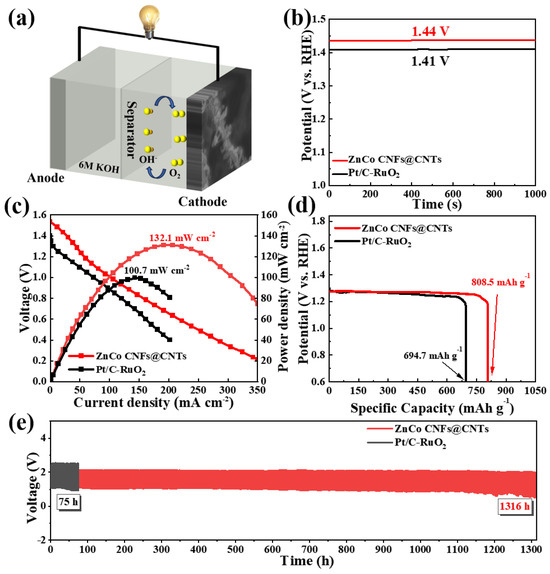
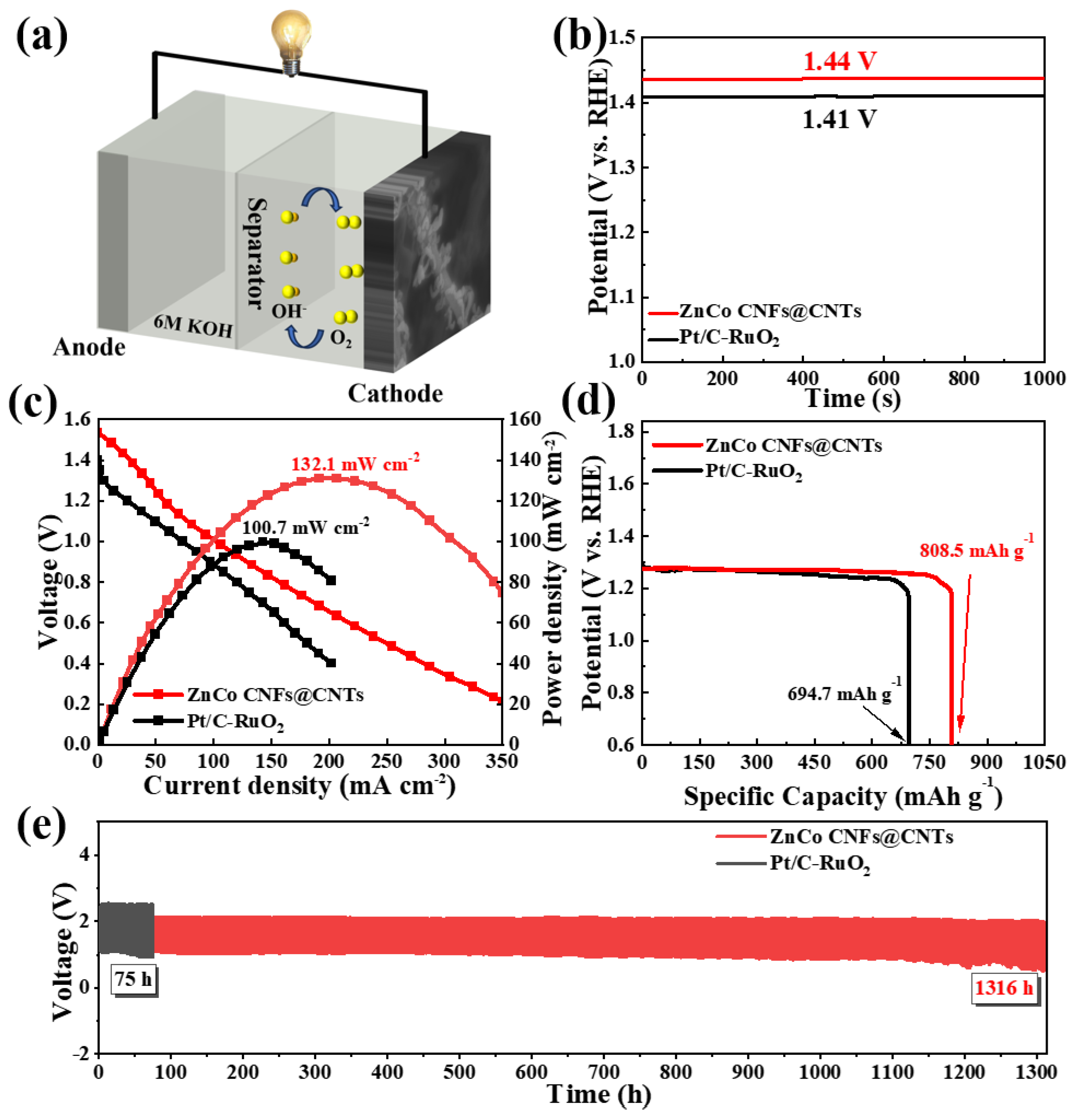
To evaluate the practical application potential of ZnCo CNFs@CNTs, liquid and self-supporting flexible ZABs were assembled and systematically compared with Pt/C-RuO2 benchmark systems. As shown in Figure 6a, ZnCo CNFs@CNTs were employed as the air cathode. The resulting battery exhibits an open-circuit voltage (OCV) of 1.44 V, higher than that of the noble-metal benchmark. Furthermore, a maximum power density of 132.1 mW cm−2 is achieved, significantly higher than the 100.7 mW cm−2 obtained for the Pt/C-RuO2 reference battery (Figure 6b–d). The ZnCo CNFs@CNTs-based battery also delivers a higher specific capacity of 808.5 mAh g−1, based on the mass of consumed Zn metal, compared with 694.7 mAh g−1 for the control system. Meanwhile, the charge–discharge voltage gap is reduced to 1.25 V, indicating improved reversibility and energy efficiency. Notably, stable operation is maintained for 1316 h at a current density of 5 mA cm−2, demonstrating excellent cycle durability (Figure 6e). Figure S4 shows the SEM image of the battery cathode sample before and after the end of battery cycle. The analysis showed that the morphology of the sample did not change much before and after the test, which proves that it has good stability. These results confirm the strong application potential and scalability of ZnCo CNFs@CNTs as efficient bifunctional air cathodes for ZABs.
Figure 6.
(a) Schematic illustration of ZABs; (b) OCV comparison; (c) discharge polarization and corresponding power density curves; (d) specific discharge capacity (based on the mass of consumed Zn metal); and (e) galvanostatic cycling stability at 5 mA cm−2 for ZnCo CNFs@CNTs and Pt/C-RuO2 air electrodes.
2.4. Solid-State Zn-Air Battery Performance
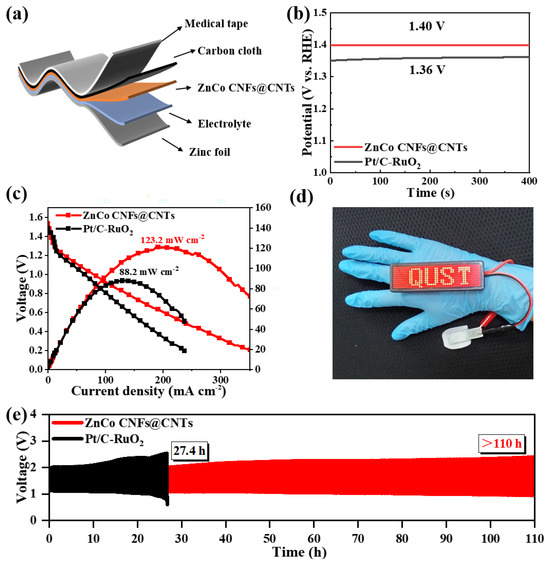
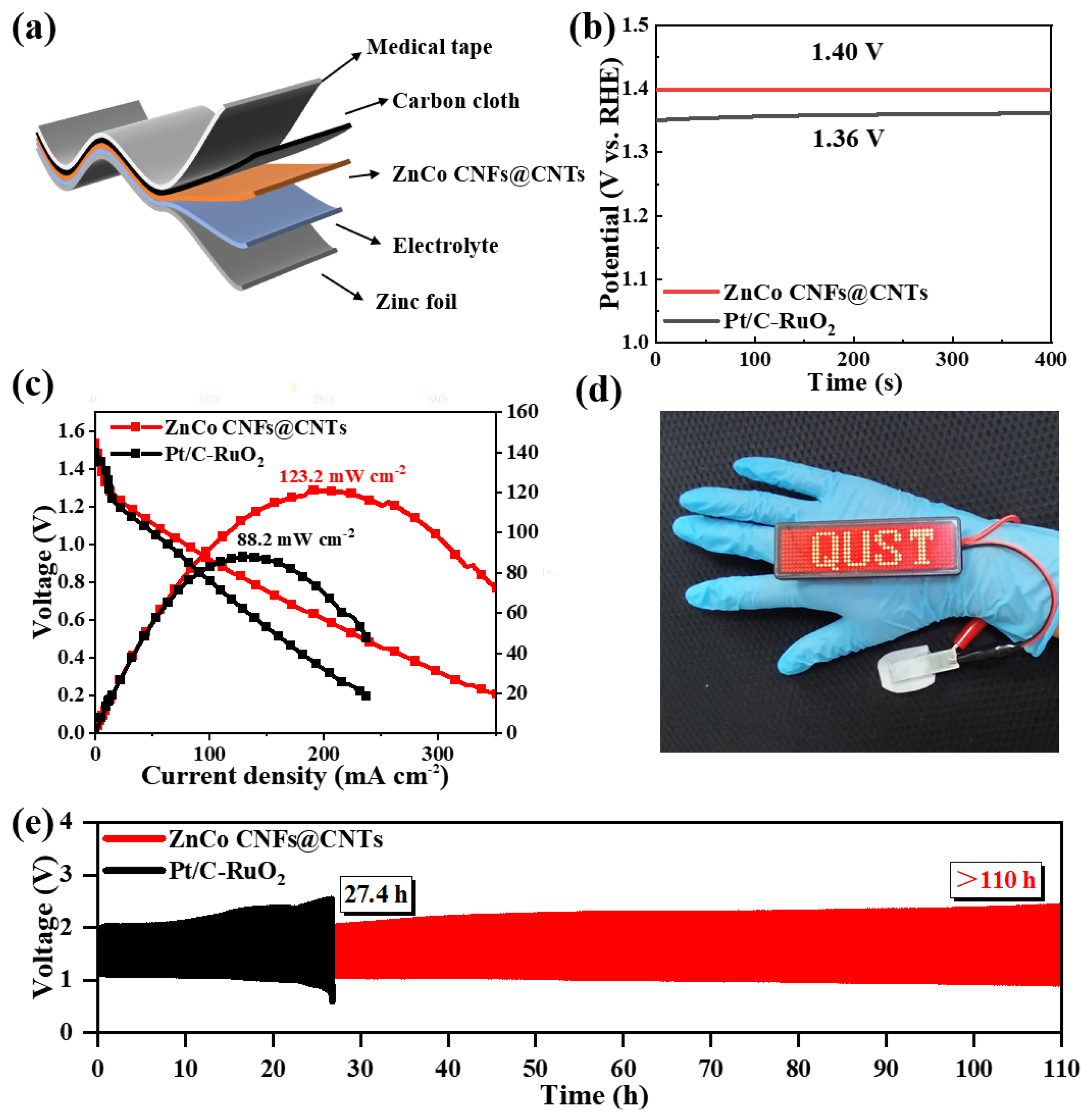
Figure 7a illustrates the configuration of a flexible, self-supporting solid-state ZAB assembled using a ZnCo CNFs@CNTs air cathode. The battery delivers an open-circuit voltage of 1.40 V (Figure 7b), indicating good thermodynamic stability. During charge–discharge cycling, a low polarization voltage is maintained, and a peak power density of 123.2 mW·cm−2 is achieved (Figure 7c), reflecting rapid reaction kinetics. Practical demonstration shows that a single flexible battery can stably power a red light-emitting diode (LED) (Figure 7d). After 110 h of constant-current cycling, the battery remains stable within a voltage window of 1.13 V without noticeable degradation (Figure 7e), confirming its electrochemical durability and mechanical integrity. In addition, Figure S3a,b display the morphology of ZnCo CNFs@CNTs under bending and folding conditions, where the structure remains intact without fracture, indicating excellent flexibility and mechanical robustness. These characteristics meet the mechanical requirements of wearable energy-storage devices. Overall, ZnCo CNFs@CNTs combine high bifunctional catalytic activity with structural flexibility, demonstrating strong potential for next-generation wearable ZABs.
Figure 7.
(a) Schematic illustration of flexible self-supporting ZABs, (b) open-circuit voltage, (c) discharge polarization and power density curves compared with Pt/C-RuO2, (d) photograph of a red LED powered by a flexible ZnCo CNFs@CNTs battery, and (e) charge–discharge cycling performance.
3. Experimental
3.1. Materials
Polyacrylonitrile (PAN, Mw = 150,000) was purchased from Macklin (Shanghai, China). N,N-Dimethylformamide (DMF, ≥99.5%), melamine (C3H6N6, ≥98%), zinc chloride (ZnCl2, ≥98%), and cobalt (II) acetate tetrahydrate (Co(CH3COO)2·4H2O, AR) were supplied by Aladdin Industrial Corporation (Shanghai, China). Isopropanol (≥99.9%) and Nafion 117 (5 wt.%) were purchased from Sigma (St. Louis, MO, USA).
3.2. Synthesis of Nanofiber Precursors NFs and Co NFs
Nanofiber precursors were prepared by uniaxial electrospinning. Taking Co NFs as a representative example, 5.13 mmol of PAN was dissolved in 7 mL of DMF and magnetically stirred at 50 °C for 1 h to obtain a homogeneous polymer solution. Subsequently, 5.52 mmol of Co(CH3COO)2·4H2O was added, and the mixture was stirred for an additional 10 h to form a uniform spinning precursor solution. Electrospinning was conducted at an applied voltage of 18 kV, a tip-to-collector distance of 16 cm, and a solution feeding rate of 0.6 mL h−1, with an ambient temperature of 25–30 °C, relative humidity of 30–40%, and a collector rotation speed of 120 rpm. The as-spun nanofiber membrane was dried overnight at 60 °C and denoted as Co NFs. Under the same conditions, nanofibers prepared without introducing metal salts were denoted as NFs.
3.3. Synthesis of CNFs, Zn CNFs, Co CNFs@CNTs and ZnCo CNFs@CNTs
The nanofiber precursors were placed in a porcelain boat, and 7.93 mmol of melamine was evenly distributed above the fiber samples as a nitrogen source. For Zn-containing samples, an additional porcelain boat containing 11 mmol of ZnCl2 was placed upstream as the zinc source. The boats were then placed sequentially in a tube furnace for heat treatment. The samples were first heated to 280 °C at a heating rate of 3 °C min−1 in air and held for 1 h to stabilize the precursors. Subsequently, under an N2 atmosphere, the temperature was increased to 900 °C at 5 °C min−1 and maintained for 2 h to complete carbonization and nitrogen doping. The obtained samples were designed as follows: CNFs, obtained from NFs via carbonization with melamine burial; Co CNFs@CNTs, obtained from Co NFs under identical conditions; Zn CNFs, prepared by introducing ZnCl2 during the carbonization and nitrogen-doping processes of NFs; and ZnCo CNFs@CNTs, prepared by simultaneously introducing ZnCl2 during the carbonization and nitrogen-doping processes of Co NFs with melamine burial.
3.4. Electrochemical Measurements
Electrochemical performances were assessed using a standard three-electrode system with a CHI 760E workstation (CH Instruments, Shanghai, China). Measurements were performed in saturated O2 in 0.1 M KOH, with a Ag/AgCl reference electrode and a graphite rod counter electrode. Working electrodes were prepared by mixing 4 mg of sample, 1 mg carbon black (XC-72), 800 μL deionized water, 200 μL isopropanol, and 20 μL Nafion117, followed by 20 min sonication. The resulting suspension was applied to glassy-carbon electrodes of rotating disk electrodes (RDE, 3 mm diameter) or rotating ring–disk electrodes (RRDE, 4 mm diameter) to achieve a loading of 60 μg cm−2 and air-dried.
ORR polarization curves were obtained using rotating disk experiments (RDE-3A, ALS Co., Ltd., Tokyo, Japan) from 0.2 V to −0.8 V (vs. Ag/AgCl) at 10 mV s−1 with rotation speeds of 400–2500 rpm in saturated O2 0.1 M KOH. OER performance was evaluated using linear sweep voltammetry (LSV) at 10 mV s−1 in O2-saturated 0.1 M KOH. Electrochemical impedance spectroscopy (EIS) was performed at 1.545 V (vs. RHE) over 100 kHz–10 mHz with a 10 mV amplitude. Stability tests for ORR and OER were conducted by chronoamperometry in a three-electrode system under stirring at a constant potential.
Reference potentials were converted to the reversible hydrogen electrode (RHE) using the Nernst equation:
where ERHE is the converted potential relative to RHE, and EAg/AgCl is the real-time value measured by the Ag/AgCl reference electrode.
ERHE = EAg/AgCl + 0.0591 pH + 0.197
Cyclic voltammetry (CV) was used to record ORR curves in KOH solution saturated with N2 or O2. LSV curves were obtained under similar conditions at a scan rate of 5 mV s−1 and various rotational speeds (400, 625, 900, 1225, and 1600 rpm). The electron transfer number (n) was calculated using the Koutecky-Levich (K-L) equation:
where J is the measured current density, Jk is the kinetic current density, Jd is the diffusion-limited current density, F is the Faraday constant (96,485 C mol−1), D0 (1.86 × 10⁻⁵ cm2 s−1) and C0 (1.21 × 10⁻⁶ mol cm−3) are the diffusion coefficient and bulk concentration of O2 in 0.1 M KOH, respectively, ω (rpm) is the rotation rate of RDE, and ν is the kinetic viscosity (0.01 cm2 s−1).
The electron transfer number (n) and hydrogen peroxide yield (%) in the ORR process were determined using RRDE.
where Id is the disk current, Ir is the ring current density, and N is the current collection efficiency constant (0.37).
OER measurements were conducted in 0.1 M KOH solution under O2 saturation, with a rotation rate of 1600 rpm and a scan rate of 5 mV s−1. OER stability was assessed by chronoamperometry at 1.60 (V vs. RHE).
4. Conclusions
Hierarchical ZnCo CNFs@CNTs with dual-metal active centers were successfully fabricated via electrospinning coupled with gas-phase-assisted pyrolysis. The resulting material features carbon nanofibers as a robust scaffold decorated with in situ-grown carbon nanotubes, enabling highly dispersed Zn species and their synergistic interaction with Co nanocrystals, thereby markedly enhancing bifunctional ORR/OER activity. Electrochemical measurements demonstrate that ZnCo CNFs@CNTs achieve an ORR half-wave potential of 0.86 V and an OER overpotential of 1.64 V, surpassing the performance of commercial Pt/C and RuO2 catalysts. In liquid Zn-air batteries, the assembled electrodes deliver a high open-circuit voltage of 1.44 V, a peak power density of 132.1 mW·cm−2, and long-term cycling stability exceeding 1300 h. Furthermore, flexible solid-state batteries achieve an open-circuit voltage of 1.40 V and a peak power density of 123.2 mW·cm−2, while maintaining stable operation under bending and folding, indicative of excellent mechanical robustness and practical device performance. Collectively, the superior bifunctional catalytic activity, hierarchical architecture, and conductive CNT network facilitate efficient electron/ion transport and optimized intermediate adsorption/desorption, highlighting ZnCo CNFs@CNTs as promising candidates for next-generation wearable energy devices.
Supplementary Materials
The following supporting information can be downloaded at: https://www.mdpi.com/article/10.3390/catal16040331/s1, Figure S1: SEM image of Zn CNFs and AC HAADF-STEM images with corresponding elemental mapping results; Figure S2: (a) Chronoamperometric ORR curves at 0.76 V for ZnCo CNFs@CNTs and Pt/C; and (b) OER stability curves at 1.65 V for ZnCo CNFs@CNTs and RuO2; Figure S3: Flexibility test of ZnCo CNFs@CNTs; Figure S4: SEM images of the air cathode (a) before cycling and (b) after completion of the battery cycling test; Table S1: Comparison of ORR and OER activities of ZnCo CNFs@CNTs with other recently reported noble metal-free catalysts; Table S2: Fitted Rs and Rct values of ZnCo CNFs@CNTs, Co CNFs@CNTs, Zn CNFs and CNFs derived from EIS measurements.
Author Contributions
Z.W.: Conceptualization, Investigation, Software, Writing-original draft. Y.C.: Conceptualization, Methodology, Writing-review and editing. L.J.: Investigation. F.K.: Conceptualization. B.P.: Investigation, Conceptualization. Q.Z.: Visualization. J.F.: Investigation, Conceptualization. L.Y.: Project administration, Funding acquisition. L.D.: Project administration, Funding acquisition, Supervision, Writing-review and editing, Resources. All authors have read and agreed to the published version of the manuscript.
Funding
This work was supported by the National Natural Science Foundation of China (Nos. 21776147, 21905153, 61604086, 22378221, 22308183, 52002198), the Natural Science Foundation of Shandong Province (Nos. ZR2021YQ32, ZR2022QB164, ZR2023QB070), the Taishan Scholar Project of Shandong Province (No. tsqn201909117), the Qingdao Science and Technology Benefit the People Demonstration and Guidance Special Project (No. 23-2-8-cspz-11-nsh), the Qingdao Natural Science Foundation (No. 23-2-1-241-zyyd-jch), and the China Postdoctoral Science Foundation (No. 2023M731856). L.D. also acknowledges financial support from the Malmstrom Endowed Fund at Hamline University.
Data Availability Statement
The authors can confirm that all relevant data are included in the article.
Conflicts of Interest
The authors do not have any financial or non-financial interests that are directly or indirectly related to the work submitted for publication.
References
- Xia, Q.; Zhai, Y.J.; Zhao, L.L.; Wang, J.; Li, D.Y.; Zhang, L.L.; Zhang, J.T. Carbon-supported single-atom catalysts for advanced rechargeable metal-air batteries. Energy Mater. 2022, 2, 200015. [Google Scholar] [CrossRef] [Scilit]
- Pan, L.; Chen, D.F.; Pei, P.C.; Huang, S.W.; Ren, P.; Song, X. A novel structural design of air cathodes expanding three-phase reaction interfaces for zinc-air batteries. Appl. Energy 2021, 290, 116777. [Google Scholar] [CrossRef] [Scilit]
- Yin, Z.Y.; He, R.; Xue, H.B.; Chen, J.J.; Wang, Y.; Ye, X.X.; Xu, N.N.; Qiao, J.L.; Huang, H.T. A bimetallic-activated MnO2 self-assembly electrode with a dual heterojunction structure for high-performance rechargeable zinc-air batteries. Energy Mater. 2022, 2, 200021. [Google Scholar] [CrossRef] [Scilit]
- Shi, Q.; Liu, Q.; Ma, Y.; Fang, Z.; Liang, Z.; Shao, G.; Tang, B.; Yang, W.Y.; Qin, L.; Fang, X.S. High-performance trifunctional electrocatalysts based on FeCo/Co2 Phybrid nanoparticles for zinc-air battery and self-powered overall water splitting. Adv. Energy Mater. 2020, 10, 1903854. [Google Scholar] [CrossRef] [Scilit]
- Jiao, L.; Li, J.K.; Richard, R.L.L.; Sun, Q.; Stracensky, T.; Liu, E.S.; Sougrati, M.T.; Zhao, Z.P.; Yang, F.; Zhong, S.C. Chemical vapour deposition of Fe-N-C oxygen reduction catalysts with full utilization of dense Fe-N4 sites. Nat. Mater. 2021, 20, 1385–1391. [Google Scholar] [CrossRef] [Scilit]
- Balamurugan, J.; Nguyen, T.T.; Kim, N.H.; Kim, D.H.; Lee, J.H. Core-shell CuMo-oxynitride @N-doped graphene nanohybrids as multifunctional catalysts for rechargeable zinc-air batteries and water splitting. Nano Energy 2021, 85, 105987. [Google Scholar] [CrossRef] [Scilit]
- Wu, M.J.; Wei, Q.L.; Zhang, G.X.; Qiao, J.L.; Wu, M.X.; Zhang, J.H.; Gong, Q.J.; Sun, S.H. Fe/Co double hydroxide/oxide nanoparticles on N-doped CNTs as highly efficient electrocatalysts for rechargeable liquid and quasi-solid-state zinc-air batteries. Adv. Energy Mater. 2018, 8, 1801836. [Google Scholar] [CrossRef] [Scilit]
- Irmawati, Y.; Balqis, F.; Destyorini, F.; Adios, C.G.; Yudianti, R.; Iskandar, F.; Sumboja, A. Cobalt nanoparticles encapsulated with N-doped bamboo-like carbon nanofibers as bifunctional catalysts for oxygen reduction/evolution reactions. ACS Appl. Nano Mater. 2023, 6, 2708–2718. [Google Scholar] [CrossRef] [Scilit]
- Yang, W.; Guo, B.; Guo, Z.; Wang, X.; Zeng, Y.; Guo, J.; Wu, M. Hollow porous carbon nanofibers with Fe-N-C modified by Fe3O4 nanoparticles for enhanced oxygen reduction reaction. ACS Sustain. Chem. Eng. 2023, 11, 8884–8892. [Google Scholar] [CrossRef] [Scilit]
- Wang, Q.; Kaushik, S.; Xiao, X.; Xu, Q. Sustainable zinc-air battery chemistry: Advances, challenges and prospects. Chem. Soc. Rev. 2023, 52, 6139–6190. [Google Scholar] [CrossRef] [Scilit] [PubMed]
- Xiao, X.; Zheng, Z.; Zhong, X.; Gao, R.; Piao, Z.; Jiao, M.; Zhou, G. Rational design of flexible Zn-based batteries for wearable electronic devices. ACS Nano 2023, 17, 1764–1802. [Google Scholar] [CrossRef] [Scilit]
- Wang, L.; Xu, M.; Li, H.; Huang, Z.; Wang, L.; Isimjan, T.T.; Yang, X. Mn-doped Zn-MOF-derived porous N-doped carbon composites for oxygen reduction and flexible zinc-air batteries. Inorg. Chem. 2023, 62, 13284–13292. [Google Scholar] [CrossRef] [Scilit]
- Chang, J.; Zhang, Q.; Yu, J.; Jing, W.; Wang, S.; Yin, G.; Waterhouse, G.I.N.; Lu, S. Fe single-atom seed-mediated Fe3C/Fe-N-C catalysts with outstanding bifunctional ORR/OER activity. Adv. Sci. 2023, 10, 2301656. [Google Scholar] [CrossRef] [Scilit]
- Fiorio, J.L.; Garcia, M.A.S.; Gothe, M.L.; Galvan, D.; Troise, P.C.; Conte-Junior, C.A.; Vidinha, P.; Camargo, P.H.C.; Rossi, L.M. Recent advances in the use of nitrogen-doped carbon materials for the design of noble metal catalysts. Coord. Chem. Rev. 2023, 481, 215053. [Google Scholar] [CrossRef] [Scilit]
- Jin, M.; Wang, R.; Jia, B.; Zhang, J.; Liu, H.; Lu, S.-Y. Achieving uniform Pt deposition site by tuning the surface microenvironment of bamboo-like carbon nanotubes. Appl. Surf. Sci. 2022, 603, 153201. [Google Scholar] [CrossRef] [Scilit]
- Fang, C.; Tang, X.; Yi, Q. Adding Fe/dicyandiamide to Co-MOF to greatly improve its ORR/OER bifunctional electrocatalytic activity. Appl. Catal. B Environ. 2024, 341, 123346. [Google Scholar] [CrossRef] [Scilit]
- Wang, M.; Chen, Z.; Song, Y.; Hu, Z.; Song, H.; Dong, S.; Yuan, D. Architecting N-doped Carbon Nanotube-Rich Carbon Nanofibers with Biomimetic Vine-Leaf-Whisker Structure as Robust Bifunctional Electrocatalysts for Rechargeable Zn-Air Batteries. Inorg. Chem. 2024, 63, 4373–4384. [Google Scholar] [CrossRef] [Scilit] [PubMed]
- Kong, L.; Zhang, S.; Liu, Y.; Wu, H.; Fan, X.; Cao, Y.; Huang, J. Hierarchical architecture bioinspired CNTs/CNF electromagnetic wave absorbing materials. Carbon 2023, 207, 198–206. [Google Scholar] [CrossRef] [Scilit]
- Wang, Z.; Ang, J.; Liu, J.; Ma, X.Y.D.; Kong, J.; Zhang, Y.; Yan, T.; Lu, X. FeNi alloys encapsulated in N-doped CNTs-tangled porous carbon fibers as highly efficient and durable bifunctional oxygen electrocatalyst for rechargeable zinc-air battery. Appl. Catal. B Environ. 2020, 263, 118344. [Google Scholar] [CrossRef] [Scilit]
- Zhao, X.; Abbas, S.C.; Huang, Y.; Lv, J.; Wu, M.; Wang, Y. Robust and Highly Active FeNi@NCNT Nanowire Arrays as Integrated Air Electrode for Flexible Solid-State Rechargeable Zn-Air Batteries. Adv. Mater. Interfaces 2018, 5, 1701448. [Google Scholar] [CrossRef] [Scilit]
- Ding, W.; Saad, A.; Wu, Y.; Wang, Z.; Li, X. CNTs/CNF-supported multi-active components as highly efficient bifunctional oxygen electrocatalysts and their applications in zinc-air batteries. Nano Res. 2023, 16, 4793–4802. [Google Scholar] [CrossRef] [Scilit]
- Gao, C.; Mu, S.; Yan, R.; Chen, F.; Ma, T.; Cao, S. Recent Advances in ZIF-Derived Atomic Metal-N-C Electrocatalysts for Oxygen Reduction Reaction: Synthetic Strategies, Active Centers, and Stabilities. Small 2022, 18, 2105409. [Google Scholar] [CrossRef] [Scilit]
- Dang, D.; Zhang, L.; Long, G.; Liu, C.; Fan, W.; Zheng, J.; Wang, T.; Liu, Q.; Han, X. Modulation the Coordination of Fe-Co Diatomic Sites with Boron Atom for Fuel Cells and Zn-Air Battery. Appl. Catal. B Environ. 2025, 379, 125679. [Google Scholar] [CrossRef] [Scilit]
- Li, M.; Lv, M.; Zheng, Y.; Zhu, M.; Feng, Q.; Guan, J.; Yu, X.; Shen, Y.; Hou, J.; Lu, Y.; et al. Bimetallic-Coordinated Covalent Triazine Framework-Derived FeNi Alloy Nanoparticle-Decorated Coral-Like Nanocarbons for Oxygen Electrocatalysis. ACS Appl. Mater. Interfaces 2024, 16, 633–642. [Google Scholar] [CrossRef] [Scilit]
- Pan, Y.; Li, Y.; Nairan, A.; Khan, U.; Hu, Y.; Wu, B.; Sun, L.; Zeng, L.; Gao, J. Constructing FeNiPt@C Trifunctional Catalyst by High Spin-Induced Water Oxidation Activity for Zn-Air Battery and Anion Exchange Membrane Water Electrolyzer. Adv. Sci. 2024, 11, e2308205. [Google Scholar] [CrossRef] [Scilit] [PubMed]
- Chen, T.-H.; Ni, C.-S.; Lai, C.-Y.; Gull, S.; Chu, Y.-C.; Jao, W.-Y.; Hu, C.-C.; Liu, S.-F.; Chi, C.-C.; Chen, T.-Y.; et al. Enhanced oxygen evolution and power density of Co/Zn@NC@MWCNTs for the application of zinc-air batteries. J. Colloid Interface Sci. 2025, 679, 119–131. [Google Scholar] [CrossRef] [Scilit] [PubMed]
- Dong, F.; Wu, M.; Chen, Z.; Chen, N.; Bakhtbidar, M.; Ruediger, A.; Zhang, G.; Sun, S. In situ reconstruction of bimetallic heterojunctions encapsulated in N/P co-doped carbon nanotubes for long-life rechargeable zinc-air batteries. Nano Energy 2025, 133, 110497. [Google Scholar] [CrossRef] [Scilit]
- Yin, X.; Xi, W.; Wang, P.; Wu, T.; Liu, P.; Gao, B.; Zheng, Y.; Lin, B. In-situ construction of 2D β-Co(OH)2 nanosheets hybridized with 1D N-doped carbon nanotubes as efficient bifunctional electrocatalyst for oxygen reduction and evolution reactions. Chem. Eng. J. 2025, 503, 158437. [Google Scholar] [CrossRef] [Scilit]
- Gu, T.; Shen, J.; Sun, Z.; Li, F.; Zhi, C.; Zhu, M.; Liu, J. Engineering Non-precious Trifunctional Cobalt-Based Electrocatalysts for Industrial Water Splitting and Ultra-High-Temperature Flexible Zinc-Air Battery. Small 2024, 20, e2308355. [Google Scholar] [CrossRef] [Scilit]
- Hua, C.; Ye, D.; Chen, C.; Sun, C.; Fang, J.; Liu, L.; Bai, H.; Tang, Y.; Zhao, H.; Zhang, J. Engineering triple phase interface and axial coordination design of single-atom electrocatalysts for rechargeable Zn-air batteries. Small 2025, 21, 2412696. [Google Scholar] [CrossRef] [Scilit]
- Sun, X.Y.; Li, X.Y.; Huang, H.; Lu, W.T.; Xu, X.C.; Cui, X.Q.; Li, L.; Zou, X.X.; Zheng, W.T.; Zhao, X. Fine engineering of d-orbital vacancies of ZnN4 via high-shell metal and nonmetal single-atoms for efficient and poisoning-resistant ORR. Nano Lett. 2024, 24, 14602–14609. [Google Scholar] [CrossRef] [Scilit]
- Wu, X.G.; Wang, R.; Ma, F.; Liu, X.L.; Jia, D.L.; Yang, H.C.; Liu, Y.P.; Wang, Z.X.; Zheng, H.Z.; Zhang, Y.N. FeCo-N encapsulated in nitrogen-doped carbon nanotubes as highly stable bifunctional electrocatalysts for zinc-air batteries. Rare Met. 2023, 42, 1526–1534. [Google Scholar] [CrossRef] [Scilit]
- Huang, C.; Zhang, Y.; Li, X.; Cao, H.; Guo, Y.; Zhang, C. Mn-incorporated Co3O4 bifunctional electrocatalysts for zinc-air batteries: An experimental and DFT study. Appl. Catal. B Environ. 2022, 319, 121909. [Google Scholar] [CrossRef] [Scilit]
- Fan, C.; Yin, Q.; Yuan, Y.; Yu, J.; Sun, Q.; Chen, Y.; Yu, L.; Dong, L. ZnCo-ZIF-based nanoarchitectonics of honeycomblike N-doped carbon for oxygen reduction reaction and supercapacitor. Diamond Relat. Mater. 2023, 136, 109997. [Google Scholar] [CrossRef] [Scilit]
- Wang, Z.; Fan, C.; Chen, Y.; Yuan, Y.; Xue, J.; Yu, N.; Feng, J.; Yu, L.; Dong, L. NaCl-assisted electrospinning of bifunctional carbon fibers for high-performance flexible zinc-air batteries. J. Colloid Interface Sci. 2025, 690, 137325. [Google Scholar] [CrossRef] [Scilit]
- Yuan, Y.; Fan, C.; Wang, Z.; Pang, B.; Zhang, Q.; Chen, Y.; Yu, L.; Dong, L. High-performance bifunctional electrocatalysts for zinc-air batteries using coaxial electrospun hollow N-doped carbon nanofibers decorated with NiCo and CoMn nanocrystals. J. Energy Storage 2025, 107, 114907. [Google Scholar] [CrossRef] [Scilit]
- Radinović, K.; Samancı, M.; Bayrakçeken, A.; Bajuk-Bogdanović, D.; Gavrilov, N.; Santos, D.M.F.; Šljukić, B. Maximizing electrochemical energy conversion and storage performance of carbon aerogel with Co-Fe by tuning the synthesis method. J. Power Sources 2026, 348, 131614. [Google Scholar] [CrossRef] [Scilit]
- García-Osorio, D.A.; Jaimes, R.; Vazquez-Arenas, J.; Lara, R.H.; Alvarez-Ramirez, J. The Kinetic Parameters of the Oxygen Evolution Reaction (OER) Calculated on Inactive Anodes via EIS Transfer Functions: •OH Formation. J. Electrochem. Soc. 2017, 164, E3321. [Google Scholar] [CrossRef] [Scilit]
- Mohamed, I.M.A.; Kanagaraj, P.; Yasin, A.S.; Iqbal, W.; Liu, C. Electrochemical impedance investigation of urea oxidation in alkaline media based on electrospun nanofibers towards the technology of direct-urea fuel cells. J. Alloys Compd. 2020, 816, 152513. [Google Scholar] [CrossRef] [Scilit]
- Liu, M.S.; Lei, Z.H.; Lv, X.H.; Song, X.X.; Zhang, L.; Li, S.; Sun, T.; Li, L.; Hui, J.N.; Zhang, W.Y.; et al. Enhancing the ORR durability of single atomic Fe-N4 active sites with implanted SiO2 nanoparticles as radical and H2O2 inhibitors. Nat. Commun. 2025, 16, 10178. [Google Scholar] [CrossRef] [Scilit] [PubMed]
- Meng, X.; Yuan, Y.; Feng, J.; Ma, C.; Sun, Y.; Zhang, J.; Pang, B.; Chen, Y.; Yu, L.; Dong, L. Design and synthesis of self-supporting FeCoNi- and N-doped carbon fibers/nanotubes as oxygen bifunctional catalysts for solid-state flexible Zn-air batteries. Chem. Eng. J. 2024, 479, 147648. [Google Scholar] [CrossRef] [Scilit]
Disclaimer/Publisher’s Note: The statements, opinions and data contained in all publications are solely those of the individual author(s) and contributor(s) and not of MDPI and/or the editor(s). MDPI and/or the editor(s) disclaim responsibility for any injury to people or property resulting from any ideas, methods, instructions or products referred to in the content. |
© 2026 by the authors. Licensee MDPI, Basel, Switzerland. This article is an open access article distributed under the terms and conditions of the Creative Commons Attribution (CC BY) license.