


Abstract
Achieving selective conversion of lignin-derived phenolic compounds to cycloalkanes under mild conditions remains a significant challenge. Herein, we report a novel iron-incorporated two-dimensional NiO nanosheet supported Pd-Pt alloy catalyst (Pd1.7-Pt0.3/NiO-5FeOx) that is capable of facilitating highly efficient hydrodeoxygenation (HDO) of lignin-derived phenolic model compounds (e.g., 2,6-dimethoxy-4-methylphenol) under mild conditions (250 °C, 5 atm H2). The reaction mechanism was investigated through various characterization techniques and mechanistic studies: introducing FeOx into the NiO support increases the proportion of defect-related oxygen species (Oβ), enhances adsorption of the key hydrogenated alcohol intermediate 4-methylcyclohexanol, and optimizes the acidity distribution of the catalyst, thereby promoting C(sp3)-O bond cleavage (dehydroxylation) toward cycloalkane formation. The catalyst achieved high conversion (>95%) for various lignin-derived phenolics and high selectivity (93.0%) toward methylcyclohexane under mild conditions. This work offers new insights into the design of efficient biomass conversion catalysts under mild conditions and provides an energy-efficient route for the sustainable utilization of lignin resources.
1. Introduction
Lignocellulosic biomass is an abundant and low-cost renewable resource in nature, considered a significant alternative to fossil resources [1,2,3]. Among the three major components of lignocellulose (cellulose, hemicellulose, and lignin), lignin is the only one containing aromatic structures, making it a unique feedstock for sustainable aromatic chemicals. Its efficient valorization can be utilized for the synthesis and production of aviation fuels [4], fine chemicals [5], and other value-added products. In particular, lignin pyrolysis or liquefaction generates bio-oil rich in methoxyphenolic compounds (e.g., guaiacol [6], eugenol [7]), which require further upgrading to obtain stable fuel-grade hydrocarbons.
Among the current studies on phenolic conversion, catalytic cracking [8], pyrolysis [9], and hydrogenation deoxygenation [10] are the main methods. However, during catalytic cracking and pyrolysis, a considerable amount of carbon is lost, accompanied by the formation of CO and CO2. Direct liquid-phase conversion of phenol to aniline has been reported using nickel-based perovskite catalysts [11]. While this system offers environmental benefits through the elimination of reducing gases (H2/NH3) and demonstrates excellent catalyst recyclability, it suffers from limited phenol conversion (~83%) and moderate aniline yield. Hydrodeoxygenation has attracted extensive attention from researchers because it can almost completely remove oxygen from phenolic compounds to generate high-quality hydrocarbon products [12]; it avoids carbon loss caused by the formation of CO/CO2 in catalytic cracking and decarboxylation reactions; and through the design of catalysts and the control of reaction conditions, it can flexibly achieve high selectivity in the production of aromatics or cycloalkanes [13].
Hydrodeoxygenation (HDO) has been widely explored by scholars as an effective way to upgrade bio-oil into high-value products by severing the C-O bond or saturating the aromatic ring structure [14,15,16]. However, the complex structural characteristics of lignin-derived phenolic compounds pose significant challenges: the hydrogenation of aromatic rings is thermodynamically unfavorable and typically requires elevated hydrogen pressures (50~100 atm H2), while the cleavage of Caromatic-O bonds (particularly Ar-O) demands specific active sites due to their high bond dissociation energies [17,18,19]. Therefore, developing catalysts capable of efficient HDO under mild pressure conditions remains an important goal.
Among various catalytic systems, precious metals such as Pd [20], Pt [21] and Ru [22] have demonstrated superior hydrogenation activity for HDO reactions, particularly under mild hydrogen pressures that are desirable for safe and energy-efficient operation. However, the catalytic performance of these precious metal systems is strongly governed by the support properties [23]. Conventional single-component oxide supports often exhibit inherent limitations for HDO reactions: non-reducible oxides (e.g., Al2O3, SiO2) lack oxophilic sites for C-O bond activation, favoring aromatic ring hydrogenation over direct deoxygenation [24,25,26,27]; while reducible oxides (e.g., TiO2, ZrO2), despite possessing oxophilic cation sites, often require harsh conditions (high temperature/pressure) to achieve effective metal–support interaction for efficient deoxygenation [28,29,30].
Recent efforts have tackled these issues by tuning support acidity, redox properties, and metal–support electronic interactions [31,32,33]. Despite these advances, single-component supports still face persistent challenges, including poor dispersion of active metal species and structural instability under reaction conditions, such as phase transformation and reduction in oxide supports [34,35,36]. To address these challenges, hydrogen spillover, the dissociation of H2 on metal sites followed by atomic H migration to the support, offers a compelling strategy to boost HDO activity under mild conditions [37,38,39]. Efficient spillover requires supports with abundant oxygen vacancies and favorable electronic structures, which can extend active sites beyond the metal surface and enable direct support participation in hydrogenation and deoxygenation [40].
Transition metal doping represents a promising approach to create such oxygen vacancy-rich supports. Functionalization via transition metal doping has emerged as a powerful strategy to modulate the support’s electronic and structural properties [41,42,43,44]. Among various dopants (e.g., Mo [45], Fe [46], Nb [47]), Fe has attracted particular attention due to its ability to regulate oxygen vacancy concentration and acid site distribution on support surfaces, thereby enhancing hydrogen activation and C-O bond cleavage [48,49,50]. For example, Yang et al. developed a Pd-FeOx/SiO2 catalyst for the solvent-free HDO of furan compounds under atmospheric pressure, where Fe modification suppressed undesired C-C cleavage and promoted Pd-Fe alloy formation, significantly enhancing catalytic activity [46]. Li et al. designed an efficient FeOx modified Ru/Nb2O5 catalyst for the highly selective production of ethylbenzene from birch lignin oil. Characterizations showed the introduction of FeOx increased the oxygen vacancies on the surface of Nb2O5, thus promoting the cleavage of C-O bonds [51].
In our previous work, we developed a Pd-Pt/NiO catalyst that achieved efficient HDO of phenols at near-ambient H2 pressure (1 atm H2) [52]. However, pure NiO supports exhibit structural instability under reaction conditions and limited substrate range, hindering their wider applications. In the current research on the production of cycloalkanes from lignin-derived phenols via hydrodeoxygenation, reaction pressure of the phenolic compounds remains relatively high, and studies employing 2,6-dimethoxy-4-methylphenol as the direct substrate remain limited (Table 1). This is primarily due to the necessity of additional demethoxylation and dehydroxylation steps when using 2,6-dimethoxy-4-methylphenol, which introduces extra complexity to the conversion process. Taking inspiration from the role of iron species in regulating support performance [53,54], we incorporated iron species into NiO to stabilize the lattice structure, enrich surface oxygen vacancies, and thereby facilitate hydrogen spillover, ultimately improving HDO performance. A series of Pd1.7-Pt0.3/NiO-nFeOx catalysts were synthesized and systematically evaluated for HDO of complex lignin-derived phenolics to cycloalkanes. This work demonstrates a hydrogen spillover-mediated catalyst design strategy for improving HDO performance under mild reaction conditions, providing insights into designing stable and efficient biomass conversion catalysts.
Table 1.
The effects of catalysts on phenols HDO as reported in the literature.
2. Results and Discussion
2.1. HDO Catalytic Performance of Pd1.7-Pt0.3/NiO-nFeOx Catalyst
The catalytic performance of Pd1.7-Pt0.3/NiO-nFeOx catalysts with varying Fe doping levels (n = 0, 3, 5, 10 mol%) was evaluated for the HDO of 2,6-dimethoxy-4-methylphenol, as summarized in Table 2. It can be seen that compared with the pure nickel oxide support catalysts (entry 1), the catalysts after the support doped with iron have better catalytic activity for the same substrate (entry 2–4), and all of them achieve almost complete conversion of the substrate (>99%) and more than 15% selectivity of methylcyclohexane, in which the Pd1.7-Pt0.3/NiO-5FeOx had the highest catalytic activity with 46.4% selectivity for methylcyclohexane. When the reaction time was extended to 10 h over Pd1.7-Pt0.3/NiO-5FeOx (entry 5), the methylcyclohexane selectivity increased substantially from 46.4% to 93.0%, while the 4-methylcyclohexanol selectivity decreased from 28.7% to 2.2%, and toluene selectivity dropped from 17.3% to 1.4%. As reaction time increased, 4-methylcyclohexanol and toluene were gradually converted to methylcyclohexane, indicating a sequential HDO pathway under relatively mild conditions (5 atm H2, 250 °C).
Table 2.
Catalytic performance of 2,6-Dimethoxy-4-methylphenol over Pd1.7-Pt0.3/NiO-nFeOx catalysts a.
2.2. Characterization of Catalyst Structure and Surface Properties
In order to investigate the underlying mechanism of Fe-doping catalysts in HDO performance enhancement, all the catalysts (Pd1.7-Pt0.3/NiO, Pd1.7-Pt0.3/NiO-3FeOx, Pd1.7-Pt0.3/NiO-5FeOx, Pd1.7-Pt0.3/NiO-10FeOx) were detected by XRD (Figure S2), the patterns of which show three characteristic diffraction peaks at 2θ = 37.3°, 43.3° and 62.8° (Figure S2), corresponding to the (111), (200) and (220) planes of the NiO support [65,66]. Pd or Pt metals show no distinctive peaks due to the low loading or small particles [67]. Meanwhile, no distinct Fe oxide reflections were observed, suggesting it was highly dispersed inside the support.
Subsequently, the SEM characterization of the catalysts with different molar percentages of iron doping was carried out, and the results are shown in Figure S3. The support structure was shown at a scale bar of 500 nm for Pd1.7-Pt0.3/NiO, Pd1.7-Pt0.3/NiO-3FeOx, Pd1.7-Pt0.3/NiO-5FeOx, and Pd1.7-Pt0.3/NiO-10FeOx, respectively, which show that the four groups of catalysts exhibit uniform 2D nanoflower-like structures (Figure S3a–d). However, the catalyst support showed thinner and smaller nanosheets crosslinked with each other compared with the pure NiO supports in the case of Fe-doped catalysts, which may be due to the interaction between Fe and Ni. The thinner and smaller nanosheets have a larger specific surface area, which may provide more adsorption active sites during the catalytic process, and increase the hydrogenation performance of the catalysts [68].
The textural properties of different catalysts were investigated by N2 physisorption at 77 K, with the specific surface area, average pore diameter, and pore volume summarized in Table 3. Pd1.7-Pt0.3/NiO-5FeOx exhibited the largest specific surface area (316.1 m2·g−1) and the smallest average pore diameter (9.9 nm) among all samples. Notably, Pd1.7-Pt0.3/NiO-3FeOx and Pd1.7-Pt0.3/NiO-10FeOx displayed textural properties similar to the undoped Pd1.7-Pt0.3/NiO catalyst (specific surface area: 263.2 m2·g−1; pore diameter: 17.1 nm). The unique structural characteristics of the 5 mol% Fe-doped catalyst indicate that the influence of iron doping on the catalyst is not linear but rather in a volcano shape. And 5 mol% Fe doping level may be the optimal condition for modifying the NiO support structure. The enhanced specific surface area could potentially provide more surface sites for active metal dispersion. As shown in Figure S4, all catalysts exhibited type IV N2 adsorption–desorption isotherms according to the IUPAC classification, confirming their mesoporous nature. The hysteresis loops were characteristic of H3-type, indicating the presence of slit-shaped pores formed by plate-like particles [69].
Table 3.
Specific surface area and pore size distribution of the Pd1.7-Pt0.3/NiO and the different moles Fe-doped catalysts detected by BET.
The elemental compositions of the catalysts were determined by ICP-OES, as summarized in Table S1. Across all samples, Pd and Pt loadings were fairly consistent (about 1.7 wt% and 0.3 wt%, respectively), suggesting the noble metal deposition was successful. The Fe contents determined by ICP-OES were 1.8, 3.1, and 6.7 wt% for NiO-3FeOx, NiO-5FeOx, and NiO-10FeOx, respectively. The measured values increased proportionally with the nominal doping levels, confirming successful Fe incorporation into the NiO support.
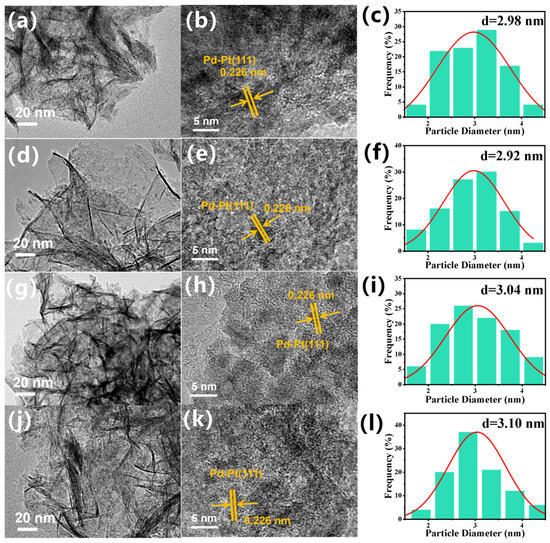
TEM characterization was used for a more in-depth microscopic study of the catalysts. Figure 1a,d,g,j shows the TEM images of four groups of catalysts attributed to the catalysts Pd1.7-Pt0.3/NiO, Pd1.7-Pt0.3/NiO-3FeOx, Pd1.7-Pt0.3/NiO-5FeOx, and Pd1.7-Pt0.3/NiO-10FeOx, respectively. It can be seen that the four groups of catalysts all exhibit nanosheet morphology with interlocking stacking structures. At the same time, all four catalysts exhibit dispersed metal particles, with little metal agglomeration to form large metal clusters. The diameters of the metal particles of the four groups of catalysts were measured using particle size calculation software (Nano Measurer 1.2). The average diameter of the metal particles of the Pd1.7-Pt0.3/NiO catalyst was 2.98 nm (Figure 1c), while the average particle diameters of the iron-doped catalysts were 2.92, 3.04, and 3.10 nm, respectively (Figure 1f,i,l). There was no significant difference in the average diameters of metal particles of the iron-doped catalysts compared to that of the pure nickel oxide catalyst. The lattice stripe spacing of the metal particles was measured using HR-TEM, and the results are shown in Figure 1b,e,h,k. This intermediate d-spacing provides evidence for the formation of Pd-Pt alloy nanoparticles, consistent with previous reports on Pd-Pt bimetallic systems [70,71]. Elemental mapping (Figure S5) confirms that Pd and Pt are uniformly dispersed in all catalysts with no significant aggregation, consistent with TEM results. For Fe-doped samples (Figure S5b–d), Fe is also homogeneously distributed throughout the NiO support.
Figure 1.
TEM, HR-TEM, and particle size distribution of different catalysts: (a–c) Pd1.7-Pt0.3/NiO, (d–f) Pd1.7-Pt0.3/NiO-3FeOx, (g–i) Pd1.7-Pt0.3/NiO-5FeOx, (j–l) Pd1.7-Pt0.3/NiO-10FeOx.
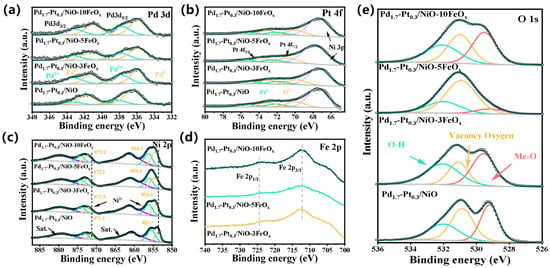
Figure 2 shows the XPS characterization profiles of different catalysts. As can be seen from Figure 2a,b, although Pd and Pt were loaded by chemical reduction, both metals exist in metallic and oxidized states after alloy formation. The peak located around 67.8 eV in the Pt 4f region (Figure 2b) is attributed to the Ni 3p orbital [72]. Figure 2c shows the XPS pattern of Ni 2p. The Ni2+ binding energies of the iron-doped catalysts shift toward higher values compared with the pure nickel oxide catalyst. For example, the Ni2+ peaks in the Ni 2p1/2 and Ni 2p3/2 orbitals of Pd1.7-Pt0.3/NiO-5FeOx are positively shifted by ~0.9 eV compared with those of Pd1.7-Pt0.3/NiO, respectively, which is probably due to the interaction between Ni and Fe in the supports [73]. In Figure 2d, the Fe 2p peaks are weak due to the low Fe content and overlap with the Ni LMM Auger peaks. Figure 2e shows the O 1s spectra for different catalysts, where peaks at 532.0 eV are attributed to adsorbed oxygen species, those at 530.9 eV are attributed to oxygen species associated with defect sites (Oβ) [74,75], and those at 529.4 eV are attributed to lattice oxygen species [76]. Pd1.7-Pt0.3/NiO-5FeOx has the highest proportion of Oβ species, which are favorable for the adsorption and activation of oxygen-containing compounds and may enhance surface acidity [77]. This may be one of the reasons for the excellent catalytic effect of Pd1.7-Pt0.3/NiO-5FeOx.
Figure 2.
XPS spectra of different catalysts: (a) Pd 3d, (b) Pt 4f, (c) Ni 2p, (d) Fe 2p and (e) O 1s spectra of Pd1.7-Pt0.3/NiO, Pd1.7-Pt0.3/NiO-3FeOx, Pd1.7-Pt0.3/NiO-5FeOx and Pd1.7-Pt0.3/NiO-10FeOx catalysts.
2.3. Performance for 2,6-Dimethoxy-4-methylphenol HDO over Pd1.7-Pt0.3/NiO-5FeOx Catalysts
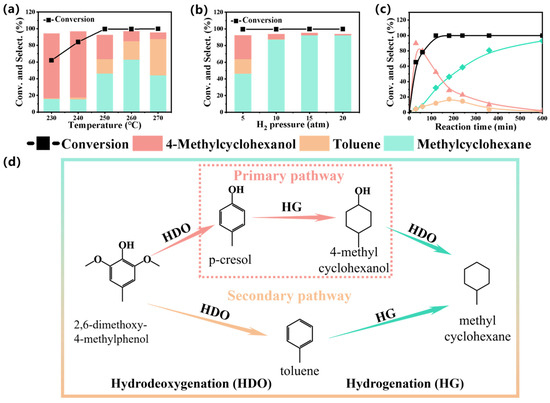
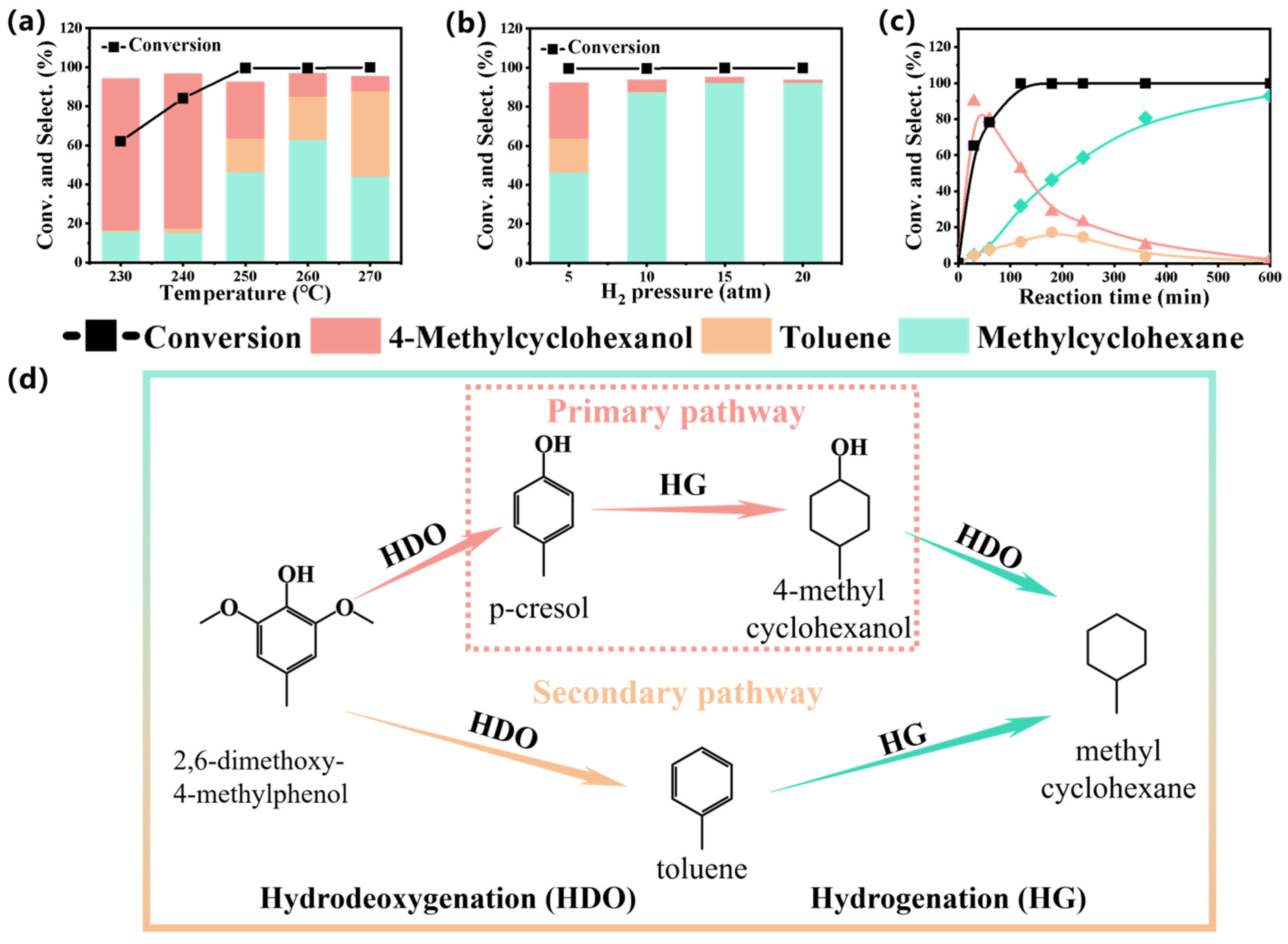
The Pd1.7-Pt0.3/NiO-5FeOx catalyst was examined under different reaction conditions. The effect of reaction temperature was first investigated. As shown in Figure 3a and Table S2, substrate conversion increased with increasing reaction temperature, achieving nearly complete conversion (>99%) at 250 °C. The selectivity toward methylcyclohexane increased with temperature up to 250 °C, but decreased when the temperature was further raised to 270 °C. This decrease may be attributed to thermodynamic limitations, as aromatic ring hydrogenation is highly exothermic and elevated temperatures shift the equilibrium toward dehydrogenation; additionally, catalyst sintering at higher temperatures may also contribute. Meanwhile, the selectivity of 4-methylcyclohexanol decreased as the temperature rose, which is consistent with thermodynamic equilibrium constraints on the exothermic hydrogenation of 4-methylcyclohexanol to methylcyclohexane—at moderate temperatures (230–250 °C), the conversion of 4-methylcyclohexanol to methylcyclohexane is thermodynamically and kinetically favorable.
Figure 3.
Conversion and selectivity of HDO reactions over the Pd1.7-Pt0.3/NiO-5FeOx catalyst at (a) different reaction temperatures, (b) different initial H2 pressures and (c) different reaction times. Reaction conditions: 30 mg Substrate, 20 mg catalyst, 12 mL n-tetradecane; (a) 5 atm H2, 3 h; (b) 250 °C, 3 h; (c) 5 atm H2, 250 °C; (d) potential reaction pathways for the conversion of 2,6-dimethoxy-4-methylphenol to methylcyclohexane.
The effect of hydrogen pressure was also examined (Figure 3b and Table S3). The selectivity toward methylcyclohexane increased with increasing H2 pressure, while the selectivities of 4-methylcyclohexanol and toluene decreased gradually. This indicates that higher hydrogen pressure thermodynamically and kinetically favors complete aromatic ring hydrogenation and subsequent deoxygenation. The time-course study (Figure 3c and Table S4) revealed that 4-methylcyclohexanol was the predominant product at the initial stage with a selectivity of 89.9%. Its selectivity continuously decreased over time, while the selectivity of methylcyclohexane steadily increased, indicating the sequential dehydroxylation of 4-methylcyclohexanol to methylcyclohexane. Notably, the selectivity of toluene first increased and then decreased as the reaction progressed. This observation suggests the existence of two parallel reaction pathways: (1) a major pathway involving aromatic ring hydrogenation followed by deoxygenation, and (2) a minor pathway involving direct deoxygenation to form toluene, which is subsequently hydrogenated to methylcyclohexane. Under these reaction conditions, the dominant pathway follows the sequence of aromatic ring hydrogenation first, followed by dehydroxylation.
From the perspective of product distribution, the conversion of 2,6-dimethoxy-4-methylphenol over Pd1.7-Pt0.3/NiO-5FeOx proceeds through two main reaction pathways (Figure 3d). In the primary pathway, 2,6-dimethoxy-4-methylphenol first loses its methoxy groups to give p-cresol which is an intended intermediate. From there, the aromatic ring gets hydrogenated, yielding 4-methylcyclohexanol. 4-Methylcyclohexanol progressively gave way to methylcyclohexane during the reaction. As for toluene, its selectivity peaked early and then declined, pointing to its role as an intermediate along the secondary pathway. The secondary pathway involves demethoxylation and dehydroxylation of 2,6-dimethoxy-4-methylphenol to generate toluene, which is subsequently hydrogenated to form methylcyclohexane. The time-course study revealed that 4-methylcyclohexanol was the predominant product at the initial stage of the reaction. As the reaction proceeded, 4-methylcyclohexanol gradually converted into methylcyclohexane, while toluene selectivity first increased and then decreased, indicating its role as an intermediate in the secondary pathway. These observations support that the primary reaction pathway follows the sequence of demethoxylation → aromatic ring hydrogenation → deoxygenation → hydrogenation.
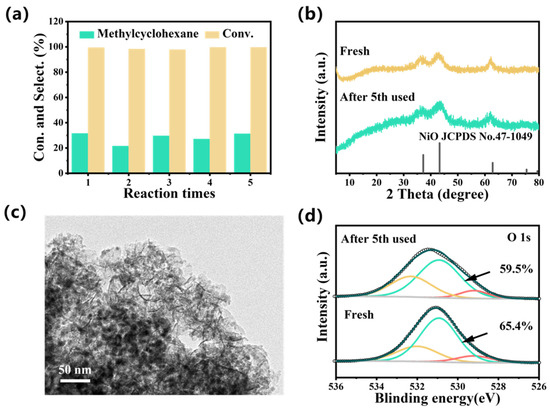
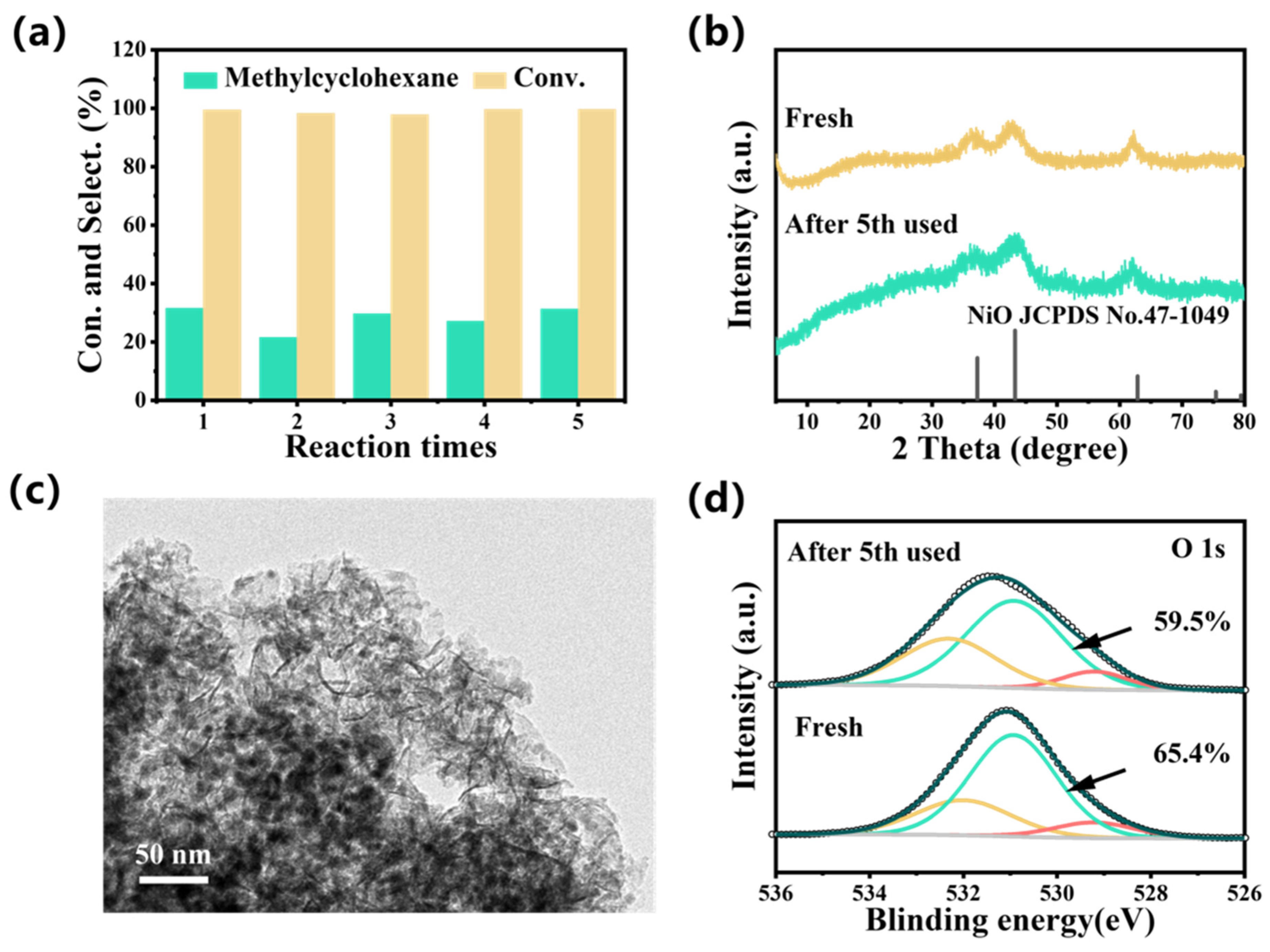
To evaluate the stability of the Pd1.7-Pt0.3/NiO-5FeOx catalyst, we conducted recycling tests over five consecutive reaction cycles (Figure 4a). In all five cycles, the conversion rate of 2,6-dimethoxy-4-methylphenol remained almost complete (about 100%), indicating excellent stability of the catalyst in substrate conversion. However, the selectivity of methylcyclohexane showed some fluctuations within five cycles, ranging from approximately 21.5% to 31.6%. In order to investigate the structural changes in the catalyst after recycling, we characterized the spent catalyst using XRD, TEM, and XPS. The XRD pattern (Figure 4b) shows that both fresh and recycled catalysts exhibit broad diffraction characteristics and low crystallinity. After five cycles, the characteristic peak corresponding to NiO (JCPDS number 47-1049) still remains, indicating that the overall support structure has been preserved. TEM analysis (Figure 4c) indicates that some aggregation of metal nanoparticles occurred after recycling, which may be due to the partial reduction in NiO support to metallic Ni in a hydrogen atmosphere. [78] The XPS characterization of the O 1s region (Figure 4d) shows that the proportion of oxygen vacancies decreased from 65.4% in the fresh catalyst to 59.5% after five cycles. The decrease in oxygen vacancy concentration, combined with the observed particle aggregation phenomenon, may be the reason for the fluctuation of product selectivity, as oxygen vacancies are important sites for the adsorption and activation of oxygen-containing reactants. [79] Future work will focus on improving the sintering resistance of this catalyst by optimizing the support structure and modulating the metal–support interaction to develop a more robust catalytic system for biomass HDO.
Figure 4.
(a) Reusability of Pd1.7-Pt0.3/NiO-5FeOx for 2,6-dimethoxy-4-methylphenol HDO. Reaction conditions: 150 mg substrate, 100 mg catalysts, 12 mL n-tetradecane, 5 atm H2, 250 °C and 2 h. (b) XRD spectra of the Pd1.7-Pt0.3/NiO-5FeOx catalyst before and after five catalytic cycles; (c) TEM image of Pd1.7-Pt0.3/NiO-5FeOx catalyst after five cycles. (d) XPS spectra of O 1s for fresh catalyst and after 5th use.
2.4. Mechanism Studies
In order to elucidate the reasons for the enhanced HDO activity of the catalyst after iron doping, we studied the reaction effects of three key intermediates: toluene, 4-methylcyclohexanol, and p-cresol (Table 4). Under the same reaction conditions (5 atm H2, 250 °C, 3 h), both catalysts achieved complete conversion (>99%) of all substrates. The most significant difference was observed in the reaction results of 4-methylcyclohexanol: the selectivity of Pd1.7-Pt0.3/NiO-5FeOx for methylcyclohexane was 84.0%, while the selectivity of Pd1.7-Pt0.3/NiO was only 50.2%. This 34% enhancement indicates that iron doping specifically promotes the dehydroxylation of saturated cyclic alcohols (Csp3-O cleavage). In contrast, the selectivity of the two catalysts for toluene hydrogenation was similar (93.7% vs. 95.8%), confirming that aromatic ring saturation is not significantly affected by iron doping. For p-cresol, which undergoes both ring saturation and dehydroxylation simultaneously, the iron-doped catalyst showed improved selectivity for both methylcyclohexane (47.2% vs. 26.2%) and toluene (26.0% vs. 6.3%), indicating that iron doping may also promote direct Caromatic-O cleavage, albeit to a lesser extent than Csp3-O cleavage.
Table 4.
The HDO activity of intermediates over Pd1.7-Pt0.3/NiO and Pd1.7-Pt0.3/NiO-5FeOx catalyst.
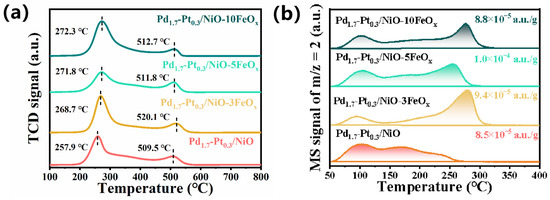
The reduction behavior and hydrogen activation performance of the catalyst were studied through H2-TPR and H2-TPD characterization. As shown in Figure 5a and Table S5, all four catalysts exhibited two distinct reduction peaks, located in the ranges of 257.9–272.3 °C and 509.5–520.1 °C, respectively. Among them, the reduction peak in the low-temperature region should be attributed to the reduction in Ni2+ to Ni0. The peak located near the high temperature may be attributed to the reduction in bulk NiO and NiO species that strongly interact with Fe doping [80]. Interestingly, the peak exhibits a non-monotonic trend: the 3FeOx sample shows the highest reduction temperature (520.1 °C), while the reduction temperatures of the 5FeOx and 10FeOx samples slightly decrease (511.8 °C and 512.7 °C, respectively). This phenomenon may be due to the strong Fe–O–Ni interaction formed by isolated iron ions at low Fe doping levels; however, a higher Fe loading may lead to the aggregation of iron species, thereby reducing the strength of the interaction [73].
Figure 5.
(a) H2-TPR and (b) H2-TPD spectras of Pd1.7-Pt0.3/NiO, Pd1.7-Pt0.3/NiO-3FeOx, Pd1.7-Pt0.3/NiO-5FeOx and Pd1.7-Pt0.3/NiO-10FeOx catalysts.
The hydrogen adsorption capacity of catalysts significantly affects the catalytic hydrogenation reaction. To investigate the hydrogen adsorption capacity of different catalysts, four groups of catalysts were characterized by H2-TPD-MS (Figure 5b). The characterization results shown in Figure 5b demonstrated that all four groups of catalysts showed weakly bound hydrogen desorption peaks at around 100 °C, which may be attributed to the alloy Pd-Pt sites. Compared to Pd1.7-Pt0.3/NiO, the Fe-doped catalysts all showed a new peak around 275–300 °C, which should be attributed to the desorption of hydrogen species due to the strong interaction with the support after Fe doping. The relative hydrogen desorption of the four groups of catalysts was calculated by peak integration. The hydrogen desorption values follow the order: Pd1.7-Pt0.3/NiO-5FeOx (1.0 × 10−4 a.u./g) > Pd1.7-Pt0.3/NiO-3FeOx (9.4 × 10−5 a.u./g) > Pd1.7-Pt0.3/NiO-10FeOx (8.8 × 10−5 a.u./g) > Pd1.7-Pt0.3/NiO (8.5 × 10⁻⁵ a.u./g), indicating that Pd1.7-Pt0.3/NiO-5FeOx exhibits the highest hydrogen activation capability. Moreover, the hydrogen desorption of Fe-doped catalysts is higher than that of the undoped Pd-Pt/NiO catalyst, suggesting that Fe doping enhances the hydrogen activation capability.
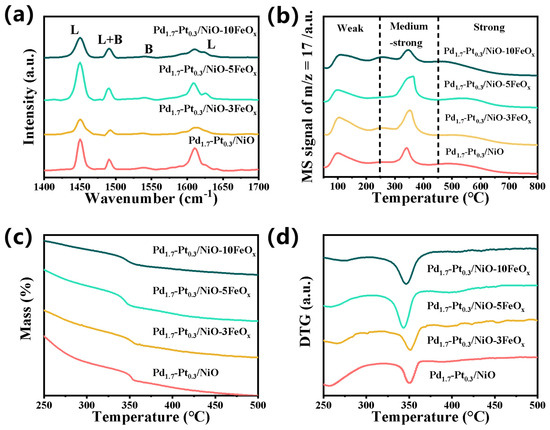
The acidity of the catalysts plays a critical role in determining their catalytic performance. Thus, the surface acidity of the catalysts was systematically investigated in this study. Py-IR and NH3-TPD-MS analyses revealed the acidic characteristics of the catalysts. From the Py-IR spectra in Figure 6a and Figure S6, all four catalysts exhibit similar peak patterns. The peaks at 1450 and 1610 cm−1 are attributed to Lewis acidic sites [81], while the peak at 1540 cm−1 is attributed to Brønsted acidic sites [82]. The peak at 1490 cm−1 corresponds to the combined absorption of both Lewis and Brønsted acidic sites. These results suggest that the catalysts are dominated by Lewis acidic sites, with a small number of Brønsted acidic sites also present. NH3-TPD-MS (Figure 6b) shows the NH3 desorption profiles (m/z = 17), further revealing the distribution of acidic sites. Compared to Pd1.7-Pt0.3/NiO, the Fe-doped catalysts all exhibited larger medium-strong acid desorption peaks, with Pd1.7-Pt0.3/NiO-5FeOx showing the largest peak, indicating the highest proportion of medium-strong acidic sites [83].
Figure 6.
(a) Py-IR patterns (desorption temperature: 300 °C) and (b) NH3-TPD patterns of Pd1.7-Pt0.3/NiO, Pd1.7-Pt0.3/NiO-3FeOx, Pd1.7-Pt0.3/NiO-5FeOx and Pd1.7-Pt0.3/NiO-10FeOx catalysts. (c) TG analysis and (d) DTG analysis for Methylcyclohexanol desorption over Pd1.7-Pt0.3/NiO, Pd1.7-Pt0.3/NiO-3FeOx, Pd1.7-Pt0.3/NiO-5FeOx and Pd1.7-Pt0.3/NiO-10FeOx catalysts.
As demonstrated in Table 4, Fe doping significantly enhanced the dehydroxylation of 4-methylcyclohexanol to methylcyclohexane (selectivity increased from 50.2% to 84.0%). The adsorption capacity of substrates on the surface of catalysts is a key factor affecting catalytic activity. The previous text confirmed that 4-methylcyclohexanol is the key intermediate in the hydrogenation dehydrogenation process of 2,6-dimethoxy-4-methylphenol to form methylcyclohexane. To investigate the adsorption behavior of 4-methylcyclohexanol on different catalysts, we pre-adsorbed 4-methylcyclohexanol on the catalyst and performed thermogravimetric (TG) and derivative thermogravimetric (DTG) analyses (Figure 6c,d). All four catalysts exhibited a significant weight loss peak at approximately 350 °C in the DTG curve. The desorption temperature is significantly higher than the boiling point of 4-methylcyclohexanol (about 174 °C), indicating strong chemisorption between the substrate and the catalyst surface, rather than simple physisorption. As shown in Table 5, the desorption mass of 4-methylcyclohexanol follows the order: Pd1.7-Pt0.3/NiO-5FeOx (0.061 g) > Pd1.7-Pt0.3/NiO-10FeOx (0.054 g) > Pd1.7-Pt0.3/NiO (0.046 g) > Pd1.7-Pt0.3/NiO-3FeOx (0.040 g). Among them, Pd1.7-Pt0.3/NiO-5FeOx exhibits the highest adsorption capacity (33% higher than the undoped catalyst). This can be attributed to its largest specific surface area (316.1 m2/g, Table 3) and enhanced surface–adsorbate interactions associated with Fe doping.
Table 5.
The loss of catalysts detected by TG at near 350 °C after methylcyclohexanol absorption.
In order to further investigate the adsorption behavior at the molecular level, we conducted density functional theory (DFT) calculations to study the adsorption energy (Eads) of 4-methylcyclohexanol on different catalyst surfaces (Figure S7). As shown in Figure S7a, the Eads values of 4-methylcyclohexanol on NiO and NiO-5FeOx supports are −1.13 eV and −1.65 eV, respectively, indicating that Fe doping enhances the adsorption strength of the substrate on the support by 46%. After loading Pd-Pt alloy, the adsorption effect is further enhanced: the Eads of Pd1.7-Pt0.3/NiO is −1.86 eV, while Pd1.7-Pt0.3/NiO-5FeOx exhibits the strongest adsorption energy, which is −3.33 eV. It is worth noting that compared to the undoped support (with a 65% increase in adsorption energy from −1.13 eV to −1.86 eV), the adsorption energy enhancement effect brought by the loaded alloy is more significant on the Fe doped support (with a 102% increase from −1.65 eV to −3.33 eV). This indicates that there is a synergistic interaction between the Fe doped support and Pd-Pt alloy nanoparticles, which jointly promotes the adsorption of the substrate. The optimized adsorption geometry configuration (Figure S7b) shows that on Pd1.7-Pt0.3/NiO-5FeOx, 4-methylcyclohexanol simultaneously interacts with alloy nanoparticles and support surfaces, which may explain its significantly enhanced adsorption energy. These DFT calculation results are in good agreement with TG/DTG analysis (Figure 6c,d), i.e., the highest amount of 4-methylcyclohexanol desorption (0.061 g) was observed on Pd1.7-Pt0.3/NiO-5FeOx. A stronger adsorption effect is beneficial for the activation of C-O bonds in 4-methylcyclohexanol, thereby promoting the dehydroxylation reaction and contributing to the highest selectivity of methylcyclohexane (84.0%, Table 4). These findings indicate that Fe doping alters the electronic structure of reducible NiO supports, which synergistically interacts with Pd-Pt alloys to form highly active sites favorable for adsorption and activation of 4-methylcyclohexanol.
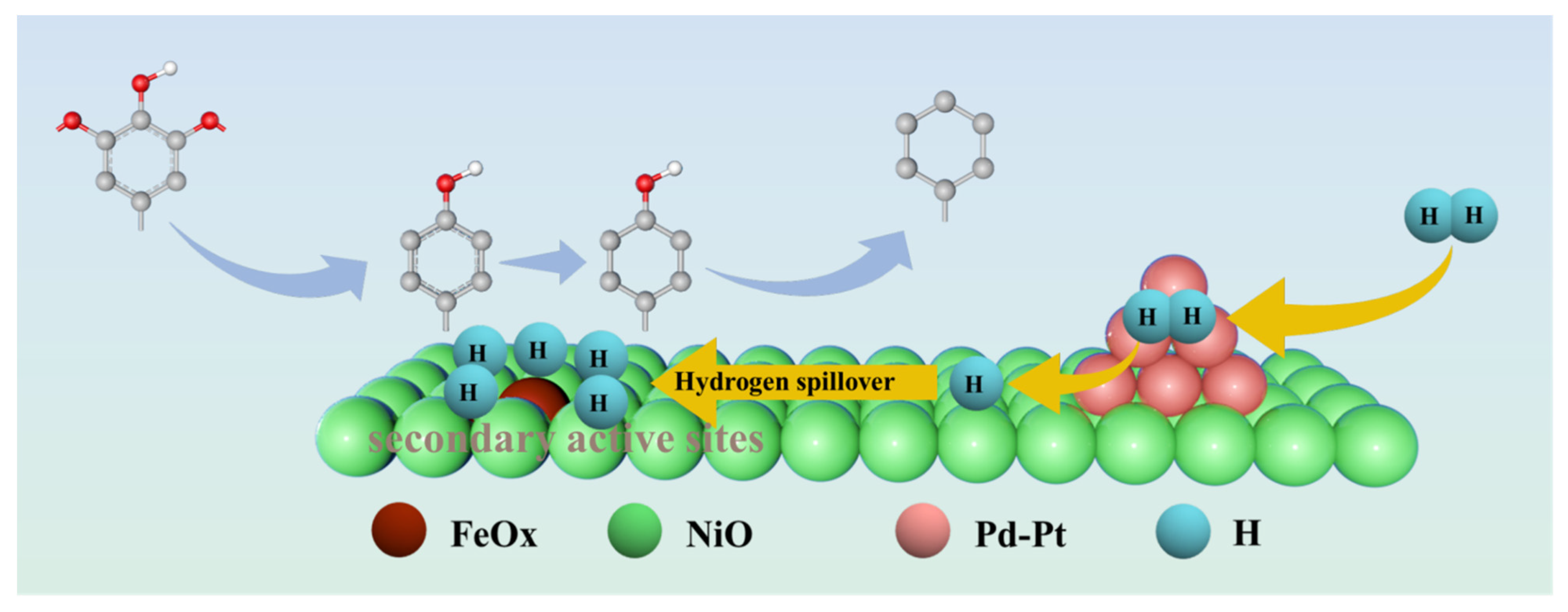
In this study, we also investigated the potential active sites of iron-doped supports in depth by mixing the catalysts with the supports to investigate their reactivity (Figure S8). As shown in Figure S8a, we first reacted 4-methylcyclohexanol by physically mixing Pd1.7-Pt0.3/NiO-5FeOx with a certain amount of NiO-5FeOx support. The results showed that the yield of methylcyclohexane increased from 12.7% (without the addition of support) to 24.0% after the addition of 0.01 g of support. The yield of methylcyclohexane further increased to 35.2% after continuing to add the support to 0.02 g. This indicates that there is some kind of active site on the NiO-5FeOx support, which is able to dehydroxylate 4-methylcyclohexanol to methylcyclohexane. However, it was hypothesized that the pure NiO-5FeOx support could not effectively catalyze the dehydroxylation of 4-methylcyclohexanol due to the absence of the loaded active metal. To verify this hypothesis, the catalytic activity of pure NiO-5FeOx support on 4-methylcyclohexanol was investigated by a control experiment. As shown in the red box of Figure S8a, the yield of methylcyclohexane for the reaction catalyzed by the pure NiO-5FeOx support was only 0.9%, indicating that the pure support barely catalyzes the reaction. This result indicates that in the mixed support experiment, after mixing the catalyst with the support, the active metal undergoes the hydrogen spillover effect, and the active hydrogen spills over through the metal to the surface of the support to produce the second active site, which enables 4-methylcyclohexanol to be activated and reacted at the second active site.
To elucidate whether the Fe species in the support is responsible for accepting spillover hydrogen, we conducted a control experiment by physically mixing pure NiO support with Pd1.7-Pt0.3/NiO-5FeOx. As shown in Figure S8b, in sharp contrast to the NiO-5FeOx mixing experiment, the yield of methylcyclohexane decreased from 12.7% to 8.3% after adding 0.01 g of NiO support and further decreased to 3.3% when 0.02 g was added. This negative effect contrasts sharply with the promoting effect observed when the NiO-5FeOx support was added (Figure S8a), where methylcyclohexane yield increased from 12.7% to 35.2% with 0.02 g NiO-5FeOx addition. The divergent behaviors suggest that pure NiO does not facilitate the dehydroxylation reaction; instead, it likely suppresses catalytic activity through competitive adsorption of reactants or intermediates on NiO surface sites, or by acting as a physical barrier that impedes hydrogen spillover pathways. In contrast, the presence of Fe dopants in NiO-5FeOx appears critical for creating secondary active sites capable of accepting spillover hydrogen.
Based on the above observation results and H2-TPD data (Figure 5b), we propose the following hydrogen spillover-mediated reaction mechanism (Scheme 1): (1) H2 molecules undergo dissociative activation on Pd-Pt alloy nanoparticles, generating active hydrogen species. (2) These activated hydrogen species migrate from the metal nanoparticles to the Fe-doped NiO support surface through hydrogen spillover. (3) Under H2 atmosphere, the high-valent iron species in the support may be reduced to low-valent iron species and/or form oxygen vacancies (as evidenced by the increased proportion of Oβ component in XPS O 1s spectrum, see Figure 2e), and these sites act as secondary active centers to promote the cleavage of C-O bonds in 4-methylcyclohexanol. (4) The generated methylcyclohexane desorbs from the catalyst surface, completing the catalytic cycle.
Scheme 1.
The following hydrogen spillover-mediated reaction mechanism of Pd1.7-Pt0.3/NiO-nFeOx catalysts.
Subsequently, Pd1.7-Pt0.3/NiO-5FeOx was applied to the HDO of real lignin bio-oil derived from enzymatic hydrolysis, and the results are shown in Figure S9. At a reaction temperature of 250 °C, the mass yields of cycloalkanes and cycloalkanols were 2.4% and 19.9%, respectively, indicating that the HDO of lignin-derived phenols remains inefficient at this temperature under low hydrogen pressure. When the reaction temperature was increased to 260 °C, the mass yields of cycloalkanes and cycloalkanols increased significantly to 15.7% and 77.8%, respectively, demonstrating that elevated temperature substantially promotes both the hydrogenation and dehydroxylation reactions. However, a considerable amount of cycloalkanols remained unconverted to cycloalkanes (Figure S10), suggesting that enhancing the dehydroxylation activity under mild hydrogen pressure remains a key challenge for practical lignin valorization.
3. Experimental Section
3.1. Chemicals
Nickel (II) nitrate hexahydrate (Ni(NO3)2·6H2O, 98%), iron (III) nitrate nonahydrate (Fe(NO3)3·9H2O, 98%), sodium nitrate (NaNO3, 98%), and sodium hydroxide (NaOH, 99%) were purchased from Guangdong Guanghua Sci-Tech Co., Ltd. (Shantou, China). Sodium borohydride (NaBH4, AR) was purchased from Tianjin Kermel Chemical Reagent Co., Ltd. (Tianjin, China). Sodium tetrachloropalladate (II) (Na2PdCl4, 98%) was purchased from Shanghai Haohong scientific Co., Ltd. (Shanghai, China). Sodium hexachloroplatinate (IV) (Na2PtCl6, 99%), 2,6-Dimethoxy-4-methylphenol (C9H12O3, 98%), p-Cresol (C7H8O, 98%), 4-Methylcyclohexanol (C7H14O, 99%), Toluene (C7H8, 98%), n-tetradecane (C14H30, 98%), n-hexane (C6H14, 96%), and n-hexadecane (C16H34, 98%) were obtained from Shanghai Macklin Biochemical Co., Ltd. (Shanghai, China).
3.2. Catalyst Preparation
The nickel–iron oxide supports NiO-nFeOx were prepared by doping the Ni(NO3)2·6H2O with different molar percent amounts of iron salt (Fe(NO3)3·9H2O). n refers to the doping percent of the iron element, n = mol (Fe)/(mol (Fe) + mol (Ni)). The doping amounts of 0 mol%, 3 mol%, 5 mol%, 10 mol%, respectively, correspond to the oxides NiO, NiO-3FeOx, NiO-5FeOx, NiO-10FeOx.
The synthesis of NiO-5FeOx is detailed here as a representative example as follows (Scheme S1): 6.72 g of Ni(NO3)2·6H2O, 1.5 g of NaNO3, and 0.49 g of Fe(NO3)3·9H2O were weighed and added to a three-necked flask containing 200 mL of deionized water at room temperature. The flask was stirred continuously under nitrogen for more than 10 min; 3.78 g of NaBH4 and 0.42 g of NaOH were dissolved in a beaker containing 80 mL of deionized water while waiting for the stirring process; a peristaltic pump was used to add the configured sodium borohydride solution to the three-necked flask at a dropping rate of 1.6 mL/min, and the rotational speed was increased to 800 rpm. Timing began upon the addition of the first drop of NaBH4 solution. After 2 h of reduction reaction, the nitrogen was turned off and the speed was adjusted to 250 rpm for the stirring head and the three-necked flask was left open to allow the solid suspension to oxidize in air for 24 h. After full oxidation, a yellowish-green solid suspension was obtained, which was filtered and washed three times with water and three times with ethanol, and then dried under vacuum at <50 °C (Figure S1). The powder was dried completely and then ground in a mortar and pestle for 20 min. The powder was then calcined at 400 °C under air atmosphere and kept for 4 h to obtain the support powder.
0.5 g of the prepared supports were dispersed in 20 mL of deionized water, then 0.0226 g Na2PdCl4 and 0.0047 g Na2PtCl6 were added, stirred for 6 h, and then 3.39 mg/mL of NaBH4 was added dropwise and stirred for 60 min, then filtered through a sintered glass funnel and washed three times with water and ethanol, respectively, and then placed in a vacuum oven for drying.
3.3. Catalytic Performance
The HDO catalytic performance of catalysts were tested in a 50 mL stainless steel high-pressure reactor. In a typical HDO experiment of model compounds, 30 mg 2,6-Dimethoxy-4-methylphenol, 20 mg catalyst, and 12 mL n-tetradecane were added to the autoclave reactor. After purging three times with N2, 5 atm hydrogen was fed into the reactor. And then the reaction temperature in the reactor was set up and kept stirring mechanically at 400 rpm.
Enzymatic lignin was first catalytically reduced using a Ru/C catalyst in methanol to obtain lignin oil. Subsequently, the phenolic compounds in the lignin oil were purified by Soxhlet extraction with n-hexane. The exact details of the procedures, including equipment specifications and operational conditions, are elaborated in Supplementary Information. For the HDO reaction of lignin oil, 6 mL of lignin oil, 50 mg of catalyst, and 12 mL n-tetradecane were added to the reactor. The other steps were the same as those for the model compounds.
After reaction, the reaction products were quantified by gas chromatography (GC-2030, Shimadzu, Kyoto, Japan) with HP-5 capillary column (30 m × 0.25 mm × 0.25 μm). The oven temperature program started at 50 °C (held for 1 min). The temperature was raised to 120 °C (10 °C/min, and held for 1 min), then to 220 °C (10 °C/min). The product of Bio-oil was detected by a program started at 50 °C (held for 1 min). The temperature was raised to 120 °C (10 °C/min, and held for 1 min), then to 275 °C (10 °C/min and held for 5 min).
The conversion, product selectivity and product yield for HDO were calculated as follows:
4. Conclusions
In this study, a Pd-Pt alloy catalyst supported on Fe-doped NiO nanosheets (Pd1.7-Pt0.3/NiO-5FeOx) was developed for hydrodeoxygenation (HDO) of lignin-derived phenolic compounds to cycloalkanes under mild conditions. This catalyst has good catalytic activity and selectivity, achieving 99.9% conversion of 2,6-dimethoxy-4-methylphenol with 93.0% selectivity towards methylcyclohexane at 250 °C, 5 atm H2, 10 h. Through systematic characterization and comparative experiments, it was found that the unique electronic structure of Pd-Pt alloy promotes hydrogen activation and directional migration, while the NiO-5FeOx support acts as a secondary active site for accepting spillover hydrogen and promoting C-O bond cleavage, and the two complement each other. The addition of FeOx increased the content of Oβ, enhanced the hydrogen spillover effect, and also improved the acidity distribution of the catalyst. These modifications result in better adsorption of 4-methylcyclohexanol (the intermediate and rate limiting step of this reaction), thereby promoting its dehydroxylation to methylcyclohexane through spillover hydrogen. The catalyst has good recyclability, and the conversion rate remains almost unchanged after five consecutive cycles. However, due to factors such as partial metal aggregation and oxygen vacancy loss, the selectivity of methylcyclohexane fluctuates. When the catalyst was used to treat actual lignin derived bio-oil at 260 °C, a yield of 77.8% of cycloalkanols and 15.7% of cycloalkanes were obtained, indicating its potential for biomass resource utilization. Efficient utilization of hydrogen gas at a mild pressure of 5 atmospheres provides a new pathway for clean production of lignin-based cycloalkanes. Future work will focus on improving the stability and dehydroxylation activity of catalysts, in order to achieve better yields of cycloalkanes in actual lignin raw materials.
Supplementary Materials
The following supporting information can be downloaded at: https://www.mdpi.com/article/10.3390/catal16040330/s1.
Author Contributions
C.C.: writing—original draft, validation, investigation, data curation, conceptualization. H.C.: data curation. L.L.: data curation. R.L.: data curation. H.H.: data curation. C.W.: writing—review and editing. Y.G.: writing—review and editing. B.C.: writing—review and editing, visualization, supervision, methodology, funding acquisition, data curation, conceptualization. Z.L.: writing—review and editing. All authors have read and agreed to the published version of the manuscript.
Funding
This work was supported by the Guangxi Natural Science Foundation of China (No. 2025GXNSFBA069175), the National Natural Science Foundation of China (No. 22468005, No. 22266006, and No. 21978057), the Guangxi Key Laboratory of Petrochemical Resource Processing and Process Intensification Technology (No. 2024Z004), China Guangxi 100-Talent Program, the Guangxi Autonomous Region Young Talent Funding Research Project (No. ZX2020800424002). Bo Chen acknowledges the financial support from Program for Introducing High-Level Talents of Guangxi University.
Data Availability Statement
Data will be made available on request.
Conflicts of Interest
The authors declare that they have no known competing financial interests or personal relationships that could have appeared to influence the work reported in this paper.
References
- Sulis, D.B.; Lavoine, N.; Sederoff, H.; Jiang, X.; Marques, B.M.; Lan, K.; Cofre-Vega, C.; Barrangou, R.; Wang, J.P. Advances in lignocellulosic feedstocks for bioenergy and bioproducts. Nat. Commun. 2025, 16, 1244. [Google Scholar] [CrossRef] [Scilit]
- Park, J.; Cahyadi, H.S.; Mushtaq, U.; Verma, D.; Han, D.; Nam, K.-W.; Kwak, S.K.; Kim, J. Highly Efficient Reductive Catalytic Fractionation of Lignocellulosic Biomass over Extremely Low-Loaded Pd Catalysts. ACS Catal. 2020, 10, 12487–12506. [Google Scholar] [CrossRef] [Scilit]
- Mqoni, N.; Bahadur, I.; Singh, S.; Meng, X.; Ragauskas, A. Deep Eutectic Solvents for Pretreatment of Lignocellulose Biomass: Physical Properties, Solubility Mechanisms, and Their Interactions. Chem. Rev. 2026, 126, 1206–1257. [Google Scholar] [CrossRef] [Scilit]
- Wang, N.; Liu, B.; Liao, Z.; Liu, Q.; Lin, X.; Qiu, X. Structurally Confined Ni with Oxygen-Deficient CeO2 for Efficient Self-Transfer Hydrogenolysis of Lignin into Jet Fuel Precursors. Small 2025, 21, e08631. [Google Scholar] [CrossRef] [Scilit] [PubMed]
- Li, N.; Yan, K.; Rukkijakan, T.; Liang, J.; Liu, Y.; Wang, Z.; Nie, H.; Muangmeesri, S.; Castiella-Ona, G.; Pan, X.; et al. Selective lignin arylation for biomass fractionation and benign bisphenols. Nature 2024, 630, 381–386. [Google Scholar] [CrossRef] [Scilit]
- Chen, M.; Dai, W.; Wang, Y.; Tang, Z.; Li, H.; Li, C.; Yang, Z.; Wang, J. Selective catalytic depolymerization of lignin to guaiacols over Mo-Mn/sepiolite in supercritical ethanol. Fuel 2023, 333, 126365. [Google Scholar] [CrossRef] [Scilit]
- Jia, Z.; Hu, J.; Lu, P.; Sun, Y.; Wang, Y. Enhanced lignin-first valorization of biomass for producing monophenols over Ru/C cooperated with H2WO4. Fuel 2023, 349, 128735. [Google Scholar] [CrossRef] [Scilit]
- Ibarra, Á.; Rodríguez, E.; Sedran, U.; Arandes, J.M.; Bilbao, J. Synergy in the Cracking of a Blend of Bio-oil and Vacuum Gasoil under Fluid Catalytic Cracking Conditions. Ind. Eng. Chem. Res. 2016, 55, 1872–1880. [Google Scholar] [CrossRef] [Scilit]
- Cheng, S.; Meng, M.; Xing, B.; Shi, C.; Nie, Y.; Xia, D.; Yi, G.; Zhang, C.; Xia, H. Preparation of valuable pyrolysis products from poplar waste under different temperatures by pyrolysis: Evaluation of pyrolysis products. Bioresour. Technol. 2022, 364, 128011. [Google Scholar] [CrossRef] [Scilit] [PubMed]
- Wang, Z.; Chen, X.; Sun, Y.; Hua, D.; Yang, S.; Sun, L.; Li, T.; Chen, L. Co-pyrolysis induced strong metal-support interaction in N-doped carbon supported Ni catalyst for the hydrogenolysis of lignin. Chem. Eng. J. 2023, 473, 145182. [Google Scholar] [CrossRef] [Scilit]
- Ádám, A.A.; Nagy, S.B.; Kukovecz, Á.; Kónya, Z.; Sipos, P.; Varga, G. Nickel-based perovskite-catalysed direct phenol-to-aniline liquid-phase transformations. Chem. Commun. 2024, 60, 10520–10523. [Google Scholar] [CrossRef] [Scilit] [PubMed]
- Jiang, S.; Shu, R.; Wang, A.; Deng, Z.; Xiao, Y.; Li, J.; Meng, Q.; Zhang, Q. Efficient hydrodeoxygenation of lignin-derived phenolic compounds under acid-free conditions over carbon-supported NiMo catalysts. Green Chem. 2024, 26, 9330–9345. [Google Scholar] [CrossRef] [Scilit]
- Kong, X.; Liu, Z.; Zou, Y.; Wang, C.; Xu, C.; Wang, X. Preparation and optimization of dendritic Ni/Y-silica composite catalysts for naphthalene hydrocracking to BTX. J. Catal. 2025, 450, 116331. [Google Scholar] [CrossRef] [Scilit]
- Gao, Z.; Zhou, Z.; Wang, M.; Shang, N.; Gao, W.; Cheng, X.; Gao, S.; Gao, Y.; Wang, C. Highly dispersed Pd anchored on heteropolyacid modified ZrO2 for high efficient hydrodeoxygenation of lignin-derivatives. Fuel 2023, 334, 126768. [Google Scholar] [CrossRef] [Scilit]
- Valizadeh, S.; Valizadeh, B.; Lee, J.; Park, Y.K. Catalytic Guaiacol Hydrodeoxygenation in Supercritical Fluids: A Review. ChemCatChem 2025, 17, e202401390. [Google Scholar] [CrossRef] [Scilit]
- Lonchay, W.; Bagnato, G.; Sanna, A. Highly selective hydropyrolysis of lignin waste to benzene, toluene and xylene in presence of zirconia supported iron catalyst. Bioresour. Technol. 2022, 361, 127727. [Google Scholar] [CrossRef] [Scilit]
- Ju, C.; Li, M.; Fang, Y.; Tan, T. Efficient hydro-deoxygenation of lignin derived phenolic compounds over bifunctional catalysts with optimized acid/metal interactions. Green Chem. 2018, 20, 4492–4499. [Google Scholar] [CrossRef] [Scilit]
- Li, L.; Huang, Z.; Shu, F.; Gao, Y.; Long, J. Hydrodeoxygenation of heavy lignin bio-oil to oxygenated fuel catalyzed by CuxNiy/MgO. Fuel 2024, 357, 129805. [Google Scholar] [CrossRef] [Scilit]
- Bjelić, A.; Grilc, M.; Huš, M.; Likozar, B. Hydrogenation and hydrodeoxygenation of aromatic lignin monomers over Cu/C, Ni/C, Pd/C, Pt/C, Rh/C and Ru/C catalysts: Mechanisms, reaction micro-kinetic modelling and quantitative structure-activity relationships. Chem. Eng. J. 2019, 359, 305–320. [Google Scholar] [CrossRef] [Scilit]
- Liang, X.; Jin, X.; Yu, S.; Li, C.; Song, C.; Sheng, G.; Ye, X.; Gao, R.; Lin, L.; Ma, D. CO-resistant hydrogenation over noble metal/α-MoC catalyst. Nat. Commun. 2025, 16, 4159. [Google Scholar] [CrossRef] [Scilit] [PubMed]
- Liang, Y.; Douthwaite, M.; Huang, X.; Zhao, B.; Tang, Q.; Liu, L.; Dong, J. Zero-oxidation state precursor assisted fabrication of highly dispersed and stable Pt catalyst for chemoselective hydrogenation of α,β-unsaturated aldehydes. Nano Res. 2022, 16, 6085–6093. [Google Scholar] [CrossRef] [Scilit]
- Hu, Q.; Qian, S.; Wang, Y.; Zhao, J.; Jiang, M.; Sun, M.; Huang, H.; Gan, T.; Ma, J.; Zhang, J.; et al. Polyethylene hydrogenolysis by dilute RuPt alloy to achieve H2-pressure-independent low methane selectivity. Nat. Commun. 2024, 15, 10573. [Google Scholar] [CrossRef] [Scilit]
- Liu, H.; Liu, C.; Zong, X.; Wang, Y.; Hu, Z.; Zhang, Z. Role of the Support Effects in Single-Atom Catalysts. Chem.—Asian J. 2023, 18, e202201161. [Google Scholar] [CrossRef] [Scilit] [PubMed]
- Hunns, J.A.; Durndell, L.J.; Zhang, X.; Konarova, M.; Lee, A.F.; Wilson, K. Tuning Acid-Metal Synergy in m-Cresol Hydrodeoxygenation over Bifunctional Pt/Aluminosilicate Catalysts. ACS Catal. 2024, 14, 7052–7061. [Google Scholar] [CrossRef] [Scilit]
- Pan, Y.; Zhang, X.; Sun, G.; Li, Y.; Liu, B. Single-Atom-Alloy Catalysts for Enhanced Hydrogenation Reaction Process: Mechanism, Regulation Strategy, and Design Principle. ACS Catal. 2025, 15, 3674–3698. [Google Scholar] [CrossRef] [Scilit]
- Kong, L.; Liu, C.; Gao, J.; Wang, Y.; Dai, L. Efficient and controllable alcoholysis of Kraft lignin catalyzed by porous zeolite-supported nickel-copper catalyst. Bioresour. Technol. 2019, 276, 310–317. [Google Scholar] [CrossRef] [Scilit] [PubMed]
- Jiang, W.; Cao, J.-P.; Zhu, C.; Zhao, M.; Ni, Z.-H.; Zhao, X.-Y.; Xie, J.-X.; Zhao, L.; Zhao, Y.-P.; Bai, H.-C. Catalytic hydrogenation of aromatic ring over ruthenium nanoparticles supported on α-Al2O3 at room temperature. Appl. Catal. B Environ. Energy 2022, 307, 121137. [Google Scholar] [CrossRef] [Scilit]
- Li, S.; Luo, X.; Wang, Y.; Wang, C.; Zhang, G.; Xiang, H.; Yan, Y.; Ke, X.; Lu, Y.; Yao, C.; et al. Strong Oxide-Support Interaction Induced Thermal Stabilization of Pt Single Atoms for Durable Catalytic CO Oxidation. Angew. Chem. Int. Ed. 2025, 64, e202504551. [Google Scholar] [CrossRef] [Scilit]
- Dong, C.; Li, R.; Qu, Z.; Fan, Y.; Wang, J.; Du, X.; Liu, C.; Feng, X.; Ning, Y.; Mu, R.; et al. Oxide Support Inert in Its Interaction with Metal but Active in Its Interaction with Oxide and Vice Versa. J. Am. Chem. Soc. 2025, 147, 13210–13219. [Google Scholar] [CrossRef] [Scilit]
- Insyani, R.; Kim, M.-K.; Choi, J.-W.; Yoo, C.-J.; Jin Suh, D.; Lee, H.; Soo Kim, C.; Ho Kim, K.; Kim, K.; Ha, J.-M. Selective hydrodeoxygenation of biomass pyrolysis oil and lignin-derived oxygenates to cyclic alcohols using the bimetallic NiFe core-shell supported on TiO2. Chem. Eng. J. 2022, 446, 136578. [Google Scholar] [CrossRef] [Scilit]
- Xu, M.; Peng, M.; Tang, H.; Zhou, W.; Qiao, B.; Ma, D. Renaissance of Strong Metal–Support Interactions. J. Am. Chem. Soc. 2024, 146, 2290–2307. [Google Scholar] [CrossRef] [Scilit]
- Pu, T.; Zhang, W.; Zhu, M. Engineering Heterogeneous Catalysis with Strong Metal–Support Interactions: Characterization, Theory and Manipulation. Angew. Chem. Int. Ed. 2022, 62, e202212278. [Google Scholar] [CrossRef] [Scilit]
- Luo, Z.; Zhao, G.; Pan, H.; Sun, W. Strong Metal–Support Interaction in Heterogeneous Catalysts. Adv. Energy Mater. 2022, 12, 2201395. [Google Scholar] [CrossRef] [Scilit]
- Zhang, L.; Zhang, Z.; Li, S.; Li, J.; He, X.; Yan, W.; Xu, H. Support engineering drives the CO2 electro-reduction performance of single-atom catalysts: Structure-activity relationships and strategic regulation. Chem. Eng. J. 2025, 526, 170966. [Google Scholar] [CrossRef] [Scilit]
- Yang, Z.; Zhang, J.; Tan, X.; Zhu, H.; Xu, L.; Wu, X.; Xu, Z.; Guo, J.; Jia, D.; Chen, C. Manipulating the Coordination Environment of Cu Single Atoms via Regulating ZrO2 Support Crystal Phases for Enhanced CO2 Electroreduction. J. Am. Chem. Soc. 2025, 147, 35985–35994. [Google Scholar] [CrossRef] [Scilit]
- Aunkon, R.H.; Choi, H.; Shimogawa, R.; Wang, H.; Zhang, L.; Reece, C.; Li, Y.; Kim, H.Y.; Frenkel, A.I. Low-Temperature Catalyst Redispersion: A Route to Enhanced Stability of Supported Metal Catalysts? ACS Catal. 2025, 15, 19709–19720. [Google Scholar] [CrossRef] [Scilit]
- Tan, M.; Yang, Y.; Yang, Y.; Chen, J.; Zhang, Z.; Fu, G.; Lin, J.; Wan, S.; Wang, S.; Wang, Y. Hydrogen spillover assisted by oxygenate molecules over nonreducible oxides. Nat. Commun. 2022, 13, 1457. [Google Scholar] [CrossRef] [Scilit]
- Wang, N.L.; Li, T.H.; Wang, X.; Kong, X.L.; Xie, W.H.; Xu, L.; He, Y.R.; Zhang, P.F.; Luo, Z.H. Spillover Hydrogen Boosts Nitroarene Hydrogenation to Industrial Activity with Ppm-Level Platinum Single Atoms. Angew. Chem. Int. Ed. 2025, 64, e202514332. [Google Scholar] [CrossRef] [Scilit] [PubMed]
- Ni, W.; Ran, H.; Wang, R.; Liu, Y.; Zhou, P.; Guo, T.; Shan, J.; Lai, Z.; Liu, B.; Liang, S.-J.; et al. Stepwise hydrogen spillover–engineered synergistic sites enable near-quantitative conversion of waste PET to p-xylene. Nat. Commun. 2026, 17, 2128. [Google Scholar] [CrossRef] [Scilit] [PubMed]
- Karim, W.; Spreafico, C.; Kleibert, A.; Gobrecht, J.; VandeVondele, J.; Ekinci, Y.; van Bokhoven, J.A. Catalyst support effects on hydrogen spillover. Nature 2017, 541, 68–71. [Google Scholar] [CrossRef] [Scilit]
- Jiang, B.; Zhang, Y.; Wang, H.; Liu, K.; Jiang, N.; Li, J.; Song, H.; Chen, Y. Enhanced Hydrodeoxygenation performance through novel Al-Doped radial channel Silica-Supported Carbon-Encapsulated nickel catalysts. Chem. Eng. J. 2024, 495, 153118. [Google Scholar] [CrossRef] [Scilit]
- Song, L.; Liu, G.; Jiang, X.; Qu, Z. Tuning the Electronic Metal–Support Interaction in Cu/ZnAl2O4 Spinel via La Modification for Efficient CO2 Hydrogenation to Methanol. ACS Catal. 2025, 15, 11243–11256. [Google Scholar] [CrossRef] [Scilit]
- Kim, J.; Guo, J.; Shan, N.; Yoo, J.; Farinazzo Bergamo Dias Martins, P.; Noh, J.; Jung, M.; Zapol, P.; Mun, B.S.; Klie, R.; et al. Deciphering Catalyst–Support Interaction via Doping for Highly Active and Durable Oxygen Evolution Catalysis. J. Am. Chem. Soc. 2025, 147, 16340–16349. [Google Scholar] [CrossRef] [Scilit] [PubMed]
- Li, L.; Feng, C.; Meng, X.; Chae, S.R.; Li, X.; Cui, T.; Guo, L.; Wang, C.; Guo, H. In-situ anchored catalysts for efficient gas-phase formic acid dehydrogenation: Enhanced activity via metal-support interactions between Ni3P and g-C3N4. Appl. Catal. B Environ. Energy 2026, 382, 125993. [Google Scholar] [CrossRef] [Scilit]
- Zhang, Y.; Fan, G.; Yang, L.; Zheng, L.; Li, F. Cooperative Effects between Ni-Mo Alloy Sites and Defective Structures over Hierarchical Ni-Mo Bimetallic Catalysts Enable the Enhanced Hydrodeoxygenation Activity. ACS Sustain. Chem. Eng. 2021, 9, 11604–11615. [Google Scholar] [CrossRef] [Scilit]
- Yang, J.; Li, S.; Zhang, L.; Liu, X.; Wang, J.; Pan, X.; Li, N.; Wang, A.; Cong, Y.; Wang, X.; et al. Hydrodeoxygenation of furans over Pd-FeOx/SiO2 catalyst under atmospheric pressure. Appl. Catal. B Environ. 2017, 201, 266–277. [Google Scholar] [CrossRef] [Scilit]
- Xu, Y.; Wang, W.; Liu, B.; Pan, Y.; Dong, B.; Li, Y.; Li, Y.; Guo, H.; Chai, Y.; Liu, C. The role of Nb2O5 in controlling metal-acid sites of CoMoS/γ-Al2O3 catalyst for the enhanced hydrodeoxygenation of guaiacol into hydrocarbons. J. Catal. 2022, 407, 19–28. [Google Scholar] [CrossRef] [Scilit]
- Strapasson, G.B.; Arjona, A.S.; McPeak, J.E.; Aalling-Frederiksen, O.; Sapnik, A.F.; Baun, N.L.; Bordallo, H.N.; Rodella, C.B.; Zanchet, D.; Jensen, K.M.Ø. Oxygen Vacancy-Induced Phase Transformations of Iron-Doped Titanium Oxide Nanostructures. ACS Nano 2025, 19, 30986–30999. [Google Scholar] [CrossRef] [Scilit]
- Tao, X.; Hou, L.; Wang, X.; Jin, J.; Li, H.; Gao, F. Iron and oxygen vacancies co-modulated adsorption evolution and lattice oxygen dual-path mechanism for water oxidation. Nat. Commun. 2025, 16, 8788. [Google Scholar] [CrossRef] [Scilit]
- Du, L.; Sun, J.; Zhang, Y.; Wang, Y.; Liu, Z.; Yao, M.; Wang, Q.; Tang, Y.; Zhang, Y. Enhancing Catalysis and Sieving Polysulfides by Oxygen Vacancy-Rich Separator Modifier for High-Performance Li-S Batteries. Adv. Mater. 2025, 37, e08523. [Google Scholar] [CrossRef] [Scilit]
- Li, L.; Dong, L.; Liu, X.; Guo, Y.; Wang, Y. Selective production of ethylbenzene from lignin oil over FeOx modified Ru/Nb2O5 catalyst. Appl. Catal. B Environ. 2020, 260, 118143. [Google Scholar] [CrossRef] [Scilit]
- Chen, H.; Chen, B.; Wei, X.; Liu, L.; Jin, X.; Huang, H.; Wang, C.; Ge, Y.; Li, Z. Pd-Pt alloy/NiO nanosheets as synergistic catalysts for efficient hydrodeoxygenation of lignin-derived phenolics to cyclic alkanes under near-ambient H2 pressure. Int. J. Hydrogen Energy 2025, 137, 526–537. [Google Scholar] [CrossRef] [Scilit]
- Sun, L.; Xiao, X.; Wang, X.; Xie, L.; Liu, S.; Zhou, Y.; Ruan, W. Efficient conversion of waste cooking oil over Ru-Fe species supported on high acid density Nb-SAPO-11: Unveiling the electronic tuning effect of Fe on Ru. Appl. Catal. B Environ. Energy 2025, 371, 125258. [Google Scholar] [CrossRef] [Scilit]
- Huang, L.; Tang, F.; Liu, P.; Xiong, W.; Jia, S.; Hao, F.; Lv, Y.; Luo, H. Highly efficient and selective conversion of guaiacol to cyclohexanol over Ni-Fe/MgAlOx: Understanding the synergistic effect between Ni-Fe alloy and basic sites. Fuel 2022, 327, 125115. [Google Scholar] [CrossRef] [Scilit]
- Chen, S.; Wang, W.; Li, X.; Yan, P.; Han, W.; Sheng, T.; Deng, T.; Zhu, W.; Wang, H. Regulating the nanoscale intimacy of metal and acidic sites in Ru/γ-Al2O3 for the selective conversions of lignin-derived phenols to jet fuels. J. Energy Chem. 2022, 66, 576–586. [Google Scholar] [CrossRef] [Scilit]
- Zhang, X.; Tang, W.; Zhang, Q.; Wang, T.; Ma, L. Hydrodeoxygenation of lignin-derived phenoic compounds to hydrocarbon fuel over supported Ni-based catalysts. Appl. Energy 2018, 227, 73–79. [Google Scholar] [CrossRef] [Scilit]
- Zhang, C.; Jia, C.; Cao, Y.; Yao, Y.; Xie, S.; Zhang, S.; Lin, H. Water-assisted selective hydrodeoxygenation of phenol to benzene over the Ru composite catalyst in the biphasic process. Green Chem. 2019, 21, 1668–1679. [Google Scholar] [CrossRef] [Scilit]
- Shu, R.; Li, R.; Lin, B.; Luo, B.; Tian, Z. High dispersed Ru/SiO2-ZrO2 catalyst prepared by polyol reduction method and its catalytic applications in the hydrodeoxygenation of phenolic compounds and pyrolysis lignin-oil. Fuel 2020, 265, 116962. [Google Scholar] [CrossRef] [Scilit]
- Chen, Q.; Cai, C.; Zhang, X.; Zhang, Q.; Chen, L.; Li, Y.; Wang, C.; Ma, L. Amorphous FeNi–ZrO2-Catalyzed Hydrodeoxygenation of Lignin-Derived Phenolic Compounds to Naphthenic Fuel. ACS Sustain. Chem. Eng. 2020, 8, 9335–9345. [Google Scholar] [CrossRef] [Scilit]
- Yan, P.; Mensah, J.; Drewery, M.; Kennedy, E.; Maschmeyer, T.; Stockenhuber, M. Role of metal support during ru-catalysed hydrodeoxygenation of biocrude oil. Appl. Catal. B Environ. 2021, 281, 119470. [Google Scholar] [CrossRef] [Scilit]
- Chen, G.; Liu, J.; Li, X.; Zhang, J.; Yin, H.; Su, Z. Investigation on catalytic hydrodeoxygenation of eugenol blend with light fraction in bio-oil over Ni-based catalysts. Renew. Energy 2020, 157, 456–465. [Google Scholar] [CrossRef] [Scilit]
- Li, X.; Zhang, J.; Liu, B.; Liu, J.; Wang, C.; Chen, G. Hydrodeoxygenation of lignin-derived phenols to produce hydrocarbons over Ni/Al-SBA-15 prepared with different impregnants. Fuel 2019, 243, 314–321. [Google Scholar] [CrossRef] [Scilit]
- Zhao, C.; Lercher, J.A. Upgrading Pyrolysis Oil over Ni/HZSM-5 by Cascade Reactions. Angew. Chem. Int. Ed. 2012, 51, 5935–5940. [Google Scholar] [CrossRef] [Scilit]
- Zhu, G.; Wu, K.; Tan, L.; Wang, W.; Huang, Y.; Liu, D.; Yang, Y. Liquid Phase Conversion of Phenols into Aromatics over Magnetic Pt/NiO–Al2O3@Fe3O4 Catalysts via a Coupling Process of Hydrodeoxygenation and Dehydrogenation. ACS Sustain. Chem. Eng. 2018, 6, 10078–10086. [Google Scholar] [CrossRef] [Scilit]
- Ding, W.; Ji, D.; Wang, K.; Li, Y.; Luo, Q.; Wang, R.; Li, L.; Qin, X.; Peng, S. Rapid Surface Reconstruction of Amorphous-Crystalline NiO for Industrial-Scale Electrocatalytic PET Upcycling. Angew. Chem. Int. Ed. 2024, 64, e202418640. [Google Scholar] [CrossRef] [Scilit] [PubMed]
- Zhang, S.; Li, Y.; Wang, Z.; Tang, Y.; Huang, X.; House, S.D.; Huang, H.; Zhou, Y.; Shen, W.; Yang, J.; et al. Coordination Number-Dependent Complete Oxidation of Methane on NiO Catalysts. ACS Catal. 2021, 11, 9837–9849. [Google Scholar] [CrossRef] [Scilit]
- Zhao, Y.; Zhan, J.; Hu, R.; Luo, G.; Fan, J.; Clark, J.H.; Zhang, S. Water-assisted catalytic transfer hydrogenation of guaiacol to cyclohexanol over Ru/NiAl2O4. Chem. Eng. J. 2024, 485, 149934. [Google Scholar] [CrossRef] [Scilit]
- Wu, K.; Li, X.; Wang, W.; Huang, Y.; Jiang, Q.; Li, W.; Chen, Y.; Yang, Y.; Li, C. Creating Edge Sites within the Basal Plane of a MoS2 Catalyst for Substantially Enhanced Hydrodeoxygenation Activity. ACS Catal. 2021, 12, 8–17. [Google Scholar] [CrossRef] [Scilit]
- Zhang, Y.; Zhang, G.; Liu, J.; Li, T.; Wang, Y.; Zhao, Y.; Li, G.; Zhang, Y. Dry reforming of methane over Ni/SiO2 catalysts: Role of support structure properties. Fuel 2023, 340, 127490. [Google Scholar] [CrossRef] [Scilit]
- Zhao, L.; Shi, S.; Zhu, G.; Liu, M.; Gao, J.; Xu, J. Au–Pd alloy cooperates with covalent triazine frameworks for the catalytic oxidative cleavage of β-O-4 linkages. Green Chem. 2019, 21, 6707–6716. [Google Scholar] [CrossRef] [Scilit]
- Kim, C.; Song, J.Y.; Choi, C.; Ha, J.P.; Lee, W.; Nam, Y.T.; Lee, D.m.; Kim, G.; Gereige, I.; Jung, W.B.; et al. Atomic-Scale Homogeneous Ru-Cu Alloy Nanoparticles for Highly Efficient Electrocatalytic Nitrogen Reduction. Adv. Mater. 2022, 34, 2205270. [Google Scholar] [CrossRef] [Scilit]
- He, L.; Cai, Z.; Wang, C.; Yang, L.; Yong, W.; Jin, Z. Pt Nanocluster-Doped Ni2P with Phosphorus Vacancies Enables Ultrafast Hydrogen Evolution in Alkaline Seawater. Adv. Funct. Mater. 2025, 36, e14592. [Google Scholar] [CrossRef] [Scilit]
- Xu, W.J.; Dang, J.Y.; Zhang, X.Y.; Xie, D.; Zhang, J.P. Hole-Doping Driven Electronic Structure Reconstruction Enables Dual-Site Synergistic Regulation and Energy Barrier Balancing in NiFe2O4 for Efficient Seawater Oxygen Evolution. Adv. Funct. Mater. 2025, e21621. [Google Scholar] [CrossRef] [Scilit]
- Jiang, S.; Ji, N.; Diao, X.; Li, H.; Rong, Y.; Lei, Y.; Yu, Z. Vacancy Engineering in Transition Metal Sulfide and Oxide Catalysts for Hydrodeoxygenation of Lignin-Derived Oxygenates. ChemSusChem 2021, 14, 4377–4396. [Google Scholar] [CrossRef] [Scilit] [PubMed]
- Zeng, H.; Deng, L.; Zhang, H.; Zhou, C.; Shi, Z. Development of oxygen vacancies enriched CoAl hydroxide@hydroxysulfide hollow flowers for peroxymonosulfate activation: A highly efficient singlet oxygen-dominated oxidation process for sulfamethoxazole degradation. J. Hazard. Mater. 2020, 400, 123297. [Google Scholar] [CrossRef] [Scilit] [PubMed]
- Vasilopoulou, M.; Douvas, A.M.; Georgiadou, D.G.; Palilis, L.C.; Kennou, S.; Sygellou, L.; Soultati, A.; Kostis, I.; Papadimitropoulos, G.; Davazoglou, D.; et al. The Influence of Hydrogenation and Oxygen Vacancies on Molybdenum Oxides Work Function and Gap States for Application in Organic Optoelectronics. J. Am. Chem. Soc. 2012, 134, 16178–16187. [Google Scholar] [CrossRef] [Scilit] [PubMed]
- Liu, A.; Liu, X.; She, Y.; Hu, X.; Hu, M.; Zhang, Z.; Wang, X.; Liu, B. An alternative reaction pathway triggered by oxygen vacancies for boosting selective hydrodeoxygenation reactions. Green Chem. 2023, 25, 8633–8644. [Google Scholar] [CrossRef] [Scilit]
- Chen, X.; Wang, J.; Patel, S.B.; Ye, S.; Wu, Y.; Zhou, Z.; Qiao, L.; Wang, Y.; Marinkovic, N.; Li, M.; et al. Atomic dynamics of gas-dependent oxide reducibility. Nature 2025, 644, 927–932. [Google Scholar] [CrossRef] [Scilit]
- Guo, X.; Zhang, M.; Wang, W.; Xie, Z.; Lin, L.; Li, P.; Li, G.; Chen, Z.; Bo, S. Constructing Oxygen Vacancy-Enriched Ag-Mn(OH)2 via Anionic Leaching and Ag Modification: Inducing High-Valence Mn Active Sites for Efficient Electrocatalytic Oxidation of 5-Hydroxymethylfurfural. Adv. Energy Mater. 2025, 15, e02935. [Google Scholar] [CrossRef] [Scilit]
- Wang, Y.; Cao, F.; Lin, W.; Zhao, F.; Zhou, J.; Li, S.; Qin, G. In situsynthesis of Ni/NiO composites with defect-rich ultrathin nanosheets for highly efficient biomass-derivative selective hydrogenation. J. Mater. Chem. A 2019, 7, 17834–17841. [Google Scholar] [CrossRef] [Scilit]
- Zhang, N.; Li, X.; Liu, Y.; Long, R.; Li, M.; Chen, S.; Qi, Z.; Wang, C.; Song, L.; Jiang, J.; et al. Defective Tungsten Oxide Hydrate Nanosheets for Boosting Aerobic Coupling of Amines: Synergistic Catalysis by Oxygen Vacancies and Brønsted Acid Sites. Small 2017, 13, 1701354. [Google Scholar] [CrossRef] [Scilit] [PubMed]
- Huang, Z.S.; Wang, Y.F.; Qi, M.Y.; Conte, M.; Tang, Z.R.; Xu, Y.J. Interface Synergy of Exposed Oxygen Vacancy and Pd Lewis Acid Sites Enabling Superior Cooperative Photoredox Synthesis. Angew. Chem. Int. Ed. 2024, 63, e202412707. [Google Scholar] [CrossRef] [Scilit] [PubMed]
- Phan, D.-P.; Vo, T.K.; Le, V.N.; Kim, J.; Lee, E.Y. Spray pyrolysis synthesis of bimetallic NiMo/Al2O3–TiO2 catalyst for hydrodeoxygenation of guaiacol: Effects of bimetallic composition and reduction temperature. J. Ind. Eng. Chem. 2020, 83, 351–358. [Google Scholar] [CrossRef] [Scilit]

Disclaimer/Publisher’s Note: The statements, opinions and data contained in all publications are solely those of the individual author(s) and contributor(s) and not of MDPI and/or the editor(s). MDPI and/or the editor(s) disclaim responsibility for any injury to people or property resulting from any ideas, methods, instructions or products referred to in the content. |
© 2026 by the authors. Licensee MDPI, Basel, Switzerland. This article is an open access article distributed under the terms and conditions of the Creative Commons Attribution (CC BY) license.