


Abstract
Synchronously enhancing the light response range and electron–hole separation efficiency is essential to improve photocatalytic activity. Herein, we synthesized a Cu-doped ZnIn2S4 (ZIS) catalyst with S-vacancy (Cun-VZIS) via hydrothermal synthesis, incorporating sulfur vacancies and directionally substituting copper ions for zinc ions. The experimental results elucidate the synergistically photocatalytic mechanism associated with the two types of defects. Both the sulfur vacancies within the structure and the copper doping sites lead to a reduction in the size of the ZnIn2S4 unit cell. The sulfur vacancy traps electrons, thereby mitigating the recombination of photogenerated carriers. Meanwhile, the copper ions optimize the carrier migration pathways, enhancing the overall carrier separation efficiency. Consequently, Cu1.5-VZIS demonstrates a stable and markedly enhanced photocatalytic hydrogen production activity, achieving a performance that is 7.5 times greater than that of pristine ZIS. Our study elucidates the effect of vacancy defects and ion doping on the photogenerated charge dynamics in ZIS, and paves a novel pathway for optimizing carrier dynamics through the concurrent utilization of both types of defects.
1. Introduction
Photocatalytic water splitting for hydrogen production has attracted wide attention as an important potential method to utilize solar energy directly [1,2,3,4,5]. Nevertheless, the performance of the photocatalyst falls significantly short of expectations, making its practical application challenging. The performance of the photocatalyst can be optimized in several aspects: (1) increasing the light-response range, (2) accelerating carrier separation and transfer, and (3) enhancing the reactivity for surface reaction. Plenty of surface and internal modification strategies have been investigated to date, including the incorporation of vacancy engineering [6,7], the construction of heterojunctions [8,9], and doping techniques [10,11]. Among these methods, ion doping and vacancy engineering could adjust the catalyst structure at the atomic level. Moreover, the operation of these two approaches is relatively simple, rendering them highly effective for photocatalytic modification.
The introduction of appropriate vacancies can introduce shallow defects in the band gap, which can capture carriers, suppress their recombination, and increase the survival time of photogenerated excitons. Furthermore, vacancies can also serve as adsorption sites for reactants on the catalyst surface, increasing the density of active sites [12,13,14]. Atom doping could broaden visible light absorption by introducing impurity energy levels or shifting band edges. It could also promote charge separation by creating favorable coordination environments that inhibit electron–hole recombination and improve surface reactivity by tailoring local electronic states to facilitate reactant adsorption and activation [15,16,17,18]. The combination of vacancy engineering and atomic doping could achieve a synergistic effect. The vacancies facilitate surface reactions by providing active sites, while the dopants improve bulk charge separation, collectively leading to superior photocatalytic performance [19,20].
Among the various widely studied photocatalysts, ZnIn2S4 (ZIS) has garnered significant attention owing to its good chemical stability, large specific surface area, proper redox potential, and low cost [21]. As a ternary metal sulfide, ZIS can facilitate the formation of novel hybrid electronic states through the incorporation of most transition metal ions, thereby enhancing the charge transport of photogenerated carriers [22]. However, its serious electron–hole recombination and limited visible light response restrict its photocatalytic performance. By employing vacancy engineering, the vacancies introduced into ZIS could serve as electron capture centers, effectively delaying the carrier recombination. Adding an excess sulfur source to the catalyst synthesis solution is a widely employed strategy for introducing vacancies. During the hydrothermal reaction process, excess TAA or its decomposition products adsorb onto the surface of growing nanocrystals, physically hindering the ordered arrangement of the lattice and impeding crystal growth in specific directions, thereby inducing defects. The high sulfur concentration accelerates the diffusion rate of sulfur atoms. During this rapid, non-equilibrium growth process, some sulfur atoms cannot occupy the most stable lattice sites in time, resulting in the formation of sulfur vacancies [7,23,24]. Additionally, the ion doping into ZIS could also increase carrier mobility and separation efficiency. Copper ions exhibit significant activity in numerous catalytic reactions and are frequently employed as co-catalysts or dopants [25]. Moreover, copper and zinc ions have similar ionic radii and valence states, which allows for their directional substitution [26]. It is anticipated that, with the introduction of Cu atoms into the ZnIn2S4 crystal, Cu-doped ZnIn2S4 not only increases the carrier lifetime, but also maintains efficient conductive property with enhanced charge transport. Accordingly, the Cu-doped ZnIn2S4 will provide an ideal directional-doping model for understanding the role of conductive metal in photocatalytic processes.
Herein, we utilized ZIS as the primary catalyst to achieve the directional doping of Cu into Zn sites via the hydrothermal method and the formation of sulfur vacancies through the addition of excess sulfur atoms, named Cun-VZIS. Cu ions substitute Zn ions within the ZIS lattice and form Cu–S bonds with neighboring sulfur atoms, leading to a contraction of the ZIS unit cell. The incorporation of Cu ions not only enhances ZIS’s light response range but also improves its carrier transport properties. The sulfur vacancies act as carrier trapping centers, effectively reducing non-radiation recombination loss. The ultrafast transient absorption spectroscopy demonstrates that Cu1.5-VZIS possesses prolonged lifetime of the excited charge carriers with 2.15 times longer lifetime than pristine ZnIn2S4. The enhancement on the photogenerated excitons dynamics to transfer and separate results in a significant improvement in hydrogen production activity of Cu1.5-VZIS over pristine ZIS, achieving a 7.5-fold increase.
2. Results and Discussion
2.1. Preparation, Morphology and Structure Characterization
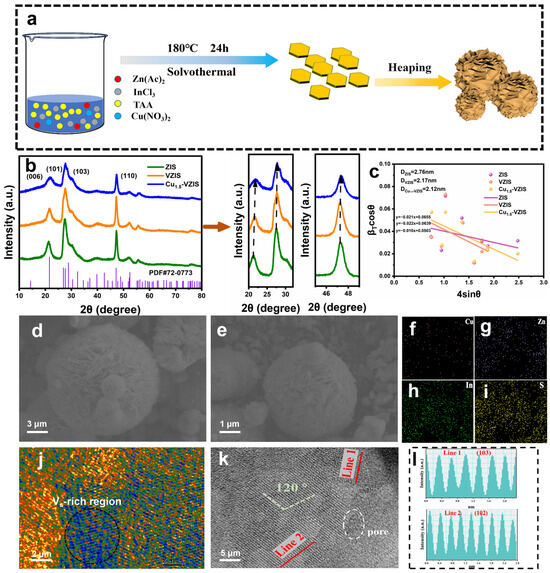
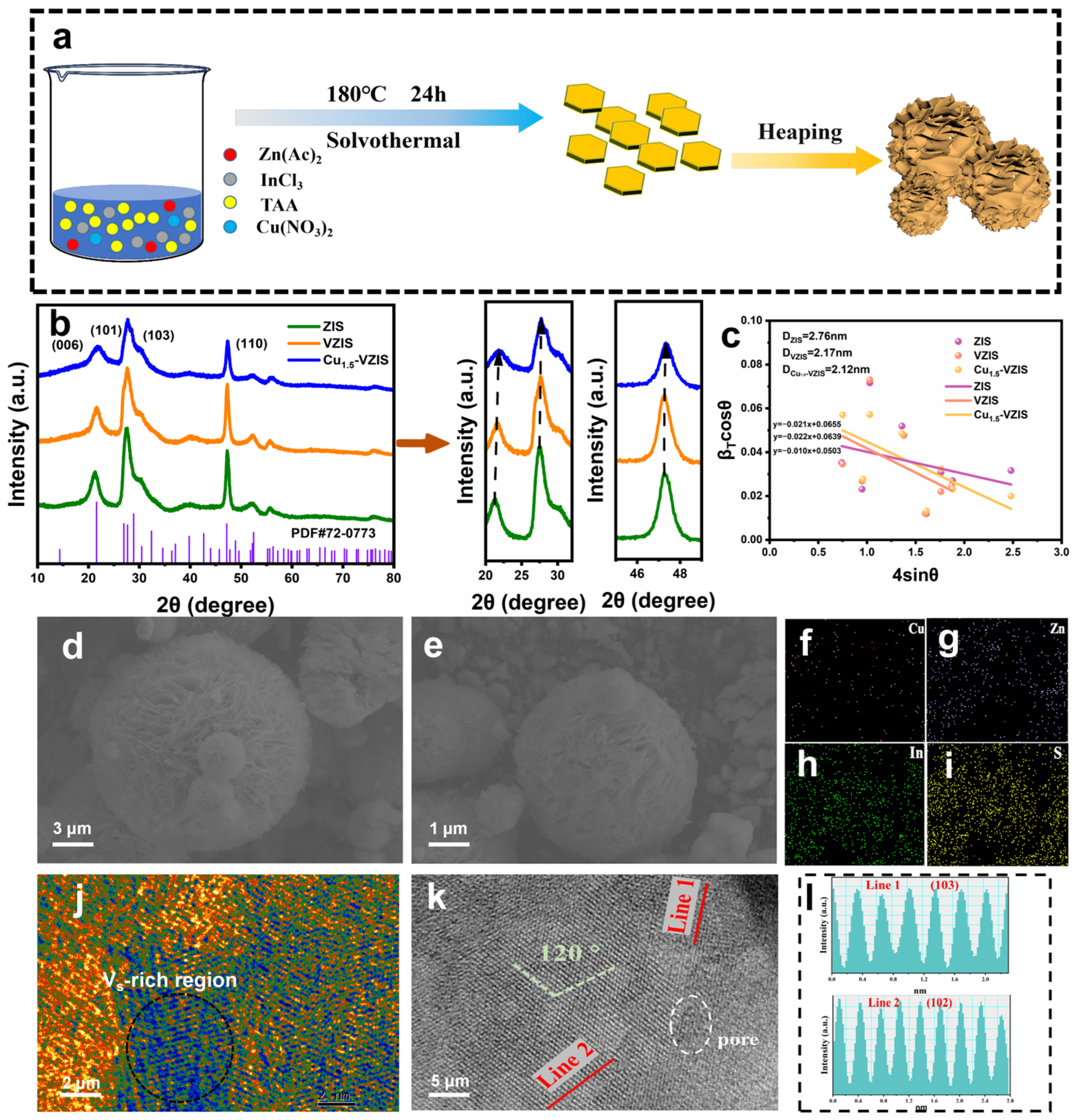
As shown in Figure 1a, Cu-doped ZnIn2S4 with sulfur vacancies (Cun-VZIS) was synthesized using a previously reported hydrothermal method in the presence of an excessive amount of thioacetamide and a proper amount of Cu2+ [21]. The value of n denotes the molar percentage of Cu ions relative to Zn ions, which was determined by inductively coupled plasma mass spectrometry (ICP-MS, Table S1). To reveal the effect of the introduction of sulfur vacancies and Cu ions in the structure of ZIS, X-ray diffraction (XRD) patterns of ZIS, VZIS and Cu1.5-VZIS were recorded (Figure 1b). Pristine ZIS exhibits the hexagonal phase (JCPDS file no. 72-0773, purple lines in Figure 1b) with diffraction peaks at 21.58°, 26.96°, 28.87°, 47.17°, which correspond to the (006), (101), (103) and (110) lattice phases, respectively. Similar diffraction peaks were observed in XRD patterns of VZIS and Cu1.5-VZIS, with no additional diffraction peak, suggesting that high-purity ZIS was formed in these three samples. Notably, the main peaks of VZIS [(006), (101), (103) and (110)] shift to a higher angle compared to those of pristine ZIS, which may be caused by an increase in sulfur vacancies that induce lattice compression and consequently reduce the interplanar spacing [25]. Similarly, the substitution of Cu into VZIS results in a further shift to the higher angle, indicating that Cu is incorporated into the lattice of ZIS [20]. Given the similar size and valence state between Cu2+ (0.73 Å) and Zn2+ (0.74 Å), Cu should replace Zn. Additionally, the Williamson–Hall method was employed to further investigate the variations in crystallite size (D) and intrinsic strain (ε) resulting from the catalyst modification process (Figure 1c). It was observed that upon sulfur vacancy engineering and Cu ions doping, the crystallite size (D) decreased from 2.76 nm to 2.17 nm (VZIS) and 2.12 nm (Cu1.5-VZIS), respectively. Concurrently, the ε value shifted from −0.01 to −0.022 and −0.021. These results suggest that sulfur vacancy engineering and ion doping could indeed change crystallite size and intrinsic strain. However, in comparison, sulfur vacancy engineering has a much greater impact [27].
Figure 1.
(a) Schematic diagram of the preparation procedure of Cun-VZIS. (b) XRD spectra. (c) Williamson–Hall plot of ZIS, VZIS and Cu1.5-VZIS. (d,e) SEM images and (f–i) EDS mapping images of Cu1.5-VZIS. (j–l) HRTEM images of Cu1.5-VZIS.
The morphology and microstructure of Cu1.5-VZIS samples were characterized using scanning electron microscopy (SEM) and transmission electron microscopy (TEM). SEM images (Figure 1d,e and Figure S1) reveal that most ZIS, VZIS and Cu1.5-VZIS exhibit a nanoflower morphology with dimensions ranging from 1 to 5 μm. TEM images of Cu1.5-VZIS presented in Figure S2a,b demonstrate that these flower-like nanospheres are composed of uniformly dispersed nanosheets. This indicates that these nanospheres form through the gradual accumulation of thin nanosheets. High-resolution TEM (HRTEM) images (Figure 1j,k and Figure S2c,d) reveal the presence of vacancy defects (The area enclosed by dashed lines in Figure 1b) within the Cu1.5-VZIS lattice. These defects are evenly distributed throughout the lattice, causing localized deformation, suggesting that excess sulfur sources induce lattice stress and promote vacancy formation [28,29]. The selected areas of Cu1.5-VZIS demonstrate that the interplanar spacing is 0.318 nm and 0.333 nm, which match well with the d103 and d102 spacings of ZIS (Figure 1k,l). Additionally, the 120° interaxial angle confirms the hexagonal phase of ZIS [30], which is consistent with the above XRD result that shows diffraction peaks of the hexagonal phase of ZIS. Energy dispersive spectrometer (EDS) mapping of Cu1.5-VZIS illustrates the uniform distribution of Cu, Zn, In, and S elements within the selected area (Figure 1f–i), agreeing with the XPS result below (Figure S3).
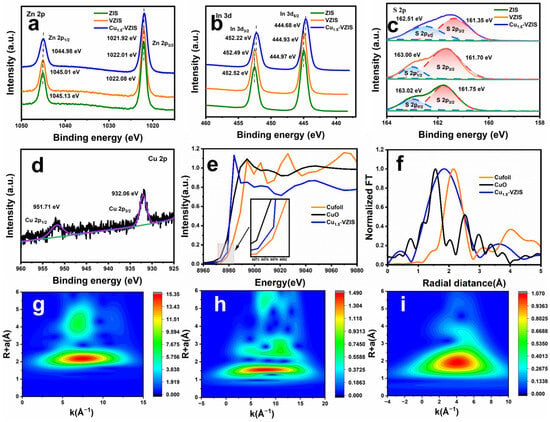
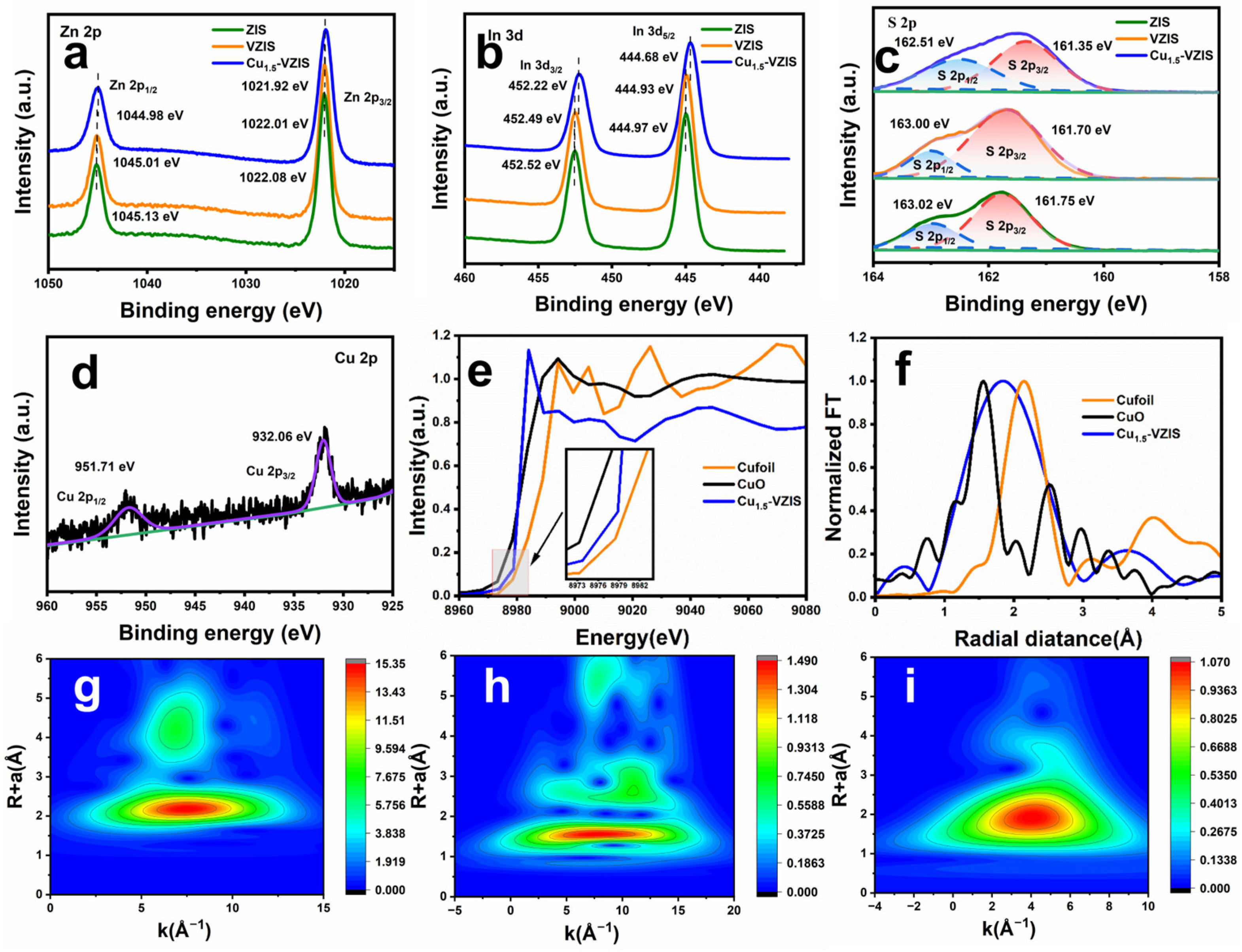
The surface elemental compositions and chemical states of ZIS, VZIS, and Cu1.5-VZIS samples were investigated using X-ray photoelectron spectroscopy (XPS). The binding energy was calibrated using the C 1s peak at 284.8 eV as a reference. The XPS spectra (Figure S3) reveal that all three samples contain Zn, In and S elements. Additionally, the Cu1.5-VZIS sample also contains Cu. The characteristic peak positions of Zn 2p, In 3d, S 2p and Cu 2p confirm the presence of these elements primarily in the states of Zn2+, In3+, S2−, and Cu2+, respectively [31,32,33,34]. This suggests the formation of Cu–S bonds within the structure. Compared to pristine ZIS, the peak positions of Zn 2p, In 3d and S 2p in VZIS shifted to a lower binding energy, which may be caused by the increase in sulfur vacancies that could increase the overall charge density [7,19]. It is worth noting that the shift of the Zn 2p peak (0.12 eV in Zn 2p1/2 and 0.07 eV in Zn 2p3/2) is more significant compared to that of In (0.03 eV in In 3d3/2 and 0.04 eV in In 3d5/2). This indicates that sulfur vacancies introduced by this method are preferentially located around Zn ions [35,36]. Furthermore, after the introduction of Cu, the positions of Zn 2p, In 3d and S 2p shift more significantly towards a lower energy. This indicates that the chemical environment change brought about by the Cu ions can lead to a greater increase in the charge density. During the introduction of Cu ions, the peak shift of In (0.25 eV in In 3d5/2) is greater than that of Zn (0.09 eV in Zn 2p3/2). This is because ZIS belongs to a multi-layered stacked hexagonal crystal system. Although the introduced Cu replaces the position of Zn, the In ion is closer to the Zn ions [18], making the peak shift of In larger than that of Zn. The elemental proportion information of ZIS, VZIS, and Cu1.5-VZIS obtained through XPS is shown in Table S2. After the introduction of sulfur vacancies, the proportion of sulfur atoms decreased. The ratio of S/(Zn + In) decreased from 0.97 (ZIS) to 0.83 (VZIS) and 0.88 (Cu1.5-VZIS). Corroborated by the ICP results, these findings collectively verify the creation of sulfur vacancies within VZIS and Cu1.5-VZIS.
To characterize the chemical environment of Cu2+ doped into VZIS, X-ray absorption spectroscopy (XAS) was employed. As shown in Figure 2e, the K-edge of Cu1.5-VZIS lies between those of Cu foil and CuO, with its shape more closely resembling that of CuO. This suggests that the oxidation state of Cu in VZIS is likely between 0 and +2, and closer to +2. From Figure 2f, it can be observed that the Cu–O bond length in CuO is shorter compared to the Cu–Cu bond length in Cu foil. The Cu–S bond length in Cu1.5-VZIS falls between these two values, which can be attributed to sulfur’s electronegativity being weaker than oxygen but stronger than copper, and its atomic radius being smaller than copper but larger than oxygen. Figure 2g–i reveal that the bonding type formed by copper in Cu1.5-VZIS is not the Cu–Cu bond. This indicates that the Cu dopants do not aggregate to form copper-rich regions within VZIS but are instead uniformly distributed and bonded to sulfur atoms [37,38].
Figure 2.
(a) Zn 2p, (b) In 3d, (c) S 2p, (d) Cu 2p XPS spectra of ZIS, VZIS and Cu1.5-VZIS. (e) Cu K-edge XANES spectra of Cu1.5-VZIS, Cu0 (Cu foil) and Cu2+ (CuO). (f) Fourier transform of k3-weighted EXAFS spectra of Cu foil, CuO, Cu1.5-VZIS. Wavelet transform of Cu foil (g), CuO (h) and Cu1.5-VZIS (i).
2.2. Optical Characterization and Band Structure
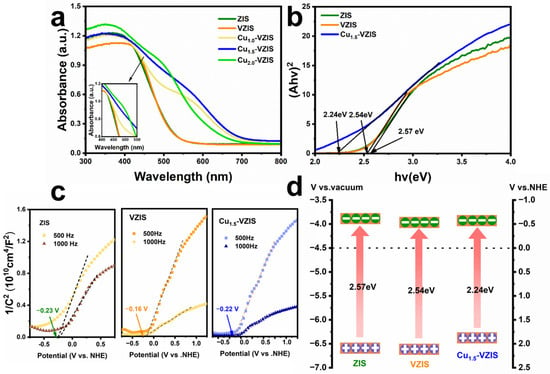
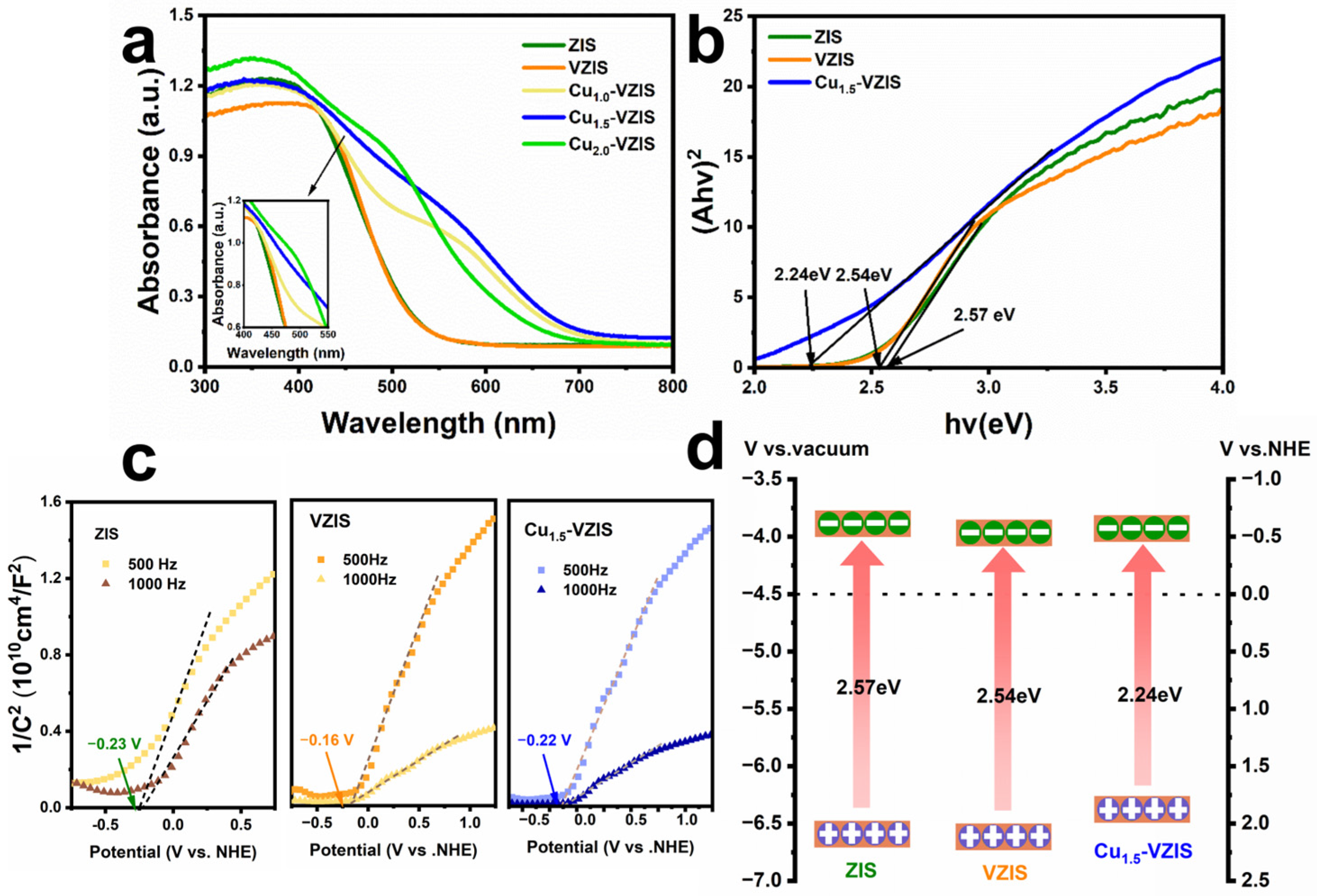
As illustrated in Figure 3a, ZIS and its variants were characterized using UV-VIS absorption spectroscopy. Pristine ZIS exhibits a pronounced absorption edge in the 400–500 nm range and weak absorption in the visible region (above 500 nm). There is no observable alteration in the absorption spectrum following vacancy engineering, suggesting that the defect level induced by introduced sulfur vacancies through this method does not reside within the mid-portion of the forbidden band [7,39]. However, with the introduction of Cu, the absorption edge of ZIS redshifts significantly. With higher doping ratios, the redshift phenomenon became progressively more pronounced, with the sample color transitioning from bright yellow to earth brown. Additionally, the optic band gap analysis of ZIS, VZIS, and Cu1.5-VZIS was conducted via Tauc plots (Figure 3b). According to the formula 2 [40], the optic band gap of Cu1.5-VZIS decreased from 2.54 eV to 2.24 eV after copper ion doping.
Figure 3.
(a) UV-visible light absorption spectra, (b) Tauc plot, (c) Mott–Schottky test and (d) optic band structure of ZIS, VZIS and Cu1.5-VZIS.
As illustrated in Figure 3c, the Mott–Schottky analysis was employed to determine the flat-band positions of ZIS, VZIS, and Cu1.5-VZIS. The positive slopes of these curves indicate that these materials exhibit n-type semiconductor behavior. Based on the intercepts of the middle tangent lines in the Mott–Schottky plots, the flat-band potentials of ZIS, VZIS, and Cu1.5-VZIS were determined to be −0.23 V, −0.16 V, and −0.22 V (vs. NHE), respectively [41,42]. In general, the conduction band potential (ECB) may be approximately 0.1–0.3 V more negative than the flat-band potential (Ef). We assume that the difference between the two values is 0.3 V [43]. Consequently, the estimated ECB values for ZIS, VZIS, and Cu1.5-VZIS are −0.53 V, −0.46 V, and −0.52 V (vs. NHE), respectively. By incorporating the known bandgap energies, the valence band positions of ZIS, VZIS and Cu1.5-VZIS were calculated to be 2.04 V, 2.08 V, and 1.74 V (vs. NHE) respectively. Utilizing this information, the band structure can be constructed as depicted in Figure 3d.
2.3. Photocatalytic Activity Test
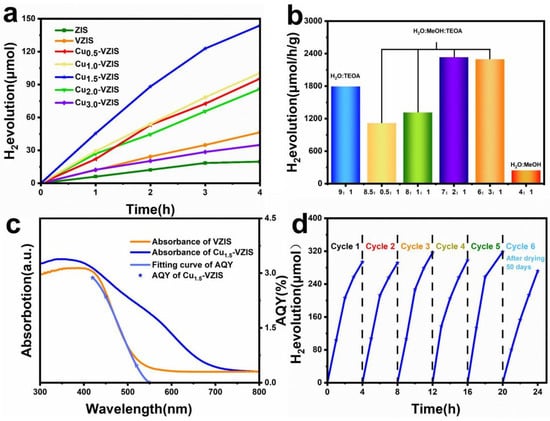
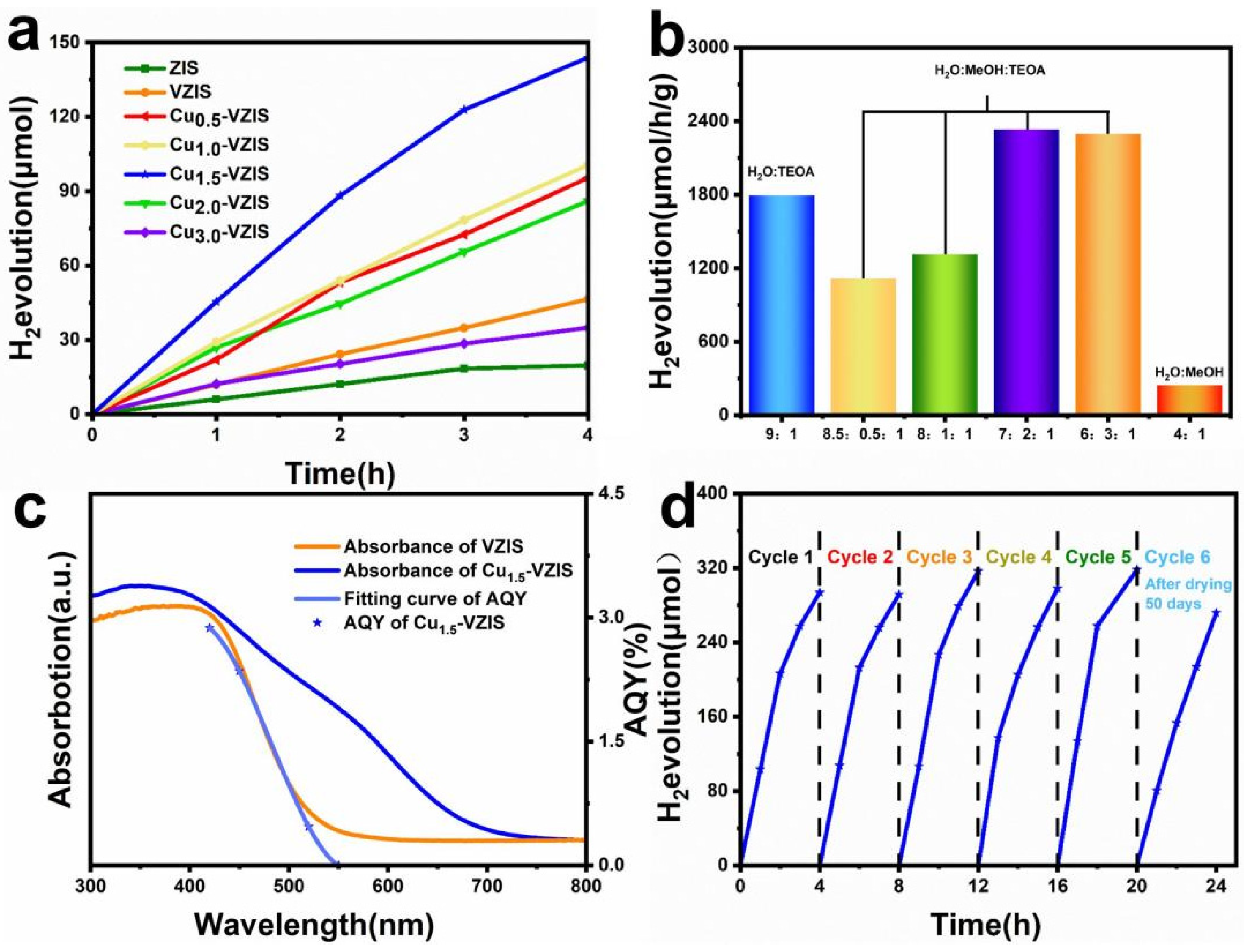
First, the catalyst was suspended in a mixture of 90 mL water and 10 mL triethanolamine (TEOA) under the irradiation of a xenon lamp (300 W, λ > 420 nm), and tested for hydrogen production at 25 °C. Figure 4a illustrates the hydrogen production of seven catalysts over a 4 h period. It is evident that the catalytic performance of VZIS is 2.4 times higher than that of the pristine sample. Subsequently, as the copper ion doping ratio increases, the catalytic performance initially improves before decreasing, forming a parabolic trend. When the doping ratio reaches 3%, the hydrogen production efficiency drops below that of VZIS. The optimal doping ratio is determined to be 1.5%, at which point the catalytic performance is three times higher than that of VZIS and nearly eight times higher than that of ZIS. Therefore, sulfur vacancy engineering combined with copper ion doping significantly enhances the hydrogen production efficiency of ZIS. As illustrated in Figure 4b and Figure S12, we subsequently investigated the impact of various solvent conditions on catalyst performance. TEOA serves as a highly efficient electron donor, playing a dominant role in consuming photogenerated holes during the photocatalytic reaction. However, owing to its high viscosity, TEOA may impede the surface kinetics of the catalytic process to some extent. In contrast, although methanol is not sufficiently effective as a hole scavenger, its low molecular weight and excellent miscibility with various solvents make it a suitable additive for modulating the viscosity of the reaction medium, thereby enhancing mass transfer efficiency. At low concentrations, methanol tends to occupy active sites on the catalyst surface, leading to a partial inhibition of catalytic activity. As the methanol concentration increases, its viscosity-reducing effect on the solution becomes more pronounced, facilitating charge transfer at the catalyst–solvent interface and subsequently improving the overall photocatalytic performance [44]. Subsequently, we employed the solvent ratio of H2O:MeOH:TEOA = 7:2:1 in hydrogen production reactions of ZIS and VZIS. The hydrogen production efficiency was enhanced by 1.55-fold and 1.37-fold (Figures S13 and S14), respectively, demonstrating the broad applicability of this approach.
Figure 4.
(a) Variation of hydrogen production of Cu1.5-VZIS over time. (b) Hydrogen production capacity of Cu1.5-VZIS under different solvent conditions. (c) Wavelength-dependent AQY of Cu1.5-VZIS. (d) The cycling measurements of hydrogen production using Cu1.5-VZIS sample.
Furthermore, we investigated the reliance of the modified catalysts on low-concentration hole scavengers under simulated seawater conditions (Figures S7–S9). Sulfur vacancy engineering initially reduced this reliance. However, subsequent copper ion doping increased the demand for scavengers owing to a significantly enhanced charge separation efficiency, which ultimately led to superior hydrogen evolution performance in the seawater environment.
To understand the true photoresponse range of the catalyst, a single wavelength hydrogen production test was performed based on the absorption spectrum. Figure 4c illustrates the apparent quantum yield (AQY) of Cu1.5-VZIS samples under various monochromatic light conditions [45]. It is observed that the variation in AQY values with wavelength closely mirrors the absorption spectrum of VZIS. Light below 550 nm can effectively excite the catalyst, whereas wavelengths beyond this threshold do not exhibit the same effect, suggesting that the new absorption peak induced by dopants does not independently contribute to the hydrogen production reaction. This finding is consistent with previous studies [10].
The cyclic stability test demonstrates that the hydrogen production performance of the catalyst remains stable after washing and recycling (Figure 4d), with no observable decline in performance. Moreover, the catalyst retains its efficacy even after being stored for 50 days. The structural and optical characteristics of the recovered photocatalyst are almost unchanged compared to freshly prepared samples (Figures S18–S20), suggesting that the stability of Cu1.5-VZIS is relatively good. The Relative Standard Deviation of the five tests was 4.22%. Additionally, the 22 h continuous hydrogen production experiment indicates that the catalyst exhibits robust performance in prolonged hydrogen production (Figure S10). This further confirms the catalytic stability of Cu1.5-VZIS.
We also investigated hydrogen production performance by immobilizing the catalyst on a FTO glass substrate (Figure S11). In this configuration, the light-receiving area was reduced to one-tenth of that in the suspended state, yet the performance decreased by only 59%, indicating that the catalyst can still effectively interact with the aqueous phase despite being adhered to the glass substrate as a film. Finally, performance experiments for the three catalysts were conducted under full wavelengths respectively (Figures S15–S17). The results indicate a gradual decrease in the enhancement ratio from ZIS to VZIS and then to Cu1.5-VZIS, thereby demonstrating that both methods effectively improve the visible light response of the catalysts and reduce their dependence on ultraviolet light.
2.4. Photo/Electrochemical Characterizations
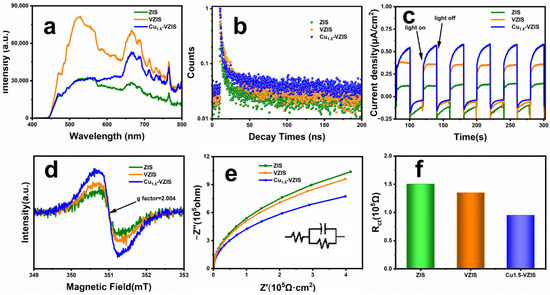
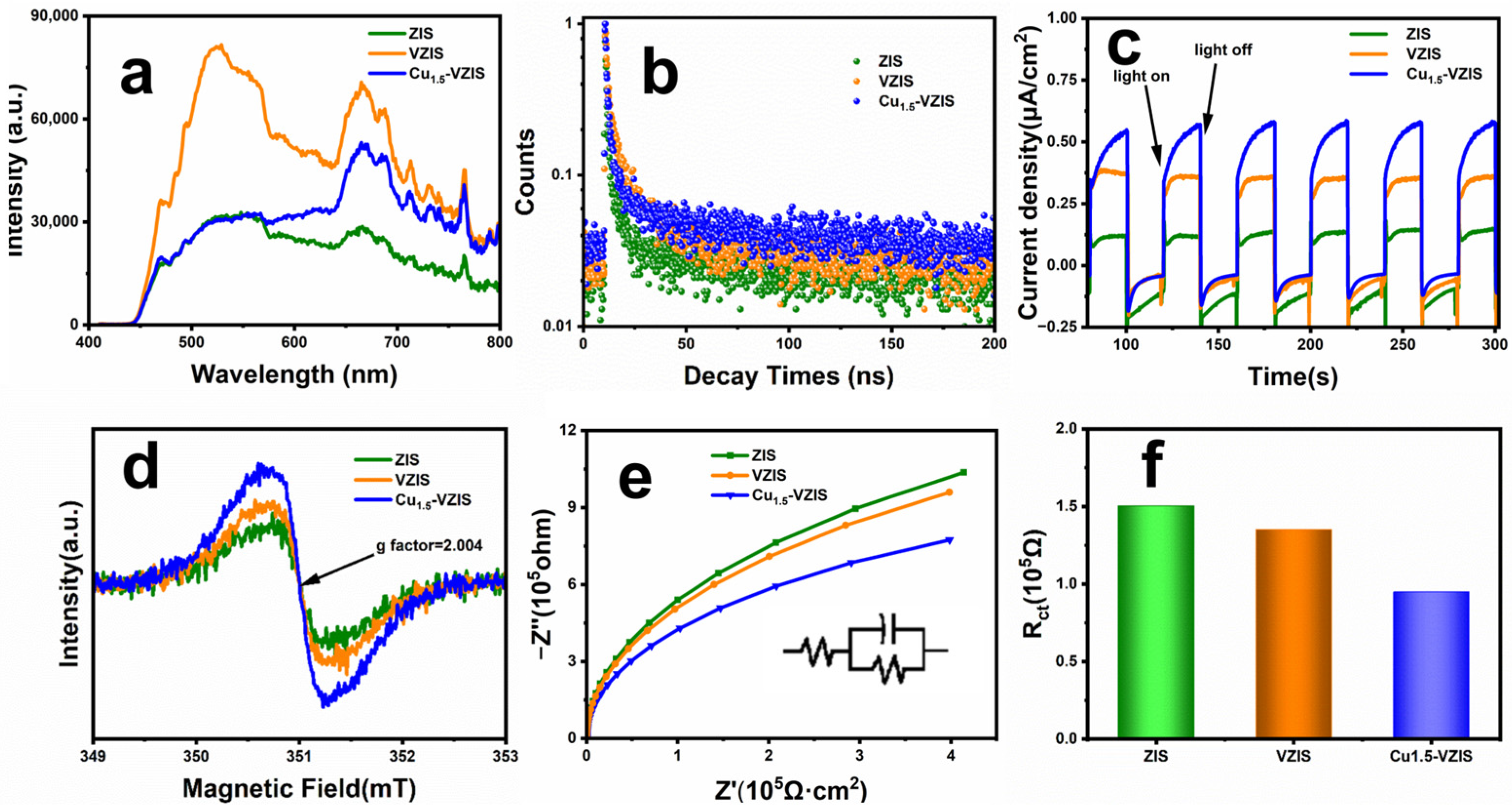
To investigate the photogenerated carrier behavior of ZIS, VZIS, and Cu1.5-VZIS, their fluorescence spectra were recorded [46]. As illustrated in Figure 5a, the emission intensity of VZIS is notably stronger than that of ZIS, which is because the increased concentration of sulfur vacancy defects that could increase the probability of electron–hole recombination [20]. Consequently, the fluorescence intensity increases. However, during the process of photocatalytic reaction, sulfur vacancies become centers to capture photo-induced electrons to catalyze the proton reduction reaction [47,48,49], and enhance the photocatalytic activity. When doping Cu ions, the fluorescence intensity drops, which may be caused by the reduced electron–hole recombination. The fluorescence spectra of ZIS, VZIS and Cu1.5-VZIS are almost the same, suggesting that sulfur vacancy engineering and ion doping do not introduce new defect states, impurity levels, or band-tail states.
Figure 5.
(a) Fluorescence spectra, (b) fluorescence decay dynamics, (c) photocurrent curve, (d) EPR spectra, (e) Nyquist plots and (f) charge transfer resistance bar diagram of ZIS, VZIS and Cu1.5-VZIS.
Additionally, fluorescence decay dynamics of these three samples were measured (Figure 5b). By fitting the data, three distinct fluorescence lifetimes (τ1, τ2, and τ3) were obtained for each sample (Table S3). Specifically, the short-lived components (τ1) and medium-lived components (τ2) are attributed to non-radiative transitions, corresponding to the capture of photogenerated electrons at shallow and deep defect levels, respectively. The long-lived component (τ3) arises from the radiative transition, indicative of the free recombination of electron–hole pairs [50]. Notably, the proportion of the long-lived component (τ3) in VZIS is larger than that in ZIS, confirming an enhanced contribution of electron–hole recombination due to the increased sulfur vacancies in VZIS. Additionally, the average lifetime (τA) was calculated using a weighted average approach [51]. Copper ion doping improves the efficiency of charge separation and reduces the recombination of electron–hole pairs, thereby extending the lifetime of Cu1.5-VZIS.
The behavior of photogenerated carriers in ZIS, VZIS and Cu1.5-VZIS was evaluated using an electrochemical workstation. Figure 5c presents transient photocurrent response curves for ZIS, VZIS and Cu1.5-VZIS. Among these samples, ZIS exhibits a weak photocurrent response with a current density of 0.2535 μA/cm2. The photocurrent response of VZIS is enhanced, achieving a current density of 0.3596 μA/cm2. Cu1.5-VZIS shows further improvement, with a current density of 0.6151 μA/cm2. Due to the presence of Nafion, a trace current response was also observed under dark conditions. The introduction of copper ions and sulfur vacancies increases the carrier concentration, thereby enhancing photoconductivity of the catalyst. As a result, the resistance is reduced, and the capacitive charging/discharging process becomes significantly faster, leading to the disappearance of the sharp transient peaks upon light switching. The gradual increase in photocurrent intensity indicates that the incorporated copper ions generate a built-in electric field, forming an internal potential within the material [52]. These current densities correlate with their hydrogen production efficiencies, confirming that sulfur vacancy engineering and copper ion doping enhance the separation efficiency of photogenerated charges.
Figure 5d illustrates EPR spectra of ZIS, VZIS and Cu1.5-VZIS within the range of 349 to 353 mT. Figure S21 displays the g-factor calculation spectrum derived from the EPR curve. All three samples exhibit a g-factor of 2.004, indicating that the vacancies in the crystal structure are sulfur vacancies [53]. The intensity of the EPR signal gradually increases from ZIS to VZIS and then to Cu1.5-VZIS, suggesting that the concentration of vacancy defects increases gradually. This implies that the introduction of copper ions also affects the sulfur atom structure [18].
Furthermore, electrochemical impedance experiments were utilized to verify the surface charge transfer performance of these catalysts. Nyquist fitting plots for ZIS, VZIS and Cu1.5-VZIS are shown in Figure 5e, where the semicircle radius represents the charge transfer resistance. The charge transfer resistances decrease gradually from ZIS (1.506 × 10⁶ Ω) to VZIS (1.351 × 10⁶ Ω) and then to Cu1.5-VZIS (9.51 × 10⁵ Ω). This confirms that sulfur vacancies and copper ion doping could simultaneously promote carrier separation and transfer, thereby enhancing the hydrogen production efficiency.
2.5. Photocatalytic Mechanism
In the Cu1.5-VZIS photocatalytic system, the synergistic effect between sulfur vacancies and Cu ions, combined with an optimized external reaction environment, enables highly efficient hydrogen evolution. Sulfur vacancies act as electron traps that enhance photocatalytic hydrogen production. Concurrently, sulfur vacancies induce a reconstruction of the local electron density, providing electron-enriched active sites for proton reduction, as evidenced by the continuous negative shifts in the binding energies of Zn, In, and S in XPS spectra. Copper ions, incorporated by substituting Zn sites, optimize carrier migration pathways—XANES and EXAFS analyses confirm that Cu is uniformly incorporated into the lattice via Cu-S bonds without forming Cu clusters. Building upon the copper ions doping, the photocurrent density increases from 0.3596 μA/cm2 for VZIS to 0.6151 μA/cm2 for Cu1.5-VZIS, while the charge transfer resistance decreases from 1.351 × 10⁶ Ω to 9.51 × 10⁵ Ω, demonstrating that Cu doping further accelerates electron transport to the surface. Furthermore, TEOA acts as a hole scavenger to rapidly consume photogenerated holes, while the addition of an optimal amount of methanol enhances interfacial mass transfer and adsorption by modulating the viscosity of the reaction medium. Solvent optimization experiments show that the highest activity is achieved at a H2O:MeOH:TEOA ratio of 7:2:1, a condition that is universally effective for both ZIS and VZIS. The combination of the intrinsic synergy between sulfur vacancies and Cu ions with the external promotion by TEOA and an optimal methanol concentration ultimately results in a 7.5-fold enhancement in photocatalytic hydrogen evolution activity, with Cu1.5-VZIS achieving a hydrogen production rate of 1.799 mmol·g−1·h−1.
3. Materials and Methods
3.1. Materials
Nitric acid, anhydrous sodium sulfate, acetone, and copper nitrate trihydrate were purchased from Sinopharm Chemical Reagent Co., Ltd. (Shanghai, China). Zinc acetate dihydrate was purchased from Macklin Biochemical Technology Co., Ltd. (Shanghai, China). Indium chloride tetrahydrate was purchased from yuanye Bio-Technology Co., Ltd. (Shanghai, China). Thioacetamide was purchased from J&K Scientific Ltd. (Beijing, China). Triethanolamine was purchased from Shanghai Aladdin Biochemical Technology Co., Ltd. (Shanghai, China). Alcohol and isopropyl alcohol were purchased from Tianjin Fuyu Fine Chemical Co., Ltd. (Tianjin, China).
3.2. Synthesis of ZIS, VZIS, and Cun-VZIS Catalysts
All chemicals were analytical-grade and used without any further purification. Typically, 1.0 mmol of Zn(Ac)2, 2.0 mmol of InCl3·4H2O, and 4.0 mmol of thioacetamide (TAA) were dissolved by sonication in a mixture of 15 mL deionized water and 15 mL ethanol with stirring for 1 h. Then the mixture was transferred into a 50 mL teflon-lined stainless-steel autoclave and heated to 180 °C for 24 h. After nature cooling, the pristine ZIS product was collected by centrifugation and subsequently washed three times with deionized water and ethanol, and finally vacuum-dried at 60 °C.
As for the synthesis of VZIS, the amount of TAA was increased from 4 mmol to 10 mmol, the amounts of other reactants and the steps are the same as those for pristine ZIS. The increase in the TAA amount would introduce sulfur vacancies in the ZIS structure (VZIS) [7,25,26]. Finally, according to the doping ratio, using a pipette, 0.1 M copper nitrate solution was introduced into the hydrothermal synthesis solution of VZIS, and Cun-VZIS was obtained.
3.3. Photocatalytic Activity Test
Typically, the photocatalyst (20 mg) is dispersed into a 100 mL aqueous solution containing 10% triethanolamine (TEOA) by sonication for 20 min, and then transferred to a 250 mL quartz reactor. The suspension is thoroughly stirred, degassed with nitrogen for 30 min, and then exposed to light for degassing. The reaction solution temperature is maintained at 25 °C by circulating and condensing water. Then a 300 W Xenon lamp (Beijing Perfectlight Technology Co, Ltd., PLS-SXE 300D, Beijing, China) equipped with 420 nm cut-off was used as an illumination source. After the light is turned on, samples are taken once every hour for a total of four hours. The hydrogen content was detected by gas chromatography (GC7900). The ratio of peak area to hydrogen content was 2505.395 μmol−1. The luminous flux was 0.153 W. The cycling stability test was conducted five times consecutively.
The apparent quantum yield (AQY) was detected under irradiation for 4 h with various band-pass filters including 420, 450, 520, and 550 nm.
3.4. Characterizations
3.4.1. Structural Characterization
XRD spectra was obtained by Ultima IV (Rigaka, Tokyo, Japan) Ultima IV diffractometer. XPS spectra were obtained by Thermo SCIENTIFIC ESCALAB 250Xi (Thermo Fisher Scientific, Waltham, MA, USA). The binding energy data of all peaks in the spectrum were converted by reference to the C 1s peak of surface-attached C at 284.8 eV. X-ray absorption structures (K-sides) were collected at the Beijing Synchrotron Radiation Facility (BSRF, Beijing, China). Scanning electron microscope images were obtained using the JSM-6700F (Carl Zeiss AG, Baden-Württemberg, Germany) and transmission electron microscope images were obtained by using the JEM-2100, (JEOL Ltd., Tokyo, Japan).
3.4.2. Optical Characterization
Using BaSO4 as the reference sample, the UV-VIS diffuse reflectance spectrum was obtained by using Hitachi UH-4150 spectrophotometer (Hitachi, Tokyo, Japan). Steady-state fluorescence spectra and decay dynamics were obtained by FLS 980 fluorescence spectrophotometer (Edinburgh Instruments, Livingston, UK).
3.4.3. Photo-Electrochemical Measurement
Electrochemical tests were conducted on a CHI760D electrochemical workstation (Shanghai CH Instruments, Shanghai, China). The reference electrode, counter electrode and working electrode are saturated calomel electrode, Platinum nets electrode and photocatalyst coated FTO electrode, respectively. The electrolyte was 0.5 M Na2SO4 aqueous solution. Before measuring, 5 mg sample was dispersed in 2 mL ethanol with 20 μL nafion under ultrasonication for 2 h to obtain a suspension. The glass sheets were blown dry and placed on the hot table at 70 °C, and the above suspension was evenly distributed on the glass plate by drops with an eyedropper, then was kept for 10 h after completion. To build the circuit system, a 300 W xenon lamp with a 420 nm cut-off filter was used to test the photocurrent at first, and the mode of turning the light off and on was switched every 20 s, which was conducted under no bias voltage conditions. The open circuit potential was obtained through the “open circuit Potential Time” test. Then the impedance test was conducted, whose parameters are as follows. The value of Init E is the open circuit potential, High Frequency is 105 Hz, Low Frequency is 0.01 Hz, Amplitude is 0.005 V, and the Quiet Time is 2 s. Finally, Mott–Schottky spectra were measured at 500 Hz, 800 Hz and 1000 Hz, which were conducted under the same conditions as the aforementioned photocurrent and impedance measurements, using a 0.5 M Na2SO4 aqueous solution (pH = 7) as the electrolyte. The electrode was identical to that described above. The parameters are as follows. The value of Initial E is the open-circuit potential + 1, Final E is the open-circuit potential −1, Incur E is 0.05 V, Amplitude is 0.01 V, and Quiet Time is 2 s. Both impedance testing and Mott–Schottky testing were conducted under dark conditions.
3.4.4. Tauc Plot
The band gap width of the catalyst can be obtained through UV-VIS absorption spectrum by the following formula: 2 [43]. The tangent line is obtained by intercepting the data of the middle flat section of the curve, and the intercept of the tangent line with the X-axis is obtained.
3.4.5. Williamson–Hall Analysis
The full widths at half maximum (FWHM, denoted as βT) of the main diffraction peaks and their corresponding Bragg angles (θ) for each catalyst were determined by peak fitting using Origin software(version number: 10.10.178). The crystallite size (D) and lattice strain (ε) were then calculated employing the Williamson–Hall equation: βTcosθ = Kλ/D + 4εsinθ, where K is the Scherrer constant (taken as 0.9) and λ is the X-ray wavelength (0.154 nm, Cu Kα radiation).
4. Conclusions
In summary, Cu-doped ZnIn2S4 (ZIS) catalysts with S-vacancy (Cun-VZIS) were synthesized successfully. Vacancy engineering alters the accumulation pattern of sulfur atoms within the catalyst and creates additional charge transfer pathways. Additionally, copper ion doping significantly accelerates bulk-to-surface charge transfer, and further minimizes fluorescence dissipation during the charge transfer process, thereby enhancing the overall charge transfer efficiency. The combination of these two methods leads to a substantial improvement in the overall efficiency of ZIS. Under visible light irradiation, the photocatalytic hydrogen production rate of Cu1.5-VZIS reaches 1.799 mmol·g−1·h−1, which is 7.5 times higher than that of pristine ZIS. Our findings demonstrate that vacancy introduction and ion doping exhibit excellent compatibility and synergy, achieving a complementary effect that promotes hydrogen production. This approach provides a viable strategy for developing efficient photocatalysts with stable performance through simple elemental substitution and vacancy engineering.
Supplementary Materials
The following supporting information can be downloaded at: https://www.mdpi.com/article/10.3390/catal16040289/s1.
Author Contributions
Conceptualization, Y.Z. and H.H.; Methodology, Y.Z. and H.H.; Validation, Y.Z., C.C., C.W. and H.L.; Formal analysis, Y.Z.; Investigation, Y.Z. and H.H.; Resources, H.L.; Data curation, Y.Z.; Writing—original draft, Y.Z.; Writing—review & editing, Y.Z. and H.L.; Supervision, H.L.; Project administration, H.L.; Funding acquisition, H.L. All authors have read and agreed to the published version of the manuscript.
Funding
Financial support from National Natural Science Foundation of China (22473115 and 21703287), Natural Science Foundation of Shandong Province (ZR2022MB065 and ZR2024YQ007), and Fundamental Research Funds for the Central Universities (24CX04012A and 19CX05002A) are acknowledged. H.L. thanks Taishan Scholar program of Shandong Province (tsqn202312119) for financial support.
Data Availability Statement
The original contributions presented in this study are included in the article/Supplementary Material. Further inquiries can be directed to the corresponding author.
Conflicts of Interest
The authors declare that they have no known competing financial interests or personal relationships that could have appeared to influence the work reported in this paper.
Abbreviations
The following abbreviations are used in this manuscript:
| ZIS | ZnIn2S4 |
| VZIS | ZIS after vacancy engineering |
| Cun-VZIS | VZIS introduced Cu2+ (the value of n represents molar percent of Cu2+ to Zn2+) |
References
- Xing, C.; Yu, G.; Zhou, J.; Liu, Q.; Chen, T.; Liu, H.; Li, X. Solar energy-driven upcycling of plastic waste on direct Z-scheme heterostructure of V-substituted phosphomolybdic acid/g-C3N4 nanosheets. Appl. Catal. B Environ. 2022, 315, 121496. [Google Scholar] [CrossRef] [Scilit]
- Xing, C.; Yu, G.; Chen, T.; Liu, S.; Sun, Q.; Liu, Q.; Hu, Y.; Liu, H.; Li, X. Perylenetetracarboxylic diimide covalently bonded with mesoporous g-C3N4 to construct direct Z-scheme heterojunctions for efficient photocatalytic oxidative coupling of amines. Appl. Catal. B Environ. 2021, 298, 120534. [Google Scholar] [CrossRef] [Scilit]
- Gong, J.; Li, C.; Wasielewski, M.R. Advances in solar energy conversion. Chem. Soc. Rev. 2019, 48, 1862–1864. [Google Scholar] [CrossRef] [Scilit]
- Arunkumar, T.; Ao, Y.; Luo, Z.; Zhang, L.; Li, J.; Denkenberger, D.; Wang, J. Energy efficient materials for solar water distillation—A review. Renew. Sustain. Energy Rev. 2019, 115, 109409. [Google Scholar] [CrossRef] [Scilit]
- Fujishima, A.; Honda, K. Electrochemical photolysis of water at a semiconductor electrode. Nature 1972, 238, 37–38. [Google Scholar] [CrossRef] [Scilit]
- Xiao, B.; Lv, T.; Zhao, J.; Rong, Q.; Zhang, H.; Wei, H.; He, J.; Zhang, J.; Zhang, Y.; Peng, Y.; et al. Synergistic Effect of the Surface Vacancy Defects for Promoting Photocatalytic Stability and Activity of ZnS Nanoparticles. ACS Catal. 2021, 11, 13255–13265. [Google Scholar] [CrossRef] [Scilit]
- Du, C.; Zhang, Q.; Lin, Z.; Yan, B.; Xia, C.; Yang, G. Half-unit-cell ZnIn2S4 monolayer with sulfur vacancies for photocatalytic hydrogen evolution. Appl. Catal. B Environ. 2019, 248, 193–201. [Google Scholar] [CrossRef] [Scilit]
- Cui, C.; Zhao, X.; Su, X.; Xi, N.; Wang, X.; Yu, X.; Zhang, X.L.; Liu, H.; Sang, Y. Porphyrin-based Donor–Acceptor Covalent Organic Polymer/ZnIn2S4 Z-Scheme Heterostructure for Efficient Photocatalytic Hydrogen Evolution. Adv. Funct. Mater. 2022, 32, 2208962. [Google Scholar] [CrossRef] [Scilit]
- Zhao, L.; Yang, B.; Zhuang, G.; Wen, Y.; Zhang, T.; Lin, M.; Zhuang, Z.; Yu, Y. Thin In-Plane In2O3/ZnIn2S4 Heterostructure Formed by Topological-Atom-Extraction: Optimal Distance and Charge Transfer for Effective CO2 Photoreduction. Small 2022, 18, 2201668. [Google Scholar] [CrossRef] [Scilit]
- Wan, J.; Wang, Y.; Liu, J.; Song, R.; Liu, L.; Li, Y.; Li, J.; Low, J.; Fu, F.; Xiong, Y. Full-Space Electric Field in Mo-Decorated Zn2In2S5 Polarization Photocatalyst for Oriented Charge Flow and Efficient Hydrogen Production. Adv. Mater. 2024, 36, e2405060. [Google Scholar] [CrossRef] [Scilit]
- Huang, H.; Yu, G.; Zhao, X.; Cui, B.; Yu, J.; Zhao, C.; Liu, H.; Li, X. Atomic Ni directional-substitution on ZnIn2S4 nanosheet to achieve the equilibrium of elevated redox capacity and efficient carrier-kinetics performance in photocatalysis. J. Energy Chem. 2024, 88, 272–281. [Google Scholar] [CrossRef] [Scilit]
- Zhang, S.; Ou, X.; Xiang, Q.; Carabineiro, S.A.C.; Fan, J.; Lv, K. Research progress in metal sulfides for photocatalysis: From activity to stability. Chemosphere 2022, 303, 135085. [Google Scholar] [CrossRef] [Scilit]
- Sharma, K.; Kumar, A.; Ahamad, T.; Le, Q.V.; Raizada, P.; Singh, A.; Nguyen, L.H.; Thakur, S.; Nguyen, V.-H.; Singh, P. Sulphur vacancy defects engineered metal sulfides for amended photo(electro)catalytic water splitting: A review. J. Mater. Sci. Technol. 2023, 152, 50–64. [Google Scholar] [CrossRef] [Scilit]
- Deng, X.; Lu, X.; Cao, Y.; Chen, Q. Electrochemical imaging uncovers the heterogeneity of HER activity by sulfur vacancies in molybdenum disulfide monolayer. Chin. Chem. Lett. 2024, 36, 110379. [Google Scholar] [CrossRef] [Scilit]
- Yu, J.; Zheng, Z.; Wang, A.; Humayun, M.; Attia, Y.A. MoO3 with the Synergistic Effect of Sulfur Doping and Oxygen Vacancies: The Influence of S Doping on the Structure, Morphology, and Optoelectronic Properties. Nanomaterials 2024, 14, 1189. [Google Scholar] [CrossRef] [Scilit]
- Yu, G.; Gong, K.; Xing, C.; Hu, L.; Huang, H.; Gao, L.; Wang, D.; Li, X. Dual P-doped-site modified porous g-C3N4 achieves high dissociation and mobility efficiency for photocatalytic H2O2 production. Chem. Eng. J. 2023, 461, 142140. [Google Scholar] [CrossRef] [Scilit]
- Shi, X.; Dai, C.; Wang, X.; Hu, J.; Zhang, J.; Zheng, L.; Mao, L.; Zheng, H.; Zhu, M. Protruding Pt single-sites on hexagonal ZnIn2S4 to accelerate photocatalytic hydrogen evolution. Nat. Commun. 2022, 13, 1287. [Google Scholar] [CrossRef] [Scilit]
- Zhang, S.; Zhang, Z.; Si, Y.; Li, B.; Deng, F.; Yang, L.; Liu, X.; Dai, W.; Luo, S. Gradient Hydrogen Migration Modulated with Self-Adapting S Vacancy in Copper-Doped ZnIn2S4 Nanosheet for Photocatalytic Hydrogen Evolution. ACS Nano 2021, 15, 15238–15248. [Google Scholar] [CrossRef] [Scilit] [PubMed]
- Yue, W.; Ye, Z.; Liu, C.; Xu, Z.; Wang, L.; Cao, X.; Yamashita, H.; Zhang, J. Enhanced Photocatalytic Hydrogen Evolution Activity Driven by the Synergy Between Surface Vacancies and Cocatalysts: Surface Reaction Matters. Adv. Sci. 2024, 11, e2407092. [Google Scholar] [CrossRef] [Scilit] [PubMed]
- Zhang, X.; Zhao, Z.; Zhang, W.; Zhang, G.; Qu, D.; Miao, X.; Sun, S.; Sun, Z. Surface Defects Enhanced Visible Light Photocatalytic H2 Production for Zn-Cd-S Solid Solution. Small 2016, 12, 793–801. [Google Scholar] [CrossRef] [Scilit]
- Zhang, G.; Wu, H.; Chen, D.; Li, N.; Xu, Q.; Li, H.; He, J.; Lu, J. A mini-review on ZnIn2S4-Based photocatalysts for energy and environmental application. Green Energy Environ. 2022, 7, 176–204. [Google Scholar] [CrossRef] [Scilit]
- Wang, J.; Sun, S.; Zhou, R.; Li, Y.; He, Z.; Ding, H.; Chen, D.; Ao, W. A review: Synthesis, modification and photocatalytic applications of ZnIn2S4. J. Mater. Sci. Technol. 2021, 78, 1–19. [Google Scholar] [CrossRef] [Scilit]
- He, J.; Yang, Z.; Wang, Z.; Gu, L.; Qiu, J.; Ran, J. Sulfur-vacancy-enriched ZnIn2S4 mediates efficient charge transfer for hydrogen evolution from lignocellulose photoreforming. Chem. Eng. J. 2025, 503, 158433. [Google Scholar] [CrossRef] [Scilit]
- Liu, Y.; Xue, W.; Chowdhury, A.; Putta Rangappa, A.; Zhao, J. S-vacancy regulation over ultra-thin ZnIn2S4 for enhanced photocatalytic valorization of biomass-derived 5-hydroxymethylfurfural to 2,5-diformylfuran. Chem. Eng. J. 2024, 497, 154613. [Google Scholar] [CrossRef] [Scilit]
- Ryu, T.; Kim, H.; Hong, S.B. Nature of active sites in Cu-LTA NH3-SCR catalysts: A comparative study with Cu-SSZ-13. Appl. Catal. B Environ. 2019, 245, 513–521. [Google Scholar] [CrossRef] [Scilit]
- Dong, S.; Cui, L.; Zhao, Y.; Wu, Y.; Xia, L.; Su, X.; Zhang, C.; Wang, D.; Guo, W.; Sun, J. Crystal structure and photocatalytic properties of perovskite MSn(OH)6 (M = Cu and Zn) composites with d10-d10 configuration. Appl. Surf. Sci. 2019, 463, 659–667. [Google Scholar] [CrossRef] [Scilit]
- Dhruv, D.K.; Patel, B.H.; Dhruv, S.D.; Patel, P.B.; Trivedi, U.B.; Agrawal, N. Synthesis and microstructural characterization of bulk ZnIn2Se4. Mater. Today Proc. 2023. [Google Scholar] [CrossRef] [Scilit]
- Jing, X.; Lu, N.; Huang, J.; Zhang, P.; Zhang, Z. One-step hydrothermal synthesis of S-defect-controlled ZnIn2S4 microflowers with improved kinetics process of charge-carriers for photocatalytic H2 evolution. J. Energy Chem. 2021, 58, 397–407. [Google Scholar] [CrossRef] [Scilit]
- Xie, J.; Zhang, H.; Li, S.; Wang, R.; Sun, X.; Zhou, M.; Zhou, J.; Lou, X.W.; Xie, Y. Defect-rich MoS2 ultrathin nanosheets with additional active edge sites for enhanced electrocatalytic hydrogen evolution. Adv. Mater. 2013, 25, 5807–5813. [Google Scholar] [CrossRef] [Scilit]
- He, Y.; Rao, H.; Song, K.; Li, J.; Yu, Y.; Lou, Y.; Li, C.; Han, Y.; Shi, Z.; Feng, S. 3D Hierarchical ZnIn2S4 Nanosheets with Rich Zn Vacancies Boosting Photocatalytic CO2 Reduction. Adv. Funct. Mater. 2019, 29, 1905153. [Google Scholar] [CrossRef] [Scilit]
- Zhang, M.; Lu, D.; Zhang, Z.; Yang, J. Enhancement of Visible-Light-Induced Photocurrent and Photocatalytic Activity of V and N Codoped TiO2 Nanotube Array Films. J. Electrochem. Soc. 2014, 161, H416–H421. [Google Scholar] [CrossRef] [Scilit]
- Zhao, S.; Huang, J.; Huo, Q.; Zhou, X.; Tu, W. A non-noble metal MoS2–Cd0.5Zn0.5S photocatalyst with efficient activity for high H2 evolution under visible light irradiation. J. Mater. Chem. A 2016, 4, 193–199. [Google Scholar] [CrossRef] [Scilit]
- Huang, H.B.; Yu, K.; Zhang, N.; Xu, J.Y.; Yu, X.T.; Liu, H.X.; Cao, H.L.; Lu, J.; Cao, R. Localized surface plasmon resonance enhanced visible-light-driven CO2 photoreduction in Cu nanoparticle loaded ZnInS solid solutions. Nanoscale 2020, 12, 15169–15174. [Google Scholar] [CrossRef] [Scilit] [PubMed]
- Zhao, H.; Guo, L.; Xing, C.; Liu, H.; Li, X. A homojunction–heterojunction–homojunction scaffold boosts photocatalytic H2evolution over Cd0.5Zn0.5S/CoO hybrids. J. Mater. Chem. A 2020, 8, 1955–1965. [Google Scholar] [CrossRef] [Scilit]
- Zheng, Y.; Wang, Y.; Mansoor, S.; Hu, Z.; Zhang, Y.; Liu, Y.; Zhou, L.; Lei, J.; Zhang, J. Tuning Electrons Migration of Dual S Defects Mediated MoS(2−x/)ZnIn(2)S(4−x) Toward Highly Efficient Photocatalytic Hydrogen Production. Small 2024, 20, e2311725. [Google Scholar] [CrossRef] [Scilit]
- Fang, M.; Yang, Z.; Guo, Y.; Yuan, S.; Xia, X.; Pan, S. Synergy of sulfur vacancy and piezoelectric effect to tune charge migration in Sv-ZnIn2S4/UiO-66-NH2 for efficient photocatalytic H2 evolution. Appl. Surf. Sci. 2024, 673, 160893. [Google Scholar] [CrossRef] [Scilit]
- Ravel, B.; Newville, M. ATHENA, ARTEMIS, HEPHAESTUS: Data analysis for X-ray absorption spectroscopy using IFEFFIT. J. Synchrotron Radiat. 2005, 12, 537–541. [Google Scholar] [CrossRef] [Scilit]
- Xia, Z.; Zhang, H.; Shen, K.; Qu, Y.; Jiang, Z. Wavelet analysis of extended X-ray absorption fine structure data: Theory, application. Phys. B Condens. Matter 2018, 542, 12–19. [Google Scholar] [CrossRef] [Scilit]
- Zhong, W.J.; Hung, M.Y.; Kuo, Y.T.; Tian, H.K.; Tsai, C.N.; Wu, C.J.; Lin, Y.D.; Yu, H.C.; Lin, Y.G.; Wu, J.J. Dual-Vacancy-Engineered ZnIn2S4 Nanosheets for Harnessing Low-Frequency Vibration Induced Piezoelectric Polarization Coupled with Static Dipole Field to Enhance Photocatalytic H2 Evolution. Adv. Mater. 2024, 36, e2403228. [Google Scholar] [CrossRef] [Scilit]
- Tauc, J.; Grigorovici, R.; Vancu, A. Optical Properties and Electronic Structure of Amorphous Germanium. Phys. Status Solidi (b) 1966, 15, 627–637. [Google Scholar] [CrossRef] [Scilit]
- Gelderman, K.; Lee, L.; Donne, S.W. Flat-Band Potential of a Semiconductor: Using the Mott–Schottky Equation. J. Chem. Educ. 2007, 84, 685. [Google Scholar] [CrossRef] [Scilit]
- Hankin, A.; Bedoya-Lora, F.E.; Alexander, J.C.; Regoutz, A.; Kelsall, G.H. Flat band potential determination: Avoiding the pitfalls. J. Mater. Chem. A 2019, 7, 26162–26176. [Google Scholar] [CrossRef] [Scilit]
- Yang, Y.; Zeng, G.; Huang, D.; Zhang, C.; He, D.; Zhou, C.; Wang, W.; Xiong, W.; Li, X.; Li, B.; et al. Molecular engineering of polymeric carbon nitride for highly efficient photocatalytic oxytetracycline degradation and H2O2 production. Appl. Catal. B Environ. 2020, 272, 118970. [Google Scholar] [CrossRef] [Scilit]
- Hillman, S.A.J.; Sprick, R.S.; Pearce, D.; Woods, D.J.; Sit, W.-Y.; Shi, X.; Cooper, A.I.; Durrant, J.R.; Nelson, J. Why Do Sulfone-Containing Polymer Photocatalysts Work So Well for Sacrificial Hydrogen Evolution from Water? J. Am. Chem. Soc. 2022, 144, 19382–19395. [Google Scholar] [CrossRef] [Scilit]
- Liu, W.; Wang, Y.; Huang, H.; Wang, J.; He, G.; Feng, J.; Yu, T.; Li, Z.; Zou, Z. Spatial Decoupling of Redox Chemistry for Efficient and Highly Selective Amine Photoconversion to Imines. J. Am. Chem. Soc. 2023, 145, 7181–7189. [Google Scholar] [CrossRef] [Scilit]
- Reddy, C.V.; Reddy, K.R.; Shetti, N.P.; Shim, J.; Aminabhavi, T.M.; Dionysiou, D.D. Hetero-nanostructured metal oxide-based hybrid photocatalysts for enhanced photoelectrochemical water splitting—A review. Int. J. Hydrog. Energy 2020, 45, 18331–18347. [Google Scholar] [CrossRef] [Scilit]
- Yang, W.; Zhang, L.; Xie, J.; Zhang, X.; Liu, Q.; Yao, T.; Wei, S.; Zhang, Q.; Xie, Y. Enhanced Photoexcited Carrier Separation in Oxygen-Doped ZnIn2S4 Nanosheets for Hydrogen Evolution. Angew. Chem. Int. Ed. 2016, 55, 6716–6720. [Google Scholar] [CrossRef] [Scilit]
- Shen, S.; Zhao, L.; Zhou, Z.; Guo, L. Enhanced Photocatalytic Hydrogen Evolution over Cu-Doped ZnIn2S4 under Visible Light Irradiation. J. Phys. Chem. C 2008, 112, 16148–16155. [Google Scholar] [CrossRef] [Scilit]
- Liqiang, J.; Yichun, Q.; Baiqi, W.; Shudan, L.; Baojiang, J.; Libin, Y.; Wei, F.; Honggang, F.; Jiazhong, S. Review of photoluminescence performance of nano-sized semiconductor materials and its relationships with photocatalytic activity. Sol. Energy Mater. Sol. Cells 2006, 90, 1773–1787. [Google Scholar] [CrossRef] [Scilit]
- Jiao, X.; Chen, Z.; Li, X.; Sun, Y.; Gao, S.; Yan, W.; Wang, C.; Zhang, Q.; Lin, Y.; Luo, Y.; et al. Defect-Mediated Electron-Hole Separation in One-Unit-Cell ZnIn2S4 Layers for Boosted Solar-Driven CO2 Reduction. J. Am. Chem. Soc. 2017, 139, 7586–7594. [Google Scholar] [CrossRef] [Scilit]
- Liu, Y.; Fang, P.; Cheng, Y.; Gao, Y.; Chen, F.; Liu, Z.; Dai, Y. Study on enhanced photocatalytic performance of cerium doped TiO2-based nanosheets. Chem. Eng. J. 2013, 219, 478–485. [Google Scholar] [CrossRef] [Scilit]
- Bisquert, J.; Gonzales, C.; Guerrero, A. Transient On/Off Photocurrent Response of Halide Perovskite Photodetectors. J. Phys. Chem. C 2023, 127, 21338–21350. [Google Scholar] [CrossRef] [Scilit]
- Zhao, H.; Yao, Y.; Cai, M.; Li, X.; Li, P.; Imran Channa, A.; Lin, F.; Wang, M.; Wang, Z.M.; Tong, X. Synergistic selenium doping and colloidal quantum dots decoration over ZnIn2S4 enabling high-efficiency photoelectrochemical hydrogen peroxide production. Chem. Eng. J. 2024, 491, 151925. [Google Scholar] [CrossRef] [Scilit]
Disclaimer/Publisher’s Note: The statements, opinions and data contained in all publications are solely those of the individual author(s) and contributor(s) and not of MDPI and/or the editor(s). MDPI and/or the editor(s) disclaim responsibility for any injury to people or property resulting from any ideas, methods, instructions or products referred to in the content. |
© 2026 by the authors. Licensee MDPI, Basel, Switzerland. This article is an open access article distributed under the terms and conditions of the Creative Commons Attribution (CC BY) license.