


Abstract
It is necessary to find sustainable alternatives to the conventional fossil fuels used by the transportation sector today. For the hard-to-abate aviation and heavy transport, liquid hydrocarbon fuels derived from biomass via pyrolysis are a viable option. Biomass pyrolysis oils need upgrading by hydroprocessing before they can be further processed into fuels at a refinery. Due to reactor plugging and catalyst deactivation in one-step hydroprocessing, it has been proposed to add a stabilization step at a lower temperature to convert the most reactive compounds in pyrolysis oil, such as carbonyls, to less reactive species such as alcohols. Three different catalysts, Ni/Al2O3, sulfided NiMo/Al2O3, and Pt/Al2O3, were studied for stabilizing three different model compounds, furfural, guaiacol, and octanoic acid, alone and as a mixture in a batch reactor at 90 bar initial H2 pressure and 180 °C. The order of performance was determined to be Ni/Al2O3 > Pt/Al2O3 > sulfided NiMo/Al2O3 in these conditions. The Ni/Al2O3 catalyst showed both the highest overall conversion, the most fully hydrogenated compounds, and the highest carbonyl conversion. The effect of adding 1172 wt-ppm sulfur to the feed was also investigated, which showed that Ni/Al2O3 was the most sensitive catalyst to sulfur poisoning.
1. Introduction
In 2022, Eurostat reported the transport sector to be responsible for the largest share (31%) of the total energy consumption in the EU [1]. Currently, fossil fuels are mostly used to supply this energy [2]. Since fossil fuels have a negative impact on the environment and the reserves are finite, greener alternatives are slowly being implemented. However, for aviation and heavy transport, it has proven difficult to find sustainable alternatives with sufficient volumetric energy density [2].
Liquid hydrocarbons, which resemble fossil fuels and have a high volumetric energy density, can be derived from biomass by use of pyrolysis. In fast pyrolysis, the vapor residence time is minimized, which allows for minimal char and gas formation [3] and a maximization of liquid yield [4], which is of particular interest if the pyrolysis oil (PO) is to be used as a liquid fuel. Unfortunately, the produced PO is not directly suitable as transportation fuel. This is due to high oxygen (up to 45 wt%, wet basis) and water contents resulting in high acidity, poor stability, and a low heating value. In particular, the thermal instability has been reported to be caused by carbonyl compounds that tend to polymerize under heating [5].
To mitigate these undesirable properties, the oxygen could be removed from the PO by catalytic hydrodeoxygenation (HDO) [6]. This is done at temperatures up to 400 °C and high hydrogen pressures (up to 200 bar) in the presence of a catalyst [5,7]. Problems have, however, been reported when conducting the HDO in a single step, where the high temperature results in operational issues like polymerization, coking, reactor plugging, and catalyst deactivation [8,9]. Instead, a two-stage upgrading process has been suggested, in which the PO is stabilized by hydrogenation (HYD) at lower temperatures (ideally below 200 °C) before the actual HDO is conducted at elevated temperatures [10]. While research on the subject has been ongoing, a suitable catalyst has yet to be commercialized [2,11,12].
The investigated catalysts can be divided into three different types: noble metal catalysts, sulfided NiMo and CoMo catalysts, and base metal catalysts, with a particular interest in nickel. Various noble metal catalysts like Ru, Pd and Pt on different supports have also been tested for the stabilization of PO [13,14]. The advantage of noble metal catalysts is the high activity towards HYD and HDO at low temperatures [15,16]. A disadvantage is that noble metal catalysts are susceptible to poisoning from sulfur, which is present in bio-derived PO in levels of 45 to 1153 ppm [17]. Coupled with the fact that noble metals are scarce and expensive, this makes these catalysts less likely candidates for PO stabilization.
The sulfided NiMo and CoMo catalysts are well-known for desulfurization and denitrogenation in fossil fuel refining processes [2,18]. This makes them obvious candidates for the deoxygenation of biomass-derived POs. Studies have shown that while the sulfided catalysts do catalyze hydrodeoxygenation, they require temperatures that are too high for stabilization. Furthermore, operational issues, such as coke formation, have been reported in continuous experiments with prolonged runtimes [19]. In contrast to noble metal catalysts, sulfided catalysts require a small amount of sulfur in the feed to remain active for longer runtimes. Sulfur would therefore need to be added to the feed, as the sulfur level in bio-based PO is typically below the optimal amount [2,17,20]. In practice, this is not an issue, as the recycling of product gas or the addition of sulfur can be used to obtain the required sulfur content in the feed.
Metallic Ni-based catalysts are interesting candidates for the stabilization step. Like noble metal catalysts, they are active for both HYD and HDO at relatively low temperatures but are cheaper and abundant [16,19,21,22,23,24,25,26,27,28]. Several studies have been conducted on Ni-based catalysts in recent decades. Sivec et al. [16] compared the hydrogenation of furfural over a Ni catalyst to several noble metal catalysts, and showed that while at a lower temperature, the noble metal catalysts were generally more active and the inexpensive Ni/C catalyst showed a 95% yield of 2-methyl tetrahydrofuran at 212 °C. Otyuskaya et al. [23] used propionic acid as a model compound in n-hexane to investigate a Ni-Cu/SiO2-ZrO2 catalyst for hydrotreatment. They proposed a generic catalytic hydrotreatment reaction network for carboxylic acids, involving five different reactions: decarbonylation, decarboxylation, hydrogenation, esterification, and ketonization.
While model compound experiments cannot provide a full picture of how a catalyst will work with real PO, they do give valuable insight into the reaction mechanisms that may occur in hydrotreatment of real PO. Especially studies with multiple model compounds in a mixture can provide insights into the possible interactions between the hundreds of different compounds found in real PO. This is also why multiple studies have been conducted on model compounds [23,28,29]. Han et al. [28] studied the effects of temperature (100–250 °C) and reaction time (approximately 10–310 min) on catalytic hydrotreatment of hydroxyacetone, furfural, and phenol over a Ni/SiO2 catalyst. Experiments with a mixture of the model compounds revealed competitive adsorption between the three model compounds, resulting in a suppression of the conversion of hydroxyacetone and phenol until furfural was converted.
With this study, we advance the understanding of the complex reactions in the stabilization of PO by low temperature hydrotreatment, focusing particularly on how the compounds interact during stabilization and how the choice of catalyst impacts this. This was done by using a mixture of furfural, guaiacol, and octanoic acid at a weight ratio (5:4:1) designed to mimic biomass-derived PO. Biomass consists of three different polymers: cellulose, hemicellulose, and lignin, which result in different types of products under pyrolysis. Therefore, the three model compounds were chosen to each represent one part of the oil: furfural represented the furans from hemicellulose, guaiacol represented the phenolics that originate from lignin, and octanoic acid was chosen to represent the smaller aliphatic acids derived from cellulose [30]. Furthermore, phenolic compounds as well as carboxylic acids contribute to the acidity of PO, which makes them highly relevant for model compound studies [31].
The experiments were carried out using a batch reactor with the individual model compounds or a mixture of them, using three different catalysts (Pt/Al2O3, sulfided NiMo/Al2O3, and Ni/Al2O3) that were specifically chosen to represent the three different catalyst types for stabilizing PO, while keeping the support material the same, to compare the catalysts based solely on the active material. As Al2O3 is a well-known support material with many desirable properties including high surface area and good thermal stability [32], this was chosen as support material for this study. The Pt/Al2O3 was chosen with a low loading (1 wt%), as this would be required for a noble metal catalyst to be considered as a candidate for stabilization. The sulfided NiMo/Al2O3 was chosen to represent the optimized conventional hydrotreating catalysts. Finally, a high-loaded (>25 wt%) Ni/Al2O3 catalyst was chosen to represent the high-loaded Ni catalysts that have gained significant attention in recent years as promising stabilization catalysts [16,19,21,22,23,24,25,26,27]. Both the high-loaded Ni/Al2O3 and the sulfided NiMo/Al2O3 were supplied by TOPSOE A/S.
Furthermore, the impact of sulfur on the catalytic activity was investigated by using dodecanethiol as an organic sulfur source. The sulfur source was chosen to be organic in nature, as would be the case for real biomass-derived PO [17], but with a sufficiently long carbon chain to ensure accurate dosing, even at the desired low sulfur additions. While sulfided NiMo/Al2O3 has no problems with sulfur in the feed, the impact of the presence of sulfur on Pt catalysts and high-loaded Ni catalysts during stabilization remains understudied.
All experiments were conducted at 180 °C, based on initial studies with the Ni/Al2O3 catalyst that showed a significant increase in conversion from 150 °C to 180 °C, but a significant shift in products toward larger molecules at 200 °C indicated undesired polymerization.
2. Results and Discussion
2.1. Stabilization of Model Compounds
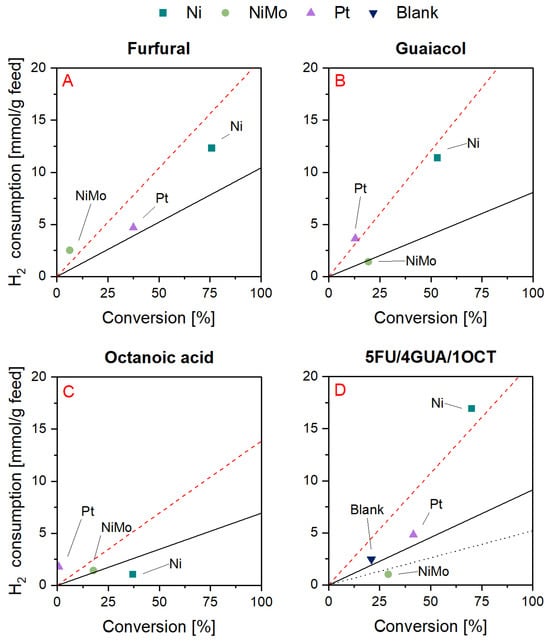
All three catalysts (Ni/Al2O3, sulfided NiMo/Al2O3, Pt/Al2O3) were tested both with the pure model compounds and the model compound mixture (50 wt% furfural, 40 wt% guaiacol, and 10 wt% octanoic acid), henceforth referred to as 5FU/4GUA/1OCT. Furthermore, a blank experiment with only the 5FU/4GUA/1OCT mixture was performed as well, to account for any activity not caused by a catalyst. A small amount of conversion and hydrogen consumption was found for this experiment, as shown in Figure 1D.
Figure 1.
Hydrogen consumption plotted against the conversion for experiments with (A) furfural, (B) guaiacol, (C) octanoic acid, and (D) the 5FU/4GUA/1OCT mixture (weighted conversion as defined in Section 3.4.1). The theoretical hydrogen consumption is plotted as lines for the following reactions: (A) to furfuryl alcohol (black) and to tetrahydrofurfuryl alcohol (red dashed), (B) to phenol (black) and to cyclohexanol (red dashed), (C) to octanal (black) and to octanol (red dashed), and (D) only carbonyl conversion (black dotted), combination of all three first steps (black), and combination of all three second steps (red dashed). All experiments were conducted with 2 g of catalyst and 50 g of feed at 180 °C, with initial pressure of 90 bar H2 (at room temperature) for 1 h.
In Figure 1, the hydrogen consumption is plotted against the conversion of the compounds. The hydrogen consumption was calculated from the pressure change measured at room temperature before and after the reaction and the gas analysis. The conversion was calculated based on GC-FID analysis of the liquid product. Alongside the experimental data, the theoretical hydrogen consumption is plotted as a function of the degree of conversion for different degrees of hydrogenation. The sulfided NiMo/Al2O3 catalyst consistently showed a low hydrogen consumption below 2.5 mmol/g feed and correspondingly low conversion (see also Tables S1 and S2). When comparing the experiments for stabilizing the 5FU/4GUA/1OCT mixture with the sulfided NiMo/Al2O3 and no catalyst (blank), the hydrogen consumption was surprisingly higher for the blank experiment (2.5 mmol/g feed vs. 1.0 mmol/g feed), but the conversion was higher for the sulfided NiMo/Al2O3 (29% vs. 21%). This indicates that the conversion observed with the sulfided NiMo/Al2O3 catalyst may be due to polymerization, rather than hydrogenation, as previously suggested in a batch study with biomass-derived fast pyrolysis oil [33].
In accordance with the high levels of conversion found in the literature [16,19,21,22,23,24,25,26,27,28], the experiments with the Ni/Al2O3 catalyst resulted in the highest level of conversion, as well as the highest hydrogen consumption of up to 17 mmol/g feed, except for pure octanoic acid, where the hydrogen consumption was only 1.05 mmol/g feed. For the other three cases, a comparison of the experimental data with the theoretical hydrogen consumption in the plots in Figure 1A,B,D all indicate that the Ni/Al2O3 catalyst not only hydrogenated the carbonyls but also the aromatic ring in both furfural and guaiacol. For the experiment with the Ni/Al2O3 catalyst and pure octanoic acid, the catalyst was partially dissolved by the feed (see Figure S2 for photographs). This likely occurred due to the reaction between the support (Al2O3) and the octanoic acid. It is well-known that alumina can become chemically unstable in aqueous acidic environments [32,34]. As water was likely produced during the reaction, it is therefore not surprising that the alumina support could be affected. It is, however, interesting that the similar support of the three catalysts seemingly does not lead to the same behavior, with respect to the dissolution of the catalysts.
Lastly, the Pt/Al2O3 catalyst showed very low conversion of octanoic acid (0.76%), even though it had the highest hydrogen consumption of all the experiments with pure octanoic acid (1.79 mmol/g feed compared to 1.05 mmol/g for Ni/Al2O3 and 1.43 mmol/g feed for the sulfided NiMo/Al2O3). It is possible, however, that this apparent higher hydrogen consumption can be accounted for by other factors, like leaks and uncertainties in pressure reading and gas analysis. When compared to the theoretical lines in Figure 1A, the H2 consumption at the calculated conversion suggests that the Pt/Al2O3 catalyst converted furfural to furfuryl alcohol without hydrogenating the ring. On the other hand, the plot in Figure 1B indicates that the Pt/Al2O3 not only catalyzed the demethoxylation of guaiacol, but also the hydrogenation of the benzene ring. Regarding the use of Pt/Al2O3 for stabilizing the 5FU/4GUA/1OCT mixture (see Figure 1D), the hydrogen consumption corresponded to the hydrogen needed for the first hydrogenation step for each of the compounds (the black lines in Figure 1A–C). While the weighted conversions for the experiments with the 5FU/4GUA/1OCT mixture were different for all three catalysts, a general trend can be observed. In all three cases, the order of conversion was as follows: furfural > octanoic acid > guaiacol, as shown in Table 1.
Table 1.
Conversion of each component in the 5FU/4GUA/1OCT mixture experiments. All experiments were conducted with 2 g of catalyst and 50 g of feed at 180 °C, with initial pressure of 90 bar H2 (at room temperature) for 1 h.
From the conversion, an apparent reaction rate for each experiment could be calculated. However, due to the nature of the batch experiment and the absence of data at low conversion (for some experiments), the reported rates are an average over the reaction time but can still be useful for catalyst comparison. In Table 2, the apparent reaction rates for each component in each experiment can be seen. As furfural was fully converted in the 5FU/4GUA/1OCT experiment with Ni/Al2O3, this particular apparent reaction rate () is significantly underestimated.
Table 2.
Apparent reaction rates in mol∙g−1∙s−1 for each experiment with pure feed as well as each component in the 5FU/4GUA/1OCT mixture experiments. All experiments were conducted with 2 g of catalyst and 50 g of feed at 180 °C, with initial pressure of 90 bar H2 (at room temperature) for 1 h.
Han et al. [28] reported furfural to have an inhibitory effect on the conversion of both phenol and hydroxyacetone in their experiments with a mixture of the three model compounds over a Ni/SiO2 catalyst. The underestimated reaction rate for furfural in the 5FU/4GUA/1OCT mixture with Ni/Al2O3 aside, a similar trend may be inferred from the calculated reaction rates for the 5FU/4GUA/1OCT mixture experiments in Table 2. For all three catalysts, a lower apparent reaction rate for all reactants in the 5FU/4GUA/1OCT mixture can be seen when compared to the corresponding pure feed experiments. This indicates mutual inhibition between the components in the 5FU/4GUA/1OCT feed experiments. Interestingly, for the experiments with the sulfided NiMo/Al2O3, the relative magnitude of the reaction rates changed from GUA > OCT > FU in the pure feed experiments to FU > GUA > OCT in the 5FU/4GUA/1OCT mixture. The sequence observed in the mixed-feed experiments resembles the relative concentrations of the three components in the feed, which may indicate that competitive interactions between the reactants influence the apparent rates. While the dataset does not allow firm mechanistic conclusions, the results suggest that surface coverage or mutual inhibition effects could play a role under the mixed-feed conditions. For the two other catalysts, no similar shift was observed, as the sequence FU > GUA > OCT was already present in the pure-feed experiments.
Evaluation of potential mass-transfer limitations was conducted using Mears’ criterion, the Weisz–Prater (WP) criterion and calculation of the effectiveness factor based on the apparent first order rate constant for each catalyst, with the 5FU/4GUA/1OCT mixture as feed (see calculations in Section S1) [35]. Based on these results (see all results in Table S10), it can be concluded that the mass-transfer limitations had the most influence, up to 26%, in the case of the Ni/Al2O3 catalyst and only slightly (less than 5%) for the sulfided NiMo/Al2O3, while there were no mass transfer limitations for the powder Pt/Al2O3 catalyst.
To further understand what occurred in each experiment, the gas phase products were identified and quantified (see Figure S1 and Table S3) as C% of carbon in feed. In general, only CO, CO2, C1 to C3 paraffins and minor amounts of heavier volatile hydrocarbons (denoted C6+) were detected. C2 to C5 olefins and C4 to C5 paraffins were not detected.
For experiments with pure furfural, the amount of gas produced increased in the following order: sulfided NiMo/Al2O3 < Pt/Al2O3 < Ni/Al2O3. For the experiments with guaiacol, the overall gas production was far lower, with the highest amount of gas produced being from the experiment with sulfided NiMo/Al2O3 (0.06 C%). The production of gas was extremely low for all catalysts with pure octanoic acid. The highest total was 0.0058 C%, using Pt/Al2O3 where the main product was CO2 (0.0057 C%), indicating decarboxylation. This is in accordance with the low conversion and hydrogen consumption for all catalysts, as shown in Figure 1C. This is also in agreement with expectations, as organic acids are normally reduced at higher temperatures [2,19].
Finally, for the experiments using the 5FU/4GUA/1OCT mixture as feed, the highest amount of produced gas was seen for the experiment with the Ni/Al2O3 catalyst (0.15 C%), but still a very low amount relative to the feed. Thus, the highest gas production was observed using the Ni/Al2O3 catalyst with pure furfural and the 5FU/4GUA/1OCT mixture as feed. This fits well with the hydrogen consumptions shown in Figure 1. Surprisingly, the highest gas production for the guaiacol experiments was observed for the sulfided NiMo/Al2O3, although it did not have the highest conversion, as shown in Figure 1B.
2.2. Liquid Products
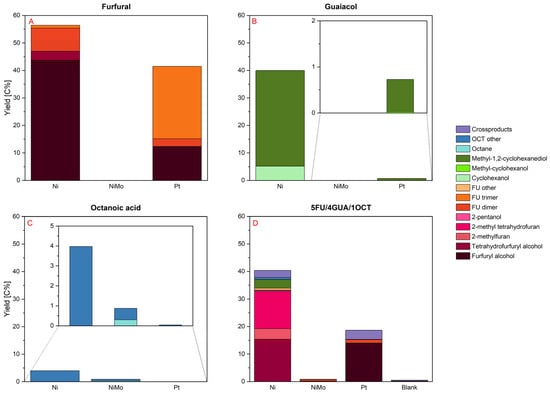
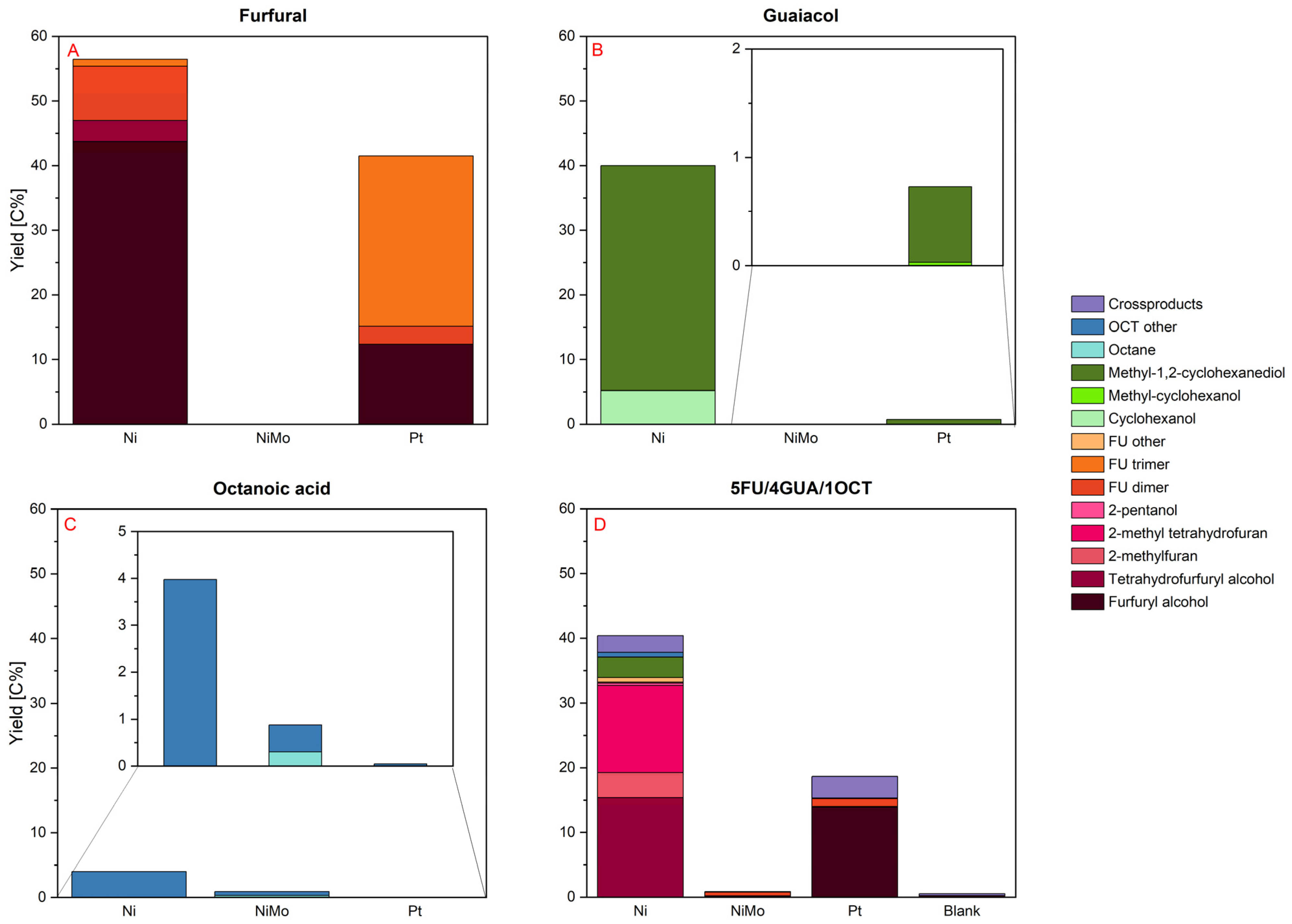
The liquid products determined by GC-MS/FID are shown in Figure 2 (for a more detailed overview of the products, see Tables S4–S7). Some products were grouped into the following groups for a better overview: FU dimer (four different furfural-derived dimers), FU trimer (three different furfural-derived trimers), FU other (2-pentanone and valeric acid) and OCT other (octanol, octanal, octyl octanoate). The structures and yields of the individual products are available in Tables S4–S7. The yields for the experiments with pure furfural (shown as C% of carbon in feed) are displayed in Figure 2A. No liquid phase products were detected from the experiment with the sulfided NiMo/Al2O3 catalyst, and hence the yields are all zero. Based on Figure 1A, where a low conversion is shown (6.5%) and the small amount of gas products (0.003%), it is surprising that the yields for this experiment are zero. The liquid yields are based on GC analysis; hence, heavier compounds (such as furfural polymers) that are not detectable by GC may have been produced, thus accounting for the observed missing yield. See Supplementary Figure S3 for carbon mole balances by GC detection, typically in the range of 80 to 85%.
Figure 2.
Yields of liquid products grouped by feed for the experiments: (A) furfural, (B) guaiacol, (C) octanoic acid, and (D) the 5FU/4GUA/1OCT mixture. All experiments were conducted with 2 g of catalyst and 50 g of feed at 180 °C, with initial pressure of 90 bar H2 (at room temperature) for 1 h.
For the Ni/Al2O3 catalyst, the main product from pure furfural was furfuryl alcohol (43.7%), followed by different dimers formed by reactions of furfural and its derivatives (8.4%). Thus, some polymerization reactions have still occurred, though the majority of the detected liquid products were stabilized hydrogenation products (43.7% furfuryl alcohol and 3.2% tetrahydrofurfuryl alcohol). Interestingly, none of the dimers and trimers formed during these experiments had hydrogenated furan rings, thus suggesting that the products with hydrogenated furan rings are less likely to polymerize (see structures in Table S4). The relatively high furfuryl alcohol yield could be an indication that an extension of the reaction time would result in a fuller hydrogenation to tetrahydrofurfuryl alcohol, as shown by Han et al. [28]. For the Pt/Al2O3 catalyst, however, the main liquid product was different trimers formed from furfural and its derivatives (26.4%). This shows that polymerization occurred to a larger extent with this catalyst compared to the Ni/Al2O3.
For the experiments with pure guaiacol as feed (Figure 2B), the highest liquid yield of GC detectable products was achieved with Ni/Al2O3 as the catalyst, which correlates well with Figure 1B. Guaiacol was primarily converted into Methyl-1,2-cyclohexanediol (34.8%), where a methyl transfer had occurred as well as the hydrogenation of the benzene ring. This is supported by Figure 1B, where the hydrogen consumption for Ni/Al2O3 is close to the theoretical hydrogen consumption for the hydrogenation of the ring. This is similar to the reaction pathway proposed by Han et al. [28]. As with furfural, no liquid products were detected by the GC for the experiment with the sulfided NiMo/Al2O3, showing that it is significantly less active at the given reaction temperature compared to the other catalysts. For the Pt/Al2O3 catalyst, only a small amount of methyl-1,2-cyclohexanediol (0.7%) was produced. The total yield of detected products was very low compared to the observed conversion of 13%. This can be explained by the fact that the GC analysis could only account for 84% of the liquid after reaction (Figure S3). It is likely that larger, non-volatile compounds were formed that are not detectable by GC.
As is already evident from Figure 1C, the pure octanoic acid was very difficult to convert. This is further supported by the yields displayed in Figure 2C, where the highest product yield can be seen for the experiment with the Ni/Al2O3 catalyst (3.98%). The product labeled as ‘OCT other’ covers the products octanal, octanol and octyl octanoate, the latter of which was the majority product for the Ni/Al2O3 experiment (3.83 C%, see all products in Tables S5 and S6). The use of the sulfided NiMo/Al2O3 resulted in a lower overall yield (0.88 C%), though in this case, some of the octanoic acid was hydrogenated to octane, corresponding to complete hydrodeoxygenation. Almost no products were detected for Pt/Al2O3 (0.04 C% octyl octanoate), which fits well with the conversion plotted in Figure 1C (0.75%).
Using the 5FU/4GUA/1OCT mixture allows for many more possible products, as the compounds and their derivatives can cross-react. In Figure 2D, these compounds have been grouped together as “cross-products” for a better overview. These primarily consist of esters formed from the reaction between octanoic acid and one of the other two model compounds or their derivatives. For the blank experiment, only a small amount of products were found (in total, 0.51 C%). The products were furfuryl alcohol (0.22 C%) and cross-products (0.29 C%). This amounts to less than the calculated conversion (20.9%), which indicates that the majority of the products were larger non-volatile compounds. The total yield was not much higher when using the sulfided NiMo/Al2O3 catalyst, in total 0.84 C%, where the primary product was furfuryl dimers (0.54 C%), followed by furfuryl alcohol (0.19 C%). A higher conversion was observed when using the Ni/Al2O3 catalyst (70.2 C%). Likewise, this also produced the highest yield of GC detectable products (in total, 40.4 C%) distributed on a wide array of different products. The major products were tetrahydrofurfuryl alcohol (15.4 C%) and 2-methyl tetrahydrofurfuryl alcohol (13.5 C%). Some cross-products (2.58 C%) were also formed during the experiment, with tetrahydrofurfuryl octanoate being the major product (2.18 C%). Similar to the pure guaiacol experiments, Ni/Al2O3 was the only catalyst that was able to hydrogenate the aromatic ring in guaiacol to form methyl-1,2-cyclohexanediol (3.16 C%) in the 5FU/4GUA/1OCT mixture experiments. While the conversion of guaiacol results in a lower total acid number [31], it is not ideal to hydrogenate all aromatic rings if the stabilized pyrolysis oil is to be used as aviation fuel, since the current regulations demand 8–26% aromatic content in the fuel [36] and it leads to a high consumption of hydrogen during hydrotreatment. As such, whether the ability of the Ni/Al2O3 catalyst to hydrogenate the aromatic ring in guaiacol is desirable can be discussed.
In the case of Pt/Al2O3, a larger part of the total yield (18.67 C%) were cross-products (3.34 C%). The primary product was furfuryl alcohol (13.91 C%) and, in contrast to Ni/Al2O3, the Pt/Al2O3 catalyst did not hydrogenate the aromatic ring, as no tetrahydrofurfuryl alcohol was detected. No guaiacol products were detected for this experiment, although a significant amount of the guaiacol was converted (28.86 C%). This indicates that the guaiacol most likely formed larger, non-volatile molecules that were not detectable by GC.
2.3. The Influence of Sulfur
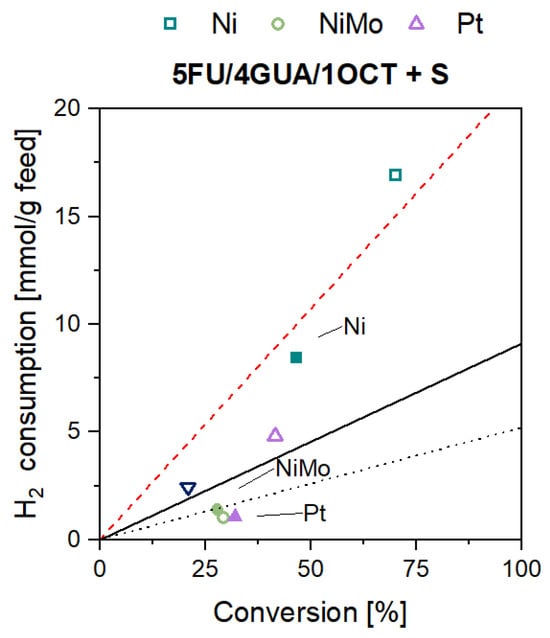
The influence of sulfur on the conversion and product selectivities was investigated by adding dodecanethiol to the 5FU/4GUA/1OCT mixture (1172 wt-ppm S in the case of Ni/Al2O3 and Pt/Al2O3, and 6336 wt-ppm S for the sulfided NiMo/Al2O3). In Figure 3, the conversion is plotted against the hydrogen consumption for each catalyst (the comparable experiments with no sulfur in the feed, as previously shown in Figure 1D, plotted as open symbols for comparison).
Figure 3.
Hydrogen consumption plotted against weighted conversion (as defined in Section 3.4.1) for the 5FU/4GUA/1OCT mixture experiments with sulfur addition (Ni/Al2O3 and Pt/Al2O3: 1172 wt-ppm S, and NiMo/Al2O3: 6336 wt-ppm S). Results from 5FU/4GUA/1OCT experiments without sulfur are plotted as open symbols for reference. The theoretical hydrogen consumption is plotted as lines for only carbonyl conversion (black dotted), combination of all three first steps (black), and combination of all three second steps (red dashed). All experiments were conducted with 2 g of catalyst and 50 g of feed at 180 °C, with initial pressure of 90 bar H2 (at room temperature) for 1 h.
Both the conversion and hydrogen consumption remained relatively unchanged for the sulfided NiMo/Al2O3 catalyst, as expected. Conversion decreased slightly from 29.3% to 27.8%, while hydrogen consumption increased from 1.02 mmol/g feed to 1.39 mmol/g feed. However, for the Ni/Al2O3 catalyst, the conversion was significantly reduced by the addition of sulfur to the feed, from 70.1% to 46.5%. Similarly, the hydrogen consumption approximately halved from 16.9 mmol/g feed to 8.5 mmol/g feed. Likewise, for the Pt/Al2O3 catalyst, the conversion was reduced as well, from 41.6% without sulfur to 32.0% with sulfur in the feed, and the hydrogen consumption decreased from 4.81 mmol/g feed to 1.06 mmol/g feed. This apparent trend for both the Pt/Al2O3 and Ni/Al2O3 with the addition of sulfur in the feed is significant and shows a large negative impact of sulfur on the performance of both catalysts. The calculated apparent reaction rates for each component in the experiments reflected this as well (see Table S8). While the reaction rates decrease in all cases, the sulfur addition can be seen to impact the reaction rates the most for Ni/Al2O3 and Pt/Al2O3, with decreases in reaction rate of 37–80% and 39–86%, respectively. The lowest decrease for the Ni/Al2O3 (37%), which was seen for the reaction rate of furfural, is most likely underestimated, as the reaction rate for the sulfur-free experiment was underestimated due to full conversion. The lowest decrease in reaction rates was seen for the sulfided NiMo/Al2O3, where the reaction rates decreased by 19% for both furfural and octanoic acid and by 33% for guaiacol. These results are consistent with the generally higher sulfur sensitivity of metallic Ni and Pt catalysts, whereas sulfided NiMo/Al2O3 is inherently more sulfur tolerant, due to its Mo-S-based active sites. The more pronounced decrease for Ni/Al2O3 and Pt/Al2O3 therefore reflects the higher susceptibility of its active phase to sulfur poisoning.
The gas products for the 5FU/4GUA/1OCT mixture experiments with sulfur added were identified and quantified as well (see Figure S1 and Table S3). For Ni/Al2O3, the amount of gas produced significantly decreased with the addition of sulfur (from 0.15 C% to 0.091 C%), which correlates well with the reduced conversion. The distribution of the products in the gas phase also changed from CH4 and CO2 as the main products to CO being the primary product (0.039 C%), followed by CO2 (0.026 C%) and CH4 (0.023 C%).
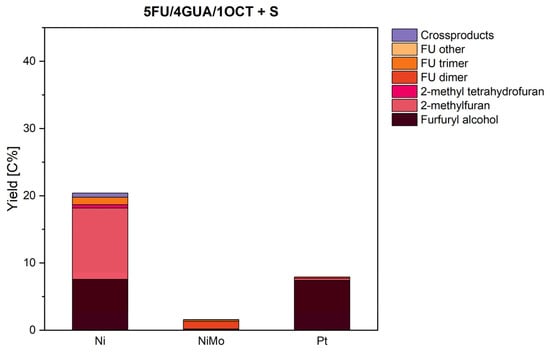
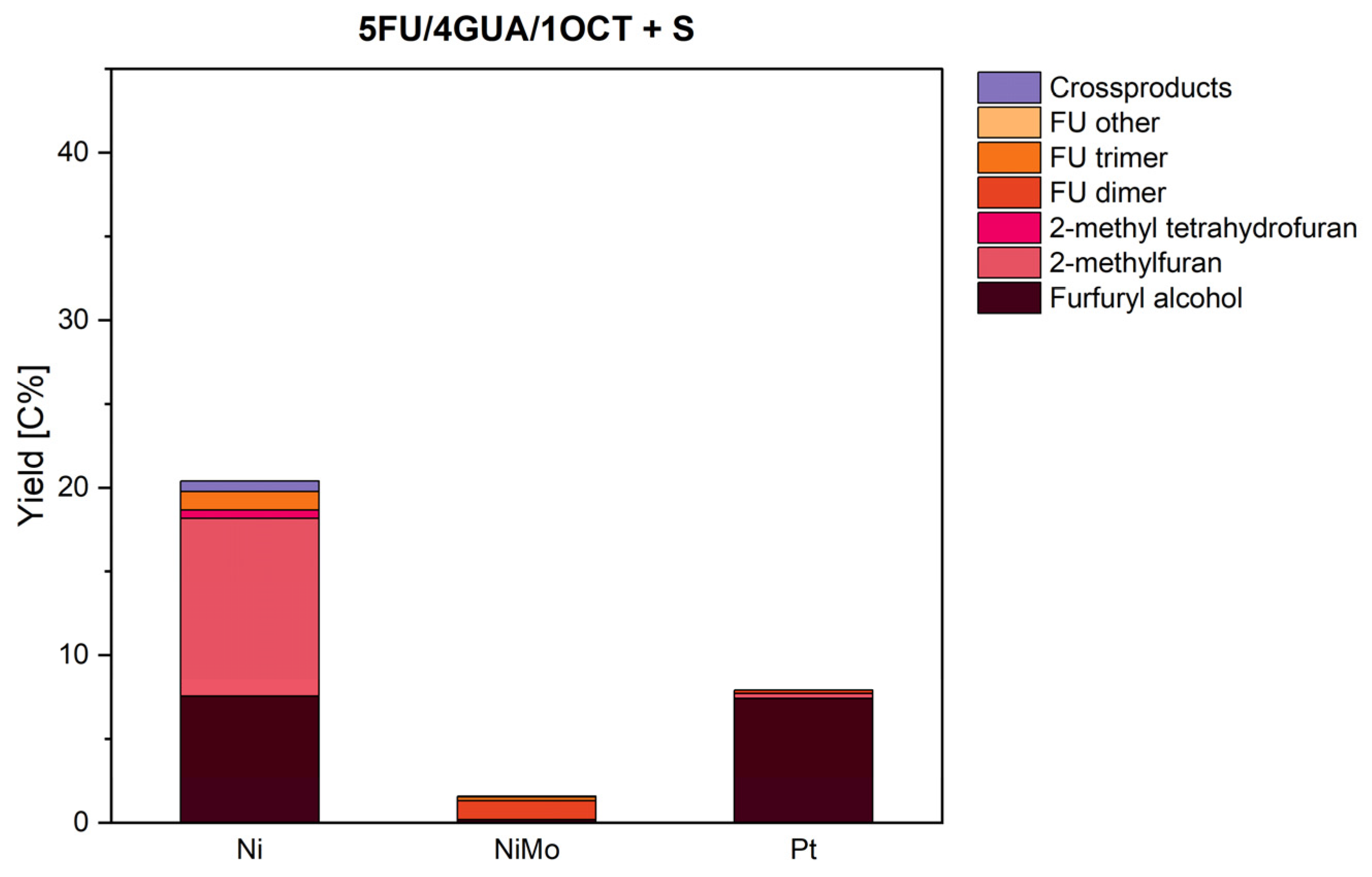
The yields of liquid products from the experiments using the 5FU/4GUA/1OCT mixture with sulfur are shown in Figure 4 (see also Table S7). The total yield decreased for both the Ni/Al2O3 (from 40.4 C% to 20.4 C%) and Pt/Al2O3 (from 18.7 C% to 7.93 C%) experiments, in accordance with the observed decrease in conversion for both cases (as shown in Figure 3). On the other hand, the liquid yield detected by GC analysis for the sulfided NiMo/Al2O3 increased from 0.84 C% to 1.58 C%, even though the conversion was observed to decrease slightly with the sulfur addition. This could be explained by the higher GC detection for this experiment, most likely due to more volatile compounds being formed. The main product remained dimers of furfural and its derivatives: their total amount increased from 0.54 C% to 1.14 C%. The amount of furfuryl alcohol did not change significantly (it decreased from 0.19 C% to 0.18 C%), but the amount of furfural-derived trimers increased from 0.04 C% to 0.23 C%. Interestingly, no cross-products were detected in the experiment with sulfur added to the feed.
Figure 4.
Yield of liquid products for experiments with the 5FU/4GUA/1OCT mixture with sulfur added in the form of dodecanethiol, 1172 wt-ppm S in the case of Ni/Al2O3 and Pt/Al2O3, and 6336 wt-ppm S for the sulfided NiMo/Al2O3. All experiments were conducted with 2 g of catalyst and 50 g of feed at 180 °C, with initial pressure of 90 bar H2 (at room temperature) for 1 h.
Not only did the total liquid yield decrease when adding sulfur to the feed for the Ni/Al2O3 catalyst, but the composition of the liquid products also changed significantly. The primary products changed from tetrahydrofurfuryl alcohol (15.4 C%) and 2-methyl tetrahydrofuran (13.5 C%) to 2-methyl furan (10.6 C%) and furfuryl alcohol (7.55 C%). In general, a switch can be seen in the furfural-derived products from compounds where the furan-ring has been hydrogenated to compounds where only the carbonyl group has been converted. Furthermore, for the sulfur experiment, the only products from the guaiacol and octanoic acid were in the category cross-products: more specifically, the ester between octanoic acid and 2-methyl furan. No guaiacol-derived products were detected for the case with sulfur as opposed to the no-sulfur experiment, where guaiacol was converted to both methyl-1,2-cyclohexanediol (3.16 C%) and the ester between guaiacol and octanoic acid (0.10 C%). The absence of the methyl-1,2-cyclohexandiol further confirms that the addition of sulfur affects the Ni/Al2O3 catalyst’s ability to hydrogenate aromatic rings.
The addition of sulfur to the experiment with Pt/Al2O3 also negatively impacted the conversion and total yield. However, the main product was still furfuryl alcohol (decreased from 13.9 C% to 7.44 C%). The secondary products were dimers of furfural and furfural-derived compounds (0.19 C%) and 2-methylfuran (0.29 C%). No cross-products were found for this experiment.
2.4. Carbonyl Conversion
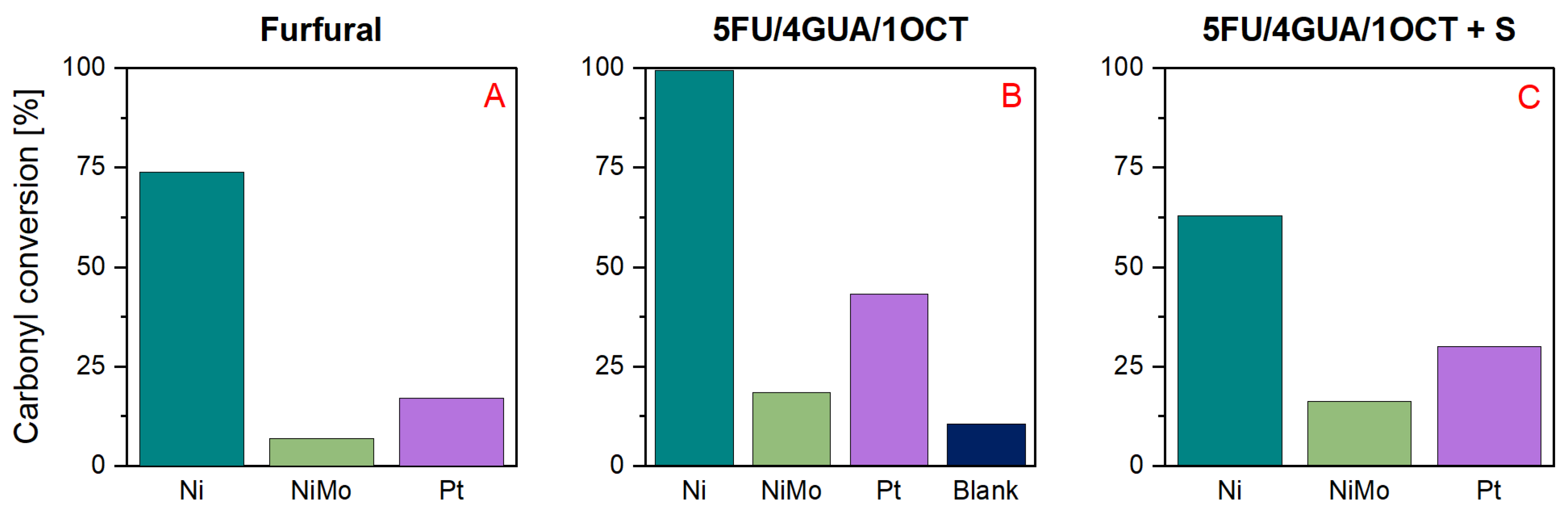
Since carbonyls are especially prone to polymerization and coke formation, the degree of stabilization of PO is often measured by the reduction in the carbonyl number [6,33]. Based on the GC analysis, the carbonyl number was calculated for each of the experiments, as shown in Figure 5. The experiments with pure guaiacol and pure octanoic acid are not depicted in the figure, as they have no carbonyl group and none were formed. The experiments with pure furfural had a higher initial carbonyl number compared to the 5FU/4GUA/1OCT mixture experiments (10.4 mmol/g feed vs. 5.20 mmol/g feed), since the furfural was the sole contributor to the carbonyl number in all cases. Interestingly, the experiments with the 5FU/4GUA/1OCT mixture displayed a higher fractional carbonyl conversion compared to the experiments with the pure furfural for all catalysts, indicating that some inhibition occurred in the case of pure furfural.
Figure 5.
Carbonyl conversion for experiments with (A) furfural (original carbonyl number 10.40 mmol/g feed), (B) 5FU/4GUA/1OCT mixture w.o. sulfur, and (C) w. sulfur (original carbonyl number 5.20 mmol/g feed). All experiments were conducted with 2 g of catalyst and 50 g of feed at 180 °C, with initial pressure of 90 bar H2 (at room temperature) for 1 h.
The order of the catalysts and their ability to convert carbonyls were Ni/Al2O3 > Pt/Al2O3 > sulfided NiMo/Al2O3 with the addition of sulfur to the feed. Sulfur proved to have a negative impact on the carbonyl conversion for all three catalysts, especially the Ni/Al2O3 (carbonyl conversion decreased from 99.5 to 63.0%). The Pt/Al2O3 catalyst was less affected by sulfur, as the carbonyl conversion only decreased from 43.1 to 30.0%. The sulfided NiMo/Al2O3 catalyst showed a minor decrease from 18.5 to 16.2%, but this may be within experimental uncertainty. As mentioned in the introduction, the sulfided NiMo/Al2O3 catalyst generally operates at higher temperatures (>300 °C) when utilized for HDS, and here it is seen that the catalyst also has low activity for conversion of carbonyl groups at the low temperature of stabilization. Unfortunately, with the already substantial amount of coke on the catalyst, especially in the presence of carbonyls, as evident from Figure 6, increasing the temperature will most likely only result in reactor plugging and catalyst deactivation, as already reported in other studies [19].
2.5. Catalyst Characterization
The Ni/Al2O3 and Pt/Al2O3 catalysts were characterized into fresh and spent states, using XRF to confirm that sulfur adsorbed onto the surface of these catalysts. The spent Ni/Al2O3 catalyst had gained 1.55 wt% sulfur, which corresponds to 63.5 wt% of the added sulfur in the experiment. Whether the catalyst is completely and permanently deactivated cannot be determined without further investigation, e.g., by testing the catalysts in a continuous flow reactor or repeating an autoclave experiment with the used catalyst. However, a study by Gardini et al. [37] showed that by use of STEM-EDX combined with XRD and XAS, a catalytically inactive Ni-S phase was formed when exposing a Ni/ZrO2 catalyst to octanethiol (0.3 vol%) in a continuous setup. This would suggest that the deactivation of the Ni/Al2O3 catalyst is permanent as well.
Figure 6.
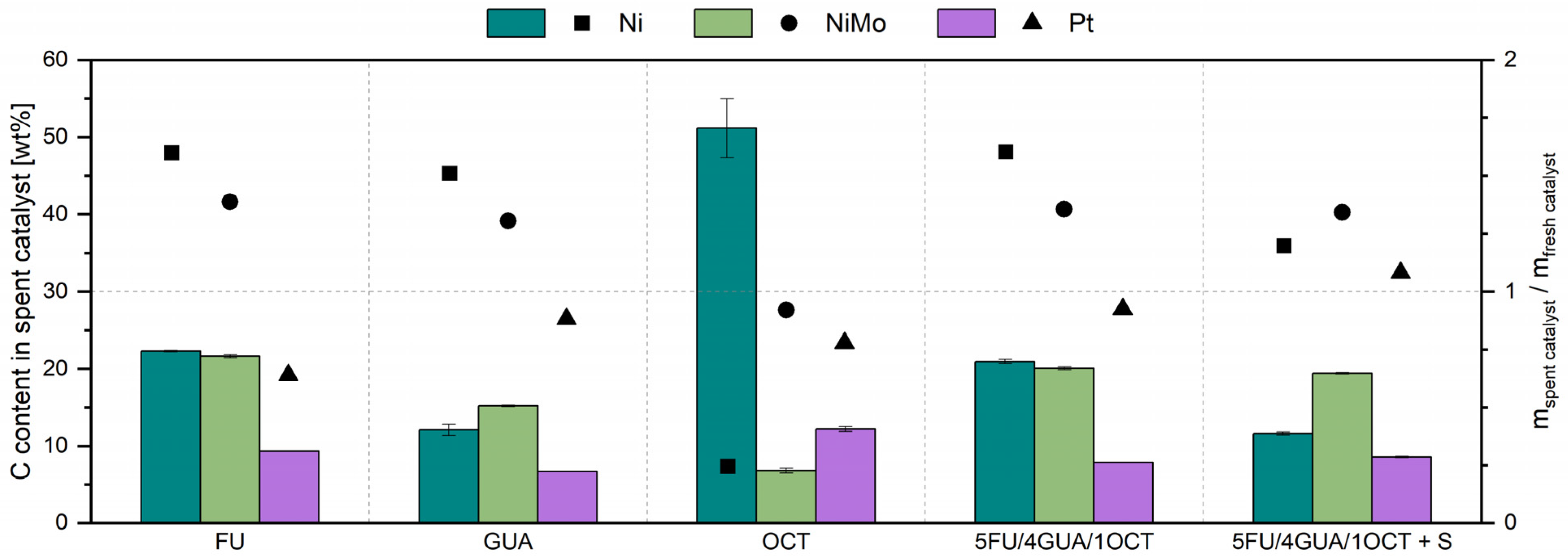
C content in spent catalyst in wt% (column, left axis) and relative change in mass (scatter, right axis) for each experiment grouped by feed. A reference line at no mass change can be seen on the plot. All experiments were conducted with 2 g of catalyst and 50 g of feed at 180 °C, with initial pressure of 90 bar H2 (at room temperature) for 1 h.
The spent Pt/Al2O3 had gained 0.31 wt% sulfur, corresponding to the 10.4 wt% of the added sulfur. In both cases, these results indicate that sufficient sulfur was added to observe a significant effect, as not everything was adsorbed. The difference between the two catalysts is likely due to differences in loading of the active material as well as its affinity to sulfur, as the Ni/Al2O3 has a much higher loading compared to the 1 wt% Pt/Al2O3 catalyst and binds sulfur stronger than Pt.
The sulfided NiMo/Al2O3 was also analyzed using XRF. As previously stated, this catalyst was pre-sulfided and the sulfur addition in this case (which was higher than for the other two catalysts) was done to maintain the sulfided state of the catalyst. While the XRF revealed that the catalyst had lost 7.21 wt% of sulfur, this could be attributed to the uncertainty of the characterization method, as well as the increase in mass (from 2.014 to 2.702 g).
Furthermore, the carbon content of each catalyst was determined by elemental analysis, as shown in Figure 6, alongside the change in catalyst mass from each experiment. A reference line has been added at one (right y-axis) for easier comparison to the original catalyst’s mass. As the fresh catalysts did not contain carbon, all measured carbon in the spent catalysts may be attributed to coking. The decrease in catalyst mass for the Pt/Al2O3 catalyst is likely attributed to the catalyst being a powder—and is therefore more difficult to completely retrieve after an experiment—rather than an actual loss in mass. However, interestingly, the Pt/Al2O3 catalyst showed the lowest carbon content in all cases except for the experiment with pure octanoic acid. For the experiments with pure furfural as feed as well as with the 5FU/4GUA/1OCT mixture, a correlation can be seen between the measured carbon content and the increase in mass: the Ni/Al2O3 catalyst had the highest carbon content and mass increase in both cases. The lower amount of coking and catalyst mass increase for Ni/Al2O3 with the addition of sulfur to the 5FU/4GUA/1OCT mixture, however, signifies a correlation between catalyst activity and coke formation, as this follows the observed lower conversion displayed in Figure 3.
The high carbon content, despite the small amount of catalyst retrieved from the Ni/Al2O3 experiment with octanoic acid, confirms that most of the catalyst was indeed dissolved during the experiment. The large error bar for the carbon content of the collected solids for this particular experiment is indicative of a lack of uniformity in the sample, rather than a measure of the accuracy of the analysis method.
XRD of all fresh and spent catalysts (SI Figures S5–S7) revealed no other Al2O3-phases than γ-Al2O3 in any of the catalyst samples, spent or fresh, although this does not exclude the possibility of non-crystalline Al2O3 being present in the samples. In general, XRD indicated amorphous material(s) in the spent samples, which complicated the analysis of the obtained results. XRD analysis indicated negligible structural changes in the Pt/Al2O3 samples, except for the appearance of a minor graphite phase in two of the samples (see Figure S7), which was deemed to be due to the presence of small pieces of the graphite gasket from the autoclave.
3. Materials and Methods
3.1. Materials
The furfural and guaiacol were purchased from Sigma Aldrich (St. Louis, MO, USA), and the Octanoic acid was from PanReac Applichem (ITW Reagents, Castellar del Vallès, Spain). A pre-reduced high-loaded Ni/Al2O3 (above 25 wt%, quadrilobed extrudates) and a pre-sulfided NiMo/Al2O3 (trilobed extrudates) were acquired from Topsoe A/S (Kongens Lyngby, Denmark), and pre-reduced Pt/Al2O3 (1 wt% loading, powder) was purchased from Sigma Aldrich (St. Louis, MO, USA). The extrudates were approximately 1 mm in diameter and up to 5 mm in length.
3.2. Experimental Setup
The experiments were performed in a lab scale batch reactor setup (500 mL autoclave, Parr 4575 HP/HT pressure reactor with a Parr 4848 reactor controller), as previously described [33]. The reactor was loaded with 50 g of feed (pure model compounds or a mixture of 50 wt% furfural, 40 wt% guaiacol, and 10 wt% octanoic acid) and 2 g of catalyst. For the experiments with sulfur addition, 0.37 g of dodecanethiol (corresponding to 1172 wt-ppm S) was added in the case of Pt/Al2O3 and Ni/Al2O3, and 2 g (corresponding to 6336 wt-ppm S) was added in the case of sulfided NiMo/Al2O3, since this type of catalyst requires sulfur to remain active [20]. The reactor was flushed with nitrogen to remove air and then pressurized to 90 bar with hydrogen gas. Under constant stirring (approximately 560 rpm), the reactor was heated to the reaction temperature (180 °C, heating rate on average 3.8 °C/min), where it was kept for 1 h. Afterwards it was externally quenched in an ice bath. The stirrer was turned off, the pressure was reduced to 20 bar and a gas sample was taken for GC analysis. The reactor was unloaded and weighed, and the liquid and catalyst were separated by suction filtration. The retrieved catalyst was subsequently washed with acetone and dried in air.
3.3. Analysis Methods
3.3.1. Gas Chromatography
Both gas and liquid samples were analyzed using gas chromatography. The gas phase was analyzed with a Global Analyzer Solutions (GAS) assembled Thermo Fischer Trace 1300 GC (Waltham, MA, USA) with three detectors: two TCD’s and one FID. One TCD was used to quantify H2, and the other to quantify CO, CO2, and N2 (both using micro-packed columns). An Agilent (Santa Clara, CA, USA) J&W HP-PLOT Al2O3 S column (25 m long, inner diameter of 0.53 mm, and a layer thickness of 10 µm) was used for hydrocarbon analysis on the FID together with a backflush column Restek Rtx-1.5m long, 0.53 mm ID, and 4 µm layer (as described in [38]). The FID was used to quantify C1 to C5 hydrocarbons individually and C6+ as a combined group. The GC was calibrated by using certified calibration gases as external standards.
The liquid phase was analyzed using an Agilent 7890B GC with FID and a 5977B MSD. Each sample was diluted in ethyl acetate (1:4) prior to injection. The carrier gas was Helium, the split ratio was 20.5:1, and the injection volume was 1 µL. Compound identification was done on the basis of the GC-MS, while the GC-FID was used for quantification. Calibration was done with the following chemical standards: furfural, guaiacol, octanoic acid, and phenol. The quantification of other compounds was done using the calculated FID response factors calculated based on ref. [39].
3.3.2. X-Ray Fluorescence
The catalysts were characterized by XRF on a Series 2 Puma from Bruker (Billerica, MA, USA), with a silver anode and an energy-dispersive HighSense XP detector. The spot size was limited to 18 mm with a collimating mask and the samples were loaded in 20 mm plastic sample cups with 4 µm polypropylene foil. Quantification was done using Bruker’s standardless methods in the Spectra Elements software (v3.2.42.0).
3.3.3. Elemental Analysis
The catalysts were subjected to elemental analysis to determine the carbon deposition from the experiments. The analysis was performed on a Thermo Scientific FlashSmart CHNS/O Elemental Analyzer (Waltham, MA, USA). For each measurement, 2–3 mg of sample was weighed into tin capsules, sealed, and deposited into the autosampler. The combustion was carried out at 950 °C in an oxygen-rich environment, followed by a reduction in the combustion gases in a separate reactor held at 530 °C. Helium was used as carrier gas at a flow rate of 140 mL/min. All spent catalysts were analyzed in triplicate and compared to the fresh catalysts. Quantification of C, H, N, and S was performed using 2,5-bis(5-tert-butyl-2-benzoxazolyl)thiophene (BBOT STD, Thermo Scientific, Waltham, MA, USA) as the calibration standard. The gases CO2, H2O, SO2, and N2 were separated on the chromatographic column prior to detection via TCD. Elemental analysis was calculated based on the peak areas that were relative to the BBOT standard and subsequently reported as weight percentages.
3.3.4. X-Ray Diffraction
The change in crystallinity of the catalysts was investigated by X-ray diffraction (XRD), using a Panalytical X’Pert Pro instrument (Worcestershire, UK) in Bragg–Brentano geometry working in reflectance mode, using CuKα radiation (Å). The instrument is equipped with a monochromator, soller-, divergence- and anti-scatter slits. The analysis was conducted at TOPSOE A/S. A portion of a powder sample was mounted into a standard XRD holder. The sample was measured in a horizontal spinning sample stage over the 2θ Scan range from 5° to 70°, with 0.017° step size in ambient air. The resulting diffraction pattern are analyzed using the X’Pert Highscore Plus software (v5.2) from Panalytical. The measured pattern matches the reference lines from a powder diffraction database file (PDF4+). Rietveld analyses are performed using the Topas Software (v6).
3.4. Calculations
3.4.1. Conversion and Reaction Rates
The conversion of reactants was calculated using GC analysis and mass balance from experiments. For the experiments with the model compound mixture (5FU/4GUA/1OCT), the conversion was calculated as a weighted average of the conversion of each of the three reactants:
where X is the conversion, m is the mass, and Mix, FU, GUA and OCT denote the model compound mixture (5FU/4GUA/1OCT), furfural, guaiacol, and octanoic acid, respectively.
The apparent reaction rate was calculated as an average over the reaction time (1 h):
where is the initial amount of reactant, is the amount of reactant left at the end of the experiment, t is the reaction time (1 h), and is the mass of catalyst used in the experiment (2 g). The following mass-transfer calculations are outlined in Section S1.
3.4.2. Carbonyl Number
The carbonyl number and conversion were calculated based on GC-detected carbonyls in the products. The carbonyl conversion was calculated using the following:
where is the conversion, is the concentration of carbonyls, and and denote initial and final, respectively.
4. Conclusions
The stabilization by hydrogenation of three different model compounds, furfural, guaiacol, and octanoic acid, chosen to represent bio-based pyrolysis oil, was studied using a batch reactor and three different catalysts, i.e., metallic Ni/Al2O3, sulfided NiMo/Al2O3, and metallic Pt/Al2O3. All experiments were conducted at 180 °C, for a reaction time of one hour, with an initial hydrogen pressure of 90 bar (at room temperature), and using a catalyst to feed ratio of 4 wt%. The model compounds were subjected to stabilization both as pure compounds and in a mixture consisting of 50 wt% furfural, 40 wt% guaiacol, and 10 wt% octanoic acid. Furthermore, the effect of adding a sulfur-containing compound (dodecanethiol) to the feed was investigated for the 5FU/4GUA/1OCT mixture, using all three catalysts.
In order of overall performance, the catalysts can be ranked Ni/Al2O3 > Pt/Al2O3 > sulfided NiMo/Al2O3, where the Ni/Al2O3 catalyst showed the highest conversion and yield of liquid GC detectable products in all cases. It showed especially good activity towards converting furfural to less reactive compounds in the 5FU/4GUA/1OCT mixture. Here, the hydrogenation of the furan ring, along with the carbonyl group, seemed to lower the possibility of further polymerization, since all detected polymerization products (dimers and trimers) had an un-hydrogenated furan ring. The highest loss of carbon to the gas phase was also observed with this catalyst, but overall, the amount of gas phase products was very low at the applied temperature.
When adding sulfur to the 5FU/4GUA/1OCT mixture, changes were observed for all three catalysts. For the sulfided NiMo/Al2O3, the conversion was relatively unchanged. The overall gas yield remained very low (less than 0.25 C%) for all experiments, regardless of feed and catalyst. However, a change in the liquid products was detected by GC. In general, a larger part of the converted reactants was accounted for by the GC analysis (1.58 vs. 0.84 C%): particularly, the yield of the furfural-derived dimers and trimers were seen to increase. In the case of the Pt/Al2O3 catalyst, the conversion decreased from 42 to 32%. The liquid yield also decreased overall: in particular, the yields of furfuryl alcohol, furfural-derived dimers, and cross-products decreased. Regardless of feed, catalyst, and presence of sulfur, carbon loss to the solid phase in the form of coke formation was seen on all spent catalysts.
As expected, the addition of sulfur to the feed had a negative impact on the otherwise promising activity of the Ni/Al2O3 catalyst. The conversion and hydrogen consumption decreased significantly (from 70.1% to 46.5%, and 16.9 mmol H2/g feed to 8.46 mmol H2/g feed, respectively), and the liquid product analysis showed that the catalyst did not hydrogenate the furan and benzene rings when sulfur was present in the feed. The characterization of the Ni/Al2O3 catalyst showed that sulfur had adsorbed to the catalyst, resulting in a sulfur content of 1.55 wt %. It is known that sulfur is a strong poison to Ni catalysts, but due to the nature of batch experiments, it remains to be seen whether the catalyst is completely or only partially deactivated. The results indicate that the most active catalyst for bio-oil stabilization, i.e., Ni/Al2O3, may be challenged by the presence of even ppm-level amounts of sulfur in real bio-oil.
Supplementary Materials
The following supporting information can be downloaded at: https://www.mdpi.com/article/10.3390/catal16030268/s1, Table S1: Hydrogen consumption for all experiments; Table S2: Conversion for all experiments; Figure S1: Gas products determined from GC analysis of gas phase; Table S3: Gas products determined from GC analysis of gas phase; Figure S2: Pictures of the Ni/Al2O3 catalyst dissolved in octanoic acid after the experiment with pure octanoic acid; Table S4: Overview of the structures of all formed products; Table S5: Complete liquid composition for all experiments with the pure reactants; Table S6: Complete liquid composition for all experiments with the 5FU/4GUA/1OCT mixture without sulfur added; Table S7: Complete liquid composition for all experiments with the 5FU/4GUA/1OCT mixture with sulfur added; Figure S3: GC detected mass balance; Figure S4: Mass balance for all experiments; Table S8: Apparent reaction rates for experiments with sulfur added, Figure S5: XRD diffractograms for fresh and spent Ni/Al2O3 catalysts, Figure S6: XRD diffractograms for fresh and spent sulfided NiMo/Al2O3 catalysts, Figure S7: XRD diffractograms for fresh and spent Pt/Al2O3 catalysts, Section S1: Mass-transfer calculations; Table S9: Shape, volume, surface area, and Sauter diameter for the extruded catalysts, Table S10: Results from mass-transfer calculations. References [35,40,41,42,43,44,45] are cited in the Supplemental Materials.
Author Contributions
Conceptualization, A.P.K., I.S.O., M.H., M.Z.S., L.Y.L.-O., M.B. and A.D.J.; methodology, A.P.K., I.S.O., M.H., M.Z.S., L.Y.L.-O., M.B. and A.D.J.; validation, A.P.K., I.S.O., M.H., M.Z.S., L.Y.L.-O., M.B. and A.D.J.; formal analysis, A.P.K. and I.S.O.; investigation, A.P.K. and I.S.O.; resources, A.D.J.; data curation, A.P.K. and I.S.O.; writing—original draft preparation, A.P.K.; writing—review and editing, A.P.K., I.S.O., M.H., M.Z.S., L.Y.L.-O., M.B. and A.D.J.; visualization, A.P.K.; supervision, M.H., M.Z.S., L.Y.L.-O., M.B. and A.D.J.; project administration, A.D.J.; funding acquisition, A.D.J. All authors have read and agreed to the published version of the manuscript.
Funding
This research was funded by the Innovation Fund Denmark for funding this research through the project “HyProFuel—Hydroprocessing Sustainable Fuels for Aviation and Heavy Transport—Grant no. 0224-00029A”.
Data Availability Statement
The raw data supporting the conclusions of this article will be made available by the authors upon request.
Conflicts of Interest
Authors Magnus Zingler Stummann, Lived Yegres Lemus-Olsen, Michael Brorson were employed by the company Topsoe A/S. The remaining authors declare that the research was conducted in the absence of any commercial or financial relationships that could be construed as a potential conflict of interest.
References
- Energy Statistics—An Overview Statistics Explained. 2024. Available online: https://ec.europa.eu/eurostat/statistics-explained/index.php?title=Energy_statistics_-_an_overview (accessed on 12 December 2024).
- Dabros, T.M.H.; Stummann, M.Z.; Høj, M.; Jensen, P.A.; Grunwaldt, J.-D.; Gabrielsen, J.; Mortensen, P.M.; Jensen, A.D. Transportation fuels from biomass fast pyrolysis, catalytic hydrodeoxygenation, and catalytic fast hydropyrolysis. Prog. Energy Combust. Sci. 2018, 68, 268–309. [Google Scholar] [CrossRef] [Scilit]
- Demirbas, A. Biorefineries: Current activities and future developments. Energy Convers. Manag. 2009, 50, 2782–2801. [Google Scholar] [CrossRef] [Scilit]
- Decker, S.R.; Sheehan, J.; Dayton, D.C.; Bozell, J.J.; Adney, W.S.; Aden, A.; Hames, B.; Thomas, S.R.; Bain, R.L.; Brunecky, R.; et al. Biomass Conversion. In Handbook of Industrial Chemistry and Biotechnology; Springer International Publishing: Cham, Switzerland, 2017; pp. 285–419. [Google Scholar] [CrossRef] [Scilit]
- Venderbosch, R.H.; Heeres, H.J. 17. Pyrolysis Oil Stabilisation by Catalytic Hydrotreatment. In Biofuel’s Engineering Process Technology; IntechOpen: London, UK, 2011; pp. 385–410. [Google Scholar] [CrossRef] [Scilit]
- Wang, H.; Lee, S.J.; Olarte, M.V.; Zacher, A.H. Bio-oil Stabilization by Hydrogenation over Reduced Metal Catalysts at Low Temperatures. ACS Sustain. Chem. Eng. 2016, 4, 5533–5545. [Google Scholar] [CrossRef] [Scilit]
- Adjaye, J.D.; Bakhshi, N.N. Production of hydrocarbons by catalytic upgrading of a fast pyrolysis bio-oil. Part I: Conversion over various catalysts. Fuel Process. Technol. 1995, 45, 161–183. [Google Scholar] [CrossRef] [Scilit]
- Auersvald, M.; Shumeiko, B.; Staš, M.; Kubička, D.; Chudoba, J.; Šimáček, P. Quantitative Study of Straw Bio-oil Hydrodeoxygenation over a Sulfided NiMo Catalyst. ACS Sustain. Chem. Eng. 2019, 7, 7080–7093. [Google Scholar] [CrossRef] [Scilit]
- Hu, X.; Zhang, Z.; Gholizadeh, M.; Zhang, S.; Lam, C.H.; Xiong, Z.; Wang, Y. Coke Formation during Thermal Treatment of Bio-oil. Energy Fuels 2020, 34, 7863–7914. [Google Scholar] [CrossRef] [Scilit]
- Baker, E.G.; Elliott, D.C. Catalytic Upgrading of Biomass Pyrolysis Oils. In Research in Thermochemical Biomass Conversion; Springer: Dordrecht, The Netherlands, 1988; pp. 883–895. [Google Scholar] [CrossRef] [Scilit]
- Lin, F.; Xu, M.; Ramasamy, K.K.; Li, Z.; Klinger, J.L.; Schaidle, J.A.; Wang, H. Catalyst Deactivation and Its Mitigation during Catalytic Conversions of Biomass. ACS Catal. 2022, 12, 13555–13599. [Google Scholar] [CrossRef] [Scilit]
- Zacher, A.H.; Elliott, D.C.; Olarte, M.V.; Wang, H.; Jones, S.B.; Meyer, P.A. Technology advancements in hydroprocessing of bio-oils. Biomass Bioenergy 2019, 125, 151–168. [Google Scholar] [CrossRef] [Scilit]
- Ardiyanti, A.R.; Gutierrez, A.; Honkela, M.L.; Krause, A.O.I.; Heeres, H.J. Hydrotreatment of wood-based pyrolysis oil using zirconia-supported mono- and bimetallic (Pt, Pd, Rh) catalysts. Appl. Catal. A Gen. 2011, 407, 56–66. [Google Scholar] [CrossRef] [Scilit]
- Wildschut, J.; Mahfud, F.H.; Venderbosch, R.H.; Heeres, H.J. Hydrotreatment of Fast Pyrolysis Oil Using Heterogeneous Noble-Metal Catalysts. Ind. Eng. Chem. Res. 2009, 48, 10324–10334. [Google Scholar] [CrossRef] [Scilit]
- Šivec, R.; Likozar, B.; Grilc, M. Surface kinetics and transport phenomena modelling for furfural hydrotreatment over Pd/C in isopropanol and tetrahydrofuran. Appl. Surf. Sci. 2021, 541, 148485. [Google Scholar] [CrossRef] [Scilit]
- Šivec, R.; Huš, M.; Likozar, B.; Grilc, M. Furfural hydrogenation over Cu, Ni, Pd, Pt, Re, Rh and Ru catalysts: Ab initio modelling of adsorption, desorption and reaction micro-kinetics. Chem. Eng. J. 2022, 436, 135070. [Google Scholar] [CrossRef] [Scilit]
- Auersvald, M.; Kejla, L.; Eschenbacher, A.; Thi, H.D.; Van Geem, K.M.; Šimáček, P. Detailed characterization of sulfur compounds in fast pyrolysis bio-oils using GC × GC-SCD and GC–MS. J. Anal. Appl. Pyrolysis 2021, 159, 105288. [Google Scholar] [CrossRef] [Scilit]
- Stanislaus, A.; Marafi, A.; Rana, M.S. Recent advances in the science and technology of ultra low sulfur diesel (ULSD) production. Catal. Today 2010, 153, 1–68. [Google Scholar] [CrossRef] [Scilit]
- Yin, W.; Kloekhorst, A.; Venderbosch, R.H.; Bykova, M.V.; Khromova, S.A.; Yakovlev, V.A.; Heeres, H.J. Catalytic hydrotreatment of fast pyrolysis liquids in batch and continuous set-ups using a bimetallic Ni-Cu catalyst with a high metal content. Catal. Sci. Technol. 2016, 6, 5899–5915. [Google Scholar] [CrossRef] [Scilit]
- Dabros, T.M.H.; Gaur, A.; Pintos, D.G.; Sprenger, P.; Høj, M.; Hansen, T.W.; Studt, F.; Gabrielsen, J.; Grunwaldt, J.-D.; Jensen, A.D. Influence of H2O and H2S on the composition, activity, and stability of sulfided Mo, CoMo, and NiMo supported on MgAl2O4 for hydrodeoxygenation of ethylene glycol. Appl. Catal. A Gen. 2018, 551, 106–121. [Google Scholar] [CrossRef] [Scilit]
- Yin, W.; Wang, Z.; Yang, H.; Venderbosch, R.H.; Heeres, H.J. Catalytic Hydrotreatment of Biomass-Derived Fast Pyrolysis Liquids Using Ni and Cu-Based PRICAT Catalysts. Energy Fuels 2022, 36, 14281–14291. [Google Scholar] [CrossRef] [Scilit]
- Yin, W.; Gu, H.; Figueirêdo, M.B.; Xia, S.; Venderbosch, R.H.; Heeres, H.J. Stabilization of fast pyrolysis liquids from biomass by catalytic hydrotreatment using Raney nickel ‘type’ catalysts. Fuel Process. Technol. 2021, 219, 106846. [Google Scholar] [CrossRef] [Scilit]
- Otyuskaya, D.; Thybaut, J.W.; Alexiadis, V.; Alekseeva, M.; Venderbosch, R.; Yakovlev, V.; Marin, G.B. Fast pyrolysis oil stabilization kinetics over a Ni-Cu catalyst using propionic acid as a model compound. Appl. Catal. B Environ. 2018, 233, 46–57. [Google Scholar] [CrossRef] [Scilit]
- Yin, W.; Venderbosch, R.H.; He, S.; Bykova, M.V.; Khromova, S.A.; Yakovlev, V.A.; Heeres, H.J. Mono-, bi-, and tri-metallic Ni-based catalysts for the catalytic hydrotreatment of pyrolysis liquids. Biomass Convers. Biorefin. 2017, 7, 361–376. [Google Scholar] [CrossRef] [Scilit]
- Ardiyanti, A.R.; Bykova, M.V.; Khromova, S.A.; Yin, W.; Venderbosch, R.H.; Yakovlev, V.A.; Heeres, H.J. Ni-Based Catalysts for the Hydrotreatment of Fast Pyrolysis Oil. Energy Fuels 2016, 30, 1544–1554. [Google Scholar] [CrossRef] [Scilit]
- Alekseeva (Bykova), M.V.; Otyuskaya, D.; Rekhtina, M.; Bulavchenko, O.; Stonkus, O.; Kaichev, V.; Zavarukhin, S.; Thybaut, J.; Alexiadis, V.; Venderbosch, R.; et al. NiCuMo-SiO2 catalyst for pyrolysis oil upgrading: Model acidic treatment study. Appl. Catal. A Gen. 2019, 573, 1–12. [Google Scholar] [CrossRef] [Scilit]
- Yin, W.; Venderbosch, R.H.; Alekseeva, M.V.; Figueirêdo, M.B.; Heeres, H.; Khromova, S.A.; Yakovlev, V.A.; Cannilla, C.; Bonura, G.; Frusteri, F.; et al. Hydrotreatment of the carbohydrate-rich fraction of pyrolysis liquids using bimetallic Ni based catalyst: Catalyst activity and product property relations. Fuel Process. Technol. 2018, 169, 258–268. [Google Scholar] [CrossRef] [Scilit]
- Han, D.; Yin, W.; Arslan, A.; Liu, T.; Zheng, Y.; Xia, S. Stabilization of fast pyrolysis liquids from biomass by mild catalytic hydrotreatment: Model compound study. Catalysts 2020, 10, 402. [Google Scholar] [CrossRef] [Scilit]
- Nejadmoghadam, E.; Achour, A.; Sirous-Rezaei, P.; Salam, M.A.; Arora, P.; Öhrman, O.; Creaser, D.; Olsson, L. Stabilization of bio-oil from simulated pyrolysis oil using sulfided NiMo/Al2O3 catalyst. Fuel 2023, 353, 129094. [Google Scholar] [CrossRef] [Scilit]
- Verdier, S.; Mante, O.D.; Hansen, A.B.; Poulsen, K.G.; Christensen, J.H.; Ammtizboll, N.; Gabrielsen, J.; Dayton, D.C. Pilot-scale hydrotreating of catalytic fast pyrolysis biocrudes: Process performance and product analysis. Sustain. Energy Fuels 2021, 5, 4668–4679. [Google Scholar] [CrossRef] [Scilit]
- Oasmaa, A.; Elliott, D.C.; Korhonen, J. Acidity of Biomass Fast Pyrolysis Bio-oils. Energy Fuels 2010, 24, 6548–6554. [Google Scholar] [CrossRef] [Scilit]
- Trueba, M.; Trasatti, S.P. γ-Alumina as a Support for Catalysts: A Review of Fundamental Aspects. Eur. J. Inorg. Chem. 2005, 2005, 3393–3403. [Google Scholar] [CrossRef] [Scilit]
- Krebs, A.P.; Sløk, H.A.; Høj, M.; Stummann, M.Z.; Lemus-Olsen, L.Y.; Brorson, M.; Jensen, A.D. Stabilization of Pyrolysis Oil from Woody Biomass Using Ni/Al2O3 and Sulfided NiMo/Al2O3 Catalysts. Energy Fuels 2025, 39, 15300–15309. [Google Scholar] [CrossRef] [Scilit]
- Girel, E.; Cabiac, A.; Chaumonnot, A.; Besson, M.; Tuel, A. Selective Carbon Deposition on γ-Alumina Acid Sites: Toward the Design of Catalyst Supports with Improved Hydrothermal Stability in Aqueous Media. ACS Appl. Mater. Interfaces 2020, 12, 13558–13567. [Google Scholar] [CrossRef] [Scilit]
- Mortensen, P.M. Catalytic Conversion of Bio-Oil to Fuel for Transportation. Ph.D. Thesis, Technical University of Denmark, Kongens Lyngby, Denmark, 2013. [Google Scholar]
- ASTM International. Specification for Aviation Turbine Fuel Containing Synthesized Hydrocarbons; ASTM International: West Conshohocken, PA, USA, 2024. [Google Scholar] [CrossRef] [Scilit]
- Gardini, D.; Mortensen, P.M.; Carvalho, H.W.P.; Damsgaard, C.D.; Grunwaldt, J.-D.; Jensen, P.A.; Jensen, A.D.; Wagner, J.B. Electron Microscopy Study of the Deactivation of Nickel Based Catalysts for Bio Oil Hydrodeoxygenation. Microsc. Microanal. 2014, 20, 458–459. [Google Scholar] [CrossRef] [Scilit]
- Böhme, M.; Jensen, P.A.; Høj, M.; Hansen, B.B.; Stummann, M.Z.; Jensen, A.D. Conversion of Furfural as a Bio-Oil Model Compound over Calcium-Based Materials as Sacrificial Low-Cost Catalysts for Bio-Oil Upgrading. Catalysts 2025, 15, 554. [Google Scholar] [CrossRef] [Scilit]
- De Saint Laumer, J.Y.; Cicchetti, E.; Merle, P.; Egger, J.; Chaintreau, A. Quantification in gas chromatography: Prediction of flame ionization detector response factors from combustion enthalpies and molecular structures. In Analytical Chemistry; ACS Publications: Washington, DC, USA, 2010; pp. 6457–6462. [Google Scholar] [CrossRef] [Scilit]
- Ancheyta, J.; Muñoz, J.A.D.; Macías, M.J. Experimental and theoretical determination of the particle size of hydrotreating catalysts of different shapes. Catal. Today 2005, 109, 120–127. [Google Scholar] [CrossRef] [Scilit]
- Wilke, C.R.; Chang, P. Correlation of diffusion coefficients in dilute solutions. AIChE J. 1955, 1, 264–270. [Google Scholar] [CrossRef] [Scilit]
- Reid, R.C.; Prausnitz, J.M.; Poling, B.E. The Properties of Gases and Liquids, 4th ed.; McGraw-Hill: Columbus, OH, USA, 1987. [Google Scholar]
- Kleiber, M.; Joh, R.; Span, R. D3 Properties of Pure Fluid Substances. In VDI Heat Atlas; Springer: Berlin/Heidelberg, Germany, 2010; pp. 301–418. [Google Scholar]
- Frenkel, M.; Hong, X.; Dong, Q.; Yan, X.; Chirico, R.D. 5.1.2 Saturated Carboxylic Acids, C7–C12, densities. In Densities of Phenols, Aldehydes, Ketones, Carboxylic Acids, Amines, Nitriles, and Nitrohydrocarbons; Springer: Berlin/Heidelberg, Germany, 2002; pp. 209–233. [Google Scholar]
- Tjaden, B.; Cooper, S.J.; Brett, D.J.; Kramer, D.; Shearing, P.R. On the origin and application of the Bruggeman correlation for analysing transport phenomena in electrochemical systems. Curr. Opin. Chem. Eng. 2016, 12, 44–51. [Google Scholar] [CrossRef] [Scilit]

Disclaimer/Publisher’s Note: The statements, opinions and data contained in all publications are solely those of the individual author(s) and contributor(s) and not of MDPI and/or the editor(s). MDPI and/or the editor(s) disclaim responsibility for any injury to people or property resulting from any ideas, methods, instructions or products referred to in the content. |
© 2026 by the authors. Licensee MDPI, Basel, Switzerland. This article is an open access article distributed under the terms and conditions of the Creative Commons Attribution (CC BY) license.