


Abstract
In the present work, a six-cation high-entropy fluorite-type oxide photocatalyst composition (Ce1/6Gd1/6Pr1/6Sm1/6Y1/6Zr1/6)O2−δ (HEFO) was prepared with the concept of “high entropy” using a glycine-assisted solution combustion method. Several characterization techniques, such as X-ray diffraction (XRD), UV–visible spectroscopy, and field emission scanning electron microscopy (FESEM), were employed to evaluate the physicochemical properties. Structural analysis by XRD confirmed the formation of a single-phase cubic fluorite structure supported by the Rietveld refinement analysis. The photocatalytic application was systematically evaluated using the prepared HEFO for the degradation of Rhodamine B dye with the help of natural sunlight and H2O2. Several parameters such as photocatalyst dose, dye concentration, and pH were investigated, and the results revealed that 25 mg of photocatalyst, 20 ppm dye concentration, and pH 11 achieved 99.25% of Rhodamine B degradation. Similarly, radical-scavenger tests suggested the involvement of more than one reactive pathway. In addition, the photocatalyst demonstrated excellent reusability, retaining 74.46% degradation efficiency after five cycles (83.6% activity retention), with XRD confirming the preserved cubic fluorite structure. The photocatalytic investigations demonstrate high-entropy oxides to be highly efficient and sustainable photocatalysts for the degradation of Rhodamine B dye.
1. Introduction
Fast-paced industrial development has driven remarkable economic growth and social transformation, yet it has come at a significant environmental cost. Among the most pressing concerns is water pollution, particularly from synthetic dyes and other refractory organic contaminants. Synthetic dyes from the textile, paper, printing, and leather industries are increasingly finding their way into water bodies, bringing with them a host of environmental and health concerns [1,2]. These dyes are not only toxic but also highly persistent, resisting natural degradation and posing long-term threats to ecosystems and human health [3,4]. Among them, Rhodamine B (RhB), a widely used xanthene dye, is chemically stable, toxic, and extremely difficult to break down through conventional biological processes [5,6,7]. Conventional remediation strategies include adsorption, coagulation–flocculation, biological treatment, photodegradation, and electrochemical oxidation [8,9,10].
Photocatalysis has emerged as a compelling solution. It uses incident light, under favorable conditions, to drive the complete mineralization of various pollutants, offering an environmentally friendly and sustainable path forward for wastewater remediation [11,12,13]. Conventional photocatalysts such as TiO2 [14], ZnO [15], and CeO2 [16] have been the subject of extensive research for pollutant degradation. However, they are hindered by several inherent drawbacks: wide bandgaps that confine their activity to the UV region, high electron–hole recombination rates, and a scarcity of active sites. Various strategies such as doping [17,18], heterojunction construction [19,20], and defect engineering [21,22] have been proposed to overcome these limitations.
Most present photocatalytic systems are focused on constructing multiple heterojunctions to achieve efficient charge separation and extended light absorption. The ZnO/rGO/TiO2 heterojunction system was fabricated to degrade Rhodamine B dye using it. The heterojunction system effectively degraded 93% of Rhodamine B dye in 300 min [23]. Similarly, a direct Z-scheme photocatalyst was designed using Zn3V2O8/g-C3N4 heterojunction to be used for degrading Rhodamine B dye. The degradation kinetics were tuned by varying the amount of Zn3V2O8. The optimized bandgap, along with effective charge separation by such a heterojunction, effectively degraded 91% of Rhodamine B within 120 min under simulated solar irradiation [24]. A ternary Ag/Ag2O/SnS2 heterojunction photoelectrode was prepared on an FTO conductive surface. The photocatalytic studies display 92.4% Rhodamine B degradation for the 20-Ag/Ag2O/SnS2 system. Here, radical trap experiments indicate that h+ and •OH are the major reactive oxygen species (ROS) participating in the degradation of Rhodamine B dye [20]. A dual Z-scheme photocatalyst based on BiVO4/AgBr/Ag2MoO4 achieved an excellent degradation of Rhodamine B dye when a 210 W xenon lamp was used as a light source. The achieved degradation was 260.5 times, 6.1 times, and 161.7 times that of pure BiVO4, AgBr, and Ag2MoO4, respectively, attributed to the lowest probability of electron–hole recombination [25].
While heterojunction engineering has undoubtedly led to significant improvements in photocatalytic performance, this approach introduces considerable complexity. For instance, fabricating heterojunctions often requires multi-step synthesis procedures, precise interface engineering, and careful matching of band structures between different materials. To overcome this issue, high-entropy oxides (HEOs) have recently emerged as one of the new classes of functional materials with diverse functional properties and applications [26]. These materials are designed from five or more principal metal cations, which are distributed in near equimolar proportions and are stabilized by high configurational entropy.
Several prominent characteristics of HEOs stem from their compositional tunability, enabled by the wide selection of available elements. This flexibility allows for the precise tailoring of optical [27], magnetic [28], mechanical [29], electromagnetic [30], and dielectric properties [31] to meet specific application requirements. Consequently, HEOs often outperform pristine or conventionally doped systems, positioning them as promising candidates for diverse technological applications [32,33,34,35,36]. In the context of photocatalysis, the incorporation of cations with diverse ionic radii frequently results in bandgap narrowing, thereby enabling visible light absorption [32,37]. This is an essential advantage, as it allows HEOs to utilize a substantially larger portion of the solar spectrum compared to conventional wide-bandgap photocatalysts.
As pointed out earlier, the multi-step synthesis process can be avoided by using high-entropy oxides. By incorporating multiple cations into a single-phase solid solution, HEOs inherently provide the benefits of heterojunction systems such as efficient charge separation and extended light absorption. In this work, we report the synthesis of a high-entropy fluorite oxide, (Ce1/6Gd1/6Pr1/6Sm1/6Y1/6Zr1/6)O2−δ, via a glycine-assisted solution combustion method. The cation combination was selected to favor the formation of a multicomponent fluorite-type solid solution. In addition, the purpose of adding multi-valent cations such as Ce3+/4+ and Pr3+/4+ is to enhance the photocatalytic reaction kinetics, while other metal cations assist in stabilizing the crystal structure and increase the configurational entropy.
The structural, morphological, and optical properties of the synthesized photocatalyst are comprehensively characterized using XRD, FESEM-EDS, and UV-vis spectroscopy. The photocatalytic performance is systematically evaluated for Rhodamine B dye degradation under natural sunlight irradiation.
2. Results
2.1. Physicochemical Properties
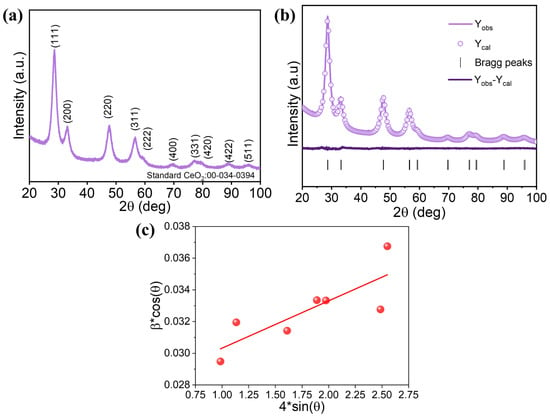
The crystal structure, phase purity, and microstructural parameters of the synthesized HEFO photocatalyst were investigated using powder XRD. The XRD pattern of HEFO powder calcined at 700 °C presented in Figure 1a was indexed to the cubic fluorite structure (space group Fm-3m). The major peaks around 28.6, 33.1, 47.6, 56.5, and 59.2 correspond to (111), (200), (220), (311), and (222), respectively, characteristics of single-phase material, typical of CeO2 (ICDD card number: 00-034-0394). No additional peaks except peaks arising from the cubic fluorite structure are observed, confirming the formation of a single-phase cubic fluorite oxide.
Figure 1.
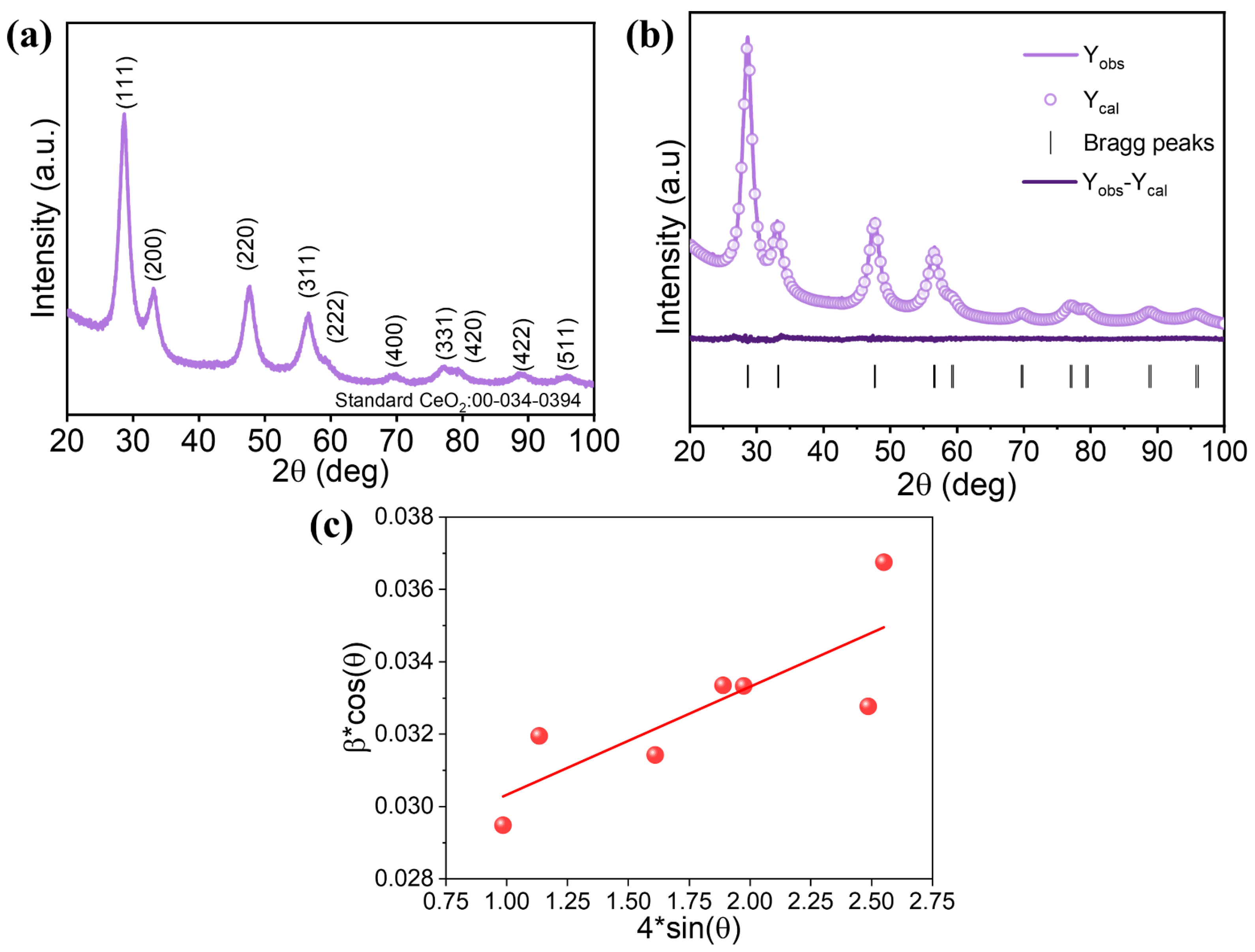
(a) XRD pattern of prepared HEFO, (b) Rietveld refinement plot, and (c) Williamson–Hall plot. In the plot, “*” represents a multiple sign.
Rietveld refinement was performed on the obtained XRD data to estimate the structural parameters and assess the phase purity. The refinement was carried out using the cubic fluorite structure (space group Fm-3m), with all metal cations occupying at (0, 0, 0) and O atoms occupying at (1/4, 1/4, 1/4) (Figure 1b). The refinement fitting parameters indicate single-phase cubic fluorite structure formation and are summarized in Table 1. The lattice parameter of 5.3959 Å was obtained from the refinement results and is in excellent agreement with the standard reported value for bulk CeO2 (a = 5.4113 Å). Williamson–Hall (W-H) analysis was performed on the XRD data to estimate the crystallite size and lattice microstrain (Figure 1c). Accordingly, the calculated crystallite size and microstrain values are 5.07 nm and 0.0029 (0.29%), respectively. Variation in the lattice parameter and microstrain stems from the multi-principal elements with diverse ionic radii, creating a locally strained environment that is characteristic of high-entropy materials [38,39].
Table 1.
Structural and microstructural parameters derived from Rietveld refinement and Williamson–Hall analysis of XRD data.
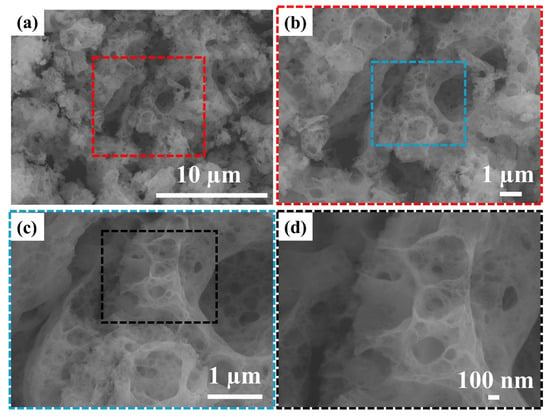
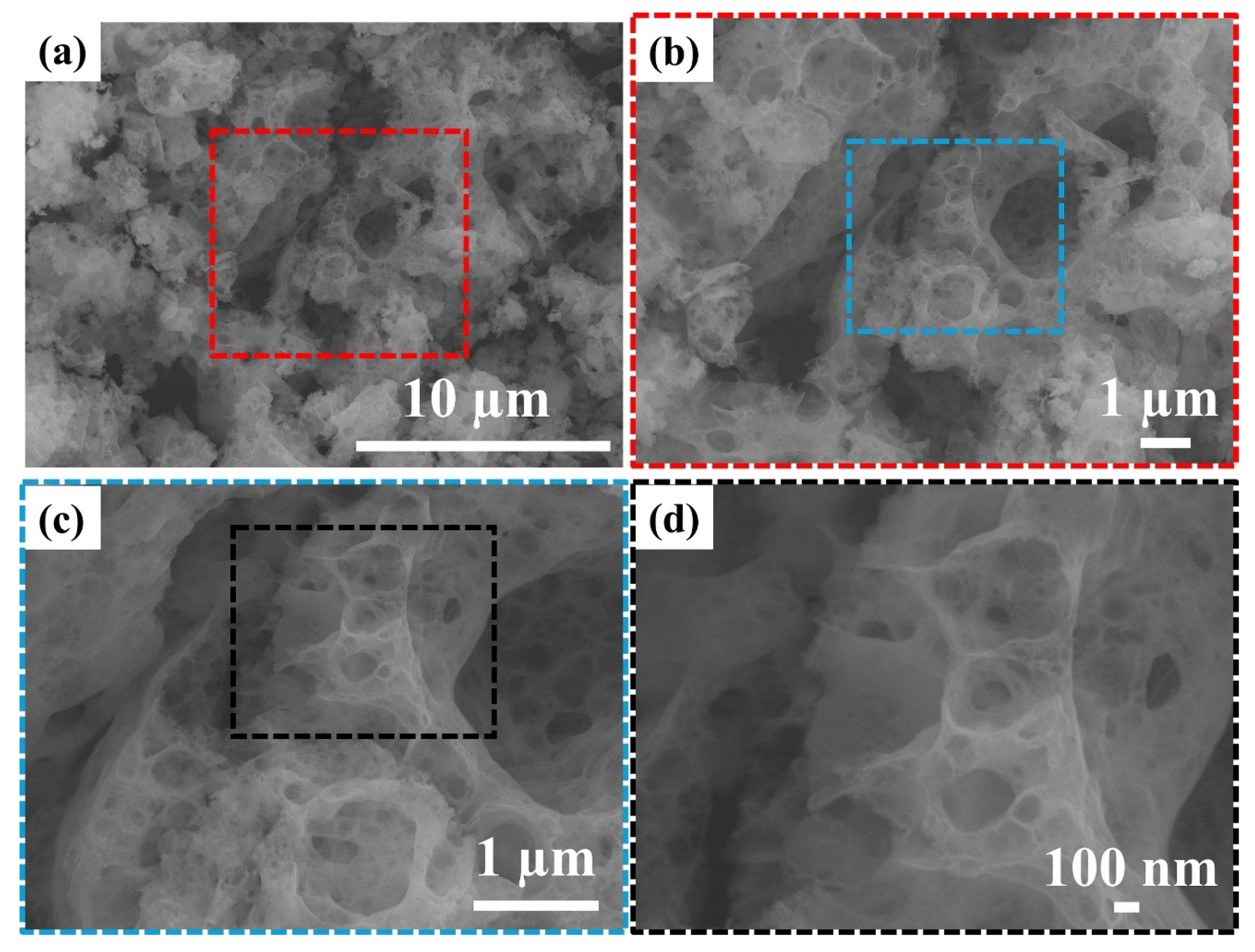
The surface morphology, microstructure, and elemental composition of the synthesized HEFO photocatalyst were investigated using field emission scanning electron microscopy (FESEM) coupled with energy-dispersive X-ray spectroscopy (EDS) (Figure 2 and Figure 3). The low magnification images reveal a highly porous, spongy, and flaky morphology with an interconnected network structure. This unique morphology is characteristic of materials prepared by the solution combustion synthesis technique using glycine as a fuel (Figure 2a–c) [40]. During the combustion process, a large volume of gases (CO2, H2O, and N2) is evolved, resulting in the highly porous and fluffy appearance observed in the micrographs. At higher magnifications, individual particles appear to be composed of agglomerated nanocrystallites within a porous network (Figure 2d).
Figure 2.
FESEM micrographs of prepared HEFO captured at different magnifications. (a) 5000×, (b) 10,000×, (c) 25,000×, and (d) 50,000×.
Figure 3.
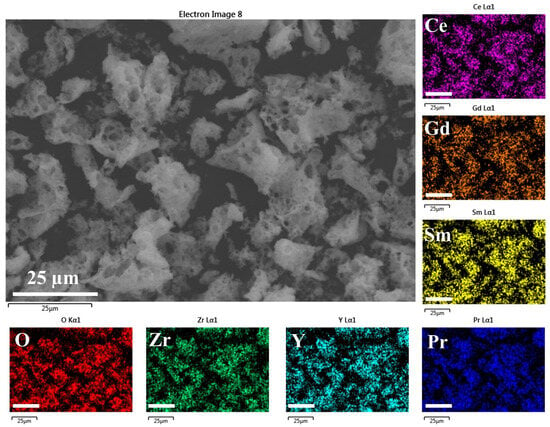
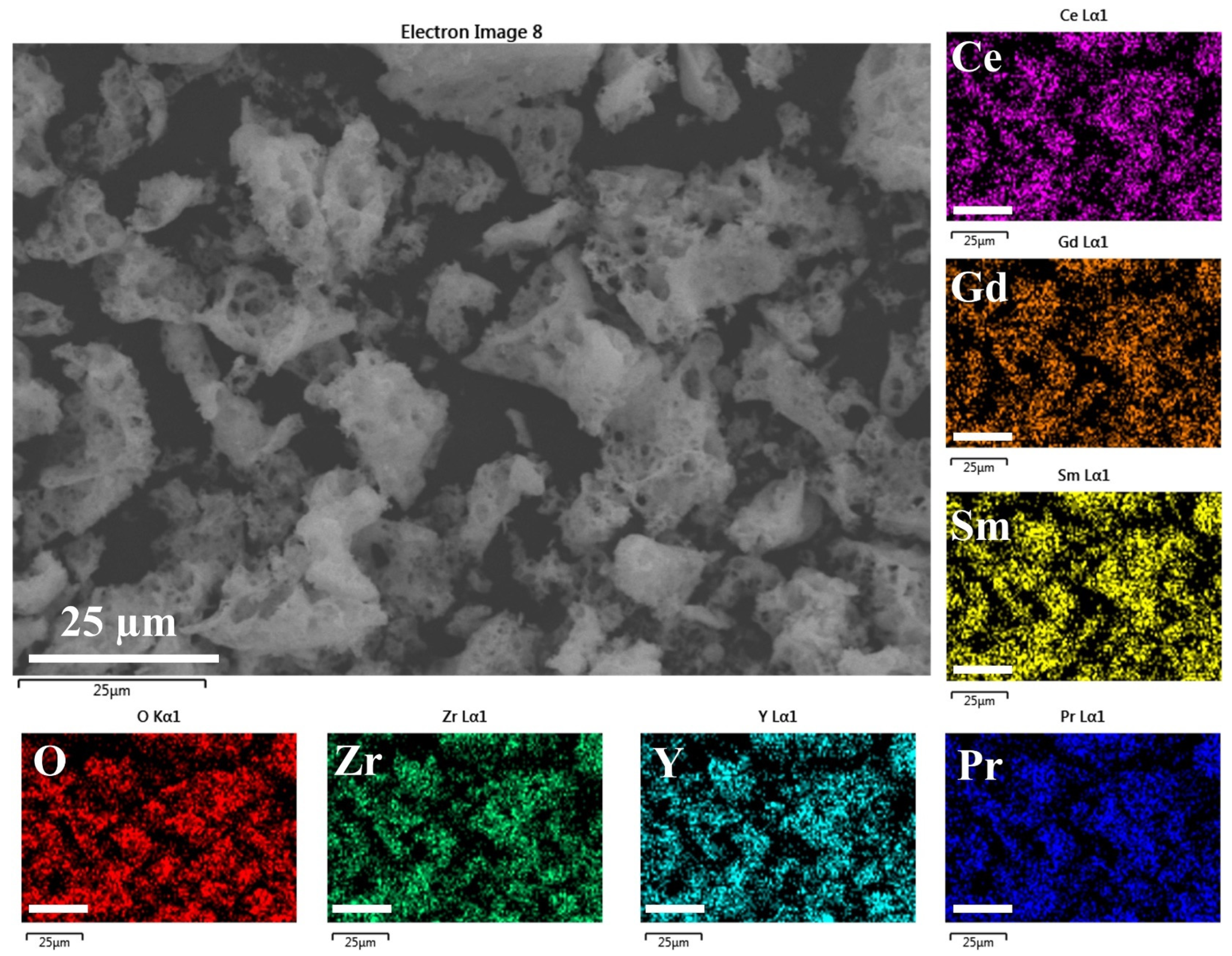
Elemental mapping of prepared HEFO showing homogeneous distribution of metal cations.
Elemental mapping was performed to evaluate the distribution of all metal cations across the sample (Figure 3). The elemental mapping shows a uniform and homogeneous distribution of multi-principal elements throughout the porous structure, without any evidence of elemental segregation conforming to chemical uniformity. An EDS point scan probed from five different locations was used to estimate the mean composition of principal elements (Table 2). The measured metal-cation fractions are broadly consistent with the intended near-equimolar composition. However, the oxygen stoichiometry estimated by EDS is not sufficiently precise and can be used as a semi-quantitative reference.
Table 2.
Elemental quantification of HEFO nanoparticles probed using an EDS point scan.
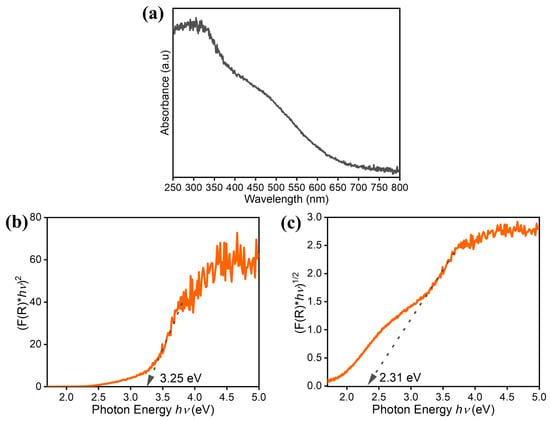
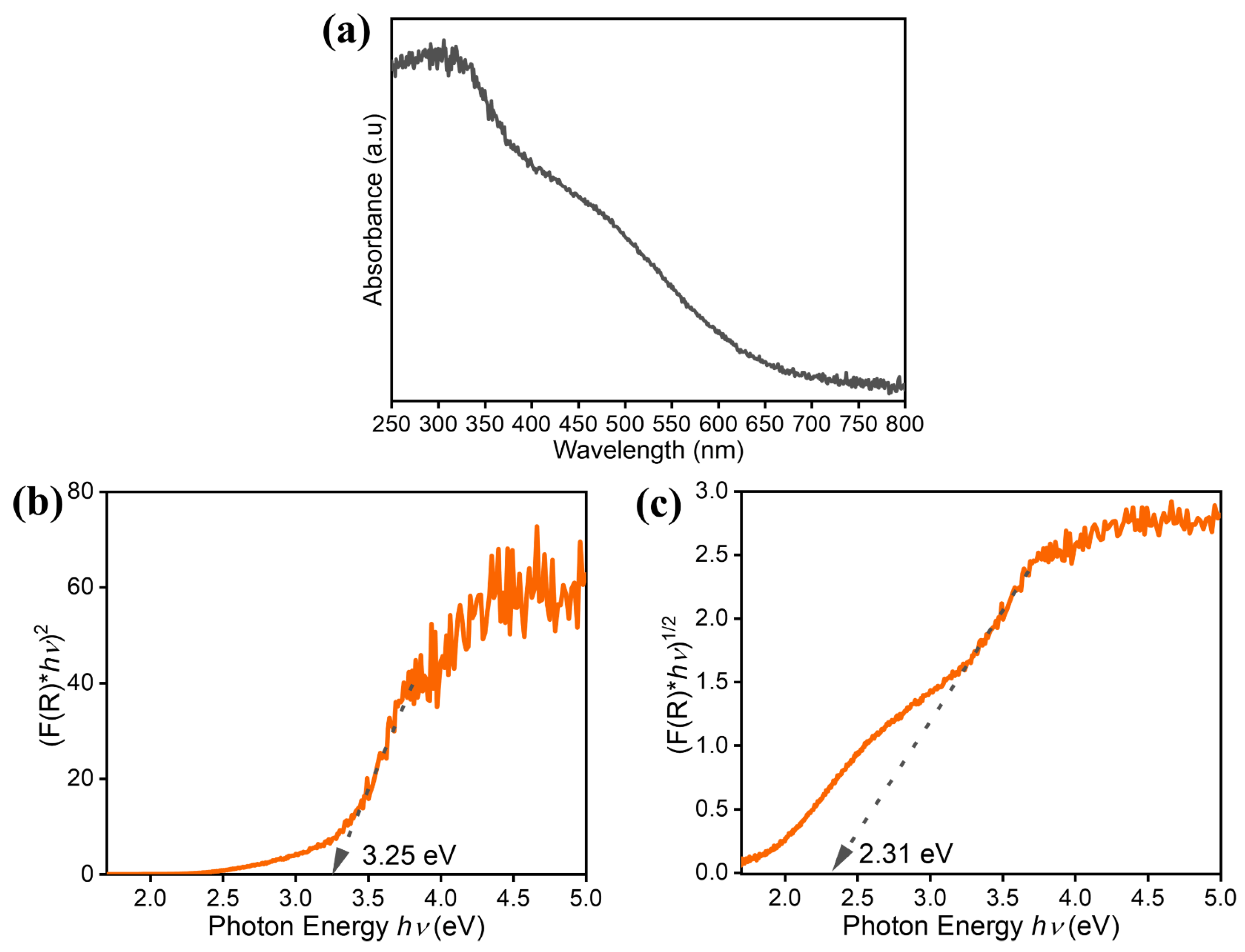
The optical properties of the synthesized HEFO photocatalyst were investigated using UV-vis spectroscopy in the wavelength range of 250–800 nm. The UV-vis absorbance spectrum of HEFO calcined at 700 °C is shown in Figure 4a. The absorbance spectrum exhibits a strong broad absorption band in the UV region, with a sharp absorption edge observed at approximately 375 nm attributed to electronic transition from the O 2p valence band to the Me3+/4+ conduction band [27]. In addition, a broad absorbance between 375–600 nm is observed and corresponds to the oxygen defects promoted by trivalent cations such as Pr3+/4+ [41]. The optical bandgap was estimated using the Kubelka–Munk (K-M) function and Tauc plot. The direct and indirect bandgap of the HEFO is 3.25 eV and 2.31 eV (Figure 4b,c).
Figure 4.
(a) UV-vis absorbance spectrum, and (b) direct and (c) indirect bandgap estimated from the Tauc plot. In the plot, “*” represents a multiple sign.
2.2. Photocatalytic Reaction
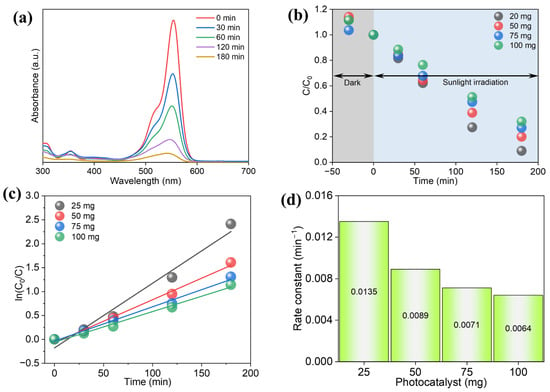
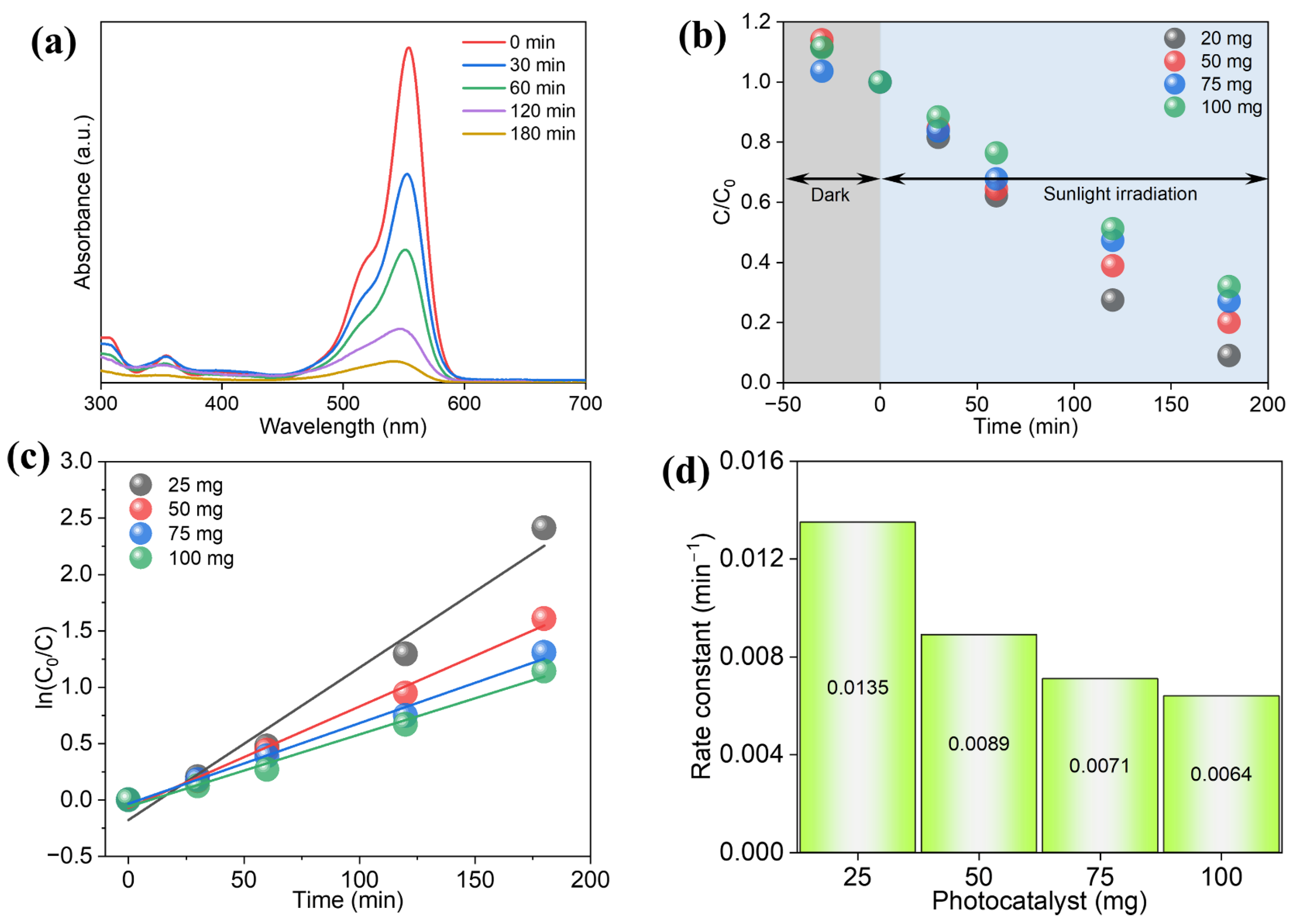
The photocatalytic degradation of Rhodamine B dye by high-entropy oxide was evaluated using UV-vis absorption spectroscopy. The absorbance spectra of Rhodamine B dye possess an intense absorbance centered around 554 nm [5]. Upon natural sunlight irradiation, the peak intensity rapidly decreases in the course of time (Figure 5a). Meanwhile, there is no visual evidence of new peaks indicating that the Rhodamine B dye was completely degraded. Here, several parameters are varied, such as photocatalyst concentration, dye concentration, and pH, to evaluate their roles in the degradation kinetics. As a result, to evaluate the optimum loading for the sunlight-assisted degradation of Rhodamine B, the photocatalytic experiments were conducted with varying amounts of the HEFO photocatalyst, specifically 25, 50, 75, and 100 mg. The results revealed a significant inverse relationship between the catalyst dosage and degradation performance (Figure 5b). The reaction kinetics were then evaluated based on the UV-absorbance plots. Pseudo-first-order reaction kinetics were followed, given by ln(C0/Ct) = kt, where k denotes the rate constant, and C0 and Ct represent the concentration of Rhodamine B dye at time 0 and time of interest, respectively.
Figure 5.
Effect of photocatalyst concentration on Rhodamine B degradation. (a) Time-dependent UV-vis absorption spectra of Rhodamine B degradation, (b) (C/C0) versus irradiation time for different catalyst loadings, (c) pseudo-first-order kinetic plot, and (d) bar chart showing the apparent rate constants (k) as a function of catalyst dosage. (20 ppm dye, 200 µL H2O2, sunlight).
Meanwhile, the percentage degradation of Rhodamine dye was calculated using the following formula: degradation (%) = ((C0 − Ct) /C0) × 100. Accordingly, the highest degradation efficiency of 91.4% was achieved with the lowest catalyst loading of 25 mg, corresponding to the maximum apparent rate constant (k) of 0.0135 min−1 (Figure 5d). As the photocatalyst loading was increased to 50, 75, and 100 mg, the degradation efficiencies dropped sharply to 79.94%, 72.95%, and 68.07%, respectively, with rate constants decreasing almost proportionally to 0.0089, 0.0071, and 0.0064 min−1. The observed results are unique compared to reported works where the degradation efficiency usually increases with catalyst loading up to an optimal point before declining.
The possible cause for such an observation in degradation kinetics was related to particle agglomeration and shielding effects at higher photocatalyst concentrations [13,42]. When the concentration of the photocatalyst is increased beyond a threshold value, the turbidity of the reaction solution increases. This prevents the penetration of photons into the deeper bulk of the solution, drastically reducing the number of photogenerated charge carriers available for Rhodamine B degradation, affecting reaction kinetics. Therefore, 25 mg of photocatalyst was selected as an optimal concentration for further investigations.
Control experiments were conducted with HEFO and sunlight but without H2O2 (Figure S1), and with H2O2 and sunlight but without HEFO (Figure S2). We observed the degradation of Rhodamine B is too slow in the absence of H2O2. This is attributed to the rapid recombination of the electron–hole pairs. In general, metal oxide-based photocatalysts exhibit such a fast electron–hole pair recombination rate, and several strategies are used to prevent such a process [16,40]. Here, in our case, we have used H2O2 as an oxidizing agent to capture conduction band electrons, delaying the recombination rate and improving the Rhodamine B dye degradation [16]. Second, partial degradation of Rhodamine B is noticed in the absence of a photocatalyst. This is attributed to the photolysis of Rhodamine B dye in the presence of visible light and H2O2. Therefore, the synergistic combination of photocatalyst and H2O2 is essential to effectively degrade Rhodamine B dye.
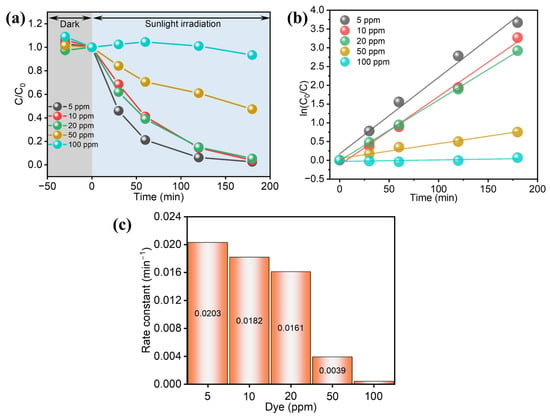
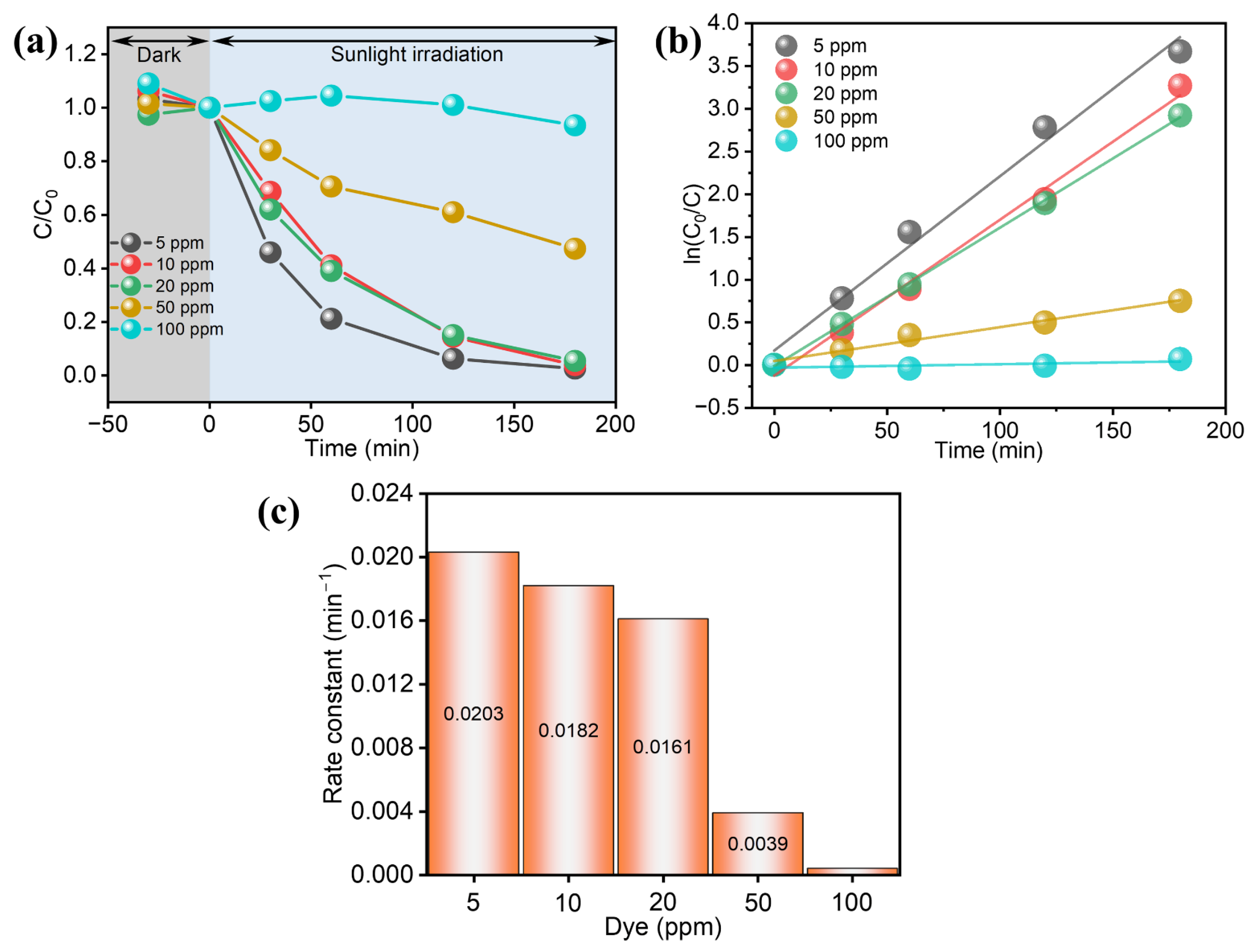
The influence of the initial Rhodamine B dye concentration on the photocatalytic degradation efficiency was investigated using 25 mg of photocatalyst. Here, five different Rhodamine B dye concentrations, 5, 10, 20, 50, and 100 ppm, were added to the photocatalytic reaction and exposed to natural sunlight, and the corresponding degradation kinetics are presented in Figure 6. The result shows that, at lower dye concentrations up to 20 ppm, the prepared HEFO exhibited good photocatalytic degradation. The degradation of 97.45%, 96.20%, and 94.62% was achieved for the 5, 10, and 20 ppm dye concentrations, respectively. The estimated rate constant seems marginally constant, from 0.0203 to 0.0161 min−1, indicating rapid and efficient dye mineralization. On the other hand, a drastic decline in performance was observed when the dye concentration was above 20 ppm. The degradation efficiency decreased from 52.71% (k = 0.0039 min−1) for 50 ppm to 6.59% (0.0004 min−1) for 100 ppm.
Figure 6.
Effect of initial dye concentration on Rhodamine B degradation: (a) C/C0 vs. time, (b) ln(C0/C) vs. time, and (c) rate constants (25 mg photocatalyst, 200 µL H2O2, sunlight).
Several possible explanations for such a decline in photocatalytic performance are discussed below. First, from the photocatalyst perspective, is the availability of active sites. In all initial dye concentrations, the amount of available active sites is fixed. At low dye concentrations, the photocatalyst can accommodate most of the dye molecules, accelerating the reaction kinetics. However, with increasing dye concentration, the active sites on the photocatalyst surface become progressively saturated. Such a condition drastically reduces the degradation efficiency, which is directly reflected in the sharp reduction of the rate constant from 0.0161 min−1 (20 ppm) to 0.0004 min−1 (100 ppm). Second, the “shielding effect” by the high concentration of dye molecules restricts penetration of sunlight photons into the reaction medium [43]. At such a higher concentration, a substantial percentage of the incident solar radiation is absorbed by the dye molecules, leaving behind a fraction of sunlight to interact with the photocatalyst [44]. As a result, the number of generated electron–hole pairs is low, substantially inhibiting the reaction kinetics.
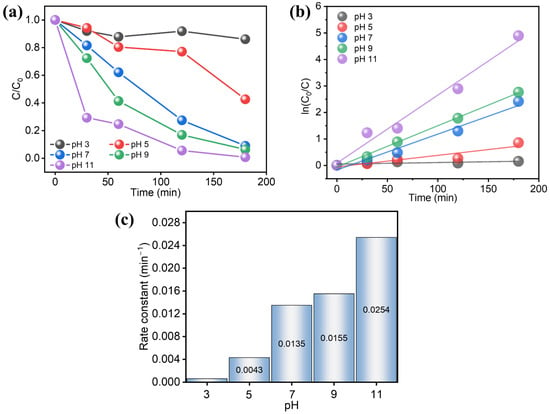
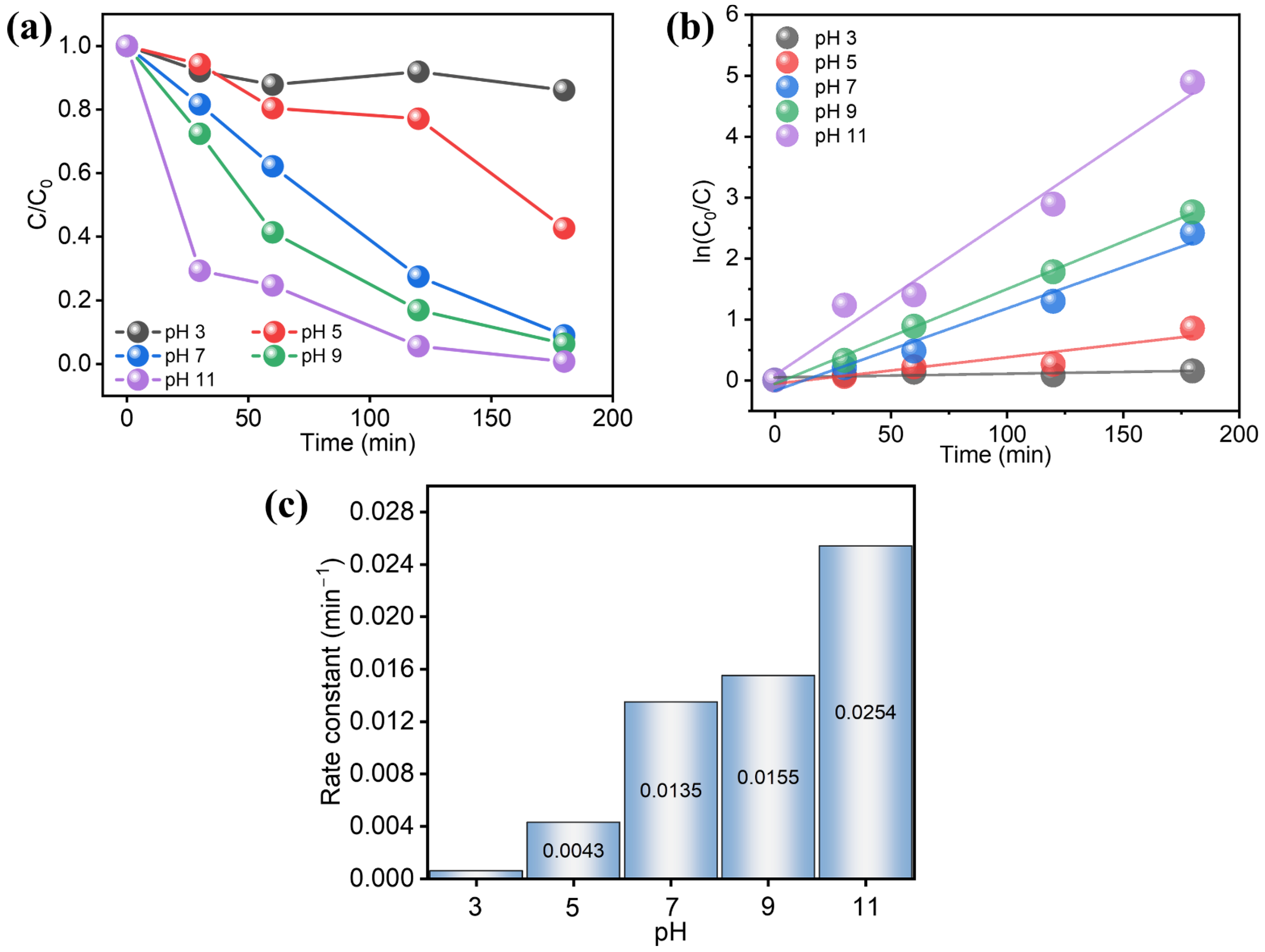
Similarly, the pH of the reaction medium plays a vital role in photocatalysis, as it influences the reaction kinetics. To investigate these effects, the photocatalytic degradation of Rhodamine B using a 25 mg HEFO photocatalyst and 20 ppm dye concentration was investigated across a wide pH range from 3 to 11, and the resulting degradation efficiencies and apparent pseudo-first-order rate constants were calculated (Figure 7). The results indicate that the photocatalytic degradation shows systematic enhancement with increasing pH. At acidic pH, the rate constant increased from k = 0.00059 min−1 (pH 3) to k = 0.0043 min−1 (pH 5). Remarkably, the rate constant drastically increased from 0.0155 min−1 (pH 9) to k = 0.0256 min−1 (pH 11). The degradation increased from 13.93% at pH 3 to 99.25% at pH 11, underscoring the extraordinary sensitivity of this HEFO system to the solution pH.
Figure 7.
Effect of pH on Rhodamine B dye degradation: (a) C/C0 vs. time, (b) ln(C0/C) vs. time, and (c) rate constants (25 mg photocatalyst, 20 ppm dye, 200 µL H2O2, sunlight).
This can be explained by the nature of Rhodamine B dye in different pH environments [45,46]. For instance, with pKa values of 3.7, Rhodamine B exists as a cation, and the photocatalyst surface becomes highly protonated, acquiring a net positive charge. This eventually electrostatically repels cationic Rhodamine B molecules away from the photocatalyst surface. This drastically reduces the probability of electron transfer and reactive oxygen species-mediated attack, and reduces the rate constant [47]. In contrast, at higher pH values (basic region), Rhodamine B exists in zwitterionic form while the surface of the photocatalyst is negatively charged. Such an environment positively favors the attraction of Rhodamine B dye through electrostatic attraction [48]. The increase in degradation efficiency from pH 7 to pH 11 suggests that the surface negative charge density continues to increase with alkalinity, further strengthening the electrostatic attraction and maximizing the utilization of available active sites. Table 3 compares the photocatalytic performance of the HEFO photocatalyst with various reported photocatalyst systems. Many of these reported systems rely on the formation of heterojunctions or the incorporation of noble metals such as Ag, which significantly increases both fabrication costs and process complexity. In contrast, the high-entropy oxide developed in this work can be synthesized via a simple, single-step solution combustion method, substantially reducing synthesis complexity while maintaining excellent photocatalytic performance.
Table 3.
Comparison of photocatalytic degradation of Rhodamine B dye with reported photocatalysts.
2.3. Photocatalyst Recyclability and Stability
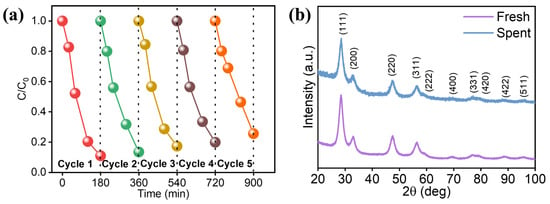
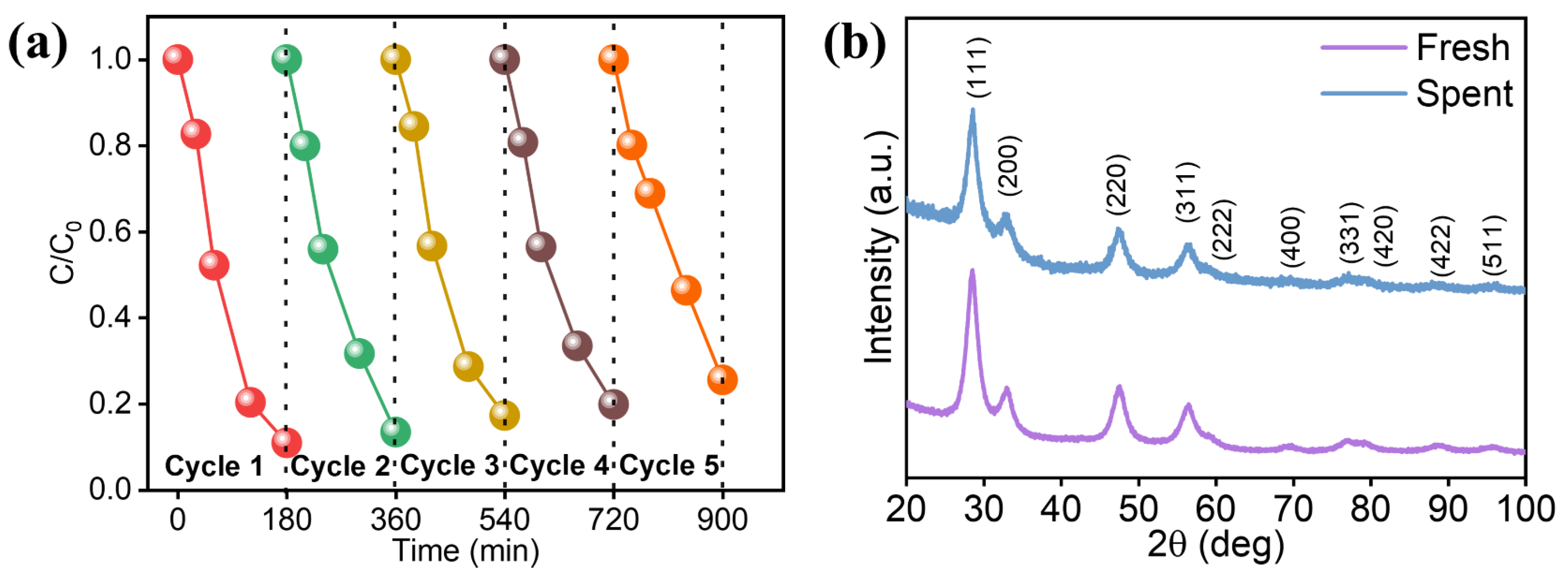
The recyclability of the photocatalyst was evaluated for five consecutive cycles (Figure 8a). At the end of each cycle, the HEFO photocatalyst was separated from the reaction mixture by centrifugation. The obtained powder was thoroughly washed with deionized water and ethanol to remove any adsorbed dye molecules or intermediates, dried at 60 °C in a hot air oven, and subsequently reused in the next cycle. The results indicate that the prepared HEO photocatalyst maintains good degradation performance throughout the five cycles. Initially, the degradation efficiency of Rhodamine B dye was 89.08% and, at the end of the fifth cycle, the degradation reduced to 74.46%. The possible reason for such a decline in activity is due to the photocatalyst loss during the recovery (washing) step, which is unavoidable. The stability of the photocatalyst after five cycles was investigated and is shown in Figure 8b. The XRD pattern reveals the spent photocatalyst retained its structural integrity, underscoring the phase stability of the high-entropy oxide even after five successive photocatalytic cycles.
Figure 8.
(a) Recyclability test for the photocatalytic degradation of Rhodamine B dye using HEFO photocatalyst for five consecutive cycles and (b) XRD pattern of fresh and spent photocatalyst.
2.4. Proposed Photocatalyst Mechanism
To investigate the photocatalytic mechanism, the positions of the conduction band (CB) and valence band (VB) of a semiconductor photocatalyst are essential, as they dictate the photocatalytic reaction kinetics [58]. The valence band (EVB) and conduction band (ECB) potentials were estimated using Equations (1) and (2):
where:
ECB = χHEO − Ee − 0.5 Eg
EVB = ECB + Eg
- Ee is the energy of free electrons on the hydrogen scale (4.5 eV)
- Eg is the bandgap of the material (Eg = 3.25 eV)
- χHEO denotes the electronegativity of high-entropy oxide.
The following equation (Equation (3)) was used to calculate the electronegativity of high-entropy oxide.
Here, a, b, c, d, e, f, and g are the number of atoms present in the compound, while A, B, C, D, E, F, and G are the six metal cations and one anion present in the system. The electronegativity of an individual atom can be found using Equation (4):
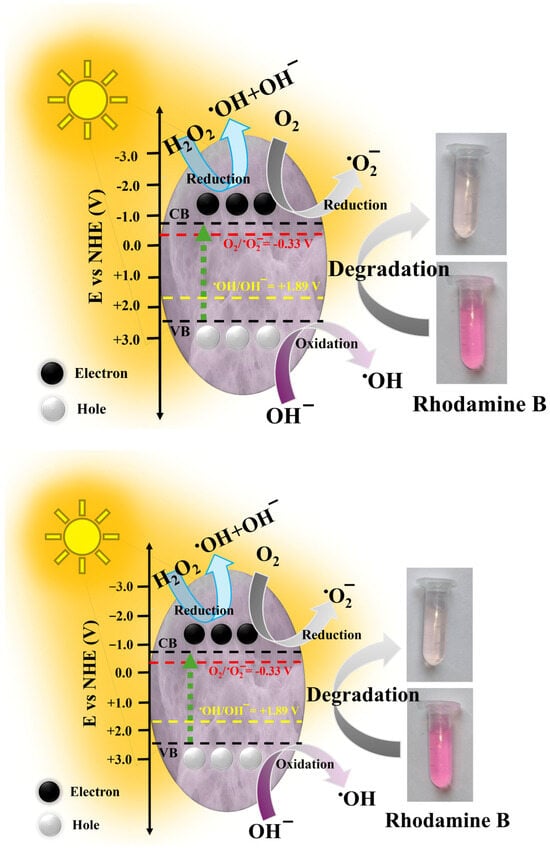
Here, EEA and EIE represent electron affinity energy and ionization energy, respectively. For the prepared HEFO photocatalyst, the experimentally determined band edge positions considering a direct bandgap of 3.25 eV are ECB = −0.7682 V and EVB = +2.4818 V vs. NHE. In the case of an indirect bandgap (Eg = 2.31 eV), the ECB and EVB are −0.2982 V and +2.0118 eV, respectively.
When the reaction solution containing the Rhodamine B dye and high-entropy Ce1/6Gd1/6Pr1/6Sm1/6Y1/6Zr1/6)O2 oxide was exposed to natural sunlight, the generation of electron–hole pairs occurred (Equation (5)). The photogenerated electron migrates to the conduction band while the holes remain in the valance band. Next, electrons from the conduction band interact with H2O2 and form hydroxyl radicals and hydroxyl ions (Equation (6)), because the EVB = +2.4818 V vs. NHE of the photocatalyst is more positive than the redox potential of •OH/OH− (+1.89 eV vs. NHE). In addition, the available holes in the valance band react with adsorbed water to produce hydroxyl radicals (Equation (7)). Simultaneously, the interaction between holes and hydroxyl ions forms hydroxyl radicals (Equation (8)). On the other hand, the ECB = −0.7682 V of the photocatalyst is more negative than the redox potential of •O−2 (−0.33 eV vs. NHE) which generates superoxide radicals (Equation (9)). Furthermore, the superoxide attacks H2O2 and forms •OH + O2 + OH− (Equation (10)). The formation of such hydroxyl and superoxide radicals specifically attacks and degrades Rhodamine B dye into smaller, less harmful compounds such as CO2, H2O, and other inorganic small molecules through mineralization [59,60] (Equation (11)). The proposed degradation mechanism is schematically illustrated in Figure 9.
Figure 9.
Schematic displaying the possible photocatalytic degradation mechanism of Rhodamine B dye using a HEFO photocatalyst.
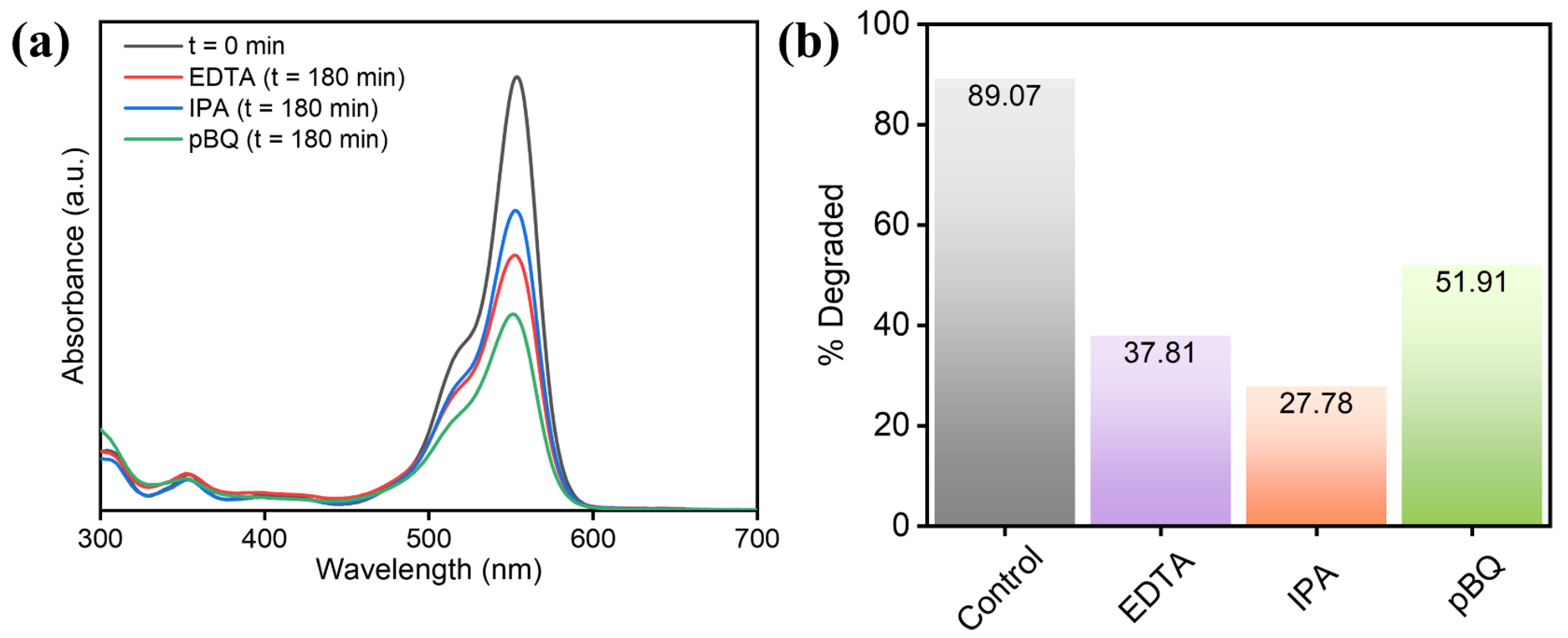
To evaluate the role of each component, a series of radical trapping experiments was conducted. Amounts of 1 mM each of isopropyl alcohol (IPA), p-benzoquinone (p-BQ), and ethylenediaminetetraacetic acid disodium salt (EDTA 2Na) were introduced into the reaction system to selectively scavenge individual reactive species. Here IPA, p-BQ, and EDTA 2Na scavenge hydroxyl radicals, superoxide radicals, and holes, respectively. The results indicate a significant reduction in degradation efficiency confirming the participation of multiple reactive species in the degradation process (Figure 10). The degradation of Rhodamine B follows a multi-pathway mechanism involving three reactive species (Hydroxyl radicals (•OH) > Holes (h+) > Superoxide radicals (•O−2)). The 27.78% dye degradation observed with IPA confirms that hydroxyl radicals are the dominant reactive species. Apart from this, holes play an accompanying role followed by superoxide radicals. These experimental findings are in excellent agreement with the thermodynamic predictions based on the band edge positions of the HEFO photocatalyst (ECB = −0.7682 V and EVB = +2.4818 V vs. NHE). Overall, the effective degradation of Rhodamine B dye stems from the hydroxyl radical generation from H2O2 supported by the photocatalytic activity of the HEFO nanoparticles, which assist in generating additional reactive species [61,62].
Figure 10.
Radical trap experiments. (a) UV-vis absorbance plot using various radical quenchers, and (b) its corresponding Rhodamine B dye degradation.
3. Materials and Methods
3.1. Materials and Reagents
Cerium (III) nitrate hexahydrate (Ce(NO3)3·6H2O, 99.9%, Sigma-Aldrich, Moscow, Russia), gadolinium (III) nitrate hexahydrate (Gd(NO3)3·6H2O, 99.9%, Sigma-Aldrich, Moscow, Russia), praseodymium (III) nitrate hexahydrate (Pr(NO3)3.6H2O, 99.9%, Sigma-Aldrich, Moscow, Russia), samarium (III) nitrate hexahydrate (Sm(NO3)3·6H2O, 99.9%, Sigma-Aldrich, Moscow, Russia), zirconium (IV) oxynitrate dihydrate (ZrO(NO3)2·2H2O, 99%, Sigma-Aldrich, Moscow, Russia), yttrium (III) nitrate hexahydrate (Y(NO3)3·6H2O, 99.8%, Sigma-Aldrich, Moscow, Russia), Rhodamine B (C28H31ClN2O3, ≥95%, Sigma-Aldrich, Moscow, Russia), and glycine (NH2CH2COOH, ≥99.0% (NT), BioUltra, Sigma-Aldrich, Moscow, Russia). All the chemicals were used for the synthesis without any further purification. Deionized (DI) water was used throughout the study.
3.2. Synthesis of HEFO Nanoparticles
HEFO nanoparticles were prepared via a solution combustion route using glycine as the fuel. Equimolar quantities (0.001 mol) of the metal nitrate precursors were dissolved in 25 mL of deionized water under stirring, followed by the addition of glycine at a metal-to-glycine ratio of 1:1.4. The mixture was heated at 130 °C until a gel formed, after which the temperature was rapidly raised to 320 °C to initiate combustion. The resultant powder was calcined at 700 °C for 4 h in a muffle furnace to ensure complete decomposition of organic residues. The final powder was used for characterization and photocatalytic testing.
3.3. Characterization
The phase composition of the powder samples was determined by X-ray diffraction (XRD) using a powder diffractometer in the 2θ range of 20–100° at a scan speed of 3° min−1. Williamson–Hall (W–H) analysis was employed to separate the contributions of crystallite size and lattice strain to peak broadening. Morphological features were observed by field emission scanning electron microscopy (FESEM; JEOL JSM-7001F, Peabody, MA, USA) at 20 kV. Elemental mapping was conducted using energy-dispersive X-ray spectroscopy (EDS) attached to the FESEM. Optical properties were characterized using a UV-vis spectrophotometer (Shimadzu UV-2700, Shimadzu, Japan).
3.4. Photocatalytic Investigations
In a typical photocatalytic experiment, 25 mg of the HEFO photocatalyst was dispersed in 50 mL of Rhodamine B dye solution (20 ppm, 41.7 µM). The suspension was magnetically stirred in the dark for 30 min to establish adsorption–desorption equilibrium between the dye molecules and the catalyst surface. Next, 0.2 mL of 30% H2O2 (SRL, Coimbatore, India) was added to the suspension, and the reaction mixture was exposed to natural sunlight under continuous stirring. The mean light intensity of the sunlight measured using a digital lux meter (Digital light meter MT-30) was 90,000 ± 10,000 lux. At regular time intervals, 3 mL of the suspension was withdrawn and centrifuged to separate the photocatalyst. The absorbance of the clear supernatant was measured using a UV-vis spectrophotometer (Labtical UV1400, Labtical, Coimbatore, India) at the characteristic absorption maximum of Rhodamine B dye centered at λmax = 554 nm.
4. Conclusions
A highly efficient HEFO photocatalyst was successfully synthesized via a glycine-assisted solution combustion method. A single-phase cubic fluorite structure with a crystallite size of 5.07 nm was obtained. FESEM analysis showed a porous and spongy texture with an interconnected network. The direct bandgap of the prepared HEFO photocatalyst was 3.25 eV with corresponding conduction and valence band energies of ECB = −0.7682 V and EVB = +2.4818 V vs. NHE, respectively. The photocatalytic degradation performance was evaluated with various concentrations of photocatalysts, dye, and solution pH. The photocatalyst performed better at a higher pH, and free radical trap experiments concluded the participation of all three species (h+, •O−2, and •OH) with hydroxyl radical being the dominant. In addition, the HEFO photocatalyst was structurally stable after five consecutive cycling studies. Future research directions would be evaluating the quantitative photocatalytic activity for the prepared photocatalyst towards Rhodamine B degradation.
Supplementary Materials
The following supporting information can be downloaded at https://www.mdpi.com/article/10.3390/catal16100934/s1, Figure S1. Control experiment in the presence of photocatalyst and sunlight, without H2O2 towards Rhodamine B dye degradation. Figure S2. Control experiment in the presence of H2O2 and sunlight, without photocatalyst towards Rhodamine B dye degradation.
Author Contributions
Conceptualization, M.A., O.V.Z. and E.A.T.; methodology, M.A., N.J. and K.P.K.; validation, M.A.; investigation, M.A., N.J., K.P.K. and O.V.Z.; writing—original draft preparation, M.A.; writing—review and editing, M.A., O.V.Z. and E.A.T.; visualization, M.A.; supervision, M.A., O.V.Z. and E.A.T.; project administration, O.V.Z.; funding acquisition, O.V.Z. All authors have read and agreed to the published version of the manuscript.
Funding
The study was supported by the Russian Science Foundation, Grant No. 24–73–10181, https://rscf.ru/project/24-73-10181/ (accessed on 16 September 2026).
Data Availability Statement
The original contributions presented in this study are included in the article/Supplementary Materials. Further inquiries can be directed to the corresponding author.
Acknowledgments
The synthesis of the samples, their structural and microstructural characterization, and the analysis of all experimental data were carried out at South Ural State University under a grant from the Russian Science Foundation Grant No. 24–73–10181, https://rscf.ru/project/24-73-10181/ (accessed on 16 September 2026). The photocatalytic measurements performed by N.J., and K.P.K. at the PSG Institute of Technology and Applied Research, and also E.A.T. works were conducted independently of the RSF project and without any external financial support.
Conflicts of Interest
The authors declare no conflicts of interest.
Abbreviations
The following abbreviations are used in this manuscript:
| DI | Deionized |
| EDS | Energy Dispersive X-Ray Spectroscopy |
| EDTA 2Na | Ethylenediaminetetraacetic acid disodium salt |
| FESEM | Field emission scanning electron microscopy |
| HEOs | High-entropy oxides |
| IPA | Isopropyl alcohol |
| K-M | Kubelka–Munk |
| p-BQ | p-benzoquinone |
| RhB | Rhodamine B |
| W-H | Williamson–Hall |
| XRD | X-ray diffraction |
References
- Soyinka, O.O.; Evbuomwan, I.O.; Abodunrin, T.O.; Adekoya, J.A. Biochemical health implications of textile dyes: A multidisciplinary perspective. Results Chem. 2026, 22, 103130. [Google Scholar] [CrossRef] [Scilit]
- Islam, M.M.; Aidid, A.R.; Mohshin, J.N.; Mondal, H.; Ganguli, S.; Chakraborty, A.K. A critical review on textile dye-containing wastewater: Ecotoxicity, health risks, and remediation strategies for environmental safety. Clean. Chem. Eng. 2025, 11, 100165. [Google Scholar] [CrossRef] [Scilit]
- Aravinthkumar, K.; Eswaran, S.G.; Hsieh, S.; Hsieh, S.; Kumar, A.S.K.; Mohan, C.R. Design and Engineering of Metal-Organic Frameworks for Energy Conversion and Environmental Remediation. Coord. Chem. Rev. 2026, 555, 217582. [Google Scholar] [CrossRef] [Scilit]
- Geetha, R. MoS2 nanomaterials: A comprehensive review of synthesis, applications, and future directions in photocatalytic dye degradation for water management. Hybrid Adv. 2026, 14, 100718. [Google Scholar] [CrossRef] [Scilit]
- Chowdhury, A.P.; Anantharaju, K.S.; Vidya, Y.S.; Rokhum, S.L.; Gurushantha, K.; Aishwarya, A. Mechanistic insight into synergistic effect of BiOBr modified Ce doped CoFe2O4 Z—Scheme photocatalysis for Rhodamine B degradation. Mater. Sci. Eng. B 2026, 325, 119090. [Google Scholar] [CrossRef] [Scilit]
- Guan, Y.; Wu, W.; Su, J.; Zhang, L. Synthesis of rhodamine B amine derivatives with improved light resistance and its application in thermochromic materials. Dye. Pigment. 2025, 233, 112529. [Google Scholar] [CrossRef] [Scilit]
- Mohod, A.V.; Momotko, M.; Shah, N.S.; Marchel, M.; Imran, M.; Kong, L.; Boczkaj, G. Degradation of Rhodamine dyes by Advanced Oxidation Processes (AOPs)—Focus on cavitation and photocatalysis—A critical review. Water Resour. Ind. 2023, 30, 100220. [Google Scholar] [CrossRef] [Scilit]
- Wei, Z.; Wang, Y.; Hou, B.; Lin, W.; Cao, Q.; Du, G.; Xu, K.; Zhang, L.; Chai, X. Hydrothermal carbon/ZnIn2S4 composites for solar-driven rhodamine B degradation: Synergistic adsorption-photothermal-photocatalytic performance and mechanisms. Ind. Crops Prod. 2026, 239, 122490. [Google Scholar] [CrossRef] [Scilit]
- Toghan, A.; Mohamed, A.A.; Al-Hussain, S.A.; Ahmed, H.A.; Ahmed, M.A.; Masoud, E.M.; Alharbi, N.S.; Adel, M. Visible-light-driven S-scheme g-C3N4/CdO integrated with a chitosan-graphene oxide matrix for efficient adsorption-photocatalysis of rhodamine B. FlatChem 2026, 58, 101075. [Google Scholar] [CrossRef] [Scilit]
- Waseem, S.; Javaid, A.; Latif, S.; Ibrahim, A.B.M.; AlDamen, M.A.; Khanfar, M.A.; Goda, M.N.; Akhtar, M.N. Insights into the synergistic removal of rhodamine B dye through photocatalysis over Zn(II)-based complex: A structural and mechanistic insights. Dye. Pigment. 2026, 254, 113882. [Google Scholar] [CrossRef] [Scilit]
- Anandkumar, M.; Sudarsan, S.; Naganaboina, V.R.; Bandari, N.K.; Litvinyuk, K.S.; Singh, S.G.; Trofimov, E.A. High-Entropy (Ce0.2Pr0.2Zn0.2Nd0.2Tb0.2)2Zr2O7 Zirconate Pyrochlore: A Promising Photocatalyst for Diverse Environmental Applications. Nanomaterials 2025, 15, 1668. [Google Scholar] [CrossRef] [Scilit]
- Sudarsan, S.; Anandkumar, M.; Allasi, H.L.; Soosaimariyan, M.V. Solvent-Engineered Synthesis of Copper Ferrite Nanocomposites From Waste PCB: Role of Diethylene Glycol in Photocatalytic Dye Degradation. J. Chem. 2026, 2026, 2173996. [Google Scholar] [CrossRef] [Scilit]
- Elgharbi, F.; Baragh, F.; Hu, T.; Quimbayo, J.S.M.; Brahmi, R.; Heponiemi, A.; Agunaou, M. Enhanced photocatalytic degradation of Rhodamine B dye over novel BiOCl/Bi2O3-intercalated bentonite nanocomposites under UV-B and visible light. Surf. Interfaces 2026, 80, 108370. [Google Scholar] [CrossRef] [Scilit]
- Qi, X.-N.; Zhu, Y.-Q.; Yuan, H.; Xu, Z.-X.; Guo, H.-R.; Li, Z.-L. Latest progress based on doped-TiO2 photocatalysis materials: Fabrication and applications. J. Water Process Eng. 2025, 78, 108791. [Google Scholar] [CrossRef] [Scilit]
- Paraguay-Delgado, F.; De la Cruz-Alderete, G.A.; Pérez-Jiménez, L.E.; Pantoja-Espinoza, J.C.; Orozco-Carmona, V.M. Influence of ZnO synthesis conditions for Rhodamine B photocatalytic degradation under natural Sunlight and its capacity in multicycle reusability. Results Chem. 2026, 27, 103435. [Google Scholar] [CrossRef] [Scilit]
- Himanshi; Jasrotia, R.; Somvanshi, A.; Lal, B.; Suman; Alsayari, A.; Wahab, S.; Singh, V.P.; Kumar, R. Emerging trends in cerium oxide photocatalysis for wastewater treatment applications: A comprehensive review. Inorg. Chem. Commun. 2026, 191, 117146. [Google Scholar] [CrossRef] [Scilit]
- Liu, C.; Duo, X.; Zhang, R.; Yan, H.; Sheng, X.; Bao, L.; Bao, S.; Ga, L. A robust Ni-doped CdS/Bi2MoO6 heterojunction with facile fabrication for visible-light-driven photocatalytic degradation of rhodamine B and tetracycline hydrochloride. Appl. Surf. Sci. 2026, 724, 165707. [Google Scholar] [CrossRef] [Scilit]
- Azeez, S.O.; Otun, K.O.; Saheed, I.O.; Jimoh, A.A.; Opadiran, Z.O.; Abdul-Raheem, M.N.; Adekola, F.A. Optimization and kinetics of rhodamine B photodegradation with a novel nitrogen-doped CeO2/ZnO nanocatalyst. Next Mater. 2026, 12, 102295. [Google Scholar] [CrossRef] [Scilit]
- Liu, B.; Tian, Y.; Liu, Z.; Yi, L.; Li, F.; Liu, Y.-H.; Huang, X. Innovative construction of sulfur-self-doped g-C3N4/CuFeO2 S-scheme heterojunction for photocatalytic removal of rhodamine B: Mechanism and detoxification assessment. J. Photochem. Photobiol. A Chem. 2026, 479, 117231. [Google Scholar] [CrossRef] [Scilit]
- Mu, J.; Zhou, Q.; Shi, C.; Zhang, Q. Fabrication of type II-scheme Ag/Ag2O/SnS2 heterojunction with strongest light absorption and rapid charge transfer kinetics for photoelectrochemical degradation of Rhodamine B. Ceram. Int. 2025, 51, 64592–64608. [Google Scholar] [CrossRef] [Scilit]
- Bouslama, W.; Othmani, A.; Souayeh, B.; Elhouichet, H.; Alam, M.W.; Alhashem, Z.H. From defect engineering to heterojunction formation: Dual-regime photocatalysis in Cu-doped ZnO nanocrystals for water remediation. Micro Nanostructures 2026, 218, 208834. [Google Scholar] [CrossRef] [Scilit]
- Yu, Y.; Peng, Y.; Ming, H.; Guo, C.; Li, K.; Liu, R.; Sun, Y.; Gu, W.; Wang, X.; Sun, H.; et al. Ce-doped V2O5 nanorods: Defect engineering-mediated photocatalysis for enhanced degradation of water pollutants. J. Alloys Compd. 2026, 1079, 189928. [Google Scholar] [CrossRef] [Scilit]
- Nurdiansah, H.; Nikmah; Asih, R.; Pramata, A.D.; Rasyida, A.; Noerochim, L.; Susanti, D. Temperature-tuned ZnO/rGO/TiO2 ternary all-solid-state Z-scheme heterojunction for enhanced photocatalytic degradation of rhodamine B. Case Stud. Chem. Environ. Eng. 2026, 14, 101414. [Google Scholar] [CrossRef] [Scilit]
- Yu, J.; Wang, S.; Xie, M.; Wu, Q.; Shu, Q. Construction of a direct Z-scheme Zn3V2O8/g-C3N4 heterojunction for highly efficient photocatalytic degradation of Rhodamine B. Diam. Relat. Mater. 2026, 164, 113515. [Google Scholar] [CrossRef] [Scilit]
- Zheng, X.; Han, H.; Zhang, R.; Yang, J. Construction and photocatalytic performance of dual Z-scheme BiVO4/AgBr/Ag2MoO4 heterojunction for enhanced photocatalytic degradation of rhodamine B. Chem. Phys. 2026, 605, 113112. [Google Scholar] [CrossRef] [Scilit]
- Anandkumar, M.; Trofimov, E. Synthesis, Properties, and Applications of High-Entropy Oxide Ceramics: Current Progress and Future Perspectives. J. Alloys Compd. 2023, 960, 170690. [Google Scholar] [CrossRef] [Scilit]
- Anandkumar, M.; Kesavan, K.P.; Sudarsan, S.; Zaitseva, O.V.; Ostovari Moghaddam, A.; Iarushina, D.V.; Trofimov, E.A. Band-Gap Engineering of High-Entropy Fluorite Metal Oxide Nanoparticles Facilitated by Pr3+ Incorporation by Gel Combustion Synthesis. Gels 2025, 11, 117. [Google Scholar] [CrossRef] [Scilit]
- Verma, D.; Maitra, T.; Malik, V.K.; Varma, G.D. Understanding the role of multi-component elements on the magnetic and magnetocaloric properties of (Mg0.2Mn0.2Co0.2Ni0.2Cu0.2)Fe2O4 high entropy spinel oxide. J. Magn. Magn. Mater. 2025, 623, 173033. [Google Scholar] [CrossRef] [Scilit]
- Liew, S.L.; Wei, F.; Seng, D.H.L.; Chen, S.; Sng, A.; Lim, P.C.; Ngo, A.C.Y.; Wang, S. Thermal and mechanical properties of high- and medium-entropy fluorite oxide Hf(1-2x)/3Zr(1-2x)/3Ce(1-2x)/3GdxCaxO2-δ. Mater. Res. Bull. 2026, 204, 114287. [Google Scholar] [CrossRef] [Scilit]
- Yang, J.; Qing, Y.; Lv, H.; Duan, Z.; Jiang, C.; Zhang, L. Entropy-enabled electronic-state diversification to boost electromagnetic shielding of perovskite oxides with excellent thermal stability. Chem. Eng. J. 2026, 544, 179055. [Google Scholar] [CrossRef] [Scilit]
- Wang, Z.; Guan, L.; Zhu, Y.; Duan, C.; Cheng, K.; Yao, Y.; Han, S.; Han, S.; Gao, Q.; Zhang, Y.; et al. Thermal and electrical coupling mechanism in the microwave-Driven synthesis of (Cr0.2Mn0.2Fe0.2Co0.2Ni0.2)3O4 high-entropy oxide. J. Mater. Res. Technol. 2025, 39, 6666–6674. [Google Scholar] [CrossRef] [Scilit]
- Mancuso, A.; Monzillo, K.; Sacco, O.; Spiridigliozzi, L.; Monfreda, V.; Muscatello, A.; Dell’agli, G.; Esposito, S.; Vaiano, V. Bixbyite-structured high-entropy oxide (CeZrYbErGd)2O3+δ for visible-light photocatalytic degradation of gallic acid: Performance and energy efficiency. Catal. Today 2026, 473, 115824. [Google Scholar] [CrossRef] [Scilit]
- Anandkumar, M.; Morozov, R.S.; Lychkin, G.V.; Naganaboina, V.R.; Zaitseva, O.V.; Iarushina, D.V.; Trofimov, E.A. Sensitive Hg(II) detection via a glassy carbon electrode modified with Pr-doped high-entropy fluorite oxide nanoparticles. Colloids Surf. A Physicochem. Eng. Asp. 2026, 728, 138534. [Google Scholar] [CrossRef] [Scilit]
- Mao, X.; Lv, B.; Guo, H.; Tian, W.; Bao, Q.; Xu, B.; Mao, J.; Deng, C.; Deng, C.; Liu, M.; et al. Sintering resistance and phase stability of high-entropy (Y0.2La0.2Nd0.2Sm0.2Eu0.2)2Zr2O7 thermal barrier coatings at 1500 °C. J. Eur. Ceram. Soc. 2026, 46, 117743. [Google Scholar] [CrossRef] [Scilit]
- Zhu, H.; Pan, S.; Guo, Y.; Xu, Z.; Wang, R.; Wei, X.; Wang, X.; Zhao, Y.; Meng, F. Highly sensitive tetramethylethylenediamine gas sensor based on(Cu0.2Ni0.2Zn0.2Cd0.2Co0.2)MoO4 high-entropy metal oxide homojunctions. Sens. Actuators B Chem. 2026, 466, 140305. [Google Scholar] [CrossRef] [Scilit]
- Anandkumar, M.; Lychkin, G.V.; Morozov, R.S.; Naganaboina, V.R.; Bandari, N.K.; Sudarsan, S.; Zaitseva, O.V.; Singh, S.G.; Trofimov, E.A. Non-enzymatic dopamine sensing using high-entropy oxide-modified carbon paste electrodes. Inorg. Chem. Commun. 2026, 191, 116963. [Google Scholar] [CrossRef] [Scilit]
- Nguyen, T.T.; Edalati, K. High-entropy oxide with tailored heterogeneous electronic structure as a low-bandgap catalyst for antibiotic photodegradation under visible light. Appl. Catal. B Environ. Energy 2026, 382, 126011. [Google Scholar] [CrossRef] [Scilit]
- Anandkumar, M.; Kesavan, K.P.; Sudarsan, S.; Zhivulin, D.E.; Shaburova, N.A.; Ostovari Moghaddam, A.; Litvinyuk, K.S.; Trofimov, E.A. Phase Evolution of High-Entropy Stannate Pyrochlore Oxide Synthesized via Glycine-Assisted Sol–Gel Synthesis as a Thermal Barrier Coating Material. Nanomaterials 2025, 15, 939. [Google Scholar] [CrossRef] [Scilit]
- Anandkumar, M.; Kannan, P.K.; Sudarsan, S.; Trofimov, E.A. High-entropy oxide (CeGdHfPrZr)O2 nanoparticles as reusable photocatalyst for wastewater remediation. Surf. Interfaces 2024, 51, 104815. [Google Scholar] [CrossRef] [Scilit]
- Anandkumar, M.; Kannan, P.K.; Sudarsan, S.; Uchaev, D.A.; Trofimov, E.A. Reusable high-entropy oxide environmental photocatalyst towards toxic Cr(VI) reduction with tailored bandgap via solution combustion synthesis. Adv. Powder Technol. 2024, 35, 104429. [Google Scholar] [CrossRef] [Scilit]
- Jiang, L.; Tinoco, M.; Fernández-García, S.; Sun, Y.; Traviankina, M.; Nan, P.; Xue, Q.; Pan, H.; Aguinaco, A.; González-Leal, J.M.; et al. Enhanced Artificial Enzyme Activities on the Reconstructed Sawtoothlike Nanofacets of Pure and Pr-Doped Ceria Nanocubes. ACS Appl. Mater. Interfaces 2021, 13, 38061–38073. [Google Scholar] [CrossRef] [Scilit]
- Fang, R.; Zhai, C.; Kou, J.; Lai, H.; Carraro, M.; Wu, D.; Xin, Z.; Huang, Y. ZIF-67@g-C3N4 Z-scheme photocatalyst for efficient removal of dye and norfloxacin via photo-fenton-like degradation under visible light irradiation. J. Photochem. Photobiol. A Chem. 2027, 482, 117543. [Google Scholar] [CrossRef] [Scilit]
- Ali, M.H.H.; Ghannam, H.E.; El-Gaar, D.M.; Khedr, A.I. Eco-friendly synthesis of WO3, ZrO2, and WO3@ZrO2 nanoparticles using peel extract of Citrus limon for efficient and sustainable photocatalytic degradation of Rhodamine B dye. Surf. Interfaces 2025, 74, 107687. [Google Scholar] [CrossRef] [Scilit]
- Nonthing, S.; Panchakeaw, A.; Dulyasucharit, R.; Nakajima, H.; Nanan, S. Fe3O4/BiOCl photocatalyst with magnetic recovery property for solar-light-responsive removal of Rhodamine B dye. OpenNano 2025, 26, 100260. [Google Scholar] [CrossRef] [Scilit]
- Maggu, C.; Singla, S.; Basu, S. Unleashing the power of sunlight: Bi2O3/Sb2S3 photocatalysis for sustainable wastewater remediation of Tetracycline and Rhodamine-B. J. Environ. Manag. 2024, 349, 119424. [Google Scholar] [CrossRef] [Scilit]
- Kaur, M.; Kumar, A.; Siddeeg, S.M.; Selvaraj, M.; Gautam, S. Dual-functional Ag3PO4/CoFe2O4/RGO nanocomposite for visible-light-driven photocatalytic degradation of Rhodamine B and tramadol and antibacterial applications. Surf. Interfaces 2026, 90, 109194. [Google Scholar] [CrossRef] [Scilit]
- Ramya, B.S.; Krishnamurthy, G. Fabrication of BaO-CeO2/TiO2 ternary nanocomposite: An efficient photocatalyst for removal of indigo carmine and rhodamine B. Sustain. Chem. One World 2025, 7, 100088. [Google Scholar] [CrossRef] [Scilit]
- El Ouardi, M.; Madigou, V.; Chevallier, V.; Merlen, A.; BaQais, A.; Saadi, M.; Ait Ahsaine, H.; Arab, M. Synthesis of ZnV2O6 nanosheet photocatalysts for efficient photodegradation of Rhodamine B: Experimental and RSM modeling. J. Environ. Chem. Eng. 2024, 12, 113505. [Google Scholar] [CrossRef] [Scilit]
- Mao, T.; Liu, P.; Wang, W.; Hu, Y.; Zhao, Y.; Song, R.; Luo, X. Multifunctional magnetic composite photocatalyst Fe3O4@SiO2@TiO2-CS: Synthesis and efficient photocatalytic degradation of rhodamine B. J. Phys. Chem. Solids 2026, 217, 113831. [Google Scholar] [CrossRef] [Scilit]
- Dervishi, S.; Korpa, A.; Gjyli, S.; Baydogan, N.; Isak, N.; Farruku, M. Highly Efficient Ag-doped TiO2/graphite oxide photocatalyst for Rhodamine B degradation in wastewater treatment. J. Alloys Compd. Commun. 2026, 9, 100149. [Google Scholar] [CrossRef] [Scilit]
- Jiang, S.; Xu, L.; Wu, F.; Wen, R.; Yang, M.; He, B.; Xiong, W.; Yi, H. Structurally stable Ag/Ag2O@MOF-808 photocatalysts for efficient photodegradation of high-concentration Rhodamine B. J. Photochem. Photobiol. A Chem. 2026, 472, 116789. [Google Scholar] [CrossRef] [Scilit]
- Dhiman, P.; Sharma, J.; Kumar, A.; Verma, Y.; Sharma, G.; Kondal, N.; Lai, C.W. Fabrication of Bi4O5I2/CuO S-scheme heterojunction photocatalyst with enhanced visible light degradation of Rhodamine B. J. Alloys Compd. 2025, 1014, 178793. [Google Scholar] [CrossRef] [Scilit]
- Liu, J.; Liang, H.; Xing, Z.; Wang, X.; Bai, J. Synthesis of Bi-BiPO4-Ag3PO4/PAN composite nanomaterial photocatalyst with the degradation performance for rhodamine B. Mater. Sci. Semicond. Process. 2025, 185, 108918. [Google Scholar] [CrossRef] [Scilit]
- Al Naji, Z.H.; Slimani, Y.; Almessiere, M.A.; Gondal, M.A.; Thakur, A.; Baykal, A.; Ul-Hamid, A. Efficient visible-light-active ZnO/Cs0.33WO3/g-C3N4 double Z-type heterojunction photocatalyst for rhodamine B photodegradation. Spectrochim. Acta Part A Mol. Biomol. Spectrosc. 2025, 341, 126380. [Google Scholar] [CrossRef] [Scilit]
- Li, Y.; Liu, Y.; Liu, X.; Li, X. Visible light-driven efficient degradation of Rhodamine B using rGO/Bi2O2CO3/BiOCl composite photocatalysts. Diam. Relat. Mater. 2024, 144, 111038. [Google Scholar] [CrossRef] [Scilit]
- Qian, H.; Zou, J.; Liu, H.; Ma, A.; Xu, S.; Li, T.; Ren, S. Construction of direct-Z-scheme heterojunction photocatalyst of g-C3N4/Ti3C2/TiO2 composite and its degradation behavior for dyes of Rhodamine B. Chin. J. Chem. Eng. 2024, 73, 222–234. [Google Scholar] [CrossRef] [Scilit]
- Oluwole, A.O.; Yusuf, T.L.; Tichapondwa, S.M.; Daramola, M.O.; Iwarere, S.A. Enhanced photocatalytic efficiency of a novel GO/Bi2SO5/AgBr ternary heterojunction for the degradation of tetracycline and rhodamine B. J. Environ. Chem. Eng. 2025, 13, 116777. [Google Scholar] [CrossRef] [Scilit]
- Anandkumar, M.; Lathe, A.; Palve, A.M.; Deshpande, A.S. Single-phase Gd0.2La0.2Ce0.2Hf0.2Zr0.2O2 and Gd0.2La0.2Y0.2Hf0.2Zr0.2O2 nanoparticles as efficient photocatalysts for the reduction of Cr(VI) and degradation of methylene blue dye. J. Alloys Compd. 2021, 850, 156716. [Google Scholar] [CrossRef] [Scilit]
- Xu, M.; Lu, M.; Yang, Y.; Ai, L.; Fan, H.; Guo, N.; Wang, L. Efficient degradation of pollutants by Bi2WO6/BiOCl heterojunction activated peroxymonosulfate: Performance and mechanism. J. Environ. Chem. Eng. 2024, 12, 112156. [Google Scholar] [CrossRef] [Scilit]
- Dashtpeyma, G.; Shabanian, S.R.; Zamani, Y. Optimizing double Z-scheme LaFeO3/BiVO4/modified g-C3N4 ternary Photocatalysts for degradation of multiple organic pollutants: Insights into mechanisms and performance. J. Taiwan Inst. Chem. Eng. 2026, 180, 106504. [Google Scholar] [CrossRef] [Scilit]
- Das, S.; Hazarika, A.; Newar, R.; Kalita, N.; Saikia, B.K.; Qureshi, M.; Baruah, A. Synthesis and mechanistic investigation of scrap metal-derived Fe3O4/g-C3N5 heterojunction photocatalyst for efficient H2O2-assisted degradation of cationic dye under visible light. Appl. Surf. Sci. 2026, 729, 166242. [Google Scholar] [CrossRef] [Scilit]
- Fatimah, I.; Aulia, G.R.; Rizky, I.T.; Roy, D.; Kamari, A.; Sagadevan, S.; Oh, W.-C.; Doong, R.-a. Unveiling the adsorptive, catalytic and photocatalytic performance of surfactant-free synthesized ZnFe2O4 for dye-contaminated water treatment. Next Nanotechnol. 2026, 10, 100760. [Google Scholar] [CrossRef] [Scilit]

Disclaimer/Publisher’s Note: The statements, opinions and data contained in all publications are solely those of the individual author(s) and contributor(s) and not of MDPI and/or the editor(s). MDPI and/or the editor(s) disclaim responsibility for any injury to people or property resulting from any ideas, methods, instructions or products referred to in the content. |
© 2026 by the authors. Licensee MDPI, Basel, Switzerland. This article is an open access article distributed under the terms and conditions of the Creative Commons Attribution (CC BY) license.