


Abstract
Extending particulate overall water splitting beyond ultraviolet (UV) and short-wavelength visible light is important for more fully utilizing the solar spectrum. Here, we report a particulate Z-scheme system comprising a single-walled carbon nanotube (SWCNT)/fullerodendron nanohybrid (CNT photocatalyst) for H2 evolution, commercially available WO3 for O2 evolution, and an iodide-derived redox mediator. Under air mass (AM) 1.5G simulated sunlight (1000 W m−2) and without sacrificial reagents or external bias, the optimized system evolved H2 and O2 at 15.2 and 7.6 µmol h−1, respectively—a stoichiometric 2:1 ratio—corresponding to a solar-to-hydrogen conversion efficiency of 0.08%. Near-stoichiometric gas evolution was sustained over three 6 h cycles, with 91% of the initial activity retained in the third cycle; X-ray diffraction revealed no detectable bulk structural change in WO3. The two photocatalysts play complementary roles: WO3 oxidizes water under near-UV and short-wavelength visible light, whereas the CNT photocatalyst exhibits chirality-dependent absorption spanning the visible to near-infrared region and evolves H2 at selected wavelengths in sacrificial half-reactions. Coupling these functions through an iodide-based redox shuttle extends CNT photocatalysis beyond sacrificial H2 evolution and offers a materials-design strategy for extending the usable spectral range of particulate overall water splitting.
1. Introduction
Solar-driven overall water splitting (OWS) is an attractive route to carbon-neutral hydrogen because it directly converts abundant solar energy and water into a storable chemical fuel. Of the available approaches, particulate photocatalyst systems are particularly attractive owing to their conceptual simplicity, potential scalability, and compatibility with large-area reactor designs [1,2]. In a landmark study, Domen and co-workers demonstrated solar hydrogen production from water on a 100 m2 scale using Al-doped SrTiO3 panels, with a maximum solar-to-hydrogen (STH) energy conversion efficiency of 0.76% [2]. This achievement established the feasibility of safe, large-scale photocatalytic water splitting. Nevertheless, SrTiO3 is activated primarily by ultraviolet (UV) photons, which constitute only a small fraction of the solar spectrum. The central challenge for practical artificial photosynthesis is therefore not merely to split water, but to do so by efficiently harvesting the visible and near-infrared (NIR) portions of the solar spectrum.
Natural photosynthesis provides an instructive blueprint. Photosystem II and photosystem I use red-light photochemistry centered at P680 and P700, respectively, to accumulate the oxidizing and reducing equivalents required for water oxidation and CO2 reduction [3,4]. Artificial Z-scheme systems seek to reproduce this two-step excitation strategy by combining a hydrogen-evolution photocatalyst (HEP), an oxygen-evolution photocatalyst (OEP), and an electron-transfer mediator [5]. Recent halide-perovskite-based Z-scheme systems have achieved STH efficiencies exceeding 2% in suspension and approximately 1% in outdoor modules that produce H2 and O2 separately [6,7]. These reports highlight the promise of redox-mediated tandem photocatalysis. However, robust particulate HEPs that utilize red light beyond 600 nm and extend light harvesting into the NIR region remain far less developed.
Recent approaches to visible-light utilization include CdSe quantum dots for sacrificial H2 evolution [8], metal-free organic dyes coupled to oxide photocatalysts for Z-scheme OWS [9], and carbon nanotubes used as solid-state electron mediators [10]. These examples illustrate the distinct roles of nanoscale absorbers, molecular sensitizers, and carbon conductors. It should be noted, however, that visible-light-driven H2 half-reactions are distinct from OWS.
Single-walled carbon nanotubes (SWCNTs) offer a distinctive means of overcoming the long-wavelength bottleneck. Their optical transitions are dictated by chirality, so that discrete E22 and E11 absorption bands can be selected through the choice of nanotube structure [11]. For example, the E22 transition of (8,3)SWCNTs at approximately 680 nm directly overlaps the red-light region exploited by natural photosynthesis, whereas the E11 transitions of semiconducting nanotubes extend into the NIR region [11,12]. Although carbon nanotubes can serve as electron conductors in such systems [10], their strongly bound excitons are difficult to dissociate and harness in conventional solution-phase photocatalysis. We previously addressed this problem by assembling amphiphilic fullerodendrons on SWCNT sidewalls to form coaxial SWCNT/C60 heterojunction nanowires [12,13]. In these assemblies, SWCNT excitons can dissociate via electron transfer to the fullerene layer, and the dendron shell can support cocatalytic metal sites for proton reduction [12]. This design enabled hydrogen evolution from water upon 680 nm excitation of (8,3)SWCNTs, thereby demonstrating that carbon nanotube excitons can drive photocatalysis at wavelengths rarely accessible to conventional particulate HEPs.
Building on this concept, we subsequently integrated a carbon nanotube (CNT)-based HEP into a Z-scheme OWS system using BiVO4 as the OEP and [Co(bpy)3]3+/2+ as the soluble electron mediator [14]. BiVO4 is one of the most widely used OEPs in particulate Z-scheme water splitting because of its visible-light absorption, suitable band-edge positions, and proven compatibility with various HEPs and redox mediators [1,15]. Our CNT photocatalyst/BiVO4 system achieved an STH efficiency of 0.09% under simulated sunlight, outperforming the classic (Ru/SrTiO3:Rh)-(BiVO4)-([Co(bpy)3]3+/2+) benchmark under comparable conditions [14,15]. However, O2 evolution gradually decreased during operation. The photostability of BiVO4 depends strongly on its reaction environment [16,17]; in particular, carboxylic acids and chloride ions promote its photochemical dissolution [18]. Because our previous system contained both—carboxylate groups on the fullerodendron shell and chloride from RuCl3, [Co(bpy)3]Cl2, and HCl—we hypothesized that the decline in O2 evolution reflected a system-specific incompatibility rather than an intrinsic limitation of BiVO4. We therefore sought an OEP less susceptible to such ligand-assisted photocorrosion.
Tungsten(VI) oxide (WO3) is a compelling alternative OEP. WO3 has a deep valence band edge well suited to water oxidation, exhibits comparatively high stability in acidic, oxidizing environments, and is commercially available in a well-defined powder form [19,20,21]. However, substituting WO3 for BiVO4 is not straightforward. In redox-mediated Z-scheme systems, the HEP, OEP, mediator, pH, and surface reactions must be mutually compatible, both thermodynamically and kinetically. A mediator compatible with BiVO4 may undergo oxidative degradation or exhibit unfavorable interfacial kinetics when combined with WO3. Indeed, Kudo and co-workers showed that [Co(bpy)3]3+/2+ is highly effective only for particular HEP/OEP combinations; when WO3 was used instead of BiVO4, O2 evolution was severely suppressed [15].
Herein, we redesign the CNT-based Z-scheme system by replacing BiVO4 with WO3 and optimizing the electron mediator. We first examine the compatibility of WO3 with the [Co(bpy)3]3+/2+ mediator, and then identify iodide as a more suitable mediator precursor for the CNT photocatalyst/WO3 pair under the conditions tested. The optimized iodide-mediated system achieves stoichiometric H2 and O2 evolution under air mass (AM) 1.5G simulated sunlight with an STH efficiency of 0.08%. More importantly, the WO3/iodide system sustains O2 evolution more effectively than our previous BiVO4-based system. This work thus provides a design platform for broad-spectrum artificial photosynthesis in which SWCNT excitons generated by red-to-NIR light are coupled, via a tuned soluble mediator, to a stable metal-oxide photocatalyst that oxidizes water under UV and short-wavelength visible light.
2. Results and Discussion
2.1. Preparation and Wavelength-Dependent Photoresponse of the CNT Photocatalyst
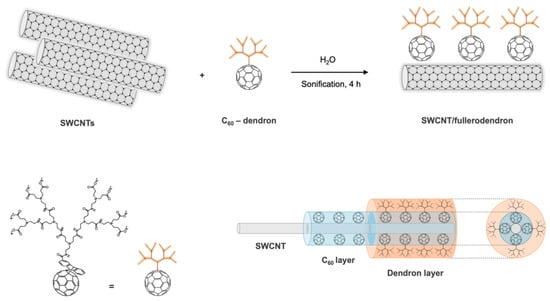
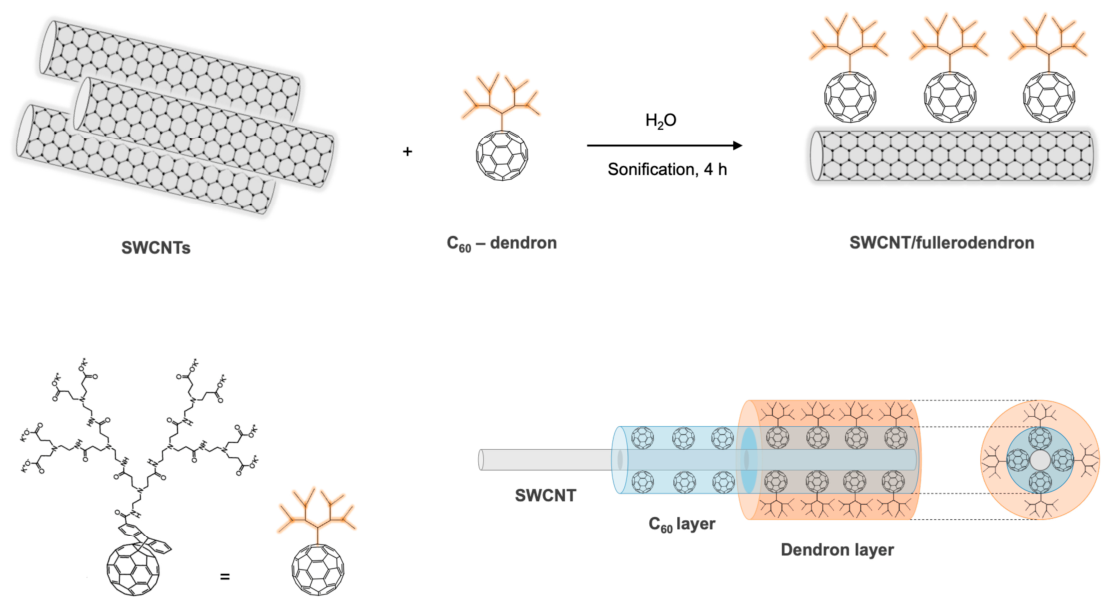
Figure 1 outlines the preparation of the SWCNT/fullerodendron nanohybrid (CNT photocatalyst). Semiconducting SWCNTs were noncovalently functionalized with amphiphilic fullerodendrons, each consisting of a C60 unit linked to a poly(amidoamine)-type dendron bearing eight terminal carboxylate groups [12], to form water-dispersible SWCNT/fullerodendron coaxial nanohybrids. The fullerene layer serves as an electron-accepting interface for exciton dissociation, whereas the carboxylate-terminated dendron shell confers water dispersibility and presents a high density of carboxylate groups at the nanohybrid surface. This noncovalent architecture is essential because covalent functionalization of the SWCNT sidewalls would disrupt the nanotubes’ π-electronic structure and compromise the chirality-dependent optical transitions required for long-wavelength light harvesting.
Figure 1.
Schematic of the preparation of the single-walled carbon nanotube (SWCNT)/fullerodendron coaxial nanohybrid used as the carbon nanotube (CNT) photocatalyst. The chemical structure of the fullerodendron, bearing eight terminal carboxylate groups (as the potassium salt), is shown at the bottom left.
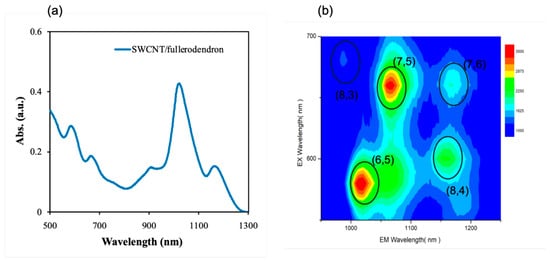
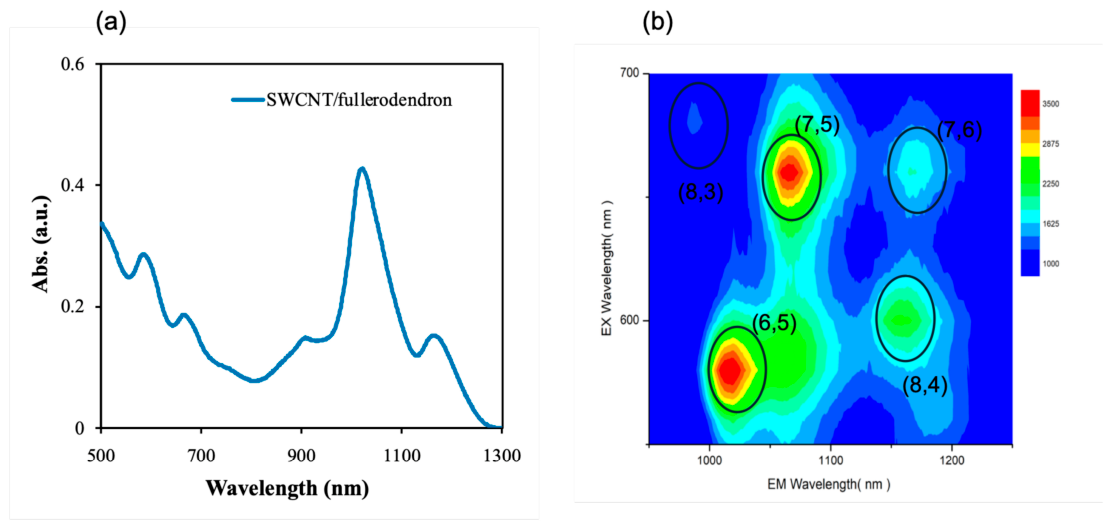
The visible-to-near-infrared (Vis-NIR) absorption spectrum (Figure 2a) shows characteristic SWCNT bands extending from the visible to the NIR region. On the basis of the photoluminescence spectrum (Figure 2b), these bands were assigned primarily to (6,5), (7,5), and (8,3)SWCNTs: their E22 transitions at 570, 650, and 680 nm, respectively; the overlapping E11 transitions of the (8,3) and (6,5) tubes at approximately 990–1010 nm; and the E11 transition of the (7,5) tube at approximately 1070 nm. Together, these bands span a broad spectral range, making the nanohybrid well suited to harvesting sunlight.
Figure 2.
(a) Visible-to-near-infrared (Vis-NIR) absorption spectrum and (b) three-dimensional photoluminescence spectrum of the SWCNT/fullerodendron nanohybrids in water. The SWCNT concentration was estimated to be 0.016 mg mL−1.
To evaluate the wavelength dependence of the hydrogen-evolution reaction, we performed sacrificial half-reactions with 1-benzyl-1,4-dihydronicotinamide (BNAH) as the electron donor and RuCl3 as a cocatalyst precursor under chirality-selective monochromatic excitation (Table 1): 570, 650, and 680 nm for the E22 bands of (6,5), (7,5), and (8,3)SWCNTs, respectively, and 1005 nm for the overlapping E11 bands of (6,5) and (8,3)SWCNTs. Under all conditions, H2 evolved steadily over 7 h, indicating that excitation of both the E22 and E11 transitions can initiate photocatalytic H2 evolution; the pH of the reaction mixture (7.5) remained unchanged. Consistent with our previous finding that the H2 evolution rate depends on the driving force at the SWCNT/C60 heterojunction [14], the highest rate (1.1 µmol h−1; internal quantum yield (IQY), 0.70%) was obtained under 680 nm irradiation, which predominantly excites the E22 transition of (8,3)SWCNTs. Notably, H2 also evolved under 1005 nm excitation (0.72 µmol h−1), with an IQY of 12.8%, higher than the values obtained under visible-light excitation. These results show that the CNT photocatalyst can exploit both red and NIR light for sacrificial H2 evolution.
Table 1.
H2 evolution rates and internal quantum yields (IQY) of the CNT photocatalyst under chirality-selective visible-to-near-infrared irradiation.
2.2. Compatibility of WO3 with the [Co(bpy)3]3+/2+ Mediator
We first evaluated whether WO3 could directly replace BiVO4 in the previously developed [Co(bpy)3]3+/2+-mediated CNT photocatalyst/BiVO4 Z-scheme system [14]. The valence band edge of WO3 lies at approximately +3.0 V versus the standard hydrogen electrode (SHE), compared with approximately +2.4 V for BiVO4, although the precise band-edge positions depend on crystallinity, pH, and surface chemistry [19,20,21]. WO3 should therefore provide a strong thermodynamic driving force for water oxidation, but its conduction band and surface kinetics must still be compatible with the reduction of the oxidized mediator. Table 2 summarizes H2 and O2 evolution under visible-light irradiation (λ > 422 nm; see Section 3.3 for details). The photocatalytic behavior was strongly pH-dependent (entries 1 and 2): H2 evolution was observed at pH 4.5, whereas at pH 9.8 it was suppressed and O2 evolution became dominant. In both cases, however, the H2/O2 ratio deviated substantially from the stoichiometric value of 2, indicating that competing redox processes contributed appreciably; these experiments are therefore treated as mediator-compatibility tests rather than as evidence of OWS. The marked pH dependence further suggests that the overall activity is governed not only by band energetics but also by the kinetic balance among proton reduction, water oxidation, mediator oxidation/reduction, and back electron transfer.
Table 2.
Effects of initial pH and WO3 loading on H2 and O2 evolution in the [Co(bpy)3]3+/2+-mediated CNT photocatalyst/WO3 Z-scheme system under visible-light irradiation.
We next varied the WO3 loading at pH 4.5 (Table 2, entries 2–4). Increasing the WO3 loading from 250 to 300 µmol enhanced H2 evolution while leaving O2 evolution essentially unchanged, suggesting that the WO3 loading influences mediator turnover and the balance between the two gas-evolution reactions. However, a further increase to 350 µmol reduced O2 evolution while H2 evolution remained almost unchanged, resulting in a highly nonstoichiometric H2/O2 ratio. This trend is consistent with the suppressed O2 evolution reported by Kudo and co-workers for WO3 with [Co(bpy)3]3+/2+ [15]. A likely cause is that oxidative decomposition of the bipyridine ligand and/or parasitic mediator oxidation competes with water oxidation at WO3. These results prompted us to evaluate an alternative mediator for the CNT photocatalyst/WO3 pair.
2.3. Evaluation of Iodide as a Mediator for the CNT Photocatalyst/WO3 System
Iodide-based redox mediators, particularly the I3−/I− couple, have been widely employed in Z-scheme systems containing WO3 and related OEPs [6,9,22,23]. Before constructing the full Z-scheme system, we examined whether iodide can serve as an electron donor to the photooxidized CNT photocatalyst. In the absence of WO3, the CNT photocatalyst evolved H2 from aqueous KI at 0.10 µmol h−1 under visible-light irradiation (λ > 422 nm), with RuCl3 as the cocatalyst precursor. Although modest, this rate is consistent with iodide serving as an electron donor to the photooxidized CNT photocatalyst under the half-reaction conditions.
We then combined the CNT photocatalyst, WO3, and NaI under the same irradiation conditions (Table 3), first examining the pH dependence. Under mildly acidic conditions (pH 4.5), simultaneous H2 and O2 evolution was observed (entry 1). At neutral pH (entry 2), the evolution of both gases decreased and rapidly approached a plateau; the cause of this decrease remains unclear. Under basic conditions (pH 9.4; entry 3), O2 evolution continued whereas H2 evolution was completely suppressed, indicating a substantial imbalance between the oxidation and reduction processes. Because the H2/O2 ratios in entries 1–3 were well below 2, these data are used only to assess the pH-dependent reaction balance, not to demonstrate stoichiometric OWS. These data also show that the iodide mediator must be optimized under conditions that sustain both reduction at the CNT photocatalyst and oxidation at WO3.
Table 3.
Optimization of the iodide-mediated CNT photocatalyst/WO3 Z-scheme system: effects of initial pH, NaI concentration, and WO3 loading on H2 and O2 evolution under visible-light irradiation.
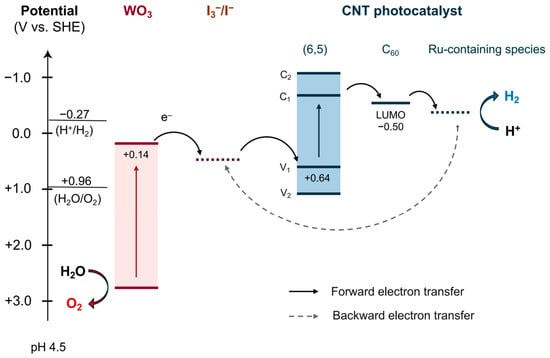
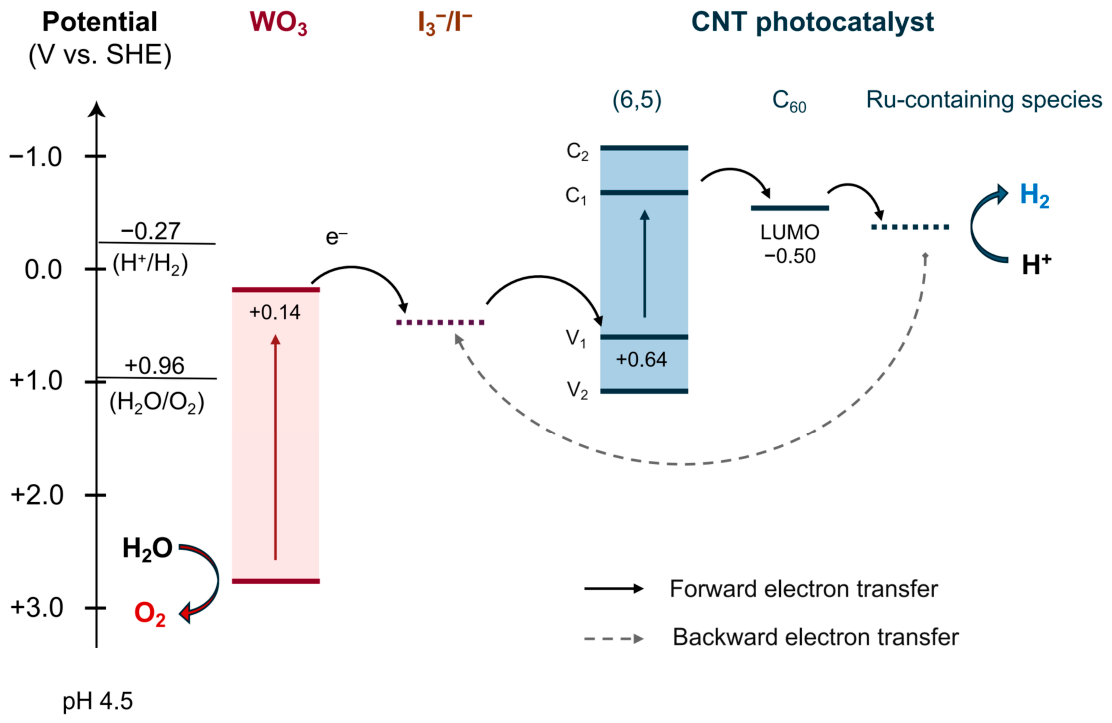
Figure 3 presents a proposed energy-level scheme for the iodide-mediated CNT photocatalyst/WO3 system at pH 4.5. Excitation of the SWCNT component generates strongly bound excitons, which can undergo charge separation at the SWCNT/C60 interface [12,14,24,25]. In the proposed reaction cycle, iodide consumes photogenerated holes in the CNT photocatalyst, producing oxidized iodine species. Photogenerated electrons in the WO3 conduction band may then reduce these oxidized species and regenerate iodide, while holes in the WO3 valence band oxidize water to O2. On the basis of previously reported WO3-containing Z-scheme systems, the I3−/I− couple is a plausible mediator. At pH 4.5, the Nernst equation gives H+/H2 and O2/H2O potentials of approximately −0.27 and +0.96 V versus SHE, respectively. The effective potential and speciation of the iodine mediator depend on the relative concentrations of iodide and oxidized iodine species [26].
Figure 3.
Proposed energy-level scheme for the iodide-mediated CNT photocatalyst/WO3 system at pH 4.5. The I3−/I− couple is shown as a plausible mediator on the basis of previous reports. Potentials are referenced to SHE. Ru-containing species derived from the RuCl3 precursor are shown schematically; their exact chemical identity and oxidation-state distribution under the present reaction conditions were not established. SHE, standard hydrogen electrode; LUMO, lowest unoccupied molecular orbital.
Changes in mediator concentration may affect both the reduction of oxidized iodine species by WO3 and the consumption of holes by iodide at the CNT photocatalyst (Table 3, entries 4–6). At 0.3 mM NaI, H2 evolution was slow; at 0.5 mM, the H2/O2 ratio was closest to the stoichiometric value; and at 0.7 mM, overall gas evolution decreased. This concentration dependence may reflect combined changes in iodine speciation, mediator turnover, optical absorption, and back-electron-transfer kinetics. Although the solution was only slightly colored at 400 µmol WO3 (entries 4–6), the relative contributions of these possible loss pathways were not determined.
We next examined the effect of WO3 loading at 0.5 mM NaI and an initial pH of 4.5 (Table 3, entries 1, 5, 7, and 8). Raising the WO3 loading from 100 to 300 µmol increased both H2 and O2 evolution, whereas a further increase to 400 µmol decreased O2 evolution from 2.1 to 1.2 µmol h−1 with little change in H2 evolution (2.1 vs. 2.2 µmol h−1). Competition between water oxidation and iodide oxidation at WO3 is one possible explanation, although this competition was not directly confirmed. At 300 µmol, O2 evolution exceeded the amount expected from H2 evolution (H2/O2 = 1.0). O2 evolution was also observed without NaI (Table S1, entry 3), but these observations do not identify the electron acceptor or establish a specific role for Ru-containing species. At 400 µmol, the electrons consumed in H2 evolution and the holes consumed in O2 evolution were nearly balanced (4.4 and 4.8 µmol h−1, respectively; H2/O2 = 1.8).
Raising the loading further to 500 µmol increased H2 evolution but suppressed O2 evolution even more (entry 8). Under these conditions, the electrons consumed in H2 evolution (8.4 µmol h−1) substantially exceeded the holes consumed in O2 evolution (2.4 µmol h−1), corresponding to an excess of approximately 30 µmol of electrons over the 5 h reaction. If all of the iodide (75 µmol) were oxidized to I3−, it would supply 50 µmol of electrons, which exceeds this imbalance; this estimate, however, does not identify the iodine species actually present. In addition, the solution turned yellow—unlike the only slightly colored solutions obtained at 400 µmol WO3—consistent with the formation of oxidized iodine species, whose identity remains to be determined. Thus, at 500 µmol WO3, iodide appears to have acted partly as a sacrificial electron donor rather than as a fully reversible mediator. We therefore selected 400 µmol WO3 and 0.5 mM NaI as the optimized conditions for STH evaluation; with these conditions, stoichiometric H2 and O2 evolution was subsequently confirmed under AM 1.5G simulated sunlight (Section 2.4). The component-omission and dark controls under the conditions specified in Table S1 support the involvement of each reaction component and of light, but do not directly establish the origin of the evolved gases.
2.4. Solar-to-Hydrogen Energy Conversion Efficiency Under AM 1.5G Simulated Sunlight
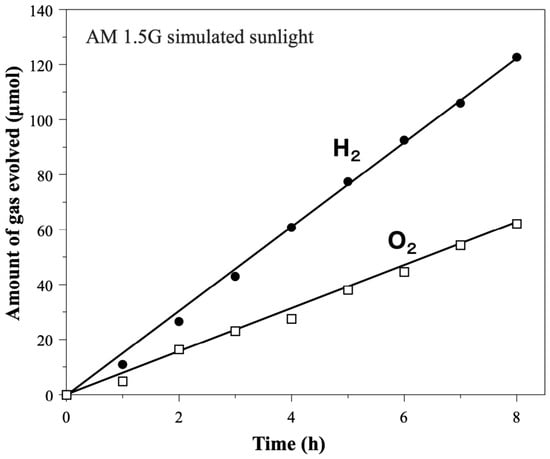
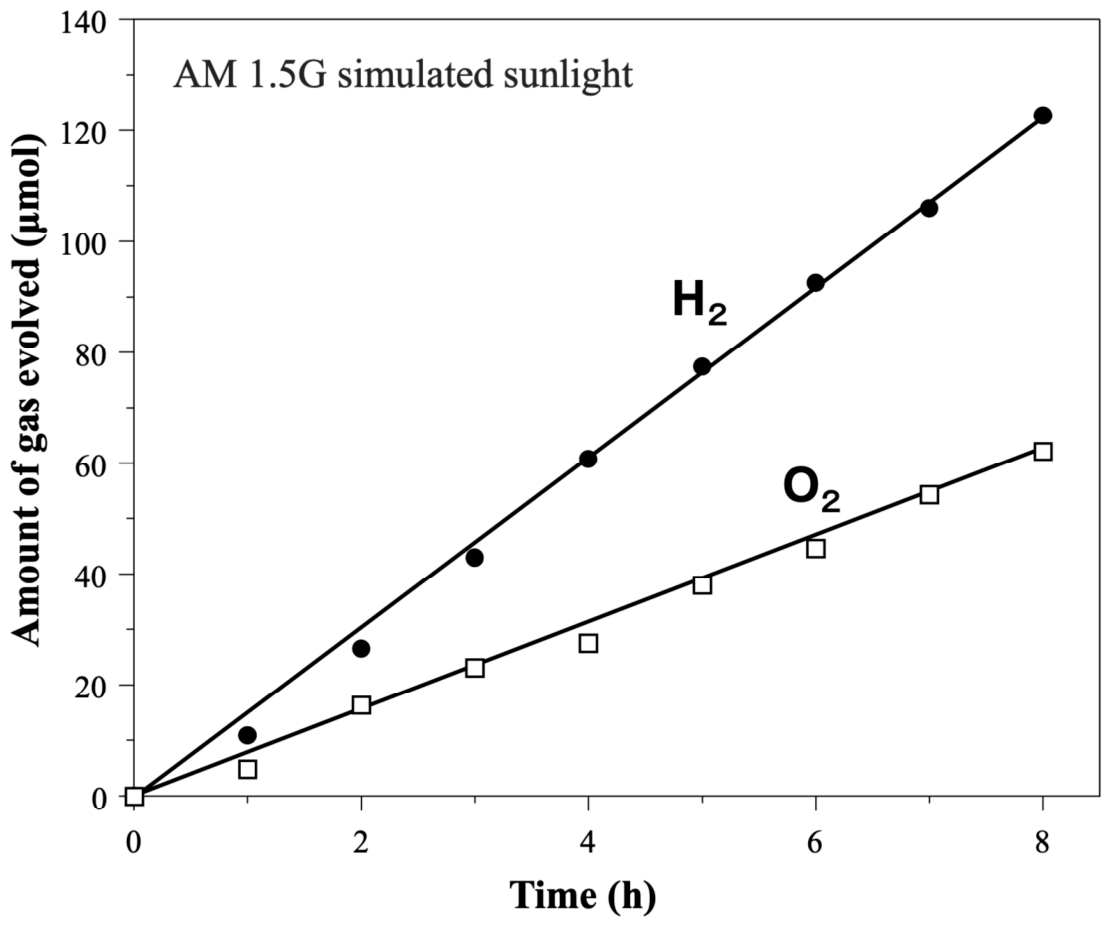
The optimized system was subsequently evaluated under AM 1.5G simulated sunlight (1000 W m−2) in the absence of sacrificial reagents, buffer salts, or external bias (Figure 4). The H2 and O2 evolution profiles were approximately linear over 8 h, with fitted rates of 15.2 and 7.6 µmol h−1, respectively. The H2/O2 molar ratio of 2.0 is consistent with stoichiometric OWS under these conditions. The corresponding STH efficiency is 0.08%, calculated from the H2 evolution rate, the standard Gibbs free energy change for water splitting (237 kJ mol−1), and the incident solar power. Over 8 h, the amounts of H2 and O2 calculated from these rates (approximately 122 and 61 µmol, respectively) exceed the maximum amounts attributable to the stoichiometric consumption of either NaI or RuCl3: even if all of the NaI (75 µmol) were oxidized to I2, the released electrons could produce at most 37.5 µmol of H2; even if all of the RuCl3 (30 µmol) were reduced to Ru(0), the corresponding holes could produce at most 22.5 µmol of O2. Stoichiometric consumption of NaI or RuCl3 alone therefore cannot account for the amounts of gas evolved.
Figure 4.
Time course of H2 and O2 evolution by the optimized iodide-mediated CNT photocatalyst/WO3 system under air mass (AM) 1.5G simulated sunlight. Solid circles and open squares denote H2 and O2, respectively. Conditions: AM 1.5G, 1000 W m−2; no sacrificial reagent; no external bias.
The principal advance lies in the WO3/iodide combination and its improved short-term operational stability rather than in STH efficiency: the present value (0.08%) is comparable to that of our previous [Co(bpy)3]3+/2+-mediated CNT photocatalyst/BiVO4 system (0.09%) [14]. Whereas O2 evolution in that system declined within 6 h, the present WO3-based system maintained linear H2 and O2 evolution for at least 8 h. Beyond stability, the significance of this result lies in the materials concept. Most particulate OWS systems rely on UV or short-wavelength visible absorbers, whereas the CNT HEP harvests red light and also absorbs in the NIR region. Coupling such an excitonic nanocarbon HEP with a robust WO3 OEP opens a route toward fuller use of the solar spectrum. In addition to the strategies outlined in Section 4, loading water-oxidation cocatalysts onto WO3 and immobilizing the two photocatalysts in architectures that minimize light shielding while preserving mediator transport should further enhance performance.
In a previously reported CNT-based Z-scheme [10], CNTs function as solid-state electron mediators between inorganic photocatalysts, whereas in the present system the SWCNT/fullerodendron nanohybrid serves as the photoactive H2-evolution component. Dye-sensitized H2-evolution photocatalysts have also been coupled with WO3 and iodide-based mediators [9,22]; the present system extends this architecture to a CNT-based light-harvesting HEP.
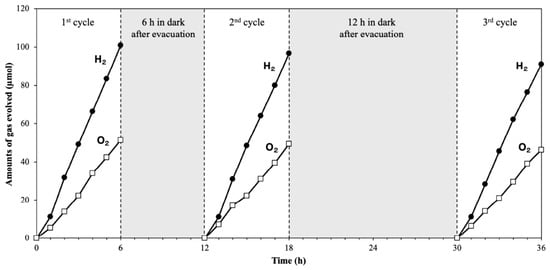
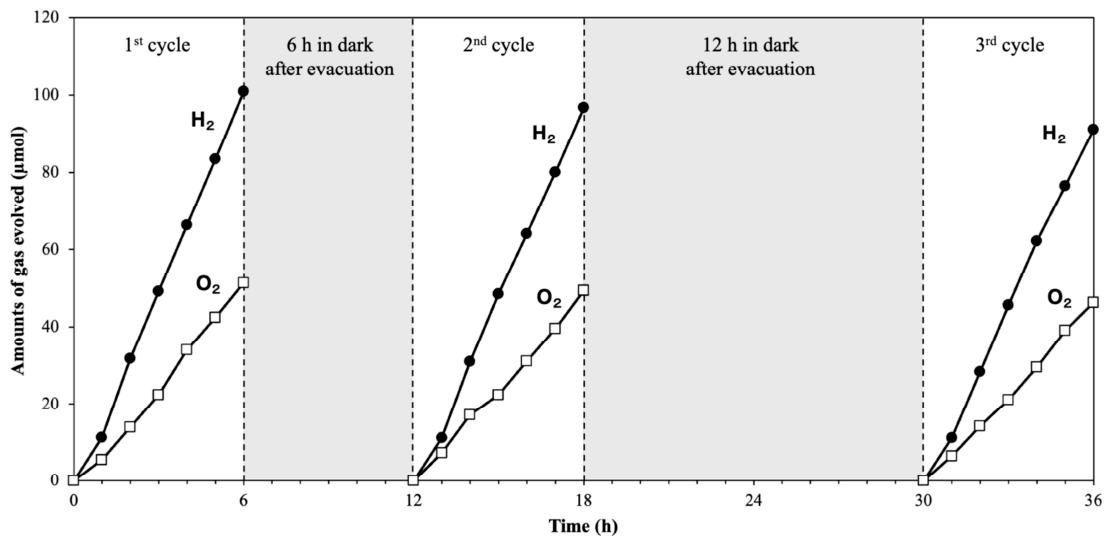
Cycling stability was evaluated over three 6 h irradiation cycles (Figure 5), separated by intervals of 6 h (between the first and second cycles) and 12 h (between the second and third cycles). Relative to the first cycle, the system retained 97% and 91% of its activity in the second and third cycles, respectively. X-ray diffraction (XRD) analysis of WO3 after the repeated-use tests showed no detectable change from the pre-reaction pattern, further supporting the stability of WO3 under operating conditions (Figure S1).
Figure 5.
Cycling performance of the optimized iodide-mediated CNT photocatalyst/WO3 system under AM 1.5G simulated sunlight. Solid circles and open squares denote H2 and O2, respectively. Conditions: AM 1.5G, 1000 W m−2; no sacrificial reagent; no external bias. The three cycles represent repeated use of the same reaction system, not independent replicates.
Several aspects of the reaction mechanism remain to be clarified. The speciation of the iodine mediator, the chemical identity and oxidation state of the Ru-containing species derived from RuCl3, and the wavelength-resolved contributions of the two photocatalysts under AM 1.5G illumination were not determined in this study. The energy-level scheme in Figure 3 should therefore be regarded as a working model rather than an established mechanism. Isotope-labeling controls and analysis of the organic nanohybrid before and after irradiation will be important for directly determining the origin of the evolved gases. Systematic variation of the amount of Ru precursor will also help optimize the system. The number of independent runs was limited by the amount of sample available relative to that required per reaction; consequently, run-to-run variability was not fully evaluated, which limits quantitative conclusions regarding reproducibility and small differences in activity.
3. Materials and Methods
3.1. Materials and Characterization
Single-walled carbon nanotubes enriched in (6,5) chirality (CoMoCAT tubes) were purchased from Sigma-Aldrich Japan K.K. (Tokyo, Japan) and used as received unless otherwise stated. The fullerodendron amphiphile was synthesized according to our previous report [12]. WO3 powder, RuCl3, NaI, KI, [Co(bpy)3]Cl2, and all other reagents were purchased from Junsei Chemical Co., Ltd. (Tokyo, Japan), Kanto Chemical Co., Inc. (Tokyo, Japan), Sigma-Aldrich, and Tokyo Chemical Industry Co., Ltd.(Tokyo, Japan), and were used as received. Deionized water was used for all photocatalytic experiments. UV-vis-NIR absorption spectra were recorded on a Shimadzu UV-3150 spectrophotometer (Shimadzu Corporation (Kyoto, Japan) using a quartz cuvette with an optical path length of 10 mm.
3.2. Preparation of the CNT Photocatalyst Dispersion
SWCNT/fullerodendron nanohybrids were prepared by noncovalent functionalization of SWCNTs with fullerodendron as previously reported [12,13]. In a typical preparation, SWCNTs (1.0 mg) and fullerodendron (12.75 mg) were suspended in water (5.0 mL) and sonicated for 4 h in a bath sonicator. The resulting dispersion was centrifuged at 3000× g for 30 min, and the clear, black supernatant was collected. The supernatant was dialyzed against water for 3 days using regenerated-cellulose tubing (Spectra/Por 4; molecular weight cutoff, 12–14 kDa) to remove excess fullerodendron and low-molecular-weight impurities, affording a stock dispersion of the SWCNT/fullerodendron coaxial nanohybrid.
3.3. Photocatalytic Z-Scheme Water-Splitting Reactions
For the optimized iodide-mediated OWS reaction, an aliquot of the CNT photocatalyst dispersion (0.75 mL; SWCNT content, 0.15 mg) was diluted with deionized water (9.25 mL). RuCl3·xH2O (6.3 mg, nominally 30 µmol as RuCl3) was added as a cocatalyst precursor, and the suspension was stirred for 1 h. WO3 (92.7 mg, 400 µmol) and NaI (11.3 mg, 75 µmol) were then added, and the total reaction volume was adjusted to 150 mL with deionized water. Photocatalytic reactions were performed in a Pyrex glass reactor (Makuhari Rikagaku Garasu Inc. (Chiba, Japan)) connected to a closed gas-circulation system. The initial pH was approximately 4.5; where indicated, it was adjusted with 0.1 mol L−1 aqueous HCl or NaOH. The pH was measured before and after the reaction, and no change was observed under conditions giving stoichiometric H2 and O2 evolution. For the [Co(bpy)3]3+/2+-mediated experiments (Table 2), NaI was replaced with [Co(bpy)3]Cl2 (45.0 mg; final concentration, 0.5 mM). The WO3 loading, NaI concentration, and initial pH were varied as indicated in Table 2 and Table 3. The suspension was degassed by five evacuation/Ar-backfilling cycles and then vigorously stirred at 25 °C during irradiation. Visible-light experiments were conducted using a 300 W xenon arc lamp (Ushio Inc., UXL-300 W, Tokyo, Japan) equipped with a long-pass filter (λ > 422 nm; Asahi Spectra Co., Ltd., Tokyo, Japan). The incident light intensity at the reactor window was adjusted to 3000 W m−2 for visible-light optimization experiments. Simulated sunlight experiments were performed under AM 1.5G irradiation at 1000 W m−2 using a solar simulator (Asahi Spectra Co., Ltd., HAL-320).
3.4. Gas Analysis and STH Calculation
At designated time intervals, the evolved gases in the closed gas-circulation system were analyzed with a gas chromatograph (Shimadzu Corp., GC-8A, Kyoto, Japan) equipped with a thermal conductivity detector and a molecular sieve 5A column (2.0 m × 3.0 mm) with Ar as the carrier gas. Calibration curves for H2 and O2 were prepared using standard gases over a concentration range of 25–100 ppm. The headspace volume of the closed gas-circulation system was 448.15 mL. The STH efficiency under AM 1.5G simulated sunlight was calculated as follows: STH = [rate of H2 evolution (mol h−1)] × [standard Gibbs free energy change for water splitting, ΔG0298 (2.37 × 10⁵ J mol−1)]/(3600 × [irradiance of the incident light (W m−2)] × [irradiation area (m2)]). The incident light intensity was set to 1000 W m−2 and measured using an HD 2302.0 light meter (Delta OHM, Selvazzano Dentro, Italy). The irradiated area was a circle of radius 2.0 cm (1.257 × 10⁻³ m2).
4. Conclusions
We have developed an iodide-mediated Z-scheme OWS system that combines a red-to-NIR-responsive SWCNT/fullerodendron HEP with commercially available WO3 as the OEP. Replacing BiVO4 and the cobalt mediator with WO3 and iodide, respectively, helped retain gas-evolution activity and improved the balance between H2 and O2 evolution. Under AM 1.5G simulated sunlight and without sacrificial reagents or external bias, the optimized system evolved H2 and O2 stoichiometrically at 15.2 and 7.6 µmol h−1, respectively, corresponding to an STH efficiency of 0.08%. H2 and O2 evolution remained approximately linear over 8 h, in contrast to the decline in O2 evolution within 6 h observed for our previous BiVO4-based system. Moreover, more than 90% of the initial activity was retained in the third of three 6 h cycles, demonstrating good short-term operational stability.
This work advances artificial photosynthesis in two respects. First, it extends CNT photocatalysis beyond sacrificial H2 evolution by integrating the CNT photocatalyst with a metal-oxide OEP in an iodide-mediated system that achieves OWS under simulated sunlight. Second, it illustrates the potential value of combining photocatalysts with complementary spectral roles: WO3 oxidizes water under near-UV and short-wavelength visible light, whereas the CNT photocatalyst evolves H2 under selected red and NIR excitation wavelengths in sacrificial half-reactions. Integrating these photocatalysts is thus a step toward broader spectral utilization and more sustained operation in particulate OWS. The STH efficiency could be further improved by increasing the fraction of active SWCNT chiralities, enhancing exciton dissociation at the SWCNT/C60 interface, suppressing unproductive reactions with oxidized iodine species, and accelerating water oxidation at WO3. Such mechanistic and materials-level optimization may establish CNT/metal-oxide Z-scheme photocatalysis as a useful strategy for long-wavelength-responsive solar-fuel production.
Supplementary Materials
The following supporting information can be downloaded at: https://www.mdpi.com/article/10.3390/catal16100933/s1, Table S1: Control experiments for the iodide-mediated CNT photocatalyst/WO3 system; Figure S1: X-ray diffraction (XRD) patterns of pristine WO3 and WO3 recovered after the overall water-splitting experiment under AM 1.5G simulated sunlight (1000 W m−2) No detectable change in the bulk XRD pattern of WO3 was observed after the cycling test.
Author Contributions
Conceptualization, Y.T.; methodology, Y.T.; investigation, T.L.P. and T.A.; formal analysis, T.L.P.; data curation, T.L.P.; writing—original draft preparation, T.L.P. and Y.T.; writing—review and editing, T.L.P. and Y.T.; supervision, Y.T.; funding acquisition, Y.T. All authors have read and agreed to the published version of the manuscript.
Funding
This work was supported by JSPS KAKENHI Grant Numbers 26K01326, 24H01616, and 23K04519.
Data Availability Statement
The data presented in this study are included in the article and Supplementary Materials. Further data supporting the findings are available from the corresponding author upon request.
Acknowledgments
During manuscript preparation, the authors used ChatGPT (GPT-6 Sol, OpenAI) for English language editing. All AI-assisted revisions were checked and edited by the authors, who take responsibility for the final content of this publication.
Conflicts of Interest
The authors declare no conflicts of interest. The funders had no role in the design of the study; in the collection, analyses, or interpretation of data; in the writing of the manuscript; or in the decision to publish the results.
References
- Chen, S.; Takata, T.; Domen, K. Particulate Photocatalysts for Overall Water Splitting. Nat. Rev. Mater. 2017, 2, 17050. [Google Scholar] [CrossRef] [Scilit]
- Nishiyama, H.; Yamada, T.; Nakabayashi, M.; Maehara, Y.; Yamaguchi, M.; Kuromiya, Y.; Nagatsuma, Y.; Tokudome, H.; Akiyama, S.; Watanabe, T.; et al. Photocatalytic Solar Hydrogen Production from Water on a 100-m2 Scale. Nature 2021, 598, 304–307. [Google Scholar] [CrossRef] [Scilit] [PubMed]
- Renger, G.; Renger, T. Photosystem II: The Machinery of Photosynthetic Water Splitting. Photosynth. Res. 2008, 98, 53–80. [Google Scholar] [CrossRef] [Scilit] [PubMed]
- Webber, A.N.; Lubitz, W. P700: The Primary Electron Donor of Photosystem I. Biochim. Biophys. Acta Bioenerg. 2001, 1507, 61–79. [Google Scholar] [CrossRef] [Scilit] [PubMed]
- Wang, Y.; Suzuki, H.; Xie, J.; Tomita, O.; Martin, D.J.; Higashi, M.; Kong, D.; Abe, R.; Tang, J. Mimicking Natural Photosynthesis: Solar to Renewable H2 Fuel Synthesis by Z-Scheme Water Splitting Systems. Chem. Rev. 2018, 118, 5201–5241. [Google Scholar] [CrossRef] [Scilit] [PubMed]
- Fu, H.; Zhang, Q.; Liu, Y.; Zheng, Z.; Cheng, H.; Huang, B.; Wang, P. Photocatalytic Overall Water Splitting with a Solar-to-Hydrogen Conversion Efficiency Exceeding 2% through Halide Perovskite. Angew. Chem. Int. Ed. 2024, 63, e202411016. [Google Scholar] [CrossRef] [Scilit] [PubMed]
- Fu, H.; Wu, Y.; Guo, Y.; Sakurai, T.; Zhang, Q.; Liu, Y.; Zheng, Z.; Cheng, H.; Wang, Z.; Huang, B.; et al. A Scalable Solar-Driven Photocatalytic System for Separated H2 and O2 Production from Water. Nat. Commun. 2025, 16, 990. [Google Scholar] [CrossRef] [Scilit] [PubMed]
- Burke, R.; Chakraborty, S.; McClelland, K.P.; Jelušić, J.; Matson, E.M.; Bren, K.L.; Krauss, T.D. Light-Driven Hydrogen Production with CdSe Quantum Dots and a Cobalt Glutathione Catalyst. Chem. Commun. 2021, 57, 2053–2056. [Google Scholar] [CrossRef] [Scilit] [PubMed]
- Nakada, A.; Yokota, T.; Ogura, M.; Chang, N.; Tomita, O.; Saeki, A.; Ogasawara, M.; Abe, R. Metal-Free Carbazole–Thiophene Photosensitizers Designed for a Dye-Sensitized H2-Evolving Photocatalyst in Z-scheme Water Splitting. J. Chem. Phys. 2024, 160, 044710. [Google Scholar] [CrossRef] [Scilit] [PubMed]
- Lin, L.; Ma, Y.; Zettsu, N.; Vequizo, J.J.M.; Gu, C.; Yamakata, A.; Hisatomi, T.; Takata, T.; Domen, K. Carbon Nanotubes as a Solid-State Electron Mediator for Visible-Light-Driven Z-scheme Overall Water Splitting. J. Am. Chem. Soc. 2024, 146, 14829–14834. [Google Scholar] [CrossRef] [Scilit] [PubMed]
- Blackburn, J.L. Semiconducting Single-Walled Carbon Nanotubes in Solar Energy Harvesting. ACS Energy Lett. 2017, 2, 1598–1613. [Google Scholar] [CrossRef] [Scilit]
- Murakami, N.; Tango, Y.; Miyake, H.; Tajima, T.; Nishina, Y.; Kurashige, W.; Negishi, Y.; Takaguchi, Y. SWCNT Photocatalyst for Hydrogen Production from Water upon Photoexcitation of (8,3)SWCNT at 680-nm Light. Sci. Rep. 2017, 7, 43445. [Google Scholar] [CrossRef] [Scilit] [PubMed]
- Tajima, T.; Yano, K.; Mukai, K.; Takaguchi, Y. Photocatalytic Ammonia Decomposition Using Dye-Encapsulated Single-Walled Carbon Nanotubes. Catalysts 2024, 14, 715. [Google Scholar] [CrossRef] [Scilit]
- Izawa, T.; Kalousek, V.; Miyamoto, D.; Murakami, N.; Miyake, H.; Tajima, T.; Kurashige, W.; Negishi, Y.; Ikeue, K.; Ohkubo, T.; et al. Carbon-Nanotube-Based Photocatalysts for Water Splitting in Cooperation with BiVO4 and [Co(bpy)3]3+/2+. Chem. Lett. 2019, 48, 410–413. [Google Scholar] [CrossRef] [Scilit]
- Sasaki, Y.; Kato, H.; Kudo, A. [Co(bpy)3]3+/2+ and [Co(phen)3]3+/2+ Electron Mediators for Overall Water Splitting under Sunlight Irradiation Using Z-scheme Photocatalyst System. J. Am. Chem. Soc. 2013, 135, 5441–5449. [Google Scholar] [CrossRef] [Scilit] [PubMed]
- Lee, D.K.; Choi, K.-S. Enhancing Long-Term Photostability of BiVO4 Photoanodes for Solar Water Splitting by Tuning Electrolyte Composition. Nat. Energy 2018, 3, 53–60. [Google Scholar] [CrossRef] [Scilit]
- Toma, F.M.; Cooper, J.K.; Kunzelmann, V.; McDowell, M.T.; Yu, J.; Larson, D.M.; Borys, N.J.; Abelyan, C.; Beeman, J.W.; Yu, K.M.; et al. Mechanistic Insights into Chemical and Photochemical Transformations of Bismuth Vanadate Photoanodes. Nat. Commun. 2016, 7, 12012. [Google Scholar] [CrossRef] [Scilit] [PubMed]
- Chen, X.; Yu, Y.; Huang, W.; Gao, Y. Photochemical Dissolution of Bismuth Vanadate and Formation of Volatile Bismuth Species: Effects of Low-Molecular-Weight Organic Acids and Chloride Ions. Microchem. J. 2026, 224, 117552. [Google Scholar] [CrossRef] [Scilit]
- Murillo-Sierra, J.C.; Hernández-Ramírez, A.; Hinojosa-Reyes, L.; Guzmán-Mar, J.L. A Review on the Development of Visible Light-Responsive WO3-Based Photocatalysts for Environmental Applications. Chem. Eng. J. Adv. 2021, 5, 100070. [Google Scholar] [CrossRef] [Scilit]
- Lin, S.; Huang, H.; Ma, T.; Zhang, Y. Photocatalytic Oxygen Evolution from Water Splitting. Adv. Sci. 2021, 8, 2002458. [Google Scholar] [CrossRef] [Scilit] [PubMed]
- Huang, J.; Yue, P.; Wang, L.; She, H.; Wang, Q. A Review on Tungsten-Trioxide-Based Photoanodes for Water Oxidation. Chin. J. Catal. 2019, 40, 1408–1420. [Google Scholar] [CrossRef] [Scilit]
- Abe, R.; Shinmei, K.; Koumura, N.; Hara, K.; Ohtani, B. Visible-Light-Induced Water Splitting Based on Two-Step Photoexcitation between Dye-Sensitized Layered Niobate and Tungsten Oxide Photocatalysts in the Presence of a Triiodide/Iodide Shuttle Redox Mediator. J. Am. Chem. Soc. 2013, 135, 16872–16884. [Google Scholar] [CrossRef] [Scilit] [PubMed]
- Oshima, T.; Nishioka, S.; Kikuchi, Y.; Hirai, S.; Yanagisawa, K.; Eguchi, M.; Miseki, Y.; Yokoi, T.; Yui, T.; Kimoto, K.; et al. An Artificial Z-scheme Constructed from Dye-Sensitized Metal Oxide Nanosheets for Visible Light-Driven Overall Water Splitting. J. Am. Chem. Soc. 2020, 142, 8412–8420. [Google Scholar] [CrossRef] [Scilit] [PubMed]
- Tanaka, Y.; Hirana, Y.; Niidome, Y.; Kato, K.; Saito, S.; Nakashima, N. Experimentally Determined Redox Potentials of Individual (n,m) Single-Walled Carbon Nanotubes. Angew. Chem. Int. Ed. 2009, 48, 7655–7659. [Google Scholar] [CrossRef] [Scilit] [PubMed]
- Isborn, C.M.; Tang, C.; Martini, A.; Johnson, E.R.; Otero-de-la-Roza, A.; Tung, V.C. Carbon Nanotube Chirality Determines Efficiency of Electron Transfer to Fullerene in All-Carbon Photovoltaics. J. Phys. Chem. Lett. 2013, 4, 2914–2918. [Google Scholar] [CrossRef] [Scilit]
- Bentley, C.L.; Bond, A.M.; Hollenkamp, A.F.; Mahon, P.J.; Zhang, J. Voltammetric Determination of the Iodide/Iodine Formal Potential and Triiodide Stability Constant in Conventional and Ionic Liquid Media. J. Phys. Chem. C 2015, 119, 22392–22403. [Google Scholar] [CrossRef] [Scilit]

Disclaimer/Publisher’s Note: The statements, opinions and data contained in all publications are solely those of the individual author(s) and contributor(s) and not of MDPI and/or the editor(s). MDPI and/or the editor(s) disclaim responsibility for any injury to people or property resulting from any ideas, methods, instructions or products referred to in the content. |
© 2026 by the authors. Licensee MDPI, Basel, Switzerland. This article is an open access article distributed under the terms and conditions of the Creative Commons Attribution (CC BY) license.