


Abstract
Molybdenum disulfide (MoS2) has garnered significant interest as an auspicious catalytic material for the hydrogen evolution reaction (HER). Here, MoS2 nanostructures are synthesized using the hydrothermal method with ammonium molybdate tetrahydrate ((NH4)6Mo7O24∙4H2O) as the Mo source; thioacetamide (CH3CSNH2) as the reducing agent and S source; and nonylphenols 9, nonylphenols 40, and polysorbate 80 as the surfactants. The impact of the different nonionic surfactants on the materials is comprehensively investigated. Moreover, the MoS2 fine structure was characterized using Fourier transform infrared spectroscopy (FTIR), X-ray diffraction (XRD), energy-dispersive X-ray spectroscopy (EDX), Raman spectroscopy, scanning electron microscopy (SEM), and transmission scanning microscopy (TEM). The HER characteristics of the MoS2 composites are assessed through electrochemical experiments, including linear sweep voltammetry and chronoamperometry measurements. Among the prepared specimens, MoS2/NP 9 exhibits the best electrocatalytic performance in a neutral medium. Furthermore, 240 mV is required to reach the current density of 10 mAcm−2.
1. Introduction
The extraordinary problems with carbon dioxide (CO2) production and the depletion of fossil fuels are causing the global clean and sustainable energy demand to steadily increase. Currently, fossil fuels are the main energy source utilized. A considerable green energy source is molecular hydrogen. In contrast to the naturally occurring oil and natural gas, hydrogen is not naturally abundant and needs to be produced through manufacturing processes. Hydrogen can be generated through various domestic resources, such as nuclear, natural gas, coal, biomass, and other renewable sources. Among the different hydrogen manufacturing processes, electrochemical water splitting is considered a highly reliable replacement for fossil fuels due to its cost-effectiveness and environmental responsiveness [1,2,3,4,5,6].
The hydrogen evolution reaction (HER) is a complex reaction comprising multiple steps occurring at the electrode surface. It is commonly known as a two-electron transfer reaction mechanism involving a single intermediate catalyst (2H+ + 2e− → H2). Active catalysts need to be used to decrease the overpotential necessary for HER progression [7].
Platinum (Pt) and its alloys are widely recognized as highly efficient electrocatalysts for HER. However, their relatively elevated cost and limited availability are impeding their industrial application. Hence, non-precious catalysts for HER that are abundant and have economical pricing, superior efficacy, and longevity need to be investigated [8,9,10,11]. Various alternatives to Pt-group catalysts have been explored, including transition metal carbides, nitrides, phosphides, and sulfides. Among the available options, molybdenum disulfide (MoS2) has exhibited significant potential and garnered considerable interest [10].
MoS2 is a layered material with each layer comprising three atomic sub-layers (S–Mo–S) that are stacked and bound by the van der Waals force. MoS2 is semiconducting and has an indirect bandgap of 1.2 eV in bulk form that changes to a direct bandgap of 1.9 eV when it is exfoliated into two-dimensional form [12,13]. MoS2 is known to exist in two distinct crystal phases: the 2H phase, which exhibits a trigonal prismatic structure and is semiconducting and thermodynamically stable, and the 1T phase, which is characterized by an octahedral structure and possesses conducting properties but is metastable [4].
Effective and cheap methods for synthesizing MoS2 nanostructures with pre-determined particle size, shape, and characteristics need to be researched. Hydrothermal synthesis is a simple approach for producing micro–nano powders and does not require specialized equipment or high temperatures [14]. By adding annexing agents, significant efforts have been made to avoid agglomeration and realize the dispersible shape and grain size of the micro–nano-sized MoS2. Various intercalation strategies have been employed to increase the active sites of MoS2 specimens for improving the HER activities [15].
Surfactants have recently garnered significant attention due to their remarkable ability to serve as templates in the precise manufacturing of nanomaterials. Several morphologies have been synthesized using surfactants, including nanorods, neck-shaped nanospheres, hollow nanospheres, hierarchical hollow cages, nanotubes, and nanowires. Zhuangzhi Wu effectively synthesized hexagonal MoS2 nanoparticles at the relatively low temperature of approximately 373 K using the template effect of sodium dodecyl benzene sulfonate [16]. Suo Xia Hou synthesized MoS2 using a chemical synthesis technique with sodium molybdate and thioacetamide as precursor materials, and they studied the addition of polyethylene glycol (PEG-20000), anhydrous ethanol, or hexadecyl trimethyl ammonium chloride in the synthesis process [17]. Some recent studies showed an effective hydrogen evolution reaction (HER) improvement for MoS2 samples prepared with the assistance of different surfactants [4,5,10,14,16]. In the current context, the key objective for enhancing the performance of the HER in MoS2 revolves around exploring the influence of long-chain surfactants. These surfactants have the potential to affect the size, morphology, and properties of the produced MoS2.
This study investigates the impact of intercalated long-chain surfactants on the MoS2 crystal phase structure, morphologies, agglomeration behavior, nanoparticle size, and activity in the hydrogen evolution reaction (HER). To achieve this, a hydrothermal synthesis technique is employed to produce fine-structure MoS2 by adding the following three polymers to the solution: Tergitol NP 9 (nonylphenol), Tergitol NP 40 (nonylphenol), and Tween 80 (polyethoxylated sorbitan and oleic acid derivative). The prepared specimens are characterized using Fourier transform infrared spectroscopy (FTIR), X-ray diffraction (XRD), Raman spectroscopy, scanning electron microscopy (SEM), energy-dispersive X-ray spectroscopy (EDX), and transmission electron microscopy (TEM). Additionally, the HER activity of each specimen is evaluated.
2. Results and Discussion
2.1. Sample Characterization
The samples were examined via FTIR by using a spectrophotometer from BRUKER (Ettlingen 76275, Germany) which was applied within 4000–400 cm−1. To determine crystallinity, XRD analysis (Malvern, GH Eindhoven, the Netherlands) with Cu Kα radiation (λ = 0.154 nm) was performed. A Raman microscope with an excitation wavelength of 445 nm was used for the Raman spectroscopy. The sample morphologies were examined via SEM (Tescan vega 3 SBU, Brno, the Czech Republic). The EDX spectra were collected using the same instrument. The size and shape of the synthesized material were determined through high-resolution TEM (JEOL, JEM-2100, Tokyo, Japan).
2.2. FTIR Spectra
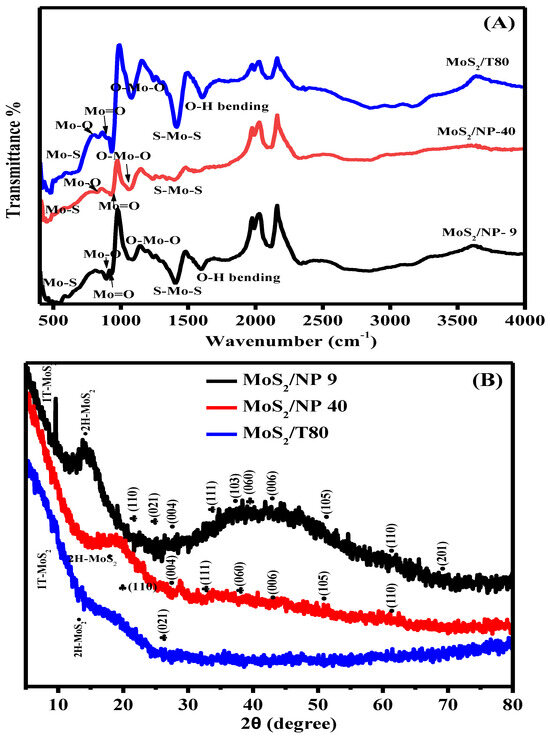
In Figure 1A, the absorption peaks between 470 and 1400 cm−1 are attributed to MoS2. The peak at 1400 cm−1 is related to the stretching vibration of S–Mo–S [18]. The peaks in the 860–980 cm−1 region are attributed to the asymmetric vibration of Mo–O and Mo=O groups in the MoO3 compound; the strong peak at 1070 cm−1 is attributed to the symmetric stretching mode of O–Mo–O [19,20,21]. The peak of the Mo–S stretching vibration mode is present between 590 and 620 cm−1 [22,23]. The peaks at ~3000 and 1600 cm−1 are attributed to the bending and stretching vibrations of the hydroxyl group, respectively.
Figure 1.
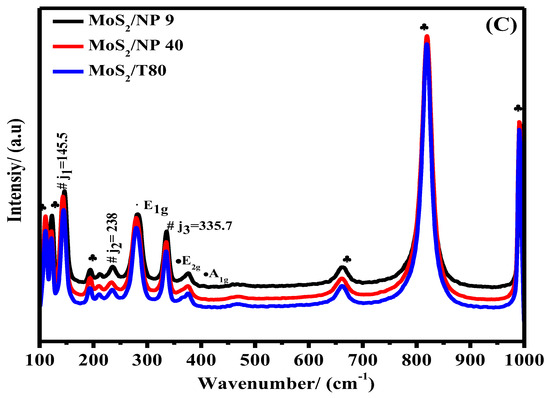
(A) FTIR spectra of the MoS2/NP 9, MoS2/NP 40, and MoS2/T 80 composites. (B) XRD pattern of the MoS2/NP 9, MoS2/NP 40, and MoS2/T 80 composites. (C) Raman spectra of the MoS2/NP 9, MoS2/NP 40, and MoS2/T 80 composites. The peaks related to 2H-MoS2, MoO3, and 1T-MoS2 are denoted by •, ♣, and #, respectively.
2.3. XRD Spectra
According to the JCPDS 37-1492 card, the diffraction peaks observed for 2H-MoS2 are located at the 2θ values of 14.2, 28.3, 38.6, 44.3, 52.2, 62, and 69.3° (Figure 1B), corresponding to the crystallographic orientations of (002), (004), (103), (006), (105), (110), and (021), respectively [24].
According to the JCPDS 35-0609 card, the diffraction peaks of MoO3 can be detected at the 2θ values of 23.2, 26.7, 34.2, 39.6, and 46.8° (Figure 1B), corresponding to the crystallographic orientations of (110), (021), (111), (060), and (061), respectively [19,25,26,27,28,29].
For MoS2/NP 40 and MoS2/T 80 2θ = 17°, the peak corresponding to (002) was shifted to a higher angle. The observed increase in angle (002) was determined to be associated with the notable reduction in the interlayer spacing [15,28,30]. The decrease in the intensity of the (002) peak of MoS2/NP 40 and MoS2/T 80 (Figure 1B) suggests the presence of a limited number of MoS2 layers in the analyzed sample [31]. Furthermore, the broadening of the peaks suggests a significant decrease in the size of the crystalline structure.
2.4. Raman Spectra
As shown in Figure 1C, for all the samples, the Raman spectra exhibits a distinct Raman active mode, namely E2g (in-plane opposite vibration of Mo and S atoms), at 376.487 cm−1. In contrast, the A1g mode (out-of-plane vibration of S atoms) at 403 cm−1 is not clear for all the samples as it exhibits low intensity and high broadening, which could stem from the doping and alloying with other materials (MoO3) [32]. The significant difference between E2g and A1g implies the production of a comparatively thick MoS2 [33,34].
The suppression of the E2g and A1g bands and the appearance of new and powerful peaks in the low wavenumber region were observed. The peaks observed at 145.5, 238, and 335.7 cm−1 were attributed to the J1, J2, and J3 bands of the 1T metallic phase of MoS2 [4,25,35], while those at 194.3, 123, 111, 664, 820, and 992 cm−1 were attributed to MoO3 [19,20,36,37,38]. The FTIR and Raman results suggest that the material is an alloy of MoS2 and MoO3 [32], with a significant degree of phase conversion from the 2H-MoS2 phase to the 1T-MoS2 phase.
2.5. SEM, EDS, and TEM
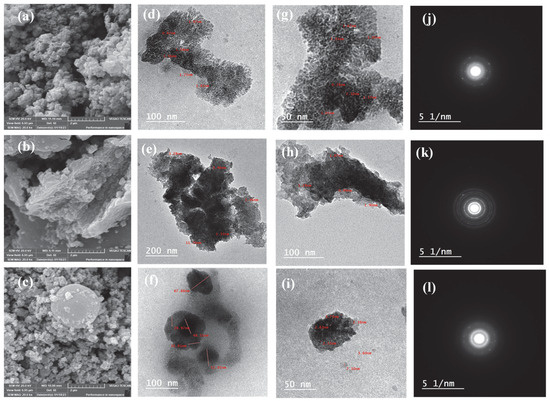
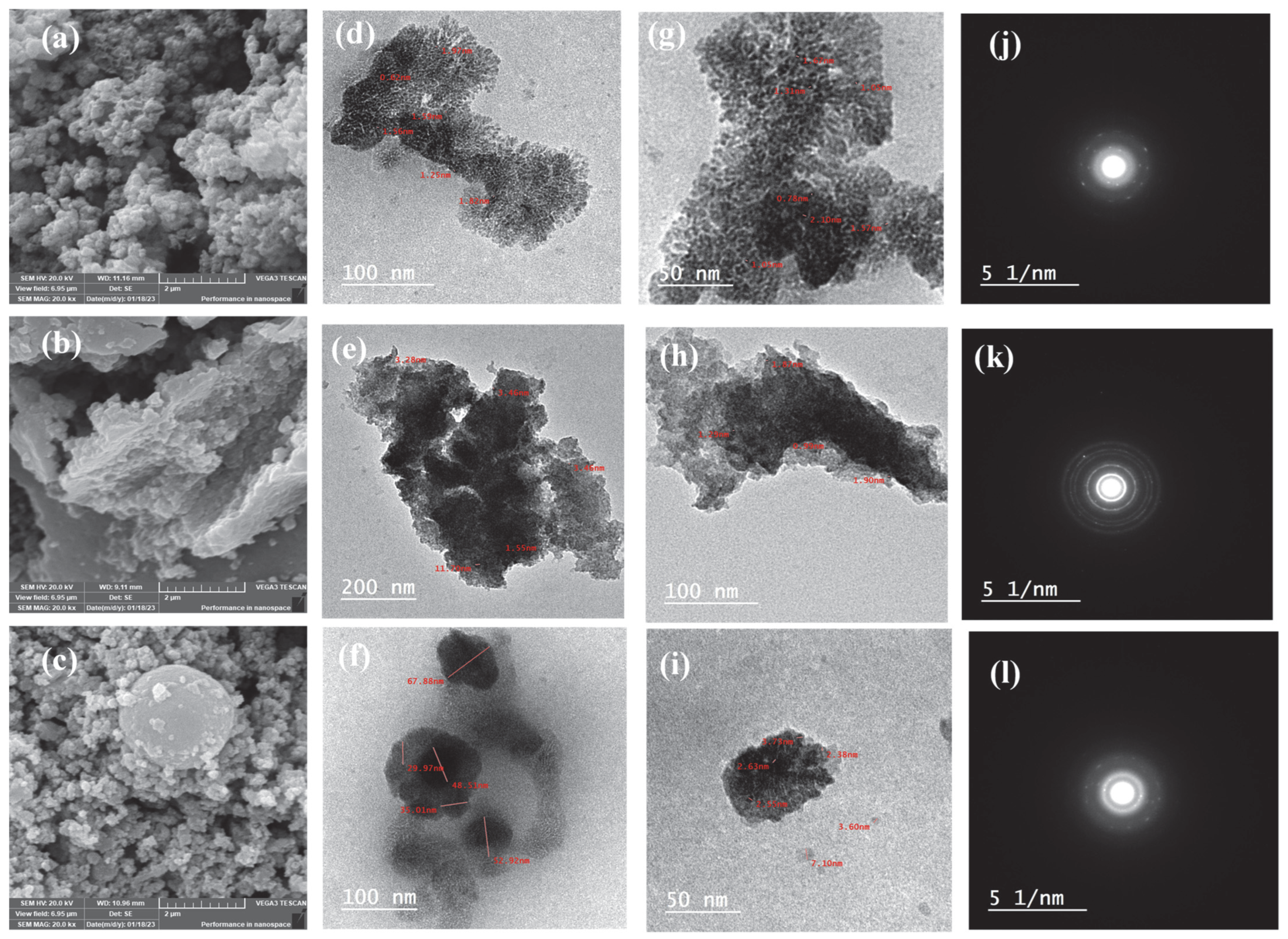
Figure 2a–c presents the SEM images of MoS2/NP 9, MoS2/NP 40, and MoS2/T 80, respectively. The figure shows that the nanoparticle structure primarily dominates the MoS2/NP 9 and MoS2/T 80 morphology, while the morphology of MoS2/NP 40 has a layered flakes structure.
Figure 2.
SEM images of the (a) MoS2/NP 9; (b) MoS2/NP 40; and (c) MoS2/T 80 composites. TEM images of the (d,g) MoS2/NP 9; (e,h) MoS2/NP 40; and (f,i) MoS2/T 80 composites, with selected area electron diffraction patterns for the corresponding area (j–l).
For MoS2/NP 9, the TEM images display nanometer-sized multigrain features with some gaps in between (Figure 2d). The 50 nm scale TEM images (Figure 2g) reveal that the average size of the features is 1.36 nm, which explains the broadness of the XRD peaks. NP 9 helps decrease the average size and the aggregation of nanoparticles.
The TEM images of the MoS2/T 80 sample (Figure 2f,i) also present nanostructures comprising small features with an average size of 2.8 nm. Furthermore, MoS2/NP 40 comprised nano multigrain flakes, as shown in Figure 2e,h.
The selected area electron diffraction patterns shown in Figure 2j–l exhibit a ring shape diffraction which indicates polycrystalline structures. The discernible increase in the number of imperceptible rings, and the diffraction rings exhibit enhanced sharpness, brightness, and distinctness for the MoS2/NP 40 sample compared to the other samples. This indicates a slight improvement in the crystallinity and an enlargement of the crystal size for the MoS2/NP 40 sample as it has a polycrystalline flake-layered structure compared to the other samples that show a few nanometers of particle size with patterns very close to amorphous materials [39].
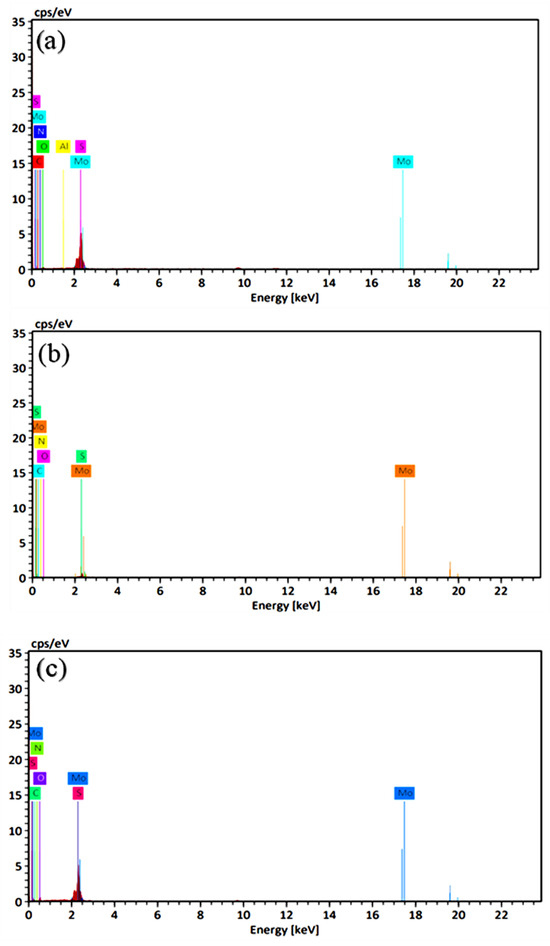
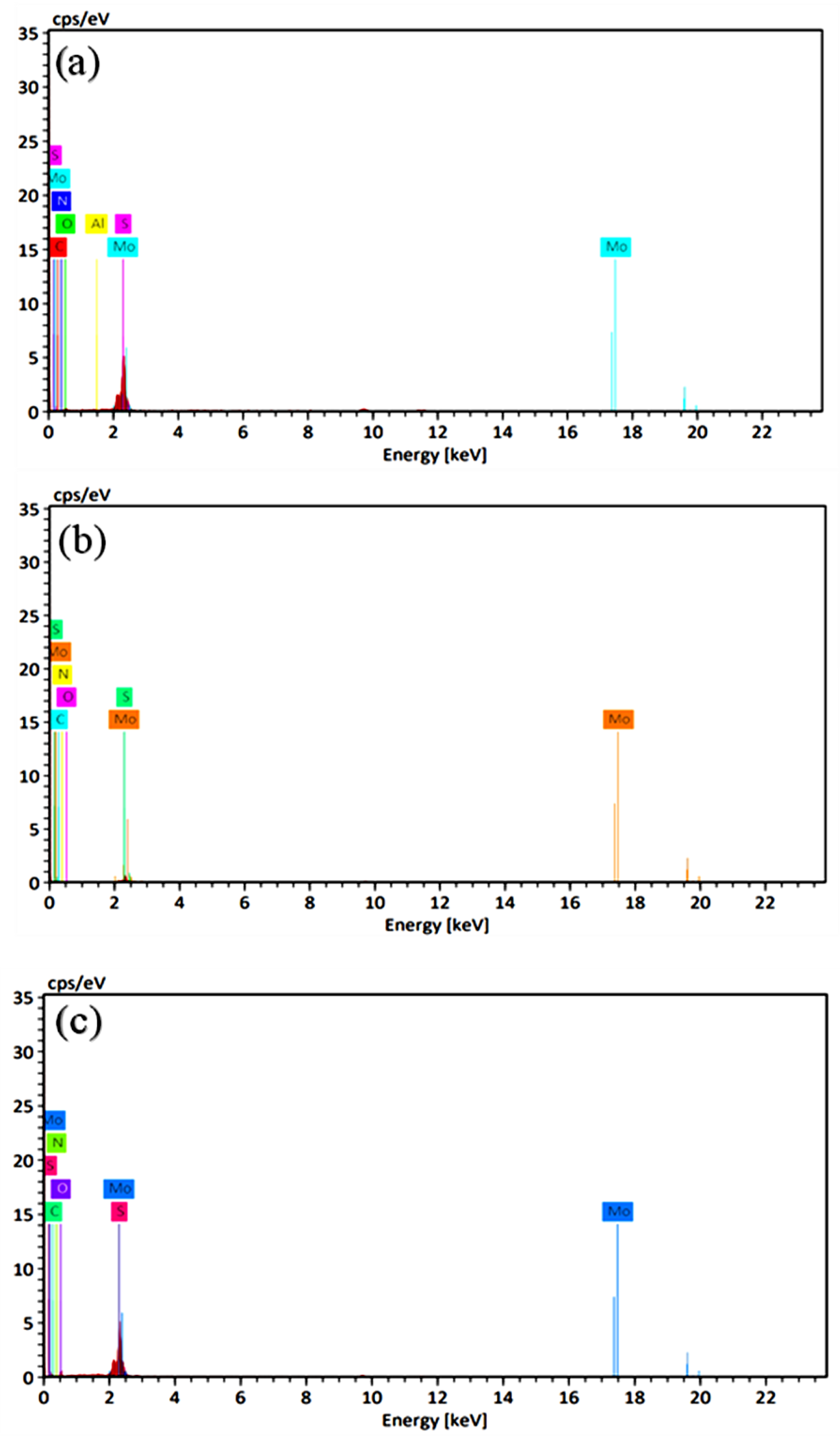
Figure 3 presents the EDX data for all the samples, illustrating their elemental compositions. Prominent peaks indicating the presence of Mo, S, and O as the main three elements in the MoS2 and MoO3 compounds are observed, along with peaks of other elements commonly observed in the materials utilized during sample formation, such as carbon and nitrogen (Table 1).
Figure 3.
Typical EDX spectrum of (a) MoS2/NP 9, (b) MoS2/NP 40, and (c) MoS2/T 80.
Table 1.
Atomic composition of each sample.
The surfactant acts as a template, determining the size and form of the synthesized nanoparticles as well as influencing the agglomeration. In these experiments, nonionic surfactants with different molecular weights and cloud points were added. Nonionic surfactants from the polyoxyethylene (POE) family have an inverse temperature–solubility relationship, denoting that their solubility in water decreases with increasing solution temperature. This phenomenon stems from the breakdown of the hydrogen bonding between the water and the POE units in the molecule. The temperature at which the POE surfactant components begin to precipitate from the solution is referred to as the “cloud point”.
For nonionic surfactants, aqueous micellar solutions only form below the cloud point. Above the cloud point, they separate into a surfactant-rich phase and a very dilute aqueous solution.
Here, since the synthesis was conducted at 200 °C, the micelles did not affect the MoS2 particle formation. Moreover, the clots of the surfactant molecules constrained the free space for producing MoS2 particles, and nucleation occurred in the dilute aqueous solution.
Nonionic surfactants prevent MoS2 stacking in the perpendicular direction, causing MoS2 sheets to become disoriented. Based on the data, a few nanometer-sized structures stemmed from NP 9 or T 80 and nanometer flakes stemmed from NP 40. After cooling to the cloud point, nonionic surfactants stabilize MoS2 by creating a bulky, physical barrier between the particles, preventing reaggregation [40]. Each of the three surfactants promotes varying sizes, shapes, and degrees of metallic structures within MoS2 compositions. According to XRD data, NP 9 induces a greater enhancement of the metallic structure in MoS2.
2.6. HER Activity of MoS2/Polymer in Neutral Medium
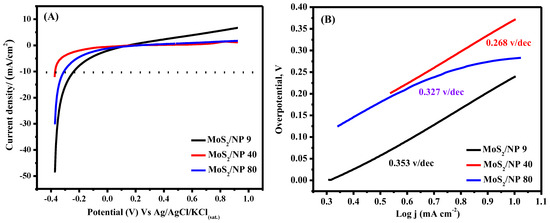
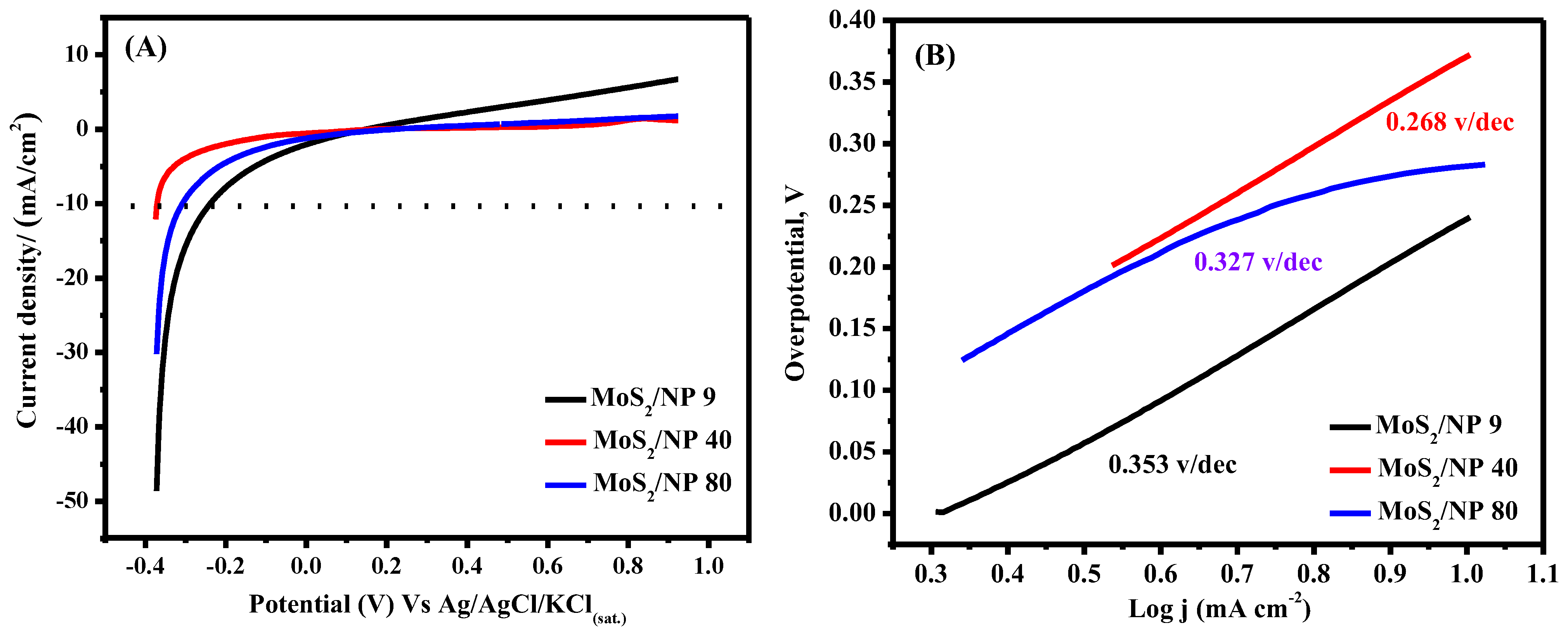
The relation between voltage and current was analyzed through the polarization curves to estimate and identify the onset potential of HER, as shown in Figure 4A, with 1 M KCl as the applied electrolyte. The onset potential estimated using the MoS2/NP 9 electrode was better than that estimated using the MoS2/T 80 or MoS2/NP 40 electrode (Table 2). This indicates that flexible electron charge transfer occurs more easily for the MoS2/NP 9 electrode than that for the MoS2/T 80 and MoS2/NP 40 electrodes. Moreover, the Tafel slope of the MoS2/NP 9 electrode (353 mV/dec) was better than that of the MoS2/T 80 (327 mV/dec) or MoS2/NP 40 electrode (268 mV/dec), as shown in Figure 4B. These results signify that the rate-determining step of the hydrogen evolution process could be explained by the Volmer–Heyrovsky mechanism. Therefore, the synthesized MoS2 could be employed as an electroactive electrode for HER in a neutral medium.
Figure 4.
HER activity in neutral medium: (A) polarization curve; (B) Tafel plot of the MoS2/NP 9, MoS2/NP 40, and MoS2/T 80 composites in KCl.
Table 2.
Electrochemical parameters calculated for evaluating the HER performance of all the prepared MoS2 catalysts in KCl.
2.7. HER Activity of MoS2/Polymer in Acidic Medium
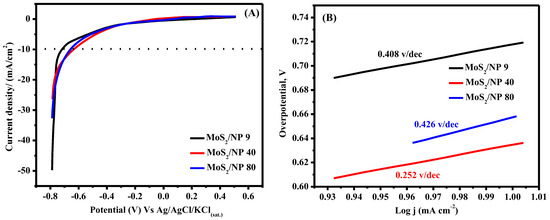
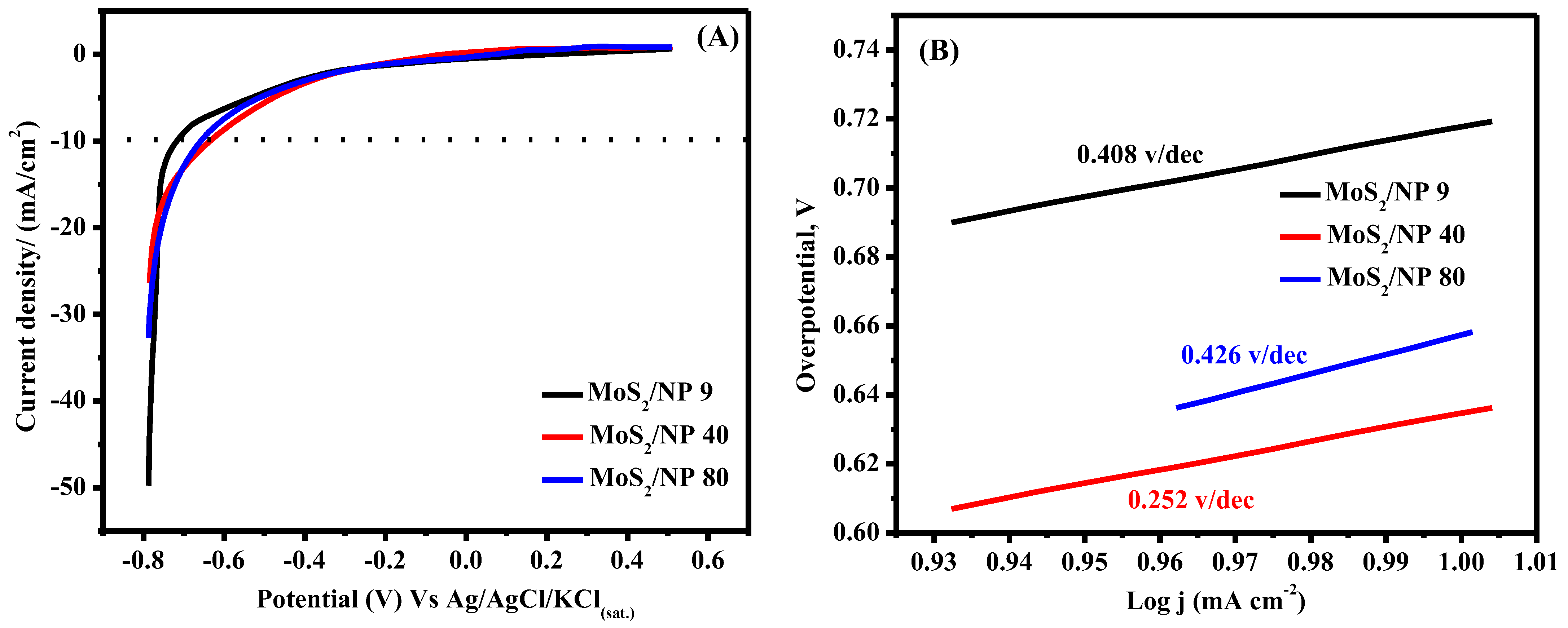
Same measurements were performed using 0.5 mol L−1 aqueous H2SO4 with a scanning rate of 0.1 Vs−1 at room temperature (Figure 5A,B). The polarization curves in Figure 5A show that the onset potential of MoS2/NP 9 is nearly equal to that of MoS2/T 80 and is better than that of MoS2/NP 40. Furthermore, the onset potential of MoS2/NP 40 indicates that the relaxed electron charge transfers for the MoS2/NP 40 electrode are slower than those for MoS2/T 80 and MoS2/NP 9 electrodes (Table 3). In addition, the Tafel plots (Figure 5B) of MoS2/T 80 (426 mV/dec) are slightly better than those of MoS2/NP9 (408 mV/dec) and MoS2/NP 40 (252 mV/dec). The HER reaction mechanism process in acidic medium is connected with the adsorption and/or desorption of intermediate hydrogen (H*) (rate-determining step), which could be described by the Volmer–Tafel or Volmer–Heyrovsky the mechanism as follows:
Volmer step: H+ + e− → H*
Heyrovsky step: H* + H+ + e− → H2
Tafel step: H* + H* → H2
Figure 5.
(A) Polarization curve and (B) Tafel plot of the MoS2/NP 9, MoS2/NP 40, and MoS2/T 80 composites in H2SO4.
Table 3.
Electrochemical parameters calculated for evaluating the HER performance of all the prepared MoS2 catalysts in H2SO4.
The accessibility of protons in the acidic medium establishes favorable conditions for HER. Therefore, the synthesized MoS2 could be employed as an electroactive electrode for HER in an acidic medium. It is suggested that the exceptional electrochemical activity of the MoS2/NP 9, MoS2/NP 40, and MoS2/T 80 composites is due to the presence of sulfur vacancies, which provide active sites for the HER and establish a clear pathway for ions to traverse through the material [41].
2.8. Chronoamperometry Studies of the MoS2/NP 9, MoS2/NP 40, and MoS2/T 80 Composites
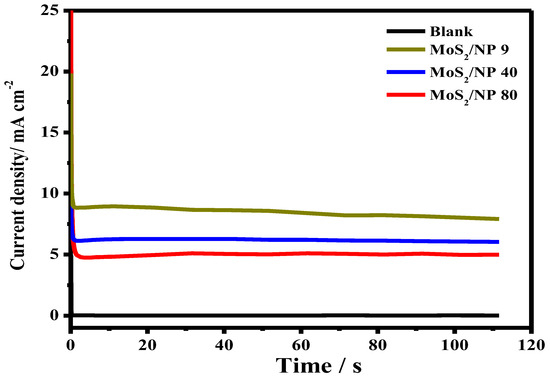
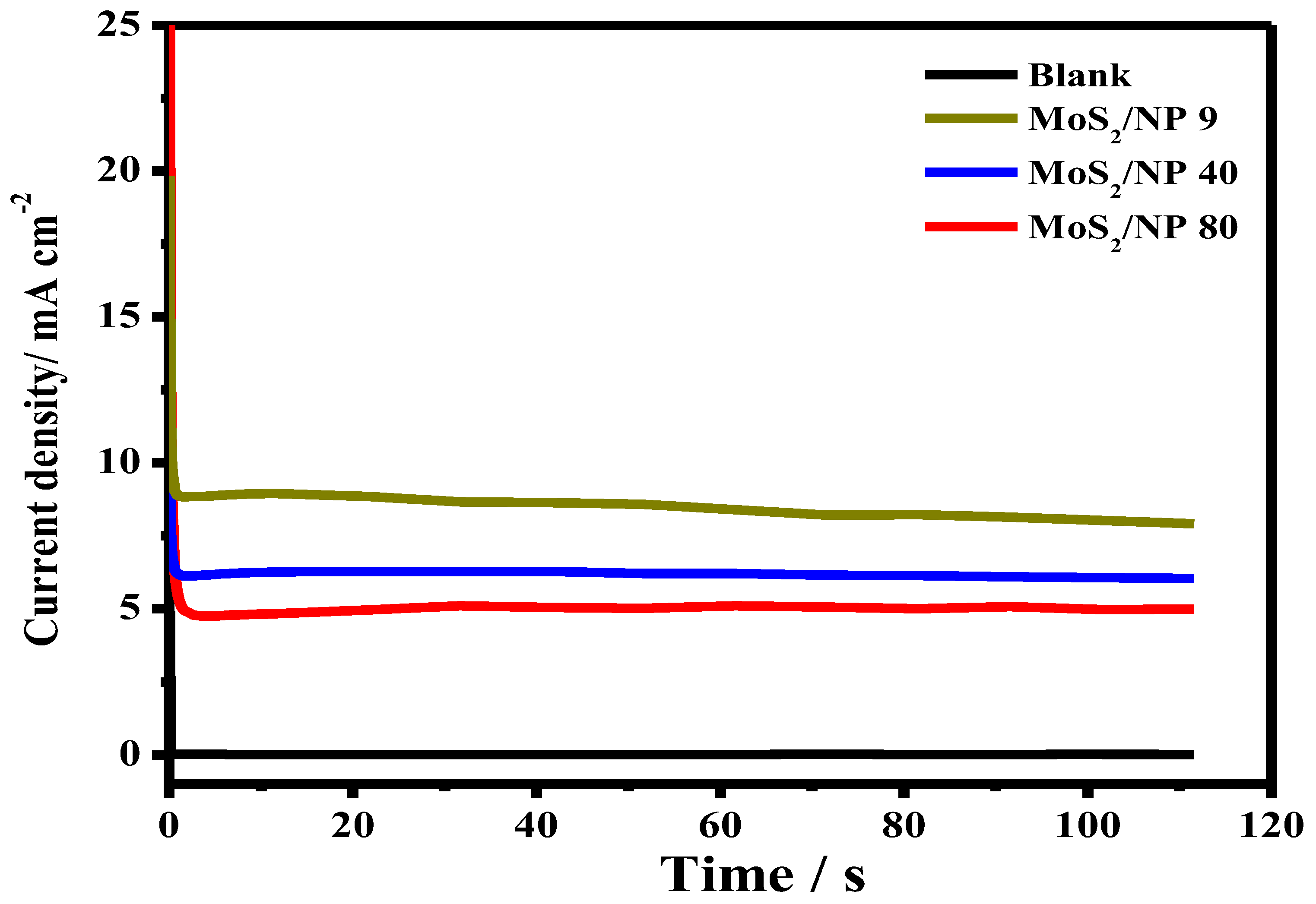
To confirm the stability of the MoS2/NP 9, MoS2/NP 40, and MoS2/T 80 composites, chronoamperometry studies were accompanied, as presented in Figure 6. The outcomes indicate that the electrodes modified with MoS2/NP 9, MoS2/NP 40, and MoS2/T 80 exhibited stable, continuous, and higher current densities with minimal reduction over time. The gradual decrease in current density over time, as depicted in Figure 6, is mainly ascribed to the rapid diffusion of electroactive molecules at the electrode interface. Following an initial decay lasting 20 s, the current steadied and remained constant for up to 115 s. This consistent current output from 20 s to 115 s emphasizes the stability of the produced current. The chronoamperometry findings indicate that the MoS2/NP 9, MoS2/NP 40, and MoS2/T 80 composites display steadiness and efficiency in promoting HER activity, as evidenced by their constant current levels post the initial decay period.
Figure 6.
Chronoamperometry of MoS2/NP 9, MoS2/NP 40, and MoS2/T 80 composites at the applied potential of 0.5 V vs. Ag/AgCl.
Finally, the introduced MoS2/NP 9, MoS2/NP 40, and MoS2/T 80 composites were compared with the recent literature on the application of MoS2 as a catalyst for the hydrogen evolution reaction (HER), as presented in Table 4 [41,42,43,44]. Our results revealed a notably lower onset potential and a higher Tafel slope compared to certain recent studies in the literature (except for ref. [43]) (Table 4). The material prepared with CTAB assistance yields edge-rich ultrathin MoS2 nanosheets, achieving a 90.0 mV onset potential in an acidic medium [43], which is lower than our result in the same environment. However, our result surpasses it in a neutral medium. These comparisons confirm the enhanced performance of the prepared composites as electrode materials for HER in both acidic and neutral environments.
Table 4.
Comparison of the recent literature on the use of MoS2 as a catalyst for the hydrogen evolution reaction (HER).
3. Experimental Procedures
3.1. Materials and Reagent
Analytical grade reagents of ammonium molybdate tetrahydrate ((NH4)6Mo7O24∙4H2O; AHM)) were purchased from Panreac quimica. Analytical grade reagents of thioacetamide (CH3CSNH2 , Tergitol NP 9 surfactant (nonionic, 616.8235 g/mol; a tergitol polymer comprising nonylbenzene with a nine-membered poly (ethylene glycol) moiety connected at position 4), Tergitol NP 40 surfactant (nonionic, 1980 g/mol; nonyl phenoxypolyethoxylethanol), and Tween 80 surfactant (nonionic, 1310 g/mol; a polyoxyethylene (20) sorbitan monooleate) were purchased from Sigma Al-drich (Darmstadt, Germany). All chemicals were used as received without further purification.
3.2. Sample Syntheses
In the typical hydrothermal operation, 0.26 g (1.14 mM) of thioacetamide and 1.41 g (3.46 mM) of AHM were completely dissolved in 20 mL of distilled water and mixed to yield a homogenous solution. An amount of 36 µL (36 mg) of Tergitol NP 9 (0.06 mM), Tergitol NP 40 (0.06 mM), and Tween 80 (0.06 mM) were separately added to the mixed solution. This resultant was stirred by magnetic stirrer at room temperature for 30 min to ensure homogeneity. Then, it was transferred into a 100 mL Teflon-lined stainless-steel autoclave to be placed in an electric oven (Gallenkamp oven, Cambridge, England) under 200 °C and left for 24 h. [15] The autoclave was cooled outside the oven at room temperature. The resultant was centrifuged and rinsed three times with distilled water and once with ethanol to remove any remaining reactants then filtered. Finally, the obtained black powder was dried in air using a standard oven at 60 °C for 6 h.
3.3. Fabrication of MoS2 Modified GCE
The tested electrode was fabricated as follows. At room temperature, 5 mg of the MoS2/polymer catalyst powder and 30 µL of Nafion solution were dispersed in 1 mL of ethanol–water solution, with volume ratio of 1:3. The mixed solution was dispersed using an ultrasonic device for 1 h. Thereafter, 5 µL of the dispersed solution was placed onto the surface of a 3 mm glassy carbon electrode (GCE). Finally, the modified GCE was dried for 24 h at room temperature [15].
3.4. Electrochemical Measurements
All the electrochemical measurements were performed in the 0.5 M H2SO4 or 1.0 M KCl solution at room temperature using an electrochemical potentiostat (PGSTAT204, Metrohom Autolab, The Netherlands). A three-stand electrode cell was employed, with the fabricated electrode, Ag/AgCl/KCl(sat.), and Pt wire as the working, reference, and counter electrodes, respectively. Linear sweep voltammetry (LSV) was conducted between −1 and 0.3 V at 0.1 Vs −1. The chronoamperometry experiments were conducted at a constant potential of 0.5 V vs. Ag/AgCl/KCl(sat.). During the test, all potentials were collected versus the Ag/AgCl electrode. Then, the potential was calibrated to a reversible hydrogen electrode.
4. Conclusions
MoS2 specimens were hydrothermally prepared using Tergitol NP 9, Tergitol NP 40, and Tween 80 surfactants. The morphological and structural characteristics of the samples were examined via FTIR, XRD, and Raman spectroscopy, collectively pointing towards a composite nature of MoS2 and MoO3. These analyses revealed a notable transition from the 2H-MoS2 phase to the 1T-MoS2 phase in the material. SEM and TEM displayed the nanomorphology of the specimens, illustrating the multigrain structure of the materials with nanometer-sized particles. The HER activity of the MoS2/MoO3 surfactant samples was observed in both acidic and neutral electrolytes. Among the prepared samples, the sample prepared using the NP 9 surfactant exhibited the best characterization and HER activity. The stability of the composites was validated through chronoamperometry studies, revealing that electrodes enhanced with MoS2/NP 9, MoS2/NP 40, and MoS2/T 80 showcased consistent, enduring, and elevated current densities. The exchange current values for MoS2/NP 9, MoS2/NP 40, and MoS2/T 80 were determined as 2.02, 0.497, and 1.22 mA cm−2, respectively, indicating the promising potential of MoS2 materials for enhancing HER activity.
Author Contributions
Conceptualization, K.A-A., S.S.L., S.H.A. and H.M.A.E.-L.; methodology, K.A.-A., S.S.L., S.H.A. and H.M.A.E.-L.; formal analysis, K.A.-A., S.H.A. and H.M.A.E.-L.; investigation, K.A.-A., S.S.L., S.H.A. and H.M.A.E.-L.; writing—original draft preparation, K.A.-A., S.S.L., S.H.A. and H.M.A.E.-L.; writing—review and editing, K.A.-A., S.S.L., S.H.A. and H.M.A.E.-L.; supervision, K.A.-A. and S.H.A. All authors have read and agreed to the published version of the manuscript.
Funding
This work is funded by the Deanship of Scientific Research, Vice Presidency for Graduate Studies and Scientific Research, King Faisal University, Saudi Arabia [grant no. KFU242206].
Data Availability Statement
Data are contained within the article.
Conflicts of Interest
The authors declare no conflicts of interest.
References
- Muralikrishna, S.; Manjunath, K.; Samrat, D.; Reddy, V.; Ramakrishnappa, T.; Nagaraju, D.H. Hydrothermal synthesis of 2D MoS2 nanosheets for electrocatalytic hydrogen evolution reaction. RSC Adv. 2015, 5, 89389–89396. [Google Scholar] [CrossRef] [Scilit]
- Liao, C.-H.; Huang, C.-W.; Wu, J.C.S. Hydrogen Production from Semiconductor-based Photocatalysis via Water Splitting. Catalysts 2012, 2, 490–516. [Google Scholar] [CrossRef] [Scilit]
- Du, Y.; Li, B.; Xu, G.; Wang, L. Recent advances in interface engineering strategy for highly-efficient electrocatalytic water splitting. InfoMat 2023, 5, e12377. [Google Scholar] [CrossRef] [Scilit]
- Venkateshwaran, S.; Senthil Kumar, S.M. Provoking Metallic 1T Phase Conversion of 2H-MoS2 via an Effectual Solvothermal Route for Electrocatalytic Water Reduction in Acid. ACS Sustain. Chem. Eng. 2022, 10, 5258–5267. [Google Scholar] [CrossRef] [Scilit]
- Edwards, P.P.; Kuznetsov, V.L.; David, W.I.F.; Brandon, N.P. Hydrogen and fuel cells: Towards a sustainable energy future. Energy Policy 2008, 36, 4356–4362. [Google Scholar] [CrossRef] [Scilit]
- Li, J.; Tang, C.; Zhang, H.; Zou, Z.; Li, C.M. Mesoporous molybdenum carbide for greatly enhanced hydrogen evolution at high current density and its mechanism studies. Mater. Rep. Energy 2023, 3, 100215. [Google Scholar] [CrossRef] [Scilit]
- Ali, A.; Liu, Y.; Mo, R.; Chen, P.; Shen, P.K. Facile one-step in-situ encapsulation of non-noble metal Co2P nanoparticles embedded into B, N, P tri-doped carbon nanotubes for efficient hydrogen evolution reaction. Int. J. Hydrogen Energy 2020, 45, 24312–24321. [Google Scholar] [CrossRef] [Scilit]
- Xu, X.; Liu, L. MoS2 with Controlled Thickness for Electrocatalytic Hydrogen Evolution. Nanoscale Res. Lett. 2021, 16, 137. [Google Scholar] [CrossRef] [Scilit]
- Yan, Y.; Xia, B.; Xu, Z.; Wang, X. Recent Development of Molybdenum Sulfides as Advanced Electrocatalysts for Hydrogen Evolution Reaction. ACS Catal. 2014, 4, 1693–1705. [Google Scholar] [CrossRef] [Scilit]
- Guo, B.; Yu, K.; Li, H.; Song, H.; Zhang, Y.; Lei, X.; Fu, H.; Tan, Y.; Zhu, Z. Hollow Structured Micro/Nano MoS2 Spheres for High Electrocatalytic Activity Hydrogen Evolution Reaction. ACS Appl. Mater. Interfaces 2016, 8, 5517–5525. [Google Scholar] [CrossRef] [Scilit]
- Liang, K.; Tabassum, A.; Kothakonda, M.; Zhang, X.; Zhang, R.; Kenney, B.; Koplitz, B.D.; Sun, J.; Naguib, M. Two-dimensional titanium carbonitride MXene as a highly efficient electrocatalyst for hydrogen evolution reaction. Mater. Rep. Energy 2022, 2, 100075. [Google Scholar] [CrossRef] [Scilit]
- Gupta, D.; Chauhan, V.; Kumar, R. A comprehensive review on synthesis and applications of molybdenum disulfide (MoS2) material: Past and recent developments. Inorg. Chem. Commun. 2020, 121, 108200. [Google Scholar] [CrossRef] [Scilit]
- Shi, M.; Dong, L.; Zheng, S.; Hou, P.; Cai, L.; Zhao, M.; Zhang, X.; Wang, Q.; Li, J.; Xu, K. “Bottom-up” preparation of MoS2 quantum dots for tumor imaging and their in vivo behavior study. Biochem. Biophys. Res. Commun. 2019, 516, 1090–1096. [Google Scholar] [CrossRef] [Scilit] [PubMed]
- Cui, Y.; He, J.; Yuan, F.; Xue, J.; Li, X.; Wang, J. Preparation of MoS2 microspheres through surfactants-assisted hydrothermal synthesis using thioacetamide as reducing agent. Hydrometallurgy 2016, 164, 184–188. [Google Scholar] [CrossRef] [Scilit]
- Zeng, X.; Niu, L.; Song, L.; Wang, X.; Shi, X.; Yan, J. Effect of Polymer Addition on the Structure and Hydrogen Evolution Reaction Property of Nanoflower-Like Molybdenum Disulfide. Metals 2015, 5, 1829–1844. [Google Scholar] [CrossRef] [Scilit]
- Wu, Z.; Wang, D.; Sun, A. Surfactant-assisted preparation of hexagonal molybdenum disulfide nanoparticles. Mater. Lett. 2009, 63, 2591–2593. [Google Scholar] [CrossRef] [Scilit]
- Hou, S.X. Controllable preparation of nano molybdenum disulfide by hydrothermal method. Ceramics-Silikáty 2017, 61, 158–162. [Google Scholar] [CrossRef] [Scilit]
- Ali, M.E.M.; Mohammed, R.; Abdel-Moniem, S.M.; El-Liethy, M.A.; Ibrahim, H.S. Green MoS2 nanosheets as a promising material for decontamination of hexavalent chromium, pharmaceuticals, and microbial pathogen disinfection: Spectroscopic study. J. Nanopart. Res. 2022, 24, 191. [Google Scholar] [CrossRef] [Scilit]
- Vattikuti, S.V.P.; Nagajyothi, P.C.; Anil Kumar Reddy, P.; Kotesh Kumar, M.; Shim, J.; Byon, C. Tiny MoO3 nanocrystals self-assembled on folded molybdenum disulfide nanosheets via a hydrothermal method for supercapacitor. Mater. Res. Lett. 2018, 6, 432–441. [Google Scholar] [CrossRef] [Scilit]
- Kumar, N.; George, B.P.A.; Abrahamse, H.; Parashar, V.; Ngila, J.C. Sustainable one-step synthesis of hierarchical microspheres of PEGylated MoS2 nanosheets and MoO3 nanorods: Their cytotoxicity towards lung and breast cancer cells. Appl. Surf. Sci. 2017, 396, 8–18. [Google Scholar] [CrossRef] [Scilit]
- Thangappan, R.; Dhinesh Kumar, R.; Jayavel, R. Facile Synthesis and Characterization of Molybdenum Oxide (MoO3) Nanofibers and Submicron Rods by Electrospinning Technique for Potential Application in Photocatalytic Activity. J. Clust. Sci. 2022, 33, 2209–2214. [Google Scholar] [CrossRef] [Scilit]
- Zhao, J.; Zhang, Z.; Yang, S.; Zheng, H.; Li, Y. Facile synthesis of MoS2 nanosheet-silver nanoparticles composite for surface enhanced Raman scattering and electrochemical activity. J. Alloys Compd. 2013, 559, 87–91. [Google Scholar] [CrossRef] [Scilit]
- Ali, G.A.M.; Thalji, M.R.; Soh, W.C.; Algarni, H.; Chong, K.F. One-step electrochemical synthesis of MoS2/graphene composite for supercapacitor application. J. Solid State Electrochem. 2020, 24, 25–34. [Google Scholar] [CrossRef] [Scilit]
- Aleithan, S.H.; Al-Amer, K.; Alabbad, Z.H.; Khalaf, M.M.; Alam, K.; Alhashem, Z.; Abd El-Lateef, H.M. Highly scalable synthesis of MoS2 thin films for carbon steel coatings: Influence of synthetic route on the nanostructure and corrosion performance. J. Mater. Res. Technol. 2023, 23, 1239–1251. [Google Scholar] [CrossRef] [Scilit]
- Saadati, M.; Akhavan, O.; Fazli, H. Single-Layer MoS2-MoO3-x Heterojunction Nanosheets with Simultaneous Photoluminescence and Co-Photocatalytic Features. Catalysts 2021, 11, 1445. [Google Scholar] [CrossRef] [Scilit]
- Faizan, M.; Hussain, S.; Islam, M.; Kim, J.-Y.; Han, D.; Bae, J.-H.; Vikraman, D.; Ali, B.; Abbas, S.; Kim, H.-S.; et al. MoO3@MoS2 Core-Shell Structured Hybrid Anode Materials for Lithium-Ion Batteries. Nanomaterials 2022, 12, 2008. [Google Scholar] [CrossRef] [Scilit]
- Mondal, A.K.; Chen, S.; Su, D.; Liu, H.; Wang, G. Fabrication and enhanced electrochemical performances of MoO3/graphene composite as anode material for lithium-ion batteries. Int. J. Smart Grid Clean Energy 2014, 3, 142–148. [Google Scholar] [CrossRef] [Scilit]
- Li, N.; Chai, Y.; Li, Y.; Tang, Z.; Dong, B.; Liu, Y.; Liu, C. Ionic liquid assisted hydrothermal synthesis of hollow vesicle-like MoS2 microspheres. Mater. Lett. 2012, 66, 236–238. [Google Scholar] [CrossRef] [Scilit]
- Tian, Y.; Yang, X.; Nautiyal, A.; Zheng, Y.; Guo, Q.; Luo, J.; Zhang, X. One-step microwave synthesis of MoS2/MoO3@graphite nanocomposite as an excellent electrode material for supercapacitors. Adv. Compos. Hybrid. Mater. 2019, 2, 151–161. [Google Scholar] [CrossRef] [Scilit]
- Yi, M.; Zhang, C. The synthesis of MoS2 particles with different morphologies for tribological applications. Tribol. Int. 2017, 116, 285–294. [Google Scholar] [CrossRef] [Scilit]
- Gao, D.; Si, M.; Li, J.; Zhang, J.; Zhang, Z.; Yang, Z.; Xue, D. Ferromagnetism in freestanding MoS2 nanosheets. Nanoscale Res. Lett. 2013, 8, 129. [Google Scholar] [CrossRef] [Scilit] [PubMed]
- Manikandan, R.; Raina, G. Hydrothermally synthesized 2H-MoS2 under optimized conditions—A structure and morphology analysis. Phys. Scr. 2022, 97, 125808. [Google Scholar]
- Han, S.; Liu, K.; Hu, L.; Teng, F.; Yu, P.; Zhu, Y. Superior Adsorption and Regenerable Dye Adsorbent Based on Flower-Like Molybdenum Disulfide Nanostructure. Sci. Rep. 2017, 7, 43599. [Google Scholar]
- Li, H.; Zhang, Q.; Yap, C.C.R.; Tay, B.K.; Edwin, T.H.T.; Olivier, A.; Baillargeat, D. From Bulk to Monolayer MoS2: Evolution of Raman Scattering. Adv. Funct. Mater. 2012, 22, 1385–1390. [Google Scholar] [CrossRef] [Scilit]
- Geng, X.; Sun, W.; Wu, W.; Chen, B.; Al-Hilo, A.; Benamara, M.; Zhu, H.; Watanabe, F.; Cui, J.; Chen, T. Pure and stable metallic phase molybdenum disulfide nanosheets for hydrogen evolution reaction. Nat. Commun. 2016, 7, 10672. [Google Scholar] [CrossRef] [Scilit] [PubMed]
- Kothaplamoottil Sivan, S.; Padinjareveetil, A.K.K.; Padil, V.V.T.; Pilankatta, R.; George, B.; Senan, C.; Černík, M.; Varma, R.S. Greener assembling of MoO3 nanoparticles supported on gum arabic: Cytotoxic effects and catalytic efficacy towards reduction of p-nitrophenol. Clean Technol. Environ. Policy 2019, 21, 1549–1561. [Google Scholar] [CrossRef] [Scilit]
- Wang, T.; Li, J.; Zhao, G. Synthesis of MoS2 and MoO3 hierarchical nanostructures using a single-source molecular precursor. Powder Technol. 2014, 253, 347–351. [Google Scholar] [CrossRef] [Scilit]
- Sharma, R.K.; Reddy, G.B. Synthesis and characterization of α-MoO 3 microspheres packed with nanoflakes. J. Phys. D Appl. Phys. 2014, 47, 065305. [Google Scholar] [CrossRef] [Scilit]
- Fei, L.; Lei, S.; Zhang, W.-B.; Lu, W.; Lin, Z.; Lam, C.H.; Chai, Y.; Wang, Y. Direct TEM observations of growth mechanisms of two-dimensional MoS2 flakes. Nat. Commun. 2016, 7, 12206. [Google Scholar] [CrossRef] [Scilit]
- Shyyko, L.O.; Kotsyubynsky, V.O.; Budzulyak, I.M. The Importance of Surfactant and Its Type on MoS2 Nanoparticles Formation. J. Nanosci. Nanotechnol. 2016, 16, 7792–7796. [Google Scholar] [CrossRef] [Scilit]
- Saleem, S.; Salman, M.; Ali, S.; Ling, Y.; Khan, M. Electrocatalytic hydrogen evolution reaction on sulfur-deficient MoS2 nanostructures. Int. J. Hydrogen Energy 2022, 47, 7713–7723. [Google Scholar] [CrossRef] [Scilit]
- de-Mello, G.B.; Smith, L.; Rowley-Neale, S.J.; Gruber, J.; Hutton, S.J.; Banks, C.E. Surfactant-exfoliated 2D molybdenum disulphide (2D-MoS2): The role of surfactant upon the hydrogen evolution reaction. RSC Adv. 2017, 7, 36208–36213. [Google Scholar] [CrossRef] [Scilit]
- Guo, Z.; Ma, Q.; Xuan, Z.; Du, F.; Zhong, Y. Facile surfactant-assisted synthesis of CTAB-incorporated MoS2 ultrathin nanosheets for efficient hydrogen evolution. RSC Adv. 2016, 6, 16730–16735. [Google Scholar] [CrossRef] [Scilit]
- Song, L.; Zhao, M.; Li, X.; Zhang, Z.; Qu, L. Solution-processed MoS2 nanotubes/reduced graphene oxide nanocomposite as an active electrocatalyst toward the hydrogen evolution reaction. RSC Adv. 2016, 6, 70740–70746. [Google Scholar] [CrossRef] [Scilit]

Disclaimer/Publisher’s Note: The statements, opinions and data contained in all publications are solely those of the individual author(s) and contributor(s) and not of MDPI and/or the editor(s). MDPI and/or the editor(s) disclaim responsibility for any injury to people or property resulting from any ideas, methods, instructions or products referred to in the content. |
© 2024 by the authors. Licensee MDPI, Basel, Switzerland. This article is an open access article distributed under the terms and conditions of the Creative Commons Attribution (CC BY) license (https://creativecommons.org/licenses/by/4.0/).