





Skip Content
You are currently on the new version of our website. Access the old version .

All Articles (832)

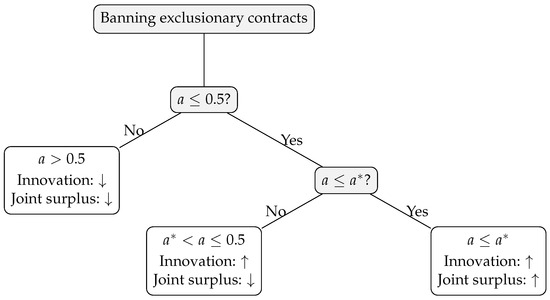
This paper develops a game-theoretic model to study how exclusionary contracts affect firms’ incentives to invest in innovation. Several symmetric sellers compete to supply an identical product to a set of buyers, and each seller can invest in R&D to develop a higher-quality version of the product. Prior to choosing their R&D investments, sellers may offer exclusionary contracts to buyers. In equilibrium, all buyers sign an exclusionary contract with the same seller, which eliminates rival sellers’ incentives to invest in R&D and concentrates innovative effort in a single firm. Banning exclusionary contracts increases the aggregate probability of innovation and the joint surplus of buyers and sellers only when the R&D technology exhibits sufficiently strong diseconomies of scale.

3 February 2026

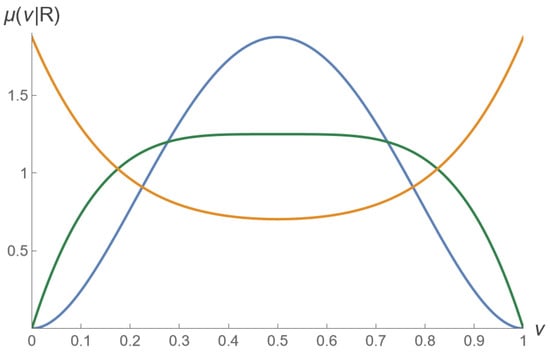
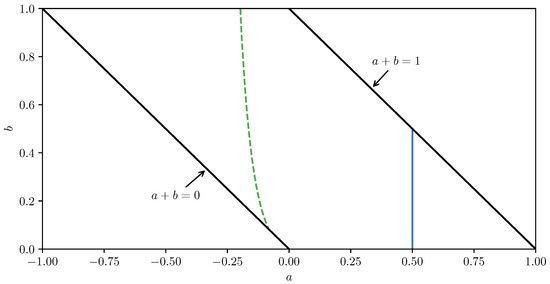
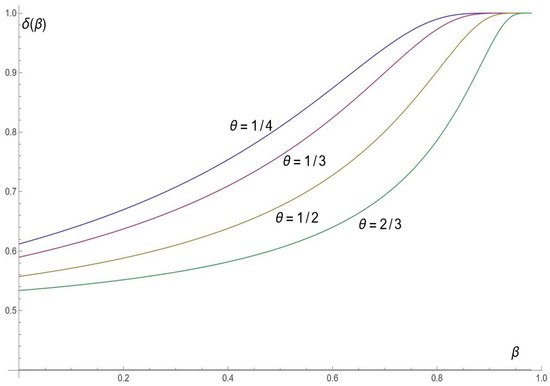
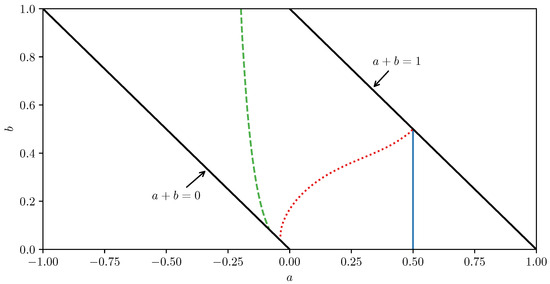
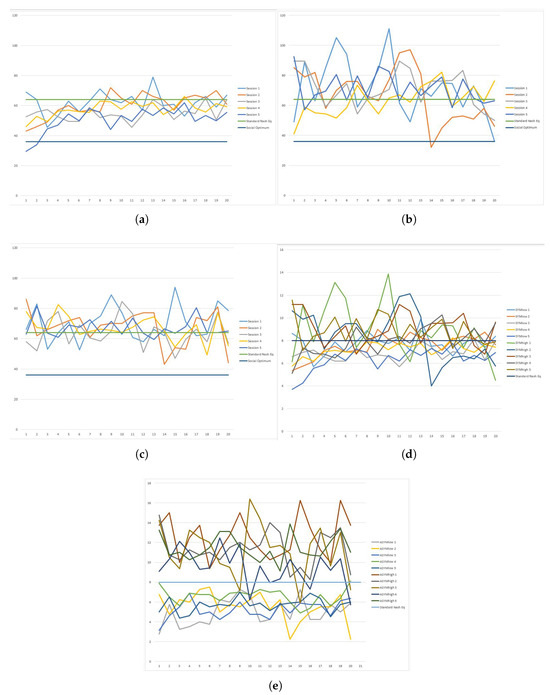
Critical combinations of a and b. In the area to the left (right) of the solid blue line, banning exclusionary contracts increases (decreases) the aggregate probability of innovation. In the area to the left (right) of the dashed green line, banning exclusionary contracts increases (decreases) the joint surplus of the buyers and sellers.

There has been significant recent progress in algorithms for approximation of Nash equilibrium in large two-player zero-sum imperfect-information games and exact computation of Nash equilibrium in multiplayer normal-form games. While counterfactual regret minimization and fictitious play are scalable to large games and have convergence guarantees in two-player zero-sum games, they do not guarantee convergence to Nash equilibrium in multiplayer games. We present an approach for exact computation of Nash equilibrium in multiplayer imperfect-information games that solves a quadratically-constrained program based on a nonlinear complementarity problem formulation from the sequence-form game representation. This approach capitalizes on recent advances for solving nonconvex quadratic programs. Our algorithm is able to quickly solve three-player Kuhn poker after removal of dominated actions. Of the available algorithms in the Gambit software suite, only the logit quantal response approach is successfully able to solve the game; however, the approach takes longer than our algorithm and also involves a degree of approximation. Our formulation also leads to a new approach for computing Nash equilibrium in multiplayer normal-form games which we demonstrate to outperform a previous quadratically-constrained program formulation.

3 February 2026

  • Feature Paper
  • Article
  • Open Access

This paper examines the potential for pre-play communication to shorten the duration of two-player incomplete-information wars of attrition. If players’ types constitute costlessly verifiable information, then all types of players disclose their types, resulting in the war of attrition having duration zero. However, if type constitutes unverifiable information, the results are less sanguine. Pre-play cheap-talk communication has no effect on the play of the subsequent war of attrition. Mediated cheap-talk communication is no better: No institution that relies on players’ cheap-talk reports can systematically allocate the prize to the player who values it more highly at a lower resource cost than is entailed in equilibrium play of the war of attrition. Costly signaling in the form of burning money can effectively supplant the war of attrition as a means of allocating the prize, but it requires the same expected equilibrium resource expenditures, with the same expected distribution across types, as does the war of attrition. Thus, in spite of players’ unanimous preference for a system in which types are made known, and in spite of their disclosing type in equilibrium when type is verifiable, they nonetheless expend resources to credibly communicate their types when type is not verifiable, and the resources expended are, on average, equivalent to those expended in a war of attrition.

2 February 2026

We develop a model of monetary policy committee decision-making, building on the framework of games played through agents (GPTA). Interest groups seek to influence policy by offering action-contingent contracts to committee members. The resulting equilibrium admits a simple characterization and shows how institutional features—such as committee size—shape the extent of external influence. When political pressure pushes for expansive and inflationary policy, larger committees can enhance de facto independence by diluting this influence. We also show that when anti-inflationary pressures dominate, an appropriate choice of committee size can replicate the preference shift towards more conservativeness familiar from delegation frameworks, even when it is not feasible to appoint a conservative central banker in a systematic way.

16 January 2026

News & Conferences

Issues

Open for Submission

Editor's Choice

Reprints of Collections

Economics of Conflict and Terrorism
Reprint

Economics of Conflict and Terrorism

Editors: Joao Ricardo Faria, Daniel Arce
Behavioral Game Theory
Reprint

Behavioral Game Theory

Editors: Russell Golman

Get Alerted

Add your email address to receive forthcoming issues of this journal.

XFacebookLinkedIn
Games - ISSN 2073-4336