Article

Moral Emotions and Beliefs Influence Charitable Giving

by
Garret Ridinger
1,* and
Anne Carpenter
2
1
Department of Management, College of Business, University of Nevada, Reno, 1664 N Virginia St., Reno, NV 89557, USA
2
Department of Economics, College of Business, University of Nevada, Reno, 1664 N Virginia St., Reno, NV 89557, USA
*
Author to whom correspondence should be addressed.
Games 2025, 16(6), 63; https://doi.org/10.3390/g16060063
Submission received: 30 March 2025 / Revised: 8 August 2025 / Accepted: 25 August 2025 / Published: 5 December 2025

Abstract

This paper studies the influence of moral emotions and beliefs on understanding charitable giving. While specific moral emotions such as empathy, guilt, and shame have been associated with prosocial behavior, how they impact giving behavior may depend on beliefs about the giving of others. Using a laboratory experiment, individuals participated in a dictator game with charity and completed measures of beliefs, empathy, guilt, and shame. Results show that while individual variation in empathy, guilt, and shame is important in explaining charitable giving, these effects depend crucially on individual beliefs.

1. Introduction

Evidence continues to demonstrate that many people exhibit prosocial behavior. Data on charitable giving in the United States shows that charitable giving is around 2 percent of national GDP, with approximately 70 percent of that total from individual donors (Giving USA Foundation, 2024). While actual giving statistics have wide estimates depending on the sample, data from the Panel Study of Income Dynamics in 2018 shows that 49.6 percent of households report giving to charity, with wide variation in amounts donated (Indiana University Lilly Family School of Philanthropy, 2024). Researchers have explored many factors that influence why people give, such as altruism Andreoni (1998), personal reputation (DellaVigna et al., 2012), individual demographics (Piff et al., 2010), and charity characteristics (Simon et al., 2008). Although this research has added much to our understanding about why individuals give, many unexplored questions remain about individual heterogeneity in giving. This paper adds to prior research on charitable giving by exploring the idea that part of giving behavior is driven by beliefs and moral emotions. Specific moral emotions such as empathy, guilt, and shame may influence the decision to give to others. The intensity with which individuals feel these different emotions can influence their decisions to give to others. Our paper adds to this research by exploring the interaction between beliefs and individual traits on dictator game behavior. While prior research has examined how certain moral emotions can lead to prosocial behavior (Batson & Ahmad, 2001; Batson et al., 1988; Battigalli & Dufwenberg, 2007; Ellingsen et al., 2010; Reuben et al., 2009; Ridinger, 2020; Ridinger & McBride, 2025; Theilmann et al., 2020), less study has been devoted to how beliefs about others’ giving interact with these moral emotions in predicting decisions to give to charity.
Many researchers have used the dictator game to study prosocial behavior, finding that most people give a significant portion to others (Camerer, 2011). The vast majority of experiments using the dictator game have been between two subjects in the laboratory. However, a small but increasing number of studies have used a dictator game where a subject can give to a charity (Bachke et al., 2014; Bekkers, 2007; Eckel & Grossman, 1996; McBride & Ridinger, 2021; Umer et al., 2022). In this paper, we used the dictator game with charity and elicited incentivized beliefs about the giving of others in a controlled laboratory experiment. In addition, individual differences were measured in terms of propensity to feel empathy, guilt, and shame. We show that different types of empathy, guilt, and shame provide unique theoretical predictions about charitable giving. Empirically, we tested crucial hypotheses about how beliefs and these moral emotions interact to influence prosocial behavior.
Results show that individuals who feel greater empathy are more likely to give to charity, but that this effect is crowded out if they believe others are giving more. In addition, a higher propensity to feel guilt and shame are positively correlated with increased giving. Interestingly, evidence suggests that this increase in giving is driven primarily through differences in beliefs, that is, individuals who are more prone to feeling guilt and shame hold higher beliefs about the giving of others, and this difference is what explains the increase in their giving behavior. Additional analysis shows that increases in empathic concern lead to a lower likelihood of donating nothing to charity and a large increase in subjects donating their entire endowment. Increases in shame and guilt are associated with a lower likelihood of donating nothing to charity. These results add to our understanding of how moral emotions and beliefs influence charitable giving.

2. Theory

2.1. Simple Model of Charitable Giving

Considerable research has focused on different motivations that influence giving (Andreoni, 1989; Ottoni-Wilhelm et al., 2017; Ridinger & McBride, 2020) First, individuals may be motivated by the overall welfare of the charity recipient. Often called pure altruism, in this case an individual’s utility is increased based on the total welfare of the recipient. Second, individuals may be motivated to give by their individual interest. Often called warm-glow altruism, in this case they receive utility based on their own action of giving, which is independent from the welfare of the recipient (Andreoni, 1989). Lastly, extensive research on social norms has found that people can be motivated to conform to the actions of others (Bicchieri, 2005; Bicchieri & Xiao, 2009; Karapetian et al., 2025; Leary & Ridinger, 2020; McBride & Ridinger, 2021; te Velde & Louis, 2022). Increased giving from others can lead individuals to want to increase their own giving in order to match this social norm.
Each of these three approaches differs crucially in how the giving of others affects individual utility. To illustrate this, we introduce a simple model for the utility of giving. Let y be the endowment of player i and let g i be defined as the amount donated to charity by player i, where g i [ 0 , y ] . Let G be the total amount the charity receives from all other players and G i the amount received by the charity that does not include the donation g i from player i. The utility of player i can then be written as follows:
U i ( g i ) = y g i + α i l o g ( g i + θ i G i )
where α i 0 captures the altruistic concern of player i. The term θ i R is multiplied by the overall giving of others, and captures how the giving of others influences individual utility. To see this, we can solve for the optimal donation:
g i * = α i θ i G i .
According to this model, the optimal donation is increasing in the overall preference for altruism α i and is influenced by the giving of others. Whether higher giving of others increases or decreases the optimal giving g i * depends on the value of θ i . If θ i = 1 , then we have pure crowd-out in the donations of others. This is consistent with a model of pure altruism. If θ i ( 0 , 1 ) , then we have a model of incomplete crowd-out; while higher donations leads to lower giving, substitution is imperfect. If θ i = 0 , then we have a model of pure warm-glow; when θ i < 0 , the model captures the general predictions of the impure altruism model, which allows individuals to vary between pure and warm-glow altruism (Andreoni, 1989; Ottoni-Wilhelm et al., 2017). Lastly, if θ i < 0 , then giving is increasing with the giving of others. As a result, if others give more, then a person is motivated to give more. This allows the model to capture a preference for conformity or a preference to follow social norms.
There exists considerable evidence estimating crowd-out and crowd-in effects in giving to charity. One approach has examined whether government grants to charities crowd-out private donations. Evidence has varied, with some studies finding evidence of crowding-out (Andreoni & Payne, 2011; Kingma, 1989; Payne, 1998) and others evidence of crowding-in (Heutel, 2012; Khanna & Sandler, 2000). Isolating the source of the crowd-out effect from these secondary data can be difficult. For example, one study found that part of the crowding-out in private donations can be explained by charities reducing their fundraising behavior after receiving a government grant (Andreoni & Payne, 2011). Controlled experimental work has also found a wide range of estimates of crowd-out effects, ranging from none to complete crowding-out (Andreoni, 1993; Bolton & Katok, 1998; Chan et al., 2002; Crumpler & Grossman, 2008; Eckel et al., 2005; Gronberg et al., 2012; Konow, 2010; Korenok et al., 2013; Ottoni-Wilhelm et al., 2017; Sutter & Weck-Hannemann, 2004). For example, in one experiment, donations were designed to be completely crowded-out, as any chosen donation did not change the overall level given to the charity; however, more than half of all subjects still donated, providing evidence of warm-glow altruism (Crumpler & Grossman, 2008). Another experiment found that varying the frame could move crowd-out effects from almost zero to full crowding-out (Eckel et al., 2005).
While the crowd-in effect has received less attention, research has found evidence that individual giving can increase when others are giving more. One explanation has focused on how the giving of others may provide a signal about the quality of the charity, which could lead to a crowd-in effect (Vesterlund, 2003). Another potential explanation is that charities may choose their fundraising goals; in equilibrium, those choices can lead to a crowd-in effect (Andreoni, 1998). In contrast, Smith et al. (2015) found that neither of these explanations could explain the crowd-in effects in their data; instead, their findings were more consistent with a scenario in which donations of others serve as an expectation about what people should give (Smith et al., 2015).
It is important to note that the vast majority of studies examining crowd-out effects have not measured beliefs about the actions of others. This is important because, as previous studies have shown, there exists evidence that donations are sensitive to the overall level of donations to the charity (Ottoni-Wilhelm et al., 2017). In many situations, people who donate do not know the amount donated by others with certainty. Specifically, players may not know G i when they make their decision. Instead, they may form some belief β i ( G i ) about the true level G i of giving by others, which may vary across each player i. Modifying the utility function and solving for the optimal donation provides
g i * = α i θ i β i ( G i ) .
While evidence suggests that donations can be influenced by the actions of others in different ways, it remains an open question as to what explains individual variation in giving and individual variation in how people respond to the actions of others. One source for this heterogeneity may be differences in the propensity to feel different moral emotions. Importantly, it is unclear how these moral emotions can impact optimal giving. We can use our simple model to illustrate how moral emotions could impact giving behavior. First, moral emotions could operate as differences in the general preference for altruism, which in our model is measured through α i . In this way, differences in these moral emotions could lead to differences in the overall level of giving. Second, moral emotions could operate through differences in how people are influenced by the giving of others, which is captured in our model as θ i . Third, moral emotions may lead to different beliefs about the giving of others. In our model, we represent this as β i ( G i ) , which allows each individual to form a different belief about others’ giving; however, this belief may also depend on differences in how people feel moral emotions. Importantly, as we discuss next, prior literature suggests that different types of moral emotions may operate through these channels in different ways.

2.2. Empathy, Beliefs, and Charitable Giving

Charitable giving is a complex behavior influenced by various emotional and cognitive processes. Among these, empathy may play an important role in shaping the motivation to donate. A recent meta-analysis of studies on dictator games found a significant effect of empathy on increases in giving (Theilmann et al., 2020). It should be noted that many different types of empathy measures were aggregated as a single measure of empathy in the analysis. While these results suggest that empathy is related to prosocial behavior, prior literature demonstrates that there exist multiple conceptualizations of empathy and that these differences suggest different theoretical predictions about individual behavior (Batson, 2011). In this paper, we focus on two primary types: empathic concern and perspective-taking. Empathic concern refers to an emotional response characterized by the desire to help another person in need (Batson, 2011; Davis, 1983), whereas perspective-taking denotes the cognitive ability to understand what another person is thinking or feeling (Batson, 2011; Davis, 1983). Individual differences in these traits may influence charitable giving.
Empathic concern is often activated when people observe the suffering of others, eliciting a negative emotional response that can motivate prosocial actions in order to reduce discomfort (Zahn et al., 2013). Prior research has found evidence linking empathic concern and altruistic behavior. For example, second movers in a sequential prisoner’s dilemma cooperate more often with a person that they know defected on them compared to controls if they are induced to feel empathy for the defector (Batson & Ahmad, 2001). Higher empathic concern has been linked to policy preferences such as increased giving to the poor, increased social security benefits, and progressive income redistribution (Ridinger, 2011). In addition, empathic concern has been correlated with self-reported helping behaviors (Kruger, 2003; Ridinger, 2011). In a study related to ours, higher empathy was found to be correlated with increased giving to a charity for children in a binary-choice task (Vu et al., 2024).
One interpretation is that empathic concern increases a person’s overall preference for altruism. In our model, this suggests that empathic concern influences the utility of a player i through the overall altruism parameter α i . As a result, individuals with higher levels of empathic concern should give more to charity compared to those with lower levels of empathic concern.
Hypothesis 1.
Higher empathic concern should be associated with greater giving to charity.
Research has shown that perspective-taking ability develops over time as children age (Baron-Cohen et al., 2001; Ridinger & McBride, 2015). However, there still exists wide variation in perspective-taking ability within adult populations (Baron-Cohen et al., 2001; Dodell-Feder et al., 2013; Ridinger & McBride, 2015). While perspective-taking helps others to recognize the needs of others, it does not inherently activate a negative or positive feeling (Batson, 2011; Zahn et al., 2013). Thus, while perspective-taking could lead to increased giving (Singer & Fehr, 2005), whether it actually does is theoretically ambiguous (Ridinger & McBride, 2025). Ridinger and McBride (2025) have shown that in the context of cooperation, greater perspective-taking ability could be associated with higher or lower cooperation depending on individual beliefs and social preferences (Ridinger & McBride, 2025). Empirical research has tested the relationship between perspective-taking and prosocial behavior in both children and adult populations. Some studies have found increases in perspective-taking to be associated with increased prosocial behavior (Takagishi et al., 2010, 2014). In contrast, other studies have found no correlation between perspective-taking and prosocial behavior (Artinger et al., 2014; Traverso et al., 2020). Lastly, one study found a decrease in prosocial behavior in those with higher perspective-taking ability (Cowell et al., 2015). As these studies show, the relationship between perspective-taking and prosocial behavior remains unclear. Given this prior research, we predict that perspective-taking should not be correlated with giving to charity.
Hypothesis 2.
Perspective-taking should not be correlated with giving.
Recent work suggests that one reason for these mixed results may be that perspective-taking is necessary to engage in prosocial behavior, but having the ability is not sufficient by itself to lead to increases in prosocial behavior (Ridinger & McBride, 2025). Empirical work studying cooperation has found that perspective-taking is correlated with the ability to predict others behavior, but whether higher perspective-taking was associated with higher or lower prosocial behavior depended on beliefs about others’ cooperation (Ridinger & McBride, 2025). In the context of charitable giving, perspective-taking ability could help people to recognize how others would feel about their choice to give, and this recognition could lead people to feel empathic concern for those in need (Singer & Fehr, 2005). However, whether higher perspective-taking leads to increased giving may depend on an individual’s overall level of empathic concern. Taken together, we predict that individuals with high perspective-taking ability but low empathic concern may be less likely to donate compared to those who exhibit high levels of both traits.
Hypothesis 3.
The interaction effect between perspective taking and empathic concern should be positive and predicts greater giving as both scores increase.
Our simple model of utility allows for individuals to have a preference for pure altruism or warm-glow altruism. Empathy may potentially influence which preference a person has. While prior evidence has found a relationship between empathy and altruism, these prior studies did not measure beliefs, and as a result this crowd-out effect of empathy could be directly tested (Theilmann et al., 2020; Vu et al., 2024). For example, one theoretical explanation for the source of pure altruistic behavior is the empathy-altruism hypothesis Batson (2011). The empathy-altruism hypothesis posits that individuals are motivated to help improve the welfare of others who are in need due to having empathic concern for others. Based on the empathy-altruism hypothesis, we argue that beliefs about the actions of others should moderate this effect. Specifically, if an individual believes that many others are already donating, they may infer that the need for their own contribution is diminished, leading to a potential crowd-out effect.
Hypothesis 4a.
According to the empathy-altruism hypothesis, the increased effect of higher empathic concern on giving should be crowded-out by higher beliefs about the giving of others.
Alternatively, people may be motivated to give due to warm-glow altruism (Andreoni, 1989). Empathic concern could lead to warm-glow altruism through what has been called the empathic-specific reward hypothesis (Schaefer et al., 2021). According to the empathic-specific reward hypothesis, empathic concern could influence warm-glow giving because the act of giving could provide a personal or social reward (Batson et al., 1988; Schaefer et al., 2021). Crucially, this personal reward is not based on the welfare of the other person (Schaefer et al., 2021). Based on this reasoning, we predict that if individuals are driven by warm-glow altruism, then beliefs about the giving of others should not crowd-out giving behavior. In this case, empathic concern should increase giving, but the person will still want to give even if others are giving, since they receive a personal reward from the act of giving.
Hypothesis 4b.
According to the empathic-specific reward hypothesis, the increased effect of higher empathic concern on giving should not be crowded-out by higher beliefs about the giving of others.

2.3. Guilt, Beliefs, and Charitable Giving

Similar to empathic concern, shame and guilt are also negative feelings that people experience (Zahn et al., 2013). Shame and guilt are different compared to empathic concern in that the negative feeling is about the potential donor, that is, the negative feeling is activated when a person is viewing their own actions. In this context, people are more likely to feel guilt or shame if their actions can or could have influenced the state of people who need help; that is, to activate feelings of guilt or shame, a person must view their actions as impacting the outcome of the charity. Guilt is typically described as a negative feeling about one’s behavior, while shame is often described as a feeling about one’s character (Cohen et al., 2011; Tracy & Robins, 2004). Additionally, guilt is typically felt privately, while shame is more associated with being observed or imagining that one is being observed (Tracy & Robins, 2004; Zahn et al., 2013).
Prior research has found a positive relationship between giving in the dictator game and proneness to guilt, but no correlation with proneness to shame (Bellemare et al., 2019). One drawback of that study was that the measure of guilt and shame did not separately measure self-evaluations compared to behavioral responses (Bellemare et al., 2019).1 However, the evaluation and behavior distinction with shame and guilt is important (Wolf et al., 2010). With shame and guilt, individuals may have a negative evaluation of their own behavior or character, but may also choose actions or behaviors due to those feelings. For example, shame can motivate some people to avoid others after experiencing shame. This is often referred to as shame withdrawal, and is often associated with less prosocial actions (Cohen et al., 2011; Lamm et al., 2022). In contrast, if shame is focused on evaluating the self, then people may take prosocial actions in order to avoid that anticipated feeling (Ridinger, 2020). As a result, how people feel shame may have different predictions for giving depending on how shame manifests in that person.
In this paper, we use the guilt and shame proneness (GASP) scale, which measures evaluations and behaviors separately for both shame and guilt (Cohen et al., 2011). The scale consists of four subscales that measure different aspects of guilt and shame. The shame—negative misbehavior self-evaluation (Shame-NSE) subscale measures individual shame about public misbehavior. The shame—withdrawal subscale (Shame-W) measures the propensity for behavioral change by withdrawing from future situations after experiencing shame. The guilt—repair (Guilt-R) subscale measures the propensity for behavioral change to repair the situation after feeling guilt. Finally, the guilt—negative behavior evaluation (Guilt-NBE) subscale measures individual guilt about private misbehavior. Using this scale allowed us to test how these different manifestations of guilt and shame differentially impact giving in the dictator game with charity. One prior study used the Guilt-R and Guilt-NBE subscales to test giving to charity in a binary-choice task, but did not measure shame (Vu et al., 2024). The results of two online studies found a significant and positive correlation with increased giving for the Guilt-NBE subscale, but only one of the studies found a correlation with the Guilt-R subscale (Vu et al., 2024).
All four of these types of guilt and shame are uncomfortable feelings, and people may choose actions in order to reduce these feelings or to avoid feeling them at all. When considering whether or not to give to a charity, an individual may feel guilt or shame about not giving. When that feeling of shame involves negative self-evaluation, they may feel that not donating would mean that they are a bad person. To avoid this feeling, they may choose to donate. In contrast, when a person is experiencing shame withdrawal, they may try to avoid the situation, and as such may be less likely to donate. When experiencing guilt with negative behavioral evaluation, they may anticipate feeling bad about not helping; thus, they may donate in order to avoid this anticipated feeling. Lastly, when a person experiences guilt repair, they are motivated to help fix the situation. As a result, if they are experiencing guilt repair, then the feeling of guilt could motivate them to give to charity. Taken together, we predict that higher scores on Shame-NSE, Guilt-R, and Guilt-NSE will be associated with greater donations to charity, while Shame-W will be associated with lower donations to charity.
Hypothesis 5.
Shame-NSE, Guilt-R, and Guilt-NBE should be correlated with increased giving to charity, while Shame-W should be correlated with decreased giving to charity.
Researchers in psychological game theory have argued that beliefs are crucial in understanding guilt (Battigalli & Dufwenberg, 2007). One of the most common models of guilt in games is what is called the second-order belief model (Battigalli & Dufwenberg, 2007). In the second-order belief model, individuals are assumed to have beliefs about what others expect to receive. Violating these expectations can lead to feelings of guilt. Thus, people may avoid choices that make them feel guilty. Crucial in the second order belief-based model is that the recipient’s expectations determine whether or not a person feels guilt (Cartwright, 2019). Evidence on whether others’ expectations influence prosocial behavior has been mixed. Self-reported beliefs about other player’s expectations have been found to be correlated with prosocial behavior in trust and ultimatum games (Bellemare et al., 2011; Reuben et al., 2009). In contrast, directly disclosing what recipients expect to receive in trust and dictator games is not correlated with prosocial behavior (Bellemare et al., 2017; Ellingsen et al., 2010).
While it could be that guilt is not a strong factor in explaining dictator game behavior, an alternative explanation for these results is that guilt may not be entirely determined by what the recipient expects; that is, while a charitable organization may expect that a person will not donate anything, a person may still feel guilty if they chose not to donate. One potential reason they may feel guilt is if they believe that donating is what they should do or what others are doing. This has been described as reference-point guilt (Cartwright, 2019). This reference-point guilt could be determined by a person’s own expectations about the behavior they should follow, or a social norm that prescribes certain behavior (McBride & Ridinger, 2021). In our simple model, this would be captured by θ i < 0 , as utility would increase as the donations of others increase.
Alternatively, a person may form expectations about what a charity will receive or the amount of donations needed by the charity. If the charity needs more, then the person may feel guilty by not donating. We describe this as altruism-based guilt. Our simple model can capture this θ i > 0 , since utility would be decreasing as the donations of others increase. In contrast to the second-order belief model, both reference-point guilt and altruism-based guilt are not determined by the recipients’ expectations. Instead, guilt may influence behavior through beliefs about the donations of other people.
In prior models of guilt aversion, differences in propensity to feel guilt are assumed to be independent of the reference point or beliefs (Battigalli & Dufwenberg, 2007; Cartwright, 2019). However, a higher propensity to feel shame or guilt may be correlated with different beliefs about the actions of others, that is, the formation of expectations may be determined in part with an individuals’ propensity to feel guilt or shame about violating a social expectation. Put another way, a person who often feels strong feelings of shame or guilt may believe that others will donate more than those who hold lower levels of shame or guilt, that is, they may hold higher expectations about norms or expected behavior.
Hypothesis 6.
Proneness to guilt and shame should be positively correlated with greater beliefs about others’ charitable giving.
Because guilt and shame are thought to rely in part on expectations, the amount a person donates may be a function of what they believe others are giving. If individuals are donating based on the welfare needs of the organization, then the impact on giving may depend on their beliefs about the total charitable donations the charity will receive. In this case, a possibility is that the increased effect of guilt and shame on giving may be crowded-out as their beliefs about the giving of others increase.
Hypothesis 7a.
According to the altruism-based guilt model, the increased effect on giving of higher proneness to guilt and shame should be crowded-out by higher beliefs about the giving of others.
According to the reference-point model of guilt, individuals with higher proneness to guilt and shame should donate more if they believe that others are donating more. This is due to guilt and shame being activated based on the reference action or social norm concerning what a person should donate. As a result, if individuals believe others are donating more, then they will want to increase their donations to match those higher donations of others.
Hypothesis 7b.
According to the reference-point guilt model, the increased effect on giving of higher proneness to guilt and shame should not be crowded-out by higher beliefs about the giving of others.

3. Study Design

A total of 194 students at a large public university completed the experiment.2 Subjects arrived and were randomly assigned to a computer in a controlled laboratory. The experimental sessions took approximately twenty minutes to complete and there were a total of eight sessions. Each subject received 7 dollars for participation and could earn up to 6 additional dollars based on their choices in the experiment. The average take home pay for subjects was 8.64 dollars, with 3.45 dollars donated to charity.

3.1. Dictator Game

At the start of the experiment, subjects completed the dictator game with charity following the design in (McBride & Ridinger, 2021). Subjects read about four charities: Unicef, Doctors without Borders, American Cancer Society, and Amnesty International. After selecting one of the four charities, they could choose any amount from 0 to 5 dollars to donate to that charity. After that choice, subjects were then asked to indicate what they believed the average donation chosen by the other participants in the room for each charity would be. One of those beliefs was randomly selected, and if their number was within 25 cents of the true average donation, then they received a 1 dollar bonus. If not within 25 cents, then they received 0. Screenshots showing the instructions can be found in the Supplemental Materials.

3.2. Measures of Moral Emotions

To measure empathic concern and perspective-taking, subjects completed the Interpersonal Reactivity Index (IRI) (Davis, 1983). Subjects completed fourteen Likert scale items measuring empathic concern and perspective-taking (see the Supplemental Materials for the items used in the scales). Following Davis (1983), the scores for each subscale were averaged to provide the overall score for empathic concern and perspective-taking for each subject (Davis, 1983).3
Proneness to guilt and shame were measured using the GASP Scale (Cohen et al., 2011). The GASP scale consists of sixteen statements; subjects indicated the likelihood that they would as react as described on a seven-point Likert scale (see the Supplemental Materials for the items used in the scales). The four subscales (Shame-NSE, Shame-W, Guilt-R, and Guilt-NBE) each consist of four statements. Following Cohen et al. (2011), each subscale was scored independently for use as independent predictors in the analysis in order to avoid issues of multicollinearity (Cohen et al., 2011).4
One advantage of the elicitation method used to measure emotions in this experiment is that it concerns general proneness to feeling these emotions. As such, it is not a measure of the emotion that participants felt during the dictator task. A common alternative approach to studying emotions in decision-making is to ask subjects to rate how much they are feeling an emotion after making a choice Bosman and Van Winden (2002). If subjects are asked directly how much guilt or empathy they feel after they make their decision to give to charity, then there are potential measurement issues that may occur. A person could choose to give a certain amount because they were trying to avoid those feelings; for example, they may choose to donate anticipating that they might feel guilt about not donating. If that person is asked how much guilt they are feeling after that choice, then they may state that it is low; however, guilt still could have influenced their choice to give, while the influence of guilt on the choice would not be accurately measured. To avoid this measurement issue, subjects in our experiment reported their general proneness to feeling these different moral emotions. While this does not directly measure the moral emotions individuals felt in the specific dictator task, it avoids the measurement problem in which people may make decisions to avoid feeling these moral emotions.5

3.3. Control Variables

Additional control variables were collected on sex, age, and political views. Political views were measured on five-point Likert scale where participants selected which best represented their political position. The summary statistics for all the variables collected are reported in Table 1.

3.4. Potential Limitations

The effectiveness of a charity may also be correlated with beliefs about others’ giving and the decision to donate. While our design attempts to reduce this by allowing participants to select their preferred charity from among four options, this design does not completely eliminate the potential bias. To further address this and other beliefs about the charitable organization itself, we controlled for political views, age, and biological sex in all the regression results. It remains unclear how much the effectiveness of the charity is a key determinant in donation decisions; for example, recent research suggests that people tend to overestimate the efficacy of charitable organizations and often do not know or seek such information (Berman et al., 2018). Additionally, research has found that individuals underestimate the differences between the efficacy of different charitable organizations (Caviola et al., 2020); as a result, they often view charities as relatively similar in effectiveness. This suggests that while the efficacy of a charity may be important, differences in perceived efficacy may not be great, and those differences may not have a huge impact on giving behavior. Results show that providing information about charities’ effectiveness can boost giving to more effective charities, but there is still strong evidence that people will still give to their preferred charity even if they know it is less effective (Caviola et al., 2020). While our current data do not allow us to completely rule out any omitted variable bias due to the effectiveness of the charity, we think it is unlikely that the efficacy of the charity is driving the results seen in our study between beliefs and donations.
There has long been debate about belief elicitation and potential contamination with behavior. For example, Schotter and Sopher (2003, 2007) found that eliciting beliefs changed behavior in intergenerational coordination games Schotter and Sopher (2003, 2007). Similarly, Blanco et al. (2010) found that eliciting beliefs before subjects made choices in both prisoner’s dilemma and public goods games led to higher contributions, but there was no significant behavior difference in contribution decisions when beliefs were elicited after decisions compared to the control group Blanco et al. (2010). Rutström and Wilcox (2009) explicitly tested for belief contamination in signaling games, but found no effect of belief elicitation on behavior. To avoid biasing choices in the dictator game with charity, we elicited beliefs after the subjects made their donation decisions.
While eliciting beliefs after decisions can ensure that choice data are unbiased from the elicitation, there is another potential issue in that people may have preferences over their beliefs Bénabou and Tirole (2016). Bénabou and Tirole (2002) showed theoretically that people may face a tradeoff between the accuracy of their beliefs and the utility they have over holding certain beliefs Bénabou and Tirole (2002). As a result, individuals may state beliefs that are consistent with their own behavior or beliefs that they want to be true, as opposed to stating their true belief. These self-serving biases can potentially lead to differences between what subjects state as their belief and their actual true belief. In a recent study, Gangadharan et al. (2024) tested belief elicitation methods for donations to charity. Their results showed that self-serving biases are reduced if beliefs are incentivized Gangadharan et al. (2024). Additionally, they found no difference in beliefs between treatments in which beliefs were elicited and subjects could choose to donate to charity compared to treatments that only elicited beliefs. This provides some evidence that the potential bias in beliefs in our setting may be less compared to biases found in other types of experimental games.

4. Results

4.1. Results for Empathic Concern and Perspective Taking

Result 1.
Higher empathic concern is associated with higher donations.
Result 2.
Higher perspective-taking is not associated with higher donations.
Result 3.
Higher perspective-taking with higher empathic concern is associated with increased donations compared to lower perspective-taking with lower empathic concern.
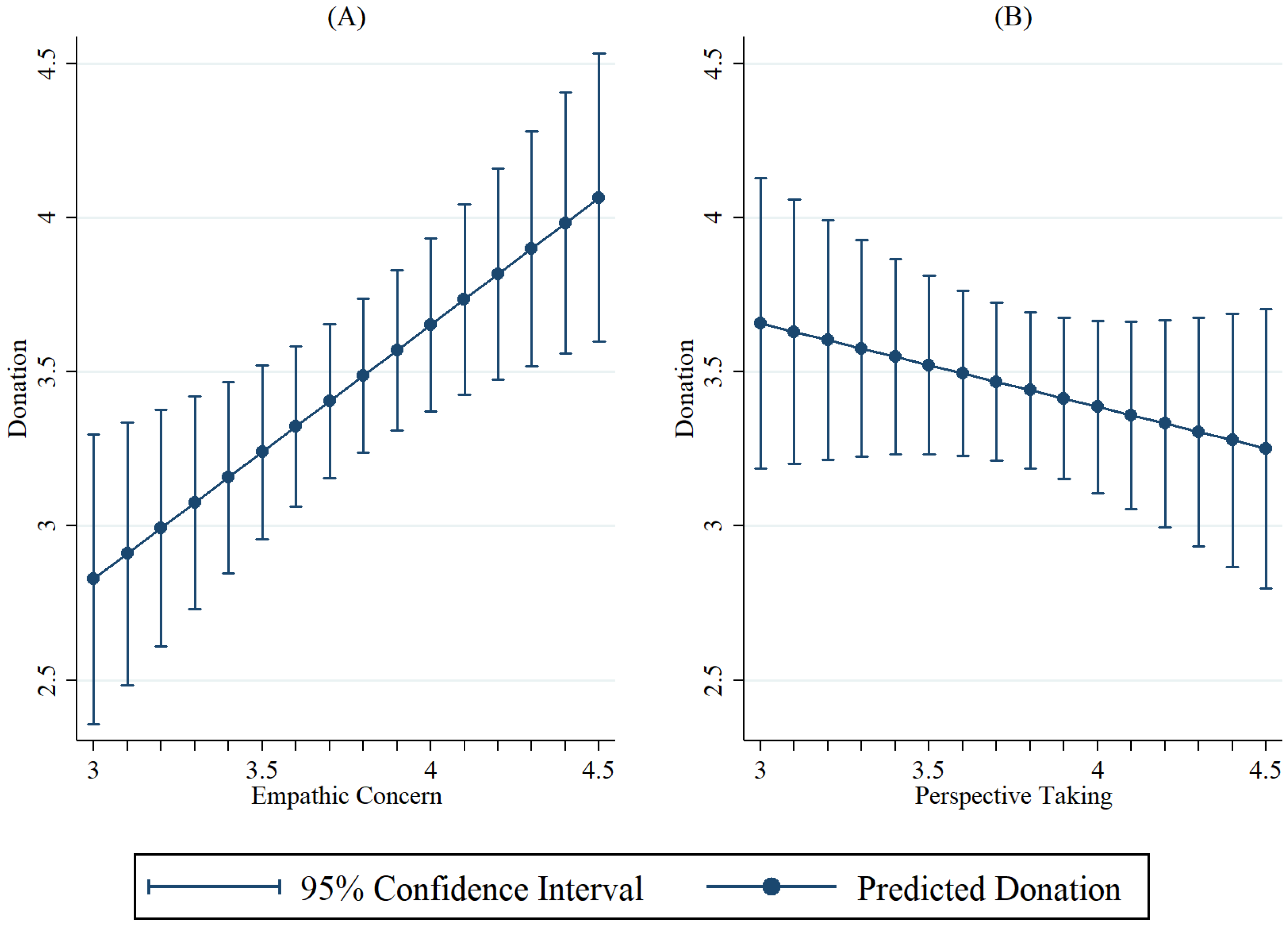
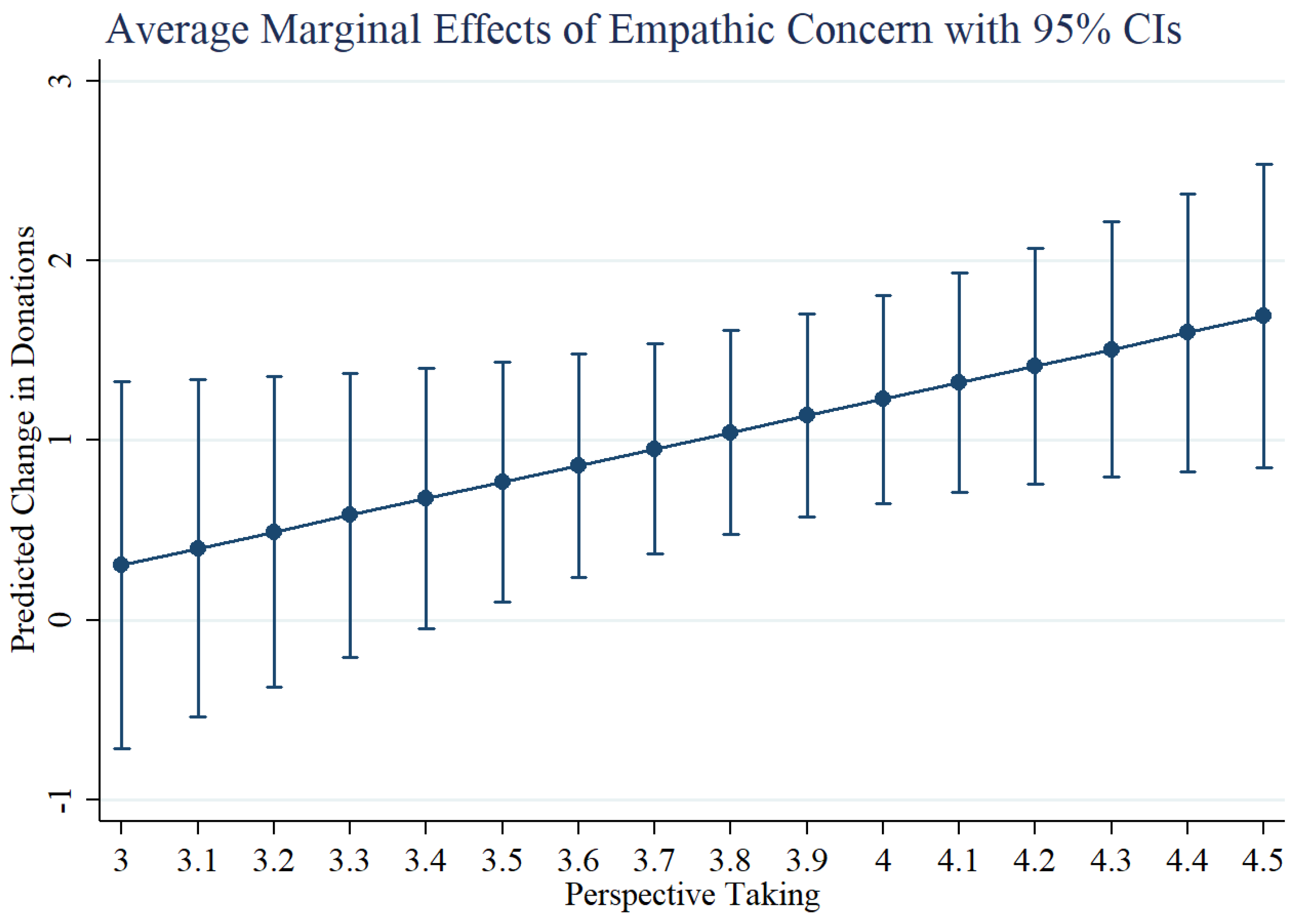
Table 2 shows the results in predicting charitable giving by empathic concern and perspective-taking. Consistent with Hypothesis 1, higher empathic concern is significantly correlated with larger donations to charity (Table 2, column (1)). An increase of one in the score on the empathic concern scale is associated with donating approximately 16 percent more of the total endowment. In contrast, in column (2), perspective-taking alone does not significantly predict donations, which is consistent with Hypothesis 2. These results can be seen in Figure 1, which plots the predicted donations for empathic concern and perspective-taking. When including both empathic concern and perspective-taking in the same regression, both scores are significant, with higher empathic concern increasing donations and higher perspective-taking associated with lower donations (Table 2, column (3)). Column (4) includes an interaction term for both empathic concern and perspective-taking. The coefficient for perspective taking is negative and significant, but the interaction term is positive and significant. This suggests that higher perspective-taking is associated with lower donations when empathic concern is low. However, high perspective-taking with high empathy is associated with an increase in donations to charity. This finding is consistent with Hypothesis 3. This is illustrated by Figure 2, which plots the marginal effect of increased empathic concern on donations at different levels of perspective-taking.
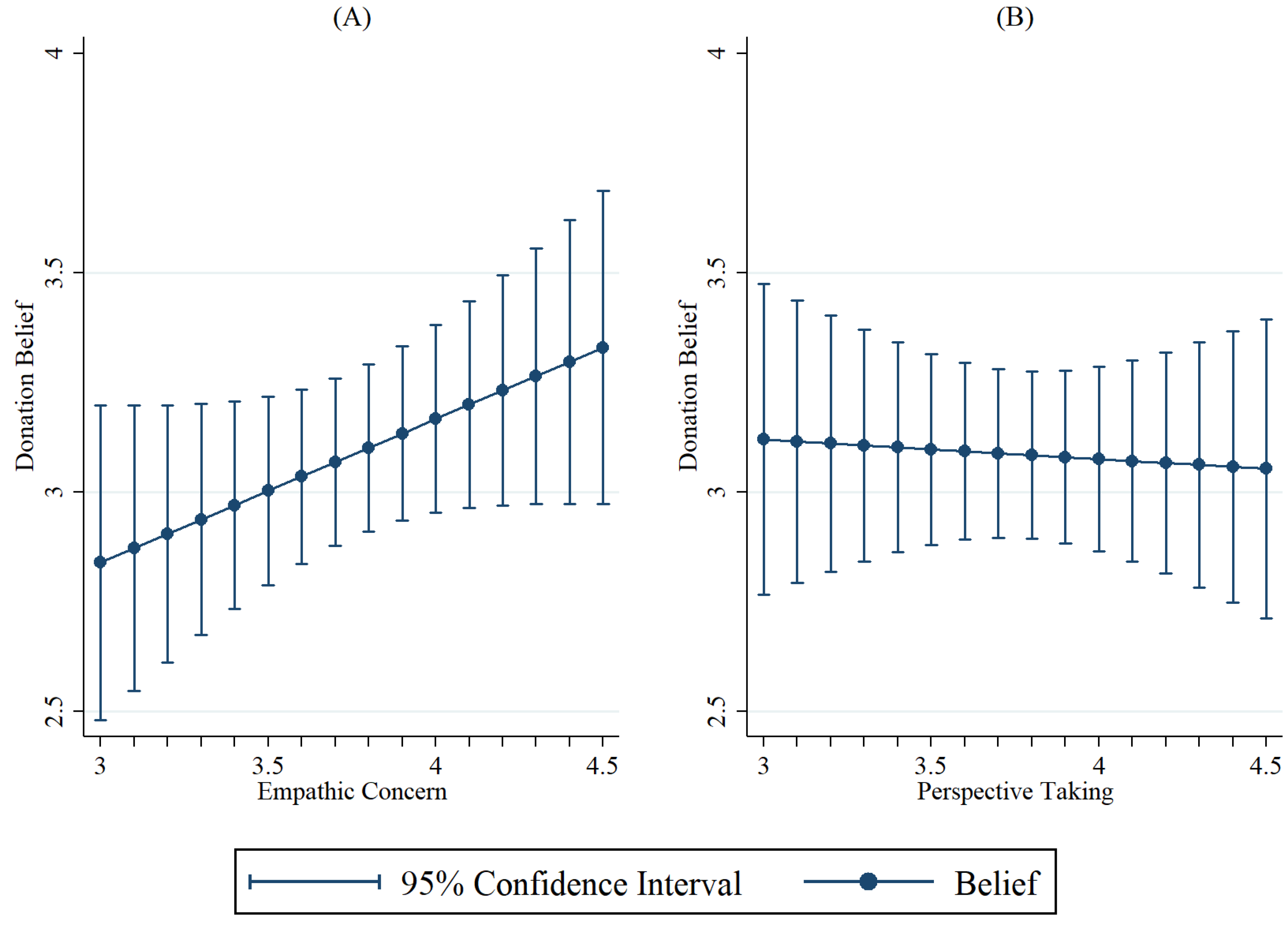
Table 3 predicts individual beliefs about the giving of others by empathic concern and perspective-taking. Both columns (1) and (2) show that neither empathic concern nor perspective-taking alone is significantly associated with beliefs (see Figure 3). Column (3) shows that when controlling for both empathic concern and perspective-taking, empathic concern is associated with significantly higher beliefs about the giving of others. Column (4) includes an interaction term between both empathic concern and perspective-taking. The coefficients for empathic concern and perspective-taking are both negative, and the interaction is positive. This suggests that when perspective-taking is low, higher empathic concern is associated with lower beliefs about the giving of others.
Result 4.
The interaction effect of empathic concern and belief about others’ giving is negative.
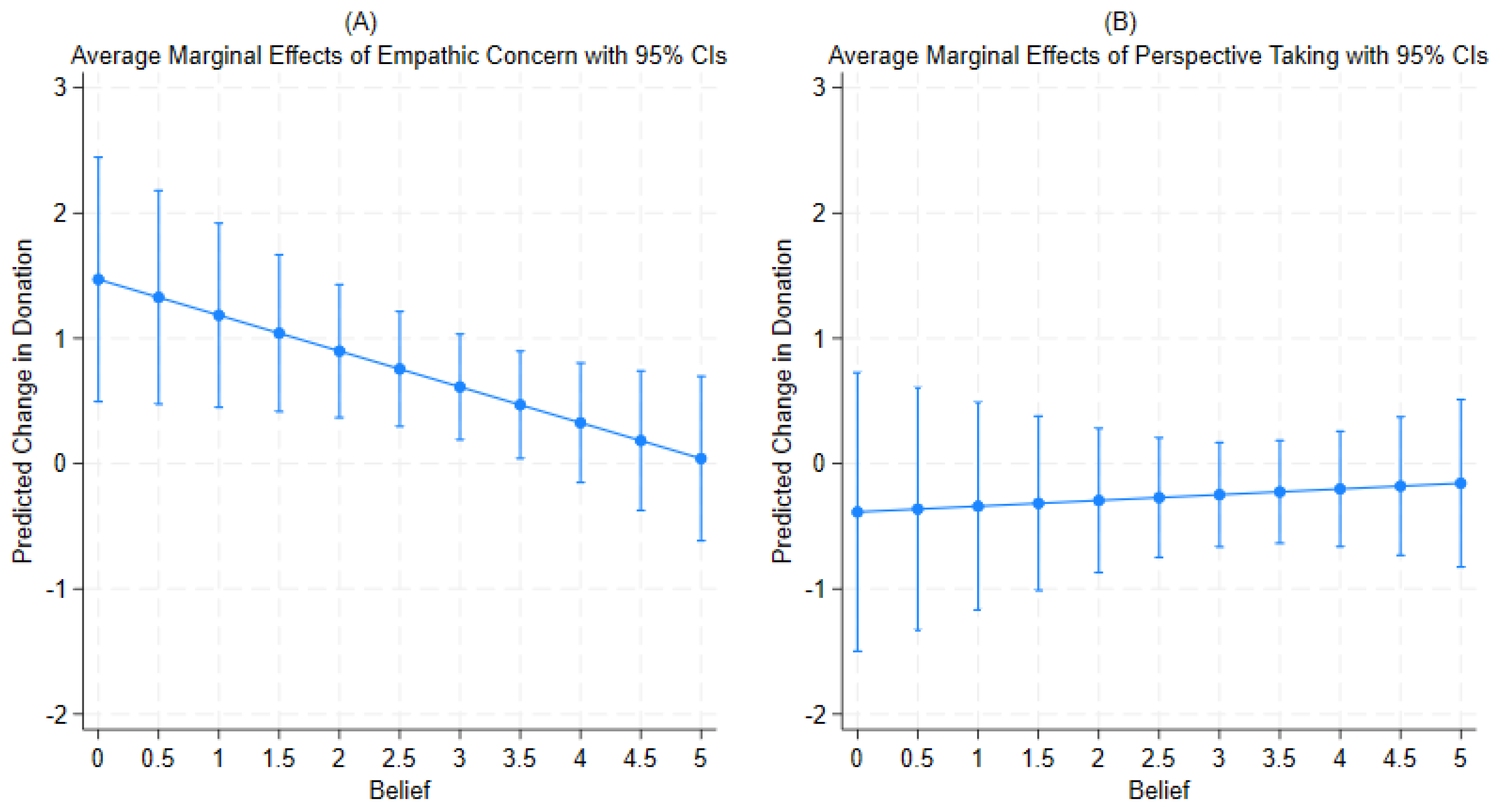
If the empathy-altruism hypothesis is driving pure altruism, then higher beliefs should crowd-out the empathic concern effect (Hypothesis 4a). If empathic concern is driving warm-glow altruism, then higher beliefs should not crowd-out one’s own donation (Hypothesis 4b). The regressions in Table 4, column (1) show that higher empathic concern is associated with higher donations even when controlling for beliefs about the donations of others.6 While these results appear to support the warm-glow hypothesis, this effect disappears when empathic concern interacts with beliefs (see Table 4, column (2)). Because the coefficients for belief and empathic concern are positive and significant and their interaction is negative, empathic concern is associated with an increase in donations, but the strength of this effect diminishes the more a person believes others will donate. This is illustrated in Figure 4A, which plots the marginal effect of an increase in empathic concern on predicted change in donations at different levels of beliefs about the donations of others. These results are consistent with the empathy-altruism hypothesis and demonstrate a crowd-out effect for empathic concern on giving behavior.

4.2. Results for Guilt and Shame

Result 5.
Guilt-R and Shame-NSE are associated with higher donations. Shame-W and Guilt-NBE are not associated with higher donations.
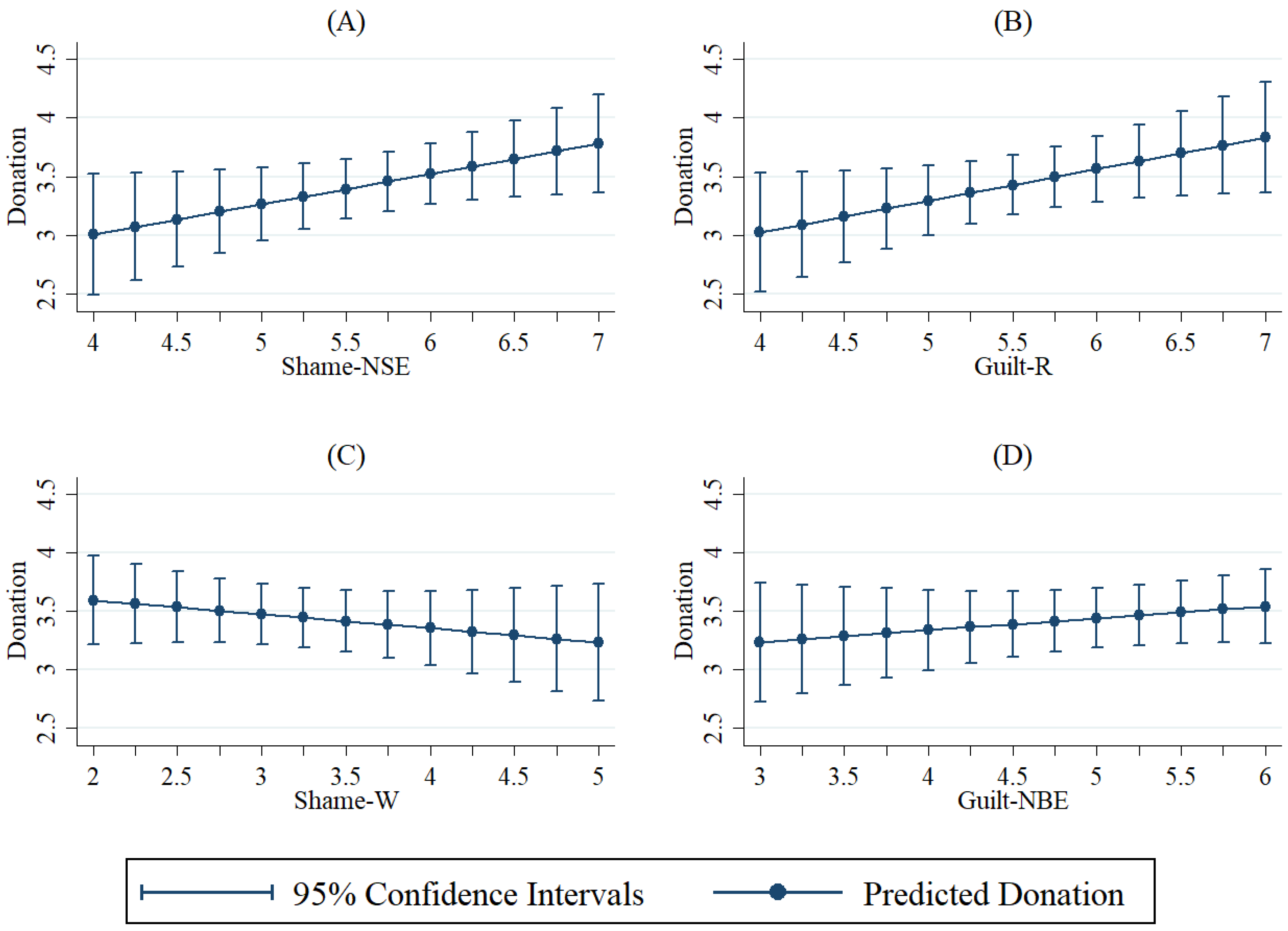
Table 5 shows the regressions of predicted donations for each GASP subscale. Each subscale measures a different type of shame and guilt. The Shame-NSE subscale measures how likely a person is to experience negative self-evaluations when they experience shame. Table 5, column 1 shows that higher scores on Shame-NSE are positive and significantly correlated with higher donations to charity. The Shame-W subscale measures how likely a person is to avoid future situations after experiencing shame. As predicted, Table 5, column 2 shows that Shame-W is not significant in predicting donations. The Guilt-R subscale measures how likely someone would be to try to repair situations after experiencing guilt. Table 5, column 3 finds that the coefficient for Guilt-R is positive and significantly correlated with higher donations to charity. The Guilt-NBE subscale measures how likely a person is to negatively evaluate their own behavior after experiencing guilt. Table 5, column 4 shows that Guilt-NBE is not correlated with donations. These results are illustrated in Figure 5, which plots the marginal effects on donations for each measure of guilt and shame. Overall, these results show support for part of Hypothesis 5.
Result 6.
Higher scores on the Guilt-R and Shame-NSE subscales are associated with higher beliefs about the donations of others. Higher scores on the Shame-W and Guilt-NBE subscales are not associated with higher beliefs about the donations of others.
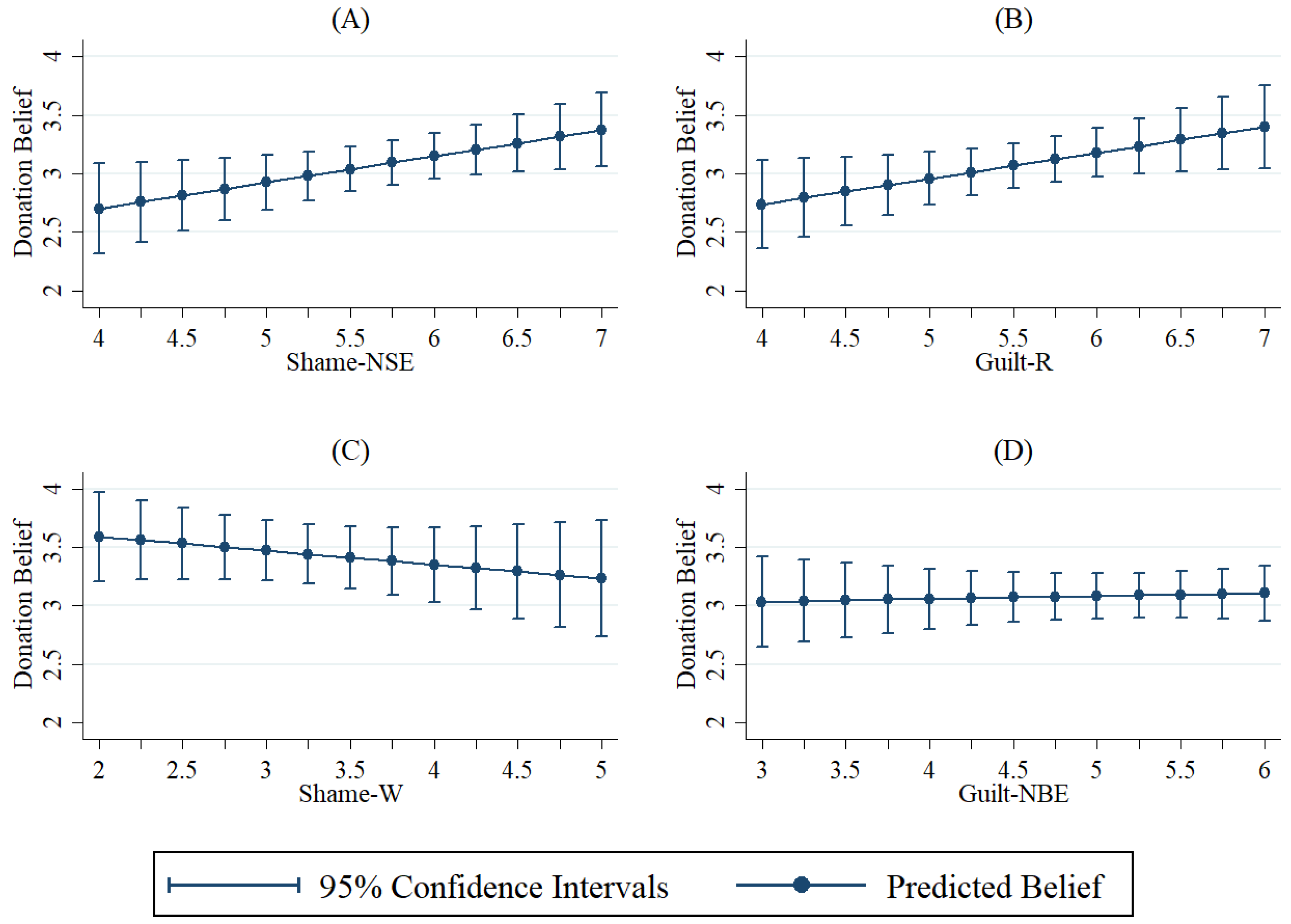
Theoretically, guilt and shame are thought to be influenced by expectations. To explore this, in Table 6 we first test whether scores on the GASP subscale are associated with different beliefs about the giving of others. Consistent with Hypothesis 6, results show that higher scores for Shame-NSE and Guilt-R are associated with higher beliefs about the giving of others. For Shame-W and Guilt-NBE, there is no significant correlation with beliefs. These results are shown in Figure 6, which plots the marginal effects on beliefs about the donations of others for each guilt and shame subscale.
Result 7.
The effects of guilt and shame on donations are explained by differences in beliefs.
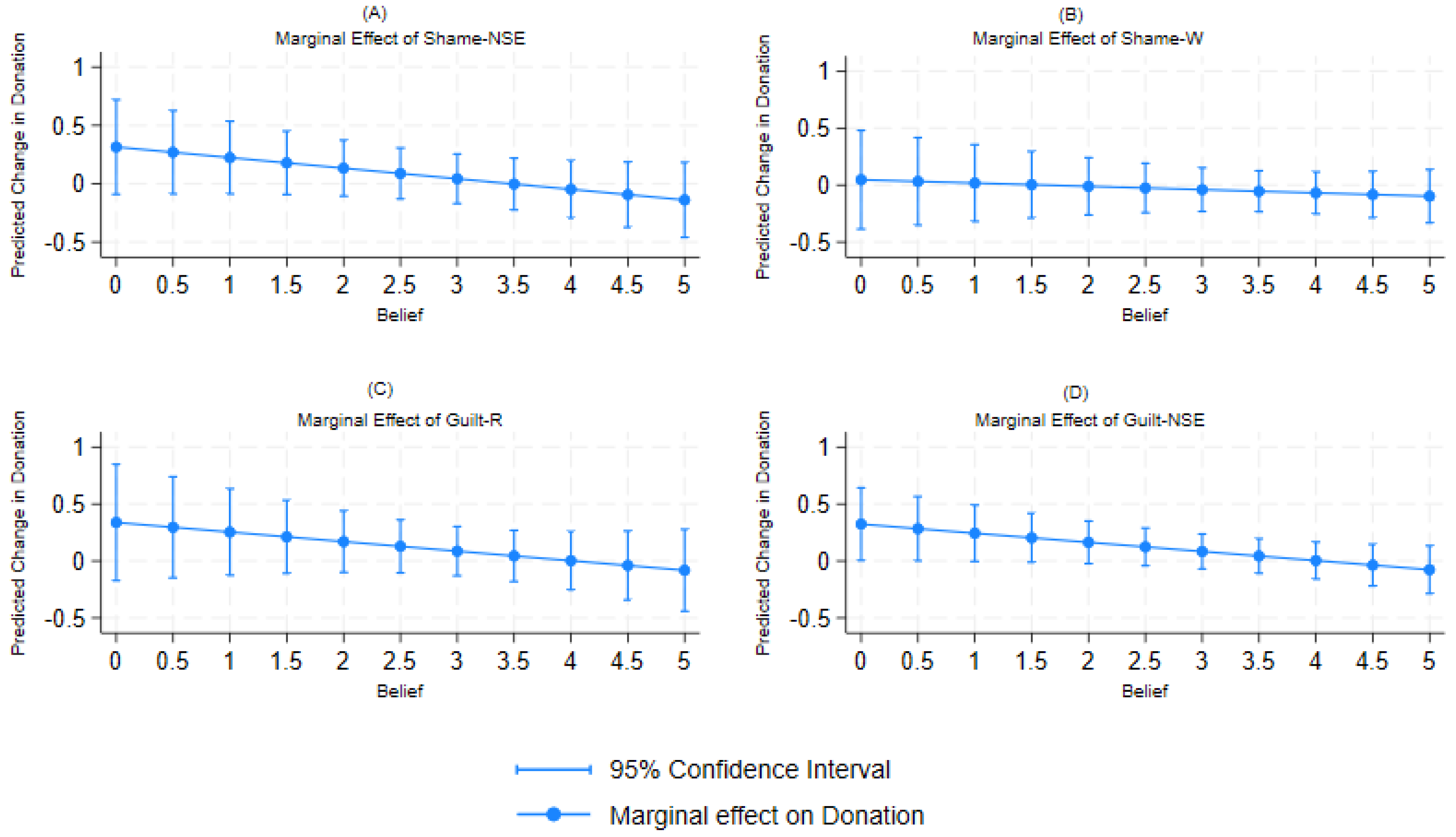
A central question in this paper is whether higher shame and guilt directly increase donations or whether the effect operates through changes in beliefs. To test this, the regressions in Table 7 repeat the analysis in Table 5 but control for those beliefs. Interestingly, after controlling for beliefs, none of the subscales are significant at predicting donations. Table 8 repeats the analysis from Table 7 but includes an interaction term between beliefs and scores on the GASP subscale. Interestingly, the interaction is not significant for Shame-NSE or Guilt-R. This suggests that while these subscales are associated with higher donations, it appears that the effect is driven primarily by holding different beliefs than those who score lower. This result adds evidence to Hypothesis 7a, namely, that guilt and shame potentially operate through different expectations about the giving of others. While the effect on donations for the Guilt-NBE score was not significant in the prior regression results, when interacted with beliefs, Guilt-NBE becomes significant and positive. However, the interaction term with beliefs is negative and significant at the 10% level. This suggests that higher Guilt-NBE scores increase donations when beliefs are low, but that this effect decreases as beliefs increase. The results for this subscale suggest a possible crowd-out effect, which is consistent with Hypothesis 7b. While weak, this provides some evidence that the effect of higher scores on Guilt-NBE may have a smaller effect on increasing donations for subjects who hold higher beliefs about the donations of others. These results are illustrated in Figure 7, which plots the marginal effects on donations over different beliefs for a one-unit change in the guilt and shame measures. Interestingly, Figure 7D shows that the marginal effect of Guilt-NSE significantly increases donations for subjects with lower beliefs, but that the marginal effect is no longer significant if subjects hold higher beliefs about the giving of others.

4.3. Additional Analysis

In the experiment, subjects could choose the amount they wanted to donate to charity from whole dollars, providing six different possible donation choices. Using multinomial logit regressions, we separately estimated the predicted probability of donating for each choice for each measure of moral emotions.7 In Table 9, we present the predicted marginal effects by a unit change in each moral emotion on the probability of donating zero to five dollars to charity. Interestingly, empathic concern was associated with significantly fewer donations of zero to charity and significantly more donations of all five dollars to charity. For Shame-NSE, Guilt-R, and Guilt-NBE, an increase in one unit of the measure was associated with fewer donations of zero.8

5. Discussion

As discussed, we examined the role of two different conceptualizations of empathy in donations to charity: empathic concern and perspective-taking. Prior research has found evidence that giving can be driven by the empathy-altruism hypothesis Batson (2011) and by warm-glow altruism (Andreoni, 1989). The results from our study suggest that empathic concern does not appear to drive warm-glow altruism. Instead, our results were consistent with the empathy-altruism hypothesis. Individuals who feel empathic concern may be motivated to help a charity if they believe that the charity needs help. Our evidence shows that the increased effect of empathic concern on increased giving decreases when the subject believes that others will give more to the charity. This crowd-out effect is consistent with the empathy-altruism hypothesis. The results also show that perspective-taking is not directly associated with giving. Our results suggest that higher perspective-taking can lead to increased giving if a person also has high empathic concern, but can actually lead to less giving if the person has low empathic concern. These results complement prior research on cooperation (Ridinger & McBride, 2025), which has found that perspective-taking is important in forming beliefs about others but that whether a person chooses to cooperate depends on what others are doing. Our results add to this by showing that other moral emotions interact with perspective-taking and can impact prosocial behavior.
While guilt and shame are thought to be important in explaining prosocial behavior, there exist key open questions about how they affect behavior. The behavioral distinction between guilt and shame is thought to result in differential effects on behavior (Wolf et al., 2010). Results from our study indicate that experiencing shame by negatively evaluating oneself was associated with increases in giving; in contrast, shame withdrawal was not correlated with giving. These results suggest that one of the reasons prior research may have found no correlation between proneness to shame and prosocial behavior (Bellemare et al., 2019) could be due to not separately measuring these distinct aspects of shame. Interestingly, guilt repair was associated with increased giving, while the evidence on guilt with negative behavior evaluation was mixed. While the increase in giving with shame—negative self-evaluation (Shame-NSE) and guilt—repair (Guilt-R) seemed to operate through different beliefs about giving, guilt—negative behavioral evaluation (Guilt-NBE) interacted with beliefs and was weakly associated with a crowd-out effect.
These findings on guilt and shame add to our understanding of game-theoretic modeling approaches used to study guilt. The second-order model predicts that the recipient’s expectations influence the dictator’s behavior, whereas the expectation-based model predicts that other dictators’ behavior influences the choice to give. The evidence on which modeling approach predicts behavior more accurately has been mixed (Cartwright, 2019). The results from this paper cannot directly examine the second-order belief model. However, the results do suggest that the type of guilt or shame felt by participants could matter. Our results for shame when performing negative self-evaluation and guilt when focused on repair are more consistent with the expectation-based model. In contrast, the results for guilt with negative behavioral evaluation are more consistent with a crowd-out effect, and are not consistent with the expectation model.
The results from the additional analysis in Table 9 suggest that moral emotions may be important in understanding why people choose to give nothing to charity. Increases in empathic concern, shame, and guilt were associated with a lower likelihood of not donating at all. This suggests that these moral emotions may be important in understanding part of why individuals choose not to give.
This study has some important limitations. The results of this study are correlational, and future research would benefit from experimental designs aimed at manipulating these different types of moral emotions to test the causal impact on giving. Additionally, the experimental design may have increased the overall level of giving, as the subjects chose the charity before choosing their donation amount. It is possible that this choice led subjects to feel committed to donating. As a result, it could be that the effects of moral emotions on giving might differ in a dictator game without choice of charity. Finally, second-order beliefs about what the charity expects to receive were not elicited. Future research should elicit different types of beliefs in order to determine whether those beliefs have differential impacts on moral emotions and charitable giving.

Supplementary Materials

The following supporting information can be downloaded at: https://www.mdpi.com/article/10.3390/g16060063/s1.

Author Contributions

Conceptualization, G.R. and A.C.; Methodology, G.R. and A.C.; Formal analysis, G.R. and A.C.; Resources, G.R. and A.C.; Writing—original draft, G.R. and A.C.; Writing—review & editing, G.R. and A.C.; Project administration, G.R. All authors have read and agreed to the published version of the manuscript.

Funding

This research received no external funding.

Institutional Review Board Statement

The study was conducted in accordance with the Declaration of Helsinki and approved by the Institutional Review Board.

Informed Consent Statement

Informed consent was obtained from all subjects involved in the study.

Data Availability Statement

Data are available upon request.

Conflicts of Interest

The authors declare no conflicts of interest.

Appendix A

Table A1. Correlation coefficients.
Empathic
Concern
Perspective
Taking
Shame-NSEShame-WGuilt-RGuilt-NBEFemaleAge
Empathic Concern    1
Perspective Taking    0.35 ***    1
Shame-NSE    0.25 ***    0.01    1
Shame-W  −0.07  −0.09    0.02    1
Guilt-R    0.40 ***    0.24 ***    0.44 ***  −0.03    1
Guilt-NBE    0.32 ***    0.19 ***    0.49 ***    0.05    0.50 ***    1
Female    0.18 **  −0.08    0.16 **    0.23 ***  −0.06    0.16 **    1
Age    0.01  −0.04  −0.05    0.09  −0.00    0.01  −0.03    1
See Table A1 for variable descriptions. ** p < 0.05 , *** p < 0.01 .

Notes

1
The TOSCA-3 scale was used to measure proneness to guilt and shame; a drawback of the TOSCA-3 scale is that it measures both self-evaluations and behaviors together.
2
Data were collected prior to the COVID-19 pandemic.
3
The Cronbach’s alpha scores were 0.7 for empathic concern and 0.69 for perspective-taking.
4
The Cronbach’s alpha scores for each subscale were 0.61 for Shame-NSE, 0.50 for Shame-W, 0.65 for Guilt-R, and 0.68 for Guilt-NBE.
5
Table A1 in the Appendix A contains the correlation coefficients for the measures of moral emotions.
6
Due to the presence of both beliefs and moral emotions, we tested for multicollinearity for all regressions in the paper that included both beliefs and moral emotions. The variance inflation factors for these regressions ranged from 1.08 to 1.10, suggesting that multicollinearity is unlikely to be a major issue.
7
To avoid multicollinearty issues across the scales, we estimated each moral emotion in a separate regression.
8
As a robustness check, we ran a logit regression predicting whether a person donated any amount to charity or chose to donate zero. These results are similar to the marginal effects analysis in Table 9, and show that those with higher scores on empathy, Shame-NSE, Guilt-R, and Guilt-NBE are all significantly less likely to donate zero compared to those with lower scores on these measures.

References

  1. Andreoni, J. (1989). Giving with impure altruism: Applications to charity and Ricardian equivalence. Journal of Political Economy, 97(6), 1447–1458. [Google Scholar] [CrossRef]
  2. Andreoni, J. (1993). An experimental test of the public-goods crowding-out hypothesis. The American Economic Review, 83, 1317–1327. [Google Scholar]
  3. Andreoni, J. (1998). Toward a theory of charitable fund-raising. Journal of Political Economy, 106(6), 1186–1213. [Google Scholar] [CrossRef]
  4. Andreoni, J., & Payne, A. A. (2011). Is crowding out due entirely to fundraising? Evidence from a panel of charities. Journal of Public Economics, 95(5–6), 334–343. [Google Scholar] [CrossRef]
  5. Artinger, F., Exadaktylos, F., Koppel, H., & Sääksvuori, L. (2014). In others’ shoes: Do individual differences in empathy and theory of mind shape social preferences? PLoS ONE, 9(4), e92844. [Google Scholar] [CrossRef]
  6. Bachke, M. E., Alfnes, F., & Wik, M. (2014). Eliciting donor preferences. VOLUNTAS: International Journal of Voluntary and Nonprofit Organizations, 25(2), 465–486. [Google Scholar] [CrossRef]
  7. Baron-Cohen, S., Wheelwright, S., Hill, J., Raste, Y., & Plumb, I. (2001). The “Reading the mind in the eyes” test revised version: A study with normal adults, and adults with Asperger syndrome or high-functioning autism. Journal of Child Psychology and Psychiatry, 42(2), 241–251. [Google Scholar] [CrossRef]
  8. Batson, C. D. (2011). These things called empathy: Eight related but distinct phenomenon. In J. Decety, & W. Ickes (Eds.), The social neuroscience of empathy (pp. 3–15). MIT Press. [Google Scholar]
  9. Batson, C. D., & Ahmad, N. (2001). Empathy-induced altruism in a prisoner’s dilemma II: What if the target of empathy has defected? European Journal of Social Psychology, 31(1), 25–36. [Google Scholar] [CrossRef]
  10. Batson, C. D., Dyck, J. L., Brandt, J. R., Batson, J. G., Powell, A. L., McMaster, M. R., & Griffitt, C. (1988). Five studies testing two new egoistic alternatives to the empathy-altruism hypothesis. Journal of Personality and Social Psychology, 55(1), 52–77. [Google Scholar] [CrossRef]
  11. Battigalli, P., & Dufwenberg, M. (2007). Guilt in games. American Economic Review, 97(2), 170–176. [Google Scholar] [CrossRef]
  12. Bekkers, R. (2007). Measuring altruistic behavior in surveys: The all-or-nothing dictator game. Survey Research Methods, 1(3), 139–144. [Google Scholar]
  13. Bellemare, C., Sebald, A., & Strobel, M. (2011). Measuring the willingness to pay to avoid guilt: Estimation using equilibrium and stated belief models. Journal of Applied Econometrics, 26(3), 437–453. [Google Scholar] [CrossRef]
  14. Bellemare, C., Sebald, A., & Suetens, S. (2017). A note on testing guilt aversion. Games and Economic Behavior, 102, 233–239. [Google Scholar] [CrossRef]
  15. Bellemare, C., Sebald, A., & Suetens, S. (2019). Guilt aversion in economics and psychology. Journal of Economic Psychology, 73, 52–59. [Google Scholar] [CrossRef]
  16. Berman, J. Z., Barasch, A., Levine, E. E., & Small, D. A. (2018). Impediments to effective altruism: The role of subjective preferences in charitable giving. Psychological Science, 29(5), 834–844. [Google Scholar] [CrossRef] [PubMed]
  17. Bénabou, R., & Tirole, J. (2002). Self-confidence and personal motivation. The Quarterly Journal of Economics, 117(3), 871–915. [Google Scholar] [CrossRef]
  18. Bénabou, R., & Tirole, J. (2016). Mindful economics: The production, consumption, and value of beliefs. Journal of Economic Perspectives, 30(3), 141–164. [Google Scholar] [CrossRef]
  19. Bicchieri, C. (2005). The grammar of society: The nature and dynamics of social norms. Cambridge University Press. [Google Scholar]
  20. Bicchieri, C., & Xiao, E. (2009). Do the right thing: But only if others do so. Journal of Behavioral Decision Making, 22(2), 191–208. [Google Scholar] [CrossRef]
  21. Blanco, M., Engelmann, D., Koch, A. K., & Normann, H.-T. (2010). Belief elicitation in experiments: Is there a hedging problem? Experimental Economics, 13(4), 412–438. [Google Scholar] [CrossRef]
  22. Bolton, G. E., & Katok, E. (1998). An experimental test of the crowding out hypothesis: The nature of beneficent behavior. Journal of Economic Behavior and Organization, 37(3), 315–331. [Google Scholar] [CrossRef]
  23. Bosman, R., & Van Winden, F. (2002). Emotional hazard in a power-to-take experiment. The Economic Journal, 112(476), 147–169. [Google Scholar] [CrossRef]
  24. Camerer, C. F. (2011). Behavioral game theory: Experiments in strategic interaction. Princeton University Press. [Google Scholar]
  25. Cartwright, E. (2019). A survey of belief-based guilt aversion in trust and dictator games. Journal of Economic Behavior and Organization, 167, 430–444. [Google Scholar] [CrossRef]
  26. Caviola, L., Schubert, S., Teperman, E., Moss, D., Greenberg, S., & Faber, N. S. (2020). Donors vastly underestimate differences in charities’ effectiveness. Judgment and Decision Making, 15(4), 509–516. [Google Scholar] [CrossRef]
  27. Chan, K. S., Godby, R., Mestelman, S., & Muller, R. A. (2002). Crowding-out voluntary contributions to public goods. Journal of Economic Behavior and Organization, 48(3), 305–317. [Google Scholar] [CrossRef]
  28. Cohen, T. R., Panter, A. T., & Insko, C. A. (2011). Introduction the GASP scale: A new measure of guilt and shame proneness. Journal of Personality and Social Psychology, 100, 947–966. [Google Scholar] [CrossRef]
  29. Cowell, J. M., Samek, A., List, J., & Decety, J. (2015). The curious relation between theory of mind and sharing in preschool age children. PLoS ONE, 10(2), e0117947. [Google Scholar] [CrossRef]
  30. Crumpler, H., & Grossman, P. J. (2008). An experimental test of warm glow giving. Journal of Public Economics, 92(5–6), 1011–1021. [Google Scholar] [CrossRef]
  31. Davis, M. H. (1983). Measuring individual differences in empathy: Evidence for a multidimensional approach. Journal of Personality and Social Psychology, 44, 113. [Google Scholar] [CrossRef]
  32. DellaVigna, S., List, J. A., & Malmendier, U. (2012). Testing for altruism and social pressure in charitable giving. The Quarterly Journal of Economics, 127(1), 1–56. [Google Scholar] [CrossRef]
  33. Dodell-Feder, D., Lincoln, S. H., Coulson, J. P., & Hooker, C. I. (2013). Using fiction to assess mental state understanding: A new task for assessing theory of mind in adults. PLoS ONE, 8(11), e81279. [Google Scholar] [CrossRef]
  34. Eckel, C. C., & Grossman, P. J. (1996). Altruism in anonymous dictator games. Games and Economic Behavior, 16(2), 181–191. [Google Scholar] [CrossRef]
  35. Eckel, C. C., Grossman, P. J., & Johnston, R. M. (2005). An experimental test of the crowding out hypothesis. Journal of Public Economics, 89(8), 1543–1560. [Google Scholar] [CrossRef]
  36. Ellingsen, T., Johannesson, M., Tjøtta, S., & Torsvik, G. (2010). Testing guilt aversion. Games and Economic Behavior, 68(1), 95–107. [Google Scholar] [CrossRef]
  37. Gangadharan, L., Grossman, P. J., & Xue, N. (2024). Belief elicitation under competing motivations: Does it matter how you ask? European Economic Review, 169, 104830. [Google Scholar] [CrossRef]
  38. Giving USA Foundation. (2024). Giving USA 2024: The annual report on philanthropy for the year 2023 (Tech. Rep.). Indiana University Lilly Family School of Philanthropy. Available online: https://www.givingusa.org (accessed on 2 March 2025).
  39. Gronberg, T. J., Luccasen, R. A., III, Turocy, T. L., & Van Huyck, J. B. (2012). Are tax-financed contributions to a public good completely crowded-out? Experimental evidence. Journal of Public Economics, 96(7–8), 596–603. [Google Scholar] [CrossRef][Green Version]
  40. Heutel, G. (2012). Crowding out and crowding in of private donations and government grants. Public Finance Review, 42(2), 143–175. [Google Scholar] [CrossRef]
  41. Indiana University Lilly Family School of Philanthropy. (2024). The giving environment: Giving during times of uncertainty (Tech. Rep.). Lilly Family School of Philanthropy. [Google Scholar] [CrossRef]
  42. Karapetian, A., Sundali, J., Guerrero, F., Hanna, A., & Ridinger, G. (2025). Risk aversion and social influence. Experimental Economics. forthcoming. [Google Scholar]
  43. Khanna, J., & Sandler, T. (2000). Partners in giving: The crowding-in effects of UK government grants. European Economic Review, 44(8), 1543–1566. [Google Scholar] [CrossRef]
  44. Kingma, B. R. (1989). An accurate measurement of the crowd-out effect, income effect, and price effect for charitable contributions. Journal of Political Economy, 97(5), 1197–1207. [Google Scholar] [CrossRef]
  45. Konow, J. (2010). Mixed feelings: Theories of and evidence on giving. Journal of Public Economics, 94(3–4), 279–297. [Google Scholar] [CrossRef]
  46. Korenok, O., Millner, E. L., & Razzolini, L. (2013). Impure altruism in dictators’ giving. Journal of Public Economics, 97, 1–8. [Google Scholar] [CrossRef]
  47. Kruger, D. J. (2003). Evolution and altruism: Combining psychological mediators with naturally selected tendencies. Evolution and Human Behavior, 24(2), 118–125. [Google Scholar] [CrossRef]
  48. Lamm, A. E., McCann, R. G., & Howe, P. D. (2022). I could but I don’t: What does it take to adopt pro-environmental behaviors in the United States? Energy Research and Social Science, 93, 102845. [Google Scholar] [CrossRef]
  49. Leary, R. B., & Ridinger, G. (2020). Denial without determination: The impact of systemic market access denial on consumer power and market engagement. Journal of Public Policy and Marketing, 39(2), 99–118. [Google Scholar] [CrossRef]
  50. McBride, M., & Ridinger, G. (2021). Beliefs also make social-norm preferences social. Journal of Economic Behavior and Organization, 191, 765–784. [Google Scholar] [CrossRef]
  51. Ottoni-Wilhelm, M., Vesterlund, L., & Xie, H. (2017). Why do people give? Testing pure and impure altruism. American Economic Review, 107(11), 3617–3633. [Google Scholar] [CrossRef]
  52. Payne, A. A. (1998). Does the government crowd-out private donations? New evidence from a sample of non-profit firms. Journal of Public Economics, 69(3), 323–345. [Google Scholar] [CrossRef]
  53. Piff, P. K., Kraus, M. W., Cote, S., Cheng, B. H., & Keltner, D. (2010). Having less, giving more: The influence of social class on prosocial behavior. Journal of Personality and Social Psychology, 99(5), 771–784. [Google Scholar] [CrossRef]
  54. Reuben, E., Sapienza, P., & Zingales, L. (2009). Is mistrust self-fulfilling? Economics Letters, 104(2), 89–91. [Google Scholar] [CrossRef]
  55. Ridinger, G. (2011). Empathetic concern, altruism, and the pursuit of distributive justice [Unpublished Master’s thesis, California State University, Fullerton].
  56. Ridinger, G. (2020). Shame and theory-of-mind predicts rule-following behavior. Games, 11(3), 36. [Google Scholar] [CrossRef]
  57. Ridinger, G., & McBride, M. (2015). Money affects theory of mind differently by gender. PLoS ONE, 10(12), e0143973. [Google Scholar] [CrossRef]
  58. Ridinger, G., & McBride, M. (2020). Reciprocity in games with unknown types. In Handbook of experimental game theory (p. 271). Edward Elgar Publishing. [Google Scholar]
  59. Ridinger, G., & McBride, M. (2025). Theory-of-mind ability and cooperation. Journal of Economic Behavior and Organization, 230, 106895. [Google Scholar] [CrossRef]
  60. Rutström, E. E., & Wilcox, N. T. (2009). Stated beliefs versus inferred beliefs: A methodological inquiry and experimental test. Games and Economic Behavior, 67(2), 616–632. [Google Scholar] [CrossRef]
  61. Schaefer, M., Kühnel, A., Rumpel, F., & Gärtner, M. (2021). Do empathic individuals behave more prosocially? Neural correlates for altruistic behavior in the dictator game and the dark side of empathy. Brain Sciences, 11, 863. [Google Scholar] [CrossRef] [PubMed]
  62. Schotter, A., & Sopher, B. (2003). Social learning and coordination conventions in intergenerational games: An experimental study. Journal of Political Economy, 111(3), 498–529. [Google Scholar] [CrossRef]
  63. Schotter, A., & Sopher, B. (2007). Advice and behavior in intergenerational ultimatum games: An experimental approach. Games and Economic Behavior, 58(2), 365–393. [Google Scholar] [CrossRef]
  64. Simon, B., Trötschel, R., & Dähne, D. (2008). Identity affirmation and social movement support. European Journal of Social Psychology, 38(6), 935–946. [Google Scholar] [CrossRef]
  65. Singer, T., & Fehr, E. (2005). The neuroeconomics of mind reading and empathy. American Economic Review, 95(2), 340–345. [Google Scholar] [CrossRef]
  66. Smith, S., Windmeijer, F., & Wright, E. (2015). Peer effects in charitable giving: Evidence from the (running) field. The Economic Journal, 125(585), 1053–1071. [Google Scholar] [CrossRef]
  67. Sutter, M., & Weck-Hannemann, H. (2004). An experimental test of the public goods crowding out hypothesis when taxation is endogenous. FinanzArchiv/Public Finance Analysis, 60, 94–110. [Google Scholar] [CrossRef]
  68. Takagishi, H., Kameshima, S., Schug, J., Koizumi, M., & Yamagishi, T. (2010). Theory of mind enhances preference for fairness. Journal of Experimental Child Psychology, 105(1–2), 130–137. [Google Scholar] [CrossRef]
  69. Takagishi, H., Koizumi, M., Fujii, T., Schug, J., Kameshima, S., & Yamagishi, T. (2014). The role of cognitive and emotional perspective taking in economic decision making in the ultimatum game. PLoS ONE, 9(9), e108462. [Google Scholar] [CrossRef] [PubMed]
  70. te Velde, V. L., & Louis, W. (2022). Conformity to descriptive norms. Journal of Economic Behavior and Organization, 200, 204–222. [Google Scholar] [CrossRef]
  71. Theilmann, I., Spadaro, G., & Balliet, D. (2020). Personality and prosocial behavior: A theoretical framework and meta-analysis. Psychological Bulletin, 146, 30. [Google Scholar] [CrossRef] [PubMed]
  72. Tracy, J. L., & Robins, R. W. (2004). Putting the self into self-conscious emotions: A theoretical model. Psychological Inquiry, 15(2), 103–125. [Google Scholar] [CrossRef]
  73. Traverso, L., Viterbori, P., & Usai, M. C. (2020). Prosocial behavior: The role of theory of mind and executive functions. Journal of Cognition and Development, 21(5), 690–708. [Google Scholar] [CrossRef]
  74. Umer, H., Kurosaki, T., & Iwasaki, I. (2022). Unearned endowment and charity recipient lead to higher donations: A meta-analysis of the dictator game lab experiments. Journal of Behavioral and Experimental Economics, 97, 101827. [Google Scholar] [CrossRef]
  75. Vesterlund, L. (2003). The informational value of sequential fundraising. Journal of Public Economics, 87(3–4), 627–657. [Google Scholar] [CrossRef]
  76. Vu, L., Molho, C., Soraperra, I., Fiedler, S., & Shalvi, S. (2024). Giving (in) to help an identified person. Journal of Experimental Social Psychology, 110, 104557. [Google Scholar] [CrossRef]
  77. Wolf, S. T., Cohen, T. R., Panter, A. T., & Insko, C. A. (2010). Shame proneness and guilt proneness: Toward the further understanding of reactions to public and private transgressions. Self and Identity, 9(4), 337–362. [Google Scholar] [CrossRef]
  78. Zahn, R., de Oliveira-Souza, R., Moll, J., Armory, J., & Vuilleumier, P. (2013). Moral emotions. In The Cambridge handbook of human affective neuroscience (pp. 491–508). Cambridge University Press. [Google Scholar]
Figure 1. Linear predictions of donations to charity: (A) predicted donations by scores of empathic concern (results from Table 2, column (1)) and (B) predicted donations by scores of perspective-taking (results from Table 2, column (2)).
Games 16 00063 g001
Figure 2. Marginal effect of empathic concern on donations to charity at different levels of perspective-taking (results from Table 2, column (4)).
Games 16 00063 g002
Figure 3. Linear predictions of beliefs about others’ donations to charity: (A) predicted beliefs by scores of empathic concern (results from Table 3, column (1)) and (B) predicted beliefs by scores of perspective-taking (results from Table 3, column (2)).
Games 16 00063 g003
Figure 4. (A) Marginal effect of empathic concern on donations to charity at different levels of beliefs about others’ donations to charity (results from Table 4, column (2)) and (B) marginal effect of perspective-taking on donations to charity at different levels of belief about others’ donations to charity (results from Table 4, column (4)).
Games 16 00063 g004
Figure 5. Linear predictions of donations to charity: (A) predicted donations by scores of Shame-NSE (results from Table 5, column (1)); (B) predicted donations by scores of Guilt-R (results from Table 5, column (2)); (C) predicted donations by scores of Shame-W (results from Table 5, column (3)); (D) predicted donations by scores of Guilt-NBE (results from Table 5, column (4)).
Games 16 00063 g005
Figure 6. Linear Predictions of beliefs about others’ donations to charity: (A) predicted beliefs by scores of Shame-NSE (results from Table 6, column (1)); (B) predicted beliefs by scores of Guilt-R (results from Table 6, column (2)); (C) predicted beliefs by scores of Shame-W (results from Table 6, column (3)); (D) predicted beliefs by scores of Guilt-NBE (results from Table 6, column (4)).
Games 16 00063 g006
Figure 7. (A) Marginal effects of Shame-NSE on donations to charity at different levels of beliefs about others’ donations to charity (results from Table 8, column (1)); (B) marginal effects of Shame-W on donations to charity at different levels of beliefs about others’ donations to charity (results from Table 8, column (3)); (C) marginal effects of Guilt-R on donations to charity at different levels of beliefs about others’ donations to charity (results from Table 8, column (2)); (D) marginal effects of Guilt-NBE on donations to charity at different levels of beliefs about others’ donations to charity (results from Table 8, column (4)).
Games 16 00063 g007
Table 1. Summary statistics.
MeanSDMinMax
 Donate3.451.80  0  5
 Belief3.091.37  0  5
 Empathic Concern3.750.49  2.71  5
 Perspective-Taking3.770.50  2.43  5
 Shame-NSE5.710.99  1.75  7
 Shame-W3.191.11  1  6
 Guilt-R5.580.93  2.75  7
 Guilt-NBE5.121.26  1  7
 Female0.690.46  0  1
 Age21.341.951930
 Extremely Liberal0.050.22  0  1
 Liberal0.480.50  0  1
 Moderate0.380.49  0  1
 Conservative0.090.28  0  1
 Extremely Conservative0.010.08  0  1
 Take Home Pay8.651.82  713
 Observations194      
Table 2. Predicting donations by empathic concern and perspective-taking.
(1)(2)(3)(4)
DonationDonationDonationDonation
  Empathic Concern     0.82 ***      1.10 ***     −2.47
    (0.26)     (0.28)     (1.95)
  Perspective-Taking     −0.27   −0.68 **    −4.15 **
     (0.20)    (0.29)     (1.90)
  Empathic Concern X       0.92 *
  Perspective-Taking      (0.49)
  Female     0.54 *      0.68 **     0.43      0.44
    (0.28)     (0.28)    (0.28)     (0.28)
  Intercept     1.19      5.16 ***     2.92    16.4 **
    (1.69)     (1.76)    (1.85)    (7.54)
  N194 194194 194
   R 2     0.10     0.05    0.12     0.14
Cluster robust standard errors at the subject level are in parentheses. Regressions are OLS. Additional controls include age and political views. * p < 0.10 , ** p < 0.05 , *** p < 0.01 .
Table 3. Predicting beliefs about others’ donations by empathic concern and perspective-taking.
(1)(2)(3)(4)
BeliefBeliefBeliefBelief
  Empathic Concern       0.33        0.41 *     −2.92 *
      (0.21)       (0.22)      (1.51)
  Perspective-Taking      −0.04     −0.19     −3.43 **
      (0.20)      (0.21)      (1.46)
  Empathic Concern X        0.86 **
  Perspective-Taking       (0.21)
  Female       0.52 **       0.58 ***       0.48 **       0.49 **
      (0.22)      (0.21)      (0.22)      (0.21)
  Intercept       3.10 **       4.44 ***       3.59 ***      16.18 ***
      (1.30)      (1.32)      (1.39)       (5.8)
  N   194   194   194   194
   R 2        0.08       0.07       0.09       0.11
Cluster robust standard errors at the subject level are in parentheses. Regressions are OLS. Additional controls include age and political views. * p < 0.10 , ** p < 0.05 , *** p < 0.01 .
Table 4. Predicting donations by beliefs, empathic concern, and perspective-taking.
(1)(2)(3)(4)(5)
DonationDonationDonationDonationDonation
  Belief    0.81 ***    1.88 ***    0.83 ***    0.65    1.56 ***
   (0.08)   (0.53)   (0.08)   (0.61)   (0.69)
  Empathic Concern    0.56 ***    1.47 ***     0.57
   (0.21)   (0.49)    (1.64)
  Empathic Concern X   −0.29 **   −0.26 *
  Belief    (0.14)    (0.15)
  Perspective-Taking   −0.23  −0.39  −1.62
   (0.20)   (0.56)   (1.57)
  Perspective-Taking X     0.05    0.06
  Belief    (0.16)   (0.17)
  Empathic Concern X    0.26
  Perspective-Taking    0.41
  Female    0.13    0.08    0.21    0.21    0.03
   (0.22)   (0.22)   (0.22)   (0.22)   (0.22)
  Intercept  −1.32  −4.95 **    1.49    2.08    0.94
   (1.40)   (2.26)   (1.42)   (2.5)   (6.35)
  N194194194194194
   R 2     0.44    0.45    0.42    0.42    0.47
Cluster robust standard errors at the subject level are in parentheses. Regressions are OLS. Additional controls include age and political views. * p < 0.10 , ** p < 0.05 , *** p < 0.01 .
Table 5. Predicting donations by guilt and shame.
(1)(2)(3)(4)
DonationDonationDonationDonation
   Shame-NSE       0.26 **
      (0.13)
   Shame-W      −0.12
      (0.12)
   Guilt-R        0.27 **
      (0.13)
   Guilt-NBE        0.10
      (0.11)
   Female       0.62 **       0.78 ***       0.74 ***       0.66 **
      (0.28)      (0.12)      (0.28)      (0.28)
   Intercept       2.49       4.28 **       2.52       3.59 **
      (1.65)      (1.44)      (1.65)      (1.53)
   N   194   194   194   194
    R 2        0.07       0.05       0.07       0.05
Cluster robust standard errors at the subject level are in parentheses. Regressions are OLS. Additional controls include age and political views. ** p < 0.05 , *** p < 0.01 .
Table 6. Predicting beliefs about others’ donations by guilt and shame.
(1)(2)(3)(4)
BeliefBeliefBeliefBelief
   Shame-NSE       0.22 **
      (0.10)
   Shame-W      −0.10
      (0.09)
   Guilt-R        0.22 **
      (0.11)
   Guilt-NBE        0.02
      (0.08)
   Female       0.50 **       0.64 ***       0.60 ***       0.57 ***
      (0.21)      (0.22)      (0.21)      (0.21)
   Intercept       2.87 **       4.40 ***       2.97 **       4.14 **
      (1.23)      (1.09)      (1.24)      (1.15)
   N   194   194   194   194
    R 2        0.09       0.07       0.09       0.07
Cluster robust standard errors at the subject level are in parentheses. Regressions are OLS. Additional controls include age and political views. ** p < 0.05 , *** p < 0.01 .
Table 7. Predicting donations by beliefs, guilt, and shame.
(1)(2)(3)(4)
DonationDonationDonationDonation
   Beliefs       0.82 ***       0.83 ***       0.82 ***       0.83 ***
      (0.08)      (0.08)      (0.08)      (0.08)
   Shame-NSE       0.07
      (0.10)
   Shame-W      −0.10
      (0.09)
   Guilt-R        0.09
      (0.11)
   Guilt-NBE        0.02
      (0.08)
   Female       0.21       0.25       0.24       0.19
      (0.23)      (0.23)      (0.22)      (0.23)
   Intercept       0.14       0.64       0.08       0.17
      (1.32)      (1.19)      (1.32)      (1.24)
   N   194   194   194   194
    R 2        0.42       0.42       0.42       0.42
Cluster robust standard errors at the subject level are in parentheses. Regressions are OLS. Additional controls include age and political views. *** p < 0.01 .
Table 8. Predicting donations by beliefs, guilt, and shame with interaction terms.
(1)(2)(3)(4)
DonationDonationDonationDonation
   Beliefs       1.34 ***       0.92 ***       1.30 ***       1.24 ***
      (0.34)      (0.18)      (0.45)      (0.21)
   Shame-NSE       0.31
      (0.21)
   Shame-NSE X     −0.09
   Belief      (0.06)
   Shame-W        0.05
      (0.22)
   Shame-W X       −0.03
   Belief       (0.06)
   Guilt-R        0.34
      (0.26)
   Guilt-R X      −0.08
   Belief       (0.08)
   Guilt-NBE        0.32 **
      (0.16)
   Guilt-NBE X      −0.08 *
   Belief       (0.04)
   Female       0.21       0.24       0.24       0.18
      (0.24)      (0.25)      (0.24)      (0.24)
   Intercept     −1.46       0.22     −1.60     −1.37
      (1.54)      (1.19)      (1.71)      (1.15)
   N   194   194   194   194
    R 2        0.42       0.42       0.42       0.43
Cluster robust standard errors at the subject level are in parentheses. Regressions are OLS. Additional controls include age and political views. * p < 0.10 , ** p < 0.05 , *** p < 0.01 .
Table 9. Predicting donations by moral emotions: marginal effects.
(1)(2)(3)(4)(5)(6)
DonateDonateDonateDonateDonateDonate
ZeroOneTwoThreeFourFive
  Empathic Concern  −0.101 **  −0.061  −0.039    0.021  −0.015    0.200 ***
   (0.047)   (0.048)   (0.048)   (0.045)   (0.036)   (0.071)
  Perspective Taking    0.020    0.003    0.052  −0.009    0.023  −0.088
   (0.039)   (0.047)   (0.048)   (0.044)   (0.031)   (0.071)
  Shame-NSE  −0.053 ***    0.004    0.002    0.014  −0.009    0.043
   (0.017)   (0.024)   (0.025)   (0.025)   (0.014)   (0.038)
  Shame-W    0.021  −0.021    0.030  −0.002  −0.003  −0.022
   (0.016)   (0.022)   (0.021)   (0.021)   (0.014)   (0.033)
  Guilt-R  −0.050 ***  −0.001  −0.015    0.020    0.011    0.040
   (0.018)   (0.024)   (0.029)   (0.023)   (0.013)   (0.040)
  Guilt-NBE  −0.030 **  −0.000    0.011    0.011  −0.006    0.016
   (0.014)   (0.017)   (0.021)   (0.016)   (0.014)   (0.029)
Marginal effects are calculated from multinomial logit regressions. Delta-method standard errors in parentheses. ** p < 0.05, *** p < 0.01.
Disclaimer/Publisher’s Note: The statements, opinions and data contained in all publications are solely those of the individual author(s) and contributor(s) and not of MDPI and/or the editor(s). MDPI and/or the editor(s) disclaim responsibility for any injury to people or property resulting from any ideas, methods, instructions or products referred to in the content.