


Abstract
Conversational recommendation systems aim to provide high-quality recommendations based on user needs through multiple rounds of interaction with users. Hypergraphs are introduced into conversation recommendation due to their ability to express and model complex relationships among multiple entities, enabling the capture of complex multi-entity interactions in dialog history. However, existing hypergraph-based methods treat all entities within the same hyperedge as sharing a single relationship, ignoring the fact that multiple types of semantic relationships coexist among entities within the same hyperedge. This leads to ambiguous entity representations and makes it difficult to accurately characterize complex user preferences. To address this issue, this paper proposes a Hypergraph Conversational Recommendation System Fusing Pairwise Relationships (HCRS-PR) model that integrates pairwise relationships. While preserving the overall high-order semantics of the hypergraph, it constructs a fine-grained pairwise relationship graph for each entity interaction within a hyperedge, capturing specific interaction patterns between entities and significantly improving the accuracy of conversational context representation. During the model inference stage, to enhance the diversity of generated responses, this paper adopts a multinomial beam search strategy based on multinomial distribution sampling. Experimental results on benchmark datasets demonstrate the effectiveness of the proposed method in conversation recommendation tasks.
1. Introduction
In recent years, Conversation Recommendation Systems (CRSs) have become a hot topic of research [1,2,3]. Compared to traditional recommendation systems, CRSs interact with users through multi-round natural language dialog sessions and capture explicit user feedback in real time, aiming to more accurately understand users’ dynamic interests and model their preferences. CRSs consist of two modules: recommendation and conversation. The recommendation module is used to mine user preferences from text features and filter out items of interest to users for recommendation. The conversation module focuses on understanding user semantics and generating natural and fluent responses.
To improve the accuracy of conversation recommendations and address data sparsity issues, some researchers [4,5] have focused on enriching the contextual representation of entities in sessions by introducing external knowledge to compensate for insufficient historical information. Other researchers [6,7,8,9,10] have introduced hypergraph structures to capture complex relationships between entities (e.g., composite semantic relationships formed by multiple entity attributes mentioned in a single user request).
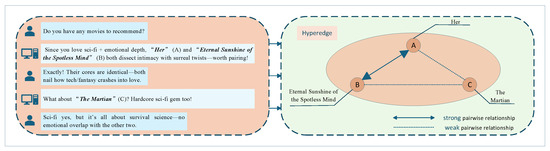
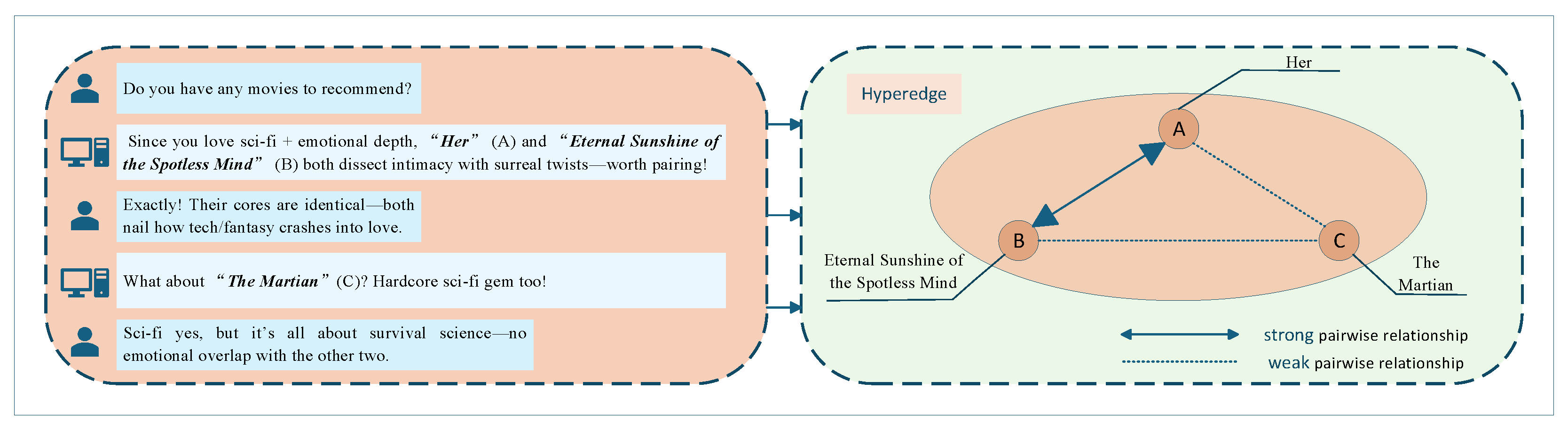
Despite their merits, existing hypergraph-based CRS methods suffer from a fundamental limitation: the “flatness” of hyperedges. Specifically, they treat all entities within a hyperedge as sharing a single, undifferentiated relationship, thereby blurring the fine-grained, pairwise affinities between individual entities. As illustrated in Figure 1, while three movies (A, B, C) may be co-mentioned in a dialog, the actual semantic relationships between them (e.g., strong thematic similarity between A and B versus weak relevance to C) are lost when aggregated into a monolithic hyperedge. This flattening effect leads to an incomplete and coarse-grained exploration of user interests, ultimately hampering recommendation precision.
Figure 1.
Hyperedge relationship differentiation: pairwise interaction extraction example.
Addressing this hyperedge flatness problem requires tackling two intertwined challenges: (1) Pairwise Relation Extraction: how to effectively derive fine-grained, context-aware pairwise relationships between entities from aggregated hyperedges; and (2) Multi-modal Feature Fusion: how to effectively integrate the inherent features of individual nodes with the aggregated semantics of hyperedges without information loss.
Given these challenges and inspired by previous research on hypergraph representation [11] and pairwise relationship capture [12], this paper proposes a Hypergraph Conversational Recommendation System Fusing Pairwise Relationships (HCRS-PR) model that integrates higher-order hypergraph structures with fine-grained pairwise relationships. Specifically, this work (1) constructs a session hypergraph based on dialog history and a knowledge hypergraph based on an external knowledge graph; (2) introduces a dedicated module to learn context-aware pairwise relationships within each hyperedge via a multi-head attention mechanism; and (3) designs a feature embedding enhancement mechanism to adaptively fuse features from the pairwise relationship graph and the hypergraph. Subsequently, the enhanced node representations are utilized for recommendation and response generation. Furthermore, to improve the diversity of generated responses, we propose a multinomial beam search decoding strategy based on multinomial distribution sampling.
2. Related Work
2.1. Conversational Recommendation Systems
Conversational Recommendation Systems (CRSs) aim to leverage users’ short-term intent and interactive feedback within dialog sessions to provide real-time recommendations. A central challenge for CRSs is accurately modeling the complex and often implicit relationships between entities mentioned in conversations to infer user preferences. Existing approaches for relational modeling in CRSs can be broadly categorized, yet each exhibits specific limitations in capturing the complete spectrum of entity relationships.
Language Model-based CRSs utilize the powerful semantic capabilities of Pretrained Language Models (PLMs). Frameworks employing architectures such as Transformer have enabled end-to-end joint training for both conversation and recommendation tasks [13,14]. Although effective for language generation and certain reasoning tasks [15,16,17], these methods primarily rely on textual co-occurrence patterns. They often struggle with the implicit knowledge gaps inherent in dialog data—conversations are sparse and rarely contain exhaustive relational facts about entities. This sparsity limits their ability to ground recommendations in rich, structured relational knowledge.
To bridge this knowledge gap, External Knowledge-based CRSs incorporate structured sources such as Knowledge Graphs (KGs). Methods like KGSF [4] and KECRS [18] construct graphs from entity and word perspectives to enrich session context. Others, such as RevCore [19], integrate auxiliary textual data (e.g., reviews). Although these methods mitigate data sparsity by importing external knowledge, their relational modeling often remains confined to pairwise connections (e.g., simple edges in a KG). They fail to capture the higher-order, multi-entity relationships that naturally arise when a user discusses multiple items within a single conversational turn.
A parallel line of research employs External Guidance-based CRSs, using mechanisms like memory graphs [20] or prompt-based learning [21] to guide the dialog flow and recommendation process. While innovative in integrating diverse information sources, their focus is often on information routing or task unification rather than on deepening the granularity of relational modeling between the entities themselves.
Recognizing the limitations of pairwise relations, recent studies have introduced Hypergraph-based CRSs to model complex, higher-order associations. For instance, some works construct hypergraphs from dialogs and external KGs, employing multi-granularity operations to capture user interests [10]. Subsequent enhancements incorporate additional data like reviews to build specialized hypergraphs [9]. However, these hypergraph approaches introduce a new, fundamental limitation: the “flatness” of hyperedges. By treating all entities within a hyperedge as an undifferentiated set, they obscure the fine-grained, pairwise affinities between individual entities (e.g., strong thematic ties between two movies versus a weaker association with a third mentioned in the same context). This loss of relational nuance within the aggregated hyperedge results in an incomplete and blurred representation of user preferences.
Therefore, while existing work has advanced in utilizing PLMs, external knowledge, guidance mechanisms, and hypergraphs, a significant gap remains: the effective integration of higher-order group associations (via hypergraphs) with fine-grained pairwise relationships. This paper addresses this gap by proposing a model that explicitly learns and fuses both levels of relational information, aiming to overcome the hyperedge flatness problem and achieve a more precise and nuanced understanding of user interests in conversations.
2.2. Pairwise Relationships
In a graph structure, a pairwise relationship refers to the direct connection established between two nodes via an edge, typically used to describe interactions, similarities, or dependencies between nodes. In social networks, pairwise relationships can be used to describe direct connections between users. In knowledge graphs, pairwise relationships can be used to describe indirect connections between entities. Formally, a graph is denoted as , where the set of vertices is represented by and the set of edges is defined as . For any edge , if there exists a binary relation , then and are considered to possess a pairwise relationship.
2.3. Hypergraph Learning
Hypergraphs, as an extension of graphs, are used to construct complex relationships between entities. Unlike ordinary graph structures, which can only describe binary relationships between nodes, hyperedges in hypergraphs can connect any number of nodes and describe higher-order relationships between them [22,23]. Therefore, hypergraphs demonstrate significant advantages in modeling the complex associations of high-dimensional data and have become a current research focus. For example, the MHCPL [8] model emphasizes learning and integrating dynamic user preference information under multi-view hypergraphs to complete session recommendation tasks. The MC-HGNN [7] model aims to construct hypergraphs at different scales to optimize item representations and combine them with line graphs for joint learning of session preferences. The HCCF [6] model introduces a self-supervised framework to enhance the quality of recommendation system representations.
3. Preliminaries
3.1. Task Description
The CRS aims to capture user preferences through multiple rounds of interaction with users. Define the item set as , the user set as , and the system-user interaction utterances set as , where each round of utterance consists of a sequence of words. At the same time, the recommendation items for round t () are (i.e., the recommendation results output by the system in the t-th round based on the dialog session history at that time). Based on the above definitions, the core task of the CRS is to generate the decision for the -th round based on the historical dialog sessions and the corresponding recommended item sequence over the previous n rounds: on one hand, it screens out candidate recommended items from the item set that match the current preferences (whose generation depends on feedback analysis of and dynamic updates of user needs); on the other hand, it generates the response utterance to achieve collaborative decision-making between recommendations and conversations.
3.2. Hypergraph Definition
For complex semantic relationships in dialog sessions, this paper uses hypergraph structures to establish higher-order semantic associations. Typically, a hypergraph is defined as , where contains a vertex set and a hyperedge set . A hypergraph can be represented by an incidence matrix , where indicates whether node is connected to hyperedge , defined as
4. Approach
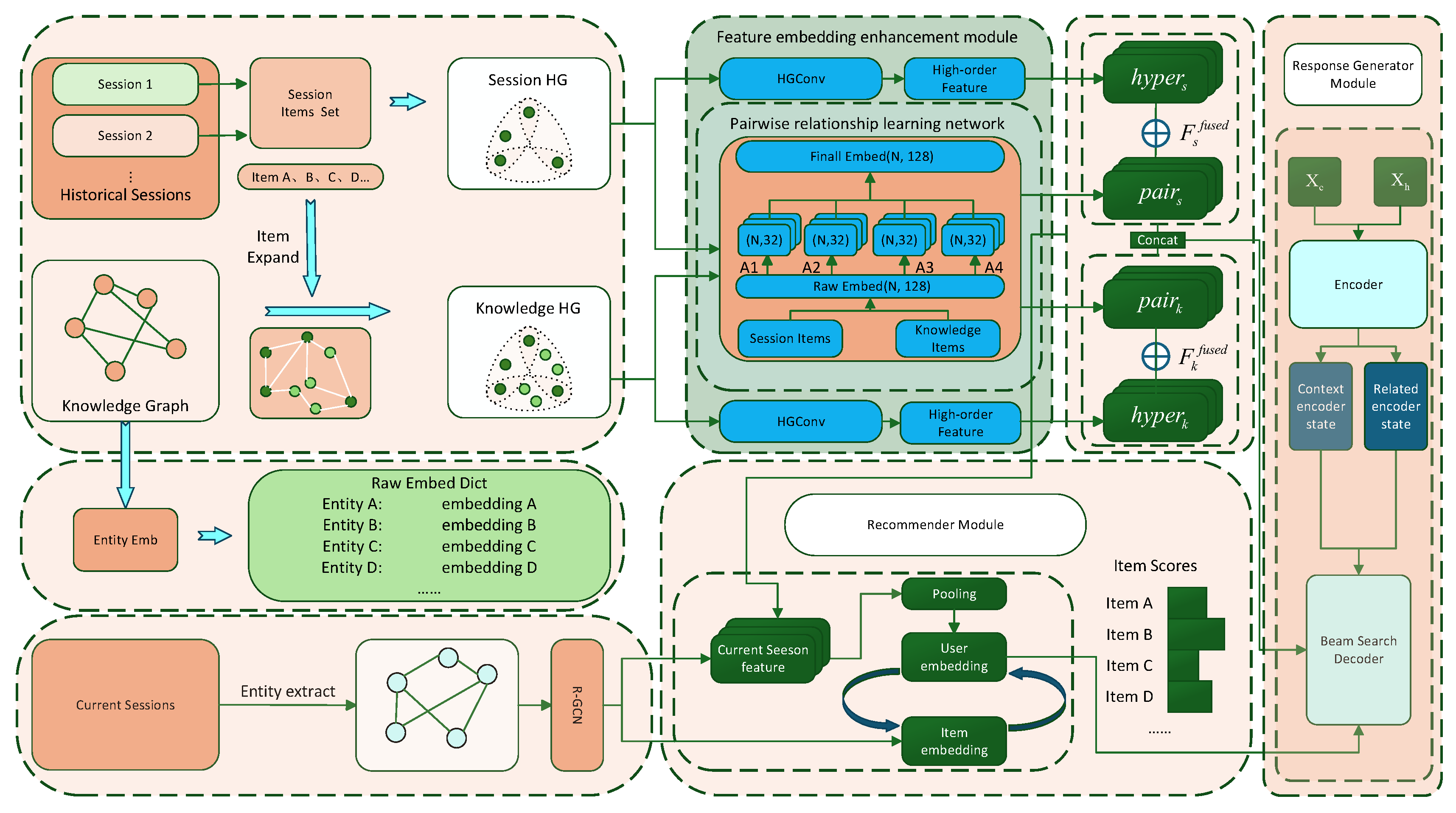
This section provides a detailed explanation of the proposed HCRS-PR model. First, HCRS-PR employs a session hypergraph–knowledge hypergraph joint framework to model high-order complex relationships among entities, while integrating an external knowledge graph encoded by R-GCN to enhance semantic representations. Second, a feature embedding enhancement module is proposed to analyze the influence weights of pairwise relationships, and a dynamic weighting strategy is adopted to fuse higher-order and pairwise features. During the dialog generation phase, a beam search decoding strategy based on multinomial distribution sampling is employed to enhance the semantic diversity of responses. As shown in Figure 2 and Figure 3, this framework achieves end-to-end collaborative optimization of session structure and knowledge semantics.
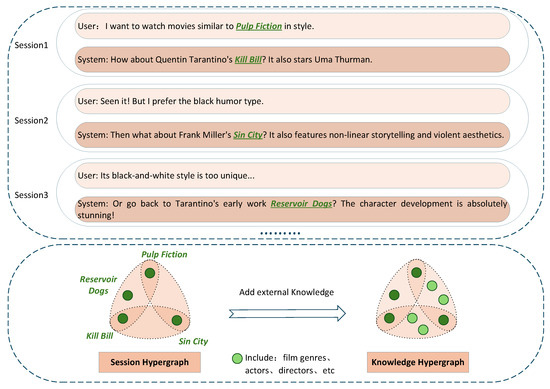
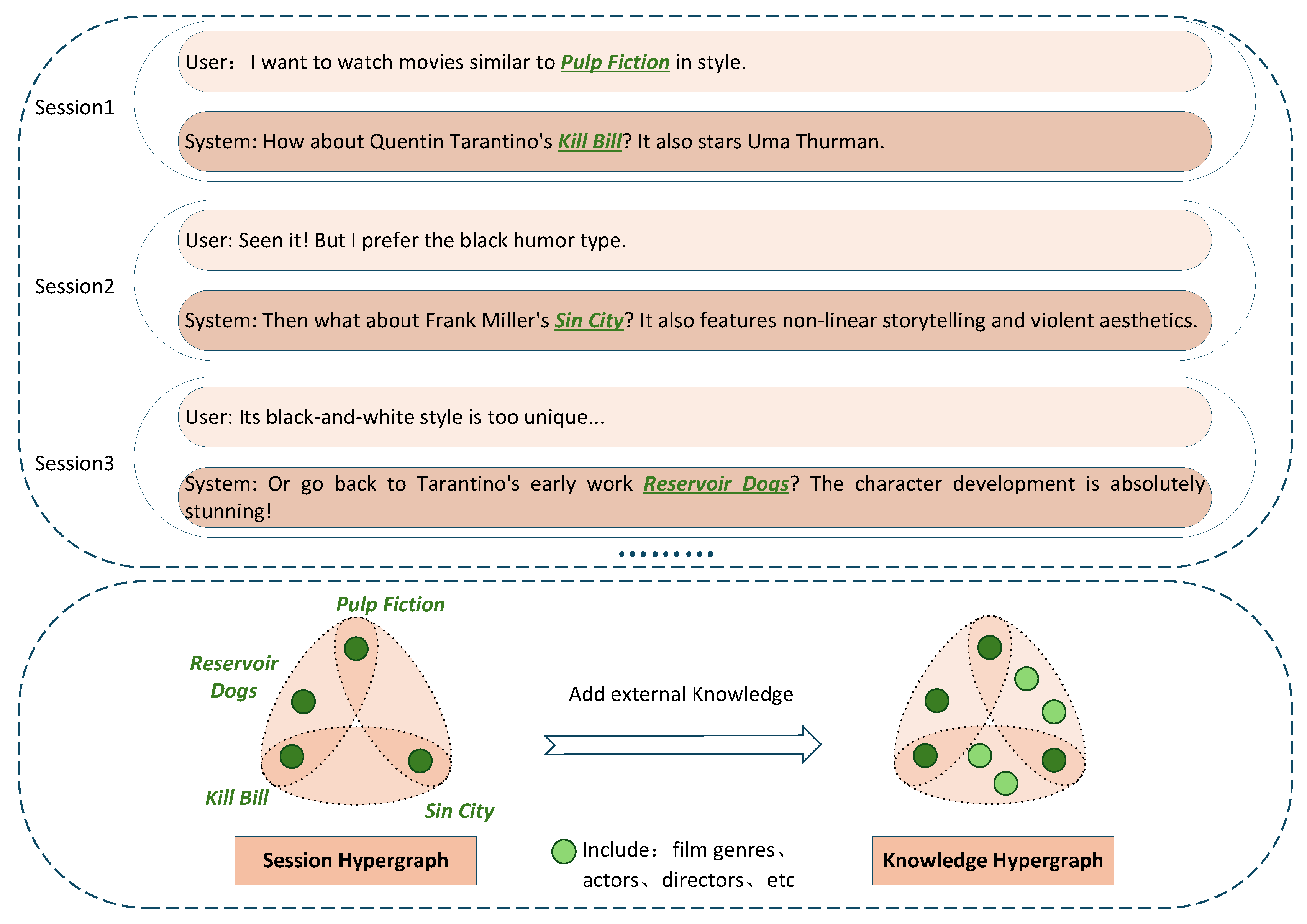
Figure 2.
Example of the construction of a session hypergraph and a knowledge hypergraph.
Figure 3.
A framework of a Hypergraph Conversational Recommendation System Fusing Pairwise Relationships (HCRS-PR). From left to right and top to bottom, the figure sequentially contains a Hypergraph Construction Module, Raw Embedding Bank, R-GCN Knowledge Encoder, Feature Embedding Enhancement Module, Recommendation Module, and Response Generation Module.
4.1. Hypergraph Construction Module
In order to enhance entity feature representation and learn high-order complex relationships between entities, this paper introduces hypergraph structures to construct session hypergraphs and knowledge hypergraphs based on historical dialog sessions and external knowledge, respectively.
4.1.1. Session-Hypergraph Construction
Ordinary graph structures struggle to capture deep interaction patterns within historical dialog sessions. Therefore, this paper introduces the session hypergraph [10] to model historical dialog sessions: the set of items in a session is represented as a hyperedge, while shared item nodes connect different sessions across hyperedges, enabling semantic flow between sessions. The specific construction process is shown in Figure 2: the movie entities “Pulp Fiction,” “Reservoir Dogs,” and “Kill Bill” are extracted from the historical dialog sessions between the user and the system, and the session hyperedge groups these three movie entities, which are associated in the dialog, into a entirety.
Based on the previous introduction to hypergraphs, the session hypergraph structure is defined as , where is the set of all item nodes in the session, and represents the set of session hyperedges. Additionally, based on the hypergraph definition in Section 3.2, this paper uses to denote the session hypergraph incidence matrix (used to quantify the connection relationships between nodes and hyperedges). This structure models the higher-order relationships among multiple sessions of the same user through cross-session connections of shared nodes, addressing the information sparsity issue caused by node feature isolation in ordinary graph structures.
4.1.2. Knowledge-Hypergraph Construction
To address the issue of sparse dialog sessions data, this paper constructs a knowledge hypergraph [10] by injecting external knowledge into the session hypergraph, and reconstructs the semantic relationships between items through entity alignment and relationship mapping. The construction process is shown in Figure 2, where the light-colored nodes represent other attributes of the current movie found in the external knowledge graph (including movie type, actors, directors, and other information). The knowledge hypergraph is represented as , where contains session item nodes and their N-hop neighbor entities in the knowledge graph, and denotes the set of hyperedges in the knowledge hypergraph. Similar to the construction in Section 4.1.1, represents the knowledge hypergraph incidence matrix. By combining the external knowledge graph with historical dialog session information in this way, the system addresses the issue of sparse historical data and facilitates deeper exploration of user preferences.
4.2. Knowledge Graph Encoding Module
To encode the structured relational information from external knowledge into our model, we employ a dedicated knowledge graph encoding module. The output of this module—entity embeddings enriched with type-aware relational semantics—serves as the foundational node features for constructing the knowledge hypergraph, thereby injecting discriminative external knowledge into our main framework. First, to provide a relevant and focused knowledge context, we construct a task-specific knowledge subgraph for each session by extracting key entities and performing an N-hop expansion in the external knowledge graph—a one-time, uniform preprocessing step. The external knowledge is sourced from DBPEDIA [24] and CN-DBPEDIA [25], represented as triples .
The core of this module is the knowledge graph encoder. Since the constructed subgraphs contain diverse relation types (), standard GCNs [26] are unsuitable as they treat all edges uniformly. Therefore, we adopt R-GCN [27], which is designed to handle multi-relational graphs. Its key advantage is the use of relation-specific weight matrices, allowing it to distinguish and aggregate information from different relation paths when updating node embeddings. This capability is crucial for preserving the fine-grained semantic relationships needed for our subsequent fusion of pairwise and higher-order information. The embedding of entity e at layer is defined as
where the embedded representation of entity e at layer l and is denoted by and . The set of neighbor nodes of entity e under relation r is represented by . The normalization coefficient is expressed as , which is defined as the cardinality of the neighbor node set. Additionally, the weight matrix of relationship r at layer l is represented by , and the weight matrix associated with the node itself (self-connection) is represented by . The final entity embedding matrix is obtained by aggregating and propagating node features.
4.3. Feature Embedding Enhancement Module
Although hypergraph convolutions can model complex relationships between multiple entities, the strength of pairwise relationships between nodes still needs to be further explored. Therefore, it is necessary to add a pairwise relationship learning module on top of hypergraph convolutions to enrich entity representations.
4.3.1. Hypergraph Convolution
First, establish a hypergraph convolution layer based on the session hypergraph, following Bai et al. [28] to construct the hypergraph convolution layer as follows:
where is the embedding representation of the vertex v at layer l and is the weight matrix connecting the two layers.
However, the number of vertices changes during the actual computation, which leads to numerical instability. To mitigate this issue, a normalization operation is introduced, reformulating Equation (3) in matrix notation (replacing vector representation):
where and are the feature inputs at layers l and , respectively. The diagonal matrices corresponding to vertex degrees and the edge degrees are denoted as and , respectively.
The convolution process can be described as three stages, first inputting the initial node features and completing the feature transformation through the weight matrix W. Secondly, the node features are aggregated into hyperedge representations by transposed hypergraph incidence matrix . Finally, the hyperedge representation is spread to the node through the hypergraph incidence matrix , and the final node embedding is obtained by the normalization operation.
For the dual targets of the CRS for session structure modeling and knowledge semantic fusion, the convolution layer is instantiated and the session hypergraph representation and knowledge hypergraph representation are obtained, respectively.
where is a hypergraph convolution operation defined by Equation (4). The incidence matrices for the session hypergraph and knowledge hypergraph are represented by and , respectively. The diagonal matrices of the vertex degrees are denoted as and , while the diagonal matrices of the edge degrees are denoted as and . is the aggregated entity embedding representation of items within the session, whereas the aggregated entity embedded representation of historical session items and multi-hop neighbors is represented by .
4.3.2. Pairwise Relationship Learning Module
To achieve pairwise relationship fusion, we first convert the constructed session hypergraph into a standard graph via clique expansion [29] and then extract the initial entity embeddings of relevant items from each historical dialog session segment. The original embeddings and session indices are input into the graph attention layer to obtain the attention weights between nodes, thereby analyzing the connection relationships among nodes within each hyperedge.
Formally, let be the incidence matrix of , where if node v belongs to hyperedge e. The adjacency matrix of the resulting pairwise graph is obtained through the following transformation function:
where is defined as the clique expansion operation , with being the diagonal matrix of node degrees. This operation connects all node pairs that co-occur within the same dialog session (hyperedge), thereby transforming higher-order group relations into a fine-grained pairwise graph structure.
To this end, this module employs a multi-head attention mechanism [30] to capture the pairwise relationships present in the original embeddings . Specifically, for each node embedding in the input feature (where N denotes the number of nodes and d denotes the embedding dimension), K independent projection matrices to a low-dimensional subspace:
where the projected feature of node i for the k-th head is denoted by .
The two node projection features are concatenated in the operation , while the association strength between nodes is calculated by employing a learnable parameter vector . The raw score of the association strength between node i and node j under the k-th head is represented by , where node j is indexed as one of the neighbor nodes of target node i.
After the raw association scores between nodes are obtained, local normalization is applied to convert the absolute association strength into relative importance weights , enabling adaptive focus on significant neighbors (i.e., pairwise relationships) by the model.
where is the set of neighboring nodes of node i. In a session hypergraph, this set is defined as the collection of nodes that co-occur within the same session or nodes that are directly associated in a knowledge graph.
Then, based on the normalized attention weights, the features of the neighboring nodes are weighted and aggregated. A nonlinear transformation is introduced via an activation function to obtain node embeddings that perceive pairwise relationships under a single-head attention mechanism.
Finally, the outputs of the four attention heads are concatenated to obtain the final pairwise relationship-aware node embedding .
A sampling approach is adopted for learning pairwise relationships within the knowledge hypergraph. The initial static original embedding is denoted by , while the final learned feature representation is denoted by .
The learned and are fused with the higher-order associations and obtained through hypergraph convolution, respectively. Due to the inherent complexity of the model architecture and the sparsity of dialog sessions entity data, convolution operations may smooth out some key features during information aggregation [31]. To address this issue, this paper adopts a dynamic weighted concatenation fusion strategy, dynamically adjusting the weight ratios of paired relationships and higher-order relationships while ensuring the integrity of the original features. The following is the specific calculation process for pairwise relationship fusion at the session hypergraph level:
During the feature fusion stage, learnable variables and weight parameters and are introduced, with their initial values initialized to 0.5. The Sigmoid function is employed to normalize and , yielding dynamic weight coefficients (utilized to scale pairwise relationship features) and (employed for scaling higher-order relationship features). The specific computational procedure is formalized in Equation (14). The scaled features of both types are concatenated along the feature dimension, resulting in fused features . To augment the model’s expressive capacity, a fully connected layer is incorporated to map to the target dimension, while the ELU activation function is applied to enhance nonlinear representational capabilities, ultimately forming the comprehensive feature representation . The pairwise relationship fusion process at the knowledge hypergraph level is implemented identically to the session-level computation, and is represented as .
Given that the final feature representation employed for item recommendation constitutes an integrated representation of historical items, and are concatenated and denoted by :
4.4. Item Recommendation
Item recommendations aim to satisfy users’ current dialog sessions needs based on their long-term and short-term interest preferences. from Equation (17) serves as an integrated representation of historical conversation information and external knowledge, simultaneously modeling the user’s long-term historical interests. The user’s short-term interest preferences are obtained through feature learning of the current session. To comprehensively capture the user’s complete preferences, a pooling layer is used to aggregate the user’s short-term and long-term interests, forming a unified user preference feature , specifically defined as follows:
where Pooling is the average pooling, which is employed to extract global feature representations. The aggregation operations denoted by [;] are performed along the feature dimension to generate unified embeddings.
In order to provide users with accurate recommendations, it is still necessary to calculate the similarity between user preference features and item embeddings , using the probability distribution converted by Softmax as the final recommendation probability:
where is the embeddings of all items in the candidate item set I.
To enable the model to fit better, the cross-entropy loss function is used to optimize the model parameters as follows:
where is the minimum batch size of data, and is the project label.
4.5. Beam Search-Based Response Generation
4.5.1. Response Generation
Based on previous research, this module adopts an encoder–decoder model based on the transformer architecture [32]. In the encoding stage, a dual transformer encoder is used to process sequential session data in parallel: the historical interaction encoder focuses on capturing long-term user behavior patterns and generates a compressed representation of historical session embeddings . The real-time dialog encoder focuses on extracting salient features from the current interaction and forms the current session embedding . In the hierarchical decoding stage, the Multi-Head Attention (MHA) mechanism [32] dynamically fuses three types of information: (1) the embedding matrix output from the historical session encoder, (2) the embedding matrix output from the current session encoder, and (3) , which represents the encoded structured item embeddings. In the n-th layer of the decoder, the hierarchical fusion of multi-source information is achieved through the following steps:
At the n-th layer of the decoder, self-attention is first calculated on the hidden state of the previous layer to enhance the semantic correlation within the sequence, yielding . Subsequently, the model enhances the interaction between and the item embedding matrix through multi-scale information fusion, thereby introducing the semantic information of candidate items. To capture the user’s immediate intent, the current session encoding is incorporated. Combined with the historical encoding , this reflects the user’s long-term preferences. Additionally, the learnable parameter dynamically adjusts the short-term intent and long-term preferences , achieving multi-scale user interest fusion and obtaining . Finally, a two-layer feedforward neural network (FFN) [32] is used to perform a nonlinear transformation on , generating the final item representation .
After decoding is complete, a probabilistic model of the autoregressive encoding is constructed to generate the final response. Specifically, in the recursive process of generating the sequence, the prediction of the current token depends on the previously generated historical token sequence. Formally, given an autoregressive decoding sequence , the conditional probability of generating the next token is composed of three parts:
Based on the final item representation output by the decoder, a hybrid generative–replicative model is constructed to obtain the response content. Specifically, the conditional probability of the next token is obtained by combining three methods: (1) is the standard vocabulary distribution calculated based on the decoder hidden state (i.e., ). (2) captures personalized preferences through the user representation u. (3) implements a hybrid copy mechanism to copy entities or tokens from the context. The final generation probability is a weighted combination of the three, and the entire sequence is optimized using a cross-entropy loss function:
where is the batch size of the data, is the maximum statement length, and is the t-th label of the i-th training sample.
4.5.2. Beam Search Decoding Strategy Based on Multinomial Distribution
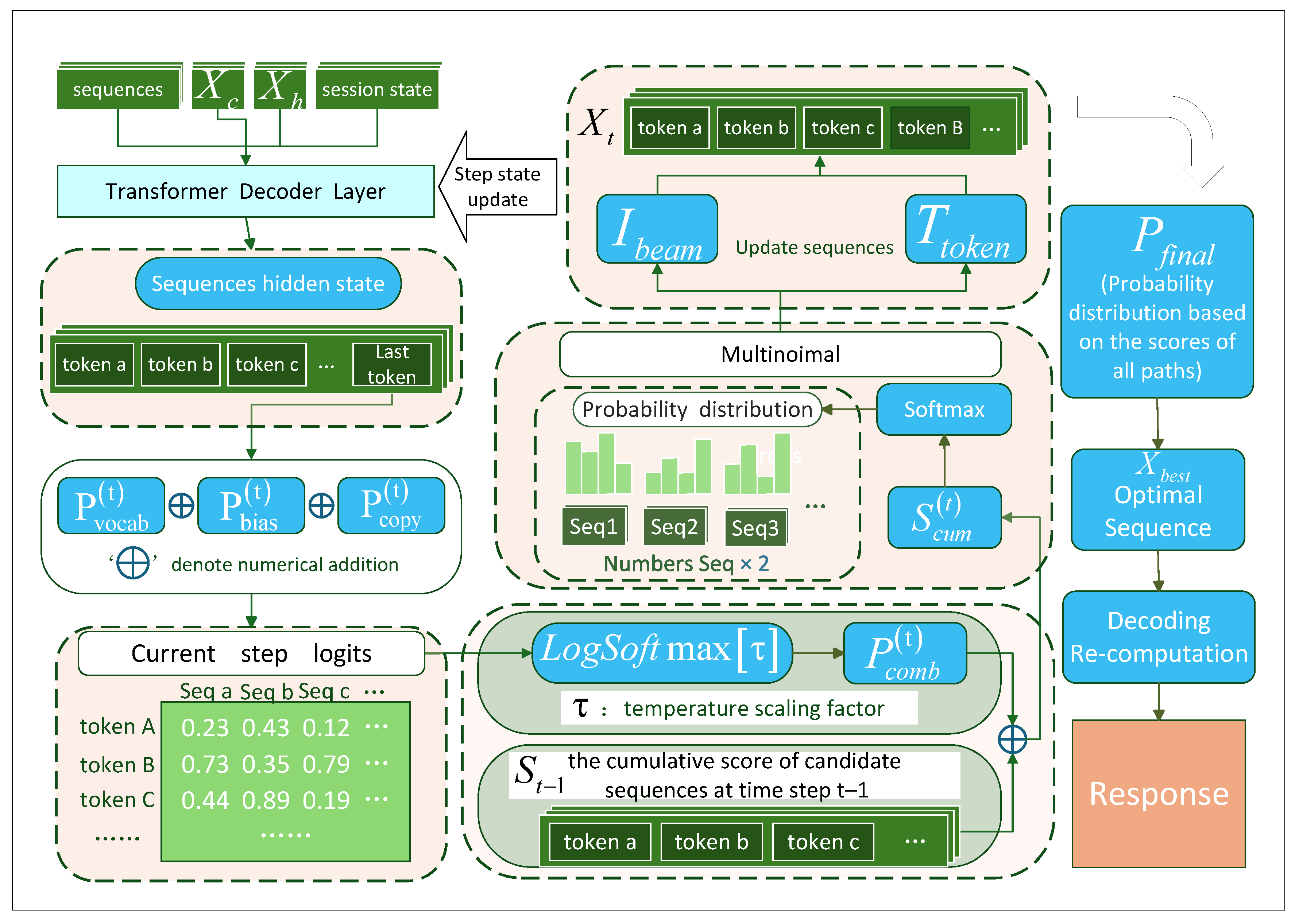
During the conversational model testing phase, given that traditional greedy search strategies only select the word with the highest probability at each step during decoding, potentially overlooking high-probability combinations in low-probability paths [33], this paper proposes an improved beam search decoding strategy, as shown in Figure 4. Specifically, multinomial distribution sampling [34,35] is adopted as a replacement for conventional Top-k selection in HCRS-PR, enabling stochastic candidate expansion per decoding step to amplify exploration capabilities. A temperature coefficient is introduced to adjust the smoothness of the probability distribution, enhancing semantic diversity in high-temperature modes and focusing on high-probability semantic paths in low-temperature modes. After generating the complete sequence, weighted sampling is performed based on the cumulative probability of the path to avoid local optima.
Figure 4.
Model architecture diagram of a beam search strategy based on multinomial distribution. The figure illustrates the complete workflow of beam search with multinomial sampling.
It is crucial to clarify the relationship between our approach and standard stochastic decoding techniques (e.g., temperature scaling, top-k, or nucleus sampling). The contribution of this work does not lie in proposing a new core sampling algorithm. Instead, the novelty resides in the systematic integration and tailored adaptation of the aforementioned stochastic components (multinomial distribution sampling with temperature) into a novel two-stage framework specifically designed for conversational recommendation. Unlike general-purpose decoders that apply sampling to the entire vocabulary distribution at each step, our sampling operation is confined to the semantically constrained space defined by the candidate items from the first-stage recommendation module. This design aims to guide the beam search towards generating responses that balance recommendation accuracy with conversational diversity. Therefore, the core contribution here is the design of a recommendation-oriented decoding framework that effectively leverages and contextualizes stochastic sampling, rather than an incremental improvement to the fundamental sampling techniques themselves.
To implement beam search decoding, the multi-source states output by the decoder must first be expanded to accommodate the dynamic computations of the decoding process. Specifically, the user’s historical dialog session state , the current dialog session state , the item embedding , and the user embedding are expanded to obtain , , , and . The definitions are as follows:
Subsequently, based on the beam search strategy, the expanded state is used for decoding path exploration. K is the beam width, which is set to 2 in this paper, meaning that at each decoding step, two paths are selected from the probability distribution to expand the token. The decoding process still calculates and generates probabilities through three modes, namely , , and , defined as follows:
where the hidden state at the previous time step is denoted , E is the word embedding matrix, is the Softmax function, and , , are learnable projection layers.
By performing a probability-weighted summation across the three modes, the combined probability at time step t is obtained. The temperature coefficient is used to control the balance between exploration and exploitation at the current step, addressing the issue of over-exposure (where high-probability words appear frequently) and compensating for the distribution differences between training and test inference. The definition is as follows:
where is the log-likelihood of generating each candidate token at the current time step given the historical sequence , and is broadcast addition (i.e., the current score of each candidate sequence is added to the score of each expanded token). The index of the candidate sequence retained at the previous time step is denoted by m, and the index of the candidate tokens that can be expanded at the current time step t is denoted by n. This ultimately forms an expanded score tensor of dimension (where B is the batch size and V is the vocabulary dimension). is essentially a three-dimensional score matrix, where each element is the cumulative score after expanding the k-th candidate sequence in batch b with tag v.
To select the optimal candidate set from the possible expansion paths, candidate path expansion is performed using a multinomial sampling mechanism. Specifically, the cumulative scores are normalized using a Softmax function with a temperature coefficient, and then K candidate expansions are selected from them via sampling without replacement:
where is the selected beam index (i.e., the candidate sequence number to be expanded) and is the newly generated word token. Through index mapping, the historical sequence is concatenated with the new token to generate the current candidate sequence .
After completing the single-step sampling, the candidate sequence is iteratively updated according to the mechanisms described in Equations (36) and (37). After T decoding steps, K complete candidate paths and their cumulative scores are obtained. Finally, the Softmax function with a temperature coefficient is used again to calculate the weights of each path, and the optimal response sequence is sampled based on the multinomial distribution . The definition is as follows:
However, during decoding, beam search only updates the hidden state of the latest word, which can lead to discontinuity in the sequence context. Additionally, there is a cross-indexing issue between the encoder states and user embeddings of different candidate paths. Therefore, a probability re-computation mechanism is introduced to ensure output consistency. Specifically, after obtaining the best sequence , the decoder is re-invoked to perform forward computation on the entire sequence, ensuring that the hidden state at each time step is generated based on the full context. Simultaneously, the user representation aligned with is extracted to avoid overlapping state information across multiple candidate paths. The specific calculation is as follows:
where , , and represent position-aware features, user preference features, and context fusion features generated based on the optimal sequence , respectively. Together, these three components form the final output , which balances conversation fluency and diversity.
5. Experiment
5.1. Experiment Setup
5.1.1. Datasets
The model HCRS-PR proposed in this paper was evaluated on two publicly available datasets, namely ReDial [13] and TG-ReDial [36]. These two datasets provide standardized benchmarks for evaluating the context-aware capabilities and conversational coherence of dialog recommendation systems. The specific information of the two datasets is shown in Table 1.
Table 1.
Experiment datasets.
ReDial is an English-language movie recommendation dialog dataset constructed using Amazon Mechanical Turk (AMT), generating multi-round interactions through strict role-playing (“requestor” and “recommender”). This dataset accurately replicates the dynamic negotiation and preference discovery processes found in real-world dialog scenarios.
TG-ReDial is a semi-automatically generated dialog dataset tailored for Chinese movie recommendation scenarios, which integrates language features and cultural specificity in the Chinese context while simulating human–machine interaction.
5.1.2. Baselines
To comprehensively validate the performance advantages of the proposed model HCRS-PR, experiments were conducted to evaluate its performance on two tasks: recommendation and conversation. The proposed method was compared with existing mainstream conversation recommendation methods, typical recommendation models, and dialog models.
SASRec [37]: This model employs a self-attention mechanism to capture dynamic changes in user interaction sequences.
ReDial [13]: This framework integrates a hierarchical recurrent encoder–decoder (HRED) dialog generation model with a recommendation module based on autoencoders.
TG-ReDial [36]: Breaking away from the traditional paradigm of dialog recommendation, this model proposes a topic-guided dialog recommendation task. It jointly models user preferences using dialog context semantics (textual statements) and long-term interaction patterns (historical behavior data), enabling dynamic preference adaptation during the dialog process.
KBRD [38]: Introduces entity-level external knowledge graphs to enhance the limited semantic information of items. Uses a Transformer architecture for conversation generation.
KGSF [4]: Enhances knowledge representation by separately constructing word-oriented and entity-oriented knowledge graphs and adopts mutual information maximization to align word-level and entity-level semantic spaces.
KECRS [18]: Develops Bag-of-Entity loss and infusion loss and constructs a high-quality knowledge graph in the movie domain (TMDKG).
BERT [15]: A pre-trained model that introduces a masked language generation model to learn interactions between words in the left and right contexts.
BART [39]: A denoising autoencoder for sequence-to-sequence model pre-training. Text is corrupted using an arbitrary noise function, and a model is then trained to reconstruct the original text.
MHIM [10]: Constructs historical dialog sessions and external knowledge as a hypergraph and captures user preferences at multiple granularities through hypergraph convolution.
5.1.3. Evaluation Metrics
The experiment uses a variety of metrics to evaluate the performance of the model in the two tasks.
To assess the accuracy of the item recommendation results, this paper uses Recall@K, MRR@K, and NDCG@(K = 10, 50) to evaluate the effectiveness of the model in the recommendation task. Distinct n-gram (n = 2, 3, 4) is used to measure text vocabulary diversity.
5.1.4. Implementation Details
The model HCRS-PR is implemented using Python 3.12 with the PyTorch (version 2.5.1) framework. In the text processing stage, the text extraction lengths for historical and current dialog utterances are set to 1024 and 256, respectively. During model training, the word embedding dimension for conversation tasks is set to 300, and the knowledge graph embedding dimension for recommendation tasks is set to 128. Furthermore, the number of layers for the R-GCN encoder is set to 1, and the normalization constant is also set to 1. Additionally, Adam [40] is adopted as the optimizer for the model parameters. To ensure the model’s performance reaches its optimal level, extensive experiments were conducted, and the initial learning rate for both tasks was ultimately set to 0.001.
In the decoding phase of conversation generation based on beam search, the beam width is set to 2, and the temperature coefficient is set to 0.7.
5.2. Evaluation on Recommendation Task
5.2.1. Result Analysis on Recommendation Task
This paper conducted a series of experiments on two CRS datasets to validate the effectiveness of HCRS-PR in recommendation tasks. Table 2 and Table 3 show the research results on different datasets. The following conclusions can be drawn from the experimental results.
Table 2.
Comparison and analysis of experimental results under the Redial dataset recommendation task.
Table 3.
Comparison and analysis of experimental results under the TG-Redial dataset recommendation task.
SASRec [37], as a traditional recommendation system method, generally performs worse than conversational recommendation system methods across all metrics. This advantage stems primarily from conversational recommendation addressing issues such as interest transfer, data sparsity, and cold start through dynamic session segmentation, sequence sensitivity, and deep relationship mining.
Secondly, since external knowledge can effectively uncover users’ latent preferences, the KBRD model performs significantly better than Redial and TG-Redial. External knowledge links session entities to a knowledge graph, using entity relationships to implicitly extend users’ explicit feedback to unmentioned items. Additionally, the TG-Redial model outperforms Redial because the TG-Redial dataset has more users and items, and richer interaction relationships between entities (see Table 1 for details).
Furthermore, the KECRS model enhances entity interactions by constructing higher-quality knowledge graphs and using an optimized loss function, resulting in slightly better performance. The KGSF model constructs knowledge graphs at both word and entity levels to enhance representations, aligning heterogeneous knowledge semantics through mutual information maximization, thereby indirectly enhancing related embedding representations. BERT and BART, as pre-trained models in conversational recommendation, indirectly introduce knowledge through large-scale text pre-training.
Finally, HCRS-PR outperforms other baseline methods. The model captures global high-order relationships through hypergraph convolution and dynamically reallocates node weights, effectively balancing the feature smoothing problem while retaining semantic associations between nodes. This hierarchical feature fusion mechanism captures both local pairwise relationships within sessions and integrates global high-order interactions, thereby achieving more accurate user preference modeling.
5.2.2. Ablation Study on Recommendation Task
The ablation experiments demonstrated the extent to which each component designed in this paper affects the model. (1) The part related to the construction of the session hypergraph was removed. (2) The part related to the construction of the knowledge hypergraph was removed. (3) The pairwise relationship learning module was removed. (4) The feature embedding enhancement module was removed.
The specific results are shown in Table 4. The experimental data indicate that the feature embedding enhancement module has the greatest impact on model performance. This module achieves deep exploration of user interests by capturing higher-order relationships and pairwise relationships between nodes. Removing it results in a significant weakening of representation capabilities, as the model then relies solely on the original embeddings. Additionally, the absence of the session hypergraph and knowledge hypergraph also leads to performance degradation, as hypergraph construction enriches representations through entity associations and expands interest diversity. Finally, from the perspective of capturing pairwise relationships between entities, relying solely on the higher-order relationships captured by the hypergraph would overlook the direct pairwise associations between original nodes. Therefore, each component designed in this paper can effectively capture user interests to a certain extent, thereby enhancing user satisfaction.
Table 4.
Ablation experiment results on recommend tasks.
5.3. Evaluation on Conversation Task
5.3.1. Result Analysis on Conversation Task
In the experimental results of the conversational task, HCRS-PR also outperforms all baseline methods. The experimental results are shown in Table 5. From the experimental results, KBRD enhances entity embedding representations by introducing structured knowledge graphs, thereby enriching the diversity of language responses. KGSF, on the other hand, aligns users’ overall preferences at a coarse-grained level and matches word-entity associations at a fine-grained level, achieving multi-level semantic modeling. Redial is limited by data sparsity and struggles to uncover users’ implicit preferences. MHIM uses hypergraph convolution to perform multi-granularity user preference mining and generate response content. The beam search decoding strategy designed in this paper, with a beam width of 2, replaces top-k word selection with multinomial distribution sampling, allowing low-probability words to participate in sequence generation. Moreover, as demonstrated in Table 6, this method is capable of significantly enhancing response diversity while ensuring sentence fluency.
Table 5.
Comparative analysis of experimental results in conversation tasks.
Table 6.
Comparative analysis of HCRS-PR and the baseline MHIM on Bleu metrics.
5.3.2. Ablation Study on Conversation Task
This paper demonstrates the effectiveness of the proposed beam search decoding strategy through ablation experiments. As shown in the comparison data in Table 5, when the beam search decoding module based on multinomial sampling is removed, diversity metrics such as Dist-2, 3, and 4 significantly decrease. This is because the beam search strategy, through its multi-path candidate expansion mechanism (with a beam width of 2), enables low-probability words to effectively participate in sequence generation, thereby overcoming the local optimality limitations of greedy decoding. Additionally, the temperature coefficient introduced in the strategy dynamically adjusts the smoothness of the probability distribution, effectively avoiding the issue of over-exposure of high-frequency words.
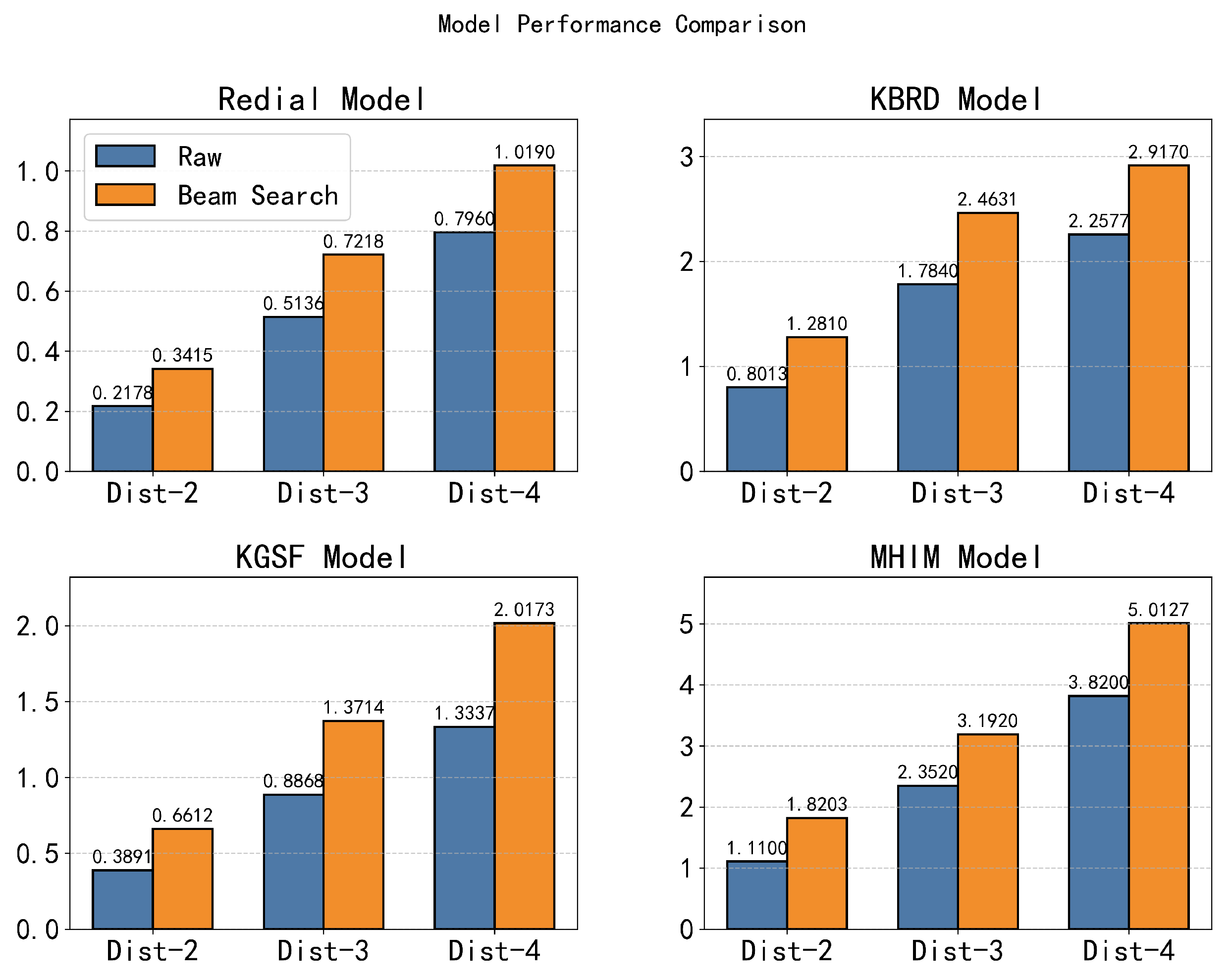
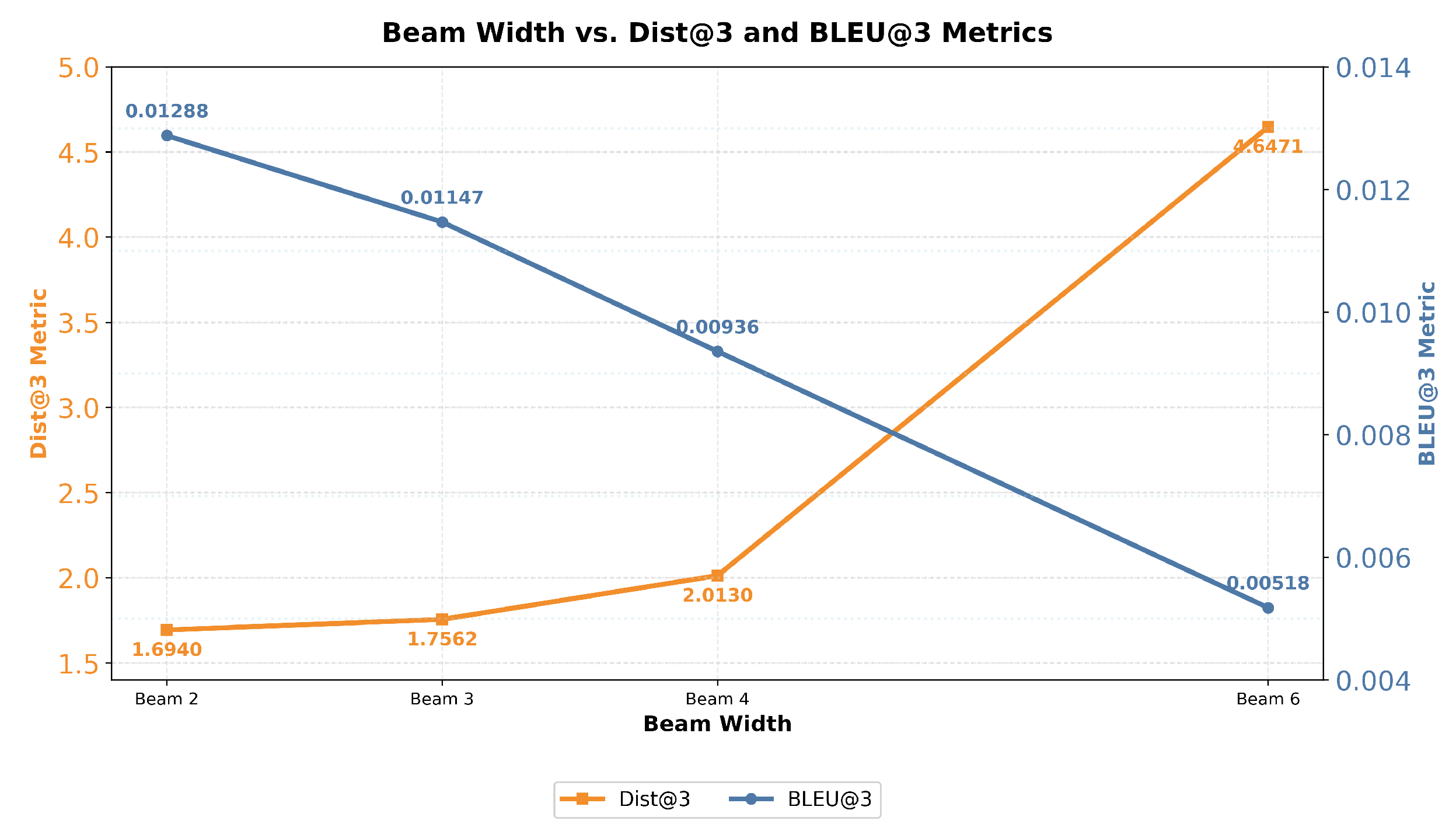
Furthermore, this paper applies the beam search decoding strategy to four baselines and conducts comparative experiments. The results are shown in Figure 5. The experimental data demonstrate that the beam search strategy can indeed improve the diversity of responses, meeting users’ diverse recommendation needs. It is worth noting that Figure 6 also reflects that the beam width parameter has a significant impact on the generation effect. Although a larger beam width can produce more innovative responses, it leads to a significant decrease in sentence fluency and semantic accuracy. Through extensive experimental verification, when the beam width is set to 2, the model achieves the best balance between diversity and response quality, generating natural language responses that meet user preferences while ensuring the overall interaction experience of the recommendation system.
Figure 5.
Experimental results of beam search strategy under four baselines.
Figure 6.
Analysis of the impact of beam width on the Dist and Bleu metrics, using Dist-3 and Bleu-3 as examples.
6. Conclusions and Future Work
Existing conversation recommendation systems have limitations in capturing complex heterogeneous relationships between entities and ensuring the diversity of response generation: on the one hand, a single hypergraph structure is insufficient to fully characterize the multi-type interactions between entities; on the other hand, traditional generation strategies are prone to causing response homogenization. To address these issues, this paper proposes a Hypergraph Conversational Recommendation System Fusing Pairwise Relationships (HCRS-PR): by combining hypergraph convolution and pairwise relationship learning modules for feature learning, it effectively models higher-order associations and heterogeneous interactions between entities; simultaneously, it introduces a beam search strategy based on a multinomial distribution to enhance the diversity of language responses. Experimental results on two public datasets demonstrate that this method outperforms baseline methods in key metrics such as recommendation accuracy and response diversity, validating its effectiveness.
Despite the promising results, our study has several limitations that point to directions for future research.
First, regarding the scope of validation, our experiments were conducted on two established text-based dialog datasets (ReDial and TG-ReDial). While these datasets provide a solid foundation, their coverage of conversational scenarios is limited. The proposed model has not been validated in more complex, multi-turn, or multi-modal conversational settings, which may present different challenges. Furthermore, we observe potential differences in conversational structure between the TG-ReDial and ReDial datasets. Preliminary statistical analysis indicates that dialogs in TG-ReDial (Chinese) tend to have shorter average turns and more concentrated entity co-occurrence within a single turn, whereas conversations in ReDial (English) exhibit a broader distribution of turn lengths and stronger topic continuity. Such structural differences may pose distinct challenges for hypergraph modeling and could partially account for the subtle performance variations observed across the two datasets. This suggests that language and cultural backgrounds may indirectly influence the performance of recommendation models by shaping the underlying conversational structure. Therefore, a systematic analysis of cross-lingual conversational structure and its impact on model generalization represents a valuable direction for future research.
Second, on the methodological front, although our fusion strategy for pairwise and hypergraph relationships shows effectiveness, it remains relatively straightforward (e.g., a learnable weighted concatenation). This component has room for further refinement. More sophisticated multi-level feature extraction and fusion mechanisms could be explored to better capture and integrate the complementary information from these two relational views.
Third, as noted in the conclusion, our performance benchmarking is intentionally focused on non-LLM-based CRS methods that are most architecturally comparable to our hypergraph approach. This provides a controlled and fair evaluation within this research paradigm. However, it does not encompass the rapidly emerging class of prompt-based or large language model (LLM)-driven conversational recommenders. Future work should aim to bridge this gap, either by designing equitable comparison frameworks across paradigms or by investigating hybrid models that combine structured relational reasoning (as in HCRS-PR) with the powerful generative capabilities of LLMs.
Addressing these limitations constitutes our main agenda for future work. We plan to explore more optimal strategies for multi-relational fusion, extend our model to multi-modal conversational scenarios, and engage with the challenges and opportunities presented by foundation models in conversation recommendation.
Author Contributions
Validation, J.L. and D.J.; Methodology, J.L.; Software, J.L. and D.J.; Writing—original draft, J.L.; Writing—review and editing, L.W. and L.S.; Supervision, L.W., L.S. and C.P.; Project administration, L.W. All authors have read and agreed to the published version of the manuscript.
Funding
This research was funded by the National Science Foundation of China under Grant 62166021.
Data Availability Statement
The public benchmark datasets utilized in this study, namely Redial and TG-ReDial, are openly available. The Redial dataset can be accessed at its official website: https://redialdata.github.io/website/. The TG-ReDial dataset is available in its GitHub repository: https://github.com/RUCAIBox/TG-ReDial. The processed data, model parameters, and source code developed and analyzed during the current study are not publicly available due to the privacy-sensitive nature of the underlying conversational data but are available from the corresponding author (Lei Su, sulei@kust.edu.cn) upon reasonable request.
Conflicts of Interest
The authors declare no conflicts of interest.
References
- Ren, Z.; Tian, Z.; Li, D.; Ren, P.; Yang, L.; Xin, X.; Liang, H.; de Rijke, M.; Chen, Z. Variational Reasoning about User Preferences for Conversational Recommendation. In Proceedings of the 45th International ACM SIGIR Conference on Research and Development in Information Retrieval, Madrid, Spain, 11–15 July 2022; pp. 165–175. [Google Scholar]
- Lin, D.; Wang, J.; Li, W. Cola: Improving Conversational Recommender Systems by Collaborative Augmentation. Proc. AAAI Conf. Artif. Intell. 2023, 37, 4462–4470. [Google Scholar] [CrossRef]
- Zhang, C.; Huang, X.; An, J.; Zou, S. Improving Conversational Recommender Systems via Multi-Preference Modelling and Knowledge-Enhanced. Knowl.-Based Syst. 2024, 286, 111361. [Google Scholar]
- Zhou, K.; Zhao, W.X.; Bian, S.; Zhou, Y.; Wen, J.-R.; Yu, J. Improving Conversational Recommender Systems via Knowledge Graph Based Semantic Fusion. In Proceedings of the 26th ACM SIGKDD Conference on Knowledge Discovery and Data Mining, Virtual, 6–10 July 2020; pp. 1006–1014. [Google Scholar]
- Zhou, Y.; Zhou, K.; Zhao, W.X.; Wang, C.; Jiang, P.; Hu, H. C2-CRS: Coarse-to-Fine Contrastive Learning for Conversational Recommender System. In Proceedings of the Fifteenth ACM International Conference on Web Search and Data Mining, Virtual, 21–25 February 2022; pp. 1488–1496. [Google Scholar]
- Xia, L.; Huang, C.; Xu, Y.; Zhao, J.; Yin, D.; Huang, J. Hypergraph Contrastive Collaborative Filtering. In Proceedings of the 45th International ACM SIGIR Conference on Research and Development in Information Retrieval, Madrid, Spain, 11–15 July 2022; pp. 70–79. [Google Scholar]
- Sun, A.; Wang, X.; Yang, K.; Ren, D. Session-Based Recommendation Using Multi-Channel HyperGraph Neural Network. In Proceedings of the 2023 6th International Conference on Artificial Intelligence and Pattern Recognition, Xiamen, China, 22–24 September 2023; pp. 1390–1398. [Google Scholar]
- Zhao, S.; Wei, W.; Mao, X.-L.; Zhu, S.; Yang, M.; Wen, Z.; Chen, D.; Zhu, F. Multi-View Hypergraph Contrastive Policy Learning for Conversational Recommendation. In Proceedings of the 46th International ACM SIGIR Conference on Research and Development in Information Retrieval, Taipei, Taiwan, 23–27 July 2023; pp. 654–664. [Google Scholar]
- Li, X.; Zhang, Y.; Huang, Y.; Li, K.; Zhang, Y.; Wang, X. Multi-Aspect Knowledge-Enhanced Hypergraph Attention Network for Conversational Recommendation Systems. Knowl.-Based Syst. 2024, 299, 112119. [Google Scholar]
- Shang, C.; Hou, Y.; Zhao, W.X.; Li, Y.; Zhang, J. Multi-Grained Hypergraph Interest Modeling for Conversational Recommendation. AI Open 2023, 4, 154–164. [Google Scholar] [CrossRef]
- Yadati, N.; Nimishakavi, M.; Yadav, P.; Nitin, V.; Louis, A.; Talukdar, P. HyperGCN: A New Method for Training Graph Convolutional Networks on Hypergraphs. In Proceedings of the Annual Conference on Neural Information Processing Systems 2019, Vancouver, BC, Canada, 8–14 December 2019; Volume 32. [Google Scholar]
- Lee, J.; Chae, D.-K. Multi-View Mixed Attention for Contrastive Learning on Hypergraphs. In Proceedings of the 47th International ACM SIGIR Conference on Research and Development in Information Retrieval, Washington, DC, USA, 14–18 July 2024; pp. 2543–2547. [Google Scholar]
- Li, R.; Kahou, S.E.; Schulz, H.; Michalski, V.; Charlin, L.; Pal, C. Towards Deep Conversational Recommendations. In Proceedings of the 32nd Conference on Neural Information. Processing Systems (NeurIPS 2018), Montreal, QC, Canada, 3–8 December 2018; Volume 31. [Google Scholar]
- Kang, D.; Balakrishnan, A.; Shah, P.; Crook, P.; Boureau, Y.-L.; Weston, J. Recommendation as a Communication Game: Self-Supervised Bot-Play for Goal-Oriented Dialogue. arXiv 2019, arXiv:1909.03922. [Google Scholar]
- Devlin, J.; Chang, M.-W.; Lee, K.; Toutanova, K. BERT: Pre-Training of Deep Bidirectional Transformers for Language Understanding. In Proceedings of the 2019 Conference of the North American Chapter of the Association for Computational Linguistics: Human Language Technologies, Minneapolis, MN, USA, 2–7 June 2019; pp. 4171–4186. [Google Scholar]
- Zhang, Y.; Sun, S.; Galley, M.; Chen, Y.-C.; Brockett, C.; Gao, X.; Gao, J.; Liu, J.; Dolan, B. DialoGPT: Large-Scale Generative Pre-Training for Conversational Response Generation. arXiv 2019, arXiv:1911.00536. [Google Scholar]
- Penha, G.; Hauff, C. What Does BERT Know about Books, Movies and Music? Probing BERT for Conversational Recommendation. In Proceedings of the Fourteenth ACM Conference on Recommender Systems, Virtual, 22–26 September 2020; pp. 388–397. [Google Scholar]
- Zhang, T.; Liu, Y.; Li, B.; Zhong, P.; Zhang, C.; Wang, H.; Miao, C. Toward Knowledge-Enriched Conversational Recommendation Systems. In Proceedings of the 4th Workshop on NLP for Conversational AI, Dublin, Ireland, 27 May 2022; pp. 212–217. [Google Scholar]
- Lu, Y.; Bao, J.; Song, Y.; Ma, Z.; Cui, S.; Wu, Y.; He, X. RevCore: Review-Augmented Conversational Recommendation. arXiv 2021, arXiv:2106.00957. [Google Scholar]
- Xu, H.; Moon, S.; Liu, H.; Liu, B.; Shah, P.; Yu, P.S. User Memory Reasoning for Conversational Recommendation. arXiv 2020, arXiv:2006.00184. [Google Scholar] [CrossRef]
- Wang, X.; Zhou, K.; Wen, J.-R.; Zhao, W.X. Towards Unified Conversational Recommender Systems via Knowledge-Enhanced Prompt Learning. In Proceedings of the 28th ACM SIGKDD Conference on Knowledge Discovery and Data Mining, Washington, DC, USA, 14–18 August 2022; pp. 1929–1937. [Google Scholar]
- Benson, A.R.; Gleich, D.F.; Leskovec, J. Higher-Order Organization of Complex Networks. Science 2016, 353, 163–166. [Google Scholar] [CrossRef]
- Feng, Y.; You, H.; Zhang, Z.; Ji, R.; Gao, Y. Hypergraph Neural Networks. In Proceedings of the The Thirty-Third AAAI Conference on Artificial Intelligence (AAAI-19), Honolulu, HI, USA, 27 January–1 February 2019; Volume 33, pp. 3558–3565. [Google Scholar]
- Lehmann, J.; Isele, R.; Jakob, M.; Jentzsch, A.; Kontokostas, D.; Mendes, P.N.; Hellmann, S.; Morsey, M.; Van Kleef, P.; Auer, S.; et al. DBpedia-A Large-Scale, Multilingual Knowledge Base Extracted from Wikipedia. Semant. Web 2015, 6, 167–195. [Google Scholar]
- Xu, B.; Xu, Y.; Liang, J.; Xie, C.; Liang, B.; Cui, W.; Xiao, Y. CN-DBpedia: A Never-Ending Chinese Knowledge Extraction System. In Advances in Artificial Intelligence: From Theory to Practice, Proceedings of the 30th International Conference on Industrial Engineering and Other Applications of Applied Intelligent Systems, IEA/AIE 2017, Arras, France, 27–30 June 2017; Springer: Cham, Switzerland, 2017; pp. 428–438. [Google Scholar]
- Kipf, T.N.; Welling, M. Semi-Supervised Classification with Graph Convolutional Networks. arXiv 2016, arXiv:1609.02907. [Google Scholar]
- Schlichtkrull, M.; Kipf, T.N.; Bloem, P.; Van Den Berg, R.; Titov, I.; Welling, M. Modeling Relational Data with Graph Convolutional Networks. In The Semantic Web, Proceedings of the 15th International Conference, ESWC 2018, Heraklion, Greece, 3–7 June 2018; Springer: Cham, Switzerland, 2018; pp. 593–607. [Google Scholar]
- Bai, S.; Zhang, F.; Torr, P.H.S. Hypergraph Convolution and Hypergraph Attention. Pattern Recognit. 2021, 110, 107637. [Google Scholar] [CrossRef]
- Sun, L.; Ji, S.; Ye, J. Hypergraph spectral learning for multi-label classification. In Proceedings of the 14th ACM SIGKDD International Conference on Knowledge Discovery and Data Mining, Las Vegas, NV, USA, 24–27 August 2008; pp. 668–676. [Google Scholar] [CrossRef]
- Velickovic, P.; Cucurull, G.; Casanova, A.; Romero, A.; Lio, P.; Bengio, Y. Graph Attention Networks. Stat 2017, 1050, 10-48550. [Google Scholar]
- Yang, C.; Wang, R.; Yao, S.; Liu, S.; Abdelzaher, T. Revisiting Over-Smoothing in Deep GCNs. arXiv 2020, arXiv:2003.13663. [Google Scholar] [CrossRef]
- Vaswani, A.; Shazeer, N.; Parmar, N.; Uszkoreit, J.; Jones, L.; Gomez, A.N.; Kaiser, L.; Polosukhin, I. Attention Is All You Need. In Proceedings of the Advances in Neural Information Processing Systems 30 (NIPS 2017), Long Beach, CA, USA, 4–9 December 2017; Volume 30. [Google Scholar]
- Vijayakumar, A.K.; Cogswell, M.; Selvaraju, R.R.; Sun, Q.; Lee, S.; Crandall, D.; Batra, D. Diverse Beam Search: Decoding Diverse Solutions from Neural Sequence Models. arXiv 2016, arXiv:1610.02424. [Google Scholar]
- Jannach, D.; Manzoor, A.; Cai, W.; Chen, L. A Survey on Conversational Recommender Systems. ACM Comput. Surv. 2021, 54, 105. [Google Scholar] [CrossRef]
- Holtzman, A.; Buys, J.; Du, L.; Forbes, M.; Choi, Y. The Curious Case of Neural Text Degeneration. arXiv 2019, arXiv:1904.09751. [Google Scholar]
- Zhou, K.; Zhou, Y.; Zhao, W.X.; Wang, X.; Wen, J.-R. Towards Topic-Guided Conversational Recommender System. arXiv 2020, arXiv:2010.04125. [Google Scholar] [CrossRef]
- Kang, W.-C.; McAuley, J. Self-Attentive Sequential Recommendation. In Proceedings of the 2018 IEEE International Conference on Data Mining (ICDM), Singapore, 17–20 November 2018; pp. 197–206. [Google Scholar]
- Chen, Q.; Lin, J.; Zhang, Y.; Ding, M.; Cen, Y.; Yang, H.; Tang, J. Towards Knowledge-Based Recommender Dialog System. arXiv 2019, arXiv:1908.05391. [Google Scholar] [CrossRef]
- Lewis, M.; Liu, Y.; Goyal, N.; Ghazvininejad, M.; Mohamed, A.; Levy, O.; Stoyanov, V.; Zettlemoyer, L. BART: Denoising Sequence-to-Sequence Pre-Training for Natural Language Generation, Translation, and Comprehension. arXiv 2019, arXiv:1910.13461. [Google Scholar]
- Kingma, D.P.; Ba, J. Adam: A Method for Stochastic Optimization. arXiv 2014, arXiv:1412.6980. [Google Scholar]

Disclaimer/Publisher’s Note: The statements, opinions and data contained in all publications are solely those of the individual author(s) and contributor(s) and not of MDPI and/or the editor(s). MDPI and/or the editor(s) disclaim responsibility for any injury to people or property resulting from any ideas, methods, instructions or products referred to in the content. |
© 2026 by the authors. Licensee MDPI, Basel, Switzerland. This article is an open access article distributed under the terms and conditions of the Creative Commons Attribution (CC BY) license.