
Breaking the Speed–Accuracy Trade-Off: A Novel Embedding-Based Framework with Coarse Screening-Refined Verification for Zero-Shot Named Entity Recognition


Abstract
1. Introduction
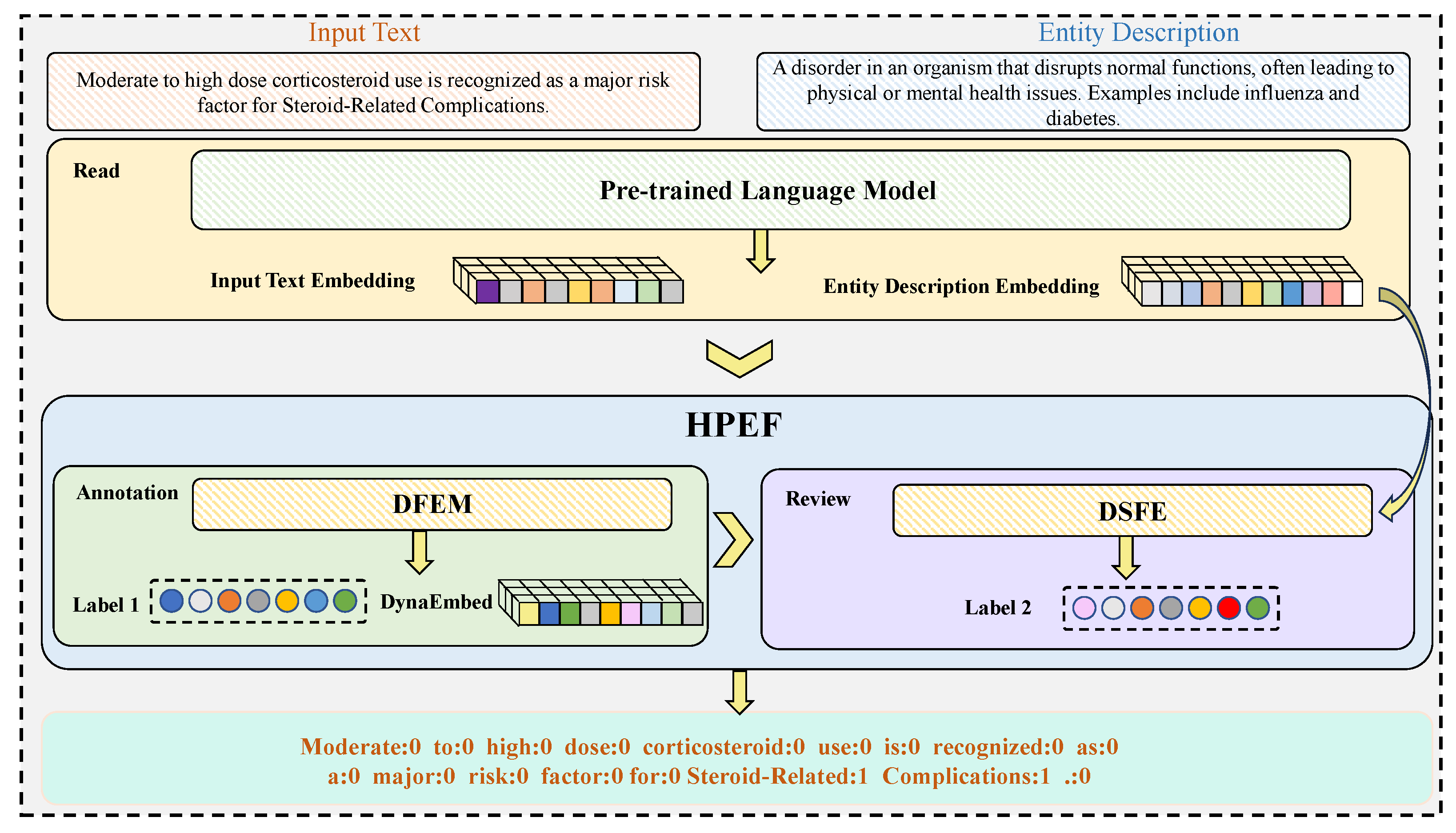
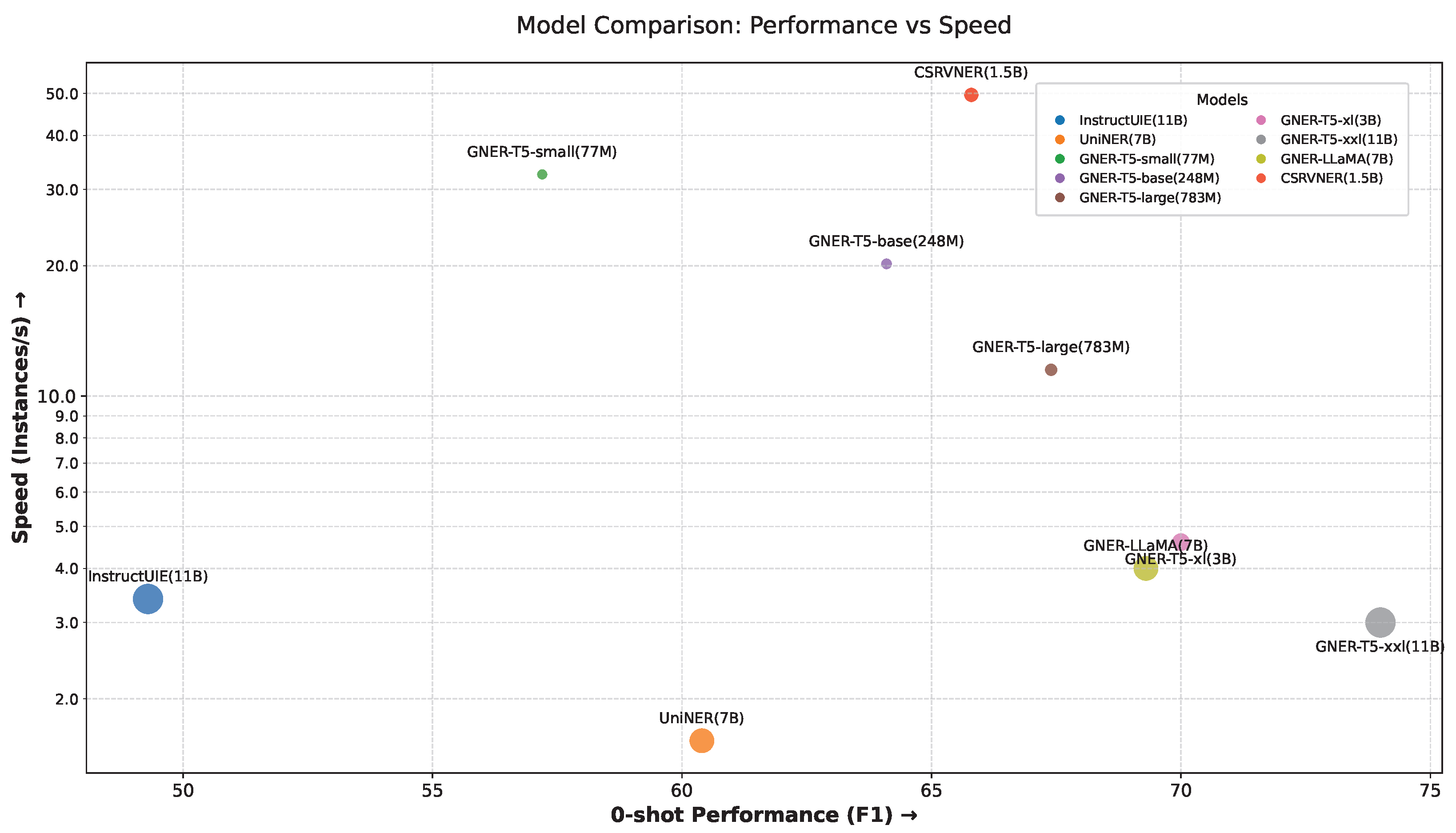
- We propose an encoding-based NER framework that simulates human cognitive processes through a Hierarchical Progressive Entity Filtering (HPEF) mechanism for open-type entity recognition. Experimental results show that the framework significantly improves recognition accuracy while maintaining highly efficient inference performance.
- To address the challenge of effective entity localization, we design a Dynamic Feature-to-Entity Mapping (DFEM) module. DFEM integrates entity description semantics with contextual text features through cross-attention and adaptive feature fusion, enabling dynamic modeling of contextual dependencies and improving semantic alignment. The resulting representations offer high-quality contextual semantics for the subsequent entity filtering stage.
- Building upon DFEM, we further introduce a Dynamic Span Feature Encoder (DSFE) as a refinement stage to enhance candidate entity representations. DSFE utilizes a multi-layer cross-attention framework for fine-grained semantic verification, enabling it to suppress low-confidence predictions and strengthen entity boundary coherence.
2. Related Work
2.1. Traditional NER Approaches
2.1.1. StatisticalMachine Learning Methods
2.1.2. Deep Learning Methods
2.2. Span-Based NER Approaches
2.3. Zero-Shot NER
3. Method
3.1. Hierarchical Progressive Entity Filtering
3.2. Dynamic Feature-to-Entity Mapping
3.2.1. Iterative Attention Refinement
3.2.2. Attention Computation
3.2.3. Classification
3.3. Dynamic Span Feature Encoder
3.3.1. Candidate Span Generation via Greedy Strategy
3.3.2. Span Representation and Fusion
3.3.3. Span-Level Classification
- represents the probability distribution of span over entity categories (including a “None” class for invalid spans). The final decision depends entirely on this review result.
3.4. Training Objectives
3.4.1. Phase 1: Annotation Module (Token-Level Learning)
3.4.2. Phase 2: Review Module (Span-Level Learning)
- K is the number of candidate spans generated by the greedy strategy.
- is the ground truth label for the k-th span. We assign a positive entity label to if its Intersection over Union (IoU) with a ground truth entity exceeds 0.5; otherwise, it is labeled as “None” (invalid).
- is the model’s predicted probability that span belongs to category .
- is a weight coefficient assigned to positive entity spans to address the imbalance between valid entities and false-positive spans.
4. Experiment Settings
4.1. Training Data
4.2. Evaluation
4.2.1. Datasets
4.2.2. BaseLines
4.2.3. Metrics
5. Results and Analysis
5.1. Zero-Shot Performance
5.1.1. OOD NER Benchmark
5.1.2. 15 NER Benchmark
5.2. Inference Speed
5.3. Ablation Studies
5.3.1. Effectiveness Evaluation of DFEM
5.3.2. Impact of Model Capacity Analysis
5.3.3. Contribution Analysis of HPEF
5.4. Qualitative Analysis
6. Conclusions
Author Contributions
Funding
Institutional Review Board Statement
Informed Consent Statement
Data Availability Statement
Conflicts of Interest
Appendix A
Appendix A.1. Hyperparameters

| Hyperparameter | Value |
|---|---|
| Optimizer | |
| Optimizer | AdamW |
| lr_encoder | |
| lr_others | |
| Training Parameters | |
| epoch | 3 |
| warmup_ratio | - |
| train_batch_size | 8 |
| eval_every | 5000 |
| Model Configuration | |
| model_name | Qwen2.5-1.5B |
| fine_tune | false |
| hidden_size | 1536 |
| dropout | 0.3 |
Appendix A.2. Entity Description Generation
Entity Description Generation Details
| Dataset | Train | Dev | Test | Types | Avg. Tokens | Avg. Entities |
|---|---|---|---|---|---|---|
| AnatEM [58] | 5861 | 2118 | 3830 | 1 | 37 | 0.7 |
| bc2gn [59] | 12,500 | 2500 | 5000 | 1 | 36 | 0.4 |
| bc4chend [60] | 30,682 | 30,639 | 26,364 | 1 | 45 | 0.9 |
| bc5cdr [61] | 4560 | 4581 | 4797 | 2 | 41 | 2.2 |
| conll 03 [24] | 14,041 | 3250 | 3453 | 3 | 25 | 1.9 |
| GENIA [62] | 15,023 | 1669 | 1854 | 5 | 43 | 3.5 |
| HarveyNER [63] | 3967 | 1301 | 1303 | 4 | 48 | 0.4 |
| MultiNERD [64] | 134,144 | 10,000 | 10,000 | 16 | 28 | 1.6 |
| ncbi [65] | 5432 | 923 | 940 | 1 | 39 | 1.0 |
| Ontonotes [37] | 59,924 | 8528 | 8262 | 18 | 18 | 0.9 |
| PolyglotNER [66] | 393,982 | 10,000 | 10,000 | 3 | 34 | 1.0 |
| TweetNER7 [67] | 7111 | 886 | 576 | 7 | 52 | 3.1 |
| WikiANN en [68] | 20,000 | 10,000 | 10,000 | 3 | 15 | 1.4 |
| FindVehicle [69] | 21,565 | 20,777 | 20,777 | 21 | 33 | 5.5 |
| CrossNER AI [4] | 100 | 350 | 431 | 13 | 52 | 5.3 |
| CrossNER Literature [4] | 100 | 400 | 416 | 11 | 54 | 5.4 |
| CrossNER Music [4] | 100 | 380 | 465 | 12 | 57 | 6.5 |
| CrossNER Politics [4] | 199 | 540 | 650 | 8 | 61 | 6.5 |
| CrossNER Science [4] | 200 | 450 | 543 | 16 | 54 | 5.4 |
References
- Nadeau, D.; Sekine, S. A survey of named entity recognition and classification. Lingvisticae Investig. 2007, 30, 3–26. [Google Scholar] [CrossRef]
- Chiu, J.P.; Nichols, E. Named entity recognition with bidirectional lstm-cnns. Trans. Assoc. Comput. Linguist. 2016, 4, 357–370. [Google Scholar] [CrossRef]
- Sun, C.; Yang, Z.; Wang, L.; Zhang, Y.; Lin, H.; Wang, J. Biomedical named entity recognition using bert in the machine reading comprehension framework. J. Biomed. Inform. 2021, 118, 103799. [Google Scholar] [CrossRef]
- Liu, Z.; Xu, Y.; Yu, T.; Dai, W.; Ji, Z.; Cahyawijaya, S.; Madotto, A.; Fung, P. CrossNER: Evaluating Cross-Domain Named Entity Recognition. In Proceedings of the AAAI Conference on Artificial Intelligence, Virtual Event, 2–9 February 2021; Volume 35, pp. 13452–13460. [Google Scholar]
- Achiam, J.; Adler, S.; Agarwal, S.; Ahmad, L.; Akkaya, I.; Aleman, F.L.; Almeida, D.; Altenschmidt, J.; Altman, S.; Anadkat, S.; et al. Gpt-4 technical report. arXiv 2023, arXiv:2303.08774. [Google Scholar] [CrossRef]
- Touvron, H.; Lavril, T.; Izacard, G.; Martinet, X.; Lachaux, M.A.; Lacroix, T.; Rozière, B.; Goyal, N.; Hambro, E.; Azhar, F.; et al. Llama: Open and efficient foundation language models. arXiv 2023, arXiv:2302.13971. [Google Scholar] [CrossRef]
- Xie, T.; Li, Q.; Zhang, J.; Zhang, Y.; Liu, Z.; Wang, H. Empirical study of zero-shot ner with chatgpt. arXiv 2023, arXiv:2310.10035. [Google Scholar] [CrossRef]
- Zhou, W.; Zhang, S.; Gu, Y.; Chen, M.; Poon, H. Universalner: Targeted distillation from large language models for open named entity recognition. arXiv 2023, arXiv:2308.03279. [Google Scholar]
- Sainz, O.; García-Ferrero, I.; Agerri, R.; de Lacalle, O.L.; Rigau, G.; Agirre, E. Gollie: Annotation guidelines improve zero-shot information-extraction. arXiv 2023, arXiv:2310.03668. [Google Scholar]
- Zaratiana, U.; Tomeh, N.; Holat, P.; Charnois, T. GLiNER: Generalist model for named entity recognition using bidirectional transformer. arXiv 2023, arXiv:2311.08526. [Google Scholar] [CrossRef]
- Warden, P.; Situnayake, D. TinyML: Machine Learning with TensorFlow Lite on Arduino and Ultra-Low-Power Microcontrollers; O’Reilly Media: Sebastopol, CA, USA, 2019. [Google Scholar]
- Shumailov, I.; Shumaylov, Z.; Zhao, Y.; Gal, Y.; Papernot, N.; Anderson, R. The curse of recursion: Training on generated data makes models forget. arXiv 2023, arXiv:2305.17493. [Google Scholar]
- Pope, R.; Douglas, S.; Chowdhery, A.; Devlin, J.; Bradbury, J.; Heek, J.; Xiao, K.; Agrawal, S.; Dean, J. Efficiently scaling transformer inference. Proc. Mach. Learn. Syst. 2023, 5, 606–624. [Google Scholar]
- Wang, Y.; Tong, H.; Zhu, Z.; Li, Y. Nested named entity recognition: A survey. ACM Trans. Knowl. Discov. Data 2022, 16, 1–29. [Google Scholar] [CrossRef]
- Huang, P.; Zhao, X.; Hu, M.; Fang, Y.; Li, X.; Xiao, W. Extract-select: A span selection framework for nested named entity recognition with generative adversarial training. In Proceedings of the Findings of the Association for Computational Linguistics: ACL 2022, Dublin, Ireland, 22–27 May 2022; Association for Computational Linguistics: Stroudsburg, PA, USA, 2022; pp. 85–96. [Google Scholar]
- Zhu, E.; Liu, Y.; Jin, M.; Li, J. Recognizing nested entities from flat supervision: A new ner subtask, feasibility and challenges. arXiv 2022, arXiv:2211.00301. [Google Scholar]
- Wan, J.; Ru, D.; Zhang, W.; Yu, Y. Nested named entity recognition with span-level graphs. In Proceedings of the 60th Annual Meeting of the Association for Computational Linguistics (Volume 1: Long Papers), Dublin, Ireland, 22–27 May 2022; Association for Computational Linguistics: Stroudsburg, PA, USA, 2022; pp. 892–903. [Google Scholar]
- Si, S.; Cai, Z.; Zeng, S.; Feng, G.; Lin, J.; Chang, B. SANTA: Separate strategies for inaccurate and incomplete annotation noise in distantly-supervised named entity recognition. In Proceedings of the Findings of the Association for Computational Linguistics: ACL 2023, Toronto, AB, Canada, 9–14 July 2023; Association for Computational Linguistics: Stroudsburg, PA, USA, 2023; pp. 3883–3896. [Google Scholar]
- Mao, H.; Mao, X.L.; Tang, H.; Shang, Y.M.; Gao, X.; Ma, A.J.; Huang, H. Span-based unified named entity recognition framework via contrastive learning. In Proceedings of the Thirty-Third International Joint Conference on Artificial Intelligence (IJCAI-24), Jeju, Republic of Korea, 3–9 August 2024; International Joint Conferences on Artificial Intelligence: Montreal, QC, Canada, 2024; pp. 6406–6414. [Google Scholar]
- Zhou, W.; Zhang, S.; Gu, Y.; Chen, M.; Poon, H. Recent advances in named entity recognition: A survey. arXiv 2024, arXiv:2404.14294. [Google Scholar]
- Sutton, C.; Rohanimanesh, K.; McCallum, A. Dynamic conditional random fields: Factorized probabilistic models for labeling and segmenting sequence data. In Proceedings of the Twenty-First International Conference on Machine Learning, Banff, AB, Canada, 4–8 July 2004; ACM: New York, NY, USA, 2004; p. 99. [Google Scholar]
- Sun, X.; Sun, S.; Yin, M.; Yang, H. Hybrid neural conditional random fields for multi-view sequence labeling. Knowl.-Based Syst. 2020, 189, 105151. [Google Scholar] [CrossRef]
- Ekbal, A.; Bandyopadhyay, S. Named Entity Recognition Using Support Vector Machine: A Language Independent Approach. Int. J. Electr. Comput. Syst. Eng. 2010, 4, 155–170. [Google Scholar]
- Sang, E.F.; De Meulder, F. Introduction to the CoNLL-2003 Shared Task: Language-Independent Named Entity Recognition. arXiv 2003, arXiv:cs/0306050. [Google Scholar]
- Finkel, J.R.; Grenager, T.; Manning, C.D. Incorporating Non-local Information into Information Extraction Systems by Gibbs Sampling. In Proceedings of the 43rd Annual Meeting of the Association for Computational Linguistics (ACL’05), Ann Arbor, MI, USA, 25–30 June 2005; Association for Computational Linguistics: Stroudsburg, PA, USA, 2005; pp. 363–370. [Google Scholar]
- Collobert, R.; Weston, J.; Bottou, L.; Karlen, M.; Kavukcuoglu, K.; Kuksa, P. Natural Language Processing (Almost) from Scratch. J. Mach. Learn. Res. 2011, 12, 2493–2537. [Google Scholar]
- Finkel, J.R.; Manning, C.D. Joint Parsing and Named Entity Recognition. In Proceedings of Human Language Technologies: The 2009 Annual Conference of the North American Chapter of the Association for Computational Linguistics; Association for Computational Linguistics: Stroudsburg, PA, USA, 2009; pp. 326–334. [Google Scholar]
- Johnson, R.; Zhang, T. A High-Performance Semi-Supervised Learning Method for Text Chunking. In Proceedings of the 43rd Annual Meeting of the Association for Computational Linguistics (ACL’05), Ann Arbor, MI, USA, 25–30 June 2005; Association for Computational Linguistics: Stroudsburg, PA, USA, 2005; pp. 1–9. [Google Scholar]
- Luo, L.; Yang, Z.; Yang, P.; Zhang, Y.; Wang, L.; Lin, H.; Wang, J. An attention-based bilstm-crf approach to document-level chemical named entity recognition. Bioinformatics 2018, 34, 1381–1388. [Google Scholar] [CrossRef]
- Li, D.; Yan, L.; Yang, J.; Ma, Z. Dependency syntax guided bert-bilstm-gam-crf for chinese ner. Expert Syst. Appl. 2022, 196, 116682. [Google Scholar] [CrossRef]
- Vaswani, A.; Shazeer, N.; Parmar, N.; Uszkoreit, J.; Jones, L.; Gomez, A.N.; Kaiser, Ł.; Polosukhin, I. Attention is All You Need. In Advances in Neural Information Processing Systems; Guyon, I., Luxburg, U.V., Bengio, S., Wallach, H., Fergus, R., Vishwanathan, S., Garnett, R., Eds.; Curran Associates, Inc.: Red Hook, NY, USA, 2017; Volume 30, pp. 5998–6008. [Google Scholar]
- Ushio, A.; Camacho-Collados, J. T-NER: An All-Round Python Library for Transformer-Based Named Entity Recognition. arXiv 2022, arXiv:2209.12616. [Google Scholar]
- Devlin, J.; Chang, M.W.; Lee, K.; Toutanova, K. BERT: Pre-training of Deep Bidirectional Transformers for Language Understanding. In Proceedings of the 2019 Conference of the North American Chapter of the Association for Computational Linguistics: Human Language Technologies, Volume 1 (Long and Short Papers), Minneapolis, MN, USA, 2–7 June 2019; pp. 4171–4186. [Google Scholar]
- Hakala, K.; Pyysalo, S. Biomedical Named Entity Recognition with Multilingual BERT. In Proceedings of the 5th Workshop on BioNLP Open Shared Tasks, Hong Kong, China, 4 November 2019; Association for Computational Linguistics: Stroudsburg, PA, USA, 2019; pp. 56–61. [Google Scholar]
- Souza, F.; Nogueira, R.; Lotufo, R. Portuguese Named Entity Recognition Using BERT-CRF. arXiv 2019, arXiv:1909.10649. [Google Scholar]
- Li, X.; Zhang, H.; Zhou, X.H. Chinese Clinical Named Entity Recognition with Variant Neural Structures Based on BERT Methods. J. Biomed. Inform. 2020, 107, 103422. [Google Scholar] [CrossRef]
- Weischedel, R.; Palmer, M.; Marcus, M.; Hovy, E.; Pradhan, S.; Ramshaw, L.; Xue, N.; Taylor, A.; Kaufman, J.; Franchini, M.; et al. OntoNotes Release 5.0 LDC2013T19; Linguistic Data Consortium: Philadelphia, PA, USA, 2013. [Google Scholar]
- Sohrab, M.G.; Miwa, M. Deep exhaustive model for nested named entity recognition. In Proceedings of the 2018 Conference on Empirical Methods in Natural Language Processing (EMNLP), Brussels, Belgium, 31 October–4 November 2018; ACL: San Jose, CA, USA, 2018; pp. 2843–2849. [Google Scholar]
- Fu, J.; Kong, X.; Zhang, Y.; Xu, W.; Zhou, G. SPAN: Structured Prediction Adaptation Network for Generalized Zero-Shot Learning. In Proceedings of the AAAI Conference on Artificial Intelligence, Virtual, 19–21 May 2021; pp. 12875–12883. [Google Scholar]
- Zheng, C.; Cai, Y.; Xu, J.; Leung, H.F.; Xu, G. A Boundary-aware Neural Model for Nested Named Entity Recognition. In Proceedings of the 2019 Conference on Empirical Methods in Natural Language Processing (EMNLP), Hong Kong, China, 3–7 November 2019; ACL: San Jose, CA, USA, 2019; pp. 357–366. [Google Scholar]
- Xu, G.; Zhang, Y.; Liu, M. SEE-Few: Seed, Expand and Entail for Few-shot Named Entity Recognition. In Proceedings of the 60th Annual Meeting of the Association for Computational Linguistics (ACL), Dublin, Ireland, 22–27 May 2022; ACL: San Jose, CA, USA, 2022; pp. 2637–2651. [Google Scholar]
- Li, X.; Chen, X.; Shen, Y.; Zhang, S.; Chen, Q.; Huang, X.; Qiu, X. Unified Named Entity Recognition as Word-Word Relation Classification. In Proceedings of the 60th Annual Meeting of the Association for Computational Linguistics (ACL), Dublin, Ireland, 22–27 May 2022; ACL: San Jose, CA, USA, 2022; pp. 4730–4742. [Google Scholar]
- Zhang, S.; Chen, X.; Qiu, X.; Huang, X. DeepKE: A Deep Learning-Based Knowledge Extraction Toolkit for Knowledge Graph Construction. In Proceedings of the 60th Annual Meeting of the Association for Computational Linguistics: System Demonstrations, Dublin, Ireland, 22–27 May 2022; ACL: San Jose, CA, USA, 2022; pp. 289–296. [Google Scholar]
- Yu, J.; Bohnet, B.; Poesio, M. Named Entity Recognition as Dependency Parsing. In Proceedings of the 58th Annual Meeting of the Association for Computational Linguistics (ACL), Online, 5–10 July 2020; ACL: San Jose, CA, USA, 2020; pp. 6470–6476. [Google Scholar]
- Wang, X.; Lu, Y.; Wang, H.; Yu, D.; Zhang, X.; Liu, K. SPANNER: Named Entity Recognition as Span Boundary Detection. In Proceedings of the 2021 Conference on Empirical Methods in Natural Language Processing (EMNLP), Virtual Event/Punta Cana, Dominican Republic, 7–11 November 2021; ACL: San Jose, CA, USA, 2021; pp. 256–267. [Google Scholar]
- Shen, Y.; Wang, X.; Wang, H.; Zhang, X.; Liu, K.; Huang, S. Locate and Label: A Two-stage Identifier for Nested Named Entity Recognition. In Proceedings of the 59th Annual Meeting of the Association for Computational Linguistics (ACL), Online, 1–6 August 2021; ACL: San Jose, CA, USA, 2021; pp. 2782–2794. [Google Scholar]
- Yan, H.; Li, T.; Ji, J.; Qiu, X.; Huang, X. A Unified Generative Framework for Various NER Subtasks. In Proceedings of the 59th Annual Meeting of the Association for Computational Linguistics (ACL), Online, 1–6 August 2021; ACL: San Jose, CA, USA, 2021; pp. 5808–5822. [Google Scholar]
- Li, X.; Zhao, X.; Lu, Y.; Zhang, X.; Liu, K. Dice Loss for Data-imbalanced NLP Tasks. In Proceedings of the 60th Annual Meeting of the Association for Computational Linguistics (ACL), Dublin, Ireland, 22–27 May 2022; ACL: San Jose, CA, USA, 2022; pp. 7661–7670. [Google Scholar]
- Wei, J.; Bosma, M.; Zhao, V.; Guu, K.; Yu, A.W.; Lester, B.; Du, N.; Dai, A.M.; Le, Q.V. Finetuned Language Models are Zero-Shot Learners. arXiv 2021, arXiv:2109.01652. Available online: https://arxiv.org/abs/2109.01652 (accessed on 4 January 2026).
- Ouyang, L.; Wu, J.; Jiang, X.; Almeida, D.; Wainwright, C.; Mishkin, P.; Zhang, C.; Agarwal, S.; Slama, K.; Ray, A.; et al. Training language models to follow instructions with human feedback. Adv. Neural Inf. Process. Syst. 2022, 35, 27730–27744. [Google Scholar]
- Wang, X.; Zhou, W.; Zu, C.; Xia, H.; Chen, T.; Zhang, Y.; Zheng, R.; Ye, J.; Zhang, Q.; Gui, T.; et al. InstructUIE: Multi-task Instruction Tuning for Unified Information Extraction. arXiv 2023, arXiv:2304.08085. [Google Scholar]
- Ding, Y.; Li, J.; Wang, P.; Tang, Z.; Yan, B.; Zhang, M. Rethinking negative instances for generative named entity recognition. arXiv 2024, arXiv:2402.16602. [Google Scholar] [CrossRef]
- Chiang, W.-L.; Li, Z.; Lin, Z.; Sheng, Y.; Wu, Z.; Zhang, H.; Zheng, L.; Zhuang, S.; Zhuang, Y.; Gonzalez, J.E.; et al. Vicuna: An Open-Source Chatbot Impressing GPT-4 with 90%* ChatGPT Quality. LMSYS Org. 2023. Available online: https://lmsys.org/blog/2023-03-30-vicuna/ (accessed on 4 January 2026).
- Ye, J.; Chen, X.; Xu, N.; Zu, C.; Shao, Z.; Liu, S.; Cui, Y.; Zhou, Z.; Gong, C.; Shen, Y.; et al. A Comprehensive Capability Analysis of GPT-3 and GPT-3.5 Series Models. arXiv 2023, arXiv:2303.10420. [Google Scholar] [CrossRef]
- Lou, J.; Lu, Y.; Dai, D.; Jia, W.; Lin, H.; Han, X.; Sun, L.; Wu, H. Universal Information Extraction as Unified Semantic Matching. In Proceedings of the AAAI Conference on Artificial Intelligence, Washington, DC, USA, 7–14 February 2023. [Google Scholar]
- Qwen Team. Qwen2.5: A Party of Foundation Models. 2024. Available online: https://qwenlm.github.io/blog/qwen2.5/ (accessed on 18 September 2024).
- Yang, A.; Yang, B.; Hui, B.; Zheng, B.; Yu, B.; Zhou, C.; Li, C.; Li, C.; Liu, D.; Huang, F.; et al. Qwen2 Technical Report. arXiv 2024, arXiv:2407.10671. [Google Scholar]
- Pyysalo, S.; Ananiadou, S. Anatomical entity mention recognition at literature scale. Bioinformatics 2014, 30, 868–875. [Google Scholar] [CrossRef] [PubMed]
- Smith, L.; Tanabe, L.K.; Kuo, C.J.; Chung, I.; Hsu, C.N.; Lin, Y.S.; Klinger, R.; Friedrich, C.M.; Ganchev, K.; Torii, M.; et al. Overview of BioCreative II gene mention recognition. Genome Biol. 2008, 9, S2. [Google Scholar] [CrossRef]
- Krallinger, M.; Rabal, O.; Leitner, F.; Vazquez, M.; Salgado, D.; Lu, Z.; Leaman, R.; Lu, Y.; Ji, D.; Lowe, D.M.; et al. The CHEMDNER corpus of chemicals and drugs and its annotation principles. J. Cheminform. 2015, 7, S2. [Google Scholar] [CrossRef]
- Li, J.; Sun, Y.; Johnson, R.J.; Sciaky, D.; Wei, C.H.; Leaman, R.; Davis, A.P.; Mattingly, C.J.; Wiegers, T.C.; Lu, Z. BioCreative V CDR task corpus: A resource for chemical disease relation extraction. Database 2016, 2016, baw068. [Google Scholar] [CrossRef] [PubMed]
- Kim, J.D.; Ohta, T.; Tateisi, Y.; Tsujii, J. GENIA Corpus—A Semantically Annotated Corpus for Bio-Textmining. Bioinformatics 2003, 19, i180–i182. [Google Scholar] [CrossRef]
- Chen, P.; Xu, H.; Zhang, C.; Huang, R. Crossroads, buildings and neighborhoods: A dataset for fine-grained location recognition. In Proceedings of the 2022 Conference of the North American Chapter of the Association for Computational Linguistics: Human Language Technologies, Seattle, WA, USA, 10–15 July 2022; Association for Computational Linguistics: Seattle, WA, USA, 2022; pp. 3329–3339. [Google Scholar]
- Tedeschi, S.; Navigli, R. MultiNERD: A multilingual, multi-genre and fine-grained dataset for named entity recognition (and disambiguation). In Proceedings of the Findings of the Association for Computational Linguistics: NAACL 2022, Seattle, WA, USA, 10–15 July 2022; Association for Computational Linguistics: Seattle, WA, USA, 2022; pp. 801–812. [Google Scholar]
- Doğan, R.I.; Leaman, R.; Lu, Z. NCBI disease corpus: A resource for disease name recognition and concept normalization. J. Biomed. Inform. 2014, 47, 1–10. [Google Scholar] [CrossRef]
- Al-Rfou, R.; Kulkarni, V.; Perozzi, B.; Skiena, S. Polyglot-NER: Massive multilingual named entity recognition. In Proceedings of the 2015 SIAM International Conference on Data Mining, Vancouver, BC, Canada, 30 April–2 May 2015; SIAM: Bangkok, Thailand, 2015; pp. 586–594. [Google Scholar]
- Ushio, A.; Neves, L.; Silva, V.; Barbieri, F.; Camacho-Collados, J. Named Entity Recognition in Twitter: A Dataset and Analysis on Short-Term Temporal Shifts. In Proceedings of the 2nd Conference of the Asia-Pacific Chapter of the Association for Computational Linguistics and the 12th International Joint Conference on Natural Language Processing, Taipei, Taiwan, 20–23 November 2022; Association for Computational Linguistics: Seattle, WA, USA, 2022. [Google Scholar]
- Pan, X.; Zhang, B.; May, J.; Nothman, J.; Knight, K.; Ji, H. Cross-lingual Name Tagging and Linking for 282 Languages. In Proceedings of the 55th Annual Meeting of the Association for Computational Linguistics (Volume 1: Long Papers), Vancouver, BC, Canada, 30 July–4 August 2017; Association for Computational Linguistics: Stroudsburg, PA, USA, 2017; pp. 1946–1958. [Google Scholar]
- Guan, R.; Man, K.L.; Chen, F.; Yao, S.; Hu, R.; Zhu, X.; Smith, J.; Lim, E.G.; Yue, Y. FindVehicle and VehicleFinder: A NER dataset for natural language-based vehicle retrieval and a keyword-based cross-modal vehicle retrieval system. arXiv 2023, arXiv:2304.10893. [Google Scholar] [CrossRef]


| Model | Params | AI | Literature | Music | Politics | Science | Average |
|---|---|---|---|---|---|---|---|
| Vicuna-7B | 7B | 12.8 | 16.1 | 17.0 | 20.5 | 13.0 | 18.5 |
| Vicuna-13B | 13B | 22.7 | 22.7 | 26.6 | 27.0 | 22.0 | 24.2 |
| USM | 0.3B | 28.2 | 56.0 | 44.9 | 36.1 | 44.0 | 41.8 |
| ChatGPT-3.5 | – | 52.4 | 39.8 | 66.6 | 68.5 | 67.0 | 58.9 |
| InstructUIE | 11B | 49.0 | 47.2 | 53.2 | 48.1 | 49.2 | 49.3 |
| UniNER-7B | 7B | 53.6 | 59.3 | 67.0 | 60.9 | 61.1 | 60.4 |
| UniNER-13B | 13B | 54.2 | 60.9 | 64.5 | 61.4 | 63.5 | 60.9 |
| GoLLIE | 7B | 63.0 | 62.7 | 67.8 | 57.2 | 55.5 | 61.2 |
| GLiNER-L | 0.3B | 57.2 | 64.4 | 69.6 | 72.6 | 62.6 | 65.3 |
| CSRVNER | 1.5B | 57.6 | 64.2 | 71.5 | 70.2 | 65.6 | 65.8 |
| Dataset | ChatGPT | UniNER | GLiNER | CSRVNER |
|---|---|---|---|---|
| Params | - | 7B | 0.3B | 1.5B |
| AnatEM | 30.7 | 25.1 | 33.3 | 32.1 |
| bc2gm | 40.2 | 46.2 | 47.9 | 35.2 |
| bc4chemd | 35.5 | 47.9 | 43.1 | 44.5 |
| bc5cdr | 52.4 | 68.0 | 66.4 | 68.6 |
| CoNLL03 | 52.5 | 72.2 | 64.6 | 71.5 |
| FindVehicle | 10.5 | 22.2 | 41.9 | 21.2 |
| GENIA | 41.6 | 54.1 | 55.5 | 57.8 |
| HarveyNER | 11.6 | 18.2 | 22.7 | 34.6 |
| MultiNERD | 58.1 | 59.3 | 59.7 | 71.6 |
| ncbi | 42.1 | 60.4 | 61.9 | 60.4 |
| OntoNotes | 29.7 | 27.8 | 32.2 | 42.5 |
| PolyglotNER | 33.6 | 41.8 | 42.9 | 51.7 |
| TweetNER7 | 40.1 | 42.7 | 41.4 | 41.5 |
| WikiANN | 52.0 | 55.4 | 58.9 | 65.6 |
| WikiNeural | 57.7 | 69.2 | 71.8 | 75.6 |
| Average | 39.2 | 47.3 | 49.6 | 51.6 |
| Length | W2NER | CSRVNER (Ours) | ||||
|---|---|---|---|---|---|---|
| Latency | Thr. | VRAM | Latency | Thr. | VRAM | |
| (ms)↓ | (token/s)↑ | (GB)↓ | (ms)↓ | (token/s)↑ | (GB)↓ | |
| 1000 | 85.61 | 11,680.96 | 5.75 | 273.98 | 3649.91 | 8.11 |
| 2000 | 2384.00 | 838.93 | 14.10 | 520.34 | 3843.65 | 8.53 |
| 3000 | 5287.26 | 567.40 | 27.94 | 971.28 | 3088.72 | 9.15 |
| Dataset | SA-Concat | CA-Cross |
|---|---|---|
| AI | 31.1 | 57.6 |
| Literature | 28.9 | 64.2 |
| Music | 34.0 | 71.5 |
| Politics | 39.5 | 70.2 |
| Science | 41.9 | 65.6 |
| Avg. | 35.1 | 65.8 |
| Dataset | DFEM | DFEM-Deep |
|---|---|---|
| AI | 43.6 | 44.3 |
| Literature | 45.6 | 44.0 |
| Music | 51.5 | 49.8 |
| Politics | 55.7 | 55.6 |
| Science | 50.3 | 49.9 |
| Avg. | 49.3 | 48.7 |
| Dataset | D1-Only | HPEF |
|---|---|---|
| AI | 43.6 | 57.6 |
| Literature | 45.6 | 64.2 |
| Music | 51.5 | 71.5 |
| Politics | 55.7 | 70.2 |
| Science | 50.3 | 65.6 |
| Avg. | 49.3 | 65.8 |
| Error Type | Count | Percentage | Primary Cause |
|---|---|---|---|
| Span Boundary Error | 9 | 40.9% | Inclusion of titles/modifiers (e.g., Job Titles) |
| False Positives | 8 | 36.4% | Adjectival entities & Ground truth omissions |
| False Negatives | 4 | 18.2% | Missed capitalized datelines & Ambiguity |
| Tokenization Artifacts | 1 | 4.5% | Possessive suffix handling (’s) |
Disclaimer/Publisher’s Note: The statements, opinions and data contained in all publications are solely those of the individual author(s) and contributor(s) and not of MDPI and/or the editor(s). MDPI and/or the editor(s) disclaim responsibility for any injury to people or property resulting from any ideas, methods, instructions or products referred to in the content. |
© 2026 by the authors. Licensee MDPI, Basel, Switzerland. This article is an open access article distributed under the terms and conditions of the Creative Commons Attribution (CC BY) license.
Share and Cite
Yang, M.; Wang, S.; Yang, H.; Chen, N. Breaking the Speed–Accuracy Trade-Off: A Novel Embedding-Based Framework with Coarse Screening-Refined Verification for Zero-Shot Named Entity Recognition. Computers 2026, 15, 36. https://doi.org/10.3390/computers15010036
Yang M, Wang S, Yang H, Chen N. Breaking the Speed–Accuracy Trade-Off: A Novel Embedding-Based Framework with Coarse Screening-Refined Verification for Zero-Shot Named Entity Recognition. Computers. 2026; 15(1):36. https://doi.org/10.3390/computers15010036
Chicago/Turabian StyleYang, Meng, Shuo Wang, Hexin Yang, and Ning Chen. 2026. "Breaking the Speed–Accuracy Trade-Off: A Novel Embedding-Based Framework with Coarse Screening-Refined Verification for Zero-Shot Named Entity Recognition" Computers 15, no. 1: 36. https://doi.org/10.3390/computers15010036
APA StyleYang, M., Wang, S., Yang, H., & Chen, N. (2026). Breaking the Speed–Accuracy Trade-Off: A Novel Embedding-Based Framework with Coarse Screening-Refined Verification for Zero-Shot Named Entity Recognition. Computers, 15(1), 36. https://doi.org/10.3390/computers15010036